Flashback : Dallas

A Miscellany: History, Ads, Pop Culture

Category: HOF

The Republic Bank Building and Spain’s “Casa de Los Picos”

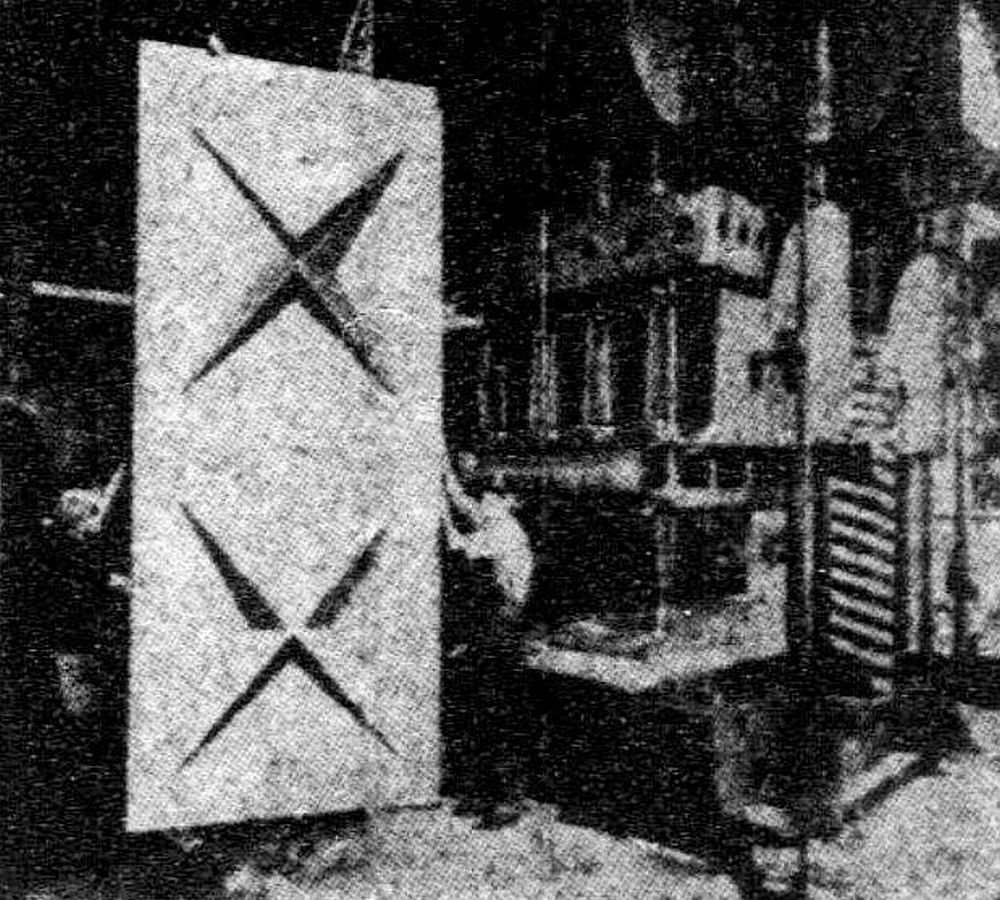
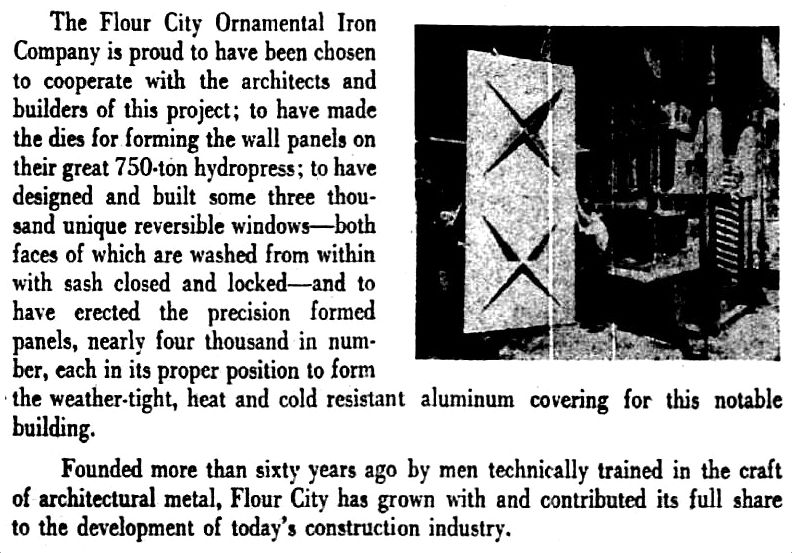
flour-city-ad_dmn_120154-panelFlour City Ornamental Iron Co. employees hard at work (click for larger image)

by Paula Bosse

Did a 15th-century building in Spain inspire one of Dallas’ most distinctive and recognizable skyscrapers?

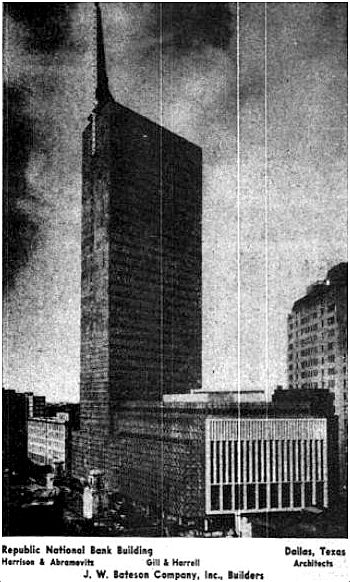
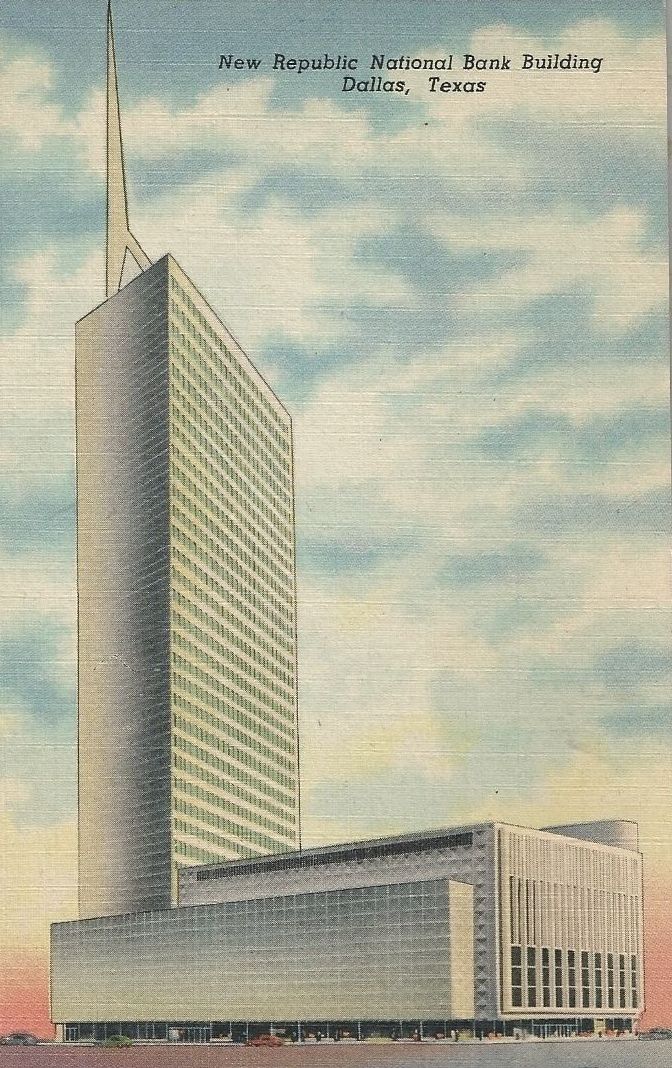
While reading about the construction of the Republic Bank Building, I came across the great, GREAT photo above which was part of an ad which ran about the time of the grand opening of the just-completed big, splashy Republic Bank Building in December, 1954. The ad this photo appeared in was for the Flour City Ornamental Iron Co. in Minnesota — the company that manufactured the thousands of pressed and embossed aluminum panels that covered the building’s exterior. These star-embossed panels — along with the distinctive and forever-cool “rocket” on the top of the building — gave the Dallas skyline a new super-modern look and an instantly recognizable landmark.

But back to that photo. It’s pretty cool. I had never really thought about those panels, but now I know that these iconic architectural adornments were manufactured in Minneapolis (…”New York CITY?!”) at the Flour City Ornamental Iron Co. Almost four thousand of these aluminum panels, a mere 1/8th of an inch thick (!), along with three thousand windows (which were reversible, so that the exterior sides could be washed from inside the building) were made in Flour City’s Minneapolis factory and transported to Dallas. From the ad:

The Flour City Ornamental Iron Company is proud to have been chosen to cooperate with the architects and builders of this project; to have made the dies for forming the wall panels on their great 750-ton hydropress; to have designed and built some three thousand unique reversible windows — both faces of which are washed from within with sash closed and locked — and to have erected the precision-formed panels, nearly four thousand in number, each in its proper position to form the weather-tight, heat and cold resistant aluminum covering for this notable building.

So, discovering that was interesting. But maybe even more interesting was this paragraph:

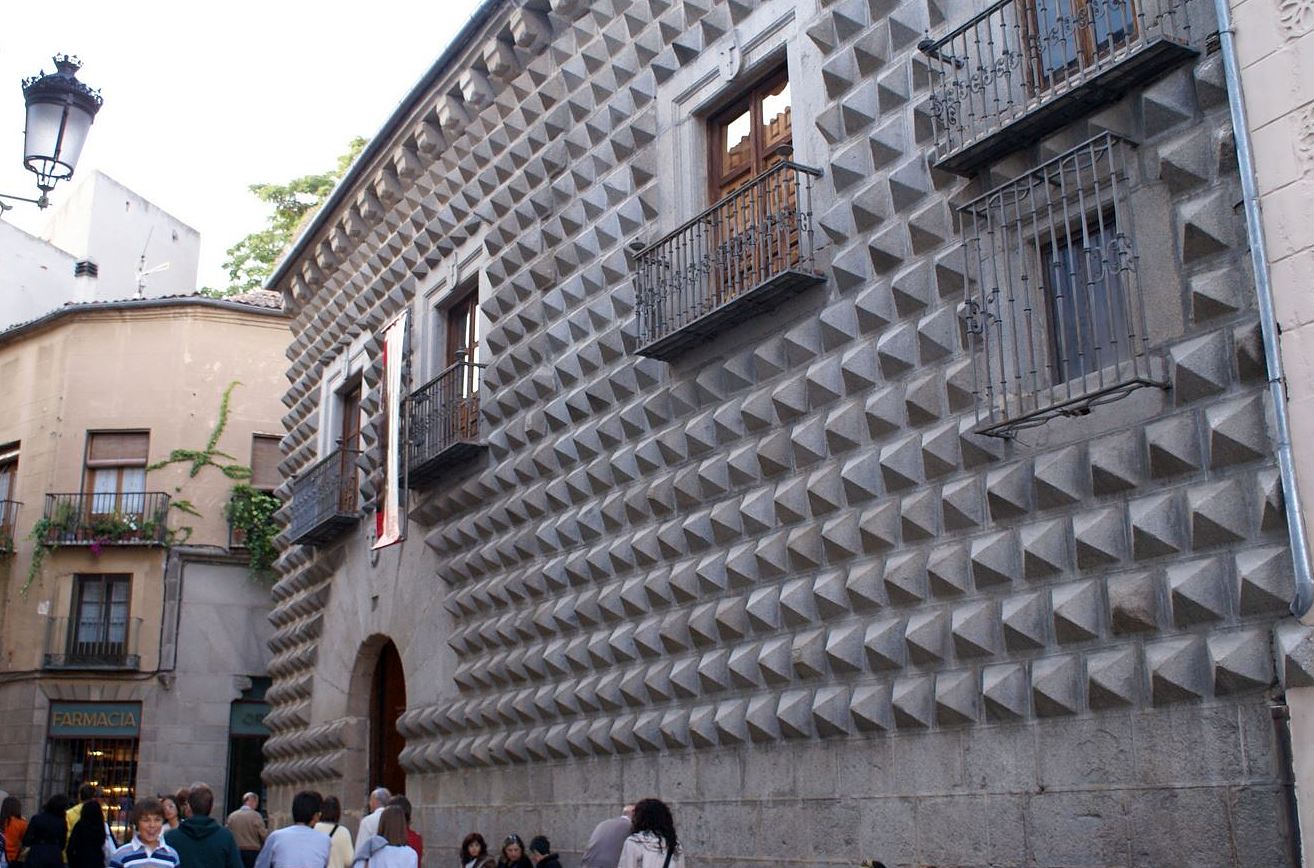
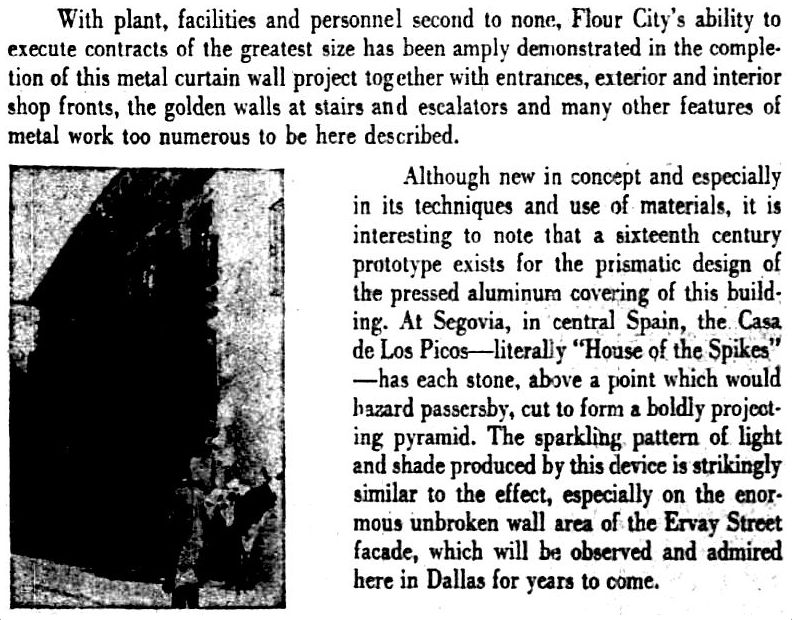
Although new in concept and especially in its techniques and use of materials, it is interesting to note that a sixteenth century [sic — it’s actually fifteenth century] prototype exists for this prismatic design of the pressed aluminum covering of this building. At Segovia, in central Spain, the Casa de Los Picos — literally ‘House of the Spikes’ — has each stone, above a point which would hazard passersby, cut to form a boldly projecting pyramid. The sparkling pattern of light and shade produced by this device is strikingly similar to the effect, especially on the enormous unbroken wall area of the Ervay Street side, which will be observed and admired here in Dallas for years to come.

I looked up Casa de Los Picos. It’s fantastic.

casa-de-los-picos_trover-websiteCasa de Los Picos, Segovia, Spain / via Trover.com

Was this design an homage of sorts to the Spanish building, conceived by the building’s main architects, Wallace K. Harrison and Max Abramovitz of the New York firm Harrison & Abramovitz? Or was it just Flour City exaggerating their work’s architectural significance? Whichever — I’m excited to have discovered Casa de Los Picos … because of an advertisement! I love this building — here it is again.

casa-de-los-picos_wikimediaWikimedia (click for gigantic image here)

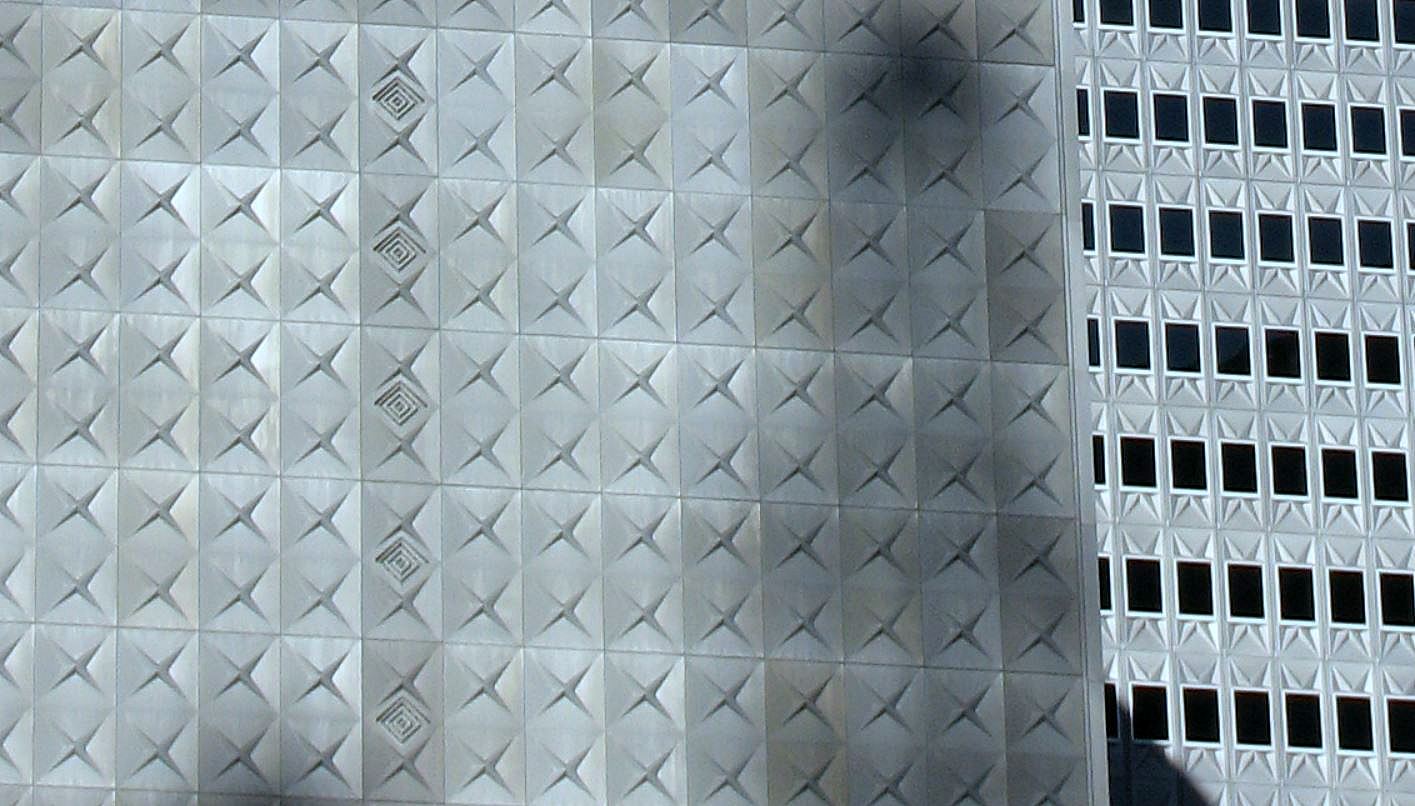
And here’s an extreme close-up of the hometown favorite.

panels_wikimedia-detWikimedia (see a fuller image image here)

You learn something new every day.

Here’s the original 1954 Flour City advertisement, broken into readable sections (click for larger images).

ad-flour-city_dmn_120154a

ad-flour-city_dmn_120154b

ad-flour-city_dmn_120154c

ad-flour-city_dmn_120154d

ad-flour-city_dmn_120154e

republic-national-bank

***

Sources & Notes

Wikipedia round-up:

  • Flour City Ornamental Iron Works Company, here
  • Casa de Los Picos (en Español), aqui
  • Harrison & Abramovitz, architects, here
  • Republic Bank Building, here

See a whole passel of photos of the exterior of Case de Los Picos, here.

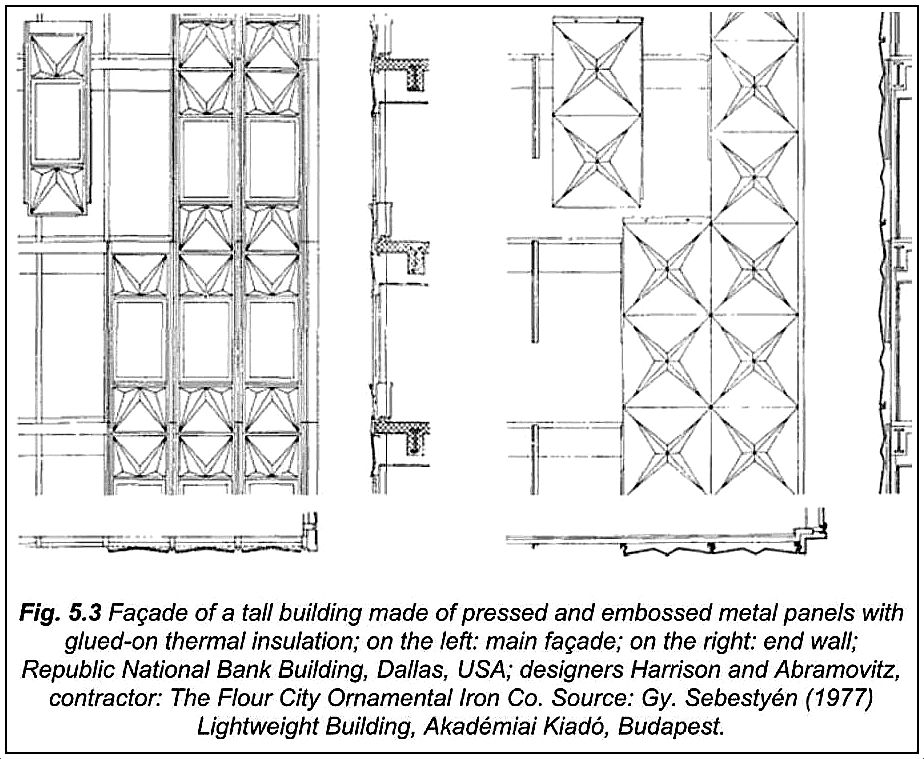
Here’s something I stumbled across in the middle of stumbling across other things — a schematic of the aluminum panels — I don’t know if they are original architectural drawings or not. They are contained in the book Construction, Craft to Industry by Gyula Sebestyen (London: E & FN Spon, 1998); you can find it here.

panel-details_construction-craft-to-industry_

I found surprisingly little information on Flour City’s contribution to the Republic Bank Building on the internet. Anyway, thanks, Minnesota, for playing such an important role in the construction of — and look of — one of my favorite Dallas buildings!

My previous post on this great building — “The Republic National Bank Building: Miles of Aluminum, Gold Leaf, and a Rocket” — is here.

When in doubt, click pictures for larger images.

*

Copyright © 2015 Paula Bosse. All Rights Reserved.


An Afternoon Outing with SMU Frat Boys & Their Dates — 1917

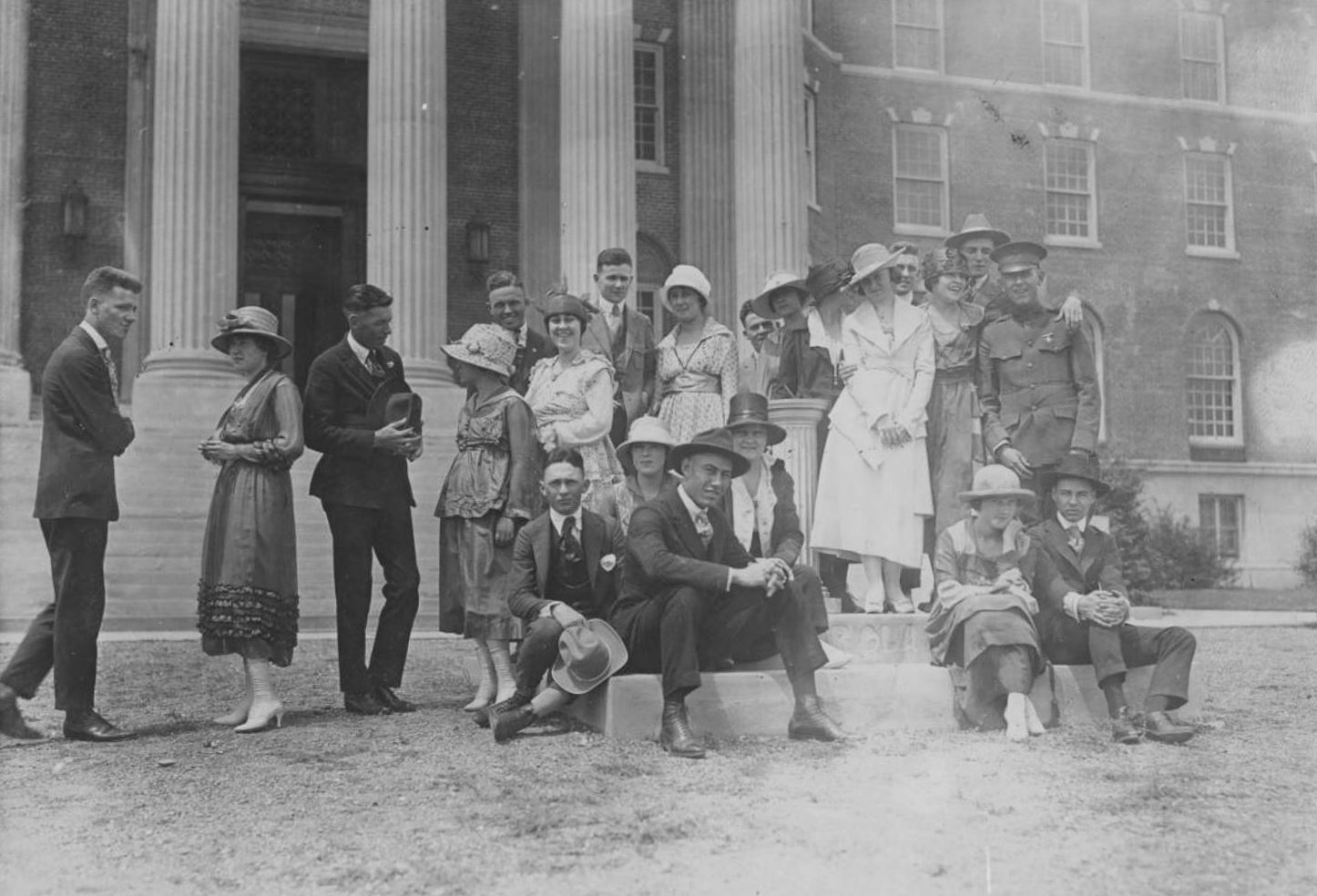
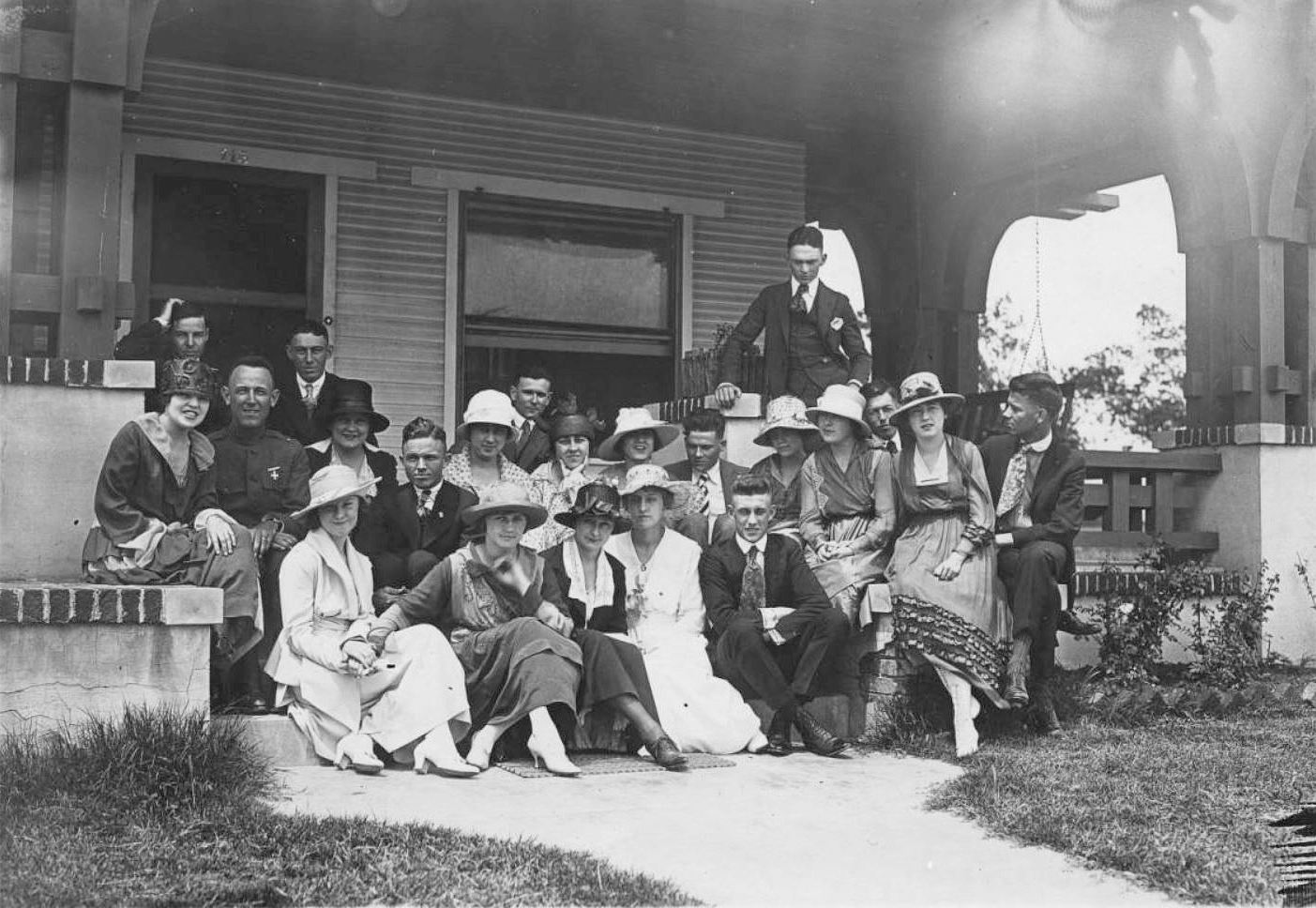
smu_omega-phi_dallas-hall_1917_degolyerCampus couples, 1917

by Paula Bosse

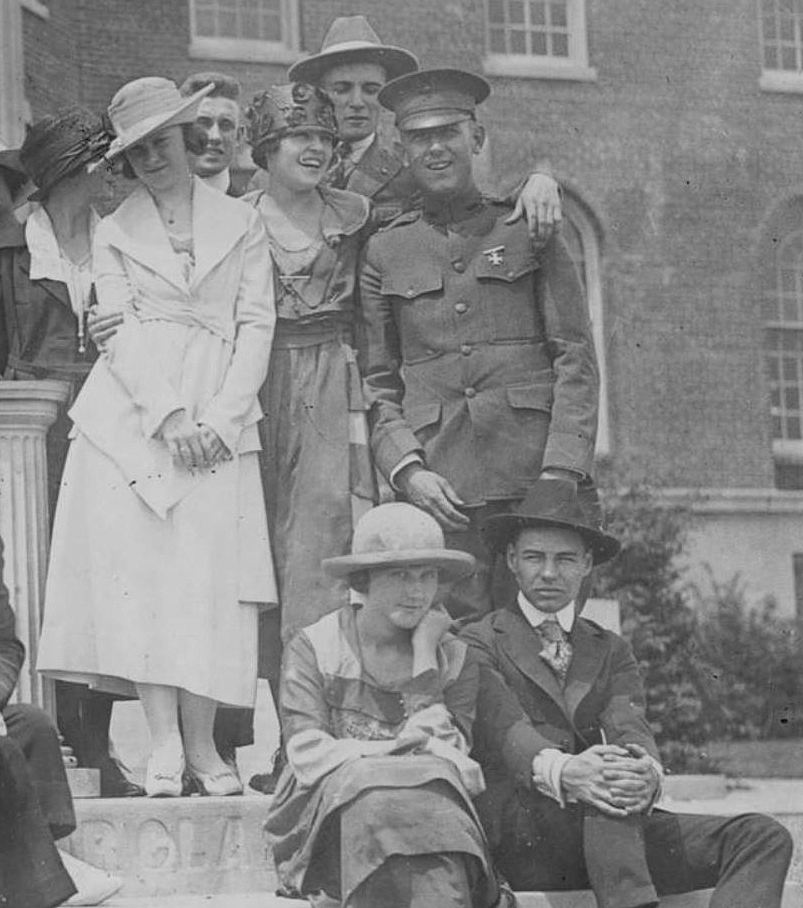
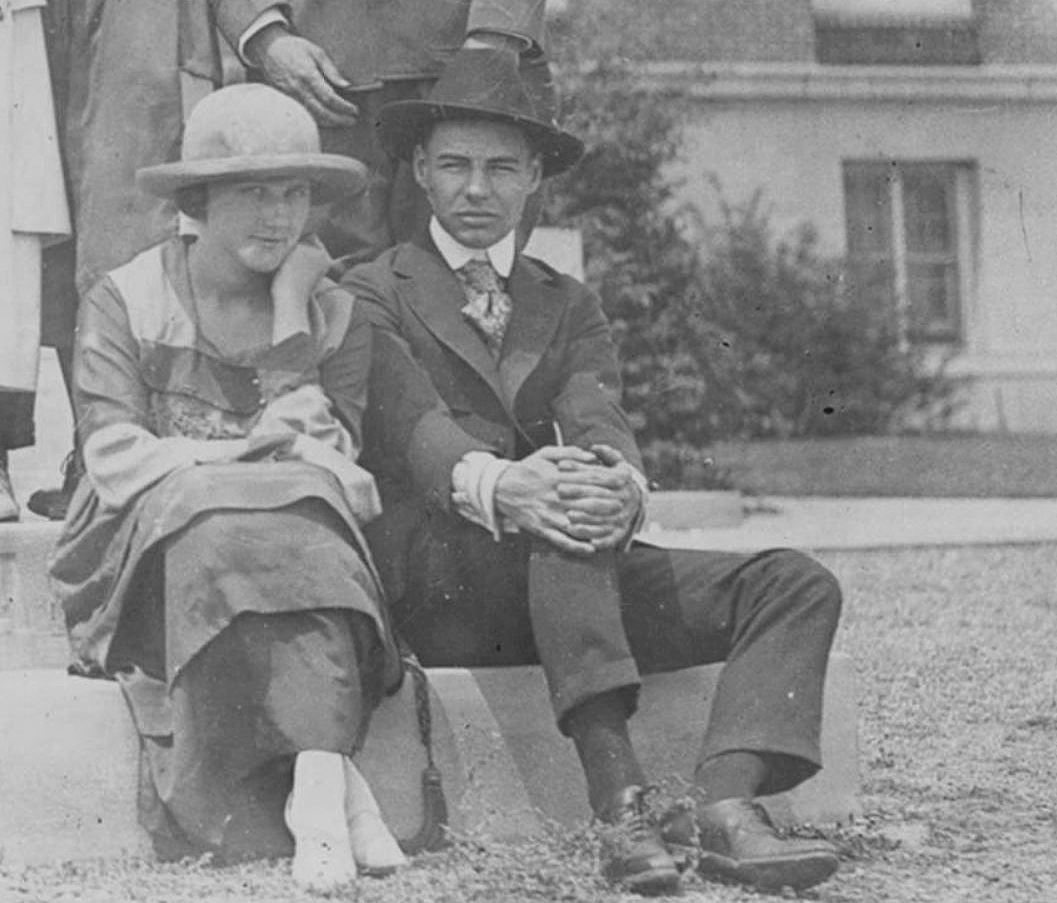
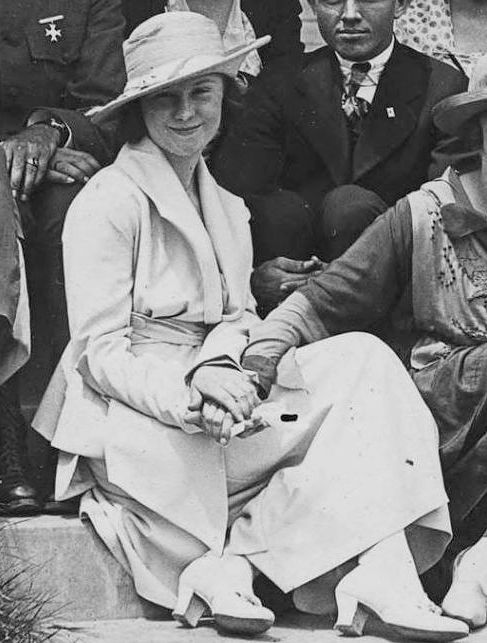
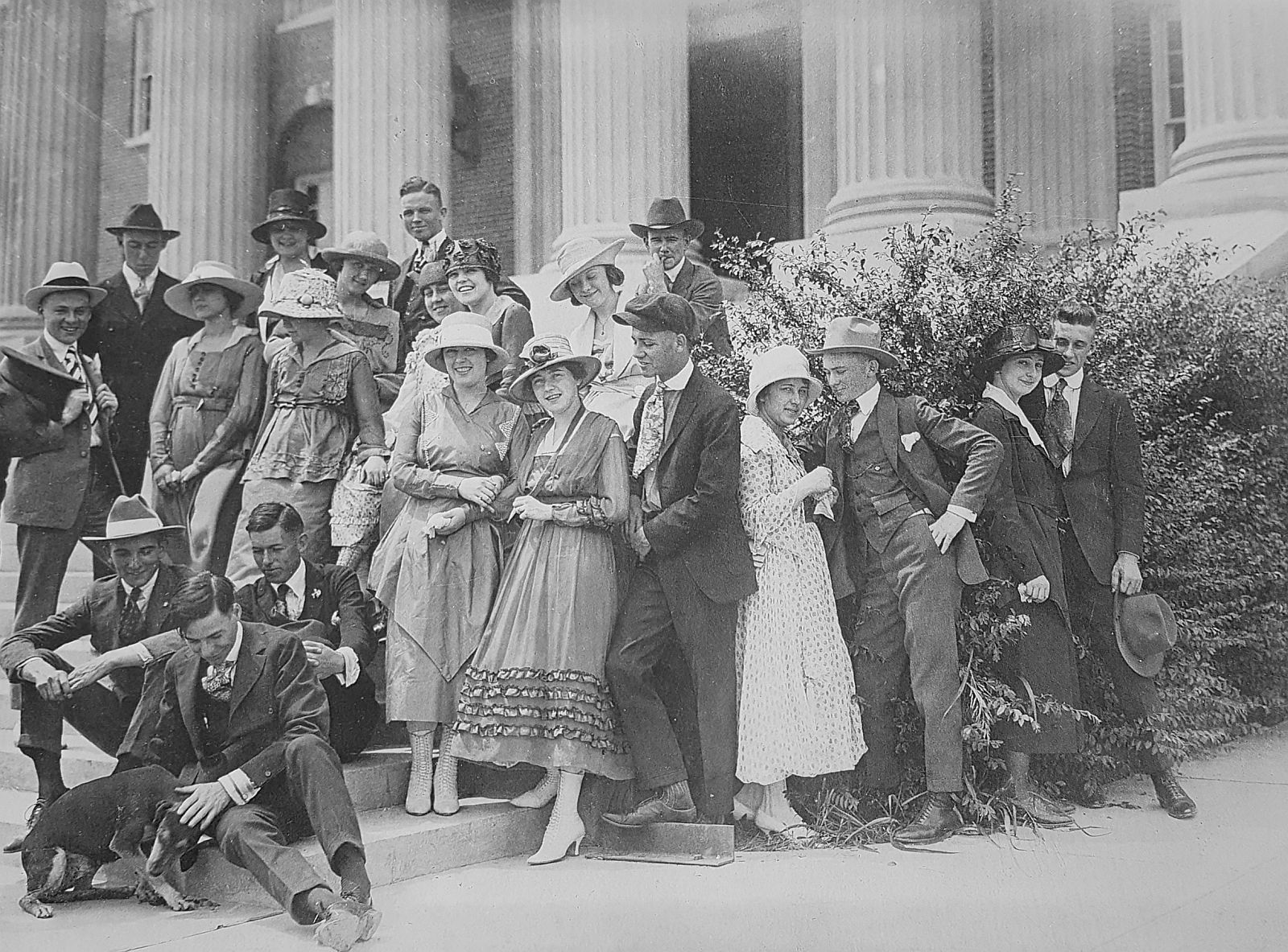
I came across three wonderful World War One-era photos in the SMU archives while I was looking for something else. You know how you can become enthralled by the charm of old photos and sit for long stretches of time staring at every little detail and wondering about the lives of the unidentified people who populate them? That happened to me with these. There is one particular young woman who stands out more than anyone else. Not only is she the best-dressed person in the photos, she also seems calm, collected, and serene. She looks friendly. She was probably very pleasant to have around.

These three photographs show a group of ten young couples and a pair of chaperones spending a beautiful sunny day together, with the highlight of the day being a trip to Highland Park’s Exall Lake. The men are SMU students, identified only as members of the Omega Phi fraternity. The women are identified merely as “dates,” but I’m sure that some of them were also SMU students. The photograph above shows the crowd gathered on campus in front of Dallas Hall. The woman in white looks like she’s on a pedestal, glowing in a spotlight. Below, a closer look at her stylish outfit (as well as a look at the young be-medaled WWI soldier next to her).

smu_omega-phi_dallas-hall_1917_degolyer-det1

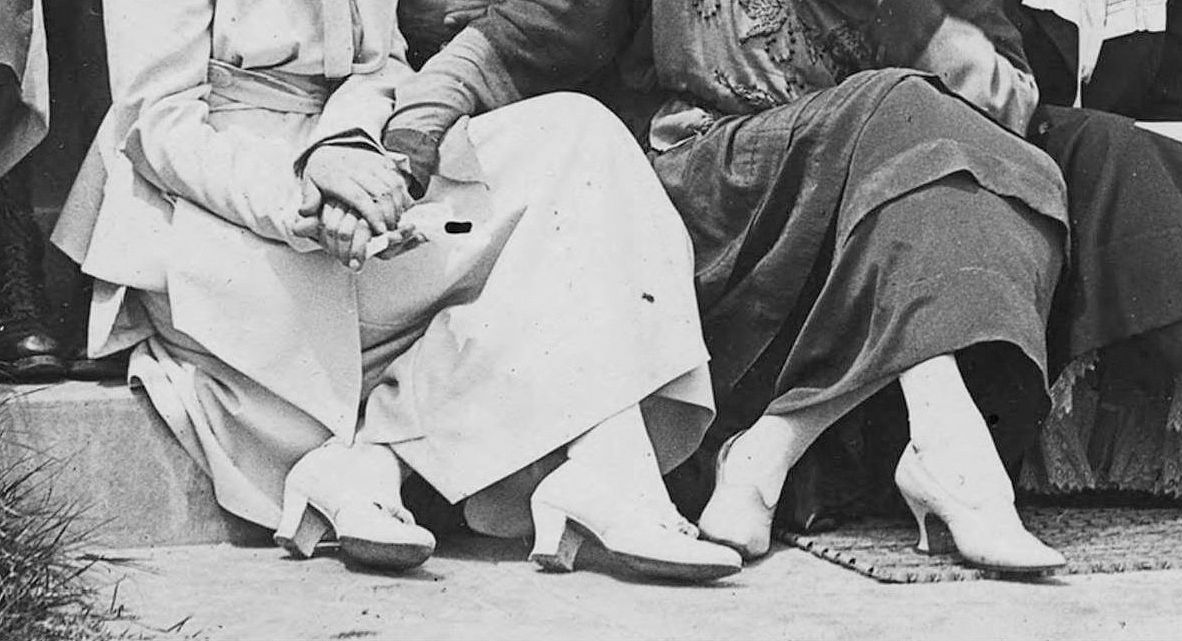
And, below, a similar detail, but this one showing the daintily crossed ankles of another pretty girl, seated beside a sour-looking companion.

smu_omega-phi_dallas-hall_1917_degolyer-det2

And here’s the gang on the idyllic banks of Exall Lake. Diane Galloway included this photograph in her book The Park Cities, A Photohistory with this caption:

At one time a bridge crossed Exall Lake near the Cary house, shown in the distance. The photographer was standing on the bridge to capture this picture of well-dressed SMU students going boating on the lake. A trip to Lakeside Drive was one of the few off-campus excursions permitted in 1917.

I love this photo. If I didn’t know what the Turtle Creek area looked like, I’d be hard-pressed to identify this as Dallas!

smu_omega-phi_exall-lake_1917_degolyer

Here’s a close-up of the beatific, smiling woman in white. I like the kid lurking in the background.

smu_omega-phi_exall-lake_1917_degolyer-det1

And the boat.

smu_omega-phi_exall-lake_1917_degolyer-det2

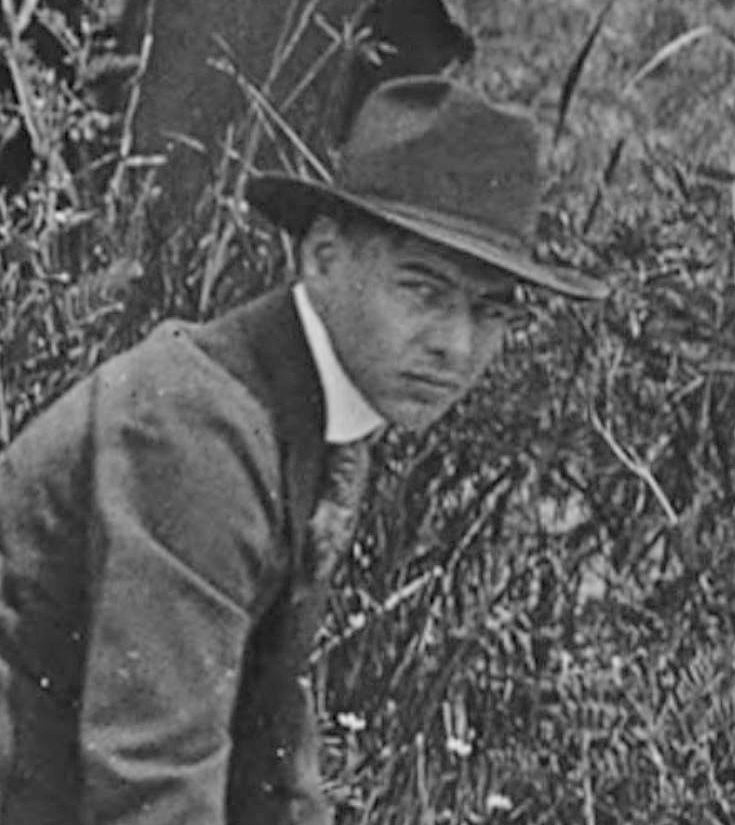
And the sour-looking guy again, looking even more annoyed than before.

smu_omega-phi_exall-lake_1917_degolyer-det3

And here’s the crowd sitting on the steps of the frat house (which was located at Haynie and Hillcrest). The personnel has changed a little bit (they gained a woman and lost a man), but (almost) everyone seems pretty happy.

smu_omega-phi_porch_1917_degolyer

And, below, my very favorite detail from these three photos.

smu_omega-phi_porch_1917_degolyer-det1

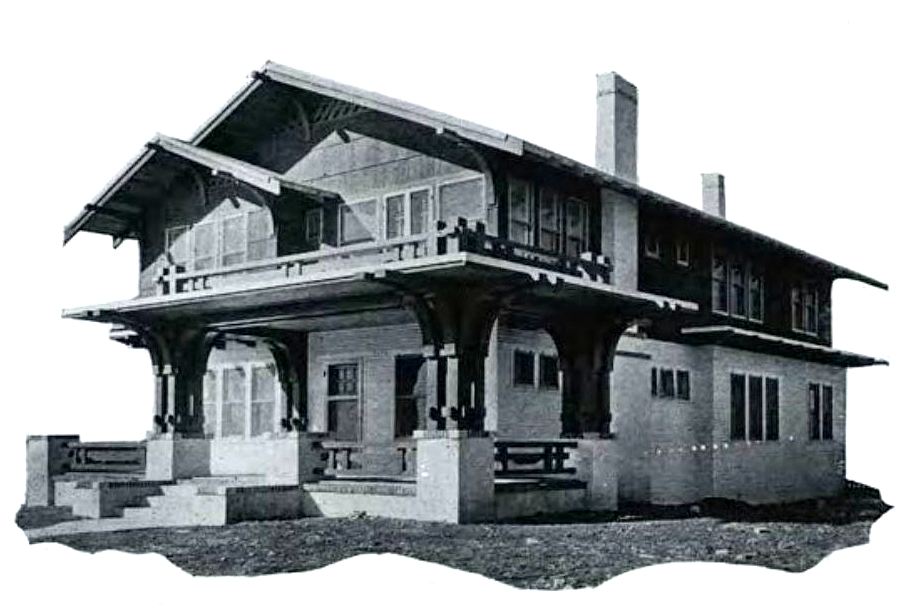
After a bit of sleuthing, I found a picture of the house at the time these photos were taken. It was actually a residence which was, I think, being rented out to the small group of Omega Phis. They had a proper fraternity house built several years later.

omega-phi-house_rotunda_1917

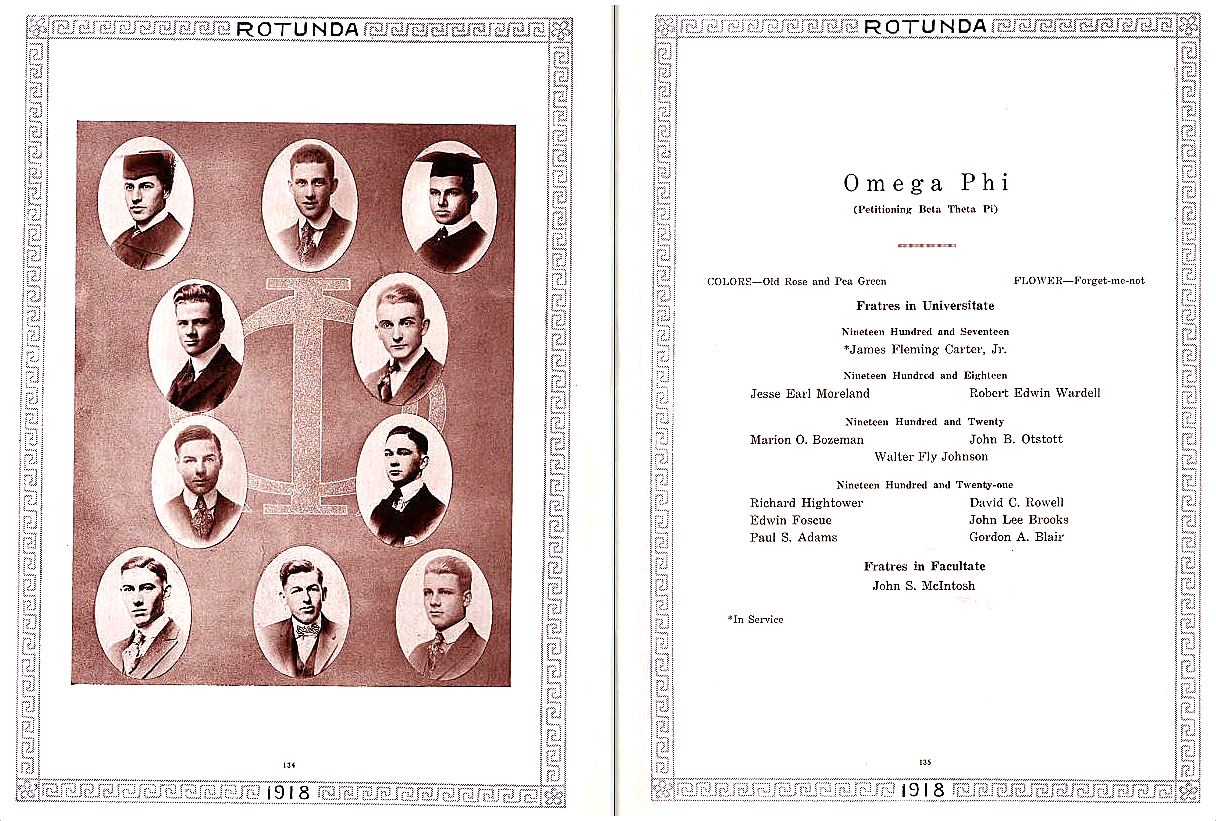
The top photo had “1917” written on the back, so I checked SMU’s Rotunda yearbooks from around that time. Here’s a look at the men who were members of Omega Phi in 1918. Several of these faces match the ones in the photos of the afternoon outing.

omega-phi_rotunda-1918

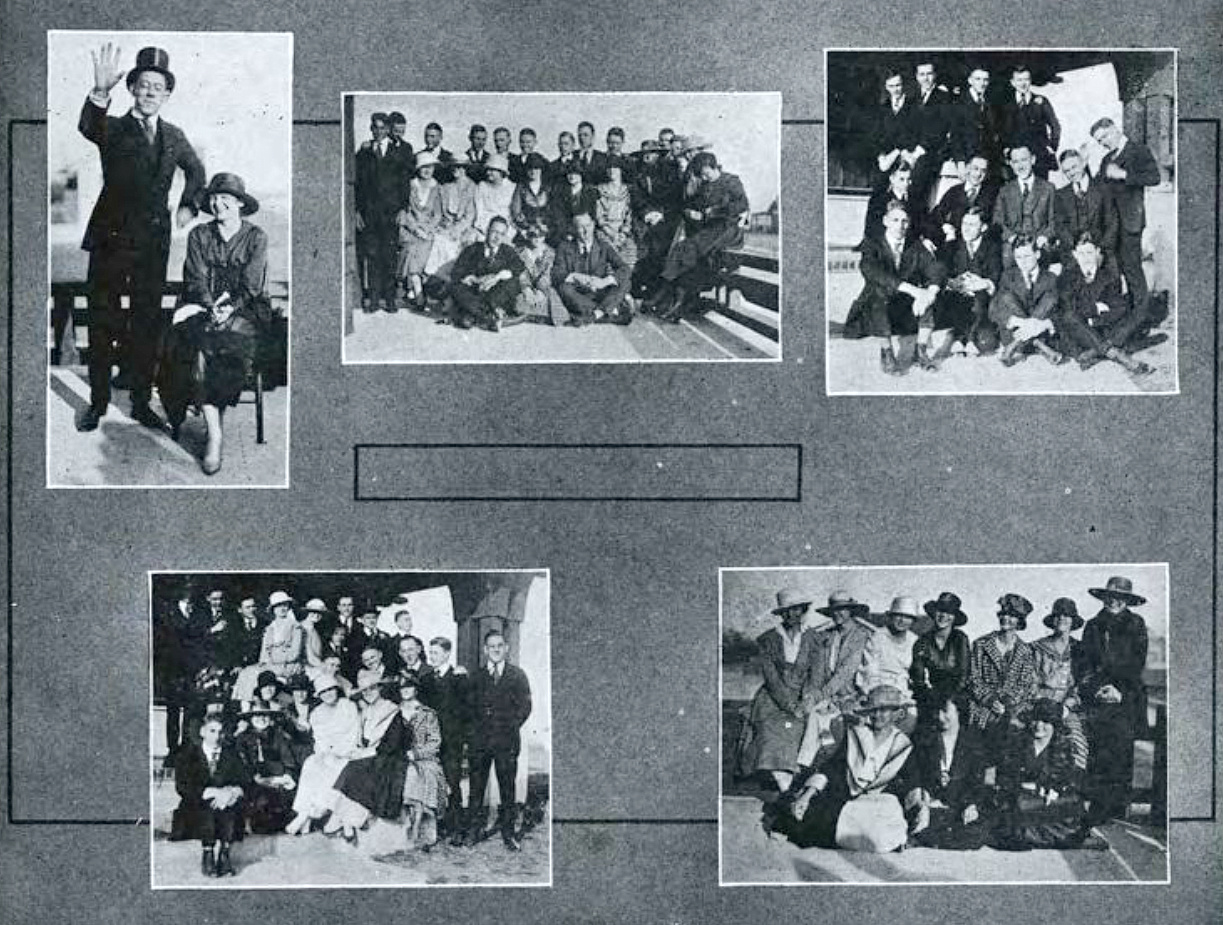
And, below, a photo collage from the Omega Phi page of the 1917 Rotunda. Several of the women look familiar. I see the Woman in White in at least one of these snapshots.

omega-phi_photos_rotunda_1917

And here she is, close up. I hope she was as happy, intelligent, and confident in her real life as she appears to be in these photos.

smu_omega-phi_porch_1917_degolyer-det2

***

Sources & Notes

The three photos of the afternoon outing all come from the collection of the DeGolyer Library, Central University Libraries, Southern Methodist University:

  • “Omega Phi Fraternity members and their dates in front of Dallas Hall” is here.
  • “Omega Phi Fraternity member outing to Exall Lake” is here.
  • “Omega Phi Fraternity members and their dates on porch” is here.

The quote from Diane Galloway comes from her FANTASTIC book, The Park Cities, A Photohistory (Dallas: Diane Galloway, 1989), p. 24.

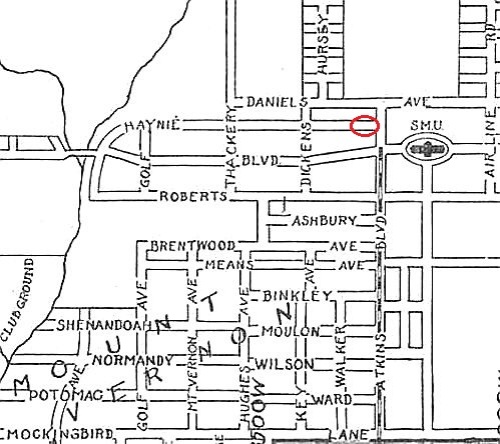
The ersatz Omega Phi fraternity house was located at 115 Haynie Avenue, just west of Atkins (now Hillcrest). (The photo of the exterior of the house is from the 1917 SMU Rotunda yearbook.)

omega-phi_map_19191919 map (detail), Portal to Texas History

I have absolutely no idea how college fraternities work, but it seems that when they formed on the SMU campus in 1915, the Omega Phi group was not actually affiliated with a national fraternity. They “petitioned” to be chartered by national groups, but they finally stopped trying after 11 years of, I guess, being repeatedly turned down — in 1926 they declared themselves to be an “independent society.” But one year later, they were granted a charter by the national Kappa Sigma fraternity. In the Dallas Morning News article announcing the news, this sentence was included: “The local chapter will be known as Delta Pi chapter.” I have no idea what any of that means, but if you’re really into these things, read the DMN article “Kappa Sigmas Grant Charter” (Sept. 26, 1927), here.

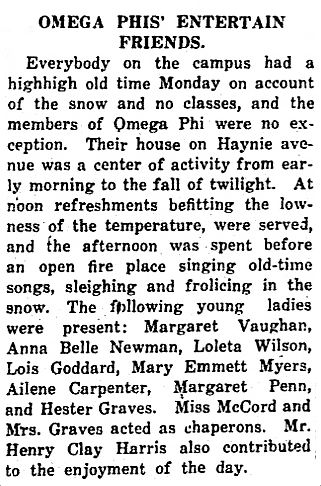
As for the identities of the women in the photos, it’s a mystery. I would assume, though, that at least some of them were the women mentioned in this little article about a cozy winter get-together at the Haynie Ave. house:

omega-phi_smu-campus_011917DMN, Jan. 19, 1917

If you’re not familiar with beautiful Exall Lake, you can watch a short, minute-long video of the lake’s history, produced to celebrate the 100th anniversary of Highland Park, here.

For other posts featuring photos I’ve zoomed in on to reveal interesting little vignettes, click here.

UPDATE: I stumbled across another photo of this group, from Diane Galloway’s book The Park Cities, A Photohistory:

smu_group-date_park-cities-photohistory_galloway

*

Copyright © 2015 Paula Bosse. All Rights Reserved.

White Mule, Red Whisky, & “Wicked Liquid” — Moonshining In, Around, & Under Dallas In the 1920s

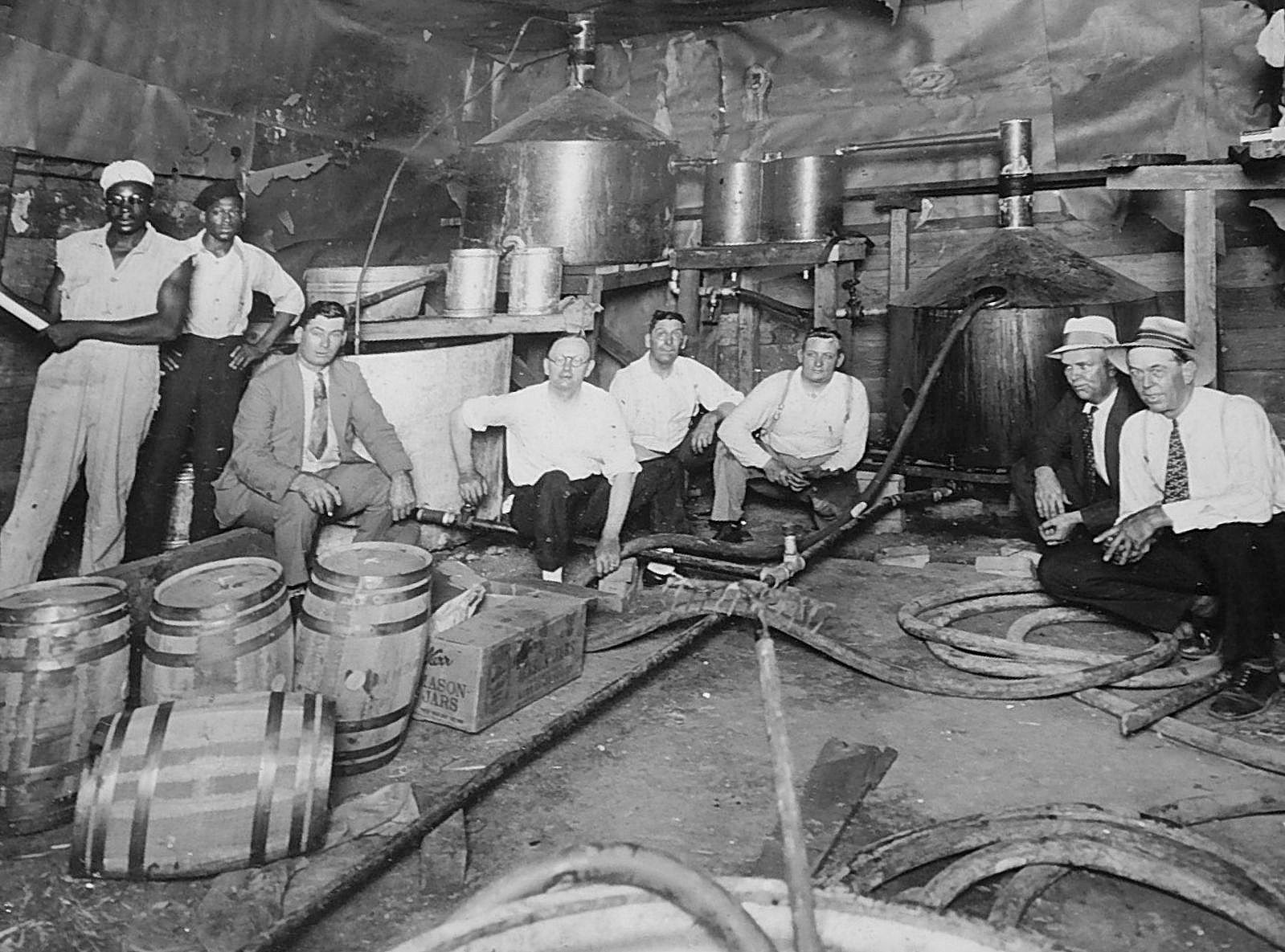
prohibition-stills_ebayBusted!

by Paula Bosse

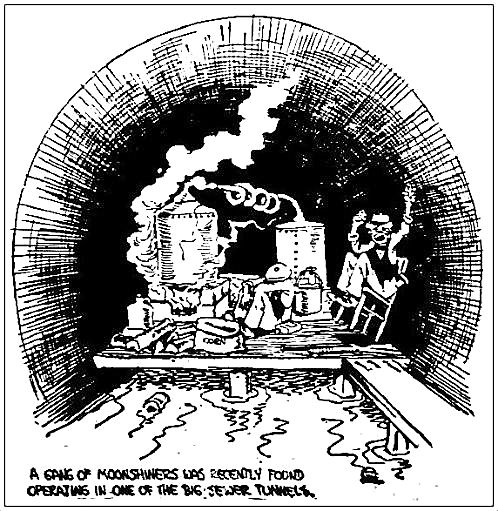
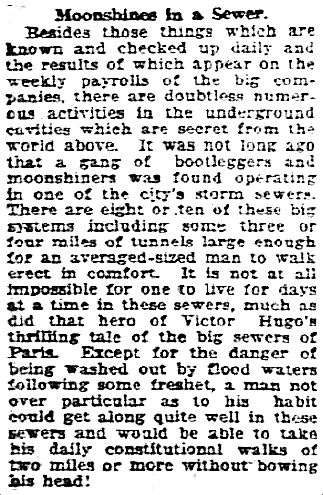
I recently came across an article from 1925 describing a whole world of hidden activity that went on beneath Dallas’ downtown streets. This cartoon and paragraph about moonshiners and bootleggers conducting business in underground storm sewers was particularly interesting:

moonshine_sewer_dmn_050325-cartoon

moonshine_sewer_dmn_050325-by-george-geeDallas Morning News, May 3, 1925

I searched and searched for news of this subterranean moonshining operation but was unable to find anything. I did, however, find some interesting stories from the ’20s, when it seems moonshining and bootlegging were going on absolutely everywhere.

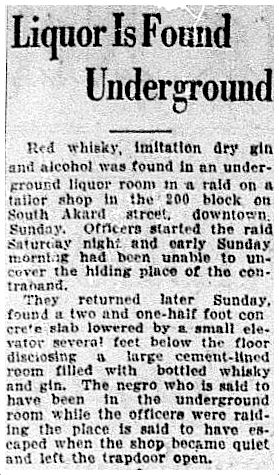
For example, one such operation was going on in a “large cement-lined room” underneath a tailor shop in the 200 block of South Akard, which was accessed by a small “elevator” through a trapdoor.

moonshine_akard_dmn_121425DMN, Dec. 14, 1925

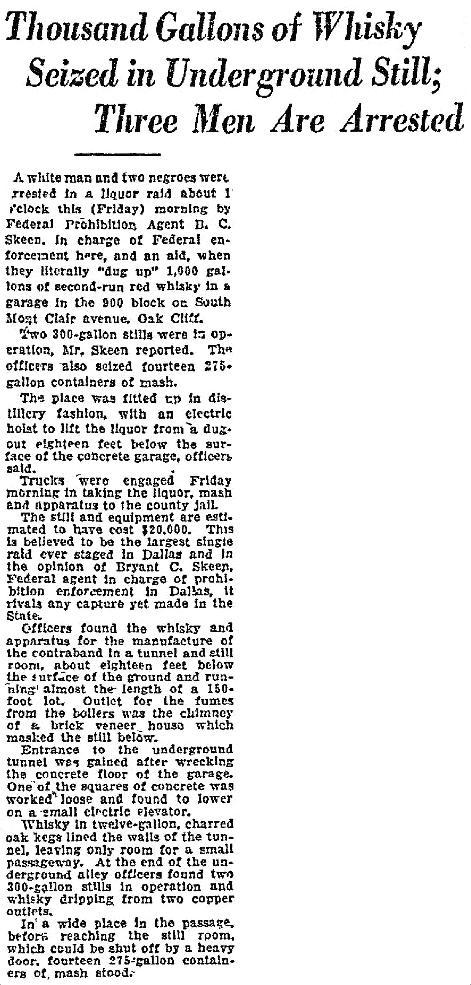
One was in operation underground in Oak Cliff in the 900 block of South Montclair (click to read).

moonshine_dmn_121125DMN, Dec. 11, 1924

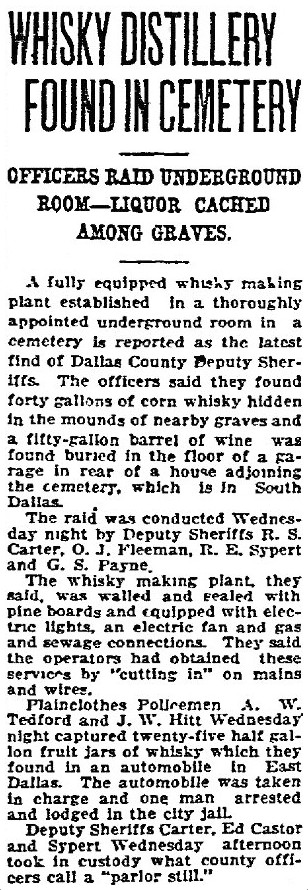
Then there was a still operating in a South Dallas cemetery.

moonshine_dmn_090424-cemeteryDMN, Sept. 4, 1924

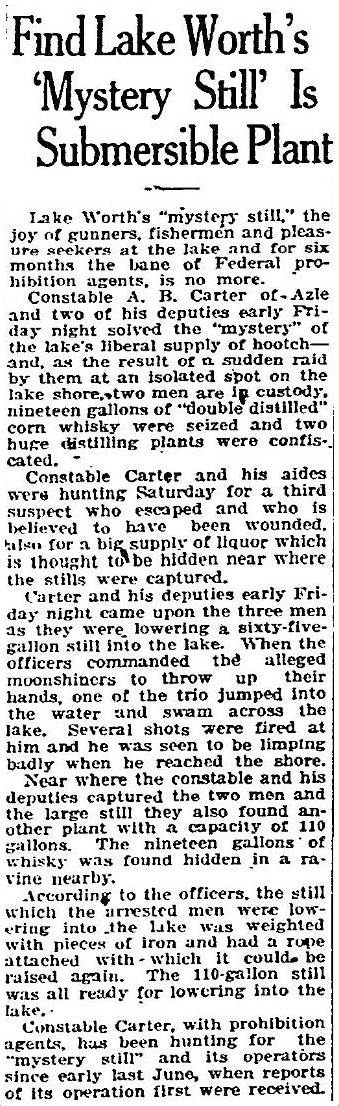
Over in Tarrant County — at Lake Worth — some outside-the-box-thinking moonshiners were hiding stills under the WATER.

moonshine_FWST_111921_lake-worthFort Worth Star-Telegram, Nov. 19, 1921

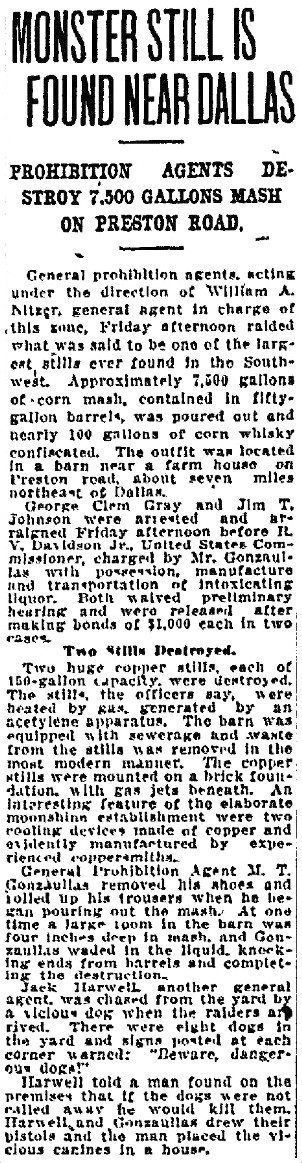
Up north on Preston Road, a massive still was discovered — one of the largest ever found in the Southwest. This operation was above ground, in a barn. 7,500 gallons of corn mash was emptied by legendary Texas Ranger M. T. “Lone Wolf” Gonzaullus, who “removed his shoes and rolled up his trousers when he began pouring out the mash. At one time a large room in the barn was four inches deep in mash, and Gonzaullus waded in the liquid” (DMN, Dec. 23, 1922).

moonshine_gonzaullas_dmn_122322DMN, Dec. 23, 1922

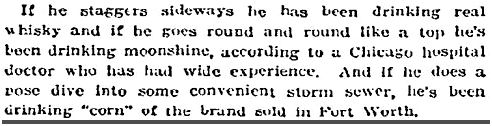
During this incredibly productive and creative period in DFW history, there were different levels of moonshining: there were people making small batches of so-called white lightning for “home use” (kind of like Mayberry’s Morrison sisters who provided small “medicinal quantities” of “elixir” to Otis Campbell), and then there were massive “distilleries” involving large networks of bootleggers and making big money. The former were usually “jest folks,” but the latter were generally professionals, often dangerous and armed-to-the-teeth. The quality of the product varied markedly. This was a handy primer:

moonshine_FWST_120420FWST, Dec. 4, 1920

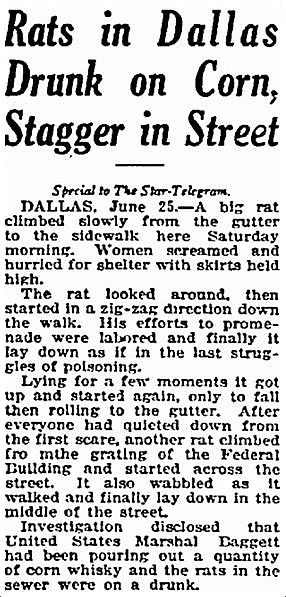
My favorite moonshine-related story appeared in The Fort Worth Star-Telegram. It was about drunken rats “staggering” in the streets of Dallas. Star-Telegram publisher (and famous Dallas-hater) Amon Carter must have cackled as he read this. I’m surprised the headline wasn’t bigger.

moonshine_rats_FWST_062621FWST, June 26, 1921

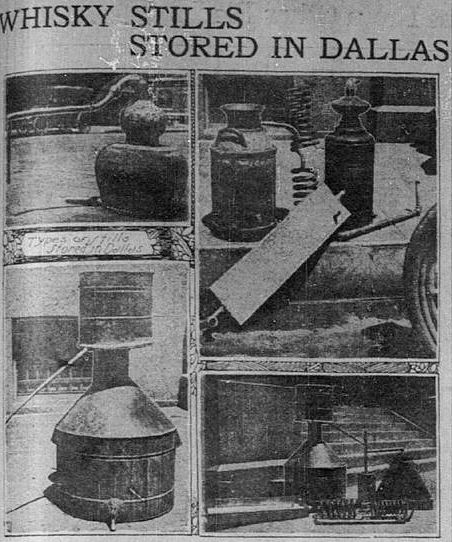
A whole passel of confiscated stills — having been emptied of their contents into nearby gutters (the cause of Big D’s apparent rampant rodental inebriation problem) — can be seen in the photos below, displayed for the media in 1921 by the sheriff’s office in a “perp walk” of inanimate objects. “Your tax dollars at wok.” It’s a good thing Prohibition would last only another … twelve long years.

stills_dmn_050821DMN, May 8, 1921

***

Sources & Notes

Top photo — taken by Frank Rogers — appeared on eBay a few months ago. It shows a moonshine operation somewhere in Dallas County, with Deputy Sheriff Ed Castor in there somewhere.

All other newspaper clippings as noted.

The initial Dallas Morning News story about the goings-on in the sewers and tunnels beneath downtown was “A Peep Into Dallas’ Real Underworld” by George Gee (a very entertaining writer who doesn’t seem to have been with the DMN long — I wonder if his name is a pseudonym?); it appeared on May 3, 1925 and can be read here.

A very informative article on local moonshining and bootlegging appeared in the DMN — “Now Bootleggers May Weep At Sight of Strange Display” (meaning those photos just above of confiscated stills); it was written by Ted Dealey and appeared on May 8, 1921 — it can be read here.

Prohibition wasn’t ever going to work. Read the Handbook of Texas entry about the movement in Texas, here.

Read an entertaining WFAA article about how openly Prohibition laws were flouted in Dallas, here.

You know what Wikipedia is good for? Reading about moonshine, more moonshine, and corn whiskey. If fails me, however, on Mason jars, so I went here and learned a few things about why moonshine was usually sold in these famous “fruit jars.”

Another photo of confiscated stills displayed on the steps of the old Municipal Building/City Hall can be found in my previous post “Prohibition Killjoys,” here.

Check out a photo of the booming business in a Dallas speakeasy in the post “Hoisting a Few in the Basement Speakeasy,” here.

Since you’re in the mood, why not settle back and watch a scene from the “Alcohol and Old Lace” episode of The Andy Griffith Show, here. Otis Campbell’s darkest day.

*

Copyright © 2015 Paula Bosse. All Rights Reserved.

How To Access the Historical Dallas Morning News Archive

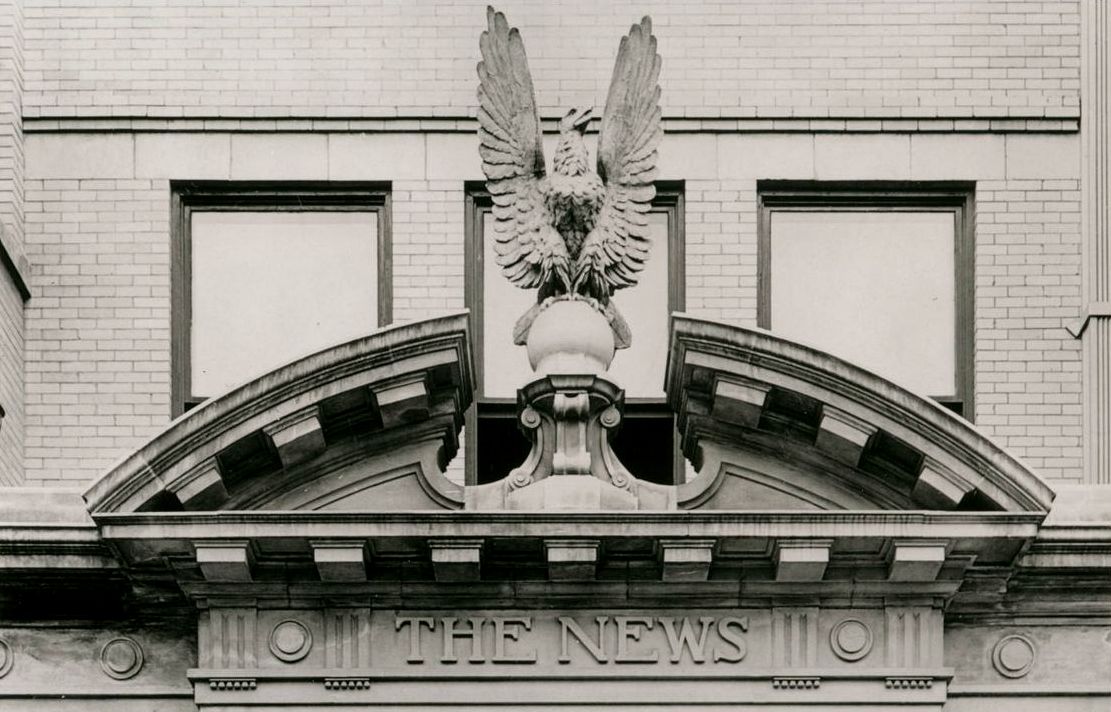
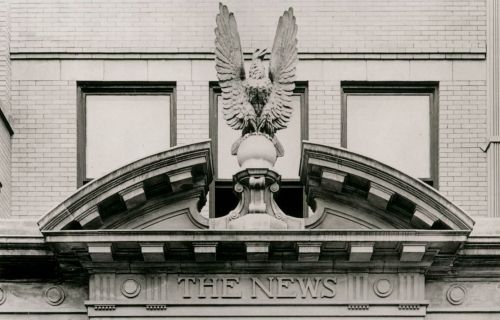
lintel-pediment_dmn-bldg_belo_smu_1930sThe old Dallas Morning News building

by Paula Bosse

(UPDATED August 1, 2025 — I have not updated this post, but, instead, I’ve written a whole new one. It’s shorter and — as of today! — it’s up to date. Find that post, which reflects the new Dallas Public Library website, here. The post on this page below still has some good tips, but as far as being able to use it to figure out how to actually get anywhere on the DPL website, check out the link above instead. I will update this post, if I ever have the time to do it!)

*

Yesterday I wrote about how I tracked down the location of a photograph with very little information to go on. I hesitated to include the step-by-step process I used to discover the location, because I was afraid that it would be a little too tediously arcane for most people. But, apparently I was wrong. I’ve been surprised by how popular the post has become. It’s gotten many more hits than most Flashback Dallas posts usually do. I’ve seen it shared all over Facebook, and it’s generated more comments and emails than I expected. It’s gratifying that people seem to be interested in the actual process of historical research. Even though I don’t necessarily consider myself a historian (I studied Art History in college, and my background is in bookselling), I’m happy to be able to share historical events and forgotten local tidbits with an audience that finds them as interesting as I do. I consider myself a writer and researcher, and sometimes all the fun is in the researching.

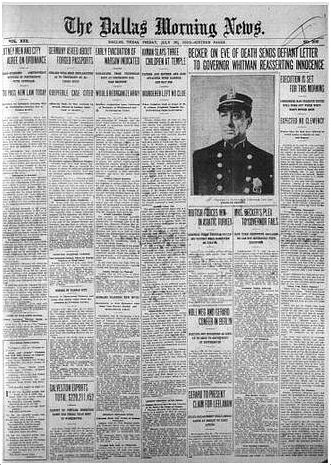
Since I began this blog in February of 2014, I’ve been asked several times how I access the Dallas Morning News archive. Without question, the DMN is the single most valuable resource in the study of Dallas history. Years ago, one would have had to trudge to a library and crank up a microfilm or microfiche reader. Luckily, we are in the digital age, and every edition of the DMN from 1885 to the end of 1984 has been scanned and digitized and can be viewed from the comfort of one’s own home. (Also available in this database are various Fort Worth newspapers — from The Fort Worth Register to The Fort Worth Star-Telegram — from at least 1897 to 1990, which is, of course, very handy!) You can view the paper page by page, article by article, photo by photo, comic strip by comic strip, ad by ad. It’s incredible. You’ll get lost in it for hours. Want to know what was going on 100 years ago today? Easy! Here’s the front page of the DMN from July 30, 1915:
front-page_dmn_073015DMN, July 30, 1915

So how do you do it? First off, you have to live in the city of Dallas — bad news for those of you living outside the city limits, I’m afraid. (UPDATE: THERE IS A WAY FOR NON-RESIDENTS TO ACCESS THE ARCHIVE — FOR A MONTHLY FEE. SEE UPDATE AT BOTTOM OF THIS POST.) For those of us who do live inside the city limits, not only can we access the database whenever we want, but it’s also FREE. All you need is a Dallas Public Library card (information on how to get a free card is here; the DPL’s FAQ is here). UPDATE Nov. 9, 2021: The Dallas Public Library will now offer free library cards (and with it access to their website, including the newspaper archives) to STUDENTS AND TEACHERS AT DALLAS PUBLIC AND PRIVATE SCHOOLS, CHARTER SCHOOLS, COMMUNITY COLLEGES, AND UNIVERSITIES, regardless of whether they actually live in the city of Dallas — see the DPL’s FAQ on that here, and read a news story about it on the KERA site here.

So your first step is to get a library card. Once you have a card, go to the Dallas Public Library site’s “My Account” page, here, to sign up for the free account. You’re now ready to plunge in. 

*

HOW TO ACCESS THE “DALLAS MORNING NEWS ARCHIVES”

Use this to search for content published ONLY in The Dallas Morning News, between 1885 and 2016 (articles post-2016 are available on DallasNews.com). (Scroll down for instructions to access Fort Worth papers.) This BY FAR the easiest option for most people and should give you more than you need!

  • Log in to your Dallas Public Library account
  • Click on “DATABASES”
  • Scroll down, click on “MAGAZINES, NEWSPAPERS & JOURNALS”
  • Scroll down, click on “DALLAS MORNING NEWS ARCHIVE”
  • This gets you to a default page with 4 DMN-related sources: 1) the “historical” edition, for the years 1885-1984 (results will show scanned images/articles as they appeared in the newspaper when originally published), 2) the “modern” edition, for the years 1984-2016 (these results will be text-only — no images), 3) DMN Blogs (2006-2016), and 4) the DMN old free paper Quick (2003-2011). Enter your search terms in the search box, and wave goodbye to big chunks of time as you sit in front of your computer searching and reading and searching and reading.

I use the ADVANCED SEARCH option — click “Advanced Search” underneath the main keyword search box. A new page opens and you can filter what you’re searching for by choosing any specific fields you want to use. Click the down-arrows next to the search boxes to show a drop-down menu of options. 

*

ACCESS FORT WORTH PAPERS ONLY:

  • Follow the instructions above to log in — the main page opens — click through as above to “DALLAS MORNING NEWS ARCHIVE”
  • At the very top of the page, click the down arrow next to “Change Databases” — click on “ALL DATABASES” — a new page will load
  • Under “Access World News — Historical and Current” click on “Fort Worth Star Collection with Historical Archive” (they’ve left out the “Telegram” in several places with the recent update) — this brings up archives of the Fort Worth Star-Telegram (“historical” editions published 1902-1990 and “modern” editions published 1990-present day) as well as an archive of The Fort Worth Register (1897-1902) — and other stuff. Full scans are available for the editions published between 1897 and 1990; after that, it’s text-only.

*

ACCESS THE FULLY SCANNED “HISTORICAL” DALLAS AND FORT WORTH PAPERS *SIMULTANEOUSLY*: 

This is the option I find most useful in doing daily historical research — I exclude “modern” editions, because I get too many extraneous results. If I do need more recent info, it’s easy to add modern editions, but I find excluding papers published after 1984 is best for my work. 

There are two ways to do this — this way is fastest (you won’t see results published after 1984 for the DMN or after 1990 for FWST):

  • Log in — follow all the steps listed above — the main page opens
  • Hover over “Change Databases” at the very top of the page – a dropdown menu appears — click on “All Databases” — a new window opens
  • Scroll down and click on “America’s Historical Newspapers” a new page opens — this will search the “historical” databases of the Dallas Morning News and Fort Worth Star-Telegram as well as the Fort Worth Register (Jan. 2023 update: even though you don’t see them until you look at search results, there are now several other fully scanned “historical” newspapers which will show up from other cities and states — up to 1922, which I gather is when copyright kicks in — you can filter these out and just stick with the DMN and FWST, but they are very interesting to peruse)
  • Filter your search options by date, specific newspaper, etc., on the left side of the page or — my preference — use the “Advanced Search” option by clicking that link below the main search box and add however many rows you need to refine your search (I always add a “Date” row and leave it for the duration of my research period)

This is a way to add and exclude various newspapers (don’t confine yourself to Dallas and Fort Worth!), and it also allows you to see search results from historical and modern papers at the same time:

  • Follow the steps above to log in — the main search page opens
  • Near the top of the page (to the right of the “NewsBank” logo) click on “A-Z Source List” — a new page opens
  • In the search box next to “All Keywords” type in “Dallas” — as of this writing, a LOT of options pop up, mostly modern rather than “historical” — click the checkboxes of all sources you wish to access
  • After you’ve selected all the sources you want, click on the blue box at the bottom of the page reading “Search Within These Selections” — a new page will open — begin your searches from the newspapers you’ve selected.

*

ACCESS ALL AVAILABLE METROPLEX-AREA NEWSPAPERS SIMULTANEOUSLY:

There are tons of DFW metropolitan-area papers and neighborhood publications to search through on the Newsbank/DPL website — from Alvarado to Weatherford; only the pre-1984 Dallas Morning News and pre-1990 Fort Worth papers are “historical” and fully scanned) — all other papers are text-only and, generally, don’t have content available from before the early 2000s. But those papers have lots of great info. I know this is getting tedious (!), but here’s how to search those non-historical DFW papers simultaneously:

  • Log in — main page opens
  • Click on “Access World News Historical and Current” at the very top of the page — a new page opens
  • Click on the blue box on the right side of the page reading “Dallas Metropolitan Collection” — this brings up archives for (as of this writing) 90 area publications (Jan. 2023 update: I see issues of The Dallas Herald (1855-1887) are, weirdly, kind of hidden in this list — they appear to be the exact same scans available on the Portal to Texas History, where navigation is a lot easier!)

*

Note: At the risk of beating a dead horse, one more time: the difference between the “historical” and “modern” post-1984 Dallas Morning News archives is that the “historical” (1885-1984) search results include images of fully scanned editions of the newspaper — you see everything the way it looked in the actual newspaper: you can see entire pages as well as individual articles, photos, illustrations, comic strips, ads, classifieds, etc. You do not see any of this in the post-1984 results — the information is still useful, but it’s not as interesting and, maddeningly, not as comprehensive. I tend to use one or the other, otherwise, too many non-applicable results are returned.

**

It takes a good bit of time to figure out how to use the search engine quickly and effectively — it has a lot of weird little idiosyncrasies that can cause you to miss out on lots of things you’re searching for (apostrophes, initials, and numbers can be extremely problematic) — but once you start to wander around, you’ll be amazed at what an incredible treasure trove is at your fingertips. It’s always confusing after a major re-do of a site, so you just have to play around with it until you figure out how everything works. …Then have everything change again when you finally get comfortable with it.

This is such a wonderful resource — thank you, Dallas Public Library and thank you, Dallas Morning News!

***

Sources & Notes

Photo at top: “Lintel and pediment above doorway, Commerce St. entrance,” ca. 1930s, from the Belo Records collection, DeGolyer Library, Central University Libraries, Southern Methodist University; photo and details are here.

The best newspaper database for those interested in Texas history is UNT’s Portal to Texas History Texas Digital Newspaper database, here. They have tons of scanned and digitized historical Texas newspapers (excluding The Dallas News), AND it’s free and available to everyone. Below are a few of their offerings of particular interest to Dallasites:

  • The Dallas Herald — absolutely ESSENTIAL for Dallas goings-on between 1855 and 1887, here
  • The Southern Mercury, the agricultural-leaning paper published in Dallas, 1888-1907, here
  • The Dallas Express — a newspaper printed by and for the city’s African American community — ALSO essential — sadly, only the years 1919-1924 have been scanned, here
  • The Jewish Monitor — published in Fort Worth, serving the DFW (and Texas) Jewish community, 1919-1921, here
  • The Texas Jewish Post, 1950-2011, here

Check out all the Texas newspapers UNT has scanned: go to the Advanced Search page and scroll down the “Collections” menu bar to see the full list.

And, of course, there are the subscription sites Newspapers.com (which I use) and NewpaperArchive.com. I’m not familiar with the offerings of the latter, but Newspapers.com has a lot of DFW papers, all of which are fully scanned (and many of which are available for free at the Portal to Texas History). My favorite DFW newspaper on Newspapers.com is a fairly recent addition — the evening edition of the Fort Worth Star-Telegram, which is often very different from the morning edition (morning editions are the ones found on the Newsbank/Dallas Public Library database — Newspapers.com has both morning and evening FWST editions).

**If you need some research done, I might be able to help. I have access to several resources and am pretty thorough. Let me know what you’re looking for and inquire on hourly rates by clicking the “Contact” tab at the top of the page.**

Enjoy!

*

7/31/15 — UPDATE: GENEALOGYBANK.COM — HOW TO ACCESS THE HISTORICAL DALLAS MORNING NEWS ARCHIVE IF YOU ARE NOT A DALLAS RESIDENT: While looking for something completely unrelated, I came across a comment by someone who said he accessed the Dallas Morning News archives — historical and modern — through a site called GenealogyBank.com. It sounds like something similar to Ancestry.com where you are given access to several different types of resources used in genealogical research. The website indicates the cost is $19.95/month or $69.95/year. There is a free 30-day trial (but if you don’t cancel it and explicitly tell them you are canceling, they will automatically charge you and you will NOT get your money back). This is the first I’ve ever heard of this site, so I have no idea whether it’s good or bad. (The parent company of GenealogyBank is NewsBank, the company that manages the DMN archive accessible through the Dallas Public Library.) I did ask on a Dallas history group tonight, and a trusted member said that he uses it all the time. He posted a few screenshots, and it’s very similar to the archive accessed through the library’s website. For those interested, you might want to try the free trial to see if it’s something you’d be interested in subscribing to. This is pretty cool, because it offers people who live outside the city limits the ability to access the DMN archives for a relatively small fee each month. I am not promoting or endorsing this site because I had never even heard of it until an hour or two ago. I’d love to hear feedback from people who try it out. The Genealogy Bank website is here. A review of the site from About.com is here. I encourage you to check other consumer sites for pros and cons. I hope this is helpful for those of you who, for some reason, choose to live away from Dallas!

*

Copyright © 2015-2023 Paula Bosse. All Rights Reserved.

Tracking Down a Photo Location & Discovering a City Pioneer: D. M. Clower, The Man Who Brought the Telephone to Dallas

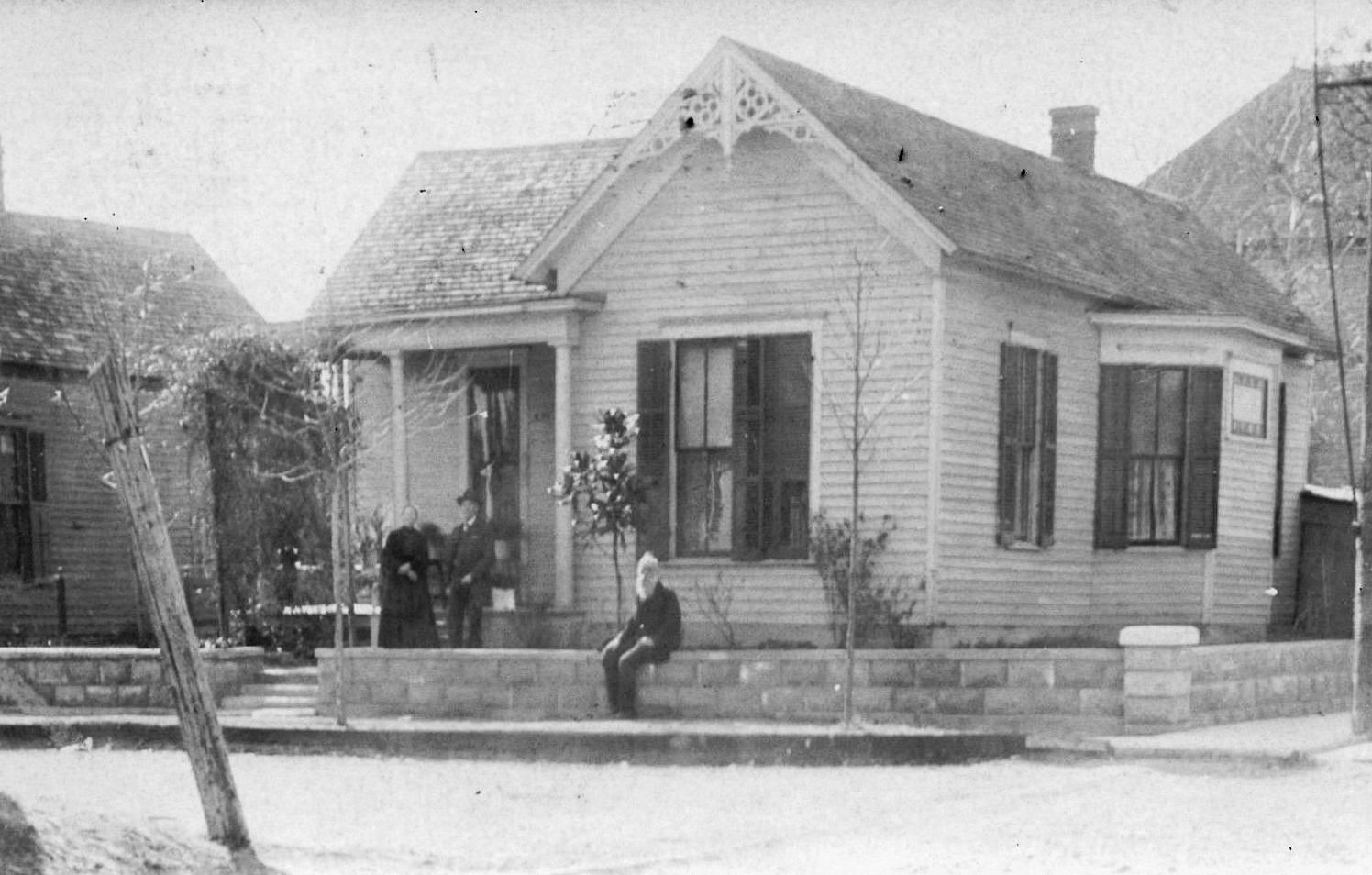
house_RPPC_1909_ebayMystery house, Dallas, ca. 1908 (click for larger image)

by Paula Bosse

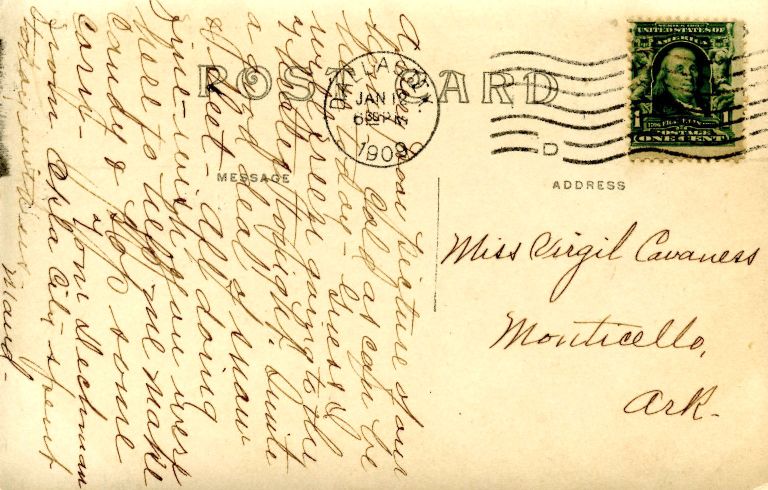
Not too long ago I came across the above photo which had been made into a real photo postcard.” It was postmarked January 12, 1909, and it contained a chatty message.

“A very good picture of our house. Cold as can be here today – guess I will freeze going to the theater tonight. Quite a good deal of snow and sleet. All doing fine – wish you were here to help me make candy & pop some corn. Tom Dechman from Okla. City spent today with us. Maud.”

house_RPPC_1909_ebay_back

Such a nice photo of a modest little house in Dallas, probably taken in 1908. When I saw it, I thought it would be cool if I could figure out where it was. There wasn’t much to go on from the postcard, though. But, as it turns out, there was just enough information to put the pieces together and figure it out. Someone asked me recently how I track down things like this. Basically, I look for a long time in a lot of different places. Here’s how I found out where this mystery house was.

Using Ancestry.com, I found Virginia (“Virgil” — sometimes “Virgie”) Cavaness in Monticello, Arkansas. She was born in 1871 and would have just turned 37 years old when she received this card. The familiar tone of the postcard message indicated to me that Virgil was probably a close friend or family member.

I found Thomas Dechman in Oklahoma City — he would have been 23 when he visited Maud. He probably wasn’t a close friend or immediate family member because she writes his full name out. According to the 1909 Oklahoma City directory (accessible on Ancestry.com), he worked alongside his father, A. F. Dechman, at a wholesale produce company.

Then I checked the Dallas Morning News archives and found this from Dec. 30,1909.

clower_dmn_123009DMN, Dec. 30, 1909

Tom Dechman was Mrs. A. F. Dechman’s son. So I searched on “Maud Clower.” Maud, born in 1877, was also D. M. Clower’s daughter. Mrs. A. F. Dechman was Maud’s sister Annie, and Tom was her nephew.

I continued searching the DMN archives for mentions of the Clower family and found that in 1906 Maud Clower had married Jesse (J. D.) Patterson — and, hey, Virgil had attended the wedding.

virgie_dmn_090206DMN, Sept. 2, 1906

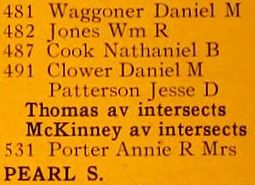
I checked to see where Maud and J. D. Patterson were living in 1908/1909. Most directories are available on Ancestry (a subscription site), but, as it happens, the 1909 directory is one of the few historical Dallas city directories that is available online (for free) — you can access it here (a few other directories are here). I found a Jesse D. Patterson listed as living at 491 N. Pearl, but no spouse’s name was listed, so I cross-referenced the address with the street directory section to determine whether this was the right J. D. Patterson. (Street directories are very helpful — not only do they list the occupants for each address, they also help to pinpoint where specific addresses were as they show which cross-streets those addresses were between; this is extremely helpful when trying to figure out where things were when streets had different names and/or when trying to figure out where things were before all of Dallas’ street numbers were changed in 1911. Another useful resource is a page on Jim Wheat’s site, which has links to every page of the 1911 street directory — click on a street name and find your address: the “new” address is on the left, and the “old” address is next to it, in bold.)

clower-patterson_1909-directory1909 city directory, residents of N. Pearl Street
Even though this didn’t have Maud’s name listed alongside her husband’s, it DID show that her father, D. M. Clower, was living at the same address. Success!

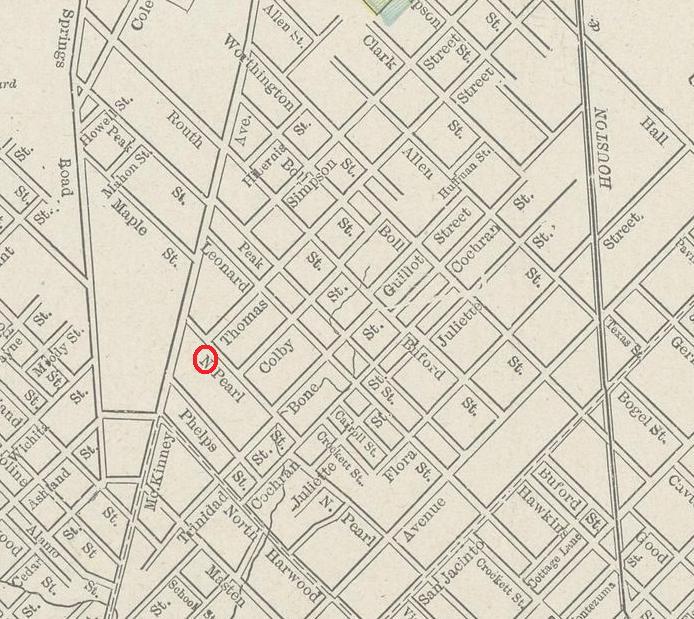
So there it is. When Maud sent that postcard to Virgil, she and her husband were living with her parents at 491 N. Pearl Street. The house in the photo was at the southwest corner of N. Pearl and Thomas. It’s always helpful to check a street map from about the same period for context and to make sure you’re looking at the right location — many street names have changed over the years — if a street named “Forest” is being referenced in the 1940s, for instance, you need to know that the old Forest Avenue and the current Forest Lane are absolutely nowhere near each other. Below is a map drawn about 1900, with the location of the Clower house circled in red (this is one of many maps found on the Portal to Texas History site; the one below is a detail of the map found here).

clower-home_map-ca1898

I also checked out Sanborn maps to see if the house in the photo matched the house that was actually on the lot at N. Pearl and Thomas. It does. To see what the general footprint of the house looked like in 1905 (the Clowers lived at 491 N. Pearl from about 1905 to 1910), see here. In the 1921 map (by which time the address had been changed to 2221 N. Pearl), you can see that additions had been made to the house since 1905 and that it looks more like the house in the photo (a room now juts out at the right and there is an out-building behind the house); see the 1921 Sanborn map here. To see what that Uptown block looks like now, see here (N. Pearl is on the left, looking south). Quite a change! It took me a long time to realize just how essential Sanborn maps can be — they are incredibly useful, and I try to use them whenever I can.

**

I really didn’t expect to track down the actual address of an unidentified house found on a picture postcard, but persistence pays off. A bonus of this persistence was that I ended up learning about the very interesting man who owned the house — a man who played a pivotal role in the development of Dallas: Daniel Morgan (D. M.) Clower. Clower was an electrical engineer who, in 1881, installed the very first telephone in Dallas (for Judge John Bookhout) and ran the city’s first telephone exchange; he also set up phone systems in other cities. In addition to his work for Bell Telephone, he also ran Dallas’ electric company for many years and was responsible for setting up the city’s first electric street lights and helped in developing electrified rail systems in the region.

clower_electrician_1889-directory1889 Dallas directory (click for larger image)

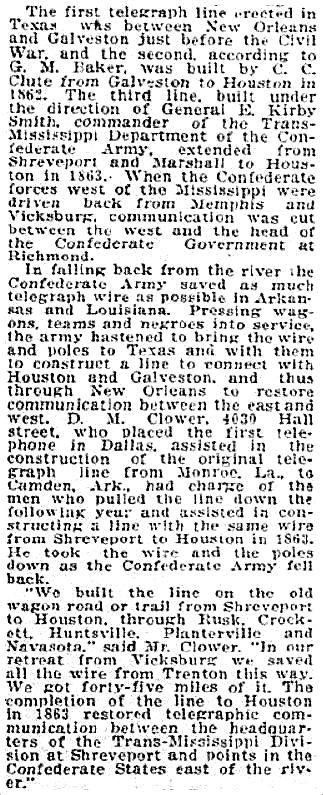
During the Civil War, Clower was a Confederate telegraph operator in the 1st Louisiana Regiment (see Clower’s fascinating obituary below). When the Union army was advancing after the fall of Vicksburg, Clower directed (and helped in) the destruction of the Confederate telegraph system he had helped set up, in order to prevent its being commandeered by Yankee forces — he and his men raced to pull up over 40 miles of wire and equipment, loaded everything on wagons, bugged out, and then used the same wire and poles to string a new Confederate line into and across Texas.

clower-telegrapher_dmn_010822DMN, Jan. 8, 1922

The war ended before Clower had completed his line northward from Houston, but his efforts had helped lay the telegraph infrastructure that the state of Texas relied on for decades afterward.

*

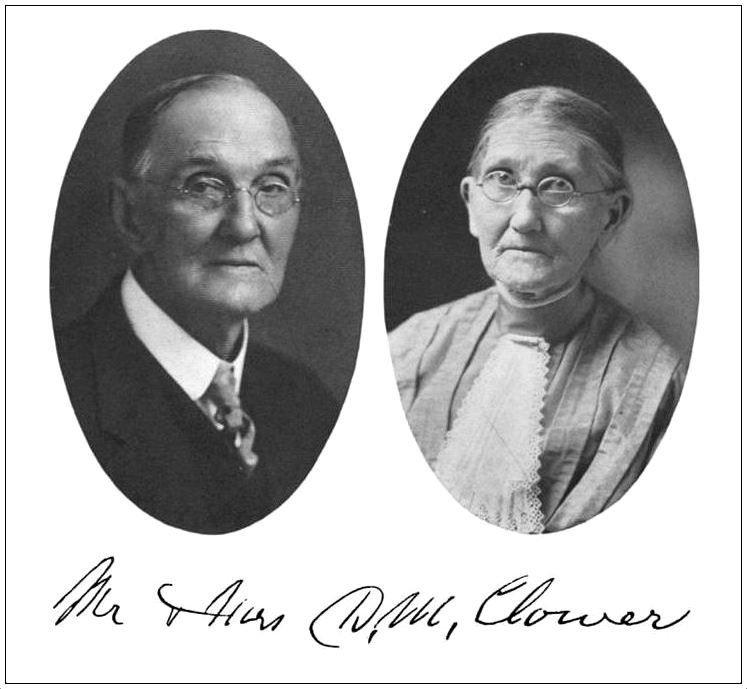
The people in the top photo are not identified. When that photo was taken, D. M. Clower and his wife, Ellender, would have been about 73; their daughter Maud and her husband Jesse would have been in their early 30s. I assume it’s the elder Clowers, with a mystery bearded man in the foreground.

clowers_d-m-and-ellender_hist-of-tx-and-texans_1914_portal
Mr. and Mrs. D. M. Clower, ca. 1914

You never know what you’re going to discover when you read a 106-year-old postcard and wonder where an old house used to be.

***

Sources & Notes

Postcard found on eBay.

Daniel Morgan Clower was born in Alabama in 1835; he arrived in Dallas in 1879, coming from Comanche, where Maud was born in 1877. Clower died in 1927 at the age of 92; Maud died in 1948. His wife, Ellender Paralee Clower, died in 1917 (at which time the couple had been married for more than sixty years).

More on Clower can be found in the pages of The Dallas Morning News:

  • “Telegrapher Tells Civil War Episode” (DMN, Feb. 1, 1924) — a fantastically cinematic account of Clower’s past, in his own words
  • A photo of Clower and Eli Sanger, (DMN, May 1, 1927) — what might well be the last photo of Clower ran in the News just a few months before his death at the age of 92; also in the photo is Eli Sanger, of Sanger Bros. (Clower once had a business in Millican, TX when Sanger’s opened there at the close of the Civil War, and he proudly boasted that he was one of their very first customers)
  • “Daniel Clower Funeral Held” (DMN, Aug. 19, 1927) — Clower’s obituary, with photo

Photo of Mr. Clower with text from a Dallas Times Herald story published on the occasion of his 89th birthday can be found here (scroll down to 1924, about halfway down the page), via Jim Wheat’s site.

The photo of Mr. Clower and his wife Ellender is from the book A History of Texas and Texans, published in 1914; the accompanying entry about Clower’s very interesting life can be found here, via the Portal to Texas History.

*

Copyright © 2015 Paula Bosse. All Rights Reserved.

White Rock Station

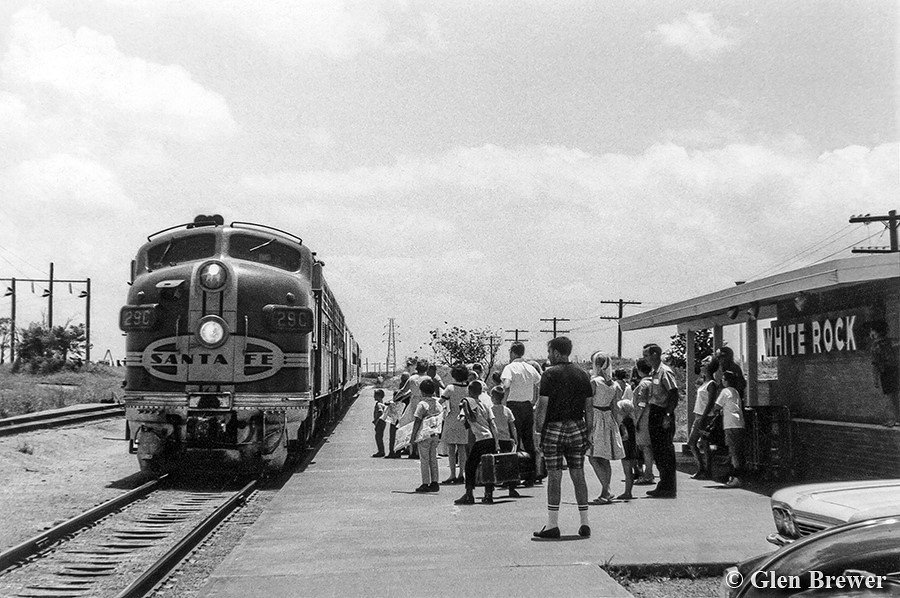
white-rock-station_glen-brewer_062468White Rock Station, June 24, 1968 (click for larger image) © Glen Brewer

by Paula Bosse

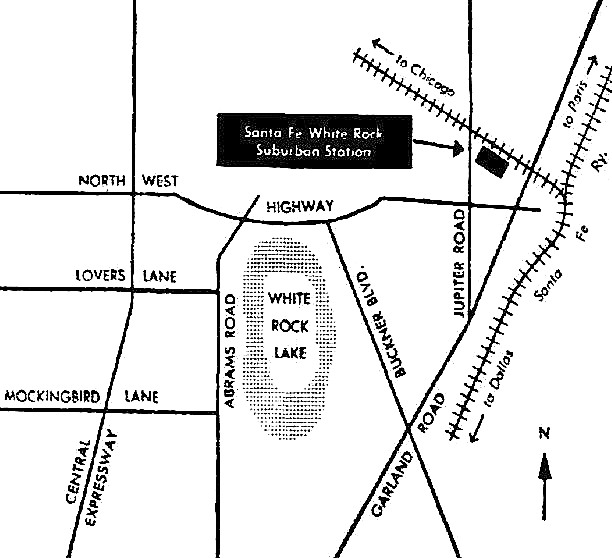
The White Rock passenger station — the Santa Fe railroad’s first suburban train depot built in the Southwest — opened on December 5, 1955 on Jupiter Road, about a quarter of a mile south of Kingsley (located mere steps across the Garland city line), a few miles northeast of White Rock Lake. It was the culmination of a $7,000,000 construction project in which two depots were built and 49.3 miles of new track was laid between Dallas and Denton (or, more specifically, between Zacha Junction — the area near Northwest Highway & Garland Road — and Dalton Junction, an area just northwest of Denton).

The new track — touted by a Santa Fe ad as being “the longest main line construction over new territory by any railroad in 25 years” — was important because it offered passengers from Dallas the ability to travel for the first time directly to Chicago without having to change trains. It also reduced freight line distances by 65 miles. The swanky streamlined Texas Chief shuttled passengers between Dallas’ Union Station and Chicago in about 19 hours — travel time between Union Station and the new White Rock Station was 25-30 minutes.

white-rock-station_dmn_120455_det-map_smSanta Fe ad detail, Dec. 4, 1955

The breathless copy from the giant two-page advertising spread heralding the new line included the following description:

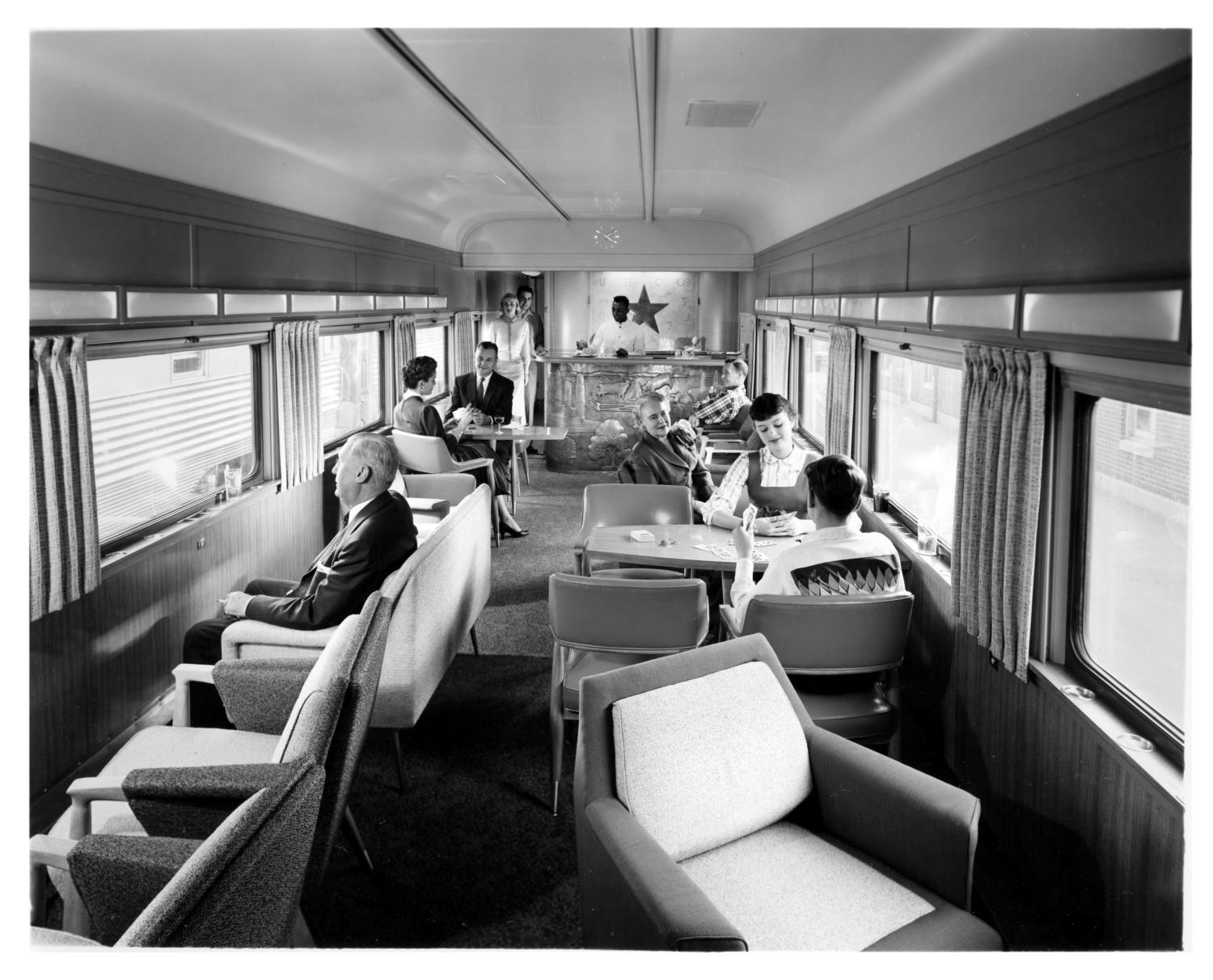
And just wait until you see the special lounge car and dining car on the Texas Chief — the last word in luxury in railroad equipment, decorated in the style and smartness indicative of Dallas…. A lounge decorated to please a Texan! Wide open and spacious feeling, with really comfortable modern sofas and chairs, casually grouped to make you want to relax. You’ll see the Star of Texas and famous cattle brands tooled into the rich leather back-bar — and Texas-inspired murals in hand-hammered copper. Even the walls are richly paneled — in smart, new frosted walnut. Just wait until you see it, you’ll say there’s nothing like it.

And here they are (click for larger images):

texas-chief_dining-car_portal_c1956texas-chief_lounge-car_portal_c1956

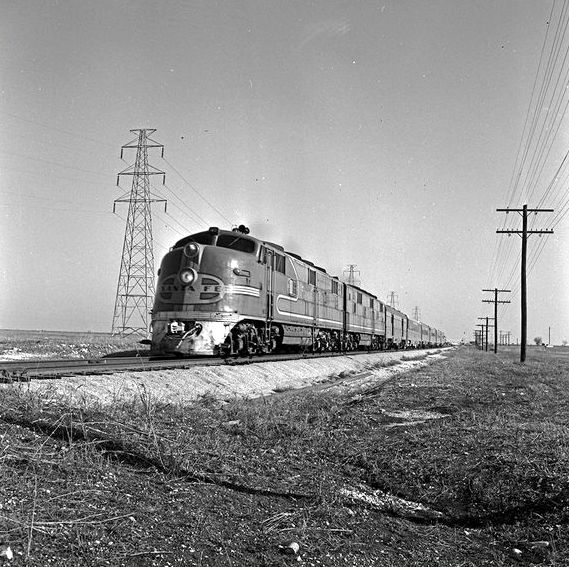
Below, the Texas Chief, pulling out of the station, heading north. (To see a grainy closeup of the station in the background, click here.)

texas-chief_degolyer_smu_122956Photo by Everette DeGolyer, Dec. 29, 1956, via SMU

*

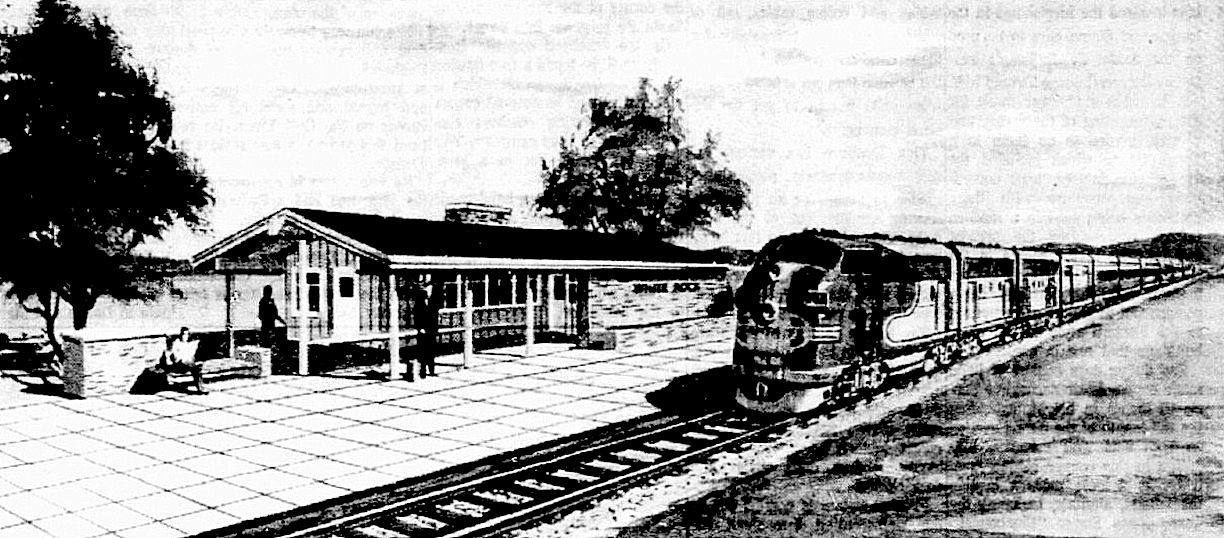
white-rock-station_dmn_120455_det-drawingwhite-rock-station_dmn_120455_renderingAbove two drawings from Santa Fe ad, Dec. 4, 1955

white-rock-station_c1956_portalCirca 1956, photo by M. D. Monaghan

*

UPDATE: Watch color home-movie film footage taken at the station in this clip from the Portal to Texas History (the pertinent footage begins at the 3:00 mark). More on this cool piece of film can be found in another Flashback Dallas post, here.

*

Interesting tidbit: the engine of the Texas Chief was christened at Union Station on Dec. 5, 1955 with a bottle of water from White Rock Lake! The caption of a photo of the christening in the Dallas Morning News read: “NEW STREAMLINER CHRISTENED — With a bottle of water from White Rock Lake, Mrs. Fred G. Gurley, wife of the Santa Fe Railway’s president, christens the new Dallas-Chicago Texas Chief in ceremonies Monday at the Union Terminal. At right is Miss Sandra Browning of Garland, who presented the local bottle of water,” (DMN, Dec. 6, 1955). Champagne? Pffft! We’ve got pure-dee White Rock Lake water!

And I found footage of that! Here is a screenshot of Mrs. Gurley wielding the bottle of East Dallas’ finest (as Miss Garland, Sandra Browning looks on).

white-rock-station_christening_youtube

And here is the short clip of the Texas Chief on Dec. 5, 1955, the day of its inaugural run from Dallas to Chicago — in color!. There are shots of the ceremonies at Union Station in Dallas, of the new White Rock Station, of the streamliner with the Dallas skyline behind it, and, possibly, footage from the other big ceremony in Denton.

**

santa-fe-line_corsicana-daily-sun_120555Corsicana Daily Sun, Dec. 5, 1955 (click to read)

white-rock-station_santa-fe_spike_ardmore-OK-antique-store_2020Commemorative spike

***

Sources & Notes

Top photo shows passengers waiting for the train on June 24, 1968; photo © Glen Brewer.

The two photos showing the dining and lounge cars of the Texas Chief were taken around 1956; both are from the Museum of the American Railroad Collection, Portal to Texas History. Other photos of the Texas Chief from this collection can be seen here.

Photo of the Texas Chief pulling out of the White Rock Station was taken by Everette L. DeGolyer on Dec. 29, 1956; it is from the Everette L. DeGolyer Jr. Collection of United States Railroad Photographs, DeGolyer Library, Central University Libraries, Southern Methodist University. The photo (“Atchison, Topeka, and Santa Fe, Diesel Electric Passenger Locomotive No. 11, White Rock Station”) can be viewed here.

The two drawings, and a few quotes, are from large advertisements placed by the Santa Fe railroad to announce the opening of their new line.

The last photograph showing the station is dated “circa 1956” and credited to “Monaghan, M.D.”; it can be viewed on the Portal to Texas History site, here.

The YouTube video showing color footage of the Texas Chief’s inaugural festivities is titled “New railroad into Dallas. Archive film 93424,” from the Huntley Film Archives, here.

The photo of the commemorative railroad spike (“Spiked with Progress”) was sent to me by a man who had seen it for sale in an antique store in Ardmore, Oklahoma in 2020 (thanks, Joe!).

A 1962 map showing the location of the station is here. A present-day Bing map showing where the station was is here. A Google Street View image of the area today is (…if you must…) here.

An article on the construction of the Denton and Dallas (White Rock) depots — “Work on New Santa Fe Depot To Start Here” (Denton Record-Chronicle, July 13, 1955) — can be read here.

For anyone doing research into this specific new rail line, there was a 16-page section in The Dallas Morning News on Dec. 5, 1955 which was bursting with helpful info, civic pride, “welcome to the neighborhood” ads, and corporate puffery. There was an even larger (MUCH larger!) tribute to the sainted Santa Fe which consumed the entire Dec. 4, 1955 edition of The Denton Record-Chronicle (there was even a ghost image of a Santa Fe engine which covered page one).

As mentioned above, there is home-movie film footage taken at the station — more about this can be found in the Flashback Dallas post “White Rock Station (And a Helicopter Ride),” here.

And, lastly, check out a YouTube video of Henry Mancini’s version of Johnny Mercer’s “Atchison, Topeka & Santa Fe” — with loads of cool period film footage of train travel — here.

*

Copyright © 2015 Paula Bosse. All Rights Reserved.

WWII-Era Elm Street … In COLOR — 1945

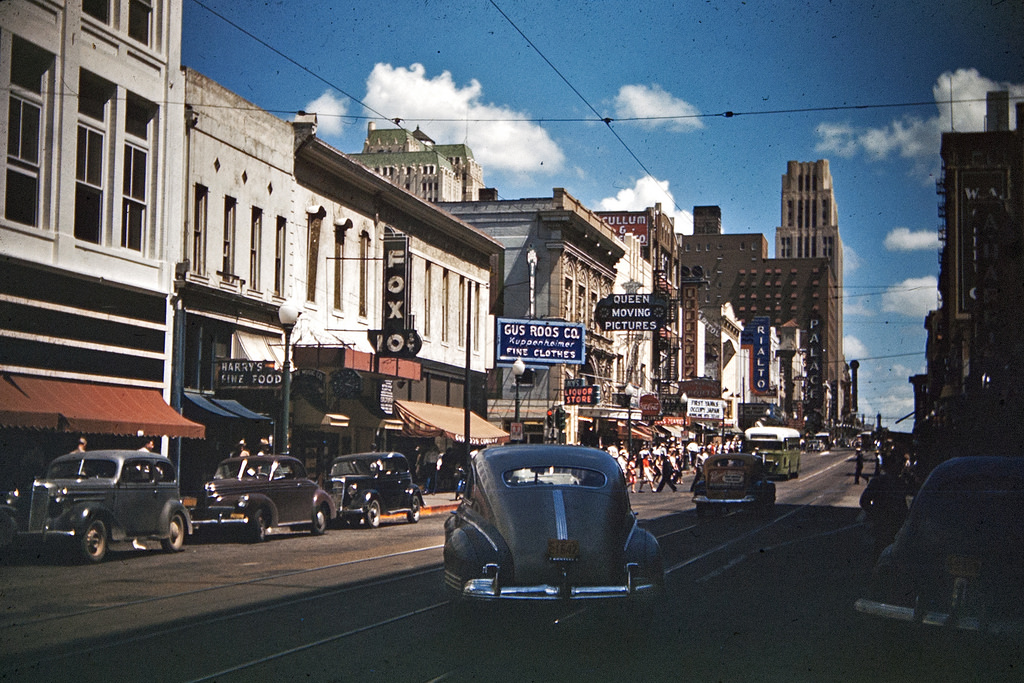
elm-street-color_1940s_jeppson-flickr(Click to see a larger image of this wonderful color photo!)

by Paula Bosse

This is one of my favorite photos of Dallas — mainly because it’s in COLOR! This absolutely fantastic photograph is from Noah Jeppson’s great website, Unvisited Dallas. Here we see Elm Street, looking east along Theater Row, taken from about the middle of the 1400 block of Elm. (To get your bearings, Gus Roos was at the northwest corner of Elm & Akard.) I LOVE this!

***

Sources & Notes

Photo from Noah Jeppson’s Unvisited Dallas post, “Elm Street 1945” — see the original post and read Noah’s description of the buildings seen in the photograph here. I don’t know where this photo came from, but I hope there are more color photos from this era out there. I would love to see them!

Other photos of this block (sadly, none in color) are in an earlier Flashback Dallas post, “Building Collapse on Elm Street — 1955,” here.

See several other fantastic COLOR photos in the Flashback Dallas post “Downtown Dallas in Color — 1940s and 1950s.”

*

Copyright © 2015 Paula Bosse. All Rights Reserved.

The Nellie Maurine: When a Pleasure Boat Became a Rescue Craft During the Great Trinity River Flood of 1908

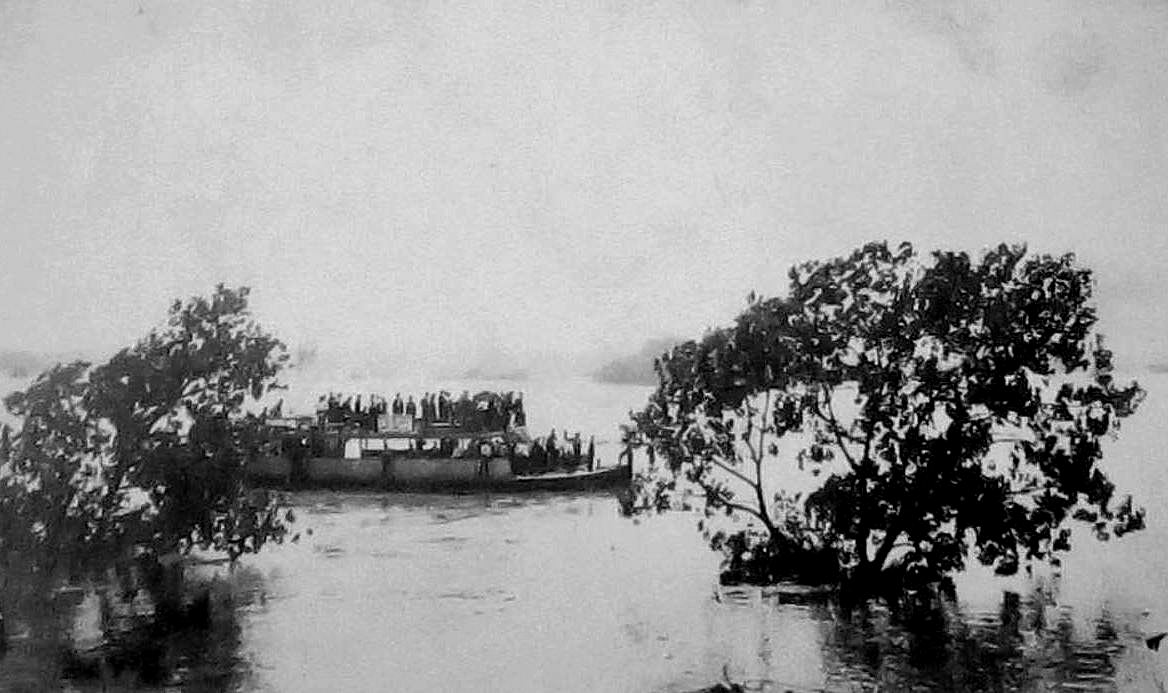
nellie-maurine_diaper-daysThe Nellie Maurine

by Paula Bosse

107 years ago today — after days and days of torrential rains — the Trinity River reached a crest of over 52 feet, and the resulting flooding caused loss of life and property and almost incalculable widespread damage on both sides of the suddenly surging river. Bridges and train trestles were washed out, cutting off any way for Dallasites or travelers heading west on trains and interurbans to get from Dallas to Oak Cliff, and vice versa. Ever the home of the entrepreneurial capitalist, the owner of one of the only large boats in the area, the Nellie Maurine, offered his water vehicle to be used as a ferry for those souls desperate to cross the river. For a price.

In September of 1906, E. L. Gale built a large boat in Dallas. It was designed to carry freight as well as passengers on pleasure trips between the “wharf” at the base of Commerce Street and the under-construction Lock and Dam No. 1 at McCommas Bluff. The boat was named after his daughters Vanelle and Maurine.

The Nelle Maurine is a model bow, flat-bottomed boat, seventy feet in length, sixteen-foot beam on the water line, and twenty feet including the guard rail. She is a propeller boat, draws twelve inches of water, and is driven by a 40-horsepower engine. In the event it be found that the engine is not of sufficient power to give the boat the required speed, it is so arranged that it can be changed to 80-horsepower with but very little trouble. With full cargo aboard, the vessel will require a depth of about thirty-three inches of water. (Dallas Morning News, Sept. 29, 1906)

nellie-maurine_dmn_092906DMN, Sept. 29, 1906 (before upper deck/pilot house had been built)

Gale envisioned great success in establishing shipyards and a wharf in Dallas. Though the much hoped-for “navigable Trinity” was still not a reality, many believed a trade route waterway between Dallas and the Gulf of Mexico was inevitable. A person could make a great deal of money by being in on the ground floor of such an industry.

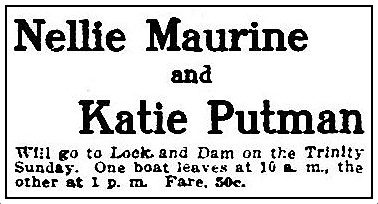
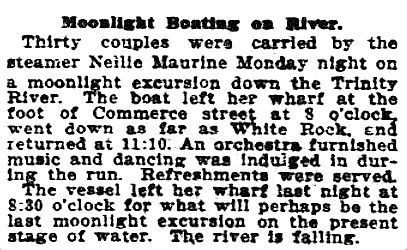
The boat, initially a propeller boat which was converted to a sternwheeler in the summer of 1907, had trouble in operating along the short stretch of river with any kind of regular service — the water level was either too low or too high (when the water was high, the boat could not pass beneath the “Zang boulevard bridge”). The Nellie Maurine was often moored near a large cottonwood tree waiting for the river to cooperate. When it did cooperate, the boat was in demand as a pleasure craft, often offering moonlight treks down the river, complete with onboard dance band. The fare for a daytime round-trip to McCommas Bluff was 50¢; the privately chartered night-time cruises were likely quite a bit higher.

nellie-maurine_dmn_070409-ADAd, DMN, July 4, 1909

nellie-maurine_dmn_051308May 13, 1908 (less than two weeks before the flood)
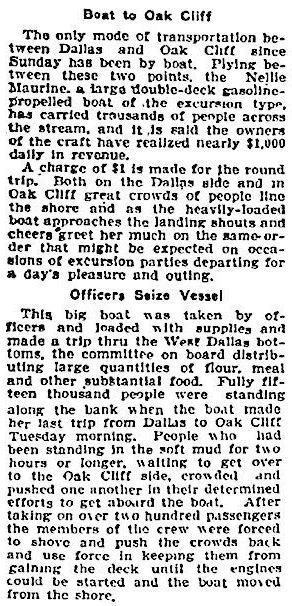
When the Great Flood of 1908 hit on May 25, there was absolute bedlam, beginning in the middle of the night when one man set off several “dynamite bombs” one after another in order to awaken his neighbors who were unaware of the sudden and unexpected rise of the swollen river and who were in imminent danger. When Dallasites went to bed on May 24, the river was at an already high 28 feet. By 3:00 in the morning, just a few short hours later, it had risen to an incredible — and incredibly dangerous — 41.5 feet. By that afternoon it was over 51 feet, and by nightfall, it had surpassed all records and was at more than 52 feet. West Dallas and downtown were underneath water. Homes and livestock were washed away. Electricity was out. Telephones were out. Roads and railways were impassable. There was absolute panic.

For numerous reasons, people were desperate to cross the river. As all roads and bridges across the Trinity were submerged or destroyed, the only way across was by boat. The Nellie Maurine’s owner saw an opportunity to make a lot of money — by charging people to ferry them back and forth across the Trinity, something that probably rubbed people the wrong way. When city authorities asked permission to use the Nellie Maurine to survey the damage, they were rebuffed when Gale (or his captain) insisted the city pay a fee and the city refused. Dallas County Sheriff Arthur L. Ledbetter and Criminal District Judge W. W. Nelms were having none of that and seized the boat, deputizing the crew and ordering them to set off for the west bank of the river. As it turned out, the damage was far worse than anyone could have expected, and the boat was used to rescue stranded people, some of whom were pulled from treetops. (The account of this survey, titled “West Dallas Trip Proves Thrilling,” is pretty gripping — see link below.)

When the city was done with its search-and-rescue mission, it UN-seized the boat, and the Nellie Maurine began operating as a ferry again, transporting frantic people back and forth across the river. If you wanted to cross the river, you’d have to cough up one dollar — maybe even two, a hefty price to reach safety. (According to the Inflation Calculator, $1 in 1908 would be the equivalent of about $26 in today’s money). It was rumored that this ferry service was generating $1,000 a day (almost $26,000 a day in today’s money!).

nellie-maurine_dmn_052808DMN, May 28, 1908

The Nellie Maurine provided a much-needed service during the Great Dallas Flood — and they also made a substantial profit, which — depending on your business philosophy — is either ingenious or appalling.

*

Below, a few images of the Nellie Maurine. I’m not sure what ultimately became of her, but I have found no mention of the boat past 1910, a year before E. L. Gale died.

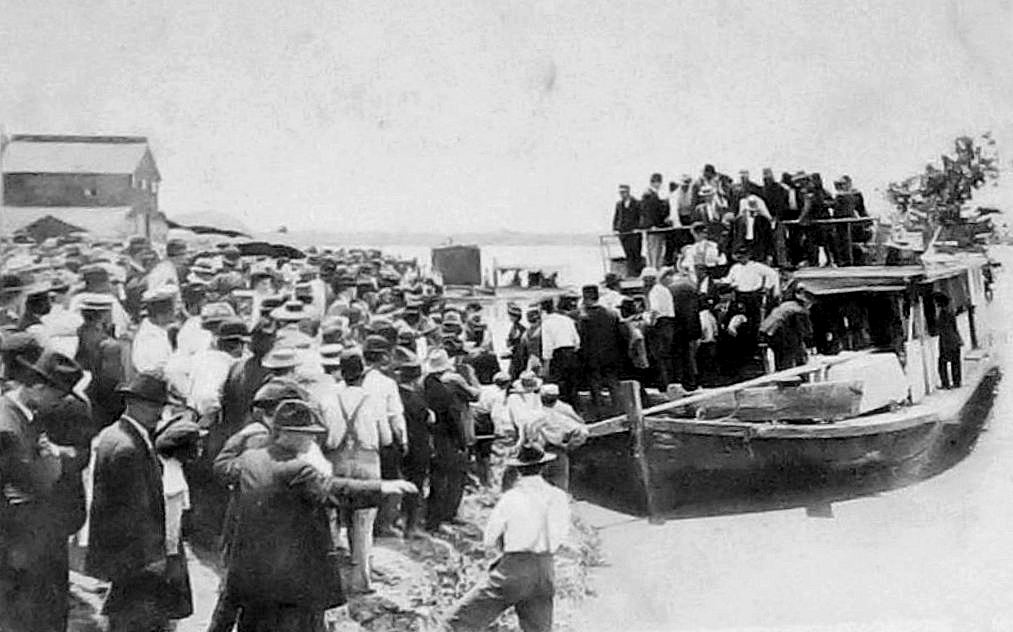
First, two photos of the boat taken during the flood (the boat had lost its pilot house when it was caught under the Commerce Street bridge earlier that day). (These two “real photo postcard” images found on eBay.)

flood_nellie-maurine_1908a

flood_nellie-maurine_1908b

Another photo from 1908 (from the John Miller Morris collection of Texas real photographic postcards and photographs, DeGolyer Library, SMU, here):

nellie-maurine_flood_1908_RPPC_john-miller-morris-collection_de-golyer-lib_SMU_front1908, DeGolyer Library, SMU

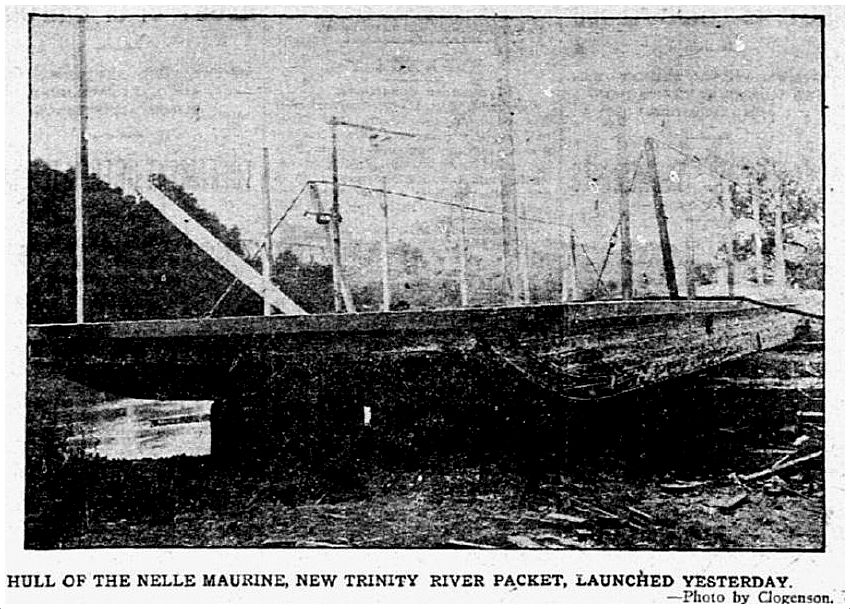
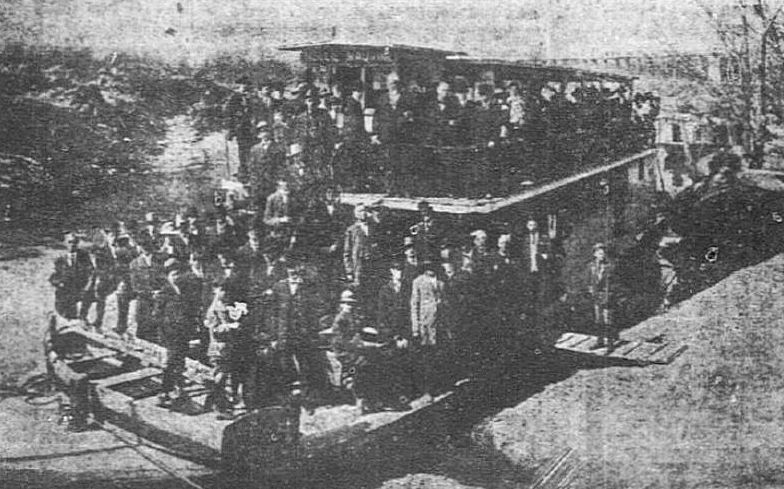
And, lastly, a post-flood photo from 1909, showing builders and contractors onboard, about to head to Lock and Dam No. 1 to check on its progress.

nellie-maurine_dmn_022309DMN, Feb. 23, 1909 (photo by Clogenson)

***

Sources & Notes

Top photo from the highly recommended book Diaper Days of Dallas by Ted Dealey.

Clippings and photos from The Dallas Morning News, as noted.

Read about the introduction of the Nellie Maurine (or the “Nelle Maurine”) to Dallas newspaper readers in an article published in The Dallas Morning News on Sept. 29, 1906, here. (The second photo above accompanied this article.)

Read the account of what was seen from the boat when it was commandeered by city officials in “West Dallas Trip Proves Thrilling,” published in the DMN on May 26, 1908, here.

Read more about the flood in these articles from The Dallas Morning News:

  • “The Trinity’s Swan Song Spree of 1908” by Gene Wallis (DMN, March 1, 1931), a hair-raising account of the havoc wreaked by the flood
  • “Riders Saw 1908 Flood from Ferry” (DMN, May 28, 1957), includes an account of S. S. Cumby, a farm boy who witnessed the flood

The Trinity River flood of 1908 was a story that made national headlines. The death-toll reports were all over the place, from 4 to “hundreds.” I think the official number of lives lost was only 4 or 5, which is pretty amazing, considering the massive destruction caused by the flood. An interesting first-day report can be found in the Wichita (Kansas) Beacon, in a late edition from May 25, 1908, here. “Trinity Is on a Rampage” — indeed.

An incredible photo of the washed-out T & P railroad trestle can be found in a previous post here.

Stay dry, y’all!

*

Copyright © 2015 Paula Bosse. All Rights Reserved.

Orson Welles In Dallas — 1934-1940

orson-welles_cornell-tour_1934
Orson at 18 — publicity photo used for the Cornell tour, 1934

by Paula Bosse

Today is the 100th anniversary of the birth of Orson Welles. Welles was one of the truly great, innovative theater and film directors, an actor with a commanding presence, and a delightfully entertaining raconteur. His frenetically creative work on the New York stage, on radio, and in film (he wrote, produced, directed, and acted in his first film, Citizen Kane, when he was only 25) earned him/saddled him with the hard-to-deny sobriquet “Boy Genius.” His rise up the show-biz ladder was a quick one.

Orson’s first professional acting gig was as an unknown 18-year old repertory player in the touring company of famed actress Katharine Cornell who, along with British actor Basil Rathbone, starred in the three plays performed on the tour, which stopped in Dallas for a two-night engagement at the Melba theater, in February, 1934. The three plays performed in Dallas on February 19 and 20 (one a matinee) were “Romeo and Juliet” (Orson played Mercutio), “The Barretts of Wimpole Street” (he played Octavius Moulton-Barrett), and “Candida” (he played Marchbanks). Cornell was a huge draw, and there was a rush for tickets. The Melba begged her to extend her stay and add performances, but she declined.

The young Welles had gotten reviews on the tour which ranged from a dismissive mention in Variety that he was unable to speak Shakespeare’s lines properly and audibly (!), to raves from Charles Collins of The Chicago Tribune:

The cast is brilliant, and many of the secondary characters are acted with consummate skill. This is particularly true of Orson Welles’ Mercutio, which is an astonishing achievement for a youth still new on the stage. In his duel with Tybalt and his death scene, this Mercutio is a complete realization of Shakespeare’s bravest blade.

The star of the show was the then-very-famous Katharine Cornell, around whom most of the articles and reviews centered (she was, for instance, breathlessly reported to be staying at the Melrose during her Dallas stay) (I wonder if the lowly company players — i.e. Orson Welles — stayed there as well?). The Dallas Morning News theater critic, John Rosenfield — who mentioned this 1934 Dallas appearance in almost every succeeding article he ever wrote about Orson Welles over the next several decades — wrote the following before he saw Orson’s performances in any of the three plays:

Orson Welles, 18-year-old actor, who is apparently bulky enough to hold his own with adults, will be Mercutio. (DMN, Feb. 19, 1934)

After he saw his Mercutio:

Orson Welles’ Mercutio was up to the best standards known for this role. (DMN, Feb. 20, 1934)

When the tour finished, Welles quickly became a presence in the New York theater world. One of his early successes as a producer and director was his production of the so-called “Black Macbeth”/”Negro Macbeth”/”Voodoo Macbeth” — a hugely popular staging of Shakespeare’s “Macbeth” with an all-black cast, done under the auspices of the Federal Theatre Project in 1936. In August of that year — just two and a half years after his appearance as an unknown at the Melba — he took the production to Dallas where it made a splash at the Texas Centennial in the brand new bandshell.

macbeth_texas-centennial_dmn_081336Aug., 1936

macbeth_playbill_dallas_LOC(click for larger image)

Rosenfield was impressed by the lush design and the electric and inventive spectacle, but he was not a fan of the performances. A few years later, on the eve of the release of Citizen Kane, he wrote the following (which was much harsher than his original 1936 review):

We saw this production in Dallas during the Texas Centennial and could marvel at the artistic futility of such ingenuity. The Negro Macbeth, however, was something to be seen if only to be despised. (DMN, Oct. 29, 1941)

Oh dear.

In 1940, Welles was working on his first film, the legendary Citizen Kane. As filming began to wind down, he decided to go out on a short lecture tour because he was in desperate need of money (an all-too-common circumstance he found himself in throughout the entirety of his career). His topic was a vague “anecdotes of the stage and theories on the drama” — and it sounds like his “performances” were largely unscripted and unrehearsed. 

On October 29, 1940 — only a week or two after wrapping production on Citizen Kane — 25-year old Orson Welles spoke at McFarlin Auditorium on the SMU campus as part of the Community Course series of lectures. His topic: The Actor’s Place in the Theater. It was another packed house of adoring and/or curious Dallasites. Rosenfield was both entertained and annoyed by the rambling “lecture,” but Orson was undoubtedly delighted to talk for two hours before an adoring crowd, answer their questions about his craft, and collect a $1,200 check.

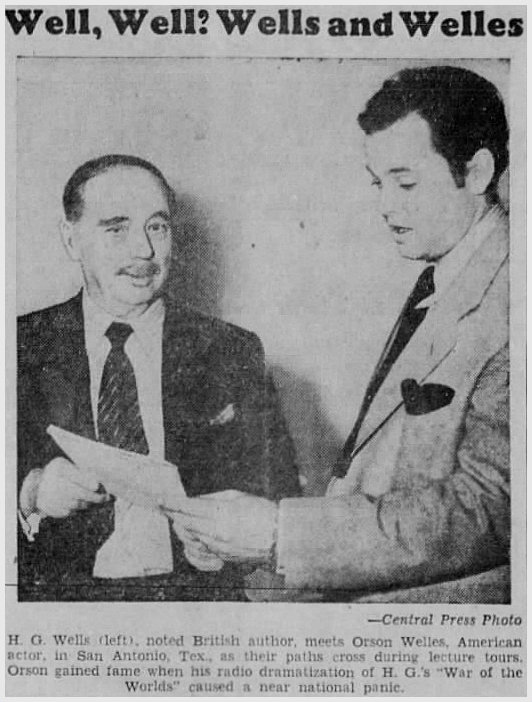
Orson’s appearance in Dallas was particularly noteworthy for the fact that the speaker scheduled to appear on the McFarlin stage just three days later was … H. G. Wells! At the time of this lecture tour, Orson was best known for his infamous 1938 radio adaption of H. G. Wells’ The War of the Worlds, the frighteningly realistic production that panicked the nation and led thousands to believe that the earth was being attacked by Martians. Rather surprisingly, Welles and Wells had never met.

According to a blurb in a Phoenix newspaper, Orson had cancelled a previously-scheduled meeting in Tucson in order to fly into Dallas earlier than planned. My guess is that he saw that H. G. Wells was also lecturing in Texas and realized that H. G.’s lecture in San Antonio the night before Orson’s own appearance in Dallas on the 29th was the only chance he had to meet the man who had provided the source-material for his (to-date) greatest career triumph.

A quick timeline:

  • Sun. Oct. 27, 1940: Orson arrives in Dallas, staying at the Baker Hotel.
  • Mon. Oct. 28: In the morning, Orson flies down to San Antonio to meet H. G. Wells and attend his lecture. The two meet, get along famously, have their photos taken, and give a short joint interview to San Antonio radio station KTSA (see below for link to recording). That evening, both fly to Dallas. Later that night, Orson (well known as an amateur magician) pops into The Mural Room in the Baker Hotel to catch the floor show featuring popular magician Russell Swann.
  • Tues. Oct. 29: H. G. Wells leaves Dallas for Denver, continuing his lecture tour. That morning Orson drives to Fort Worth to present a lecture and attend a luncheon at the River Crest Country Club. That night, he presents his lecture at McFarlin Auditorium at Southern Methodist University. After his lecture, he catches Russell Swann’s magic show for a second time. At 3:00 a.m. he flies to San Antonio for his lecture there.
  • Wed. Oct. 30: Orson lectures in San Antonio. It is the second anniversary of the broadcast of “The War of the Worlds.” Conveniently, newspapers around the country begin to run the photos of Welles and Wells taken on the 28th.
  • Thurs. Oct. 31: A Martian-free Halloween.
  • Fri. Nov. 1: H. G. Wells is back in Dallas for his lecture that night at McFarlin Auditorium.

welles-wells_san-antonio_102840

welles-wells_pottstown-pa-mercury_103140Pottsdown (PA) Mercury, Oct. 31, 1940

h-g-wells_dmn_102940DMN, Oct. 29, 1940

Whew.

Happy 100th, Orson! And thanks for everything.

***

Sources & Notes

Dates and sources of newspaper clippings as noted.

“Macbeth” playbill from the Library of Congress, here.

The timeline for the Welles-Wells meeting and their Dallas-related activities were gleaned from a report in the Oct. 30, 1940 edition of The Dallas Morning News.

And now, links galore.

  • Watch an entertaining short clip in which Orson talks about mind-reading and fortune-telling — which he says he indulged in on the Cornell tour — here.
  • Read the profile of the 18-year-old phenom which appeared in newspapers during the run of the Katharine Cornell tour, here.
  • Read about the “Voodoo Macbeth” here (scroll to the bottom to see fantastic photos).
  • Listen to the interview with Orson Welles and H. G. Wells that aired on San Antonio station KTSA, the day they met for the first time, on Oct. 28, 1940 — here.
  • Read about that still-chilling Mercury Theatre radio broadcast of The War of the Worlds, here.

Finally, my favorite Orson Welles-related quote from the erudite and not-without-humor arts critic of The Dallas Morning News, John Rosenfield. He wrote the following in his review of the set-in-Haiti “Macbeth” — about the aesthetic viability of future Shakespeare productions tailored for specific audiences:

…Mr. Welles hasn’t started a movement. His Negro “Macbeth” does not inspire us to corroborate a fabled Texas lawyer and make Antonio “The Merchant of Ennis.” (DMN, Aug. 16, 1936)

“THE MERCHANT OF ENNIS”! Someone! Make this happen!

*

Copyright © 2015 Paula Bosse. All Rights Reserved.

Aerial View of the Centennial Fairgrounds — 1936

fair-park_1936_red-oak-kidThe Texas Centennial: a “World’s Fair” for Dallas

by Paula Bosse

This fantastic photo (by one of Dallas’ top aerial photographers, Lloyd M. Long) shows the impressive expanse of Fair Park’s new Art Deco splendor — most of the buildings seen here were built especially for the 1936 Texas Centennial Exposition, and most of those are, thankfully, still standing.

***

Sources & Notes

Lloyd M. Long photo, found on Red Oak Kid’s Flickr stream, here.

To see this photo REALLY big, click here.

*

Copyright © 2015 Paula Bosse. All Rights Reserved.