Flashback : Dallas

A Miscellany: History, Ads, Pop Culture

Category: Holidays/Celebrations

The Margules Family’s Passover Seder
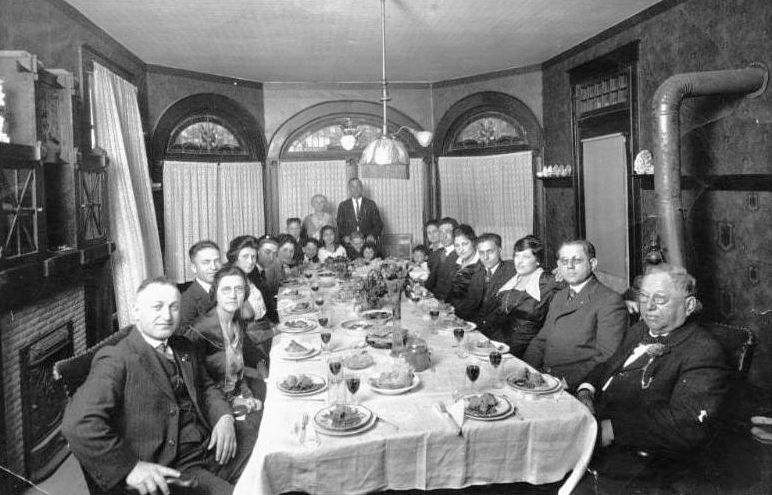
1-passover_djhsClick for larger image (Dallas Jewish Historical Society photo)

by Paula Bosse

Above, a photograph of Passover seder, probably in the 1920s, taken at the South Dallas home of Sam and Dubbie Margules, with some (or all) of their nine children.
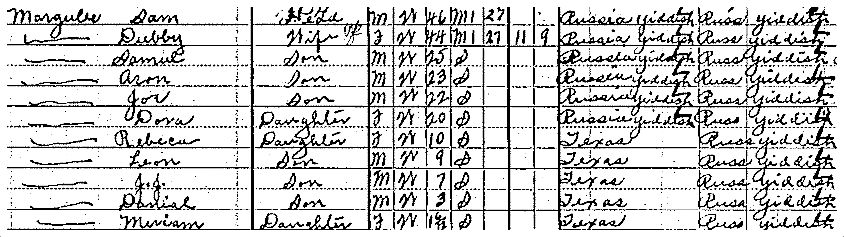
2-margules_census_1910(1910 Census — click for larger image)

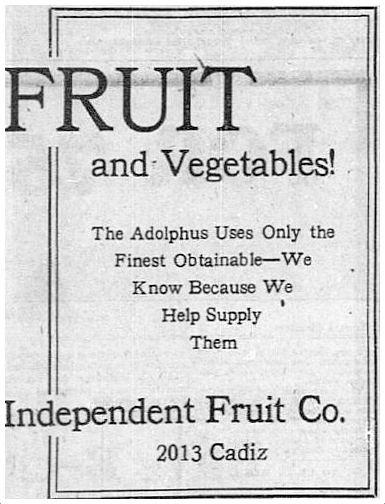
Sam Margules immigrated to the United States from Russia in the late 1880s. By the early 1890s he had made his way to Dallas and had begun working in the wholesale produce business. Once settled and on secure financial footing, he sent for his wife and four children (five more would be born in Dallas). In 1915, Sam established his own business, the Independent Fruit Co.

3-margule_ind-fruit-co_dmn_010116(1916)

4-margules_adolphus_dmn_101224(1924)

Even thought the Margules family seems to have had a happy and successful life in Dallas, there was one incident that must have been very unsettling for them. In the waning days of World War I, a Chicago trade publication reported an instance of vandalism against the Independent Fruit Co., perpetrated by a thuggish Liberty war bond committee. In what was clearly meant as intimidation, the shakedown “committee” had splashed yellow paint across the Margules storefront in the dead of night, as punishment for what they believed was the family’s refusal to purchase Liberty bonds. These attacks with yellow paint were a common occurrence around the country in those days (as was tarring and feathering!), and they were frequently directed at immigrants, as were nasty accusations that they were “slackers”  (a much-used pejorative at the time meaning “unpatriotic shirker” or even “coward”)

The family seems to have shrugged off the incident, but it must have been a frightening time for them. The Jewish community in Dallas was a large and thriving one, but there was always antisemitism to deal with, and the Ku Klux Klan’s rise to power in the 1920s was particularly difficult for Jews in Dallas. (Click article below to see larger image.)
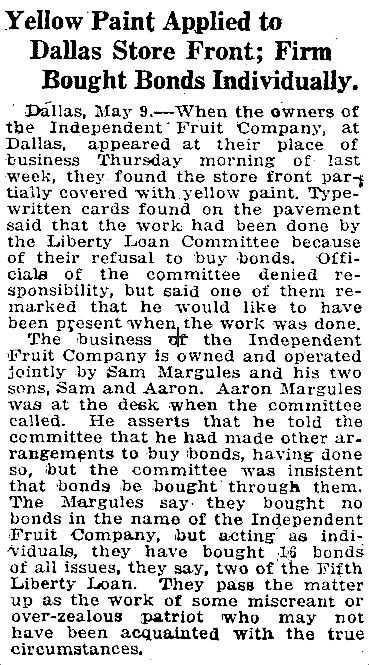
5-margules_chicago-packer_051019(1919)

Sam Margules died in 1930 at the age of  67, a 40-year resident of Dallas. His wife, Dubbie, died in 1953 at the age of 90, survived by 18 grandchildren and 17 great-grandchildren.

***

Sources & Notes

Photo from the Dallas Jewish Historical Society — the full citation is here.

Ads from The Dallas Morning News.

Article on the yellow paint attack from The Chicago Packer, May 10, 1919.

A passage on other yellow paint attacks on America’s immigrants by Liberty Bond committees can be read here.

A lengthy article on “The Jews Who Built Dallas” by David Ritz  (D Magazine, Nov. 2008) can be read here.

Click top two pictures for larger images.

*

Copyright © 2014 Paula Bosse. All Rights Reserved.
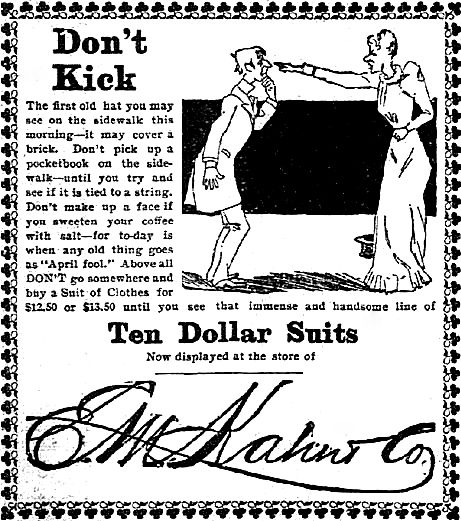
 

Do Not Become an April Fool: Tips from E. M. Kahn & Co. — 1898

by Paula Bosse

Pranks in 1898 were high-larious.

Do NOT be a fool and pass up that ten-buck suit, man, or you’ll have hell to pay with the missus.

***

Ad appeared in The Dallas Morning News, April 1, 1898.

*

Copyright © 2014 Paula Bosse. All Rights Reserved.
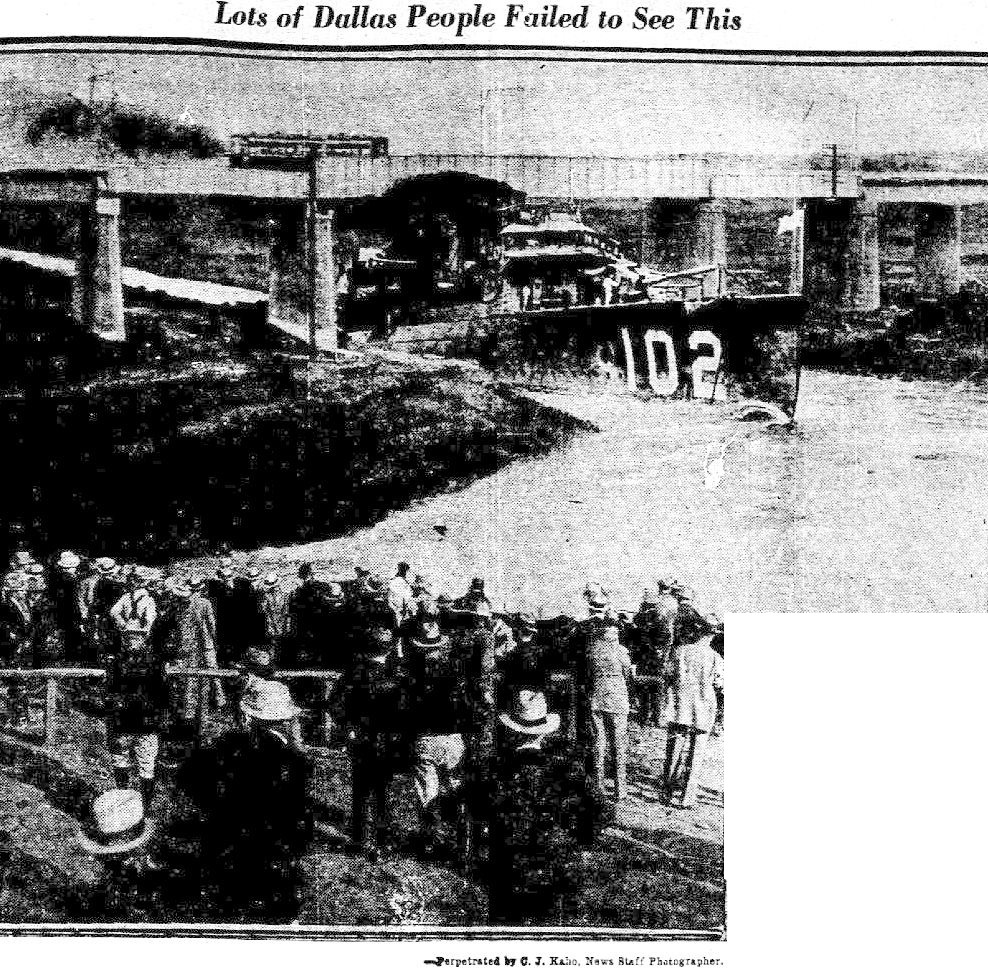
U.S. Revenue Cutter “Carrie Nation” Successfully Navigates the Trinity In Valiant Effort to Keep Dallas Dry! — 1931

april-fools_dmn_010131_carrie-nation
The ship’s arrival, passing under the streetcar viaduct…

by Paula Bosse

I spent a couple of hours looking through the archives of The Dallas Morning News this morning, hoping to find a nice juicy April Fools’ prank from the past. Everything was fairly run-of-mill. Until I came across this. THIS is great. I don’t know who wrote the story, but there is, at least, acknowledgement for the wonderfully weird photo above — the photo credit reads: “Perpetrated by C. J. Kaho, News Staff Photographer.”

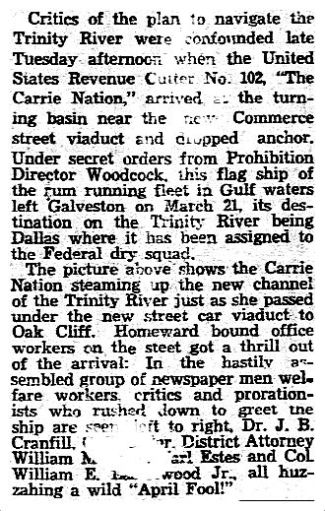
Below is the accompanying story about the United States Revenue Cutter Carrie Nation and the news of its journey up a surprisingly navigable Trinity River in order to anchor itself beneath the Commerce Street viaduct and make sure that the rum-runners in the Gulf don’t gain a foothold in bone-dry Prohibition-era Dallas. The photo and report appeared in the pages of The Dallas Morning News on April 1, 1931, beneath the headline “Lots of Dallas People Failed to See This.”

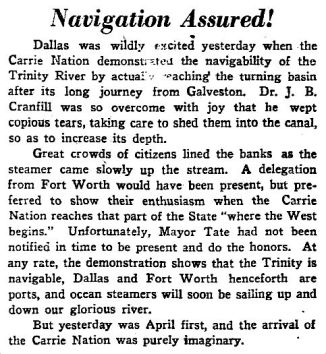
Unwilling to let such an important story fade away — and with a few more good lines left to get into print — this appeared the next day, on April 2, 1931: “Navigation Assured!”

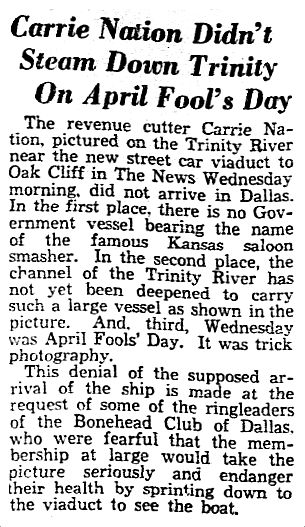
Then some killjoy editor probably insisted on this, which also appeared on April 2, 1931:

**

Rev. J. B. Cranfill was a Baptist leader and a noted Prohibitionist. I love the line “Dr. J. B. Cranfill was so overcome with joy that he wept copious tears, taking care to shed them into the canal, so as to increase its depth.”

And I laughed out loud at the “where the West begins” dig at Fort Worth.

But, seriously, that photo is great. The little streetcar chugging over the viaduct is just the perfect garnish.

Read about the famed, notorious Bonehead Club of Dallas in a 1991 Texas Monthly article by Helen Thompson, here. Thank you, Boneheads!

*

Copyright © 2014 Paula Bosse. All Rights Reserved.
Protected: Never Tell an Irate Irishman That He Can’t Paint a Green Stripe Down Main Street — 1960

This content is password-protected. To view it, please enter the password below.

My Birthdays at Kirby’s: Filet Mignon for Everyone!

kirbys-birthday

by Paula Bosse

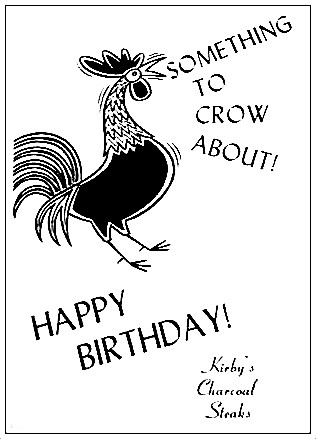
I grew up in the Lower Greenville area, and since we had a nice steakhouse just a couple of blocks away, that’s where we always went for family birthdays and special occasions: Kirby’s. I had forgotten about the birthday cards they sent out until my mother came across one in a recent move which was addressed to “Miss Paula Bosse.” Other than receiving actual mail, the thing that made these cards really exciting for a child was the inclusion of a dime. I always thought of it as a little birthday treat, but my mother suggested it was more of a subtle reminder to the parents to spend that dime on a call for reservations.

I loved that place. It was very dark. My brother and I always had the same thing: a non-alcoholic, super-sweet Shirley Temple from the bar, a salad with big chunks of roquefort in the salad dressing, a baked potato, and, oh my god, a filet mignon. I was mesmerized by the bacon wrapped around the steak. And the little wooden marker that showed how the meat was cooked. It was a nice, friendly neighborhood steakhouse. It was loud and happy. You could hear the steaks sizzling on the grill. It was always a treat to go to Kirby’s. And the place smelled GREAT! Even out on the sidewalk.

I was sad when they tore the building down, and even though there is now a chain of restaurants with the name “Kirby’s” — they even built a new one a couple of blocks down from the original location — there’s no way it could ever be the same.

Looking around for the history of the original “Kirby’s Charcoal Steaks,” I was surprised to discover that the man who owned Kirby’s — B. J. Kirby — was the son of the man who founded the Pig Stand chain of drive-ins. The Pig Stand started in Dallas, and it was the first drive-in restaurant EVER. They had the first carhops. The first onion rings. The first Texas toast. The Kirby’s steakhouse location — 3715 Greenville — had actually been a Pig Stand! B. J. Kirby had grown up working at his father’s restaurants, and when his father died, he sold all the Pig Stands except for the Greenville Avenue location (i.e. Pig Stand No. 4). In 1954 he turned the pig-sandwich-serving drive-in into a nice sit-down steakhouse which remained popular until the restaurant closed in 1987 when Mr. Kirby retired.

Watch Ch. 5 news footage of B. J. Kirby and the auction of the restaurant fixtures at UNT’s Portal to Texas History site, here.

kirbys_ch-5_closing_screencap_portal

I could really go for a bacon-wrapped filet mignon right about now. And one of those Shirley Temples would even hit the spot.

kirbys_1958

kirbys_color

kirbys_1951

***

Sources & Notes

“Something to Crow About!” card from the author’s collection.

Color photo of the Kirby’s sign is a screenshot from the Channel 5 news coverage of the auction of the Kirby’s fixtures, which aired April 14, 1987, viewable here; from the KXAS-NBC 5 News Collection, UNT Libraries, via the Portal to Texas History.

First ad from 1958; bottom ad from 1951.

Watch the 14-minute documentary “Carhops,” in which B. J. Kirby remembers life working as a kid for his father, here (also interviewed are other drive-in Dallas icons, J. D. Sivils and Jack Keller).

An entertaining history of the Pig Stand No. 4 and its transformation into Kirby’s Charcoal Steaks can be found here.

*

Copyright © 2014 Paula Bosse. All Rights Reserved.
“Throw Me a Pink Thing, Mister!” — 1967

mardi-gras_1967_doubloon-a

mardi-gras_1967_doubloon-b1967 Mardi Gras doubloon (click for larger images)

by Paula Bosse

“THROW ME SOMETHING, MISTER.”

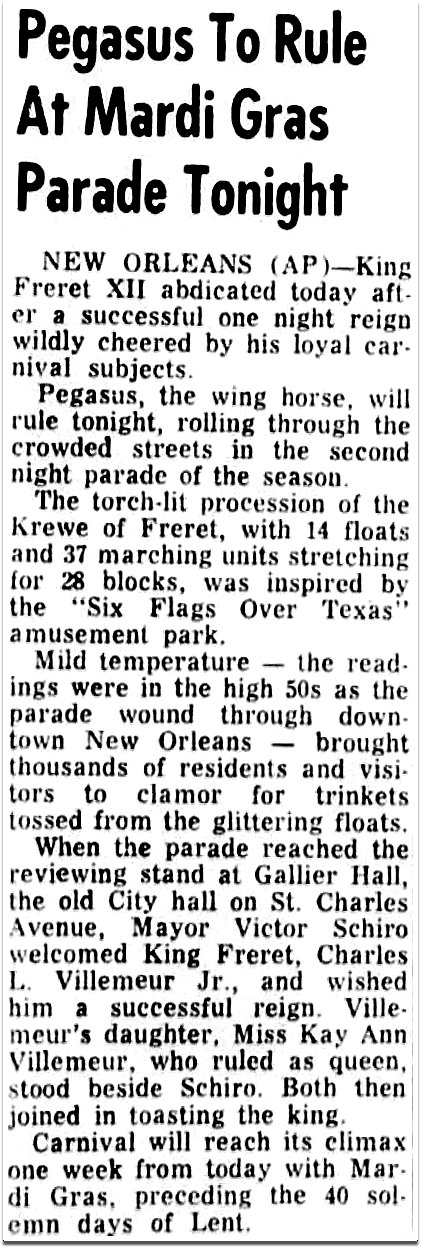
Pictures of these are all over the internet, but I found only ONE reference explaining why “Six Flags Over Texas” was on a Krewe of Freret Mardi Gras doubloon — and it was in this Jan. 31, 1967 AP article from the Monroe (Louisiana) News Star (transcription below):

mardi-gras_six-flags_monroe-louisiana-news-star_013167

NEW ORLEANS (AP)-King Freret XII abdicated today after a successful one night reign wildly cheered by his loyal carnival subjects. Pegasus, the winged horse, will rule tonight, rolling through the crowded streets in the second night parade of the season. The torch-lit procession of the Krewe of Freret, with 14 floats and 37 marching units stretching for 28 blocks, was inspired by the “Six Flags Over Texas” amusement park. Mild temperatures — the readings were in the high 50s as the parade wound through downtown New Orleans — brought thousands of residents and visitors to clamor for trinkets tossed from the glittering floats. When the parade reached the reviewing stand at Gallier Hall, the old city hall on St. Charles Avenue, Mayor Victor Schiro welcomed King Freret, Charles L. Villemeur Jr., and wished him a successful reign. Villemeur’s daughter, Miss Kay Ann Villemeur, who ruled as queen, stood beside Schiro. Both then joined in toasting the king. Carnival will reach its climax one week from today with Mardi Gras, preceding the 40 solemn days of Lent.

I wonder if there actually IS any connection to the amusement park? It might just be a friendly nod to neighboring Texas and not to the Arlington park we all know and love. But who am I to doubt the fine folks at the Biloxi Daily Herald?

Laissez les bons temps rouler!

***

Click the doubloons to get those suckers big. REAL big.

*

Copyright © 2014 Paula Bosse. All Rights Reserved.
Mardi Gras Parade in Dallas — ca. 1876/1877

mardi-gras_c1870s_degolyerMain St. looking east from Austin (click for larger image)

by Paula Bosse

What was happening downtown on this day, about 140 years ago? Mardi Gras, Dallas-style! Let’s wander around this parade photo, taken by Alfred Freeman. (Click photos to see larger images.)

mardi-gras_c1870s-det1This kid has a great, unobstructed second-story view of the parade below.

mardi-gras_c1870s-det2No glitz, no beads, no flashing.

mardi-gras_c1870s-det5Every time I look at the original photograph, my eye always goes to this woman.

mardi-gras_c1870s-det3Okay, that kid’s view is nothing compared to these guys who’ve scaled the Dallas Herald building.

mardi-gras_c1870s-det4In information about the 1876 parade, the Feb. 24, 1876 edition of The Dallas Herald advised: “To prevent accidents, owners of buildings having varandas [sic] will permit no one to stand on them, unless the same have been sufficiently strengthened.” I don’t know … some of those “varandas” look pretty shaky.

And down Main Street they go.

***

This is a stereograph photo by Alfred Freeman, from the Lawrence T. Jones III Texas Photographs Collection, DeGolyer Library, Central University Libraries, Southern Methodist University; it can be viewed here. (I have manipulated the color.) SMU has the photo as being “ca. 1870,” but the first Mardi Gras parade in Dallas wasn’t held until 1876. The view shows Main Street looking east, apparently taken from the roof of the Reed & Lathrop building on the northeast corner of Main and Austin.

UPDATE: This might be a photograph of the Mardi Gras celebration held in Dallas on February 24 (a Thursday…), in 1876. This was the first such celebration held in the city, and it was a massive undertaking, attracting more than 20,000 spectators. For weeks after the event, Alfred Freeman was advertising his Mardi Gras photographs with the following text: “Freeman, the artist, has nine different views of the Mardi Gras procession, for sale.”

mardi-gras_c1870s_freeman

Read about the first Mardi Gras parade in Dallas in the Flashback Dallas post “Mardi Gras: ‘Our First Attempt at a Carnival Fete’ — 1897,” here.

Click pictures for larger images.

*

Copyright © 2014 Paula Bosse. All Rights Reserved.