Flashback : Dallas

A Miscellany: History, Ads, Pop Culture

Category: Dining and Drinking

Back When Preston Royal Was “Exotic” and Had Its Very Own Elephant
safari-preston-royal

safari-preston-royal-back

by Paula Bosse

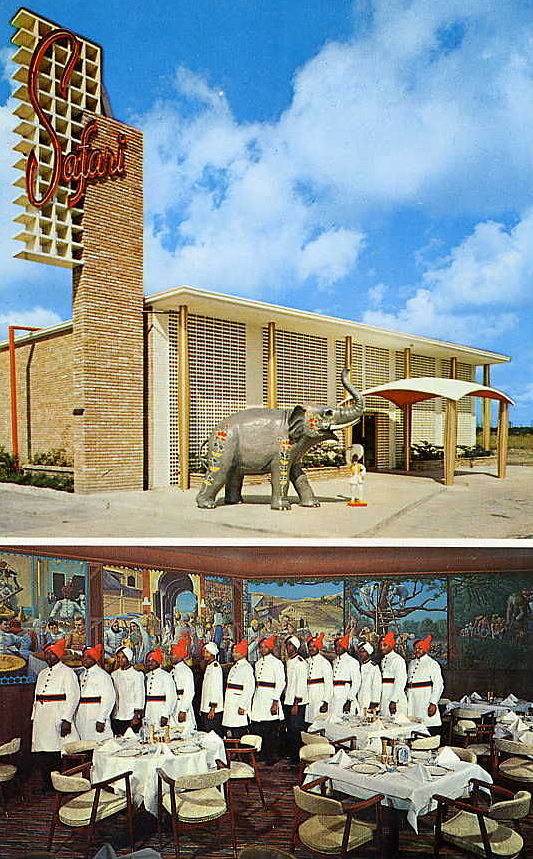
Dallas had a restaurant like this?! Yes, it did. (EDIT: It has been brought to my attention in the comments that the image above shows the *Houston* location. But I have been assured that the Dallas location had its very own elephant standing guard outside — so I will not have to ignominiously change the title of this post!)

The Safari Steak House was in the Preston Royal Shopping Center at the northeast corner of Preston & Royal (in the space now occupied by the venerable Royal China restaurant). The decor shown in the postcard above is something else — someone put their whole heart and soul into that, from the elephant and, um, elephant wrangler (“mahout“?) out front, to the ornate wood carving and the somewhat… busy murals inside. And the uniformed staff is pretty impressive, too.

Here are photos of the DALLAS Safari, taken in 1961 by Squire Haskins (photos from the UTA Libraries, Special Collections — click the links below the photos for full descriptions and large images). (Thanks, Tom Bowen, for sharing these links in the comments.)

safari_squire-haskins_1961_UTA_1via UTA Libraries, Special Collections

safari_squire-haskins_1961_UTA_2via UTA Libraries, Special Collections

Guy T. Jones opened the Safari in mid 1956 (I think the Houston location was opened later — it was open by at least 1959). I could find almost no early advertising for the place — perhaps Jones blew his advertising budget on elephants and murals. At this point, the shopping center was basically still under construction — the eastern-edge building (home of the Safari) opened about a year after the larger northern-edge building. There used to be a gap between the two buildings, which can be seen in the photo immediately above and can (sort of) be seen in the 1955 ad below, which shows a model of what the finished shopping center would look like.

preston-royal-shopping-center_032755-adAd detail, March 1955

In 1974, Royal China (which is a fantastic place, by the way) took over the space.

I really wish I’d seen that elephant, which — according to the comment below — “was highly visible and well lit at night.” I certainly hope so!

*

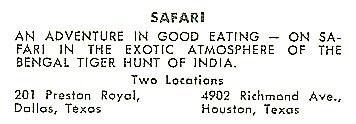
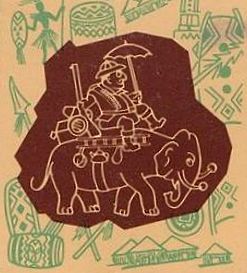
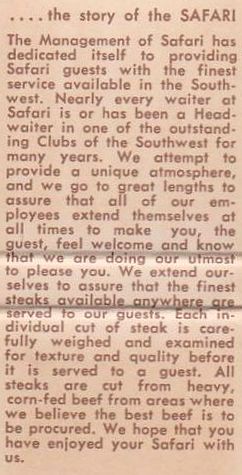
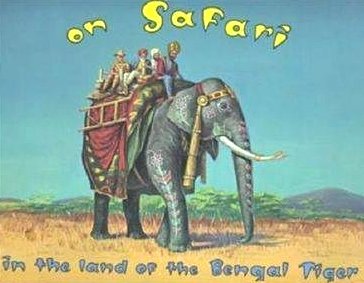
From the cover of the menu:
safari-matchbook-a

safari-matchbook

safari-matchbook_story

safari-preston-royal_menu-1969

*

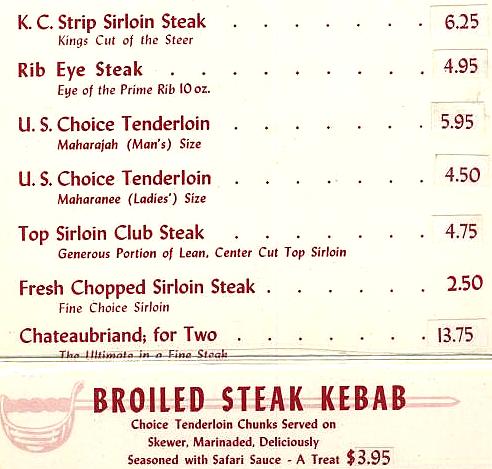
Below, the steak menu. One could choose between the “Maharajah (Man’s) Size” and the “Maharanee (Ladies’) Size.” Or get the kebabs of skewered beef “deliciously seasoned with Safari Sauce — A Treat.”
safari-menu

*

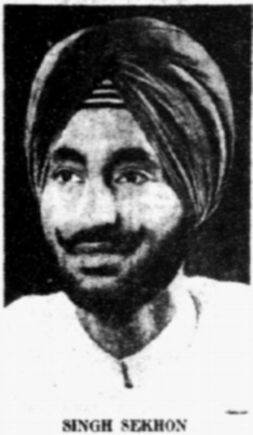
One of the stars of the restaurant was Iqbal “Ike” Singh Sekhon, who started working as the restaurant’s host while studying for his Master’s degree at SMU. He left a few years later to run the fabulous La Tunisia.
safari_dmn_062756-photo

safari-menu-logo

***

Sources & Notes

Edit (Sept. 2022): Wow. This post had a bunch of problems! All I can say is that this was one of my very earliest posts. I was so enamored of that elephant that I made a couple of very glaring errors.

First off, the original title of this post was “Back When Preston Royal Village Was ‘Exotic’ and Had Its Very Own Elephant.” The Safari Steak House was in the Preston Royal Shopping Center, located on the northeast corner of Preston and Royal; the Preston Royal Village shopping center, is on the northwest corner. I’ve (ignominiously) changed the title, but… yikes.

And, as mentioned in the first paragraph, the postcard at the top shows the Houston location, not the Dallas location. Incidentally, the Houston building is still there — it can be seen in a 2011 Google Street View capture here.

The two photos by Squire Haskins (linked below the images) are from the Squire Haskins Photography Inc. Collection, University of Texas at Arlington Libraries, Special Collections (thanks, Tom!). They are dated 1961, one year before a major fire at the restaurant. They reopened the following month, with what sounds like quite an update in decor. I’m not sure when the “gap” between the two shopping center buildings was filled in, but that would have been a good time to expand.

*

Copyright © 2014 Paula Bosse. All Rights Reserved.
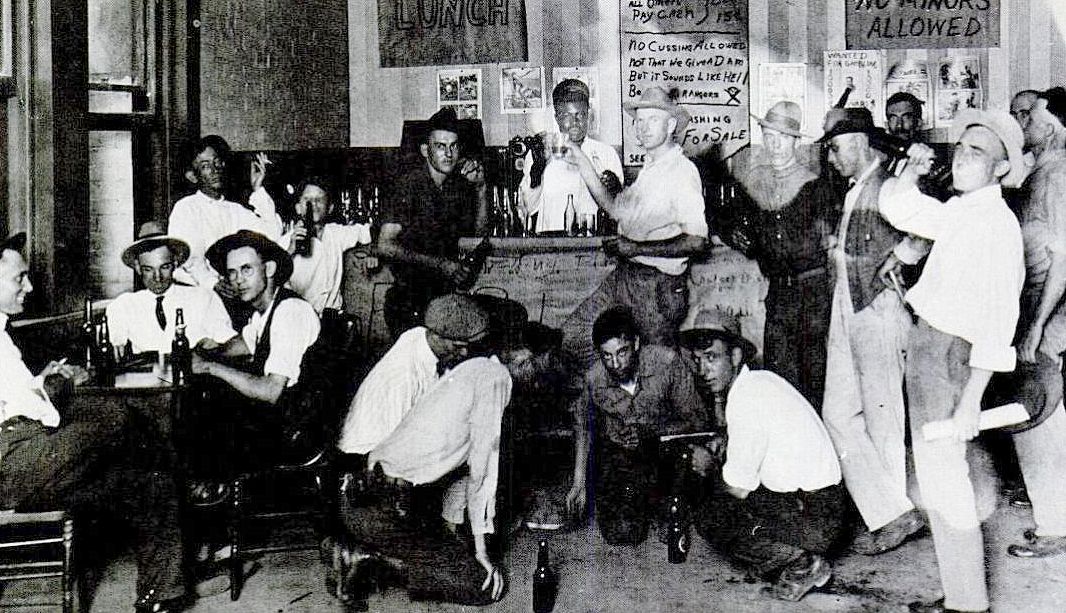
Hoisting a Few in the Basement Speakeasy

speakeasy_greene

by Paula Bosse

It’s tax day. Here’s a photo of men drinking illegally and gambling. Cheers!

“Dallas voted for Prohibition October 1917 — but it didn’t go dry, as this workingman’s speakeasy (a word not developed then) shows. One sign assures drinkers ‘No Neer Beer Served.’ This is a basement of some downtown building, address unknown.”

***

Photo and caption from Dallas, The Deciding Years by A. C. Greene (Austin: Encino Press, 1973).

Click picture for larger image.

*

Copyright © 2014 Paula Bosse. All Rights Reserved.

Joe Yee Cafe: The Best Chop Suey in Town

joe-yee-cafe-extChop suey *and* famous chicken house…

by Paula Bosse

I came across the above image and was enthralled. I’ve never heard of the Joe Yee Cafe, but this (granted) idealized picture is wonderful. The postcards above and below were from the early 1950s, and if you are familiar with the generally run-down neighborhood around Columbia and Fitzhugh these days, you may well shed a tear that something this charming and picturesque has been gone for many, many years.

joe-yee-cafe-interior

I love the surprising color scheme of the restaurant’s interior — those fabulous purples and greens! (The colors are a bit unexpected because they so loudly clash with the bold tomato red of the exterior.)

I did a little research to see what I could find out about Joe Yee’s Chinese restaurant. Seems that Mr. Yee’s cafe was in business by the 1930s, downtown, on Main Street near Field. It advertised steadily over the years, and its ads proudly proclaimed that the restaurant served “the best Chinese food you ever tasted” and was “completely air-conditioned.” Several newspaper accounts (particularly the society columns) mentioned it as a popular place for young people to grab a bite before and after dances at nearby downtown hotels. Business must have been pretty good for the place to have lasted so long at such a primo location. The cafe moved to the Columbia Street location in 1950 where it remained in business until at least late 1956 when a major fire struck.

joe-yee-cafe_matchbk

1938-joe-yee_dmn_1125381938

1943-joe-yee_dmn_0812431943

1953-joe-yee_dmn_0830531953

***

Sources & Notes

Top two early-’50s postcards are from the great Boston Public Library Tichnor Brothers Postcard Collection on Flickr, here.

In old photos of downtown Dallas one often sees “Chop Suey” signs along the streets. I’d love to know more about these restaurants in general, and about Chinese and Chinese-Americans in Dallas in the first half of the 20th century, if anyone can point me to a good source.

If background on Chop Suey is needed, might I point you to to the Wikipedia entry here, or the Snopes entry here.

*

Copyright © 2014 Paula Bosse. All Rights Reserved.


Celery Cola: “It Picks You Up!” — 1909

celery-cola_logo_1906

by Paula Bosse

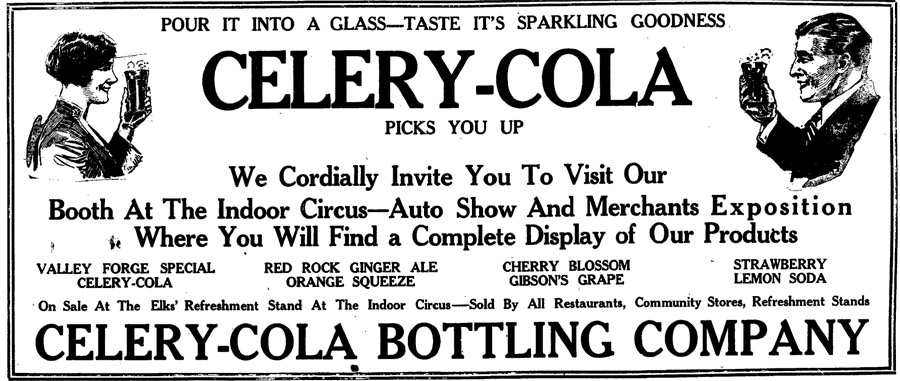
When you think of Dallas and soft drinks, you probably think Dr Pepper. But back in 1909, Dallas was the main office for the Western division for the Birmingham, Alabama fizzy drink Celery Cola (containing, one presumes, delicious celery-flavored syrup). Their offices were in the somewhat low-rent stretch of Exposition while rival Coca Cola was snugly housed at the cushy southeast corner of N. Akard and Ross.

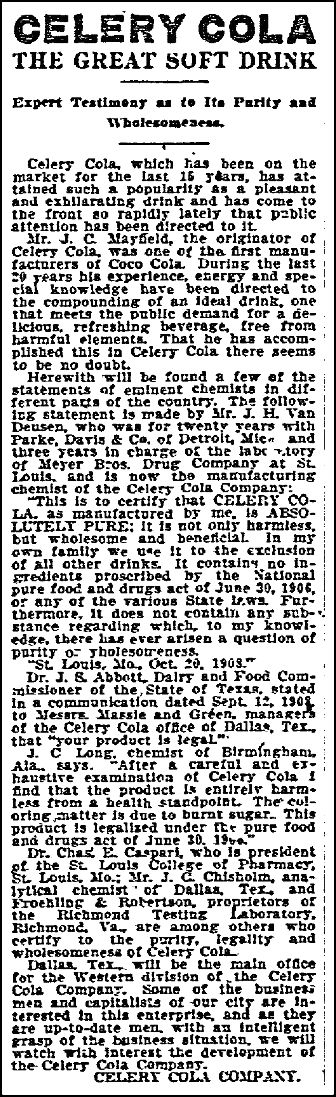
Only a couple of weeks after an official state charter was granted to local aspiring soda tycoons W. A. Massie, E. O. Massie, and J. B. Green to start officially producing the elixir in Dallas, this ad — a bit on the defensive side — appeared in the Dallas Morning News (click to see larger image):

celery-cola-AD_dmn_022809DMN, Feb. 28, 1909

Not so much an ad as testimony. Ads are usually more like this:

celery-cola-ad

As it turns out, Celery Cola ceased production in 1910 after repeated findings of the presence of cocaine and large amounts of caffeine by the Pure Food and Drug Administration. Let’s hope Messrs. Massie, Massie, and Green bounced back from their ill-advised investment. The owner of the Celery Cola Company certainly bounced back — he continued to create soft drinks such as — no kidding — “Koke” and “Dope.” Dallas is better off with Dr Pepper. The only whispered allegation that’s dogged them is prune juice — and that stuff is 100% legal.

Check out the related Flashback Dallas post “‘No Mice, No Flies, No Caffeine, No Cocaine’ — 1911.”

***

Sources & Notes

Top ad from a Celery Cola site here.

Third ad, with the word “its” misspelled (*sigh*) from the comments section of a Shorpy post here.

Best overview on the history of Celery Cola and its creator, James Mayfield, is here.

My favorite part of this story was reading the long list of Dallas-area “illegal” soft drinks (and other oft-tampered-with foodstuffs) in J. S. Abbott’s First Annual Report of the Dairy and Food Commissioner of Texas (Austin, 1908). The soft drink list begins on p. 46 after an interesting prologue here. Celery Cola was not alone! (And, if I’m reading this correctly, Messrs. Massie, Massie, and Green were fully aware of what was going on, having provided the food cops with cocaine-laced samples several months before they bought into the company.)

*

Copyright © 2014 Paula Bosse. All Rights Reserved.

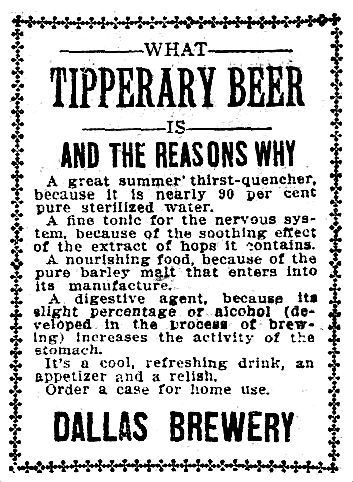
Tipperary Beer from the Dallas Brewery: “Insist Upon Having It”

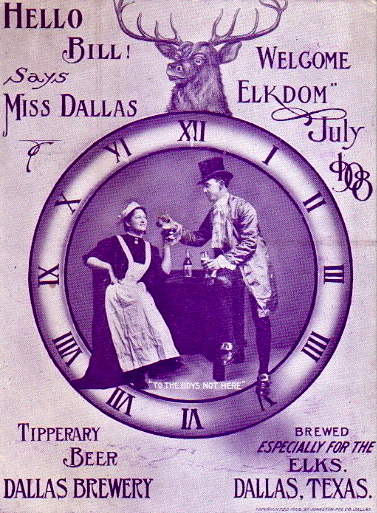
tipperary-beer1908

By Paula Bosse

I’m pretty sure there’s no real Irish connection here — other than the name — but how could I pass this up on St. Patrick’s Day!

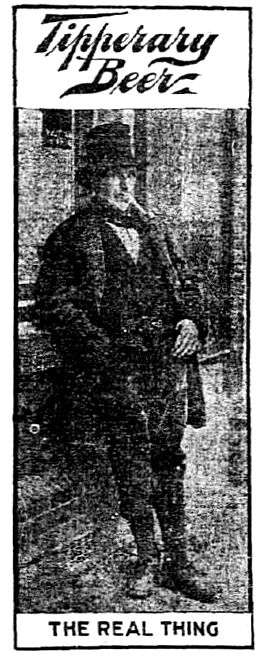
tipperary-beer_dmn_071806atipperary-beer_dmn_071806bDallas Morning News, July 18, 1906

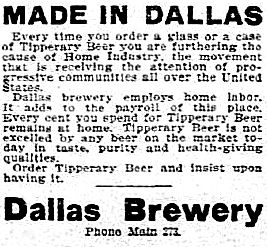
dallas-brewery_tipperary_dmn_090107DMN, Sept. 1, 1907

***

Sources & Notes

Top ad addressing the Elks’ conventioneers who were visiting Dallas in 1908 is from an Elks’ historical site, here.

*

Copyright © 2014 Paula Bosse. All Rights Reserved.

My Birthdays at Kirby’s: Filet Mignon for Everyone!

kirbys-birthday

by Paula Bosse

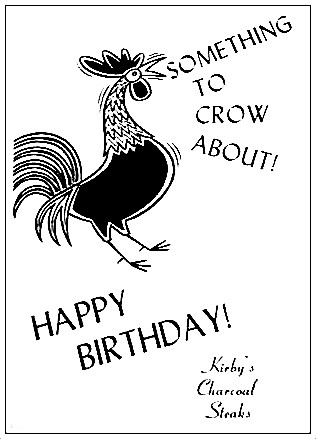
I grew up in the Lower Greenville area, and since we had a nice steakhouse just a couple of blocks away, that’s where we always went for family birthdays and special occasions: Kirby’s. I had forgotten about the birthday cards they sent out until my mother came across one in a recent move which was addressed to “Miss Paula Bosse.” Other than receiving actual mail, the thing that made these cards really exciting for a child was the inclusion of a dime. I always thought of it as a little birthday treat, but my mother suggested it was more of a subtle reminder to the parents to spend that dime on a call for reservations.

I loved that place. It was very dark. My brother and I always had the same thing: a non-alcoholic, super-sweet Shirley Temple from the bar, a salad with big chunks of roquefort in the salad dressing, a baked potato, and, oh my god, a filet mignon. I was mesmerized by the bacon wrapped around the steak. And the little wooden marker that showed how the meat was cooked. It was a nice, friendly neighborhood steakhouse. It was loud and happy. You could hear the steaks sizzling on the grill. It was always a treat to go to Kirby’s. And the place smelled GREAT! Even out on the sidewalk.

I was sad when they tore the building down, and even though there is now a chain of restaurants with the name “Kirby’s” — they even built a new one a couple of blocks down from the original location — there’s no way it could ever be the same.

Looking around for the history of the original “Kirby’s Charcoal Steaks,” I was surprised to discover that the man who owned Kirby’s — B. J. Kirby — was the son of the man who founded the Pig Stand chain of drive-ins. The Pig Stand started in Dallas, and it was the first drive-in restaurant EVER. They had the first carhops. The first onion rings. The first Texas toast. The Kirby’s steakhouse location — 3715 Greenville — had actually been a Pig Stand! B. J. Kirby had grown up working at his father’s restaurants, and when his father died, he sold all the Pig Stands except for the Greenville Avenue location (i.e. Pig Stand No. 4). In 1954 he turned the pig-sandwich-serving drive-in into a nice sit-down steakhouse which remained popular until the restaurant closed in 1987 when Mr. Kirby retired.

Watch Ch. 5 news footage of B. J. Kirby and the auction of the restaurant fixtures at UNT’s Portal to Texas History site, here.

kirbys_ch-5_closing_screencap_portal

I could really go for a bacon-wrapped filet mignon right about now. And one of those Shirley Temples would even hit the spot.

kirbys_1958

kirbys_color

kirbys_1951

***

Sources & Notes

“Something to Crow About!” card from the author’s collection.

Color photo of the Kirby’s sign is a screenshot from the Channel 5 news coverage of the auction of the Kirby’s fixtures, which aired April 14, 1987, viewable here; from the KXAS-NBC 5 News Collection, UNT Libraries, via the Portal to Texas History.

First ad from 1958; bottom ad from 1951.

Watch the 14-minute documentary “Carhops,” in which B. J. Kirby remembers life working as a kid for his father, here (also interviewed are other drive-in Dallas icons, J. D. Sivils and Jack Keller).

An entertaining history of the Pig Stand No. 4 and its transformation into Kirby’s Charcoal Steaks can be found here.

*

Copyright © 2014 Paula Bosse. All Rights Reserved.

L. Craddock & Co. — Pioneer Whiskey Purveyors

L. Craddock ad, 1912

by Paula Bosse

L. Craddock, an Alabama native born in 1847, arrived in Dallas in 1875 and opened a liquor business at Main and Austin streets in a building built by the Odd Fellows. It was a success, becoming one of the largest such businesses in a young, thirsty city.

Feeling a flush of civic pride, Mr. Craddock branched out beyond the retail world of alcohol sales, and in the late 1870s he opened the city’s second theatrical “opera house,” conveniently housed on the second floor of his liquor emporium, above his saloon and retail business. The theater was immensely popular and hosted the important performers and lecturers of the day, until the much larger Dallas Opera House arrived on the scene and siphoned off Craddock’s audiences. He closed the second-floor theater in the mid-1880s (a space which, presumably, continued to be used as an IOOF meeting hall) but kept the business on the ground floor.

The first location, at Main & Austin, with theater on second floor (1880s)The first location, at Main & Austin, with theater on second floor (1880s)

In 1887 Craddock decided to change careers. He sold his company to Messrs. Swope and Mangold (more on them later) and retired from the liquor trade — if only temporarily. I’m not sure what prompted this somewhat unexpected decision (I’d like to think there was some juicy, illicit reason), but, for whatever reason, he decided to give real estate a whirl. Craddock was certainly a savvy wheeler-dealer and he probably did well buying and selling properties in booming Dallas, but (again, for whatever reason) he seems to have tired of real estate, and, by at least 1894 (if not sooner), he had returned to the whiskey trade and had built up an even more massive wholesale liquor business than before.

ad_craddock-liquors-19061907 (click for much larger image)

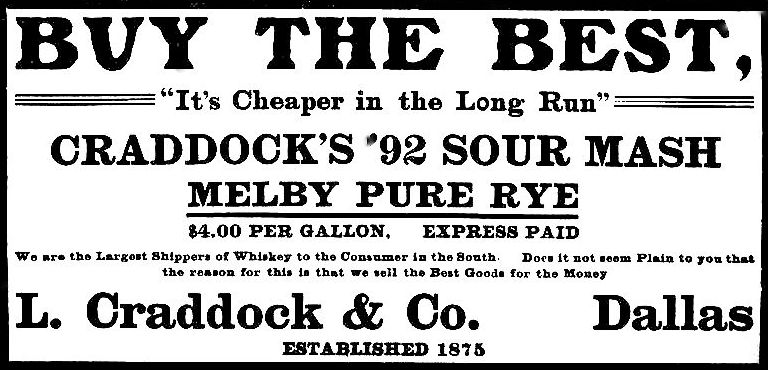
He had a new, larger building, this time on Elm, between N. Lamar and Griffin. In the company’s incessant barrage of advertising, he touted the company’s unequaled, unstoppable success as purveyors of the finest alcohol available. One ad even took on something of a hectoring, lecturing tone as it admonished the reader with this snappy tagline:

“We are the Largest Shippers of Whiskey to the Consumer in the South. Does it not seem Plain to you that the reason for this is that we sell the Best Goods for the Money.”

1906

Arrogant or just supremely confident, Craddock was rolling in the dough for many, many years. Until … disaster struck. Prohibition. With the inevitable apocalypse about to hit the alcoholic beverage industry, L. Craddock threw in the towel and retired. For good this time. I’m sure many a faithful L. Craddock & Co. customer stocked up on as much as they could hoard in the final weeks of the prices-way-WAY-higher-than-normal going-out-of-business sale.

Craddock retired to Colorado, but in 1922, he returned to present to the city a valuable ten-acre tract of land in the old Cedar Springs area — land he asked be used as a park. Craddock Park remains a part of the Dallas Parks system today.

craddock_dmn_120322Dallas Morning News, Dec. 3, 1922

It’s interesting to note that in every article about Mr. Craddock that appeared during and after Prohibition — such as the articles reporting his generous gift to the city — there was never any mention of what kind of business he had been in or how he had made his great fortune. Even in his obituary. He was always vaguely described as a “pioneer businessman.”

Speaking of his obituary (which, by the way, was the place I actually saw his first name finally revealed — it was Lemuel), L. Craddock — Dallas’ great retailer of beer, wine, and spirits — died on December 2, 1933. Three days before the repeal of Prohibition. THREE DAYS. O, cruel fate.

**

ADDED: Interesting tidbit about a legal matter brought by Federal prosecutors. In 1914, Craddock was found guilty of “illicit liquor dealing” — shipping barrels of whiskey (labeled “floor sweep”) into the former Indian Territory of Oklahoma. Craddock wrote a check for the fine of $5,000 right there in the courtroom. The three men who actually did the deed were sentenced to a year and a day at Leavenworth. (I’m never sure how much faith to put in the Inflation Calculator, but according to said calculator, $5,000 in today’s money would be approaching $115,000. I think ol’ Lemuel was doing all right, money-wise. I’m guessing this “floor sweep” thing was not an isolated incident.)

craddock_FWST_061914Fort Worth Star-Telegram, June 19, 1914

***

Sources & Notes

Top L. Craddock & Co. ad from 1912.

Photograph of first location, with theater, from Historic Dallas Theaters by Troy Sherrod (Charleston: Arcadia Publishing, 2014).

Ad featuring rendering of second Craddock location at Elm & Poydras, signed Fishburn Co. Dallas, from 1906.

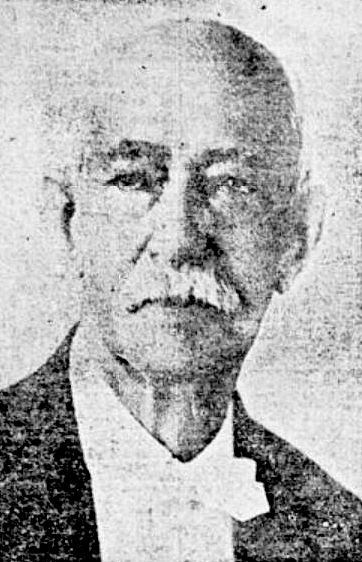
Photograph of L. Craddock from a Dallas Morning News interview in which he reminisces about the Craddock Opera House, published December 3, 1925. It’s an informative interview about early Dallas (like REALLY early Dallas) — the article can be read here.

Update: I’ve wondered if this building downtown is the Craddock building, cut down and uglified. The current address is 911 Elm (I assume that the addresses for that stretch of Elm changed when the cross-street configuration changed). The Dallas Central Appraisal District gives the construction date of that building as 1937, but the DCAD dates are frequently not accurate. I don’t know. It’s very similar (missing the third floor…) and in about the exact same spot. Looks like it to me. That poor 100-plus-year-old building needs some loving attention. Here is a Google street view from early 2014:

craddock_google_feb-2014

Most images in this post are larger when clicked.

*

Copyright © 2014 Paula Bosse. All Rights Reserved.
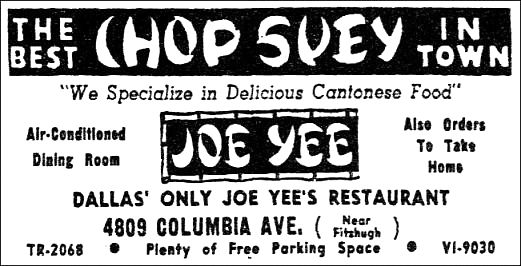
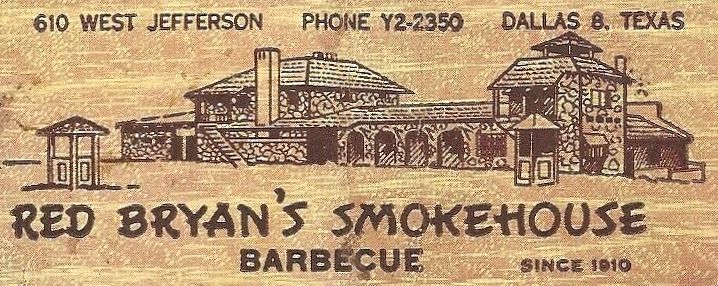
Red Bryan’s Smokehouse — BBQ, Oak Cliff-Style

red-bryans-smokehouse_bbq_postcard_ebay_ca-1950

by Paula Bosse

Everybody in Dallas knows about Sonny Bryan, and some remember Red Bryan, but I didn’t know there was another Bryan forebear, who started the family barbecue dynasty: Elias Bryan. Elias and his wife, Sadie, arrived in Oak Cliff from Cincinnati in 1910 and opened a barbecue stand. Elias begat Red, and Red begat Sonny. And there was much trans-generational smoking of meat. The Bryans have been a BBQ fixture in Dallas for over 100 years.

Fun facts about William Jennings “Red” Bryan:

  • Red studied botany at SMU, which might explain his initial career as a florist until he was inevitably pulled back into the family business. He opened his first place in the early 1930s in a retired Interurban car, known affectionately as “The Tin Shack.”
  • In the late ’40s, now well established and wanting swankier digs, he commissioned the respected architect Charles Dilbeck to design the new restaurant. (Dilbeck designed some of the most beautiful homes in Dallas, several of which are in Lakewood, but this was probably his first — and only — barbecue joint.)

And the rest is, as they say, barbecue — and Oak Cliff — history.

*

red_bryan_bbq_dth_0205561

*

Red, 1951

*

red-bryans-bbq_matchbook_ebay

***

Sources & Notes

Postcard (circa 1950) at top from eBay. This is printed on the back:


red-bryans-smokehouse_bbq_postcard_caption_ebay

Ad from 1956.

Much more on Red Bryan’s Smokehouse, with lots of photos of its construction, can be found in the Oak Cliff Advocate article “The King of Oak Cliff Barbecue” by Gayla Brooks, here.

Even more cool stuff, including early photos of the family business, can be found in the Texas Monthly article “Bryan Family Artifacts and Mementos” by Daniel Vaughn, here.

Sonny Bryan’s website is here.

*

Copyright © 2014 Paula Bosse. All Rights Reserved.
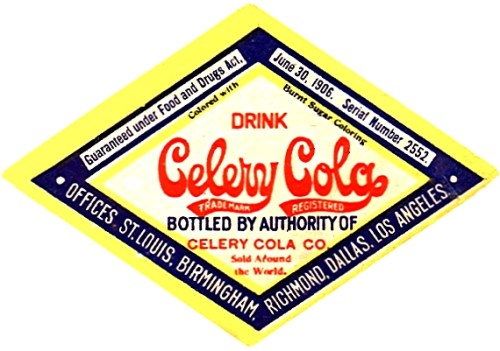
Meet Me at the Kitten Lounge — 1968

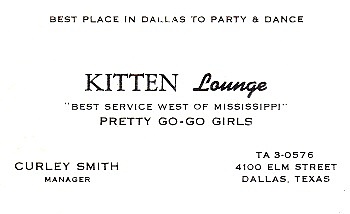
kitten-lounge_1968

by Paula Bosse

KITTEN LOUNGE
Best Place in Dallas to Party and Dance
“Best Service West of Mississippi”
Pretty Go-Go Girls
Curley Smith, Manager
TA 3-0576
4100 Elm Street
Dallas, Texas

From the manly, go-go-girl-loving pages of a 1968 issue of Texas Peace Officer magazine. No doubt a happening place, at Elm & Haskell. Peace officers welcome!

*

Copyright © 2014 Paula Bosse. All Rights Reserved.
Earl’s Continental Buffet Has Got it ALL — 1947

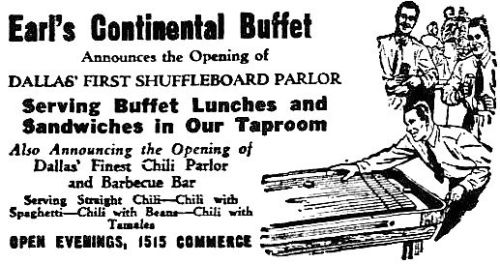
earls-continental-buffet_shuffleboard_dmn_1947

by Paula Bosse

Earl’s Continental Buffet Announces the Opening of
Dallas’ First Shuffleboard Parlor
Serving Buffet Lunches and Sandwiches in Our Taproom
Also Announcing the Opening of
Dallas’ Finest Chili Parlor and Barbecue Bar
Serving Straight Chili — Chili with Spaghetti –
Chili with Beans — Chili with Tamales
Open Evenings, 1515 Commerce

This place has EVERYTHING!

*

Copyright © 2014 Paula Bosse. All Rights Reserved.