Hey, y’all, guess what’s just around the corner. Whenever you start seeing pictures of Big Tex, you know that the State Fair of Texas can’t be too far away.
There have been a lot of artistic depictions of Big Tex over the years, but I think this sketch by Dallas artist Otis Dozier (1904-1987) may be my all-time favorite. And I’ve only just discovered it! (Thank you, DMA!)
The Otis Dozier sketchbooks have been digitized in a joint project between the Dallas Museum of Art, SMU’s Bywaters Special Collections at the Hamon Arts Library, and SMU’s Norwick Center for Digital Services. To read about this fantastic collection, see the SMU Central University Libraries page, here.
*
This week, the Dallas Museum of Art launched a new digital database in which its entire collection is now accessible online! This is great news for many reasons, not least being that it allows the public to see works that are rarely — if ever — displayed in the museum. Such as this one. To read more about assembling this incredible database, read the DMA’s announcement, here.
To look up your favorite artist, check to see what the DMA has, here.
For the biography of the Forney-born Dozier (who was one of the members of the famed Dallas Nine group), see the Handbook of Texas entry here.
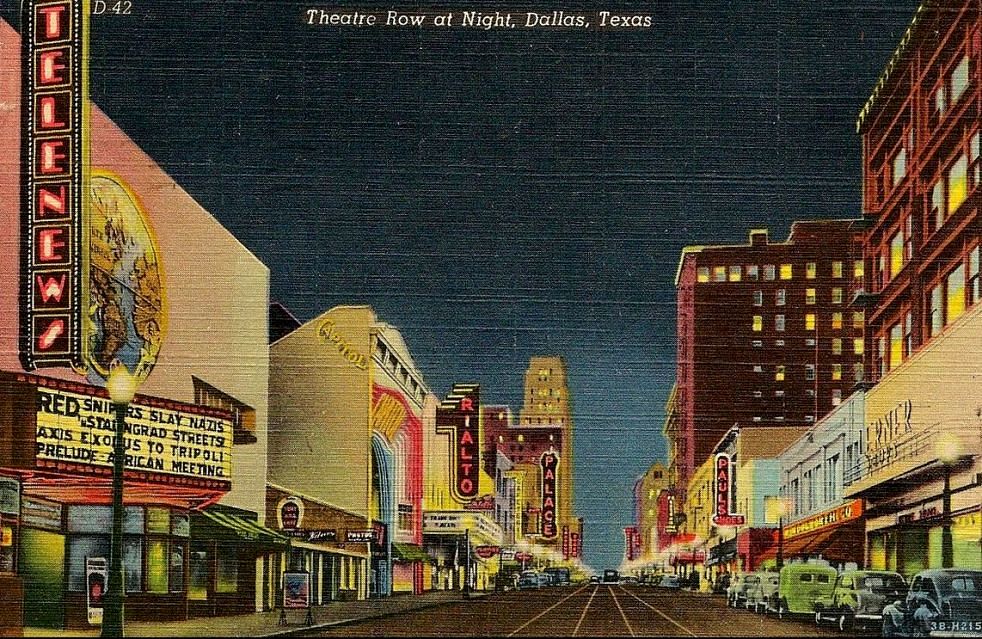
You know how you look at some of those fantastic postcards from the ’40s that don’t look real and you wonder, “Is that from a photograph, or is that just an artistic interpretation?” Well, it’s both.
In the above “before” and the below “after,” it’s interesting to note what’s been kept in and what’s been taken out. And how a fairly ho-hum daytime view becomes a dazzling night-time scene. Either way, it’s an Elm Street I’ll — sadly — never experience.
***
Sources & Notes
Black-and-white photograph of Elm Street’s “Theater Row” from the Texas State Historical Association.
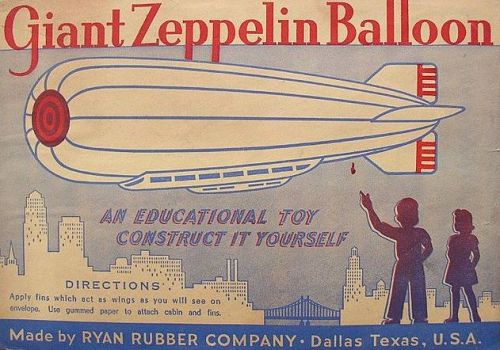
Bet you didn’t know that giant Zeppelin balloons were made in Dallas (or maybe Forney…). They were. The Ryan Rubber Company’s balloon factory opened in Forney in 1946, managed by Lester G. Norris with the help of his wife, Gladys.
***
Sources & Notes
Source of Zeppelin ad unknown.
See a photo of the Norrises at work and read the accompanying article “Picture Blocks and Balloons Big Business for These Men” (Dallas Morning News, Nov. 28, 1949).
Lucille Ball and Desi Arnaz and their loaner ‘copter from Bell Aircraft
by Paula Bosse
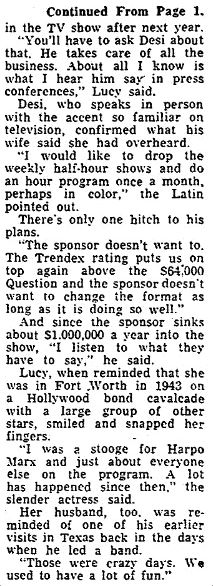
Lucille Ball and Desi Arnaz came to Dallas and Fort Worth in 1956 to promote their new movie, “Forever Darling.” Their arrival times were heavily publicized, and throngs of fans showed up to welcome them — in Dallas at Love Field, and in Fort Worth at the Western Hills Hotel. For those who might have missed their arrivals, they still had a chance to see the couple at one of the personal appearances scheduled at the theaters showing their movie (in Dallas at the Majestic on February 10th, and in Fort Worth at the Hollywood on the 11th). Crowds were large and enthusiastic, and everyone appears to have had a genuinely fun time, possibly even Lucy and Desi, whose relationship in those days was frequently a bit shaky.
Best of all was the tidbit about how the famous couple traveled from Dallas to Fort Worth: by helicopter.
Two television stars will be sailing around above Dallas skyscrapers Saturday. …Lucille Ball and Desi Arnaz will catch a helicopter ride from atop the Statler Hilton for a trip to Fort Worth. City Council officially sanctioned the ride at its Monday meeting. (Dallas Morning News, Feb. 7, 1956)
They left from the helipad atop the Statler Hilton and touched down at the helipad at the Western Hills Hotel in Fort Worth (hotels are nothing without helipads). There was some sort of cordial relationship between the Arnazes and the people at Bell Aircraft, because they availed themselves of this brand new deluxe chopper in New York as well as in DFW. When their promotional duties were finished, Lucy and Desi left Cowtown for California as guests of the president of the Santa Fe Railway — in his private car. Because that’s how you travel if you’re Hollywood royalty.
*
Feb 8, 1956
*
DMN, Feb. 11, 1956
(Leon Craker, I bet you had a great story about this for years after this momentous meeting.)
*
In Fort Worth, Elston Brooks (whose amusing articles I’ve really enjoyed discovering these past few months), seemed underwhelmed and a little annoyed at the prospect of “lovable Lucy and spouse” invading the city (click articles to see larger images):
Fort Worth Star-Telegram, Feb. 5, 1956
*
Elson Brooks may not have been very excited, but when Lucy and Desi stepped out of that helicopter, the Fort Worth crowd went wild (click text for larger image):
FWST, Feb. 12, 1956
*
And here they are back in Los Angeles, with Desi Jr., at the end of a busy promotional tour. Desi is proudly wearing the cowboy hat he’d been given in Fort Worth. And he looks damn good in it.
***
Sources & Notes
Top photo of Lucy and Desi standing next to the 1956 Bell 47H-1 (“one of the world’s first executive helicopters”) is from the August 2012 issue of Vintage Aircraft Magazine; photo from Bell Aircraft. The article concerning this helicopter model is contained in a PDF here.
UPDATE: I had originally identified the photo of Lucy and Desi with the train as having probably been taken in Fort Worth as they were about to depart for Hollywood, mainly because they’re wearing similar clothing from the FW appearance, but a rail historian noted that this photo was actually taken in California at the Los Angeles Union Passenger Terminal — he could tell because he recognized the part of the platform structure over their heads! (“I can name that song in TWO notes!”) The photo he directed me which shows the LAUPT platform (and, in fact, the same engine, two years earlier!), is here. They probably took the final photo for the Santa Fe company as thanks for providing them with transportation back home in the president’s private car. (Thanks, Skip!)
*
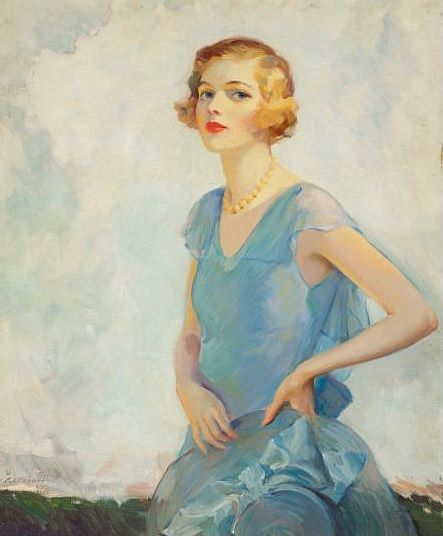
And because today is Lucille Ball’s birthday (which I know only because she shares a birthday with my aunt — happy birthday, Bettye Jo!), it seems like a good time to wheel out this strikingly beautiful portrait of Lucy, along with a wonderful photograph of her from about the same time (probably between 1928 and 1930).
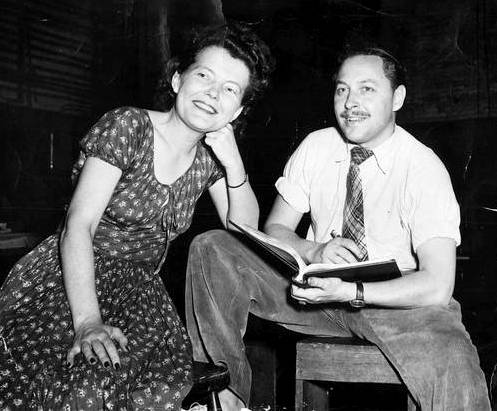
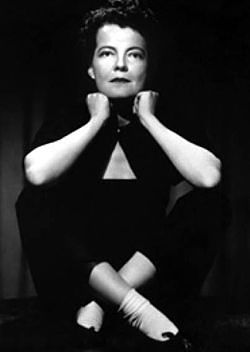
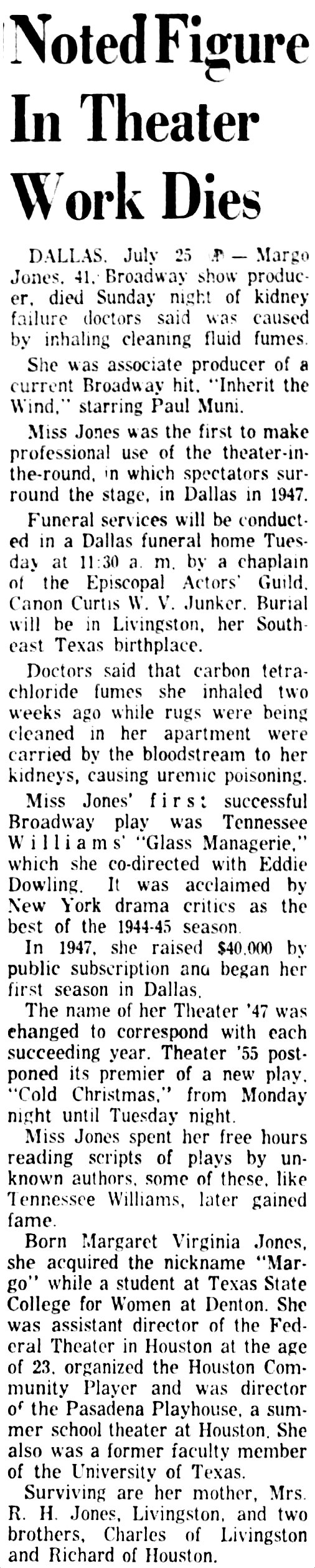
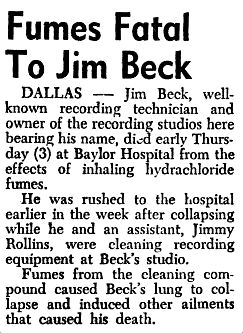
In reading about Dallas theater legend Margo Jones, I saw that she died from inhaling the lingering fumes of a cleaning agent that had been used to clean a rug in her apartment at the Stoneleigh Hotel: carbon tetrachloride. The only thing I knew about carbon tetrachloride was that it had also caused the early death of legendary recording engineer and producer Jim Beck (the man who discovered and produced the first records of Lefty Frizzell, Ray Price, et al.); Beck had been cleaning his recording equipment and had been overcome by the fumes. Both were rushed to the hospital when they were discovered unconscious, and both died about ten days later.
Margo Jones died on July 24, 1955, and Beck died less than a year later, on May 3, 1956. Jones was in her early 40s — Beck was only 39. Margo Jones was a creative powerhouse who was already revolutionizing regional theater, and Jim Beck’s enormous talent was the sole reason that Columbia Records was on the brink of moving their operations from Nashville to Dallas (a move that might very well have set the wheels in motion for Dallas to overtake Nashville as the nation’s recording center for country music). It is such a loss that both died so young,victims of something as mundane as cleaning fluid. With so much remarkable potential ahead of them, it’s sobering to imagine how different Dallas theater and the Dallas recording industry would be today had their careers lasted another two or three or four decades.
Austin American, July 26, 1955 (click to see larger image)
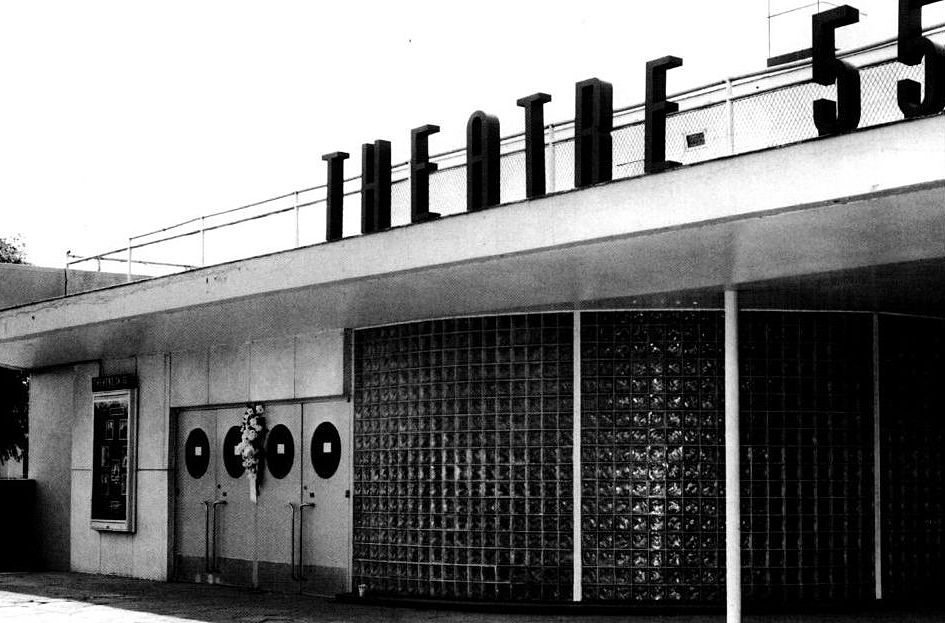
Margo Jones’ Theatre ’55 with wreath on door (click for larger image)
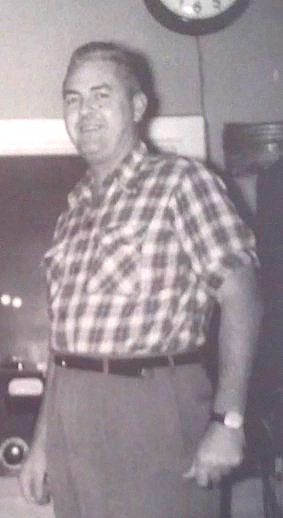
Jim Beck in his studio
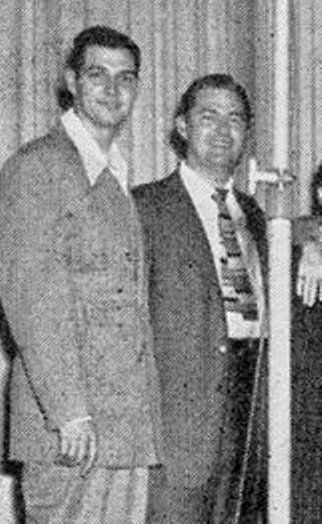
Jim Beck (right) with Hank Thompson
Billboard, May 12, 1956
***
Sources & Notes
Photo of Theatre ’55 (formerly the Magnolia Lounge in Fair Park) with wreath is from the story “‘I’m Doing It, Darling!’ — Dallas, Margo Jones, and Inherit the Wind” by Kay Cattarulla (Legacies, Fall, 2004 issue), which can be read here.
First photo of Jim Beck (which has been cropped) is from the Bear Family CD box set “Lefty Frizzell: Life’s Like Poetry.”
Photo of Jim Beck and country recording star Hank Thompson is a (cropped) Liberty Jamboree promotional photo, circa 1951.
Jim Beck Studio logo from the Handbook of Texas entry for the recording industry in Texas, here.
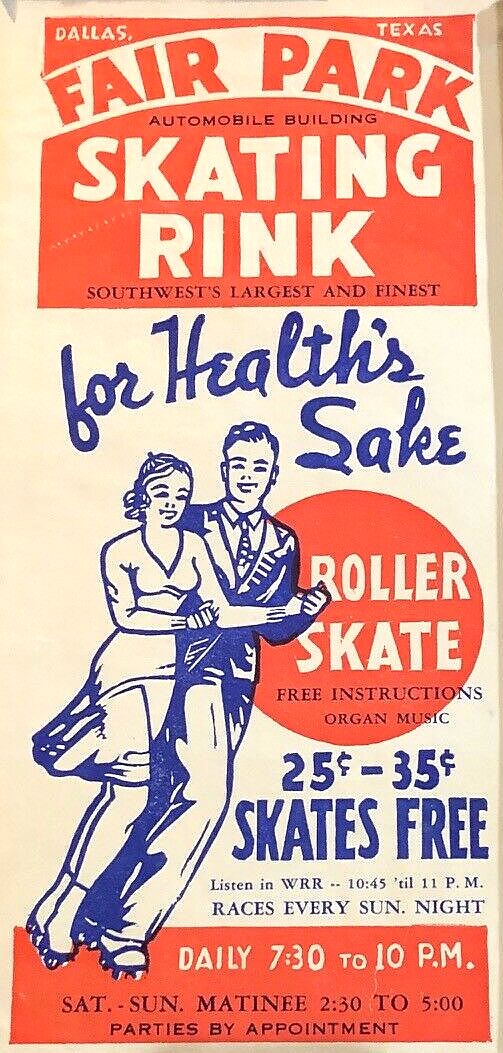
The Fair Grounds Skating Rink opened in the old Machinery Hall in 1906 at the height of the roller skating fad that was sweeping the nation. Over 1,000 people were “on the floor” on opening night, and the rink was an immediate hit with the city’s “roller-maniacs.” Though apparently very popular, it closed rather suddenly in 1907 when it was discovered that the concessionaires were selling more than cold drinks to patrons — they had also been operating a prostitution business right there on the (city-owned) premises.
It wasn’t until 1921 that the rink re-opened (managed by a man who may well have been one of the guys who operated the lucrative illicit side-business back in the aughts). It seems to have closed again for a while and then re-re-opened sometime in the ’30s, a time when business was steady and booming. But, sadly, the building burned down in 1942. BUT, a new, flashier rink was built right away, near (…next to? …in?) the Cotton Bowl (the ad below mentions the Automobile Building), and this one lasted a good long time, until at least 1957.
So, 1906-1957, give or take a few years — not a bad run for roller skating in Fair Park (…unless you count the bleacher bordello and the fiery conflagration). All skate!
***
Sources & Notes
Top photo (of an attractive but unidentified couple) from eBay. Click it for a MUCH larger image (and check out the cool Fair Park Skating Rink logo to the right of the man’s head).
Postcard from the Watermelon Kid’s site, here. (It is also larger when clicked!)
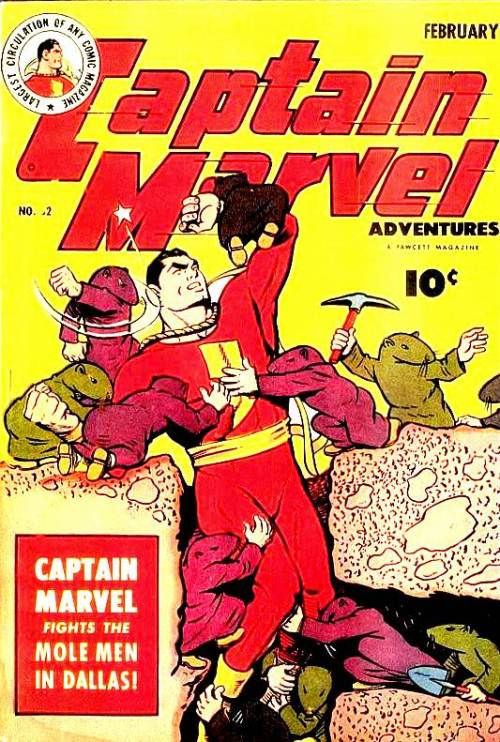
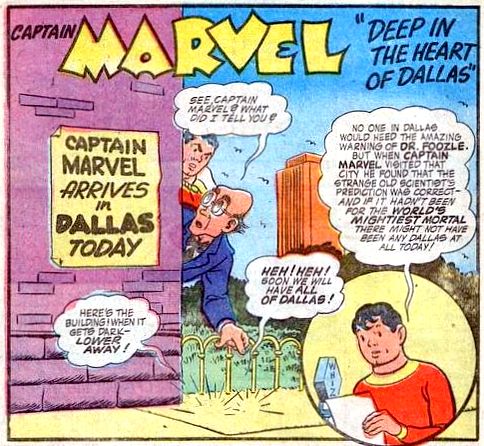
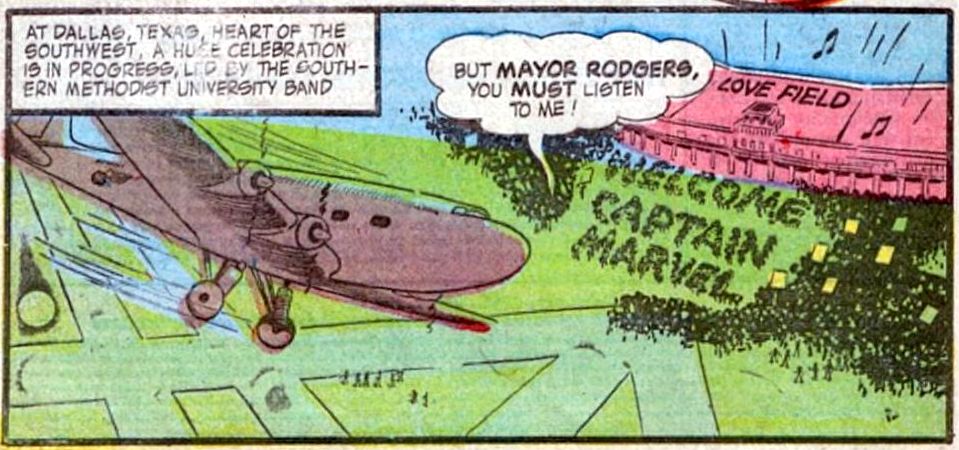
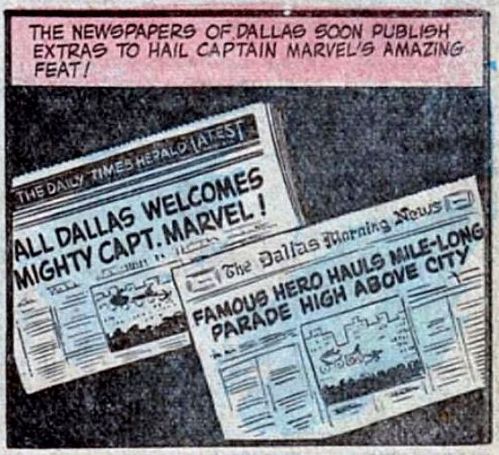
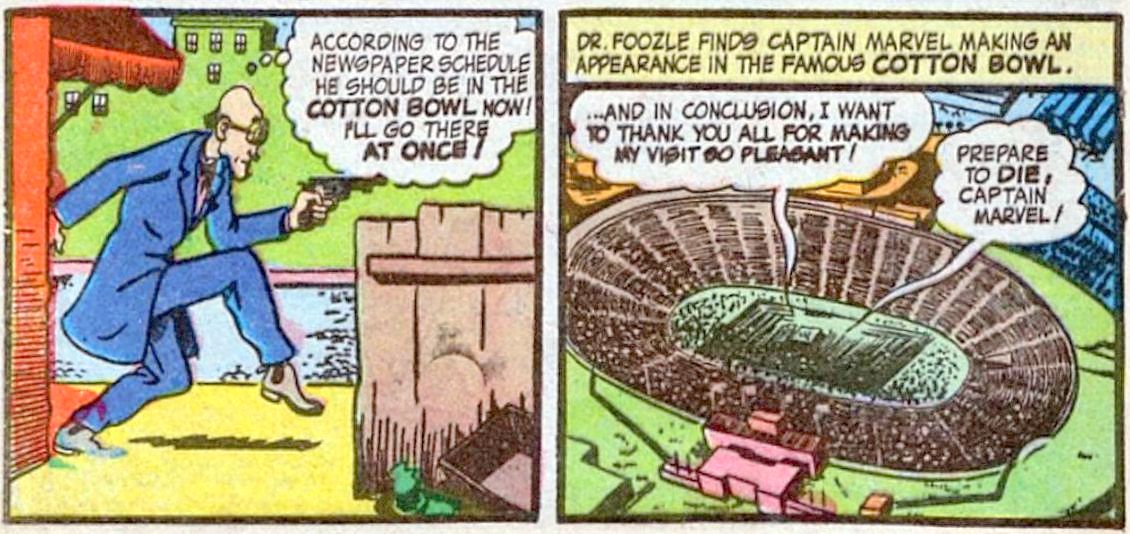
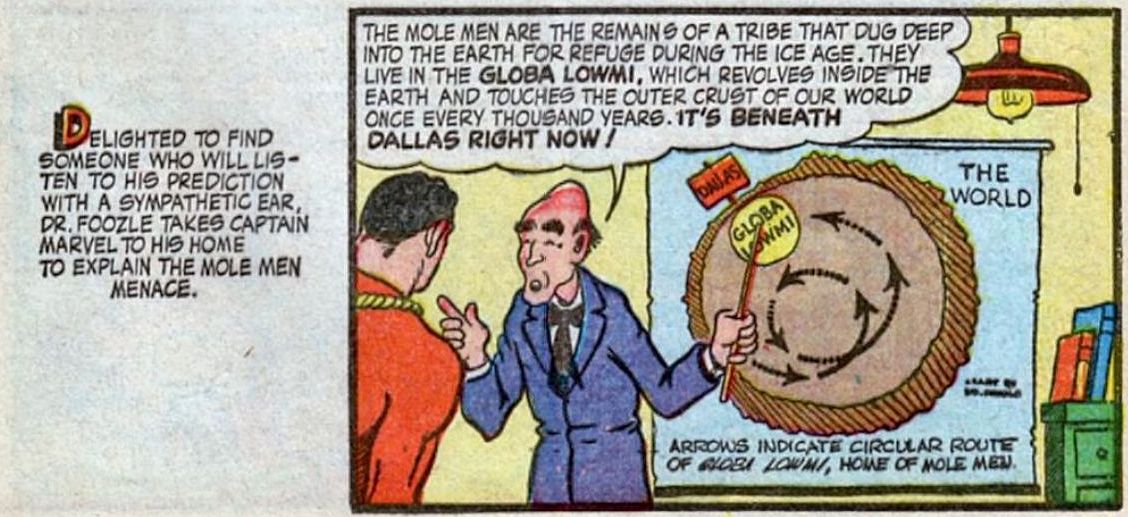
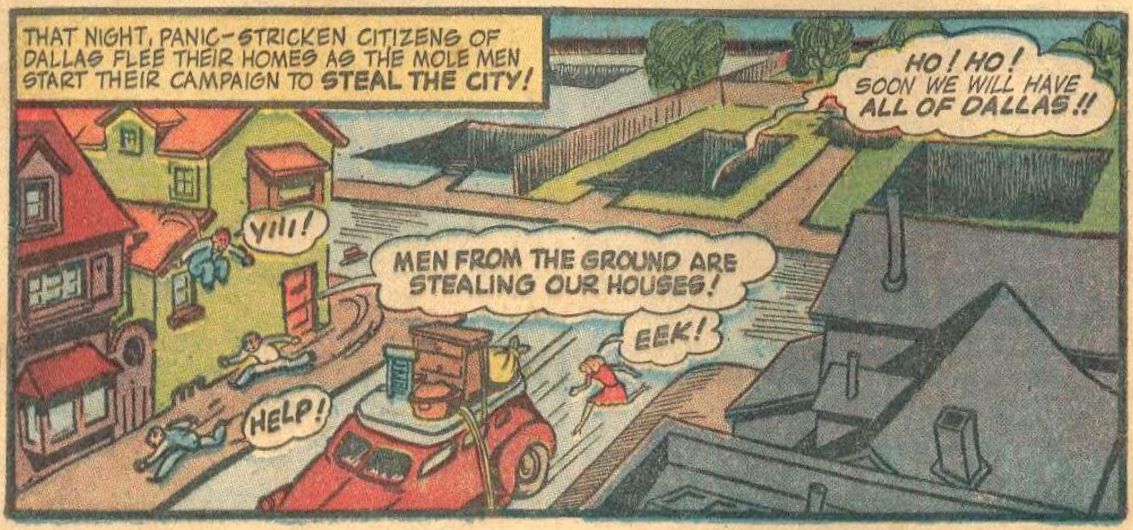
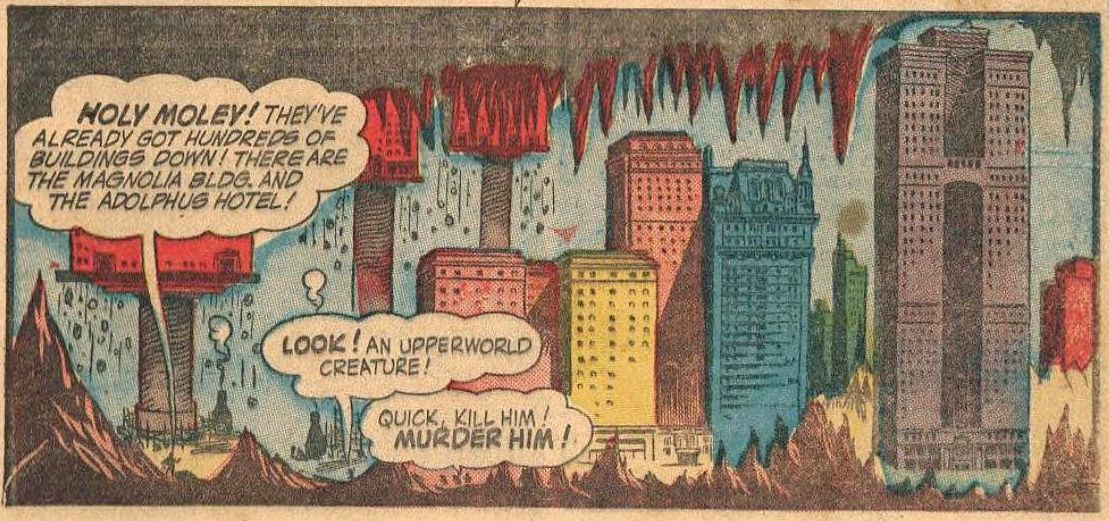
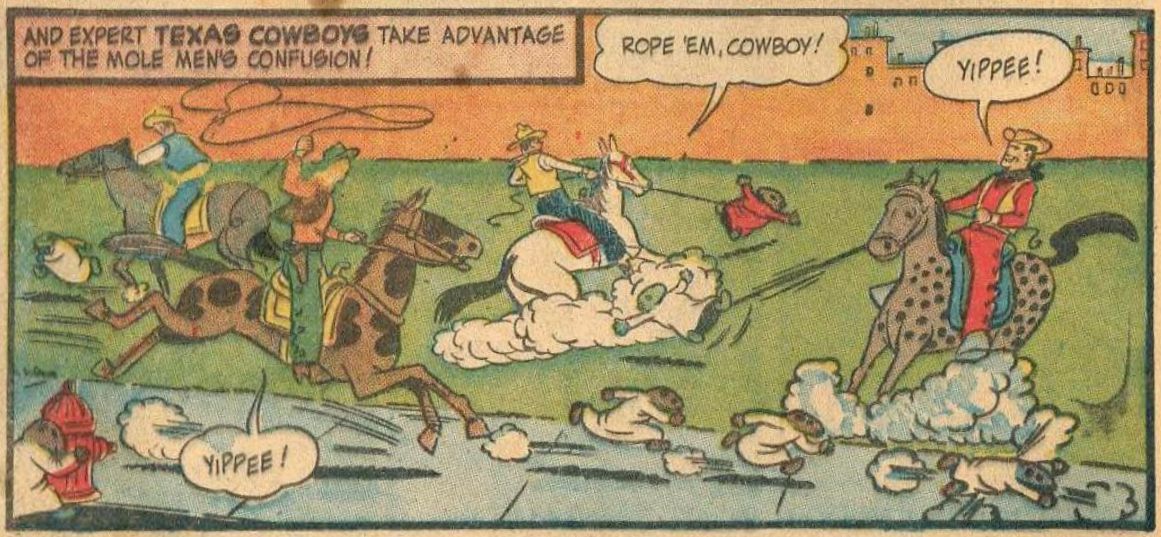
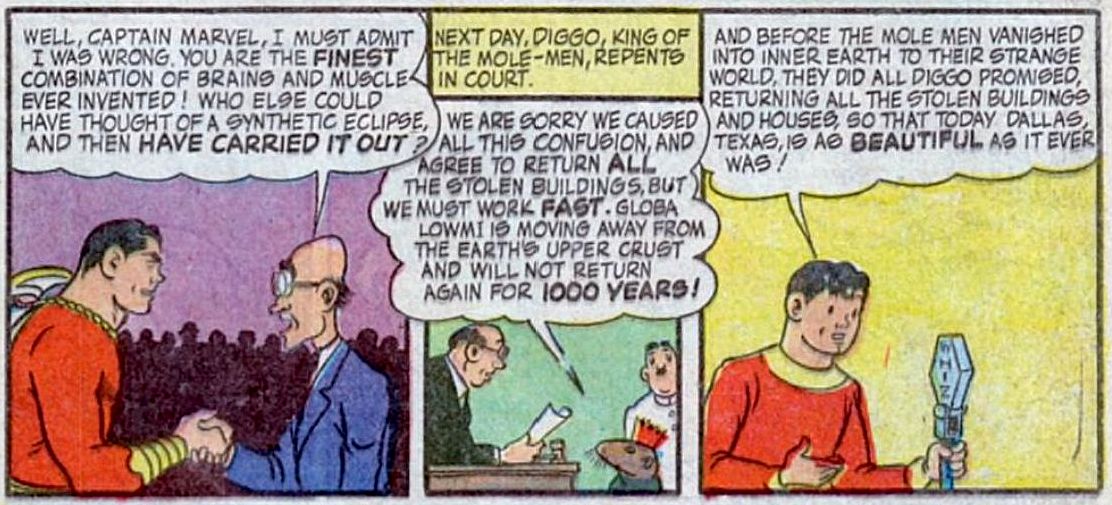
In 1944 Captain Marvel came to Dallas. He had brushes with the SMU marching band, Love Field, Mayor Woodall Rodgers, Fair Park, the Cotton Bowl, a sunken Adolphus, Ted Dealey, and a bunch of “expert lariat throwers.” And he saved us from the Mole Men (and their “mole-kids”). People, you have NO idea…. A few of the highlights below (click for larger images). (To go directly to the entire scanned comic book, click here.)
Holy Moley! That was close! Thank you, Captain Marvel! SHAZAM!
***
To read the entire adventure “Deep in the Heart of Dallas” — in fact, to read the entire comic book (which also includes a trip to Greenpoint, Brooklyn…), check out the whole thing here. Enjoy! (And sorry about the spoilers!)
Above, three views of “Leadbelly,” the sculpted head of the blues legend, by Michael G. Owen, Jr., 1943.
Michael Owen (profiled here previously as the 15-year-old soap-sculptor who made headlines at the 1930 State Fair of Texas), was the youngest member of the group of artists loosely affiliated with the Dallas Nine group who were making a name for themselves in the 1930s and ’40s. He studied life drawing as a student of Olin Travis and painting as a student of Jerry Bywaters, but he was most proficient as a sculptor. He is best known for his award-winning 1943 bust of bluesman Lead Belly, a piece in the permanent collection of the Dallas Museum of Art (which can be seen in a 1951 DMFA catalog here).
In a 1950 letter to the (then-) Dallas Museum of Fine Arts, Owen recounted how Lead Belly sat for him in New York and sang “Goodnight Irene” as Owen worked on a clay model. Owen was living in Greenbelt, Maryland at the time, and Louisiana-born Lead Belly was living in New York City, but I’d like to think that the two men reminisced about their formative days in Dallas where Owen was a much-talked-about young artist and Lead Belly performed on the streets of Deep Ellum with Blind Lemon Jefferson.
I noticed in the newspaper article that the stone was called black Belgian marble. Actually it isn’t so exotic. It was quarried not far from Charlottesville, Virginia, and is called Black Serpentine. It was the first time I have ever heard of the stuff being black. If you’ll notice it seems quite a bit more crystalline than marble.
The way I happened to do the head went like this. A young fellow I had known in Dallas by the name of Ralph Knight had gone to New York a year or so after I went to Washington. He was interested in folk music and became acquainted with Leadbelly. It was at Ralph’s instigation that I did the head — he got me the stone, sent pictures (I first roughed out the head in clay at home in Greenbelt) and then arranged the sitting at his apartment in New York. Leadbelly sat for me one afternoon and I finished the clay model at that time. From that I worked out the stone cutting, only being able to work on it in my spare time. All in all it was about a full month’s work, I guess. During the time he was “sitting” for me (playing his guitar and singing) he played “Goodnight Irene,” but at that time the folk music devotees did not consider the tune “true folk music.” Still it pleased me when it became a popular song. It’s too bad Leadbelly couldn’t have lived to see himself gain such popularity. (Mike Owen in 1950, from a letter excerpted in the book Lone Star Regionalism, The Dallas Nine and Their Circle)
Sadly, Mike Owen’s career stalled soon after this 1940s artistic high point. He eventually settled in Oregon, where he was sidelined by multiple sclerosis. He died in 1976 at the age of 60.
Mike Owen in his early 20s
I’m not sure how often the piece is displayed at the Dallas Museum of Art, but it’s a wonderful work of art. When I saw it a couple of years ago, I just stood and stared at it for ages. It’s really fantastic. And it’s fitting that it resides here in Dallas where Michael Owen was once a part of a group of Texas artists whose influence continues to be felt today.
It also seems fitting to throw in this classic from Mr. Ledbetter, who, like Mike Owen, spent time honing his craft in Dallas:
***
Sources & Notes
“Leadbelly” sculpture by Michael G. Owen, Jr. is in the collection of the Dallas Museum of Art.
Photo of the artwork is by Paul L. as posted on Yelp.
Quote from Mike Owen’s letter to the DMFA (April 11, 1950) can be found in the superb book Lone Star Regionalism, The Dallas Nine and Their Circle, 1928-1945 by Rick Stewart (Austin: Texas Monthly Press, Dallas Museum of Art, 1985) — the best book on Dallas art of this period.
Read the Handbook of Texas entry about Huddie Ledbetter (aka Lead Belly/Leadbelly) here.
Other Flashback Dallas posts on Owen:
Young Mr. Owen’s star-turn as the teenager who carved the WFAA transmitter plant from 8,400 pounds of Ivory Soap is here.
Owen’s monument to SMU Mustangs’ mascot Peruna, commissioned in 1937, is here.
UPDATE: Read about a recently discovered large painting by Owen up for auction in Dallas in 2019 here.
The Hall of Negro Life at the Texas Centennial Exposition, Fair Park
by Paula Bosse
Juneteenth, the anniversary of the date that African American Texans learned they were freed from slavery, was celebrated at the Texas Centennial Exposition with a day of entertainment and exhibits. It was also the day that the Hall of Negro Life — a federally funded exhibition hall acknowledging and honoring the history and accomplishments of African Americans in the United States — was officially dedicated.
One of the more interesting things I’ve stumbled across is a drawing of the proposed building (published in J. Mason Brewer’s The Negro In Texas History in 1935). I don’t believe I’ve seen this before. It’s interesting to note the changes from original proposal to finished product.
Among the large collection of art by black artists displayed in the Hall of Negro Life were four murals by the artist Aaron Douglas, depicting black history in Texas. Below are the two murals that survive, “Into Bondage” and “Aspiration.” These are incredible murals, and it must have been an emotional experience for those Juneteenth visitors in 1936 to be surrounded by all four powerful pieces in the lobby of a government-backed project that formally recognized the contributions of fellow African Americans.
“Into Bondage” by Aaron Douglas, 1936 (Corcoran Gallery of Art)
“Aspiration” by Aaron Douglas, 1936 (Fine Arts Museum of San Francisco)
***
Sources & Notes
Black-and-white photograph of the Hall of Negro Life from the Private Collection of Mary Newton Maxwell, Portal to Texas History, here.
Photo of proposed Hall of Negro Life from An Historical and Pictorial Souvenir of the Negro In Texas History, written by J. Mason Brewer (Dallas: Mathis Publishing Co., 1935).
More on the Hall of Negro Life, from the Handbook of Texas, here.
More on the Hall of Negro Life from The Crisis, the magazine of the NAACP, in the July, 1936 article “Negroes and the Texas Centennial” by Jesse O. Thomas,here.
How was this important Juneteenth celebration at the Texas Centennial covered by The Dallas Morning News? Well, the paper actually devoted a lot of space to the day’s events in a fairly lengthy article which appeared on June 20, 1936. I think the DMN editorial board probably thought they were being magnanimous in the amount of coverage given, but, really, the article — though brimming with a certain amount of probably well-intentioned jubilation — is so unremittingly racist that it’s actually shocking to see this sort of thing in print in a major newspaper. I encourage you to check out the article published on June 20, 1936 which carries the laboriously headlined and sub-headlined “Negroes Stage Big Juneteenth at Centennial; Dallas Eats Cold Supper and Cotton Patches Emptied as Thousands Inspect Magic City; Hall Is Dedicated; Dusky Beauties Prance; Cab Calloway Does His Stuff For Truckers.”
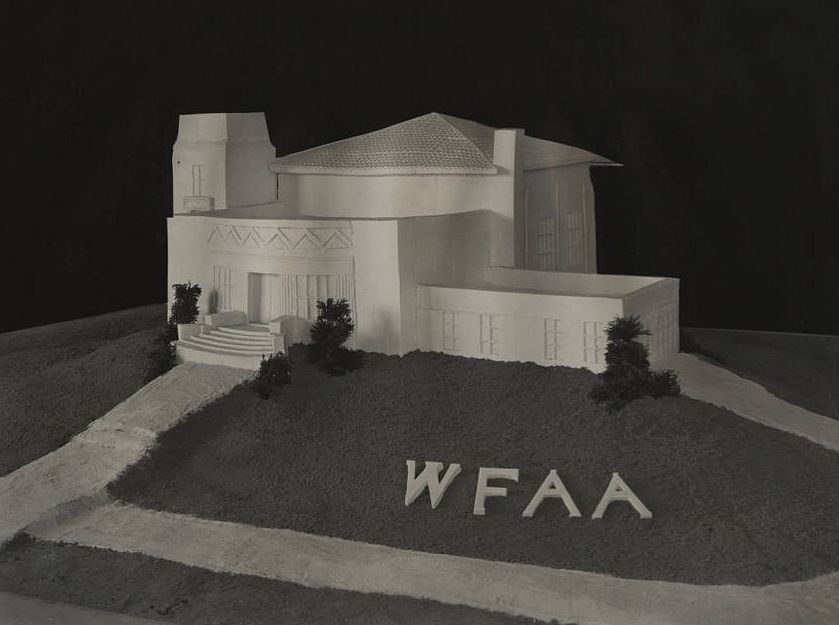
In 1930, 15-year-old sculptor Michael G. Owen, Jr. carved a replica of the WFAA transmitter building out of 8,400 pounds of Ivory soap. And why not? It was a big draw at that year’s State Fair of Texas.
Mike Owen, a student at well-to-do Highland Park High School (although Dallas artist Olin Travis, who had him as a pupil at about this time, described him as being “very poor”), had been sculpting all sorts of things, from the age of 3. He had begun winning awards when he was 13 or 14, one in an earlier “soap modeling” contest sponsored by Procter & Gamble. Not only did that soap-carving award result in young Mr. Owen being commissioned by Sanger Bros. to carve a model of the downtown skyline (I’m not sure this commission was ever actually completed), he was also asked to create an attraction for the State Fair: a replica-in-soap of the WFAA transmitter plant located on Northwest Highway near Grapevine (see a photo of the transmitter building and tower here). Owen worked from blueprints of the building and a bronze model supplied by the Belo Corporation (owner of WFAA), and Proctor & Gamble supplied the huge bars of Ivory soap (12 bars, each weighing 700 pounds). The finished piece was an “exact replica” of the 50,000-watt transmitter plant and was touted by Procter & Gamble as being the largest soap sculpture ever executed. It was a big hit at the 1930 State Fair of Texas.
Michael Owen went on to become a professional artist, with early enthusiastic support from Jerry Bywaters. He was associated with the Dallas Nine (and was, by far, the youngest member affiliated with that somewhat amorphous group), and I will address his more serious non-soap forays into the art world in a later post. But, first, back to soap!
The photo below shows Mike Owen’s finished product, which took him 12 days to complete.
Belo Collection, DeGolyer Library, SMU
It’s difficult to tell what the size of the finished work was from this photo, but it was described as being five feet high and seven feet wide. So… big. When it was displayed at the fair it was, for some reason, bathed in blue light. After the 12 days it took Owen to complete this sculpture, I bet that kid was squeaky-clean and positively reeked of Ivory soap.
***
Sources & Notes
Photo of Owen’s soap carving of the WFAA transmitter plant is from the Belo Records collection, DeGolyer Library. Central University Libraries, Southern Methodist University; more information on this photo can be found on the SMU websitehere.
Other Flashback Dallas posts on artist and sculptor Michael G. Owen, Jr.:
For a look at Owen’s professional career as a sculptor, see my post “Michael G. Owen, Jr., Dallas Sculptor of Lead Belly” here.
To read about the Peruna monument SMU commissioned him to produce in 1937 (when he had just turned 22), see my post here.
UPDATE: Read about a recently discovered large painting by Owen up for auction in Dallas in 2019 here.

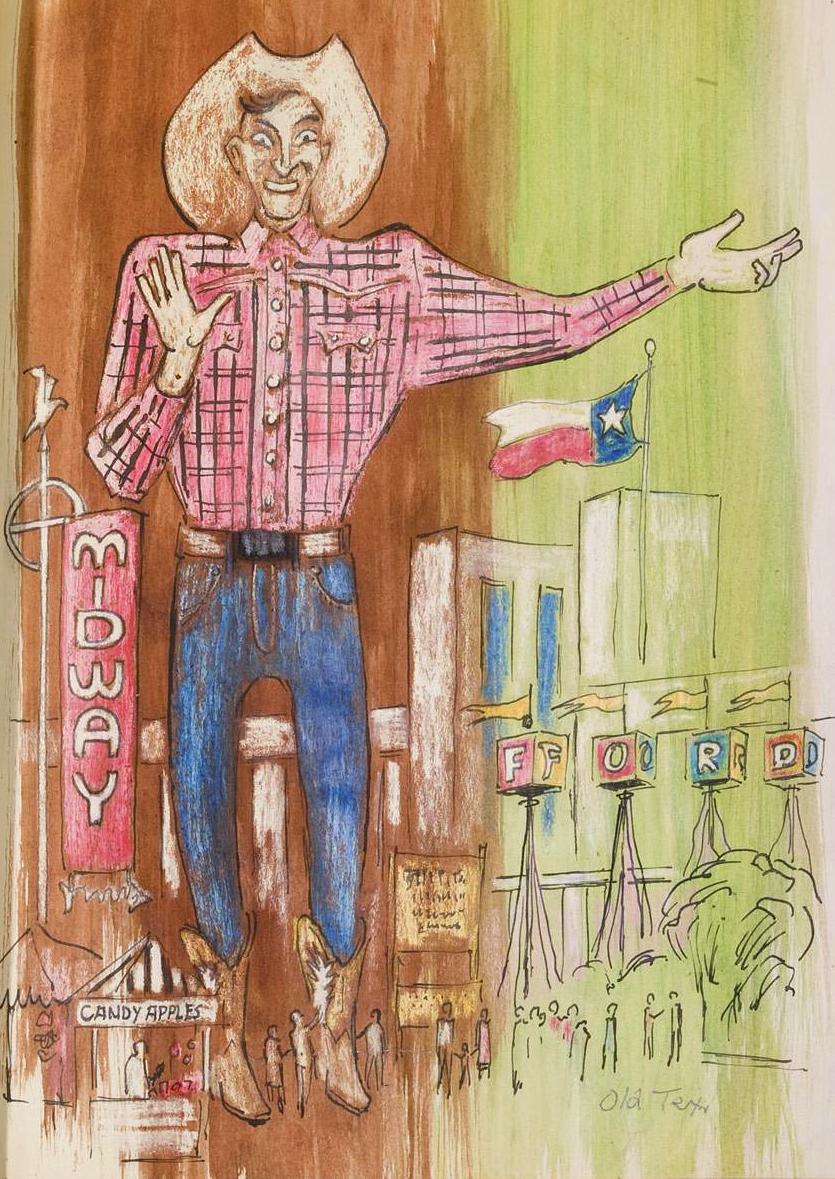 “Old Tex” sketch by Otis Dozier, 1954 — Dallas Museum of Art


 DMN, Feb. 11, 1956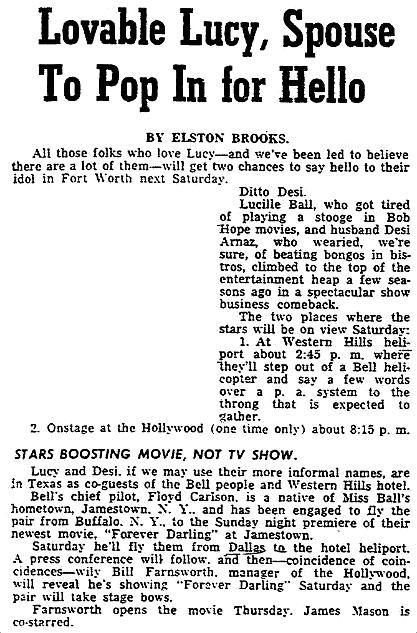




 Jim Beck in his studio
 Jim Beck (right) with Hank Thompson
 Billboard, May 12, 1956




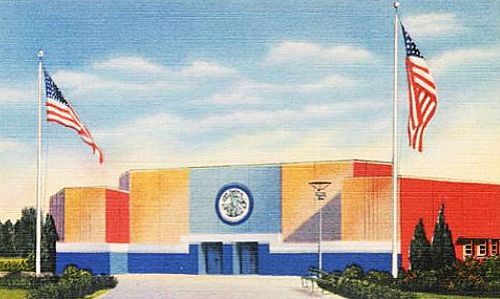 The Hall of Negro Life at the Texas Centennial Exposition, Fair Park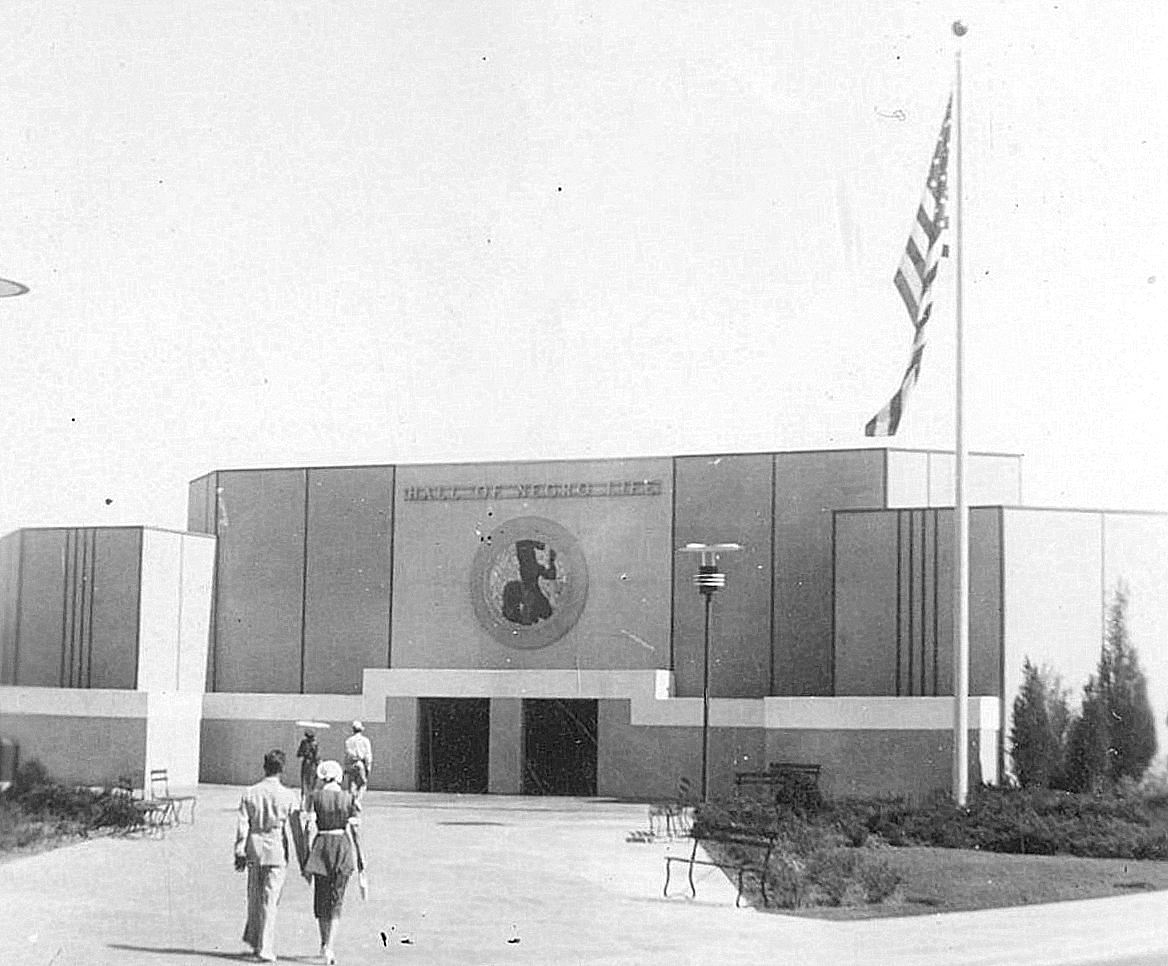

 “Into Bondage” by Aaron Douglas, 1936 (Corcoran Gallery of Art)
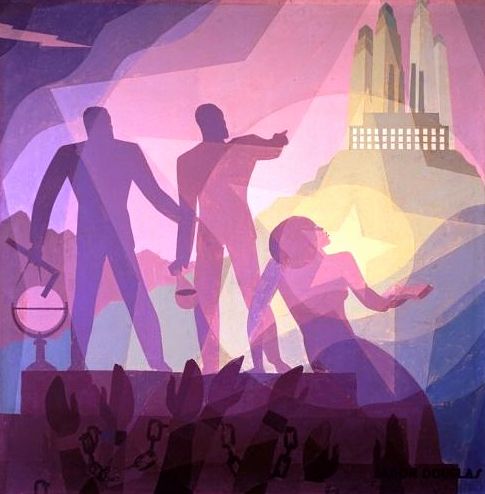 “Aspiration” by Aaron Douglas, 1936 (Fine Arts Museum of San Francisco)


 Flashback : Dallas