Flashback : Dallas

A Miscellany: History, Ads, Pop Culture

Category: Entertainment

Betty and Benny Fox, Sky-Dancing in Dallas — ca. 1935

fox-betty-benny_princeton-univ_nd
Betty & Benny, without a care in the world… 

by Paula Bosse

I often just wander aimlessly around the internet, hoping I’ll find something Dallas-related that I haven’t seen before. Last night I found this unusual photo in the Western Americana Collection of Princeton University, described as “View of a Texas city, possibly Dallas.” Okay. It didn’t strike me immediately as a familiar view of Dallas, but you’ve got appearances by Dallas Art Glass Co., Texas Hosiery, and Texas Paper Co. So, yeah. Dallas! I definitely haven’t seen this before. (Scroll down for the specifics of the location.)

Once I determined this was, in fact, Dallas, I tried to figure out what was happening — who (and why?!) were those two people waving from a tiny platform on top of a tall pole? I first thought “flagpole-sitting,” the weird fad of the 1920s which makes me uncomfortably acrophobic just thinking about it. But it was two people on a pole. Standing. Waving. I just kept looking at it, wondering how they got up there. And how were they going to get down (without plummeting)? Why were they there? Were they a couple? Were there husband-and-wife pole-sitters/-standers/-dancers/-wavers? So many questions.

My first hint was in a December, 1931 story in The Dallas Morning News about a young woman who seemed to have some name-recognition named Betty Fox who was, at the time of the article, perched atop a pole in Greenville, Texas, attempting to test her endurance and remain there for 100 hours. As one does. (When in Greenville….) So I searched for newspaper articles about “Betty Fox.” She was, indeed, a star in the pole-sitting world, entertaining large crowds and making personal appearances all around the country. Then I noticed that there seemed to be more than one “Betty Fox” out there. Hmm. And I had noticed that there had been a pole-sitter named Ben Fox who was a fairly serious flagpole-sitting champ. That was kind of a weird coincidence. Or was it? And then I found the article “Sky Dancers Betty and Benny Fox,” which helpfully explained that Benny and Betty were daredevil aerial dancers. They were originally billed as brother and sister, but as the article says, “they were not related. And Betty was not always the same person, nor was she actually named Betty.”

They traveled from city to city where they drew large crowds who watched them perform high in the sky on a tiny circular disc 24 inches in diameter (it later shrank to 18 inches in diameter). Their acrobatic “sky dance” (AKA “The Dance of Death”) apparently lasted for several hours. (There was an article I read from 1931 about “Betty” and a heretofore unknown other “sibling” named “Babe” Fox who defied a judge’s injunction to prohibit the two from engaging in a 100-hour marathon-dance stunt on a 35-inch platform, 50 feet in the air in cold, wet, and windy Texarkana. Seems like a bad idea, but, apparently, they didn’t die. (…Or maybe they did and just got a new “Betty” and “Babe” and carried on to the next gig.)

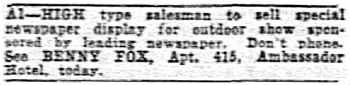
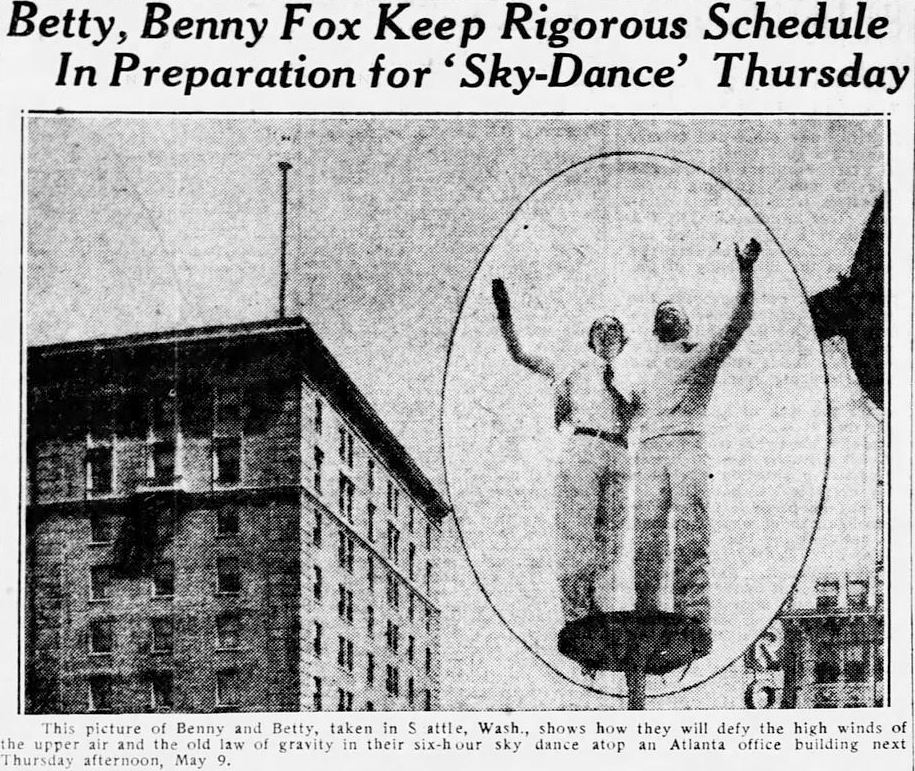
Princeton University estimated the date of the photo to be around 1930. I think it might have been 1935. The two classified ads below in which Benny seeks Dallas promoters for their local event, were from the end of 1935. (The event was sponsored by a Dallas newspaper — it obviously wasn’t the DMN, because there was no story about the Foxes in their pages.) The newspaper photo below the ads shows the then-current version of Betty and Benny, and they look like the couple in the Princeton photo. 

fox-benny_dmn_112735Dallas Morning News, Nov. 27, 1935

fox-benny_dmn_120735DMN, Dec. 7, 1935

fox_atlanta-constitution_050335Atlanta Constitution, May 3, 1935

Yes, that caption says they performed for SIX HOURS.

I’m not sure how long “Betty and Benny” lasted, but they were back in Dallas in 1957 performing at a week-long carnival in Wynnewood Shopping Center. I bet there were more “Bettys” than “Perunas.”

Here’s some newsreel footage of one of the Betty and Benny incarnations, doing their thing in Chicago. (Seriously, if you’ve got even a hint of a fear of heights, look away!!!)

*

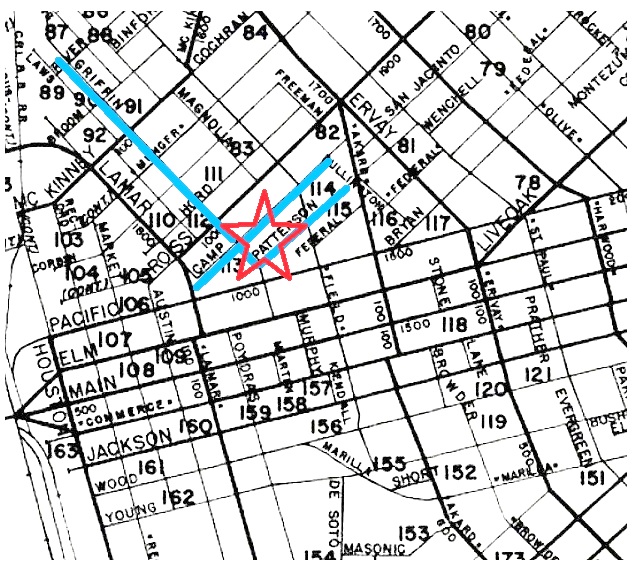
So where was that photo at the top taken? I’m estimating the camera was on the top of a building at, roughly, Griffin and Pacific, looking in a northerly direction. At the top right, the tall building farthest away is the First Methodist Episcopal Church (now First United Methodist) at Ross and Harwood. It’s hard to see any streets, but the two running diagonally are Camp and Patterson. A few addresses of businesses seen in the photo:

  • Dallas Art Glass Co.: 1408 Camp
  • Steger Transfer Co.: 1305 Camp
  • Texas Hosiery: 1200 Camp/1201 Patterson
  • Texas Paper Co.: 1200 Patterson, extending to Pacific

A 1921 Sanborn map is here. A detail from a 1952 Mapsco is below.

fox_mapsco_1952_camp-patterson-griffin1952 Mapsco (det)

*

I’m not sure why Princeton has this photo in their collection, but I really enjoyed reading about Benny and his “Bettys.”

***

Sources & Notes

Top photo — “View of a Texas city, possibly Dallas” — is from the Western Americana Collection, Princeton University Library Special Collections; more information on this photo can be found on the Princeton website here.

See several “action” photos of Benny and Betty from GettyImages here.

Read the very entertaining “Sky Dancers Betty and Benny Fox” by Alan E. Hunter, here.

Another story I wrote concerning an “endurance” stunt (which, like this one, also makes me feel a little panicky) is “Buried Alive at the Fair Park Midway — 1946.” 

fox-betty-benny_princeton-univ_nd_det

*

Copyright © 2022 Paula Bosse. All Rights Reserved.

Dallas Entertainment Awards — 1961

dallas-entertainment-awards_1961_cover_SMUAnd the winner is…

by Paula Bosse

Here’s an interesting piece of Dallas entertainment history: a program for the 1961 Dallas Entertainment Awards, held in the Century Room, the swanky nightclub in the Adolphus Hotel. The awards were nicknamed “the Billy award,” or “the Billys.” Dresscode: “semi-formal.” Here are a few highlights.

*

BEST RADIO PERSONALITY

Nominees are: Nick Ramsey (KVIL), Ted Cassidy (“Profile of an Orchestra,” WFAA), Meg Healy (KIXL), Hugh Lampman (“Music ’til Dawn,” KRLD — the previous year’s winner), Irving Harrigan & Tom Murphy (“Murphy and Harrigan Show,” KLIF), Jim Lowe (WRR), and Chem Terry (KRLD). 

So – Ted Cassidy? Yes, that is the same Ted Cassidy who later played “Lurch” on TV in The Addams Family (he also played “Thing”). He worked for WFAA radio for a few years and is a trivia answer in JFK-related quizzes regarding Dallas media coverage of the assassination.

cassidy-ted_dallas-entertainment-awards_1961_SMU_bw

*

BEST MALE VOCALIST

Nominees are: Mark Carroll, Marty Ross, Earl Humphreys (the previous year’s winner), Skip Fletcher, Charlie Applewhite, Ron Shipman, and Trini Lopez.

Skip Fletcher? Yes, a member of those Fletchers. When he wasn’t frying up corny dogs he did a little singing, and even released at least one 45.

fletcher-skip_dallas-entertainment-awards_1961_SMU_bw

*

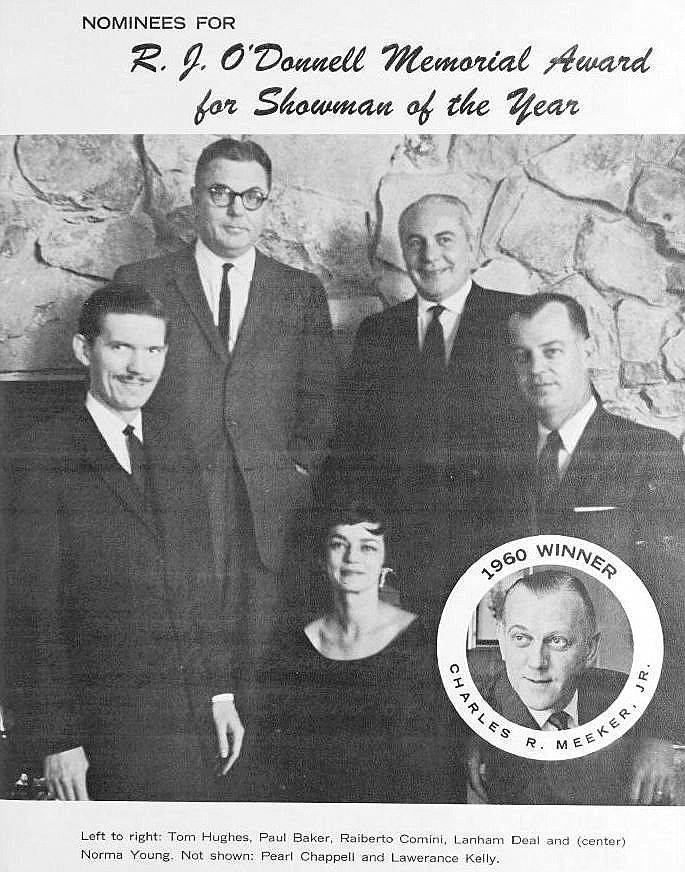
R. J. O’DONNELL MEMORIAL AWARD FOR SHOWMAN OF THE YEAR

Nominees are: Tom Hughes, Paul Baker, Raiberto Comini, Lanham Deal, Norma Young, Pearl Chappell, and Lawrence Kelly. (The previous year’s winner was Charles R. Meeker Jr.) A few names there which should be familiar to aficionados of Dallas live theater.

hughes-tom_paul-baker_raiberto-comini_lanham-deal_norma-young_charles-meeker_dallas-entertainment-awards_1961_SMU_bw

*

Producers of the event were Breck Wall and Joe Peterson, creators of the naughty “Bottoms Up” revue, which is probably still running somewhere. Some biographical information on the pair (click for larger image):

wall-breck_joe-peterson_dallas-entertainment-awards_1961_SMU_bw

*

Master of Ceremonies was Tony Zoppi, who wrote a column about the local nightclub scene for The Dallas Morning News. Whenever I read his old columns, I think that he must have had the BEST job in town — writing about the Dallas nightlife scene when it was at its sophisticated and sometimes seedy Mad Men-era apex.

zoppi-tony_dallas-entertainment-awards_1961_SMU_bw

*

And — a bit of a change of pace — a little bio of real estate titan Leo Corrigan, who owned the Adolphus, where the show was being held — he was, unsurprisingly, receiving an “Appreciation Award.”

corrigan-leo_dallas-entertainment-awards_1961_SMU_bw

*

And a couple of drawings of Dallas entertainment notables: Pappy Dolson, owner of Pappy’s Showland and legendary agent of strippers, and Joe Reichman, the leader of the Century Room orchestra who was billed as “the Pagliacci of the piano.”

pappy_pappys_dallas-entertainment-awards_1961_SMU

reichman-joe_dallas-entertainment-awards_1961_SMU

*

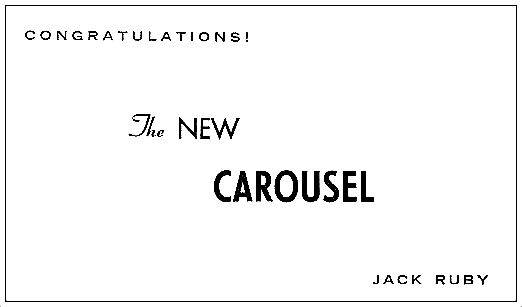
A few interesting ads include a little “howdy” from Jack Ruby (who was well known to several of the people mentioned above, some of whom testified to the Warren Commission about their relationships with him). 

ruby-jack_new-carousel_dallas-entertainment-awards_1961_SMU

An ad for Villa Fontana, a gay club, formerly known as Le Boeuf Sur Le Toit (The Bull on the Roof), then managed by Bob Strange. Gay clubs were illegal at the time, so you didn’t see a lot of ads for them. (I wrote an article for Central Track about some of the gay clubs in Dallas in the early ’70s — with photos — here.)

villa-fontana_gay-cllub_dallas-entertainment-awards_1961_SMU

And, the 24-hour greasy spoon known to generations of Dallasites, Oak Lawn’s Lucas B & B.

lucas-b-and-b_dallas-entertainment-awards_1961_SMU_bw

Here’s the photo enlarged. Unless something earth-shattering has happened that I don’t know about, that great sign is still standing on Oak Lawn near Lemmon, long after the restaurant closed.

lucas-b-and-b_dallas-entertainment-awards_1961_SMU_det

*

See the rest of the 44-page program — lots more photos, lots more nominees — in a PDF from the DeGolyer Library at SMU, here.

***

Sources & Notes

All images are from “Dallas Entertainment Awards — 1961,” from the Diane Wisdom Papers, Archives of Women of the Southwest, DeGolyer Library, SMU Libraries; more information and a link to the fully-scanned program is here.

dallas-entertainment-awards_1961_cover_SMU_sm

*

Copyright © 2022 Paula Bosse. All Rights Reserved.
Gene de Jean Lifts a Curse on Dallas — 1970

gene-de-jean_WFAA_090470Curse lifted — all in a day’s work…

by Paula Bosse

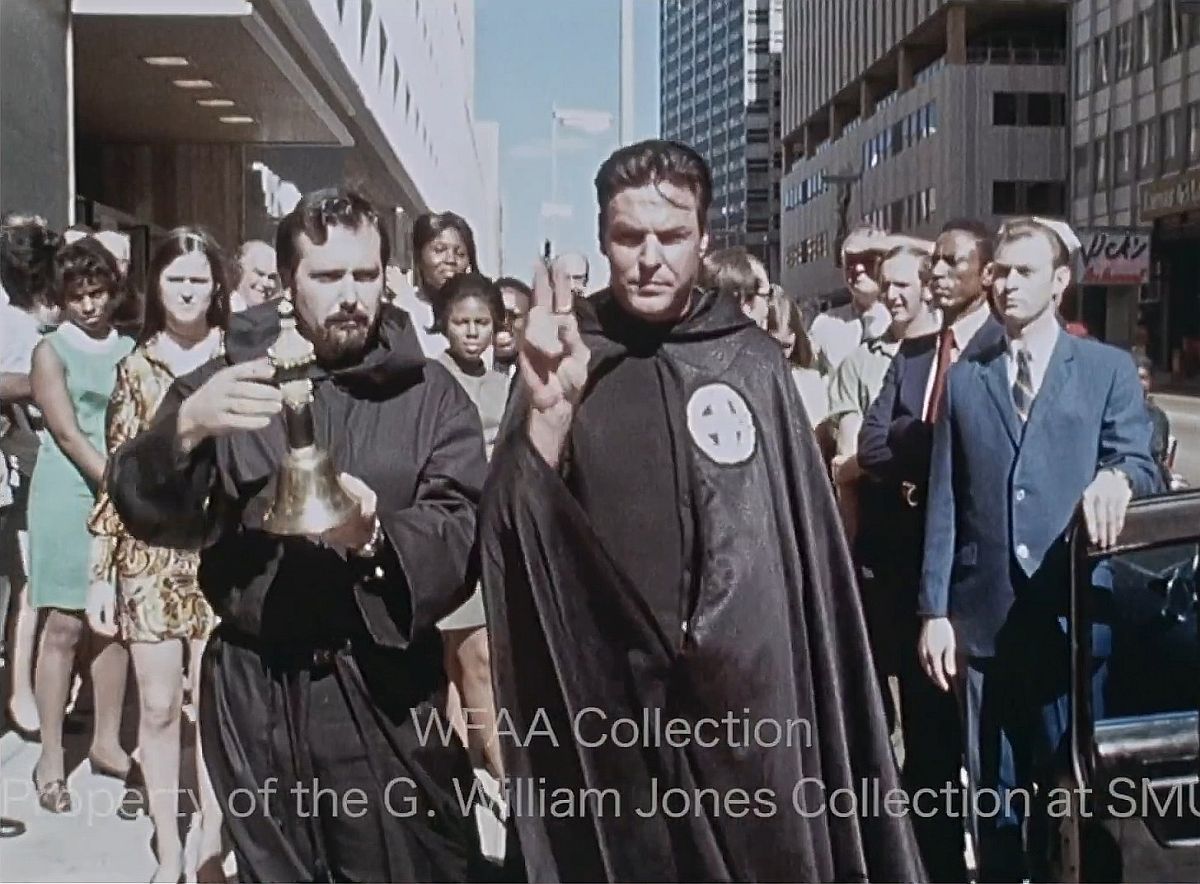
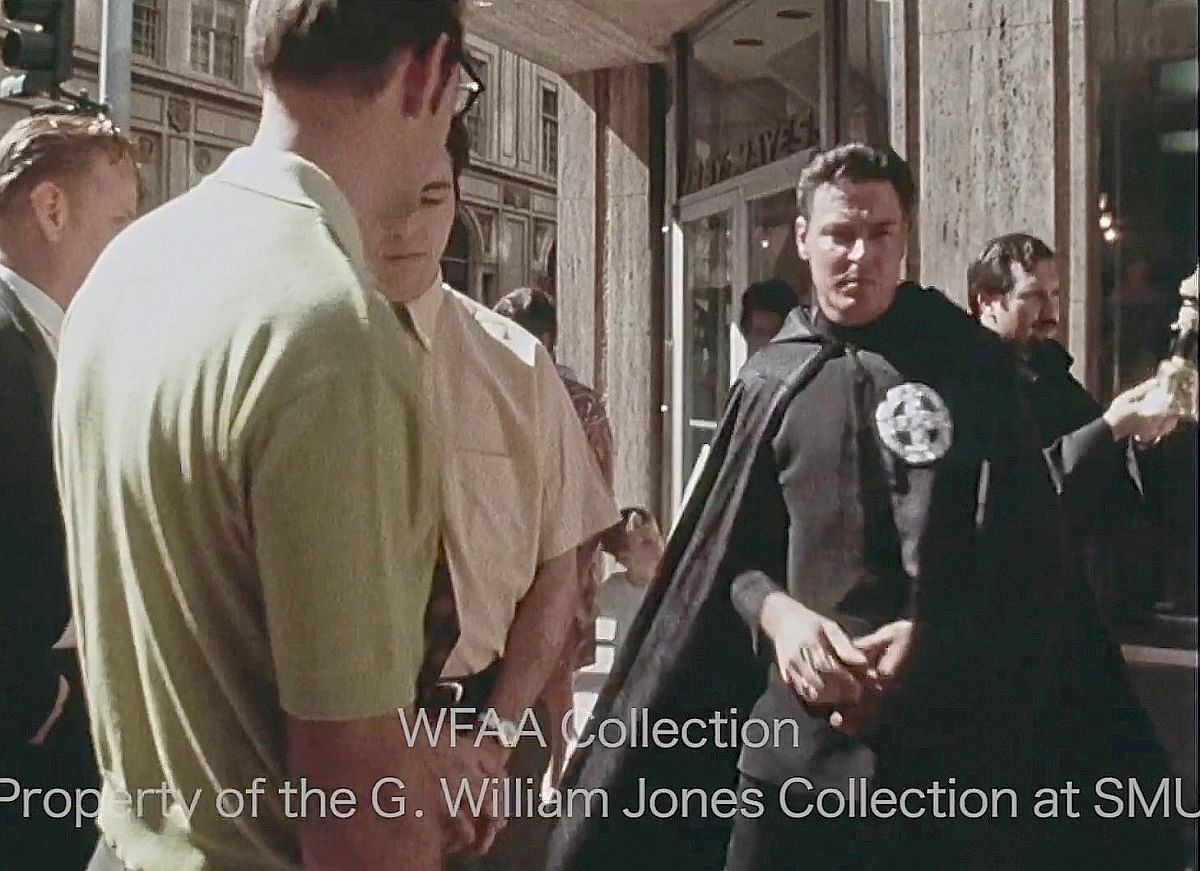
On Sept. 4, 1970, at the corner of Commerce and Ervay, a “white-magic warlock” named Gene de Jean conducted a ceremony to lift a heinous curse placed on Dallas in 1963 by a somewhat vague “malevolent black-magic coven” — this curse, which, uncoincidentally, preceded the JFK assassination, had apparently hung over the city for 7 long years. Fortunately, the media had been alerted, and we have film footage of the historic occasion in which a mysterious warlock lifted a nasty curse which no one in Dallas knew had been cast in the first place.

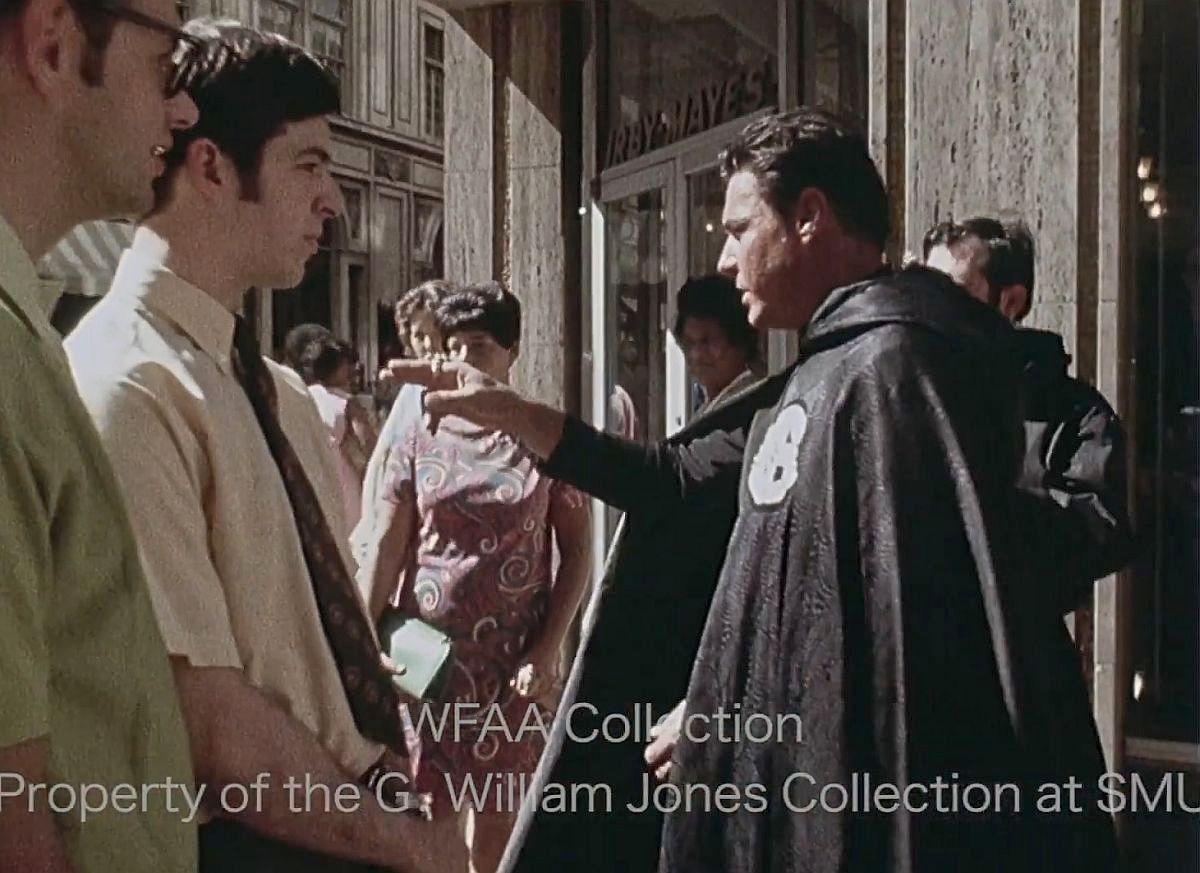
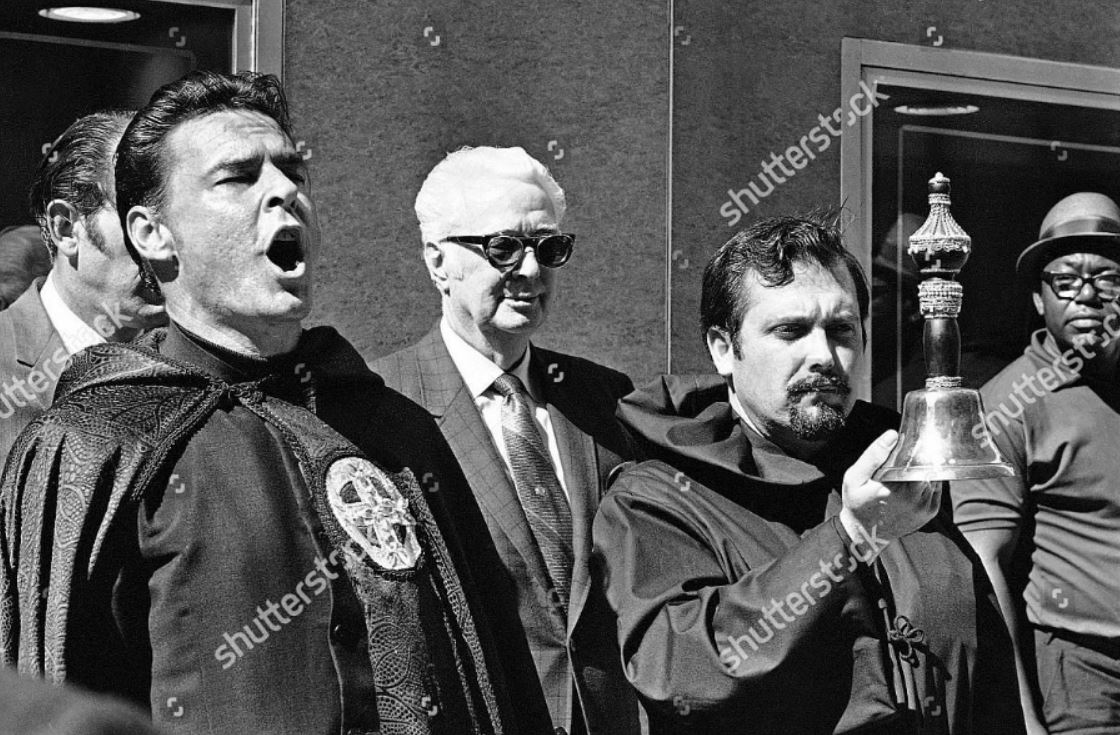
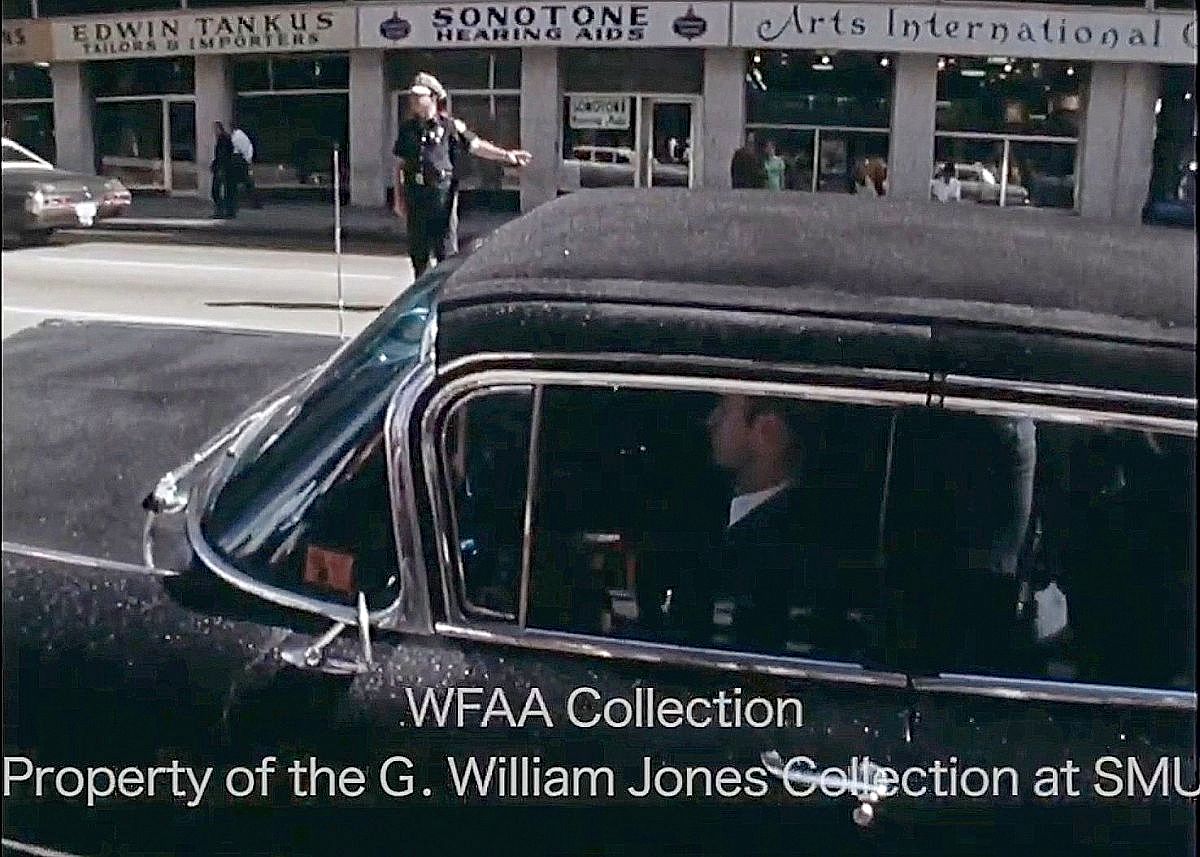
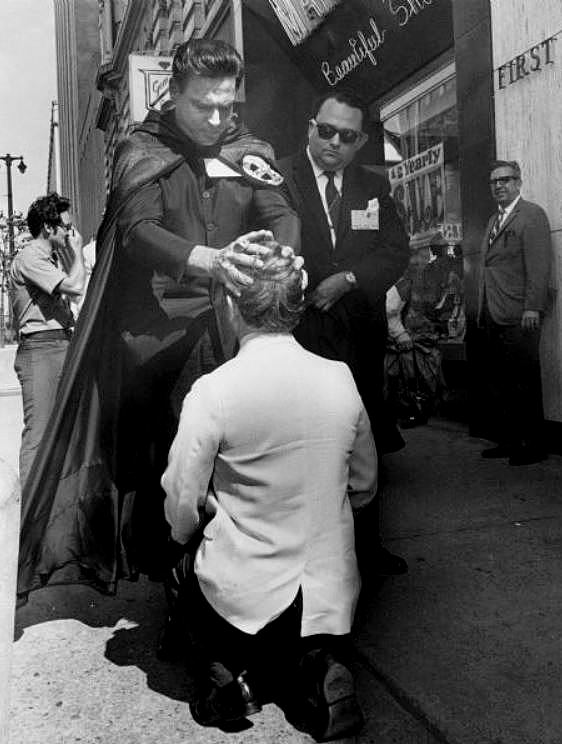
Do-gooding warlock Gene de Jean arrived in a “velvetized Cadillac” (a Cadillac COVERED IN BLACK VELVET!) with a be-robed bell-ringing acolyte, and, with Neiman-Marcus in the background, he uttered a few incantations and proclaimed the curse lifted. He also “blessed” a few random people in the crowd for good measure before walking back to the waiting velvetized warlock-mobile, his job done. In his wake there was much rejoicing and/or confused looks exchanged on Commerce Street. Thank you Mr. de Jean!

*

In something of a kill-joy article, the Associated Press revealed that “Gene de Jean” was a warlock stage-name. In non-warlock life he was Gene McIntosh, mild-mannered Houston psychologist. When pressed by the reporter, Gene said that it was “pure coincidence” that the Texas Association of Magicians was wrapping up its 25th annual convention 2 blocks away at the Statler Hilton (which can be seen in the background of the footage). So, yes, Gene McIntosh and Lee Thompson (the bell-ringing “acolyte”) were well-known Houston magicians/illusionists in town for a magicians’ convention. And — why not? — a friendly curse-lifting.

**

Here’s the footage — at the 12:19 mark — captured by a WFAA-Channel 8 News cameraman for posterity.

*

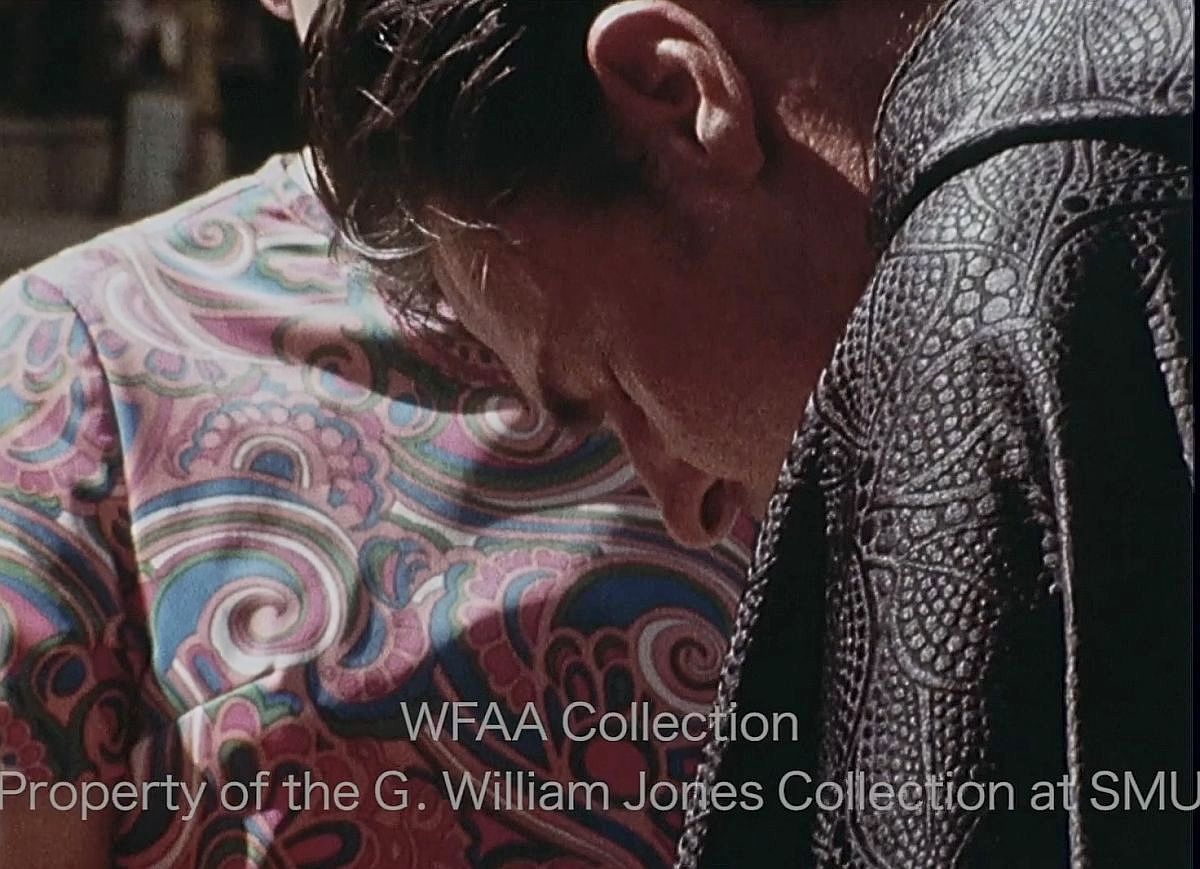
And a few screenshots of the warlock in action.

gene-de-jean_WFAA_090470_1

gene-de-jean_WFAA_090470_2

gene-de-jean_WFAA_090470_3

gene-de-jean_dallas_090470-shutterstock_ferd-kaufmanAssociated Press photo by Ferd Kaufman

gene-de-jean_WFAA_090470_velvetized-caddySeriously — how do you cover a car with velvet?

Voilà! Curse lifted!

**

Doing a little research, I have to say, when I came across the photo below, I felt a twinge of betrayal. Or at least disappointment. It shows Gene de Jean on the streets of Milwaukee (Milwaukee?!!) in June, 1970. The guy in the sunglasses is also seen with him in Dallas. The caption of this photo: “A self-described warlock (male witch) in black flowing cape bestowed a blessing right here in Old Milwaukee Tuesday. Gene De Jean blessed the city and a number of passersby at N. 3rd St. and W. Wisconsin Ave. He was in town for a magician’s convention.” Was it all just a schtick, Gene? And I thought we had something special.

gene-de- jean_milwaukee_june-1970via Wisconsin Historical Society

***

Sources & Notes

Video and screenshots are from the WFAA NewsFilm Collection, G. William Jones Film Collection, Hamon Arts Library, Southern Methodist University; the footage is from Sept. 4, 1970 and can be found on YouTube here (clip begins as the 12:19 mark).

When I posted a version of this on my Facebook page a few weeks ago, David B. commented with a couple of informative links about Gene McIntosh (who died in 2006): this overview of his career as a magician, and this tale of a stunt he performed while driving from Houston to Dallas in 1959, blindfolded the whole way. RIP, Gene.

gene-de-jean_WFAA_090470 sm

*

Copyright © 2021 Paula Bosse. All Rights Reserved.

State Fair of Texas, From Above — 1959

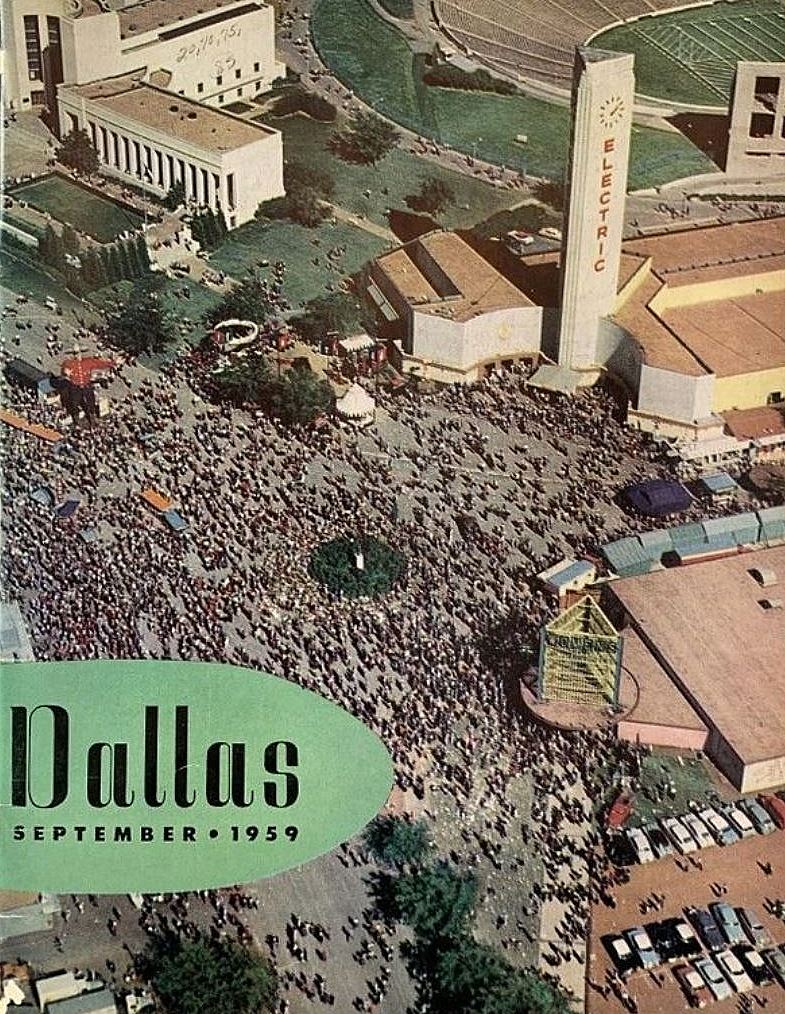
sfot_dallas-magazine_sept-1959A bird’s-eye view of the Great State Fair

by Paula Bosse

I think I see Waldo.

***

Sources & Notes

Front cover of Dallas magazine, Sept. 1959.

sfot_dallas-magazine_sept-1959_sm

*

Copyright © 2021 Paula Bosse. All Rights Reserved.

Dusty Hill, 1949-2021

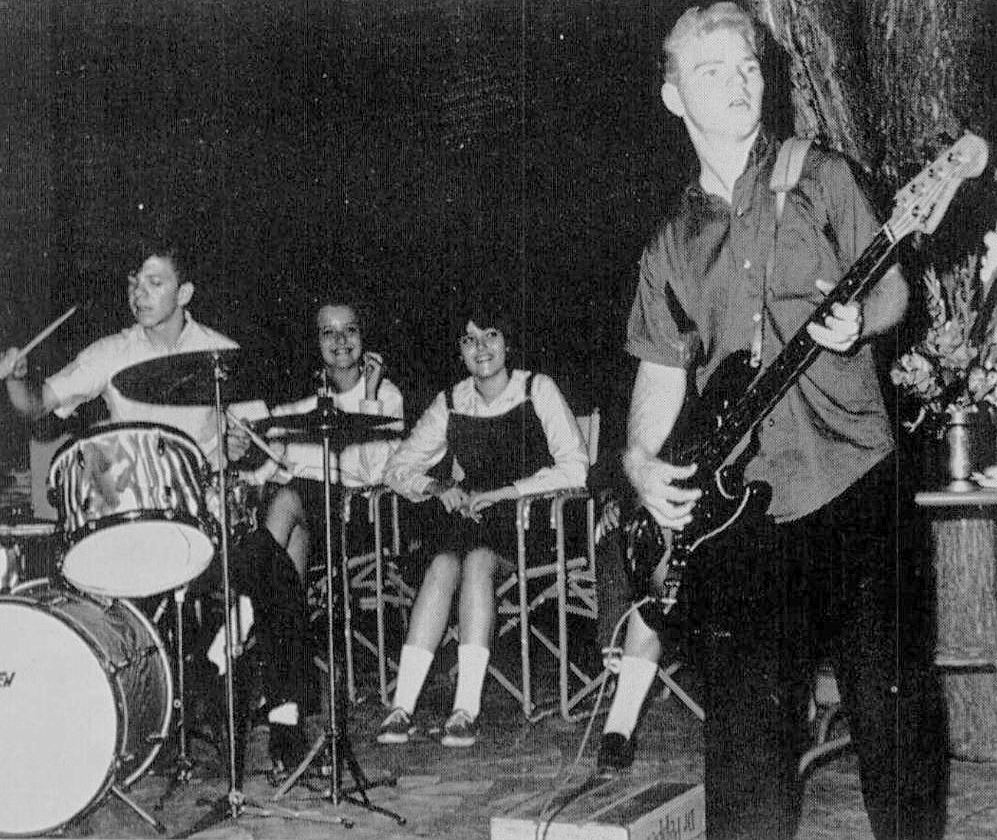
zz-top_dusty-hill_woodrow-wilson_1965-yrbkDusty Hill on bass, Richard Harris on drums, 1965

by Paula Bosse

Dusty Hill, the legendary bassist of the legendary ZZ Top, died today. Born Joe Michael Hill in Dallas, Dusty lived in East Dallas and attended Woodrow Wilson High School. He dropped out before graduating and pursued a career as a musician, a decision which seems to have worked out pretty well for him. 

Above is a photo from the 1965 Woodrow yearbook when Dusty would have been 15 years old. The caption reads “The disappointment of the Bryan Adams loss was lessened by the lively music of Richard Harris and Dusty Hill.”

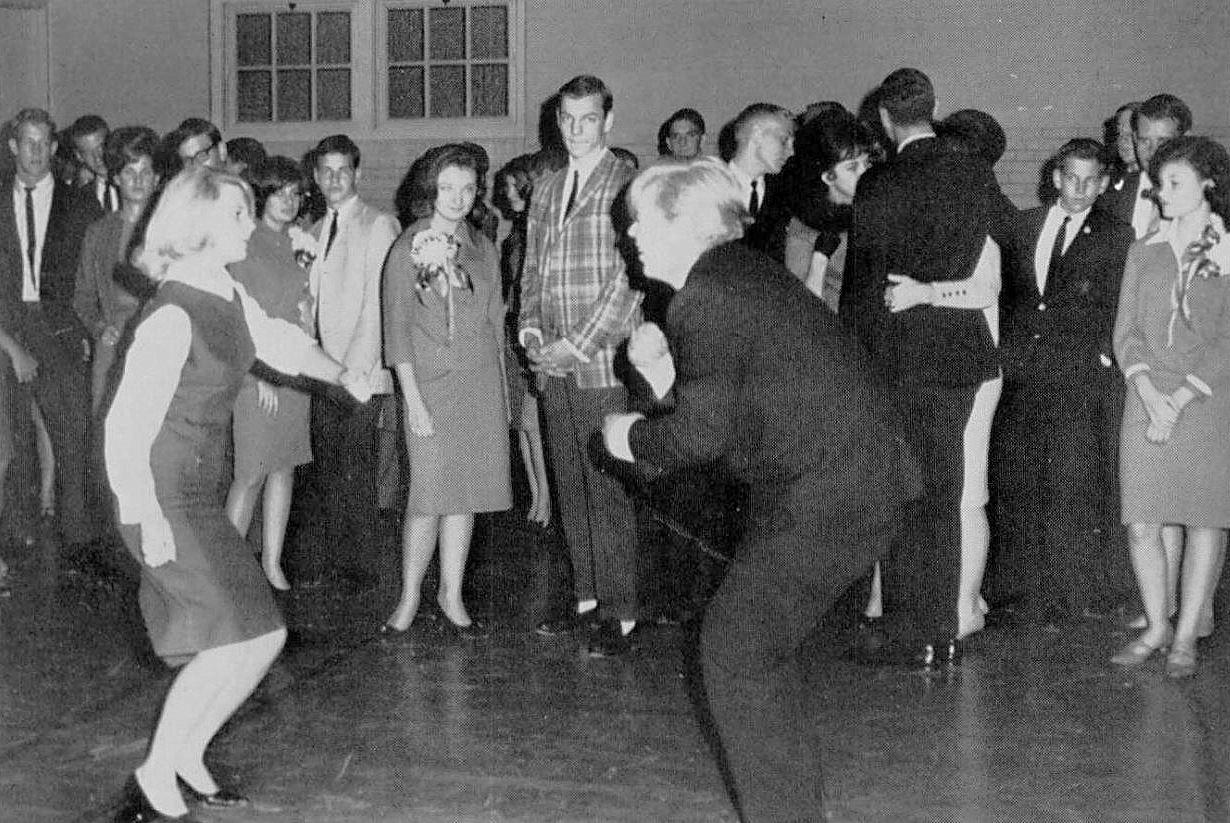
At the time of these photos, Dusty and Richard were playing around town in a band called The Dead Beats, a trio which also included Dusty’s older brother, Rocky Hill, who is seen below in a photo from the same yearbook, with the caption “At the homecoming dance, Rocky Hill and his date prove their skill at a modern dance called ‘The Dog.” Dusty, Rocky, and Richard would go on to form the band American Blues.

rocky-hill_woodrow-wilson_1965-yrbkRocky Hill, 1965

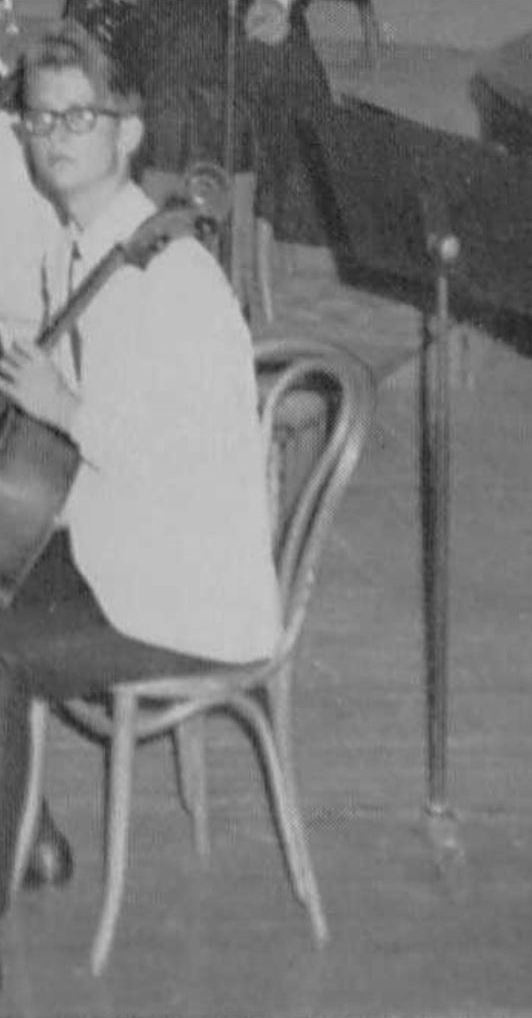
Dusty played cello in the Woodrow orchestra, so I went looking through the yearbook to see if I could find him. I think I might have — could this be him in an awkwardly cropped photo?

zz-top_dusty-hill_woodrow-wilson_1965-yrbk-celloYoung man with cello, 1965

*

RIP, Dusty. Thanks for the great music.

**

UPDATE: Thanks to reader Steve Roe who sent me an Oct. 29, 1964 clipping of “Dallas After Dark” (the Tony Zoppi column in The Dallas Morning News devoted to the city’s nightclub scene) which mentioned all three of the Woodrow boys seen above in photos which were taken at the time they were playing around town with their band The Dead Beats:

There’s a swinging new group in town billed as The Dead Beats, and they’ll be appearing through Sunday at the Jungle Dream on North Henderson. Rocky Hill plays lead guitar and Dusty Hill is the bassist. Little Richard Harris is a torrid drummer. The trio recently returned from Nashville and appeared at Louanns. The youngsters say they are America’s answer to The Beatles. How about that?  (Dallas Morning News, Oct. 29, 1964)

How about that?! Talented and apparently aggressively confident teenagers! (Jungle Dream was located at 1823 N. Henderson, just north of Ross — a couple of doors from the old Louie’s — managed by Pat Carpenter.) 

***

Sources & Notes

Photos from the 1965 edition of The Crusader, the yearbook of Woodrow Wilson High School.

Obit from The Dallas Morning News is here.

Obit from Rolling Stone is here.

zz-top_dusty-hill_woodrow-wilson_1965-yrbk_sm

*

Copyright © 2021 Paula Bosse. All Rights Reserved.

Snider Plaza & The Varsity Theater — 1920s

varsity-theater_1929_galloway_1600The Varsity Theater, Snider Plaza, 1929

by Paula Bosse

Snider Plaza, the University Park shopping center near the SMU campus, was formally opened on June 2, 1927 when its centerpiece fountain was switched on as a crowd of thousands watched. The buildings weren’t completed yet, but it was a sure sign to everyone that a large project was underway in an area of town which was not yet fully developed.

It was announced in December 1926 that a 30-acre tract at the northwest corner of Hillcrest and Daniel had been purchased by Wichita Falls businessman Charles W. Snider (he had recently funded Snider Hall, the women’s dormitory at SMU) and University Park mayor J. Fred Smith from Miss Fannie B. Daniel, whose family had owned the land since 1851. The purchase price was $82,500 (which would be the equivalent of about $1.25 million in today’s money) (…let that sink in for a moment…). Snider Plaza, along with SMU, was both the heart of University Park and an impetus for real estate development around it.

Here’s an ad from October 1927 from the University Park Development Co. (click to see larger images) — lots were going for $1,890 ($30.000 today):

university-park-develpment-co_ad_100927_a

university-park-develpment-co_ad_100927_bOct. 1929 — Hurry!

*

Below are a couple of VERY early photos of Snider Plaza.

First off, the fountain. It was illuminated at night with rotating colored lights. The view is to the northwest.

snider-plaza-fountain_1927_galloway_dpl_1200

And that was about it. A fountain, paved streets and sidewalks, and lots of streetlights. In the photo below you can see the fountain in the distance. And the office of Ralph Porter, the man who was the driving force behind Snider Plaza (see his photo in the ad above). There is still a Ralph Porter Co. real estate business — and, appropriately, it’s still located in Snider Plaza.

snider-plaza_galloway_dpl_1200

*

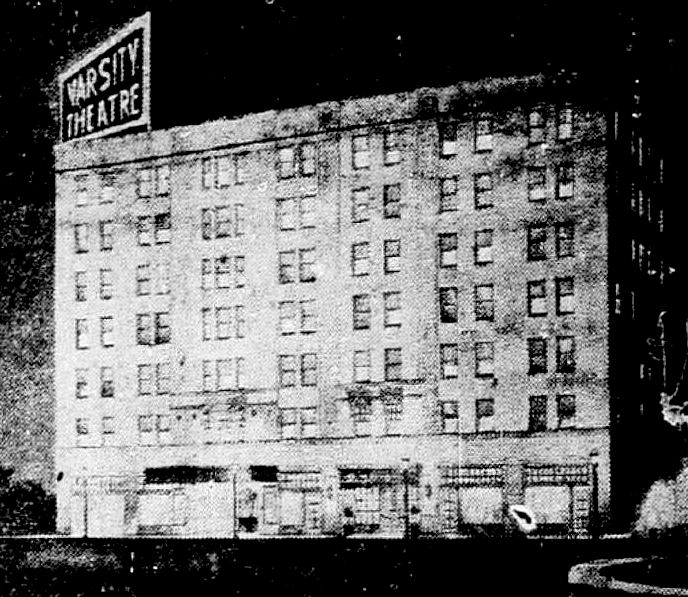
The Varsity Theater wasn’t built until 1929, even though a movie theater was always in the plans. I’m not sure what happened, but in 1928 it was announced that a new theater was going to be built as part of a 7-story building. The theater and retail shops were to occupy the first floor, offices would occupy the second floor, and furnished apartments would fill the top five floors (there would also be a parking garage in the basement). That’s all so weird to imagine. First off, apartments?! Secondly, that would have been the tallest building in the Park Cities! Buildings weren’t that tall in most of “suburban” Dallas in the 1920s. Also, the architecture is pretty bland, and very unlike the rest of the shopping area.

snider-plaza_varsity-apartments_1928Architect’s conception, 1928

The stripped-down plans ended up doing away with the basement and everything but the ground floor for the theater and retail shops. And I’m so glad! I love the photo at the top, from 1929. What a beautiful, beautiful building! The architect of the building was Wyatt C. Hedrick of Fort Worth. The buildings of Snider Plaza were meant to be of uniform design. Like this. (If only they all still looked like that!) (Another photo I posted recently showing that uniform style is here.)

*

A photo from 1940 showing a partial image of the marquee:

snider-plaza_brown-bks_university-park_varsity-theater_19401940, University Park Brown Books

*

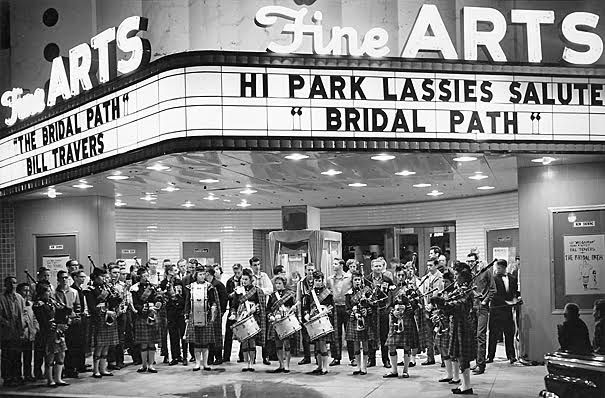
The Varsity opened on Oct. 3, 1929 with “In Old Arizona” (the first talkie to be filmed outdoors). It became the Fine Arts in January 1957. A reader, Malcom Thomson — who was a very youthful theater manager during the early days of the Fine Arts (I think he was an SMU student at the time) — sent me the great photo below from February 1960.

fine-arts-theater_snider-plaza_malcolm-thomson_feb-3-1960Feb. 3, 1960 (courtesy Malcolm Thomson)

At some point — it’s so incredibly hard to believe that it seems like an urban legend — the Fine Arts Theater became an “adult” theater. Yes, Virginia, X-rated movies were screened regularly in the Park Cities. Oh dear.

*

The theater is long-gone, as is almost all of Snider Plaza’s original “look.” But it’s still a cool, quirky place, and it’s always interesting to explore (never quite as interesting as M. E. Moses was to me as a child, but so few places are). And as long as Kuby’s is still around to fulfill my Reuben and warm-potato-salad needs, I’m pretty happy.

**

A couple of quirky tidbits about the very early years:

  • SMU students were responsible in large part for operating the theater, because, of course, it offered them the opportunity to “obtain practical experience in show business.”
  • Also, the streets of the plaza were cleaned by “an automatic street-washing machine.” I’m not sure what that would have entailed, but I would guess that SMU students were glad to be let off the street-cleaning life-experience hook on that one.

And, on a personal note, several decades later, my father owned the very short-lived Plaza Book Store, which was located in the retail space just to the right of the theater (where, just a few short years earlier, he had worked as an usher — i.e. “obtained practical experience in show business” — while attending SMU).

***

Sources & Notes

The two photos of Snider Plaza from 1927 and the top photo of the Varsity Theater from 1929 were found in the absolutely fantastic book The Park Cities: A Photohistory by Diane Galloway. The first two are from the collection of the Dallas Public Library. Ms. Galloway’s credit for the photo of the theater reads, “Photo by Frank Rogers/Courtesy of Jerrry Washam/Ralph Porter Company.” I believe all three photos are by Frank Rogers.

1960 photo of the Fine Arts Theater is used courtesy of Malcolm J. Thomson (thanks, Malcolm!).

varsity-theater_1929_galloway_sm

*

Copyright © 2021 Paula Bosse. All Rights Reserved.

Texas Rasslin’ at the Sportatorium — 1959

sportatorium_wrestling_mclemore_radio-annual-television-yrbk_1959Heroes and villains, hillbillies and rasslers… (1959)

by Paula Bosse

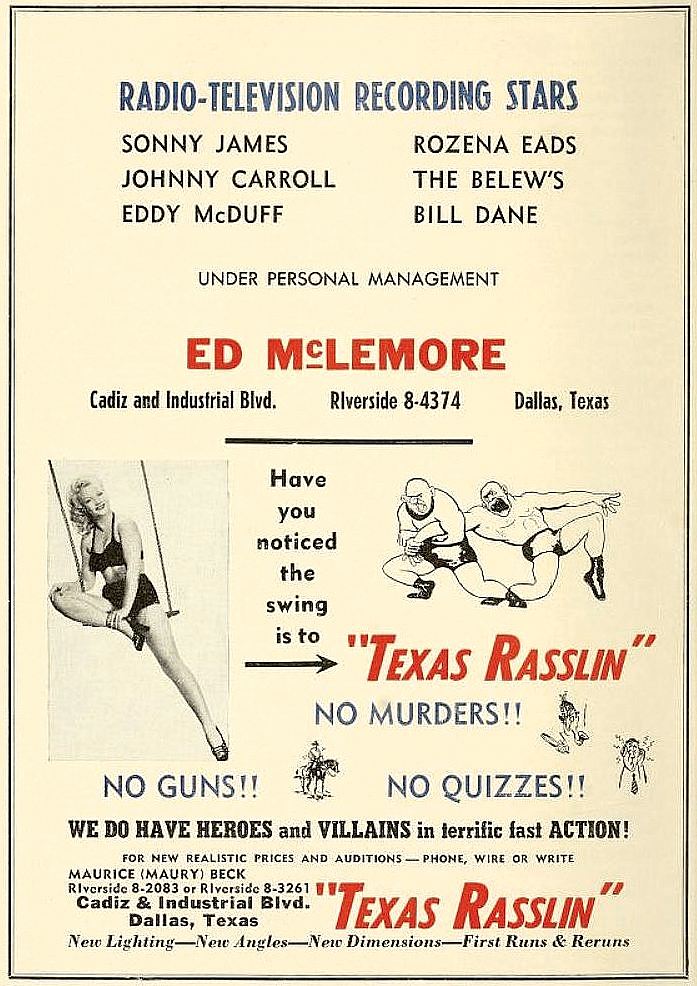
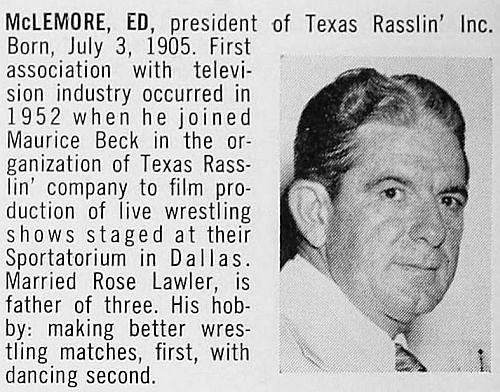
Ed McLemore and the Sportatorium. It’s hard to imagine one without the other. McLemore owned the Sportatorium (at Cadiz and Industrial) and was a successful promoter of both professional wrestling and up-and-coming hillbilly and rock ‘n’ roll musicians. The wrestlers and the musicians all performed centerstage in the Sportatorium ring (on different nights, but I’m sure McLemore must have at least day-dreamed about having some sort of offbeat tag-team bout featuring all of his clients in the ring at the same time). The Sportatorium was very, very popular, with crowds showing up for both wrestling matches and the legendary Big D Jamboree music shows, as well as boxing matches and a variety of other events.

This 1959 ad mentions a few of the musicians McLemore managed at the time, the biggest of whom was Sonny James (read about Sonny James’ years in Dallas in the Flashback Dallas post “Sonny James: The ‘Shindig Heartbreaker'”). Also listed were Johnny Carroll, the Belew Twins, Rozena Eads, Eddy McDuff, and Bill Dane.

The ad appears to be urging people to head to the Sportatorium because it’s got way more going on than boring old television!

“TEXAS RASSLIN”

Have you noticed the swing is to “Texas Rasslin”

No Murders!! No Guns!! No Quizzes!!

We do have heroes and villains in terrific fast action!

New Lighting — New Angles — New Dimensions — First Runs & Reruns

*

mclemore_radio-annual-and-television-yrbk_1959_bio1959

***

Sources & Notes

Ad and bio of Ed McLemore from the 1959 Radio Annual Television Yearbook.

Check out some vintage wrestling footage from the Sportatorium in 1960 here.

Check out vintage footage of the Big D Jamboree here.

More on the Sportatorium can be found in various Flashback Dallas posts here.

sportatorium_wrestling_mclemore_radio-annual-television-yrbk_1959_det

*

Copyright © 2021 Paula Bosse. All Rights Reserved.

Showtime on Elm Street

theater-row_night_majestic-melba-tower-palace_portalLit up like Broadway…

by Paula Bosse

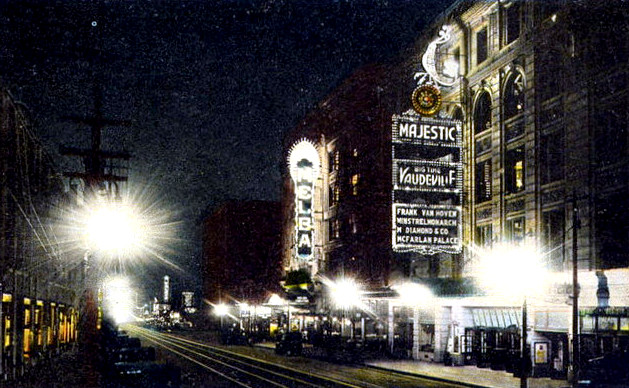
Who doesn’t love nighttime photos of Dallas’ Theater Row, generating enough electricity to be seen from space. The Majestic, the Melba, the Palace. And a buck a night at the Majestic Hotel across the street, the window shades of which could not possibly have been enough to block out the blinding, strobing neon. This is a similar view to the fabulous photo from 1942 by Arthur Rothstein seen here. This is absolutely the period of Dallas’ history I wish I could have experienced first-hand.

***

Sources & Notes

Photo titled “[Businesses on theatre row at night]” is from the Spotlight on North Texas Collection, UNT Media Library, UNT Libraries — more information can be found on the Portal to Texas History site here.

theater-row_night_majestic-melba-tower-palace_portal_sm

*

Copyright © 2021 Paula Bosse. All Rights Reserved.

The Majestic Theatre’s Centenary

majestic-theatre_tsha_1920sThe Majestic Theatre, 1925 Elm Street

by Paula Bosse

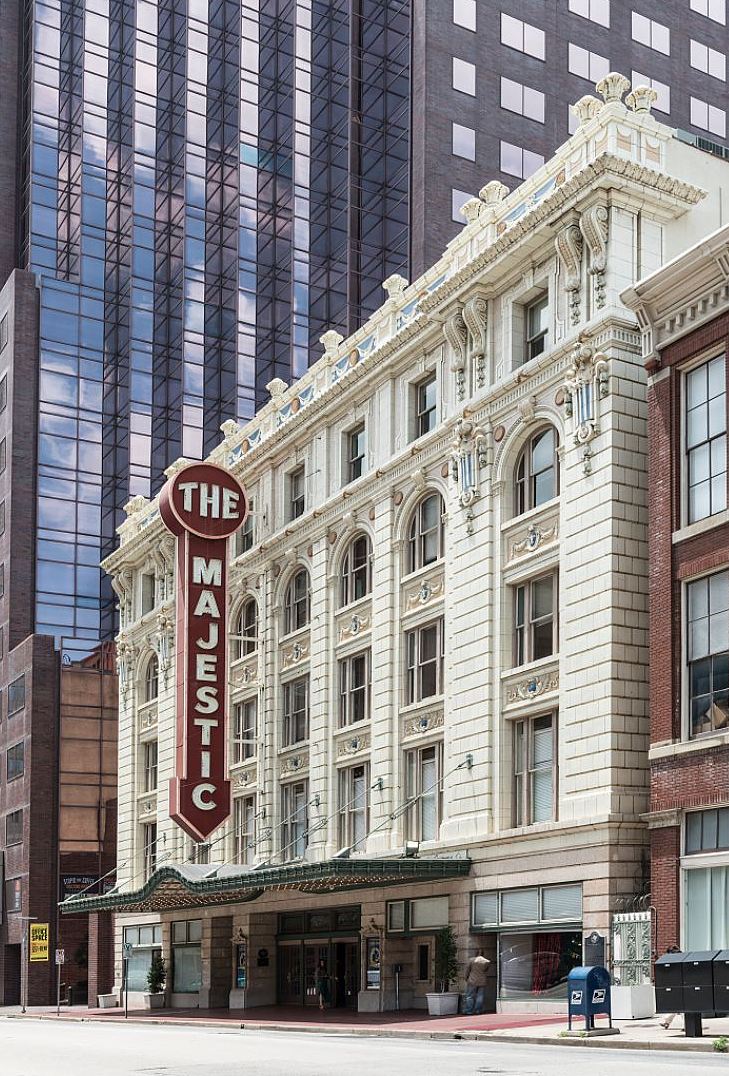
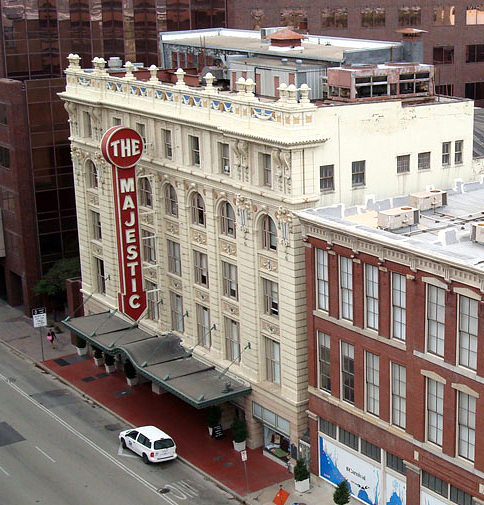
The Majestic Theatre opened on Elm Street 100 years ago this week. We’re lucky to still have such a beautiful building, one which we came close to losing in the late ’60s/early ’70s when so many other “old” buildings were being demolished in downtown Dallas.

The Majestic opened at 1925 Elm on April 11, 1921. The promotional blitz was pretty intense: for months the local papers were full of every little tidbit about the building and the grand opening. A pilot was even hired to drop leaflets and float balloons over 25 North Texas towns in order to reach those farther afield who might be outside the Big City theater loop. 

There was a lot of bragging that the showplace theater cost over $2 million, a huge amount of money at the time. That would be about $30 million in today’s money, and there is no way that beautiful, beautiful theater and its luxurious decor could be built today for a mere $30 million.

Like I said, we’re lucky to have it. Happy 100th, Majestic!

*

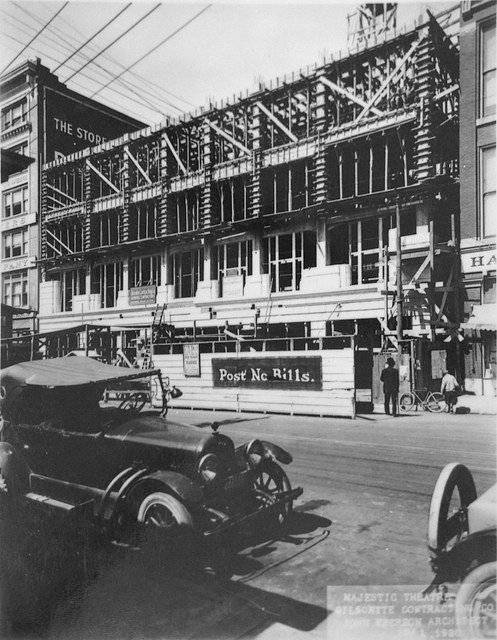
Here it is under construction in 1920:

majestic_under-constructioin_100120_cinema-treasuresvia Cinema Treasures

*

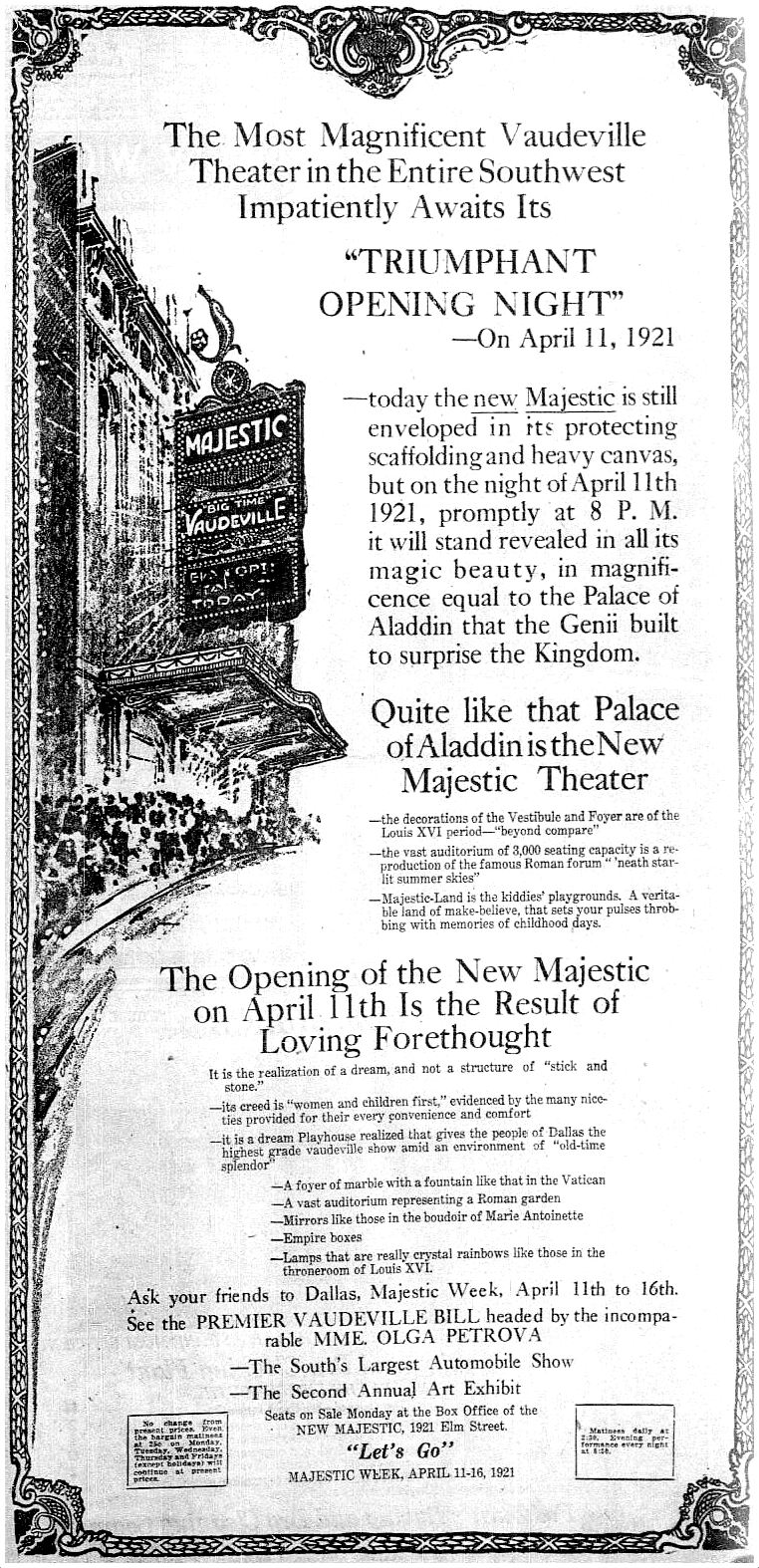
Just read this (click to see a larger image):

majestic-theatre_dmn_040321_grand-openingDallas Morning News, April 3, 1921

*

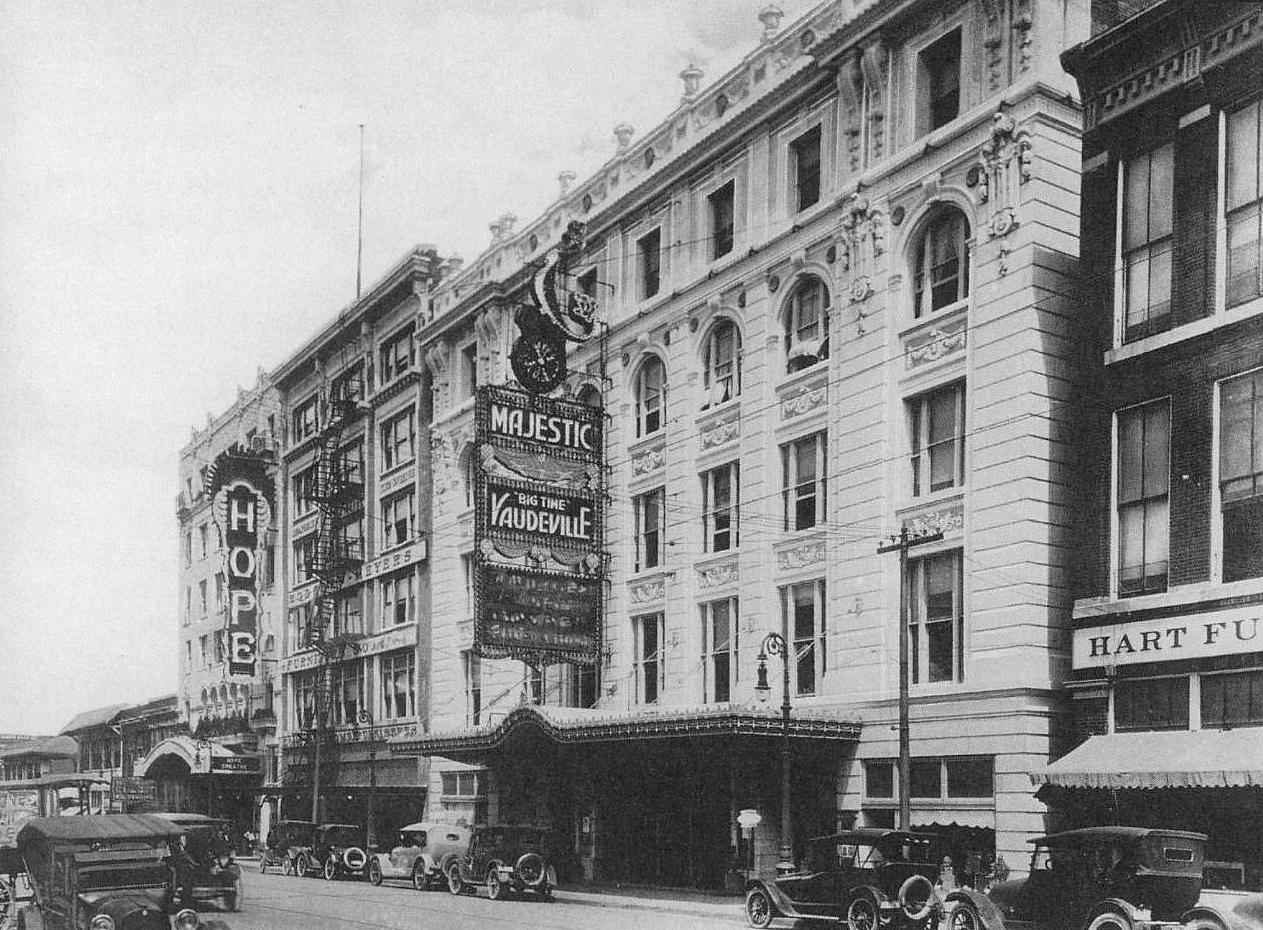
At night, just down from the Melba (originally the Hope):

majestic-theatre_night_cinema-treasuresvia Cinema Treasures

*

And it still looks beautiful in the 21st century:

majestic-theatre_LOC_carol-highsmith_20142014, photo by Carol M. Highsmith, Library of Congress

*

majestic-theatre_2009_wikipedia2009, via Wikipedia

*

theater_majestic_052522_where-its-cool“Where it’s really cool” (1922)

***

Sources & Notes

More about the history of the Majestic Theatre can be found at Cinema Treasures.

The official theater website is here — check out the upcoming shows!

majestic-theatre_tsha_1920s_sm

*

Copyright © 2021 Paula Bosse. All Rights Reserved.

Art Landry Is At The Palace — 1927

palace-theatre_u-s-coffee_frank-rogers_1927_DPLMarquees, schmarquees… (Dallas Public Library)

by Paula Bosse

Great photo of the Palace Theatre on Elm and Ervay in November or December of 1927 (“My Best Girl” starring Mary Pickford opened at the end of November and ran for a week or two into the middle of December). The movie seems like a bit of an afterthought, though — I mean… ART LANDRY IS IN TOWN, and his giant 78 disc replica promotional sign is crowding out others on the marquee. The touring jazz-band leader (who insisted he did NOT play jazz music — “I became a bandmaster when jazz was jax. In those days noise was the objective. […] The day of jazz is gone….” ) was nestled here in Big D for the holiday season and was apparently well-received. (See another photo of the Palace from about this same time here.)

palace_art-landry_111327Nov. 13, 1927

palace_pickford_my-bes-girl_112727Nov. 27, 1927

You know how when you get a new car you suddenly start seeing that same model everywhere? I’m like that with the U.S. Coffee & Tea Co. — seen right next door to the theater. (See it here, peeping around the Wilson Building in a squattier incarnation.)

***

Sources & Notes

Photo titled “[Palace Theatre, Art Landry exclusive Victor Artist]” — by Frank Rogers — is from the Ted C. Steinberg Collection, Dallas History and Archives Division, Dallas Public Library, call number PA2018-03-14 (the library has the date this photo was taken as Dec. 27, 1927, but “My Best Girl” was long-gone by then — it was probably taken on Nov. 27, the day after “My Best Girl” opened).

Quote from Art Landry about not being a jazz-band leader is from an interview with him in The Dallas Morning News (“Jazz Is Thing of the Past Says Palace’s New ‘Jazz Band’ Leader Who Specializes in Modern Music” — DMN, Nov. 12, 1927). I can’t find any other instances of early jazz music referred to as “jax” music. Can anyone point me to another reference?

palace-theatre_u-s-coffee_frank-rogers_1927_DPL_sm

*

Copyright © 2021 Paula Bosse. All Rights Reserved.