Flashback : Dallas

A Miscellany: History, Ads, Pop Culture

Category: Entertainment

At the Palace: The Streets of Sin and The Mikado of Jazz — 1928

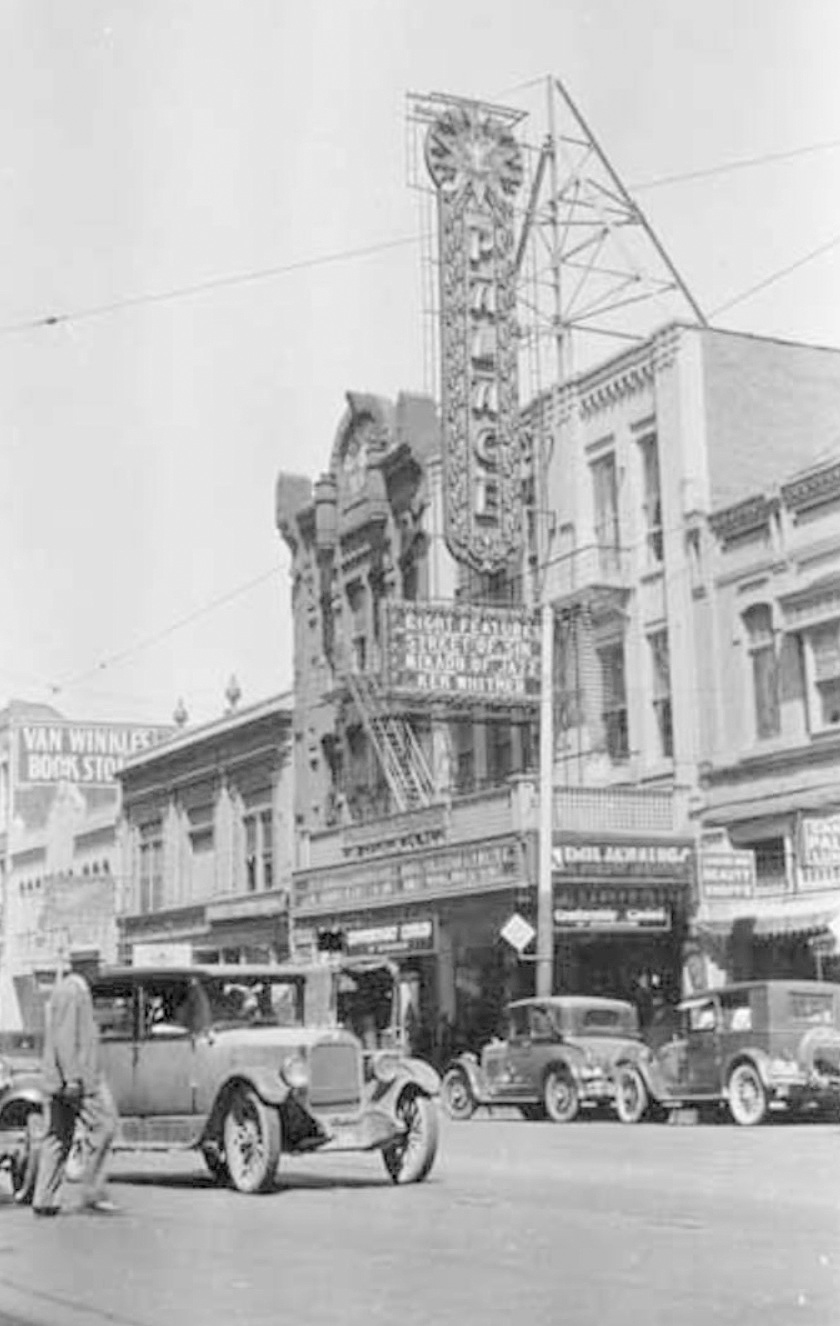
palace-theater_052628_univ-of-washington-librariesElm & Ervay, 89 years ago… (click for larger image)

by Paula Bosse

The photograph above is not the greatest quality, but it’s a photo I’ve never seen before. It shows the Palace Theatre in the 1600 block of Elm Street, just west of Ervay, with the well-known (and very large) Van Winkle’s Book Store in the background. One of the things that makes this photo so interesting is seeing the cumbersome support tower on top of the building holding up the ornate Palace sign. See what a slightly different Palace sign looked like the next year, lit up in neon, here.

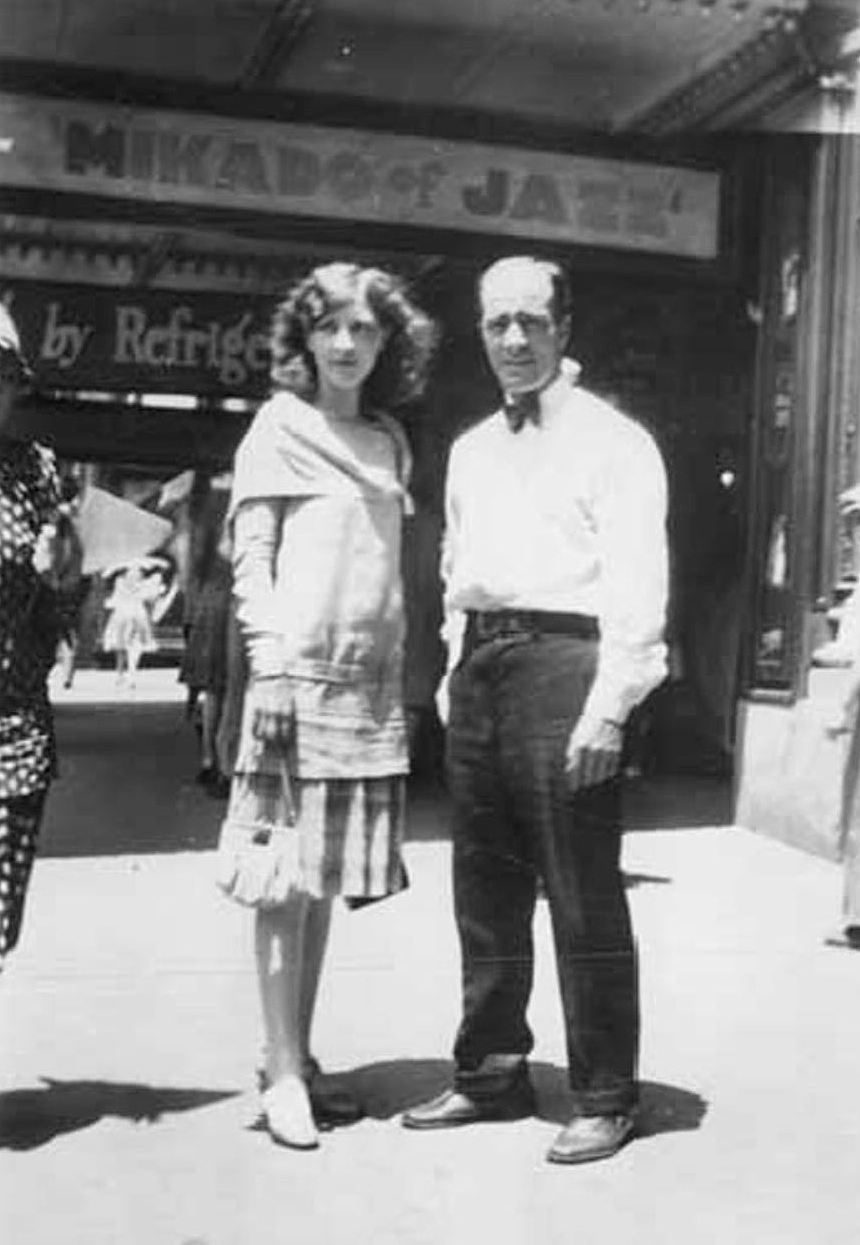
The photo above was an amateur snapshot, taken to document the tour of the traveling live stage revue The Mikado of Jazz which played the Palace in late May of 1928. The photo below — which shows the revue’s stage manager and his wife standing on the sidewalk in front of the Palace — was taken at the same time.

palace-theater_052628_univ-of-washington-libraries_sidewalk

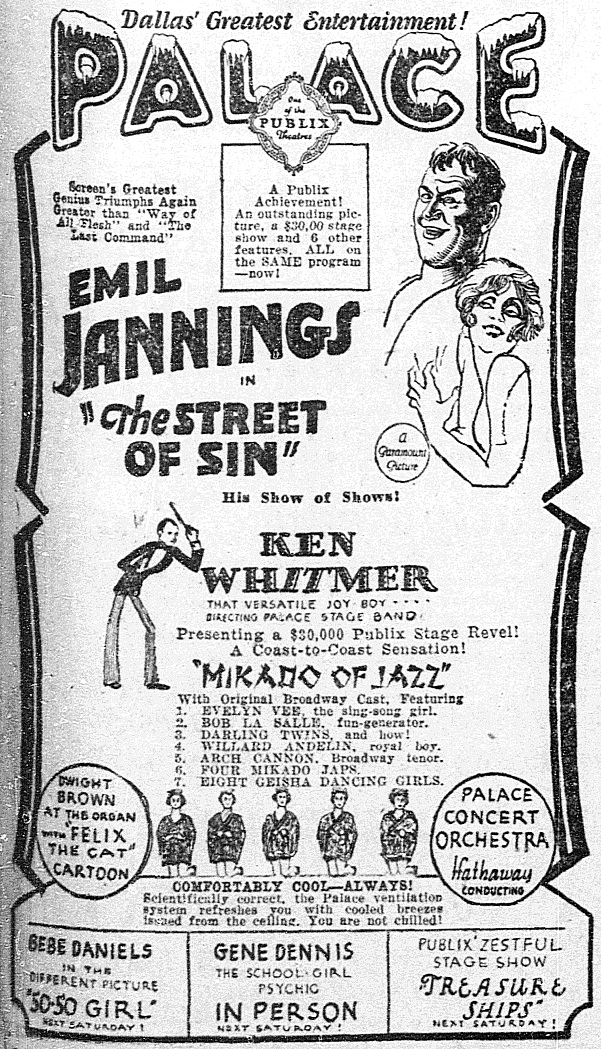
Part of a sign visible behind them was probably advertising that the theater was “cooled by refrigerated air.” The ad at the bottom of this post includes this informative little tidbit:

COMFORTABLY COOL — ALWAYS!

Scientifically correct the Palace ventilation system refreshes you with cooled breezes issued from the ceiling. You are not chilled!

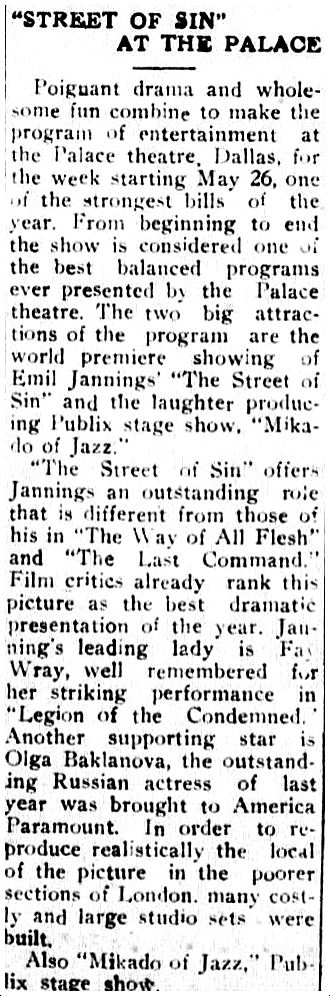
What was The Mikado of Jazz? It appears to have been a jazzed-up version of The Mikado — making Gilbert & Sullivan relevant to 1920s’ audiences — like Hamilton for the Jazz Age (“This is said to be the first time that any comic opera has been syncopated and presented with a stage band.”Dallas Morning News blurb, May 20, 1928)

Also on the bill was the “world premiere” (?) of the film The Street of Sin, starring Emil Jannings and Fay Wray, a live stage orchestra, an organ player, and a Felix the Cat cartoon.

mikado-of-jazz_texas-mesquiter_052528
Texas Mesquiter (Mesquite), May 25, 1928

All at the Palace — “Dallas’ Greatest Entertainment!” Enjoyed at a comfortable temperature.

palace_mikado-of-jazz_dmn_052728
May 27, 1928

***

Sources & Notes

Photographs (taken in May, 1928) are from the Rene Irene Grage Photograph and Ephemera Collection, 1921-1930s, University of Washington Libraries, Special Collections: more information on the first photo (the view of the theater from across the street) is here; more info on the second photo is here.

For other posts that show the Palace in this era, see these posts:

  • “Next-Door Neighbors: The Palace Theater and Lone Star Seed & Floral — 1926,” here 
  • “Dazzling Neon, Theater Row — 1929,” here

Click photos and clippings to see larger images.

*

Copyright © 2017 Paula Bosse. All Rights Reserved.
When the Circus Came to Town — 1886

cole-circus_dallas-herald_101586-detI’m exhausted just looking at this…. (click for larger image)

by Paula Bosse

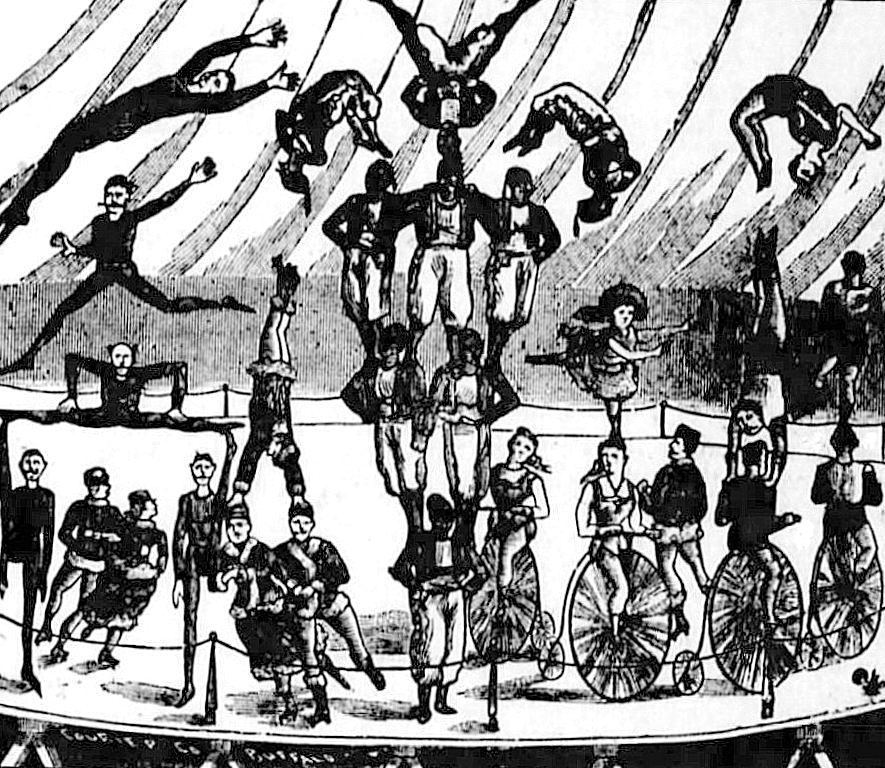
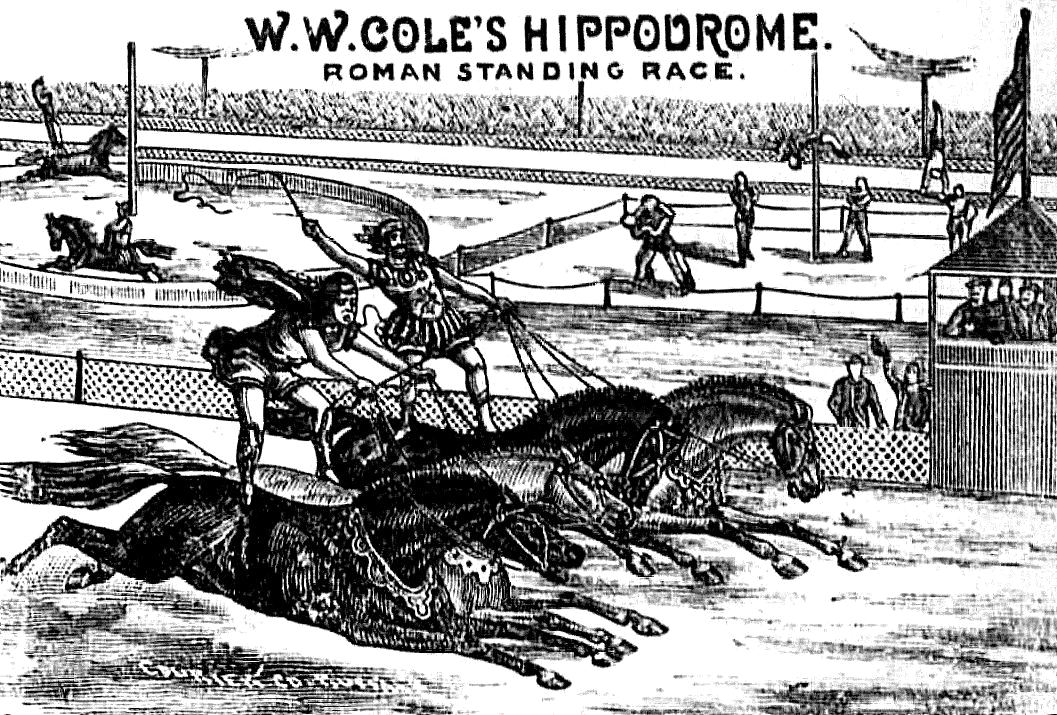
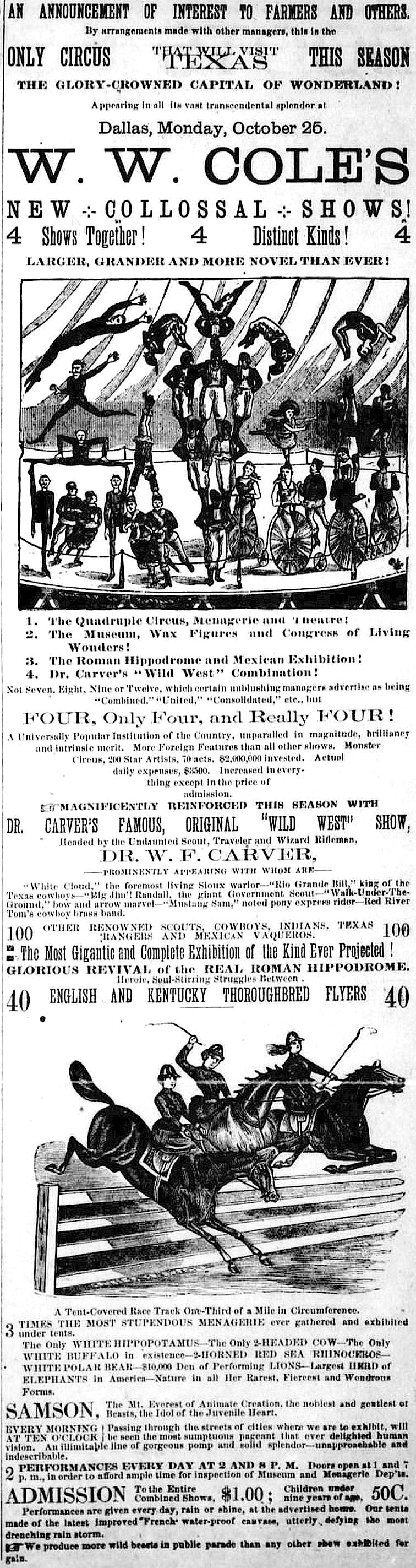
W. W. Cole brought his unbelievably jam-packed circus to Dallas at the end of October, 1886. That would have been big news all on its own, but also going on at the exact same time were two fairs. TWO! (This was when Dallas had competing state fairs battling each other across town.) I’m not sure how people handled all that entertainment. Circus attendance alone was reported at more than 16,000 for the Dallas engagement. That’s a lot.

One thing the Cole organization knew about was the power of adjectives. I can’t even begin to take apart this ad, so run your eyeballs over the intense, pop-eyed text and imagine what frontier Dallasites thought. Sit back and enjoy the “vast transcendental splendor” that was W. W. Cole’s extravaganza. (Click to see a larger image.)

ad_cole-circus_dallas-herald_101586Dallas Herald, Oct. 15, 1886

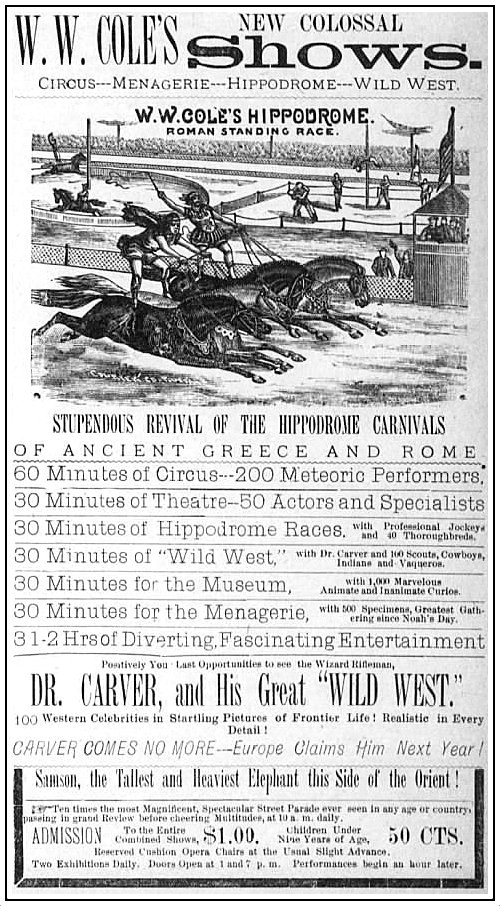
The circus appeared in Austin a few days later. This ad is also great.

cole-circus_austin-weekly-statesman_101486
Austin Weekly Statesman, Oct. 14, 1886

coles-circus_dmn_102486
Dallas Morning News, Oct. 24, 1886

circus_fairs_dallas-herald_102586
Dallas Herald, Oct. 25, 1886

The review:

coles-circus_dmn_102686
DMN, Oct. 26, 1886

Not everyone was impressed:

circus_dallas-herald_102686
Dallas Herald, Oct. 26, 1886

And then there was this weird little story. (I think the ending was tacked on by the writer as a joke. …I think.)

circus_somnambulist_dallas-herald_102686
Dallas Herald, Oct. 26, 1886

After all that excitement, it was probably a relief when the circus left town!

coles-circus-in-austin_dmn_110186DMN, Nov. 1, 1886

cole-circus_austin-weekly-statesman_101486_det

***

Sources & Notes

W. W. Cole’s Circus lasted forever — up until, apparently, last year! More here.

I’m never sure how much weight to give to the estimates of the Inflation Calculator, but when you plug the numbers into it, a dollar ticket for adults and a fifty-cent ticket for children would today equal somewhere in the neighborhood of twenty-five and thirteen bucks, respectively. That can’t be right, can it? You can’t argue that there was a lot going on in those French waterproof tents, but I can’t imagine people forking over that much when penny-candy was considered extravagant! But apparently 16,000 people happily forked! (W. W. Cole died a very, very, very wealthy man: when he shuffled off his moral coil in 1915, he left an estate of more than five million dollars — or, per the Inflation Calculator, more than 120 million dollars in today’s money.)

Click clippings to see larger images.

*

Copyright © 2017 Paula Bosse. All Rights Reserved.
 

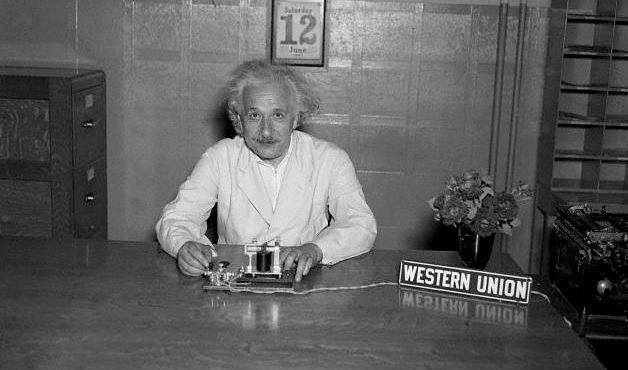
Albert Einstein “Threw the Switch” in New Jersey to Open the Pan-American Exposition in Dallas — 1937

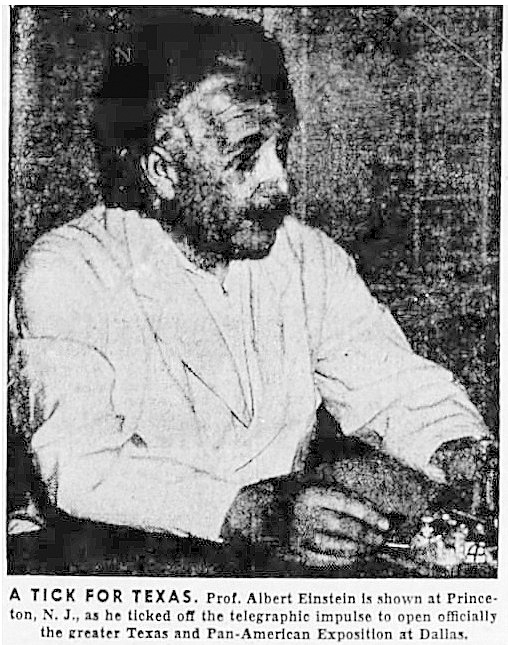
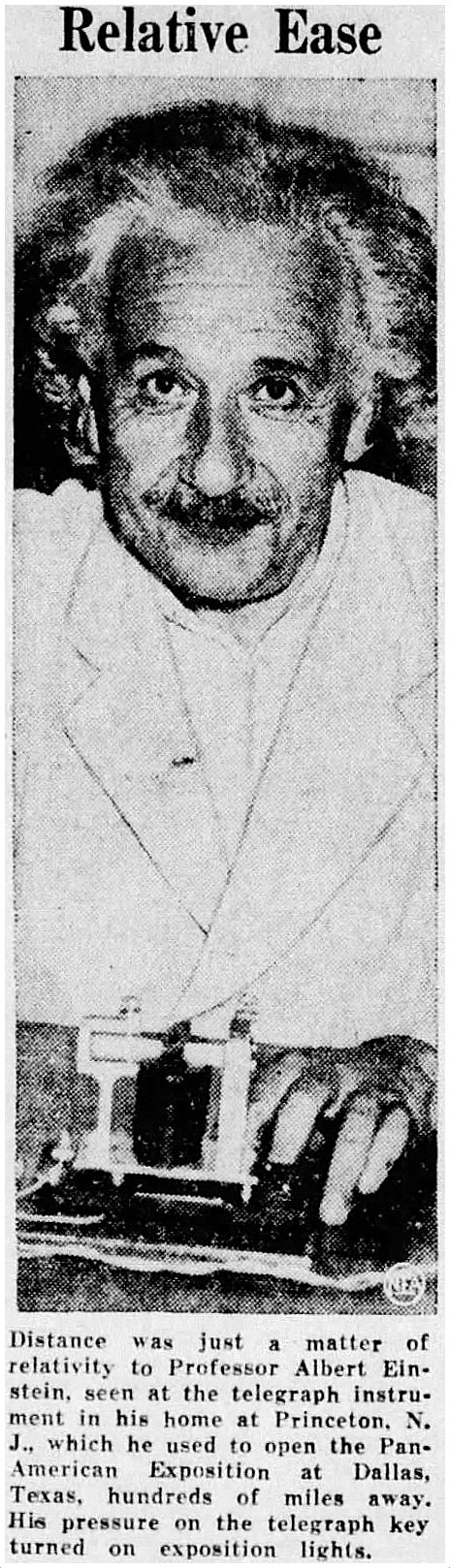
pan-american-expo_einstein_061237Einstein at the switch, June 12, 1937…

by Paula Bosse

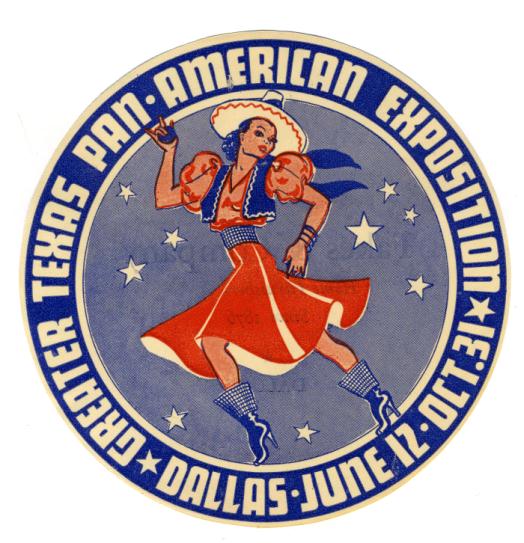
Who knew? Albert Einstein, the world’s most famous physicist, helped open the Greater Texas and Pan-American Exposition. The exposition was held at Fair Park for 20 weeks, from June 12, 1937 to October 31, 1937, as a follow-up of sorts to the Texas Centennial (the city had built all those new buildings — might as well get their money’s worth!). I’m not quite sure how Einstein got roped into this, but looking at the photo above, he seemed pretty happy about what was, basically, a long-distance ribbon-cutting. Via telegraph.

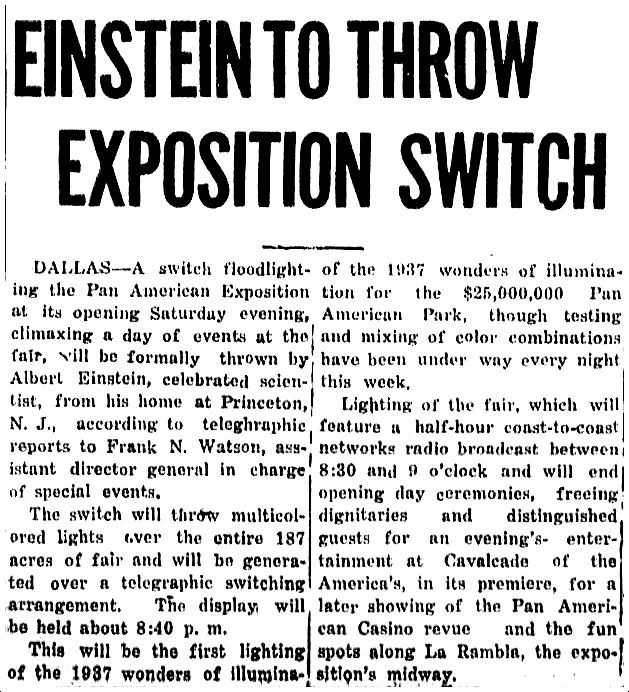
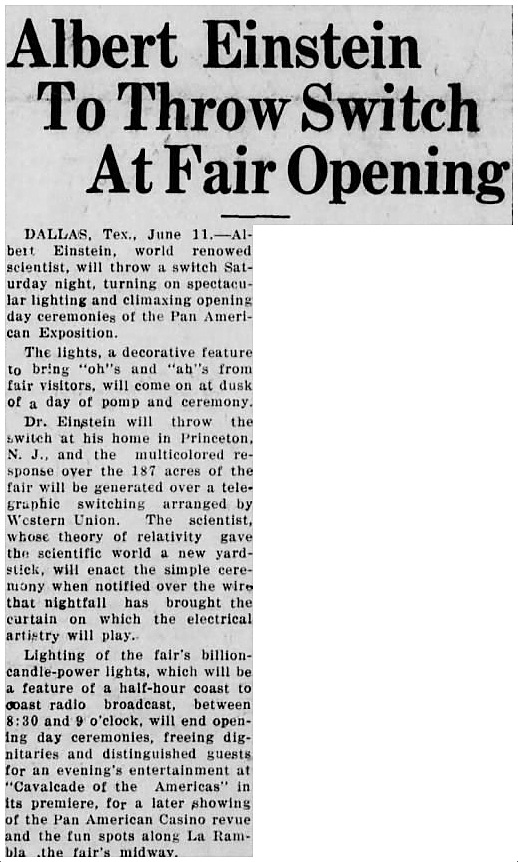
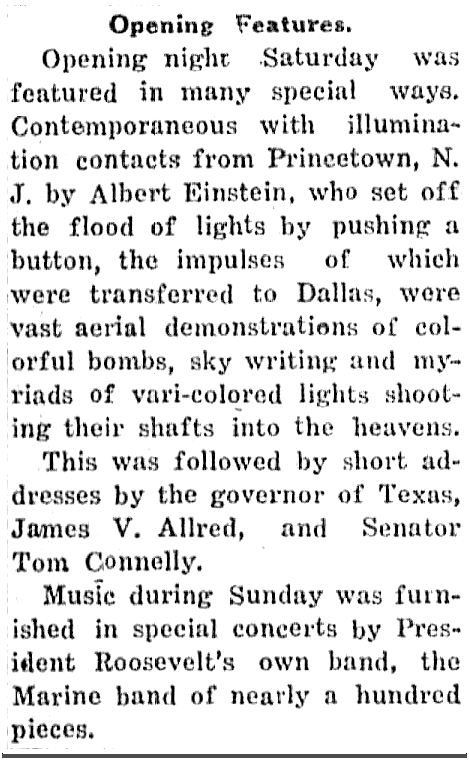
The plan was for Professor Einstein to officially open the Pan-American Exposition by “throwing the switch” which would turn on massive displays of lights around Fair Park. He would do this from Princeton, New Jersey, where he lived, by closing a telegraph circuit which would put the whole thing in motion. Newspaper reports varied on where exactly Herr Einstein was tapping his telegraph key — it was either the study in his home, in his office, in a Princeton University administration building, or in the Princeton offices of Western Union (the latter of which was mentioned in only one report I found, but it seems most likely).

Einstein was a bona fide celebrity, and this was national news — newspapers around the country ran stories about it, and the ceremony was carried live on coast-to-coast radio. Almost every report suggested that Einstein’s pressing of the key in New Jersey would be the trigger that lit up the park in Texas, 1,500 miles away — which was partly correct. According to The Dallas Morning News:

Lights on the grounds will be turned on officially at 8:40 p.m. when Dr. Albert Einstein, exponent of the theory of relativity, presses a key in his Princeton home to fire an army field gun. With the detonation of the shell, switches will be thrown to release the flood of colored lights throughout the grounds. (DMN, June 10, 1937)

So on June 12, 1937 he pressed a telegraph key somewhere in Princeton, NJ, an alert was instantly wired to Dallas, an army field gun (in some reports a “cannon”) was fired, and that blast was the cue for electricians positioned around the park to throw switches to illuminate the spectacular displays of colored lights.

The Western Union tie-in gimmick was a success. Newspaper reports might have been a little purple in their descriptions, but from all accounts, those lights going on all at once was a pretty spectacular sight.

Dr. Albert Einstein, celebrated scientist, threw a switch that flashed a million lights over the 187-acre exposition park. The flash came at 8:40 o’clock and instantly the huge park became a city of a million wonders. Flags from a thousand staffs proclaimed their nationality [and] bands played the national airs of the nations of the Western Hemisphere as lusty cheers roared with thunderous approval. The Greater Texas and Pan-American Exposition was formally opened. It is on its way. (Abilene (TX) Reporter News, June 13, 1937)

The Dallas News describes the crowd as stunned into silence:

The waiting participants in the ceremonies at Dallas heard the results [of Einstein’s telegraph signal] when a cannon boomed. Electricians at switches around the grounds swung the blades into their niches and the flood of light awoke the colors of the rainbow to dance over the 187-acre park. Its breath taken by the spectacle, the crowd stood silent for a moment, and then broke into a cheer. (“Pan-American Fair Gets Off to Gay Start” by Robert Lunsford, DMN, June 13, 1937)

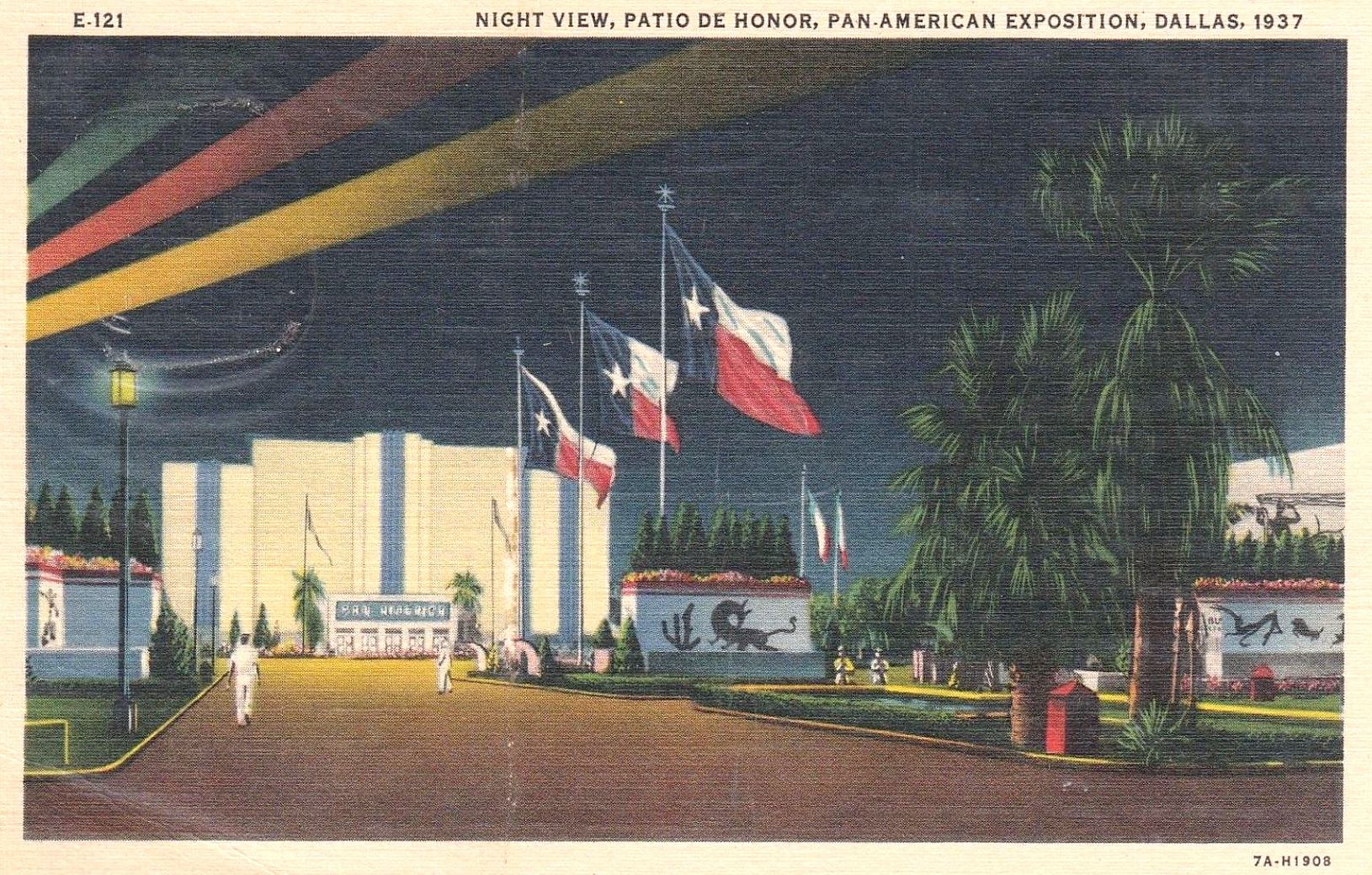
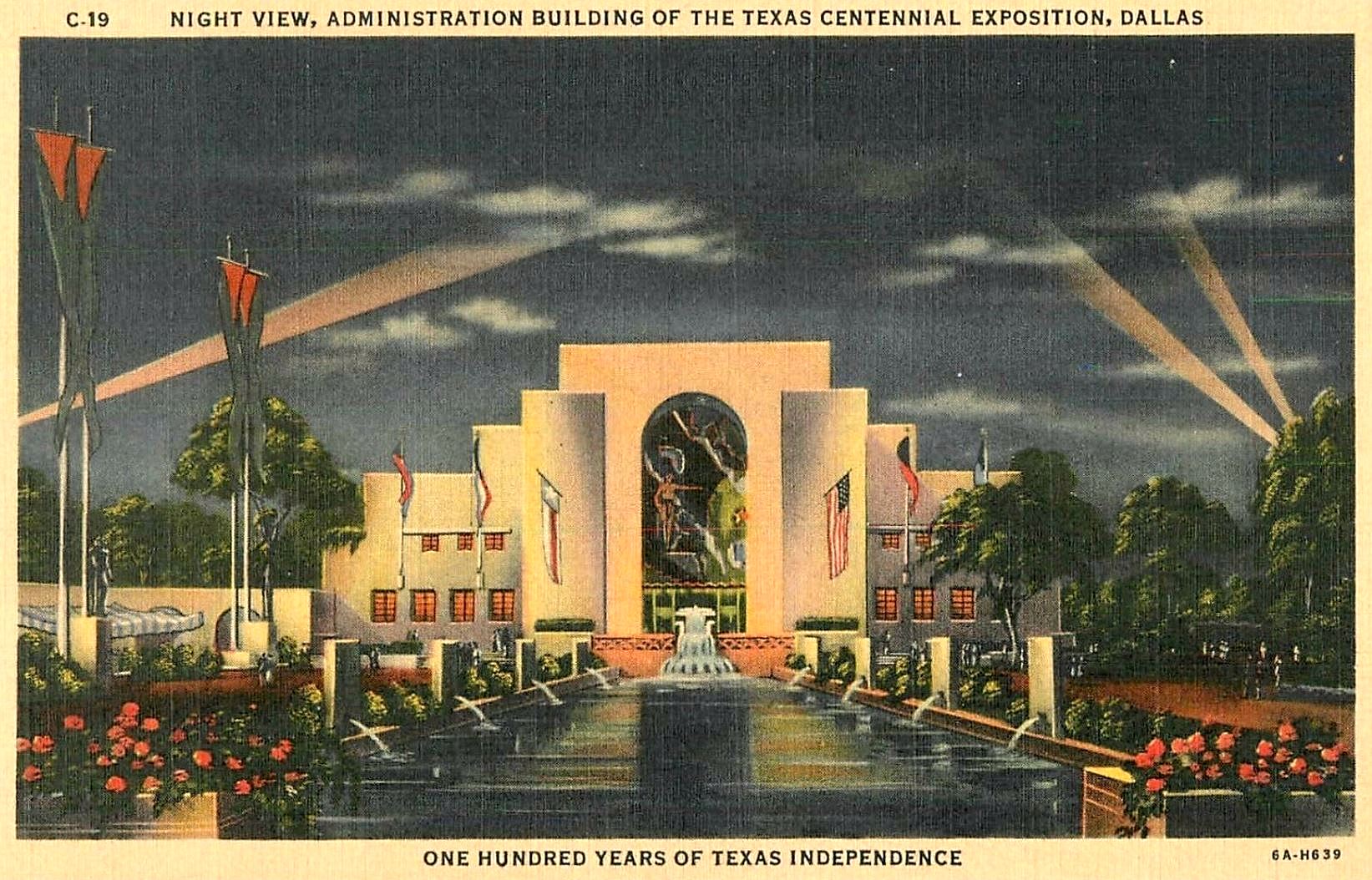
Many of the lighting designs and displays had been used the previous year during the Centennial, but, as with much of the attractions and appointments throughout the park, they were improved and spectacularized for the Pan-American Expo. And people loved what they saw.

Despite the multi-million dollar structures, air conditioning demos, works of art and other newfangled additions to the space, when people left the Centennial Exposition one thing was on everyone’s tongues, according to historical pollsters: the lights.

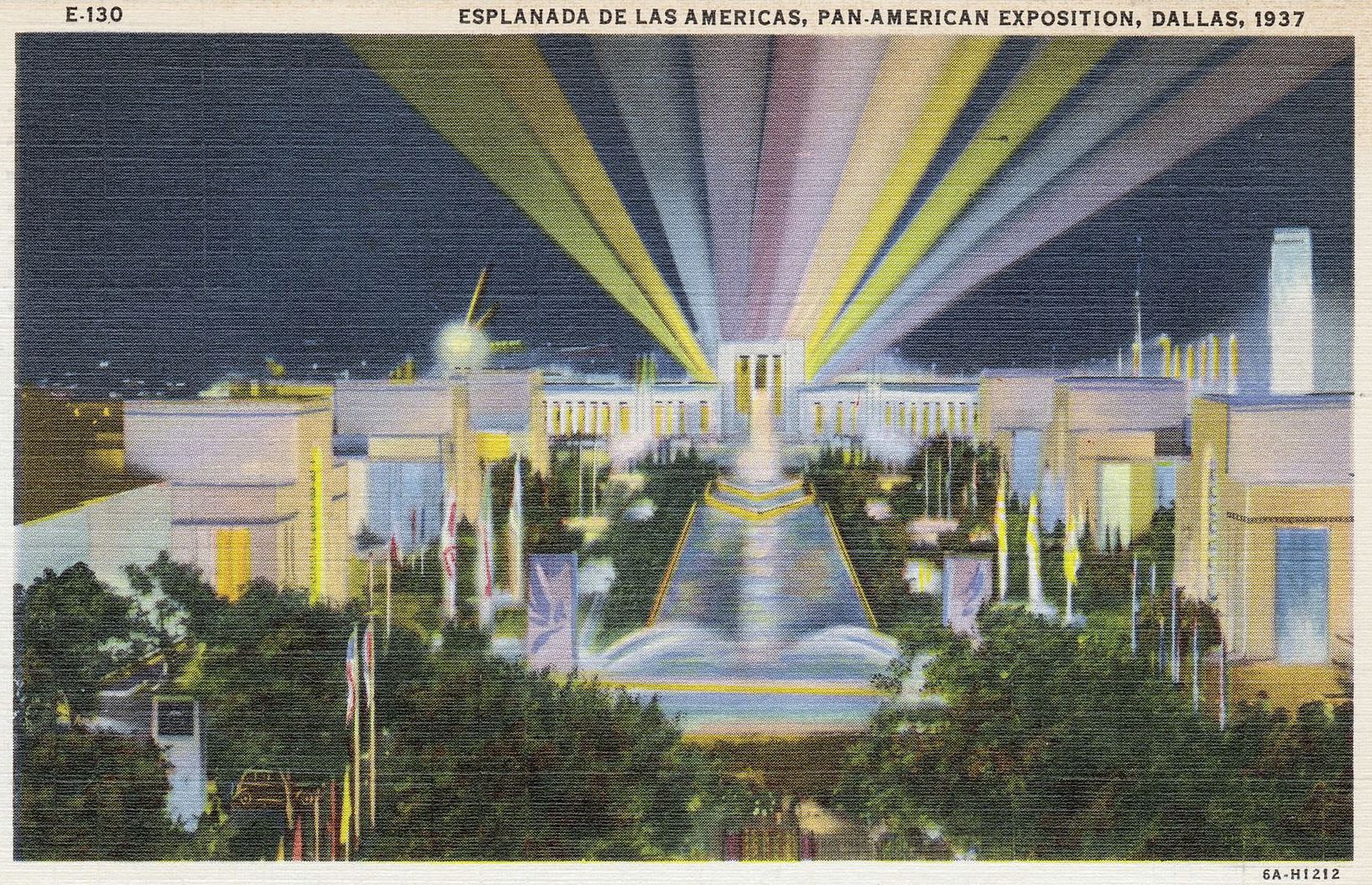
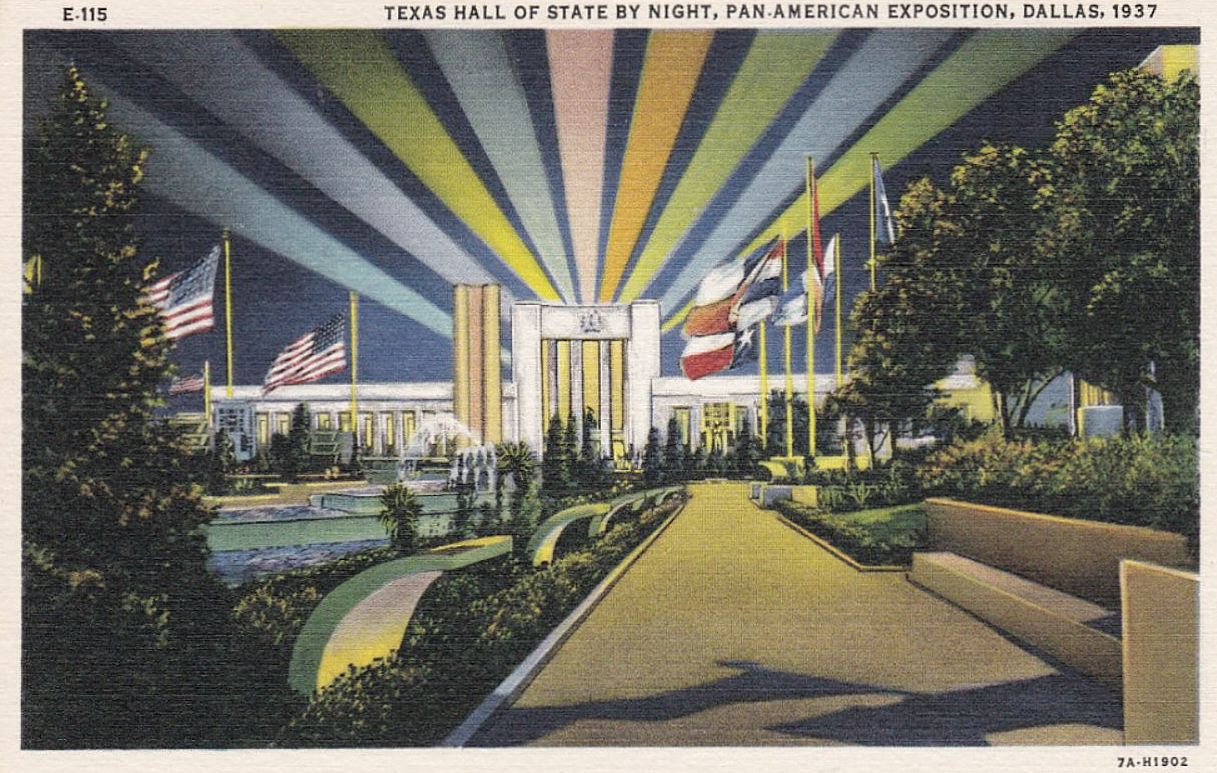
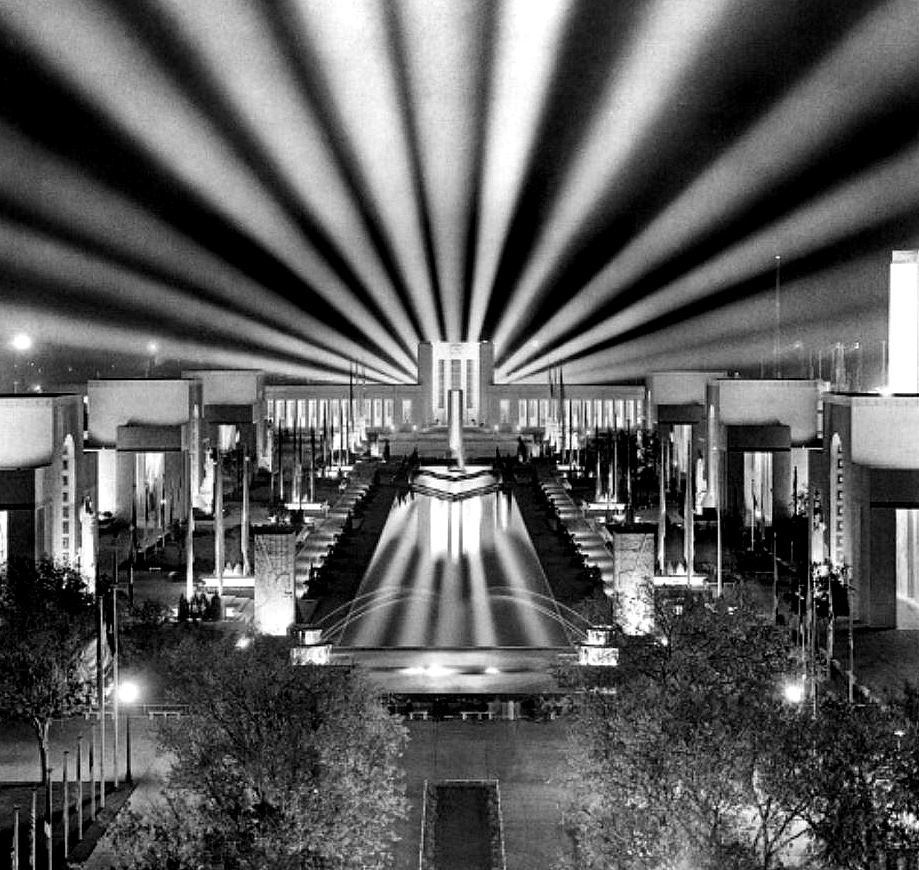
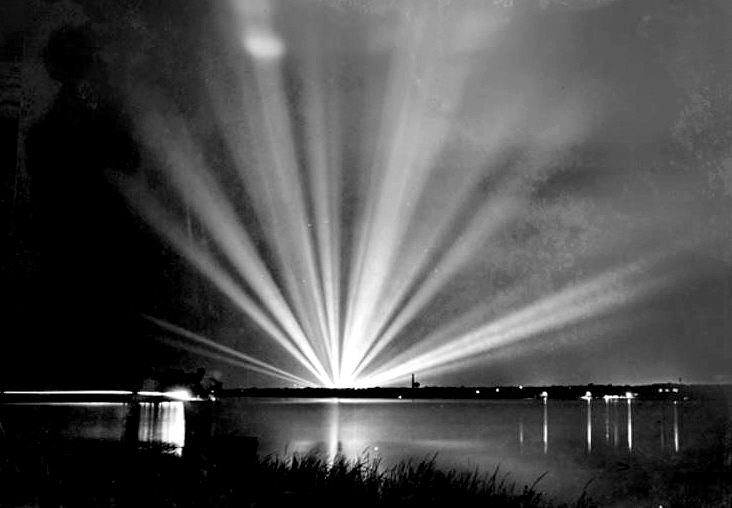
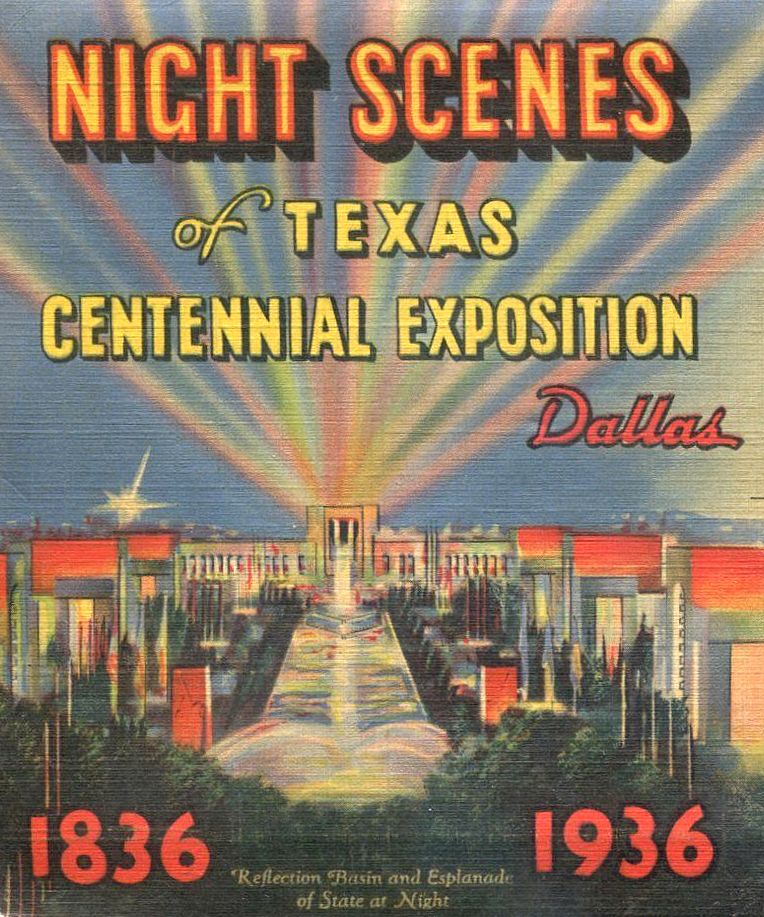
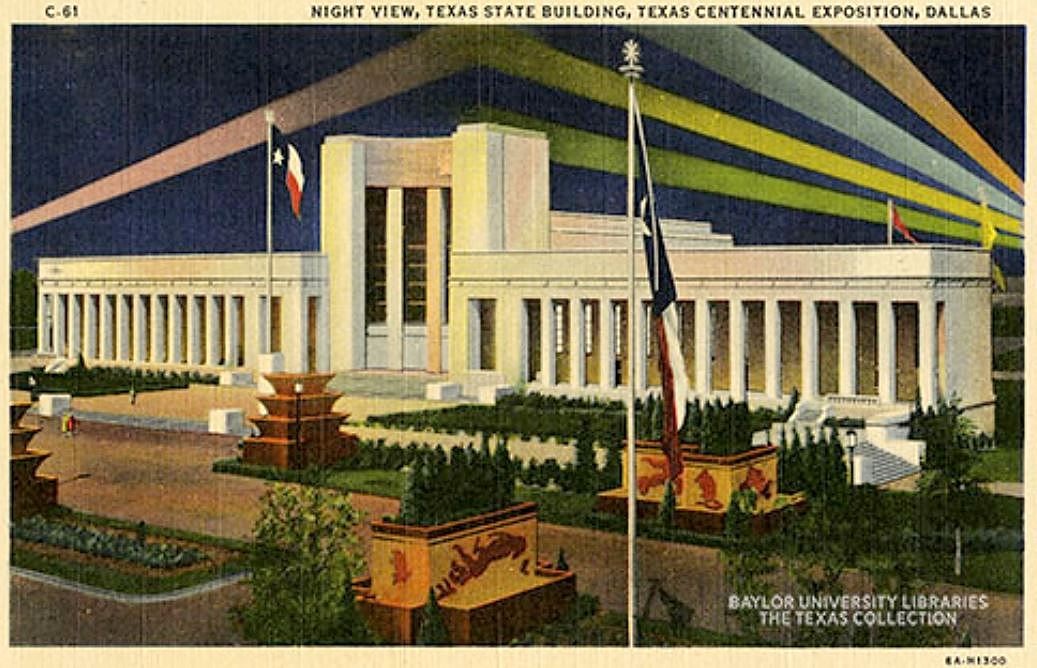
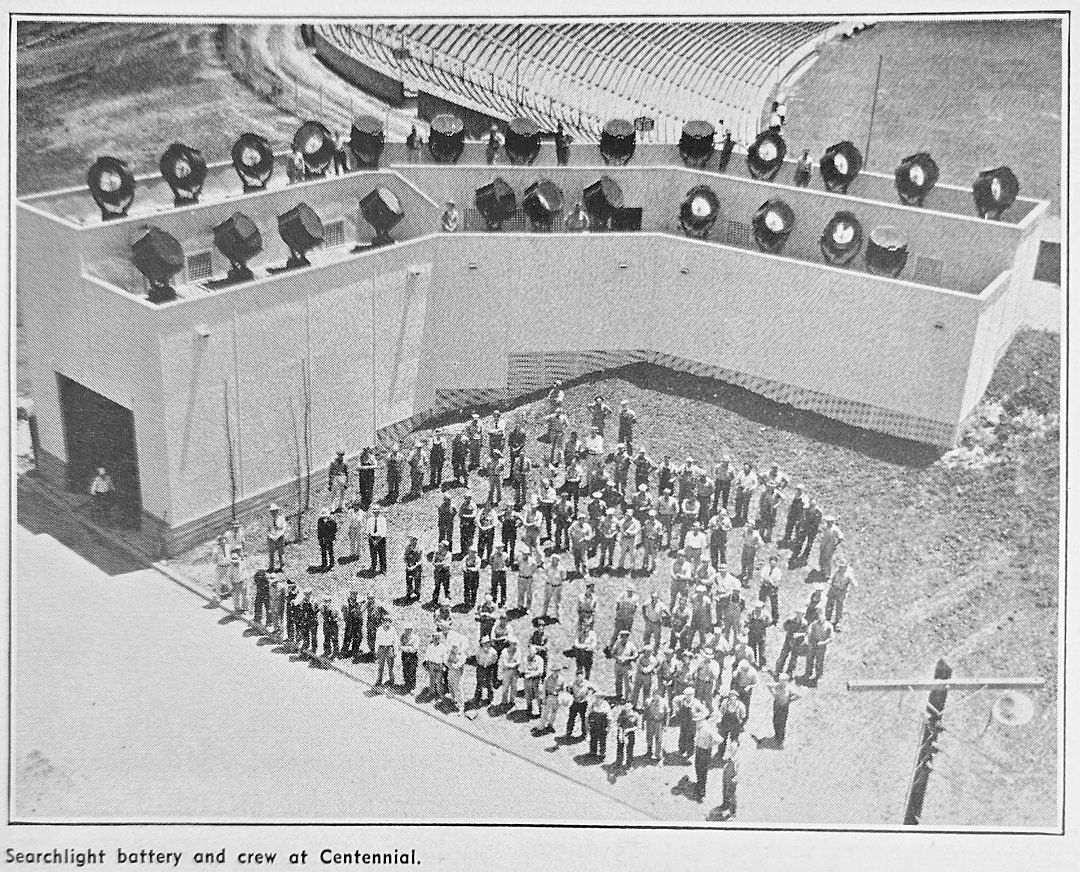
Positioned behind the Hall of State were 24 searchlights scaffolding into a crowned fan shape. “They all moved and were different colors,” says [Jim] Parsons [co-author of the book Fair Park Deco]. “It sounds gaudy, but people loved it.” The lights, he goes on to tell, were visible up to 20 miles away.

Considering most of the people who were visiting the fairgrounds were coming from rural farming communities with no electricity, the inspiring nature of those far-reaching beams makes a lot of sense. (Dallas Observer, Nov. 7, 2012)

Thanks for doing your part for Dallas history, Prof. Einstein!

pan-american-expo_esplanade_postcard

pan-american-expo_hall-of-state_postcard

pan-american-expo_patio-de-honor_ebay

Below, photos from the Texas Centennial, 1936. The multicolored lights could be seen from miles away — here’s what they looked like from downtown and from White Rock Lake.

centennial_pan-american_lights

skyline_downtown-to-fair-park_1936_GE-colln_museum-of-innovation-and-science

fair-park-lights_white-rock-lake

tx-centennial_night-scene_espalanade_hall-of-state_lights_ebay

tx-centennial_night_hall-of-state_lights_flickr_baylorvia Baylor University Flickr stream

tx-centennial_night_administration-bldg_lights_ebay

*

A look behind the scenes: “The general lighting effect is a battery of twenty-four 36-inch searchlights as powerful as the giants that flash from the dreadnoughts of Uncle Sam’s navy. Each searchlight will produce 60 million candlepower. Combined, the battery has a total candlepower of 1.5 billion. A 350,000-watt power generator will produce this colossal quantity of ‘juice.’” And the accompanying photo of the searchlight battery crew manning the candlepower:

tx-centennial_lights_southwest-business-mag_june-1936_photoSouthwest Business, June 1936

**

(All pictures and clippings are larger when clicked.)

einstein_pan-am-expo_denison-press_060937
Denison Press, June 9, 1937

*

einstein_pan-am-expo_waxahachie-daily-light_061137
Waxahachie Daily Light, June 11, 1937

*

einstein_pan-am-expo_denison-press_061437
Denison Press, June 14, 1937

*

einstein_pan-am-expo_medford-oregon-mail-tribune_062337
Medford (Oregon) Mail Tribune, June 23, 1937

*

einstein_pan-am-expo_vernon-daily-record_062437
Vernon Daily Record, June 24, 1937

*

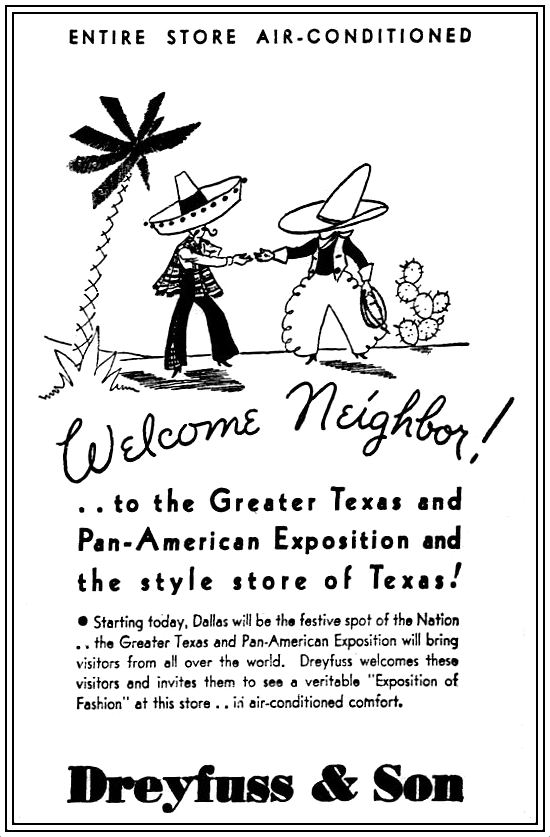
pan-american-expo_drefuss-ad_dmn_061237
1937

pan-american-expo_sticker_1937_cowgirl

***

Sources & Notes

Top photo from the old Corbis site.

Black-and-white photos from the Centennial seen from Fair Park and White Rock Lake are from the Texas/Dallas History and Archives Division of the Dallas Public Library; the photo of the lights seen from downtown Dallas (titled “New skyline at night from Dallas, Texas”) is from the GE Photo Collection, Museum of Innovation and Science (more info on that photo is here).

Sources of other images and clippings cited, if known.

More on the Pan-American Exposition from Wikipedia, here, and from the fantastic Watermelon Kid site of all-things-Fair-Park, here.

*

Copyright © 2016 Paula Bosse. All Rights Reserved.
What’s Playing at the Palace? — 1950s

elm-street_ten-commandments_1957_flickr_coltera.JPGFilm Row: Elm & Ervay, looking west… (click for large image)

by Paula Bosse

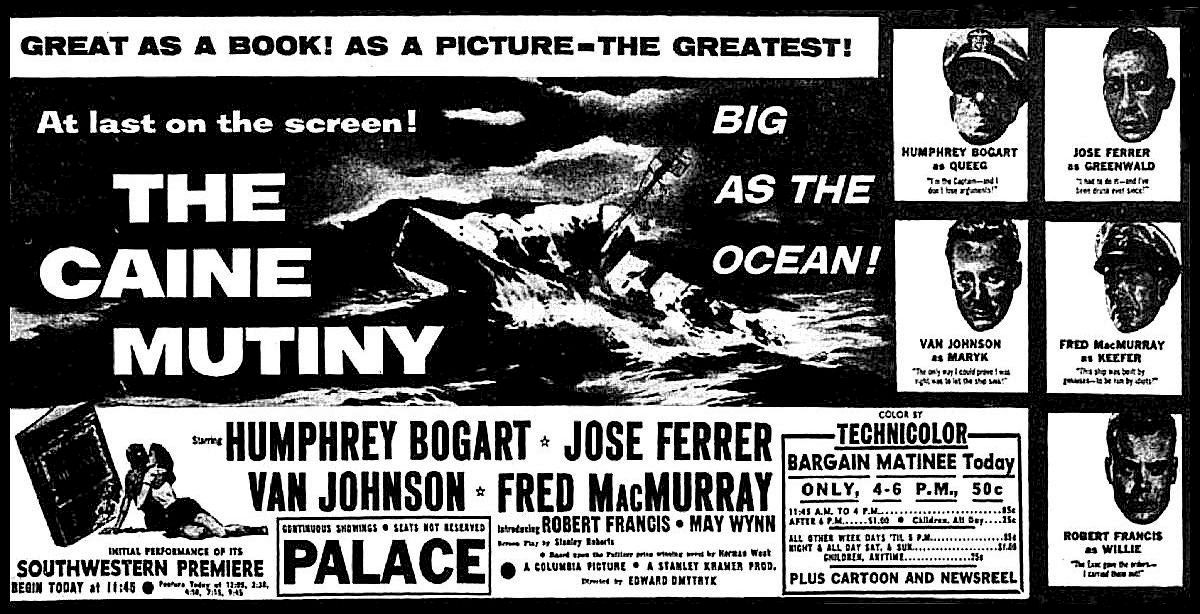
In the 1950s, the two prestige movie theaters in Dallas were the Majestic and the Palace, mainstays of “Theater Row” and just a few blocks apart on Elm Street. The Palace Theater (at Elm and Ervay, across from the Wilson Building) is seen in the two postcards featured here. The one above shows Elm Street looking west. “The Ten Commandments” is playing, placing the date that photo was taken sometime between February and May, 1957. The postcard below shows an eastward-looking view with “The Caine Mutiny” on the marquee, dating that photo to the latter half of July, 1954.

elm-street_looking_east_palace_night_flickr_coltera

“The Ten Commandments” was a huge, huge hit and ran for 11 weeks — no movie had ever run that long in the history of Dallas theaters (it had beat out the then-champ, “Sergeant York,” which had had a seven-week run at the Majestic in 1941).

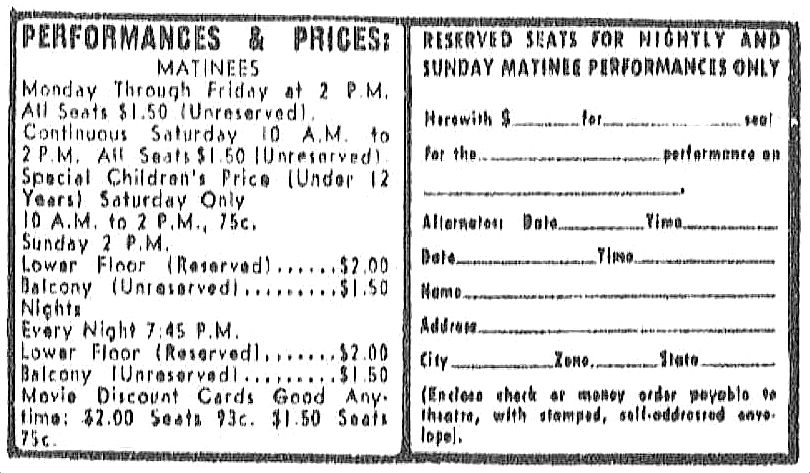
It was also one of the longest movies to ever play in Dallas. We’re talking a running time of almost 4 hours (with an intermission), something which not only tested the endurance of audiences but also severely limited the number of showings per day. It was an “event” picture, and, accordingly, prices were higher and reserved seats were offered.

ten-commandments_palace_dmn_021457_ad_det_reserved-seatsFeb., 1957

The number of people in Dallas who saw that movie at the Palace is staggering: over 100,000! Even after its run at the Palace ended, it continued to draw crowds when it moved down the street to the Tower.

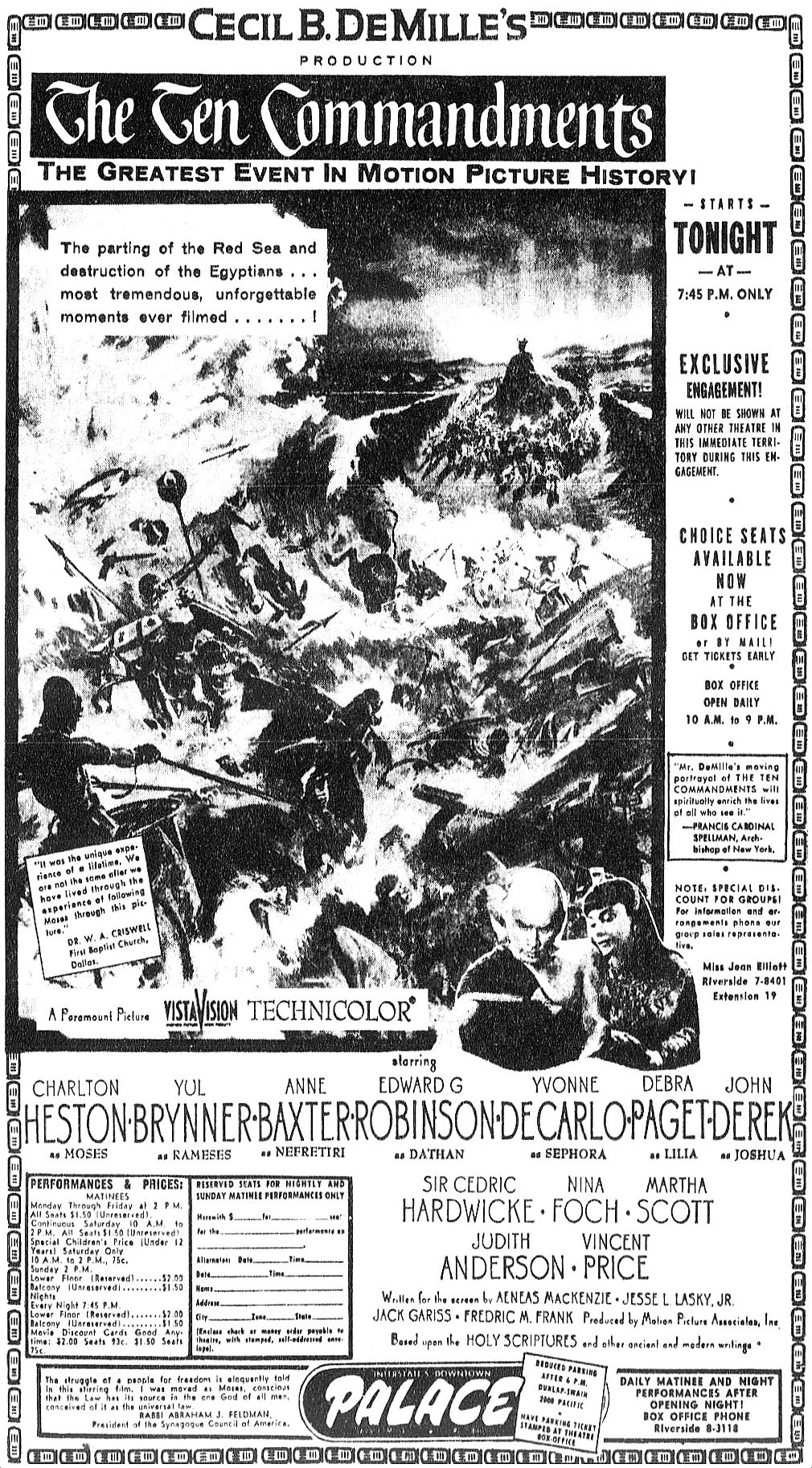
The opening-day ad for the movie:

ten-commandments_palace_dmn_021457_ad
Feb. 14, 1957

There were a couple of things I found interesting about this ad. One was that it had a blurb by First Baptist Church of Dallas’ chief Baptist,  W. A. Criswell.

ten-commandments_palace_dmn_021457_ad_det_criswell

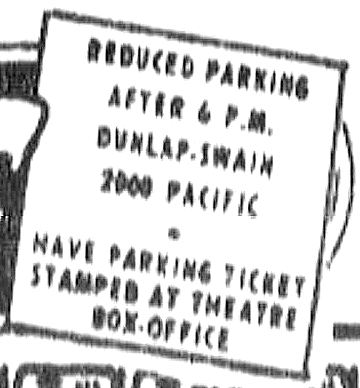
The second was that patrons could park behind the theater — on Pacific — at the Dunlap-Swain station. (Parking downtown for large crowds in those days must have been challenging —  not everyone took streetcars or, later, buses.)

ten-commandments_palace_dmn_021457_ad_det_parking

*

caine-mutiny_palace_dmn_071654_opening-nightJuly, 1954

***

Sources & Notes

Both postcards found on Flickr, posted by the unstoppable Coltera: the top one here, the bottom one here.

“The Ten Commandments” ran at the Palace Theater from Feb. 14, 1957 to May 2, 1957. The film that followed was “Boy On a Dolphin,” which featured the debut of super-sexy Sophia Loren in a U.S. movie. …Which is an interesting counterpoint.

“The Caine Mutiny” ran from July 16, 1954 to July 29, 1954.

A previous post about the Palace — “Next-Door Neighbors: The Palace Theater and Lone Star Seed & Floral — 1926” — can be found here.

Click pictures and clippings to see larger images.

*

Copyright © 2016 Paula Bosse. All Rights Reserved.
 

“Dallas Midway, Night Illumination” — 1936

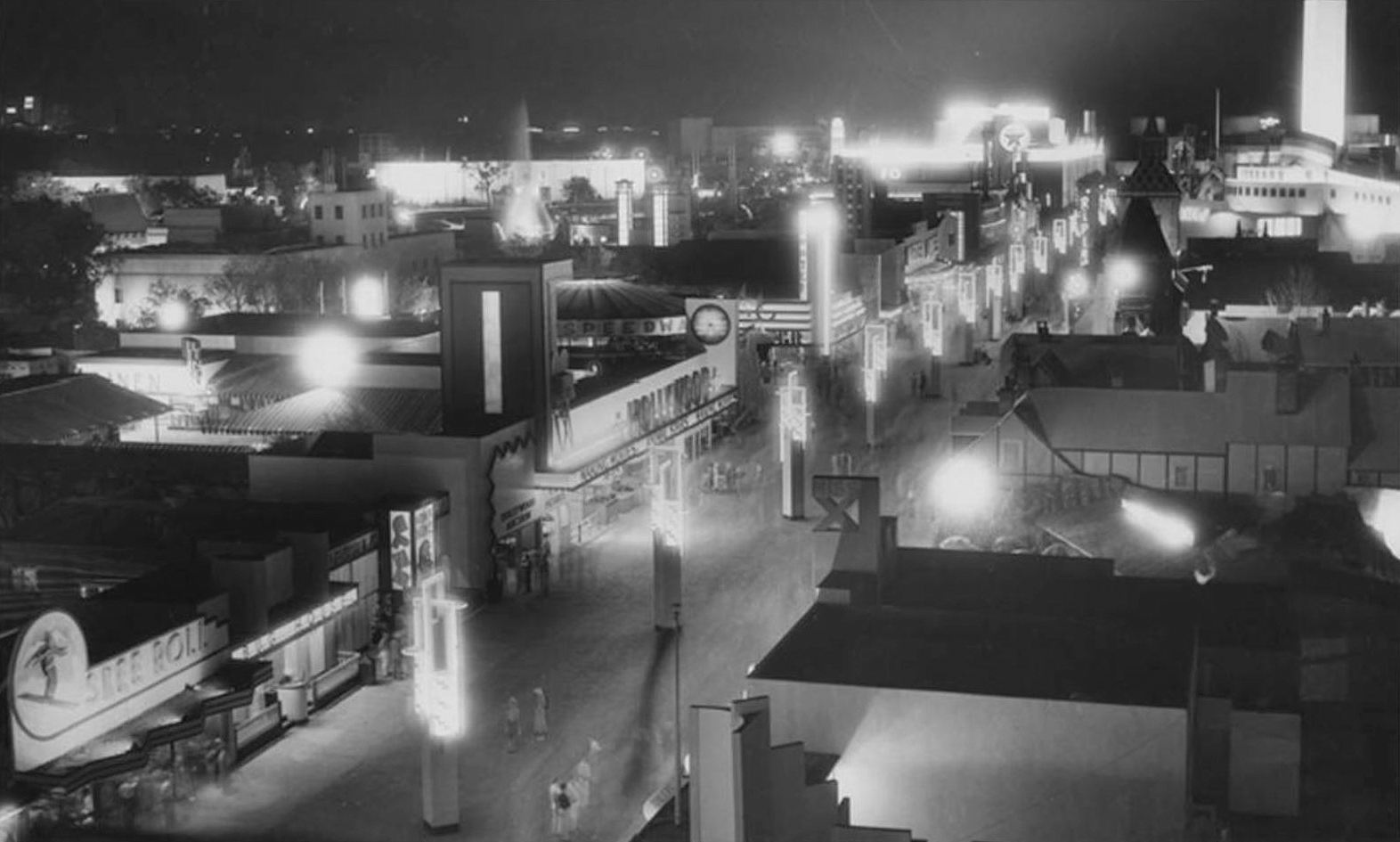
tx-centennial_midway_night_cook-coll_smuAll calm in Fair Park along the Centennial Midway (click for larger image)

by Paula Bosse

Above, a nighttime shot of an almost empty Midway during the Texas Centennial. All this scene needs in order to boost the moody atmosphere is a little fog. Go a little further and add some zither music, Joseph Cotten, and Orson Welles running past the Texaco Building and you’d have a pretty cool setting for a Texas version of The Third Man.

***

Photo titled “Dallas Midway, Night Illumination, Centennial Exposition, State Fair of Texas” (taken by an unknown photographer on Oct. 16, 1936) is from the George W. Cook Dallas/Texas Image Collection, DeGolyer Library, Central University Libraries, Southern Methodist University; more info here.

*

Copyright © 2016 Paula Bosse. All Rights Reserved.

Next-Door Neighbors: The Palace Theater and Lone Star Seed & Floral — 1926

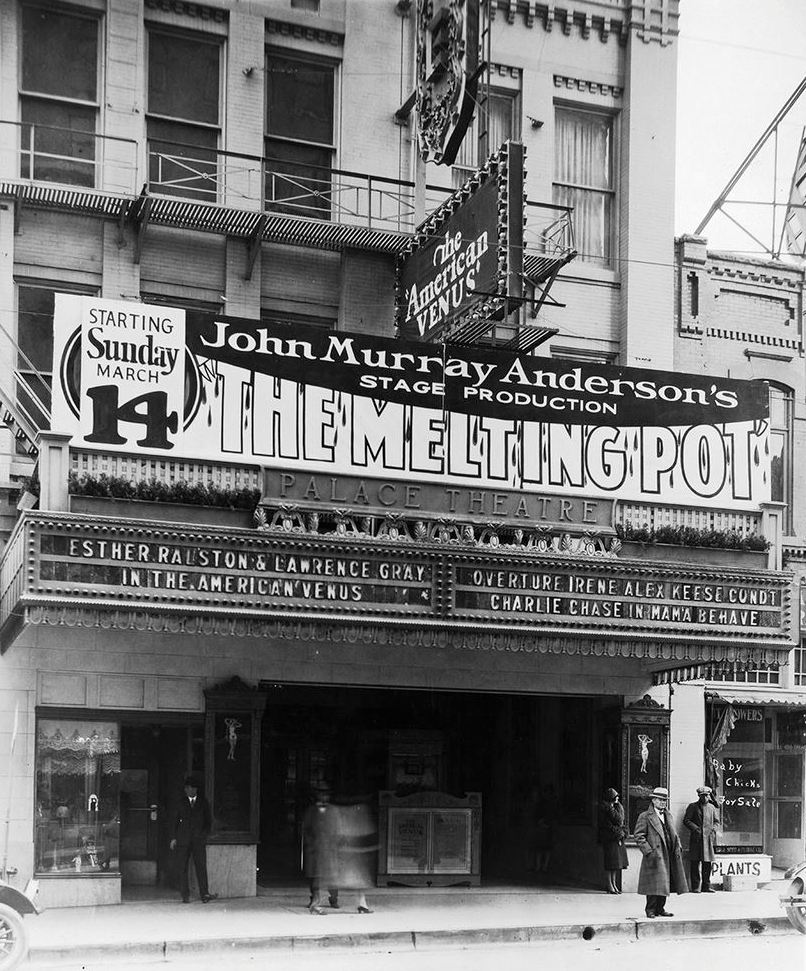
palace-theatre_melting-pot_march-1926_utaElm Street neighbors, March, 1926…. (click for larger image)

by Paula Bosse

Above, the Palace Theater, one of Dallas’ great moviehouses. It opened in June, 1921, near the northwest corner of Elm and Ervay; this photograph is from March of 1926, three months before the theater’s fifth birthday. It was still a whippersnapper. 

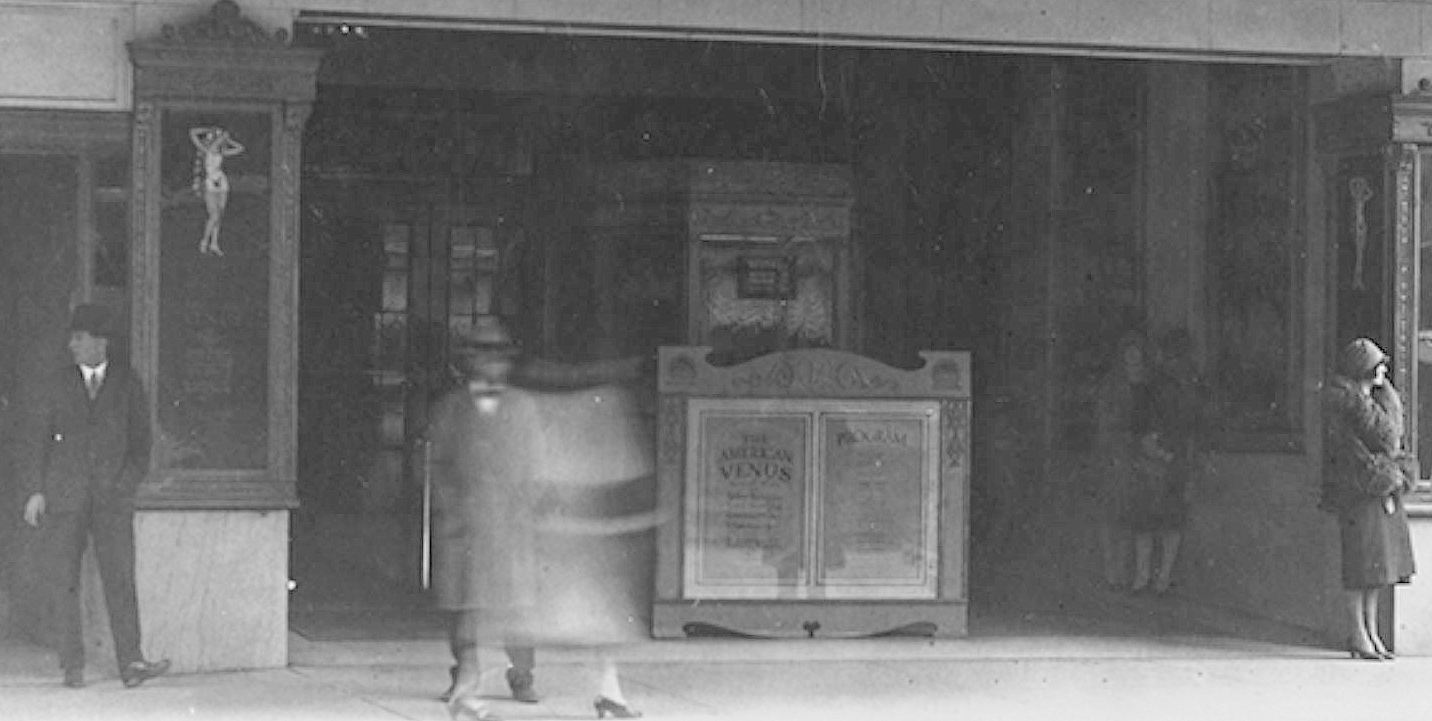
Below, a detail from the photo: by zooming in and tweaking the contrast, the box office is revealed, as are two women chatting in the shadows (all pictures and clippings are larger when clicked).

palace-theatre_melting-pot_march-1926_uta_det2

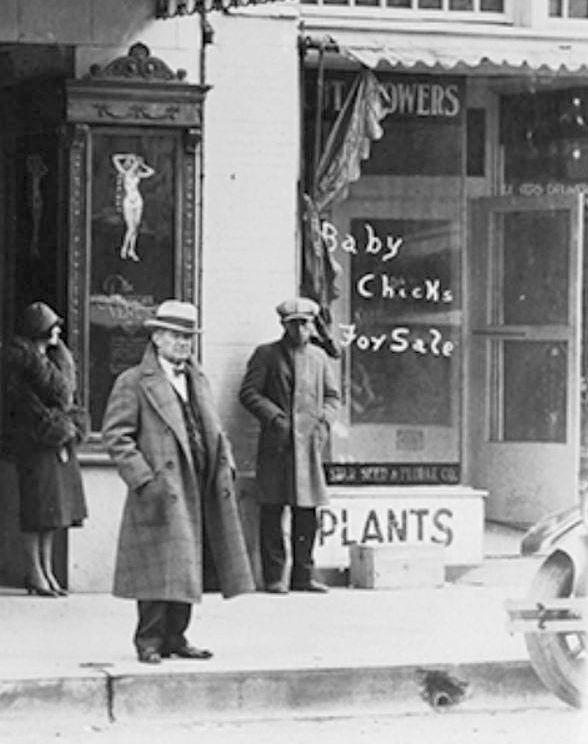
As interesting as old movie theaters are, I was more intrigued by the three people to the right of the theater (who all look like characters from a period melodrama) and by the business next door. I’ll never know who those men were or who that woman was waiting for, but finding out what business was selling baby chicks (…next door to the Palace?) was pretty easy.

palace_lone-star-seed_1926_uta_det

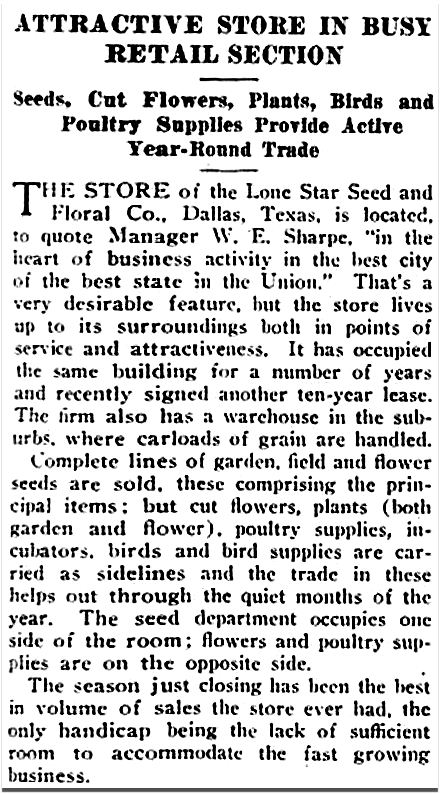
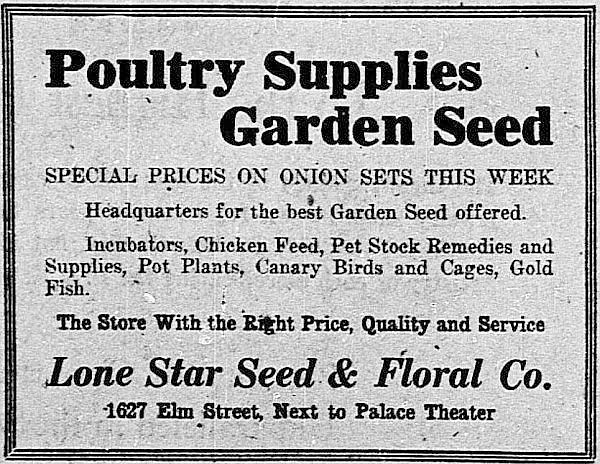
The store was Lone Star Seed & Floral (1627 Elm). They sold seeds and flowers, potted plants, canaries, goldfish, and pet and livestock supplies. They could also help you with all your poultry needs: feed, incubators, medicine, and live chickens. …Right next door to one of the plushest and most luxurious entertainment destinations in Dallas.

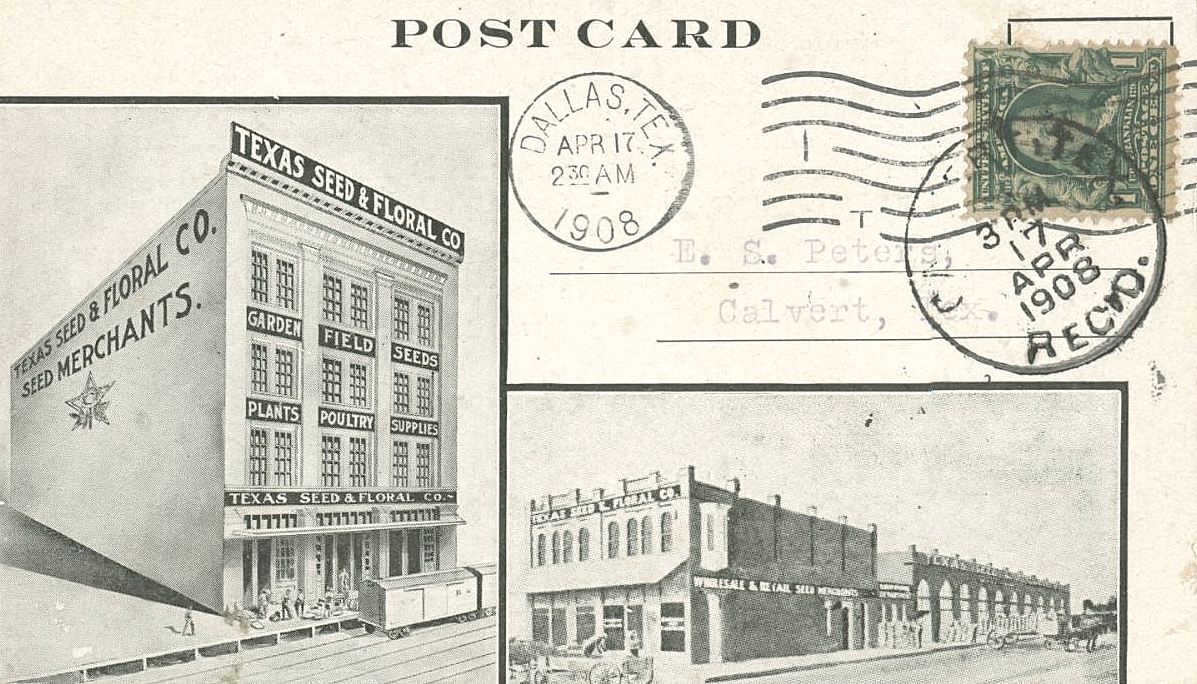
Lone Star Seed & Floral appears to have once been Texas Seed & Floral and had been around since at least 1892. They set up shop at 1627 Elm in 1902 and remained there quite a while until they moved in January, 1927, just a few months after the top photo was taken. Here is a postcard of its earlier incarnation, with photos of the Pacific Avenue location at the left, and the Elm Street location at the lower right (the view is looking north on Ervay; the Palace would later be built immediately west of this  building, to the left of the lower postcard image, just out of frame).

texas-seed-and-floral_1908_portal

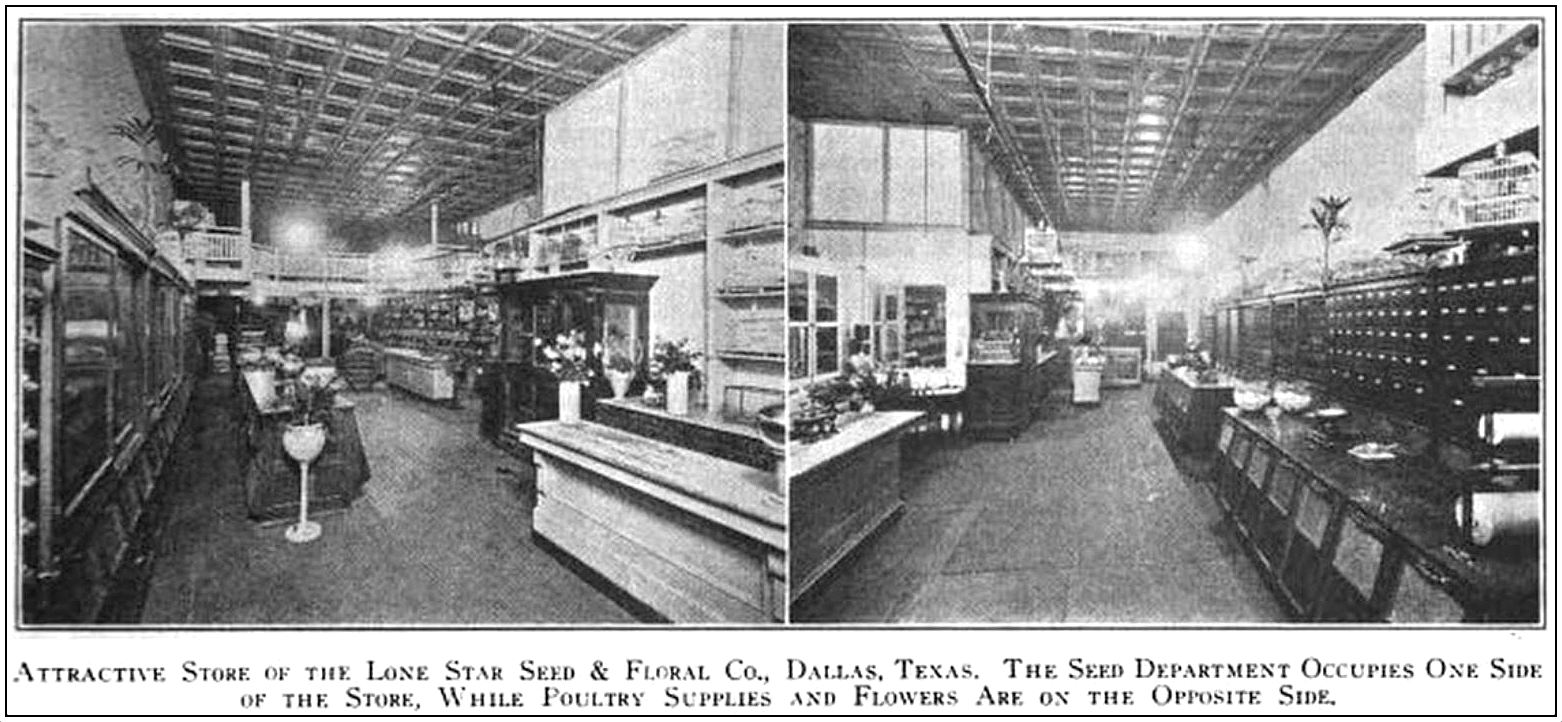
The store looks very clean and extremely well organized. My inexplicable love of things stored in card-catalog-file-like cabinets and fold-out bins tells me I’d probably be stopping in fairly regularly after having seen the latest Buster Keaton film next door.

lone-star-seed_the-seed-world_082020

lone-star-seed_the-seed-world_082020_article
Photo and article from, yes, The Seed World, Aug. 20, 1920

lone-star-seed_dmn_022622
Feb., 1922

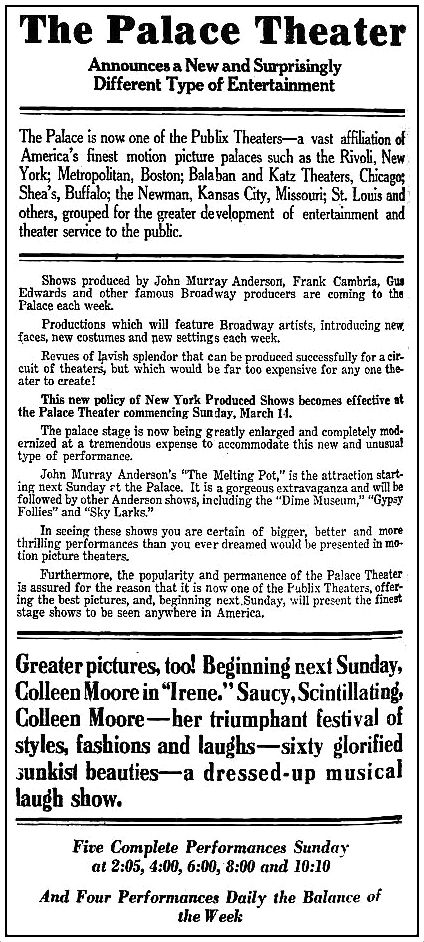
But back to the Palace. The banner is publicizing the imminent arrival of John Murray Anderson’s “The Melting Pot,” a stage production which opened at the Palace on March 14, 1926. The Palace Theater, owned by the Publix chain, was about to embark on “a new and surprisingly different type of entertainment,” which consisted of musical revue roadshows staged in New York under the direction of producer John Murray Anderson. Each production — its performers, costumes, and sets — would be sent into the hinterlands, playing a circuit which included Dallas, the only stop in Texas. There was a new show every week. And if you missed it, you really had no excuse: there were four shows daily (five on Sunday). (Anderson was later asked by Billy Rose to help with producing Fort Worth’s Centennial celebration.) (John Rosenfield’s tepidly positive Dallas Morning News review, “‘Melting Pot’ Is Presented at Palace, Introducing New Style Film Theater Feature,” ran on March 15, 1926.)

palace_dmn_031326_melting-pot-ad
Palace ad, March 13, 1926

*

palace-theatre_1926_uta_det1

***

Sources & Notes

Top photo from the Billy Burke Photograph Collection, UTA Libraries, Special Collections; more info here.

See the same view today via Google Street View here.

The Texas Seed & Floral Co. postcard is from the collection of Dallas Heritage Village, via the Portal to Texas History, here.

The beloved Palace — once an honest-to-God “movie palace” was unceremoniously demolished in 1971. It had stood at Elm and Ervay for 50 years. The north side of that block is now occupied by Thanksgiving Tower. The theater and the seed store were just west of Ervay — Lone Star Seed & Floral was just to the left of where the 7-Eleven is, on the ground floor of 211 N. Ervay, the blue building seen here (the view is northwesterly from the Wilson Building across the street).

See a great photo of Elm Street in the ’20s in the post “Dazzling Neon, Theater Row — 1929” here.

Click pictures and clipping to see larger images.

*

Copyright © 2016 Paula Bosse. All Rights Reserved.


Lady Godiva and the “Flesh Shows” of the Texas Centennial — 1936

tx-centennial_streets-of-paris_ticket_cook-coll_smuGeorge W. Cook Collection/SMU

by Paula Bosse

When one thinks of the Texas Centennial Exposition, the splashy 6-month extravaganza held at Fair Park to celebrate the 100th anniversary of Texas independence, one might not immediately think of the three things associated with the big show that were making headlines around the country (and were undoubtedly responsible for healthy ticket sales): according to Variety, the Centennial had “all the gambling, wining and girling the visitor wants” (June 10, 1936).

The Dallas exposition (and the coattail-riding Frontier Exposition, which was held at the same time in Fort Worth) was “wide open” in 1936: there was gambling, liquor, and nudity everywhere. The Texas Rangers cracked down on some of the gaming in the early days, but alcohol and girlie shows continued throughout the expo’s run.

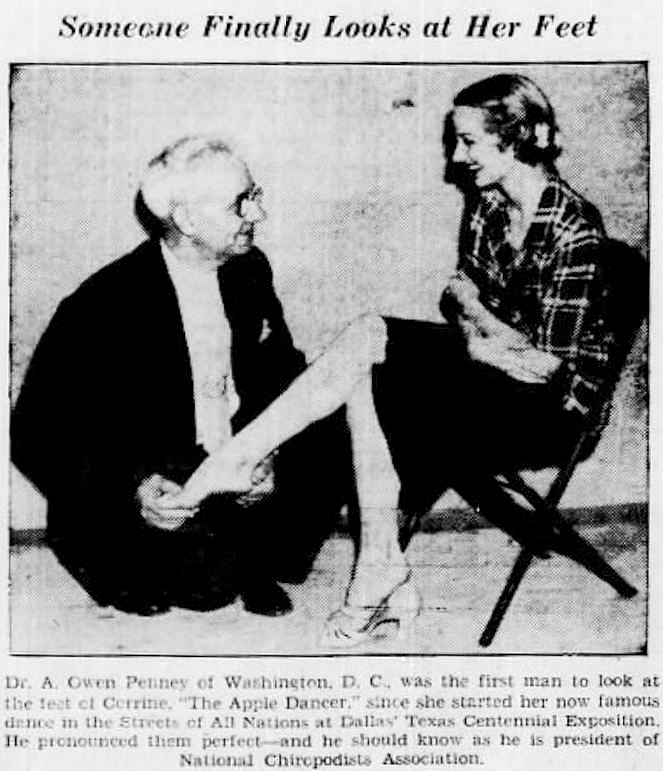
As far as the nudity, it really was everywhere. It’s a little shocking to think that this sort of thing was so widely accepted in very conservative Dallas — 80 years ago! — but it was (despite some local pastors disdainfully referring to the big party as the Texas Sintennial). Many of the acts — and much of the personnel — had appeared in a version of the same revue in Chicago in 1933 and 1934. Some of the offerings for the Centennial visitor: peep shows a-plenty, the clad-only-in-body-paint “Diving Venus” named Mona Lleslie (not a typo), a naked “apple dancer” named Mlle. Corinne who twirled with a “basketball-sized ‘apple'” held in front of her frontal nether regions, and the somewhat obligatory nude chorus girls. There was also an “exhibit” in which nude women were on display as “artists’ models,” posing for crowds of what one can only assume were life-drawing aficionados who were encouraged to render the scene before them artistically (…had they planned ahead and brought a pencil and sketchpad); those who lacked artistic skill and/or temperament were welcome to just stand there and gawk. (Click photos and ads to see larger images.)

corinne_apple-dancer_cook-collection_smu

tx-centennial_apple-dancer_dmn_070536

tx-centennial_apple-dancer_franklin-ind-evening-star_071136Franklin, Indiana Evening Star, July 11, 1936

Another attraction was Lady Godiva, who, naked, rode a horse through the Streets of Paris crowds. Her bare-breastedness even made it into ads appearing in the pages of staid Texas newspapers. (Click to see larger images.)

tx-centennial_lady-godiva_dmn_060436_sm
June, 1936

There were two areas along the Midway where crowds could find these saucy attraction: Streets of Paris (which Time magazine described as appealing to “lovers of the nude”) and Streets of All Nations (“for lovers of the semi-nude”). Lady Godiva was part of the Streets of Paris, and she rode, Godiva-esque, nightly. The gimmick (beyond the gimmick of a naked woman riding a horse in Fair Park) was that she was supposed to  be a Dallas debutante who rode masked in order to conceal her identity. The text below is from the ad above.

MASKED…but unclothed in all her Glory…Riding a milk-white steed. […] Miss Debutante was introduced to Dallas society in 1930. She was later starred in Ziegfeld’s Follies, in “False Dreams, Farewell,” “Furnished Rooms,” and other Broadway successes. She appeared in motion pictures, being starred in “Gold Diggers of 1935,” “Redheads on Parade” (yes, she is a redhead) and other picture successes.

SHE WILL STARTLE DALLAS SOCIETY! JUST AS THE STREETS OF PARIS WILL BE THE SENSATION OF THE CENTENNIAL SEASON .. WHO IS SHE?

And, of course, none of that was true (including the fact that this “Lady Godiva” rode a white horse — apparently one could not always be found), but I’m sure it got local pulses racing. My guess is that there were several Ladies Godiva (none of whom were members of Dallas society). One woman was actually named as the Centennial’s exhibitionist horsewoman. I haven’t been able to find mention of a “Paulette Renet” anywhere other than the caption of this photo, but here she is:

godiva_madera-tribune_082936

godiva_madera-tribune_082936-caption
Madera (California) Tribune, Aug. 29, 1936

Another photo featuring what appears to be the same woman, with this caption: “No white horse for Lady Godiva, at the Texas Centennial Exposition in Dallas. A feature of the ‘Streets of Paris,’ a midway show, Godiva rode a ‘paint pony,’ first week because no white one was available.”

godiva_altoona_penn-tribune_062336
Altoona (Pennsylvania) Tribune, June 23, 1936

I think this is still the same woman, but on a rare white steed:

lady-godiva_cook-collection_smu

The Godiva who appeared in the March of Times newsreel “Battle of a Centennial” appears to be a different woman. (Watch a 45-second snippet of the newsreel which features both a glimpse of Lady Godiva and a head-shaking son of Sam Houston wondering what the deal is with the younger generation — here.)

godiva_march-of-time_1936

Imagine seeing performers and attractions like this along the Fair Park midway today!

*

godiva_dmn_070536-detJuly, 1936 (ad detail)

tx-centennial_lady-godiva_dmn_060436-det
June, 1936 (ad detail)

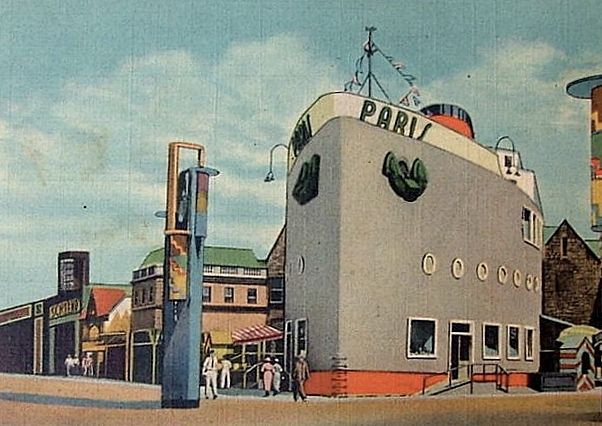
What was the Centennial Club? It was an exclusive, invitation-only private club located within the very large George Dahl-designed building which housed the Streets of Paris (and which was shaped like the famed S. S. Normandie ocean liner). It had three levels (“decks”) and housed a lounge, dining rooms, a main clubroom, and a “dance pavilion” — all air conditioned. From various decks, well-heeled patrons could look down at the action going on below: the milling throngs of the hoi polloi, the Streets of Paris shows, and the Midway.

centennial-club_dmn_061636
June, 1936

tx-centennial_streets-of-paris_art-institute-chicago

tx-centennial_streets-of-paris_ebay_rppc

tx-centennial_streets-of-paris

Can’t miss the ridiculously large land-locked ocean liner in the center of the photo below. Mais oui!

normandie_winters_dhs

**

The articles below on “gals, likker, and gambling” are GREAT. They are from the show biz trade publication Variety, which really latched onto the rampant nudity on view at the Texas Centennial. Remember: 80 years ago! (The abbreviation of “S. A.” in the headline of the second article stands for “sex appeal.”) (As always, click to see larger images.)

sex_variety_061036
Variety, June 10, 1936

sex_variety_062436
Variety, June 24, 1936

nudity_variety_070136
Variety, July 1, 1936

***

Sources & Notes

Top photo shows an admission ticket to the Streets of Paris, from the George W. Cook Dallas/Texas Image Collection, Central University Libraries, Southern Methodist University; more information is here. Another interesting item from this collection is a brochure (here) which describes Streets of Paris as “the smartest, most sophisticated night club in America. Here you will find the gay night life of Paris in a setting of exotic splendor.”

Photo of “Mlle. Corrine” also from the Cook Collection at SMU; more info on that photo here.

Photo of Lady Godiva on a white horse (with the words “Dallas Centennial” near the bottom … um, bottom of the image … is also from the Cook Collection at SMU, here.

The photo showing the night-time crowd outside the Streets of Paris Normandie is from the Ryerson & Burnham Archives, Art Institute of Chicago; more info here.

The aerial photograph showing the S. S. Normandie is from Willis Cecil Winters’ book Fair Park (Arcadia Publishing, 2010); photo from the collection of the Dallas Historical Society.

All other sources noted, if known.

See quick shots of the Streets of Paris and the Streets of All Nations in the locally-made short film “Texas Centennial Highlights,” here (Streets of Paris is at about the 7:00 mark and the more risqué bits showing the parasol chorus girls followed by Mlle. Corinne and her apple dance (I mean, it’s not really shocking, but … it still kind of is…) at the 8:45 mark. (Incidentally, there appears to be a new book on Corinne and her husband — Two Lives, Many Dances — written by their daughter.)

A very entertaining history of the State Fair of Texas and the Texas Centennial Exposition can be found in the article “State Fair!” by Tom Peeler (D Magazine, October, 1982), here.

A Flashback Dallas post on the feuding Dallas and Fort Worth Centennial celebrations can be found here.

More Flashback Dallas posts on the Texas Centennial can be found here.

Click pictures and clippings to see larger images.

*

Copyright © 2016 Paula Bosse. All Rights Reserved.

“Teen-Age Downbeat”

teen-age-downbeat_broadcasting-mag_051859_detWBAP’s “Teen-Age Downbeat,” 1959 (click for larger image)

by Paula Bosse

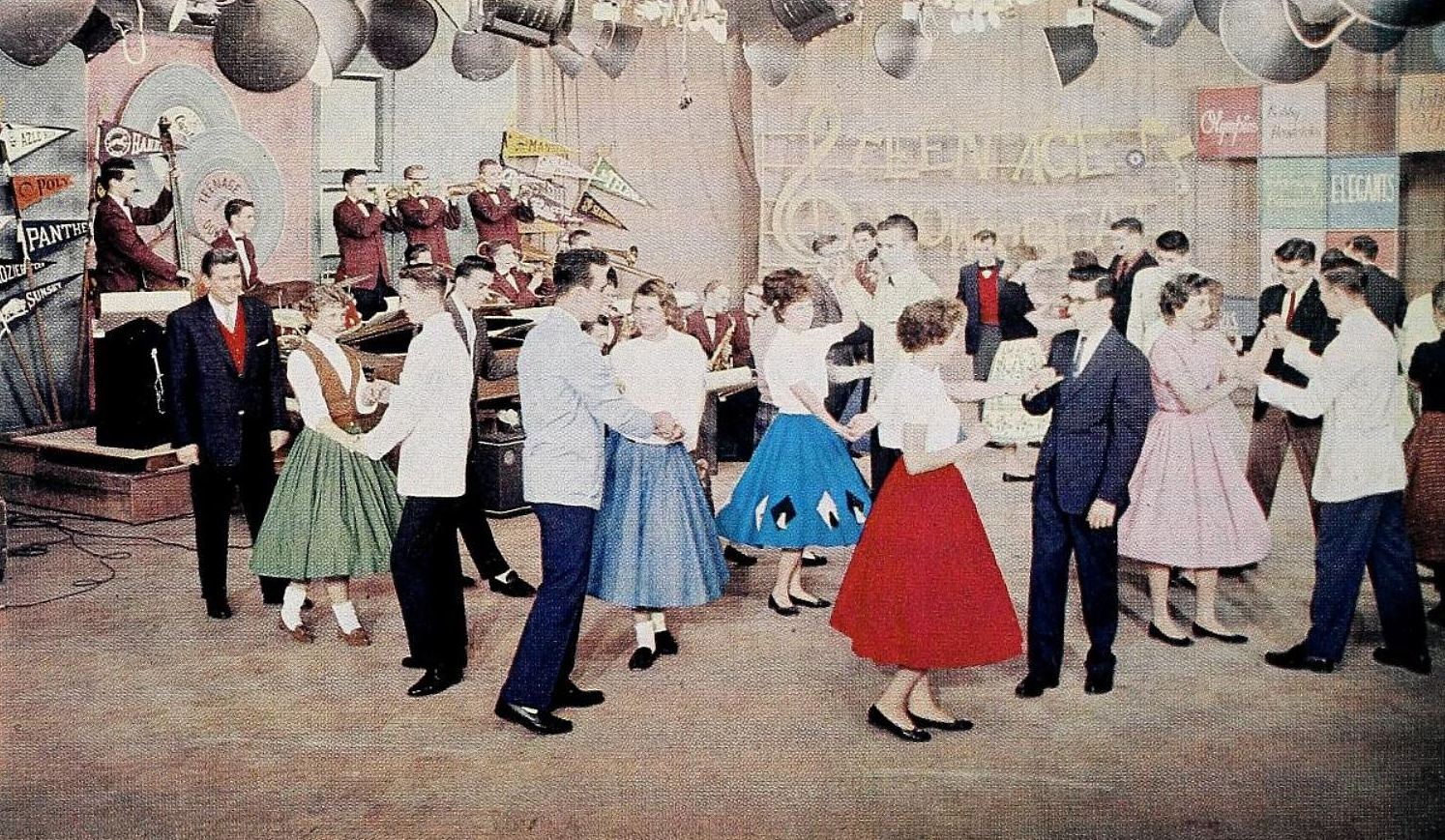
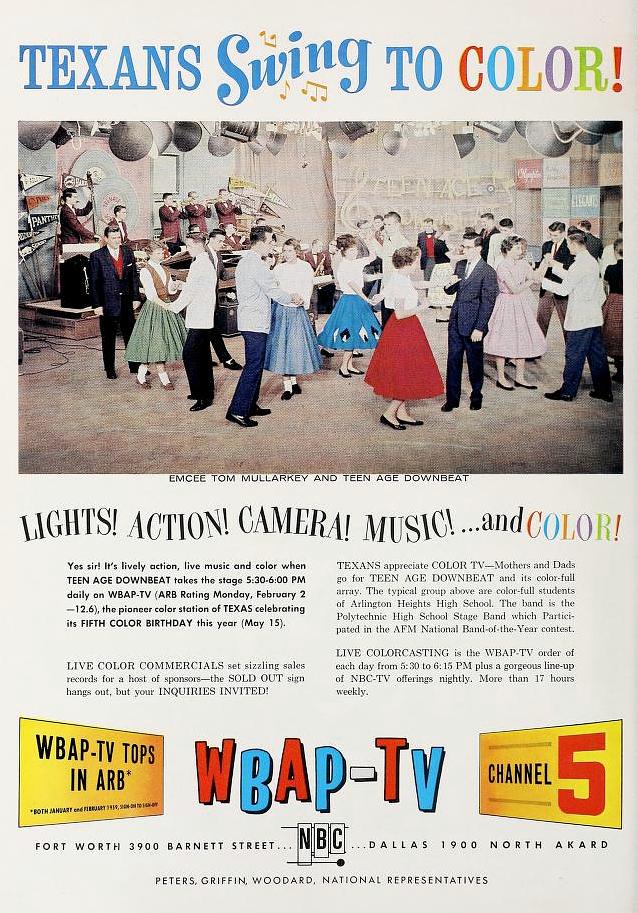
“Teen-Age Downbeat” — Fort Worth’s answer to “American Bandstand” — debuted on WBAP-TV in January, 1958 — in COLOR. It featured teens from the Dallas-Fort Worth area (…or maybe I should say from the Fort Worth-Dallas area…) who would play and dance to their favorite records. The host was WBAP broadcaster Tom Mullarkey (seen above at the left, wearing the red vest). The show was quite popular and lasted as best I can tell, from January, 1958 until July, 1961 (the last mention in The Fort Worth Star-Telegram was July 1, 1961). I’m guessing those kids danced to a lot of Fabian.

teenage-downbeat_fwst_010558FWST, Jan. 5, 1958

teen-age-downbeat_sponsor-mag_080860“Sponsor” trade magazine, Aug. 8, 1960

teen-age-downbeat_unt-lab-bandNorth Texas State College’s Lab Band with director Gene Hall

teenage-downbeat_fwst_022661
FWST, Feb. 26, 1961

teen-age-downbeat_broadcasting-mag_051859
“Broadcasting” trade magazine, May 18, 1959

teen-age-downbeat_xmas_1958_fortworthhistorical-IG“Toys For Tots” campaign, Christmas 1958

***

Sources & Notes

The color photo (which appeared in a full-page WBAP ad in the trade magazine Broadcasting) shows non-teen Tom Mullarkey watching over the dancers from Arlington Heights High School, as the Polytechnic High School Stage Band plays some happenin’ tunes. (I do see two Dallas high school pennants in the photo: Crozier Tech and Sunset.)

The photo showing director Gene Hall with the North Texas State College (now the University of North Texas) Laboratory Band was found at UNT’s Portal to Texas History site, here. The photo is not dated, but a blurb in The Fort Worth Star-Telegram mentioned that Hall and the band were to appear on “Teen-Age Downbeat” on Feb. 5, 1959.

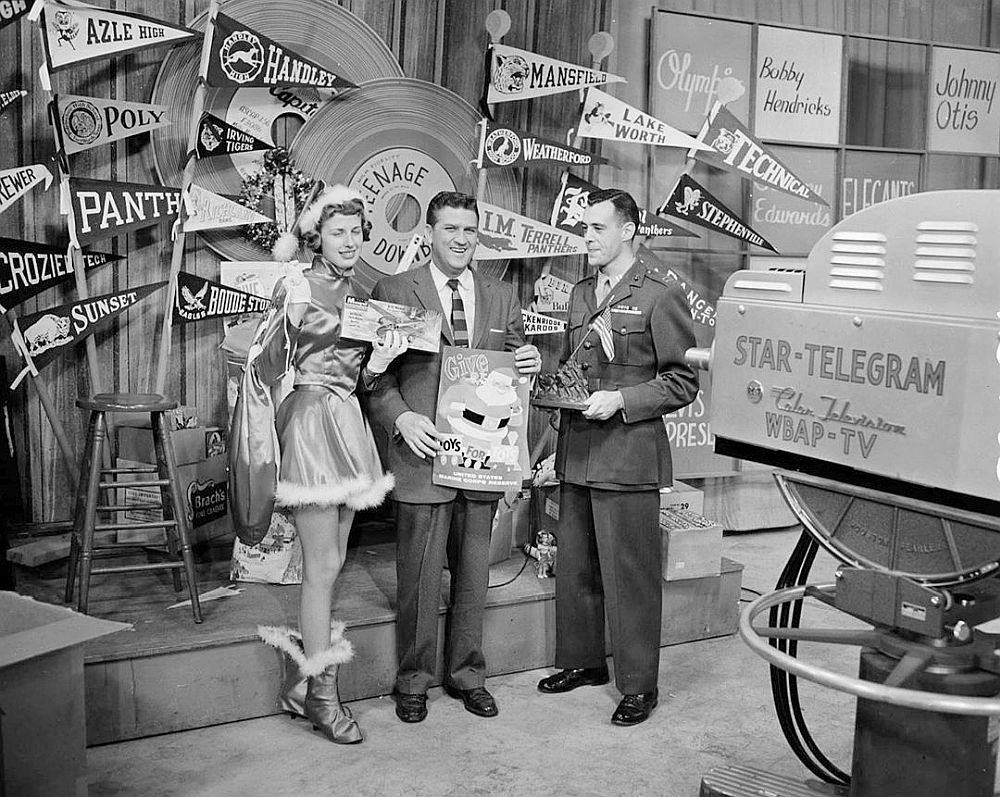
Photo of the “Toys For Tots” campaign, featuring a sexy Santa’s helper, Tom Mularkey, and a Marine Corps (Reserve?) officer was found on the Instagram feed of @fortworthhistorical.

*

Copyright © 2016 Paula Bosse. All Rights Reserved.

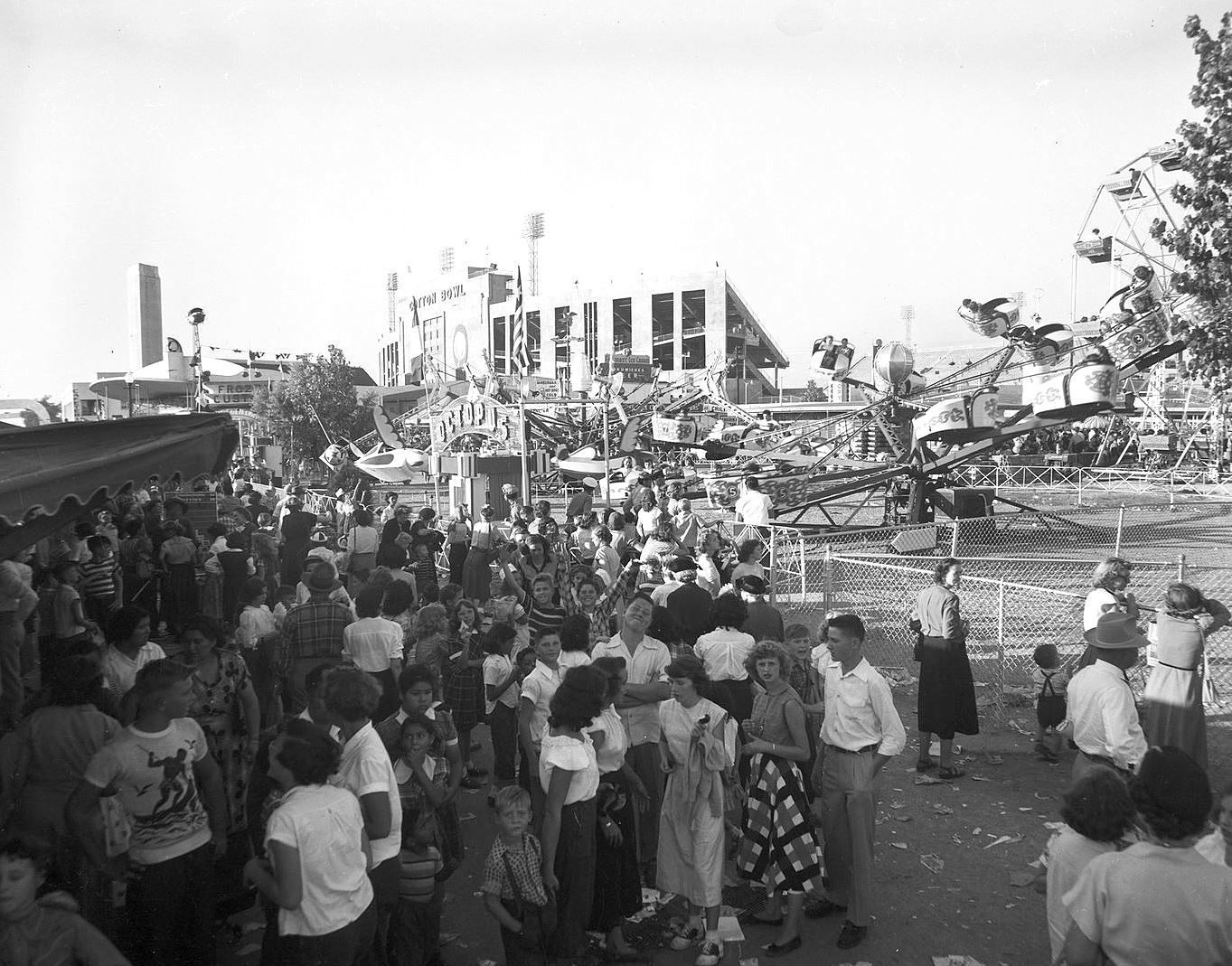
Zooming In on the State Fair: The Midway, the Cotton Bowl, and the Octopus — ca. 1950

state-fair_midway-cotton-bowl_squire-haskins_ca_1950_utaAnother visit to the fair… (click for larger image)

by Paula Bosse

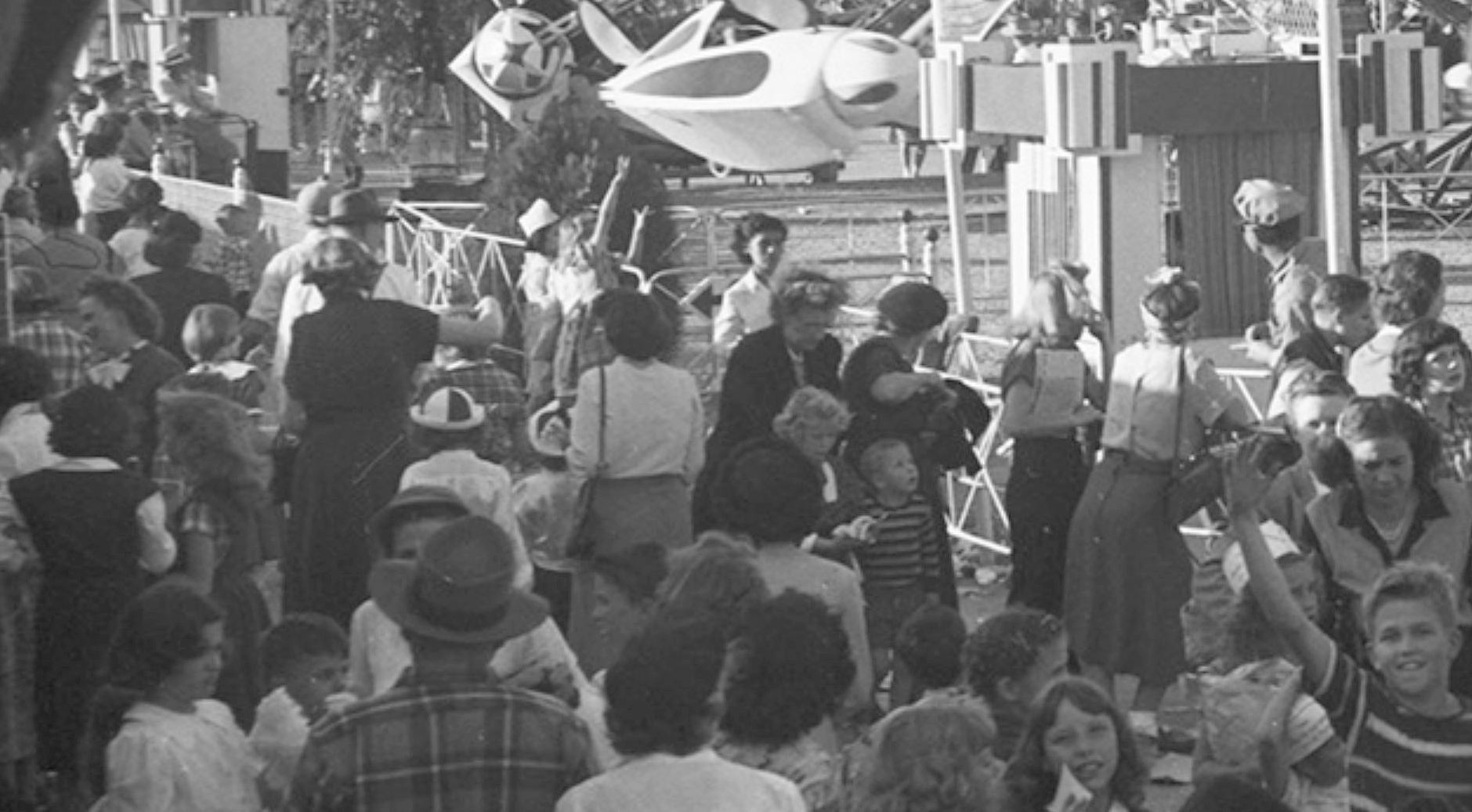
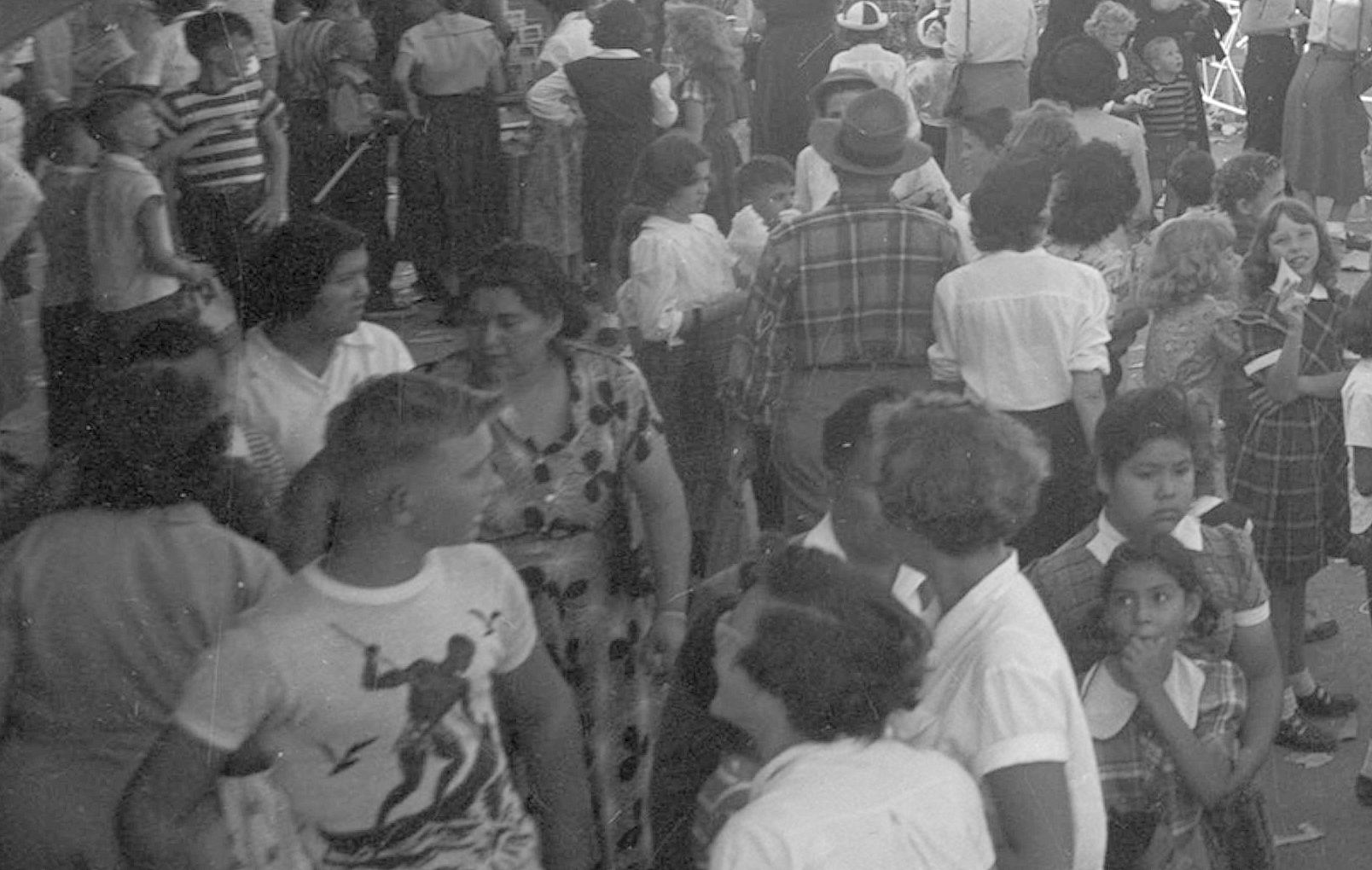
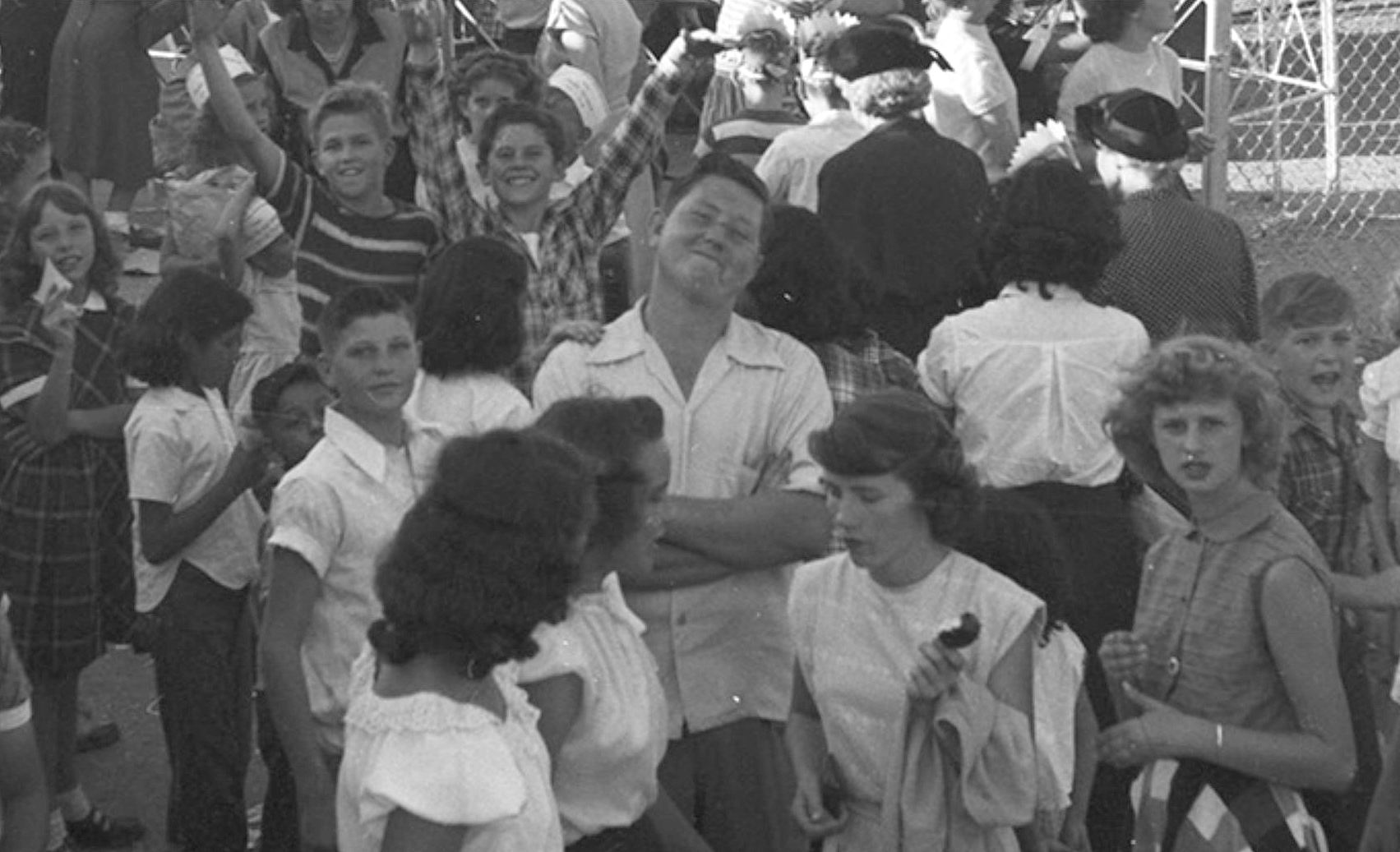
When I see old photos of the State Fair, I always look at the people. Let’s take a closer look at this great photo by Squire Haskins, taken around 1950. (See a BIG scan of this photo at the UTA website, here.)

Here are a few magnified details from Haskins’ photo (all are much larger when clicked):

midway-zoom_1

midway-zoom_2

midway-zoom_3

midway-zoom_5

midway-zoom-4

midway-zoom_6

***

Top photo by Squire Haskins, from the Squire Haskins Photography, Inc. Collection, Special Collections, University of Texas at Arlington Libraries; more information can be accessed here. (Other photos from this collection which were taken around the State Fair Midway at about this time were taken in October, 1950 — this one is not dated, but it seems likely it was taken at the same time.)

See other photos I’ve zoomed in on here.

Click pictures for larger images!

*

Copyright © 2016 Paula Bosse. All Rights Reserved.

The State Fair of Texas: “A Son-of-a-Gun in ’51” — 1951

state-fair-poster_1951_pinterest

by Paula Bosse

In honor of opening day of the 2016 State Fair of Texas, a poster from the 1951 fair. Proto-Big Tex imagery was being used well before the giant cowboy’s debut the following year (see, that hand thing is going on even back then…).
Welcome back, SFOT!

***

Poster found on Pinterest.

*

Copyright © 2016 Paula Bosse. All Rights Reserved.