Flashback : Dallas

A Miscellany: History, Ads, Pop Culture

Category: Leisure

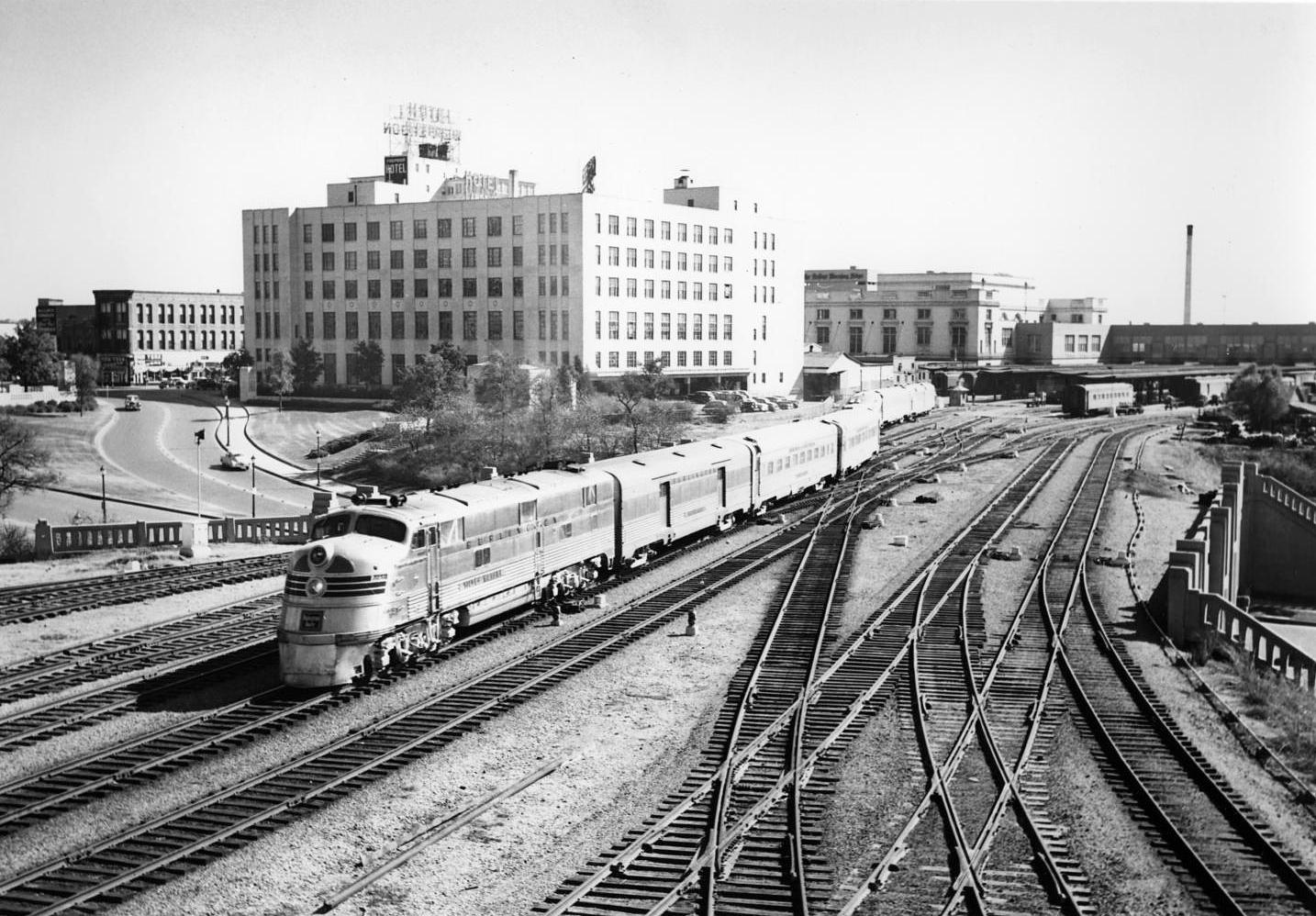
The Sam Houston Zephyr Leaving Union Station, Crossing Over the Triple Underpass — 1950

zephyr_triple-underpass_1950_portalThe SHZ heading out of Dallas… (click for larger image)

by Paula Bosse

The title pretty much says it all. The Sam Houston Zephyr passenger train is seen crossing over the Triple Underpass, heading out of Dallas. Next stop: Fort Worth. The Post Office Terminal Annex is the tall white building, the Jefferson Hotel is behind it (with the sign on its roof), and Union Station is in the background, just right of center, with the Dallas Morning News building peeking over its roofline. The Old Red Courthouse would be out of frame to the left.

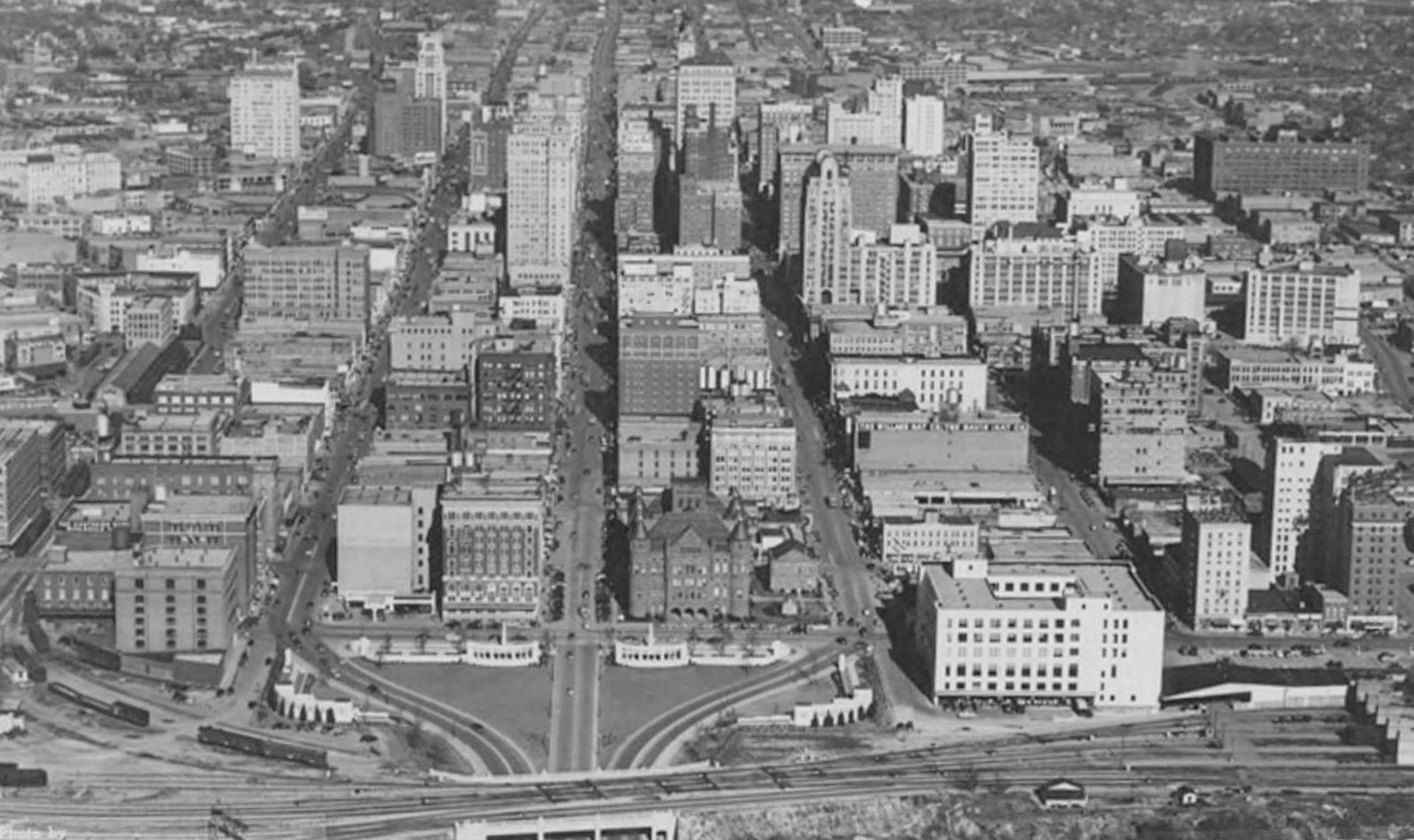
Below, a view of downtown from the west, with the Triple Underpass partially cut off at the very bottom, and Union Station just out of frame at the right.

downtown_aerial-photo-service_postcard_cook-collection_smu_cropped

In asking members of Facebook’s Texas Railroad History group about the top photo, Gerald Preas, one of the members, made this comment, full of interesting little tidbits (slightly edited by me):

The large building in the center is the USPO Terminal Annex. I started working there in August 1963. The buildings between TA and Union Station were part of Railway Express, used for sorting mail to and from RPO cars. That stack in back was the power station for Union Station — it had its own electric and water system, maybe sewage, too. I drank many times that cool sweet well-water. Notice cars around TA loading dock. I supervised that dock 1968/69 — we had to keep the area open. Now look where train is bending, people would park off ballast, but cars turning would swing out further and hit parked cars. That tree on the upper right led down grade to vacant parting lot. I was coming up that path when the President was shot.

***

Sources & Notes

Top photo shows the Fort Worth and Denver’s Sam Houston Zephyr train No. 4, northbound from Houston, leaving the Dallas Union Terminal Station, heading to Fort Worth. The photo was taken by Roger S. Plummer in 1950; photo from the Museum of the American Railroad, via UNT’s Portal to Texas History, here.

(Other photos of the Sam Houston Zephyr taken in Dallas — and one in Fort Worth — by Roger S. Plummer between 1949 and 1955 can be found on the Portal to Texas History site, here.)

Bottom image titled simply “Dallas, Texas” is an Aerial Photo Service postcard, from the George W. Cook Dallas/Texas Image Collection, DeGolyer Library, Central University Libraries, Southern Methodist University. I’ve edited the image a bit — see the original image and description here.

An aerial view of the same area today can be seen here, via Google.

A previous Flashback Dallas post on the stunningly beautiful Texas Zephyr can be found here.

Thanks to the members of the Texas Railroad History group on Facebook for their comments and help.

Both photos are larger when clicked.

*

Copyright © 2016 Paula Bosse. All Rights Reserved.


Thanksgiving, 1891: The First Turkey-Day Football Game in Dallas

thanksgiving-card_pinterest_sm

by Paula Bosse

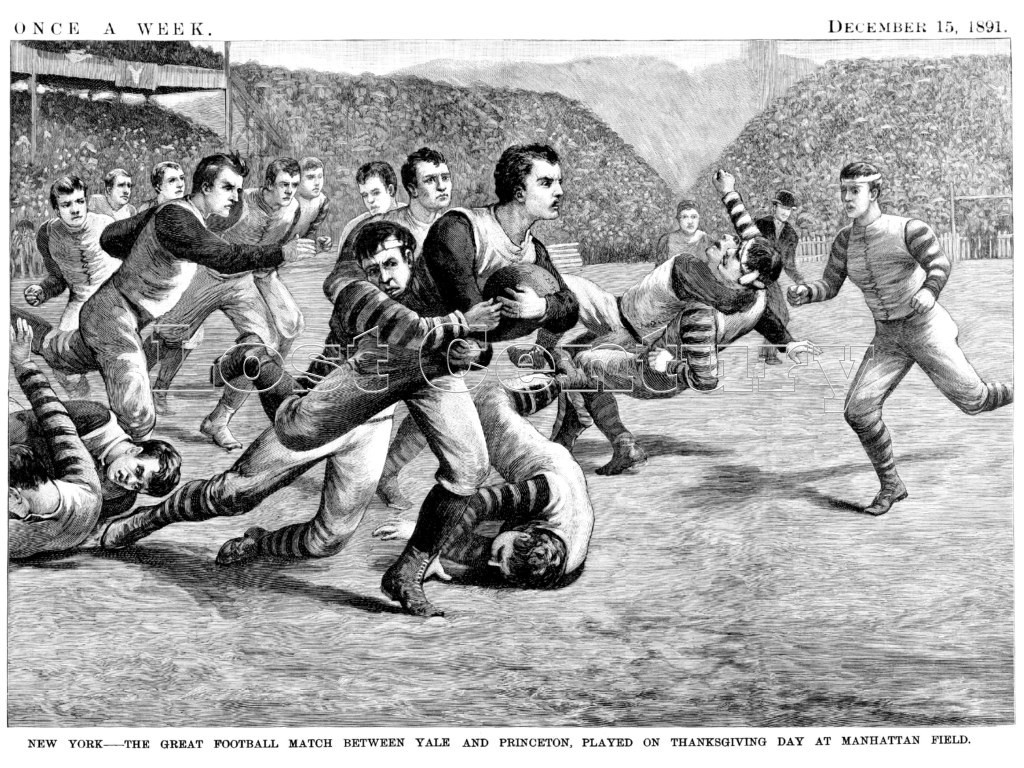
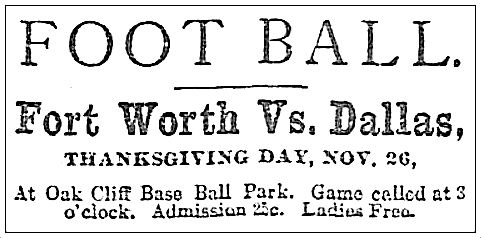
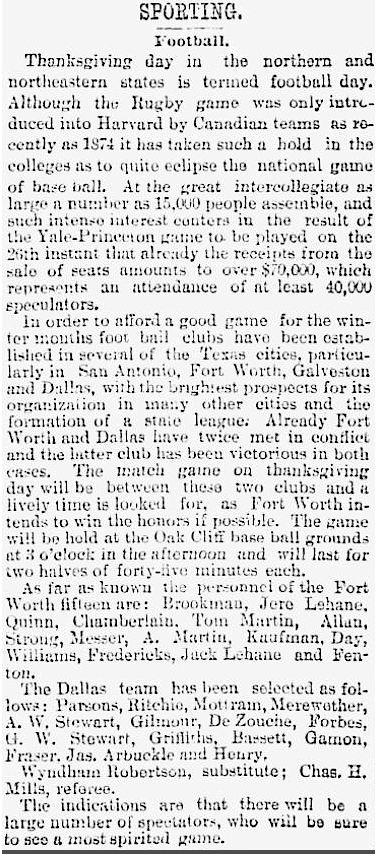
Thanksgiving is a holiday known for eating until you’re full as a tick and football — the highlight for many is the traditional Dallas Cowboys game. But when was the very first Thanksgiving Day football game played in Dallas? 125 years ago — in 1891. It was played on November 26, 1891 in Oak Cliff (…which wasn’t strictly part of Dallas at the time, but… yeah, 1891). The game was between teams from Dallas and Fort Worth, teams which had been organized only a few months previously. The sport of “rugby football” had been gaining popularity around the United States, particularly as a college sport. One of the biggest games of the young sport was the university game played on Thanksgiving Day. In 1891, the Yale-Princeton Thanksgiving game was played in New York before thousands and thousands of spectators. Yale won that year, 19-0 (see the exciting illustration below in which helmets for players are non-existent, but a man who appears to be the referee is wearing a stylish bowler hat). (Click for larger image.)

thanksgiving__football_yale-princeton_1891_lost-century

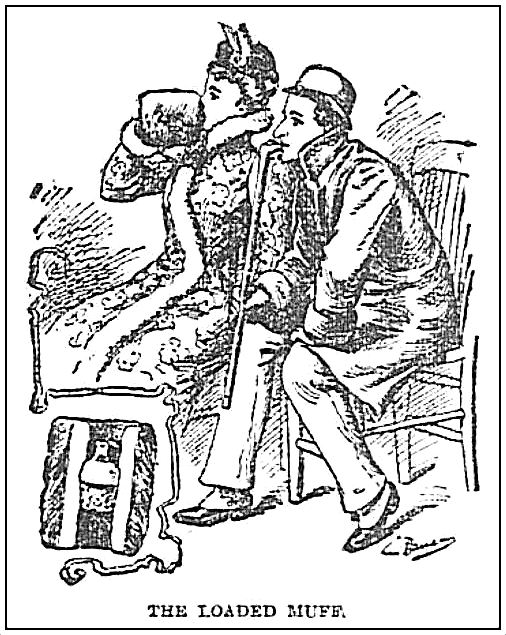
This Ivy League game was almost more of a society event than a sporting event. To get a feel for the atmosphere of these university games, read this really great contemporary article — “The Man of Fashion, We Observe Thanksgiving Day with Great Eclat” by Albert Edward Tyrrell — on the fashions and behavior of these generally well-heeled crowds (it also contains an interesting look at how Thanksgiving was celebrated in 1891, by the swells as well as the non-swells). My favorite piece of minutiae was that young ladies were not above sneaking flasks of liquor into games, hidden in their fashionable hand-warmers. I give you “the loaded muff”:

football_thanksgiving_loaded-muff_dmn112291

But I digress. However much those early Texas football enthusiasts might have hoped for similar large, flask-sipping crowds, the first Thanksgiving football game held in Dallas (and possibly in Texas) attracted a smaller crowd of hundreds rather than thousands (including “about 100 ladies”). Though the crowd was miniscule compared to the one up in New York that day, it did not lack in boisterousness and excited appreciation.

thanksgiving_football_dmn_112591_ad
Dallas Morning News, Nov. 25, 1891

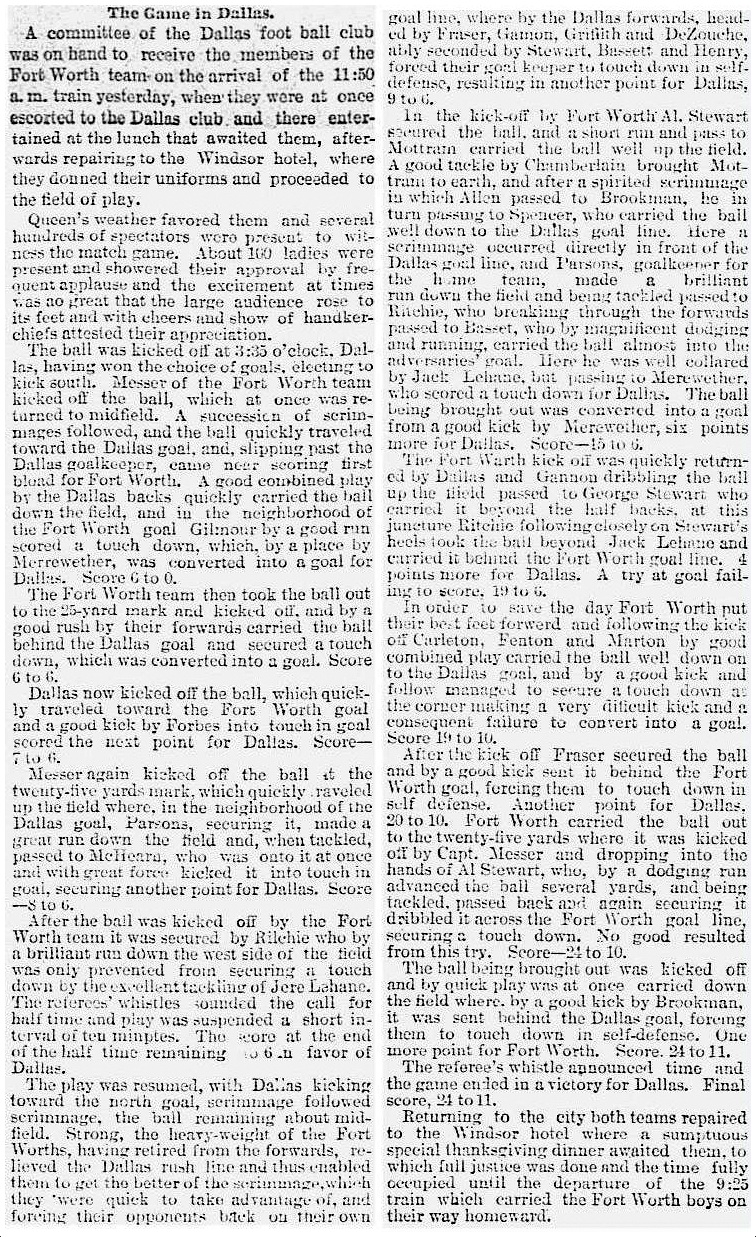
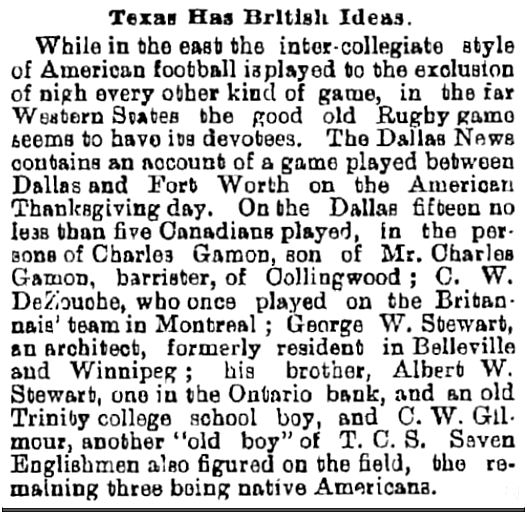
Dallas and Fort Worth had met twice before their matchup in Oak Cliff — both times with Dallas emerging victorious, and … not to be too anti-climactic, but the big inaugural Thanksgiving Day game on November 26, 1891 resulted in another Dallas win (24-11). (This shouldn’t be too surprising, seeing as the overwhelming majority of the players on the Dallas team of 15 grew up playing rugby in rugby-playing countries: 7 were British and 5 were Canadian — only 3 were native-born Americans. Still. Whatever it takes.) (The dullish play-by-play of the game can be read below.)

So what else was going on in Dallas in the Thanksgiving season of 1891? Here are a few morsels.

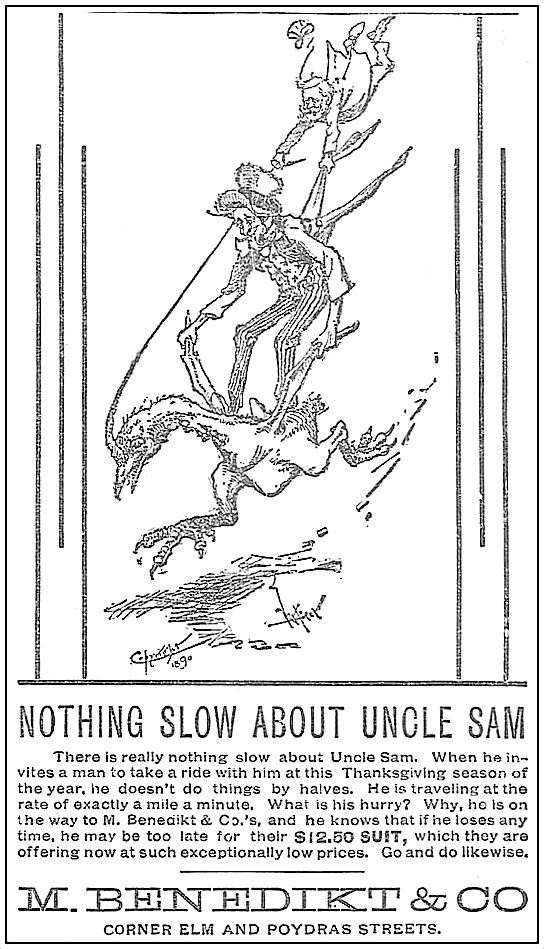
Men might have contemplated getting a new $12.50 suit from M. Benedikt & Co. (a suit which would cost about $335.00 today) — especially after seeing this eye-catching Uncle-Sam-riding-a-(scrawny)-turkey ad. (Click pictures to see larger images.)

ad-thanksgiving_benedikt_dmn_112191
DMN, Nov. 21, 1891

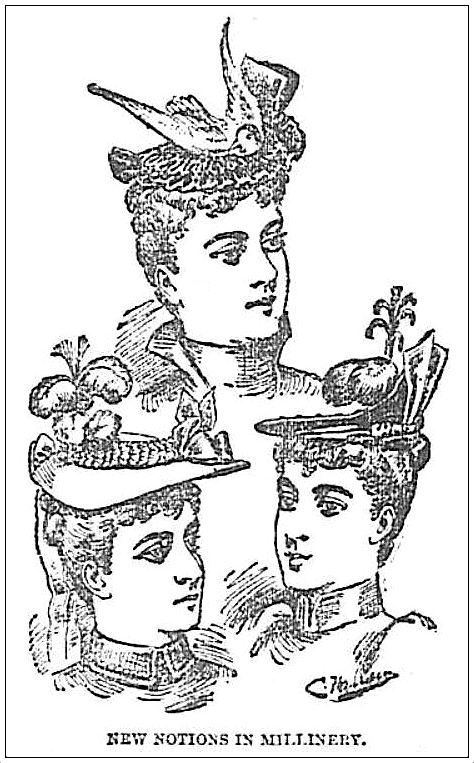
Ladies were kept up to date on the millinery, dress, and hairstyle fashions of the season by reading newspaper articles such as “What Is Really Worn, The Fashions That Find Favor at Thanksgiving” (which can be read here).

thanksgiving_milinery_dmn_112291
DMN, Nov. 22, 1891

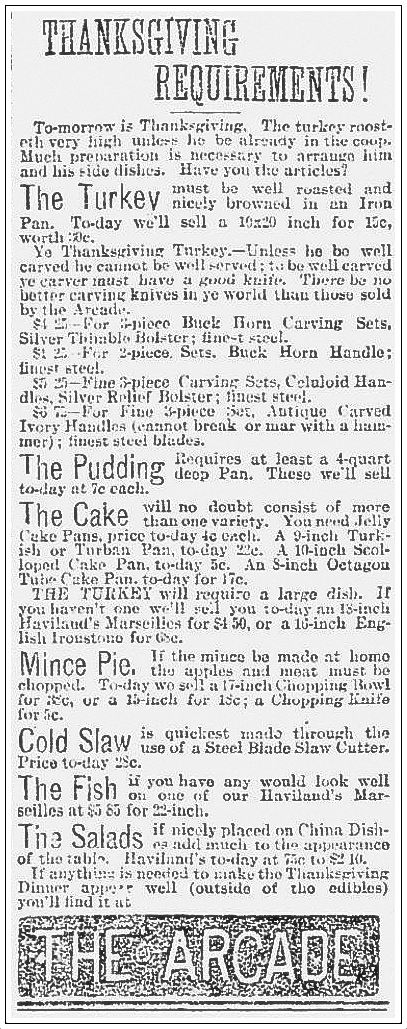
And stores that sold cookware, bakeware, and china took out ads to inform Dallasites that they really needed some new items in order to properly prepare for the big day — one’s guests shouldn’t be forced to be served a feast from tacky serving dishes or eat from chipped plates.

ad-thanksgiving_dmn_112591
DMN, Nov. 25, 1891

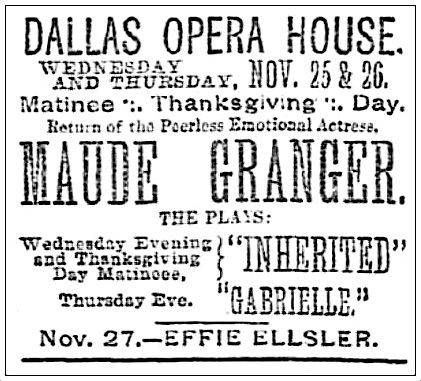
If one wasn’t spending Thanksgiving Day attending one of the city’s many church services, feeding the children at the Buckner Orphans Home, feeding one’s guests and one’s family, visiting friends, or trekking over to Oak Cliff to see that football game, he or she might have considered attending a matinee at the Dallas Opera House — Maude Granger (“The Peerless Emotional Actress”) was back in town and raring to emote.

thanksgiving_theater_dmn_112491
DMN, Nov. 24, 1891

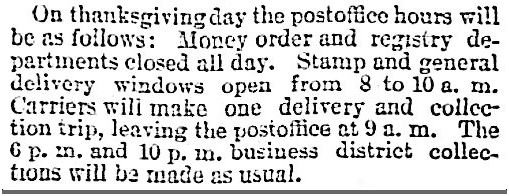
Almost everyone had the day off from work, but, oddly enough, most postal workers had to work at least part of the day. Neither rain nor sleet nor tender turkey breasts and cranberry sauce stayed those couriers from the swift completion of their appointed rounds, I guess.

thanksgiving_post-office_dmn_112591
DMN, Nov. 25, 1891

At least no one was dreading/eagerly anticipating Black Friday back in ’91.

**

Back to football. First, a friendly D-FW practice run before the Big Game.

thanksgiving_football_dmn_111491
DMN, Nov. 14, 1891

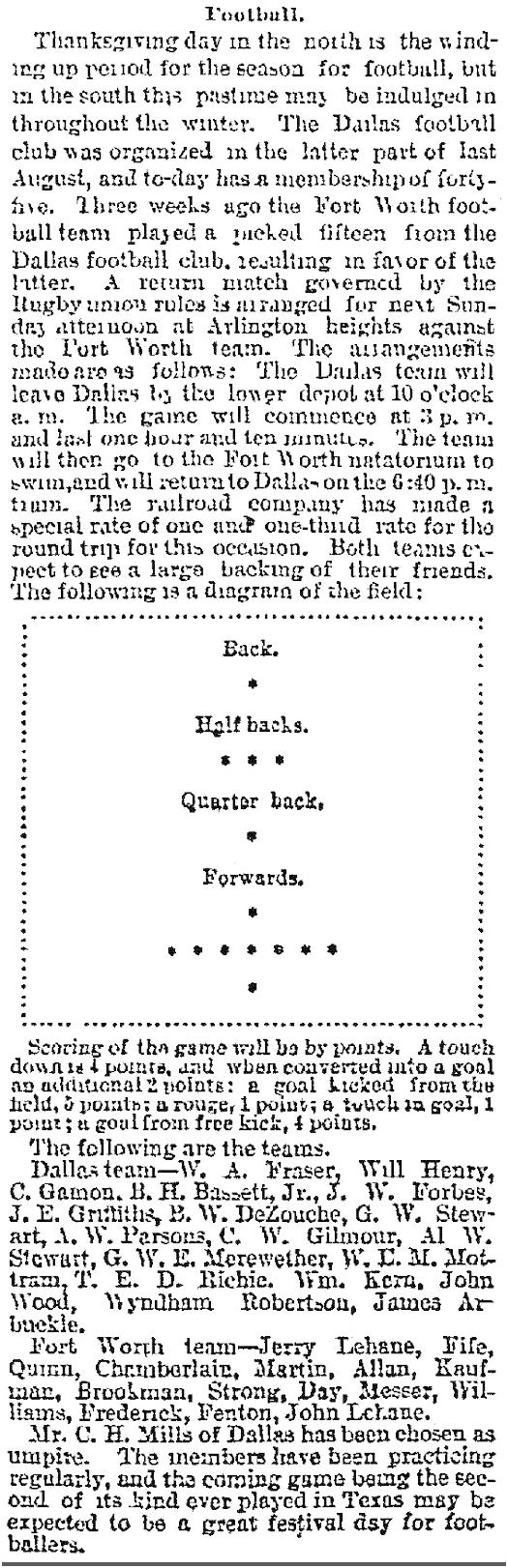
The pre-game article.

thanksgiving_football_dmn_112591
DMN, Nov. 25, 1891

The post-game article.

thanksgiving_football_dallas-fw_dmn_112791_highlights
DMN, Nov. 27, 1891

And an article from a proud Canadian newspaper, boasting of the number of Queen Victoria’s faithful subjects playing for the Dallas team.

thanksgiving__football_manitoba-free-press_121191
The Manitoba Free Press, Dec. 11, 1891

***

Sources & Notes

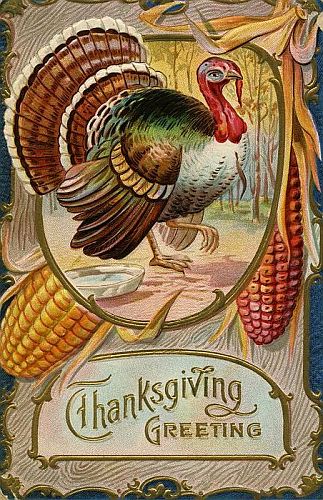
Thanksgiving card found on Pinterest.

Illustration of the 1891 Yale-Princeton game is from the Lost Century of Sports website, here. (I’m not really a sports fan, but if I were, this website of 19th-century sports might be one of my favorites!)

For more on how Thanksgiving finally came to be celebrated in Texas in 1874 (it took a long time for the Southern states to agree to celebrate what many thought was a “Yankee abolitionist holiday”), see my post “Encouraging Dallasites to Observe Thanksgiving — 1874,” here.

Happy Thanksgiving!

*

Copyright © 2016 Paula Bosse. All Rights Reserved.

The Expanded “Texas Size” Titche’s Building: Twelve Glamorous Acres of Department Store — 1955

titches_utaDallas’ largest department store, ca. 1955…

by Paula Bosse

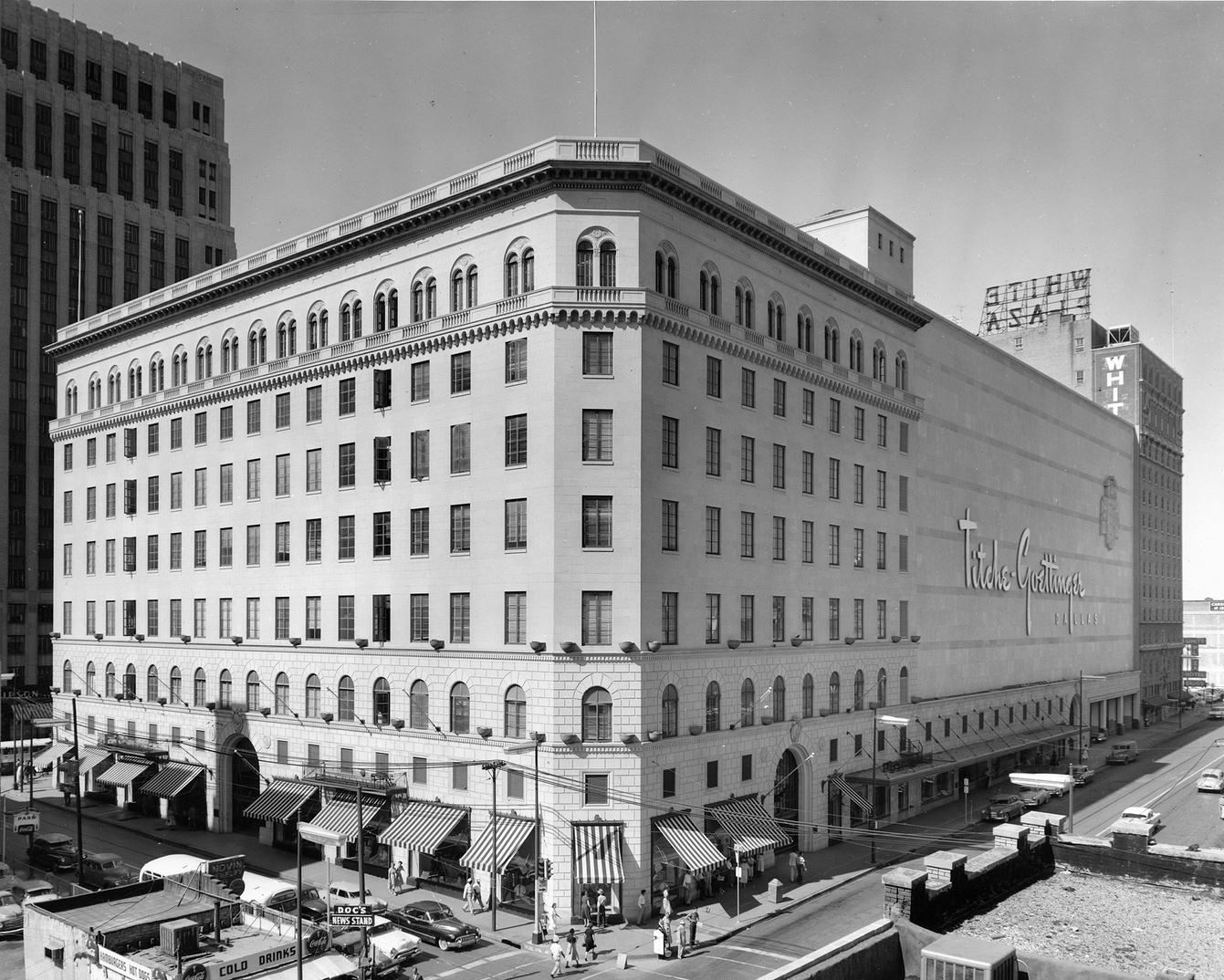
This photo of the Titche-Goettinger department store (Main and St. Paul) was taken soon after the store’s expansion which increased its size from 250,000 square feet to a whopping 504,000 square feet. When the greatly enlarged store introduced itself to the Dallas public at an open house in March 1955, one of the most notable things about it (for me, anyway) was the fact that 93-year-old Max Goettinger — founder of the department store in 1902, along with Edward Titche — attended the festivities.

The beautiful original building — designed by George Dahl — was built in the late 1920s and was a commanding presence at only half its later size. (Click pictures to see larger images.)

titches_night

The postcard view above has handily erased most of the other buildings in that block which one would have seen in a photograph, including the Pollock Trunk Co. and the old Hilton Hotel (later the White Plaza, currently the Indigo). A 1942 view of the block, looking west from Harwood, looked like this:

main-street-canyon_ebay

When construction of the new part of the store was completed in 1955, this new 12-acre “Texas Size” Titche’s was the largest store in Dallas, a head-spinning prospect for a city that loves to shop.

**

If you want a much more comprehensive overview of the Titche’s building — and want to see wonderful photos of the building, inside and out — I highly recommend Noah Jeppson’s Unvisited Dallas post, “Titche-Goettinger Building,” here. My favorite part? Its innovative system of pneumatic tubes!

***

Sources & Notes

Top photo by Squire Haskins, from the Squire Haskins Photography, Inc. Collection, UTA Libraries, Special Collections — more info here) (click on the thumbnail image on the page to see this photo BIG).

Read more on the expansion at the Dallas Morning News archives:

  • “Titche’s Reports Plans to Double Present Size” by Edd Rout (DMN, Sept. 7, 1952)
  • “Visitors Jam Opening of Texas-Sized Titche’s” by James A. Cockrell (DMN, March 15, 1955)

This wonderful building is still standing, modified to accommodate its current owners, the University of North Texas. Here’s how the building looks these days, via Google Street View, here.

More on the Titche-Goettinger Building on Wikipedia, here.

*

Copyright © 2016 Paula Bosse. All Rights Reserved.

“Dallas Midway, Night Illumination” — 1936

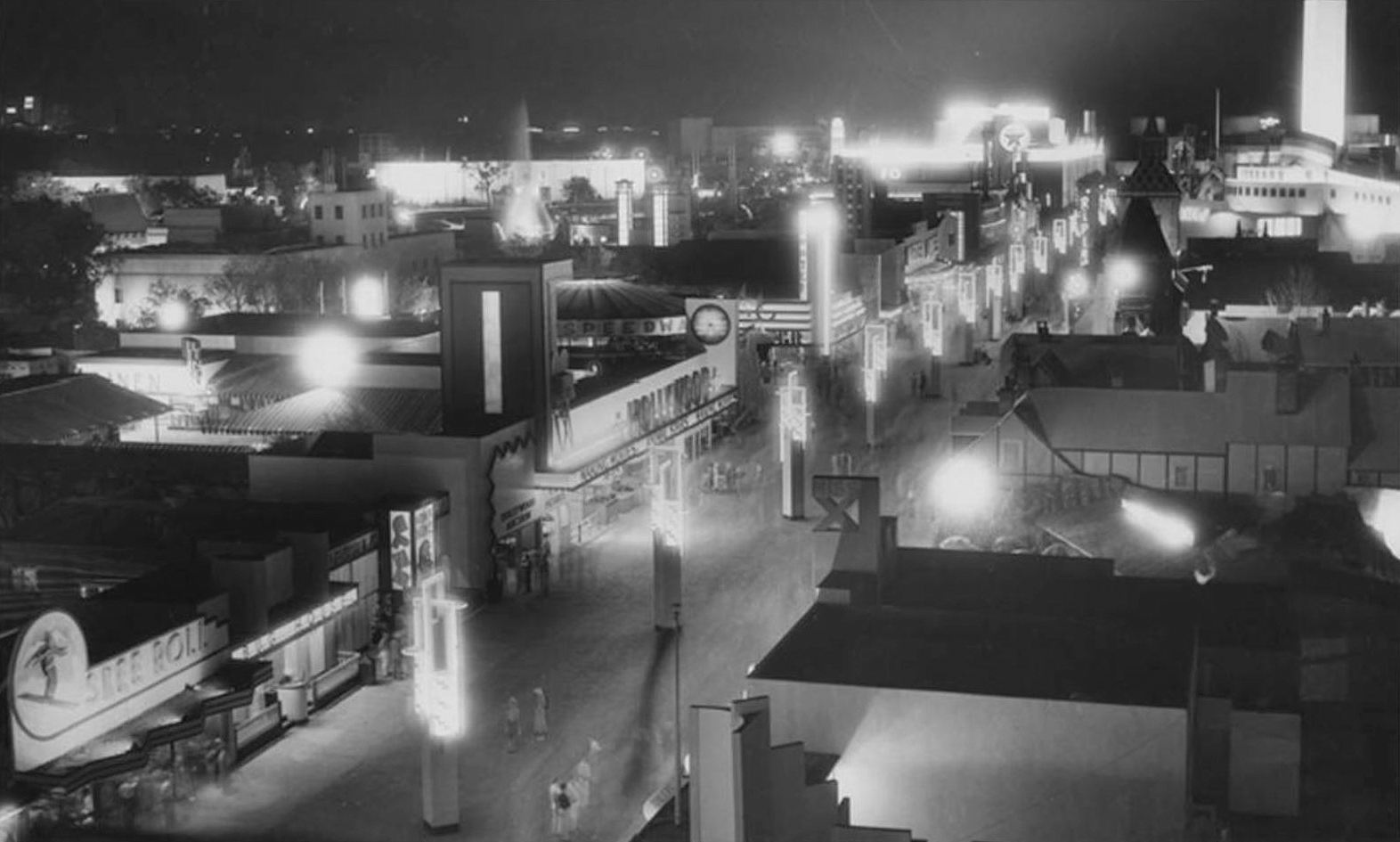
tx-centennial_midway_night_cook-coll_smuAll calm in Fair Park along the Centennial Midway (click for larger image)

by Paula Bosse

Above, a nighttime shot of an almost empty Midway during the Texas Centennial. All this scene needs in order to boost the moody atmosphere is a little fog. Go a little further and add some zither music, Joseph Cotten, and Orson Welles running past the Texaco Building and you’d have a pretty cool setting for a Texas version of The Third Man.

***

Photo titled “Dallas Midway, Night Illumination, Centennial Exposition, State Fair of Texas” (taken by an unknown photographer on Oct. 16, 1936) is from the George W. Cook Dallas/Texas Image Collection, DeGolyer Library, Central University Libraries, Southern Methodist University; more info here.

*

Copyright © 2016 Paula Bosse. All Rights Reserved.

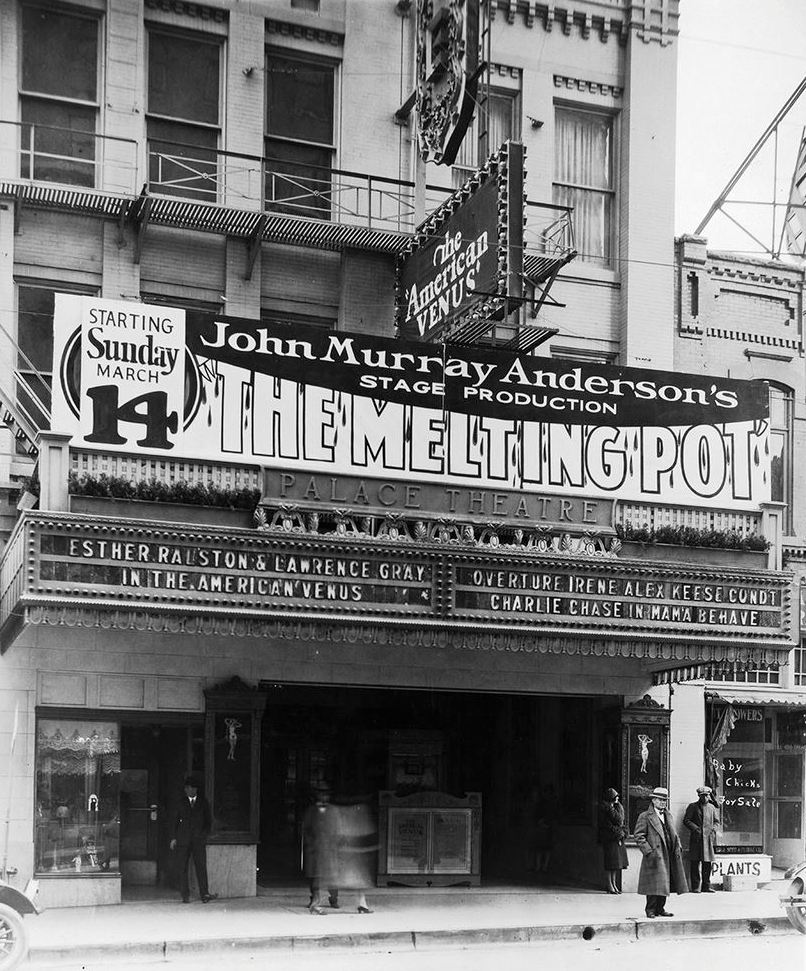
Next-Door Neighbors: The Palace Theater and Lone Star Seed & Floral — 1926

palace-theatre_melting-pot_march-1926_utaElm Street neighbors, March, 1926…. (click for larger image)

by Paula Bosse

Above, the Palace Theater, one of Dallas’ great moviehouses. It opened in June, 1921, near the northwest corner of Elm and Ervay; this photograph is from March of 1926, three months before the theater’s fifth birthday. It was still a whippersnapper. 

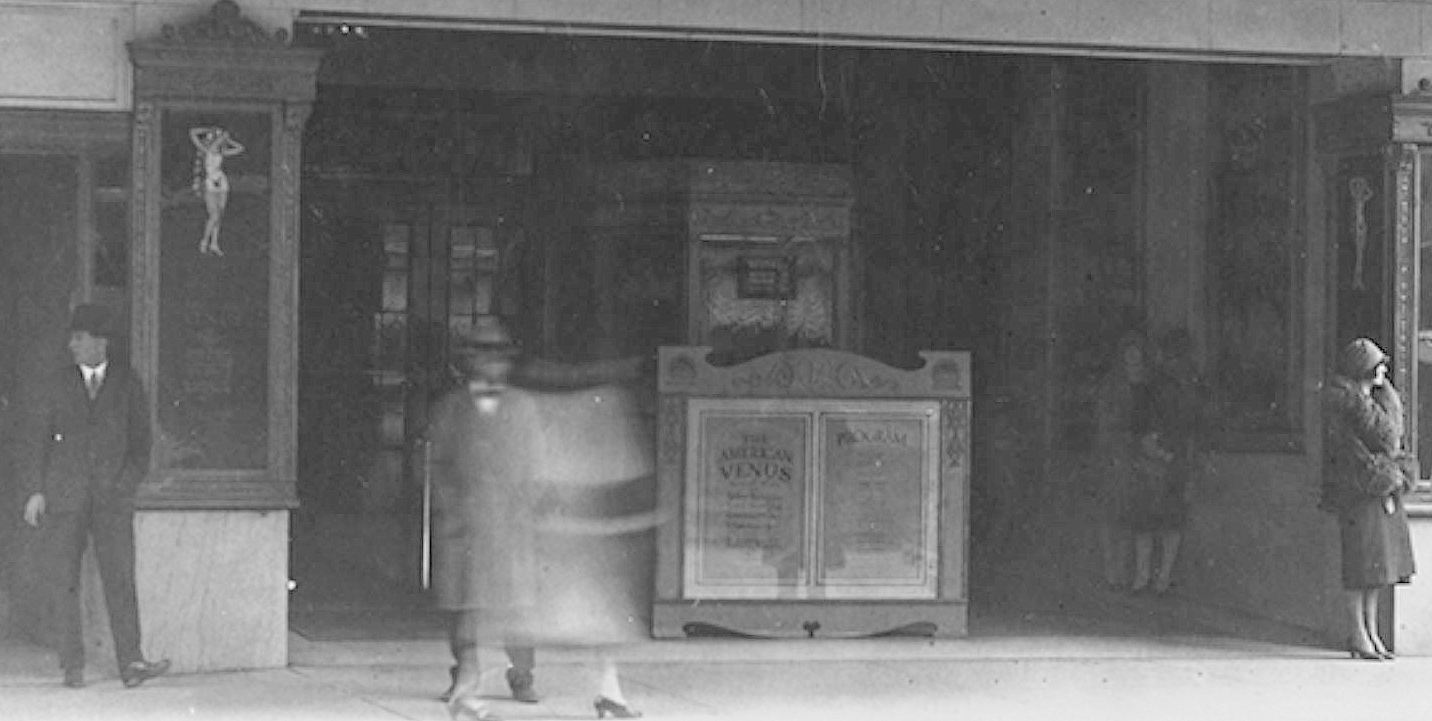
Below, a detail from the photo: by zooming in and tweaking the contrast, the box office is revealed, as are two women chatting in the shadows (all pictures and clippings are larger when clicked).

palace-theatre_melting-pot_march-1926_uta_det2

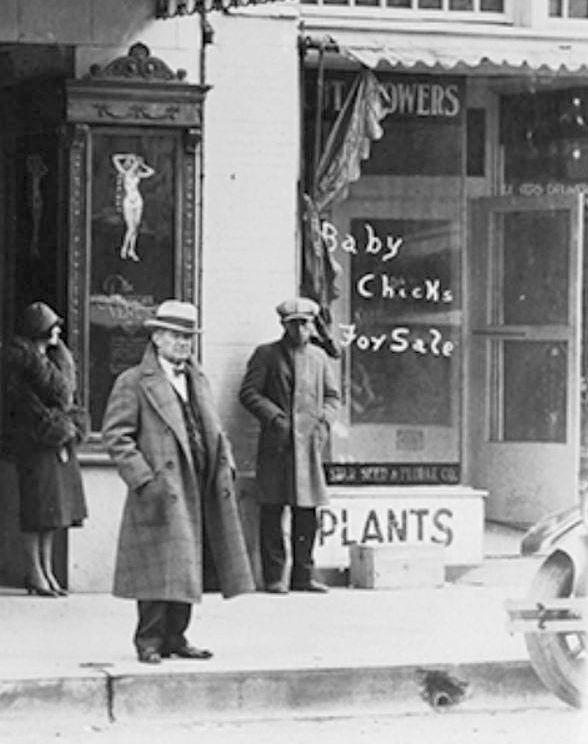
As interesting as old movie theaters are, I was more intrigued by the three people to the right of the theater (who all look like characters from a period melodrama) and by the business next door. I’ll never know who those men were or who that woman was waiting for, but finding out what business was selling baby chicks (…next door to the Palace?) was pretty easy.

palace_lone-star-seed_1926_uta_det

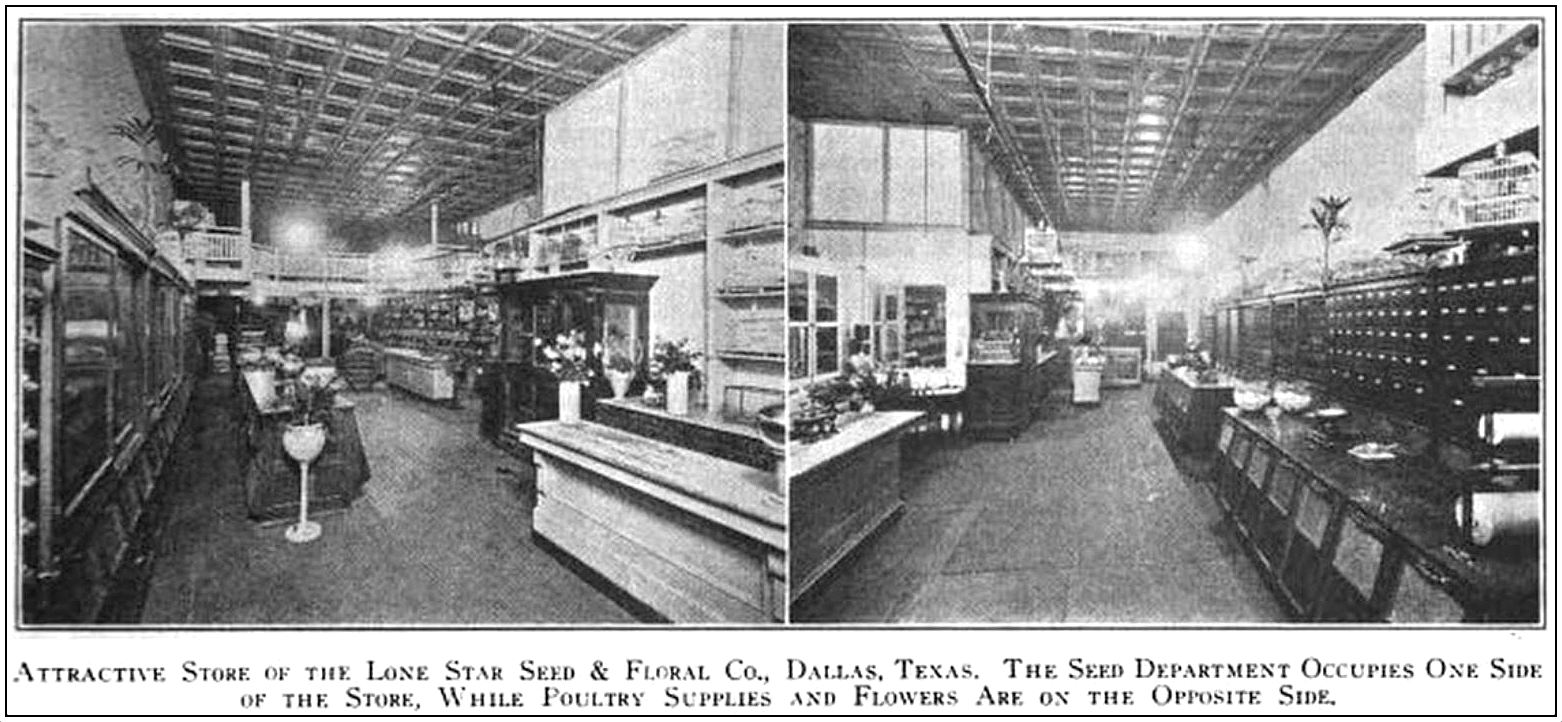
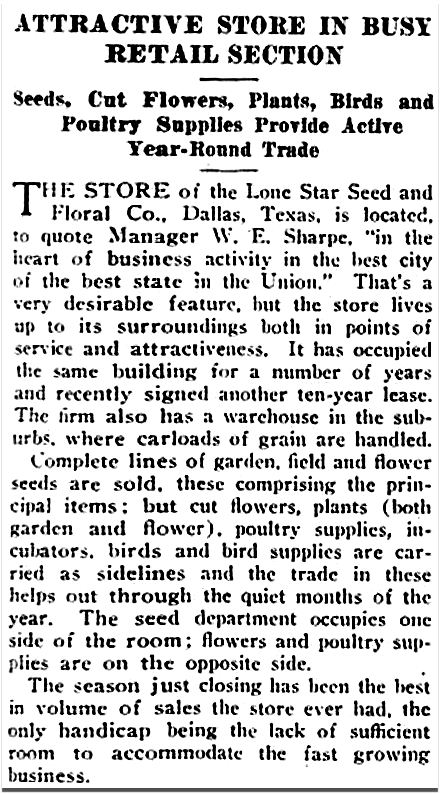
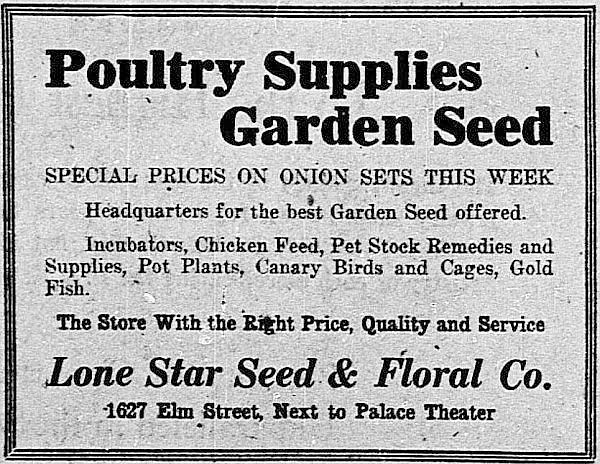
The store was Lone Star Seed & Floral (1627 Elm). They sold seeds and flowers, potted plants, canaries, goldfish, and pet and livestock supplies. They could also help you with all your poultry needs: feed, incubators, medicine, and live chickens. …Right next door to one of the plushest and most luxurious entertainment destinations in Dallas.

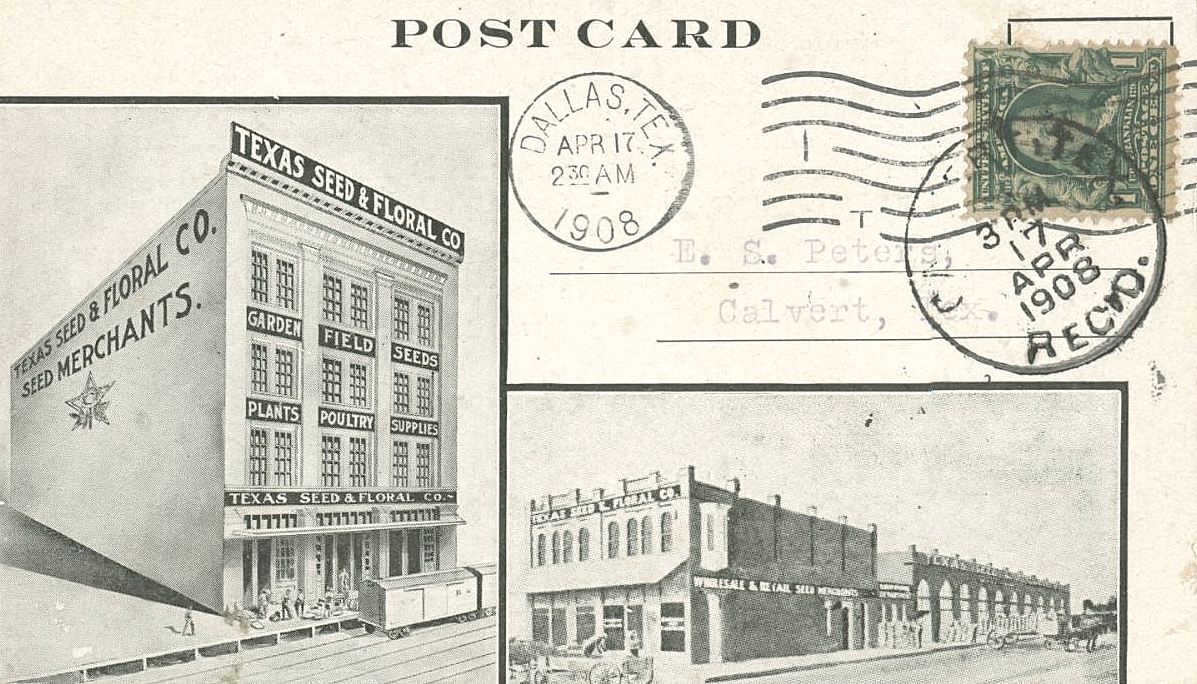
Lone Star Seed & Floral appears to have once been Texas Seed & Floral and had been around since at least 1892. They set up shop at 1627 Elm in 1902 and remained there quite a while until they moved in January, 1927, just a few months after the top photo was taken. Here is a postcard of its earlier incarnation, with photos of the Pacific Avenue location at the left, and the Elm Street location at the lower right (the view is looking north on Ervay; the Palace would later be built immediately west of this  building, to the left of the lower postcard image, just out of frame).

texas-seed-and-floral_1908_portal

The store looks very clean and extremely well organized. My inexplicable love of things stored in card-catalog-file-like cabinets and fold-out bins tells me I’d probably be stopping in fairly regularly after having seen the latest Buster Keaton film next door.

lone-star-seed_the-seed-world_082020

lone-star-seed_the-seed-world_082020_article
Photo and article from, yes, The Seed World, Aug. 20, 1920

lone-star-seed_dmn_022622
Feb., 1922

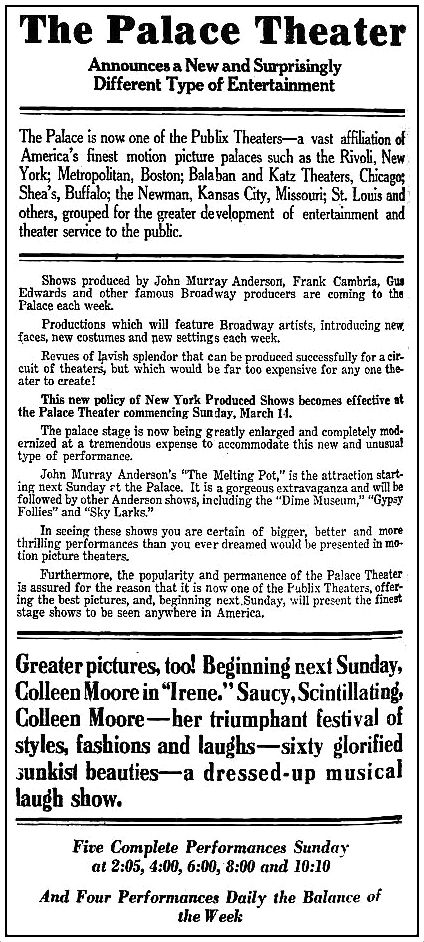
But back to the Palace. The banner is publicizing the imminent arrival of John Murray Anderson’s “The Melting Pot,” a stage production which opened at the Palace on March 14, 1926. The Palace Theater, owned by the Publix chain, was about to embark on “a new and surprisingly different type of entertainment,” which consisted of musical revue roadshows staged in New York under the direction of producer John Murray Anderson. Each production — its performers, costumes, and sets — would be sent into the hinterlands, playing a circuit which included Dallas, the only stop in Texas. There was a new show every week. And if you missed it, you really had no excuse: there were four shows daily (five on Sunday). (Anderson was later asked by Billy Rose to help with producing Fort Worth’s Centennial celebration.) (John Rosenfield’s tepidly positive Dallas Morning News review, “‘Melting Pot’ Is Presented at Palace, Introducing New Style Film Theater Feature,” ran on March 15, 1926.)

palace_dmn_031326_melting-pot-ad
Palace ad, March 13, 1926

*

palace-theatre_1926_uta_det1

***

Sources & Notes

Top photo from the Billy Burke Photograph Collection, UTA Libraries, Special Collections; more info here.

See the same view today via Google Street View here.

The Texas Seed & Floral Co. postcard is from the collection of Dallas Heritage Village, via the Portal to Texas History, here.

The beloved Palace — once an honest-to-God “movie palace” was unceremoniously demolished in 1971. It had stood at Elm and Ervay for 50 years. The north side of that block is now occupied by Thanksgiving Tower. The theater and the seed store were just west of Ervay — Lone Star Seed & Floral was just to the left of where the 7-Eleven is, on the ground floor of 211 N. Ervay, the blue building seen here (the view is northwesterly from the Wilson Building across the street).

See a great photo of Elm Street in the ’20s in the post “Dazzling Neon, Theater Row — 1929” here.

Click pictures and clipping to see larger images.

*

Copyright © 2016 Paula Bosse. All Rights Reserved.


Empire Central and Its Fabulous Empire Club

empire-central_1958_ebay_det“Northwest Dallas” in 1959 — how quaint… (click for larger image)

by Paula Bosse

“Empire Central.”

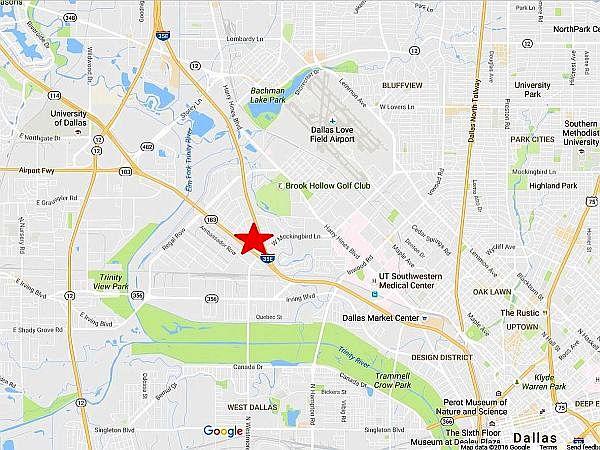
I have to admit that I’d never heard of anyplace in Dallas called Empire Central, but because I wanted to post the picture above (which I love) (and which is  from a 1959 ad), I felt I should at least look into finding out what and where it was and broaden my horizons a bit. So I did. It was (is?) an “office community” built in 1958 on 90 acres of land (later expanded), located in the “V” between Hwy. 77 (soon to be Stemmons Freeway) and Hwy. 183 (aka Empire Freeway, soon to be John W. Carpenter Freeway), with W. Mockingbird on the south and Dividend Drive on the north(-ish). It was developed as an office park as part of the already existing 1,200-acre Brook Hollow Industrial District (which, when its development began in 1953, was beyond the city limits) — both areas were developed by Windsor Properties. Empire Central was announced in 1957.

Unsurprisingly, almost every early newspaper story about plans for the new district mentioned what was considered to be its sexiest, most novel attraction: the Empire Club, an on-site dining and recreation club for employees — executives and underlings alike — who worked in the “community’s” office buildings. It was a round, 45,000-square-foot structure that sat on 9 acres and featured a distinctive roof which utilized 24 tamarack logs “more than 100 feet long, imported here especially for the club from the virgin forests of Washington” (DMN, Nov. 24, 1957). Its amenities included a sunken garden, a terraced dining room, lounge, swimming pool, putting green, and shuffleboard court, all nestled in a “garden-like atmosphere.” What a great perk!

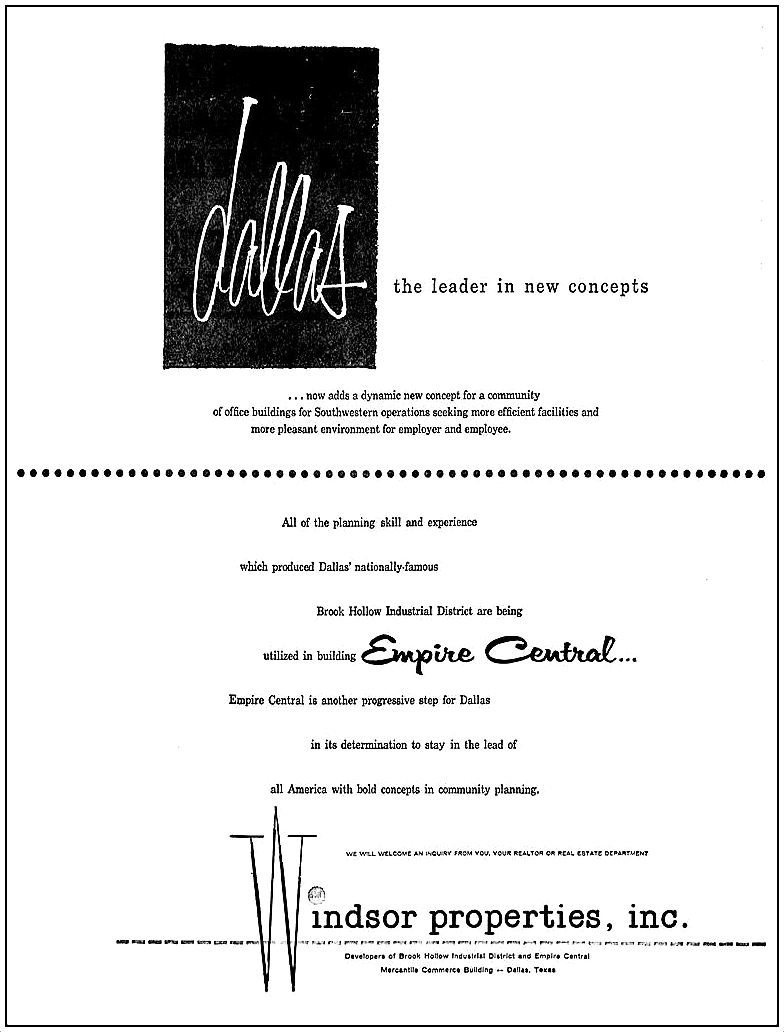
The club was important in the conceptualization of the office park, as the developers insisted that a happy employee was a productive employee, as can be seen in the text from a 1959 advertisement which ran the week the club opened:

Two fundamental concepts were taken into consideration by Windsor Properties, Inc., in designing Empire Central.

First was the realization that the company able to attract the most capable employees at a given wage would be most successful. Second, the urbanization of our population has created the need for a measure of community life.

The Empire Club, as the heart of Empire Central, is designed to accomplish both objectives for management.

And that club looked cool. It was a cutting-edge design from the always impressive George Dahl, one of Dallas’ top architects. (Dahl worked on several other projects with W. C. Windsor — Sr. and Jr. — including a prison (?!) and several other buildings in the Empire Central District.) Dahl’s previous big round building — Memorial Auditorium/Dallas Convention Center — had opened in 1957, just months before construction began on this unusual and sophisticated clubhouse, something one would certainly not expect to find plonked down in the middle of such prosaic surroundings.

empire-central_dmn_101859_empire-club_det

empire-central_dmn_101859_empire-club_pool_det

empire-central_dmn_101859_map_det

Below, the full ad, which appeared the week the new Empire Club opened in October, 1959 (click to see larger image):

empire-central_dmn_101859_empire-club
Oct., 1959

At some point (or maybe always) the club began to be used by outside groups. In the ’60s, it was the site of a lot of Junior League and debutante activities and dances. In 1966 the Empire Club became The Round House restaurant (in which could be found the Fatted Calf club). The last listing I could find of a restaurant or club at that address (which was, originally, 100 Empire Central Drive and, later, 1100 Empire Central Place) was in 1971. Sadly, that cool-looking building was torn down somewhere along the way. What a shame! I just discover a George Dahl-designed building I’d never seen — in a part of town I’d never heard of — and *poof*! … it’s gone. …At least I didn’t have time to get too attached.

**

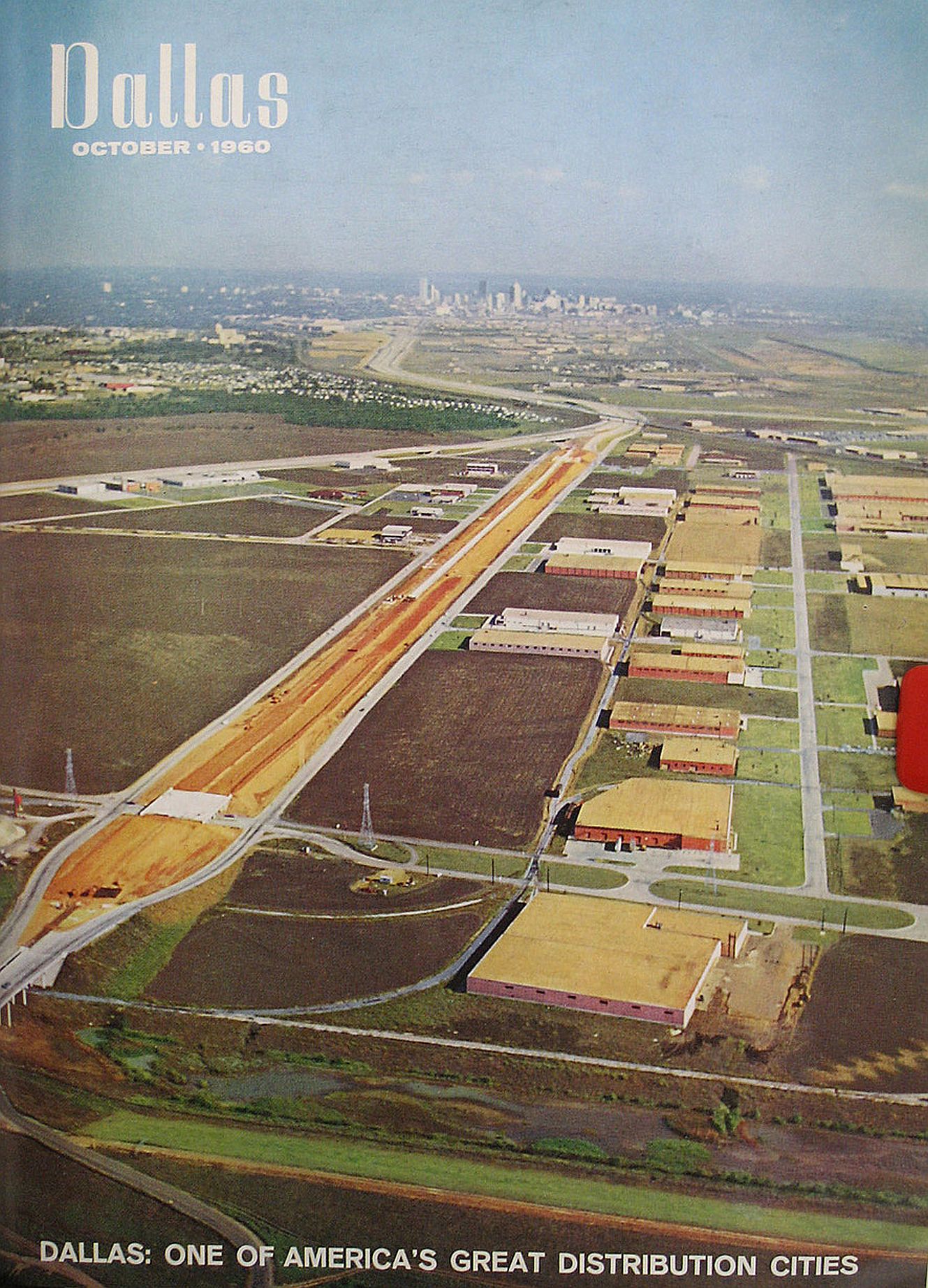
Here’s a great photo from 1960 (click it — it’s really big) looking southeast toward downtown from about Regal Row (bridge in foreground), with the new and improved Carpenter Freeway/Hwy. 183 in the center, and Stemmons — coming in from the left — meeting it in the distance; the Mockingbird bridge is just beyond it, just above the point. The Empire Central district — in between Stemmons and Carpenter — looks kind of puny here. You  might have to squint, but you can see the brown, round Empire Club building in the center of the triangle. If you listen closely, you might be able to hear a Southwestern Drug Company secretary splashing happily in the heated pool.

empire-central_183-construction_1960_dallas-freeways-site

*

empire-central_1958_ebay
1958 ad

empire-central_dmn_011958_ad
Jan., 1958

empire-central_google
Google Maps

***

Sources & Notes

Top image is from a full-page magazine ad from 1958, found on eBay.

The 1960 photo appeared on the cover of Dallas magazine (October, 1960); I found it on the unbelievably thorough Dallas-Fort Worth Freeways site (main page is here, this photo is linked from here).

This area — what is it called? The consensus seems to be “Brook Hollow.” Or maybe “Stemmons Corridor” (the Wikipedia entry for the latter is here).

The Flashback Dallas post on the area’s 1920s-era namesake golf club — “Brook Hollow Country Club — 1940s” — is here.

(Thank you, Dallas History Facebook group for the helpful tidbits!)

Think it should be bigger? Click it!

*

Copyright © 2016 Paula Bosse. All Rights Reserved.


Lady Godiva and the “Flesh Shows” of the Texas Centennial — 1936

tx-centennial_streets-of-paris_ticket_cook-coll_smuGeorge W. Cook Collection/SMU

by Paula Bosse

When one thinks of the Texas Centennial Exposition, the splashy 6-month extravaganza held at Fair Park to celebrate the 100th anniversary of Texas independence, one might not immediately think of the three things associated with the big show that were making headlines around the country (and were undoubtedly responsible for healthy ticket sales): according to Variety, the Centennial had “all the gambling, wining and girling the visitor wants” (June 10, 1936).

The Dallas exposition (and the coattail-riding Frontier Exposition, which was held at the same time in Fort Worth) was “wide open” in 1936: there was gambling, liquor, and nudity everywhere. The Texas Rangers cracked down on some of the gaming in the early days, but alcohol and girlie shows continued throughout the expo’s run.

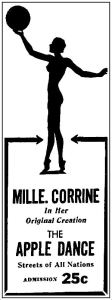
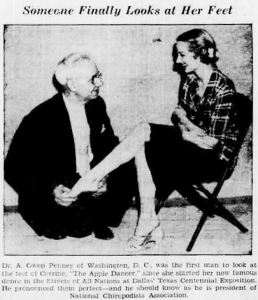
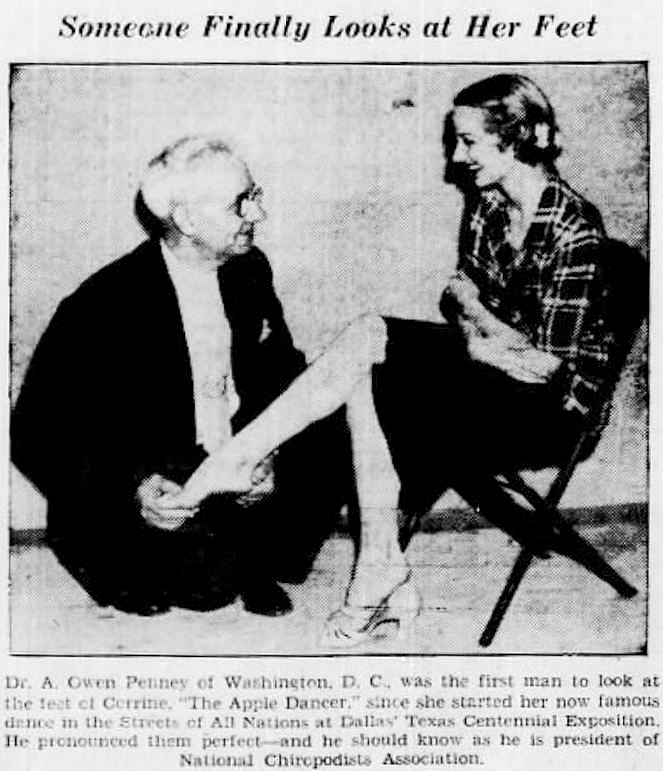
As far as the nudity, it really was everywhere. It’s a little shocking to think that this sort of thing was so widely accepted in very conservative Dallas — 80 years ago! — but it was (despite some local pastors disdainfully referring to the big party as the Texas Sintennial). Many of the acts — and much of the personnel — had appeared in a version of the same revue in Chicago in 1933 and 1934. Some of the offerings for the Centennial visitor: peep shows a-plenty, the clad-only-in-body-paint “Diving Venus” named Mona Lleslie (not a typo), a naked “apple dancer” named Mlle. Corinne who twirled with a “basketball-sized ‘apple'” held in front of her frontal nether regions, and the somewhat obligatory nude chorus girls. There was also an “exhibit” in which nude women were on display as “artists’ models,” posing for crowds of what one can only assume were life-drawing aficionados who were encouraged to render the scene before them artistically (…had they planned ahead and brought a pencil and sketchpad); those who lacked artistic skill and/or temperament were welcome to just stand there and gawk. (Click photos and ads to see larger images.)

corinne_apple-dancer_cook-collection_smu

tx-centennial_apple-dancer_dmn_070536

tx-centennial_apple-dancer_franklin-ind-evening-star_071136Franklin, Indiana Evening Star, July 11, 1936

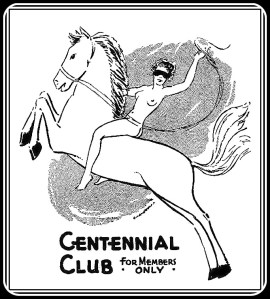
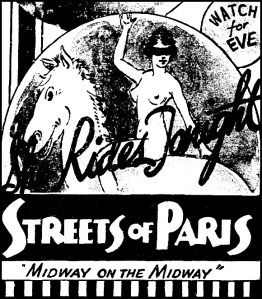
Another attraction was Lady Godiva, who, naked, rode a horse through the Streets of Paris crowds. Her bare-breastedness even made it into ads appearing in the pages of staid Texas newspapers. (Click to see larger images.)

tx-centennial_lady-godiva_dmn_060436_sm
June, 1936

There were two areas along the Midway where crowds could find these saucy attraction: Streets of Paris (which Time magazine described as appealing to “lovers of the nude”) and Streets of All Nations (“for lovers of the semi-nude”). Lady Godiva was part of the Streets of Paris, and she rode, Godiva-esque, nightly. The gimmick (beyond the gimmick of a naked woman riding a horse in Fair Park) was that she was supposed to  be a Dallas debutante who rode masked in order to conceal her identity. The text below is from the ad above.

MASKED…but unclothed in all her Glory…Riding a milk-white steed. […] Miss Debutante was introduced to Dallas society in 1930. She was later starred in Ziegfeld’s Follies, in “False Dreams, Farewell,” “Furnished Rooms,” and other Broadway successes. She appeared in motion pictures, being starred in “Gold Diggers of 1935,” “Redheads on Parade” (yes, she is a redhead) and other picture successes.

SHE WILL STARTLE DALLAS SOCIETY! JUST AS THE STREETS OF PARIS WILL BE THE SENSATION OF THE CENTENNIAL SEASON .. WHO IS SHE?

And, of course, none of that was true (including the fact that this “Lady Godiva” rode a white horse — apparently one could not always be found), but I’m sure it got local pulses racing. My guess is that there were several Ladies Godiva (none of whom were members of Dallas society). One woman was actually named as the Centennial’s exhibitionist horsewoman. I haven’t been able to find mention of a “Paulette Renet” anywhere other than the caption of this photo, but here she is:
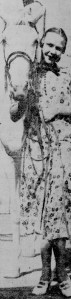
godiva_madera-tribune_082936

godiva_madera-tribune_082936-caption
Madera (California) Tribune, Aug. 29, 1936

Another photo featuring what appears to be the same woman, with this caption: “No white horse for Lady Godiva, at the Texas Centennial Exposition in Dallas. A feature of the ‘Streets of Paris,’ a midway show, Godiva rode a ‘paint pony,’ first week because no white one was available.”

godiva_altoona_penn-tribune_062336
Altoona (Pennsylvania) Tribune, June 23, 1936

I think this is still the same woman, but on a rare white steed:
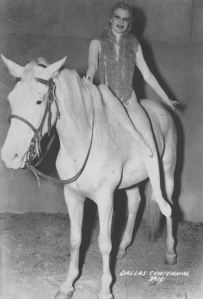
lady-godiva_cook-collection_smu

The Godiva who appeared in the March of Times newsreel “Battle of a Centennial” appears to be a different woman. (Watch a 45-second snippet of the newsreel which features both a glimpse of Lady Godiva and a head-shaking son of Sam Houston wondering what the deal is with the younger generation — here.)

godiva_march-of-time_1936

Imagine seeing performers and attractions like this along the Fair Park midway today!

*
godiva_dmn_070536-detJuly, 1936 (ad detail)

tx-centennial_lady-godiva_dmn_060436-det
June, 1936 (ad detail)

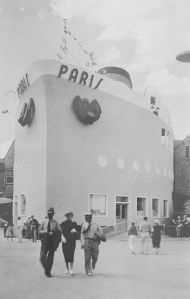
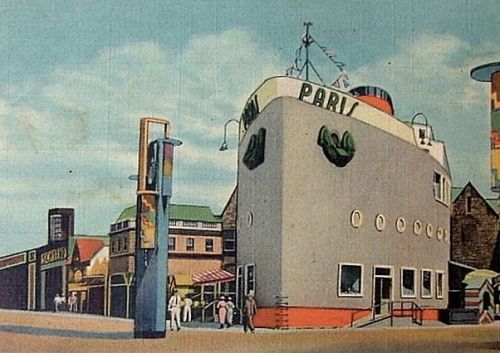
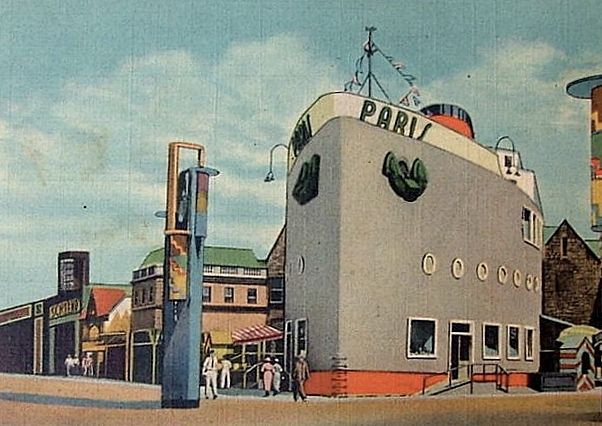
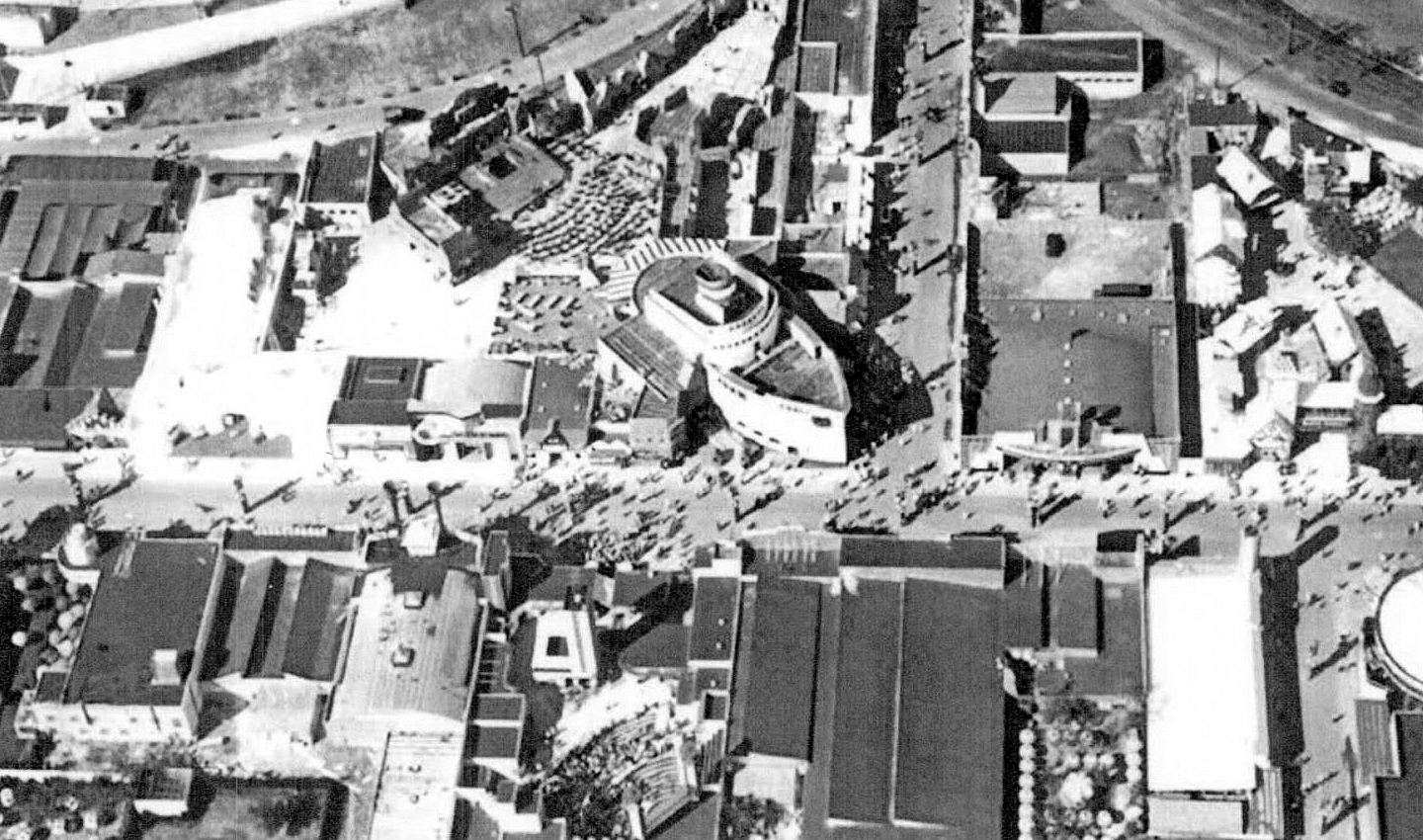
What was the Centennial Club? It was an exclusive, invitation-only private club located within the very large George Dahl-designed building which housed the Streets of Paris (and which was shaped like the famed S. S. Normandie ocean liner). It had three levels (“decks”) and housed a lounge, dining rooms, a main clubroom, and a “dance pavilion” — all air conditioned. From various decks, well-heeled patrons could look down at the action going on below: the milling throngs of the hoi polloi, the Streets of Paris shows, and the Midway.

centennial-club_dmn_061636
June, 1936

tx-centennial_streets-of-paris_art-institute-chicago

tx-centennial_streets-of-paris_ebay_rppc

tx-centennial_streets-of-paris

Can’t miss the ridiculously large land-locked ocean liner in the center of the photo below. Mais oui!
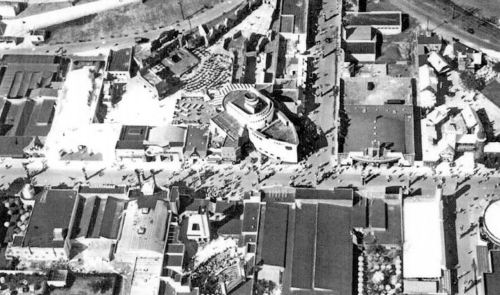
normandie_winters_dhs

**

The articles below on “gals, likker, and gambling” are GREAT. They are from the show biz trade publication Variety, which really latched onto the rampant nudity on view at the Texas Centennial. Remember: 80 years ago! (The abbreviation of “S. A.” in the headline of the second article stands for “sex appeal.”) (As always, click to see larger images.)
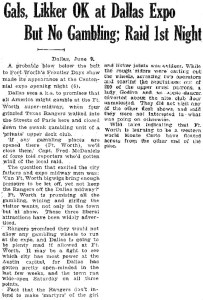
sex_variety_061036
Variety, June 10, 1936

sex_variety_062436
Variety, June 24, 1936

nudity_variety_070136
Variety, July 1, 1936

***

Sources & Notes

Top photo shows an admission ticket to the Streets of Paris, from the George W. Cook Dallas/Texas Image Collection, Central University Libraries, Southern Methodist University; more information is here. Another interesting item from this collection is a brochure (here) which describes Streets of Paris as “the smartest, most sophisticated night club in America. Here you will find the gay night life of Paris in a setting of exotic splendor.”

Photo of “Mlle. Corrine” also from the Cook Collection at SMU; more info on that photo here.

Photo of Lady Godiva on a white horse (with the words “Dallas Centennial” near the bottom … um, bottom of the image … is also from the Cook Collection at SMU, here.

The photo showing the night-time crowd outside the Streets of Paris Normandie is from the Ryerson & Burnham Archives, Art Institute of Chicago; more info here.

The aerial photograph showing the S. S. Normandie is from Willis Cecil Winters’ book Fair Park (Arcadia Publishing, 2010); photo from the collection of the Dallas Historical Society.

All other sources noted, if known.

See quick shots of the Streets of Paris and the Streets of All Nations in the locally-made short film “Texas Centennial Highlights,” here (Streets of Paris is at about the 7:00 mark and the more risqué bits showing the parasol chorus girls followed by Mlle. Corinne and her apple dance (I mean, it’s not really shocking, but … it still kind of is…) at the 8:45 mark. (Incidentally, there appears to be a new book on Corinne and her husband — Two Lives, Many Dances — written by their daughter.)

A very entertaining history of the State Fair of Texas and the Texas Centennial Exposition can be found in the article “State Fair!” by Tom Peeler (D Magazine, October, 1982), here.

A Flashback Dallas post on the feuding Dallas and Fort Worth Centennial celebrations can be found here.

More Flashback Dallas posts on the Texas Centennial can be found here.

Click pictures and clippings to see larger images.

*

Copyright © 2016 Paula Bosse. All Rights Reserved.

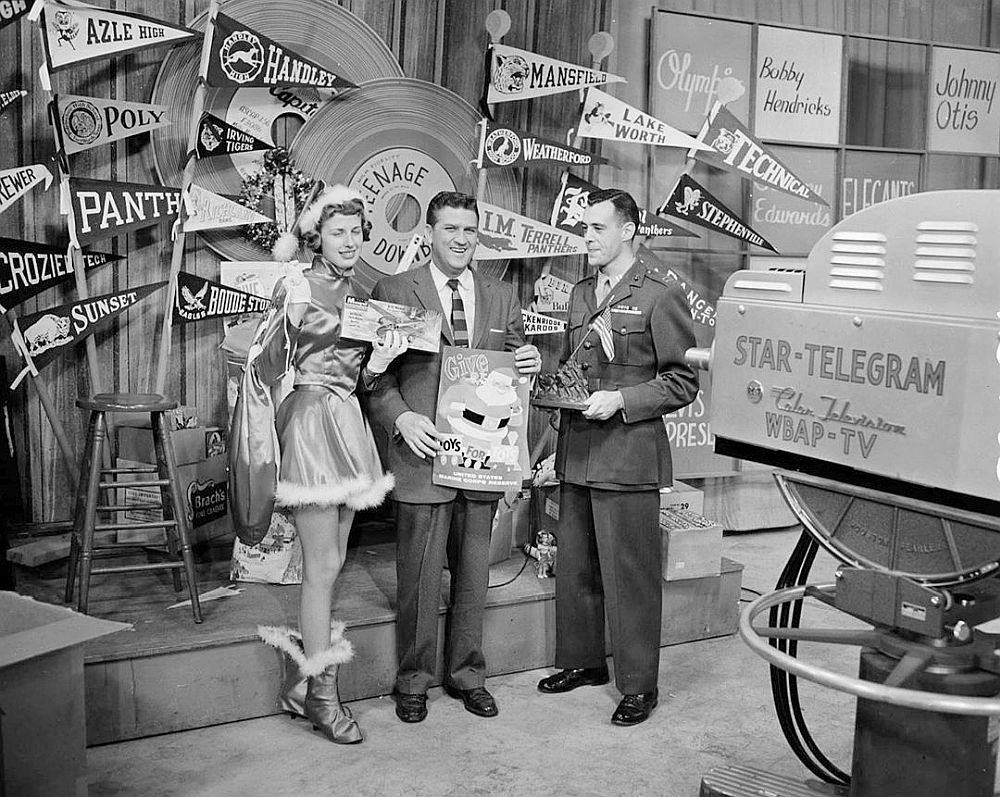
“Teen-Age Downbeat”

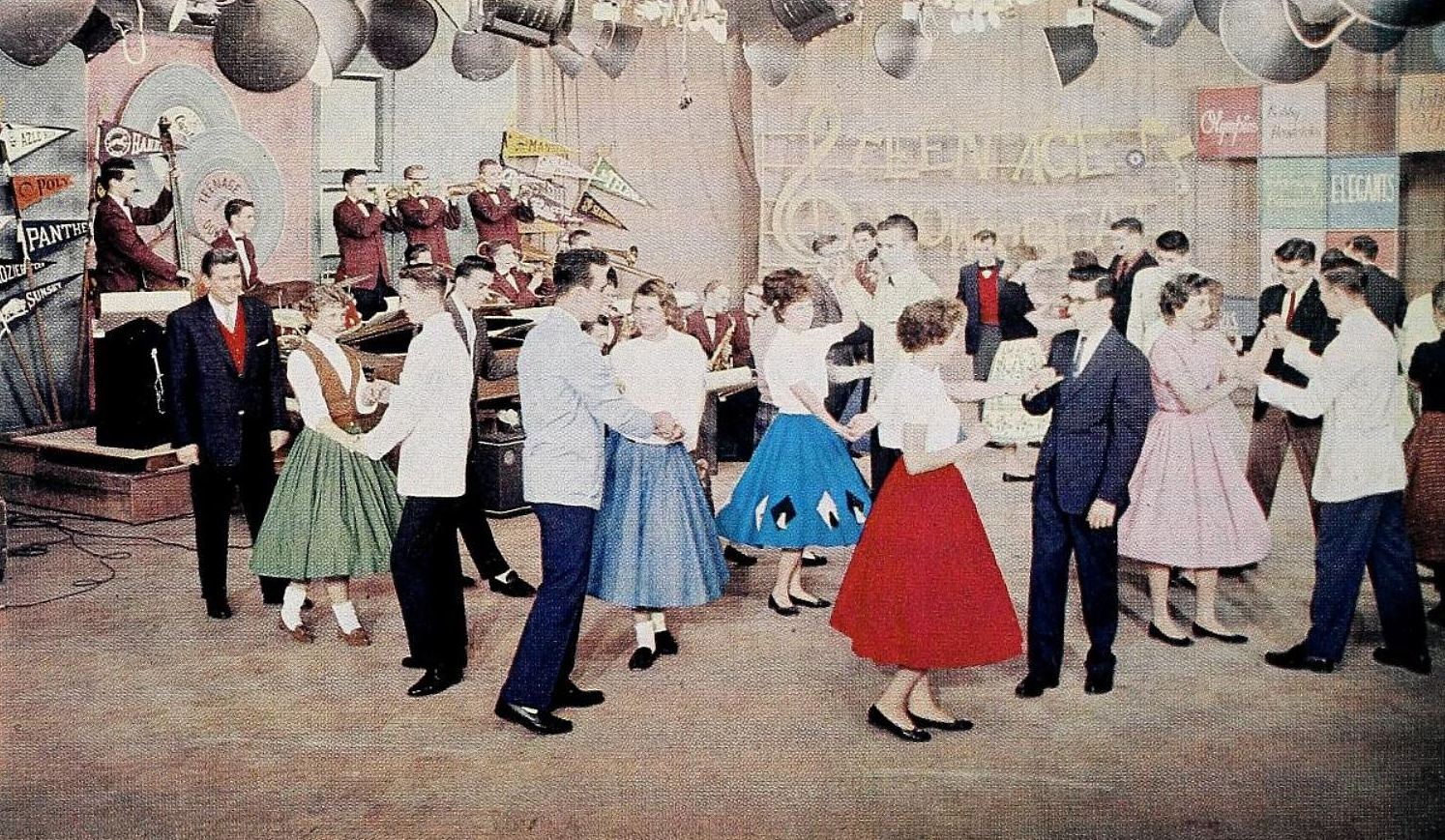
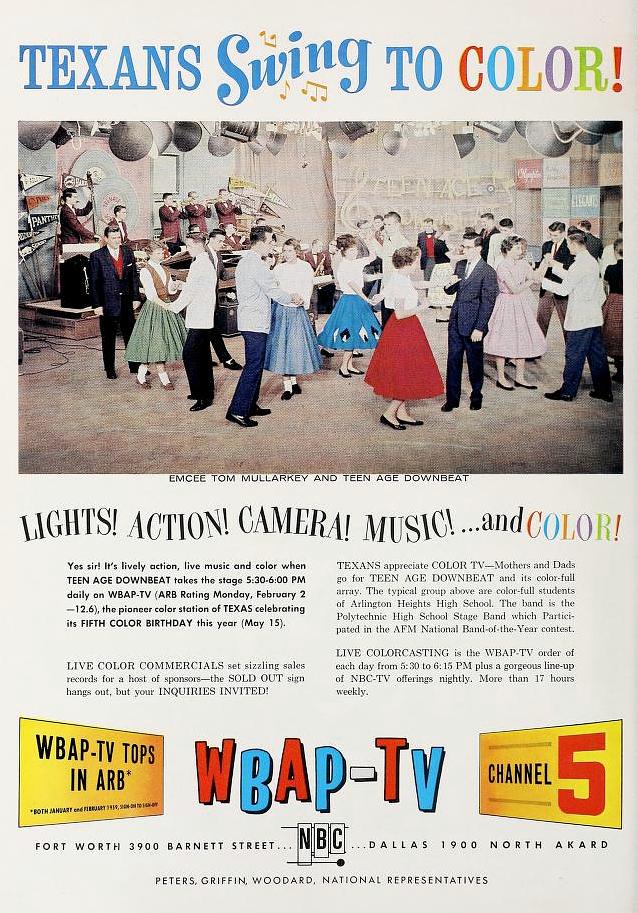
teen-age-downbeat_broadcasting-mag_051859_detWBAP’s “Teen-Age Downbeat,” 1959 (click for larger image)

by Paula Bosse

“Teen-Age Downbeat” — Fort Worth’s answer to “American Bandstand” — debuted on WBAP-TV in January, 1958 — in COLOR. It featured teens from the Dallas-Fort Worth area (…or maybe I should say from the Fort Worth-Dallas area…) who would play and dance to their favorite records. The host was WBAP broadcaster Tom Mullarkey (seen above at the left, wearing the red vest). The show was quite popular and lasted as best I can tell, from January, 1958 until July, 1961 (the last mention in The Fort Worth Star-Telegram was July 1, 1961). I’m guessing those kids danced to a lot of Fabian.

teenage-downbeat_fwst_010558FWST, Jan. 5, 1958

teen-age-downbeat_sponsor-mag_080860“Sponsor” trade magazine, Aug. 8, 1960

teen-age-downbeat_unt-lab-bandNorth Texas State College’s Lab Band with director Gene Hall

teenage-downbeat_fwst_022661
FWST, Feb. 26, 1961

teen-age-downbeat_broadcasting-mag_051859
“Broadcasting” trade magazine, May 18, 1959

teen-age-downbeat_xmas_1958_fortworthhistorical-IG“Toys For Tots” campaign, Christmas 1958

***

Sources & Notes

The color photo (which appeared in a full-page WBAP ad in the trade magazine Broadcasting) shows non-teen Tom Mullarkey watching over the dancers from Arlington Heights High School, as the Polytechnic High School Stage Band plays some happenin’ tunes. (I do see two Dallas high school pennants in the photo: Crozier Tech and Sunset.)

The photo showing director Gene Hall with the North Texas State College (now the University of North Texas) Laboratory Band was found at UNT’s Portal to Texas History site, here. The photo is not dated, but a blurb in The Fort Worth Star-Telegram mentioned that Hall and the band were to appear on “Teen-Age Downbeat” on Feb. 5, 1959.

Photo of the “Toys For Tots” campaign, featuring a sexy Santa’s helper, Tom Mularkey, and a Marine Corps (Reserve?) officer was found on the Instagram feed of @fortworthhistorical.

*

Copyright © 2016 Paula Bosse. All Rights Reserved.
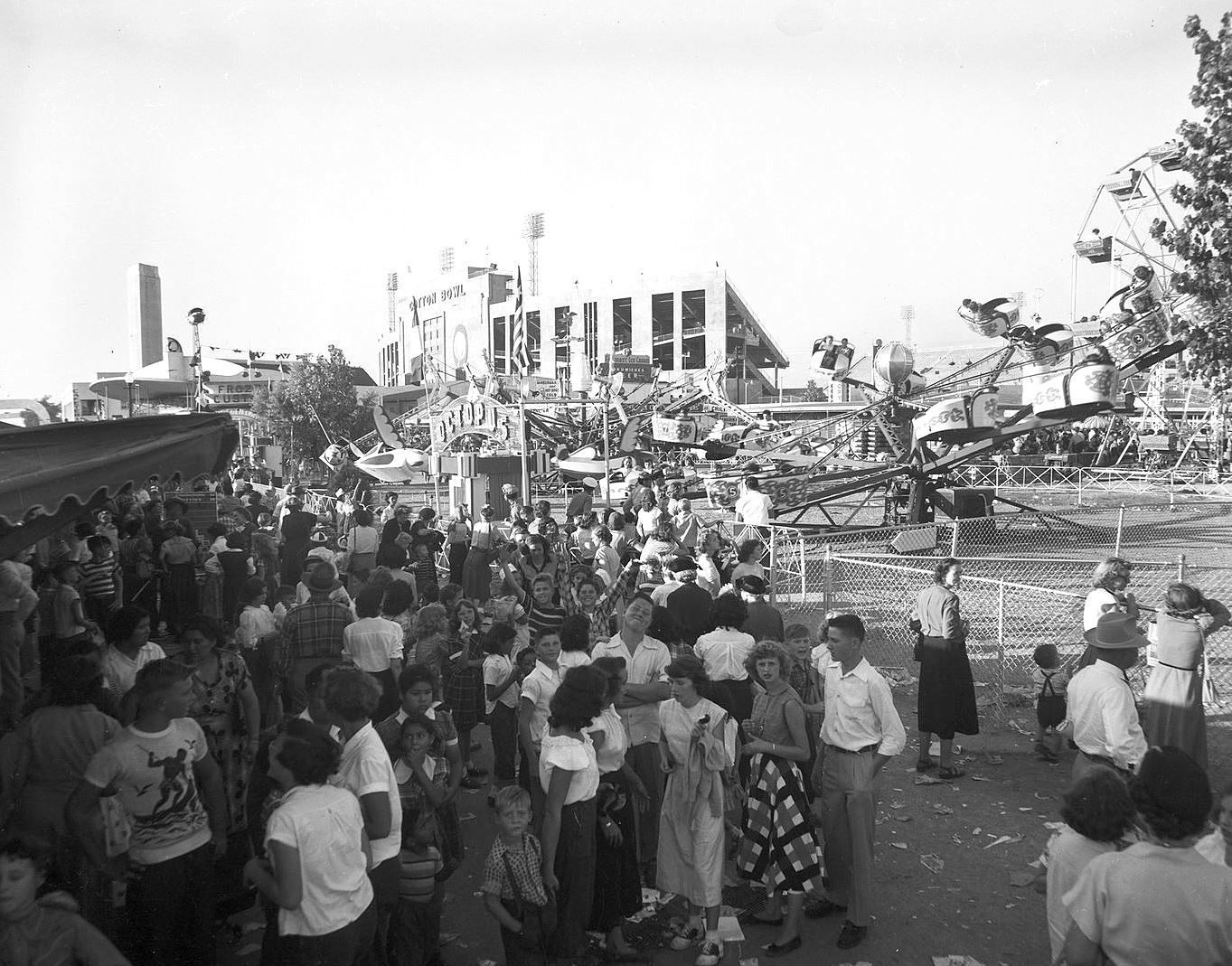
Zooming In on the State Fair: The Midway, the Cotton Bowl, and the Octopus — ca. 1950

state-fair_midway-cotton-bowl_squire-haskins_ca_1950_utaAnother visit to the fair… (click for larger image)
by Paula Bosse

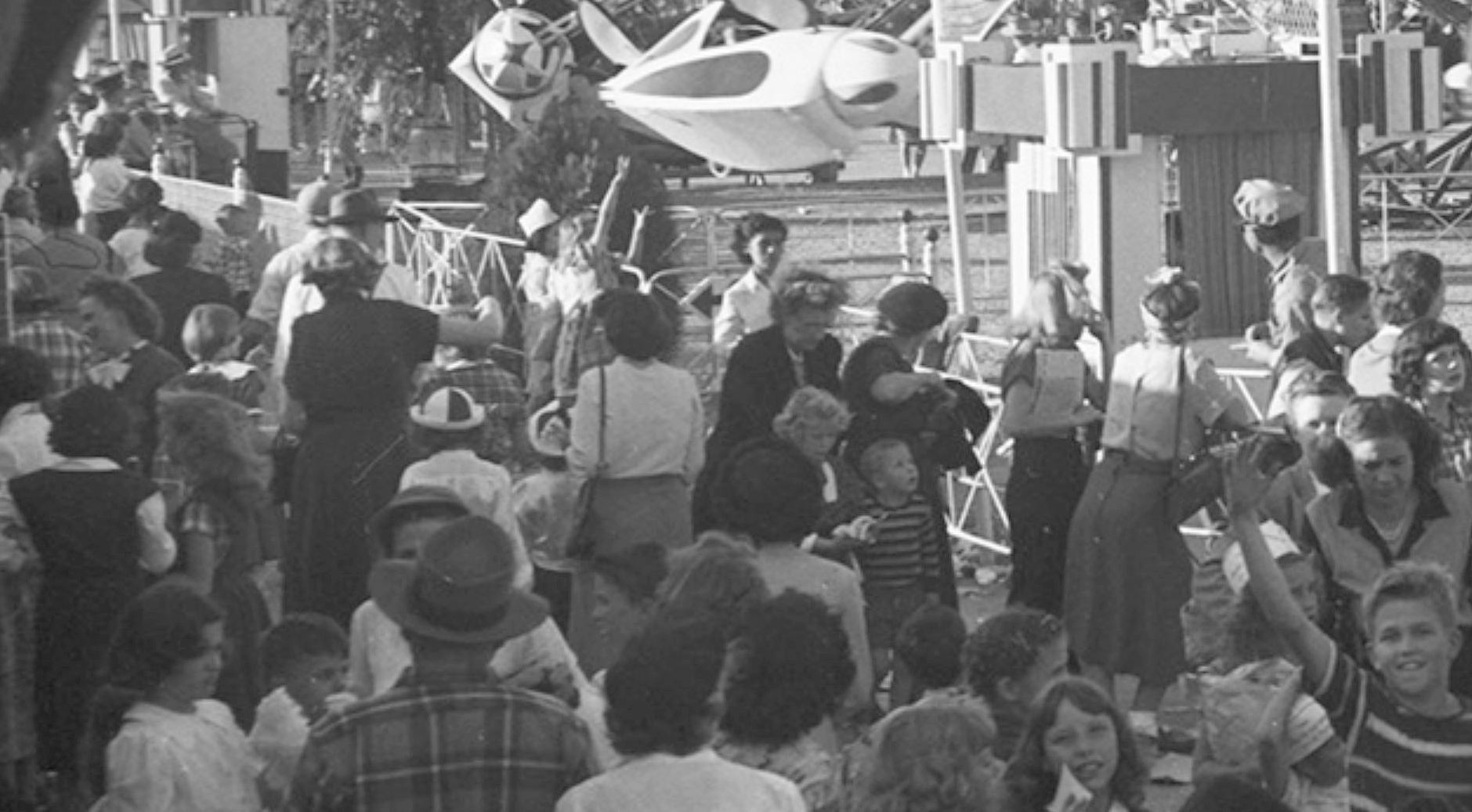
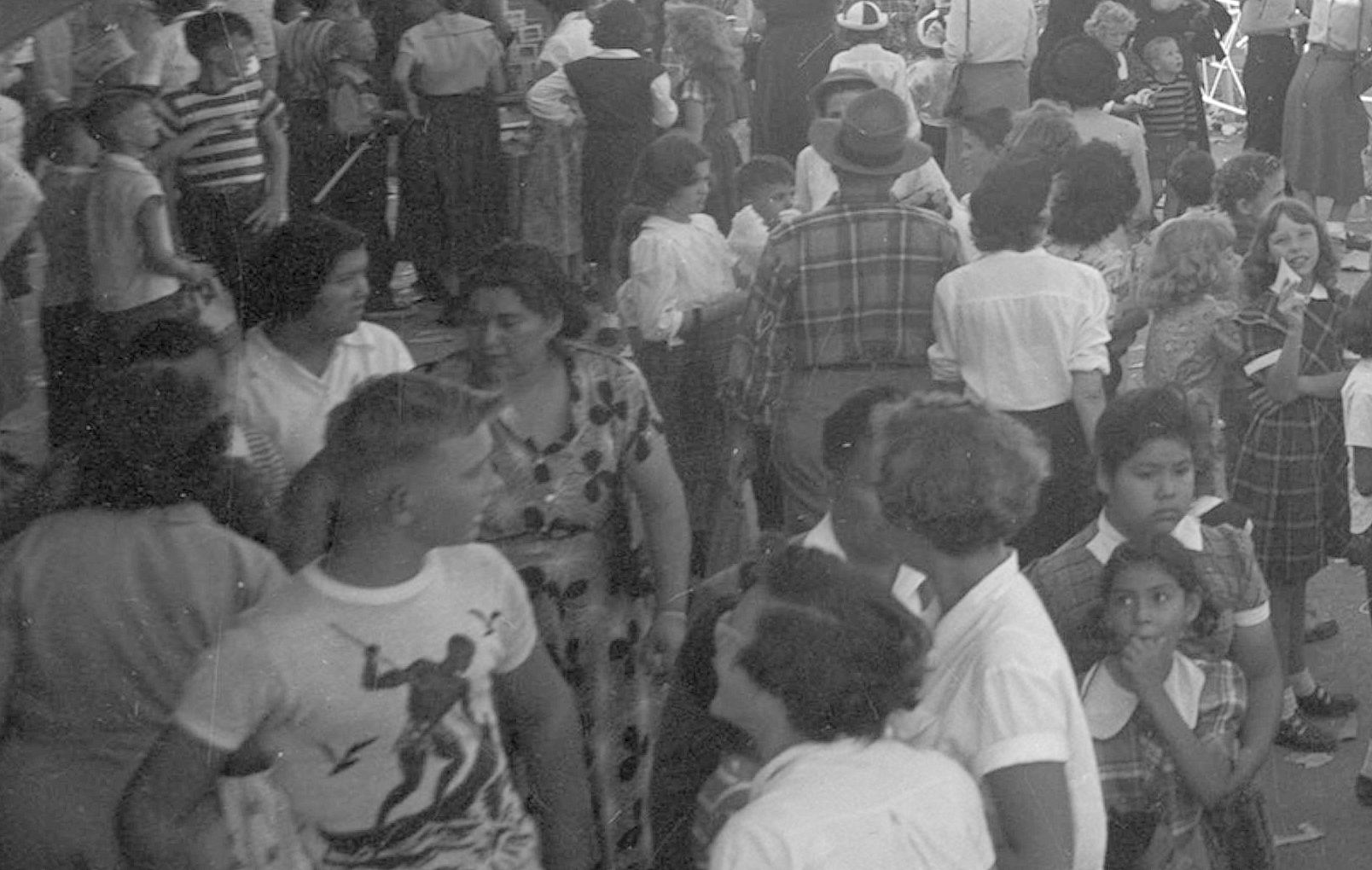
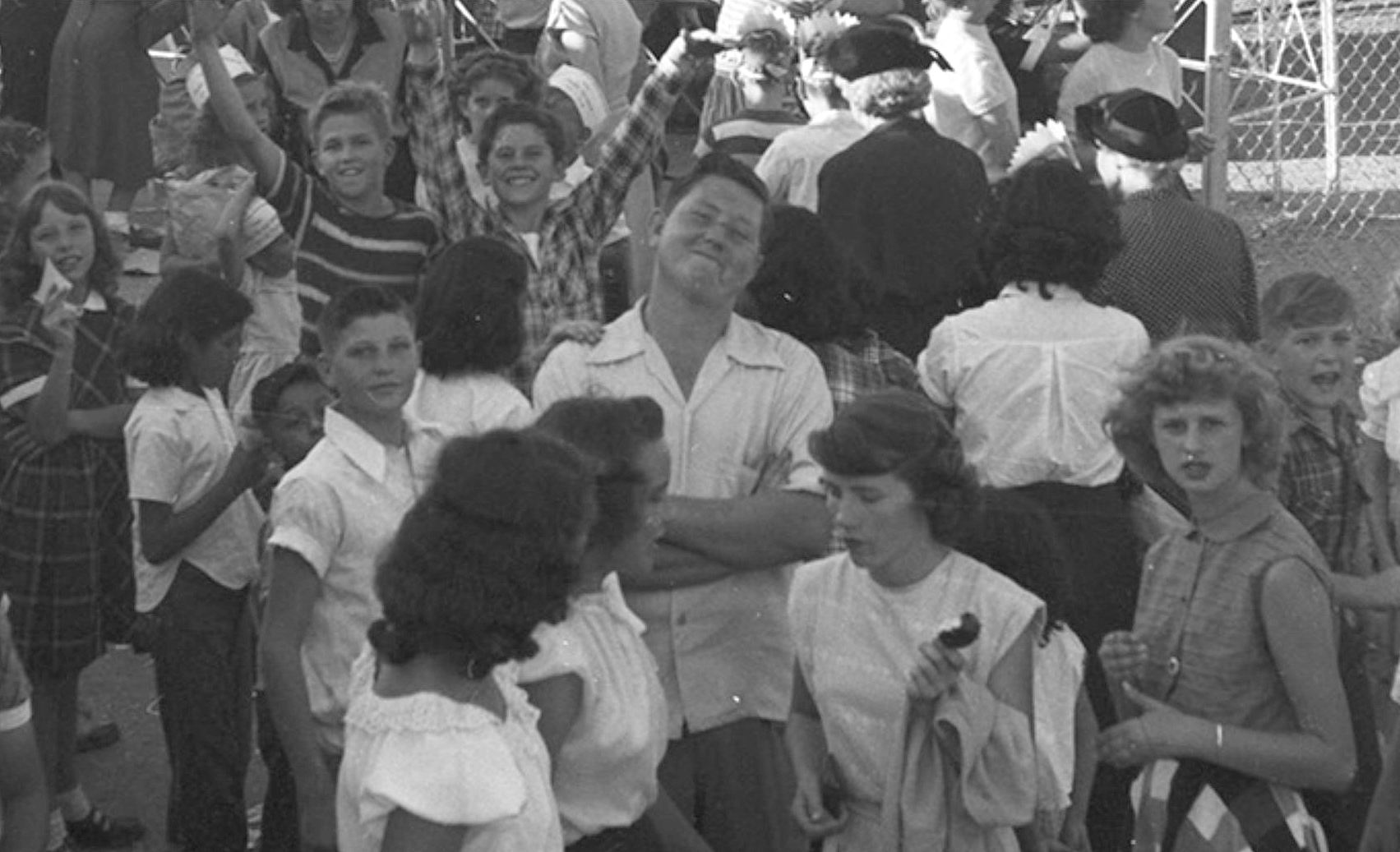
When I see old photos of the State Fair, I always look at the people. Let’s take a closer look at this great photo by Squire Haskins, taken around 1950. (See a BIG scan of this photo at the UTA website, here.)
Here are a few magnified details from Haskins’ photo (all are much larger when clicked):

midway-zoom_1

midway-zoom_2

midway-zoom_3

midway-zoom_5

midway-zoom-4

midway-zoom_6

***

Top photo by Squire Haskins, from the Squire Haskins Photography, Inc. Collection, Special Collections, University of Texas at Arlington Libraries; more information can be accessed here. (Other photos from this collection which were taken around the State Fair Midway at about this time were taken in October, 1950 — this one is not dated, but it seems likely it was taken at the same time.)

See other photos I’ve zoomed in on here.

Click pictures for larger images!

*

Copyright © 2016 Paula Bosse. All Rights Reserved.

The State Fair of Texas: “A Son-of-a-Gun in ’51” — 1951

state-fair-poster_1951_pinterest

by Paula Bosse

In honor of opening day of the 2016 State Fair of Texas, a poster from the 1951 fair. Proto-Big Tex imagery was being used well before the giant cowboy’s debut the following year (see, that hand thing is going on even back then…).

Welcome back, SFOT!

***

Poster found on Pinterest.

*

Copyright © 2016 Paula Bosse. All Rights Reserved.