Flashback : Dallas

A Miscellany: History, Ads, Pop Culture

Category: Leisure

Tower Theater — 1967

theater-row_preservation-dallasMovie premiere at the Tower, 1967 (click for larger image) photo, Lovita Irby

by Paula Bosse

Elm Street, probably Thursday July 6, 1967, when “The Dirty Dozen” opened at the Tower. Next door at the Capri was “Spartacus.” Down the street, at the Majestic, the second week of the James Bond movie, “You Only Live Twice.” At first I thought it was odd that there was little in the clothing that looked like 1967, but I guess there probably weren’t a lot of hippies standing in line to see “The Dirty Dozen.”

***

Photo by Lovita Irby, from the November 2013 Preservation Dallas newsletter, accessible in a PDF here.

Trivia: Appearing in “The Dirty Dozen” was Dallas native Trini Lopez.

Previous Flashback Dallas posts on Theatre Row/Theater Row, here.

*

Copyright © 2015 Paula Bosse. All Rights Reserved.


Three of Dallas’ Earliest “Photoplay Houses” — 1906-1913

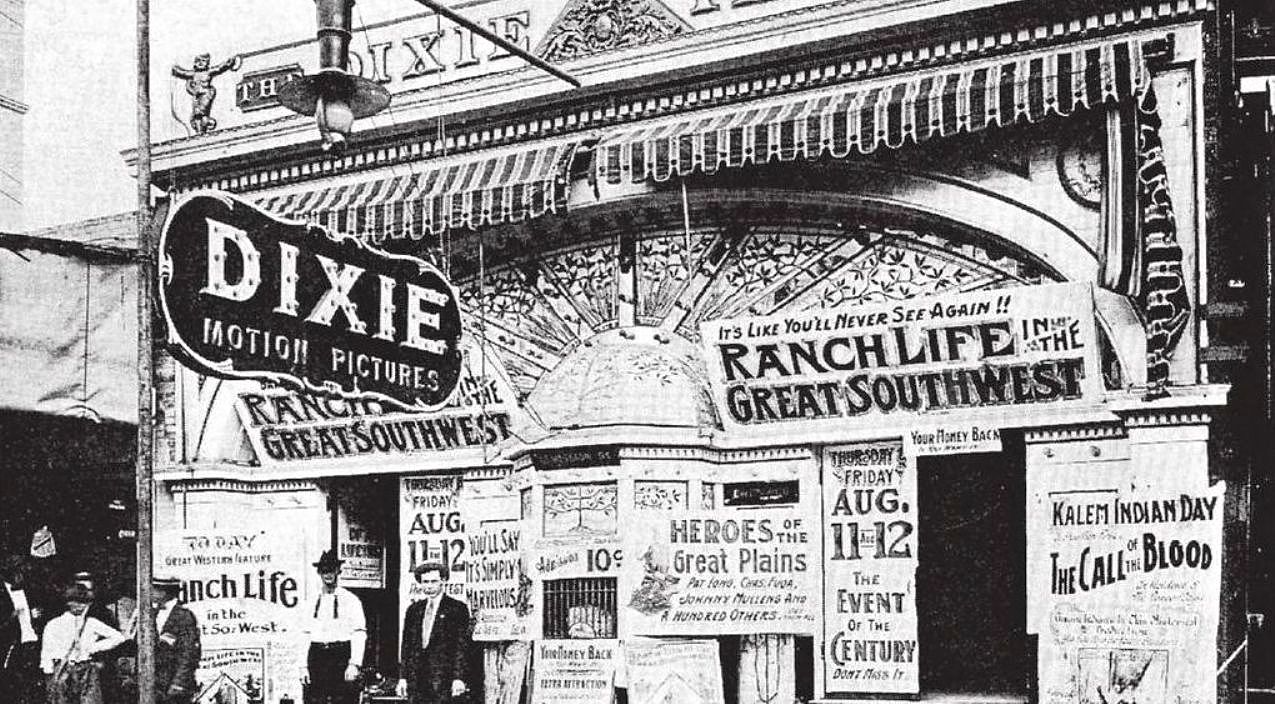
dixie-theater_1910_sherrod_smuDallas’ first movie house, here in 1910 on its third name (click for larger image)

by Paula Bosse

I seem to be deep into an unintended “Movie Week” here, all because I’ve been researching a photo of a little-known early suburban movie theater — and that’s how I stumbled onto a great article about Dallas’ first “picture shows.” The rather clunky title of the extremely informative Dallas Morning News article (which is linked below) is: “Startling Progress of Picture Shows; One-Third of Dallas’ Population Daily Entertained; History Local Houses; Dark Storerooms and Rickety Chairs Give Way to the Modern Photo-Play Theater” (March 9, 1913).

Some of the facts in the article are a bit off, but it’s fascinating to read that the first (or certainly ONE of the first) showings of a moving picture in Dallas was at the State Fair in 1897, when a boxing promoter presented what was one of the earliest “pay for view” matches in history — he showed footage of the highly publicized Jim Corbett-Bob Fitzsimmons Heavyweight Championship fight which had taken place a few months previously — the fight was originally intended to be fought in Dallas, but it was moved to Nevada, causing, one would assume, much consternation to those involved with the staging of and promotion of the fight. Not only did the promoter make back all the money he had invested locally in the thwarted boxing match, but he made a hefty profit trundling the film around the country for curious viewers (which included a large number of women who were not generally allowed to watch boxing matches).

Later, two men set up a projector in a second-story window and began showing movies on an open-air screen across the street, at Main and Lamar. It was popular, but it was also something of a traffic hazard. Also, there were itinerant hucksters who came and went, showing motion pictures wherever they could, moving from city to city.

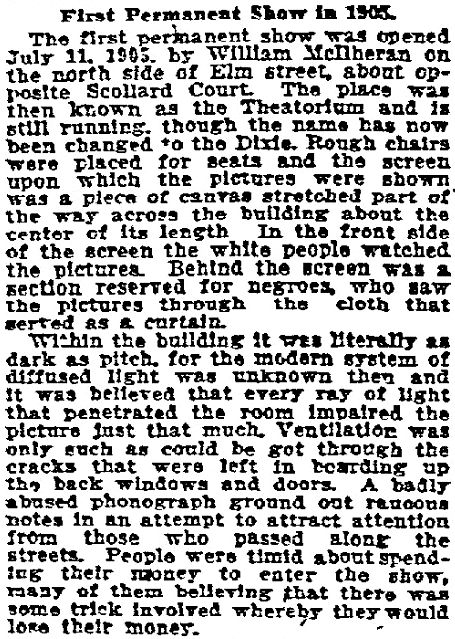
It wasn’t until the summer of 1906 that Dallas got its first permanent movie house when William McIlheran opened the Theatorium (a common word used around the country back then for a movie theater, but which, to virgin ears, sounds as odd as “Sportatorium” must to people who have never heard that word). It was at 311 Elm Street (which later became 1315 Elm), at about where Field is today, and it was the first movie theater on Theater Row! I love this description of what the place was like, from the DMN article mentioned above — even though the opening date is off by a year (click for larger image):

theatorium_dmn_030913DMN, March 9, 1913

theatorium_sherrod

With the arrival of this permanent theater (one with an actual roof over it), the moving picture had finally became more than just a mere novelty, and the success of the Theatorium started a mad dash of entrepreneurs opening up their own theaters. Within a month of the Theatorium’s opening, at least four more such houses were open for business.

At some point the Theatorium became the Wonderland (in 1907 or 1908), and it began showing so-called “talking films” (the talking was, apparently, provided by an off-stage actor providing the spoken dialogue while trying to match the silent actors’ lips on screen).

cameraphone_talking-pictures_dmn_101908The “Cameraphone” — DMN, Oct. 19, 1908

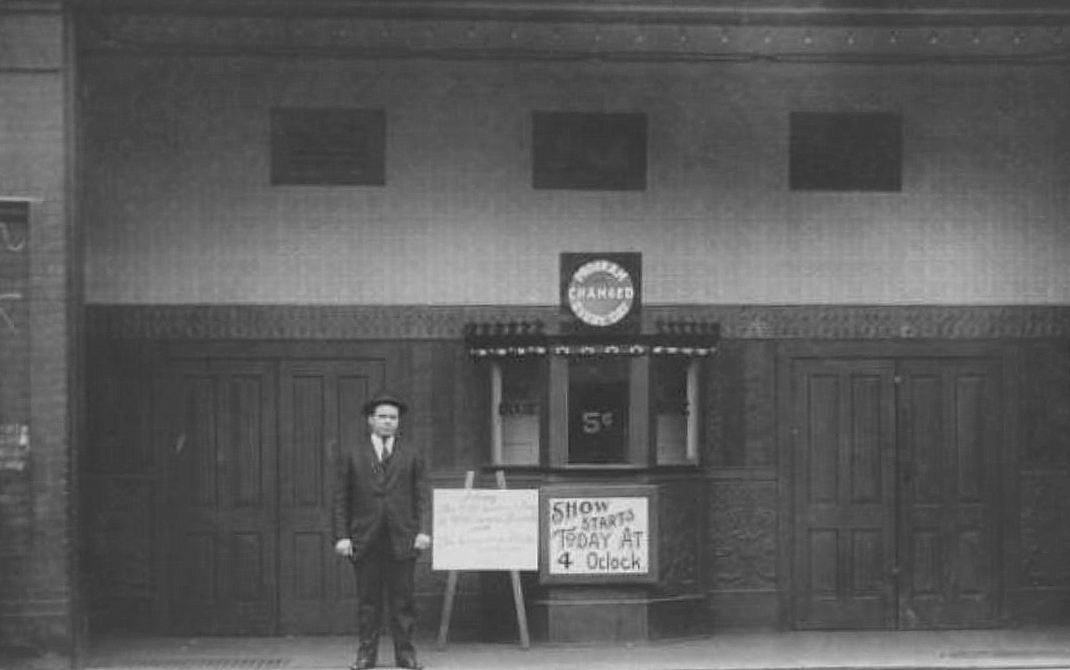
And finally, the Wonderland turned into the Dixie, seen at the top, in 1910, and below, in 1909.

dixie-theatre_1909_cook-colln_degolyer

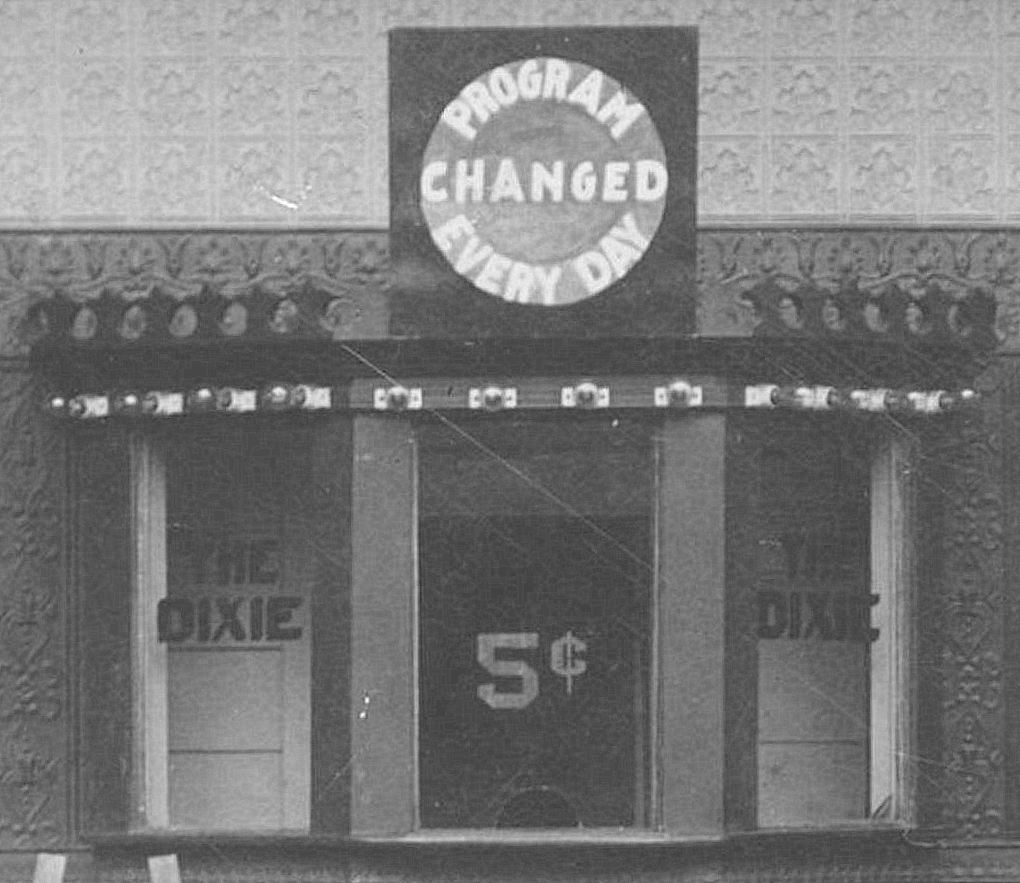
dixie-theatre_1909_cook-colln_degolyer_detBox office, detail (click for larger image)

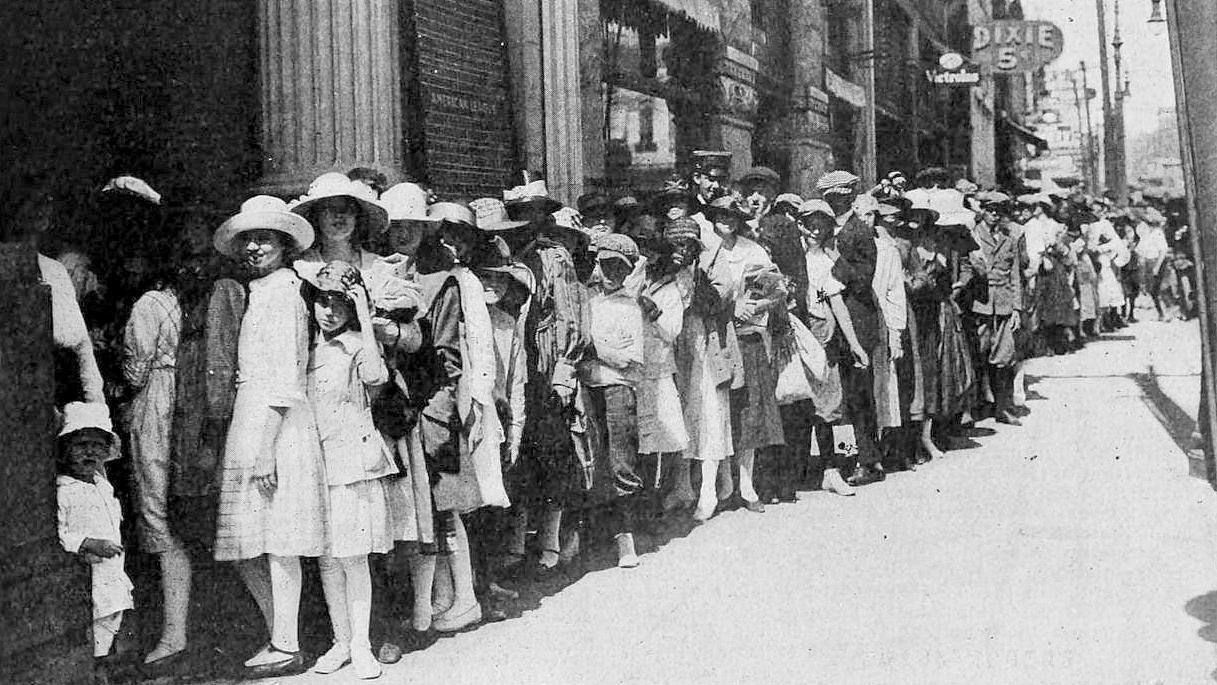
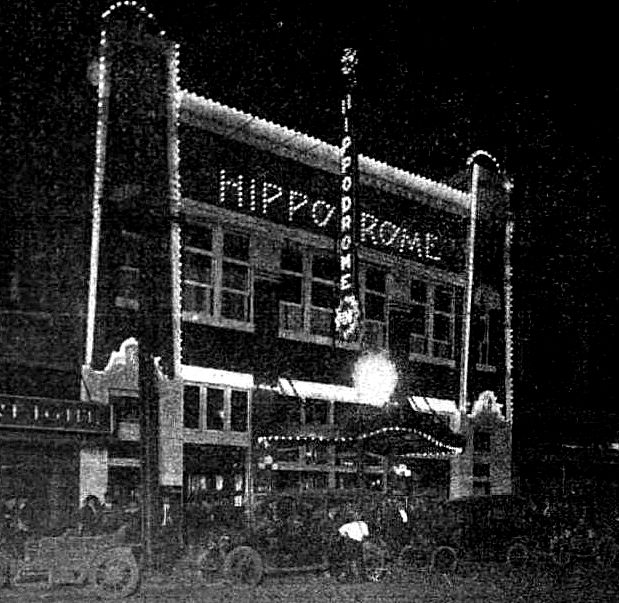
Another photo, from 1918, shows mostly children lined up in front of the theater, with the sign in the background. (They were lined up to see a WWI-related movie at the nearby Hippodrome; the photo is looking east along the north side of Elm, near where Field now intersects.)

hippodrome_dixie_elm-street_moving-picture-world_062218from The Moving Picture World magazine, June 22, 1918

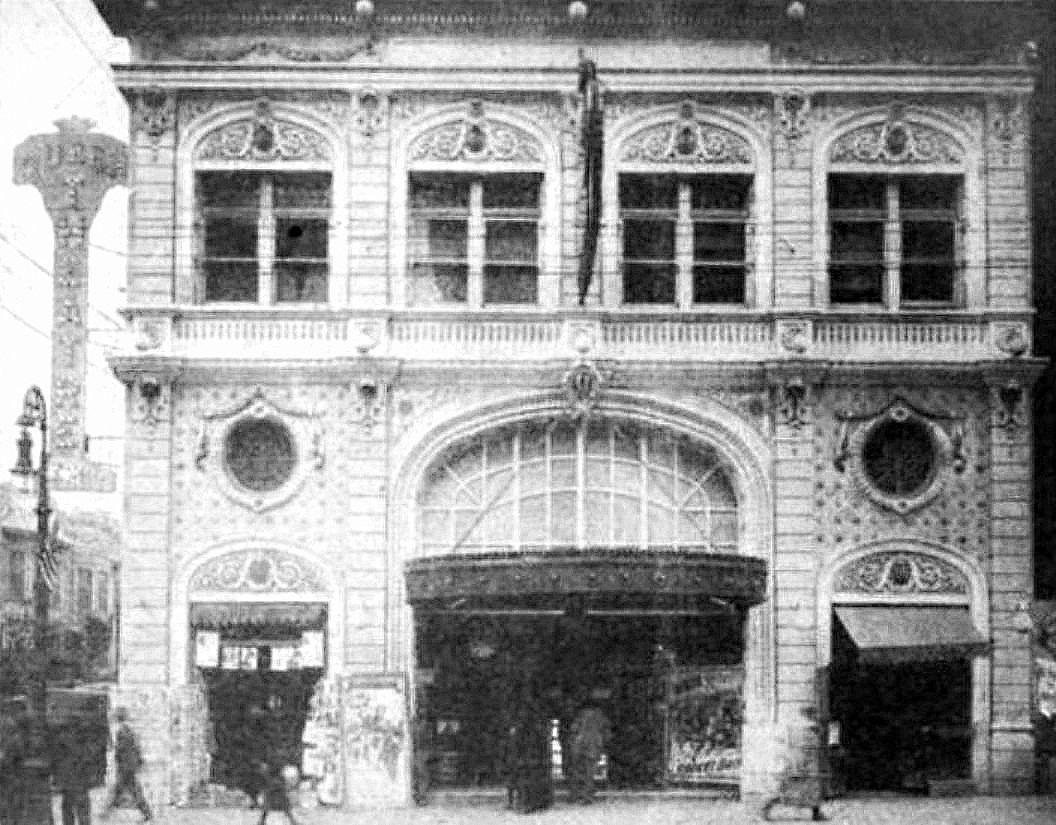
But it wasn’t until the beginning of 1913 that the first “palaces” arrived. The Queen Theatre opened first, at the corner of Elm and Akard. The DMN raved: “The most beautiful Photo-Play Theater in the South. Every man, woman and child in Texas should see this theater — truly a credit to the State” (DMN, Feb. 2, 1913).

queen_bldg-code-bk_1914Photo from Building Laws of the City of Dallas, 1914

queen_cinema-treasuresElm St. about 1917, with Queen on left — photo from CinemaTreasures.org

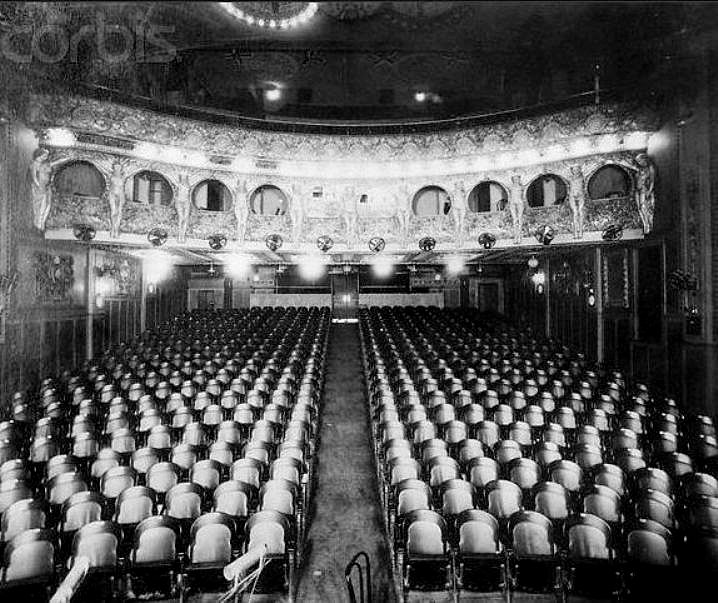
queen-theater-1939-CORBISInterior, 1930s — photo from CorbisImages.com

queen-theatre_dmn_102012DMN, Oct. 20, 1912

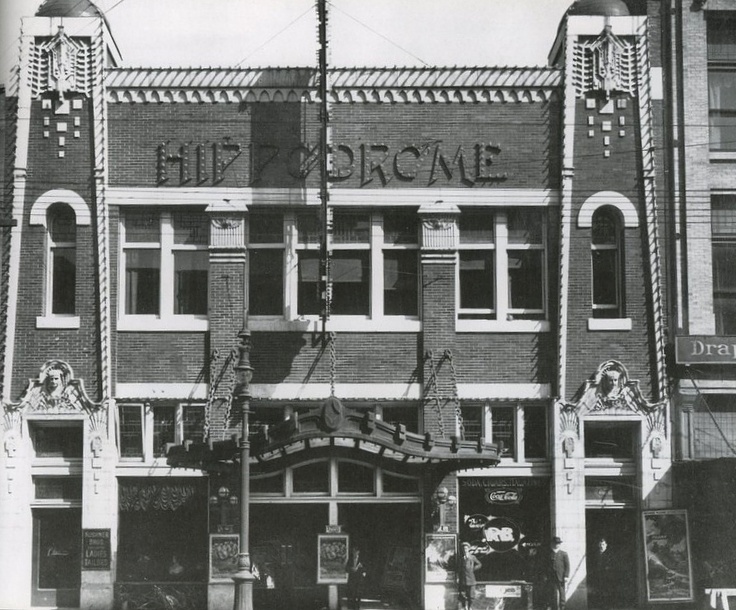
The Queen opened to rapturous crowds in January, 1913, but moviegoers barely had time to catch their collective breath when the Hippodrome opened at 1209 Elm, just a few weeks later, on March 1, 1913. It was “…conceded to being the finest moving picture house in the United States” (DMN, March 9, 1913).

hippodrome

hippodrome_bldg-code_1914Photo from Building Laws of the City of Dallas, 1914

hippodrome_dmn_022813DMN, Feb. 28, 1913

By the time the Queen and Hippodrome opened, movies had become a popular and profitable form of entertainment. In 1913 Dallas had 28 “picture shows” — 24 for white patrons and 4 for black patrons. Even vaudeville houses occasionally ran short films to pad out their live shows. And, notably, movie houses had begun to pop up away from downtown: in 1913 there were a dozen “suburban” theaters in residential areas of town (many of these, though, showed movies outdoors and thus operated only in the warmer months and at night).

There was a tremendous appetite for movies in Dallas in those early years, and when the money men realized that motion pictures weren’t just a here-today-gone-tomorrow novelty but a burgeoning industry, they dived in with enthusiasm.

Any tendency to cast the movies aside as a passing fad has given way to a realization that they are here to stay and that the crest of their popularity has not yet been approached. (DMN, March 9, 1913)

And Theater Row was off and running.

***

Sources & Notes

The top photo of the Dixie Theatre and the Theatorium ad are from the Hamon Arts Library, Southern Methodist University. I found them in Historic Dallas Theatres by D. Troy Sherrod. Sherrod’s passage on the Theatorium/Wonderland/Dixie is well worth reading, here. The second Dixie Theatre photo, with the man standing next to the box office, is from the George W. Cook Dallas/Texas Image Collection, DeGolyer Library, Central University Libraries, Southern Methodist University; it can be found here.

The very informative Dallas Morning News article of March 9, 1913 on the history of movie theaters in Dallas can be read here (it opens in a PDF, click the plus-sign at top of page to increase the text size).

Background on the Corbett-Fitzsimmons fight is here. Background on the now-legendary FILM of the fight is here; highlights of the 1897 film can be viewed here.

Many images larger when clicked.

*

Copyright © 2015 Paula Bosse. All Rights Reserved.


Dazzling Neon, Theater Row — 1929

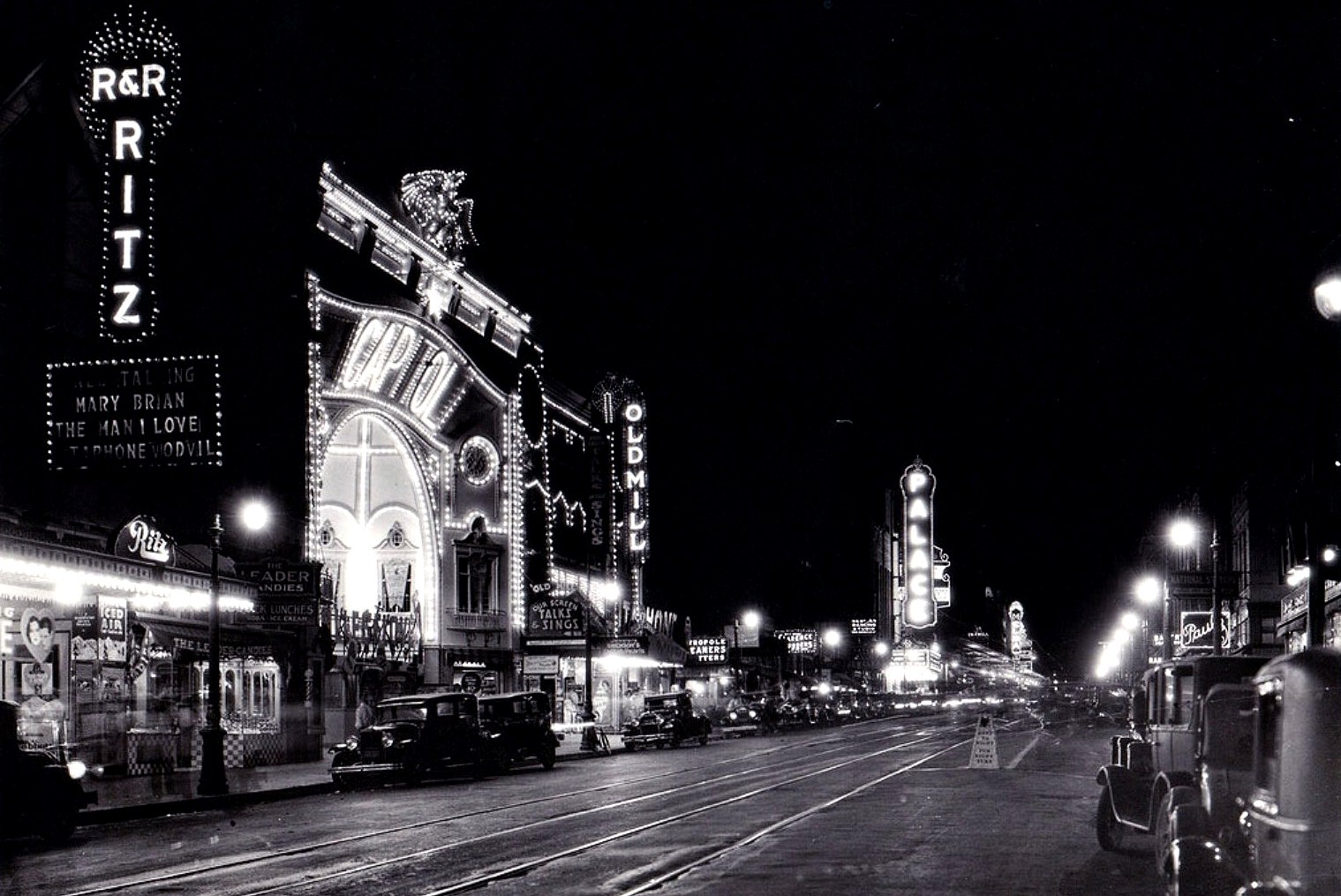
elm-st-night_capitol-old-mill_1929_shorpy“The lights are much brighter there…”

by Paula Bosse

Whoa. Elm Street in the ’20s.

The Ritz. The Capitol. The Old Mill. The Palace. The Melba. Iced air. Paul’s Shoes. What I wouldn’t give to have walked down Elm when it looked like this.

***

Sources & Notes

Photo from Shorpy.com, here.

Highlights from the 1929 and 1930 street directory (from about Akard, heading east):

  • 1517 Elm: Ritz Theatre
  • 1519: Leader Candy Co.
  • 1521: Fooshee’s Barber Shop
  • 1521-23: Capitol Theatre
  • 1525-27: Old Mill Theatre
  • 1600: Paul’s Shoes
  • 1601: Metropole Cleaners
  • 1603: Elm Pacific Arcade
  • 1605: Lontos Cafe
  • 1623-25: Palace Theatre
  • 1911-15: Melba Theatre
  • 1912-29: Majestic Theatre

 *

Copyright © 2015 Paula Bosse. All Rights Reserved.

Dallas’ First Two Drive-In Theaters — 1941

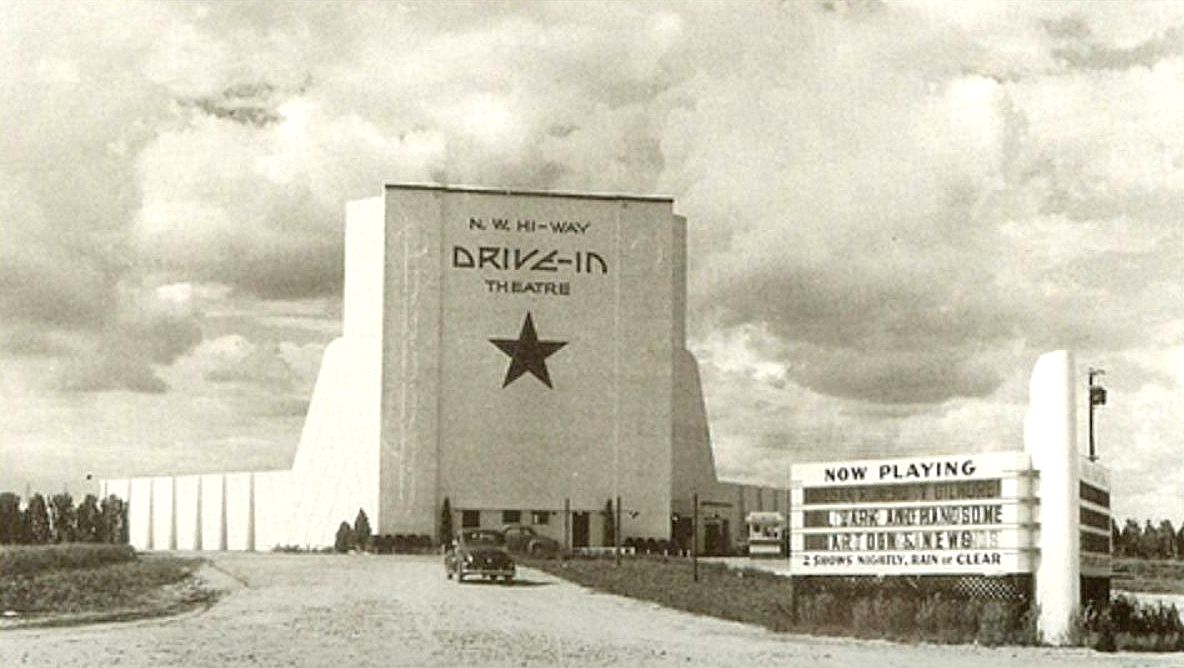
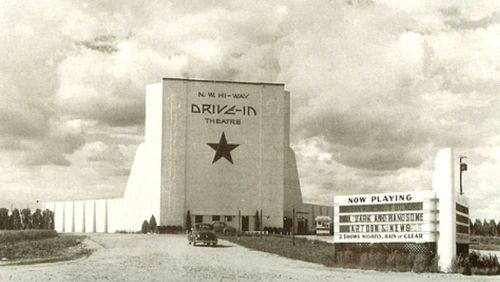
nwhwy-drive-in_july-1941Northwest Hi-Way Drive-In, July 1941

by Paula Bosse

The drive-in theater arrived in Dallas on June 20, 1941, the night that “Give Us Wings,” starring the Dead End Kids, played as the first feature of the Northwest Hi-Way Drive-In, located at the northwest corner of Northwest Highway and Hillcrest. It stood on twelve-and-a-half acres and had a 450-car capacity. The drive-in was opened by W. G. Underwood and Claude Ezell, who had opened similar outdoor movie theaters in San Antonio and Houston.

The Hi-Way (which appears to have usually been spelled “Highway”) featured something I had never seen in drive-in design: cars parked on terraced ramps, where the car behind was always slightly higher than the one in front of it so as to offer an unobstructed view, and speakers were on stands embedded in cement and were placed between cars (no in-car speakers).

Rain was apparently not a problem in this brave new world of outdoor entertainment — if it rained the show would go on (even though the opening was delayed by a few days because of rainy weather) — but fog was a problem, and in case of such weather, movie-goers would be issued a “fog-check” to come back another (fog-free) night.

A newspaper article appeared a few days before the theater’s opening, explaining what a drive-in was and how it worked. Here is the last paragraph:

According to Mr. Underwood 80 per cent of the people who attend drive-in theaters are non-theatergoers. These include people with children and no one to leave them with, semi-invalids, cripples and corpulent individuals who find it embarrassing to attend the regulation theaters. At the Drive-In there is no necessity for getting out of the car, an attendant meets you at the gate, takes your money and buys your tickets, while another wipes your windshield. A third pilots the car to a space on one of the ramps. These are widely spaced enough that any car may leave at any time. (Dallas Morning News, “Northwest Highway Drive-In To Open Tuesday, Rain Or Stars,” by Fairfax Nisbet, June 14, 1941)

Okay then.

The the weather eventually behaved, and the opening on June 20, 1941 was a success, with an almost-capacity audience. The drive-in had arrived in Big D.

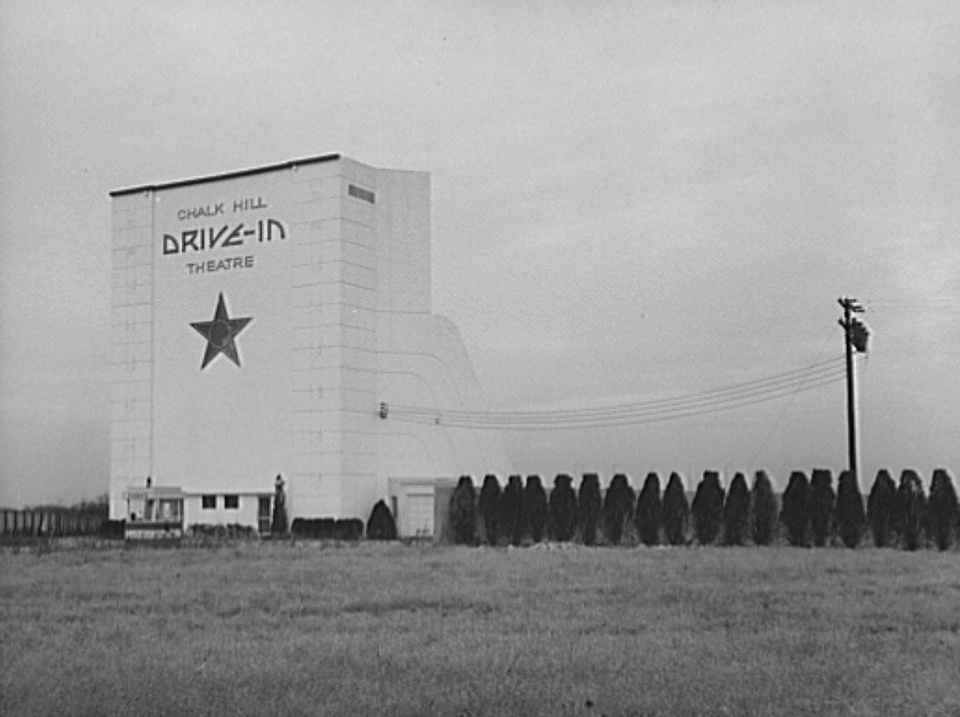
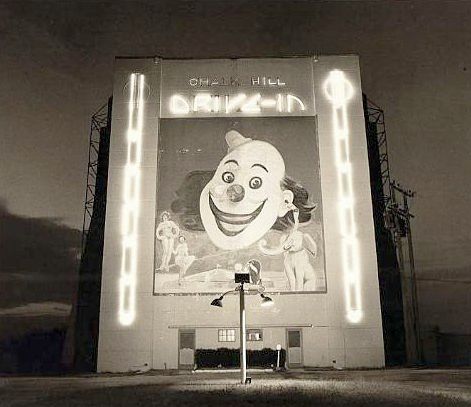
Two weeks later — on July 4, 1941 — Underwood and Ezell opened the Chalk Hill Drive-In in Oak Cliff, at about West Davis and Cockrell Hill Road. It looked almost exactly like the Northwest Highway drive-in, down to the great big star on the outside of it (to be replaced with a clown mural years later). The very first feature was “The Invisible Woman” with Virginia Bruce and John Barrymore.
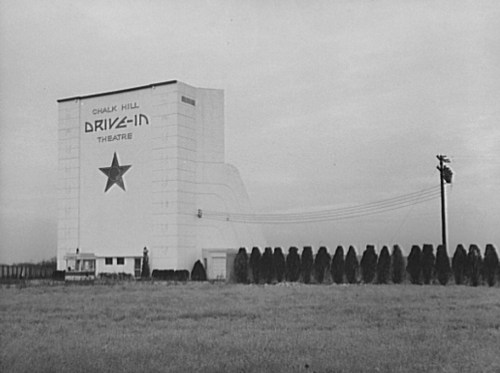
chalk-hill-drive-in_1942_LOC1942, out on the Fort Worth pike (Library of Congress)

Both theaters had successful and relatively long lives. The Northwest Highway drive-in closed in 1963 when the land was purchased for development (the most notable occupant of the new businesses that occupied that corner was probably the fondly remembered Kip’s restaurant).

The Chalk Hill Drive-In closed in the late 1970s, and from what I can tell, it spent a couple of decades abandoned and decaying.

*

A few random tidbits.

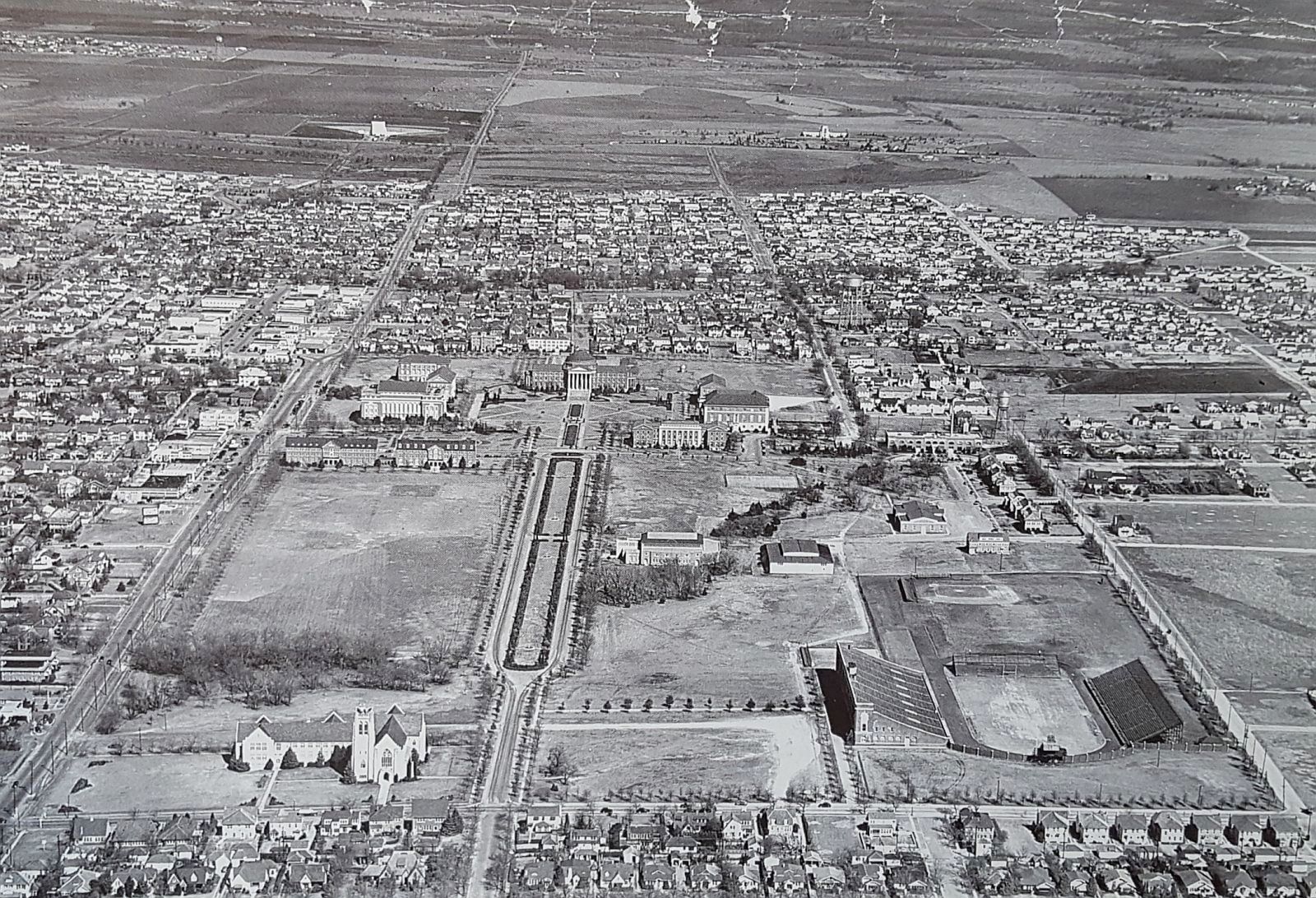
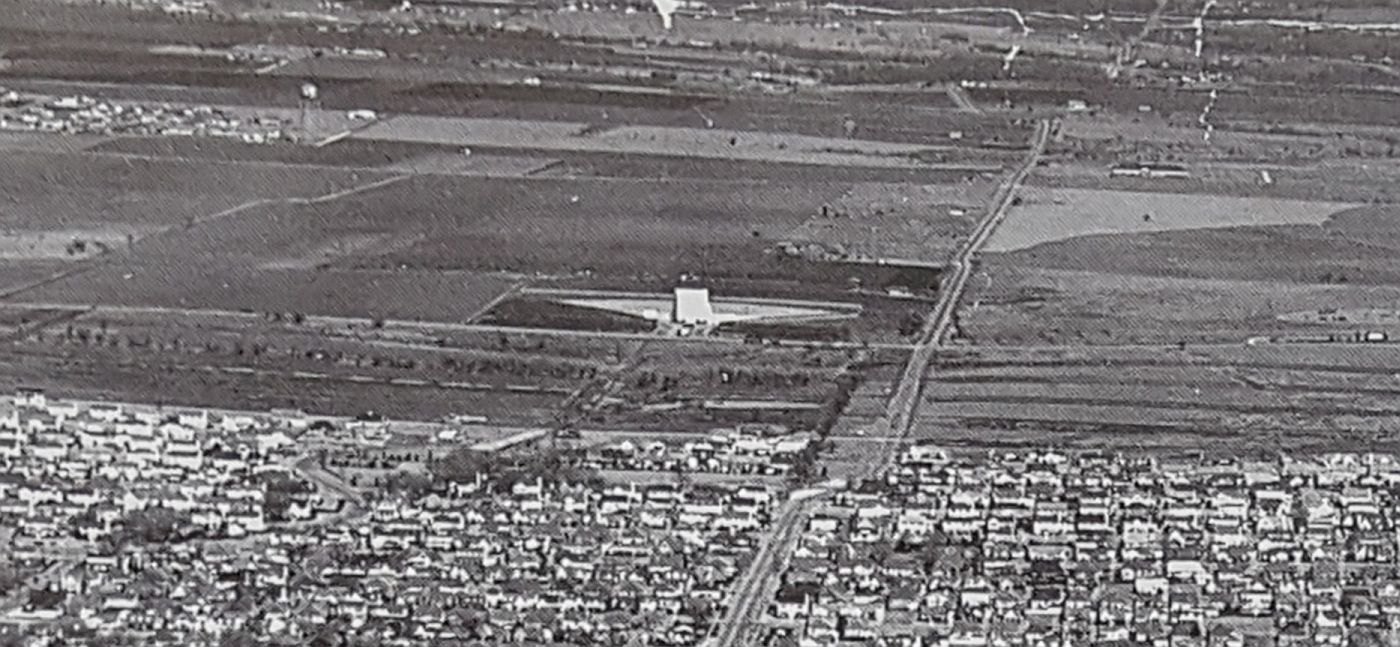
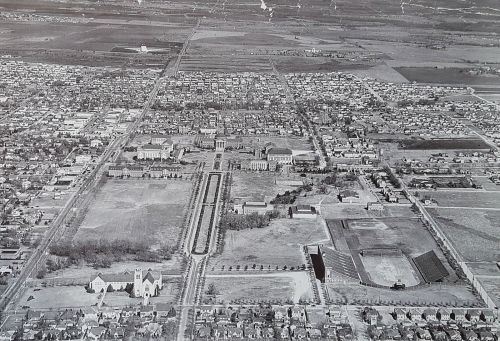
Here’s a 1945 aerial shot over SMU looking north — the drive-in is in the middle of all that wide-open Caruth farmland, seen just left of Hillcrest (the Hillcrest Mausoleum, built in 1936, can be seen to the right of Hillcrest; the Caruth Homestead is at the far right edge of the photo).
nw-hway-drive-in_1945_galloway_park-cities-photohistory

Here’s a detail, showing it up-close:
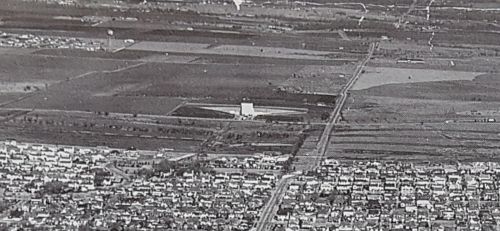
nw-hway-drive-in_1945_galloway_park-cities-photohistory_det

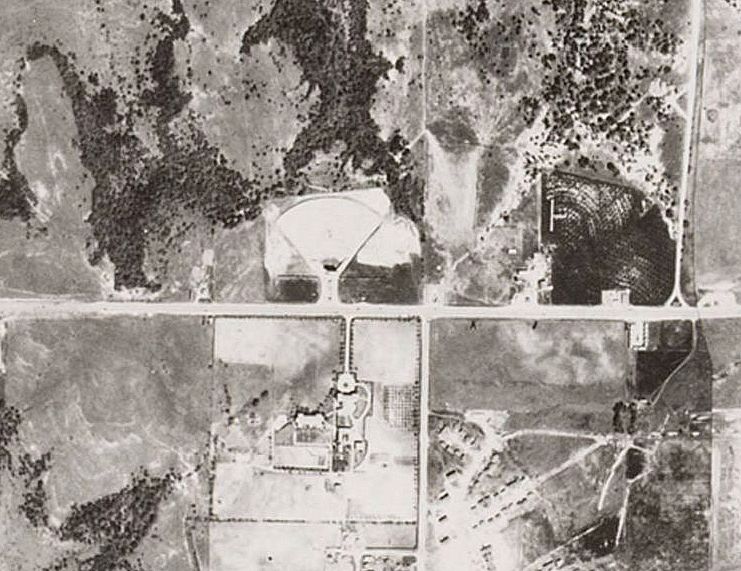
Two aerial shots by the United States Army Air Forces, taken for a USDA survey in 1945. First, the Northwest Highway Drive-In, with Northwest Highway running horizontally in the photo and Hillcrest running vertically.
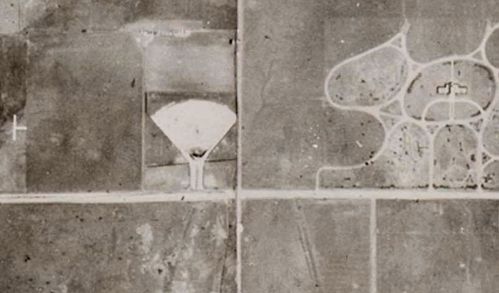
nwhwy-hillcrest_usaaf_fosucue_smu_1945SMU

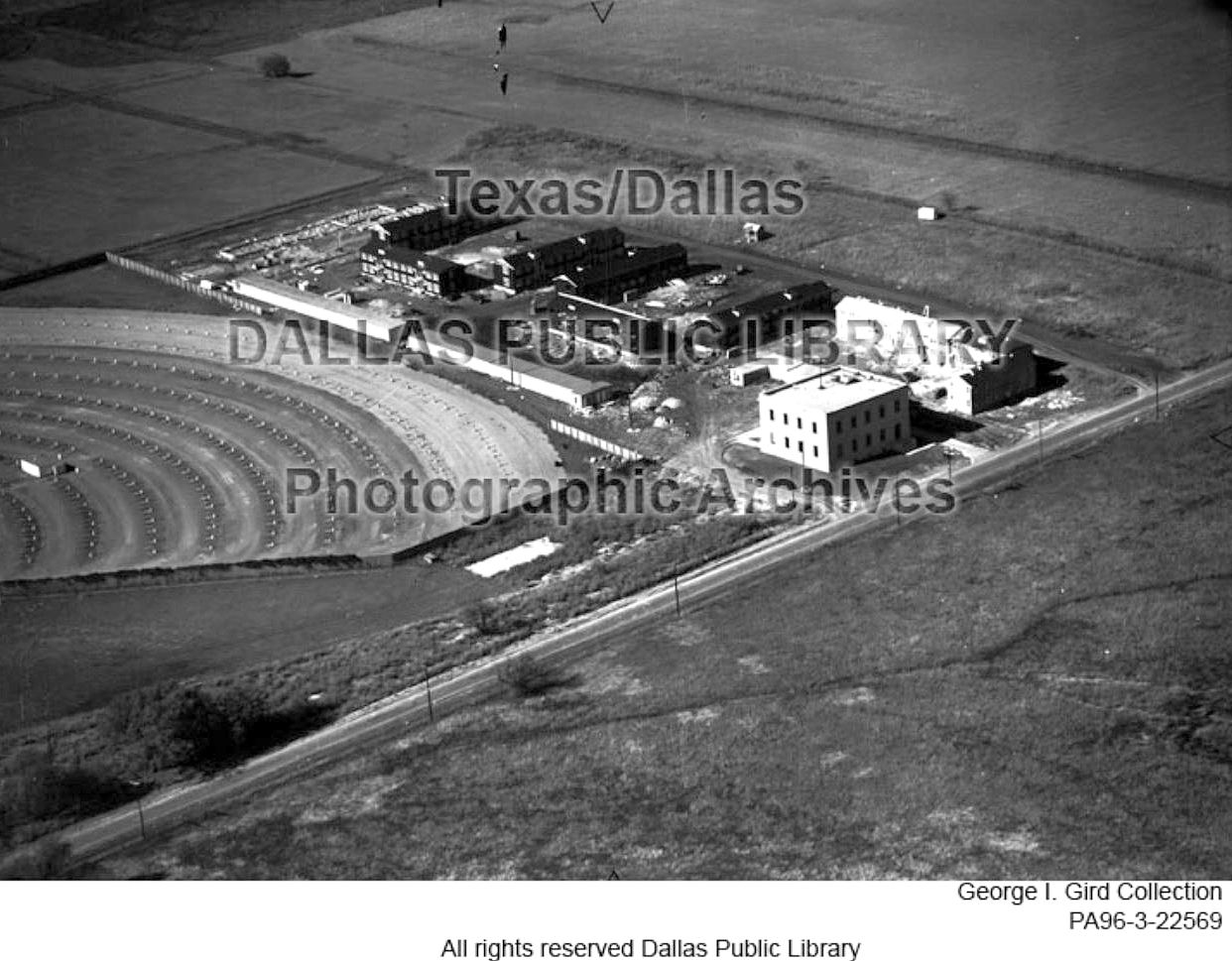
This aerial photo from 1947 shows a view to the northwest, with Hillcrest running from lower left corner to top right — it appears the photo was taken to show the new apartment complex just north of the parking area of the drive-in.
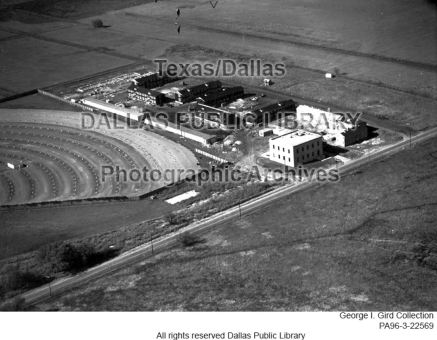
northwest-hi-way_drive-in_DPL_1947
Dallas Public Library

And Chalk Hill, with Highway 80 running horizontally:
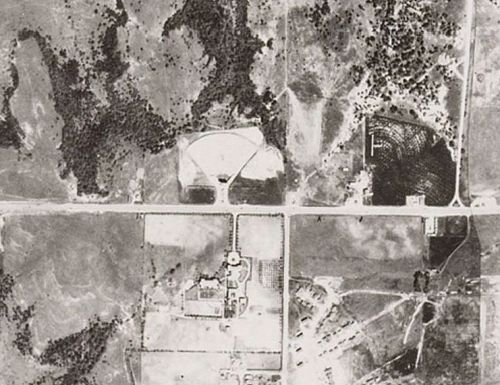
chalk-hill_usaaf_smu_1945SMU

Chalk Hill again, this photo from 1973, with the clown face and circus theme that many remember:
chalk-hill-drive-in_1973_smithsonian
Photo by Steve Fitch, Smithsonian American Art Museum

A couple of amusing livestock-oriented drive-in-related human-interest blurbs appeared in the pages of The Dallas Morning News:

Some cattle going from Waco to Wisconsin stampeded through University Park when their truck caught fire on Greenville. Police herded most of the steers into a Northwest Highway drive-in theater. Five were found nuzzling zinnias at a home on Southwestern. (Lorrie Brooks, DMN, Sept. 18, 1952)

Cattle in 1952, donkeys in 1955:

University Park police early Wednesday captured two pet donkeys who escaped their pen at the Northwest Highway Drive-In Theater during the night. A startled passerby spotted the two donkeys grazing contentedly on a lawn at Centenary and Hillcrest, about four blocks from the theater…. Bill Duckett, manager of the theater, reported the loss of the two pets, which he keeps for the entertainment of the theater’s small-fry patrons. (DMN, May 26, 1955)

***

Sources & Notes

I’m not sure of the source of the top photo, but I’m pretty sure of when it was taken: the marquee shows that the movie “Tall, Dark and Handsome,” starring Cesar Romero, was playing; that movie ran at the Northwest Hi-Way Drive-In July 12-14, 1941.

The aerial photo (by Capt. Lloyd N. Young) showing SMU and the land that lay north of it is from the Highland Park United Methodist Church Archives; I found it in Diane Galloway’s fantastic book The Park Cities, A Photohistory.

The two aerial photos are details of larger photographs from the collection of Dallas Aerial Photographs, 1945 USDA Survey, Edwin J. Foscue Map Library, Central University Libraries, Southern Methodist University. The full (labeled) Northwest Highway photo is here; the Chalk Hill photo is here.

Two other aerial photos (from 1958) are interesting because they are a bit closer and because you can see the terraced ramps — they can be seen here (apologies for the watermarks — photos from HistoricAerials.com).

The Wikipedia entry for the Drive-In Theater is here.

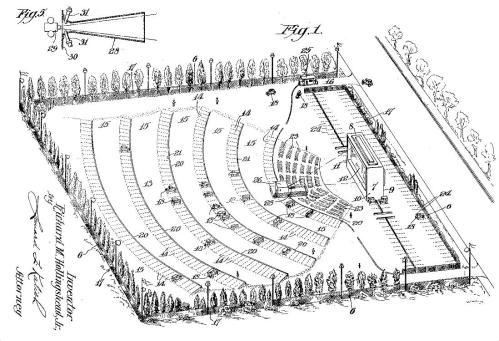
The patent (with illustrations) for the drive-in theater, filed by Richard M. Hollingshead, Jr. in 1932 is here (it’s a very interesting read). I had no idea a drive-in movie theater could be patented. This cool drawing is part of it (click it to see it larger):
drive-in-patent_1

A great history of drive-ins in the Dallas-Fort Worth area can be found in the article “Starlit Skies and Memories” by Susan and Don Sanders; it appeared in the Spring, 1999 issue of Legacies, and can be read here. Great photos! (Who knew there was a drive-in on South Lamar — the Starlite — which catered exclusively to the black community?)

*

Copyright © 2015 Paula Bosse. All Rights Reserved.

“A Perfect Auto Tent” — 1921

ad-dallas-tent-awning_dmn_061221-smRemember to turn off engine before retiring for the night…

by Paula Bosse

Personally, I don’t understand why anyone would want to be outside when it’s 157 degrees, but for those of you who are insistent campers who might be heading out for a sweaty and bug-filled weekend in the wilderness, might I direct your attention to the “automobile tent,” ready for purchase in 1921 at the Dallas Tent and Awning Co. at 2620 Main Street, in the heart of Deep Ellum. Adjusted for inflation, the cost of this admittedly charming-looking “car tent” would be the equivalent of about $200.

My weekend? I will be camped out in a blissfully air-conditioned house — shades drawn, blinds closed — with an iced tea in hand, moving slowly, and not smelling like insect repellent.

*

Copyright © 2015 Paula Bosse. All Rights Reserved.

Thank You, Weird Hollywood!

weird_hollywood

by Paula Bosse

Thank you, Joe Oesterle, for the very flattering post on your (great) Weird Hollywood Facebook page! His mystery photo of the Gunther Castle was a lot of fun to research (the “castle” was at 2308 Pacific Avenue in Long Beach, California), and, yes, as a matter of fact, I’d love to help you research a building or person or old news story or mystery photo. I CAN be bought! If you have inquiries, please click the “Contact” tab at the top of the page and send me an email. If there’s something I can help you with, we’ll talk turkey.

As this is a blog devoted to Dallas history, the Hollywood stories are a bit scarce (even though classic Hollywood and entertainment history is a passion of mine), but there are a few. These Flashback Dallas posts might appeal to those new visitors more interested in Hollywood than Dallas: (click title to see post):

Thanks again for the kind words, Joe! And keep Hollywood weird!

*

Copyright © 2015 Paula Bosse. All Rights Reserved.

Radio Broadcasting, 1922-Style

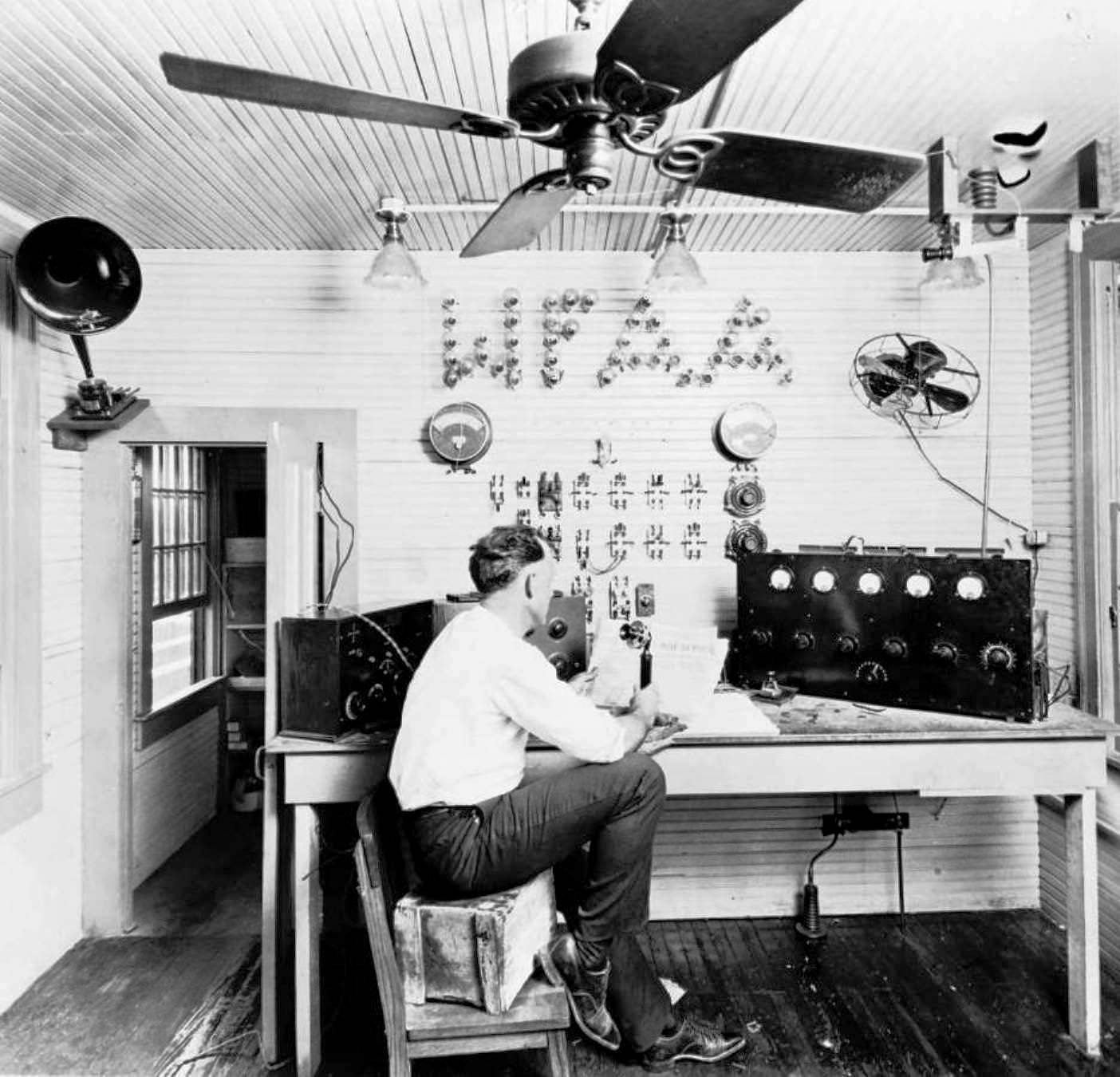
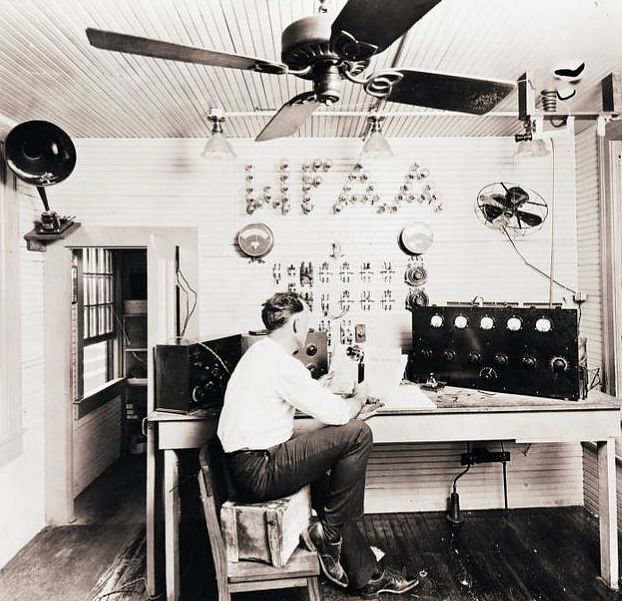
wfaa-control-room_belo_smu_1922WFAA “newsreader,” 1922 (click for larger image) Belo Collection, SMU

by Paula Bosse

This fantastic photo shows the interior of a little shack-like building on top of the old Dallas Morning News building at Commerce & Lamar, soon after WFAA radio had begun broadcasting in the summer of 1922. There are so many things I love about this photo. Let’s explore the details. (All pictures are larger when clicked.)

*

The Magnavox speaker/monitor.

wfaa-control-room_belo_smu_det1

*

The booster seat and the shoes that need a shine.

wfaa-control-room_belo_smu_det2

*

The announcer at work. (I’m assuming this telephone was being used as an early microphone?) The newspaper is The Dallas Journal, sister publication of The Dallas Morning News which owned WFAA radio. The headlines appear to be about the nationwide railroad and coalminers’ strikes, both of which had been getting more and more violent throughout July of 1922 (violence surrounding the railroad strike led to Texas Governor Pat Neff declaring martial law in Denison that month).

wfaa-control-room_belo_smu_det3

*

The control panel (which has its own fan).

wfaa-control-room_belo_smu_det4

*

And an open window around the corner, in the supervisor’s office. Cross-ventilation and oscillating fans might not have been hugely effective in keeping operators and machinery cool in the summertime.

wfaa-control-room_belo_smu_det5

*

Here’s another view of the “Operating Room,” as published in the DMN on June 25, 1922, the day before WFAA began broadcasting.

wfaa_operating-room_dmn_062522DMN, June 25, 1922

***

Photo titled “WFAA Radio Original Control Panel” from the Belo Papers collection, DeGolyer Library, Central University Libraries, Southern Methodist University; it can be viewed here.

A companion post to this, “WFAA’s ‘Altitudinous Antenna System'” — which contains a background of WFAA’s debut and several photographs — is here.

Other Flashback Dallas posts on Dallas Radio and TV are here.

Click pictures for larger images.

*

Copyright © 2015 Paula Bosse. All Rights Reserved.

WFAA Radio’s “Altitudinous Antenna System”

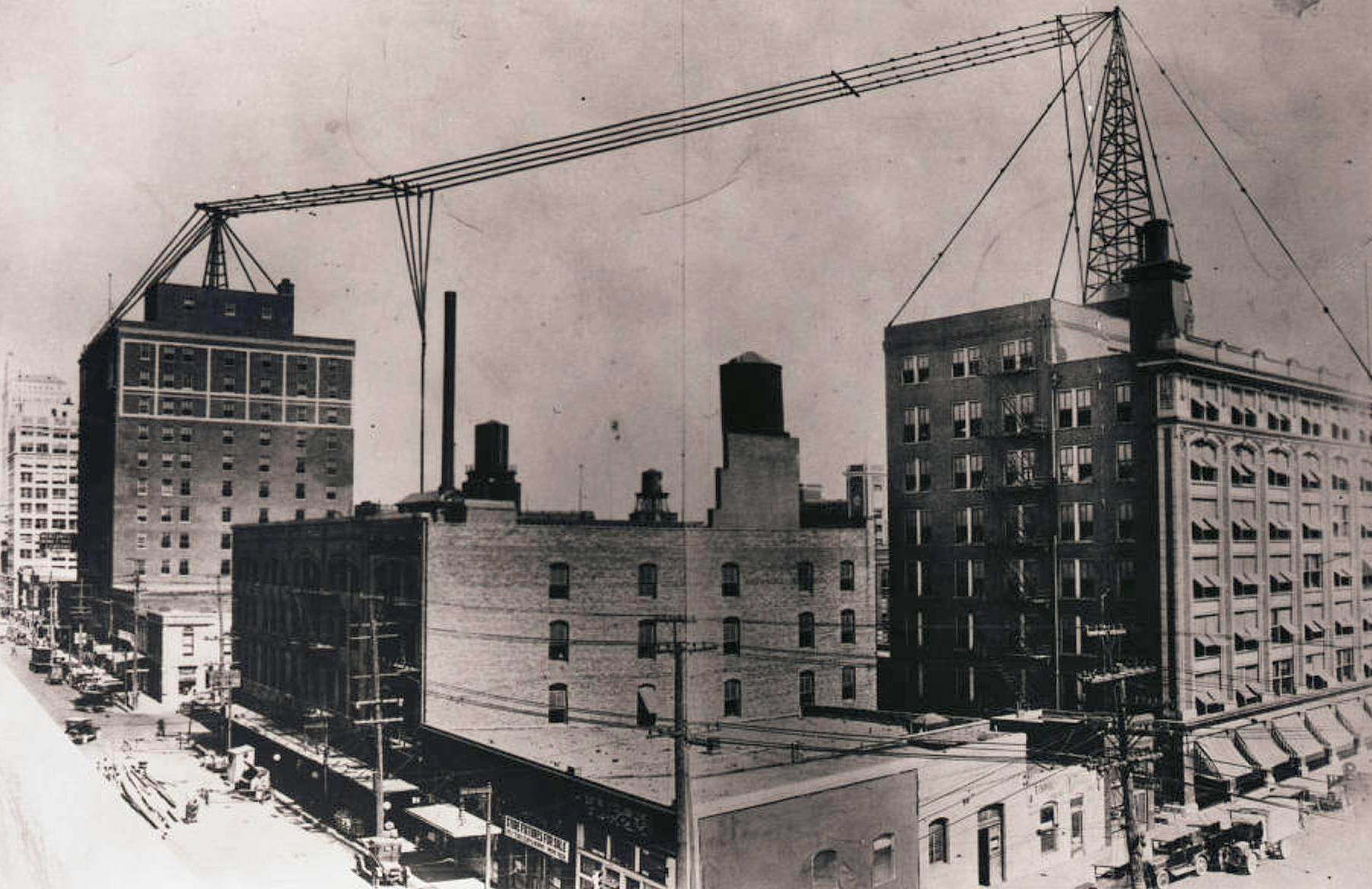
wfaa_towers_1920s_belo-coll_degolyerSeems … “busy” … (click for larger image) Belo Collection, SMU

by Paula Bosse

Broadcast radio was very, very, very new when WFAA radio went on the air in June, 1922; it was Dallas’ second radio station, but it was the city’s first commercial station, and its debut was a BIG deal. (WRR had preceded WFAA, but it was mainly used for city business.) Figuring out where to place towers and aerials and antennae (which may all be the same thing, for all I know) was a major problem, with not a lot of precedents. So why not just do what they did in the photo above?

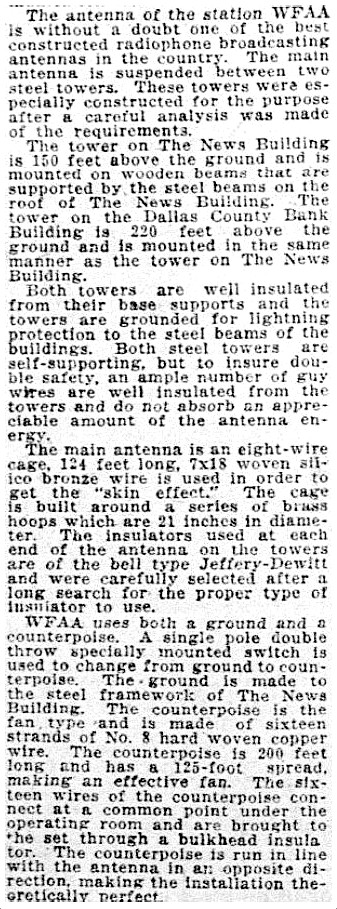
WFAA began broadcasting at 12:30 p.m. on June 26, 1922, and the day before that, a giddy and surprisingly technical article appeared in The Dallas Morning News (which owned WFAA). The full article is linked below, but this is the specific passage devoted to those towers/aerials/antennae:

wfaa-towers_dmn_062522DMN, June 25, 1922

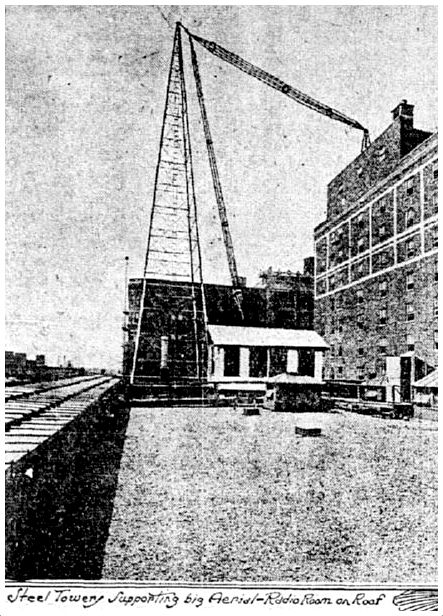
I’m not sure if the photo at the top was from these first days (it appeared, undated, in the DMN in 1927), but here is a photo that accompanied the above article from 1922:

wfaa_tower_dmn_062522

Is that a little building? Why, yes it is.

WFAA. It began as a 50-watt station. Its studios occupied all of a 9×9-foot shack on top of the old Dallas Morning News Building. Its antennae were strung from a water tank on the The New building to a 20-foot mast on top of the Texas Bank Building. (DMN, May 21, 1950)

When WFAA began, it broadcast from inside of and on top of the old Dallas Morning News building, which was located at Commerce and Lamar. By 1927, it had moved its studios to swankier digs in the Baker Hotel. Below, another description of how the rooftop aerial situation — the “altitudinous antenna system” seen at the photo at the top of this post — functioned at this time.

One of the big towers is on top of the lofty Dallas Mercantile Bank Building, while the other is atop the high Missouri-Kansas-Texas Railway Building. The wires are connected with the WFAA operating room on the roof of the Dallas Morning News Building between the two other structures. (DMN, Feb. 20, 1927)

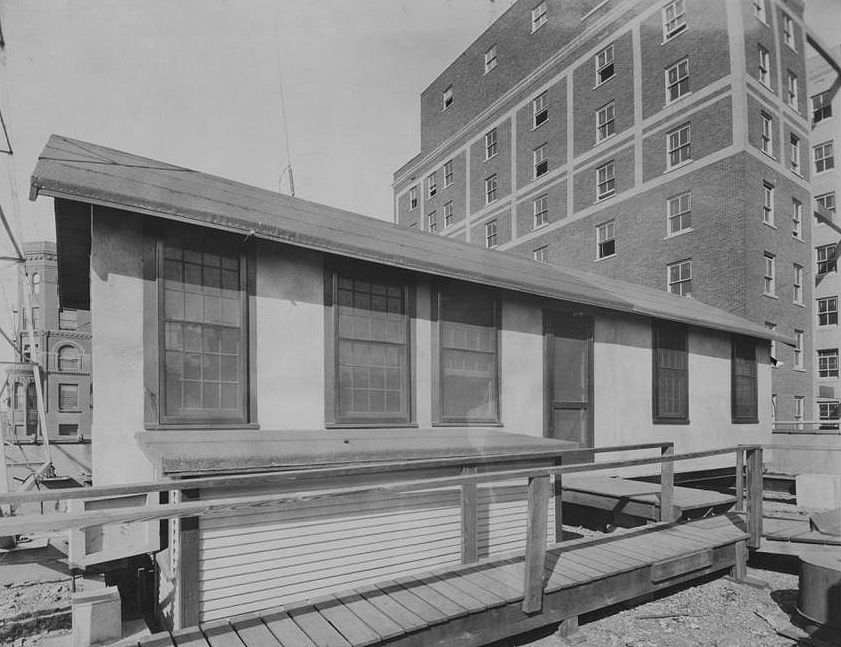
But back to that little shack. Let’s see it a bit closer. Here’s the exterior.

wfaa_rooftop-broadcasting-room_belo-degolyerBelo Collection, SMU

And here’s the interior.

wfaa-studio_ca1922_belo-degolyerBelo Collection, SMU

The generator and battery room.

wfaa_generator-battery_dmn_062522DMN, June 25, 1922

And the supervisor’s office.

wfaa_supervisors-office_dmn_062522DMN, June 25, 1922

And Dallas broadcasting never looked back from its humble beginnings.

*

ad-white-electric-co-detail_dmn_062522Advertising detail, June 25, 1922

*

wfaa-logo_dmn_062522

***

Sources & Notes

Photographs from the Belo Records Collection, DeGolyer Library, Central University Libraries, Southern Methodist University. Top photo can be accessed here; rooftop “broadcasting room” (exterior) is here; “broadcasting room” (interior) is here. More photos here. (The interior and exterior shots of the studio seem to be from 1922. The announcer is reading from the DMN’s sister publication, The Dallas Journal, which contains an article about a subject hot in the news in July, 1922 — a strike by Kentucky coal miners.)

A Belo photo identified as showing the room containing the “Transmitter on top of The Dallas Morning News building, 1924” is here.

To read the article describing how WFAA (which, by the way, at some point stood for “Working For All Alike”) was put together — how it was literally put together — see the Dallas Morning News article “Most Complete Radio Station in the Southwest to Begin Broadcasting” (June 25, 1922), written by R. M. Lane, here, and the accompanying photos here.

See the companion Flashback Dallas post, “Radio Broadcasting, 1922-Style,” here.

Other Flashback Dallas posts on WFAA radio can be found here.

Other Flashback Dallas posts on Dallas Radio & TV can be found here.

*

Copyright © 2015 Paula Bosse. All Rights Reserved.

Neiman-Marcus / France-Texas / A-Z — 1957

n-m_french_ad_cover-smMais oui!

by Paula Bosse

Bastille Day again already? It seems to come earlier every year. Last year I wrote about the 1957 Neiman-Marcus French Fortnight — the very first fortnight celebration. This year I thought I would present a few of the pages from the lavish advertising supplement Neiman’s placed in the October, 1957 issues of American and French Vogue. The mini-catalog was titled “Neiman-Marcus Brings France to Texas, Everything From A to Z.” (Link to the entire ad insert is below.) Here we have “C,” “R,” “V,” and “Z.” Enjoy a flashback to fabulous ’50s fashion photography. And Happy Bastille Day!

n-m_french-ad_cn-m_french_ad_rn-m_french_ad_vn-m_french-ad_zClick to read a list of events and exhibits happening around the store.

***

These pages are from a reprint of a 30-plus-page 1957 Neiman-Marcus advertising spread; from the collection of Stanley Marcus’ papers at the DeGolyer Library, Central University Libraries, Southern Methodist University. This is the very epitome of high-fashion advertising of the 1950s, and the sophisticated-but-fun-and-frothy art direction is wonderful. The entire mini-catalog has been scanned by SMU, and it can be viewed in a PDF, here.

My previous post “Neiman-Marcus Brings France to Big D — 1957” — which gives some background on this first N-M fortnight celebration and contains a great photo of the exterior of the downtown store elaborately decorated to resemble the Rue du Faubourg Saint-Honoré — can be found here.

All images larger when clicked.

*

Copyright © 2015 Paula Bosse. All Rights Reserved.

Salvador Dali Brings “Nuclear Mysticism” to Dallas — 1952

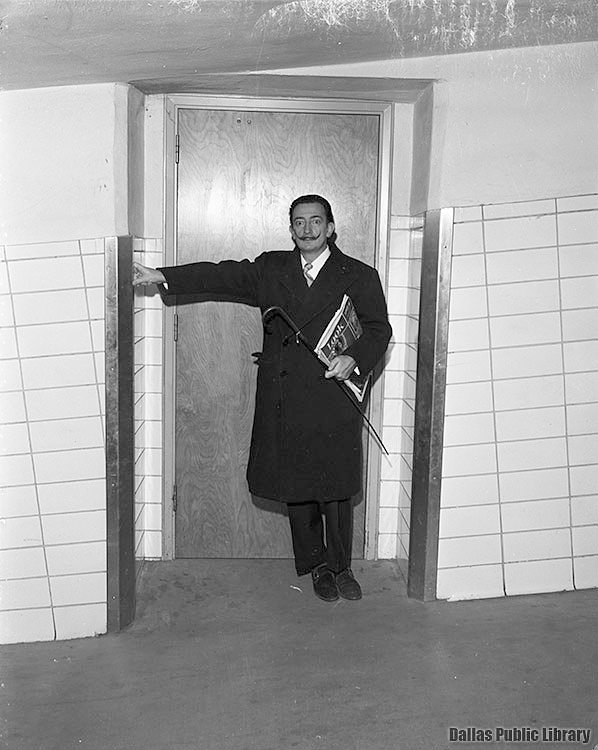
dali_union-station_feb-1952_dplDali does Dallas (in a slanted doorway at Union Station)

by Paula Bosse

The artist and pop phenomenon Salvador Dali came to Dallas in 1952 to present a lecture at McFarlin Auditorium on the SMU campus as part of the popular Community Course series. This was during his “Nuclear Mysticism” period, during which his paintings were influenced by the atomic age, science, and religion. One of the examples of this direction in his art is his painting “Raphaelesque Head Exploding” from 1951.

dali-raphaelesque-head_1951“Raphaelesque Head Exploding”

This 1952 American lecture tour included at least three stops in Texas: Houston, Fort Worth, and Dallas. Dali and his wife, Gala, arrived in Dallas on the afternoon of Thursday, February 14, 1952, after the artist had spoken at a members-only event and luncheon at Fort Worth’s River Crest Country Club earlier in the day. The lecture at McFarlin Auditorium was on Saturday night, Feb. 16. One wonders what he did in Dallas on his free day Friday.

While in Dallas, Dali was interviewed at the Baker Hotel by Paul Crume of the Morning News, a bit of an odd choice, in that Crume — author of the very popular front-page “Big D” column — was generally the paper’s go-to humor writer, an indication, perhaps, that Dali was considered less of a serious artist than as a quirky and larger-than-life entertainer. Which… fair enough.

One of the interesting little morsels that Dali told Crume was that he was amazed that his dreams in Texas had all been in technicolor, a relative rarity for him.

“Astonishing! In New York, all black and white. In Texas, all in color. In Italy, everybody dreams in color. In France, not so much. It is very mysterious. But in Houston, I am dream in color twice. And then, last night here [in Dallas].” (DMN, Feb. 17, 1952)

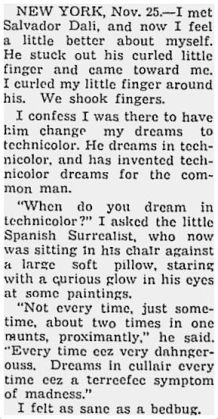
Dali loved dreaming in technicolor and mentioned it several times throughout his career. This little tidbit from Earl Wilson’s column in 1944 is amusing (if weighted down by Wilson’s unfortunate lapses into dialect).

dali_earl-wilson_112644New York Post, Nov. 26, 1944

To dream in technicolor every time “is very dangerous. Dreams in color every time is a terrific symptom of madness.” …I’m not sure what that says about Texas and/or Texans.

dali-caricature_technicolor

***

Sources & Notes

Top photo (dated Feb. 15, 1952) shows Salvador Dali standing in a slanted doorway at Union Station in Dallas (it seems likely that the photo was taken on Feb. 14th when he arrived in Dallas from Fort Worth, and was then published on Feb. 15th); it is from the Hayes Collection, Dallas History & Archives Division, Dallas Public Library (Call Number PA76-1/7171).

(Regarding this crooked door frame at Union Station: when Dali saw it he exclaimed, “A Dali-an door!”) (He would have loved Casa Magnetica at Six Flags.)

Articles about Dali’s visit to Dallas can be found in the archives of The Dallas Morning News:

  • “Key to New Art Revealed by Dali” (It’s Mysticism)” — an unbylined review, probably written by Paul Crume (DMN, Feb. 17, 1952)
  • “Texas Tints Dreams of Artist Dali” — interview by Paul Crume, conducted in the Baker Hotel (DMN, Feb. 17, 1952)
  • “Big D” column by Paul Crume (DMN, Feb. 19, 1952)

An entertaining 1965 appearance by Dali on Merv Griffin’s talk show can be seen here. He talks about dreaming in “glorious technicolor” at about 4:55. And, I mean… it’s just a great example of Dali as entertainer.

*

Copyright © 2015 Paula Bosse. All Rights Reserved.