Flashback : Dallas

A Miscellany: History, Ads, Pop Culture

Category: Leisure

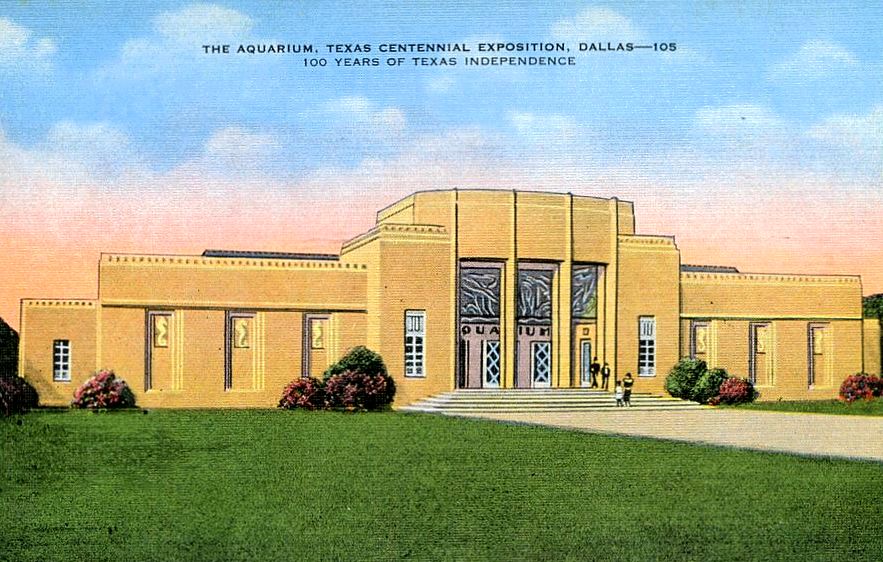
The Dallas Aquarium: The Building Emblazoned With Seahorses — 1936

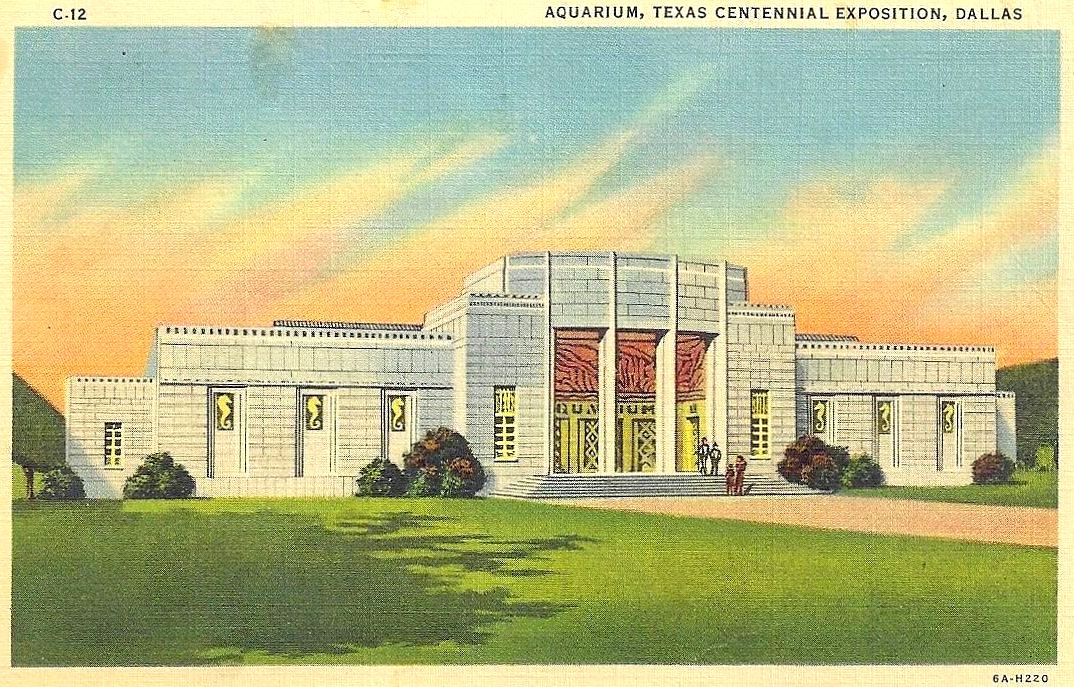
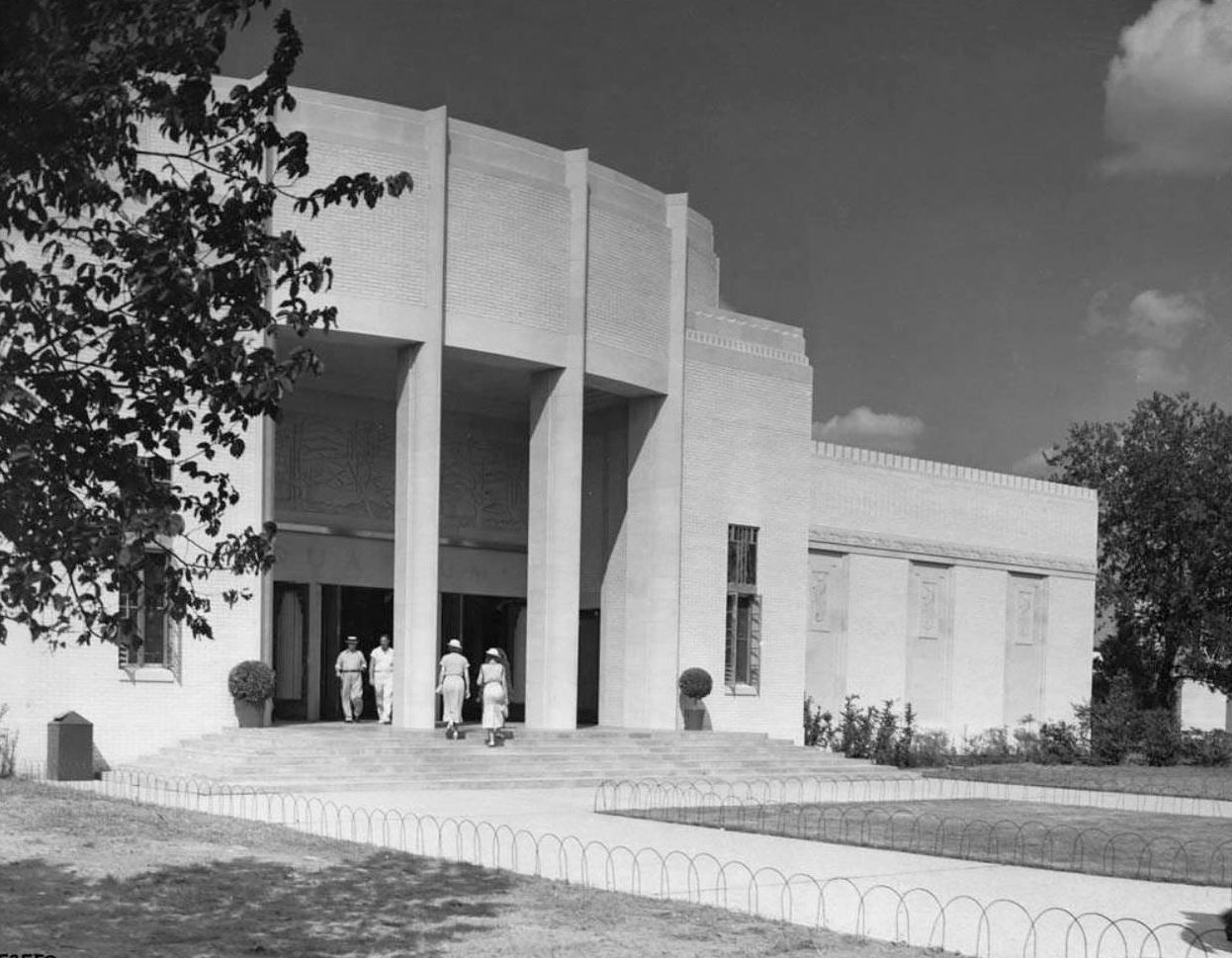
tx-centennial_aquariumThe Dallas Aquarium at Fair Park, 1936… (click for larger image)

by Paula Bosse

Out of all the buildings at Fair Park, the one I have the fondest memories of is the Dallas Aquarium, one of the buildings built in 1936 for the Texas Centennial Exposition which was specifically intended to be a permanent structure which would be available year-round to the citizens of Dallas, well after the Centennial had ended (some of these other “civic buildings” included the Museum of Fine Arts, the Museum of Natural History, the Hall of State, the bandshell, etc.). The Centennial buildings were designed by different architects, usually working in teams — the aquarium was designed by Fooshee & Cheek (best known for their previous triumph, Highland Park Village), Hal B. Thomson, and Flint & Broad. It ended up costing the city about $200,000 ($50,000 over the initial budget), and tussles with the Park Department and the City Council over its budget and space requirements meant that at various times it was suggested that the aquarium find a home at the Marsalis Park Zoo in Oak Cliff rather than at Fair Park, or that it just be shelved altogether.

fair-park-aquarium_1936

But everything worked itself out in the end, and its popularity at the Centennial was huge. HUGE. Most people in our part of the country had never been to an aquarium and had never seen fish outside of a lake or river or hatchery. According to reports in the newspapers during its construction in early 1936, not only was the Dallas Aquarium the first aquarium in Texas, it was also only the 12th aquarium in the entire United States — and it was the only one in the country in a “strictly inland city.” So unless visitors to the Centennial that year had traveled extensively, chances were slim that they’d ever seen anything like this.

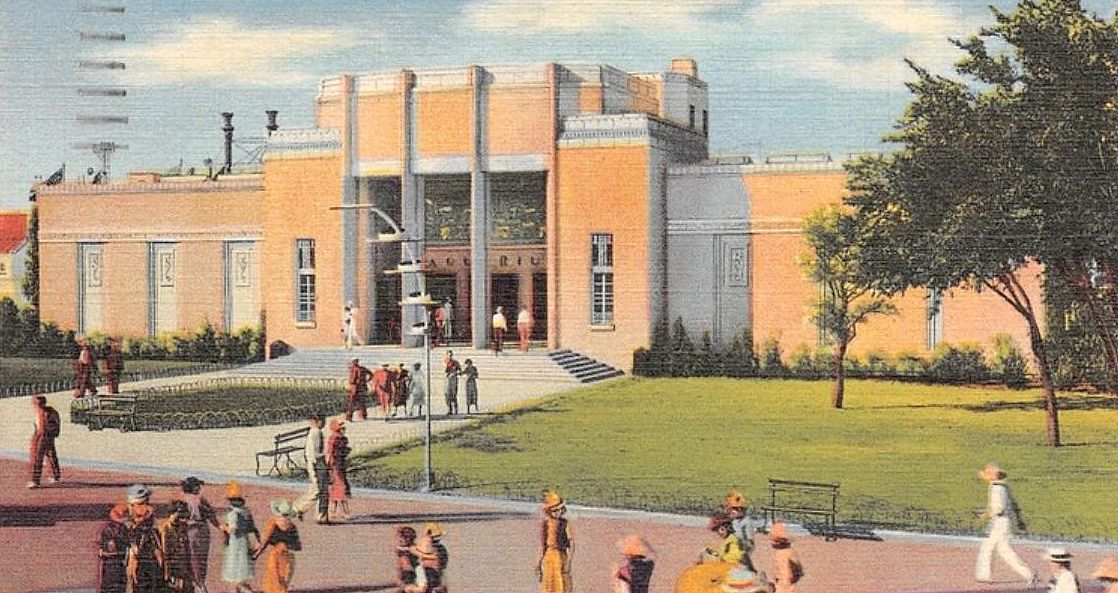
fair-park_aquarium_postcard

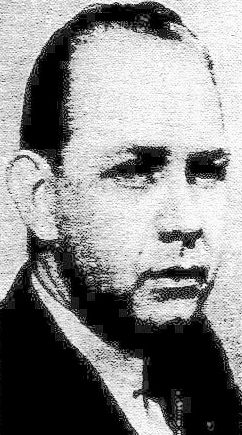
At the time that plans were being discussed for the Fair Park facility, there was something of a tropical fish fad going on around the country. The Dallas Aquarium Society — a small group of “tropical fish fanciers” — was organized in June, 1935, and in September of that year, they had enough pull to put on an exhibition of their personal collections in small tanks on an upper floor of the Dallas Gas Company. People who had never before seen anything but a goldfish in a fish bowl were fascinated, and there were several “gee-whiz” articles in the papers describing the fishy wonders that could be found that fall at the gas company. The president of the Dallas Aquarium Society was Pierre Fontaine — an advertising man and “authority on marine life” — and he must have made quite an impression with the Centennial board, because in February of 1936, he was chosen to be the head of the already-under-construction Dallas Aquarium. (Though apparently a hobbyist when appointed, Fontaine served for decades as the respected director of the Dallas Aquarium — and later the Dallas Zoo.)

aquarium_fontaine_1936
Pierre Fontaine, 1936

The fish on display during the Centennial were almost exclusively freshwater fish. Not only would it have been prohibitively expensive to ship the thousands and thousands of gallons of salt water that would have been needed, it would also have been extremely costly to purchase and maintain the special non-corroding equipment necessary to equip such tanks. But Fontaine must have pushed, because the city gave the go-ahead for a paltry 500 gallons of salt water from the Gulf to be shipped up for the opening of the Exposition, so at least a few exotic saltwater-dwelling creatures and plants were able to share their DeMille-moment in the Centennial spotlight with their freshwater brethren. (At the time, “artificial” salt water was not yet an option as it now is, and only natural salt water could be used.)

aquarium_art-institute-of-chicago_1936Art Institute of Chicago Collection

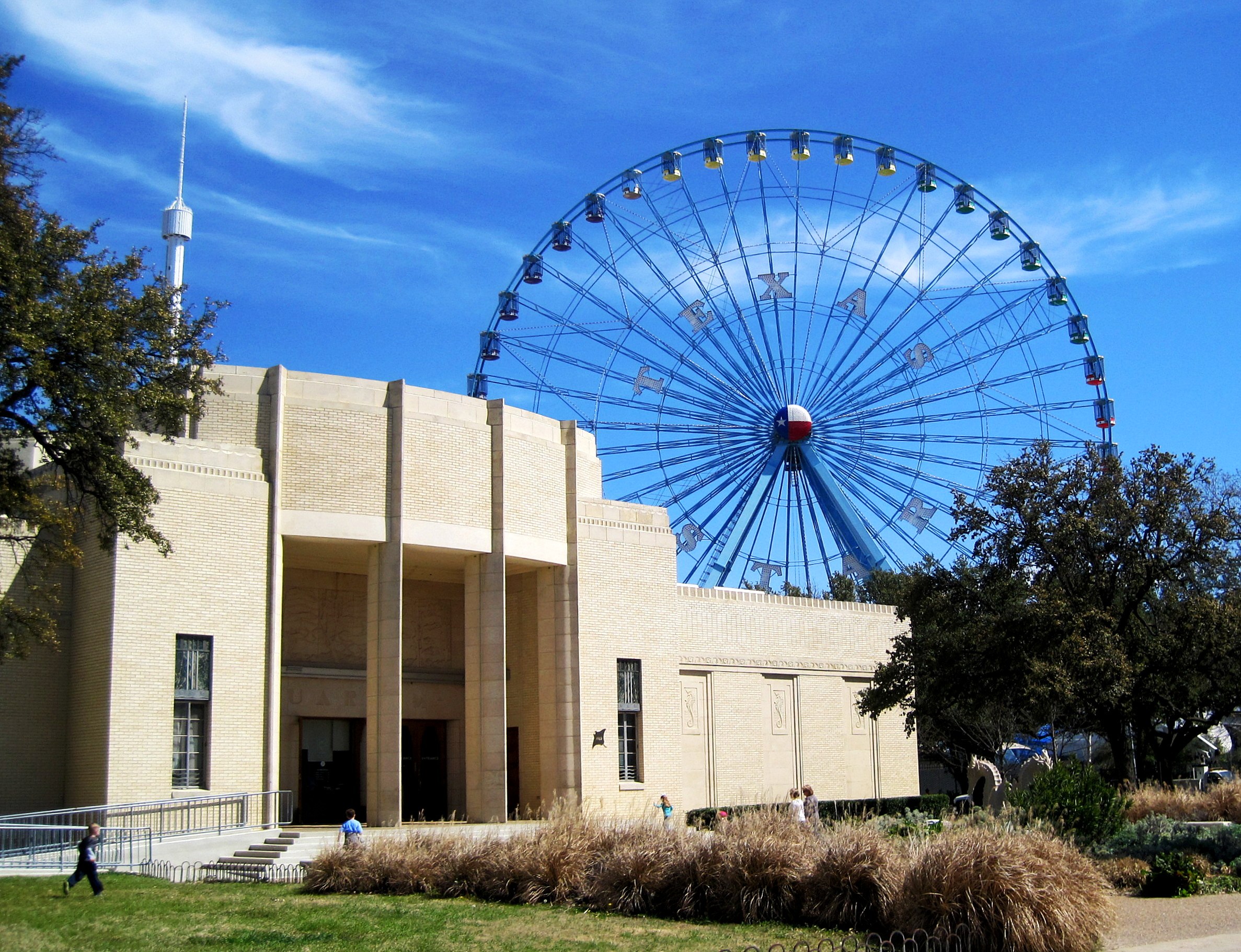
The 1936 Centennial aquarium building still stands. After extensive renovation, it now houses the “Children’s Aquarium,” which I haven’t visited, but which I’m confident is entertaining and educational. I’m pretty sure, though, that it is a completely different aquarium from the one of my childhood memories (when museums were basically designed for adults and were rarely “interactive”). I loved going to the aquarium. I remember it being dark and cool and kind of dreamy inside. Mysterious and exotic. I loved the little neon fish that playfully (or nervously) darted all around the tanks, the big, slow-moving fish that looked back at me like nonchalant cud-chewing cows in a field, the tiny skittering crabs, the turtles, the undulating plants … I loved all of it.

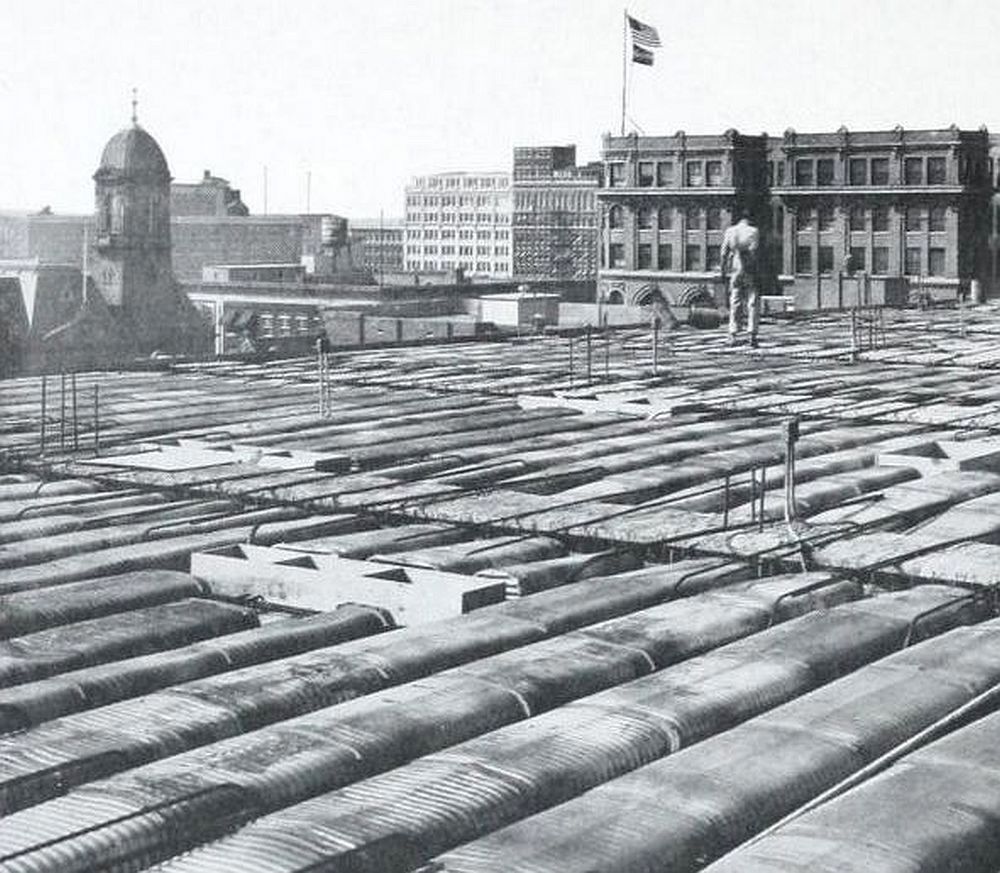
But what I really remember are the seahorses on the side of the building — whichever architect came up with that perfect little detail deserves a special place in heaven. I loved them as a child, and I love them now. The acres and acres of art deco fabulousness created for the Texas Centennial are absolutely thrilling, but those solemn and quietly elegant seahorses all in a row on the side of the Dallas Aquarium will always be my personal favorite little nostalgic detail in the whole of beautiful, beautiful Fair Park.

seahorses_pb-det

The Aquarium today (click to enlarge) / photo: Paula Bosse

*

UPDATE — Oct. 2020: It has been announced that the Children’s Aquarium will be closing permanently. This news is almost as upsetting as seeing Big Tex in flames.

UPDATE — Sept. 2021: Good news! It looks like the aquarium will be reopening in time for the 2021 State Fair of Texas. Read about it here.

***

Sources & Notes

Top two images are postcards based on the original architectural drawings, issued before the aquarium was built, found somewhere on the internet.

The third color image is a postcard from a photograph taken after the Centennial was underway.

Photo of the exterior of the present-day aquarium was taken by me in 2013.

The website for the Children’s Aquarium at Fair Park is here.

For an absolutely FANTASTIC well-illustrated article titled “The Metamorphosis of the Dallas Aquarium at Fair Park Into the Children’s Aquarium at Fair Park, With Historical Annotations” by Barrett L. Christie, Aquarium Supervisor, see p. 5 of the “Drum & Croaker” PDF, here. I really loved this article — especially the “Annotations of Historical Interest” at the end (p. 14). Seriously — this is a great read. I’m as layman as you’re gonna get regarding this topic, and I was fascinated by all of this. I’m going to have to write about that mysterious severed human leg found on the roof in 1954!

*

Copyright © 2015 Paula Bosse. All Rights Reserved.

The Dallas Athletic Club Building, 1925-1981

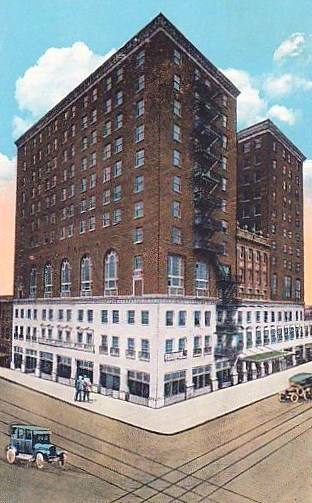
dallas-athletic-clubThe Dallas Athletic Club, 1920s

by Paula Bosse

Dallas’s premier architects Lang & Witchell designed the Dallas Athletic Club building. It was built between 1923 and 1925 on a triangular piece of land located at St. Paul, Elm, and Live Oak, its entrance facing St. Paul. It was one of the city’s top private clubs, catering to Dallas’ businessmen. Aside from sports and recreational facilities — swimming pools (for men and women), gymnasiums, games courts, billiard rooms, etc. — the club also offered meeting rooms, a dining room, a ballroom, and lounges. It also offered use of hotel-like “rooms” to members and their guests. (If it was anything like old movies from this period, I assume it was a handy place to stay if a DAC member was in the doghouse with his wife — or in the midst of divorce proceedings. “If the VP from the home-office calls, Miss Klondike, I can be reached at my room at the club.”) The building also housed a variety of non-DAC-related businesses and offices — my great aunt had a hat shop there in the late 1930s and early 1940s.

The Athletic Club was a major social and recreational spot for years and was something of a landmark in the east end of downtown. In the 1950s the membership opened a country club and golf course near Mesquite but kept the downtown facility open as well. But with suburbia’s surge and downtown’s decline, it was only a matter of time until the club closed the downtown facility. The DAC finally sold the building in 1978, and it was demolished in 1981 to make way for the 50-story 1700 Pacific tower. It had a good run.

*

Before construction began, an artesian well was dug on the property.

dac_artesian-well_dmn_031722DMN, March 17, 1922

When it was finished five months later, “water sufficient to produce 300,000 gallons of water every twenty-four hours was reached” (Dallas Morning News, Aug. 20, 1922).

*

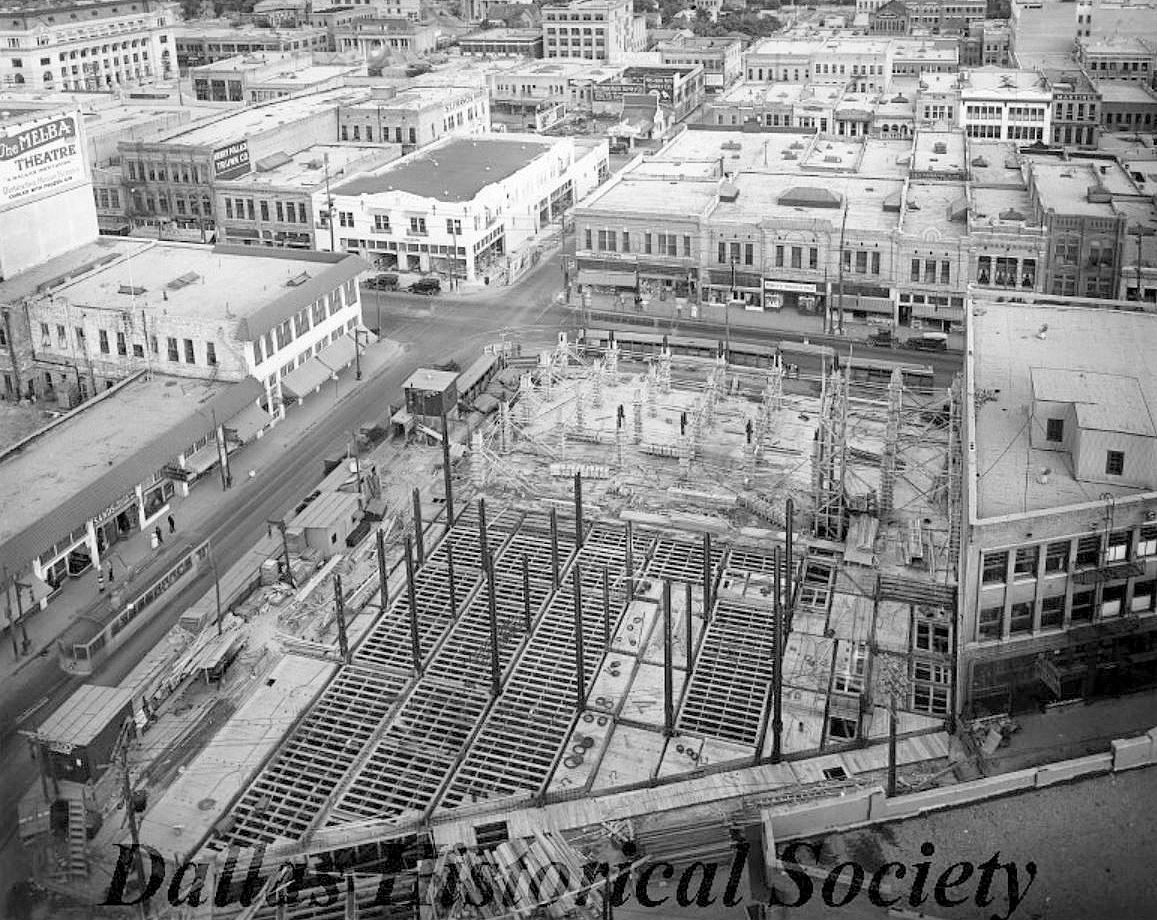
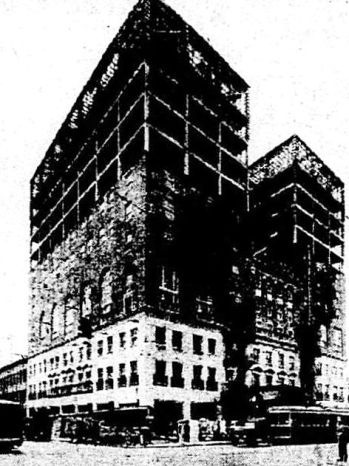
Photo by Charles Erwin Arnold showing construction in progress:

dallas-athletic-club_construction_DHSvia Dallas Historical Society

*

dac_construction_dmn_112523

The progress made to date on the new home of the Dallas Athletic Club Building, which is under construction. […] The picture was snapped from an upper floor of the Medical Arts Building. […] The facing for the three lower floors is of gray Bedford stone. The exterior walls for the upper floors will be of dark red brick. The large openings extending from the fourth to sixth floors will contain the massive windows over the men’s swimming pool. The men’s gymnasium will be on the south side of the fourth floor. When completed, the building will cost approximately $2,000,000, and it will be the most modern athletic club in the United State, according to club officials. (DMN, Nov. 25, 1923)

*

dac_berloy-ad_1924_cropAd for “Berloy Floor Cores” from 1924. Great photo!

*

dac_construction_dmn_111624

Work is nearing completion on the concrete framing for the five upper floors of the thirteen-story Dallas Athletic Club building at Elm and St. Paul street, and bricklaying will be started probably this week. The five upper floors will be used for office purposes, with the club quarters on the eight lower floors, except for some storerooms facing the two streets. (DMN, Nov. 16, 1924)

*

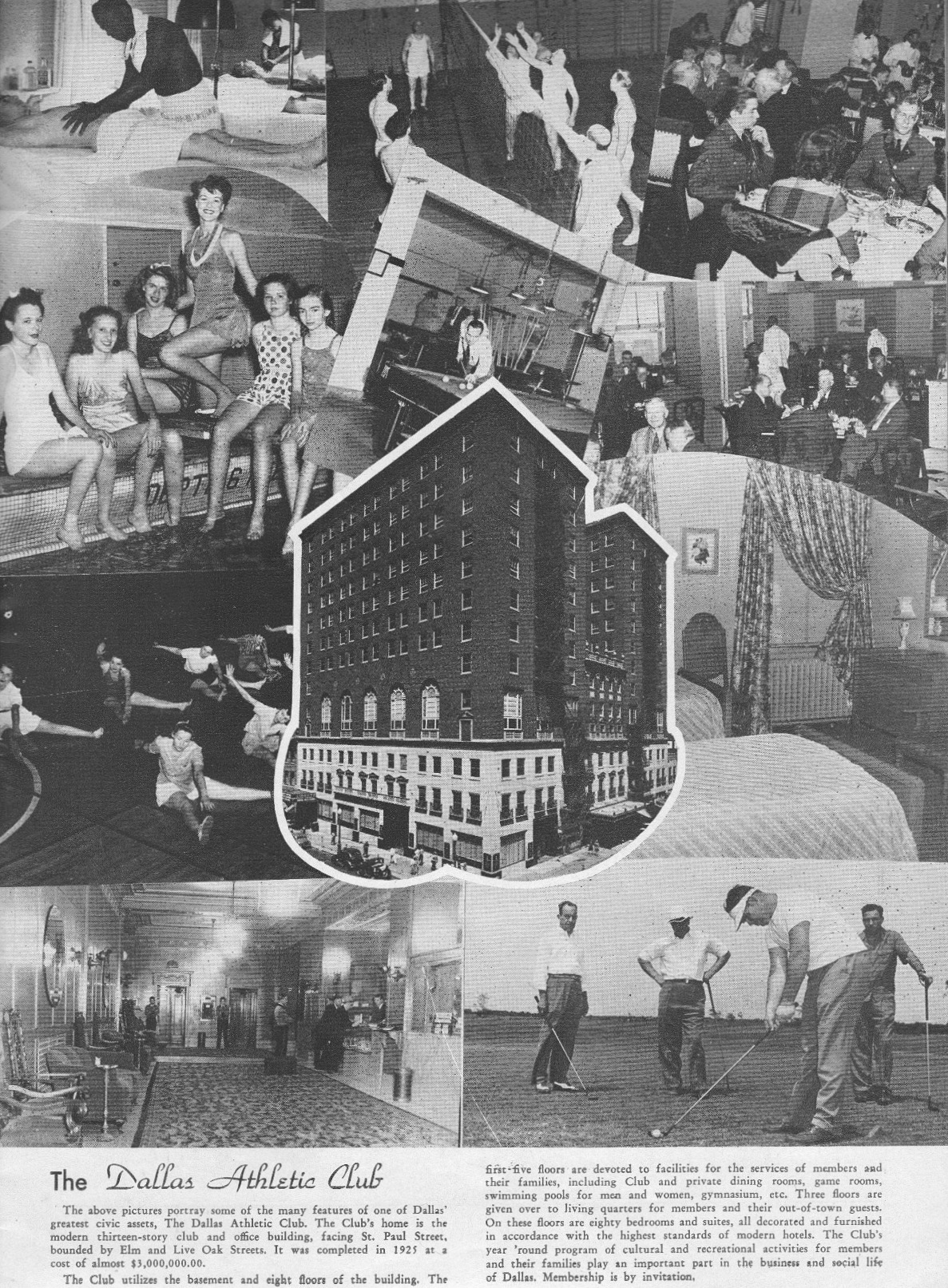
dallas-athletic-club_so-this-is-dallas_c1946_sm1946-ish (click for much larger image)

The above pictures portray some of the many features of one of Dallas’ greatest civic assets, the Dallas Athletic Club. The club’s home is the modern thirteen-story club and office building, facing St. Paul Street, bounded by Elm and Live Oak streets. It was completed in 1925 at a cost of almost $3,000,000.

The Club utilizes the basement and eight floors of the building. The first five floors are devoted to facilities for the services of members and their families, including clubs and private dining rooms, game rooms, swimming pools for men and women, gymnasium, etc. Three floors are given over to living quarters for members and their out-of-town guests. On these floors are eighty bedrooms and suites, all decorated and furnished in accordance with the highest standards of modern hotels. The Club’s year ’round program of cultural and recreational activities for members and their families play an important part in the business and social life of Dallas. Membership is by invitation.  (“So This Is Dallas,” a guide for newcomers to the city, circa 1946)

*

dac_smu_1938-crop

Aerial view from 1938, looking east; the DAC is in the center, with Elm Street to the right. (SMU)

*

dallas-athletic-club_matchbook_cook-collection_degolyer_smu_a     dallas-athletic-club_matchbook_cook-collection_degolyer_smu_b
1950s matchbook, via SMU

*

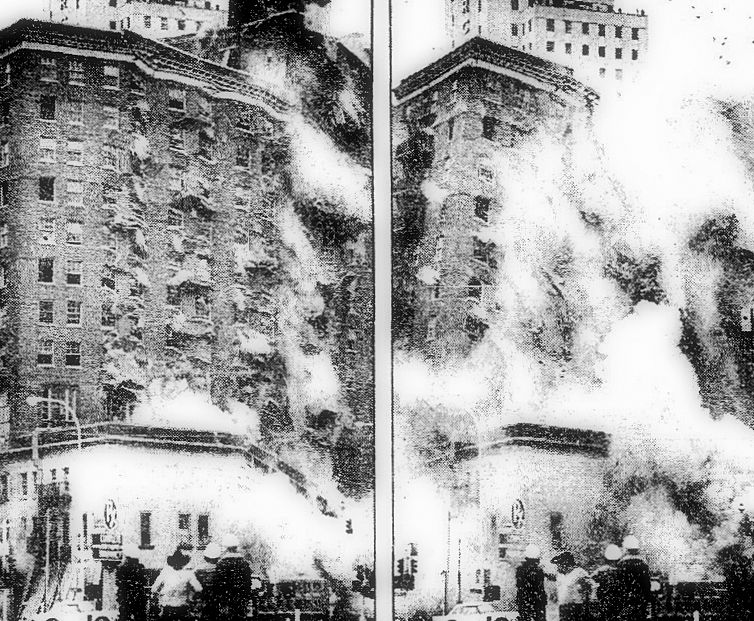
In March, 1981 it was announced that the building would be imploded.

The former Dallas Athletic Club building, which for 53 years served as a health club and meeting place for Dallas businessmen, will be imploded. […] A 50-story office building will be constructed on the site. The 57-year-old building has been empty since the club moved from the building in 1978. (Dallas Morning News, March 22, 1981)

And on March 22, 1981…

dallas-athletic-club_demo_dmn_032381a

dallas-athletic-club_demo_dmn_032381bDMN, March 23, 1981

The end of an era.

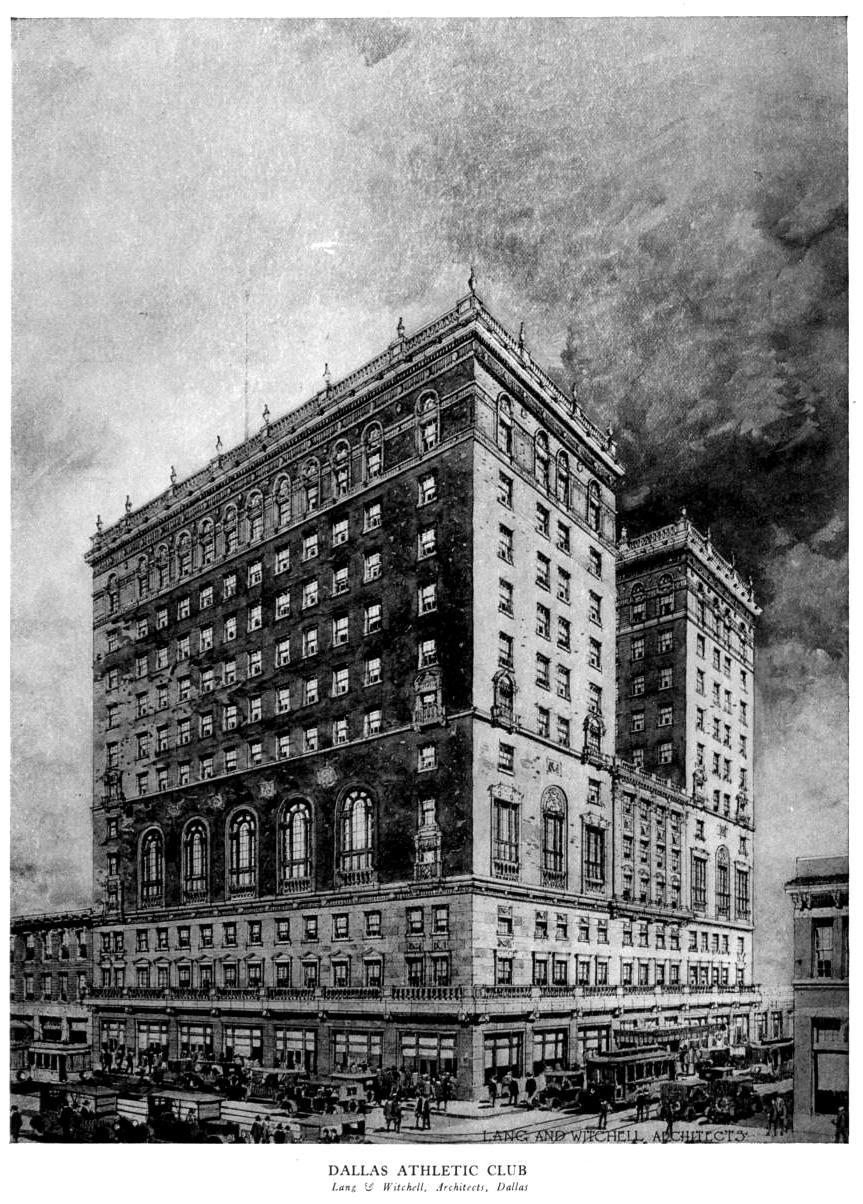
But let’s remember happier times for the Dallas Athletic Club building and gaze at this idealized version from Lang & Witchell’s original drawing (circa 1922).

dallas-athletic-club_drawing_arch-yrbk_1922

***

Sources & Notes

Bird’s-eye view of the construction site is by Charles Erwin Arnold and is from the Arnold Photographic Collection, Dallas Historical Society; its ID number is A.68.28.17.

Aerial view is a detail from a photograph taken by Lloyd M. Long in 1938; it is from the Edwin J. Foscue Map Library, Southern Methodist University. The full photo can be seen here; the same photo, with buildings labeled, is here.

Lang & Witchell drawing from The Yearbook of the Dallas Architectural Club, 1922.

Dallas Morning News clippings and photos are as noted.

Live Oak used to cut through the block bounded by St. Paul, Elm, Ervay, and Pacific. To get an idea of where the building was, here is a 1962 map of the area (the full map can be seen here).

map_1962

The Dallas Athletic Club is still around. Their website is here.

*

Copyright © 2015 Paula Bosse. All Rights Reserved.

SMU Football Players’ Unusual Summer Job: Strutting and Parading at the Dog Track — 1937

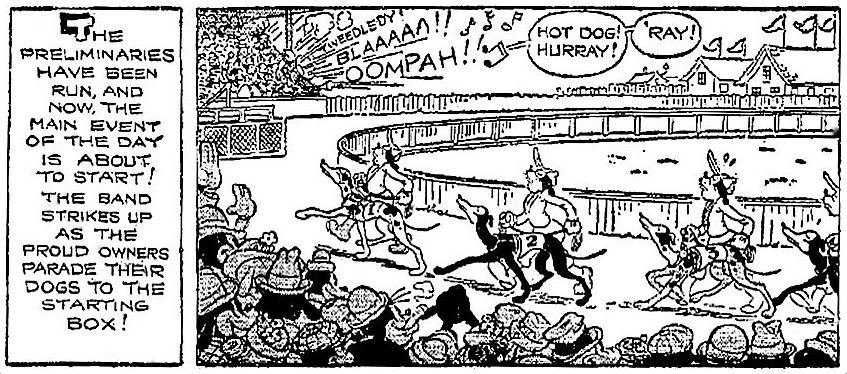
greyhounds_mickey-mouse_010835_cropped
It was kind of like this… (click for larger image with caption)

by Paula Bosse

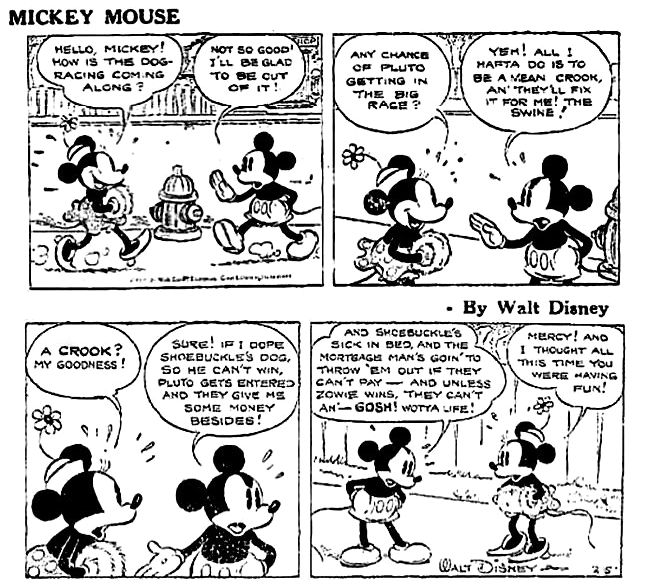
In doing research for my recent post on the Oak Downs/Sportsman’s Park greyhound racing track across from Love Field, I came across, of all things, a 1935 Mickey Mouse comic strip story arc about dog racing. The first panel of one of the early strips is above. Its caption:

The preliminaries have been run, and now, the main event of the day is about to start! The band strikes up as the proud owners parade their dogs to the starting box.

So when I came across a 1937 story about financially-strapped SMU football players earning extra money during the off-season by parading greyhounds around our dog track, I couldn’t help but think of the cartoon panel above. …But with maybe more strutting.

Some of Matty Bell’s Southern Methodist University Mustangs already are picking up something more than pin money out at Sportsman’s Park, where greyhound racing is flourishing and gaining in popularity nightly. When Lou Harris’ jazz band strikes up a lively tune for the parade to the post you’ll see eight husky young athletes leading out the field of greyhounds in that race. They’re decked out in handsome uniform and they’ve learned to strut with the music and put on their part of the show in style. After finally placing the dogs in the starting box they keep fit running down the track to a stand where they wait until the race is over to catch the canines and then return them to their owners…. [Coach Bell] thinks the work in the open, combining strutting with running, will help keep off that excess poundage. Meantime some other coaches are wishing they had dog tracks in the vicinity of their schools.” (Dallas Morning News, April 30, 1937)

***

Sources & Notes

Mickey Mouse panel from the 9-week dog-racing story arc which ran between Jan. and March, 1935; this particular panel appeared in newspapers on Jan. 8, 1935.

Dallas  Morning News excerpt from George White’s “Sport Broadcast” column (DMN, April 30, 1937). I’m afraid I know nothing about Mr. White, except that, lordy, that man needed to pare down his sentences and use a lot more commas!

*

Copyright © 2015 Paula Bosse. All Rights Reserved.


Oak Downs: Dallas’ Brief Flirtation with Greyhound Racing

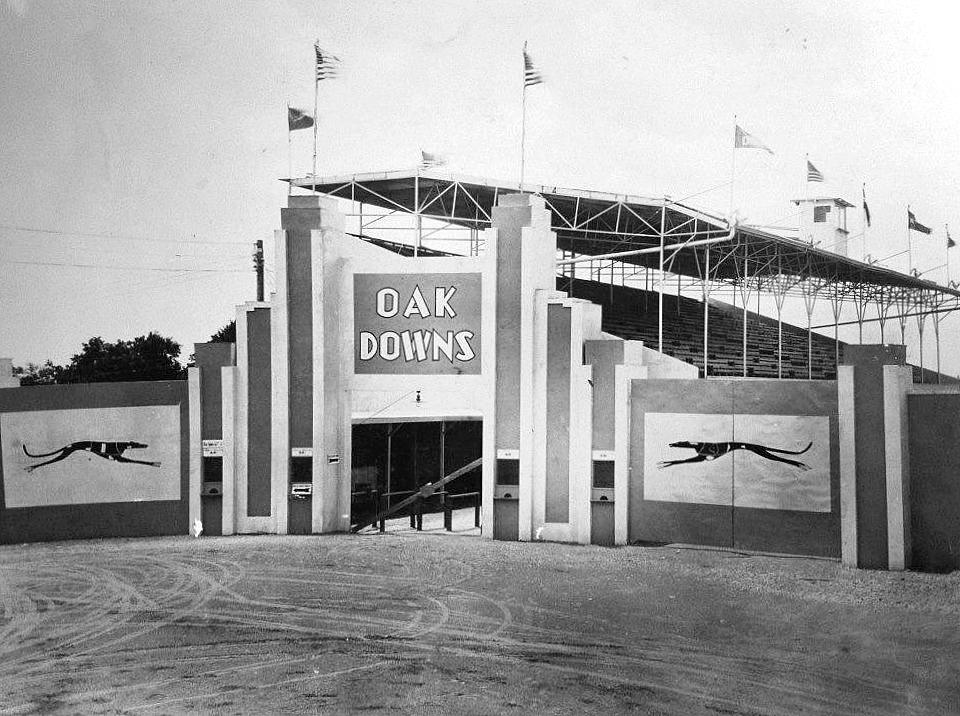
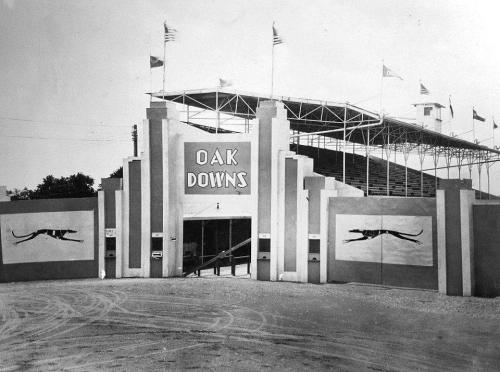
oak-downs_hurst_bwOak Downs greyhound track, ca. 1935 (photo courtesy Robert Hurst)

by Paula Bosse

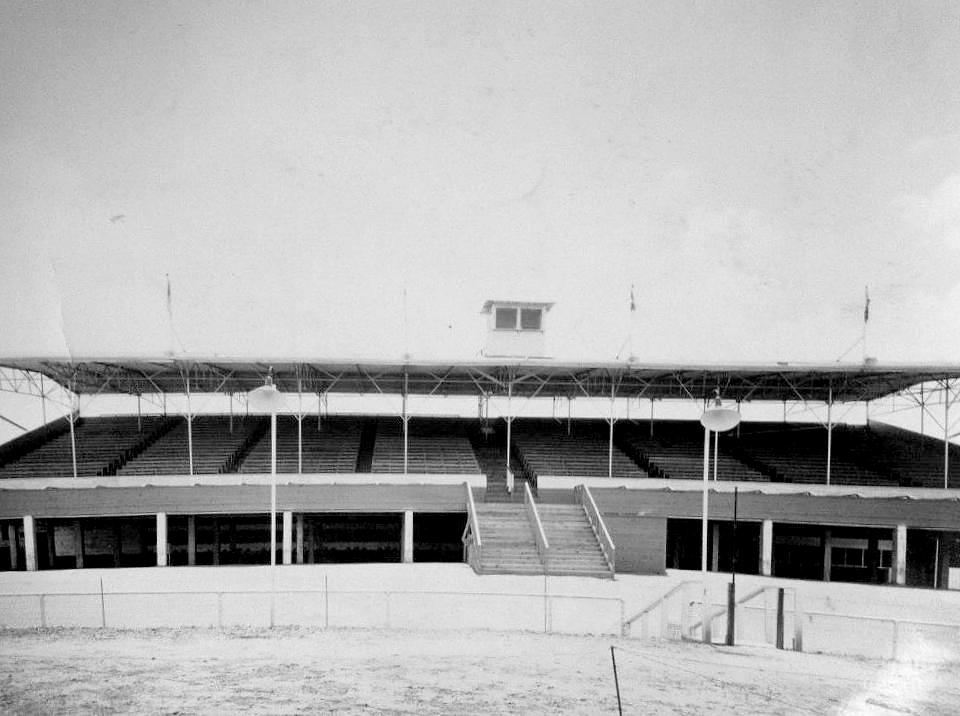
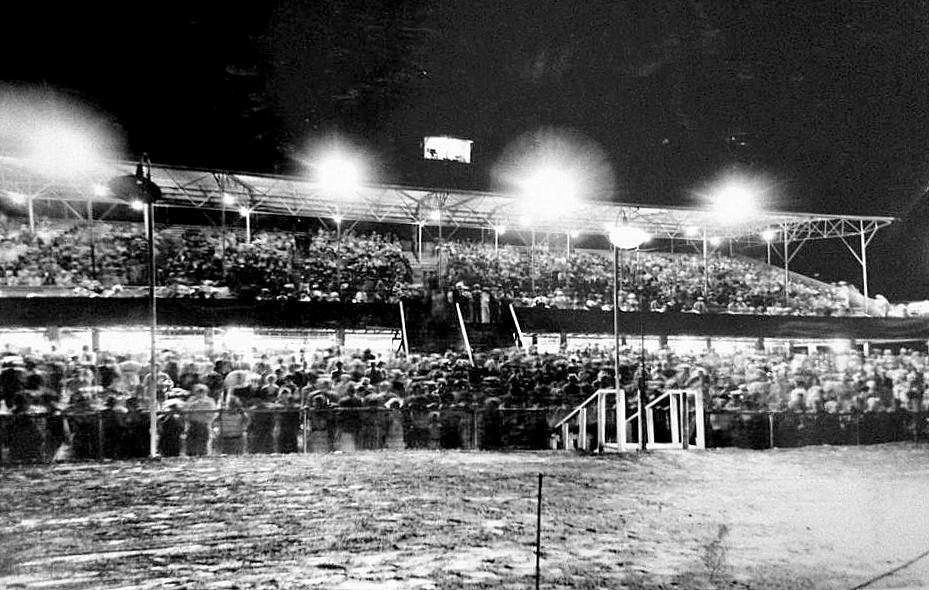
Robert Hurst has shared three great photos with me: the one above, and the two below. They show Oak Downs, a greyhound racing track that he thought might have been in Oak Cliff. A dog track? In Dallas? That was news to me. Mr. Hurst came across the photos a few years ago when going through the belongings of his grandparents, Lt. Col. and Mrs. C. W. Newman. As far as he knew, they had no particular interest in dog racing, and he wasn’t sure why they would have been in possession of photos of a greyhound track. I was a little hesitant to delve into anything having to do with dog racing, but these wonderful photographs piqued my interest. (For the faint of heart, this post focuses almost exclusively on the somewhat vague and constantly changing laws on parimutuel betting in Texas, with very little on the troubling aspects of greyhound racing.)
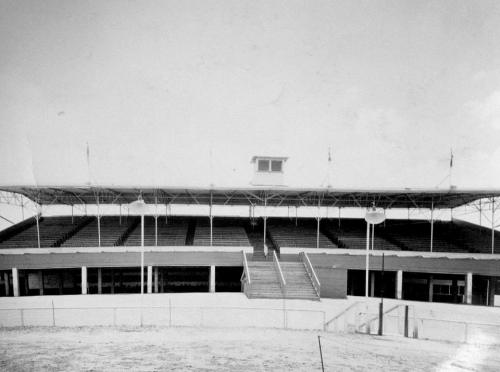
oak-downs_grandstand_day_hurst_bwGrandstand, daytime (click for larger image) (courtesy Robert Hurst)
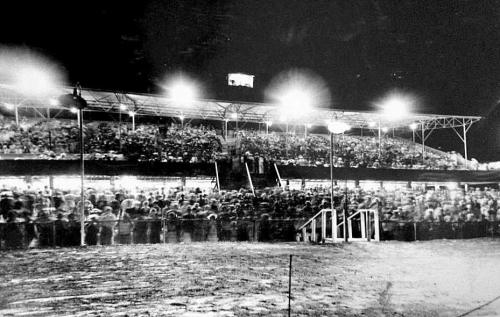
oak-downs_grandstand_night_hurst_bwGrandstand, nighttime (courtesy Robert Hurst)

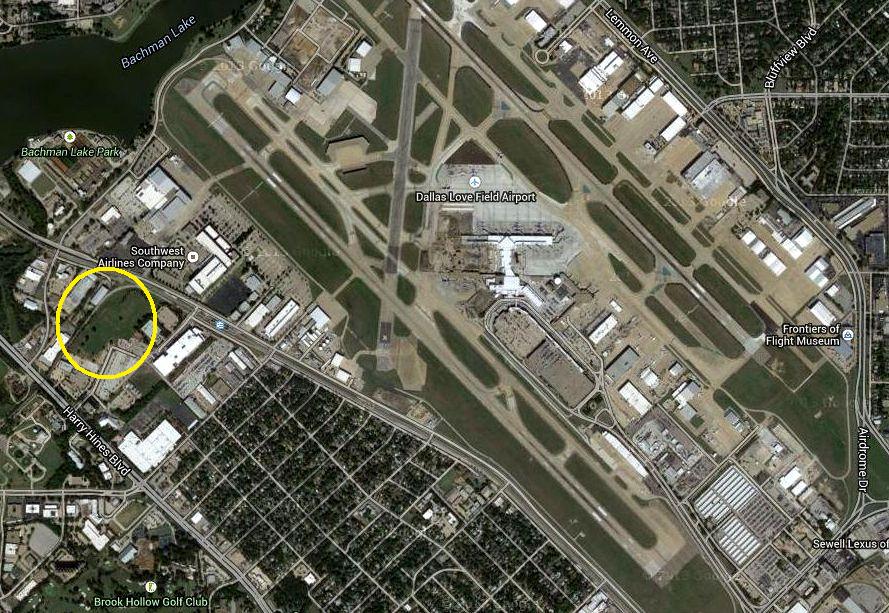
The track was located not in Oak Cliff, but right across the street from Love Field — an area that was “north of the city” in the 1930s. It was to the west of the airfield, with the address listed, popularly, as Maple Avenue, but officially as Denton Drive (just north of Burbank Road).
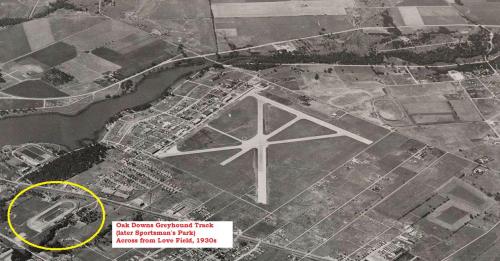
aerial_oak-downs_smu-foscue_1930s1930s (Edwin J. Foscue Map Library, SMU)
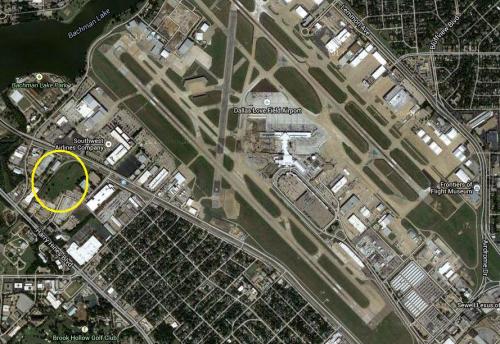
aerial_oak-downs_google2014 (Google Maps)

*

The first mention I can find of greyhound racing in Dallas was in 1898 at events held at the Fair Park horse racing track — the “sport” then was “coursing.” I don’t want to go into it, but live hares and jackrabbits were used, and it didn’t end well for them. (Competitive coursing is, I believe, now illegal in Texas, but open-field coursing is considered hunting and is legal.)

The first professional greyhound racing track to take the “blood” out of “blood sport” by utilizing an electric rabbit lure, was in California in 1919. The first track in the Dallas area to use an electric rabbit seems to have been one that opened near Grand Prairie in 1928; the news stories made sure to mention that there would be no wagering going on because, unlike other states where dog racing had been going on for some time and was quite popular as a gambling sport, parimutuel betting was not legal in Texas. Racing at that early track doesn’t seem to have lasted very long — probably because the spectators were not allowed to wager on the contests. Another track opened just outside Fort Worth at Deer Creek in 1934 (right after Texas had legalized betting on horse races in 1933), but, again, it doesn’t seem to have lasted long.

So, in the early ’30s, Texas was not really a hot-bed of dog racing enthusiasts. What was popular was horse racing — the two most popular tracks in the area were the Fair Park track in Dallas, and Arlington Downs in Arlington. The state legislature had voted in 1933 to allow parimutuel betting on horse races, hoping to raise revenue in the dark days of the Depression. People might not have been able to afford a new pair of shoes, but they managed to scrounge up money to bet with. Gambling on horse races was big business. But betting on dog races? Was it legal, too? It sounds like the law was surprisingly vague. Dog racing was not expressly written into law as being illegal — but people just seemed to understand it to be illegal. Proponents of greyhound racing — the so-called “Sport of Queens” — were adamant that they would force the state to address the issue and clarify the law — they would sue if they had to. A track in San Antonio had taken its case to a State Court of Appeals (after having been shut down by local authorities), and the court ruled that parimutuel wagering at dog tracks in Texas was not illegal. A precedent had bet set, and a few dog racing tracks began to open around the state, their owners and operators feeling they were relatively safe from prosecution.

In early 1935, 31-year old Winfield Morten, a “wealthy sportsman” who owned several businesses and a lot of Dallas real estate, decided he’d open a greyhound track on his 40 acres of land along Maple Ave./Denton Dr., just west of Love Field. He received his state business charter in May, 1935 (just days after the San Antonio ruling), and he made plans to open his dog racing “plant” — Oak Downs — in June. As they said back then, “pari-mutuel betting would be fully in vogue.”

Many people did not want a dog racing track in Dallas (or anywhere in Texas, really). Owners of horse tracks (and the powerful people who were in bed with them) feared that they’d lose some of that sweet gambling moolah to the upstart “dogmen.” Outside the racing world, there was the fear/expectation that with dog tracks would come the inevitable gambling and sleazy criminal element. (Dog racing was generally seen as somehow more unsavory and déclassé than horse racing, which is odd, because the horse racing industry has never been known as a squeaky-clean one.) Also, apart from the gambling-related issues, many people were probably aware of (and disturbed by) persistent accusations of animal mistreatment. Interestingly, at this same time — during the first few months of 1935 — none other than Mickey Mouse was involved in a comic strip story arc that lasted several weeks in which he was hanging out at a dog track training his dog Pluto for a race. It wasn’t long before the comic strip (which was usually full of typical comic strip silliness and gentle humor) turned surprisingly dark, and Mickey found himself involved in a world of doping, gambling, extortion, and threatened violence (!). If Walt and Mickey were against the evils of dog racing, shouldn’t everybody be? I wonder if the strip was reflecting public opinion or shaping public opinion?
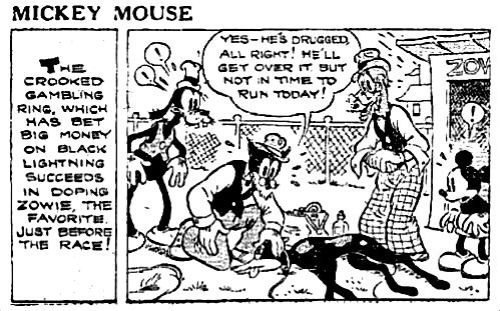
mickey_021935Poor Zowie! (Originally run Feb. 19, 1935)
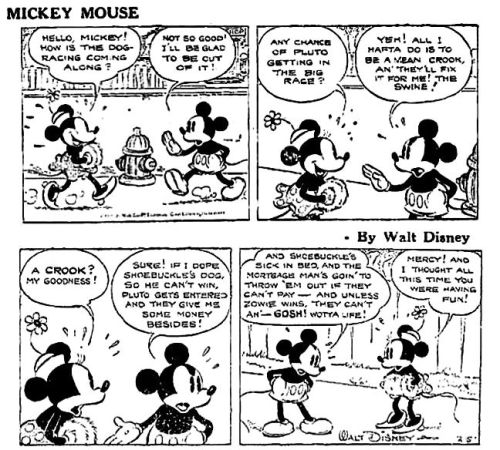
mickey_020535Mickey’s in a tough spot (click to enlarge) (Feb. 5, 1935)

Not only was the prospect of a “seedy” dog track unpalatable for many in an image-conscious city gearing up for its upcoming Centennial-Exposition-moment in the national spotlight, but there were those who were still convinced that gambling on anything but horse races in Texas was illegal — despite what the appeals court had ruled in the San Antonio case. Several interested district attorneys from around the state petitioned the State Supreme Court for a definite ruling. In the meantime, Dallas D.A. Robert L. Hurt and Dallas County Sheriff Smoot Schmid (greatest name in law enforcement EVER) threatened to shut down the not-yet-opened Oak Downs if it allowed wagering. Battle lines were drawn, and both sides believed they were in the right.

Track manager Jack Thurman said the city’s threats didn’t scare him. He’d open as scheduled, with plans for a full season of 48 days of racing (every day but Sunday), sleek hounds, an electric rabbit, and full-tilt betting. The day before Oak Downs was scheduled to open, its operators wisely obtained an injunction against Hurt (and, basically, the Sheriff’s Department and the Texas Rangers), which prevented the track from being shut down — they would open without fear of incident, under full legal protection of a court order. Not a happy guy, Hurt said he would file a motion to dissolve the injunction … immediately!

Oak Downs opened on June 18, 1935 to a large crowd of curious spectators, most of whom had never seen a dog race. The betting windows were open, but there was little betting. There were problems with the electricity in the stadium on opening day — the electric-powered rabbit that the greyhounds chased was not running on full power, and it moved so slowly that it was caught in two separate races by the probably confused dogs. (The second night there was too much juice, and the rabbit shot away from the pack so quickly that the dogs lost sight of it and just stopped running altogether. Hard to have a race if the dogs don’t actually run.) But the crowd seemed happy, and they weren’t overly concerned by the glitches happening there at the track or by the political and legal wranglings that were swirling downtown.

The crowds and the betting increased over the next few days, hinting at a rosy future for the track’s operators. But the races and the attendant wagering continued for only eleven days. The United States Fifth Circuit Court of Appeals refused to interfere with the wishes of State law enforcement — and State law enforcement wanted Oak Downs to cease with the gambling. So there was no more parimutuel betting at Oak Downs. After trying to struggle by without the sexy allure of betting — left with nothing but exhibition races and weird novelty events involving dog-riding monkeys — Oak Downs was forced to close its season prematurely on June 29.

Bye-bye, abbreviated inaugural season. No more betting on Doctor Snow, or Dixie Lad, or Rowdy Gloom, or Miss Cutlet, or Pampa Flash, or Billie Hobo, or Blond Hazard, or Mellow Man. Oh, Mellow Man, we hardly knew ye.

In February, 1936, Morten applied to the Texas Racing Commission for permission to race horses at his track, but the idea was quickly shot down by the Dallas City Council. The very profitable horse track at Fair Park was out of commission for 1936 as it was being used as part of the Centennial Exposition. Privately owned at the time, the track was leased to the Centennial Corporation, and the City Council — the members of which were no doubt on very friendly terms with the Fair Park track owner — felt it would be “unfair” to allow a competitor to horn in on the massive profits to be had. So … no dice (…as it were).

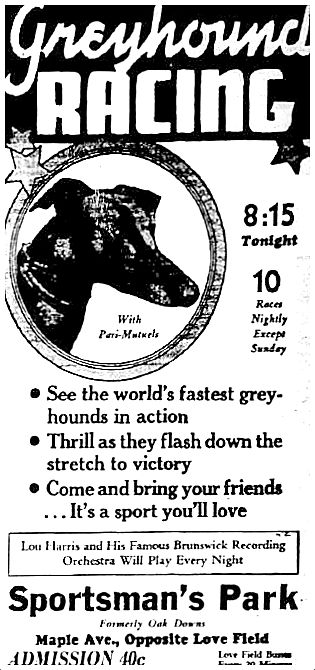
By September of 1936, Morten changed Oak Downs’ name to Sportsman’s Park and brought in new operators (including a former Texas Ranger). Oak Downs had joined other dog tracks in a new round of legal action which was slowly working its way through the courts. Without any ruling yet from the Supreme Court, they ignored an injunction that had been filed against them and defiantly opened up their betting windows again. Four of the men were fined and jailed briefly for contempt of court. But after months of mixed messages and conflicting rulings from various judges around the state, confused and fed-up lawmen were unsure of the actual legality of dog track betting, and, grudgingly, they allowed the wagering at Oak Downs to continue as they, too, awaited a high court decision.

As reported in Texas newspapers, on Oct. 28, 1936 the Texas Supreme Court finally ruled on the matter of whether or not dog racing could be wagered on legally in the state of Texas:

We do not find any provision in the penal code defining gaming which can be construed to include dog racing or betting on dog racing. It is not a game prohibited by law. […] This court is fully conscious of the pernicious and unwholesome effects upon society of betting on dog races and keeping premises for dog racing where betting is allowed, but the proper agency for the suppression of those wrongs is the Legislature, and until it sees proper to further legislate in the matter, the courts are without power to suppress these evils by injunction.

In other words, the Texas House and Senate were going to have to take up the issue if they really wanted to do away with legalized betting on dog races (which they did), because it was their fault that they hadn’t been specific enough when they wrote their original law.

So betting was back “in vogue” once again. And now with absolutely no threat of arrest. The remainder of the 1936 season continued without problems, and when the 1937 season opened in April, it was “the first greyhound meet in Dallas free of danger of being interfered with by law enforcement agencies” (DMN, April 22, 1937), but … as there were bills to outlaw betting on dog racing AND horse racing percolating through the current Texas legislature, it was thought that the 1937 season might also be the last season of racing in Texas.

In May, 1937, Governor James V. Allred addressed the Texas Congress, urging them to repeal the current law allowing parimutuel gambling on horse racing (with the knowledge that this would almost certainly also apply to the outlawing of dog racing, as that bill had just passed the House and was headed to the Senate). Here are a couple of passages from his speech, a transcription of which appeared in newspapers throughout the state on May 28, 1937:

I do not know how to state in words a stronger case for repeal of the race track gambling law than I have already given to this Legislature from time to time. I have quoted Washington, Franklin, Blackstone, Shakespeare, Brisbane, McIntyre and the Holy Bible. I have pointed out the living evidence of undesirables, of doping, of thuggery, of embezzlement, of bank failures, of suicides, and narcotic rings. Each month of the life of this law sees addition to the numbers of these human tragedies….

And, finally, a mention of the evils of racing with regard to the animals themselves:

There is no record of a horse ever being doped except to run a race. All the races ever run are not worth the agony and cruelty dealt even one of these poor, helpless beasts! I appeal to all who love good horses, I appeal to all who believe in preventing cruelty to animals to join with me in demanding that this law be repealed.

Allred’s lengthy and impassioned speech — which addressed every argument the pro-gambling forces were wont to … trot out … must have touched a few nerves (with both the public and the politicians), because in June, both bills passed with huge margins. (The bill outlawing the betting on dog racing passed in the Senate 22-1 and in the House 109-12. With passage of the new law, betting on dog races could now incur a fine of up to $500 and a jail term of up to ninety days; the penalty of “keeping a place of betting on dogs” was two to four years in the state penitentiary.)

So no more parimutuel betting in Texas. No more dog racing. No more horse racing.

And that was that for the state’s dog tracks. What was next for Oak Downs … er, Sportsman’s Park? Three words: “midget auto racing” (i.e. the racing of very small cars, not the racing of cars operated by very small drivers).

Besides the regular auto races, two added events give promise of furnishing fans with a few thrills as well as a laugh or two. Fast cowponies will be featured in a half-mile sprint with a race for roosters rounding out the show. Winner of the cowpony race will receive $15, while the winning rooster will be rewarded with $5. Entries are open to any and all owners of ponies or roosters. (Dallas Morning News, Aug. 27, 1937)

Somehow I don’t think five-buck-purse rooster races figured into Mr. Morten’s big dreams back at the beginning of 1935.
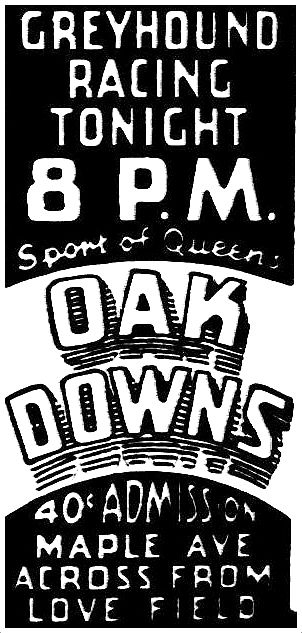
ad_oak-downs_0622351935

*

ad-dmn_0422371937

***

Sources & Notes

Top three photos of Oak Downs greyhound racing track used by kind permission of Robert Hurst. He came across them several years ago in the belongings of his grandparents, Lt. Col. Campbell Wallace (C. W. “Bub”) Newman and Martha Price Newman. Col. Newman was a cavalry officer who served in WWI, WWII, and Korea; between WWI and WWII, he worked in Dallas as a contractor and was employed for a time at Oak Downs where he worked in track operations. (That’s why he had these photos!) [And by no means do I mean to imply that this career military man was involved in any sort of shady goings-on. In fact, from what I can tell, Oak Downs seems to have been run by a fairly “clean” group of people. The perception/reputation of dog racing at the time wasn’t great, but nothing I’ve read about this track suggests that anything unscrupulous was going at the track, behind the scenes, or amongst the personnel who worked there.] He was also an avid polo player and was a good friend (and polo teammate) of Winfield Morten who owned the track. Many thanks, Mr. Hurst, for the use of these wonderful photos!

Black and white aerial view of the Love Field/Bachman Lake area was taken by Lloyd M. Long in the 1930s; photo is from the Edwin J. Foscue Map Library, Southern Methodist University. The unlabeled photo (a detail of which is used above) can be accessed here; a labeled version of this photo (with some streets and buildings identified) can be accessed here.

I highly encourage people to see out the transcript of Governor James V. Allred’s FANTASTIC impassioned speech before members of the Texas House and Senate, which appeared in newspapers around Texas on or around May 28, 1937. As far as politics is concerned, I’m the most cynical person in the world, but this is an incredible speech.

More on the history of parimutuel gambling in Texas from Wikipedia, here.

An explanation of just what parimutuel betting is, is here.

Parimutuel racing was legalized again in Texas in 1987. The current state of racing in Texas can be read about in the Dallas Morning News article “A Last Hurrah for Texas Horse Racing” (May 3, 2014) by Gary Jacobson, here.

I’m quite honestly shocked to learn that greyhound racing is legal in the state of Texas. There seems to be really only one active track with live racing in the state (in South Texas), and the only upside to this appalling fact is that attendance has been in steep decline for years.

*

Copyright © 2015 Paula Bosse. All Rights Reserved.

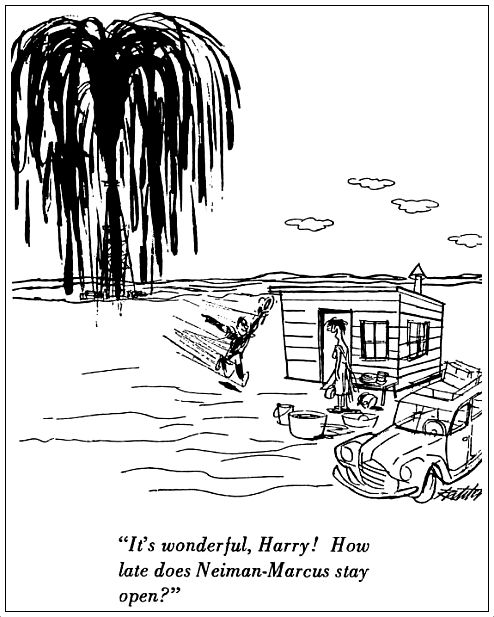
Neiman’s Will Welcome You With Open Arms When Your Gusher Finally Comes In

neiman-marcus_cartoon_1956New Yorker cartoon by Mischa Richter, 1956

by Paula Bosse

I came across this cartoon in — of all things — a historical journal, without a source. Google informs me that this was a cartoon by Mischa Richter, and that it appeared in the Oct. 27, 1956 issue of the New Yorker, one month before the release of the heavily-promoted epic movie “Giant.” You know Jett Rink was no stranger to N-M after his gusher came in.

***

Cartoon from the TSHA journal Texas Historian, Nov. 1978, used as an illustration in the article “Neiman-Marcus: A Dream of Elegance” by Margaret Lucas.

Details on the New Yorker cartoon by Mischa Richter (and the possibility that the original artwork may be available for purchase from Condé Nast, if you are so inclined) can be found here.

*

Copyright © 2015 Paula Bosse. All Rights Reserved.
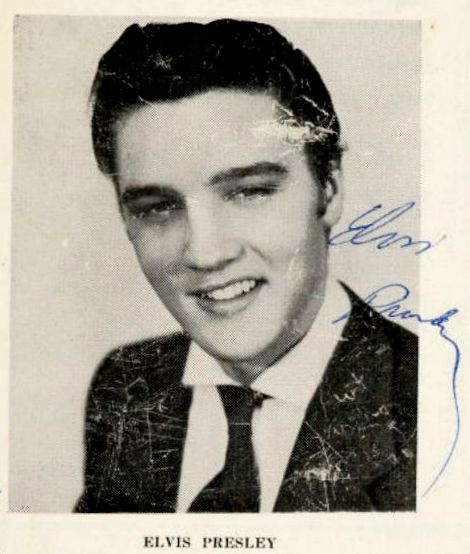
Elvis at the Big D Jamboree — 1955

elvis_big-d-jamboree_program_090355-photo

by Paula Bosse

Today is Elvis Presley’s birthday — a perfect time to present a nostalgic look back at the early days of his fame, before he broke nationally and when it was still pretty easy to get a ticket to see him. Here are a few tidbits from his appearance on Sept. 3, 1955 at the legendary Big D Jamboree (held at the equally legendary Sportatorium). Happy Birthday, E!

*

elvis_big-d-jamboree-program-090355Big D Jamboree program, Sept. 3, 1955

*

elvis_big-d-jamboree_090355That night’s schedule — E’s all over it

*

elvis_big-d-jamboree-ad_dmn_090355Typos like this wouldn’t be a problem soon

***

Sources & Notes

Photo of Elvis and the two clippings from the Big D Jamboree program to that night’s show, Sept. 3, 1955 (which the ad is promoting).

*

Copyright © 2015 Paula Bosse. All Rights Reserved.

You Know What They Say: Big Feet, Big Cigars — 1877

ad-ben-loeb-cigars_dallas-herald_070777“Go to Ben Loeb’s” — 1877 advertisement
by Paula Bosse

Not your typical advertising cut. Wonder if ol’ Ben paid a local artist a handful of cigars in exchange for this great eye-catching art?

An early subliminal ad?

***

Ad from The Dallas Herald, July 7, 1877.

*

Copyright © 2015 Paula Bosse. All Rights Reserved.

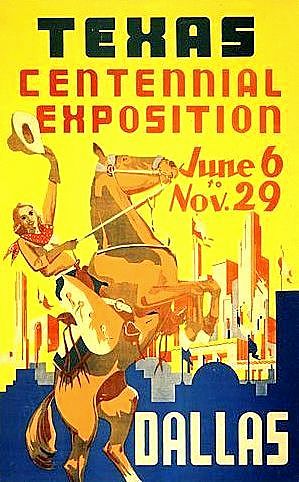
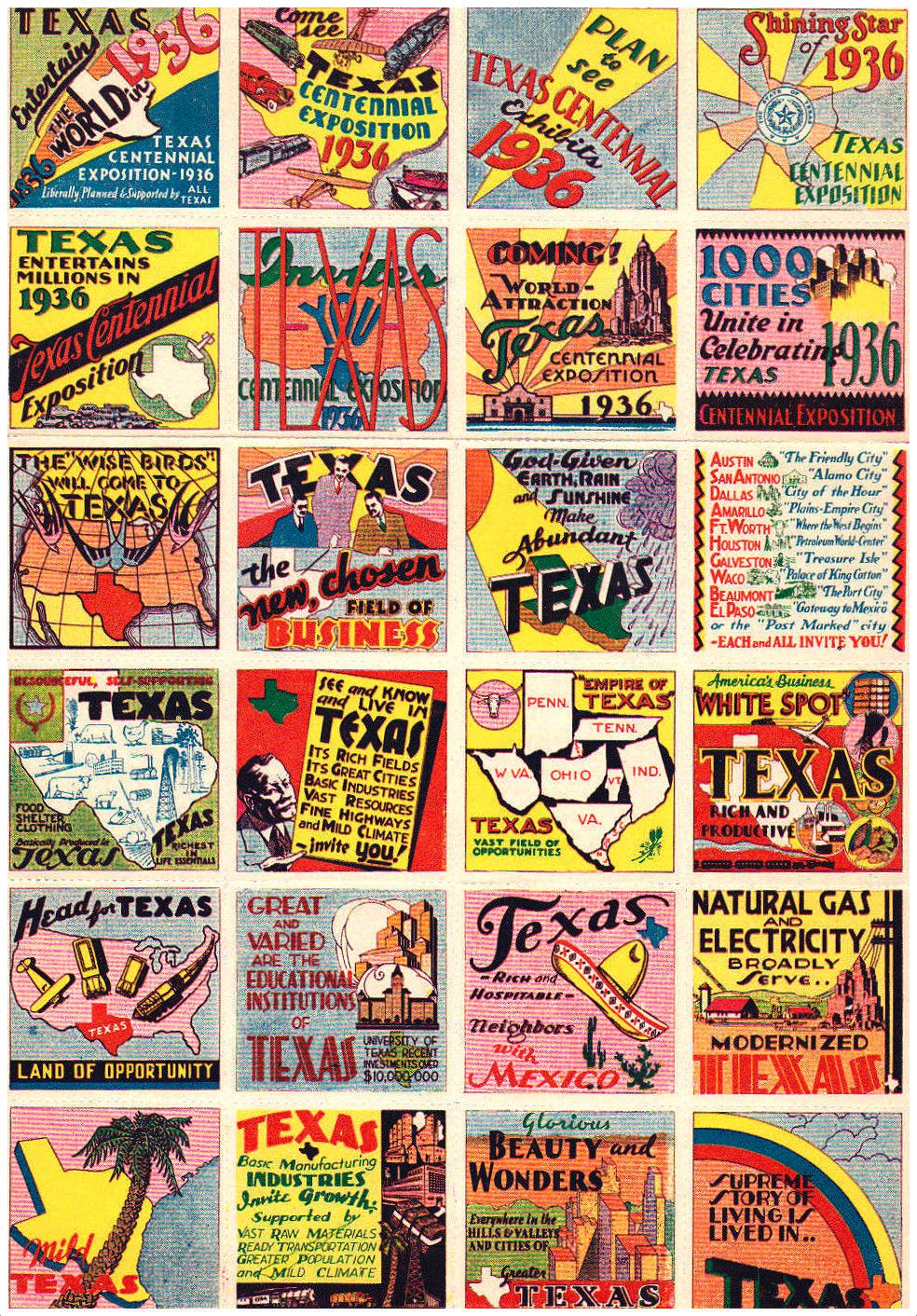
Texas Centennial Promotion on Hyper-Drive! — 1936

tx-centennial_poster_cowgirl_briscoe-ctr

by Paula Bosse

A bit of color and giddy enthusiasm on a gray day.

tx-centennial_promo_sheet(click for MUCH larger image)

***

Top image is a Texas Centennial poster from the Ephemera Collection of the Dolph Briscoe Center for American History. I would provide a link, but I am unable to find it now. It was online a few months ago!

Source of bottom image is unknown. Probably eBay. A long, long time ago.

*

Copyright © 2014 Paula Bosse. All Rights Reserved.

Old Red Goes Hollywood (sort of…) — 1964

buchanan_trial-oswald_1964Old Red’s star turn in The Trial of Lee Harvey Oswald (click for larger image)

by Paula Bosse

An interesting (if a bit fuzzy) screenshot of the Old Red Courthouse from one of Larry Buchanan’s Dallas-made films, “The Trial of Lee Harvey Oswald” (1964), about what might have happened had LHO lived to face trial. As with most of Buchanan’s extremely low-budget films, it drags and has clunky acting (…I have to admit that I didn’t watch the whole thing), but it’s interesting to fast-forward through to see the bits shot out on the streets of downtown. I really like this view of the courthouse. It seems familiar and unfamiliar at the same time.

***

Yes, you can watch the whole film on YouTube — free! Mosey on over here. The movie’s tagline: “Not a Newsreel … A Full-Length Motion Picture Filmed Secretly in Dallas.” Uh-huh. And as far as the movie having been “suppressed” (as is mentioned at the  beginning of the film) … well, let’s just say Larry worked in advertising for many years and knew a thing or two about marketing.

For other posts I’ve written about Larry Buchanan (I kind of feel I know him now — he would have been a lot of fun to shoot a movie with!), click here.

*

Copyright © 2014 Paula Bosse. All Rights Reserved.

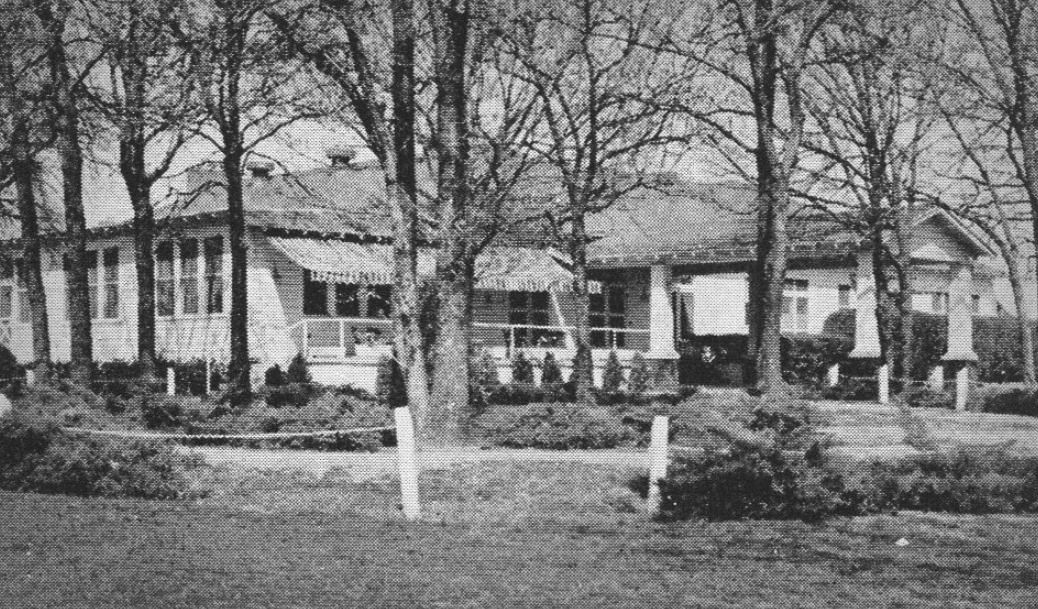
Brook Hollow Country Club — 1940s

brook-hollow-country-club_1940sA modest clubhouse…

by Paula Bosse

A photo of Brook Hollow Country Club from a 1940s guide for newcomers. This photo is from a page of the area’s country clubs. This looks positively quaint.

***

Sources & Notes

From an early edition of “So This Is Dallas,” a guide for new residents of Dallas — this edition is from the early ’40s. Thanks to the Lone Star Library Annex Facebook group for loan of the image.

The Brook Hollow Golf Club is a bit swankier these days. The official site is here.

*

Copyright © 2014 Paula Bosse. All Rights Reserved.