Flashback : Dallas

A Miscellany: History, Ads, Pop Culture

Category: Leisure

Mme. Koneman, High-Class Milliner
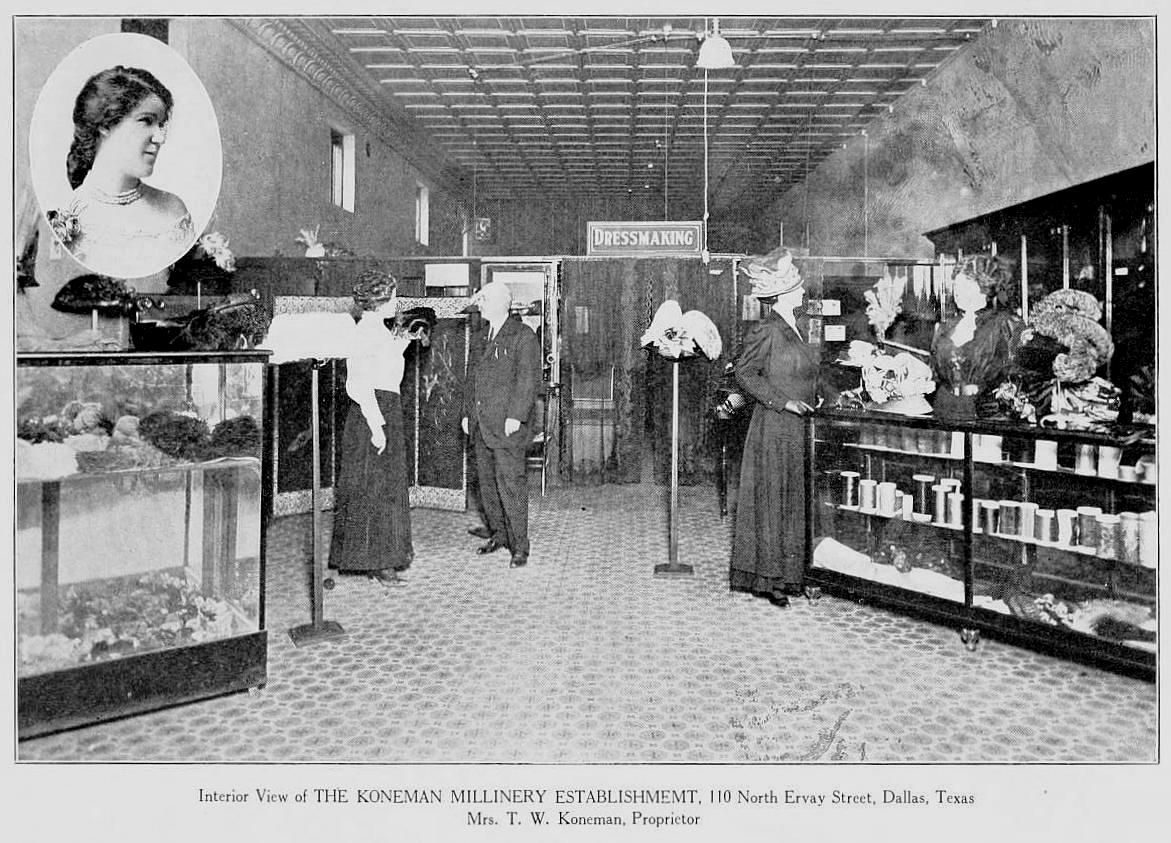
Madame Koneman’s fashion emporium, 1912 (click for larger image)

by Paula Bosse

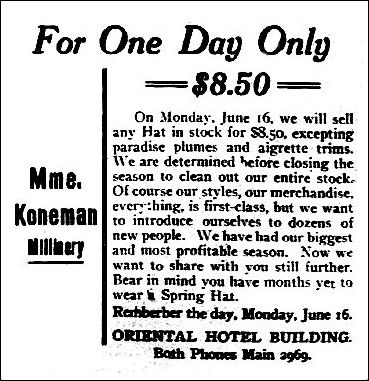
Behold, the Koneman Millinery Establishment, which actually looks a little plain for a millinery shop housed in the ornate Oriental Hotel building. When I see old ads or photos like this, I always wonder about the people pictured in them. I’m assuming that the woman in the oval inset at the left was the proprietess, “Mme. Koneman.” So who WAS she, this woman who had a “high-class” business that catered to a “high-class” clientele? I poked around a little and found these ads from 1913.
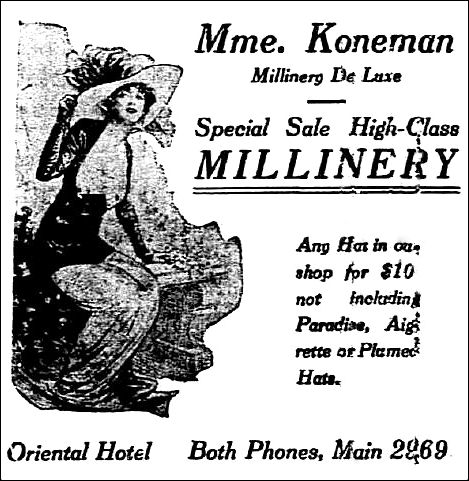
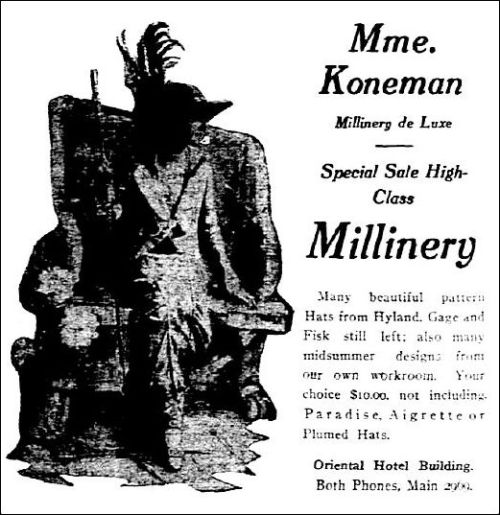
koneman-millinery_dmn_060113

koneman-millinery_dmn_060813

koneman-millinery_dmn_061413

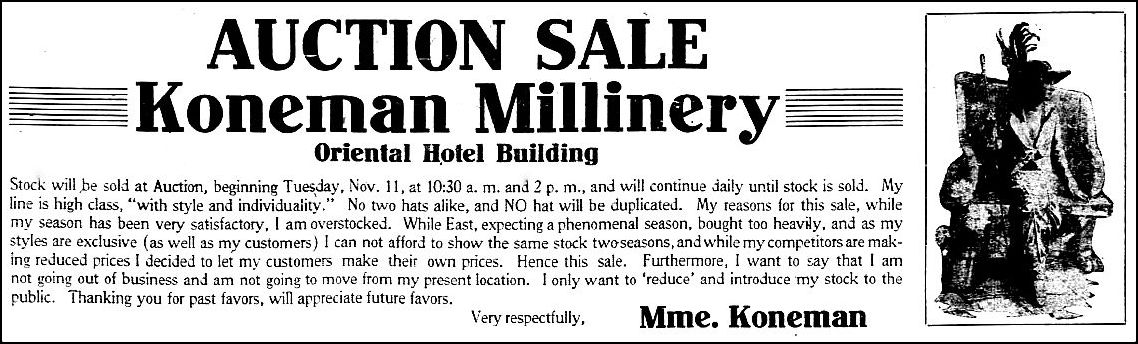
koneman-millinery_dmn_110913(click for larger image)

Ooh. Those last few sentences of the above ad seem a little defensive, as if she’s addressing nasty gossip. “Furthermore, I want to say that I am not going out of business.” When you see a sentence like that — in an advertisement — that sends up some furiously waving red flags. And … just one month after that ad, this miniscule tidbit in teeny-tiny letters appeared in the paper at the end of 1913:

Dallas Morning News, Dec. 21, 1913

Oh dear. D-I-V-O-R-C-E. And, guess what? There were no more ads for the millinery shop.

But, alarmingly, THIS appeared on the wire services on February 17, 1917:

Fort Worth Star-Telegram, Feb. 17, 1917

Oh DEAR! Shot by a widower with two children, who tried to kill both her and himself after he flew into a jealous rage in a New Orleans hotel lobby. Working with feathers and plumes and felt and velvet (probably) does not prepare one for being shot at!

Ten days after being shot, it was reported that the 36-year old Mrs. Koneman (whose first name was either “Matilda” or “Mathilda”) was released from the hospital in New Orleans. The jealous suitor, 40-year old Edgar J. Hargrave (or “Hargrove”), remained in the hospital, slowly recovering (but with a bullet still lodged in his head!). “Policemen expect to arrest Hargrave on a charge of shooting with intent to murder as soon as he is able to leave the institution.” He was an “oil salesman” from Houston.

One week later, Hargrave/Hargrove was released from the hospital and was transferred to Parish Prison where he awaited arraignment on attempted murder. Meanwhile, Matilda/Mathilda, a material witness in the case, had been arrested when the D.A. heard she was about to leave town. Out on a $650 bond, she was ordered to stay in the city until the arraignment.

On March 16, one month after being shot in the lobby of the Grunewald Hotel, Mrs. Koneman was in court recounting her near-death experience, and I’m sure the people back in Dallas were eating up every last morsel in the scandalous testimony about the spurned lover who tried to kill the divorcée who used to sell them great big hats with aigrette plumes in that bleakly unadorned hat shop over on Ervay!

koneman-testifies_dmn_031617-smDMN, March 16, 1917 (click for larger image)

(UPDATE: A reader kindly forwarded me a more detailed account of the shooting incident between the spurner and the spurnee, in a longer article from the New Orleans Times-Picayune (Feb. 17, 1917). Click here to read the article, with a blurry photo of Hargrave.)

And then — rather anticlimactically — the trail ran cold. What was the verdict? What happened to Edgar? Whither Mme. Koneman? Mrs. Koneman was reported to be living in Galveston at the time of the shooting, but by the summer of 1922 she was back in Dallas, checked into the Southland Hotel. The last shred of info I found about her was this classified ad from June, 1922, which raises even more questions.

DMN, June 15, 1922

I’m not really sure what this was all about, but it’s safe to say there would have been very few lags in the conversation between Dallas and California!

***

Top ad from The Standard Blue Book of Dallas, 1912-1914 (Dallas: A. J. Peeler & Co.).

“Dallas Woman Shot” article from the Fort Worth Star-Telegram, Feb. 17, 1917. This was a wire service story that was printed around the country, but, oddly enough, the news doesn’t seem to have made its way into the DMN until ten days after the shooting!

All other ads and articles from the Dallas Morning News. The Koneman Millinery ads were from 1913.

*

Copyright © 2014 Paula Bosse. All Rights Reserved.
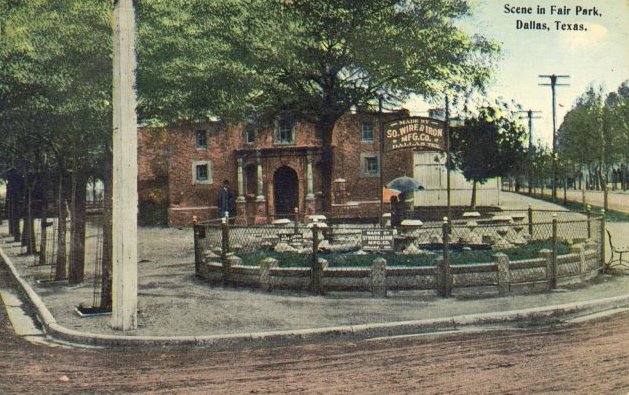
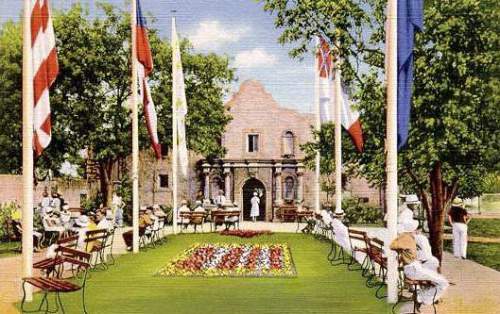
Remember the Alamo! …In Fair Park?

alamo_replica_fair-park_seewatermelonkidpage

by Paula Bosse

Today, on the anniversary of the fall of the Alamo, I bring you news that Dallas has outdone San Antonio by having hosted two Alamos. TWO! Both in Fair Park. The first one was a gift to the city by G. B. Dealey and the Dallas Morning News — it stood stoically at the entrance to the fairgrounds from 1909 until 1935 — and the second one was a rebuilding of the first which was torn down to make way for the the splendor of the Art Deco Centennial extravaganza and lasted from 1936 until 1951. And here I’d never heard mention of Dallas having had ANY Alamos.

The idea came from Dallas Morning News executive George Bannerman Dealey. He sent architect J. P. Hubbell (of Hubbell & Greene) to San Antonio to meticulously photograph, sketch, and measure the original structure — this included making note of every stain, every crack, every instance of broken plaster, etc. — in order to reproduce an exact replica of the historical landmark (at half the size of the original). The Morning News offered to pay for and build the replica (the cost was estimated at $5,000) and asked only that it be placed in a primo location (at the entrance!), that it be open to the public during the day but be available to the DMN people to use for private/company functions after hours, and that the Park Board maintain the building and its landscaping. The Park Board jumped at the gift, and the news of our very own “little Alamo” was met with giddy anticipation. Even the rival Dallas Times Herald was swept up in the excitement and suggested a “Meet Me at the Alamo at the Dallas State Fair” slogan in an editorial.

San Antonio and the Daughters of the Republic of Texas (who managed and maintained the historic shrine) were not terribly amused by this, but The News (in the expected torrent of its own self-congratulatory publicity about its magnanimous gift “not to Dallas, but to the State”) humbly insisted that the much, much, MUCH smaller Alamo would only drum up steady tourism of people who wanted to see the real thing. San Antonio and the Daughters seemed to get over it eventually. Dealey had made a good point, though, when he said that only a very small percentage of Texans had been able to see the Alamo in person, and this was an excellent way to bring history alive for North Texans.

The replica was dedicated on the opening day of the fair in 1909, and curious crowds lined up to see the startlingly realistic reproduction of the building which Mayor S. J. Hay described as being “sacred to every patriotic citizen of the State.” The brand new Alamo (made to look old and worn and battle-scarred) was a hit. In fact, it seems to  have been a very popular exhibit for the length of its stay — a total of 42 years. Other than being visited by thousands and thousands of fair-goers and families and schoolchildren, it was also used to house soldiers briefly during both World War I and World War II. It was visited by numerous people who claimed to be related to Alamo heroes like Crockett, Bowie, and Travis, and there were even a couple of instances of visits by 100-year-old men who said they had known Crockett and Bowie when they were children.

And, oddly, even Comanche Chief Quanah Parker stopped by to check the place out. I’ll end with his salient observations upon seeing the Alamo replica when visiting Dallas as a guest of the State Fair in 1909:

White men talk a great deal about their history. They don’t all play brave in making it. They don’t all care as much for getting it right as for getting it like they want it. Alamo fight was brave like Indians fight, don’t care for safety and for life. This Alamo house brings back to me thought of the ‘Dobe Walls’ fight a long time ago. It must make Texas people feel good to look at this and think of what it stands for. It was a fine thing for The News to put it here. (DMN, Oct. 27, 1909)

*

Above, opening day crowds. “Scene in front of the Replica of the Alamo Chapel During the Ceremony of Presentation.” Photo by Henry Clogenson. (DMN, Oct. 17, 1909)

Dallas’ second Alamo (which made its debut at the Texas Centennial in 1936) no longer had its primo location at the entrance to Fair Park, but it at least had a bit of room to breathe. As with the first replica, an architect was sent to San Antonio to bring back exact measurements — this time it was the incomparable George Dahl (if you’re not familiar with his work, you need to look him up). And this time, San Antonio and the Daughters of the Republic of Texas were not happy at ALL: there was a sternly worded petition from San Antonio to the governor and threats to legally force a halt to the construction. Guess they got over it. Again.

alamo_art-institute-of-chicago_1936

But eventually, the Alamo fell. It was razed in August of 1951, after years of neglect. Stalwart Texas demolition workers must have blanched a bit at being informed that their job was to destroy the very symbol of Texas heroism and independence.

***

Top postcard from a page on the Watermelon Kid’s great Dallas history site, here.

Photo of the “brand new” Alamo in 1936 from the Ryerson & Burnham Archives, Art Institute of Chicago, here.

*

Copyright © 2014 Paula Bosse. All Rights Reserved.


Mr. Peppermint!

by Paula Bosse

I have no idea where I came across this photo a couple of years ago, but it is without question my favorite photograph of my childhood pal and idol, Mr. Peppermint!

*

Copyright © 2014 Paula Bosse. All Rights Reserved.

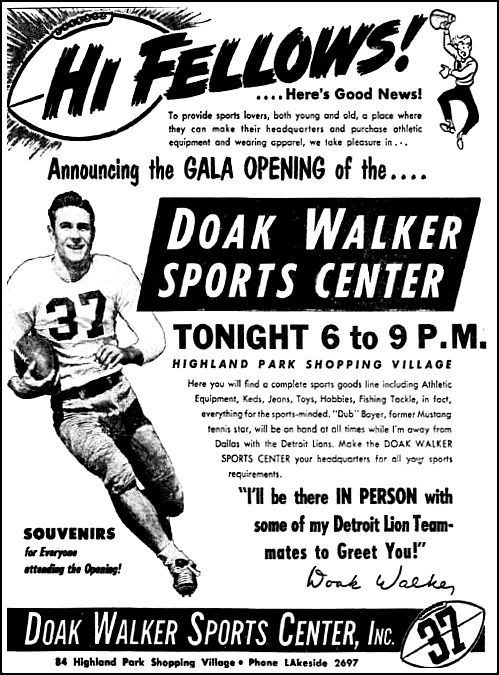
The Store That Doak Built

doak-walker-sport-center

by Paula Bosse

Doak Walker, the Heisman-winning superstar football player for SMU from 1945 to 1949, was, for a good forty-odd years, a partner in a successful sporting goods business that bore his name: the Doak Walker Sports Center. When it opened in Highland Park Village on August 23, 1951, the 24-year old — then playing pro ball with the Detroit Lions — was a bona fide celebrity, both locally and nationally. Predictably, the grand opening drew large crowds of sports fans eager to see their homegrown hero and check out the new place in town to get tennis balls and baseball bats (and, who knows, there might even have been some who showed up to see those unnamed Lions teammates the ads said he’d bring with him). The promise of “souvenirs for everyone!” was merely icing on the cake.

At the same time that the Sports Center was opening, Doak’s name was also on a Gulf station that he and former Mustangs teammate Raleigh Blakely owned on Hillcrest across from the SMU campus. And while both of those business concerns were chugging along, he was also appearing in local and national ads for everything from chewing gum to Vitalis (with a name like “Doak” you’re going to have instant name recognition). Oh, and he was also playing football. Doak Walker was a force to be reckoned with — on the field, on Madison Avenue, and in the dang Park Cities.

*

doak-walker_sports-ctr_opening_dmn_082351

***

Postcard of Doak Walker Sports Center from the Boston Public Library Tichnor Brothers Postcard Collection on Flickr, here.

Life magazine from Sept. 27, 1948. The cover story on Doak Walker and the SMU team can be accessed here.

Signed issued of Sport magazine is currently available for sale here.

Triangle Motors ad from a 1951 program for an SMU-Rice game at the Cotton Bowl.

Doak Walker bio on the Pro Football Hall of Fame website is here.

*

Copyright © 2014 Paula Bosse. All Rights Reserved.
Mr. Blandings Builds His Dream House … In Preston Hollow — 1948

blandings_preston-hollow_dallas_dream-houseThe Blandings Dream House in Preston Hollow… (click for larger image)

by Paula Bosse

I watch a lot of old movies, and one of my favorites has always been Mr. Blandings Builds His Dream House, the 1948 comedy about the trials and tribulations of home renovation and construction starring Cary Grant, Myrna Loy, and Melvyn Douglas. It wasn’t until fairly recently that I learned there had been a nationwide promotion in which replicas of the “dream house” were built in cities around the country. And, to my surprise, one of those houses was built in Dallas! To be exact, in Preston Hollow. To be precise, at 5423 Walnut Hill Lane (the northwest corner of Walnut Hill and Hollow Way). Sadly, when I went looking for it last week, I found an empty lot. (Figures.) The photo above shows the house in September, 1948 when it (and, not so coincidentally, the movie) opened to the public.

Ahead of the movie’s release, Selznick Studios approached local builders around the country and provided them with architectural plans, asking that they build houses as near to the specifications of the movie house as conditions would permit. The studio contracted Dallas builder A. Pollard Simons and supervising architect Lucien O’Brien to work on the Dallas dream house, seen below in a rendering (all images are larger when clicked).

blandings_a-pollard-simons_rendering

Simons greatly increased the size of the original two-story, three-bedroom house quite a bit (of course he did!), and he allowed the Junior League to raise money by selling 25-cent tickets to curious dream-house-wanters clamoring to wander through the house and gawk at its plush interior and its state-of-the art appliances. Afterwards, Simons put the completely furnished house on the market (in some cities the houses were put up as raffle prizes), and life, presumably, returned to normal for all concerned.

It was a clever way to promote the movie, and, as most of the contractors rushed to boast of their participation by taking out large ads (likely bought in conjunction with studio money), it was also an advertising bonanza for local newspapers. In amongst such ads I discovered that the company owned by my mother’s uncle and my grandfather — Fred Werry Electric Co. — did all the electrical work for the house!

Below are some of those ads that appeared at the time — and, trust me, this was just the tip of the iceberg. The ads were non-stop. This was a huge campaign, going far beyond traditional Hollywood promotion — and it certainly paid off. I’m fairly certain that most Dallasites who read the paper during that time were aware of the house (and the movie), even if they had absolutely no interest in houses (or movies). It was that that unavoidable. (Scroll to the bottom of this post to listen to a FABULOUS commercial-slash-PSA made by actor Melvyn Douglas at a local radio station during a trip to Dallas to tour the Preston Hollow house.)

There were other Texas “Dream Houses” built in Fort Worth (still standing, see link at bottom of page), Austin, Houston, and Amarillo. I only wish Dallas still had its “Dream House,” but I fear a tasteful-but-puny, little ol’ 3,000-square-foot house would not meet today’s definition of a “dream house” in ultra-swanky Preston Hollow.

*

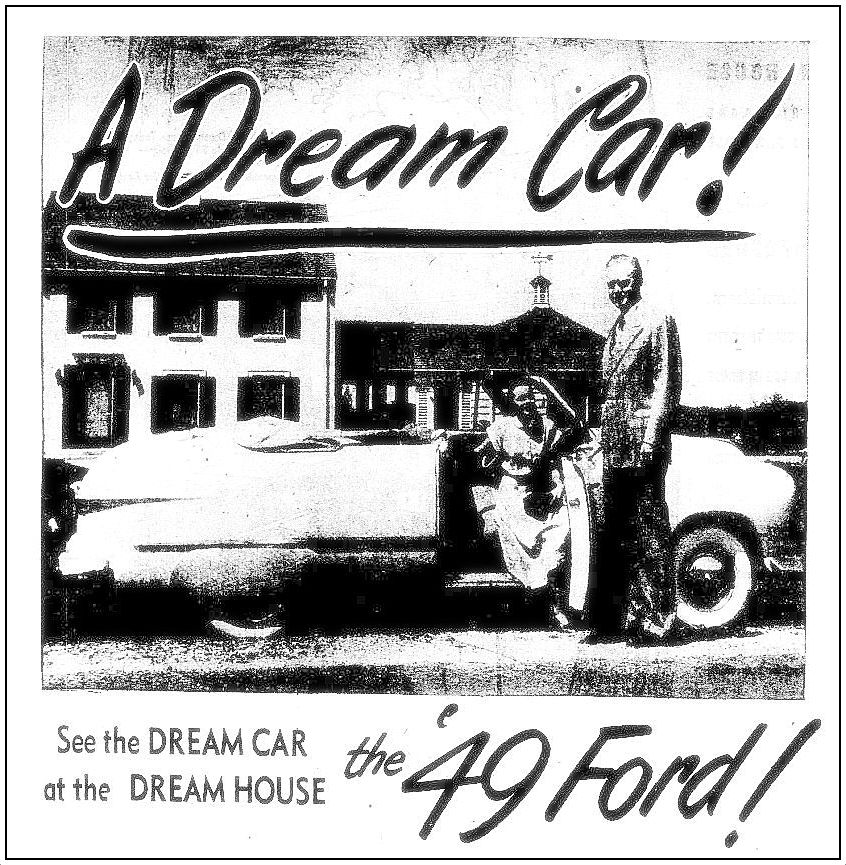
ad-blandings_dallas-ford-dealers_sept-1948The Ford people got into the advertising. This appears to be have been taken in front of the Dallas house.

ad-blandings_werry-electric_sept-1948My great-uncle and grandfather! I can now claim my six degrees of separation (LESS!) from Cary, Myrna, and Melvyn.

ad-blandings_langs_sept-1948Kitchen porn from Lang’s.

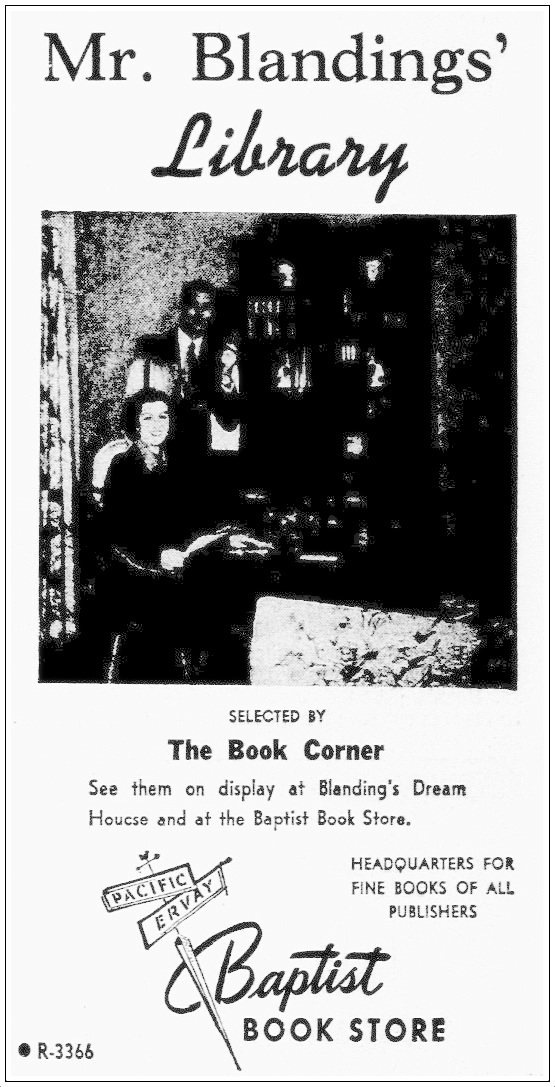
ad-blandings_baptist-book-store_sept-1948The Baptist Book Store stocked the shelves of the Blandings library!

I really like the Wyatt’s Cafeteria ad below, which begins with an itinerary. “Program for today: go to church, eat at Wyatt’s, drive out to see the Mr. Blandings’ ‘Dream House’ in Preston Hollow.” This cafeteria ad sneaked in a mention of the Wyatt’s grocery stores by informing the reader that they had supplied the food for the Dream House’s refrigerator and pantry shelves. But this was my favorite part: “When Mr. Blandings takes his family out for a delicious meal you may rest assured that he will take them to a Wyatt’s De Luxe Cafeteria where each may choose the foods of his own liking from Wyatt’s tremendous varieties. Mr. Blandings won’t mind paying the bill because Wyatt’s prices are really modest.” If Cary Grant was going to be dining at a Dallas cafeteria, I only hope he was choking down large slabs of Wham.

ad-blandings_wyatts_sept-1948

*

The original “dream house” from Mr. Blandings Builds His Dream House — cute, but much smaller than its Dallas counterpart.

***

Sources & Notes

All ads relating to the Dallas Dream House appeared throughout September, 1948.

A nice look at the still-standing Fort Worth Dream House can be found in “Standing at the Corner of Hollywood and Cowtown,” here.

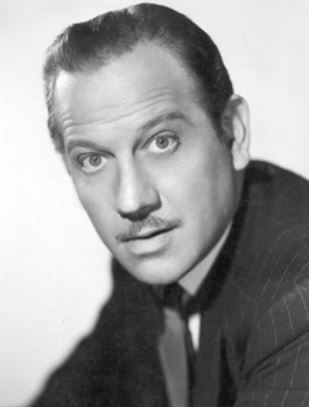
A short radio promo about the Preston Hollow Dream House was recorded on Aug. 10, 1948 by the wonderful Melvyn Douglas, one of the stars of the film (who, by the way, went on to win an Oscar for his role as the family patriarch in the brilliant — and iconically Texan — film Hud in 1963). It was recorded when he visited Dallas in August, 1948 at station KIXL (in which he was an investor), and it can be heard here. (By permission of the great Dallas DJ and broadcasting archivist, George Gimarc.) I LOVE THIS! Thank you, George!

melvyn-douglas

UPDATE: I wrote this post in 2014, and at the time I could find no information about this Dallas Blandings house outside contemporary newspaper archives. Which is the only reason I took some small amount of credit for the house showing up in a Preston Hollow-centric mural in 2015 at the then-new Trader Joe’s at Walnut Hill and Central. I took the photo below in 2015, but, sadly, this tribute to Mr. Blandings and his Dallas dream house is no more. Last time I stopped in, it had been painted over. But here it lives on!

blandings_trader-joes-walnut-hill_PEB_2015Trader Joe’s, Walnut Hill, Dallas (photo by Paula Bosse, 2015)

*

Copyright © 2014 Paula Bosse. All Rights Reserved.

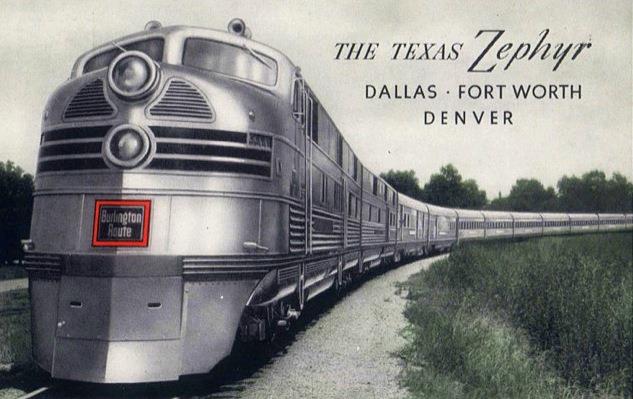
The Texas Zephyr — Streamlined Luxury Train Travel

Dallas — Fort Worth — Denver

by Paula Bosse

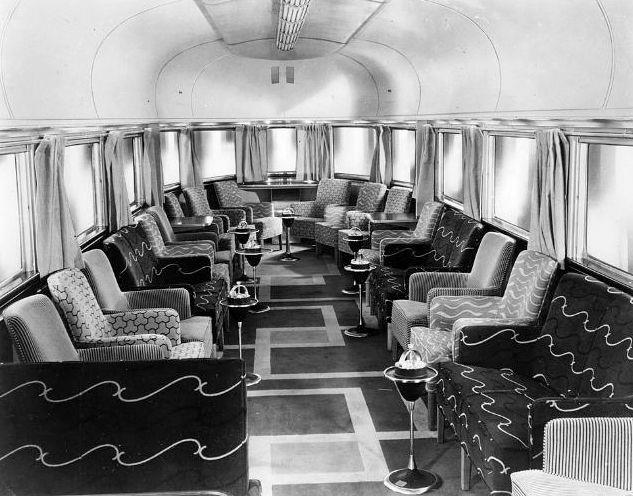
From the golden age of train travel. …I was born in the wrong era.

***

Sources & Notes

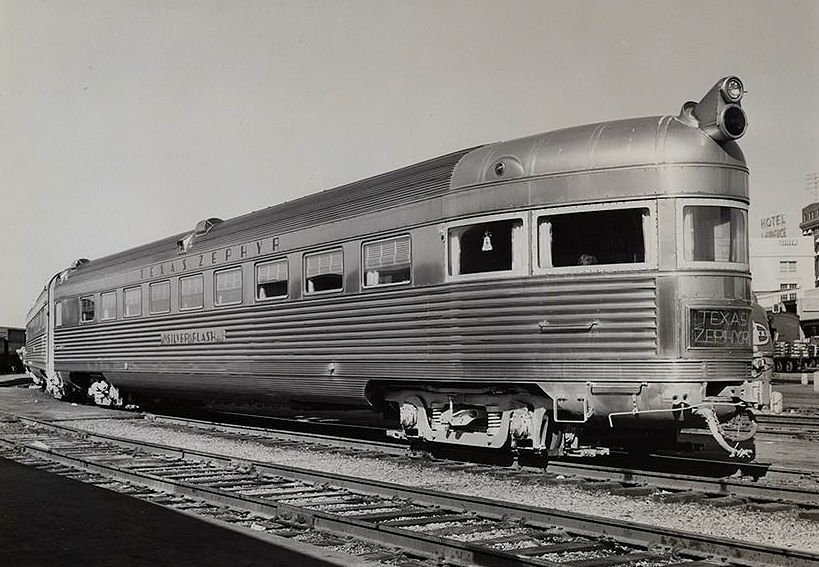
Second photo showing the exterior of the “Silver Flash” passenger car on the tracks at Union Station in Dallas is from the DeGolyer Library, Central University Libraries, Southern Methodist University; it was taken by Everett L. DeGolyer Jr. in 1960; more information on this photo is here.

Top and bottom images are from the wilds of the internet.

More on the Texas Zephyr here.

*

Copyright © 2014 Paula Bosse. All Rights Reserved.

Roger Corman Does Dallas — 1970

by Paula Bosse

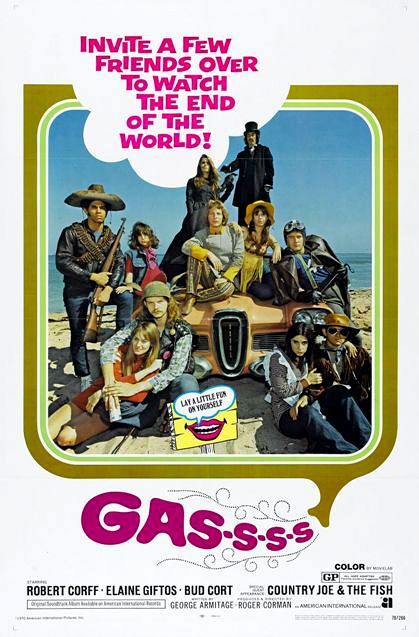
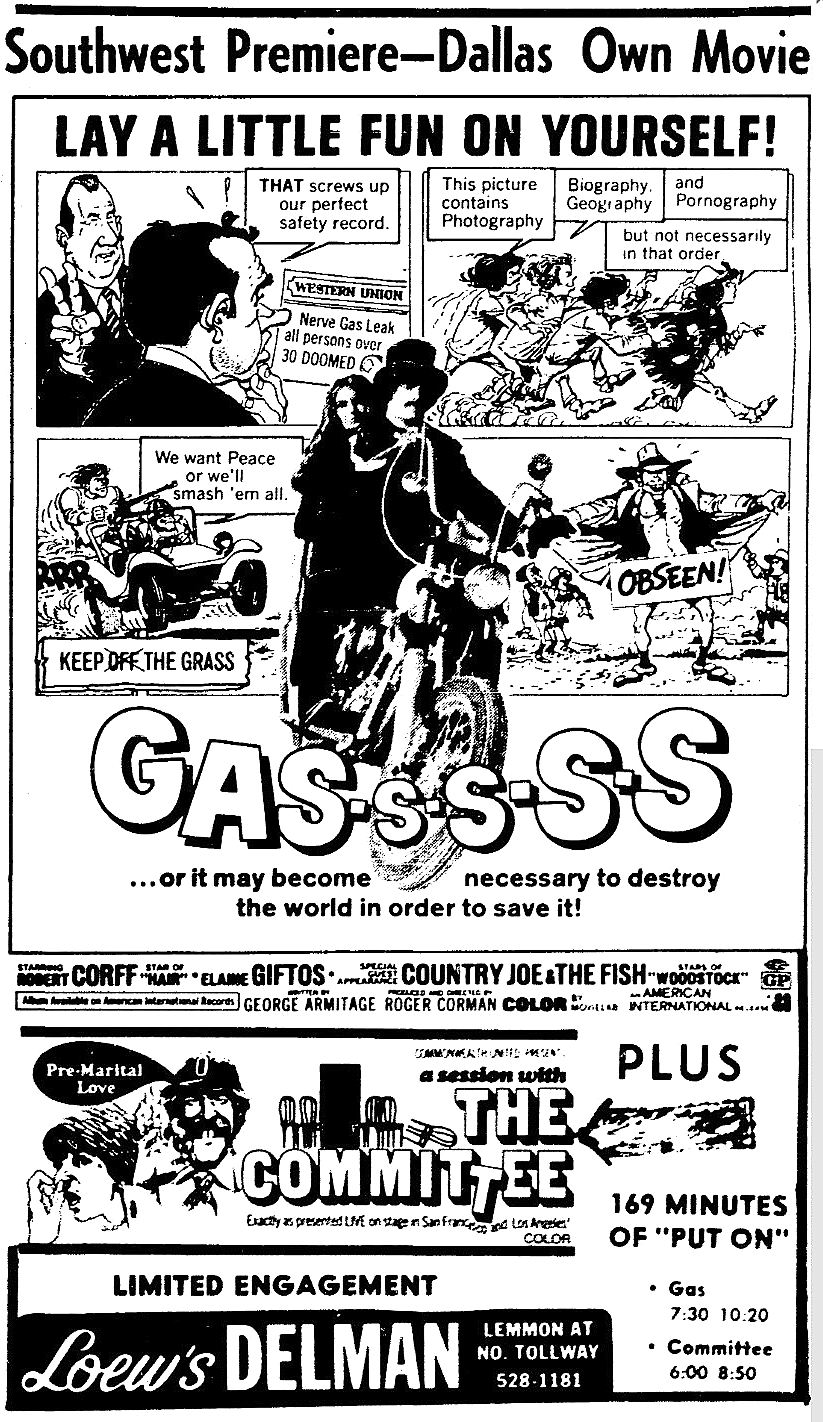
Think you’re up on your “movies-shot-in-Dallas” trivia? I thought I was. Until I happened across a strange little movie in the wee hours of the morning a couple of years ago. The movie is called Gas-s-s-s! Or sometimes Gas–Or–It Became Necessary to Destroy the World In Order to Save It. And it’s directed and produced by the great schlockmeister (and I use that word lovingly), Roger Corman.

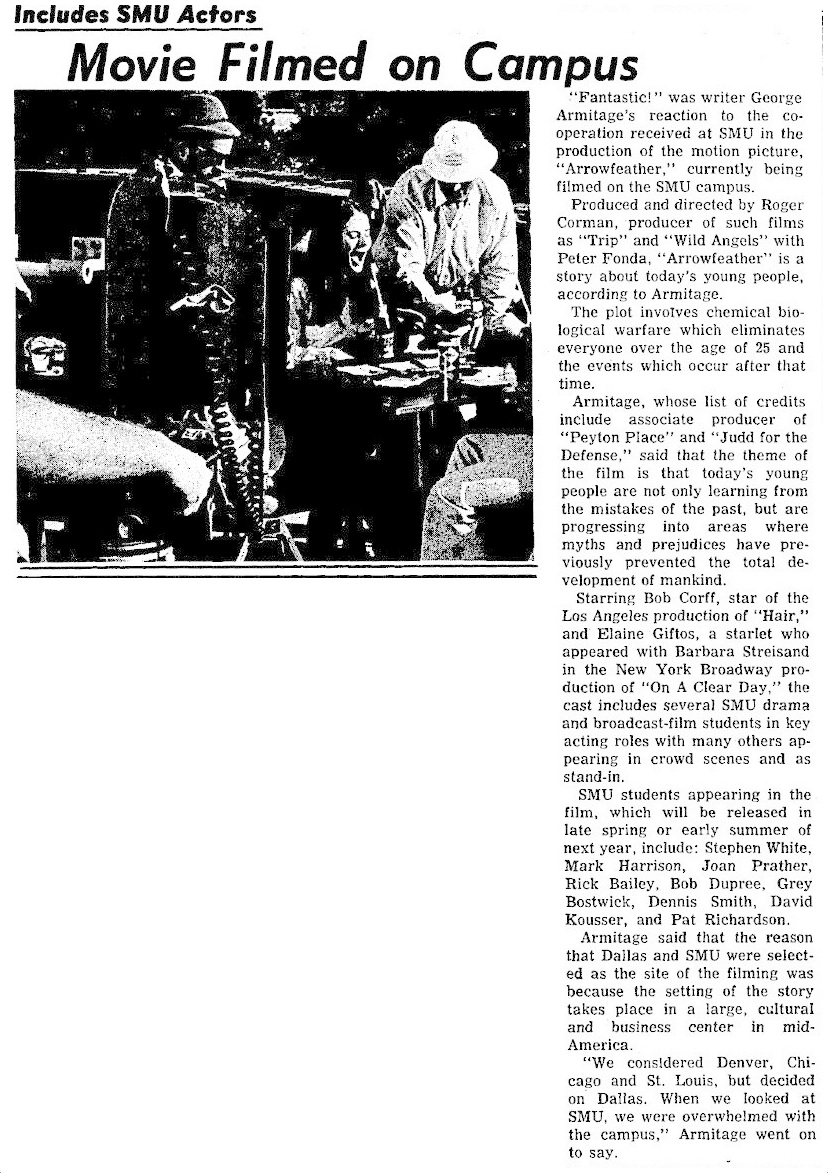
For my purposes here, I’m not going to try to describe the meandering plot of this vaguely post-apocalyptic screwball hippie groove-fest, but other than the fact that it has early appearances on film by Bud Cort, Cindy Williams, Ben Vereen, and Talia Shire (billed here as “Tally Coppola”), the only thing that really matters is that a good ten minutes of this really bad movie take place in Dallas — a good chunk of it shot on the SMU campus (?!). (I wonder if there was some guerrilla film-making going on here because it seems unlikely that the powers-that-be at SMU would have allowed Corman to film one of his typical counter-culture movies in the heart of the Park Cities.) (ETA: Well, I’ve recently come across an article from the SMU Daily Campus, which appeared during filming (read it at the bottom of this post). It mentions previous Corman movies, so I guess the Hilltop decision-maker knew of Corman’s oeuvre and was fine with everything. Either that, or that person was lazy and didn’t bother investigating. The working title, by the way, was “Arrowfeather.”)

The Dallas scenes are conveniently right at the beginning of the movie (following a short animated sequence of plot exposition and titles). Corman’s opening montage of the streets of Dallas is only 30-seconds long, but it’s really great! Not that he meant it to be, but it’s like a little valentine to downtown Dallas as it was embarking on a new decade. Look at all those buildings! Look at all those people! Later on you see an eerie, deserted downtown, Dealey Plaza, SMU fraternity row, and a mod, weird-looking church which I’ve never seen (where is that, anyway?). Here’s the opening couple of minutes of the movie:

*

The entire movie is occasionally on YouTube, but it seems to go up and get pulled off with some frequency. By the time you read this it may no longer be available, but you can watch the trailer here. (If you can find the full movie, the Dallas bits start at about the 3:30 mark and last until about the 13:00 mark.)

I watched the whole thing, and I can’t say I enjoyed it. I DID really like Cindy Williams as an excitable music geek, here in her first movie — three years before American Graffiti and longer still before Laverne & Shirley — but I’m not sure that’s enough of a reason to recommend sitting all the way through it. (And don’t get excited about Bud Cort, because his participation is minimal.)

Watch the whole thing if you must. But, remember: you’ve been warned!

**

gassssss_movie_smu-daily-campus_nov-4-1970SMU Daily Campus, Nov. 4, 1970

This article appeared in the SMU newspaper — The Daily Campus — while the movie was being filmed in Dallas. (Click for larger image.)

gas_making-of_roger-corman_smu-daily-campus_112669SMU Daily Campus, Nov. 26, 1969

The photos accompanying the article are, sadly, not the greatest resolution, but here’s one:

gas_making-of_roger-corman_smu-daily-campus_112669_photo

***

Sources & Notes

SMU Daily Campus article (Nov. 26, 1969) is from the Southern Methodist University Student Newspapers collection, DeGolyer Library — see the scanned issue here.

The IMDb listing for the movie is here. Who knows? You might know people in it! …Heck, you might be in it.

If you’ve arrived at this post by searching on “schlockmeister,” I invite you to peruse these other Flashback Dallas posts about Dallas’ own Roger Corman, Larry Buchanan:

*

Copyright © 2014 Paula Bosse. All Rights Reserved.

Not Every ‘Good Luck Trailer Park’ Story Has a Happy Ending — 1964

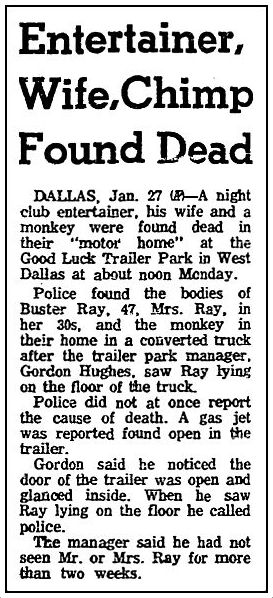
chimp_fwst_012864Fort Worth Star-Telegram, Jan. 28, 1964

by Paula Bosse

“Entertainer, Wife, Chimp Found Dead.” THAT is a headline.

Had I not known that the (ironically named) Good Luck Trailer Park on W. Commerce had been a favorite with visiting circus folk, I might have been a little more surprised by the weird circumstances reported in this article. As it was, I was only mildly surprised.

(I kind of think the chimp did it….)

***

Sources & Notes

Hats off to the Fort Worth Star-Telegram‘s headline writer. The story ran in the Star-Telegram on Jan. 28, 1964.

The victims — Harold Allen Ray and his wife Nadine (and unnamed monkey) — were later determined to have died of accidental carbon monoxide poisoning.

“Buster Raye” (stage name of Harold Ray) had been a comedian and master of ceremonies who seems to have played a lot of burlesque joints/strip clubs as the between-stripper entertainment. He was billed as “The Mighty Mite of Mirth.” In a Feb. 24, 1948 review of his act, The Bryan Eagle wrote:

Buster Raye, diminutive master of ceremonies, stole the show with a clever line of chatter punctuated with juggling, acrobatics, songs, imitations. His jokes were well handled with none of the vulgarity common to many floor shows.

I’m not sure where the monkey fits in.

buster-raye_corpus_042948Corpus Christi Caller-Times, April 29, 1948

*

Copyright © 2014 Paula Bosse. All Rights Reserved.
 

A Robot Visits the Texas Centennial — 1936

by Paula Bosse

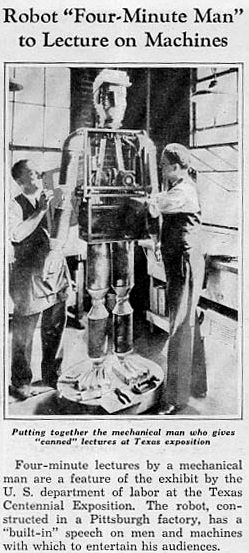
This “mechanical man, built by human hands” was quite the attraction at the 1936 Texas Centennial.

Four-minute lectures by a mechanical man are a feature of the exhibit by the U.S. department of labor at the Texas Centennial Exposition. The robot constructed in a Pittsburgh factory, has a ‘built-in’ speech on men and machines with which to entertain his audiences.

***

Lower image from Popular Mechanics (Sept. 1936).

*

Copyright © 2014 Paula Bosse. All Rights Reserved.

Motel Skyline / Skyline Motel — “The Motel of Distinction” (1947)

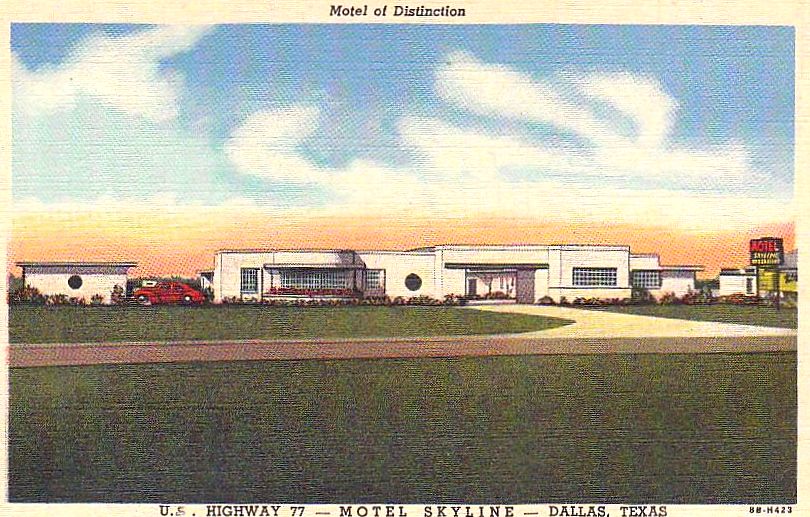
motel-skyline_postcard

by Paula Bosse

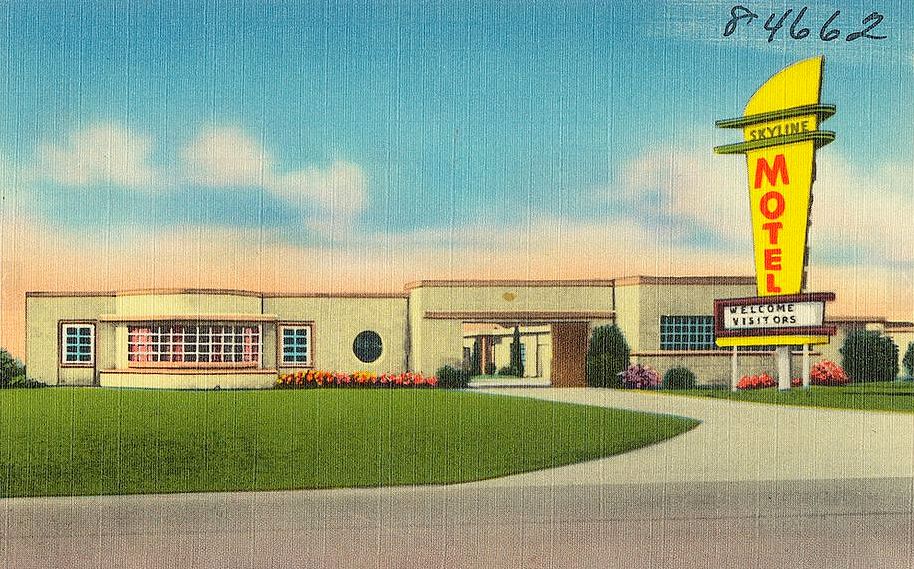
THIS is a great, great-looking motel. I only hope it looked half as sleek in real life. It was, rather surprisingly, designed in 1947 by the architect George Marble who was known for his large Tudor-revival homes in the pricier areas of Dallas (particularly Highland Park and Lakewood), so this is a major divergence in style. 1947 seems a little late for something this Deco-looking, but, no matter — this is just a fantastic building.

The “Motel Skyline” (or “Skyline Motel” as it was being referred to in ads not long after it opened in September, 1947) was located at 6833 Harry Hines, near West Mockingbird, just past Love Field. It’s not a great neighborhood these days, but perhaps it was better 60-some-odd years ago, when Harry Hines was the route that the old Hwy. 77 followed. The 30-unit “motor hotel” was built at a cost of $250,000 — it boasted year-round air conditioning and “mattresses of fiberglass.” 

I don’t know how long the place lasted — perhaps until the mid- or late-’60s, when advertising petered out and by which time the probably no-longer-so-sleek motel seems to have started catering to customers paying by the week and by the month. It might not have gotten as seedy as I fear it might have, as I saw only a couple of fairly run-of-the-mill appearances on the police blotter (cash stolen from a sleeping customer and a likely suicide in one of the rooms). Still, I shudder to think of that once-beautiful building ending its days cheek-by-jowl with modern-day Harry Hines.

It’s nice to know Dallas once had this wonderful building, if only for a little while. If anyone has photographs of the actual building, I’d love to see them, even though I know I would probably be disappointed.

*


1962 ad

***

Check out the kind of architectural design that George N. Marble is actually known for (residential, palatial), here.

Second postcard from the absolutely fantastic Boston Public Library Tichnor Brothers Postcard Collection on Flickr, here.

Matchbook from Flicker, here.

Click postcards for larger images. It’s worth it.

*

Copyright © 2014 Paula Bosse. All Rights Reserved.