Flashback : Dallas

A Miscellany: History, Ads, Pop Culture

Category: Leisure

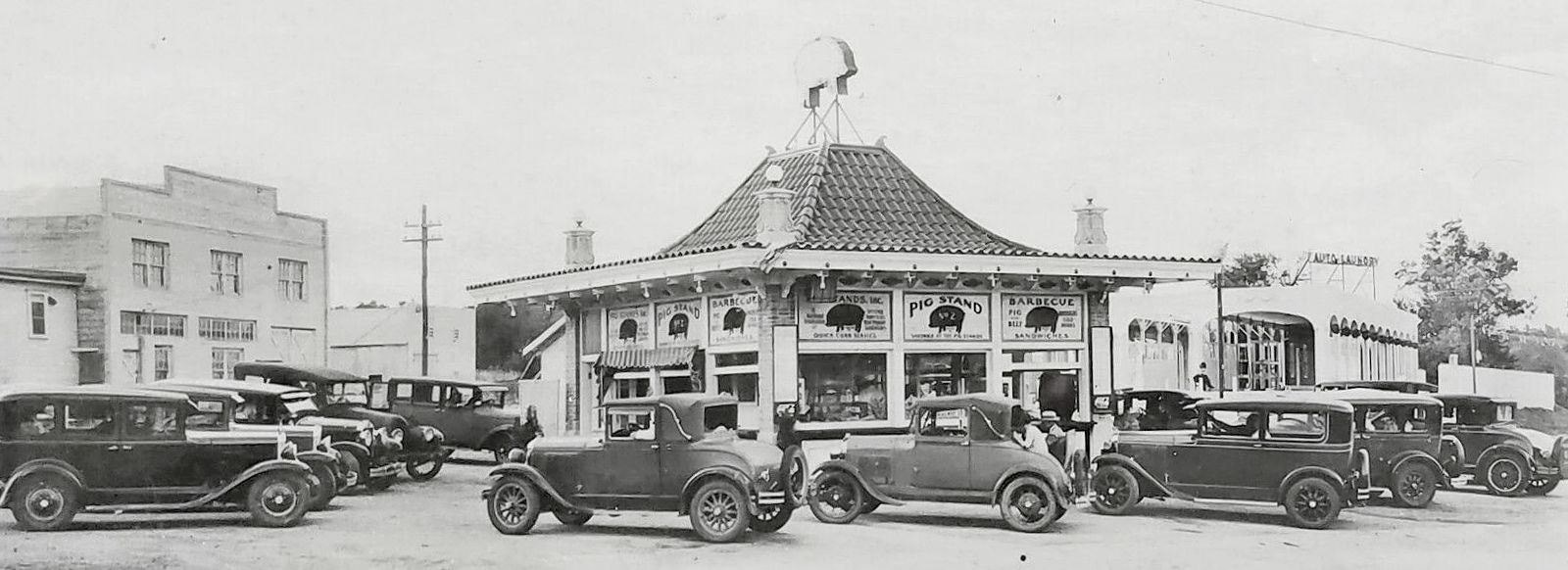
Pig Stand No. 2, Oak Cliff

pig-stand-no-2_dallas_ebayWaiting in cars for pig sandwiches

by Paula Bosse

I’ve seen a cropped version of this photo, but not the full image. It’s great! I don’t mean to keep posting about restaurants, but seeing this photo was too good not to share. (As I type this, it’s available on eBay, here.)

It shows Pig Stand No. 2 at 1301 N. Zang in Oak Cliff, probably about 1928. It appears that this was the second “No. 2” — it was announced that this brand-new building had just begun construction in January 1928.

Work was started last week on the new Pig Stand, Zang’s Boulevard and Colorado Street, for the Pig Stands Company, a Dallas institution, now operating in 39 cities in 12 states. The ornamental building has been adopted as a standard design for the many future stands now contemplated over the country by this concern. In this building will be embodied modern sanitary features complying with all requirements and laws. It will be faced with brick and highly colored tile with ornamental stone trimmings and a clay tile sweeping roof in several shades. The exterior as well as the interior will be illuminated electrically with the cornice and ornaments decorated out in varied contrasting colors. The Pig Stands Co., starting less than five years ago with small capital, has developed into a national institution. Architects F. J. Woerner and Co. designed and will supervise this work, while M. W. McDade will have charge of the construction. (Dallas Morning News, Jan. 26, 1928)

At the right is the Oak Cliff/Tramway Auto Laundry at 1307 N. Zang.

pig-stand-no-2_dallas_ebay_det

I love the couple in the rumble seat!

***

Sources & Notes

Photo currently available for sale on eBay, here.

Read a history of Dallas’ Pig Stand empire — long considered to be the first-ever drive-in restaurants, a revolutionary contribution to American social culture — in the Texas Monthly article “The History of the Pig Stands” by Daniel Vaughn (Feb. 2015).

Architect Frank Woerner designed many notable commercial and residential buildings in Dallas, including the Stoneleigh Hotel, the Couch Building across from SMU, the old Union Depot in Deep Ellum, and the beautiful home of Max Rosenfield on South Boulevard.

pig-stand-no-2_dallas_ebay_det_sm

*

Copyright © 2023 Paula Bosse. All Rights Reserved.

Kimball High School, Off Campus — Ads, 1959-1961

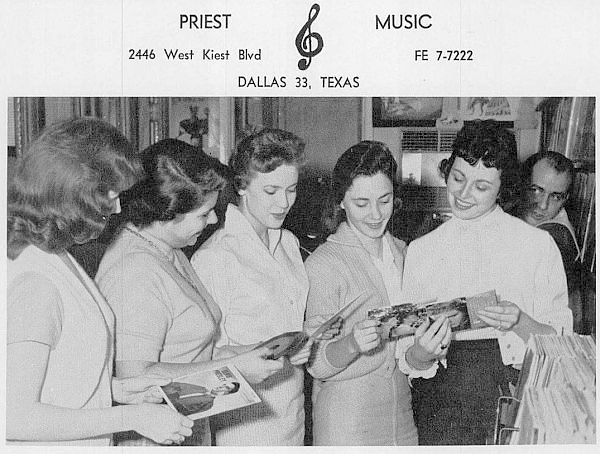
priest-music_kimball-high-school_1959-yrbk
Browsing the Elvis releases, 1959

by Paula Bosse

A few years ago I posted several Oak Cliff-centric ads found in the 1963 and 1967 Kimball High School yearbooks (see those ads here). I’m back for another installment.

**

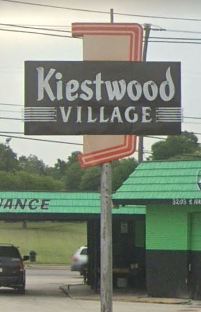
Above, a photo I really love, showing five Kimball girls checking out Elvis records at Priest Music (2447 W. Kiest Blvd). No, they don’t look like high school girls, and, yes, they are. The man at the right is, apparently, the owner, Frank M. Anderson (whom, I think, changed the name of the store to Music Hall the following year?). I posted this ad on my Facebook page last week, and one man wrote, about the owner: “Frank, the owner. His shop was known for its collection of Jazz and Classical albums. We became friends as I got into Jazz thanks to the Great Pete Fountain!” And because, why not, here’s a recent Google Street View of the Kiestwood Village sign which was probably there at that little shopping strip when Frank and the girls were photographed for this ad. 

kiestwood-village_2022

*

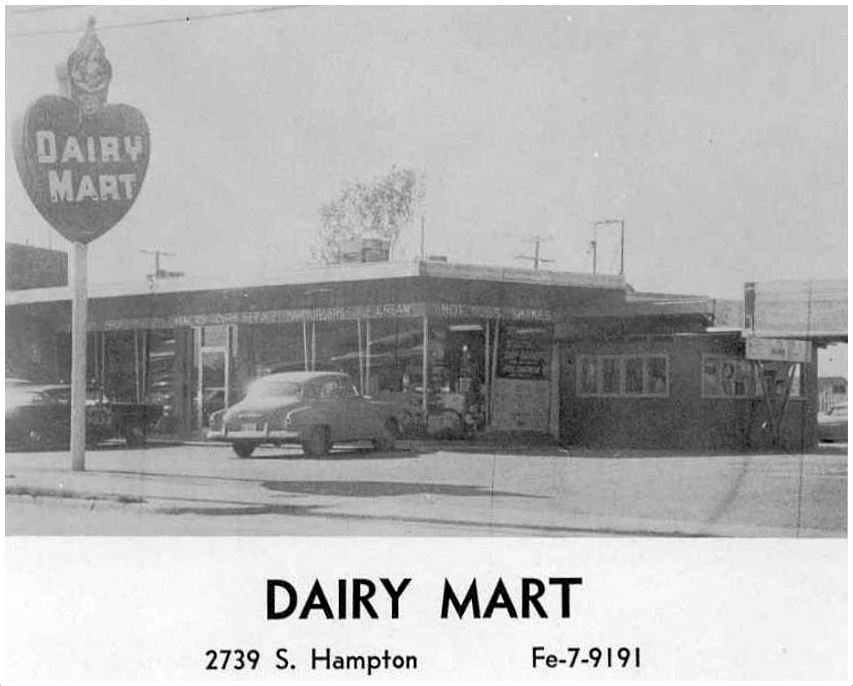
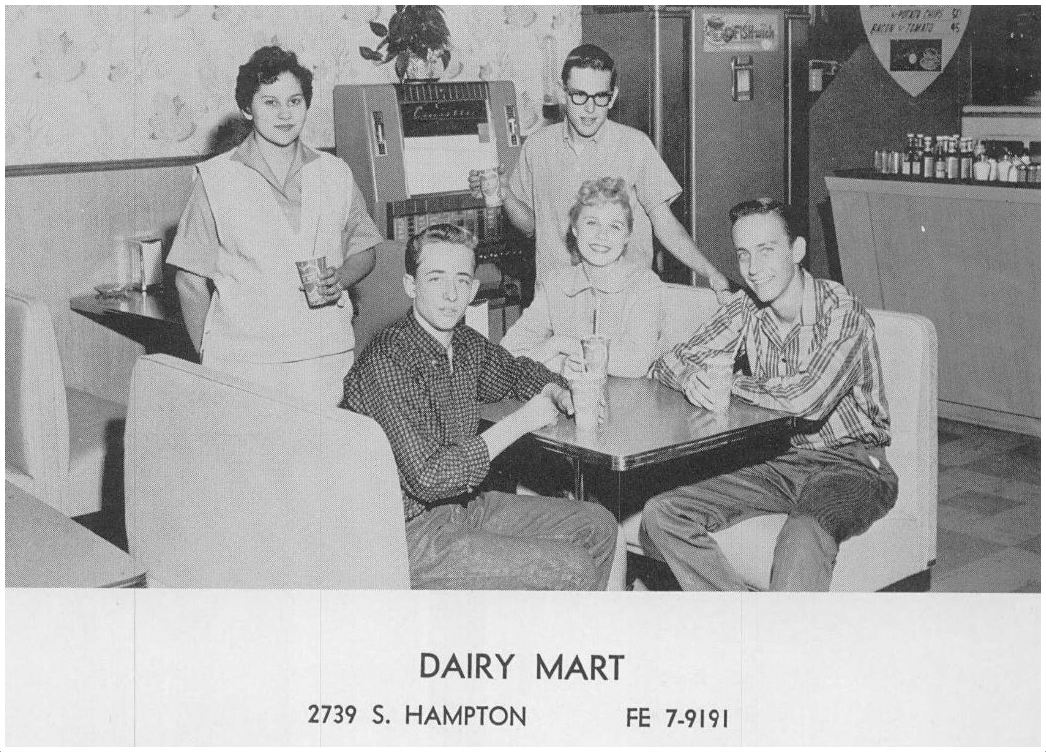
Dairy Mart (2739 S. Hampton):

kimball-high-school_1960-yrbk_dairy-mart1960

kimball-high-school_1959-yrbk_dairy-mart1959

*

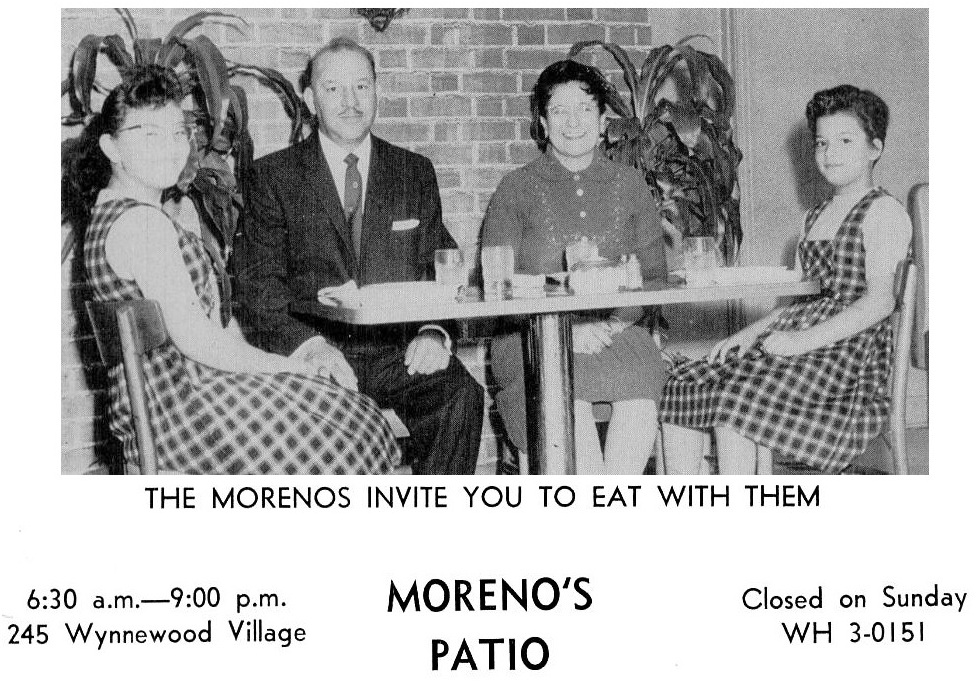
Moreno’s Patio (245 Wynnewood Village):

kimball-high-school_1961-yrbk_morenos-patio_restaurant1961

*

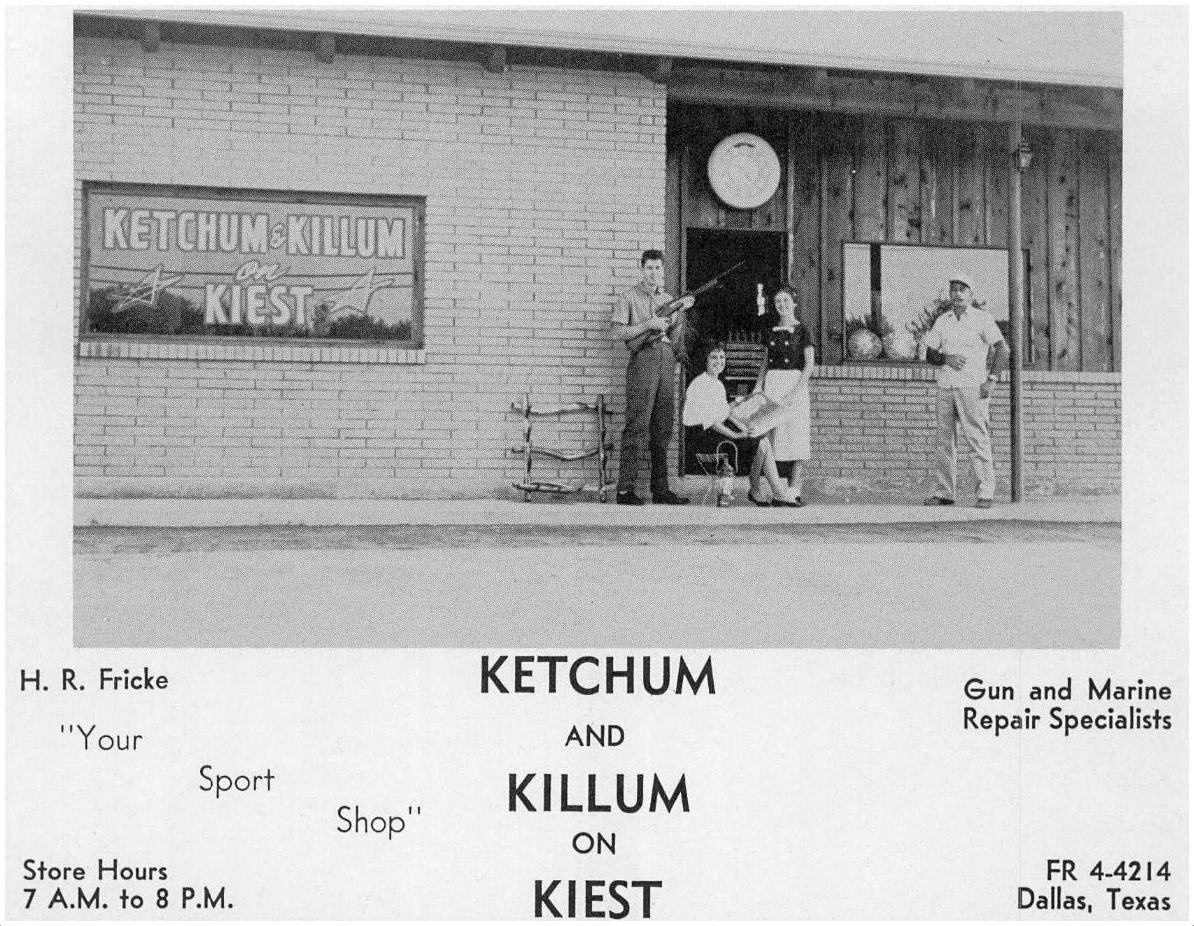
Ketchum & Killum (334 W. Kiest) — a sporting goods store with perhaps the best name ever (UPDATE: or not — see the comments below):

kimball-high-school_1961-yrbk_ketchum-and-killum1961

*

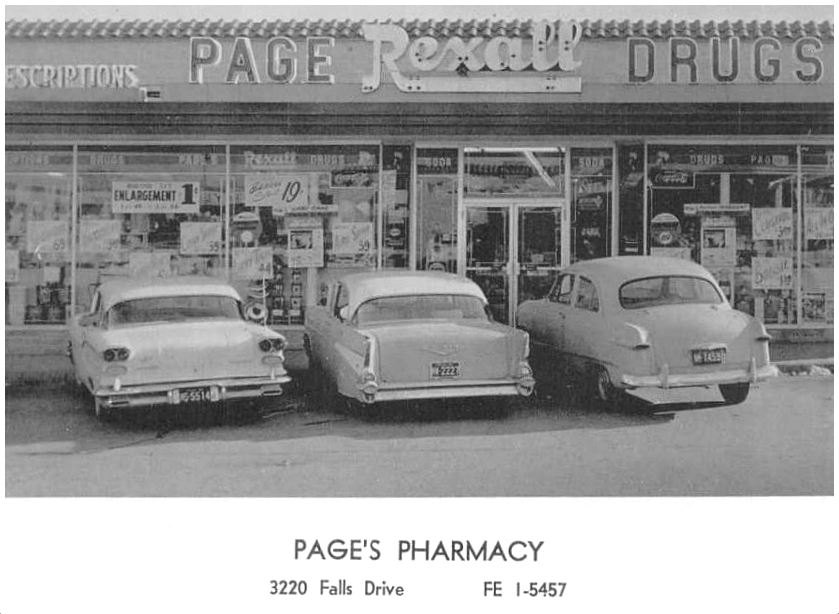
If you’re in need of some bandages or Mercurochrome after being a little too curious at Ketchum & Killum, head over to Page’s Pharmacy (3220 Falls Dr.):

kimball-high-school_1959-yrbk_page-drugs1959

*

For all things “fun,” Playland (3900 W. Illinois):

kimball-high-school_1959-yrbk_playland1959

***

Sources & Notes

All ads from the 1959, 1960, and 1961 yearbooks of Justin Kimball High School in Oak Cliff.

More Kimball yearbook ads can be found in the Flashback Dallas postA Few Ads From the Pages of the 1963 and 1967 Kimball High School Yearbooks.”

priest-music_kimball-high-school_1959-yrbk_sm

*

Copyright © 2023 Paula Bosse. All Rights Reserved.

Stuart Margolin, 1940-2022

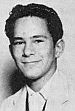
margolin-stuart_hillcrest-high-school_1955Hillcrest High School, 1955

by Paula Bosse

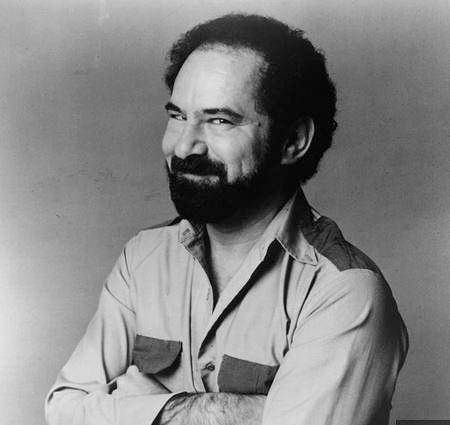
Everyone’s favorite character actor, Stuart Margolin, has died. He grew up in Dallas (Preston Hollow) and went to Hillcrest High School — until he was sent to what sounds like a reform school in another state. A brief look through the Dallas Morning News archives shows that he appeared in local theater productions as a child — he trod the boards in a production of A Midsummer Night’s Dream when he was 10. As a teenager, he was active in the Courtyard Theater in Oak Lawn, a school and theater led by Robert Glenn, who had also mentored other young Dallas actors such as Jayne Mansfield, Brenda Vaccaro, Ann Wedgeworth, and… Candy Barr). When he wasn’t acting — and apparently causing enough mayhem to get sent to reform school — he was a very good, avid junior golfer who competed in many tournaments (he is shown in one very grainy photo as a 13-year-old member of the DAC Country Club team, wearing a jaunty golf cap). There is no further mention of the young Margolin after 1955, when, one assumes, the teenager was shipped off to someplace not as cushy as Preston Hollow. He starts popping up again in newspaper stories in 1967, in the early days of his long and successful career in Hollywood when he was making regular appearances on TV shows such as Love American Style

His most-remembered role is Angel, sidekick to James Garner, in The Rockford Files. People loved this character. HE loved this character. He has said, with great affection, that he based Angel on streetwise guys he grew up with in Dallas. 

In 1979, though an established working actor and director in Hollywood, he moved back to Dallas for a couple of years, working on writing projects and establishing the production company River Entertainment.

margolin-stuart_dmn_022481_river-entertainmentFeb. 1981 (Dallas Morning News)

He tried for several years to establish a theater in the city, saying, “I don’t think there’s a professional theater here that is of a quality that this city deserves, a city that likes to view itself as Dallas does” (“Margolin’s Life Has Many Stages” by Joe Leydon, DMN, Apr. 20, 1980). (He was not a huge fan of the Dallas Theater Center and was especially unhappy that, in 1980, the DTC hadn’t had an Actors Equity contract in 20 years.)

At this time he also recorded a country/blues album, And the Angel Sings, of which he said:

I’m from [Dallas], and my musical influences are from this area. When I grew up in Dallas, I listened to a lot of blues — Muddy Waters, B.B. King, This record was made for the kind of people I grew up with. (The Daily Oklahoman, Apr. 22, 1980)

I just watched him in an old episode of The Mary Tyler Moore Show a couple of days ago and said to myself, “I love this guy.” I was always a fan of Stuart Margolin. RIP.

margolin-stuart

***

Sources & Notes

Top photo from the 1955 Hillcrest High School yearbook, The Panther.

margolin-stuart_hillcrest-high-school_1955_sm

*

Copyright © 2022 Paula Bosse. All Rights Reserved.

New Wheels for Margo Jones — 1955

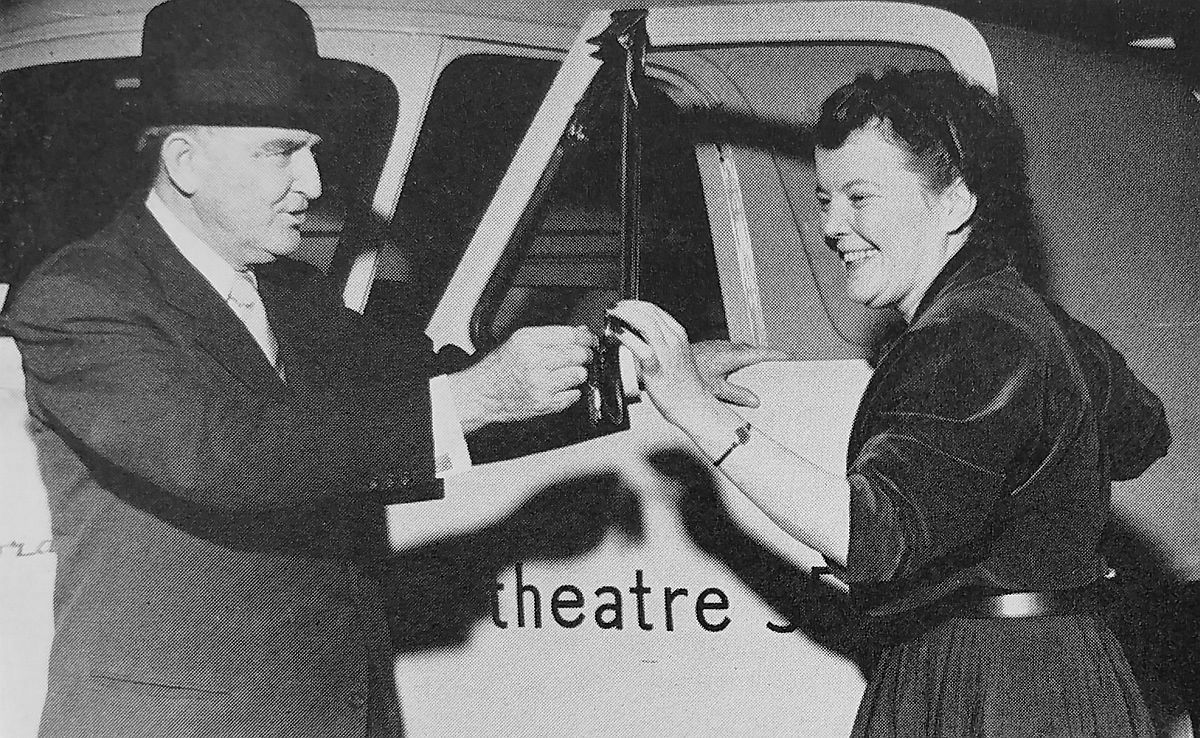
jones-margo_theatre-55_dallas-magazine_apr-1955DeWitt Ray and Margo Jones

by Paula Bosse

The photo above shows Dallas theater legend Margo Jones accepting the keys to a new Ford truck in March 1955. Below, the caption that appeared in the April 1955 issue of Dallas magazine:

GIFT FOR THEATRE ’55: Margo Jones, director of Theatre ’55, is shown as she accepts the keys to a new 1955 panel truck from DeWitt T. Ray, Dallas banker and member of Dallas Theatre ’55 board of trustees. The truck, gift of a group of 18 Dallas businessmen and civic leaders, will be used for transporting set furniture, props and other necessities for the theatre’s productions.

She looks very, very happy!

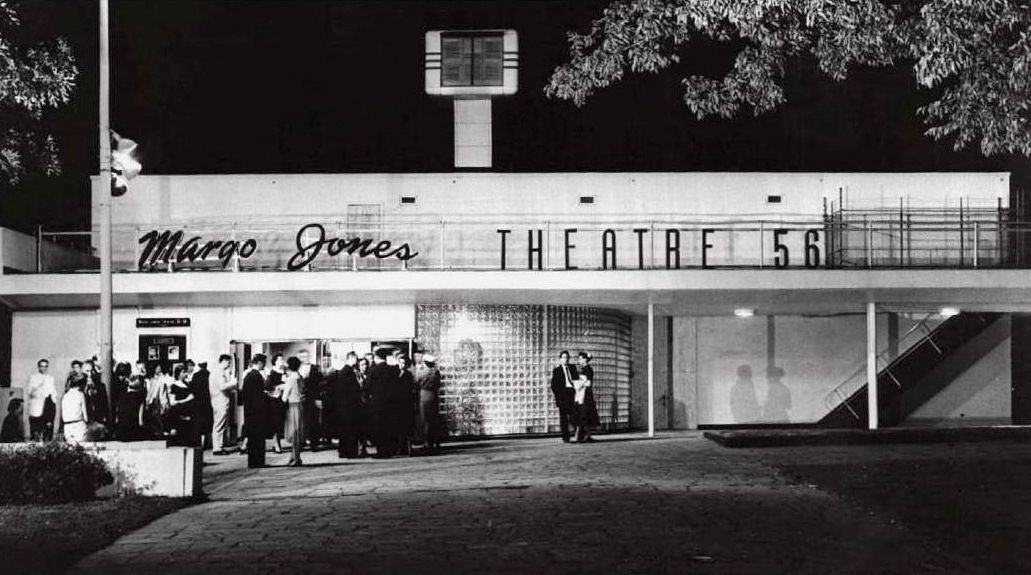
margo-jones_theatre-56_dpl

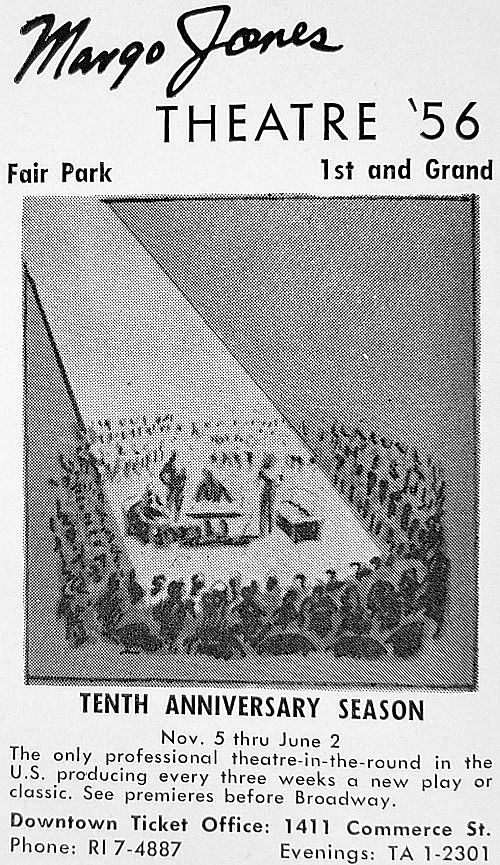
jones-margo_theatre-56_this-month-in-dallas_dec-1956_ad

***

Sources & Notes

Photo is from the April 1955 issue of Dallas, a periodical published by the Dallas Chamber of Commerce.

Photo of the exterior of the theater from the collection of the Dallas Public Library.

Ad from the Dec. 1956 issue of This Month in Dallas.

More on Margo Jones can be found in the following Flashback Dallas posts:

Watch “Sweet Tornado: Margo Jones and the American Theater,” the full documentary on Margo Jones produced by KERA-Channel 13, here.

jones-margo_theatre-55_dallas-magazine_apr-1955_sm

*

Copyright © 2022 Paula Bosse. All Rights Reserved.

1400 Block of Main Street, ca. 1946

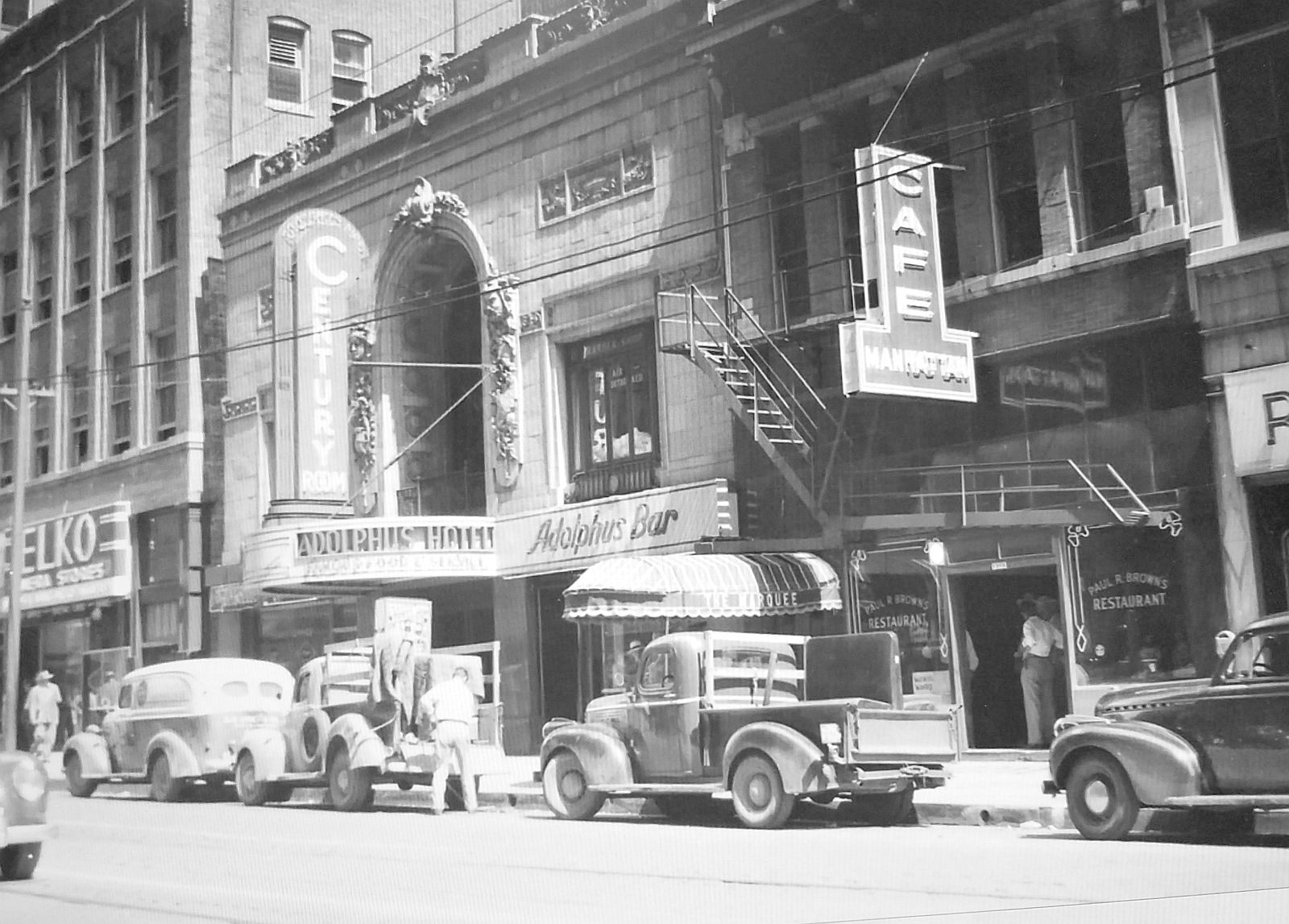
main-street_century-room_ca-1946_bell-collection_DHS_detThe Century Club, the Adolphus Bar, and the Manhattan Cafe await…

by Paula Bosse

A few years ago, I went in to the Dallas Historical Society a few times a week to volunteer. I ended up basically cataloging an entire collection of photos taken by a man named James H. Bell — and I really enjoyed it. Bell wasn’t a professional photographer, he was just a guy who liked to take a lot of photographs. The photos were all taken, as I recall, in 1946 and 1947, when he was apparently visiting Dallas — which I gather was his hometown — on a trip from his new home in California. He took a lot of pictures of places around Dallas that no one really bothered to document: businesses, street life, houses. He was also something of a pinball and jukebox aficionado, because a large number of his photos had coin-operated machines in them. Like a LOT. He also liked buses. And he seemed to always have his camera with him.

The photo above (which, sadly, I’ve had to crop because of image issues) shows the south side of the 1400 block of Main Street. I’ve never seen a photo from this period of the Main Street entrance to the Adolphus Hotel. That cool 1936 deco sign for the Century Room is great (even though it looks a little out of place next to the overly ornate early-20th-century arch next to it). (See the full wonky image — apologies for the low resolution — all my fault — here.)

I can tell you exactly why Bell took this photo: he saw a coin-operated machine being unloaded from a truck (or loaded into a truck). There were others photos in this collection taken in similar circumstances. I don’t know whether he was following jukebox and pinball trucks around town (a very definite possibility…), or whether he just happened upon these coin-op machine deliveries, camera at the ready. Whatever the case, he got a nice action-photo of a jukebox delivery in the wild, while, at the same time, he secured for posterity a nice historical image of everyday life on Main Street. And, we have the added bonus of seeing the long-gone sign for the swanky Century Room nightclub.

This was the Dallas Historical Society description I wrote for the full photo:

Downtown Dallas, 1400 block of Main Street. South side of Main, with Akard intersecting at left. Partial view of the Southwestern Life Building (southeast corner of Main and Akard, with Travis cigar stand at street level); Andrews Building (southwest corner of Main and Akard); C C Liquor Store (1412-B Main); Elko Camera Store (1410 Main); Ragir’s (1412 Main); Adolphus Hotel, rear entrance (with Century Room nightclub sign); Adolphus Bar (1406 Main); the Marquee restaurant (1404 1/2 Main); Paul R. Brown’s Restaurant. Also: a sign for Manhattan Cafe or Cafe Manhattan, pedestrians, 1940s vehicles, workman securing a pinball or other coin-operated machine into back of pickup truck.

*

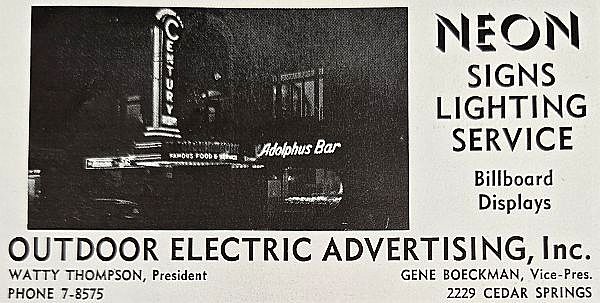
And here’s what it looked like at night:

adolphus_neon_outdoor-electric-advertising_southwest-business_sept-19361936

***

Sources & Notes

This photo was taken by James H. Bell in about 1946, and it is from the James H. Bell Collection at the Dallas Historical Society. The Accession Number is 2017.48, and the Object ID is V.2017.48.531. 

Ad for Outdoor Electric Advertising is from Southwest Business magazine, Sept. 1936, Periodicals Collection, Dallas Public Library.

main-street_century-room_ca-1946_bell-collection_DHS_det_sm

*

Copyright © 2022 Paula Bosse. All Rights Reserved.

Safari Redux

safari_squire-haskins_1961_UTA_1Dallas? Yes!

by Paula Bosse

Back in 2014 — when Flashback Dallas was still in its blogging infancy — I wrote about the Safari Steak House in North Dallas in the post “Back When Preston Royal Was ‘Exotic’ and Had Its Very Own Elephant.” There were a few errors in that post which I corrected today, thanks to a couple of commenters on the original post who pointed out that what I thought showed the Safari restaurant at Preston & Royal showed, instead, the Houston location. Kind of embarrassing!

What better time than this to say that I ABSOLUTELY WELCOME CORRECTIONS!! I’d like this blog to be as unpedantically accurate as possible, so, please, if you see I’ve smugly written something which is blatantly incorrect, please let me know! I’ll be happy you let me know.

I invite you to check out that original post, now updated with a couple of photos of the actual Dallas Safari Steak House, including the one above, taken by the estimable Squire Haskins in 1961.

***

Sources & Notes

Photo “Safari Steak House, Dallas, Texas” by Squire Haskins, 1961, from the Squire Haskins Photography Inc. Collection, University of Texas at Arlington Libraries, Special Collections — more info on this photo can be found here. (Thank you for the links, Tom Bowen!)

The Safari space is now occupied by Royal China, which I love from the days I worked across the street at Borders.

safari_squire-haskins_1961_UTA_1_sm

*

Copyright © 2022 Paula Bosse. All Rights Reserved.

The Fountain: “A Resort for Gentlemen” — ca. 1911

by Paula Bosse

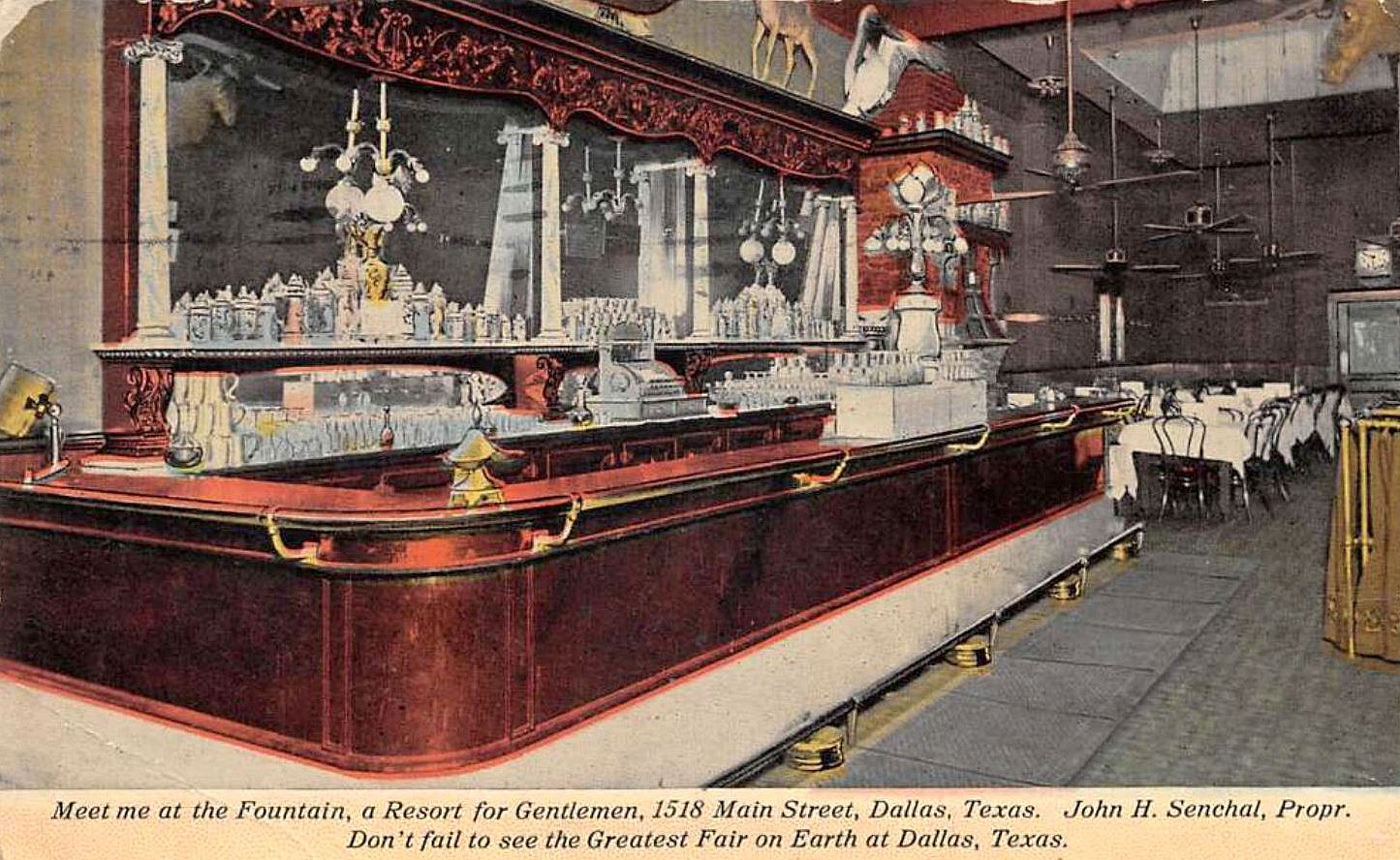
This postcard (which has a 1911 postmark) shows The Fountain, a well-appointed drinking establishment (not lacking in ceiling fans). The caption reads:

Meet me at the Fountain, a Resort for Gentlemen, 1518 Main Street, Dallas, Texas.
John H. Senchal, Propr.
Don’t fail to see the Greatest Fair on Earth at Dallas, Texas.

This bar-with-food was located on the south side of Main, steps away from the present location of Neiman Marcus. It was in the block seen in the picture below (it is just out of frame at the bottom right, next door to the Colonial Theater):

Main Street looking east from Akard

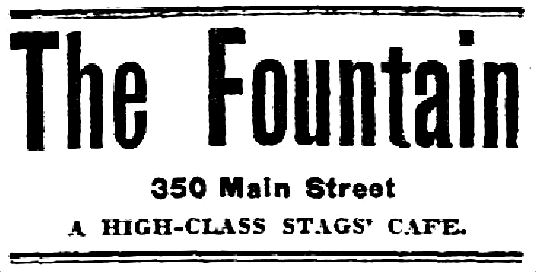
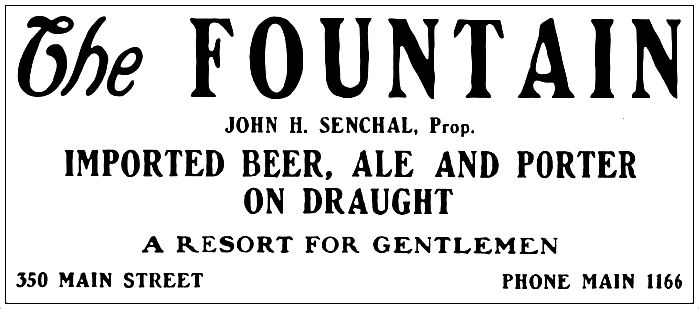
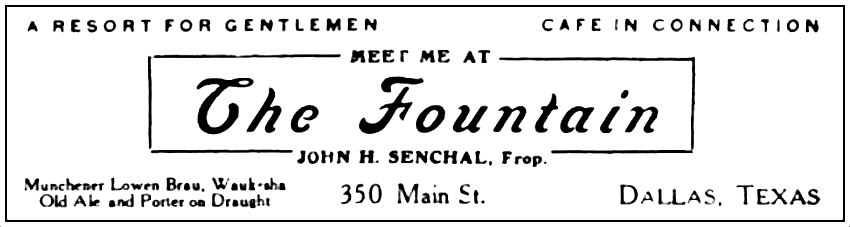
Its address was originally 350 Main — after the city-wide address change in 1911, it became 1518 Main. It appears to have opened in 1907 and was in business until at least 1918 (after Dallas voted to go “dry,” the former saloon became The Fountain Cafe). Here are a few early ads for the “High-Class Stags’ Cafe” in its early go-go “gentlemen’s resort” days: 

Dallas Morning News, Oct. 1907

Dallas directory, 1909

Dallas Police annual, 1910

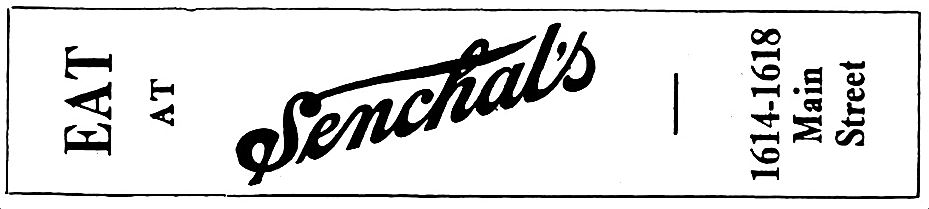
A few years later, the owner, John Henry Senchal, opened Senchal’s Buffet and Senchal’s Restaurant and Rathskeller at 1614-1618 Main.

Dallas directory, 1915

*

Johnnie Senchal — born in Galveston in 1875 to a French father and American mother — appears to have been a popular, civic-minded man’s-man. He frequently traveled with Dallas businessmen to other cities and states to act as a booster for the city. He also indulged in sporty activities such as being a regular wrestling referee and sponsoring horse races at the State Fair of Texas (in 1914 a $2,000 “Fountain Purse” was offered — in today’s money, more than $56,000!). One 1915 newspaper report said he was “probably the best known saloon man in the city.” He was very successful and was not hurting for money.

He also seems to have had a cozy relationship with members of the Dallas police department — a situation which is probably commonplace between saloon-owners and cops. One news story described how he had leapt to the defense of a policeman who was waylaid by a large group of men while he was walking prisoners to jail — a huge brawl broke out, and Senchal and the cop emerged victorious. Also — in a story which wasn’t fully explained — Senchal and another man ponied up $5,000 in bond money ($140,000 in today’s money!) for a Dallas policeman who was charged in the fatal shooting of a 17-year-old, Those are some strong ties between a saloonkeeper and the local constabulary, man.

In 1912 there was another confusing story concerning a man who had been arrested and convicted for being the owner/lessee/tenant of an establishment which was “knowingly permitted to be used as a place in which prostitutes resorted and resided for the purpose of plying their vocation. […] The house was a ‘disorderly house.’ Prostitutes resorted there and displayed themselves in almost a nude condition.” The man who was charged was seen there on a number of occasions “dancing with the prostitutes.” The man appealed his conviction because he had been charged with being the owner/lessee/tenant of this “bawdy house” — but the lessee/tenant was none other than Johnnie Senchal and another man. As far as I can tell, Senchal was not charged with anything regarding this case. 

But a couple of years later, in 1914, he was charged with running a “disorderly house” (a term often meaning a bordello or gambling den, but also meaning a place which is frequently the site of disturbances and is generally considered to be a public nuisance). It seems Johnnie and other were offering “cabaret” entertainment which might gotten out of hand. From The Dallas Morning News:

Alleging that the cabarets are conducted as “disorderly houses,” [charges were filed] on behalf of the State of Texas against owners of three restaurants in the downtown section. Affidavits accompanying the petitions alleged that women were allowed to drink at the places and to act in an unbecoming manner. (DMN, March 12, 1915)

I’m not sure exactly what constituted “an unbecoming manner,” but Johnnie Senchal was one of the men charged. At the very same time he was fighting this violation of the cabaret ordinance, it was reported that “an involuntary petition in bankruptcy has been filed in the United States court here against John Senchal and J. O. Walker, partners in the saloon business on Main Street. The petition was filed by local brewery agents and whisky houses” (DMN, June 20, 1915). Bankrupt! Even though he was apparently rolling in dough for years, he was rather ironically pushed to bankruptcy because he couldn’t pay his own bar tab.

And so Johnnie put the barkeeper’s life behind him. And I mean he REALLY put it behind him: he became a fervent speaker at Anti-Saloon League events, saying that having been forced out of the saloon game was actually a godsend — he was quoted as saying that his profits increased 75-80% when he stopped selling alcohol and became a full-time restaurateur. That seems unlikely, but that’s where he was in 1918, an improbable evangelist for Prohibition. 

Soon after, he and his family moved to Houston, where he opened a small cafe. On Oct. 9, 1929, after closing-time, Johnnie Senchal died in his cafe from a self-inflicted gunshot wound. He was 54 years old.

***

Sources & Notes

Postcard of The Fountain found on eBay.

Postcard of Main Street found on Flickr.

*

Copyright © 2022 Paula Bosse. All Rights Reserved.

S. Mayer’s Summer Garden, Est. 1881

mayers-garden_DPL_1885Roll out the barrel… (collection Dallas Public Library)

by Paula Bosse

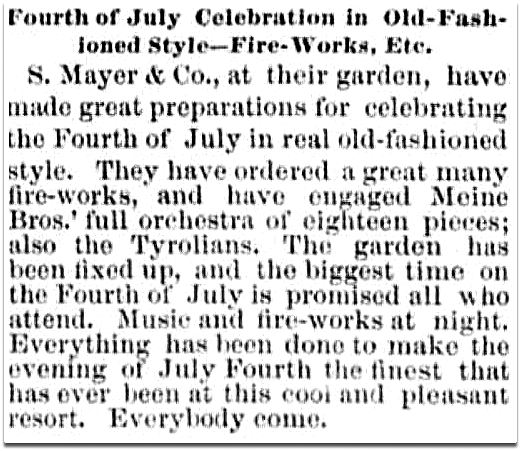
Today is the 4th of July. I had these two articles stuffed into bulging digital files:
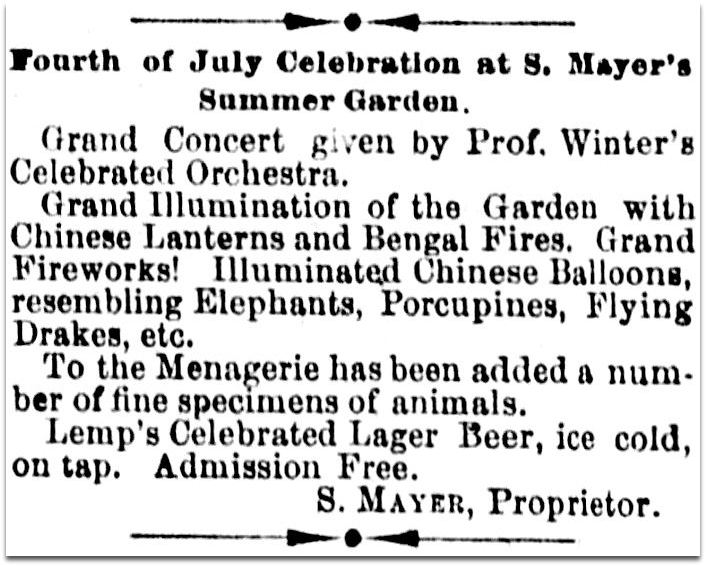
4th-july_mayers_dallas-herald_070482
Dallas Herald, July 4, 1882

4th-of-july_dallas-herald_070384_mayer-gardensDallas Herald, July 3, 1884

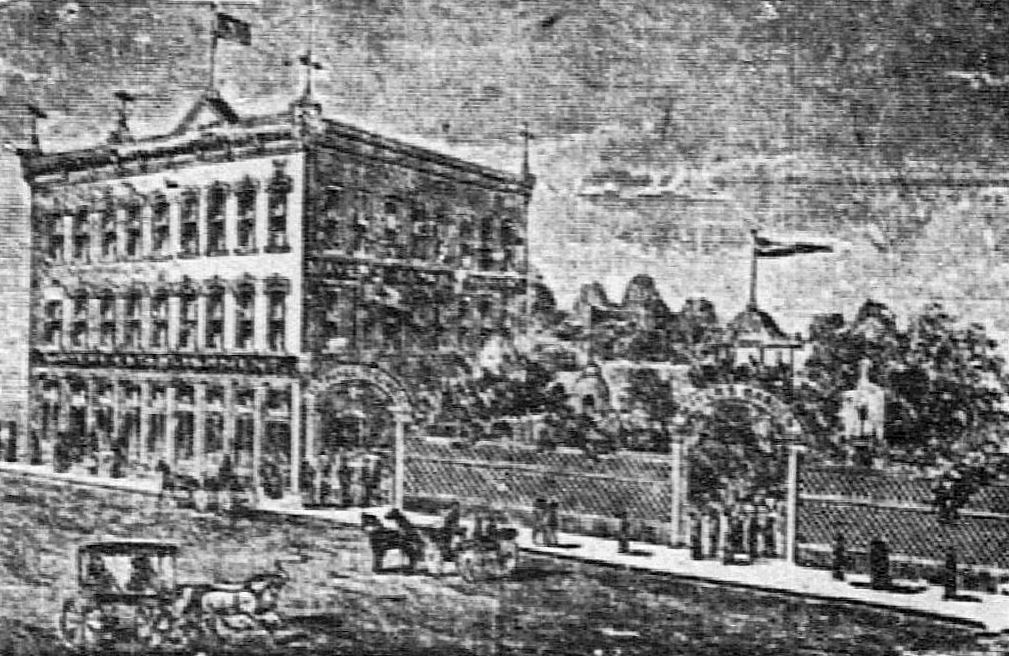
I had seen the photo of Mayer’s beer garden posted above, but I didn’t really know anything about it.

Simon Mayer (1843-1924) was born in Germany/Prussia and came to the United States in 1866, first settling in Milwaukee. He came to Texas in 1869 where, as his obituary in The Dallas Morning News says, “he owned and operated the first brewery established in Fort Worth.” He moved to Dallas in 1871 and entered into business with pioneer Dallas brewer Charles Meisterhans. 

In December, 1881 he opened what would become one of Dallas’ foremost gathering places, Mayer’s Summer Garden. He built a 3-story-plus-basement building (at what would later be 1601-1603 Elm Street) and added a charming outdoor beer garden. It stood on the north side of Elm and looked directly down Stone Street (now Stone Plaza) toward Main. You can see it on an 1885 Sanborn map here.

A 3-story building in Dallas in 1881 was nothing to sneeze at. He was putting a lot of money into it, and people were interested in its progress. The opening was touted in the paper for several months (click articles to see larger images):
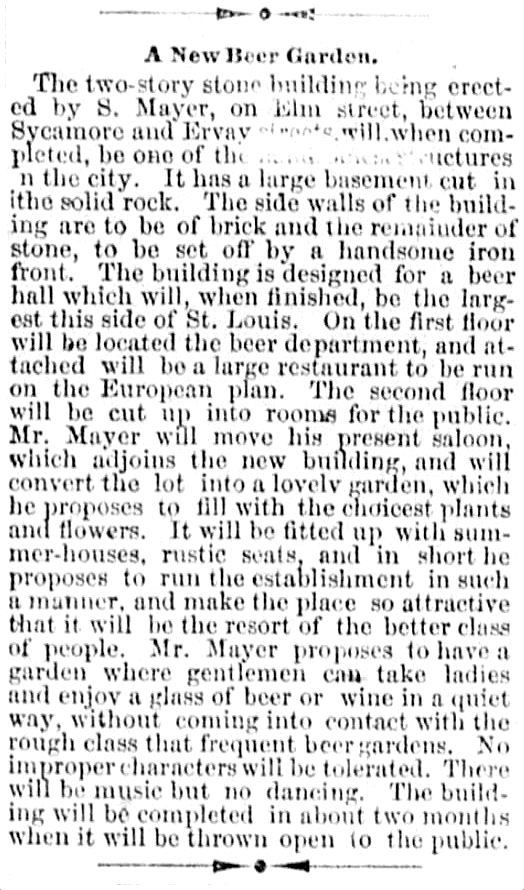
mayers_dallas-herald_090181_constructionDallas Herald, Sept. 1, 1881

From the above article: “Mr. Mayer proposes to have a garden where gentlemen can take ladies and enjoy a glass of beer or wine in a quiet way, without coming into contact with the rough class that frequent beer gardens. No improper characters will be tolerated. There will be music but no dancing.”
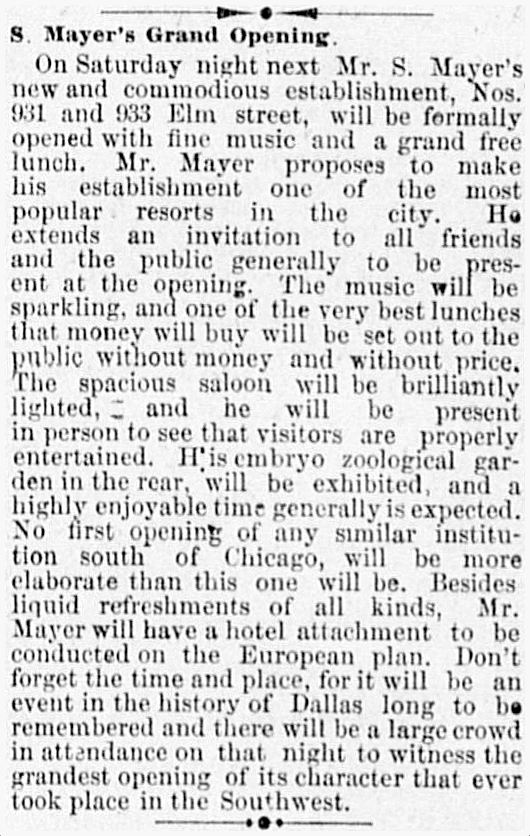
mayers_dallas-herald_120981_to-openDallas Herald, Dec. 1, 1881

Finally. the opening was about to happen: “the grandest blow-out ever witnessed in Dallas” was promised (who knew “blow-out” was a term used in 1881?):
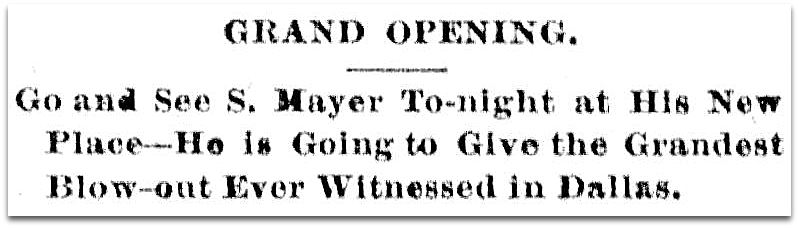
mayers_dallas-herald_121081_to-open_blow-outDallas Herald, Dec. 10, 1881

Over a thousand curious and thirsty Dallasites turned out.
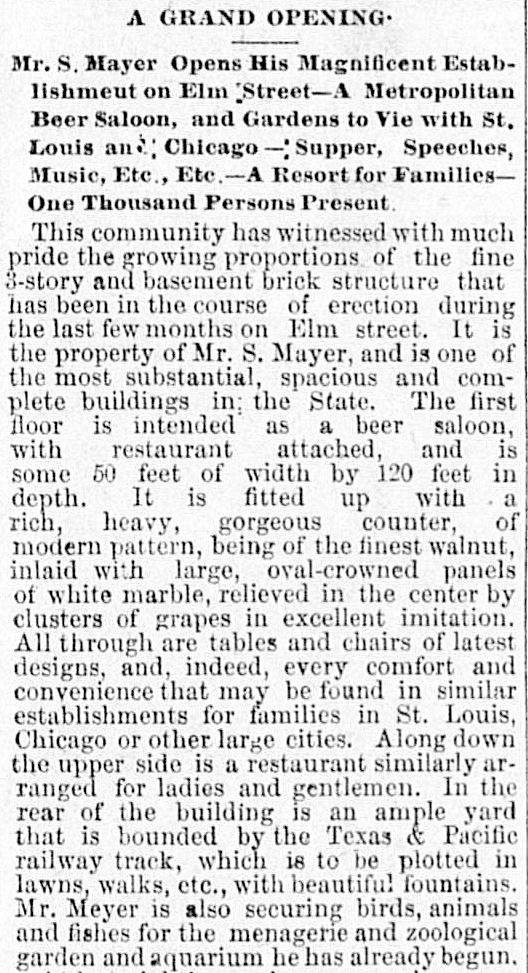
mayers_dallas-herald_121181_grand-openingDallas Herald, Dec. 11, 1881

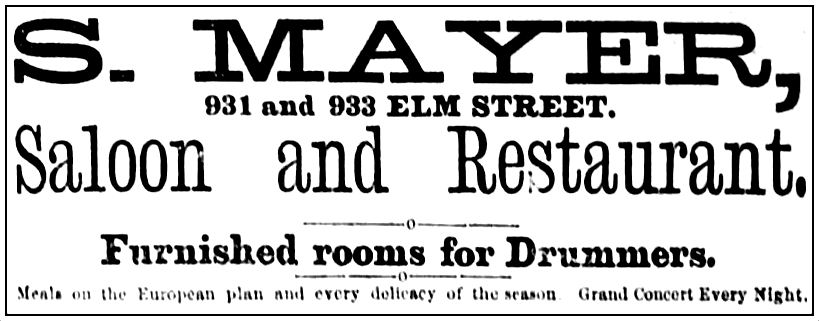
mayer_dallas-herald_121381_adDallas Herald, Dec. 13, 1881

(Don’t know what “drummers” are? Check it out.)

You might have noticed mention of zoological specimens. Yes, not only did this establishment offer a beer garden, a meeting hall, a hotel, a restaurant, a saloon, a performance space, and a lecture hall, it also had lots of animals in (and out of) cages — Dallas’ first zoo. He had alligators, birds, lions, eagles, prairie dogs, a Gila monster, a bear, and a pet crow. And a lot more. The bear escaped at least once — it wandered down the street and bit a guy who was making a commotion about a bear wandering down the street. But the bear was fairly easily recaptured and was waltzed back home along Elm Street without further incident. (Apparently, Mayer was a taxidermist by trade. One wonders how many of these creatures ended up stuffed and mounted and displayed in Herr Mayer’s home.)

People flocked to the Summer Garden. They loved the outdoor beer garden with its trees and fountains and performing bands. …And alligators. Below is a, sadly, washed-out circa-1885 image of Mayer’s garden. It actually seems fairly cosmopolitan for a Texas city in the 19th century. (Although, on the other side of the trees at the right was a livery stable and a wagon yard, so I would assume the jovial tippling, socializing, and oom-pah music was accompanied by unpleasant smells that were hard to ignore.)
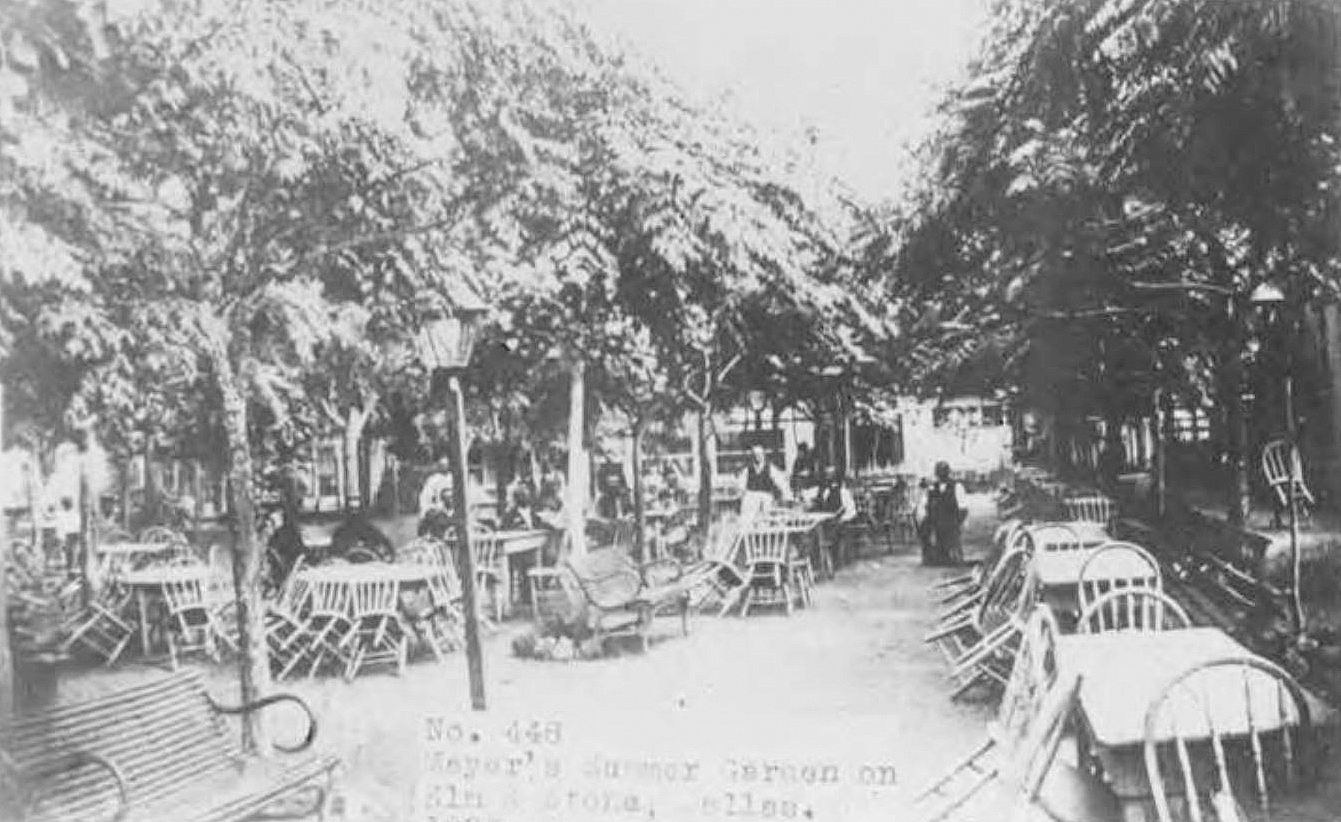
mayers-summer-garden_1885_degolyer-library_SMUMayer’s Garden, circa 1885 (via DeGolyer Library, SMU)

Mayer’s was one of the first businesses in Dallas (or, according to lore, THE first) to have electric lights — lights were switched on to great fanfare in August of 1882. Before that, Mayer utilized an interesting lighting technique I had never heard about: “Mr. Mayer had the latest thing in kerosene lamps. An attachment to the lamp sprayed kerosene on the blaze, making it much brighter” (Dallas Morning News, Sept. 14, 1924). (Perhaps the bear had escaped in fear for his life!)
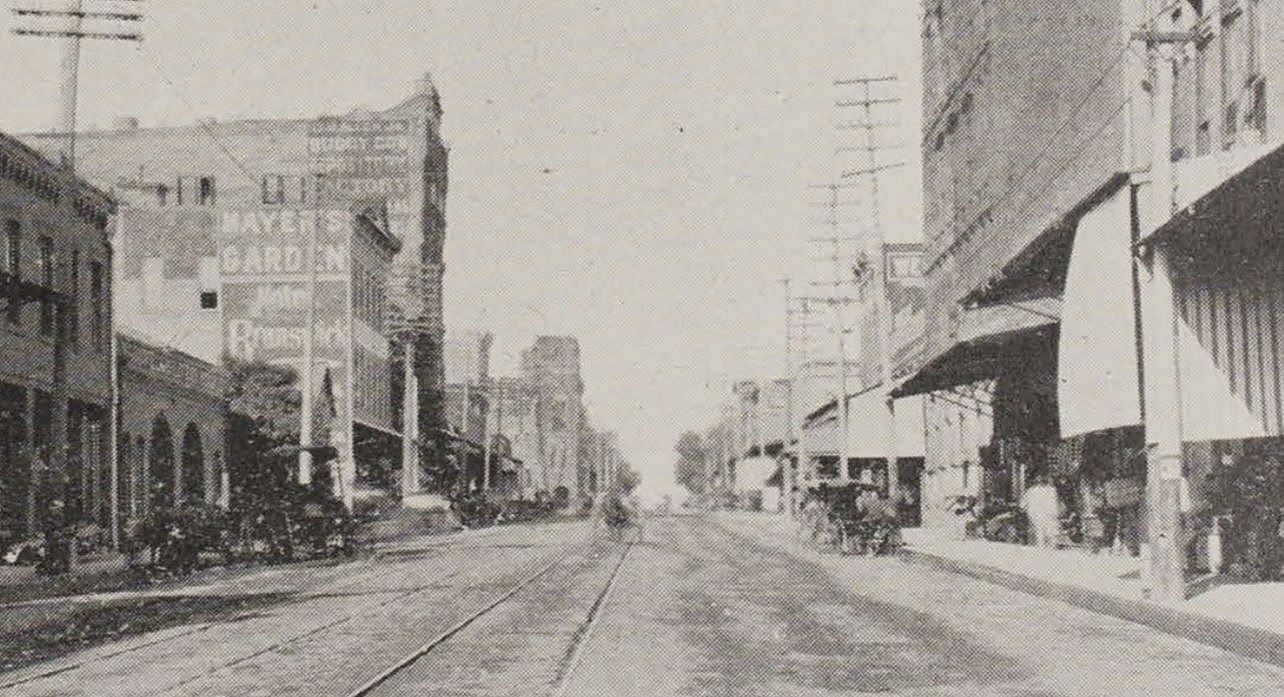
mayers-garden_clifton-church_1894_degolyer-library_SMU_detca. 1894 (via DeGolyer Library, SMU)

Mayer eventually closed his very popular business sometime in the 1890s after being unable to fight the “Sunday-closing” laws which forced him to close on his most profitable day of the week. By 1901, he placed the ad below and was selling the building.
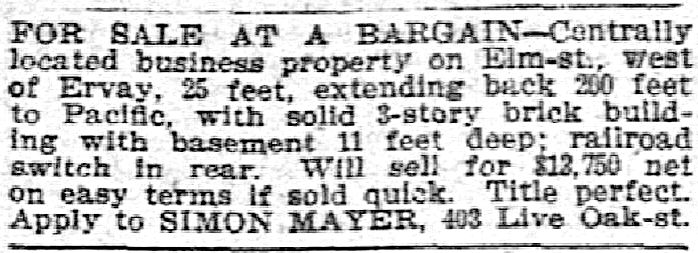
mayers_dmn_112401_property-for-saleNov. 24, 1901

I’m not sure when the building was demolished — probably in the ’20s or ’30s. I just found a photo of the building as it looked about the time Mayer sold it (it was the Clifton Hotel for a while).
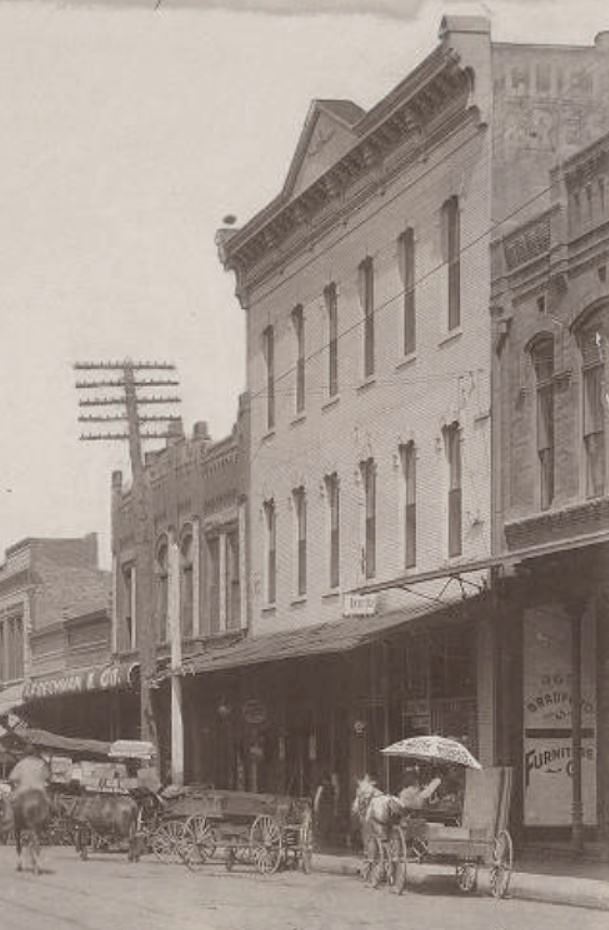
mayers_clifton-hotel_ca-1900_cook-coll_degolyer-library_SMU_cropped
No more garden, ca. 1900 (via DeGolyer Library, SMU)

The beer-garden era had ended. There were several in Dallas in the 1880s and 1890s, but Simon Mayer’s was perhaps the creme-de-la-creme. I mean, he had an eagle!

mayers-garden_icollector-comvia iCollector

mayers-garden_token_ebayvia eBay

mayers-garden_dmn_091424

***

Sources & Notes

Top photo — “[Mayer’s Beer Garden, Dallas, Texas”] — is from the Dallas Public Library (Call Number PA87-1/19-27-1).

The photo of the “garden” is titled “Mayer’s Summer Garden on Elm and Stone, 1885,” and it is from the Collection of Dallas Morning News negatives and copy photographs, DeGolyer Library, Southern Methodist University — more info can be found here. (There is another photo of the garden in this collection — it’s really hard to make out clearly, but I swear I see an alligator int he foreground. And maybe some other zoological specimens out of their cages. …Or not. It’s here.)

The photo showing Mayer’s around 1894 has been cropped from the original Clifton Church photograph, which appeared in his book Dallas, Texas Through a Camera (DeGolyer Library, SMU) — the full photo can be seen in the fully scanned book here.

The photo showing Mayer’s building in about 1900 has been cropped from “[Elm Street between Stone and Ervay Streets].” which is from the George W. Cook Dallas/Texas Image Collection, DeGolyer Library, Southern Methodist University — see the full photo here.

All articles and ads are from The Dallas Herald, editions of which are scanned in their entirety and can be found at the Portal to Texas History, here — thank you, University of North Texas!

A lot of colorful info can be found in Mayer’s obituary in the Dallas Morning News archives: “Simon Mayer, Early Dallas Entertainer — Death of Pioneer Brewer Recalls Pleasure Garden He Founded” (DMN, Sept. 14, 1924).

mayers-garden_DPL_1885_sm

*

Copyright © 2022 Paula Bosse. All Rights Reserved.

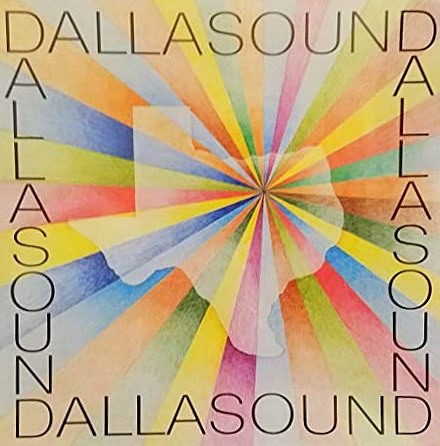
The DALLASOUND — 1971

dallasound_1971_amazon
Staight outta Big D…

by Paula Bosse

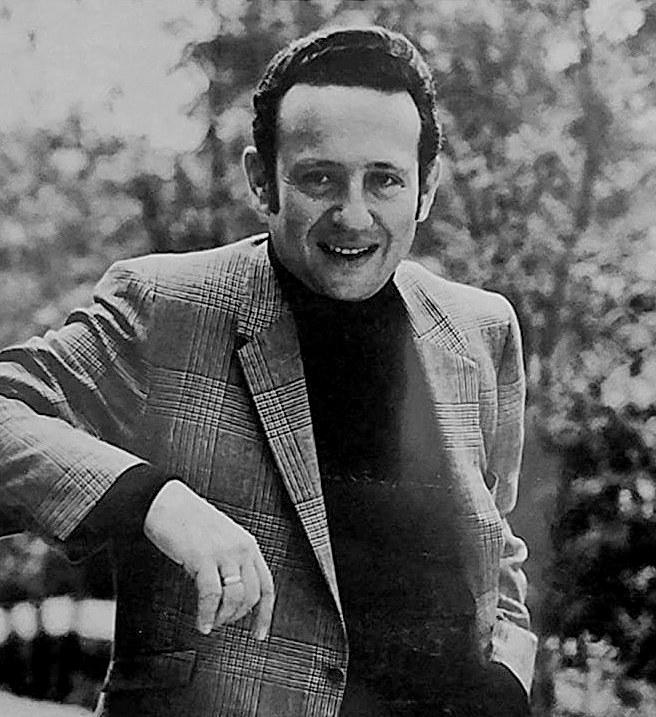
The Boston Symphony Orchestra had Arthur Fiedler and its popular-music offshoot, The Boston Pops. The Dallas Symphony Orchestra had Anshel Brusilow and The Dallasound. 

Brusilow, a Philadelphia native, came to Dallas in 1970 as the resident conductor of the Dallas Symphony Orchestra. The DSO was in financial straits at the time, so in a bid to increase the orchestra’s demographic reach, Brusilow borrowed Fiedler’s idea and formed his own “pops” orchestra, which played jazzy arrangements of pop songs and light classical music. He named this sideline project “The Dallasound.” It was very popular, but it didn’t improve the financial problems of the DSO, and Brusilow was gone after only 3 years. He then went on to accept a teaching a position at North Texas State University (now the University of North Texas). After 9 years at UNT, he began teaching at SMU’s Meadow School of the Arts in 1983. Brusilow died in 2018 — he spent the last 48 years of his life in Dallas.

*

Here are the liner notes for the Dallasound album (1971):

THE DALLAS SYMPHONY ORCHESTRA

One of America’s oldest orchestras, the Dallas Symphony Orchestra was founded in 1900. Through the years, it has served its community and the entire North Texas area with the finest in music from the greatest composers the world has known. From a modest beginning — with 35 members giving a handful of concerts a season — the Dallas Symphony Orchestra currently has 85 members and performs more than 160 concerts each season. Its membership would comprise a “Who’s Who” of some of the finest artists in the world.

With its reputation for the classics well-established, the Dallas Symphony Orchestra now adds another brilliant facet to its already illustrious history — the DALLASOUND — a new sound and a new concept in music making. A big band sound incorporating the latest and most exciting modern-day pop sounds – special arrangements of tunes by the Beatles, Simon and Garfunkel, Jim Webb and many others.

Featured as special guest artists on the first recording on the DALLASOUND Label are three outstanding jazz musicians from the Dallas area — Paul Guerrero on drums, Jack Petersen on guitar and Al “Little Al” Wesar on Fender bass. Arrangements are by one of the most gifted arrangers in the business — Wilfred Holcombe of Trenton, New Jersey. Not just stock orchestral arrangements, but the swingingest, rockingest big band arrangements around! Settle back and listen to some of the most exciting music you will ever hear made by a symphony orchestra!

ANSHEL BRUSILOW

Like many of the world’s great violinist/conductors, Anshel Brusilow laid aside his Stradivarius several years ago and took baton in hand in earnest. His extensive performing and conducting experience with three of the world’s greatest conductors — Eugene Ormandy, George Szell and Pierre Monteux — placed him in good stead on the podium. He came to Dallas after two extremely busy years and more than 300 concerts with the Chamber Symphony of Philadelphia, including five recordings with RCA Victor.

With him he brought the DALLASOUND and a new era for Dallas’s symphony orchestra. Completely at home with the standard symphonic fare, he is equally proficient when ” swinging” with the DALLASOUND. Thousands of Dallasites have been converted to the new sound a symphony orchestra can make, a fact which substantiates Anshel Brusilow’s theory that the Dallas Symphony Orchestra belongs to all the people of a community and must therefore serve them in as many ways as it can. Thanks to Anshel Brusilow, the Dallas Symphony embarks on a new direction in music — the DALLASOUND!

The album’s musical offerings included arrangements of George Harrison’s “Something” and “My Sweet Lord,” The Carpenters’ “We’ve Only Just Begun,” The Doors’ “Light My Fire,” Tom Jones’ “It’s Not Unusual” and “Delilah,” and everyone’s favorite ubiquitous weird song from the late ’60s, “MacArthur Park.”

dallasound_back-cover_amazon_brusilowAnshel Brusilow

dallasound_back-cover_amazon_det

dallasound_back-cover_amazon_logo

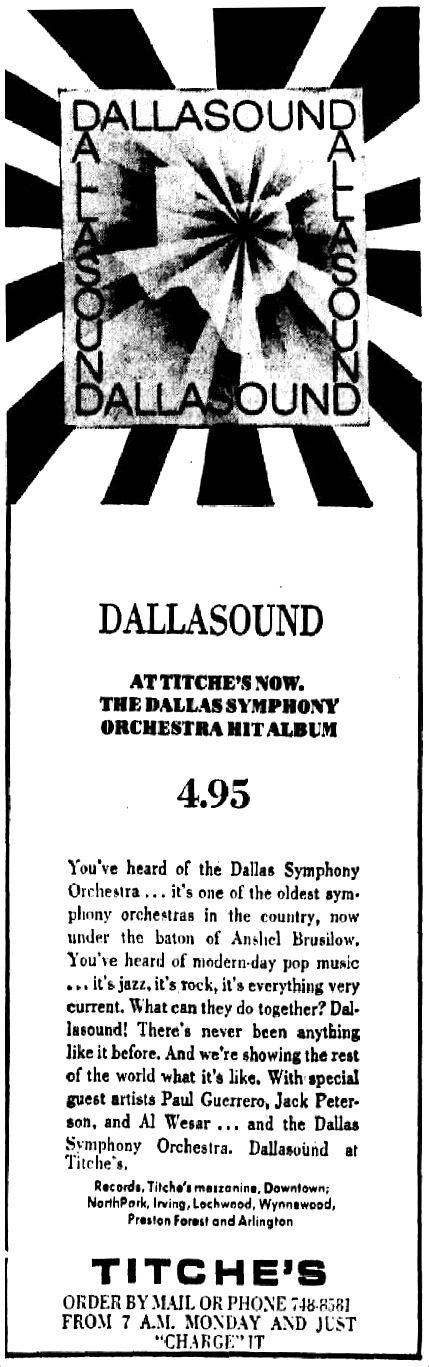
dallasound_030771_adTitche’s ad, March, 1971

***

Sources & Notes

Images from the front and back cover of the DALLASOUND album were found on Amazon, here.

A really good interview with Anshel Brusilow can be found in the “High Profile” article by Marty Primeau (Dallas Morning News, July 17, 1983).

dallasound_1971_amazon_sm

*

Copyright © 2022 Paula Bosse. All Rights Reserved.
Union Station Interiors — 1916

union-station_interior_atlantic-terra-cotta-co-coll_UT_frank-rogersA beautiful place to wait…

by Paula Bosse

Above, a photo of the new “Union Depot,” completed in 1916 and, thankfully, still standing more than a century later. Below, a couple of details of the Lunch Room and the Women’s Waiting Room.

union-station_interior_atlantic-terra-cotta-co-coll_UT_frank-rogers_lunch-rm

union-station_interior_atlantic-terra-cotta-co-coll_UT_frank-rogers_womens-wtg-rm

The same view as the top photo, but from 1922:

union-station-interior_1922

Back to 1916, in what I gather is a sort of interior/exterior shot showing another place to pass the time. What better, quaint way to wait for a train and take in a great, slightly elevated view, than in a rocking chair.

union-station_rocking-chairs_atlantic-terra-cotta-co-coll_UT_frank-rogers

And a slight zoom-in:

union-station_rocking-chairs_atlantic-terra-cotta-co-coll_UT_frank-rogers_det-1

Imagine those rocking chairs up there in those archways, between the columns.

union-station_dallas-city-of-the-hour_ca-1916_SMU

***

Sources & Notes

The two photos from 1916 (by Frank Rogers) are from the Atlantic Terra Cotta Company Architectural records and photographs, 1914-1941, Architectural Terra Cotta, Alexander Architectural Archives, University of Texas Libraries, The University of Texas at Austin — more info on these photos is here and here

A couple of other images of the new Union Station can be seen in these Flashback Dallas posts:

union-station_interior_atlantic-terra-cotta-co-coll_UT_frank-rogers_sm

*

Copyright © 2022 Paula Bosse. All Rights Reserved.