Flashback : Dallas

A Miscellany: History, Ads, Pop Culture

Category: Celebs

The Pink Panther-Mr. Peppermint Connection

mr-peppermint_dmn_1961Mr. P. — 1961

by Paula Bosse

I had no idea that the “Mr. Peppermint” theme was by Henry Mancini! It’s from a 1960 movie called “High Time,” which, I have to say, I’ve never heard of. It starred Bing Crosby, Fabian, and Tuesday Weld (I kind of think Bing may have been in it solely for the paycheck). Check out the movie’s main theme music. Sound familiar?

Hearing this brings back a flood of happy memories — an aural version of Proust’s madeleines.

In a recent Los Angeles Times interview, Paul Reubens (aka Pee-wee Herman) had this to say:

“I never met Captain Kangaroo; I probably would have completely freaked out if I met Captain Kangaroo. In fact, when I meet people who are just beside themselves to meet me, I always think they’re reacting like I would react if I met Captain Kangaroo, I was so crazy about that television show as a child.” (LA Times, Oct. 21, 2014)

I ran into Jerry Haynes (aka Mr. Peppermint) several times around town over the years. The first time I saw him, I was in my 20s, and he was doing some sort of promotion (in character) at a store in, I think, Northpark. I was unaware that he would be there, but when I saw him at the top of the escalator, I was shocked. My childhood TV pal right in front of me! It’s a bit of a blur, but I think I giddily foisted myself on him and told him all the things other Dallas kids raised on his show probably told him. I might even have gushed an involuntary “I love you, Mr. Peppermint!” Yikes. I bet he got that ALL THE TIME. He was very sweet and didn’t treat me like a crazy person.

The last time I saw him, he was just Jerry Haynes, shopping for cheese at the Tom Thumb on Mockingbird and Abrams. I didn’t bother him, but I still got a little happy jolt of recognition when I saw him.

And now I find out that the composer who wrote so much of my favorite movie music wrote the music so tied to my childhood. Thanks, Mr. Mancini! Thanks, Mr. Peppermint! Thanks, Mr. Wiggly Worm!

***

Sources & Notes

Quote from Paul Reubens’ Los Angeles Times interview, here.

Wikipedia roundup: madeleines, here; “High Time” movie, here; Henry Mancini, here.

(Thank you, Steve S., for bringing this to my attention!)

*

Copyright © 2014 Paula Bosse. All Rights Reserved.


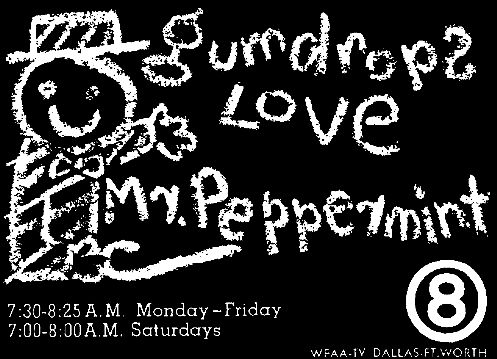
“Gumdrops Love Mr. Peppermint” — 1968

mr-peppermint_1968

by Paula Bosse

When the news is unsettling, remember your “happy place.”

***

1968 TV Guide ad, from eBay.

*

Copyright © 2014 Paula Bosse. All Rights Reserved.


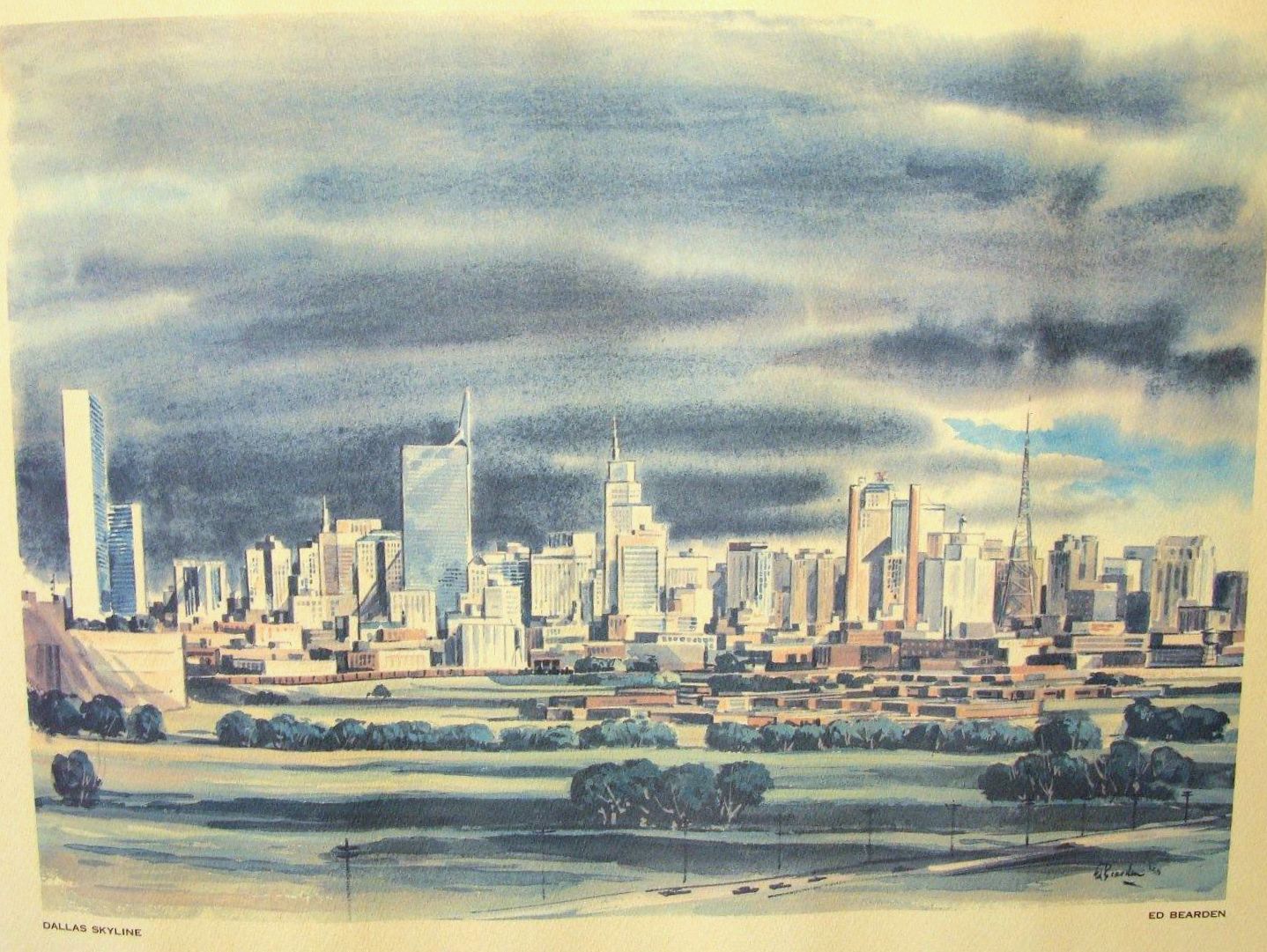
“Dallas Skyline” by Ed Bearden — 1958

dallas-skyline_ed-bearden“Dallas Skyline” by Ed Bearden (click for much larger image)

by Paula Bosse

Ed Bearden (1919-1980) was a Dallas painter who studied under Jerry Bywaters and Otis Dozier and was loosely affiliated with the Dallas Nine group of artists. He worked with Bywaters at the Dallas Museum of Fine Art as Assistant Director, and he helped found the Dallas Museum for Contemporary Arts. He also spent several years at SMU — both as a student and as a member of the faculty — until he decided to leave to focus on his own art career. In addition to working as a fine artist, he also owned a commercial art business.

The constantly changing Dallas skyline was a particular favorite subject of his, and he returned to it again and again. The one above is a personal favorite. I’m not sure why I feel so nostalgic when I look at it, except that I swear that I saw this print as a child at my father’s bookstore. It’s a Dallas I’ve never known, but one I wish I had.

***

Apologies for the wonky image, but I can’t find a better scan of it. I’m assuming this was first a watercolor, then issued as a lithograph, then maybe printed as a broadside or a loose plate in a book? The date in the lower right corner is very difficult to make out — it looks like either 1958 or 1959. I’m going with 1958. ‘Cause I’m like that.

A brief biography of Ed Bearden can be found here.

An unlikely gig came Bearden’s way when director George Stevens asked him to draw the storyboards for the film Giant, hoping that having a Texas artist do them would lend an air of authenticity to the look and feel of the movie (and, in fact, Bearden’s sketches were used as reference by makeup and wardrobe personnel). Read more about this interesting assignment on SMU’s Hamon Arts Library site, and see some of Bearden’s sketches from the set in Marfa, here.

*

Copyright © 2014 Paula Bosse. All Rights Reserved.

The Fab Four in Big D — 1964

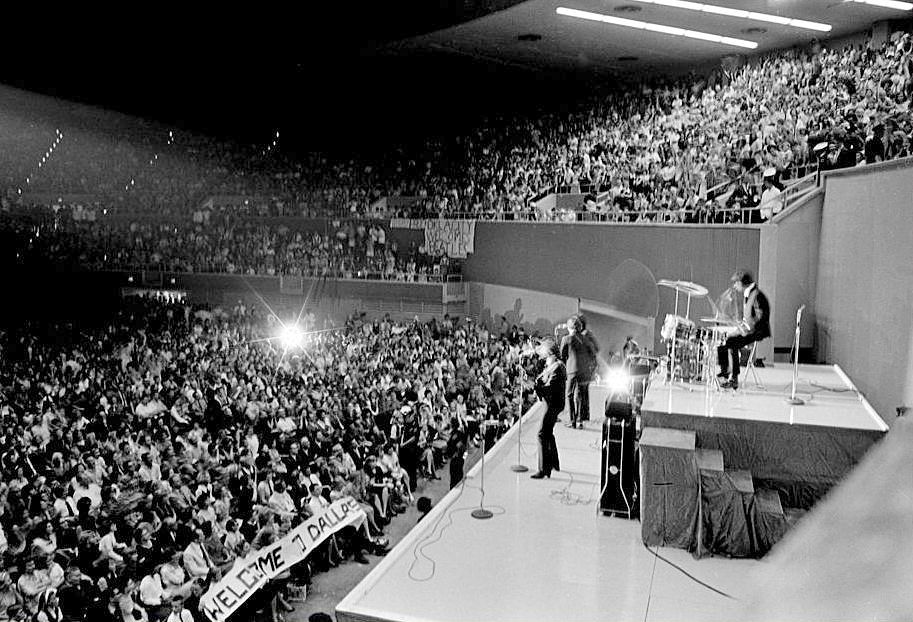
beatles_memorial-auditorium_091864_ferd-kaufmanThe Beatles at Memorial Auditorium, Sept. 18, 1964

by Paula Bosse

The Beatles came to Dallas fifty years ago this week. There was pandemonium at Love Field when they arrived. There was pandemonium at the Cabaña Hotel when they got there. There was pandemonium at the press conference. And there was pandemonium at the concert at Memorial Auditorium on September 18, 1964, the last date of their American tour. This event has been pretty well covered over the years, but here are a couple of cool photos of the Fabs’ time in Dallas, and a couple of droll columns from DFW entertainment reporters who seem to be vaguely amused, vaguely annoyed, and vaguely impressed — all at the same time.

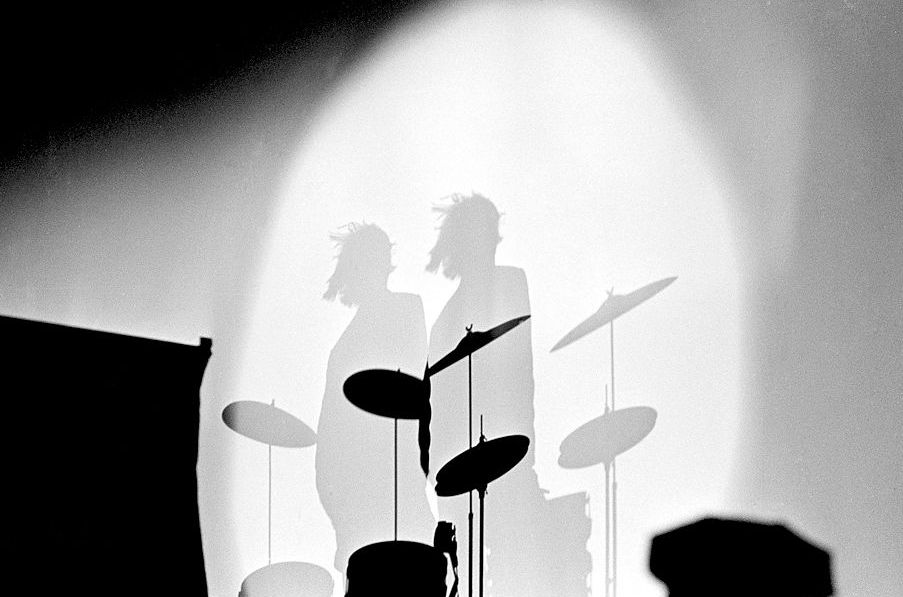
beatles_memorial-aud_091964_ferd-kaufman

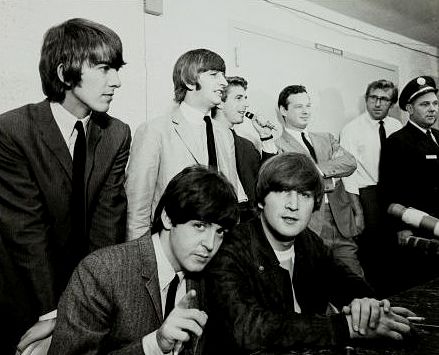
beatles_dallas_1964_john-mazziotta_dth

Above, the Dallas press conference, with Beatles press agent Derek Taylor (holding microphone), manager Brian Epstein (who, still in Dallas, would turn 30 the following day), and road manager Mal Evans (with glasses). And a Dallas cop (who, over the years, must have told a thousand people about this momentous day).

*

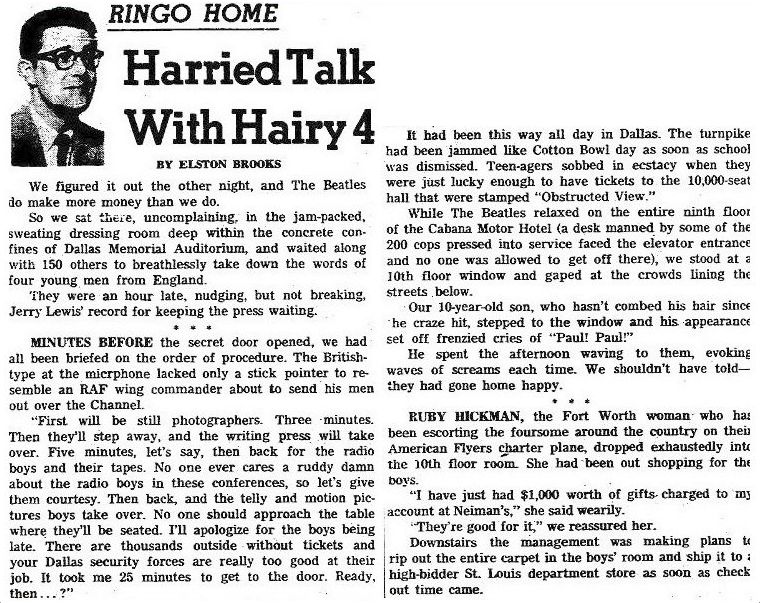
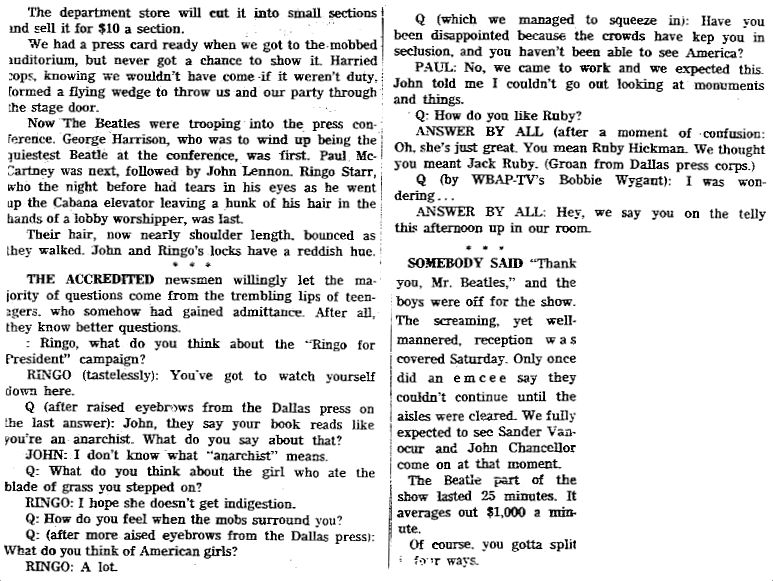
Below, the always-entertaining Elston Brooks of the Fort Worth Star-Telegram writes about his “Harried Talk With Hairy 4” (click article for larger image).

beatles_FWST_092064a

beatles_FWST_092064bFWST, Sept. 20, 1964

*

The Dallas Morning News’ man-about-town, Tony Zoppi, enlisted the aid of a teenager to explain to him the nuances of Beatlemania. His opening paragraph is pretty good:

It was Mardi Gras, V-E Day, the Texas-Oklahoma excitement and The Alamo all rolled into one — only louder. It was the Beatles, winding up their American tour deep in the heart of Texas. It was Dallas playing the role of uninhibited host to the hilt. (“The Beatles Do It, Yeah! Yeah! Yeah!” by Tony Zoppi, DMN, Sept. 19, 1964)

*

And lastly, the short scattershot interview by Bert Shipp of Channel 8:

*

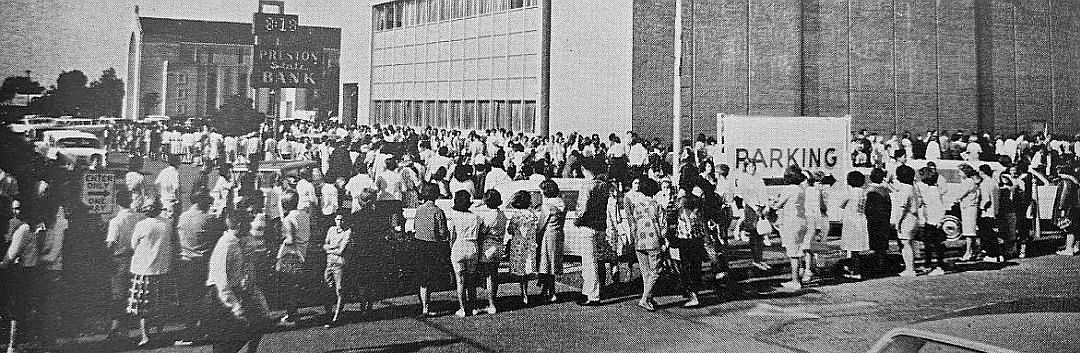
And here’s a photo I’ve never seen: kids lining up to buy tickets. The caption: “The Preston Ticket Agency, a service of the Preston State Bank of Dallas, recently attracted this crowd when the agency was named to handle the exclusive sale of tickets for a September performance in Dallas of the Beatles quartet. Some youngsters stood in line 24 hours before the ticket office opened for business. The Preston Ticket Agency has been in operation since 1963, and last year served over 40,000 customers with tickets to major Dallas entertainment attractions.” (“Dallas” magazine, July 1963)

beatles_preston-tickets_dallas-mag_july-1964-DPL

***

Sources & Notes

Top two performance photos of The Beatles at Memorial Auditorium by Ferd Kaufman (the one of Ringo is GREAT).

Photo of the press conference by John Mazziotta.

Photo of the ticket line is from Dallas magazine — a publication of the Dallas Chamber of Commerce — July 1963, Periodicals Collection, Dallas Public Library.

More photos of the Dallas visit can be seen here.

And a nostalgic look back at the Beatles’ visit can be read in Bonnie Lovell’s entertaining Dallas Morning News essay, “50 Years Ago the Beatles Played Their Only Dallas Concert” (DMN, Sept. 19, 2014) (no longer available online apparently) — Bonnie was there in the thick of it as a Beatle-crazed 13-year-old and was one of the lucky few who had a ticket to the show and got to see the boys shake their mop-tops in person.

*

Copyright © 2014 Paula Bosse. All Rights Reserved.

Dallas’ Frank Lloyd Wright Skyscraper — 1946

frank-lloyd-wright_rogers-lacy_1946-smThe Rogers Lacy Hotel, designed by Frank Lloyd Wright

by Paula Bosse

Feast your eyes on that fantastic skyscraper. That building was *this close* to being built in Dallas. And even though it was designed in 1946 (!), it looks modern enough to fit right in with the city’s celebrated 21st-century skyline.

Frank Lloyd Wright designed this 47-story hotel for millionaire East Texas wildcatter Rogers Lacy, to be built at the southwest corner of Commerce and Ervay, catty-corner from the also fabulous (if not quite so futuristic-looking) Mercantile National Bank Building.

Even though he had a firm distaste for the overly-populated, traffic-clogged, modern American city, Wright jumped at the chance to design a hotel smack dab in the middle of one of the country’s largest and fastest-paced cities. In fact, the Lacy Hotel was one of Wright’s pet projects, and he went all-out in his attempt to convince his wavering client of the merits (both aesthetic and utilitarian) of the multi-million-dollar skyscraper he had, apparently, been dreaming of for decades.

While Wright worked on swaying Lacy in his favor, John Rosenfield — the influential arts critic of The Dallas Morning News — worked on winning over the people of Dallas. Rosenfield really pulled out the stops when writing about the project; his promotion of the proposed hotel (in print as well as behind-the-scenes) was as tireless as it was passionate.

The startlingly new architectural design combined with Wright’s salesmanlike pronouncements on how he had transcended what he saw as the crushing gloom of hotel space caused quite a bit of excitement. Lacy, the Texas oil man with deep pockets, was eventually won over. But a client’s enthusiasm and an architect’s full-bore persuasion can sometimes go only so far. After an initial gung-ho response from the Lacy camp, communication with Wright began to get spotty (causing a freak-out at Taliesin), and plans never really got underway. When Lacy died unexpectedly at the end of 1947, the project was scrapped, and Frank Lloyd Wright’s dream of a soaring glass skyscraper was never realized.

If only we could go back and nudge Rogers Lacy to sign off on this building’s construction. It’s amazing how Wright’s concept here predicted the later glass-clad, atrium-centered architecture that has been a Dallas staple for decades. If Wright’s Lacy building were announced today — even without the weight of Frank Lloyd Wright’s name attached to it — I think news of its construction would, again, be met with excitement.

***

Sources & Notes

The Frank Lloyd Wright drawing of the proposed Rogers Lacy Hotel is from the cover of the Spring 2009 issue of Legacies: A History Journal for Dallas and North Central Texas. Charles T. Marshall’s extremely entertaining article, “Where Dallas Once Stood: Frank Lloyd Wright and the Rogers Lacy Hotel,” is in this issue, and it’s a great read, illustrated with photos of the key players and additional architectural drawings of the hotel; you can read the full article here.

Wright’s biggest champion in Dallas was legendary Dallas Morning News critic John Rosenfield (he and Wright were also personal friends). His articles on the proposed Rogers Lacy hotel appeared in the DMN, including the ones listed below:

  • “Famed Architect Confers on New Dallas Hotel Plans” (DMN, March 28, 1946)
  • “47-Story, Windowless Dallas Hotel Designed by Celebrated Architect” (DMN, July 28, 1946) — Rosenfield’s extensive, soaring description of the planned building
  • “Dallas’ Dream Hotel Soon Coming To Life” (DMN, Aug. 11, 1946)
  • “Wright Bares Lacy Hotel Plans” (DMN, June 22, 1947) — the unveiling to the Dallas public of the final plans (which was accompanied by the images contained in the Legacies article linked above)

*

Copyright © 2014 Paula Bosse. All Rights Reserved.

Big Tex and His Dressers

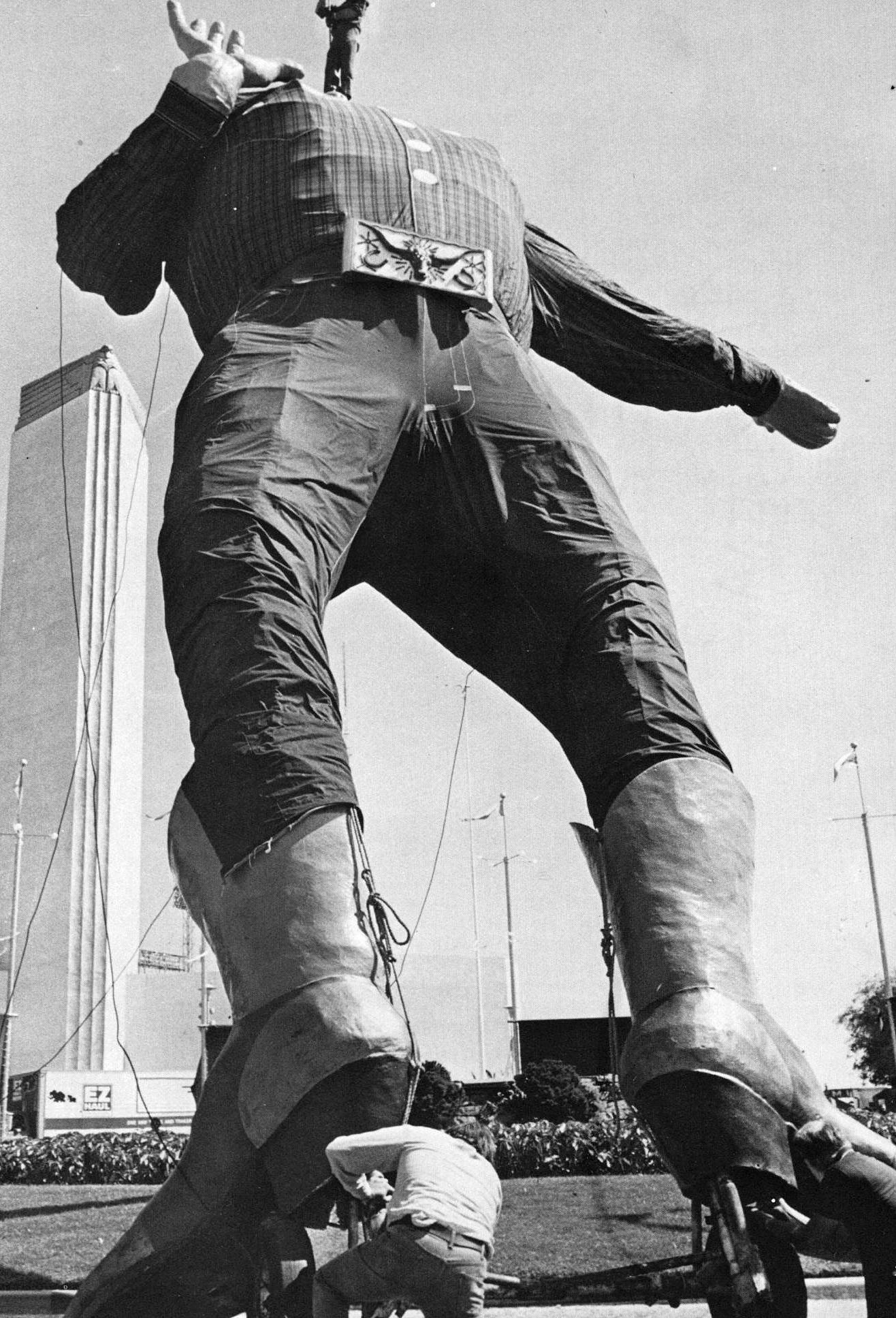
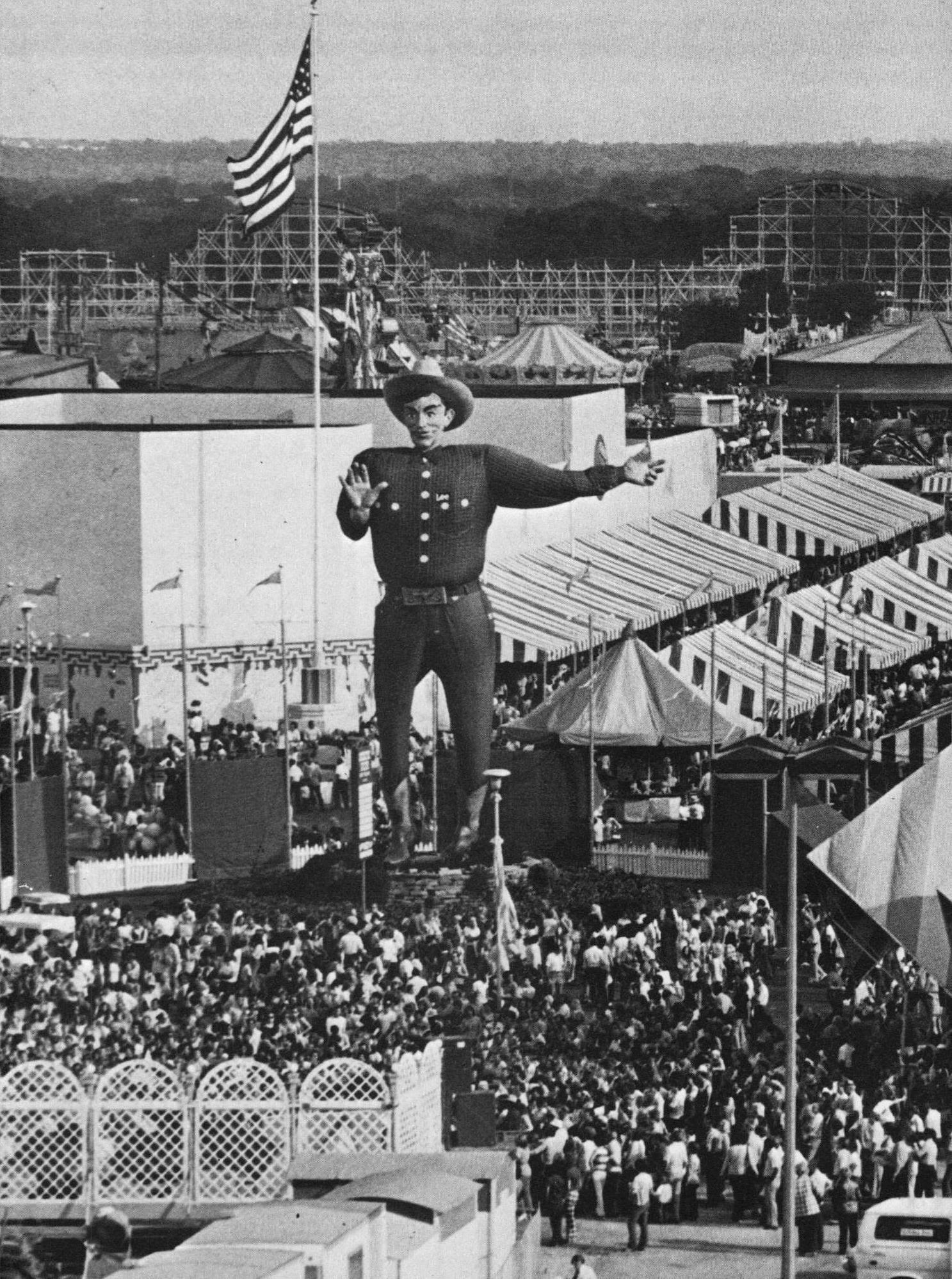
big-tex_headless_1970s
Headlessness and wardrobe malfunctions being attended to…

by Paula Bosse

It’ll probably all get straightened out in the end.

When I worked in a bookstore that had frequent visits by costumed characters for children’s events, we were told to make sure children never saw the characters without their costume heads because it might freak the kids out. If true, that photo above has the potential to scar some impressionable youngsters for life.

Above, Big Tex in dishabille.

Below, all pulled together.

big-tex_tx-historian_sept1976-sm

***

Sources & Notes

Top photo of a headless Big Tex is from the Sept. 1976 issue of Texas Historian, a Texas State Historical Association publication of the Junior Historians of Texas.

Second photo, of a put-together Big Tex is a State Fair of Texas photo from the same issue of Texas Historian.

Click images to make Bit Tex REALLY big!

*

Copyright © 2014 Paula Bosse. All Rights Reserved.

Big Tex, Old Tex, Big Ol’ Tex — Whatever You Call Him, Otis Dozier Wins (1954)

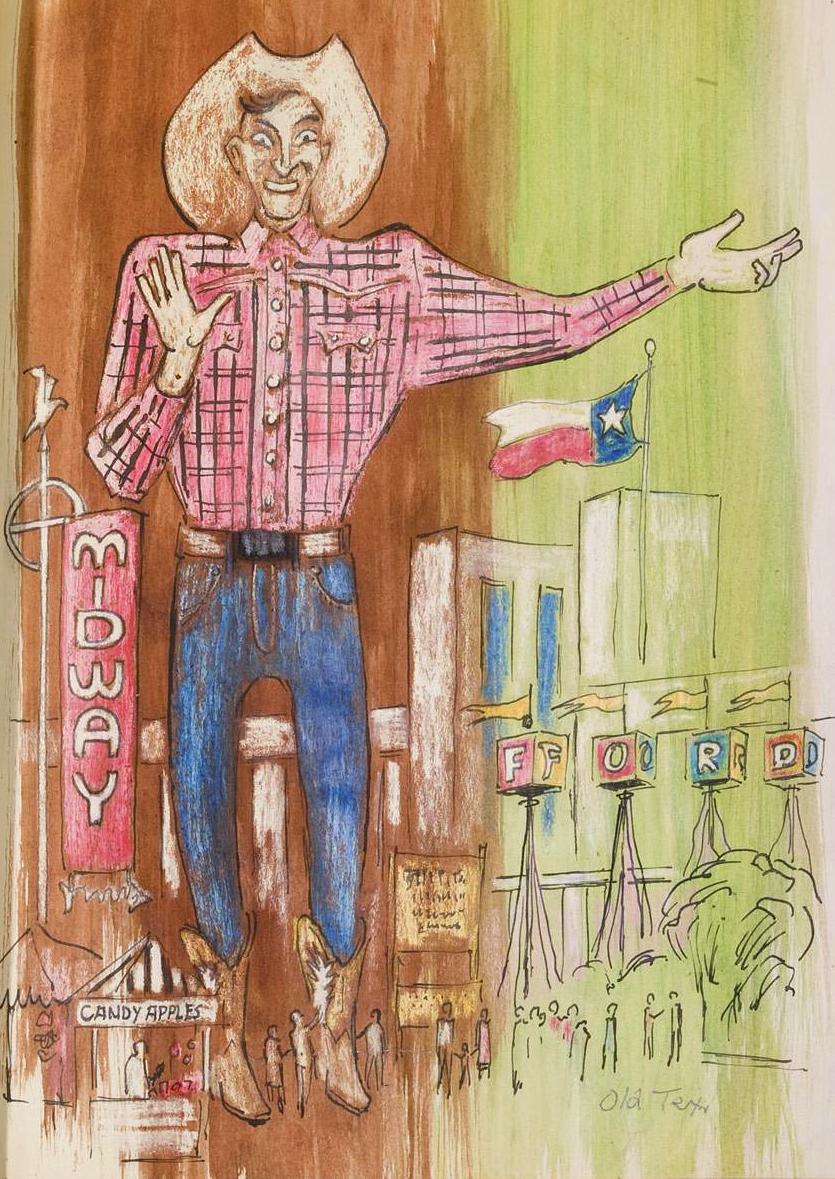
dozier_big-tex_sketchbook_1954_dma“Old Tex” sketch by Otis Dozier, 1954 — Dallas Museum of Art

© Marie Scott Miegel and Denni Davis Washburn

by Paula Bosse

Hey, y’all, guess what’s just around the corner. Whenever you start seeing pictures of Big Tex, you know that the State Fair of Texas can’t be too far away.

There have been a lot of artistic depictions of Big Tex over the years, but I think this sketch by Dallas artist Otis Dozier (1904-1987) may be my all-time favorite. And I’ve only just discovered it! (Thank you, DMA!)

***

This wonderful ink, watercolor, and crayon sketch of “Old Tex” is contained in one of Otis Dozier’s sketchbooks, now in the collection of the Dallas Museum of Art, a gift of the Dozier Foundation (© Marie Scott Miegel and Denni Davis Washburn). To see details on this work, see the page on the DMA’s website, here.

The Otis Dozier sketchbooks have been digitized in a joint project between the Dallas Museum of Art, SMU’s Bywaters Special Collections at the Hamon Arts Library, and SMU’s Norwick Center for Digital Services. To read about this fantastic collection, see the SMU Central University Libraries page, here.

*

This week, the Dallas Museum of Art launched a new digital database in which its entire collection is now accessible online! This is great news for many reasons, not least being that it allows the public to see works that are rarely — if ever — displayed in the museum. Such as this one. To read more about assembling this incredible database, read the DMA’s announcement, here.

To look up your favorite artist, check to see what the DMA has, here.

For the biography of the Forney-born Dozier (who was one of the members of the famed Dallas Nine group), see the Handbook of Texas entry here.

Click picture for larger image.

*

Copyright © 2014 Paula Bosse. All Rights Reserved.


Lucy, Desi, Dallas — 1956

lucy-desi_fw_bellaircraftLucille Ball and Desi Arnaz and their loaner ‘copter from Bell Aircraft

by Paula Bosse

Lucille Ball and Desi Arnaz came to Dallas and Fort Worth in 1956 to promote their new movie, “Forever Darling.” Their arrival times were heavily publicized, and throngs of fans showed up to welcome them — in Dallas at Love Field, and in Fort Worth at the Western Hills Hotel. For those who might have missed their arrivals, they still had a chance to see the couple at one of the personal appearances scheduled at the theaters showing their movie (in Dallas at the Majestic on February 10th, and in Fort Worth at the Hollywood on the 11th). Crowds were large and enthusiastic, and everyone appears to have had a genuinely fun time, possibly even Lucy and Desi, whose relationship in those days was frequently a bit shaky.

Best of all was the tidbit about how the famous couple traveled from Dallas to Fort Worth: by helicopter.

Two television stars will be sailing around above Dallas skyscrapers Saturday. …Lucille Ball and Desi Arnaz will catch a helicopter ride from atop the Statler Hilton for a trip to Fort Worth. City Council officially sanctioned the ride at its Monday meeting. (Dallas Morning News, Feb. 7, 1956)

They left from the helipad atop the Statler Hilton and touched down at the helipad at the Western Hills Hotel in Fort Worth (hotels are nothing without helipads). There was some sort of cordial relationship between the Arnazes and the people at Bell Aircraft, because they availed themselves of this brand new deluxe chopper in New York as well as in DFW. When their promotional duties were finished, Lucy and Desi left Cowtown for California as guests of the president of the Santa Fe Railway — in his private car. Because that’s how you travel if you’re Hollywood royalty.

*

lucy-desi_dmn_020856-detFeb 8, 1956
*

lucy-desi_dmn_021156-photolucy-desi_dmn_021156-captionDMN, Feb. 11, 1956

(Leon Craker, I bet you had a great story about this for years after this momentous meeting.) 

*

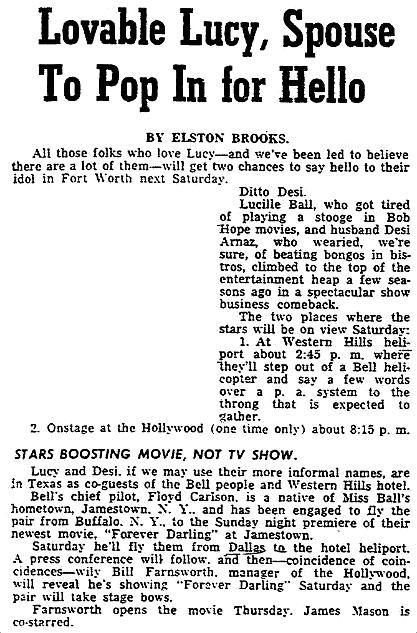
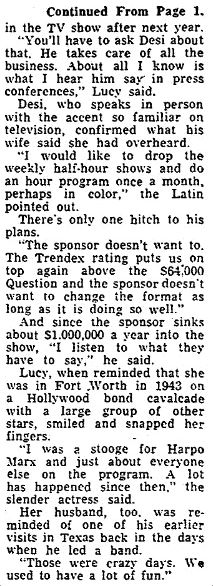
In Fort Worth, Elston Brooks (whose amusing articles I’ve really enjoyed discovering these past few months), seemed underwhelmed and a little annoyed at the prospect of  “lovable Lucy and spouse” invading the city (click articles to see larger images):

lucy-desi_FWST_020556Fort Worth Star-Telegram, Feb. 5, 1956
*

Elson Brooks may not have been very excited, but when Lucy and Desi stepped out of that helicopter, the Fort Worth crowd went wild (click text for larger image):

lucy-desi_FWST_021256-photo

lucy-desi_FWST_021256a

lucy-desi_FWST_021256bFWST, Feb. 12, 1956

*

And here they are back in Los Angeles, with Desi Jr., at the end of a busy promotional tour. Desi is proudly wearing the cowboy hat he’d been given in Fort Worth. And he looks damn good in it.

lucy-desi_dfw

***

Sources & Notes

Top photo of Lucy and Desi standing next to the 1956 Bell 47H-1 (“one of the world’s first executive helicopters”) is from the August 2012 issue of Vintage Aircraft Magazine; photo from Bell Aircraft. The article concerning this helicopter model is contained in a PDF here.

The bottom photo is from a Pinterest page, here.

UPDATE: I had originally identified the photo of Lucy and Desi with the train as having probably been taken in Fort Worth as they were about to depart for Hollywood, mainly because they’re wearing similar clothing from the FW appearance, but a rail historian noted that this photo was actually taken in California at the Los Angeles Union Passenger Terminal — he could tell because he recognized the part of the platform structure over their heads! (“I can name that song in TWO notes!”) The photo he directed me which shows the LAUPT platform (and, in fact, the same engine, two years earlier!), is here. They probably took the final photo for the Santa Fe company as thanks for providing them with transportation back home in the president’s private car. (Thanks, Skip!)

*

And because today is Lucille Ball’s birthday (which I know only because she shares a birthday with my aunt — happy birthday, Bettye Jo!), it seems like a good time to wheel out this strikingly beautiful portrait of Lucy, along with a wonderful photograph of her from about the same time (probably between 1928 and 1930).

lucilleballportrait

lucilleball-ca1930

*

Copyright © 2014 Paula Bosse. All Rights Reserved.


Margo Jones & Jim Beck: Both Legends in Their Fields, Both Victims of Carbon Tetrachloride

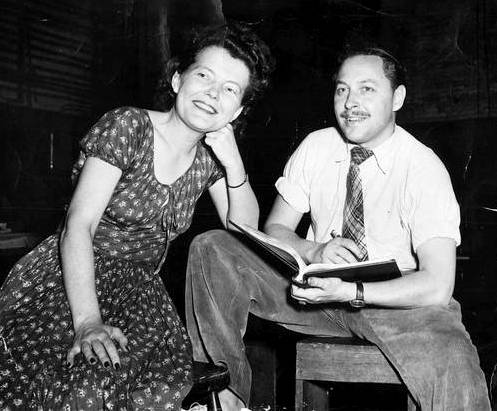
margo_tennessee
Margo Jones with Tennessee Williams

by Paula Bosse

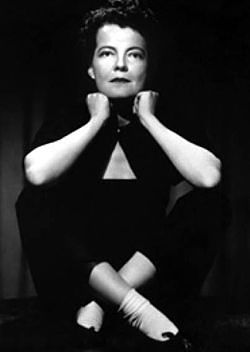
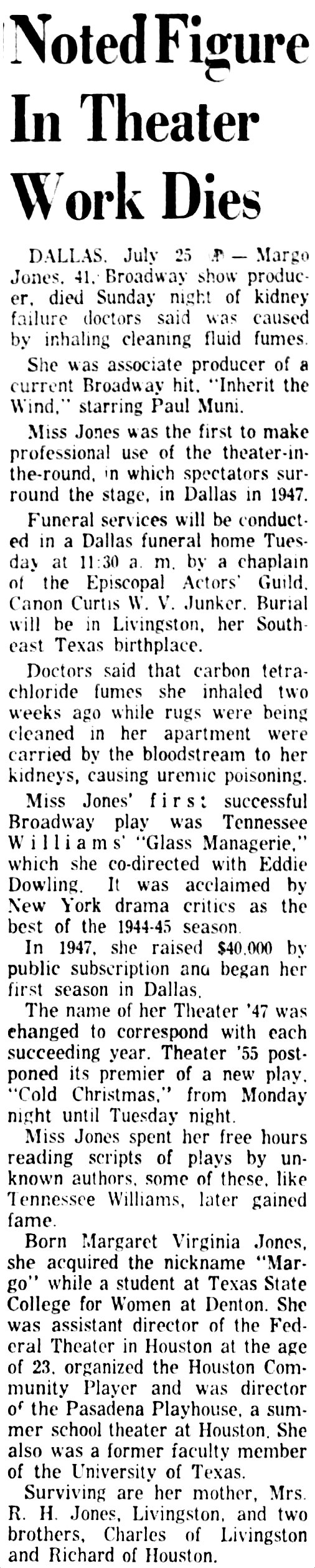
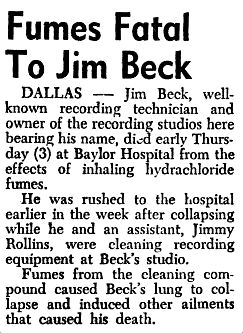
In reading about Dallas theater legend Margo Jones, I saw that she died from inhaling the lingering fumes of a cleaning agent that had been used to clean a rug in her apartment at the Stoneleigh Hotel: carbon tetrachloride. The only thing I knew about carbon tetrachloride was that it had also caused the early death of legendary recording engineer and producer Jim Beck (the man who discovered and produced the first records of Lefty Frizzell, Ray Price, et al.); Beck had been cleaning his recording equipment and had been overcome by the fumes. Both were rushed to the hospital when they were discovered unconscious, and both died about ten days later.

Margo Jones died on July 24, 1955, and Beck died less than a year later, on May 3, 1956. Jones was in her early 40s — Beck was only 39. Margo Jones was a creative powerhouse who was already revolutionizing regional theater, and Jim Beck’s enormous talent was the sole reason that Columbia Records was on the brink of moving their operations from Nashville to Dallas (a move that might very well have set the wheels in motion for Dallas to overtake Nashville as the nation’s recording center for country music). It is such a loss that both died so young,victims of something as mundane as cleaning fluid. With so much remarkable potential ahead of them, it’s sobering to imagine how different Dallas theater and the Dallas recording industry would be today had their careers lasted another two or three or four decades.

margo-jones-photo

margo-jones_austin-american_072655_obitAustin American, July  26, 1955 (click to see larger image)

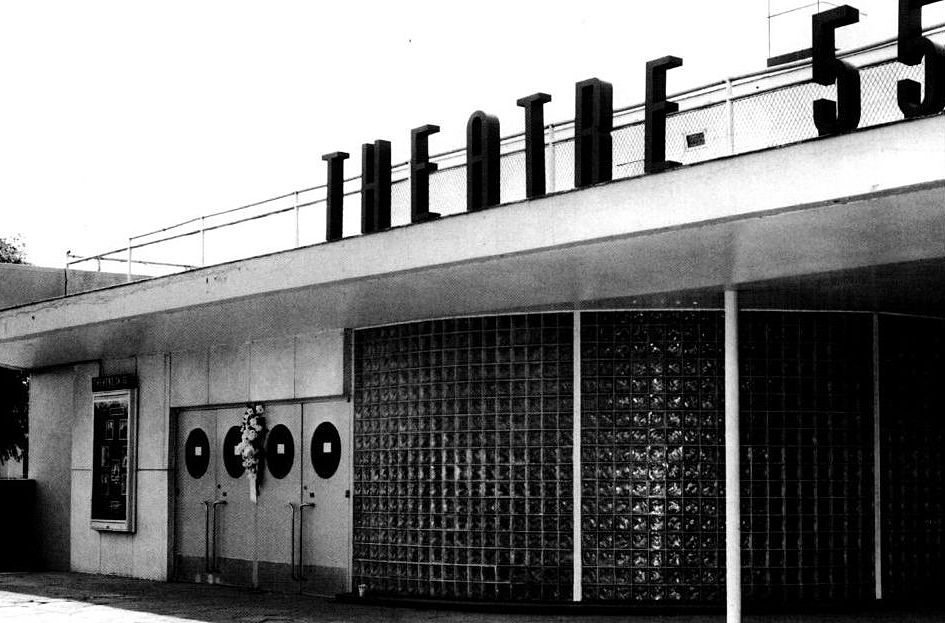
margo-jones_wreath_legacies_fall-2004Margo Jones’ Theatre ’55 with wreath on door (click for larger image)

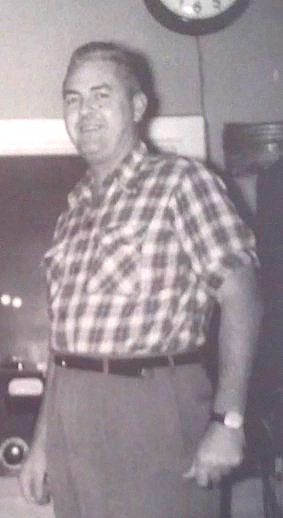
jim-beck_detJim Beck in his studio

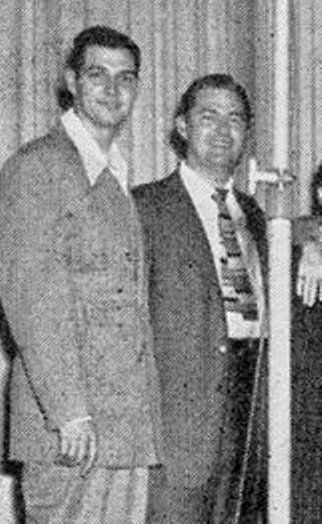
jim-beck_hank-thompson_liberty-jamboree_c1951-detJim Beck (right) with Hank Thompson

jim-beck_billboard_051256bBillboard, May 12, 1956

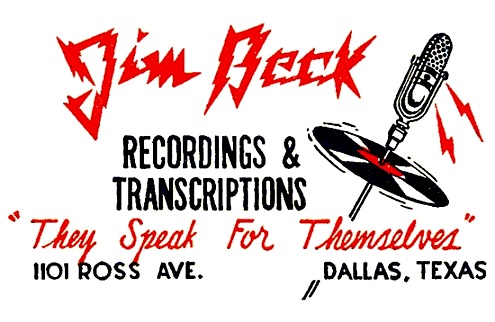
jim-beck-studio-logo

***

Sources & Notes

Photo of Theatre ’55 (formerly the Magnolia Lounge in Fair Park) with wreath is from the story “‘I’m Doing It, Darling!’ — Dallas, Margo Jones, and Inherit the Wind” by Kay Cattarulla (Legacies, Fall, 2004 issue), which can be read here.

First photo of Jim Beck (which has been cropped) is from the Bear Family CD box set “Lefty Frizzell: Life’s Like Poetry.”

Photo of Jim Beck and country recording star Hank Thompson is a (cropped) Liberty Jamboree promotional photo, circa 1951.

Jim Beck Studio logo from the Handbook of Texas entry for the recording industry in Texas, here.

Margo Jones is very important. Read why here.

Jim Beck is very important. Read why here.

A bit morbid, perhaps, but Margo Jones’ death certificate can be viewed here; Jim Beck’s death certificate, here.

And, finally … kids, stay away from that carbon tetrachloride. It’s bad stuff.

For my previous post “Lefty Frizzell: It All Began on Ross Avenue,” click here.

*

Copyright © 2014 Paula Bosse. All Rights Reserved.

Ernie Banks: From Booker T. Washington High School to the Baseball Hall of Fame to the Presidential Medal of Freedom

banks-ernie_jet_110355
Ernie Banks and George Allen, Oct. 1955 (Jet magazine)

by Paula Bosse

Ernie Banks, the baseball player so indelibly linked with Chicago that he is known as “Mr. Cub,” is a Dallas native whose professional career began when he was spotted by a Negro League scout while playing softball in a park near his high school, Booker T. Washington. He was recruited right away and made his mark almost immediately, and, in 1953, he and Gene Baker became the first African American players signed to the Chicago Cubs.

One of the sport’s most popular players, Banks, who began his career playing shortstop, routinely shattered home run records and was a perennial MVP and All-Star player. Even though his Cubs never made it to the World Series, Banks was a stand-out player, and his election to the Baseball Hall of Fame in 1977 came as no surprise. I have to admit, my knowledge of baseball is scant, but I love this man, and it’s a testament to “Mr. Cub” that he is as famous for his genuine nice-ness as he is for his undisputed skill as a player.

banks_dmn_091553AP, Sept. 15, 1953

ernie-banks_rookieErnie Banks’ rookie card – Topps, 1954

ernie_banks

*

Oct. 11, 1955 was declared “Ernie Banks Day” in Dallas. Ernie was in town to play an exhibition game between the Major League Negro All Stars and the Negro American League All Stars (Ernie’s major leaguers won, 6-2) — while he was here, he enjoyed the hometown adulation and was lauded with gifts. The photo at the top of this post was from that day, as is the one below, in which he poses with his wife, Mollye Banks.

banks-ernie_wife-mollye-ector-banks_101155_patton-collection_DHSHometown hero, Oct. 11, 1955 (Dallas Historical Society)

***

Sources & Notes

Top photo from Jet magazine, Nov. 3, 1955; a version ran in The Dallas Morning News on Oct. 12, 1955 above the following caption: “Honors came thick and fast for Ernie Banks at Burnett Field Tuesday night. Appearing with a group of barnstorming Major League All Stars, Banks was presented a new Oldsmobile (background), a Texas style hat and scrolls and trophies. With Banks is George Allen, chairman of the citizens’ appreciation committee which presented the automobile. The mayor [R.L. Thornton] proclaimed Oct. 11 Ernie Banks Day in Dallas.”

The photo of Banks and his wife, Mollye Ector Banks, in Dallas is from the John Leslie Patton Jr. Papers, Dallas Historical Society (Object ID V.86.50.902).

Check out these articles from The Dallas Morning News archives:

  • “Banks to Tackle First — Reluctantly” by Bud Shrake (DMN, March 16, 1962) — with a few paragraphs on growing up in Dallas
  • “From Dallas to Cooperstown” by Randy Galloway (DMN, Jan. 20, 1977)

A nice overview of Ernie Banks’ career titled “Nice Guys Don’t Always Finish Last” by Steven Schmich (from his larger article titled “Five Dallas Athletes Who Made a Difference”) can be read in the Spring, 1994 issue of Legacies magazine here. (In fact, the entire issue of this Dallas history journal is devoted to sports and is available to read in its entirety, beginning here.)

Stats? I got yer stats, right here.

In November 2013, Ernie Banks was awarded the Presidential Medal of Freedom. A few short words from him after the ceremony say all that really needs to be said from this wonderful man — watch the short video here.

UPDATE: Sadly, Ernie Banks has died. He died Friday, January 23, 2015. He was 83. The New York Times obituary is here; the Chicago Tribune’s wonderful collection of tributes and photos is here.

*

Copyright © 2014 Paula Bosse. All Rights Reserved.