Flashback : Dallas

A Miscellany: History, Ads, Pop Culture

Category: Celebs

Thank You, Weird Hollywood!

weird_hollywood

by Paula Bosse

Thank you, Joe Oesterle, for the very flattering post on your (great) Weird Hollywood Facebook page! His mystery photo of the Gunther Castle was a lot of fun to research (the “castle” was at 2308 Pacific Avenue in Long Beach, California), and, yes, as a matter of fact, I’d love to help you research a building or person or old news story or mystery photo. I CAN be bought! If you have inquiries, please click the “Contact” tab at the top of the page and send me an email. If there’s something I can help you with, we’ll talk turkey.

As this is a blog devoted to Dallas history, the Hollywood stories are a bit scarce (even though classic Hollywood and entertainment history is a passion of mine), but there are a few. These Flashback Dallas posts might appeal to those new visitors more interested in Hollywood than Dallas: (click title to see post):

Thanks again for the kind words, Joe! And keep Hollywood weird!

*

Copyright © 2015 Paula Bosse. All Rights Reserved.

Salvador Dali Brings “Nuclear Mysticism” to Dallas — 1952

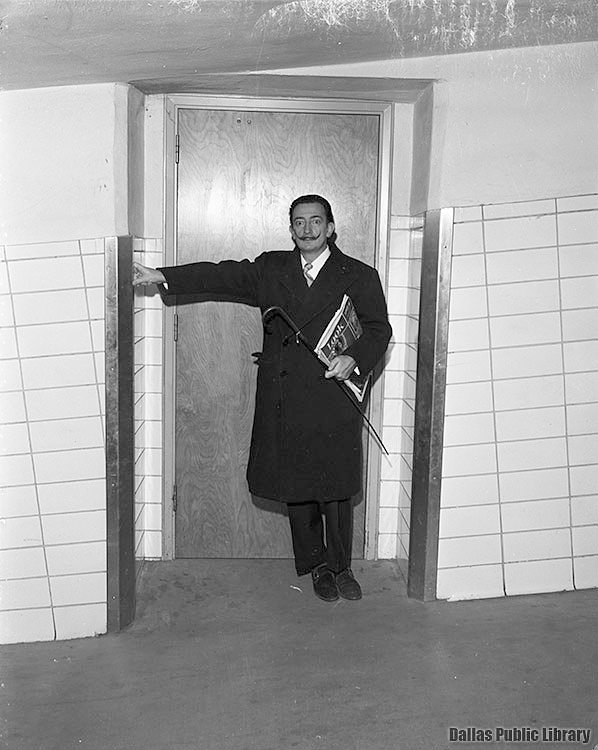
dali_union-station_feb-1952_dplDali does Dallas (in a slanted doorway at Union Station)

by Paula Bosse

The artist and pop phenomenon Salvador Dali came to Dallas in 1952 to present a lecture at McFarlin Auditorium on the SMU campus as part of the popular Community Course series. This was during his “Nuclear Mysticism” period, during which his paintings were influenced by the atomic age, science, and religion. One of the examples of this direction in his art is his painting “Raphaelesque Head Exploding” from 1951.

dali-raphaelesque-head_1951“Raphaelesque Head Exploding”

This 1952 American lecture tour included at least three stops in Texas: Houston, Fort Worth, and Dallas. Dali and his wife, Gala, arrived in Dallas on the afternoon of Thursday, February 14, 1952, after the artist had spoken at a members-only event and luncheon at Fort Worth’s River Crest Country Club earlier in the day. The lecture at McFarlin Auditorium was on Saturday night, Feb. 16. One wonders what he did in Dallas on his free day Friday.

While in Dallas, Dali was interviewed at the Baker Hotel by Paul Crume of the Morning News, a bit of an odd choice, in that Crume — author of the very popular front-page “Big D” column — was generally the paper’s go-to humor writer, an indication, perhaps, that Dali was considered less of a serious artist than as a quirky and larger-than-life entertainer. Which… fair enough.

One of the interesting little morsels that Dali told Crume was that he was amazed that his dreams in Texas had all been in technicolor, a relative rarity for him.

“Astonishing! In New York, all black and white. In Texas, all in color. In Italy, everybody dreams in color. In France, not so much. It is very mysterious. But in Houston, I am dream in color twice. And then, last night here [in Dallas].” (DMN, Feb. 17, 1952)

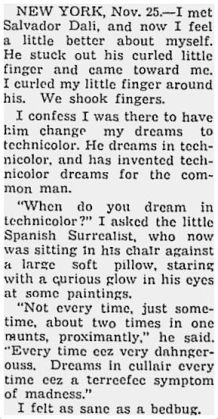
Dali loved dreaming in technicolor and mentioned it several times throughout his career. This little tidbit from Earl Wilson’s column in 1944 is amusing (if weighted down by Wilson’s unfortunate lapses into dialect).

dali_earl-wilson_112644New York Post, Nov. 26, 1944

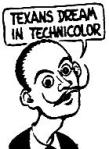
To dream in technicolor every time “is very dangerous. Dreams in color every time is a terrific symptom of madness.” …I’m not sure what that says about Texas and/or Texans.

dali-caricature_technicolor

***

Sources & Notes

Top photo (dated Feb. 15, 1952) shows Salvador Dali standing in a slanted doorway at Union Station in Dallas (it seems likely that the photo was taken on Feb. 14th when he arrived in Dallas from Fort Worth, and was then published on Feb. 15th); it is from the Hayes Collection, Dallas History & Archives Division, Dallas Public Library (Call Number PA76-1/7171).

(Regarding this crooked door frame at Union Station: when Dali saw it he exclaimed, “A Dali-an door!”) (He would have loved Casa Magnetica at Six Flags.)

Articles about Dali’s visit to Dallas can be found in the archives of The Dallas Morning News:

  • “Key to New Art Revealed by Dali” (It’s Mysticism)” — an unbylined review, probably written by Paul Crume (DMN, Feb. 17, 1952)
  • “Texas Tints Dreams of Artist Dali” — interview by Paul Crume, conducted in the Baker Hotel (DMN, Feb. 17, 1952)
  • “Big D” column by Paul Crume (DMN, Feb. 19, 1952)

An entertaining 1965 appearance by Dali on Merv Griffin’s talk show can be seen here. He talks about dreaming in “glorious technicolor” at about 4:55. And, I mean… it’s just a great example of Dali as entertainer.

*

Copyright © 2015 Paula Bosse. All Rights Reserved.
 

(Obscure) Country Music Radio Stations — 1969

KYAL-1600“Home of the Tall Texans” (click for larger image)

by Paula Bosse

Okay, maybe they’re not obscure to people who listened to country stations in Dallas in the 1960s, but to someone who grew up in the ’70s in a household in which country stalwarts KBOX and WBAP were always on, these three stations are unknown to me.

Of these, my favorite call letters are KYAL, as seen in the ad above — that’s right, “K-y’all.” Disc jockey “Johnny Dallas” was none other than local rockabilly fave, Groovey Joe Poovey.

KYAL_johnny-dallas_groovey-joe-poovey_ca1969

KBUY was out of Fort Worth and had quite the daytime signal.

KBUY-1540

There was also KCWM (for “Country & Western Music”). This one was an FM station. Legendary DJ Bill Mack was hired by the station to get its country format going, and he even suggested the call letters.

KCWM-99.5

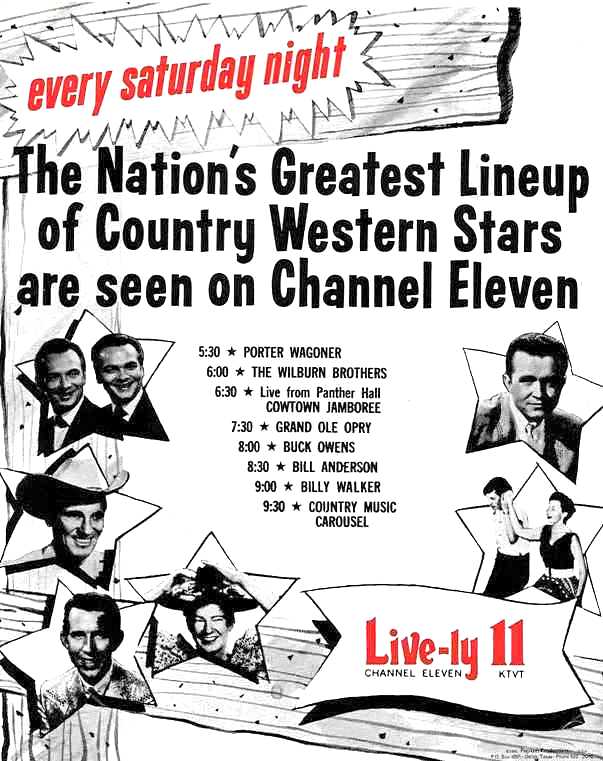
I came across these ads in some sort of local country music publication called “Country and Western — The Sound That Goes Around the World” (1969). Sprinkled amongst bios and photos of country stars are lots of local ads. One of the (non-radio) ads that caught my attention was one for the Saturday night lineup of country music television shows on KTVT Channel 11. Some of these shows were still on in the ’70s when I used to watch them with my father. (I’m not sure I knew there was ever a live television broadcast from Panther Hall in Fort Worth — “Cowtown Jamboree” — that would have been cool to see.)

country-music-saturday-night_ch-11-1969(click for larger image)

***

The best source for the history of Dallas-Fort Worth radio is, without question, Mike Shannon’s DFWRetroplex.com site.

KBOX was the station that really started it all for country music radio in Dallas; read about its history here.

Info on KYAL 1600 AM is on this page.

Info on KBUY 1540 AM and KCWM 99.5 FM is on this page.

Read about Groovey Joe Poovey here and here and here. See a slideshow of photos of him while listening to his GREAT version of “Deep Ellum Blues,” here.

Click pictures for larger images.

*

Copyright © 2015 Paula Bosse. All Rights Reserved.


Clyde Barrow In a Sailor Suit

clyde-barrow_sister_1925_utsa_smClyde Barrow & his sister Nell

by Paula Bosse

Behold, a teenage Clyde Barrow in a sailor suit. Bonnie & Clyde lore has it that Clyde attempted to join the United States Navy but was rejected because of lingering problems from a childhood illness, but on a quick sprint across the internet, I’ve been unable to find any specifics about Clyde’s having tried to enlist in the Navy. But he was certainly pro-navy: not only does he appear to have enjoyed wearing the sailor’s outfit, but he apparently also had a “USN” tattoo.

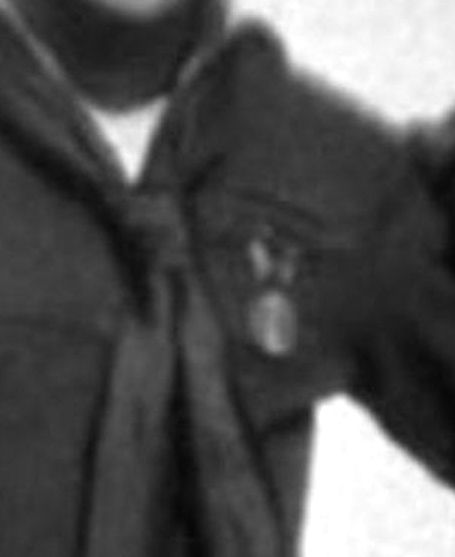
But what about this outfit? It certainly looks like a navy uniform. Is it an actual navy uniform? Maybe a relative’s? Is it a costume? Is it some sort of facsimile someone whipped up for him so he could slip into it whenever he felt like it? Is he play-acting? Dressing up for a party? And what about that “medal”?

clyde-barrow_sister_1925_utsa-det

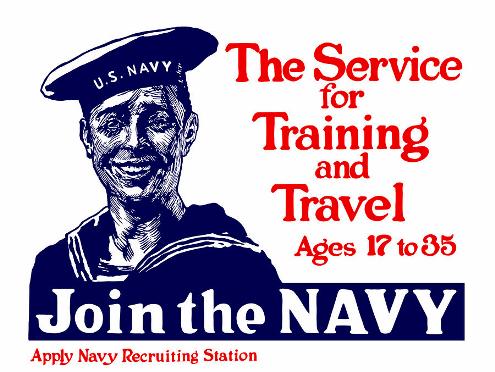
The back of this photo reads “Nell Barrow and Clyde / 1925.” Could it have been 1926 instead? On his birthday in 1925, Clyde (who was born on March 24, 1909) would have turned 16 years old. The minimum age for enlistment in the U.S. Navy jumped back and forth between 17 and 18 years old, but by the time his birthday rolled around in March of 1926, the enlistment age was 17. By the end of that year Clyde had been arrested for stealing a car, and even though charges were eventually dropped, this police record may have been enough to prevent him from enlisting even if he hadn’t failed a physical. Whatever the case, if he DID want to join the navy, he had a very limited window in which to do it: from his 17th birthday on March 24, 1926 to his first arrest on December 3, 1926.

Imagine how different things would have been if Clyde Barrow had joined the navy and sailed the Seven Seas instead of hooking up with Bonnie Parker and terrorizing the Southwest?

navy-recruiting-poster

***

Sources & Notes

Photo, titled “Clyde Barrow and sister Nell Barrow, Dallas, Texas,” is from the University of Texas at San Antonio Libraries Special Collections, and is accessible here. Photo loaned to UTSA by Henry J. Williams (other photos from Mr. Williams’ collection are dated 1926, some of which I used in my previous post “Babyface Barrow — 1926” here).

If anyone has more information about Clyde’s uniform in this photo, I’d love to hear from you. Similar uniforms can be seen here.

Just to be ruthlessly detailed, if Clyde Barrow visited the United States Navy recruiting office in Dallas, it was on the second floor at 206 ½ Browder Street, at Commerce, its new headquarters as of June, 1925; station physician was Lieut. Jack Terry. (Wonder if Lieut. Terry was the one who gave Clyde his walking papers? If so, I wonder if he ever knew?)

A list of requirements to join the U.S. Navy — published in The Scranton Republican on Feb. 10, 1927 — can be found here.

For previous Flashback Dallas posts on Bonnie and Clyde, click here.

*

Copyright © 2015 Paula Bosse. All Rights Reserved.
Orson Welles In Dallas — 1934-1940

orson-welles_cornell-tour_1934
Orson at 18 — publicity photo used for the Cornell tour, 1934

by Paula Bosse

Today is the 100th anniversary of the birth of Orson Welles. Welles was one of the truly great, innovative theater and film directors, an actor with a commanding presence, and a delightfully entertaining raconteur. His frenetically creative work on the New York stage, on radio, and in film (he wrote, produced, directed, and acted in his first film, Citizen Kane, when he was only 25) earned him/saddled him with the hard-to-deny sobriquet “Boy Genius.” His rise up the show-biz ladder was a quick one.

Orson’s first professional acting gig was as an unknown 18-year old repertory player in the touring company of famed actress Katharine Cornell who, along with British actor Basil Rathbone, starred in the three plays performed on the tour, which stopped in Dallas for a two-night engagement at the Melba theater, in February, 1934. The three plays performed in Dallas on February 19 and 20 (one a matinee) were “Romeo and Juliet” (Orson played Mercutio), “The Barretts of Wimpole Street” (he played Octavius Moulton-Barrett), and “Candida” (he played Marchbanks). Cornell was a huge draw, and there was a rush for tickets. The Melba begged her to extend her stay and add performances, but she declined.

The young Welles had gotten reviews on the tour which ranged from a dismissive mention in Variety that he was unable to speak Shakespeare’s lines properly and audibly (!), to raves from Charles Collins of The Chicago Tribune:

The cast is brilliant, and many of the secondary characters are acted with consummate skill. This is particularly true of Orson Welles’ Mercutio, which is an astonishing achievement for a youth still new on the stage. In his duel with Tybalt and his death scene, this Mercutio is a complete realization of Shakespeare’s bravest blade.

The star of the show was the then-very-famous Katharine Cornell, around whom most of the articles and reviews centered (she was, for instance, breathlessly reported to be staying at the Melrose during her Dallas stay) (I wonder if the lowly company players — i.e. Orson Welles — stayed there as well?). The Dallas Morning News theater critic, John Rosenfield — who mentioned this 1934 Dallas appearance in almost every succeeding article he ever wrote about Orson Welles over the next several decades — wrote the following before he saw Orson’s performances in any of the three plays:

Orson Welles, 18-year-old actor, who is apparently bulky enough to hold his own with adults, will be Mercutio. (DMN, Feb. 19, 1934)

After he saw his Mercutio:

Orson Welles’ Mercutio was up to the best standards known for this role. (DMN, Feb. 20, 1934)

When the tour finished, Welles quickly became a presence in the New York theater world. One of his early successes as a producer and director was his production of the so-called “Black Macbeth”/”Negro Macbeth”/”Voodoo Macbeth” — a hugely popular staging of Shakespeare’s “Macbeth” with an all-black cast, done under the auspices of the Federal Theatre Project in 1936. In August of that year — just two and a half years after his appearance as an unknown at the Melba — he took the production to Dallas where it made a splash at the Texas Centennial in the brand new bandshell.

macbeth_texas-centennial_dmn_081336Aug., 1936

macbeth_playbill_dallas_LOC(click for larger image)

Rosenfield was impressed by the lush design and the electric and inventive spectacle, but he was not a fan of the performances. A few years later, on the eve of the release of Citizen Kane, he wrote the following (which was much harsher than his original 1936 review):

We saw this production in Dallas during the Texas Centennial and could marvel at the artistic futility of such ingenuity. The Negro Macbeth, however, was something to be seen if only to be despised. (DMN, Oct. 29, 1941)

Oh dear.

In 1940, Welles was working on his first film, the legendary Citizen Kane. As filming began to wind down, he decided to go out on a short lecture tour because he was in desperate need of money (an all-too-common circumstance he found himself in throughout the entirety of his career). His topic was a vague “anecdotes of the stage and theories on the drama” — and it sounds like his “performances” were largely unscripted and unrehearsed. 

On October 29, 1940 — only a week or two after wrapping production on Citizen Kane — 25-year old Orson Welles spoke at McFarlin Auditorium on the SMU campus as part of the Community Course series of lectures. His topic: The Actor’s Place in the Theater. It was another packed house of adoring and/or curious Dallasites. Rosenfield was both entertained and annoyed by the rambling “lecture,” but Orson was undoubtedly delighted to talk for two hours before an adoring crowd, answer their questions about his craft, and collect a $1,200 check.

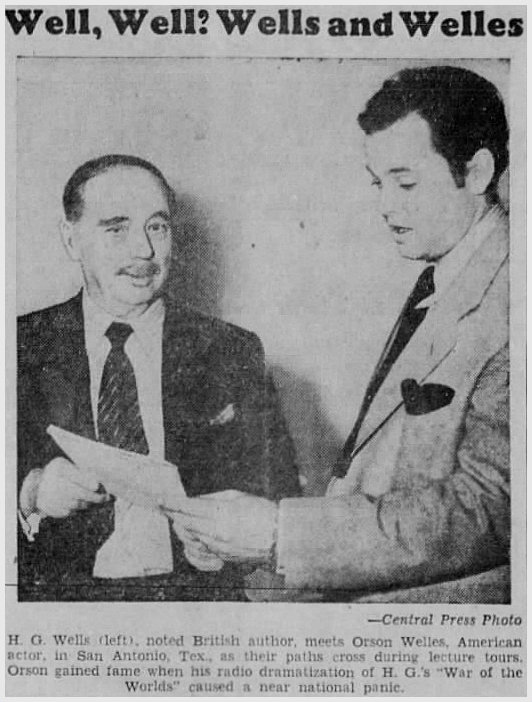
Orson’s appearance in Dallas was particularly noteworthy for the fact that the speaker scheduled to appear on the McFarlin stage just three days later was … H. G. Wells! At the time of this lecture tour, Orson was best known for his infamous 1938 radio adaption of H. G. Wells’ The War of the Worlds, the frighteningly realistic production that panicked the nation and led thousands to believe that the earth was being attacked by Martians. Rather surprisingly, Welles and Wells had never met.

According to a blurb in a Phoenix newspaper, Orson had cancelled a previously-scheduled meeting in Tucson in order to fly into Dallas earlier than planned. My guess is that he saw that H. G. Wells was also lecturing in Texas and realized that H. G.’s lecture in San Antonio the night before Orson’s own appearance in Dallas on the 29th was the only chance he had to meet the man who had provided the source-material for his (to-date) greatest career triumph.

A quick timeline:

  • Sun. Oct. 27, 1940: Orson arrives in Dallas, staying at the Baker Hotel.
  • Mon. Oct. 28: In the morning, Orson flies down to San Antonio to meet H. G. Wells and attend his lecture. The two meet, get along famously, have their photos taken, and give a short joint interview to San Antonio radio station KTSA (see below for link to recording). That evening, both fly to Dallas. Later that night, Orson (well known as an amateur magician) pops into The Mural Room in the Baker Hotel to catch the floor show featuring popular magician Russell Swann.
  • Tues. Oct. 29: H. G. Wells leaves Dallas for Denver, continuing his lecture tour. That morning Orson drives to Fort Worth to present a lecture and attend a luncheon at the River Crest Country Club. That night, he presents his lecture at McFarlin Auditorium at Southern Methodist University. After his lecture, he catches Russell Swann’s magic show for a second time. At 3:00 a.m. he flies to San Antonio for his lecture there.
  • Wed. Oct. 30: Orson lectures in San Antonio. It is the second anniversary of the broadcast of “The War of the Worlds.” Conveniently, newspapers around the country begin to run the photos of Welles and Wells taken on the 28th.
  • Thurs. Oct. 31: A Martian-free Halloween.
  • Fri. Nov. 1: H. G. Wells is back in Dallas for his lecture that night at McFarlin Auditorium.

welles-wells_san-antonio_102840

welles-wells_pottstown-pa-mercury_103140Pottsdown (PA) Mercury, Oct. 31, 1940

h-g-wells_dmn_102940DMN, Oct. 29, 1940

Whew.

Happy 100th, Orson! And thanks for everything.

***

Sources & Notes

Dates and sources of newspaper clippings as noted.

“Macbeth” playbill from the Library of Congress, here.

The timeline for the Welles-Wells meeting and their Dallas-related activities were gleaned from a report in the Oct. 30, 1940 edition of The Dallas Morning News.

And now, links galore.

  • Watch an entertaining short clip in which Orson talks about mind-reading and fortune-telling — which he says he indulged in on the Cornell tour — here.
  • Read the profile of the 18-year-old phenom which appeared in newspapers during the run of the Katharine Cornell tour, here.
  • Read about the “Voodoo Macbeth” here (scroll to the bottom to see fantastic photos).
  • Listen to the interview with Orson Welles and H. G. Wells that aired on San Antonio station KTSA, the day they met for the first time, on Oct. 28, 1940 — here.
  • Read about that still-chilling Mercury Theatre radio broadcast of The War of the Worlds, here.

Finally, my favorite Orson Welles-related quote from the erudite and not-without-humor arts critic of The Dallas Morning News, John Rosenfield. He wrote the following in his review of the set-in-Haiti “Macbeth” — about the aesthetic viability of future Shakespeare productions tailored for specific audiences:

…Mr. Welles hasn’t started a movement. His Negro “Macbeth” does not inspire us to corroborate a fabled Texas lawyer and make Antonio “The Merchant of Ennis.” (DMN, Aug. 16, 1936)

“THE MERCHANT OF ENNIS”! Someone! Make this happen!

*

Copyright © 2015 Paula Bosse. All Rights Reserved.

Nolan Ryan’s Celebratory Pancake Breakfast — 1972

nolan-ryan© Bettmann/CORBIS

by Paula Bosse

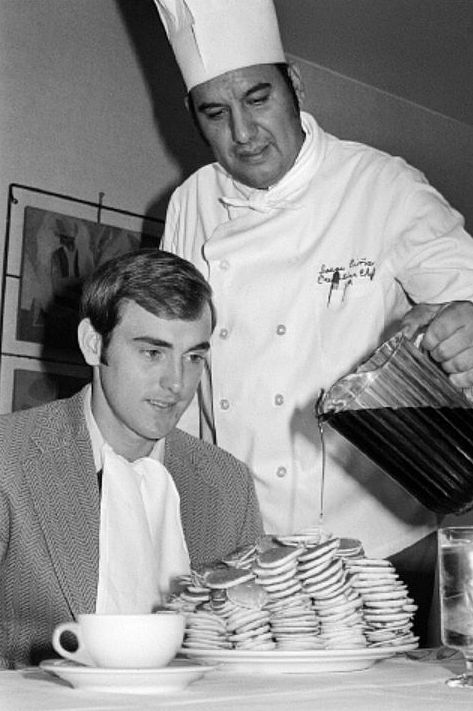
In 1972, future baseball hall-of-famer and Texas Rangers legend Nolan Ryan (then a California Angel) was photographed in Dallas as he sat mesmerized by a platter of 302 silver-dollar pancakes and an iced-tea-sized pitcher of syrup. The celebratory breakfast was served to him at the Sheraton Dallas the morning after he became only the sixth pitcher in major league history to strike out more than 300 batters in a season. (His opponents the previous night — September 25, 1972 — had been the Rangers, the team he would one day play for and preside over as president and CEO.)

The UPI Telephoto wire photo ran on Sept. 27, 1972 above the following caption:

302 PANCAKES — Ever wonder what 302 strikeouts in a season will get you? If you’re a batter, you may lose your job, but if you’re a pitcher like Nolan Ryan, left, of the California Angels, [you] will at least get 302 silver dollar pancakes. This was the breakfast that awaited Ryan Tuesday after his 3-hit, 12-strikeout win over the Texas Rangers Monday. The executive chef at the Sheraton Dallas [Isaac Pina] produced the breakfast for the Alvin native, a former New York Met, who is the sixth pitcher in major league history to strike out more than 300 batters in one season.

Twelve strike-outs!

ryan_FWST_092672Fort Worth Star-Telegram, Sept. 26, 1972

Judging by the expression on his face at the next day’s breakfast table, it’s pretty obvious the 25-year old Nolan Ryan enjoyed his triumph.

***

Sources & Notes

Photo ©Bettmann/CORBIS. The photo is also seen on this page, from The Guardian, which shows a collection of really great historic baseball photos — a bit of a surprise, coming from a British newspaper!

The photo was published in newspapers around the country; the quoted wire copy appeared in the Sept. 27, 1972 edition of The Waxahachie Daily Light.

To read a passage from the book Nolan Ryan’s Pitcher’s Bible in which he writes about the importance of his high-carb breakfasts (Day One: Pancakes…), see here.

The Wikipedia entry on Nolan Ryan is here; his stats are here.

*

Copyright © 2015 Paula Bosse. All Rights Reserved.


The Dallas Skyline from the Maple Terrace Penthouse — 1952

feldman_terrace_huntington-detView from the penthouse (Huntington Library)

by Paula Bosse

The best view of the Dallas skyline that no longer exists may very well have been the view from atop the Maple Terrace Apartments, located on Maple Avenue, right across Wolf Street from the Stoneleigh Hotel. The photo above was taken in 1952, when there was a straight-shot view of downtown, with no hulking buildings to spoil the vista. This view — completely unobstructed except for the Stoneleigh (out of frame, at left) — must have been spectacular at night. (Although, as can be seen at the far right, the industrial area that surrounded the iconic DP&L smokestacks was also part of the view. Also not included in realtor brochures would have been the fact that the luxury apartment building overlooked the adjacent Little Mexico neighborhood, often described as a “slum area” — the huge economic disparity between the neighboring haves and have-nots would have been starkly apparent to any gimlet-sipping rooftop visitor. And then there was the not-so-distant meat-packing plant…. But I digress.)

The beautiful Maple Terrace Apartments — designed by architect Alfred Bossom (who also designed the Magnolia Building) — was built in 1924-25 and opened with great fanfare as the city’s first luxury apartments.

maple-terrace_postcard

An early tenant was Morris Feldman, a Polish immigrant whose family owned the successful Parisian Fur Co. (later Parisian-Peyton). Morris’ son, the incredibly wealthy oilman and art collector, D. D. Feldman, must have been quite taken with his parents’ home there, because in the late ’40s or early ’50s, he transformed the entire seventh floor — which had previously contained 20 “hotel-type” units — into his personal penthouse. The patio terrace with the to-die-for view was the cherry on the sundae.

feldman_terrace_huntington

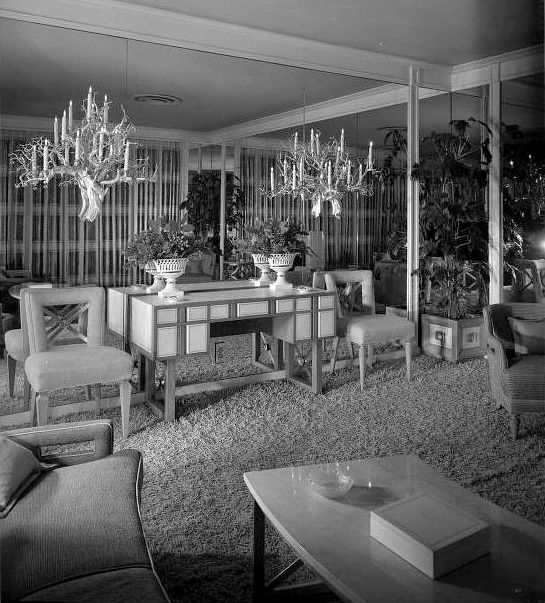
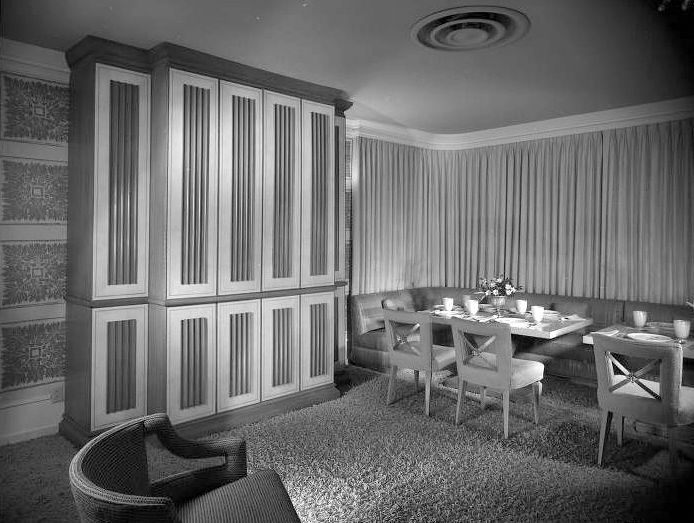
Countless cocktail parties, dinner parties, and fashionable teas were held in the Feldmans’ penthouse. The interior design — the work of Tom Douglas, of Los Angeles — was, apparently, much admired. The decor consisted of a mixture of typically cool Mid-Century Modern pieces as well as a few touches that, from a 21st-century vantage point, look a little … tacky. Somewhere in all of the acreage of furnishings was a fireplace, a white leather-covered piano (!), “a cocoa-striped sofa with pale blue frame,” murals, white brick wallpaper, and several pieces of furniture and cabinetry with a “driftwood finish.” And lots of lacquer. And mirrors, mirrors, mirrors. These “timeless furnishings in beige, marigold, white leather and ash” (DMN, Nov. 19, 1960) are dated relics of another era, but, at the time, they were splashed across the pages of magazines such as Architectural Digest.

feldman_entryway_huntington-lib

feldman_living-rm_huntington-lib

feldman_dining-rm_huntington-lib

As far as I know, the seventh floor of the Maple Terrace is still a single space. A 1978 real estate ad touted its “recently redecorated” 3,000 sq. ft. amenities:

maple-terrace-penthouse_dmn_032278

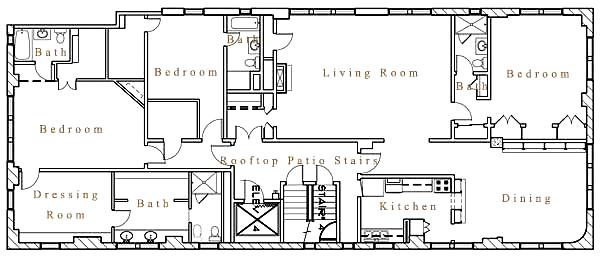
Below, the present-day penthouse floor plan from the Maple Terrace’s website:

maple-terrace_penthouse-floorplan-today

And, look, here’s a photo of what that entryway looks like now, (without the mural):

maple-terrace_hallway-today

I’m sure the rooftop terrace is still as beautiful as ever, but, sadly, it will never again boast of that once-incredible view:

maple-terrace-view-today

***

Sources & Notes

Top photo (and all black and white photos from this series) by Maynard L. Parker, for Architectural Digest; from the Maynard L. Parker Collection at the Huntington Library, accessible here. The top photo is a detail, which has been cropped and reversed; the original photo is shown in reverse on the Huntington site (along with some early image “editing” on the outline of the Stoneleigh), which is a bit freaky when you know that what you’re looking at is backwards!

Color photos and floor plan from the website of the Maple Terrace Apartments, here. Biographical info on the architect, Sir Alfred Bossom, is here. Fabulous photos of the building from AIA Dallas, is here; and a wonderful piece on the mystique of living in the famed Maple Terrace from D Magazine, is here.

An intense and thorough description of the Feldmans’ penthouse decor is in the article “Feldman Apartment: Timeless Decorating” by Jeanne Barnes (Dallas Morning News, Nov. 19, 1960).

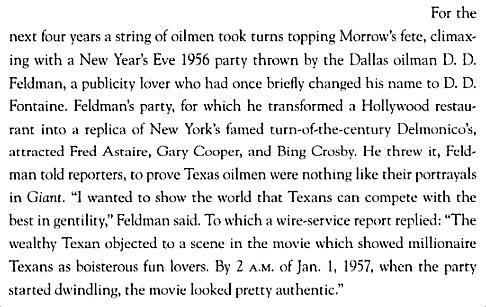
In addition to his oil holdings, D. D. Feldman was an important collector and patron of Texas art. In reading about Mr. Feldman, my favorite tidbit is this, from the book The Big Rich: The Rise and Fall of the Greatest Texas Oil Fortunes by Bryan Burrough (Penguin, 2009):

feldman_big-rich_quote

*

Copyright © 2015 Paula Bosse. All Rights Reserved.

“Dallas in Winter” by Guy Wiggins — ca. 1942

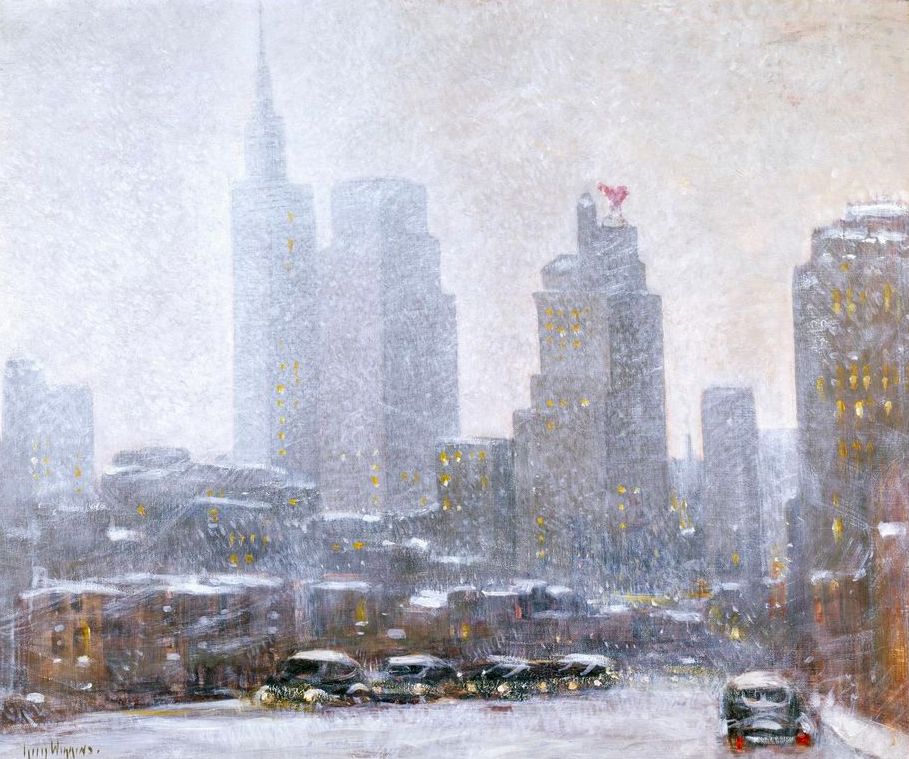
wiggins_dallas-in-winter_c1942_dma“Dallas in Winter” by Guy Carleton Wiggins (Dallas Museum of Art)

by Paula Bosse

A nostalgic look back at a snowy Dallas scene from the 1940s by Guy Wiggins (1893-1962), an artist most remembered for his snow scenes of New York City. Wiggins was apparently quite fond of Dallas and was a frequent visitor, beginning in the 1920s. He had countless gallery shows here over the years, and while in town he’d often present lectures and “master classes” to arts groups and women’s groups. According to articles in local newspapers, Wiggins painted views of the Dallas skyline several times, paintings which no doubt found their way into private collections and are probably still hanging on the walls of local art patrons. In 1952, his daughter and her family moved here, giving Wiggins yet another reason to visit.

The wonderful snow scene above is in the collection of the Dallas Museum of Art; this is the DMA’s description of the painting:

A rare snowstorm in Dallas captured the eye of Guy Carleton Wiggins, who recorded this scene from the downtown vantage point of Live Oak and Pearl streets, showing the skyline’s distinctive historic landmark of the red statue of Pegasus on the Magnolia building.

Although born and raised in the East, where he was affiliated with the artists’ colony in Old Lyme, Connecticut, Wiggins traveled widely throughout the United States during his career. He became known for urban winter scenes such as this one.

***

Sources & Notes

The painting “Dallas in Winter” by Guy Carleton Wiggins is from the Patsy Lacy Griffith Collection, Dallas Museum of Art; it was a bequest of Patsy Lacy Griffith. More information on the painting can be found on the DMA’s website, here.

(Patsy Lacy Griffith was the daughter of oil millionaire Rogers Lacy, who was this close to building the incredible Frank Lloyd Wright-designed hotel downtown. I wrote about it in a previous post, here.)

More on the career of Guy Wiggins, from Wikipedia, here, and from a 2011 New York Times profile of the Wiggins family of painters, here.

Because he visited so often and had many friends here (and because he apparently painted very quickly), Wiggins’ paintings were well represented in private collections in Dallas. (One of his earliest patrons was Miss Ela Hockaday, of the Hockaday School for Girls, who loaned one of her paintings for an exhibit at the Dallas Public Library in 1930.) Among works depicting views of the city were oil studies with the titles “Morning Over Dallas,” “The Akard Canyon,” “Dallas: Morning From Cliff Towers,” and “Dallas Nocturne,” all of which were probably still damp when first shown, as The Dallas Morning News reported that they had been painted “little more than a week ago” before they went on display at the Ed Spillars gallery on Fairmount at the end of December, 1948 (DMN, Dec. 22, 1948). I’d love to see these paintings.

Want “Dallas in Winter” hanging on your walls? Buy the poster from the DMA Shop here. Look at it longingly when it’s 157 degrees in August.

*

Copyright © 2015 Paula Bosse. All Rights Reserved.

Back at the Ranch with Yves Saint Laurent — 1958

YSL_longhorn_josey-ranch_1958_eric-sweckerYSL & friend… (photo: Eric Swecker)

by Paula Bosse

Even if you had no idea who the man with the glasses was, this would be an attention-grabber of a photo. But if you do happen to recognize the man as international fashion icon Yves Saint Laurent, then it’s even more of an attention-grabber. Yes, that is 22-year-old Yves Saint Laurent, head of the legendary House of Dior.

…In a pasture with a longhorn steer.

…Wearing a Stetson (or something Stetson-like).

..In Carrollton, Texas! What could be more unexpectedly perfect?

The UPI/Telephoto caption:

9/5/58-DALLAS: Yves-Mathieu Saint Laurent, 22-year-old master of the House of Dior, got a taste of Texas tradition on his first trip to the US. Saint Laurent, in Dallas to receive an award from Neiman-Marcus, stopped off at a cattle ranch near here before departing for France and was presented a Texas-style hat and introduced to a real “Texas Longhorn” steer.

YSL (who had not yet jettisoned the “Mathieu”) was the wunderkind fashion designer who — at the unbelievable age of 21 — had succeeded Christian Dior as Dior’s head designer. His first collection was a hit, and he was 1958’s fashion superstar.

That was the year that YSL was invited to Dallas by Stanley Marcus to receive the 21st Annual Neiman-Marcus Fashion Exposition Award — known throughout the industry as the “Fashion Oscar.”

He has had many offers to come to America to accept awards but the Dallas honor was the only one he accepted. He had a sentimental reason. His late master, Christian Dior, came to Dallas to accept the Neiman-Marcus award in 1947 after he had created the New Look in his second collection. (Dallas Morning News, Sept. 4, 1958)

While in Dallas, the young Saint Laurent — whom the fashion editor of The Dallas Morning News described as looking “like a serious young man who might be coming to enroll at SMU” — soaked up a little local color: he was taken to the Orleans Room downtown to see the Dixieland jazz band The Chain Gang, and — apparently at his request — he was taken to a Texas ranch.

Saint Laurent had been quite keen to see a real Texas ranch, so Stanley Marcus’ son Richard took him out to the nearby Josey Rancho — the large ranch owned by Dallas oilmen brothers Clint and Don Josey in then-rural Carrollton. The fashionably dressed, Cartier-watch-wearing dudes took a bumpy ride in a pickup truck across the large ranch, and there was much gawking of longhorn cattle and herds of buffalo. YSL seems to have enjoyed himself and must have found the whole thing very “Texan”: he got closer to a longhorn than I’d ever get (and he squatted like a real cowboy!), he watched some calf roping, and he ate some barbecue. And he was probably the most stylishly-dressed visitor the ranch ever had (there aren’t a lot of tailored suits and French cuffs out on the lone prairie).

He headed back to Paris later that afternoon with, I’m sure, plenty of exotic stories to share with those back at the atelier. He also had a new hat. And maybe some indigestion.

*

ysl_090458_stanley-marcus-papers_SMUvia Stanley Marcus Papers, SMU

josey-rancho-longhorns_lufkin-line-mag_1956Josey Rancho

josey-rancho-buffalo_1950sJosey Rancho

josey-rancho_aerial_pointer-bkJosey Rancho

***

Sources & Notes

Top photo by UPI/Telephoto. This wire photo is from the collection of my old friend Eric Swecker. Thank you for use of this fantastic photo, Eric!

Photo of longhorns at the Josey Rancho from a trade magazine called The Lufkin Line (Jan./Feb., 1956). Photo of Josey Rancho buffalo and the aerial photo are from the book Carrollton by Toyia Pointer, with photo credit given to Linda Sollinger; more on the book here. More information on the ranch from the book is here.

More on YSL’s visit can be found in the Dallas Morning News article “N-M Awardees Get Glimpse of Texas” by Gay Simpson (DMN, Sept. 6, 1958).

YSL wiki, here.

“When Coco Chanel Came To Dallas — 1957” — my post about Mlle. Chanel’s visit to Dallas to accept the previous year’s Neiman-Marcus award — is here. (Let’s hope Saint Laurent liked the BBQ more than Coco did.)

*

Copyright © 2015 Paula Bosse. All Rights Reserved.

The Marietta Mask

marietta-mask_doak_boys-life_oct55SMU football star Doak Walker in an ad from Boys’ Life, Oct. 1955

by Paula Bosse

Dr. Thomas M. Marietta (1910-1995), a Dallas dentist, devised a startlingly new invention in 1947: a specially-made facemask. Initially, the mask was created to protect the face of a Dallas hockey player who had recently sustained a broken nose and would have been unable to play without a mask for fear of further injury. Marietta’s creation was a success — not only did the player get back on the ice, but tentative inquiries from other sports teams began to trickle in. But what changed everything were the masks he made for TCU’s star quarterback Lindy Berry, who had suffered a broken jaw, and Texas A&M’s fullback Bob Smith, who had a badly broken nose. Without the odd-looking masks that protected their entire faces, they would not have been able to play out the seasons. The masks were an unqualified success, and the doc went commercial.

marietta-face-mask_marion-OH-star_112251_wireDr. Marietta (Marion Ohio Star, Nov. 22, 1951 — full article is here)

In 1951, football players did not generally wear facemasks. It was commonplace for players to rack up a dizzyingly large number of injuries such as broken and dislocated jaws and noses, knocked-out teeth, facial lacerations, major bruising, concussions, etc. An article appeared in The Dallas Morning News on Aug. 31, 1951 describing what this whole facemask thing was about and how the Texas Aggies were about to try a revolutionary experiment by equipping “possibly half of the A&M team” with Dr. Marietta’s newfangled masks. Coach Ray George approved a trial test of the masks, saying that his primary concerns were reduction of facial injuries, elimination of head injuries, and improvement of athletic performance. A&M’s trainer, Bill Dayton, predicted that the wearing of facemasks would become universal among players in the coming years.

Many head injuries happen as the result of a player ducking his head. We believe that by the use of this face gear we can eliminate head ducking, and our players will see where they are going. When they watch their opponents, they are able, by reflective action, to keep their heads out of the way. (A&M trainer Bill Dayton, DMN, Aug. 31, 1951)

The various incarnations of the Marietta Mask over the next couple of decades were used in various sports by children, by college athletes, and by professionals. Dr. Marietta patented several designs for masks and helmets and had a lucrative manufacturing business for many years. In 1977 the business was sold, and the Marietta Corp. became Maxpro, a respected name in helmets.

Football and hockey will always be extremely physical sports with the very real possibility of injury, and though there’s need for further improvement, Dr. Marietta’s invention helped lower the danger-level quite a bit. Thanks to a mild-mannered dentist from Dallas, a lot of athletes over the years managed to avoid all sorts of nasty head and facial injuries. Thanks, doc.

*

marietta-mask_corbis_oct1954Oct. 1954 (©Bettmann/CORBIS)

marietta_joe-perry

marietta-mask_envelope

***

Sources & Notes

Photo ©Bettmann/CORBIS; the original caption: “An outer-space look is given by this all-plastic mask lined with foam rubber. It was designed by Dr. M. T. Marietta, a Dallas, Texas dentist.”

Joe Perry photo from HelmetHut. To see some pretty wacky versions of early masks from a Marietta catalog, see images from HelmetHut.com, here.

Read the following newspaper articles:

  • “Mask Maker: Dentist Helped Wolves Win Title (Abilene Reporter-News, Nov. 29, 1950) — regarding the Colorado City (TX) Wolves and their injured player, Gerald Brasuell, the team’s tackle who wore Dr. Marietta’s mask and was able to play despite having a triple-fracture to his jaw, here
  • “Broken Jaw Protection: Doctor’s Face Mask Enables Injured Gridders To Play” (Marion, Ohio Star, Nov. 22, 1951), here

To see several of Marietta’s patents (including abstracts and drawings), see them on Google Patents, here.

And to read an interesting and entertaining history of the football facemask (and I say that as someone who isn’t really a sports person), check out Paul Lukas’ GREAT piece “The Rich History of Helmets,” here. (If nothing else, it’s worth it to see the cool-but-kind-of-weird-and-scary, crudely-fashioned, one-of-a-kind facemask made out of barbed wire wrapped in electrical tape!)

And because a day without Wikipedia is like a day without sunshine, the facemask/face mask wiki is here.

*

Copyright © 2015 Paula Bosse. All Rights Reserved.