One of Dallas’ great bibliophiles and book collectors was Everette Lee DeGolyer, petroleum geologist, Texas oil superstar, and namesake of SMU’s DeGolyer Library. He was also a notable book collector and a favored customer of many Texas rare books dealers. This article appeared in 1946, when there were very few antiquarian bookstores in Dallas. The Aldredge Book Store opened on McKinney Avenue in 1947, and Mr. DeGolyer was a steady customer until his death in 1956. (Click article for larger image.)
Texas Week magazine, Aug. 24, 1946
*
Below, the library at the newly built DeGolyer Estate at White Rock Lake, shelves waiting to be filled.
The fabulous DeGolyer Estate is now part of the Dallas Arboretum.
Photo: Dallas Arboretum
DeGolyer with Stanley Marcus, 1951:
***
Sources & Notes
Article from Texas Week magazine; accessible through UNT’s Portal to Texas History, here.
Photo of DeGolyer’s home library (not to be confused with the DeGolyer Library at SMU), is from the Dallas Municipal Archives collection, also found on the Portal to Texas History site, here. More photos of the estate from this collection are here.
Photo of DeGolyer and Stanley Marcus is from Dallas magazine, Sept. 1951, Periodicals Collection, Dallas History and Archives, Dallas Public Library.
The Handbook of Texas entry for Everette DeGolyer ishere.
That term “Texiana” used by the unnamed author of the article to describe books of Texas subject matter or interest? For anyone uncertain about whether to use that or “Texana,” use “Texana.” Always! (It rhymes with “Hannah.”)
Last Tuesday, my friend Carlos Guajardo and I were each asked to present a favorite vinyl album at the Tuesday Night Record Club, a monthly event organized by Brian McKay and held at the historic Texas Theatre. My choice was a French import called Public Execution by Mouse and the Traps, a collection of the Texas band’s singles issued during their fairly short career (roughly 1965 to 1970). I bought this at a time when all of my disposable income was going to alternative record stores Metamorphosis and VVV, and I feel fairly certain that I bought this album at Metamorphosis. ’60s garage rock may be my favorite genre of music, and Texas garage rock is, for whatever reason, usually the best.
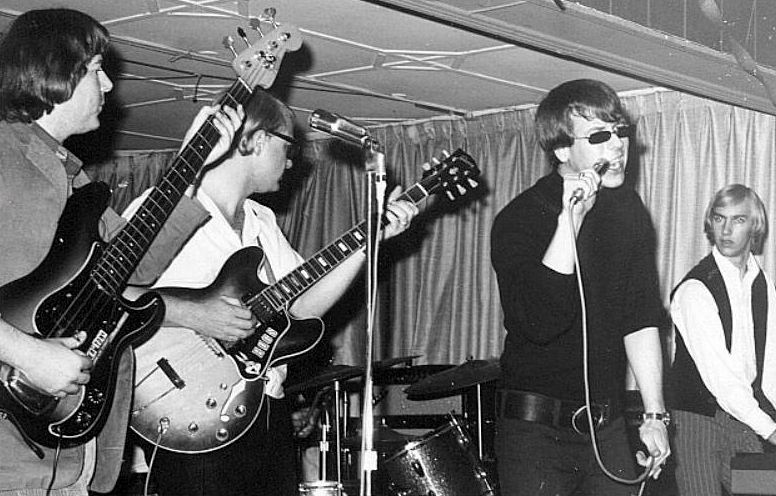
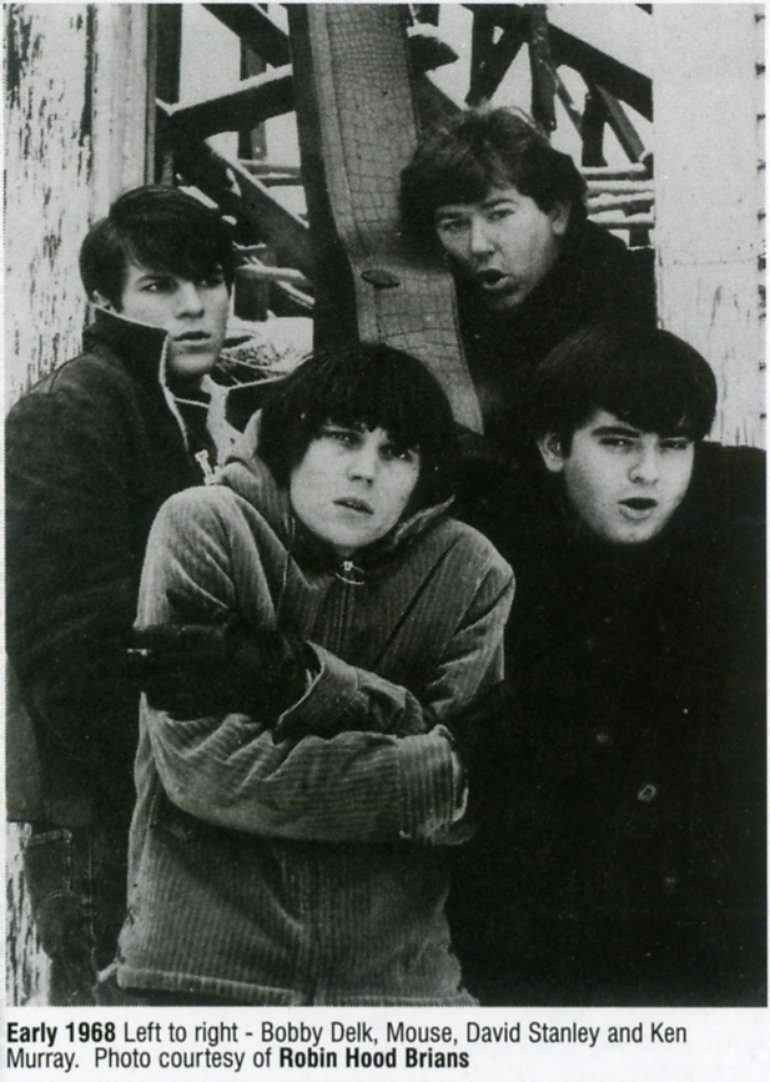
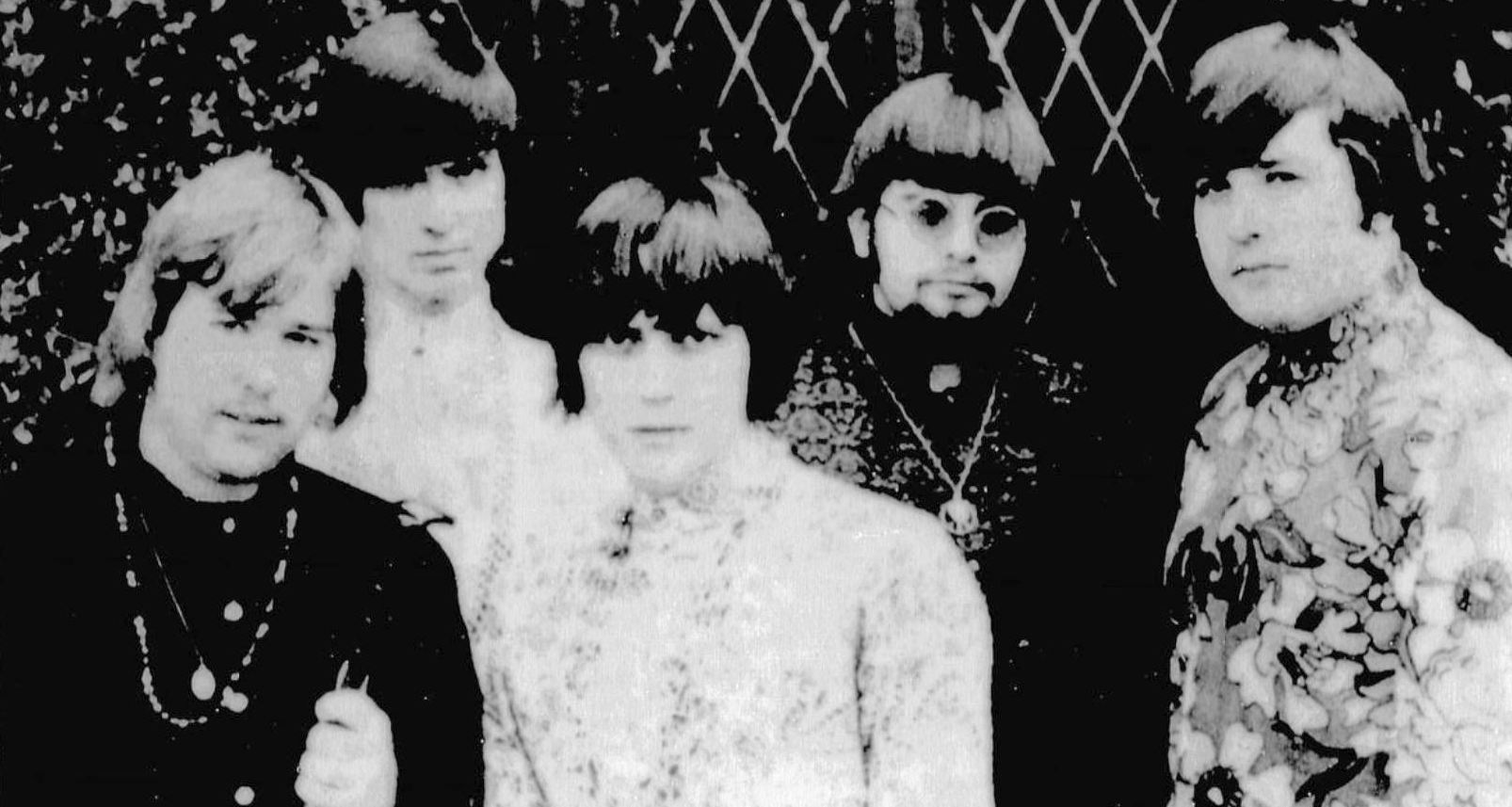
Mouse and the Traps was a band formed in Tyler, Texas in 1965, with Ronnie Weiss (whose nickname was “Mouse”) on vocals and guitar, Bugs Henderson on lead guitar, David Stanley on bass, Ken “Nardo” Murray on drums, and Jerry Howell on keyboards. Even though most of the band members grew up in Tyler and almost all of their singles were recorded there (recordings produced by the great Robin Hood Brians, who was only a couple of years older than the band), the band pretty much moved to Dallas when they began to get a lot of airplay on local stations, notably KLIF. I actually always thought they were a Dallas band, and, damn it, I’m still considering them a Dallas band.
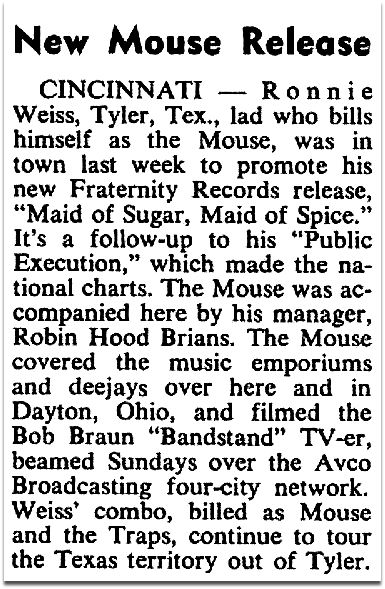
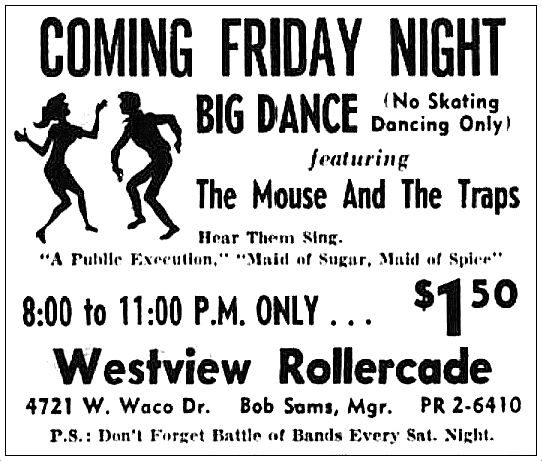
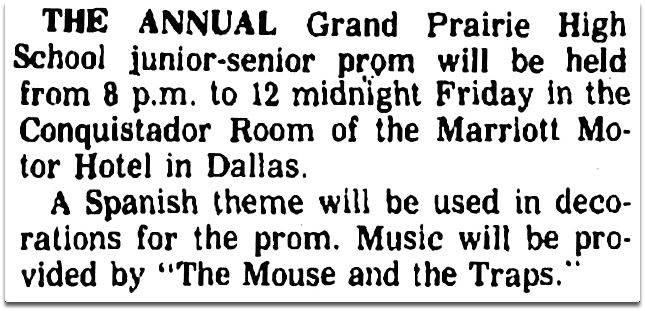
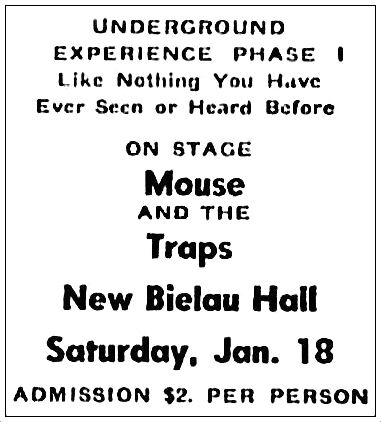
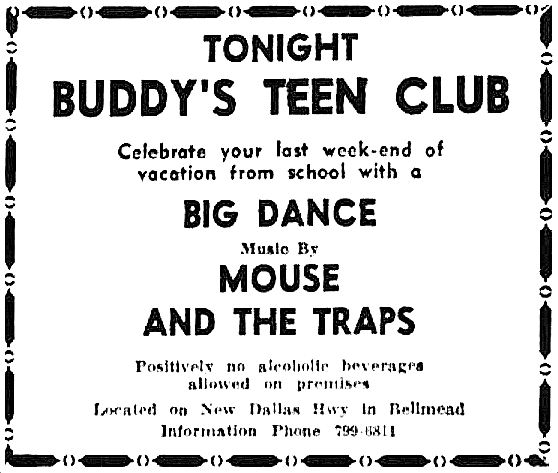
Mouse and the Traps toured around the state feverishly, playing clubs, colleges, parties, and even proms. There were occasional forays beyond Texas, but, for the most part, they remained a (very popular) regional band. Their first single — the unapologetically Dylan-esque “A Public Execution,” was released at the end of 1965 on the Fraternity label; it was their only record to show up on the Billboard charts, as a “bubbling under” track, not quite reaching the Top 100. After a couple of years, Bugs Henderson (who later became “guitar legend Bugs Henderson”) left the band and was replaced by Bobby Delk. Their personnel history is a little fuzzy, but I think Bugs re-joined the band briefly before the group finally disbanded sometime in 1970, after releasing a series of well-regarded singles and after almost five years of endless live dates. For most bands that had found little commercial success, that would have been the last most people would have heard of them. But most bands weren’t “Nugget” bands.
In 1972, Lenny Kaye included Mouse and the Traps on his revered (and influential) “Nuggets” compilation, propelling the band from “slowly fading memory” to “newly appreciated cult band” and introducing them to a whole new international audience. The band is now regarded as “proto-punk” and an important Texas garage band.
Their garage recordings are probably the most admired, but they dabbled in every ’60s style imaginable, including psychedelia, folk rock, breezy pop, and West Coast country, with hints of Dylan, The Beatles, The Yardbirds, Them, Donovan, and the Sir Douglas Quintet. There’s even a “Get Smart”-inspired novelty song in there. My favorite song of theirs, “Maid of Sugar, Maid of Spice,” is generally considered their finest single, assuring them a place in the pantheon of great garage songs. The stinging, electrifying guitar of Bugs Henderson is fantastic.
The band re-formed for several reunion shows over the years, but, sadly, Bugs Henderson died in 2012. No more reunion shows featuring the original line-up.
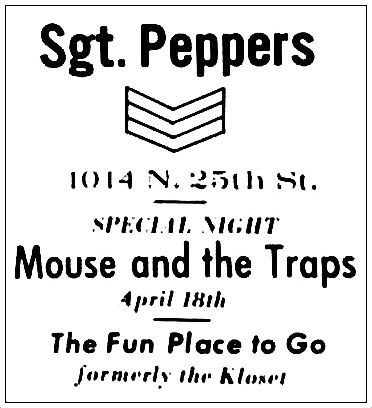
As far as the Dallas connection during the height of their career, there is precious little I’ve been able to find, as far as contemporary local photos, ads, or newspaper mentions. Despite the cultural revolution which began with the explosive arrival of the Beatles to the U.S. in 1964, “teenage” music in the ’60s was not taken seriously enough at the time to warrant much coverage in the major newspapers.
One of the few mentions of the band I found was as a support act on a Sonny and Cher show at the Fair Park Music Hall in early 1966. Also on the bill: The Outcasts from San Antonio, and Scotty McKay from Dallas (who can be seen performing two pretty good songs in a clip from one of Dallas director Larry Buchanan’s “schlock” movies, “Creature of Destruction,” here).
Feb., 1966
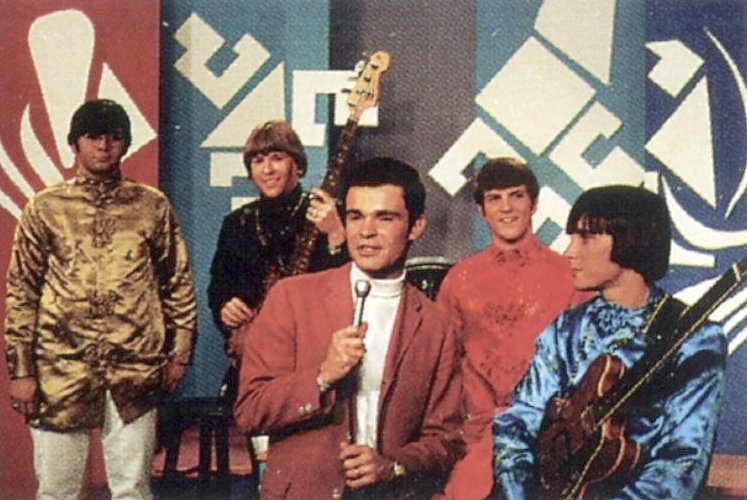
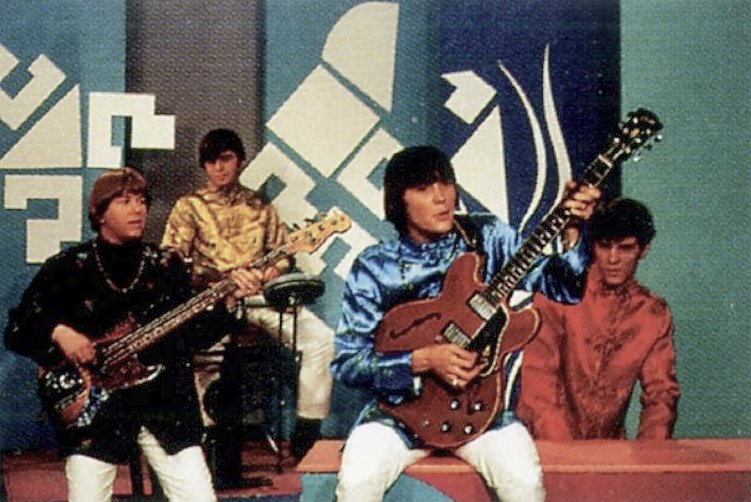
They also appeared on the TV music show “Sump’n Else” “Upbeat” (in 1968, post-Bugs). (Thanks to Jim for pointing out in the comments that these two color photos actually show the band on the Cleveland-based syndicated teen show “Upbeat,” hosted by Don Webster. TV listings show that the band appeared on the show in April 1968, along with the Boxtops and several other performers.)
Photos: Robin Hood Brians
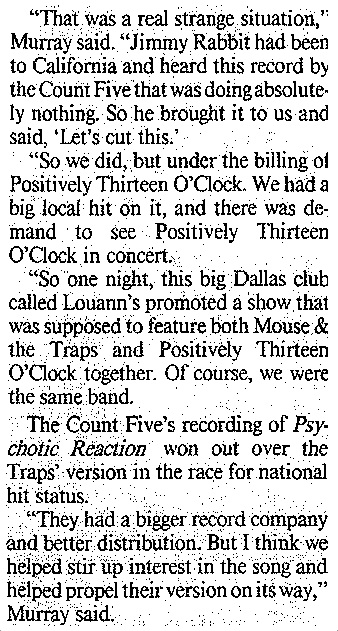
They also played a memorable show at Louanns in 1966 where they appeared on a double-bill as two separate bands. In 1966 Jimmy Rabbit, a popular DJ on KLIF who was a big supporter of the band, asked them to perform as his backing band on a (great!) recording of “Psychotic Reaction” — a very early cover (perhaps the first) of the song by the Count Five. The song was recorded in Tyler by Robin Hood Brians with Rabbit on vocals and was released under the name Positively Thirteen O’clock. Unsurprisingly, with Rabbit being a DJ on the top station in town, it became a huge local hit. Ken “Nardo” Murray talked about it in a 1988 interview (read the full interview here). Click for larger image.
Fort Worth Star-Telegram, May 17, 1988
And here they are at Louanns, with Rabbit at the mic, backed up by Dave Stanley, Bugs Henderson (he has “Bugs” and a picture of Bugs Bunny on his guitar!), and Jerry Howell:
If anyone has any Dallas-related photos or memorabilia of Mouse and the Traps, I’d love to see them! I’d also love to hear from people who saw them perform in the ’60s.
*
Billboard, May 21, 1966
Waco Tribune Herald, Aug. 11, 1966
Grand Prairie Daily News, May 9, 1968
Weimar Mercury, Jan. 16, 1969
North Texas State University newspaper, Feb. 7, 1969
Waco Tribune Herald, Aug. 30, 1969
Waco Citizen, April 13, 1970
***
Sources & Notes
A few Mouse and the Traps tidbits:
The band was originally called “Mouse.” “The Traps” was added when the second single, “Maid of Sugar, Maid of Spice” came out in 1966.
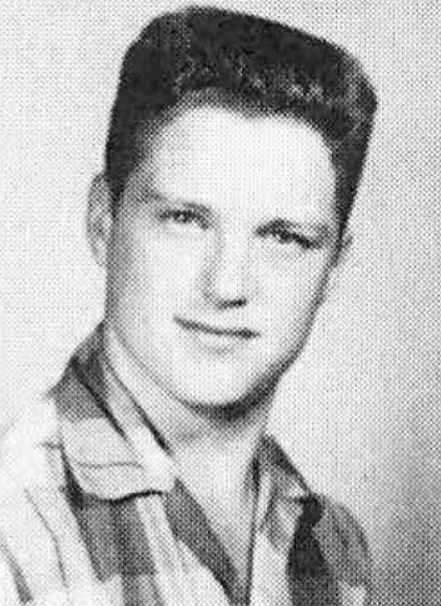
The “Henderson” listed as co-writer with Ronnie Weiss of a few of the early Mouse and the Traps songs (including the first two singles) was not Bugs Henderson (who was born Harry Fisher Henderson but was known as “Buddy” in the pre-“Bugs” days) — it was Knox Henderson, a high school pal from Tyler, seen below from a 1955 John Tyler High School (Tyler, TX) yearbook.
More on the band — including photos and newspaper articles — can be found here. Also included is additional information on Robin Hood Brians who has produced artists as diverse as ZZ Top, the Five Americans, James Brown, David Houston, and John Fred and His Playboy Band (whose “Judy In Disguise” knocked the Beatles out of the #1 spot on the national charts).
Legendary sportswriter Blackie Sherrod died yesterday at the age of 96. My father was not a follower of sports, but I remember he read Blackie Sherrod’s columns because, along with other great, larger-than-life, and exceptionally talented DFW sportswriters such as Bud Shrake, Dan Jenkins, and Gary Cartwright, Blackie was — for want of a better word — a “literary” journalist whose style transcended his subject matter. His writing appealed to everyone who enjoyed and appreciated well-written and caustically funny forays into, around, over, and under the world of sports. Sports fans — and other sportswriters — loved the guy. And so did everyone else.
In the December 1975 issue of Texas Monthly, Larry L. King (forever known as the man who made more money from the best little whorehouse in Texas than any of the girls who plied their trade there) wrote a fantastic profile of Blackie (“The Best Sportswriter in Texas”), in which he described Blackie Sherrod as being “the most plagiarized man in Texas.” Sportswriters around the state routinely stole all of Blackie’s best lines and inserted them, unattributed, into their own columns. King himself admits he was one of the worst offenders. The lengthy profile is great. Great. Read it here.
*
UPDATE: Also, this is a great 9-minute film produced by KERA in the 1970s in which Blackie talks about his career, past and present.
***
Sources & Notes
Video is from the KERA Collection, G. William Jones Film & Video Collection, Hamon Arts Library, Southern Methodist University; the permanent link on YouTube is here.
Watch a Dallas Morning News-produced video tribute to Blackie Sherrod from 2013.
The Dallas Morning News obituary — “Legendary News Sportswriter Blackie Sherrod Dies at 96” — written by Kevin Sherrington, is here.
Several of Blackie’s Sherrod’s books can be purchased online, here.
Moments after I posted yesterday’s photo of the Dallas Times Herald lobby, I read that Blackie had died. He must have walked through that lobby thousands of times. That was an odd bit of synchronicity.
(George W. Cook Collection, DeGolyer Library, SMU)
by Paula Bosse
This amazing (and amazingly gruesome) first-hand account of an unnamed McKamy-Campbell Funeral Home undertaker details the incredible amount of work required to prepare the bullet-ridden body of celebrity outlaw Bonnie Parker for burial. This odd little historical document comes from the absolutely fantastic George W. Cook Dallas/Texas Image Collection housed in SMU’s DeGolyer Library. The four-page handwritten document can be viewed in its entirety on SMU’s Central University Libraries’ website here. Below is the full account, transcribed by SMU, with a few corrections/additions made by me.
*
Tear this up please? Tear this up please?
Heres [sic] first hand on Bonnie & Clyde as we had Bonnie. She was about the size of Rose Grace, weighing a 100 pounds. (a thousand pounds of dynamite though) She was very pretty of course her skin was somewhat tan. Her nails were beautiful. Likewise her toe nails. Her toes looked like fingers. The cuticles pushed back, the nails filed to a point, and a deep coral shade polish on them, the most beautiful toes I ever saw, just perfect. Her permanent just a month old we had it waved. Her face, right side was blown off. We fixed this and you could hardly tell it. Just one bullet went through her brain, however and number grazed her head as there were 3 big holes in her scalp, but not through skull. Her left eye terribly black, however I used eye shadow on other eye to match, so that was covered up. Now, her body was just mutilated and torn to pieces from shots. Her right hand nearly blown off (known as her trigger hand) her body besides being full of bullet holes was full of buckshot, pellets all over her
[Page 2] body. We received body ten minutes of nine. Joe and I sewed on her until three that afternoon. At that time they say 25,000 people were lined up outside. It took 2 hours picking dirt, rocks etc. from her hair then to wash it and have waved. A tattoo on right leg two hearts one read Roy, the other Bonnie. Roy you know was her Husband (Roy Thornton now in Pen) All fluid the undertaker in Arcadia La. used leaked out she was torn up so she was a a [sic] mass of blood, caked & dried. Several hours in bathing her. Had to scrape some of it off, and used gold dust to remove most of it. Had skinslip that night account Fluid leaking from it, began to smell the next morning, turning dark, smelling worse. The last day was rotten so to speak The odor was awful. Her Mother thought [sic] sat in room alone with her head over casket. How she stood it Lord knows. The other children couldn’t. Mother fainted 2:30 that night I asked if she wouldn’t like to go home, she went. By then the entire house smelt. We had to keep her so Sister Billy that was in jail in Ft Worth could get out & come to Funeral. She was buried in an all steel metal casket. Paper said $1000.00 wrong about $600 maybe less. Paper said $1000.00 vault Wrong there was no vault Page 2
[Page 3] Buried in an ice Blue Neglegee [sic] (is this spelled right) She was dressed in expensive clothes when killed. About 40,000 people came to view her. Paper said $1,500.00 damages done to Funeral Home. Wrong about the extent of $2.50. They did not tear windows etc as stated. The woman next door though turned Hose on Them to keep her flowers from being walked on. We had 38 officers stationed (3 shifts) all over house and front & back yard keeping crowd in order and all of us as well. 4 operators on the 4 phones. They rang every minute for two days & nights. More people came to see Bonnie then [sic] to see Clyde. Our new Porch Furniture was damaged. We had a Rubber mat about ½ inch in thickness all over Funeral House. Officers
[Page 4] stationed to keep people on it so as not to wear rug out (Big movie Star) my picture was shown in Movies. The paper stretched their stories. She was not to become a Mother as stated. She was diseased slightly though as stated. Now you have it first hand as I worked on her. Joes [sic] & My work was praised very highly in every other line in papers. And if I do say it, It was good. And she looked swell no trace of disfigures showing. The crowd did not steal anything to take home. All paper talk. Example crowd lined up as Far as Fair Park, now judge how it looked. They brought their Lunches. Such Fools.
*
Below, two photographs of the McKamy-Campbell Funeral Home, located at 1921 Forest Avenue in South Dallas, besieged by curious spectators.
**
I’m unsure who the “Rose Grace” was who was mentioned on the first page.
The “gold dust” mentioned in the account as being used to remove caked blood from Bonnie’s body was actually Gold Dust Washing Powder or Gold Dust Scouring Soap, a popular, commercially-available “all-purpose cleaning agents” — Wikipedia article ishere.
***
Sources & Notes
Top image of the handwritten account on Adolphus Hotel stationery is from the aforementioned George W. Cook Dallas/Texas Image Collection, DeGolyer Library, Central University Libraries, Southern Methodist University, viewable here.
First photo of the McKamy-Campbell Funeral Home is reproduced all over the internet; the second photo is from the files of the Dallas Police Dept., Dallas Municipal Archives, via the University of North Texas’ Portal to Texas History database, here.
Even though the identity of the person who wrote this account is not known, he (…it was probably a man) mentions that he was seen in newsreel footage of the funeral of Bonnie Parker. My wild guess is that he can be seen in this clip from a longer newsreel on the funerals and burials of Bonnie and Clyde at the 2:34 mark. I could never find who his co-worker “Joe” was.
*
Is this our man laying flowers on Bonnies casket?
If you really want to see the state of the bodies of Bonnie (and Clyde) — before and after their time with their undertakers — they’re easy to find via your favorite search engine.
More Flashback Dallas posts on Bonnie & Clyde here.
If you like what you’ve seen on Flashback Dallas, please consider supporting me on Patreon, where for as little as $5 a month, you can receive all-new updates several times a week (if not daily!). More information can be found at Patreon,here.
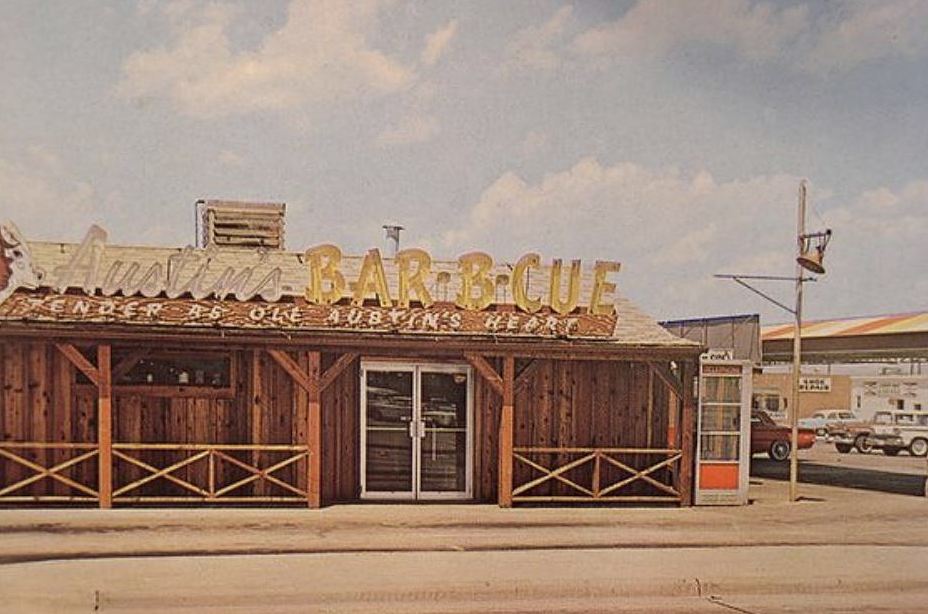
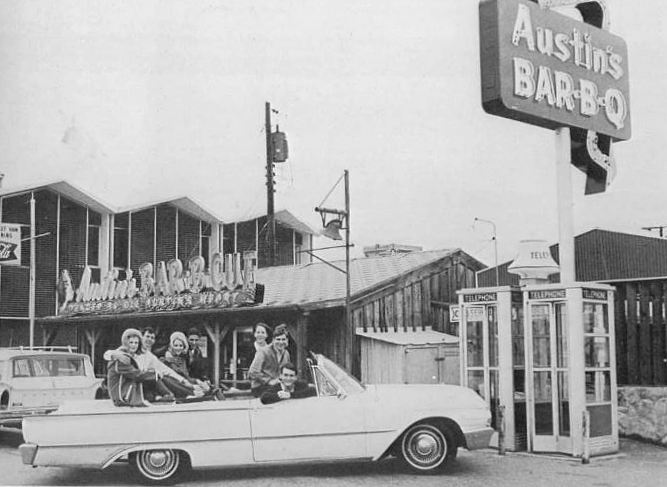
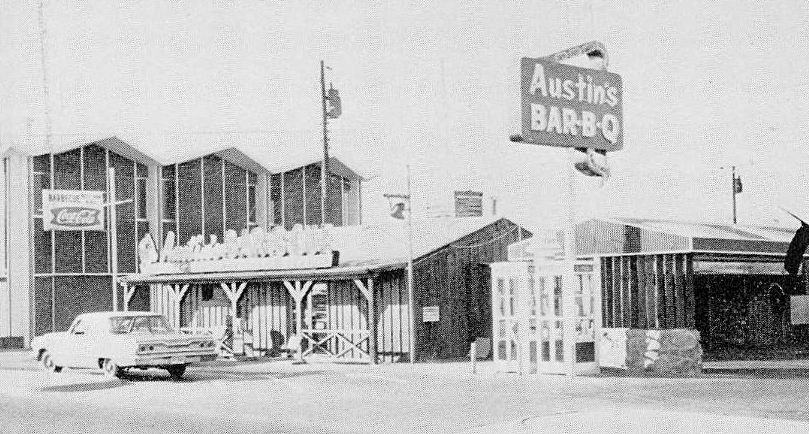
One of my major failings as a Dallasite is that I don’t know Oak Cliff. Like at all. Every time I go over there, I get lost. I can’t remember my family ever going to Oak Cliff when I was a kid, except to visit the zoo. This explains why I had no idea how important a cultural landmark Austin’s Barbecue was when I posted a bunch of Oak Cliff ads the other day. That post has been shared hundreds and hundreds of times now and, inevitably, the only thing people mention — and rhapsodize about — is Austin’s Barbecue. …I had no idea!
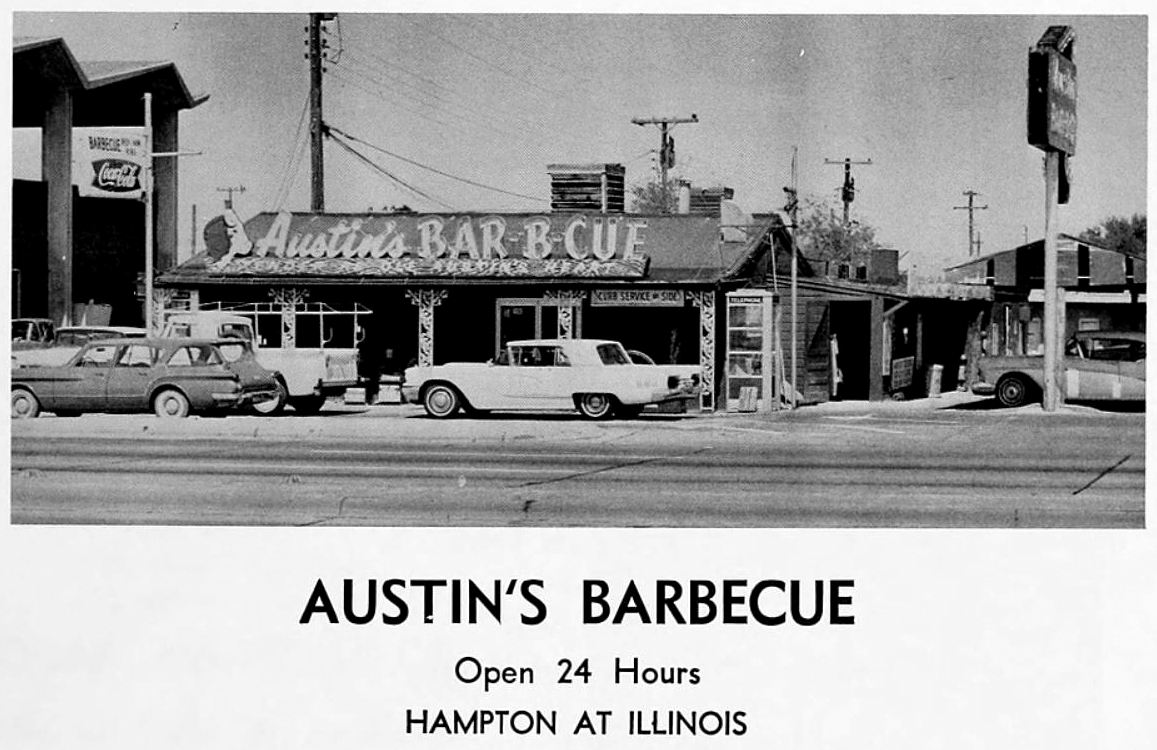
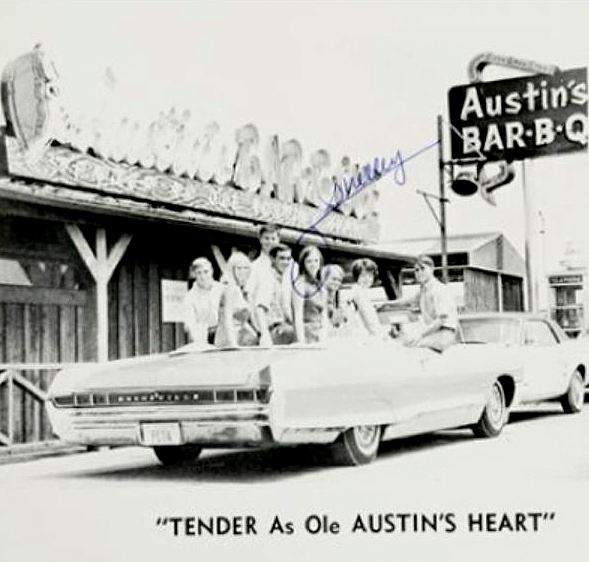
The famed BBQ joint at the northeast corner of Illinois Avenue and Hampton Road opened in 1949 as B & G Barbecue but soon became known as Bull Pen Barbecue, run jointly by owners Bert Bowman and Austin Cook. In 1956 or 1957, another Bull Pen opened in Arlington. After Oak Cliff went dry (a dark day for many Oak Cliffites), Bowman — who firmly believed that BBQ and beer were a match made in heaven — left for Arlington and Cook stayed in Oak Cliff and changed the restaurant’s name to Austin’s Barbecue. (“Bull Pen Barbecue” was still appearing in ads as late as Oct. 1957 — the official name changeover seems to have happened in 1958.)
1967 Sunset High School yearbook
*
The following memory of starting the business was apparently written by Austin Cook in 1990:
Dear Family & Friends,
I will try to tell you a little more about my being in the restaurant business. We borrowed $10,000 and bought out some one and it was B and G Barbecue. You see I always spell out Barbecue because when I went in business they hadn’t started abbreviating it like it is today.
After we had been there awhile we changed the name to The Bull Pen. Our slogan was “Come in and Shoot the Bull with Austin and Bert.” We used that name until they voted beer out of Oak Cliff. That really set us back, but maybe it was the best thing for us. We put another place in Arlington and that place was going pretty good. My partner wanted to get rid of the place in Oak Cliff. I traded him my part of the one in Arlington for his part in the one in Oak Cliff. Everyone said I was crazy.
When we bought that first place it was way out in the country, but they were building a bunch of houses not too far away. There was an airport across the street from the place. They kept talking about building a shopping center where the airport was. I remember the first day we ran a hundred dollars, and I thought we would never make it.
We started making money and we paid that ten thousand dollars back and we drew fifty dollars a week just like I was making in the grocery store. We started out with a barbecue sandwich and a hamburger. Then we started adding different things until we had a menu. We started getting those workers in the houses, and the business took off. We had beer also to go with the barbecue. My mother wasn’t too happy about that, but Dad said if that was the way I wanted to make my living it would be all right. In about a year or two we had a customer make us up a menu and we put in Barbecue plates for one dollar and twenty five cents. When I left they we were getting $4.99 for them. After I left I think they went to over seven dollars.
They always told me that you weren’t a success until you were in debt a hundred thousand dollars, and I went to the bank and borrowed all they would let me have. Then I went to my landlord and sold him the idea that I wanted to improve his property, and he loaned me the balance I needed to remodel, and I built a restaurant that held a hundred and twenty-five. Many times I was almost broke and didn’t know what I was going to do, but something always happened and I came out of it.
*
Both the Bull Pen in Arlington and Austin’s in Oak Cliff were successful and long-lived. Austin Cook retired at the end of 1993, and the business was taken over by his stepson, John Zito who had already been working at the restaurant for several years. Austin’s Barbecue closed in July, 2000, and the building was demolished soon after, replaced with an Eckerd drug store (now a CVS). Bert Bowman (born Glynbert Lee Bowman) died in 1989 at the age of 66; Austin O. Cook died at in 2006 at 86. And now I kind of feel like I know them, and I’m really sorry I never sampled their sandwiches.
*
Below, a Bowman and Cook timeline (most pictures and clippings are larger when clicked).
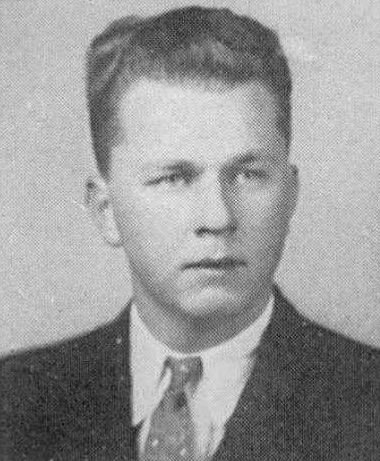
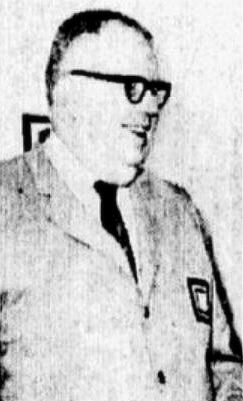
Austin Cook, Sunset High School, 1937
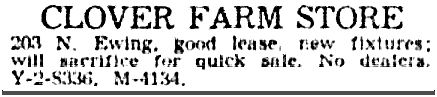
Before Cook and Bowmen met — probably around 1947 — each had been dabbling in different businesses. In early 1947, Cook leased a Clover Farm Store building at 203 N. Ewing and opened the Libby & Cook grocery with partner Lendal C. Libby.
February, 1947
1947 Dallas directory
Bert Bowman worked there as a meat-cutter.
1947 Dallas directory
The grocery store was in business at least into 1949, the year that Bowman and Cook decided to ditch the groceries and start their own business at 2321 W. Illinois, in a part of Oak Cliff which was just starting to be developed. Their BBQ place was originally called B & G Barbecue, which — according to Cook’s letter above — was the name of the restaurant he and Bowman bought out. I guess they felt it was easier to keep the name for awhile.
1951 Dallas directory
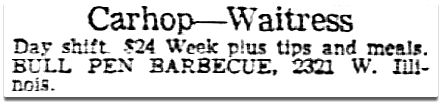
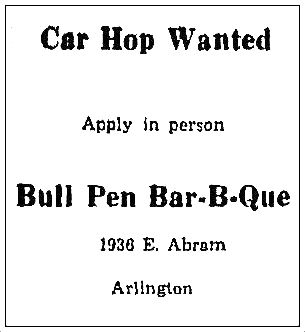
The name “Bull Pen Barbecue” didn’t come until later. In fact, the first appearance of the Bull Pen name associated with this address doesn’t show up in local newspaper archives until a want-ad placed in the summer of 1952.
August, 1952
A probably related “Bull Pen No. 2” opened in South Dallas in 1953. It appears to have been very short-lived.
October, 1953
By the fall of 1957, Cook and Bowman had opened another Bull Pen — this one in Arlington, and this one a success.
September, 1957
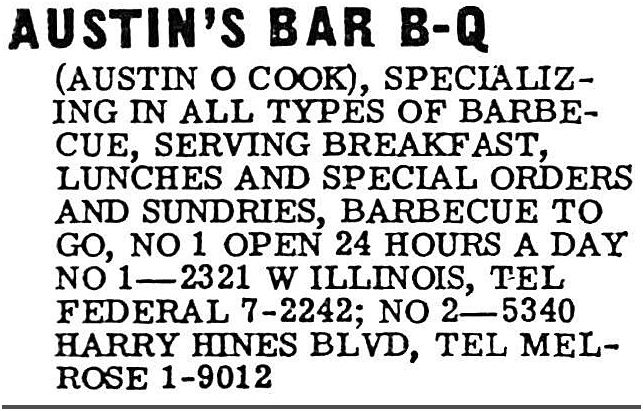
And then Oak Cliff went dry, the worst thing that could happen to a restaurant that sold a lot of beer. Similar businesses which relied heavily on beer sales began to desert Oak Cliff. Bowman did not think their original drive-in could survive, but Cook disagreed. Bowman sold his half-interest in the Oak Cliff location to Cook, and Cook sold his half-interest in the Arlington location to Bowman. Cook changed the name of his now solely-owned restaurant to Austin’s Barbecue, and his success continued, despite the fact that he could no longer sell beer. He was doing well enough that, in 1961, he opened a second location, on Harry Hines across from Parkland Hospital (a location which lasted through 1964).
1962 Dallas directory
1963 Dallas directory
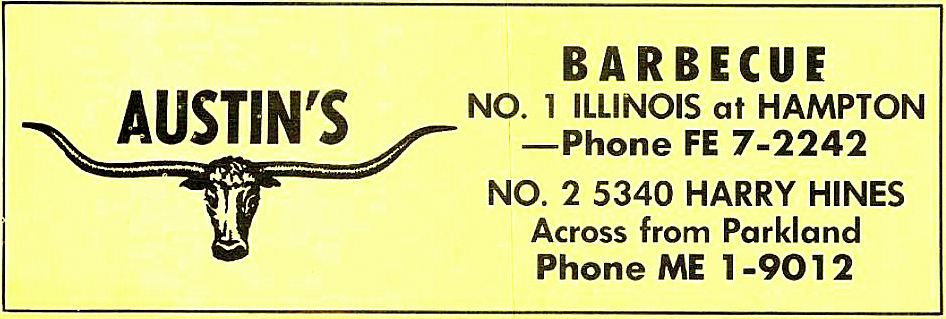
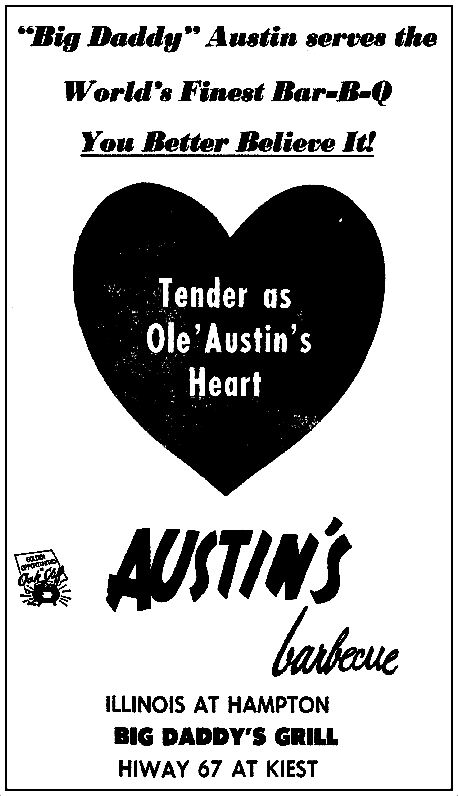
By 1963, Austin’s was a well-established teen hang-out and wisely placed ads in Oak Cliff high school annuals. Apparently everyone went there!
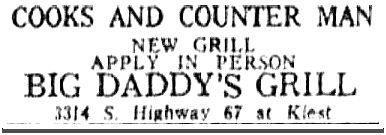
In 1964, Cook — known as “Big Daddy” — opened another restaurant, this one called Big Daddy’s Grill.
June, 1964
August, 1966
The restaurant was a bona fide Oak Cliff landmark, and Cook was an active participant in community business affairs. Below, a detail of a photo showing Cook as a member of the Oak Cliff Chamber of Commerce.
late 1960s
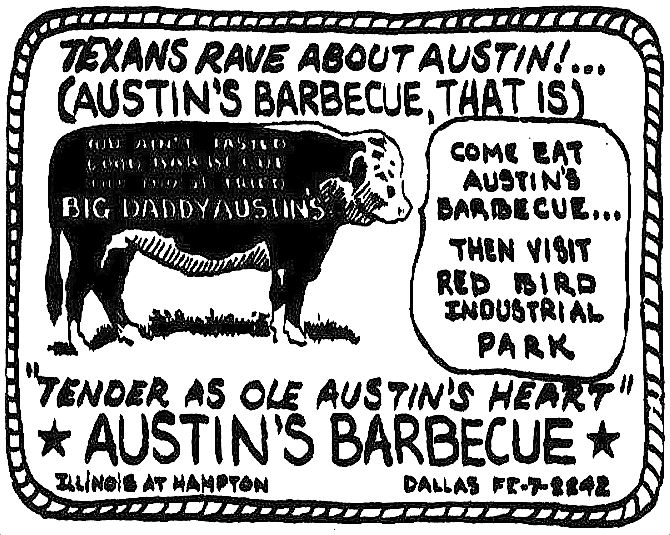
Cook participated in a series of Oak Cliff Chamber of Commerce campaigns and even included oddities like “Come eat Austin’s barbecue… and then visit Red Bird Industrial Park” in his ads. Make a day of it!
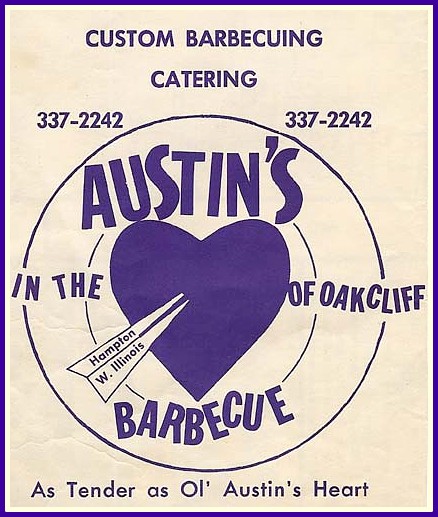
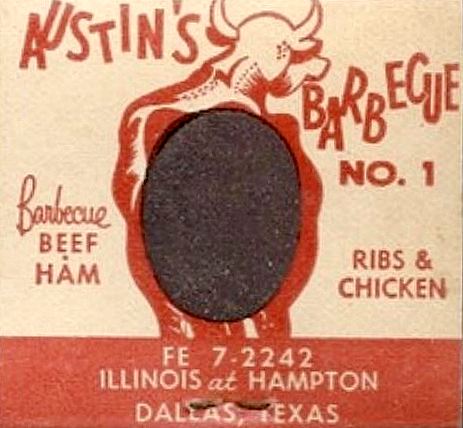
Color postcard at the top found on Pinterest, here.
The letter from Austin Cook was quoted on the DHS Phorum, here. More from the Phorum on The Bull Pen/Austin’s is here.
More can be found in the Dallas Morning News archives in the following stories:
“Austin’s Bar-B-Q Grows With Oak Cliff” (DMN, Aug. 14, 1966)
“Barbecue To Go — Staff, Customers Mourn Closing of Oak Cliff Institution” (DMN, July 13, 2000)
“Closed But Not Forgotten — Oak Cliff Eatery Marks Half-Century of Barbecue With Memorable Auction” (DMN, Aug. 27, 2000)
“John P. Zito — Operated Oak Cliff Landmark Austin’s Barbecue For 19 Years” by Joe Simnacher (DMN, Oct. 14, 2003)
Read the obituaries of Bert Bowman (1989) and Austin O. Cook (2006) here.
The Oak Cliff Advocate article “A Look Back at Austin’s Barbecue” by Gayla Brooks is here (with tons of memories from readers in the comments).
Not mentioned in this post is the connection of Officer J. D. Tippit (who moonlighted as a keeper of the peace at Austin’s) and other tangential/coincidental associations to the Kennedy assassination. It’s well documented elsewhere. Google is your friend.
The great Merle Haggard died today, on his 79th birthday. My earliest music memories are hearing his songs on the radio. Even people who don’t listen to country music know who Merle Haggard is (and are probably fans).
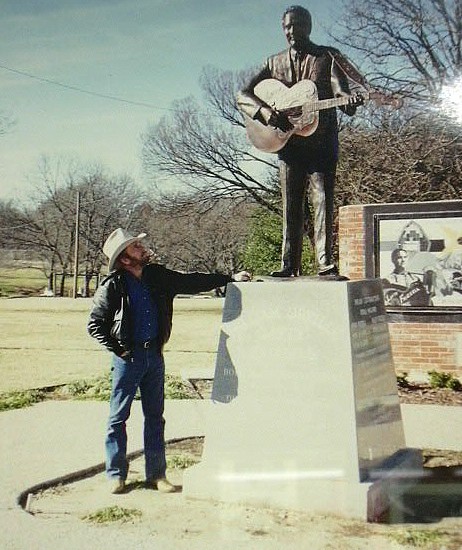
One of his idols was Lefty Frizzell, the Corsicana-born legend whose first hits were recorded in Dallas. Merle helped raise the funds in the late ’80s and early ’90s for the wonderful statue of Lefty which now stands in Jester Park in Corsicana. The picture above shows Merle visiting the statue. (Whenever I’m in Corsicana, I always drop by Jester Park to spend some time with Lefty.)
As far as Merle and Dallas, the earliest mention I could find was from January, 1965. Country music was covered only sporadically in the pages of The Dallas Morning News back then, but his early-’65 stop at the Sportatorium may have been Merle’s first appearance in Dallas — appropriately enough, it was at the Big D Jamboree. “California country music team” Merle and Bonnie Owens were guest performers, along with Billy Grammer and James O’Gwynn of the Grand Ole Opry, and the regular Jamboree cast of thirty, for the Jan. 30, 1965 Saturday-night Big D Jamboree show.
RIP, Merle. Thanks for everything.
***
The top picture is a photo I took of an original photograph which is hanging in the Lefty Frizzell Museum, which is also in Corsicana’s Jester Park (as part of the Pioneer Village).
Merle’s obituary in Variety — which includes entertaining salty quotes from the man himself — is here.
Today is Tennessee Williams’ birthday — he was born March 26, 1911. Thanks to his personal friendship and professional relationship with energetic Dallas theater pioneer Margo Jones (to whom he gave the nickname “The Texas Tornado”), playwright Tennessee Williams was a fairly frequent visitor to Dallas in the 1940s in the early years of his celebrity. Margo was a very early supporter of Williams, and their friendship led to her co-directing The Glass Menagerie on Broadway and her directing and producing the world premiere of his play Summer and Smoke at her Theater ’47 in Fair Park (a production which she took to Broadway the following year).
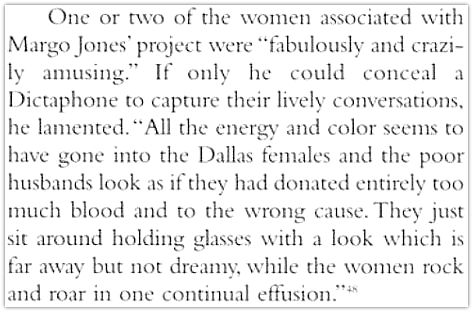
Dallas historian Darwin Payne wrote an interesting profile of Williams’ time in Dallas in the Spring 2007 issue of Legacies (read it here — it begins at the bottom of the page). My favorite quote in the article is about Dallas women, from a letter Tennessee wrote to New York theater director and producer Guthrie McClintic on June 1, 1945:
***
Sources & Notes
A comprehensive chronology of the friendship and professional partnership of Tennessee Williams and Margo Jones can be found in the article “An Alignment of Stars: Tennessee Williams, William Inge, and Margo Jones’s ‘Theatre ’47′” by Ralph F. Voss, here.
My previous post concerning Margo Jones’ early demise — “Margo Jones & Jim Beck: Both Legends in Their Fields, Both Victims of Carbon Tetrachloride” — is here.
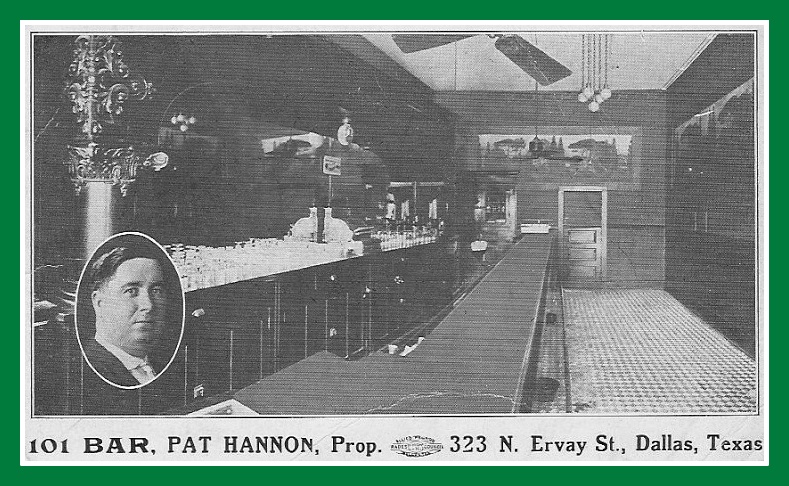
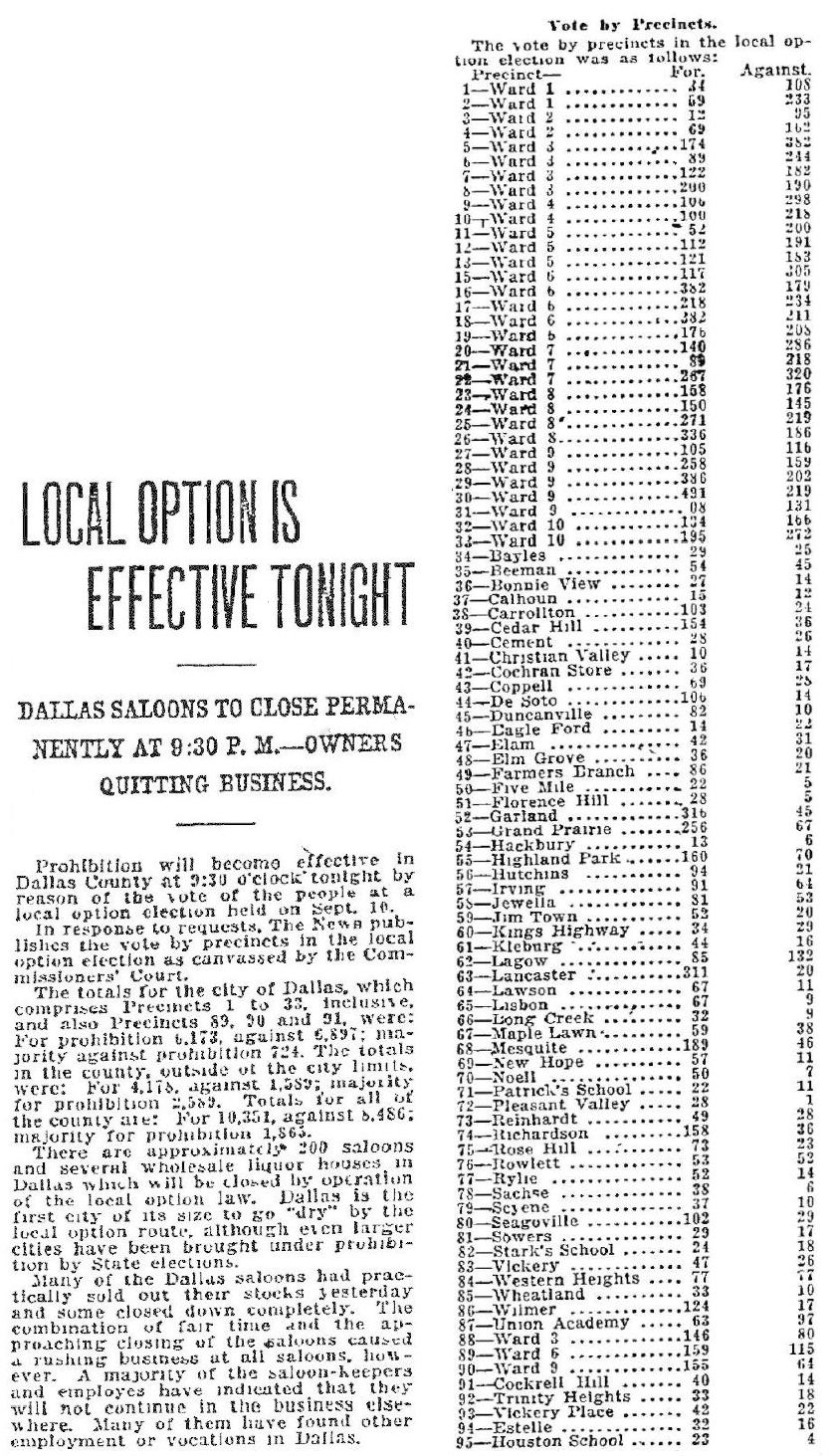
The 101 Bar was located at 323 North Ervay, on the southwest corner of Ervay and Bryan — it is now the site of Thanksgiving Square. The owner was Patrick Hannon who had worked in saloons in Dallas from at least 1908. The bar pictured above opened around 1917 but lasted only a few months — by the time the 1918 directories were printed, 323 N. Ervay was listed as “vacant.” Pat had worked his way up the competitive saloon trade in Dallas, from bartender to owner, only to be cut down by Prohibition. Had Prohibition not gone into effect in 1918 (with Dallas County voting to start even earlier, in October, 1917), this fine-looking bar might have had a long, boozy life. Pat disappeared from the directory completely in 1918, but he was back in 1919, with a new occupation: butcher. Meat-cutting is all well and good and certainly pays the bills, but I bet in his idle moments, Pat’s thoughts turned to daydreams of his old Ervay St. bar.
The 1917 Dallas directory showed 183 bars operating in Dallas; the next year, zero.
Bad timing, Pat.
***
Sources & Notes
I’m not sure where the photo came from — some random web page, I think.
Why did Dallas County go dry so early? Because of a “local option” vote in September 1917. The city of Dallas voted against it, but the surrounding communities voted overwhelmingly FOR it. (You could still drive over to Fort Worth for legal beer and hooch, though.) Election results below (click for larger image).
Dallas Morning News, Oct. 20, 1917
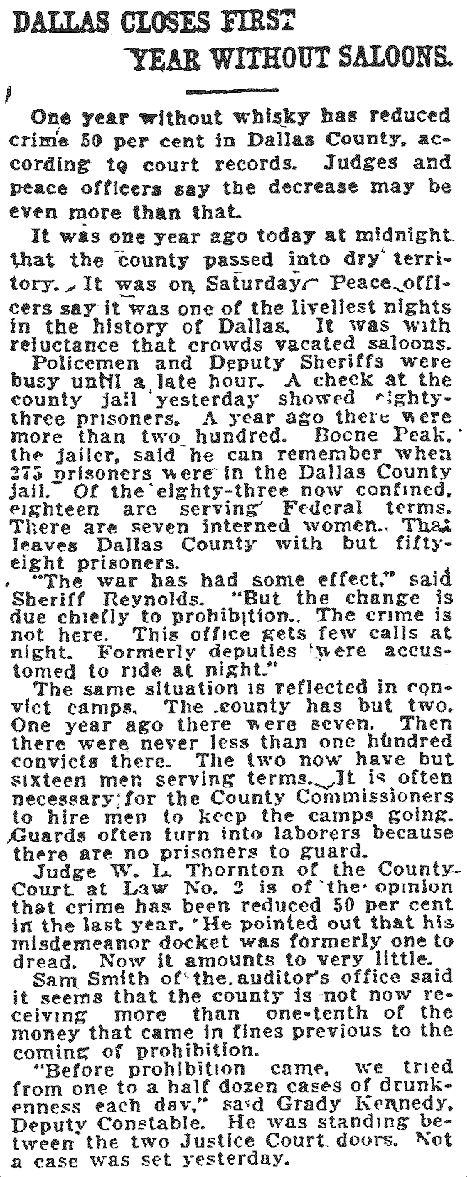
How were things faring a year later?
DMN, Oct. 20, 1918
This has been a rather tenuously-associated St. Patrick’s Day post (Irish name, bar, green border), but … Happy St. Patrick’s Day!
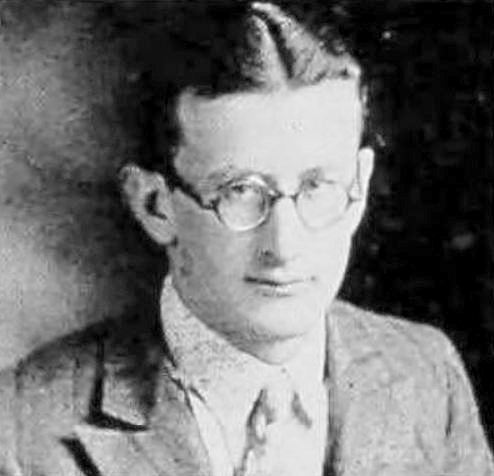
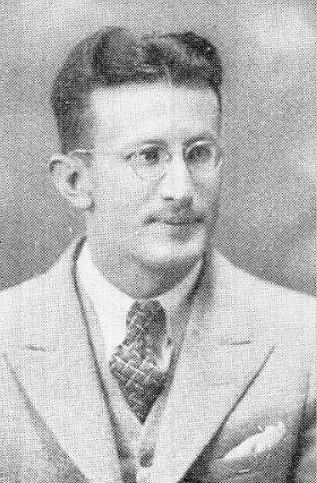
Alfred D. Weir (1909-1996) was the son of A. F. Weir, the successful retail furniture merchant who founded Weir Furniture in 1922. The younger Weir graduated from SMU in 1933 with a degree in mechanical engineering and started his career, fresh out of college, at Dallas’ Ford assembly plant. During World War II, he was the chief industrial engineer at North American Aviation and was later employed by Fairchild Engine and Aircraft, Ford’s aircraft division in Kansas City, Texas Instruments, and Bell Helicopter.
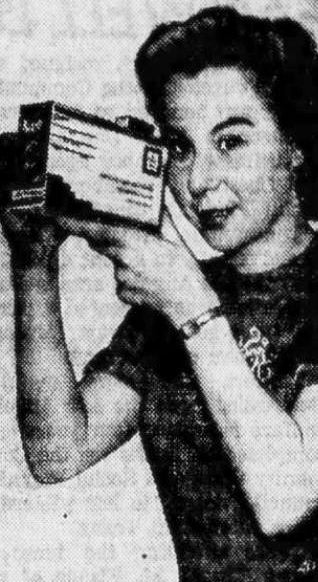
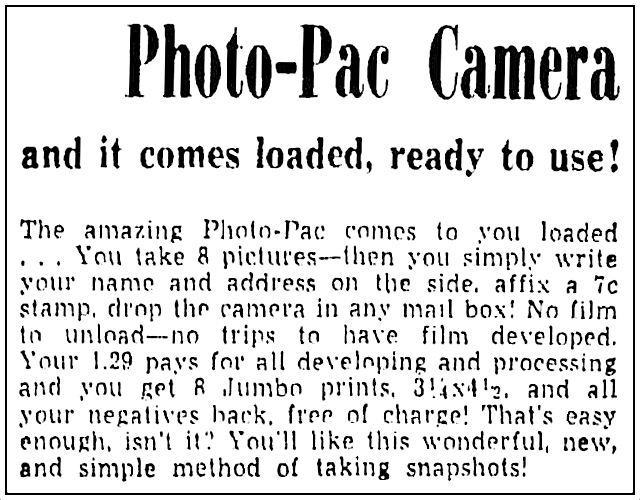
After the war and before his time in Kansas City, Weir took time out from his engineering career to try his hand as an entrepreneur: he invented, patented, and manufactured the Photo-Pac, a single-use camera made of inexpensive fiber board and pre-loaded with 35mm film (loaded by blind employees in total darkness). The user would buy one of these cameras at a drug store, department store, or gas station for $1.29, take eight photographs, and then write his or her name on the side of the camera and drop the whole thing — with the film still inside the camera — in a mail box. Photos would be processed in Dallas, and prints and negatives would be returned to the customer in a couple of days. The camera would not be returned.
It appears to have made its debut at the 1948 State Fair of Texas at an introductory price of only 98¢ (click for larger image).
Billboard, Oct. 9, 1948
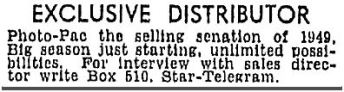
Manufacture and distribution of the camera began in earnest in May, 1949. And then … ads for the camera were everywhere! (The home-grown invention appeared in a hometown newspaper advertorial on May 1, here.) Weir and his small team managed to get the camera in retail locations all over the country. He was also worked hard to line up distributors. Ads such as this one were placed in several U.S. newspapers:
Fort Worth Star-Telegram, June 16, 1949
It seems to have been very popular — both as a novelty impulse buy and as a useful product for people who either did not own cameras or who did not want to take their family cameras on trips. Here’s a typical ad (see text below):
FWST, Nov. 16, 1949 — from ad for Fort Worth’s Fair Department Store
The camera won a “prize gadget” award from Mechanix Illustrated (click to see very large image).
Mechanix Illustrated, Sept. 1949
By the summer of 1950, the number of exposures went from eight to twelve, and the price increased to $1.49. It seemed that the business was growing, but by the fall of 1950, Photo-Pac seems to have reached the end of the road. Court dockets showed a couple of lawsuits filed against the company. Newspaper ads showed stock of the cameras being deep-discounted to as low as 50¢ apiece. The next year, 1951, saw Weir returning to his engineering career — he accepted a position with Ford in Kansas City and apparently left his business dreams behind. It was a great idea, but, for whatever reason, it never fully caught on.
36 long years after A. D. Weir’s Dallas company folded, Fuji introduced their very popular disposable camera; Kodak followed with theirs in 1987. Those things were everywhere — everyone’s had one of them at one time or another. I bet A. D. Weir was miffed.
FWST, July 2, 1986
*
A. D. Weir, SMU Rotunda, 1930
Weir, SMU Rotunda, 1933
1953
***
Sources & Notes
Top photo is an inset from the Mechanix Illustrated “prize gadget” page, from the blog Modern Mechanix, here.
Weir’s patent can be found on Google here. To view Google Patent Image separately (and really big), click image below.
There seems to be some debate about whether Weir’s Photo-Pac was actually the first single-use disposable camera — if it isn’t strictly the first, it seems to have been the one that made the most headway into the American marketplace. A great article on the topic can be found on the Disposable America website here.
A. D. Weir’s father, Alfred Folsom (A. F.) Weir opened Weir Furniture at 2550 Elm Street in 1922; in 1934 the company was incorporated to include his wife and son. A. F. Weir sold the Dallas company to his brother Earl (who had owned furniture stores in Fort Worth and Arlington) in the 1940s — that business closed sometime between 1945 and 1948. In 1948, Earl’s son John Ray Weir opened Weir’s Furniture Village on Knox Street, a business still going strong today.
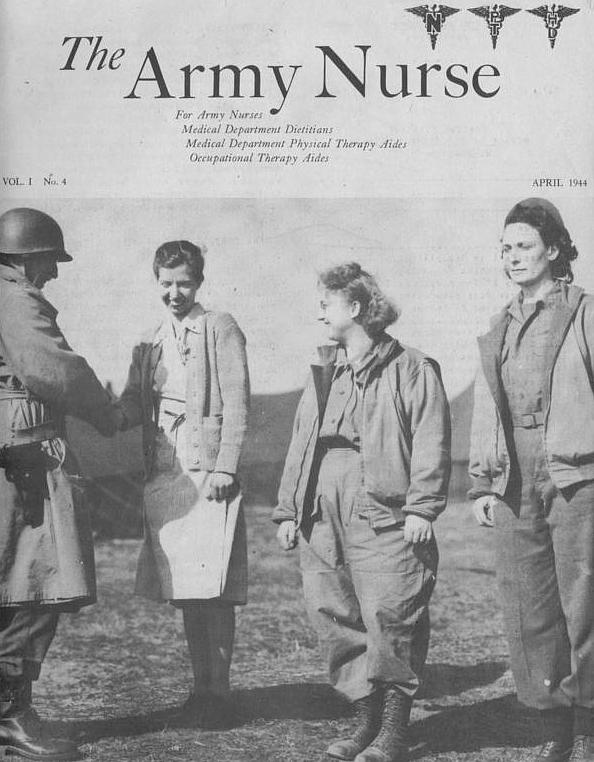
Roberts (left) and two fellow Army Nurse Corps nurses receiving the Silver Star
by Paula Bosse
The opening paragraph from a chapter in Tom Brokaw’s book The Greatest Generation:
There are so many impressive numbers connected to World War II that it’s difficult for one or two to catch your eye. Here are a few that caught me by surprise: more than sixty thousand women served in the Army Nurse Corps. Sixteen died as a result of enemy action. Sixty-seven nurses were taken prisoner of war. More than sixteen hundred were decorated for bravery under fire or for meritorious service.
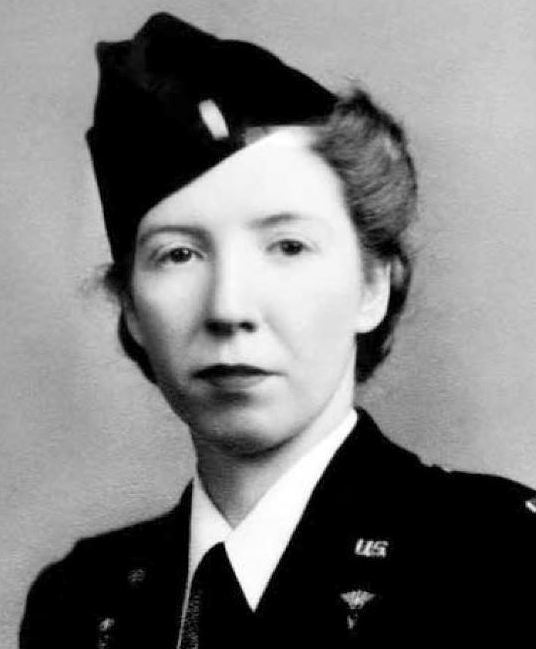
The chapter is titled “Mary Louise Roberts Wilson,” a profile of Mary L. Roberts, a Methodist Hospital nurse who enlisted in the Army Nurse Corps in 1942. She served with the 56th Evacuation Hospital Unit alongside many other medical professionals from Dallas (the unit — sometimes called the “Baylor Unit” — was organized by the Baylor University College of Medicine in Dallas). She knew she would be serving overseas in field hospitals in combat zones.
As far as seeing action, the worst of the worst for the 56th was on February 10, 1944 when their hospital tents on the Anzio beachhead in Italy were attacked by German long-range artillery shells for a full thirty minutes. Several operations were underway during the attack, and Roberts, the chief nurse of the operating tent, managed to keep a calm head and help to maintain as much order as possible.
“I wanted to jump under the operating table, but first we had to lower litter cases to the floor. Pieces of steel already were ripping through tents. There were four litters. I saw a patient on the operating table had his helmet near him so I put it over his head to give him that much protection.” (Mary L. Roberts, Dallas Morning News, Feb 23, 1944)
When the shelling ended, two enlisted men in the operating tent had been wounded, and elsewhere in the field hospital, two nurses had been killed and several other personnel wounded. As a result of their exceptional bravery, outstanding leadership, and “gallantry in action,” Roberts and two other nurses, 2nd Lt. Rita Virginia Rourke and 2nd Lt. Elaine Arletta Roe were awarded the Silver Star. No women had ever received the medal. As 1st Lt. Roberts had seniority, she was the first woman in history to be decorated for heroism in action.
Maj. General John P. Lucas surprised her and the other two nurses on Feb. 22, 1944 with an informal presentation of the medals at the same Anzio hospital that had been shelled only twelve days earlier. After the brief pinning ceremony, the nurses immediately returned to their duties, all feeling they were accepting acknowledgement for their team, not for themselves alone. Roberts spent 29 months overseas, and tended to more than 73,000 patients.
After the war, when Lufkin-native Mary Roberts returned home, she worked for almost 30 years as a nurse at a VA hospital in Dallas, and, rather late in life, she married fellow veteran Willie Ray Wilson. Mrs. Wilson died in 2001 at the age of 87. She was buried with full military honors.
1944 (Fort Worth Star-Telegram Archives, UTA)
1944
Presentation of the Silver Star at Anzio
Mary Roberts Wilson (1914-2001)
***
Sources & Notes
Top photo and first quote from The Greatest Generation by Tom Brokaw (New York: Random House, 1998).
For an exceedingly detailed history of the 56th Evacuation Hospital Unit, with several photographs, see here.
Articles on Mary Roberts from The Dallas Morning News archives:
“Baylor Unit In Action” (DMN, Aug. 26, 1942): photo of unit, including Roberts, working around an operating table
“Dallas Nurse, Two Others Win Medals” (DMN, Feb. 23, 1944): “The award, denoting exceptional bravery went to Lt. Mary L. (Pinky) Roberts, 1205 North Bishop, Dallas, Texas, chief nurse in an operating room hit by shell fragments.”
“Nurses of Dallas Unit Serving at Anzio Doing Jobs Cheerfully Despite Many Hardships” by Wick Fowler (DMN, March 31, 1944)
“Ends Military Career: WWII Recalled By Heroic Nurse” (DMN, July 26, 1964): photo and interview with Mary Roberts Wilson on her retirement from the U. S. Army Reserve
“Happiness Is Being Part of a Team” by Jane Ulrich Smith (DMN, May 16, 1972), photo and interview, on her retirement from the Veterans Administration Hospital
“Compassion Revisited: Nurse Reunites With GI She Treated For Serious Injuries In WWII” (DMN, Nov. 4, 1999): a reunion with former patient Dewey Ellard of Mobile, Alabama, brought together by Tom Brokaw
“Distinguished Career In Medicine Followed — WWII Gallantry — VA Hospital Honors Longtime Nurse — Who Won Silver Star in ’44” (DMN, Nov. 6, 2001): interview with the then-87-year-old Mrs. Wilson, published two-and-a-half weeks before her death
“Mary Wilson, ‘Angel of Anzio,’ Dies at 87 — WWII Nurse Known For Kindness Was Decorated For Bravery Under Fire” (DMN, Nov. 24, 2001)
Other women who were honored in 1944 for heroism and achievement in the line of duty:

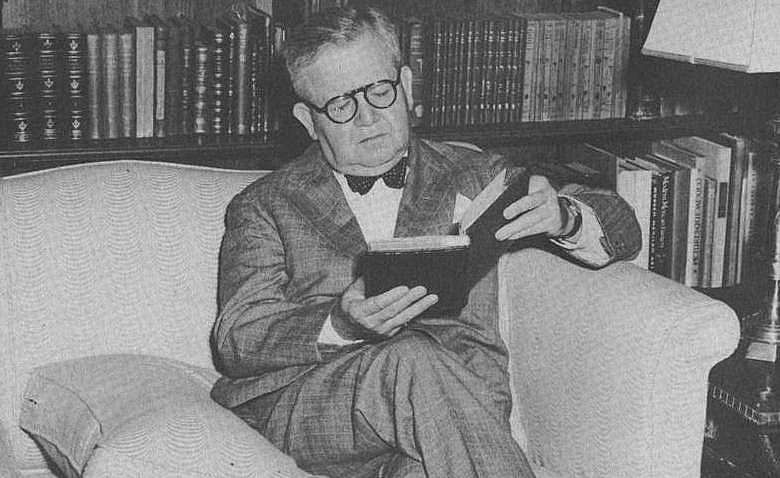
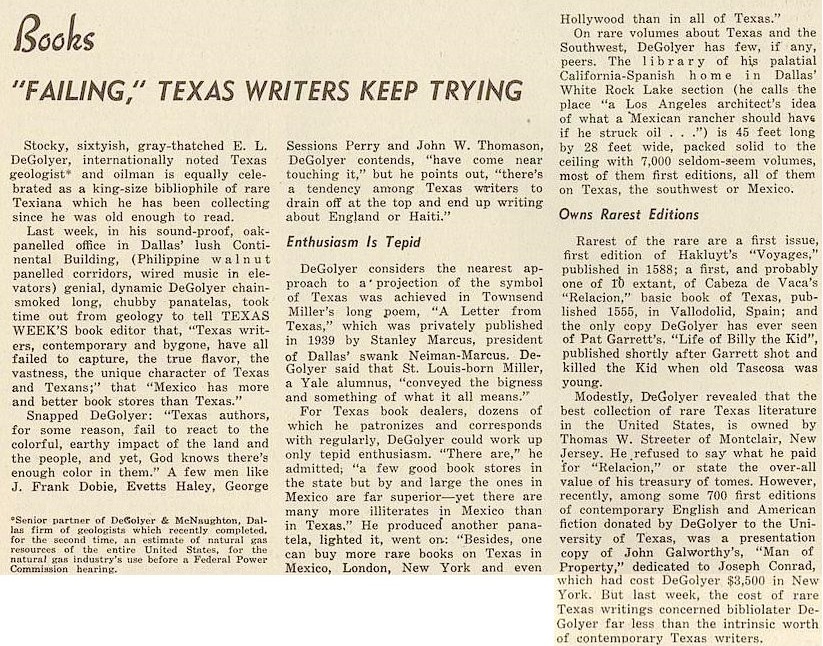
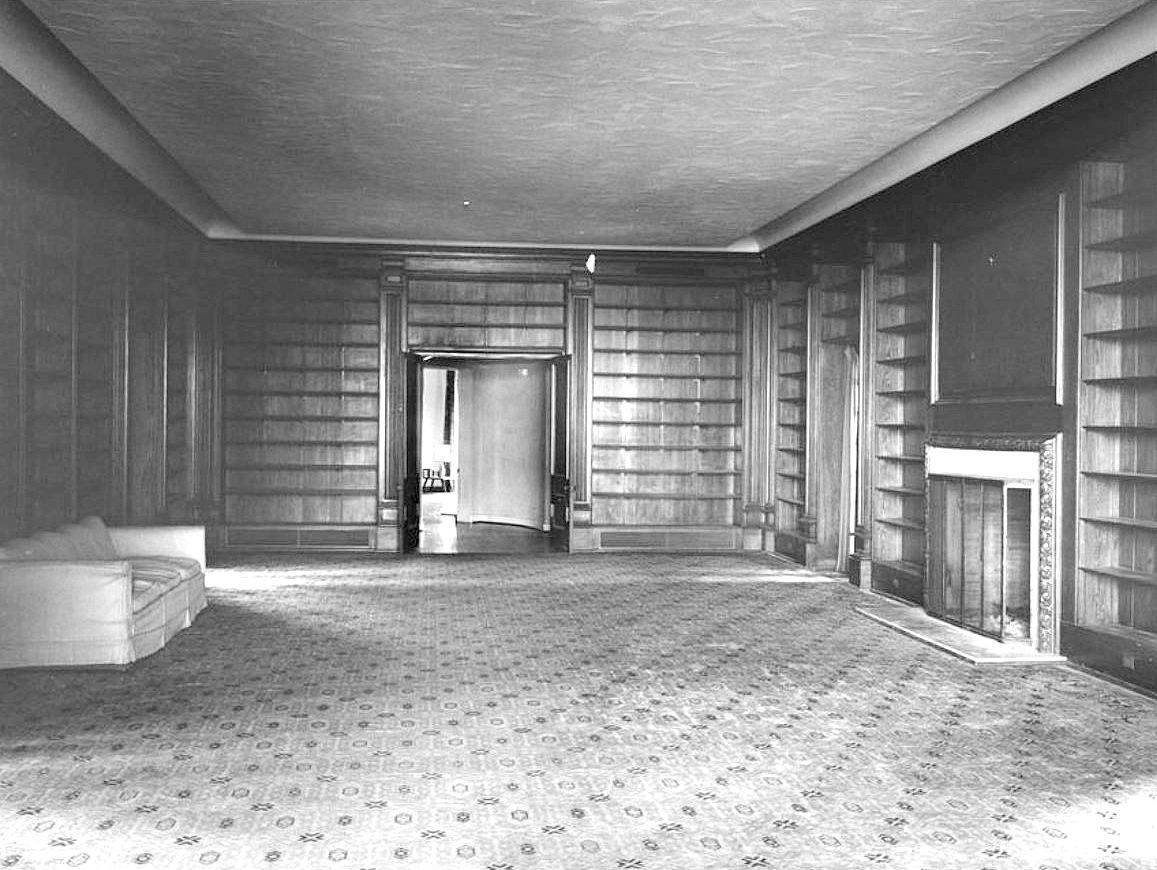
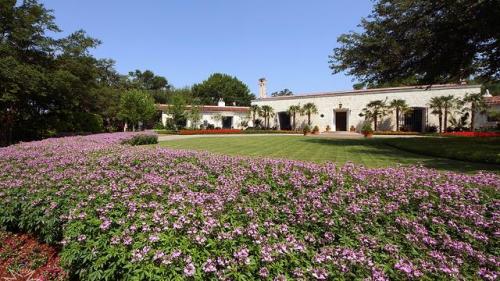 Photo: Dallas Arboretum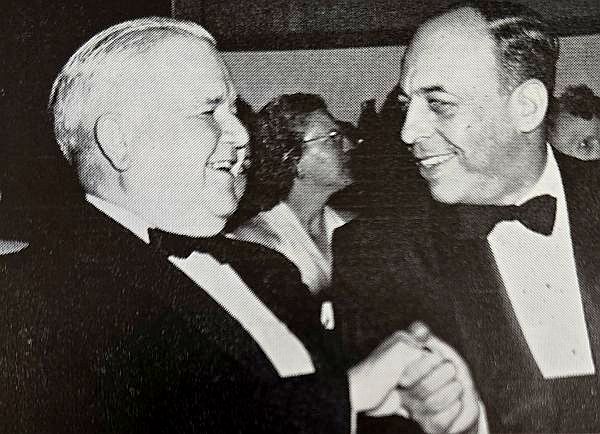











 Merle and Lefty, in Corsicana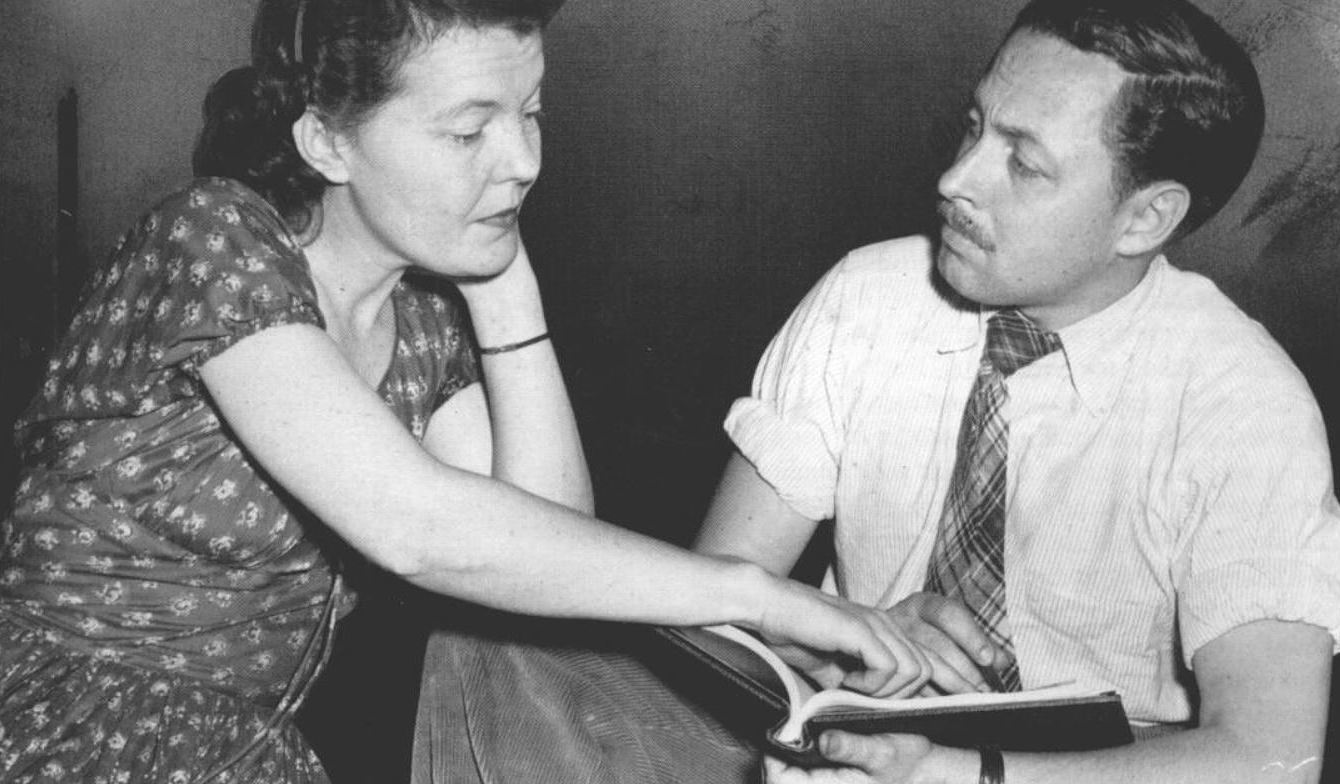



 Fort Worth Star-Telegram, June 16, 1949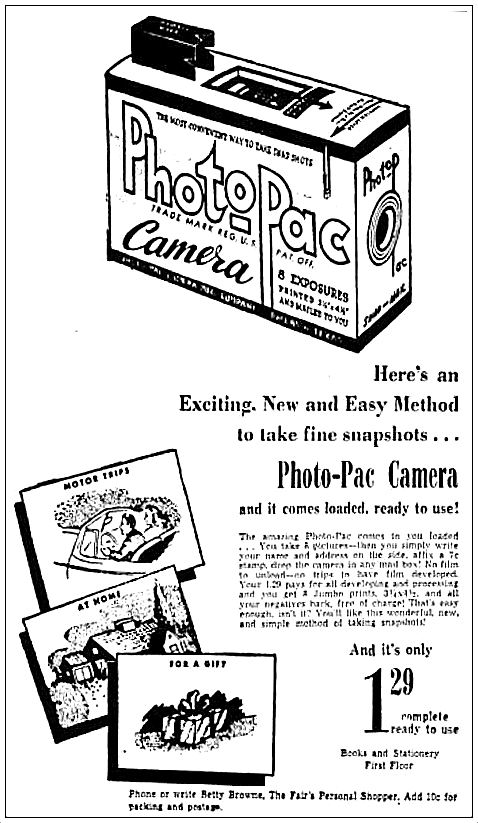





 Mary Roberts Wilson (1914-2001)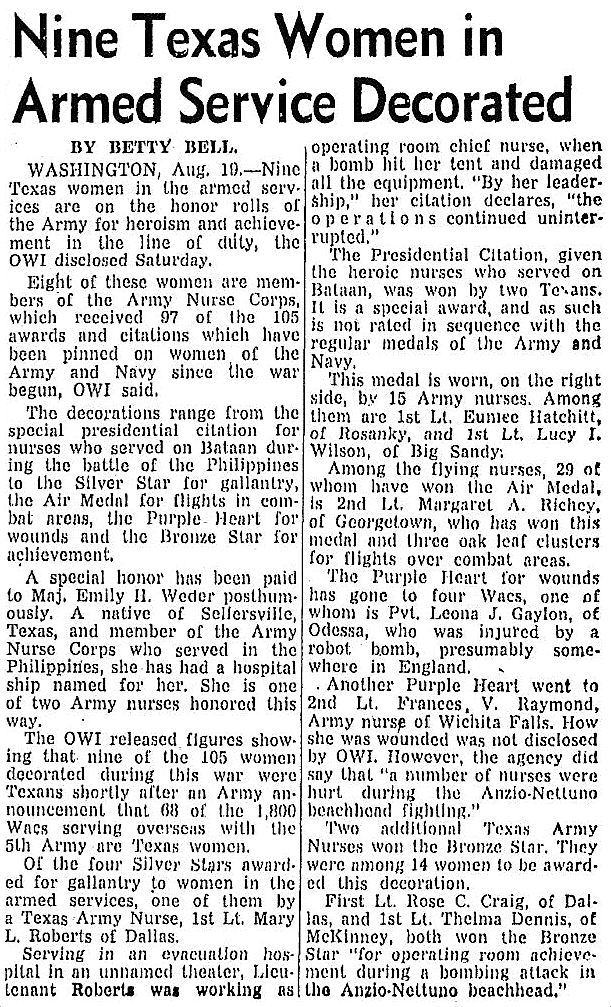
 Flashback : Dallas