Flashback : Dallas

A Miscellany: History, Ads, Pop Culture

Category: Local Personalities

The Gypsy Tea Room, Central Avenue, and The Darensbourg Brothers

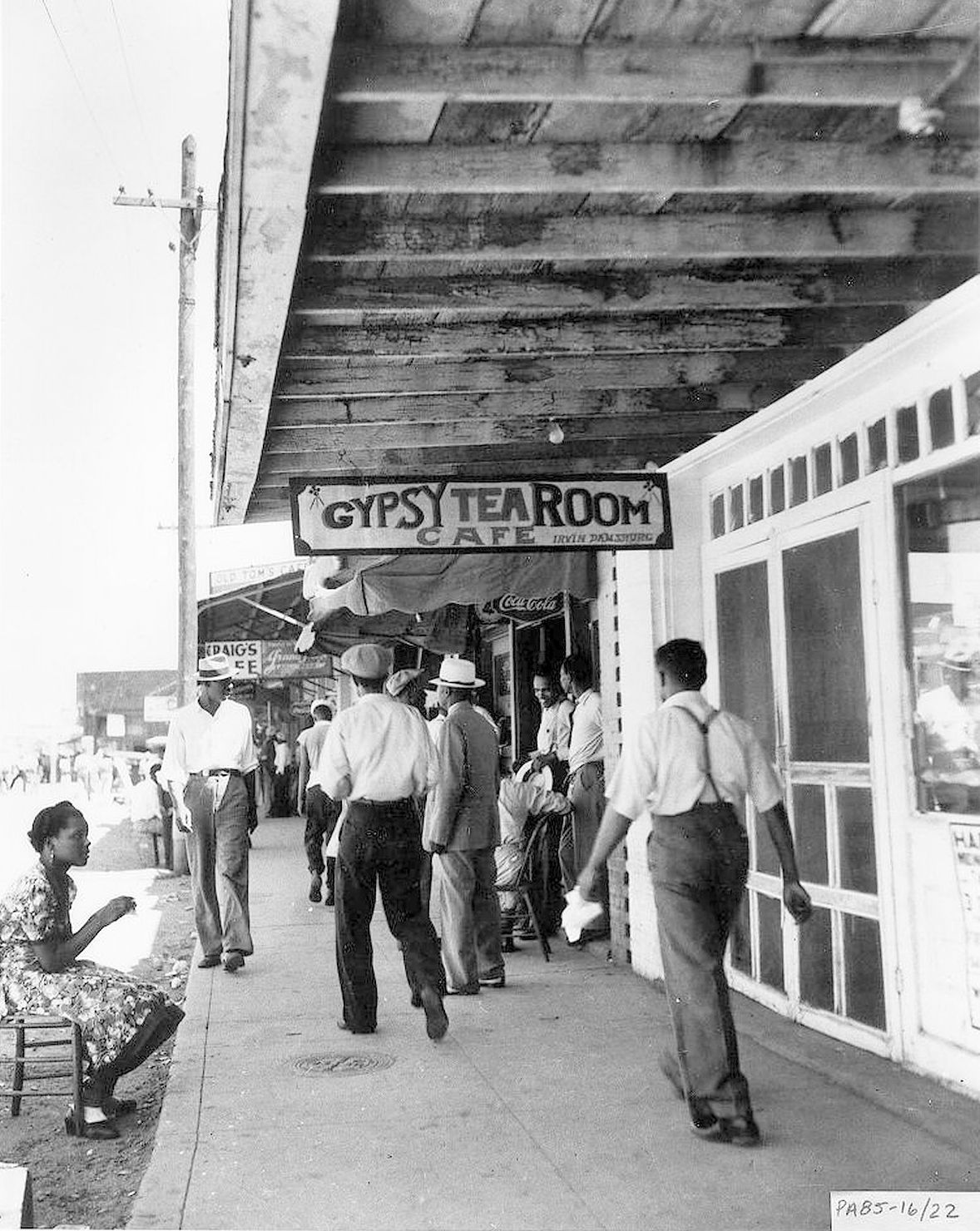
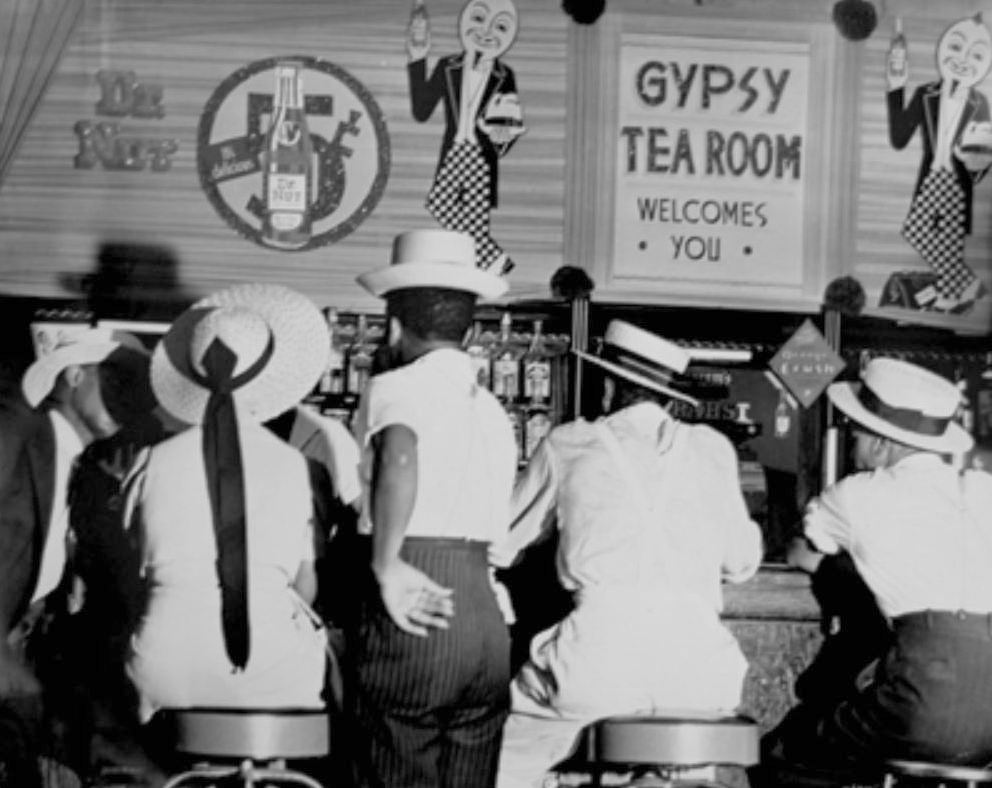
gypsy-tea-room_dallas-public-libraryThe 200 block of Central Ave., about 1937…  (Dallas Public Library photo)

by Paula Bosse

I’ve seen this photograph of Deep Ellum for years, and I’ve always loved it. But for some reason, I always thought this showed Elm Street — across from the Knights of Pythias Temple, just west of Good-Latimer (probably because that’s where a recent club with the same name was located). In fact, this scene was captured a couple of blocks west, just north of Elm, on Central Avenue, sometimes referred to as Central Track, along the Houston & Texas Central railroad tracks — a part of Deep Ellum that’s been gone for more than 60 years.

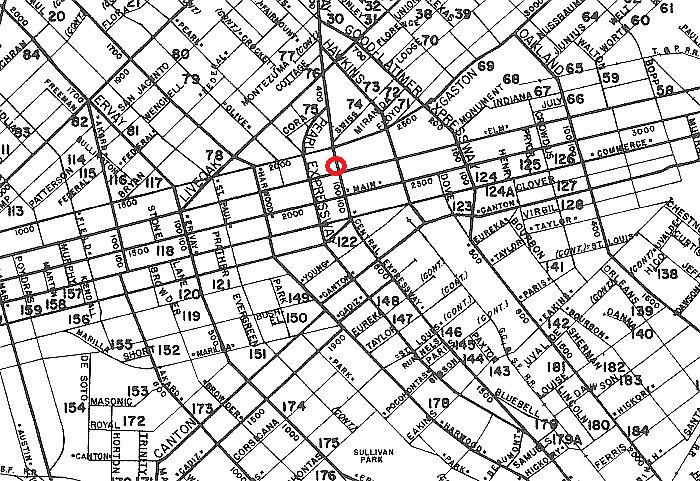
gypsy-tea-room-location_1952-map.jpgAfter Central Expwy. replaced Central Ave. (1952 Mapsco)

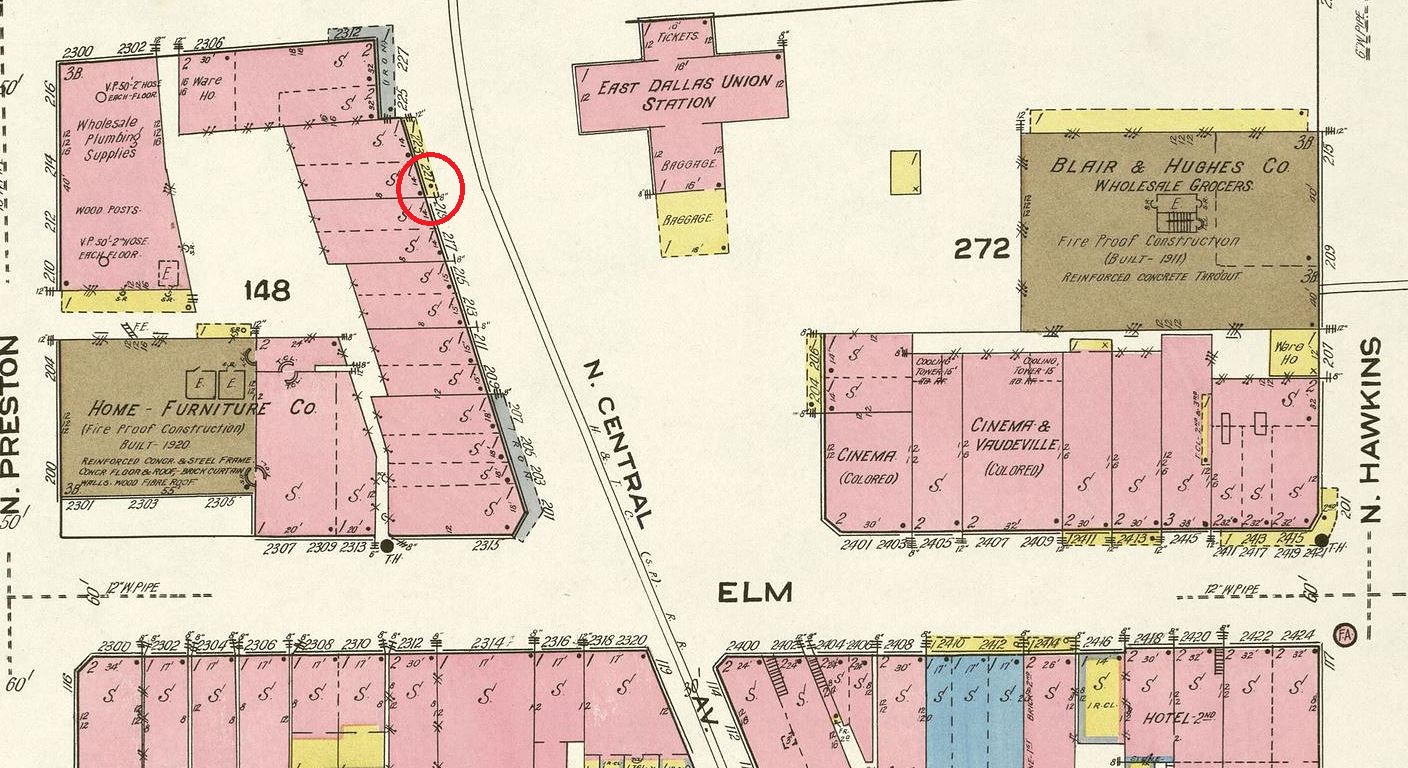
This area — which many have described as being the very heart of Deep Ellum in the 1920s through the 1940s (and which was somewhat ironically referred to as “the gay white way of the Negro in Dallas” by an uncredited WPA writer) — was demolished to make way for the construction of North Central Expressway (which closely followed the H&TC Railway tracks). This photo was taken in the 200 block of North Central Avenue, looking south toward Elm (the building farthest in the background, jutting out to the left, is across Elm, on the south side of the street). To the immediate left of this photo (out of frame) was the old union depot (read about it here).

You can see that the Sanborn map from 1921 shows that same building jutting out. (See the full Sanborn map here; it might be more helpful to see this detail rotated to show the same view as the photo, here.)

sanborn-map_1921_sheet-17-det1921 Sanborn map, detail (click for larger image)

Information about The Gypsy Tea Room is scant. The proprietor was a man named Irvin Darensbourg, whose family was from the black community of Killona, Louisiana in St. Charles Parish; they appear to have been of French Creole extraction, and the family’s last name was probably correctly spelled as D’Arensbourg.

The Darensbourgs were an interesting family (and not just because their mother’s maiden name was Louise Jupiter!). There were several children, and at least two of them were professional musicians: Percy Darensbourg (1899-1950) and Caffery (often spelled “Caffrey”) Darensbourg (1901-1940). Both played with several jazz bands, and Percy even made a few recordings, playing banjo. Below are a couple of promotional photos showing them at work in the 1920s, when they were still based in New Orleans, before they settled in Dallas. (These are cropped details — click pictures to see the full photos.)

Percy Darensbourg, with Lee Collins‘ band, 1925 or 1926:

percy-darensbourg_duke_det

Listen to Percy on banjo, here:


And, below, Caffery Darensbourg, with Manuel Perez’s Garden of Joy Orchestra (click photo to see full band — the other band members are identified here):

caffery-darensbourg_tulane-library

The first of the brothers to arrive in Dallas from New Orleans was Percy, in about 1929, and for the next few years he continued to make his living as a professional musician. Caffery followed in 1932 and opened the short-lived Frenchie’s Creole Inn on Boll Street. Their non-musician brother Irvin was here by 1935 and promptly opened the Green Tavern at 217 Central Avenue, just a few doors down from Percy’s drinking establishment, the Central Tavern Inn, at 223 Central. At about this same time, Percy was also running a club at 3120 Thomas called The Gay Paree — which The Dallas Morning News described as a “swanky negro night club” (April 12, 1938) in a short mention of Percy’s being fined for selling alcohol to an already-inebriated customer.

But back to that 200 block of Central Avenue — the one pictured in the photo at the top. Between 1937 and 1939, Irvin also owned/ran a small restaurant or cafe — and later a pool hall — out of 219½ Central. The Darensbourgs had that block locked up.

*

In 1935, a song called “In a Little Gypsy Tea Room” by Bob Crosby swept the country. It was a huge hit. Suddenly there were scads of places popping up all over calling themselves The Gypsy Tea Room or The Little Gypsy Tea Room. Some might have been actual tearooms, but there were also a lot of clubs and bars with the “tea room” name — the most famous of these was The Gypsy Tea Room in the Tremé district of New Orleans, at Villere & St. Ann, which opened the same year the song was being played incessantly by every dance band in the nation. This famous New Orleans nightclub booked the biggest jazz bands around and was a legendary musician’s hangout.

gypsy-tea-room_new-orleans_1942_tulane-libNew Orleans’ Gypsy Tea Room, 1942 (via Tulane University)

gypsy-tea-room_NOLA_myneworleansNew Orleans’ Gypsy Tea Room, 1930s (via MyNewOrleans.com)

The Darensbourgs most likely knew the club, its owner, its patrons, and the musicians who played there. Perhaps Irvin Darensbourg decided to name his own little Gypsy Tea Room in Dallas in honor of the New Orleans landmark. Whatever the case, Deep Ellum’s Gypsy Tea Room appears to have come and gone fairly quickly (and one assumes there was more than tea being sipped inside).

*

The life of a tavern and club operator could be a hard one, especially in those days, especially in the black neighborhoods of Deep Ellum and North Dallas. Irvin seemed to be forever sleeping on a relative’s couch and had a different address every few months. By 1940 he had moved to Fort Worth to open another bar, and after that … I’m not sure what became of him — but one hopes that he met a less violent end than his brothers did here in Dallas. According to Caffery’s death certificate, he died in 1940 after having been shot in the abdomen while “in a public place.” His death was ruled a homicide. Percy, who by all indications was the most stable and successful of the brothers, was also killed — in 1950 he was stabbed in the neck (!) while out on the street at 4:20 AM.

**

As for the original photograph, I’ve pored over it and looked through directories, but I can’t pinpoint the exact year this photo was taken or determine what the actual address of the Gypsy Tea Room was. Since it was mentioned in the WPA Dallas Guide and History, which was written and compiled between 1936 and 1940 and contains the only contemporary mention of the Tea Room, my guess is that this photograph was taken about 1937, as this was the last year that Old Tom’s Tavern (209 ½ Central) seems to have been in business (although the bar that replaced it was owned by the same person, and the sign seen in this photograph could well have remained up for a while).

Craig’s Cafe, at 213 Central, was in business between 1929 and at least 1946 when property began to be demolished in order to begin construction on the expressway. The Gypsy Tea Room looks to be either two or three doors down from Craig’s place. My guess is that it’s 219 Central. The 1937 street directory has Irvin Darensbourg (whose name is constantly mangled and misspelled everywhere) listed as being the proprietor of both the Green Tavern (at 217 Central) as well as an unnamed restaurant at 219-A (sometimes written as 219 ½) Central. The 1938 and 1939 directories specify Darensbourg’s business at this address in those years is a pool hall, not a restaurant. So I’m going to venture that Irvin Darensbourg ran the Gypsy Tea Room at 219 Central Avenue in 1937. 

1937_gypsy-tea-room_central_1937-directory
1937 Dallas directory

That was exhausting!

***

Sources & Notes

Photo of the Gypsy Tea Room at the top of this post is from the Texas/Dallas History & Archives Division of the Dallas Public Library: “Gypsy Tea Room Cafe located in Deep Ellum” is from the WPA Dallas Guide & History Collection of the Dallas Public Library — its call number is PA85-16/22.

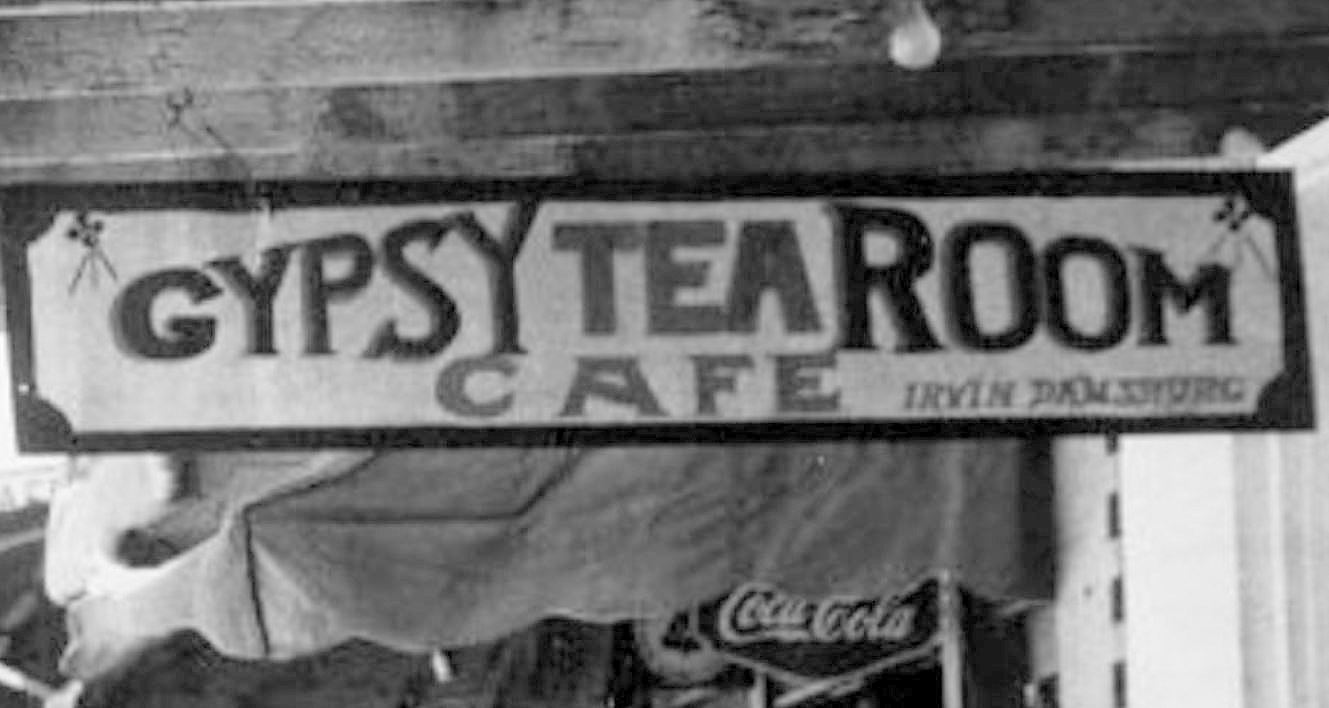
Thanks to Bob Dunn of the Lone Star Library Annex for deciphering “Darensbourg” from this badly garbled printed name on the Gypsy Tea Room sign.

gypsy-tea-room-sign

Here are a few of the numerous ways this Darensbourg’s family’s name is misspelled across the internet:

D’Arensbourg
Darensbourg
Darensburg
Darenbourg
Darenburg
Darnburg
Darnsberg
Dansberg

Darensborough

And I’m still not actually sure whether it’s “Irvin” or “Irving,” or “Caffery” or “Caffrey.”

When clicked, the photo of Percy Darensbourg above opens up to show the full band — the personnel is identified in a caption from the book Oh, Didn’t He Ramble: The Life Story of Lee Collins: “Lee’s band in Dallas, 1925 or 1926. From the left: Coke Eye Bob (Arthur Joseph?), Mary Brown, Freddie ‘Boo-Boo’ Miller, Octave Crosby, Henry Julien, ‘Professor’ Sherman Cook, Lee, and Percy Darensburg [sic].”

A couple of other versions of “In a Little Gypsy Tea Room,” if you must:

  • The version by The Light Crust Doughboys (no strangers to Deep Ellum), recorded in 1935 in Dallas at 508 Park, is here.
  • The at-least-peppier version by Louis Prima and His New Orleans Gang, also recorded in 1935, is here.

See what the area once occupied by the vibrant street life of Central Track looks like now, here. The expressway overpass is now planted about where the photo was taken. It’s a shame this important part of town — in a way it was Dallas’ second downtown — was bulldozed into oblivion.

*

Copyright © 2015 Paula Bosse. All Rights Reserved.

HR Meeting at the Carousel Club

ruby-girls_carousel-club“Where do you see yourself in five years?”

by Paula Bosse

Jack and the girls. …Before.

***

Sources & Notes

I think this is the Carousel Club. It might not be. The source of this photo is a bad, bad, bad, spammy site with loud commercials. They get no credit from me. “No soup for you!”

*

Copyright © 2015 Paula Bosse. All Rights Reserved.

Views of Dallas by Bruno Lore — 1931

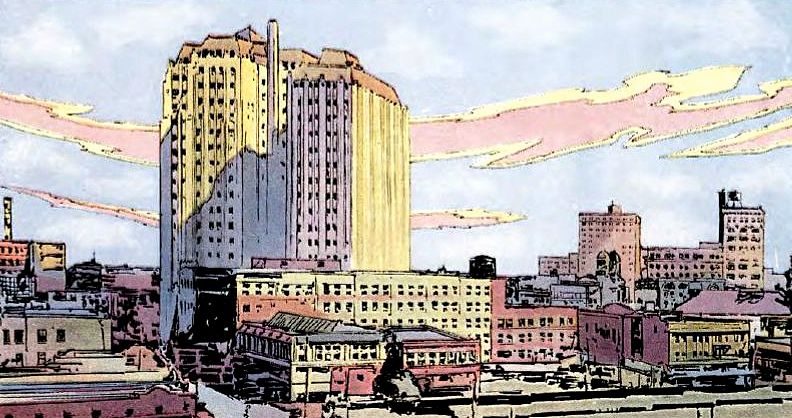
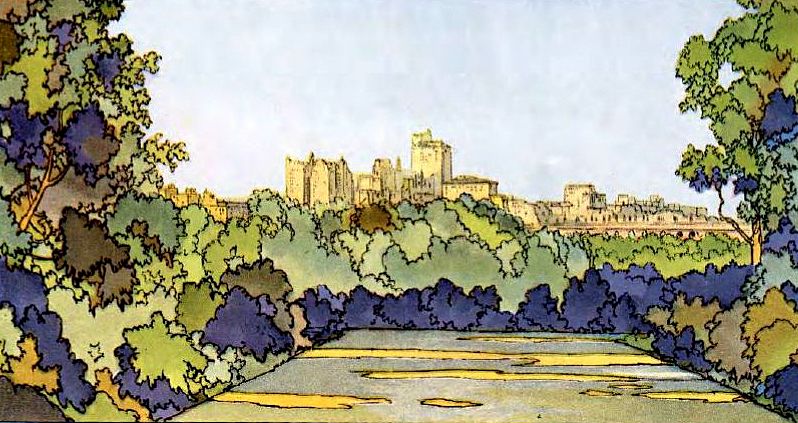
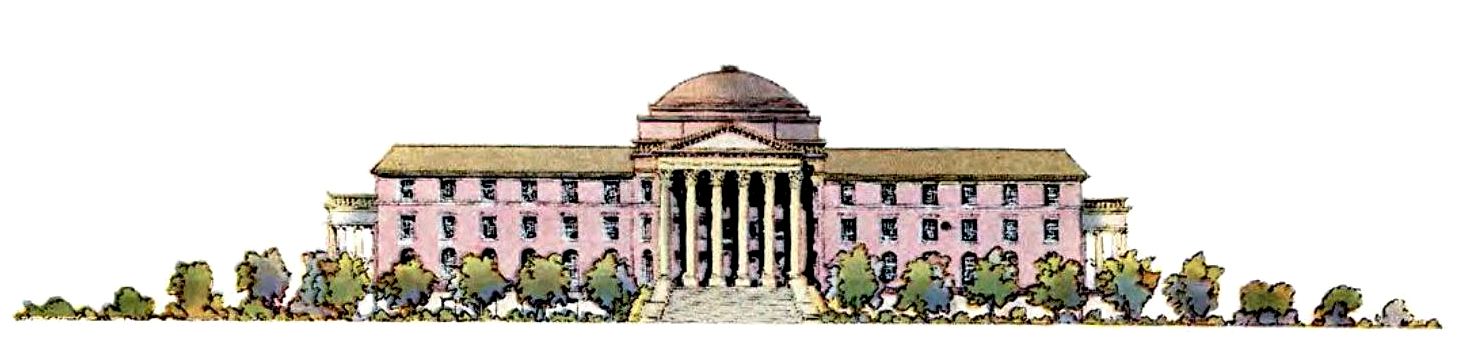
skyline_smu_1931Bruno Lore’s Dallas, in purples and pinks

by Paula Bosse

Bruno J. Lore (1890-1963) was a Fort Worth artist and illustrator who spent much of his career working for the Southwestern Engraving Company. Known as “the dean of Fort Worth commercial artists,” Lore had a long and successful career, counting among his many clients colleges and universities who commissioned him to create artwork for their yearbooks (and, perhaps as a friendly or persuasive perk, he was often asked to pick the campus beauties who would be featured in those same yearbooks). Even though information about Lore is scant, he seems to have had steady yearbook work, with his illustrations appearing in several Southern and Southwestern college annuals, primarily in the 1920s and ’30s. In Dallas, his artwork appeared in editions of SMU’s Rotunda.

Below are Lore’s vividly colorful views of the SMU campus and the Dallas skyline which appeared in the 1931 Rotunda and provided a lively, modern exuberance to an otherwise fairly standard college yearbook.

rotunda_1931_advertising-header

smu-rotunda_1931-intto

dallas-hall_smu-rotunda-1931

skyline_smu-rotunda-1931

skyline-3_smu-rotunda-1931

skyline-5_smu-rotunda-1931

skyline-2_smu-rotunda-1931

skyline-6_smu-rotunda-1931

skyline-4_smu-rotunda-1931

skyline-8_smu-rotunda-1931

skyline-7_smu-rotunda-1931

saddleburr_smu-rotunda-1931

students_smu-rotunda-1931

smu-1931rotunda_1931_title-page

*

Lore was doing yearbook work (along with his other commissions) into at least the ’40s. His later years seem to have been focused on Western art, and he produced several paintings. He seems to be most fondly remembered by collectors as the artist who was responsible for several decades’ worth of Western-themed cover art for souvenir annuals of the Fort Worth Rodeo and the Southwestern Exposition and Fat Stock Show.

lore_FWST_012173Fort Worth Star-Telegram, Jan. 21, 1973

***

Sources & Notes

All artwork is from the 1931 Rotunda, yearbook of Southern Methodist University. The above illustrations are unattributed, but it seems fairly certain that they are by Bruno J. Lore, who is mentioned in the school’s newspaper, The Daily Campus, as providing the artwork for the 1931 Rotunda. This edition of the yearbook also contains eight somewhat more staid views of campus scenes in pencil or ink and wash which are attributed to Lore. Lore’s yearbook work was apparently done remotely, and he often worked from photographs.

*

Copyright © 2015 Paula Bosse. All Rights Reserved.

Waking Up Every Day To an Unimpeded View of Lake Cliff Park

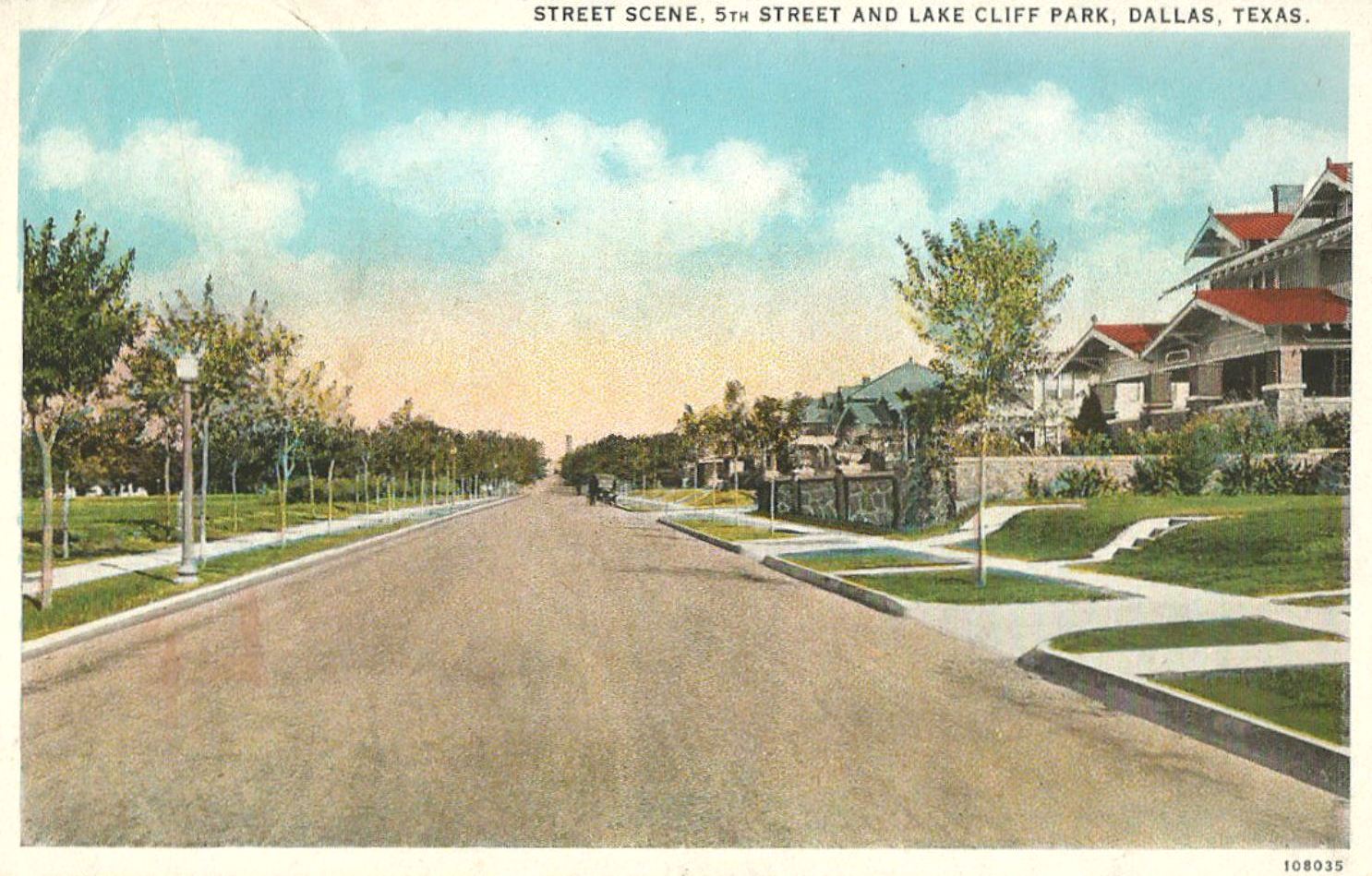
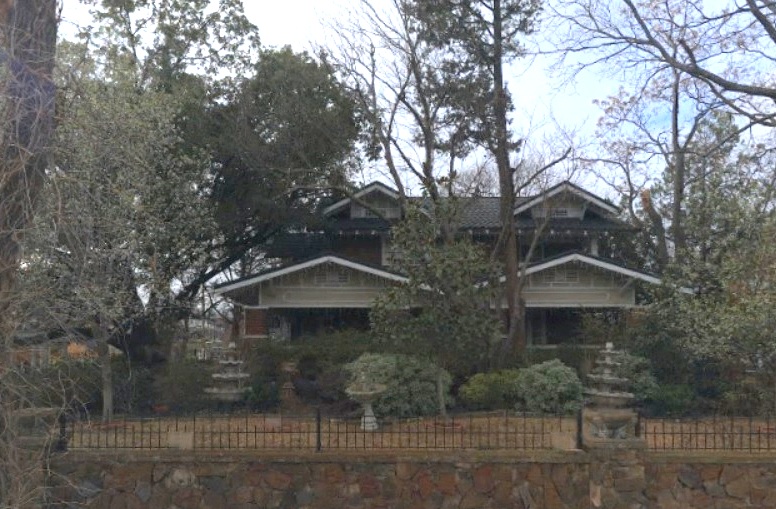
oak-cliff_5th-street_lake-cliff-park_ebayThe red-roofed Frank Rogers house, E. Fifth & N. Denver, Oak Cliff

by Paula Bosse

I saw this postcard of a row of houses on East Fifth Street in Oak Cliff and wondered if the house with the red roof and the low stone wall was still standing. Happily, it is. With a little digging, I discovered that the house at 320 E. Fifth Street was built in 1922 or very, very early 1923 for Frank Rogers, one of Dallas’ top photographers. A photographer would want to live with a beautiful view, and he certainly had it there — Lake Cliff Park was right across the street. (The artist Frank Reaugh also lived on East Fifth, a block or two to the west.) Frank Rogers (1878-1961) lived in the house he built at the corner of East Fifth and North Denver until his death at the age of 82.

It appears that Rogers bought the property in the survey area known as Robinson’s Park Place in December of 1920 for $8,000. The address does not exist until his house is built — it shows up for the first time in the 1923 city directory. The 1922 Sanborn map (see it here) shows the corner lot empty — as well as most of the rest of the lots along East Fifth between North Crawford and North Denver.

Here are a few bits and pieces of random information from a search on the address. In 1933, Rogers’ German Shepherd got loose. That park would have been an absolute paradise for a dog on the lam.

roger_dmn_090233Sept. 2, 1933

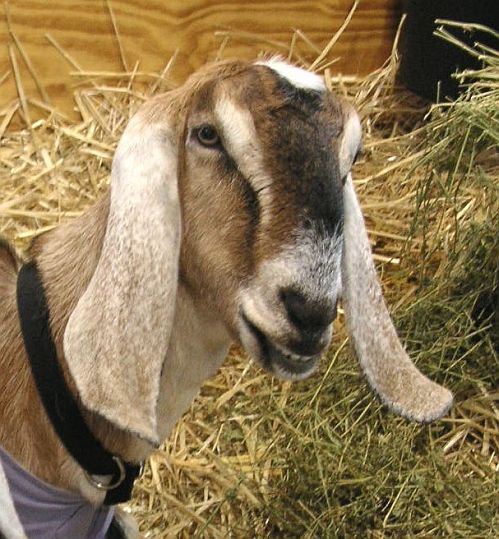
And in 1936, for some reason Rogers was selling a “Nubian milch goat,” a friendly source of milk which was, presumably, kept on the property. Was it being sold at the behest of neighbors? The publication Milch Goat Dairy (1917) informs us that “no member of the goat family is more peaceful or gentle than the Nubian, and while the bucks of this breed have the same odor that all goat bucks have, the odor is far less in this breed.” Still. The other well-heeled neighbors might have had a few goat-related issues.

320_dmn_111736-goatNov. 17, 1936

Nubian goat! (Wikipedia)

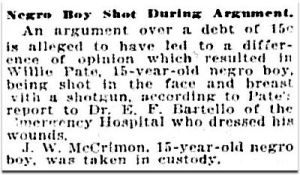
There was a room or small apartment at the rear of the house, and directories show that (at least through the ’20s) there was an ever-changing roster of lodgers who lived there — every year a different name was listed. They were most likely employees. In 1929, the occupant was J. W. McCrimon/McCrimmon, who may have been the same person who, as a minor in 1922, was accused of wounding another minor with a shotgun.

mccrimon_dmn_082922Dallas Morning News, Aug. 29, 1922

Frank Rogers began his career as a newspaper photographer who later ran his own photography studio with his son, Norman. He preferred commercial jobs to bread-and-butter studio portraiture, though he did both. Whatever kind of job he was doing, he preferred to use flash powder when he could, a practice which caused several injuries (and even fires!) over the years.

A news article in 1945 described one such incident: during a commissioned job in which he was taking hundreds of employee photographs for a large company, his flash-powder gun exploded and he was “seriously burned on the hands and face. His spectacles, physicians told him, probably saved his eyesight” (DMN, Feb. 10, 1945).

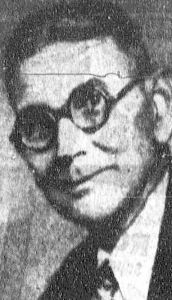
And here he is in those spectacles:

rogers-frank_portrait

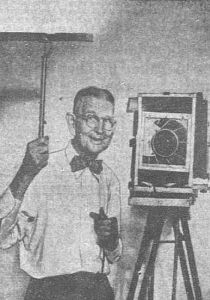
Here’s another photo of the happy-looking photographer, posing with his camera and the potentially incendiary accoutrement.

rogers-frank_at-work_ca-1950s

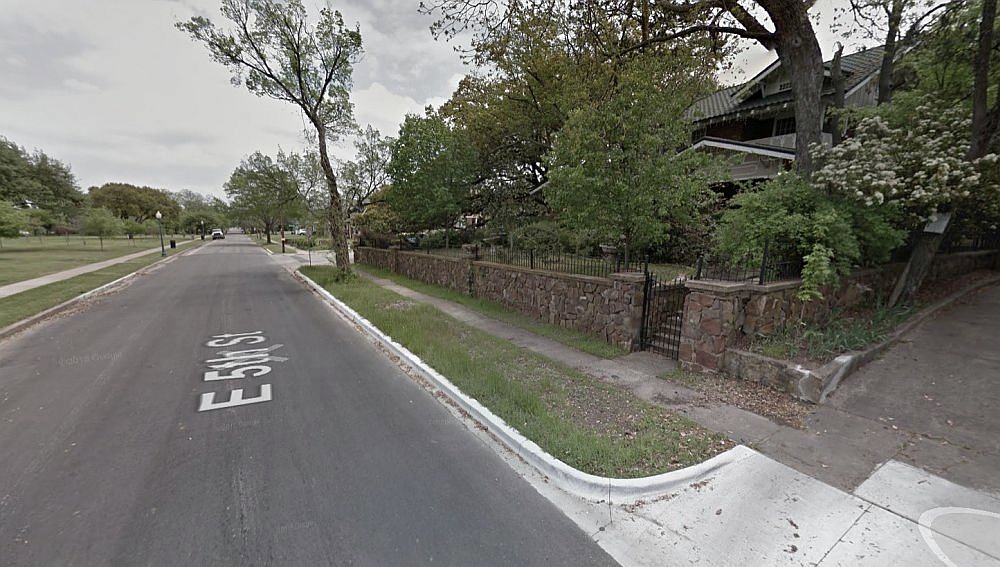
But back to the house. Here it is today.

rogers-house_googleGoogle Street View

And another view, this time with the front of the house visible.

rogers-house_bingBing StreetSide

If I had access to flash powder, I’d go out today and take an extremely well-lit photo of an old Dallas building (and hope I’d survive the experience) — as a nod to Frank Rogers, his cool house, and all the wonderful photos of Dallas he took in the first half of the 20th century. Thanks, Frank!

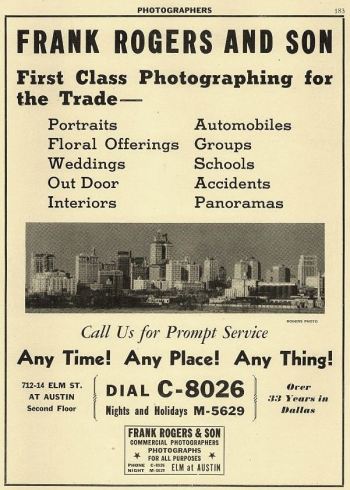
rogers-frank_ad_dallas-directory_1944-45
Frank Rogers and Son ad, 1944-45 Dallas directory

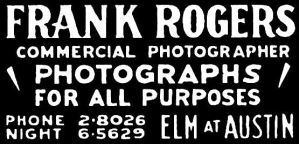
rogers-frank_1936-directory1936 Dallas directory

***

Sources & Notes

Postcard is from eBay.

Frank Rogers was a busy man. If you’re interested in Dallas history (and I’m guessing you are if you’re reading a Dallas history blog), you’ve probably seen dozens and dozens (and dozens) of his photos without even knowing it. The Frank Rogers Collection is housed at the Dallas Public Library. I’ve used a few of his photos in previous posts — one of my favorites is his view of the Akard Street Canyon, here.

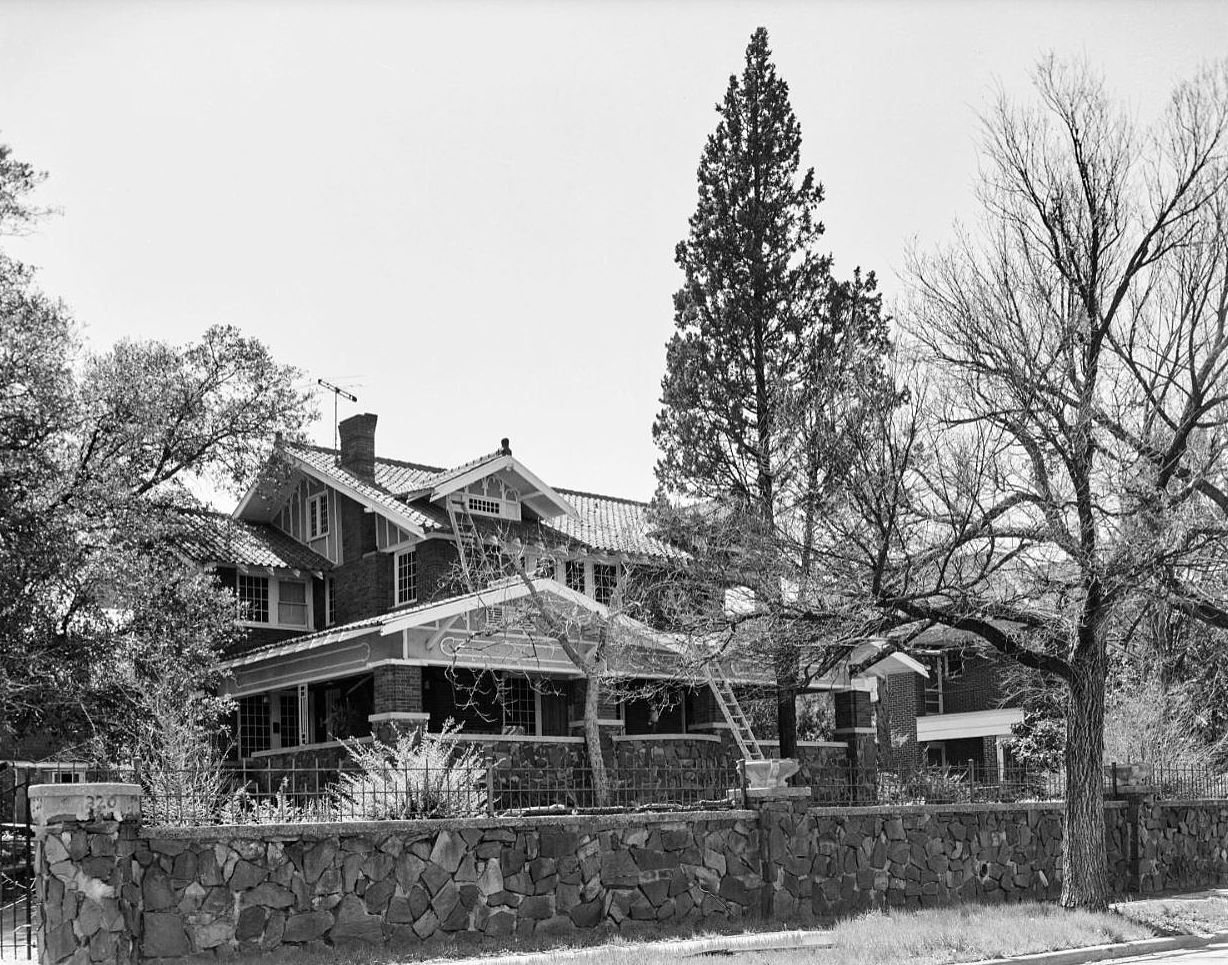
Another photo of the house can be seen in the 1980 photo below, from the Texas Historical Commission Historical Resources Survey, via the Portal to Texas History, here.

rogers-frank_home_320-east-fifth_oak-cliff_portal_1980

Take a tour of the Lake Cliff Park area via Google Street View, here.

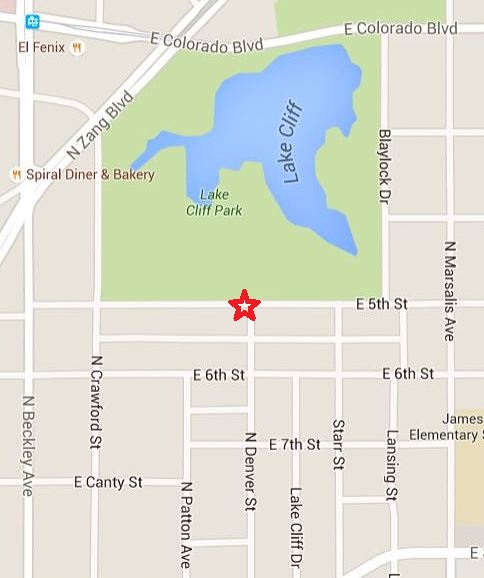
And finally, here’s where Frank’s house is, marked in red.

rogers-house_googleGoogle Maps

*

Copyright © 2015 Paula Bosse. All Rights Reserved.

Ebby Halliday, 1911-2015

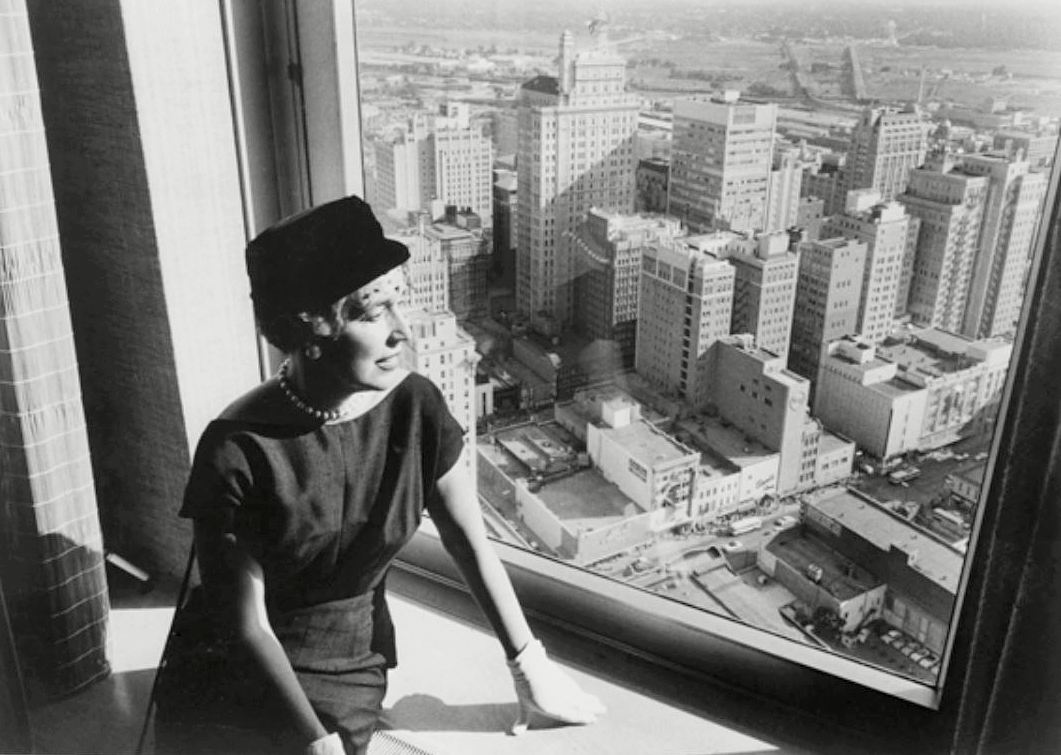
ebby_1957_big-d_cowboy-hat_via-candys-dirt
Ebby in Big D, 1957… (photo: Ebby Halliday Realtors)

by Paula Bosse

(Feb. 2019: This post has been expanded since its original publication on Sept. 9, 2015.)

Ebby Halliday — the Dallas realtor known instantly by just her first name — died September 8, 2015 at the age of 104. Ebby was not only stunningly successful in the world of Dallas real estate, she was also something of a pioneer in paving the way for other women to establish and find great success in business. There are several obituaries that will present a more complete overview of her life (see links at the bottom of this post), so I’ll just post a few odds and ends that have caught my attention.

*

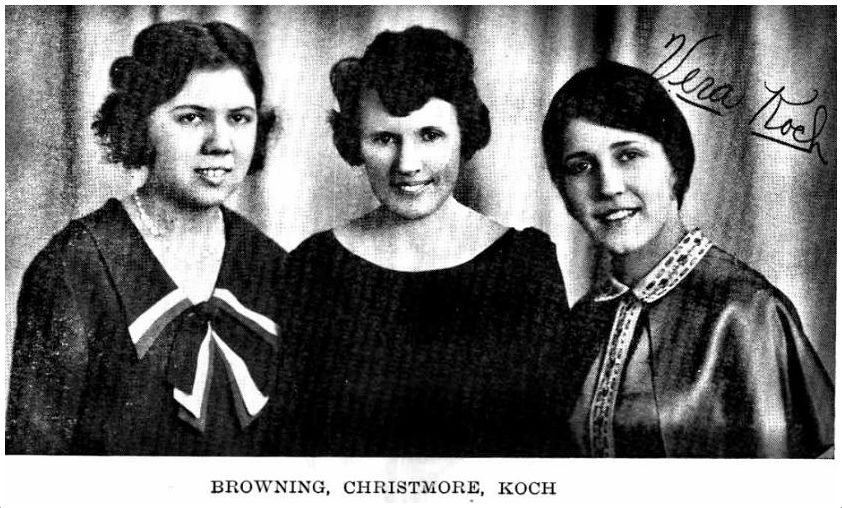
Vera Lucille Koch grew up in Kansas, and according to her 1929 Abilene High School yearbook, she was inordinately active in all sorts of clubs and sports. Here are a couple of photos from that yearbook (most images are larger when clicked); the first one shows her with the debate team.
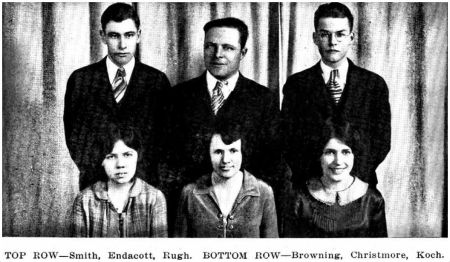
ebby_debate-club_AHS-1929

And the second one shows her with her “Forensics” teammates (she excelled in reading competitions, although I’m not exactly sure what that means, as most “forensics” events involve debating). Rather amazingly, this scanned yearbook has her signature!
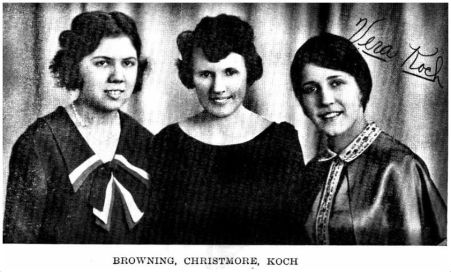
ebby_forensics-team-reading_AHS-1929

These two extra-curricular activities served her well in her later career — she obviously learned a lot about the effectiveness of persuasion at an early age.

After school, she spent several years working in department stores selling women’s fashions (including a stint in Omaha, where a vivacious young Vera can be seen in a  fantastic photo posted by D Magazine here). Ultimately she arrived in glamorous Dallas around 1938, where she began life as a Dallasite managing the women’s hat department at the downtown department store W. A. Green. Most accounts have her entering the real estate business while still selling hats, soon after the war — almost by a fluke. Legend has it that one of her customers mentioned to her husband, famed oilman Clint Murchison, that he might want to utilize Ebby’s sense of style by having her decorate a few of his newly-built houses in Far North Dallas in order to increase sluggish sales; she was apparently so successful at this that she decided to pursue selling houses on her own and eventually established her own realty company.

*

I’ve always wondered about the name “Ebby” — what was it short for? Ebby Halliday is the only Ebby I’ve ever heard of. Turns out that she made the name up, sometime between graduating from high school in Kansas and coming to Dallas. In a 1983 Dallas Morning News interview, she explained how Vera Lucille Koch became “Ebby Halliday”:

“I was selling hats when one of the buyers who I admired a great deal told me I had to get rid of  Vera Lucille. She said it was the silliest name she’d ever heard. I needed something more sophisticated. I thought about it and came up with the name Ebby. That sounded very, to me, like I had a lot of class.” (DMN, Sept. 25, 1983)

The  paragraph ended with two sentences added by the writer of the article:

The name Halliday came from an early first marriage. That husband is now deceased.

The somewhat dismissive tone of those last two lines is interesting, because that husband, Claude W. Halliday — whom she appears to have married in 1947 (although an earlier marriage license for the couple had been issued in 1945 in New York) — is almost non-existent in newspaper searches. C. W. Halliday (1908-1965) was described in a 1957 article about Ebby as being “engaged in an investment and building corporation.” In his 1965 obituary, C. W. was described as “head of C. W. Halliday Realtors and a partner in Ebby Halliday Realtors.” When C. W. died in 1965 — several years he and Ebby had divorced (and the same year Ebby married Maurice Acers) — it was Ebby who acted as informant on his death certificate. Mr. Halliday’s real estate career began about 1946, a year or so before Ebby opened her own retail millinery business. Ebby and C. W.’s marriage lasted for over 12 years, but most traces of him seem to have vanished into the ether.

But back to the name “Ebby.” When the former Vera Lucille Koch arrived in Dallas around 1938 to work at the W. A. Green department store, she was listed in the city directory as “Mrs. Vera Eberhardt.” I’m not sure where the “Mrs.” came from (had she been married before she arrived in Dallas?), but it’s certainly easy to see that “Ebby” probably came from “Eberhardt,” a name which was either a husband’s surname or the name she described as having created for herself because it sounded sophisticated.

eberhardt_vera_ebby_1939-directory1939 Dallas directory

In June, 1940, 29-year-old Ebby married KRLD broadcaster Royce H. Colon. Their marriage lasted only a few years, but it was during this time that the city directory shows her using the name “Ebby” professionally, while still working at Green’s.
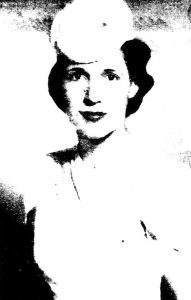
colon_ebby_1940
Mrs. Royce Colon, 1940

colon_1941-directory
1941 Dallas directory

colon_1942-43-directory1942-43 Dallas directory

In Mr. Colon’s 1975 obituary it was stated that he had begun his career in real estate (with Majors & Majors Realtors) at a time which would have coincided with the years he and Ebby were married. This is to take nothing away from Ebby’s incredible accomplishments, but if that were the case, it seems that she might have had some (at least rudimentary) background in real estate before Clint Murchison asked her to spiffy-up some new houses he was having trouble unloading. It’s possible she may have entered her new profession with more in her quiver than simply a flair for interior decoration. Ambition may have seemed unladylike and immodest for a “career gal” in the 1940s, even for someone as independent and focused as Ebby. I wonder if her “origin story” might have been softened a bit to play down her ambition? Whatever the case, it didn’t take Ebby long to make her mark on the world of Dallas real estate, and, in so doing, establishing for herself a national reputation as both a top realtor as well as a major inspiration and mentor for women in business. 

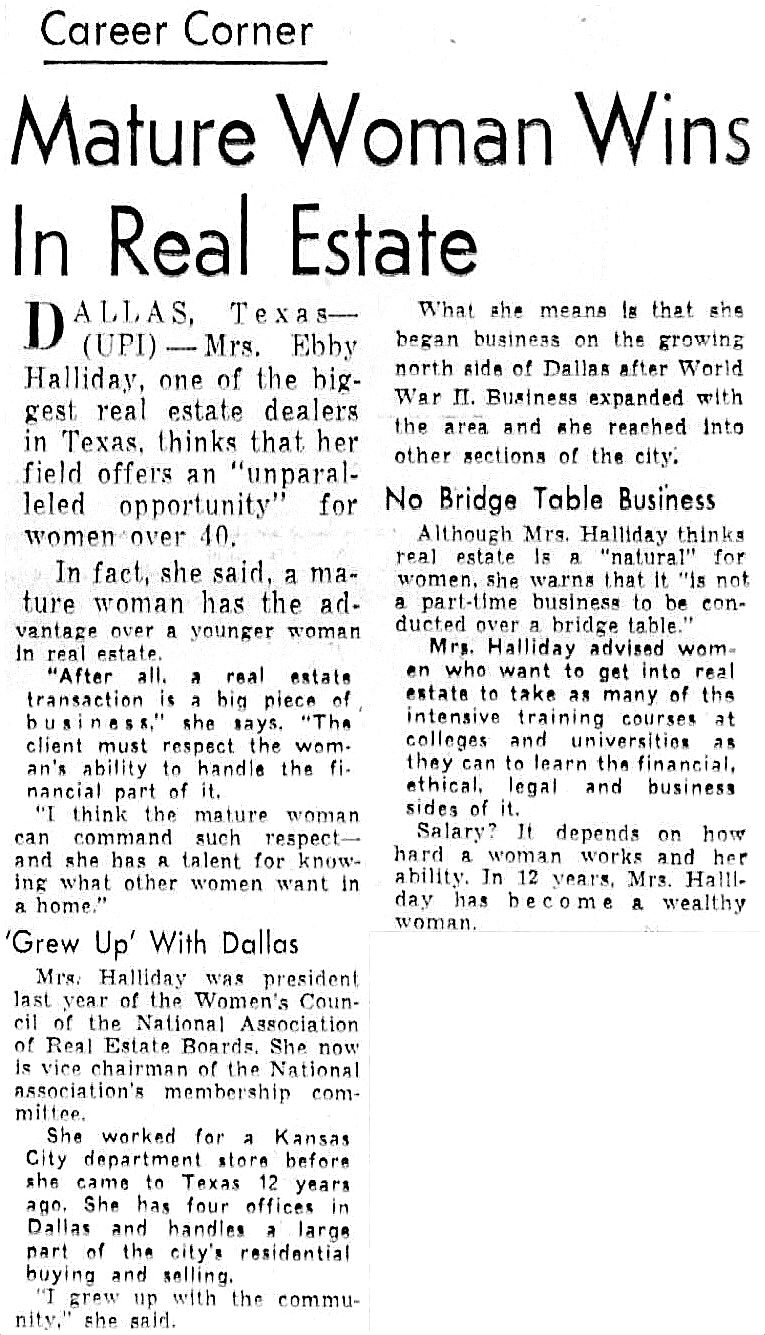
Below is the type of article about Ebby Halliday’s accomplishments which ran constantly throughout her career. (Most images in this post are larger when clicked.)
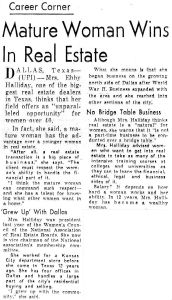
ebby-halliday_tennessean_090758_upi-wire-story
The Tennessean, Nashville, TN, Sept. 7, 1958

*

But back to that hat shop.

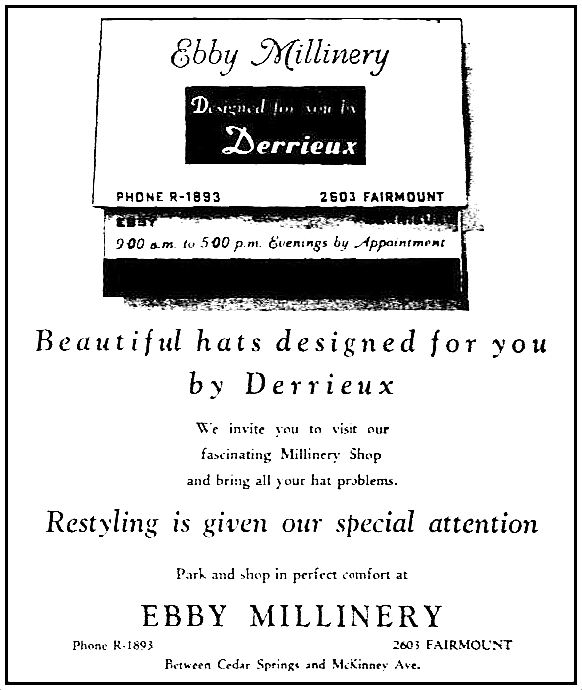
The first mentions I found for the shop Ebby Millinery (one of several boutique shops which operated in the still-beautiful old home at 2603 Fairmount), were in August, 1947 — an article in The Dallas Morning News described the shop as having “opened recently.” Ebby (who had recently become Mrs. C. W. Halliday) opened the shop in partnership with Dallas hat designer Annabelle Derrieux Bradley.

ebby-millinery_081047
Aug. 10, 1947

The shop’s bold decoration sounds … bold:

…Ebby Millinery’s French Room is decorated with bottle green walls and carpets and accented with striped drapes of deep shocking pink and chartreuse. The designing room has a touch of the Victorian with frilly white curtains and oversized wallpaper roses against a bottle-green background. (DMN, Aug. 20, 1947)

ebby-millinery_102647
Oct. 26, 1947

When Ebby decided to pursue her new real estate business full-time, Derrieux and her husband took over the shop and eventually renamed it Derrieux Hats.

*

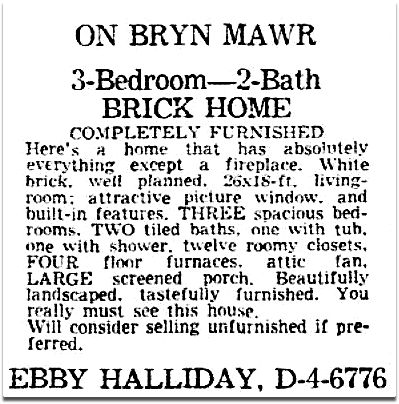
The first real estate ad I could find that featured Ebby’s name is this one, from 1948:
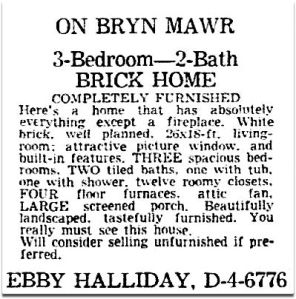
ebby_dmn_080548DMN, Aug. 5, 1948

And she was off like a rocket.

**

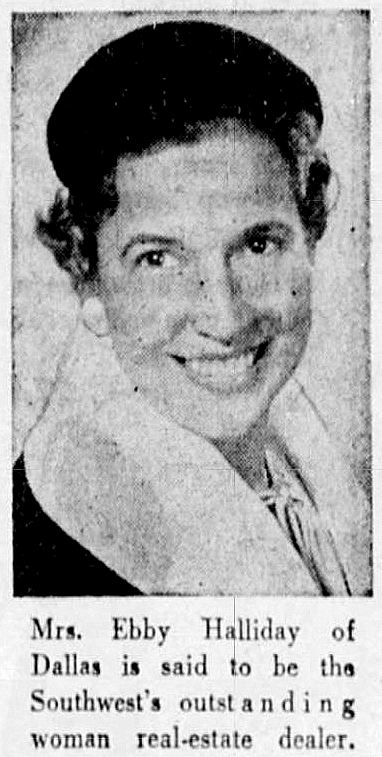
Below are a few photos of Ebby I’ve come across which I particularly like.

ebby_1956_charm_via-candys-dirt1956, Charm magazine (“the magazine for women who work”) (via Candy’s Dirt)

*

ebby-halliday_louisville-KY-courier-journal_092257Louisville (KY) Courier-Journal, Sept. 22, 1957

*
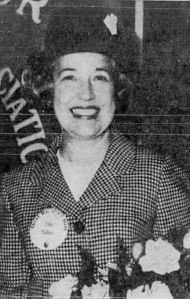
ebby-halliday_austin-statesman_012566
Austin Statesman, Jan. 25, 1966

*

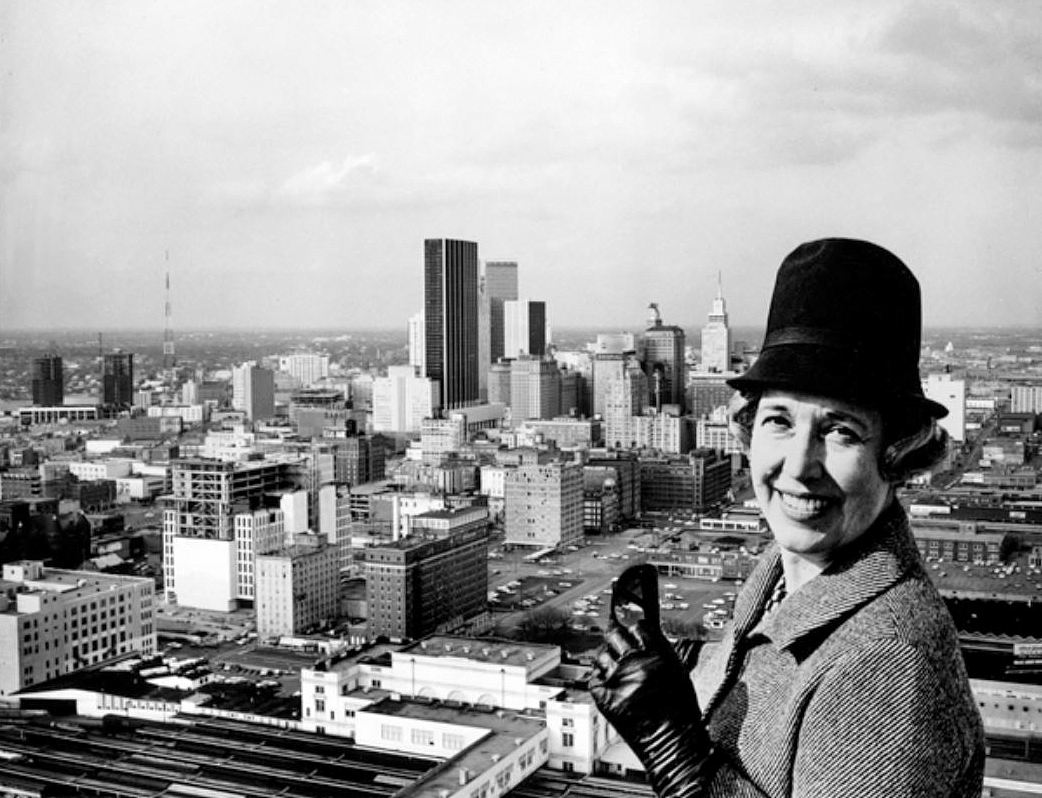
ebby_dallas-skyline1966 (via Candy’s Dirt)

This photo is interesting because a version of it appears in the May 15, 1966 edition of the Sydney Morning Herald under the headline “The Texas Millionairess” with one slight difference: instead of posing above the Dallas skyline, she is shown posing above the Sydney skyline while on a trip to Australia.

*

And here she is in later days: the undisputed grand dame of Dallas real estate. RIP, Ebby.
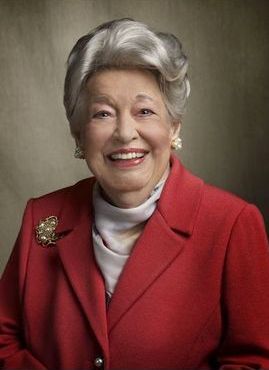
ebby_wfaa

***

Sources & Notes

Top photo is one of three in this post which appeared in a Candy’s Dirt slideshow here (slideshow photos are from the archives of Ebby Halliday Realtors — there are tons of great photos there!).

Highschool photos of Vera Koch are from the 1929 yearbook of Abilene (Kansas) High School.

Ebby Halliday Acers died Tuesday, Sept. 8, 2015. A few of the online obituaries/tributes in the local media:

  • Dallas Morning News, here
  • Dallas Business Journal, here
  • D Magazine, here
  • Ebby Halliday Realtors website, here

A great article on a typical day at work for the 96-year-old Halliday (!) appeared in D Magazine in July, 2007; read Candace Carlisle’s article “Ebby Halliday: The Woman Who (Still) Sells Dallas,” here.

*

Copyright © 2015 Paula Bosse. All Rights Reserved.


Tracking Down a Photo Location & Discovering a City Pioneer: D. M. Clower, The Man Who Brought the Telephone to Dallas

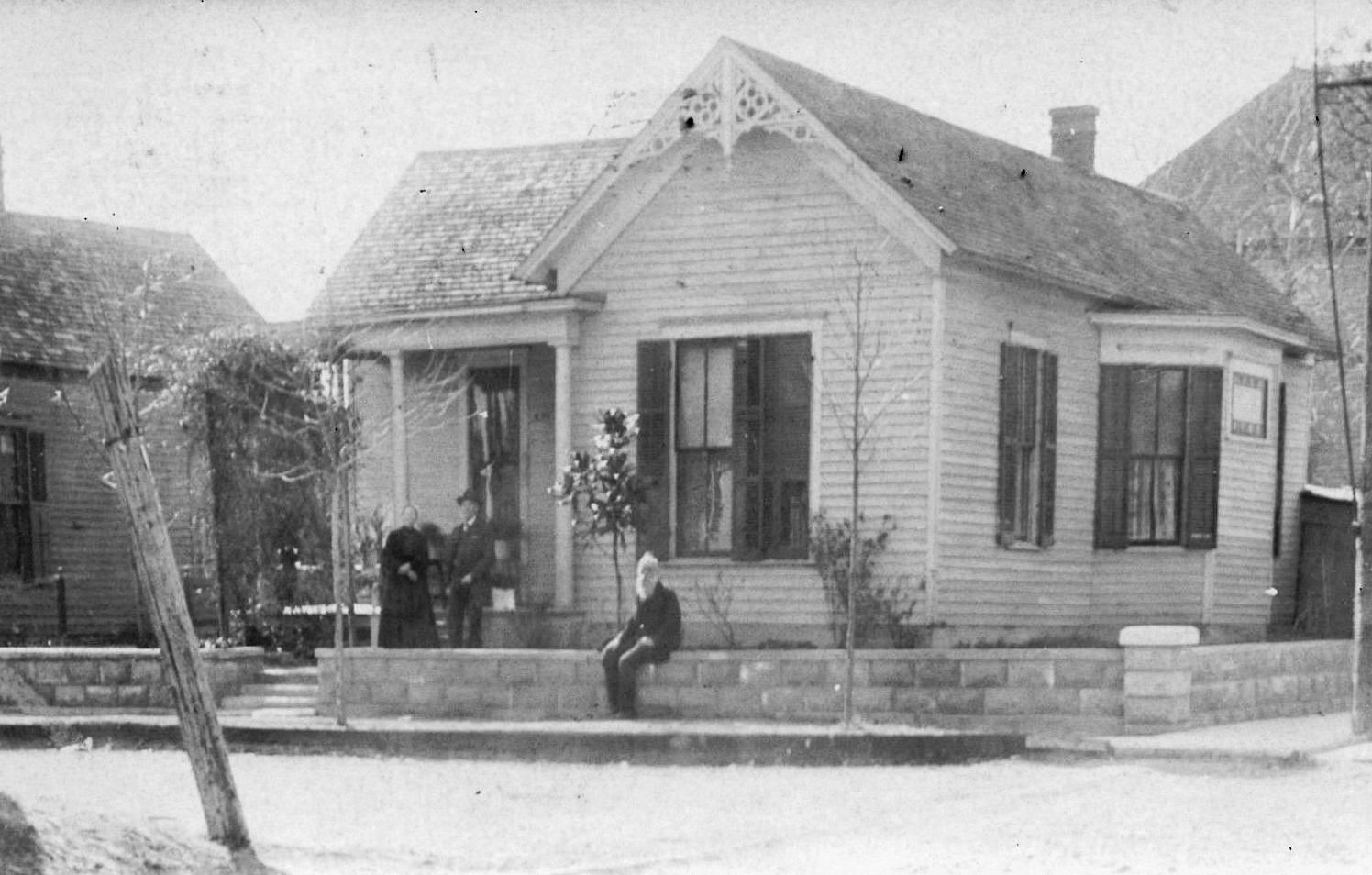
house_RPPC_1909_ebayMystery house, Dallas, ca. 1908 (click for larger image)

by Paula Bosse

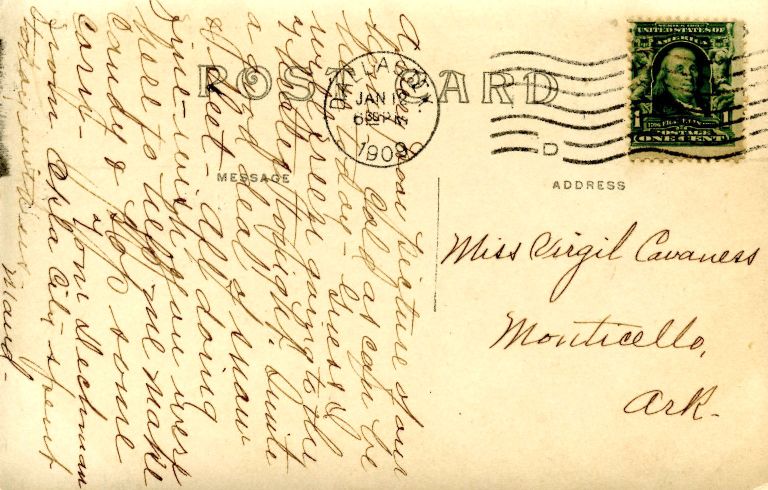
Not too long ago I came across the above photo which had been made into a real photo postcard.” It was postmarked January 12, 1909, and it contained a chatty message.

“A very good picture of our house. Cold as can be here today – guess I will freeze going to the theater tonight. Quite a good deal of snow and sleet. All doing fine – wish you were here to help me make candy & pop some corn. Tom Dechman from Okla. City spent today with us. Maud.”

house_RPPC_1909_ebay_back

Such a nice photo of a modest little house in Dallas, probably taken in 1908. When I saw it, I thought it would be cool if I could figure out where it was. There wasn’t much to go on from the postcard, though. But, as it turns out, there was just enough information to put the pieces together and figure it out. Someone asked me recently how I track down things like this. Basically, I look for a long time in a lot of different places. Here’s how I found out where this mystery house was.

Using Ancestry.com, I found Virginia (“Virgil” — sometimes “Virgie”) Cavaness in Monticello, Arkansas. She was born in 1871 and would have just turned 37 years old when she received this card. The familiar tone of the postcard message indicated to me that Virgil was probably a close friend or family member.

I found Thomas Dechman in Oklahoma City — he would have been 23 when he visited Maud. He probably wasn’t a close friend or immediate family member because she writes his full name out. According to the 1909 Oklahoma City directory (accessible on Ancestry.com), he worked alongside his father, A. F. Dechman, at a wholesale produce company.

Then I checked the Dallas Morning News archives and found this from Dec. 30,1909.

clower_dmn_123009DMN, Dec. 30, 1909

Tom Dechman was Mrs. A. F. Dechman’s son. So I searched on “Maud Clower.” Maud, born in 1877, was also D. M. Clower’s daughter. Mrs. A. F. Dechman was Maud’s sister Annie, and Tom was her nephew.

I continued searching the DMN archives for mentions of the Clower family and found that in 1906 Maud Clower had married Jesse (J. D.) Patterson — and, hey, Virgil had attended the wedding.

virgie_dmn_090206DMN, Sept. 2, 1906

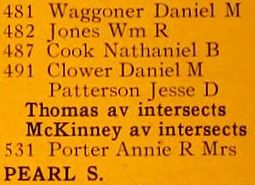
I checked to see where Maud and J. D. Patterson were living in 1908/1909. Most directories are available on Ancestry (a subscription site), but, as it happens, the 1909 directory is one of the few historical Dallas city directories that is available online (for free) — you can access it here (a few other directories are here). I found a Jesse D. Patterson listed as living at 491 N. Pearl, but no spouse’s name was listed, so I cross-referenced the address with the street directory section to determine whether this was the right J. D. Patterson. (Street directories are very helpful — not only do they list the occupants for each address, they also help to pinpoint where specific addresses were as they show which cross-streets those addresses were between; this is extremely helpful when trying to figure out where things were when streets had different names and/or when trying to figure out where things were before all of Dallas’ street numbers were changed in 1911. Another useful resource is a page on Jim Wheat’s site, which has links to every page of the 1911 street directory — click on a street name and find your address: the “new” address is on the left, and the “old” address is next to it, in bold.)

clower-patterson_1909-directory1909 city directory, residents of N. Pearl Street

Even though this didn’t have Maud’s name listed alongside her husband’s, it DID show that her father, D. M. Clower, was living at the same address. Success!

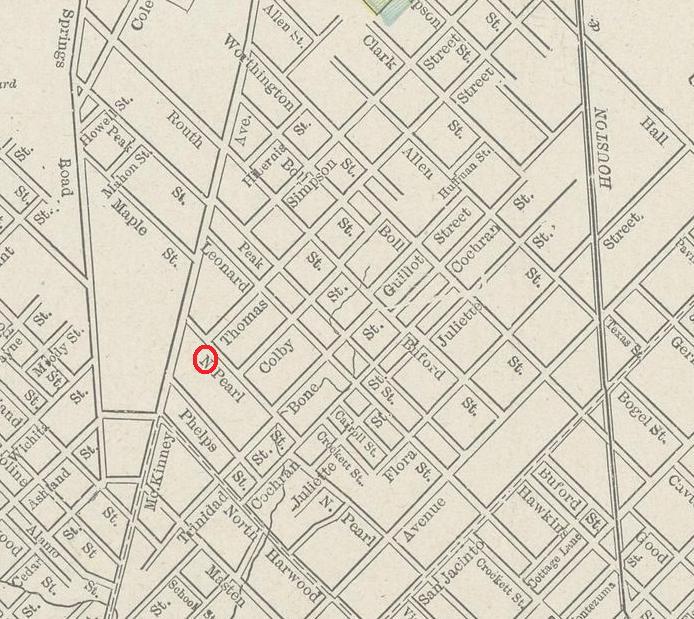
So there it is. When Maud sent that postcard to Virgil, she and her husband were living with her parents at 491 N. Pearl Street. The house in the photo was at the southwest corner of N. Pearl and Thomas. It’s always helpful to check a street map from about the same period for context and to make sure you’re looking at the right location — many street names have changed over the years — if a street named “Forest” is being referenced in the 1940s, for instance, you need to know that the old Forest Avenue and the current Forest Lane are absolutely nowhere near each other. Below is a map drawn about 1900, with the location of the Clower house circled in red (this is one of many maps found on the Portal to Texas History site; the one below is a detail of the map found here).

clower-home_map-ca1898

I also checked out Sanborn maps to see if the house in the photo matched the house that was actually on the lot at N. Pearl and Thomas. It does. To see what the general footprint of the house looked like in 1905 (the Clowers lived at 491 N. Pearl from about 1905 to 1910), see here. In the 1921 map (by which time the address had been changed to 2221 N. Pearl), you can see that additions had been made to the house since 1905 and that it looks more like the house in the photo (a room now juts out at the right and there is an out-building behind the house); see the 1921 Sanborn map here. To see what that Uptown block looks like now, see here (N. Pearl is on the left, looking south). Quite a change! It took me a long time to realize just how essential Sanborn maps can be — they are incredibly useful, and I try to use them whenever I can.

**

I really didn’t expect to track down the actual address of an unidentified house found on a picture postcard, but persistence pays off. A bonus of this persistence was that I ended up learning about the very interesting man who owned the house — a man who played a pivotal role in the development of Dallas: Daniel Morgan (D. M.) Clower. Clower was an electrical engineer who, in 1881, installed the very first telephone in Dallas (for Judge John Bookhout) and ran the city’s first telephone exchange; he also set up phone systems in other cities. In addition to his work for Bell Telephone, he also ran Dallas’ electric company for many years and was responsible for setting up the city’s first electric street lights and helped in developing electrified rail systems in the region.

clower_electrician_1889-directory1889 Dallas directory (click for larger image)

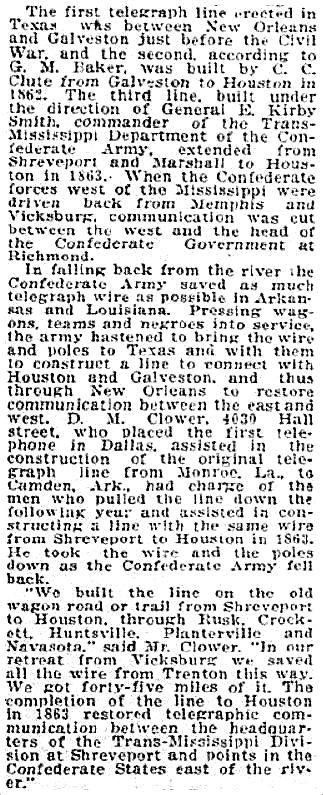
During the Civil War, Clower was a Confederate telegraph operator in the 1st Louisiana Regiment (see Clower’s fascinating obituary below). When the Union army was advancing after the fall of Vicksburg, Clower directed (and helped in) the destruction of the Confederate telegraph system he had helped set up, in order to prevent its being commandeered by Yankee forces — he and his men raced to pull up over 40 miles of wire and equipment, loaded everything on wagons, bugged out, and then used the same wire and poles to string a new Confederate line into and across Texas.

clower-telegrapher_dmn_010822DMN, Jan. 8, 1922

The war ended before Clower had completed his line northward from Houston, but his efforts had helped lay the telegraph infrastructure that the state of Texas relied on for decades afterward.

*

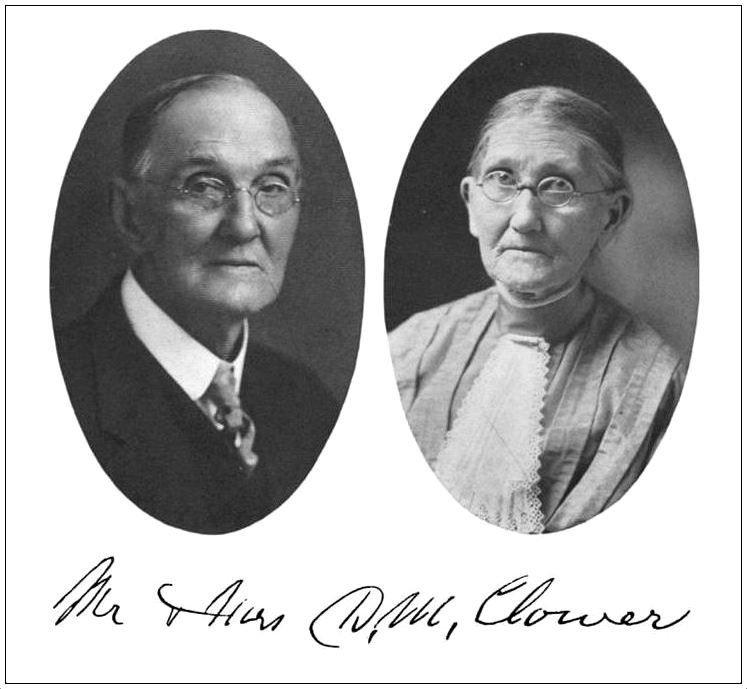
The people in the top photo are not identified. When that photo was taken, D. M. Clower and his wife, Ellender, would have been about 73; their daughter Maud and her husband Jesse would have been in their early 30s. I assume it’s the elder Clowers, with a mystery bearded man in the foreground.

clowers_d-m-and-ellender_hist-of-tx-and-texans_1914_portal
Mr. and Mrs. D. M. Clower, ca. 1914

You never know what you’re going to discover when you read a 106-year-old postcard and wonder where an old house used to be.

***

Sources & Notes

Postcard found on eBay.

Daniel Morgan Clower was born in Alabama in 1835; he arrived in Dallas in 1879, coming from Comanche, where Maud was born in 1877. Clower died in 1927 at the age of 92; Maud died in 1948. His wife, Ellender Paralee Clower, died in 1917 (at which time the couple had been married for more than sixty years).

More on Clower can be found in the pages of The Dallas Morning News:

  • “Telegrapher Tells Civil War Episode” (DMN, Feb. 1, 1924) — a fantastically cinematic account of Clower’s past, in his own words
  • A photo of Clower and Eli Sanger, (DMN, May 1, 1927) — what might well be the last photo of Clower ran in the News just a few months before his death at the age of 92; also in the photo is Eli Sanger, of Sanger Bros. (Clower once had a business in Millican, TX when Sanger’s opened there at the close of the Civil War, and he proudly boasted that he was one of their very first customers)
  • “Daniel Clower Funeral Held” (DMN, Aug. 19, 1927) — Clower’s obituary, with photo

Photo of Mr. Clower with text from a Dallas Times Herald story published on the occasion of his 89th birthday can be found here (scroll down to 1924, about halfway down the page), via Jim Wheat’s site.

The photo of Mr. Clower and his wife Ellender is from the book A History of Texas and Texans, published in 1914; the accompanying entry about Clower’s very interesting life can be found here, via the Portal to Texas History.

*

Copyright © 2015 Paula Bosse. All Rights Reserved.
James Surls & David McCullough: Art in Exposition Park — 1973

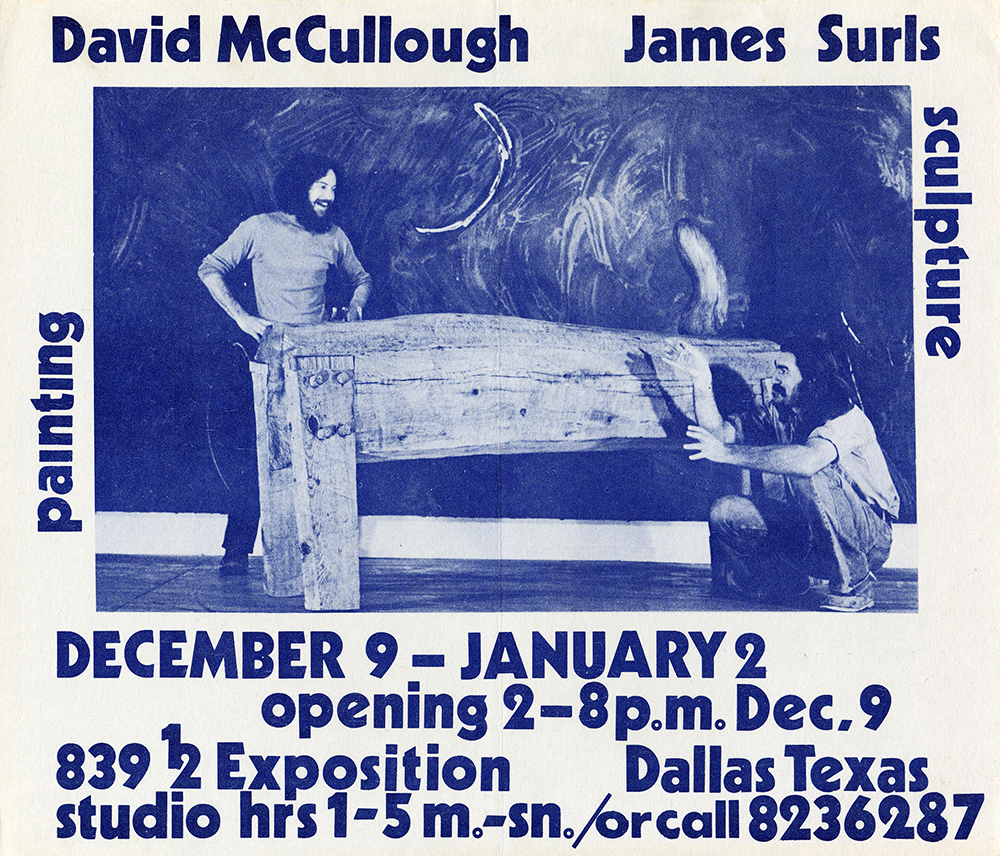
surls-mccullough_dec-1973From the DMA archives (click for larger image)

by Paula Bosse

Above, a postcard advertising a 1973 art show at 839 1/2 Exposition (Parry & Exposition, across from Fair Park), featuring the work of James Surls (right, next to one of his sculptures) and David McCullough (left, in front of one of his paintings).

James Surls (b.1943), originally from East Texas, came to Dallas in the late-’60s to teach sculpture at SMU’s Meadows School of the Arts, from 1969 to 1976. His first mention in The Dallas Morning News, though, was on Sept. 12, 1967, when a 23-year-old Surls was mentioned as a participant in a group sculpture show at Atelier Chapman Kelley (on Fairmount Street) alongside major artists such as Georges Braque, Henry Moore, Louise Nevelson, and Henry Bertoia. Surls made his first professional impact on the art world while he was living in Dallas, and for years he was known as a “Dallas artist.” Surls eventually left Dallas for Spendora, Texas, and he now lives and works in Colorado and is an important internationally admired and collected sculptor.

After studying in Boston and Kansas City, and after a stint in California working on “happenings” with Allan Kaprow and Dick Higgins, David McCullough (b. 1945) moved to Dallas in 1970 where he quickly became part of the local art scene. After only seven months as a resident of the city, McCullough was commissioned by the Dallas Museum of Fine Arts to execute “Baggie Mantra Sanctorum March,” an art and performance piece which was Dallas’ first outdoor environment “happening.” A respected artist, McCullough continues to create and continues to call Dallas his home.

The McCullough/Surls show touted in the above postcard paired the two local artists and was well-received by local publications. The exhibition space at 839 1/2 Exposition was McCullough’s studio at the time, and the show presented sculptures by Surls and “relief wall paintings” by McCullough.

*

For a FANTASTIC look at this period in Dallas’ contemporary art scene, Ken Harrison’s 1975 documentary “Jackelope” (which aired on KERA, Ch. 13 in January, 1976) is absolutely essential. (Watch it here.)

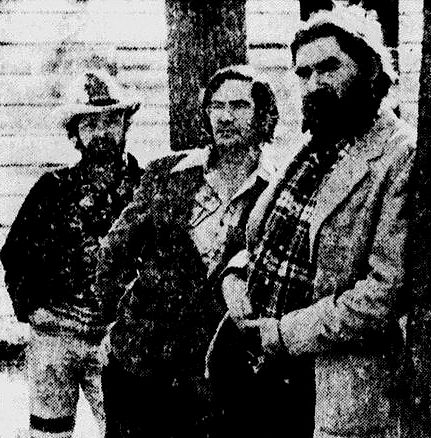
jackelop_dmn_012576-photo“Jackelope” subjects Wade, Green, and Surls

It profiles Surls, George Green, and Bob “Daddy-O” Wade (who will forever be known in Dallas as the creator of Tango’s dancing frogs), and the Surls and Wade portions are extremely entertaining. I watched this documentary earlier this year, and I’ve found myself thinking about it frequently. I highly recommend this deliberately slow-moving documentary for anyone interested in Texas art (…or just art). Or for anyone who’s a fan of incredible Texas accents (why don’t we hear accents like these anymore?).

*

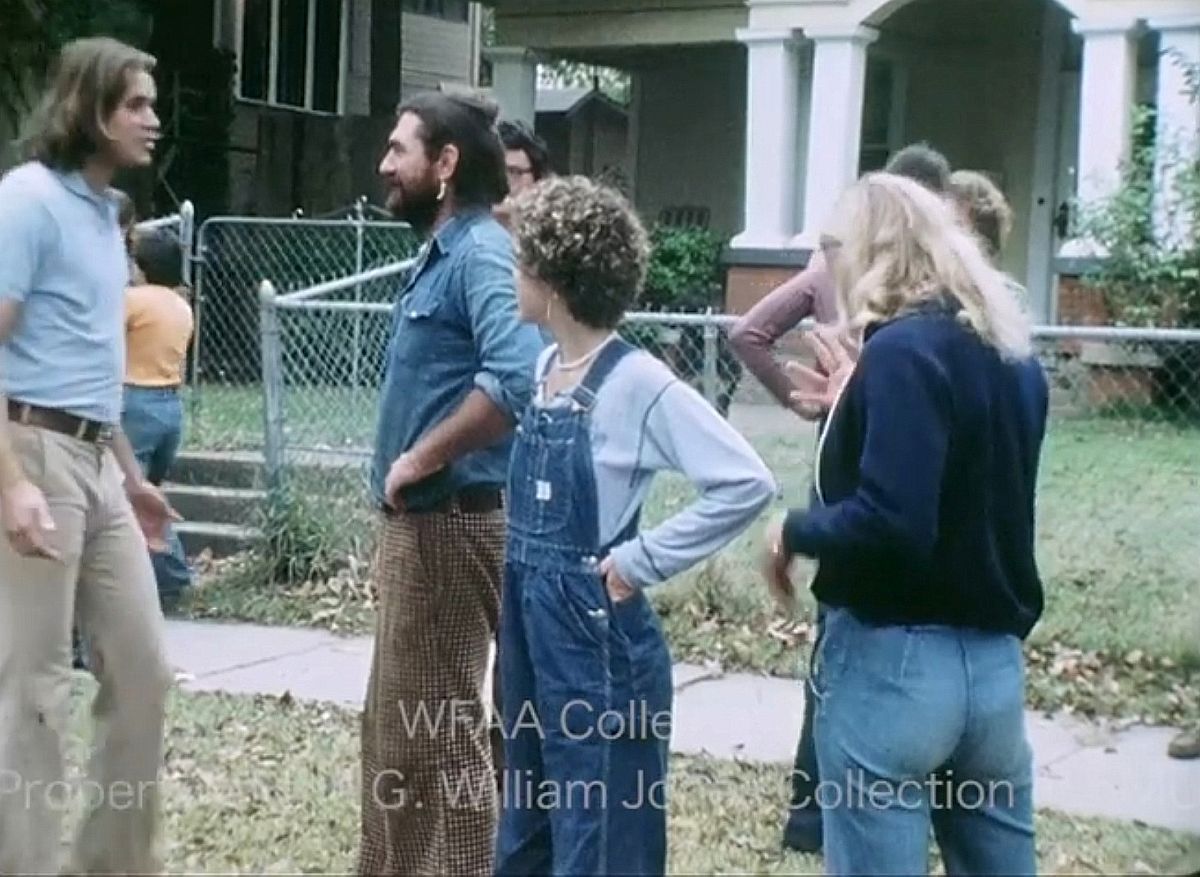
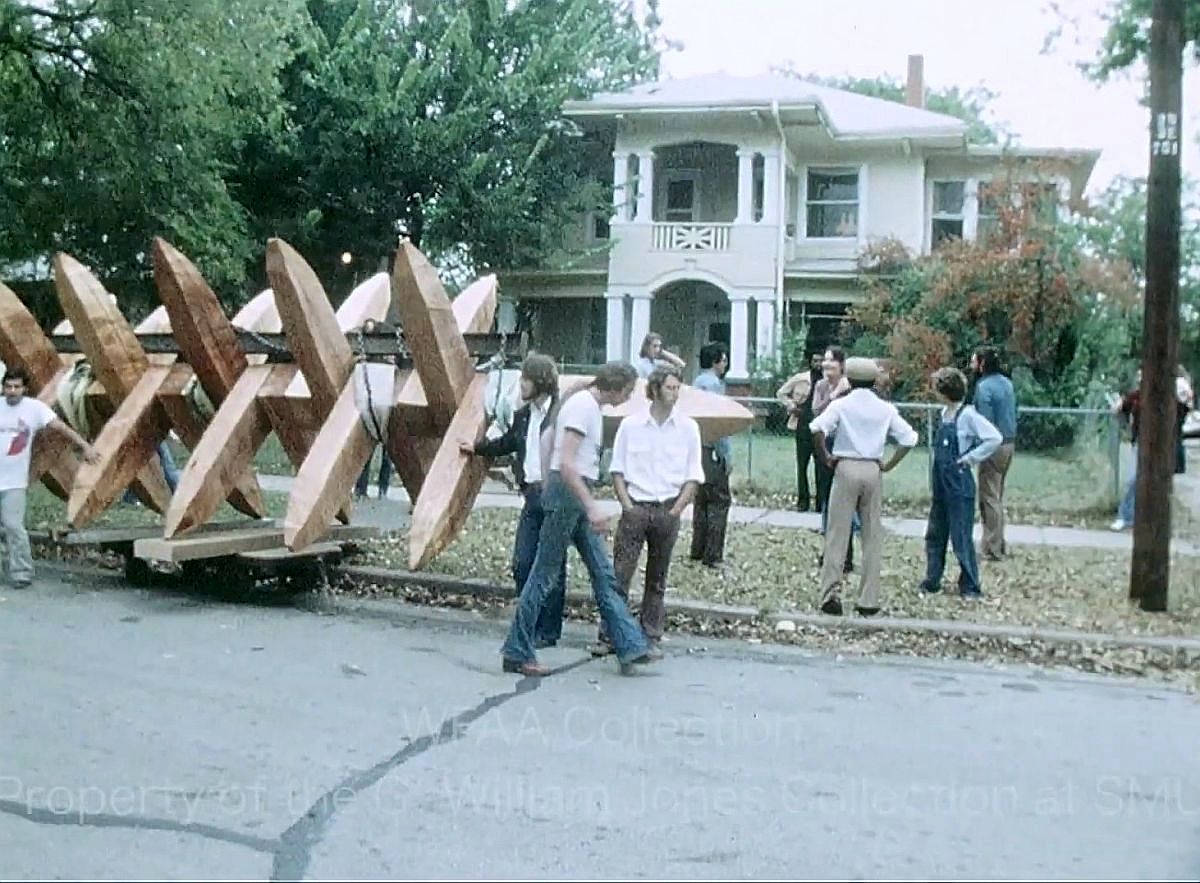
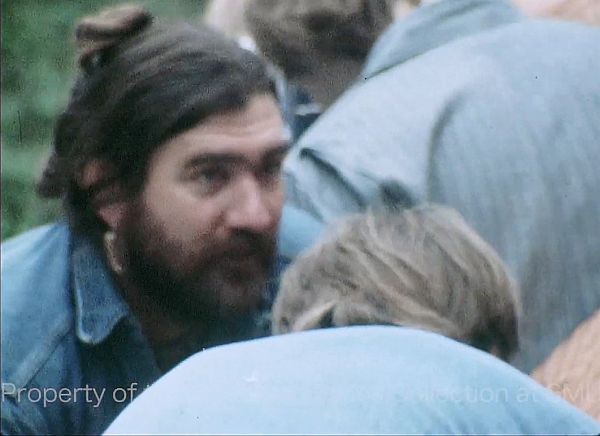
Here’s a great clip showing Surls with friends and students laboriously transporting one of his pieces, the name of which is given as “Point to Point,” through the streets of Old East Dallas before it is taken to Houston. In 1975, Surls was teaching at SMU and living at 5019 Tremont, in a house which is still standing. (WFAA News Film Collection, Jones Film Archive, Hamon Arts Library, SMU, Oct. 1975)

surls_wfaa_oct-1975_tremont_SMU_2

surls_wfaa_oct-1975-tremont_SMU

surls_wfaa_oct-1975_tremont_SMU_3

***

Sources & Notes

Postcard is from the Paul Rogers Harris Gallery Mailings Collection, Dallas Museum of Art Archives; found as part of the interesting article “Fair Park-South Dallas: The City’s First Arts District” by Leigh Arnold, here.

To see just a few of James Surls’ wonderful pieces, click here. To view a slideshow of the DMA retrospective, “Visions: James Surls, 1974-1984,” click here. His official website is here.

Articles of interest from the Dallas Morning News archives:

  • “Kelley to Unveil Sculpture Show” by John Neville (DMN, Sept. 12, 1967) — first mention of Surls in the pages of The News, this announcement of an upcoming sculpture show at Atelier Chapman Kelley has Surls alongside big-hitters such as Georges Braque, Henry Moore, and Louise Nevelson
  • “Loft Offers ‘Big Art’ Space” by Janet Kutner (DMN, Feb. 16, 1974) — review of the show advertised on the postcard at the top of this post
  • “Surls Casts ‘Sams’ for Movie Awards” by Janet Kutner (DMN, March 11, 1972) — about the bronze movie awards — the “Sams” — which Surls created for the 1972 USA Film Festival
  • “Art for Dog’s Sake” by Janet Kutner (DMN, Dec. 7, 1975) — about a 1975 group show at SMU consisting of over 50 artists (!), which Surls organized (and created a sculpture for) on a $50 budget; contains a thoroughly delightful interview about “The Dog Show” (“It’s both serious and non-serious, maybe ‘arf ‘n ‘arf…”)
  • “Texas Artists in TV Special” by Janet Kutner (DMN, Jan. 25, 1976) — review of the film “Jackelope”

For a profile on David McCullough that appeared in The Lakewood Advocate, click here. To watch an entertaining video in which he paints before a crowd at the Dallas Arboretum as the Dallas Wind Ensemble plays, followed by an interview, see the YouTube video here. McCullough’s website is here.

Read the background of McCullough’s 1971 “Baggie sculpture” — the outdoor “happening” at the lagoon at Fair Park in these Dallas Morning News articles:

  • “Baggie Sculpture in Park Lagoon” (DMN, June 12, 1971)
  • “McCullough Creates ‘Baggie Happening'” by Janet Kutner (…that lady was busy!) (DMN, June 20, 1971)

*

Copyright © 2015 Paula Bosse. All Rights Reserved.


Thank You, Weird Hollywood!

weird_hollywood

by Paula Bosse

Thank you, Joe Oesterle, for the very flattering post on your (great) Weird Hollywood Facebook page! His mystery photo of the Gunther Castle was a lot of fun to research (the “castle” was at 2308 Pacific Avenue in Long Beach, California), and, yes, as a matter of fact, I’d love to help you research a building or person or old news story or mystery photo. I CAN be bought! If you have inquiries, please click the “Contact” tab at the top of the page and send me an email. If there’s something I can help you with, we’ll talk turkey.

As this is a blog devoted to Dallas history, the Hollywood stories are a bit scarce (even though classic Hollywood and entertainment history is a passion of mine), but there are a few. These Flashback Dallas posts might appeal to those new visitors more interested in Hollywood than Dallas: (click title to see post):

Thanks again for the kind words, Joe! And keep Hollywood weird!

*

Copyright © 2015 Paula Bosse. All Rights Reserved.

Salvador Dali Brings “Nuclear Mysticism” to Dallas — 1952

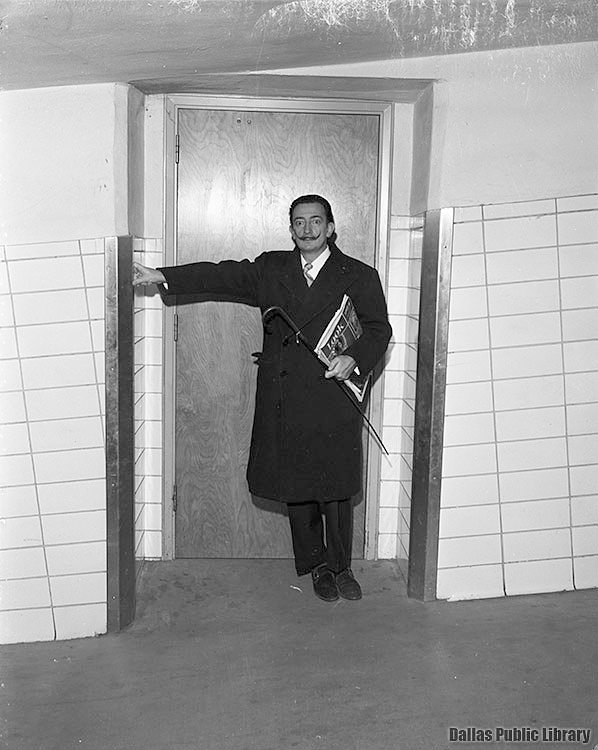
dali_union-station_feb-1952_dplDali does Dallas (in a slanted doorway at Union Station)

by Paula Bosse

The artist and pop phenomenon Salvador Dali came to Dallas in 1952 to present a lecture at McFarlin Auditorium on the SMU campus as part of the popular Community Course series. This was during his “Nuclear Mysticism” period, during which his paintings were influenced by the atomic age, science, and religion. One of the examples of this direction in his art is his painting “Raphaelesque Head Exploding” from 1951.

dali-raphaelesque-head_1951“Raphaelesque Head Exploding”

This 1952 American lecture tour included at least three stops in Texas: Houston, Fort Worth, and Dallas. Dali and his wife, Gala, arrived in Dallas on the afternoon of Thursday, February 14, 1952, after the artist had spoken at a members-only event and luncheon at Fort Worth’s River Crest Country Club earlier in the day. The lecture at McFarlin Auditorium was on Saturday night, Feb. 16. One wonders what he did in Dallas on his free day Friday.

While in Dallas, Dali was interviewed at the Baker Hotel by Paul Crume of the Morning News, a bit of an odd choice, in that Crume — author of the very popular front-page “Big D” column — was generally the paper’s go-to humor writer, an indication, perhaps, that Dali was considered less of a serious artist than as a quirky and larger-than-life entertainer. Which… fair enough.

One of the interesting little morsels that Dali told Crume was that he was amazed that his dreams in Texas had all been in technicolor, a relative rarity for him.

“Astonishing! In New York, all black and white. In Texas, all in color. In Italy, everybody dreams in color. In France, not so much. It is very mysterious. But in Houston, I am dream in color twice. And then, last night here [in Dallas].” (DMN, Feb. 17, 1952)

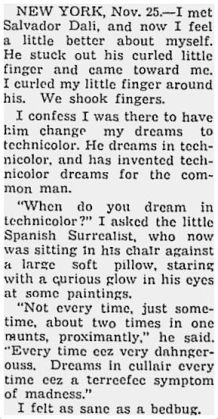
Dali loved dreaming in technicolor and mentioned it several times throughout his career. This little tidbit from Earl Wilson’s column in 1944 is amusing (if weighted down by Wilson’s unfortunate lapses into dialect).

dali_earl-wilson_112644New York Post, Nov. 26, 1944

To dream in technicolor every time “is very dangerous. Dreams in color every time is a terrific symptom of madness.” …I’m not sure what that says about Texas and/or Texans.

dali-caricature_technicolor

***

Sources & Notes

Top photo (dated Feb. 15, 1952) shows Salvador Dali standing in a slanted doorway at Union Station in Dallas (it seems likely that the photo was taken on Feb. 14th when he arrived in Dallas from Fort Worth, and was then published on Feb. 15th); it is from the Hayes Collection, Dallas History & Archives Division, Dallas Public Library (Call Number PA76-1/7171).

(Regarding this crooked door frame at Union Station: when Dali saw it he exclaimed, “A Dali-an door!”) (He would have loved Casa Magnetica at Six Flags.)

Articles about Dali’s visit to Dallas can be found in the archives of The Dallas Morning News:

  • “Key to New Art Revealed by Dali” (It’s Mysticism)” — an unbylined review, probably written by Paul Crume (DMN, Feb. 17, 1952)
  • “Texas Tints Dreams of Artist Dali” — interview by Paul Crume, conducted in the Baker Hotel (DMN, Feb. 17, 1952)
  • “Big D” column by Paul Crume (DMN, Feb. 19, 1952)

An entertaining 1965 appearance by Dali on Merv Griffin’s talk show can be seen here. He talks about dreaming in “glorious technicolor” at about 4:55. And, I mean… it’s just a great example of Dali as entertainer.

*

Copyright © 2015 Paula Bosse. All Rights Reserved.


(Obscure) Country Music Radio Stations — 1969

KYAL-1600“Home of the Tall Texans” (click for larger image)

by Paula Bosse

Okay, maybe they’re not obscure to people who listened to country stations in Dallas in the 1960s, but to someone who grew up in the ’70s in a household in which country stalwarts KBOX and WBAP were always on, these three stations are unknown to me.

Of these, my favorite call letters are KYAL, as seen in the ad above — that’s right, “K-y’all.” Disc jockey “Johnny Dallas” was none other than local rockabilly fave, Groovey Joe Poovey.

KYAL_johnny-dallas_groovey-joe-poovey_ca1969

KBUY was out of Fort Worth and had quite the daytime signal.

KBUY-1540

There was also KCWM (for “Country & Western Music”). This one was an FM station. Legendary DJ Bill Mack was hired by the station to get its country format going, and he even suggested the call letters.

KCWM-99.5

I came across these ads in some sort of local country music publication called “Country and Western — The Sound That Goes Around the World” (1969). Sprinkled amongst bios and photos of country stars are lots of local ads. One of the (non-radio) ads that caught my attention was one for the Saturday night lineup of country music television shows on KTVT Channel 11. Some of these shows were still on in the ’70s when I used to watch them with my father. (I’m not sure I knew there was ever a live television broadcast from Panther Hall in Fort Worth — “Cowtown Jamboree” — that would have been cool to see.)

country-music-saturday-night_ch-11-1969(click for larger image)

***

The best source for the history of Dallas-Fort Worth radio is, without question, Mike Shannon’s DFWRetroplex.com site.

KBOX was the station that really started it all for country music radio in Dallas; read about its history here.

Info on KYAL 1600 AM is on this page.

Info on KBUY 1540 AM and KCWM 99.5 FM is on this page.

Read about Groovey Joe Poovey here and here and here. See a slideshow of photos of him while listening to his GREAT version of “Deep Ellum Blues,” here.

Click pictures for larger images.

*

Copyright © 2015 Paula Bosse. All Rights Reserved.