Flashback : Dallas

A Miscellany: History, Ads, Pop Culture

Category: Manufacturing

Celery Cola: “It Picks You Up!” — 1909

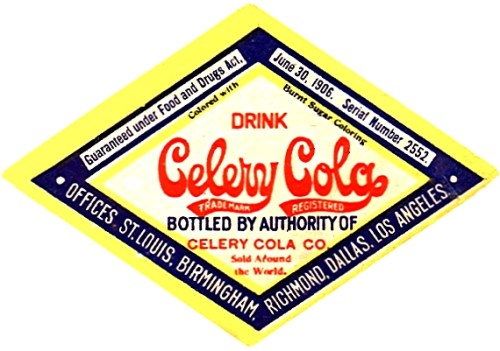
celery-cola_logo_1906

by Paula Bosse

When you think of Dallas and soft drinks, you probably think Dr Pepper. But back in 1909, Dallas was the main office for the Western division for the Birmingham, Alabama fizzy drink Celery Cola (containing, one presumes, delicious celery-flavored syrup). Their offices were in the somewhat low-rent stretch of Exposition while rival Coca Cola was snugly housed at the cushy southeast corner of N. Akard and Ross.

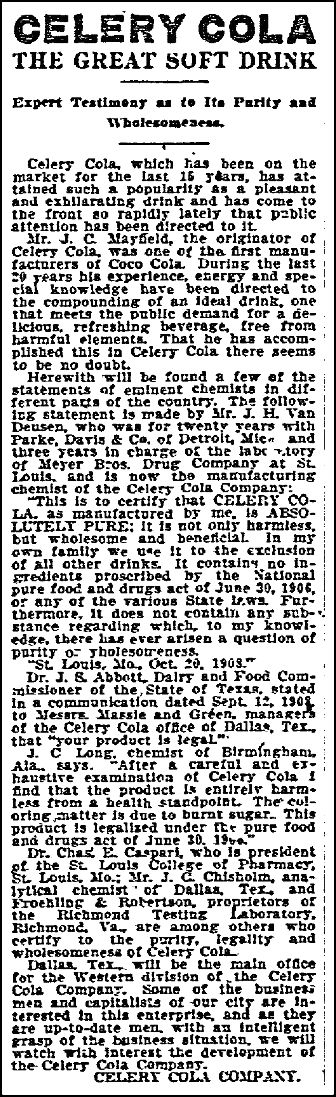
Only a couple of weeks after an official state charter was granted to local aspiring soda tycoons W. A. Massie, E. O. Massie, and J. B. Green to start officially producing the elixir in Dallas, this ad — a bit on the defensive side — appeared in the Dallas Morning News (click to see larger image):

celery-cola-AD_dmn_022809DMN, Feb. 28, 1909

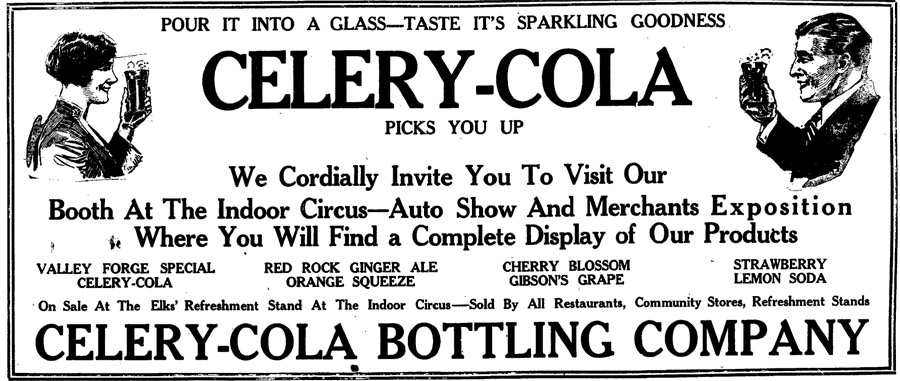
Not so much an ad as testimony. Ads are usually more like this:

celery-cola-ad

As it turns out, Celery Cola ceased production in 1910 after repeated findings of the presence of cocaine and large amounts of caffeine by the Pure Food and Drug Administration. Let’s hope Messrs. Massie, Massie, and Green bounced back from their ill-advised investment. The owner of the Celery Cola Company certainly bounced back — he continued to create soft drinks such as — no kidding — “Koke” and “Dope.” Dallas is better off with Dr Pepper. The only whispered allegation that’s dogged them is prune juice — and that stuff is 100% legal.

Check out the related Flashback Dallas post “‘No Mice, No Flies, No Caffeine, No Cocaine’ — 1911.”

***

Sources & Notes

Top ad from a Celery Cola site here.

Third ad, with the word “its” misspelled (*sigh*) from the comments section of a Shorpy post here.

Best overview on the history of Celery Cola and its creator, James Mayfield, is here.

My favorite part of this story was reading the long list of Dallas-area “illegal” soft drinks (and other oft-tampered-with foodstuffs) in J. S. Abbott’s First Annual Report of the Dairy and Food Commissioner of Texas (Austin, 1908). The soft drink list begins on p. 46 after an interesting prologue here. Celery Cola was not alone! (And, if I’m reading this correctly, Messrs. Massie, Massie, and Green were fully aware of what was going on, having provided the food cops with cocaine-laced samples several months before they bought into the company.)

*

Copyright © 2014 Paula Bosse. All Rights Reserved.

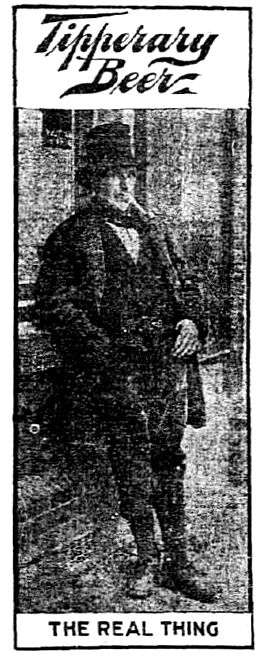
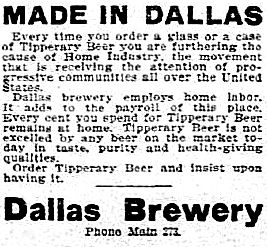
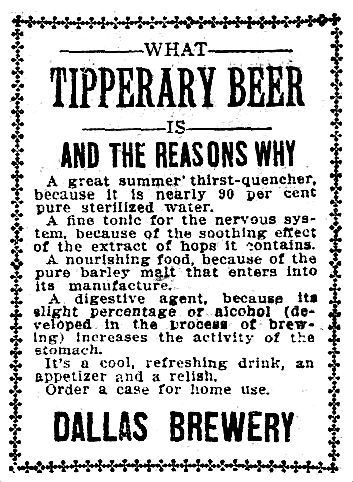
Tipperary Beer from the Dallas Brewery: “Insist Upon Having It”

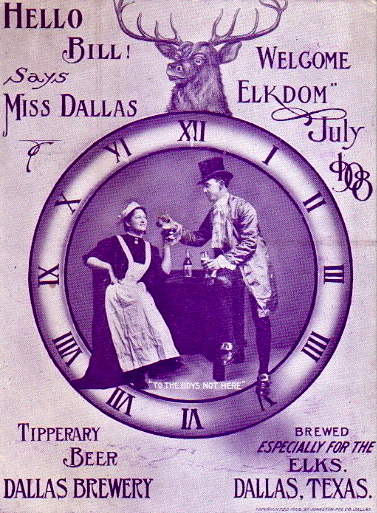
tipperary-beer1908

By Paula Bosse

I’m pretty sure there’s no real Irish connection here — other than the name — but how could I pass this up on St. Patrick’s Day!

tipperary-beer_dmn_071806atipperary-beer_dmn_071806bDallas Morning News, July 18, 1906

dallas-brewery_tipperary_dmn_090107DMN, Sept. 1, 1907

***

Sources & Notes

Top ad addressing the Elks’ conventioneers who were visiting Dallas in 1908 is from an Elks’ historical site, here.

*

Copyright © 2014 Paula Bosse. All Rights Reserved.

Munger’s Improved Continental Gin Company

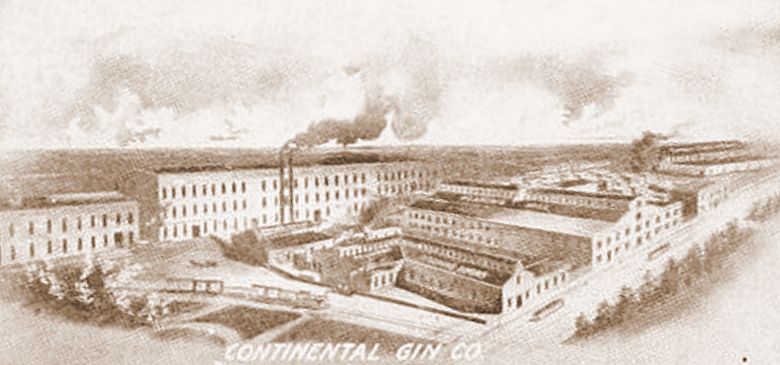
continental-gin_munger-from-natl-reg-appA Dallas landmark… (click for larger image)

by Paula Bosse

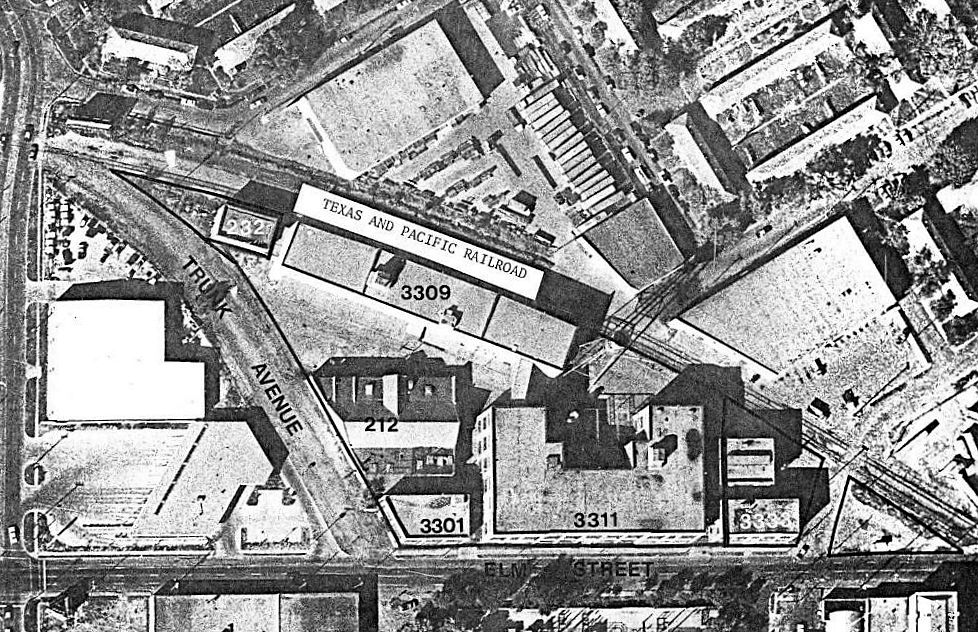
The Continental Gin Co. complex of buildings at Elm and Trunk is a Deep Ellum fixture which was successfully petitioned by the city in 1983 to be added to the National Register of Historic Places. No longer a manufacturing hub, it is now home to artists’ studios and residential lofts. The earliest of the buildings still standing were built in 1888 and the latest ones (the ones closer to Elm) were built in 1914. The company was incredibly successful, which was no surprise when one realizes that fully ONE-SIXTH of the world’s cotton grew within a 150-mile radius of Dallas at the time! It’s no wonder that Dallas was a hotbed of cotton gin manufacturing.

continental-gin_munger-drawing_Munger Catalogue and Price List, 1895

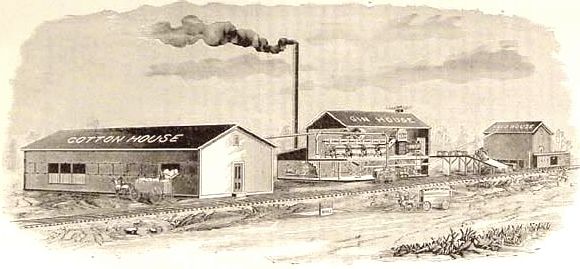
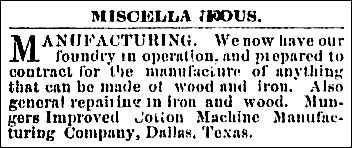
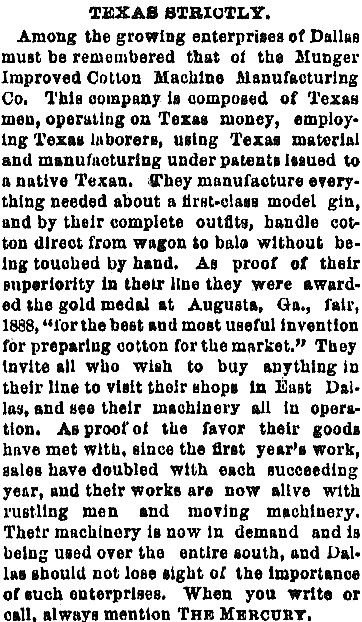
Robert S. Munger (yes, that Munger) patented several inventions that improved the cotton ginning process, and in 1888 he built a large manufacturing plant for his Munger Improved Cotton Machine Company. In 1900, after several extremely successful years, his company and several other companies that held important industry patents were absorbed by the Continental Gin Co. of Birmingham, Alabama, and, practically overnight, the Continental Gin Co. became the largest manufacturer of cotton gins in the United States. Munger retained a financial interest in the company, but he left the running of the business to his brother, S.I. Munger. R.S. Munger turned his creative talents to real estate and developed the exclusive Munger Place neighborhood. The Continental Gin Co. closed in 1962.

continental-gin-co_1912The Standard Blue Book of Texas, 1912-1914

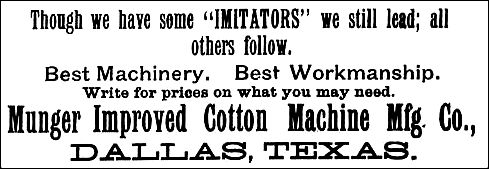
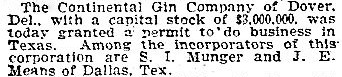
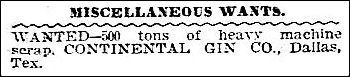
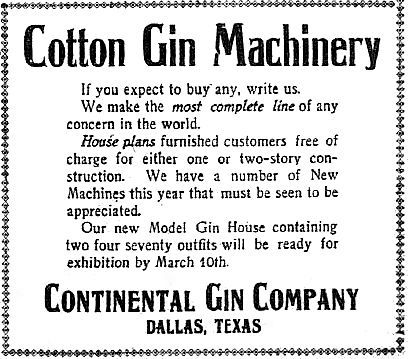
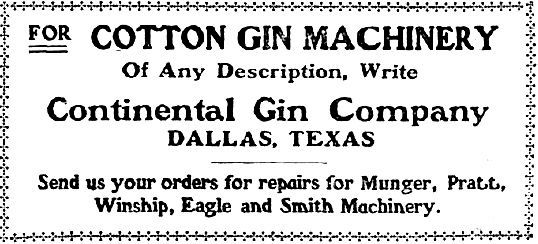
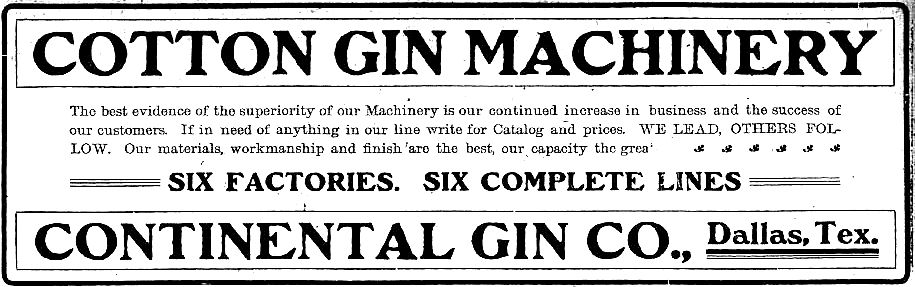
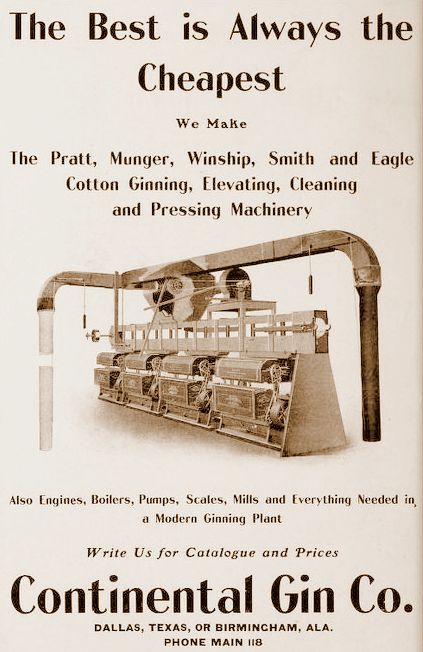
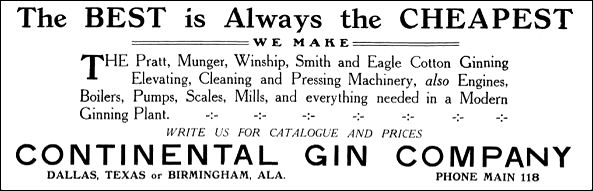
A few newspaper items regarding the Munger Improved Cotton Machine Company and the Continental Gin Company.

munger_dal-herald_101387The Dallas Herald, Oct. 13, 1887

munger_merc_053089The Southern Mercury, May 30, 1889

munger_merc_072892The Southern Mercury, July 28, 1892

munger_merc_041393The Southern Mercury, April 13, 1893

continental-gin_dmn_072600Change is imminent. (Dallas Morning News, July 26, 1900)

continental-gin_dmn_042001FIVE HUNDRED TONS! (DMN, Apri 20, 1901)

continental-gin_dmn_032203DMN, March 22, 1903

continental-gin_dmn_082005DMN, Aug. 20, 1905

continental-gin_dmn_060107DMN, June 1, 1907

continental-gin_worleys_1909Worley’s Dallas Directory, 1909

continental-gin_ad_dallas-police_1910Dallas Police, 1910

continental-gin-aerial-natl-reg-appPhotograph that accompanied the application to the National Register of Historic Places regarding the structures under consideration: 3301-3333 Elm St. and 212 & 232 Trunk Ave. (Landis Aerial Photography, 1980)

***

Sources & Notes

Handbook of Texas biography of Robert Sylvester Munger (1854-1923) is here.

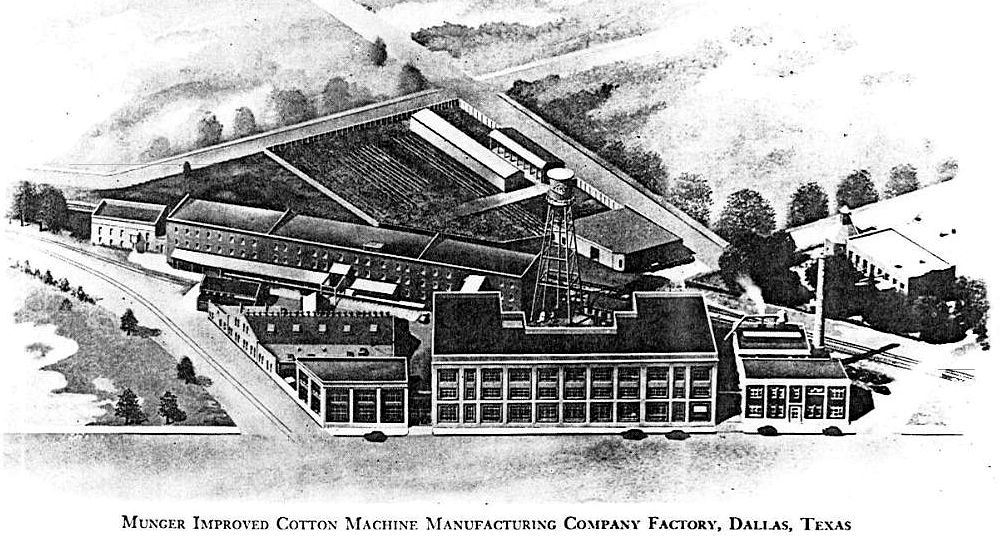
The top image (which, by the way, took me FOREVER to find, is labeled as the Munger company, but the expansion would seem to indicate that this is the Continental Gin Company, after 1914. Whatever the case, it’s a great image!

That image and the aerial photograph of 1980 are included in the city’s application to have the complex included in the National Register of Historic Places, submitted in 1983. The detailed application — as a Texas Historical Commission PDF — can be accessed here.

The second image, of the early days of the Munger Improved Cotton Machine Company is from a bookseller’s online listing for Munger’s 13th Annual Catalogue and Price List (1895) — the item may still be available for a mere $435 and can be found here.

See an aerial view of what the area looks like today, via Google, here.

To see an incredible 1914 photograph of the buildings and the residential area to the north, see my post “The Continental Gin Complex — 1914,” here.

More on Robert S. Munger and more early company ads can be found in the post “R. S. Munger’s Cotton Gin Manufactory,” here.

*

Copyright © 2014 Paula Bosse. All Rights Reserved.


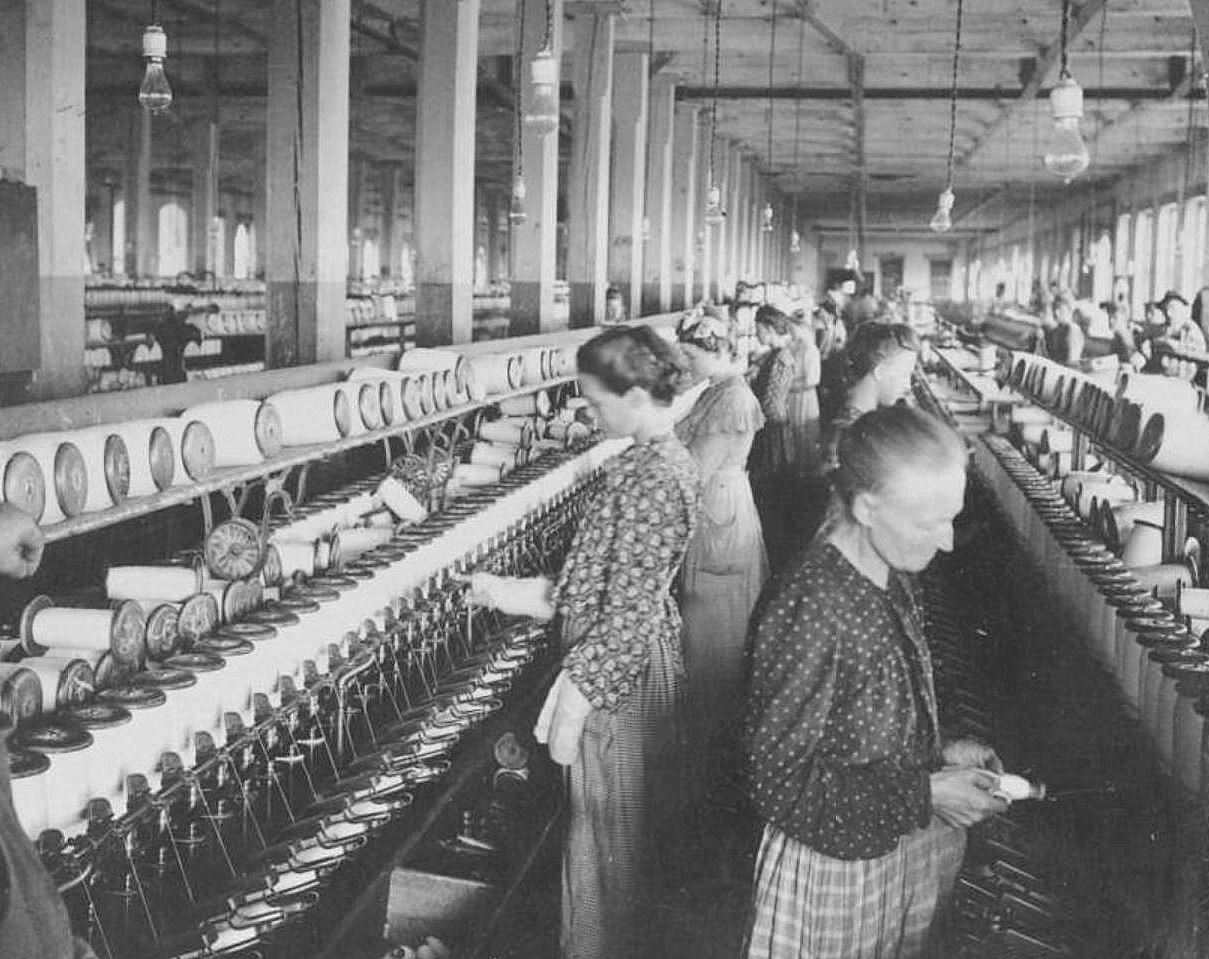
Mrs. Turner Attacked Miss Hulsey in the Spoolroom with a Knife

spoolroom_jones-coll_degolyer_smuSpoolroom of the Dallas Cotton Mills…

by Paula Bosse

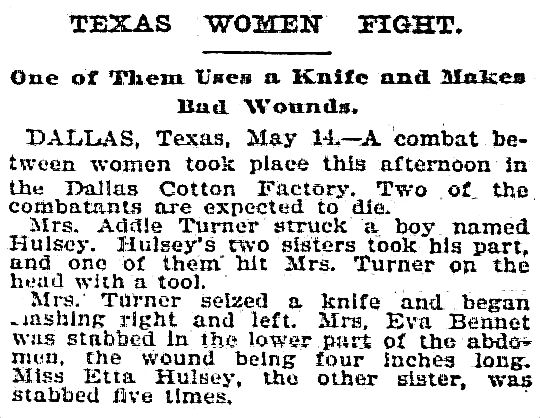
The spoolroom of the Dallas Cotton Mills was no place for the faint of heart, as this eyeball-popping story from The Dallas Morning News will attest (click for larger image):

dallas-cotton-mills_attack_dmn_051697DMN, May 16, 1897

The story even made it into the pages of The New York Times:

spoolroom-slashing_nyt_051597
NYT, May 15, 1897

(The women apparently survived.)

*

Sources & Notes

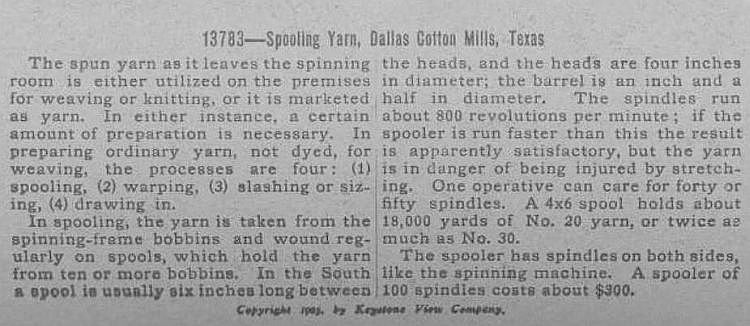
Photo (“Spooling Yarn, Dallas Cotton Mills, Dallas, Texas”) is from a stereograph, circa 1905, from the Lawrence T. Jones III Texas Photographs Collection, DeGolyer Library, Central University Libraries, Southern Methodist University; it is accessible here.

The descriptive text from the back of the card:

spoolroom_jones-coll_degolyer_smu_text

*

Copyright © 2014 Paula Bosse. All Rights Reserved.

3800 Main: Fritos Central — 1947

by Paula Bosse

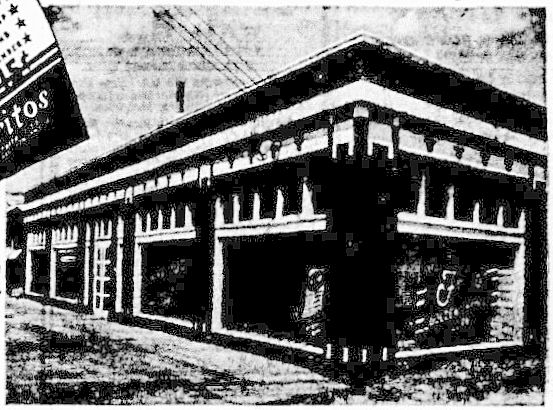
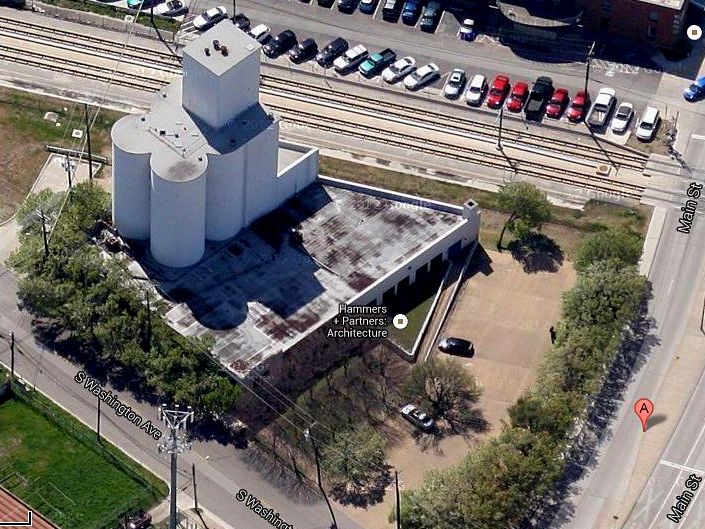
Last week I came across the above photo of old cars parked in front of a Fritos building of some sort, and I wondered where it had been. After a little bit of digging, I found out that it was near Fair Park — in the 3800 block of Main, between Washington and Exposition, on land right next to the railroad tracks. The building in the foreground appears to be gone  now, but I recognized the white, rounded towers behind it — I never knew what that building was, but I now know that it is the Frito company’s former grain elevator. And it’s still standing. Which I’m thankful for (and a bit surprised by) since it’s always been one of my favorite buildings in the area.

The Frito company (now Frito-Lay) has had its headquarters in the Dallas area since 1933. In the ’40s, its corporate offices were on Cedar Springs and its manufacturing plant was over near Fair Park, on Main Street. By 1947, the ever-expanding company had grown so much and had become so successful that it spent half a million dollars to build a whopping new grain elevator. The Dallas Morning News was there for a sneak-peek:

The extra-tough volcanic stones in the adjacent factory Monday will begin grinding corn supplied from a spanking new, ten-story white building just off the 3800 block of Main Street. […] The tall square gleaming structure is a $515,000 thoroughly modern elevator. […] Air-conditioned and equipped with the latest design apparatus, the elevator has storage capacity for 90,000 bushels of corn. It will supply the grain to the company’s factories in Dallas, San Antonio, Houston, Denver, Tulsa, and two plants in Los Angeles.

The new Frito elevator, weather proofed on the outside and weather controlled inside, was designed by Eugene Davis, architect. Huge grain cleaners which remove all chaff and foreign matter by shaking and air blast, occupy the second floor. Spray machinery gives the grain a thorough treatment to prevent infestation — the ‘buga-boo’ of grain products manufacturers. (DMN, Aug. 10, 1947, “Corn: $515,000 Elevator Latest Chapter in Corn-Chip Saga”)

Fifty-one boxcar loads of “select corn” — sans chaff and infestation — could be stored in that gleaming state-of-the-art grain elevator, designed by Eugene Davis (who a few years earlier, had designed another building for the Frito people, a small building at Wall and Corinth which housed the Pork Skin Chip Company).

In 1947, 3800 Main appears to have been something of a corn-chip Hyannisport — a self-contained compound in which all aspects of chip-production were seen to. As Kaleta Doolin (daughter of company founder C. E. Doolin) wrote in her book Fritos Pie:

Mr. Davis was the architect of all the various parts of the Frito plant in Dallas. The plant included the company’s grain elevator, where all the corn was stored; the machine shop (which my uncle Earl was in charge of); the food processing area; and the shipping warehouse, all built by Mr. Davis in 1947.

But that building in the top photo… that one had been there for years. 3800 Main Street had been the home of two or three car dealerships in the decades before Frito moved in. In 1929, as this photo shows, it was the location of the long-lived Ford dealership, Lamberth Motor Company.

lamberth-ford_1929

And here’s the same building in 1947, Frito-ized.

And the side of the building, taken from across the railroad tracks, then and now.

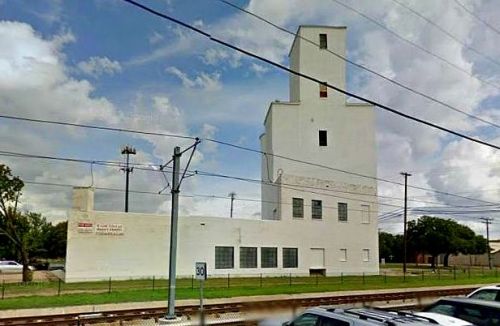
Another old building survives! What a relief that Dallas doesn’t tear down EVERY cool old building!

***

Sources & Notes

Can’t find a source for the top photo. It looks as if someone took a photo of a framed picture which is probably hanging on the wall of a person who feels a great kinship to old Dallas. Or to Fritos. Or to snacks.

Quote about the various parts of the plant is from Fritos Pie: Stories, Recipes, and More by Kaleta Doolin (College Station: Texas A & M University Press, 2011), p. 45.

The two 1947 photos of the Frito building are insets from a series of logrolling ads in which Frito thanks Texas Bank & Trust for all the money they’ve helped Frito make, and Texas Bank & Trust thanks Frito for all the money they’ve helped Texas Bank & Trust make. The take-away? There sure is a lot of money to be made in fried food.

The bottom two photos are from Google maps: the first looking toward the old granary from the railroad tracks, and the second looking down from the unblinking Google eyeball in the sky.

Lastly, a current photo of the building, now renovated and occupied by Hammers + Partners Architecture (whose daily business affairs are probably always accompanied by the faint smell of fried corn wafting past), can be seen here. (What must that building look like inside?!)

Click pictures for larger images.

*

Copyright © 2014 Paula Bosse. All Rights Reserved.