Flashback : Dallas

A Miscellany: History, Ads, Pop Culture

Category: Downtown

Walking on the Wild Side at Commerce & Akard (Crowdsourcing)

naughty-dallas_poster

by Paula Bosse

Occasionally on the Flashback Dallas Facebook page I ask questions, hoping to crowdsource answers — and people on that page know a lot of obscure stuff! I attempted to post the question(s) below on F*cebook, but I apparently crossed some sort of line. I think I used too many “forbidden” words. When I tried to post, the screen froze and ultimately ate my (lengthy) question. *Poof*! So I shall bypass F*cebook and just post it here.

I am looking for anyone who might have first-hand knowledge about the illicit side of downtown Dallas nightlife in the early 1960s. I am particularly interested in the seedier activities which might have been going on in the Baker Hotel. Namely, gambling and prostitution. Please contact me if you worked at the Baker (or the Adolphus) between, say, 1960 and 1964.

I know these activities were going on all around Dallas, but was it common to find illegal card games and prostitution going on inside the swanky hotels? If so, managers – and cops – must have known. Would they have turned a blind eye? Would they have been aware and on the take? Would they have just accepted it as part of the hotel business? I mean, Dallas was/is a huge convention city – this sort of thing must have been everywhere!

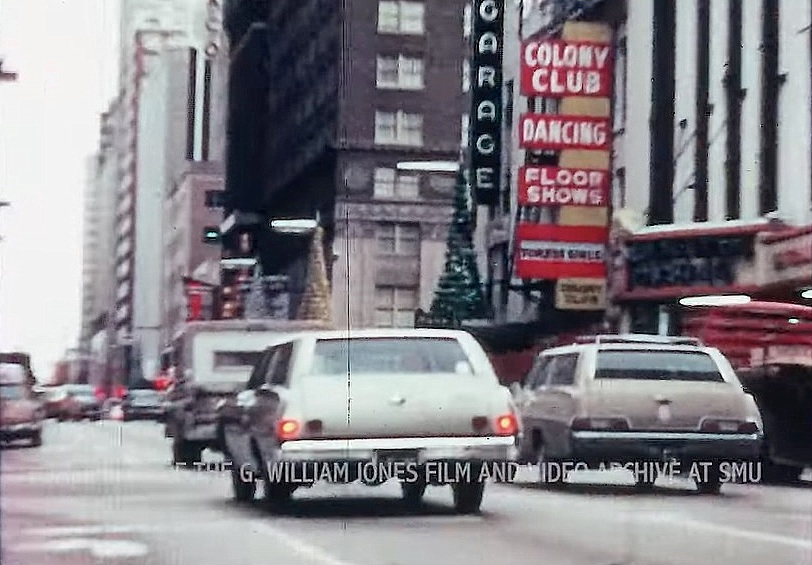
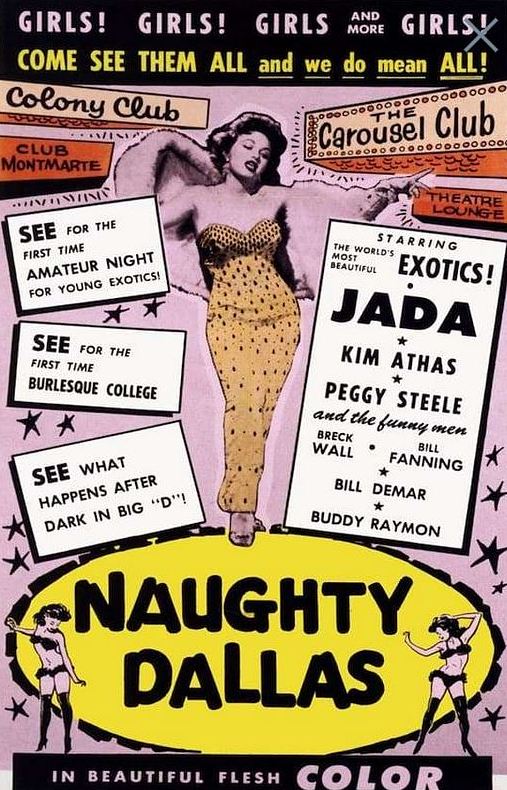
Would dancers who performed at the Colony Club have stayed at the Baker or Adolphus? They seem kind of ritzy for people in that line of work. Would management have cared if strippers stayed in their hotels? Would there have been a higher tolerance for more discreet “call girls” than your average run-of-the-mill prostitute? (I don’t mean to suggest that dancers were prostitutes, but, since I’m typing this, was it known that prostitution connected with the Colony Club or Carousel Club was going on?)

There is an amusing Dallas Morning News article titled “Officer Says Syndicated Crime Doubtful in Dallas” (DMN, Oct. 8, 1963) in which a vice cop proudly proclaims organized crime just doesn’t really exist in Big D. That seems highly unlikely, but I’m not even talking about big-time crime – more like high-stakes poker games with local high-rollers and pimping done by small-time operators. How common would it have been for this sort of thing to be going on in Dallas’ two most upscale hotels?

If you worked at the Baker Hotel in the early ’60s — or if you were employed by the Dallas Police Department at that time – or if you, yourself, were a participant in the seedier side of Dallas nightlife and spent significant time hanging around Commerce & Akard doing naughty things! – please comment below or send me an email at FlashbackDallas214@gmail.com.

This has nothing to do with the assassination, even though it’s the same time-period and there is undoubtedly a lot of overlap. But, seriously: NOTHING TO DO WITH YOU-KNOW-WHAT.

Thanks!

–Paula

***

Sources & Notes

Poster of “Naughty Dallas” (directed by cult Dallas director Larry Buchanan) found somewhere on the internet.

naughty-dallas_poster_sm

*

Copyright © 2023 Paula Bosse. All Rights Reserved.
Schulte Cigars, Elm & Akard — ca. 1923

schulte-cigars_elm-akard_frank-rogers_ebay_frank-rogers_bw
Life at Elm & Akard…

by Paula Bosse

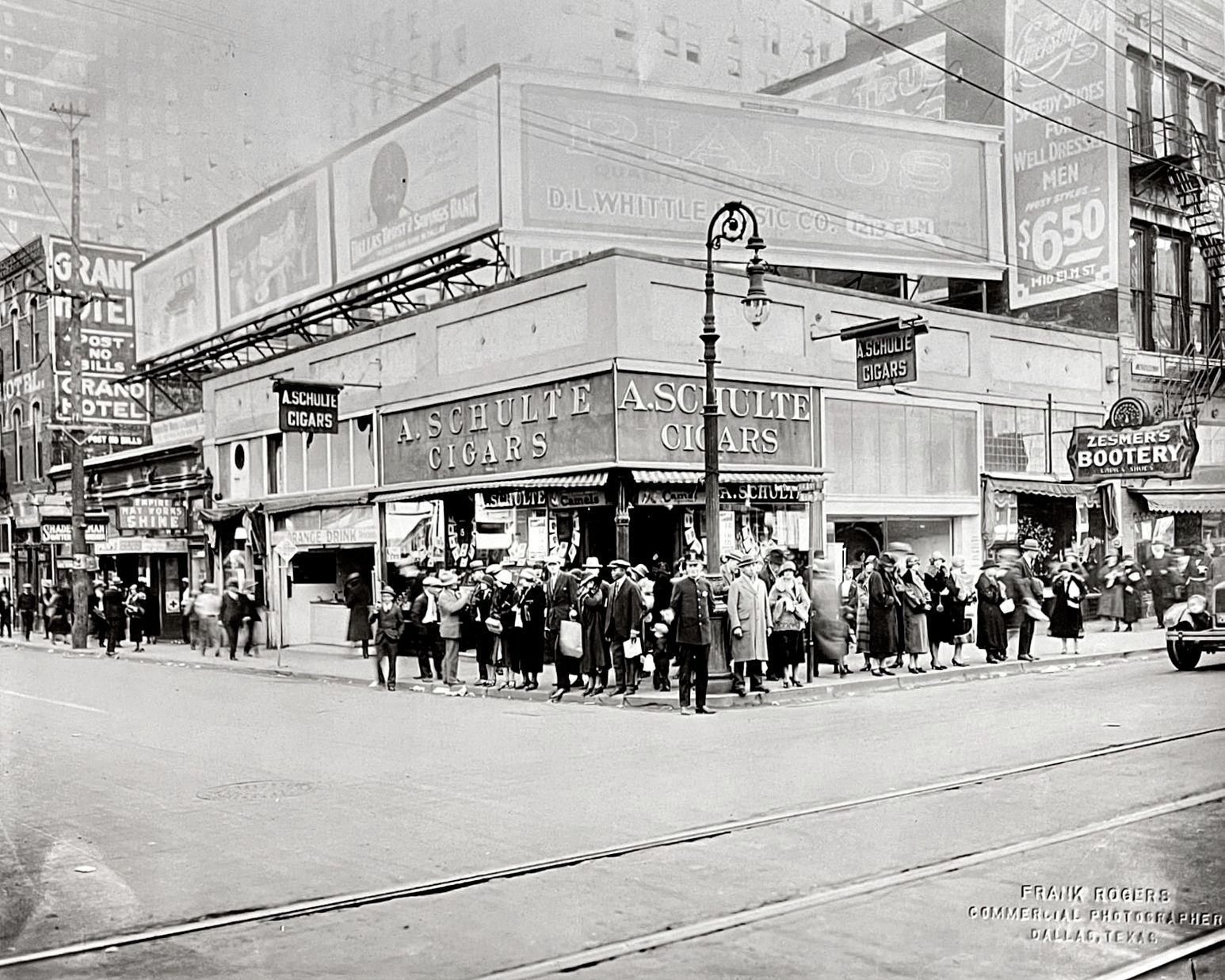
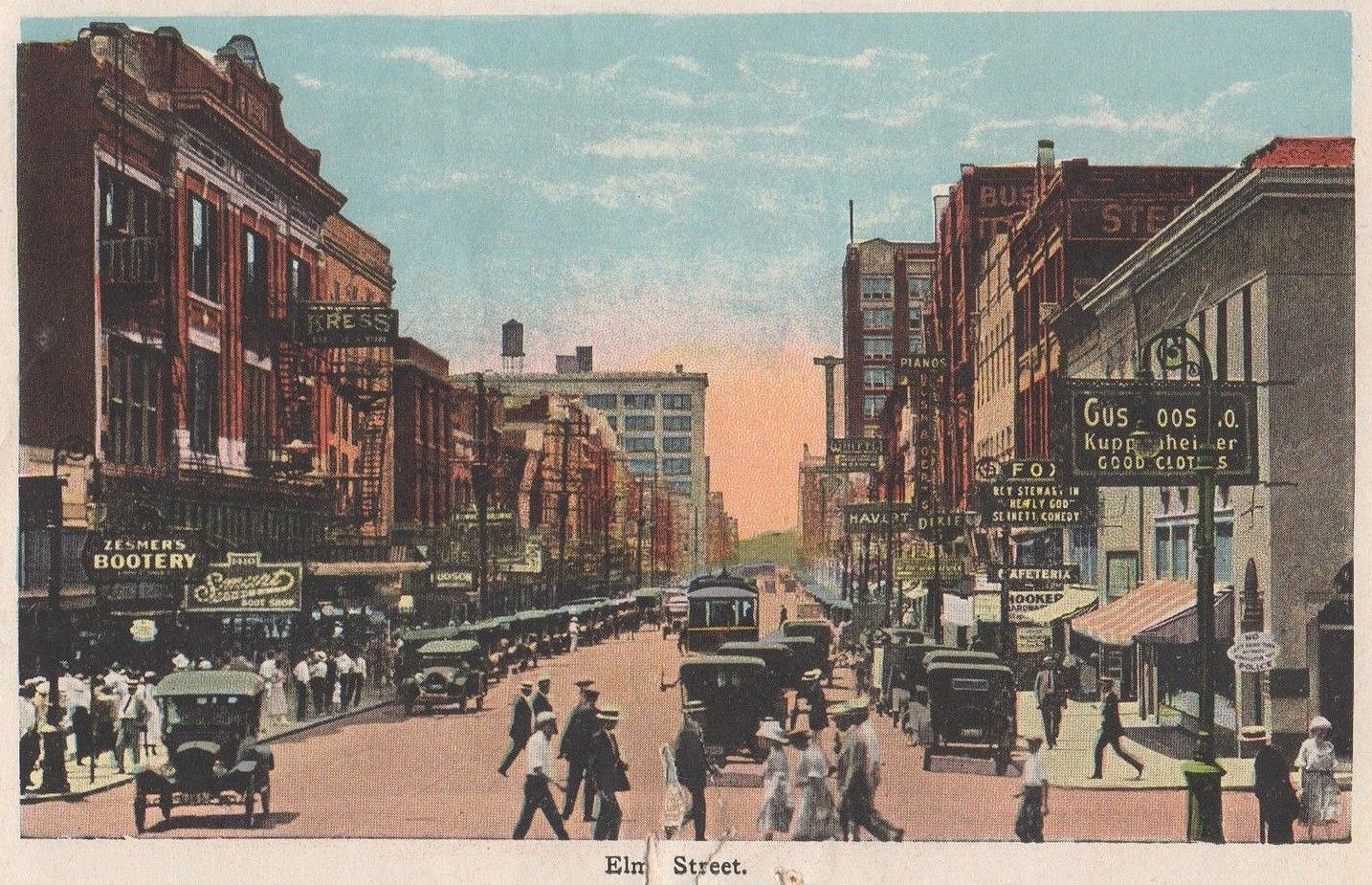
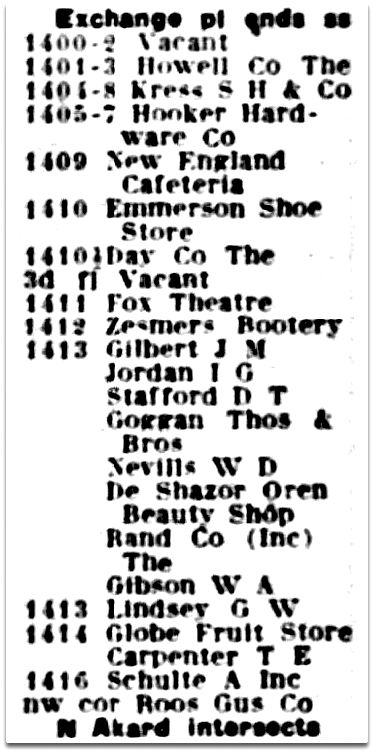
A. Schulte Cigars — at 1416 Elm — held down the southwest corner of Elm and Akard streets (Elm is in the foreground, with the streetcar tracks). The winsomely named Zesmer’s Bootery was at 1412 Elm. Around the corner on Akard was an orange-drink stand. Above the building was a surprising array of billboards. (There is a lot of advertising in this photo.) Here’s another view of the same block, looking west:

elm-st-color_1920s

Every time I see those curlicue lamp posts, they seem to be in photos of Elm Street.

zesmer_schulte_1400-block-elm_1923-directory1400 block of Elm, 1923 city directory

***

Sources & Notes

Top photo by Frank Rogers; found on eBay.

Color postcard from the Flashback Dallas post “Views of Elm Street, With Cameo Appearances by the Fox Theater — 1920s-1960s.”

A previous Schulte location was at 201 S. Ervay, which you can see in the amazing photo in the post “‘There Are Eight Million Stories in the Naked City…’ — ca. 1920.”

Please consider supporting me on Patreon for as little as $5 a month. I post exclusive content there daily!

schulte-cigars_elm-akard_frank-rogers_ebay_frank-rogers_sm

*

Copyright © 2023 Paula Bosse. All Rights Reserved.

Courthouse in the Mist/Smoke/Murk — 1901

old-red_dallas-courthouse_1901_degolyerThe ethereal Old Red Courthouse…

by Paula Bosse

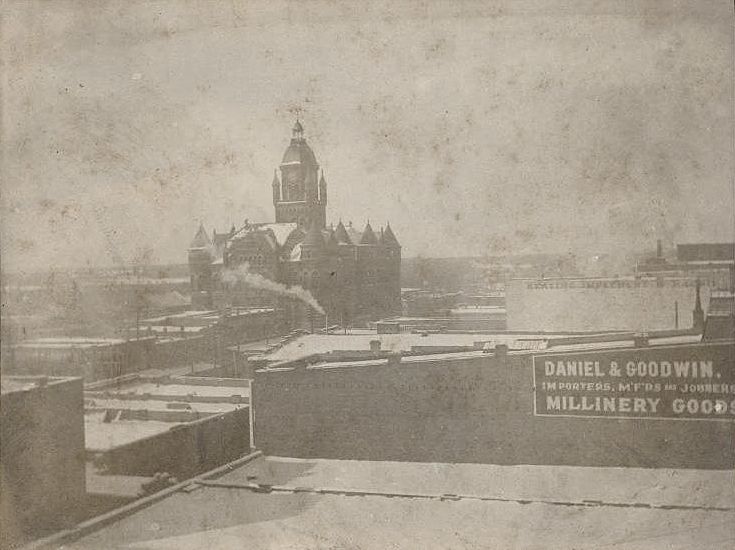
I love this photo of the Old Red Courthouse from 1901. (I guess in 1901 it would have been the New Red Courthouse….) The dreamy quality is probably due less to a romantic mists of Avalon effect (which, incidentally, I’ve seen from the Glastonbury tor, and it’s beautiful!) and maybe due more to just a lot of soot and smoke. …Or something altogether more prosaic, like a damaged photograph or plate. Here’s the courthouse a little closer:

old-red_dallas-courthouse_1901_degolyer_det

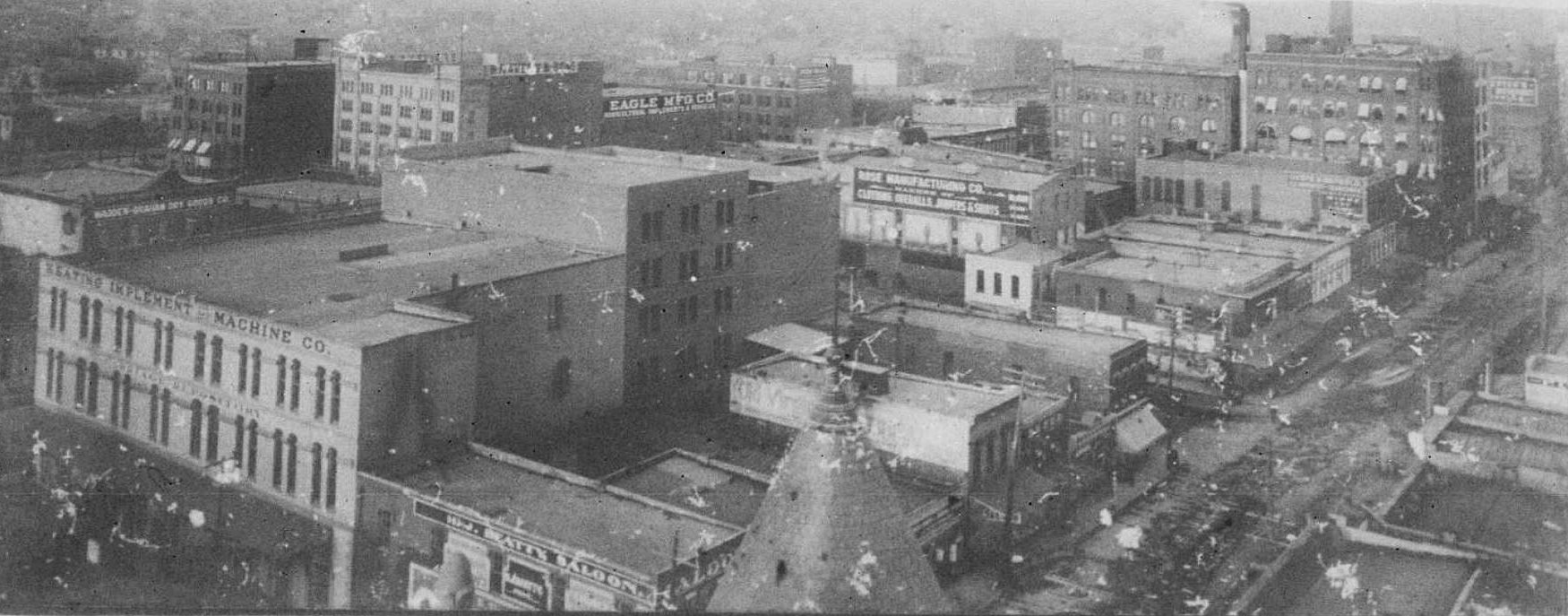
In the image at the top of the page, you can see some of the words for the “Keating Implement & Machine Co.” painted on the white building, seen just above the “Daniel & Goodwin” building on the right side of the photograph. The photo below shows the view from the courthouse, taken about 1900. In the bottom left corner, you can see the Keating building. The reverse view isn’t soft and mysterious (or even all that interesting), but I like that Old Red gets in a tiny Hitchcock-like cameo in the center foreground.

old-red_northeaset-from-courthouse_1900_degolyer_SMU

***

Sources & Notes

Top photo — titled “[Dallas Courthouse]” — is from the George A. McAfee Photographs collection, DeGolyer Library, SMU Libraries; more information on this photo can be found here.

The view from the courthouse — titled “Looking northeast from Courthouse circa 1900” — is from the Collection of Dallas Morning News negatives and copy photographs, DeGolyer Library, SMU Libraries; more information on this photo can be found here.

Please consider supporting me on Patreon, where I post exclusive content several times a week.

old-red_dallas-courthouse_1901_degolyer_sm

*

Copyright © 2023 Paula Bosse. All Rights Reserved.
Southland Center Observation Deck — 1967

southland-life_observation-deck_HPHS_1967-yrbk_photo550 feet above street level…

by Paula Bosse

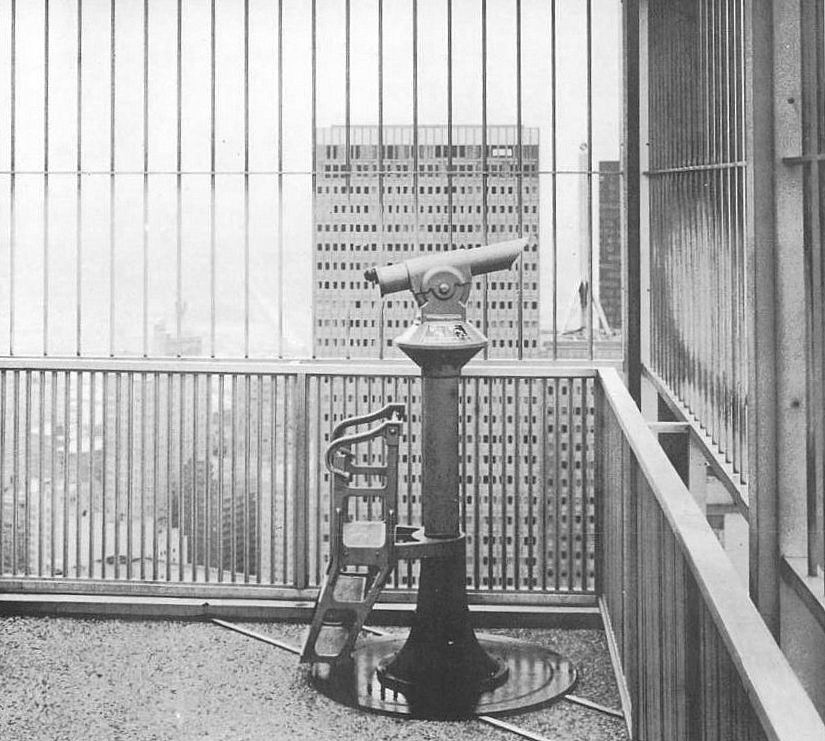
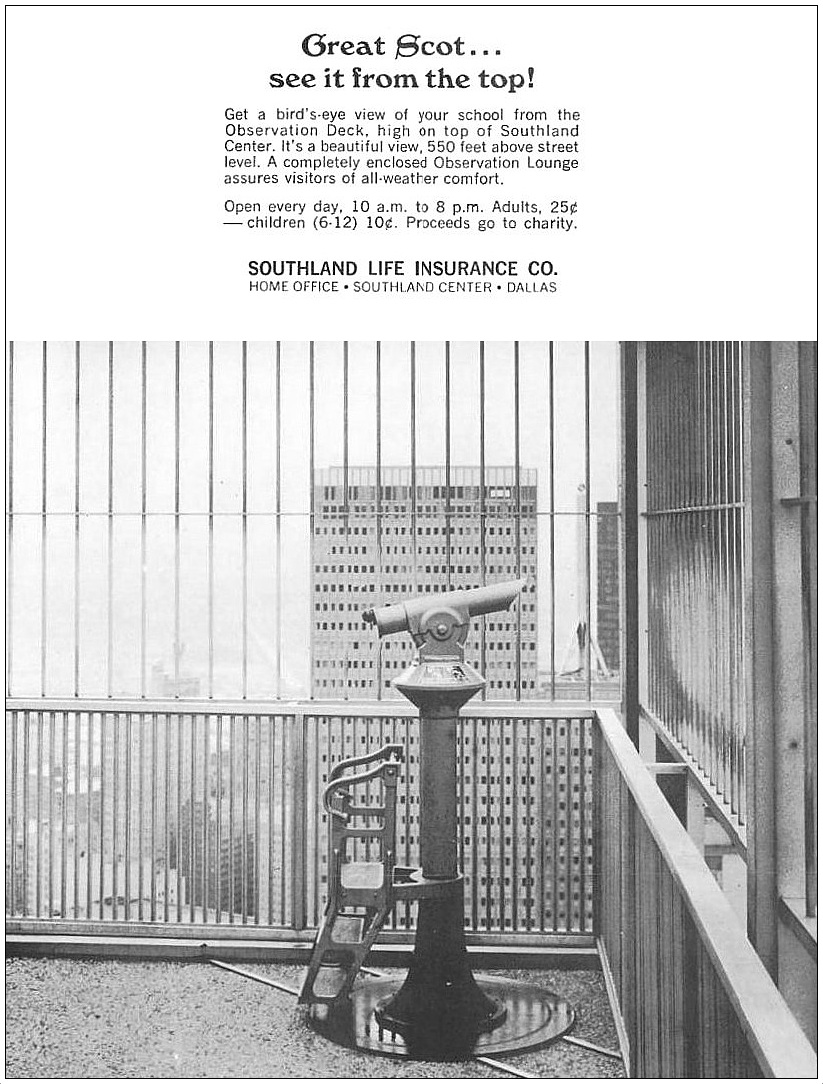
I never experienced the observation deck atop the Southland Life Insurance Building (or any of the observation decks sprinkled throughout downtown — other than Reunion Tower, I guess), but I see a lot of people mention it in fond childhood memories. Here it is in an ad from the 1967 Highland Park High School yearbook.

*

GREAT SCOT… SEE IT FROM THE TOP!

Get a bird’s-eye view of your school from the Observation Deck, high on top of Southland Center. It’s a beautiful view, 550 feet above street level. A completely enclosed Observation Lounge assures visitors of all-weather comfort.

Come every day, 10:00 a.m. to 8:00 p.m. Adults, 25¢ — children (6-12) 10¢. Proceeds go to charity.

Southland Life Insurance Co.
Home Office  •  Southland Center  •  Dallas

southland-life_observation-deck_HPHS-yrbk_1967

*

The observation deck and “lounge” was opened to the public on the 41st floor of the Southland Life Building on Oct. 31, 1956 (the top floor — the 42nd — had a private heliport). I can’t find when it finally closed, but it was open until at least the 1980s.

A search around the internet turned up an interesting bit of footage of the observation deck in 1962 — from a cameo appearance in the TV show “Route 66” (there were a couple of episodes shot in Dallas — I haven’t seen this entire episode, but the clip below has a few cool locations). The pertinent footage begins at the 4:43 mark and lasts for about 2 minutes (if, like me, any hint of fictional animal danger is a problem, you might want to stop around the 5:00 mark). (A couple of cast connections to our fair city: David Wayne, the actor featured in this episode, would later return to Big D as Digger Barnes in “Dallas,” and Dallas actress K Callan — seen in a scene at Love Field at 4:10 — was both a student and a teacher at Our Lady of Good Counsel in Oak Cliff.) From this clip, it looks like there might have been several of the telescopes around the perimeter of the building. (I’d love to see this in color — to see those shimmering blue glass tiles up close.) (This full episode — one of three filmed in Dallas — can be watched on YouTube, here. You’ll see Love Field, the Marriott Motor Hotel, the Southland observation deck, the SMU campus, the Trade Mart, a Wyatt’s cafeteria and grocery store (6126 Luther Lane, in Preston Center), Sheriff Bill Decker’s actual office, and a drive-in movie theater.)

*

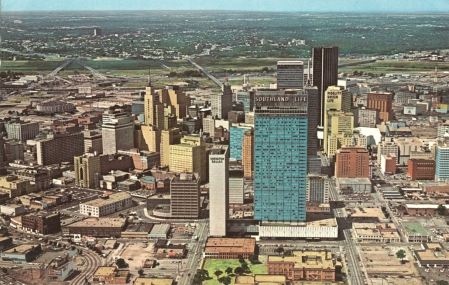
Is there an observation deck there these days?

skyline-looking-west_southland-center_1970_portal

***

Sources & Notes

Top photo/ad is from the 1966 Highland Park High School yearbook. 

Check out these related Southland Center posts:

southland-life_observation-deck_HPHS_1967-yrbk_photo_sm

*

Copyright © 2023 Paula Bosse. All Rights Reserved.
The Mercantile Bank Building — 1951

mercantile_squire-haskins_dec-1951_UTASquire Haskins Collection, UTA Special Collections

by Paula Bosse

Photo of one of my favorite downtown buildings, the Mercantile, taken by ace photographer Squire Haskins in December 1951. See a very large image of this at the UTA website, here. Zoom in and take a look around. Check out all the landmarks. You’ll probably find Waldo while you’re at it.

***

Sources & Notes

“Downtown Dallas — Mercantile Building” by Squire Haskins, taken on Dec. 11, 1951; from the Squire Haskins Photography, Inc. Collection, University of Texas at Arlington Libraries, Special Collections — more information can be found here. (I have slightly cropped the image.)

mercantile_squire-haskins_dec-1951_UTA_sm

*

Copyright © 2023 Paula Bosse. All Rights Reserved.
Businessmen’s Lunchtime Mobilization Drills — 1917

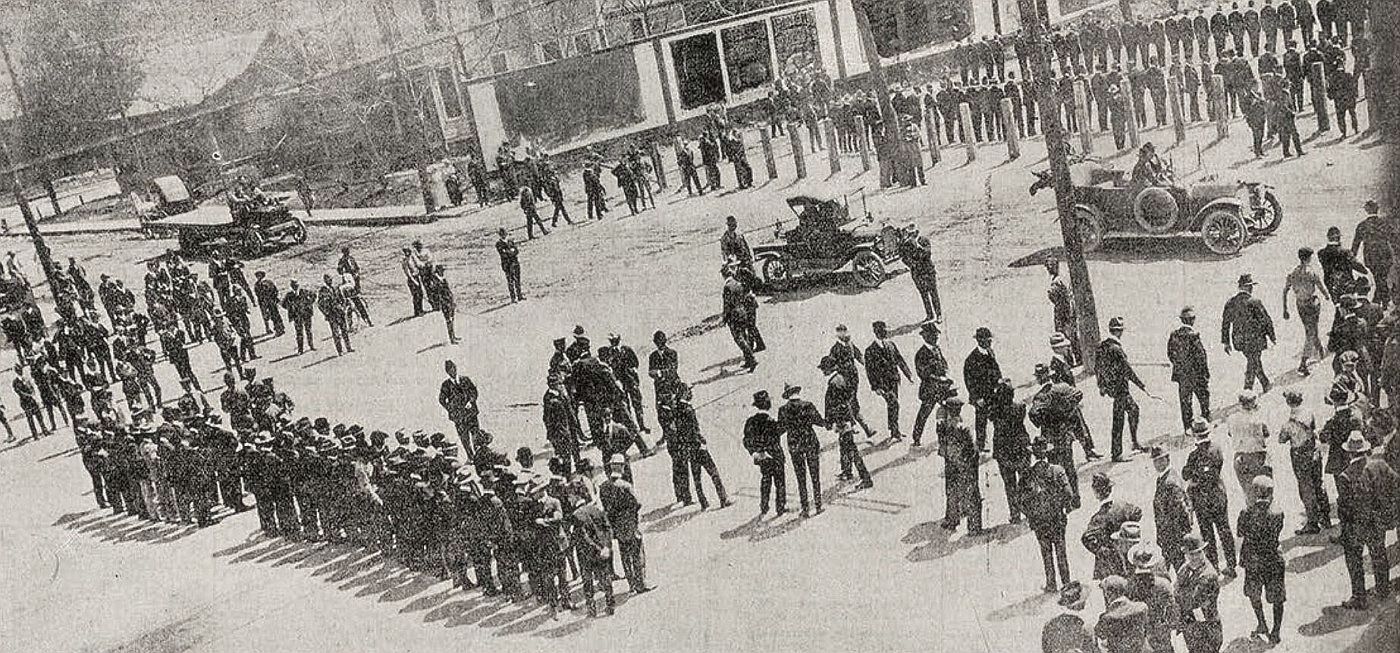
wwi_businessmen_noon-drills_dmn_040117_photoDrilling behind the depot, March 1917

by Paula Bosse

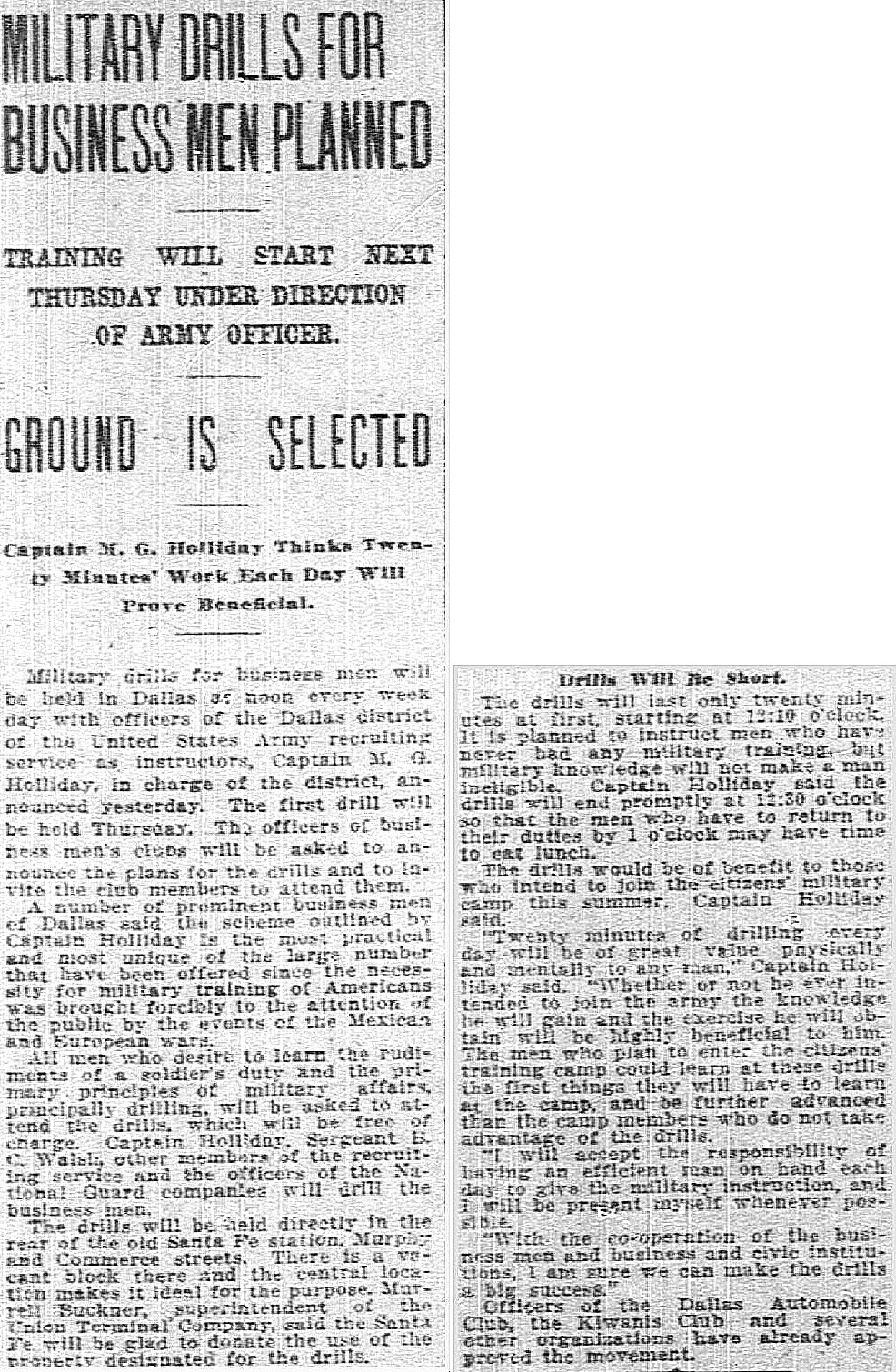
In March 1917, just days before the United States entered World War I, it was announced that there would be lunchtime military training drills in downtown Dallas for any man who wished to participate. This was part of the “Preparedness Movement” which was sweeping the country, in which citizens readied themselves for war. The idea for these drills came from Oswin K. King, a Dallas sportswriter, and they were organized and conducted by Capt. M. G. Holliday, with help from other officers of the Texas National Guard. The drills were held “in the rear of the old Santa Fe station, Murphy and Commerce streets. There is a vacant block there and the central location makes it ideal for the purpose” (“Military Drills for Business Men Planned,” Dallas Morning News, March 25, 1917). (See this location on a 1905 Sanborn map, here.)

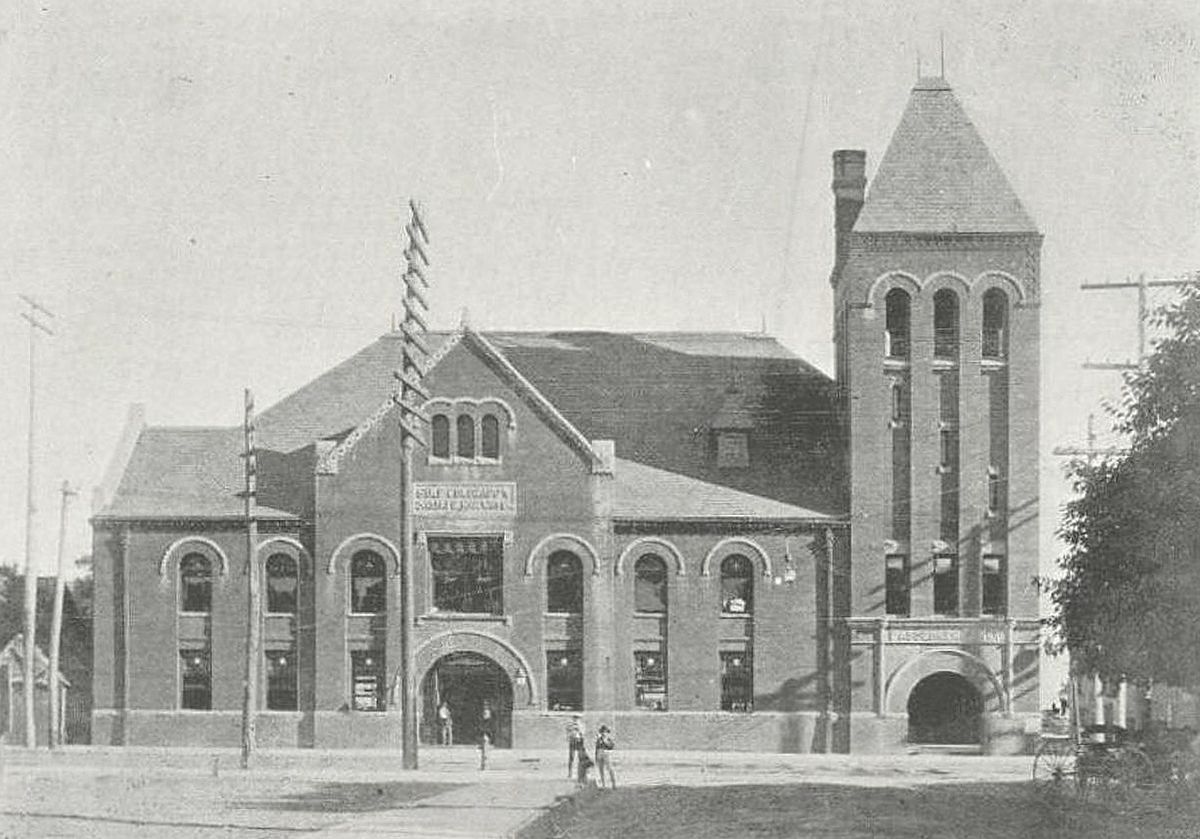
Seems like a good time to insert a photo of the Gulf, Colorado, and Santa Fe depot (when it was still in operation), behind which all this drilling activity was taking place:

santa-fe-depot_ca-1899_fire-dept-souvenir-bk_portalca. 1899, via Portal to Texas History

Military-style drills involving local civilians hadn’t really been done like this before, and news of this swept the country’s newspapers. It was a BIG story. Dallas became the city everyone copied. Cities all over the United States began their own drilling exercises, and Capt. Holliday was kept busy traveling around Texas to advise towns on how to establish such civilian units for themselves. There was a lot of marching in formation going on in April 1917.

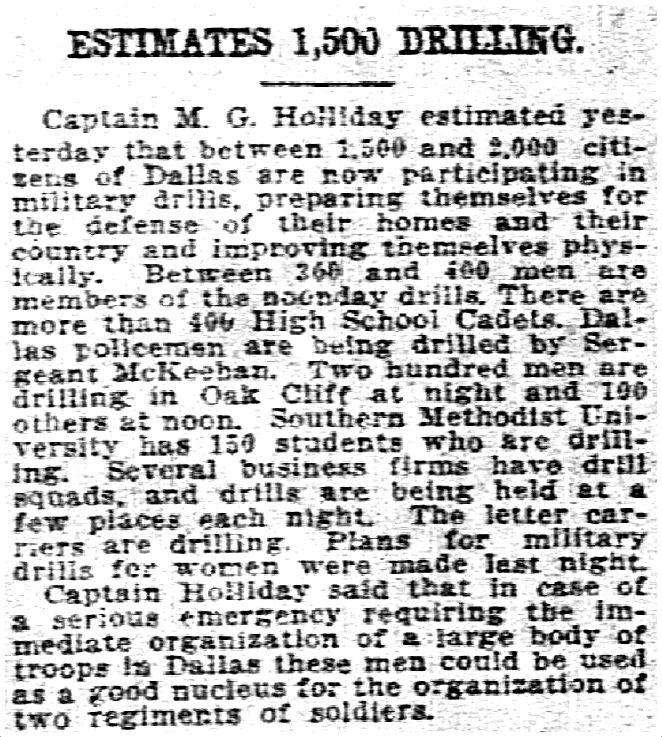
Two weeks in, drill-mania had taken over Dallas. It was estimated that 600 men were showing up daily for the downtown noon drills, and that many more — perhaps as many as 2,000 — had joined smaller groups and clubs which were drilling on their own all over town. There was a large contingent in Oak Cliff, lots of students in high schools and at SMU, policemen, letter carriers, businessmen, etc. There was even a suggestion that women should form their own groups. Any way you looked at it, the endeavor was a success (or at least fervently supported). Capt Holliday said that, should the need arise, a large body of troops could be immediately organized in Dallas — perhaps two regiments’ worth. 

This training lasted about a month, which seems like sufficient time for bank clerks and grocerymen and automobile mechanics and upholsterers to get the hang of doing whatever this was. By the spring of 1917, Dallas was prepared.

**

The April 1, 1917 Dallas Morning News article accompanying the photo above is transcribed here:

DALLAS BUSINESS MEN MOBILIZE FOR MILITARY TRAINING

First City in United States to Start New Drills in Rudiments of Soldier Knowledge

From Few Dozen the First Day to 600 or More Saturday, Shows Rapid Increase of Interest in the Noon Drills. Captain in U.S. Cavalry and Number of Non-Commissioned Officers Instructing Men and Rudiments of Knowledge of Soldier Life

Dallas enjoys the distinction of being the first city in the United States to inaugurate the new mobilization of business men for the purpose of learning the rudiments of military training. There were those who said it could not be done, but the movement has gotten under full swing and the attendance is increasing daily.

Oswin K. King, of the Evening Journal, originated the idea, and becoming enthused of the possibilities, Mr. King suggested the matter to Captain M. G. Holliday of the 12th United States Calvary. Captain Holliday at once took up the plan as suggested by Mr. King and agreed to supervise the work. 

For several days now, hundreds of Dallas business men have been in line on the spacious vacant property to the south of the Commerce Street station of the Santa Fe Railroad. The site is convenient to hundreds of business offices and not over five minutes’ walk from the skyscraper district.

That interest is increasing in the movement is evidenced by the number of business men who are enrolling. From a few dozen on Wednesday, last, to 400 on Thursday, and probably 200 more Friday and Saturday, shows that Dallas men are anxious to learn the rudiments of military training.

The idea is to teach the rudiments of close-order formation, including everything in what is known as the “Soldier’s School Without Arms.”

The instruction will continue indefinitely. Captain Holliday is assisted by several non-commissioned officers and civilian military experts.

*

WWI_noon-drills_dmn_032517DMN, Mar. 25, 1917 (click for larger image)

*

wwi_businessmen_noon-drills_dmn_041317DMN, Apr. 13, 1917

***

Sources & Notes

Top photo from The Dallas Morning News, April 1, 1917, sent to me by Julia Barton (thanks, JB!).

Photo of the Santa Fe depot is from a Dallas Fire Department publication from 1899, provided by the Dallas Firefighters’ Museum to the Portal to Texas History — more information is here.

More Flashback Dallas posts on the WWI era can be found here.

wwi_businessmen_noon-drills_dmn_040117_photo_sm

*

Copyright © 2023 Paula Bosse. All Rights Reserved.

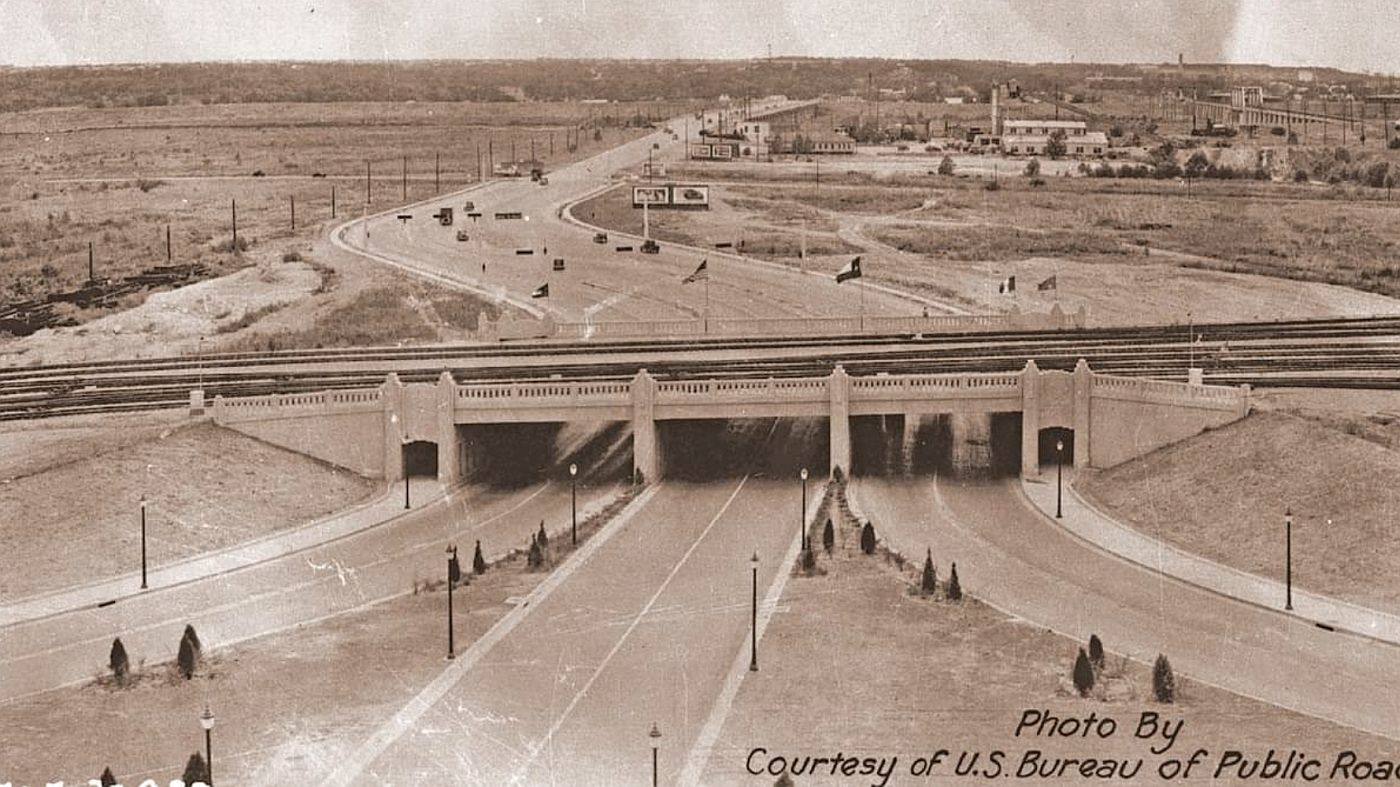
Triple Underpass — ca. 1936

triple-underpass_ca-1936_us-bureau-public-roadsThe Gateway to Dallas, or the the Gateway to Oak Cliff?

by Paula Bosse

Above, a fantastic photo showing the new Triple Underpass, about 1936, with the view toward Oak Cliff. (Compare this with a similar view, from the 1950s, here.)

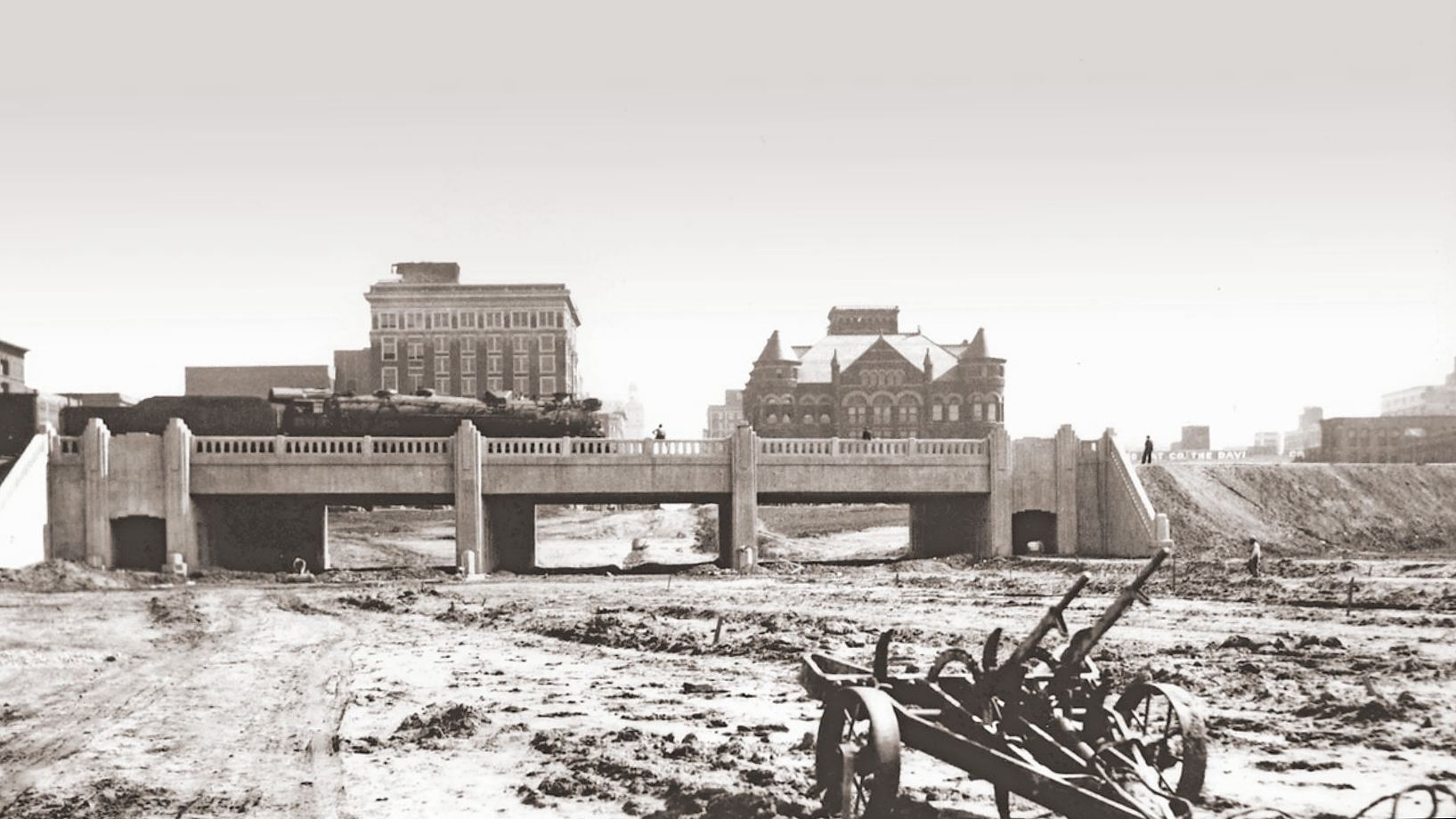
Below, a little earlier, with the view to the east, back toward town.

triple-underpass_construction_looking-east_austin-bridge-and-road-co

The triple underpass was built by the Austin Bridge & Road Company between 1934 and 1936, finishing up just in time to welcome the onslaught of visitors to the Texas Centennial Exposition. I encourage you to visit the company’s public Facebook post here, which includes these and other great photos of this Dallas landmark (including a “then and now” comparison and a history of their involvement in the project). Below is an excerpt from that post:

Once called the “Gateway to Dallas,” the triple underpass near Dealey Plaza was built by Austin Bridge Company and Austin Road Company starting in 1934. The underpass, a joint project with the Texas Highway Department and City of Dallas, created access to the western edge of downtown Dallas under the Union Terminal tracks. Contending with up to 80 trains a day complicated the job, requiring close cooperation with the railway companies. The triple underpass was hailed as a modern marvel, built of concrete with square balusters in a handsome art-deco style. It was unveiled with great excitement in 1936, during Texas Centennial celebrations.

***

Sources & Notes

Top image is a U.S. Bureau of Public Roads photo showing the new underpass, looking to the west.

Both photos and the excerpt are from a post on the Austin Bridge & Road Facebook page, which you can find here.

triple-underpass_ca-1936_us-bureau-public-roads_sm

*

Copyright © 2022 Paula Bosse. All Rights Reserved.
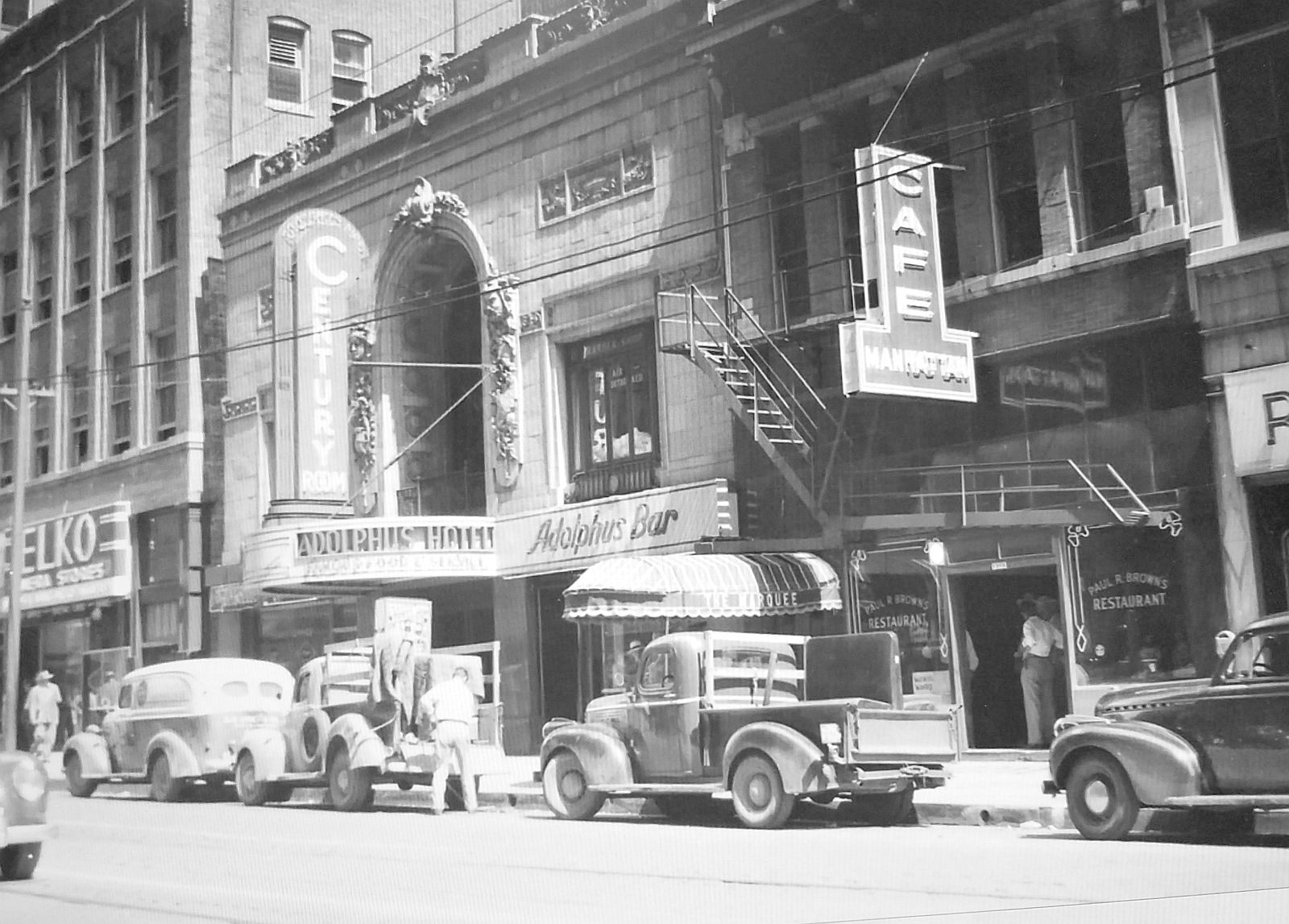
1400 Block of Main Street, ca. 1946

main-street_century-room_ca-1946_bell-collection_DHS_detThe Century Club, the Adolphus Bar, and the Manhattan Cafe await…

by Paula Bosse

A few years ago, I went in to the Dallas Historical Society a few times a week to volunteer. I ended up basically cataloging an entire collection of photos taken by a man named James H. Bell — and I really enjoyed it. Bell wasn’t a professional photographer, he was just a guy who liked to take a lot of photographs. The photos were all taken, as I recall, in 1946 and 1947, when he was apparently visiting Dallas — which I gather was his hometown — on a trip from his new home in California. He took a lot of pictures of places around Dallas that no one really bothered to document: businesses, street life, houses. He was also something of a pinball and jukebox aficionado, because a large number of his photos had coin-operated machines in them. Like a LOT. He also liked buses. And he seemed to always have his camera with him.

The photo above (which, sadly, I’ve had to crop because of image issues) shows the south side of the 1400 block of Main Street. I’ve never seen a photo from this period of the Main Street entrance to the Adolphus Hotel. That cool 1936 deco sign for the Century Room is great (even though it looks a little out of place next to the overly ornate early-20th-century arch next to it). (See the full wonky image — apologies for the low resolution — all my fault — here.)

I can tell you exactly why Bell took this photo: he saw a coin-operated machine being unloaded from a truck (or loaded into a truck). There were others photos in this collection taken in similar circumstances. I don’t know whether he was following jukebox and pinball trucks around town (a very definite possibility…), or whether he just happened upon these coin-op machine deliveries, camera at the ready. Whatever the case, he got a nice action-photo of a jukebox delivery in the wild, while, at the same time, he secured for posterity a nice historical image of everyday life on Main Street. And, we have the added bonus of seeing the long-gone sign for the swanky Century Room nightclub.

This was the Dallas Historical Society description I wrote for the full photo:

Downtown Dallas, 1400 block of Main Street. South side of Main, with Akard intersecting at left. Partial view of the Southwestern Life Building (southeast corner of Main and Akard, with Travis cigar stand at street level); Andrews Building (southwest corner of Main and Akard); C C Liquor Store (1412-B Main); Elko Camera Store (1410 Main); Ragir’s (1412 Main); Adolphus Hotel, rear entrance (with Century Room nightclub sign); Adolphus Bar (1406 Main); the Marquee restaurant (1404 1/2 Main); Paul R. Brown’s Restaurant. Also: a sign for Manhattan Cafe or Cafe Manhattan, pedestrians, 1940s vehicles, workman securing a pinball or other coin-operated machine into back of pickup truck.

*

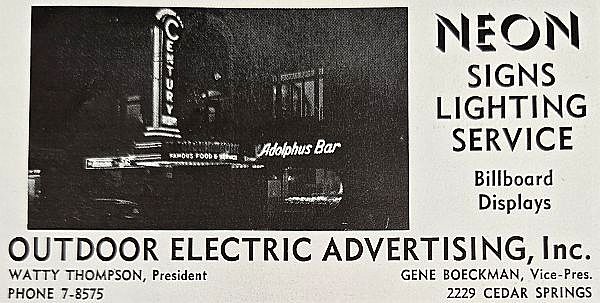
And here’s what it looked like at night:

adolphus_neon_outdoor-electric-advertising_southwest-business_sept-19361936

***

Sources & Notes

This photo was taken by James H. Bell in about 1946, and it is from the James H. Bell Collection at the Dallas Historical Society. The Accession Number is 2017.48, and the Object ID is V.2017.48.531. 

Ad for Outdoor Electric Advertising is from Southwest Business magazine, Sept. 1936, Periodicals Collection, Dallas Public Library.

main-street_century-room_ca-1946_bell-collection_DHS_det_sm

*

Copyright © 2022 Paula Bosse. All Rights Reserved.

Thanks-Giving Square — 1976

thanks-giving-square_thanksgiving-square_1976_postcard_ebay

by Paula Bosse

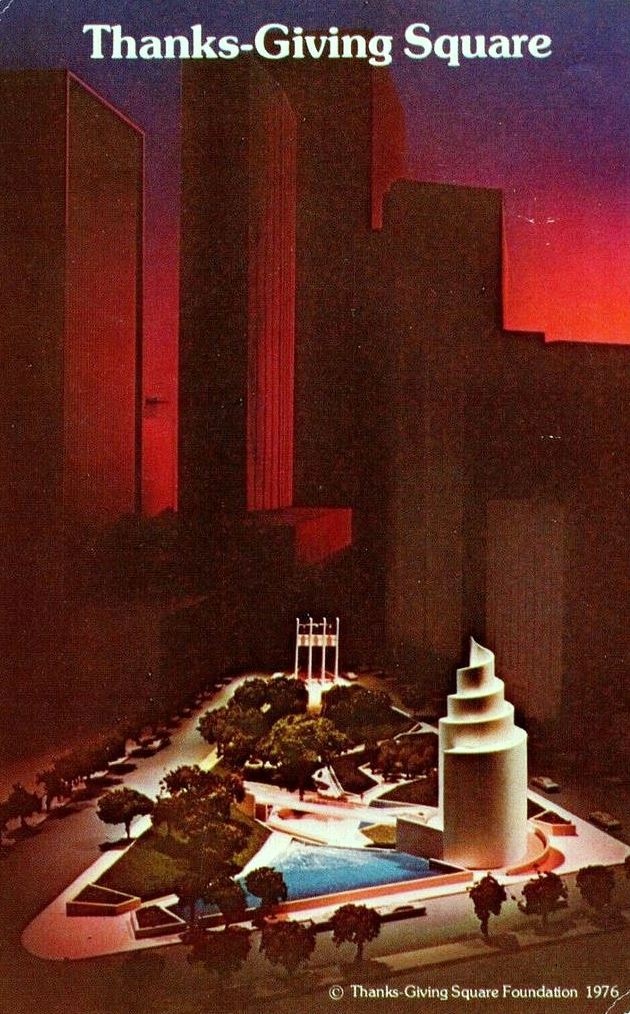
Happy Thanksgiving! It seems like a good day to look back at Thanks-Giving Square, the triangular one-acre park in downtown Dallas bounded by Pacific, Bryan, and Ervay. It was originally envisioned in 1961 by Dallas businessman Peter Stewart as a needed quiet refuge and chapel in the middle of a busy city — a calm space set aside for “spiritual gratitude.” It took several years before architect Philip Johnson was brought on to the project in 1971. After more than 15 years from its original conception, its official public dedication was on Nov. 28, 1976, three days after Thanksgiving.

Check out some of the progress reports on the project which appeared over the years on WFAA-Channel 8 News:

Architect Philip Johnson (whose other Dallas projects include the Kennedy Memorial, The Crescent, and the Cathedral of Hope, etc.) talks briefly about Thanks-Giving Square and its underground component, and also shows off a 3-D model (from July 1971):

*

Business owners whose shops were in buildings on the land which was about to be leveled were forced to move out, and many were not happy (from April 1972):

*

Construction is underway (November 1976):

*

And, lastly, Channel 8 weatherman Troy Dungan checks out the progress as the dedication day approaches (November 1976):

*

For a bit of street-level context, here’s a photo showing some of the buildings that were razed (at the right, directly across from the Republic Bank Building) in order to make way for Thanks-Giving Square:

kodachrome_bryan-n-ervay_1954_shorpyvia Shorpy.com

*

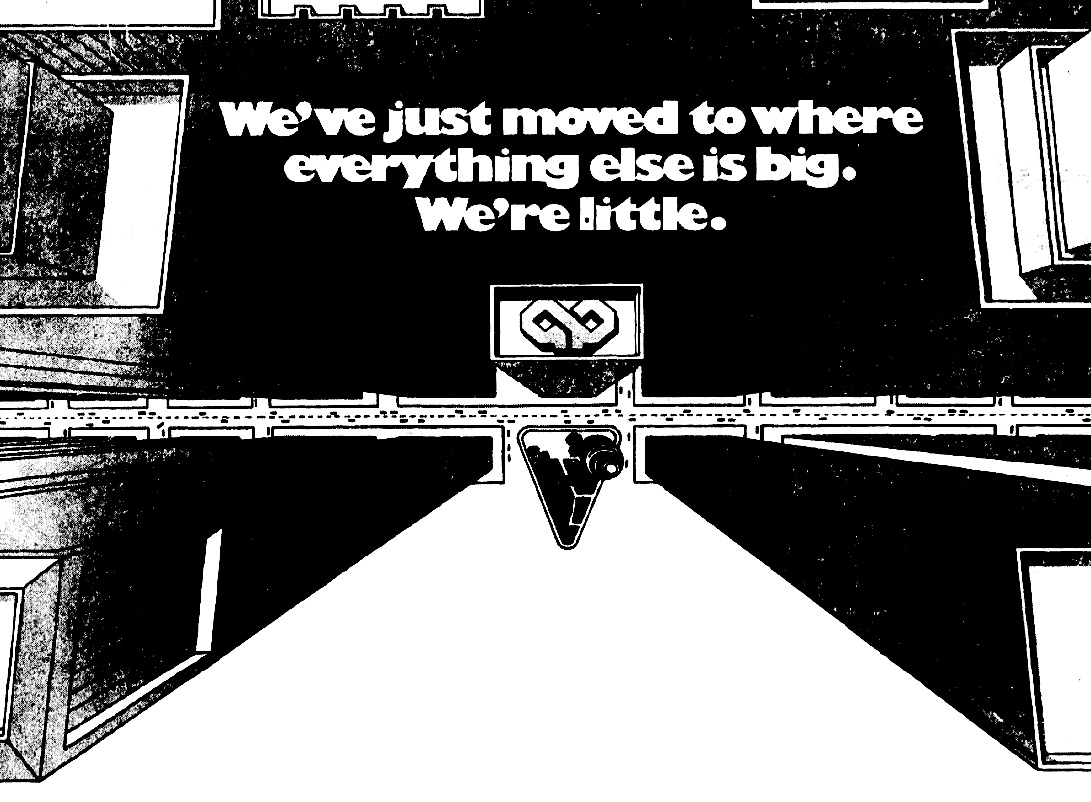
Below is a detail from a newspaper ad for MetroBank which appeared in August, 1976, with a nice little stylized illustration of the triangular TGS and its swirly chapel (click for larger image).

thanks-giving-square_metrobank-ad_det_080276

*

Speaking of the “swirly” design, in a 1982 article about TGS, Dallas Morning News architect deity David Dillon described this structure as “Philip Johnson’s Dairy Queen chapel,” which, presumably, might not have been met with amusement by internationally acclaimed architect Johnson, who probably wouldn’t have appreciated the comparison of his work to an ice cream cone. Interestingly, that description appeared in a 1982 article about Stewart’s dismay that the tall buildings which loomed over TGS (including Thanksgiving Tower) were, basically, blotting out the sun — little TGS was more often in shadow than in sunlight:

Stewart urged the city to pass a sun and shadow ordinance that would preserve the remaining downtown view corridors from high-rise development […] but the [preliminary] ordinance got such a cool reception from downtown developers that it was dropped quickly. (“Computer Study Sheds Light On Thanks-Giving Square Problem” by David Dillon, Dallas Morning News, July 4, 1982)

I bet it got a cool reception!

***

Sources & Notes

Postcard found on eBay.

Videos from SMU’s WFAA News Film Collection, which can be found on the SMU Jones Film Collection YouTube channel.

Thanks to Noah Jeppson for passing along a link to the huge Thanks-Giving Foundation Collection of photos and documents, viewable on the University of North Texas’ Portal to Texas History, here.

Read about the history of Thanks-Giving Square (or as it’s often written, Thanksgiving Square) on Wikipedia, here.

Read the D Magazine article “The Park That Peter Built” (which seems to end abruptly) about the history of Thanks-Giving Square by Jane Sumner from Nov. 1, 1977 here.

thanks-giving-square_thanksgiving-square_1976_postcard_ebay_sm

*

Copyright © 2022 Paula Bosse. All Rights Reserved.
East on Elm

elm-street_gentrys_city-of-dallas-websiteShouldn’t there be cars?

by Paula Bosse

There has been some heavy-duty editing to this post!

Here’s an interesting photo I stumbled across last night on the City of Dallas website. There wasn’t any information about it, but it appears to be a view to the east, taken from the 1400 block of Elm Street (where Exchange Place — originally Scollard Court — intersects). See what it looks like today on Google Street View here.

The main landmarks are what I call the Wilson Building Jr. (the tall dark building in the distance, located on Elm near Ervay), the Praetorian Building (the tall white building at the right, at Main and Stone), and L. W. Gentry’s photography studio in the middle of the photo at the right.

Gentry’s was upstairs at 1304 Elm from about 1904 until about 1911. In 1912, Gentry moved a block down the street to 1502 Elm, at Akard, where he took over the upstairs studio of photographer J. C. Deane. (I wrote about Deane and this building here.)

There is a sign reading “Empress” at the left. That was the Empress Theatre, which was at 1409 Elm from about 1912 to 1915. Directly across the street is a 3-story building with a sign for the Spirella Corset Parlors at 1410 Elm.

Back to the left, across the street, is the hard-to-read sign for Studebaker Bros. of Texas at 1405 Elm. Directly across the street is the new Kress Building (you can see part of the distinctive “K” from the company’s logo at the top right). Kress was at 1404-8 Elm — the building was erected in 1911 and opened that same year in November.

The “new Wilson Building” was also built in 1911, and Gentry’s took over the space above T. J. Britton’s store at Elm and Akard in 1912. And all these places appeared in the 1912 directory (except for the Empress, which was open in 1912 but might not have made the listing deadline). So I’m going to guess that this photo is from 1912 or 1913.

gentry_1912-directory_1502-ELM1912 Dallas directory, Elm Street

But this photo looks older than 1912. So many horses! The only vehicle not pulled by a horse in this photo is the streetcar. Where are the cars? In 1911, Dallas was pretty car-crazy — you’d expect to see at least ONE horseless carriage in there somewhere. It doesn’t sound like a lot, but in 1911, there were about one thousand automobiles registered in Dallas County, and the city was quickly becoming a major distribution hub for car companies (“Dallas Automobile Center of the Southwest,” Dallas Morning News, Dec. 31, 1911). (Check out this photo from 1911 taken a couple of blocks away. The only animals seen are actually riding IN an automobile!) Were cars banned from Elm Street? Seems unlikely. …I’m pretty sure I’m overthinking this.

(Ironically enough, the full entry for Studebaker Bros. which appears in the 1912 directory reads: “Carriages, wagons, buggies, street sprinklers, harness.” Nary a mention of an automobile. That arrived the following year.)

It might just be that I’ve had a very stressful couple of weeks, and it was really late when I originally wrote this. But I’ve had a refreshing night’s sleep, and I’m still fixating on this car thing. (Shouldn’t there be cars on Elm Street in 1912?) So I’m just going to stop looking at this photo, assume that it was snapped when all cars in the area were just out of frame, and wrap this thing up.

**

Here are a few zoomed-in details.

elm-street_gentrys_city-of-dallas-website_det1

elm-street_gentrys_city-of-dallas-website_det2

elm-street_gentrys_city-of-dallas-website_det3

I love these decorative lamp posts (more examples can be seen in a post I really enjoyed writing, “The Grand Elm Street Illumination — 1911”).

***

Sources & Notes

Photo found on the City of Dallas website, here (banner photo).

I have edited this after seeing the reader comment below. I realized that I was basing the original location on Lemuel W. Gentry’s first studio, which was a block or two west from the one seen in the photo. (I kept saying to myself, “That building looks so much like the one the Deane studio was in.” Because… it was the exact same building!) Thanks, NotBob.

Here’s a closer shot of Gentry’s studio around 1915 — on the southeast corner of Elm and Akard, right across the street from the new Queen Theatre. (This photo originally appeared in this post.)

queen_cinema-treasures

NOW we see cars!

elm-street_gentrys_city-of-dallas-website_sm

*

Copyright © 2022 Paula Bosse. All Rights Reserved.