There’s a church, and a bank, and a bank, and a bank…
by Paula Bosse
A couple of quickies: these are two really nice postcards which popped up recently on eBay — I’d never seen them before.
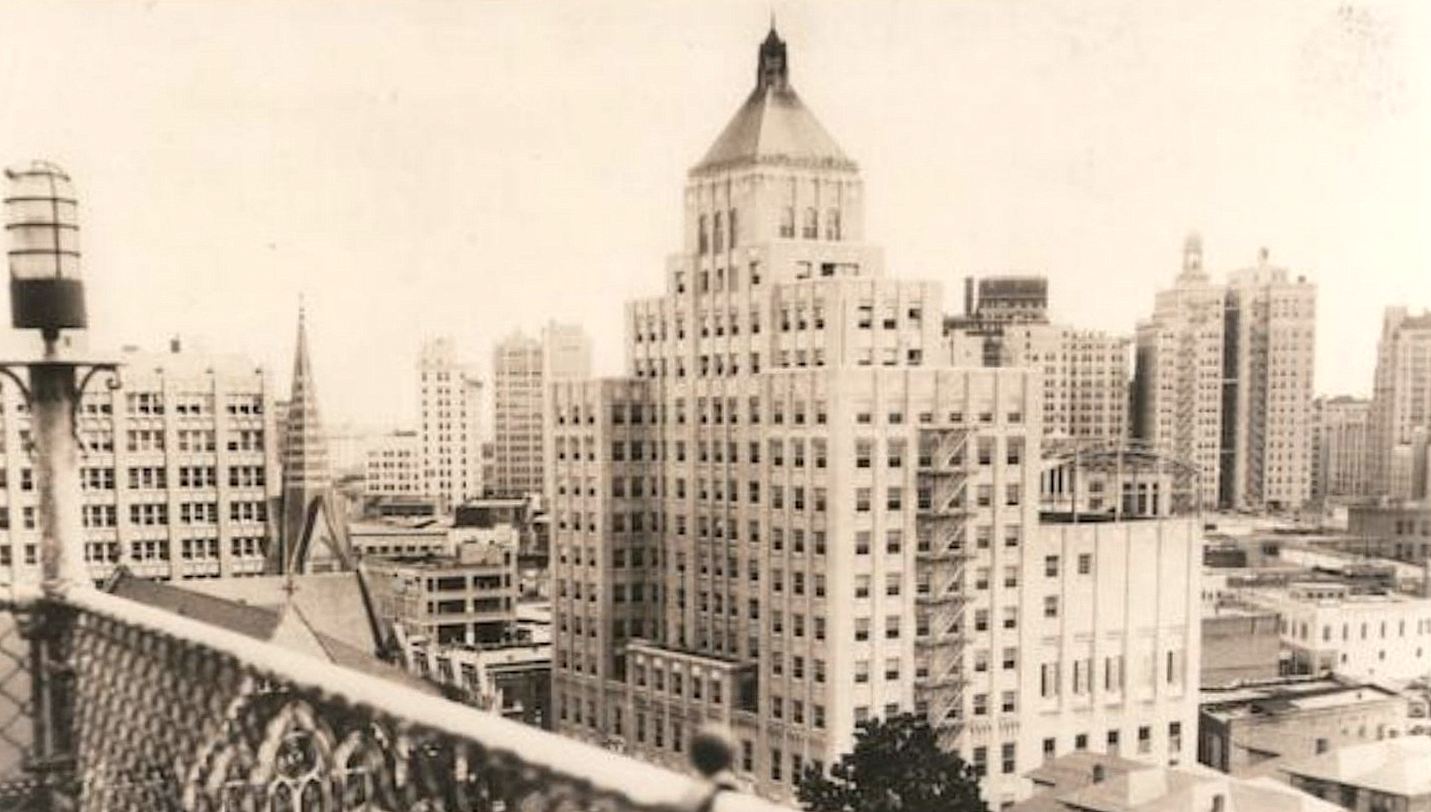
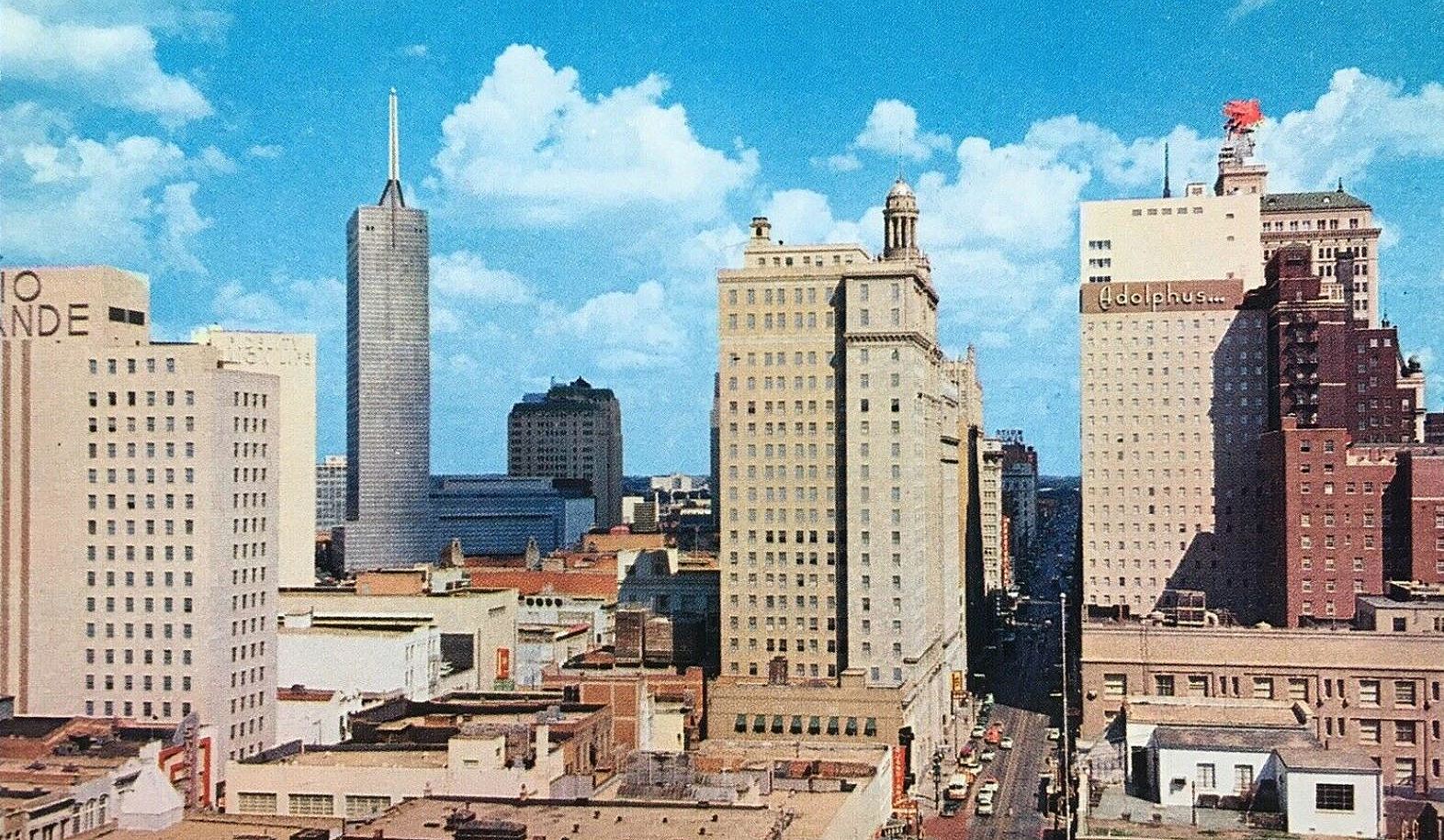
Above, a lovely, creamy, glowing shot of the skyline. I recognize several of the buildings, but I’m not sure where the photographer was positioned. I’m sure a smart person will put the location in the comments.
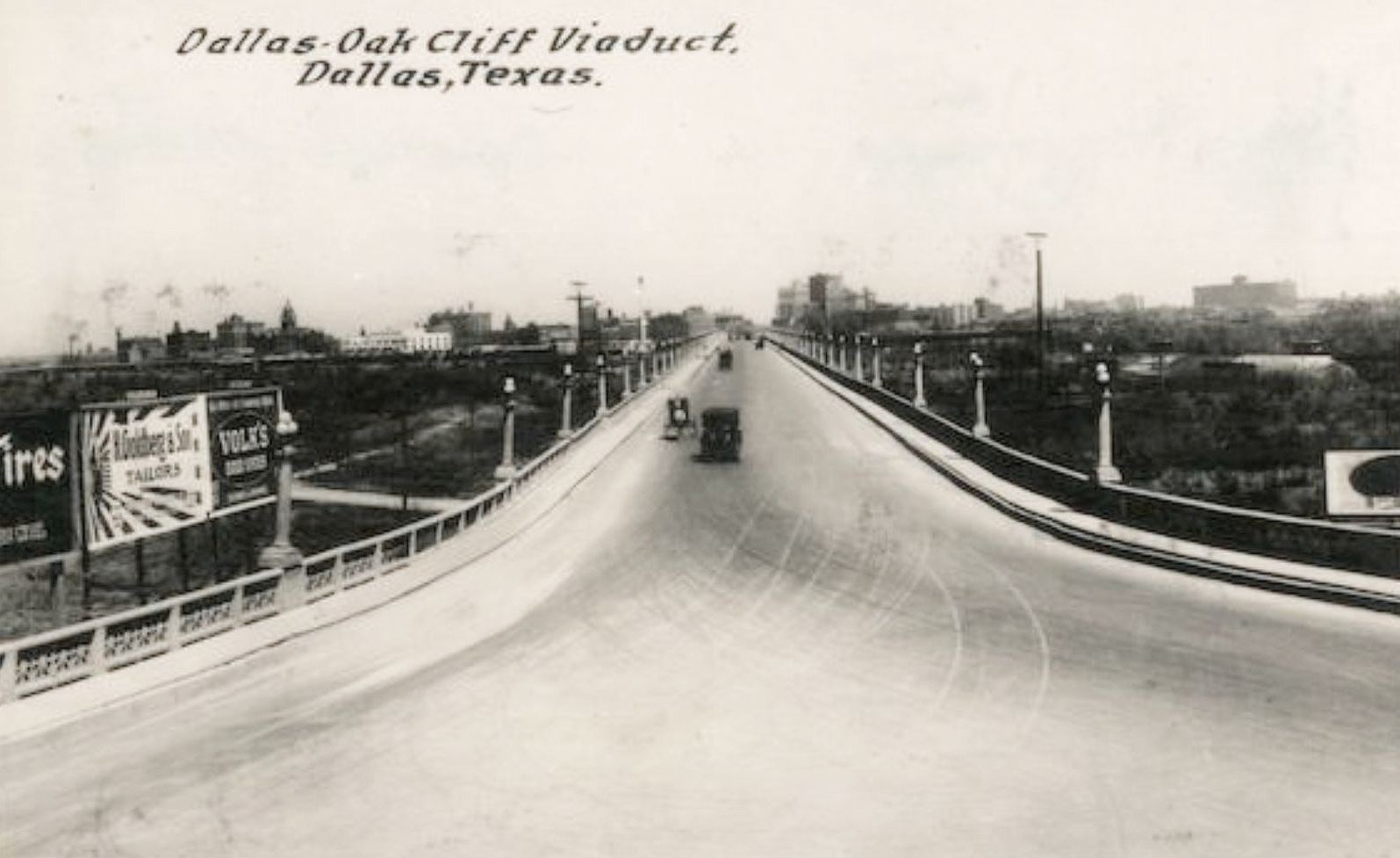
And below, a great image of the “Dallas-Oak Cliff viaduct,” looking toward the city. There’s even a Volk’s billboard to welcome visitors.
Above, a sort of bland, colorized view of downtown, looking to the east, with Main on the left and Commerce on the right. Below, the muddier, grittier reference photos, taken from the courthouse (all three were issued as postcards).
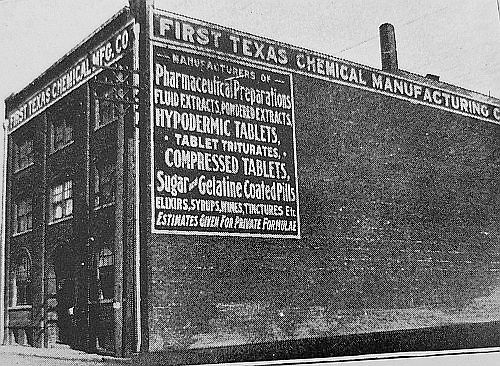
In the foreground is the First Texas Chemical Manufacturing Co. (on Market Street, between Main and Commerce), established in 1903 by super-rich guy C. C. Slaughter et al. The company manufactured a wide variety of drugs, pharmaceuticals, elixirs, and preparations.
via Greater Dallas Illustrated, 1908
Dallas Morning News, Dec. 20, 1903
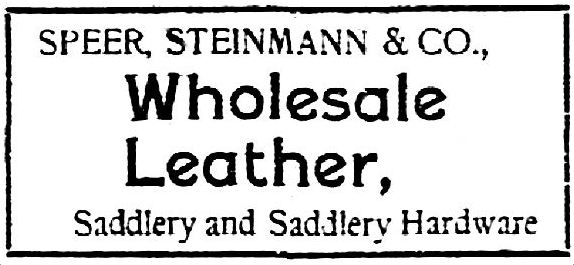
In the middle right of the postcards — facing Commerce — is Speer, Steinmann & Co., which made saddles and traded in wholesale leather products.
DMN, Feb. 26, 1899
In the lower left is Fulton Market. Below is a rather grisly newspaper account which starts off sounding like there’s been a bloody massacre on Main Street, with carnage everywhere. Turns out it’s just an arresting ad for butcher Mike Younger, a recent arrival from Atlanta.
DMN, Jan. 25, 1903
***
Sources & Notes
The first three images are postcards, all found on eBay. There is another copy of the second postcard in the George W. Cook collection of the DeGolyer Library at SMU which you can enlarge — see it here.
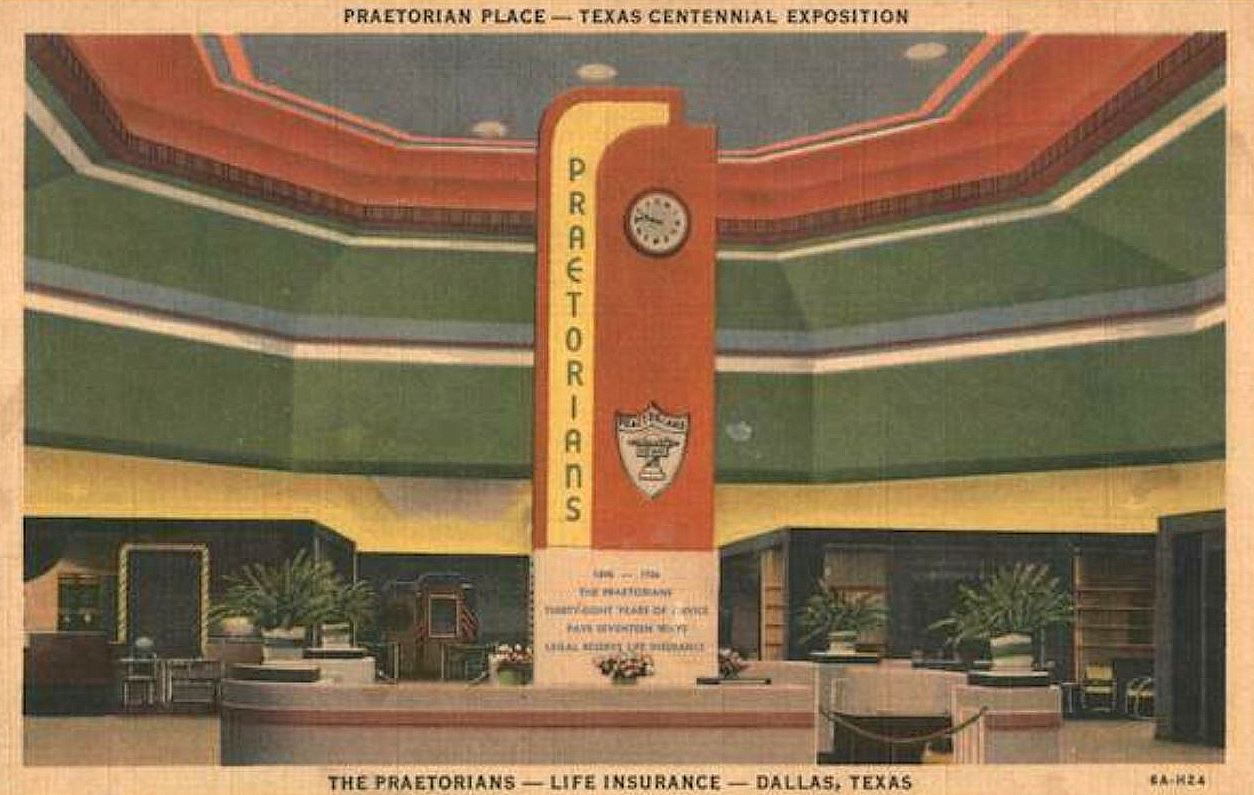
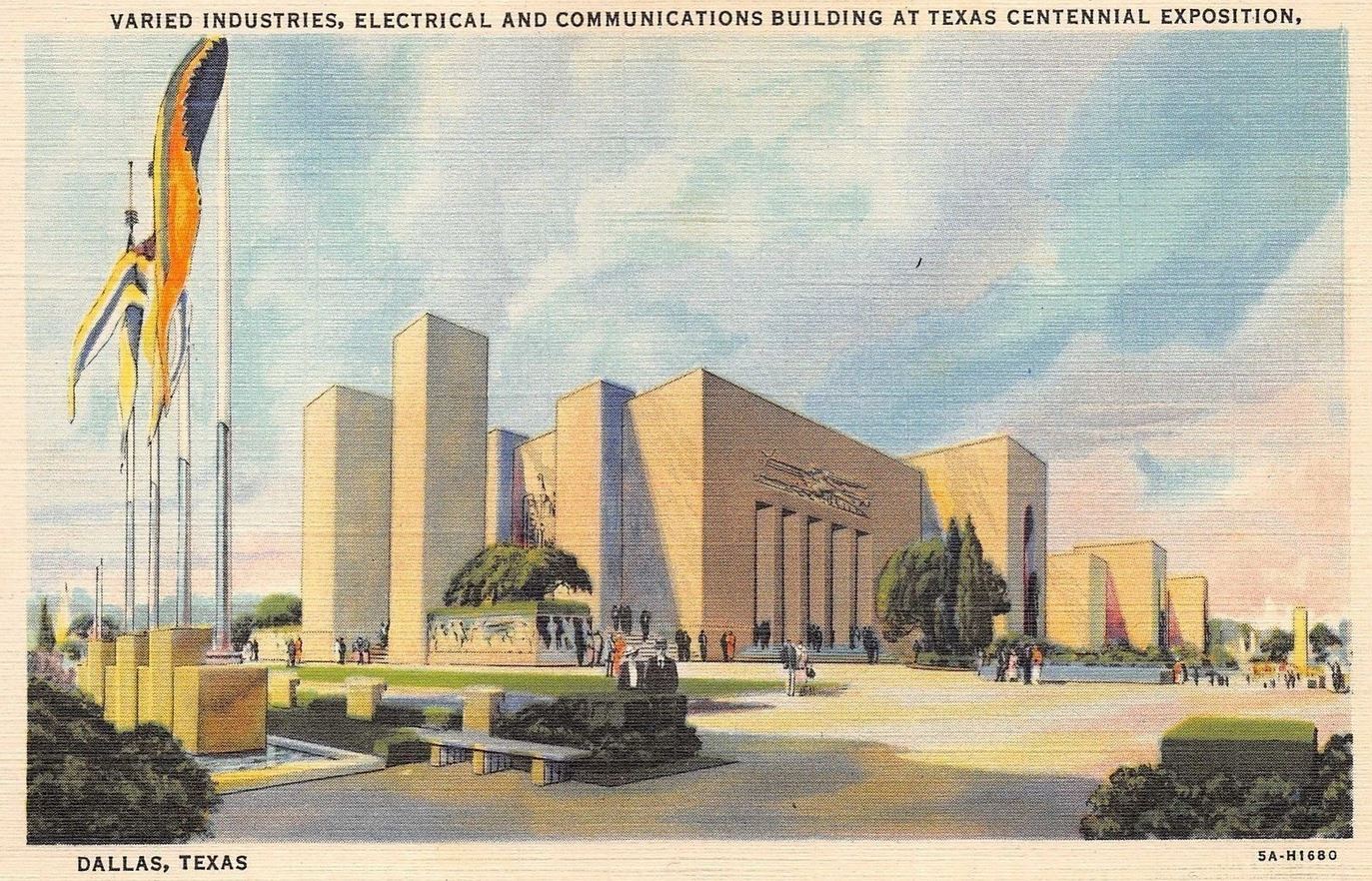
I’ve seen so many Dallas postcards that it’s always a little bit of a jolt when I see one I’ve never seen before, like the one above. The Praetorians Life Insurance exhibit was inside the Varied Industries building (below). So much is written about the architecture of Fair Park — but we don’t hear a lot about the interiors. I don’t think there are many color photos in existence. This is a colorized image, but the colors in real life were pretty vibrant. Even the floors were fantastic! One of my favorite “finds” was the ad at the top of the post “State Fair Coliseum/Centennial Administration Building/Women’s Museum/Women’s Building” — it’s a color photo (!) which shows glimpses of the interior, the furniture, and, best of all, the custom linoleum.
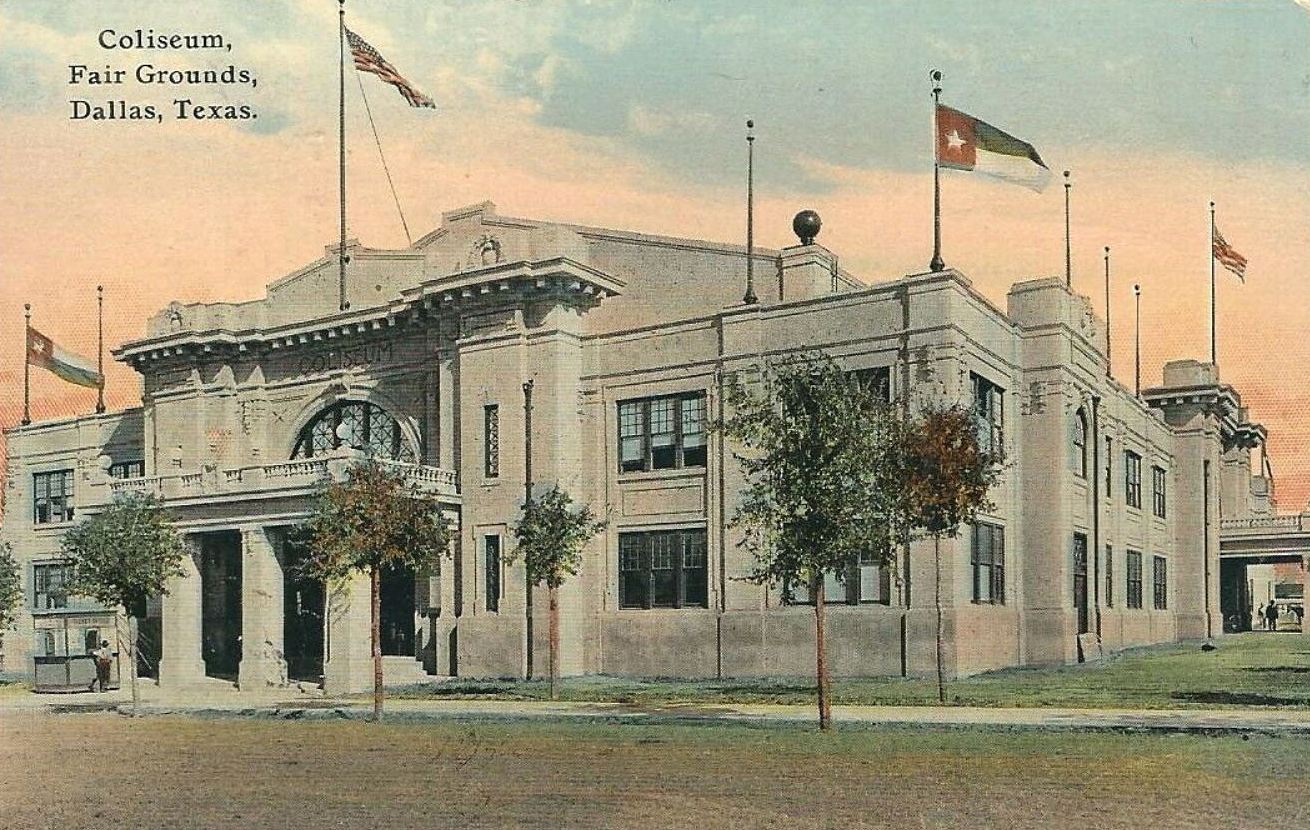
And speaking of the Fair Park Coliseum, this is a great postcard (with a 1911 postmark):
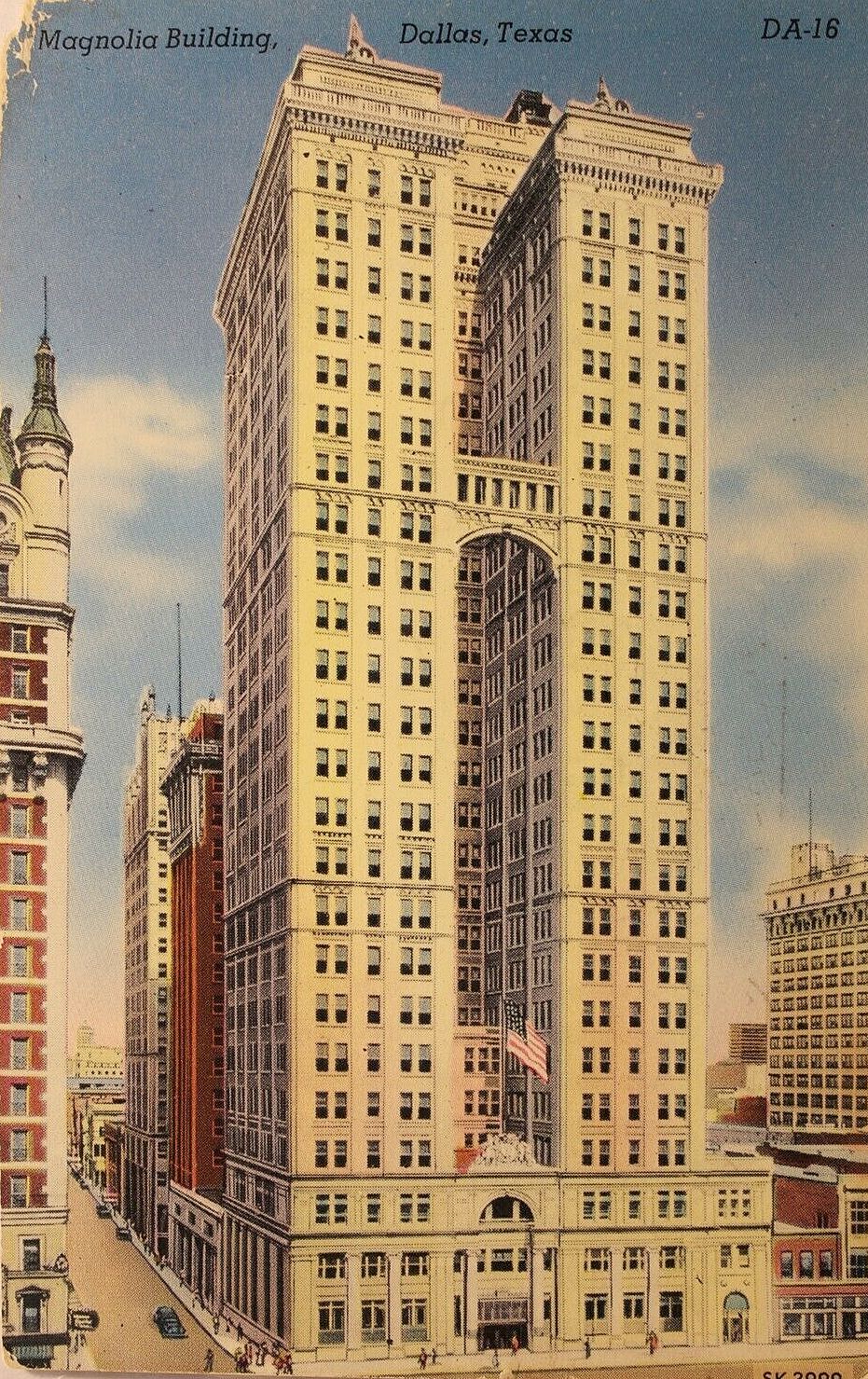
And here’s the Magnolia Building — it never gets old:
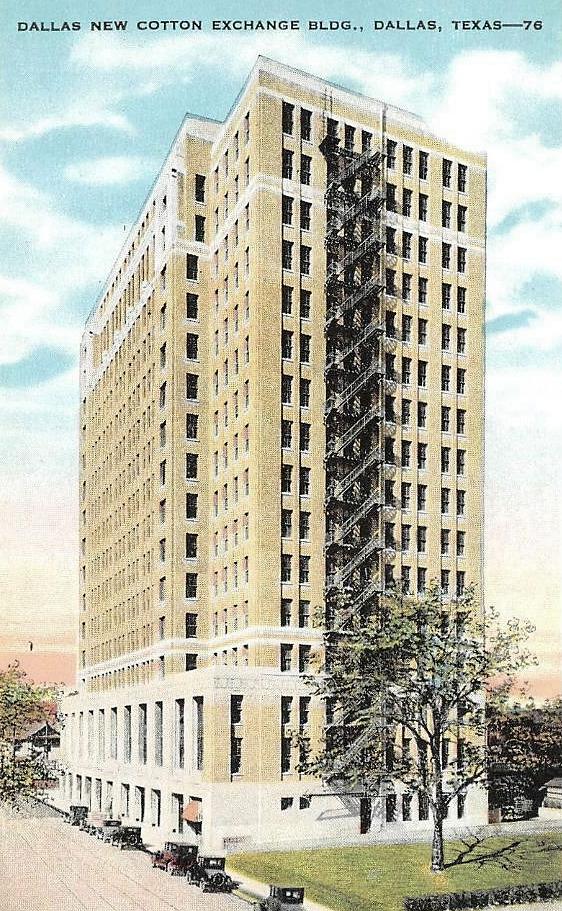
The “new” Cotton Exchange Building, at St. Paul and San Jacinto (I wrote about the old and new Cotton Exchange buildings here — scroll down to #4):
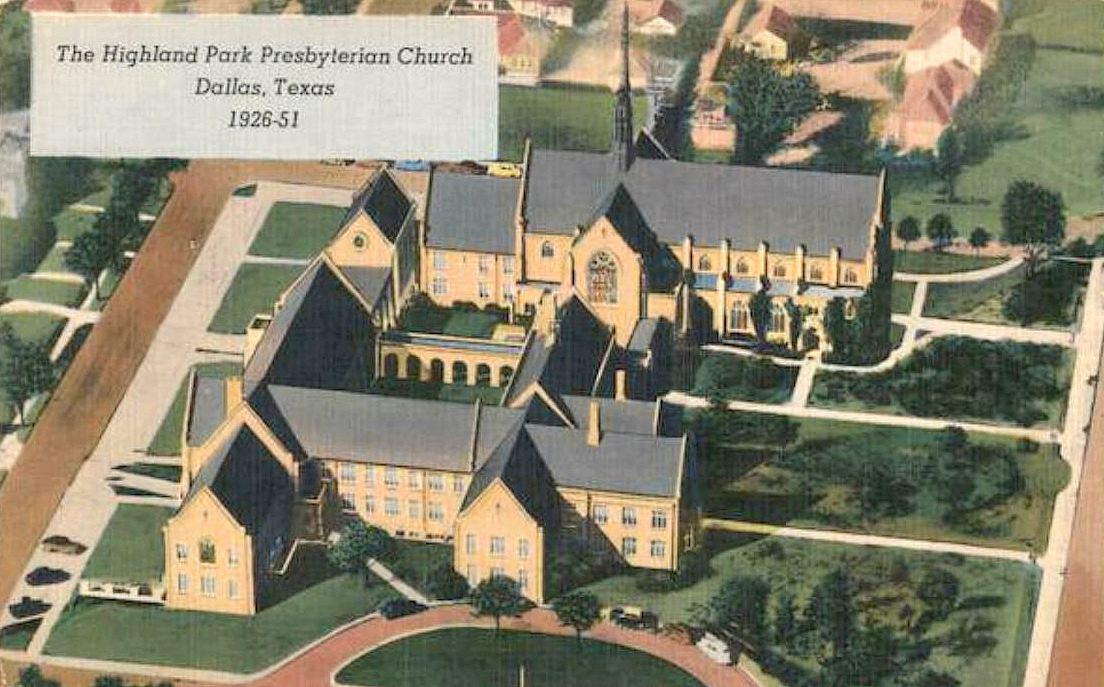
Highland Park Presbyterian Church (circa 1940s):
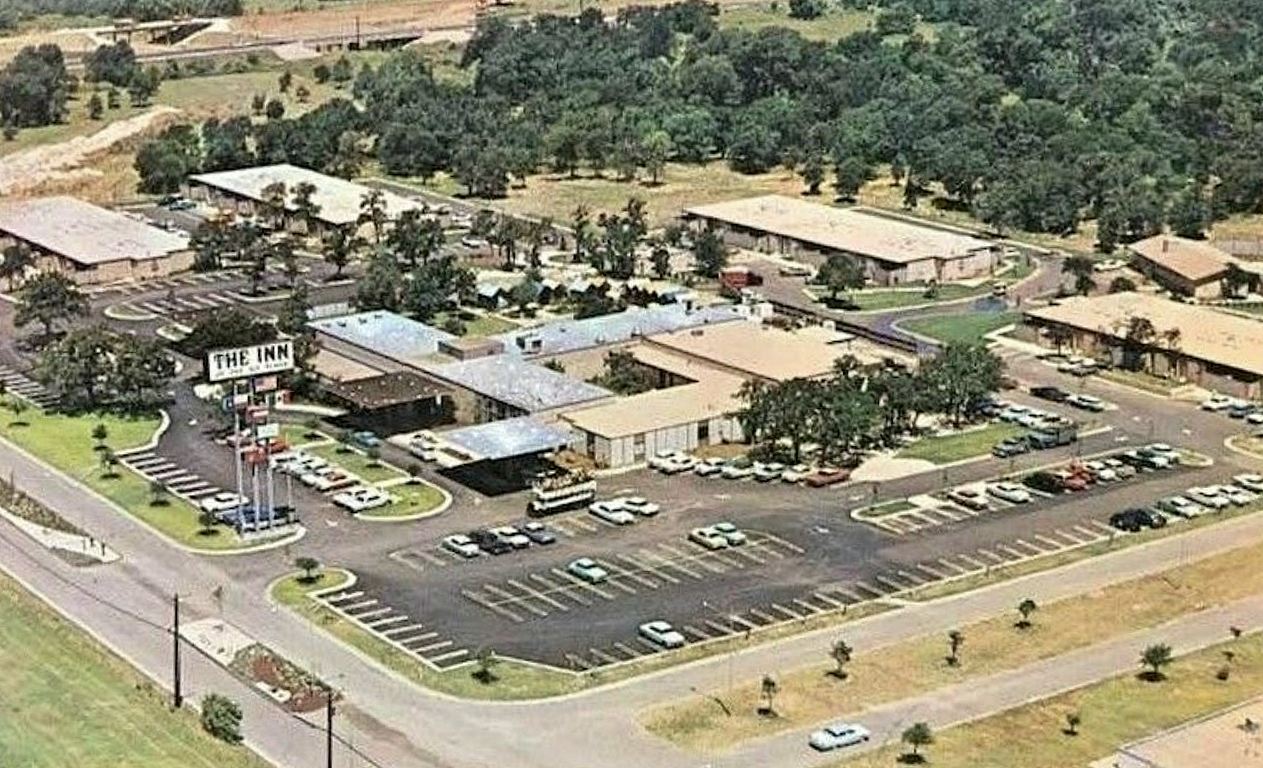
The Inn of the Six Flags — along the DFW turnpike in Arlington. I’d never seen this postcard — and the resolution is pretty bad — but I post this almost entirely to drink in that unbelievably pastoral view of 1960s Arlington.
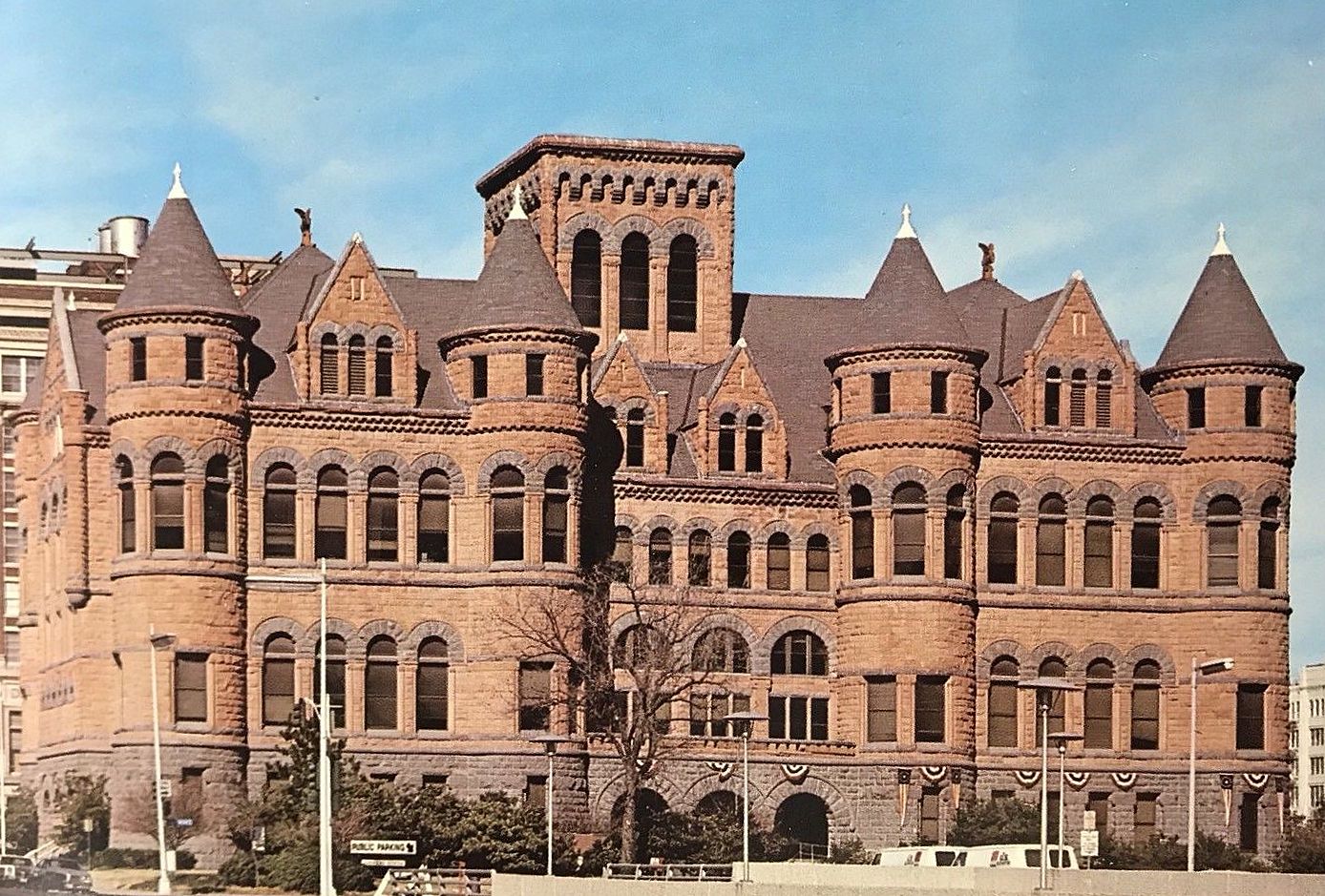
A nice view of Main Street, looking west toward the probably pretty new courthouse (built in 1892). Streetcars, the St. George Hotel, the North Texas Building, the Trust Building. Much the same shot is seen in this photo from 1954 (more buildings, less sky).
I hope citizens back then weren’t getting too attached to that beautiful clock tower, because it would go bye-bye in April, 1919 after it had been determined that it might be on the verge of collapse.
From The Dallas Morning News, Jan. 22, 1919:
COURTHOUSE TOWER IS ORDERED REMOVED
Believing the courthouse tower to be a nuisance to the safety of persons in the building, the Commissioners Court yesterday ordered H. A. Overbeck, architect, to prepare specifications for its removal. The tower will be leveled off even with the balcony.
Mr. Overbeck recently made an inspection of the tower, reporting that while there is no immediate danger, it is altogether advisable that the tower be demolished, as a strong windstorm might cause it to collapse. The walls have numerous cracks in them, the sandstone is disintegrating in places, and some of the iron supports are rusted and deteriorating, he said.
The work of removing the tower will begin as soon as Mr. Overbeck can complete the necessary plans.
It wasn’t even 30 years old. The tower came down a few months later at a cost to the county of $10,000 (the equivalent today of about $153,000).
From The Dallas Morning News, April 20, 1919:
COST $10,000 TO REMOVE COURTHOUSE TOWER
The work of razing the courthouse tower was completed this week, and workmen yesterday began tearing down the scaffold and improvised elevator shaft which had been erected to facilitate the removal of the large quantity of stone and steel contained in the old tower.
It is estimated that there were close to 75 tons of material in the tower. It cost the county $10,000 to have it removed.
75 tons!
But, oh dear — it looked bad without the tower. Real bad. …I mean REAL bad.
Yikes
But, thankfully, the Dallas County Courthouse got a brand new clock tower in 2007, and Old Red looks beautiful again!
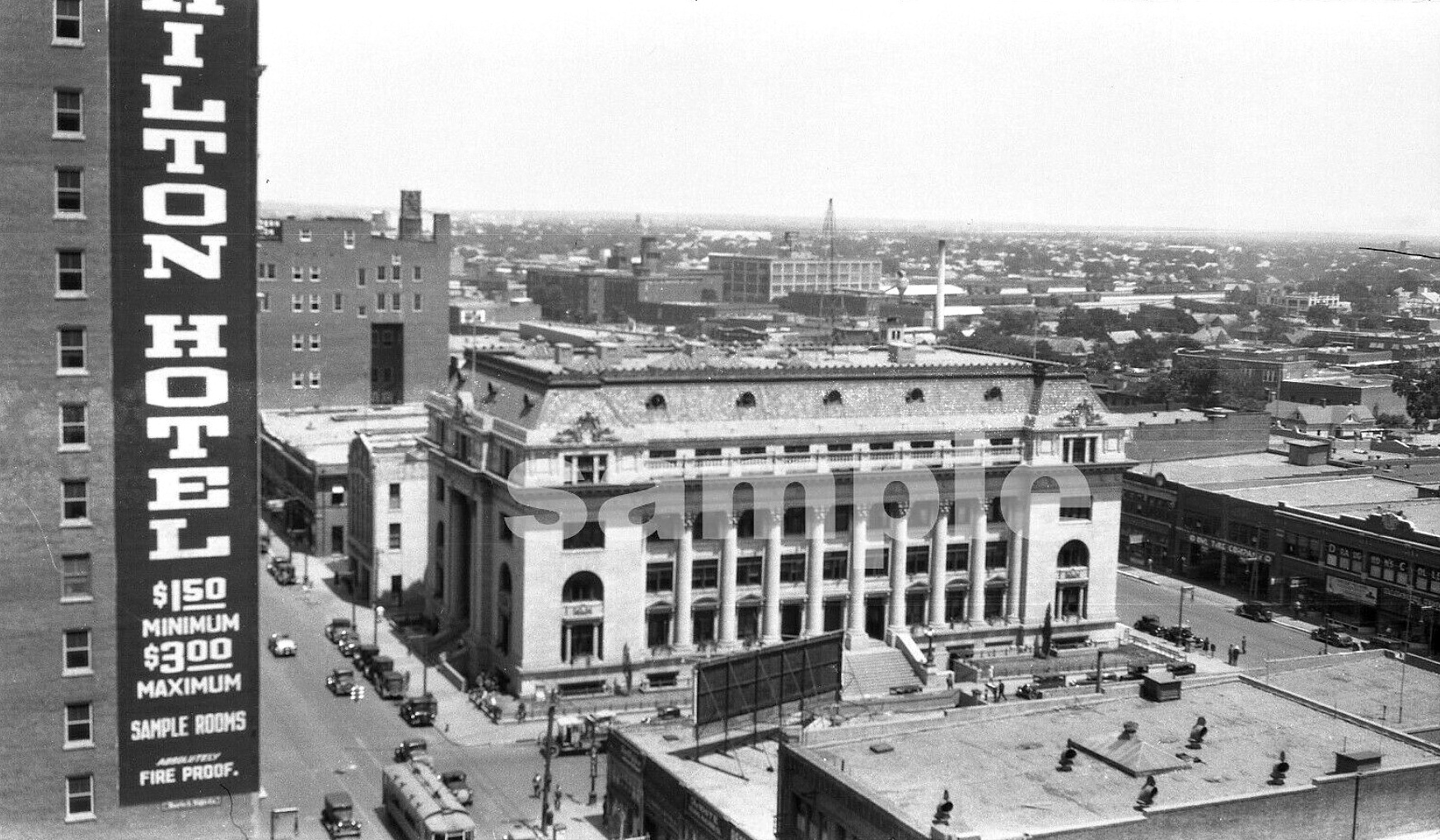
Sometimes I wonder if I’ll ever have the time or energy to write a proper historical post again. I’m still dealing with a lengthy illness of a family member, a situation which has all but taken over my life. Someday I’ll get back to researching and writing. But for now, here’s a really cool photo I came across on eBay a year ago — I’ve never seen this view of the Municipal Building. Or the Hilton. I like this photo so much I’m posting it even though it has a dreaded watermark.
***
Sources & Notes
Photo found on eBay.
To flesh this out a bit, check out these related Flashback Dallas posts:
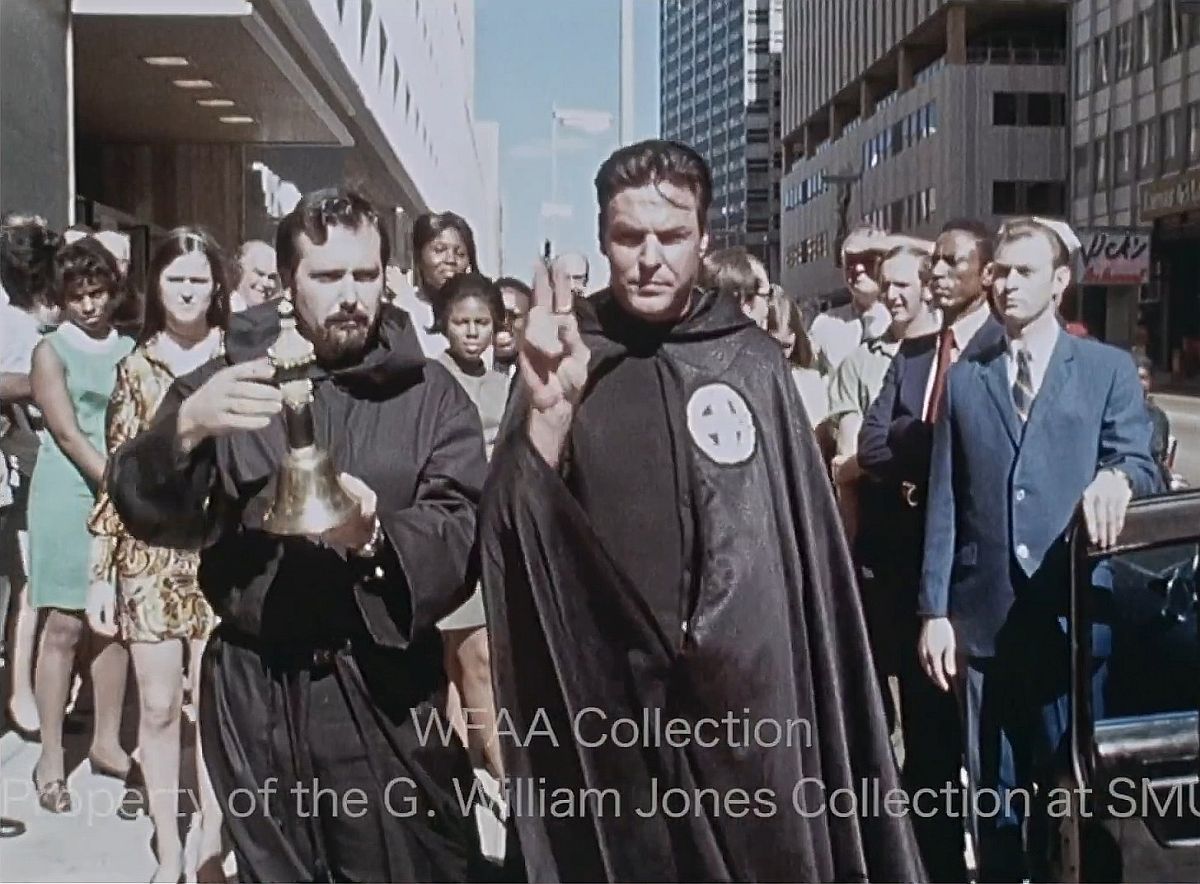
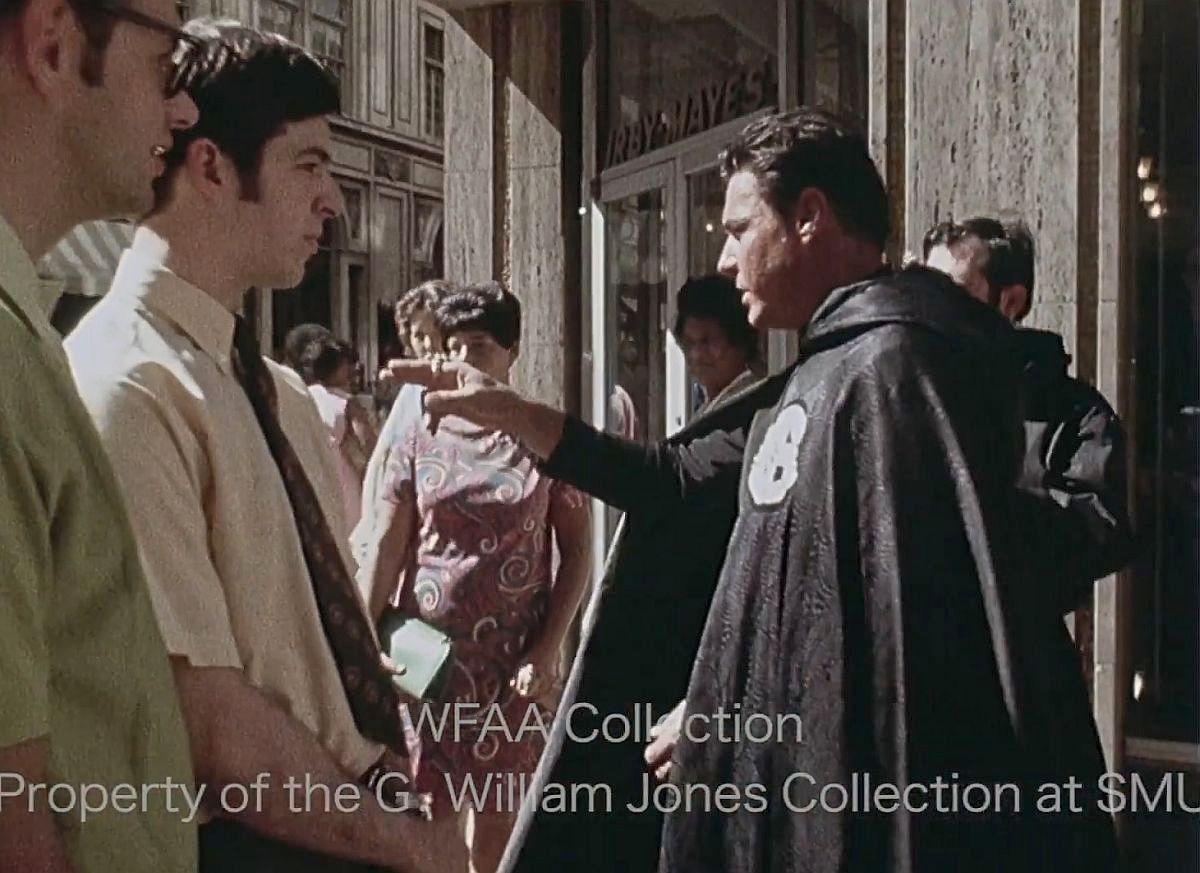
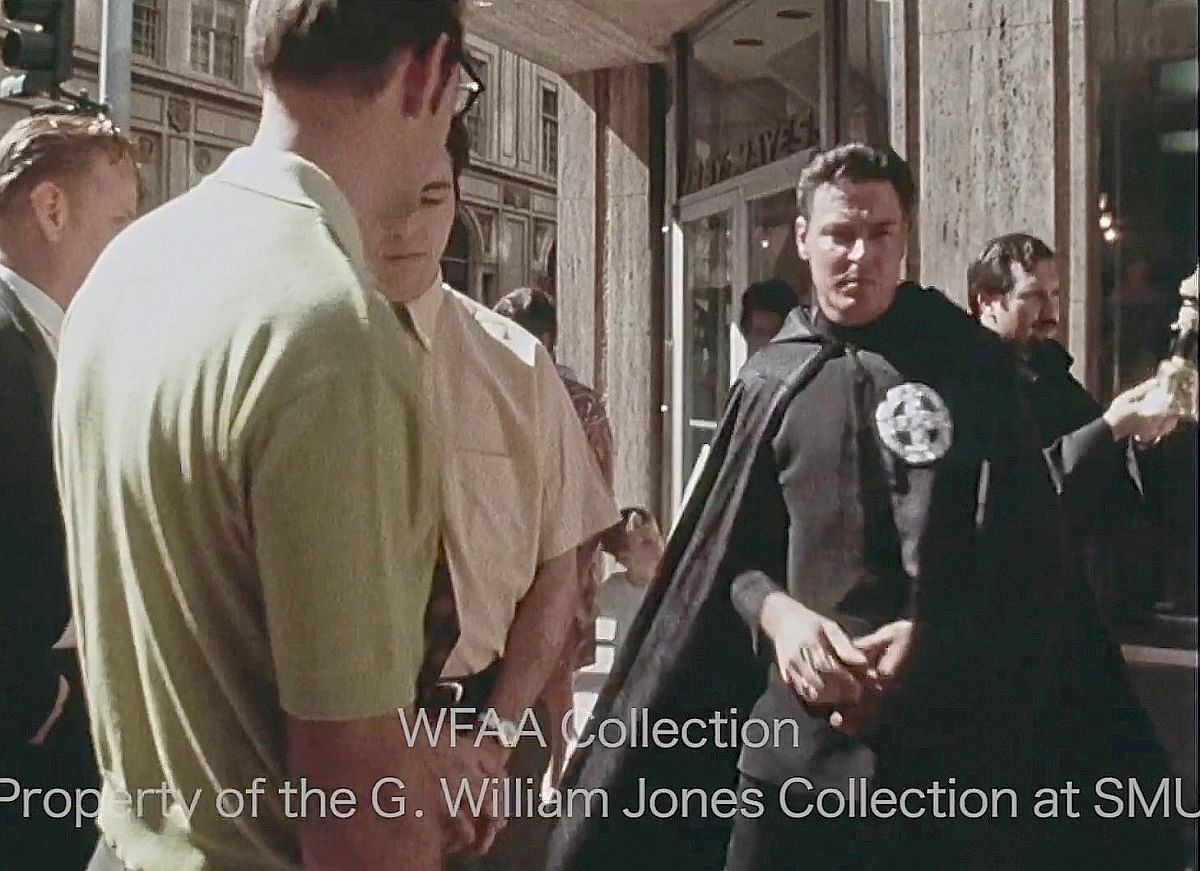
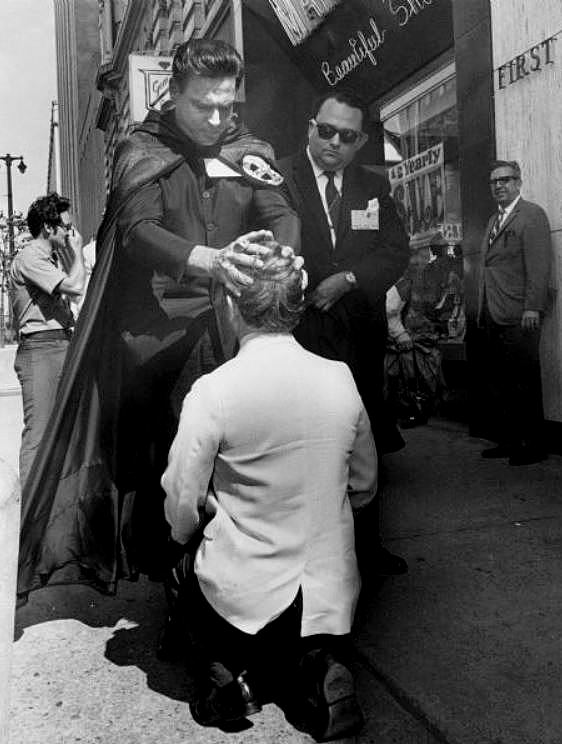
On Sept. 4, 1970, at the corner of Commerce and Ervay, a “white-magic warlock” named Gene de Jean conducted a ceremony to lift a heinous curse placed on Dallas in 1963 by a somewhat vague “malevolent black-magic coven” — this curse, which, uncoincidentally, preceded the JFK assassination, had apparently hung over the city for 7 long years. Fortunately, the media had been alerted, and we have film footage of the historic occasion in which a mysterious warlock lifted a nasty curse which no one in Dallas knew had been cast in the first place.
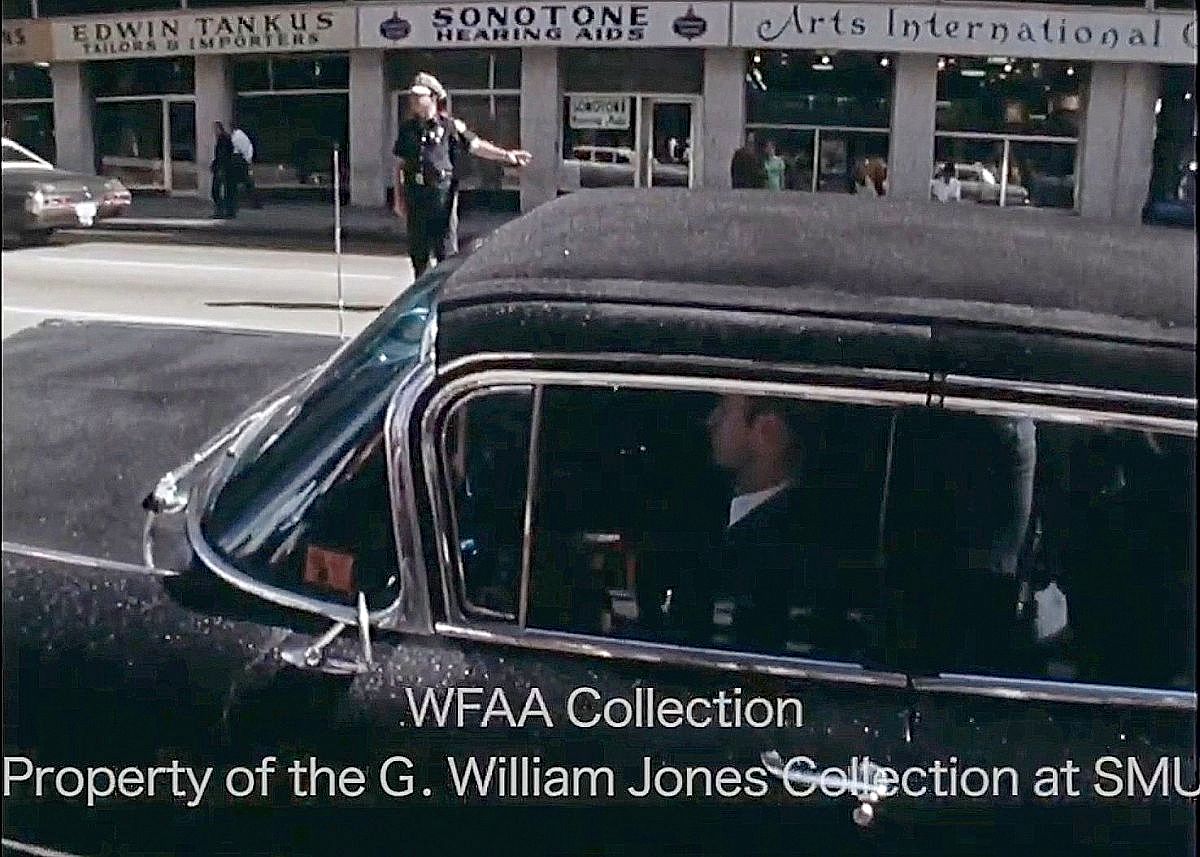
Do-gooding warlock Gene de Jean arrived in a “velvetized Cadillac” (a Cadillac COVERED IN BLACK VELVET!) with a be-robed bell-ringing acolyte, and, with Neiman-Marcus in the background, he uttered a few incantations and proclaimed the curse lifted. He also “blessed” a few random people in the crowd for good measure before walking back to the waiting velvetized warlock-mobile, his job done. In his wake there was much rejoicing and/or confused looks exchanged on Commerce Street. Thank you Mr. de Jean!
*
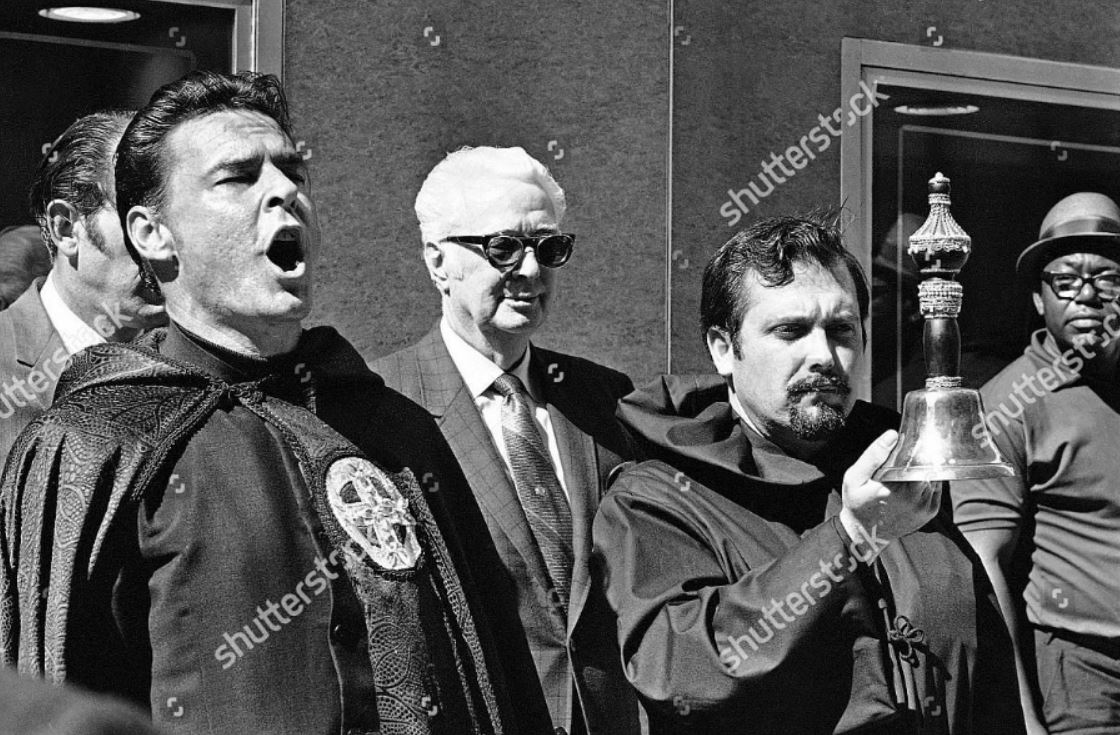
In something of a kill-joy article, the Associated Press revealed that “Gene de Jean” was a warlock stage-name. In non-warlock life he was Gene McIntosh, mild-mannered Houston psychologist. When pressed by the reporter, Gene said that it was “pure coincidence” that the Texas Association of Magicians was wrapping up its 25th annual convention 2 blocks away at the Statler Hilton (which can be seen in the background of the footage). So, yes, Gene McIntosh and Lee Thompson (the bell-ringing “acolyte”) were well-known Houston magicians/illusionists in town for a magicians’ convention. And — why not? — a friendly curse-lifting.
**
Here’s the footage — at the 12:19 mark — captured by a WFAA-Channel 8 News cameraman for posterity.
*
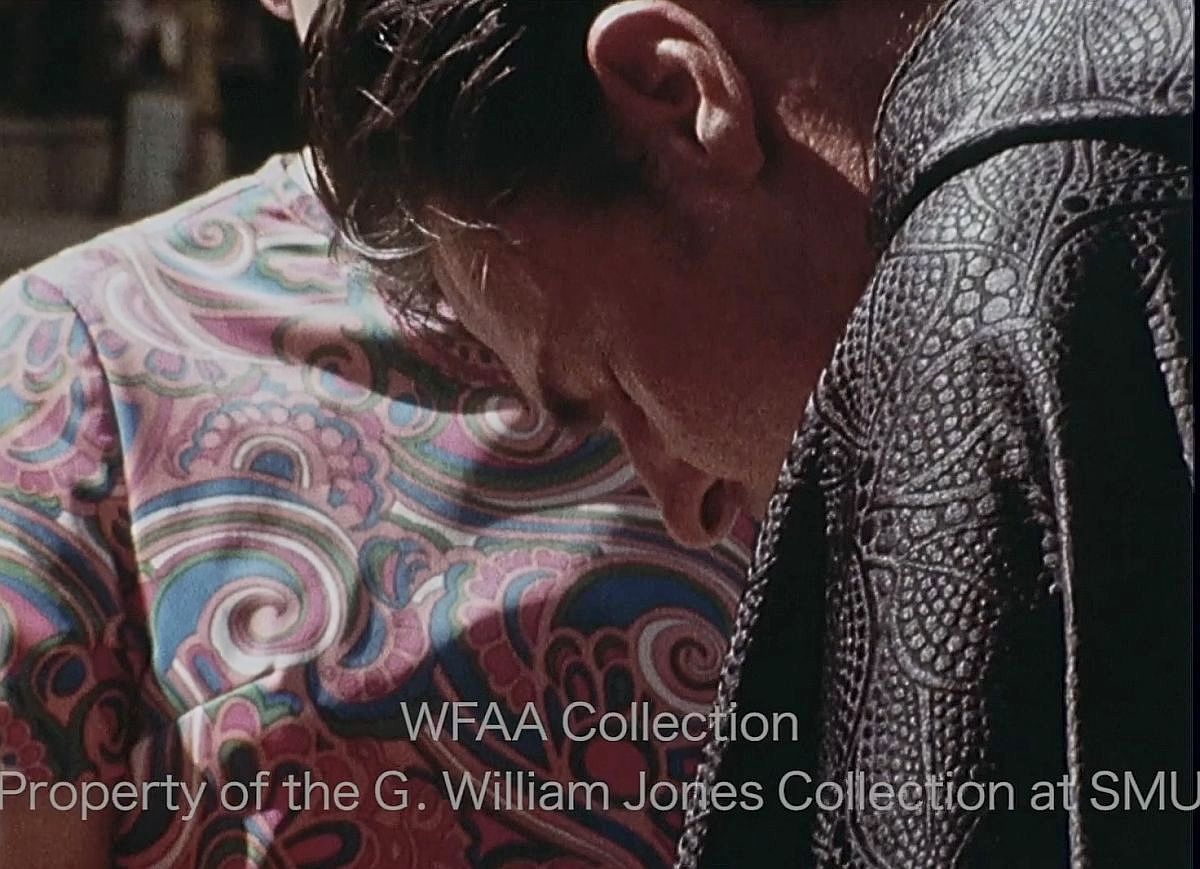
And a few screenshots of the warlock in action.
Associated Press photo by Ferd Kaufman
Seriously — how do you cover a car with velvet?
Voilà! Curse lifted!
**
Doing a little research, I have to say, when I came across the photo below, I felt a twinge of betrayal. Or at least disappointment. It shows Gene de Jean on the streets of Milwaukee (Milwaukee?!!) in June, 1970. The guy in the sunglasses is also seen with him in Dallas. The caption of this photo: “A self-described warlock (male witch) in black flowing cape bestowed a blessing right here in Old Milwaukee Tuesday. Gene De Jean blessed the city and a number of passersby at N. 3rd St. and W. Wisconsin Ave. He was in town for a magician’s convention.” Was it all just a schtick, Gene? And I thought we had something special.
Video and screenshots are from the WFAA NewsFilm Collection, G. William Jones Film Collection, Hamon Arts Library, Southern Methodist University; the footage is from Sept. 4, 1970 and can be found on YouTube here (clip begins as the 12:19 mark).
When I posted a version of this on my Facebook page a few weeks ago, David B. commented with a couple of informative links about Gene McIntosh (who died in 2006): this overview of his career as a magician, and this tale of a stunt he performed while driving from Houston to Dallas in 1959, blindfolded the whole way. RIP, Gene.
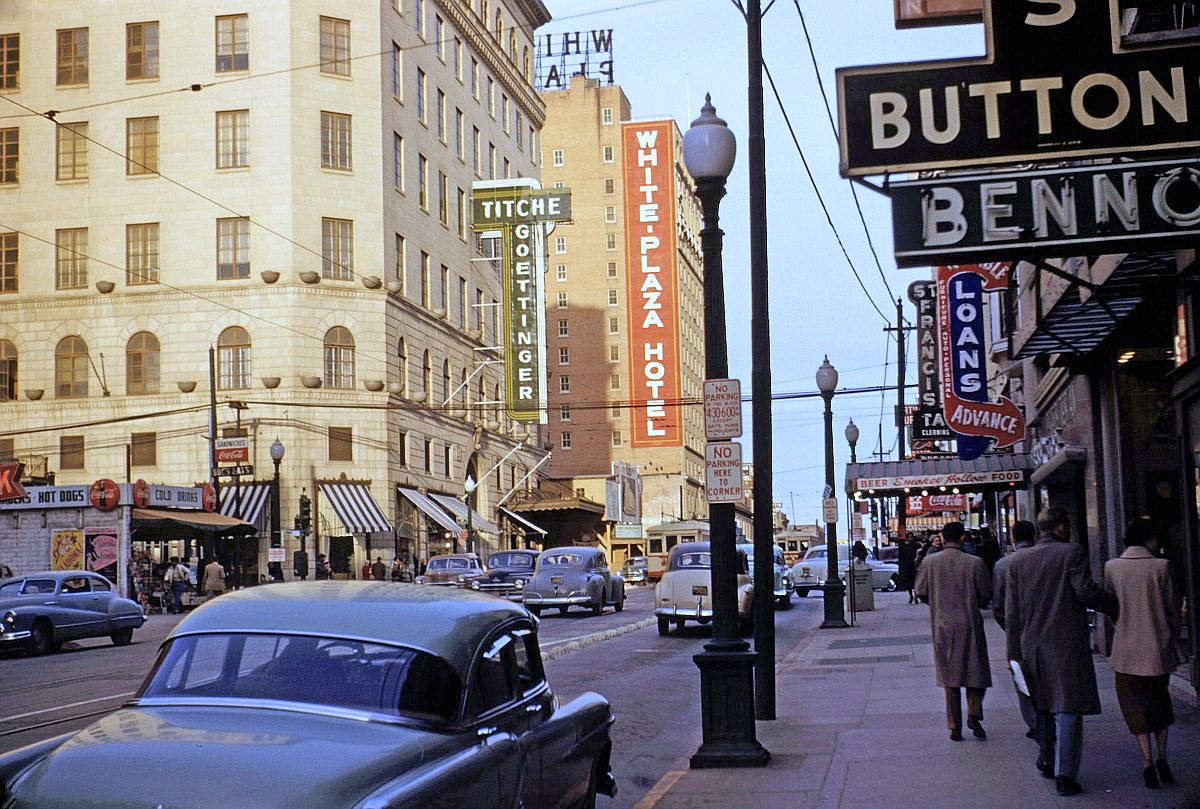
After seeing so many pictures of historic downtown Dallas in black and white, it’s pretty thrilling to see color photos — even better, super-saturated Kodachrome slides. Here are a few.
Above, a photo taken on July 31, 1950: a view of Commerce Street, taken from Lamar looking east. I LOVE this photo! Sadly, I really don’t love what this same block looks like today: brace yourselves — click here! (For reference, Padgitt Bros. was at 1018 Commerce.)
*
Below, a photo from 1954: the 300 block of N. Ervay, taken from Bryan looking southeast toward Pacific. The Republic Bank Building (at the left) is still there, but those buildings on the right? Gone, gone, gone. That space is now taken up with Thanksgiving Square. I may be in the minority, but I would rather have those buildings back. That crazy-looking building housing businesses such as Arcadia Liquor (309 N. Ervay)? I have been all-but-obsessed with that weird building for years. Personally, I prefer its bizarro architecture to that of Philip Johnson. See what this block looks like now, here.
Another great photo from the collection of Noah Jeppson (seriously, check out his Flickr stream here!), this is one I’ve posted before — everyone posts this because it’s such an amazing photo, from 1945 (!): Elm Street, looking east from the 1400 block. See it today, here.
Despite the watermark, this is a cool September, 1940 view of the gas station/service station which once held down the Preston Road entrance to Highland Park Village: looking northwesterly toward Mockingbird. The view today is here.
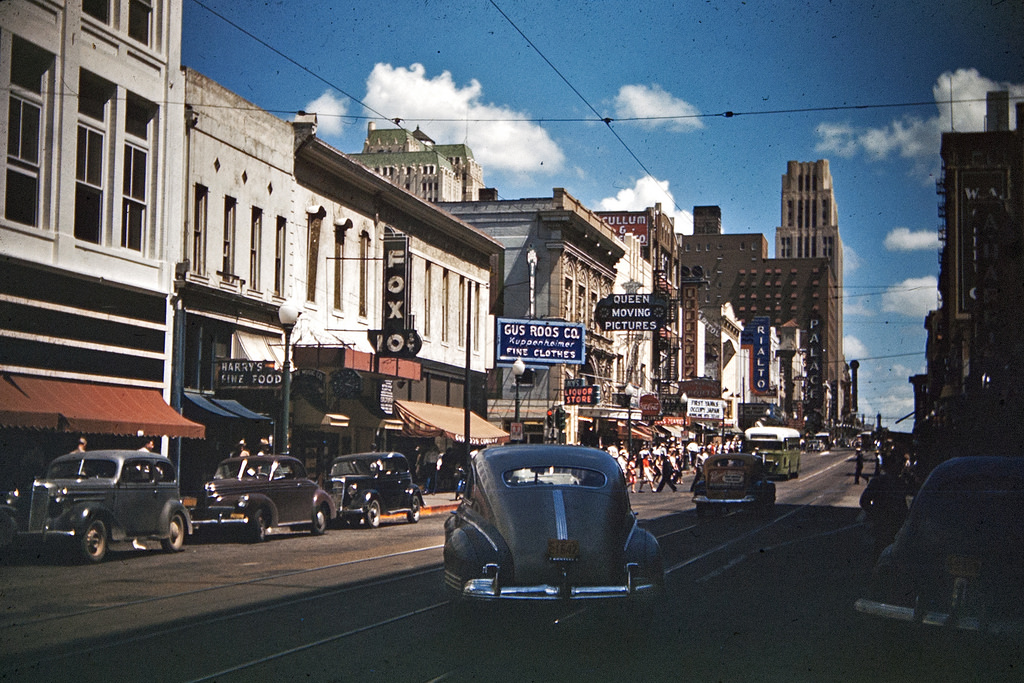
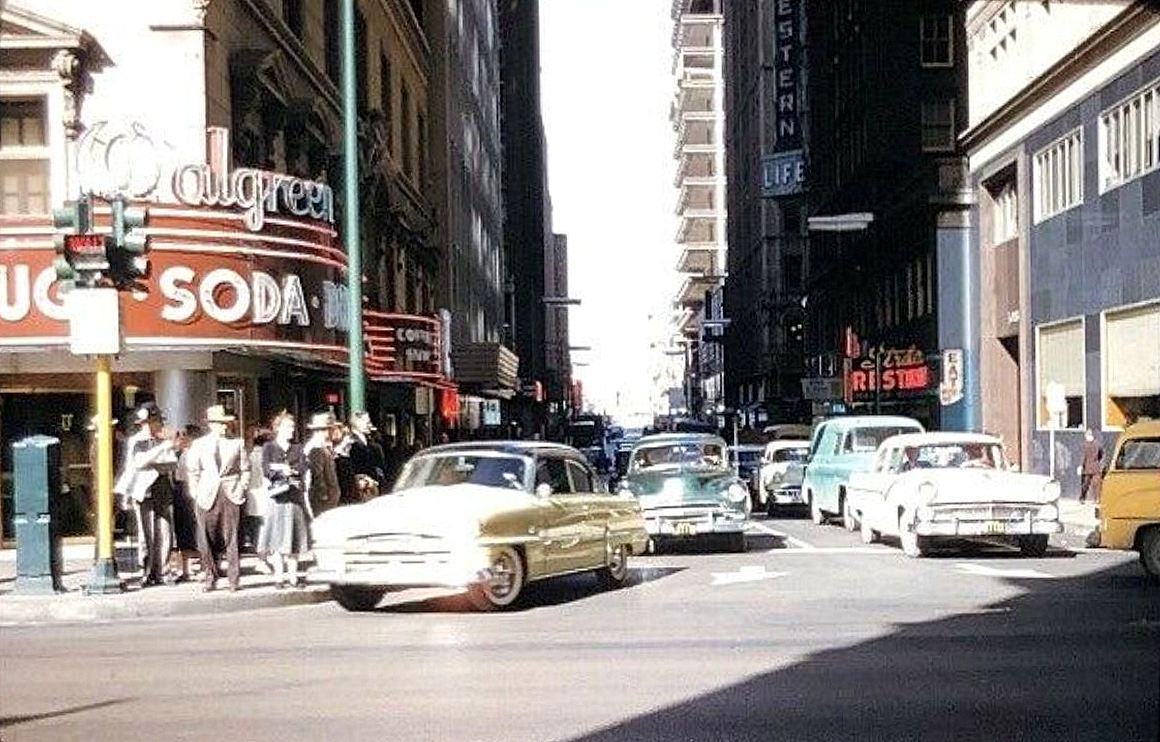
Another downtown view, this one showing the Walgreens at Commerce & Akard (at the Adolphus Hotel); the view is looking north up Akard (see it today here).
via eBay
*
If you’ve got color photos/slides from this era, I’d love to see them!
***
Sources & Notes
Links to all sources can be found beneath the photos.
Special shout-out to Michael T. Jackson (@memj83) for tagging me on Twitter to a post by @Kodakforever — a heart-stoppingly great collection of Kodachrome photos where I first saw a few of the photos posted above.
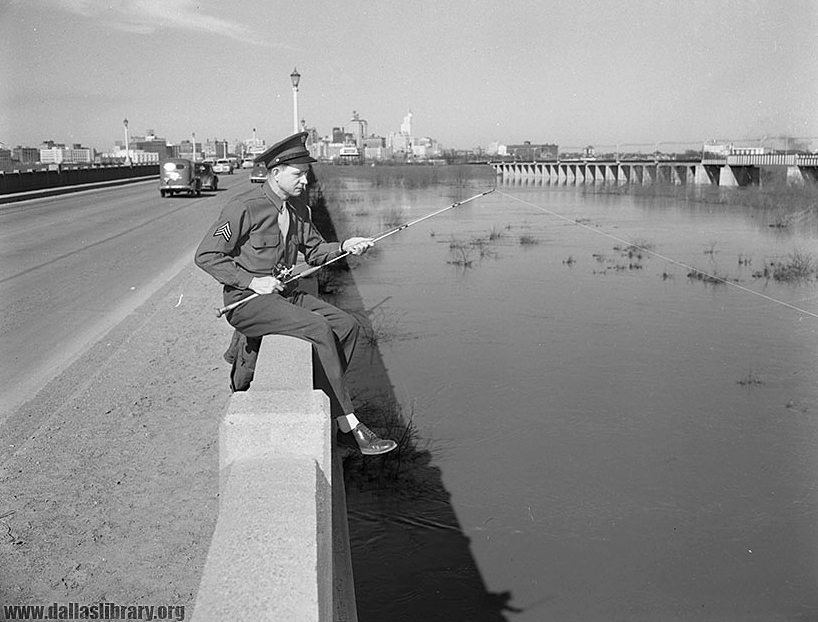
A soldier in uniform, sitting on the concrete railing of a viaduct, casting into the Trinity.
When I posted this in a Dallas history group several years ago and asked which viaduct is shown, there was no consensus — Houston Street was mentioned most often, but just about all of them got several votes!
***
Sources & Notes
I can’t remember where I came across this photo (which is dated Feb. 28, 1948), but it is from the collection of the Dallas Public Library.
In 1966, the Neiman-Marcus Fortnight honored France and all-things-French. And that included constructing an Eiffel Tower to grace the building’s exterior and an Arc de Triomphe built inside to welcome shoppers and gawkers. Bonjour, y’all!
Alvin Colt Collection, DeGolyer Library, SMU
***
Sources & Notes
Both photos are from the fabulous Alvin Colt Design Drawings and Photographs for Neiman Marcus Fortnights collection, held by the DeGolyer Library, Southern Methodist University; more info on the Eiffel Tower photo here; more info on the Arc de Triomphe photo here. Read about designer Alvin Colt and his legendary contributions to the Neiman-Marcus fortnights here.
More photos from the 1966 French Fortnight from the Alvin Colt Collection can be found here.
Browse the larger Colt Collection — which contains photos, sketches, and ads from other Fortnights — at the DeGolyer Library/SMU site here.
Read about the first N-M Fortnight celebration honoring France in 1957 in these Flashback Dallas posts:
Today is the birthday of my late father, and as a little tribute to his profession, I usually try to post something bookstore-related on his birthday.
A few weeks ago historian Rusty Williams (check out his books) sent me a great article from 1947 by publisher and bon vivantBennett Cerf who wrote giddily about the Dallas book scene (and about Dallas in general). It’s a little over-the-top, enthusiasm-wise (Cerf was a master publicist and promoter), but he writes with genuine affection about notable bookstores and book people, including Cokesbury and its legendary manager Bliss Albright, McMurray’s Book Store and its legendary owner Elizabeth Ann McMurray, and big-time book collectors Everette Lee DeGolyer and Stanley Marcus. The article was published in the April 26, 1947 issue of Saturday Review, and it can be read here.
Cokesbury was described as being the largest bookstore in the world at one time. After a sizable expansion, it covered six floors and had 18,000 square feet of room for books. The building, designed by Mark Lemmon, was at 1910 Main Street, at St. Paul, with entrances on both Main and Commerce. (And those rounded bookcases are cool.)
Manager J. F. “Bliss” Albright, 1953
The other bookstore mentioned in the article is McMurray’s, a bookstore which is generally written about with impassioned reverence and awe — it may well be Dallas’ most highly regarded bookstore ever. Wish I could have seen it. Where Cokesbury was a massively large bookstore carrying a wide variety of new books, McMurray’s was definitely more of a “curated” small shop, which, from what I gather, served almost as much of a place for literary elites to gather for informal salons as it did as a retail bookstore. If you were a writer of any heft visiting Dallas, you made the pilgrimage to Commerce Street to check out McMurray’s.
Owner Elizabeth Ann McMurray, 1951
Texas literary titans J. Frank Dobie & Tom Lea (in hats), McMurray’s, 1949
Read about the history of both Cokesbury and McMurray’s (and other Dallas bookstores) (except, oddly, the Aldredge Book Store, the store my father was associated with for decades!) in the article “The Personal Touch: Bookselling in Dallas, 1920-1955” by David Farmer, which appeared in the Fall 1993 issue of Legacies. There are some great photos.