Flashback : Dallas

A Miscellany: History, Ads, Pop Culture

Category: Fair Park

“Clean, Delightful, Refined” — The 1908 State Fair of Texas

ad-1908_sfot_dmn_101508_katzenjammer-castleDon’t miss the Katzenjammer Castle!

by Paula Bosse

As it’s State Fair of Texas time again and I’ve recently reposted the wonderful 1908 panoramic photo of a crowd-filled entrance to Fair Park (seen here), I thought I’d look to see what kinds of attractions that particular fair had to offer.

The 23rd State Fair of Texas was held from October 17 to November 1, 1908. Below are two ads that ran before the opening of the fair, the first one in The Dallas Morning News, the second in The Fort Worth Star-Telegram. The very wordy ad copy is similar in both, but they’re different enough to warrant taking a look at each one (click for larger images).

ad-1908_sfot_dmn_101508-textDMN, Oct. 15, 1908

An excerpt:

The very best features of every species of entertainment, from the Olympian games of old down to the creations and inventions of this year. Our permanent amusements represent an investment of $100,000. In addition to the Scenic Railway, Katzenjammer Castle [pictured at top], Hall of Mirth, Electric Theater, Figure Eight, Laughing Gallery, we have constructed this year the latest in the field of amusement and novelty – the ‘Tickler’ – the most laughable and fun-producing creation yet devised by man. Our Amusement Park an ensemble brilliantly spectacular and educational – a miniature Oriental City as it were. Here will be gathered a grand ethnological congress – Turks, Arabs, Cinghalese, Igorrotes, Bedouins, Turcomen, Japanese and Zulus – the strange peoples of the world, living as they do in their native lands.

Wow. The Hall of Mirth, the Tickler, and a “grand ethnological congress” — it had everything! But, wait — there’s more!

Here’s the ad for Fort Worth:

ad-1908-sfot_FWST_ 101608FWST, Oct. 16, 1908

And an excerpt:

Clean, Delightful, Refined

More than 100 new and superb shows constitute our amusement department. Permanent attractions alone represent an investment of $100,000. A grand aggregation of the latest and most ingenious attractions and revived sensations from all parts of the world. A cosmopolitan gathering of Oriental dancing girls, wrestlers, whirling dervishes, magicians, torture dancers, rough riders of the world, in a strange display of barbaric splendor. Marvelous free attractions, including the great Velaire, in his act “Beyond the Limit.”

Wonderful Exhibitions

Six acres of implement and vehicle displays. Three thousand birds in the poultry department. Over two thousand head of exhibition stock. Magnificent arena program. Agricultural and industrial growth of the state exemplified. Notable display of the handiwork of the women of the South in all departments of home life. Superb art display. Great dog show.

Martial Pyrotechnic Display Thrilling to Thousands.

Barbaric splendor, whirling dervishes, and a “great dog show.” And that mysterious “torture dance” (which I’m sure was “clean, delightful, and refined”).

Here’s one more ad promoting “Fort Worth Day,” which was held as “The Greatest Fair on Earth” was winding down:

ad-1908_sfot_FWST_102808FWST, Oct. 28, 1908

So, lots of interesting stuff was going on. But apparently the thing that people were most excited about was the horse racing (…and the wagering). Back then, people looked forward to the races with the same manic enthusiasm that people today look forward to the fried food. Racing aficionados were such a huge source of SFOT revenue that it seemed only fair they got a brand new grandstand that year.

state-fair_grandstand_dmn_082308DMN, Aug. 23, 1908

state-fair_grandstand_dmn_082308_textDMN, Aug. 23, 1908

There was also a new Grand Gateway at the main entrance to Fair Park, designed by one of Dallas’ most notable early architects, James Edward Flanders (read about him here).

fair-park-entrance_gate_flanders_dmn_052208DMN, May 22, 1908

fair-park-entrance_gate_flanders_dmn_090608DMN, Sept. 6, 1908

You can see it in this detail from the panoramic photo by Henry Clogenson mentioned earlier:

fair-park-entrance_gate_clogenson-photo_1908_loc-det

There was an exhibit of thousands of live bees in a mesh-enclosed apiary.

state-fair_bees_dmn_092908DMN, Sept. 29, 1908

And fireworks. Gotta have fireworks. Somehow they managed to recreate a pyrotechnic display which simulated a Crash at Crush scenario of two locomotives colliding with each other head-on. I’m not quite sure how that worked, but it seems to have been effective. (I’m not a fireworks connoisseur, but this “set-list” is really great.)

fireworks_trains-colliding_dmn_103108DMN, Oct. 31, 1908

fireworks_trains-colliding_dmn_110108DMN, Nov. 1, 1908

I have to say, I’m a big fan of the exhibit that was set up in the new Agricultural Building: three figures of women, each about seven feet tall, one made of rice (from Beaumont), one made of salt (from Grand Saline), and one made of coal (I’m going to guess from somewhere like Thurber),

state-fair_salt_lots-wife_dmn_092408DMN, Sept. 24, 1908

That last sentence:

She will stand in the attitude of looking over her shoulder, and in the direction in which she is represented as looking will be placed paintings of the Cities of the Plain in flames, and the terrified inhabitants making desperate though vain attempts to escape the wrath which they have called down on their stiff necks.

How fun! (When I visited Grand Saline a few years ago, I saw a little cabin in the center of town purported to be made of salt. I was curious, and when no one was looking, I licked it. Yep. Salt. I’m sure I wasn’t the first to have done that, disgusting as it was. But I digress….)

Lastly, my favorite little throwaway factoid mentioned in one of the many endless articles that appeared in the weeks leading up to the opening of the fair was that the walkways were paved with “finely crushed pink granite.”

state-fair_pink-granite_dmn_092708DMN, Sept. 27, 1908

I’d like to have seen that.

***

The photo at the top shows the Katzenjammer Castle, a popular attraction that had appeared the previous year and which sounds like the old German Funhouse (the thing *I* used to look forward to every year). The photo accompanied the ad that appeared in The Dallas Morning News on Oct. 15, 1908 (the first ad posted above). It looks as if it shows part of the Shoot the Chute water ride. (You can see several pictures of this ride, which was right next to that brand new grandstand, in a previous post “The Chute,” here.

*

Copyright © 2015 Paula Bosse. All Rights Reserved.
The Giant Cash Register at the Texas Centennial — 1936

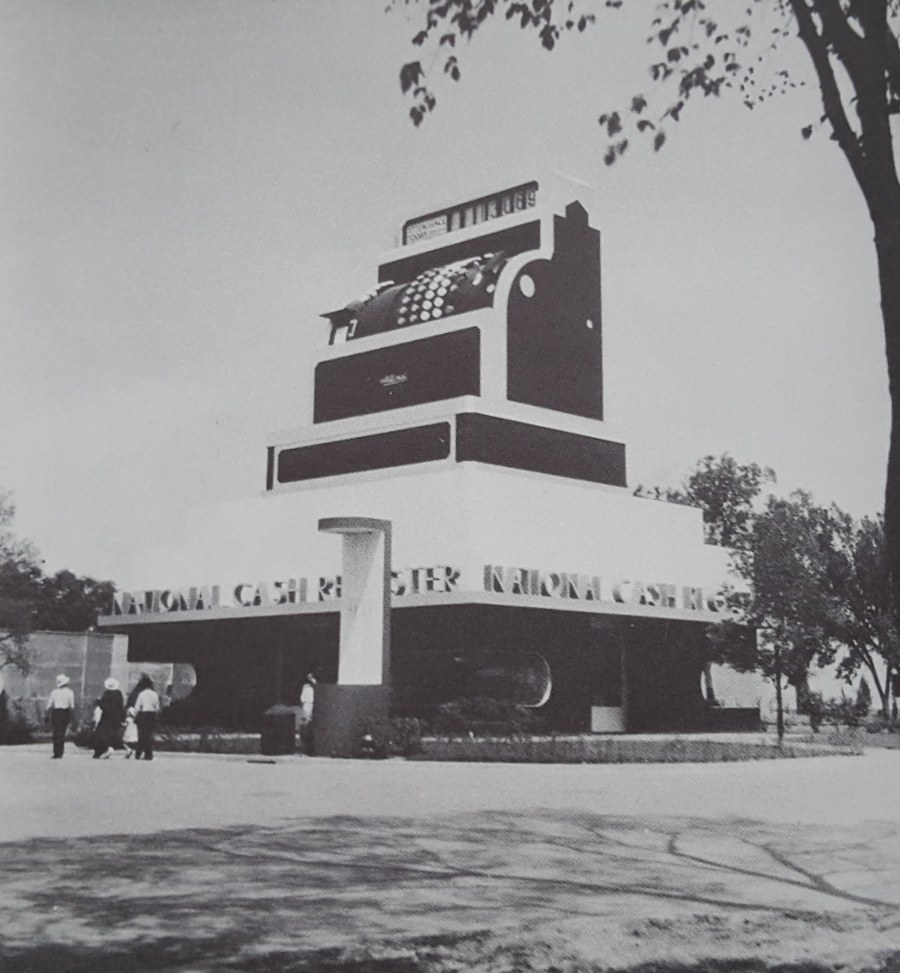
cash-register_ncr_tx-centennial_ragsdaleBefore Big Tex we had Big Till (click for larger image)

by Paula Bosse

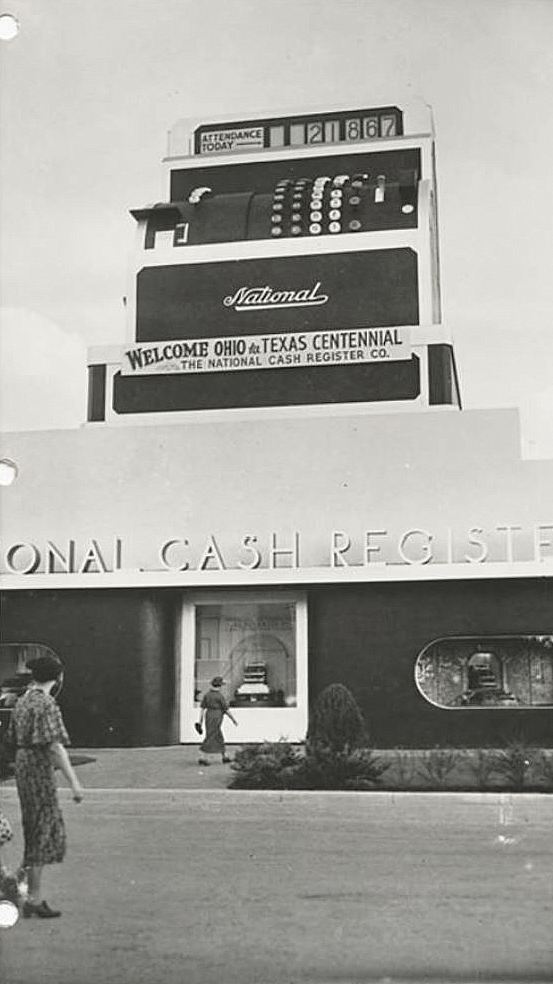
What’s not to love about a 65-foot-tall cash register? And how appropriate that this larger-than-life attraction was featured at the bigger-than-big Texas Centennial Exposition at Fair Park in 1936. This building, shaped like a very large National Cash Register (made under the auspices of noted designer Walter Dorwin Teague), served two purposes: its interior was an exhibit space to show off the company’s line of cash registers, and its exterior served as a giant tally board which was updated hourly to display the number of Centennial visitors. A similar giant cash register had been a popular feature at the Chicago World’s Fair in 1933/34, and it was decided to commission one for the Texas Centennial (another one would show up at the New York World’s Fair in 1939).

At the risk of turning into a blog-realized Monty Python sketch (“This is Uncle Ted at the front of the house. This is Uncle Ted at the back of the house. And this is Uncle Ted at the side of the house….”), let’s take a look at this great big cash register from several slightly different angles.

**

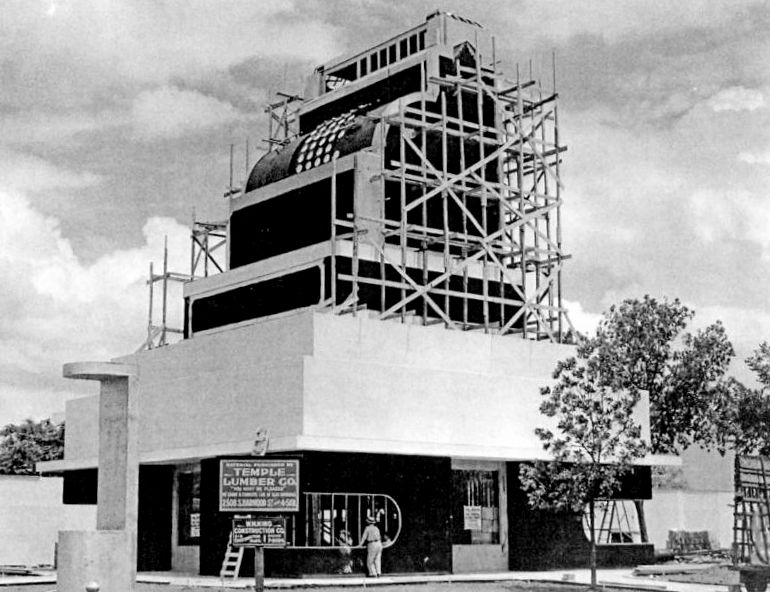
Here it is under construction.

ncr_fair-park_willis-winters_sfot-archives

*

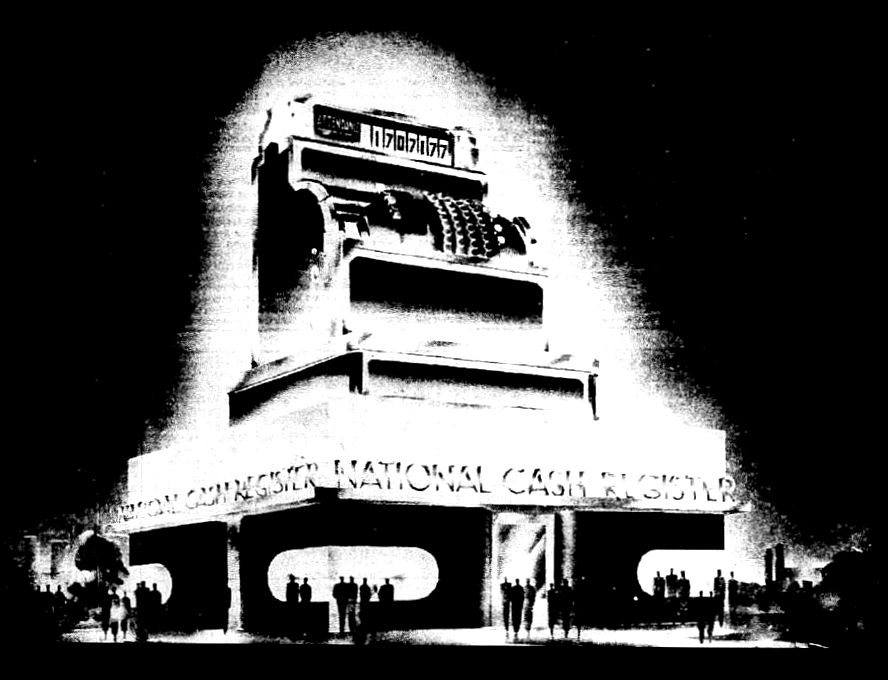
Here it is glowing in an ad with a tantalizingly dynamic illustration (click to see the illustration larger).

ncr_dmn_060736-adJune, 1936

That text?

Towering in the air the height of a six-story building, this is the largest National Cash Register the world has ever seen.

In giant figures at the top of the register Centennial attendance is recorded.

Look for this outstanding feature of the Texas Centennial. See the electrical recording device accumulating the total of all attendance as the turn-stiles click, at each gate.

The huge figures at the top of the giant register tell the whole story of the Centennial attendance. A modern National Cash Register in your store will give you the whole story of what is happening in your business.

*

Here it is in a photo that, admittedly, looks a lot like the top photo — but take a closer look — those shrubs have gotten shrubbier.

cash-register_tx-centennial

*

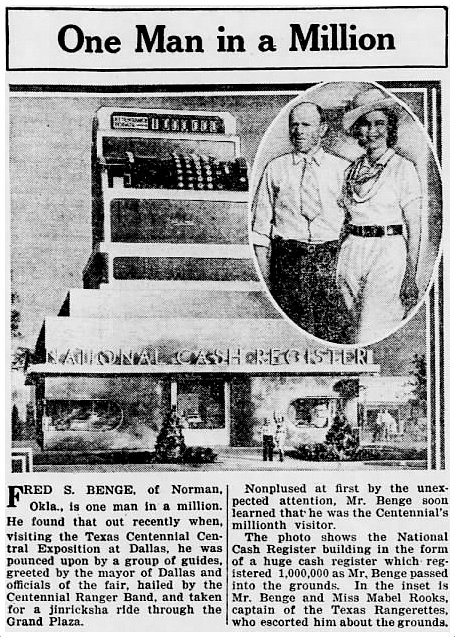
And here it is towering over Mr. Fred S. Benge of Norman, Oklahoma, the Centennial’s millionth visitor. According to the report below, when Mr. Benge passed through the gates into Fair Park on June 25, 1936 (less than three weeks after the opening of the Exposition), the giant cash register numbers flipped over to “1,000,000” and the poor man was “pounced upon” by Centennial officials eager to make a spectacle of the momentous occasion. (In this photo, and two others I’ve seen, Mr. Benge does not look particularly amused at the situation.)

ncr_greenfield-indiana-daily-reporter_080636The Greenfield (Indiana) Daily Reporter, Aug. 6,, 1936

UPDATE: Another photo of a somewhat stoic-looking Benge is here. An entertaining article about Mr. Benge’s big day is here. I sure hope Fred didn’t mind being described as a short and bald-headed jobless mechanic.

*

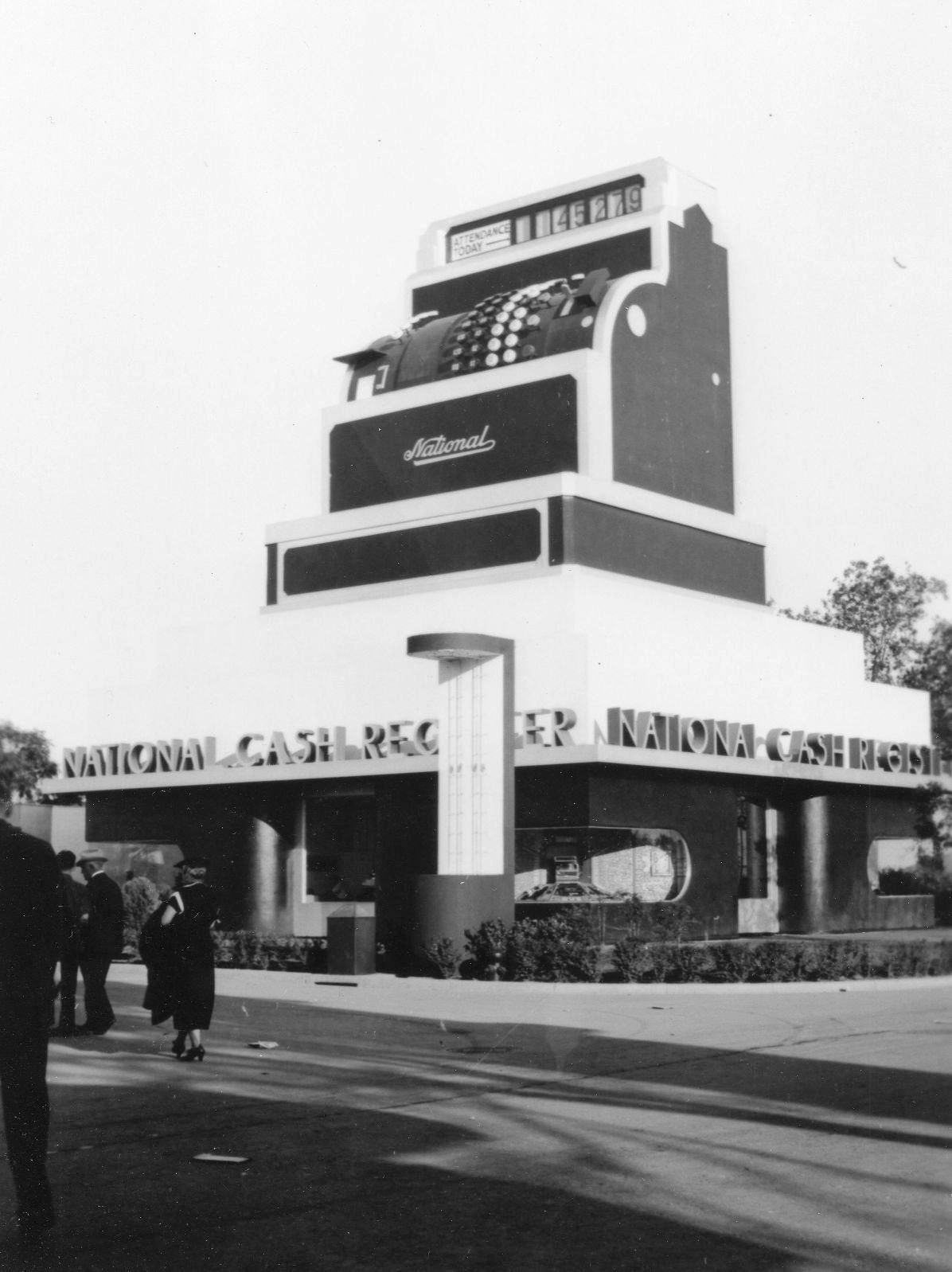
And here’s the “official photo,” which is a little bland and dowdy, but at least you can see what it looked like head-on.

ncr_tx-centennial

*

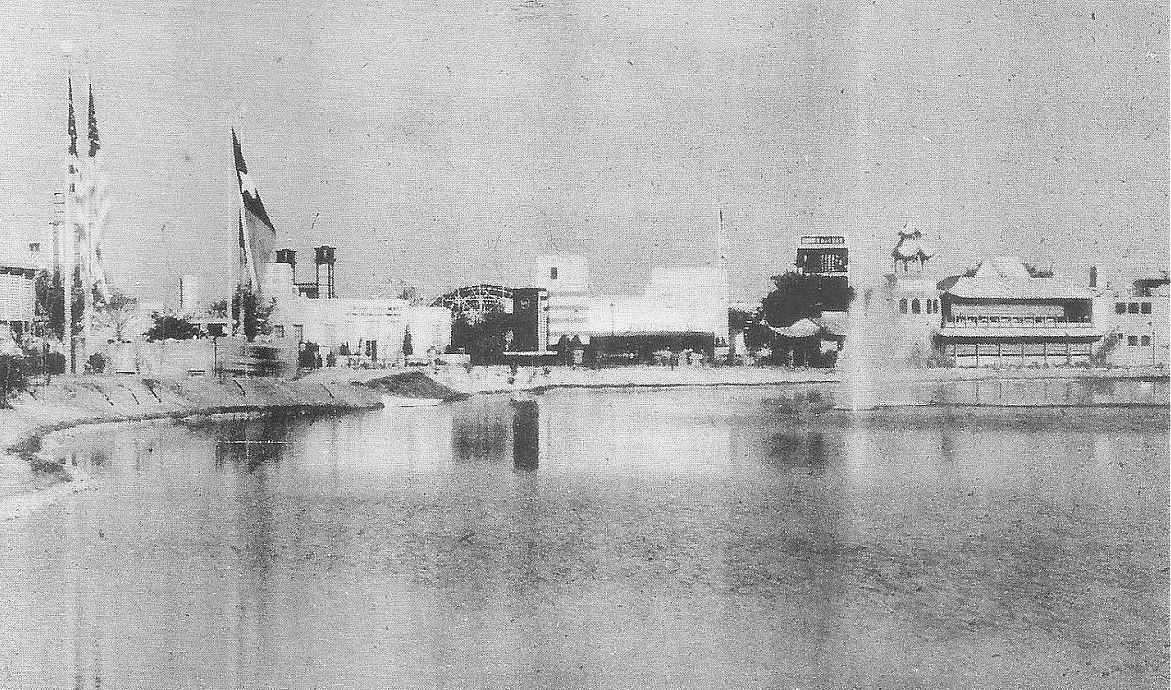
And here it is, as seen from the other side of the lagoon.

tx-centennial_lagoon_cash-register_1936

*

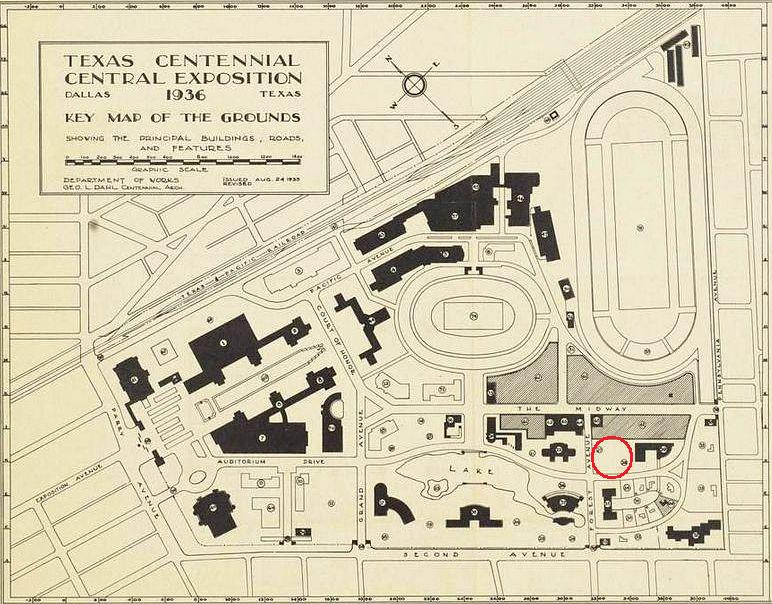
Where exactly was this “six-story cash register” located? I believe it was at San Jacinto/1st Avenue & Forest Avenue (now MLK). I think it might have been one of the two unnamed attractions I’ve circled on the “Key Map of the Grounds.” (See the full unmarked map, from the University of Texas at Arlington, via the Portal to Texas History, here.)

tx-centennial-map_ut-arlington_via-portal

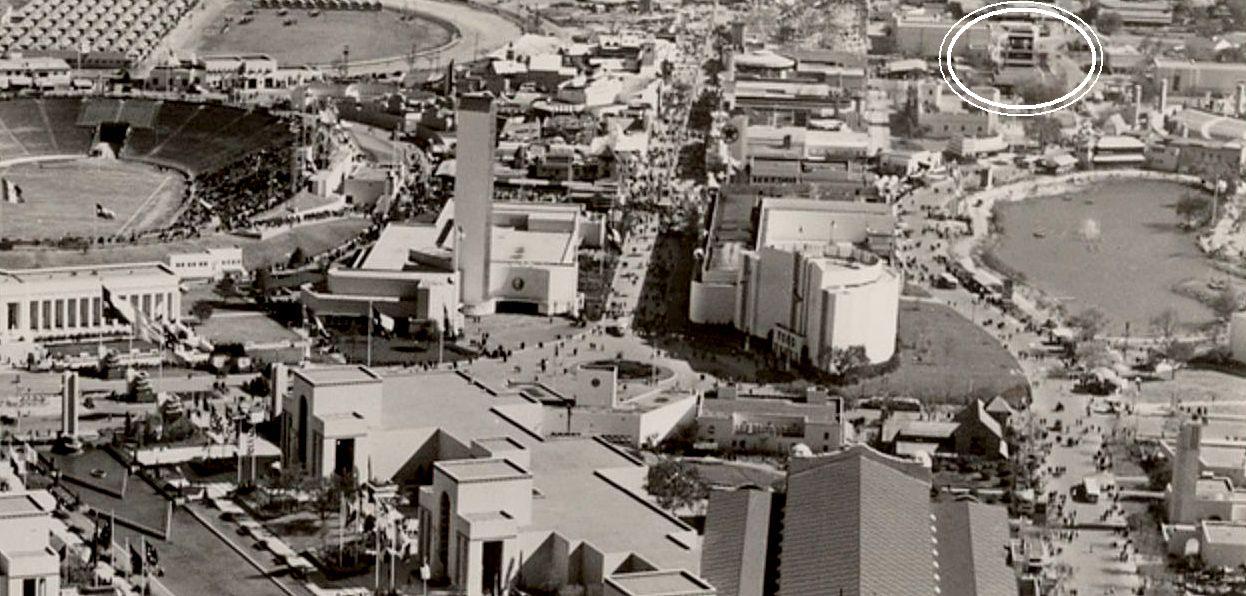
You can see it in a detail from a photo of the Centennial fairgrounds I posted previously (see that post here) — the cash register is circled at the top right.

ncr_centennial-photo-det(click for larger image)

I’ll just keep adding new photos as I come across them. Below are two photos from the George W. Cook Dallas/Texas Image Collection, DeGolyer Library, SMU (info is here and here). One of them shows a family standing in front of it — since Big Tex hadn’t arrived on the scene yet, this was as good a giant “thing” to stand in front of as anything!

tx-centennial_ncr_cook-coll_smu     cash-register_cook-collection_SMU_rau-family_1936

***

Sources & Notes

Top photo is from The Year America Discovered Texas: Centennial ’36 by Kenneth B. Ragsdale (College Station: Texas A&M University Press, 1987); the photograph is from the collection of Texas author Elithe Hamilton Kirkland (Love Is a Wild Assault) who worked as the director of school publicity for the Centennial.

The State Fair of Texas Archives photo of the cash register under construction is from Fair Park by Willis Cecil Winters (Charleston, SC: Arcadia Publishing, 2010). Another photo of the NCR register can be seen in Winters’ book here — in the bottom photo, it is the dark square in the background, left of center — you can see how it towered over everything around it.

The “shrubbier” photo is in the collection of the Dallas Historical Society, but I found it here, not identified as being the one at the Texas Centennial (if you click the picture in this interesting article, it will be super-super-gigantic).

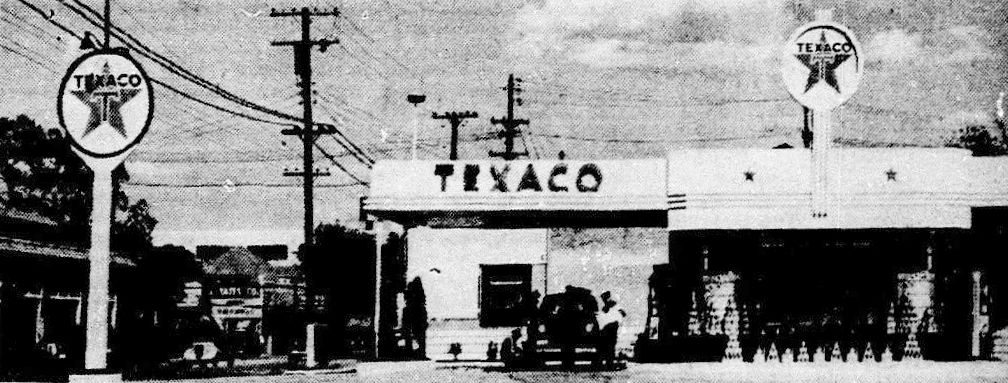
Walter Dorwin Teague (1883-1960) was the man who not only designed the National Cash Register exhibit building, he also designed other Centennial-related attractions, including the Ford Building and the nearby cool-looking new-concept moderne Texaco station (at Commerce & Exposition). Read about  him here.

texaco-station_dmn_080936_designed-teague_centennial_commerce-exposition1936

There were hopes that the Texas Centennial Exposition would attract in excess of ten million visitors over its six-month run, but the final numbers were just under six-and-a-half million. Pity. We had that great big tally machine sitting there and everything. Waiting.

Most pictures larger when clicked.

*

Copyright © 2015 Paula Bosse. All Rights Reserved.
Aerial View of the Centennial Fairgrounds — 1936

fair-park_1936_red-oak-kidThe Texas Centennial: a “World’s Fair” for Dallas

by Paula Bosse

This fantastic photo (by one of Dallas’ top aerial photographers, Lloyd M. Long) shows the impressive expanse of Fair Park’s new Art Deco splendor — most of the buildings seen here were built especially for the 1936 Texas Centennial Exposition, and most of those are, thankfully, still standing.

***

Sources & Notes

Lloyd M. Long photo, found on Red Oak Kid’s Flickr stream, here.

To see this photo REALLY big, click here.

*

Copyright © 2015 Paula Bosse. All Rights Reserved.
The Periphery of the Texas State Fair Never Looked Better

state-fair_postcard_carrie-ednaApproaching the Fair Grounds…

by Paula Bosse

A couple of pretty, but unusual views of the fairgrounds, turn-of-the-century-ish. The message on the postcard at the top: “Carrie the fair was real good this year better than it has been for years. Edna”

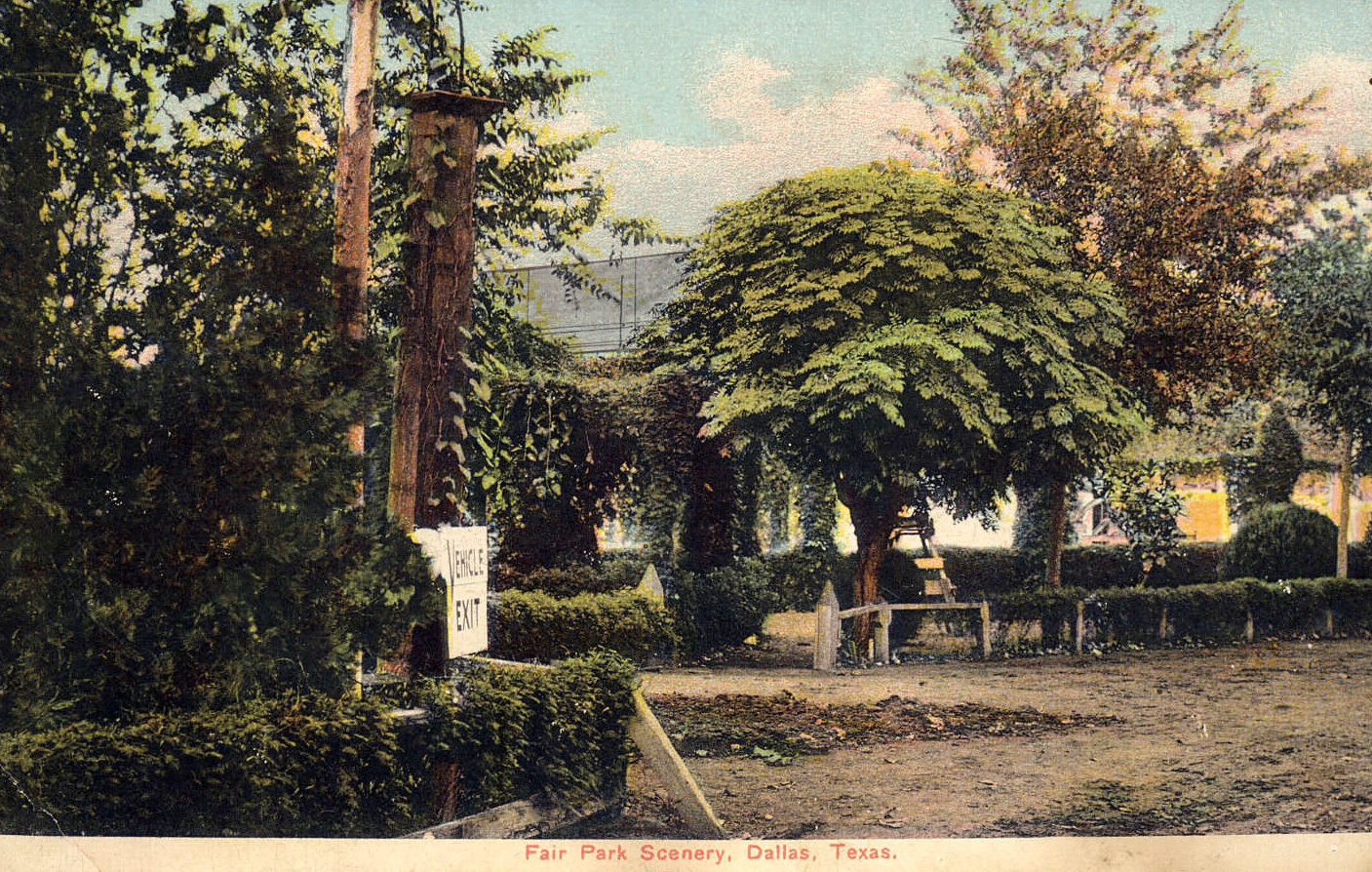
And then there’s this view, “Fair Park Scenery.” Same period as the top one? Later? It shows the “Vehicle Exit.” “Vehicles” meaning buggies and wagons?

state-fair-grounds_postcard_vehicle-exitLeaving the Fair Grounds… 

I think the top postcard shows the entrance — I have another view of the entrance that looks like this, from around 1900 (see it here). And the bottom card? “Scenery” near the Vehicle Exit. So … a parking lot? Or a road leading to the exit? Whatever it is, it’s not really all that “scenic.” Both postcards are fairly odd choices for picture postcards of the Texas State Fair, as neither one shows anything of the actual fair! But if people had fond memories of driving into or out of the State Fair, these were the postcards to buy!

***

Sources & Notes

Postcards from eBay. The second one is a photo by Clogenson.

Top postcard’s 2-cent stamp was issued in Nov. 1903, per Wikipedia.

*

Copyright © 2015 Paula Bosse. All Rights Reserved.
“Along the Tracks” in the Fair Park Area

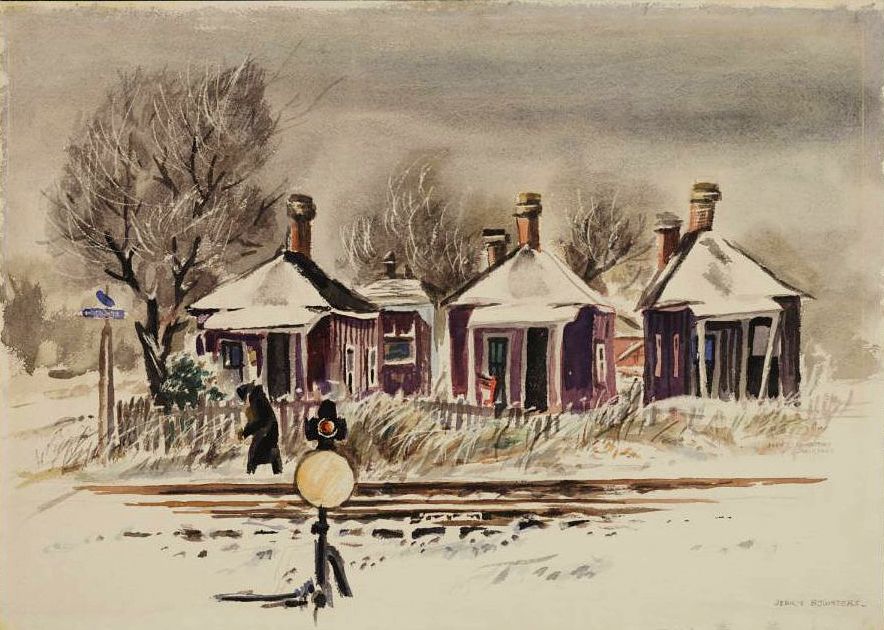
bywaters_along-the-tracks_fair-park_smu_1947“Along the Tracks” by Jerry Bywaters, 1947 (Hamon Arts Lib., SMU)

by Paula Bosse

As we’re currently experiencing an extended period of cold, snowy, icy weather, what better time than now to post this atmospheric watercolor by Jerry Bywaters? Titled “Along the Tracks,” it was painted during a very cold and snowy early January of 1947, in the area around Fair Park (where Bywaters worked as the head of the Dallas Museum of Fine Arts). Railroad tracks ran on either side of Fair Park — the Texas & New Orleans tracks ran along Trunk on the west side, and the Texas & Pacific tracks ran along Pacific on the east side. The DMFA was on the very western edge of Fair Park, and as it was bitterly cold, Bywaters probably wasn’t traipsing any farther than he had to — the west side of Fair Park near the T&NO tracks would certainly have been more convenient for him. But I came across a photo that looks pretty much the same as the scene Bywaters painted, only from the T&P side to the east, so who knows?

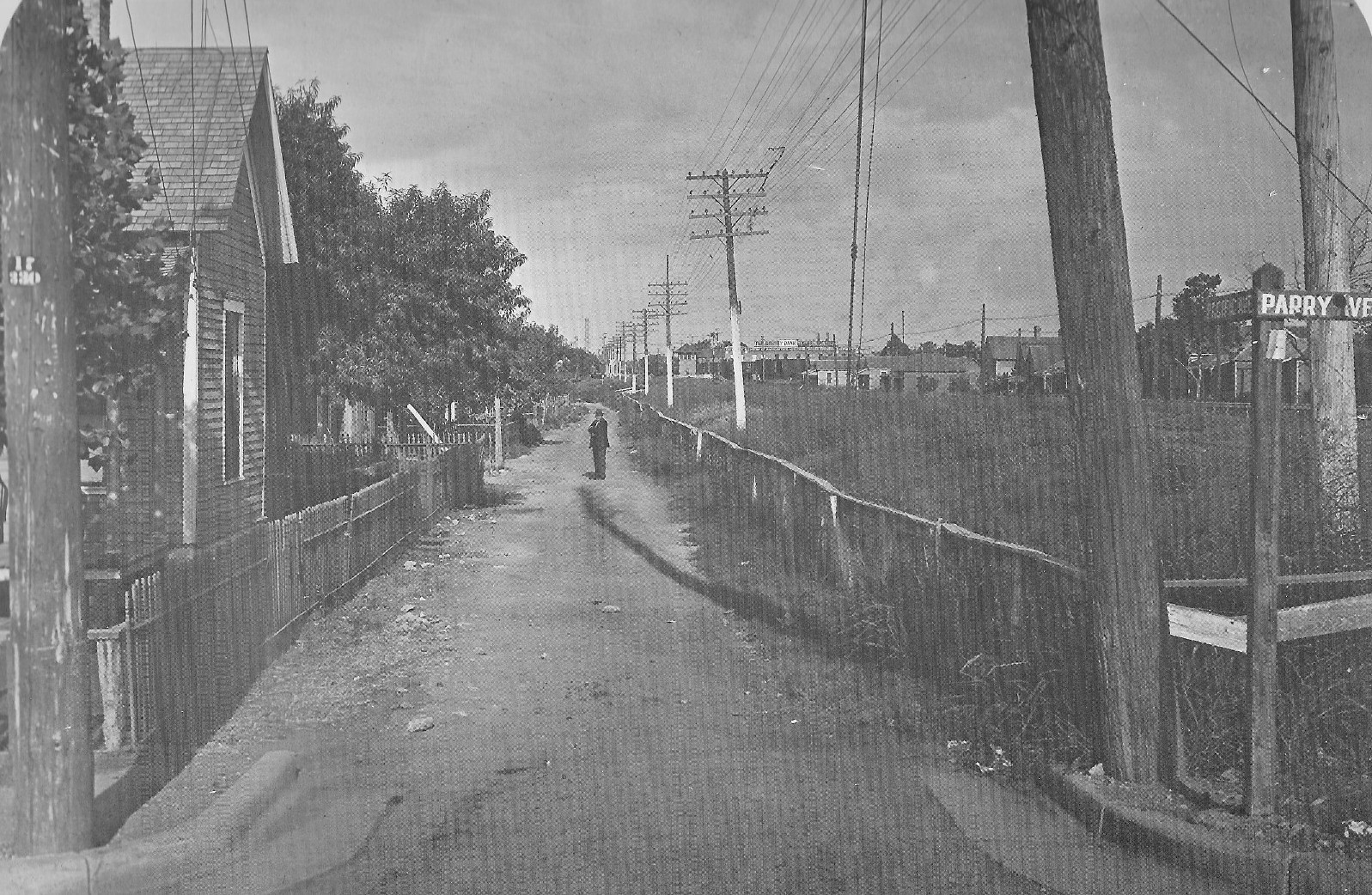
pacific-parry_ca1916_greene

The photo above (taken around 1916) shows the intersection of Pacific and Parry, looking west on Pacific. “Along the tracks.”

***

Sources & Notes

Jerry Bywaters’ painting “Along the Tracks” is from the Bywaters Special Collections in the Hamon Arts Library at Southern Methodist University; it can be accessed here. As far as I can tell, that street sign doesn’t actually say anything, but if you see something in the scribble, let me know!

The 1916-ish photograph of the Pacific and Parry intersection is from Dallas, The Deciding Years by A. C. Greene (Austin: Encino Press, 1973).

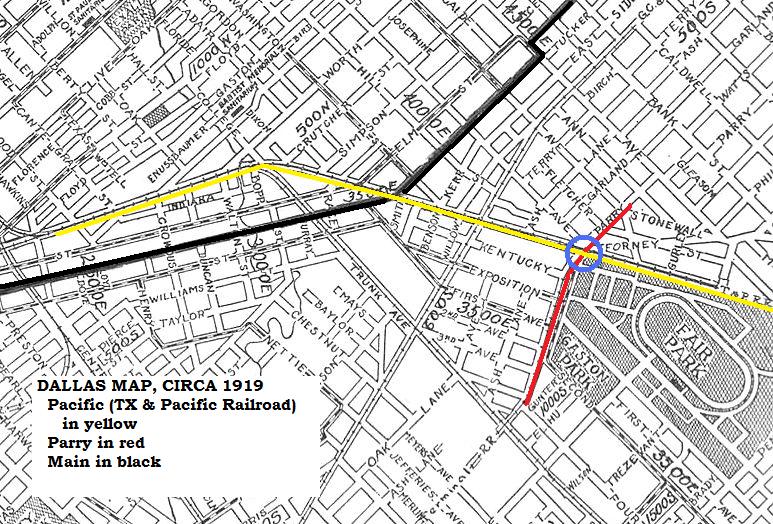
Here is a 1919 map detail showing the area around Fair Park (full map is here):

pacific-parry_1919

When Bywaters painted “Along the Tracks” it was REALLY cold. A couple of photos from the Jan. 1, 1947 edition of The Dallas Morning News show a snow-dusted Cotton Bowl and two very cute Oak Cliff teenage girls ice skating on West Jefferson Blvd.

*

Copyright © 2015 Paula Bosse. All Rights Reserved.
The Dallas Aquarium: The Building Emblazoned With Seahorses — 1936

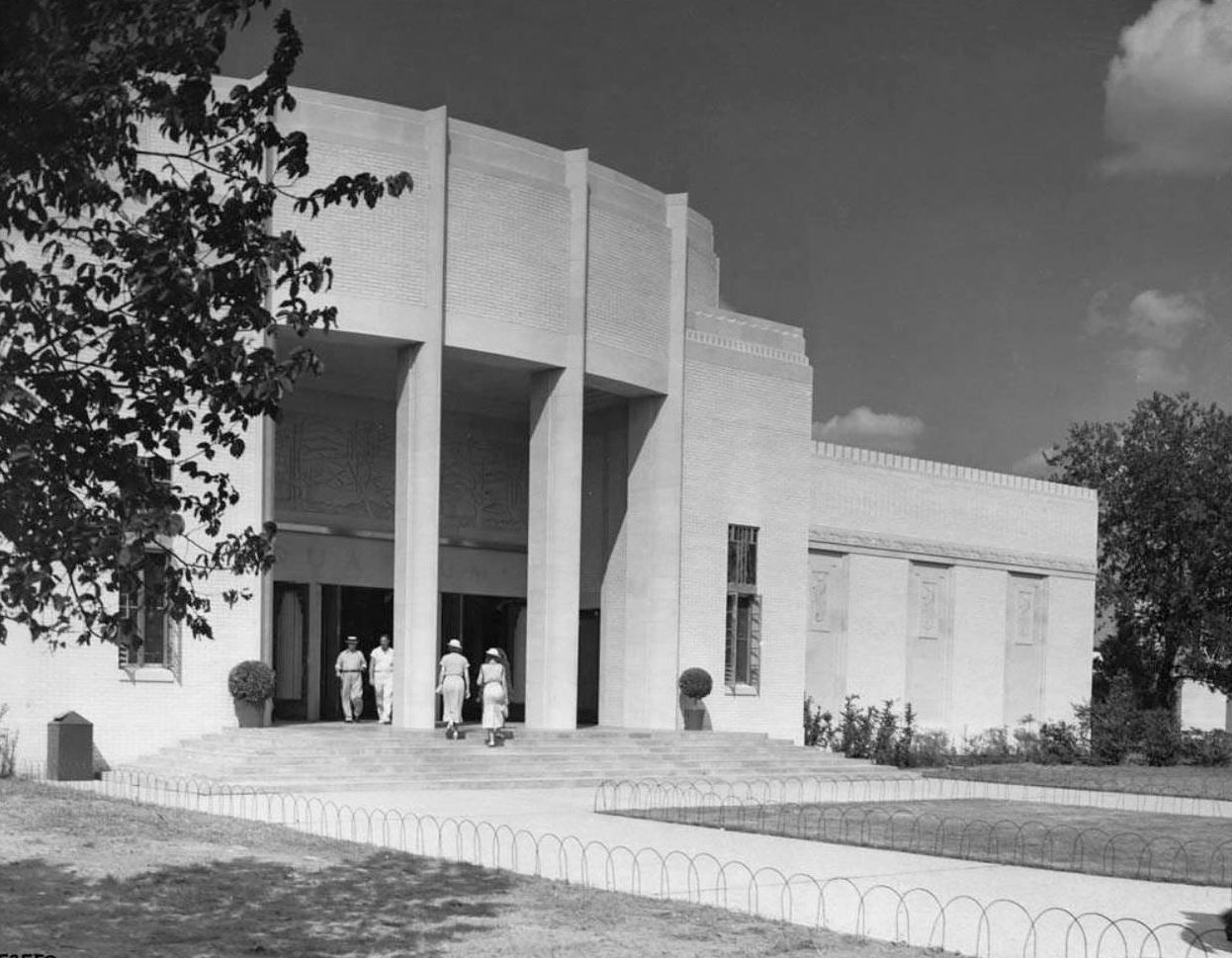
tx-centennial_aquariumThe Dallas Aquarium at Fair Park, 1936… (click for larger image)

by Paula Bosse

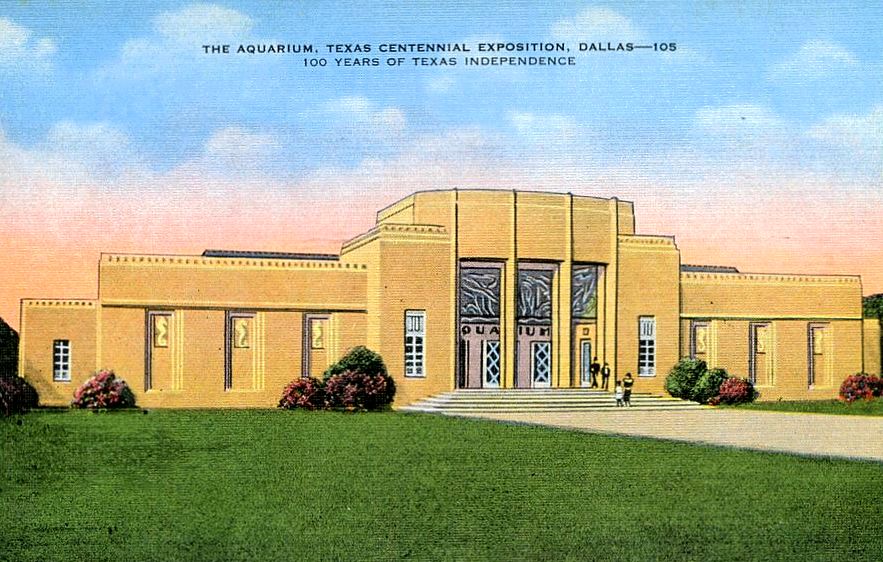
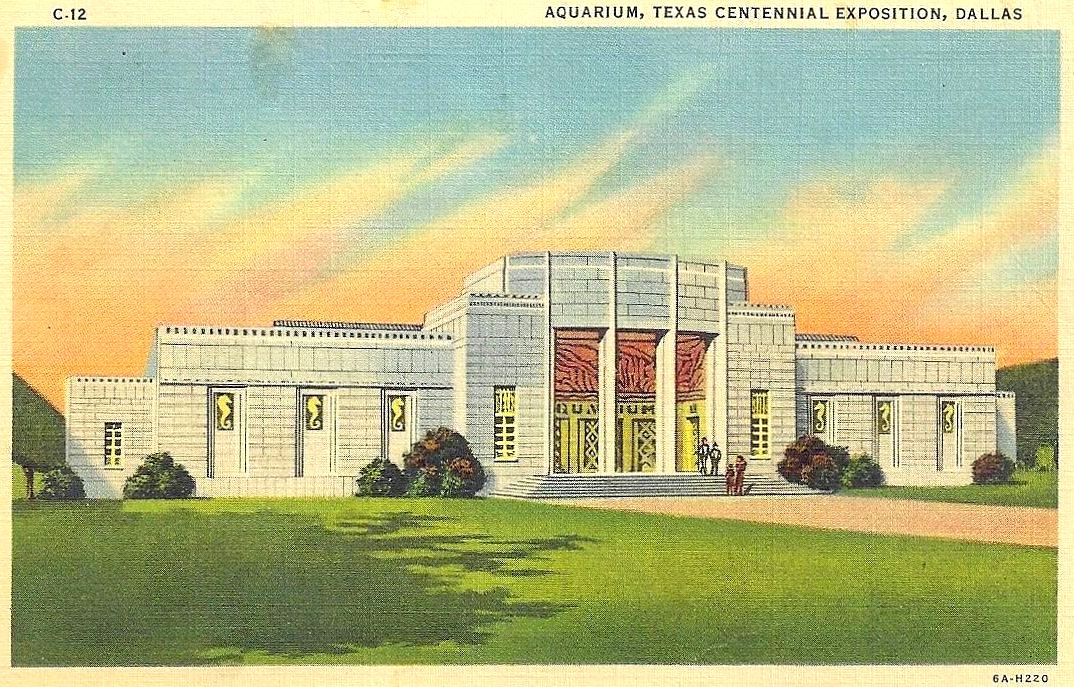
Out of all the buildings at Fair Park, the one I have the fondest memories of is the Dallas Aquarium, one of the buildings built in 1936 for the Texas Centennial Exposition which was specifically intended to be a permanent structure which would be available year-round to the citizens of Dallas, well after the Centennial had ended (some of these other “civic buildings” included the Museum of Fine Arts, the Museum of Natural History, the Hall of State, the bandshell, etc.). The Centennial buildings were designed by different architects, usually working in teams — the aquarium was designed by Fooshee & Cheek (best known for their previous triumph, Highland Park Village), Hal B. Thomson, and Flint & Broad. It ended up costing the city about $200,000 ($50,000 over the initial budget), and tussles with the Park Department and the City Council over its budget and space requirements meant that at various times it was suggested that the aquarium find a home at the Marsalis Park Zoo in Oak Cliff rather than at Fair Park, or that it just be shelved altogether.

fair-park-aquarium_1936

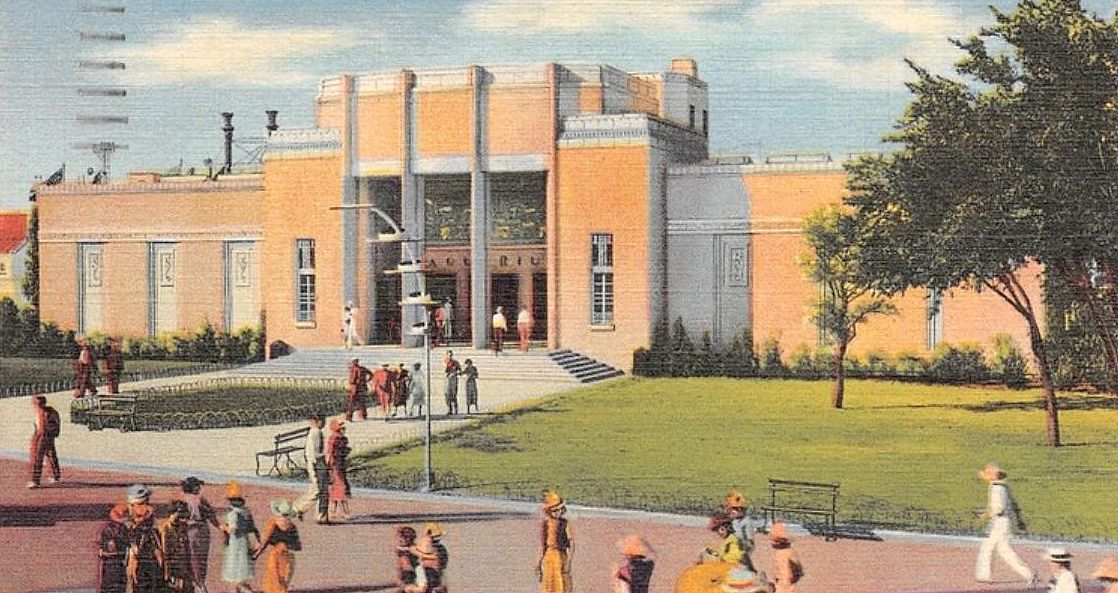
But everything worked itself out in the end, and its popularity at the Centennial was huge. HUGE. Most people in our part of the country had never been to an aquarium and had never seen fish outside of a lake or river or hatchery. According to reports in the newspapers during its construction in early 1936, not only was the Dallas Aquarium the first aquarium in Texas, it was also only the 12th aquarium in the entire United States — and it was the only one in the country in a “strictly inland city.” So unless visitors to the Centennial that year had traveled extensively, chances were slim that they’d ever seen anything like this.

fair-park_aquarium_postcard

At the time that plans were being discussed for the Fair Park facility, there was something of a tropical fish fad going on around the country. The Dallas Aquarium Society — a small group of “tropical fish fanciers” — was organized in June, 1935, and in September of that year, they had enough pull to put on an exhibition of their personal collections in small tanks on an upper floor of the Dallas Gas Company. People who had never before seen anything but a goldfish in a fish bowl were fascinated, and there were several “gee-whiz” articles in the papers describing the fishy wonders that could be found that fall at the gas company. The president of the Dallas Aquarium Society was Pierre Fontaine — an advertising man and “authority on marine life” — and he must have made quite an impression with the Centennial board, because in February of 1936, he was chosen to be the head of the already-under-construction Dallas Aquarium. (Though apparently a hobbyist when appointed, Fontaine served for decades as the respected director of the Dallas Aquarium — and later the Dallas Zoo.)

aquarium_fontaine_1936
Pierre Fontaine, 1936
The fish on display during the Centennial were almost exclusively freshwater fish. Not only would it have been prohibitively expensive to ship the thousands and thousands of gallons of salt water that would have been needed, it would also have been extremely costly to purchase and maintain the special non-corroding equipment necessary to equip such tanks. But Fontaine must have pushed, because the city gave the go-ahead for a paltry 500 gallons of salt water from the Gulf to be shipped up for the opening of the Exposition, so at least a few exotic saltwater-dwelling creatures and plants were able to share their DeMille-moment in the Centennial spotlight with their freshwater brethren. (At the time, “artificial” salt water was not yet an option as it now is, and only natural salt water could be used.)

aquarium_art-institute-of-chicago_1936Art Institute of Chicago Collection

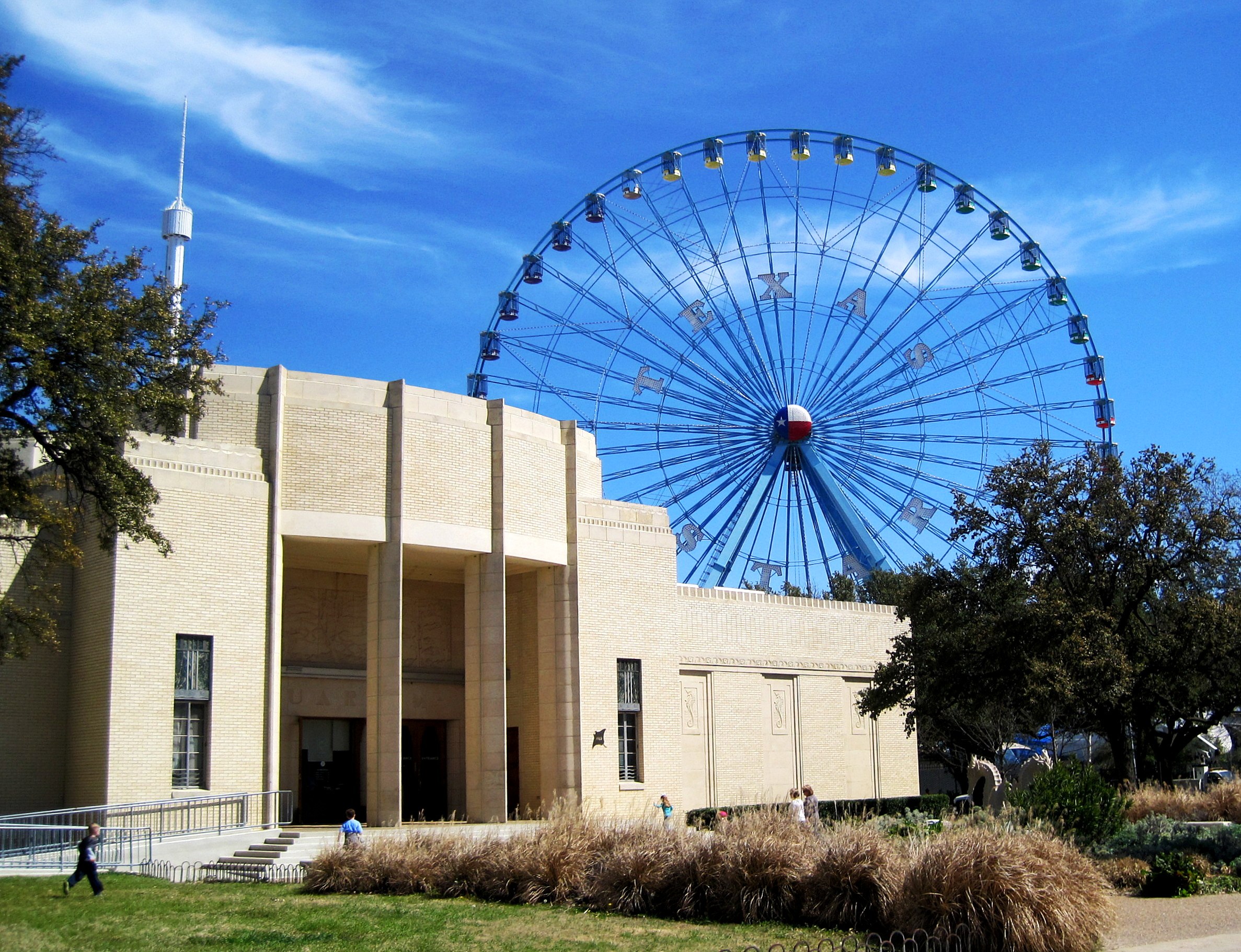
The 1936 Centennial aquarium building still stands. After extensive renovation, it now houses the “Children’s Aquarium,” which I haven’t visited, but which I’m confident is entertaining and educational. I’m pretty sure, though, that it is a completely different aquarium from the one of my childhood memories (when museums were basically designed for adults and were rarely “interactive”). I loved going to the aquarium. I remember it being dark and cool and kind of dreamy inside. Mysterious and exotic. I loved the little neon fish that playfully (or nervously) darted all around the tanks, the big, slow-moving fish that looked back at me like nonchalant cud-chewing cows in a field, the tiny skittering crabs, the turtles, the undulating plants … I loved all of it.

But what I really remember are the seahorses on the side of the building — whichever architect came up with that perfect little detail deserves a special place in heaven. I loved them as a child, and I love them now. The acres and acres of art deco fabulousness created for the Texas Centennial are absolutely thrilling, but those solemn and quietly elegant seahorses all in a row on the side of the Dallas Aquarium will always be my personal favorite little nostalgic detail in the whole of beautiful, beautiful Fair Park.

seahorses_pb-det

The Aquarium today (click to enlarge) / photo: Paula Bosse

*

UPDATE — Oct. 2020: It has been announced that the Children’s Aquarium will be closing permanently. This news is almost as upsetting as seeing Big Tex in flames.

UPDATE — Sept. 2021: Good news! It looks like the aquarium will be reopening in time for the 2021 State Fair of Texas. Read about it here.

***

Sources & Notes

Top two images are postcards based on the original architectural drawings, issued before the aquarium was built, found somewhere on the internet.

The third color image is a postcard from a photograph taken after the Centennial was underway.

Photo of the exterior of the present-day aquarium was taken by me in 2013.

The website for the Children’s Aquarium at Fair Park is here.

For an absolutely FANTASTIC well-illustrated article titled “The Metamorphosis of the Dallas Aquarium at Fair Park Into the Children’s Aquarium at Fair Park, With Historical Annotations” by Barrett L. Christie, Aquarium Supervisor, see p. 5 of the “Drum & Croaker” PDF, here. I really loved this article — especially the “Annotations of Historical Interest” at the end (p. 14). Seriously — this is a great read. I’m as layman as you’re gonna get regarding this topic, and I was fascinated by all of this. I’m going to have to write about that mysterious severed human leg found on the roof in 1954!

*

Copyright © 2015 Paula Bosse. All Rights Reserved.

A Post Office on the Fairgrounds?

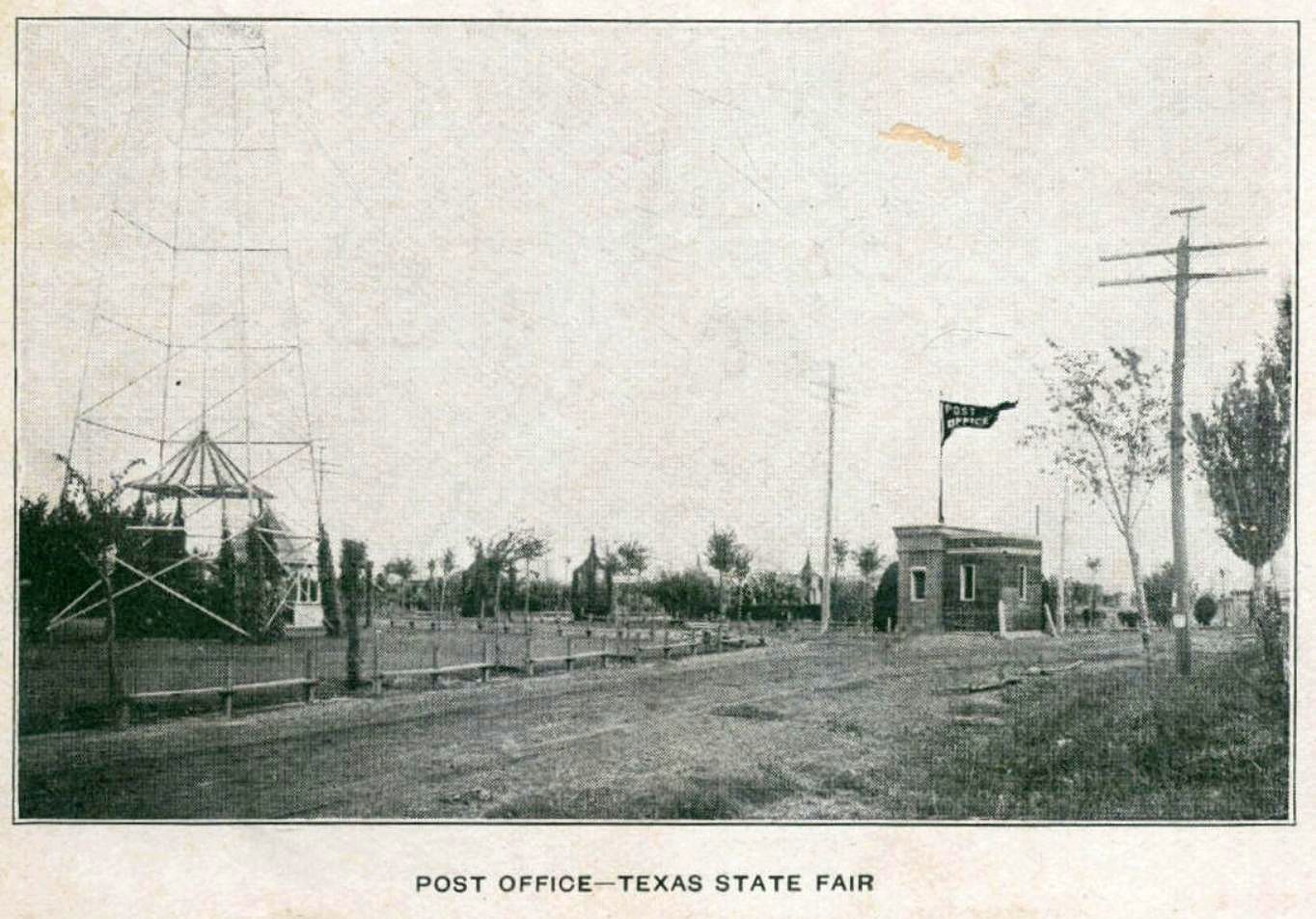
tx-state-fair_post-office_postcardTeeny-tiny post office at Fair Park… (click for larger image)

by Paula Bosse

I’m not really sure about this. It’s a postcard with a photograph captioned “Post Office — Texas State Fair” on the front, and “Missouri, Kansas & Texas Ry. Co.” printed on the back.

mkt_post-office-back

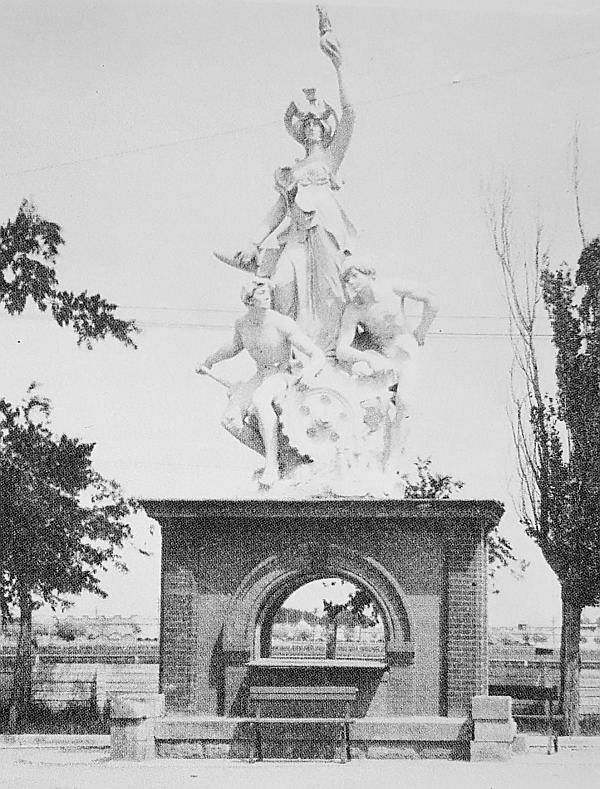
Was there a post office on the fairgrounds? After much googling, I came across a photo of a huge statue atop an arch in the book Fair Park by Willis Cecil Winters. Winters writes that this masonry arch […] served the fairgrounds as a post office.” I’m not sure how that worked, but it’s interesting.

fair-park_arch_statuary_post-office_dallas-rediscovered

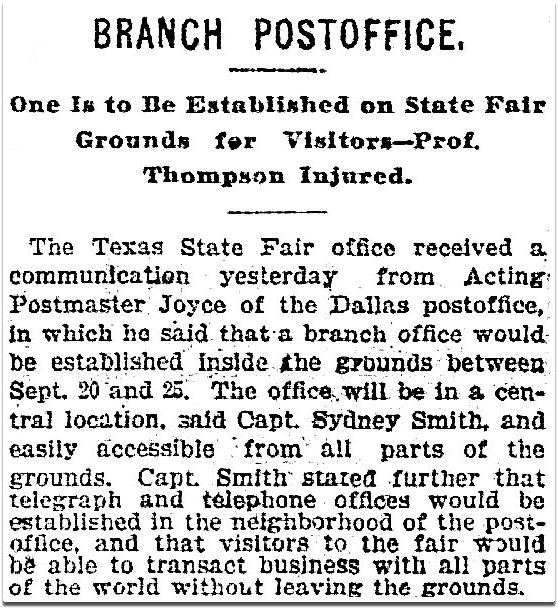
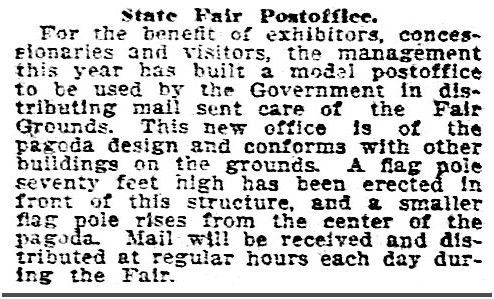
I did find a few mentions of a post office on the grounds of the state fair. Seems that it was a fairly standard temporary fixture on the fairgrounds — not only was it a post office branch that served those who worked the fair, it was also a one of the many features (along with huge steam-powered engines, restaurants, and telegraph and telephone service) that made the fairgrounds a self-contained mini city of sorts:

[I]t is no longer necessary for those doing business at the fair grounds to come down town, as the grounds constitute a completely appointed modern city, with all connection with the outside world. (Dallas Morning News, Sept. 25, 1901)

(Click clippings to see larger images.)

post-office_fairgrounds_dmn_091799
DMN, Sept. 17, 1899

post-office_fairgrounds_dmn_092501
DMN, Sept. 29, 1901

post-office_fairgrounds_dmn_091103
DMN, Sept. 11, 1903

state-fair_post-office_dmn_100408
DMN, Oct. 4, 1908

And now I know.

***

Top photo is from eBay (where this postcard is currently waiting for bids, here).

Photo of the Fair Park sculpture was taken in 1910. The Dallas Historical Society photo is captioned thusly by William L. McDonald in his book Dallas Rediscovered: “‘Progress,’ a sculptural monument to the promise of the age of technology which disappeared mysteriously just before the 1936 Centennial.” (THAT sounds like an interesting story!)
About the only mention I could find of the “colossal statuary that spans the driveway near the grand stand of the race track” (DMN, Oct. 15, 1905) was this short mention in a News article:

fair-park_arch_statuary_dmn_091505
DMN, Sept. 15, 1905

Want to know what the “Act of Congress” mentioned on the back of this “privately printed” postcard means? See here. Kind of interesting. And the info seems to indicate that the postcard above was printed between 1898 and 1901.

Click pictures and clippings to see larger images.

*

Copyright © 2015 Paula Bosse. All Rights Reserved.

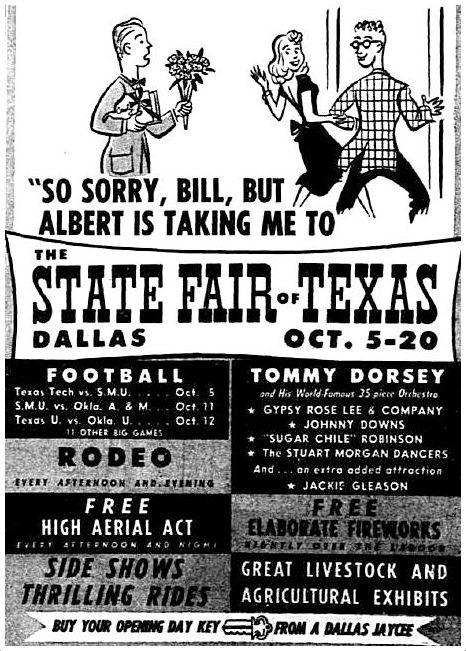
“So Sorry, Bill, But Albert is Taking Me to The State Fair of Texas”

state-fair_1909_flickr“The Pike” — 1909

by Paula Bosse

Hey, y’all — guess what ends this weekend? Hurry!

One doesn’t really need an excuse to post a bunch of photos of the Great State Fair of Texas, but it IS the closing weekend, so why not enjoy a few images from the past few decades.

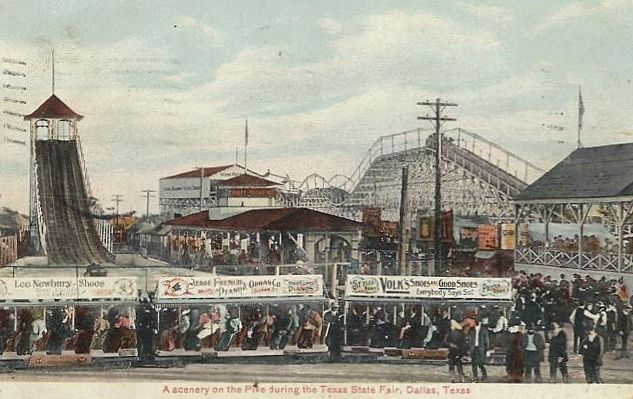
Above, a view of the Midway in 1909 (then called “The Pike”), with the Log Ride-like “Chute” and its ramp, a roller coaster, and a loaded tram festooned with shoe ads (including one for Volk’s).

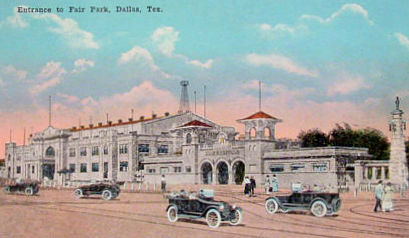
Below, the Fair Park entrance in 1919:

fair-park-entrance_1919

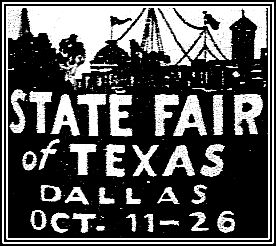
A nice little newspaper ad from 1924:

state-fair_092724

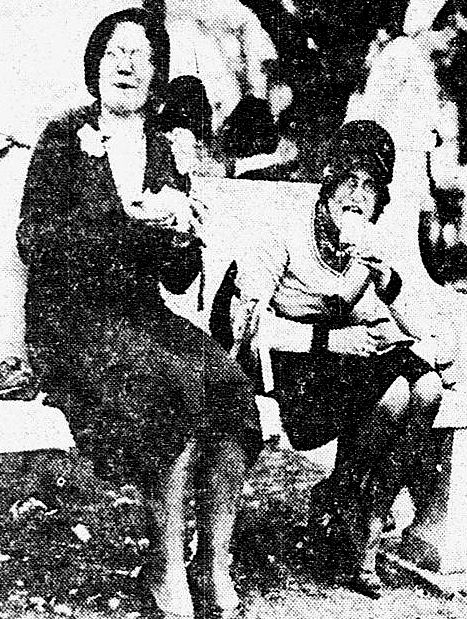
Two women enjoying ice cream in 1930 — State Fair food has always been one of the main joys of visiting the fair.

state-fair_dmn_101530

Ad from 1946: “So sorry, Bill, but Albert is taking me to the State Fair of Texas.” The grown-up entertainment that year was provided by Tommy Dorsey, Gypsy Rose Lee, and Jackie Gleason.

state-fair_dmn_092446

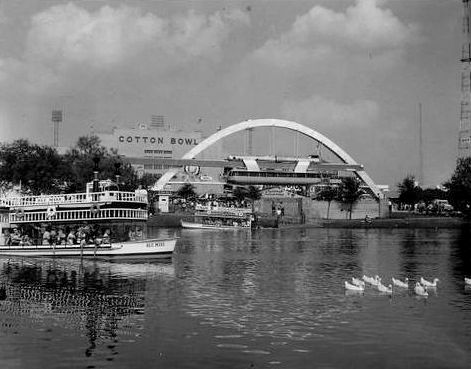
In 1958, Fair Park had a monorail (the only one then operating in the United States) and a paddle-wheeler in the lagoon:

state-fair_lagoon_squire-haskins_dmn-1958

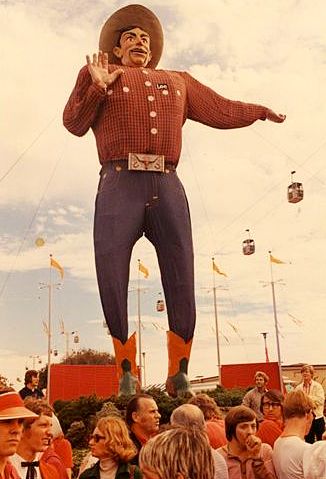
And then there’s this guy, who spans the decades:

big-tex_briscoe-center

***

Sources & Notes

1958 photo featuring the monorail by Squire Haskins, from a Dallas Morning News online article featuring TONS of cool photos of the fair over the years, here.

Big Tex photo (undated) from the Dolph Briscoe Center for American History.

Another post of random images of the SFOT through the decades — “The Fair Is In the Air — Let’s Go!” — is here.

*

Copyright © 2014 Paula Bosse. All Rights Reserved.


The First Texas-OU Game in Dallas — 1912

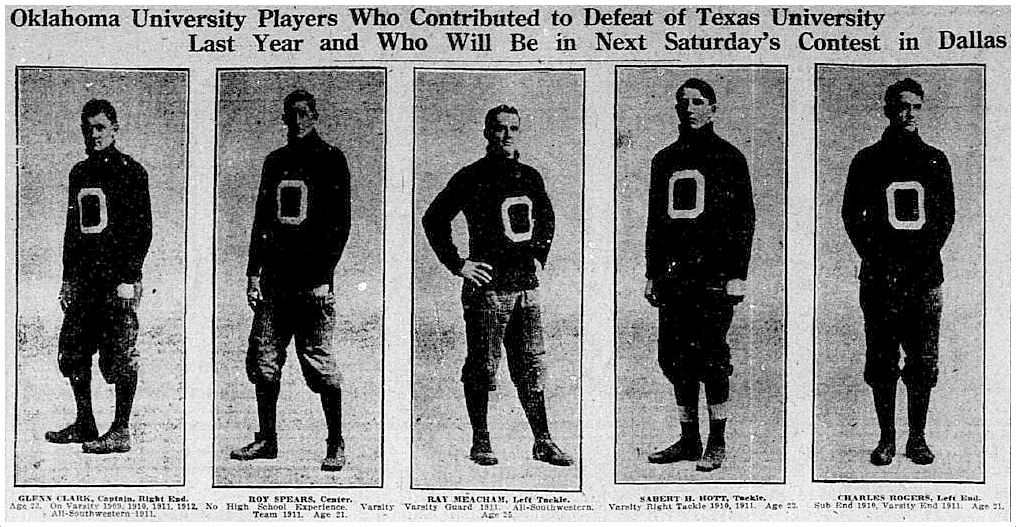
tx-players_dmn_101912bWatch out, Oklahoma: giant Texas linemen await…

 by Paula Bosse

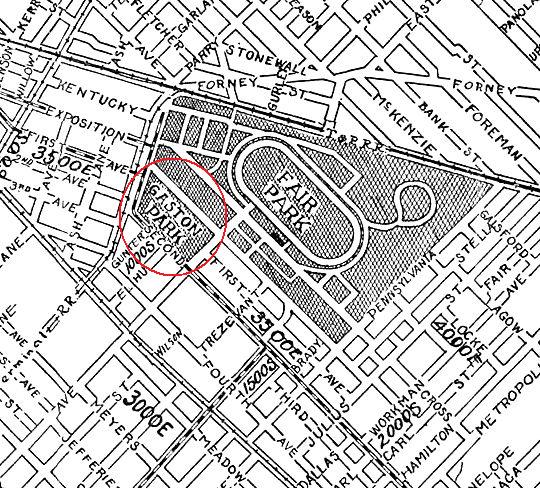
The Texas-OU game is a football tradition, held annually in the Cotton Bowl during the State Fair of Texas. The first game of the so-called “Red River Rivalry/Showdown/Shootout” was held in Dallas (aka “neutral ground”) in 1912. As the Cotton Bowl hadn’t been built yet, the game was held at Gaston Park, a sporting field with a large grandstand where Dallas teams played baseball, football, and, yes, even soccer. It was located at Parry & Exposition, in the spot where the State Fair Auditorium (now known as the Music Hall) was built in the 1920s.

Since my grasp of sports is tentative, I’m not going to go into any particulars of the actual game (which — spoiler! — Oklahoma won, 21-6); instead, I thought I’d mention a few of the incidental things leading up to the game that I found interesting. (For those who are interested in the particulars of the game, fret not — there is a link at the bottom of the post.)

So here are a few of the things that I found amusing or entertaining:

  • The 1912 football season began with new rules: downs were increased from 3 to 4; touchdowns were now 6 points instead of 5; the playing field was reduced from 110 yards to 100; the onside kick was abolished; a touchdown was permitted when caught over the goal line; the ball was kicked off from the 40-yard line instead of midfield; the intermission between quarters was reduced from 2 minutes to 1.
  • Fort Worth felt slighted that they had missed out on hosting the game (“it might just as well have been played in Fort Worth,” the Fort Worth Star-Telegram groused). Local Fort Worth-friendly UT alumni swore to try “strenuously” to get the game for Cowtown the following year, because, damn it, “next year is Fort Worth’s turn” (FWST, Oct. 15, 1912). (Sorry ’bout that, FW….)
  • The Sooners’ coach, 37-year old Bennie Owen (whom I gather is something of an OU legend), had only one arm, the result of a hunting accident. The Dallas Morning News wrote that Owen was “one of the most able [coaches] in the country. He is disabled to some extent by having but one arm, but evidenced by his success during the past season, this does not trouble him to any great extent” (DMN, Oct. 6, 1912).
  • The Longhorns’ coach, Dave Allerdice, was only 25 years old. He had been hired to fill the spot left vacant in the wake of the death of UT’s previous coach who had died rather exotically as the result of “a fall out of the window of his bedroom” (DMN, Oct. 10, 1912).
  • Both Allerdice and Owen had been coached as students by the same man, Coach Yost, at Michigan.
  • The Gaston Park crowd was estimated at over 6,000. The crowds going to the game and to the fair were so great that the streetcars and Interurbans were jam-packed. In fact, both teams had difficulty making it to the game on time because they couldn’t find transportation to get there, and the game had to be started late to allow for the players to arrive and warm up.
  • Oklahoma dominated the game, and the Sooners won, 21-6.

And so began the annual Texas-OU tradition in Dallas.

*

Below, Sooner boys: 0-0-0-0-0.

sooners_1912_dmn_101812DMN, Oct. 18, 1912

*

Grainy, off-kilter image of the crowd-frilled grandstand at Gaston Park.

tx-ou_crowd_dmn_102012DMN, Oct. 20, 1912

*

It’s a bit hard to see anything in these 100-plus-year-old photos, but here are a couple of “action photographs” of the game.

tx-ou_game-photos_dmn-102012DMN, Oct. 20, 1912

*

Gaston Park? Here’s where it was (a lot of street-renaming has gone on since this map was drawn in 1919).

gaston-park_fair-park_ca-1919

***

Sources & Notes

All photos from The Dallas Morning News.

1919 map (detail) from the Portal to Texas History, here.

For slightly better photos of Gaston Park (in 1908), see a previous post, here.

Wikipedia roundup:

  • Gaston Park, here.
  • Bennie Owen, here.
  • Dave Allerdice, here.
  • “Red River Showdown” (which I’ve never actually heard anyone other than TV commentators and promoters say to describe what everyone I know calls the “Texas-OU game”), here.
  • Defenestration, here.

The Dallas Morning News and The Fort Worth Star-Telegram are filled with numerous contemporaneous articles about this game. If you have a handy-dandy Dallas Public Library card (free!), you can pore over these articles to your heart’s content. To read what was printed the day of the game (Oct. 19, 1912), click  here. To read about the results and the game coverage, click here.

Click pictures for larger images. They will still be muddy and grainy, but, by God, they’ll be bigger.

*

Copyright © 2014 Paula Bosse. All Rights Reserved.

Snapshots of the Fair, 1936-1940

tx-centennial_strolling_fwplCentennial Exposition, 1936 — photo by Lewis D. Fox (click for larger image)

by Paula Bosse

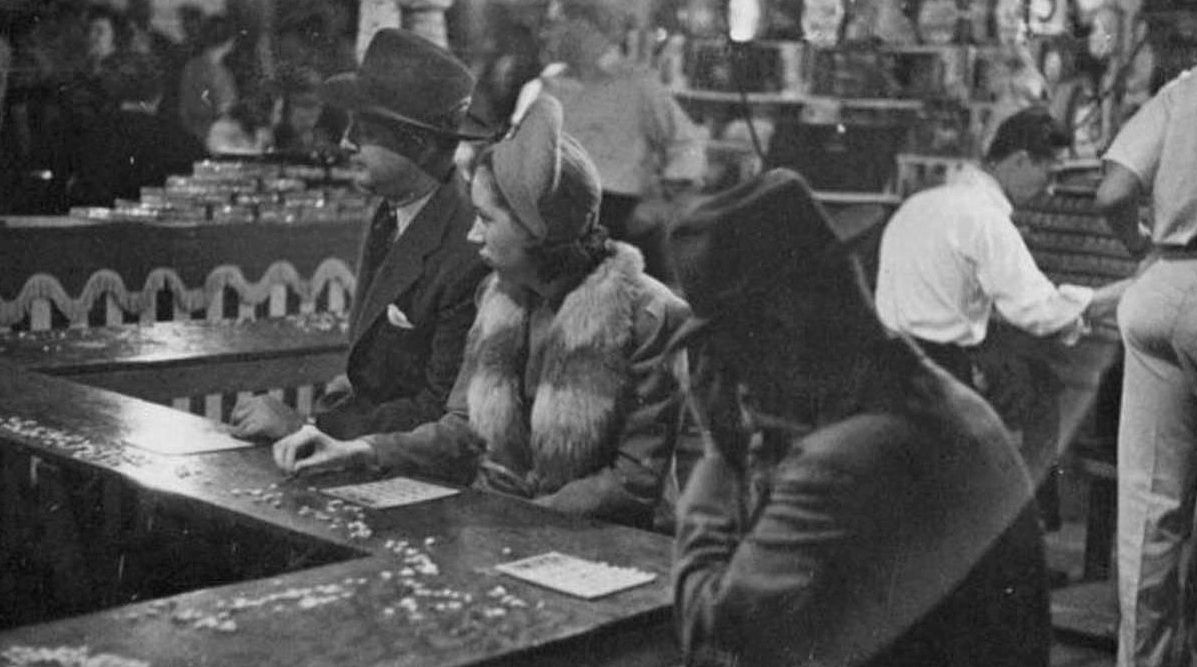
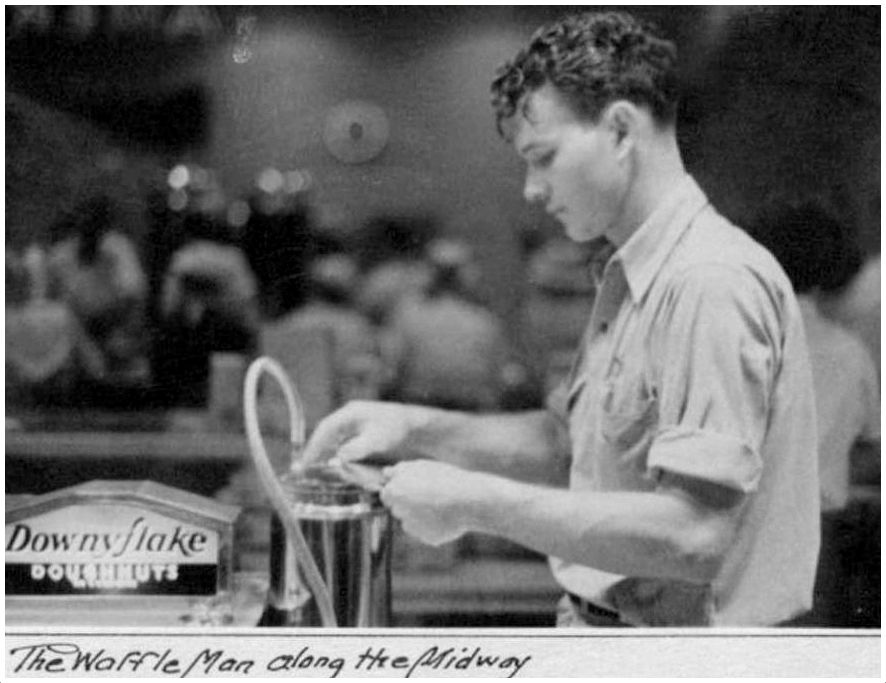
An amateur photographer named Lewis D. Fox took a lot of photos at the State Fair of Texas — from the Texas Centennial in 1936 through 1940. The Centennial photos are particularly interesting, because they show what the “Exposition” was like to the average visitor — there was more going on than just the spectacular extravaganza we usually see — there are also shots of people doing un-spectacular things like just walking around or enjoying a quiet, late-afternoon cup of coffee. There are also photos of the people who do the heavy-lifting at a state fair — the men and women who work the Midway shows and the concession stands (a link to a larger collection of Mr. Fox’s State Fair photos — almost a hundred snapshots — is below).

Enjoy this look at a time when going to the fair meant dressing up and, apparently, often leaving the children at home! (Click photos to see larger images.)

tx-centennial_spirit-of-centennial_fwpl

state-fair_texas-state-bldg_fwpl

state-fair_circus_c1939_fwpl

state-fair_grandstand_fwpl

tx-centennial_swing-revue_fwpl

state-fair_beanery_fwpl

state-fair-midway_fwpl

tx-centennial_cashier_fwpl

tx-centennial_side-view_fwpl

tx-centennial-midway_waffle-man_fwpl

***

Sources & Notes

All photos taken by Lewis D. Fox, from the Fox Photograph Collection in the Fort Worth Public Library Archives, courtesy of the Genealogy, History and Archives Unit, Fort Worth Public Library. Mr. Fox took a lot of snapshots at the fair — see  more here.

On a personal note, I’m mesmerized by “The Waffle Man.” He looks just like a young Lefty Frizzell! Lefty was from nearby Corsicana and he spent a lot of time in Dallas, but he wasn’t born until 1928, so it can’t be him — but check out this photo of Lefty as a teenager and see the remarkable resemblance! Not only did the (no doubt syrup-scented) young man above look like one of my favorite singers, but he also had ready access to waffles. What’s not to love? Oh, Waffle Man….

All images larger when clicked.

*

Copyright © 2014 Paula Bosse. All Rights Reserved.