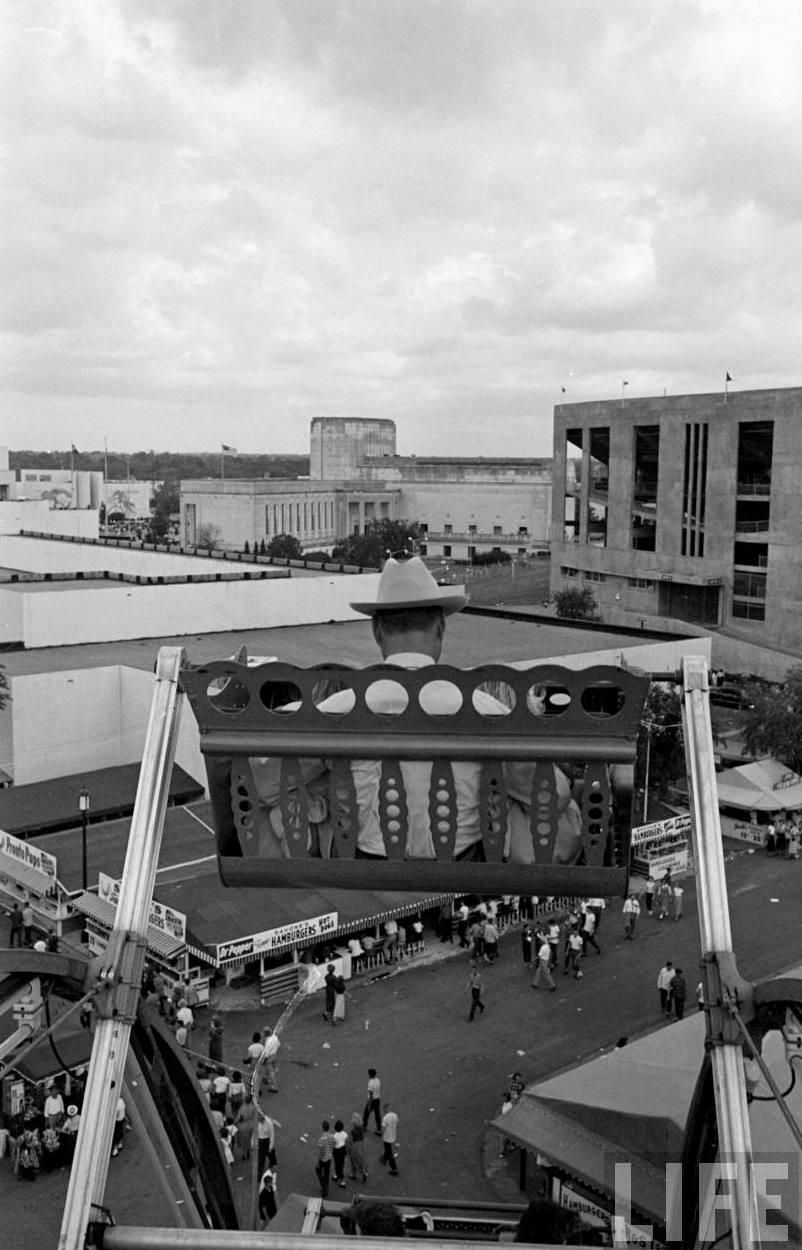
A Life magazine photographer moseyed down to Dallas in 1951 and captured a couple of cool shots of the State Fair. The photo above (so sweet, and one of my favorite Midway shots ever) was captioned:
In Dallas a rancher takes the kids for a ride in a 92-foot-high double Ferris wheel.
The photo below shows a tractor-pulled tram (fare: 15 cents) as it wheels past the Hall of State, full of well-dressed men and women. (That kid in the boots, cowboy hat, and letterman jacket … had I been around in 1951, I would have had a big ol’ crush on him.)
Click both of these wonderful photos to see larger images. You can practically smell the Brylcreem and cotton candy.
Life magazine, 1951
***
Sources & Notes
Both photos taken at the 1951 State Fair of Texas for Life magazine by an uncredited photographer. The top photo (cropped differently) ran in the Oct. 22, 1951 issue of Life as part of a feature titled “It’s a Bumper Year For Fairs” — it was the only photo that appeared in the magazine shot at the Texas fair. The bottom photo did not run in the magazine.
Brought to my attention last night in a Dallas history group was the heretofore unknown-to-me full-length, Hollywood-slick travelogue called “A Cavalcade of Texas,” shot around the state in 1938 under the auspices of Karl Hoblitzelle in his capacity as chairman of the Texas World’s Fair Commission. (Hoblitzelle also built the Majestic Theater and founded the Interstate Theatre chain.)
“A Cavalcade of Texas” — a 49-minute full-color travelogue touting the beauty, history, natural resources, and industries of the state — was made to be shown at the New York World’s Fair, but because of a variety of production and logistical problems, the film was, instead released theatrically. John Rosenfield, the legendary “amusements” critic for The Dallas Morning News, was suitably impressed. After an early preview of the film, he wrote:
The picture should be a revelation to the outlanders who still think of Texas as the backwoods with a hillbilly civilization. (DMN, June 27, 1939)
Ha.
The film opened in Dallas in October of 1939 at, unsurprisingly, The Majestic, second on a bill with a Ginger Rogers film (which was fitting, as Ginger had begun her professional career at The Majestic as a teenager). The pertinent paragraph from Rosenfield’s official review is amusingly snippy:
“Cavalcade” shoots the Houston skyline as a bristling metropolitan acreage but hides the Dallas buildings behind the towering Magnolia Building. Maybe we are sensitive about it but we don’t feel that architectural justice has been done. The Fort Worth aspect is glorified more than it deserves. (DMN, Oct. 15, 1939)
(Sorry, Fort Worth!)
The Dallas scenes are only about 4 minutes’ worth of the whole film, but to see Dallas at this time in color — and moving — is kind of thrilling. The entire film is on YouTube, but I’ve bookmarked the two Dallas bits. First, after an interminable sequence on how fantastic things will be when we finally make that darn Trinity navigable, is a Dealey Plaza-less Triple Underpass, shots of Main Street (including the now partially obliterated 1600 block at the 17:52 mark, on the right), Fair Park (including a description of the Hall of State as “the Westminster Abbey of the New World” (!)), and a neon-lit Elm Street at night. (If you let it keep going, you’ll see “the Fort Worth aspect.”)
(I am having problems embedding this clip to begin at the 17:30 mark. If the above does not begin at the Dallas sequence, see it at YouTube, here.)
*
Twenty minutes later, the viewer is, for some reason, shown the Dallas Country Club with what I’m guessing are Neiman-Marcus models pretending to play golf.
(If the above does not begin at the Dallas Country Club sequence at 40:09, see it at YouTube, here.)
*
Those are just the Dallas bits — the whole film is an impressive undertaking, and it’s great to see documentary footage of this period in rich color, presented with incredibly high production values, in full Hollywood style.
Ad, Oct. 14, 1939 (click to see larger image)
***
Sources & Notes
“A Cavalcade of Texas” was directed, edited, and narrated by James A. Fitzpatrick and can be seen in full on YouTube, here.
Background on Karl Hoblitzelle can be read in information provided by the Handbook of Texas,here, and by the Dallas Public Library, here.
The wonderful and vibrant 1939 footage of downtown Dallas that was discovered on eBay a few months ago and “saved” by a group of preservation-minded Dallasites, which included Robert Wilonsky and Mark Doty, is one of my favorite Dallas-history-related stories of 2014. Watch that footage here.
“Texas State Fair, Main Entrance” by Clogenson, 1908 (click for larger image)
by Paula Bosse
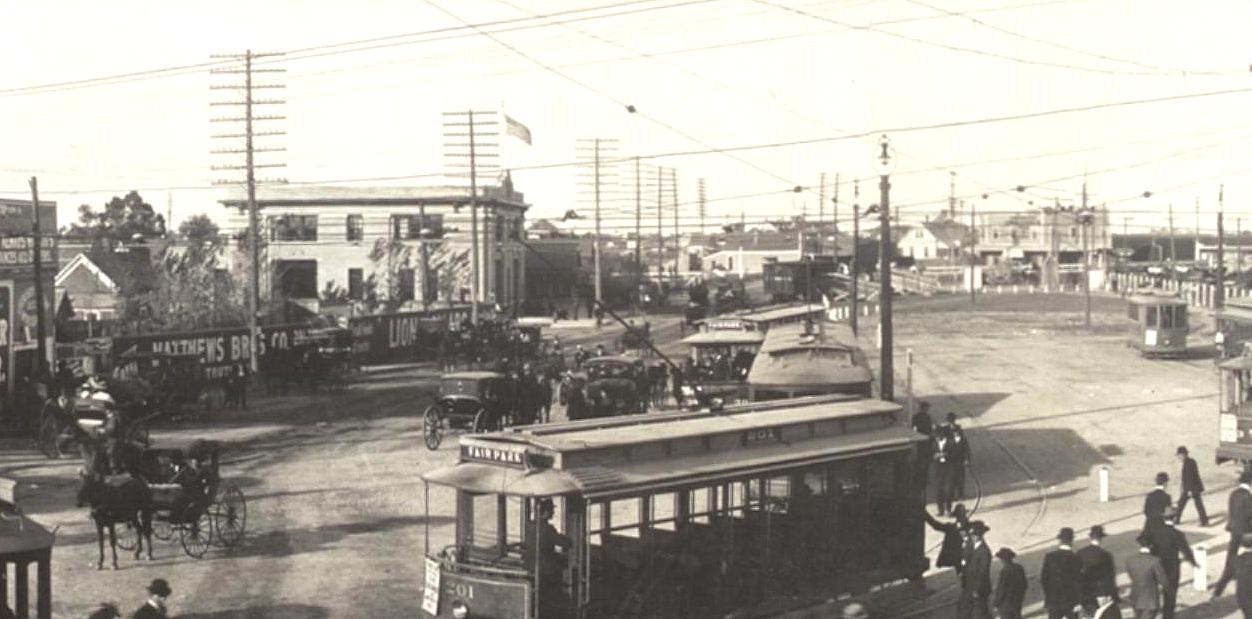
Today is opening day of the State Fair of Texas. Always an anticipated annual event, this is what the crowded entrance to Fair Park looked like over a century ago — still pretty recognizable, especially the firehouse at the top left. Below is a detail of the first third or so of this amazing panoramic photo. For a gigantic image of the top photo, click here (and then keep clicking until it’s gotten as big as it’s going to get — and don’t forget to use that horizontal scroll bar!).
Below is the detail I’ve cropped from the larger photo, showing the Parry Avenue portion, with the still-standing firehouse at the top left.
Have fun at the fair, y’all!
Detail showing Parry Avenue, looking north (click for larger image)
***
Sources & Notes
Original image titled “Texas State Fair, Main Entrance” by Clogenson, 1908, from the Library of Congress. Photo and details can be viewed at the LOC website here.
In case you missed the link above — and because it’s so fantastic and filled with such incredible detail — you really must see the really big image of that really big panoramic photo, HERE.
For other Flashback Dallas posts on the State Fair of Texas, click here.
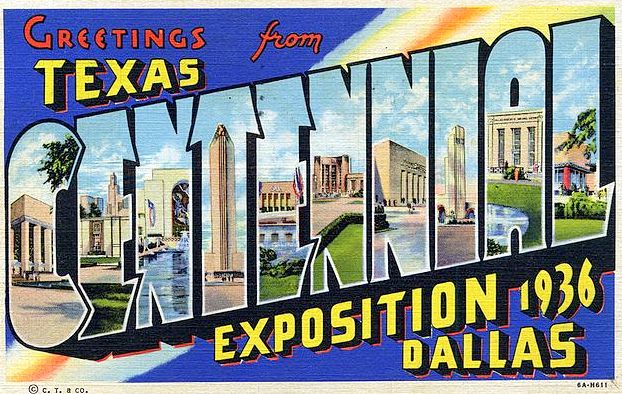
For Flashback Dallas posts on the Texas Centennial, click here.
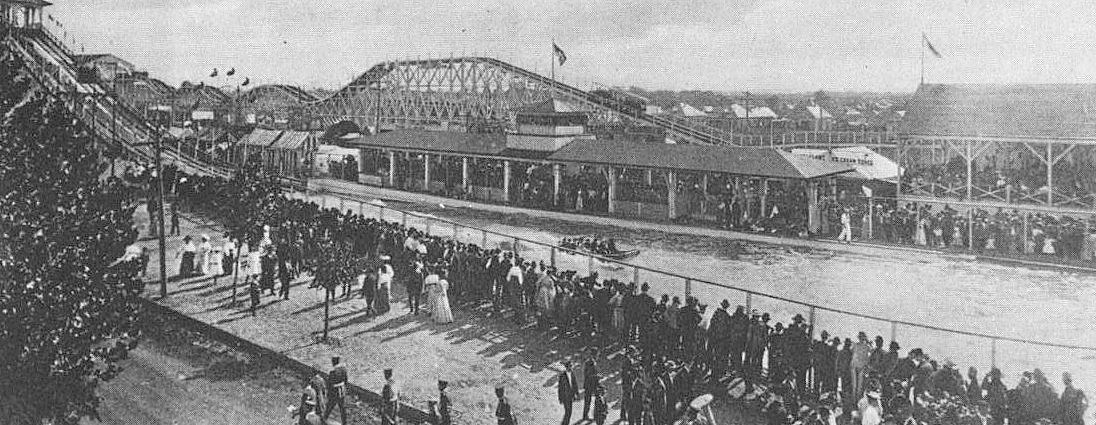
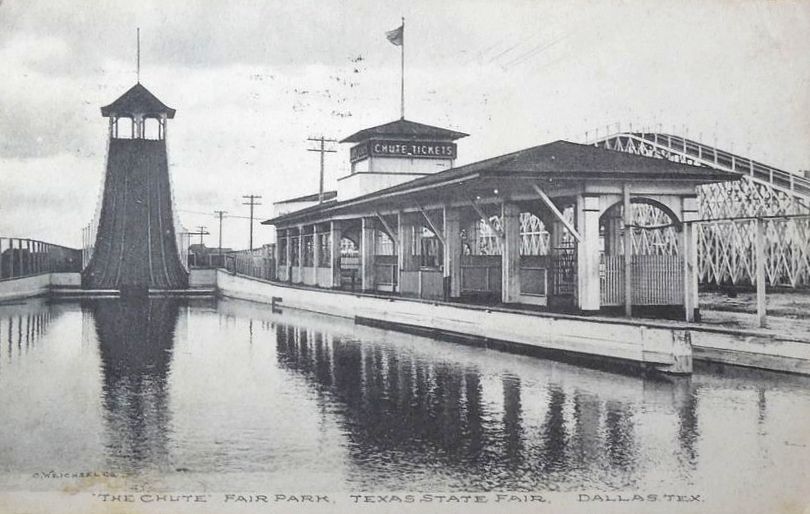
Construction began in 1906 on a new entertainment area at Fair Park called The Pike.
“What is known as ‘Smokey Row’ has been set back against the fence on the south side of the grounds, and the space between it and the race track, all the way to the grandstand, will be occupied by exhibits. Two streets through this part of the grounds lead to the grandstand and the Pike. The Pike will be located beyond the grandstand, occupying a space 250×1125 feet. Here are being constructed the scenic railway and the shoot the chute, which will represent an investment of $75,000. The State Fair has agents in the East booking the remaining attractions for this department. These agents have instructions to pay the money and get the newest and best things to be had.” (Dallas Times Herald, June 24, 1906)
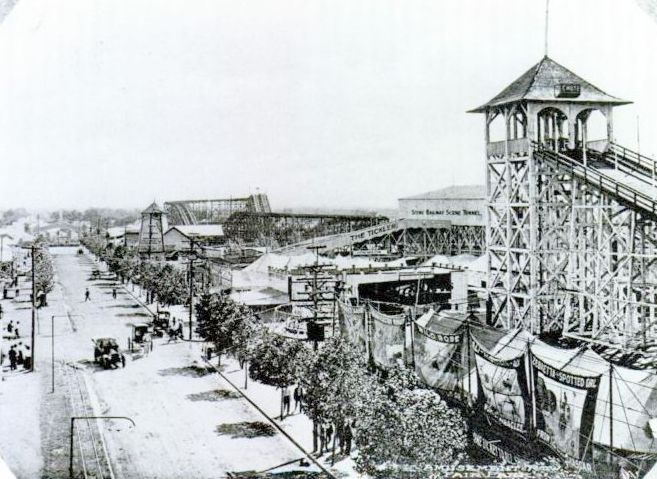
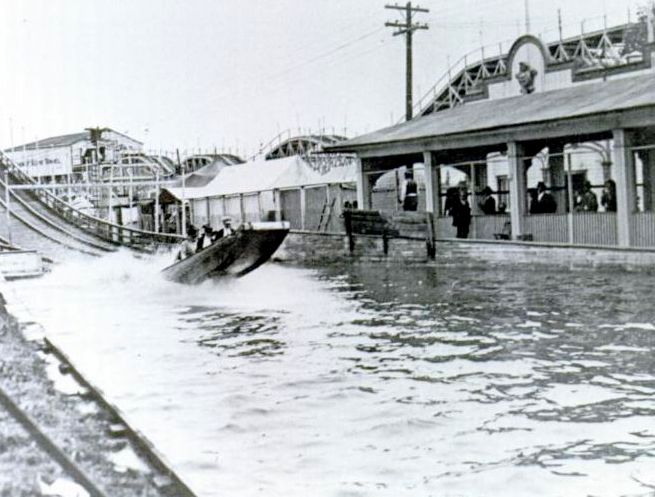
The new Pike meant that visitors to the State Fair of Texas would be able to ride “The Chute,” an amusement park attraction that had been popular in other parts of the country (and which automatically brings to mind the log ride at Six Flags Over Texas). In 1908, a roller coaster with the delightful name of “The Tickler” joined the rides in the area that was referred to as the “Pleasure Plaza” in at least one newspaper account. The Chute/Shoot the Chute/Chute the Chutes lasted a relatively short time — only until 1914 when it was torn down to “make room for the new shows known as the ‘World at Home,’ to be open to the public at the State Fair next fall” (DTH, Aug. 18, 1914).
Rides such as The Chute and The Tickler were enormously popular, and one wonders how all those hats managed to stay on all those heads of all those pleasure-seekers.
*
The Chute, head-on:
A view of The Pike, with The Chute to the right, above the sideshow banners.
In action:
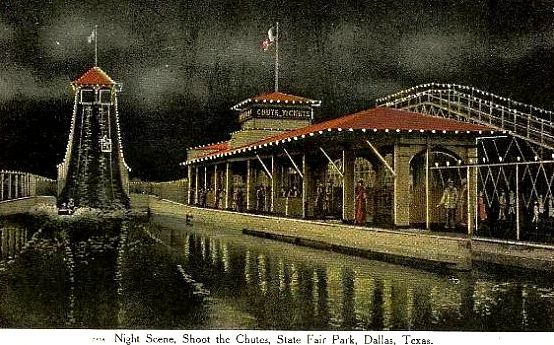
At “night” (the second photo above, glamorized, with postcard magic applied):
***
Sources & Notes
Top photo from the collection of the Texas State Historical Association.
Second photo, a 1908 postcard, from eBay.
Third and fourth photos from the book Fair Park by Willis Cecil Winters (Charleston: Arcadia Publishing, 2010). Photo of The Pike from the Dallas Public Library; photo of the boat from the State Fair of Texas Archives.
Night scene from a story by Robert Wilonsky on Winters’ book in the Dallas Observer, here.
Dallas Times Herald quotes from the indispensable Dallas County Archives pages compiled by Jim Wheat; these two articles can be found here.
Yes, Wikipedia does have an entry on the history of Shoot the Chute rides, here.
Thanks so much to the fine folks at The State Fair of Texas for the Throwback Thursday social media love today! They graciously shared our Texas Centennial posts. Welcome, new visitors!
And don’t forget, Big Tex is counting down those days….
***
State Fair of Texas website is here. Get ready, y’all!
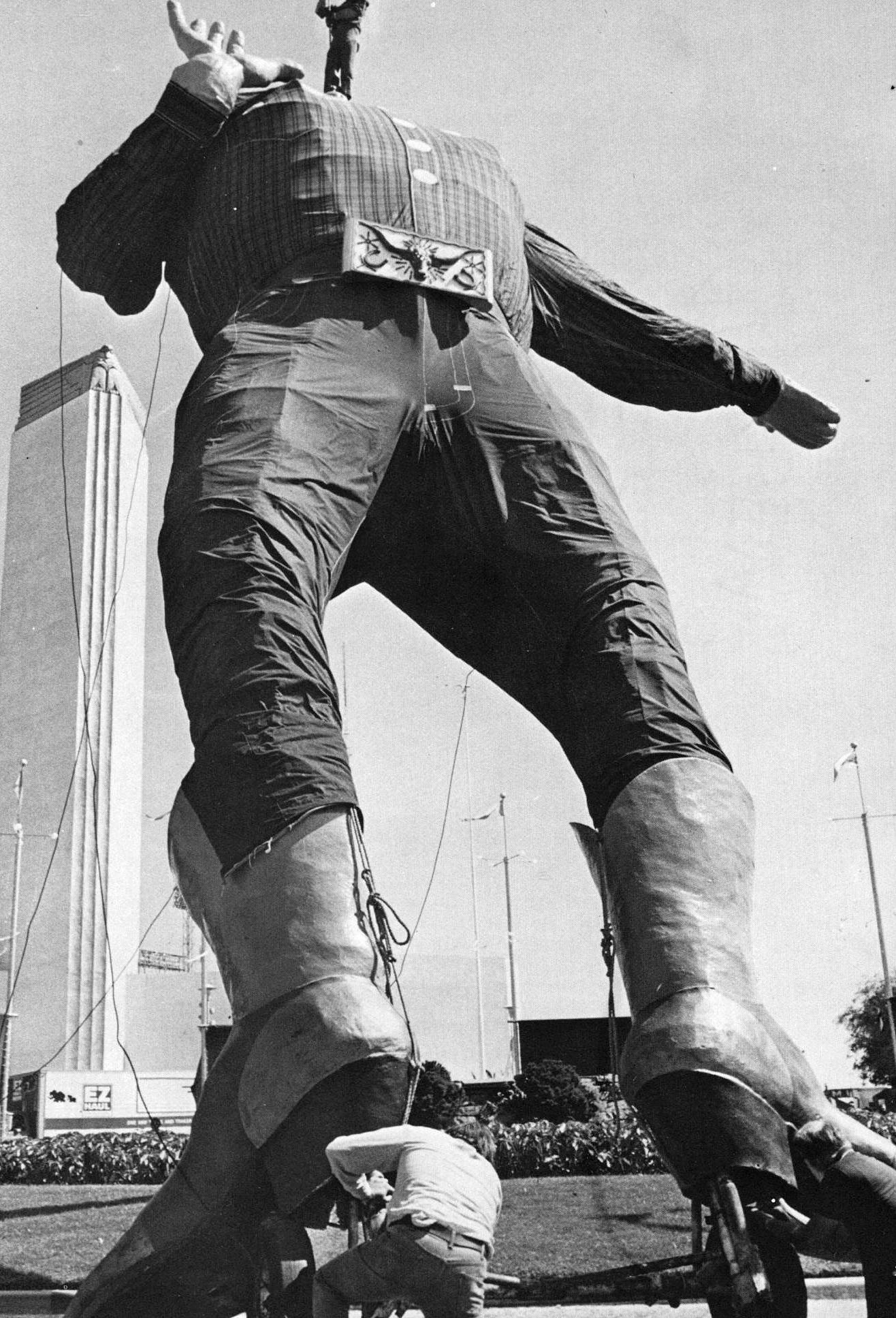
Headlessness and wardrobe malfunctions being attended to…
by Paula Bosse
It’ll probably all get straightened out in the end.
When I worked in a bookstore that had frequent visits by costumed characters for children’s events, we were told to make sure children never saw the characters without their costume heads because it might freak the kids out. If true, that photo above has the potential to scar some impressionable youngsters for life.
Above, Big Tex in dishabille.
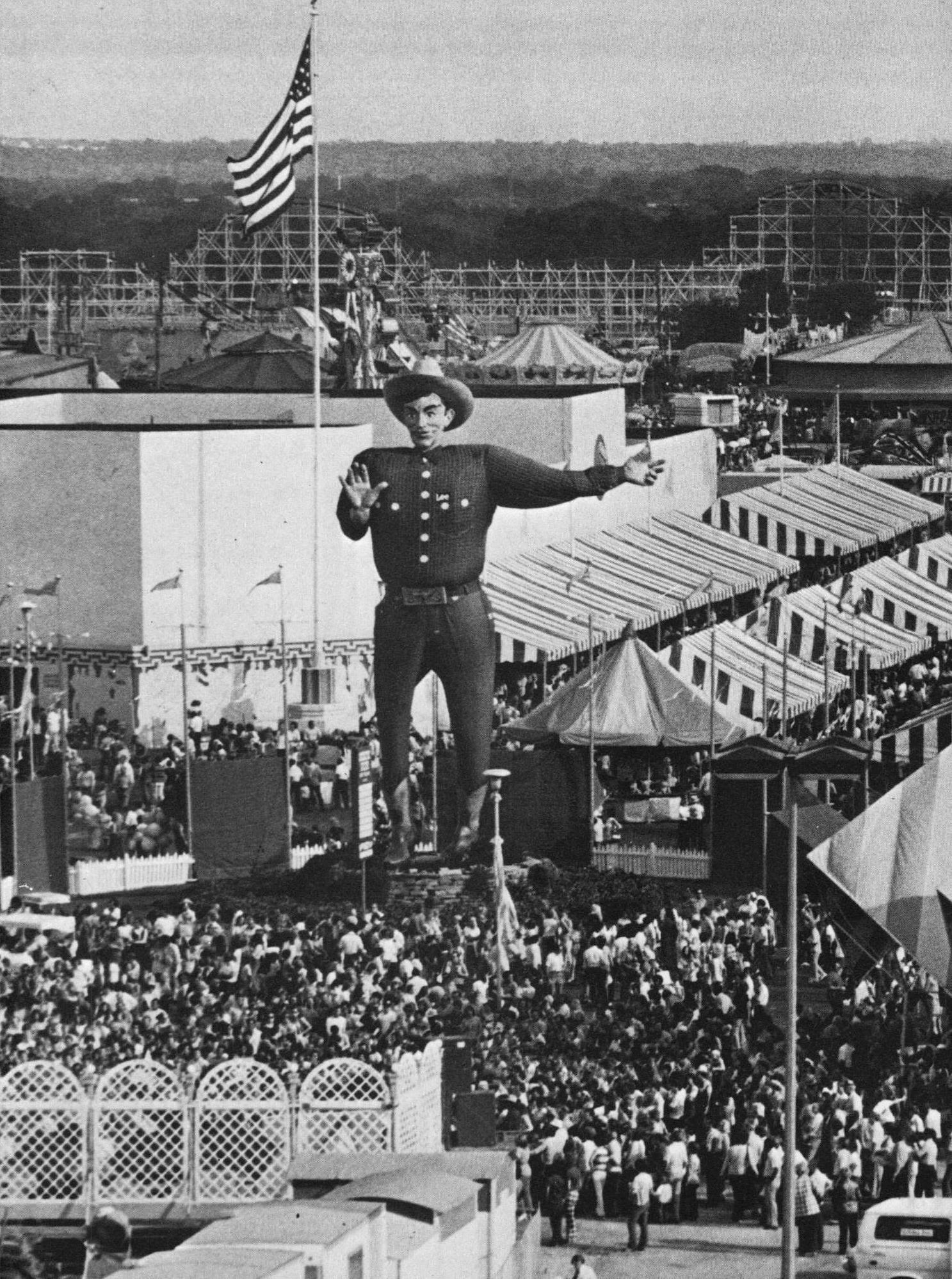
Below, all pulled together.
***
Sources & Notes
Top photo of a headless Big Tex is from the Sept. 1976 issue of Texas Historian, a Texas State Historical Association publication of the Junior Historians of Texas.
Second photo, of a put-together Big Tex is a State Fair of Texas photo from the same issue of Texas Historian.
Hey, y’all, guess what’s just around the corner. Whenever you start seeing pictures of Big Tex, you know that the State Fair of Texas can’t be too far away.
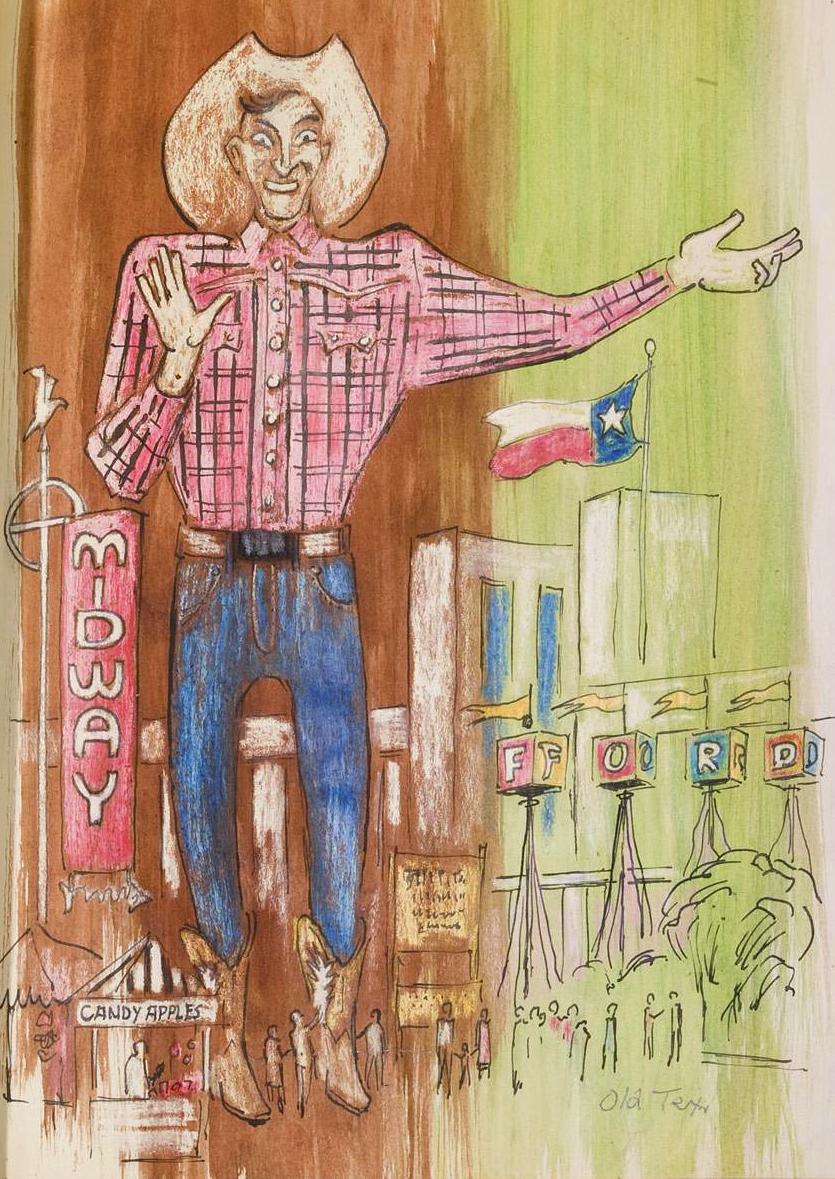
There have been a lot of artistic depictions of Big Tex over the years, but I think this sketch by Dallas artist Otis Dozier (1904-1987) may be my all-time favorite. And I’ve only just discovered it! (Thank you, DMA!)
The Otis Dozier sketchbooks have been digitized in a joint project between the Dallas Museum of Art, SMU’s Bywaters Special Collections at the Hamon Arts Library, and SMU’s Norwick Center for Digital Services. To read about this fantastic collection, see the SMU Central University Libraries page, here.
*
This week, the Dallas Museum of Art launched a new digital database in which its entire collection is now accessible online! This is great news for many reasons, not least being that it allows the public to see works that are rarely — if ever — displayed in the museum. Such as this one. To read more about assembling this incredible database, read the DMA’s announcement, here.
To look up your favorite artist, check to see what the DMA has, here.
For the biography of the Forney-born Dozier (who was one of the members of the famed Dallas Nine group), see the Handbook of Texas entry here.
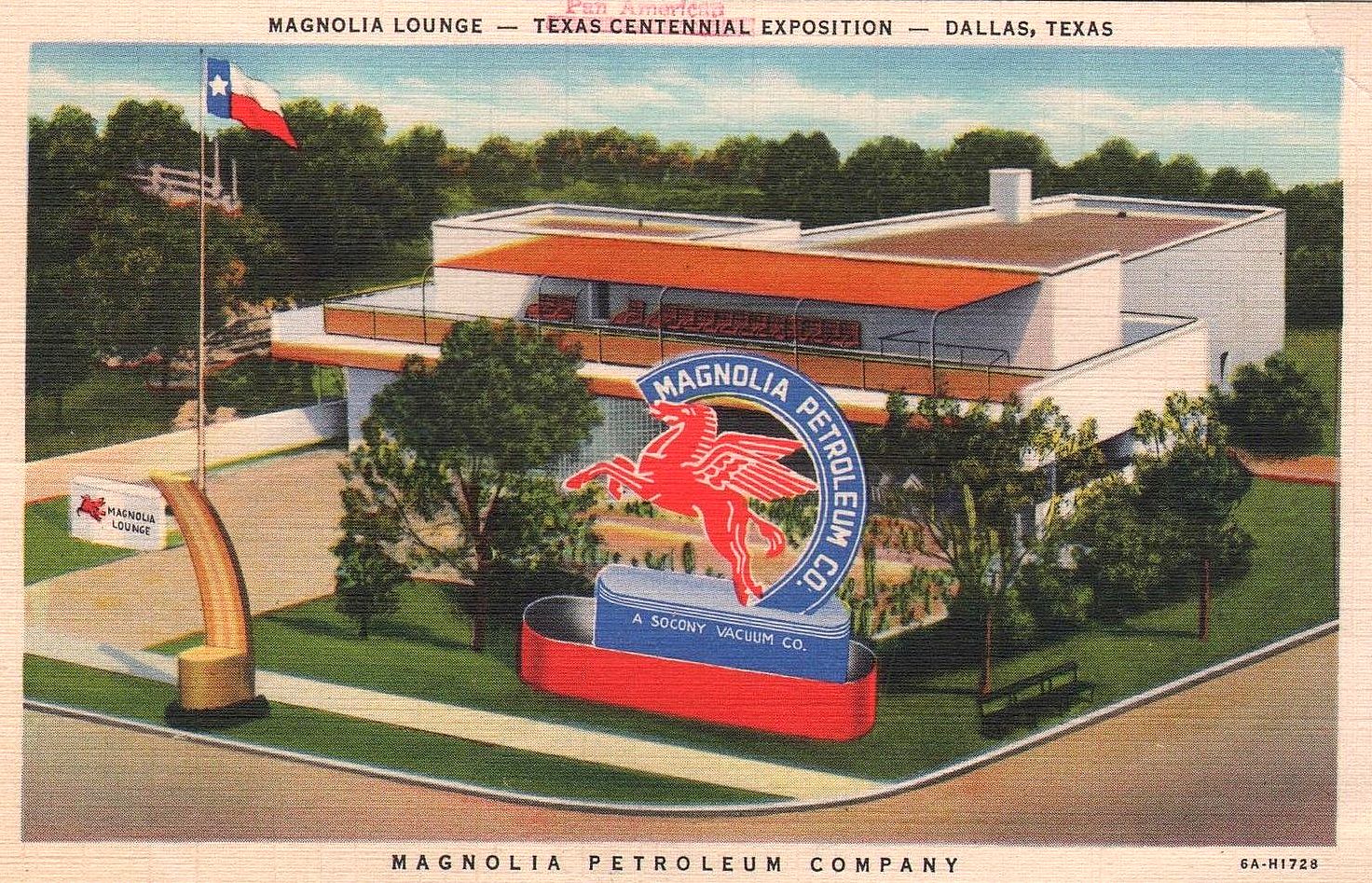
The sleekly cool Magnolia Lounge, designed by Swiss-born American architect William Lescaze for the Texas Centennial, is considered the first International-style building built in Texas, and though it feels perfectly at home in Art Deco Fair Park, it looks completely different and much more modern that the buildings around it. It was built by the Magnolia Petroleum Company as a place for visitors to the Centennial Exposition to relax and cool off (it boasted a 20-ton refrigeration plant). The Magnolia Company’s slogan for their building was “Be Our Guest and Rest at the Magnolia Lounge.” In other words, this was the most insistently fabulous rest stop ever built!
How did we GET this cool building? Two words: Stanley Marcus.
“Young retailer Stanley Marcus was dispatched to New York City by Dallas-based Magnolia Petroleum to find the most up-to-date architect of the United States for their Centennial pavilion. Marcus chose William Lescaze, who had just designed the first International-style skyscraper in the United States [the PSFS Building in Philadelphia, which opened in 1932].” (–Virginia Savage McAlester)
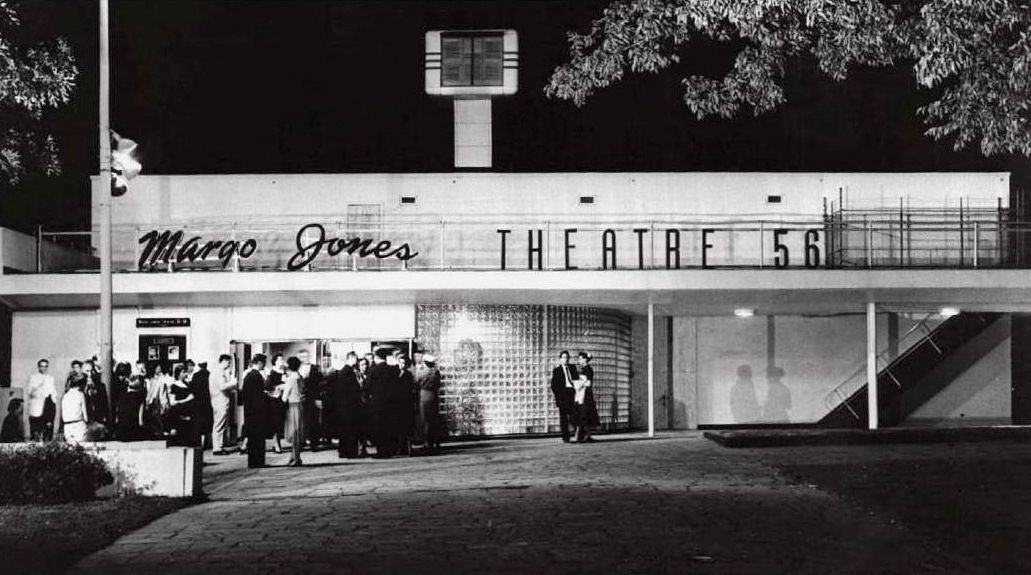
It was a popular oil company-branded “comfort station” for fair visitors until 1942 when the Magnolia Petroleum Co. (who had owned the building), gave title of the Magnolia Lounge to the State Fair, which used it for many years to house its general offices. In 1947, the space became Theatre ’47, Margo Jones’ legendary regional theater where, among other achievements, she produced plays of a young Tennessee Williams and introduced the innovation of theater-in-the-round. After Jones’ death in 1955, the theater carried on for a few years but eventually closed in 1959. After some difficult lean years for the building (during which demolition was considered!), it has been home to organizations such as the Friends of Fair Park, and it is now an active performance space again. And all is well with the world.
***
Sources & Notes
Postcard of the Magnolia Lounge from the vast wilds of the internet. Click it. It’s huge.
The Virginia McAlester quote is from a Friends of Fair Park advertising section in the Oct. 1989 issue of Texas Monthly.
Photograph of Theatre ’56 from Historic Dallas Theatres by D. Troy Sherrod, from the collection of the Dallas Public Library. (The theater struggled to continue after the sudden death of Margo Jones in 1955, which I wrote about here.)
For more on the history of the Magnolia Lounge, see the official Fair Park home page here; also, check out the the City of Dallas page devoted to this building, here.
And for more on this cool building, particularly in connection with Margo Jones, see the page on the always informative Watermelon Kid site, here.
A lengthy description of the building can be found in the article “Daylight Movies of Texas Scenes To Reward Visitors to Magnolia’s Cool Lounge” (The Dallas Morning News, April 26, 1936).
The Wikipedia page on architect William Lescaze is here.
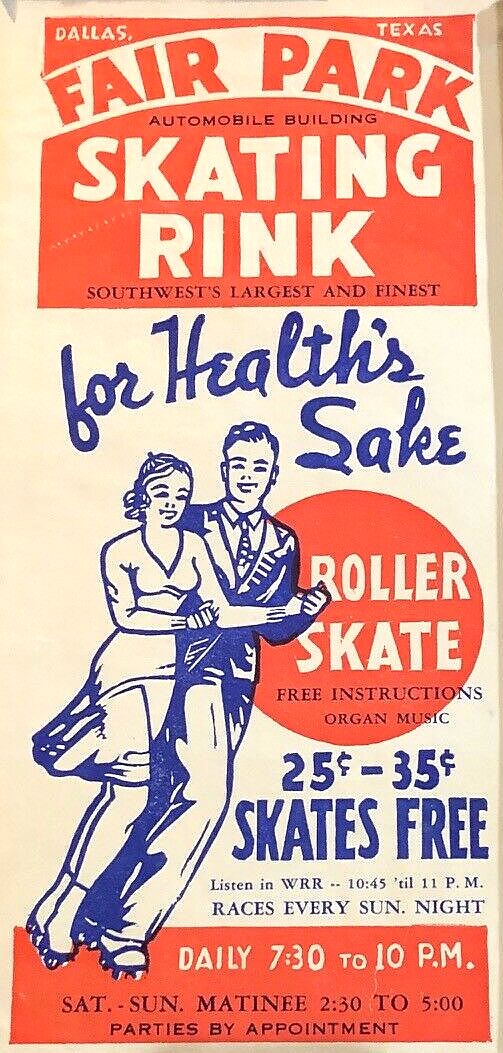
The Fair Grounds Skating Rink opened in the old Machinery Hall in 1906 at the height of the roller skating fad that was sweeping the nation. Over 1,000 people were “on the floor” on opening night, and the rink was an immediate hit with the city’s “roller-maniacs.” Though apparently very popular, it closed rather suddenly in 1907 when it was discovered that the concessionaires were selling more than cold drinks to patrons — they had also been operating a prostitution business right there on the (city-owned) premises.
It wasn’t until 1921 that the rink re-opened (managed by a man who may well have been one of the guys who operated the lucrative illicit side-business back in the aughts). It seems to have closed again for a while and then re-re-opened sometime in the ’30s, a time when business was steady and booming. But, sadly, the building burned down in 1942. BUT, a new, flashier rink was built right away, near (…next to? …in?) the Cotton Bowl (the ad below mentions the Automobile Building), and this one lasted a good long time, until at least 1957.
So, 1906-1957, give or take a few years — not a bad run for roller skating in Fair Park (…unless you count the bleacher bordello and the fiery conflagration). All skate!
***
Sources & Notes
Top photo (of an attractive but unidentified couple) from eBay. Click it for a MUCH larger image (and check out the cool Fair Park Skating Rink logo to the right of the man’s head).
Postcard from the Watermelon Kid’s site, here. (It is also larger when clicked!)

 On top of the world, 1951
 Life magazine, 1951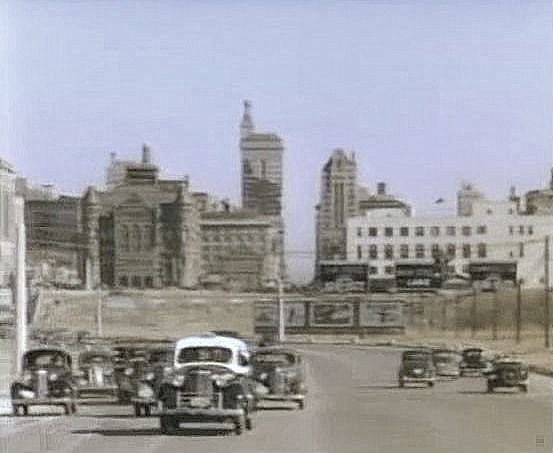





 Flashback : Dallas