Flashback : Dallas

A Miscellany: History, Ads, Pop Culture

Category: Oak Cliff/West Dallas

Sunset High School — 1929

sunset-high-school_1929_jan-gradsAbove-the-knee hemlines! (click to see larger image)

by Paula Bosse

Two photos from Oak Cliff’s Sunset High School in 1929. Above, seniors who were to graduate early in January (those girls are wearing surprisingly short skirts!) and, below, the frumpier but generally pleasant-looking faculty.

sunset-high-school_1929_faculty

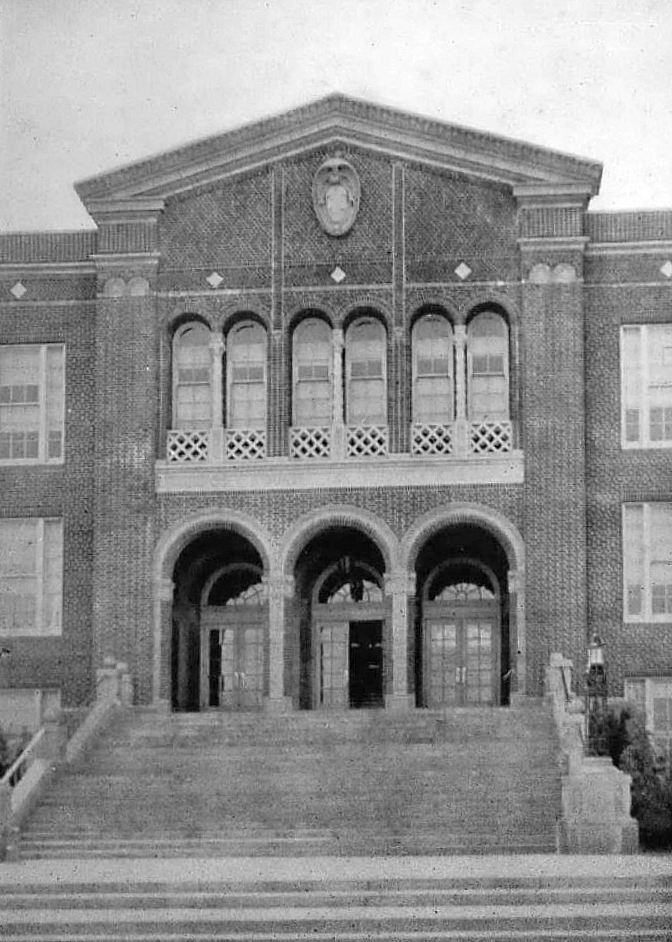
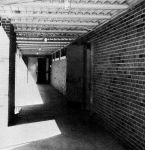
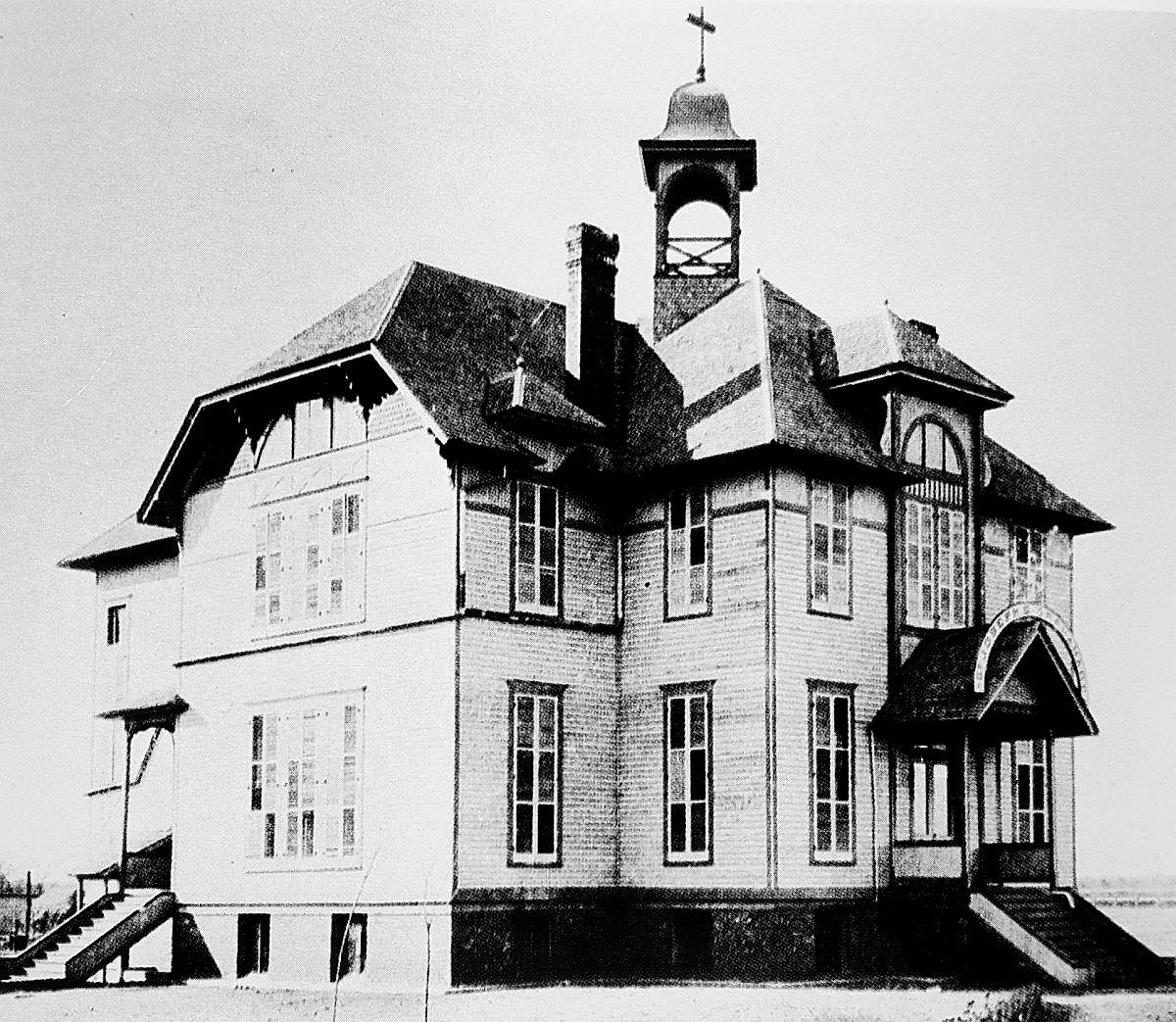
And the school itself — Oak Cliff’s second high school (Adamson was the first) — then only four years old.

sunset-high-school_1929_front

***

Photos from the 1929 Sunset High School yearbook.

Why, yes, Sunset does have a Wikipedia page, here.

To see what Sunset looks like these days, see it on Google Street View, here.

All photos larger when clicked.

*

Copyright © 2017 Paula Bosse. All Rights Reserved.

Wynnewood

oak-cliff_wynnewood_looking-south_1950_ebayS. Zang and a brand-new Wynnewood…

by Paula Bosse

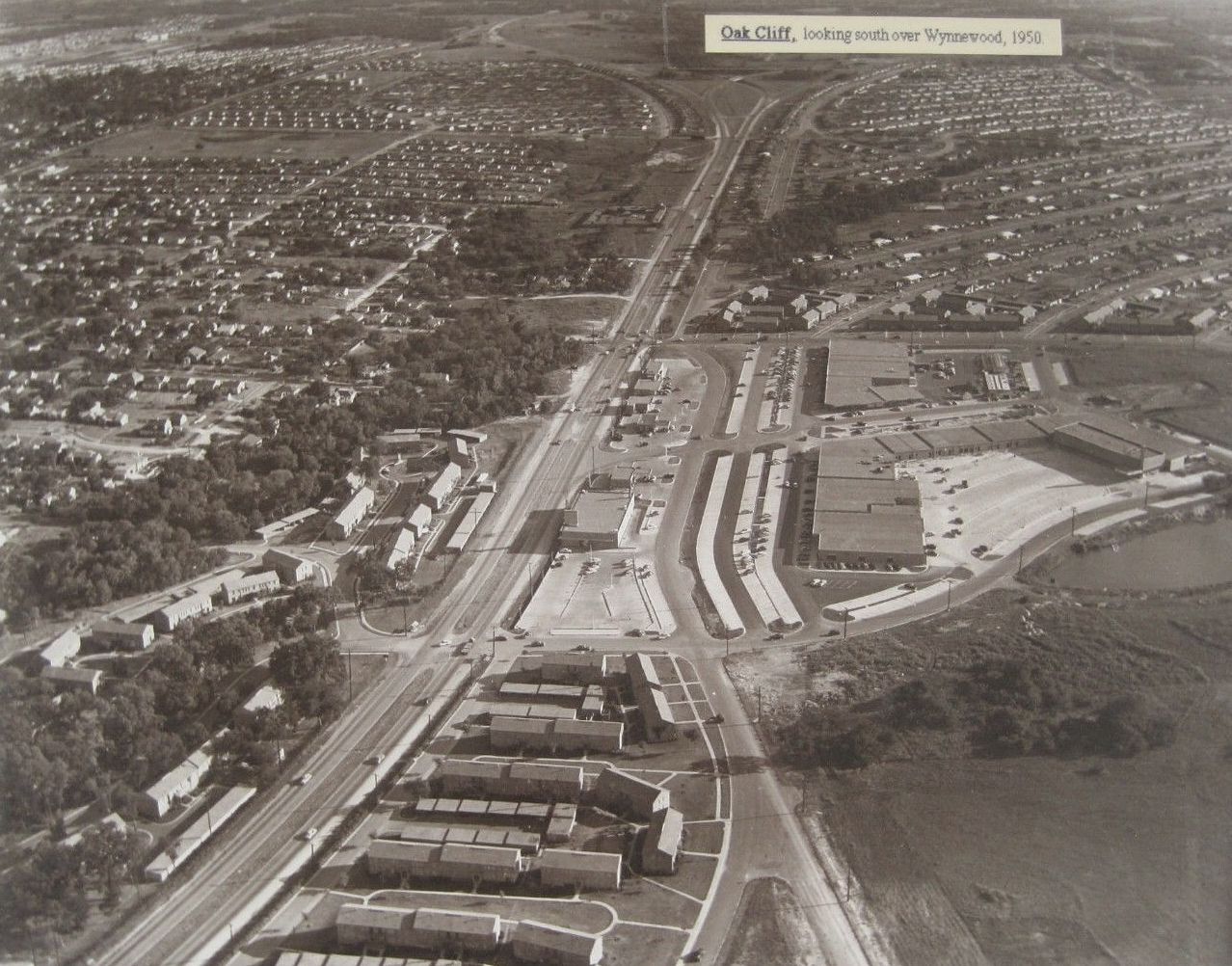
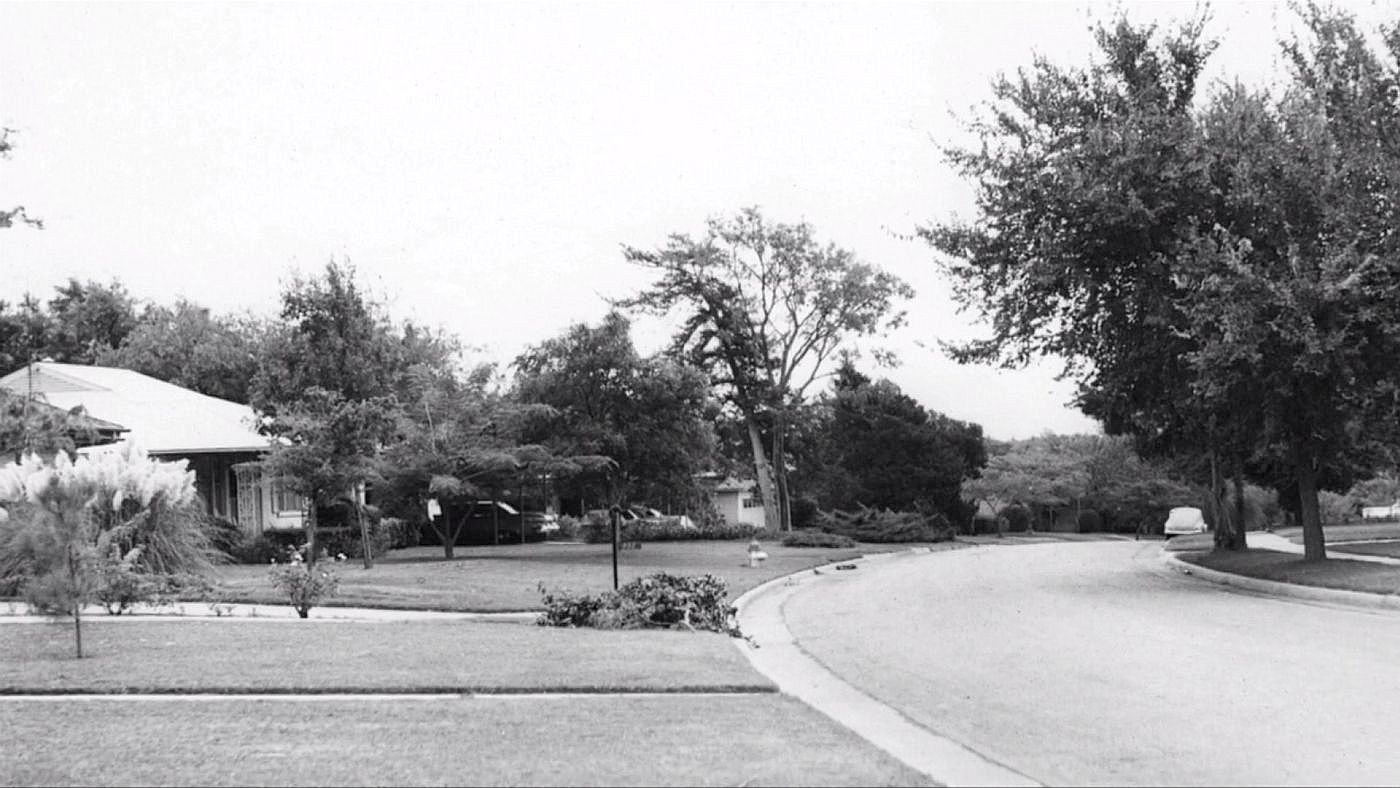
Enjoy these photos of the early days of Oak Cliff’s Wynnewood development. (And for an in-depth history of this 820-acre planned community, see Ron Emrich’s Legacies article “Wynnewood: ‘A Tonic to the Shelter-Hungry Nation,'” here.)

Above, looking south down Zang Blvd. in 1950 — see the same view 60-some-odd years later via Google, here (the “current” satellite view is pretty out-of-date, but you get the idea).

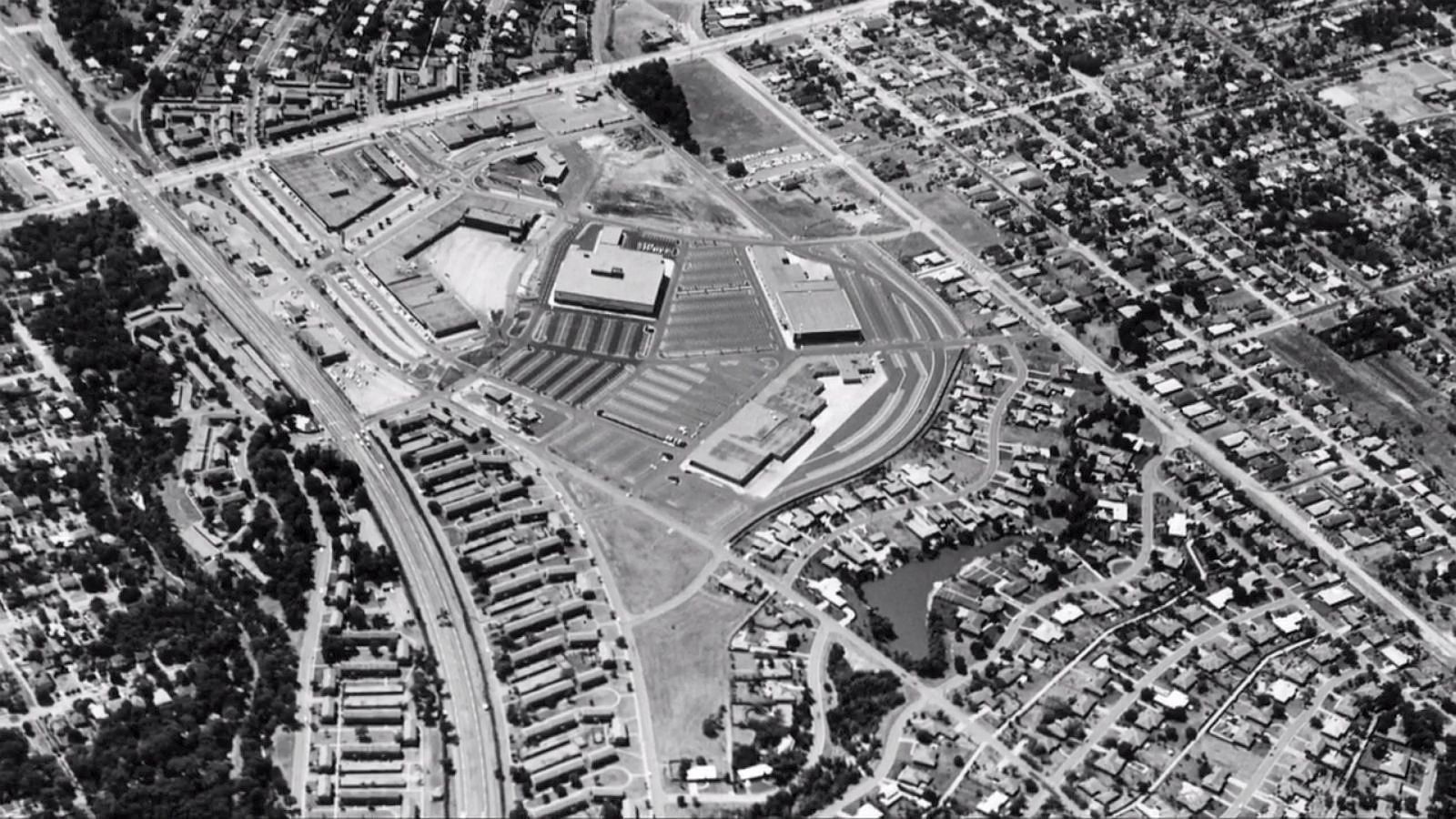
Below, Wynnewood — 1961.

wynnewood_film_screenshot_1961

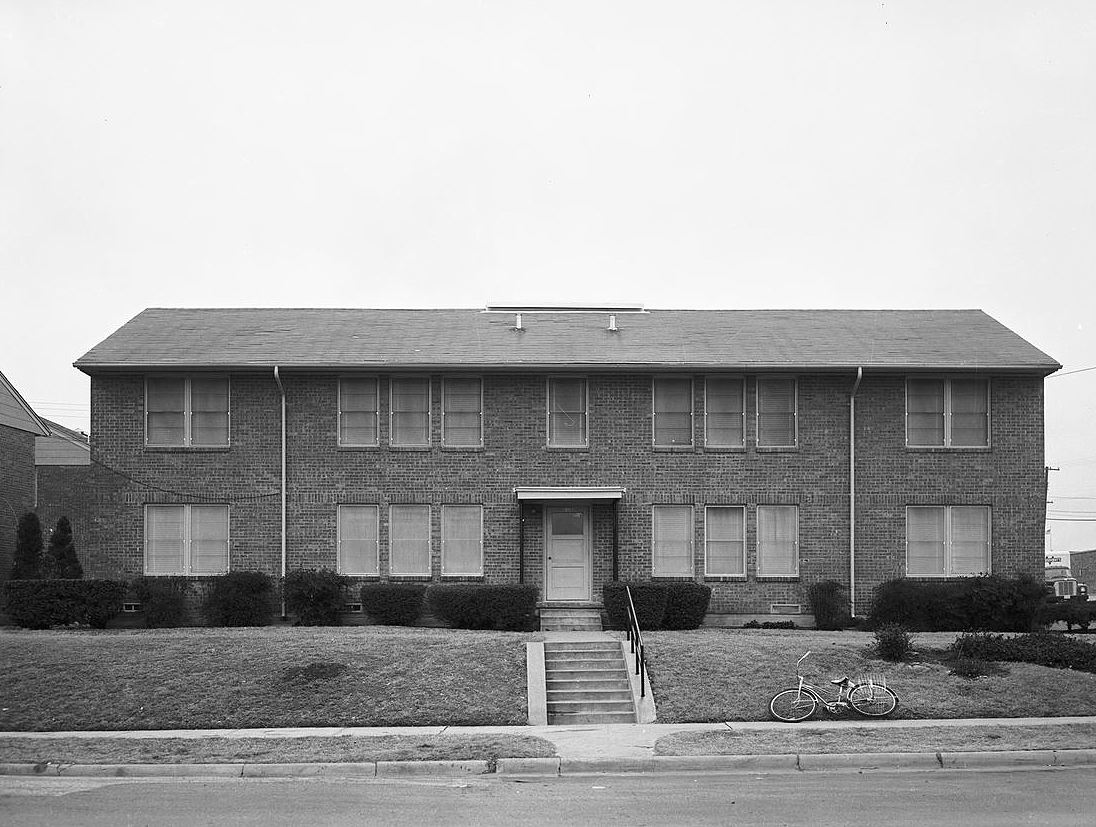
The Wynnewood Garden Apartments — 1954, the year “Father Knows Best” debuted:

wynnewood_apartments_squire-haskins_uta

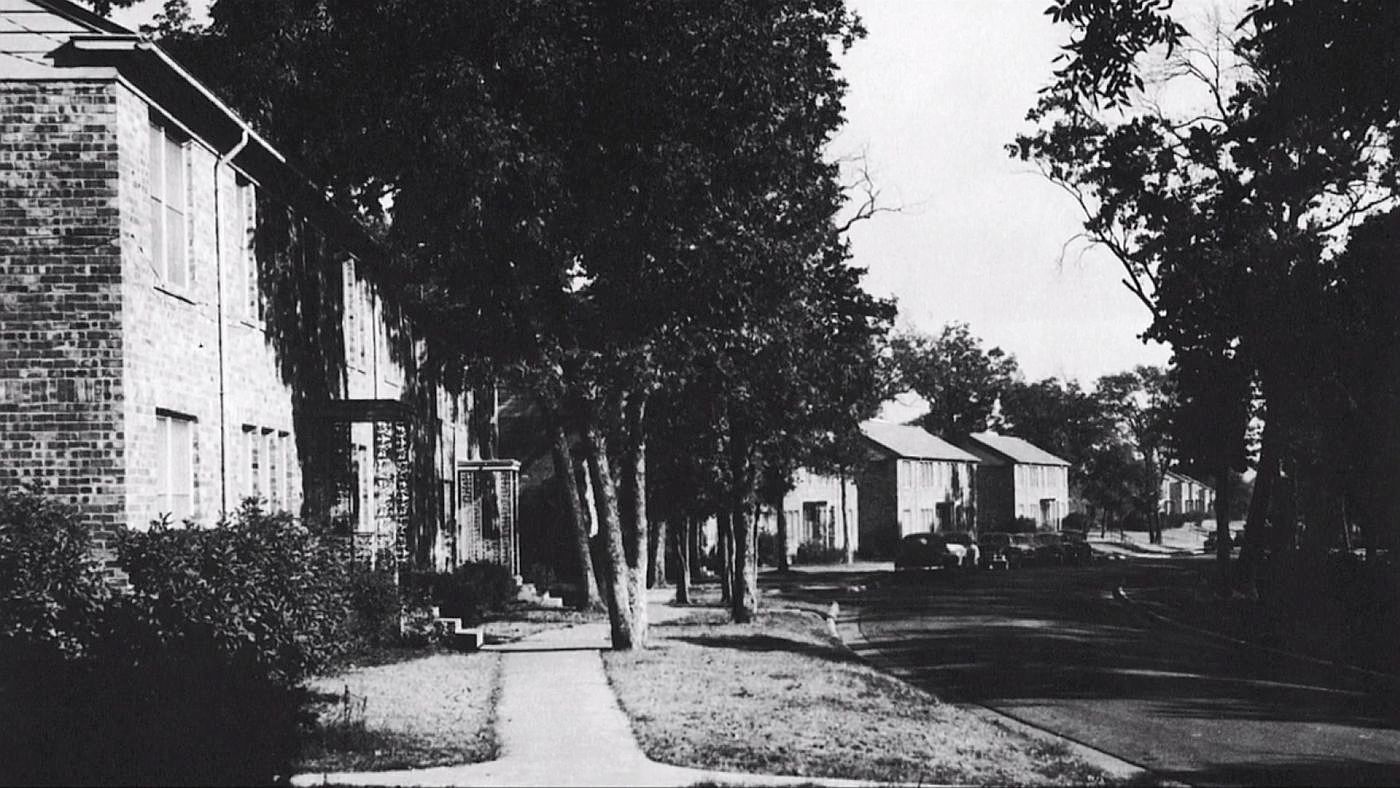
Wynnewood Garden Apartments:

wynnewood_film_screenshot_garden-apartments_1958_dpl

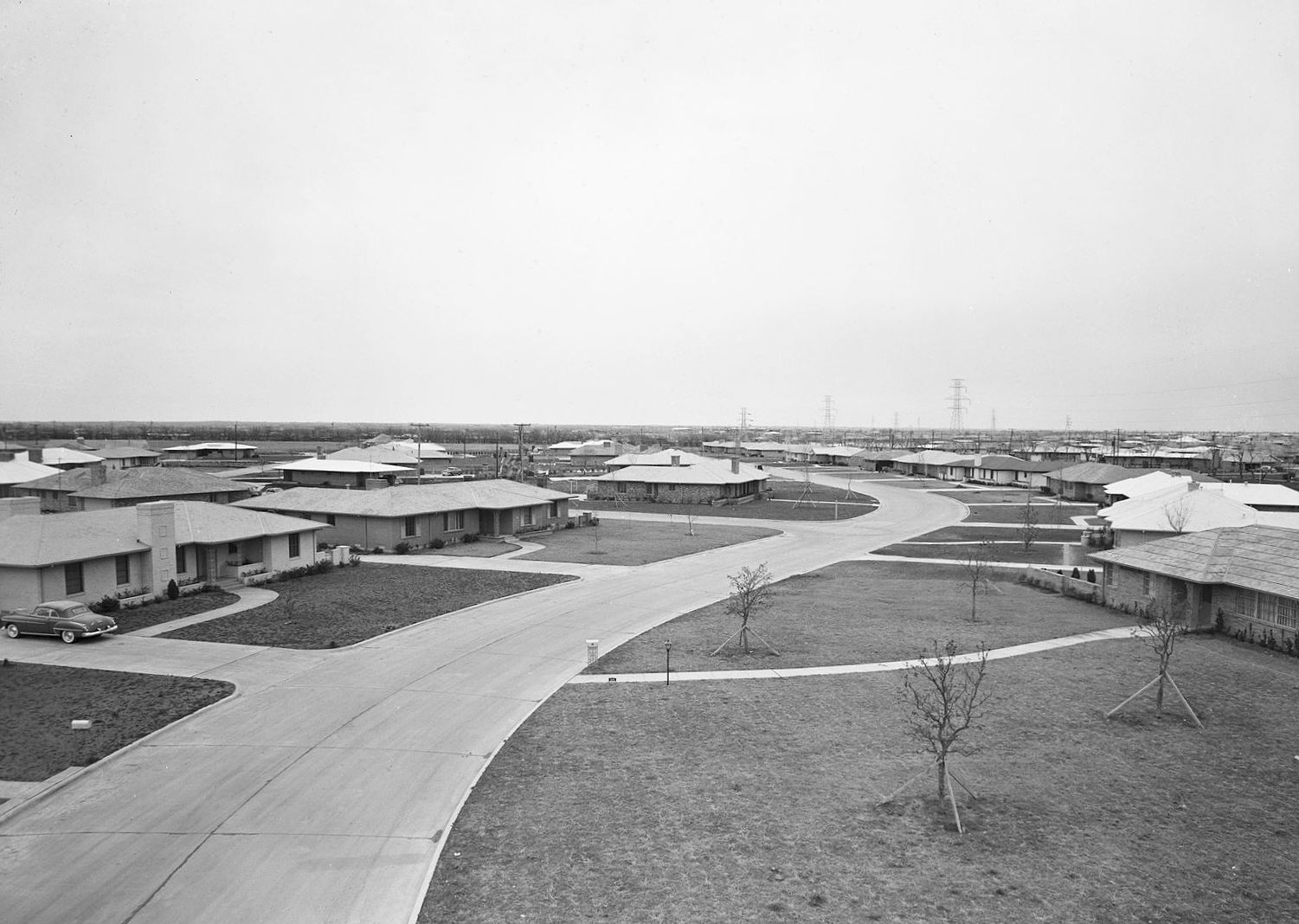
Birds-eye view of a neighborhood in Oak Cliff that is probably Wynnewood — 1954:

wynnewood_residential_squire-haskins_uta_030454

Wynnewood North, residential street — 1961:

wynnewood_film_screenshot_street_1961

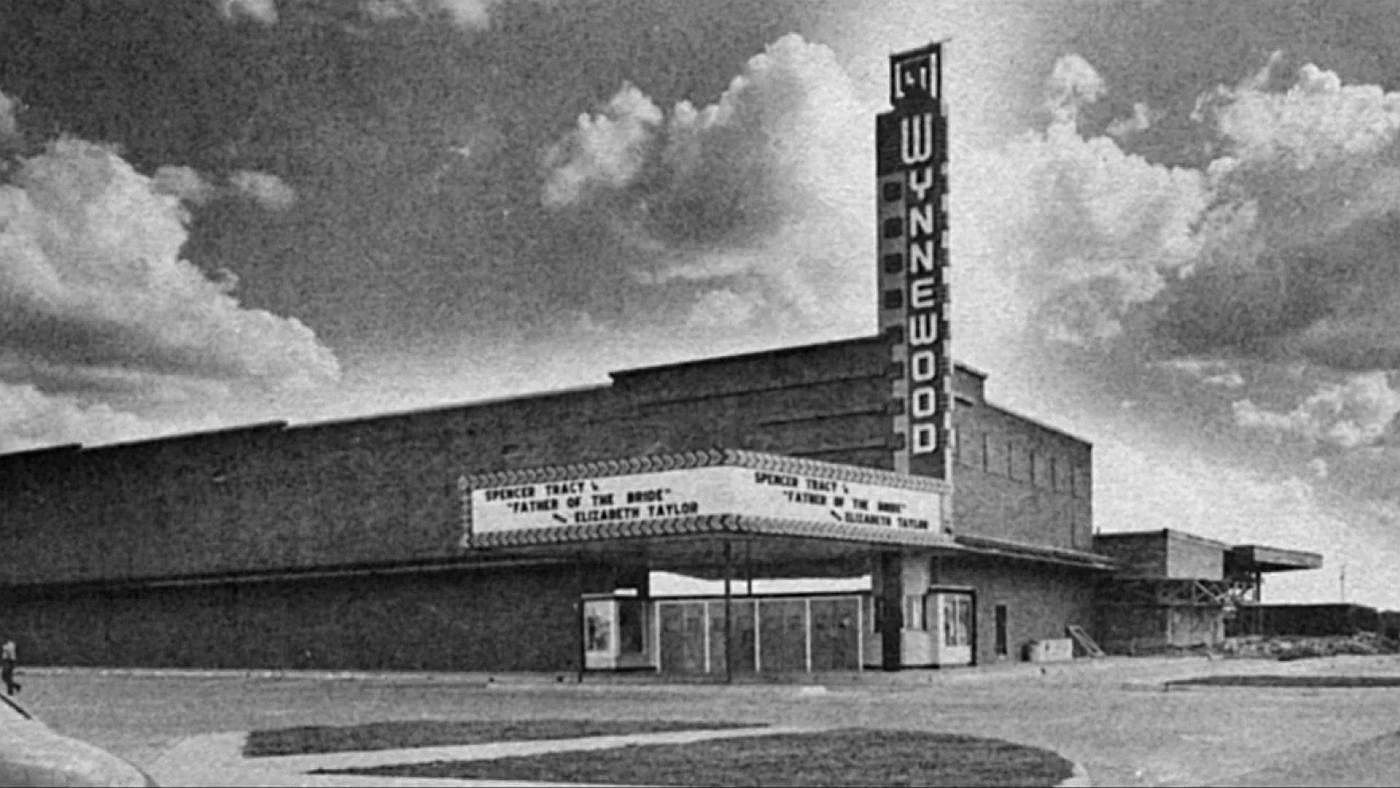
The Wynnewood Theater — 1950:

wynnewood_film_screenshot_theater

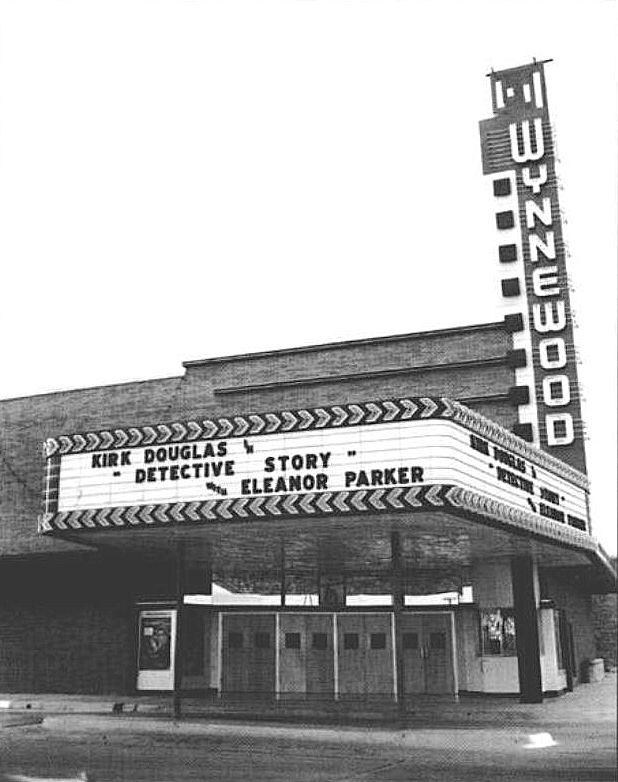
The Wynnewood Theater — 1951:

theater_wynnewood_legacies-2002

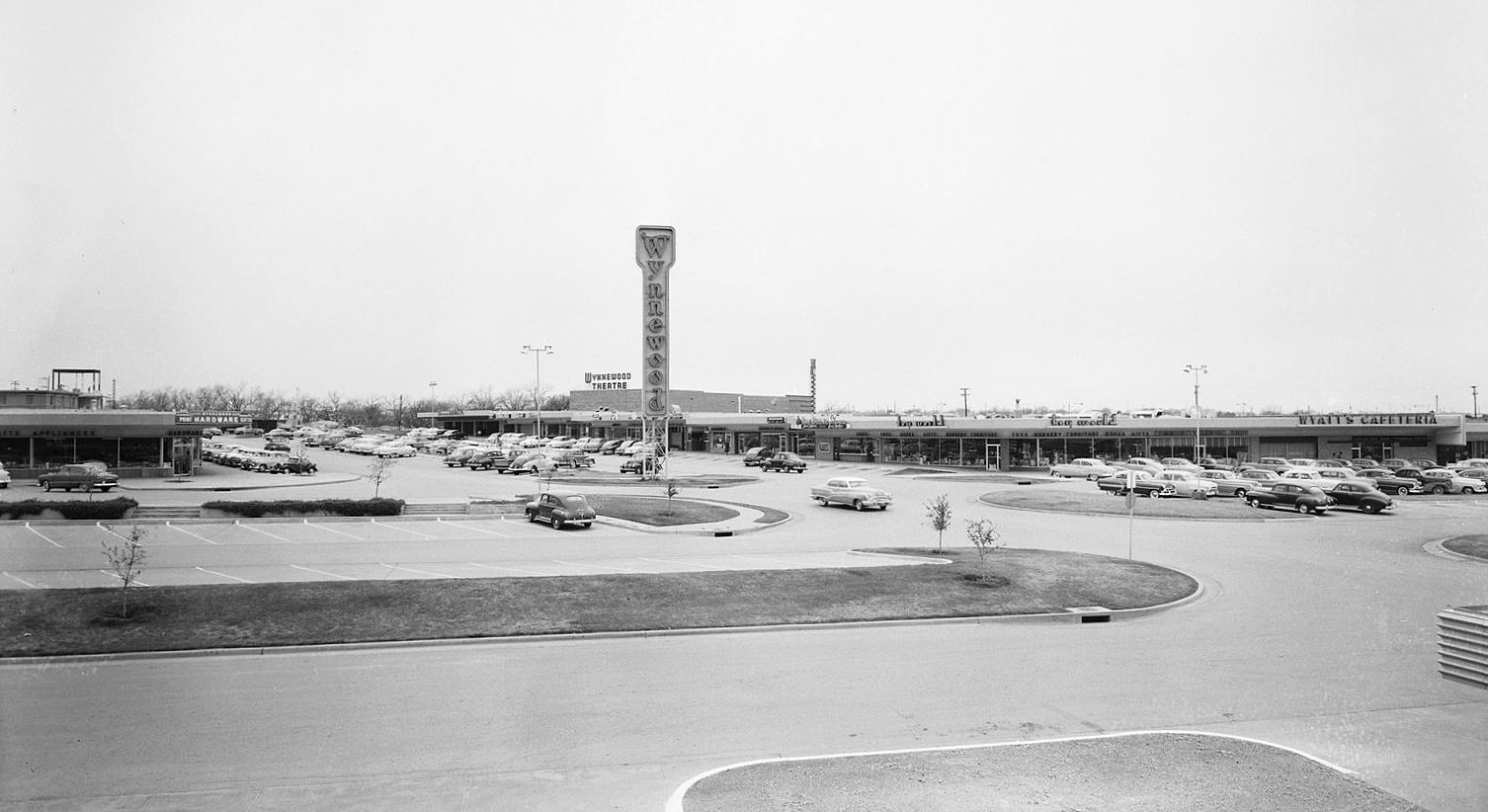
Wynnewood Shopping Village — 1954:

wynnewood-shopping_village_squire-haskins_uta_030454

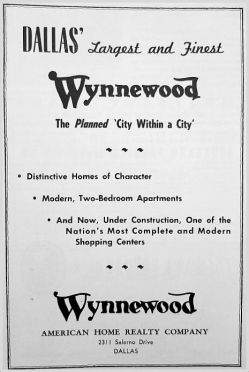
1949 ad for the “Planned ‘City within a City'”:

wynnewood_dallas-mag_feb-1949

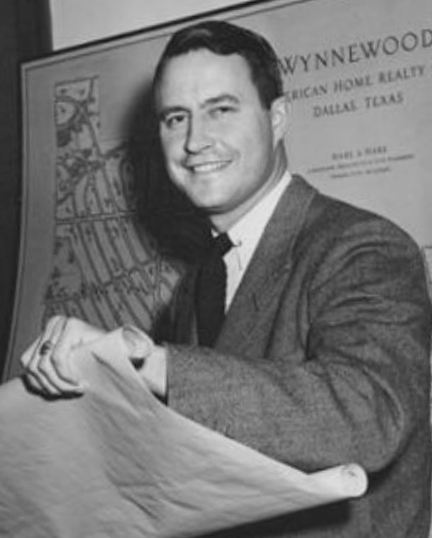
The “Wynne” behind “Wynnewood” (and the man who, a few years later, brought us Six Flags Over Texas) — Angus Wynne, Jr., 1946:

angus-wynne_pinterest

**

Watch a great little 22-minute film from 2013 on the development, rise, fall, and rebirth of Wynnewood North, “Neighborhood Stories: Wynnewood North,” here, produced by the Building Community Workshop (make sure to watch the video in full screen). There is an impressive companion booklet with more photos, here, which you can browse through page by page (hover over the cover and click on the “full screen” icon).

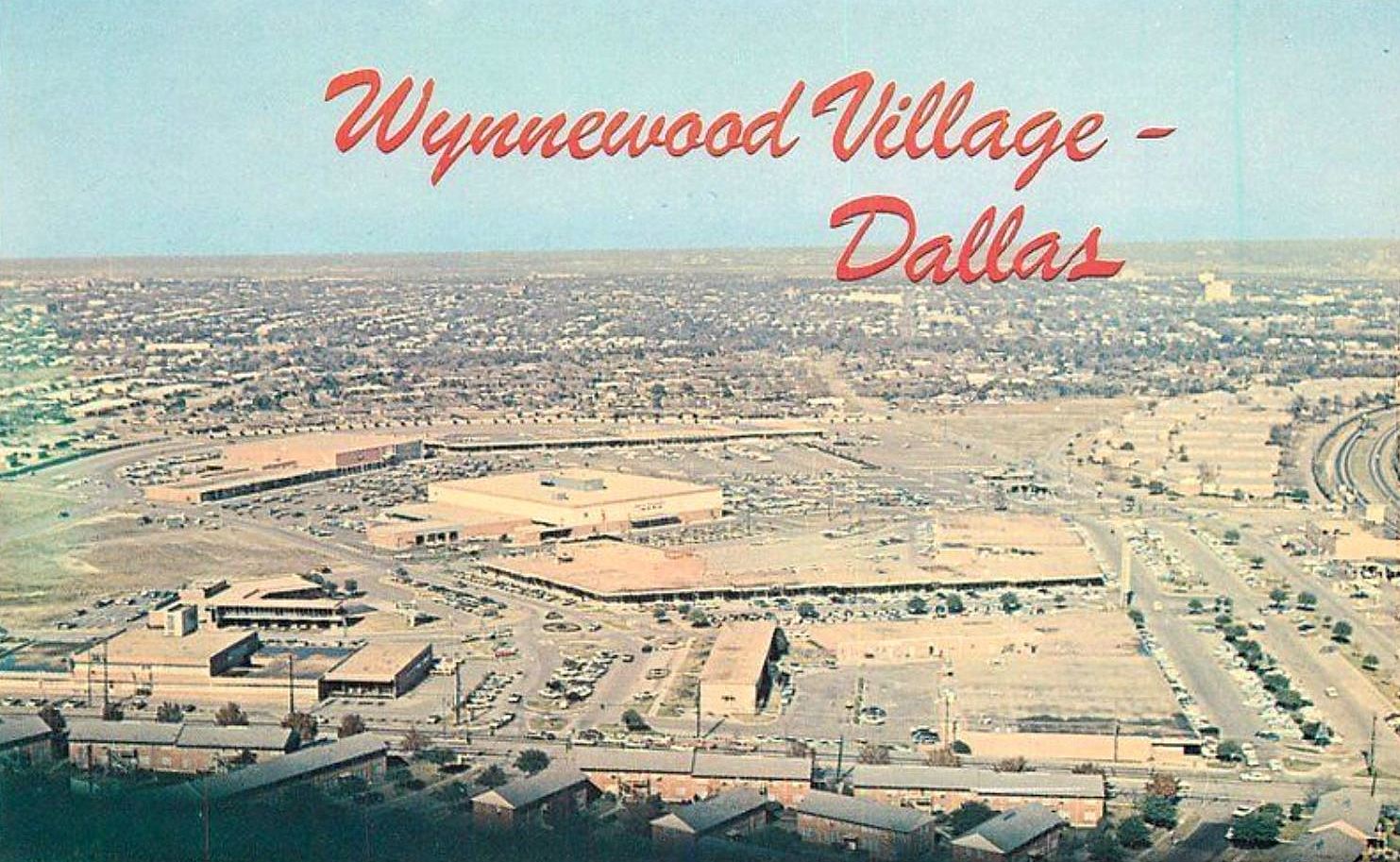
wynnewood-village_postcard_birdseye

***

Sources & Notes

Top photo from eBay. The only description was the one taped to the photo: “Oak Cliff, looking south over Wynnewood, 1950.”

1961 aerial shot from the short film linked above, “Neighborhood Stories: Wynnewood North”; photo provided by resident Janice Coffee.

Wynnewood apartment buildings: with bike, taken by Squire Haskins on March 4, 1954, from the Squire Haskins Collection, UTA — more info here (click thumbnail on that page to see huge image). Second photo of Garden Apartments is a screenshot from the “Wynnewood North” film; Dallas Public Library photo.

“Birds-eye view” of neighborhood taken by Squire Haskins on March 4, 1954 (described as “possibly Wynnewood” by UTA) — more info from UTA here (click that thumbnail for BIG image). More Wynnewood photos from UTA here.

Photo of 1961 residential street from the “Wynnewood North” film, provided by Janice Coffee.

1950 photo of Wynnewood Theater is also from “Wynnewood North” film (Hayes Collection photo, Dallas Public Library).

1951 photo of theater from the article “Wynnewood: ‘A Tonic to the Shelter-Hungry Nation'” by Ron Emrich (Legacies, Fall 2002) — GREAT history — read it here.

1949 ad from Dallas, a publication of the Dallas Chamber of Commerce, February 1949.

Angus Wynne, Jr. photo from Pinterest.

Need more Wynnewoodiana?

  • More photos from the Dallas Public Library, here.
  • More about Wynnewood from Wikipedia, here.
  • Even more from this Oak Cliff Advocate article by Gayla Brooks, here (this is an instance where I would encourage people to read the comments!).

*

Copyright © 2017 Paula Bosse. All Rights Reserved.

Adamson High School People and Places, Part 2 — 1960s

adamson_1966-yrbk_dance-plaidHave plaid, will dance — 1966… (click for larger images)

by Paula Bosse

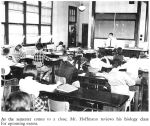
Check out these random photos of Adamson High School and its students, mostly from the 1966  yearbook. (Click for larger images.)

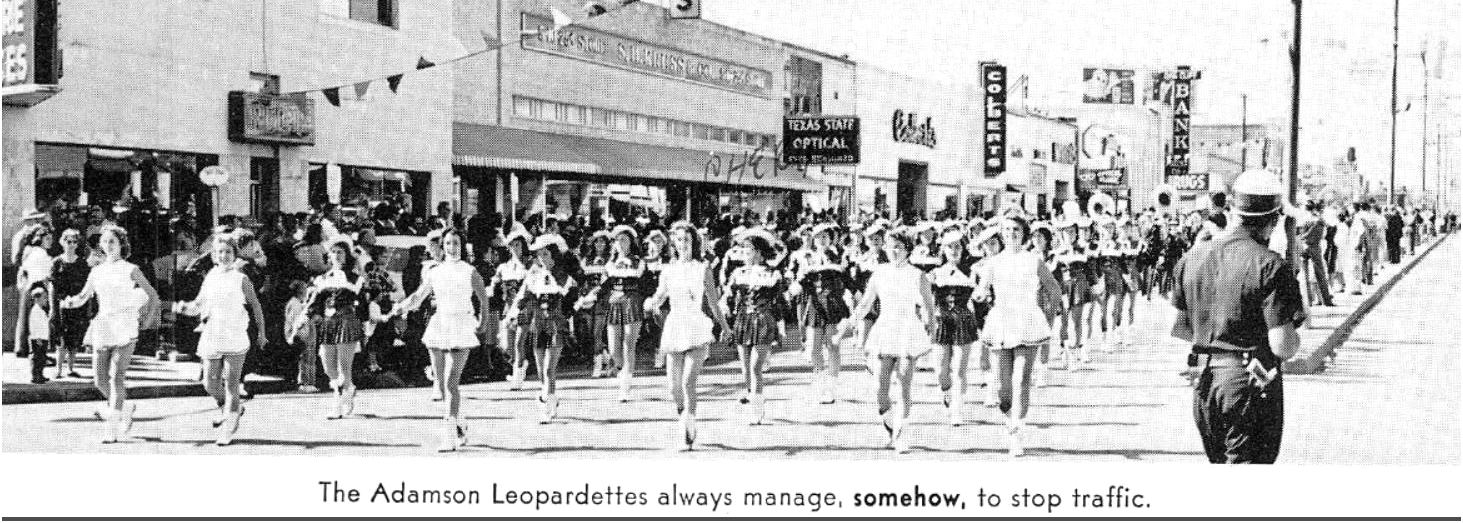
1961_adamson-yrbk_leopardettes1961

adamson_1966-yrbk_leopard
Go Leopards!

***

See the companion post (which shows advertisements from 1960s editions of the W. H. Adamson High School yearbook) here.

*

Copyright © 2016 Paula Bosse. All Rights Reserved.

Adamson High School People and Places, Part 1 — 1960s

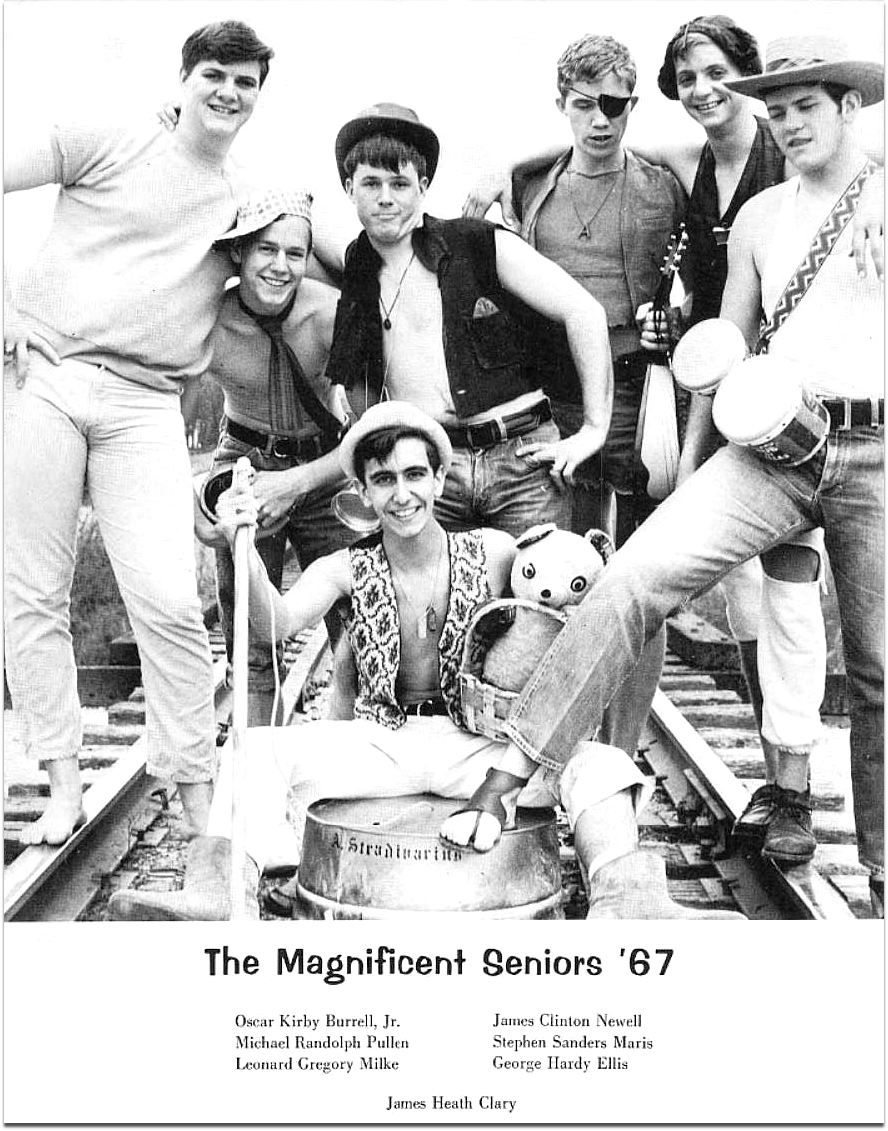
adamson-high-school_1967-yrbk_magnificent-seniors_adThe super-groovy Magnificent Seven of 1967

by Paula Bosse

Here are a whole bunch of 1960s ads from Adamson High School’s yearbooks. Go Leopards! (Click to see larger images.)

Above, a group of guys took out an ad for themselves in their 1967 senior yearbook:

  • Oscar Kirby Burrell, Jr.
  • James Clinton Newell
  • Michael Randolph Pullen
  • Stephen Sanders Maris
  • Leonard Gregory Milke
  • George Hardy Ellis
  • James Heath Clary

Thumbs up for creativity, guys!

Below, churches, lotsa churches, including:

  • Cliff Temple Baptist Church (from the 1961 yearbook)
  • First Church of the Nazarene (1961)
  • Galilean Baptist Church (1961)
  • Grace Temple Baptist Church (1961)
  • Polk Street Baptist Church (1964)
  • Oak Cliff Presbyterian Church (1966)
  • Western Heights Church of Christ (1966)
  • Grace Temple Baptist Church (1967)

And then you’ve got your garages and gas stations, including:

  • O. B. Goodman’s Gulf Service Center (1967)
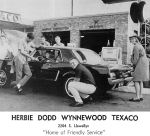
  • Herbie Dodd Wynnewood Texaco (1965)
  • Navarro Custom Automotive (for all your hot rod needs) (1966)

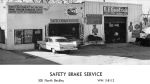
And Safety Brake Service over the years: 1961, 1964, 1965.

One must eat:

  • The Old South (1961)
  • Speedy Chick No. 4 (1965)
  • Inky’s Charcoal Burger (1966)
  • Woody’s Pancake House (1965)
  • Big Daddy’s Grill (1966)
  • Goff’s Hamburgers (don’t forget Mrs. Goff’s Ice Cream) (1966, 1967)

And then everything else:

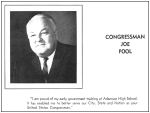
  • U.S. Congressman Joe Pool (1967)
  • Colbert’s (women’s clothing) (1967)
  • Raven’s Pharmacy (1966)
  • John Hiegel’s One Hour Martinizing (1966)
  • King’s Book Store (1966)
  • Ketchum & Killum Sporting Goods (you read that right) (1965)
  • Crosswinds Apartments (1965)
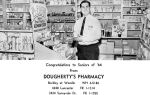
  • Dougherty’s Pharmacy (1964)
  • Doris Wood Bridal & Party Service (1966)
  • Bronco Bowl (…RIP…) (1966)

adamson_1966-yrbk_doris-wood-bridal

adamson_1966-yrbk_bronco-bowl

***

Sources & Notes

Ads from the 1961, 1964, 1965, 1966, and 1967 W. H. Adamson High School yearbooks.

See the companion post (which shows the school and students — mostly from 1966), here.

*

Copyright © 2016 Paula Bosse. All Rights Reserved.

Thomas Marsalis’ Spectacular Oak Cliff Hotel: 1890-1945

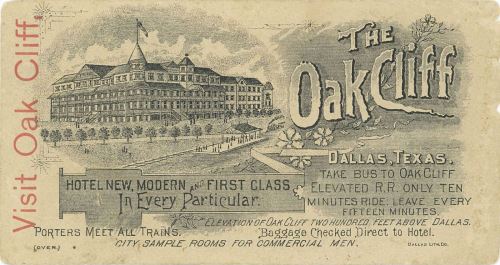
oak-cliff_cook-coll_degolyer_smu_front“Visit the Oak Cliff…” (click for much larger image) Photo: SMU

by Paula Bosse

I saw this image yesterday while browsing through the George W. Cook Collection (DeGolyer Library, SMU). It’s from about 1890. It’s great. BUT, the other side of this card is even better:

oak-cliff_cook-coll_degolyer_smu_back

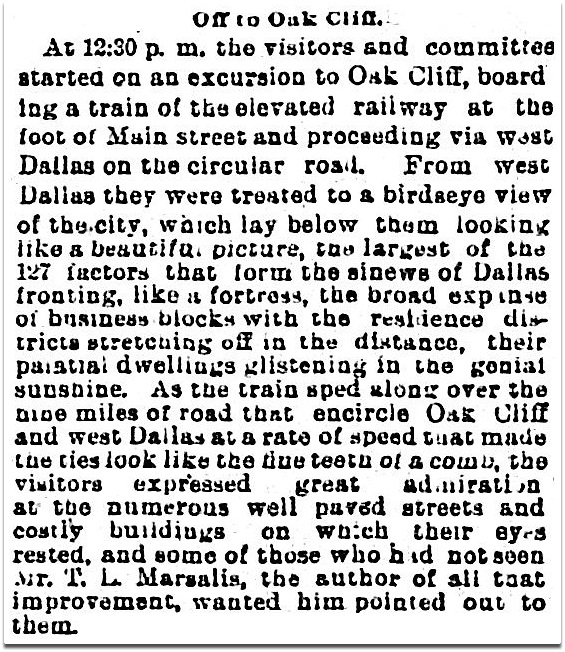
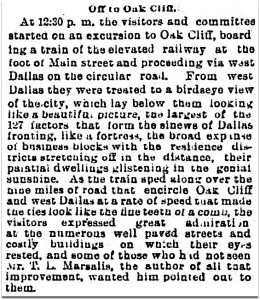
I’m not sure how realistic this drawing is, but it’s great! Oak Cliff never looked so … quaint. The best part is the depiction of the little commuter railway that Oak Cliff developer Thomas L. Marsalis built in the 1880s to handle commuter traffic between Oak Cliff and Dallas — a necessity if his development west of the Trinity was to grow. There were two little steam trains which made a complete circle and offered spectacular views of  Dallas as they headed toward the river. Here’s an account of visitors from Kansas City who enjoyed their scenic ride (click to see a larger image):
oak-cliff-train_dmn_112490
Dallas Morning News, Nov. 24, 1890

Marsalis had made his fortune in the grocery business, and much of that fortune was funneled into making his vision a reality: Oak Cliff would become a large, beautiful, prosperous community. He spent huge amounts of money developing the then-separate town of Oak Cliff. A wheeler-dealer and an obsessive whirlwind, money was no object to Marsalis as he charged at full speed to make Oak Cliff a booming North Texas garden spot.

marsalis_legacies_fall-2007
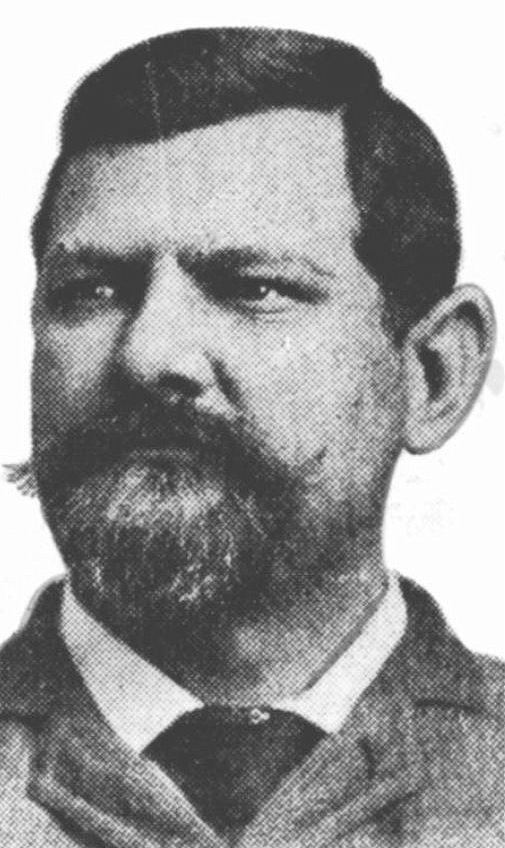
Thomas L. Marsalis — the “Father of Oak Cliff”

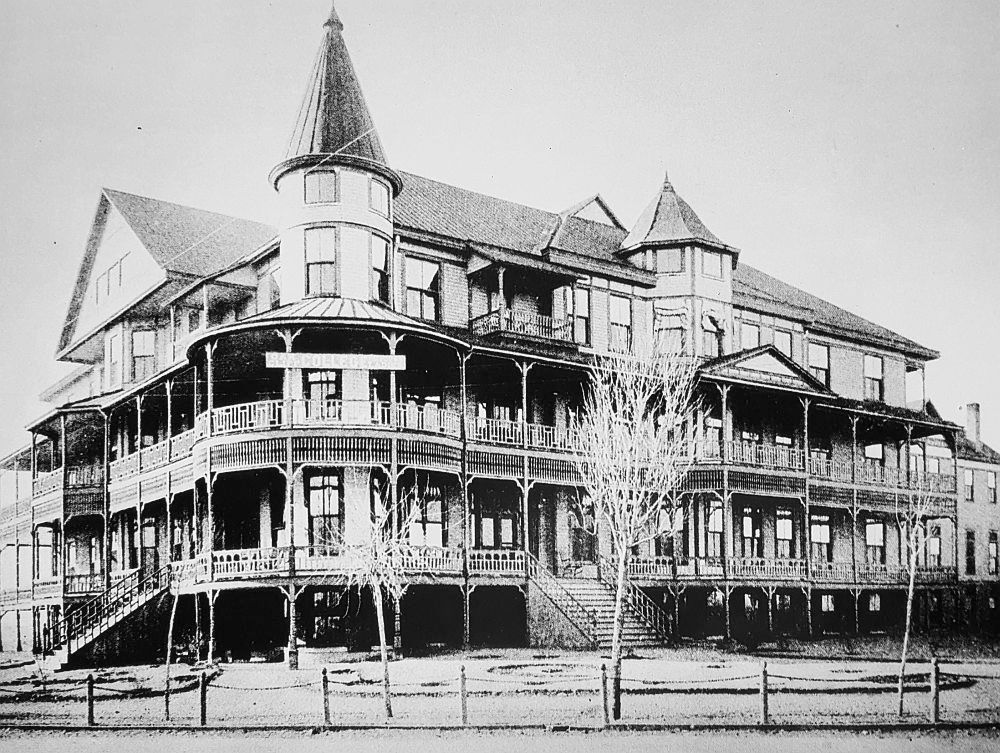
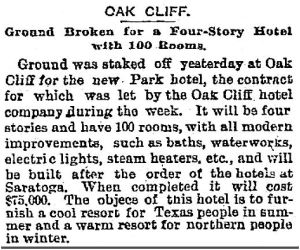
The jewel in T. L.’s O.C. crown was the 100-room resort, the Oak Cliff Hotel (which in its early planning had been called the Park Hotel). Ground was broken on Dec. 21, 1889. Projected to cost $75,000, it is said to have cost over $100,000 when construction was completed, or, over $2.6 million in today’s money.
oak-cliff-hotel_dmn_122289_groundbreaking
DMN, Dec. 22,1889

A thorough description of the spectacular $100,000 showplace can be read in a Dallas Morning News article from May 25, 1890, here. When it opened on July 10, 1890, the News’ coverage of the opening included the following lyrical passage:

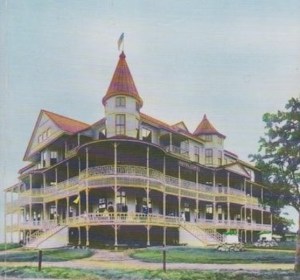
When darkness had settled down over the cliff the large hotel showed off to its best advantage, as at a short distance away it looked like some living monster with hundreds of fiery eyes. The lights showing from every window made a startling sight to those who coming upon it had previously seen a dark pile looming up in the night.
oak-cliff-hotel_minutaglio

It was, by all accounts, a popular hotel and social gathering place. But, in November of 1891 — having been open only a little over a year — a notice appeared in the papers that the hotel would be closing for the winter for “renovations.” It never reopened. Marsalis had over-extended himself. His dreams for Oak Cliff began to dim as the stacks of unpaid bills mounted, and he found himself mired in lawsuits for the next several years. He eventually had to admit defeat, and he and his family moved to New York.

Six months after that notice of “renovations” appeared, the huge building was leased to Prof. Thomas Edgerton, who planned to open a “female seminary.”

oak-cliff-college_flickr

The Oak Cliff College For Young Ladies opened  in the fall of 1892. And it was a spectacular-looking schoolhouse.

oak-cliff-college_dallas-rediscoverd_dpl

The college lasted until the beginning of 1899 when it changed hands and became Eminence College for a brief year and a half.
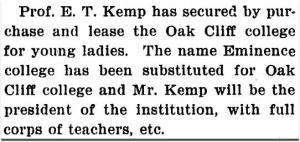
eminence-college_southern-mercury_062299
Southern Mercury, June 22, 1899

After Eminence College appears to have gone bust, the building was vacant by 1901. There was talk that Oak Cliff should purchase the property and reinstall a school, but, eventually, the building went up for auction in September, 1903.

oak-cliff-hotel_dmn_082603_for-sale
DMN, Aug. 26, 1903

The building sold to T. S. Miller, Jr. and L. A. Stemmons for $6,850, a fraction of what Marsalis had spent building it. That’s a pretty steep depreciation.
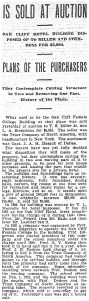
oak-cliff-hotel_dmn_090203_sold
DMN, Sept. 2, 1903

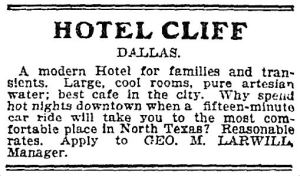
But, no fear, Hotel Cliff opened on April 18, 1904. Still looking good.

hotel-cliff_degolyer

hotel-cliff_dmn_071104
DMN, July 11, 1904

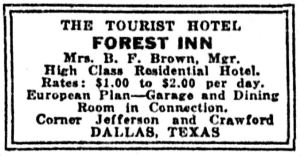
Hotel Cliff was in business through about 1915. There were some “lost” years in there when it seemed to be in limbo (during some of this time it was undergoing extensive renovation), but in 1921 it re-opened as the Forest Inn.

forest-inn_dmn_042421
DMN, April 24, 1921

forest-inn_bartlett-tribune-and-news_070424
Bartlett News, July 4, 1924

The Forest Inn had a long run — 24 years. In 1945 the property was sold, and T. L. Marsalis’ spectacular resort hotel was demolished. It was estimated that it would take ten weeks to finish the demo job — Marsalis had spared no expense building his hotel, and it had been built to last.

The destruction is a tough job, Jack Haake, wrecking contractor, said. Despite its age, the building is so well built that much time is being required to take it apart. The lumber is of the best grade and much of it still is in good condition, Haake said. Scores of huge 2×6 planks, thirty-two feet long, were used in the building, and that timber is in excellent condition. (“Historic Oak Cliff Hotel Being Razed For New Structure,” DMN, Sept. 10, 1945)

The land apparently remained vacant until Southwestern Bell Telephone announced plans to build a three-story office building on the property in 1954; the building opened the following year. In 1986, the building was renovated and became the Oak Cliff Municipal Center, which still occupies the site.

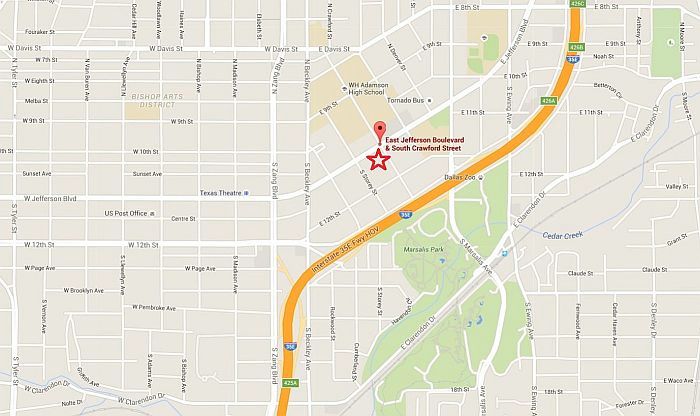
Where exactly was that huge, wonderful hotel that Thomas Marsalis built? It was located at what is now the southwest corner of East Jefferson Blvd. and South Crawford Street. A view of that corner today can be seen here. To get an idea  of how much land the hotel/college once occupied, check out the 1905 Sanborn map, here (and this is after 15 years of explosive growth of Oak Cliff, so it obviously originally had much more open land around it); by 1922, encroachment was well underway, and the property was already being chopped into smaller parcels.

oak-cliff-hotel_map_google
Google Maps

I wonder what Thomas Marsalis would think of Oak Cliff today? And I wonder what Oak Cliff would have become had Marsalis never put his money and energy into its early development?

**

There is a lot of misinformation on various online sources about the timeline of this building. As best I can determine, here is the correct chronology:

  • 1889: groundbreaking for hotel, in December
  • 1890-1891: Oak Cliff Hotel
  • 1892-1899: Oak Cliff College For Young Ladies
  • 1899-1901: Eminence College (also for young women)
  • 1902-1903: vacant
  • 1903: building sold at public auction, in September
  • 1904-1914: Hotel Cliff
  • 1914-1915: Oak Cliff College (reorganized, back for one last gasp)
  • 1915-1920: basically empty, with a couple of token tenants
  • 1921-1945: Forest Inn
  • 1945: demolished

***

Sources & Notes

First two images show both of sides of an advertising card; “Visit Oak Cliff” is from the George W. Cook Dallas/Texas Image Collection, DeGolyer Library, Central University Libraries, Southern Methodist University — more information is here.

Photo of Thomas Marsalis from Legacies, Fall, 2007.

Colorized image of hotel from the front cover of The Hidden City: Oak Cliff, Texas by Bill Minutaglio and Holly Williams. The sign is hard to read, but this may show the building during the Hotel Cliff days.

The detail of an Oak Cliff College envelope comes from the Flickr page for the Texas Collection, Baylor University, here. (Sure hope Mr. Edgerton was able to get a refund on that printing job — having “Oak Cliff” misspelled on official college correspondence probably caused a grimace or two!)

Large black and white photograph of Oak Cliff College appeared in William L. McDonald’s Dallas Rediscovered; photo from the collection of the Dallas Public Library.

Hotel Cliff postcard from the Cook Collection, SMU; information is here.

See the beautiful house Marsalis built for himself (but which he might never actually have lived in) in my post “The Marsalis House: One of Oak Cliff’s ‘Most Conspicuous Architectural Landmarks,'” here.

Thomas L. Marsalis is a fascinating character and an important figure in the development of Oak Cliff, but his post-Dallas life has always been something of a mystery. I never really thought of myself as a “research nerd” until I started this blog, but reading how a few people in an online history group pieced together what did happen to him was surprisingly thrilling. This round-robin investigation began in the online Dallas History Phorum message board, here, and finished as the Legacies article “Where Did Thomas L. Marsalis Go?” by James Barnes and Sharon Marsalis (Fall 2007 issue). If you have some time, I highly recommend reading through the Phorum comments and then reading the article. It’s very satisfying!

All images and clippings larger when clicked. 

*

Copyright © 2016 Paula Bosse. All Rights Reserved.

The St. Joseph Orphanage — 1891

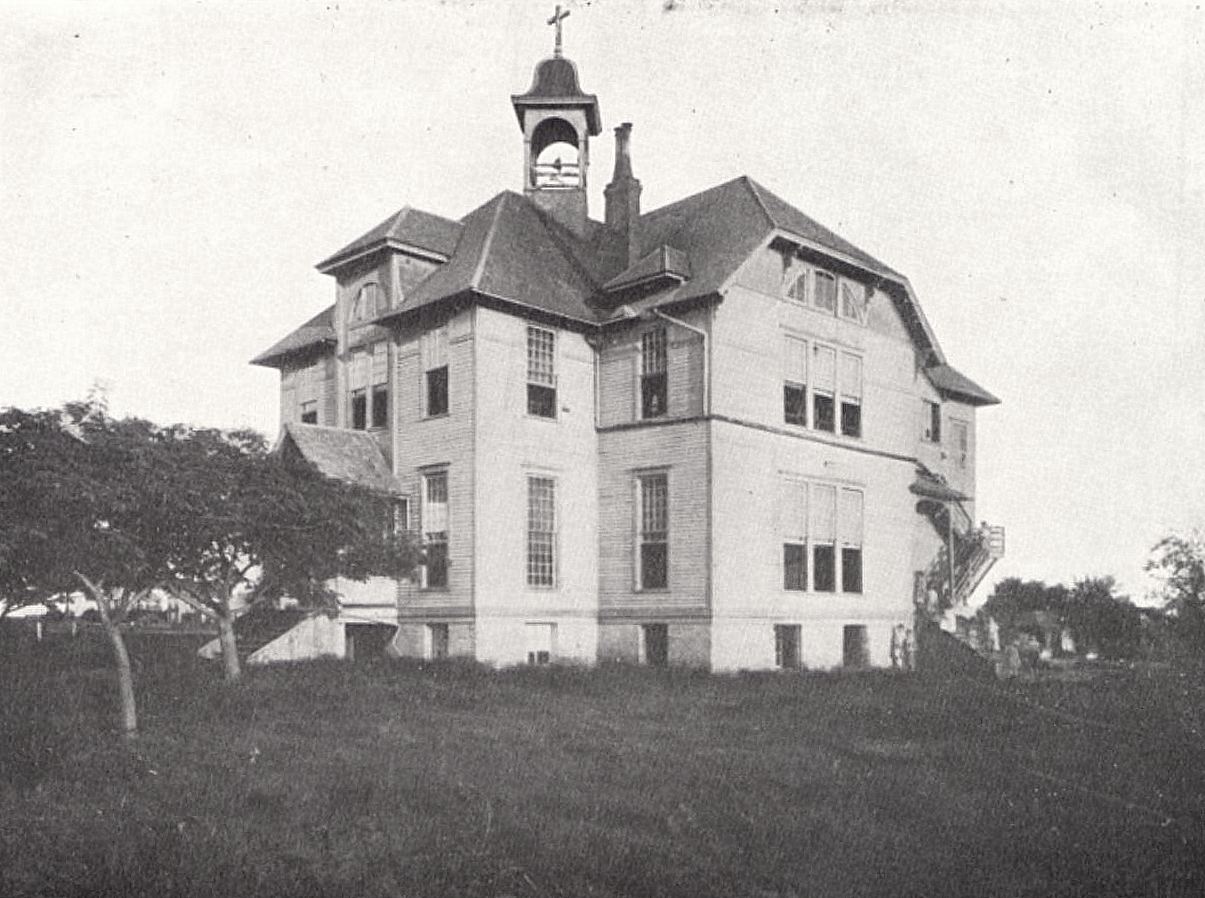
st-josephs-orphanage_dallas-rediscoveredThe new Oak Cliff orphanage, ca. 1891 (click for larger image)

by Paula Bosse

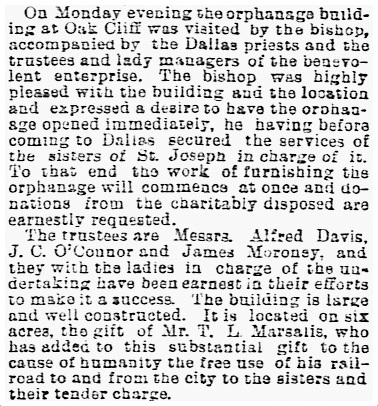
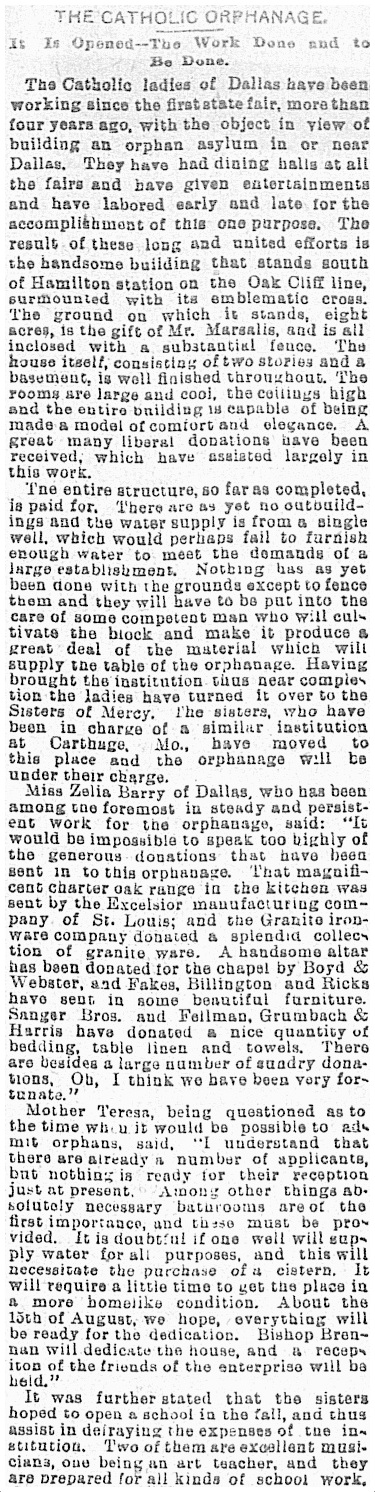
The St. Joseph orphanage was built in Oak Cliff in 1891 on 6-8 acres donated to the Catholic Diocese by Thomas Marsalis. The building was a large house, built and furnished with funds raised from local donations.

The house itself, consisting of two stories and a basement, is well finished throughout. Rooms are large and cool, the ceilings high and the entire building is capable of being made a model of comfort and elegance. A great many liberal donations have been received which have assisted largely in this work. (Dallas Morning News, July 16, 1891)

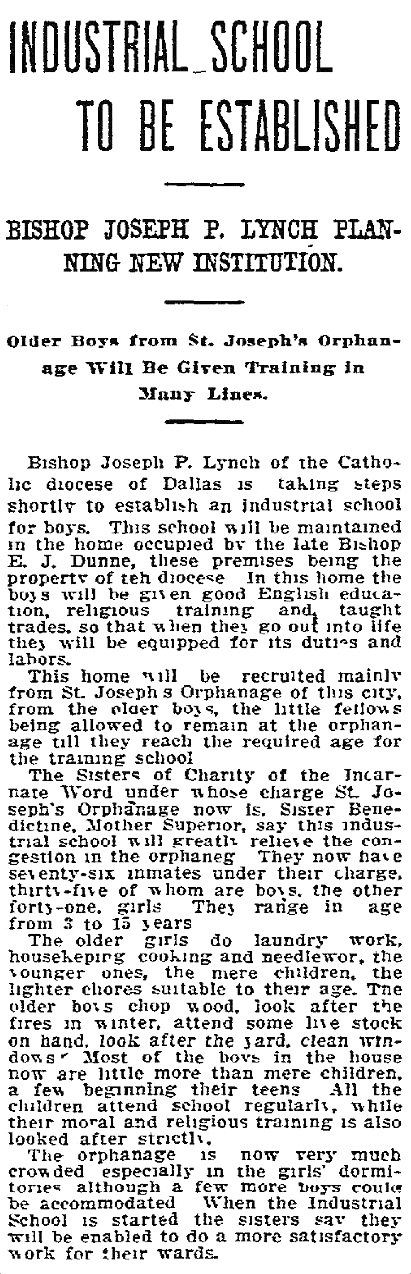
The orphanage was a Catholic institution — run at various times by the Sisters of St. Joseph, the Sisters of Mercy, the Sisters of Charity of St. Vincent de Paul, and the Sisters of Charity of the Incarnate Word — but it was “non-sectarian” in that the children or families in need were not required to be of the Catholic faith.

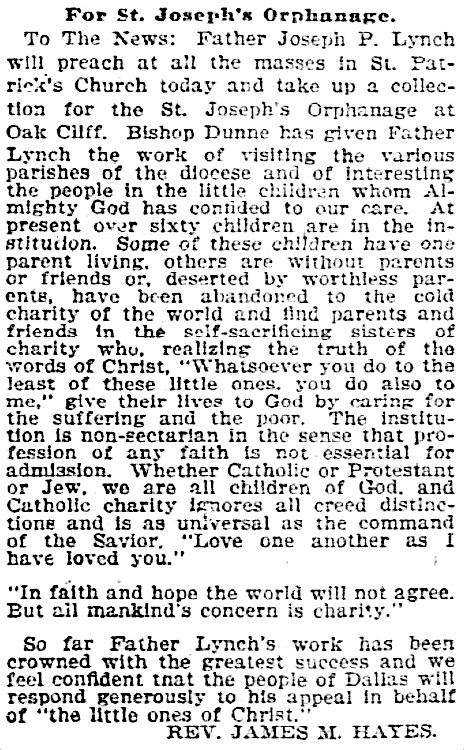
Some of these children have one parent living, others are without parents or friends or, deserted by worthless parents, have been abandoned to the cold charity of the world and find parents and friends in the self-sacrificing sisters of charity…. (DMN, Feb. 9, 1902)

st-josephs-orphanage_smu_ca1913-1919DeGolyer Library, SMU

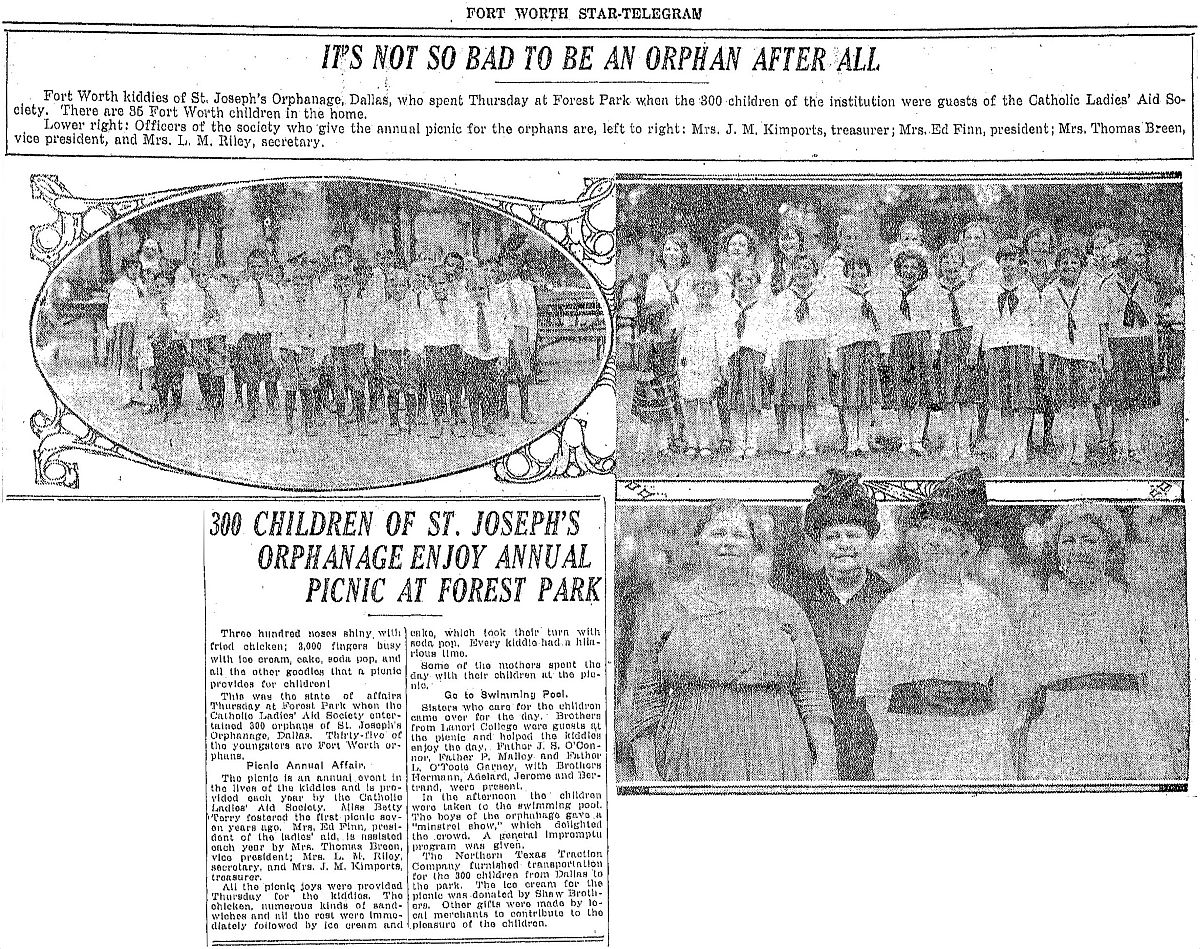
In the late ‘teens or early ’20s, the Catholic Ladies’ Aid Society of Fort Worth began an annual tradition of hosting a party for the children at Forest Park in Fort Worth. The 1923 picnic entertained 300 children. The Fort Worth Star-Telegram ran a story about the event under the unfortunate headline “It’s Not So Bad To Be An Orphan After All.” (Click article for a much larger image.)

st-josephs-orphanage_FWST_060123FWST, June 1, 1923

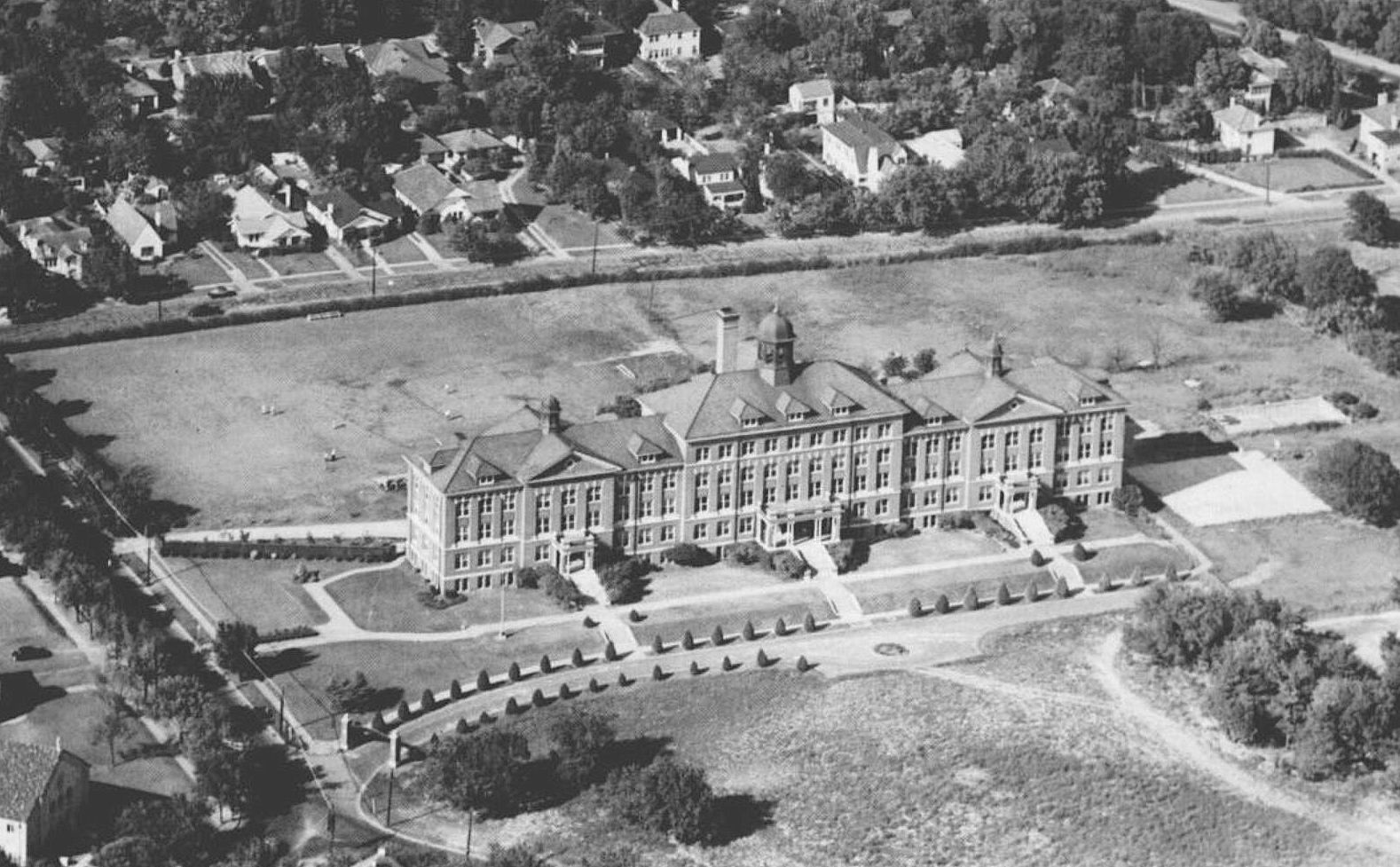
According to William L. McDonald in his book Dallas Rediscovered, “the orphanage was converted into a Carmelite convent and school in 1929 and demolished in 1945.” In December, 1930, the girls moved into their new (huge!) home in Oak Lawn (at Blackburn), in the old Dallas University building (later the Jesuit campus). The boys, I believe, moved to the Dunne Memorial Home. Here is a photo of the girls’ new home, which was taken over by Jesuit High School in 1941. (The impressive building originally built in 1906 was demolished in 1963.)

jesuit_legacies_fall-2005

**

st-josephs-orphanage_dmn_042991Dallas Morning News, April 29, 1891

st-josephs-orphanage_dmn_071691
DMN, July 16, 1891

orphanage_dmn_020902
DMN, Feb. 9, 1902

orphanage_dmn_113013-inudstrial-school-to-open
DMN, Nov. 30, 1913

st-josephs-orphanage_catholic-charities-of-dallas

***

Sources & Notes

Top photo from Dallas Rediscovered by William L. McDonald, is from the collection of the Dallas Public Library.

Photo titled “Children and Nuns, St. Joseph’s Orphanage, Dallas, Texas” was taken by Frank Rogers and is from the George W. Cook Dallas/Texas Image Collection, DeGolyer Library, Southern Methodist University; more information can be found here.

Photo of the old Dallas University/University of Dallas/Trinity University is from the article “Jesuit High School” by Liz Conrad Goedecke, which appeared in the Fall, 2005 issue of Legacies.

Bottom photo of St. Joseph’s Orphanage is from a PDF titled “A Brief Visual History of the Catholic Diocese of Dallas,” here (p. 19).

More on the original St. Joseph orphanage can be found here (scroll down to the 1902 article, “Charities of Dallas”).

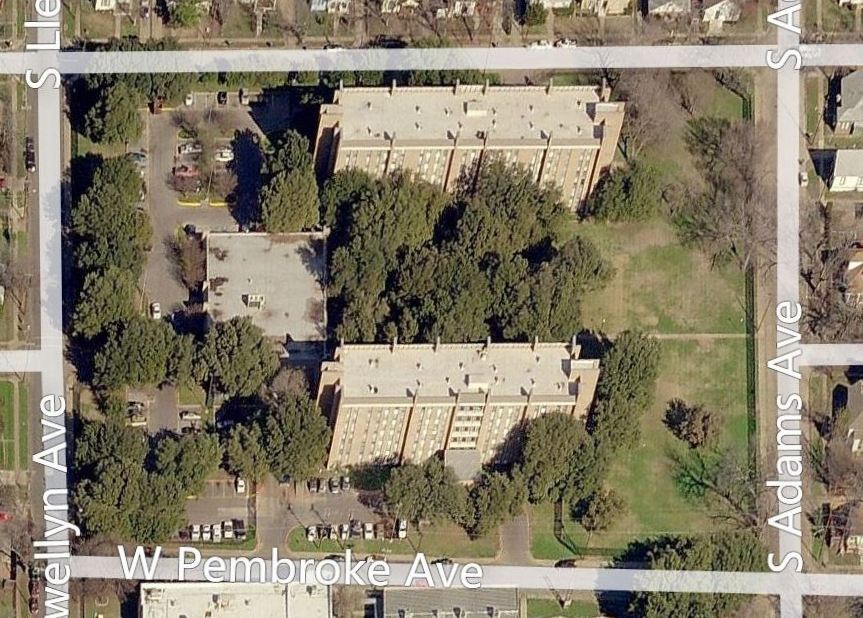
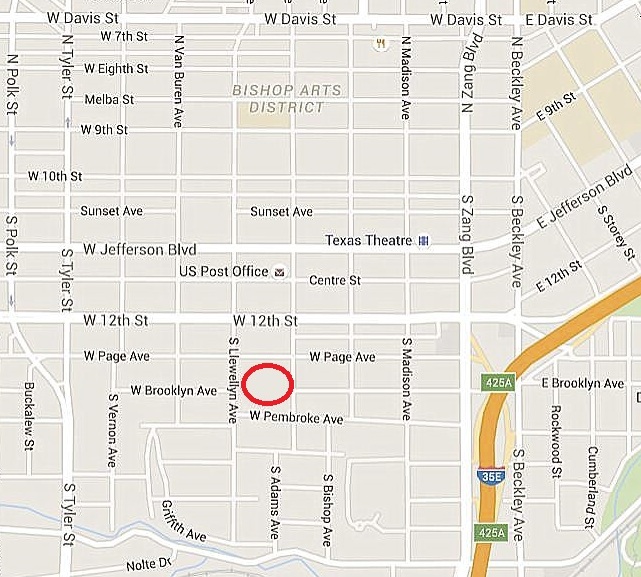
The original St. Joseph orphanage was at the southwest corner of West Page and South Adams, in Oak Cliff. See the 1922 Sanborn map, here. According to the Dallas Central Appraisal District website, the land is currently owned by the Dallas Housing Authority, which, as recently as 2014, had sought permission to build a new “home for the aged” on this property. The Bing Maps aerial view shows the Brooks Manor low-income housing project which had occupied this block for several decades before its recent demolition.

brooks-manor_bing

The Google Street view from Jan. 2016 shows an empty block.

orphanage_googleGoogle Maps

The original building at the top is not to be confused with the later St. Joseph home for girls (or the earlier Virginia K. Johnson home for unwed mothers), which was also on West Page, but a couple of blocks to the east. More on that can be found here. (It was at the Page and Madison, seen on the 1922 Sanborn map, here.) (Perhaps this was the campus the St. Joseph school moved to when Jesuit took over the campus in Oak Lawn in 1941?)

All photos and articles are larger when clicked.

*

Copyright © 2016 Paula Bosse. All Rights Reserved.


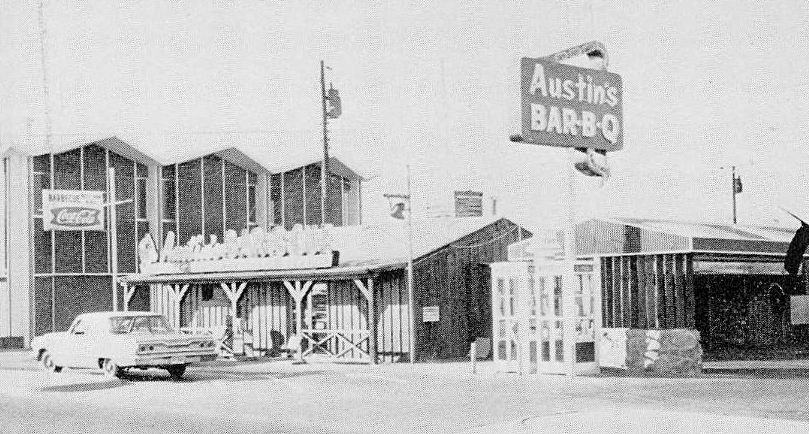
Bull Pen Barbecue/Austin’s Barbecue — 1949-2000

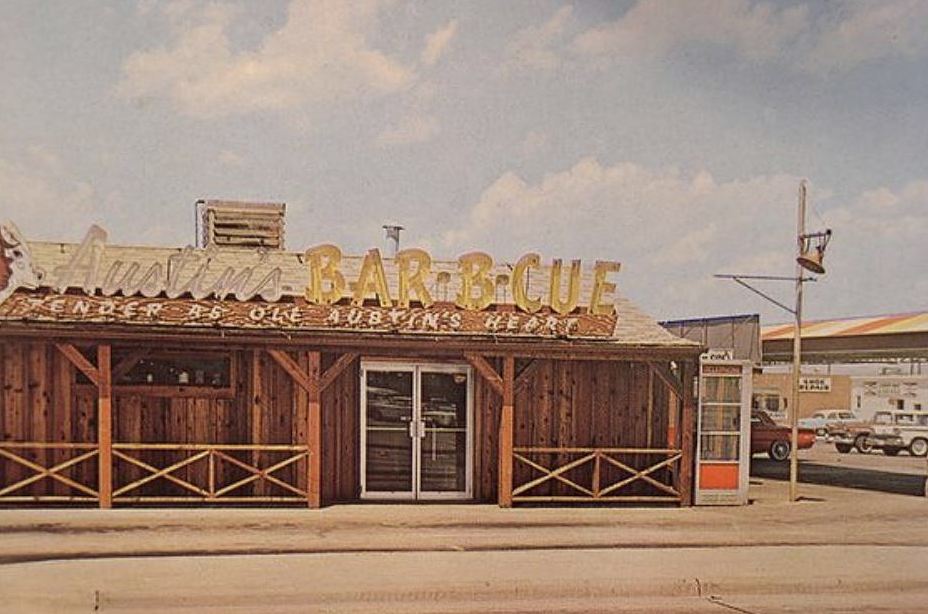
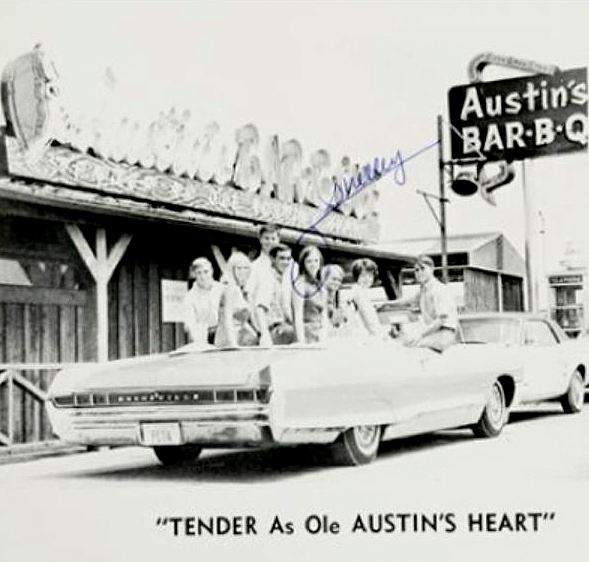
austins-barbecue_postcard_pinterest“As Tender as Ole Austin’s Heart…”

by Paula Bosse

One of my major failings as a Dallasite is that I don’t know Oak Cliff. Like at all. Every time I go over there, I get lost. I can’t remember my family ever going to Oak Cliff when I was a kid, except to visit the zoo. This explains why I had no idea how important a cultural landmark Austin’s Barbecue was when I posted a bunch of Oak Cliff ads the other day. That post has been shared hundreds and hundreds of times now and, inevitably, the only thing people mention — and rhapsodize about — is Austin’s Barbecue. …I had no idea!

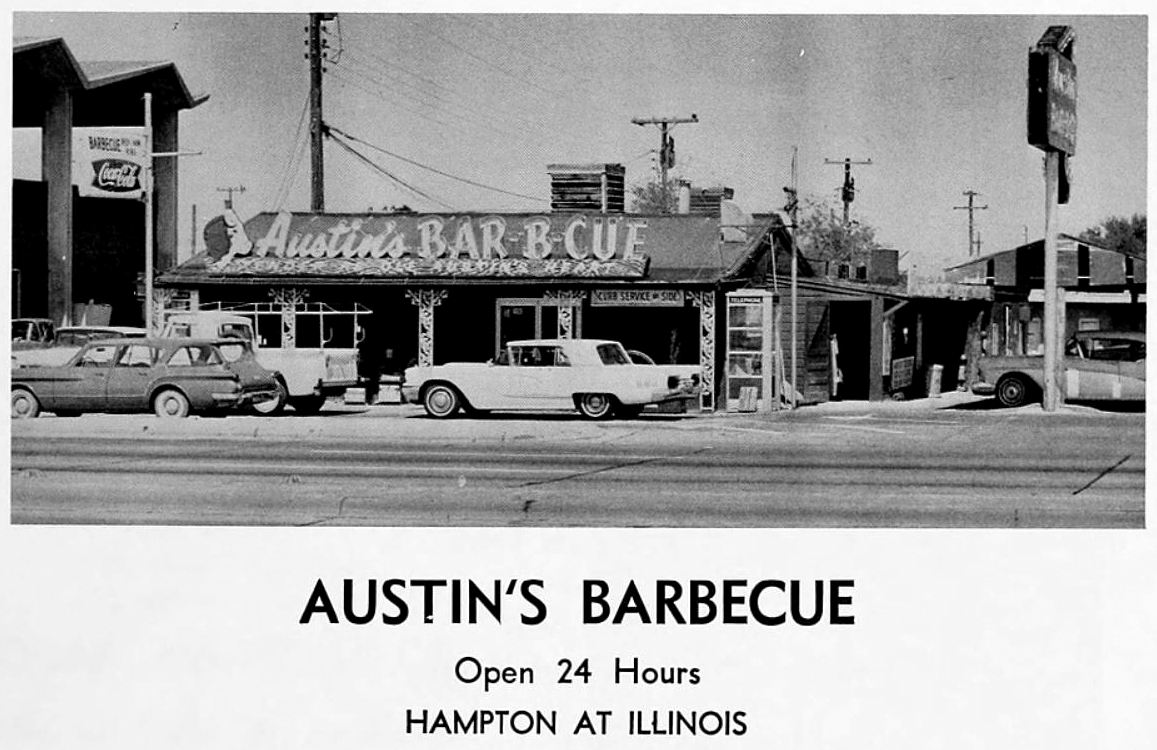
The famed BBQ joint at the northeast corner of Illinois Avenue and Hampton Road opened in 1949 as B & G Barbecue but soon became known as Bull Pen Barbecue, run jointly by owners Bert Bowman and Austin Cook. In 1956 or 1957, another Bull Pen opened in Arlington. After Oak Cliff went dry (a dark day for many Oak Cliffites), Bowman — who firmly believed that BBQ and beer were a match made in heaven — left for Arlington and Cook stayed in Oak Cliff and changed the restaurant’s name to Austin’s Barbecue. (“Bull Pen Barbecue” was still appearing in ads as late as Oct. 1957 — the official name changeover seems to have  happened in 1958.)

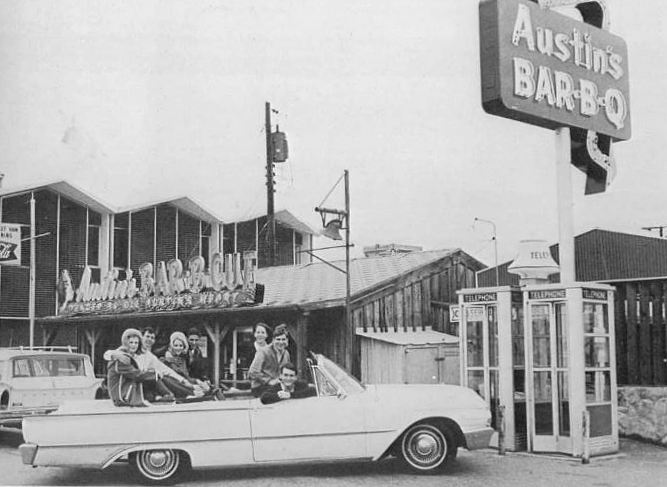
austins-bar-b-q_sunset-high-school_1967-yrbk1967 Sunset High School yearbook

*

The following memory of starting the business was apparently written by Austin Cook in 1990:

Dear Family & Friends,

I will try to tell you a little more about my being in the restaurant business. We borrowed $10,000 and bought out some one and it was B and G Barbecue. You see I always spell out Barbecue because when I went in business they hadn’t started abbreviating it like it is today.

After we had been there awhile we changed the name to The Bull Pen. Our slogan was “Come in and Shoot the Bull with Austin and Bert.” We used that name until they voted beer out of Oak Cliff. That really set us back, but maybe it was the best thing for us. We put another place in Arlington and that place was going pretty good. My partner wanted to get rid of the place in Oak Cliff. I traded him my part of the one in Arlington for his part in the one in Oak Cliff. Everyone said I was crazy.

When we bought that first place it was way out in the country, but they were building a bunch of houses not too far away. There was an airport across the street from the place. They kept talking about building a shopping center where the airport was. I remember the first day we ran a hundred dollars, and I thought we would never make it.

We started making money and we paid that ten thousand dollars back and we drew fifty dollars a week just like I was making in the grocery store. We started out with a barbecue sandwich and a hamburger. Then we started adding different things until we had a menu. We started getting those workers in the houses, and the business took off. We had beer also to go with the barbecue. My mother wasn’t too happy about that, but Dad said if that was the way I wanted to make my living it would be all right. In about a year or two we had a customer make us up a menu and we put in Barbecue plates for one dollar and twenty five cents. When I left they we were getting $4.99 for them. After I left I think they went to over seven dollars.

They always told me that you weren’t a success until you were in debt a hundred thousand dollars, and I went to the bank and borrowed all they would let me have. Then I went to my landlord and sold him the idea that I wanted to improve his property, and he loaned me the balance I needed to remodel, and I built a restaurant that held a hundred and twenty-five. Many times I was almost broke and didn’t know what I was going to do, but something always happened and I came out of it.

*

Both the Bull Pen in Arlington and Austin’s in Oak Cliff were successful and long-lived. Austin Cook retired at the end of 1993, and the business was taken over by his stepson, John Zito who had already been working at the restaurant for several years. Austin’s Barbecue closed in July, 2000, and the building was demolished soon after, replaced with an Eckerd drug store (now a CVS). Bert Bowman (born Glynbert Lee Bowman) died in 1989 at the age of 66; Austin O. Cook died at in 2006 at 86. And now I kind of feel like I know them, and I’m really sorry I never sampled their sandwiches.

*

Below, a Bowman and Cook timeline (most pictures and clippings are larger when clicked).

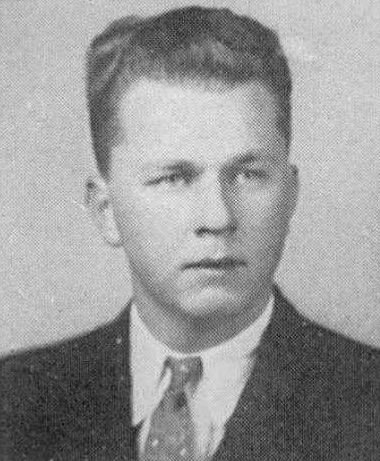
austin-cook_sunset-high-school_1937Austin Cook, Sunset High School, 1937

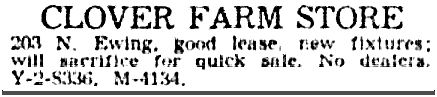
Before Cook and Bowmen met — probably around 1947 — each had been dabbling in different businesses. In early 1947, Cook leased a Clover Farm Store building at 203 N. Ewing and opened the Libby & Cook grocery with partner Lendal C. Libby.

LIBBY-COOK_dmn_021047February, 1947

LIBBY-COOK_1947-directory1947 Dallas directory

Bert Bowman worked there as a meat-cutter.

bowman_1947-directory_GROCERY-w-AUSTIN1947 Dallas directory

The grocery store was in business at least into 1949, the year that Bowman and Cook decided to ditch the groceries and start their own business at 2321 W. Illinois, in a part of Oak Cliff which was just starting to be developed. Their BBQ place was originally called B & G Barbecue, which — according to Cook’s letter above — was the name of the restaurant he and Bowman bought out. I guess they felt it was easier to keep the name for awhile.

b-and-g-1951-directory1951 Dallas directory

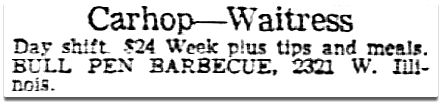
The name “Bull Pen Barbecue” didn’t come until later. In fact, the first appearance of the Bull Pen name associated with this address doesn’t show up in local newspaper archives until a want-ad placed in the summer of 1952.

bull-pen_dmn_082652_FIRSTAugust, 1952

A probably related “Bull Pen No. 2” opened in South Dallas in 1953. It appears to have been very short-lived.

bull-pen-no-2_dmn_100853
October, 1953

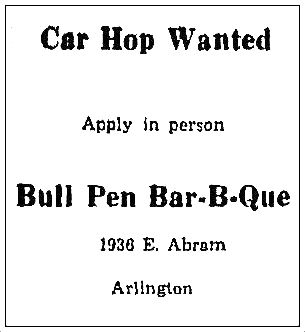
By the fall of 1957, Cook and Bowman had opened another Bull Pen — this one in Arlington, and this one a success.

bull-pen_arlington_grand-prairie-daily-news_091557
September, 1957

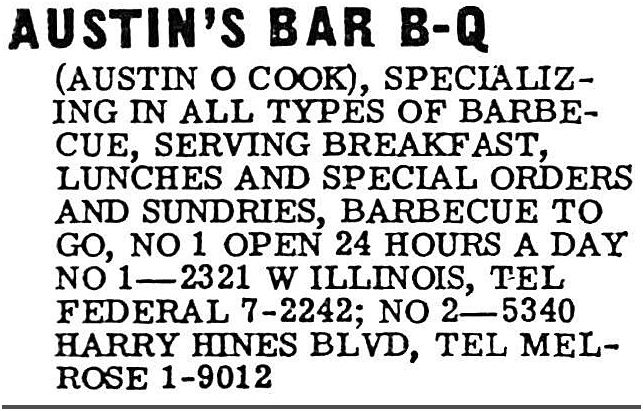
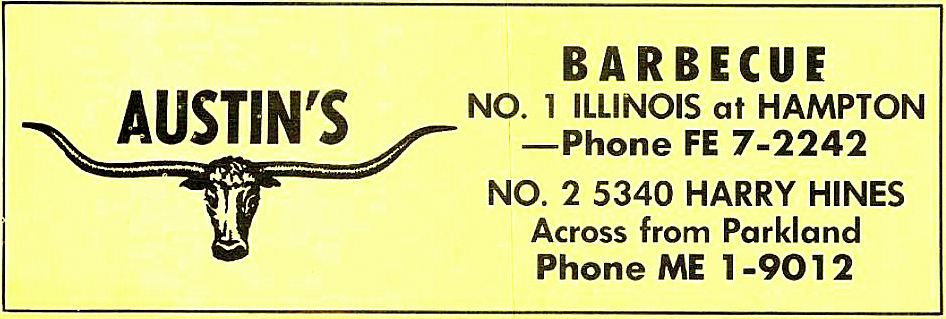
And then Oak Cliff went dry, the worst thing that could happen to a restaurant that sold a lot of beer. Similar businesses which relied heavily on beer sales began to desert Oak Cliff. Bowman did not think their original drive-in could survive, but Cook disagreed. Bowman sold his half-interest in the Oak Cliff location to Cook, and Cook sold his half-interest in the Arlington location to Bowman. Cook changed the name of his now solely-owned restaurant to Austin’s Barbecue, and his success continued, despite the fact that he could no longer sell beer. He was doing well enough that, in 1961, he opened a second location, on Harry Hines across from Parkland Hospital (a location which lasted through 1964).

austins-barbecue_1962-directory_two-locations
1962 Dallas directory

austins-barbecue_1963-directory_two-locations_ad
1963 Dallas directory

By 1963, Austin’s was a well-established teen hang-out and wisely placed ads in Oak Cliff high school annuals. Apparently everyone went there!

oak-cliff_austins_bar-b-cue_kimball-yrbk_19631963 Kimball High School yearbook

austins-bar-b-q_sunset-high-school_1964-yrbk.det1964 Sunset High School yearbook

austins_car-teens_flickr-coltera
Date and source unknown, via Flickr

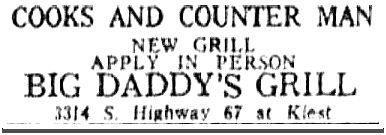
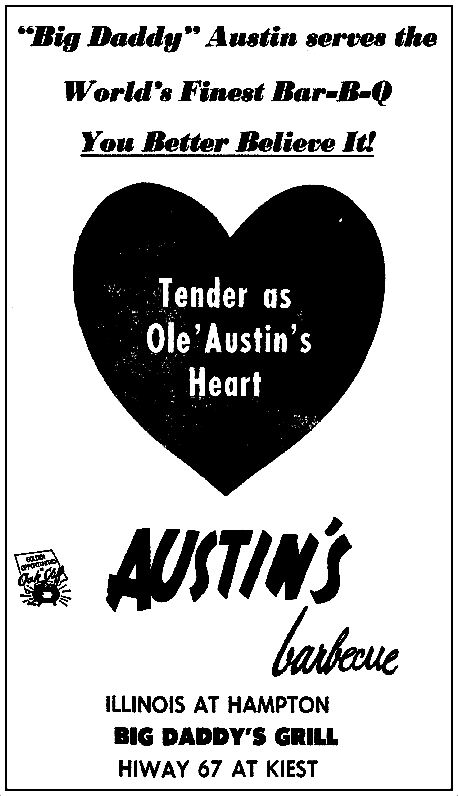
In 1964, Cook — known as “Big Daddy” — opened another restaurant, this one called Big Daddy’s Grill.

big-daddys_dmn_063064June, 1964

austins-barbecue_dmn_081466-adAugust, 1966

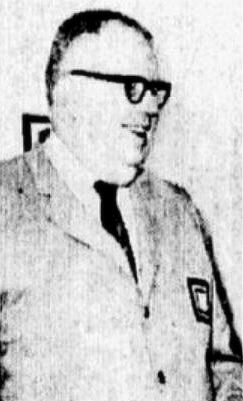
The restaurant was a bona fide Oak Cliff landmark, and Cook was an active participant in community business affairs. Below, a detail of a photo showing Cook as a member of the Oak Cliff Chamber of Commerce.

austin-cook_dmn_082568-photo-det
late 1960s

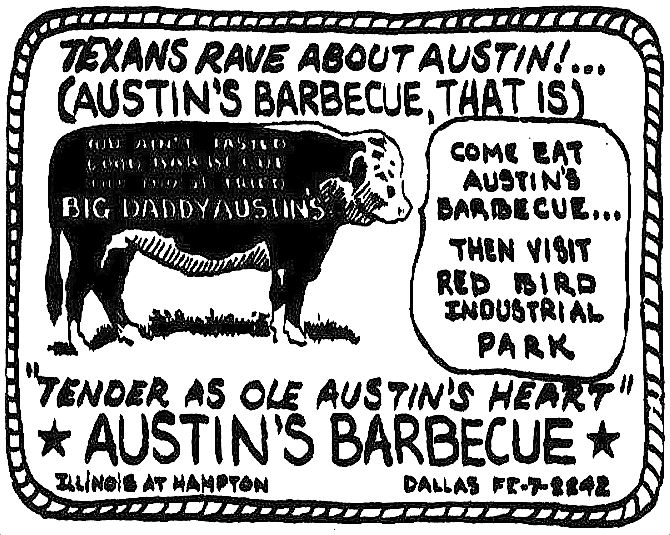
Cook participated in a series of Oak Cliff Chamber of Commerce campaigns and even included oddities like “Come eat Austin’s barbecue… and then visit Red Bird Industrial Park” in his ads. Make a day of it!

austins-barbecue_092968
September, 1968

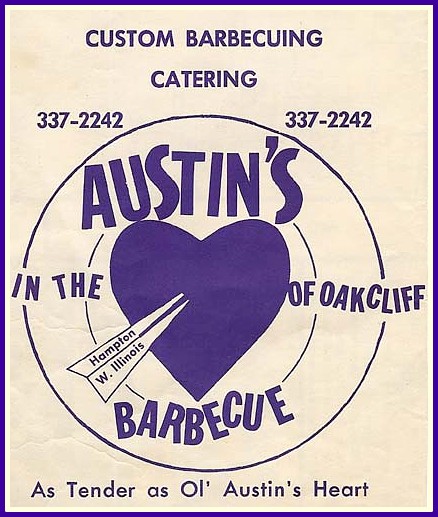
ad_austins-barbecue
via OakCliff.org

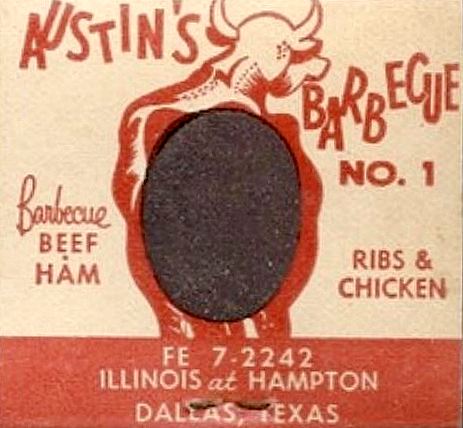
austins_matchbk_flickr_coltera
via Flickr

***

Sources & Notes

Color postcard at the top found on Pinterest, here.

The letter from Austin Cook was quoted on the DHS Phorum, here. More from the Phorum on The Bull Pen/Austin’s is here.

More can be found in the Dallas Morning News archives in the following stories:

  • “Austin’s Bar-B-Q Grows With Oak Cliff” (DMN, Aug. 14, 1966)
  • “Barbecue To Go — Staff, Customers Mourn Closing of Oak Cliff Institution” (DMN, July 13, 2000)
  • “Closed But Not Forgotten — Oak Cliff Eatery Marks Half-Century of Barbecue With Memorable Auction” (DMN, Aug. 27, 2000)
  • “John P. Zito — Operated Oak Cliff Landmark Austin’s Barbecue For 19 Years” by Joe Simnacher (DMN, Oct. 14, 2003)

Read the obituaries of Bert Bowman (1989) and Austin O. Cook (2006) here.

The Oak Cliff Advocate article “A Look Back at Austin’s Barbecue” by Gayla Brooks is here (with tons of memories from readers in the comments).

Not mentioned in this post is the connection of Officer J. D. Tippit (who moonlighted as a keeper of the peace at Austin’s) and other tangential/coincidental associations to the Kennedy assassination. It’s well documented elsewhere. Google is your friend.

*

Copyright © 2016 Paula Bosse. All Rights Reserved.

A Few Ads From the Pages of the 1963 and 1967 Kimball High School Yearbooks

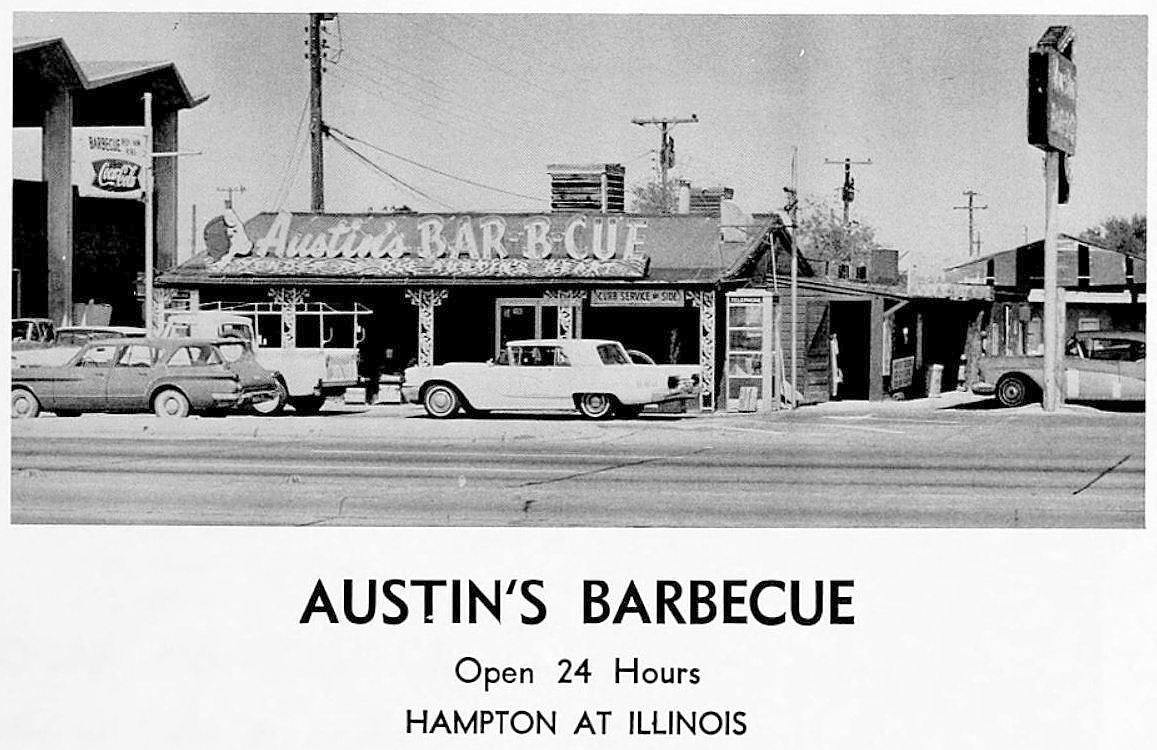
oak-cliff_austins_bar-b-cue_kimball-yrbk_1963_a
BBQ in the OC, 1963

by Paula Bosse

A few random, nostalgic ads from the 1963 and 1967 Kimball High School yearbooks.

**

Above, Austin’s Barbecue.

*

Below, the Wynnewood Pharmacy:

oak-cliff_wynnewood-pharmacy_kimball-yrbk_1963_a1963

*

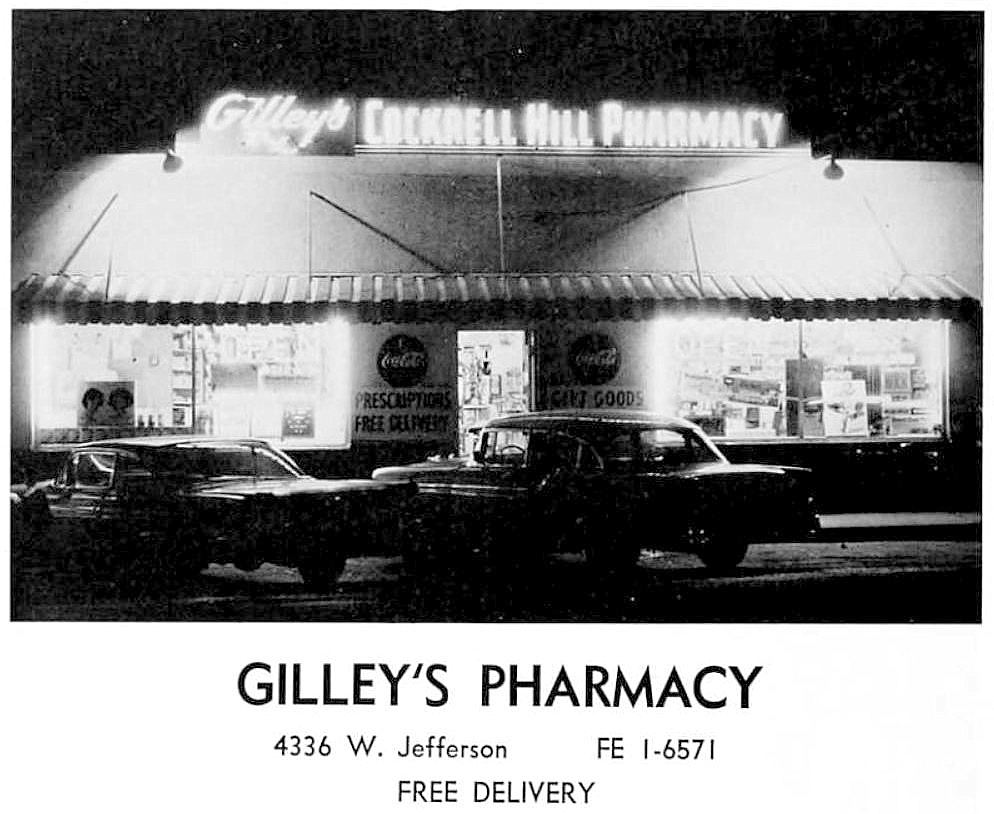
Gilley’s Cockrell Hill Pharmacy:

oak-clliff_gilleys-cockrell-hill-pharmacy_kimball-yrbk_1963_a1963

*

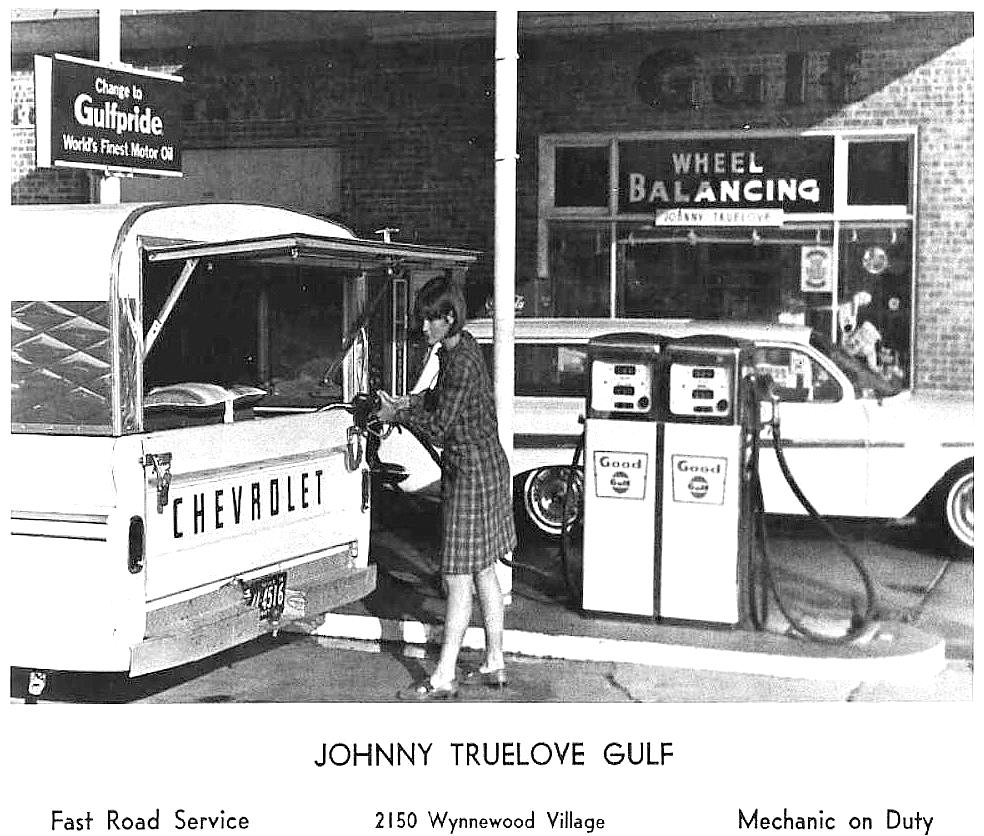
Johnny Truelove Gulf station:

truelove-gulf-station_kimball-yrbk_1963_a1963

truelove-gulf-station_kimball-yrbk_1967_a1967

*

Sammy’s Westcliff (a favorite of Marsha and her Aqua-Netted pals):

sammys_oak-cliff_1967-kimball-yrbk_a1967

*

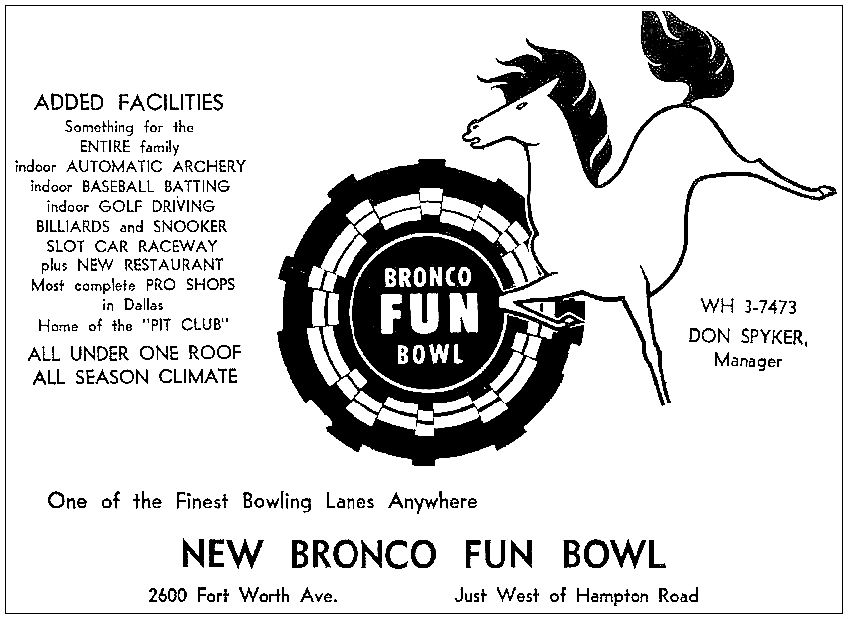
And the late, lamented Bronco Bowl:

ad-bronco-bowl_kimball-yrbk_1967_a1967

*

And for those who want to browse the retail offerings of Wynnewood Village in 1963, here is a handy list (click to see a larger image):

oak-cliff_wynnewood-village_kimball-yrbk_1963_a1963

***

Sources & Notes

All ads from the 1963 and 1967 Kimball High School yearbooks.

More than you’d ever want to know about The Bull Pen/Austin’s Barbecue in my follow-up post, here.

*

Copyright © 2016 Paula Bosse. All Rights Reserved.

West Jefferson in the Truman Years

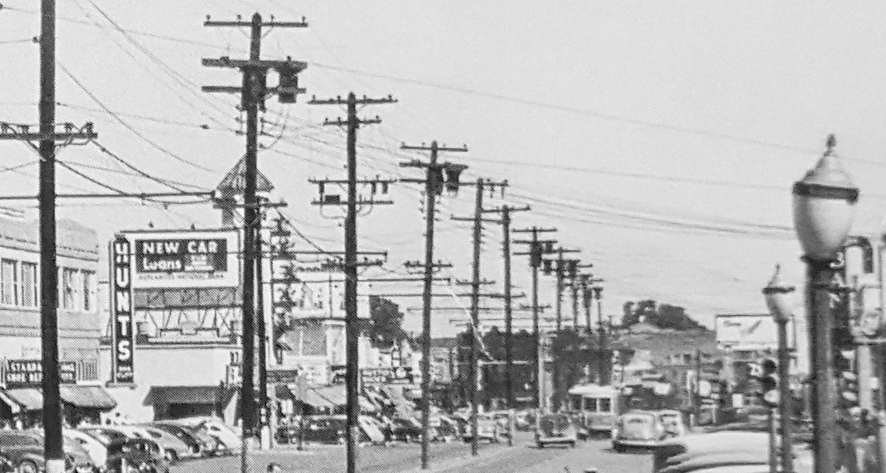
oak-cliff_w-jefferson_frontier-top-tierW. Jefferson & S. Bishop (click for very large image)

by Paula Bosse

Here we see West Jefferson Blvd. in Oak Cliff, looking east from just west of the intersection with South Bishop. Not being proficient in dating automobiles, I’m unsure of the date, but the Hoffman Optical Co. (seen on the right) did not appear in the 1948 city directory, but was there by 1951. The current view from this intersection can be seen on Google Street View here. Even though the visual blight of those telephone poles is unappealing, I have to say, I prefer the livelier W. Jefferson of 60-something years ago.

If you squint, you can just see the Texas Theatre in the distance on the left — under the pointy roof, behind the “New Car” billboard. Here’s a magnified detail (click to see a larger image) — you can (barely) see “TEXAS” spelled out on the vertical sign.

oak-cliff_w-jefferson_tx-theatre_det

The first thing I noticed in this photo is this odd black vehicle driving away from the photographer — I keep seeing a bulky version of Harold’s customized hearse from the movie Harold and Maude. What is this?

oak-cliff_w-jefferson_vehicle

Here are the businesses that occupied the couple of blocks seen here (from S. Bishop to S. Zang) in 1951:
w-jefferson_1951a          w-jefferson_1951b
1951 city directory (click to read!)

*

Copyright © 2016 Paula Bosse. All Rights Reserved.


La Reunion: Utopia on the Trinity

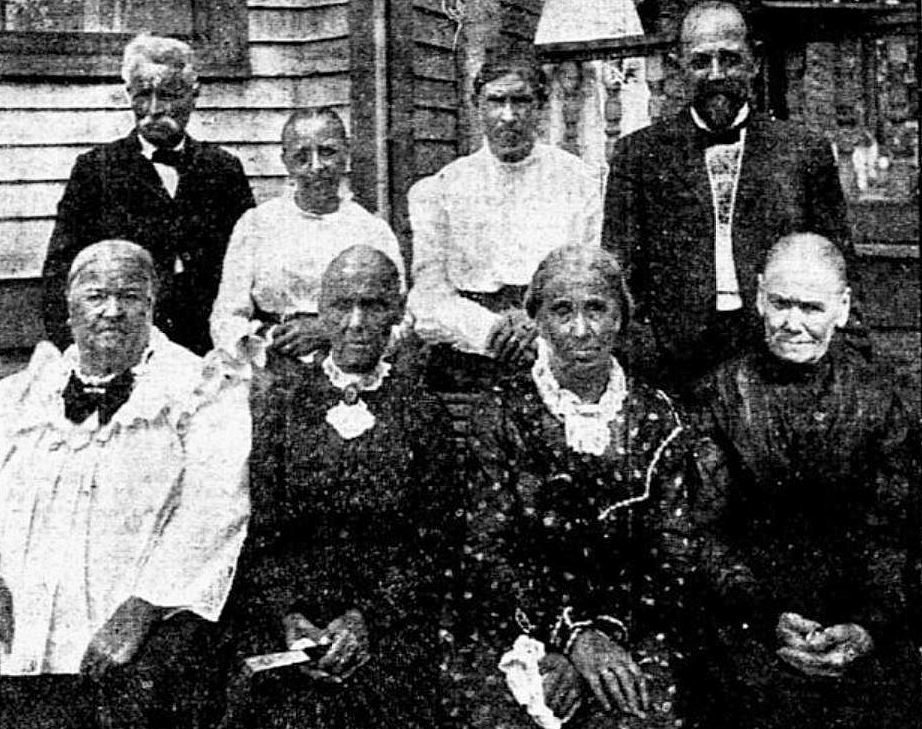
la-reunion_dmn_053106Eight of the original settlers, 1906

by Paula Bosse

I’ve put off writing about the socialist utopian settlement of La Reunion, which sprang up just across the Trinity from Dallas in the mid 1850s, because it’s such a big topic. Luckily, though, the fabulous Julia Barton has put together an entertaining and informative radio presentation on this very topic (see below for details). So I’ll just present a couple of interesting tidbits and leave the heavy lifting to Julia.

But for a totally inadequate one-paragraph summary of La Reunion, it was a colony of generally well-educated (and adventurous) French, Swiss, and Belgian immigrants, some of whom were political refugees from the unrest then spreading across Europe. They were led by Frenchman Victor Prosper Considerant (a follower of the democratic socialist Charles Fourier) — who began his settlement in 1854/1855 on land he had purchased just west of the Trinity River. A socialist commune … in Texas! But it was rough going for the European immigrants, and by 1859 the community had been deemed a failure: too many scholars, not enough farmers, as one colonist put it. Many of the colonists left the area, but several of these immigrants stayed, many becoming successful businessmen and community leaders (one of them, Swiss-born Benjamin Long, even became a two-term mayor of Dallas in the years following the Civil War). They are also credited with bringing a cultural sophistication and world-view to a dusty little town on the Texas frontier which had precious little of either before their arrival. Without the influence of these failed utopians, Dallas would be a much different city than the one we know today.

So here are a few random La Reunion bits and pieces.

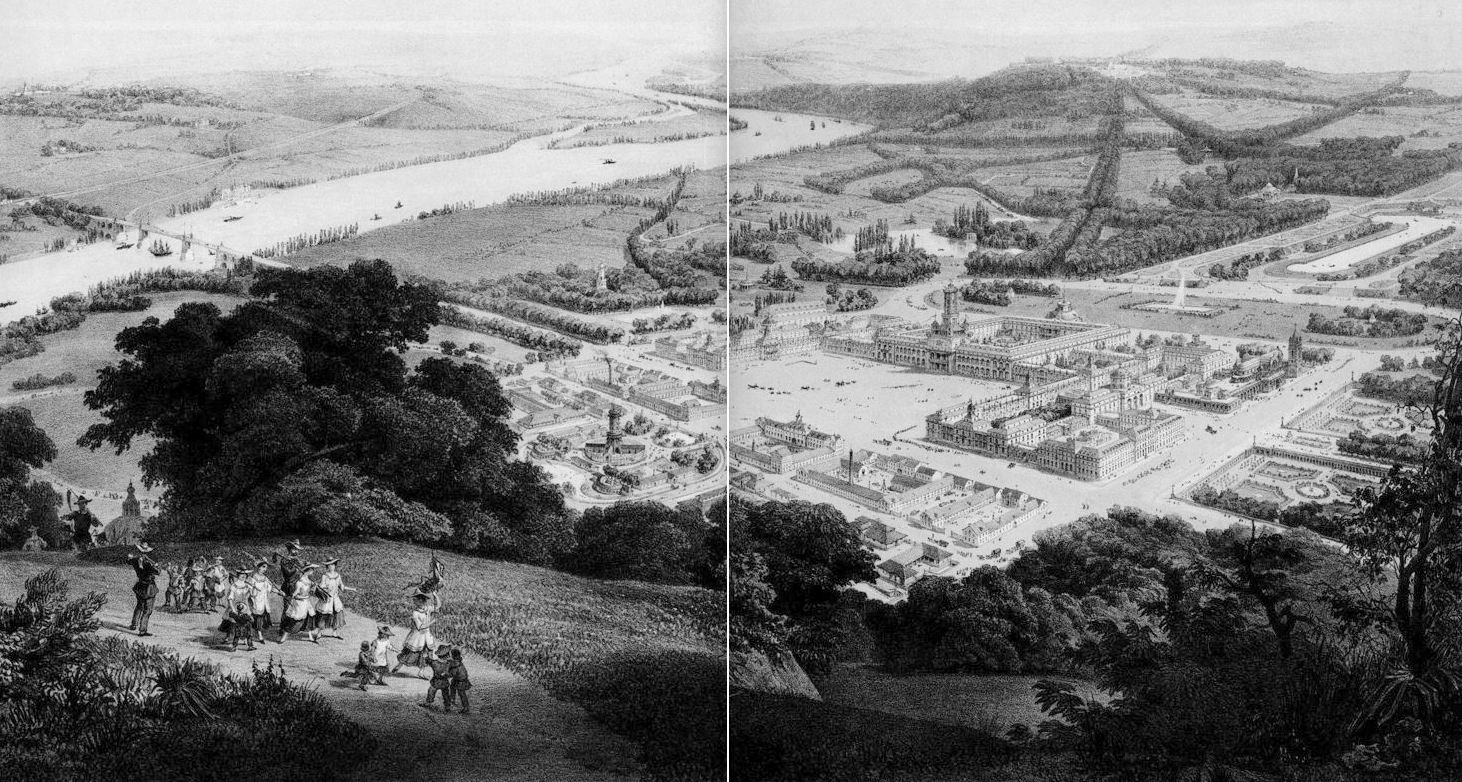
According to an interesting Legacies article by James Pratt, those settlers — while still back in their homelands — might have gotten the idea that this is what their new home in Texas might look like:

idealized_la-reunion_legacies_fall-1989_DHSSee left side REALLY big here; right side here (Dallas Historical Society)

Um, yes.

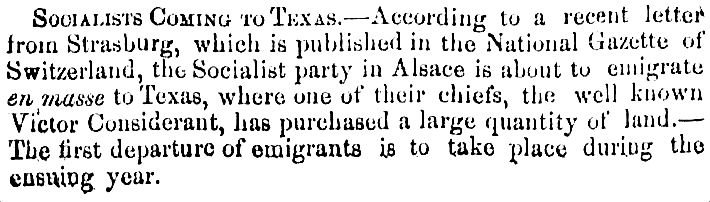
Here’s one of the first mentions of the impending arrival of Considerant’s group (the size of which was almost always exaggerated in early reports). (Click for larger image.)

la-reunion_texas-state-times_austin_021055Texas State Times (Austin), Feb. 10, 1855

*

 It was news even in Virginia:

la-reunion_richomond-dispatch_virginia_050555Richmond Dispatch, May 5, 1855

*

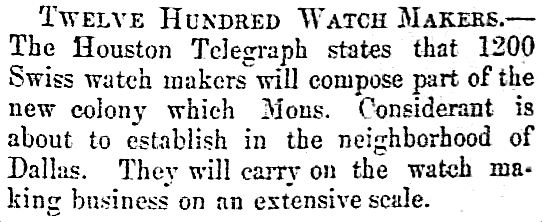
1,200 Swiss watchmakers?!!

la-reunion_texas-state-times_austin_060255Texas State Times (Austin), June 2, 1855

*

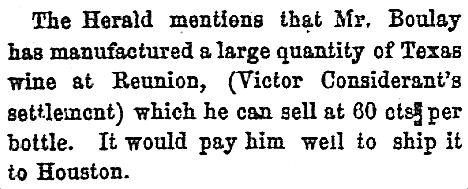
One of the things I learned from Julia Barton’s piece of La Reunion was that some of the settlers brought plants native to their European homes with them — this included grapevines, for making wine.

wine_houston-weekly-telegraph_101259Houston Weekly Telegraph, Oct. 12, 1859

(Read about the surprise M. Boulay left his widow when he died in 1875, here, in an article from The Dallas Weekly Herald, July 24, 1875)

*

On May 30, 1906, a 50th anniversary party was held by a group of the original La Reunion colonists. In the Dallas Morning News story about this event (which you can read here), these men and women were interviewed. My favorite factoid was that these fresh-off-the boat immigrants traveled to Dallas from Galveston or Houston ON FOOT. One woman said she and her fellow group of travelers walked from Houston to Dallas, leaving in late May and arriving on July 4th. Imagine their disappointment after having walked for weeks and weeks in heat they had never before experienced, only to find that their new home was nothing like what they had expected. Several stuck around for the rest of their lives, though. The eight colonists pictured in the photograph above are identified in the caption below it:

SWISS – FRENCH – BELGIAN PIONEERS OF DALLAS

  • Front row, from left to right: Mrs. Barbara Frick, Swiss, 79 years old, in Dallas 51 years
  • Mrs. D. Nussbaumer, Swiss, 73 years old, in Dallas 50 years
  • Mrs. Lucy Vorrin, French, 61 years old, in Dallas 50 years
  • Mrs. C. Remond, French, 67 years old, in Dallas 50 years
  • Second row, from left to right: Charles Capy, French, 75 years old, in Dallas 51 years
  • Mrs. Charles Capy, French, 61 years old, in Dallas 50 years
  • Mrs. C. Vongrinderbeek, Belgian, 60 years old, in Dallas 51 years
  • Adolf Frick, Swiss, 62 years old, in Dallas 51 years (DMN, May 31, 1906 — Photo by Clogenson)

*

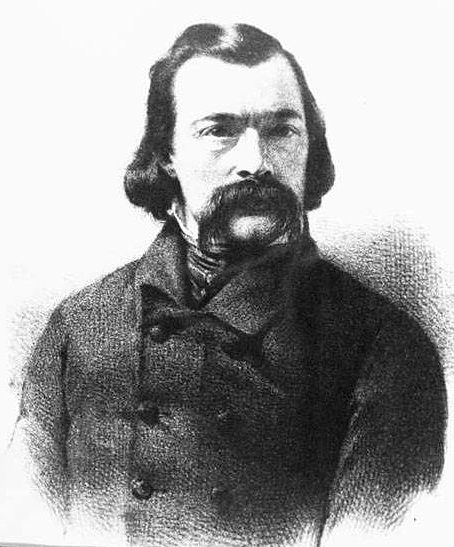
Finally, a photo of Victor Considerant, who left La Reunion when the going got tough, lived in a nice place in San Antonio for a while, then returned to France, where he lived as a teacher and “socialist sage” until his death in 1893 at the age of 85.

victor-considerant_utsaUTSA Libraries, Digital Collections

***

Sources & Notes

I HIGHLY encourage you to listen to the aforementioned radio essay Julia Barton did for Public Radio International: “The Failed Socialist Utopian Dream That Helped Dallas Become a Major City” is here. It is a segment of the PRI podcast The World in Words — it begins at about the 5:30 mark and runs about twenty minutes. I learned stuff!

The highly idealized rendering of a Fourier-inspired phalanstère is from the collection of the Dallas Historical Society and appeared on the front and back covers of the Fall, 1989 issue of Legacies. No other information on the drawing was given. I’m not sure if prospective La Reunion colonists were led to believe this was a depiction of the heaven-on-earth that awaited them in Texas. If so, I bet they were very, very disappointed.

La Reunion links:

  • Handbook of Texas (with details about the philosophical, political, and social aims of the colony)
  • Wikipedia
  • “La Reunion: Adventure in Utopia” from the WPA Guide to Dallas, here
  • “La Reunion” by Ernestine Porcher Sewell, from The Folklore of Texan Cultures (1974), here

Watch Julia Barton’s presentation of “Port of Dallas” — about the misguided hopes to turn the Trinity River into a navigable waterway from Galveston to Dallas — here.

Other Flashback Dallas posts on La Reunion can be found here.

reunion-tower_twitter@ReunionTower on Twitter

*

Copyright © 2016 Paula Bosse. All Rights Reserved.