Flashback : Dallas

A Miscellany: History, Ads, Pop Culture

Category: Oak Cliff/West Dallas

The Lighthouse Church That Warned of Sin’s Penalty with a Beam of Blue Mercury Vapor Shot Into the Skies Above Oak Cliff — 1941

gospel-lighthouse-churchStill standing in Oak Cliff… (click for larger image)

by Paula Bosse

Sometimes an image just grips you. That’s what happened when I saw this postcard featuring The Gospel Lighthouse Church. The building was so odd-looking and cool. Who designed it? Where had it been? And what was that thing on top of it? I did a bit of research on the church and found out that it was organized in Dallas in 1940 by Pentecostal preacher J.C. Hibbard and his wife Nell, who was also a preacher. The two had been preaching at the Oak Cliff Assembly of God Church until J.C.’s divorce from his first wife (and subsequent second marriage to Nell) became such a point of controversy that the two felt compelled to leave (or were asked to leave) the Assemblies of God, and they formed their own church.

And that was the Gospel Lighthouse Church, located in the 1900 block of S. Ewing (at Georgia) in Oak Cliff. While their first church was being built, they held services in a large circus tent in the parking lot. The congregation helped with the physical labor of the construction, and progress on the building continued non-stop, 24 hours a day. In January of 1941, the church was completed, and an article appeared in The Dallas Morning News soon after with the grabber of a headline, “Lighthouse Church Warns Oak Cliff of Sin’s Penalty.” Sadly, the article has no byline, which is a shame, because I’d love to know who wrote the piece, because he or she pulled out all the purple-prose stops. The introduction is fantastically over-the-top:

A towering forty-foot lighthouse 300 miles from the sea was blinking out its warning signals across the dry land of South Ewing Sunday. At the front of a neat new white stone church house at 1914 South Ewing, near Louisiana, the white stone lighthouse reared far above the other buildings. Eventually, its big circular light tower will shoot a bluish mercury-vapor beam through the night to guide shaken mariners adrift on the sea of sin. Its semi-fog horns will broadcast a soft carillon of sacred music. This is the Gospel Lighthouse, built by a preacher with a new idea of church architecture and a dream of a denomination all his own. (DMN, Feb. 10, 1949)
gospel-lighthouse_first

Wow. A “bluish mercury-vapor beam” shooting through the Oak Cliff skies! (The full article is linked below.)

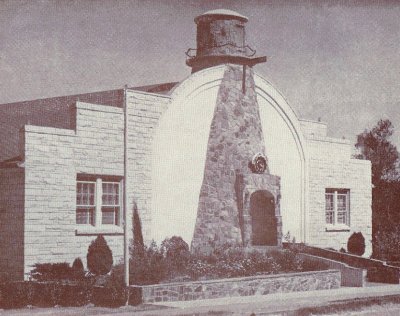
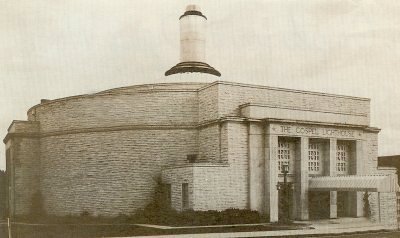
By 1948, J.C. Hibbard had become so popular (largely as a result of his daily radio sermons) that ground was broken on a larger church, designed by J.C. himself. It was right next to the first church. And it was pretty elaborate.
gospel_lighthouse_bw

Yeah, the lighthouse part of it looks a little cheesy, but with a name like “Gospel Lighthouse Church” you kind of have to have it.

*
gospel-lighthouse-church_interior

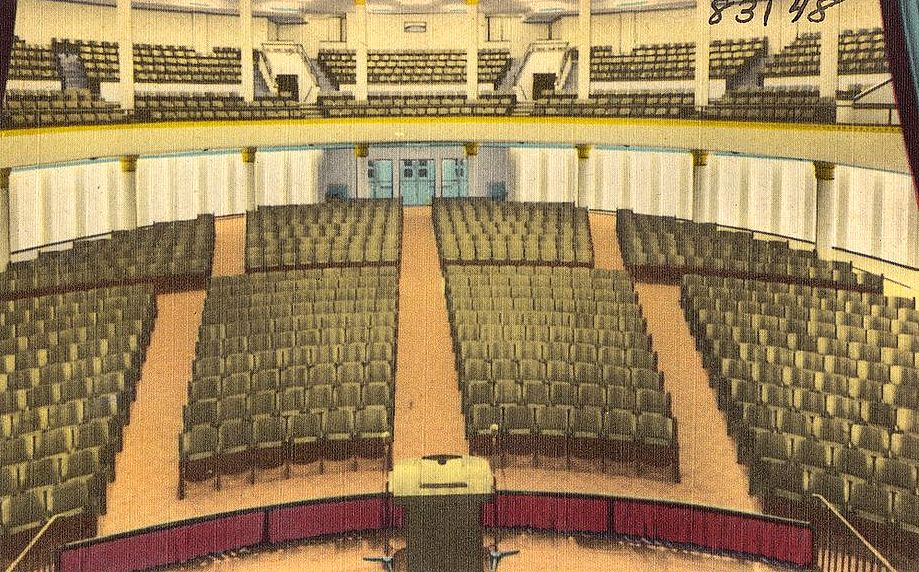
The auditorium and its mezzanine.

*

gospel-lighthouse-nursery

The nursery, with elaborate murals.

*
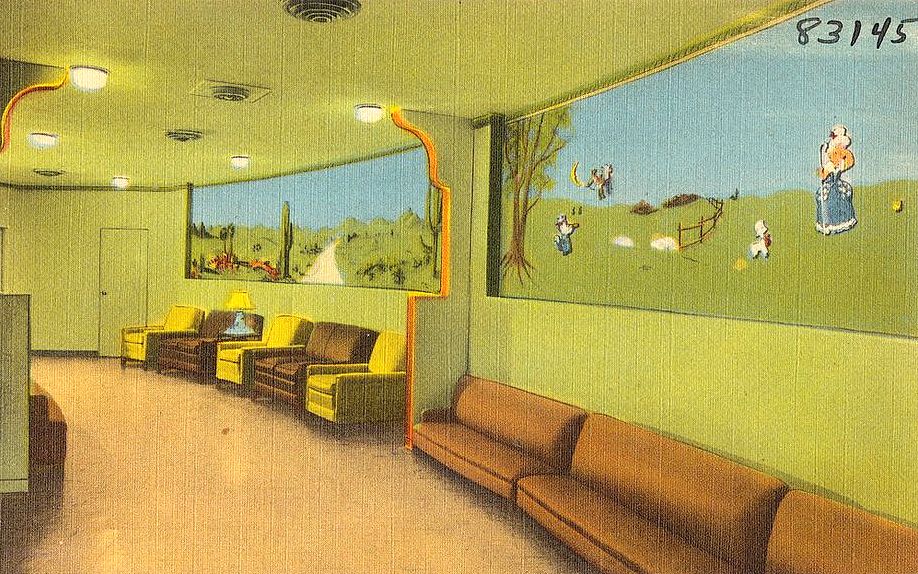
gospel-lighthouse-lounge

The lounge. Like the first church, this one had a nursery with a lounge — a “crying room” for mothers to tend to crying children without having to miss a single moment of the service. The crying was contained behind sound-proof glass while the sermon was piped in through speakers. The church had a lot of other amenities, but these were the only ones I’ve found deemed worthy enough to put on postcards.

*

I wondered if the church still stood, so I drove over to Oak Cliff yesterday and, amazingly, both churches are still there, and they are beautiful! (The original caretaker’s house is still there, too.) I’m not sure what religious group has possession of the buildings at the moment, but they are to be commended for maintaining the structures and the grounds — the 1900 block of S. Ewing really stands out from its fairly ragged surrounding neighborhood. Below are photos I took on April 19, 2014. (Click pictures for larger images.)

gospel-lighthouse_first-church_041914

Above, the first church — “a modern concrete and steel building, overlaid with white Austin stone” — which was built with help from the congregation in 1941. The beam of “bluish mercury-vapor” emanated (somehow) from the squat lighthouse above the foyer.

And, below, the later church, next door. I think the “mercury-vapor” was replaced by neon. But I could be wrong. Does either beacon light up anymore?

gospel-lighthouse_041914_sm

Aside from the “lighthouse,” the most distinctive feature of this building is those rounded walls. So beautiful!

gospel-lighthouse_side_041914-sm

The  building is actually pretty impressive to see up close. Next time you’re in the neighborhood, check it out!

***

Sources & Notes

Postcards from the Boston Public Library Tichnor Brothers Postcard Collection on Flickr, here.

Period black-and-white photos are from a page detailing the history of the Gospel Lighthouse Church, here. A biography of Rev. Hibbard from the same site can be found here.

Wander around the block on Google Street View, here.

Stumbled across this ad in the 1957 Dallas directory:
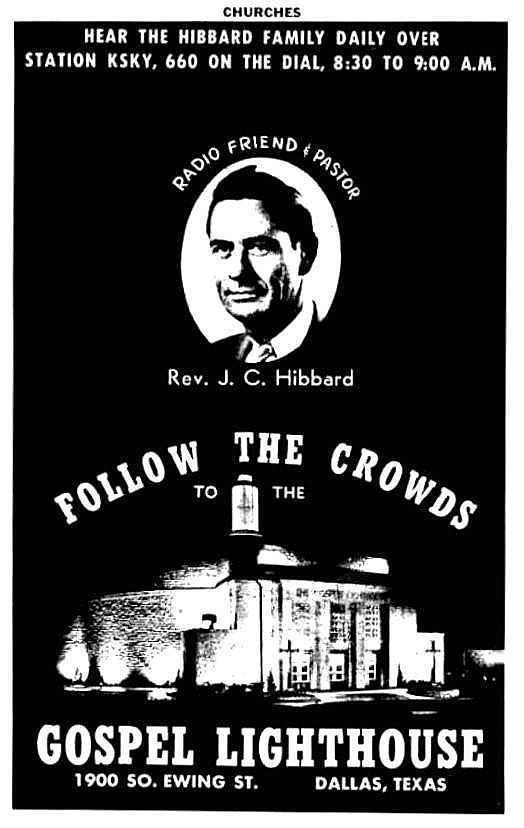
gospel-lighthouse_1957-directory

And I found this ad in, of all places, the 1967 Carter High School yearbook:
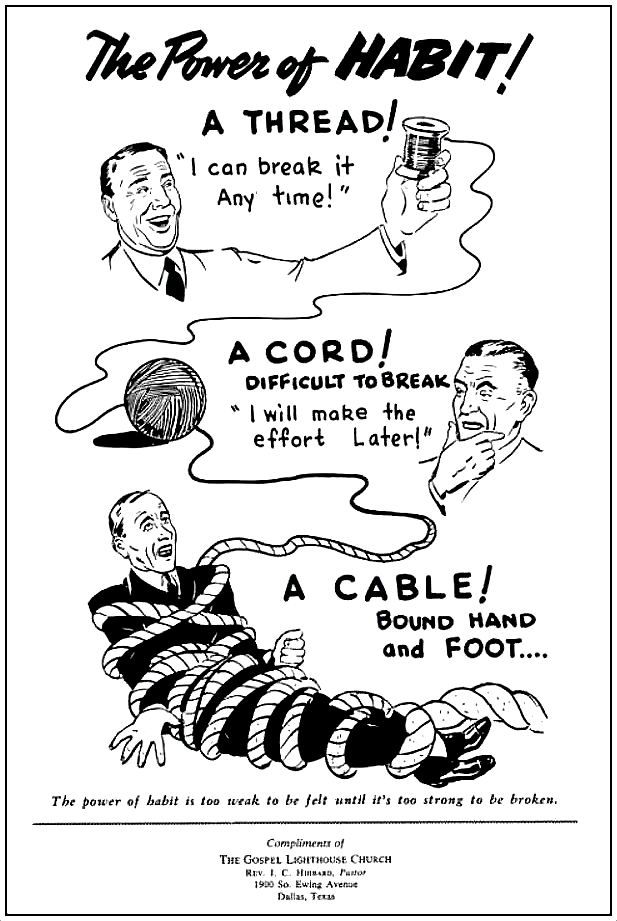
gospel-lighthouse_carter-high-school_1967-yrbk

I also found this rather hair-raising ad for a 1967 Christmas-season production — an ad which somehow contains no exclamation marks:
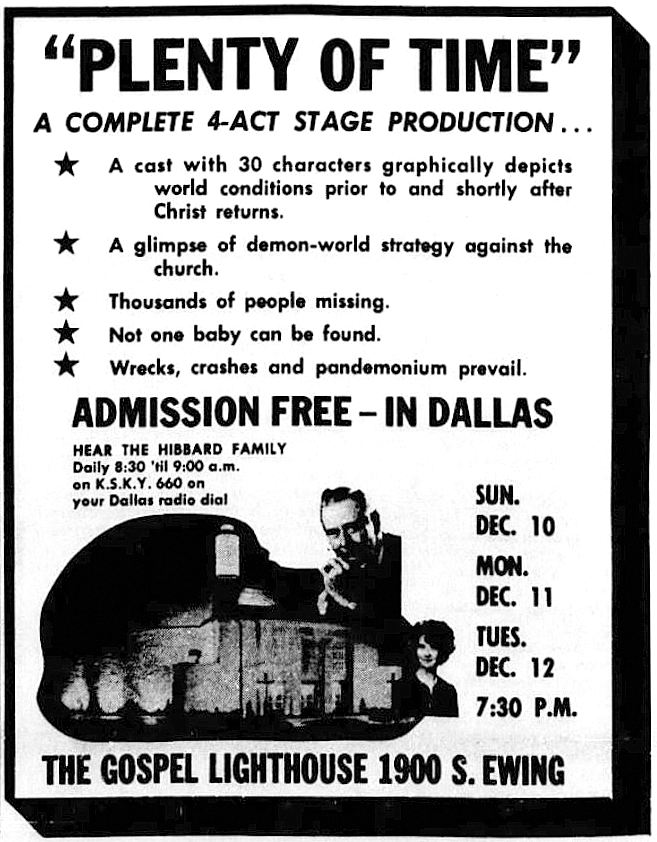
gospel-lighthouse_mckinney-courier-gazette_120867Dec. 8, 1967

*

Copyright © 2014 Paula Bosse. All Rights Reserved.
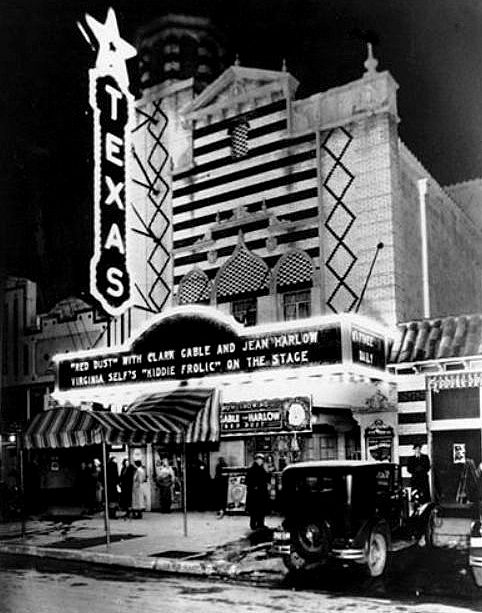
The Texas Theatre — 1932

texas-theater_1932The “Texas”

by Paula Bosse

West Jefferson Blvd, 1932. All that’s missing from this photo is Edward G. Robinson and an arsenal of tommy-guns. This is the only theater in the world whose marquee showing the 1963 double feature of “Cry of Battle”/”War Is Hell” has become a part of history (the Texas Theatre, is of course, where Lee Harvey Oswald was captured on the afternoon of November 22,  1963). When the movie theater opened in 1931 — in the time of Prohibition and running boards —  it was a much more elegant-looking picture palace. Had he not been in the Big House at the time, John Dillinger might have seen this very same Gable and Harlow movie at the Biograph (or what I call “Chicago’s Texas Theatre”). He probably wouldn’t have been sitting through something called “Kiddie Frolics,” featuring Oak Cliff’s own Virginia Self, a teenage dancer … frolicking.

***

After several changes in ownership and a few awkward renovations, the Texas Theatre seems to be back on track these days. The history page of their website is here (with interesting factoids such as: it opened on San Jacinto Day, it was the first theater in Dallas with air-conditioning, and it was briefly owned by Howard Hughes).

For photos of the theater’s interior, published in 1932 in the trade journal Motion Picture Herald, see my post “The Texas Theatre and Its Venetian-Inspired Decor,” here.

*

Copyright © 2014 Paula Bosse. All Rights Reserved.


Not Every ‘Good Luck Trailer Park’ Story Has a Happy Ending — 1964

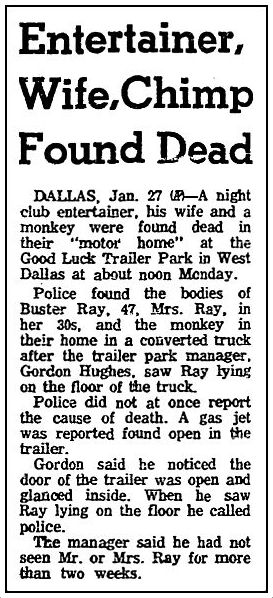
chimp_fwst_012864Fort Worth Star-Telegram, Jan. 28, 1964

by Paula Bosse

“Entertainer, Wife, Chimp Found Dead.” THAT is a headline.

Had I not known that the (ironically named) Good Luck Trailer Park on W. Commerce had been a favorite with visiting circus folk, I might have been a little more surprised by the weird circumstances reported in this article. As it was, I was only mildly surprised.

(I kind of think the chimp did it….)

***

Sources & Notes

Hats off to the Fort Worth Star-Telegram‘s headline writer. The story ran in the Star-Telegram on Jan. 28, 1964.

The victims — Harold Allen Ray and his wife Nadine (and unnamed monkey) — were later determined to have died of accidental carbon monoxide poisoning.

“Buster Raye” (stage name of Harold Ray) had been a comedian and master of ceremonies who seems to have played a lot of burlesque joints/strip clubs as the between-stripper entertainment. He was billed as “The Mighty Mite of Mirth.” In a Feb. 24, 1948 review of his act, The Bryan Eagle wrote:

Buster Raye, diminutive master of ceremonies, stole the show with a clever line of chatter punctuated with juggling, acrobatics, songs, imitations. His jokes were well handled with none of the vulgarity common to many floor shows.

I’m not sure where the monkey fits in.

buster-raye_corpus_042948Corpus Christi Caller-Times, April 29, 1948

*

Copyright © 2014 Paula Bosse. All Rights Reserved.


Red Bryan’s Smokehouse — BBQ, Oak Cliff-Style

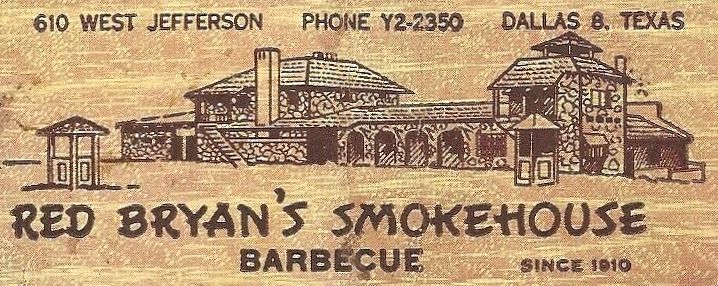
red-bryans-smokehouse_bbq_postcard_ebay_ca-1950

by Paula Bosse

Everybody in Dallas knows about Sonny Bryan, and some remember Red Bryan, but I didn’t know there was another Bryan forebear, who started the family barbecue dynasty: Elias Bryan. Elias and his wife, Sadie, arrived in Oak Cliff from Cincinnati in 1910 and opened a barbecue stand. Elias begat Red, and Red begat Sonny. And there was much trans-generational smoking of meat. The Bryans have been a BBQ fixture in Dallas for over 100 years.

Fun facts about William Jennings “Red” Bryan:

  • Red studied botany at SMU, which might explain his initial career as a florist until he was inevitably pulled back into the family business. He opened his first place in the early 1930s in a retired Interurban car, known affectionately as “The Tin Shack.”
  • In the late ’40s, now well established and wanting swankier digs, he commissioned the respected architect Charles Dilbeck to design the new restaurant. (Dilbeck designed some of the most beautiful homes in Dallas, several of which are in Lakewood, but this was probably his first — and only — barbecue joint.)

And the rest is, as they say, barbecue — and Oak Cliff — history.

*

red_bryan_bbq_dth_0205561

*

Red, 1951

*

red-bryans-bbq_matchbook_ebay

***

Sources & Notes

Postcard (circa 1950) at top from eBay. This is printed on the back:


red-bryans-smokehouse_bbq_postcard_caption_ebay

Ad from 1956.

Much more on Red Bryan’s Smokehouse, with lots of photos of its construction, can be found in the Oak Cliff Advocate article “The King of Oak Cliff Barbecue” by Gayla Brooks, here.

Even more cool stuff, including early photos of the family business, can be found in the Texas Monthly article “Bryan Family Artifacts and Mementos” by Daniel Vaughn, here.

Sonny Bryan’s website is here.

*

Copyright © 2014 Paula Bosse. All Rights Reserved.

Oak Cliff Wants YOU! — 1890

oak-cliff_southern_mercury_dallas_1890

by Paula Bosse

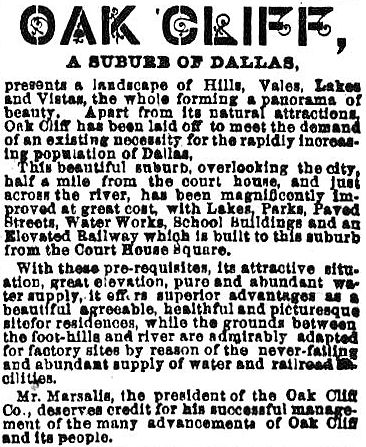
Oak Cliff, a suburb of Dallas, presents a landscape of Hills, Vales, Lakes and Vistas, the whole forming a panorama of beauty. Apart from its natural attractions, Oak Cliff has been laid off to meet the demand of an existing necessity for the rapidly increasing population of Dallas.

This beautiful suburb, overlooking the city, half a mile from the court house, and just across the river, has been magnificently improved at great cost, with Lakes, Parks, Paved Streets, Water Works, School Buildings and an Elevated Railway which is built to this suburb from the Court House square.

With these pre-requisites, its attractive situation, great elevation, pure and abundant water supply, it offers superior advantages as a beautiful, agreeable, healthful and picturesque site for residences, while the grounds between the foot-hills and river are admirably adapted for factory sites by reason of the never-failing and abundant supply of water and railroad facilities.

Mr. Marsalis, the president of the Oak Cliff Co., deserves credit for his successful management of the many advancements of Oak Cliff and its people.

*

Oak Cliff incorporated in 1890, boasting a population of 2,470, and the PR department of the Oak Cliff Co. was on promotional overdrive, running this ad many times over the course of the year. More on the history of one of Dallas’ most “beautiful, agreeable, healthful and picturesque” suburbs can be found here.

***

From the front page of the June 5, 1890 edition of the Southern Mercury, a weekly newspaper printed in Dallas.

*

Copyright © 2014 Paula Bosse. All Rights Reserved.

Beware the Narrow Oak Cliff Viaduct!

oak_cliff_viaduct_car_accident_1920s

by Paula Bosse

“Sometimes the Oak Cliff Viaduct seems a trifle too narrow. From a snapshot made just after it happened.”

I came across this photograph while flipping through  the book Our City — Dallas, A Community Civics by Justin F. Kimball (1927). I love that viaduct, but … yikes. Look at all those calm and/or petrified passengers. (We were always warned about going across the river…)

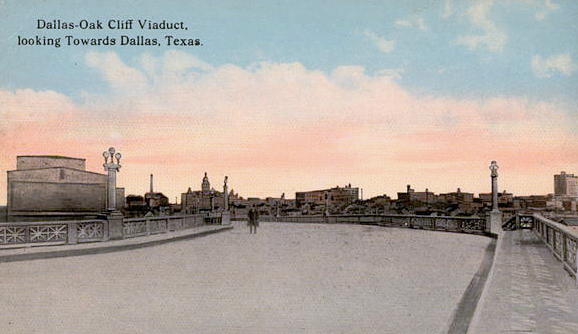
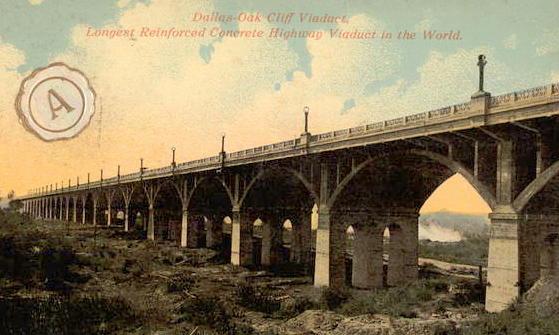
Here are a few contemporaneous images of the not-actually-so-narrow viaduct.


oak-cliff-viaduct_old_postcard

oak-cliff-viaduct_1924

oak-cliff-viaduct_fast_slow

Dallas-Oak Cliff Viaduct, looking Towards Dallas, TX

Dallas-Oak Cliff Viaduct

*

Copyright © 2014 Paula Bosse. All Rights Reserved.