Flashback : Dallas

A Miscellany: History, Ads, Pop Culture

Category: Neighborhoods

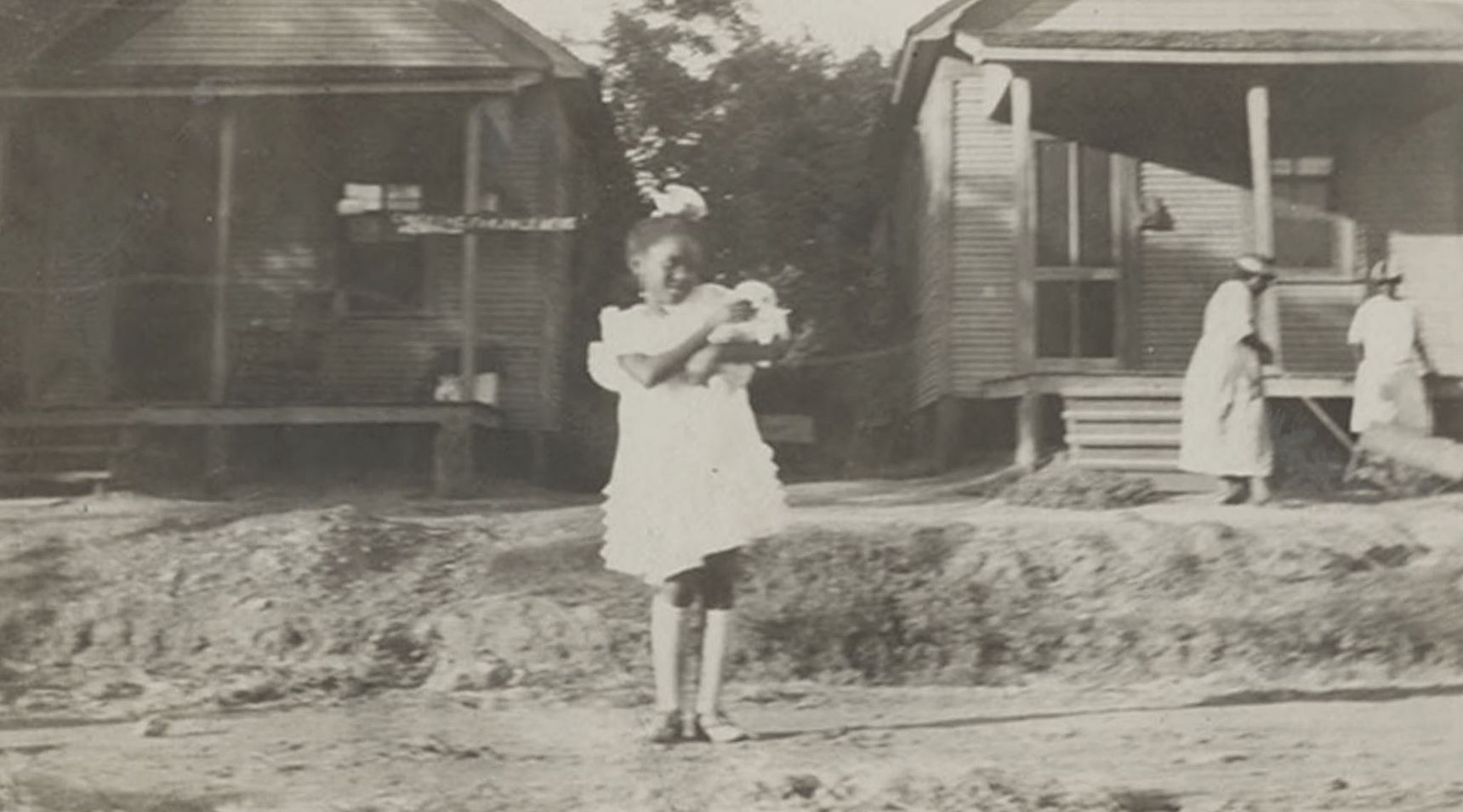
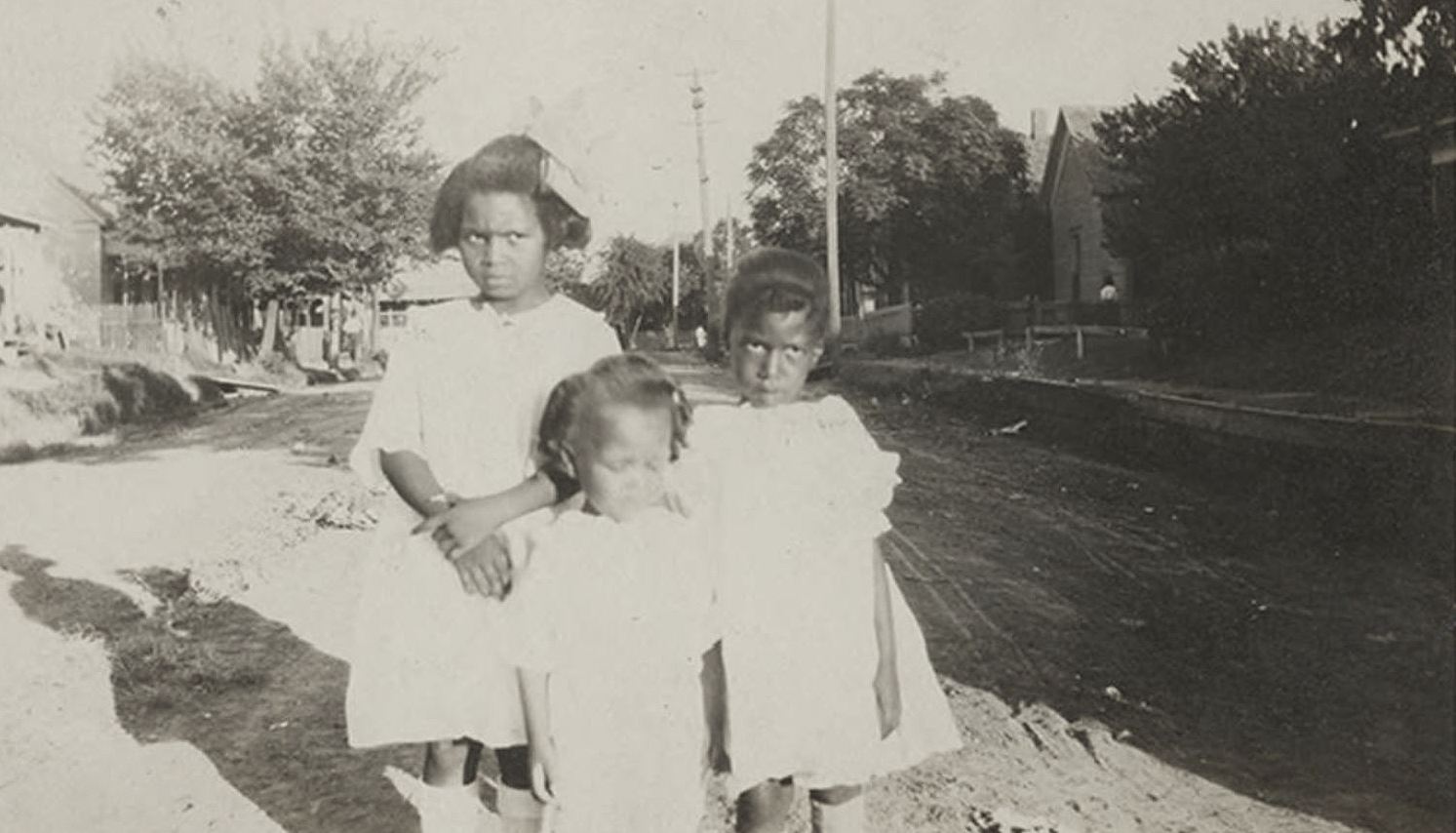
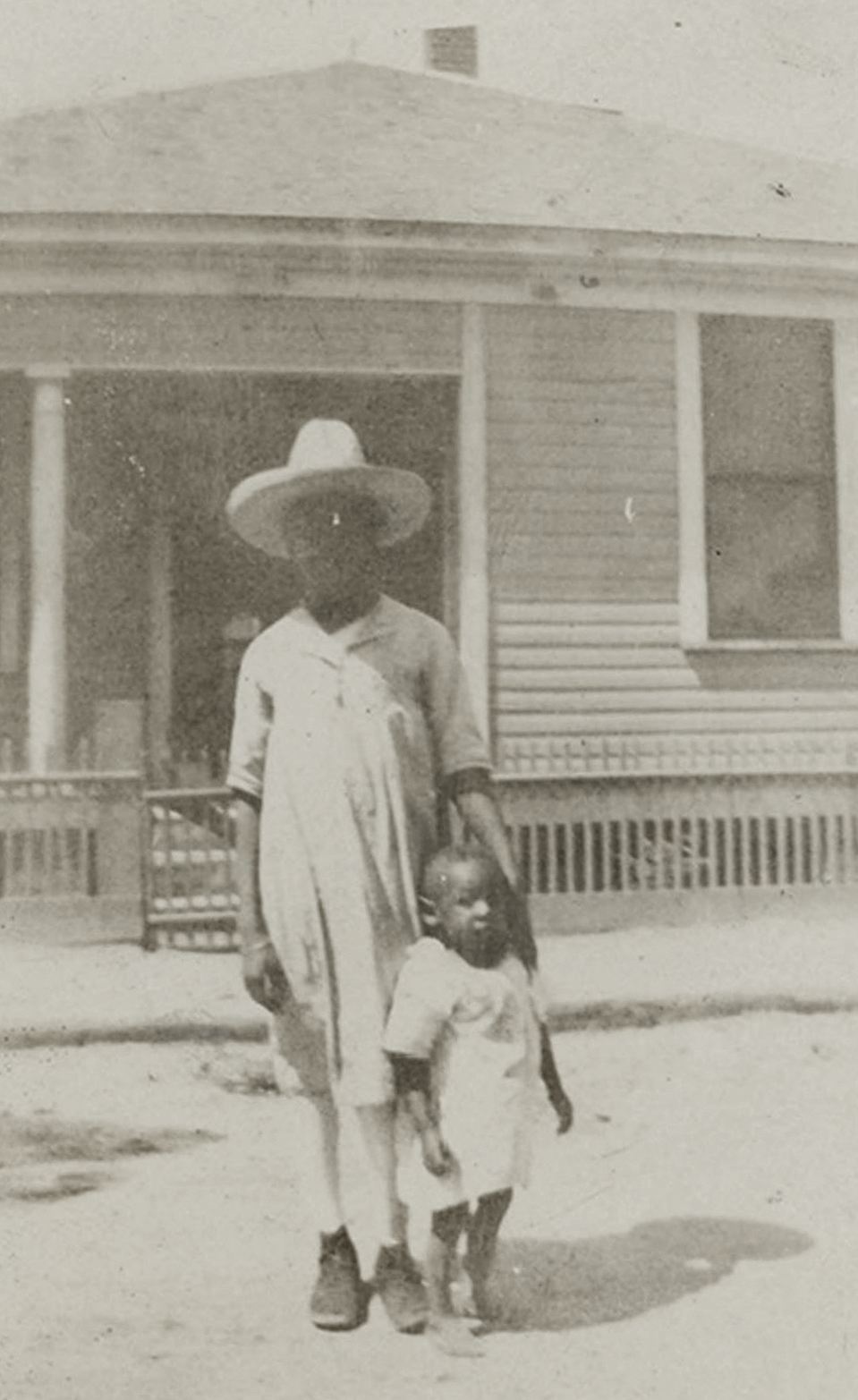
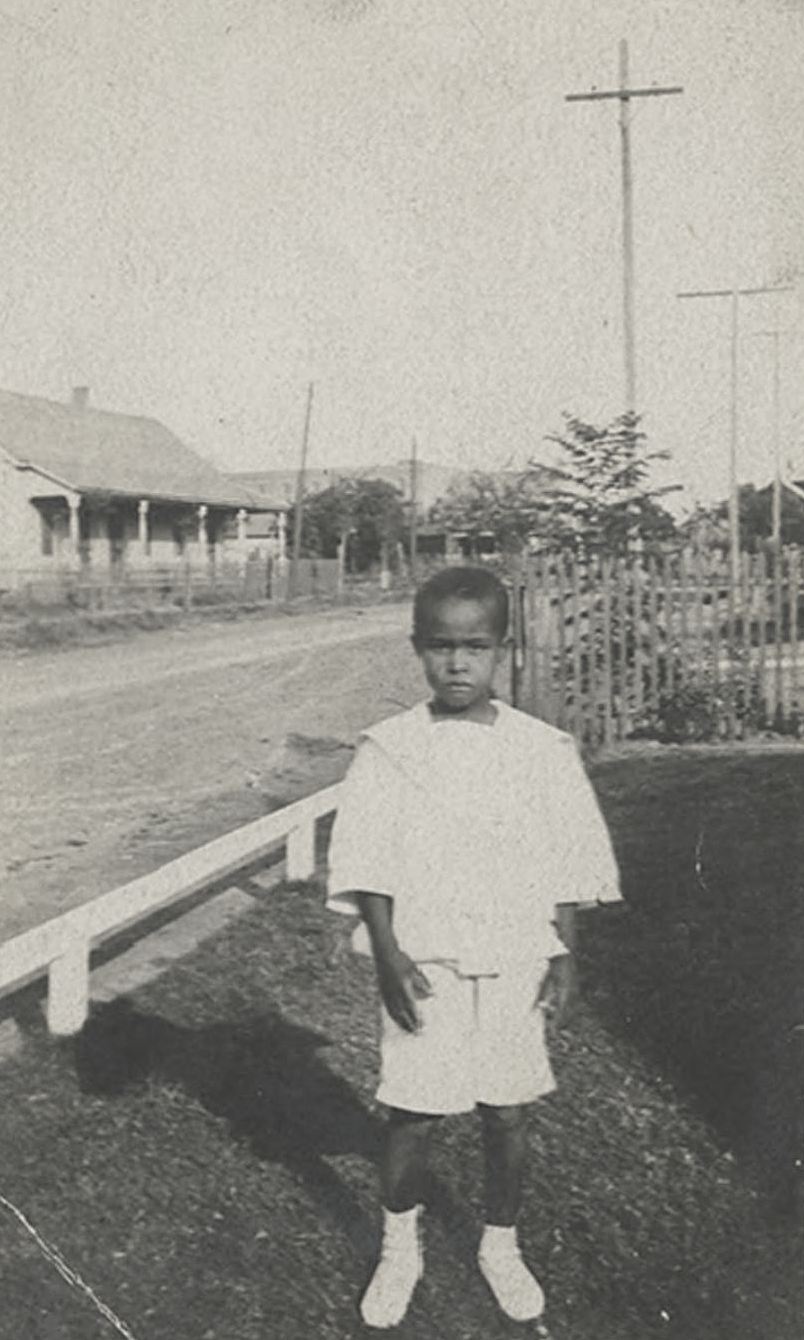
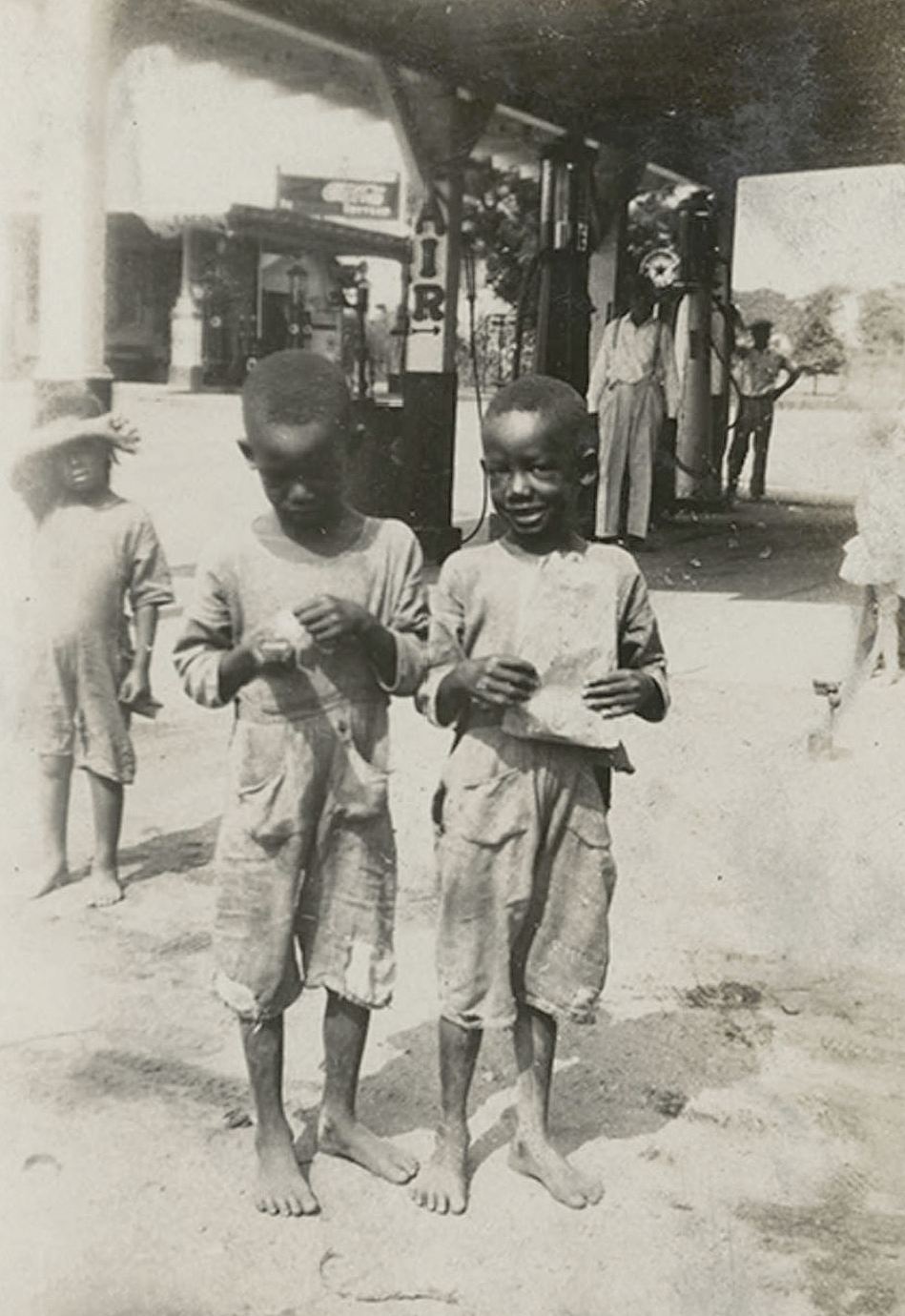
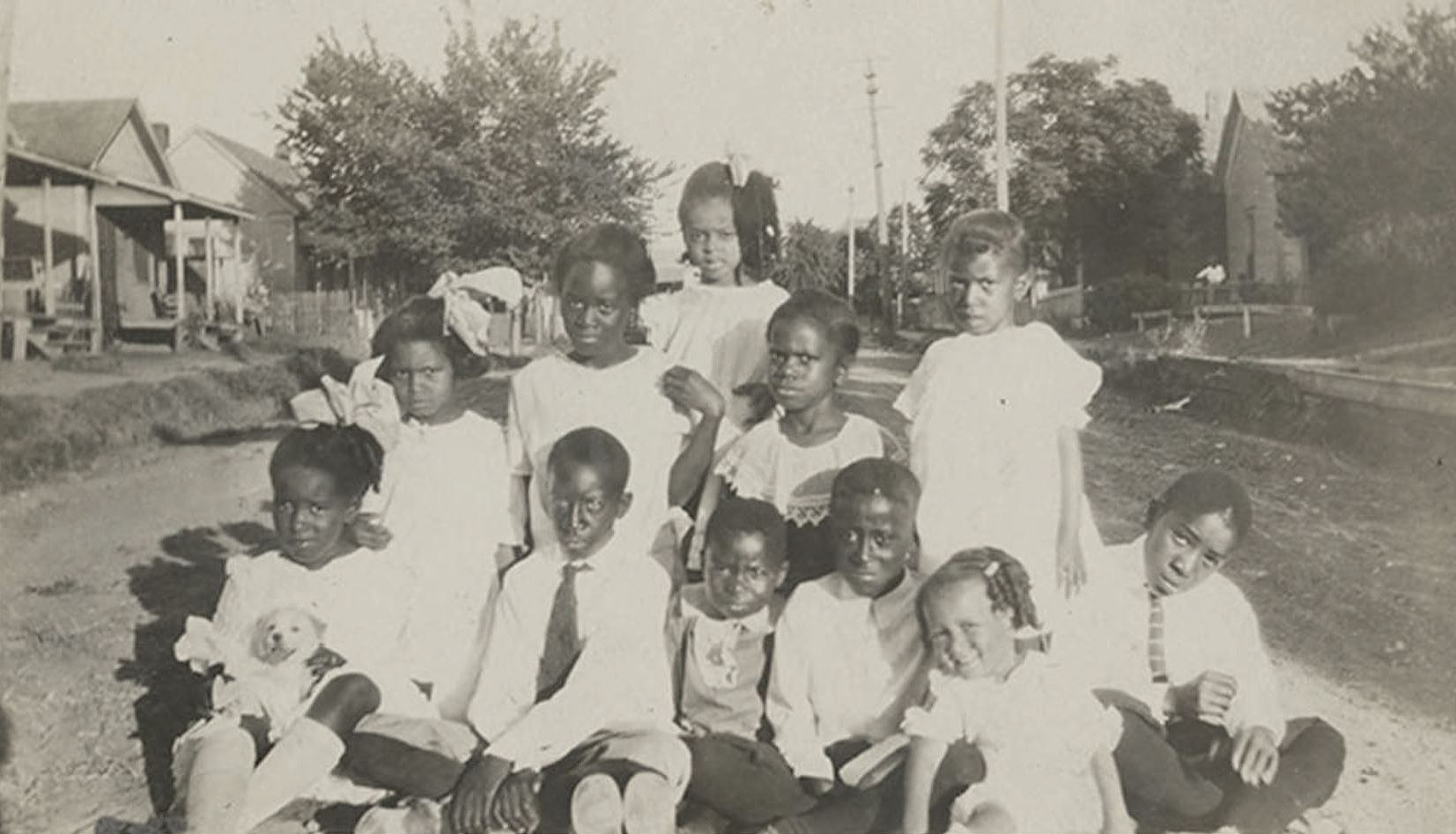
The Kids of State-Thomas

african-american-children_cook-coll_smu_1George W. Cook Collection, SMU

by Paula Bosse

More great photos from the George W. Cook Collection at SMU’s DeGolyer Library! Click photos to see larger images.

african-american-children_cook-coll_smu_2

african-american-children_cook-coll_smu_3

african-american-children_cook-coll_smu_4

african-american-children_cook-coll_smu_5

african-american-children_cook-coll_smu_6

***

Sources & Notes

All photos from the George W. Cook Dallas/Texas Image Collection, DeGolyer Library, Central University Libraries, Southern Methodist University. Additional information for each photo can be found for photo 1 here; photo 2 here; photo 3 here; photo 4 here; photo 5 here; and photo 6 here.

The State-Thomas area (also known in the past as Freedman’s Town and North Dallas) was once a vibrant African-American neighborhood which has now become swallowed up by “Uptown.” A short history can be found here (scroll down to “Freedman’s Town”).

Other State-Thomas-related photos can be found in these Flashback Dallas posts:

  • “The Allen Street Taxi Company,” here
  • “The Dunbar Branch: Dallas’ First Library for the African-American Community, 1931-1959,” here

Photos are big. Click them!

*

Copyright © 2016 Paula Bosse. All Rights Reserved.


Big Tex’s Hands

big-tex_dmn_091248_det1948 State Fair ad: “Hey, Texans!”

by Paula Bosse

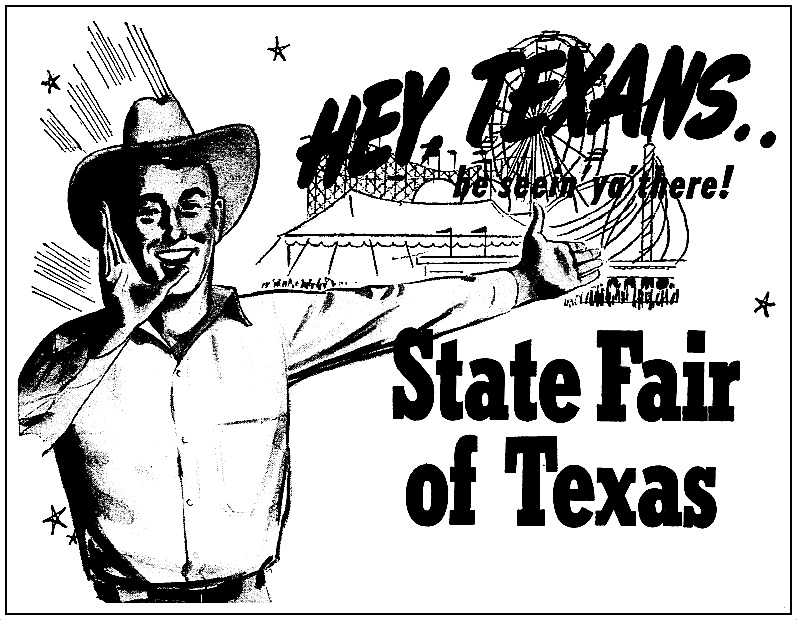
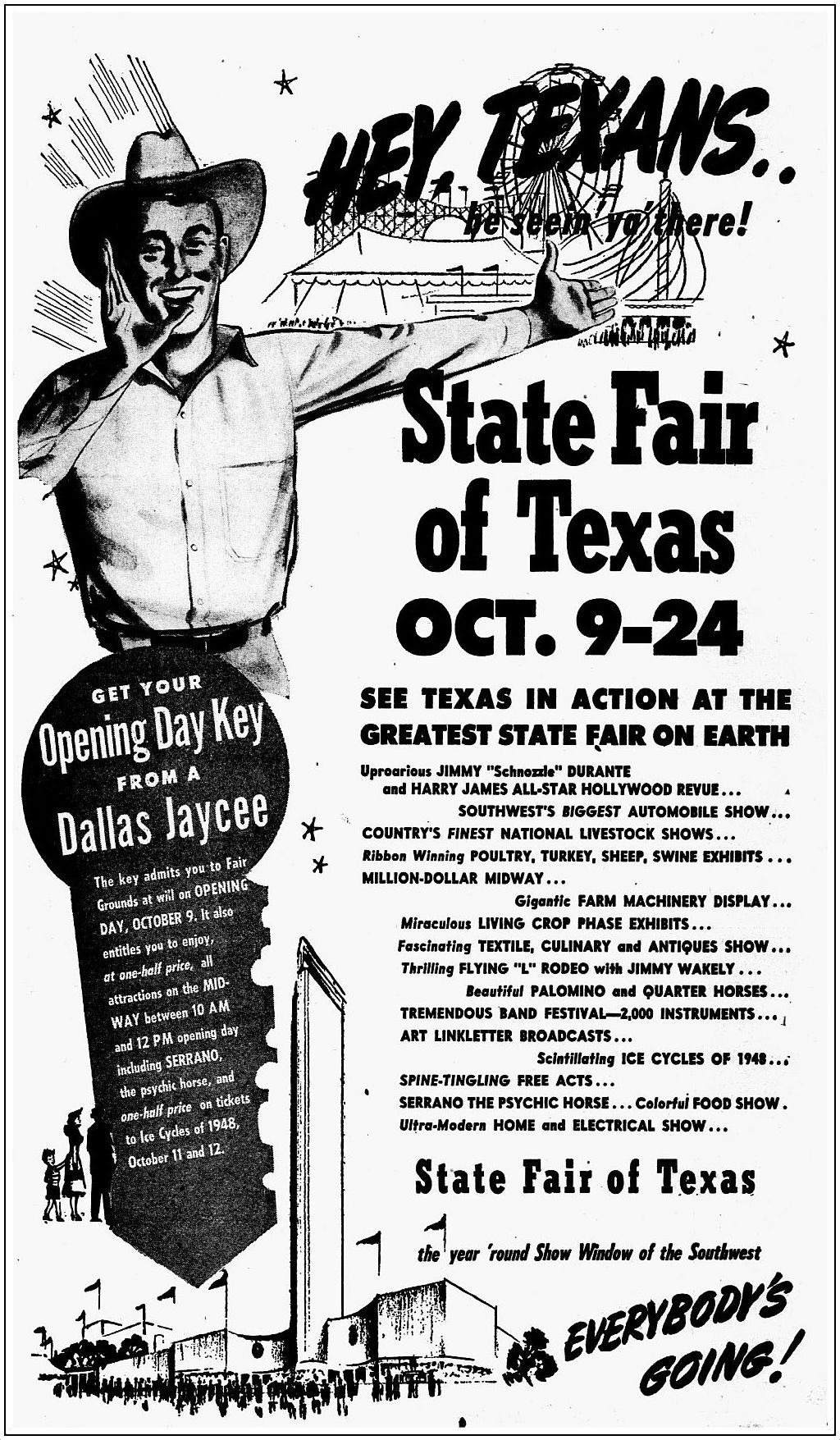
I stumbled across a State Fair of Texas ad a couple of days ago — a detail of which is above — and it made me wonder if it contained the precursor to our beloved Big Tex (whose annual hoisting-up occurred today). The ad is from 1948, four years before Big Tex’s debut at the 1952 State Fair. When I saw it I was immediately reminded of Big Tex and exclaimed to myself, “THAT’S what he should have been doing with his hands!”

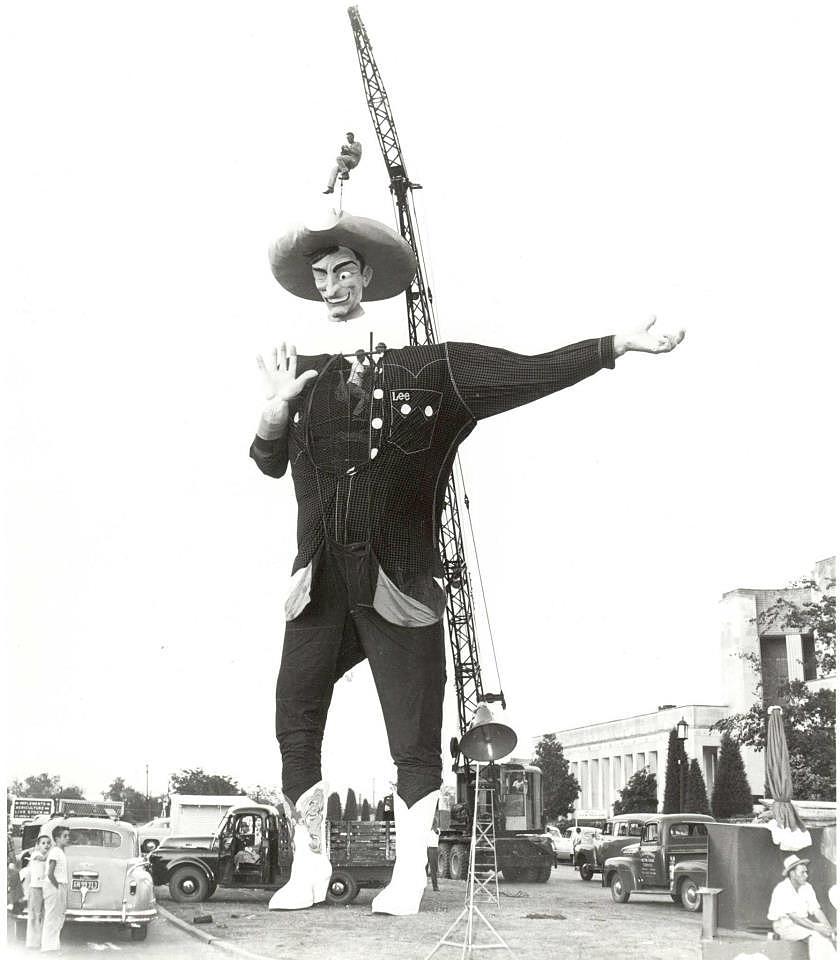
I’ve always wondered exactly what Big Tex is supposed to be doing with his hands. It’s a sort of vague “welcoming” gesture, I guess, but I can remember when I had to draw Big Tex in school that I was confused by that right hand. Was he waving? Was it an Indian “How!” greeting sign? It didn’t really look like either of those, and it really irked me (I was an easily-irked child). And, actually, it has continued to bother me all these years! (I am an easily-irked adult.)

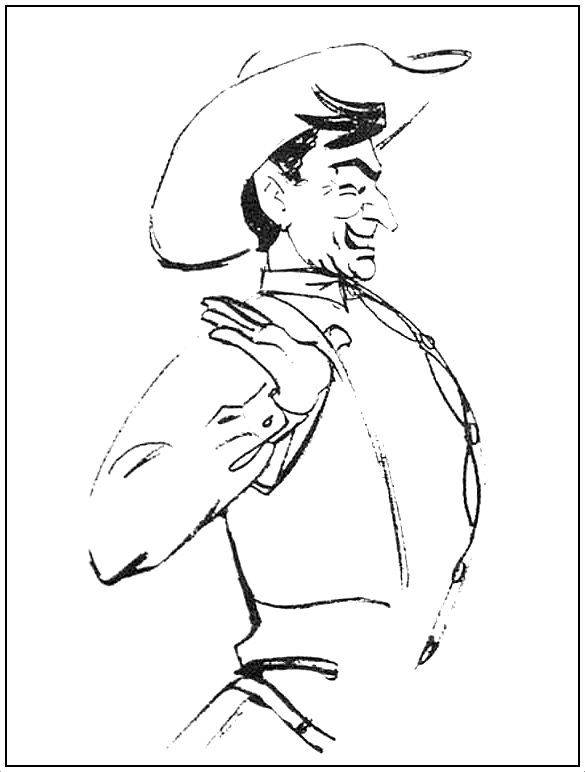
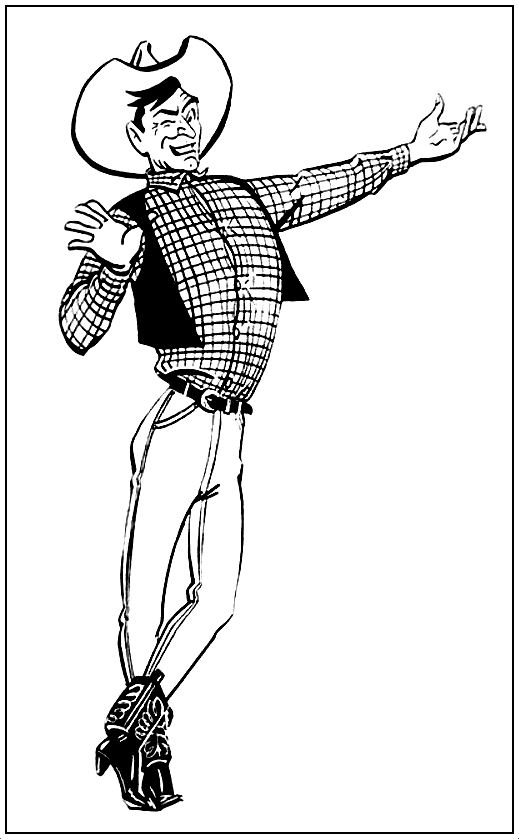
From early sketches, it seems that the right hand was intended to have the thumb hooked through a vest. Jack Bridges, Big Tex’s creator, wanted Tex to symbolize the larger-than-life Texan who wasn’t above indulging in good-humored bragging and tall-tale-telling, and that personality comes through in the sketch and the Big Tex illustration used in the 1952 ads, below.

big-tex-drawing_legend-of-big-tex

big-tex-ink_legend-of-big-tex
via The Legend of Big Tex

By the time Tex debuted, however, the vest seemed to have been discarded (as best I can tell from old photos), but the position of the right hand remained in that weird position (probably just to torment me as a child having to draw him in school).

big-tex_1952_installation_kera
A hovering, winking head, via KERA

Speaking of that very first version of Big Tex, in 1952 he had one eye shut, in the middle of a wink. He also had a long nose and wore a huge hat referred to in newspaper articles as a “sombrero.” In a 1983 interview, Jack Bridges said that in later years SFOT officials “made us open his eyes to make a ‘pretty boy’ outta him.” The wink was gone, the brim of the hat was made smaller, and his ears were moved forward. Even though Tex began to “talk” the next year, Bridges said, “I liked him better myself like he was — rugged and more or less caricature.”

The drawing of the man in the ad at the top probably has nothing to do with Big Tex, but dang if it ain’t pretty close! And the position of both hands makes sense! 

Here’s the full 1948 ad from the top:

big-tex_dmn_091248
1948

***

Sources & Notes

You can listen to a short (13-minute) interview done with Jack Bridges in 1983 as part of a Dallas Public Library oral history project, here. One of my favorite tidbits is Bridges remembering that vandals once painted a “big brown moustache” on the resting, disembodied head of Tex one year. He said that the head and the hat were kept in the Centennial Building when the fair wasn’t in progress, and the rest of Tex was kept in storage in various places around Fair Park. He said it was like making sure the president and vice-president never traveled together — if something happened to part of Big Tex, at least the whole of Big Tex wasn’t affected. (91-year-old Jack Bridges died in 2001; thankfully he didn’t have to witness the fiery … “incident” … of 2012.)

*

Copyright © 2016 Paula Bosse. All Rights Reserved.

2908 McKinney: The Emergency Home — 1912

emergency-home_dmn_031312_photo2908  McKinney Avenue, brand new in 1912… (click for larger image)

by Paula Bosse

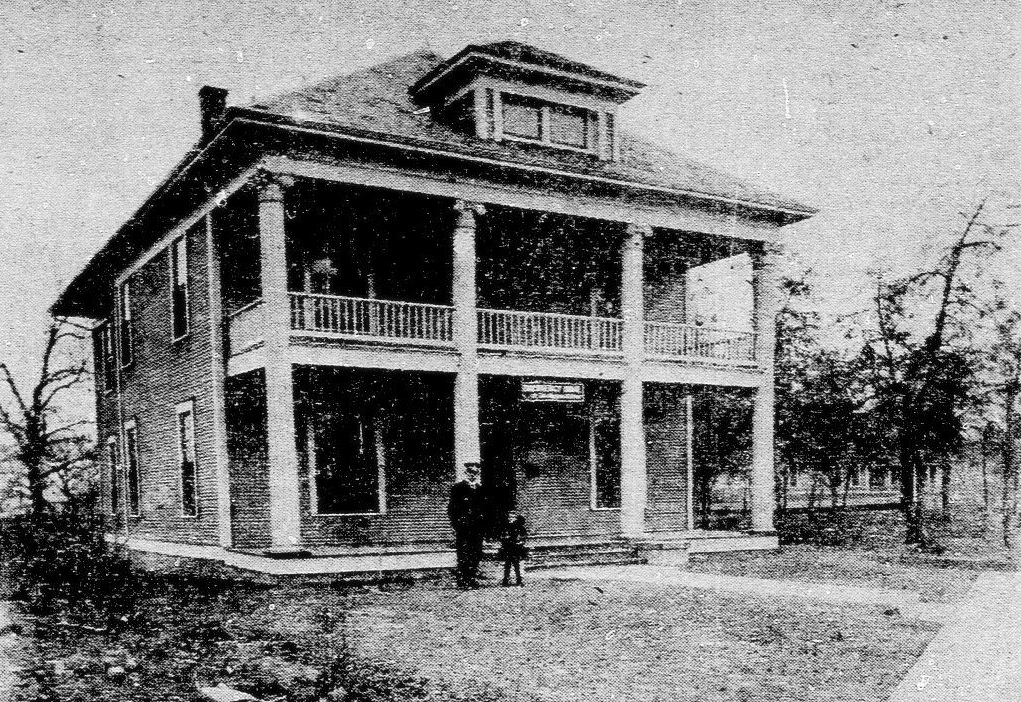
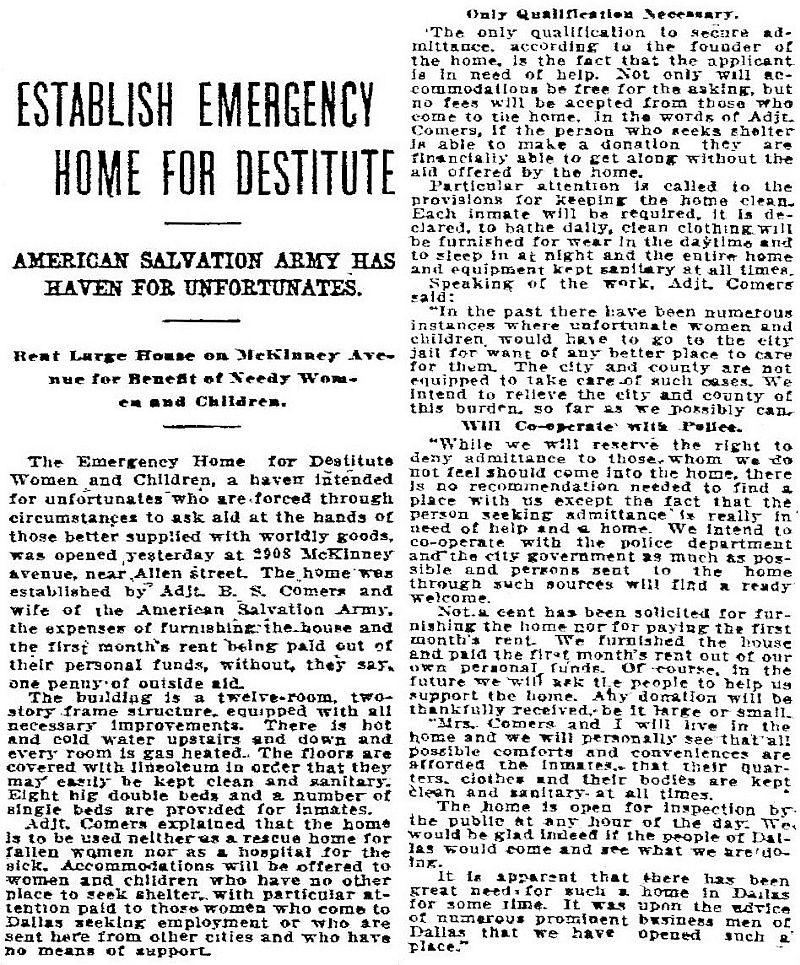
Above, the brand new Salvation Army “Emergency Home” in 1912. The accompanying headline and caption, from The Dallas Morning News (March 13, 1912):

American Salvation Army Home for Destitute

This place has been secured as shelter for unfortunate women and children. It is centrally located on McKinney Avenue, near Allen Street.

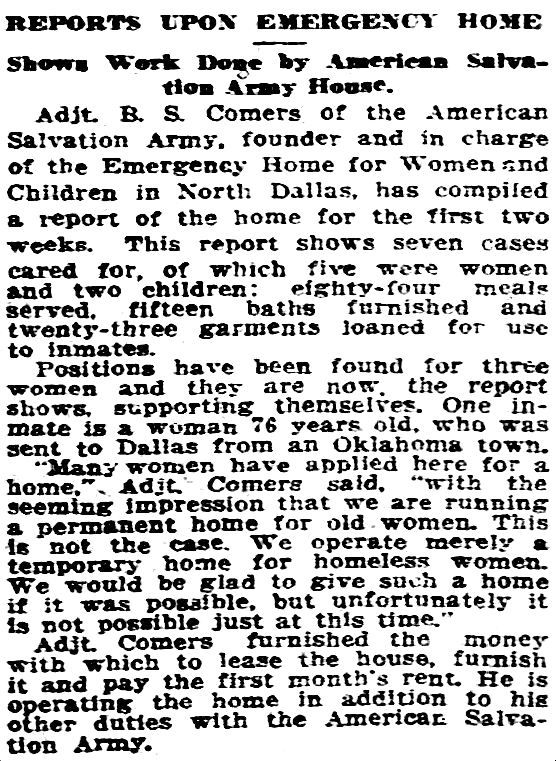
This “haven for unfortunates” was established on McKinney Avenue to temporarily house those (mostly women and children) who needed a helping hand until they were able to secure work and a permanent home.

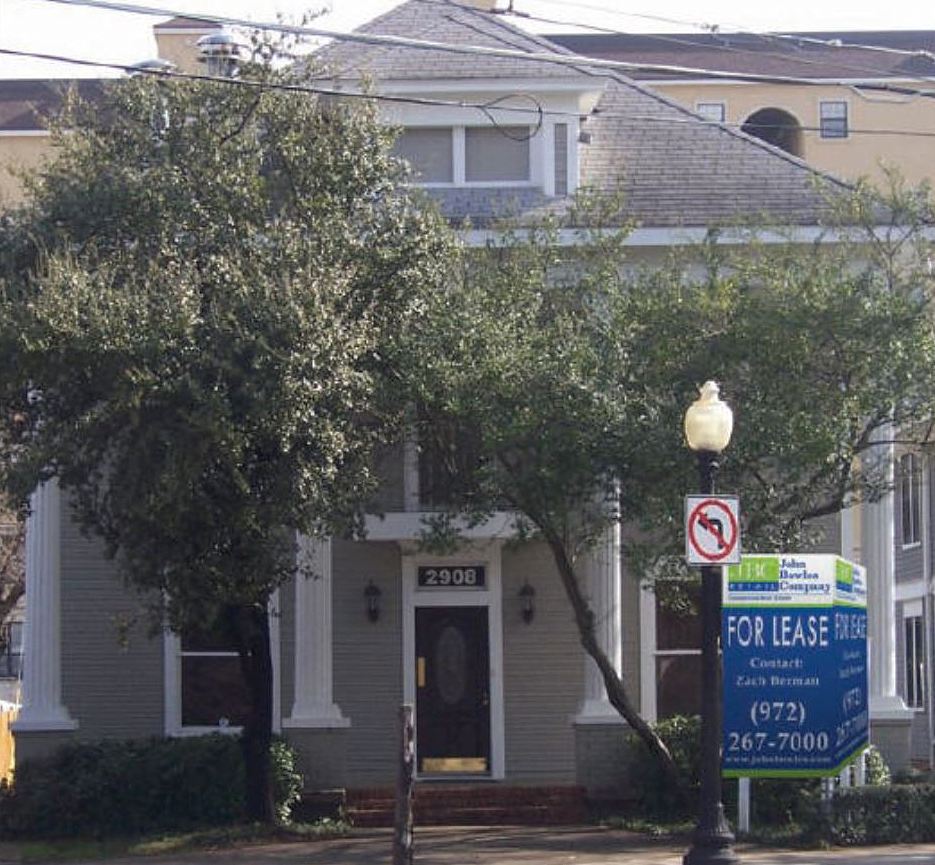
It appears that the home lasted only a couple of years. By the 1915 city directory, the house was vacant. It later became a private residence, a rooming house, a children’s clothing and furniture shop, a crime scene, a marble-top table emporium, a place to buy aquariums, a PR firm, the Dallas bureau of Texas Monthly, and a whole  bunch of bars and restaurants.

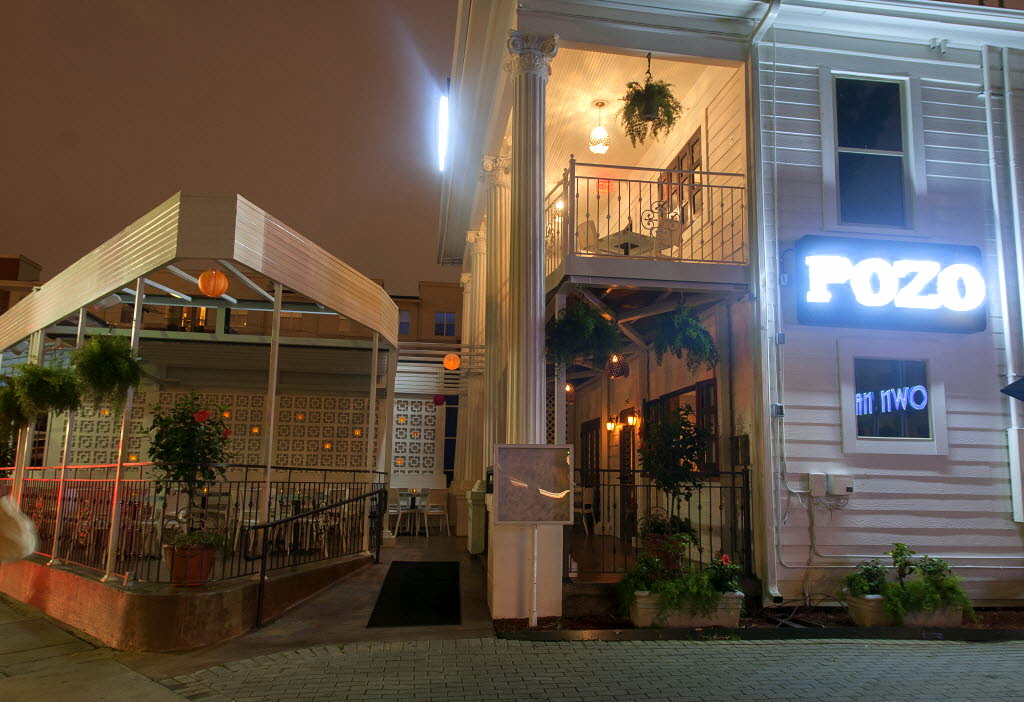
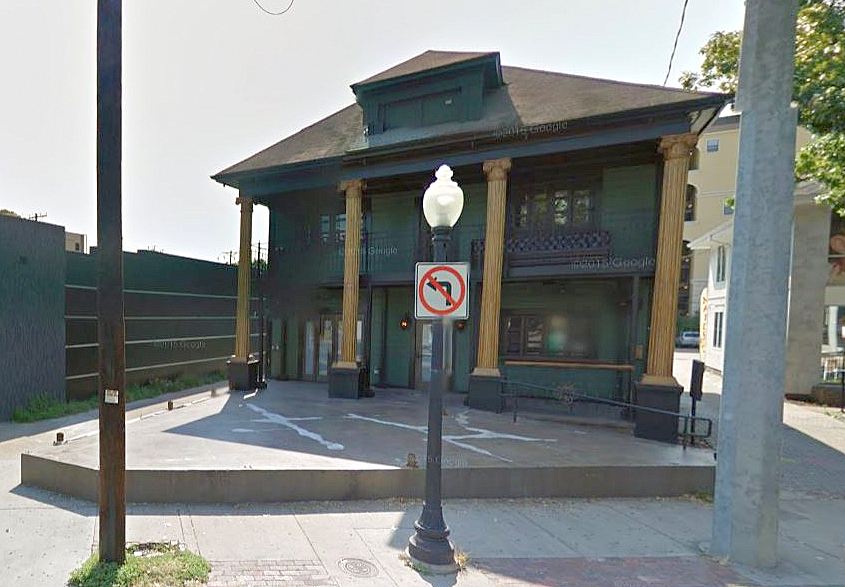
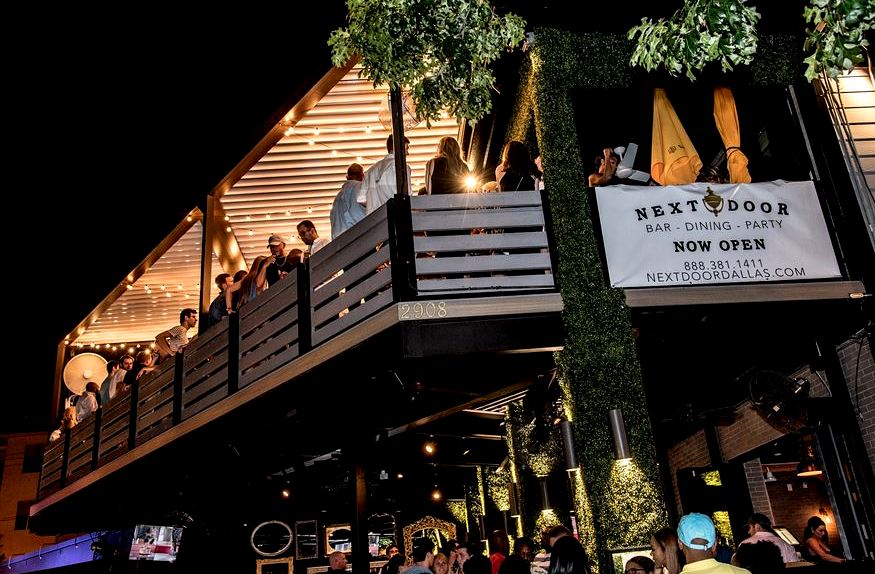
The 1912 house is still standing, and it’s currently a bar and restaurant catering to the young, Uptown party-set. Maybe the Salvation Army should set up a kettle out front this Christmas.

**

Below, a couple of articles about the first days of the “Emergency Home” (click for larger images):

emergency-home_dmn_022412
DMN, Feb. 24, 1912

emergency-home_dmn_031312
DMN, March 13, 1912

And a few photos of the house in recent years, showing a variety of paint colors and renovations.

2908-mckinney_for-lease

pozo_dmn_eatsblog_062013Dallas Morning News/Eats Blog

2908-mckinney_google_jan-2015Google Street View

2908-mckinney_dcadDallas Central Appraisal District photo — see it HUGE here

2908-mckinney_then-nowThen and now-ish

next-door_d-mag_2016Bret Redman/D Magazine

***

Sources & Notes

Top photo appeared in The Dallas Morning News on March 13, 1912 (photo by Clogenson).

As of this writing, 2908 McKinney Avenue is the bar/restaurant Next Door.

A couple of other Flashback Dallas posts concerning surprisingly old buildings along McKinney Avenue which have been re-purposed to attract Uptown nightlife:

Click photos and clippings for larger images.

*

Copyright © 2016 Paula Bosse. All Rights Reserved.


Zap Those Extra Pounds Away in Mrs. Rodgers’ Electric Chair — 1921

ergotherapy_jewish-monitor_090921_detThrowing the switch in 3-2-1… (click for larger image)

by Paula Bosse

While looking for something completely unrelated (which is always the best way to find unexpected things), I came across this full-page ad which appeared in the Sept. 9, 1921 edition of The Jewish Monitor (click to see a larger image):
ergotherapy_jewish-monitor_090921

Why Be Fat When
E R G O T H E R A P Y
WILL REDUCE YOU?

Within the last few years a method of automatic exercise, known as the Bergonie treatment, has found favor among physicians abroad in the treatment of obesity and other chronic disorders.

One advantage is that with the Sinusoidal current, which is employed, very powerful muscular contractions may be induced without pain or sensation other than that due to the muscular contraction itself.

The Treatment chair is the last word in comfort. It is fitted to meet the physiologic needs of the body as well as being comfortable. The arm and leg electrodes are wide and comfortably curved to fit the arms and legs of the patient easily. 

ERGOTHERAPY

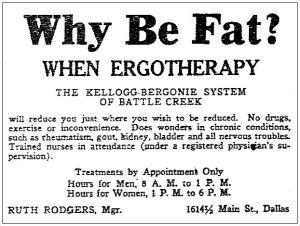
The Kellogg-Bergonie System of Battle Creek, Mich., will reduce you just where you wish to be reduced. No drugs, exercise or inconvenience. We will reduce you from one (1) to three (3) pounds per treatment and improve your physical condition. Trained nurses in attendance (under a registered physician’s supervision).

Treatments by Appointment Only

Hours for Men, 8 A.M. to 1 P.M.
Hours for Women, 1 P.M. to 6 P.M.
Phone X 5759
Ruth Rodgers, Mgr.
1614 1/2 Main Street, Dallas, Texas.

*

“The arm and leg electrodes are wide and comfortably curved” — there’s a line one doesn’t often encounter in an ad!

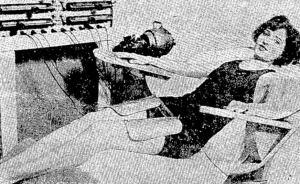
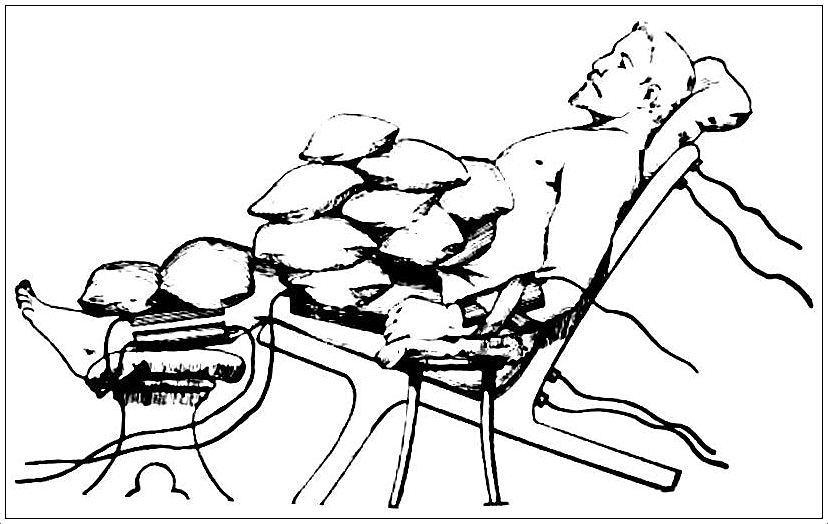
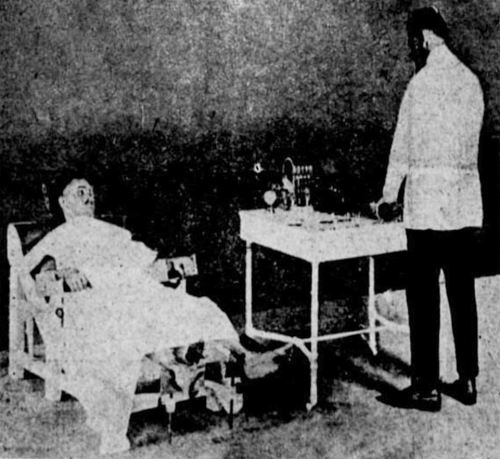
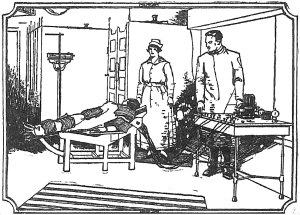
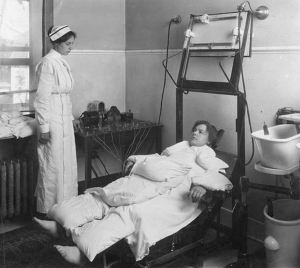
So what was this treatment of obesity that required “no drugs, exercise or inconvenience”? Well, basically, it was a low-voltage electric chair in which the naked, smock-draped “patient” reclined on wet towels and was covered with sandbags (which weighed up to 100 pounds). Electrodes were attached to the arms, legs, and abdomen. When the switch was flipped, electrically-provoked exercise began, and electric current caused muscular contractions (up to 100 a minute) without fatigue to the “exerciser.” All sorts of physiologic things were happening during these sessions, including a whole bunch of sweating. Patients would lose from 1 to 3 pounds during their time in the chair, hose themselves down and walk away refreshed.

Jean Albard Bergonié (1857-1925) was a French doctor/researcher/inventor who specialized in radiology in the treatment of cancer, and this odd electric chair was something of a departure from his oncology studies. It was used to treat a variety of ailments and conditions such as obesity, heart conditions, diabetes, “suppressed uric acid elimination,” and, later shell-shock. Professor Bergonié died in 1925 as the result of prolonged exposure to radium in his research to find a cure for cancer (in the years before his death, he had lost an arm and fingers to continual X-ray exposure). The Institut Bergonié continues in Bordeaux, France as a cancer research center.

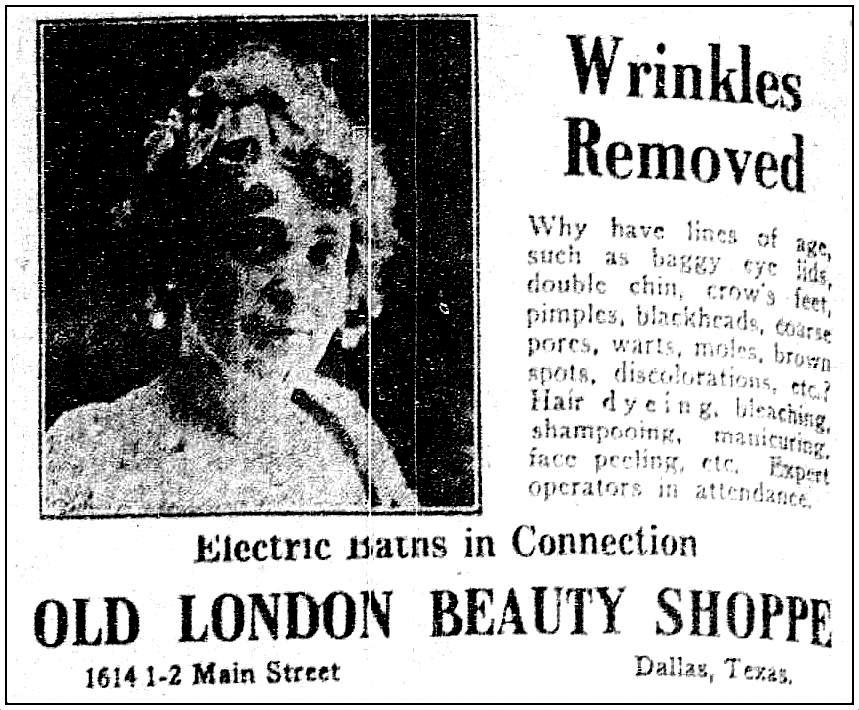
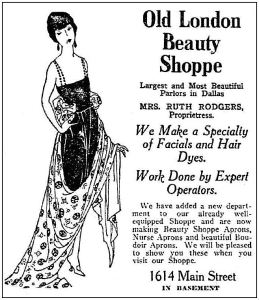
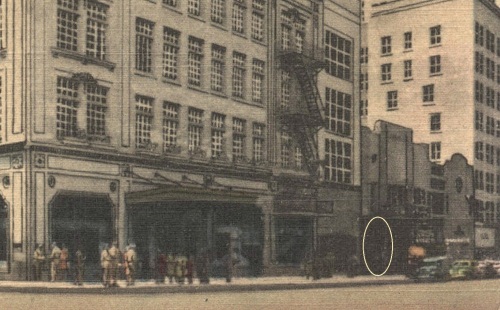
So back to the chair. By the time of the 1921 ad above, Bergonié’s “ergotherapy” had become a weight-loss feature in beauty spas and salons. The ads I found mentioning the electric chair as something corpulent men and women of means might have seen in Dallas newspapers appeared between July and October of 1921, touting the miracle chair at Mrs. Ruth Rodgers’ beauty salon, The Old London Beauty Shoppe at 1614 ½ Main Street, a couple of doors from Neiman-Marcus.
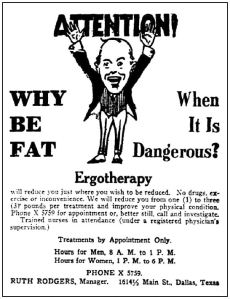
ergotherapy_071721
July, 1921

I don’t know if it didn’t catch on or whether it just wasn’t mentioned in ads, but the chair made its final appearance in an Old London Beauty Shoppe ad in early October of the same year.

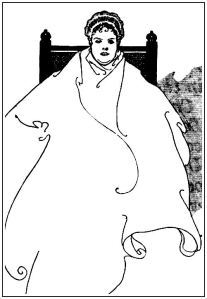
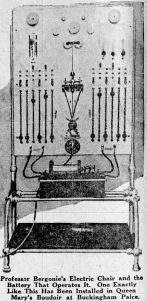
The splashiest news about Bergonié’s invention was a few months later, in early 1922, when it was revealed that the UK’s Queen Mary had availed herself of the chair in order to slim down in time for her daughter’s wedding, with Prof. Bergonié himself apparently operating the current flow. The best part of the lengthy and breathless article about the plump royal allowing herself to lie in this electric chair as she was rather unceremoniously weighted down with royal sandbags was this sentence:

[Mrs. David Lloyd George, the wife of the British prime minister] lost no time in telling Queen Mary all she knew about Professor Bergonie, the famous French ergotherapist, and his marvelous electric chair, which is said to jar fat from the human frame with the ease and almost the rapidity of a man peeling a tangerine.

Hey, I want that!

One would assume that sort of free publicity would be a boon to spas and salons offering State-side ergotherapy — I have a feeling Mrs. Rodgers had moved on by then and was probably kicking herself for concentrating on the more mundane treatment of wrinkles and sagging skin and the administering of marcel waves (her specialty).

Below, some views of The Chair over the years (all pictures larger when clicked).
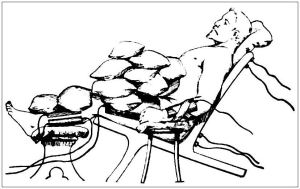
ergotherapy_1913-medical-bk_ebay

Above, a drawing from a 1913 medical book, found here.

*
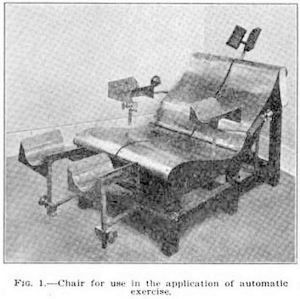
ergotherapy_medical-record_050115

From the journal Medical Record, May 1, 1915.

*
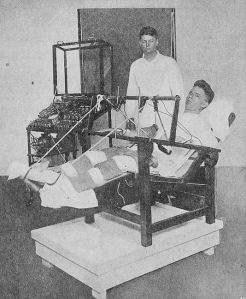
bergonie-chair_shell-shock_electrical-experimenter_feb-1919

A World War I soldier being treated for shell-shock, from The Electrical Experimenter (Feb. 1919), here (continued here).

*
ergotherapy_012321
Jan., 1921

Ruth Rodgers was the proprietress of the Old London Beauty Shoppe (later the Old London School of Beauty Culture), which seems to have operated in Dallas from the ‘teens to at least the late-1930s. The location during the period of the ergotherapeutic chair was in the basement of 1614 Main Street.

*

ergotherapy_dmn_081421
Aug., 1921

Mrs. Rodgers did it all. That might be her in the ad.

*
ergotherapy_081421
Aug., 1921

*

ergotherapy_082121
Aug., 1921

It’s a bit unusual seeing ads like this directed toward men.

*
ergotherapy_san-francisco-chronicle_092521
San Francisco Chronicle, Sept. 25, 1925

*
queen-mary_1922

Above, a very Aubrey Beardsley-esque depiction of the “distressingly stout” Queen Mary, ready to undergo her course of treatments. Read the full, widely-circulated article from February, 1922, “Queen Mary’s Jarring Anti-Fat Ordeal; Yearning for a Girlish Figure to Grace Her Daughter’s Wedding, the Queen-Mother Got One by Sitting in an Electric Chair and Losing 3½ Pounds a Week,” here. (They don’t write headlines like that anymore….) The photo below, showing the control panel, was also part of the article.
queen-mary_1922_battery

*

ergotherapy_ogden-standard-examiner_041826

The caption for this photo (which appeared five years after the cutting-edge Ruth Rodgers was offering it to Dallas patrons): “The new French electric chair on which one reclines in comfort while form-fitting electroids [sic] direct the fat-melting current, as demonstrated by Alice Harris, a stage beauty who must keep thin.” (Ogden Standard-Examiner, April 18, 1926)

*

And, finally, to bring this back to Dallas, the location of Mrs. Rodgers’ Old London Beauty Shoppe in 1921 — 1614½ Main Street (basement) — is circled (this building was later the Everts Jewelry store before it moved across the street to the north side of Main). To the left is Neiman-Marcus, at the corner of Main and Ervay. (Full view of this postcard, from the collection of the DeGolyer Library, SMU, is here.)
1614-main_n-m_degolyer_smu_det

***

Sources & Notes

Top photo is a detail from the ad below, which appeared in the Sept. 9, 1921 edition of The Jewish Monitor; it can be accessed via the Portal to Texas History, here.

Read a doctor’s account of just how Bergonie’s chair worked, in the article “Modern Treatment of Obesity” by Edward C. Titus (Medical Record, Jan. 24, 1920), here.

I’m not sure about the connection of this chair to J. H. Kellogg (the treatment in the ad was referred to as “The Kellogg-Bergonie System of Battle Creek, Mich.”). It appears that he and Bergonie might have developed similar chairs independently of one another and decided to form some sort of partnership — either by mutual agreement or court edict. Here is a photo of Kellogg’s “patented electrotherapy exercise bed” used in his Battle Creek sanitarium:
kellogg-chair
via Oobject (more Kellogg contraptions here)

And speaking of Mr. Kellogg, might I direct your attention to a previous Flashback Dallas post — “Electricity in Every Form — 1909” — here.

Click pictures for larger images

*

Copyright © 2016 Paula Bosse. All Rights Reserved.

The Mitchell Building: Home to Cotton Gins, Rockets, Frozen Beverages, A/C Units, Slackers, Squatters, Hipsters, and Urban Loft-Dwellers

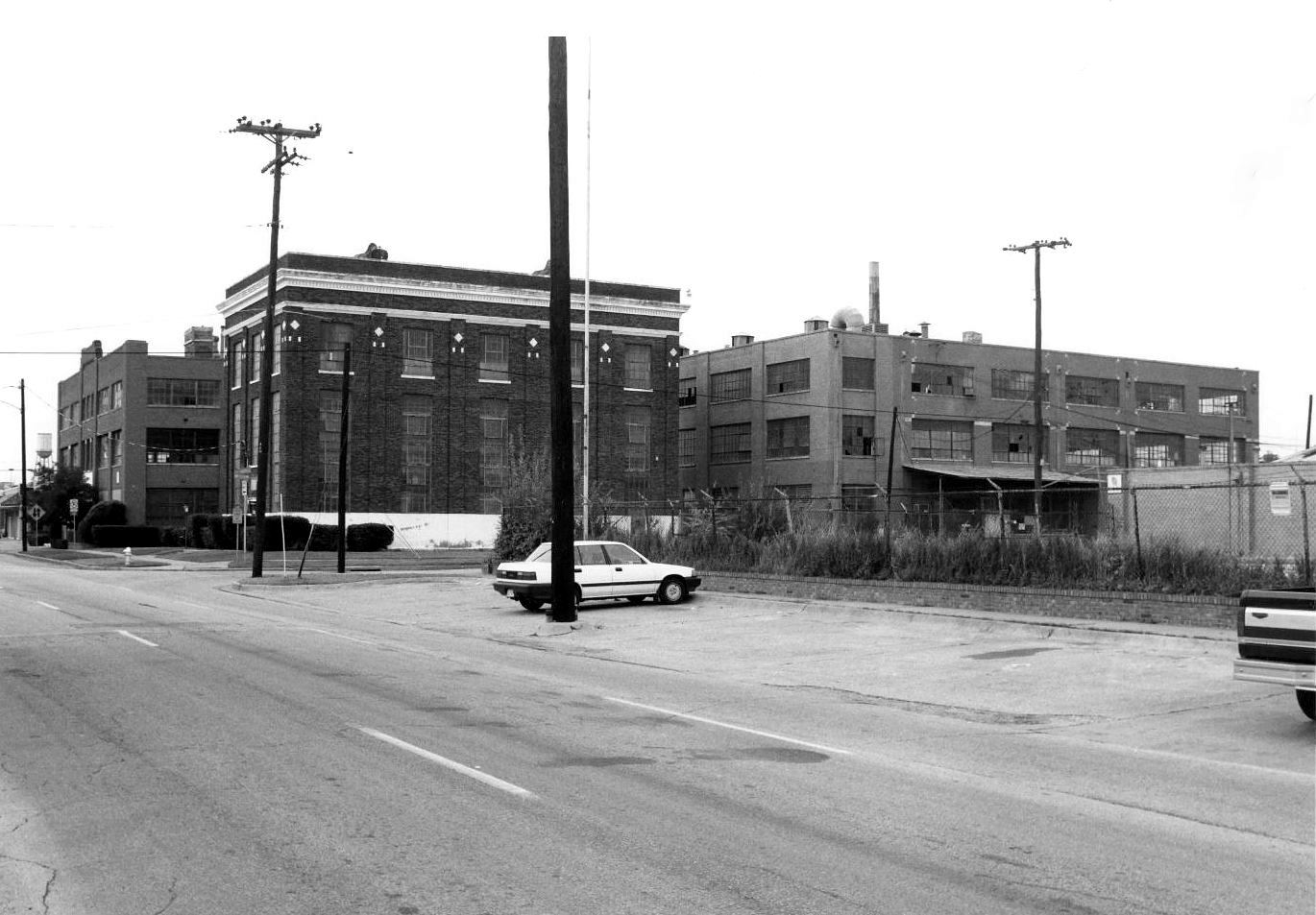
mitchell-bldg_oct-1988_appl-natl-register-hist-placesIn 1988, the building had seen better days… (click for larger image)

by Paula Bosse

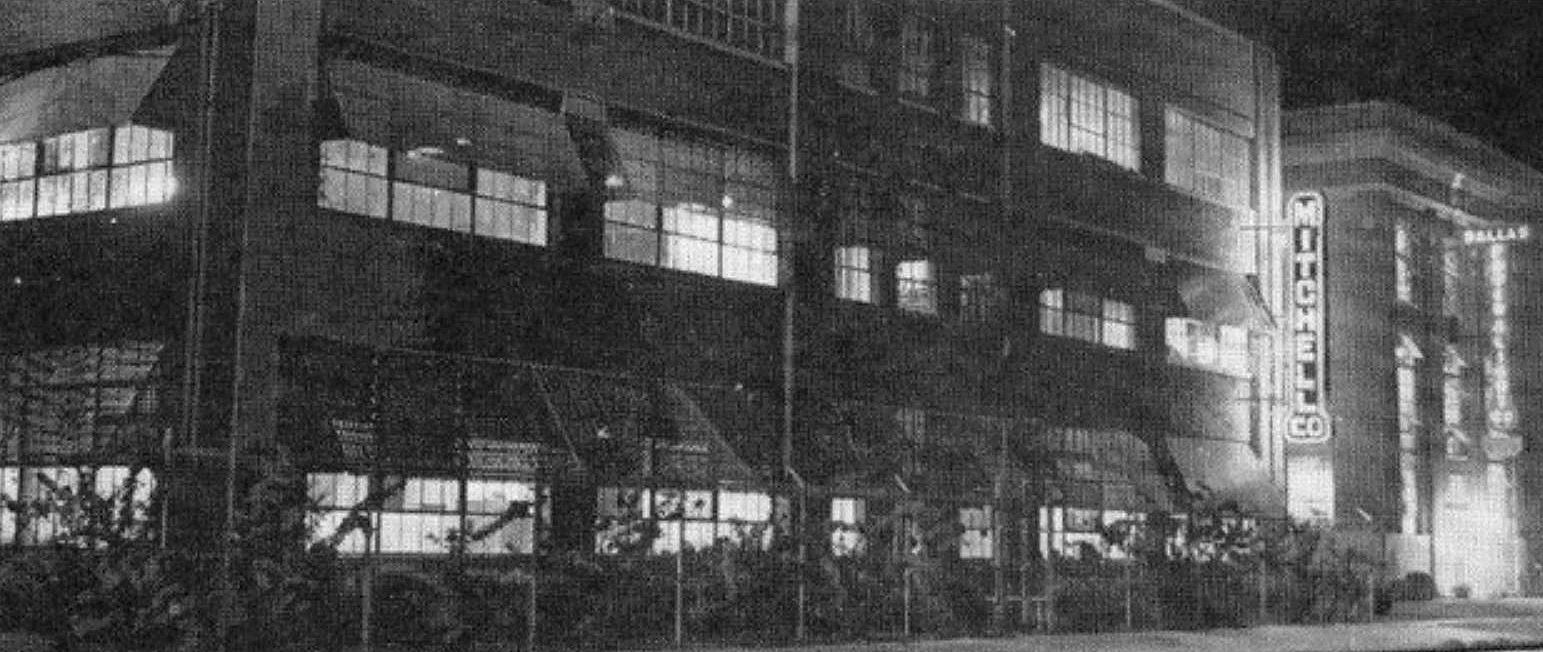
In 1928, the John E. Mitchell Company (discussed previously here, here, and here) arrived in Dallas from St. Louis and built their J. A. Pitzinger-designed 2-story factory at 3800 Commerce Street (a wing was added the next year, and a third story was added the year after that). It produced cotton gins and farm implements. As strange as it seems today, Dallas was once the largest producer of cotton gin machinery in the United States. The Mitchell Company was located in a mostly industrial area very close to several other cotton gin manufacturers (such as the nearby  Continental Gin Company and Murray Company). At the height of their production, these Dallas factories were  responsible for half of the world’s cotton gins.

When World War II hit, the company became an important defense contractor and produced munitions for the U.S. Navy and U.S. Army, making things such as “anti-submarine projectiles,” anti-aircraft shells, rocket nozzles, and “adapters for incendiary bomb clusters.”

After the war, the Mitchell Company continued to manufacture agricultural implements but diversified by turning out other types of machinery, like automobile air conditioners and and cleaning systems. As the 1960s dawned, they developed the machine that made ICEE frozen slushy drinks (forever immortalized by 7-Eleven as The Slurpee).

After the death of company president John E. Mitchell, Jr. in 1972, the business began a slow slide downward. The company appears to have gone out of business in the early 1980s. In the fall of 1982, the company’s equipment was sold at public auction, and, in 1984, the building became the temporary home of the Junior Black Academy of Arts and Letters.

In the 1980s, Deep Ellum and Exposition Park began to explode with new bars, clubs, and galleries. If it was cool, it was in Deep Ellum and Expo Park; if it was in Deep Ellum and Expo Park, it was cool. Artists and musicians began to move into many of the neighborhood’s old warehouses. These usually run-down buildings — in which bohemian types lived (not always legally) and used as studio spaces — were huge and (in the beginning) cheap. The Mitchell Building became something of a ground zero for wild parties and was described in a fantastic 1995 newspaper article by Shermakaye Bass (linked below) as both a “flophouse” and “an artists commune and downtown slacker den.” The building was closed and boarded up by its owners in early 1995 in order to avoid code-violation citations, but by 1999 the building had been purchased, cleaned up, modernized, and converted into 79 loft apartments. Today, the Mitchell Lofts have been a part of the Expo Park scene for almost 20 years.

*

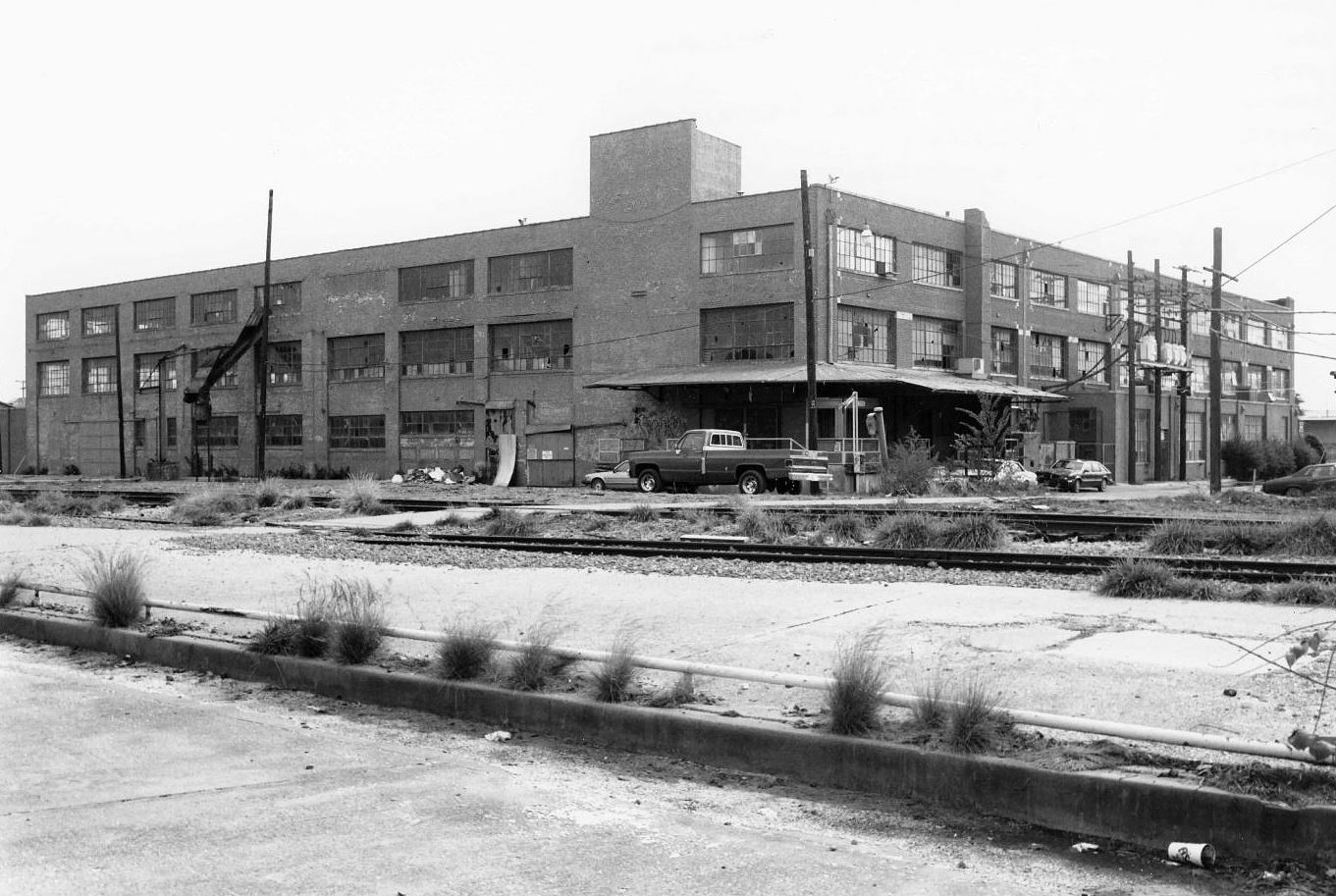
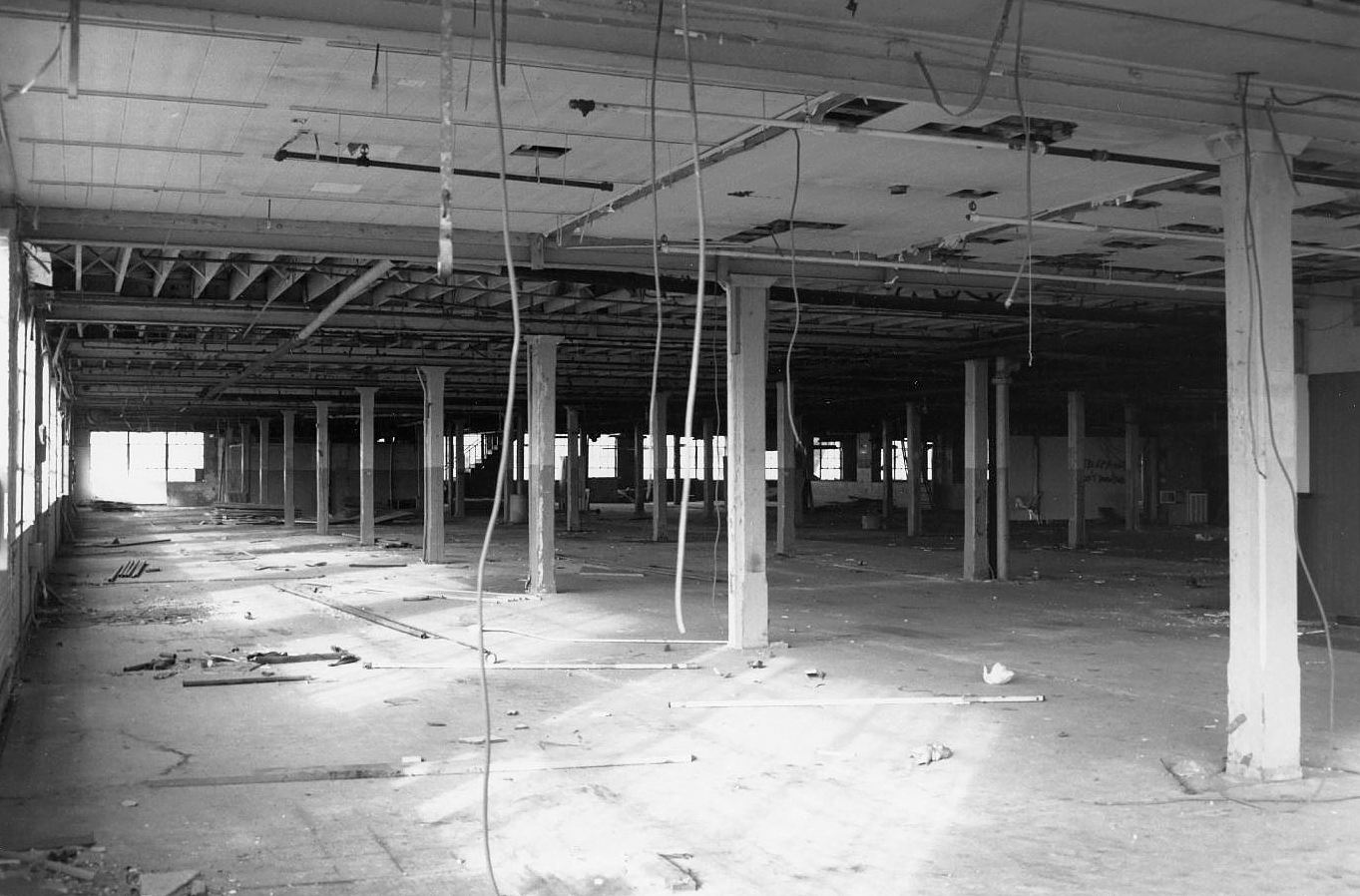
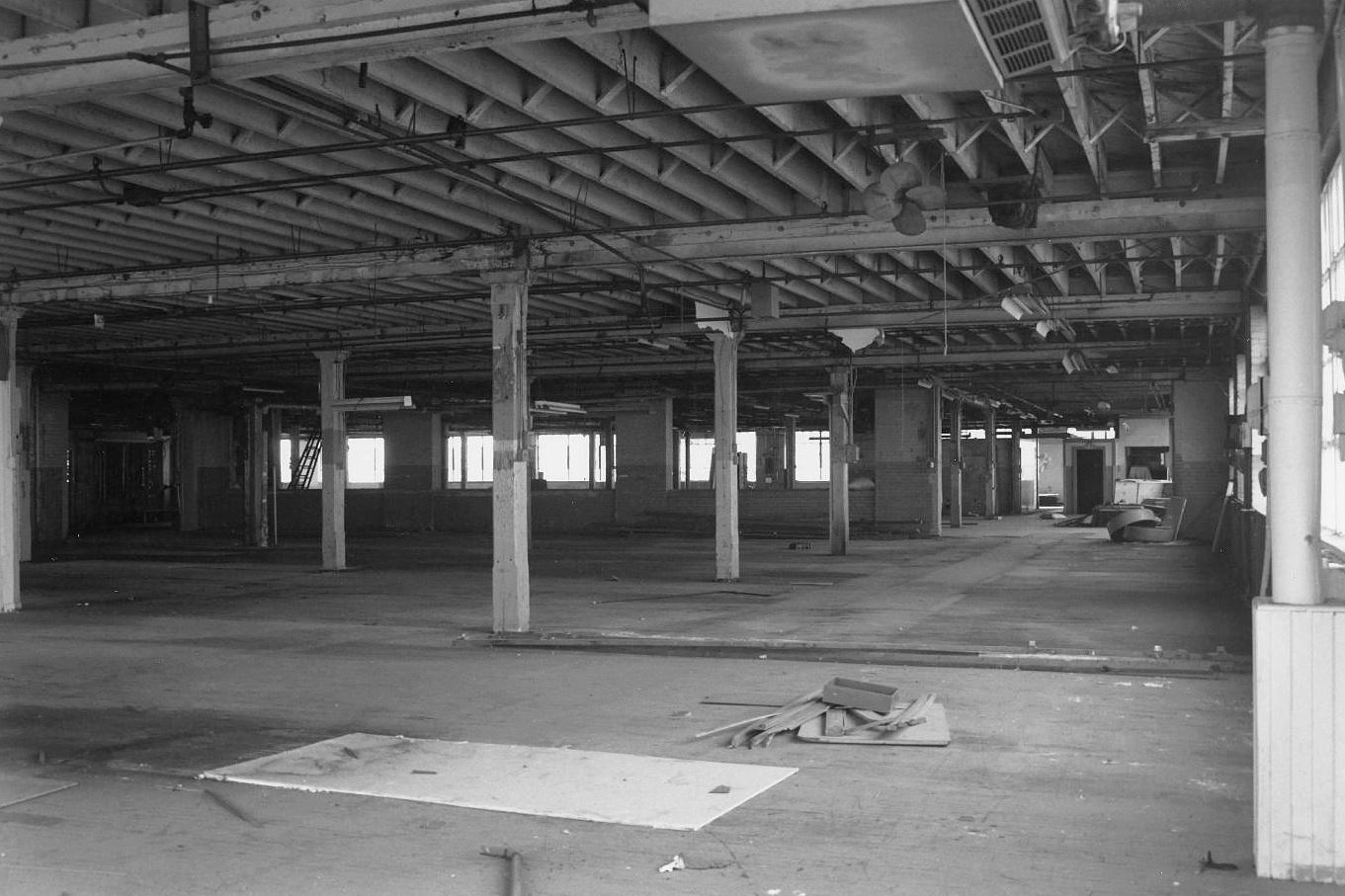
In 1991, the Mitchell Building was listed on the National Register of Historic Places. The photographs below (and the one at the top) were included in the application form. They were taken by Daniel Hardy of Hardy-Heck-Moore in October, 1988. Things weren’t looking great for the building in 1988. It must have been quite an undertaking to convert this large L-shaped building (which had certainly seen better days) into hip, sleek lofts.

Below, looking northwest on Commerce. The Mitchell Building is in an L-shape — the smaller building in the foreground is an old Dallas Power and Light substation, built around 1925. (Click photos to see larger images.)

mitchell-bldg_oct-1988_2

*

The back, from the old T&P/Missouri-Pacific railroad tracks.

mitchell-bldg_oct-1988_3

*

And two interior views of the second floor.

mitchell-bldg_oct-1988_4

mitchell-bldg_oct-1988_5

*

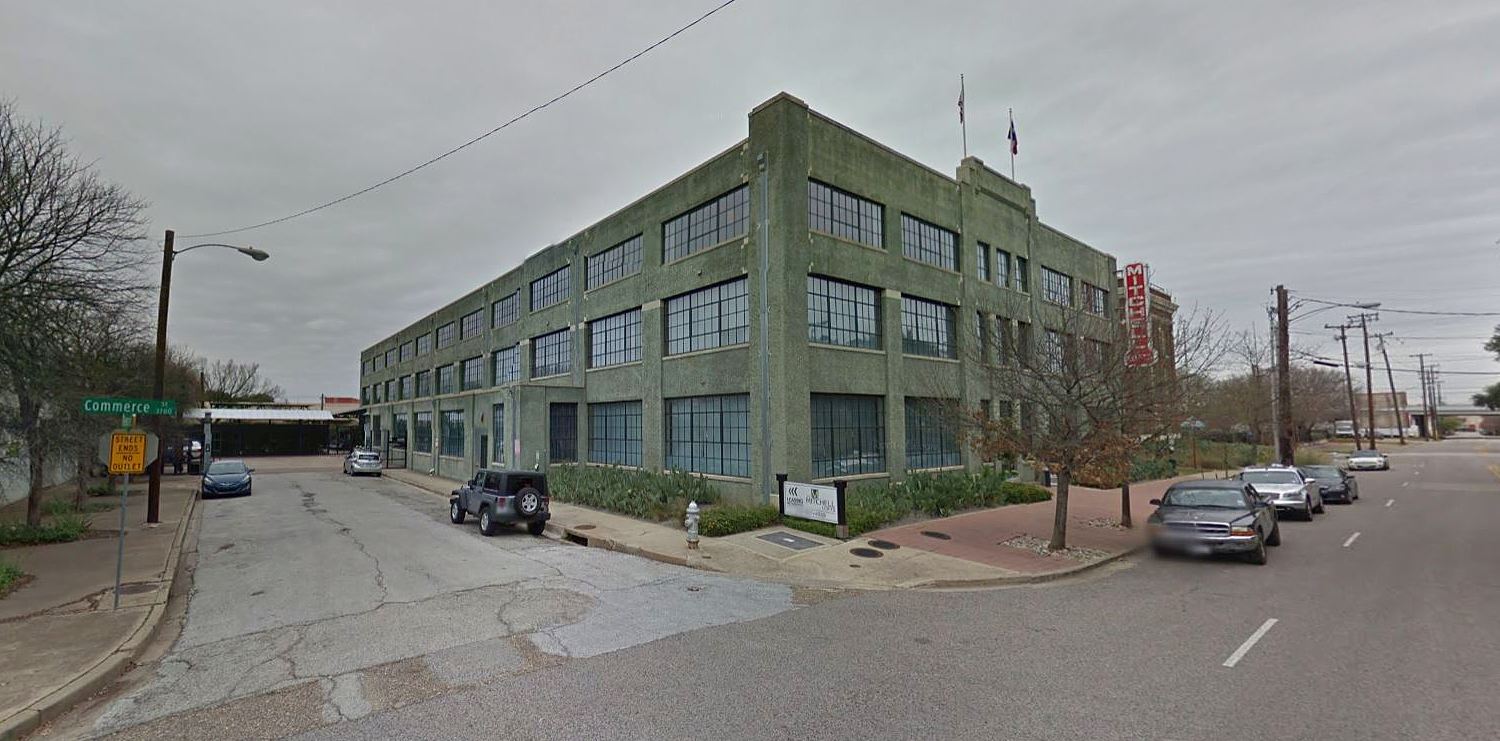
Here’s what the exterior looks like today, spiffified. (Explore it on Google Street view here.)

mitchell-lofts_google_jan-2016Google Street View (Jan. 2016)

mitchell-building_google
Google Maps

**

mitchell_sign_war-bk
Mitchell War Book, ca. 1945

mitchell-building_flickr_colteraFlickr

***

Sources & Notes

Photos are from the application to the National Register of Historic Places; in addition to the photos, there is a thorough history of both the building and the John E. Mitchell Company, written by David Moore of Hardy-Heck-Moore. The 28-page form can be found in a PDF, here. (3/14/17 UPDATE: The link no longer works for me, and I am unable to find the document. Here’s the full URL: ftp://ftp.dallascityhall.com/Historic/National%20Register/John_E_Mitchell_Plant.pdf.)

More info on the Mitchell Company and its building through the years can be found in the following Dallas Morning News articles:

  • “Dallas Gets Gin Factory” (DMN, March 17, 1928) — the announcement that a permit has been granted for the construction of a two-story brick factory and warehouse
  • “John E. Mitchell Exemplifies Faith as Secret to Success,” by Helen Bullock (DMN, July 17, 1949) — an entertaining profile of John E. Mitchell, Jr.
  • “Demise of a Dream Factory — Deep Ellum’s Historic Mitchell Building Leaves a Legacy of Artistic and Industrial Vision,” by Shermakaye Bass (DMN, Feb. 5, 1995) — for those who grew up when Deep Ellum was experiencing its (first) renaissance, the article is a great snapshot of what things were like in Deep Ellum and Exposition Park back in the ’80s and early ’90s

See what the Mitchell Lofts look like now in this Candy’s Dirt article from 2014; more photos are here. Pretty hard to believe people used to manufacture things like cotton gins and anti-aircraft missiles there.

The Mitchell Lofts website is here.

Click pictures and clipping to see larger images.

*

Copyright © 2016 Paula Bosse. All Rights Reserved.
 

The John E. Mitchell Company’s WWII Munitions Work (Part 3)

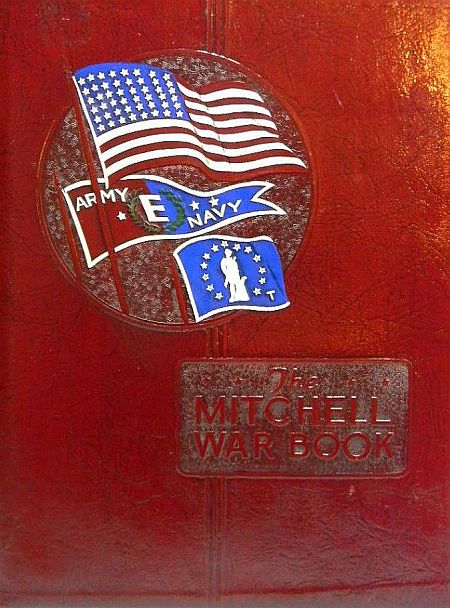
mitchell-war-book_ebay
The Mitchell War Book

by Paula Bosse

My previous two posts have been on the John E. Mitchell Company’s period as a full-time contract manufacturer of munitions and materiel for the Navy and Army. I had planned for my third Mitchell post to be about the building itself, but I just happened across this book — The Mitchell War Book — and I thought I would go ahead and slip this in now. I’ll write about the building next.

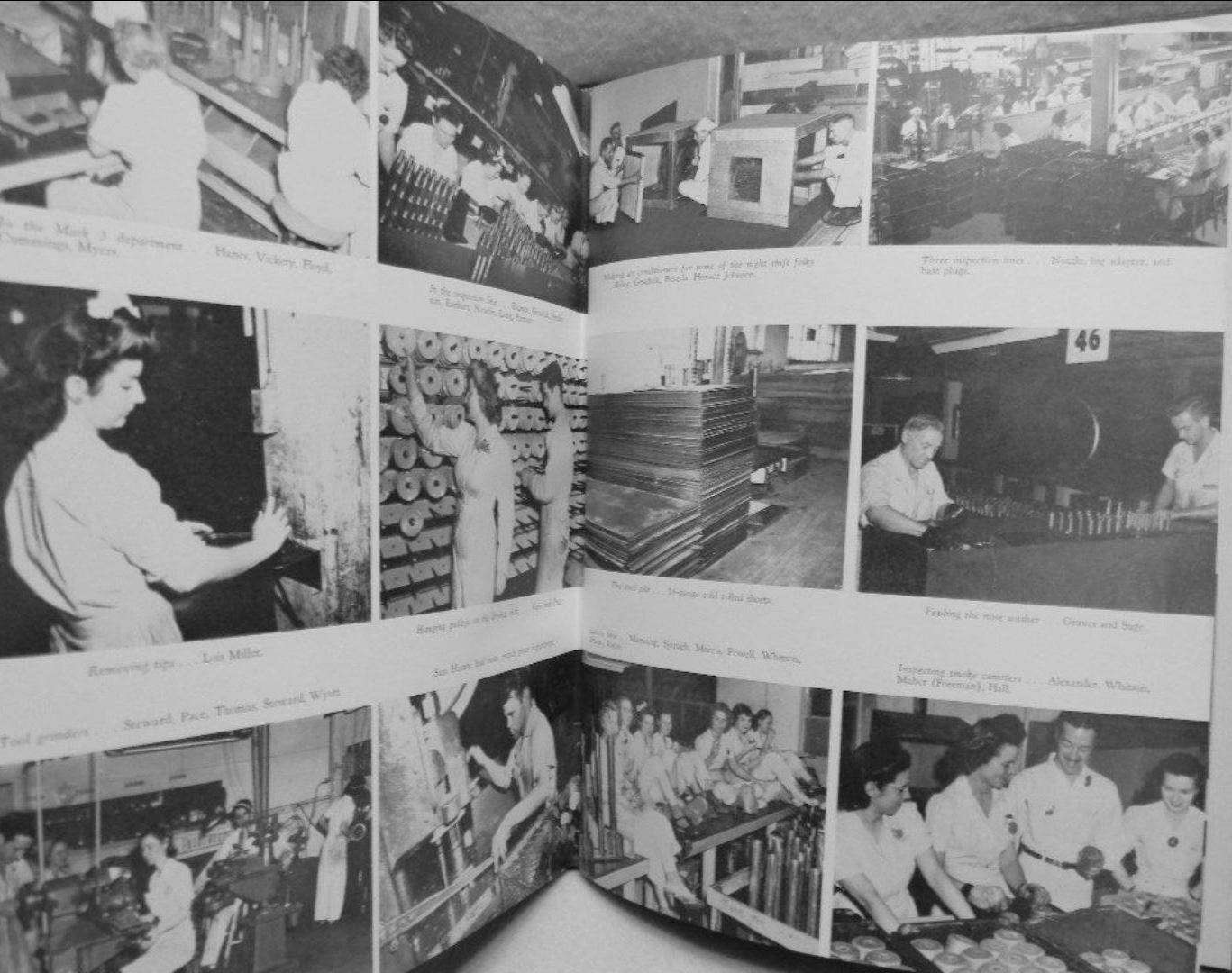
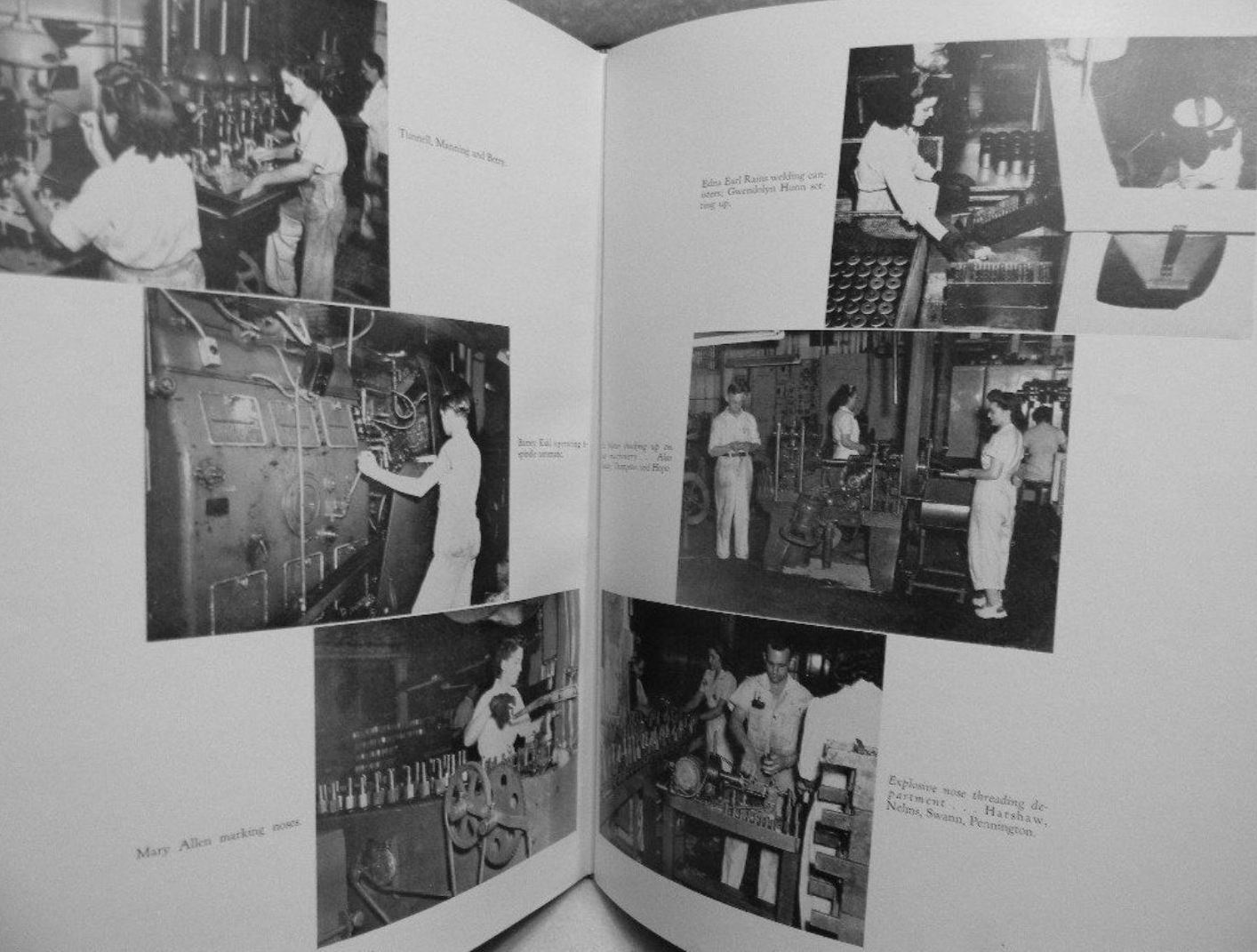
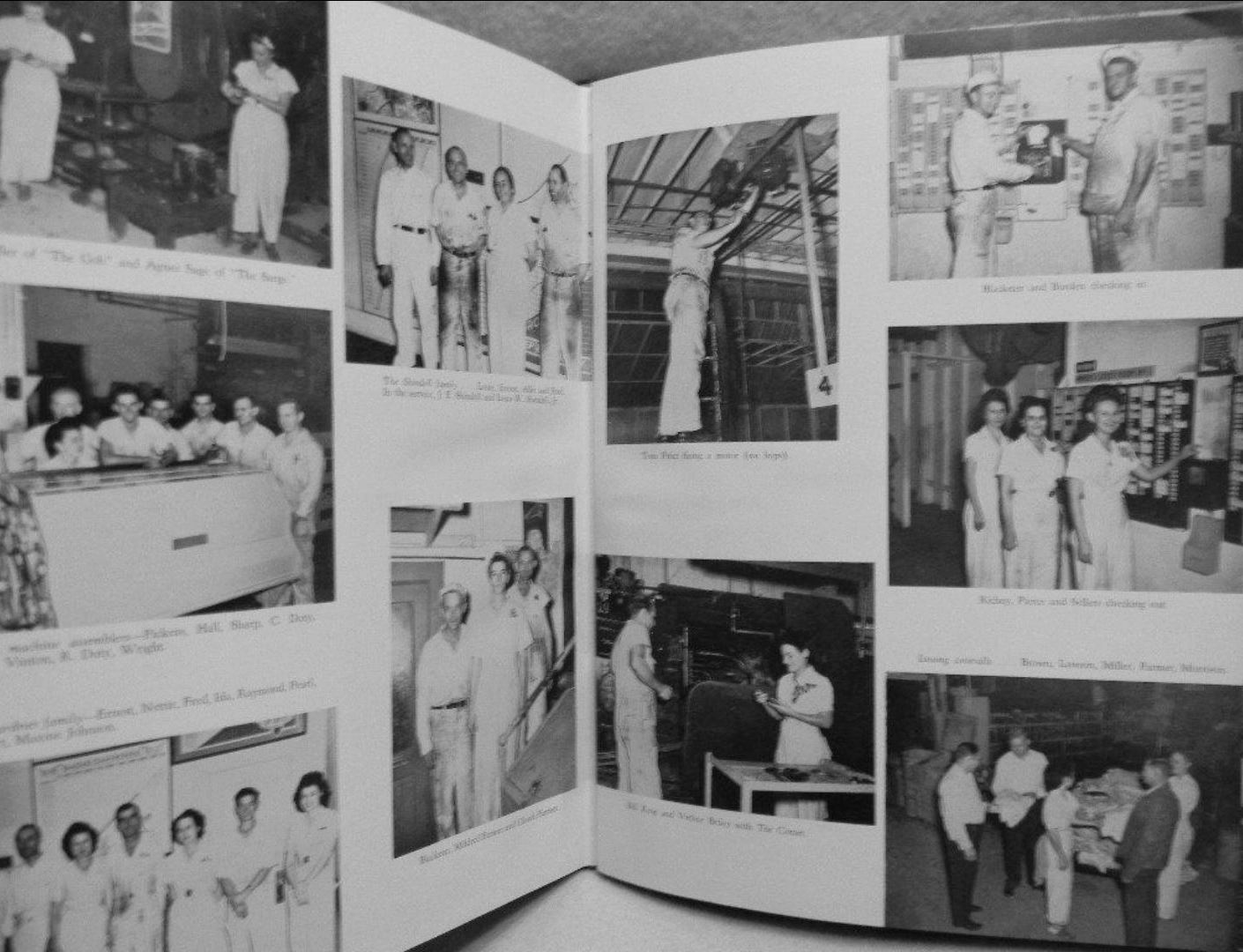
The book appears to be similar to a high school yearbook, with tons of photographs of Mitchell personnel at work on the factory floor and hanging out with their fellow war-workers in lighter off-duty moments. I’ve never seen this book (though I’d love to!), but it appears to be packed with pages and pages of photos.

Hundreds (if not thousands) of Dallasites worked in this factory while the Mitchell Company owned it — who knows? A relative of yours might be in here if he or she worked in it during the war. Below are photographs from a current eBay listing (click photos for larger images):

war-bk_1

war-bk_2

war-bk_3

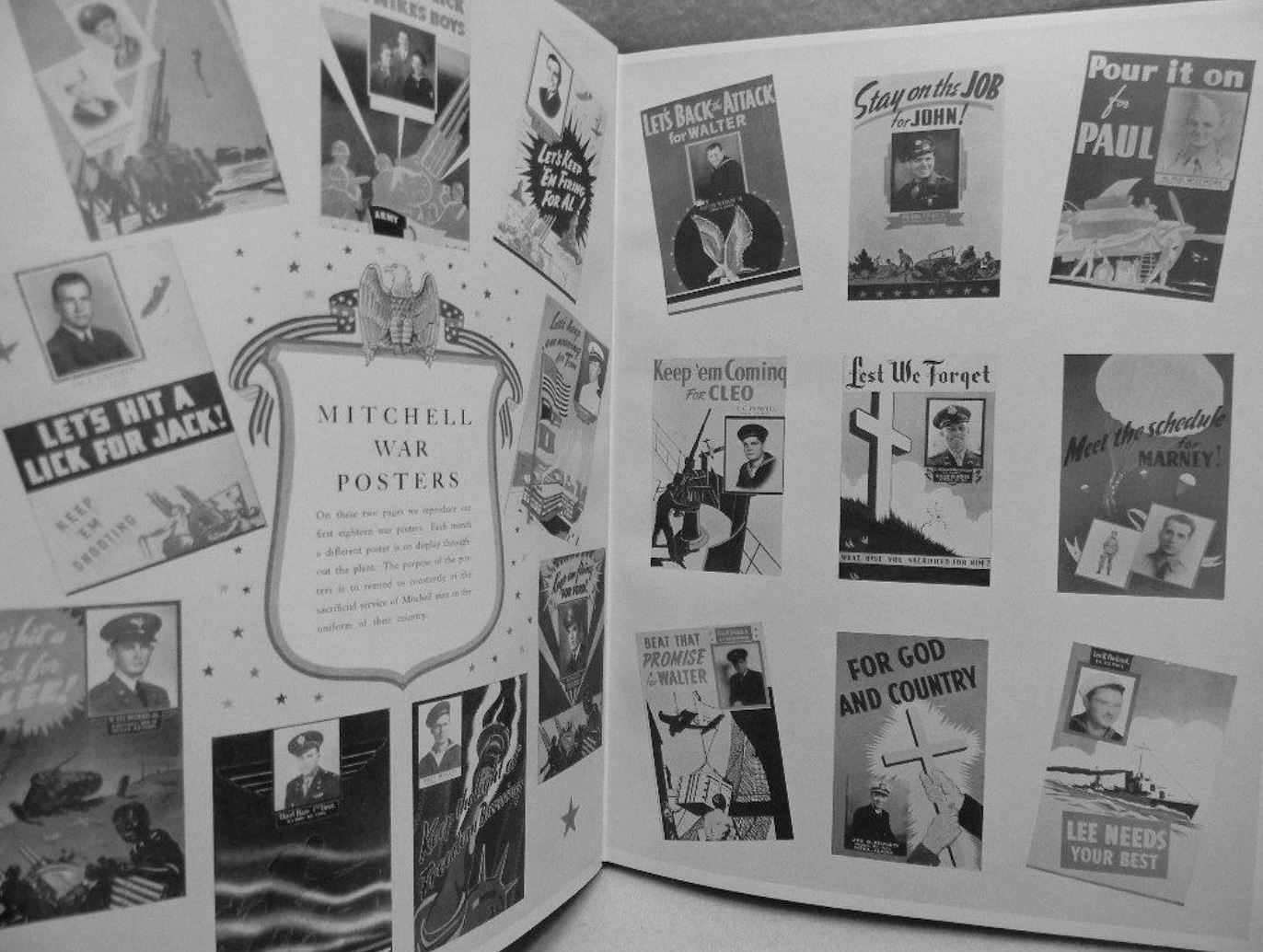
war-posters_war-bk_ebay

The posters above are interesting. When I posted a card the other day describing what this was all about (see it here), I didn’t fully understand. The company made these posters as reminders to the workers who they were working for: their fellow employees who were serving overseas.

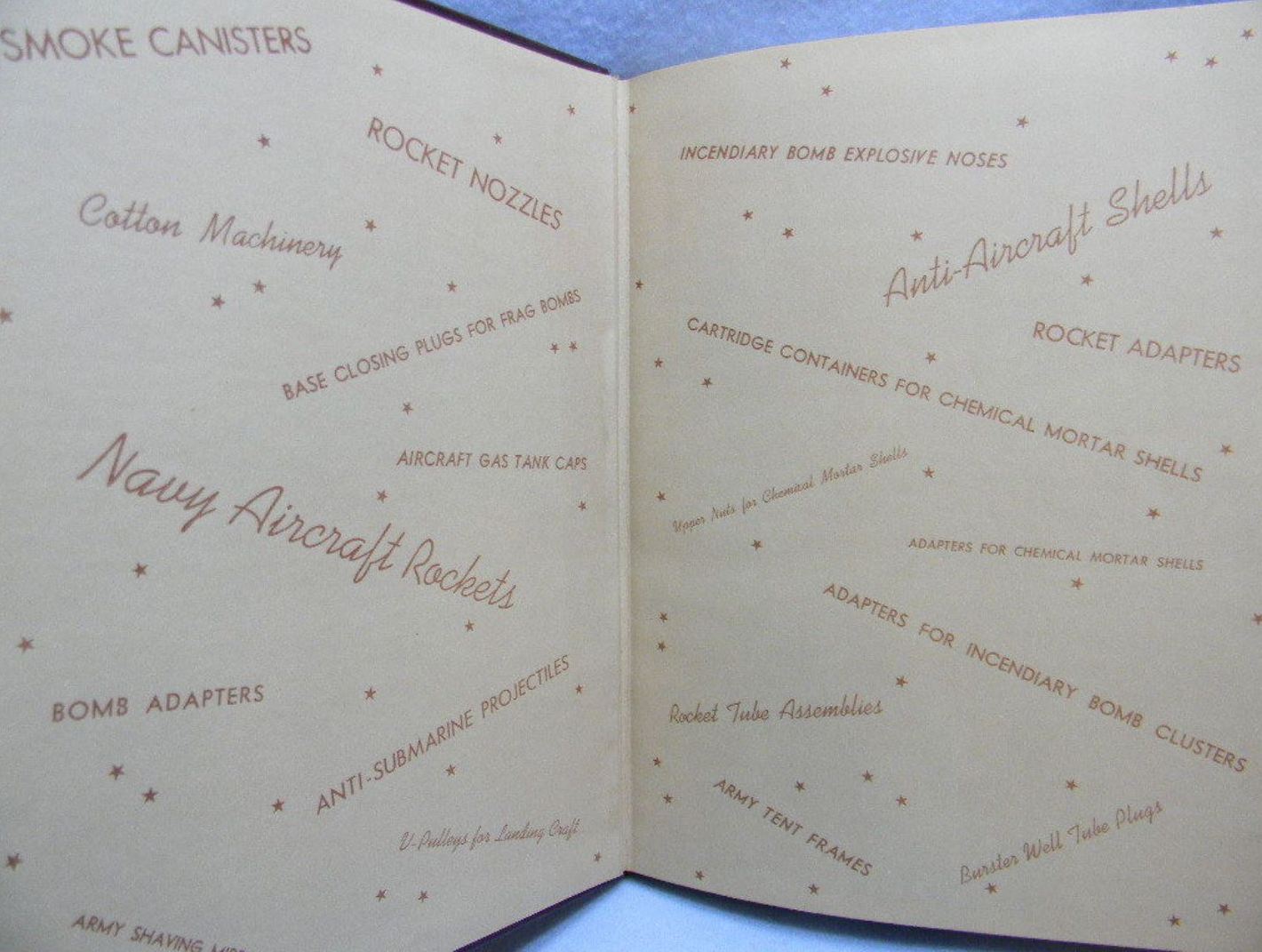
war-bk_4

Above, the book’s endpapers show the various items the Mitchell Company was manufacturing for the U.S. Navy and U.S. Army.

war-bk_5

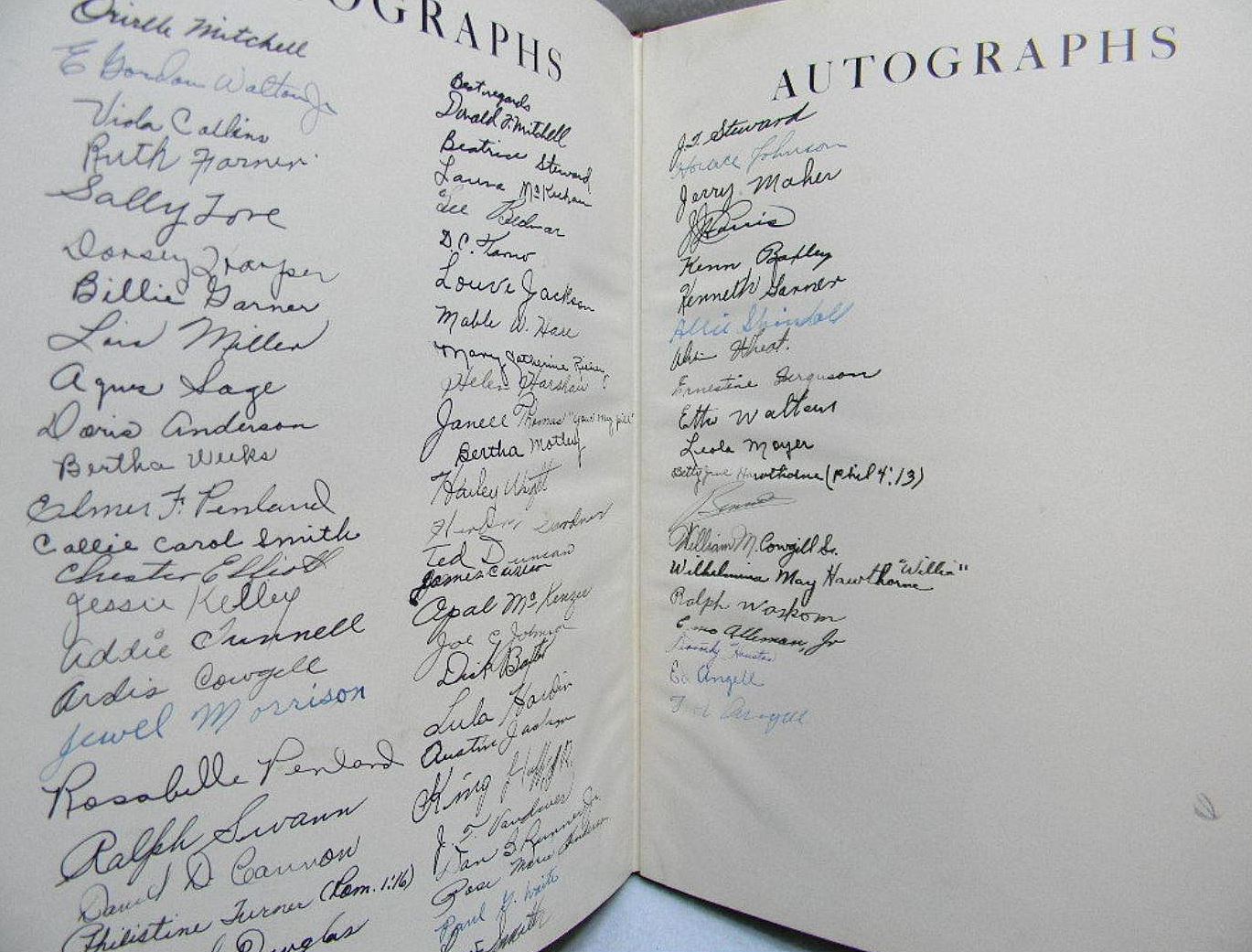
A few “autographs” of the John E. Mitchell Company’s wartime workers. Anyone you recognize?

***

Sources & Notes

As mentioned above, these photographs are from a current eBay listing, here.

Seems this book is pretty hard to find. I see only one other copy for sale — at about the same price — from a bookseller in Austin, here.

If you’re unwilling to fork over a fistful of cash but still want to look through the book, then hie yourself to the downtown Dallas Public Library to browse through the 127 pages of their only (non-circulating) copy; bibliographic details on the book from the DPL site, here (or if you don’t have a DPL account, here).

The two previous Flashback Dallas posts on the John E. Mitchell Company’s time as a munitions factory can be found here and here.

*

Copyright © 2016 Paula Bosse. All Rights Reserved.


The John E. Mitchell Company’s WWII Munitions Work (Part 2)

mitchell_17

by Paula Bosse

This is the second part of a post containing a series of postcards issued by the John E. Mitchell Company, which, before World War II was primarily a manufacturer of cotton and agricultural implements. It was located at 3800 Commerce in Exposition Park, a few blocks from Fair Park. During the war, the company ceased producing agricultural machinery and began producing munitions and materiel for the Navy and Army. (Part 1 can be found here.) The cards in a landscape format are larger when clicked.

*

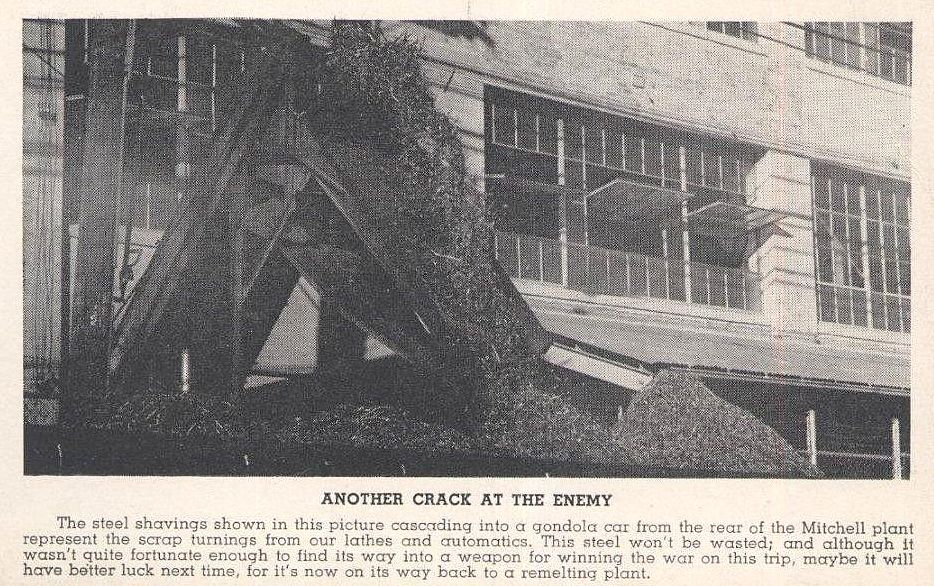
The card at the top shows the back of the (still-standing) building, behind which ran railroad tracks of the Missouri-Pacific railway. The card’s text:

ANOTHER CRACK AT THE ENEMY

The steel shavings shown in this picture cascading into a gondola car from the rear of the Mitchell plant represent the scrapped turnings from our lathes and automatics. This steel won’t be wasted; and although it wasn’t quite fortunate enough to find its way into a weapon for winning the war on this trip, maybe it will have better luck next time, for it’s now on its way back to a remelting plant.

*

mitchell_11

RECORD BREAKERS

This card will introduce you to Mr. and Mrs. Lewis J. Smith, the John E. Mitchell Company’s star tapping machine operators, shown here tapping base closing plugs for parafrag bombs.

It wasn’t so long ago that the Smiths’ sons, Dudley and Raleigh Smith, held the company production record on this machine. Then Dudley joined the Army and Raleigh joined the Navy. Mr. and Mrs. Smith decided the record should be kept in the family. So far it has.

*

mitchell_12

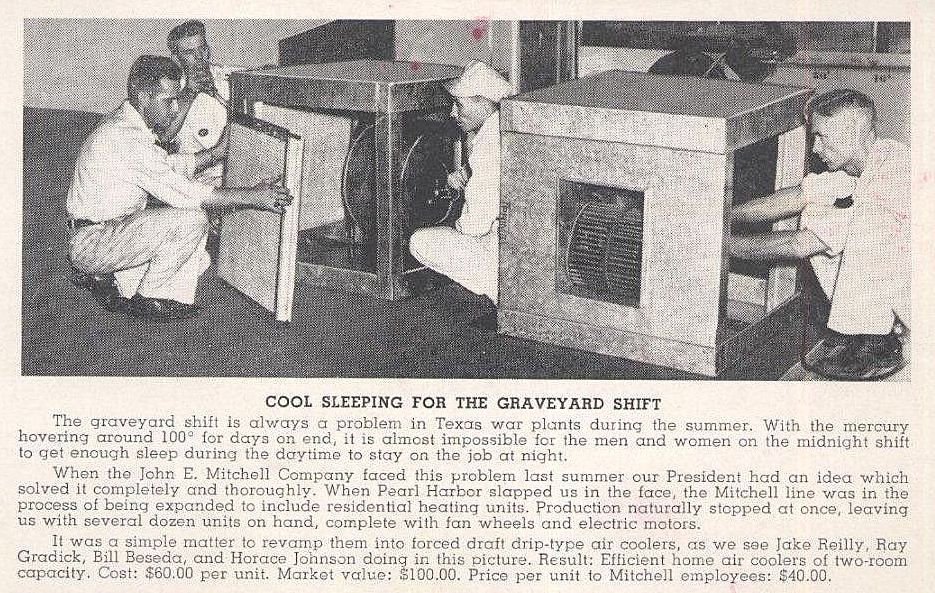
This is one of the most interesting cards in this collection. After the war, the Mitchell Company began to manufacture a wide variety of things, including heaters and air conditioners for cars. This problem of graveyard shift workers being unable to sleep during the summer months because of the oppressive heat must have been a big problem during the war, when factories such as this had to be running 24 hours a day. This was a brilliant solution.

COOL SLEEPING FOR THE GRAVEYARD SHIFT

The graveyard shift is always a problem in Texas war plants during the summer. With the mercury hovering around 100° for days on end, it is almost impossible for the men and women on the midnight shift to get enough sleep during the daytime to stay on the job at night.

When the John E Mitchell Company faced this problem last summer our President had an idea which solved it completely and thoroughly. When Pearl Harbor slapped us in the face, the Mitchell line was in the process of being expanded to include residential heating units. Production naturally stopped at once, leaving us with several dozen units on hand, complete with fan wheels and electric motors.

It was a simple matter to revamp them into forced draft drip-type air coolers, as we see Jake Reilly, Ray Gradick, Bill Beseda, and Horace Johnson doing in this picture. Result: Efficient home air coolers of two-room capacity. Cost: $60.00 per unit. Market value: $100.00. Price per unit to Mitchell employees: $40.00.

*

mitchell_13

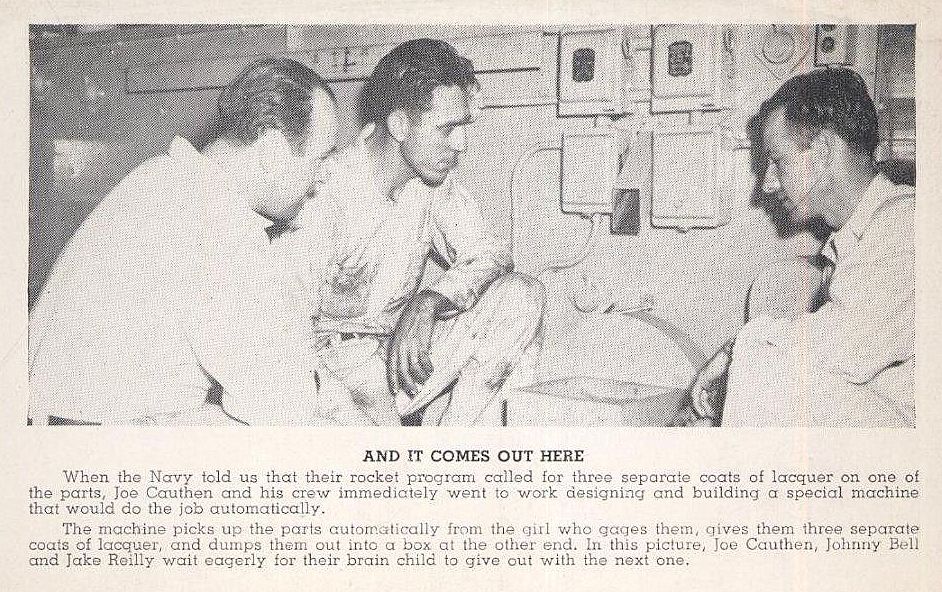
AND IT COMES OUT HERE

When the Navy told us that their rocket program called for three separate coats of lacquer on one of the parts, Joe Cauthen and his crew immediately went to work designing and building a special machine that would do the job automatically.

The machine picks up the parts automatically from the girl who gages them, gives them three separate coats of lacquer, and dumps them out into a box at the other end. In this picture, Joe Cauthen, Johnny Bell and Jake Reilly wait eagerly for their brain child to give out with the next one.

*

mitchell_14

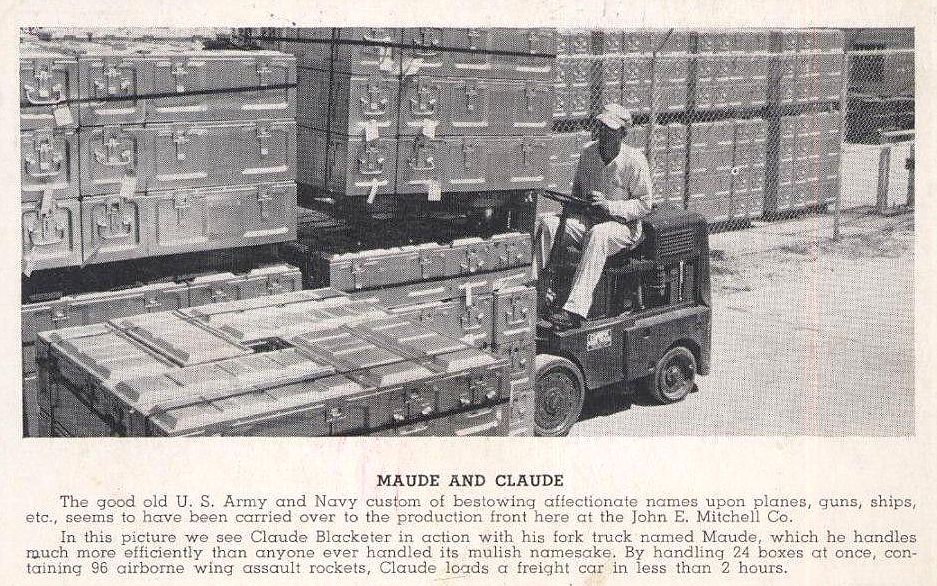
MAUDE AND CLAUDE

The good old U. S. Army and Navy custom of bestowing affectionate names upon planes, guns, ships, etc., seems to have been carried over to the production front here at the John E. Mitchell Co.

In this picture we see Claude Blacketer in action with his fork truck named Maude, which he handles much more efficiently than anyone else ever handled its mulish namesake. By handling 24 boxes at once, containing 96 airborne wing assault rockets, Claude loads a freight car in less than 2 hours.

*

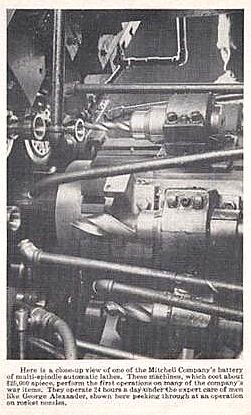
mitchell_15

Here is a close-up view of one of the Mitchell Company’s battery of multi-spindle automatic lathes. These machines, which cost about $25,000 apiece, perform the first operations on many of the company’s war items. They operate 24 hours a day under the expert care of men like George Alexander, shown here peeking through at an operation on rocket nozzles.

*

mitchell_16

PRESSURE BOY

Here’s one of the many presses with which the Mitchell factory is equipped, each operatable with a series of interchangeable blanking, stamping, forming, and drawing dies. This particular press has a capacity of 300 tons and forms the end frame for a Mitchell cotton machine in one lick.

*

mitchell_19

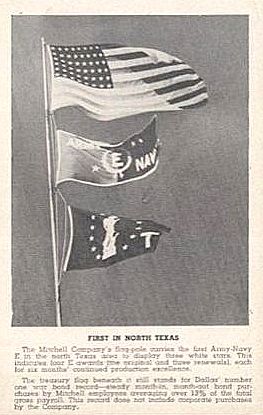
FIRST IN NORTH TEXAS

The Mitchell Company’s flag-pole carries the first Army-Navy E in the north Texas area to display three white stars. This indicates four E awards (the original and three renewals), each for six months’ continued production excellence.

The treasury flag beneath it still stands for Dallas’ number one war bond record – steady month-in, month-out bond purchases by Mitchell employees averaging over 13% of the total gross payroll. This record does not include corporate purchases by the Company.

***

Sources & Notes

Postcards found on eBay. Many of these are currently for sale, here.

Part 1, containing more of these postcards, is here.

Coming next: a look at the building built by the Mitchell Company in 1928, which is still standing in Expo Park, now repurposed as residential loft space.

mitchell-building_google
Google Maps (click for larger image)

*

Copyright © 2016 Paula Bosse. All Rights Reserved.


The John E. Mitchell Company’s WWII Munitions Work (Part 1)

mitchell_5

by Paula Bosse

The John E. Mitchell Company arrived in Dallas in 1928 to join the other nearby manufacturers of cotton gins and other agricultural equipment. They built their factory at 3800 Commerce, between Benson and Willow Streets, in the area now commonly referred to as Exposition Park, a few blocks from Fair Park. (The building still stands and has been converted into lofts. More on the building itself in Part 3.)

In 1942, during World War II, the large cotton machinery factory gradually transformed itself into one wholly concerned with war production, primarily manufacturing munitions for the Navy, but also producing ordnance parts for the Army.

Below are a series of postcards, produced by the Mitchell Company, touting their contribution to the war effort and acknowledging their workers. The second half of these cards will be contained in the next post. (Most of the cards are larger when clicked.)

*

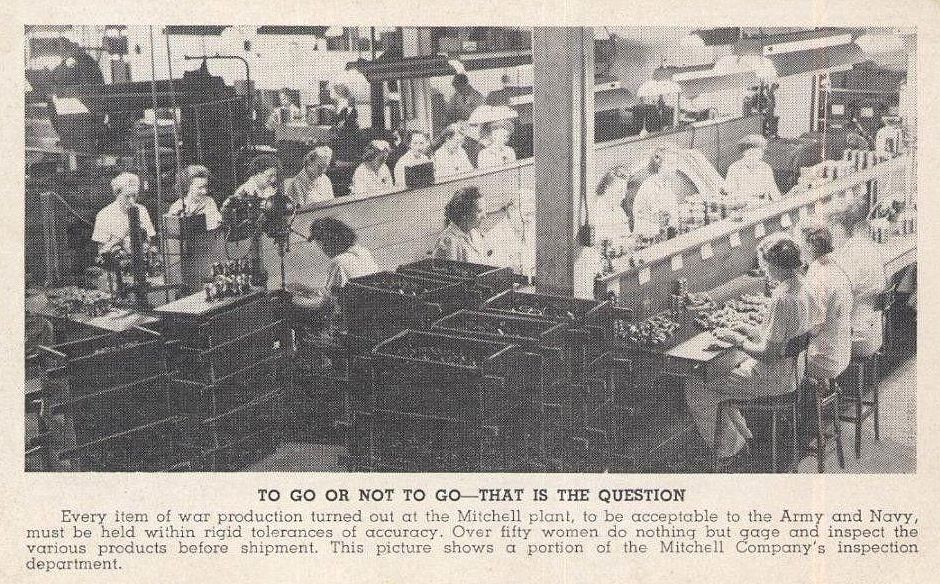
The top card shows part of the plant’s inspection department:

TO GO OR NOT TO GO — THAT IS THE QUESTION

Every item of war production turned out at the Mitchell plant, to be acceptable to the Army and Navy, must be held within rigid tolerance of accuracy. Over fifty women do nothing but gage and inspect the various products before shipment. This picture shows a portion of the Mitchell Company’s inspection department.

*

mitchell_1

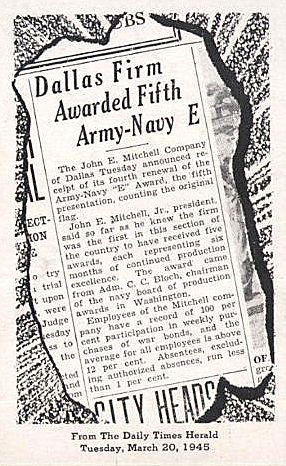
DALLAS FIRM AWARDED FIFTH ARMY-NAVY “E”

The John E Mitchell Company of Dallas Texas announced receipt of its fourth renewal of the Army-Navy E award, the fifth presentation, counting the original flag.

John E Mitchell, Jr., president, said so far as he knew the firm was the first in this section of the country to have received five awards, each representing six months of continued production excellence. The award came from Adm. C. C. Bloch, chairman of the navy board of production awards in Washington.

Employees of the Mitchell company have a record of 100 per cent participation in weekly purchases of war bonds, and the average for all employees is above 12 per cent. Absentees, excluding authorized absences, run less than 1 per cent.

From the Daily Times Herald, Tuesday, March 20, 1945

*

mitchell_2

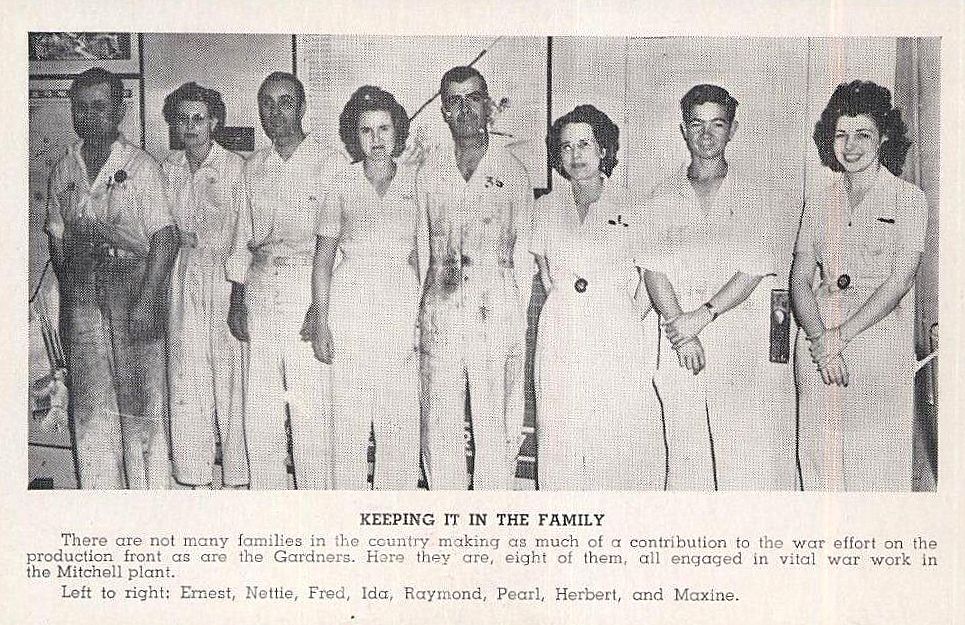
KEEPING IT IN THE FAMILY

There are not many families in the country making as much of a contribution to the war effort on the production front as are the Gardners. Here they are, eight of them, all engaged in vital war work in the Mitchell plant.

Left to right: Ernest, Nettie, Fred, Ida, Raymond, Pearl, Herbert, and Maxine.

*

mitchell_4

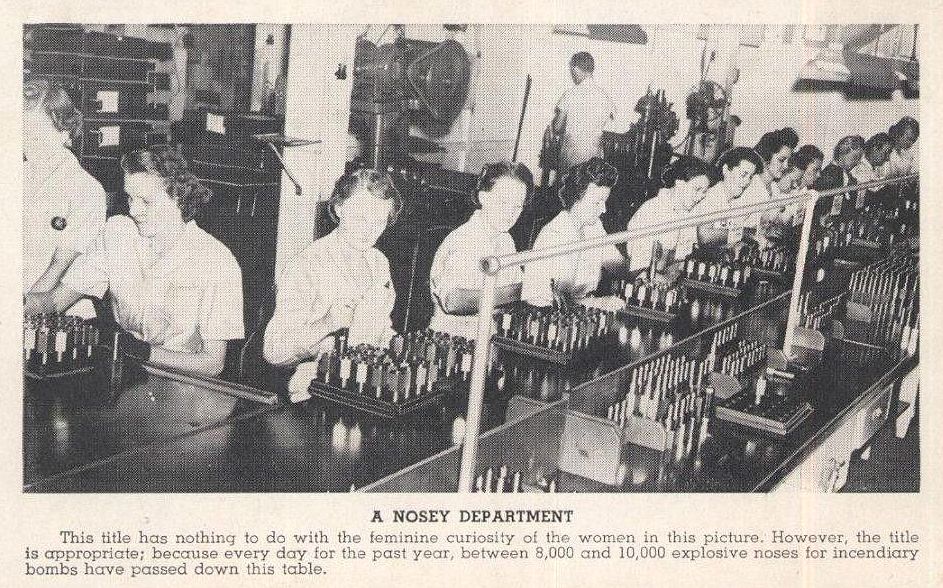
A NOSEY DEPARTMENT

This title has nothing to do with the feminine curiosity of the women in this picture. However, the title is appropriate; because every day for the past year, between 8,000 and 10,000 explosive noses for incendiary bombs have passed down this table.

*

mitchell_6

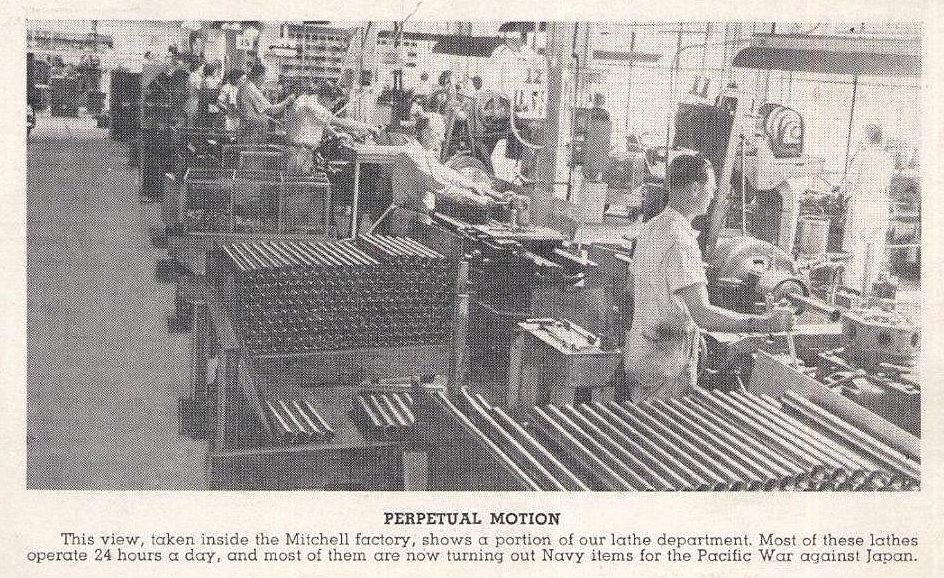
PERPETUAL MOTION

This view, taken inside the Mitchell factory, shows a portion of our lathe department. Most of these lathes operate 24 hours a day, and most of them are now turning out Navy items for the Pacific War against Japan.

*

mitchell_7

BIG JOKE

When this picture was taken, our president, John Mitchell, had evidently pulled off some sort of wisecrack which everyone seemed to enjoy, especially Mr. Mitchell himself.

The scene: one of the Mitchell Company’s regular Monday assembly meetings. The honored guests: Barney Kidd and Raleigh Smith, former Mitchell employees, now representing their company in both branches of the armed services.

*

mitchell_9

MEET OUR INDUSTRIAL CHAPLAIN

Let us introduce you to Art Isbell, the Mitchell Company’s industrial chaplain, shown here consulting with receptionist Doris Aday.

One of the first concerns in the nation to retain a full time industrial chaplain, the Mitchell Company has already discovered how important his services can be. Handling funeral arrangements, visiting the sick, helping with personnel problems, rendering spiritual guidance, Art Isbell has made himself invaluable to Mitchell men and women and has already endeared himself to the hearts of many through his patient understanding and never-failing cooperation.

*

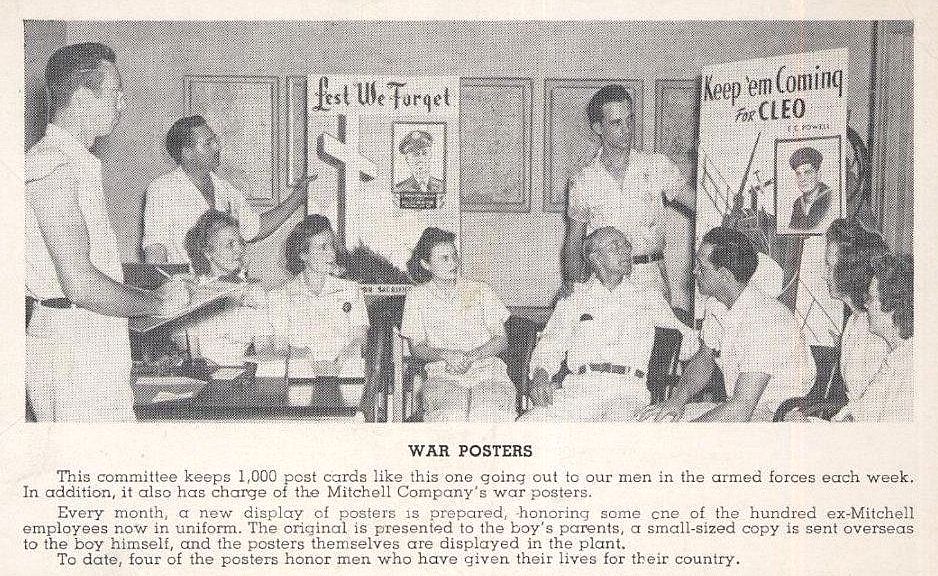
mitchell_10

WAR POSTERS

This committee keeps 1,000 post cards like this one going out to our men in the armed forces each week. In addition, it also has charge of the Mitchell Company’s war posters.

Every month, a new display of posters is prepared, honoring some one of the hundred ex-Mitchell employees now in uniform. The original is presented to the boy’s parents, a small-sized copy is sent overseas to the boy himself, and the posters themselves are displayed in the plant.

To date, four of the posters honor men who have given their lives for their country.

***

Sources & Notes

Postcards found on eBay last year. I was a little surprised to find that most of them are still available for purchase, here.

For more on the Mitchell Company’s early days as a munitions plant, see the Dallas Morning News article “E Award Given Plant Doing Munitions Job” (DMN, Dec. 29, 1942).

The Mitchell Lofts building is a long way from being war-time production plant. Here is what it looks like today.

mitchell-building_google
Google Maps (click for larger image)

Another Flashback Dallas post on a local munitions plant (this one downtown) —  “2222 Ross Avenue: From Packard Dealership to ‘War School’ to Landmark Skyscraper” — is here.

Part 2 features more of these postcards of the Mitchell Company’s war work, here.

Part 3 will focus on the building itself.

Check back!

*

Copyright © 2016 Paula Bosse. All Rights Reserved.


Preston and Valley View: The Calm Before the Storm — 1958

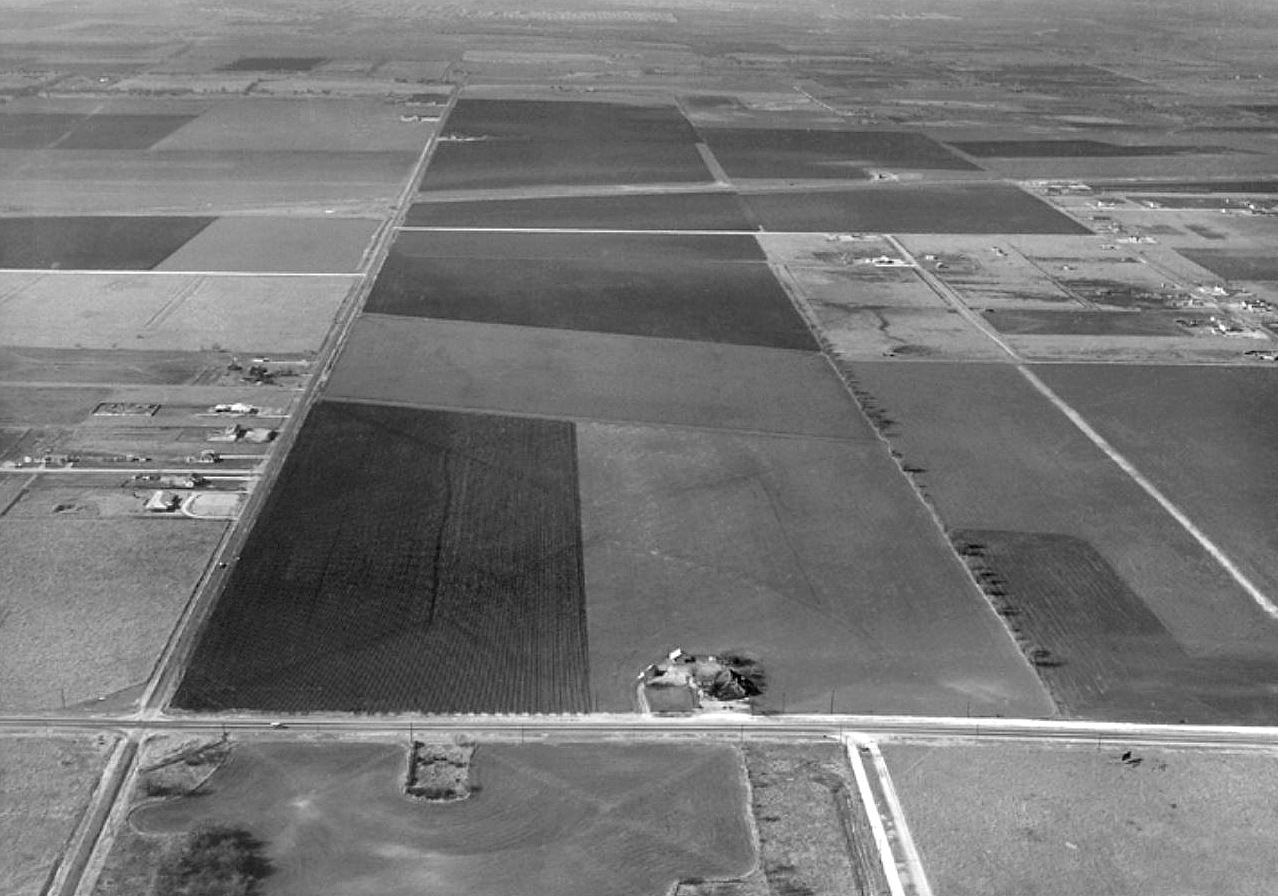
preston-lbj_122158_squire-haskins_utaLBJ Freeway, T-minus 6 years….

by Paula Bosse

This photo makes my head hurt. The road crossing horizontally at the bottom is Preston. The vertical road at the left is Valley View Lane (the view is to the west). What we’re looking at is land soon to be eaten up by LBJ Freeway, which was built along Valley View.

This fantastic photo by aerial photographer Squire Haskins (which can be seen REALLY big at the UTA website here) is included in Oscar Slotboom’s book Dallas-Fort Worth Freeways. This is his caption to the above photo:

Preston at LBJ, 1958. This December 1958 view looks west along Valley View Lane with the Preston Road intersection at the lower left. LBJ Freeway was built along Valley View Lane with work underway in 1964. A Sears store opened in the foreground in 1965 and Valley View Mall opened in 1973. The corridor was fully urbanized by the 1980s.

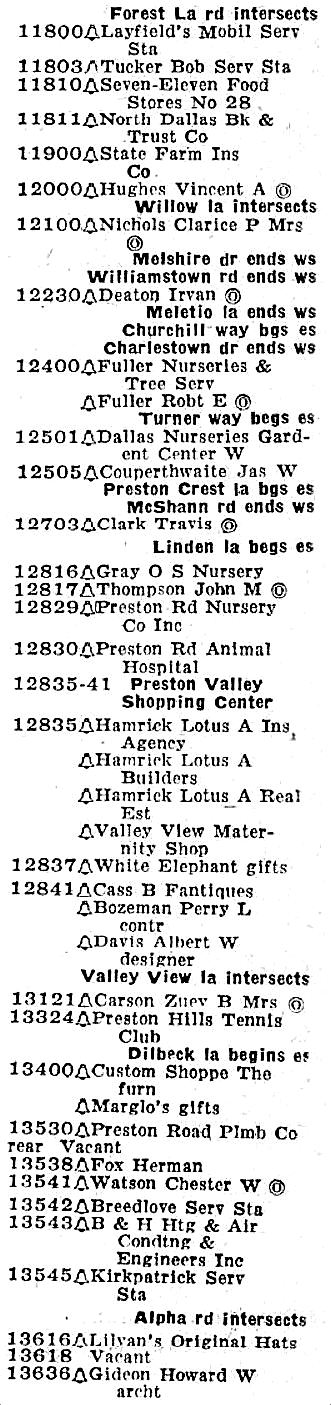
The only street directory I could find fairly close to the date of this photo was the one from 1961 — which already shows development not seen in the photograph. By this time, people knew the freeway was coming, but it was still fairly sparsely developed.

Here is the listing of addresses along Valley View Lane, stretching from Inwood, east past Central Expressway. (Click for larger image.)

valley-view_1961-directory
Valley View Lane, 1961 Dallas directory

And, below, addresses along Preston Road, moving north from Forest Lane. The thing that makes me lightheaded about this, is one particular business, way, WAY up north — out in the middle of nothing back in 1961: Lilyan’s Original Hats, at Preston and Alpha. That was my great-aunt’s hat shop. She owned that land. Imagine! She sold it, I think, in the ’70s. I can only hope she made a pretty penny!

preston-road_1961-directory
Preston Road, 1961 Dallas directory

**

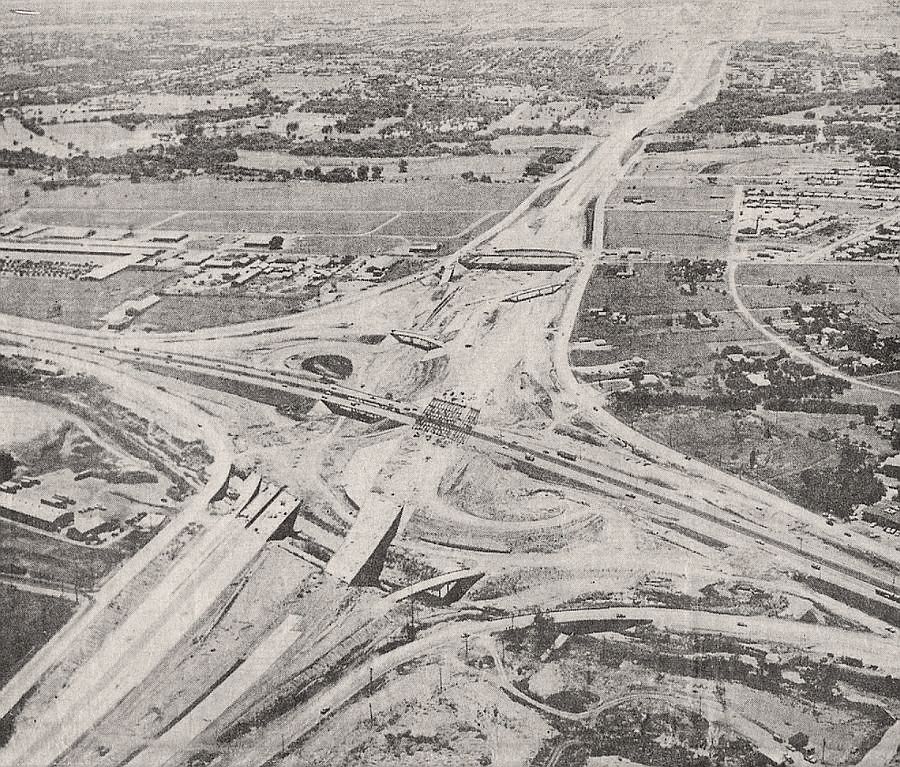
Here’s what construction of LBJ looked like in 1967 — the photo shows the intersection of Central Expressway and LBJ, with a view to the southwest).

lbj-looking-west_at-75_flickr_red-oak-kidFlickr, Red Oak Kid

***

Sources & Notes

Photo from the Squire Haskins Photography, Inc. Collection, UTA Libraries; more info here.

More on the construction of LBJ can be found in the chapter “Interstate 635, Lyndon B. Johnson Freeway” (from Oscar Slotboom’s amazingly researched book Dallas-Fort Worth Highways), here.

The 1957 map linked above is one of many scanned road maps which can be found on Slotboom’s site — the page “Old Highway Maps of Texas, 1917-1973) is here.

*

Copyright © 2016 Paula Bosse. All Rights Reserved.

Labor Day Parade — 1911

labor-day-parade_typographical-union_ca1911_cook-colln_degolyerUnion men on parade… (click for larger image)

by Paula Bosse

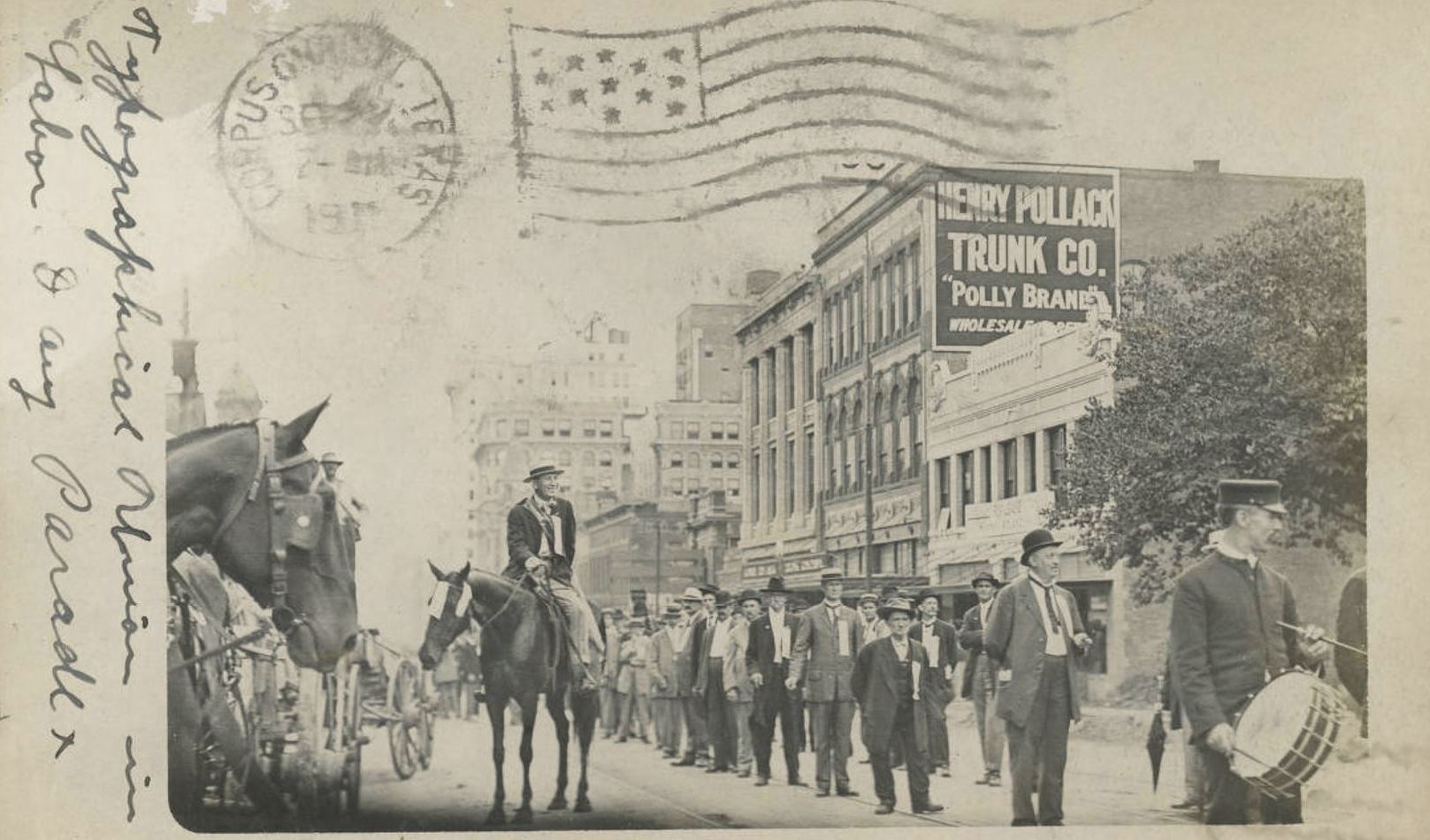
The photo above shows members of the Typographical Union marching in the Labor Day Parade held on Sept. 4, 1911. The photograph was taken looking west on Main Street toward St. Paul. (The Henry Pollack Trunk Co. was in the 1900 block, later occupied by the Titche’s building, now the Universities Center.)

The real photo postcard was sent three weeks later by John R. Minor, Jr. (a member of the union who worked as a linotype operator at The Dallas Morning News) to his mother, Mrs. Ada L. Minor, who was convalescing in Corpus Christi. (It’s possible the 27-year-old Minor was in this photo.)

Coverage of the day’s festivities can be read in the DMN article “Labor Day in Dallas Excels Past Record” (Sept. 5, 1911) here.

May your Labor Day not be spent walking behind a horse!

*

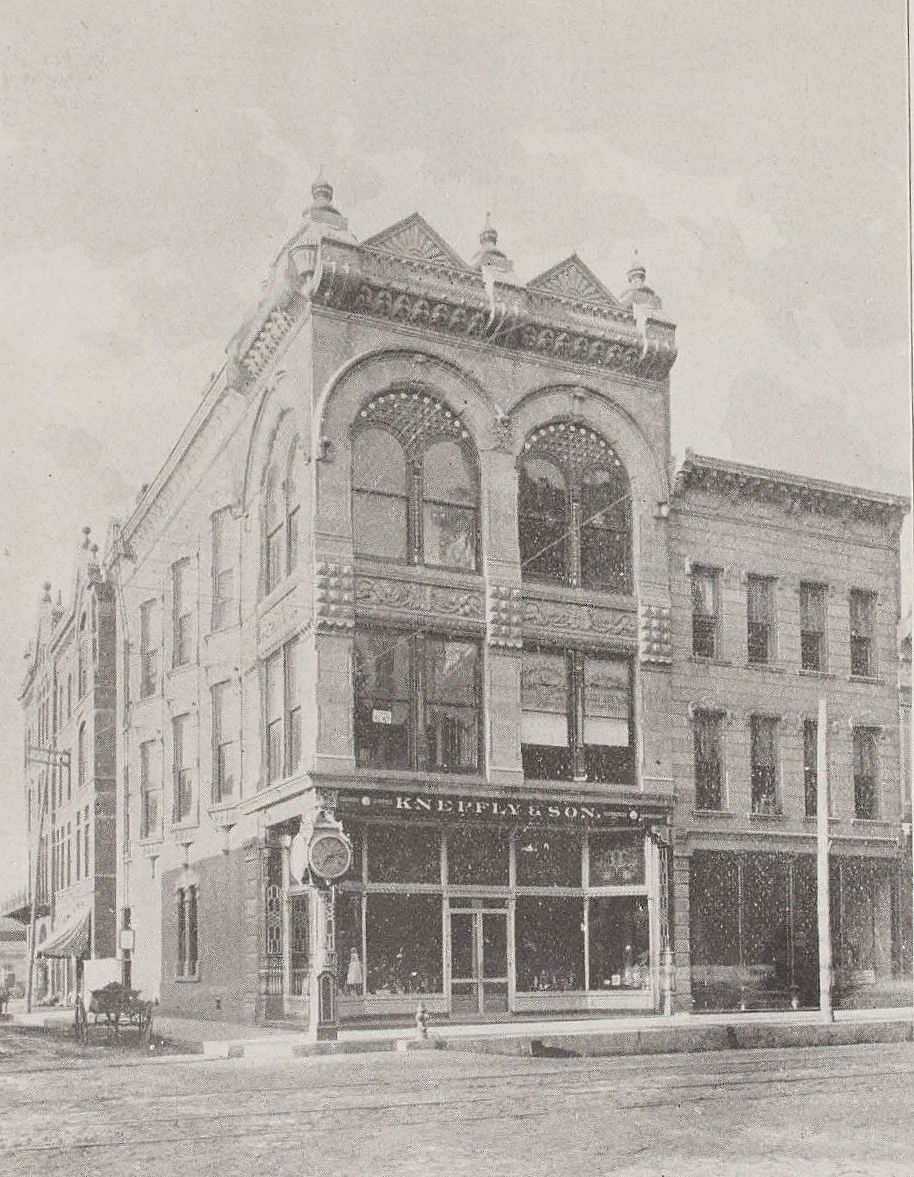
I feel I have to insert this bit of trivia here, if only because I spent so much time reading about the Minor family: in 1906, when John R. Minor, Jr. was 22 years old, the building in which he had a third-floor apartment was consumed by fire in the early hours of the morning. The three-story Knepfly Jewelry Building — built in 1888 on the southwest corner of Main and Poydras — was something of a landmark. The fire spread through the building so quickly that the only way to escape was to jump. Minor jumped and broke both legs and his pelvis. He was not expected to live, but he managed to pull through and spent several weeks in the hospital recovering. Two of the other top-floor residents died — one of whom had also jumped. Here’s the building. Minor had to jump past the telegraph wires on the Poydras (left) side of the building (the telegraph wires can be seen better in this photo from Dallas Rediscovered). He landed on his feet in the middle of the street. It’s amazing he didn’t break more bones. (Click for larger image.)

knepfly-bldg_church_dallas-through-a-camera_ca-1894_SMU

If he had marched in the 1911 Labor Day parade — which went west down Elm from about Pearl, then back east on Main from Lamar — he would have walked right past the building. On second thought, if he broke both legs and his pelvis, a mile-long march in a parade might have been a little taxing. (Maybe he’s the one on the horse!)

***

Sources & Notes

Postcard titled “Typographical Union in Labor Day Parade” is from the George W. Cook Dallas/Texas Image Collection, DeGolyer Library, Southern Methodist University; more info (and an image of the message side of the card) can be found here.

The photo of the Knepfly Building is by Clifton Church, from his book Dallas, Texas Through a Camera (1894), accessed from the DeGolyer Library, SMU Libraries, Southern Methodist University; more info is here.

Click pictures to see larger images.

*

Copyright © 2016 Paula Bosse. All Rights Reserved.