Flashback : Dallas

A Miscellany: History, Ads, Pop Culture

Category: Neighborhoods

Elm Street Store: Whiskey, Brooms, Cigars

elm-street-store_whiskey-broomsEverything one needs…

by Paula Bosse

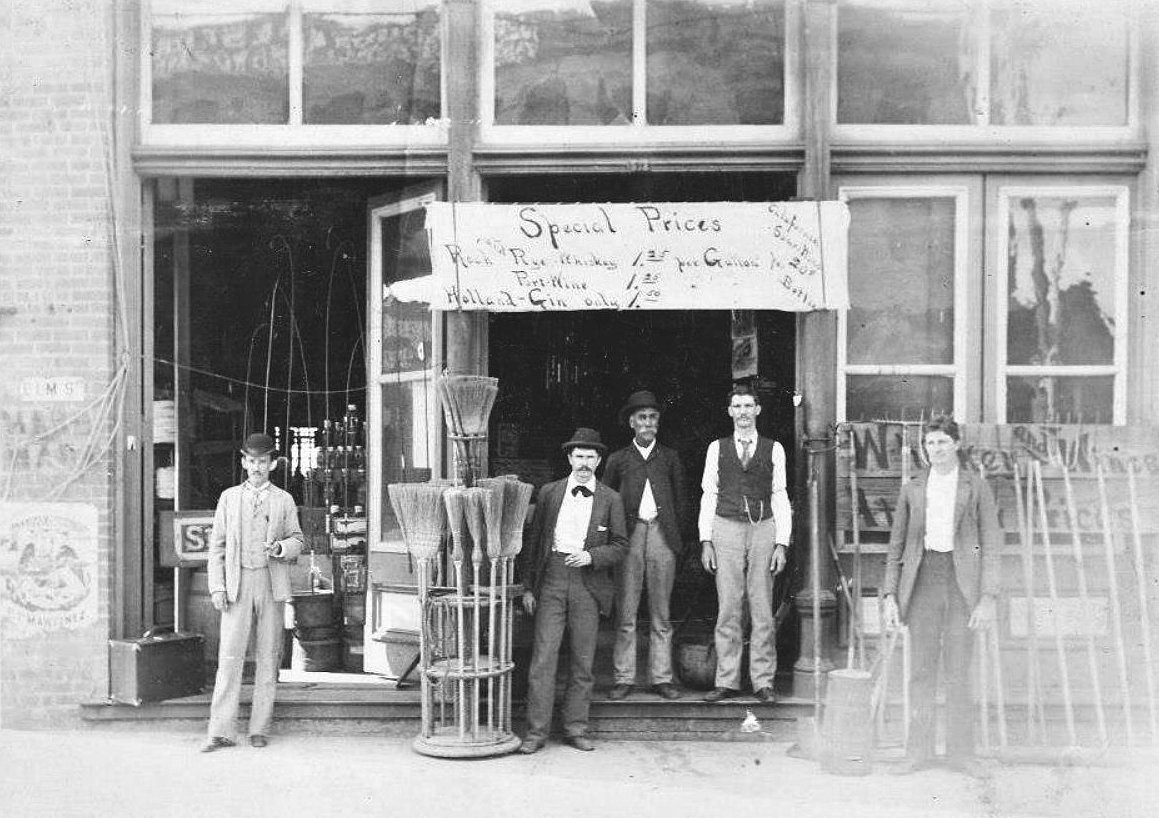
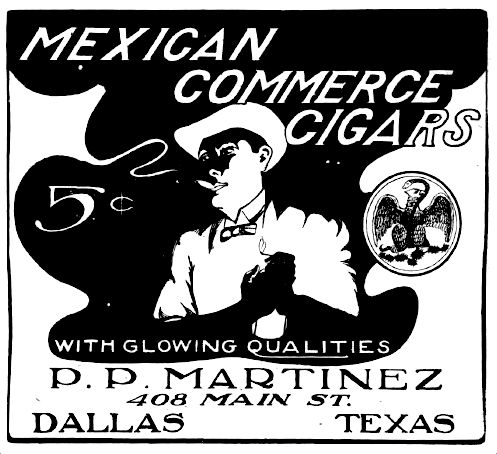
What more do you need in life than a gallon of whiskey, wine, or gin? And maybe some brooms. And a butter churn. The essentials. I don’t know anything about this photo, except that it does appear to be Dallas — you can see “Elm St.” on the brick wall at the left, just above an ad for Dallas cigar king P. P. Martinez. Not sure when the photo was taken — 1890s-ish? Below is a P. P. Martinez ad from 1908.

ad-martinez-cigars_dmn_050308

It’s hard to make out the “Special Prices” sign above the doorway, but some of the items you could purchase were rock and rye whiskey ($1.25 a gallon), port wine ($1.25 a gallon), and Holland gin (“only $1.50 per gallon”).

I had never heard of “rock and rye” whiskey until a few minutes ago. It was a whiskey cordial made with rock candy (!) and some sort of citrus or other flavor. So I’m guessing it was pretty sweet and powerful. It was often sold as a “tonic” because taxes were substantially less on medicines than on spirits. So goodbye, saloon staple, hello cough medicine! “Rock and rye” has made a recent comeback among whiskey-quaffing hipsters.

***

Sources & Notes

I have no idea where I found this photo back in 2014, but it’s great!

This post appeared in a slightly different form on my Patreon page a few months ago. If you’d like to receive daily Dallas-history postlets, check it out!

elm-street-store_whiskey-brooms_sm

*

Copyright © 2023 Paula Bosse. All Rights Reserved.

Herbert A. Kline’s “Miniature Coney Island” at the State Fair of Texas — 1909

sfot_1909_entrance_ebay_a

by Paula Bosse

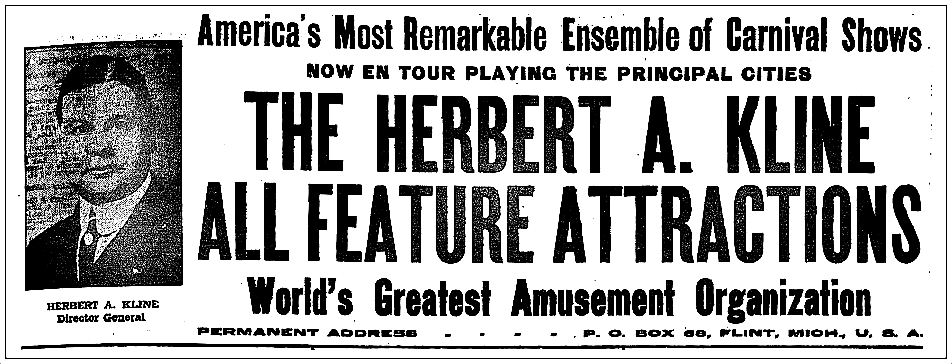
Herbert A. Kline (1873-1934) was a showman and promoter from Michigan who provided acts to several state fairs and large carnivals in the U.S. — his heyday appears to have been the 1910s. In 1909, he brought his troupe of performers and sideshow features to the State Fair of Texas. Most of the photos in this post are from promotional material for that 1909 season, with most of the photos showing Kline’s traveling “amusements.”

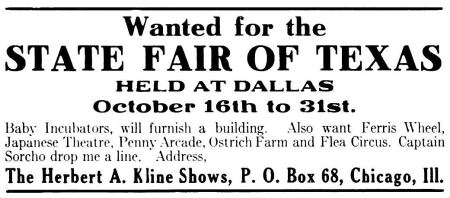
Two weeks before he got to Texas, he posted this ad in the entertainment trade magazine Billboard — I hope Capt. Sorcho (“the great deep-sea diver”) dropped him a line.

sfot_kline_billboard_100209 Billboard, Oct. 2, 1909

*

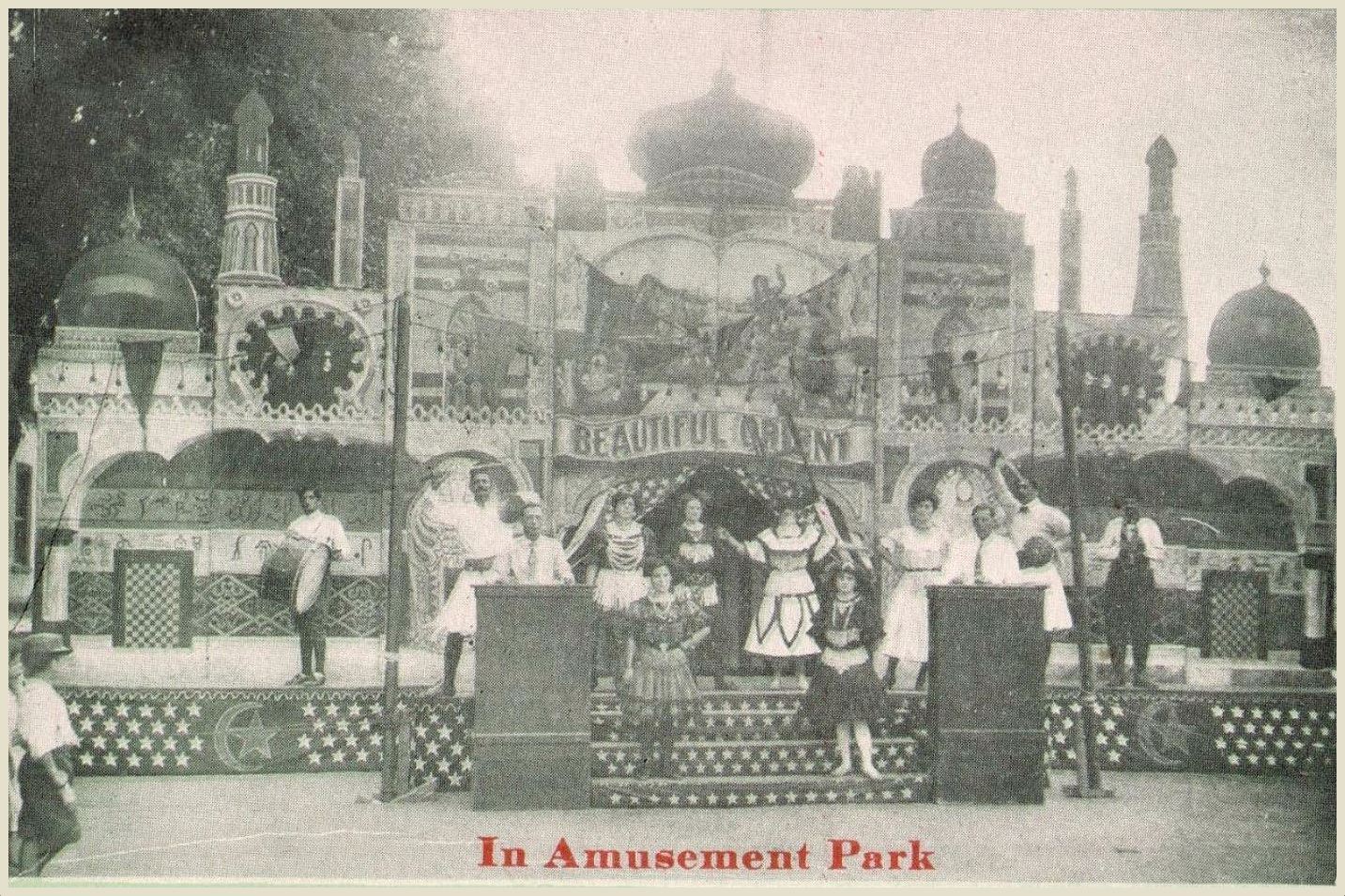
“THE BEAUTIFUL ORIENT” — included were dancers, gun-spinners, magicians, acrobats, and — somehow — wedding ceremonies. It also boasted “the cleanest and most refined dancing-girl show in America.”

sfot_1909_amusement-park_ebay_a

*

“SUPERBA, THE BEST” — a collection of vaudeville-type performers, including one woman whose “talent” appears to be that she was attractive.

sfot_1909_superba_ebay_a

*

“MRS. D. H. KINCHELOE, WARBLER” (a whistler/reader/vocalist/pianist from Kentucky — her name is misspelled below) and “THE GREAT McGARVEY, FEMALE IMPERSONATOR” (Bert McGarvey was known for a nicely turned-out ankle, charisma, magnetism, and a specialty number called “The Sacred Cobra Dance”). They — along with Galetti’s Musical Monkeys — would appear after the more high-brow operatic singers.

sfot_1909_warbler_female-impersonator_ebay_a

*

“THE IGORROTE VILLAGE” — native peoples of the Philippines gave a sort of presentation on how they lived, employing what might be seen as primitive customs in daily life. (A description of a “performance” in New York’s Central Park noted that there were demonstrations on how to shrink heads, which might have been too “exotic” for Dallas.)

sfot_1909_igorrote-village_ebay_a

*

John T. Backman’s Troupe of Glass Blowers — this was absolutely fascinating (the sign alone!). Check out this entertaining article about the sorts of things these people did.

sfot_1909_glass-blowers_ebay_a

*

Also in Kline’s family of traveling show-folk:

  • A creature half-reptile and half-human
  • Russian Prince Midget, who speaks three languages, weighs less than 16 pounds, and whose crib was a cigar box
  • Alice, The Wonder, “who is acknowledged by the press and the public to be the strangest girl in all the world”
  • Schlitzie, the Aztec Wild Girl, “whose head is no larger than an orange” (this is most likely the sideshow performer best known for appearing in Tod Browning’s cult movie “Freaks”)

*

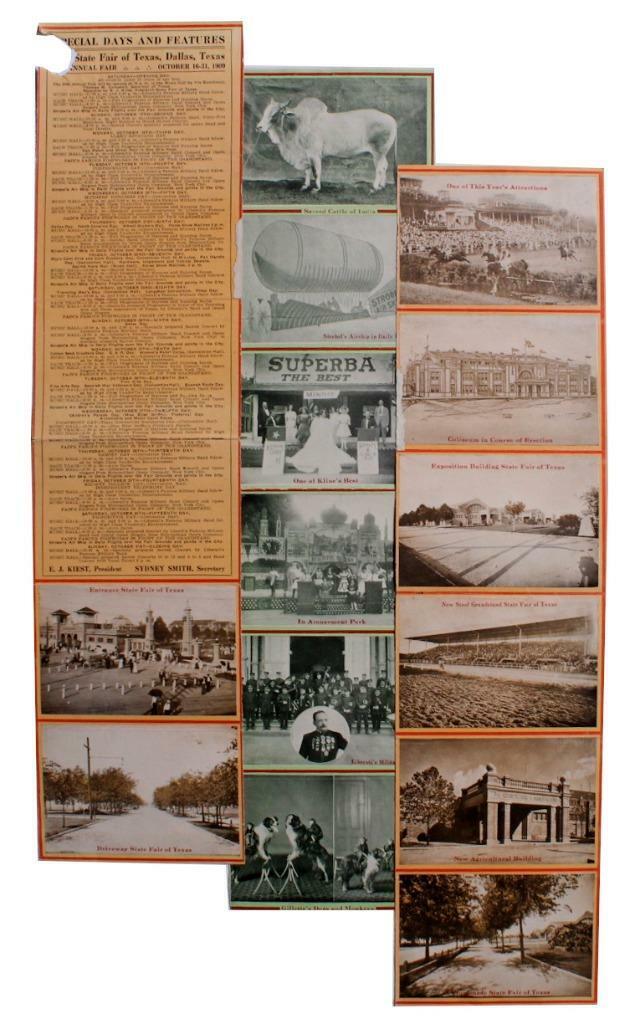
Here is an image from an eBay item, showing where these photos came from.

sfot_1909_collection_ebay

*

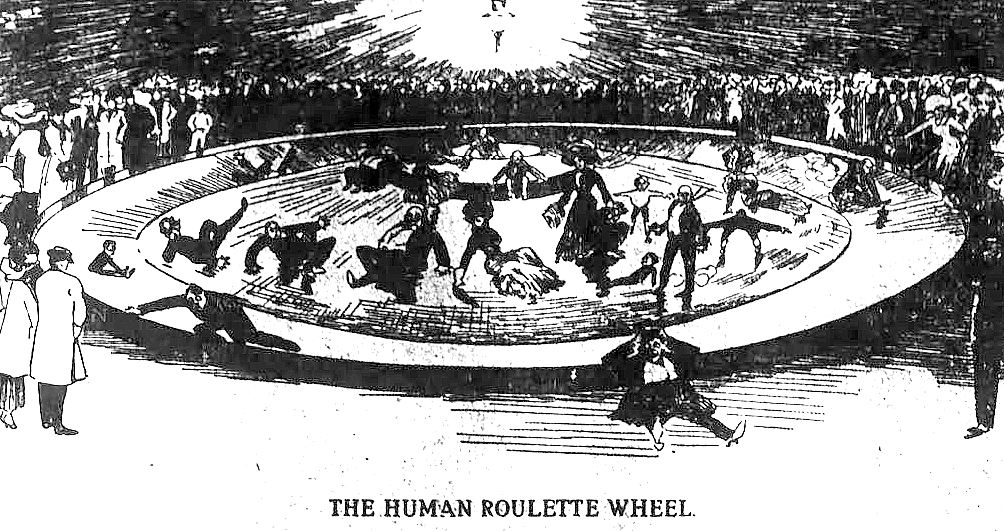
There was also a “ride” called “THE HUMAN ROULETTE WHEEL.” It was probably more fun for the spectators than for the participants.

sfot_1909_human-roulette-wheel_houston-post_110709Houston Post, Nov. 7, 1909

*

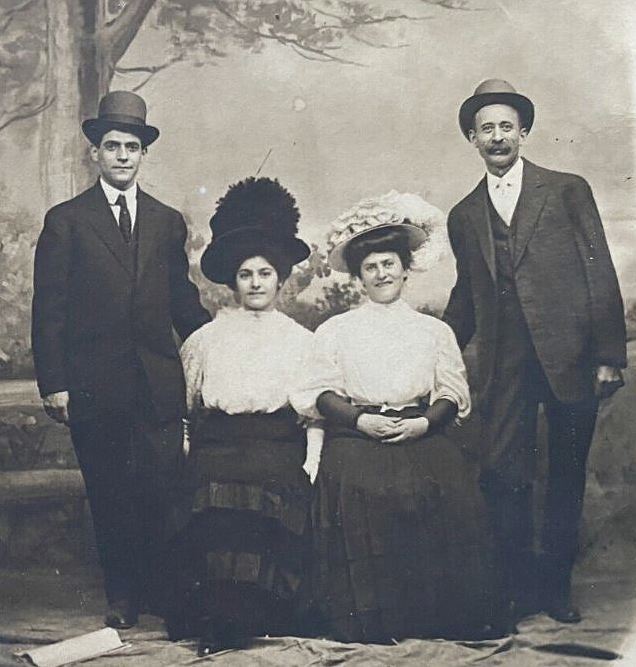
The prospect of being flung off a human roulette wheel might have been daunting to women of the period, who wore heels, corsets, long skirts, and big hats. Below are some typical fairgoers of the time, in a souvenir photo taken at the 1907 State Fair of Texas (Louis Block of Fort Worth, Miss Ray Goldsmith of Dallas, her sister Grace Goldsmith Rosenblatt, and Grace’s husband, David Rosenblatt). Imagine these people wandering around Fair Park and stopping in to see “the strangest girl in all the world” and watching people being hurled off a spinning disk.

sfot_RPPC_ebay_1907_photovia eBay

*

kline-herbert-a_new-york-clipper_oct-1912New York Clipper, Oct. 1912

*

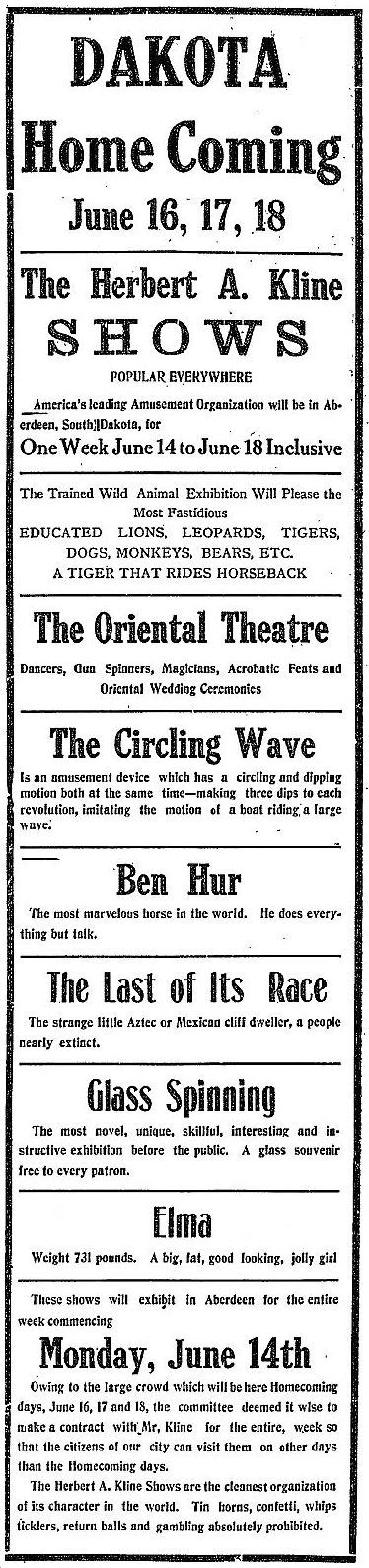
This ad for a South Dakota fair — a few months before Kline’s stop in Dallas — shows descriptions of several of the acts. (“A tiger that rides horseback.”)

kline-herbert-a_dakota-home-coming_aberdeen-american_SD_060909Aberdeen (South Dakota) American, June 9, 1909

*

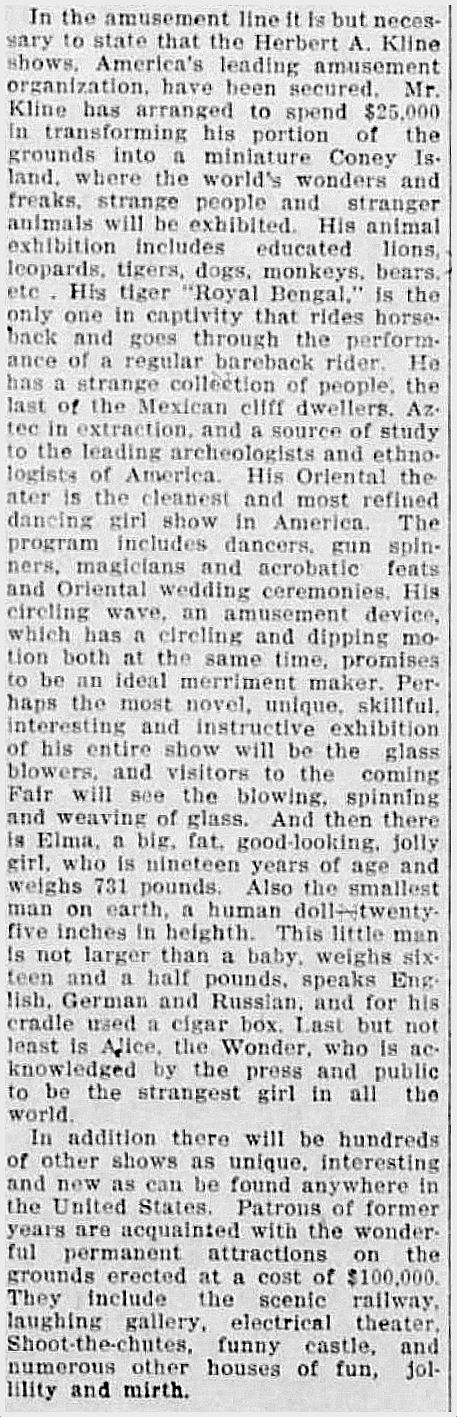
And a promotional article sent to local papers ahead of Kline’s arrival.

sfot_kline_mckinney-weekly-democrat-gazette_101409_detMcKinney (TX) Weekly Democrat Gazette, Oct. 14, 1909

***

Sources & Notes

All photos from a brochure/handbills listed earlier this year on eBay; sources of ads and other images as noted.

So many Flashback Dallas posts about the State Fair of Texas — here.

I’m on Patreon, where I post daily. Check it out!

sfot_1909_entrance_ebay_a_sm

*

Copyright © 2023 Paula Bosse. All Rights Reserved.

“Thrilling! Inspiring! Gorgeous!” — 1936

tx-centennial-brochure_ebay_4_patreon

by Paula Bosse

I don’t think the 1936 Texas Exposition at Fair Park could have oversold itself. It was everything it promised. The sensory overload must have been almost debilitating!

The night beauty of the Texas Centennial Exposition at Dallas is breath-taking! Rainbow-hued fountains, rippling flags, colorful buildings, thousands of constantly changing lights blending into a symphony of thrilling, inspiring, gorgeous effects… A glamorous fairyland of scintillating light, color and cool water that alone will repay your trip. SEE this marvel of beauty!

*

“Have the time of your life in Dallas! […] Joyous days and nights of holiday-making await you … in one of the most magnificent settings ever conceived! […] The Texas Centennial Exposition at Dallas is being enthusiastically applauded as the most magnificent spectacle ever attempted on the American continent.”

tx-centennial-brochure_ebay_5

*

“World’s Greatest Show for 50¢… Ample Tourist Accommodations… Come to Dallas!”

(According to the Inflation Calculator, 50¢ admission in 1936 would be equivalent to about $10 in today’s money. 10¢ hamburgers would be about $2, and 5¢ cold drinks would be about $1.)

tx-centennial-brochure_ebay_3

*

“Dallas: Night Spot of the World! / Dallas: Day Spot of the World!”

brochure

***

Sources & Notes

Images from a promotional brochure offered recently on eBay.

Check out many previous Flashback Dallas posts on the Texas Centennial here.

tx-centennial-brochure_ebay_4_patreon_sm

*

Copyright © 2023 Paula Bosse. All Rights Reserved.

Home Sweet Home: Oak Lawn Car No. 755

In retirement…

by Paula Bosse

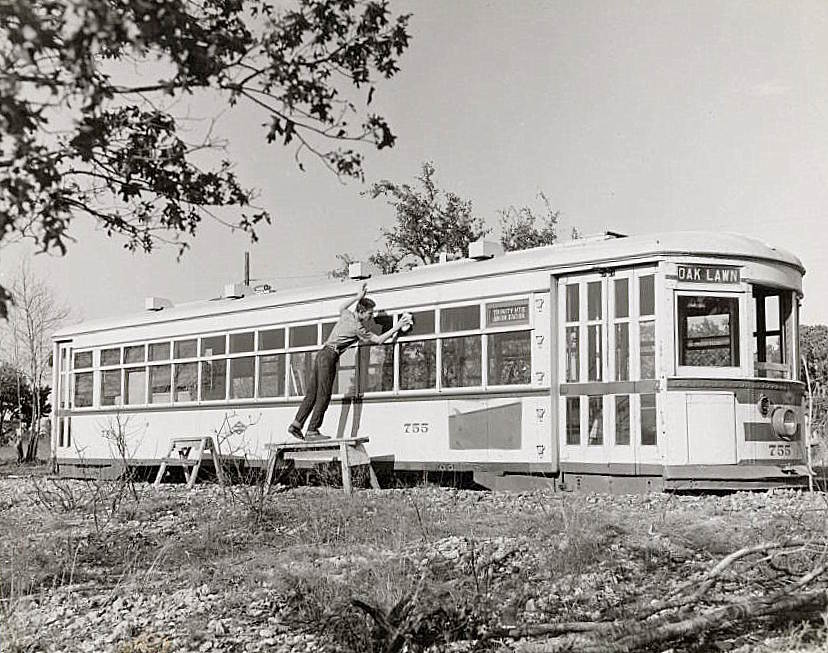
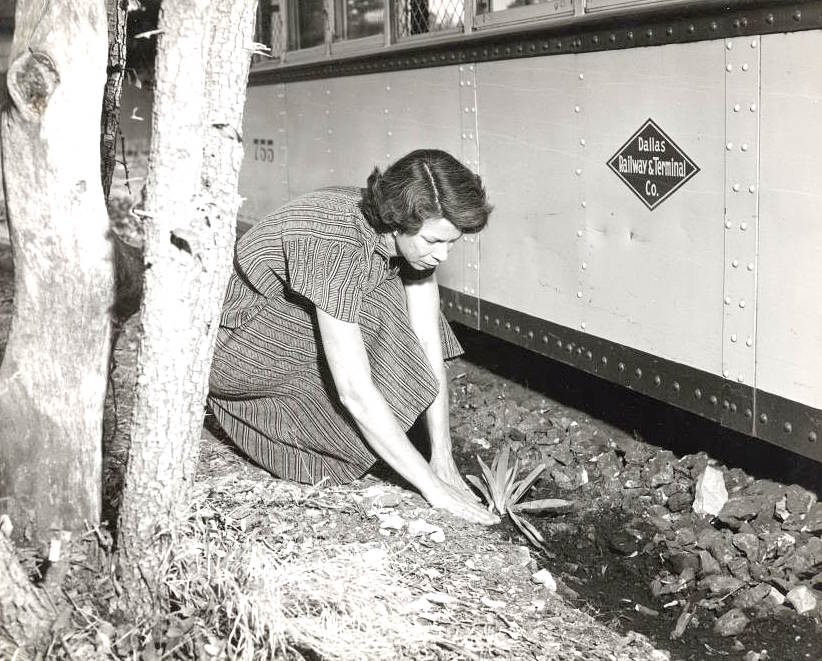
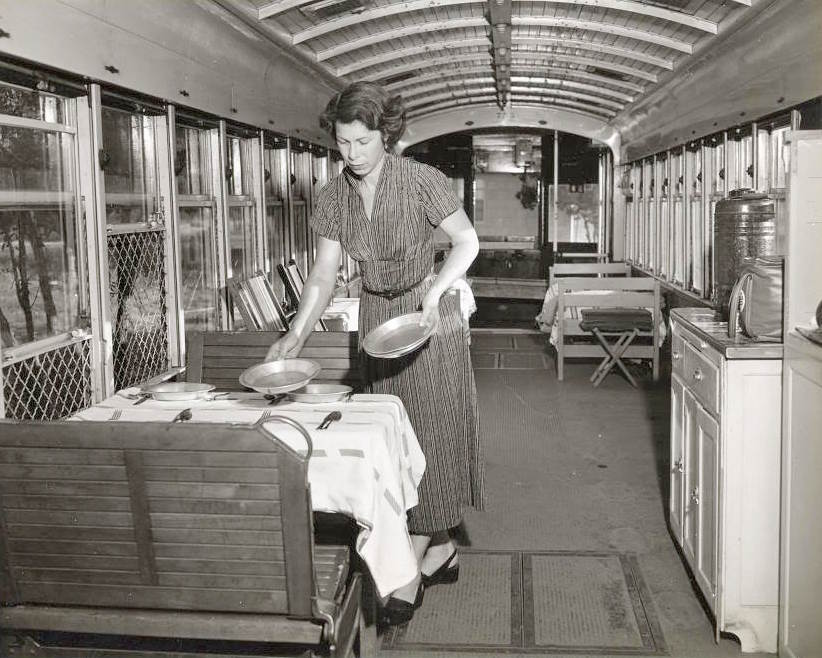
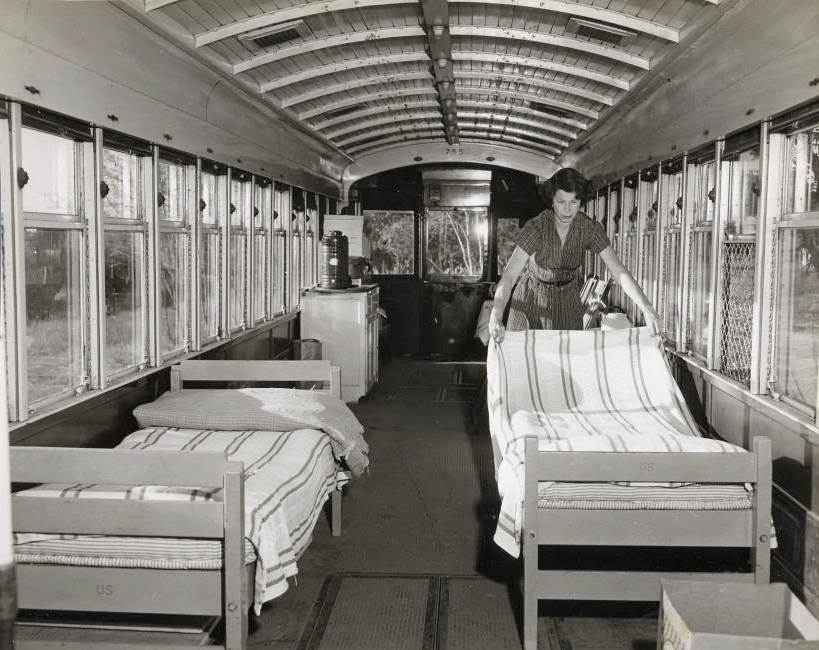
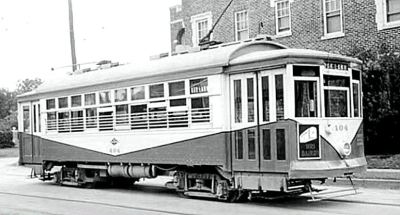
I came across these photos several years ago, but I don’t really know anything about them. They show a decommissioned Oak Lawn streetcar (car #755), which was manufactured in the 1920s for the Dallas Railway & Terminal Co. The photos, which look to be from the 1950s, show the car remodeled into a home (or, as the text below suggests, a sort of weekend “lake house”). When I clipped these photos (they were on some obscure railroad forum I stumbled onto), the only info was that someone had placed a for-sale ad for this on Craigslist in 2009. Below is the seller’s ad:

Antique 1920s or 1930s Dallas interurban trolley car. Trolley was retired from service in the 50s. Has a porch built on the back. Has a separate room with bath. There’s a kitchen and a 1930s refrigerator that works very well. On about a half acre wooded lot at Lake Whitney. Not far from boat ramp. Walking distance to water. Used to be on the “Oak Lawn” run in Dallas. Unusual, neat place to spend summers at the lake. Call Carol or Ron (214) xxx-xxxx. No owner financing.

I don’t know where the photos came from (they look like photos that would have accompanied a story in a magazine like Life), but they are great.

**

I don’t think that’s an interurban car, but it’s really long for a streetcar. (How would it turn corners?) Has it been extended? Below is a typical Oak Lawn streetcar:

This photo was actually in the video below (“Dallas Oak Lawn Streetcar Line No. 8”). It’s a pretty uneventful video — a man in a car retraces the Oak Lawn streetcar route. My mother grew up in Oak Lawn and talks about riding the streetcar to and from downtown, but I had no idea how far into Oak Lawn it traveled. 

*

While looking to see if I could find anything more about the renovated Dallas streetcar, I came across a story which showed something similar (but more elegant) in this article about a renovated interurban car in New Jersey: “One-of-a-Kind Point Pleasant Home Built Around Century-Old Trolley Car.”

*

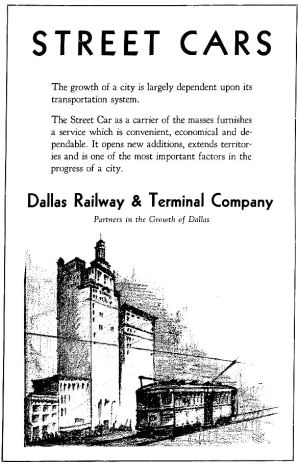
An ad from 1930, not long after the Oak Lawn car was manufactured:

streetcars_dallas-railway_dallas-mag_april-1930

*

If you know more about Oak Lawn car #755 — where it’s been, where it is now — please comment below!

***

Sources & Notes

First four photos are from a Dallas Craigslist ad placed in or before 2009 — I believe the photos were posted with the ad. The ad was then reposted on a railroad forum.

Ad from the April 1930 issue of Dallas magazine.

*

Copyright © 2023 Paula Bosse. All Rights Reserved.

1500 Block of Elm — 1920s

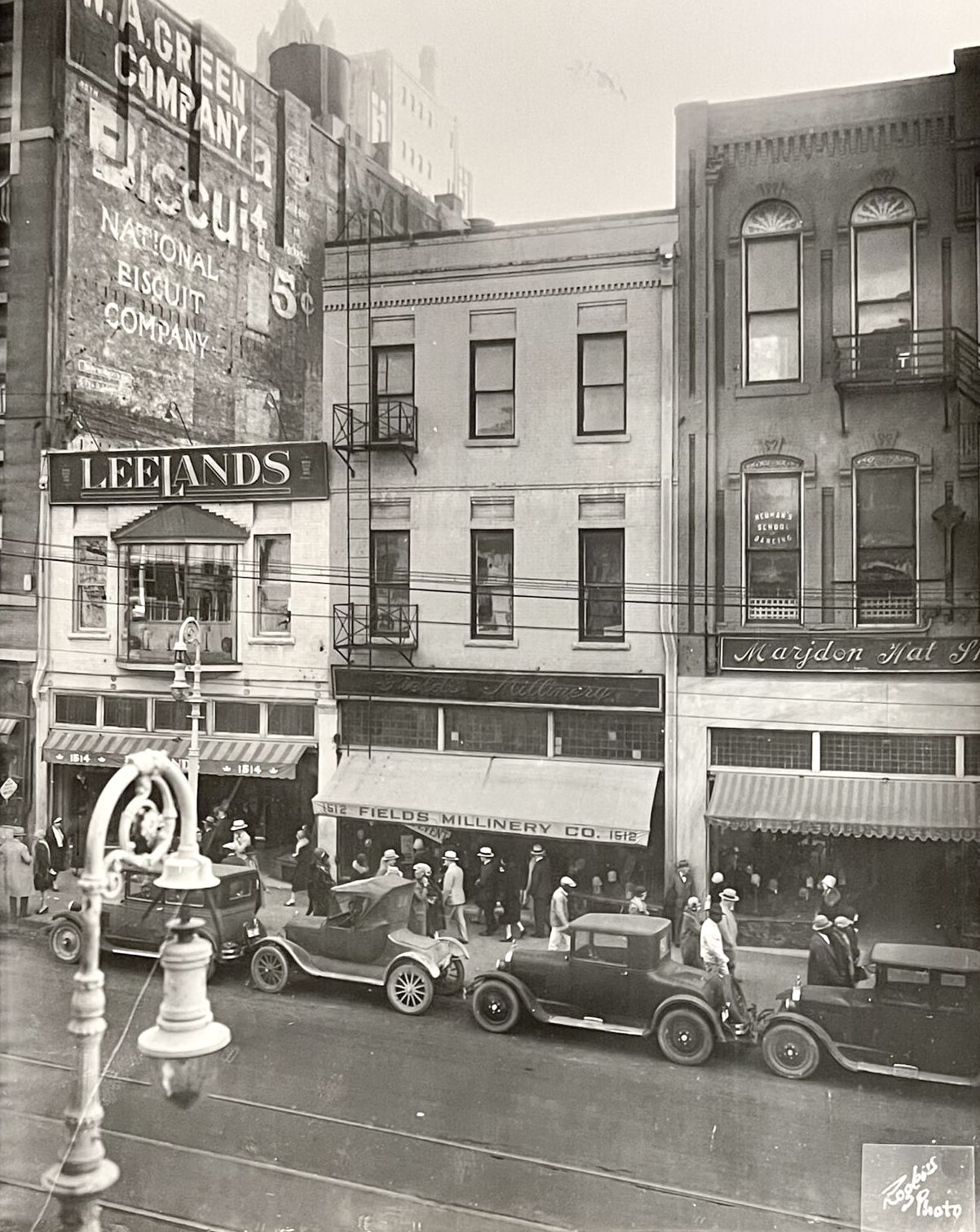
fields-millinery_1512-elm_frank-rogers-ebay1500 block of Elm Street, south side…

by Paula Bosse

This is a great photo by Frank Rogers showing businesses on the south side of the 1500 block of Elm Street, between Stone and Akard (see it today on Google Street View here — some of these buildings are still standing). Mid-1920s? Back when Elm ran two ways, and you could park your rumble-seated roadster at the curb.

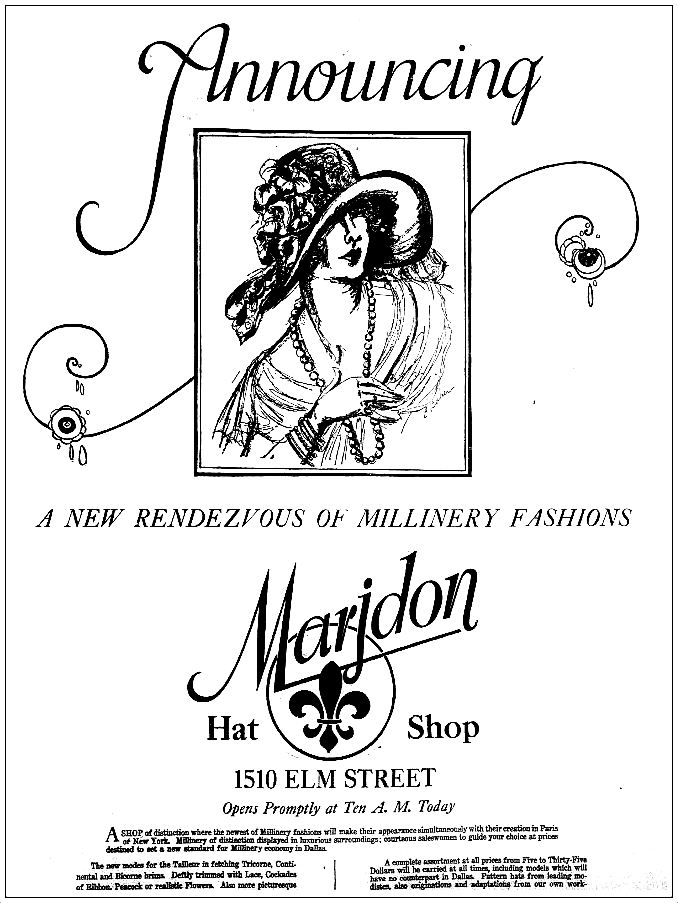
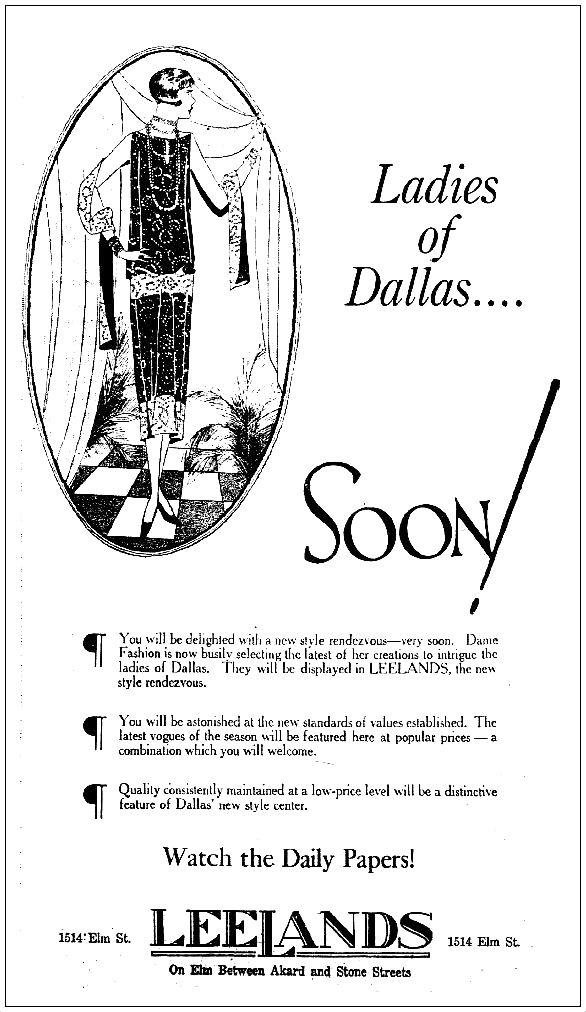
Mostly out of frame at the left is the W. A. Green department store (1516-18 Elm), then, moving east to west, Leelands women’s fashions (1514 Elm), Fields Millinery Co. (1512 Elm), part of the Marjdon Hat Shop (1510 Elm), and, above the hat shop, Neuman’s School of Dancing. (“Marjdon” must be one of the most annoying and hard-to-say business names I’ve come across.)

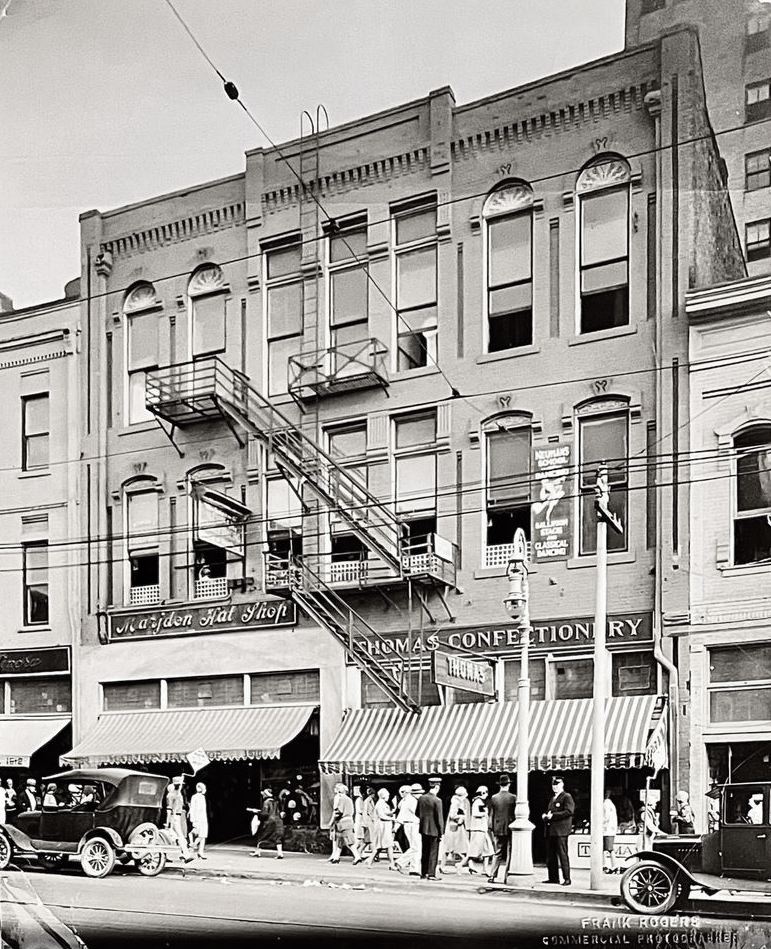
The block continues in the photo below, in another photo by Rogers (this building has been replaced and is now a parking garage).

thomas-confectionary_1508-10-elm-st_frank-rogers-ebay

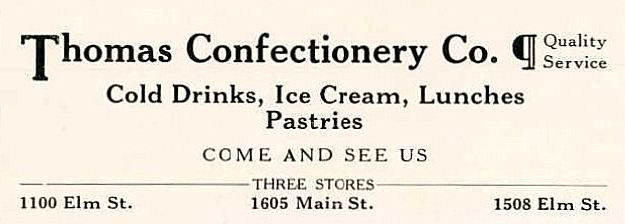
We see a full shot of Marjdon (that name…). Previously (1916-1924), that street-level space was occupied by the Rex Theater. Next door is Thomas Confectionery (1508 Elm, one of the company’s several downtown locations), which, according to the promotional postcard below was the “largest confectionery in the state.”

thomas-confectionary_postcard_1911_sam-rayburn-house-museum-via-portalvia Portal to Texas History

*

thomas-confectionary_main-high-school-yrbk_1916Dallas High School yearbook, 1916

*

marjdon_1510_opening_030124March 1, 1924

*

fields-millinery_1512-elm_dmn_opening_042122_adApril 21, 1922

*

leelands_030125March 1, 1925

*

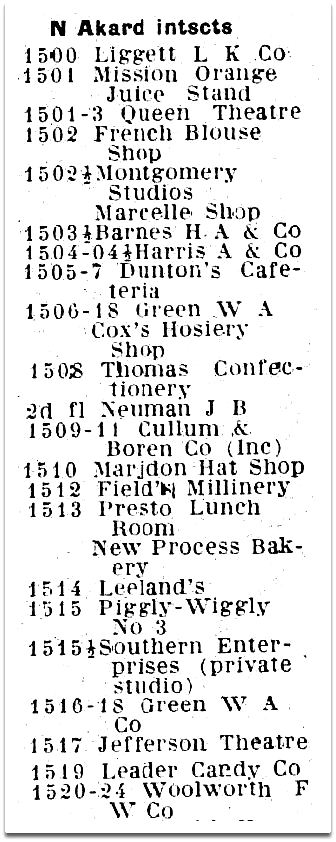
elm-street_dallas-directory-1925_1500-blockElm Street, 1925 Dallas street directory

*

Check out this block in the 1921 Sanborn map here.

***

Sources & Notes

The two photographs were taken by Dallas photographer Frank Rogers for real estate developers McNeny & McNeny; they were found on eBay.

fields-millinery_1512-elm_frank-rogers-ebay_sm

*

Copyright © 2023 Paula Bosse. All Rights Reserved.

Woodrow Teens Hang Around — 1948

woodrow-yrbk-1948_soda

by Paula Bosse

Photos from the 1948 Woodrow Wilson High School yearbook show how kids hung out in post-war Lakewood and Lower Greenville. I don’t know where some of these photos were taken — if you do, please let me know!

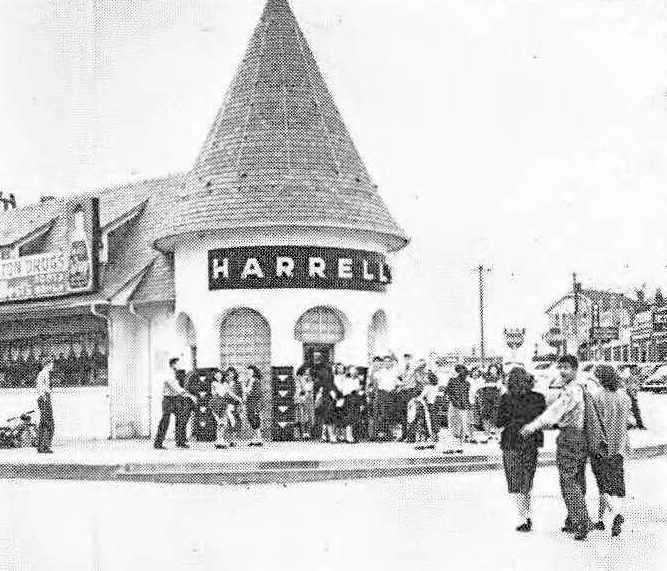
Above, there were lots of soda shops/pharmacy fountains to patronize. Including Harrell’s, in the familiar-to-anyone-who-has-spent-any-time-in-Lakewood turreted still-there building, below.

woodrow-yrbk-1948_harrells

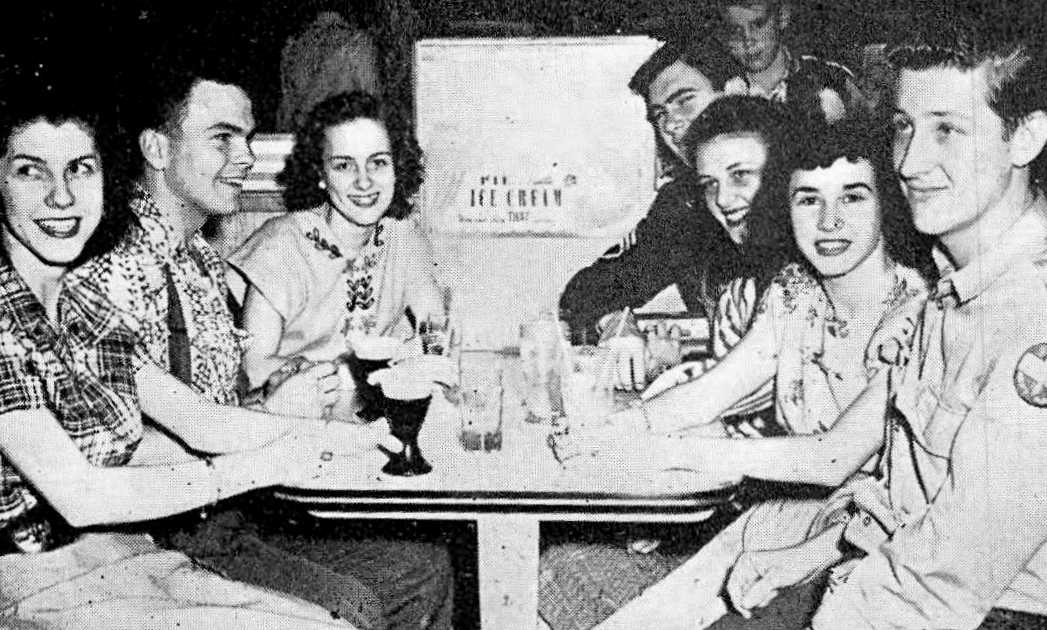
And here:

woodrow-yrbk-1948_table

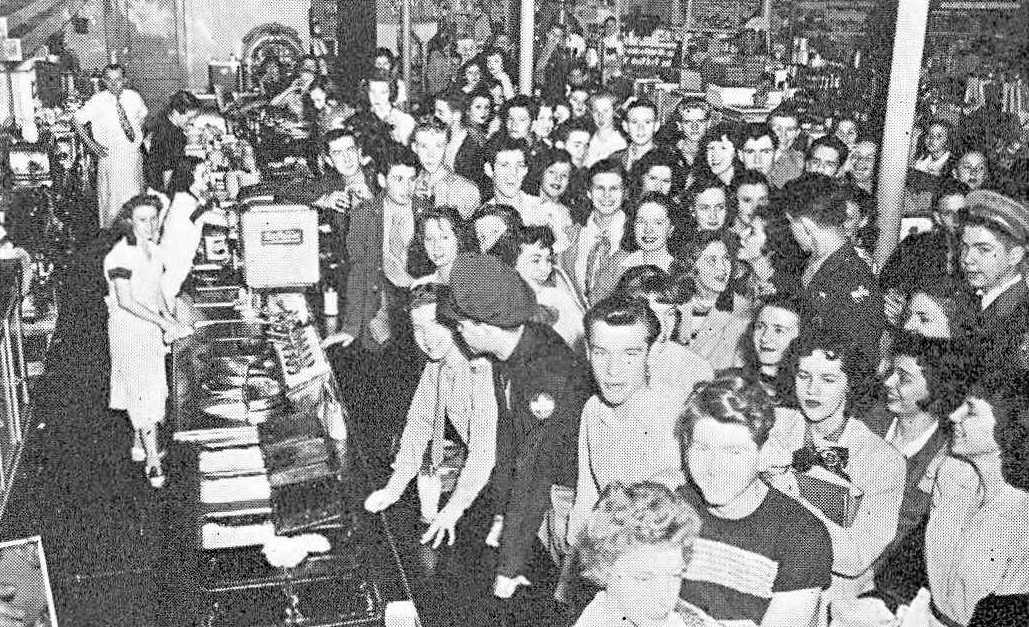
And here:

woodrow-yrbk-1948_crowd

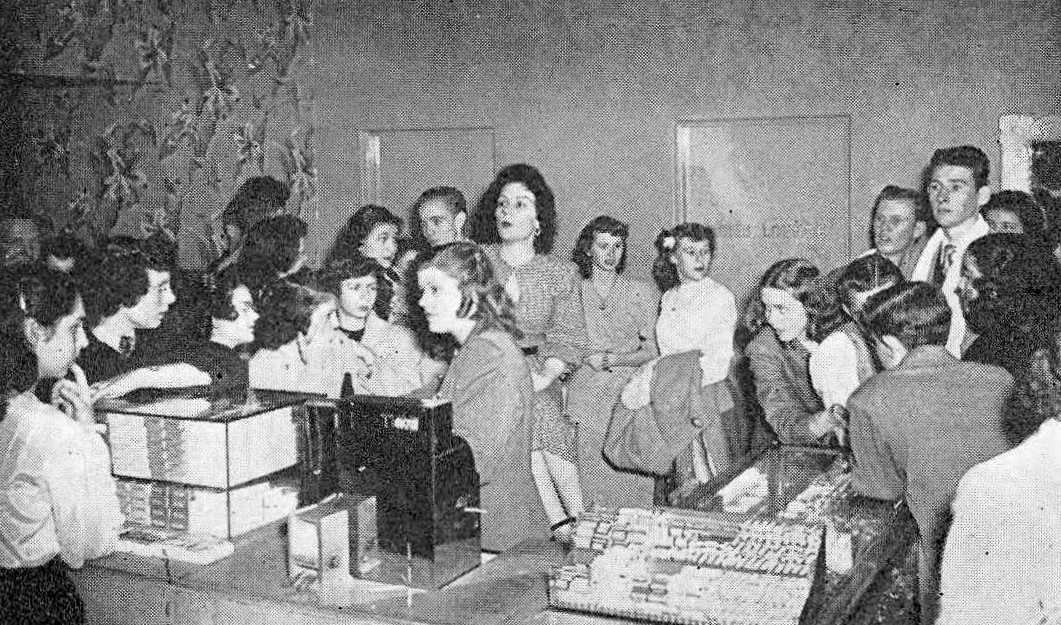
And here, where dressed-up teens are waiting for a table:

woodrow-yrbk-1948_waiting

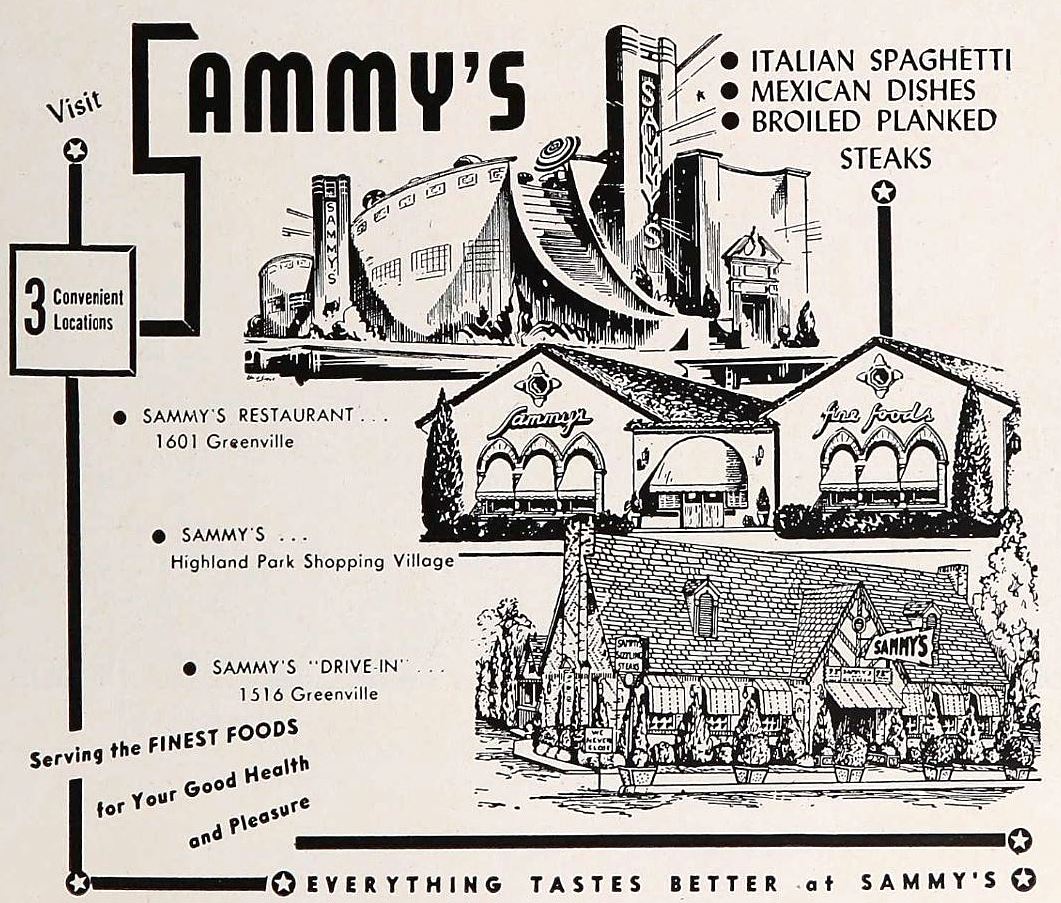
And here, the “fancy” Sammy’s on Greenville Avenue (right across the street from the less fancy Sammy’s):

woodrow-yrbk-1948_sammys

I have been obsessed with this building (just south of the intersection of Greenville and Ross) my whole life. Was there open-air dining upstairs? Dancing?

Since I mentioned it, these were the three Sammy’s which were in operation in 1945 — the two on Greenville and one in Highland Park Village:

sammys_HPHS_1945_yrbk

So, yeah, there was lots of hanging around for Woodrow kids back in 1948.

woodrow-yrbk-1948_page

***

Sources & Notes

All images (except the ad for Sammy’s) are from the 1948 Crusader, the yearbook of Woodrow Wilson High School.

Sammy’s ad is from the 1945 Highland Park High School yearbook.

woodrow-yrbk-1948_page_sm

*

Copyright © 2023 Paula Bosse. All Rights Reserved.

The Stagecoach Ride at Six Flags: 1961-1967

six-flags_stagecoach_fort-worth-magazineWhat could possibly go wrong?

by Paula Bosse

Did you ride the stagecoach at Six Flags?

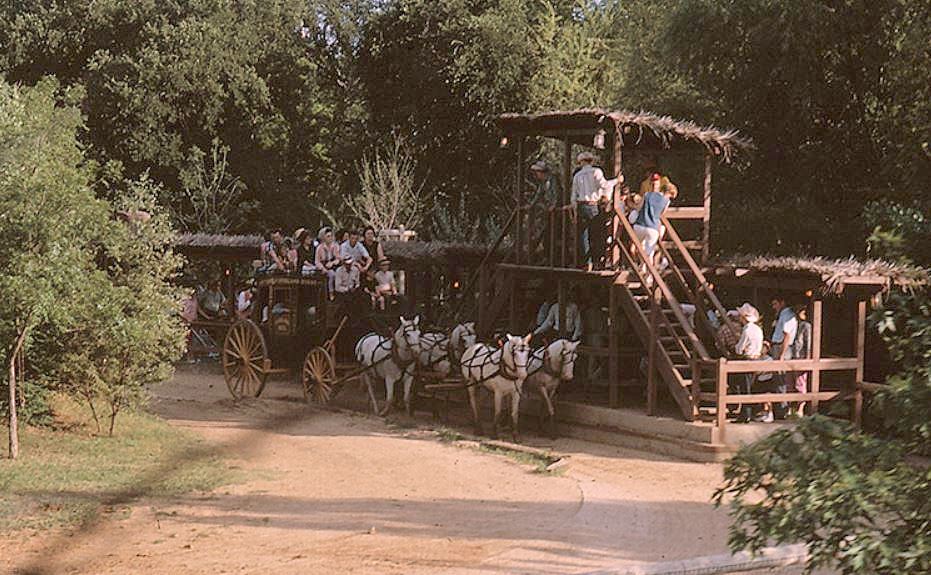
The stagecoach at Six Flags? What? This:

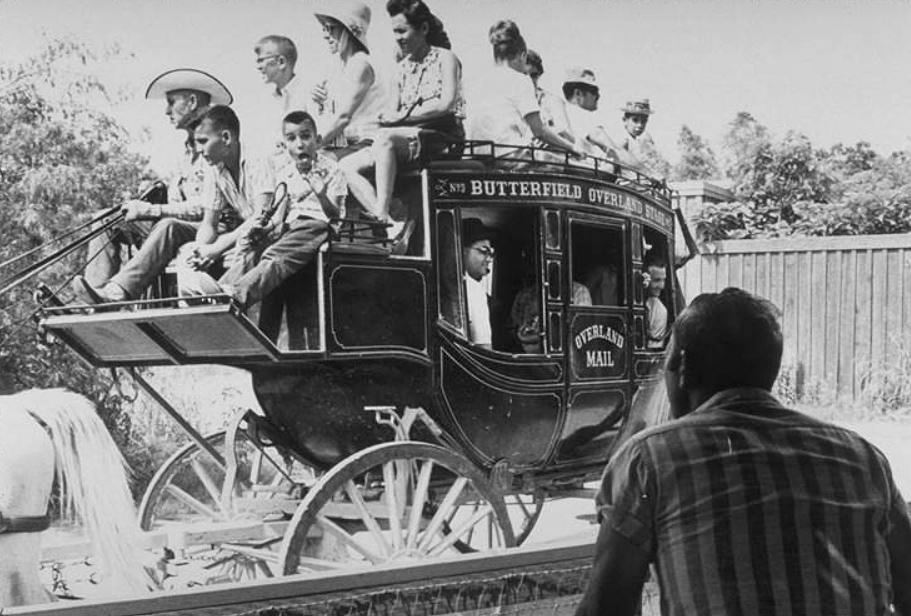
six-flags_stagecoach

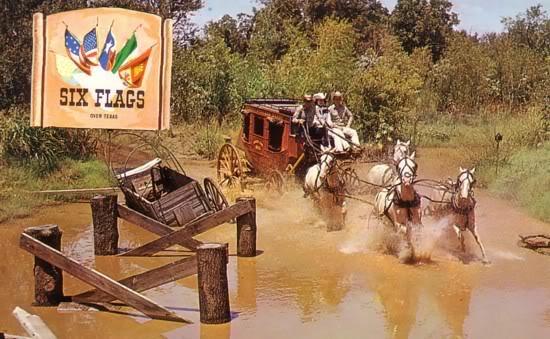
And this (with grazing buffalo for added Old West atmosphere):

six-flags_stagecoach_buffalo_ebay_front

When I first saw Six Flags postcards touting stagecoach rides, my first thought was, “How did they ever manage to get insurance for that?”

six-flags_stagecoach_buffalo_ebay_reverse

The “Butterfield Overland” ride debuted in the “Confederate” section when the park opened in 1961 and lasted until about 1967. It was very, very popular.

six-flags_stagecoach_1965_UTA_det1965, via UTA Libraries Special Collections (det)

Why did I never know about this when I was a kid? I never saw a stagecoach. I would have LOVED to ride a stagecoach. What happened? Well, here’s what happened: in May 1967, one of the stage’s wheels came off mid-ride, and the stage overturned, injuring 11 of the 14 people on board, most of them children. A 4-year-old Haltom City girl — who was riding on the top — was pinned beneath the overturned stagecoach. When she was freed, she was rushed to the hospital and underwent emergency surgery on both feet. One of the news stories about this unfortunate incident ended with, “Saturday’s accident was the first involving the stagecoach since the park opened in 1961,” adding that more than 4 million persons had ridden this ride between 1961 and 1967. (Four million!) (Granted, I think there were four stagecoaches and four teams of horses, but… four million!!)

One month after the accident, it was reported that the girl’s father had sued Six Flags for $531,000, contending that park officials were guilty of 30 counts of negligence. ($531,000 would be the equivalent in today’s money of about $5 million.) I can’t find anything about what happened with this lawsuit, but I assume there was probably a quiet settlement. Coincidentally or not, that spelled the end of the Butterfield Overland stagecoach ride at Six Flags Over Texas.

And that’s why I never heard of — or got to experience — a stagecoach ride at Six Flags.

(I don’t know what happened to the buffalo.)

***

Sources & Notes

Top photo of a Six Flags stagecoach jam-packed with kids from Fort Worth magazine.

The 1965 image is a detail of a larger photo from the Jack White Photograph Collection, UTA Libraries Special Collections — see the full photo and more details here.

Read more about this Butterfield Overland stagecoach ride at Parktimes.com.

The whole “Confederate” and “Texas” sections of SFOT were kind of weird, including a several-times-a-day lynching (!), as can be seen in one of the postcards in the 2014 Flashback Dallas post “Angus Wynne Jr.’s ‘Texas Disneyland’ — 1961.”

For real, non-amusement-park stagecoach tidbits, check out the post (also from 2014) “Dallas to Austin by Stagecoach: Only Three Days! (1854).”

A slightly different version of this post originally appeared on the Flashback Dallas Patreon page in August 2023. If you’d like to see daily Flashback Dallas posts, please consider supporting me on Patreon, for as little as $5 a month.

six-flags_stagecoach_fort-worth-magazine_sm

*

Copyright © 2023 Paula Bosse. All Rights Reserved.

Aunt Stelle’s Sno Cone

aunt-stelles_sign_googleAn Oak Cliff oasis…

by Paula Bosse

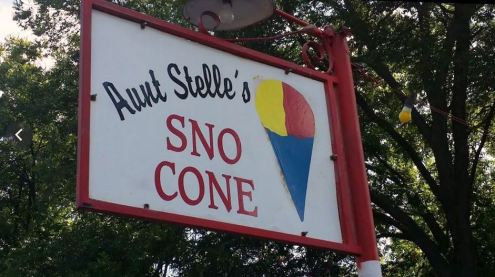
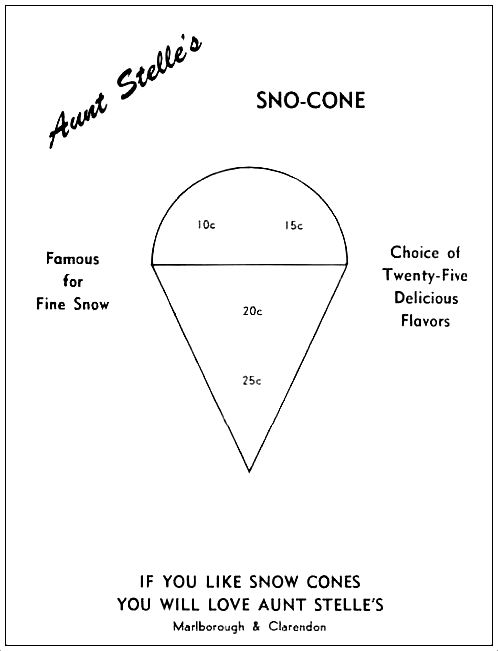
This has been a brutally hot summer. The kind of summer when a snow cone would really hit the spot at just about any sweltering hour of the day. One place that was famous for its snow cones (they were described as being like “fine snow”) was Aunt Stelle’s Sno Cone, at 2002 W. Clarendon (at Marlborough) in Oak Cliff. Established by Estelle Williams in 1962, the little stand was hugely popular until it officially closed in 2018. Her snow cones were flying out of there every summer season for more than 55 years! To generations of customers. Not many businesses can boast that kind of longevity and patron loyalty. (One of those loyal patrons was Oak Cliff homeboy Stevie Ray Vaughan.)

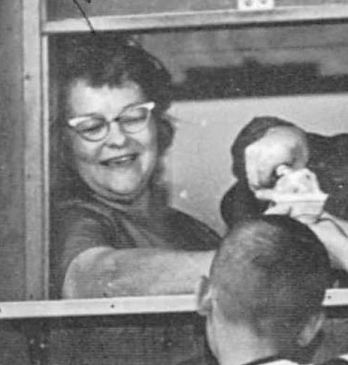
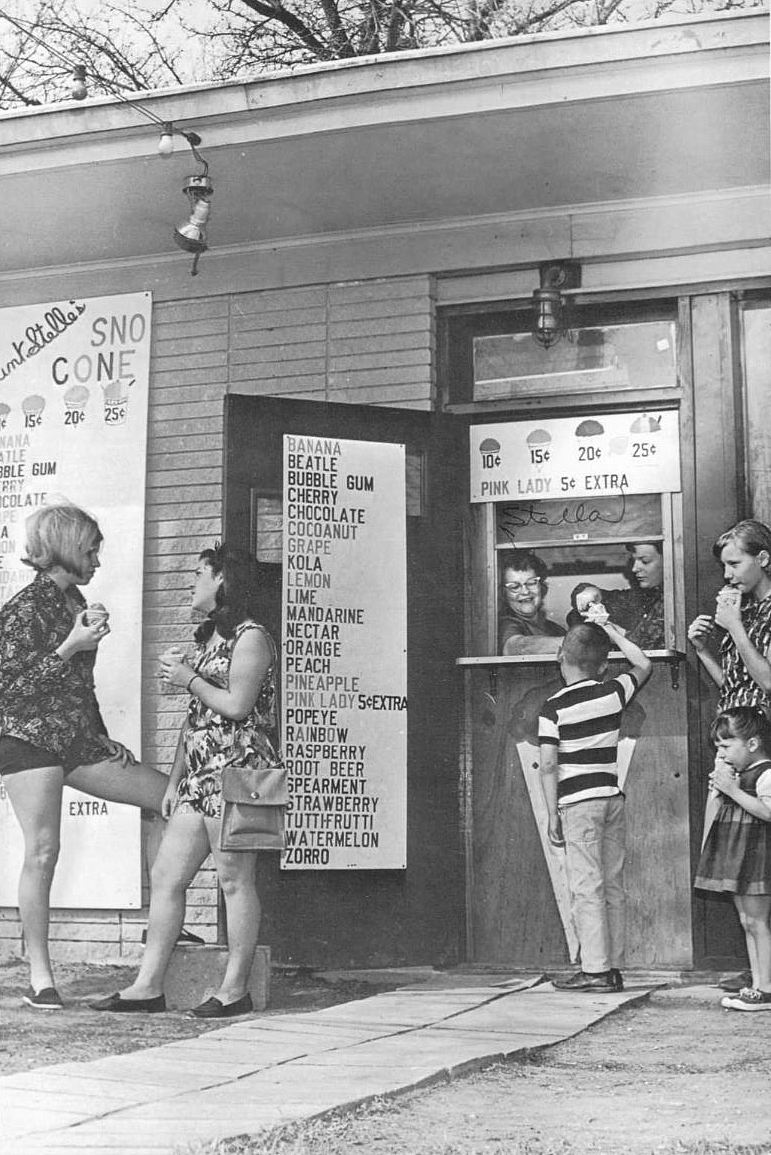
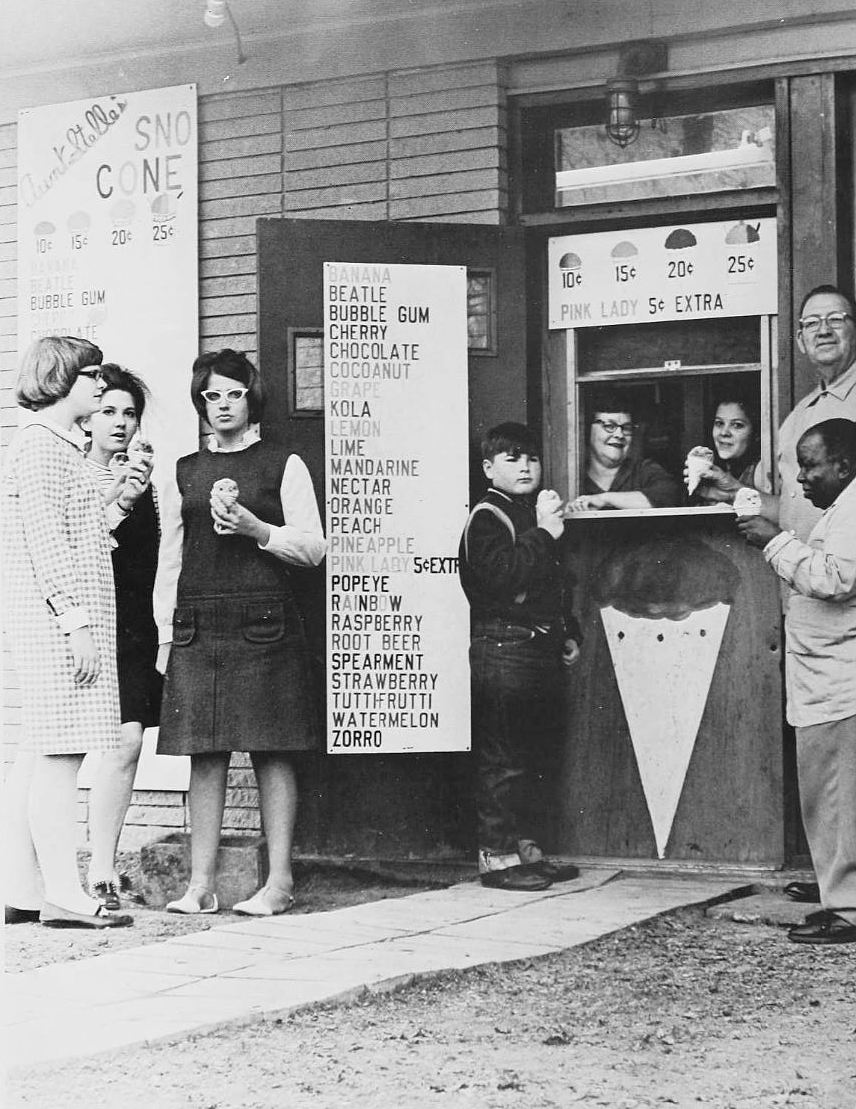
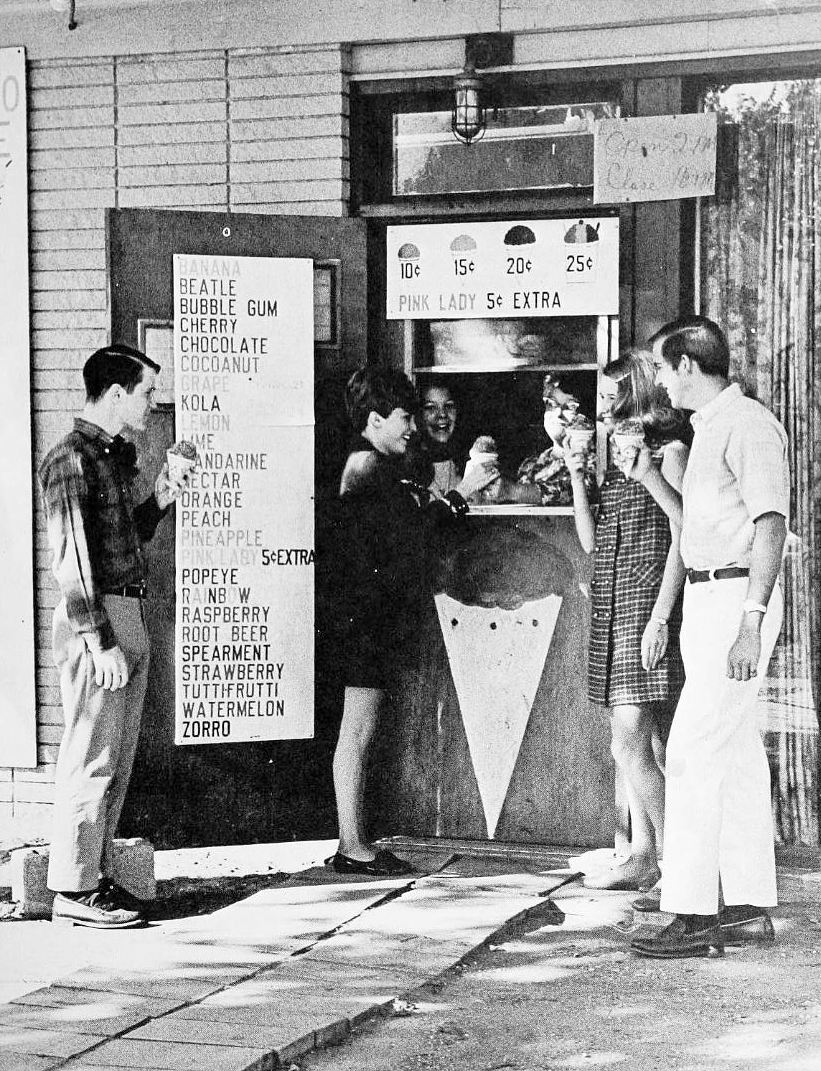
Having not grown up in Oak Cliff, I wasn’t familiar with Aunt Stelle’s until I saw the photos below which appeared as ads in editions of the Sunset High School yearbook. You can see Estelle in the window. She looks exactly like the kind of person I’d want serving me a delicious, refreshing, messy treat.

aunt-stelle_sunset-high-school-yrbk_1967-det

Speaking of the treats, check out that menu board! I understand the “Beatle” tasted like a grape SweeTart, the “Zorro” tasted like licorice (and it was black!), the “Pink Lady” tasted like vanilla ice cream, and the “Popeye”… I really wanted it to be green and taste like spinach, but apparently it tasted like gumballs (what a missed opportunity!).

*

summer_aunt-stelles-sno-cones_sunset-high-school_1967-yrbk._b1967 Sunset High School yearbook

summer_aunt-stelles-sno-cones_sunset-high-school_1967-yrbk1967 Sunset yearbook

summer_aunt-stelles-sno-cones_sunset-high-school_1968-yrbk1968 Sunset yearbook

summer_aunt-stelles-sno-cones_sunset-high-school_1969-yrbk1969 Sunset yearbook

***

Sources & Notes

Top image of the Aunt Stelle’s sign is from Google — the photographer is listed simply as “Scott.”

A great story about Aunt Stelle’s can be found in the Dallas Morning News archives in the story “Sno Days: Aunt Stelle’s Has Been Keeping Oak Cliff Cool for 40 Seasons” by Dave Tarrant (DMN, June 22, 2001).

Consider supporting me on Patreon! Five bucks a month gets you daily morsels of Dallas history!

aunt-stelles_sign_google

*

Copyright © 2023 Paula Bosse. All Rights Reserved.

Hometown by Handlebar

hometown-by-handlebar_header

by Paula Bosse

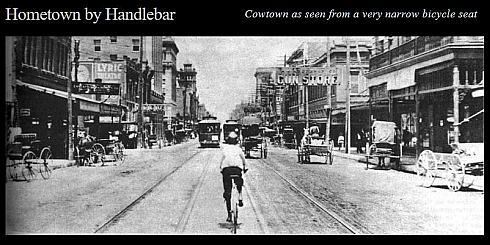
I’m ashamed to say I’ve only just learned of the death of Mike Nichols, the man behind the fantastic Fort Worth-history blog “Hometown by Handlebar.” Mike, a former columnist for The Fort Worth Star-Telegram, died on March 5, 2023. He was 73.

His last blog post was on March 4, 2023 — a version of the piece also appeared in the pages of the FWST on the following day, the day he died after a long battle with cancer.

I am so sad to hear this. I never met Mike, but we exchanged pithy fan letters over the years. I discovered his blog in 2014 — the first year I started blogging about my hometown — and when I first saw it, I was shocked. His “Hometown by Handlebar” was a Fort Worth version of “Flashback Dallas” (or, I should probably say that Flashback Dallas was a Dallas version of Hometown by Handlebar). They were really, really similar. I either commented on a post of his I had stumbled across or sent him a personal message via Facebook, and that began several years of a sporadic, not-so-long-distance mutual admiration society. He frequently referred to us as “twins.”

When I was celebrating my first Flashback Dallas anniversary on Facebook in February 2015, Mike wrote, “Happy historying to you, Sis, from upstream.”

I responded with a link to his blog so that my friends would understand what he was referring to and wrote, “People who find Dallas dullsville and Fort Worth where it’s AT need to check out Mike’s blog, Hometown by Handlebar. He and I were apparently separated at birth — our blogs are surprisingly similar. I mean … it’s WEIRD!”

And then he responded, “Thanks, Paula. The first time I saw Flashback Dallas, at first glance its content and appearance — text mixed with vintage images, old newspaper clips — were so similar to my blog that I got a bit dizzy. It was as though I was looking at my own blog, but when I looked closer I saw that everywhere the text should say ‘Fort Worth,’ it said “Dallas.” I briefly wondered if I had died and gone to Oak Cliff.”

I couldn’t have asked for a more flattering (or amusing) comparison.

*

I’ve wondered about what might happen to my own blog when I’m no longer around to renew domain names and URLs, pay for web hosting, and do all the mundane administrative things one needs to do just to keep a website alive on the internet. I hope someone will keep Mike’s unbelievably vast and wide-ranging blog online as long as possible. There’s too much entertaining and informative Fort Worth history there for it to just disappear.

*

I always hoped we would meet one day. We never did. We would have had a lot to talk about. He seems like a lovely man. Rest in peace, Mike. Cowtown — and your readers — will miss you.

nichols-mike_obit

***

Sources & Notes

Top image is the header from Mike Nichols’ blog, Hometown by Handlebar.

The color photo is from his obituary, which you can read here.

Read a profile of Mike in Fort Worth Magazine — “A Fond Farewell to Mike Nichols: Local writer, historian, and bicycle archaeologist Mike Nichols leaves an indelible legacy behind” — here.

hometown-by-handlebar_header_sm

*

Copyright © 2023 Paula Bosse. All Rights Reserved.

Dr Pepper Bottling Plant, Second Ave. & Hickory — ca. 1938

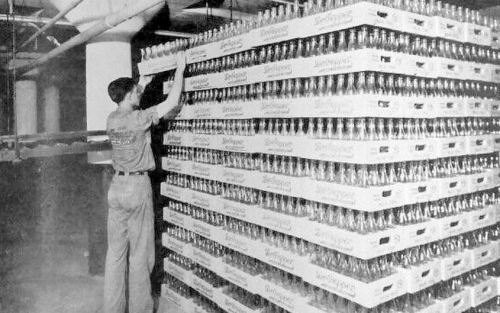
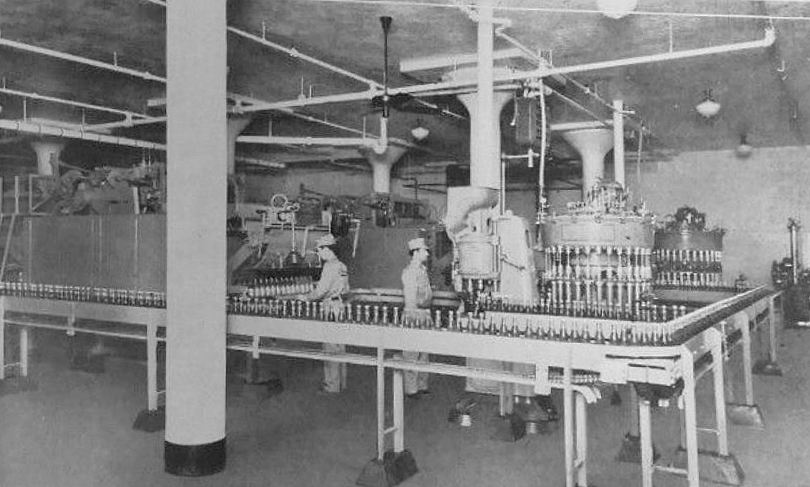
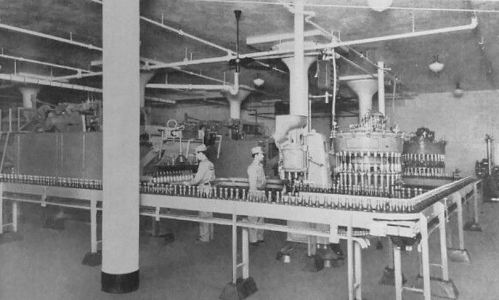
dr-pepper-manual_bottling-plant_int_cropTransfixed by Dr Pepper-laden conveyor belts

by Paula Bosse

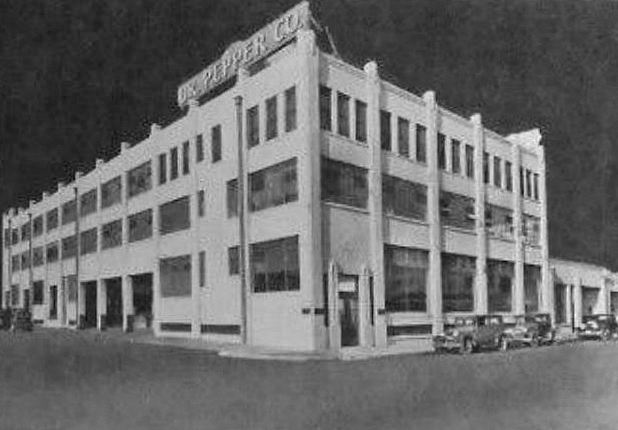
Before Dr Pepper moved into its fabulous art deco HQ at Mockingbird & Greenville (RIP…), the company’s Dallas bottling works was located at Second Avenue & Hickory Street, from about 1927 to 1948. The building (seen below) still stands.

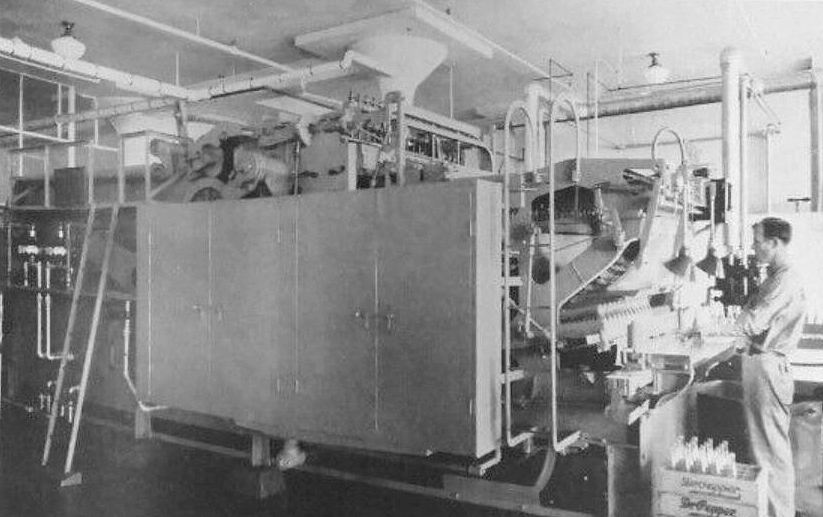
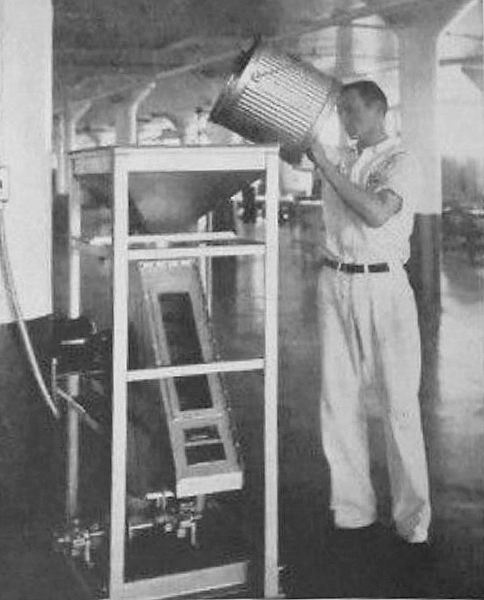
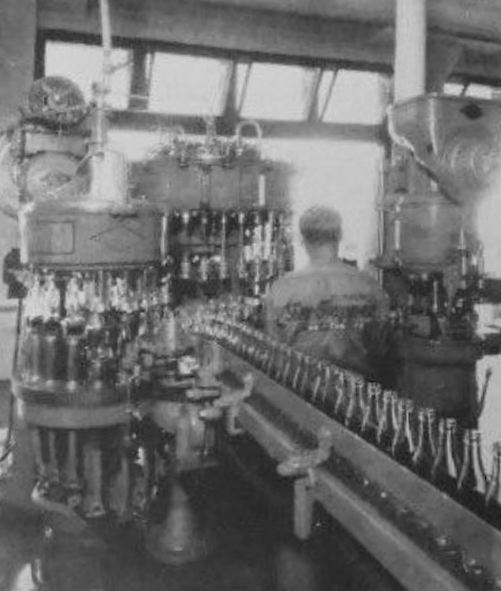
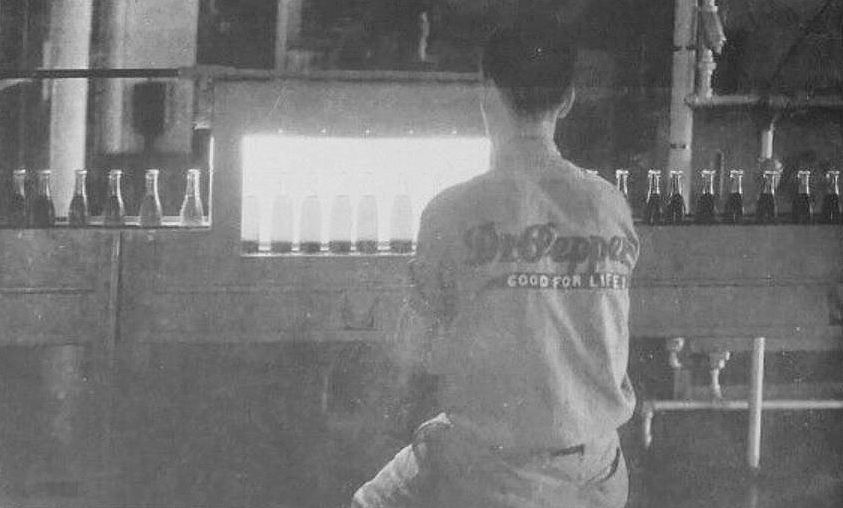
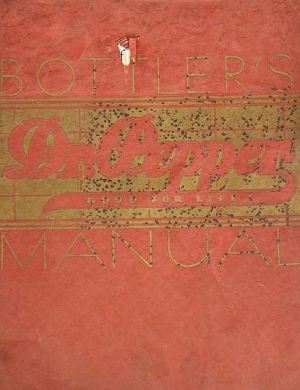
The images in this post are from a DP manual for bottlers, with numerous photos taken in the Dallas plant. All photos in this post are from that manual (more info is at the end of this post), which every true Dr Pepper superfan (or the dogged collector of obscure soft-drink ephemera) should probably have! All captions are from the booklet.

Above, “Interior of Dallas bottling plant in operation.”

Below, “Model syrup factory, bottling plant and general home office of Dr. Pepper Company, Dallas, Texas.”
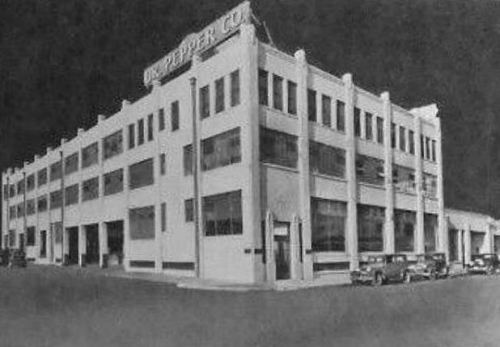
dr-pepper-manual_dallas-bottling-plant_ext_crop

*

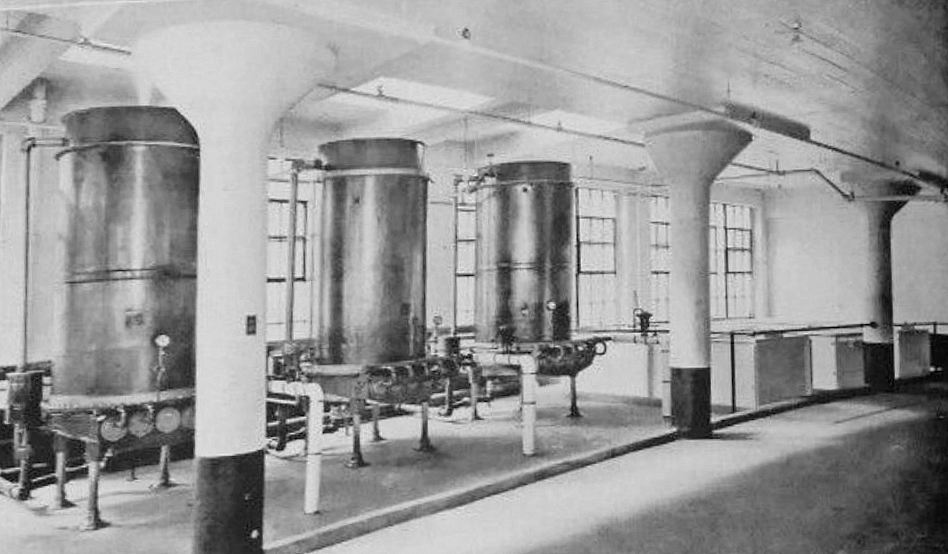
“Water stills, Dallas plant, supplying water for syrup making.”
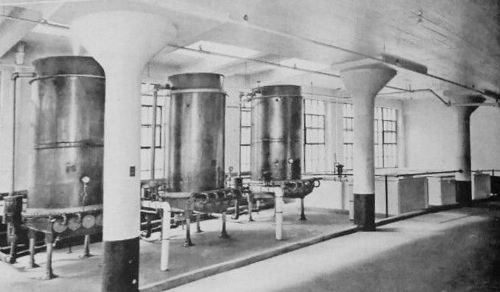
dr-pepper-manual_water-stills_crop

*

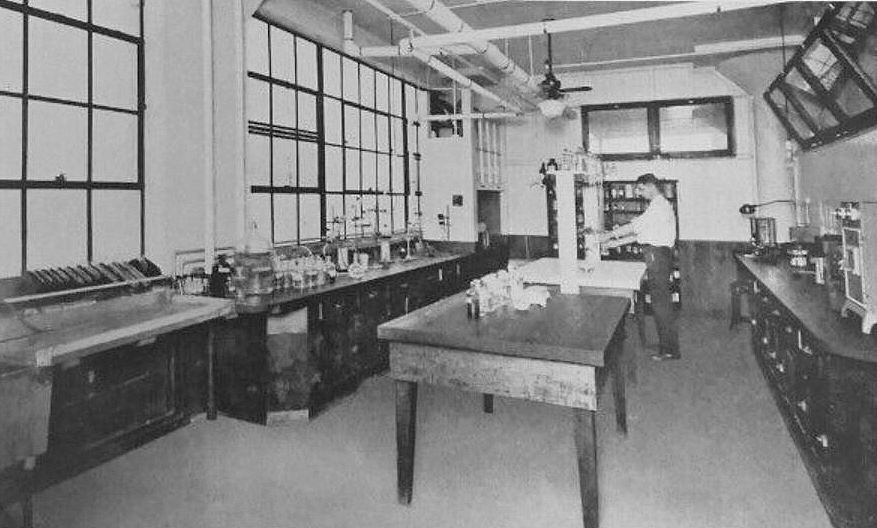
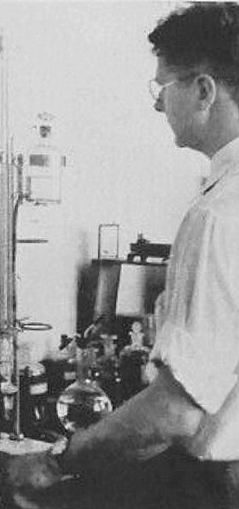
“General view chemical laboratory, Dallas.”
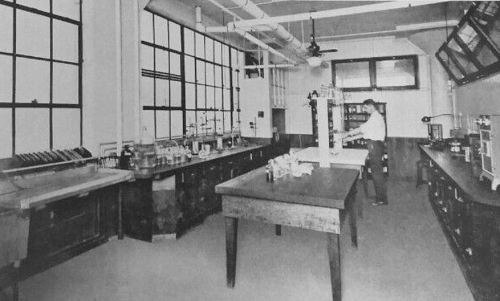
dr-pepper-manual_chemical-laboratory_crop

*

“Chief chemist, Mr. H. Buttler, Dallas, Texas” (Howland Buttler is also seen in the photo above).
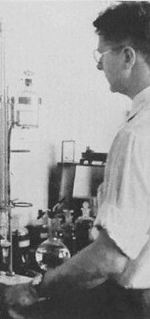
dr-pepper-manual_chief-chemist_buttler_crop

*

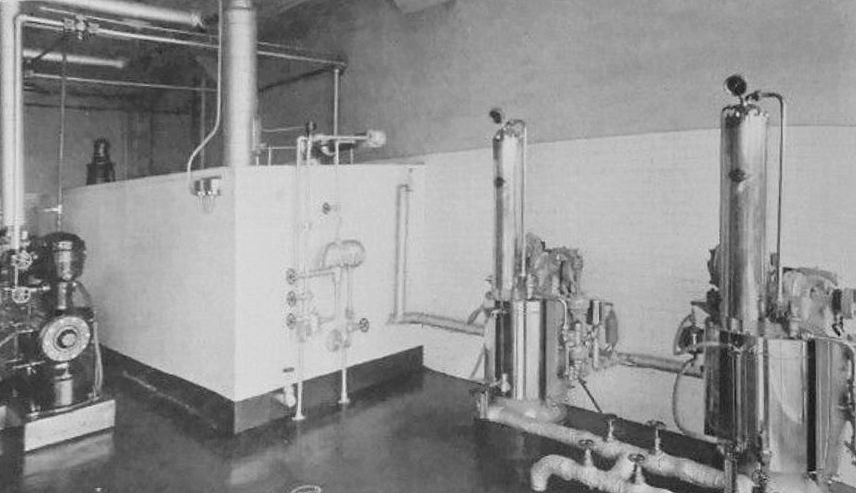
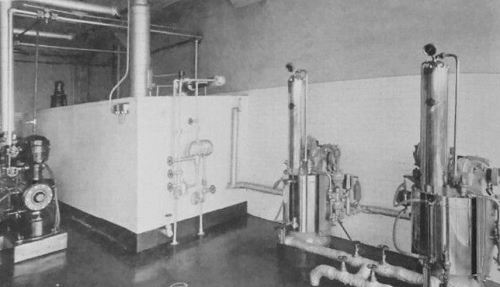
“Water cooler and carbonating equipment, bottling plant, Dallas.”
dr-pepper-manual_water-cooler_carbonating-equipment_crop

*

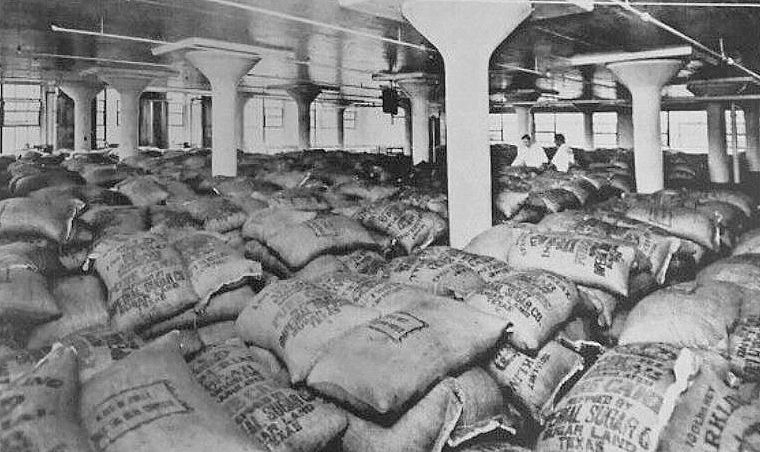
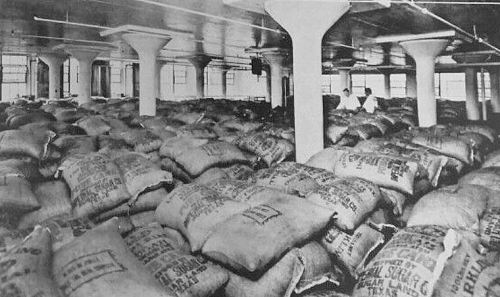
This is my favorite photo: “One section of sugar storage, Dallas — you see a supply sufficient for about a week. Interior view of sugar storage floor, Dr Pepper factory building, Dallas. Only the finest, pure cane sugar is used, a grade and quality superior even to the finest table sugar. Exacting standards must be maintained by refiners to meet our specifications, lest the slightest taste or odor from impurities creep into the Dr. Pepper syrup.”  (A few years ago, I stumbled across a crazy story about Dr. Pepper — and other soft drink manufacturers — involved in buying black-market sugar, which was a violation of war-time food rationing, as WWII came to a close. Read about this case in the post “Halloween Party? Don’t Forget the Dr Pepper! — 1947” — scroll to the bottom.) Shout out to Sugar Land!
dr-pepper-manual_sugar-storage_crop

*

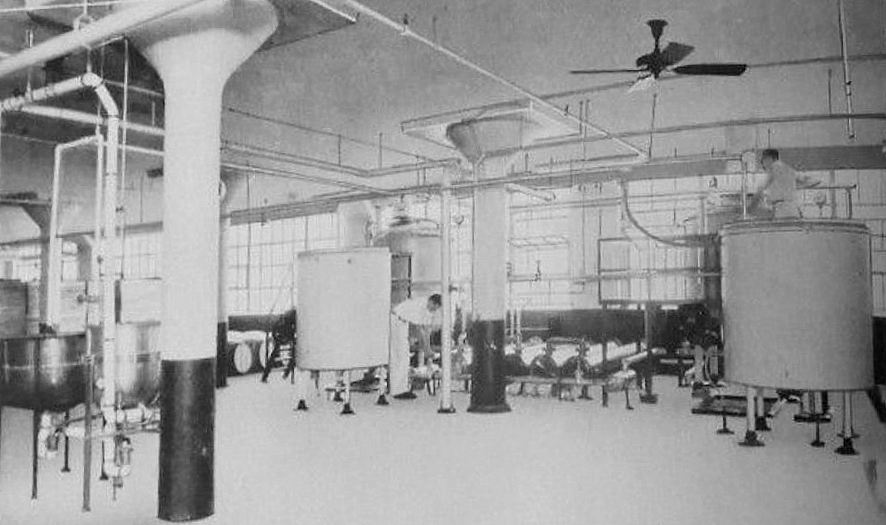
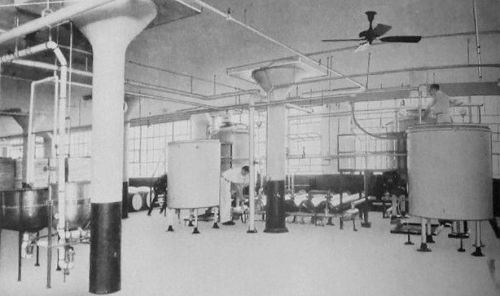
“Syrup compounding and manufacturing unit at Dallas, Texas. Interior view of syrup room, Dr. Pepper factory, Dallas. Note flood of sunshine through modern factory-glass windows; floors, walls, ceilings, as well as equipment, immaculately clean. Glass-lined mixing tanks in center and at right are of 300-gallon capacity, and behind these are 500-gallon steam-jacketed, glass-lined kettles, where hot process simple syrup is made. Entire syrup manufacturing process is modern, efficient and sanitary.”
dr-pepper-manual_syrup-unit_crop

*

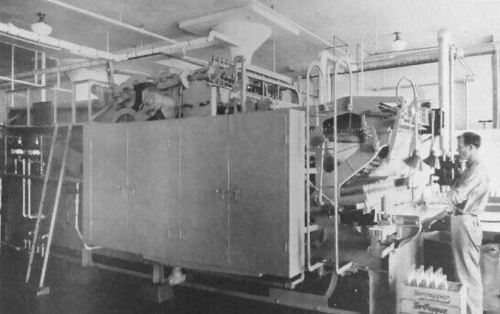
“Modern soaker and washer — one of two units used in Dallas plant.”
dr-pepper-manual_soaker_washer_crop

*

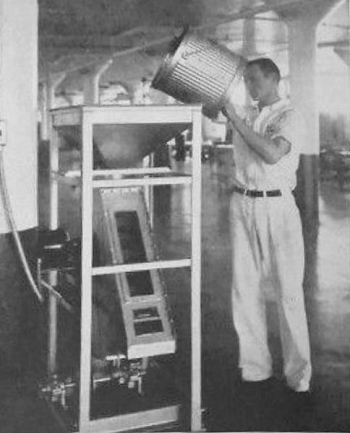
“Modern crown sifting equipment, Dallas.” (More on crown cork bottle caps here.) (And, weirdly, I wrote about a Dallas company that manufactured those caps in the post “The Crown Cork & Seal Co., Dallas Branch — ca. 1910.”)
dr-pepper-manual_crown-sifting_crop

*

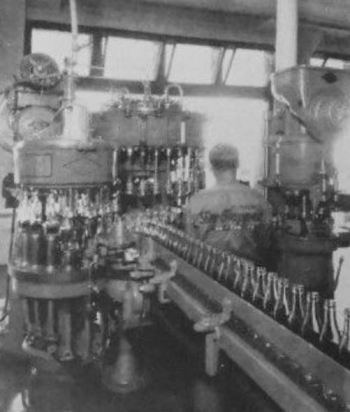
“Low pressure unit — bottler and crowner.”
dr-pepper-manual_low-pressure-unit_bottler_crowner-crop

*

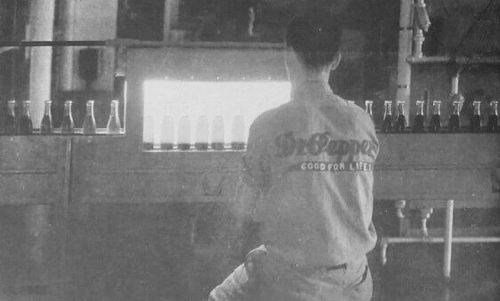
“Final inspection, Dallas bottling plant — ‘candling’ filled bottles.”
dr-pepper-manual_inspection_candling_crop

*

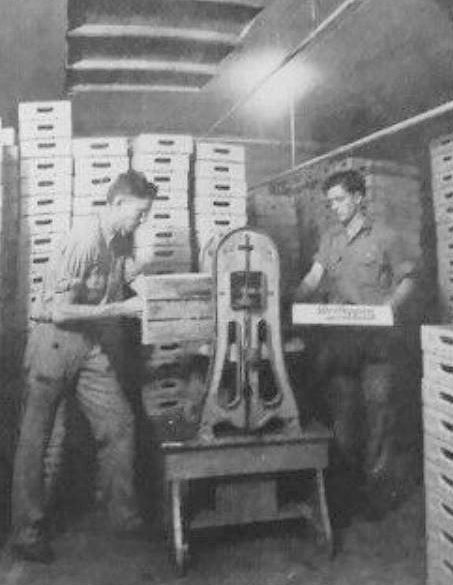
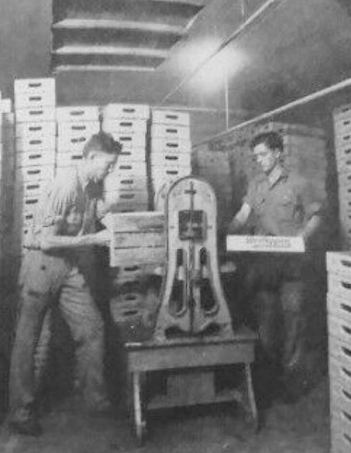
“Automatic case stenciling machine.” This is an important part of the manufacturing process I hadn’t thought about….
dr-pepper-manual_case-stenciling_crop

*

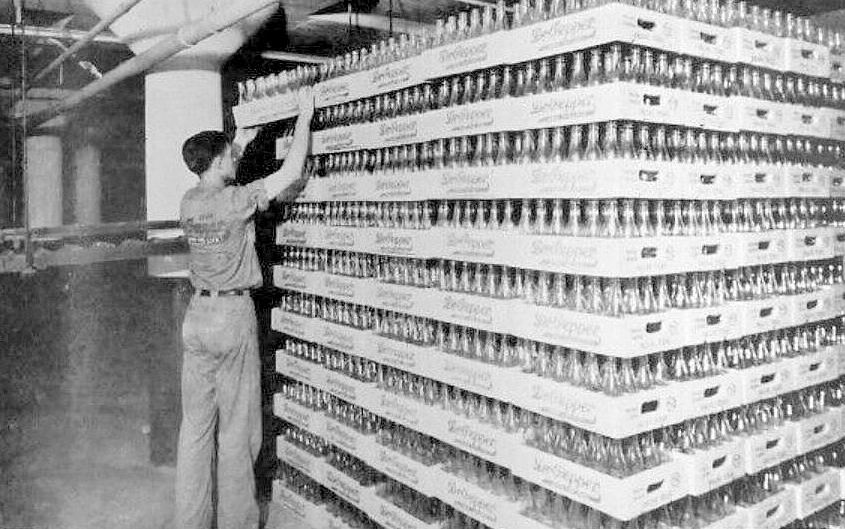
“Bottle storage, Dallas plant.”

dr-pepper-manual_bottle-storage_crop

*

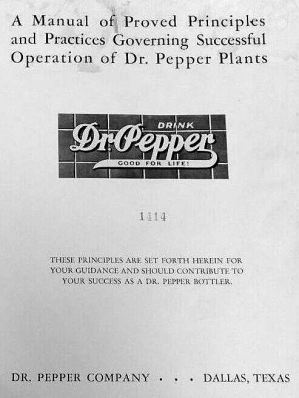
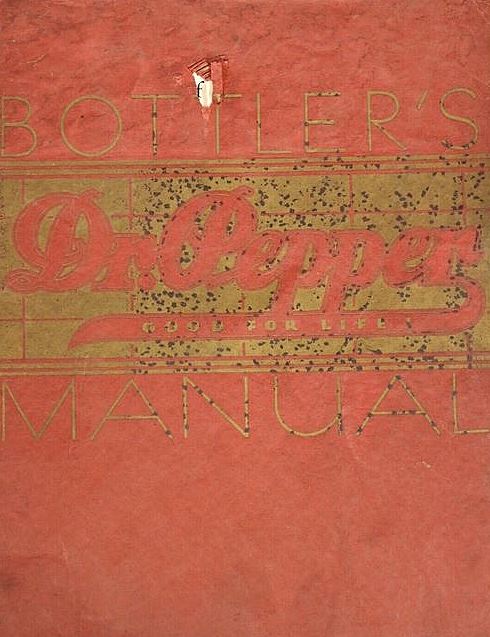
Battered front cover and title page:
dr-pepper-manual_front-cover_nov-1938_crop

dr-pepper-manual_title-page_crop

***

Sources & Notes

Photos from “Dr. Pepper Bottler’s Manual: A Manual of Proved Principles and Practices Governing Successful Operation of Dr. Pepper Plants” (Dr. Pepper Company, Dallas, Texas, Nov. 1938); this booklet was found on eBay — for sale for $499.99.

More Flashback Dallas posts featuring Dr Pepper can be found here.

Please consider following me on Patreon, where I post new content daily — for as little as $5 a month!

dr-pepper-manual_bottling-plant_int_crop_sm

*

Copyright © 2023 Paula Bosse. All Rights Reserved.