Flashback : Dallas

A Miscellany: History, Ads, Pop Culture

Category: Uptown

Cole Park Storm Water Detention Vault

water-detention-vaultWhy, yes, this IS in Uptown…

by Paula Bosse

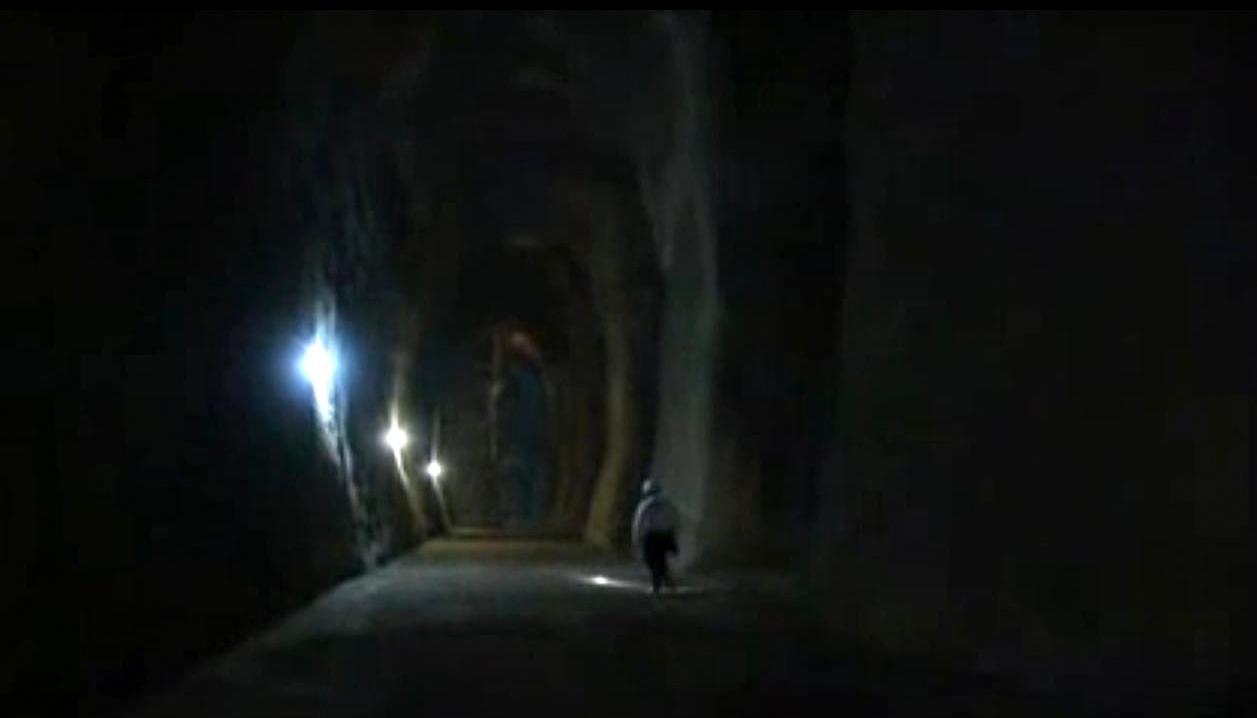
Underneath Cole Park (which is behind North Dallas High School and between Cole and McKinney), is a “storm water detention vault” — a cavernous space where storm water runoff goes when the capacity of the Mill Creek storm sewer system has been exceeded. It can hold 71 million gallons of storm water. …71 million gallons!

From a 2014 Facebook post from the Turtle Creek Association:

Completed in 1993, the vault’s 13 chambers, each of which rises five stories tall and runs the length of more than two football fields, are designed to fill with water during extreme rainfall. These massive vaults capture the storm water from Central Expressway and slowly release it into Turtle Creek via the Mill Creek Outfall by the footbridge in William B. Dean Park (next to the Kalita Humphrey Theater).

I had no idea that Dallas had anything like this until I saw the short film, below, in which Gilbert Aguilar, Assistant Director of the City of Dallas’ Department of Street Services, takes us on a tour of the “detention vault.” This is an absolutely mind-blowing look at something very, very few Dallasites know about. The City of Dallas probably wouldn’t be willing to grant access to moviemakers, but, seriously, this would make an INCREDIBLE movie set — perhaps less aesthetically appealing than the sewers of Vienna featured in The Third Man, but what it lacks in character it makes up for in sheer gigantic-ness.

***

Sources & Notes

The video, “Living With the Trinity: Cole Park Vault,” is on YouTube, here. Though not credited in the video itself, it is, presumably, a production of local filmmaker Mark Birnbaum, whose website is here.

Top image is a screengrab from the video.

*

Copyright © 2015 Paula Bosse. All Rights Reserved.

The Allen Street Taxi Company

allen-st-taxi-co_cook-degolyerAllen St. Taxi Co. / George W. Cook Collection, SMU

by Paula Bosse

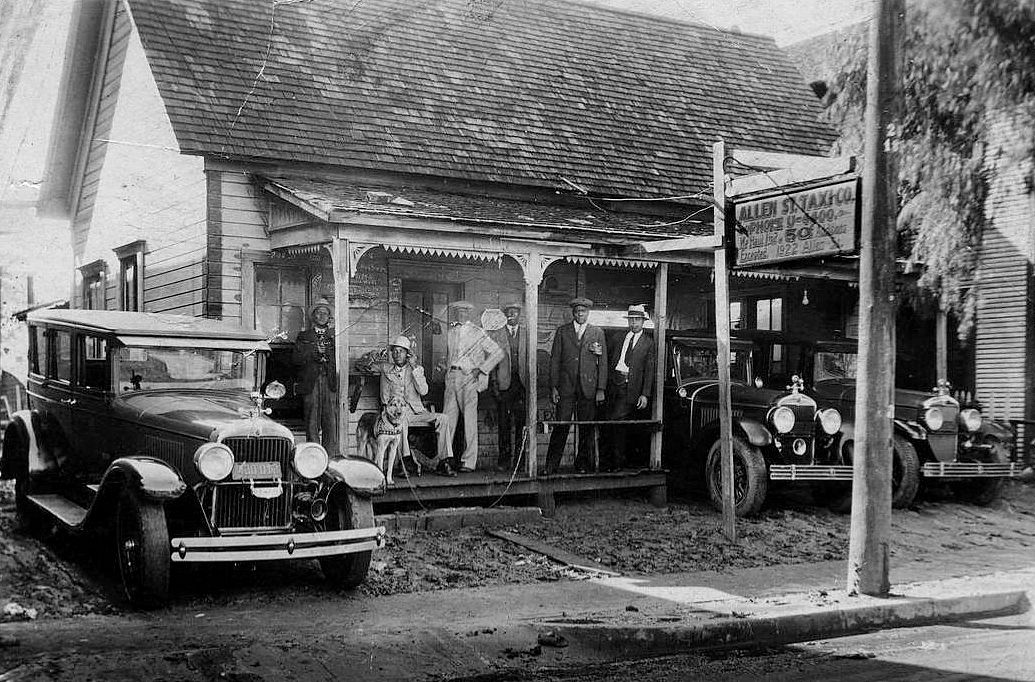
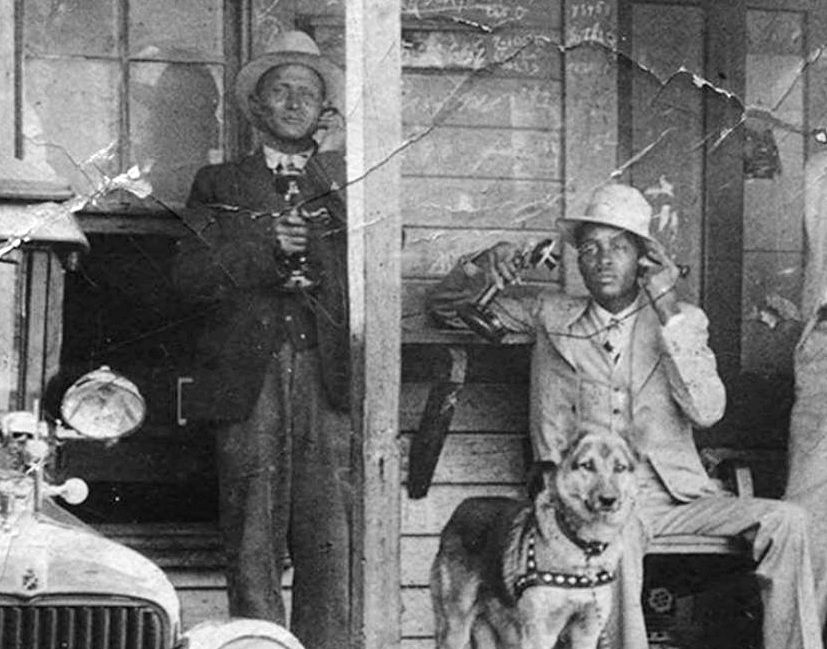
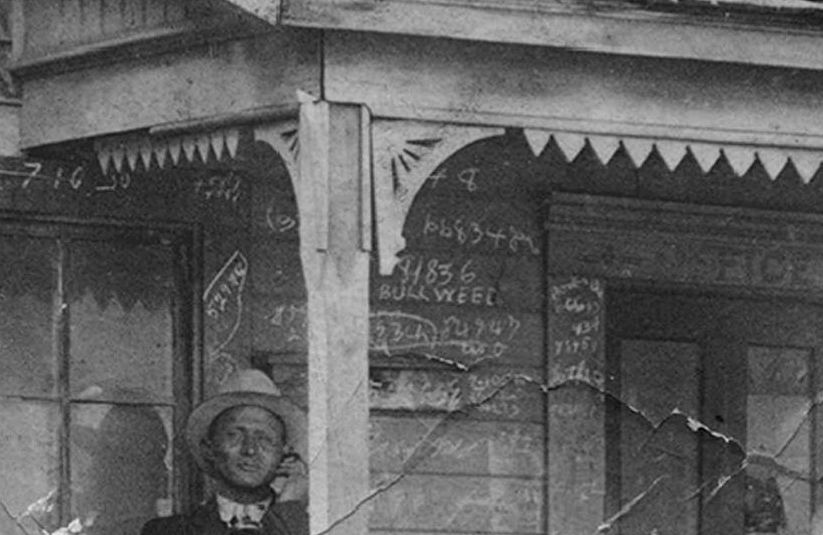
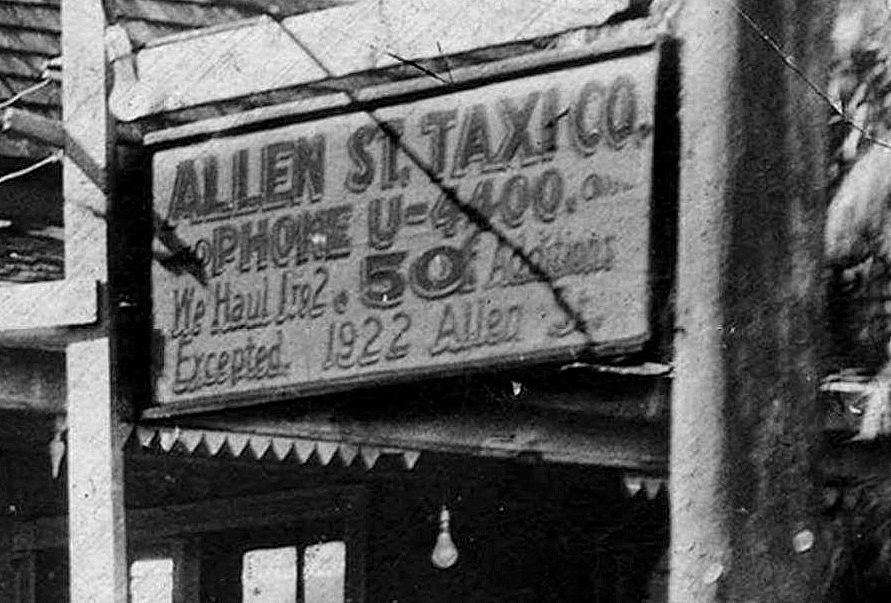
This has to be one of my favorite “unknown Dallas” photographs that I’ve come across. It shows the Allen St. Taxi Co. — in the State-Thomas area — at 1922 Allen Street (now pretty much vacant land under the Woodall Rodgers freeway). My ability to date cars is not good, but from city directory information, it seems that this photo might date from somewhere between the mid-1920s to around 1930. The owners/proprietors of the company were listed as John Leonard and Andrew Short in the 1929 telephone book. I wonder if they are in this fantastic photo? Let’s look a little more closely at some of the details. (All pictures larger when clicked.)

allen-st-taxi-co_cook-degolyer_det2Those phones!

allen-st-taxi-co_cook-degolyer-det4I love these guys. All business.

allen-st-taxi-co_cook-degolyer_det5“Bullweed.” What is all this writing? I love the guy’s face looking out of the window.

allen-st-taxi-co_cook-degolyer_det1“Dallas.” Car-people know exactly what make and model this vehicle is. …I am not one of these people.

allen-st-taxi-co_cook-degolyer_det3

***

Sources & Notes

Top photo, titled “Allen Street Taxi Co.,” is from the George W. Cook Dallas/Texas Image Collection, DeGolyer Library, Central University Libraries, Southern Methodist University; it can be viewed here.

The first “official” listing of the Allen St. Taxi Co. was in the 1929 city directory. The address at that time (which usually reflected information supplied the previous year) was 1907 Allen St. It didn’t appear again in the directory until 1932 when it was listed at 2816 Juliette St. In 1933 and 1934 it was listed at 2114 Hall St. In 1936 and 1937 it had moved to 2217 Hugo. And in 1938, the taxi part of the business seems to have fallen by the wayside, and it became Allen St. Transfer.

In 1925 there were only three official cab companies listed in the city directory. But the rough-and-tumble world of taxi cab service in the unregulated ’20s and ’30s was pretty intense. There were a lot of unlicensed jitneys rolling around town, especially, one would assume, in the segregated black neighborhoods of the city unlikely to be served by white-owned companies. My guess is that this might have been how the Allen St. Taxi Co. began.

For more on the go-go-go competitive world of taxi service at this time, see my previous post, “Washington Taxi Company: ‘Call George!'” here.

*

Copyright © 2015 Paula Bosse. All Rights Reserved.

Not Dead Yet at McKinney & Routh

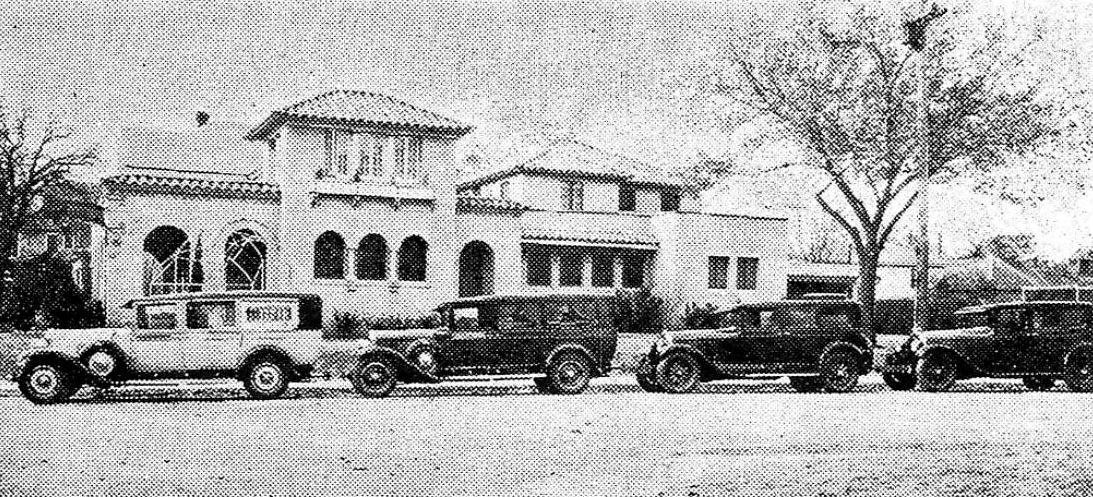
ad-funeral-home_mckinney-routh_directory-1929-detA fleet of Cadillacs in front of 2533 McKinney Ave.

by Paula Bosse

The photo above shows a truly beautiful, Spanish-style building that was built in 1927 at the northwest corner of McKinney Avenue and Routh Street. The view shows the Routh Street side. The person who took this photograph would have been standing across the street on the property of the dearly-departed McKinney Avenue Baptist Church (most recently transformed into the Hard Rock Cafe). You might be surprised to learn that the building in this photo still stands, and it’s mostly recognizable almost 90 years later.

The Community Chapel Funeral Home (yes, a funeral home!) was designed by noted architect Clarence C. Bulger (whose father, C. W. Bulger, designed, among other things, the Praetorian Building downtown AND the just-mentioned McKinney Avenue Baptist Church which was right across the street).

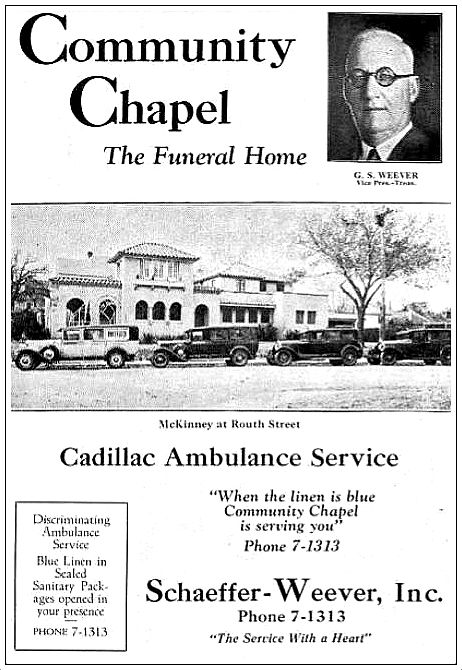
ad-funeral-home_mckinney-routh_directory-1929City directory, 1929

In addition to the funeral home portion (reception area, business office, show rooms, “operating room” (!), chapel with seating for 100, and the euphemistically named “slumber room”), the building also contained a residence for the chief mortician and his embalmer wife, an apartment for the ambulance/hearse drivers, and a “pavilion for recreation of employees.” The building and its beautifully-appointed interior cost in excess of $100,000 (which the Inflation Calculator estimates is the equivalent of more than $13 million today!).

Also, an “oxygen plant” was somewhere on the grounds. I’ve never heard of an oxygen plant, but they seem to be a mortuary thing. Let’s hope recently-bereaved smokers were kept at a safe distance from all that highly flammable oxygen, because the company had a bunch of promotional matchbooks printed up, and I can only imagine they were readily available in tastefully-arranged candy dishes of every room of the establishment. And in those days, one didn’t necessarily step outside to smoke one’s anxiety away.

weever-funeral-home_fkickr1

weever-funeral-home_fkickr2

weever-funeral-home_1937-city-directory_ad1937 Dallas directory

The funeral home at 2533 McKinney Avenue lasted almost thirty years. Sometime in the mid-’50s it was renovated into office and retail space (classified ads mentioned 2-, 3-, and 4-office suites). That lovely interior must have been hacked up pretty bad. An early tenant was the Bankers Securities Corporation, shown below in a newspaper ad from 1956 (someone made some poor choices on that renovation of the exterior). (This view shows an entrance from McKinney rather than Routh.)

bankers-securities_dmn_012256-photoAd detail, Jan., 1956

For the next 40-odd years, 2533 McKinney Avenue was home to a variety of insurance agents, a fur salon, several companies that advertised in the classifieds for vague “salesmen” positions (one company did specify that it was looking for encyclopedia salesmen in 1963), art galleries, architect/design businesses, offices of “El Sol de Texas” (“the only Spanish-language newspaper in North Texas”), and antique shops.

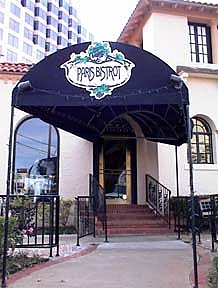
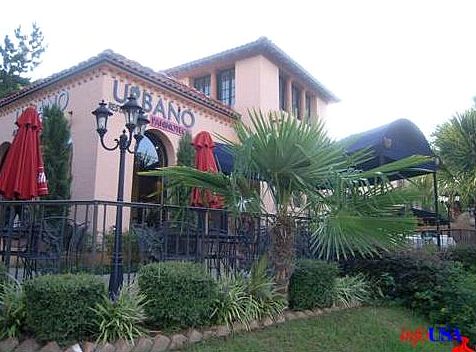
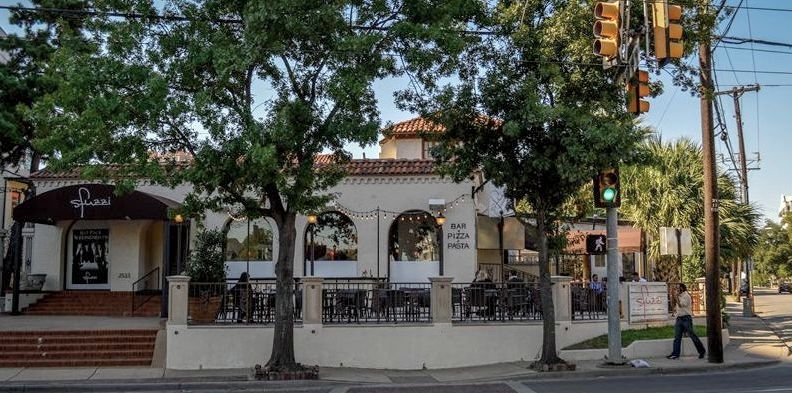
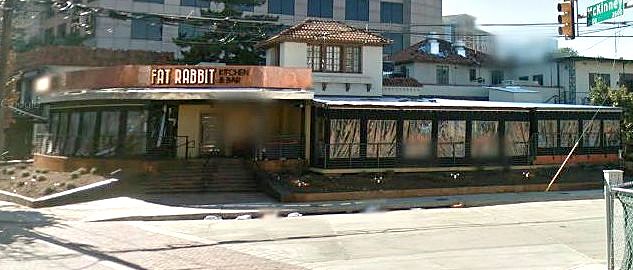
It all turned around, though, when the long-suffering building was re-renovated and became a restaurant space. Since at least 1999 when Uptown began to explode, it’s been home to bistros, cafes, and upscale eateries. The photos below show some of the restaurants that have set up shop there, and if you know what you’re looking at, the place really does look very similar to C. C. Bulger’s design from almost 90 years ago.

*

paris-bistrot_2001Le Paris Bistrot opened in 1999. The owner changed the name to Figaro Cafe in 2004 when the U.S. was going through an anti-French phase.

urbano_city-dataUrbano Paninoteca opened in 2007. Something called Split Peas Soup Cafe opened in 2009.

sfuzzi_scrumpliciousfood_sm

sfuzzi_yelpThen Sfuzzi opened with a big splash in 2010. (It had been a McKinney Avenue staple in the 1980s and ’90s, closed, and came back in 2010.) The first photo shows the Routh Street entrance, the second photo shows the McKinney entrance.

fat-rabbit_googleAnd now it’s the Fat Rabbit, which opened earlier this year. Let’s hope they get some landscaping in there STAT! (UPDATE: Fat Rabbit is now an ex-rabbit, and after spending some time of his own in the “slumber room,” he has joined the choir invisible. Next!)

And let’s hope that those tiled roofs and stuccoed walls remain a distinctive part of its future. I love the fact that it still looks a lot like it once did. And I actually like the fact that restaurants have been operating out of an old funeral home for over 15 years. Restaurateurs might be hesitant to publicize the building’s past (although I’m pretty sure most of them have been completely unaware of what the place used to be), but modern-day Harolds and Maudes might be giddy at the prospect of an unusual dining option and move this place right to the top of their date-night list. 

***

Sources & Notes

Top photo is a detail of the ad that appeared in the 1929 Dallas city directory. It shows four Cadillacs — a hearse, 5- and 7- passenger sedans, and an ambulance (“purchased from the Prather Cadillac Company”).

Matchbook artwork from Flickr, here.

The first Sfuzzi photo is from the food blog Scrumplicious Food, here. A GIGANTIC version of the photo can be seen here — you can look at all the details. Second photo of Sfuzzi from Yelp.

Fat Rabbit image from Google street view.

Sources of all other clippings and photos as noted.

Some images larger when clicked.

*

Copyright © 2015 Paula Bosse. All Rights Reserved.

The Dallas Skyline from the Maple Terrace Penthouse — 1952

feldman_terrace_huntington-detView from the penthouse (Huntington Library)

by Paula Bosse

The best view of the Dallas skyline that no longer exists may very well have been the view from atop the Maple Terrace Apartments, located on Maple Avenue, right across Wolf Street from the Stoneleigh Hotel. The photo above was taken in 1952, when there was a straight-shot view of downtown, with no hulking buildings to spoil the vista. This view — completely unobstructed except for the Stoneleigh (out of frame, at left) — must have been spectacular at night. (Although, as can be seen at the far right, the industrial area that surrounded the iconic DP&L smokestacks was also part of the view. Also not included in realtor brochures would have been the fact that the luxury apartment building overlooked the adjacent Little Mexico neighborhood, often described as a “slum area” — the huge economic disparity between the neighboring haves and have-nots would have been starkly apparent to any gimlet-sipping rooftop visitor. And then there was the not-so-distant meat-packing plant…. But I digress.)

The beautiful Maple Terrace Apartments — designed by architect Alfred Bossom (who also designed the Magnolia Building) — was built in 1924-25 and opened with great fanfare as the city’s first luxury apartments.

maple-terrace_postcard

An early tenant was Morris Feldman, a Polish immigrant whose family owned the successful Parisian Fur Co. (later Parisian-Peyton). Morris’ son, the incredibly wealthy oilman and art collector, D. D. Feldman, must have been quite taken with his parents’ home there, because in the late ’40s or early ’50s, he transformed the entire seventh floor — which had previously contained 20 “hotel-type” units — into his personal penthouse. The patio terrace with the to-die-for view was the cherry on the sundae.

feldman_terrace_huntington

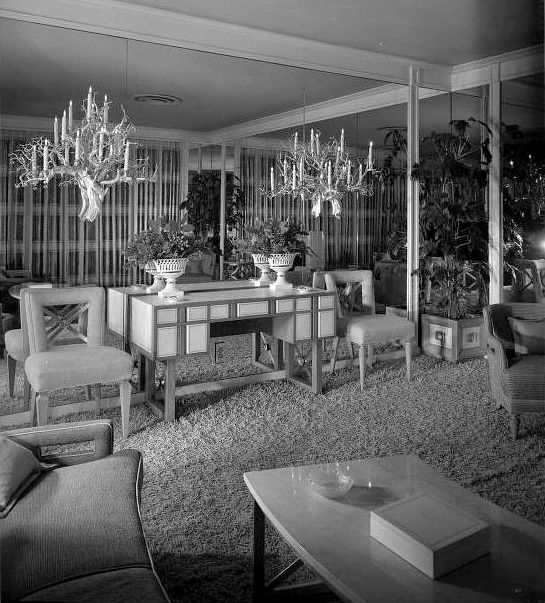
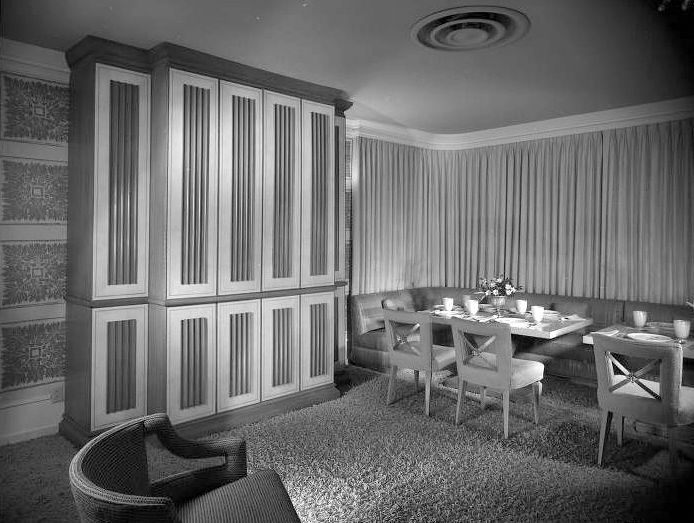
Countless cocktail parties, dinner parties, and fashionable teas were held in the Feldmans’ penthouse. The interior design — the work of Tom Douglas, of Los Angeles — was, apparently, much admired. The decor consisted of a mixture of typically cool Mid-Century Modern pieces as well as a few touches that, from a 21st-century vantage point, look a little … tacky. Somewhere in all of the acreage of furnishings was a fireplace, a white leather-covered piano (!), “a cocoa-striped sofa with pale blue frame,” murals, white brick wallpaper, and several pieces of furniture and cabinetry with a “driftwood finish.” And lots of lacquer. And mirrors, mirrors, mirrors. These “timeless furnishings in beige, marigold, white leather and ash” (DMN, Nov. 19, 1960) are dated relics of another era, but, at the time, they were splashed across the pages of magazines such as Architectural Digest.

feldman_entryway_huntington-lib

feldman_living-rm_huntington-lib

feldman_dining-rm_huntington-lib

As far as I know, the seventh floor of the Maple Terrace is still a single space. A 1978 real estate ad touted its “recently redecorated” 3,000 sq. ft. amenities:

maple-terrace-penthouse_dmn_032278

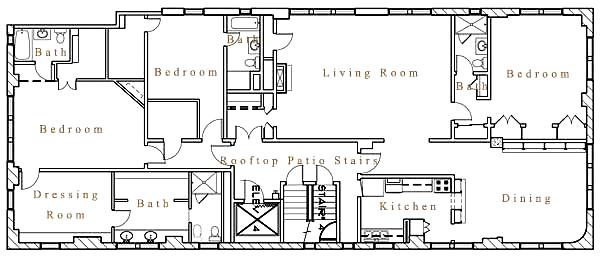
Below, the present-day penthouse floor plan from the Maple Terrace’s website:

maple-terrace_penthouse-floorplan-today

And, look, here’s a photo of what that entryway looks like now, (without the mural):

maple-terrace_hallway-today

I’m sure the rooftop terrace is still as beautiful as ever, but, sadly, it will never again boast of that once-incredible view:

maple-terrace-view-today

***

Sources & Notes

Top photo (and all black and white photos from this series) by Maynard L. Parker, for Architectural Digest; from the Maynard L. Parker Collection at the Huntington Library, accessible here. The top photo is a detail, which has been cropped and reversed; the original photo is shown in reverse on the Huntington site (along with some early image “editing” on the outline of the Stoneleigh), which is a bit freaky when you know that what you’re looking at is backwards!

Color photos and floor plan from the website of the Maple Terrace Apartments, here. Biographical info on the architect, Sir Alfred Bossom, is here. Fabulous photos of the building from AIA Dallas, is here; and a wonderful piece on the mystique of living in the famed Maple Terrace from D Magazine, is here.

An intense and thorough description of the Feldmans’ penthouse decor is in the article “Feldman Apartment: Timeless Decorating” by Jeanne Barnes (Dallas Morning News, Nov. 19, 1960).

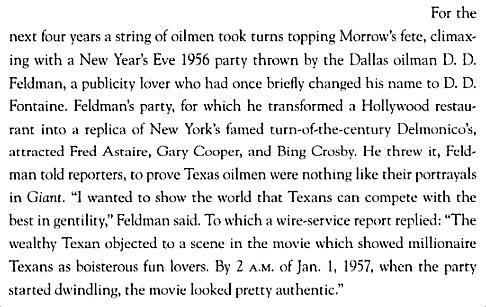
In addition to his oil holdings, D. D. Feldman was an important collector and patron of Texas art. In reading about Mr. Feldman, my favorite tidbit is this, from the book The Big Rich: The Rise and Fall of the Greatest Texas Oil Fortunes by Bryan Burrough (Penguin, 2009):

feldman_big-rich_quote

*

Copyright © 2015 Paula Bosse. All Rights Reserved.

The Dunbar Branch: Dallas’ First Library for the African-American Community, 1931-1959

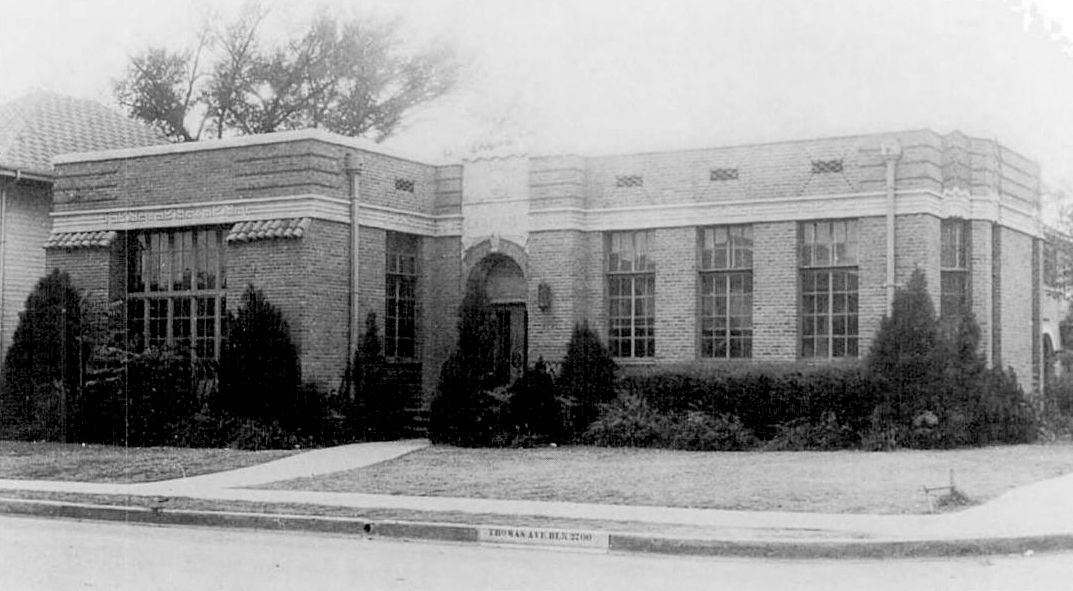
dunbar_hazel_dpl-bkThe Paul Laurence Dunbar Branch of the Dallas Public Library

by Paula Bosse

The Paul Laurence Dunbar Branch of the Dallas Public Library was the first library in Dallas to welcome and serve the African-American community. It opened in June, 1931 at the northwest corner of Thomas and Worthington in what was then the predominantly black neighborhood of “North Dallas” (the area is now known as “Uptown”), a thriving business and residential neighborhood which was home to everyone from the city’s black professionals who lived in large, lovely gingerbread-style houses, to middle- and lower-class black families who lived in more modest homes.

This was a time when almost every aspect of life was racially segregated — the grand downtown Carnegie Library was expressly off-limits to non-whites, and few of the black schools had any sort of functioning library. It was a long, hard bureaucratic battle of petitioning the city, the state, the Carnegie corporation … anyone … for a library which the city’s woefully underserved black citizens could call their own. It took years until the powers-that-be gave the go-ahead to finally build one. The building was designed by Dallas architects Ralph Bryan and Walter Sharp.

The charming one-story, brick-and-reinforced-concrete building was very, very popular and was a source of pride in the community. And it was beautiful!

dunbar_ref-and-reading-rm_hazelThe reference and reading room

dunbar-lib_hazel_062931-photoOpening-day crowds, June 1931

dunbar-children_hazel_1949Children in costumes to celebrate National Book Week, Nov. 1949

Even though the photo featured in the ad below is very grainy, it’s still kind of cool (from 1958, one year before the branch closed).

dunbar-branch-library_lincoln-high-school-yrbk-ad_19581958 Lincoln High School yearbook

dunbar-branch-library_lincoln-high-school-yrbk-ad_1958-det

In the late 1940s, construction began on Central Expressway. Unfortunately, this much-needed highway cut right through the heart of the North Dallas/State-Thomas/Freedman’s Town area. The destruction of many of the area’s buildings and displacement of many of its residents was a devastating blow to the African-American community who lived, worked, and shopped there. That and other economic forces led to the eventual dispersal of the area’s black population to other parts of the city. By the 1950s, the library had lost many of its core patrons, and in 1959 the Dunbar Branch closed. At some point that beautiful building, located just a few blocks south of McKinney Avenue, was demolished. The historic State-Thomas area has now been almost completely obliterated as “Uptown” has taken over. And another part of the city’s history has been lost.

***

Sources & Notes

All photos are from the book Dallas Public Library, Celebrating a Century of Service 1901-2001 by Michael V. Hazel (Denton: University of North Texas Press/Friends of the Dallas Public Library, 2001); photos are presumably from The Texas/Dallas History & Archives Division of the Dallas Public Library.

Hazel’s chapter on the Dunbar Branch is well worth reading. Not only is it interesting (and kind of shocking) to learn the lengths to which the black community had to go simply in order to have access to a library system which their tax dollars were helping to support, but there are also more wonderful photos like the ones above. The Dunbar chapter is accessible here.

Two articles of interest from the archives of The Dallas Morning News:

  • Description of the planned new “Negro branch” library (DMN, Aug. 15, 1930)
  • “City Plans To Sell Building” (DMN, May 15, 1959) — on the decision to close the branch and sell the building

The library’s (white) architects, Ralph Bryan and Walter Sharp also designed the nearby Moorland YMCA — it was built at almost the same time as the library, and, hallelujah, that building still stands, currently housing the Dallas Black Dance Theatre. A few years later Sharp designed Lincoln High School in South Dallas. All in all, these architects were responsible for three extremely important buildings that served Dallas’ black citizens.

Paul Laurence Dunbar (1872-1906) was one of the first nationally prominent African-American writers; more about him, here.

There is another Dunbar branch library in the Dallas Public Library system — the website for the Paul Laurence Dunbar Lancaster-Kiest Branch Library is here.

*

Copyright © 2015 Paula Bosse. All Rights Reserved.

J. M. Howell’s Dallas Nurseries — 1880s

howell_rose-garden-etc_1888The Cedar Springs-Fairmount-Howell triangle

by Paula Bosse

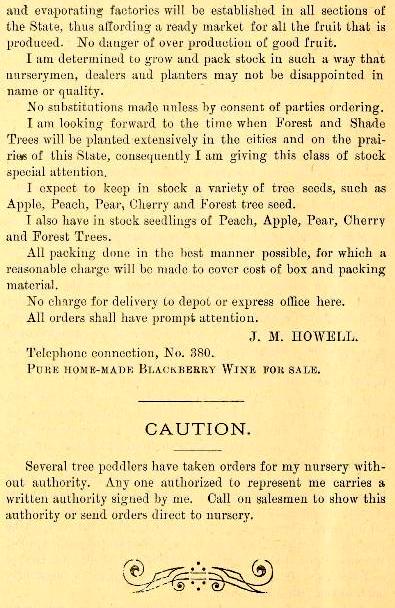
Dallas fruit grower and nurseryman J. M. Howell (1849-1925) was something of a “fruit visionary.” He gave us the “Dallas Blackberry” — something he was quite proud of. He also had dreams of giving Texans more shade.

I am looking forward to the time when Forest and Shade Trees will be planted extensively in the cities and on the prairies of this State, consequently I am giving this class of stock special attention.

Fruit and shade. I can get on board with that. He also issued some very pretty catalogs.

howell_catalog-cover_1888

howell-catalog_1888-title-page

howell_catalog_back-cover_1887

howell-catalog_intro1_1888

howell-catalog_intro2_1888

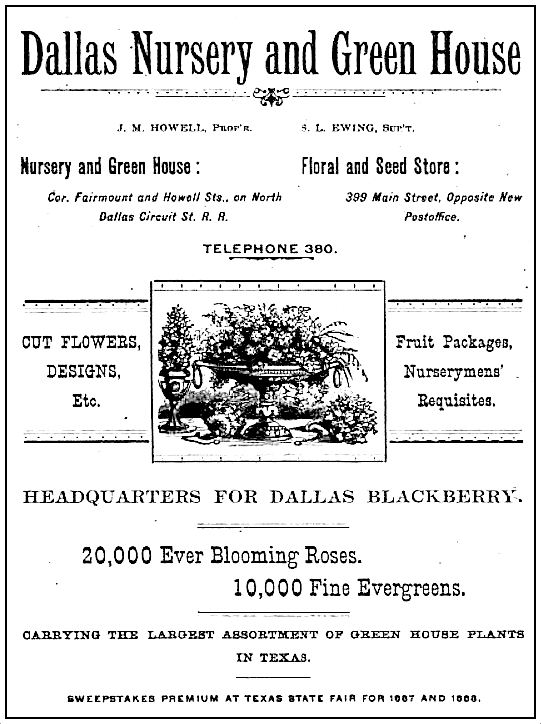
howell-nursery_1888-directory1888 Dallas directory

howell_dallas-nursery_1891-directory1891 Dallas directory

***

Sources & Notes

Above images are from scans of Howell’s catalogs on the Internet Archive: the entire 1887-88 catalog is here; the 1888-89 catalog is here. Included in these catalogs are descriptions of Howell’s inventory and his planting instructions to get the best yields from Dallas’ soil and climate.

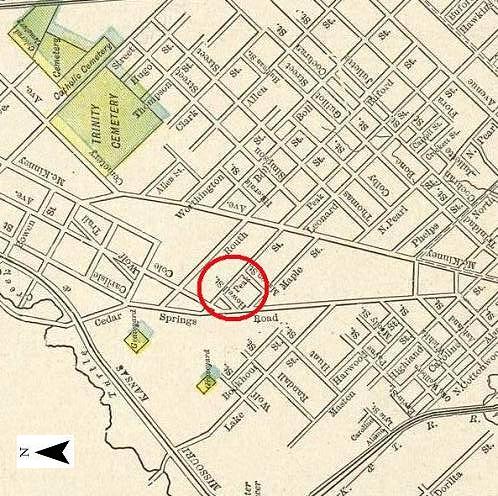
I LOVE the top image. This area — called “Howell’s Addition” — was at the northern edge of the city limits at the time. In March of 1891 the street name “Peak” was changed to “Fairmount” at Howell’s behest. In fact, Howell named the following streets: Fairmount, Maple, Routh (after his in-laws), and Howell. (His uncle was the namesake of nearby Thomas Avenue.) Below is a map showing the area around 1890 — there seems to be a lot of development around him. The rose gardens and orchards may be gone, but at least he got a street named after him.

howell-map-1898Map ca. 1891, confusingly rotated to show same view as top image.

That triangular plot of land is still there (it was the location of the old Casa Dominguez restaurant for many years). Sadly, it’s not much of a scenic vista these days. Uptown could do with a few more orchards and a lot less of everything else.

Howell was a guy who got around. Among other things, he is credited with introducing the magnolia tree to Dallas. Also, he was particular to peaches, and he planted acres and acres and acres of peach trees in Parker County, hoping they’d be a big cash-crop one day — and he was right! For more on Howell, see the Dallas Morning News article “Nurseryman Named Routh Street,” a great “Dallas Yesterday” profile by the always informative Sam Acheson (DMN, Dec. 14, 1970).

*

Copyright © 2014 Paula Bosse. All Rights Reserved.


My Father, Dick Bosse — Dallas Bookman

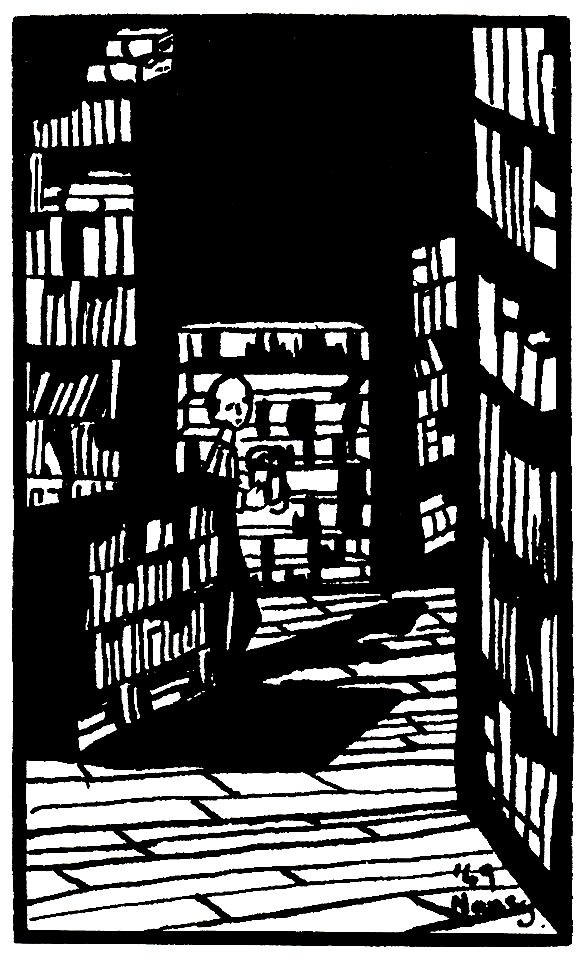
PRB_nancy-sketch_sm

by Paula Bosse

Dick Bosse was my father. When he died in 2000, he had managed (and later owned) The Aldredge Book Store for almost 45 years. He started working for founder Sawnie R. Aldredge, Jr. fresh off a half-hearted attempt at grad school. I’m sure he had no idea when he started working there (at $1.00 an hour) just how important a role the store would play in his life. My parents met at the store when my mother began working there, and they married a couple of years later. My brother and I spent countless hours there and practically grew up in the store. The Aldredge Book Store was a second home to my family, and looking back on all the time I spent there, all the books I read when I was bored, all the literati of the city I met who eventually popped in and sat around talking with my father over a cup of coffee or a beer, all the store cats I loved who became minor celebrities themselves — when I look back on all that, I realize how lucky my brother and I were to have had such interesting parents who brought us up in such an interesting place.

My father had a reputation as a stellar bookman but was known as much for his wit and humor as he was for his deep and wide-ranging knowledge of books, both rare and “chicken-fried.” He was one of the state’s top Texana experts, and his mailing list contained just about every major Texas author. The Aldredge Book Store was one of the oldest antiquarian bookstores in the Southwest, but my father was a remarkably unstuffy, unassuming, and down-to-earth bookseller.

I’ve been working off-and-on at collecting pithy catalog blurbs my father wrote over the years. The bulk of his sale catalogs were straight listings of antiquarian and out-of-print books, but he became fairly well-known in the Texas book trade for descriptions like these which he would insert throughout for his own amusement. I’ve left out the full bibliographical descriptions, but here are a few of my favorites. I realize some of these are a little esoteric, but this has been a fun project, and it’s nice to remember how funny my father was (bad puns and all). (I only wish I had been able to catalog like this when I worked as a rare books cataloger for an auction house!)

Adams, Ramon F. THE RAMPAGING HERD. The shit-kickers’ John Ciardi.

Brown, John Henry. LIFE & TIMES OF HENRY SMITH, The First American Governor of Texas. A rather nice copy, not one of the bugshit-encrusted remainders.

BULLETIN OF THE UNITED STATES FISH COMMISSION FOR 1891. A Texas piscatorial incunable.

Carter, Jimmy. KEEPING THE FAITH. Signed by the author, a former president.

Clary, Annie Vaughan. THE PIONEER LIFE. In HERD, but curiously not in SIXGUNS despite feuds, Texas Rangers, and Daddy popping caps on some badasses.

Clay, John. MY LIFE ON THE RANGE. Nice copy of the consensus bovine biggie.

Cravens, John Park. WITH FINGERS CROSSED: The Truth As Told In Texas. Apparently humor.

Devlin, John C. & Grace Naismith. THE WORLD OF ROGER TORY PETERSON, An Authorized Biography. Peterson, a student of blue bird mores, was known to Brandeis ornithologists as the goy of Jay sex.

Dobie, J. Frank. AS THE MOVING FINGER WRIT. Inscribed to “Mr. Moore,” in which 60-word inscription Dobie alludes (a frequent trick to prove he was not your run-of-the-mill shit-kicker) to Maugham and Schiller.

Eickemeyer, Rudolf. LETTERS FROM THE SOUTH WEST. Puny yankee sopping up the sun in El Paso & Santa Fe.

ENCYCLOPEDIA BRITANNICA. The twelfth edition (the eleventh edition with the supplements). Best encyclopedia in English executed prior to the American greaseballization.

Faulk, John Henry. FEAR ON TRIAL. HUAC to Hee-Haw.

Fuermann, George. RELUCTANT EMPIRE. Fine copy in dust jacket, signed by author and illustrator and marred only by one of those hideous goddam lick-in bookplates.

Gent, Peter. TEXAS CELEBRITY TURKEY TROT. Too much Peter; not enough Gent.

Hardin, John Wesley. THE LIFE OF JOHN WESLEY HARDIN. Mischievous preacher’s kid.

Hargrove, Lottie H. TEXAS HISTORY IN RHYME. Aarghh!

Hudson, Alfred Edward A’Courte. SELECTED BLOOD STUDIES ON SWINE. “Satisfying your antiquarian porcine hematological requisites since 1947.”

Koehler, Otto A. KU-WINDA (To Hunt). African safari by the Texas Beer Baron; well-illustrated, including some comely bare-breasted Somaliettes holding a “Join The Swing To Pearl” banner.

Long, Mary Cole Farrow. STRANGER IN A STRANGE LAND, From Beaufort, South Carolina, To Galveston Island Republic of Texas — A Biography of Judge James Pope Cole (1814-1866). Probably unknown to Heinlein.

McDonald, William. DALLAS REDISCOVERED: A Photographic Chronicle of Urban Expansion, 1870-1925. The reissue was in wraps and had a “perfect binding,” one of the more notable oxymorons of our time.

Pellowe, William C. S. (ed.). MICHIGAN METHODIST POETS. Enthusiasts of The Muse will be relieved to know that Michigan sprinklers are as fully gifted as their Texas colleagues.

Riley, B. F. HISTORY OF THE BAPTISTS OF TEXAS. Covers blemished, apparently sprinkled by a surly Methodist.

Rozelle, Robet V. (ed.). THE WENDY AND EMERY REVES COLLECTION. The greatest Dallas art coup since SMU acquired the wet-paint Spanish Masters collection of Al Meadows.

Schlesinger, Arthur M., Jr. A THOUSAND DAYS, John F. Kennedy in the White House. Most notable fawning since Bambi’s birth.

Slaughter, Bob. FOSSIL REMAINS OF MYTHICAL CREATURES. Profusely illustrated with photos and drawings by the author, apostate bar-fly now a distinguished scientist and sculptor. A grab-ass classic.

White, Owen P. MY TEXAS ‘TIS OF THEE. A nice enough copy except that a cretin at something called “Mary’s Book Nook” was a compulsive rubber-stamper.

 *
PRB-CD_dth_062368-putcamp

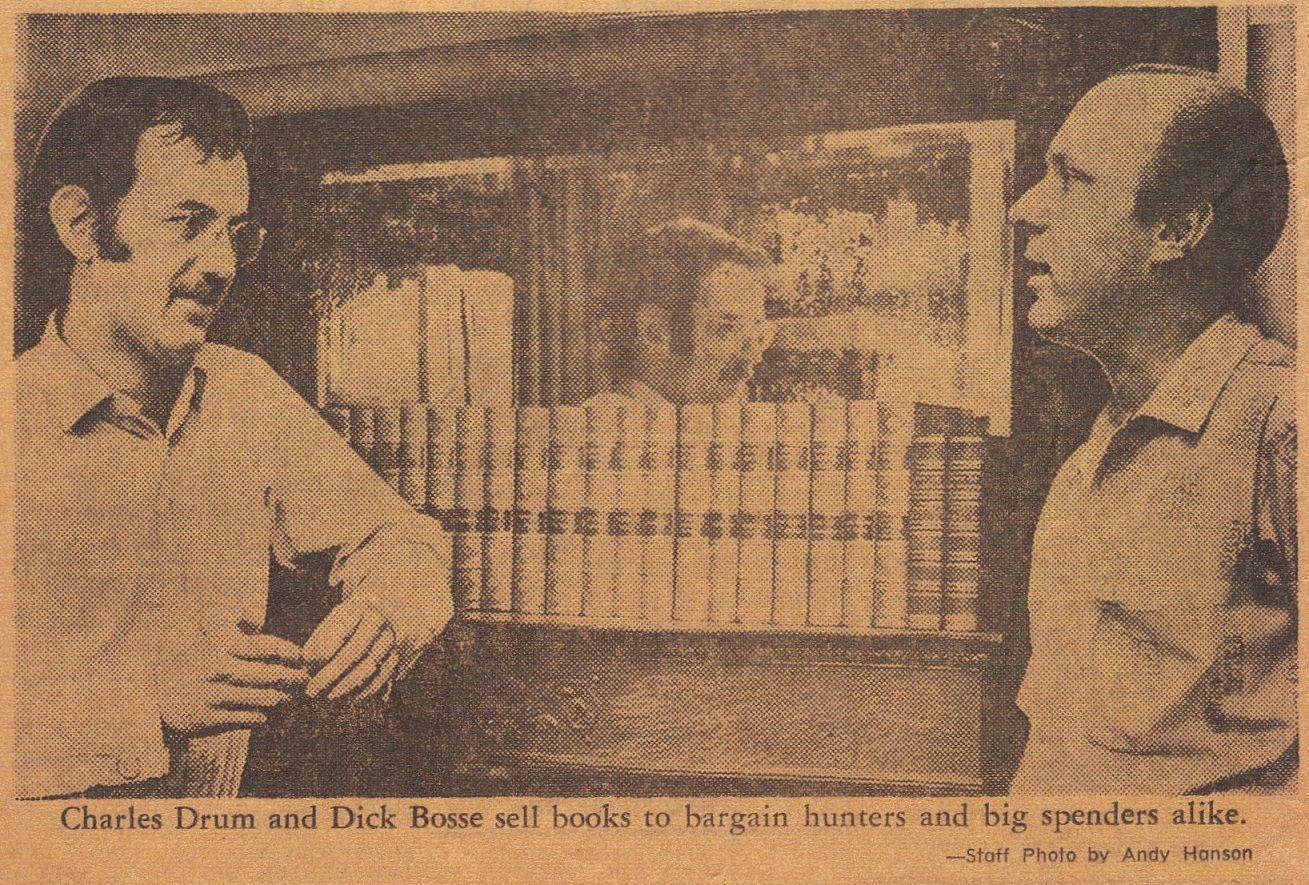
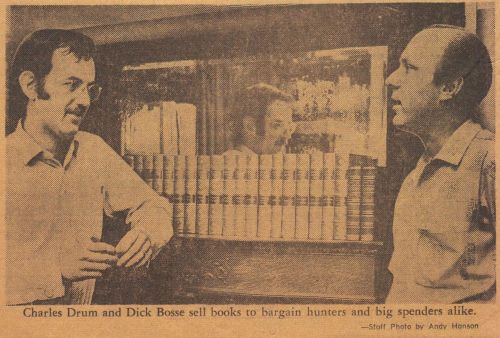
Above, my father, on the right, at the first location of the Aldredge Book Store on McKinney Avenue. The accompanying article by Luise Putcamp, Jr. is here.

*
PB-PRB

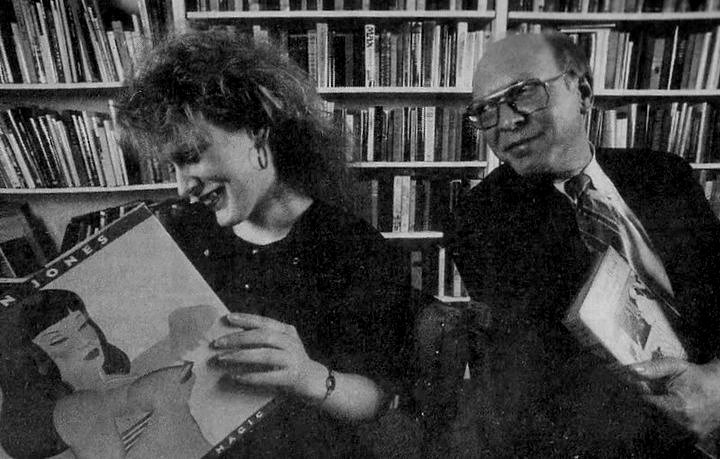
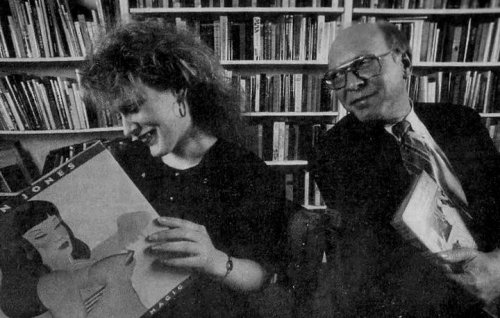
Above is one of my favorite photos of my father, taken in a small used bookstore I had on Lower Greenville Avenue. A newspaper editor thought it would be “cute” to have a photo of father-daughter booksellers. The photographer suggested I hold the newer, cutting-edge art book while my father held the older, obscure British arts journal. Of course, my father would have been more interested in the Allen Jones book, and I would have been more interested in The Yellow Book (a set of which my father gave to me for Christmas one year — and it was one of the best gifts I’ve ever received).

Today would have been my father’s 80th birthday. 80! I think of him all the time, and I miss him terribly. He was a wonderful guy, and — aside from the modest income — I think he would have said that a lifetime career as a bookseller was a pretty sweet deal.

***

Sources & Notes

When my father died in April, 2000, several appreciations of him appeared in print. If you would like to read the appreciations by his friends A. C. Greene (a very sweet tribute) and Lee Milazzo (my personal favorite — very funny), as well as the nice official obituary, they are all transcribed here

My brother, Erik Bosse, wrote a wonderful piece about our father for a catalog we issued after his death. The warm and amusing essay — as well as some of the crazy business cards my father took great joy in printing up — can be found here

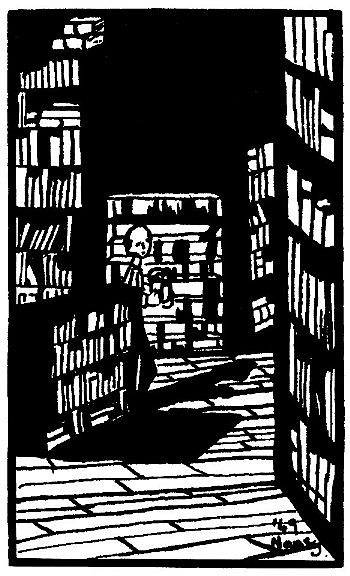
Sketch at the top was done by Nancy C. Dewell (1969). Slightly larger than a business card, it arrived in the mail one day with a short note that read: “I don’t know your name. I think you are Mr. Aldredge. I would be pleased if you would accept my drawing of you in the bookshop. Sincerely, Nancy C. Dewell.” I can’t imagine a better likeness. I really, really love this.

Photo of me and my father from the Dallas Observer.

*

Copyright © 2014 Paula Bosse. All Rights Reserved.