Flashback : Dallas

A Miscellany: History, Ads, Pop Culture

Category: Newspapers

Dallas Morning News Lobby — c. 1904

dmn-lobby_c1903_degolyer

by Paula Bosse

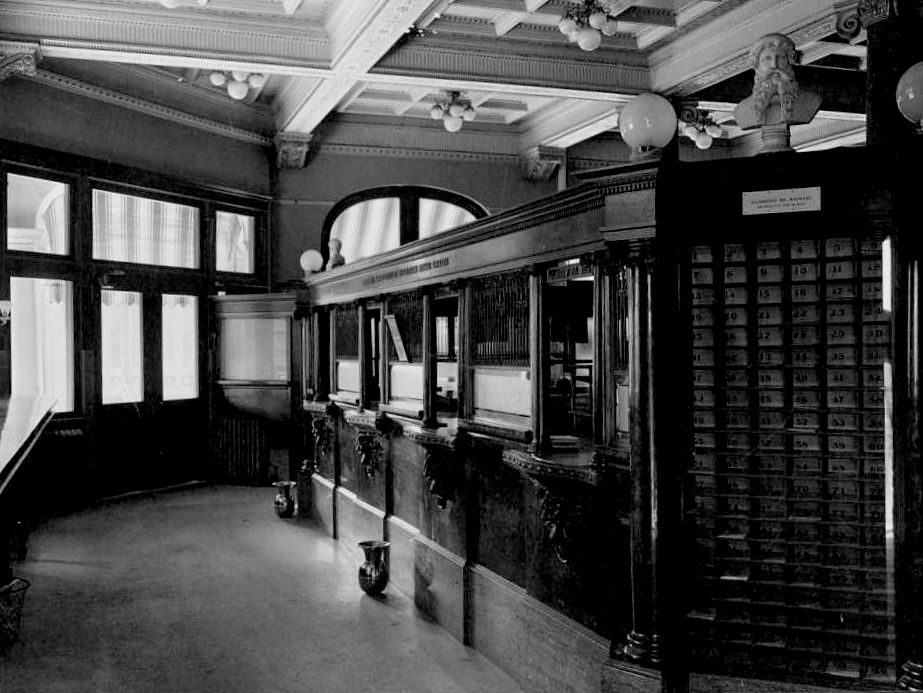
Suppose it’s 1904 and you’ve placed a classified ad in The Dallas Morning News — looking for a job, looking for a buyer for your business, or looking for your reprobate cousin Harold who’s skipped town without re-paying you the money you loaned him. You want to retain a certain amount of anonymity or you have no fixed abode, so you’ve requested that replies from interested parties be addressed in care of a box number at the newspaper offices. If you had done that in 1904, this is where you would have gone to pick them up: the lobby of The Dallas Morning News, seen here in their first building (built in 1885) at 500-501 Commerce St. I can only assume there is another strategiacally-placed spittoon just out of frame.

Here are a few random classifieds with box numbers, all of which appeared in the paper 110 years ago today. These people would have been wandering in and out of this lobby hoping to see envelopes waiting for them when they arrived. Having watched a LOT of old movies, I picture woefully conspicuous detectives hanging out in the lobby, pretending to read the paper, with one eye fixed on those boxes. Waiting. …Watching. …Spitting.

classified_stenographer_dmn_051704

classifieds_dmn_051704

classifieds-dmn_041704

***

Photo from the Belo/Dallas Morning News collection, DeGolyer Library, Central University Libraries, Southern Methodist University, accessible here.

Classifieds from the May 17, 1904 edition of The Dallas Morning News.

Click photo for larger image.

*

Copyright © 2014 Paula Bosse. All Rights Reserved.

“Start Your Day the Happy Way … with The Dallas Morning News” — 1961

ad-DMN_dmn_101461
(click for larger image)

by Paula Bosse

A word from a secretary:

I’m a secretary, and I prefer The Dallas Morning News.

My boss refers to me as his “Girl Friday” because I am more than an ordinary secretary. I make more money than an ordinary secretary makes, too.

Questions come up from time to time and I am able to supply the answers … simply because I start my day the happy way … with The Dallas Morning News.

I read it all … the news, editorials, even glance through the business and sports sections. I pay particular attention to current affairs, both foreign and domestic.

For myself, I browse the women’s pages … the fashion news, club activities, and all the special features. The advertising is very helpful. I do most of my shopping during the lunch hour. I always know where to go for what I want without having to shop around.

If you are a secretary and would like for your job to be more interesting … and valuable, too … here’s a tip. Start your day the happy way with The Dallas Morning News.

*

Copyright © 2014 Paula Bosse. All Rights Reserved.


How Lincoln’s Assassination Was Reported in Dallas — 1865

lincoln_harpers-engraving

by Paula Bosse

Abraham Lincoln was shot by John Wilkes Booth on April 14, 1865; he died the next morning. I wondered how the news had been reported in Dallas. I couldn’t find the first mention of the assassination in The Dallas Herald, but it seems there may have been a special “extra” edition published on or just after April 29th — a full two weeks after the fact! The one thing I kept encountering in general Google searches were mentions of the vicious, celebratory editorial that appeared in the pages of the Herald — these reports always quote the line “God Almighty ordered this event or it could never have taken place.” I found that editorial. It appeared in the two-page Dallas Herald on May 4, 1865, along with detailed reports of the assassination.

lincoln_dallas-herald_masthead_050465

lincoln_dallas-herald_houston-tel-050465

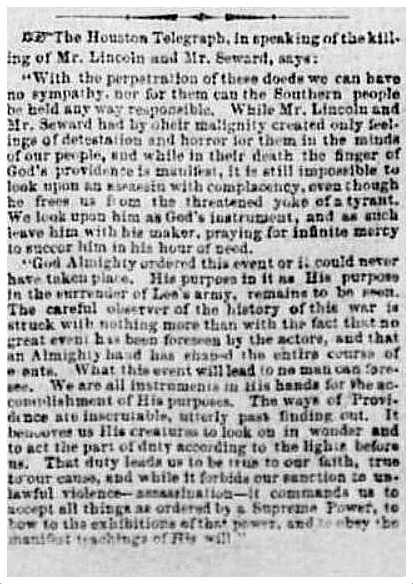
The image resolution here is pretty bad (it is transcribed below), but, yes, this eye-poppingly vitriolic editorial did appear in the pages of The Dallas Herald — but it did not originate with the Herald (which is not to say that the Dallas editor wasn’t in agreement with the sentiments expressed). The editorial was reprinted from the Houston Tri-Weekly Telegraph (which had run it ten days previously, on April 24); its appearance in the Dallas paper is even clearly prefaced with the following: “The Houston Telegraph, in speaking of the killing of Mr. Lincoln and Mr. Seward, says…” — so it’s unclear why so many historians and authors mention this editorial as being the product of The Dallas Herald.

The editorial was unsigned, but it was probably written by William Pitt Ballinger, whose previous flame-fanning tirades against the president in the pages of the Telegraph must have caused even hard-core Confederate-leaning brows to raise. I’ve transcribed the full editorial below. For whatever reasons, the Dallas Herald omitted the first and last paragraphs — probably because of space limitations, but one would like to think that even a pro-Confederacy newspaper would think it best to leave out a phrase such as “The killing of Mr. Lincoln and Mr. Seward may be more wonderful than the capitulation of armies.” Yikes. Imagine a mainstream newspaper printing something like that following the assassination of President Kennedy.

Below is the full astonishing text of the editorial that originally appeared in the Houston Tri-Weekly Telegraph on April 24, 1865. The stark reality of historical events and the contemporaneous tenor of the times can look a lot different when seen from a distance of 150 years.

*

We publish to-day the most astounding intelligence it has ever been our lot to place before our readers — intelligence of events which may decide the fate of empires, and change the complexion of an age. The killing of Mr. Lincoln and Mr. Seward may be more wonderful than the capitulation of armies.

With the perpetration of these deeds we can have no sympathy, nor for them can the Southern people be held any way responsible. While Mr. Lincoln and Mr. Seward had by their malignity created only feelings of detestation and horror for them in the minds of our people, and while in their death the finger of God’s providence is manifest, it is still impossible to look upon an assassin with complacency, even though he frees us from the threatened yoke of a tyrant. We look upon his as God’s instrument, and as such leave him with his maker, praying for infinite mercy to succor him in his hour of need.

God Almighty ordered this event or it could never have taken place. His purpose in it as His purpose in the surrender of Lee’s army, remains to be seen. The careful observer of the history of this war is struck with nothing more than with the fact that no great event has been foreseen by the actors, and that an Almighty hand has shaped the entire course of events. What this event will lead to no man can foresee. We are all instruments in His hands for the accomplishment of His purposes. The ways of Providence are inscrutable, utterly past finding out. It behooves us His creatures to look on in wonder and to act the part of duty according to the lights before us. That duty leads us to be true to our faith, true to our cause, and while it forbids our sanction to unlawful violence — to assassination — it commands us to accept all things as ordered by a Supreme Power, to bow to the exhibitions of that power, and to obey the manifest teachings of His will.

What will [be] the result of these tremendous events, no man can foresee. Theories will present themselves to every man’s mind. We have a dozen all equally probable, and all equally uncertain. Let us wait in patience for the next scene in this terrible drama.

***

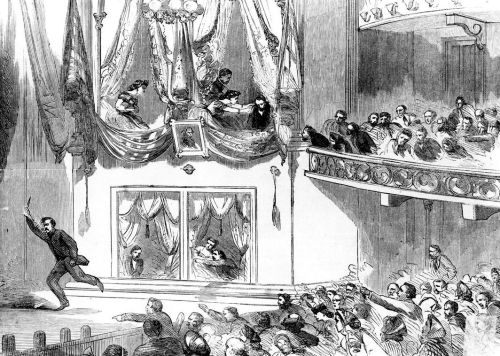
Top image is an engraving of the assassination in Ford’s Theatre from Harper’s Weekly, April 29, 1865.

Editorial is from The Houston Tri-Weekly Telegraph, published April 24, 1865 (Vol. 31, No. 13). You can view a scan of the original newspaper via the indispensable Portal to Texas History, here (it is at the top right of the page, last column). Reprinted without the first and last paragraph by The Dallas Herald ten days later on May 4, 1865 (Vol. 12, No. 36).

Editorial is probably by William Pitt Ballinger, a Galveston attorney. His editorial screeds for the Telegraph are mentioned in the just-published Loathing Lincoln: An American Tradition from the Civil War to the Present, by John McKee Barr (LSU Press, 2014), p. 53 — read an excerpt here. Read more about Ballinger — the “brilliant attorney and political insider” — here.

An interesting article titled “The Last Newspaper to Report the Lincoln Assassination” is here. The article is about The Houston Tri-Weekly Telegraph, but it looks like The Dallas Herald was even SLOWER to report the news.

lincoln_dallas-herald_extra_050465

“We received on Saturday last [April 29] the dispatches containing the assassination of Mr. Lincoln and Mr. Seward, by a letter from Maj. Stackpole to his family at this place, and published them in an extra. There was some little discrtepancy and an omission in them as published then, which we find corrected in the Houston Telegraph’s dispatches which we publish to-day.” (Dallas Herald, May 5, 1865)

*

Copyright © 2014 Paula Bosse. All Rights Reserved.

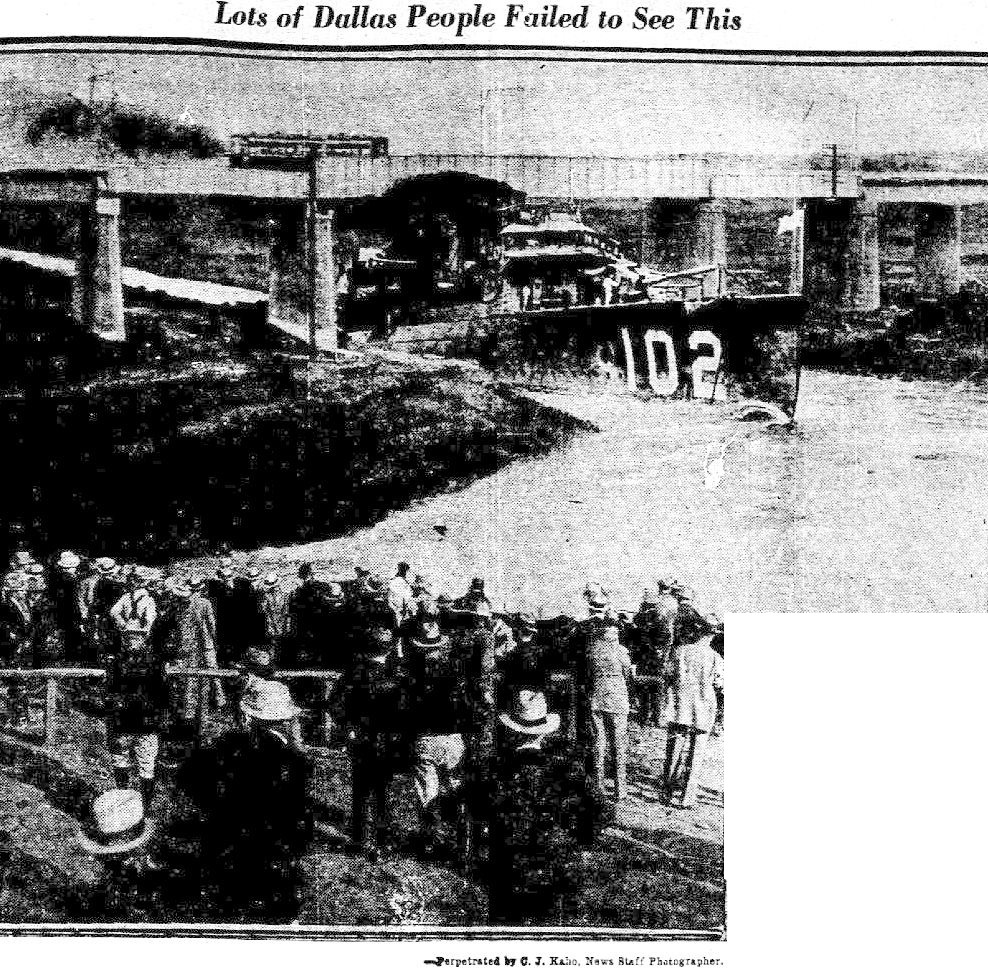
U.S. Revenue Cutter “Carrie Nation” Successfully Navigates the Trinity In Valiant Effort to Keep Dallas Dry! — 1931

april-fools_dmn_010131_carrie-nation
The ship’s arrival, passing under the streetcar viaduct…

by Paula Bosse

I spent a couple of hours looking through the archives of The Dallas Morning News this morning, hoping to find a nice juicy April Fools’ prank from the past. Everything was fairly run-of-mill. Until I came across this. THIS is great. I don’t know who wrote the story, but there is, at least, acknowledgement for the wonderfully weird photo above — the photo credit reads: “Perpetrated by C. J. Kaho, News Staff Photographer.”

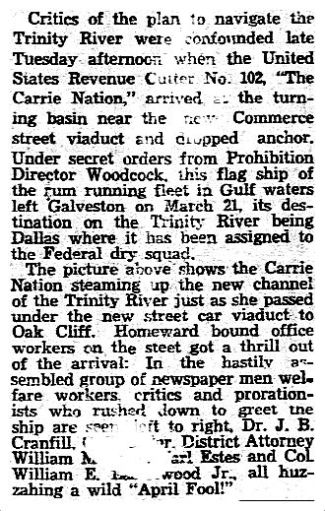
Below is the accompanying story about the United States Revenue Cutter Carrie Nation and the news of its journey up a surprisingly navigable Trinity River in order to anchor itself beneath the Commerce Street viaduct and make sure that the rum-runners in the Gulf don’t gain a foothold in bone-dry Prohibition-era Dallas. The photo and report appeared in the pages of The Dallas Morning News on April 1, 1931, beneath the headline “Lots of Dallas People Failed to See This.”

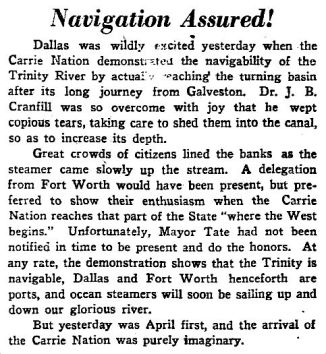
Unwilling to let such an important story fade away — and with a few more good lines left to get into print — this appeared the next day, on April 2, 1931: “Navigation Assured!”

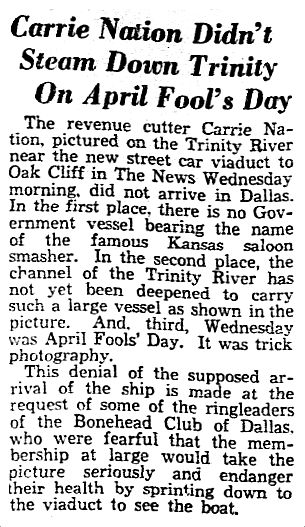
Then some killjoy editor probably insisted on this, which also appeared on April 2, 1931:

**

Rev. J. B. Cranfill was a Baptist leader and a noted Prohibitionist. I love the line “Dr. J. B. Cranfill was so overcome with joy that he wept copious tears, taking care to shed them into the canal, so as to increase its depth.”

And I laughed out loud at the “where the West begins” dig at Fort Worth.

But, seriously, that photo is great. The little streetcar chugging over the viaduct is just the perfect garnish.

Read about the famed, notorious Bonehead Club of Dallas in a 1991 Texas Monthly article by Helen Thompson, here. Thank you, Boneheads!

*

Copyright © 2014 Paula Bosse. All Rights Reserved.
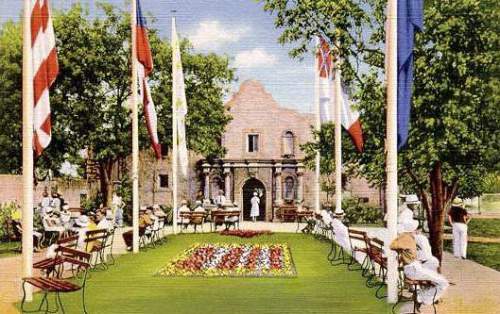
Remember the Alamo! …In Fair Park?

alamo_replica_fair-park_seewatermelonkidpage

by Paula Bosse

Today, on the anniversary of the fall of the Alamo, I bring you news that Dallas has outdone San Antonio by having hosted two Alamos. TWO! Both in Fair Park. The first one was a gift to the city by G. B. Dealey and the Dallas Morning News — it stood stoically at the entrance to the fairgrounds from 1909 until 1935 — and the second one was a rebuilding of the first which was torn down to make way for the the splendor of the Art Deco Centennial extravaganza and lasted from 1936 until 1951. And here I’d never heard mention of Dallas having had ANY Alamos.

The idea came from Dallas Morning News executive George Bannerman Dealey. He sent architect J. P. Hubbell (of Hubbell & Greene) to San Antonio to meticulously photograph, sketch, and measure the original structure — this included making note of every stain, every crack, every instance of broken plaster, etc. — in order to reproduce an exact replica of the historical landmark (at half the size of the original). The Morning News offered to pay for and build the replica (the cost was estimated at $5,000) and asked only that it be placed in a primo location (at the entrance!), that it be open to the public during the day but be available to the DMN people to use for private/company functions after hours, and that the Park Board maintain the building and its landscaping. The Park Board jumped at the gift, and the news of our very own “little Alamo” was met with giddy anticipation. Even the rival Dallas Times Herald was swept up in the excitement and suggested a “Meet Me at the Alamo at the Dallas State Fair” slogan in an editorial.

San Antonio and the Daughters of the Republic of Texas (who managed and maintained the historic shrine) were not terribly amused by this, but The News (in the expected torrent of its own self-congratulatory publicity about its magnanimous gift “not to Dallas, but to the State”) humbly insisted that the much, much, MUCH smaller Alamo would only drum up steady tourism of people who wanted to see the real thing. San Antonio and the Daughters seemed to get over it eventually. Dealey had made a good point, though, when he said that only a very small percentage of Texans had been able to see the Alamo in person, and this was an excellent way to bring history alive for North Texans.

The replica was dedicated on the opening day of the fair in 1909, and curious crowds lined up to see the startlingly realistic reproduction of the building which Mayor S. J. Hay described as being “sacred to every patriotic citizen of the State.” The brand new Alamo (made to look old and worn and battle-scarred) was a hit. In fact, it seems to  have been a very popular exhibit for the length of its stay — a total of 42 years. Other than being visited by thousands and thousands of fair-goers and families and schoolchildren, it was also used to house soldiers briefly during both World War I and World War II. It was visited by numerous people who claimed to be related to Alamo heroes like Crockett, Bowie, and Travis, and there were even a couple of instances of visits by 100-year-old men who said they had known Crockett and Bowie when they were children.

And, oddly, even Comanche Chief Quanah Parker stopped by to check the place out. I’ll end with his salient observations upon seeing the Alamo replica when visiting Dallas as a guest of the State Fair in 1909:

White men talk a great deal about their history. They don’t all play brave in making it. They don’t all care as much for getting it right as for getting it like they want it. Alamo fight was brave like Indians fight, don’t care for safety and for life. This Alamo house brings back to me thought of the ‘Dobe Walls’ fight a long time ago. It must make Texas people feel good to look at this and think of what it stands for. It was a fine thing for The News to put it here. (DMN, Oct. 27, 1909)

*

Above, opening day crowds. “Scene in front of the Replica of the Alamo Chapel During the Ceremony of Presentation.” Photo by Henry Clogenson. (DMN, Oct. 17, 1909)

Dallas’ second Alamo (which made its debut at the Texas Centennial in 1936) no longer had its primo location at the entrance to Fair Park, but it at least had a bit of room to breathe. As with the first replica, an architect was sent to San Antonio to bring back exact measurements — this time it was the incomparable George Dahl (if you’re not familiar with his work, you need to look him up). And this time, San Antonio and the Daughters of the Republic of Texas were not happy at ALL: there was a sternly worded petition from San Antonio to the governor and threats to legally force a halt to the construction. Guess they got over it. Again.

alamo_art-institute-of-chicago_1936

But eventually, the Alamo fell. It was razed in August of 1951, after years of neglect. Stalwart Texas demolition workers must have blanched a bit at being informed that their job was to destroy the very symbol of Texas heroism and independence.

***

Top postcard from a page on the Watermelon Kid’s great Dallas history site, here.

Photo of the “brand new” Alamo in 1936 from the Ryerson & Burnham Archives, Art Institute of Chicago, here.

*

Copyright © 2014 Paula Bosse. All Rights Reserved.


Dallas Steam Mills at the Cedar Spring — 1855

by Paula Bosse

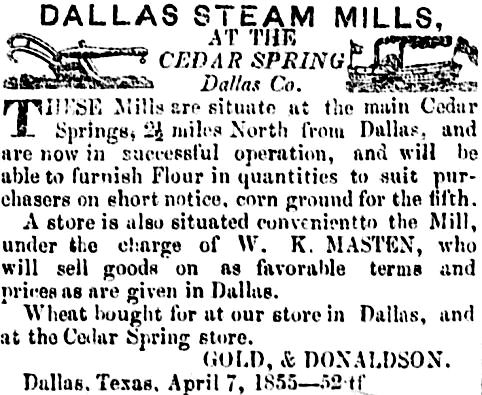
DALLAS STEAM MILLS, at The Cedar Spring, Dallas Co.

These Mills are situate at the main Cedar Springs, 2 1/2 miles North from Dallas, and are now in successful operation, and will be able to furnish Flour in quantities to suit purchasers on short notice, corn ground for the fifth. A store is also situated convenient to the Mill, under the charge of W. K. MASTEN, who will sell goods on as favorable terms prices as are given in Dallas. Wheat bought for our store in Dallas, and at the Cedar Spring store.

–GOLD, & DONALDSON. Dallas, Texas , April 7, 1855

*

In 1843, a trading post was established just outside the city of Dallas at the new settlement of Cedar Springs. There were few settlers at the time, so items traded were pretty much limited to only the essentials (groceries, ammo, buffalo hides). By 1850, though, sexier luxury goods like “hoopskirts, silk stockings, bridal bouquets, Bibles, accordions, Mustang liniment, snake-root and castor oil were listed in the inventory of a deceased merchant. This advance in merchandising may be attributed to the establishment by that time of a gristmill to which farmers from many miles around brought their grain. Naturally they visited the stores to trade” (WPA Dallas Guide and History). The Dallas Steam Mills was one of the first commercial mills in “the Cedar Spring,” and as it was affiliated with successful early Dallas retailers Gold and Donaldson, it must have also been one of the most profitable.

The community grew quickly. Until 1850. That was when Dallas County residents went to the polls and voted on which of the local communities would be the county seat. The choices were: the city of Dallas, Cedar Springs, and the ever-popular Hord’s Ridge. Cedar Springs came in dead last. The agony of defeat must have hit hard — the loss seems to have dampened civic enthusiasm and contributed to stagnant growth. It wasn’t until the turn of the century that the area — by then called Oak Lawn — had rebounded with a boom in population. By the 1940s, though, the area had been officially annexed by the city of Dallas. Oak Lawn (né Cedar Springs) had, at least, managed to hold onto a shred of independence a few decades longer than its former opponent had — Hord’s Ridge had changed its name to Oak Cliff, but it, too, had been swallowed up by the voracious, mammoth city surrounding it. No hard feelings, guys. You can run but you can’t hide. Resistance has always been futile. We’re all just one big happy kudzu-like sprawling sprawl now.

*

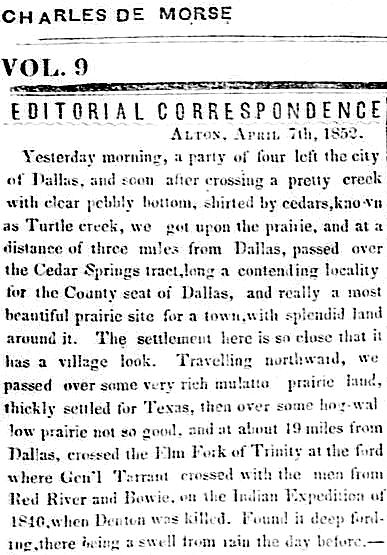
Below is an interesting account of traveling through Cedar Springs in 1852.

***

Dallas Steam Mills ad from the Dallas Herald, 1855.

Quote mentioning accordions and hoopskirts from The WPA Dallas Guide and History (Dallas Public Library Texas Center for the Book, University of North Texas Press, 1992). p.124

The account of passing though Cedar Springs, by Charles DeMorse, is the lead story in the July 17, 1852 issue of Clarksville’s Northern Standard newspaper; it can be found here  on UNT’s invaluable Portal to Texas History site; from the collection of the Dolph Briscoe Center for American History.

A biography of Charles DeMorse, writer and editor of Clarksville’s Northern Standard can be found here.

The Handbook of Texas History entry for Cedar Springs is here.

*

Copyright © 2014 Paula Bosse. All Rights Reserved.

Ned Riddle: Dallas Artist and Creator of “Mr. Tweedy”

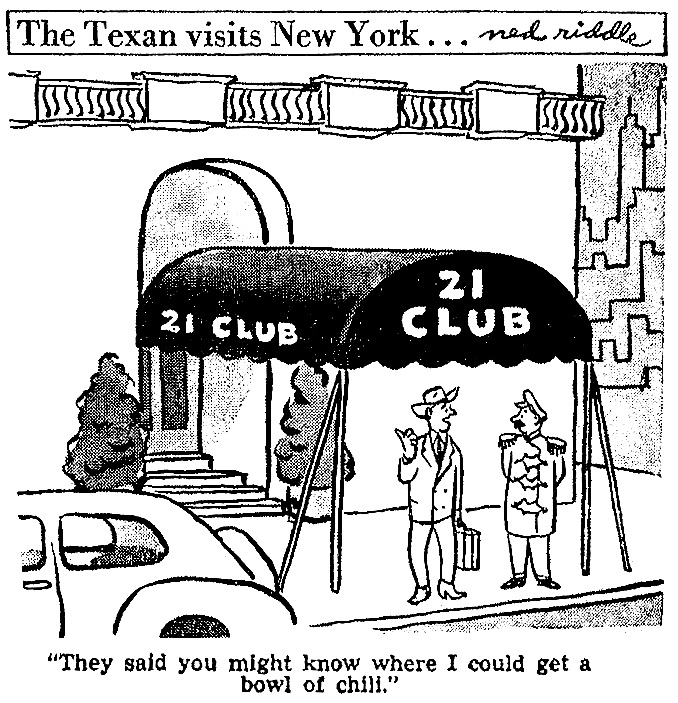
ned_riddle_texan-in-nyc_joe-cooper-bk
The Texan Visits New York City … “New York CITY?!”

by Paula Bosse

A few years ago, I came across the cartoon above in Joe E. Cooper’s chili bible, With or Without Beans, and I was delighted to see that the cartoonist was Ned Riddle, who, though having begun his career as a staff artist for the Dallas Morning News, is known primarily for his syndicated comic panel “Mr. Tweedy,” which I loved as a kid.

A couple of interesting tidbits about Mr. Riddle, who was a Dallas resident until his death in 2003: during WWII, he served on a submarine with the unspeakably perfect name, the USS Piranha, and — unlikely as it seems — while studying art at Washington University in St. Louis, he apparently studied under the great Expressionist artist Max Beckmann.

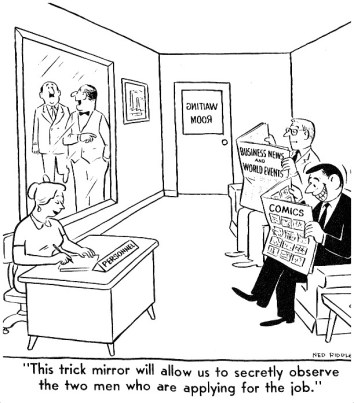
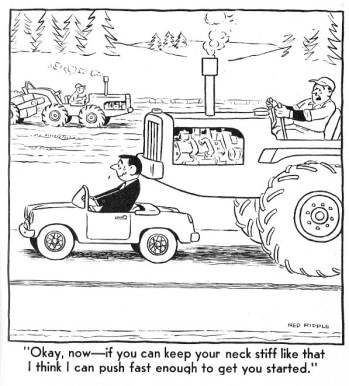
I loved “Mr. Tweedy” — the look of it, the simple one-panel jokes, and the fact that (as I recall) the somewhat optimistic-though-beleaguered Mr. Tweedy rarely actually spoke. Sort of Mr. Bean-like. I also knew that the cartoonist was from Dallas, and I was always trying to spot any sort of hidden homage to the city (as far as I know that never happened, but it SHOULD have!). “Mr. Tweedy” began in 1954 and ended in 1988. That’s a good run.

Here are a few Mr. Tweedy panels.

tweedy-21959

*

tweedy31959

*

tweedy_panel_1105691969

**

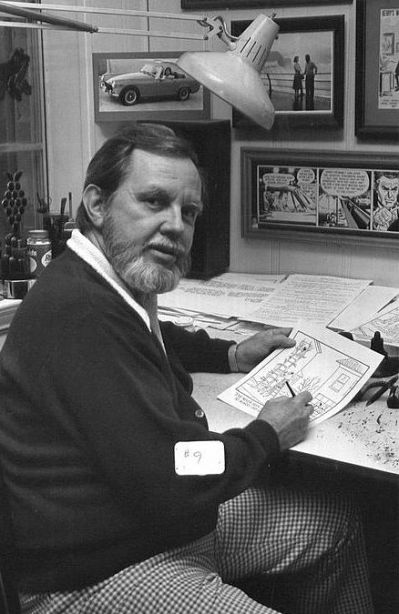
And some photos of Ned Riddle at his drawing board over the years.

tweedy1

*

ned_riddle_drawing_board_flickr

*

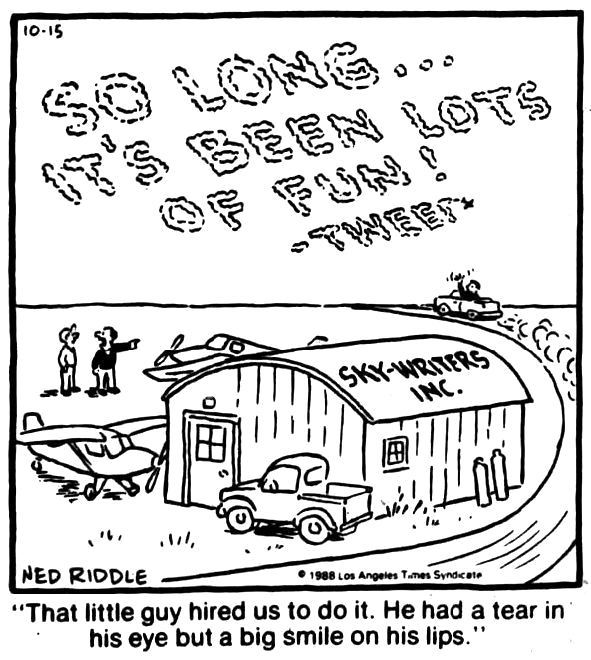
tweedy_last-panel_ned-riddle_101588Oct. 15, 1988, the final panel….

***

Sources & Notes

“The Texan Visits New York” cartoon appeared in With or Without Beans, An Informal Biography of Chili by Joe E. Cooper (Dallas: William S. Henson, Inc., 1952). Find (pricey) out-of-print copies for sale here.

First two “Mr. Tweedy” panels from Mr. Tweedy by Ned Riddle (NY: Fleet Publishing Corporation, 1960; reprinted in 1977). 

Later photo of Ned Riddle found on Flickr here.

*

Copyright © 2014 Paula Bosse. All Rights Reserved.