Main Street looking west, toward a ghostly courthouse (click for larger image)
by Paula Bosse
These three photographs were taken by prominent Dallas photographer Clifton Church, probably in 1893 or 1894. The one at the top shows Main Street looking west, taken just east of Poydras. (The then-new courthouse at the end of the street appears to have been lightly fleshed out by the hand of a photo re-toucher, giving it a mirage-like quality.) The Trust Building, on the right, was at the northeast corner of Main & N. Austin; the Dexter insurance office was in the North Texas Building, at 221-223 Main (under the old numbering system), between N. Lamar and Poydras; and the Scruggs & Scruggs wholesale liquor business was at 237-239 Main, two doors east of the Poydras intersection. The present-day view from the same location can be seen on Google Street View, here.
*
The photo below shows Elm Street looking east, taken just east of Akard. In the middle of the block on the left is Mayer’s Beer Garden & Saloon, at 361-363 Elm; the tall building behind it was the Guild Building at 369-371 Elm. Across the street, the tall building on the right is the Chilton Building. In the foreground at the right is the Dallas Business College at 342 Elm (which, in the 1892 city directory, showed to be where artist Frank Reaugh had studio space). The present-day view can be seen here.
*
And, below, Commerce Street, looking east from about Poydras. At the bottom left is the L. J. Bartlett Oriental Livery and stables, at 237-241 Commerce; next to it is the St. George Hotel. In the distance, across the street, is the brand new Oriental Hotel at Commerce and Akard with its distinctive rounded topknot. In the middle of the block is the famed Padgitt Bros. Saddlery at 248-250 Commerce, and in the foreground is Ballard & Burnette at 240-242 Commerce, a company that sold “wholesale hats, caps, gloves, and umbrellas.” The present-day view is here
*
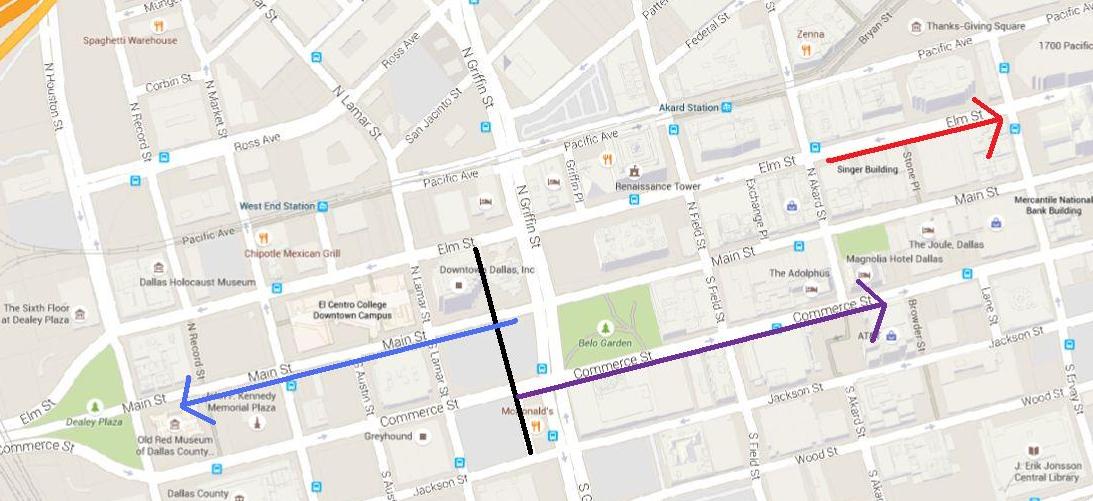
Below is a handy-dandy visual showing the locations of the above photos on a present-day map. (The black line shows where Poydras used to be. It exists today only as an alley-like block-long stretch of asphalt that runs alongside the downtown McDonald’s.) Click for larger image.
Google Maps
***
Photos by Clifton Church (1855-1943), from his book Dallas, Texas Through a Camera: A Collection of Half-Tone Engravings from Original Photographs (Dallas: J. M. Colville, Franklin Printing House, 1894). (Sadly, these images are a bit washed out. I’d love to see the original photographs — and I’d love to see a copy of the original book.)
Address information from city directories and Sanborn maps.
Dallas’ first gay pride march, June 24, 1972 (click for larger image)
by Paula Bosse
Today’s historic ruling by the United States Supreme Court on the issue of marriage equality comes after decades of civil rights activism from the LGBT community. The push for acceptance and equality began for many after the historic Stonewall Riots in New York City, which happened 47 years ago this week. The political fight began in Dallas — as it did in most major US cities — in the early 1970s. Dallas’ first Gay Pride march was held downtown on June 24, 1972, at a time when “out” homosexuals and lesbians were often blacklisted or denied basic civil rights without legal recourse. Below, the coverage of that first march by The Fort Worth Star-Telegram.
Fort Worth Star-Telegram, June 25, 1972
And now, a long, long 43 years later — almost to the day — the Supreme Court has ruled that same-sex marriage is now legal in every state in the union, a landmark victory not only for those early political and social activists who marched in the streets of Dallas and fought for their basic human rights, but also a victory for those of us who are their friends and family.
*
A wonderful history of the gay community in Dallas — from the days of secret “speak-easy”-type clubs to political organization to the AIDS fight — is contained in the KERA-produced documentary “Finding Our Voice: The Dallas Gay & Lesbian Community” (2000), which can be viewed in its entirety on YouTube, here.
***
Sources & Notes
Photograph of Dallas’ first Gay Pride march is from the LGBT Collection of the UNT Libraries; it and other photos of the parade can be found on UNT’s Portal to Texas History website, here.
Coverage of the first Dallas march can be found in the Dallas Morning News article “Gays March Proudly” by Marc Bernabo (June 25, 1972).
Other Flashback Dallas posts on LGBTQ issues can be found here.
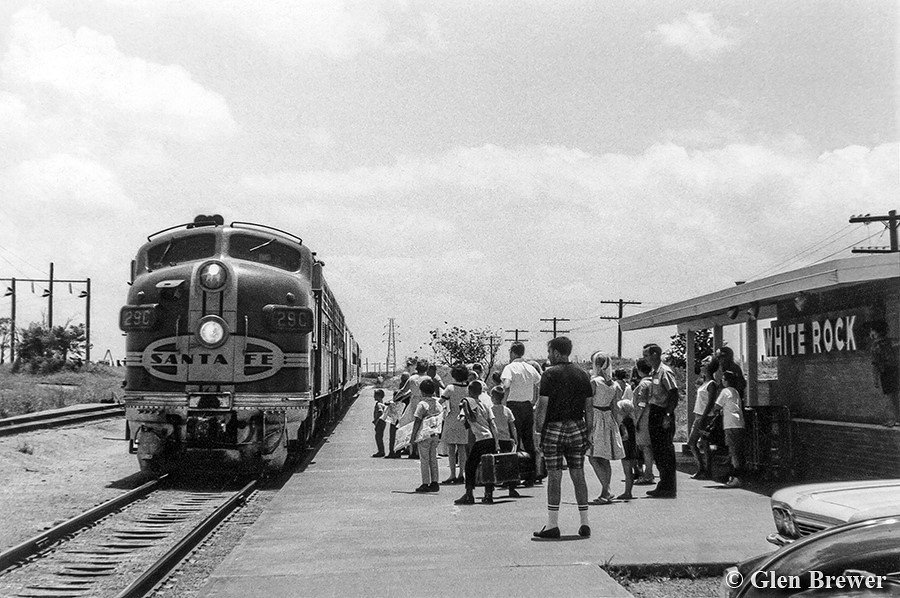
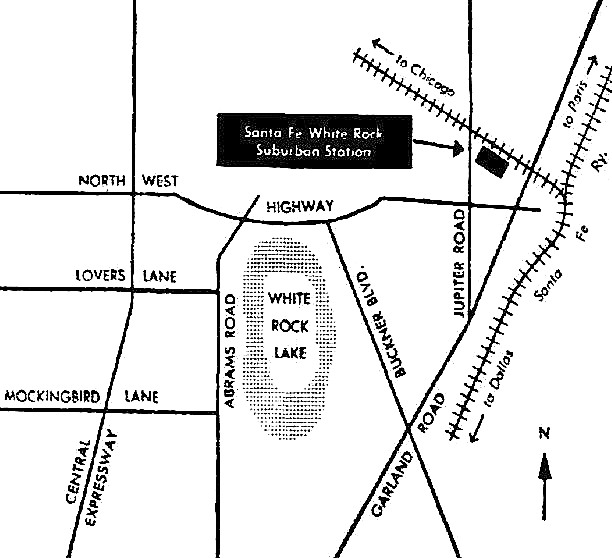
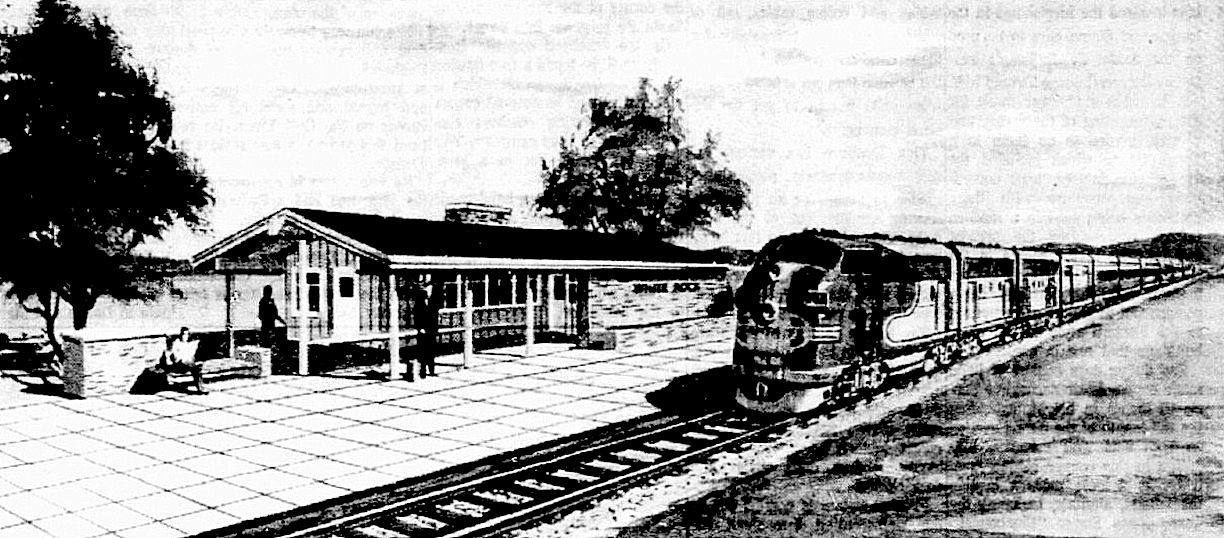
The White Rock passenger station — the Santa Fe railroad’s first suburban train depot built in the Southwest — opened on December 5, 1955 on Jupiter Road, about a quarter of a mile south of Kingsley (located mere steps across the Garland city line), a few miles northeast of White Rock Lake. It was the culmination of a $7,000,000 construction project in which two depots were built and 49.3 miles of new track was laid between Dallas and Denton (or, more specifically, between Zacha Junction — the area near Northwest Highway & Garland Road — and Dalton Junction, an area just northwest of Denton).
The new track — touted by a Santa Fe ad as being “the longest main line construction over new territory by any railroad in 25 years” — was important because it offered passengers from Dallas the ability to travel for the first time directly to Chicago without having to change trains. It also reduced freight line distances by 65 miles. The swanky streamlined Texas Chief shuttled passengers between Dallas’ Union Station and Chicago in about 19 hours — travel time between Union Station and the new White Rock Station was 25-30 minutes.
Santa Fe ad detail, Dec. 4, 1955
The breathless copy from the giant two-page advertising spread heralding the new line included the following description:
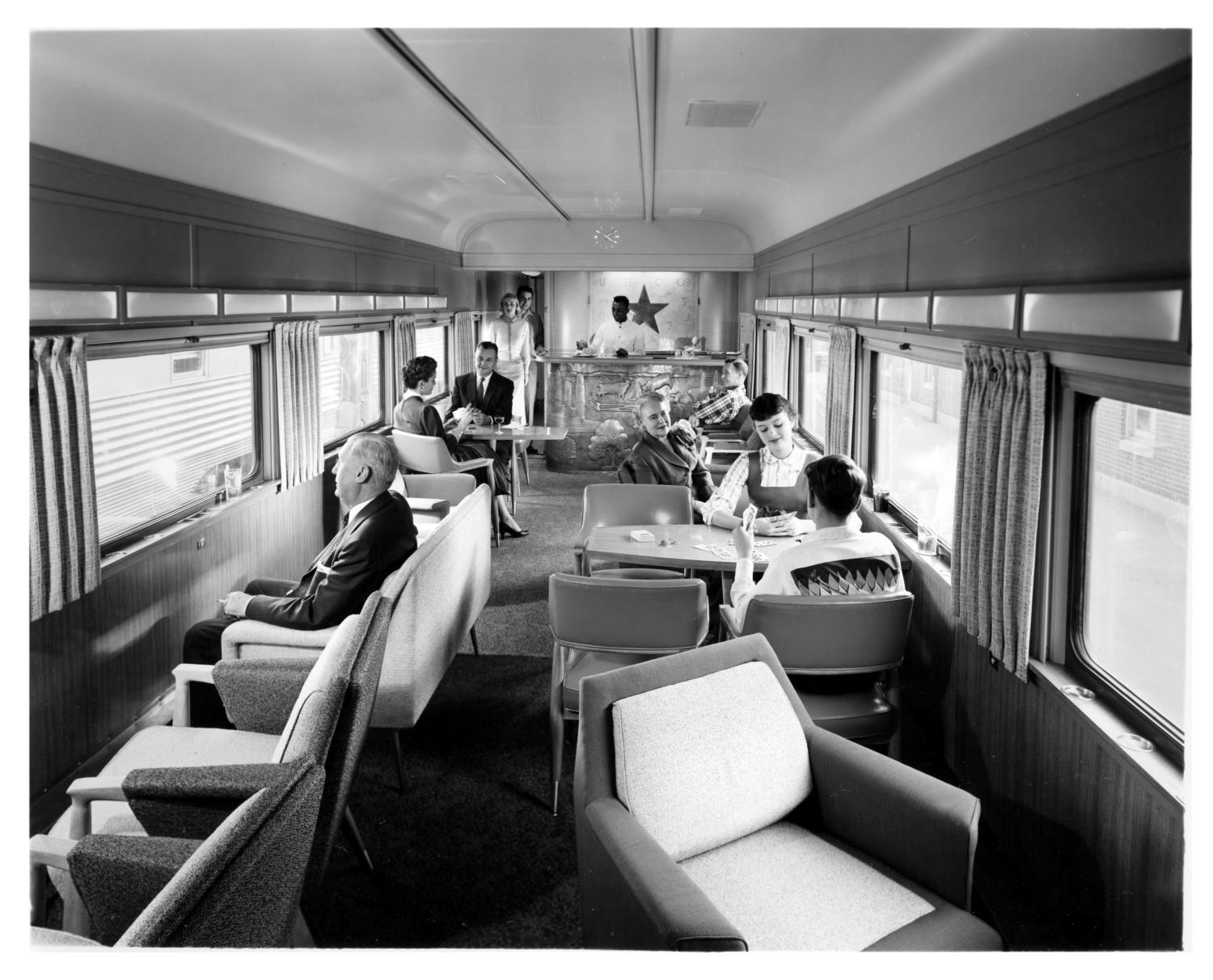
And just wait until you see the special lounge car and dining car on the Texas Chief — the last word in luxury in railroad equipment, decorated in the style and smartness indicative of Dallas…. A lounge decorated to please a Texan! Wide open and spacious feeling, with really comfortable modern sofas and chairs, casually grouped to make you want to relax. You’ll see the Star of Texas and famous cattle brands tooled into the rich leather back-bar — and Texas-inspired murals in hand-hammered copper. Even the walls are richly paneled — in smart, new frosted walnut. Just wait until you see it, you’ll say there’s nothing like it.
And here they are (click for larger images):
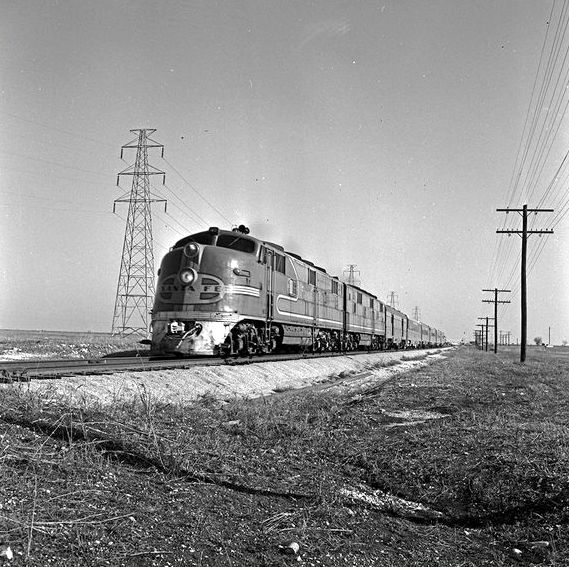
Below, the Texas Chief, pulling out of the station, heading north. (To see a grainy closeup of the station in the background, click here.)
Photo by Everette DeGolyer, Dec. 29, 1956, via SMU
UPDATE: Watch color home-movie film footage taken at the station in this clip from the Portal to Texas History (the pertinent footage begins at the 3:00 mark). More on this cool piece of film can be found in another Flashback Dallas post, here.
*
Interesting tidbit: the engine of the Texas Chief was christened at Union Station on Dec. 5, 1955 with a bottle of water from White Rock Lake! The caption of a photo of the christening in the Dallas Morning News read: “NEW STREAMLINER CHRISTENED — With a bottle of water from White Rock Lake, Mrs. Fred G. Gurley, wife of the Santa Fe Railway’s president, christens the new Dallas-Chicago Texas Chief in ceremonies Monday at the Union Terminal. At right is Miss Sandra Browning of Garland, who presented the local bottle of water,” (DMN, Dec. 6, 1955). Champagne? Pffft! We’ve got pure-dee White Rock Lake water!
And I found footage of that! Here is a screenshot of Mrs. Gurley wielding the bottle of East Dallas’ finest (as Miss Garland, Sandra Browning looks on).
And here is the short clip of the Texas Chief on Dec. 5, 1955, the day of its inaugural run from Dallas to Chicago — in color!. There are shots of the ceremonies at Union Station in Dallas, of the new White Rock Station, of the streamliner with the Dallas skyline behind it, and, possibly, footage from the other big ceremony in Denton.
The two photos showing the dining and lounge cars of the Texas Chief were taken around 1956; both are from the Museum of the American Railroad Collection, Portal to Texas History. Other photos of the Texas Chief from this collection can be seen here.
Photo of the Texas Chief pulling out of the White Rock Station was taken by Everette L. DeGolyer on Dec. 29, 1956; it is from the Everette L. DeGolyer Jr. Collection of United States Railroad Photographs, DeGolyer Library, Central University Libraries, Southern Methodist University. The photo (“Atchison, Topeka, and Santa Fe, Diesel Electric Passenger Locomotive No. 11, White Rock Station”) can be viewed here.
The two drawings, and a few quotes, are from large advertisements placed by the Santa Fe railroad to announce the opening of their new line.
The last photograph showing the station is dated “circa 1956” and credited to “Monaghan, M.D.”; it can be viewed on the Portal to Texas History site, here.
The YouTube video showing color footage of the Texas Chief’s inaugural festivities is titled “New railroad into Dallas. Archive film 93424,” from the Huntley Film Archives, here.
The photo of the commemorative railroad spike (“Spiked with Progress”) was sent to me by a man who had seen it for sale in an antique store in Ardmore, Oklahoma in 2020 (thanks, Joe!).
A 1962 map showing the location of the station is here. A present-day Bing map showing where the station was is here. A Google Street View image of the area today is (…if you must…) here.
An article on the construction of the Denton and Dallas (White Rock) depots — “Work on New Santa Fe Depot To Start Here” (Denton Record-Chronicle, July 13, 1955) — can be read here.
For anyone doing research into this specific new rail line, there was a 16-page section in The Dallas Morning News on Dec. 5, 1955 which was bursting with helpful info, civic pride, “welcome to the neighborhood” ads, and corporate puffery. There was an even larger (MUCH larger!) tribute to the sainted Santa Fe which consumed the entire Dec. 4, 1955 edition of The Denton Record-Chronicle (there was even a ghost image of a Santa Fe engine which covered page one).
As mentioned above, there is home-movie film footage taken at the station — more about this can be found in the Flashback Dallas post “White Rock Station (And a Helicopter Ride),” here.
And, lastly, check out a YouTube video of Henry Mancini’s version of Johnny Mercer’s “Atchison, Topeka & Santa Fe” — with loads of cool period film footage of train travel — here.
I’m afraid my updating here has fallen by the wayside a bit as I am STILL plowed under from my recent big move. Today I will finally unpack my books! So, time for a just a quick post. Here’s a photo of some quaint little temporary buildings on the SMU campus, still in its first decade. Below is the description of this image, written in the early 1970s:
“The parking lot in the foreground and the curving driveway are basically still the same today, but the rest of the picture has changed drastically since 1925 when it was taken.
“On the left is the Southern Methodist University Engineering School with the Chemistry Department Building in the middle and the School of Commerce on the right. The smaller building was a construction shack used for carpentry work.
“Not shown, but just to the right of this location was Dallas Hall — still a landmark. Today, the Fondren Science Building has replaced the temporary buildings pictured.
“In the background to the right and left are rows of bois d’arc trees along Airline and Daniels — planted in those days as fences.”
***
Sources & Notes
Photo from a postcard issued as part of the Park Cities Bank “Heritage Series” in the 1970s; the credit line on the postcard reads “Donated by Stanley Patterson.” Thanks to the Lone Star Library Annex Facebook group for use of the image.
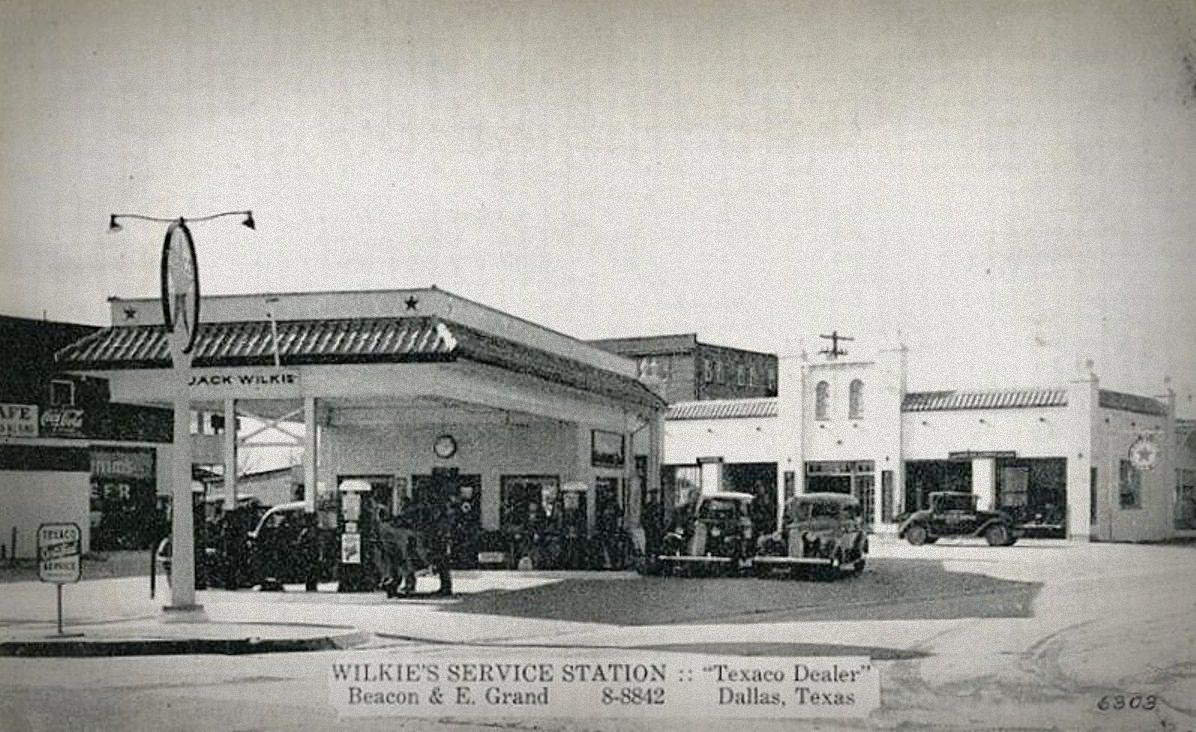
Above, Jack Wilkie’s Texaco service station at 5523 East Grand. It’s a shame gas stations are rarely this interesting anymore. The station opened in 1937 and was at this location well into the 1940s. Below, the same view today, with that tall brick building in the background of both photos. (I’m not sure what that building is, but while I was waiting for a friend in the Kalachandji’s parking lot a few months ago, I remember thinking what a strange building it was — especially when seen from the side. It’s had some weird additions made to the original building.) This part of East Dallas still has pockets of charm, but it’s never again going to be as cool as it was when Jack Wilkie’s service station was holding down the fort at the corner of Beacon and E. Grand.
A great panoramic photo by Clogenson, showing the old Commerce Street bridge partially submerged by the Trinity River (which is pretty dang high … and rising).
***
Photograph by Henry Clogenson, from the collection of the Library of Congress; accessible here.
Previous Flashback Dallas posts on the Great Flood of 1908 can be found here and here. And a fantastic photo of what the Trinity looked like before it was straightened and moved is here.
And, really, you MUST hear Johnny Cash sing the pertinent “Five Feet High & Rising,” here.
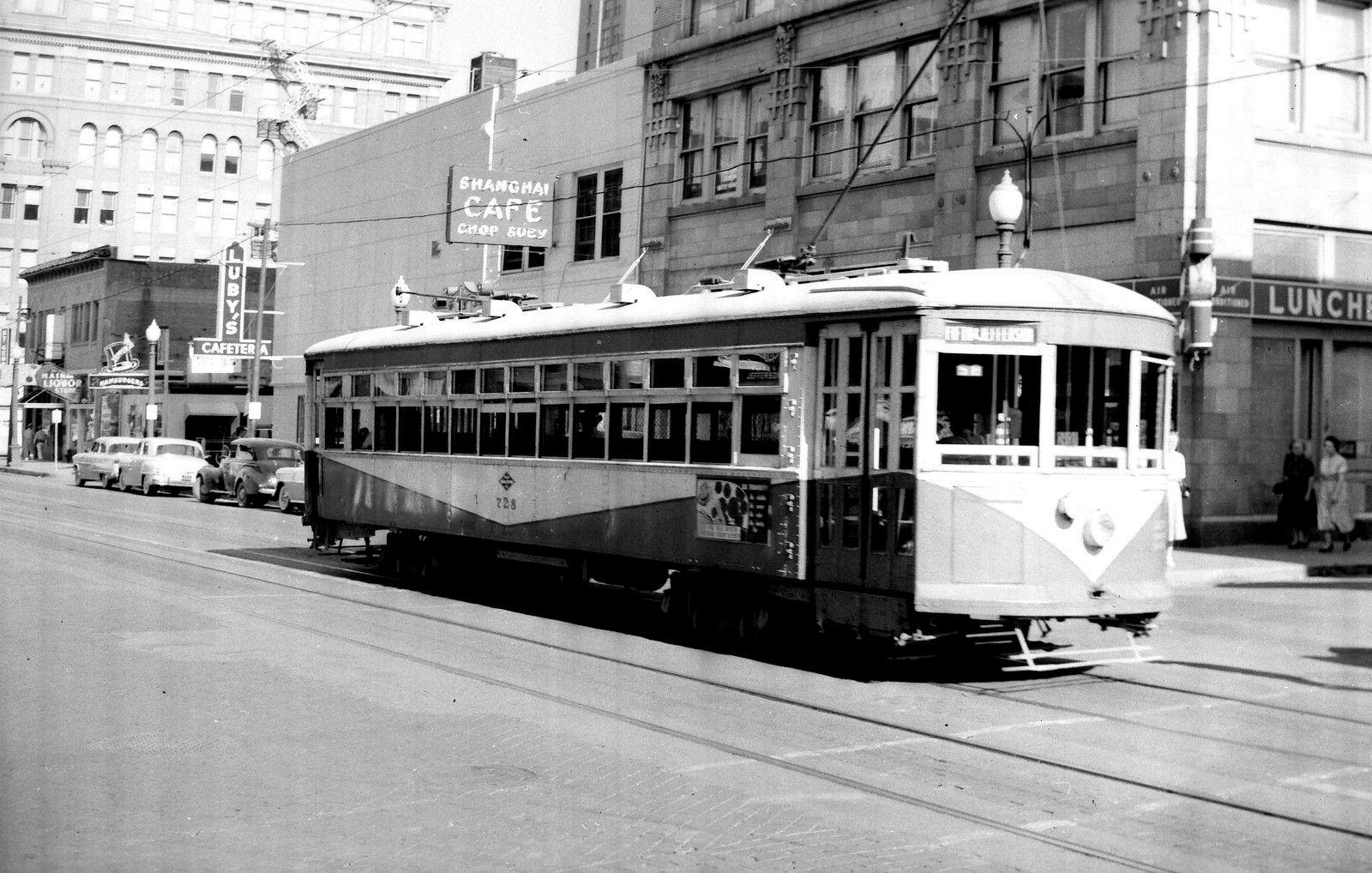
Oh, streetcars. In the photo above, we see car #728 heading east on Main Street on September 2, 1954, having come from, I believe, Oak Cliff (the placard reads “Jefferson”). This photo shows Main Street looking east from, I think, Poydras.
The Shanghai Cafe was at 1004 Main, Luby’s Cafeteria (the second one in Dallas) was at 1006 Main, the Topper restaurant was at 1012 Main, the Main & Martin Liquor Store was at 1016 Main (at Martin Street), and the St. George Hotel was at 1018 Main, all of which can be seen in this photo.
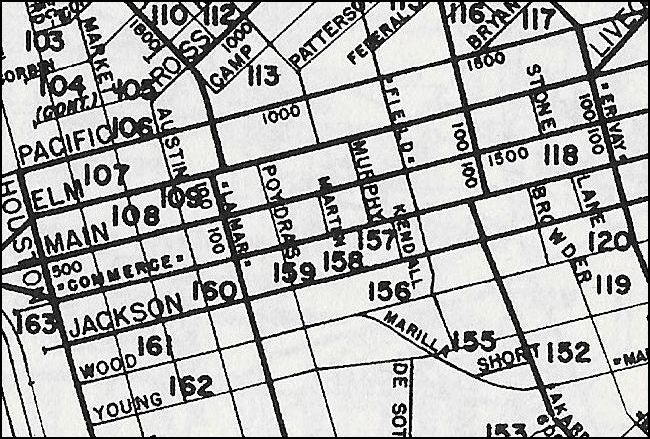
1952 Mapsco
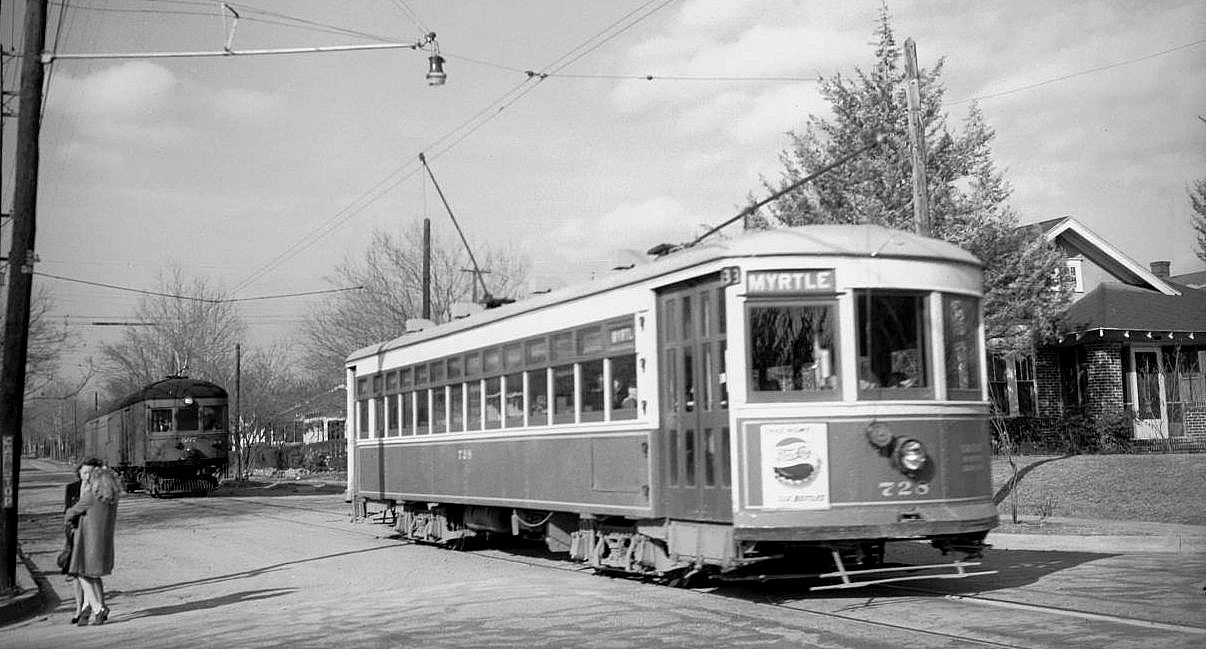
Car 728 wasn’t always “Jefferson,” whiling away its days crossing back and forth across the Trinity. Back in 1945 it was “Myrtle” and was spending a large part of its time in South Dallas.
I’m not sure where Myrtle/Jefferson ended up, but, sadly, the Golden Age of streetcars ended in Dallas in 1956.
***
Sources & Notes
Top photo from an old eBay listing.
Bottom photo by Robert W. Richardson; from the Western History/Genealogy Dept., Denver Public Library.
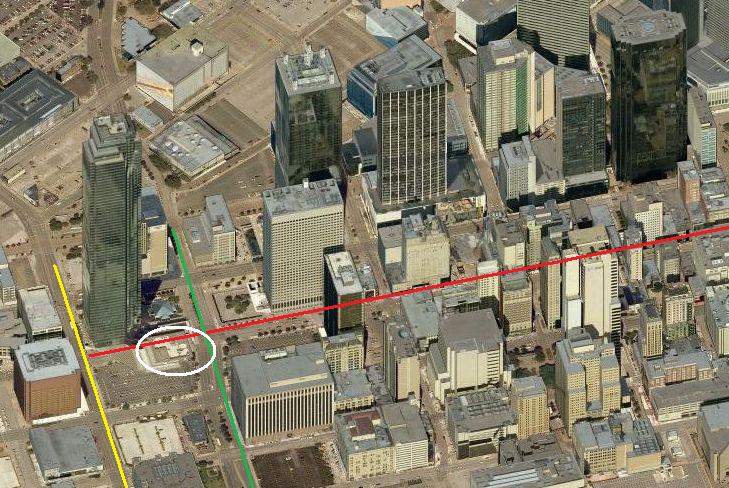
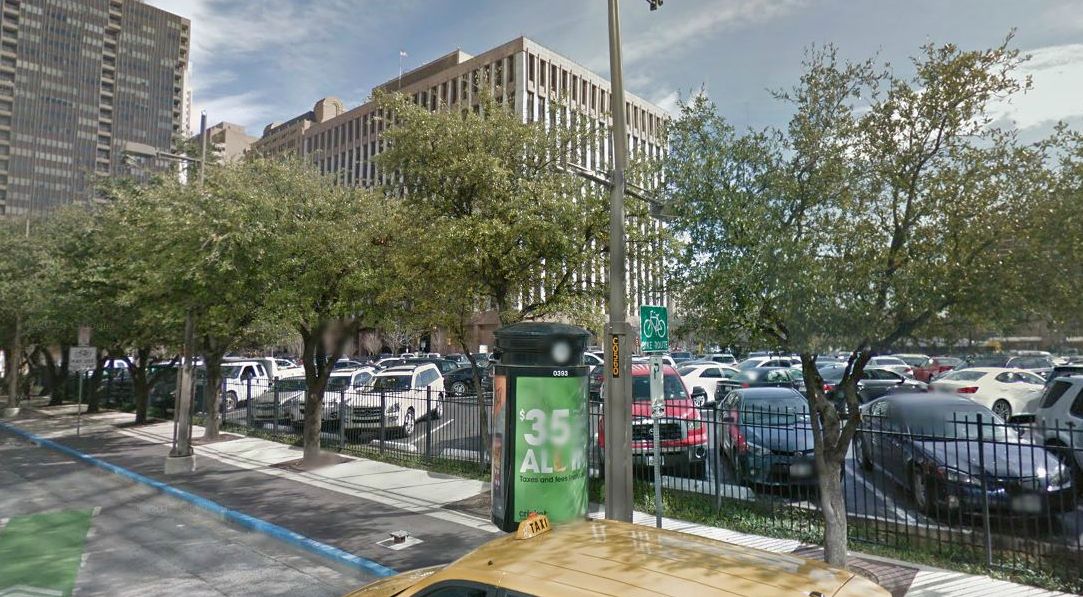
Today, the block seen in the top photo looks completely different. Across the street is where the Bank of America Plaza is now. In the map below, the red line is Main, the yellow is Lamar, and the green is Griffin. The 1000 block of Main Street is circled in white. (Click for larger image.)
Bing Maps
So what’s there now? A parking lot!
Google Street View
To read “The Last Day the Streetcars Ran in Oak Cliff” by Ron Cawthon, click here.
The 1000 block of Elm Street: small-business central
by Paula Bosse
A really incredible view of Elm Street, probably from the late-teens to the early-20s. (Almost all of the businesses seen in this photo were listed in the 1922 city directory.) The landmark businesses seen here — all founded in the 19th century — would be Huey & Philp Hardware, Charles Ott (gunsmith) (the sign can be seen just above the Huey & Philp sign at the right), and down the street on the corner of Lamar, the beautiful 8-story Sanger Bros. department store (now part of El Centro). I know it’s a like hearing a broken record, but I really wish downtown Dallas still had some of this old, quirky flavor. (Click picture for larger image.)
And here’s a shot of the same view, but street-level:
***
Sources & Notes
Photos from the Fort Worth Star-Telegram Collection, Special Collections, University of Texas at Arlington.
If you want to see what the same view looks like today, click here. Personally, I prefer the “before” to the “after.” I’m generally a fan of tall buildings, but all those skyscrapers absolutely decimated street-level businesses, which, sadly, seem to be gone for good. You can’t undo a skyscraper.
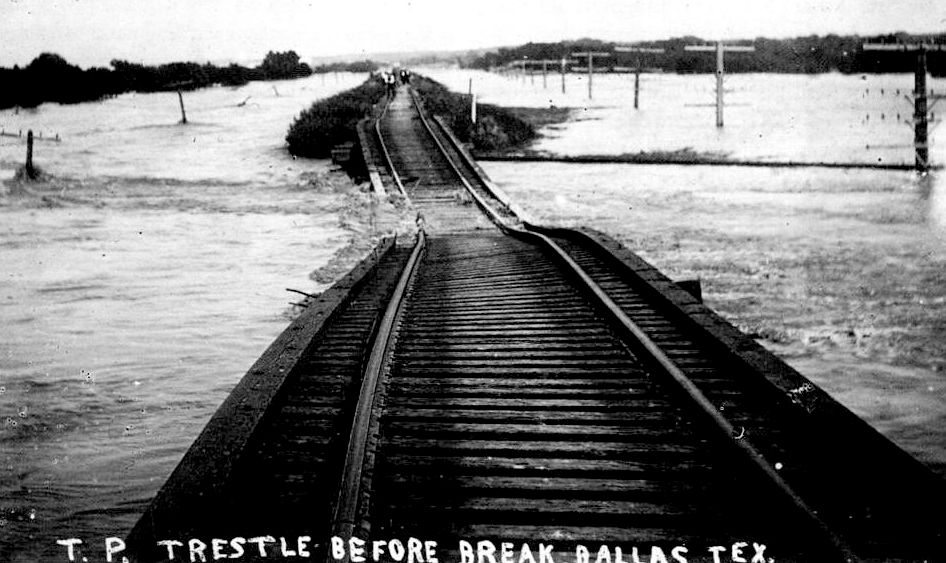
“T. P. Trestle Before Break, Dallas, Tex.” (click for larger image)
by Paula Bosse
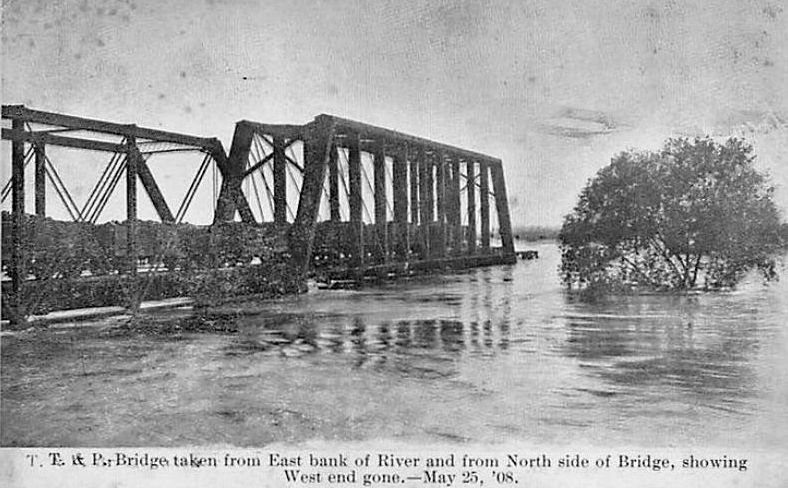
Above and below, photos of the Texas & Pacific railroad trestle spanning the Trinity River, destroyed during the great flood of May, 1908. Five people died in the flooding — in which the Trinity crested at an incredible 52.6 feet — and damage to property was unbelievable. The railroad trestle was just one of numerous victims of the worst flood Dallas has ever known.
***
Photo from the article “After the Deluge: The Impact of the Trinity River Flood of 1908” by Jackie McElhaney (Legacies, Fall, 1999), which you can read here.

 Main Street looking west, toward a ghostly courthouse (click for larger image)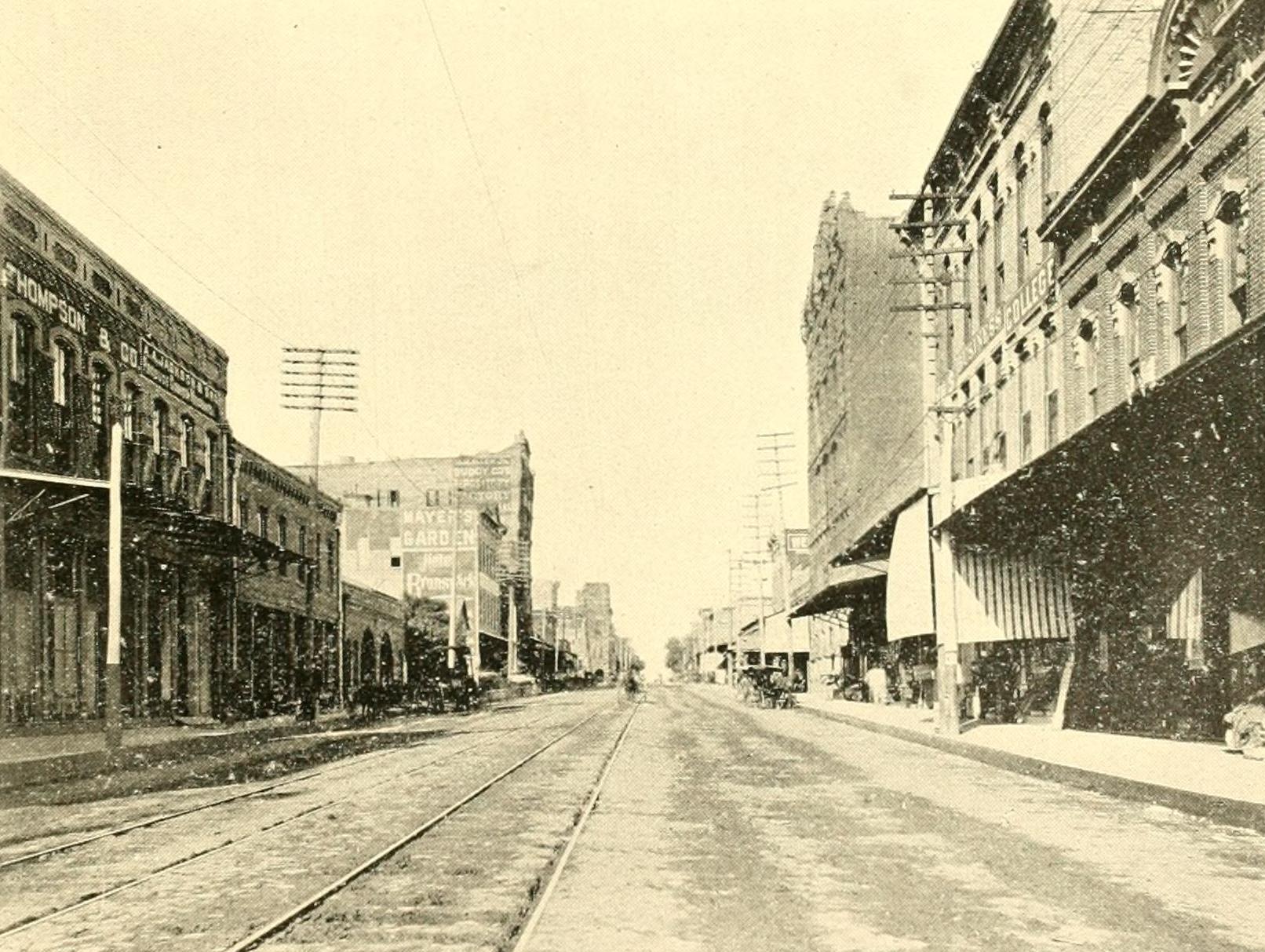

 Google Maps
 Fort Worth Star-Telegram, June 25, 1972








 Flashback : Dallas