Flashback : Dallas

A Miscellany: History, Ads, Pop Culture

Category: Photographs

Getting Married on the Radio — 1922

radio-wedding_corbis_062922Inez & John, exchanging vows on Dallas radio, 1922

by Paula Bosse

An early radio stunt happened in Dallas on the night of June 29, 1922 when a couple exchanged wedding vows over the air, with the bride, the groom, and the minister each broadcasting from the studios of different Dallas radio stations: WDAO, WRR, and WFAA. These were the very early days of radio, and when the wedding was broadcast, WDAO had been on the air for a little over a month, and WFAA for less than a week! (WRR, Dallas’ first radio station had been on the air for about a year, but most of that time it had been operating as a one-way radio dispatcher for the city’s fire and police departments). In June of 1922, these were the only three Dallas-based radio stations, and they all worked together in this “historic” broadcast. (This early media stunt was a full 47 years before Tiny Tim and Miss Vicki got hitched on the Tonight Show.)

DALLAS COUPLE TO WED BY RADIO THURSDAY NIGHT

DALLAS — The first wireless marriage ceremony ever performed in which neither the bride, the groom, nor the officiating minister will be at the same place is to be solemnized here Thursday night when Miss Inez Mabel Brady, Dallas society girl, becomes the bride of John H. Stone, operator at WRR, the municipal broadcasting station.

It is estimated that more than 25,000 radio fans will “witness” the tying of the radio nuptial knot.

Three Dallas broadcasting stations will be used in the ceremony. Rev. Thomas Harper, pastor of the Central Congregational Church, who has been asked to officiate, will repeat the marriage ritual into the transmitter of [WFAA,] the broadcasting station on the roof of [the Dallas Morning News] building. The bride and her attendants will be at the Automotive Electric Company’s radio station [WDAO, on South Ervay], while the groom will make his responses from WRR, the station of which he is in charge.

Operating staffs of the three stations are working out the details of the ceremony, which will include a broadcasted wedding march.

(– Fort Worth Star-Telegram, June 28, 1922)

Obviously new to the hustle of radio promotion, The Dallas Morning News (owner of WFAA) mentioned the event only a couple of times — fleetingly. They did note that “This probably will be audible to one of the largest audiences ever ‘hearing’ a wedding ceremony” (DMN, June 28, 1922). It’s not known just how many people tuned in to listen to the ceremony (probably a considerable number), but the story made news around the country, as can be seen in this article from The Durham Morning Herald in Durham, North Carolina:
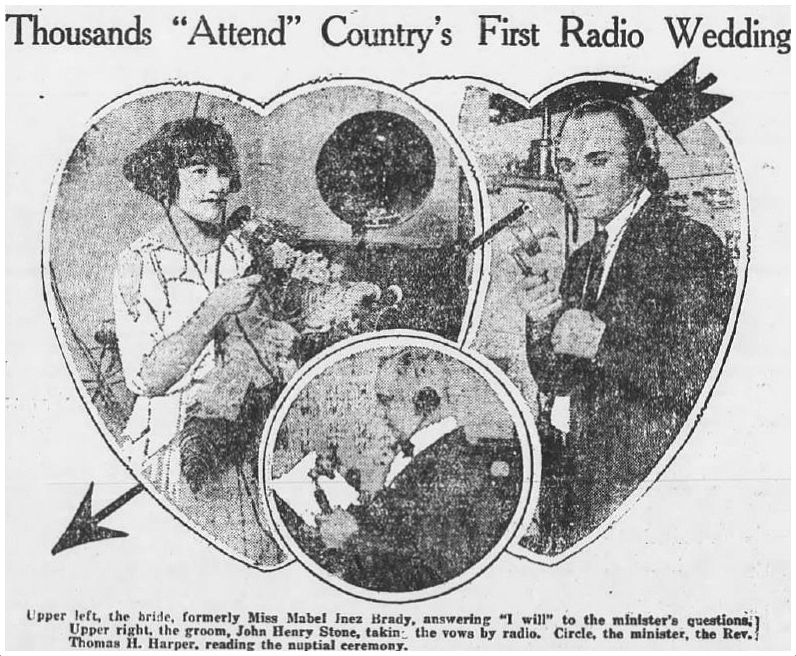
radio-wedding_durham_071322a

radio-wedding_durham_071322-bDurham (NC) Morning Herald, July 13, 1922 (click for larger image)

The broadcast had only a tiny hiccup:

radio-wedding_winfield-daily-press_kansas_063022Winfield (Kansas) Daily Press, June 30, 1922

As successful as the radio wedding was, the marriage between Inez Brady and John H. Stone does not appear to have lasted very long. At the time of the wedding, Inez was just out of school and was only 16 or 17 years old (the descriptions of her as a “society girl” and “debutante” were, I think, a bit of an exaggeration). According to the news stories surrounding the wedding, she “fell in love” with Mr. Stone’s voice on the radio. None of that bodes well for a lasting marriage. The 1923 city directory had the newlyweds renting rooms on McMillan, off Lower Greenville, but the 1924 directory had John in Oak Cliff and Inez in Old East Dallas. She re-married in 1928 at the creaky old age of 22, and he seems to have left WRR to work in some capacity for RCA. The marriage might not have lasted, but they both had a “brush-with-celebrity” story to tell (and re-tell) for the rest of their lives.

***

Sources & Notes

Top photo from CorbisImages, ©Bettmann/CORBIS.

I’m not sure which ended first — Mr. and Mrs. Stone’s wedded bliss or the radio station WDAO, which ceased operation sometime in 1923. A good look at the history of early local radio can be found at DFW Radio Archives, here. (WRR and WFAA continue to march forward, just a few years shy of their 100th anniversaries!)

*

Copyright © 2014 Paula Bosse. All Rights Reserved.
A Downtown Gas Station! — 1949

tyler-service-stn_degolyer_1949-det1Gas station at Elm & Houston! (click for larger image) (SMU Libraries)

by Paula Bosse

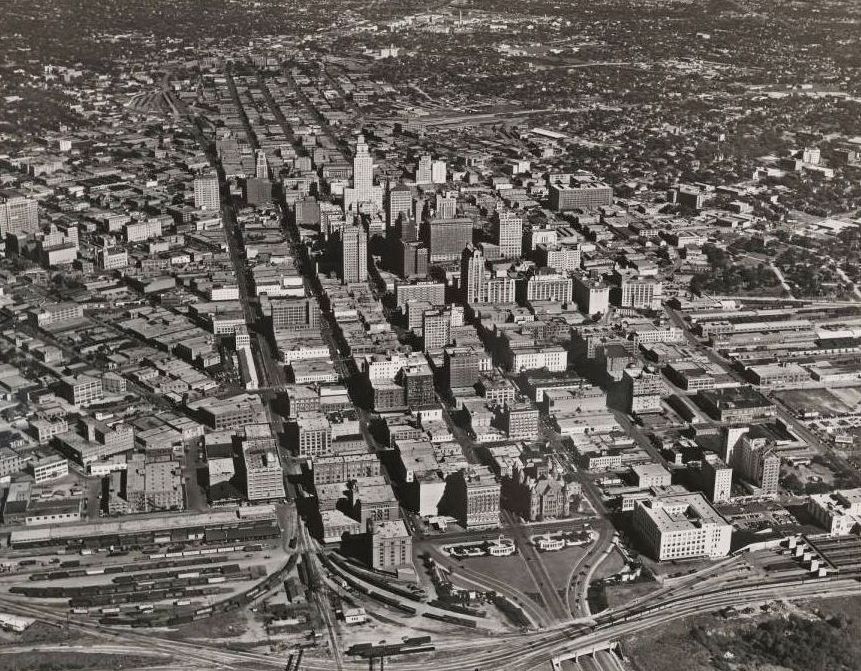
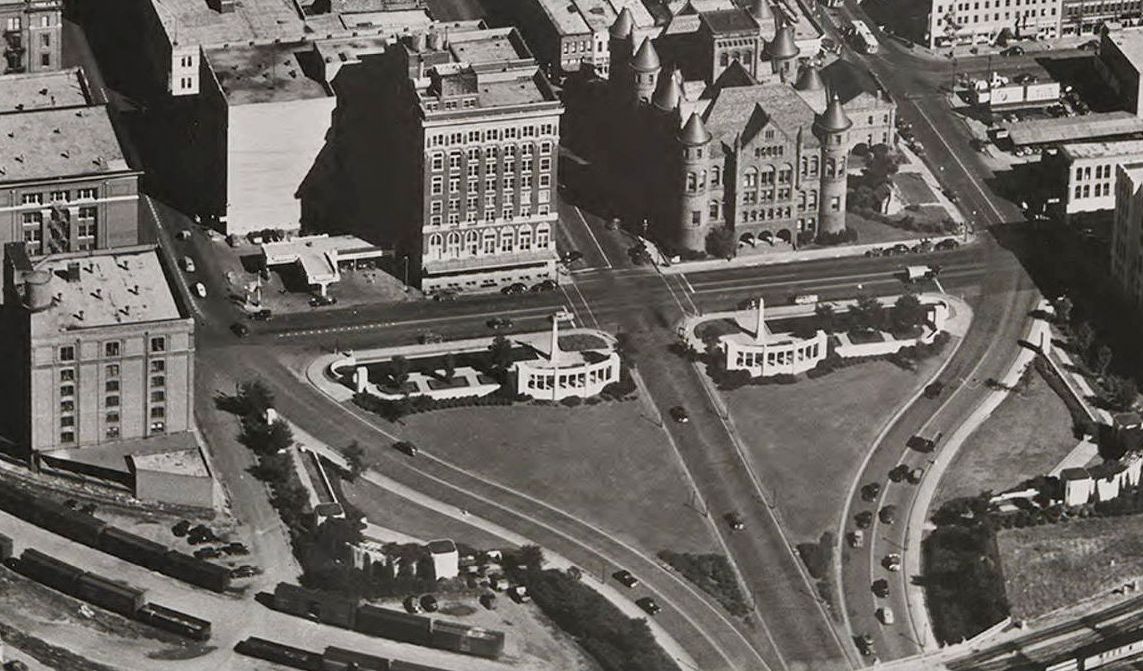
There was a time when gas stations populated the central business district in downtown Dallas. But now? I’m not sure I’ve ever seen a gas station in the heart of downtown. Which is probably why the station seen above (from a detail of a larger aerial view of downtown) stood out so much when I was looking at the photo. And it wasn’t located just anywhere downtown, but it was in the primo location opposite Dealey Plaza at the “gateway” to the city. It doesn’t fit in that space very well — it’s a corner crying out for a more substantial structure — but … wouldn’t it be nice to have an actual full-service gas station downtown again?

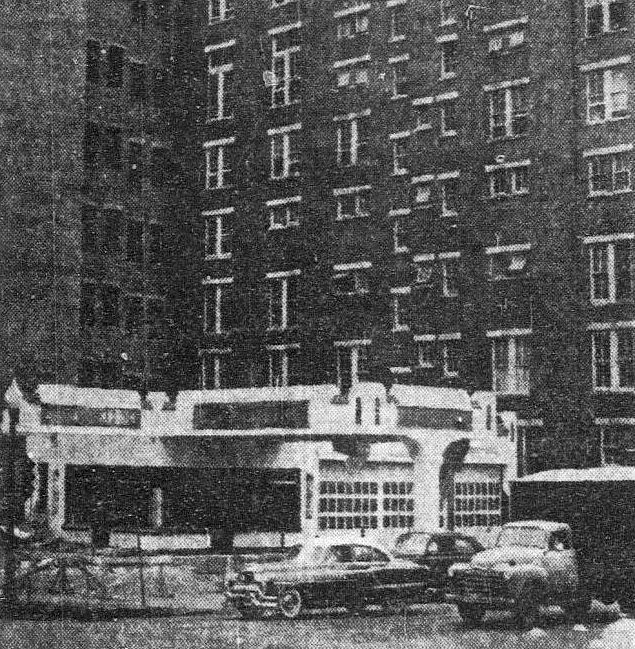
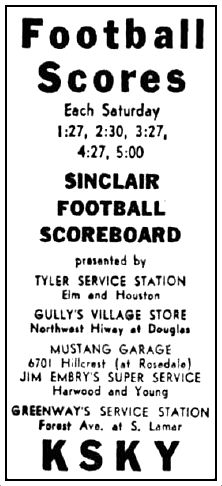
The Tyler Service Station (and before that the Longhorn Service Station) held down the corner at Elm and Houston streets in the 1940s but was demolished in 1953 to make way for the construction of the Records Building/Criminal Courts Building annex. And, hallelujah, I found a photo of the service station from ground-level — and it was pretty cool-looking!

gas-station_elm-and-houston_1950s

tyler-service-stn_dmn_100948Oct. 9, 1948

And, finally, here’s the original photo I saw in which that long-gone gas station jumped out at me, another wonderful photo by Lloyd M. Long, taken in May, 1949. You never know what odd things you’ll discover if you just take the time to explore.

downtown_degolyer_1949Aerial photo by Lloyd M. Long, 1949 (Foscue Map Library, SMU)

***

Sources & Notes

Lloyd M. Long photo (“Downtown Dallas, looking east”), from the Edwin J. Foscue Map Library, Central University Libraries, Southern Methodist University; it can be viewed here.

Click pictures for larger images.

*

Copyright © 2014 Paula Bosse. All Rights Reserved.
 

Cowboys and Indians on Elm Street — 1915

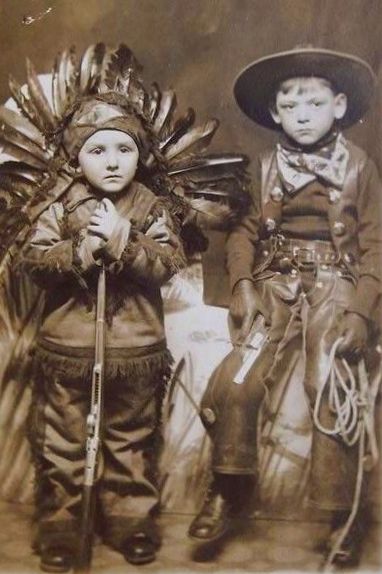
lawrence_kiddie-photoPhoto by Joe Lawrence, circa 1915

by Paula Bosse

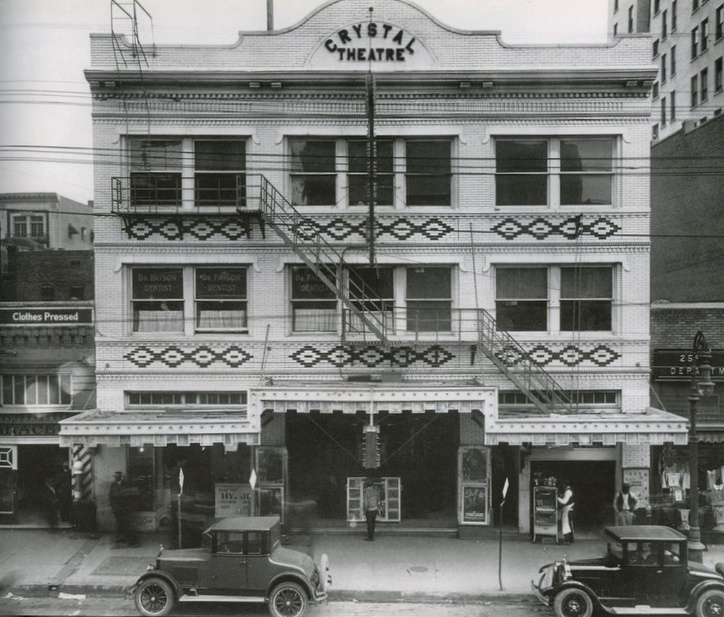
The photo above, showing two not-terribly-thrilled children dressed up in Old West costumes, was taken by Joe Lawrence in his “Crystal Electric Studio” at 1608 Elm Street, one of many small businesses located above the Crystal Theater.

crystal-theaterThe Crystal Theatre — with office space above (click for larger image)

Joseph Z. Lawrence (1884-1943) was born in Romania and settled in Dallas in 1909. In 1915 he was doing business as a photographer at 1608 Elm Street. Lawrence later owned the Lawrence Art Galleries on Pacific Avenue, and, along with his son Harry, was an early supporter of the Dallas Nine artists.

***

Sources & Notes

Top studio photo by Joe Lawrence, found on eBay.

Photo of the Crystal Theater found on Pinterest, here. A photo of the 101-year old building taken during the recent spate of downtown demolition — with the wrecking ball literally INCHES away from it — is here. The Dallas Morning News article it comes from is here.

At some point the address of the building (originally 1608-10) became 1610 Elm, perhaps when it was extensively remodeled in the late 1920s and became a retail store.

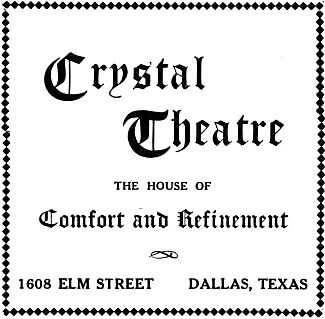
crystal-theater_building-code-bk_19141914 — “Comfort & Refinement”!

*

Copyright © 2014 Paula Bosse. All Rights Reserved.
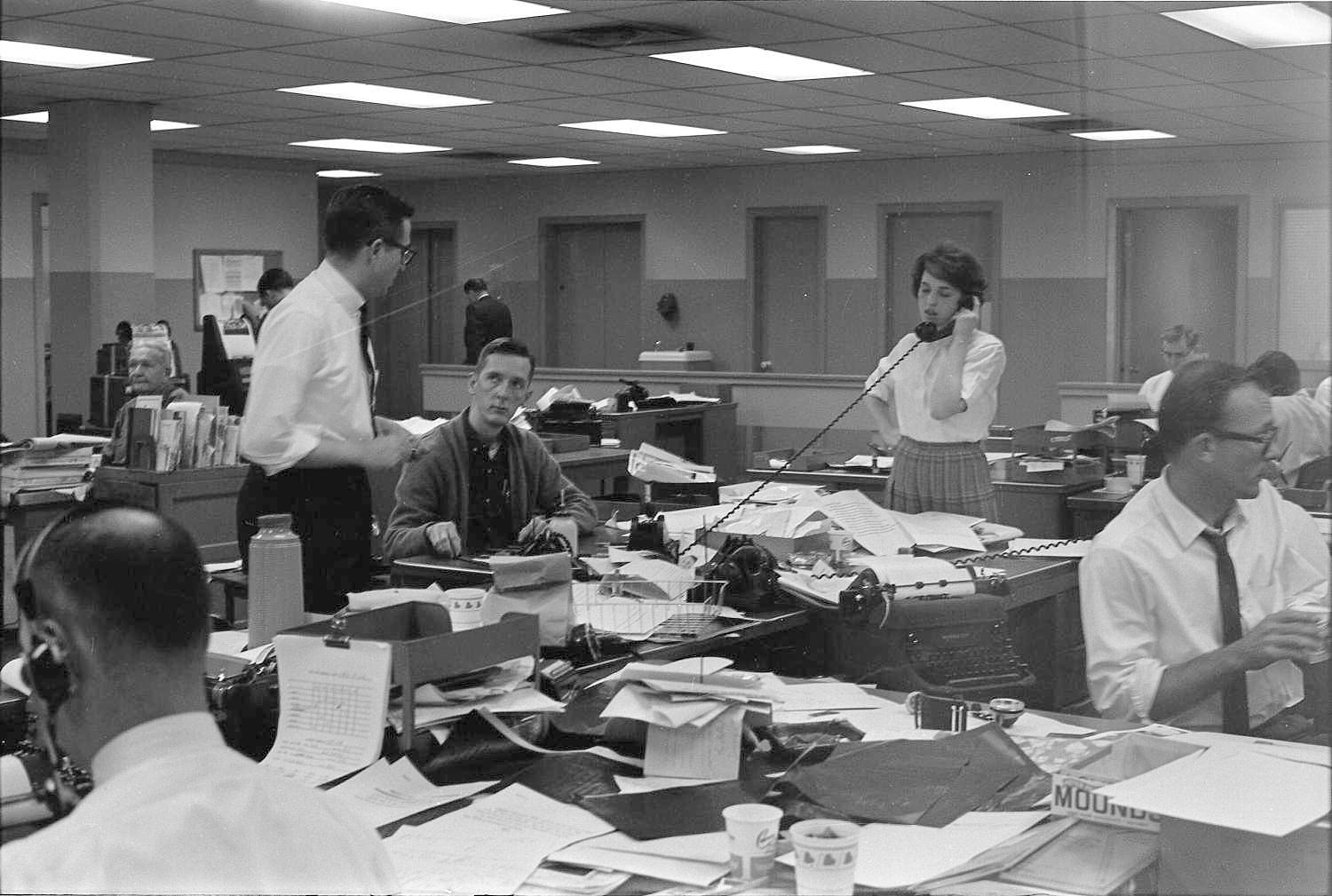
JFK Aftermath: Chaos at the City Desk — 1963

JFK_DTH_newsroom2_portal_b
It was all-hands-on-deck for a shocked and solemn Times Herald staff, 11/22/63.

by Paula Bosse

Photos of Dallas Times Herald reporters in the newsroom on November 22, 1963, scrambling for information after the assassination of President John F. Kennedy, the biggest news story of their careers — the biggest news story in the history of Dallas.

JFK_DTH_newsroom3_portal_b

JFK_DTH_newsroom1_portal_b

***

Sources & Notes

Photos (by an unidentified DTH staff photographer) are from the Sixth Floor Museum’s Dallas Times Herald Collection, accessible through the Portal to Texas History. Other photos of no doubt shocked reporters in the DTH newsroom who were probably running completely on instinct and adrenaline that day are here (click thumbnails for larger images).

Identification of DTH reporters and other staff pictured above is welcomed.

*

Copyright © 2014 Paula Bosse. All Rights Reserved.

JFK’s “Last Hour In Dallas” — 1963

JFK_poster

by Paula Bosse

How is a city supposed to respond when it is suddenly plunged into the international spotlight? Does it grieve and try to forget, or does it grieve and capitalize? Dallas has had over 50 years to deal with/come to terms with the assassination of President Kennedy, but sometimes it seems as if the City of Dallas is still shell-shocked and isn’t quite sure how to acknowledge it on an official level. Let’s face it, Dallas is known to the rest of the world for one thing: the Kennedy assassination (and perhaps the TV show, and maybe the Cowboys). Yes, we have the justly-renowned Sixth Floor Museum, but it took 26 years to open it!

The cottage industry that sprang up in the wake of the Kennedy assassination has been big business for decades, some of it generated by people who live in Dallas, but most of it by people who have probably never even been to Texas. Since 1963, the “assassination literature” (…and, yes, it’s called that) has mushroomed, with local contributions coming from Dallasites whose brush with the President before, during, or after the events of November 22, 1963 have probably been pored over by numerous people either trying to understand why what happened happened or by people searching for hidden conspiracy clues to explain what really happened.

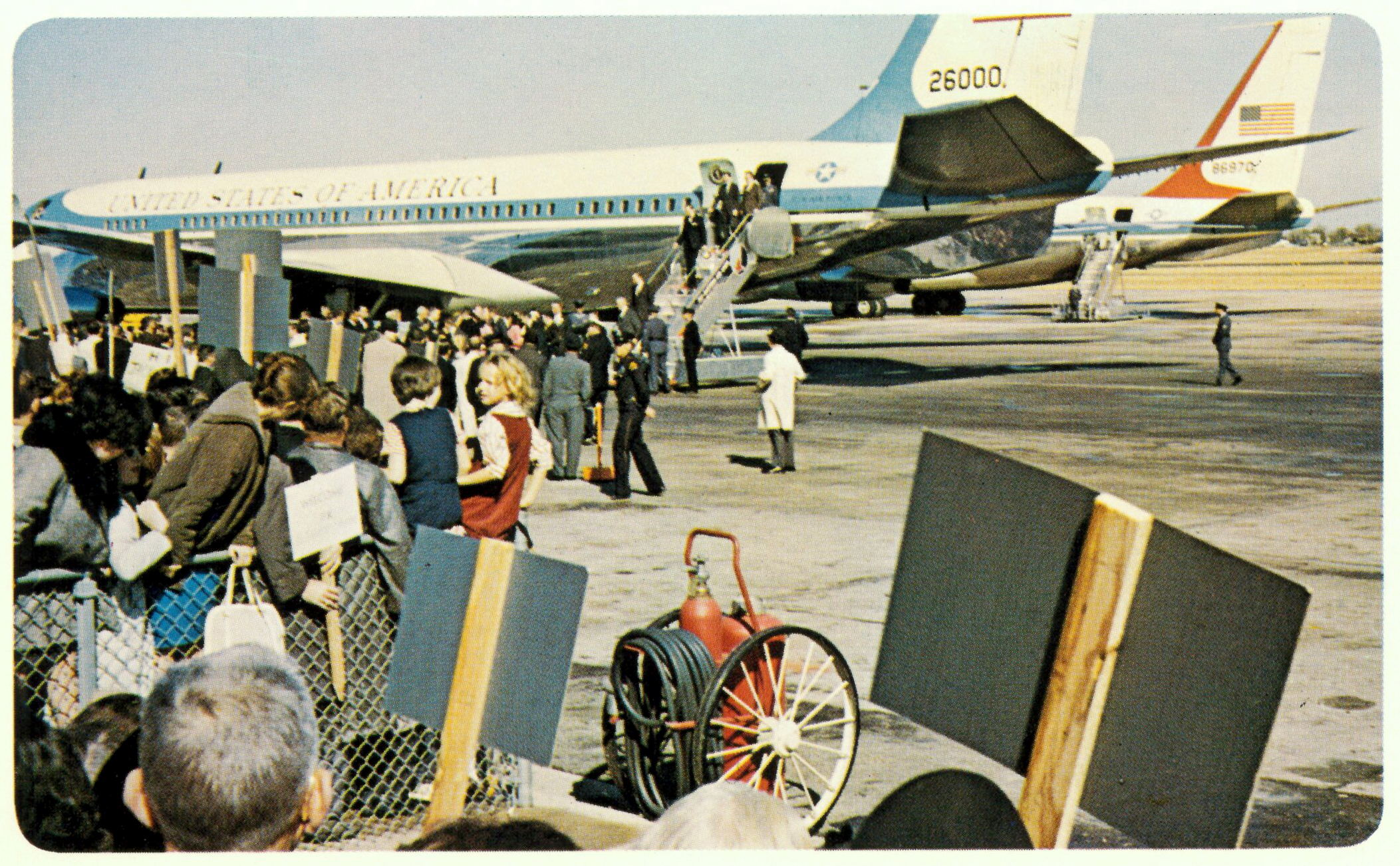
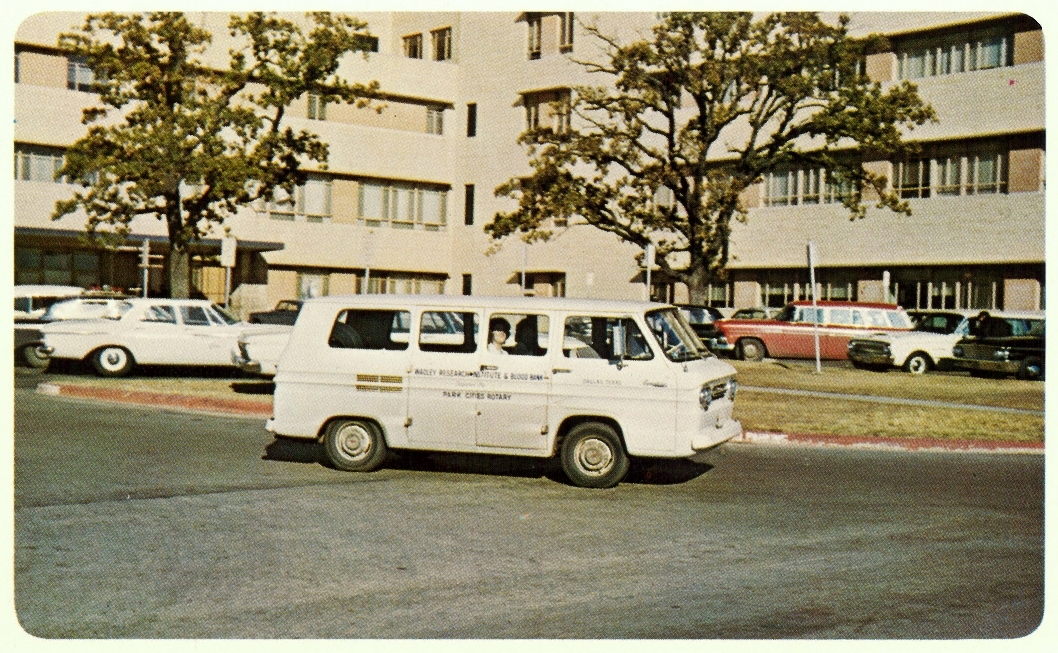
One local resident who added to the assassination literature was John E. Miller who took photos of the arrival of President and Mrs. Kennedy at Love Field and then apparently hot-footed it over to Parkland when the news of the shooting broke. These photos were issued as postcards in 1964 in a packet of 12. (Click pictures for larger images.)

JFK_envelope_frontAbove, the front of the envelope containing the cards; on the back: “A Real Picture Treat For Years To Come.”

JFK_card_01From the back of the card: “No. 1, Arrival of President’s Escort Plane at Love Field, Dallas, Texas.”

JFK_card_02“No. 2, Presidential and Escort Planes at Dallas’ Love Field landed shortly after this picture was taken.”

JFK_card_03“No. 3, President John F. Kennedy and party leaving airplane at Love Field. (Mrs. Kennedy — pink hat.)”

(UPDATE: The two little girls in the photos above and below are most likely Carolyn Jacquess, in blue, and Debby Massie, in red. Their little group arrived at the airport before the president’s plane arrived, walked through the terminal and out onto the tarmac, right to where the plane taxied up to the small crowd of about 100 people. Just like that. There was no special invitation, and, other than the chain-link fence, no real security.)

JFK_card_04“No. 4, President John F. Kennedy and Party in foreground at Dallas’ Love Field.”

JFK_card_05“No. 5, Vice-President Johnson, Governor Connally, Mrs. Kennedy (pink hat), other members of party at Dallas Love Field.”

JFK_card_06“No. 6, Vice-President Johnson, Governor Connally, Presidential Party and Newspaper Men, Love Field, Dallas.”

JFK_card_07“No. 7, Forming of Presidential Parade, Love Field, Dallas.”

JFK_card_08“No. 8, After Assassination, TV Unit arrives at Parkland Hospital in Dallas.”

JFK_card_09“No. 9, Blood Bank Unit at Parkland Hospital on fatal day. Dallas, Texas.”

JFK_card_10“No. 10, Hearse carrying President John F. Kennedy’s body and Mrs. Kennedy from Parkland Hospital back to airplane at Love Field, Dallas.”

JFK_card_11“No. 11, Presidential plane awaiting President Kennedy’s body, Vice-President Johnson and Mrs. Kennedy, for return to Washington, D.C. (Note Presidential seal.)”

JFK_card_12“No. 12, Texas School Book Depository building from which authorities believe fatal shots were fired. (Note second window down on right corner of building.)”

***

Photos and captions © John E. Miller 1964, 3500 W. Davis, Dallas, Texas 75211. (Mr. Miller was a Dallas businessman who sold motor homes and trailers in Oak Cliff between 1945 and 1976. A photo of Mr. Miller is here).

Many thanks to “amyfromdallas” for scanning and contributing the images in this post. Thanks, Amy!

For other Flashback Dallas JFK-related posts, see here.

Click pictures for larger images.

*

Copyright © 2014 Paula Bosse. All Rights Reserved.

El Presidente y Su Sombrero — 1975

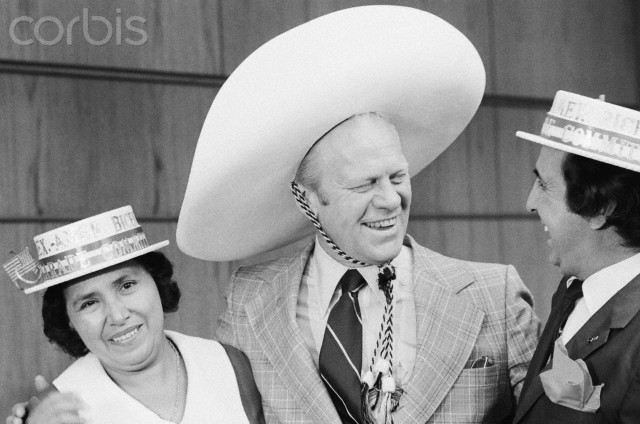
Pres. Ford In SombreroEl Prez at SMU, Sept. 13, 1975  /  ©Bettmann/CORBIS

by Paula Bosse

Politicians have to do a lot of silly things at public appearances, and some of them handle the baby-kissing and tedious chit-chat more gracefully than others. President Gerald R. Ford seems to have been pretty good-natured about this sort of thing, even in the wake of the Nixon impeachment and even while being incessantly lampooned by Chevy Chase on Saturday Night Live every week.

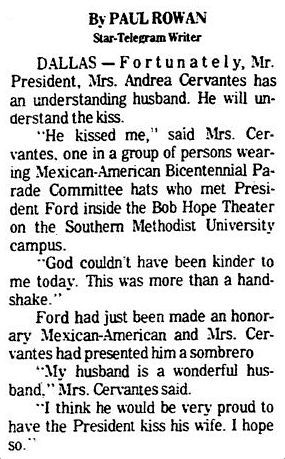
For reasons I’ve never understood, politicians and foreign dignitaries always seem to be presented with hats when they make an official visit somewhere, and when they come to Texas, they almost always get a cowboy hat. But on President Ford’s 1975 visit to Dallas and the SMU campus, he was made an “honorary Mexican-American” and was presented with a (very large) sombrero by Andrea Cervantes of the Mexican-American Bicentennial Parade Committee. He looks ridiculous, but it’s a fun ridiculous. I think he liked it — Mrs. Cervantes even got a kiss for her gift.

ford-sombrero_FWST_091475Fort Worth Star-Telegram, Sept. 14, 1975
The sombrero re-appeared a few months later, autographed and on display at Pike Park. It never left Dallas. What a shame. I would have liked to imagine the President and First Lady relaxing at Camp David, Jerry wearing his sombrero, smoking a pipe, and watching college football on TV, while Betty sat at the other end of the couch, chuckling to herself, and shaking her head.

***

Souces & Notes

Top photo from CorbisImages, here.

More on this in the Dallas Morning News article (with photo) “Ford Commends Group for ‘Feliz Cumpleanos'” (Dec. 15, 1975).

This sombrero-donning was just seven months before the now-legendary “Great Tamale Incident” in San Antonio. Read how NOT to eat a tamale here.

Ford took his gaffes in stride, even going so far as to appear on the show that made note of his every stumble, literal and figurative. Read a behind-the-scenes account of Ford’s 1976 Oval Office taping of one-liners for SNL — including his “Live from New York, it’s Saturday Night!” show opener (although I’m pretty sure he did it without the exclamation mark) — here.

*

Copyright © 2014 Paula Bosse. All Rights Reserved.

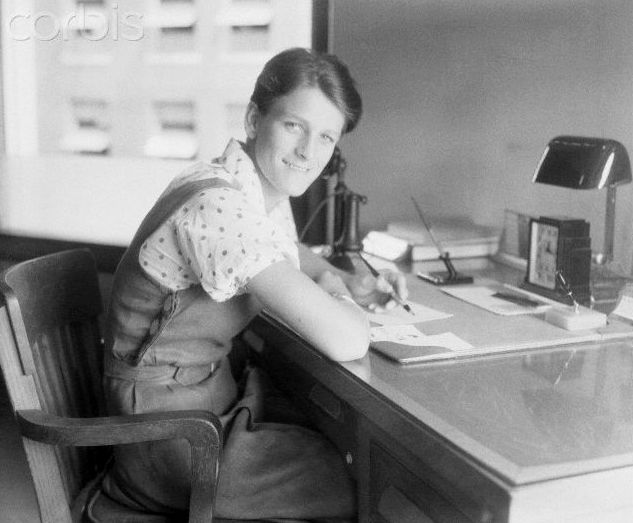
Babe Didrikson, Oak Cliff Typist

babe-corbis_102132Babe Didrikson at a desk she was probably pretty unfamiliar with, 1932

by Paula Bosse

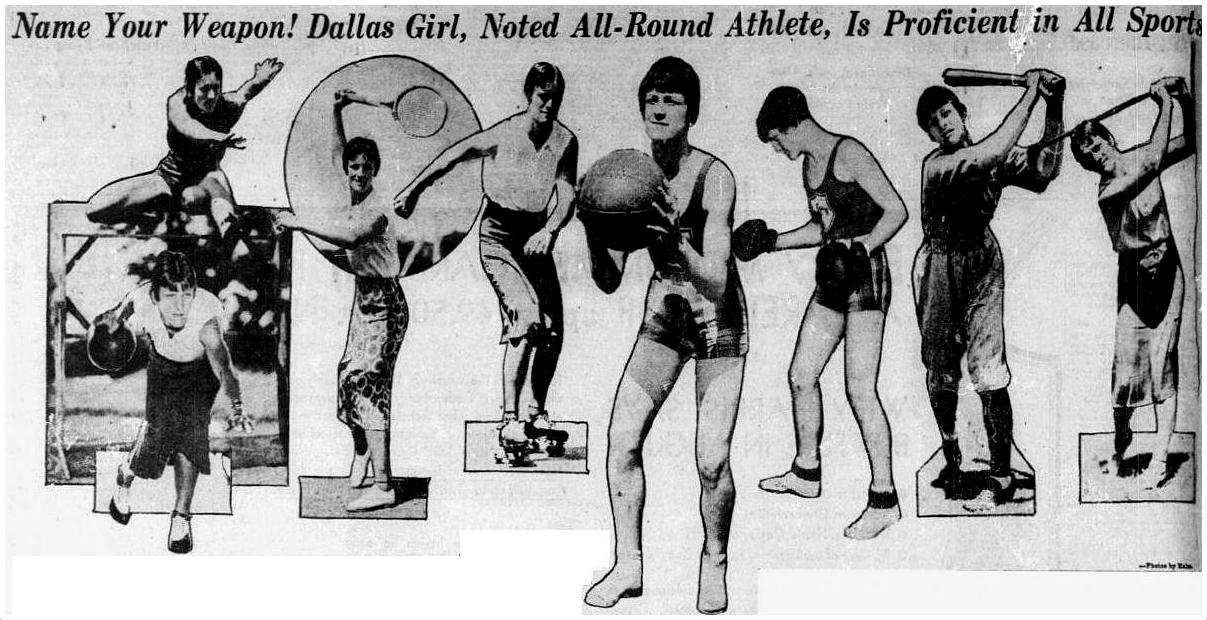
Mildred “Babe” Didrikson has been called the greatest athlete of the 20th century — male or female. She was an All-American basketball player, she set a number of world records in a wide variety of track and field events (she was so good at all of the individual sports that she was entered at least once as an entire TEAM — a team of one!), she won two gold medals and one silver (which should have been three gold medals…) at the 1932 Olympics, and she was, perhaps most famously, a champion golfer who was a founder of the LPGA. She was also highly proficient in softball, bowling, diving, swimming, roller skating, and tennis, and she dabbled in hockey, skeet-shooting, billiards, and even football. There was no sport she didn’t try — and even if she had never tried it before, she was probably pretty good at it. And she spent an important period of her life in Dallas.

babe_dmn_0802311931

Babe Didrikson was born in Port Arthur, Texas in 1911 and grew up in nearby Beaumont. She excelled in sports in school, especially basketball. In the late-’20s, a man named Col. M. J. McCombs, who was the head of the women’s athletic program for an insurance company, saw Babe in action and recruited her to play for his company’s basketball team in Dallas. She was offered a job to do vague secretarial work for the Employers’ Casualty Company (which had offices in the old Interurban Building downtown), with the understanding that she was really being taken on in order to play on the company team. With the blessing of her Norwegian immigrant parents, she interrupted her high school education in Beaumont to accept the $75-a-month job and was moved into a Haines Avenue rooming house in Oak Cliff.

Babe soon became the star of the Golden Cyclones, her company’s championship-winning team which participated in an “industrial” league governed by the national Amateur Athletic Union (the AAU). In the off-season she was introduced to track and field events by McCombs, and she quickly mastered them all.

babe_emp-cas-coFlying the company colors

She soon began breaking world records. Watch her compete at an AAU meet at SMU in July 1930, where one of the records she broke was for the javelin throw, here.

didrikson-babe_070730_track-meet_SMU_javelin_critical-past_screenshot-cropJuly 1930, Dallas

Before she knew it, it was the summer of 1932, and the Olympics were being held in Los Angeles — the 21-year old won three medals, emerged as the star of the games (she was frequently referred to as “the wonder girl from Dallas”) and began her climb up the ladder of celebrity.

After the Olympics, the city of Dallas gave her a victory homecoming, with a parade, a luncheon, and various presentations, all covered widely in the local press. The Dallas Morning News described it as “a demonstration the magnitude of which has never before been accorded a son or daughter of this city” (DMN, Aug. 12, 1932), bigger even, they said, than the reception that had greeted Charles Lindbergh on his Dallas visit.

U625776INPBabe’s post-Olympics parade through downtown Dallas — Aug. 11, 1932

After the celebrations had settled down, Babe Didrikson, sports superstar, was back at “work” — at least long enough to have photographs of her taken at the most uncluttered desk imaginable. (Though to be fair, Babe did claim to have been a typing champion in high school. Even if that were true — and she was known to be something of an exaggerator — it’s still almost impossible to imagine this world champion athlete typing up an afternoon’s dictation on insurance matters.)

babe_insuranceEmployers’ Casualty Co.’s casual employee — Oct. 21, 1932

Babe eventually turned pro, left Dallas, married wrestler George Zaharias, and became an incredibly successful golfer. She died from cancer in 1956 at the early age of 45, but her legacy lives on as one of the greatest and most versatile athletes of all time (…who, for a few short years, also happened to do a bit of light secretarial work for an insurance company in Dallas).

**

Below are a few of my favorite random Babe-related tidbits.

babe_hat_dmn_0712321932

Babe was often ridiculed by male sportswriters for her bearing and physique, which they thought were not feminine enough for their tastes. This criticism — ridiculous though it was — must have stung, because she occasionally made efforts to placate them, some of which seemed very awkward, such as this. The caption of the above photo: “Mildred (Babe) Didrikson (left) and her chaperon, Mrs. Henry Wood, are pictured above as they appeared Monday afternoon just before boarding a train for Chicago, Ill. for the national AAU track and field championships in which Babe […] hopes to carry off high honors and win a berth on the American Olympic team. This is the first picture ever taken of Babe with a hat on. She has never worn one before.”

*

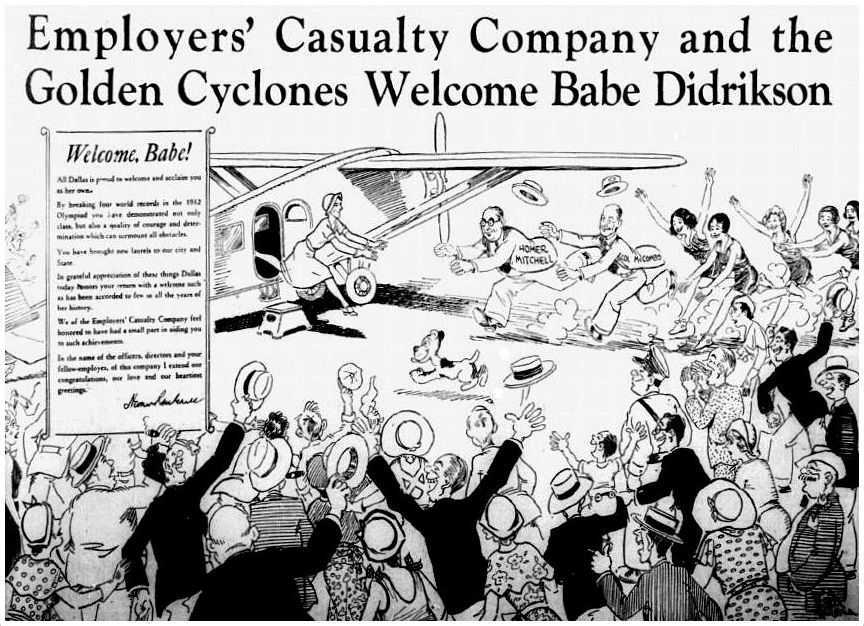
babe_insurance_ad_dmn_081132Aug. 11, 1932

babe_insurance_ad_dmn_081132-detAug. 11, 1932 — ad inset

Above, an ad taken out by the Dallas company Babe worked for, welcoming her back home from her Olympic triumph. Drawing by Jack Patton. (Even though Babe had buckled to pressure with the whole hat thing, I can’t quite picture her wearing gloves.)

*

babe-and-babe_081247

Babe and the other Babe, August 12, 1947. I love this photo.

*

babe_vanity-fair_1933

Fantastic photo of Babe in her prime by Lusha Nelson, from the January, 1933 issue of Vanity Fair.

*

babe

***

Sources & Notes

The two photos of Babe Didrikson at her desk, the photo of the parade in Dallas, and the photo with Babe Ruth are from the huge selection of photographs of Babe at CorbisImages. See a lot of photos of her throughout her career, here. The photos of her training and in action are exhilarating, but it’s nice seeing her looking so happy and relaxed in her later golfing days. She definitely smiled a lot more after she started making more than the measly $75 a month she was making in Dallas.

An interesting article from 1975 about Babe in which former co-workers and teammates from Employers Casualty remembered their time with her can be found in the Dallas News archives: “Friends Recall Babe’s Prowess” by Temple Pouncey (DMN, Oct. 26, 1975).

For more on Babe’s time in Dallas and Oak Cliff, she writes about it in her autobiography, This Life I’ve Led (1955), here. (The entire book can be read for free at the link.) Also, check out this article by Gayla Brooks that appeared in the Oak Cliff Advocate.

A really well done, comprehensive overview of Babe Didrikson Zaharias’ career (with lots of great photos), can be found at Pop History Dig, here.

One of my favorite weird Babe things is the record she made with her “golf protege” Betty Dodd. Betty sings (not very well) and is accompanied by Babe on harmonica, an instrument she loved all of her life and which she taught herself to play as a child. The song — and a bit of backstory on Babe and Betty’s relationship — is here (click the arrow at the left of the strip beneath the record label to hear the song “I Felt a Little Teardrop”). Babe’s solo starts at about the 1:06 mark.

And, lastly, newsreel footage of Babe over the years, from the early track meets and the Olympics, to her later career as a golf superstar can be watched here and here.

*

Copyright © 2014 Paula Bosse. All Rights Reserved.

Theater Row Block Party! — 1948

theater-row-block-party_082648_preservation-dallasDallas premiere, “Red River” — Aug. 26, 1948 (click for larger image)

by Paula Bosse

On a rainy night in August, 1948, United Artists premiered the movie “Red River” in Dallas at the Majestic Theatre. The now-classic Western about a Chisholm Trail cattle drive, directed by Howard Hawks and starring John Wayne and newcomer Montgomery Clift, was actually “premiered” simultaneously on August 26, 1948 in 250 theaters in Texas, Oklahoma, Kansas, and New Mexico, the four southwestern states most closely associated with the Chisholm Trail.

red-river_ad_dmn_082648(Aug. 26, 1948)

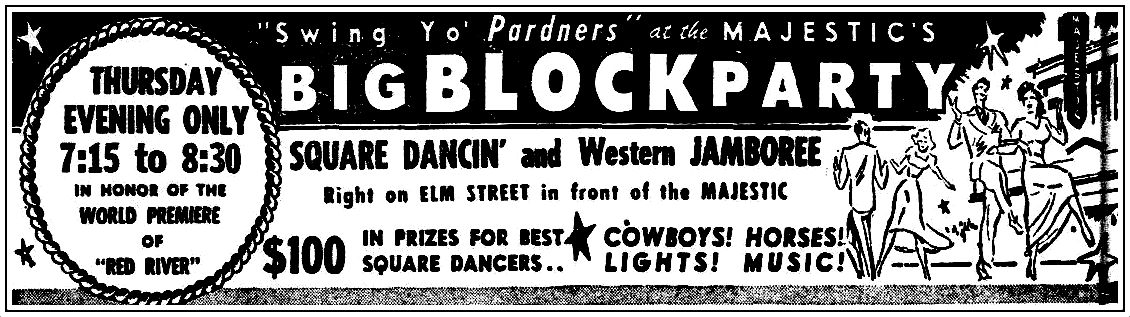
In Dallas, the publicity machine was seriously cranked up. The main attraction was a free-to-the-public street party in which the 1900 block of Elm Street was closed to traffic for a slate of western-themed festivities. The “jamboree” included square dancing, a musical set by cowboy singer Jim Boyd and his band, “cowboys and cowgirls from the Pleasant Mound Rodeo,” the Dallas Mounted Quadrille, and the Sheriff’s Posse. Or, as the ad said more succinctly, “Cowboys! Horses! Lights! Music!”

red-river_block-party_dmn_082648Great ad! Click to see it bigger! (Aug. 26, 1948)

No Hollywood celebrities were there, but the big Western Jamboree was apparently well-attended, even in the rain and despite rain, people gathered for square dancing.

(Wow. Square dancing in the rain. That’s dedication.)

The movie was a huge hit, so much so that the Majestic added showings, including one at 9:30 in the morning (!). It had a record week in Dallas, and, nationally, by the end of that first week it was reported to be the biggest-grossing picture in the history of United Artists.

The “world premiere” is interesting and all, but that photo of a brightly lit-up Theater Row is even better!

***

Sources & Notes

The original source of the photograph is not known, but I stumbled across it on a Preservation Dallas page, here.

“Red River” is a great movie. If you haven’t seen it, you need to. Even if you think you don’t like Westerns. Roger Ebert’s review/analysis is here.

*

Copyright © 2014 Paula Bosse. All Rights Reserved.


Armistice! — 1918

wwi_returning-troops-parade_1919_portalDowntown parade for returning troops — June, 1919 (click for larger image)

by Paula Bosse

Dallas found out that the Great War had finally ended at around 3:00 in the morning of November 11, 1918 when the siren atop the Adolphus Hotel sounded with “maniacal shrieks.” People poured into the streets to celebrate.

The crackle of revolver reports began to sound. Sleep was murdered, even had one been so disposed, and many residents from all parts of the city foregathered in the downtown district to jubilate and exult in various ways until daylight came. (Dallas Morning News, Nov. 12, 1918)

Giddy celebrations and impromptu parades were the order of the day, and the joyous spirit that erupted throughout the city is reflected in this Dallas Morning News report of “the first day of world peace since August, 1914” (click to see larger image):

wwi_armistice-in-dallas_dmn_111218
DMN, Nov. 12, 1918

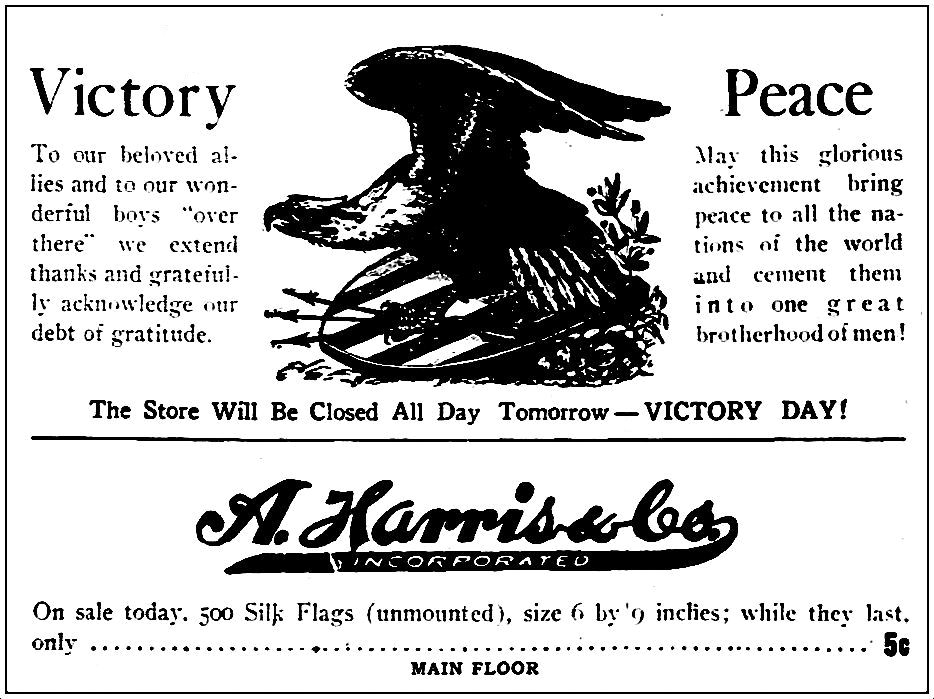
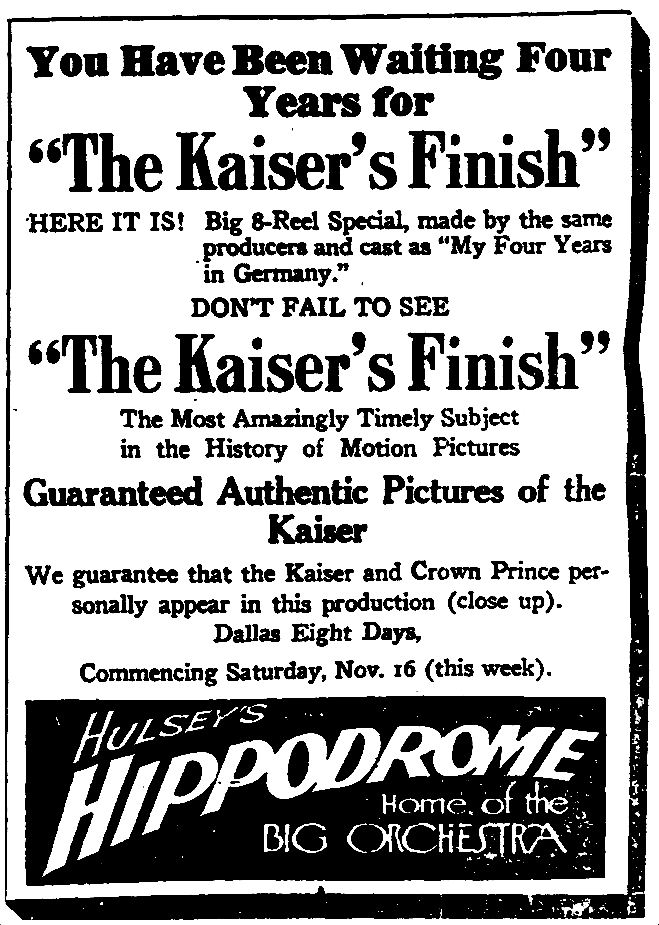
Local businesses got in on the action by placing heart-felt patriotic advertisements (some of which also quietly reminded readers that Christmas was just around the corner).

armistice_linz_dmn_111218

armistice_kahn_dmn_111218

ad-dreyfuss_dmn-111218

wwi_armistice_a-harris_dmn_111218

wwi_armistice_hippodrome_dmn_111318

wwi_armistice_hurst-bros_dmn_111318

When World War I officially ended on November 11, 1918, the military and civilian deaths and casualties totaled more than 37 million. All everyone wanted was for their loved ones to return home safely and for life to return to normal as quickly as possible. There was a lot to be thankful for that Thanksgiving.

***

Sources & Notes

Photo of the 111th Engineers from the Tarrant County College Northeast, Heritage Room, via the Portal to Texas History, here. It shows the 1500 block of Main Street, looking west toward Akard. See the same view today here (the short white  building at 1520 Main is currently occupied by the Iron Cactus; in the 1919 photo, that address is occupied by Thompson’s in what looks like the same building). (See another parade photo of the same block here. The detail is much, much better!)

1500-block_main_1919_2015

Ads from the Dallas Morning News, Nov. 12 and 13, 1918.

The Wikipedia entry for World War One casualties is here.

Click pictures for larger images.

*

Copyright © 2014 Paula Bosse. All Rights Reserved.


Preston Royal Fire Station — 1958

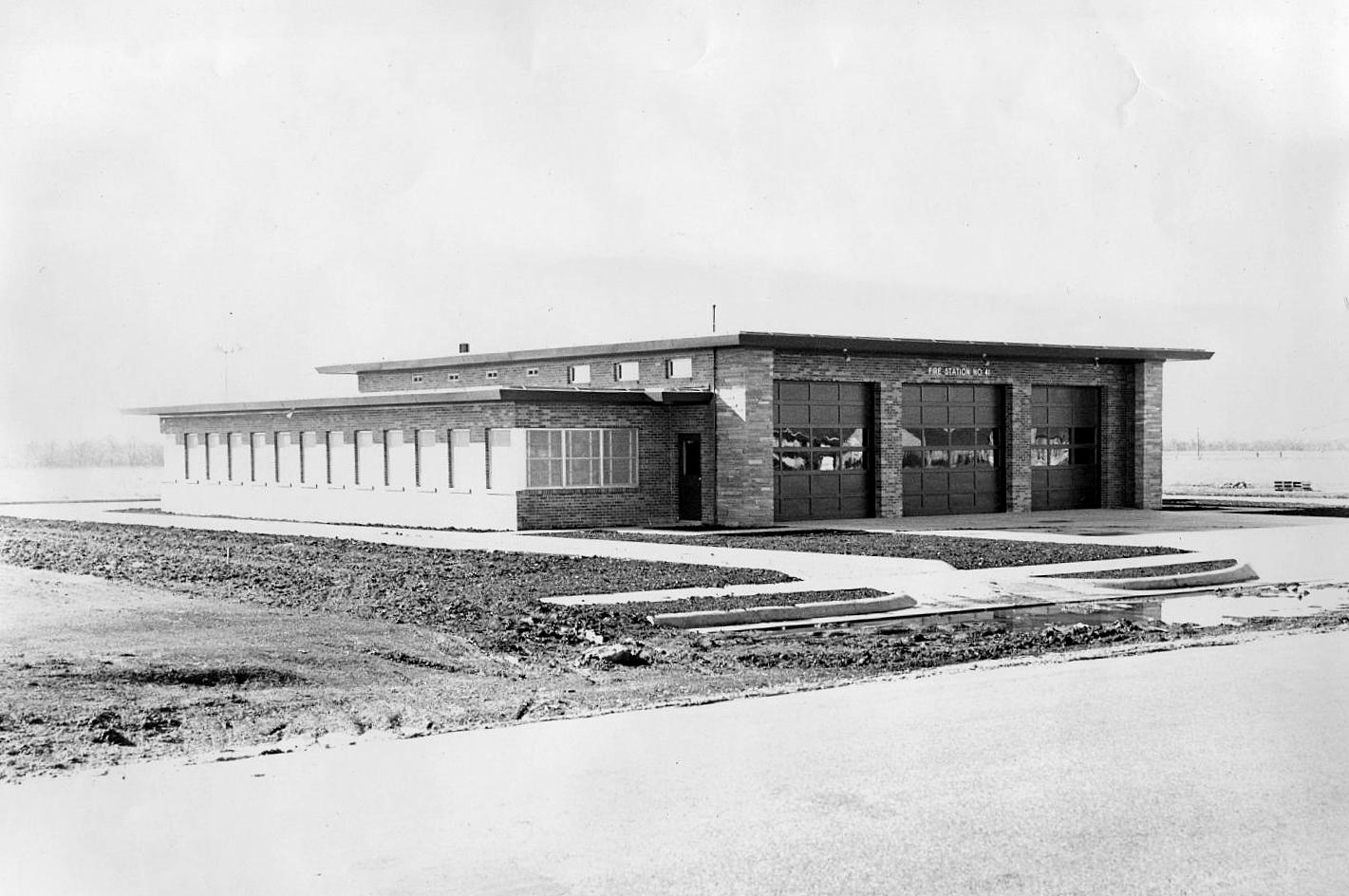
fire-station-41_royal-laneStation No. 41, 5920 Royal Lane (click for larger image)

by Paula Bosse

Above, Dallas Fire Station 41 on Royal Lane, just west of Preston Road, about the time it opened (the back of the photo says service at the station began Jan. 16, 1958). It looks as if it’s been set down upon a bleak and barren piece of land in the middle of nowhere, but, actually, commercial development in this Preston Hollow-area neighborhood was … um … on fire in 1958. The large shopping centers at Preston and Royal were under construction at this time, and even though it was very far north, it was most certainly a desirable area in which to live (as, of course, it still is).

The station was designed by architect Raymond F. Smith who had previously designed a couple of other fire stations in town, but who was known mainly for his work designing movie theaters, such as the Casa Linda (1945), the Delman (1947), and — hey! — the (long-gone) Preston Royal Theatre, which opened in 1959 right across the street from this fire station (both of which were, rather conveniently, a mere four blocks away from Smith’s Royal Lane residence).

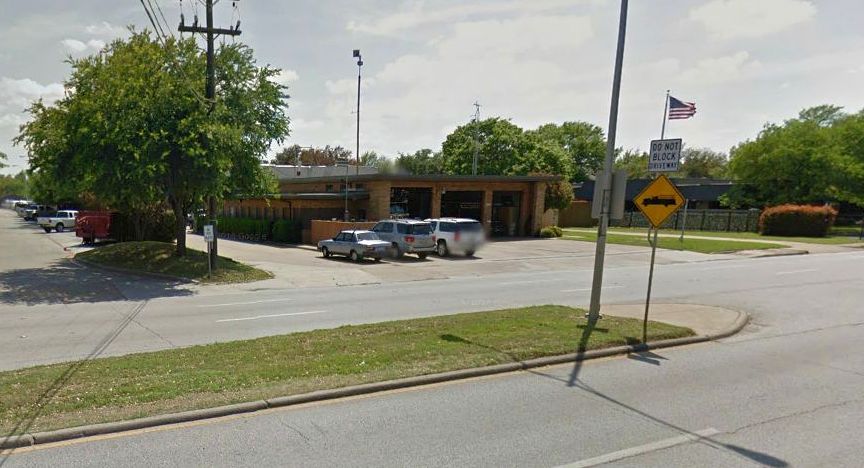
The station is still in operation, working to keep North Dallas flame-free — it just has a few more neighbors (and trees!) now than it did in 1958.

fire-station_royal_google

**

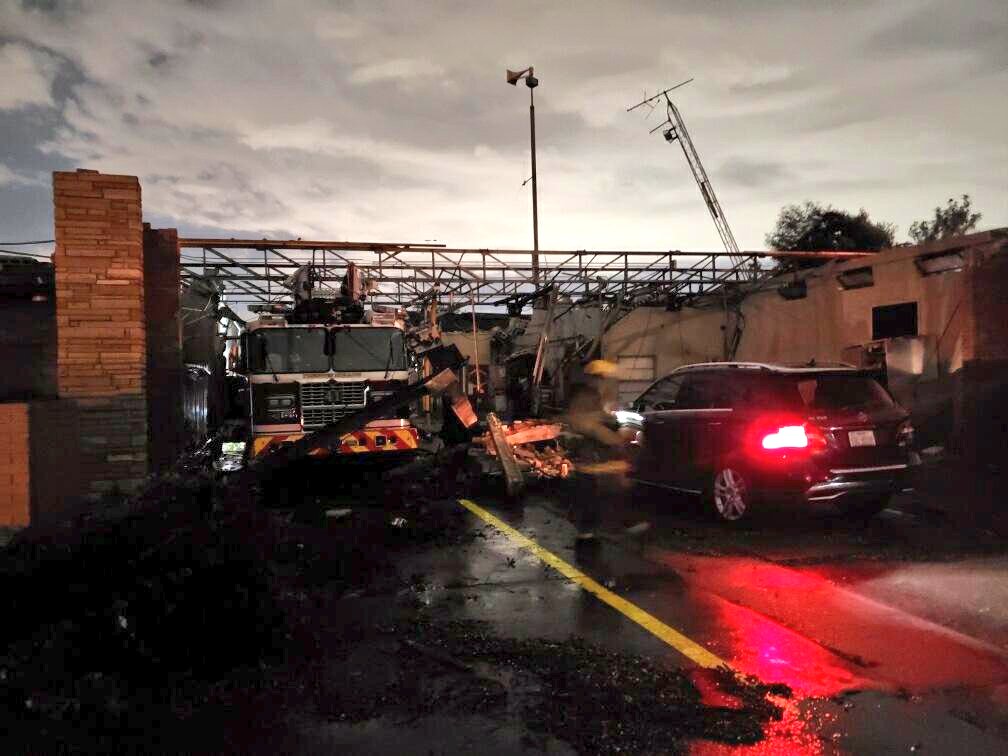
UPDATED Oct. 22, 2019: A powerful tornado hit northwest Dallas on Oct. 20, 2019 and devastated much of the Preston Hollow area. This fire station was hit hard, and it is currently out of commission. Below are photos from DFR’s Twitter feed.

preston-royal-fire-station_dfr-twitter_102119_int

preston-royal-fire-station_dfr-twitter_102119_ext

***

Sources & Notes

Photo from the Dallas Firefighters Museum, via the Portal to Texas History. It can be viewed here.

Second image of the firehouse from Google Street View.

Bottom two photos of the station post-tornado are from the Twitter feed of @DallasFireRes_q.

*

Copyright © 2014 Paula Bosse. All Rights Reserved.