Flashback : Dallas

A Miscellany: History, Ads, Pop Culture

Category: Photographs

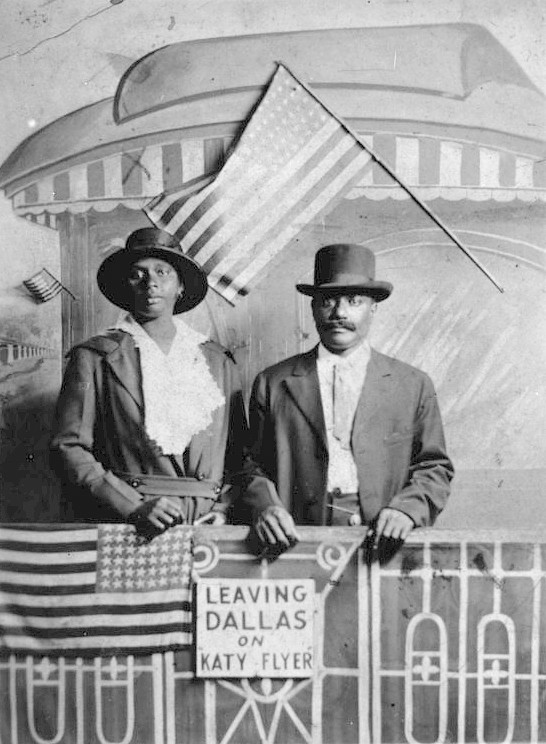
Leaving Dallas on the Katy Flyer — ca. 1914

leaving-dallas-katy-flyer1

by Paula Bosse

Who doesn’t love kitschy novelty photos? These “Leaving Dallas on the Katy Flyer” snapshots don’t disappoint with their cartoony backdrops — like something you’d see along a seaside boardwalk.

katy-flyer_three-men_1915_ebay
The people above are not identified, but, below, it’s a bunch of Order of Railroad Telegraphers union bigwigs. They probably had a wild time in Dallas. One or two of them look like they might be nursing a hangover.

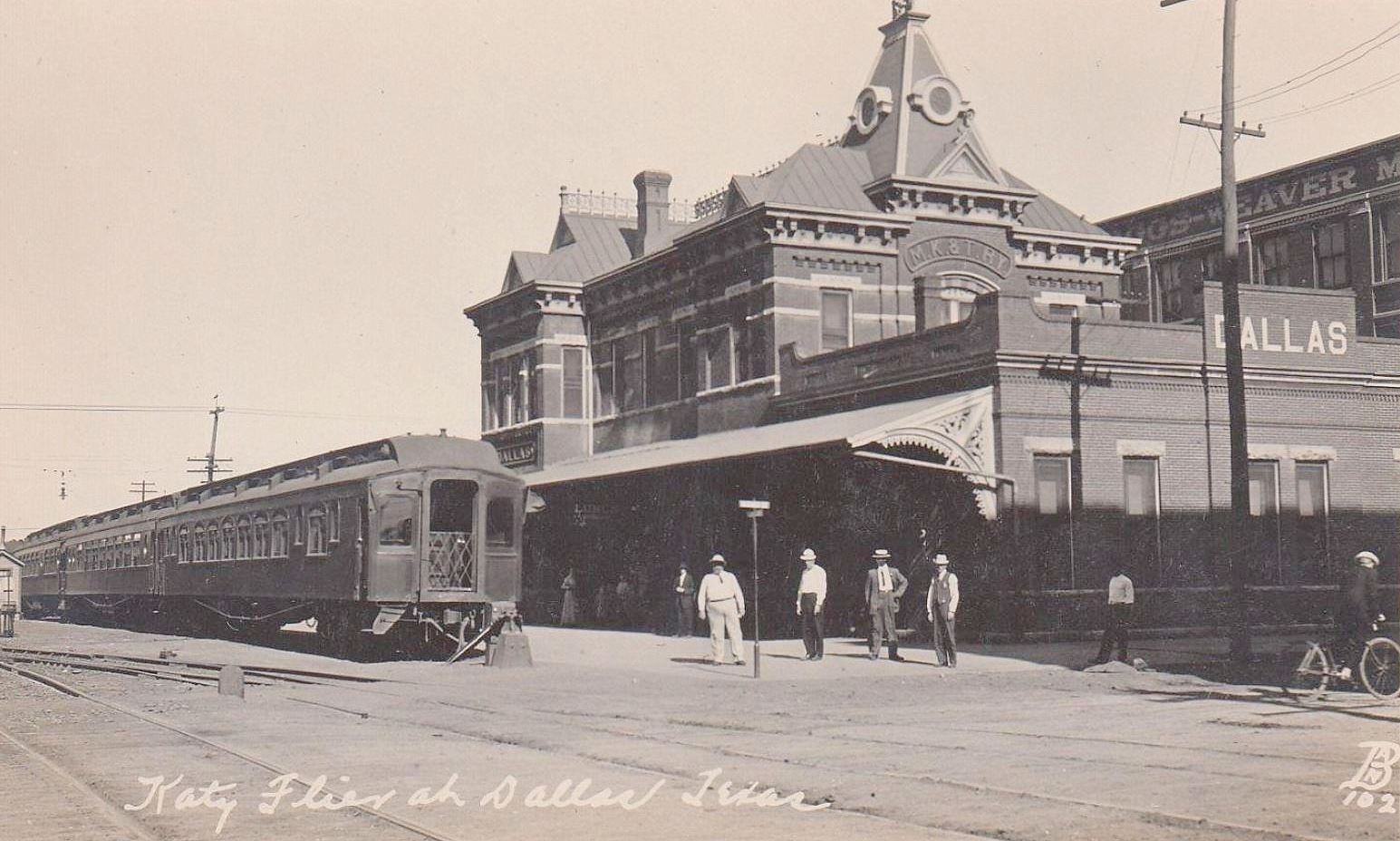
And just where was the point of departure from Big D for these Katy Flyer travelers? From the beautiful MKT passenger depot, formerly holding down the rails at Ross and Market.

katy-flyer_MKT_ebay_rppc

***

Sources & Notes

Top “real photo postcard” is from the J. L. Patton Collection, Dallas Historical Society.

Second photo was found on a postcard website.

Third photo is from eBay.

“O.R.T. General Committee” photo from — what else? — an issue of The Railroad Telegrapher (Feb. 1914).

Photo of the Missouri, Kansas & Texas depot is another real photo postcard, found on eBay.

See another Katy Flyer post — “M-K-T Railroad’s ‘Katy Flyer Route’ — 1902” — here.

*

Copyright © 2014 Paula Bosse. All Rights Reserved.


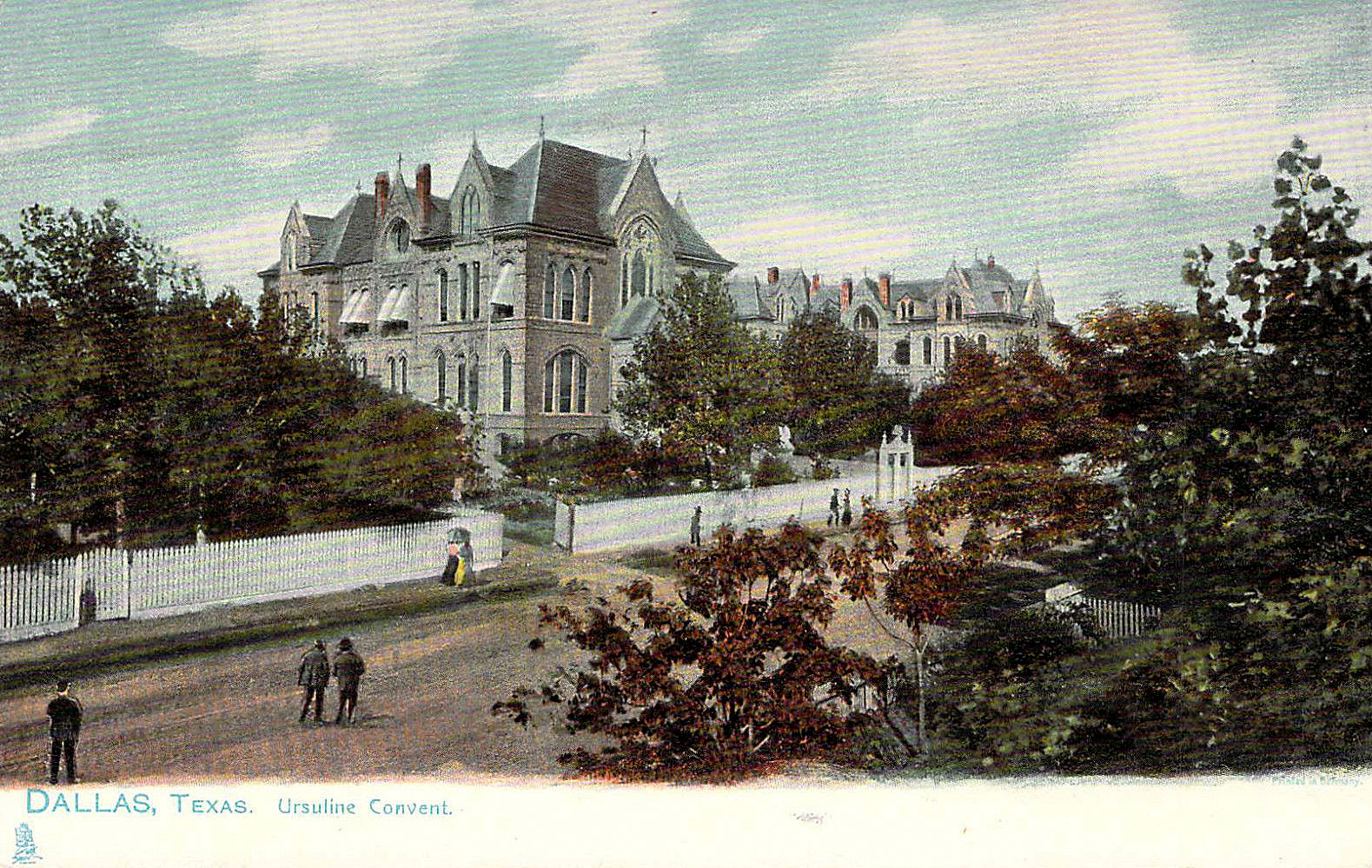
Nicholas J. Clayton’s Neo-Gothic Ursuline Academy

ursuline_postcard-color

by Paula Bosse

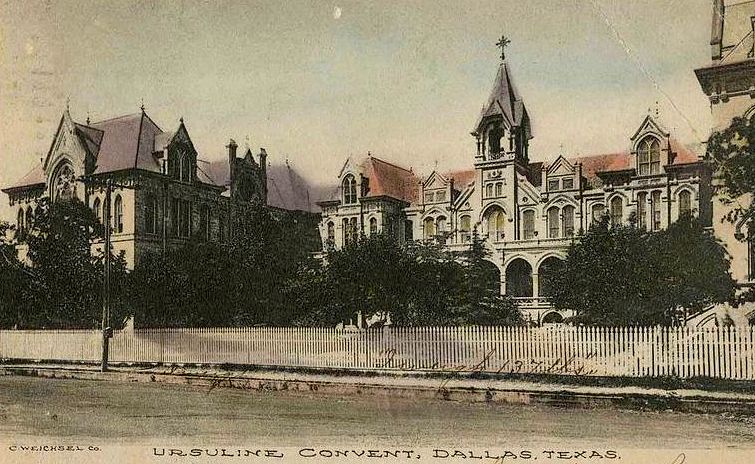
Over the years, Dallas has been the site of dozens and dozens of beautiful educational campuses, almost none of which still stand — such as the long-gone Victorian-era Ursuline Academy, at St. Joseph and Live Oak streets (near the current site of the Dallas Theological Seminary). The buildings, which began construction in 1882, were designed by the Catholic church’s favorite architect in Texas, Nicholas J. Clayton of Galveston. Such a beautiful building in Dallas? It must be demolished!

ursuline_first_bldg
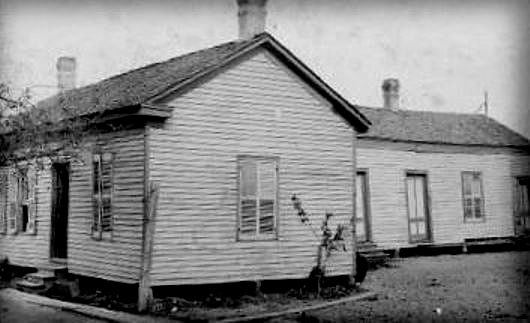
Six Ursuline Sisters, sent to Dallas from Galveston, established their academy in 1874 in this poorly insulated four-room building (which remained on the Ursuline grounds until its demolition in 1949). When they opened the school, under tremendous hardship, they had only seven students. But the school grew in size and reputation, and they were an academic fixture in East Dallas for 76 years. In 1950 the Sisters moved to their sprawling North Dallas location in Preston Hollow where it continues to be one of the state’s top girls’ prep schools. After 140 years of educating young women, Ursuline Academy is the oldest continuously operating school in the city of Dallas.

clifton-church_ursuline_1894Construction took a long time. (ca. 1894)

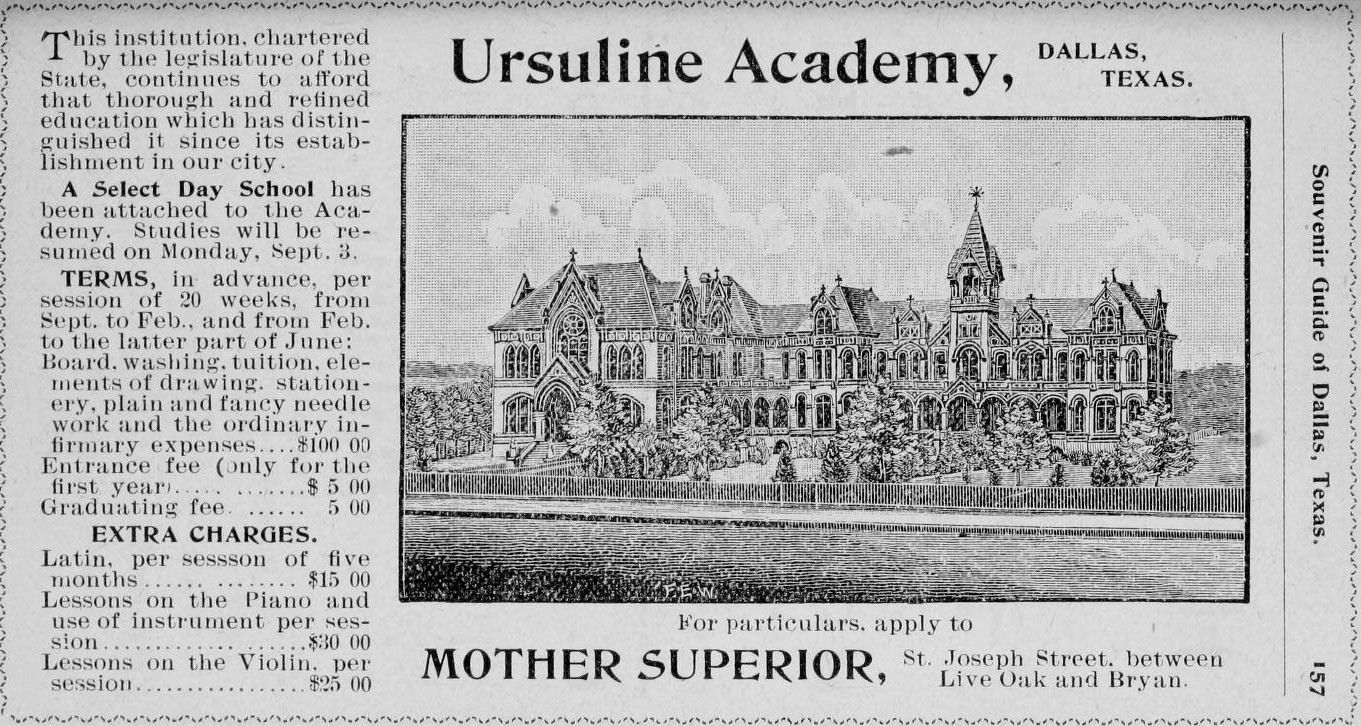
ad-ursuline_souv-gd_1894When Latin cost extra. (1894) (Click for larger image.)

ursuline_1906_largeIt even had a white picket fence. (ca. 1906)

ursuline-flickr1908-ish

ursuline_worleys_1909_det_LARGE1909 city directory

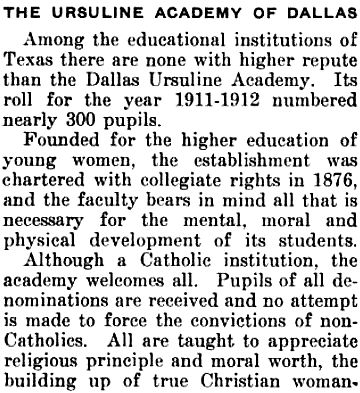
ursuline-academy_tx-mag_1912b1912 (click for large image)

After a year and a half on the market, the land was sold in 1949 for approximately $500,000 to Beard & Stone Electric Company (a company that sold and serviced automotive electric equipment). The property was bounded by Live Oak, Haskell, Bryan, and St. Joseph — acreage that would certainly go for a lot more these days (according to the handy Inflation Calculator, half a million dollars in 1949 would be the equivalent in today’s money of about five million dollars). A small cemetery was on the grounds, in which the academy’s first chaplain and “more than 40 members of the Ursuline order” had been buried. I’m not sure how these things are done, but the cemetery was moved.

ursuline_aerial_cook-colln_degolyer_smu

From a November, 1949 Dallas Morning News article on the vacated buildings’ demolition:

A workman applied a crowbar to a high window casing of the old convent and remarked: “I sure hate to wreck this one. It’s like disposing of an old friend. My father was just a kid when this building was built in 1883.” (DMN, Nov. 13, 1949)

And one of East Dallas’ oldest and most spectacular landmarks was gone forever. Looking at these photographs, it’s hard to believe it ever existed at all.

ursuline_cook-colln_degolyer_smu

*

Where was it? In Old East Dallas, bounded by Live Oak, Haskell, Bryan, and St. Joseph. See the scale of the property in the 1922 Sanborn map, here (once there, click for full-size map). Want to know what the same view as above looks like today? If you must, click here.

ursuline_today_bing-map
Bing Maps

***

Sources & Notes

Photo of the school’s first building is from the Ursuline Academy of Dallas website here. A short description of the early days of hardship faced by the Sisters upon their arrival in Dallas is here.

The photograph, mid-construction, is by Clifton Church, from his book Dallas, Texas Through a Camera (Dallas, 1894).

1894 ad is from The Souvenir Guide of Dallas (Dallas, 1894).

1912 text is from an article by Lewis N. Hale on Texas schools which appeared in Texas Magazine (Houston, 1912).

Aerial photograph from the George W. Cook Dallas/Texas Image Collection, DeGolyer Library, Southern Methodist University, here. Bottom image also from the Cook Collection, here.

Examples of buildings designed by Nicholas J. Clayton can be seen here (be still my heart!).

DMN quote from the article “Crews Begin Wrecking Old Ursuline Academy” by William H. Smith (DMN, Nov. 13, 1949).

Another great photo of the building is in another Flashback Dallas post — “On the Grounds of the Ursuline Academy and Convent” — here.

Many of the images are larger when clicked.

*

Copyright © 2014 Paula Bosse. All Rights Reserved.

George Dahl’s Sleek Downtown Library — 1955

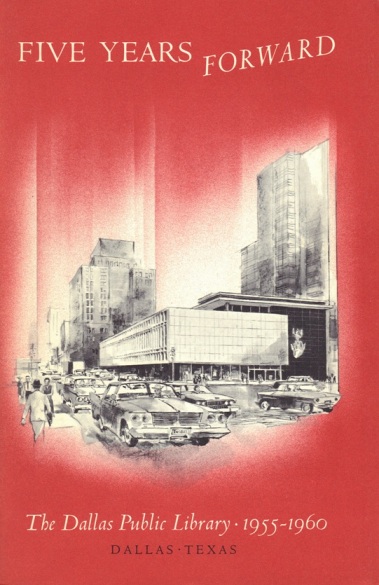
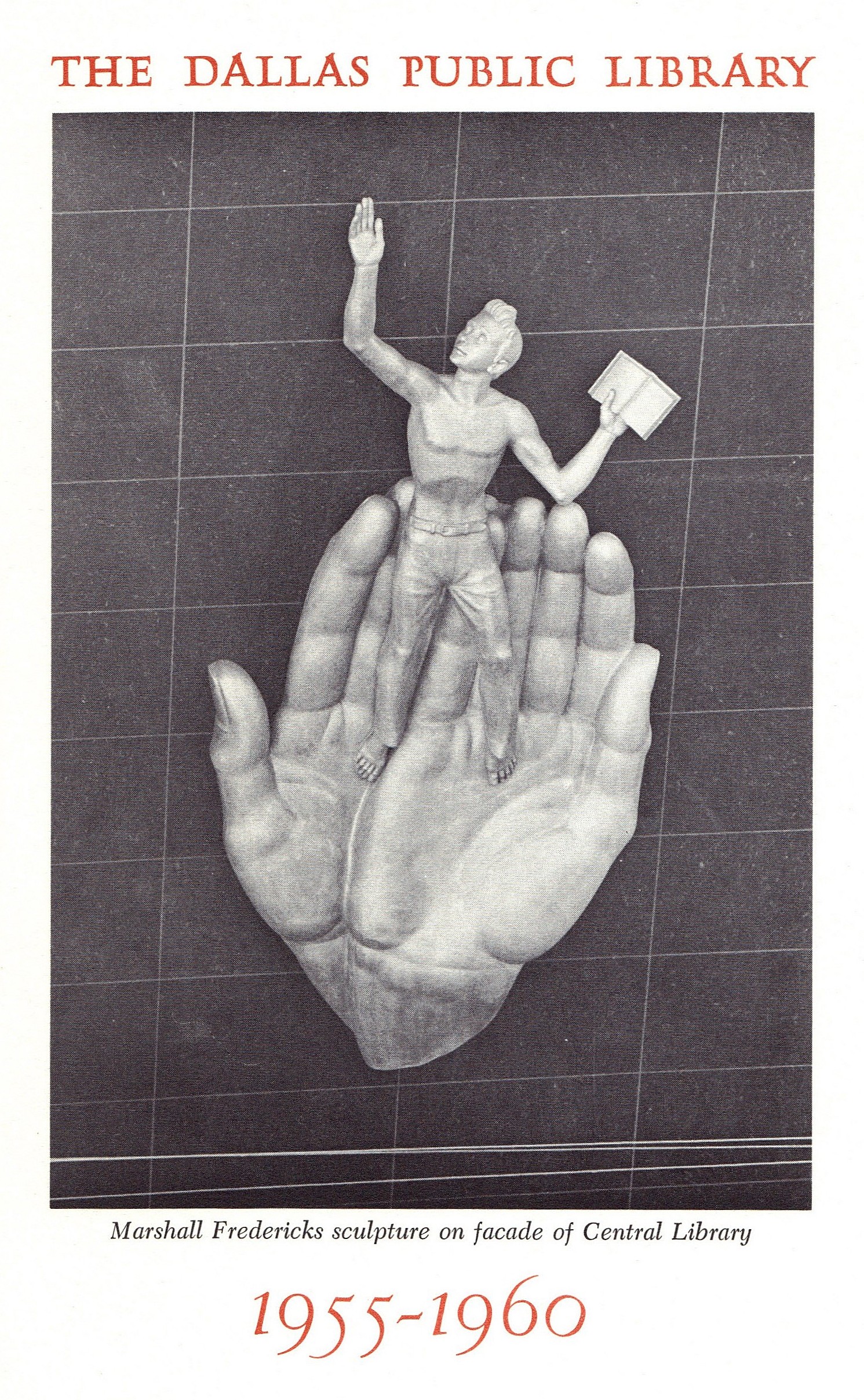
1DPL_cover-sm

by Paula Bosse

This little 31-page booklet was issued to commemorate the fifth anniversary of the Dallas Public Library. The library was built on the site of the old (beautiful!) Carnegie Library and was vacated when the current library (the J. Erik Jonssen Central Library) opened on Young St. in 1982. Unbelievably, the building has remained empty for over 30 years.

This is the only downtown building I have very distinct memories of from childhood. My mother took us to the library often, and I LOVED that place. I loved the building, the space, the books, the adventure of being downtown — I loved everything but that creepy sculpture of the kid standing in the hands that hung on the outside of the building!

This great library was designed by the legendary (and prolific!) Dallas architect, George Dahl. He moved easily from the streamlined grandeur of the Art Deco buildings of Fair Park to the sleek mid-century-modern-cool of this wonderful downtown library.

2DPL_hands-sculpture
I know there are fans of this sculpture (“Youth in the Hands of God” by Marshall Fredericks), but I’m afraid I am not one of them. I loved art as a child (in fact, I can remember checking out framed art reproductions from this very library), but, as I said, even as a kid, I strongly disliked that creepy sculpture. The kid was fine, it was those giant disembodied hands. When the library moved to its current location in 1982, this sculpture was left behind to languish for years inside the empty building. It was eventually sold, and the boy and the hands are now resting comfortably in retirement, somewhere in Michigan.

3DPL_lobbybertoiaThere was a huge controversy about the Harry Bertoia sculptural screen seen above, hanging over the circulation desk. (I LOVED this piece as a kid!) The mayor — R. L. Thornton — HATED it, and the brouhaha-loving newspapers launched themselves into the fray by running apoplectic editorials which, of course, only fanned the flames of outrage. After the “scandal” died down, the art was eventually given the okay to stay, but not before a lot of people made a lot of noise about how the city of Dallas had wasted the $8,500 it had spent on the commission. Unlike the discarded hands sculpture, the screen was moved to the new library, where it remains today.

4DPL_outdoorterrace

5DPL_familylivingThis is how I remember the library. Lots of space, cool furniture, and flooded with light.

6DPL_children

7DPL_av

8DPL_globe

9DPL_planningcomm

10DPL_checkingoutI LOVE this photo!

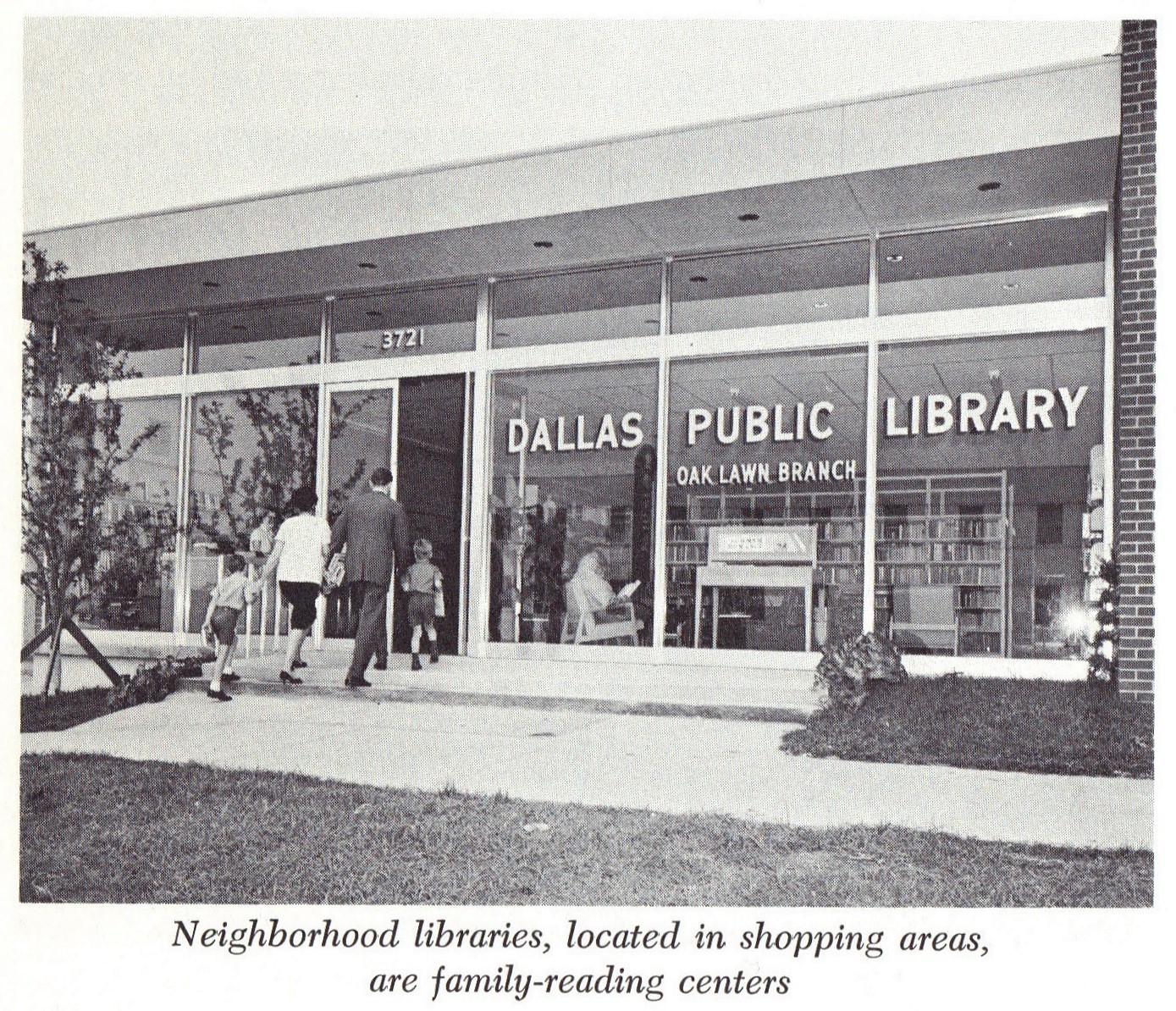
11DPL_oaklawnbranch

12DPL_teens

14DPL_schiwetzcropA detail of the front cover artwork, by Texas artist E. M. “Buck” Schiwetz. I love the driver in the cowboy hat (he must have been awfully small or that car must have been awfully big to accommodate that hat). The energetic frisson of downtown Dallas in the Mad Men era is dampened a bit by those damn hands on the building that seemed to follow you everywhere you went!

***

Sources & Notes

All images from the booklet Five Years Forward: The Dallas Public Library, 1955-1960, compiled and written by Lillian Moore Bradshaw and Marvin Stone. Drawings by E. M. (Buck) Schiwetz. Photographs by C. D. Bayne. (Dallas: Carl Hertzog for Friends of the Dallas Public Library, 1961). (Photos from the archives of the Dallas Public Library.)

More on the history and construction of the Old Dallas Central Library (as well as tidbits about the ridiculous controversy regarding the commissioned art) is here.

Even MORE on the artwork scandals (the hands, the hands, the HANDS!) as well as photos of the beautiful Carnegie Library that was razed to build the 1955 library can be found here.

And just because it’s weird, here’s a postcard showing an early, possibly even creepier depiction of the “hands” sculpture (if those are the “hands of God”…). I guess they wanted to get a postcard out before the sculpture was finished and installed.

dallas-public-library_dahl_postcard

I’ve posted one further image from this booklet — a drawing of the 1961 Dallas skyline by E. M. “Buck” Schiwetz  — here.

UPDATE — Dec., 2017: The Dallas Morning News has moved its operations to the long-vacant library, insuring this wonderful building’s continued existence for many more years! More here.

Click pictures for larger images (some are MUCH larger — click twice!).

*

Copyright © 2014 Paula Bosse. All Rights Reserved.


When Coco Chanel Came to Dallas — 1957

neiman-marcus_coco-chanelStanley Marcus and Coco Chanel

by Paula Bosse

In September of 1957 — way back when that much-missed hyphen was still in “Neiman-Marcus” — Stanley Marcus invited Coco Chanel to Dallas to accept the Neiman Marcus Award for Distinguished Service in the Field of Fashion. Mlle. Chanel had never been to Texas, but her visit here was a meaningful one. Following a 15-year retirement, her re-emergence as a designer in the early 1950s was met with mostly derision by the French press. The American response, on the other hand, was very different. It was because of the enthusiastic reception that her work received from American retailers (such as the even-then legendary Neiman Marcus department store) that she had been able to bounce back and, once again, be considered a force in the fashion world. When she was invited to Dallas to receive the “Oscar” of the fashion industry, Mlle. Chanel was happy to accept.

In the photo above, Coco is seen trying on hats at the downtown Neiman’s store as Mr. Stanley stands by beaming. On her Dallas visit she was also treated to a ranch barbecue (!) where she was photographed watching both a square dance (!!) and a … oh god … Chanel-themed bovine fashion show (!!!). Mlle. Chanel seemed to love the cows-in-ropes-of-pearls runway show, but she was not a fan of the barbecue and beans — she (one hopes discreetly) dumped the contents of her plate onto the ground under the table … right onto the shoes of dining companion Elizabeth Arden (whose shoes may have been ruined, but who had a truly great story to tell for the rest of her life).

From all reports, everyone seemed to enjoy (and no doubt profit) from the successful visit. Karl Lagerfeld, the current creative director of Chanel, recently brought Chanel back to Dallas (both figuratively and literally) with the house’s important Métiers d’Art fashion show which was held at Fair Park in December, 2013. The following day, Lagerfeld was presented with the Neiman Marcus Award for Distinguished Service in the Field of Fashion — just as Coco Chanel had been, 56 years earlier. And the haute-couture circle-pin of life keeps on rolling.

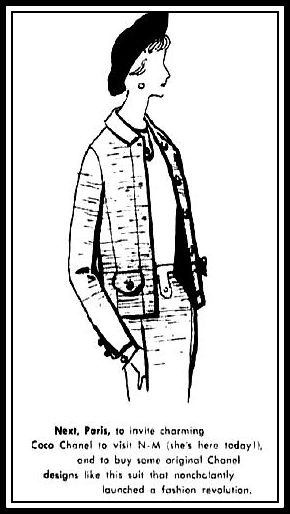
n-m_chanel_ad_dmn_090957

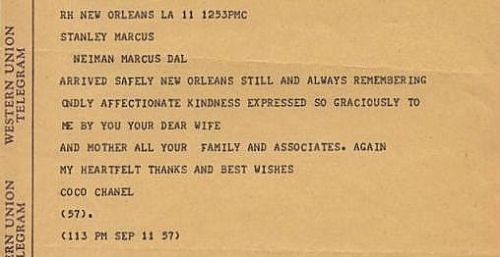
n-m_chanel_telegram

***

Sources & Notes

Top photo by Shel Hershorn for the AP. From the Briscoe Center for American History, University of Texas at Austin.

N-M ad from 1957 (portion of a larger ad).

Chanel’s thank-you telegram to Marcus, from the collection of Stanley Marcus’ Papers at the DeGolyer Library, Central University Libraries, Southern Methodist University.

Entertaining AP article about Chanel and Dallas, then and now (with photos of Stanley Marcus duded-up in an outfit you’d never see an actual cowboy in), can be found here. (Are those butterflies?!)

More photos of Mlle. Chanel in Dallas (along with text of a DMN article on the visit) can be found here.

Even more photos (bovine fashion show…) and a really great post from SMU’s “Off the Shelf” blog is here.

Video of the 2013 Chanel runway extravaganza (Métiers d’Art), held in Fair Park’s hay-stewn Centennial Hall, can be watched here. A shorter video with a few cursory shots of the Dallas skyline and Fair Park can be seen here.

For more on the first French Fortnight, see my post “Neiman-Marcus Brings France to Big D — 1957,” here.

*

Copyright © 2014 Paula Bosse. All Rights Reserved.

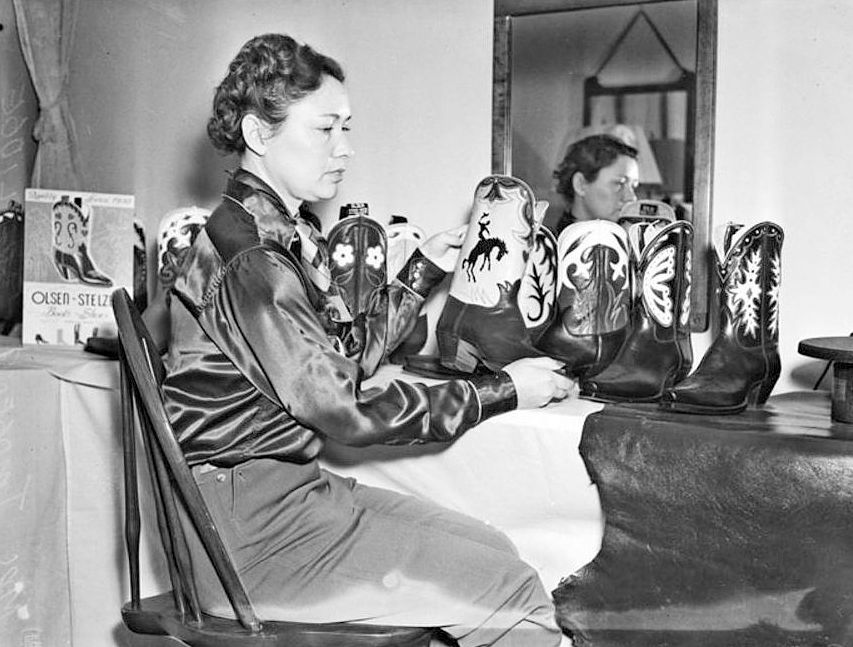
Olsen-Stelzer Cowboy Boot Saleslady — 1939

Portrait with boots…

by Paula Bosse

Above, Dallas resident Imogene Cartlidge is seen at a shoe retailers’ convention in San Antonio in 1939. Cartlidge was an employee of the Olsen-Stelzer boot company in Henrietta, Texas, and she was said to be “the only woman boot salesman on record.” I’m a big fan of cowboy boots of this period, and I have to say that I am ashamed that I was unaware of the famous Olsen-Stelzer company, which lasted from 1900 until the 1980s. The company is back in business again, led by Tom Cartlidge, whose parents began selling the boots in 1938 — Imogene is his mother. I wish them all the best of luck, because the world needs as many great-looking cowboy boots as it can get!

olsen-stelzer_dmn_120146

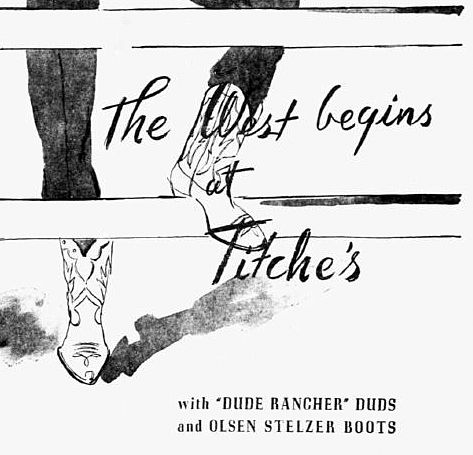
“The West begins at Titche’s”? First I’m hearing of this. Who knew? Nice ad, though.

olsen-stelzer_dmn_120146det

olsen-stelzer_dmn_103055

olsen-stelzer_1941

Best of all is this absolutely fantastic video from 1956 about the company:

olsen-stelzer-logo

olsen-stelzer-box

***

Sources & Notes

Photo of Imogene Cartlidge is from the San Antonio Light Photograph Collection, University of Texas San Antonio Libraries Special Collections, Institute of Texan Cultures.

Titche’s ad from 1946.

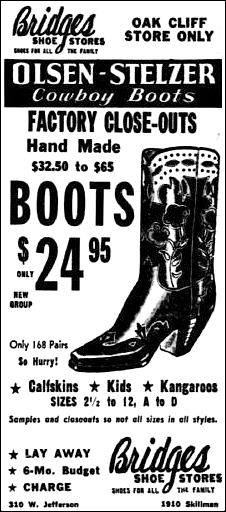
Bridges Shoe Store ad from 1955. (Bridges seems to have been the only place in Dallas where the boots were regularly sold — or at least regularly advertised. And you could get them ONLY IN OAK CLIFF!) (I hear the West begins at Oak Cliff….)

The video can be found on the home page of the Olsen-Stelzer website here.

The last image is the lid of an Olsen-Stelzer boot box, which belongs to my aunt — she keeps Christmas ornaments in it. (Sadly, no sign of the boots!)

The history of the company (and, again, that great video) can be found here.

*

Copyright © 2014 Paula Bosse. All Rights Reserved.

Mrs. Turner Attacked Miss Hulsey in the Spoolroom with a Knife

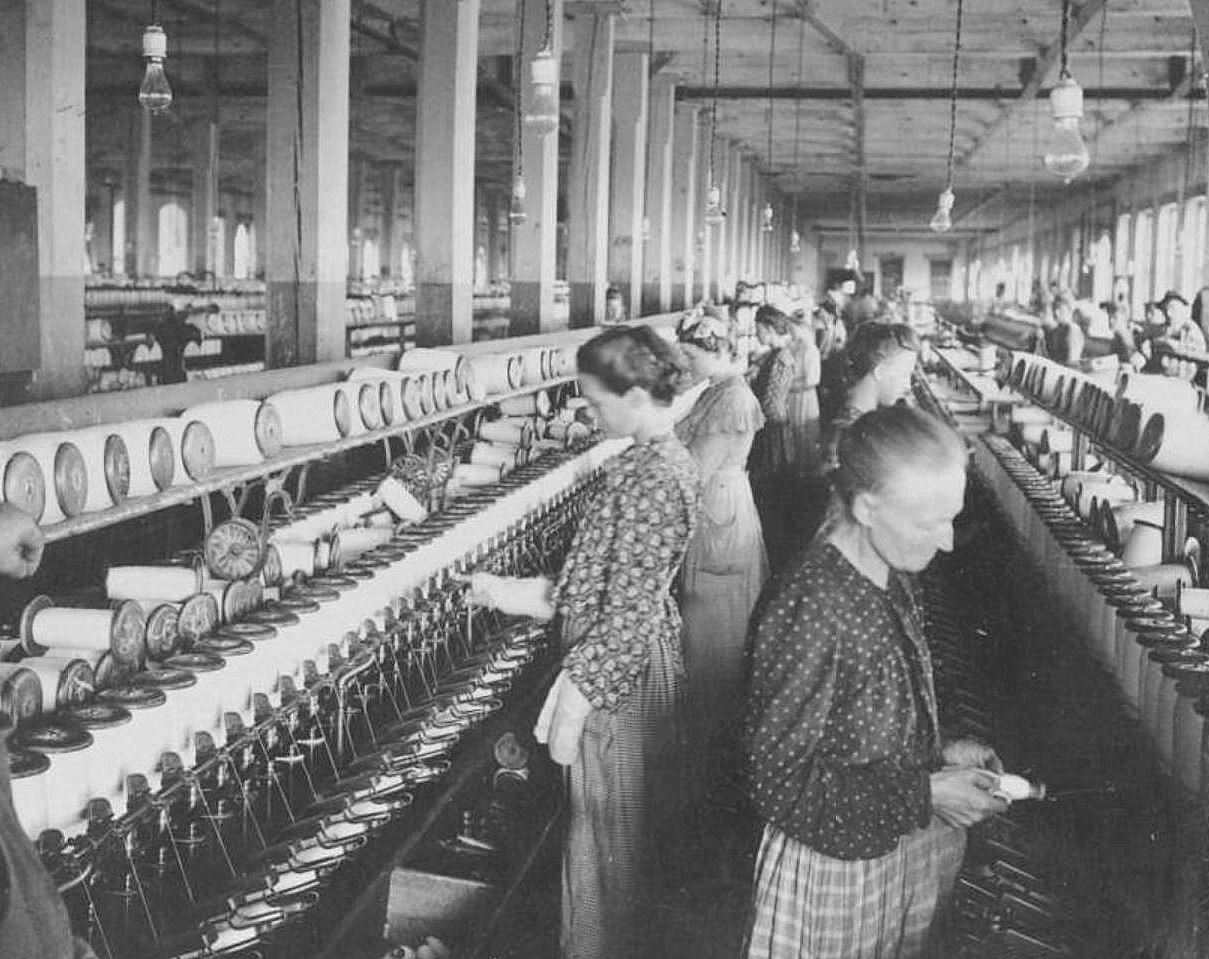
spoolroom_jones-coll_degolyer_smuSpoolroom of the Dallas Cotton Mills…

by Paula Bosse

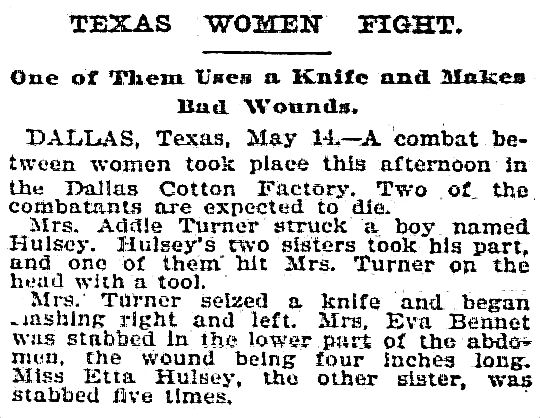
The spoolroom of the Dallas Cotton Mills was no place for the faint of heart, as this eyeball-popping story from The Dallas Morning News will attest (click for larger image):

dallas-cotton-mills_attack_dmn_051697DMN, May 16, 1897

The story even made it into the pages of The New York Times:

spoolroom-slashing_nyt_051597
NYT, May 15, 1897

(The women apparently survived.)

*

Sources & Notes

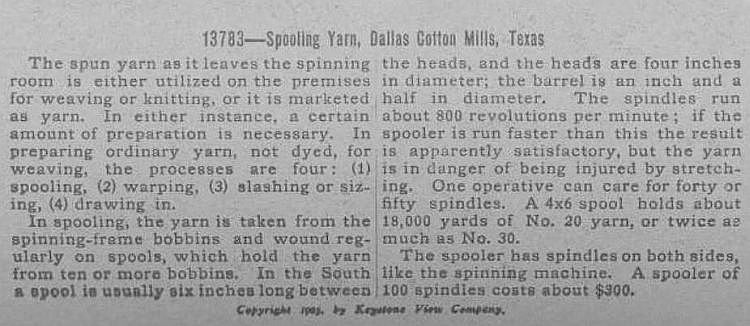
Photo (“Spooling Yarn, Dallas Cotton Mills, Dallas, Texas”) is from a stereograph, circa 1905, from the Lawrence T. Jones III Texas Photographs Collection, DeGolyer Library, Central University Libraries, Southern Methodist University; it is accessible here.

The descriptive text from the back of the card:

spoolroom_jones-coll_degolyer_smu_text

*

Copyright © 2014 Paula Bosse. All Rights Reserved.

The Construction of Turtle Creek Boulevard: “Ascending & Descending Cliffs and Ravines” — 1915

turtle-creek-blvd-1

by Paula Bosse

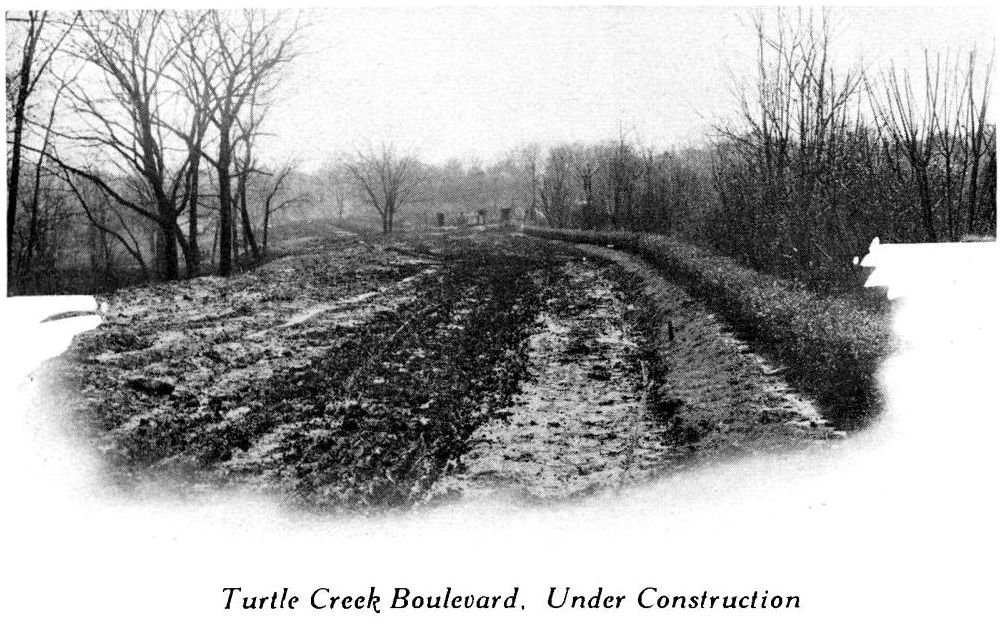
What was going on a hundred years ago in Oak Lawn? Turtle Creek Boulevard was being constructed! Construction was overseen by the Park Board, which probably explains why it is one of the most beautifully landscaped roadways in Dallas.

turtle-creek-blvd-2

turtle-creek-blvd-3

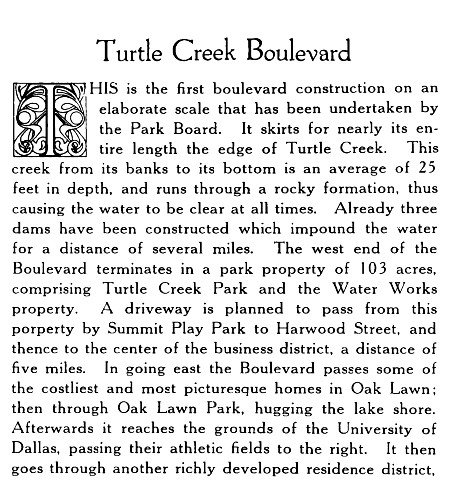
turtle-creek-blvd_text-1turtle-creek-blvd_text-2

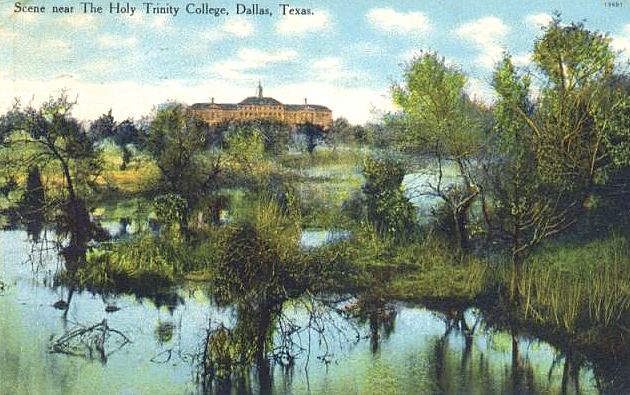
Incidentally, the “University of Dallas” mentioned above refers to the original location of the University of Dallas, first called Holy Trinity College. It moved northward in the 1940s, and Jesuit High School took over the building. I’m really surprised to learn that this huge building was located near Turtle Creek and Blackburn until Jesuit moved north to ITS new home in the early 1960s.

And here it is, snug on the banks of the turtle-infested creek, around 1909 (in a photograph that does not do the lushly beautiful area justice).

***

Sources & Notes

Photos and text from the Report for the Year 1914-15 of the Park Board of the City of Dallas (Dallas, 1915), pp. 63-64.

*

Copyright © 2014 Paula Bosse. All Rights Reserved.

Booker T. Washington Marching Band — 1937

booker-t-washington_marching-band_1937_dhs

by Paula Bosse

Marching band. Everyone’s favorite class in high school. Band director A. S. Jackson is at the right.

***

Sources & Notes

From the J. L. Patton Collection, Dallas Historical Society.

*

Copyright © 2014 Paula Bosse. All Rights Reserved.

Mr. Peppermint!

by Paula Bosse

I have no idea where I came across this photo a couple of years ago, but it is without question my favorite photograph of my childhood pal and idol, Mr. Peppermint!

*

Copyright © 2014 Paula Bosse. All Rights Reserved.

3800 Main: Fritos Central — 1947

by Paula Bosse

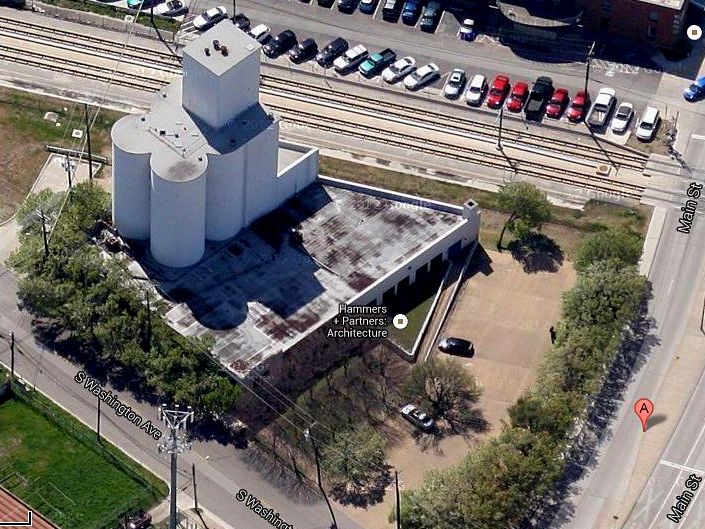
Last week I came across the above photo of old cars parked in front of a Fritos building of some sort, and I wondered where it had been. After a little bit of digging, I found out that it was near Fair Park — in the 3800 block of Main, between Washington and Exposition, on land right next to the railroad tracks. The building in the foreground appears to be gone  now, but I recognized the white, rounded towers behind it — I never knew what that building was, but I now know that it is the Frito company’s former grain elevator. And it’s still standing. Which I’m thankful for (and a bit surprised by) since it’s always been one of my favorite buildings in the area.

The Frito company (now Frito-Lay) has had its headquarters in the Dallas area since 1933. In the ’40s, its corporate offices were on Cedar Springs and its manufacturing plant was over near Fair Park, on Main Street. By 1947, the ever-expanding company had grown so much and had become so successful that it spent half a million dollars to build a whopping new grain elevator. The Dallas Morning News was there for a sneak-peek:

The extra-tough volcanic stones in the adjacent factory Monday will begin grinding corn supplied from a spanking new, ten-story white building just off the 3800 block of Main Street. […] The tall square gleaming structure is a $515,000 thoroughly modern elevator. […] Air-conditioned and equipped with the latest design apparatus, the elevator has storage capacity for 90,000 bushels of corn. It will supply the grain to the company’s factories in Dallas, San Antonio, Houston, Denver, Tulsa, and two plants in Los Angeles.

The new Frito elevator, weather proofed on the outside and weather controlled inside, was designed by Eugene Davis, architect. Huge grain cleaners which remove all chaff and foreign matter by shaking and air blast, occupy the second floor. Spray machinery gives the grain a thorough treatment to prevent infestation — the ‘buga-boo’ of grain products manufacturers. (DMN, Aug. 10, 1947, “Corn: $515,000 Elevator Latest Chapter in Corn-Chip Saga”)

Fifty-one boxcar loads of “select corn” — sans chaff and infestation — could be stored in that gleaming state-of-the-art grain elevator, designed by Eugene Davis (who a few years earlier, had designed another building for the Frito people, a small building at Wall and Corinth which housed the Pork Skin Chip Company).

In 1947, 3800 Main appears to have been something of a corn-chip Hyannisport — a self-contained compound in which all aspects of chip-production were seen to. As Kaleta Doolin (daughter of company founder C. E. Doolin) wrote in her book Fritos Pie:

Mr. Davis was the architect of all the various parts of the Frito plant in Dallas. The plant included the company’s grain elevator, where all the corn was stored; the machine shop (which my uncle Earl was in charge of); the food processing area; and the shipping warehouse, all built by Mr. Davis in 1947.

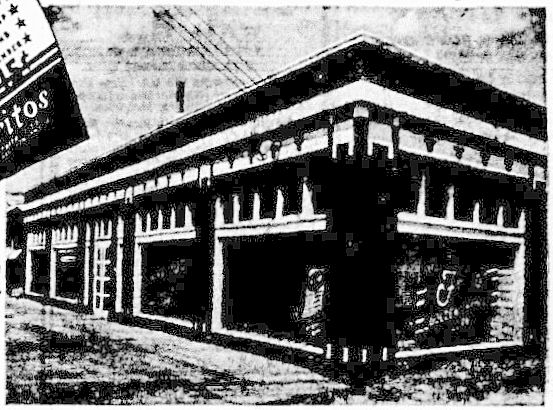
But that building in the top photo… that one had been there for years. 3800 Main Street had been the home of two or three car dealerships in the decades before Frito moved in. In 1929, as this photo shows, it was the location of the long-lived Ford dealership, Lamberth Motor Company.

lamberth-ford_1929

And here’s the same building in 1947, Frito-ized.

And the side of the building, taken from across the railroad tracks, then and now.

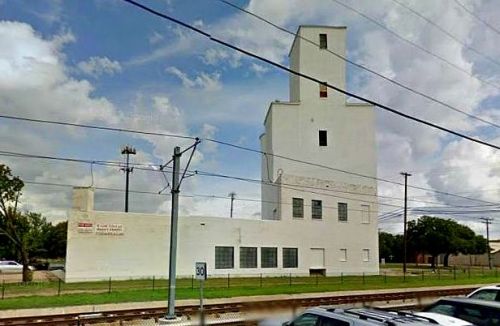
Another old building survives! What a relief that Dallas doesn’t tear down EVERY cool old building!

***

Sources & Notes

Can’t find a source for the top photo. It looks as if someone took a photo of a framed picture which is probably hanging on the wall of a person who feels a great kinship to old Dallas. Or to Fritos. Or to snacks.

Quote about the various parts of the plant is from Fritos Pie: Stories, Recipes, and More by Kaleta Doolin (College Station: Texas A & M University Press, 2011), p. 45.

The two 1947 photos of the Frito building are insets from a series of logrolling ads in which Frito thanks Texas Bank & Trust for all the money they’ve helped Frito make, and Texas Bank & Trust thanks Frito for all the money they’ve helped Texas Bank & Trust make. The take-away? There sure is a lot of money to be made in fried food.

The bottom two photos are from Google maps: the first looking toward the old granary from the railroad tracks, and the second looking down from the unblinking Google eyeball in the sky.
Lastly, a current photo of the building, now renovated and occupied by Hammers + Partners Architecture (whose daily business affairs are probably always accompanied by the faint smell of fried corn wafting past), can be seen here. (What must that building look like inside?!)

Click pictures for larger images.

*

Copyright © 2014 Paula Bosse. All Rights Reserved.