Flashback : Dallas

A Miscellany: History, Ads, Pop Culture

Category: Postcards

Albert Einstein “Threw the Switch” in New Jersey to Open the Pan-American Exposition in Dallas — 1937
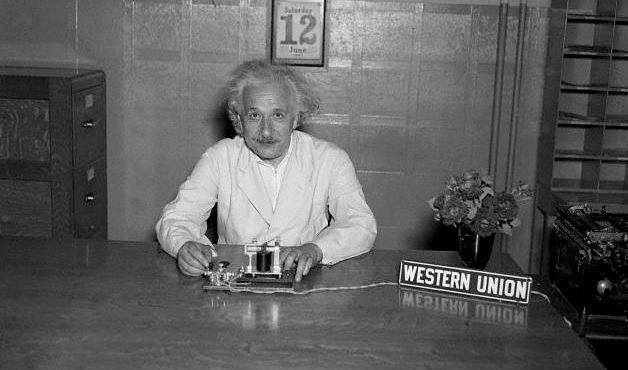
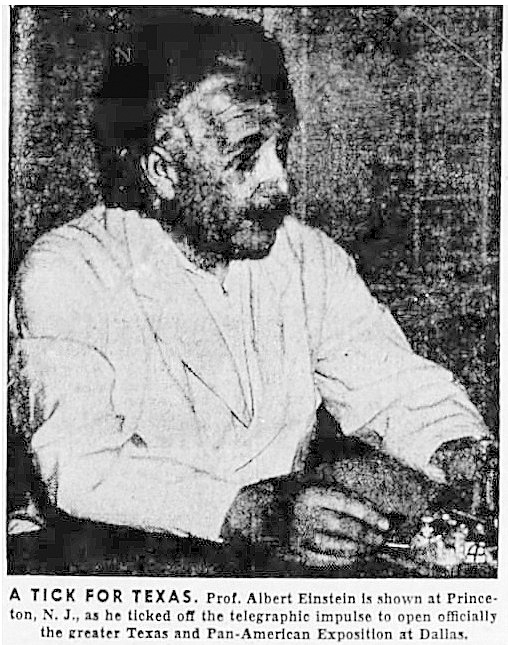
pan-american-expo_einstein_061237Einstein at the switch, June 12, 1937…

by Paula Bosse

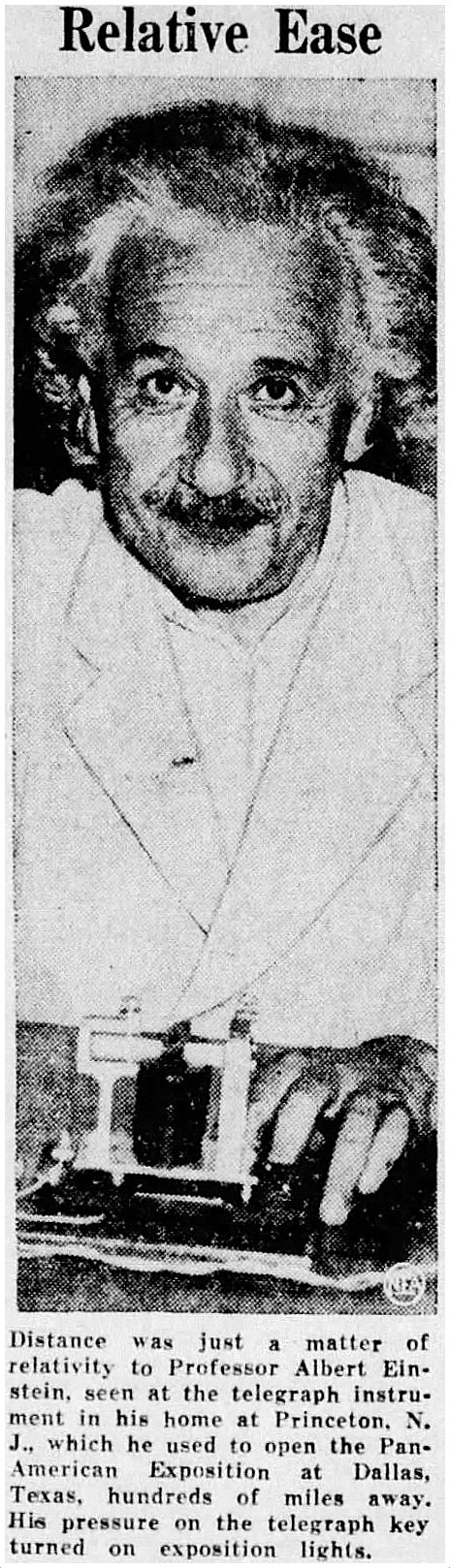
Who knew? Albert Einstein, the world’s most famous physicist, helped open the Greater Texas and Pan-American Exposition. The exposition was held at Fair Park for 20 weeks, from June 12, 1937 to October 31, 1937, as a follow-up of sorts to the Texas Centennial (the city had built all those new buildings — might as well get their money’s worth!). I’m not quite sure how Einstein got roped into this, but looking at the photo above, he seemed pretty happy about what was, basically, a long-distance ribbon-cutting. Via telegraph.

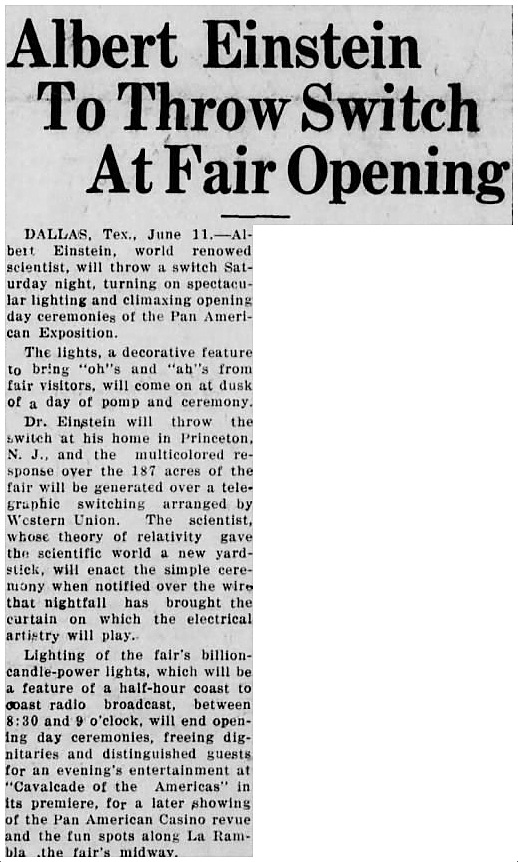
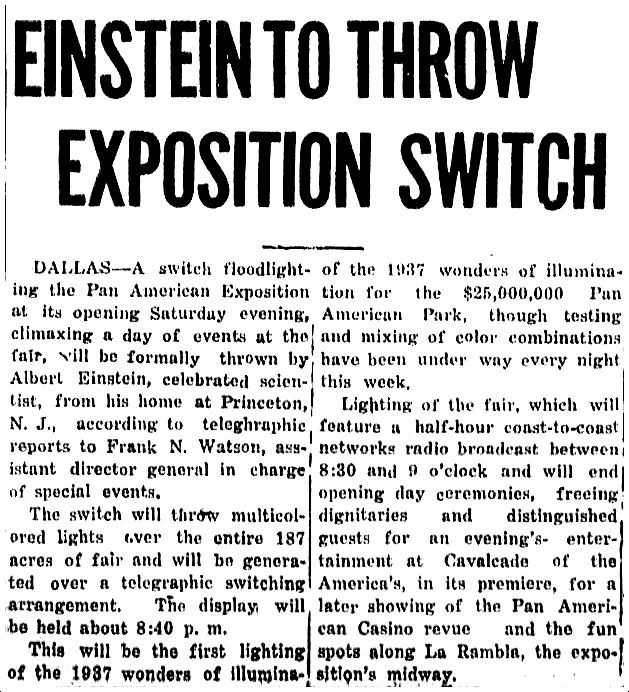
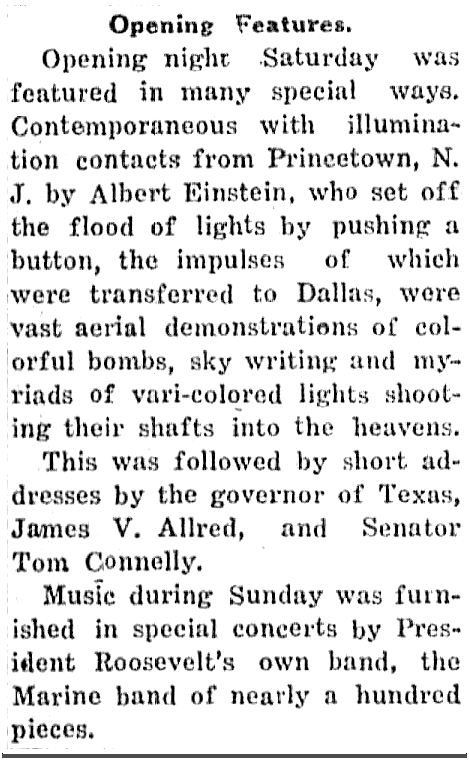
The plan was for Professor Einstein to officially open the Pan-American Exposition by “throwing the switch” which would turn on massive displays of lights around Fair Park. He would do this from Princeton, New Jersey, where he lived, by closing a telegraph circuit which would put the whole thing in motion. Newspaper reports varied on where exactly Herr Einstein was tapping his telegraph key — it was either the study in his home, in his office, in a Princeton University administration building, or in the Princeton offices of Western Union (the latter of which was mentioned in only one report I found, but it seems most likely).

Einstein was a bona fide celebrity, and this was national news — newspapers around the country ran stories about it, and the ceremony was carried live on coast-to-coast radio. Almost every report suggested that Einstein’s pressing of the key in New Jersey would be the trigger that lit up the park in Texas, 1,500 miles away — which was partly correct. According to The Dallas Morning News:

Lights on the grounds will be turned on officially at 8:40 p.m. when Dr. Albert Einstein, exponent of the theory of relativity, presses a key in his Princeton home to fire an army field gun. With the detonation of the shell, switches will be thrown to release the flood of colored lights throughout the grounds. (DMN, June 10, 1937)

So on June 12, 1937 he pressed a telegraph key somewhere in Princeton, NJ, an alert was instantly wired to Dallas, an army field gun (in some reports a “cannon”) was fired, and that blast was the cue for electricians positioned around the park to throw switches to illuminate the spectacular displays of colored lights.

The Western Union tie-in gimmick was a success. Newspaper reports might have been a little purple in their descriptions, but from all accounts, those lights going on all at once was a pretty spectacular sight.

Dr. Albert Einstein, celebrated scientist, threw a switch that flashed a million lights over the 187-acre exposition park. The flash came at 8:40 o’clock and instantly the huge park became a city of a million wonders. Flags from a thousand staffs proclaimed their nationality [and] bands played the national airs of the nations of the Western Hemisphere as lusty cheers roared with thunderous approval. The Greater Texas and Pan-American Exposition was formally opened. It is on its way. (Abilene (TX) Reporter News, June 13, 1937)

The Dallas News describes the crowd as stunned into silence:

The waiting participants in the ceremonies at Dallas heard the results [of Einstein’s telegraph signal] when a cannon boomed. Electricians at switches around the grounds swung the blades into their niches and the flood of light awoke the colors of the rainbow to dance over the 187-acre park. Its breath taken by the spectacle, the crowd stood silent for a moment, and then broke into a cheer. (“Pan-American Fair Gets Off to Gay Start” by Robert Lunsford, DMN, June 13, 1937)

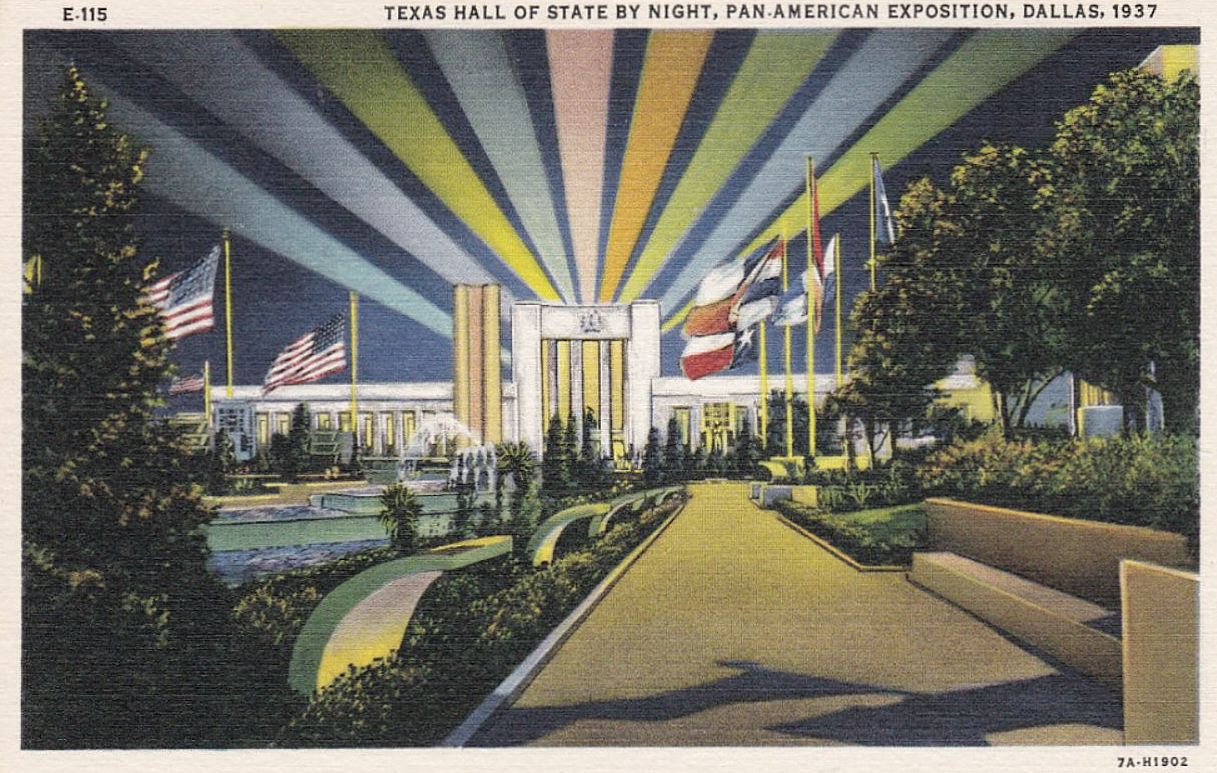
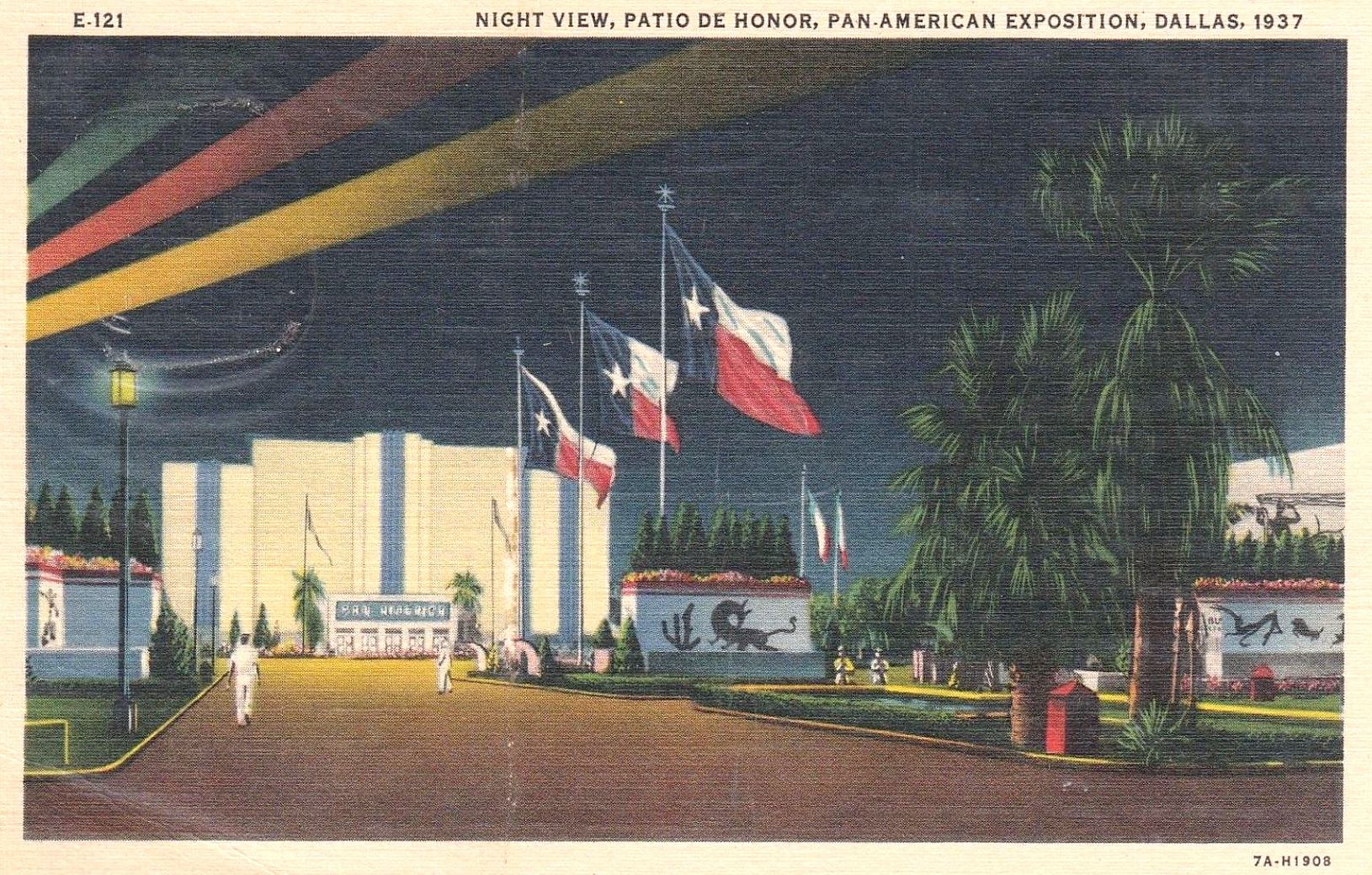
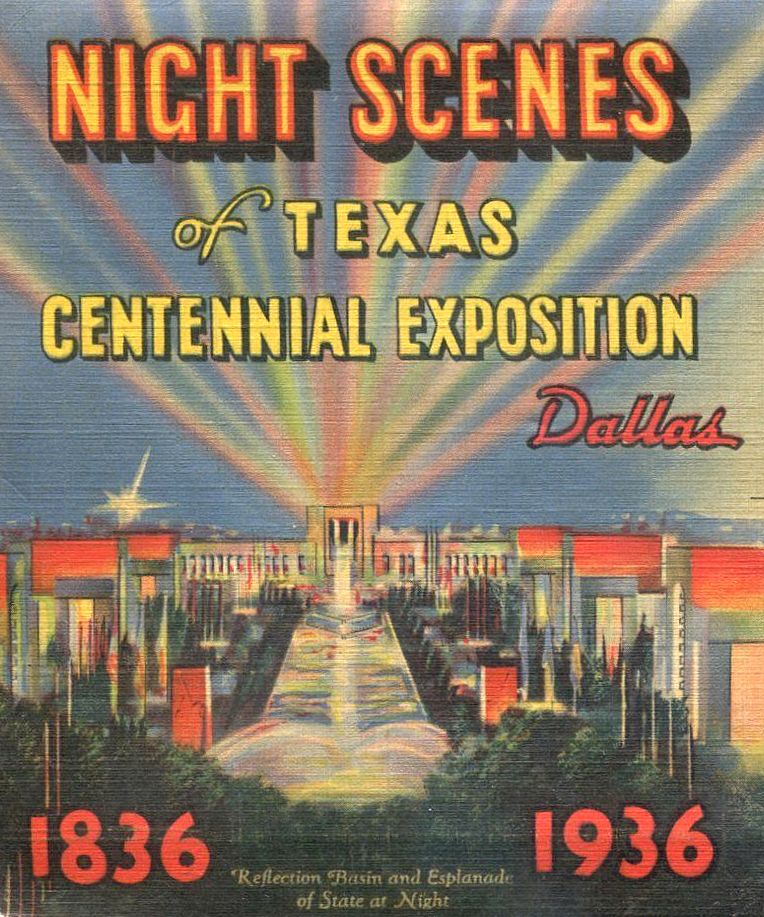
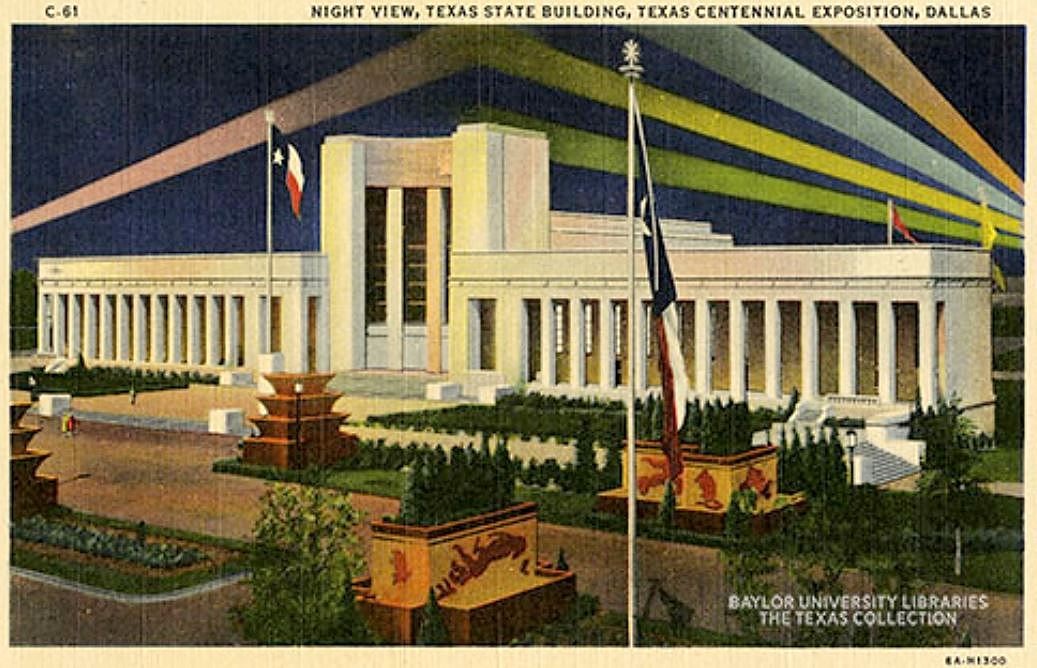
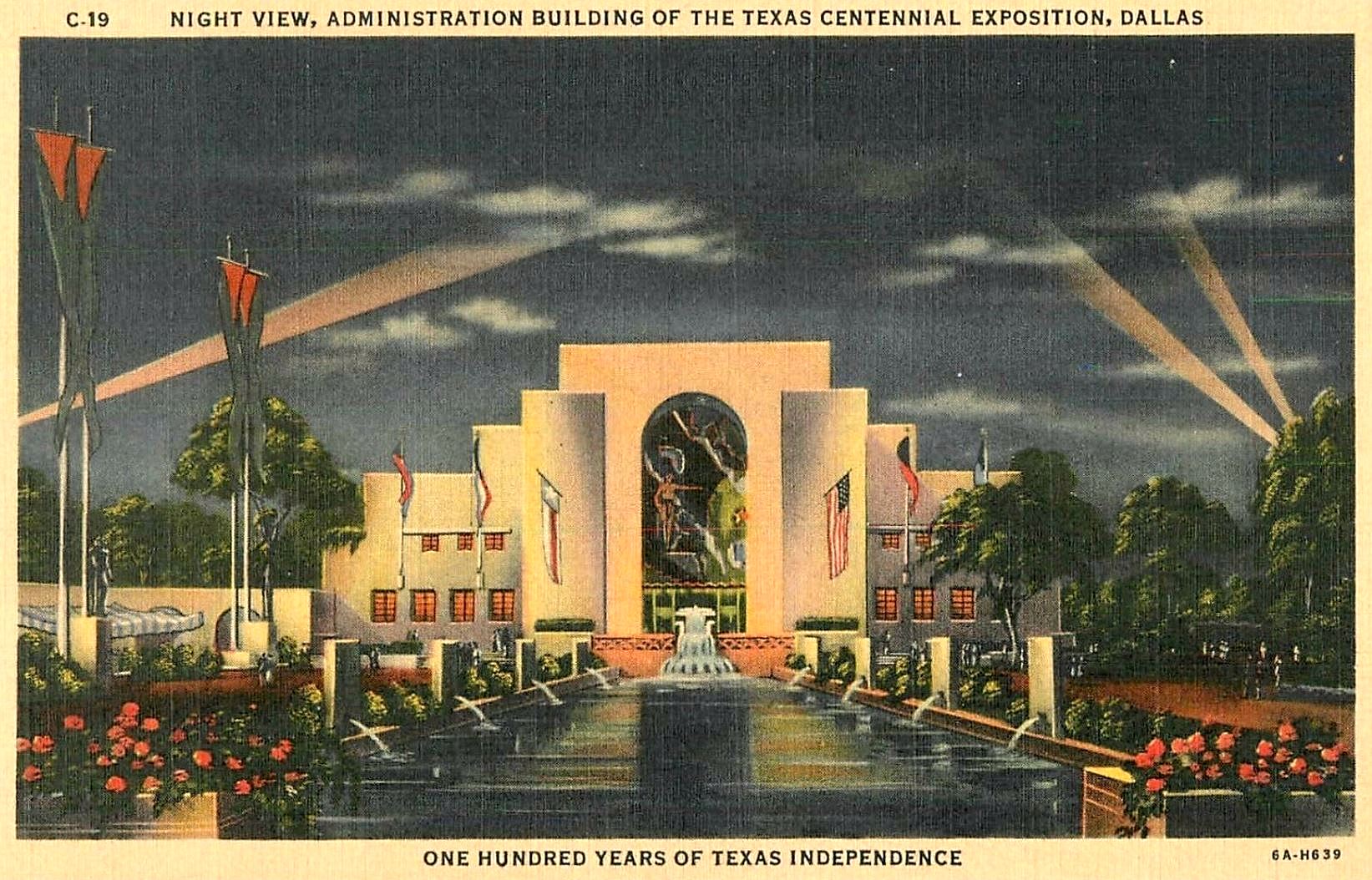
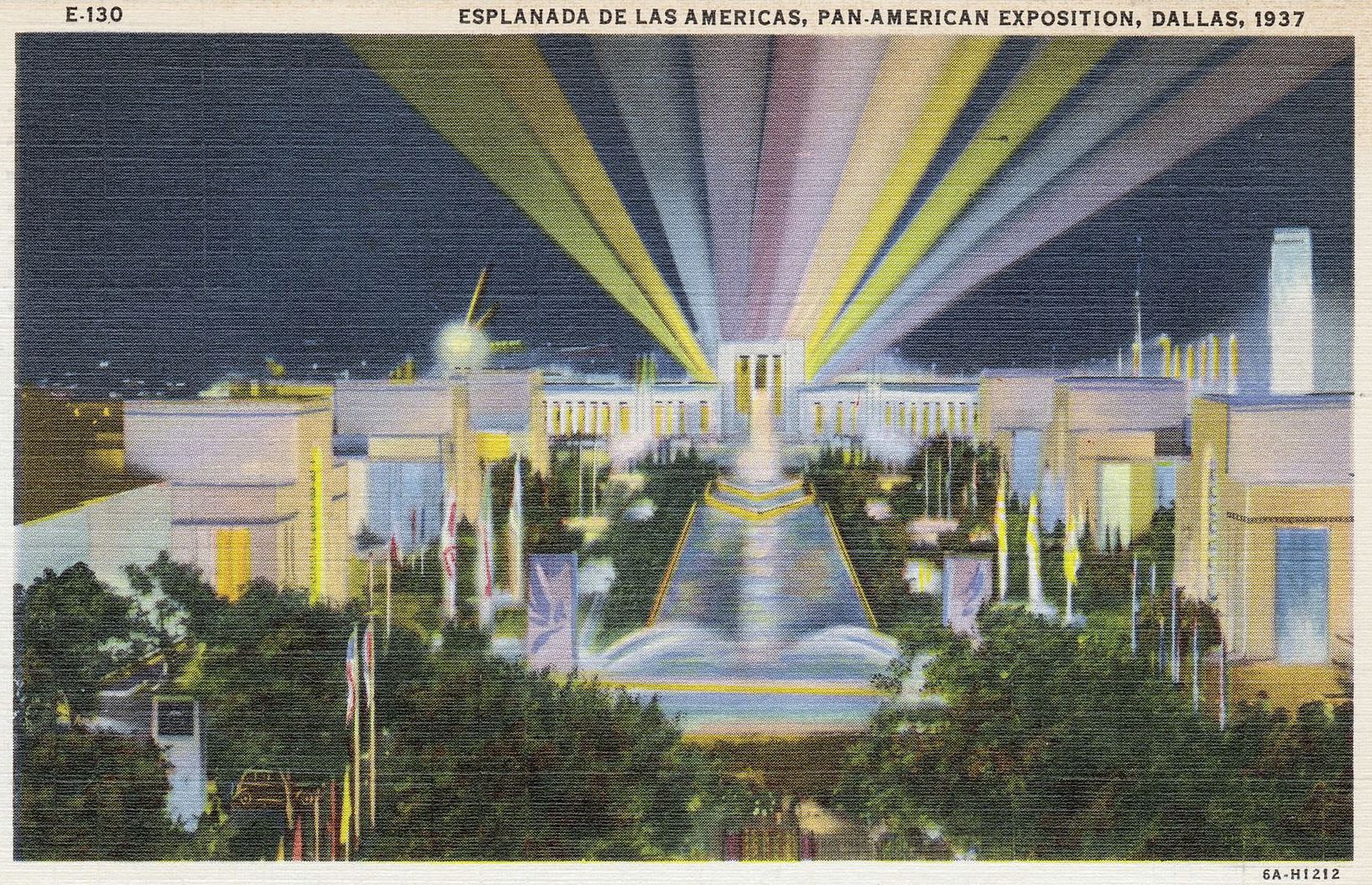
Many of the lighting designs and displays had been used the previous year during the Centennial, but, as with much of the attractions and appointments throughout the park, they were improved and spectacularized for the Pan-American Expo. And people loved what they saw.

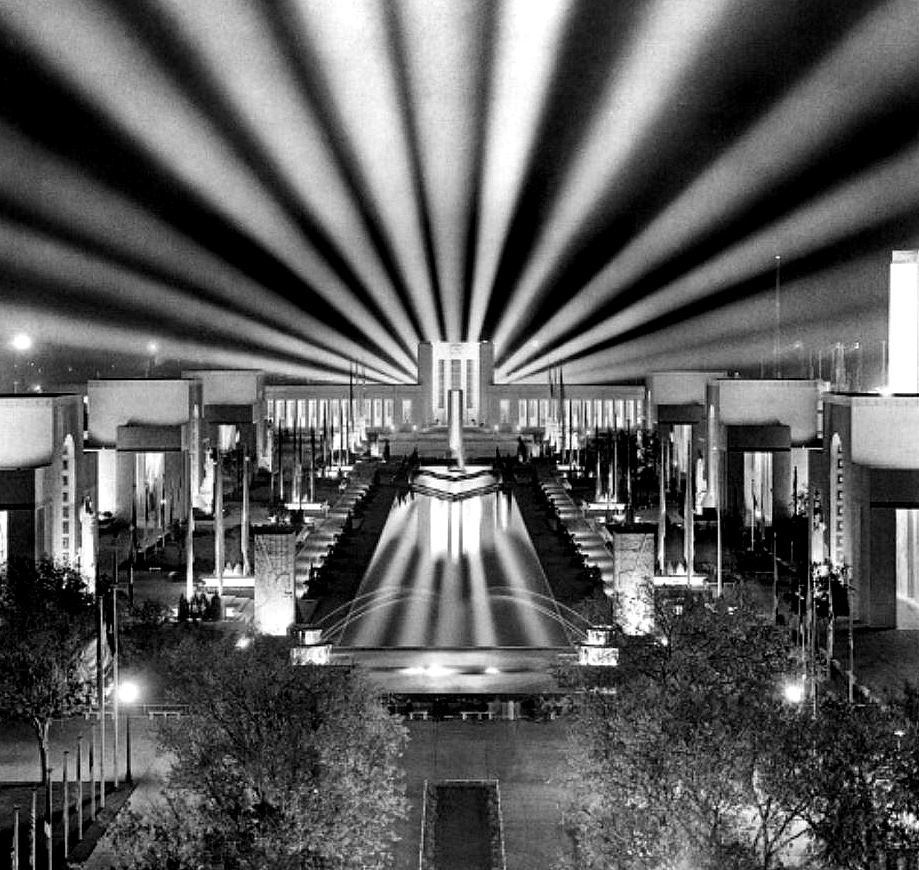
Despite the multi-million dollar structures, air conditioning demos, works of art and other newfangled additions to the space, when people left the Centennial Exposition one thing was on everyone’s tongues, according to historical pollsters: the lights.

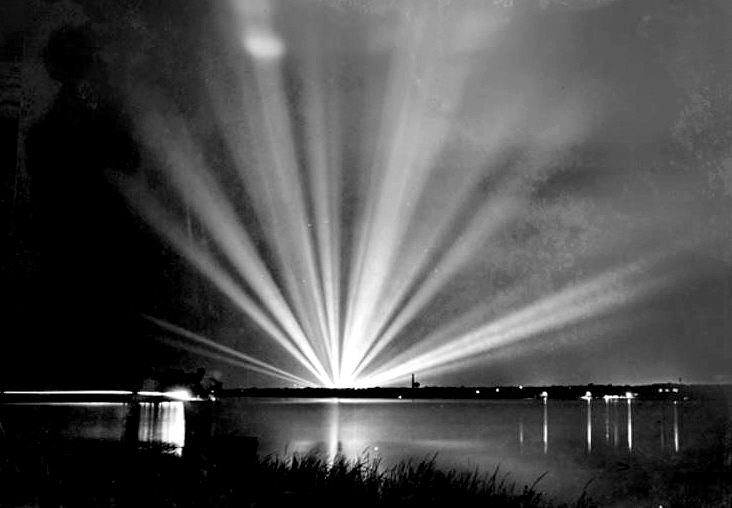
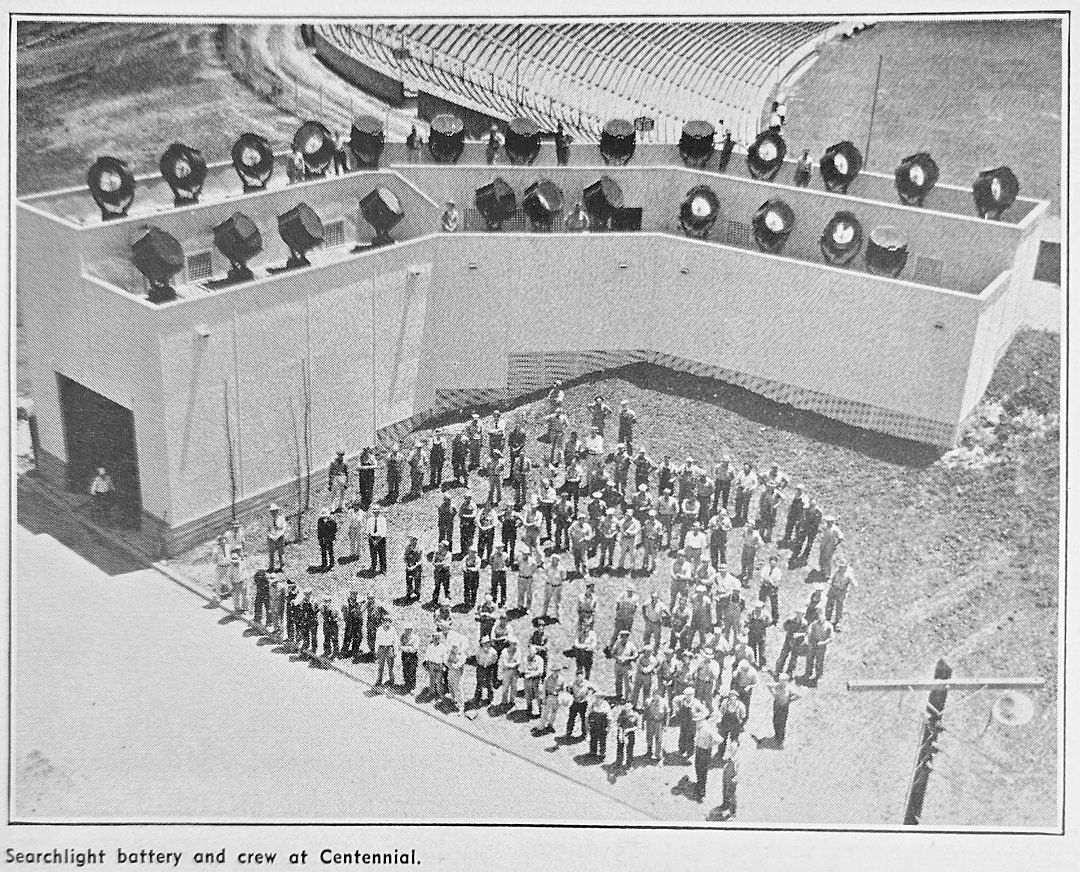
Positioned behind the Hall of State were 24 searchlights scaffolding into a crowned fan shape. “They all moved and were different colors,” says [Jim] Parsons [co-author of the book Fair Park Deco]. “It sounds gaudy, but people loved it.” The lights, he goes on to tell, were visible up to 20 miles away.

Considering most of the people who were visiting the fairgrounds were coming from rural farming communities with no electricity, the inspiring nature of those far-reaching beams makes a lot of sense. (Dallas Observer, Nov. 7, 2012)

Thanks for doing your part for Dallas history, Prof. Einstein!
pan-american-expo_esplanade_postcard

pan-american-expo_hall-of-state_postcard

pan-american-expo_patio-de-honor_ebay

Below, photos from the Texas Centennial, 1936. The multicolored lights could be seen from miles away — here’s what they looked like from downtown and from White Rock Lake.
centennial_pan-american_lights

skyline_downtown-to-fair-park_1936_GE-colln_museum-of-innovation-and-science

fair-park-lights_white-rock-lake

tx-centennial_night-scene_espalanade_hall-of-state_lights_ebay

tx-centennial_night_hall-of-state_lights_flickr_baylorvia Baylor University Flickr stream

tx-centennial_night_administration-bldg_lights_ebay

*

A look behind the scenes: “The general lighting effect is a battery of twenty-four 36-inch searchlights as powerful as the giants that flash from the dreadnoughts of Uncle Sam’s navy. Each searchlight will produce 60 million candlepower. Combined, the battery has a total candlepower of 1.5 billion. A 350,000-watt power generator will produce this colossal quantity of ‘juice.’” And the accompanying photo of the searchlight battery crew manning the candlepower:
tx-centennial_lights_southwest-business-mag_june-1936_photoSouthwest Business, June 1936

**

(All pictures and clippings are larger when clicked.)
einstein_pan-am-expo_denison-press_060937
Denison Press, June 9, 1937

*

einstein_pan-am-expo_waxahachie-daily-light_061137
Waxahachie Daily Light, June 11, 1937

*
einstein_pan-am-expo_denison-press_061437
Denison Press, June 14, 1937

*

einstein_pan-am-expo_medford-oregon-mail-tribune_062337
Medford (Oregon) Mail Tribune, June 23, 1937

*
einstein_pan-am-expo_vernon-daily-record_062437
Vernon Daily Record, June 24, 1937

*

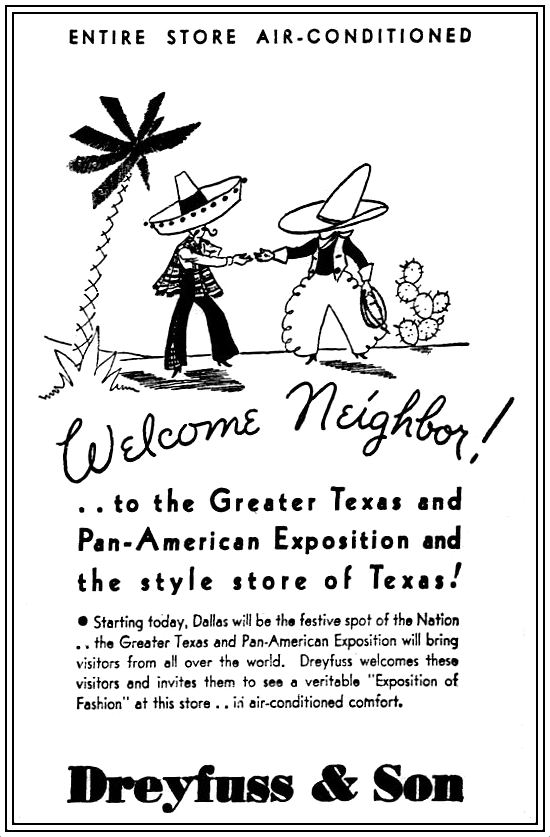
pan-american-expo_drefuss-ad_dmn_061237
1937

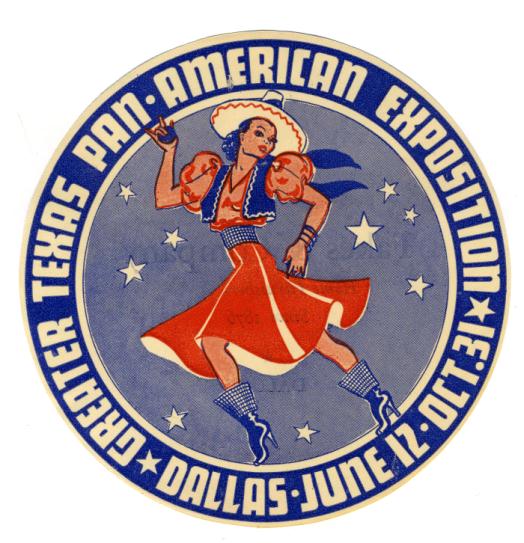
pan-american-expo_sticker_1937_cowgirl

***

Sources & Notes

Top photo from the old Corbis site.

Black-and-white photos from the Centennial seen from Fair Park and White Rock Lake are from the Texas/Dallas History and Archives Division of the Dallas Public Library; the photo of the lights seen from downtown Dallas (titled “New skyline at night from Dallas, Texas”) is from the GE Photo Collection, Museum of Innovation and Science (more info on that photo is here).

Sources of other images and clippings cited, if known.

More on the Pan-American Exposition from Wikipedia, here, and from the fantastic Watermelon Kid site of all-things-Fair-Park, here.

*

Copyright © 2016 Paula Bosse. All Rights Reserved.
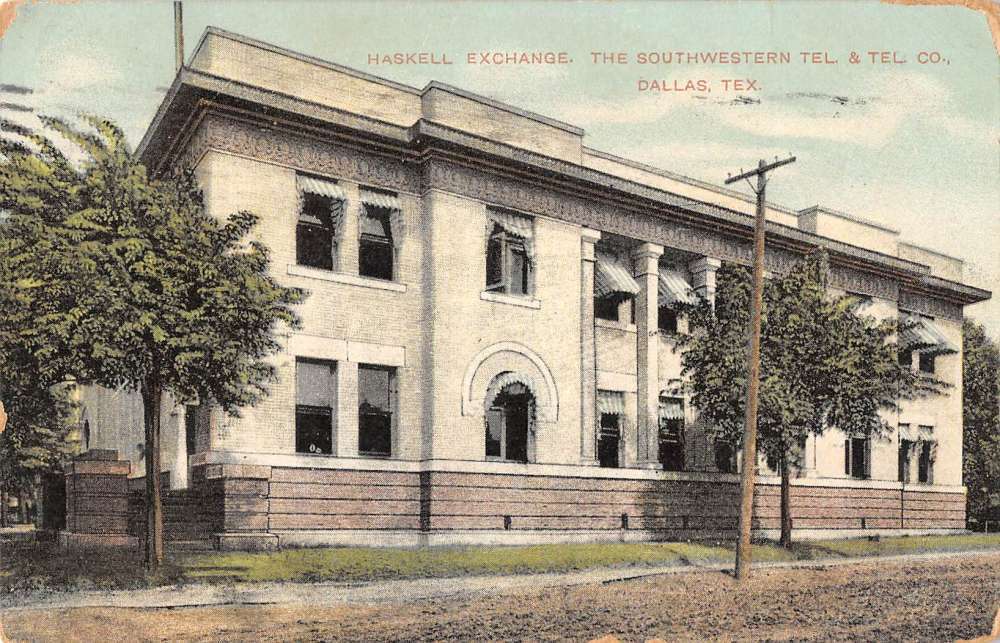
The Haskell Exchange — ca. 1910

telephone_haskell-exchange_postmarked-1910_ebayThe switchboard hub in Old East Dallas… (click for larger image)

by Paula Bosse

Above, the building that housed the Haskell Exchange of Southwestern Telegraph and Telephone (the company which later became Southwestern Bell Telephone and, eventually, part of AT&T), located at the southeast corner of Bryan and Haskell in Old East Dallas. It was so cute and quaint back in 1910 (the year this postcard was mailed). AT&T still has a building on this very same corner — over a century later. Unfortunately, the building stopped being quaint a long time ago. See the same location today, here. Some awnings might help….

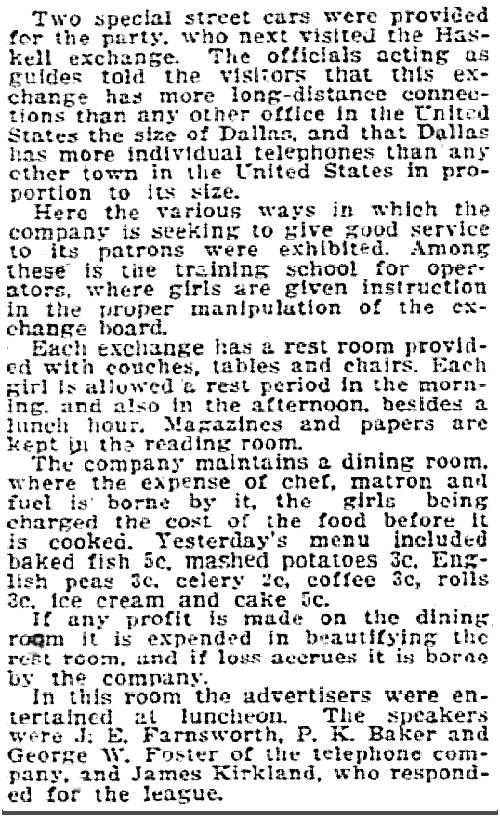
Below is part of an article describing a tour of the Exchange taken by the Dallas Advertising League in 1911 (click for larger image):

haskell-exchange_dmn_021111
Dallas Morning News, Feb. 11, 1911

ad-southwestern-telephone-telegraph_1912
Cattle Raisers’ Association of Texas, 1912

ad-southwestern-telephone-telegraph_dmn_050212
DMN, May 2, 1912

haskell-exchange_ca-1915_DHSDallas Historical Society

***

Sources &  Notes

More about the operators of Southwestern Tel. & Tel. (with photos of their “rest room”) can be found in the Flashback Dallas post “Work and Play in Telephone Land,” here.

In this case “exchange” did not mean the same thing as telephone exchanges such as “Taylor,” “Emerson,” “Lakeside,” “Fleetwood,” “Riverside,” etc. Read more at Wikipedia here and here for the distinctions.

*

Copyright © 2016 Paula Bosse. All Rights Reserved.
What’s Playing at the Palace? — 1950s

elm-street_ten-commandments_1957_flickr_coltera.JPGFilm Row: Elm & Ervay, looking west… (click for large image)

by Paula Bosse

In the 1950s, the two prestige movie theaters in Dallas were the Majestic and the Palace, mainstays of “Theater Row” and just a few blocks apart on Elm Street. The Palace Theater (at Elm and Ervay, across from the Wilson Building) is seen in the two postcards featured here. The one above shows Elm Street looking west. “The Ten Commandments” is playing, placing the date that photo was taken sometime between February and May, 1957. The postcard below shows an eastward-looking view with “The Caine Mutiny” on the marquee, dating that photo to the latter half of July, 1954.

elm-street_looking_east_palace_night_flickr_coltera

“The Ten Commandments” was a huge, huge hit and ran for 11 weeks — no movie had ever run that long in the history of Dallas theaters (it had beat out the then-champ, “Sergeant York,” which had had a seven-week run at the Majestic in 1941).

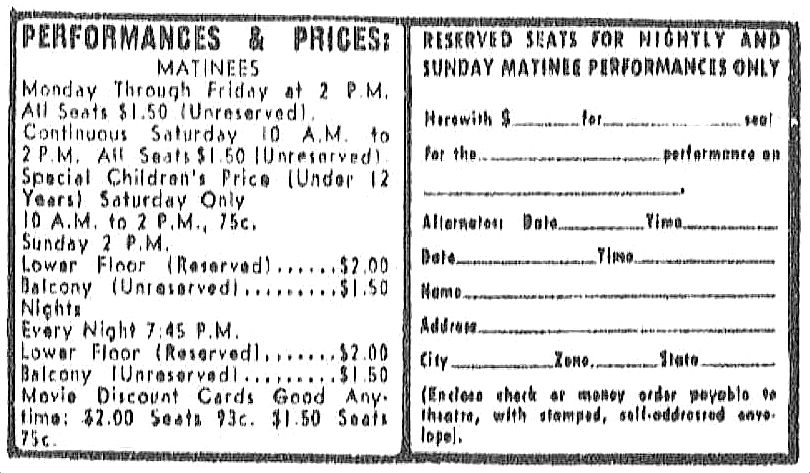
It was also one of the longest movies to ever play in Dallas. We’re talking a running time of almost 4 hours (with an intermission), something which not only tested the endurance of audiences but also severely limited the number of showings per day. It was an “event” picture, and, accordingly, prices were higher and reserved seats were offered.

ten-commandments_palace_dmn_021457_ad_det_reserved-seatsFeb., 1957

The number of people in Dallas who saw that movie at the Palace is staggering: over 100,000! Even after its run at the Palace ended, it continued to draw crowds when it moved down the street to the Tower.

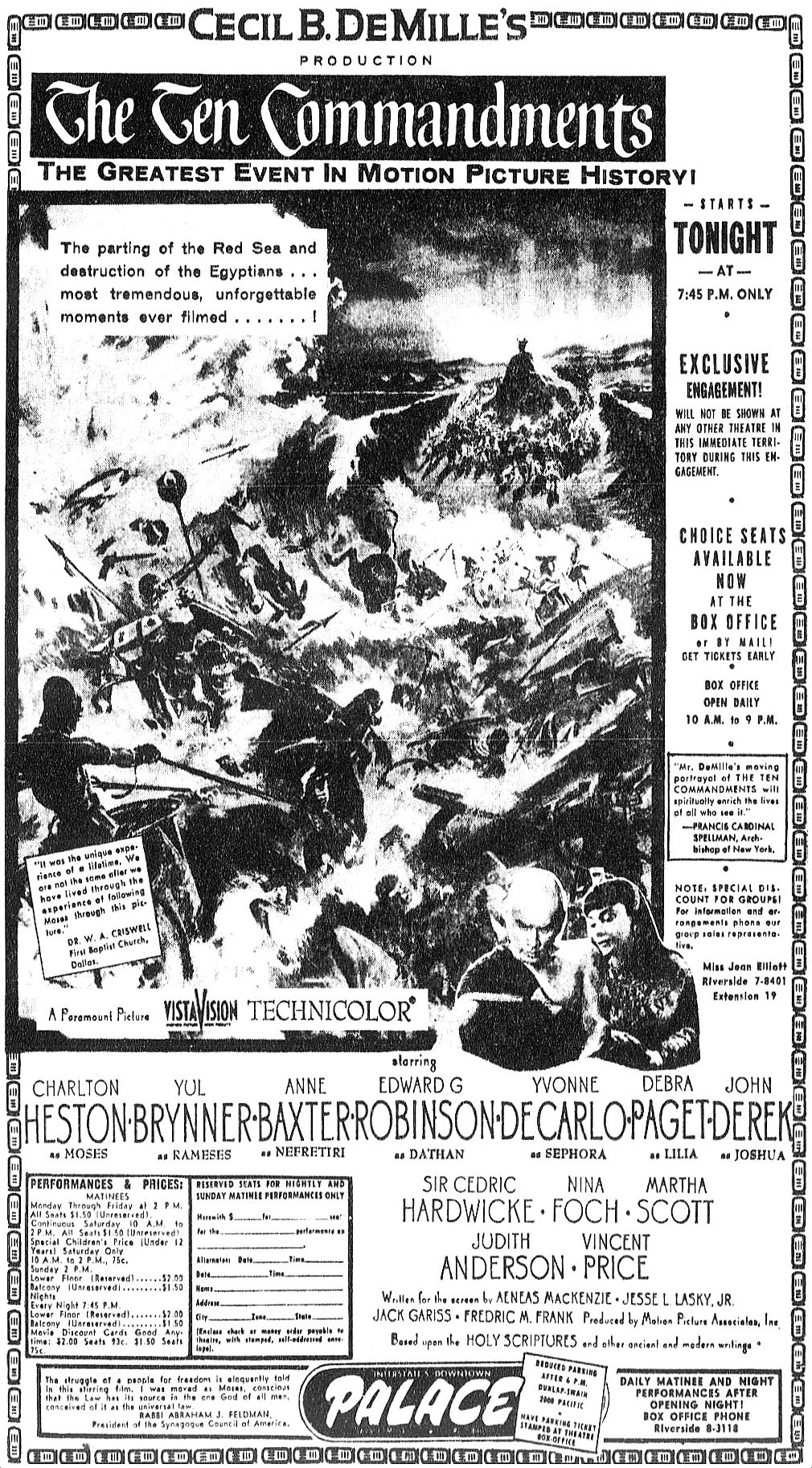
The opening-day ad for the movie:

ten-commandments_palace_dmn_021457_ad
Feb. 14, 1957

There were a couple of things I found interesting about this ad. One was that it had a blurb by First Baptist Church of Dallas’ chief Baptist,  W. A. Criswell.

ten-commandments_palace_dmn_021457_ad_det_criswell

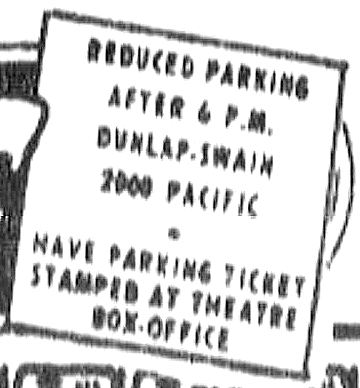
The second was that patrons could park behind the theater — on Pacific — at the Dunlap-Swain station. (Parking downtown for large crowds in those days must have been challenging —  not everyone took streetcars or, later, buses.)

ten-commandments_palace_dmn_021457_ad_det_parking

*

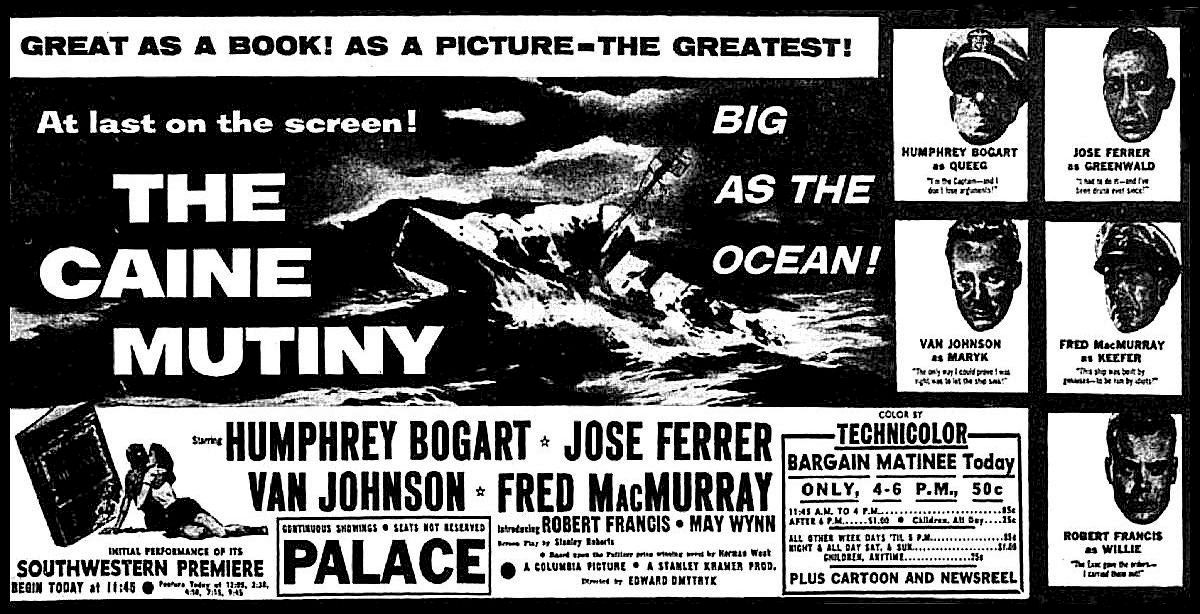
caine-mutiny_palace_dmn_071654_opening-nightJuly, 1954

***

Sources & Notes

Both postcards found on Flickr, posted by the unstoppable Coltera: the top one here, the bottom one here.

“The Ten Commandments” ran at the Palace Theater from Feb. 14, 1957 to May 2, 1957. The film that followed was “Boy On a Dolphin,” which featured the debut of super-sexy Sophia Loren in a U.S. movie. …Which is an interesting counterpoint.

“The Caine Mutiny” ran from July 16, 1954 to July 29, 1954.

A previous post about the Palace — “Next-Door Neighbors: The Palace Theater and Lone Star Seed & Floral — 1926” — can be found here.

Click pictures and clippings to see larger images.

*

Copyright © 2016 Paula Bosse. All Rights Reserved.
 

The Expanded “Texas Size” Titche’s Building: Twelve Glamorous Acres of Department Store — 1955

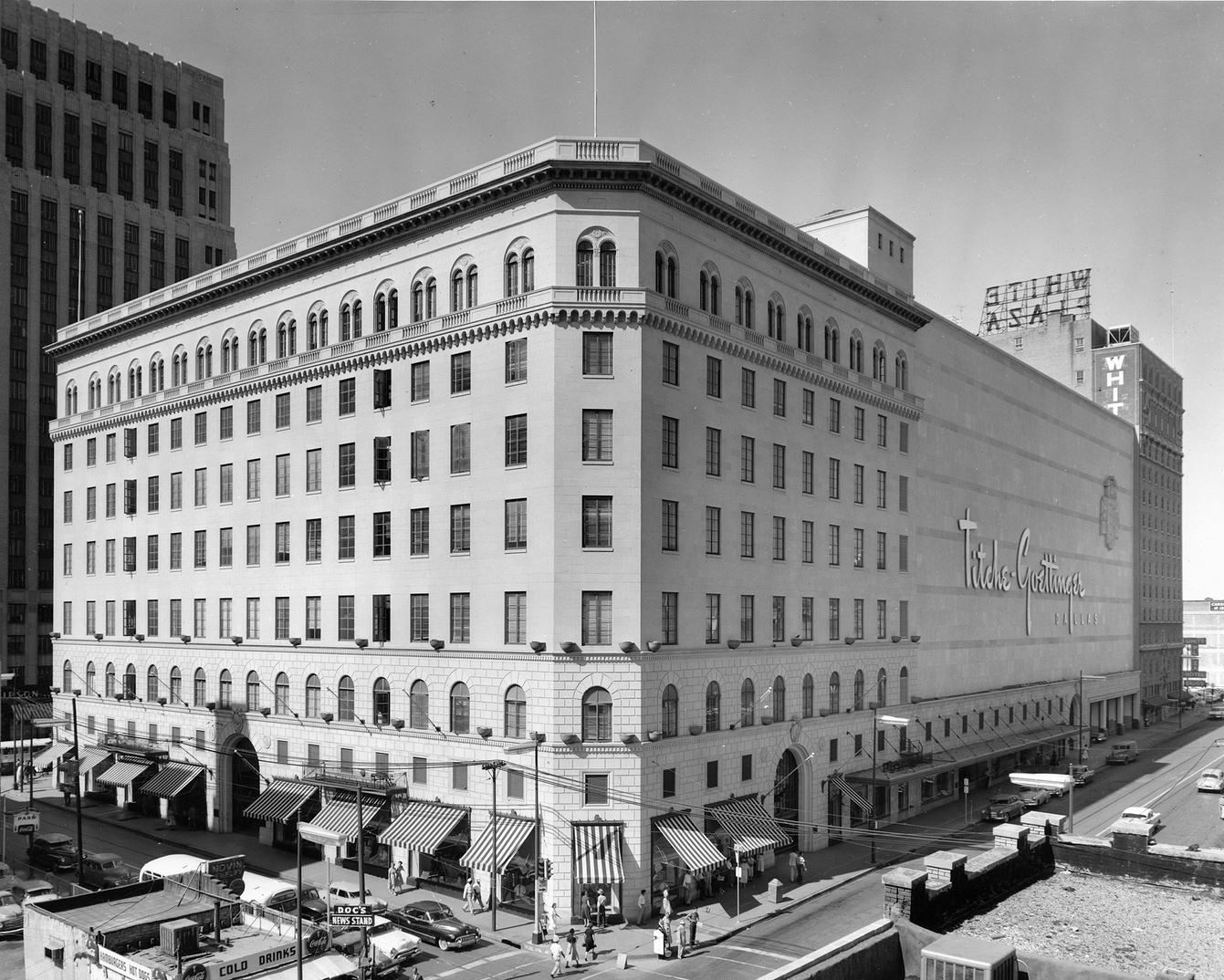
titches_utaDallas’ largest department store, ca. 1955…

by Paula Bosse

This photo of the Titche-Goettinger department store (Main and St. Paul) was taken soon after the store’s expansion which increased its size from 250,000 square feet to a whopping 504,000 square feet. When the greatly enlarged store introduced itself to the Dallas public at an open house in March 1955, one of the most notable things about it (for me, anyway) was the fact that 93-year-old Max Goettinger — founder of the department store in 1902, along with Edward Titche — attended the festivities.

The beautiful original building — designed by George Dahl — was built in the late 1920s and was a commanding presence at only half its later size. (Click pictures to see larger images.)

titches_night

The postcard view above has handily erased most of the other buildings in that block which one would have seen in a photograph, including the Pollock Trunk Co. and the old Hilton Hotel (later the White Plaza, currently the Indigo). A 1942 view of the block, looking west from Harwood, looked like this:

main-street-canyon_ebay

When construction of the new part of the store was completed in 1955, this new 12-acre “Texas Size” Titche’s was the largest store in Dallas, a head-spinning prospect for a city that loves to shop.

**

If you want a much more comprehensive overview of the Titche’s building — and want to see wonderful photos of the building, inside and out — I highly recommend Noah Jeppson’s Unvisited Dallas post, “Titche-Goettinger Building,” here. My favorite part? Its innovative system of pneumatic tubes!

***

Sources & Notes

Top photo by Squire Haskins, from the Squire Haskins Photography, Inc. Collection, UTA Libraries, Special Collections — more info here) (click on the thumbnail image on the page to see this photo BIG).

Read more on the expansion at the Dallas Morning News archives:

  • “Titche’s Reports Plans to Double Present Size” by Edd Rout (DMN, Sept. 7, 1952)
  • “Visitors Jam Opening of Texas-Sized Titche’s” by James A. Cockrell (DMN, March 15, 1955)

This wonderful building is still standing, modified to accommodate its current owners, the University of North Texas. Here’s how the building looks these days, via Google Street View, here.

More on the Titche-Goettinger Building on Wikipedia, here.

*

Copyright © 2016 Paula Bosse. All Rights Reserved.
The Business District at Night

skyline_night_flickr_coltera

by Paula Bosse

If you squint, the Mercantile Building looks a little Statue-of-Liberty here.

***

Postcard from Flickr.

Click for larger view.

*

Copyright © 2016 Paula Bosse. All Rights Reserved.
Marvin’s Drug Store, Main and Akard

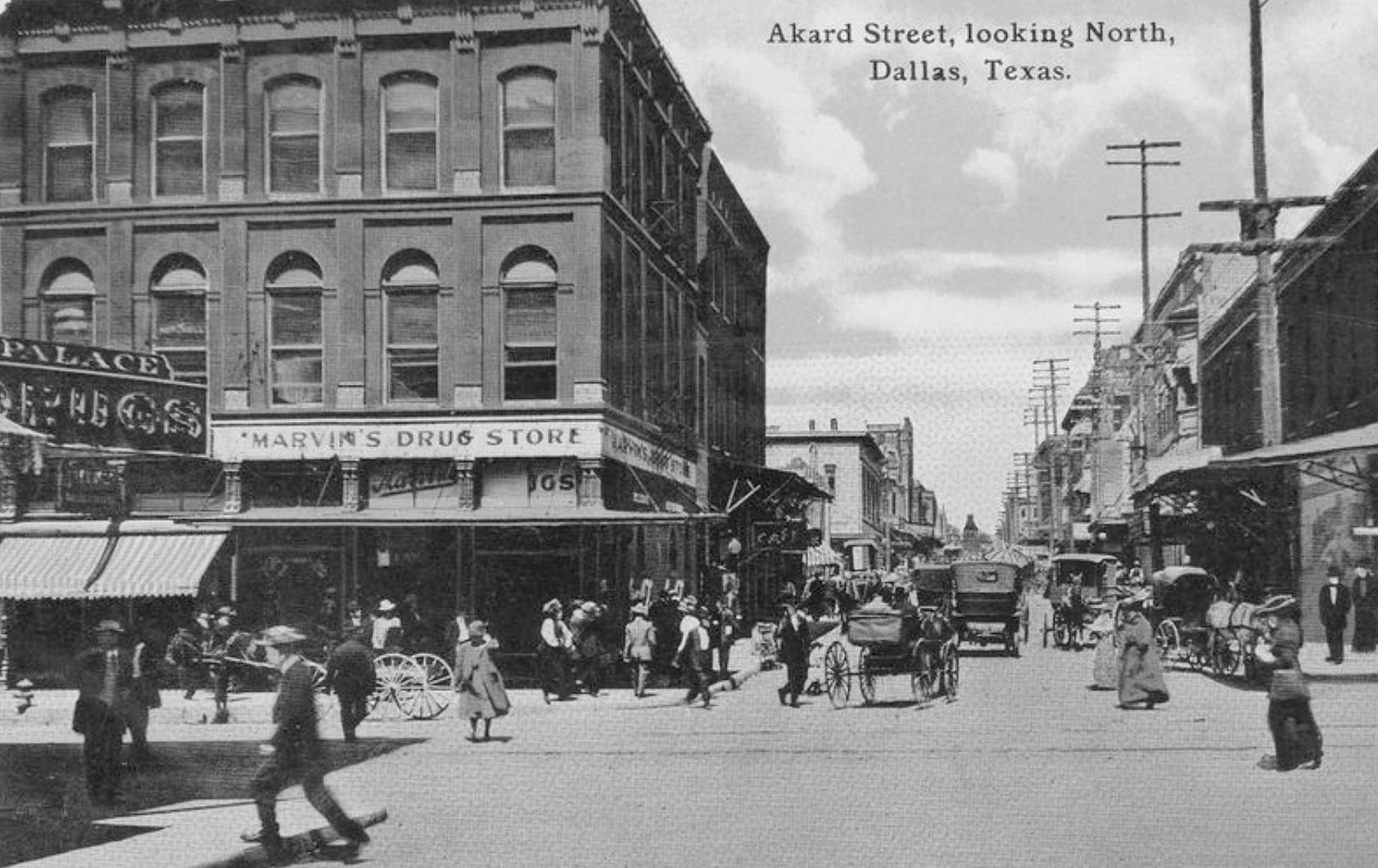
akard-looking-north_colteraLooking north up Akard from Main… (click for larger image)

by Paula Bosse

This postcard shows a bustling downtown at the intersection of Main and Akard (the view straight ahead is North Akard). Marvin’s Drug Store, on the northwest corner, was at 1415 Main, and the Palace Drug Store, on the southwest corner, was at 1414 Main. The Palace Drug Store moved to this location in December of 1909, and I’d guess the original photo used here was taken around 1910. See what this view looks like today here.

I love colorized postcards from this period, but sometimes draining them of their color gives a more realistic view of the scene (but doing this can also add a weird surreal flavor when you begin to notice evidence of the artist’s heavy hand — check out the two creepy Edvard Munch-like blank-faced pedestrians at the far right). (Click for larger image.)

akard-looking-north_coltera_bw

The building housing Marvin’s Drug Store was originally known as the Rowan Building, seen below in 1899 — its distinctive cupola was unceremoniously cropped from the postcard view.

rowan-bldg_1889-photo_detail_natl-city-bank-ny-ad_1939

In this photo you can see “Rowan” on the cupola:

rowan-bldg_marvins-drug-store_ebay

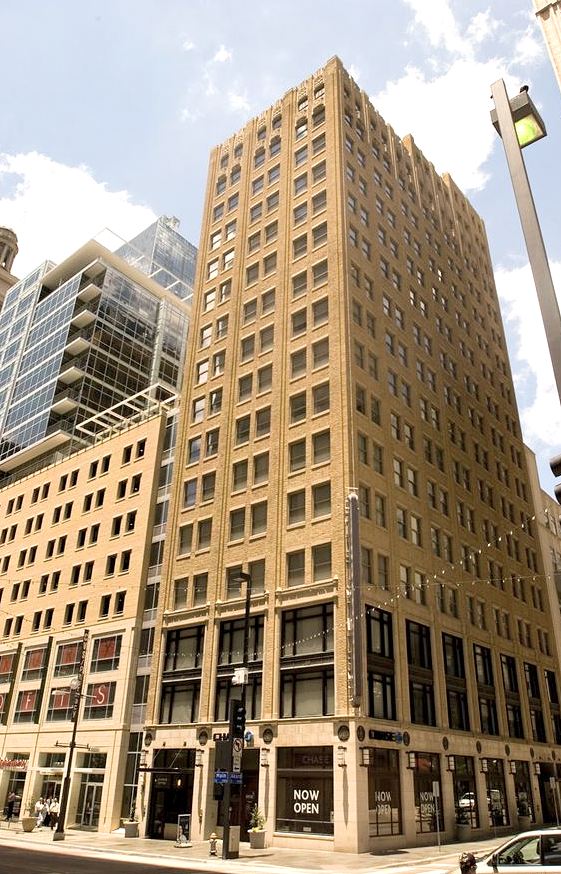
This attractive building was torn down in order to build the taller Marvin Building, which was originally intended to be 24 stories but was later downgraded to 16 stories, then to 10, then to 4 (but with plans to add more at a later date). When the new building opened in 1927, the namesake drugstore was retained as its ground-floor anchor tenant. This new structure was known as the Marvin Building until 1931 when the Gulf States Life Insurance Company purchased it and it became known as the Gulf States Building (coincidentally, ol’ Z. E. “Zeke” Marvin not only owned the Marvin Building and the Marvin Drug Company, but he was also the former president and CEO of the Gulf States Insurance Company). A Lang & Witchell-designed six-story addition was built in 1935. This 16-story building is still  standing and has been converted into residential loft space.

gulf-states-bldg_chamberlin-site

***

Sources & Notes

The postcard at the top is from the incredible Flickr collection of Christian Spencer Anderson (aka “Coltera”), here.

The 1899 photo of the Rowan Building is a detail from a 1939 ad for the National City Bank of New York.

The sepia-toned photo is from eBay.

The color photo of the Gulf States Building is from the Chamberlin Roofing and Waterproofing site, here. (See that photo REALLY big here.)

Click pictures to see larger images.

*

Copyright © 2016 Paula Bosse. All Rights Reserved.

The John E. Mitchell Company’s WWII Munitions Work (Part 2)

mitchell_17

by Paula Bosse

This is the second part of a post containing a series of postcards issued by the John E. Mitchell Company, which, before World War II was primarily a manufacturer of cotton and agricultural implements. It was located at 3800 Commerce in Exposition Park, a few blocks from Fair Park. During the war, the company ceased producing agricultural machinery and began producing munitions and materiel for the Navy and Army. (Part 1 can be found here.) The cards in a landscape format are larger when clicked.

*

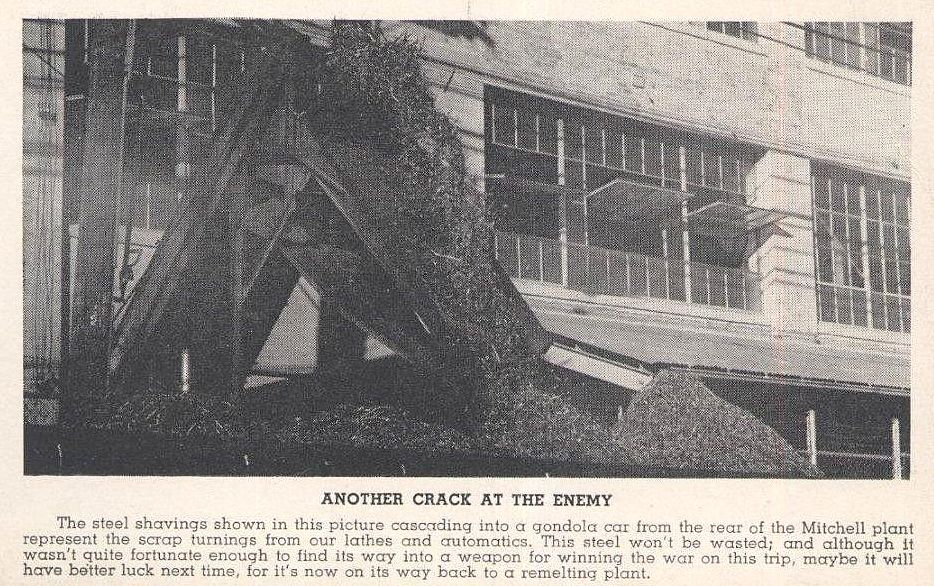
The card at the top shows the back of the (still-standing) building, behind which ran railroad tracks of the Missouri-Pacific railway. The card’s text:

ANOTHER CRACK AT THE ENEMY

The steel shavings shown in this picture cascading into a gondola car from the rear of the Mitchell plant represent the scrapped turnings from our lathes and automatics. This steel won’t be wasted; and although it wasn’t quite fortunate enough to find its way into a weapon for winning the war on this trip, maybe it will have better luck next time, for it’s now on its way back to a remelting plant.

*

mitchell_11

RECORD BREAKERS

This card will introduce you to Mr. and Mrs. Lewis J. Smith, the John E. Mitchell Company’s star tapping machine operators, shown here tapping base closing plugs for parafrag bombs.

It wasn’t so long ago that the Smiths’ sons, Dudley and Raleigh Smith, held the company production record on this machine. Then Dudley joined the Army and Raleigh joined the Navy. Mr. and Mrs. Smith decided the record should be kept in the family. So far it has.

*

mitchell_12

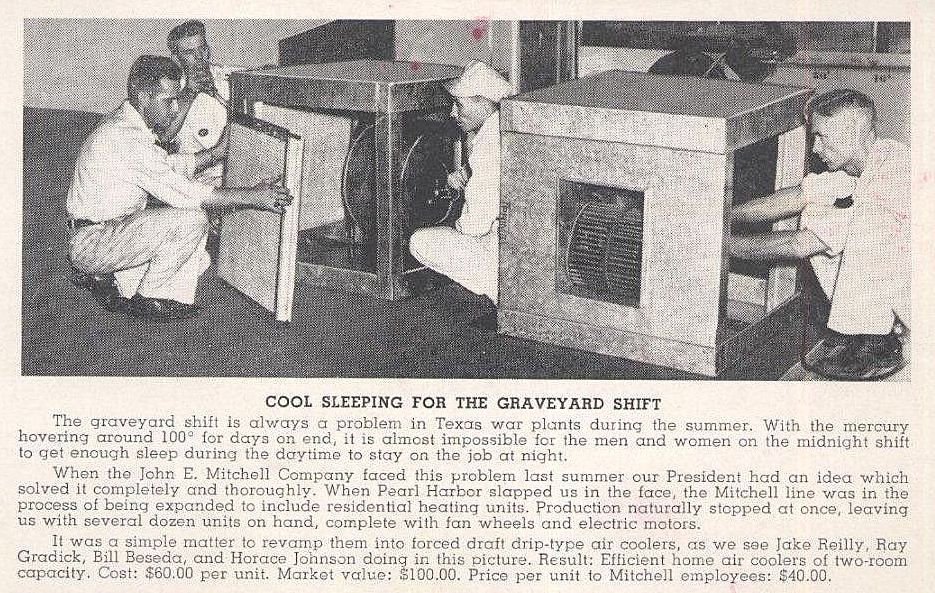
This is one of the most interesting cards in this collection. After the war, the Mitchell Company began to manufacture a wide variety of things, including heaters and air conditioners for cars. This problem of graveyard shift workers being unable to sleep during the summer months because of the oppressive heat must have been a big problem during the war, when factories such as this had to be running 24 hours a day. This was a brilliant solution.

COOL SLEEPING FOR THE GRAVEYARD SHIFT

The graveyard shift is always a problem in Texas war plants during the summer. With the mercury hovering around 100° for days on end, it is almost impossible for the men and women on the midnight shift to get enough sleep during the daytime to stay on the job at night.

When the John E Mitchell Company faced this problem last summer our President had an idea which solved it completely and thoroughly. When Pearl Harbor slapped us in the face, the Mitchell line was in the process of being expanded to include residential heating units. Production naturally stopped at once, leaving us with several dozen units on hand, complete with fan wheels and electric motors.

It was a simple matter to revamp them into forced draft drip-type air coolers, as we see Jake Reilly, Ray Gradick, Bill Beseda, and Horace Johnson doing in this picture. Result: Efficient home air coolers of two-room capacity. Cost: $60.00 per unit. Market value: $100.00. Price per unit to Mitchell employees: $40.00.

*

mitchell_13

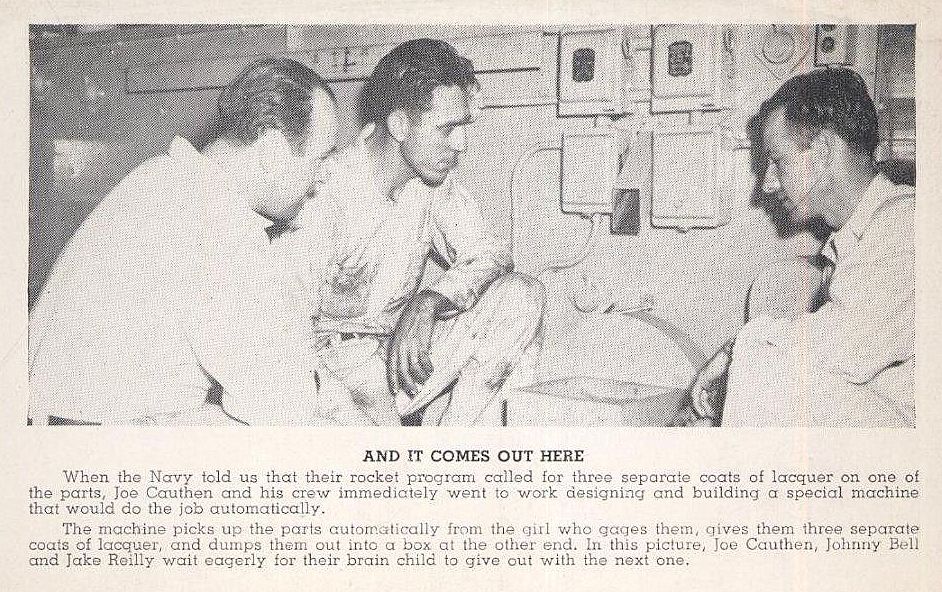
AND IT COMES OUT HERE

When the Navy told us that their rocket program called for three separate coats of lacquer on one of the parts, Joe Cauthen and his crew immediately went to work designing and building a special machine that would do the job automatically.

The machine picks up the parts automatically from the girl who gages them, gives them three separate coats of lacquer, and dumps them out into a box at the other end. In this picture, Joe Cauthen, Johnny Bell and Jake Reilly wait eagerly for their brain child to give out with the next one.

*

mitchell_14

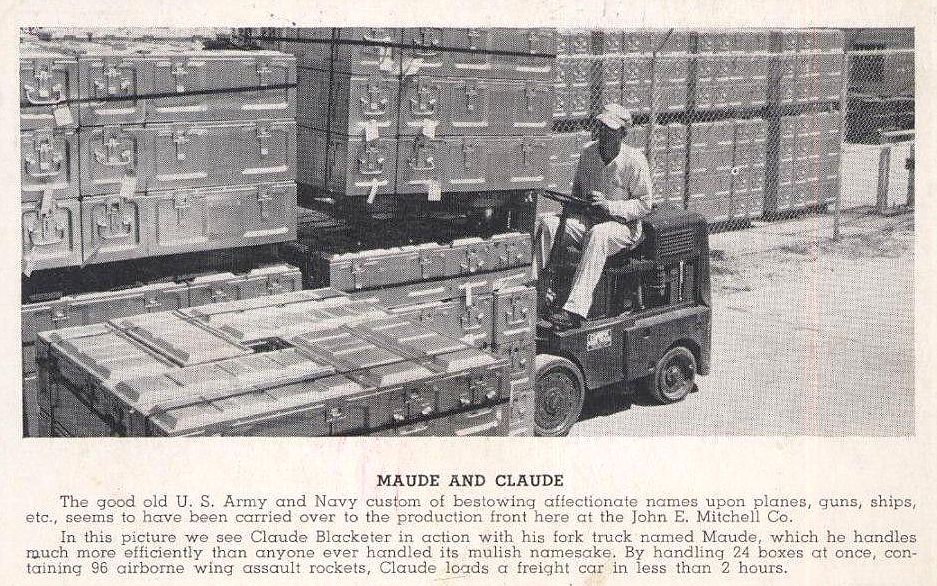
MAUDE AND CLAUDE

The good old U. S. Army and Navy custom of bestowing affectionate names upon planes, guns, ships, etc., seems to have been carried over to the production front here at the John E. Mitchell Co.

In this picture we see Claude Blacketer in action with his fork truck named Maude, which he handles much more efficiently than anyone else ever handled its mulish namesake. By handling 24 boxes at once, containing 96 airborne wing assault rockets, Claude loads a freight car in less than 2 hours.

*

mitchell_15

Here is a close-up view of one of the Mitchell Company’s battery of multi-spindle automatic lathes. These machines, which cost about $25,000 apiece, perform the first operations on many of the company’s war items. They operate 24 hours a day under the expert care of men like George Alexander, shown here peeking through at an operation on rocket nozzles.

*

mitchell_16

PRESSURE BOY

Here’s one of the many presses with which the Mitchell factory is equipped, each operatable with a series of interchangeable blanking, stamping, forming, and drawing dies. This particular press has a capacity of 300 tons and forms the end frame for a Mitchell cotton machine in one lick.

*

mitchell_19

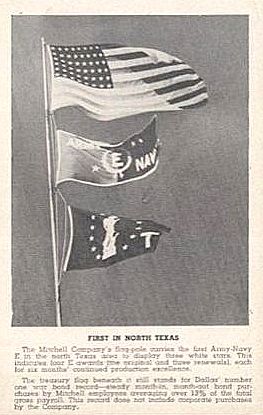
FIRST IN NORTH TEXAS

The Mitchell Company’s flag-pole carries the first Army-Navy E in the north Texas area to display three white stars. This indicates four E awards (the original and three renewals), each for six months’ continued production excellence.

The treasury flag beneath it still stands for Dallas’ number one war bond record – steady month-in, month-out bond purchases by Mitchell employees averaging over 13% of the total gross payroll. This record does not include corporate purchases by the Company.

***

Sources & Notes

Postcards found on eBay. Many of these are currently for sale, here.

Part 1, containing more of these postcards, is here.

Coming next: a look at the building built by the Mitchell Company in 1928, which is still standing in Expo Park, now repurposed as residential loft space.

mitchell-building_google
Google Maps (click for larger image)

*

Copyright © 2016 Paula Bosse. All Rights Reserved.


The John E. Mitchell Company’s WWII Munitions Work (Part 1)

mitchell_5

by Paula Bosse

The John E. Mitchell Company arrived in Dallas in 1928 to join the other nearby manufacturers of cotton gins and other agricultural equipment. They built their factory at 3800 Commerce, between Benson and Willow Streets, in the area now commonly referred to as Exposition Park, a few blocks from Fair Park. (The building still stands and has been converted into lofts. More on the building itself in Part 3.)

In 1942, during World War II, the large cotton machinery factory gradually transformed itself into one wholly concerned with war production, primarily manufacturing munitions for the Navy, but also producing ordnance parts for the Army.

Below are a series of postcards, produced by the Mitchell Company, touting their contribution to the war effort and acknowledging their workers. The second half of these cards will be contained in the next post. (Most of the cards are larger when clicked.)

*

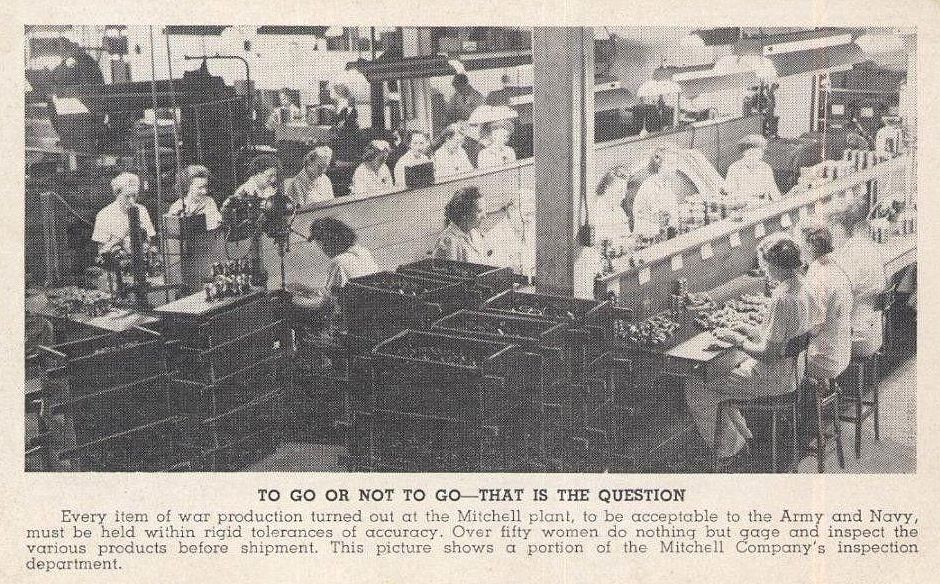
The top card shows part of the plant’s inspection department:

TO GO OR NOT TO GO — THAT IS THE QUESTION

Every item of war production turned out at the Mitchell plant, to be acceptable to the Army and Navy, must be held within rigid tolerance of accuracy. Over fifty women do nothing but gage and inspect the various products before shipment. This picture shows a portion of the Mitchell Company’s inspection department.

*

mitchell_1

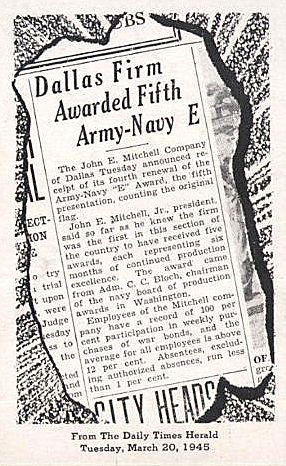
DALLAS FIRM AWARDED FIFTH ARMY-NAVY “E”

The John E Mitchell Company of Dallas Texas announced receipt of its fourth renewal of the Army-Navy E award, the fifth presentation, counting the original flag.

John E Mitchell, Jr., president, said so far as he knew the firm was the first in this section of the country to have received five awards, each representing six months of continued production excellence. The award came from Adm. C. C. Bloch, chairman of the navy board of production awards in Washington.

Employees of the Mitchell company have a record of 100 per cent participation in weekly purchases of war bonds, and the average for all employees is above 12 per cent. Absentees, excluding authorized absences, run less than 1 per cent.

From the Daily Times Herald, Tuesday, March 20, 1945

*

mitchell_2

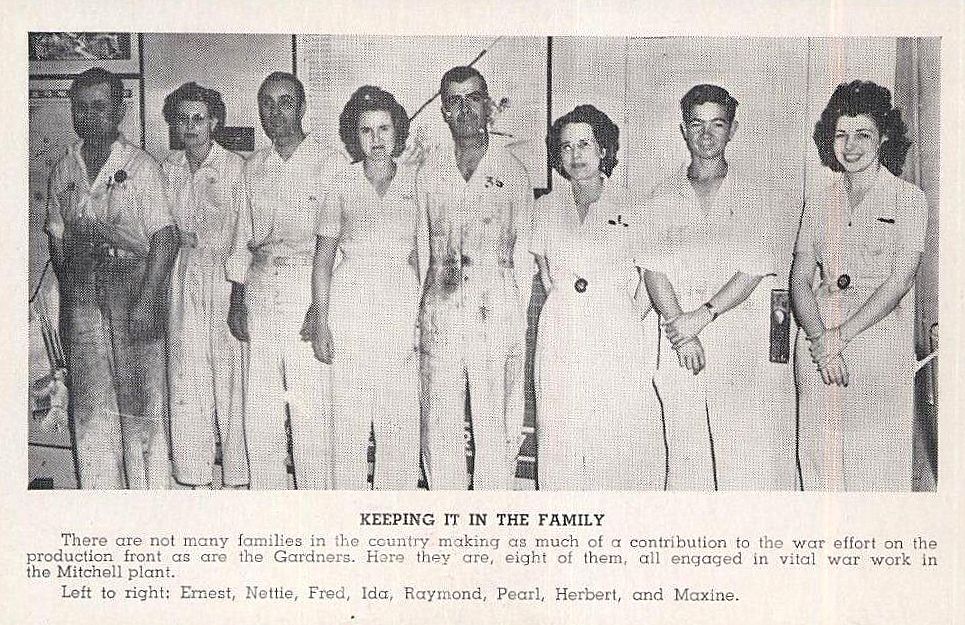
KEEPING IT IN THE FAMILY

There are not many families in the country making as much of a contribution to the war effort on the production front as are the Gardners. Here they are, eight of them, all engaged in vital war work in the Mitchell plant.

Left to right: Ernest, Nettie, Fred, Ida, Raymond, Pearl, Herbert, and Maxine.

*

mitchell_4

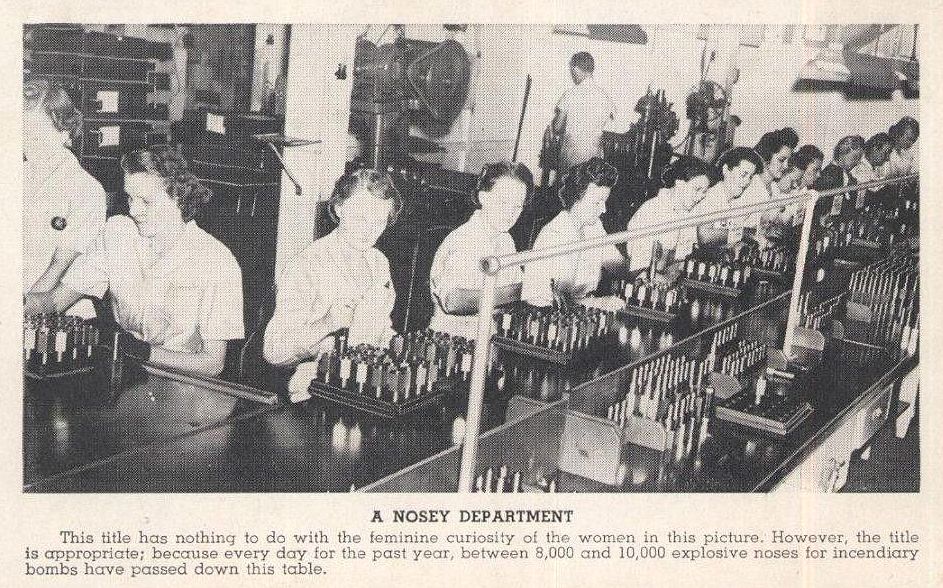
A NOSEY DEPARTMENT

This title has nothing to do with the feminine curiosity of the women in this picture. However, the title is appropriate; because every day for the past year, between 8,000 and 10,000 explosive noses for incendiary bombs have passed down this table.

*

mitchell_6

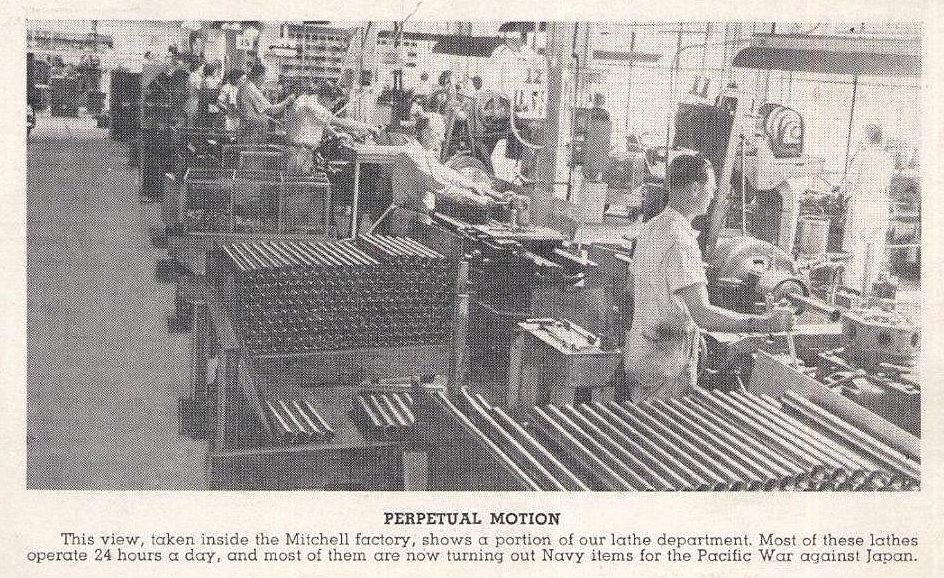
PERPETUAL MOTION

This view, taken inside the Mitchell factory, shows a portion of our lathe department. Most of these lathes operate 24 hours a day, and most of them are now turning out Navy items for the Pacific War against Japan.

*

mitchell_7

BIG JOKE

When this picture was taken, our president, John Mitchell, had evidently pulled off some sort of wisecrack which everyone seemed to enjoy, especially Mr. Mitchell himself.

The scene: one of the Mitchell Company’s regular Monday assembly meetings. The honored guests: Barney Kidd and Raleigh Smith, former Mitchell employees, now representing their company in both branches of the armed services.

*

mitchell_9

MEET OUR INDUSTRIAL CHAPLAIN

Let us introduce you to Art Isbell, the Mitchell Company’s industrial chaplain, shown here consulting with receptionist Doris Aday.

One of the first concerns in the nation to retain a full time industrial chaplain, the Mitchell Company has already discovered how important his services can be. Handling funeral arrangements, visiting the sick, helping with personnel problems, rendering spiritual guidance, Art Isbell has made himself invaluable to Mitchell men and women and has already endeared himself to the hearts of many through his patient understanding and never-failing cooperation.

*

mitchell_10

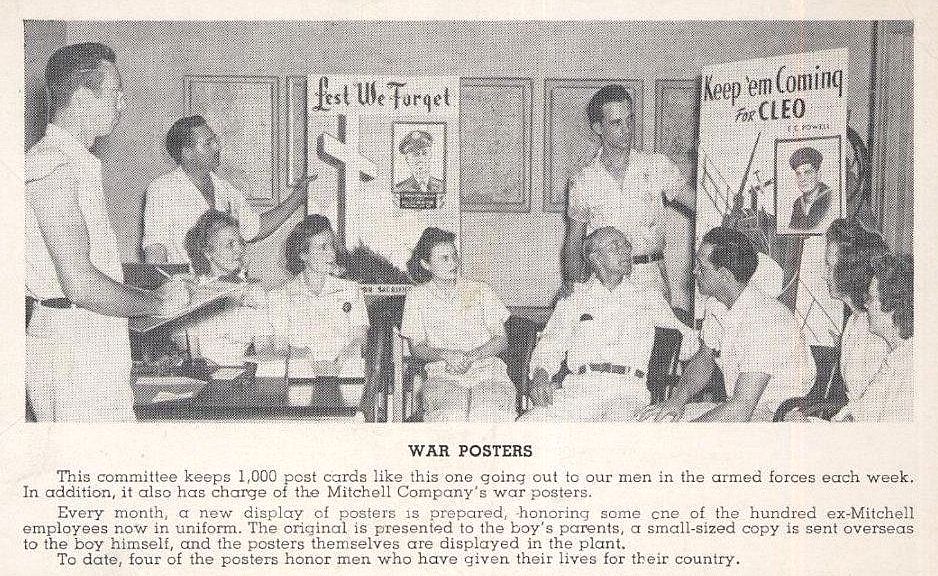
WAR POSTERS

This committee keeps 1,000 post cards like this one going out to our men in the armed forces each week. In addition, it also has charge of the Mitchell Company’s war posters.

Every month, a new display of posters is prepared, honoring some one of the hundred ex-Mitchell employees now in uniform. The original is presented to the boy’s parents, a small-sized copy is sent overseas to the boy himself, and the posters themselves are displayed in the plant.

To date, four of the posters honor men who have given their lives for their country.

***

Sources & Notes

Postcards found on eBay last year. I was a little surprised to find that most of them are still available for purchase, here.

For more on the Mitchell Company’s early days as a munitions plant, see the Dallas Morning News article “E Award Given Plant Doing Munitions Job” (DMN, Dec. 29, 1942).

The Mitchell Lofts building is a long way from being war-time production plant. Here is what it looks like today.

mitchell-building_google
Google Maps (click for larger image)

Another Flashback Dallas post on a local munitions plant (this one downtown) —  “2222 Ross Avenue: From Packard Dealership to ‘War School’ to Landmark Skyscraper” — is here.

Part 2 features more of these postcards of the Mitchell Company’s war work, here.

Part 3 will focus on the building itself.

Check back!

*

Copyright © 2016 Paula Bosse. All Rights Reserved.
 

Labor Day Parade — 1911

labor-day-parade_typographical-union_ca1911_cook-colln_degolyerUnion men on parade… (click for larger image)

by Paula Bosse

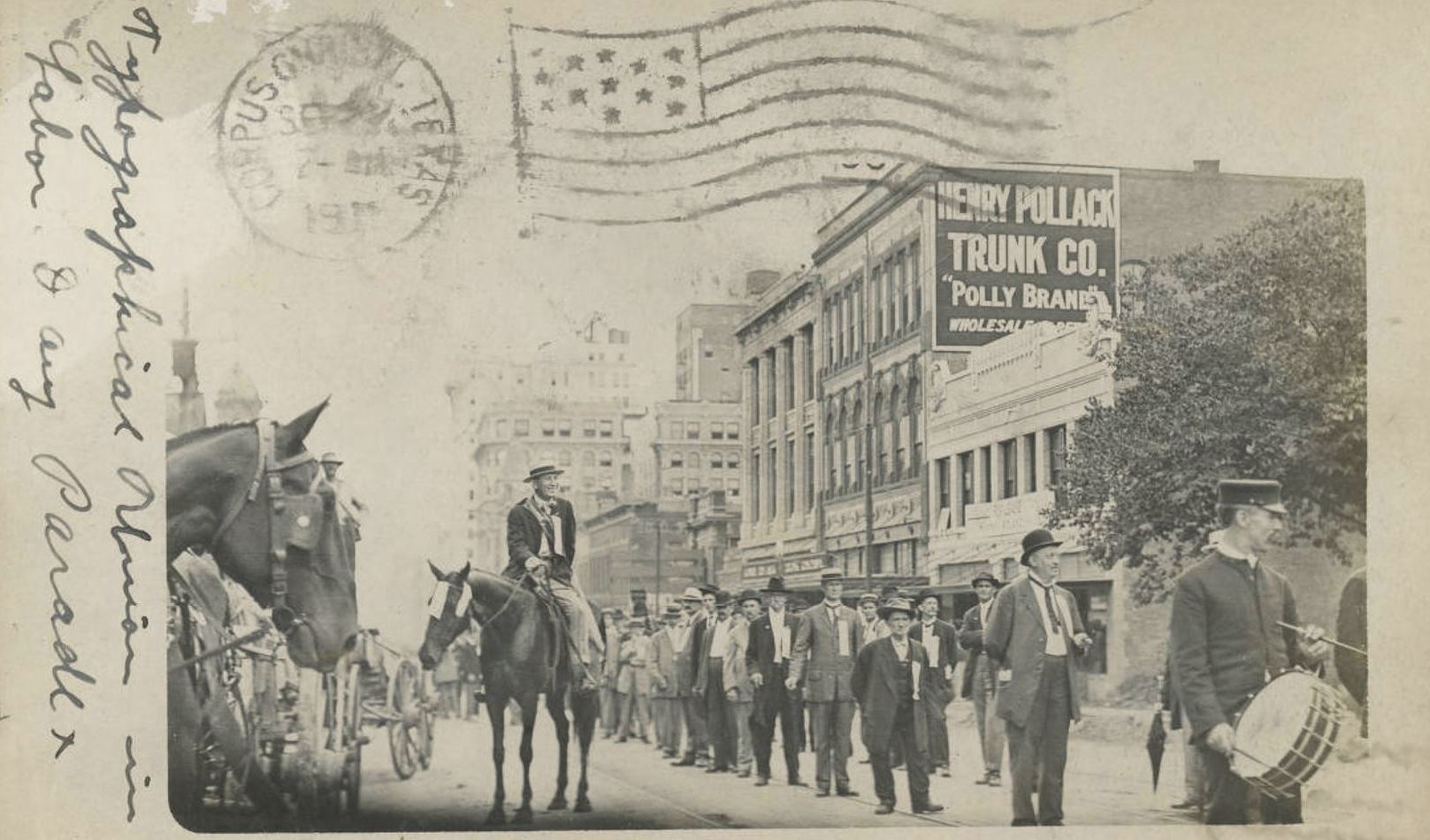
The photo above shows members of the Typographical Union marching in the Labor Day Parade held on Sept. 4, 1911. The photograph was taken looking west on Main Street toward St. Paul. (The Henry Pollack Trunk Co. was in the 1900 block, later occupied by the Titche’s building, now the Universities Center.)

The real photo postcard was sent three weeks later by John R. Minor, Jr. (a member of the union who worked as a linotype operator at The Dallas Morning News) to his mother, Mrs. Ada L. Minor, who was convalescing in Corpus Christi. (It’s possible the 27-year-old Minor was in this photo.)

Coverage of the day’s festivities can be read in the DMN article “Labor Day in Dallas Excels Past Record” (Sept. 5, 1911) here.

May your Labor Day not be spent walking behind a horse!

*

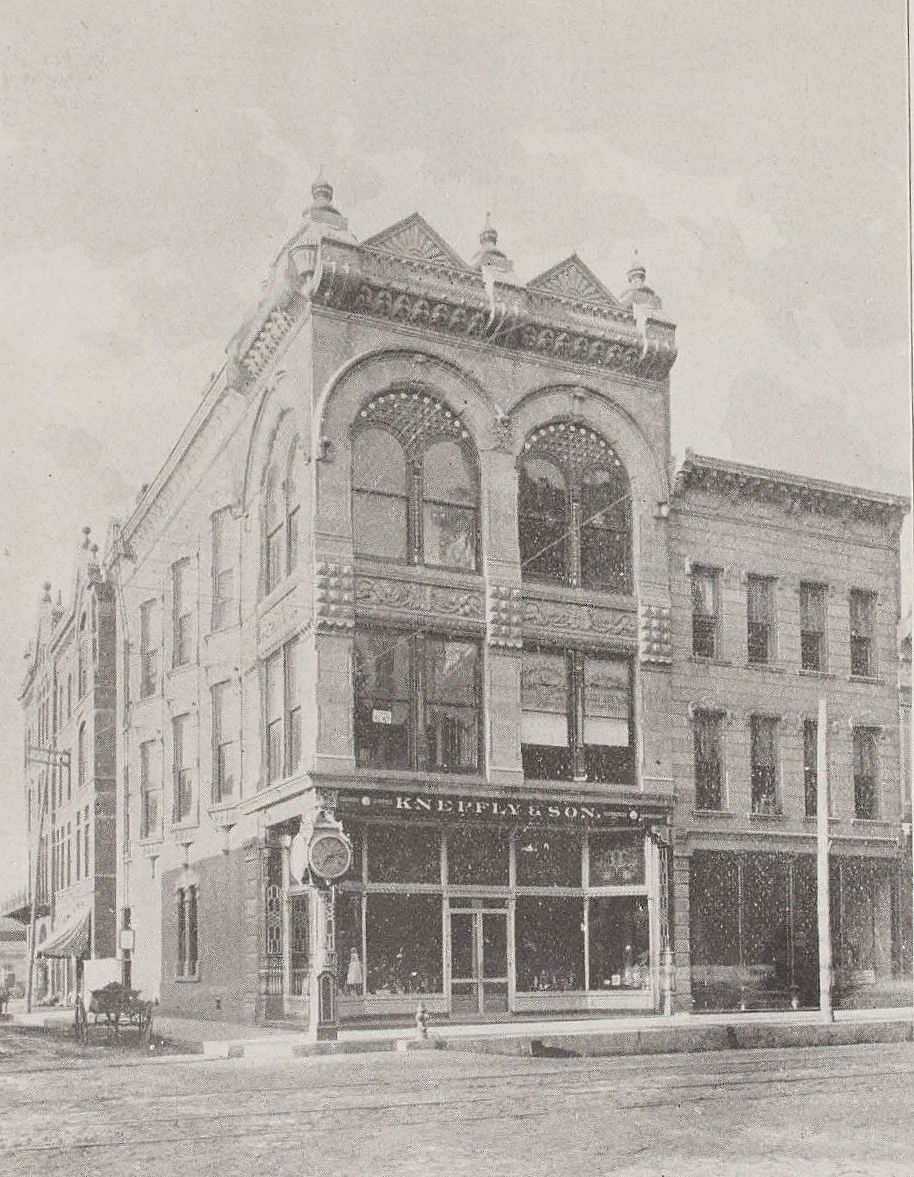
I feel I have to insert this bit of trivia here, if only because I spent so much time reading about the Minor family: in 1906, when John R. Minor, Jr. was 22 years old, the building in which he had a third-floor apartment was consumed by fire in the early hours of the morning. The three-story Knepfly Jewelry Building — built in 1888 on the southwest corner of Main and Poydras — was something of a landmark. The fire spread through the building so quickly that the only way to escape was to jump. Minor jumped and broke both legs and his pelvis. He was not expected to live, but he managed to pull through and spent several weeks in the hospital recovering. Two of the other top-floor residents died — one of whom had also jumped. Here’s the building. Minor had to jump past the telegraph wires on the Poydras (left) side of the building (the telegraph wires can be seen better in this photo from Dallas Rediscovered). He landed on his feet in the middle of the street. It’s amazing he didn’t break more bones. (Click for larger image.)

knepfly-bldg_church_dallas-through-a-camera_ca-1894_SMU

If he had marched in the 1911 Labor Day parade — which went west down Elm from about Pearl, then back east on Main from Lamar — he would have walked right past the building. On second thought, if he broke both legs and his pelvis, a mile-long march in a parade might have been a little taxing. (Maybe he’s the one on the horse!)

***

Sources & Notes

Postcard titled “Typographical Union in Labor Day Parade” is from the George W. Cook Dallas/Texas Image Collection, DeGolyer Library, Southern Methodist University; more info (and an image of the message side of the card) can be found here.

The photo of the Knepfly Building is by Clifton Church, from his book Dallas, Texas Through a Camera (1894), accessed from the DeGolyer Library, SMU Libraries, Southern Methodist University; more info is here.

Click pictures to see larger images.

*

Copyright © 2016 Paula Bosse. All Rights Reserved.
 

“Magnolia Building by Night”

magnolia-bldg-night

by Paula Bosse

Still standing. Still beautiful.
See a similar postcard, with a wider view — and a blobbier Pegasus — here.

*

Copyright © 2016 Paula Bosse. All Rights Reserved.