Flashback : Dallas

A Miscellany: History, Ads, Pop Culture

Category: State Fair of Texas

Some-Context Channel 8 Screenshots: 1971

lady mailman june 1971 WFAAWFAA Collection/Jones Film Collection/SMU

by Paula Bosse

I have been working as part of a 3-person team (led by Jeremy Spracklen and Scott Martin) on the WFAA archive of news film, housed in the G. William Jones Film and Video Collection at the Hamon Arts Library at SMU. I have been working on 1970 and 1971, going through daily footage shot for Channel 8 News. I get a bit bogged down by all the sports and car crashes, but at this point, I am so all-consumed by these two specific years that I feel I would do well on Jeopardy if the categories were things like “Minor League DFW Hockey Teams of the Early ’70s,” “Internecine Squabbles of the Dallas City Council, the Dallas School Board, and the Dallas County Commissioners Court,” and “So What’s the Deal with the Sharpstown Scandal?” My 2023 has been spent immersed in 1971, where the chaos of the implementation of court-ordered school busing, the huge securities fraud scandal that involved some very powerful Texas politicians (Sharpstown), and the battle between Craig Morton and Roger Staubach to become the Cowboys’ #1 quarterback were some of the stories that dominated the headlines. And, lordy, there were some pretty exotic hairstyles, fashions, and interior design trends hammering away relentlessly throughout this post-hippie (it might really still have been current-hippie), pre-disco period.

Here are a few of my favorite moments from this 1971 DFW-centric news footage from the WFAA archives. Links to the pertinent clips on YouTube are included at the end of the descriptions. These clips are rarely the full reports that would have been seen on the nightly news — they are often just silent footage or B-roll, without any identification of people or clues as to where they were filmed or even why they were newsworthy. It’s (mostly) a lot of fun to dig through and watch the unfolding of history from more than 50 years in the future.

**

Above, from JUNE 1971

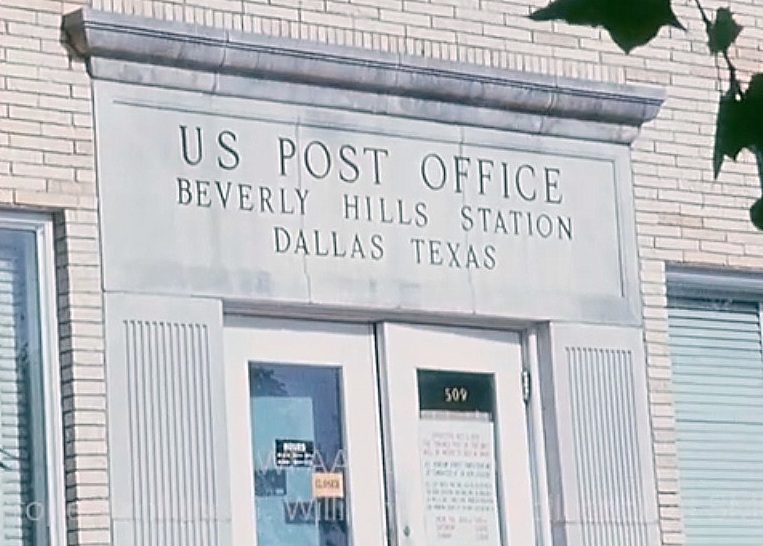
One of my favorite human-interest stories from the past year (meaning 1971!) was the profile of one of the few “lady mailmen” in Dallas at the time. She’s utterly, utterly charming, has a supportive and interesting husband and family, and loves her job. The Channel 8 cameraman shows her as she sorts her mail in the Beverly Hills Station post office in Oak Cliff and follows her as she walks along her route on West Davis. The only problem with this 7 minutes of interesting footage is that the woman is never identified. I dove in, really wanting to identify her. I thought I had cracked the mystery of her identity, only to find myself at a dead end again. If only her children could see this wonderful profile of their mother. If you know who this woman is, please let me know, and we’ll add her name to the YouTube description and try to track down any family members. I would LOVE her children to be able to see this.

The “lady mailman” is interviewed here (this first bit is in three short segments, totaling 4 minutes); a later clip shows her on her route, here (about 3 minutes). The old post office building still stands at 509 N. Barnett.
lady mailman june 1971 WFAA_beverly hills post office

*

JANUARY 1971

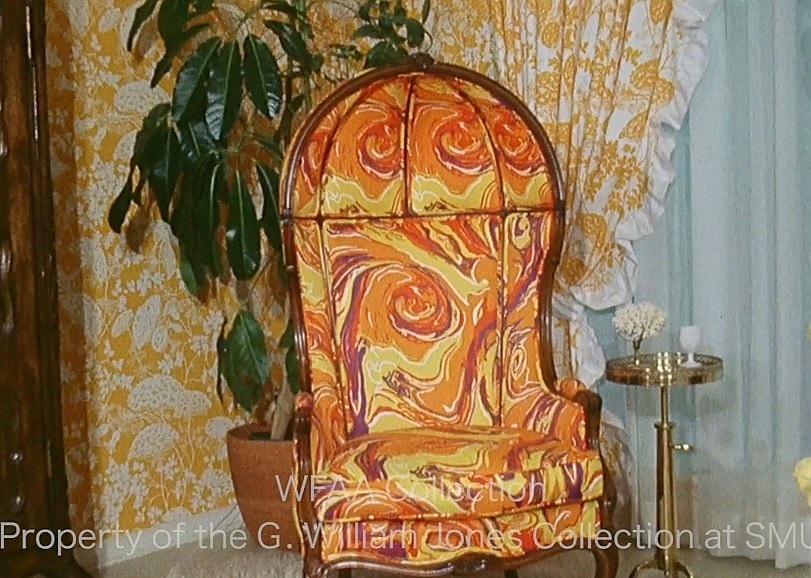
So, yeah, fashion and interior design trends were pretty… in-your-face in 1971. In the three screenshots below, you’ll see some retina-abusing images of with-it decor. The first features the always beautiful Phyllis George, the Denton native who was in the midst of her Miss America reign. In this clip, she has come back home to DFW for an appearance at an event in which a room designed with her in mind is unveiled (by decorators C. John Megna and William Farrington). She is wearing a dress designed by Carlo Bitetto specifically for her to wear IN THAT ROOM (!). You don’t often see sparkles and plaid cheek-by-jowl.

The clip with the super-color-saturated room and its battling patterns is here.

phyllis-george-room_jan-1971_c

phyllis-george-room_jan-1971_b

phyllis-george-room_jan-1971_a

*

FEBRUARY 25, 1971

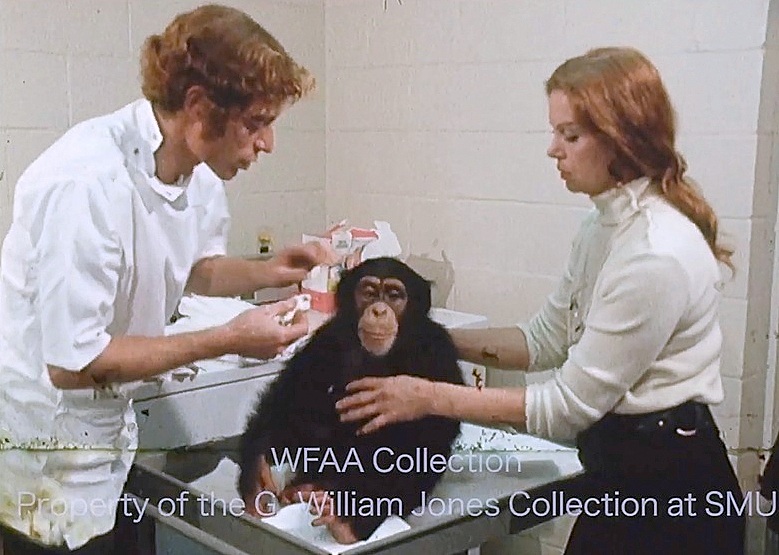
Before Lion Country Safari, Mesquite had World of Animals, a drive-thru safari park. World of Animals had a wild-animal veterinarian who visited regularly from California: Dr. Martin Dinnes. Below, Dinnes is seen providing dental care to popular attraction Harold the Chimp. This is not really something I expected to see, but there you are. (Dinnes was later engaged to actress and wildlife preservation activist Tippi Hedren for several years.)

The clips of Dinnes being interviewed and preparing Harold for a tooth extraction (and I grimaced a bit, because the camera keeps rolling during the procedure, so be warned!) are here and here. (The last clip has a shot of Harold’s hand, which, understandably, appears to be gripping the chair.) That is one well-behaved, chill chimp!
dinnes-martin_harold-chimp_022571_WFAA

*

MAY 18, 1971

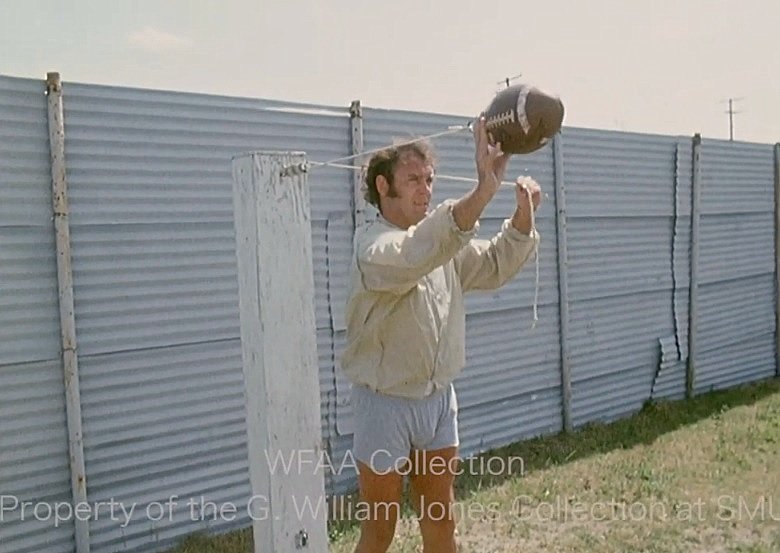
In 1971, there was an ongoing battle between old quarterback Craig Morton and NKOTB Roger Staubach over who would be named the team’s official starting QB. Coach Tom Landry worked for months with a two-quarterback system, alternating them from game to game — he was fine with this, but everyone else hated it. Below are screenshots of Morton and Staubach at the Cowboys practice field. I know virtually nothing about sports training, but this, um, extremely low-tech gadget struck me as weird. And funny. I mean, okay, it was 1971, but surely there was something more technologically advanced than this? It’s a football on a string, tied to a post. And maybe there’s a spring or something in there. This must have been effective. Rog looks like he’s straining. I don’t know. But I love it.

See Craig in an interview with Verne Lundquist from May 18, 1971 about his elbow and shoulder injuries here, and then using the football-on-a-string thing (and then training with Staubach) here; and see Roger interviewed on the same day about really, really wanting to be the starting QB here, and then he hits the string thing here before working out with Morton in what must have been a fairly tense period of both of their careers.
morton-string_WFAA_may-18-1971

staubach-string_WFAA_may-1971

*

JUNE 1971

Medical examiners used to be on the news a lot. One who popped up frequently was Tarrant County M.E. Dr. Feliks Gwozdz. I was amused more than I should have been when I saw the skull-and-crossbones coffee mug on his desk. I hope it said “World’s Greatest Coroner!” on the back.

The silent footage of Dr. Gwozdz at his desk is here.

skull-crossbones_feliks-gwozdz_june-1971

*

JULY 14, 1971

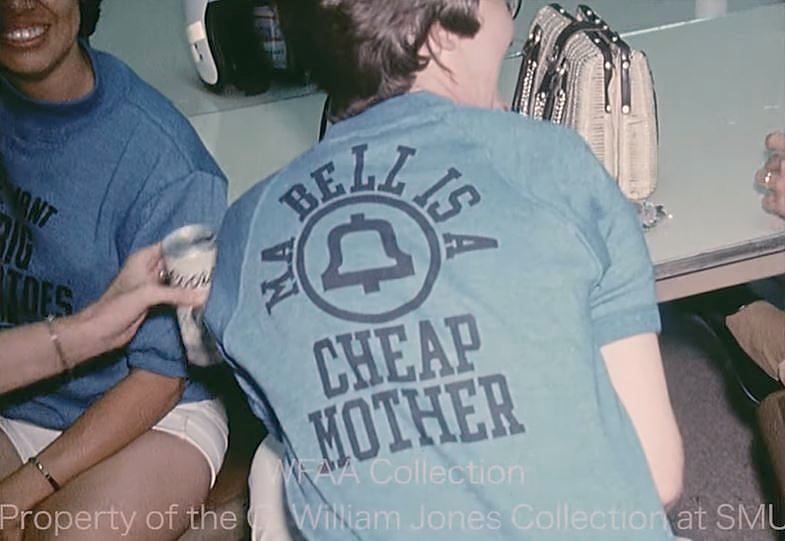
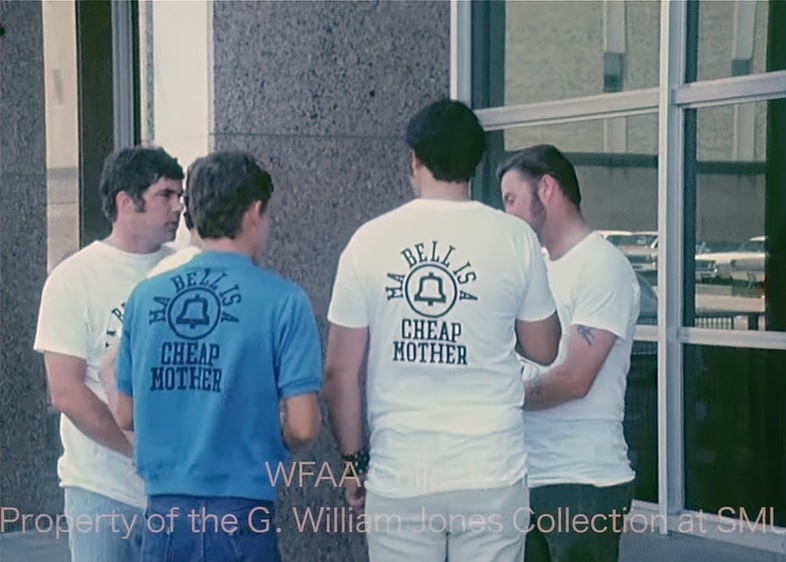
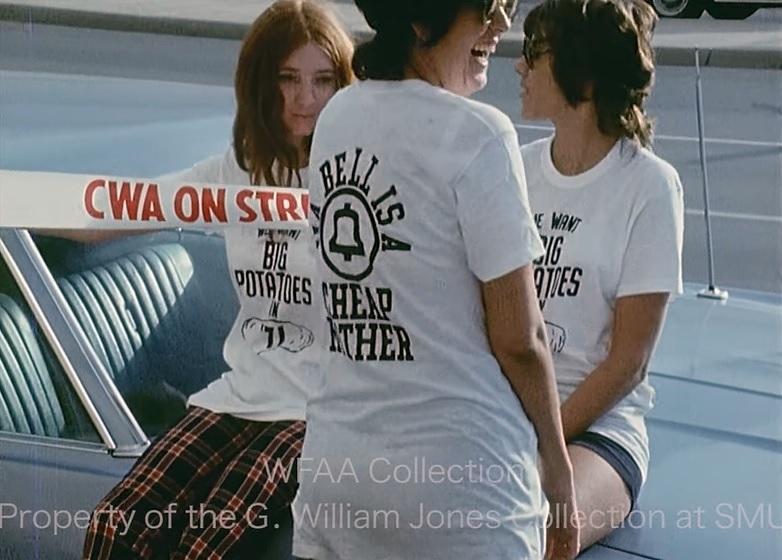
Back in 1971 there was what seemed like the threat of a union strike every 10 minutes. I enjoyed the footage of a bunch of Southwestern Bell employees who look like they were probably a lot of fun to hang out with. Their t-shirts read “Ma Bell Is a Cheap Mother,” which is just great.

Strike footage is here (about 2½ minutes) and here.
SWB-strike_july-14-1971_big potatoes

SWB-strike_july-14-1971_ma bell is a cheap mother

SWB-strike_july-14-1971_WFAA

*

JULY 1971

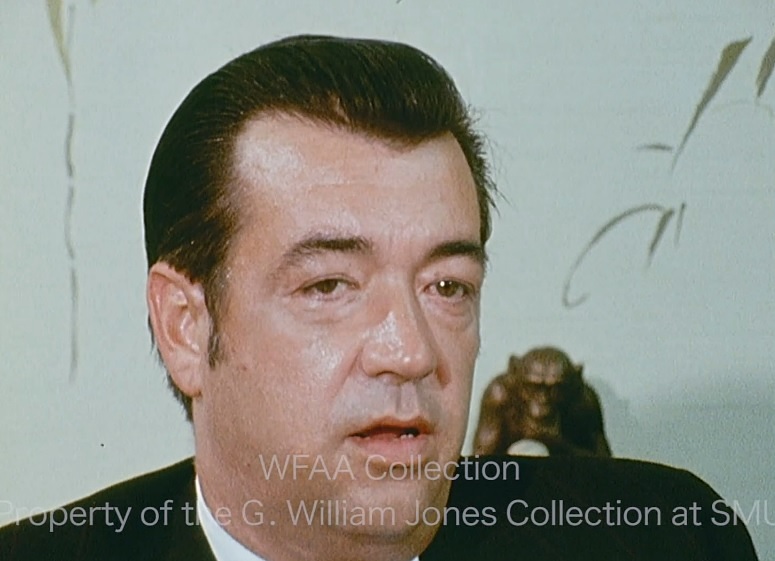
One of the top stories of 1971 was the endless furor set off by court-mandated school busing in attempts to desegregate schools. It was a mess. The man seen below is attorney Bill Brice, a leader of one of the many anti-busing groups. …Surely the cameraman noticed the monkey.

Man with monkey can be seen here.
anti-busing_bill-brice_monkey_WFAA_july-8-9-1971

*

AUGUST 29, 1971

When the Dallas School Board and Supt. Nolan Estes weren’t pulling their hair out over desegregation, they tackled other issues. One of which was so overshadowed by anti-busing demonstrations that it barely got any play, but I find it really interesting. It concerned Crozier Tech High School downtown. At the end of the 1970-71 school year, the landmark school was closed, and there was lots of discussion on what the DISD should do with the building/land, which they owned (2218 Bryan). This press conference was supposed to be about Estes’ vision of a 40-story school-office complex, which he suggested be built on the land — the first 10 floors would be for school use, and the top 30 floors would be leased to businesses as office space, with leases, theoretically, paying for construction and maintenance of the building. The building was never built (and thankfully, old Tech still stands). School board president John Plath Green and Supt. Estes sit in front of an architectural drawing of the envisioned DISD skyscraper. Too bad no one wanted to talk about it.

Footage from the press conference where reporters only want to ask about busing, is here.

super-school_DISD_crozier-tech_DMN_082971_WFAA_SMU

*

SEPTEMBER 23, 1971

The Sharpstown Scandal was a bigger story than busing, but, even though political scandals are juicy, it just didn’t get everyday people mobilizing, marching in the streets, and shouting each other down in public forums the way busing did. But it was a massive story, and several political careers bit the dust because of it. The sprawling and confusing securities-fraud scandal mostly involved drab politicians and business executives. But one part of it involved, bizarrely, six celebrated — if not beloved — NASA astronauts and an insurance company pension fund.

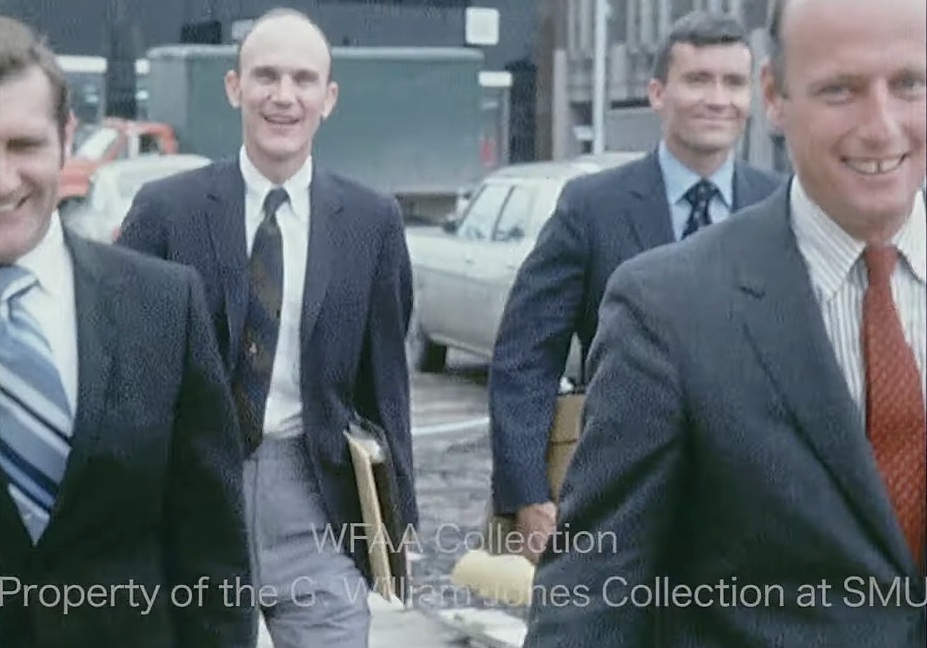
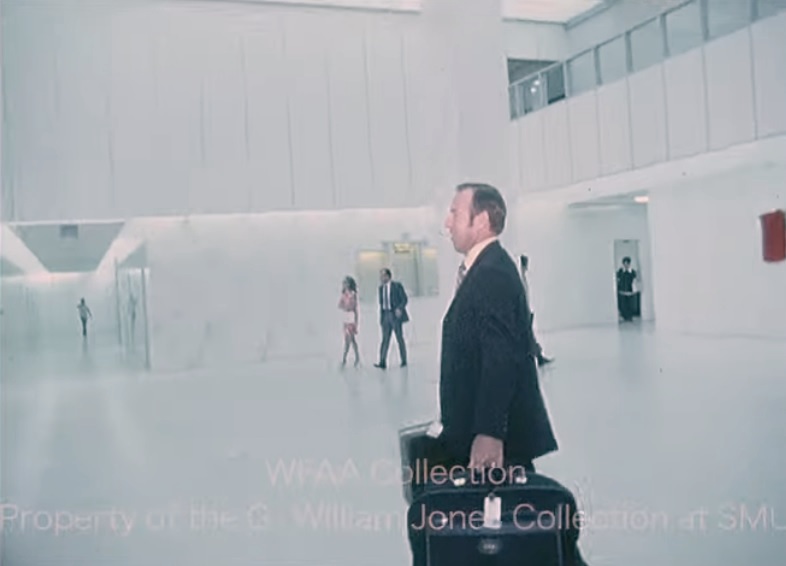
In this Channel 8 footage, you can see something you don’t see every day: five NASA astronauts walking together down the street (a sixth one was nearby, on his own). James Lovell, Pete Conrad, Fred Haise, Ken Mattingly, Richard Gordon, and Alan Bean were in Dallas on Sept. 23, 1971 to testify as witnesses before a federal grand jury that was investigating the activities surrounding the Sharpstown Scandal. These are screenshots of the five (minus Lovell), carrying briefcases through grubby downtown Dallas, and of Lovell on his own, exiting the Federal Court House. When I first watched this footage, it just seemed really odd: five internationally (galactically!) famous astronauts — heroes! — walking together down the street, without any kind of security or entourage. If you were a NASA freak (and there were a lot back then, at the height of the Apollo-Gemini programs) and you just happened to have walked past this group, your head would have exploded.

See Lovell exiting the sterile- and dystopian-looking courthouse on his own (that woman he holds the door open for has no idea who he is), and the others walking somewhat playfully down the street here (I love this footage!); a confusing wrap-up of the day’s events is here.
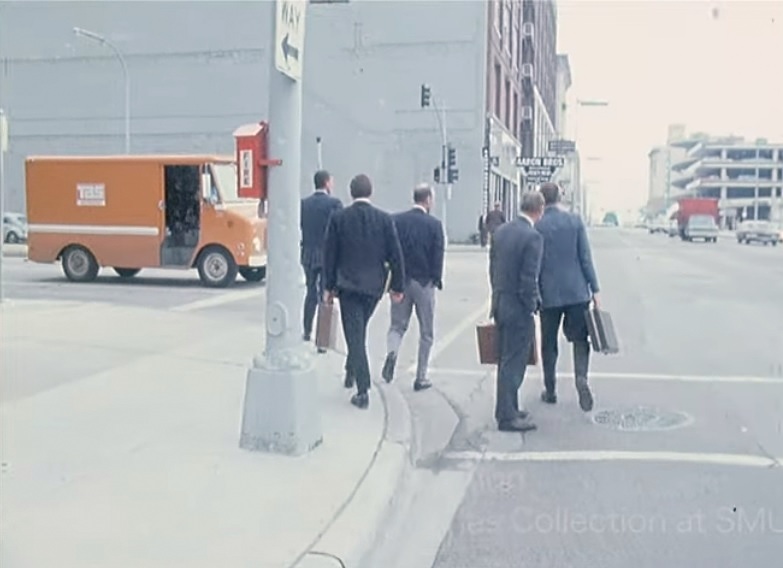
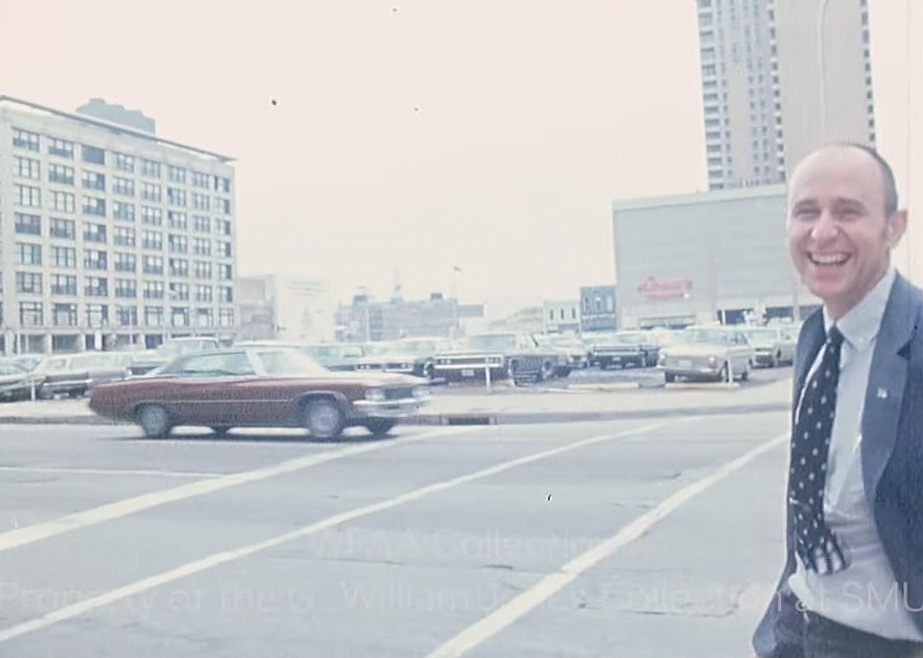
astronauts_WFAA_SMU_sept-23-1971

astronauts_WFAA_SMU_sept-23-1971_1

astronauts_WFAA_SMU_sept-23-1971_2

astronauts_WFAA_SMU_sept-23-1971_c

*

OCTOBER 14, 1971

In footage from the State Fair of Texas, I was really taken by this building, which I swore I had never seen. It was the home of the “lost children” center during the fair, in the Dallas police HQ in Fair Park. It looks different to me now, but it’s still there, near the Aquarium. It looked better in 1971!

Lots of footage of crying children and harried parents, here and here.
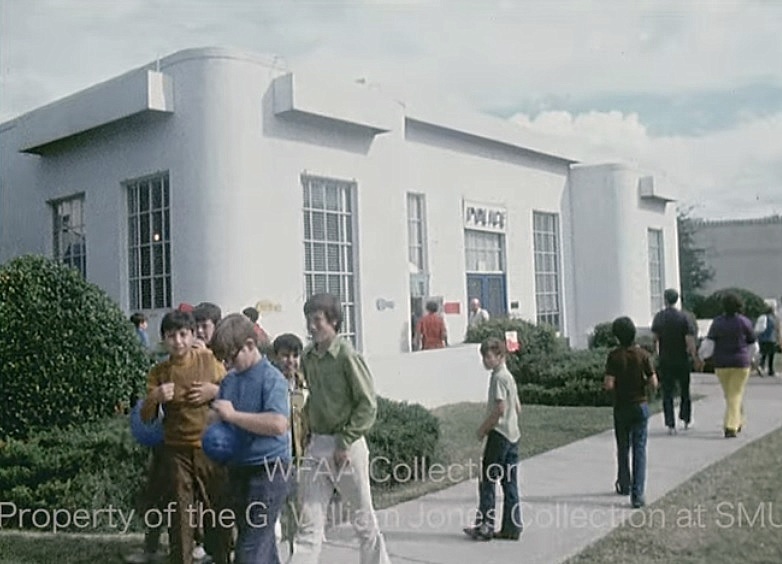
fair-park_sfot_lost-kids_101471_WFAA_SMU

*

OCTOBER 1971

This young dandy is named John Ott (I’m not 100% sure about the spelling). He was a real estate developer in Euless. He couldn’t have been more on top of the 1971 fashion wave. Represent, Euless!

It’s a story about replanting trees (with, admittedly, interesting footage of trees being uprooted and replanted). Here and here.
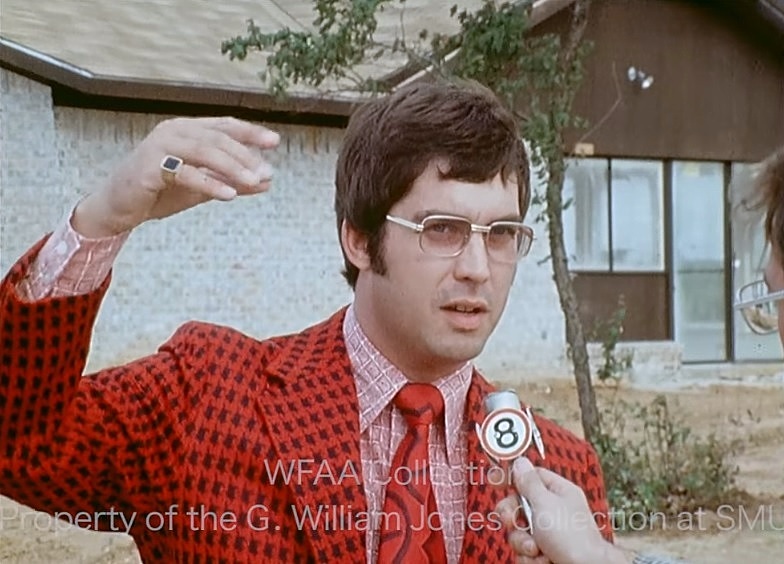
developer_john-ott_euless_oct-29-30-1971_WFAA_SMU

*

OCTOBER 31, 1971

In the screenshots below, Channel 8 reporter Judi Hanna (who had recently debuted an unfortunate hairdo) interviews Dallas City Councilman Garry Weber about City Council things. I don’t know where this was filmed, but I only hope it wasn’t his home. It’s hard to focus on what anyone is saying, because of the tidal wave of stuff coming at you. (Ironically, he was being interviewed about sponsoring a change to the city charter in order to crack down on the “visual pollution” of unenforced sign ordinances.) I was so overwhelmed by this vista, that I somehow assumed I was seeing cupid-studded wallpaper. But no. Check out the second screenshot, which also includes a peek at the room’s drapes. I can’t tell where the wallpaper ends and the drapes begin.

Appropriately shown on Halloween night, clips from this report are here (followed by footage of signs-galore along Lemmon Avenue) and here.
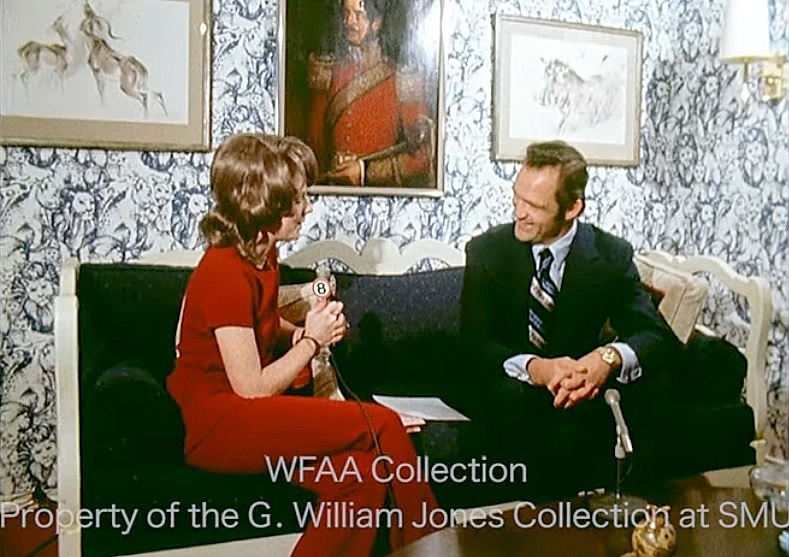
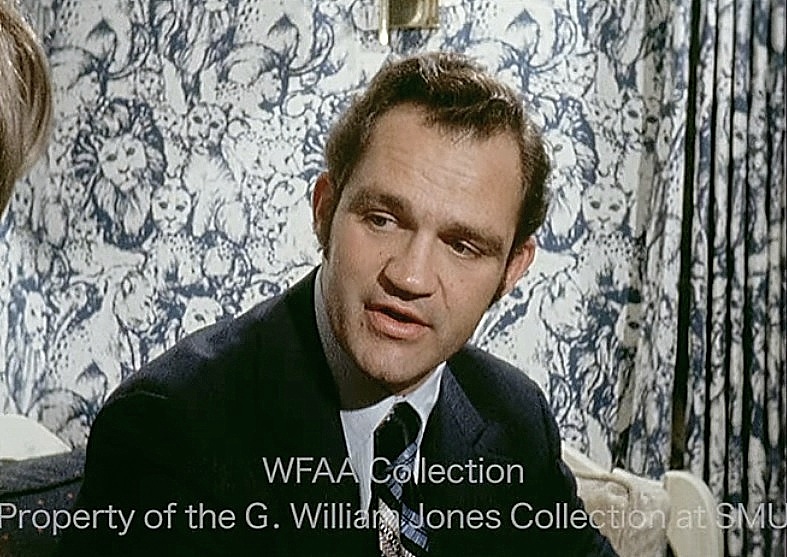
weber-garry_WFAA_SMU_oct-31-1971_wide

weber-garry_WFAA_SMU_oct-31-1971_drapes

*

OCTOBER 1971

Lastly, a shot of Mingus, Texas, a small West Texas town near Thurber. I just love this image. I think I found the location — here’s what it looks like now.

Why was the tiny town of MIngus being featured on a Dallas news report? The Greater Mingus-Thurber Metropolitan Area was in the news because it was the location of a commune of the controversial Children of God (i.e. “cult”). Actually, the “Children” were in the process of being evicted by the landowner, who, interestingly, was a TV preacher in Los Angeles (I guess even TV evangelists have a breaking point). Members of this group splintered, and a few moved to Big D for a while, where they continued to be newsworthy until they moved elsewhere.

The shot of Mingus is from one of the many clips contained in this Oct. 7 package, here (it is specifically at the 1:08 mark). Below that is a shot from a week later, after some of the self-described “Jesus Freaks” had landed in Dallas — a group member is seen walking through Exposition Park to their new HQ, at 639½ Exposition — it and other CoG footage from Oct. 14, 1971 is here (this specific shot is seen at the 17:18 mark). (If you are considering a documentary on the Children of God, there’s lots of footage for you in the WFAA archives at SMU.)
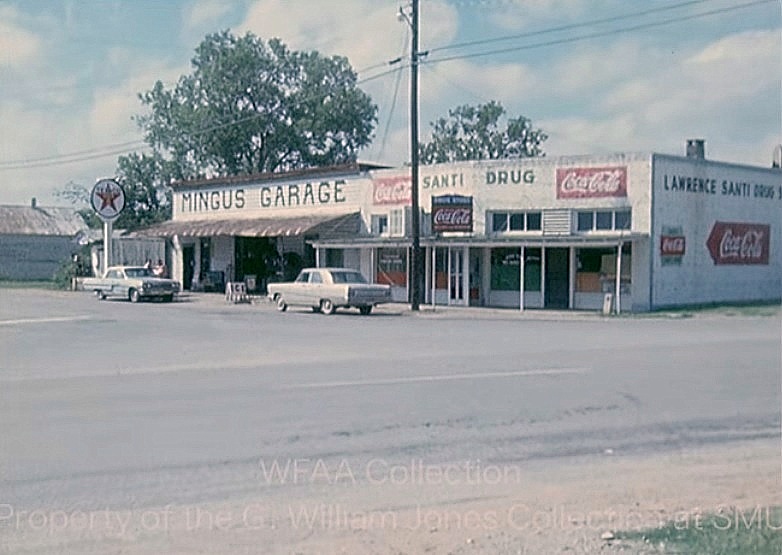
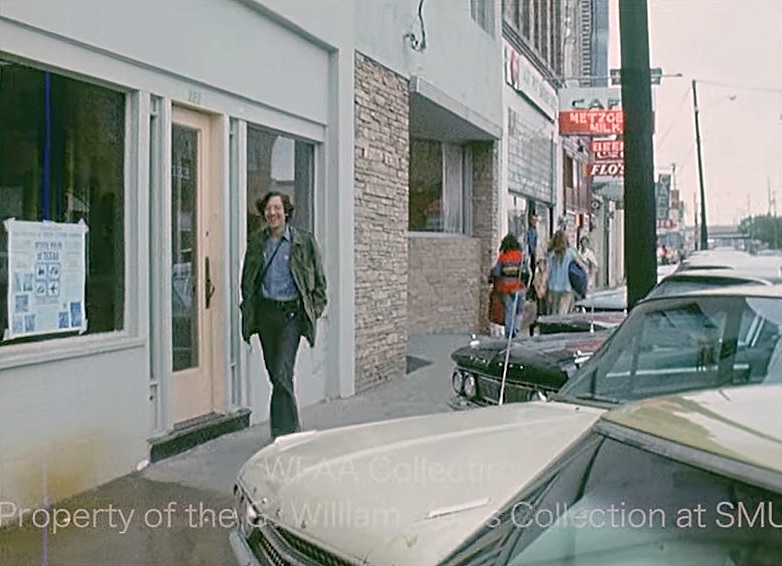
mingus_WFAA_SMU_100771

children-of-god_expo-park_WFAA_SMU_oct-14-1971

*

AUGUST 1971

This is a bonus.

As I worked my way through 1971, there was one truly amazing story. It involved the kidnapping of a toddler in Fort Worth. On Aug. 25, 1971, 21-month-old Melissa Suzanne Highsmith disappeared. Her 22-year-old mother, Alta, had hired a new babysitter, who was supposed to watch her for the day while Alta was at work. The babysitter picked Melissa up in the morning as planned, but she never returned the child. The babysitter and Melissa disappeared without a trace. There were no leads in the case for years. …And YEARS.

In 2022, the Highsmith family learned of an online DNA match, which would indicate they had found Melissa. Eventually, it was determined that a 50-something-year-old woman named “Melanie” was actually the long-missing Melissa. The woman who kidnapped her raised her as her own daughter, and Melissa never suspected she wasn’t the woman’s child (although she says she never felt really “connected” to her).

Melissa (she now uses “Melissa” again) was reunited with her family at the end of 2022. One report I read said that she grew up only 10 minutes from the Fort Worth apartment her mother lived in. Despite the Highsmith family’s 51 years of loss, grief, worry, and suffering, there has ultimately been a happy ending!

In the screenshot below from an Aug. 26, 1971 Channel 8 story, Alta Highsmith shows a photo of her missing daughter to the camera. The report is here.
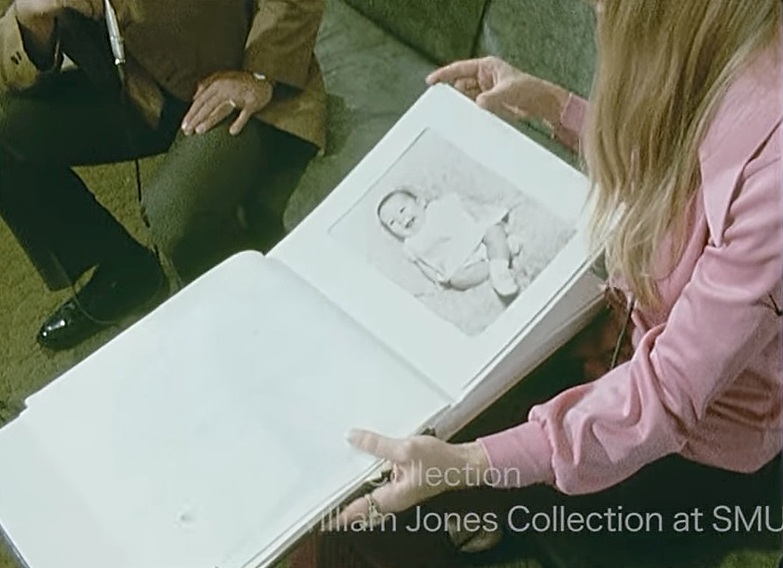
kidnapping_highsmith_WFAA_SMU_aug-26-1971

**

If you managed to get all the way through this, you deserve an award! This might be the longest thing I’ve written all year! I’m more than ready for my 1971 Jeopardy challenge (Dallas edition)!

***

Sources & Notes

All screenshots are from news film in the WFAA Collection, held by the G. William Jones Film & Video Collection, Hamon Arts Library, SMU. Clips are posted regularly from this Channel 8 collection on YouTube, here.

My previous collection of WFAA screenshots can be found in the post “No-Context Channel 8 Screenshots: 1970-1971.”

lady mailman june 1971 WFAA_sm

*

Copyright © 2023 Paula Bosse. All Rights Reserved.

Herbert A. Kline’s “Miniature Coney Island” at the State Fair of Texas — 1909

sfot_1909_entrance_ebay_a

by Paula Bosse

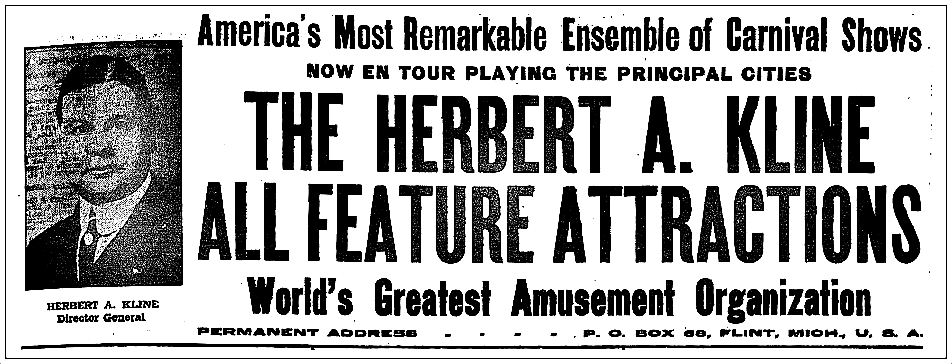
Herbert A. Kline (1873-1934) was a showman and promoter from Michigan who provided acts to several state fairs and large carnivals in the U.S. — his heyday appears to have been the 1910s. In 1909, he brought his troupe of performers and sideshow features to the State Fair of Texas. Most of the photos in this post are from promotional material for that 1909 season, with most of the photos showing Kline’s traveling “amusements.”

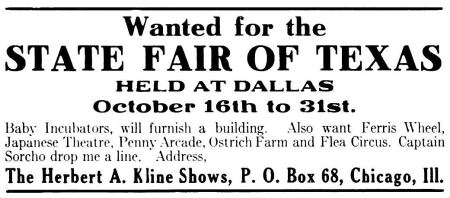
Two weeks before he got to Texas, he posted this ad in the entertainment trade magazine Billboard — I hope Capt. Sorcho (“the great deep-sea diver”) dropped him a line.

sfot_kline_billboard_100209 Billboard, Oct. 2, 1909

*

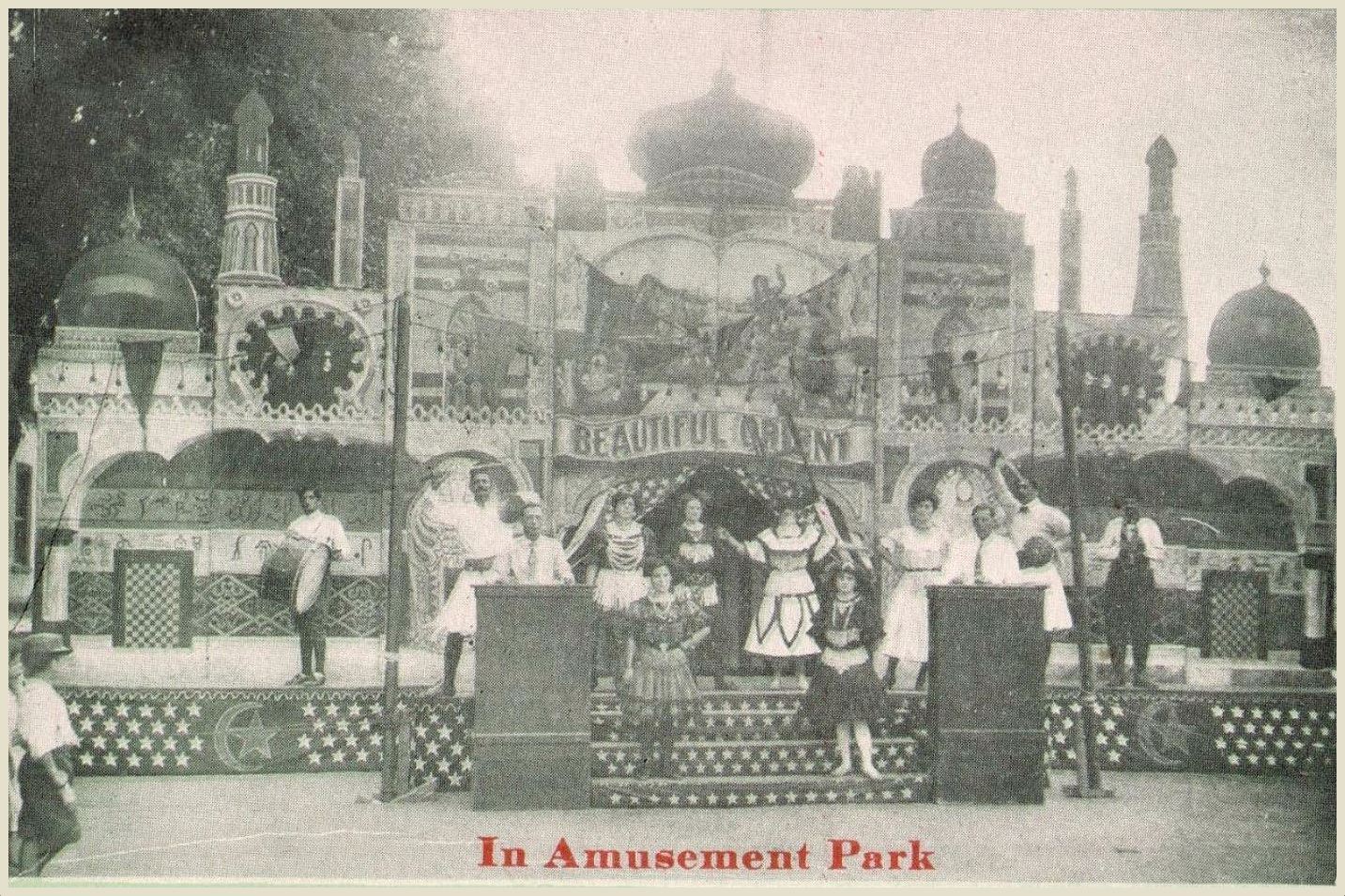
“THE BEAUTIFUL ORIENT” — included were dancers, gun-spinners, magicians, acrobats, and — somehow — wedding ceremonies. It also boasted “the cleanest and most refined dancing-girl show in America.”

sfot_1909_amusement-park_ebay_a

*

“SUPERBA, THE BEST” — a collection of vaudeville-type performers, including one woman whose “talent” appears to be that she was attractive.

sfot_1909_superba_ebay_a

*

“MRS. D. H. KINCHELOE, WARBLER” (a whistler/reader/vocalist/pianist from Kentucky — her name is misspelled below) and “THE GREAT McGARVEY, FEMALE IMPERSONATOR” (Bert McGarvey was known for a nicely turned-out ankle, charisma, magnetism, and a specialty number called “The Sacred Cobra Dance”). They — along with Galetti’s Musical Monkeys — would appear after the more high-brow operatic singers.

sfot_1909_warbler_female-impersonator_ebay_a

*

“THE IGORROTE VILLAGE” — native peoples of the Philippines gave a sort of presentation on how they lived, employing what might be seen as primitive customs in daily life. (A description of a “performance” in New York’s Central Park noted that there were demonstrations on how to shrink heads, which might have been too “exotic” for Dallas.)

sfot_1909_igorrote-village_ebay_a

*

John T. Backman’s Troupe of Glass Blowers — this was absolutely fascinating (the sign alone!). Check out this entertaining article about the sorts of things these people did.

sfot_1909_glass-blowers_ebay_a

*

Also in Kline’s family of traveling show-folk:

  • A creature half-reptile and half-human
  • Russian Prince Midget, who speaks three languages, weighs less than 16 pounds, and whose crib was a cigar box
  • Alice, The Wonder, “who is acknowledged by the press and the public to be the strangest girl in all the world”
  • Schlitzie, the Aztec Wild Girl, “whose head is no larger than an orange” (this is most likely the sideshow performer best known for appearing in Tod Browning’s cult movie “Freaks”)

*

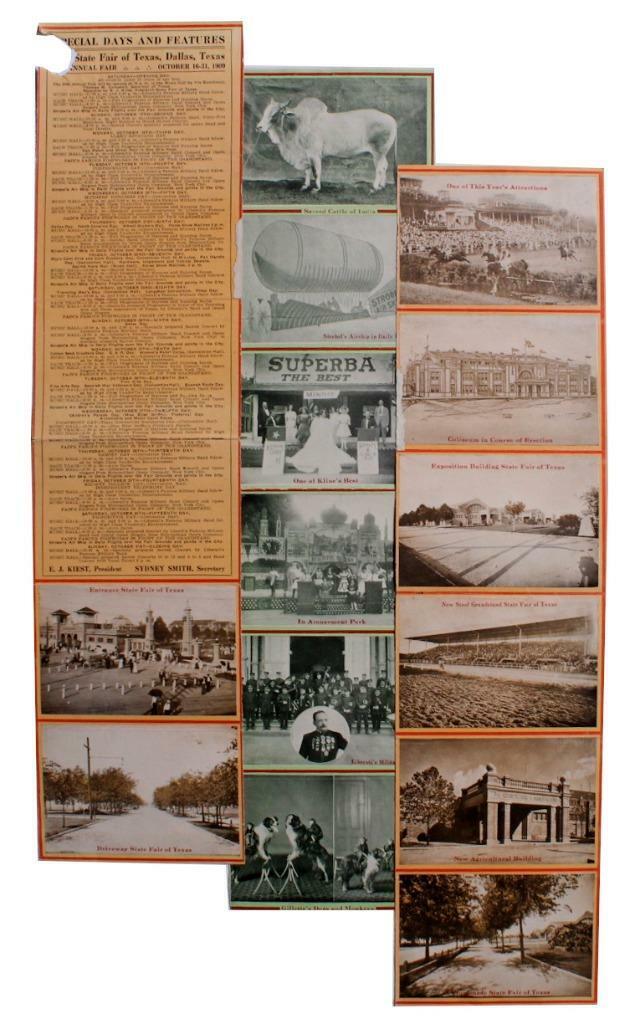
Here is an image from an eBay item, showing where these photos came from.

sfot_1909_collection_ebay

*

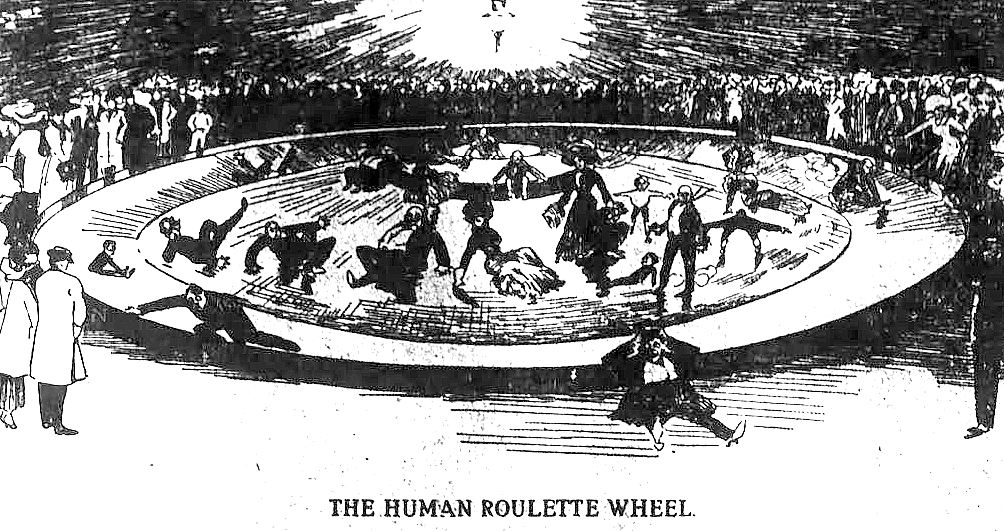
There was also a “ride” called “THE HUMAN ROULETTE WHEEL.” It was probably more fun for the spectators than for the participants.

sfot_1909_human-roulette-wheel_houston-post_110709Houston Post, Nov. 7, 1909

*

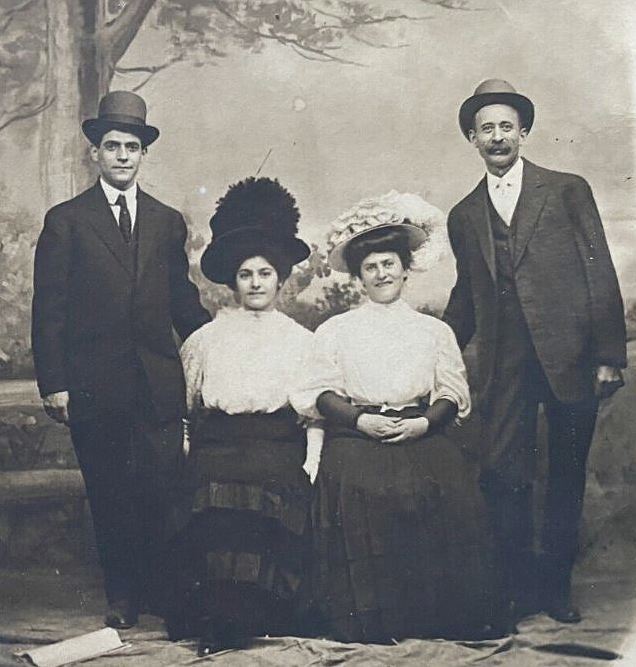
The prospect of being flung off a human roulette wheel might have been daunting to women of the period, who wore heels, corsets, long skirts, and big hats. Below are some typical fairgoers of the time, in a souvenir photo taken at the 1907 State Fair of Texas (Louis Block of Fort Worth, Miss Ray Goldsmith of Dallas, her sister Grace Goldsmith Rosenblatt, and Grace’s husband, David Rosenblatt). Imagine these people wandering around Fair Park and stopping in to see “the strangest girl in all the world” and watching people being hurled off a spinning disk.

sfot_RPPC_ebay_1907_photovia eBay

*

kline-herbert-a_new-york-clipper_oct-1912New York Clipper, Oct. 1912

*

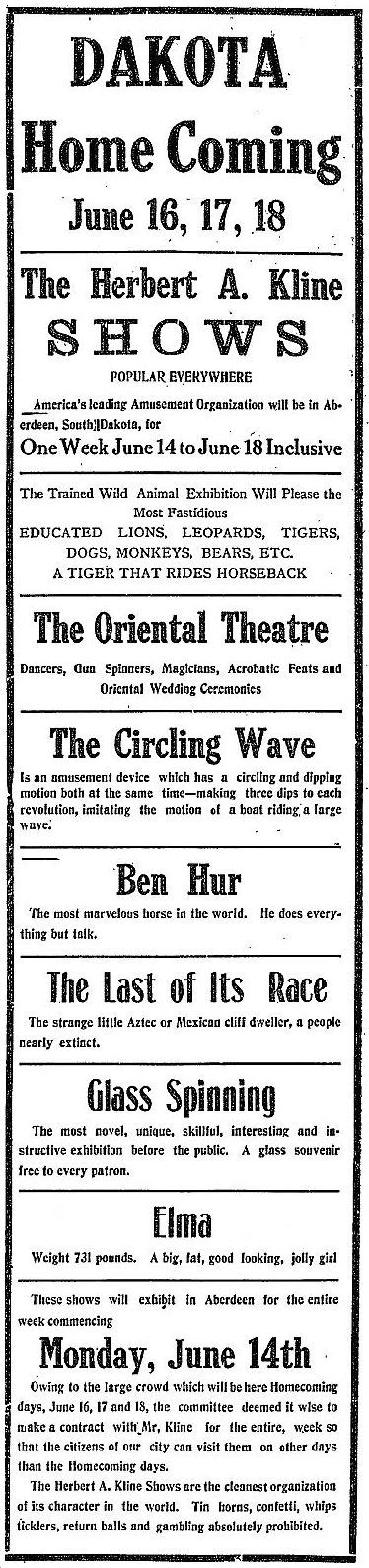
This ad for a South Dakota fair — a few months before Kline’s stop in Dallas — shows descriptions of several of the acts. (“A tiger that rides horseback.”)

kline-herbert-a_dakota-home-coming_aberdeen-american_SD_060909Aberdeen (South Dakota) American, June 9, 1909

*

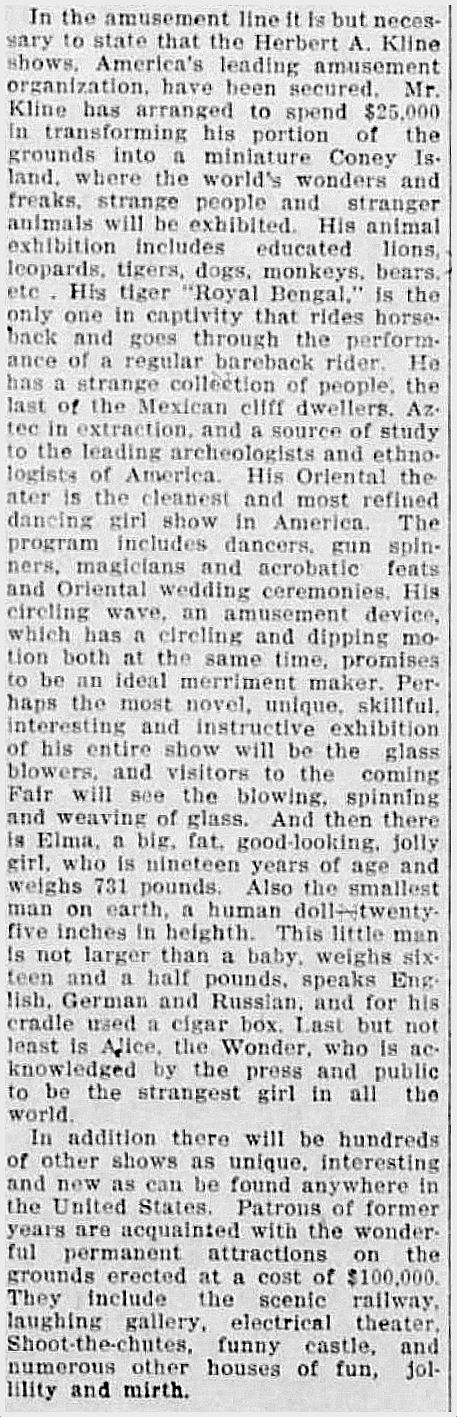
And a promotional article sent to local papers ahead of Kline’s arrival.

sfot_kline_mckinney-weekly-democrat-gazette_101409_detMcKinney (TX) Weekly Democrat Gazette, Oct. 14, 1909

***

Sources & Notes

All photos from a brochure/handbills listed earlier this year on eBay; sources of ads and other images as noted.

So many Flashback Dallas posts about the State Fair of Texas — here.

I’m on Patreon, where I post daily. Check it out!

sfot_1909_entrance_ebay_a_sm

*

Copyright © 2023 Paula Bosse. All Rights Reserved.
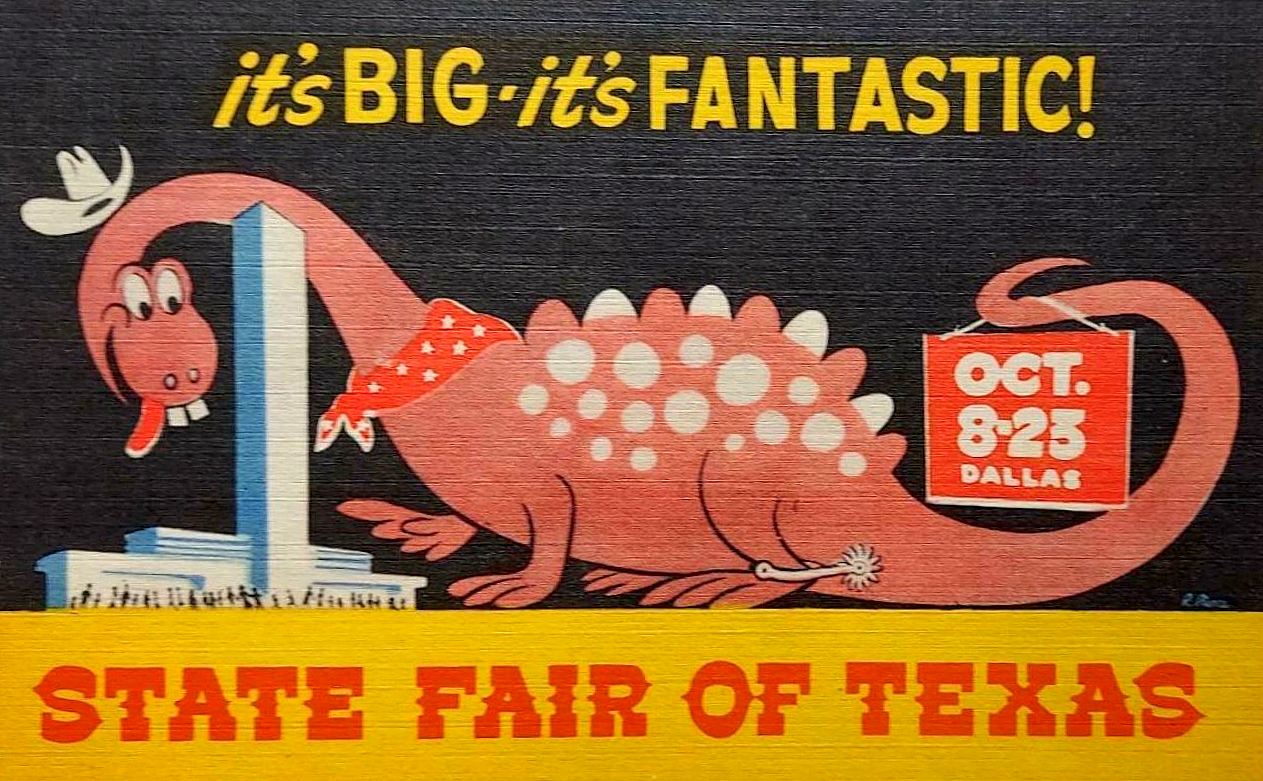
“It’s Big, It’s Fantastic!” — State Fair of Texas, 1949

sfot_1949_ebay_aWhen dinosaurs roamed Fair Park…

by Paula Bosse

Uh, hmm. Let’s see….

Dinosaur? Check.

Wearing a cowboy hat? Check.

Wearing a bandana? Check.

Wearing spurs? (!) Check.

With buck teeth? Check.

Looming over an art deco building? Check.

It must be time for the fair!

***

Sources & Notes

Postcard found on eBay.

sfot_1949_ebay_a_sm

*

Copyright © 2022 Paula Bosse. All Rights Reserved.

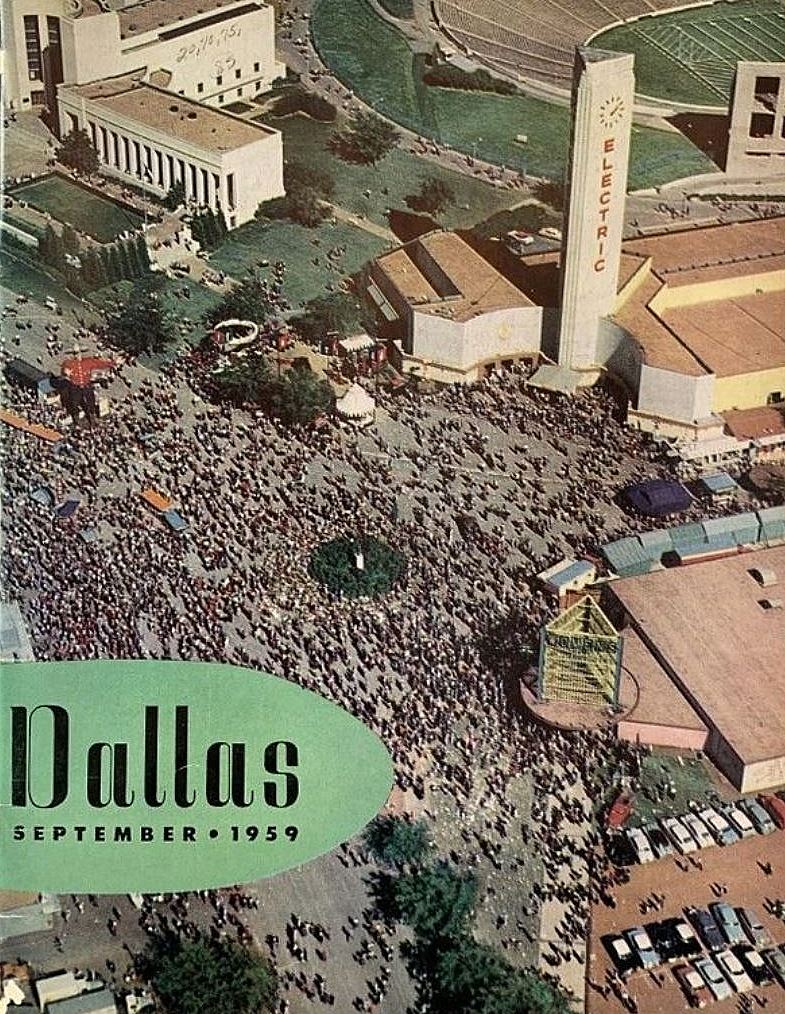
State Fair of Texas, From Above — 1959

sfot_dallas-magazine_sept-1959A bird’s-eye view of the Great State Fair

by Paula Bosse

I think I see Waldo.

***

Sources & Notes

Front cover of Dallas magazine, Sept. 1959.

sfot_dallas-magazine_sept-1959_sm

*

Copyright © 2021 Paula Bosse. All Rights Reserved.

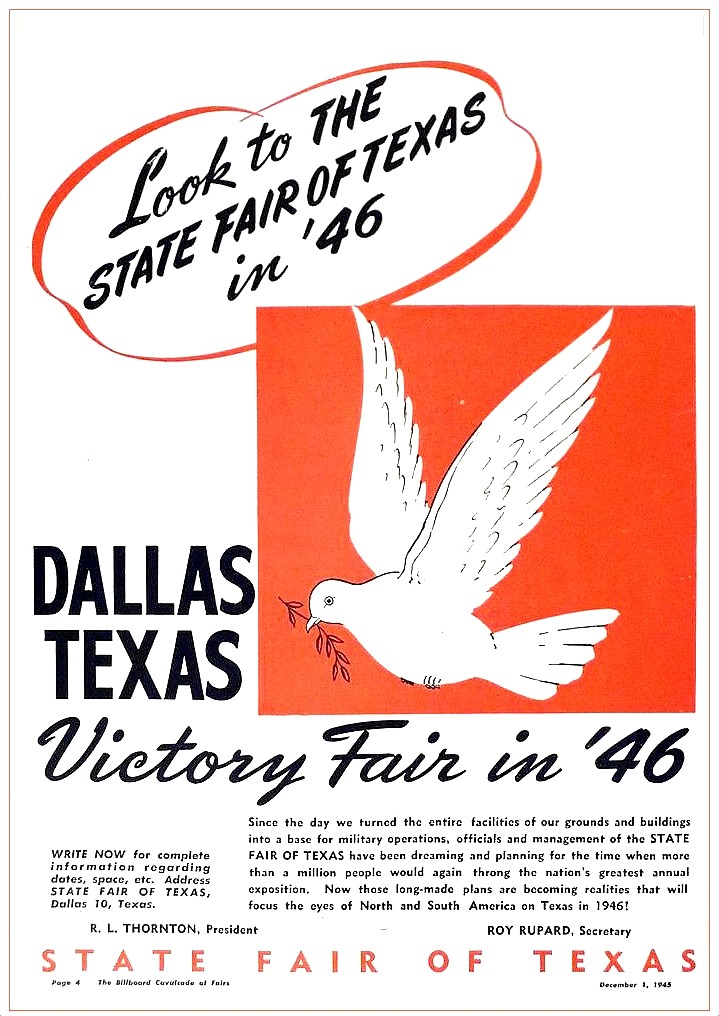
Awaiting the “Victory Fair” of 1946…

sfot_victory-fair_ebay_1946

by Paula Bosse

Many of us are missing the State Fair of Texas, canceled this year due to the COVID-19 pandemic. The last time the fair was canceled was during World War II. Here is an ad from 1945, assuring everyone that the State Fair would be back in 1946.

*

Dallas Texas Victory Fair in ’46

Since the day we turned the entire facilities of our grounds and buildings into a base for military operations, officials and management of the STATE FAIR OF TEXAS have been dreaming and planning for the time when more than a million people would again throng the nation’s greatest annual exposition. Now those long-made plans are becoming realities that will focus the eyes of North and South America on Texas in 1946!

***

Sources & Notes

Ad found on eBay (originally published in the “Billboard Cavalcade of Fairs,” Dec. 1, 1945).

More Flashback Dallas posts on the State Fair of Texas can be found here.

*

Copyright © 2020 Paula Bosse. All Rights Reserved.

Dallas — From “Texas, The Big State” (1952)

texas-big-state_santa-fe-film_jones-film_triple-underpassBehold…

by Paula Bosse

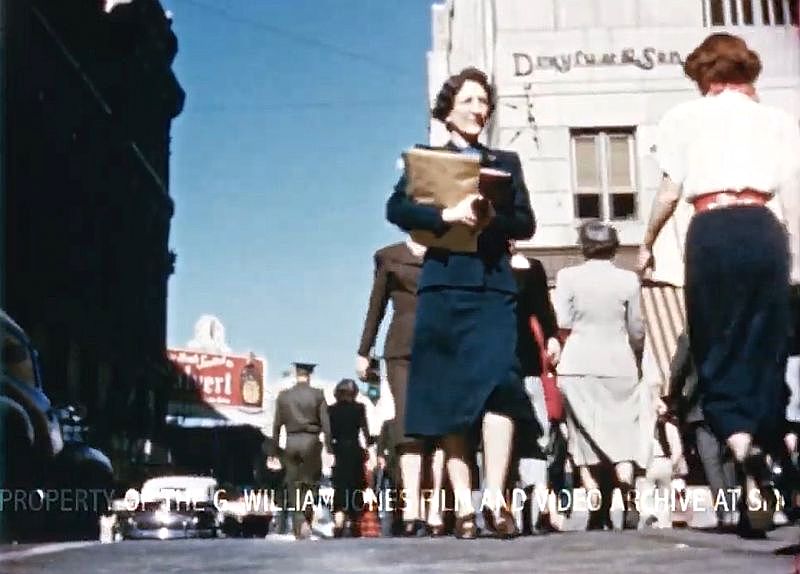
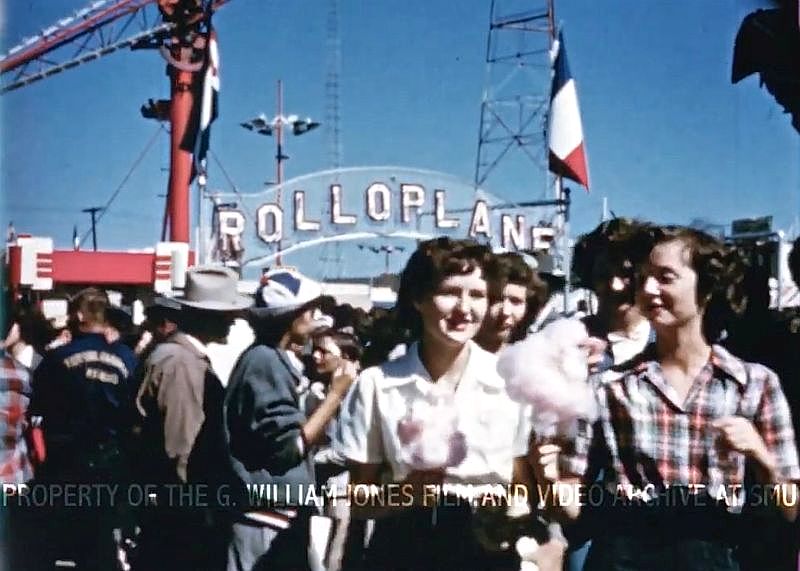
It’s always fun to see Dallas on film — and it’s even better when it’s a Technicolor film. Below are a few screenshots from “Texas — The Big State,” a 1952 travelogue produced by Santa Fe Railroad as a promotional film. It’s very enthusiastic. …Very. Dallas’ Norma-Desmond moment lasts only about three and a half minutes, but visits to downtown, Chance Vought, SMU, Fair Park, a Cotton Bowl game, and the State Fair of Texas manage to get crammed in, surrounded by a warm bath of dynamic adjectives.

Above, a scenic view of the triple underpass and the approach to downtown Dallas from the west. Nice foliage.

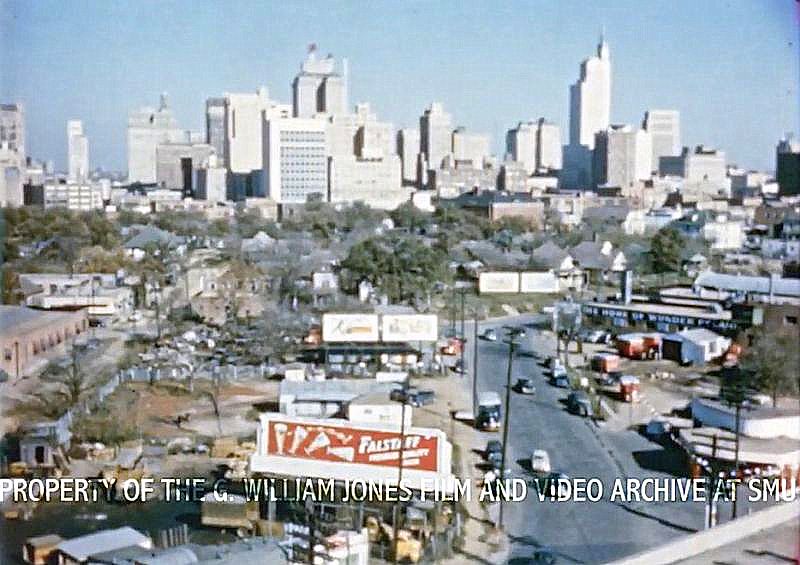
Below, a birds-eye view from the south (the same shot as the one by Eisenstaedt in the ’40s seen here, only a decade later — even the Falstaff Beer billboard is still there).

texas-big-state_santa-fe-film_jones-film_SMU_skyline

The well-dressed mean streets of Big D:

texas-big-state_santa-fe-film_jones-film_SMU_crosswalk

A woman walking on water at the Esplanade in Fair Park:

texas-big-state_santa-fe-film_jones-film_fair-park_esplanade

Rolloplane, cotton candy, etc., at the State Fair of Texas:

texas-big-state_santa-fe-film_jones-film_fair-park_midway

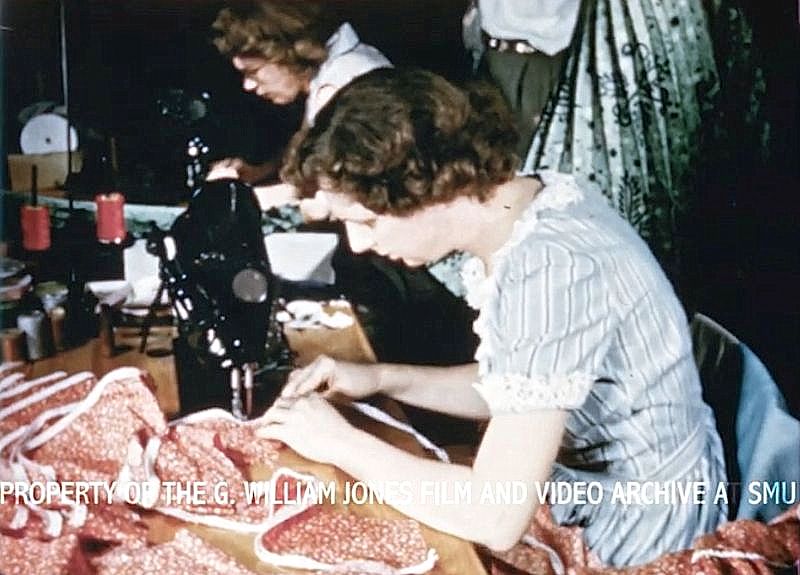
And, lastly, a fun fact I bet no one alive on this planet knows (or remembers): in 1952 Dallas was the second largest manufacturer of WASH DRESSES in the country. Probably the world. What a random piece of information for the Chamber of Commerce to have given to the Santa Fe people to include in a fluffy little film like this. Forget Neiman’s — we were number two in wash dresses! Number TWO!! (“Wash dresses”? Apparently they were house dresses made from washable fabrics. Like what Lucy Ricardo used to wear around the house when she didn’t have to don a hat and gloves to go pick up Ricky’s tux at the dry cleaners. Like the one seen in this “wash frocks” ad from 1950.) And here you go, two of the women who pushed us to runner-up wash-dress greatness:

texas-big-state_santa-fe-film_jones-film_wash-dresses

*

The 24-minute film — which premiered in Austin on May 28, 1952 and was included for months afterward as a “featurette” on double bills across the country — can be seen in its entirety on the SMU Jones Film YouTube channel. The Dallas bit starts at 9:43, followed by the Fort Worth bit at 13:19. I understand there are other cities, too.

***

Sources & Notes

All images are screenshots from the 16mm film posted on YouTube by the G. William Jones Film Archive, Hamon Library, Southern Methodist University.

Special thanks to Erik Swanson for bringing this to my attention.

*

Copyright © 2020 Paula Bosse. All Rights Reserved.

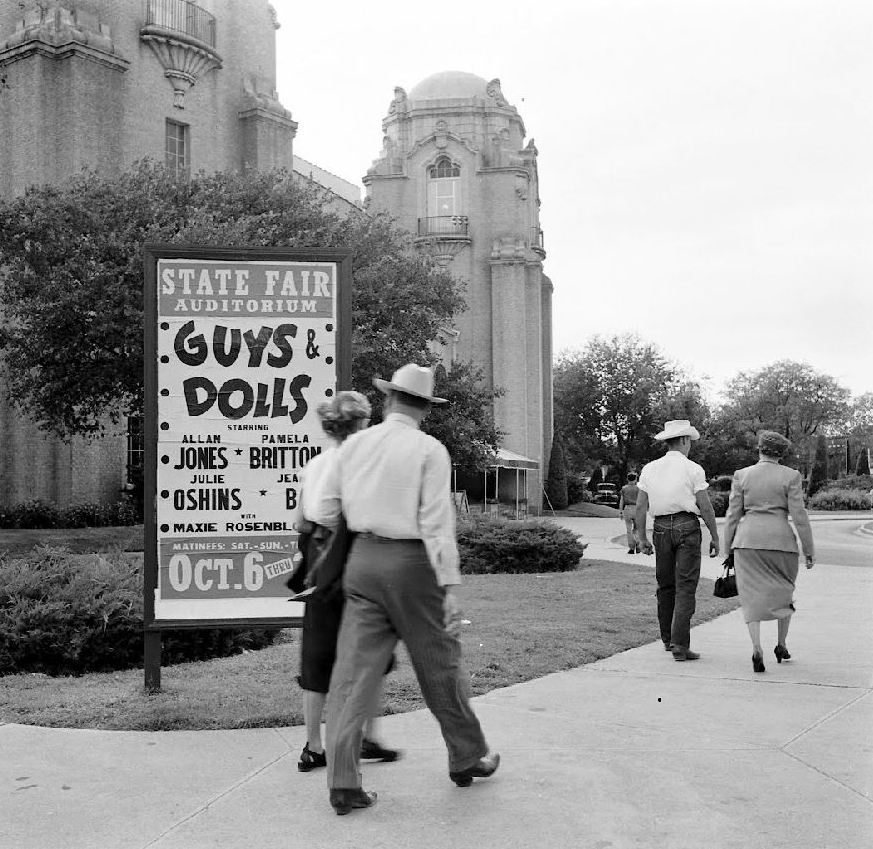
“Guys and Dolls” at the State Fair Music Hall — 1951

sfot_guys-and-dolls_music-hall_1951_john-dominis_life-mag
Wearing the *dress* boots… (photo: John Dominis, © Time, Inc.)

by Paula Bosse

This is the most Texans-going-to-the-theater photo I’ve ever seen.

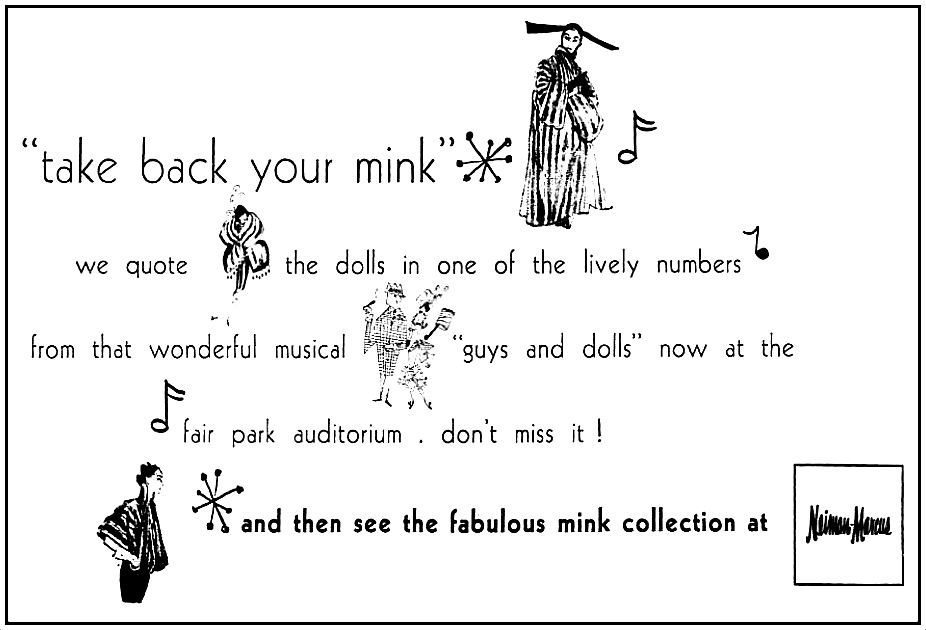
And this is the most Texans-selling-minks ad I’ve ever seen:

neiman-marcus_ad_guys-and-dolls_oct-1951

***

Sources and Notes

Photo by John Dominis, taken in October, 1951 on assignment for Life magazine, ©Time, Inc.; more info is here.

Neiman-Marcus ad is also from October, 1951.

“Take Back Your Mink” is a song from “Guys and Dolls” (hear it here), the musical that played during the 1951 State Fair of Texas, starring Pamela Britton, Allan Jones, Jeanne Ball, and Slapsie  Maxie Rosenbloom.

sfot_guys-and-dolls_music-hall_1951_john-dominis_life-mag_sm

*

Copyright © 2020 Paula Bosse. All Rights Reserved.

Buried Alive at the Fair Park Midway — 1946

sfot_scotty-scott_buried-alive_coffin_cook-colln_degolyer-library_SMU_1946Welcome to my casket!

by Paula Bosse

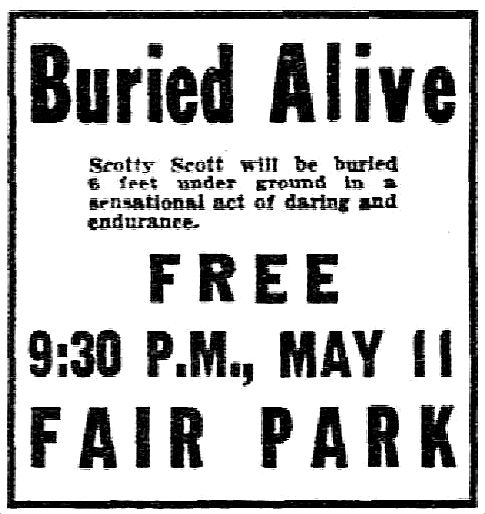
In May, 1946 a new Fair Park midway opened with new rides and new attractions to entice entertainment-seekers to Fair Park at a time of the year when the State Fair of Texas wasn’t in session. On opening day a beauty queen was chosen, a new 17-inch telescope was introduced, and a man was buried alive.

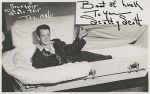
That man was C. S. “Scotty” Scott, seen above lounging in a comfy-looking casket in pajamas and robe, looking happy, propping up the lid. On May 11, 1946, Scotty Scott was buried six feet below the midway where he vowed to remain until the last day of the fair — Oct. 20th. That’s five and a half months.

sfot_scotty-scott_buried-alive_050946

Countless ads appeared over the weeks offering $500 (the equivalent of about $6,500 in today’s money) to anyone who might stop by his Fair Park lair and find him not there.

sfot_scotty-scott_buried-alive-051246

The exact set-up is not fully clear, but, basically, he was buried in a coffin in a very small space, with a ventilation pipe. One report said that visitors were able to see him through a glass partition — another said that people were peeking at him and talking to him via an eight-inch vent pipe. However they were observing him, they weren’t doing it for free — if you wanted to get a look at Scotty doing whatever it was he was doing down there, you had to fork over 25 or 30 cents. All this being-watched and chit-chatting probably helped distract Scotty from the fact that he was buried alive! (I’m getting claustrophobic just typing this.)

Scotty’s tomb was equipped with air conditioning, a radio, a telephone, and an electric razor (which seems unnecessary, but, again, it probably helped pass the time…). (He might have kept up with his shaving, but he let his hair grow, a fact which apparently had the hoi polloi debating about whether Scotty was a man or a woman.) He was able to indulge in the occasional sponge bath and “exercise himself with a vibrator machine.” There was mention somewhere of a feeding tube.

If the thought of being buried alive gives you the willies, Scotty was not completely immune himself. One report mentioned this was probably the last time he would perform this stunt because he was reaching his “breaking point” and “He has to fight himself continuously to keep from being irritable and cross” (Dallas Morning News, Oct. 13, 1946). Luckily, claustrophobia did not seem to be too much of a problem for him as he had been doing this kind of endurance stunt for several years and kept coming back for more — he had, somehow, managed to remain buried in San Francisco for eight months!

Though he considered his main vocation to be a daredevil race driver, he had stumbled into this weird, but lucrative, line of work in 1935 when he had seen a similar stunt being performed in California, and a friend bet him $1,000 he couldn’t do it for 30 days. He won the bet. By the time of this 1946 Dallas stunt, he had been buried alive a LOT — he estimated that he had spent a total of more than four and a half years (!) buried alive.

According to Scotty, the worst part of the buried-alive-thing was the un-burying:

“From past experience the most painful part of the ordeal will come when they dig me up. My circulation will be so bad that my body will turn purple and I will be unable to sit or stand for any length of time. My whole body will feel like a leg or arm that has gone to sleep.” (DMN, Oct. 13, 1946)

Scotty Scott spent 162 days buried alive in Dallas — he even celebrated his 28th birthday underneath Fair Park. He was buried on May 11 and was disinterred on the final day of the fair, Oct. 20. Crowds gathered as men with jack-hammers cracked open the cement-covered tomb. As the coffin was lifted up a woman fainted. He was transported by ambulance to a hospital, and the next day he was interviewed on a national radio program.

Why on earth would anyone do this? More than 75,000 people had paid to take a look at Scotty Scott lying underground. The total amount of money people paid for this creepy privilege works out to almost $300,000 in today’s money. That’s why.

***

Sources & Notes

Photo is from the George W. Cook Dallas/Texas Image Collection, DeGolyer Library, SMU Libraries, Southern Methodist University; more info can be found here.

Try not to think about being buried alive. TRY!

sfot_scotty-scott_buried-alive_coffin_cook-colln_degolyer-library_SMU_1946_sm

*

Copyright © 2019 Paula Bosse. All Rights Reserved.

“Dallas Day” at the State Fair of Texas

state-fair_dallas-day_100956
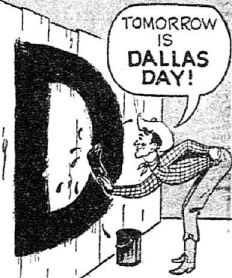
Hey, Big D — don’t forget “Dallas Day”!

by Paula Bosse

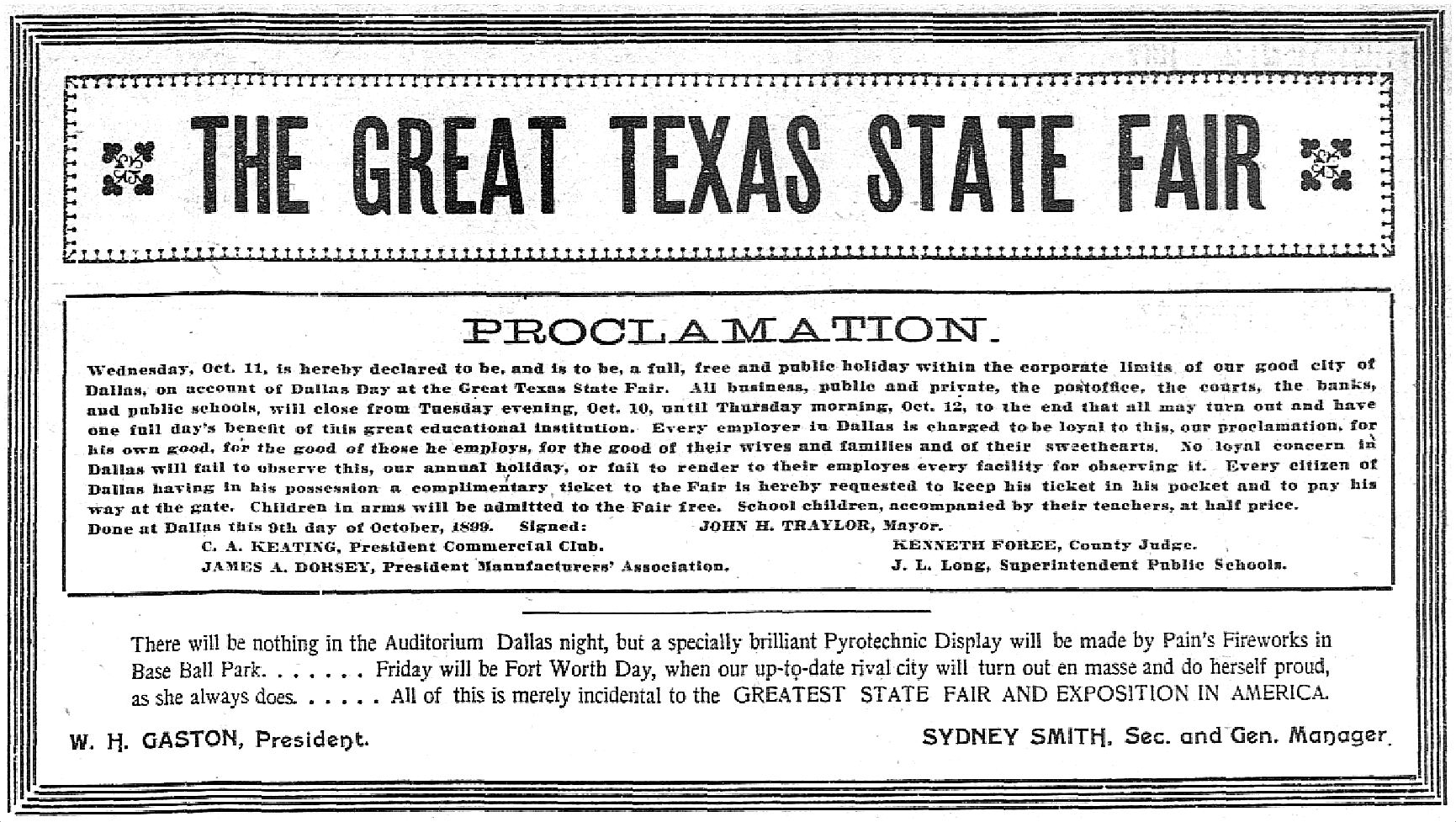
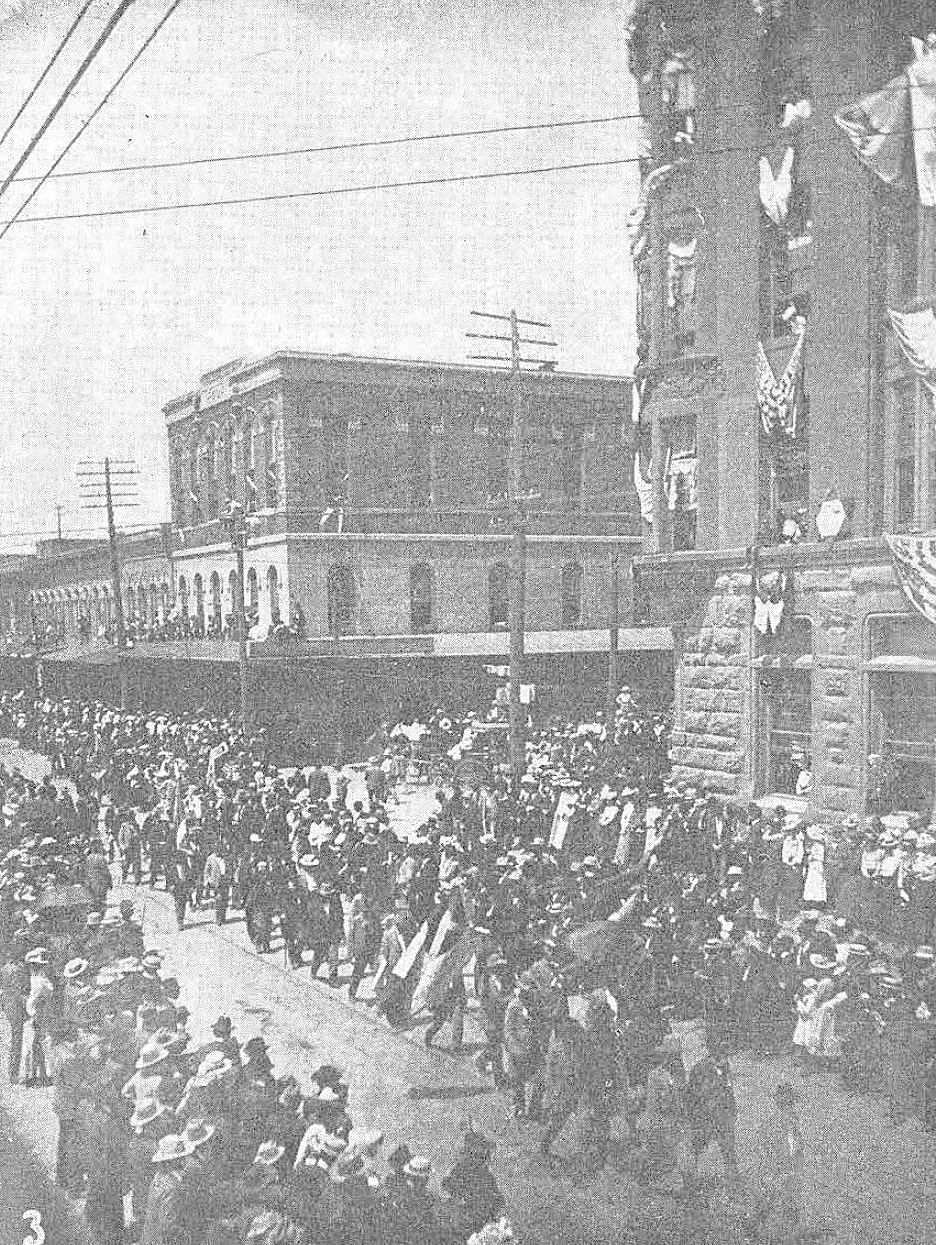
“Dallas Day” used to be an important day at the State Fair of Texas. Like really important. Like national-holiday-important. Below is a typical mayoral proclamation announcing the sweeping closures of public and private businesses and institutions on “Dallas Day,” from 1899 (click to see a larger image; transcription follows):

1899_dallas-day_sfot_dmn_101099Dallas Morning News, Oct. 10, 1899

THE GREAT TEXAS STATE FAIR

PROCLAMATION

Wednesday, Oct. 11, is hereby declared to be, and is to be, a full, free and public holiday within the corporate limits of our good city of Dallas, on account of Dallas Day at the Great Texas State Fair.

All business, public and private, the postoffice, the courts, the banks, and public schools, will close from Tuesday evening, Oct. 10, until Thursday morning, Oct. 12, to the end that all may turn out and have one full day’s benefit of this great educational institution.

Every employer in Dallas is charged to be loyal to this, our proclamation, for his own good, for the good of those he employs, for the good of their wives and families and of their sweethearts.

No loyal concern in Dallas will fail to observe this, our annual holiday, or fail to render to their employes every facility for observing it.

Every citizen of Dallas having in his possession a complimentary ticket to the Fair is hereby requested to keep his ticket in his pocket and to pay his way at the gate. Children in arms will be admitted to the Fair free. School children, accompanied by their teachers, at half price.

Done at Dallas this 9th day of October, 1899.

Signed:
John H. Traylor, Mayor

*

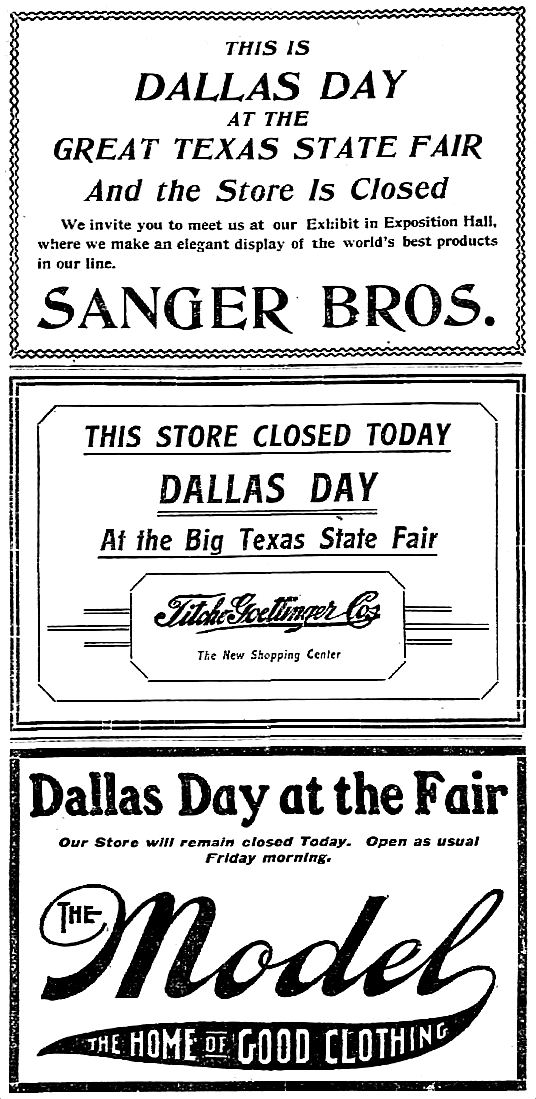
For decades, it was expected that most Dallas businesses and government offices would close on “Dallas Day.” The central business district must have been a ghost town. Woe be to anyone needing a new frock, a replacement gasket, a bank draft, or even a postage stamp on “Dallas Day.” The city had bigger fish they wanted its citizens to fry.

1906_dallas-day_sfot_dmn_101806Oct. 18, 1906

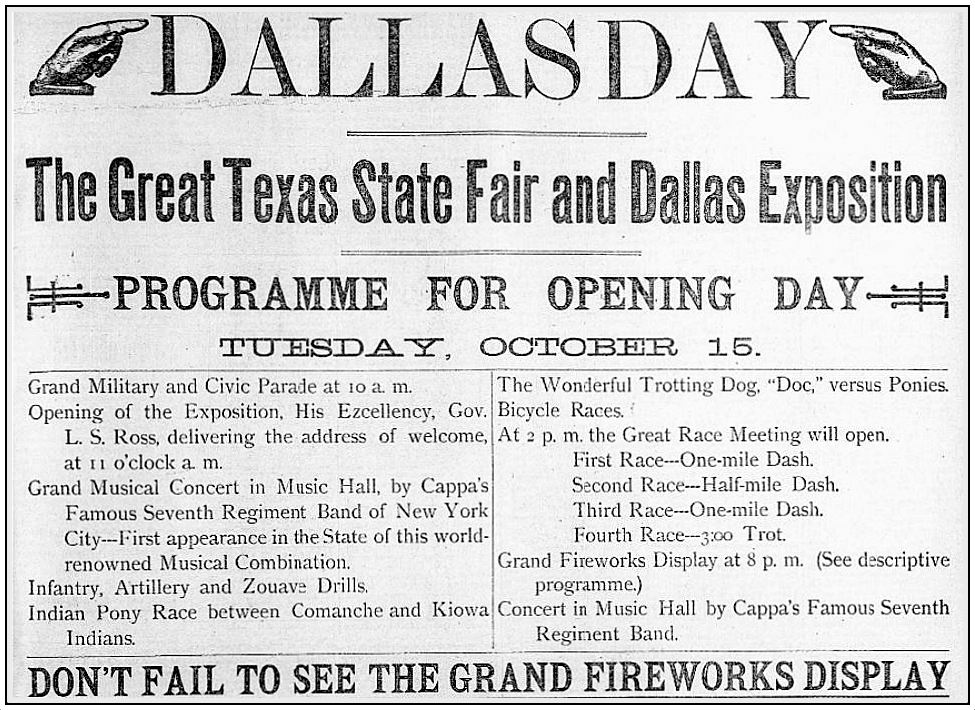
Here’s an early “Dallas Day” ad from 1889 with pointing fingers:

1889_dallas-day_sfot_dmn_101489Oct. 14, 1889

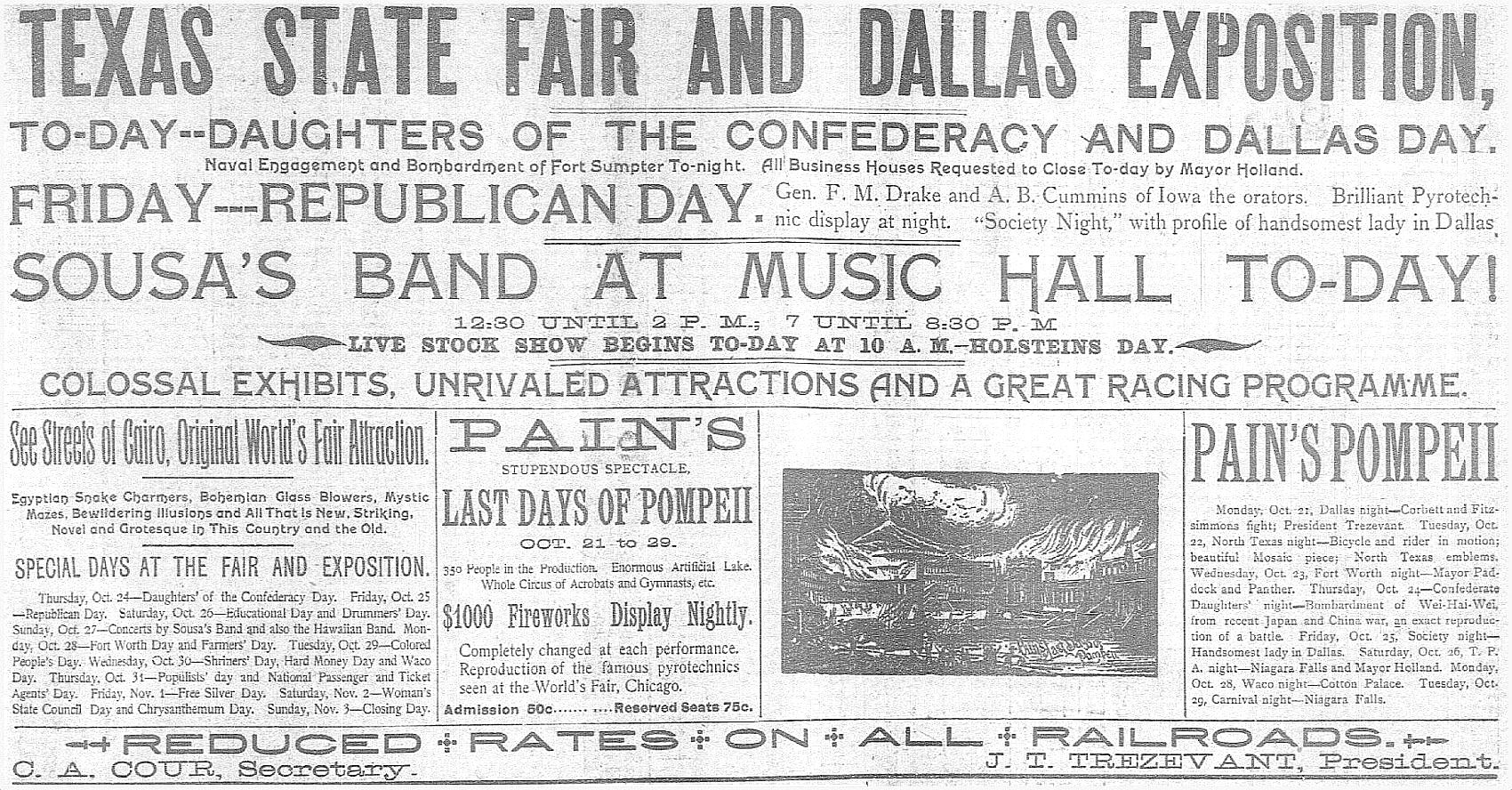
The State Fair of Texas was (and continues to be) so filled with other ubiquitous “days” (such as old favorites “Hard Money Day” and “Chrysanthemum Day,” as seen in the ad below from 1895) that if Dallas weren’t Dallas, “Dallas Day” might run the risk of getting lost in the jam-packed fair schedule.

1895_dallas-day_sfot_dmn_102495Oct. 24, 1895

There were, of course, “Dallas Day” parades:

parade_state-fair_dallas-day_come-to-dallas_degolyer_SMU_ca1905ca. 1905, via DeGolyer Library, SMU

“Dallas Day” may still be a thing, for all I know (I guess I think of “Dallas Day” as the day Dallas’ elementary school kids get off to go to the fair, a tradition I hope never dies), but it had lost a lot of steam after those early days. Some businesses continued to close or shorten their hours to let employees enjoy the fair, but the era of a city shutting down so that everyone could flock to the State Fair began to fade after those early decades of the 20th century. But imagine how exciting that must have been, with all of Dallas descending on Fair Park en masse.

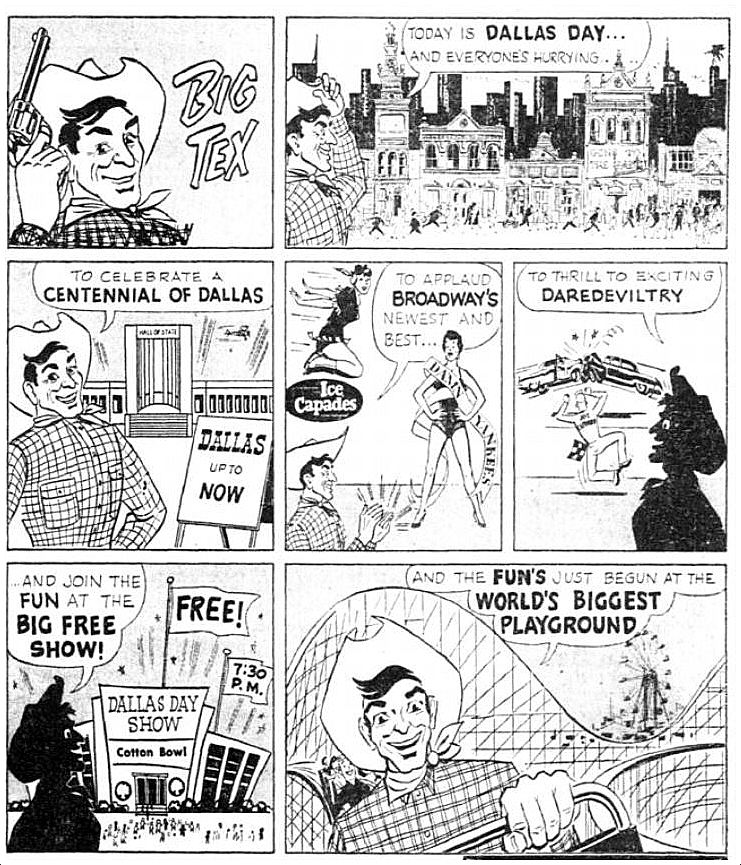
state-fair_dallas-day_101056Oct. 10, 1956

*

state-fair_dallas-day_100956_det_sm

*

Copyright © 2019 Paula Bosse. All Rights Reserved.

State Fair of Texas, Miscellaneous Tidbits from Its History

state-fair-of-texas_pennant_ebay_crop

by Paula Bosse

The State Fair of Texas is, once again, in full swing. Here are a few random SFOT images and ads from the past.

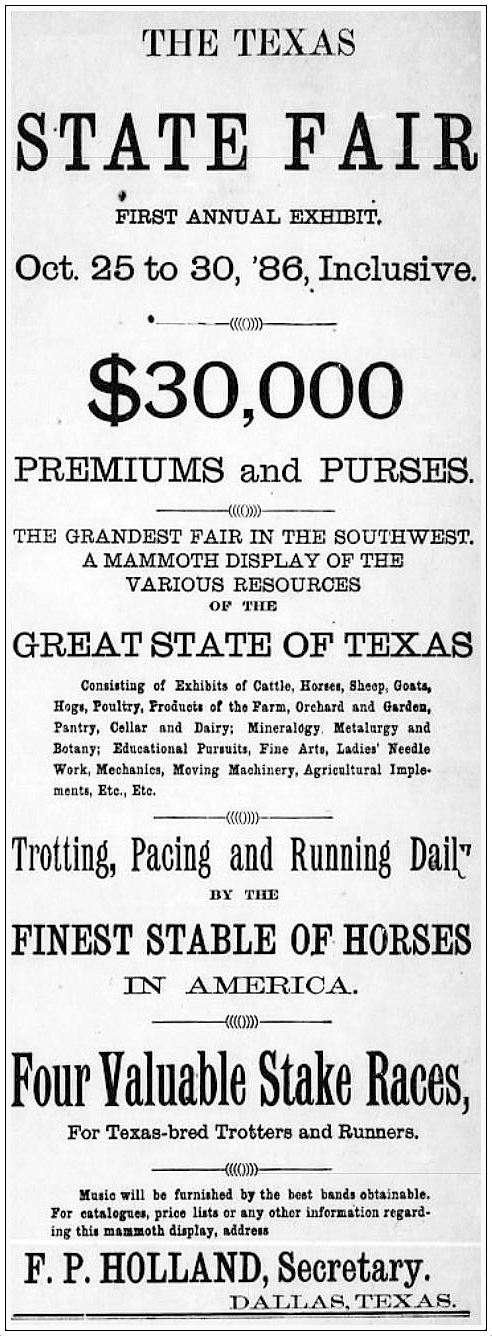
First up, an ad for the very first state fair in Dallas, in 1886. Almost unbelievably, this “Dallas State Fair” (held on 80 acres of land now known as Fair Park) was one of two competing state fairs held in the city that year — the other one was the “Texas State Fair,” which was held about three miles northeast of the courthouse on a 100-acre site roughly about where Cole Park is near present-day North Dallas High School. The two state fairs ran concurrently, and both were smash hits. The “Dallas State Fair and Exposition” eventually became the State Fair of Texas in 1904. Below are the ads for those competing two fairs. (Click to see a larger image.)

state-fair_first_dallas-herald_100986
The East Dallas fair, Dallas Herald, Oct. 9, 1886

texas-state-fair_fairland_dallas-herald_102086
The North Dallas fair, Dallas Herald, Oct. 20, 1886

*

One of the original buildings built for the 1886 Dallas State Fair was the massive Exposition Building, designed by architect James Flanders. On a site devoted to the career of Flanders, the architect recalled this project many years later: “The progress of the work on the structure was watched by most people with a degree of curiosity far more intense than is excited by the loftiest skyscraper in these days when people have no time to wonder. Such an apparition on the bald prairie attracted crowds of the curious from far and near on Sundays.”

state-fair_exposition-bldg_ca-1890s

Above, the huge Exposition Hall, enlarged from its initial design, which, in 1886 was reported to contain 92,000 square feet of unrivaled exhibition space. Unfortunately, the wooden buildings seen above burned to the ground in the early hours of July 20, 1902. The blaze was so intense that “the whole of the city was lit up with the brilliancy of the sunrise” and that “flames rose to such great height that they were seen as far west as Fort Worth, where it was thought the whole city of Dallas was burning” (Dallas Morning News, July 21, 1902). More on this building can be found on the Watermelon Kid site, here.

Below, the Exposition Building can be seen from the fairgrounds racetrack in a photo published in 1900 in an issue of The Bohemian magazine (via the Fort Worth Public Library).

fairgrounds_racetrack_bohemian_1900_fwpl

*

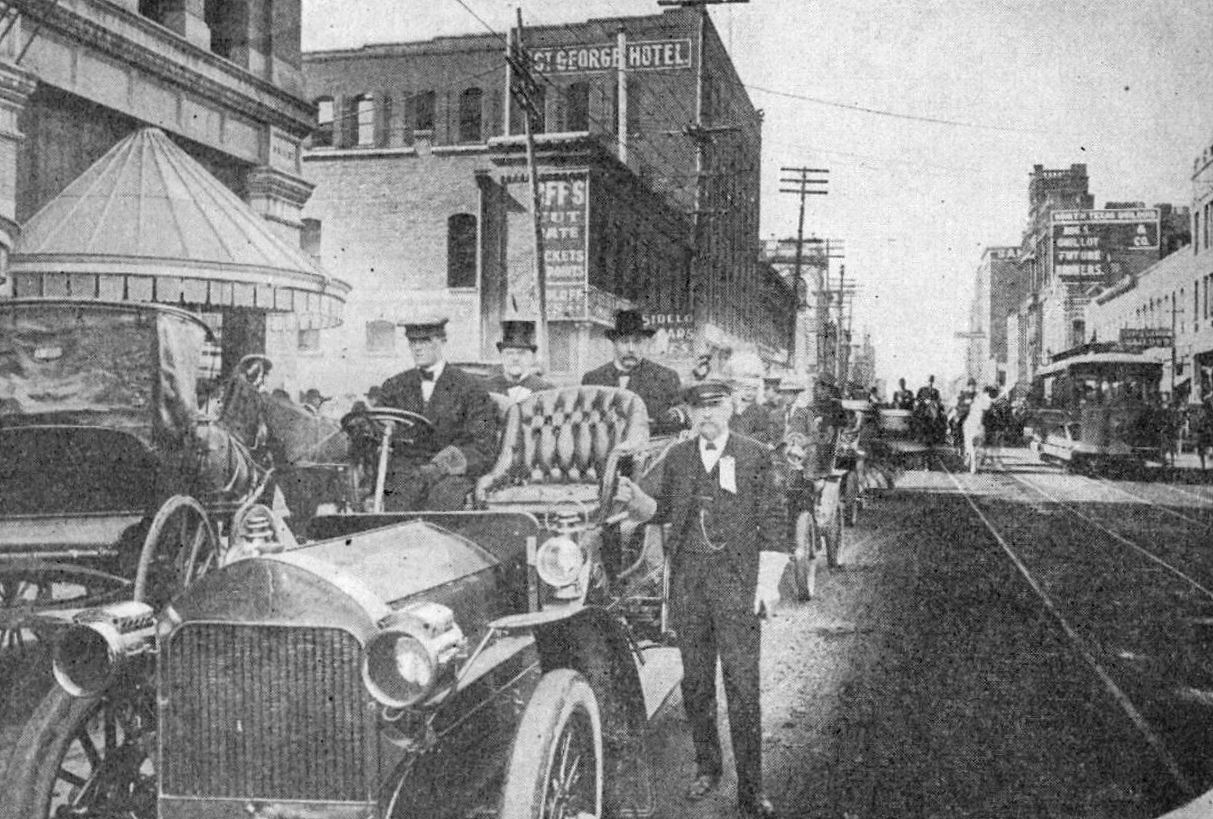
A moment from the opening day parade festivities of the 1903 fair is captured in the photo below, with the following caption from the 1941-42 edition of the Texas Almanac: “Gov. S. W. T. Lanham (in rear seat of pioneer horseless carriage) in opening day parade for 1903 State Fair of Texas formed on Main Street. Fair President C. A. Keating was seated beside him, and Secretary John G. Hunter of Board of Trade is seen standing beside the gasoline buggy.”

state-fair_opening-day_1903_tx-almanac_1941-42_portal
Main Street, looking west, via Portal to Texas History

*

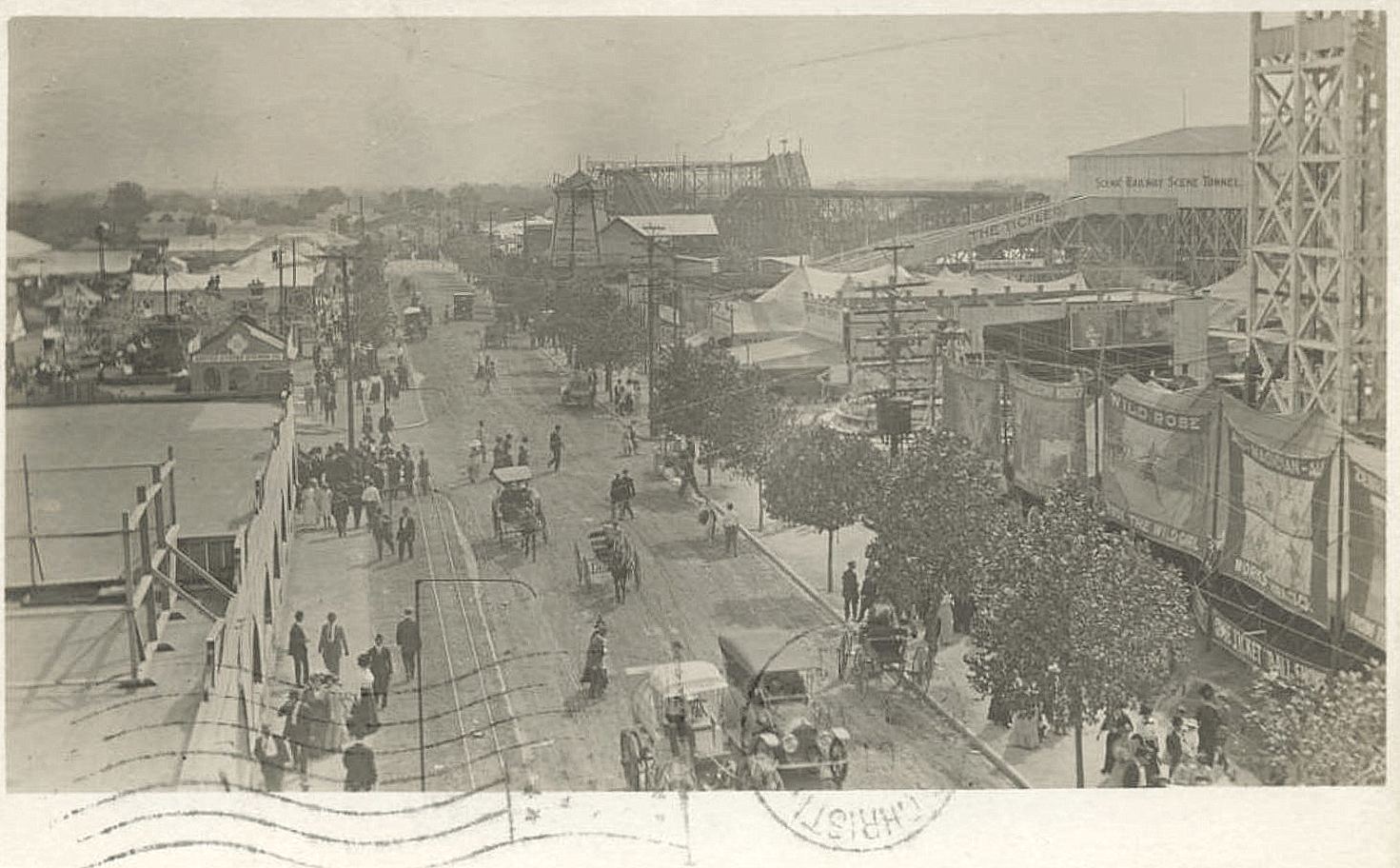
Here is a 1911 view of the state fair midway taken by John R. Minor, Jr. in a real-photo postcard. (More on Mr. Minor is here; more images of the Shoot the Chutes water ride can be found here.)

state-fair_street-scene_john-minor_1911_cook-colln_degolyer
via George W. Cook Collection, DeGolyer Library, SMU

*

From the 1920s, an ad for Clayco Red Ball gasoline (“It’s RED in color”). I’m always a sucker for ads containing photos or drawings of Dallas landmarks, and here we see the entrance to Fair Park. (Why was the gas red? Why not? It was the brainchild of Dallas advertising man Wilson W. Crook, Sr. who needed a way to make this Oklahoma gas different. He remembered that during his WWI days in France that higher quality airplane fuel was colored red to distinguish it from regular gasoline. When the gas was introduced to Dallas in August, 1924, he devised a promotion that gave away 5 gallons of this gas to every red-headed person who showed up at participating service stations.)

ad-red-ball-gas_state-fair_dmn_101224-det

ad-red-ball-gas_state-fair_dmn_101224Clayco Red Ball ad, Oct. 1924

*

If we’re talking about the State Fair of Texas and we’ve come to the 1930s, there’s a pretty good chance there’s going to be a photo from the Texas Centennial. And, looky here: a nice shot of concessionaires waiting for thirsty patrons at the Centennial Exposition in 1936. A couple of nickels could get you a Coke and a phone call.

sfot_concessionaires_coke_unt_portal_1936via Portal to Texas History

*

During World War II the State Fair was on hiatus. Here’s an ad from the 1941-42 Texas Almanac pre-closure, with a nice pencil sketch of the Esplanade and Hall of State:

state-fair_tx-almanac_1941-42

state-fair_tx-almanac_1941-42_det

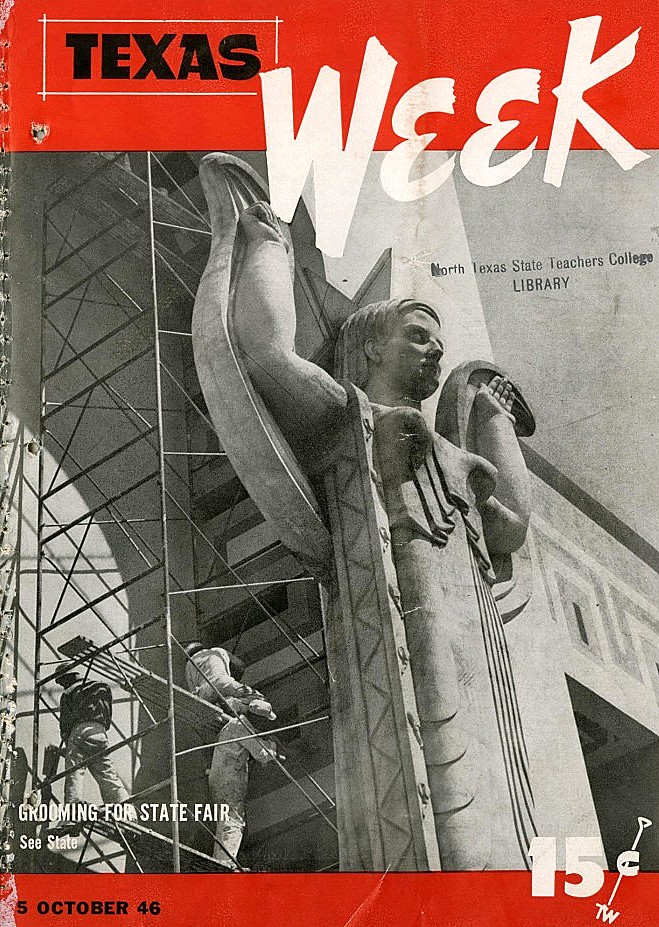
And a 1946 magazine cover story on the imminent reopening of the fair:

state-fair_texas-week-mag_100446_portal_cover
via Portal to Texas History

*

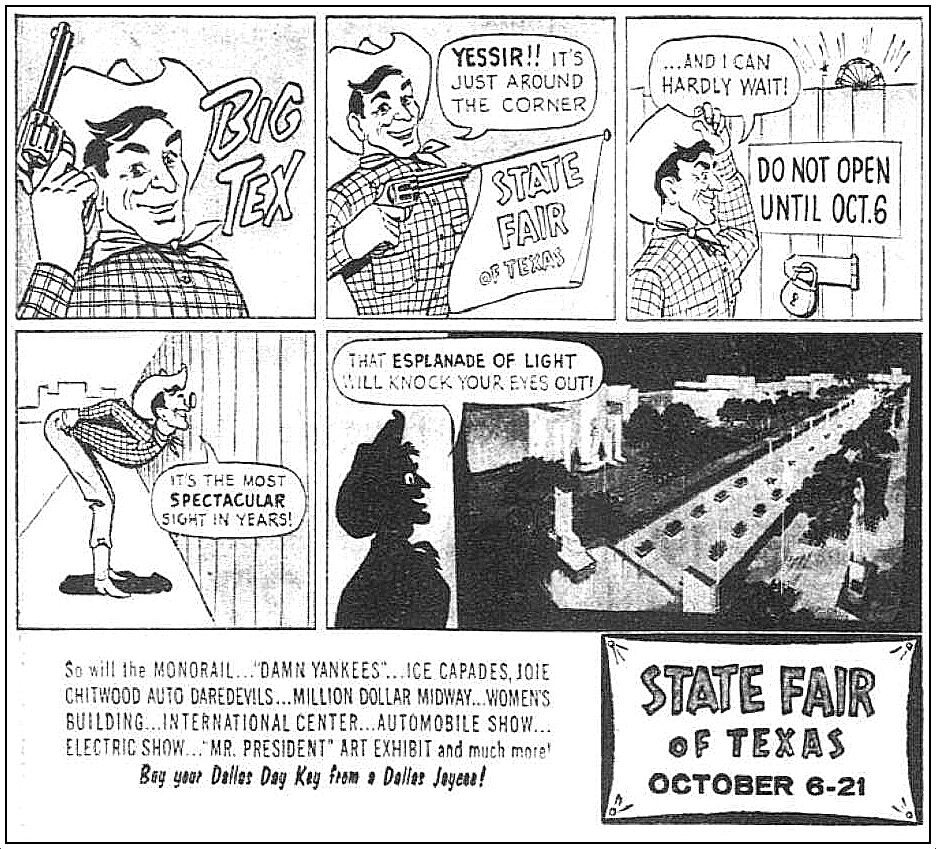
In 1956 Big Tex warned/assured you that the Esplanade lights would “knock your eyes out.”

state-fair_big-tex-ad_092456

*

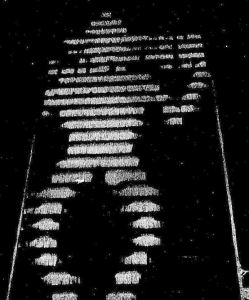
Speaking of Big Tex and lights knocking your eyes out, in the 1960s Big Tex was memorialized on the side of a downtown building, like a giant bow-legged Lite-Brite.

sfot_big-tex_illuminated_1960s

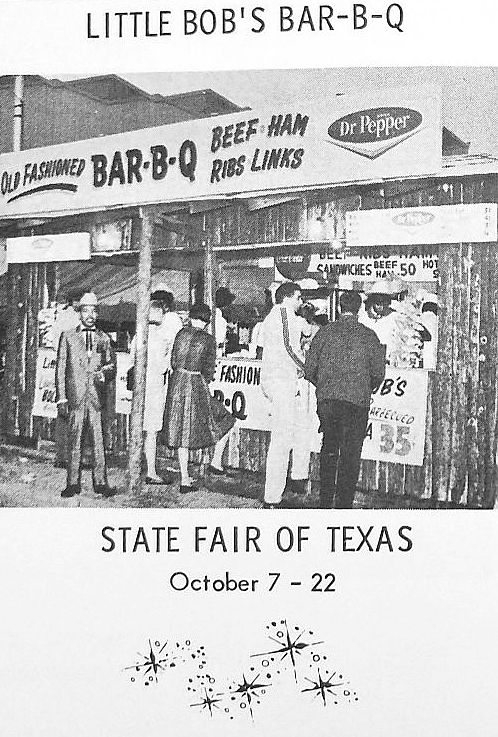
Back at Fair Park, Huey P. Nash was supplying fair throngs with barbecue from his Little Bob’s Bar-B-Q stand. In 1964, Nash was the first African-American vendor to be granted a food concession at the State Fair. Little Bob’s (which I believe is still in business) was, at the time of this 1967 ad, located in South Dallas at 4203 S. Oakland (now Malcom X), at the corner of Pine. (Ad is from the 1967 Souvenir Program of the 74th Annual Session of the Missionary Baptist General Convention of Texas; more photos from this publication can be seen here.)

sfot_little-bobs-bbq_baptist-convention-program_1967_photo

sfot_little-bobs-bbq_baptist-convention-program_oct-1967

The 1960s also gave us the Swiss Skyride, which replaced the Monorail (which, when it was introduced in 1956, was the first commercially operated monorail in the United States). The Swiss Skyride was erected in Fair Park in August, 1964, and the 6-minute ride debuted a few months later at the 1964 State Fair of Texas.

state-fair_swiss-sky-ride_tinkle-key-to-dallas_1965_replaced-monorail_
via Lon Tinkle’s children’s book Key to Dallas (1965)

sfot_swiss-skyride_FWST_101864

sfot_swiss-skyride_FWST_100964

*

state-fair-of-texas_pennant_ebay_crop_sm

*

Copyright © 2019 Paula Bosse. All Rights Reserved.