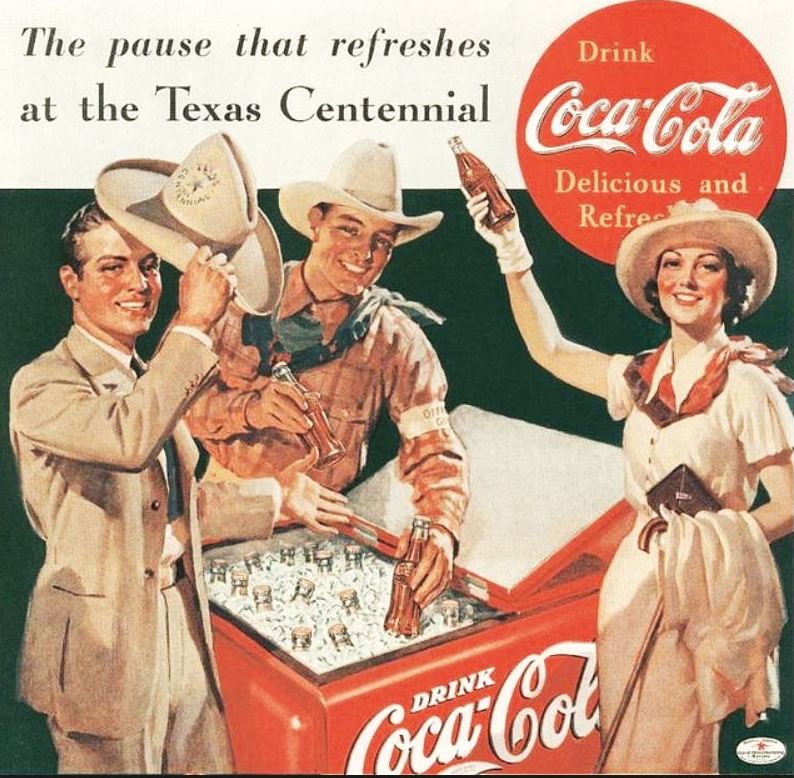
Flashback : Dallas

A Miscellany: History, Ads, Pop Culture

Category: Texas Centennial

Happy 4th Anniversary, Flashback Dallas!

tx-centennial_stamp_cook-coll_degolyer_SMU

by Paula Bosse

This weekend marks the fourth anniversary of this blog. It’s hard to believe, but, completely coincidentally, this is my 1,000th post! That’s a lotta Dallas. (Some might argue that’s too MUCH Dallas….) There are now just over 9,000 Flashback Dallas followers across various social media platforms, and it’s always nice to know there are others out there who share my interest in Dallas history. Thank you to all who read, follow, share, and comment. It wouldn’t be as much fun if I were just typing for myself.

Thank you! And now, Year 5!

–Paula

***

Sources & Notes

“Texas Centennial Exposition Stamp” from the George W. Cook Dallas/Texas Image Collection, DeGolyer Library, Central University Libraries, Southern Methodist University; more information on this image can be found here.

*

Copyright © 2018 Paula Bosse. All Rights Reserved.

Architect Donald Barthelme’s Hidden Signature on the Hall of State

hall-of-state_barthelme_080917“B-A-R-T-H-E-L-M-argh!”

by Paula Bosse

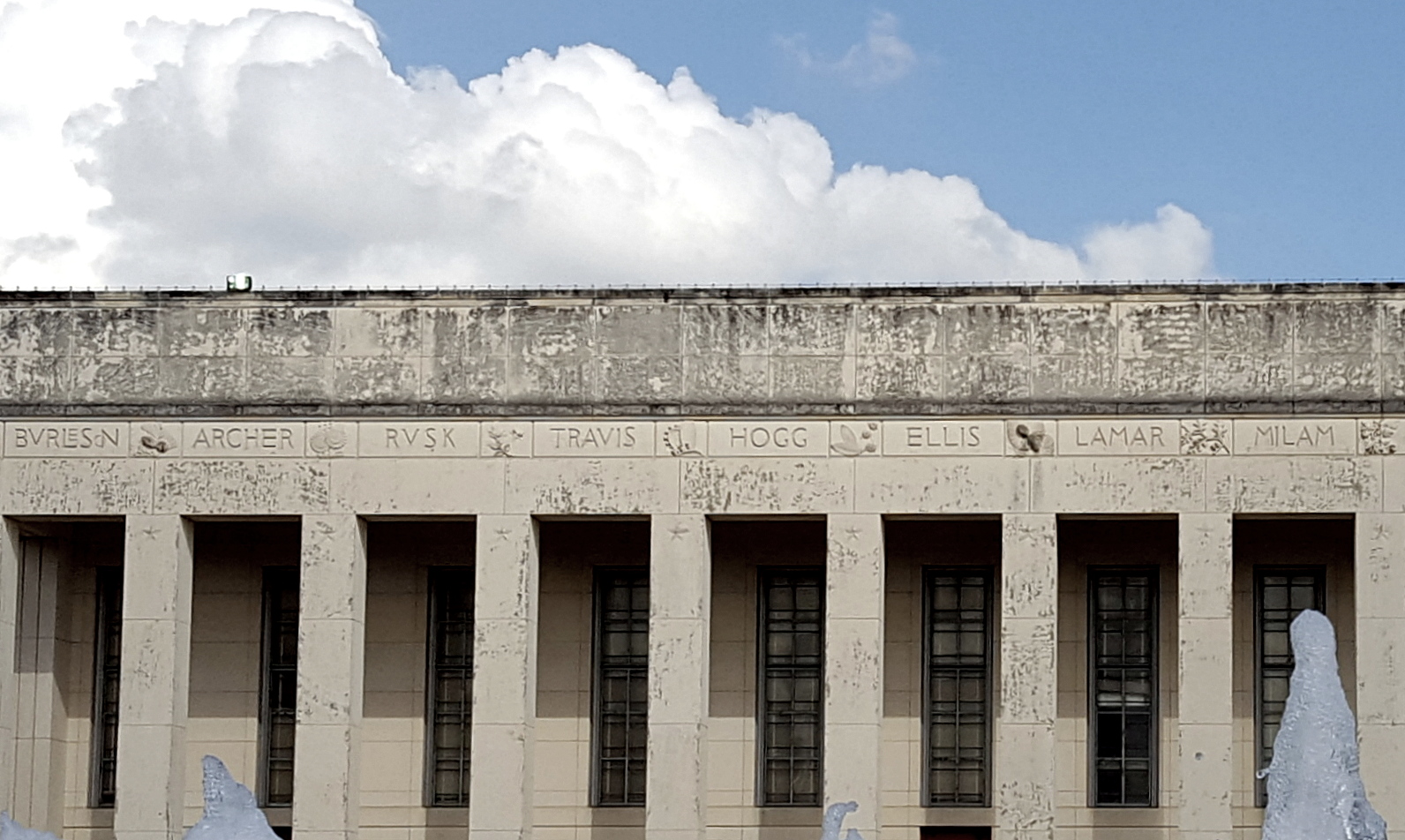
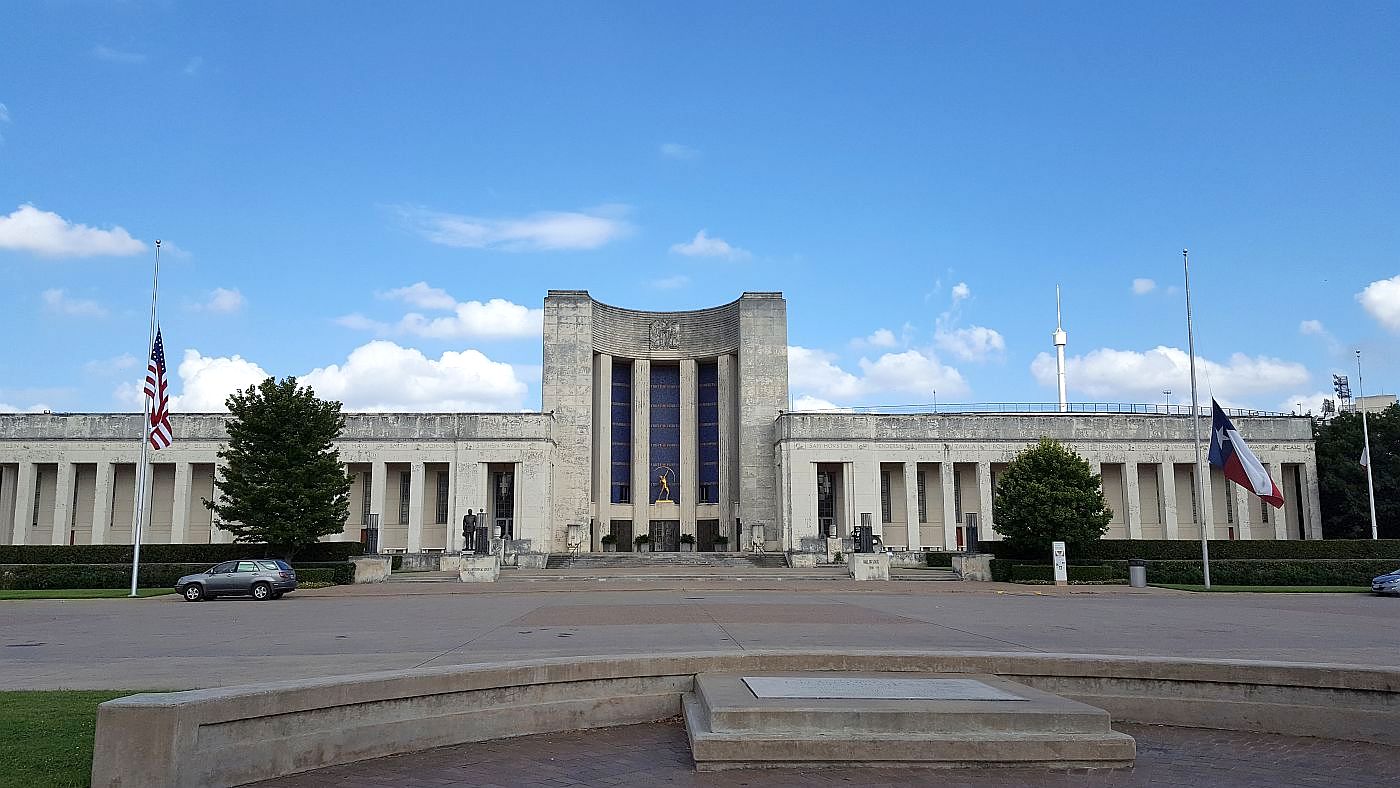
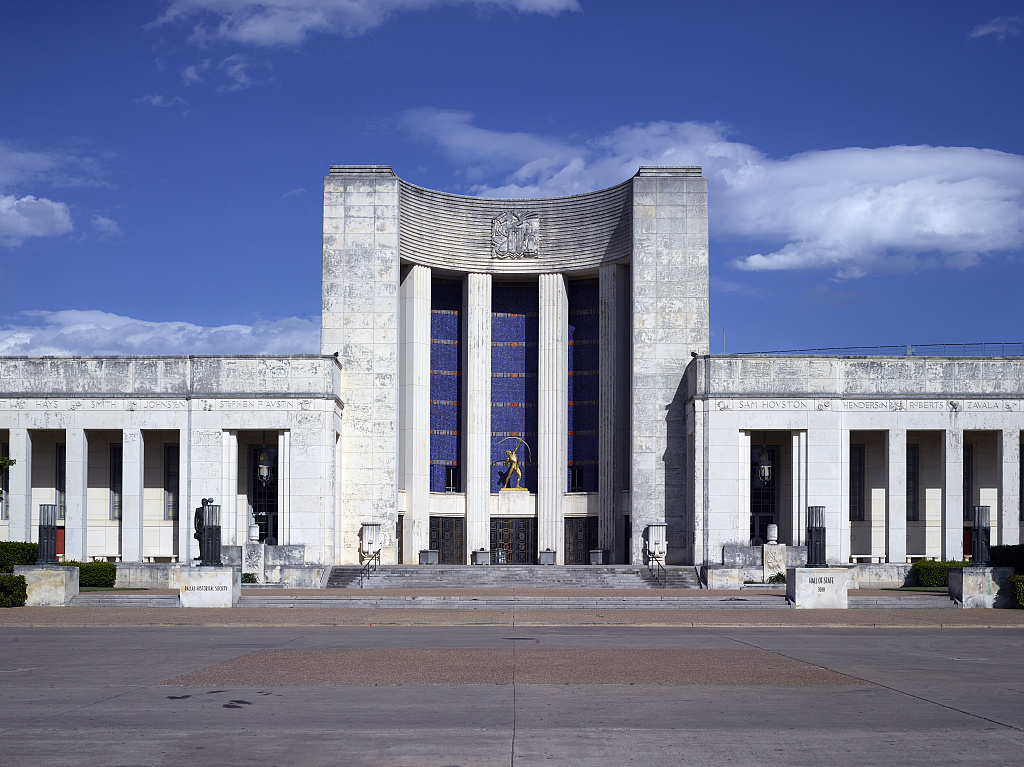
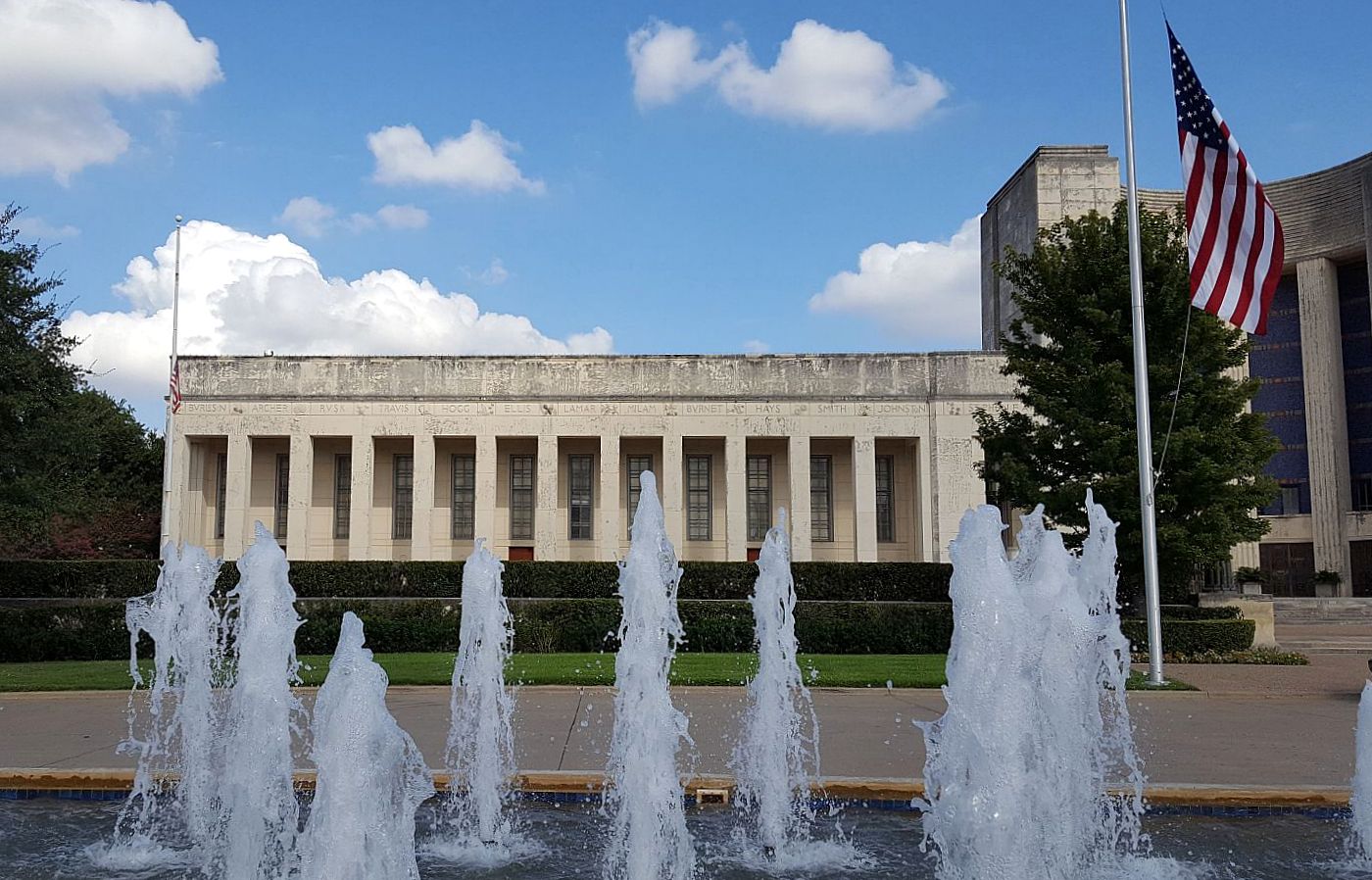
A large number of Texas architects had a hand in designing the Fair Park buildings built expressly for the Texas Centennial in 1936. One such architect was the young (still in his 20s!) Donald Barthelme (1907-1996) of Houston, the principal architect for the Centennial park’s crowning jewel, the Hall of State. Years ago — when the only Donald Barthelme I had ever heard of was the acclaimed writer (who was the son of the architect) — I read an amusing factoid about Barthelme’s amusing “signature” which adorns his beautiful building. It can be seen on the wing to the left of the Hall’s entrance — seen above. (I took the photo this week — the flags are at half-mast in honor of the recent death of former governor Mark White.)

Around the top of the building is a frieze containing names of notable Texans. I’m sure a committee of some sort came up with this list of names which were carved into what was then the most expensive public building in Texas. All I can say is that it’s a shame they couldn’t have come up with just one more name — someone whose last name began with the letter “E,” because Mr. Barthelme arranged the first eight names to spell out his last name (which ended one letter too soon, at “M” — for Milam). I think if I had been in Barthelme’s position I might have just thrown in another name. Maybe “Erath.” …For closure. Click the photo below to see Mr. B’s winking historic signature.

hall-of-state_barthelme_080917_det

hall-of-state_080917

A couple of sentences on the Hall of State by David Dillon, former architecture critic for The Dallas Morning News, written for the paper in November 1989:

Few Texans know who designed the Hall of State — it was Donald Barthelme of Houston, assisted by 10 other architects — yet 53 years after it opened it continues to stir us. It is a building of exceptional individual pieces held together by a powerful central idea — an exemplary period piece that reminds us what public design used to be, and what much contemporary civic architecture is not.

barthelme-donald_1949_univ-houston-yrbk_faculty

barthelme-donald_1950_faculty_univ-houston

***

Sources & Notes

Photos of the Hall of State taken by me on Aug. 9, 2017.

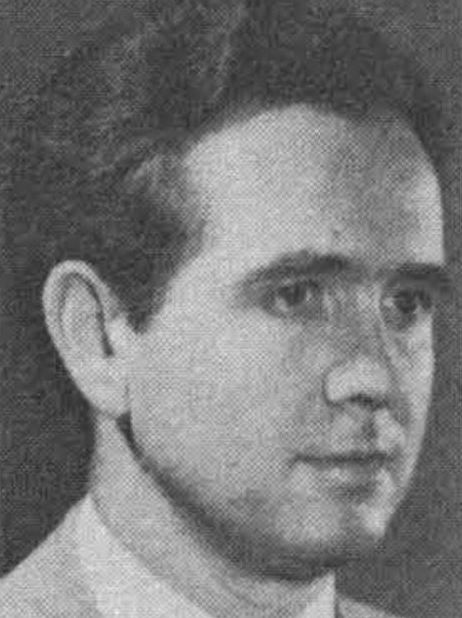
Photos of Donald Barthelme, Sr. taken from the 1949 and 1950 yearbooks of the University of Houston where he was an Architecture professor for many years.

David Dillon quote from his article “An Old Friend Triumphs Anew: The Hall of State Redo Affirms the Power of Great Architecture” (DMN, Nov. 14, 1989), written after an extensive renovation to the building.

More on Barthelme at the Handbook of Texas History and on Wikipedia.

More on the exterior of the Hall of State from Steven Butler (with a list of the names carved into the frieze) here.

*

Copyright © 2017 Paula Bosse. All Rights Reserved.

The G. B. Dealey Library and Reading Room at the Hall of State

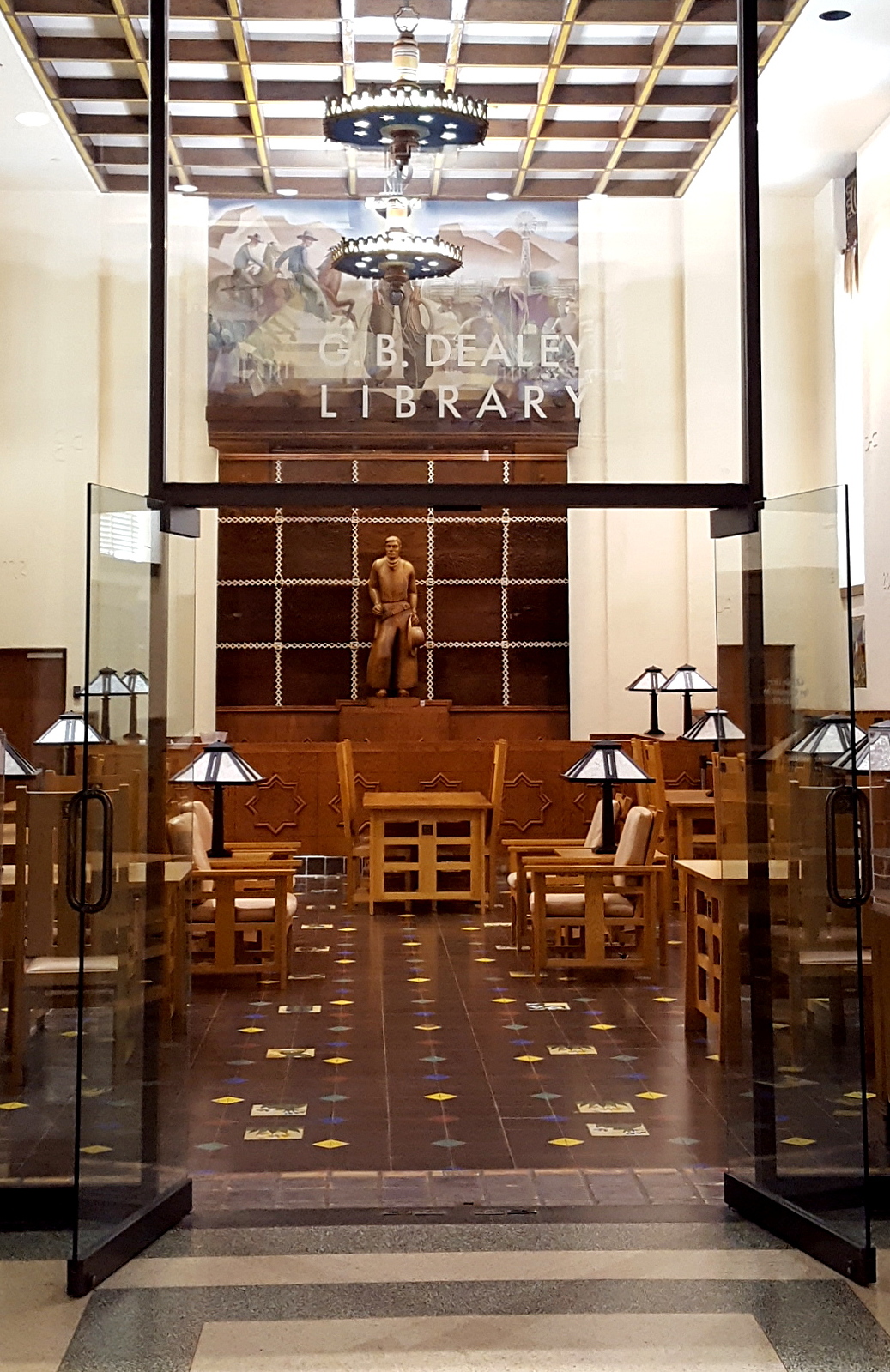
hall-of-state_dealey-library_entrance_042517A quiet place to read or study… (click for larger image)

by Paula Bosse

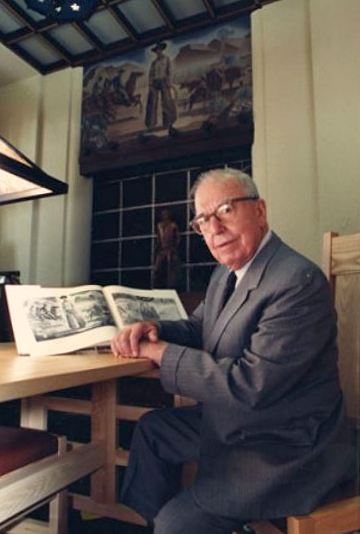
I spent time this week walking around the G. B. Dealey Library and Reading Room at the Hall of State in Fair Park. It is part of the Dallas Historical Society, and it is a quiet, high-ceilinged, airy-but-cozy Western-themed oasis filled with lots of warm wood and featuring two large murals by legendary El Paso artist Tom Lea. If you haven’t seen it, I highly encourage you to go take a look.

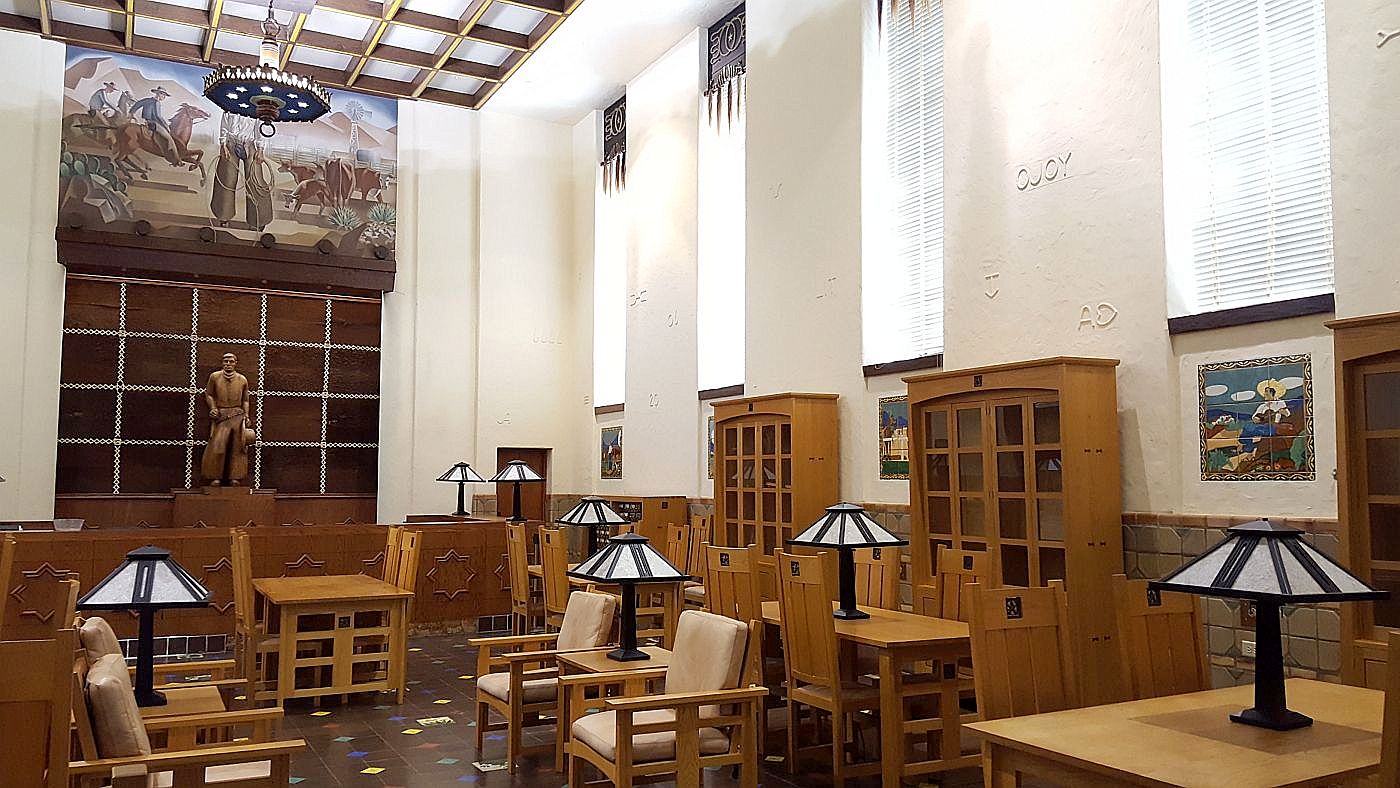
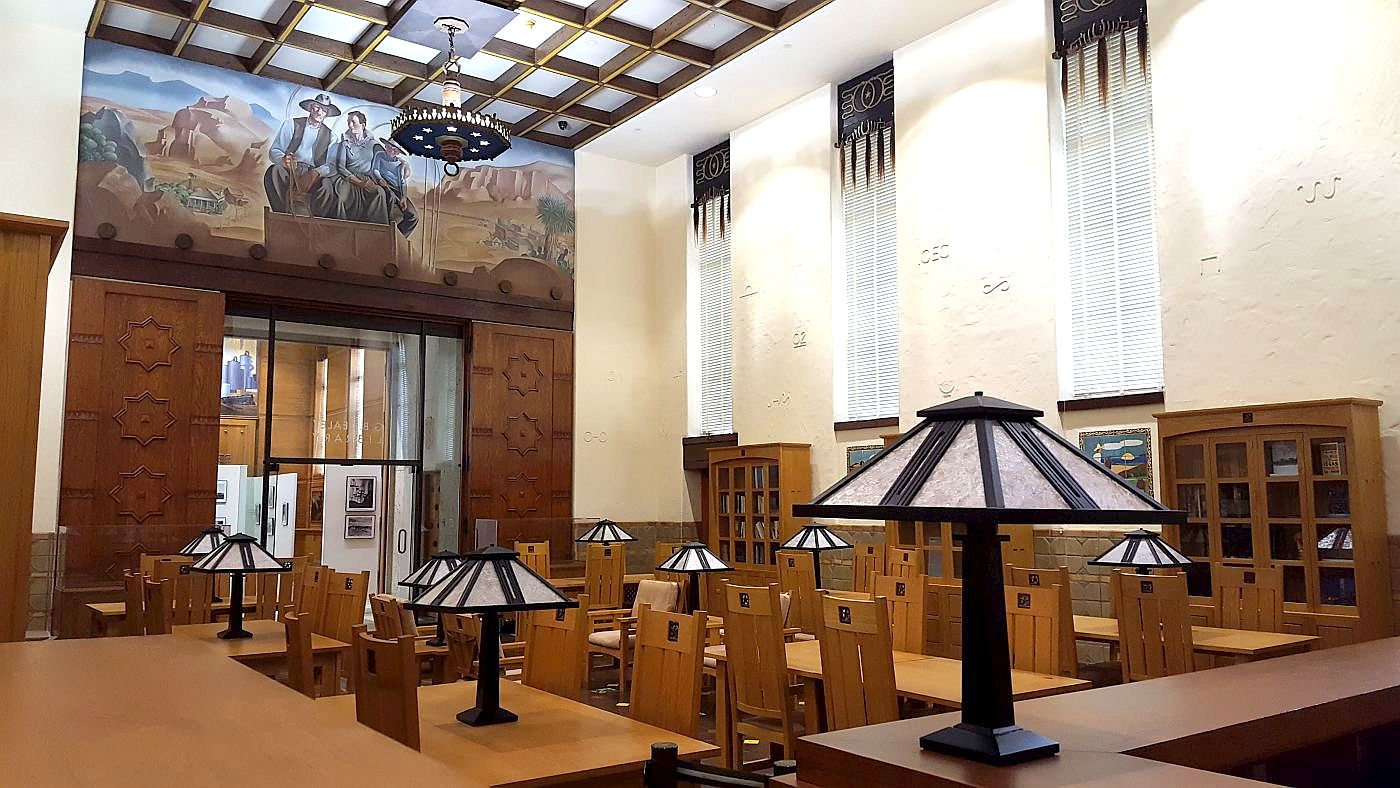
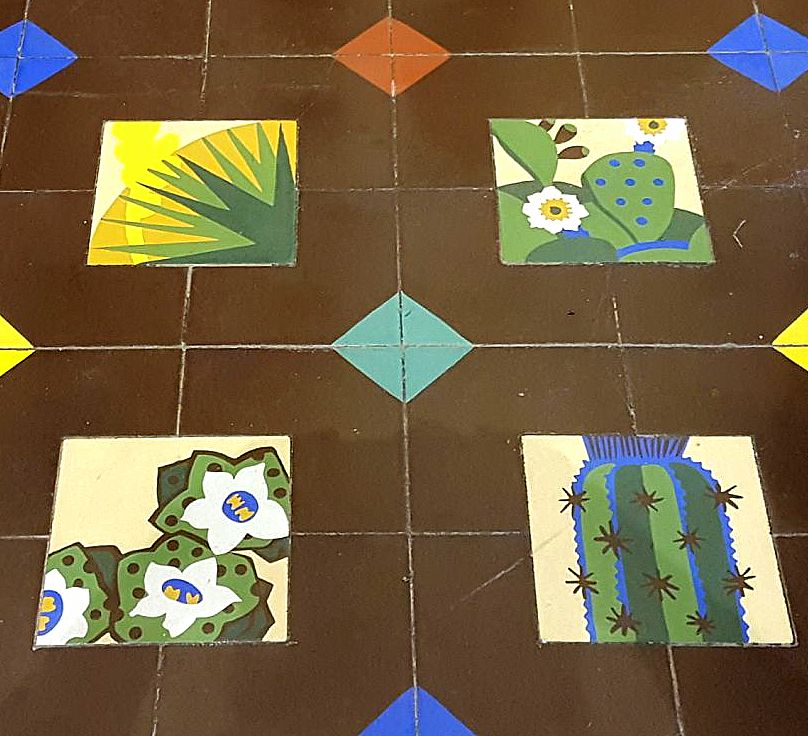
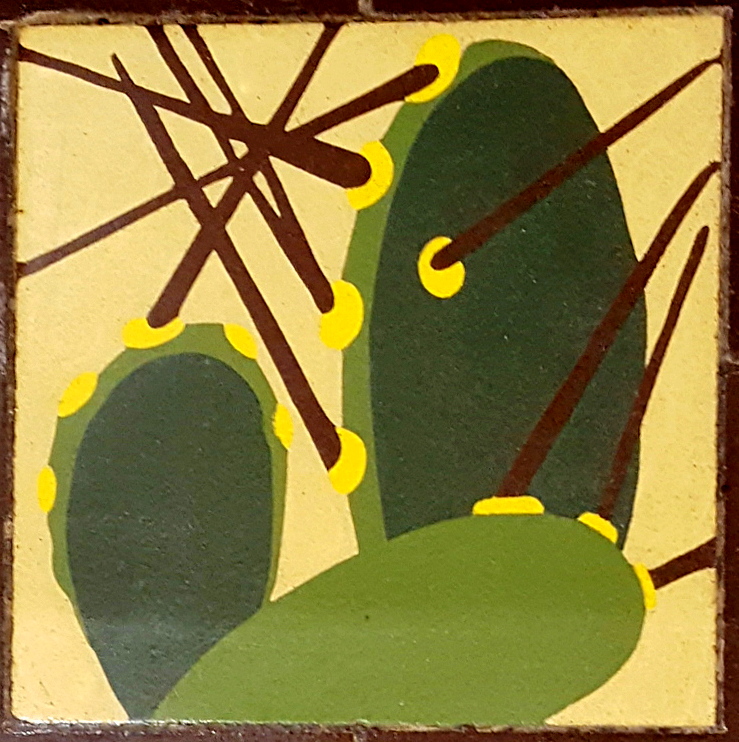
What we now call the Hall of State was the architectural jewel in the crown of the Art Deco splendor created throughout Fair Park for the Texas Centennial Exposition in 1936. The room now housing the Dealey Library was originally the West Texas Room — one of four geographically-specific rooms in the Hall of State. The two Tom Lea murals (one depicting a cowboy, the other, pioneers) are on opposite walls (walls finished with an adobe-like plaster, decorated with famous Texas brands, in relief). One wall is covered with cowhide. There are painted ceramic tiles set into both the walls and the floor (the ones on the floor decorated with images of cactus are great!). There is a wood sculpture of a cowboy, carved by Dallas artist Dorothy Austin, who was only 25 years old when the Centennial opened. And … well — like everything in the Hall of State — everywhere you look you see incredible attention to detail. Every fixture, grating, knob … everything is absolutely wonderful.

In 1989, after a two-and-a-half-year renovation, the West Texas Room became the home of the G. B. Dealey Library (named in honor of the former publisher of The Dallas Morning News). The project was headed by architect Downing Thomas who took great care in choosing the Arts and Crafts-style furniture (the chairs, tables, and bookcases were handmade by Thomas Moser in Portland, Maine, the chairs emblazoned with bronze Texas stars and upholstered in tanned leather), reading lamps with mica shades (made by Boyd Lighting of San Francisco), and a woven rug by Sally Vowell of Fort Worth (I don’t recall seeing a rug, but there’s a lot to take in and I might have missed it). I really love this room.

When the library opened in November, 1989, the first guest through the doors was Tom Lea who had been shocked to learn that his then-53-year-old murals were still in place. And they’re still there, 81 years after Lea created them. And you should go see them.

The library and reading room is open Tuesday-Sunday, same hours as the Hall of State. If you are interested in researching materials from the collection of the Dallas Historical Society, you are encouraged to contact the staff in advance of your visit and make an appointment; though the room is open to the public, research hours are limited. More about this and the hours of operation can be found here.

*

Below, one of the Tom Lea Murals can be (partially) seen above the cowhide wall-covering and above Dorothy Austin’s cowboy sculpture. (Click photo to see a larger image.) That light fixture is fantastic! (See the full Tom Lea mural here.)

hall-of-state_dealey-library_042517_inside-entrance

Here’s the view from the back corner looking toward the entrance, over which can be seen Lea’s second mural.

hall-of-state_dealey-library_042517_toward-entrance

In the photo at the very top, you can see the floor, which is studded with all sorts of cactus-themed tiles. Here are examples of four of them.

hall-of-state_dealey-library_042517_floor

My absolute favorite of the cactus tiles is this one, in a very Japanese-like rendering.

hall-of-state_dealey-library_cactus-tile

*

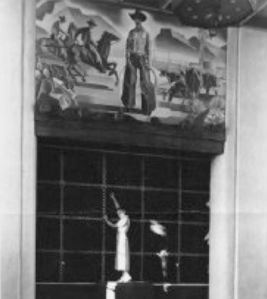
That’s what the room looks like today. Here are a few photos of the West Texas Room under construction in 1936 (photos from the Dallas Historical Society’s Centennial Visual Collection). The first one shows Dorothy Austin standing below the Tom Lea mural, about where her cowboy statue would be placed. Those ceilings are pretty high.

tom-lea_dorothy-austin_west-tx-room_DHS

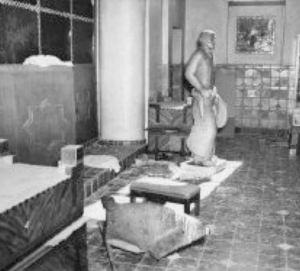
And here’s the statue. (See Austin’s statue close up, here, in a 2014 photo by Carol M. Highsmith, from the Library of Congress.)

dorothy-austin_cowboy-sculpture_west-tx-room_DHS

And here is a look into the room from the entrance, showing a construction crew at work.

west-tx-room-construction_hall-of-state_DHS

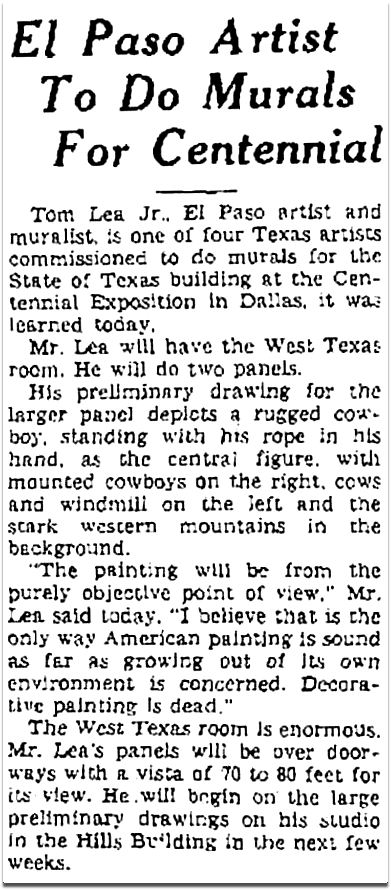
Below are 28-year-old Tom Lea’s thoughts on being informed of his important commission, from the El Paso Herald Post, March 24, 1936.  (Click to see larger image.)

tom-lea_west-tx-room-murals_el-paso-herald-post_032436

It seems strange that Lea was only in the preliminary-drawing stage of the murals’ creation in March — the Centennial was scheduled to open in June, less than three months away. (It’s worth noting that even though the Centennial — which ran for almost six months — opened in June, the Hall of State did not open to the public until September, three months behind schedule and the only Exposition building that did not meet its deadline. It was finally dedicated on September 5, 1936, the 100th anniversary of Sam Houston’s election as the first President of Texas.)

Below, a photo of Mr. Lea at the 1989 opening of the Dealey Library, with his 1936 mural behind him.

tom-lea_west-texas-room_1989_tom-lea-institute
via Tom Lea Institute

*

To read more details on the 1989 opening of the G. B. Library and the renovation of the West Texas Room, please check out these articles from The Dallas Morning News archives:

  • “A Rare Blend — Art Deco, Western and Shaker Unite for a Modern Adaptation at the Hall of State” by Mariana Greene (DMN, Nov. 12, 1989)
  • “G. B. Dealey Library Dedicated at Fair Park — Center Will House Texas Documents” by Todd Coplivetz (DMN, Nov. 13, 1989)
  • “How the West was East at the Hall of State Redo”  by Alan Peppard (DMN, Nov. 14, 1989)
  • “An Old Friend Triumphs Anew: The Hall of State Redo Affirms the Power of Great Architecture” by David Dillon (DMN, Nov. 14, 1989)
  • “Reviving a Cultural Paean to Dallas — Fair Park Changes Designed to Restore Centennial’s Glory” by David Dillon (DMN, April 9, 1986) (this article concerns Fair Park as a whole)

***

Sources & Notes

Photos of the Dealey Library and Hall of State door (below) are by me.

Photos of the West Texas Room from 1936 are from the collection of the Dallas Historical Society. You can search through low-res thumbnails of some of the images from their very large collection here.

As mentioned above, if you plan a trip to the Dealey Library in order to inspect or research items from the DHS collection, these materials must be requested in advance and an appointment must be scheduled (info here).

More on Tom Lea (1907-2001) can be found at the Tom Lea Institute website, here (with specific information on the Hall of State murals here); a profusely illustrated blog post with an emphasis on his time as a WWII artist-correspondent can be found here.

Obituary for Dorothy Austin Webberley (1911-2001) can be found on the Dallas Morning News site, here; family obituary is here.

Detailed info on the architecture and design of the Hall of State can be found in a Dallas Historical Society PDF, here. The Wikipedia entry is here (someone please correct the erroneous info that the Dealey Library is in the “East” Texas room!), and the always informative Watermelon Kid site has information on the East Texas and West Texas rooms here.

A series of photos of Fair Park, taken in 2014 by Carol M. Highsmith, can be found at the Library of Congress website, here. Her photo of the Hall of State is below.

hall-of-state_library-of-congress_carol-m-highsmith_2014

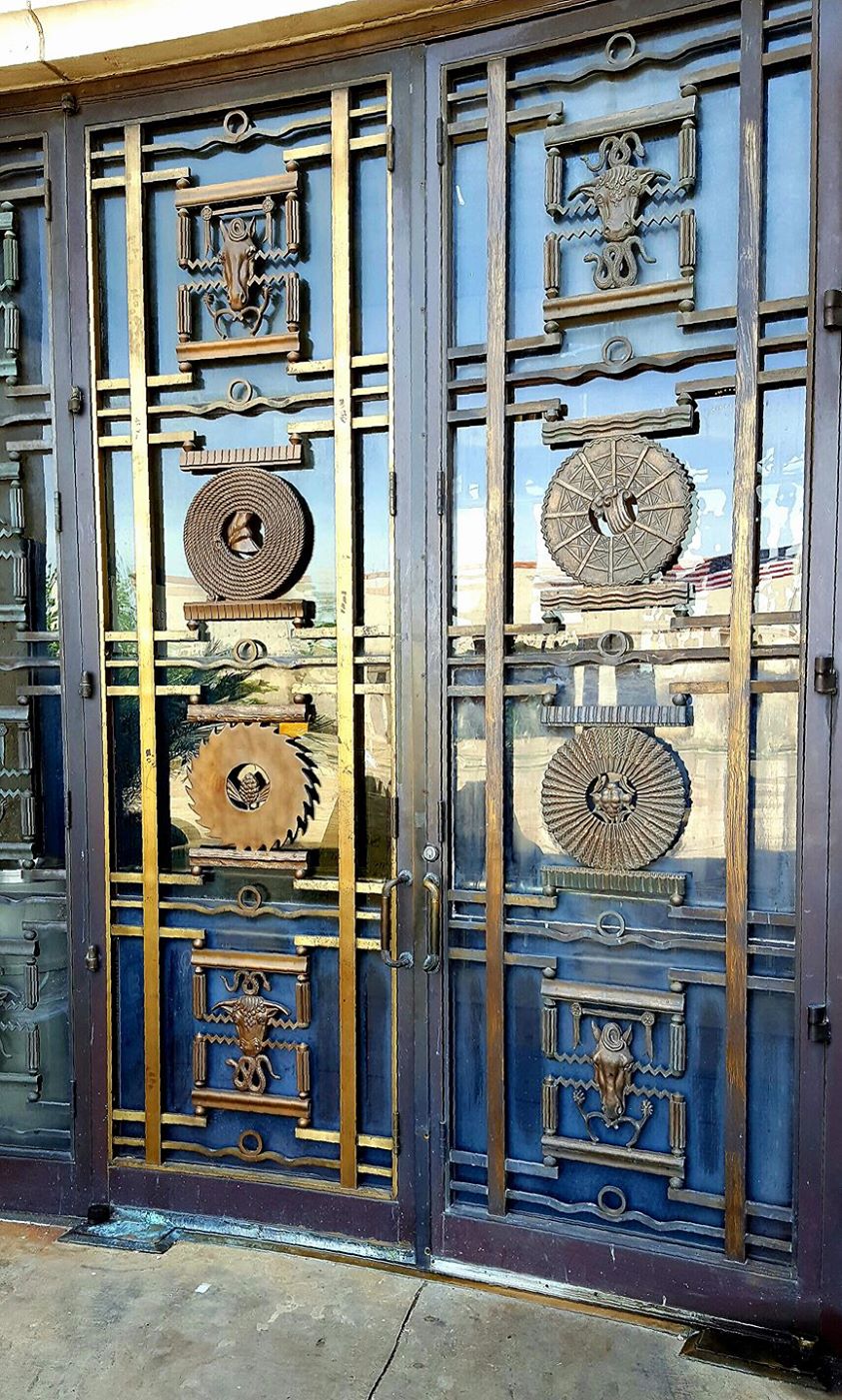
And, lastly,  a photo I took showing one of my favorite elements of a building packed with aesthetically pleasing details (seriously, everywhere you look): one of the doors of the main entrance to the Hall of State, designed by Houston architect Donald Barthelme, honoring Texas industry (ranching, timber, oil, agriculture, etc.). That sawmill blade gets me every time. And the aerial perspective of oil coming up through a derrick (middle right) is pretty cool, too. (Click to see a larger, more exciting image!)

hall-of-state-doors_042517_bosse

*

Copyright © 2017 Paula Bosse. All Rights Reserved.


Albert Einstein “Threw the Switch” in New Jersey to Open the Pan-American Exposition in Dallas — 1937

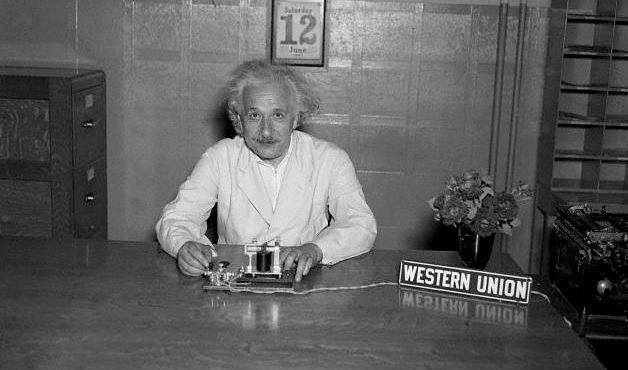
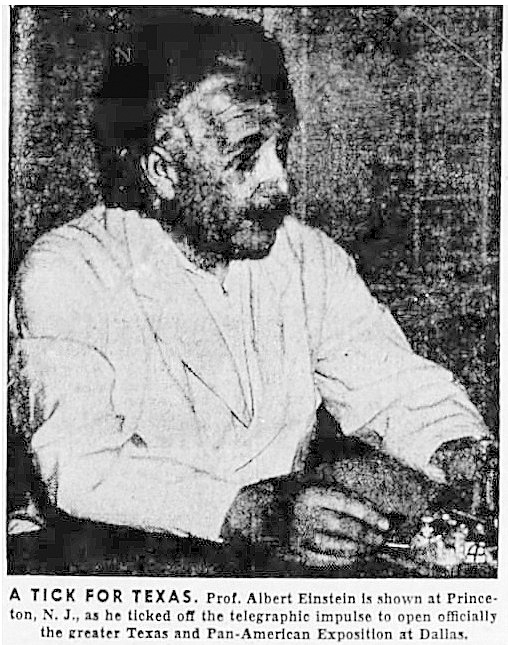
pan-american-expo_einstein_061237Einstein at the switch, June 12, 1937…

by Paula Bosse

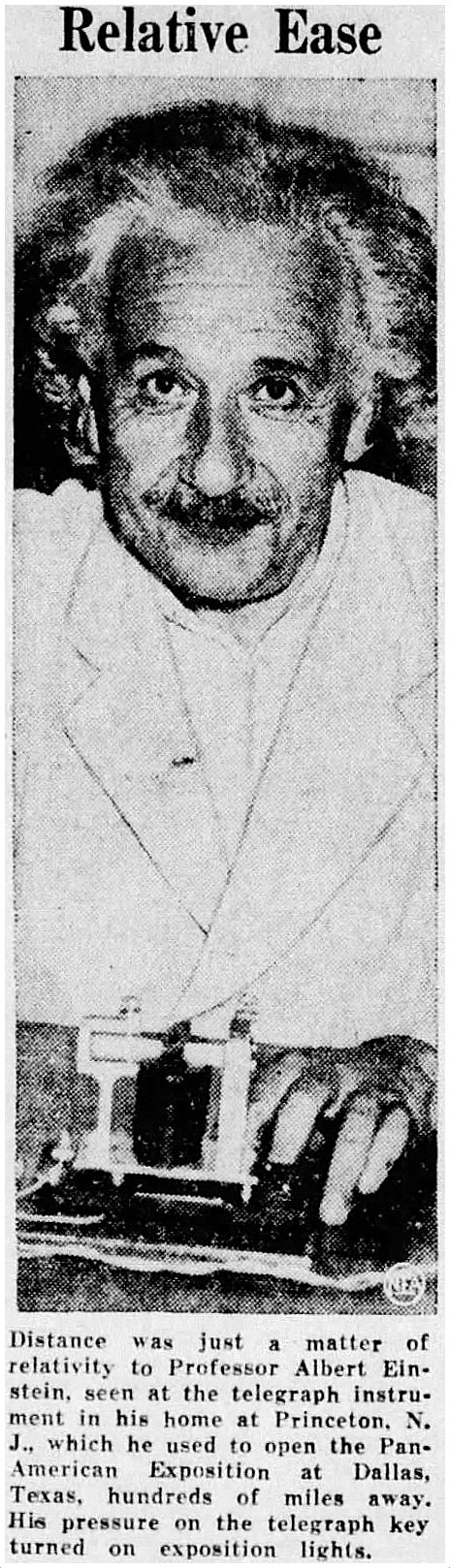
Who knew? Albert Einstein, the world’s most famous physicist, helped open the Greater Texas and Pan-American Exposition. The exposition was held at Fair Park for 20 weeks, from June 12, 1937 to October 31, 1937, as a follow-up of sorts to the Texas Centennial (the city had built all those new buildings — might as well get their money’s worth!). I’m not quite sure how Einstein got roped into this, but looking at the photo above, he seemed pretty happy about what was, basically, a long-distance ribbon-cutting. Via telegraph.

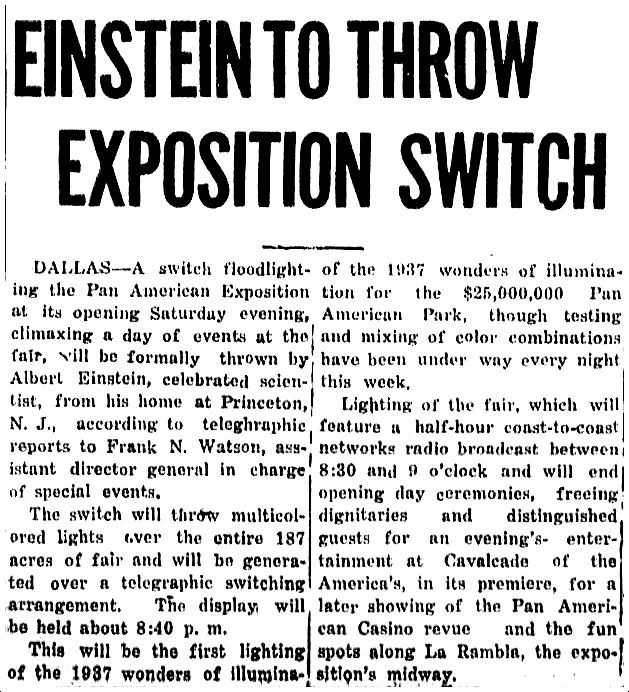
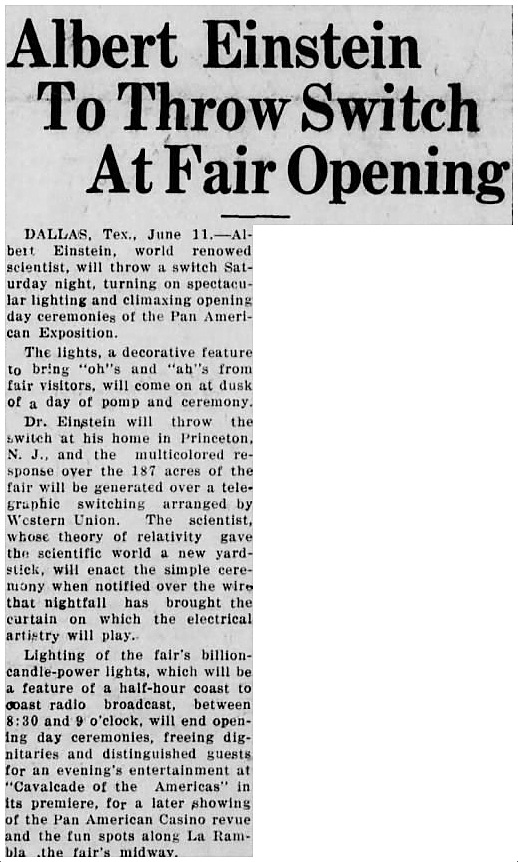
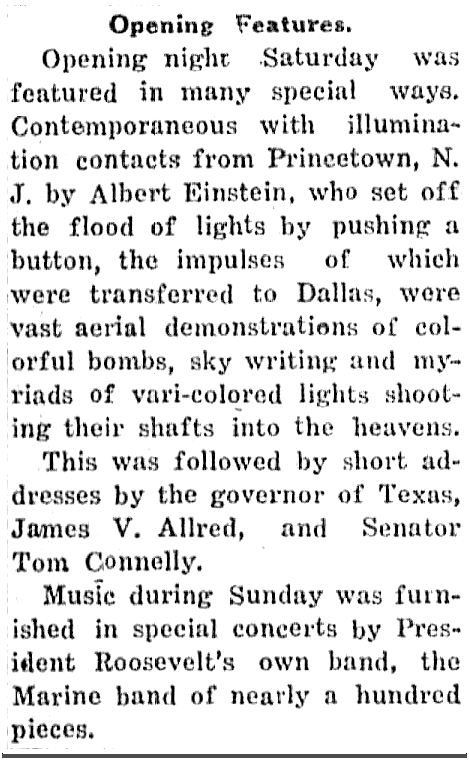
The plan was for Professor Einstein to officially open the Pan-American Exposition by “throwing the switch” which would turn on massive displays of lights around Fair Park. He would do this from Princeton, New Jersey, where he lived, by closing a telegraph circuit which would put the whole thing in motion. Newspaper reports varied on where exactly Herr Einstein was tapping his telegraph key — it was either the study in his home, in his office, in a Princeton University administration building, or in the Princeton offices of Western Union (the latter of which was mentioned in only one report I found, but it seems most likely).

Einstein was a bona fide celebrity, and this was national news — newspapers around the country ran stories about it, and the ceremony was carried live on coast-to-coast radio. Almost every report suggested that Einstein’s pressing of the key in New Jersey would be the trigger that lit up the park in Texas, 1,500 miles away — which was partly correct. According to The Dallas Morning News:

Lights on the grounds will be turned on officially at 8:40 p.m. when Dr. Albert Einstein, exponent of the theory of relativity, presses a key in his Princeton home to fire an army field gun. With the detonation of the shell, switches will be thrown to release the flood of colored lights throughout the grounds. (DMN, June 10, 1937)

So on June 12, 1937 he pressed a telegraph key somewhere in Princeton, NJ, an alert was instantly wired to Dallas, an army field gun (in some reports a “cannon”) was fired, and that blast was the cue for electricians positioned around the park to throw switches to illuminate the spectacular displays of colored lights.

The Western Union tie-in gimmick was a success. Newspaper reports might have been a little purple in their descriptions, but from all accounts, those lights going on all at once was a pretty spectacular sight.

Dr. Albert Einstein, celebrated scientist, threw a switch that flashed a million lights over the 187-acre exposition park. The flash came at 8:40 o’clock and instantly the huge park became a city of a million wonders. Flags from a thousand staffs proclaimed their nationality [and] bands played the national airs of the nations of the Western Hemisphere as lusty cheers roared with thunderous approval. The Greater Texas and Pan-American Exposition was formally opened. It is on its way. (Abilene (TX) Reporter News, June 13, 1937)

The Dallas News describes the crowd as stunned into silence:

The waiting participants in the ceremonies at Dallas heard the results [of Einstein’s telegraph signal] when a cannon boomed. Electricians at switches around the grounds swung the blades into their niches and the flood of light awoke the colors of the rainbow to dance over the 187-acre park. Its breath taken by the spectacle, the crowd stood silent for a moment, and then broke into a cheer. (“Pan-American Fair Gets Off to Gay Start” by Robert Lunsford, DMN, June 13, 1937)

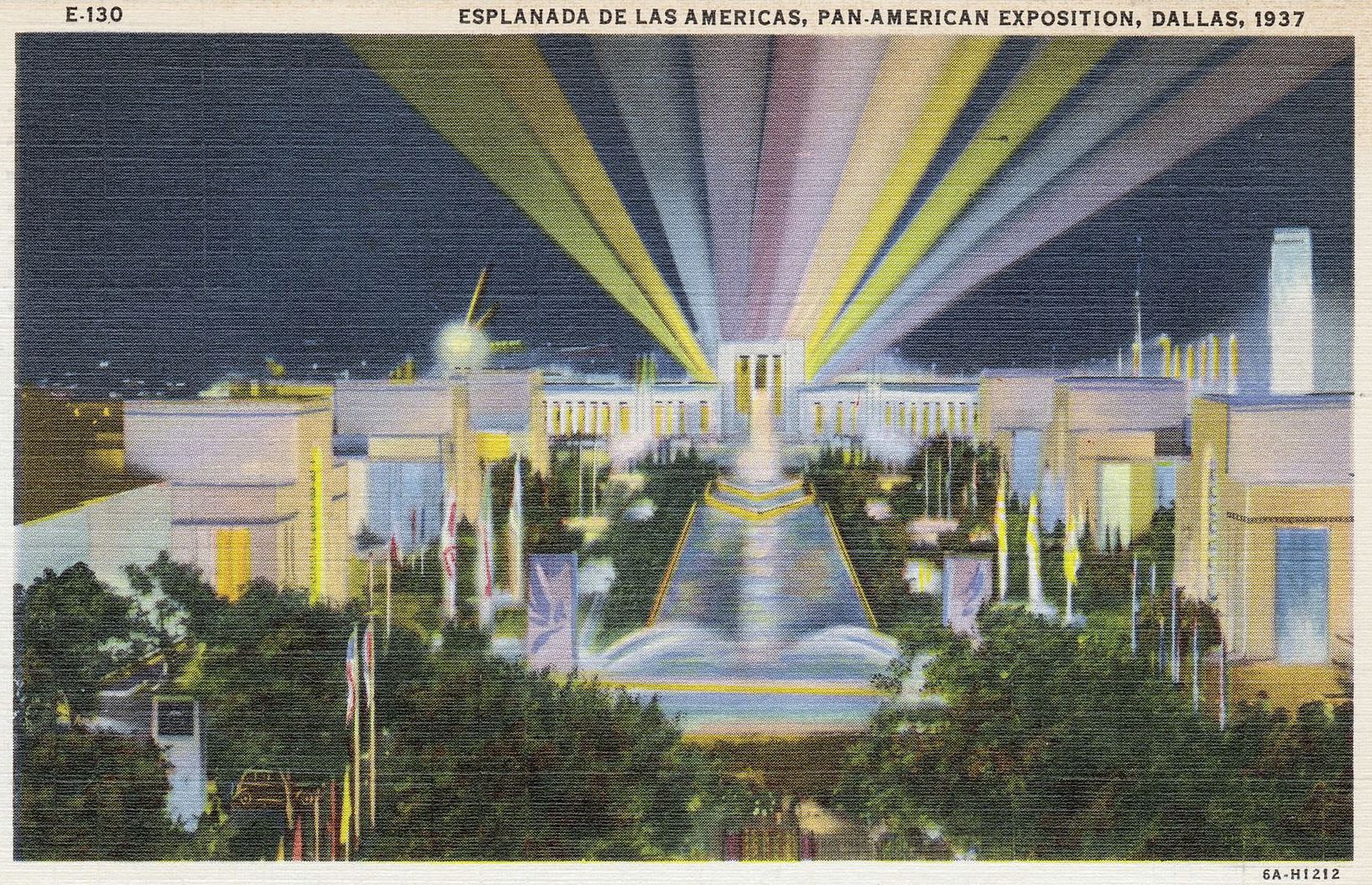
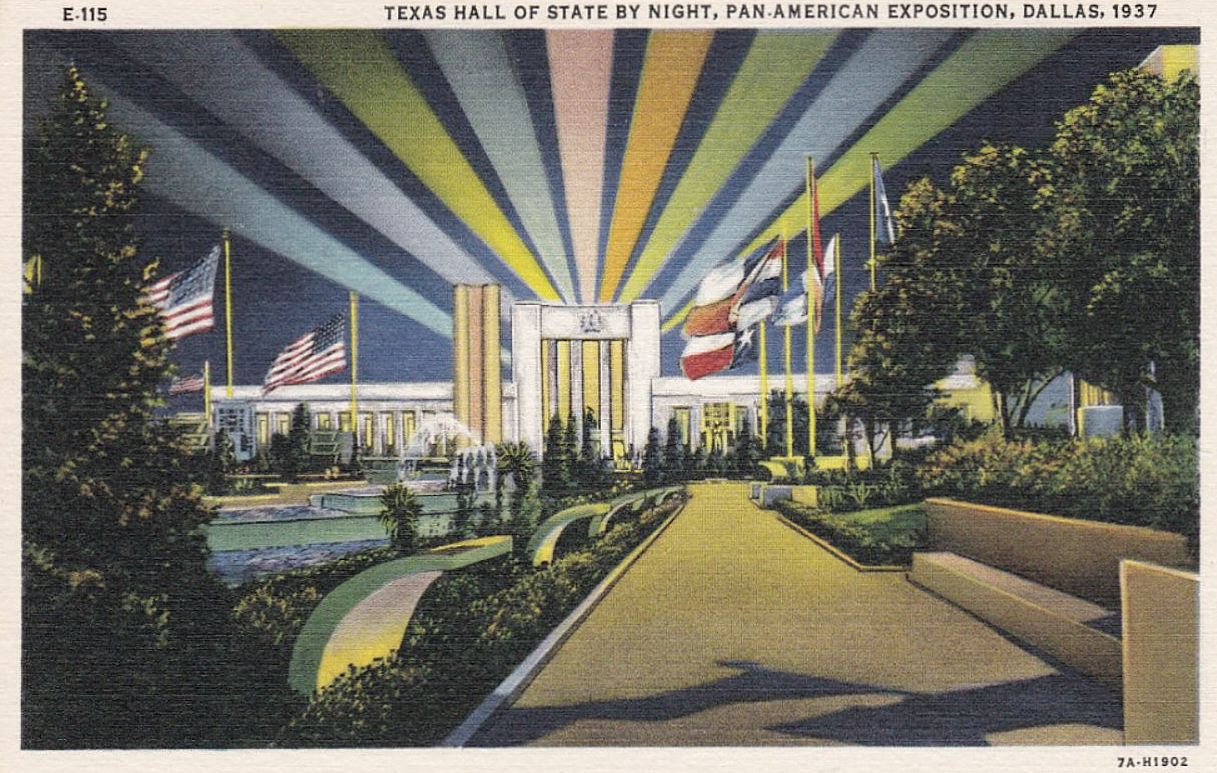
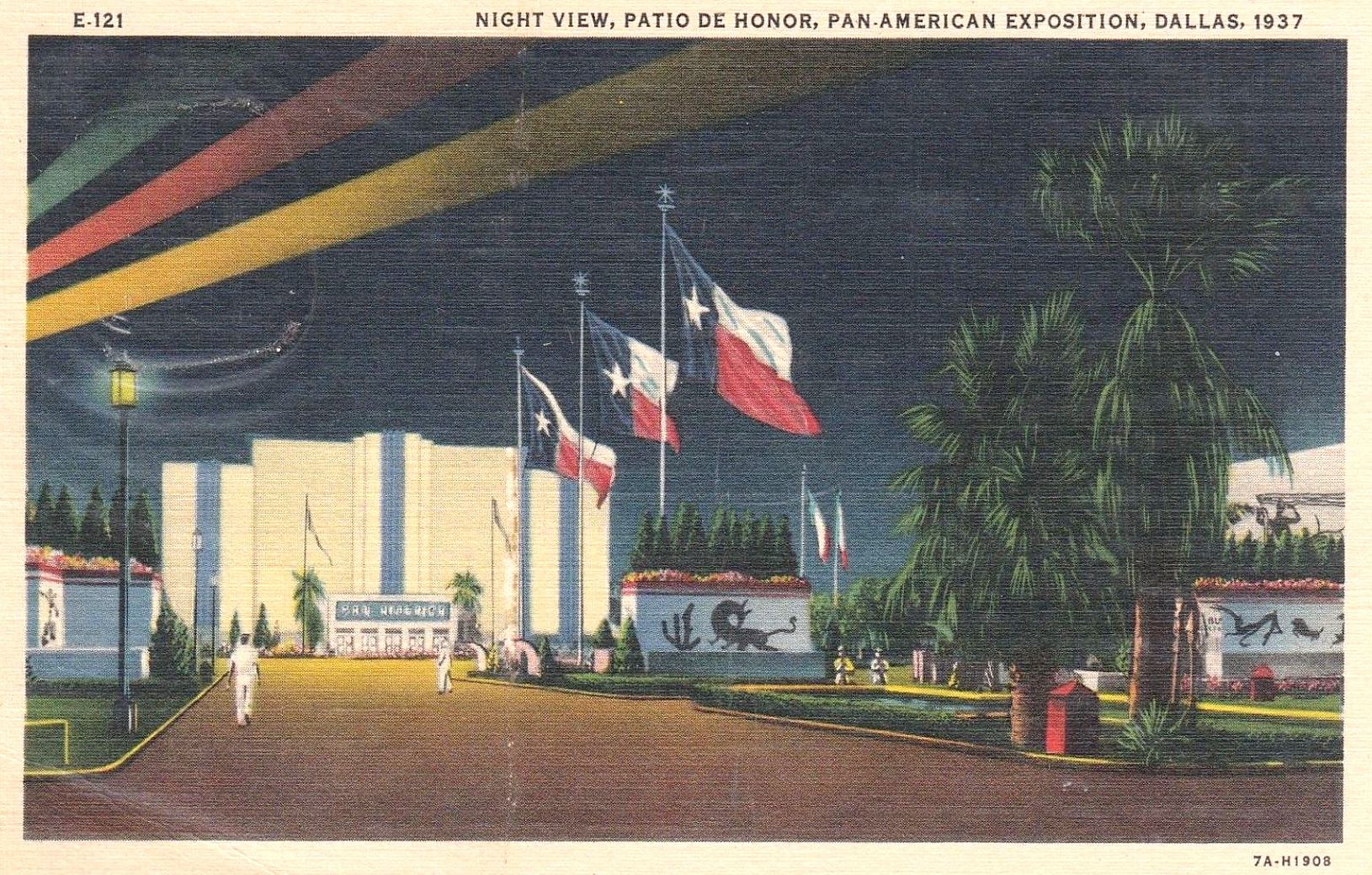
Many of the lighting designs and displays had been used the previous year during the Centennial, but, as with much of the attractions and appointments throughout the park, they were improved and spectacularized for the Pan-American Expo. And people loved what they saw.

Despite the multi-million dollar structures, air conditioning demos, works of art and other newfangled additions to the space, when people left the Centennial Exposition one thing was on everyone’s tongues, according to historical pollsters: the lights.

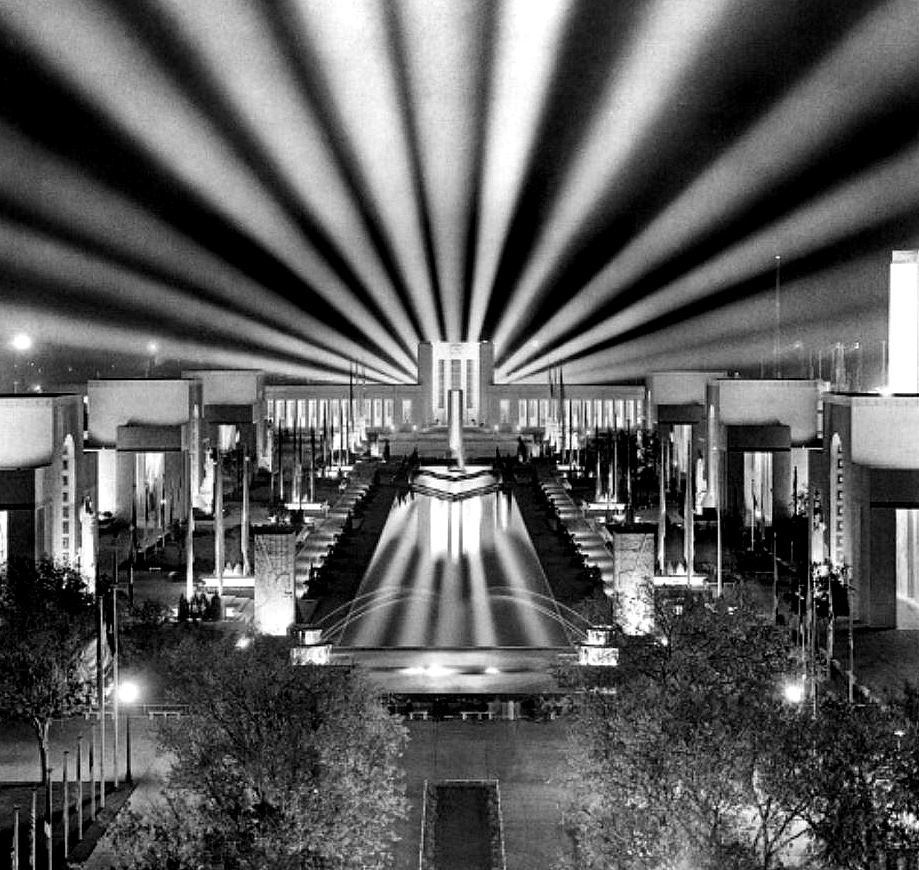
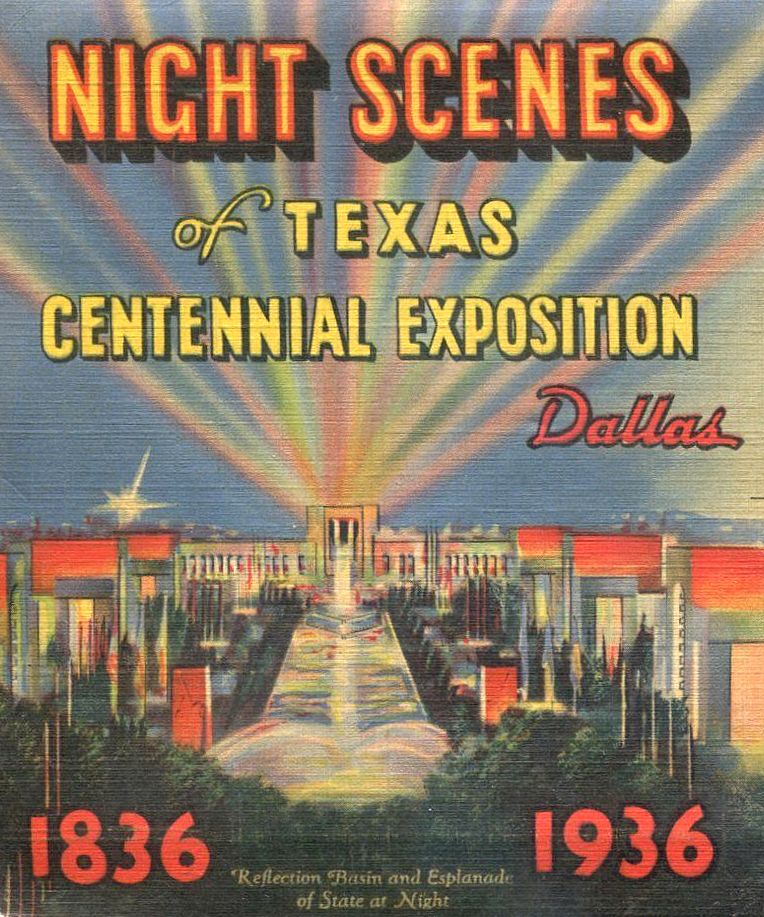
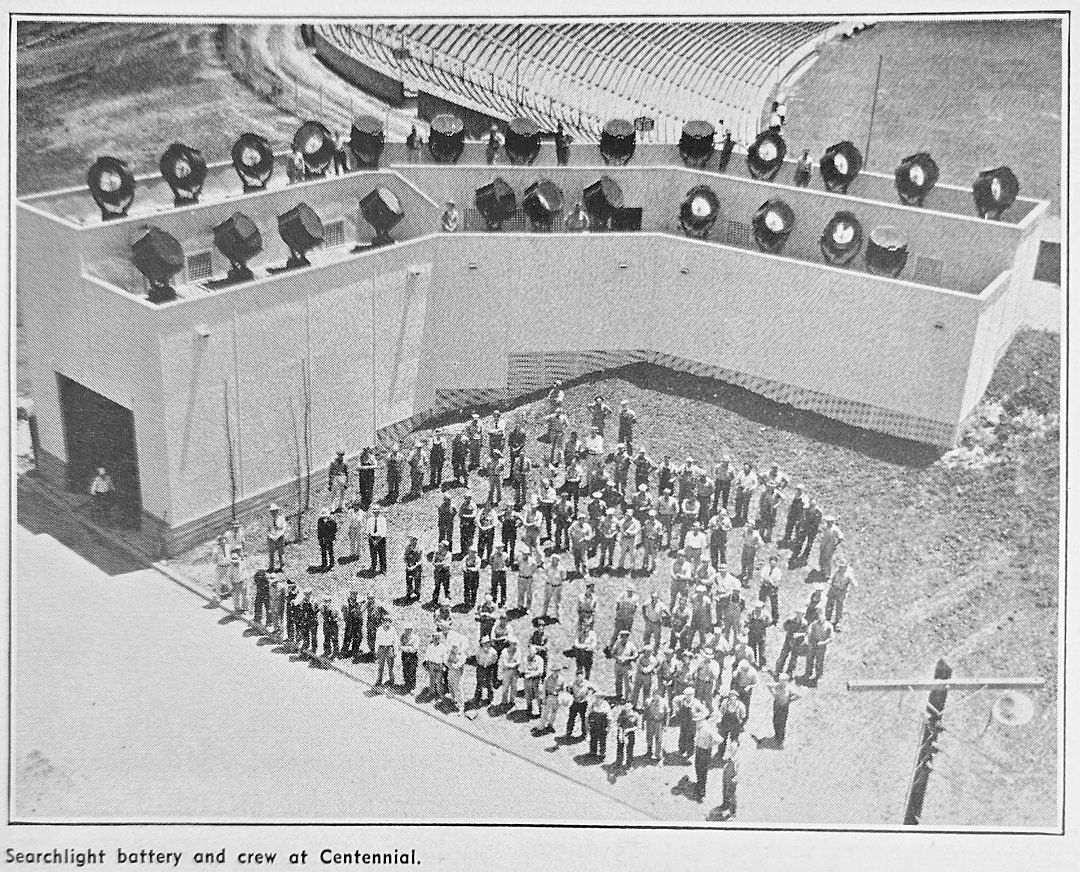
Positioned behind the Hall of State were 24 searchlights scaffolding into a crowned fan shape. “They all moved and were different colors,” says [Jim] Parsons [co-author of the book Fair Park Deco]. “It sounds gaudy, but people loved it.” The lights, he goes on to tell, were visible up to 20 miles away.

Considering most of the people who were visiting the fairgrounds were coming from rural farming communities with no electricity, the inspiring nature of those far-reaching beams makes a lot of sense. (Dallas Observer, Nov. 7, 2012)

Thanks for doing your part for Dallas history, Prof. Einstein!

pan-american-expo_esplanade_postcard

pan-american-expo_hall-of-state_postcard

pan-american-expo_patio-de-honor_ebay

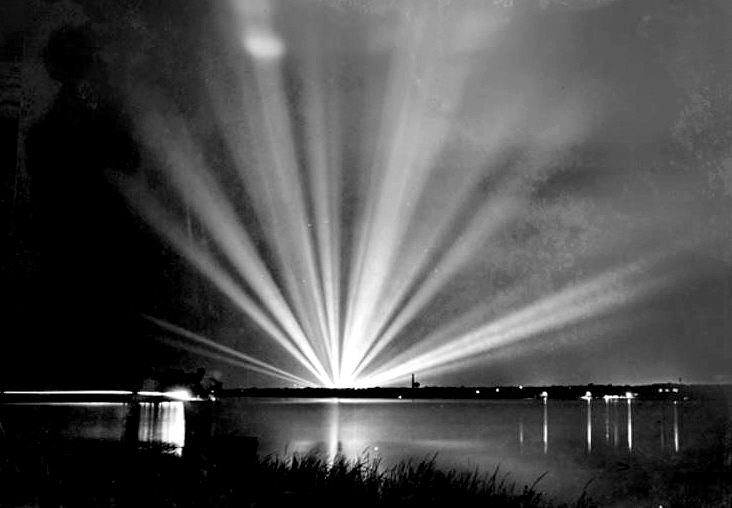
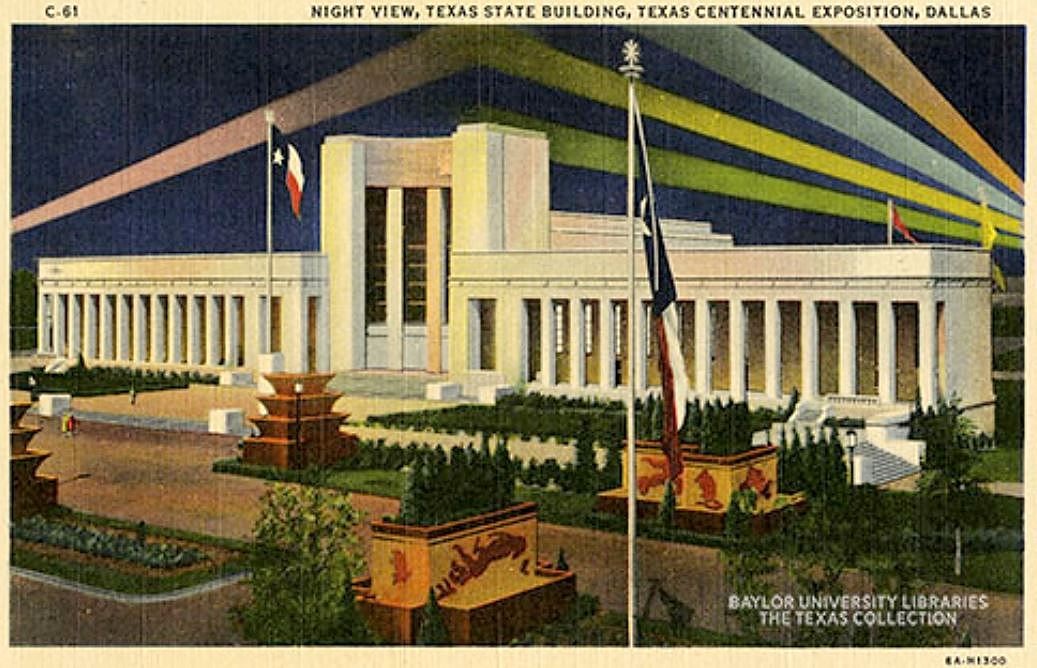
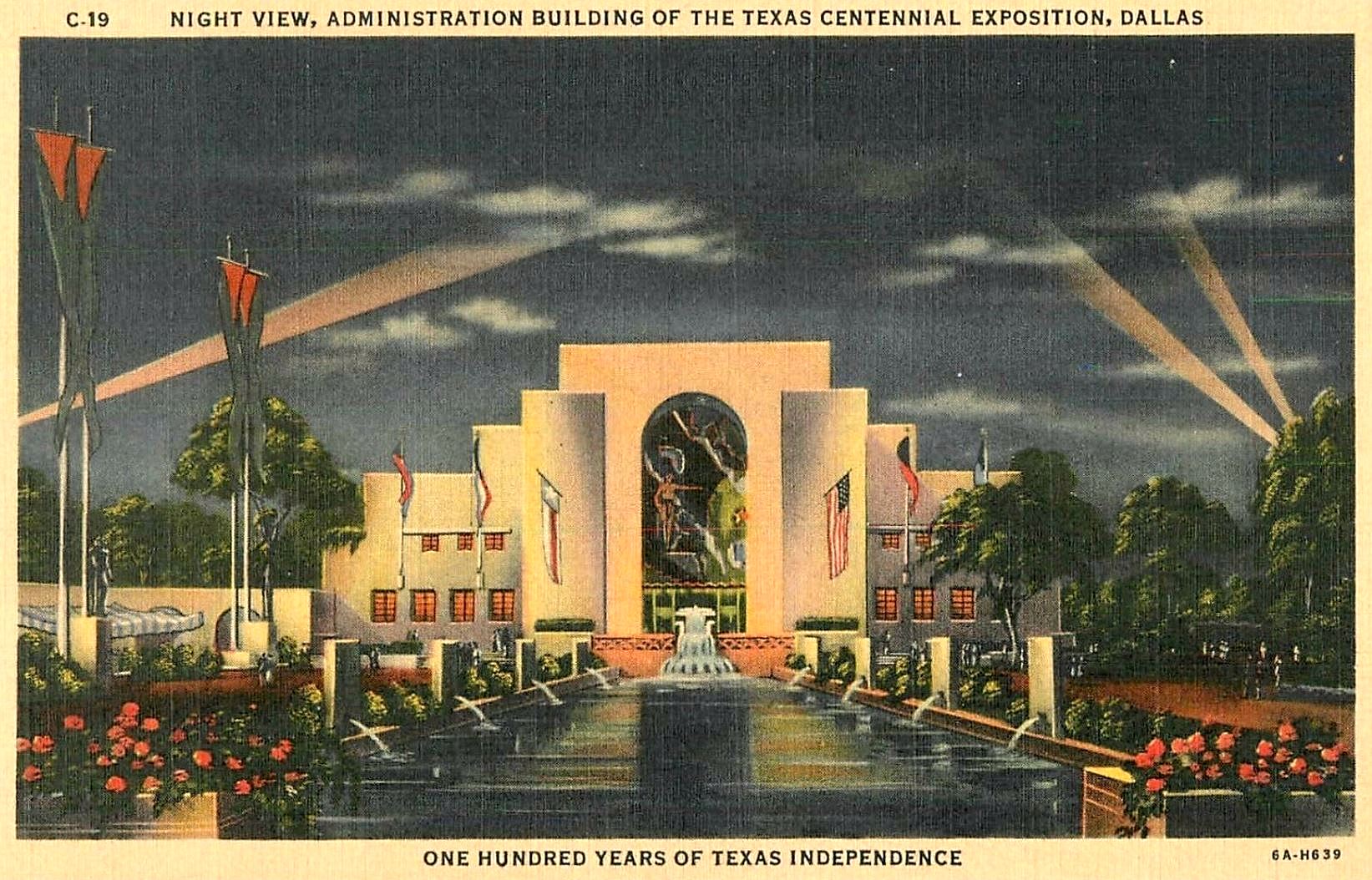
Below, photos from the Texas Centennial, 1936. The multicolored lights could be seen from miles away — here’s what they looked like from downtown and from White Rock Lake.

centennial_pan-american_lights

skyline_downtown-to-fair-park_1936_GE-colln_museum-of-innovation-and-science

fair-park-lights_white-rock-lake

tx-centennial_night-scene_espalanade_hall-of-state_lights_ebay

tx-centennial_night_hall-of-state_lights_flickr_baylorvia Baylor University Flickr stream

tx-centennial_night_administration-bldg_lights_ebay

*

A look behind the scenes: “The general lighting effect is a battery of twenty-four 36-inch searchlights as powerful as the giants that flash from the dreadnoughts of Uncle Sam’s navy. Each searchlight will produce 60 million candlepower. Combined, the battery has a total candlepower of 1.5 billion. A 350,000-watt power generator will produce this colossal quantity of ‘juice.’” And the accompanying photo of the searchlight battery crew manning the candlepower:

tx-centennial_lights_southwest-business-mag_june-1936_photoSouthwest Business, June 1936

**

(All pictures and clippings are larger when clicked.)

einstein_pan-am-expo_denison-press_060937
Denison Press, June 9, 1937

*

einstein_pan-am-expo_waxahachie-daily-light_061137
Waxahachie Daily Light, June 11, 1937

*

einstein_pan-am-expo_denison-press_061437
Denison Press, June 14, 1937

*

einstein_pan-am-expo_medford-oregon-mail-tribune_062337
Medford (Oregon) Mail Tribune, June 23, 1937

*

einstein_pan-am-expo_vernon-daily-record_062437
Vernon Daily Record, June 24, 1937

*

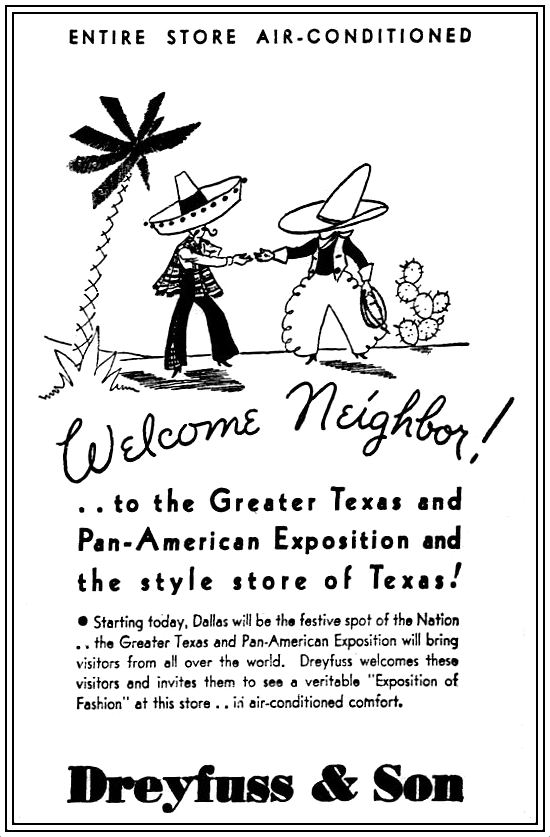
pan-american-expo_drefuss-ad_dmn_061237
1937

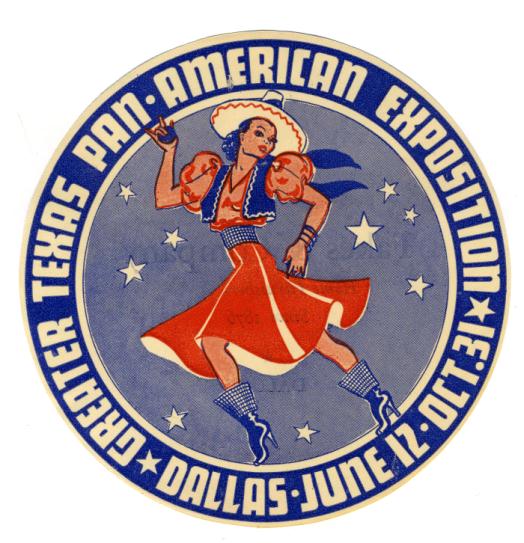
pan-american-expo_sticker_1937_cowgirl

***

Sources & Notes

Top photo from the old Corbis site.

Black-and-white photos from the Centennial seen from Fair Park and White Rock Lake are from the Texas/Dallas History and Archives Division of the Dallas Public Library; the photo of the lights seen from downtown Dallas (titled “New skyline at night from Dallas, Texas”) is from the GE Photo Collection, Museum of Innovation and Science (more info on that photo is here).

Sources of other images and clippings cited, if known.

More on the Pan-American Exposition from Wikipedia, here, and from the fantastic Watermelon Kid site of all-things-Fair-Park, here.

*

Copyright © 2016 Paula Bosse. All Rights Reserved.

“Dallas Midway, Night Illumination” — 1936

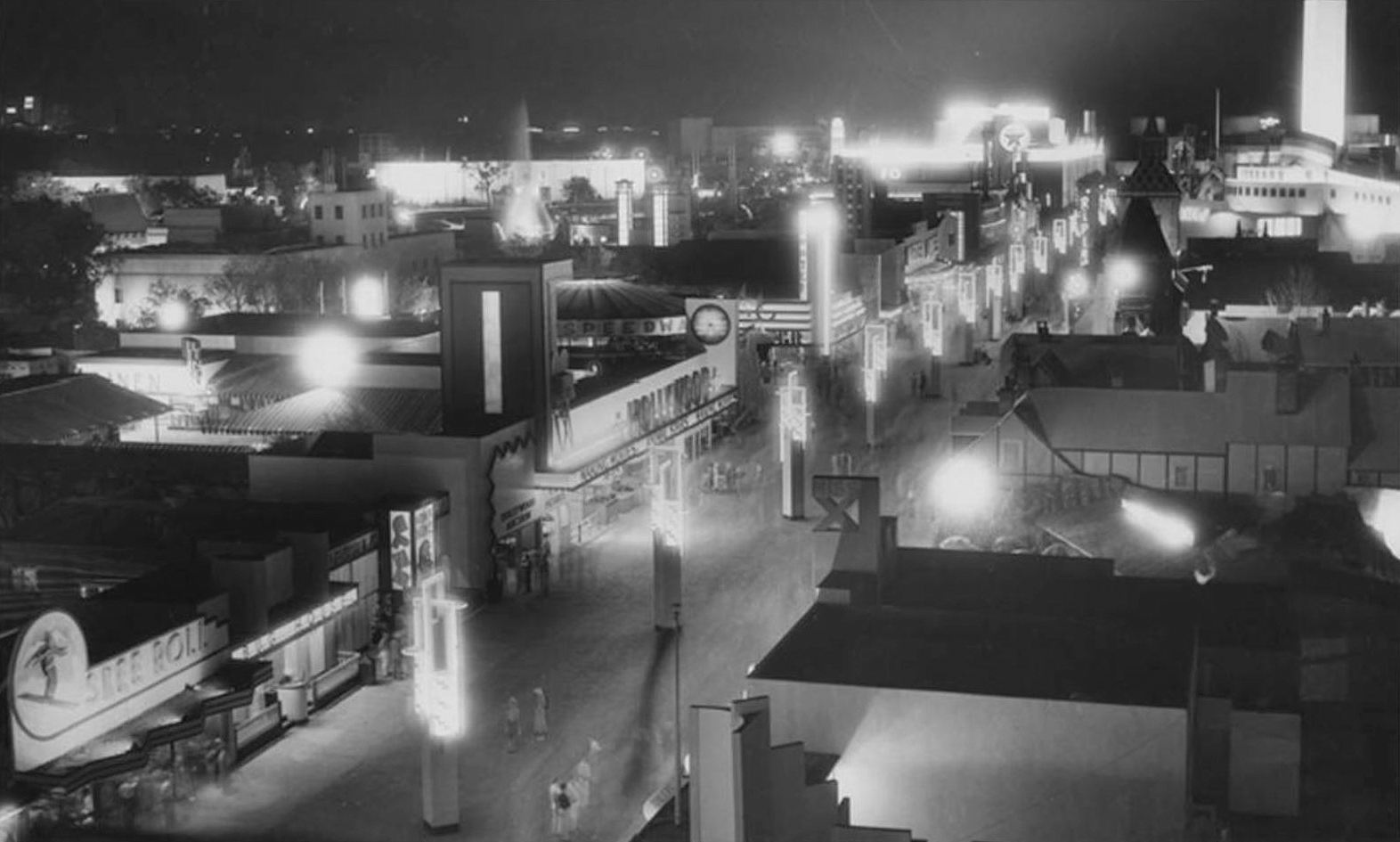
tx-centennial_midway_night_cook-coll_smuAll calm in Fair Park along the Centennial Midway (click for larger image)

by Paula Bosse

Above, a nighttime shot of an almost empty Midway during the Texas Centennial. All this scene needs in order to boost the moody atmosphere is a little fog. Go a little further and add some zither music, Joseph Cotten, and Orson Welles running past the Texaco Building and you’d have a pretty cool setting for a Texas version of The Third Man.

***

Photo titled “Dallas Midway, Night Illumination, Centennial Exposition, State Fair of Texas” (taken by an unknown photographer on Oct. 16, 1936) is from the George W. Cook Dallas/Texas Image Collection, DeGolyer Library, Central University Libraries, Southern Methodist University; more info here.

*

Copyright © 2016 Paula Bosse. All Rights Reserved.

Three Flags Over Texas at the Entrance to Fair Park — 1936

tx-centennial_flags_entrance_nyplMexico, France, and Texas welcome visitors…

by Paula Bosse

Another State Fair of Texas is winding down. Here’s what the entrance to Fair Park looked like when the Texas Centennial opened in June 1936. This Associated Press photo was accompanied by the following caption when it ran in newspapers:

FLAGS  WAVE  AT  TEXAS  CENTENNIAL
Dallas, June 6 — Three of six flags which have flown over the Lone Star State, waved over the main entrance to the Texas Centennial celebration at its opening here today. Buildings throughout the grounds of the exposition are ultra modern in design.

This view — taken at about Parry and Exposition — hasn’t changed all that much. See it on Google Street View here.

***

Sources & Notes

Associated Press photo from the New York Public Library’s digital collections, here.

*

Copyright © 2016 Paula Bosse. All Rights Reserved.

Lady Godiva and the “Flesh Shows” of the Texas Centennial — 1936

tx-centennial_streets-of-paris_ticket_cook-coll_smuGeorge W. Cook Collection/SMU

by Paula Bosse

When one thinks of the Texas Centennial Exposition, the splashy 6-month extravaganza held at Fair Park to celebrate the 100th anniversary of Texas independence, one might not immediately think of the three things associated with the big show that were making headlines around the country (and were undoubtedly responsible for healthy ticket sales): according to Variety, the Centennial had “all the gambling, wining and girling the visitor wants” (June 10, 1936).

The Dallas exposition (and the coattail-riding Frontier Exposition, which was held at the same time in Fort Worth) was “wide open” in 1936: there was gambling, liquor, and nudity everywhere. The Texas Rangers cracked down on some of the gaming in the early days, but alcohol and girlie shows continued throughout the expo’s run.

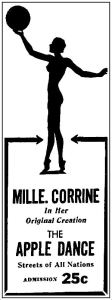
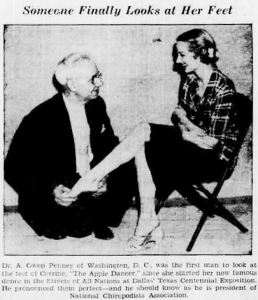
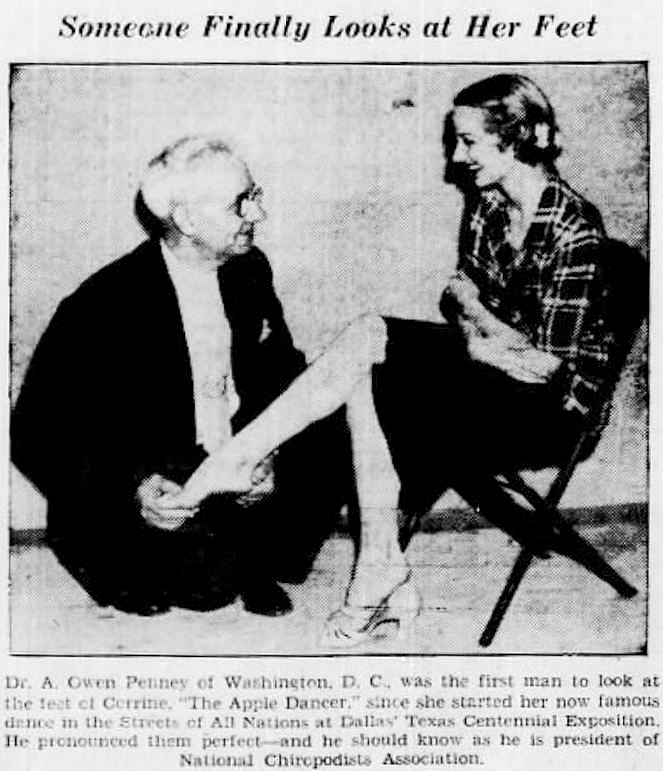
As far as the nudity, it really was everywhere. It’s a little shocking to think that this sort of thing was so widely accepted in very conservative Dallas — 80 years ago! — but it was (despite some local pastors disdainfully referring to the big party as the Texas Sintennial). Many of the acts — and much of the personnel — had appeared in a version of the same revue in Chicago in 1933 and 1934. Some of the offerings for the Centennial visitor: peep shows a-plenty, the clad-only-in-body-paint “Diving Venus” named Mona Lleslie (not a typo), a naked “apple dancer” named Mlle. Corinne who twirled with a “basketball-sized ‘apple'” held in front of her frontal nether regions, and the somewhat obligatory nude chorus girls. There was also an “exhibit” in which nude women were on display as “artists’ models,” posing for crowds of what one can only assume were life-drawing aficionados who were encouraged to render the scene before them artistically (…had they planned ahead and brought a pencil and sketchpad); those who lacked artistic skill and/or temperament were welcome to just stand there and gawk. (Click photos and ads to see larger images.)

corinne_apple-dancer_cook-collection_smu

tx-centennial_apple-dancer_dmn_070536

tx-centennial_apple-dancer_franklin-ind-evening-star_071136Franklin, Indiana Evening Star, July 11, 1936

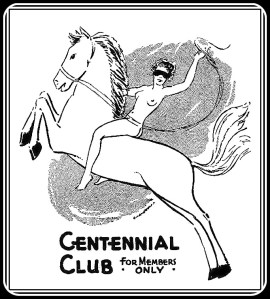
Another attraction was Lady Godiva, who, naked, rode a horse through the Streets of Paris crowds. Her bare-breastedness even made it into ads appearing in the pages of staid Texas newspapers. (Click to see larger images.)

tx-centennial_lady-godiva_dmn_060436_sm
June, 1936

There were two areas along the Midway where crowds could find these saucy attraction: Streets of Paris (which Time magazine described as appealing to “lovers of the nude”) and Streets of All Nations (“for lovers of the semi-nude”). Lady Godiva was part of the Streets of Paris, and she rode, Godiva-esque, nightly. The gimmick (beyond the gimmick of a naked woman riding a horse in Fair Park) was that she was supposed to  be a Dallas debutante who rode masked in order to conceal her identity. The text below is from the ad above.

MASKED…but unclothed in all her Glory…Riding a milk-white steed. […] Miss Debutante was introduced to Dallas society in 1930. She was later starred in Ziegfeld’s Follies, in “False Dreams, Farewell,” “Furnished Rooms,” and other Broadway successes. She appeared in motion pictures, being starred in “Gold Diggers of 1935,” “Redheads on Parade” (yes, she is a redhead) and other picture successes.

SHE WILL STARTLE DALLAS SOCIETY! JUST AS THE STREETS OF PARIS WILL BE THE SENSATION OF THE CENTENNIAL SEASON .. WHO IS SHE?

And, of course, none of that was true (including the fact that this “Lady Godiva” rode a white horse — apparently one could not always be found), but I’m sure it got local pulses racing. My guess is that there were several Ladies Godiva (none of whom were members of Dallas society). One woman was actually named as the Centennial’s exhibitionist horsewoman. I haven’t been able to find mention of a “Paulette Renet” anywhere other than the caption of this photo, but here she is:
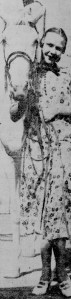
godiva_madera-tribune_082936

godiva_madera-tribune_082936-caption
Madera (California) Tribune, Aug. 29, 1936

Another photo featuring what appears to be the same woman, with this caption: “No white horse for Lady Godiva, at the Texas Centennial Exposition in Dallas. A feature of the ‘Streets of Paris,’ a midway show, Godiva rode a ‘paint pony,’ first week because no white one was available.”

godiva_altoona_penn-tribune_062336
Altoona (Pennsylvania) Tribune, June 23, 1936

I think this is still the same woman, but on a rare white steed:
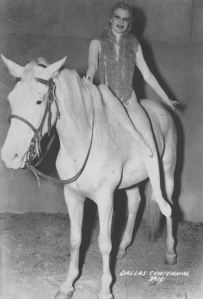
lady-godiva_cook-collection_smu

The Godiva who appeared in the March of Times newsreel “Battle of a Centennial” appears to be a different woman. (Watch a 45-second snippet of the newsreel which features both a glimpse of Lady Godiva and a head-shaking son of Sam Houston wondering what the deal is with the younger generation — here.)

godiva_march-of-time_1936

Imagine seeing performers and attractions like this along the Fair Park midway today!

*
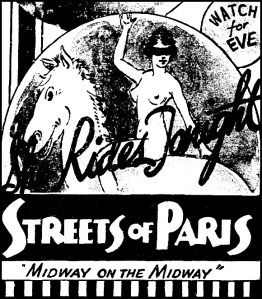
godiva_dmn_070536-detJuly, 1936 (ad detail)

tx-centennial_lady-godiva_dmn_060436-det
June, 1936 (ad detail)

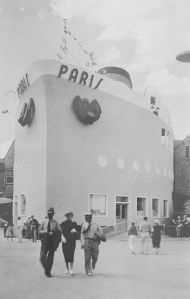
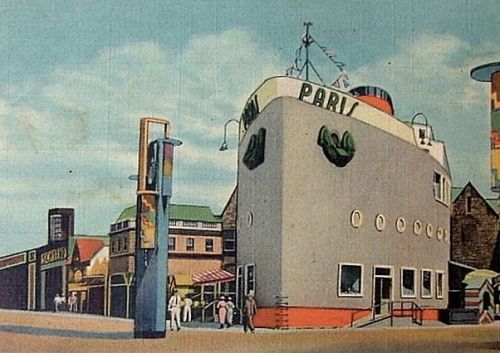
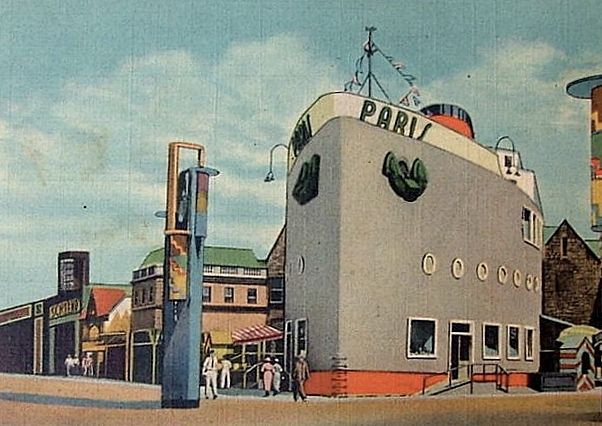
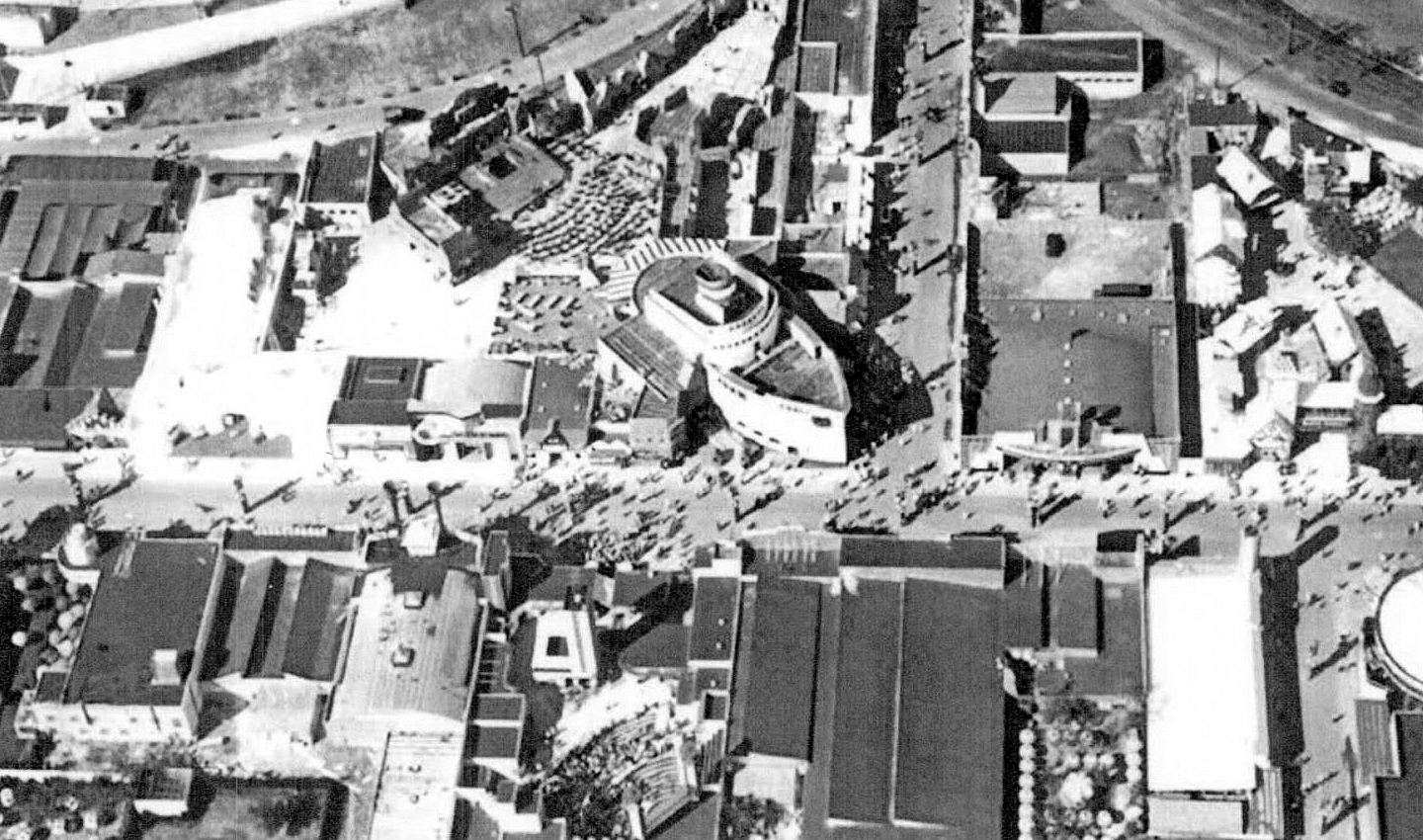
What was the Centennial Club? It was an exclusive, invitation-only private club located within the very large George Dahl-designed building which housed the Streets of Paris (and which was shaped like the famed S. S. Normandie ocean liner). It had three levels (“decks”) and housed a lounge, dining rooms, a main clubroom, and a “dance pavilion” — all air conditioned. From various decks, well-heeled patrons could look down at the action going on below: the milling throngs of the hoi polloi, the Streets of Paris shows, and the Midway.

centennial-club_dmn_061636
June, 1936

tx-centennial_streets-of-paris_art-institute-chicago

tx-centennial_streets-of-paris_ebay_rppc

tx-centennial_streets-of-paris

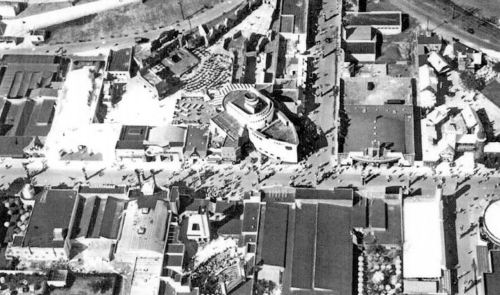
Can’t miss the ridiculously large land-locked ocean liner in the center of the photo below. Mais oui!
normandie_winters_dhs

**

The articles below on “gals, likker, and gambling” are GREAT. They are from the show biz trade publication Variety, which really latched onto the rampant nudity on view at the Texas Centennial. Remember: 80 years ago! (The abbreviation of “S. A.” in the headline of the second article stands for “sex appeal.”) (As always, click to see larger images.)
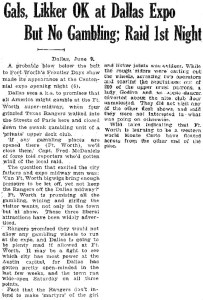
sex_variety_061036
Variety, June 10, 1936

sex_variety_062436
Variety, June 24, 1936

nudity_variety_070136
Variety, July 1, 1936

***

Sources & Notes

Top photo shows an admission ticket to the Streets of Paris, from the George W. Cook Dallas/Texas Image Collection, Central University Libraries, Southern Methodist University; more information is here. Another interesting item from this collection is a brochure (here) which describes Streets of Paris as “the smartest, most sophisticated night club in America. Here you will find the gay night life of Paris in a setting of exotic splendor.”

Photo of “Mlle. Corrine” also from the Cook Collection at SMU; more info on that photo here.

Photo of Lady Godiva on a white horse (with the words “Dallas Centennial” near the bottom … um, bottom of the image … is also from the Cook Collection at SMU, here.

The photo showing the night-time crowd outside the Streets of Paris Normandie is from the Ryerson & Burnham Archives, Art Institute of Chicago; more info here.

The aerial photograph showing the S. S. Normandie is from Willis Cecil Winters’ book Fair Park (Arcadia Publishing, 2010); photo from the collection of the Dallas Historical Society.

All other sources noted, if known.

See quick shots of the Streets of Paris and the Streets of All Nations in the locally-made short film “Texas Centennial Highlights,” here (Streets of Paris is at about the 7:00 mark and the more risqué bits showing the parasol chorus girls followed by Mlle. Corinne and her apple dance (I mean, it’s not really shocking, but … it still kind of is…) at the 8:45 mark. (Incidentally, there appears to be a new book on Corinne and her husband — Two Lives, Many Dances — written by their daughter.)

A very entertaining history of the State Fair of Texas and the Texas Centennial Exposition can be found in the article “State Fair!” by Tom Peeler (D Magazine, October, 1982), here.

A Flashback Dallas post on the feuding Dallas and Fort Worth Centennial celebrations can be found here.

More Flashback Dallas posts on the Texas Centennial can be found here.

Click pictures and clippings to see larger images.

*

Copyright © 2016 Paula Bosse. All Rights Reserved.

The Fair Park Bond Issue — 1934

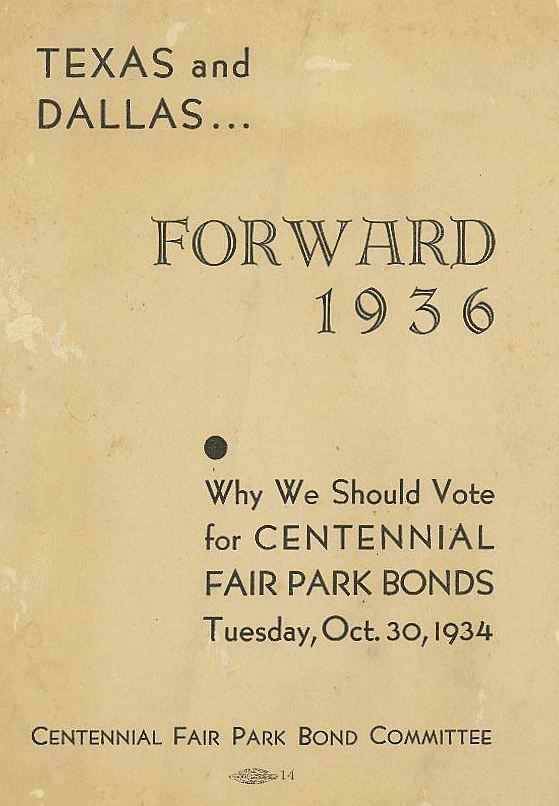
centennial-bond-issue_front-cover_cook-collection_degolyer_SMU_sm“Forward 1936…”  (DeGolyer Library, SMU)

by Paula Bosse

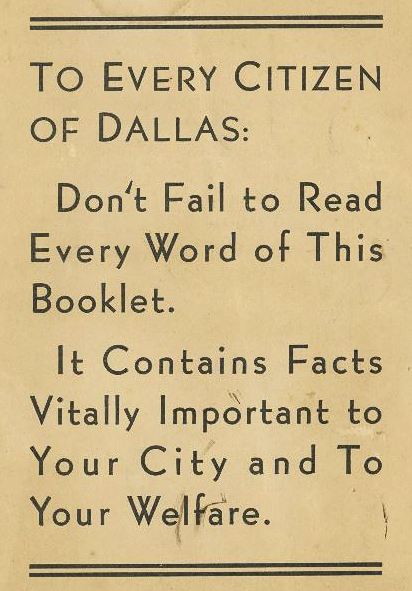
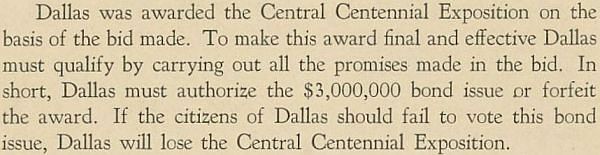
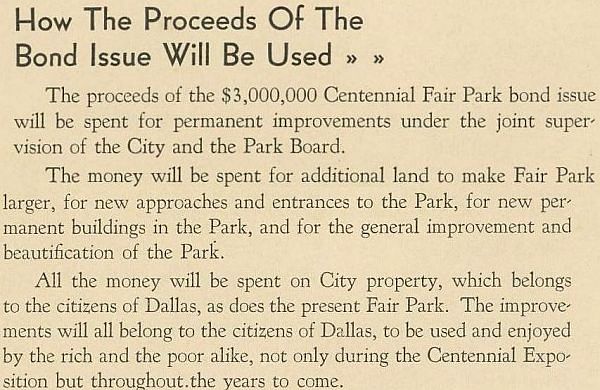
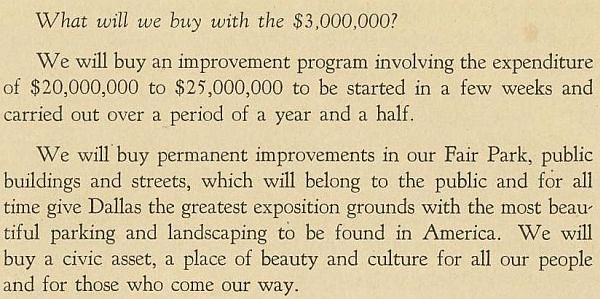
With all the heated discussion currently going on about what the city is going to do with Fair Park, I thought this little pamphlet from 1934 seemed timely. Published by the “Centennial Fair Park Bond Committee” (comprised of all the Dallas movers and shakers one would expect), the get-out-the-vote brochure was issued to explain the $3,000,000 (about $54,000,000 in today’s money, adjusted for inflation) bond issue, the approval of which was essential in order to clinch the honor of hosting the Texas Centennial Exposition in 1936. The entire pamphlet — part of the George W. Cook Collection in the DeGolyer Library — may be read on SMU’s website, here.

centennial-bond-issue_back-cover_cook-collection_degolyer_SMU

A couple of excerpts:

centennial-bond-issue

centennial-bond-issue_2

centennial-bond-issue_3

*

The issue passed, overwhelmingly, by a 5-1 margin. It’s interesting to note that the voting restrictions on this referendum were … pretty restrictive. Not only was payment of a poll tax required to vote (…one had to pay for the “privilege” of voting…), but one also had to be a property owner — and that property owner was not allowed to vote until a “rendition” was signed downtown in the tax assessor’s office. Many property owners who had signed the necessary paperwork were still unable to vote as they had not paid (or could not afford) the poll tax. It’s pretty obvious here that a substantial number of lower income residents (i.e. non-property owners or property owners unable to afford the poll tax) — including many who lived in the area immediately surrounding Fair Park — were legally prohibited from casting a vote.

6,550 ballots were cast (5462-1088), which represented “little more than one-third of the 18,000 supposed qualified to decide this important issue” (Dallas  Morning News, Nov. 1, 1934). It was declared to be “the largest majority ever cast for a bond issue in [the] history of Dallas” (DMN, Oct. 31, 1934).

The passage of the October, 1934 bond issue assured that Dallas would host the Texas Centennial Exposition, a statewide celebration which proved to be a huge success and was a tremendous economic boon to the city.

***

Sources & Notes

The pamphlet “Texas and Dallas … Forward 1936: Why We Should Vote For Centennial Fair Park Bonds, Tuesday, October 30, 1934” is part of the George W. Cook Dallas/Texas Image Collection, DeGolyer Library, Central University Libraries, Southern Methodist University; the entire pamphlet is contained in a PDF which may be read and/or downloaded here.

More on this vote can be found in these two Dallas Morning News articles:

  • “OK on Bonds For Huge Fair Up to Voters” (DMN, Oct. 30, 1934) — published on voting day, this article includes the particulars of the voting restrictions
  • “Five-to-One Majority Scored As City Favors Centennial Bonds to Assure Huge Fair” (DMN, Oct. 31, 1934) — the results

Payment of a poll tax was still required to vote in Texas elections until 1966, when the U. S. Supreme Court ruled such taxes were unconstitutional. More about that from the Dallas Public Library, here.

*

Copyright © 2016 Paula Bosse. All Rights Reserved.


Dallas’ Texas Centennial Exposition vs. Fort Worth’s Frontier Exposition — 1936

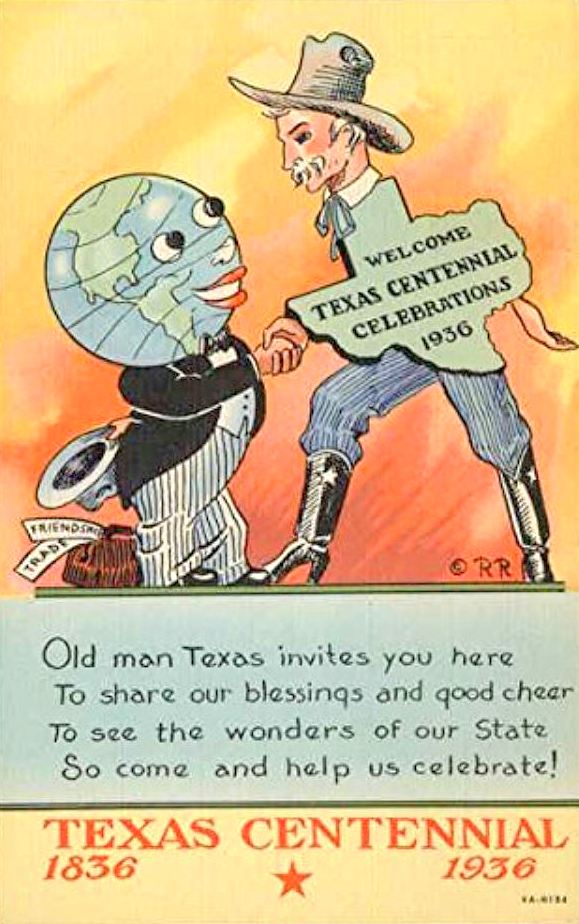
tx-centennial-postcard_old-man-texas_smWelcome to Dallas (and/or Fort Worth)!

by Paula Bosse

The Texas Centennial Exposition opened in Dallas at Fair Park in June, 1936 — 80 years ago this week. It was described in newsreels as “A New City, A Great City, A City of a Thousand Sights and a Thousand Wonders.” Which I guess it kind of was. I’ve written about the Centennial before, but I don’t think I’ve mentioned that my favorite part of the Centennial’s taking place in Dallas is that it seriously rubbed “Mr. Fort Worth,” Amon Carter, the wrong way. Carter’s distaste of Dallas was well-known, so it was no surprise, really, that this caused him to blow his top and, damn it, he created his OWN competing celebration: the Fort Worth Frontier Centennial Exposition. The Dallas-Fort Worth rivalry had already been going strong for years, but the Centennial pushed it into Hatfield-and-McCoy feud territory (although one gets the feeling that most of it was an act that generated a lot of great publicity for both sides).

Watch film footage of ol’ Amon’s blood pressure spike into the danger zone here, in a moment from a March of Time newsreel as he proclaims that Fort Worth will teach “those dudes over there” (in Dallas) a thing or two by outdoing Big D in sheer gigantic spectacle. …And sex. Or, “whoopee.” Nudity was on display absolutely everywhere at both Centennial expositions. Dallas had always planned on having the titillation before Amon Carter got into the act, but the involvement of Billy Rose on the Fort Worth side probably encouraged Dallas to, um … augment the fleshy offerings on display in Fair Park.

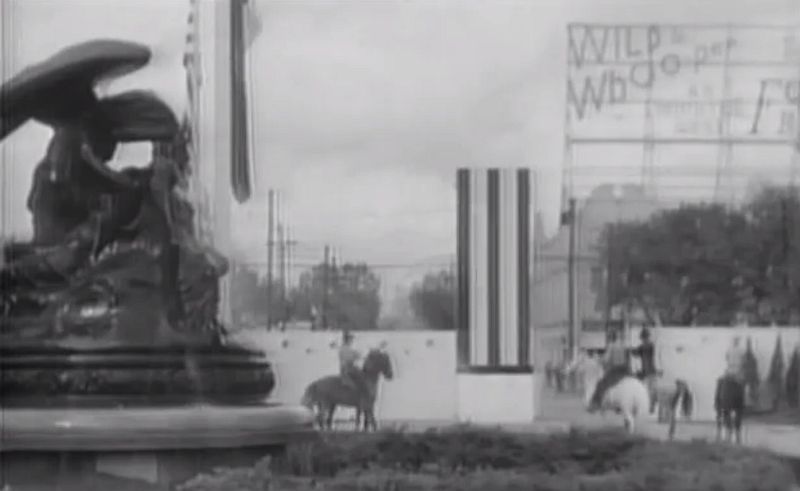
Broadway impresario Billy Rose was hired by Amon Carter to sex-up the Fort Worth expo and to do everything he could to draw more visitors to Fort Worth than to Dallas. Rose went so far as to have a HUGE electric sign (supposedly the second largest electric sign in the world) placed on top of a building on Parry directly opposite the entrance to Fair Park which read:

“Fort Worth Frontier — Wild & Whoo-pee — 45 Minutes West.”

Which is pretty hilarious. (Same view today?)

tx-centennial_FW-sign_billy-rose-presents_book_1936

(See a giant image of this photo in the UTA digital collection, here.)

I’m not sure whether the Dallas Centennial organizers were miffed or amused, but one can only imagine that Amon Carter was thrilled to bits when he saw his sign appear (fleetingly) in the Gene Autry movie The Big Show which had been shot in Fair Park during the Centennial.

billy-rose-billboard_big-show-movie_gene-autry

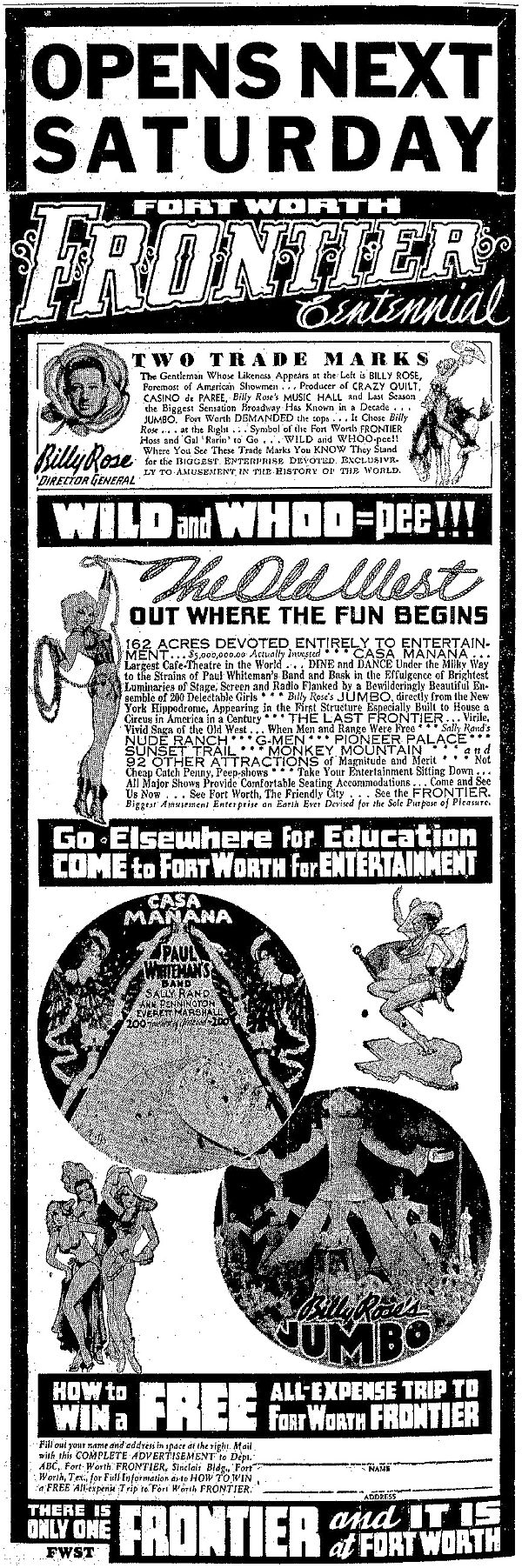
Fort Worth was all about the “whoo-pee,” and the tag-line to their show was “Come to Fort Worth for Entertainment, Go Elsewhere for Education.”

frontier_FWST_071436-detFort Worth Star-Telegram, July 14, 1936

The “feud” (i.e. the publicity machine) really cranked up when the producers of the March of Time newsreel sent their people to film in Dallas and Fort Worth. The result — a splashy look at the inter-city rivalry titled “Battle of a Centennial” — was shown in DFW-area theaters, and boisterous audiences either applauded for Dallas and hissed at Fort Worth (or vice-versa), depending on their allegiance.  (Click ad below for larger image.)

march-of-time_dmn_061736
June, 1936

In the end, the celebrations in both Dallas and Fort Worth were successful (although Dallas was the clear winner!), but the rivalry and competitive showmanship from the two cities probably made the shows much more entertaining than they might otherwise have been. So, thanks, Amon!

frontier_pinterest
via Pinterest

frontier_dmn_073036
July, 1936

frontier-centennial_FWST_071236
July, 1936

tx-centennial_variety-via-decatur-illinois-herald_060336
Variety article reprinted in Decatur (Illinois) Herald, June 3, 1936

billy-rose_casa-manana
via oldimprints.com

 ***

Sources & Notes

Source of postcard at top unknown.

Photo of the “whoo-pee” billboard is from the book Billy Rose Presents … Casa Mañana (Fort Worth: TCU Press, 1999) by Jan Jones. Jones writes that the billboard was on top of the building at Parry and First.

The shot of the billboard hovering over cowboys is a screengrab from the interesting-but-dull Gene Autry movie, The Big Show, shot mostly on the grounds of Fair Park during the Centennial. You can watch the full movie here.

The clip of Amon Carter shaking his fist at “those dudes” in Dallas is from the 1936 March of Times newsreel, “Battle of a Centennial.” I have been unable to find the entire film streaming online, but you can watch a whole bunch of clips (about 13) from Getty Images, here. The full thing appears to be available for purchase here, but only if you are affiliated with a school or institution. (If anyone has access to the full newsreel, let me know!)

Watch a different newsreel/film on the Centennial Exposition — the 11-minute Texas Centennial Highlights, shot and produced by Dallas’ Jamieson Film Co. — at the Texas Archive of the Moving Image site, here.

For more on Fort Worth’s horning-in-on Dallas’ Centennial, read the entertaining article “Makin’ Whoopee — Amon Carter Couldn’t Make Either the Depression or Dallas Go Away, But He Sure Tried” by Jerry Flemmons (D Magazine, April, 1978), here.

Unfortunately, I’m unable to embed the video I linked to above of Amon Carter sputtering about Dallas hosting the state’s Centennial, but I encourage everyone who’s ever been amused by the Dallas-Fort Worth “feud” to watch it here — it’s well worth 17 seconds of your time! As John Rosenfield wrote in the Dallas Morning News review of this March of Time newsreel, “The best actor from across the river is Amon Carter, long a leading man among Texas political Thespians” (DMN, “Centennial Fight in ‘Time’ Release,” June 21, 1936). Newspaperman Carter knew how to parlay outrageous remarks about exaggerated competition into sweet, sweet publicity for himself and his newspaper. Check out the photo of a smiling Carter with his arm around “bitter rival,” G. B. Dealey of The Dallas Morning News, here. Amon knew a thing or two about a thing or two….

Pictures and clippings are larger when clicked.

*

Copyright © 2016 Paula Bosse. All Rights Reserved.
“The Pause That Refreshes at the Texas Centennial” — 1936

tx-centennial_coke-ad_pinterestBelly on up to the Coke cooler, pardner… (click for larger image)

by Paula Bosse

What do Stetson-wearing Texans enjoy drinking more than sarsaparilla? Coca-Cola, of course!

This ad led me to discover that the Coca-Cola Bottling Company of Dallas set up a working mini bottling plant in Fair Park during the Texas Centennial, costing a cool $60,000 and taking up 4,100 square feet of the Varied Industries Building. 100 bottles a minute were produced, destined for thirsty customers who bought the five-cent drinks there at the plant or at concession stands around the park. A photo accompanying a Dallas Morning News blurb about the mini bottling plant — which will be marked by a thirty-foot electric tower brought from the Century of Progress…” (DMN, Feb. 6, 1936), looked like the stunning Century of Progress photo seen here.

tx-centennial_coca-cola_ebay_1936

***

Top ad found on Pinterest; full ad found on eBay.

The “Varied Industries Building” apparently burned down in 1942 and was replaced in 1947 by the Automobile Building.

*

Copyright © 2016 Paula Bosse. All Rights Reserved.