Flashback : Dallas

A Miscellany: History, Ads, Pop Culture
Category: Transportation
June 10, 2014
The Old Union Depot in East Dallas: 1897-1935
 From the collection of Art Hoffman (click for larger image)
by Paula Bosse
I saw the above rendering of the old East Dallas rail depot posted recently in a Dallas history group. It was bought several years ago by Art Hoffman who was told it had belonged to a former employee of the Houston & Texas Central Railroad (which, along with the Texas & Pacific, served this station). It’s an odd thing for an architect to sketch — a boarded-up railroad depot. I couldn’t find anything on E. L. Watson, the architect who did the rendering (perhaps a member of the Watson family who were prominent Dallas contractors?), and I couldn’t find any connection between the depot and the F. J. Woerner & Co. architectural firm. The drawing might have been done in 1931, with what looks like “31” next to the artist’s signature. Could the drawing have been done merely as a study for E. L. Watson’s portfolio?
But back to the building itself. It was referred to by all sorts of names: Union Station, Union Depot, East Dallas Depot, Old Union Station, etc. With all these permutations, it took considerable digging to determine exactly when it had been built and when it had been demolished.
A couple of stations had previously occupied this site (about where Pacific Avenue and Central Expressway would cross), the first being built in 1872 at the behest of William H. Gaston who was developing the area, well east of the Dallas city limits. Due to the presence of the railroad, the area grew quickly, and in 1882, it was incorporated as the city of East Dallas. It thrived and continued to grow and on January 1, 1890 it was annexed and became part of the city of Dallas.
 Location of depot in red — map circa 1890-1900 (click to enlarge)
The depot pictured in the drawing above was built in 1897. The previous station, a woefully inadequate and outdated “shanty,” was, by early 1897, being nudged toward demolition in order to remain competitive with the new Santa Fe depot then under construction. In the Feb. 10, 1897 edition of The Dallas Morning News, it was referred to as “the present eye-sore in East Dallas” which would be better off “abandoned and used for kindling wood.”
On April 4, 1897, it was reported that plans for a new Texas & Pacific passenger depot were nearly completed. By the beginning of June, the shanty had been torn down, and on June 6, 1897, the drawing below appeared in the pages of the Morning News, giving the people of Dallas a first look at what the much grander station would look like when completed. (It’s unfortunate that the actual architectural rendering was not used, but, instead, a more rudimentary staff artist’s version was printed.) The accompanying information revealed that the new depot had been designed by Mr. O. H. Lang, an architect who worked in the engineering department of the Texas & Pacific Railroad. This was an exciting tidbit to find, because I had wondered who had designed the structure but had been unable to find this elusive piece of information. And it was Otto Lang! Eight years after designing this railroad depot, Lang and fellow architect Frank Witchell would form the legendary firm of Lang & Witchell, and they would go on to design some of Dallas’ most impressive buildings.
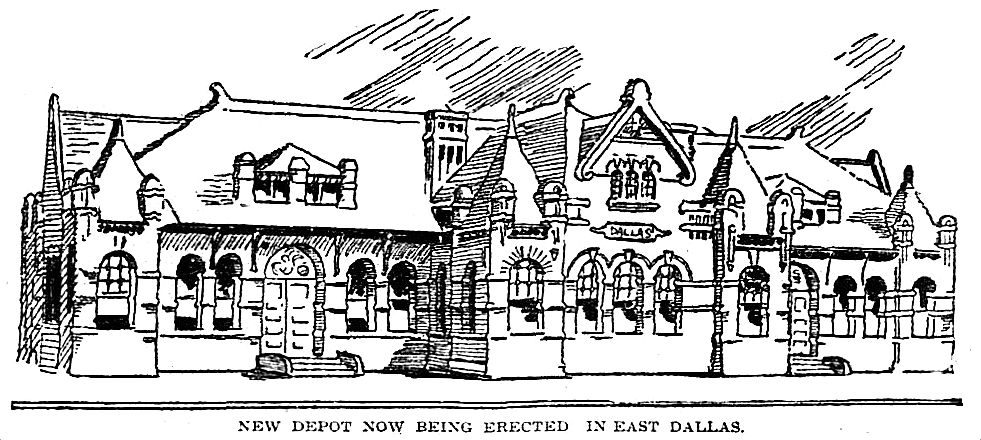
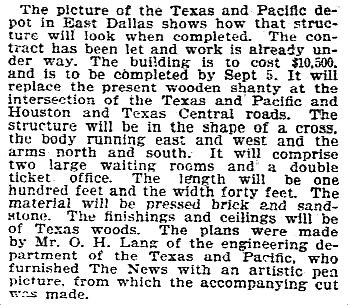 Dallas Morning News, June 6, 1897
The building was completed fairly quickly, and its official opening was announced on Oct. 12, 1897.
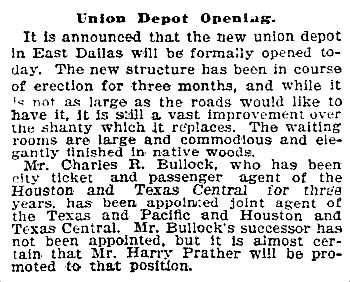 DMN, Oct. 12, 1897
Here’s what the station looked like soon after it opened for business, from an 1898 Texas & Pacific publication (click for larger images):
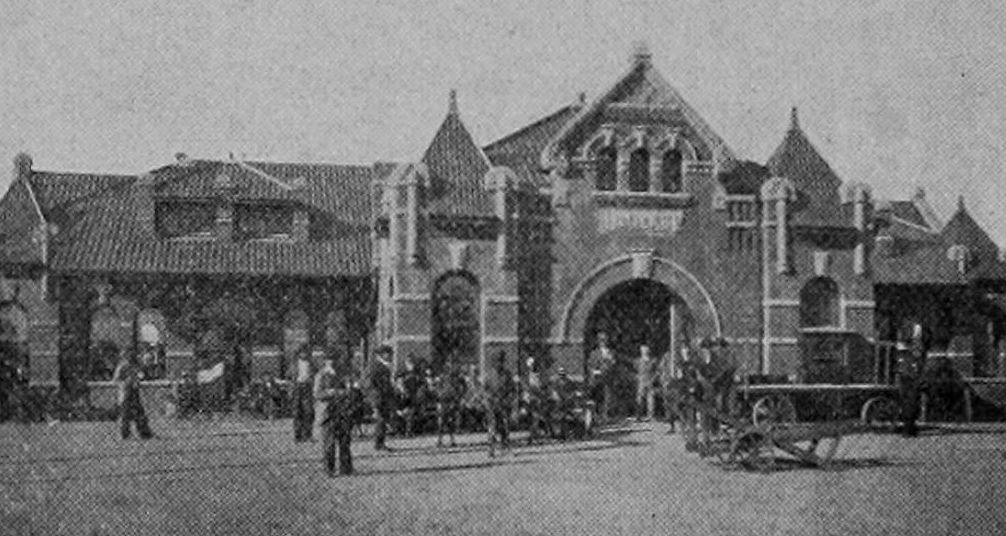
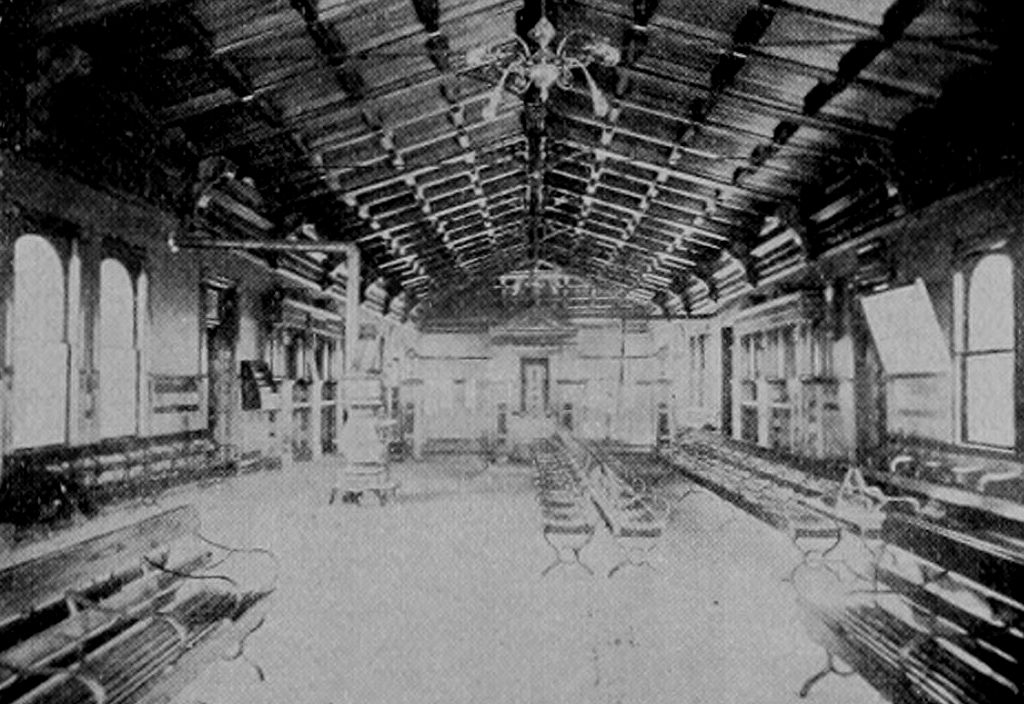
Much better than a shanty!
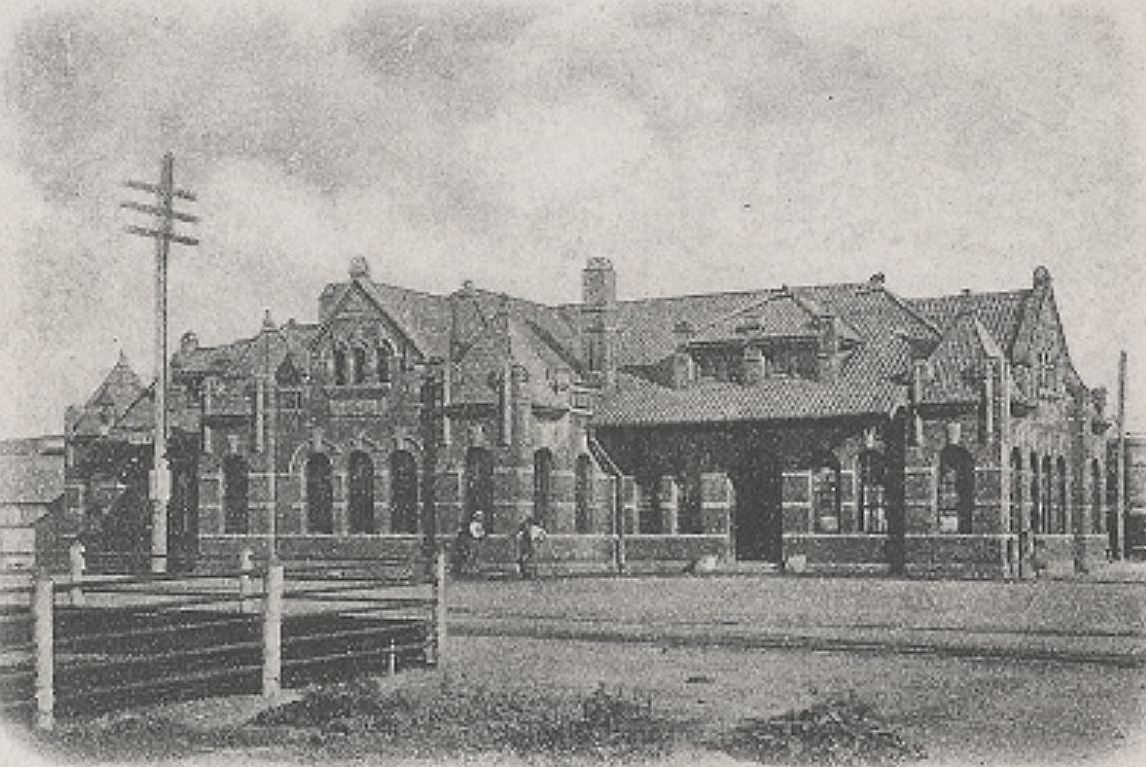
Below in another early photo of the depot:

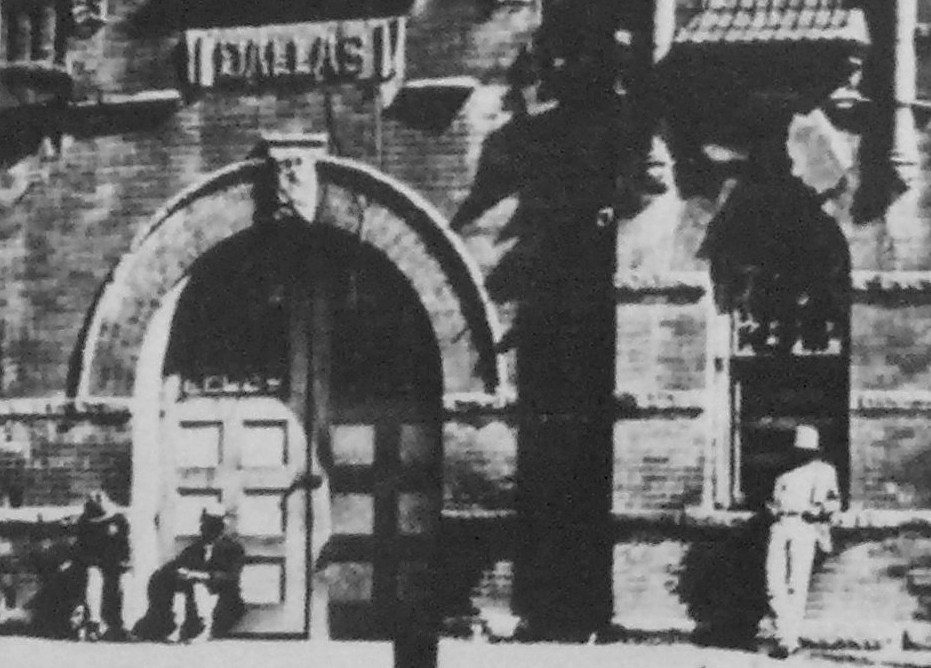
Can’t pass up an opportunity of zooming in on a detail:
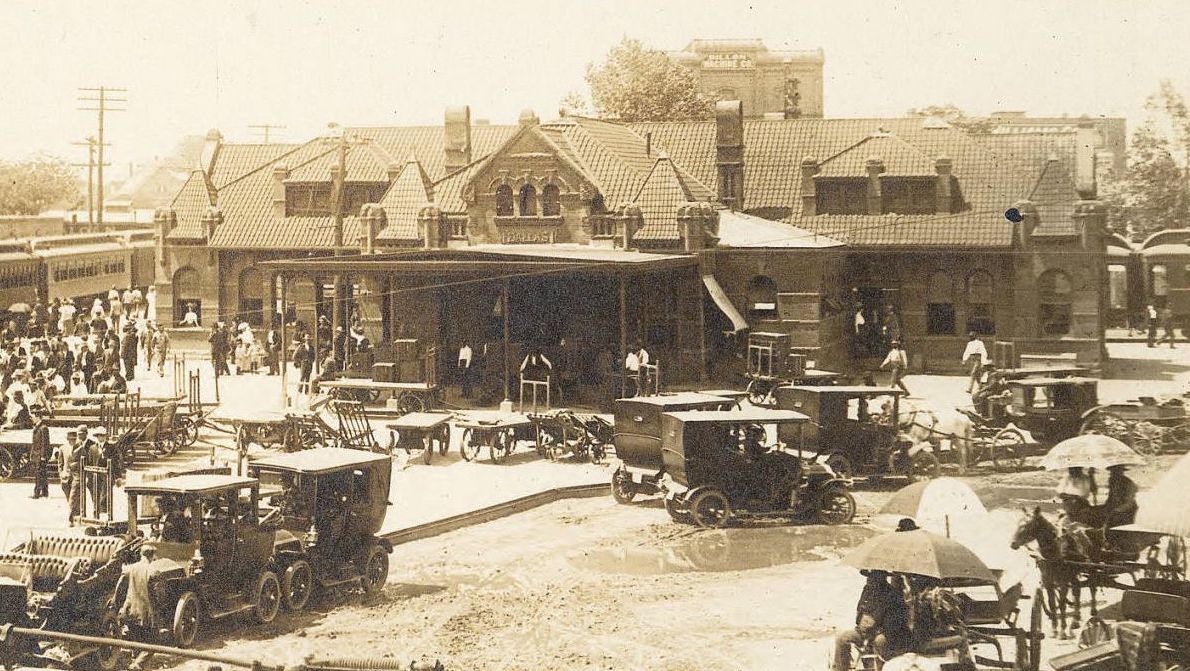
Here it is around 1910, a hotbed of activity, now with the addition of automobiles:
The station served an important role in the growth of (East) Dallas and in the everyday lives of its residents for almost twenty years, but in 1916 the many “independent” passenger and freight depots that had been spread out all over town were shuttered, per the Kessler Plan’s directive to consolidate and run all the rail lines in and out of the new Dallas Union Terminal. (This was when the word “old” began appearing ahead the East Dallas station whenever it was mentioned.)
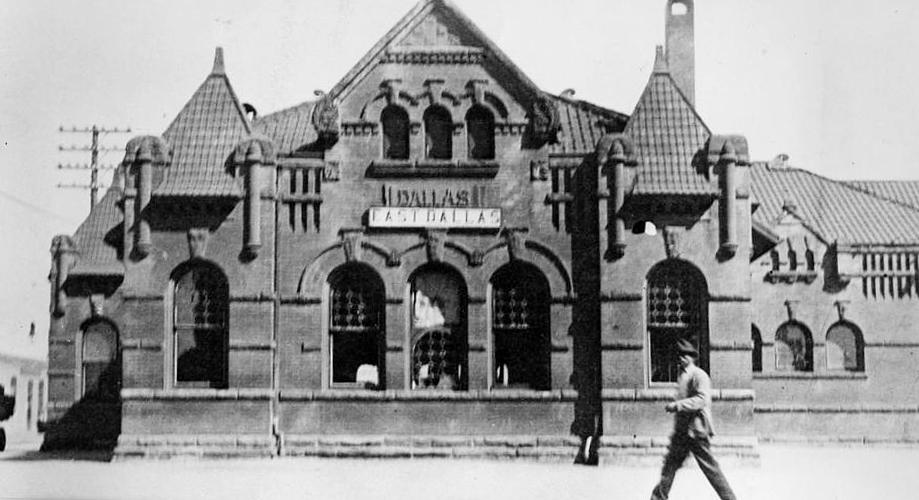 (circa 1916)
So what became of the East Dallas depot? From “Relic of City of East Dallas Being Demolished,” a Dallas Morning News article from Jan. 20, 1935:
Last use of the depot for railroad purposes came in 1933 when it was abandoned as a freight station in August of that year. After that it was used as a station for interviewing destitute clients for the relief board but for several months has been boarded up.
So that original rendering may not have been done in 1931 after all (unless it was a high-concept architect’s vision of what the depot would look like one day all boarded up…).
At some point it was determined that the station would be torn down. It may have been one of those beautify-the-city projects done in preparation for the Texas Centennial Exposition the next year, but it was probably time for the building to come down. It was January of 1935, at the height of the Great Depression, and not only did the city make it a point to hire laborers on relief to assist in the demolition, but it also approved the use of salvaged materials from the site to be used in building homes for “destitute families.”
Relief Administrator E. J. Stephany received approval Saturday of a project to get men to tear down the old structure and use the materials in building homes for destitute families and work is expected to start immediately. (“East Dallas Station To Be Torn Down and Converted Into Homes,” DMN, Jan. 13, 1935)
Demolition of the depot — which The News called “The Pride of the Gay Nineties” — began on January 18, 1935. The first solemn paragraph of an article reporting on the razing of the landmark is below.
Shorn of all the dignity it possessed for years as the East Dallas Union Depot, the old red structure near the intersection of Central and Pacific avenues began crumbling beneath the blows of wrecking tools wielded by laborers from the Dallas County relief board Friday.” (“Relic of City of East Dallas Being Demolished,” DMN, Jan. 20, 1935)
The red stone slabs bearing the word “Dallas” (3 feet long, 18 inches thick) were offered to the Dallas Historical Society “for safekeeping.”
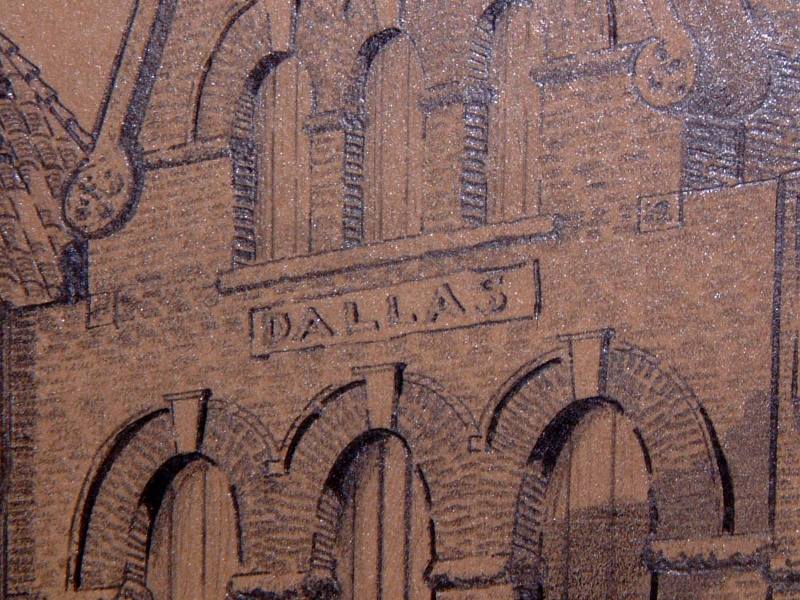
So did that relief housing get built? Sort of. All I could find was an article from June, 1935, which states that one little building was constructed with some of the brick and stone from the razed depot. It wasn’t a house for the needy but was, instead, headquarters for relief caseworkers in donated park land in Urbandale. Presumably there was housing built somewhere, but all that brick and stone salvaged from the old depot may not have been used for its intended purpose. BUT, there is this tantalizing little tidbit:
As a reminder of the historic antecedent, the new structure [in Urbandale Park] has as a headpiece for its fireplace the large carved stone bearing the name Dallas. (“Relief Structure Made of Materials From Razed Depot,” DMN, June 20, 1935)
Does this mean that the Dallas Historical Society might still have the second slab? If not, what happened to it?
I checked Google Maps and looked at tiny Urbandale Park at Military Parkway and Lomax Drive, just east of S. Buckner, but I didn’t see anything, so I assume the building came down at some point. (UPDATE, 3/20/16: Finally got around to driving to this attractive park. Sadly, the little building is no longer there.)
It would have been nice if that little bit of the old depot had survived — a souvenir of an important hub of activity which sprang to life when memories were still fresh of East Dallas being its own separate entity — the “David” Dallas to its neighboring “Goliath” Dallas. I would love to learn more about what might have happened to that “Dallas” sign which, for a while, hung over the fireplace of an odd little building in an obscure park in southeast Dallas where it lived out its days in retirement.
**
Since I keep adding photos of the depot to this post, I’m going to just start putting new additions (with captioned and linked sources) here:
 DeGolyer Library, SMU
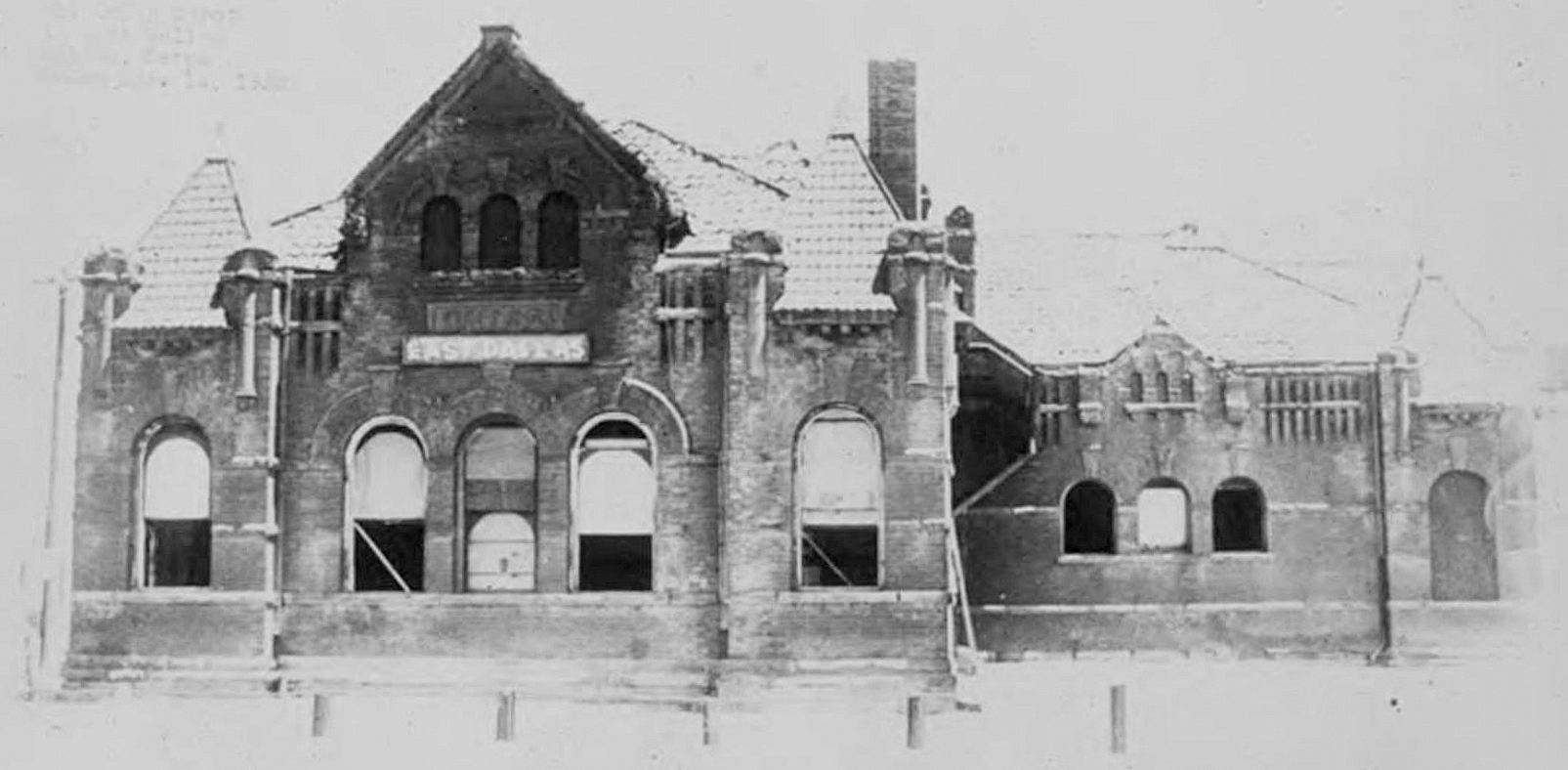 DeGolyer Library, SMU
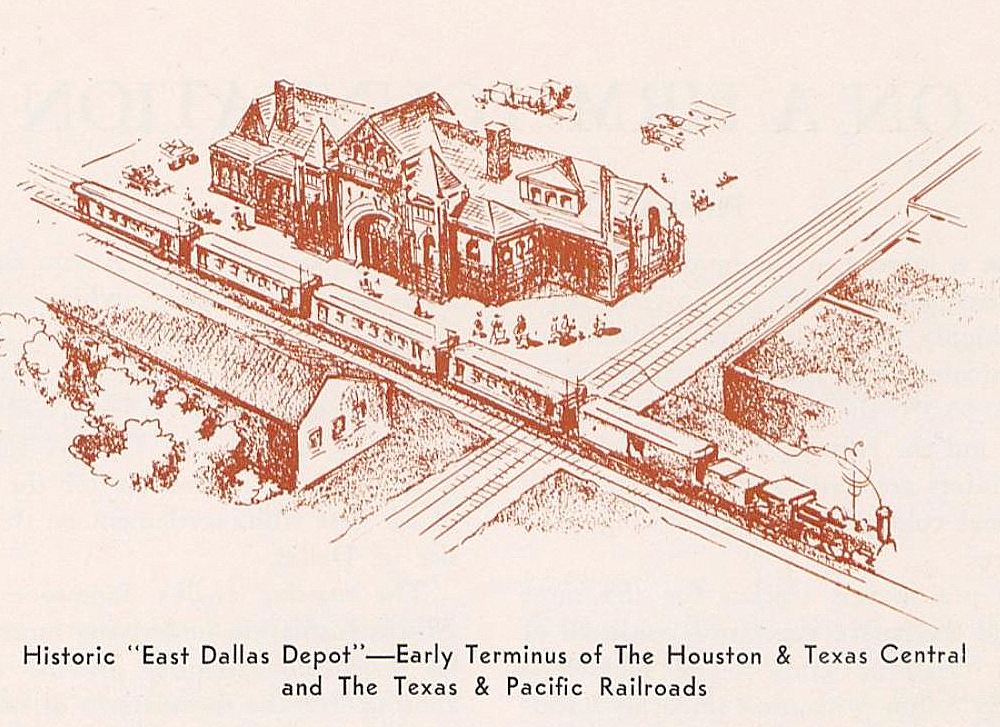
“Your Dallas of Tomorrow” (1943), Portal to Texas History
***
Sources & Notes
Original rendering of the old Union Depot at East Dallas by E. L. Watson is from the collection of Art Hoffman, used with his permission.
More on architect Frank J. Woerner (who designed, among other things, the Stoneleigh Hotel), here (see p. 10 of this PDF).
History of Old East Dallas (and the city of East Dallas), here and here.
More on architects Lang & Witchell here, with an incredible list of some of the buildings designed by their firm here.
1898 photos of the depot’s exterior and interior from Texas, Along the Line of the Texas & Pacific Ry. (Dallas: Passenger Department of the Texas & Pacific Railway, [1898]).
Photo immediately following the photos from the T & P book is from a postcard, found on Flickr, here.
Photo (and accompanying detail) immediately following that is from Dallas Rediscovered by William L. McDonald (Dallas: Dallas Historical Society, 1978). (McDonald identifies the photo as being “c. 1890” — well before the station was built in 1897.) From the collection of the Dallas Historical Society.
Photo of the depot with automobiles is a detail of a larger photograph from the collection of George A. McAfee photographs in the DeGolyer Library, Central University Libraries, Southern Methodist University. The original can be seen here.
Photograph dated 1916 from The Museum of the American Railroad, via the Portal to Texas History site, here.
More information in these Dallas Morning News articles:
- “East Dallas Station To Be Torn Down and Converted Into Homes” (DMN, Jan. 13, 1935)
- “Relic of City of East Dallas Being Demolished” (DMN, Jan. 20, 1935) — very informative
- “Historical Society Will Be Given Slabs of Former Station” (DMN, Jan. 31, 1935)
- “County Gets Land To Install Relief Depot; Later Park” (DMN, Feb. 27, 1935
- “Relief Structure Made of Materials From Razed Depot; Station Occupies Land in Urbandale Donated to County For Park” (DMN, June 20, 1935)
- “Salvaged Materials Go Artistic” (DMN, June 20, 1935) — photo of “relief structure” which accompanied above article
More photos of this immediate area can be found in these posts:
- “The Union Depot Hotel Building, Deep Ellum — 1898-1968,” here
- “The Gypsy Tea Room, Central Avenue, and the Darensbourg Brothers,” here
Many of the pictures and articles can be clicked for larger images.
*
Copyright © 2014 Paula Bosse. All Rights Reserved.
June 6, 2014
Forget the Ferris Wheel, Take a Ride in a Centennial Rickshaw — 1936
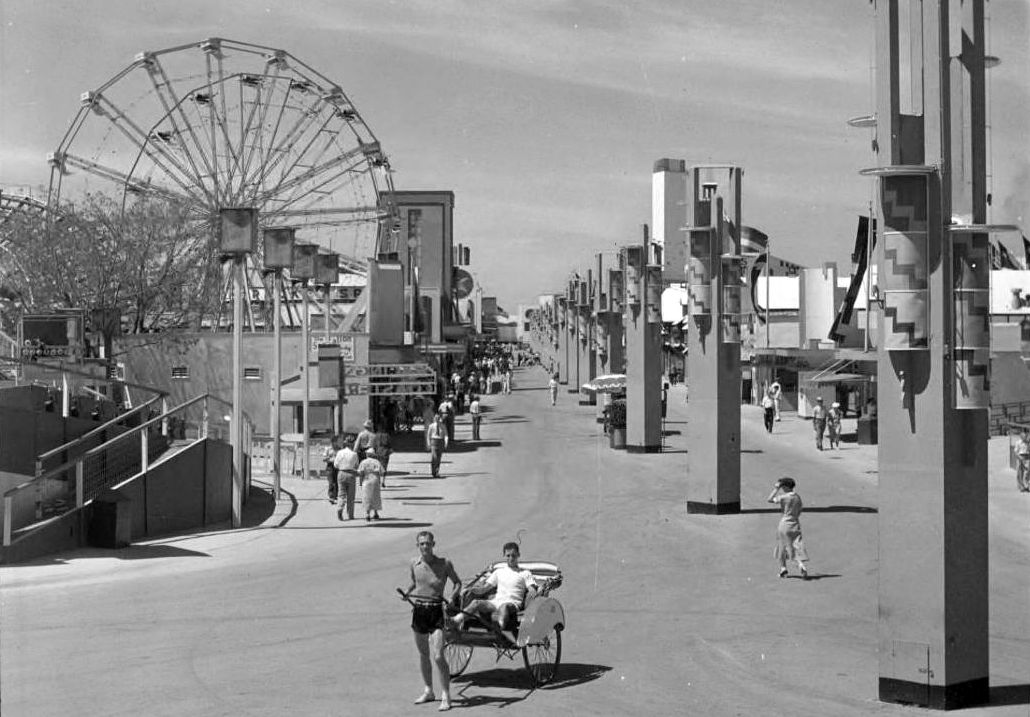 Your rickshaw awaits…
by Paula Bosse
Here’s an odd photo of the Midway at Fair Park, taken in 1936. The whole thing feels a little weird. It’s just so … bright. And empty. It’s kind of bleak-looking for the glamorous Texas Centennial Exposition. And then there’s that rickshaw (?). What this scene needs is a little postcard-colorizing magic. Below, a similar scene, sans rickshaw.
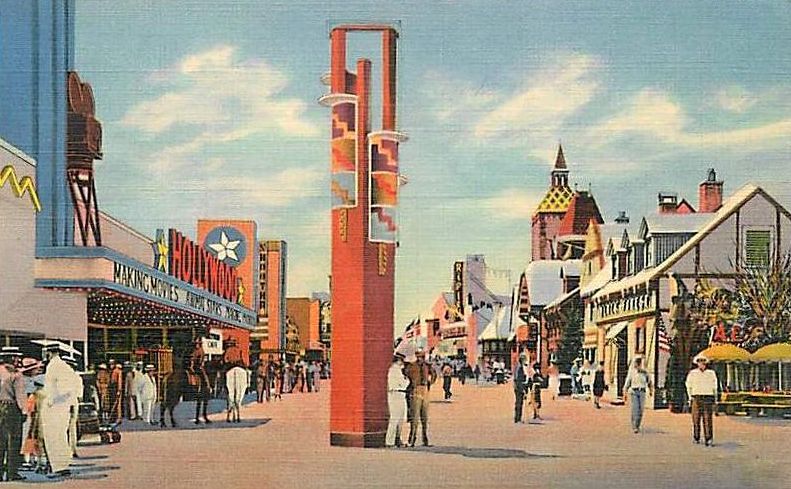
Better … but still kind of odd.
But back to that rickshaw. According to the the Treasury of Texas Trivia, Vol. II:
The Texas Centennial in Dallas had one feature that, considering its uncountable sights and sounds that one had to take in, may very well have been forgotten. College boys, as a means of earning tuition as well as keeping in shape, pulled foot-weary fairgoers from street to street and plaza to plaza in rickshaws during the 1936 celebration of our state’s one hundredth birthday.
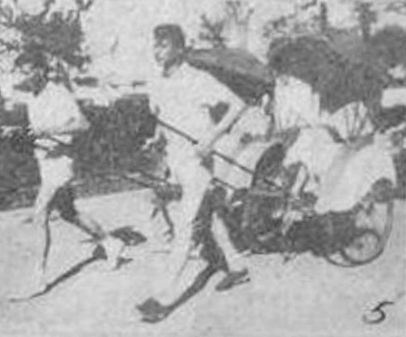
This exotic mode of transportation was even appearing in local advertisements — like this one, from an ad placed by the A. Harris department store:
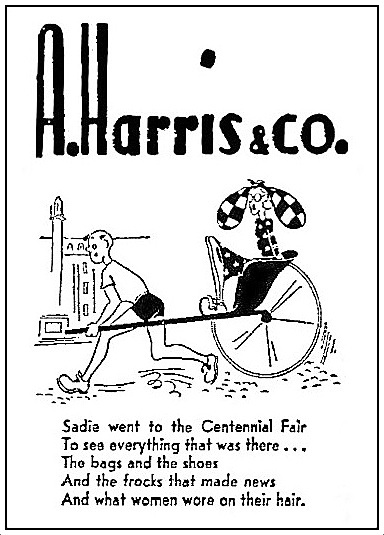 A. Harris ad (det) , 1936
One of the most notable rickshaw-riders of the Dallas Centennial was none other than celebrated fan-dancer, Sally Rand, whose “Nude Ranch” show (check Google for risque film footage) at the competing Frontier Centennial Exposition in Fort Worth was packing them in in Cowtown. Even Sally had to come over and check out the Centennial. The photo below shows her autographing the shorts of one of the “ricksha-toters,” a lucky young man named Guy Johnsen. The caption of the July, 1936 news photo reads:
Sally Rand, who says she never knew success until she thought of taking her pants off, autographs those of Guy Johnson [sic], her ricksha toter, on a visit to the Texas Centennial Exposition at Dallas. With her is Mrs. Voln Taylor, Chairman of the Centennial Advisory Board.
 Cook Collection/DeGolyer Library/SMU
And now I know.
***
Sources & Notes
Top photo — titled “The Gay Midway of the Texas Centennial Exposition, Dallas” — from the Keystone-Mast Collection, UCR/California Museum of Photography, University of California at Riverside; see here.
Quote from Treasury of Texas Trivia, Vol. II by Bill Cannon (Plano: Republic of Texas Press, 2000).
Sally Rand photo (“Sally Rand Gives an Autograph”) from the George W. Cook Dallas/Texas Image Collection, DeGolyer Library, Central University Libraries, Southern Methodist University; more info on this photo is here. (Arne Miller “Guy” Johnsen — known later as “Swede” Johnsen — was a native South Dakotan who had left home and arrived in Dallas just in time for the Centennial, where he got a job pulling visitors around Fair Park in a rickshaw. This paragraph is from his 2005 obituary: “Raised on a farm in Volin, South Dakota, ‘Guy’ (as he was nicknamed by his mother), left home on a quest for better opportunities. In 1936, his travels found him pulling a rickshaw at the Dallas Centennial Fair. His claim to fame was pulling the famous and beautiful fan-dancer Sally Rand throughout the centennial fair grounds.” I guess a moment like that really stays with a person!)
To see this stretch of the Midway from the other direction — and AT NIGHT (!) — see my companion post here.
I find that — by complete coincidence — I’ve posted this on June 6th, the anniversary of the opening day of the Texas Centennial Exposition.
*
Copyright © 2014 Paula Bosse. All Rights Reserved.
June 3, 2014
Swooning Over Love Field — 1940
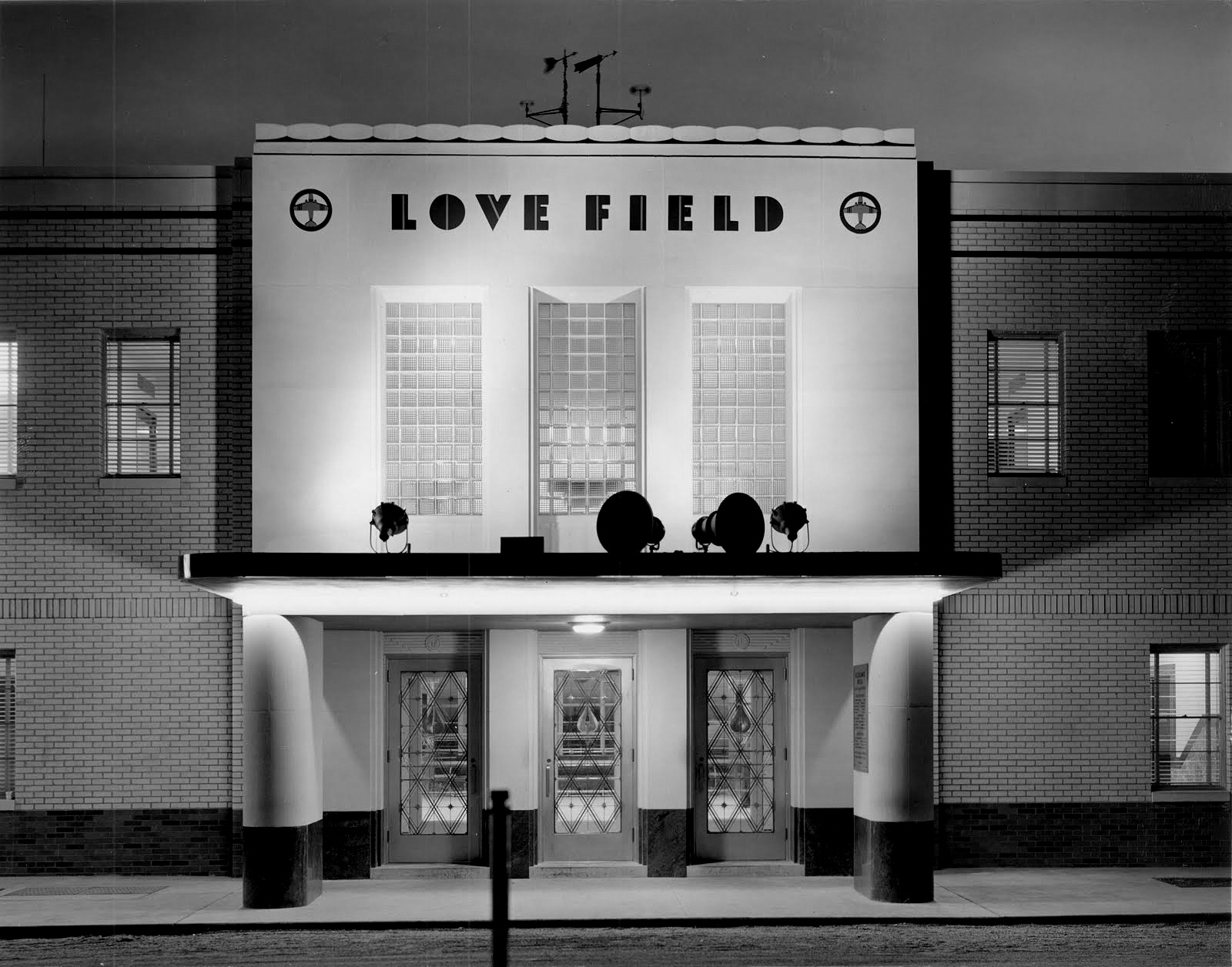 Art Deco Love Field!
by Paula Bosse
I’m a huge-fan of the modern 1950s-era Love Field (the one with the Mockingbird Lane entrance), but even that can’t trump this fantastic building! Designed by architect Thomas D. Broad, the new Love Field administration building and terminal — which faced Lemmon Avenue — was unveiled on October 6, 1940, to rapturous acclaim. The night view above is pretty breathtaking. Forget the airfield. For me, it’s all about this entrance. Those windows. And those doors. And that font! And those little airplane pictographs!
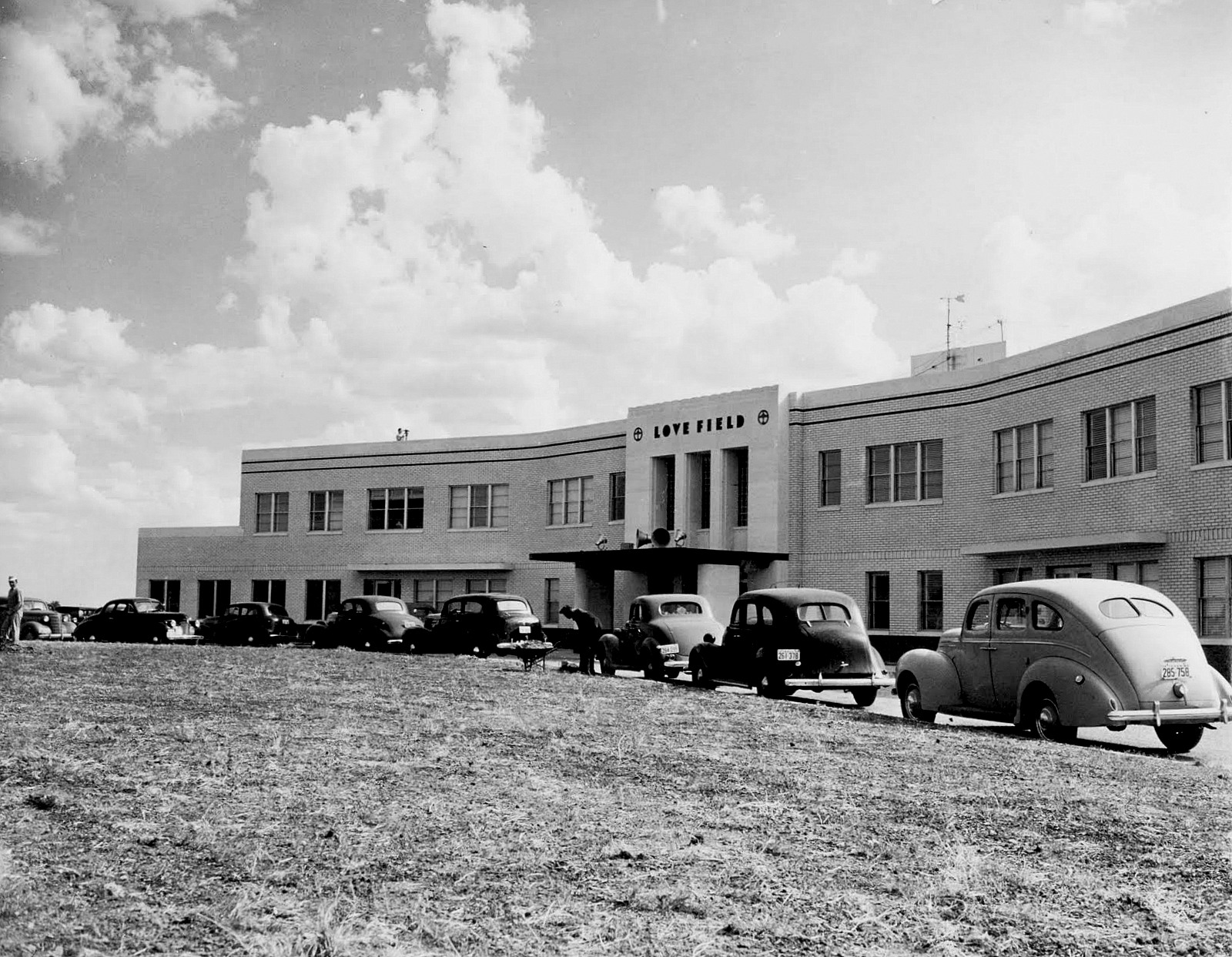 It wasn’t bad in the daytime, either — just nowhere near as dramatic. And in dire need of landscaping.
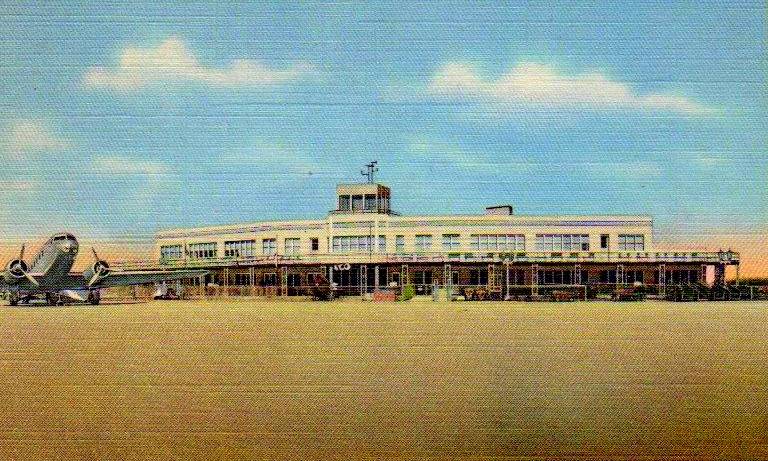 And here it is from the field side. Still swoon-worthy. The back of this postcard reads:
LOVE FIELD — NEW $225,000 ADMINISTRATION BUILDING
One of America’s finest air terminals which takes care of more airline passengers, more air mail and more air express in ratio to population than any other airport in the country.
**
What happened to this beautiful building? I searched through the Dallas Morning News archives until I felt I had to throw in the towel, never finding a definitive answer. But here’s what I did find. When the brand-spanking-new terminal (the one we know today) opened in 1958, the 1940 terminal was vacated. A better word might be “abandoned.” Most assumed the building would be razed very soon after. But I got as far as September of 1964, and the old terminal was still standing. And it wasn’t pretty. This excerpt from a Dallas Morning News article is painful to read:
…The old terminal building cowers in desolation…. Virtually every window has been smashed, carpeting the deserted terminal with a dangerous floor of broken glass. Loose wires stick out here and there, and blinds hang in twisted postures from broken cords. The building’s big sign DALLLAS is missing its D. (DMN, July 2, 1961)
(And even more thoroughly painful is the article in the Dallas News archives by Kent Biffle, “Ghosts Wait by Runway” — DMN, Feb. 2, 1961.)
Apparently, the old building had to remain standing until a “much-debated” new multi-million-dollar runway was agreed upon.
The point at which I threw in the towel in my quest to discover when the old terminal building had been demolished was a DMN photo from September 25, 1964, with the caption “$4,000,000-Plus Runway Progress. The 8,800-foot parallel runway at Dallas Love Field, left center, is two-thirds completed and should be ready for use next spring.” I am assured the photo has a hard-to-see old terminal still decaying in it. I assume they razed that sucker pretty soon afterward. …Possibly.
***
Sources & Notes
Top two photos are from the Love Field Collection, Dallas History and Archives, Dallas Public Library; accession numbers are PA83-13-8 for the swoony one at the top, and PA83-13-4 for the daylight exterior photo. I originally found these in the post “The New Love Field” by Jacob Haynes, here.
Click pictures for larger images — the first two are HUGE!
*
Copyright © 2014 Paula Bosse. All Rights Reserved.
June 2, 2014
The DFW Turnpike, Unsullied by Traffic, Billboards, or Urban Sprawl — 1957
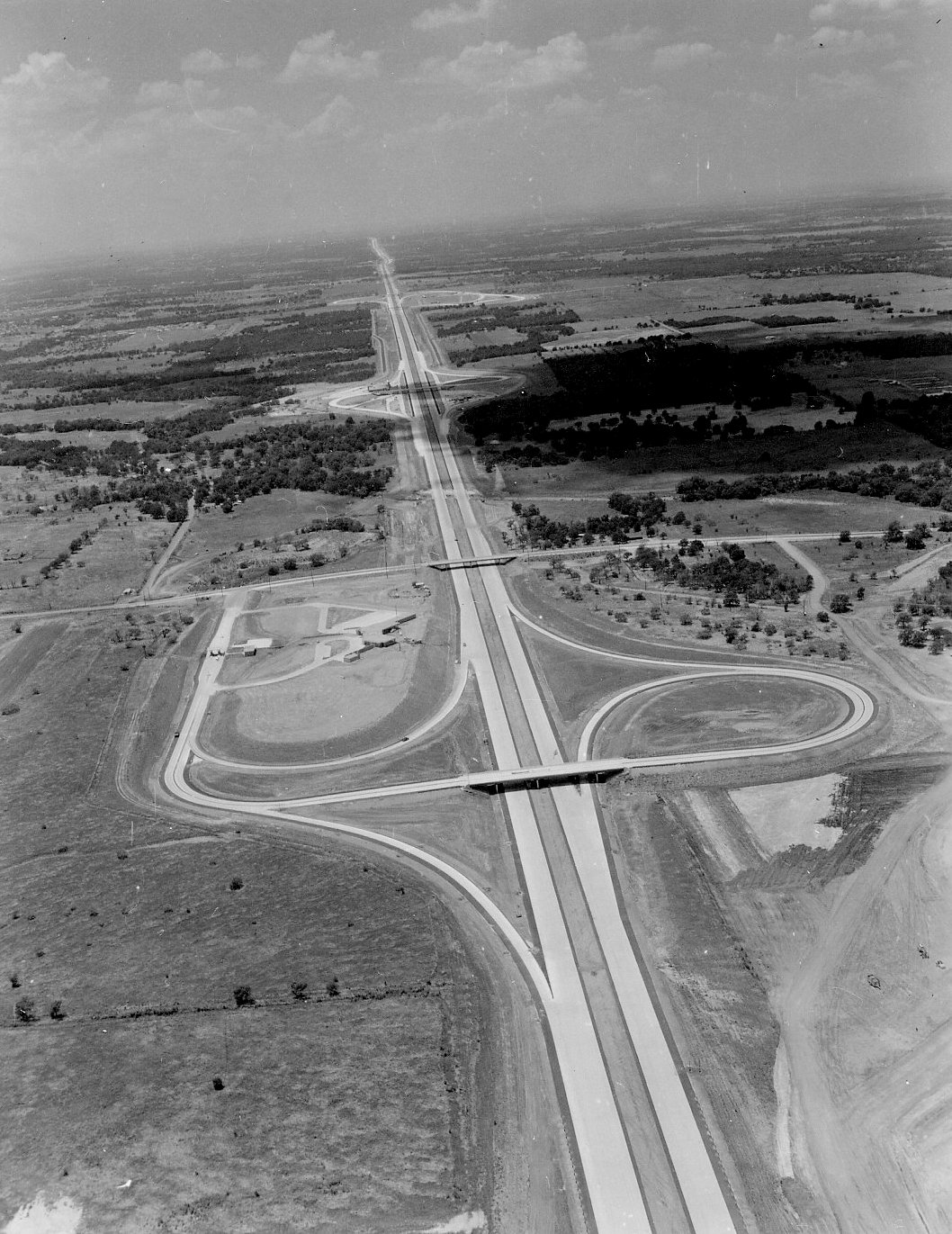 The DFW Turnpike, 1957… (click for very large image!)
by Paula Bosse
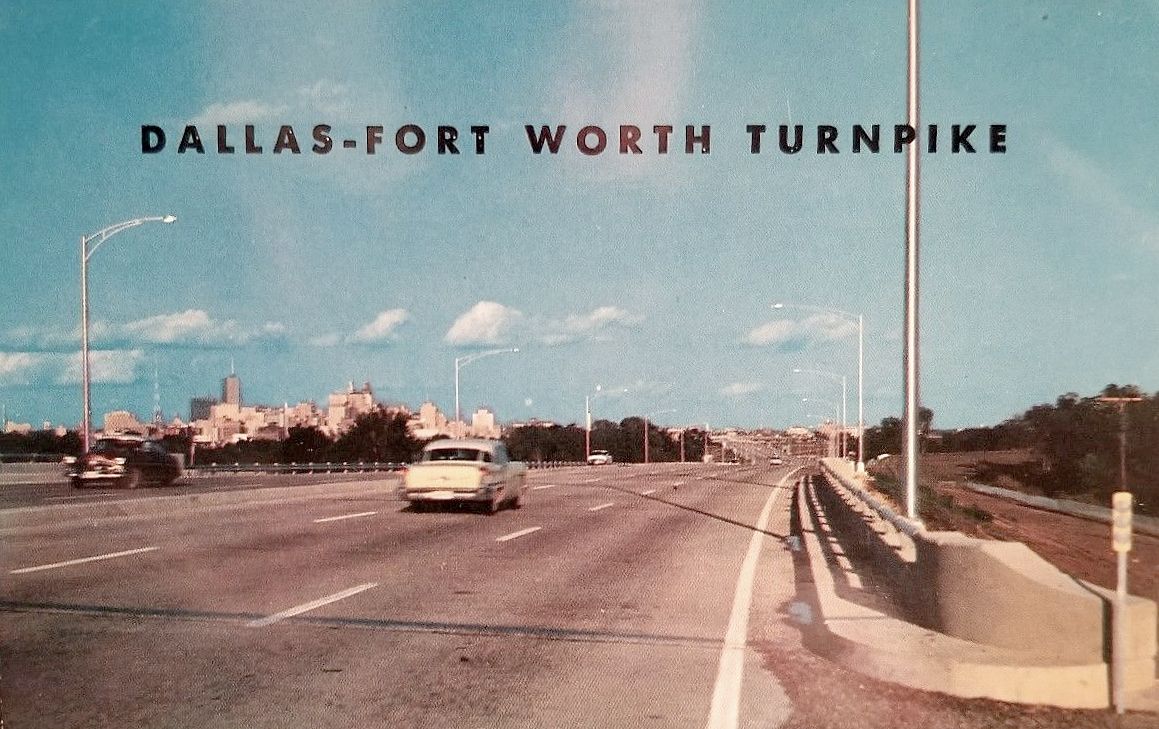
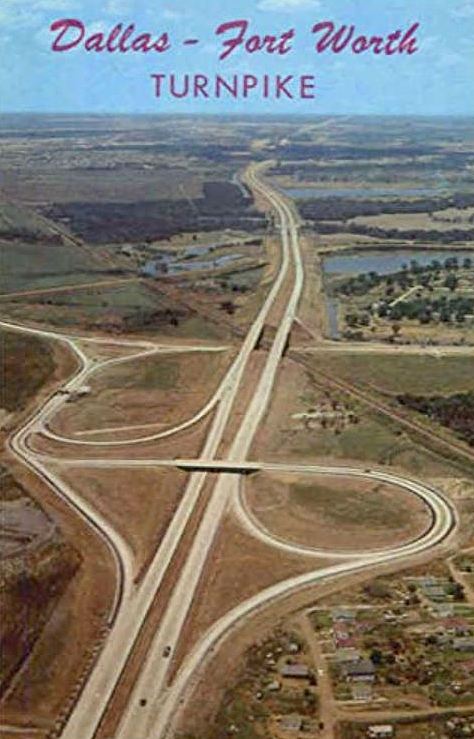
Above, the Dallas-Fort Worth turnpike in 1957, before it opened for business. When this toll road was paid off in 1977, the toll booths were removed and it became I-30, a “free” highway. (This “toll-road-becoming-a-free-road” thing has happened only once in the history of Texas; I can’t imagine it will ever happen again.) This photo shows the turnpike heading west through Arlington, with Hwy. 360 crossing over it in the middle. Six Flags over Texas would be built in this wide open expanse four years later. And then … an explosion of development.
A Texas Highways article described the 30-mile stretch (“30 miles — 30 minutes!”) as being a blissful drive through “a landscape devoid of advertising signboards and commercial establishments” (!). In fact, the only businesses along the turnpike were two restaurants and two service stations. All the way from Dallas to Fort Worth … that was IT! You know, I’d gladly pay an obscenely exorbitant toll today if it meant I could drive that stretch of highway the way it was in this photo. A world without urban sprawl would be heaven.
I love this photo. The road ahead just disappears into the ether. And, Arlington, you’ve never looked better.


***
Sources & Notes
Top photo from Oscar Slotboom’s book Dallas-Fort Worth Freeways, credited to TxDOT Travel Information Division, 1957. His caption: “The view looks west along the turnpike just before it opened in 1957 with the SH 360 intersection in the foreground…. Land on the left side of the turnpike just past SH 360 would soon be developed into Six Flags Over Texas…. The building alongside the turnpike was a Texas Turnpike Authority administrative office which was demolished in 2011.”
Postcards from around the internet.
For an informative read and LOTS of photos, I highly recommend Oscar Slotboom’s chapter on the DFW Turnpike, which you can access here (there are tons of historical photos). This chapter is from Slotboom’s exhaustive work Dallas-Fort Worth Freeways: Texas-Sized Ambition. The entire book has been made available online — for free (the home-page is here). You can read about Mr. Slotboom’s work in a Dallas Morning News interview by Robert Wilonsky here.
A fun read about the turnpike (yes, fun!) is an article from Texas Highways (Dec. 1957), here. (The article is spread over three web pages — don’t miss the links for all of the pages at the top of each page.)
By the way, when the turnpike opened, the toll was 50 cents. According to the Inflation Calculator, that would be equivalent in today’s money to just over $4.00. To drive from Dallas to Fort Worth quickly, through not-yet-developed green spaces and along a new highway uncluttered with billboards. A BARGAIN!
Click photo for larger image.
*
Copyright © 2014 Paula Bosse. All Rights Reserved.
May 31, 2014
A Lost Photo of Director Larry Buchanan, Celebrated “Schlockmeister” — 1955
 Larry Buchanan (in bowtie) in his ad-man days, 1955
by Paula Bosse
I got all excited when I saw the above photo posted in the Lone Star Library Annex Facebook group. It accompanied an article and another photo from the Katy Employes’ Magazine (August, 1955) (seen below) — the poster was interested in the railroad-angle of the article and photos, but the name “Larry Buchanan” was what grabbed my attention.

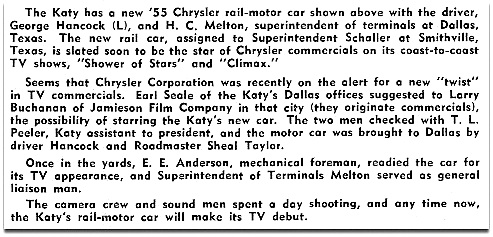
The photo was posted because it was a wonderful piece of M-K-T Railroad-related ephemera. Before reading the accompanying text, I thought that the idea of a 1955 Chrysler tricked-out to ride along Katy railroad tracks (so that M-K-T officials could, presumably, ride the rails in comfortable air-conditioned splendor as they moved from one inspection site to the next) was the cool thing about the article. Then I got to the name “Larry Buchanan.” And it became much, MUCH more interesting.
So who is Larry Buchanan? Briefly, Larry Buchanan is one of the greatest exponents of grade-Z, low-low-low-LOW-budget filmmaking, a director with a cult following amongst those who enjoy movies in the “so-bad-they’re-good” genre. He shot most of his movies in the 1960s in Dallas, taking advantage of lots of locations around the city, even if the movies he was shooting weren’t actually set in Dallas (one movie had Highland Park Village standing in for Italy, and “Mars Needs Women” was set in Houston, even though the movie is crammed full of easily recognizable Dallas locations such as the downtown skyline and the Cotton Bowl). The movies that have earned him his place in the pantheon of cult figures are primarily his sci-fi movies, like “Mars Needs Women,” “Attack of the Eye People,” “Curse of the Swamp Creature,” and “Zontar: The Thing from Venus.” Many were re-makes of earlier low-budget sci-fi movies commissioned by American International Pictures, and Buchanan was usually the producer, director, writer, and editor — “auteur” seems like the wrong word to use here, but that’s what he was, a filmmaker intensely involved with every phase of the production.
Buchanan was born in 1923 and grew up in Buckner Orphans Home. After a fleeting thought of becoming a minister, Buchanan — long-fascinated by movies — left for Hollywood and New York where he worked as an actor in small roles or on the crew (during this time there were professional brushes with, of all people, George Cukor and Stanley Kubrick). By the early 1950s, Buchanan was back in Dallas, employed by the Jamieson Film Company (3825 Bryan St.), working on industrial films, training films, television programs, and commercials. It was at Jamieson that he learned all aspects of film production, including how to get things done quickly and how to bring projects in under budget. It’s also where he met co-workers Brownie Brownrigg, Robert B. Alcott, Bob Jessup, and Bill Stokes, all of whom went on to have film careers of their own and most of whom Buchanan used as crew members when shooting in and around the city.
It was during this period that the photo above was taken. There are countless websites out there devoted to Larry Buchanan’s film oeuvre, but there are very, very few photos of him online. I found exactly three:
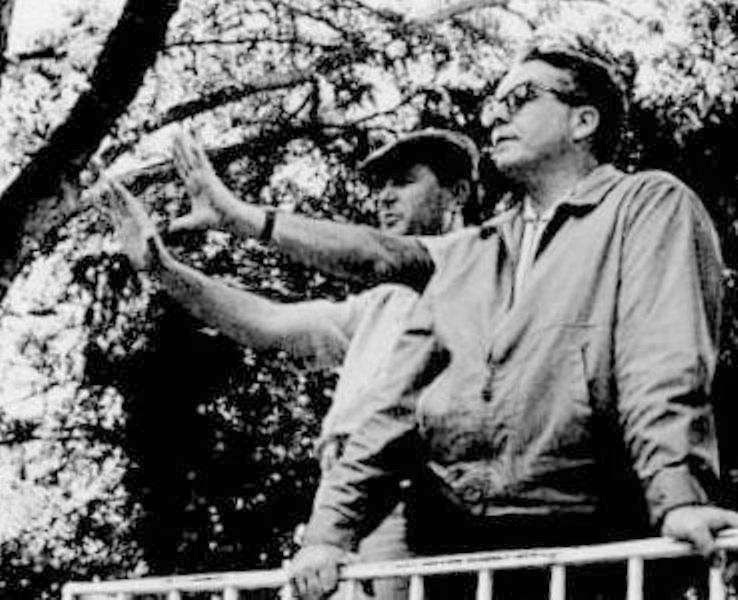 Larry (left) with cinematographer Bob Jessup
 In 1986 (Tim Boole/Texas Monthly)
 Date unknown
The photo at the top of this post is from 1955, before Buchanan had really begun cranking out his own movies. I can’t say for sure that this IS a photograph of Larry Buchanan, but it seems likely that it is. In that striped shirt, he looks like the kind of hip, energetic, ever-enthusiastic director I imagine him being. I can only hope that it IS him, straddling railroad ties, behind a camera pointed at a retrofitted Chrysler, in Dallas’ Katy railyard. One wonders if that Chrysler spot had a higher budget than some of the movies he was making ten years later. UPDATE: In the comments, below, Larry’s son Barry identifies his father in the top photo, but not as the man behind the camera, but as the man behind the car, wearing the bowtie. Thanks for the correction, Barry1)
From all reports, Larry was a tireless, driven, upbeat guy who loved making movies, and I think it would have been a lot of fun hanging out with him. If I ever have enough disposable income, I’ll fork it over and buy a copy of his entertaining-but-pricey autobiography, the well-received It Came From Hunger: Tales of a Cinema Schlockmeister (McFarland & Co., 1996).
It’s been fun researching Larry Buchanan. There’s a lot more to tackle later. I mean, I haven’t even touched on the legendary “Naughty Dallas” yet!
***
Tons of links here….
First two photos and text from the Katy Employes’ Magazine (Aug. 1955).

Katy magazine scans made with permission of the Facebook page Lone Star Library Annex.
Other examples of automobiles equipped with “railroad wheels” can be found here.
Black and white photo of Buchanan with Bob Jessup (photographer and date unknown) and the great color photo (a detail of which is shown above) by Tim Boole, both from the article, “How Bad Were They?” by Douglass St. Clair Smith (Texas Monthly, May 1986), which you can read here.
That last photo of Buchanan is all over the internet — the only one you ever really see. I don’t know who took it, when it was taken, or where it originally appeared. But it’s a great photo!
Larry Buchanan died in December, 2004, at the age of 81. His obituary from The New York Times is here.
A fond look back at Buchanan’s career by Eric Celeste appeared in the April 2005 issue of D Magazine and can be read here.
The best piece on Buchanan is “A Tribute to Larry Buchanan” by his good friend Greg Goodsell, here.
My recent post on “Mars Needs Women” — with screen caps of movie scenes shot at recognizable Dallas locations — is here.
I never did find that Chrysler spot that had been slated to appear on network TV. I have a feeling it may be in a lengthy collection of Chrysler commercials and films from 1955 which you can watch here. I couldn’t slog all the way through it, but there are a couple of “Shower of Stars” episodes, which are mentioned in the Katy article (they’re odd “entertainment” shows which seem to be nothing more than infomercials for Chrysler starring famous people in bad sketches). If anyone actually finds footage that was filmed that day in Dallas, please let me know!
And, lastly, Larry Buchanan’s movies are fun, but some are more fun than others, “if you know what I mean, and I think you do” (as Joe Bob Briggs — surely one of Larry’s biggest admirers — might say). Many of them are available to watch in their entirety online. Check YouTube and Google.
Click photos for larger images!
*
Copyright © 2014 Paula Bosse. All Rights Reserved.
May 28, 2014
“There Are Eight Million Stories in the Naked City…” — ca. 1920
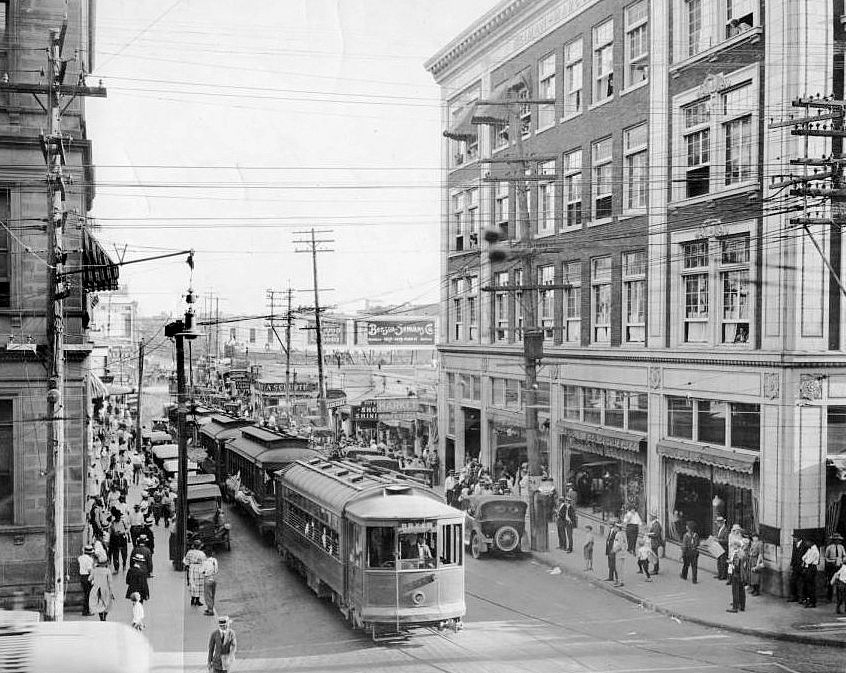
by Paula Bosse
The photograph above, by George A. McAfee, shows Ervay Street, looking south from Main, in about 1920. Neiman’s is on the right. I’m not sure what the occasion was (I see special-event bunting….), but the two things that jump out right away are the number of people on the sidewalks and the amount of congestion on the streets. In addition to private automobiles (driven by “automobilists” or “autoists,” as the papers of the day referred to them), the street is also packed with cars standing in the taxi rank (cab stand) at the left, and a long line of hulking streetcars. This busy intersection is jammed to capacity.
The city of Dallas was desperately trying to relieve its traffic problems around this time, and there were numerous articles in the papers addressing the concerns of how to manage the congestion of streets not originally designed to handle motor vehicle traffic. Dallas and Fort Worth were working on similar plans of re-routing traffic patterns and instituting something called “skip stop” wherein streetcars would stop every other block rather than every block. Streetcars, in fact, though convenient and necessary, seemed to cause the most headaches as far as backing up and slowing down traffic, as they were constantly stopping to take on and let off passengers. There was something called a “safety zone” that was being tried at the time. I’m not sure I completely understand it, but it allowed cars to pass streetcars in certain areas while they were stopped.
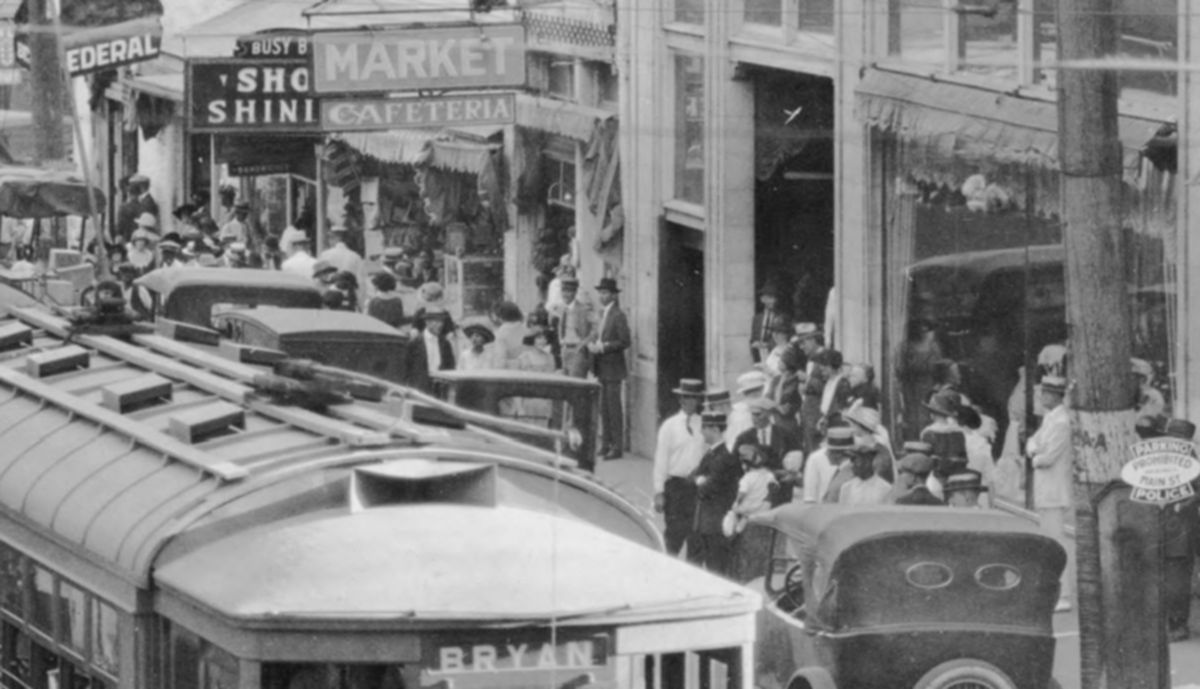
That traffic is crazy. But, to be perfectly honest, it’s far less interesting than all that human activity — hundreds of people just going about their daily business. It’s always fun to zoom in on these photos, and, below, I’ve broken the original photograph into several little vignettes. I love the people hanging out the Neiman-Marcus windows. And all those newsboys! Not quite as charming was all that overhead clutter of power lines and telephone lines; combined with the street traffic, it makes for a very claustrophobic — if vibrant — downtown street scene. (Click photos for larger images.)
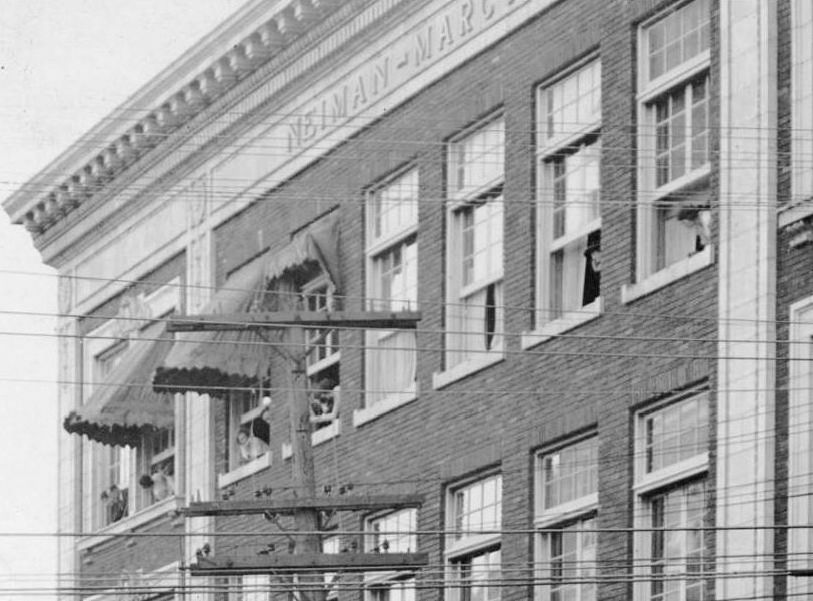


 My favorite “hidden” image in the larger photograph. The only moment of calm.
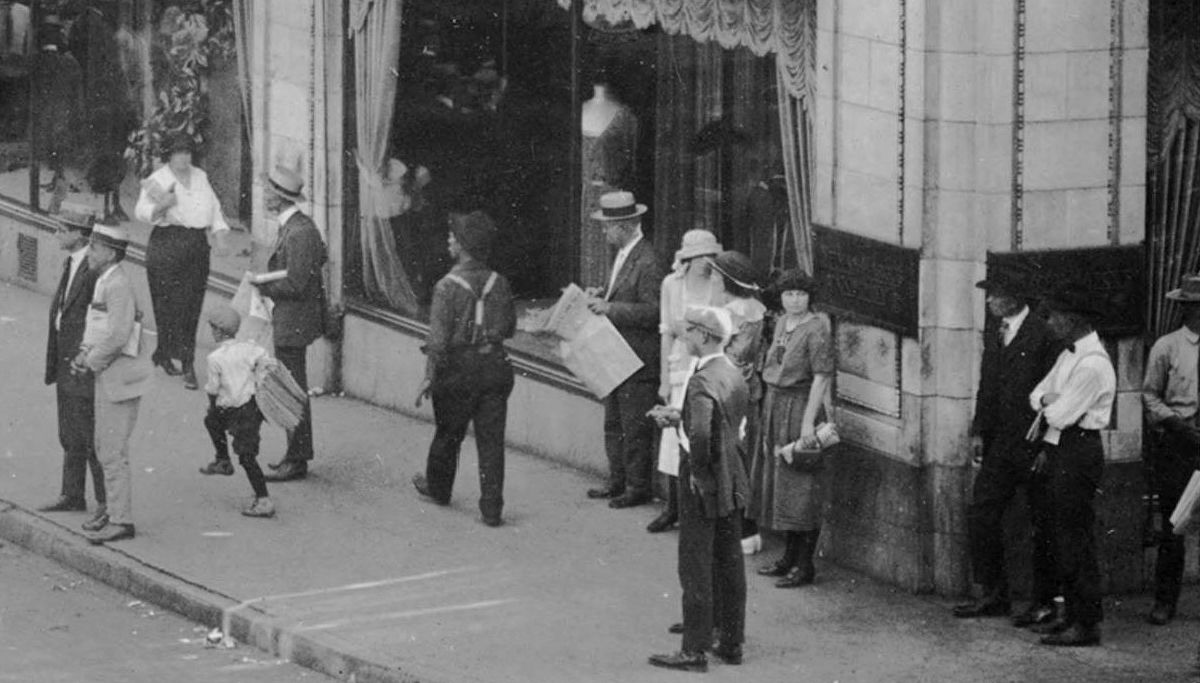 I love this. The woman in front of the Neiman-Marcus plaque looking off into the distance, the display in the store window, the newsboy running down the street, the man in suspenders, the women’s fashions, and all those hats!
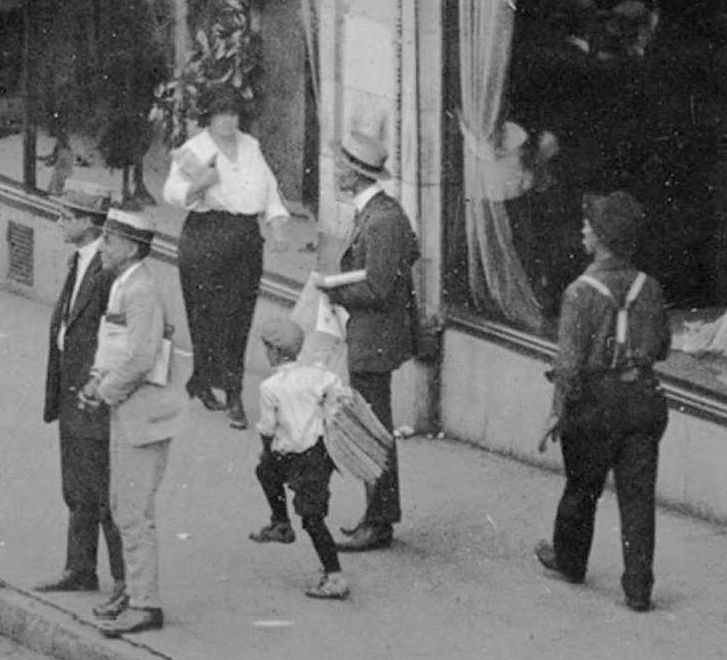
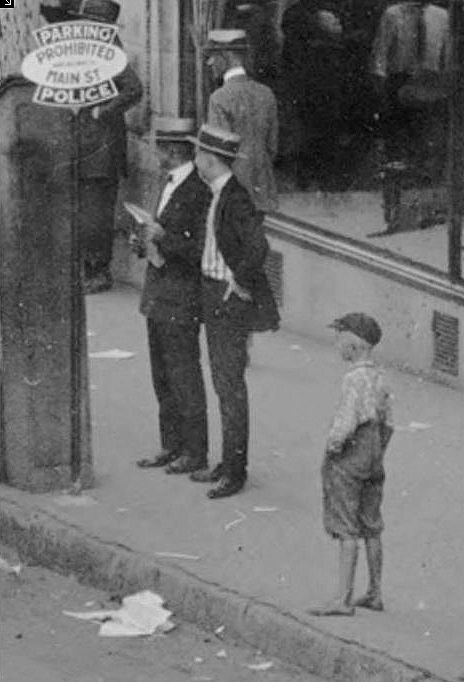 A barefoot boy and litter everywhere.

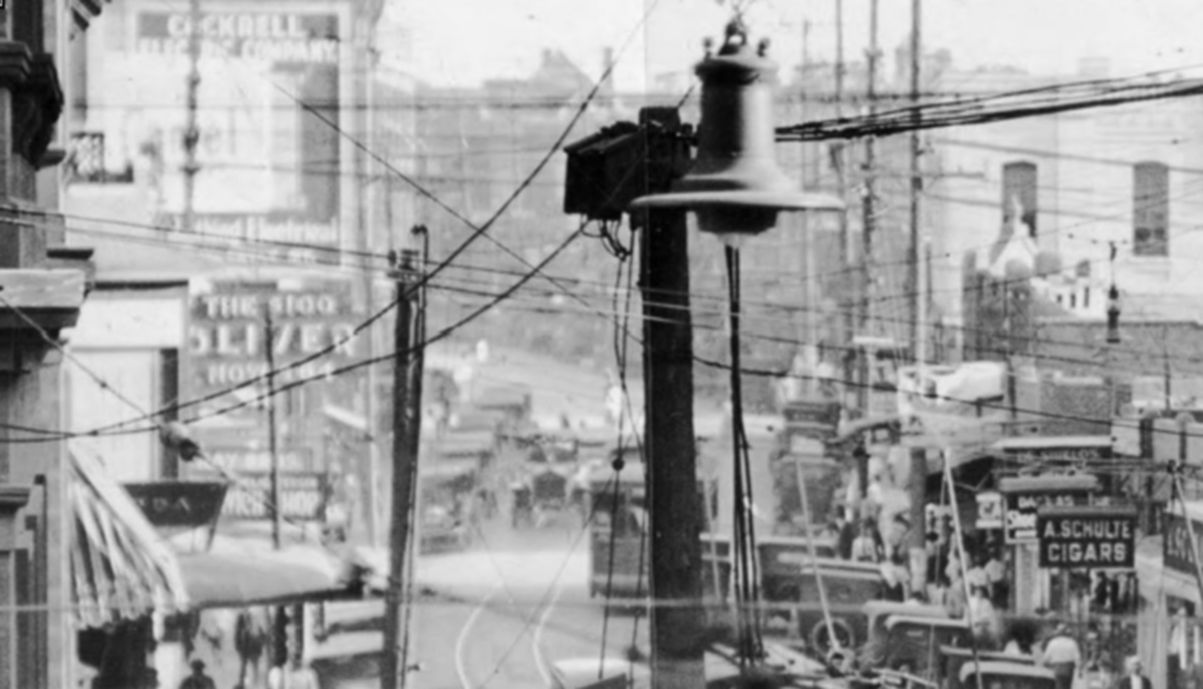 The congestion is pretty bad above the streets, too.
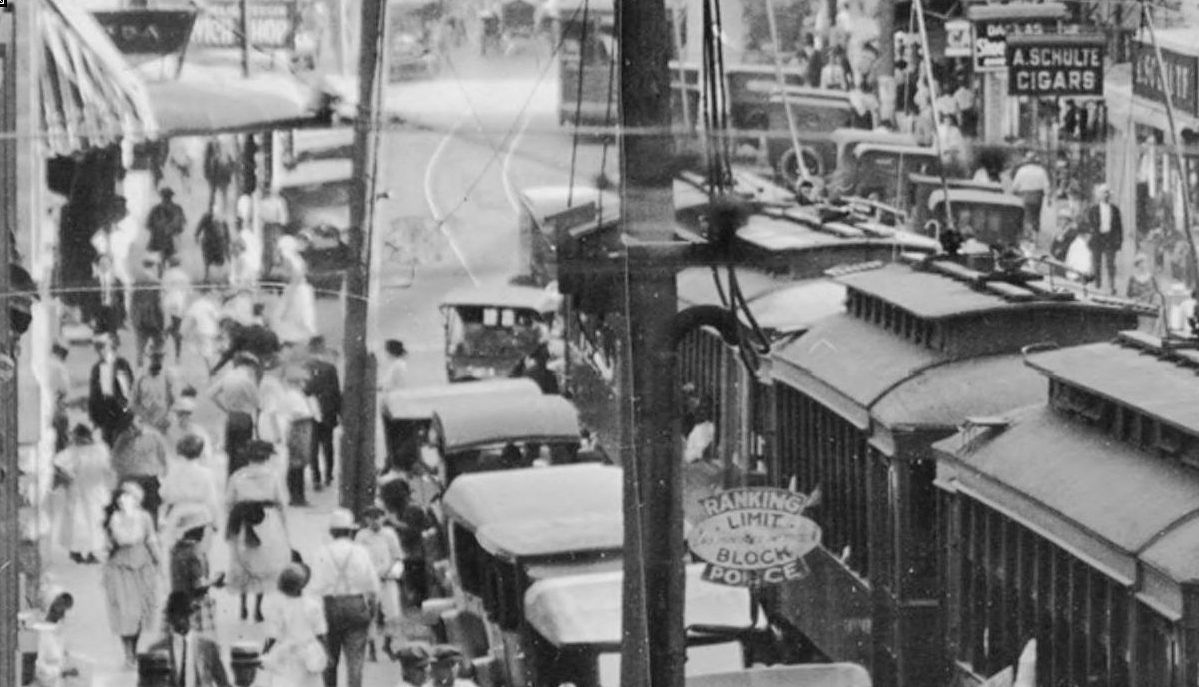
 Cabbies, newsboys, and working stiffs.
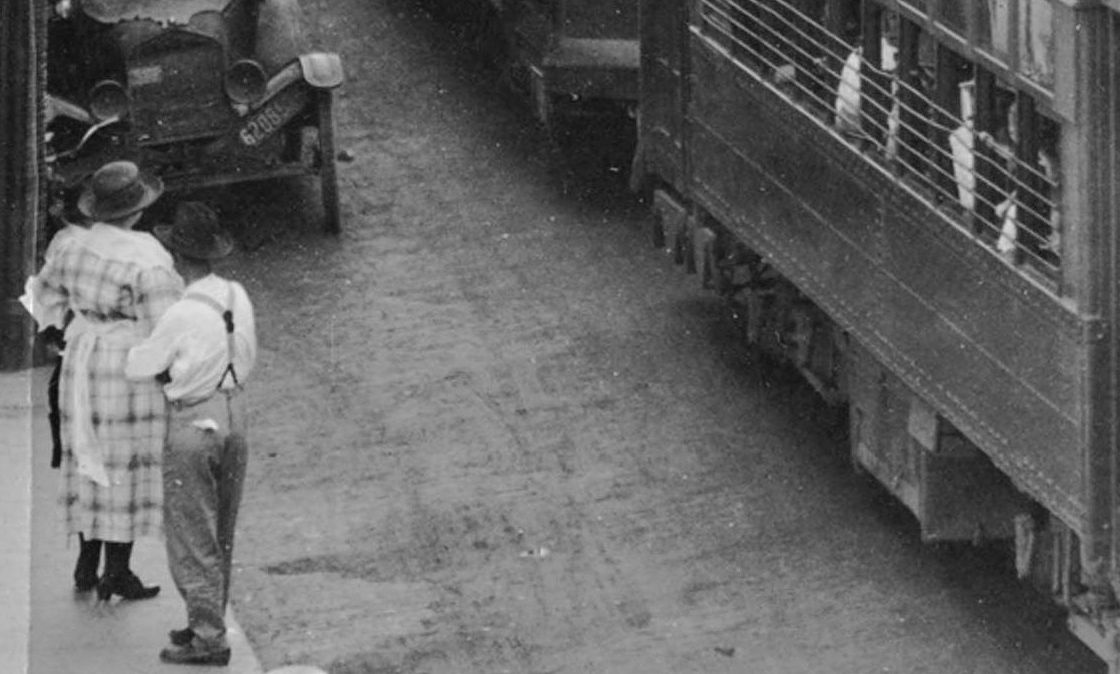
 I swear there was only one streetcar driver in Dallas, and he looked like this! Those motormen had a definite “look.”
***
Sources & Notes
Original photograph attributed to George A. McAfee, from the DeGolyer Library, Central University Libraries, Southern Methodist University, accessible here.
For other photos I’ve zoomed in on the details, see here.
*
Copyright © 2014 Paula Bosse. All Rights Reserved.
May 12, 2014
SMU’s First Year: The Dinkey, Campus Hijinx, and the Basket Ball — 1915-16
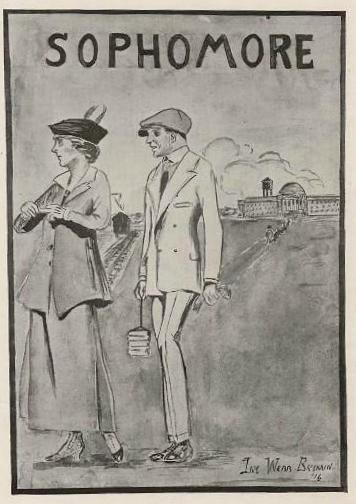
by Paula Bosse
As a companion to my previous post on the first year of classes at SMU, here are a few more photos from the yearbook, these documenting the less studious side of campus life.
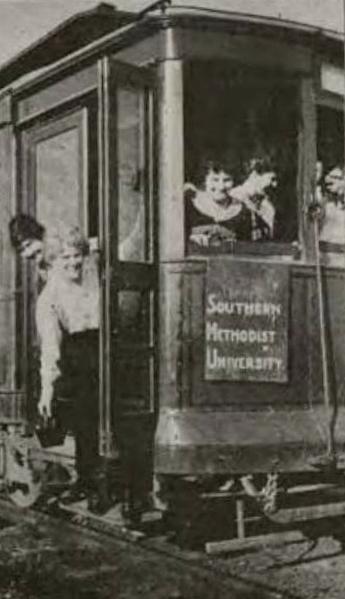
The most interesting thing about these photos, for me, is the SMU trolley, nick-named “The Dinkey” (or “The Dinky”). When SMU opened in 1915, it was waaaaaaaaaay outside the city limits, and the rail line extended only as far north as Knox. In order to get to and from downtown (and points beyond), one had to board the Dinkey near Hillcrest and McFarlin and ride to Knox, then change to an official city streetcar and head into civilization.
This reminiscence appeared in a 1984 issue of Park Cities People:
The first time Manning saw the campus was from the wooden seat of the Dinkey, an electric streetcar built for SMU in 1915.
“I told Dad Johnson, the conductor, as I boarded in Highland Park, I wanted to get off at SMU,” Manning said. “He said, ‘That’s as far as it goes.'”
“‘When we got there, I said, ‘Where’s the campus?’ He said, ‘There’s only two buildings. Dallas Hall is the one with the columns.'”
Manning couldn’t see the building from the Dinkey for the four-foot-tall Johnson grass and had to follow a travel-worn path to Dallas Hall.
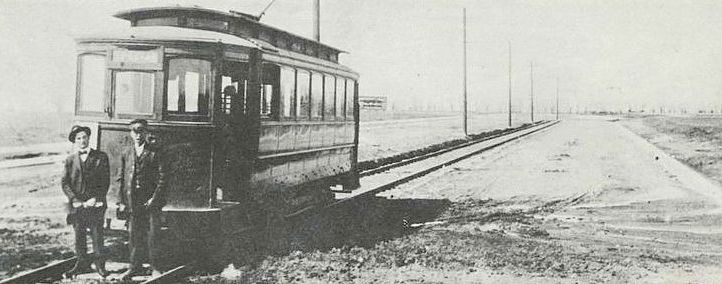 “The Dinkey ran from Dallas Hall to Knox Street on tracks in the middle of Hillcrest. This photo taken at McFarlin.”
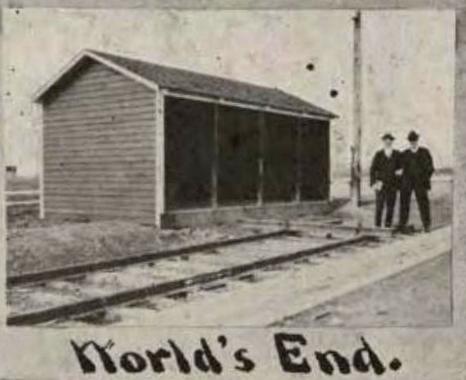 The “depot” where the Dinkey picked up and dropped off SMU students, faculty, and visitors.
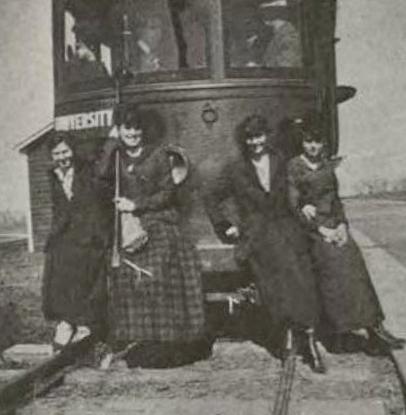 The Dinkey, garnished with co-eds.
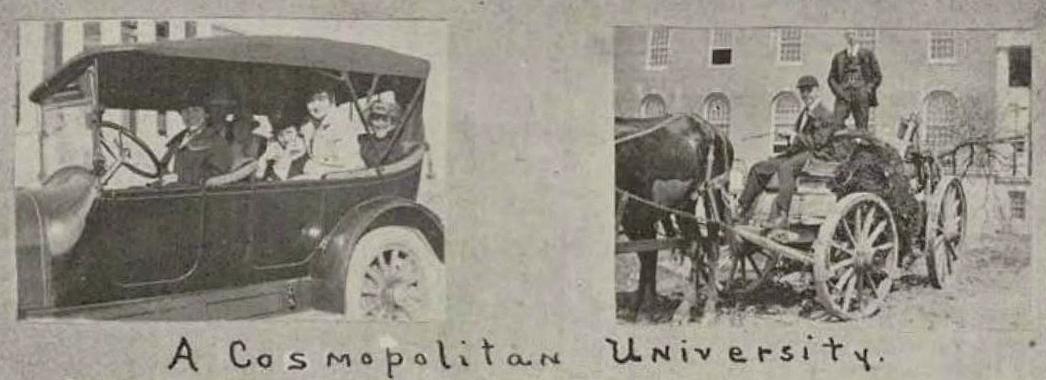 “Cosmopolitan University” horsepower.
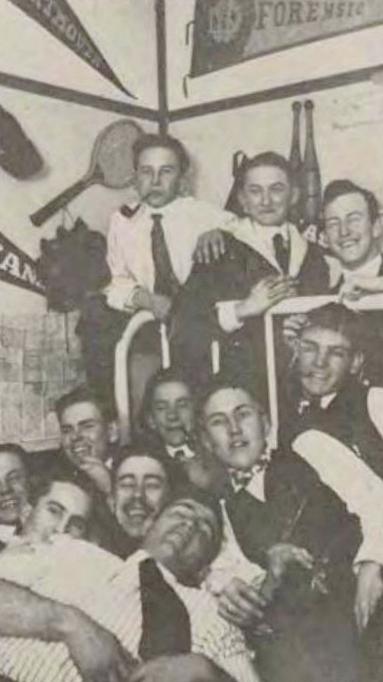
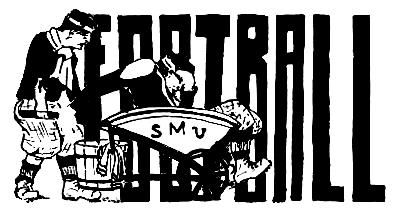 Bad season?
The inaugural football season started tentatively. The 1915 schedule:
- Oct. 9th: SMU vs. TCU at Fort Worth
- Oct. 14th: SMU vs. Hendrick College at Dallas
- Oct. 27th: SMU vs. Austin College at Dallas Fair
- Nov. 4th: SMU vs. Dallas University
- Nov. 12th: SMU vs. Daniel Baker at Brownwood
- Nov. 19th: SMU vs. Southwestern University at Dallas
- Nov. 25th: SMU vs. Trinity University at Waxahachie
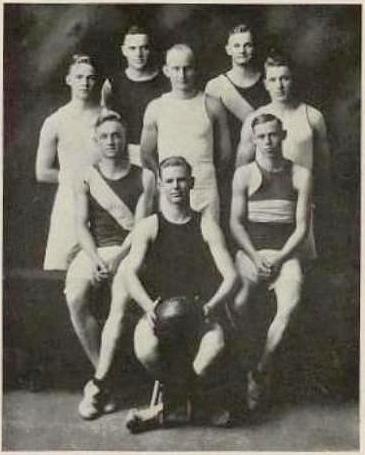 The men’s “Basket Ball” team.
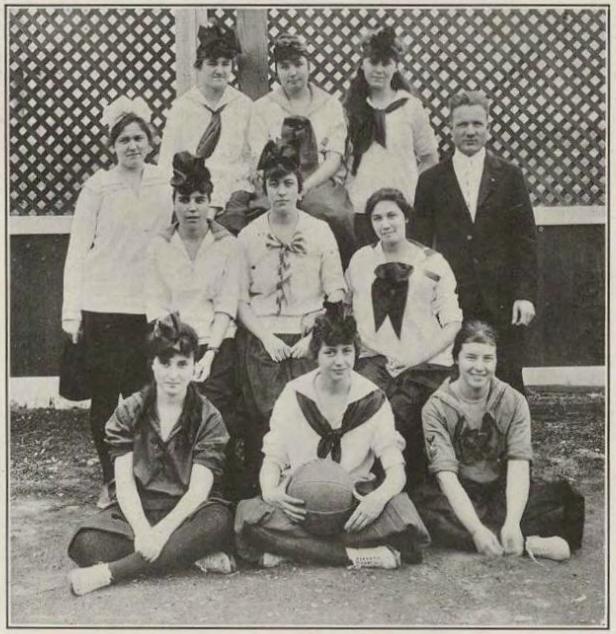 The girl’s “Basket Ball” team.
***
Sources & Notes
All images (except the second) from the 1915-1916 edition of SMU’s “Rotunda” yearbook.
Photo (and caption) of the “Dinkey” trolley at Hillcrest and McFarlin from Highland Park Centennial Celebration site, here.
Quote about traveling to the campus from Park Cities People (March 15, 1984).
“Dallas Hall and the Hilltop” by Tom Peeler, an entertaining 1998 D Magazine article on the first days of SMU, is here.
My previous post containing more photos from this first yearbook, is here.
*
Copyright © 2014 Paula Bosse. All Rights Reserved.
May 10, 2014
Jordan Moore
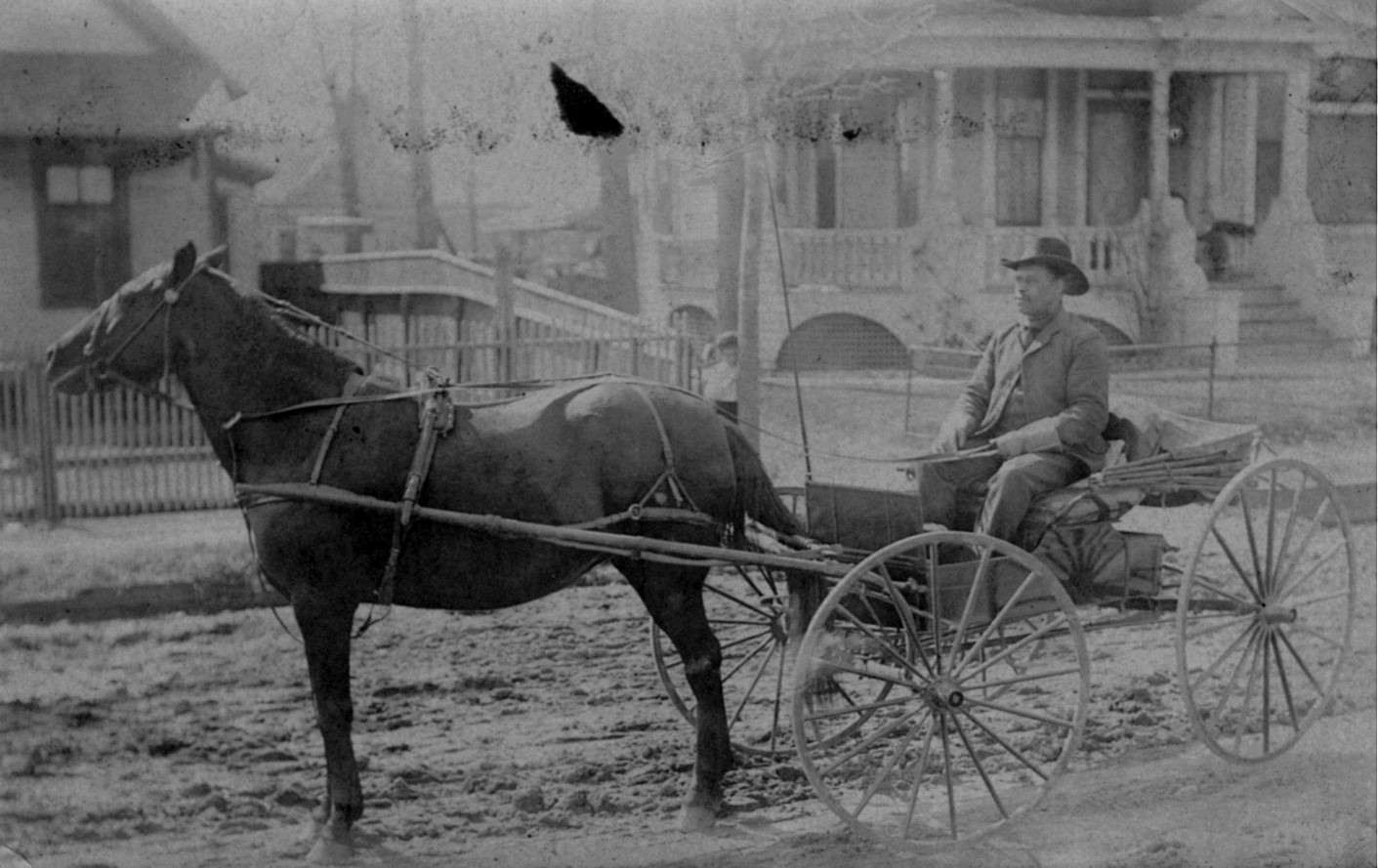 Jordan Moore, about 1905 (click for larger image)
by Paula Bosse
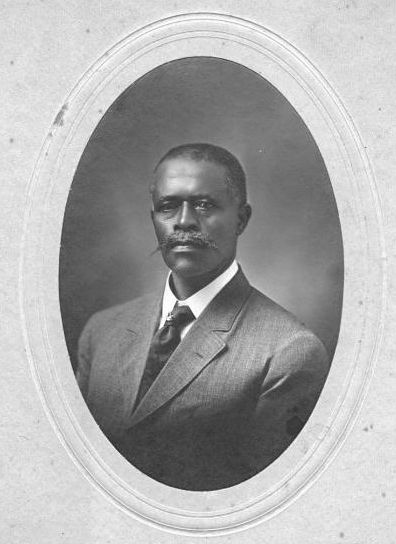
When wandering around the internet, one often encounters arresting images. Like the one above. There’s something about that photograph that grabs your attention. The stoic man in the buggy, the stiff, straight-standing horse, the child hiding behind the pole, the partial view of the porch of a fancy house, and the horrible, horrible condition of that street. The description reads simply: “Photograph of Jordan Moore seated in a horse-drawn carriage. Houses are visible in the background.” I wondered if I should know who Jordan Moore was, because the name wasn’t familiar. The photograph was in the collection that had been donated to the Dallas Historical Society by J. L. Patton, a prominent African-American educator. I found a few more photos of Mr. Moore in Patton’s collection, but I still had no idea who Jordan Moore was. So I did a little research.
Jordan Moore was born in Virginia in 1863. At some point he made it to Texas, perhaps in the early 1880s, and then to Dallas a few years later. By 1893 he was working for Mrs. Miranda Morrill, who had moved to Dallas in 1886, following the death of her husband, Judge Amos Morrill. Though born in Tennessee, Mrs. Morrill had moved to Texas as a child in 1834 and had strong ties to the state (one of her uncles was a signer of the Texas Declaration of Independence). When she arrived in Dallas, she built an imposing mansion at Ross and Harwood and, as she had no children, she and her servants (as they were listed on census forms) had that huge house to themselves to ramble around in. Mrs. Morrill was a prominent mover-and-shaker in town, devoting her time and money to a host of worthy social causes. In her employ was Jordan Moore, who is listed variously as her coachman and yardman, and who resided on the property. He worked for her until she died in 1906 at the age of 80.
(Mrs. Morrill’s obituary is interesting for many reasons, but particularly because amongst her surviving family members were her half-brothers R. L. Moore and S. J. Moore, sons of Mrs. Morrill’s stepfather. I don’t know if Jordan Moore was born into slavery and was owned by members of Mrs. Morrill’s family, but it’s interesting that he shared a surname with his employer’s family.)
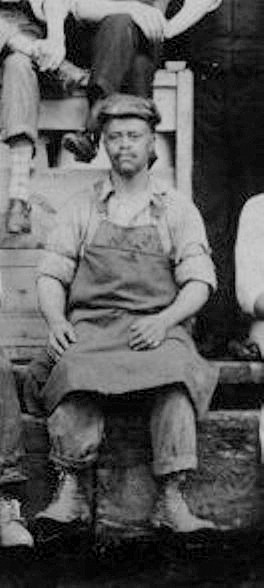
In 1907, after Mrs. Morrill’s death, Mr. Moore had moved to rooms elsewhere and went to work as a porter for the very large, very successful Huey & Philp Hardware Company at Griffin and Elm. Below are a couple of photographs of Moore and co-workers on the loading docks. He does not look very happy. He stayed at the job for 11 years but moved around from rooming house to rooming house — from Ross to Cochran to N. Harwood to Masten. (One of the captions on these photos states that Mr. Moore purchased a house on Cochran St. in 1900. I don’t think that’s correct. If he did buy a house, he doesn’t appear to have ever lived in it.)
Jordan Moore died on January 22, 1918, from complications of diabetes. He was 54. He never married and had no children, and the friend he had been staying with when he died offered scant and approximate guesses as to dates and places when asked to supply them for the official death certificate.
I wondered why all these photos of a man who apparently left no family and had lived a fairly commonplace life had made their way into the personal collection of J. L. Patton, a principal at Booker T. Washington High School and a pioneer in education for African-American students in Dallas. And then I noticed that the name of the “informant” on the death certificate was Samuel Stanton, a long-time friend with whom Moore had been staying in his last days. Moore was the godfather of Mr. Stanton’s daughter, and Mr. Stanton’s daughter was Mr. Patton’s mother. Patton would have been 12 when Moore died, and he would certainly have remembered him — and one hopes he had fond memories of him.
Jordan Moore was buried in Alpha Cemetery, one of the few “negro” cemeteries of the time, near the old freedmen’s town of Alpha, near present-day Preston and Alpha Road. Below are more photographs of Mr. Moore, now in the collection of the Dallas Historical Society.
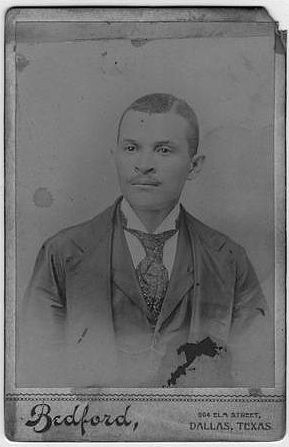 1890
1890
 Mr. Moore (seated, second from left), Huey & Philp loading dock, ca. 1907
 Mr. Moore (seated, with box), Huey & Philp loading dock, ca. 1910-15
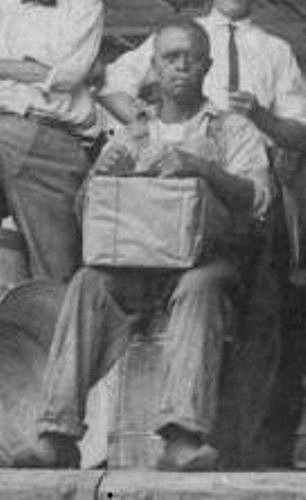
 ca. 1910-15
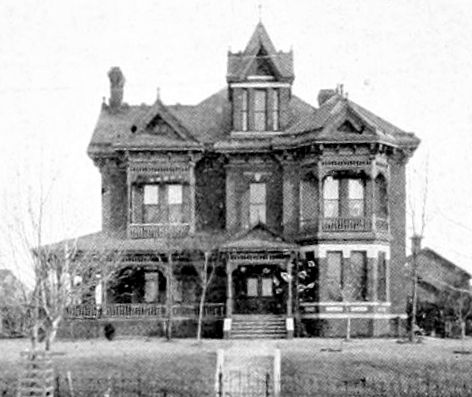 Mrs. Morrill’s house at Ross & Harwood, 1894
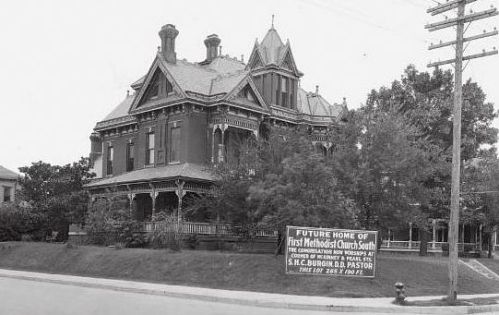 The Morrill house — next stop: demolition, 1920
 1909 ad
 Huey & Philp Hardware Co., at Griffin and Elm — ca. 1913
***
Sources & Notes
Photos of Jordan Moore from the Dallas Historical Society’s J. L. Patton Collection, once viewable at UNT’s Portal to Texas History website. Top photo, c. 1905.
The first photo of Mrs. Morrill’s house at Ross and Harwood is from Clifton Church’s book Dallas, Texas Through a Camera (Dallas, 1894). (As an interesting aside, Church was married to Morrill’s niece.) In the book Dallas Rediscovered, the house is described thusly: “Mrs. Miranda Morrill’s dark, brooding residence, completed in 1886 by A. B. Bristol at the southwest corner of Harwood, was leveled in 1920 for construction of the First United Methodist Church.”
The second photo of the Morrill house is from Mark Doty’s book Lost Dallas (Charleston: Arcadia Publishing, 2012).
Huey & Philp Hardware Co. ad from Worley’s 1909 Dallas directory.
Lang & Witchell drawing of the Huey & Philp building is from a Dallas Morning News blog post by Steve Brown, here.
More on the accomplishments of J. L. Patton from the Handbook of Texas, here.
*
Copyright © 2014 Paula Bosse. All Rights Reserved.
May 7, 2014
A Painterly View of Commerce Street

by Paula Bosse
I could be WAY off, but this MIGHT be approximately Commerce and Poydras, looking … east? For present-day reference, it’s about where the McDonald’s is on Commerce. Possibly. Click it to make it larger. Misinformation is likely.
*
Copyright © 2014 Paula Bosse. All Rights Reserved.
 Flashback : Dallas