Flashback : Dallas

A Miscellany: History, Ads, Pop Culture

Category: Vault

“Delusions of Affability” — Marijuana in 1930s Dallas
marihuana-film_poster
“The weed with roots in hell…”

by Paula Bosse

Today is April 20, also known as the cannabis-friendly “4/20 Day.” So why not take a look at the early days of marijuana awareness in Big D?

The “marijuana problem” in Dallas didn’t really start to be reported regularly in the pages of The Dallas Morning News until the 1930s, but there were a few stories that showed up in the early 1920s, such as this one about a raid on an opium-den-style house in Little Mexico in 1921 (click for larger image).

marijuana_dmn_041321DMN, April 13, 1921

Heading into the 1930s, the legality of the possessing and selling marijuana was fairly vague. After reading a bit about what was happening in Dallas in regard to “Mexican cigarettes,” I’m still not sure when the possession and selling of marijuana became illegal. The federal, state, and local laws all seemed to be different, and all were constantly in flux. There might even have been conflicting laws on the city and county books. Like I said, confusing. Nevertheless, here are a couple of interesting tidbits from the opening months of 1931 concerning the first charge in Dallas County against a person selling marijuana and the first conviction in Dallas County for a person selling marijuana. (According to the Inflation Calculator, today’s equivalent to the $25-to-$500 fine of 1931 would be, approximately, a $395-to-$7,900 fine.)

A Mexican was placed in the county jail Wednesday after a charge of selling marijuana had been filed against him in County Criminal Court, the first time in history of that body such a charge has been brought against a defendant. […] The Mexican was still ‘smoked up’ when arrested. (DMN, Jan. 29, 1931)

The penalty for selling “Mexican dope weed” was a fine of $25-$500 or a jail sentence of one month to one year.

The first conviction on record in County Criminal Court for selling marijuana, Mexican ‘loco weed,’ was given Thursday when Judge Noland G. Williams sent Manuel Garino to the county jail for thirty days. (DMN, Feb. 6, 1931)

Still, marijuana was considered only a minor annoyance locally — the Asst. D.A. even went so far as to say that there was “little use of the drug in Dallas.”

Actually, throughout the ’30s, a lot of policemen didn’t even know what marijuana plants looked like — one wonders how much marijuana-related activity was going on all around them in plain view? In these early days, when the police did stumble onto large quantities of “loco weed,” it was sometimes merely by accident while investigating something else.

And then, suddenly — around the mid ’30s — marijuana was everywhere. Just in time for the Texas Centennial, when thousands and thousands of potential new customers would be flooding into the city! Enterprising individuals were growing it all over the place — in their yards, in their fields with other crops, and even on a little island called Bois d’Arc Island in the middle of the Trinity River bottoms, a few miles south of Dallas (where 3,000 pounds was seized in July, 1938).

Even though the purchasing, the selling, the use, and the growing of marijuana was going on all over the city — in white, black, and Hispanic neighborhoods — the main areas of enforcement were, unsurprisingly, in Little Mexico and Deep Ellum, areas populated by minority citizens.

Police Sergt. O. P. Wright stopped a 22-year-old Negro languidly puffing a cigarette as he walked in the 400 block of North Central Tuesday.

“What kind of a cigarette is that, boy” inquired the Sergeant.

“Rough cut,” replied the languid one. (“Policeman Sniffs Air, Catches Marijuana Smoker,” DMN, June 22, 1938)

The federal government was attempting to deal with the marijuana problem — by taxing it so highly that it would discourage those participating in the loco weed trade: $100 tax on every ounce! At a time when you could buy a joint for anywhere from a dime to a quarter. Talk about your “sin tax”!

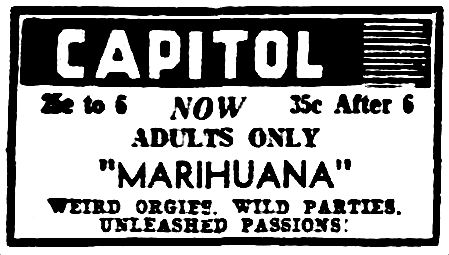
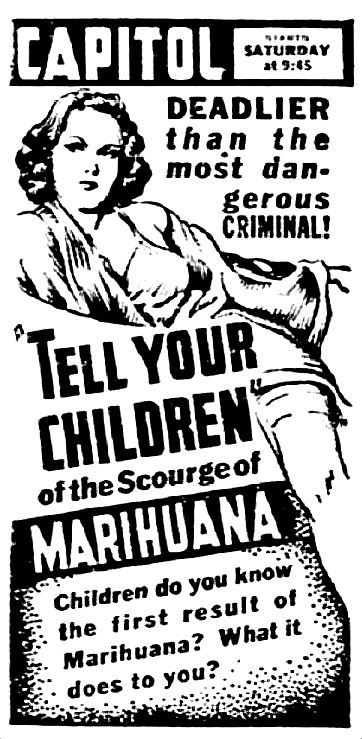
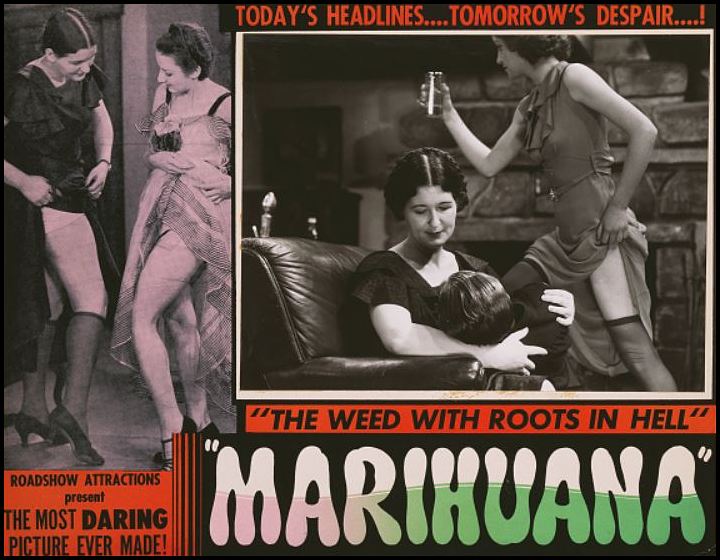
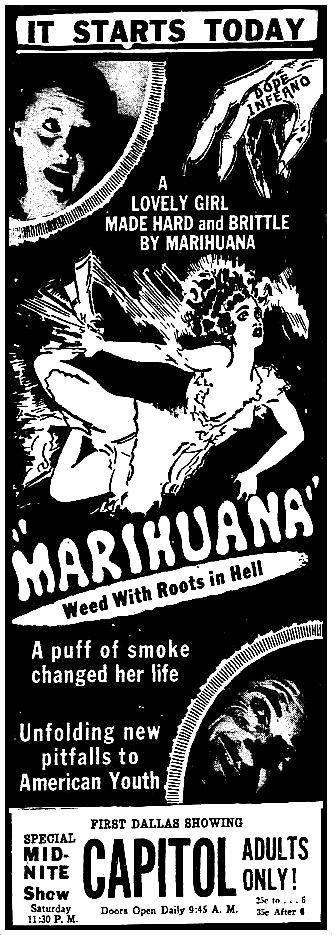
Marijuana/marihuana was generally demonized as a highly addictive drug which caused psychosis and led, inevitably, to all sorts of heinous acts and/or lewd behavior. …Or death. A lot of helpful, cautionary exploitation movies began to appear on Dallas screens, such as Marihuana from 1936 (which, incidentally, had an Oak Cliff child actor — Gloria Brown — in the cast). Below, the pomp and bug-eyed bally-hoo adorning the entrance to the lovely Capitol Theater, beckoning the Elm Street passerby to check out the film. …In order to be well-informed.
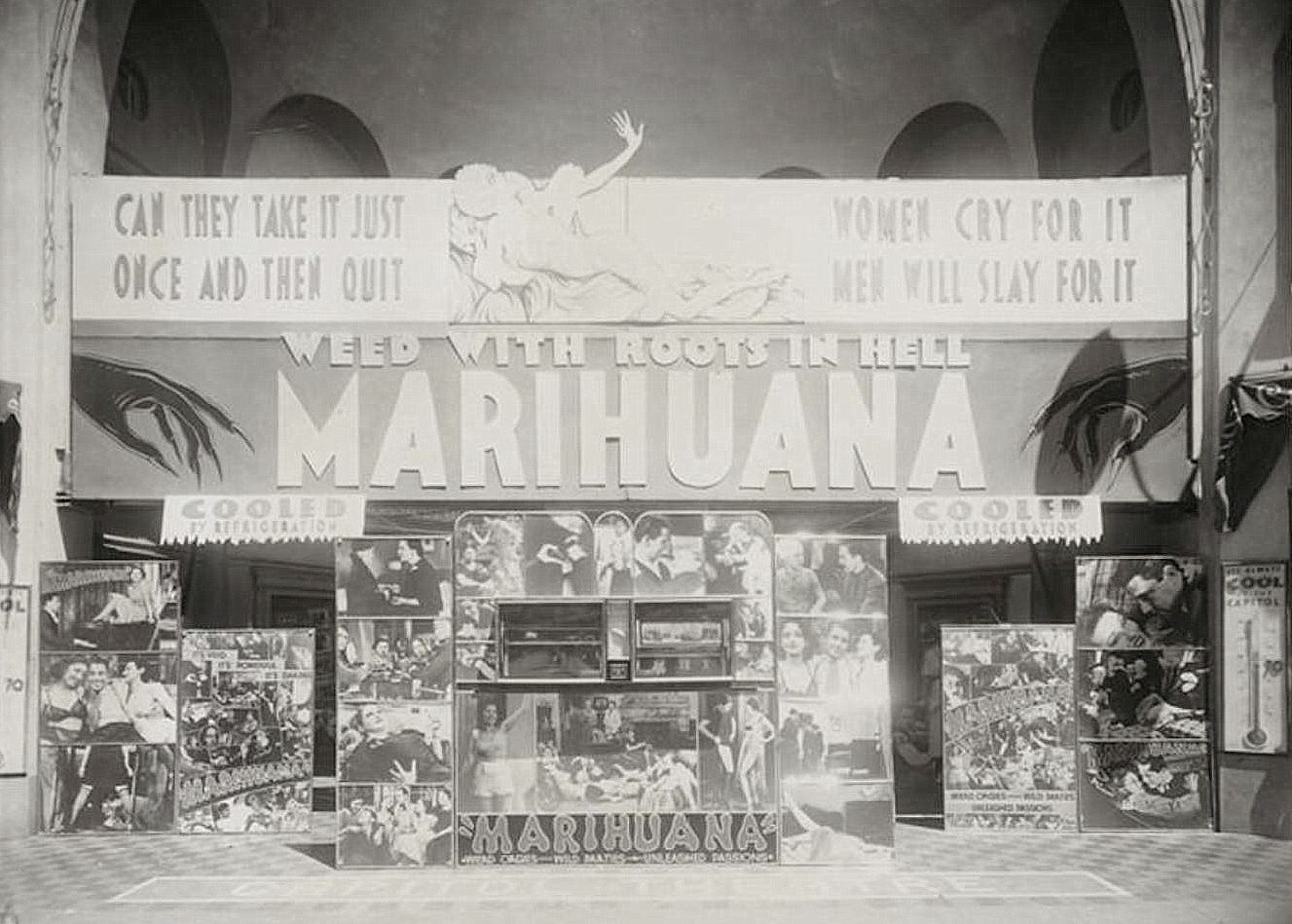
marihuana_capitol_1936_cook-collection_degolyer-library_SMU
George W. Cook Collection, DeGolyer Library, SMU
marihuana-film_dmn_080136
Aug., 1936

marihuana-film_dmn_080536
Aug. 1936

marihuana-film_dmn_061639June, 1939 (back by popular demand!)

(The full Marihuana film can be viewed free here, although it’s surprisingly dull.)

Even though most marijuana warnings were dire and filled with exclamation marks, I kind of like this more subdued one: “Smoking of the weed gives the subject delusions of riches, success and affability” (DMN, Dec. 21, 1936).

And there you have it, a little slice of unexpected Dallas historical trivia.

***

Sources & Notes

A few pertinent articles from the archives of The Dallas Morning News:

  • “Marijuana Smallest Worry of Dallas in Narcotic Violations” (DMN, March 6, 1931)
  • “Uncover Cache of Loco Weed, Lock Up Seven; Police Led to Mexican Dope Trailing Bogus Coin Milling” (DMN, March 30, 1932) — great story about cops who stumbled across marijuana when tracking down counterfeit half-dollar coins (counterfeit 50-cent pieces?!). My favorite part of this story is at the very end: “One of the Mexicans carried twenty-seven of the coins in one of his shoes.” Wow.
  • “Stalk of Marijuana Seven Feet Tall Is Found in Oak Cliff” (DMN, Aug. 7, 1934)
  • “3,000 Pounds of Marijuana Seized By Raiders on River Bottom Farm; Haul Valued at $25,000” (DMN, July 30, 1938)
  • “Marijuana Den With Open Air Resort Raided; 6 Arrested; $100 Worth of Cigarettes Found; Plants in Back Yard Destroyed by Officers” (DMN, June 25, 1936) — “This is the first open-air marijuana den I have ever encountered in all my years of service.”
  • “Policeman Sniffs Air, Catches Marijuana Smoker, Three Others” (DMN, June 22, 1938)

Related Flashback Dallas post: “3800 Main: Fritos Central — 1947,” here

*

Copyright © 2016 Paula Bosse. All Rights Reserved.
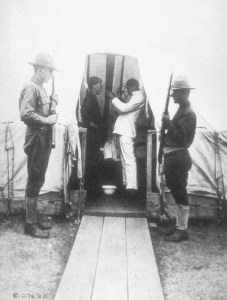
From the Vault: Dallas and the Spanish Influenza

spanish-influenza_love-field_otis-historical-archives_nmhm_110618Throat-spraying at Love Field, 1918

by Paula Bosse

A cold has been dragging me down for the past few days — the perfect excuse to re-run an old post about communicable diseases! I’ve felt pretty bad, but at least it isn’t the Spanish Influenza. Or, for that matter, Ebola. I originally wrote this post (about how the Spanish Influenza had ripped through the city in 1918 and 1919) as a response to the then-current concern that a deadly Ebola pandemic might similarly race around the world, set off by the unexpected cases of the Ebola virus spreading here in Dallas. Thankfully, that didn’t happen.

Read the original post — “When the Spanish Influenza Hit Dallas — 1918” — here.

And, remember: cover your mouth when you cough and don’t spit in the streets, because NOBODY expects the Spanish Influenza!

*

Copyright © 2016 Paula Bosse. All Rights Reserved.

Highland Park Village — The Original Model

hp-village_model_gallowayDallas’ most exclusive shopping destination

by Paula Bosse

The model of the Highland Park Shopping Village (“9 Acres of Property”) was, for many years, on display in the sales office of the Flippen-Prather Realty Co., the company that developed Highland Park and this beautiful shopping “village.” (I’m not sure where this photo was taken — it looks like a Flippen-Prather promotional table set up in an exhibition space of some sort.) Construction began on the shopping area in early 1930 and took several years to complete. The architects were Dallas’ Fooshee & Cheek.

Below, a slightly closer look at this cool model, complete with little cars (but no little people…).

hp-village-model_galloway-det

***

Sources & Notes

The photo (credited to the collection of Hugh Prather, Jr.) is from the really wonderful book The Park Cities, A Photohistory by Diane Galloway (Dallas: Diane Galloway, 1989). (This is an essential book for anyone interested in historic photos of Dallas and the Park Cities. If you come across a copy priced under $30.00, snap it up!)

More on the Highland Park Village of today can be found here.

*

Copyright © 2016 Paula Bosse. All Rights Reserved.

From the Vault: The Waiting Station at Ferris Plaza

railway-info-bldg_1926

by Paula Bosse

This forgotten building on the east side of Ferris Plaza used to face Union Station. It was the first thing travelers saw as they emerged from the terminal: an attractive information bureau and a covered place to wait for streetcars and interurbans, which many of these travelers took as they continued their journeys. One could also buy snacks inside and avail oneself of its public “comfort stations.” Almost no one remembers this little brick building, and, I have to say, I really enjoyed researching it! Read the post from 2014 — “Ferris Plaza Waiting Station: 1925-1950” — and see some interesting photos, here.

*

Copyright © 2016 Paula Bosse. All Rights Reserved.

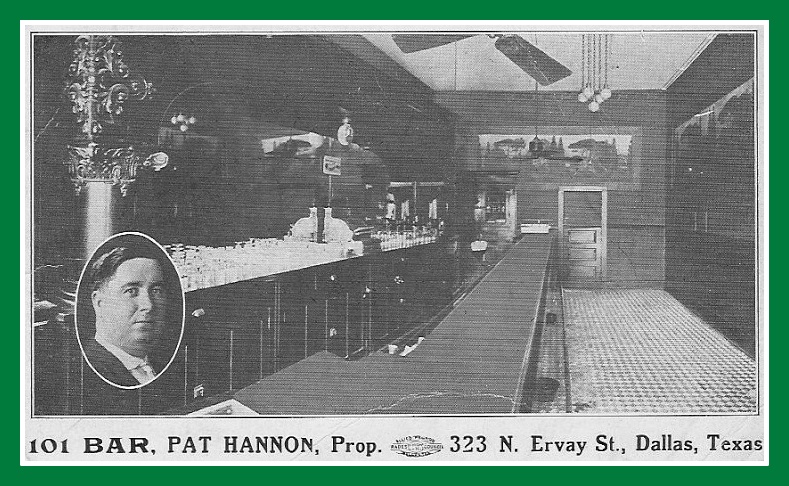
The 101 Bar: Patrick Hannon, Prop. — ca. 1917

101-bar_ca-1917
Pat Hannon’s dreams are about to be dashed…

by Paula Bosse

The 101 Bar was located at 323 North Ervay, on the southwest corner of Ervay and Bryan — it is now the site of Thanksgiving Square. The owner was Patrick Hannon who had worked in saloons in Dallas from at least 1908. The bar pictured above opened around 1917 but lasted only a few months — by the time the 1918 directories were printed, 323 N. Ervay was listed as “vacant.” Pat had worked his way up the competitive saloon trade in Dallas, from bartender to owner, only to be cut down by Prohibition. Had Prohibition not gone into effect in 1918 (with Dallas County voting to start even earlier, in October, 1917), this fine-looking  bar might have had a long, boozy life. Pat disappeared from the directory completely in 1918, but he was back in 1919, with a new occupation: butcher. Meat-cutting is all well and good and certainly pays the bills, but I bet in his idle moments, Pat’s thoughts turned to daydreams of his old Ervay St. bar.

The 1917 Dallas directory showed 183 bars operating in Dallas; the next year, zero.

Bad timing, Pat.

***

Sources & Notes

I’m not sure where the photo came from — some random web page, I think.

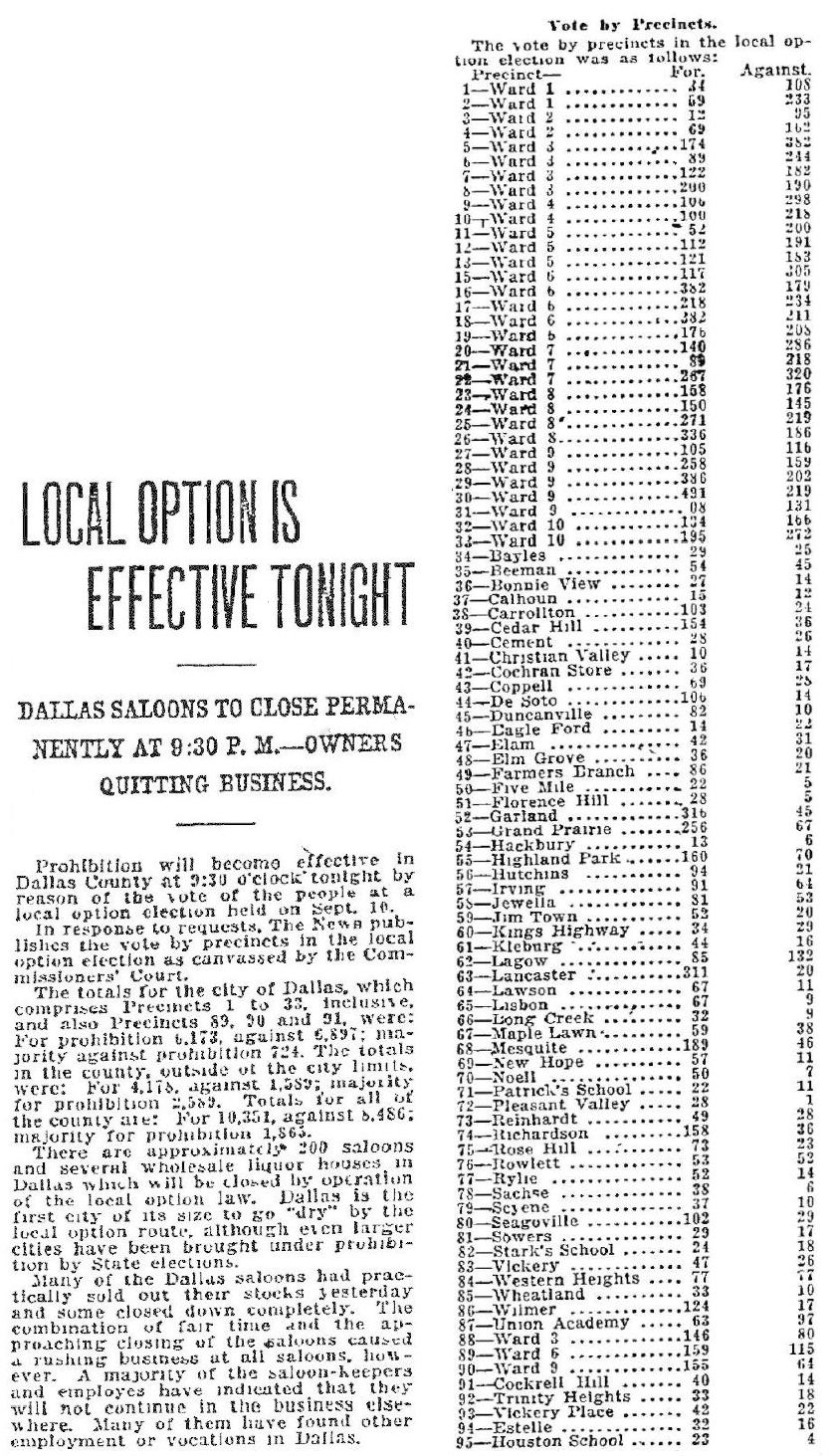
Why did Dallas County go dry so early? Because of a “local option” vote in September 1917. The city of Dallas voted against it, but the surrounding communities voted overwhelmingly FOR it. (You could still drive over to Fort Worth for legal beer and hooch, though.) Election results below (click for larger image). 

prohibition_local-option_dmn_102017Dallas Morning News, Oct. 20, 1917

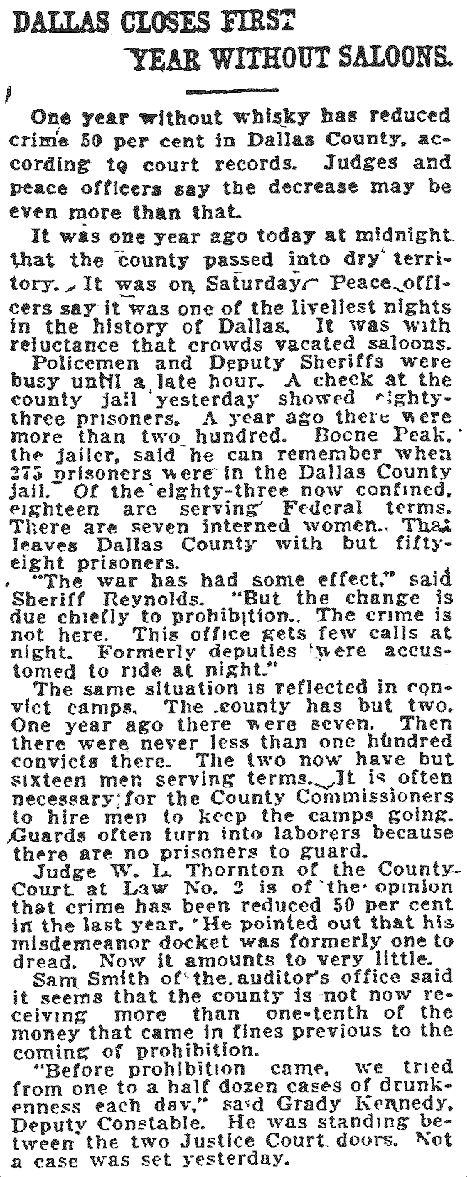
How were things faring a year later?

probibition_dallas-co_dmn_102018DMN, Oct. 20, 1918

This has been a rather tenuously-associated St. Patrick’s Day post (Irish name, bar, green border), but … Happy St. Patrick’s Day!

*

Copyright © 2016 Paula Bosse. All Rights Reserved.
From the Vault: An Early Radio Stunt — 1922

radio-wedding_corbis_062922
Inez and John, pre-wedded bliss

by Paula Bosse

Radio was new in 1922. …REALLY new. WFAA had been on the air less than one week when its first big promotion took place: a wedding ceremony in which the bride, the groom, and the minister were each in a different radio station. Read the particulars in the post from 2014, “Getting Married on the Radio — 1922,” here.

*

Copyright © 2016 Paula Bosse. All Rights Reserved.
Lt. Mary L. Roberts, The “Angel of Anzio” — The First Woman Awarded the Silver Star

silver-star_feb-22-1945Roberts (left) and two fellow Army Nurse Corps nurses receiving the Silver Star

by Paula Bosse

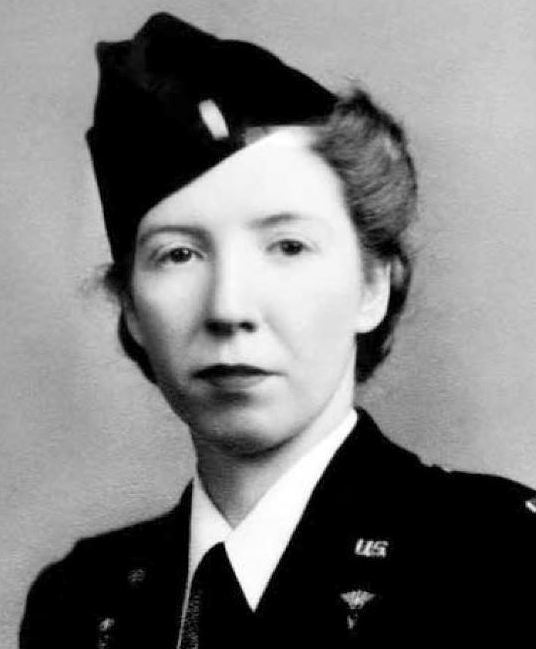
The opening paragraph from a chapter in Tom Brokaw’s book The Greatest Generation:

There are so many impressive numbers connected to World War II that it’s difficult for one or two to catch your eye. Here are a few that caught me by surprise: more than sixty thousand women served in the Army Nurse Corps. Sixteen died as a result of enemy action. Sixty-seven nurses were taken prisoner of war. More than sixteen hundred were decorated for bravery under fire or for meritorious service.

The chapter is titled “Mary Louise Roberts Wilson,” a profile of Mary L. Roberts, a Methodist Hospital nurse who enlisted in the Army Nurse Corps in 1942. She served with the 56th Evacuation Hospital Unit alongside many other medical professionals from Dallas (the unit — sometimes called the “Baylor Unit” — was organized by the Baylor University College of Medicine in Dallas). She knew she would be serving overseas in field hospitals in combat zones.

As far as seeing action, the worst of the worst for the 56th was on February 10, 1944 when their hospital tents on the Anzio beachhead in Italy were attacked by German long-range artillery shells for a full thirty minutes. Several operations were underway during the attack, and Roberts, the chief nurse of the operating tent, managed to keep a calm head and help to maintain as much order as possible.

“I wanted to jump under the operating table, but first we had to lower litter cases to the floor. Pieces of steel already were ripping through tents. There were four litters. I saw a patient on the operating table had his helmet near him so I put it over his head to give him that much protection.” (Mary L. Roberts, Dallas Morning News, Feb 23, 1944)

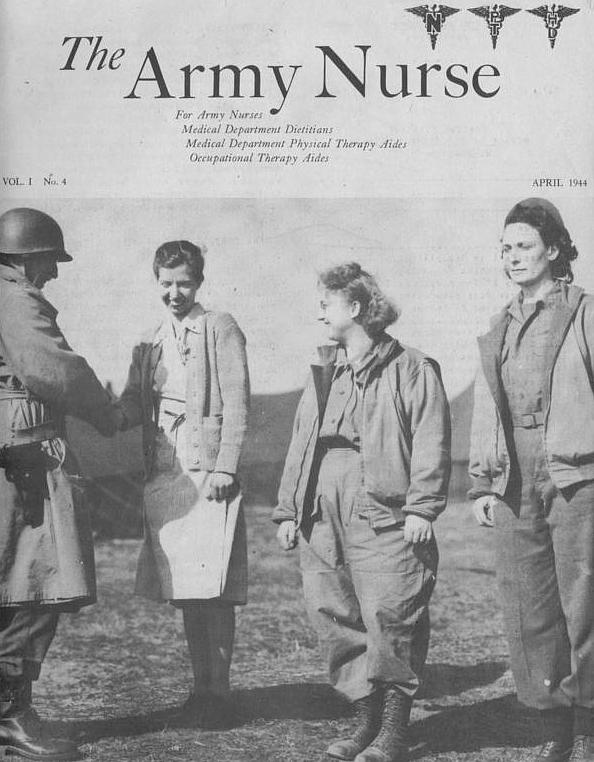
When the shelling ended, two enlisted men in the operating tent had been wounded, and elsewhere in the field hospital, two nurses had been killed and several other personnel wounded. As a result of their exceptional bravery, outstanding leadership, and “gallantry in action,” Roberts and two other nurses, 2nd Lt. Rita Virginia Rourke and 2nd Lt. Elaine Arletta Roe were awarded the Silver Star. No women had ever received the medal. As 1st Lt. Roberts had seniority, she was the first woman in history to be decorated for heroism in action.

Maj. General John P. Lucas surprised her and the other two nurses on Feb. 22, 1944 with an informal presentation of the medals at the same Anzio hospital that had been shelled only twelve days earlier. After the brief pinning ceremony, the nurses immediately returned to their duties, all feeling they were accepting acknowledgement for their team, not for themselves alone. Roberts spent 29 months overseas, and tended to more than 73,000 patients.

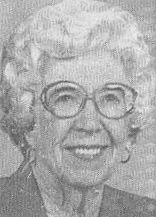
After the war, when Lufkin-native Mary Roberts returned home, she worked for almost 30 years as a nurse at a VA hospital in Dallas, and, rather late in life, she married fellow veteran Willie Ray Wilson. Mrs. Wilson died in 2001 at the age of 87. She was buried with full military honors.

roberts_texas-women-first_mcleroy_UTA1944 (Fort Worth Star-Telegram Archives, UTA)

roberts_dmn_022344-photo1944

roberts-cover_army-nurse_april-1944Presentation of the Silver Star at Anzio

roberts_obit-photoMary Roberts Wilson (1914-2001)

***

Sources & Notes

Top photo and first quote from The Greatest Generation by Tom Brokaw (New York: Random House, 1998).

For an exceedingly detailed history of the 56th Evacuation Hospital Unit, with several photographs, see here.

Articles on Mary Roberts from The Dallas Morning News archives:

  • “Baylor Unit In Action” (DMN, Aug. 26, 1942): photo of unit, including Roberts, working around an operating table
  • “Dallas Nurse, Two Others Win Medals” (DMN, Feb. 23, 1944): “The award, denoting exceptional bravery went to Lt. Mary L. (Pinky) Roberts, 1205 North Bishop, Dallas, Texas, chief nurse in an operating room hit by shell fragments.”
  • “Nurses of Dallas Unit Serving at Anzio Doing Jobs Cheerfully Despite Many Hardships” by Wick Fowler (DMN, March 31, 1944)
  • “Ends Military Career: WWII Recalled By Heroic Nurse” (DMN, July 26, 1964): photo and interview with Mary Roberts Wilson on her retirement from the U. S. Army Reserve
  • “Happiness Is Being Part of a Team” by Jane Ulrich Smith (DMN, May 16, 1972), photo and interview, on her retirement from the Veterans Administration Hospital
  • “Compassion Revisited: Nurse Reunites With GI She Treated For Serious Injuries In WWII” (DMN, Nov. 4, 1999): a reunion with former patient Dewey Ellard of Mobile, Alabama, brought together by Tom Brokaw
  • “Distinguished Career In Medicine Followed — WWII Gallantry — VA Hospital Honors Longtime Nurse — Who Won Silver Star in ’44” (DMN, Nov. 6, 2001): interview with the then-87-year-old Mrs. Wilson, published two-and-a-half weeks before her death
  • “Mary Wilson, ‘Angel of Anzio,’ Dies at 87 — WWII Nurse Known For Kindness Was Decorated For Bravery Under Fire” (DMN, Nov. 24, 2001)

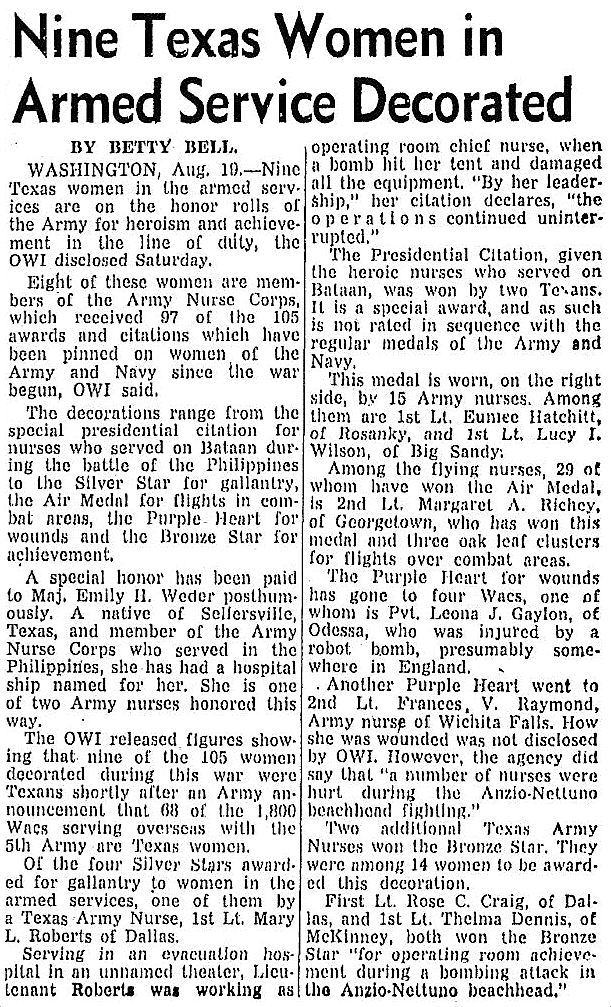
Other women who were honored in 1944 for heroism and achievement in the line of duty:

women_ww2_medals_FWST_082044Fort Worth Star-Telegram, Aug. 20, 1944

Click pictures and articles for larger images.

*

Copyright © 2016 Paula Bosse. All Rights Reserved.
 

From the Vault: Gypsy Clans Clash in Dallas — 1951

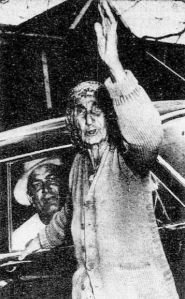
gypsy_lawrence-youngs-grandmother_baylor_feb-1951

by Paula Bosse

In 2014 I wrote about warring Gypsy factions that had gathered in Dallas in 1951, embroiled in a bitter feud centered around a seriously injured boy at Baylor Hospital. Dallas police were worried there would be bloodshed in the streets. I really loved writing this post: “‘Every Gypsy in the Nation Knows About This’ — 1951.”

*

Copyright © 2016 Paula Bosse. All Rights Reserved.


From the Vault: A Valentine from Love Field — 1919

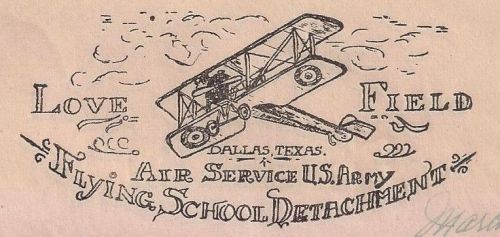
love-field_stationery_ca19191

by Paula Bosse

Yeah, it’s a bit of a stretch, but check out my Valentine’s Day post from a couple of years ago. It has cool Love Field stationery from WWI (“Love,” get it?), a tentative start at a correspondence between a young man and woman, and a sky full of 30 “skylarking” airplanes piloted by jubilant flyers who have just been told they will soon be on their way home after the long war. Read it here.

If you’re celebrating Valentine’s Day, have a good one — if you’re not, enjoy the rest of your Sunday!

*

Copyright © 2016 Paula Bosse. All Rights Reserved.

From the Vault: Dallas’ First Mardi Gras Parade — 1876

mardi-gras_dhs_1876Waiting in the wings…

by Paula Bosse

Read about the crazy goings-on in 1876 as Dallas pulled out all the stops for its first Mardi Gras parade in the post “Mardi Gras: ‘Our First Attempt at a Carnival Fete’ — 1876,” here.

Happy Mardi Gras!

*

Copyright © 2016 Paula Bosse. All Rights Reserved.