Flashback : Dallas

A Miscellany: History, Ads, Pop Culture

Category: Vault

Police Blotter — 1880s

san-angelo-saloonA saloon in a calm moment

by Paula Bosse

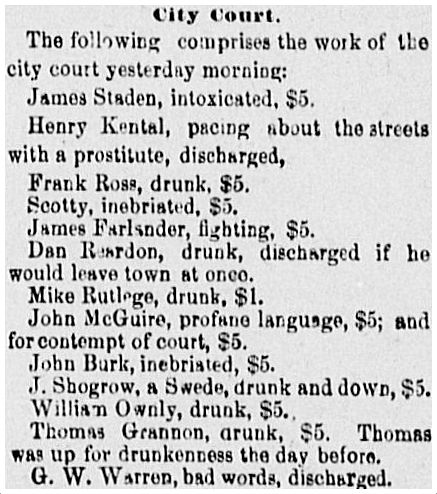
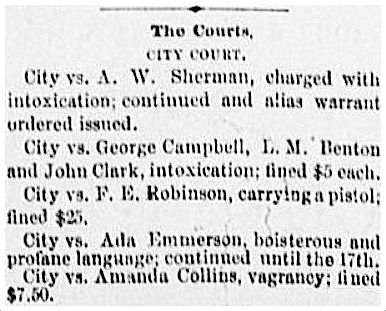
A few snapshots of life among Dallas’ lively and unruly set in the 1880s, as reported in The Dallas Daily Herald:

police-blotter_dal-her_061681(June 16, 1881)

police-blotter_dal-herald_060381(June 3, 1881)

police-blotter_dal-her_102782(Oct. 27, 1882)

police-blotter_dal-her_111782(Nov. 17, 1882)

Looks like Dallas had a steady flow of cash coming into the city coffers. The usual fine seemed to be five dollars, and that was a LOT of money back then. If you plug that into the Inflation Calculator, it shows that five bucks in 1881 would be equivalent to about $118 in today’s money. So, yeah — the city was raking it in. Prosperity! Thank you, drunks and reprobates — you  helped build our city!

***

Top photo shows imbibers inside the Arc Light Saloon in San Angelo, Texas; photo found here. Not Dallas, but I was unable to find a photo of a saloon in Dallas in this period. (I bet there’s a Tumblr on this, though. Or a Pinterest page….)

All newspaper clippings from The Dallas Daily Herald, accessible through the invaluable Portal to Texas History; browse through the collection here.

See more tidbits from the police blotter in the Flashback Dallas post “Police Blotter — Drunks, Vagrants, Adulteres,”  here.

*

Copyright © 2014 Paula Bosse. All Rights Reserved.

Armistice! — 1918

wwi_returning-troops-parade_1919_portalDowntown parade for returning troops — June, 1919 (click for larger image)

by Paula Bosse

Dallas found out that the Great War had finally ended at around 3:00 in the morning of November 11, 1918 when the siren atop the Adolphus Hotel sounded with “maniacal shrieks.” People poured into the streets to celebrate.

The crackle of revolver reports began to sound. Sleep was murdered, even had one been so disposed, and many residents from all parts of the city foregathered in the downtown district to jubilate and exult in various ways until daylight came. (Dallas Morning News, Nov. 12, 1918)

Giddy celebrations and impromptu parades were the order of the day, and the joyous spirit that erupted throughout the city is reflected in this Dallas Morning News report of “the first day of world peace since August, 1914” (click to see larger image):

wwi_armistice-in-dallas_dmn_111218
DMN, Nov. 12, 1918

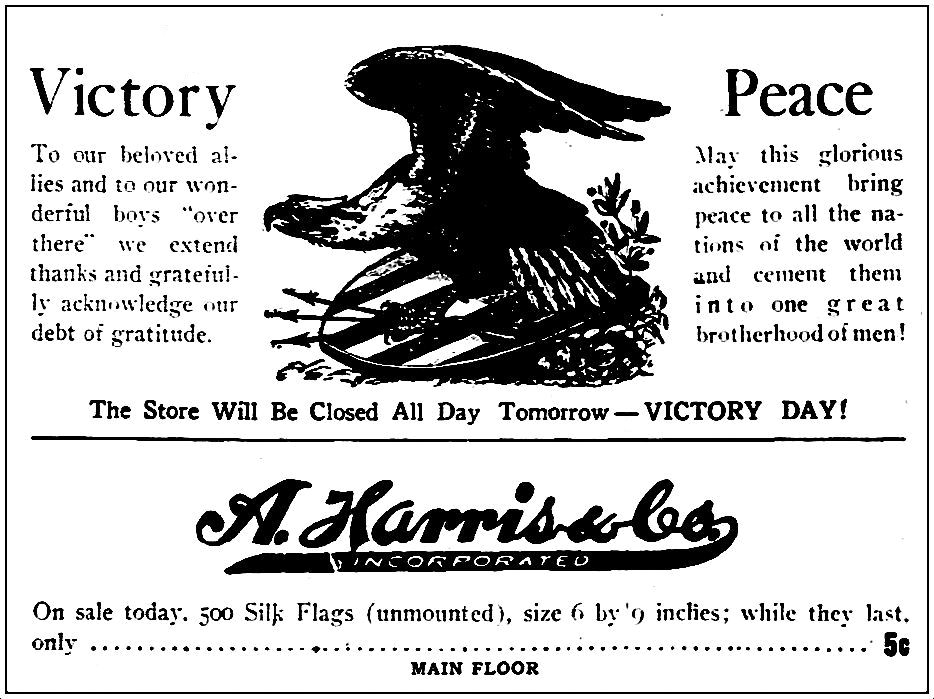
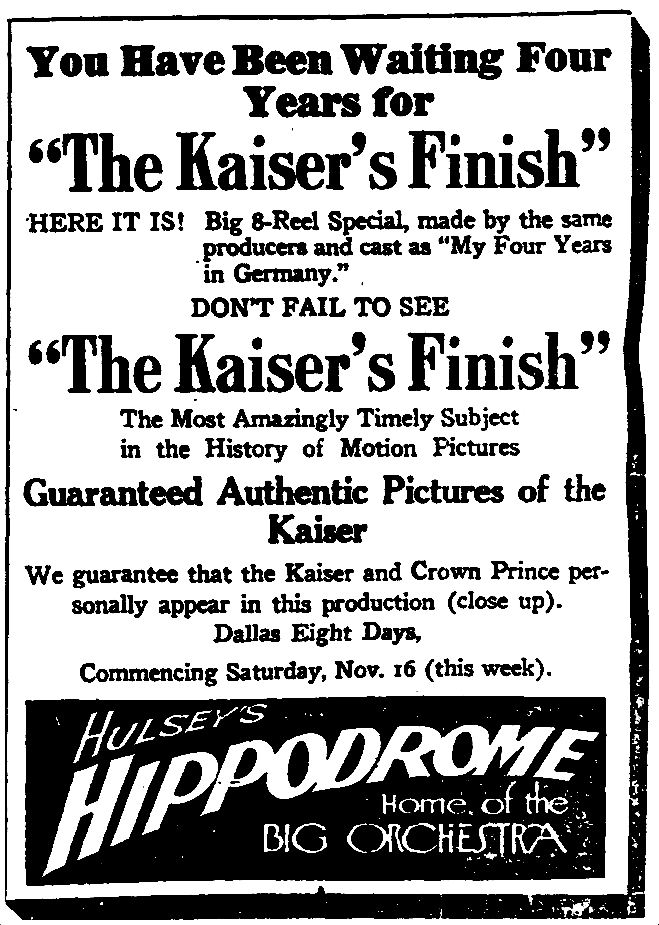
Local businesses got in on the action by placing heart-felt patriotic advertisements (some of which also quietly reminded readers that Christmas was just around the corner).

armistice_linz_dmn_111218

armistice_kahn_dmn_111218

ad-dreyfuss_dmn-111218

wwi_armistice_a-harris_dmn_111218

wwi_armistice_hippodrome_dmn_111318

wwi_armistice_hurst-bros_dmn_111318

When World War I officially ended on November 11, 1918, the military and civilian deaths and casualties totaled more than 37 million. All everyone wanted was for their loved ones to return home safely and for life to return to normal as quickly as possible. There was a lot to be thankful for that Thanksgiving.

***

Sources & Notes

Photo of the 111th Engineers from the Tarrant County College Northeast, Heritage Room, via the Portal to Texas History, here. It shows the 1500 block of Main Street, looking west toward Akard. See the same view today here (the short white  building at 1520 Main is currently occupied by the Iron Cactus; in the 1919 photo, that address is occupied by Thompson’s in what looks like the same building). (See another parade photo of the same block here. The detail is much, much better!)

1500-block_main_1919_2015

Ads from the Dallas Morning News, Nov. 12 and 13, 1918.

The Wikipedia entry for World War One casualties is here.

Click pictures for larger images.

*

Copyright © 2014 Paula Bosse. All Rights Reserved.


Preston Royal Fire Station — 1958

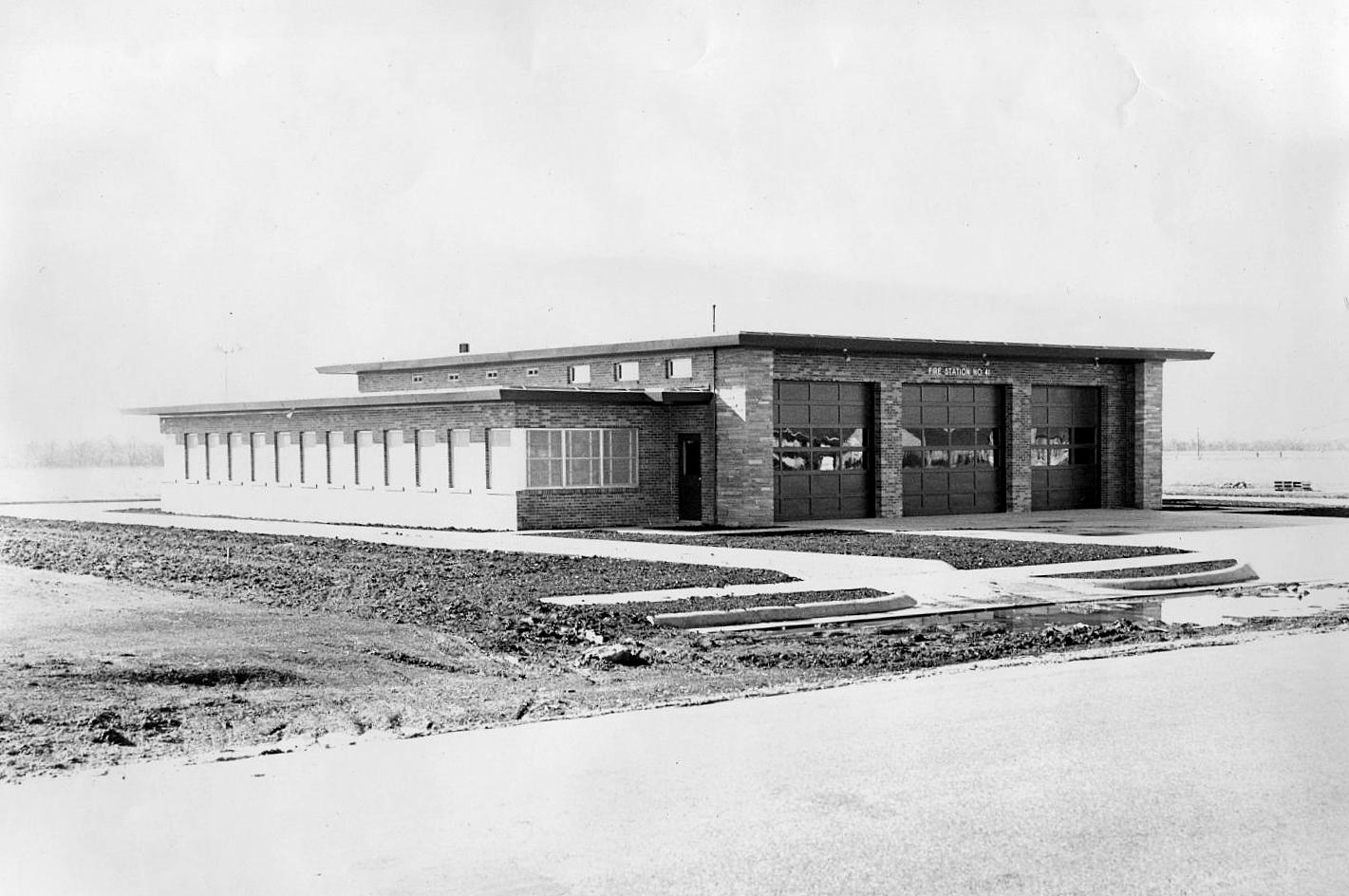
fire-station-41_royal-laneStation No. 41, 5920 Royal Lane (click for larger image)

by Paula Bosse

Above, Dallas Fire Station 41 on Royal Lane, just west of Preston Road, about the time it opened (the back of the photo says service at the station began Jan. 16, 1958). It looks as if it’s been set down upon a bleak and barren piece of land in the middle of nowhere, but, actually, commercial development in this Preston Hollow-area neighborhood was … um … on fire in 1958. The large shopping centers at Preston and Royal were under construction at this time, and even though it was very far north, it was most certainly a desirable area in which to live (as, of course, it still is).

The station was designed by architect Raymond F. Smith who had previously designed a couple of other fire stations in town, but who was known mainly for his work designing movie theaters, such as the Casa Linda (1945), the Delman (1947), and — hey! — the (long-gone) Preston Royal Theatre, which opened in 1959 right across the street from this fire station (both of which were, rather conveniently, a mere four blocks away from Smith’s Royal Lane residence).

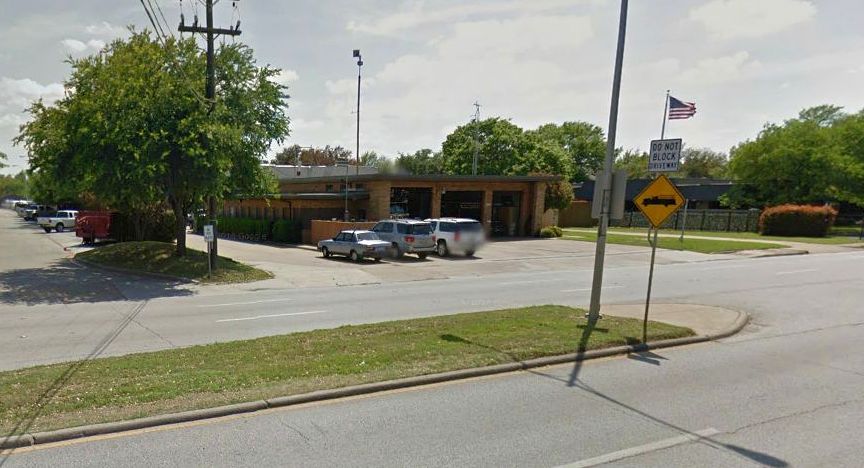
The station is still in operation, working to keep North Dallas flame-free — it just has a few more neighbors (and trees!) now than it did in 1958.

fire-station_royal_google

**

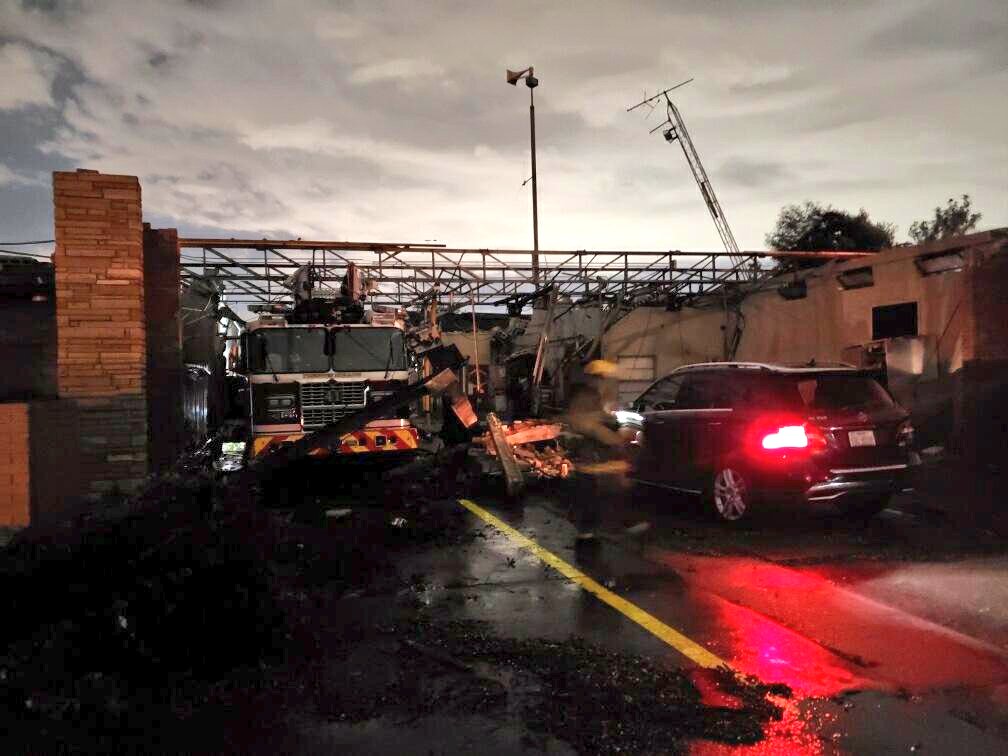
UPDATED Oct. 22, 2019: A powerful tornado hit northwest Dallas on Oct. 20, 2019 and devastated much of the Preston Hollow area. This fire station was hit hard, and it is currently out of commission. Below are photos from DFR’s Twitter feed.

preston-royal-fire-station_dfr-twitter_102119_int

preston-royal-fire-station_dfr-twitter_102119_ext

***

Sources & Notes

Photo from the Dallas Firefighters Museum, via the Portal to Texas History. It can be viewed here.

Second image of the firehouse from Google Street View.

Bottom two photos of the station post-tornado are from the Twitter feed of @DallasFireRes_q.

*

Copyright © 2014 Paula Bosse. All Rights Reserved.


The Texas Bookbindery, Arcadia Park

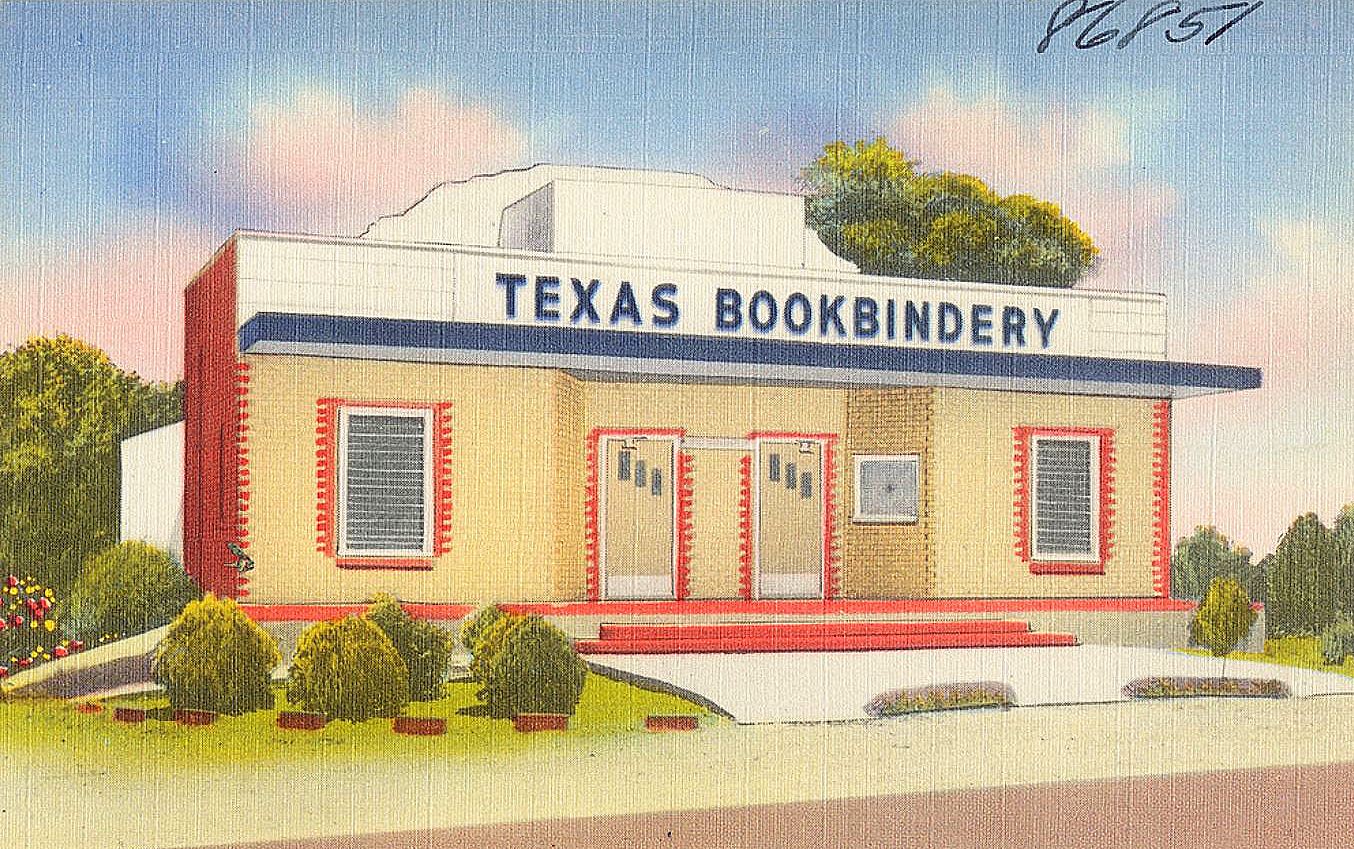
texas-bookbindery_oak-cliff_tichnorThe Texas Bookbindery, be-shrubbed and gleaming in Oak Cliff’s Arcadia Park

by Paula Bosse

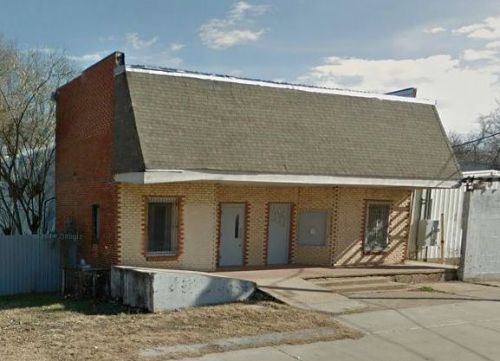
Old postcards, such as the one above, are perfect little fictional jewels. One knows instinctively when looking at them that they show a highly idealized version of reality. I almost didn’t want to find out too much about the Texas Bookbindery, because I love this image so much, and I was pretty sure that if the simple-but-charming building still stood, it wouldn’t really look like a happy little place atop a slight hill, with lovely landscaping, where butterflies flitted among the flowers and bluebirds sang in the nearby trees.

I didn’t find out much about the Texas Bookbindery, except that it seems to have been in business from at least the late 1940s until the late ’60s or early ’70s. It was managed by a man named T. Bernard White, who was featured in a 1948 Dallas Morning News article about the horrible things people do to library books (the Dallas Public Library sent the bindery what sounds like an unending stream of not-quite-destroyed books which were still repairable).

Apparently bookbinderies keep a pretty low profile, because the only other mention I found in the newspaper about this one was in 1962 when a large number of the 37 employees (“mostly women”) were overcome by fumes from poorly-vented gas heaters in the “one-story sheet-metal plant” (yes, a large sheet-metal structure extends behind the deceptively cheery street view). That story listed the address as 714 N. Justin, in the Arcadia Park area of Oak Cliff. I was almost afraid to plug that address into Google. As well I should have been. Here’s what that sweet little building looks like now (but …the shrubs! …the flowers! …the BLUEBIRDS!!):

tx-bookbindery-nowToday, via Google Street View

Poor little bookbindery.

UPDATE: A month after I wrote this post in November, 2014 the Google car drove down N. Justin and snapped a new Google Street View of the poor little bindery — it looked even sadder: it had a big hole in its roof. In March of 2017, that hole-in-the-roof image from December, 2014 has yet to be updated. See it here.

***

Sources & Notes

Postcard from the fantastic Boston Public Library Tichnor Brothers Postcard Collection on Flickr, here.

Click top pictures for larger image.

*

Copyright © 2014 Paula Bosse. All Rights Reserved.


When Halloween In Dallas Was Mostly “Trick” and Very Little “Treat”

halloween-trick-or-treat

by Paula Bosse

Dallas used to have some pretty bad Halloweens. Way more “trick” than “treat.” The word “riot” was used frequently to describe the typical Halloween night goings-on, when thousands of people clustered downtown and did unsavory things (such as drinking, fighting, pick-pocketing, mugging, and being generally obnoxious), while out in the “suburbs” (meaning far-flung locales such as East Dallas and Oak Lawn), marauding bands of young “pranksters” were keeping themselves busy breaking things and setting things on fire. Like kids do. Each Halloween, every policeman was called in for duty — only those in their sickbeds were exempt.

The worst of these Halloweens seemed to happen in the 1930s. Elm, Main, and Commerce, between Lamar and Harwood, were cordoned off from traffic. This is where upwards of 25,000 revelers would slowly cruise up and down the streets, causing mayhem and inflicting occasional bodily injury (much like the notorious Texas-OU weekends of later years). Even though the area was off-limits to automobile traffic, the streetcars still ran, and the poor drivers must have dreaded that night each year and steeled themselves for the worst, as if heading into battle.

Apparently Dallas revelers had a signature tradition, and it was to carry large wooden paddles — sometimes as large as canoe oars — and to swat people in the crowd on their backsides, usually women. At some point women also began to carry paddles, and they did their fair share of swatting, too. It was a paddling free-for-all.

1935 was a particularly noteworthy year, as it was the first Halloween after the state of Texas had voted to repeal Prohibition. Yes, people were drinking. And paddling. Sounds like a bad combination.

Below is a list of just a few of the reported instances of vandalism and “high-spiritedness” which routinely plagued the city every Halloween:

  • Broken streetlights
  • Broken windshields
  • Broken everything
  • Flooded streets from opened fire hydrants
  • The throwing of rocks
  • The throwing of eggs and rotting fruit
  • The throwing of stink-bombs
  • The throwing of WASHTUBS (!)
  • The setting of fires, both large and small
  • The malicious uprooting of shrubbery
  • The driving of cars on sidewalks
  • The reporting of false alarms to fire stations
  • Random gunfire
  • Occasional mysterious explosions
  • Extremely loud noise
  • Smoke
  • The overturning of outhouses
  • The soaping of windows
  • The breaking of windows
  • The breaking of soaped windows
  • The soaping of streetcar tracks
  • And the unsuccessful attempt one year by a small band of aspiring shake-down artists to “extort” money (rather than candy) from their eye-rolling neighbors by foregoing the chant of “Trick or Treat!” and demanding “Dime or Damage!”

In 1939, an intoxicated man who was “playfully threatening people with a knife” was playfully arrested.

In 1935, there was a huge mud-fight in Oak Lawn at Newton and Throckmorton which involved over 100 boys. Like greased pigs, an adrenaline-fueled, mud-encased 10-year old running from beleaguered and hopelessly out-numbered policemen — who, quite frankly, had bigger fish to fry that night — were almost impossible to catch. Spectators and passersby did not escape unscathed. Except for the dry cleaners the next day, Oak Lawn was not amused.

And in 1936, during the Texas Centennial, a policeman was suspended and demoted after an incident of “horseplay” at Parry and Exposition in which he had been shocking passing pedestrians by poking them with the end of a walking stick that had been hooked up to the battery of a police motorcycle. He got into trouble because one of his victims was a young woman who had been standing on wet pavement when the electrified stick touched her, resulting in a more-powerful-than-expected shock. She lost consciousness, fell to the ground, and hit her head on the sidewalk. Luckily, she recovered quickly and even requested that the officer not be punished, but the police chief was not so forgiving. He was understandably livid, especially when he discovered that a number of motorcycle cops had been doing the same thing. One imagines there were several new orifices opened up amongst the force in the days that followed.

But the pièce de résistance was in 1920 when several boys “anchored a block and tackle around a two-story house in Cockrell Hill and hoisted a wagon and a team of terrified mules up in the air” (DMN, Oct. 27, 1963). That right there required impressive organizational planning and a certain amount of entry-level engineering skill.

Eventually things settled down. By 1949 officials had finally put an end to the swarming, surging masses downtown. People began to celebrate Halloween with candy and costumes and haunted houses and parties. In 1966, a policeman was asked if things had improved from those earlier dark days:

There’s been an extensive change for the better in recent years. Police almost never get a call to let a cow out of a school house anymore. (DMN, Oct. 27, 1966)

And Halloween became more “treat” than “trick.” Good news for the City of Dallas. And for its mules. Bad news for the makers of Ivory soap and thick wooden paddles.

***

Sources & Notes

Selected tidbits gleaned from the frenzied coverage in The Dallas Morning News archives:

  • 1935: “Much Damage Done By Hoodlums During Halloween Rioting” (DMN, Nov. 1, 1935)
  • 1936: “Young Woman Victim of Police Prank Asks Jones Pardon Men” (DMN, Nov. 3, 1936)
  • 1939: “Witches Stage Costly Carnival For Halloween; Roughness Breaks Out In Downtown Crowd; Police, Firemen Busy” (DMN, Nov. 1, 1939)

Other Flashback Dallas posts on Halloween can be found here and here.

Happy Halloween!

*

Copyright © 2014 Paula Bosse. All Rights Reserved.


Simulcasting the World Series In Dallas In the Days Before Radio, Via Telegraph

world-series_dmn_100422-smThe later version, for radio listeners, 1922…

by Paula Bosse

It’s 1912. You’re a huge baseball fan, and the World Series is about to begin — New York vs. Boston! But you live in Dallas, a million miles away from the action. You can’t wait for the results in the paper the next day because you’re an impatient S.O.B., and radio won’t be introduced for another ten years. Do you panic? No! Because you live in a big city with a taste for new technology, and the Dallas Opera House is going to present a sort of early simulcast of the games on a “mammoth automatic score board.” Your sports prayers have been answered!

1912_world-series_dmn_100612DMN, Oct. 6, 1912

You lean back in your comfy theater seat and smoke your smokes in plush and civilized surroundings as each play is sent by telegraph to Dallas from the ballpark back East where the game is being played RIGHT NOW, hundreds of miles away. The telegraph operator in Dallas will relay the play-by-play information to personnel in the theater who will somehow do something to some sort of “automatic electric board.” And, according to promoters of these “reproductions” of baseball games, you’ll feel like you’re right there in the thick of the action. You’ll “see” the game played before your eyes!

I’ve read several articles about these boards and these reproductions, but I can’t for the life of me figure out how it worked. I assume there was a large traditional scoreboard on stage that lit up, keeping track of the score, runs, outs, etc. But apparently there’s more, and I just can’t picture it. Here’s a somewhat confusing description of what happened during these productions:

WORLD SERIES WILL BE SHOWN AT THE OLD MILL

Manager Buddy Stewart of the Old Mill Theater announced that he secured the New Wonder Marvel Baseball Player Board to reproduce the World Series baseball games. This board is declared the greatest board ever invented for reproducing baseball games. It is not a mechanical board and no mechanical devices are used, and very little electrical appliances are necessary. The games are reproduced by a crew of six experienced baseball players who are carefully rehearsed and each has a part or position to play. No other board is so complete as this. The board does not require sign cards to denote players as in other boards. You see the ball going and do not have to look in any other direction to see what it means.

Spectators will see each play reproduced in less than two minutes after it is made on the playing fields of the World Series as the board is connected with a direct wire to the baseball field, and as fast as the telegraph operator receives the play it is reproduced with as much realism as on the field. The players are seen to run bases, the ball is seen bouncing or soaring to the infield or outfield, and anyone who is familiar with baseball will know just exactly what is happening on the field by the plays made on the board with very little left for imagination.

Every hit, run, error, strike or ball, the number of strikeouts, or balls made by pitchers, or the number of hits, runs or errors made by the players is always prominently shown on the board which makes it [un]necessary for individual scoring during the progress of the game. (DMN, Oct. 3, 1920)

Doesn’t really help much. It sounds as if people are on the stage acting out each play. That would be weird. These “reproductions” of World Series games were quite popular in Texas (and probably elsewhere) for at least 15 years. If anyone reading this has a photo or diagram of one of these vaunted Marvel scoreboards, I’d love to see it!

*

An earlier description of the 1912 Opera House reproduction sounds more like an audience watching a baseball game on a giant Lite-Brite “score board.”

1912_world-series_dmn_100812DMN, Oct. 8, 1912

The trick to keeping the telegraph operators calm and on-their-toes during a lengthy baseball game? Make sure they have no interest in the game.
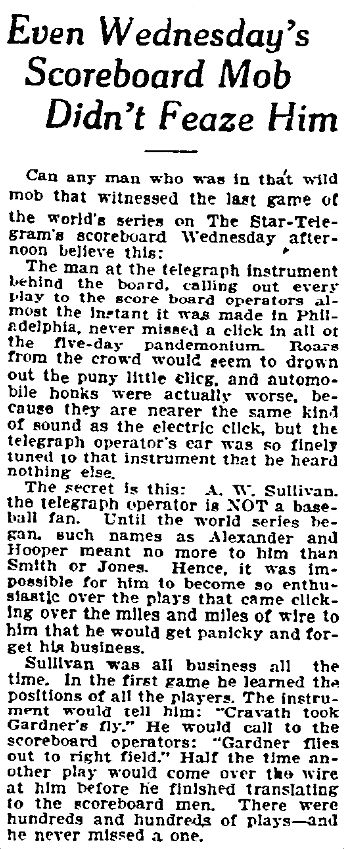
1915_world-series_FWST_101415Fort Worth Star-Telegram, Oct. 14, 1915

Fort Worth was also getting in on the action. And they had celebrities — people like Clarence (Big Boy) Kraft and Ziggy Sears (who I’m going to assume have something to do with baseball). I’m not sure what these celebrities were doing exactly, but whatever it was, they were there doing it.

1921_marvel-score-board_FWST_100221FWST, Oct. 2, 1921

These theater programs weren’t for everyone, though. If you couldn’t take the time out of a busy work day to swan over to a theater to leisurely witness one of the early “reproductions” (or if the admission price was too steep for your budget), you could always ring up the operator to have her tell you the current score:

automatic_dmn_101112-world-series
DMN, Oct. 11, 1912

These things seemed to be a popular annual event, but in 1922, something more technologically advanced than the Marvel board appeared on the scene: radio! WFAA and WBAP began broadcasting in 1922, and, suddenly, following sports became a whole lot easier. In something of a transitional technology, there was the outdoor board as described below. The games were not only broadcast live on WFAA, but The Dallas Morning News (WFAA’s parent company) also erected one of those old-fangled “electric boards” out on the street so that passersby could keep up with the scores. (Portable transistor radios were decades and decades away.)
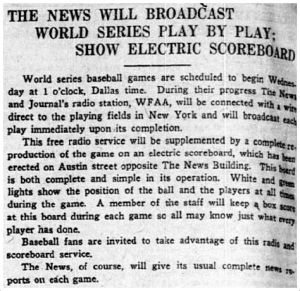
1923_world-series_dmn_101023DMN, Oct. 10, 1923

It was surprising to see that the “Marvel score boards” were still being used as late as 1926 (Yankees vs. Cardinals, at the Capitol Theater). Every baseball fan worth his salt should have had his own radio by then so he could listen to the World Series in the comfort of his own home and curse and cheer as loudly as the vicissitudes of the game demanded. Eat my dust, Marvel board! Radio changed everything, and radio was here to stay.

*

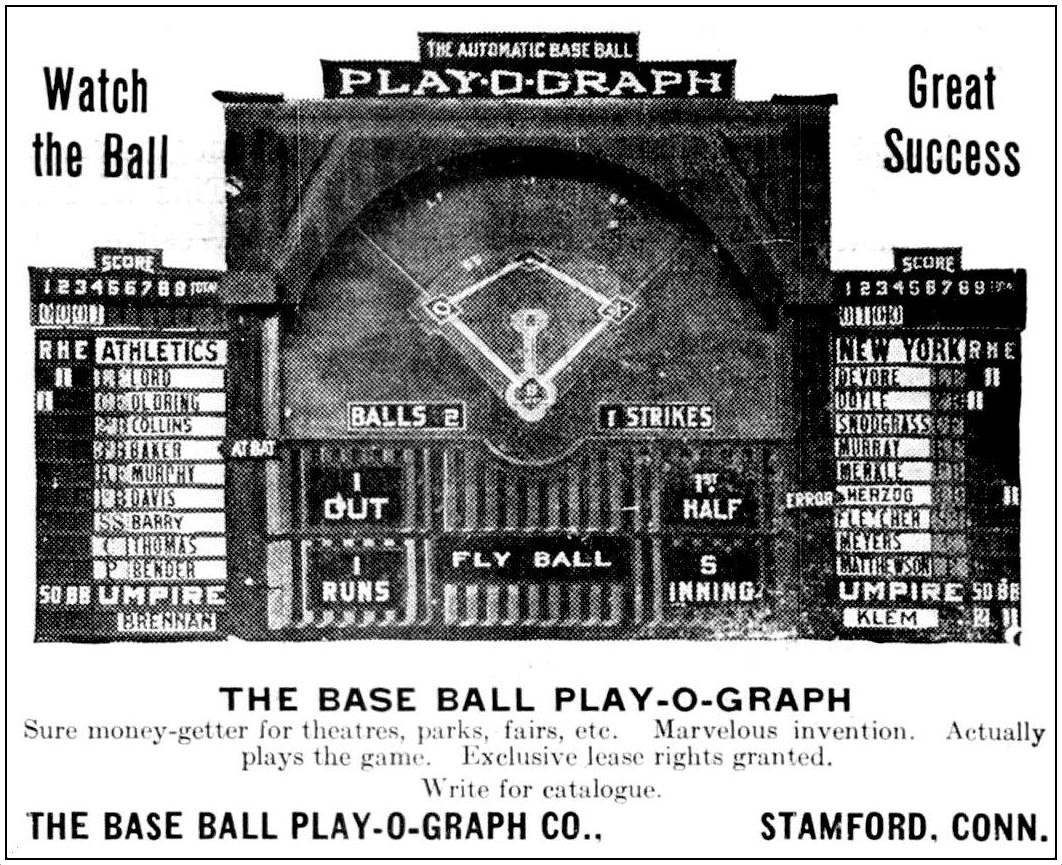
UPDATE: Thanks to Kevin’s link in the comments below, I can share this GREAT article from Uni-Watch.com about another of these boards called the Play-o-Graph: “Photography of Playography by Paul Lukas — it answers all my questions, and it even has photos (and links to photos) of crowds watching the boards. He also links to a 1912 article, “The Automatic Baseball Playograph”  by J. Hunt, in the Yale Scientific Monthly which describes how the board works and has this photo:

play-o-graph_yale-scientific-monthly_1912The “Play-o-Graph,” 1912 (click for larger image)

And, for completists, here’s an ad for the Play-O-Graph, from 1913:

baseball-simulation_play-o-graph_billboard_032213Billboard, Mar. 22, 1913

Makes a bit more sense now! Thanks, Kevin!

***

Sources & Notes

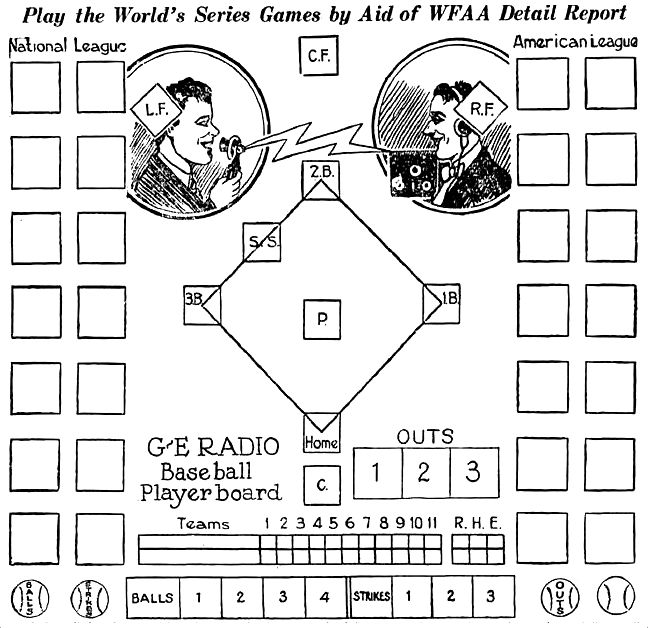
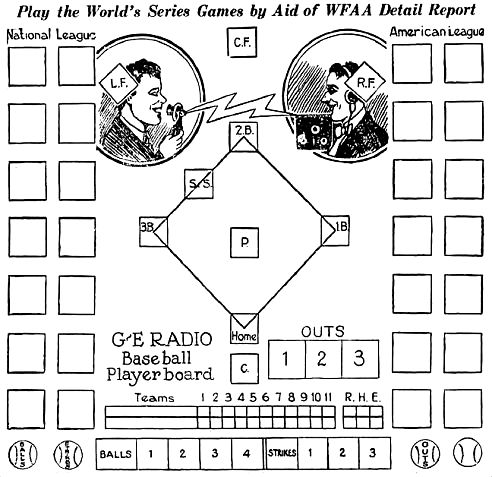
The top image is the “G.E. Radio Baseball Player Board” — a sort of home version of the big scoreboards used in theaters, printed for WFAA listeners in The Dallas Morning News on Oct. 4, 1922. The instructions are in a PDF, here. And feel free to print one out and use it while you watch the Series this year. Still works in the 21st century!

For an article on listener response to the successful first broadcast of the World Series by WFAA radio (listeners picked up the signal in England!), see the DMN article from Oct. 6, 1922 in a PDF, here.

And because they have such great names, you might want to know who Clarence “Big Boy” Kraft and Ziggy Sears were. If you’ve read this far, you owe it to yourself. “Big Boy,” here; Ziggy, here.

*

Copyright © 2014 Paula Bosse. All Rights Reserved.

Dallas High School Football, 1909-Style

football-team-1909Game faces ON… (click for larger image)

by Paula Bosse

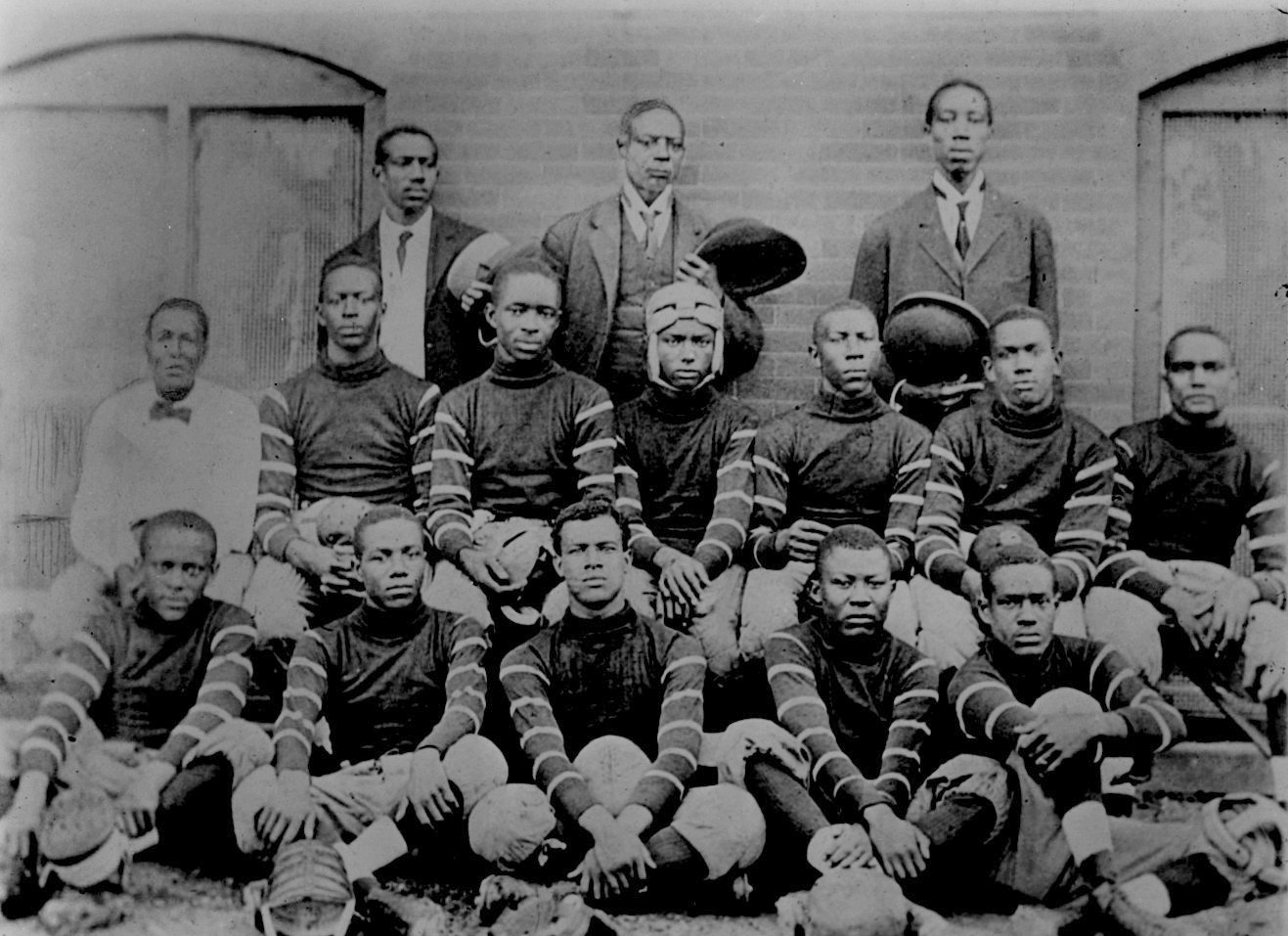
Great Dallas Historical Society photo described only as “a high school football team,” from 1909. The team most likely represented the “Colored High School” located at Hall and Cochran, the only high school in Dallas at the time for African-American students (it eventually merged with and relocated to the nearby Booker T. Washington High School in the early 1920s where, incredibly, it remained the city’s only high school for black students until Lincoln High School opened in South Dallas in 1939).

As everything was segregated at the time, including schools and sports, the number of black high school football teams they could play was severely limited — in-town opponents were non-existent. In fact, a 1909 blurb in The Dallas Morning News announced that “[t]he football team of the Dallas Colored High School will play the Wylie University team from Marshall at Gaston Park” (DMN, Nov. 12, 1909). They were playing college teams. From 150 miles away. At least they were the home team.

***

Photo from the J. L. Patton Collection, Dallas Historical Society.

Click picture for larger image.

*

Copyright © 2014 Paula Bosse. All Rights Reserved.

Ferris Plaza Waiting Station — 1925-1950

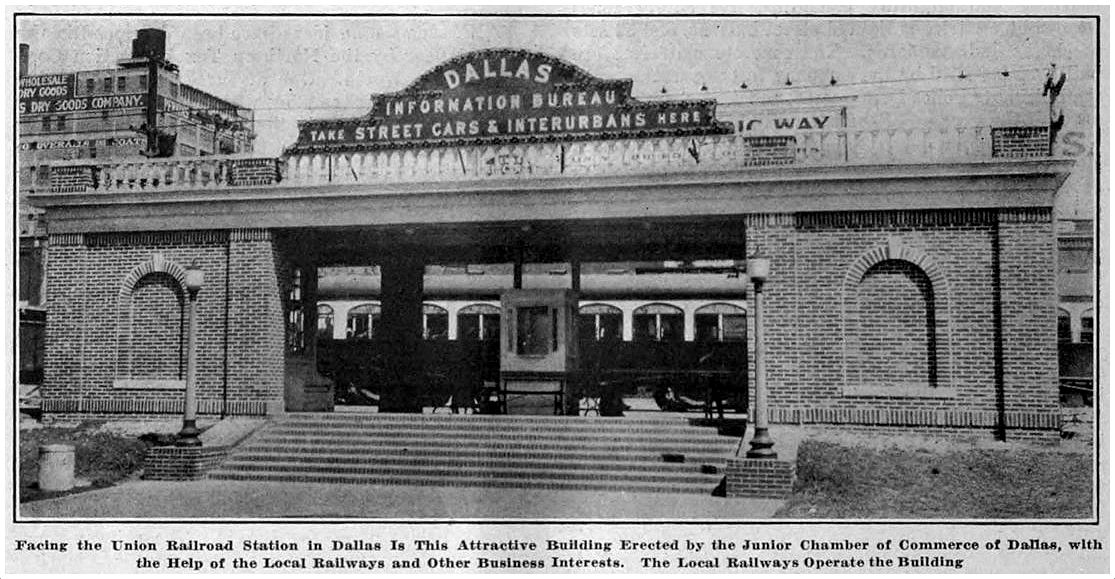
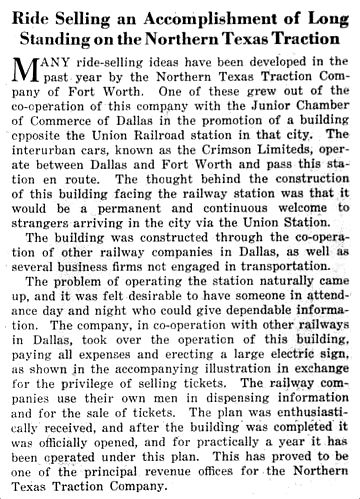
railway-info-bldg_1926From The Electric Railway Journal, 1926

by Paula Bosse

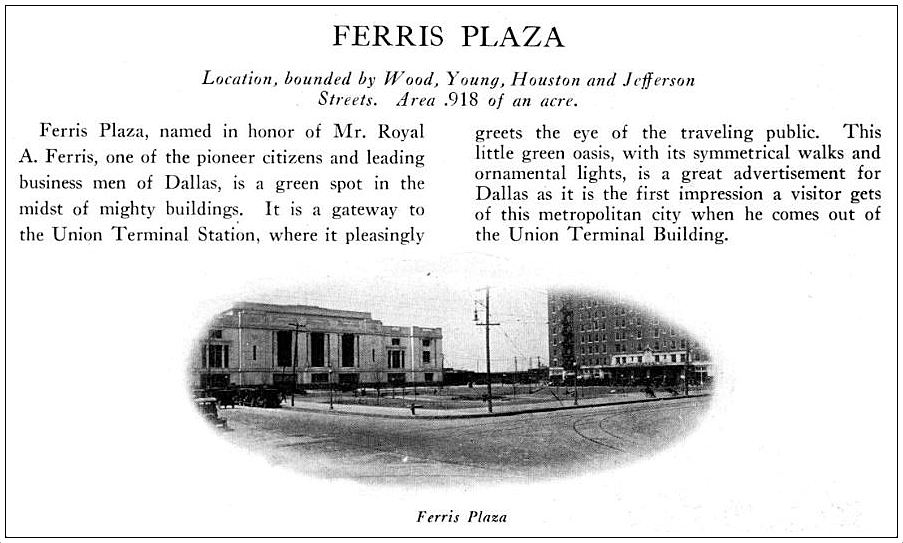
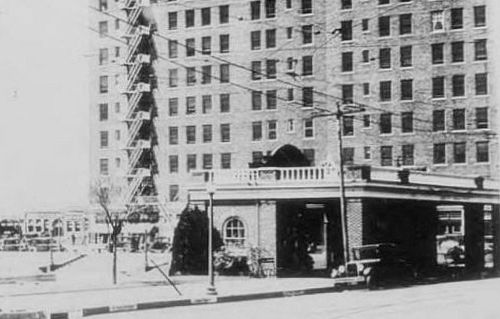
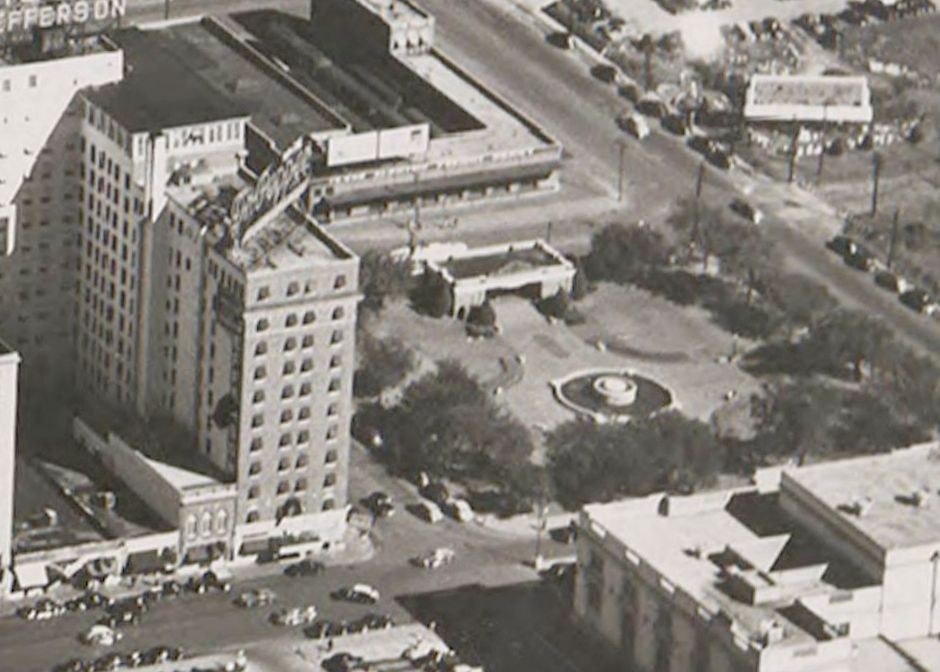
I came across the odd image above whilst digitally thumbing through a 1926 issue of The Electric Railway Journal (as one does…) and wondered what it was. It was definitely something I’d never seen downtown. Turns out it was a combination information bureau, covered stop in which to buy tickets for and await the arrival of interurbans and streetcars, a place to purchase a snack, and a location of public toilets (or, more euphemistically, “comfort stations”). It was located at the eastern edge of Ferris Park along Jefferson Street (which is now Record Street), with the view above facing Union Station. It was intended to be a helpful, welcoming place where visitors who had just arrived by train could obtain information about the city, and it was also a pleasant place to wait for the mass transit cars to spirit them away to points beyond. With the lovely Ferris Plaza (designed by George Dahl in 1925) between it and the front of the Union Terminal, this was considered The Gateway to the City long before Dealey’s Triple Underpass was constructed. (Click photos and articles to see larger images.)

ferris-plaza_park-and-playground-system_pubn_1921-23_portal

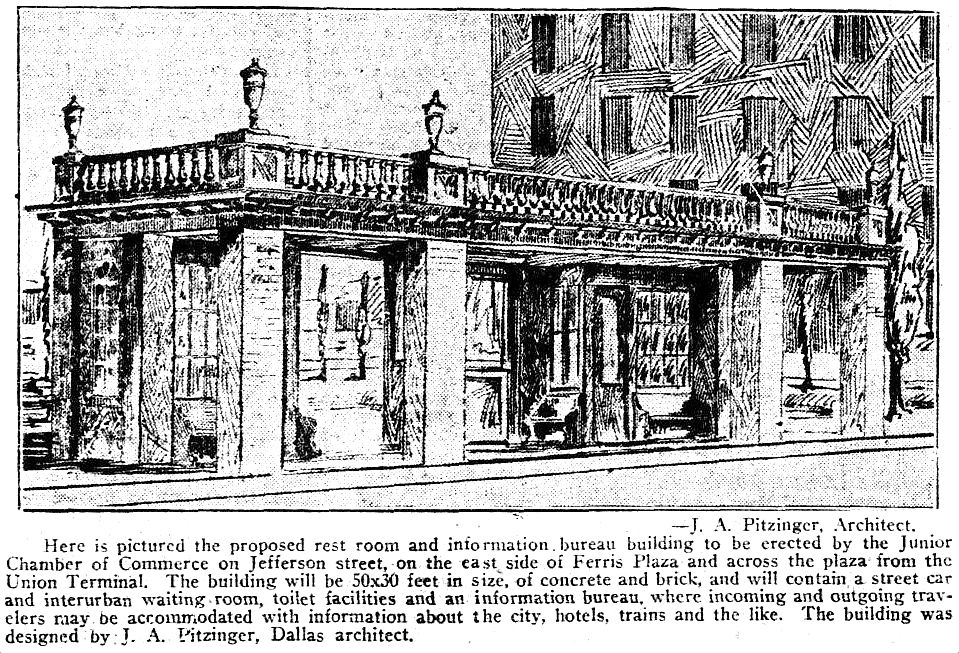
The “waiting station” was the brainchild of the Dallas Junior Chamber of Commerce which proposed the idea to the City of Dallas and, as it was to be built at the edge of a city park, the Park Board. The small (50 x 30) brick building — designed by Dallas architect J. A. Pitzinger — would cost $5,000 and would be paid for by funding from local businesses, including various transportation concerns (namely, the Northern Texas Traction Company). The “traction” companies would staff the information booth and sell tickets. The plans were accepted and permission was granted. Construction began in July, 1925, and the building was opened for waiting by October.

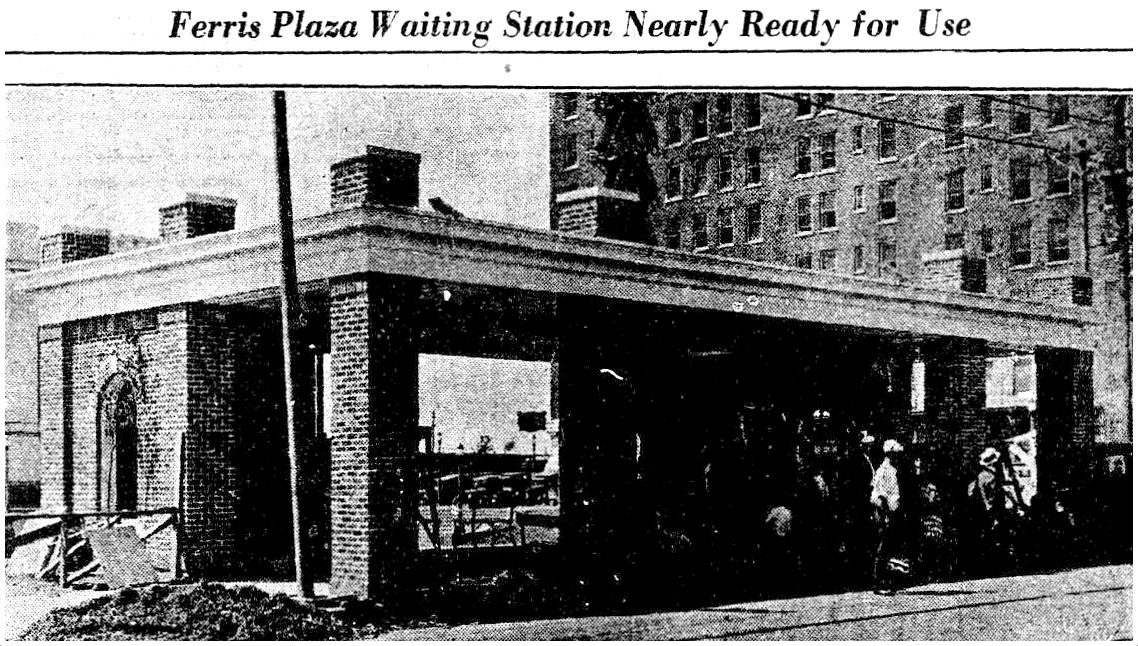
This improvement is the most recent of a number which have made of Ferris Plaza a beauty spot at the gateway of the city. Designed for a sunken garden, fringed with trees, the plaza is now adorned with a great fountain, illuminated with colored lighting at night, the gift of Royal A. Ferris. The new waiting station is in harmony with the general scheme of the plaza development, and combines beauty with utility. (Dallas Morning News, Sept. 20, 1925)

The little waiting station proved to be quite popular, and by the end of its first year the Northern Texas Traction Company (who operated interurban service between Dallas and Fort Worth) was very pleased, as interurban ticket sales at the station had become a solid source of company revenue. The Ferris Plaza station lasted a rather surprising 25 years. It was torn down in 1950, mainly because the interurbans had been taken out of service and there was no longer a need for it. Also, the park department was eager to get their park back and make it more “symmetrical.”

People would just have to wait somewhere else.

*

ferris-plaza-info-bureau_rendering_pitzinger_dmn_031625Architectural rendering by J. A. Pitzinger (DMN, March 16, 1925)

ferris-plaza-waiting-stn_dmn_092025Nearing completion (DMN, Sept. 20, 1925)

waiting-station_jefferson-hotel_degolyer-lib_SMU_croppedDeGolyer Library, SMU (cropped)

railway-info-bldg_1926_text_smThe Electric Railway Journal (Nov. 6, 1926)
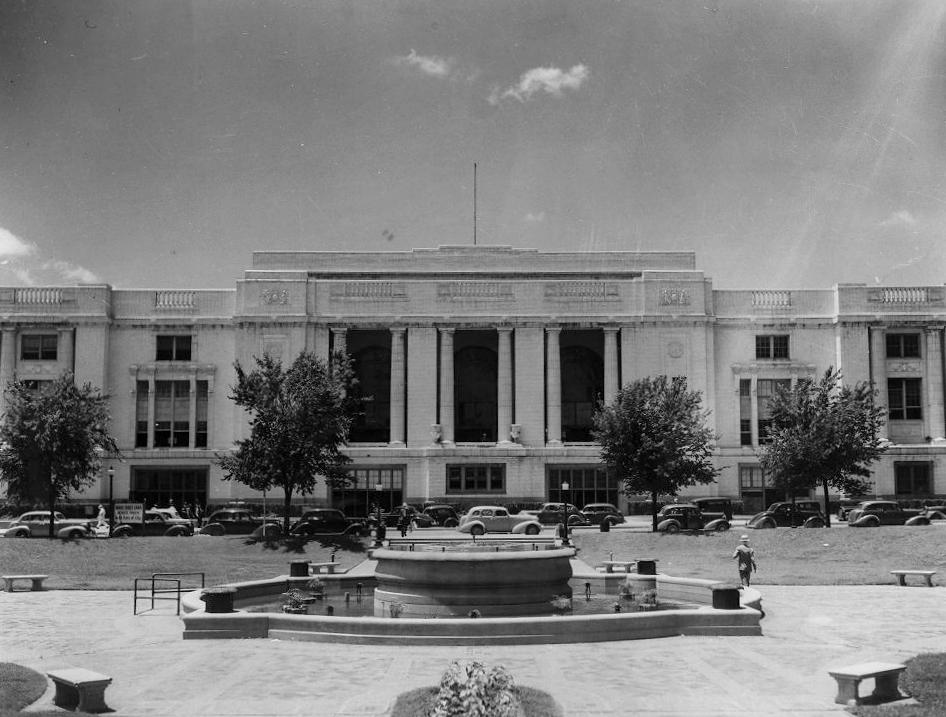
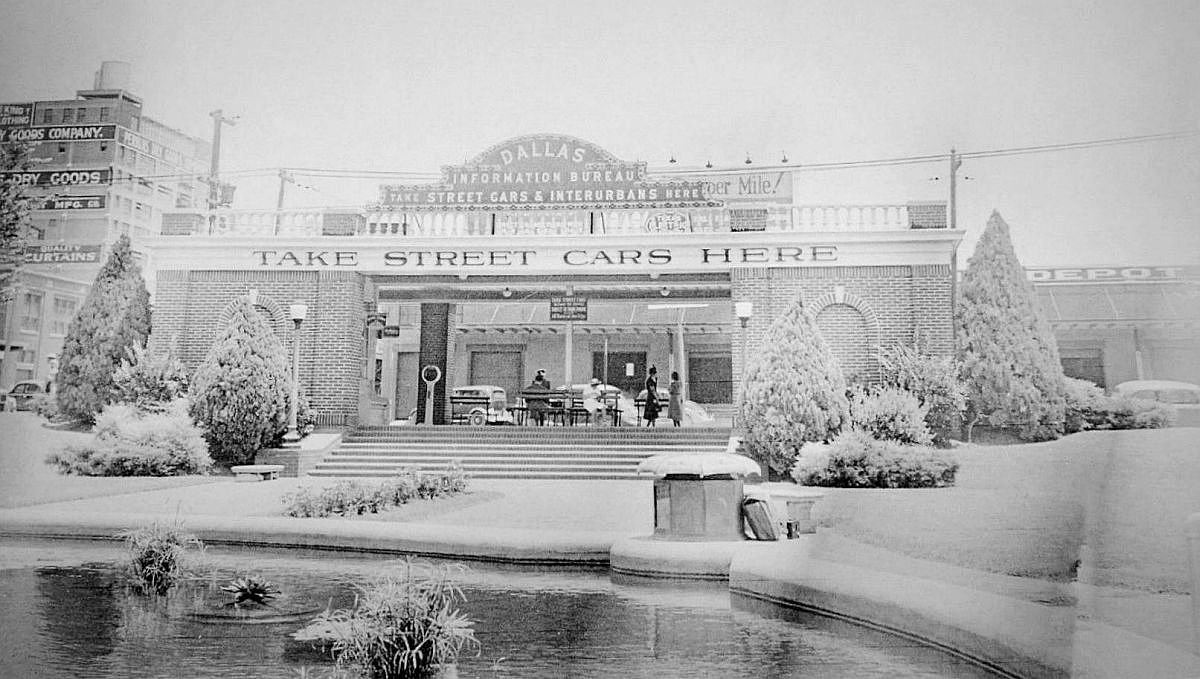
ferris-plaza_union-station_dpl_1936Union Station, 1936 — view from the “waiting station” (Dallas Public Library)

waiting-station_ebay

ferris-plaza_aerial_smu_c1949-det1949 aerial view, showing “waiting station” just above plaza’s circular fountain

***

Sources & Notes

Top photo from The Electric Railway Journal, Nov. 6, 1926.

Very early photo and description of Ferris Plaza is from Park and Playground System: Report of the Park Board of the City of Dallas, 1921-1923, via the Portal to Texas History, here.

Cropped image showing the waiting station with the Jefferson Hotel in the background is from the DeGolyer Library, SMU — more info is here.

Photograph of Union Station from the Texas/Dallas History and Archives Division of the Dallas Public Library.

Aerial photo showing Ferris Plaza is from a larger view of downtown by Lloyd M. Long (the original of which is in the Edwin J. Foscue Map Library collection of the Central University Libraries, Southern Methodist University, and which can be viewed here).

To read about the Ferris Park restoration project, see here.

For a few interesting and weird tidbits about the block that eventually became Ferris Plaza (including the fact that it was thought to be haunted and that it was once the site of a brothel), check out this page on Jim Wheat’s fantastic site.

*

Copyright © 2014 Paula Bosse. All Rights Reserved.

The First Texas-OU Game in Dallas — 1912

tx-players_dmn_101912bWatch out, Oklahoma: giant Texas linemen await…

 by Paula Bosse

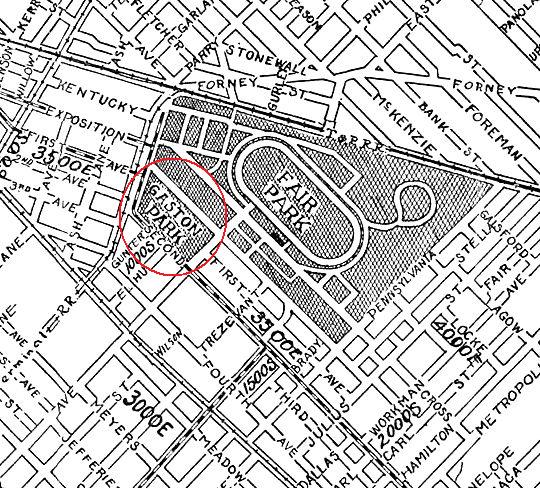
The Texas-OU game is a football tradition, held annually in the Cotton Bowl during the State Fair of Texas. The first game of the so-called “Red River Rivalry/Showdown/Shootout” was held in Dallas (aka “neutral ground”) in 1912. As the Cotton Bowl hadn’t been built yet, the game was held at Gaston Park, a sporting field with a large grandstand where Dallas teams played baseball, football, and, yes, even soccer. It was located at Parry & Exposition, in the spot where the State Fair Auditorium (now known as the Music Hall) was built in the 1920s.

Since my grasp of sports is tentative, I’m not going to go into any particulars of the actual game (which — spoiler! — Oklahoma won, 21-6); instead, I thought I’d mention a few of the incidental things leading up to the game that I found interesting. (For those who are interested in the particulars of the game, fret not — there is a link at the bottom of the post.)

So here are a few of the things that I found amusing or entertaining:

  • The 1912 football season began with new rules: downs were increased from 3 to 4; touchdowns were now 6 points instead of 5; the playing field was reduced from 110 yards to 100; the onside kick was abolished; a touchdown was permitted when caught over the goal line; the ball was kicked off from the 40-yard line instead of midfield; the intermission between quarters was reduced from 2 minutes to 1.
  • Fort Worth felt slighted that they had missed out on hosting the game (“it might just as well have been played in Fort Worth,” the Fort Worth Star-Telegram groused). Local Fort Worth-friendly UT alumni swore to try “strenuously” to get the game for Cowtown the following year, because, damn it, “next year is Fort Worth’s turn” (FWST, Oct. 15, 1912). (Sorry ’bout that, FW….)
  • The Sooners’ coach, 37-year old Bennie Owen (whom I gather is something of an OU legend), had only one arm, the result of a hunting accident. The Dallas Morning News wrote that Owen was “one of the most able [coaches] in the country. He is disabled to some extent by having but one arm, but evidenced by his success during the past season, this does not trouble him to any great extent” (DMN, Oct. 6, 1912).
  • The Longhorns’ coach, Dave Allerdice, was only 25 years old. He had been hired to fill the spot left vacant in the wake of the death of UT’s previous coach who had died rather exotically as the result of “a fall out of the window of his bedroom” (DMN, Oct. 10, 1912).
  • Both Allerdice and Owen had been coached as students by the same man, Coach Yost, at Michigan.
  • The Gaston Park crowd was estimated at over 6,000. The crowds going to the game and to the fair were so great that the streetcars and Interurbans were jam-packed. In fact, both teams had difficulty making it to the game on time because they couldn’t find transportation to get there, and the game had to be started late to allow for the players to arrive and warm up.
  • Oklahoma dominated the game, and the Sooners won, 21-6.

And so began the annual Texas-OU tradition in Dallas.

*

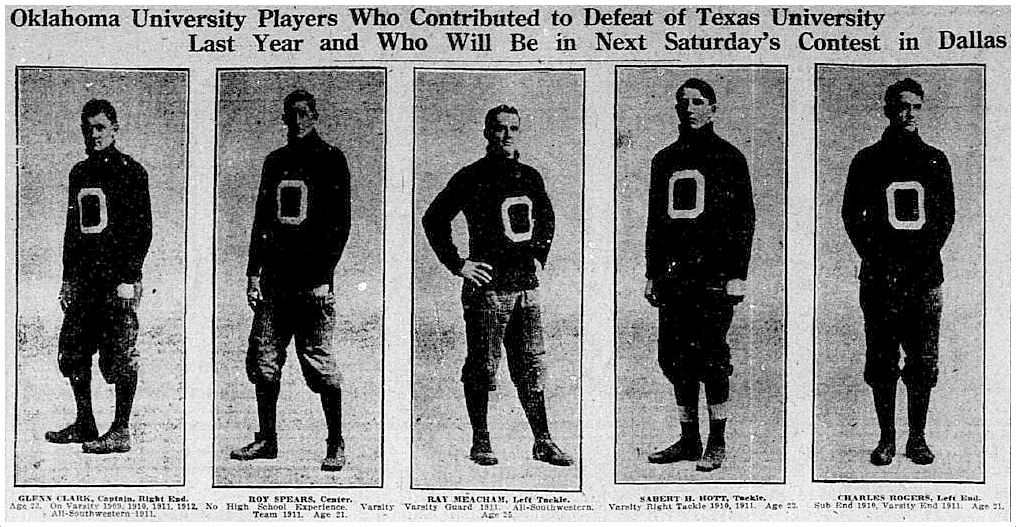
Below, Sooner boys: 0-0-0-0-0.

sooners_1912_dmn_101812DMN, Oct. 18, 1912

*

Grainy, off-kilter image of the crowd-frilled grandstand at Gaston Park.

tx-ou_crowd_dmn_102012DMN, Oct. 20, 1912

*

It’s a bit hard to see anything in these 100-plus-year-old photos, but here are a couple of “action photographs” of the game.

tx-ou_game-photos_dmn-102012DMN, Oct. 20, 1912

*

Gaston Park? Here’s where it was (a lot of street-renaming has gone on since this map was drawn in 1919).

gaston-park_fair-park_ca-1919

***

Sources & Notes

All photos from The Dallas Morning News.

1919 map (detail) from the Portal to Texas History, here.

For slightly better photos of Gaston Park (in 1908), see a previous post, here.

Wikipedia roundup:

  • Gaston Park, here.
  • Bennie Owen, here.
  • Dave Allerdice, here.
  • “Red River Showdown” (which I’ve never actually heard anyone other than TV commentators and promoters say to describe what everyone I know calls the “Texas-OU game”), here.
  • Defenestration, here.

The Dallas Morning News and The Fort Worth Star-Telegram are filled with numerous contemporaneous articles about this game. If you have a handy-dandy Dallas Public Library card (free!), you can pore over these articles to your heart’s content. To read what was printed the day of the game (Oct. 19, 1912), click  here. To read about the results and the game coverage, click here.

Click pictures for larger images. They will still be muddy and grainy, but, by God, they’ll be bigger.

*

Copyright © 2014 Paula Bosse. All Rights Reserved.

Snapshots of the Fair, 1936-1940

tx-centennial_strolling_fwplCentennial Exposition, 1936 — photo by Lewis D. Fox (click for larger image)

by Paula Bosse

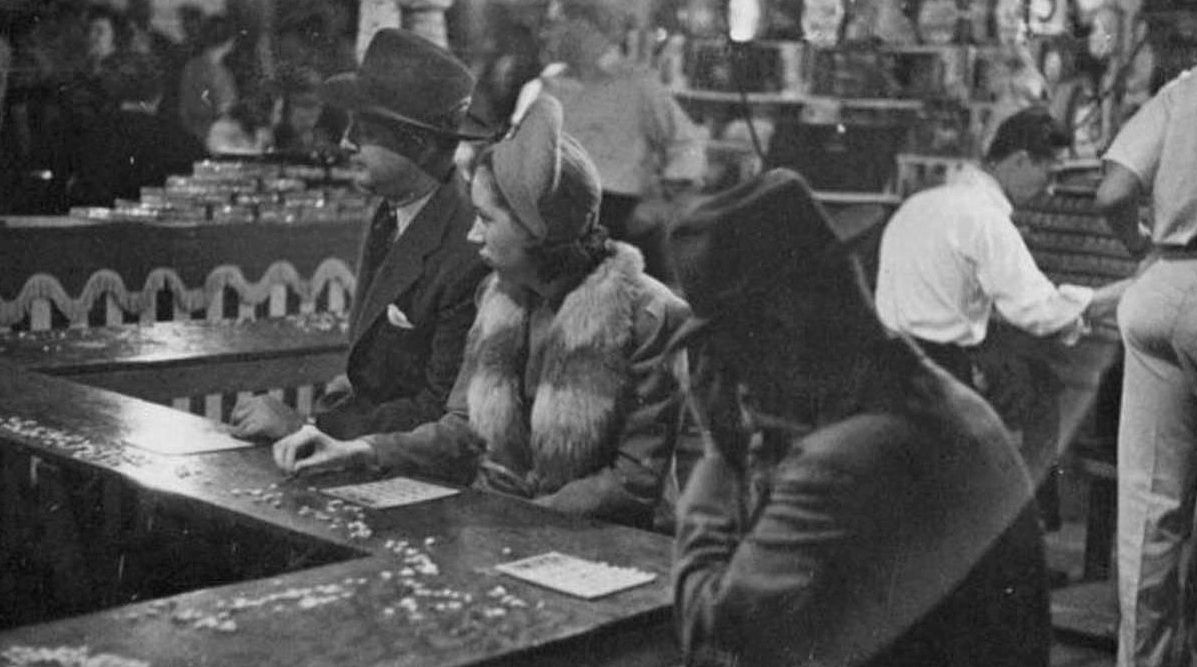
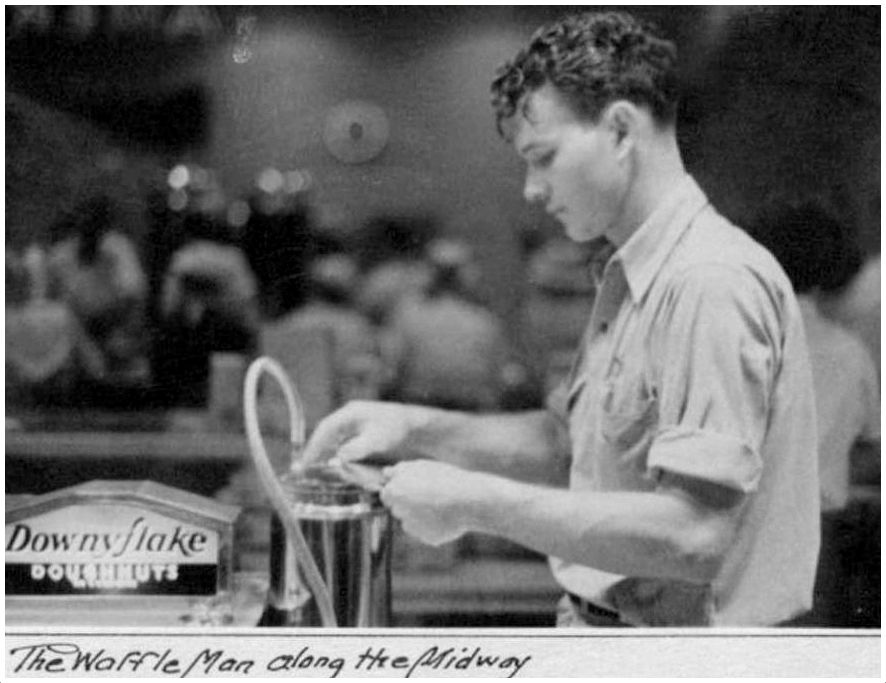
An amateur photographer named Lewis D. Fox took a lot of photos at the State Fair of Texas — from the Texas Centennial in 1936 through 1940. The Centennial photos are particularly interesting, because they show what the “Exposition” was like to the average visitor — there was more going on than just the spectacular extravaganza we usually see — there are also shots of people doing un-spectacular things like just walking around or enjoying a quiet, late-afternoon cup of coffee. There are also photos of the people who do the heavy-lifting at a state fair — the men and women who work the Midway shows and the concession stands (a link to a larger collection of Mr. Fox’s State Fair photos — almost a hundred snapshots — is below).

Enjoy this look at a time when going to the fair meant dressing up and, apparently, often leaving the children at home! (Click photos to see larger images.)

tx-centennial_spirit-of-centennial_fwpl

state-fair_texas-state-bldg_fwpl

state-fair_circus_c1939_fwpl

state-fair_grandstand_fwpl

tx-centennial_swing-revue_fwpl

state-fair_beanery_fwpl

state-fair-midway_fwpl

tx-centennial_cashier_fwpl

tx-centennial_side-view_fwpl

tx-centennial-midway_waffle-man_fwpl

***

Sources & Notes

All photos taken by Lewis D. Fox, from the Fox Photograph Collection in the Fort Worth Public Library Archives, courtesy of the Genealogy, History and Archives Unit, Fort Worth Public Library. Mr. Fox took a lot of snapshots at the fair — see  more here.

On a personal note, I’m mesmerized by “The Waffle Man.” He looks just like a young Lefty Frizzell! Lefty was from nearby Corsicana and he spent a lot of time in Dallas, but he wasn’t born until 1928, so it can’t be him — but check out this photo of Lefty as a teenager and see the remarkable resemblance! Not only did the (no doubt syrup-scented) young man above look like one of my favorite singers, but he also had ready access to waffles. What’s not to love? Oh, Waffle Man….

All images larger when clicked.

*

Copyright © 2014 Paula Bosse. All Rights Reserved.