Flashback : Dallas

A Miscellany: History, Ads, Pop Culture

Category: Weather

A Rainy Day at Main and Akard — 1932

main-akard_frank-rogers_011632_legacies_fall-2013Fedoras, cloches, umbrellas…

by Paula Bosse

A nice photo of a rainy day downtown, almost 85 years ago. The photo — taken on January 16, 1932 by Dallas photographer Frank Rogers — shows the intersection of Main and Akard (the people with umbrellas are crossing Akard Street, heading east). Marvin’s Drug Store (which occupied the ground floor of what was later known as the Gulf States Building) was on the northwest corner, and the A. Harris department store occupied the first five floors of the Kirby Building (originally the Busch Building) on the northeast corner — both buildings are still standing. See the view today, via Bing, here.

***

Sources & Notes

Photo from the Fall, 2013 issue of Legacies, viewable at the Portal to Texas History, here.

*

Copyright © 2016 Paula Bosse. All Rights Reserved.

The 1957 Tornado, Seen From Old East Dallas

tornado_live-oak_040257_rusty-williams_dplThe view from Liberty & Live Oak… (click for larger image)

by Paula Bosse

Great shot of the historic Dallas tornado (which killed 10, injured at least 200, and left about 500 people homeless) as it was plowing through Oak Cliff and West Dallas on April 2, 1957, seen from the 2800 block of Live Oak.

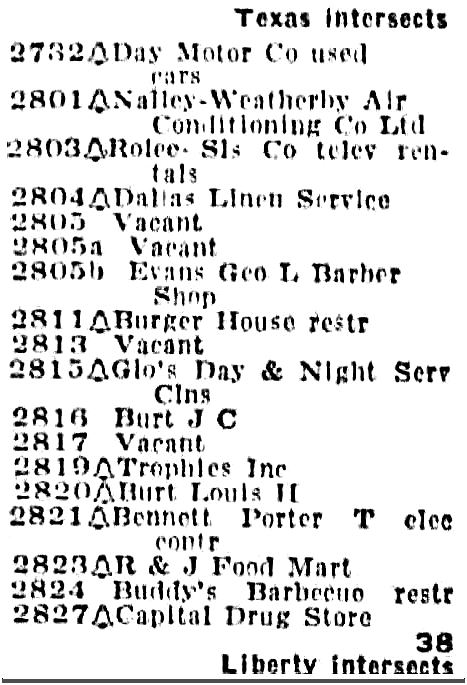
Aside from the tornado, this is an interesting view looking toward downtown, the Medical Arts Building, and the Republic Bank Building (that rocket must have been Dallas’ tallest lightning rod at the time!). The building containing the strip of businesses at the right still stands (I love these buildings — there are a lot of them in the older parts of town) — a present-day view can be seen on Google, here. What stood out to me was a Burger House — I didn’t know of any other than the one on Hillcrest, but this one stood at 2811 Live Oak from 1950 or ’51 until about 1976.

Below, the businesses in the 2800  block of Live Oak — between Texas and Liberty — from the 1956 city directory (click for larger image):

live-oak_1956directory

***

Sources & Notes

Top photo from the book Historic Photos of Dallas in the ’50s, ’60s, and ’70s by Rusty Williams (Nashville: Turner Publishing Company, 2010); from the collection of the Dallas Public Library.

Film footage of the tornado can be found in several videos on YouTube, here.

One of the newspaper reports on the tornado which captures the terror felt by those in the twister’s path and is well worth reading in the Dallas Morning News archives is “‘Roar of Thousand Trains’ Precedes the Killer Funnel” by James Ewell (DMN, April 3, 1957). Of particular interest is the story of T. M. Davisson who hid with a customer in a large empty steel tank on his property.

A previous Flashback Dallas post — “Tornado As Learning Tool — 1957” — is here.

Photo and clippings are larger when clicked.

*

Copyright © 2016 Paula Bosse. All Rights Reserved.


Brimstone Baths, Lake of Fire: Welcome to Summer

summer_knott-cartoon_dmn-071722NOT from a Chamber of Commerce brochure…

by Paula Bosse

Summer in Dallas is HELL ON EARTH. Welcome, newcomers!

***

Cartoon by Dallas Morning News staff cartoonist John Knott — it appeared in the July 17, 1922 edition of the DMN.

*

Copyright © 2016 Paula Bosse. All Rights Reserved.

Cole Park Storm Water Detention Vault

water-detention-vaultWhy, yes, this IS in Uptown…

by Paula Bosse

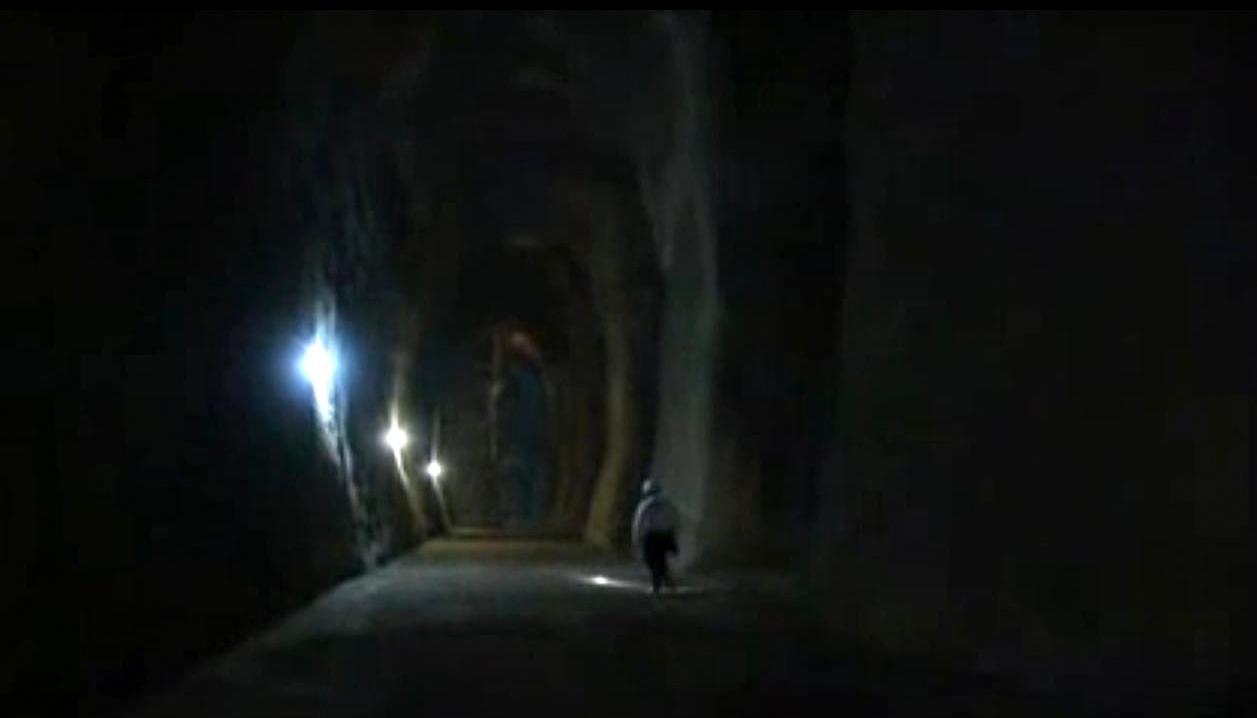
Underneath Cole Park (which is behind North Dallas High School and between Cole and McKinney), is a “storm water detention vault” — a cavernous space where storm water runoff goes when the capacity of the Mill Creek storm sewer system has been exceeded. It can hold 71 million gallons of storm water. …71 million gallons!

From a 2014 Facebook post from the Turtle Creek Association:

Completed in 1993, the vault’s 13 chambers, each of which rises five stories tall and runs the length of more than two football fields, are designed to fill with water during extreme rainfall. These massive vaults capture the storm water from Central Expressway and slowly release it into Turtle Creek via the Mill Creek Outfall by the footbridge in William B. Dean Park (next to the Kalita Humphrey Theater).

I had no idea that Dallas had anything like this until I saw the short film, below, in which Gilbert Aguilar, Assistant Director of the City of Dallas’ Department of Street Services, takes us on a tour of the “detention vault.” This is an absolutely mind-blowing look at something very, very few Dallasites know about. The City of Dallas probably wouldn’t be willing to grant access to moviemakers, but, seriously, this would make an INCREDIBLE movie set — perhaps less aesthetically appealing than the sewers of Vienna featured in The Third Man, but what it lacks in character it makes up for in sheer gigantic-ness.

***

Sources & Notes

The video, “Living With the Trinity: Cole Park Vault,” is on YouTube, here. Though not credited in the video itself, it is, presumably, a production of local filmmaker Mark Birnbaum, whose website is here.

Top image is a screengrab from the video.

*

Copyright © 2015 Paula Bosse. All Rights Reserved.

Winter Scene: The Belo Mansion & The Cathedral of the Sacred Heart — ca. 1902

cathedral_snow_flickr-colteraSnow on Ross Avenue…

by Paula Bosse

A beautiful dusting of snow in one of the tonier areas of the city, captured by a postcard photographer in the early years of the 20th century — back when the snowy slush along Ross Avenue would have been caused by horses and the buggies they pulled behind them.

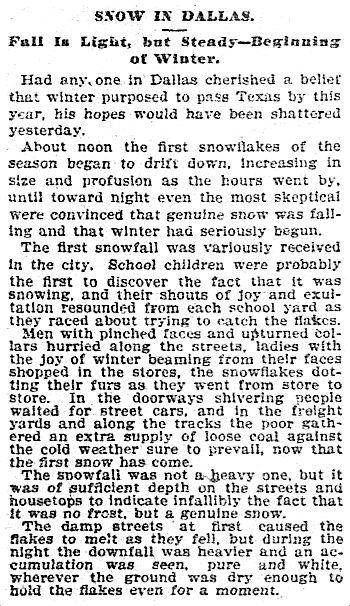
The date of this postcard is unknown, but at the end of 1902 (the same year the construction of the cathedral was completed) it snowed in Dallas — a “weather event” then (as now) so out of the ordinary that it resulted in these rapturous few paragraphs from the December 4, 1902 edition of The Dallas Morning News:

snow_dmn_120402DMN, Dec. 4, 1902

***

Sources & Notes

Postcard from Flickr, here.

The Belo Mansion was built in about 1890; more info here.

Construction of the Cathedral of the Sacred Heart (now the Cathedral Santuario de Guadalupe) was completed in 1902. Except for the bell tower, which, though part of the architect Nicholas J. Clayton’s original design, was not completed until 2005. More on this “sympathetic addition” from Architexas, here.

While most of the buildings and houses that once stood along ritzy Ross Avenue are long gone, both the Cathedral and the Belo Mansion still stand as Ross Avenue landmarks.

Below, the same view today (sans snow), via Google Street View (click for larger image). I really wish that iron fence was still there.

belo-cathedral_google

*

Copyright © 2015 Paula Bosse. All Rights Reserved.

“Dallas in Winter” by Guy Wiggins — ca. 1942

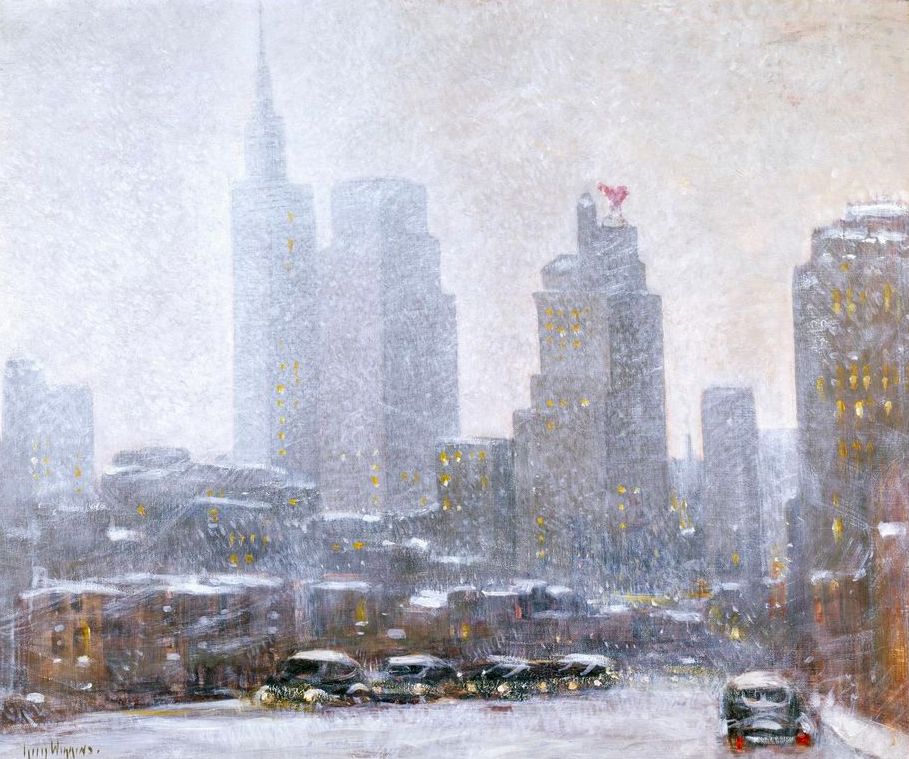
wiggins_dallas-in-winter_c1942_dma“Dallas in Winter” by Guy Carleton Wiggins (Dallas Museum of Art)

by Paula Bosse

A nostalgic look back at a snowy Dallas scene from the 1940s by Guy Wiggins (1893-1962), an artist most remembered for his snow scenes of New York City. Wiggins was apparently quite fond of Dallas and was a frequent visitor, beginning in the 1920s. He had countless gallery shows here over the years, and while in town he’d often present lectures and “master classes” to arts groups and women’s groups. According to articles in local newspapers, Wiggins painted views of the Dallas skyline several times, paintings which no doubt found their way into private collections and are probably still hanging on the walls of local art patrons. In 1952, his daughter and her family moved here, giving Wiggins yet another reason to visit.

The wonderful snow scene above is in the collection of the Dallas Museum of Art; this is the DMA’s description of the painting:

A rare snowstorm in Dallas captured the eye of Guy Carleton Wiggins, who recorded this scene from the downtown vantage point of Live Oak and Pearl streets, showing the skyline’s distinctive historic landmark of the red statue of Pegasus on the Magnolia building.

Although born and raised in the East, where he was affiliated with the artists’ colony in Old Lyme, Connecticut, Wiggins traveled widely throughout the United States during his career. He became known for urban winter scenes such as this one.

***

The painting “Dallas in Winter” by Guy Carleton Wiggins is from the Patsy Lacy Griffith Collection, Dallas Museum of Art; it was a bequest of Patsy Lacy Griffith. More information on the painting can be found on the DMA’s website, here.

(Patsy Lacy Griffith was the daughter of oil millionaire Rogers Lacy, who was this close to building the incredible Frank Lloyd Wright-designed hotel downtown. I wrote about it in a previous post, here.)

More on the career of Guy Wiggins, from Wikipedia, here, and from a 2011 New York Times profile of the Wiggins family of painters, here.

Because he visited so often and had many friends here (and because he apparently painted very quickly), Wiggins’ paintings were well represented in private collections in Dallas. (One of his earliest patrons was Miss Ela Hockaday, of the Hockaday School for Girls, who loaned one of her paintings for an exhibit at the Dallas Public Library in 1930.) Among works depicting views of the city were oil studies with the titles “Morning Over Dallas,” “The Akard Canyon,” “Dallas: Morning From Cliff Towers,” and “Dallas Nocturne,” all of which were probably still damp when first shown, as The Dallas Morning News reported that they had been painted “little more than a week ago” before they went on display at the Ed Spillars gallery on Fairmount at the end of December, 1948 (DMN, Dec. 22, 1948). I’d love to see these paintings.

Want “Dallas in Winter” hanging on your walls? Buy the poster from the DMA Shop here. Look at it longingly when it’s 157 degrees in August.

Click picture for larger image.

*

Copyright © 2015 Paula Bosse. All Rights Reserved.


Whither Water? — 1956

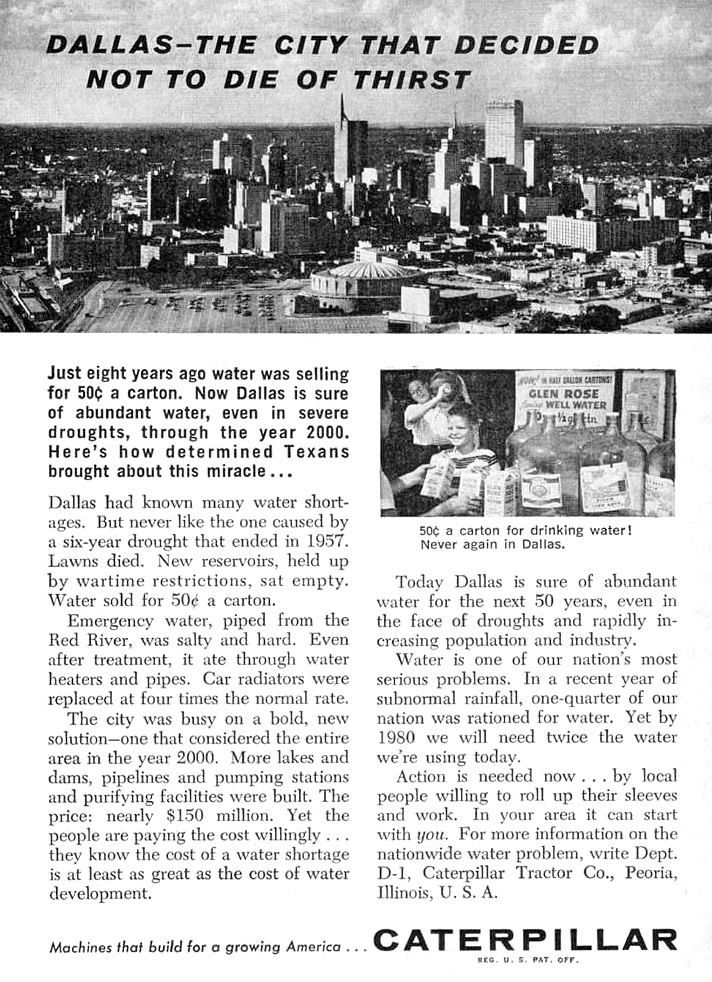
drought_caterpillar-ad_1962_det“Dallas — The City That Decided Not To Die of Thirst”

by Paula Bosse

Between 1950 and 1957, Texas suffered the worst drought on record. By 1957, 244 of Texas’ 254 counties had been declared disaster areas. In 1952, Lubbock recorded not even a trace of rain. Elmer Kelton captured the period perfectly in his classic novel, The Time It Never Rained. It might not have achieved the epic catastrophic proportions of the Dust Bowl days, but that doesn’t mean it wasn’t devastating.

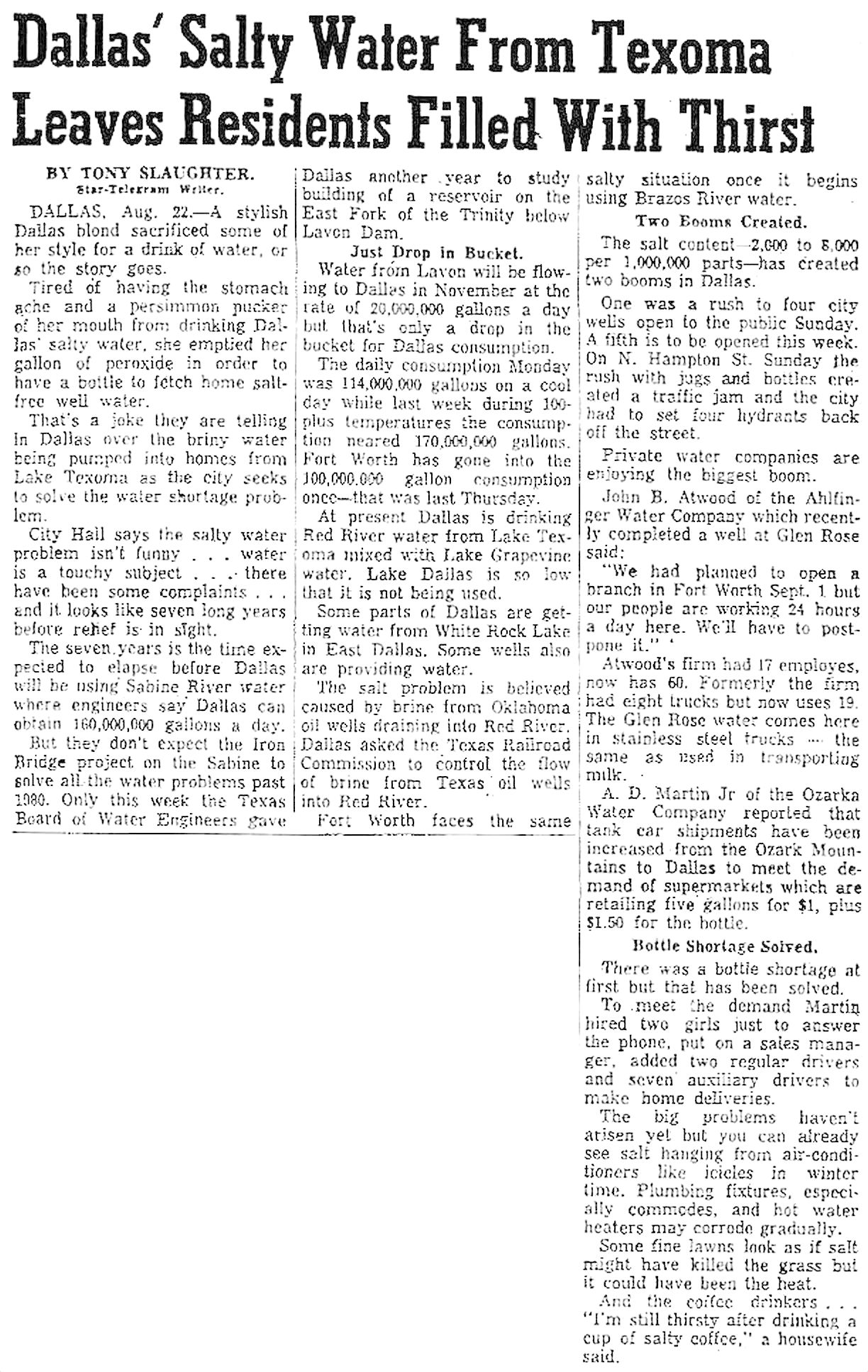
In Dallas, the lakes and reservoirs were hit hard. White Rock Lake dried up — one was able to walk across the parched lake bed without a drop of water in sight. Lake Dallas (now Lake Lewisville) fell to 11% of capacity. Dallas was desperate for water, and in 1956, it began “importing” water from Oklahoma. Red River water was appreciated, but it was considered by many far too salty to drink. In addition to the unpleasant taste, residents were concerned that there would be permanent damage to pipes and plumbing, and, to a lesser extent (since watering restrictions were being strictly enforced) to their lawns.

According to one report, salt content in the water supply had gone from the normal 39 parts per million gallons to over 800 parts (at the height of the problem, some news outlets reported it to be well over 2,000 parts per million). While the water was generally considered perfectly safe for the average person to drink, many looked for cleaner, more palatable drinking water.
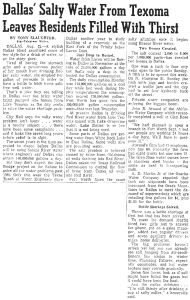
drought_FWST_082356Fort Worth Star-Telegram, Aug. 23, 1956 (click for larger image)

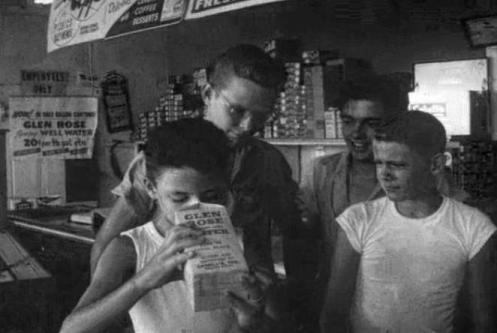
Suddenly bottled water became a boom business. Spring water was being trucked to Dallas from Glen Rose and Arkansas. Water was being sold in bottles and cartons — from 20 cents per half-gallon cartons to $2.50 for five-gallon bottles ($1.50 of which was for a deposit on the glass bottle). WBAP-TV news even sent a cameraman out to a Cabell’s convenience store to capture some boys testing out the Glen Rose water (watch it here, without sound).
water_portal_screencap

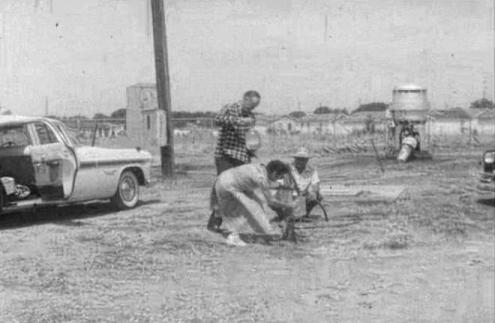
The other source of acceptable drinking water that summer was from city wells dotted around Dallas. Long dormant, the city opened the wells and offered free water to residents. From The Dallas Morning News:

If you don’t like that hard, salty water coming from your taps, you can get soft, unsalty water at four city wells beginning Sunday. City manager Elgin E. Crull Saturday said that the city has installed faucets at the four wells where people may take their buckets or bottles and obtain drinking water. No trucks will be permitted to fill up. (DMN, Aug. 19, 1956)

The four wells mentioned above — and two more opened within a few weeks — were located at the following locations:

  • 1325 Holcomb, near Lake June Road
  • Opera and 13th, near the Marsalis Zoo
  • 875 North Hampton, near Lauraette Street
  • 2825 Bethurum, in South Dallas, near the public housing project
  • Northwest Highway and Buckner
  • Matilda and Anita, on the grounds of Stonewall Jackson Elementary School, in East Dallas

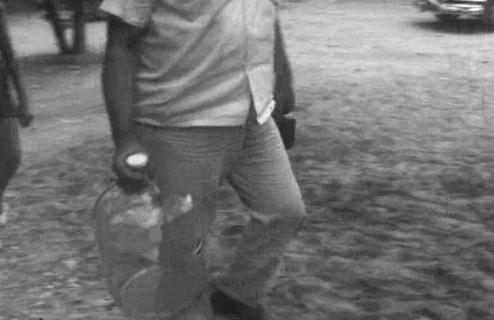
These wells were hugely popular, with thousands of people showing up with jugs, jars, kettles, canteens, and bottles of every conceivable size. (More WBAP news footage of people filling up at these wells can be seen here, without sound; details below).
well-1

well-2

The popularity of the city wells led to private citizens having wells dug on their own property. Not only were bottled water suppliers making a killing during the summer of ’56, so were the owners of drilling businesses. From The Dallas Morning News:

As salty water from city mains reportedly discourages shrubbery and affronts the taste, drillers of shallow residential water wells ride the crest of a boom. […] Luckiest of the water-seekers are residents of the southern section of the city in the Fruitdale, Pleasant Grove and Home Gardens area, and in the neighborhoods that border Loop 12. That is where drillers are finding pay dirt — water-bearing gravel — at shallow depths. (DMN, Oct. 7, 1956)

It wasn’t just professional drillers who were busy — it wasn’t uncommon for the DIY-ers to be out in the backyard on weekends, digging away, hoping for their own personal source of fresh water. And there were probably even some dowsers out and about, water witching their little hearts out.

The drought ended the next year, and personal wells were a thing of the past, but that mania for bottled water really dug its heels in.

Texas developed the Water Planning Act of 1957, and in 1962, this new mandate and what had happened in Dallas during the drought was used as the basis for a Caterpillar ad which had a bit of a hyperbolic headline, “Dallas — The City That Decided Not To Die Of Thirst”:
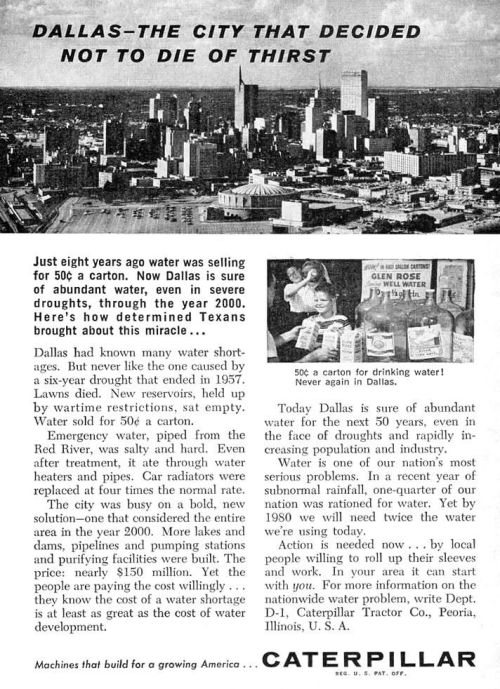
drought_caterpillar-ad_19621962 ad (click for larger image)

***

Sources & Notes

Picture of the four boys tasting the Glen Rose water is taken from the WBAP-TV news story that aired on Aug. 12, 1956. The silent, edited footage was shown as the news anchor read the script, seen here. Film footage (linked above) and script from the Portal to Texas History.

The two pictures of people availing themselves of water from the city’s wells are taken from the WBAP-TV news story that aired on  Aug. 19, 1956. The silent footage ran as the anchor read the script seen here and here. Film footage (linked above) and script from the Portal to Texas History.

1962 Caterpillar ad from eBay.

More on affect of the drought on Dallas can be found in these Dallas Morning News articles:

  • “Sparked by Salt: Business Booming For Bottled Water” (DMN, Aug. 5, 1956)
  • “Citizens Stock Up On Saltless Water” by Sue Connally (DMN, Aug. 20, 1956)
  • “Thirsty City Witnesses Revival of Well Drilling” by William K. Stuckey (DMN, Oct. 7, 1956)
  • “Resourceful Citizens Tap City Water Well” (DMN, Oct. 16, 1956)
  • “Continuing Drouth Produces Top Local News Story in ’56” by Patsy Jo Faught (DMN, Dec. 30, 1956)

Read about how the drought affected Texas water management here; read about the Texas Water Rights Commission here.

Read “The City of Dallas Water Utilities Drought Management Update” in a PDF, here.

Finally, I encourage everyone to grab a tall glass of ice water and settle down to read Elmer Kelton’s classic Texas novel, The Time It Never Rained. Or if you’re pressed for time, read Mike Cox’s article about the book in Texas Parks & Wildlife magazine, here.

*

Copyright © 2014 Paula Bosse. All Rights Reserved.


Telephone Operators Sweating at the Switchboard — 1951

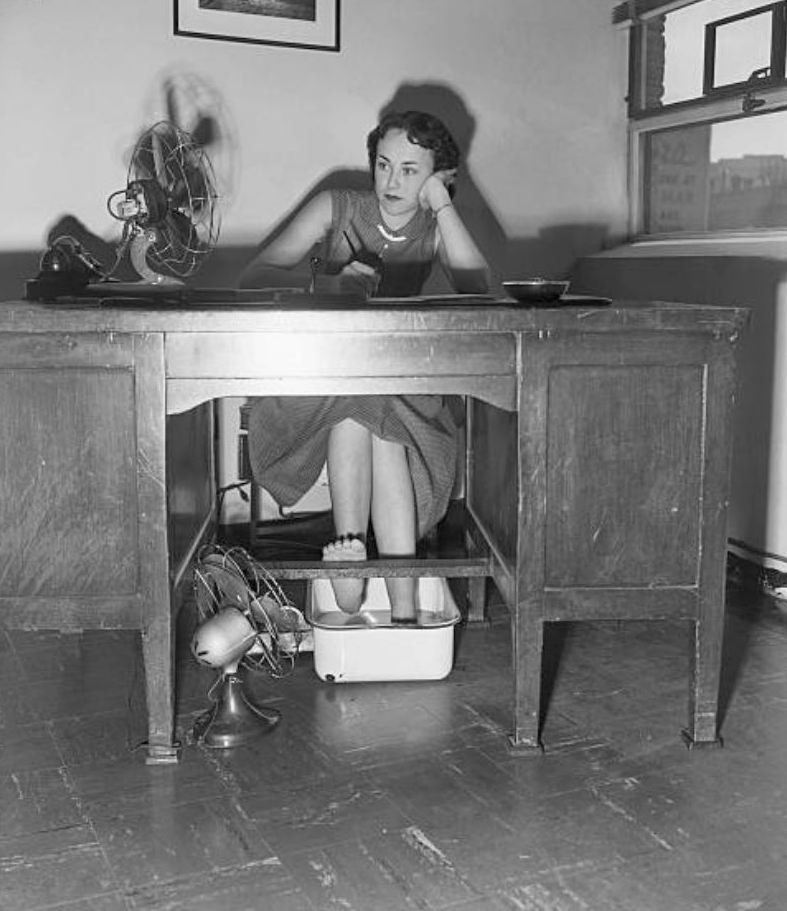
summer_telephone-operators_1951Low-tech A/C: ice, buckets, fans

by Paula Bosse

The summer of 1951 in Texas was brutally hot. One heat-related incident that August made national headlines: more than 1,500 Southwestern Bell telephone operators (and supportive coworkers) who were working in unairconditioned conditions (!!) at the Haskell Exchange on Bryan and at the Akard Street headquarters downtown staged what news reports called a “wildcat walkout” and refused to continue working in the sweltering buildings. Management’s attempt to cool things down with electric fans blowing over buckets of ice had not worked. Operators returned the next day, having made their point, hopefully to the imminent installation of air-conditioned switchboard rooms.

The caption for the photo above:

Dallas, Tex. Aug. 10 [1951] — BEATING THE HEAT — Both ice and fans are brought into play by telephone operators at an exchange here today as the city continued to swelter under 100-degree or over temperatures. The thermometer reached a high of 102-degrees to run the consecutive days of 100-degree readings to ten. It is the longest period of such reading since 1925 when a record 11 straight days was set. High mark for the present heat wave was 107 on August 6.

Three days later, the sweat hit the fan, and the women walked out.

operators_heat_st-joseph-MO-news-press_081451
St. Joseph [MO] News Press, Aug. 14, 1951 (click to read)

Let’s hope your work conditions are a bit better this summer!

***

Sources & Notes

Wire service photograph from the Southern Labor Archives of the Georgia State University Library Special Collections.

See ads from 1911 and 1925 encouraging women to become telephone operators in the Flashback Dallas post “Work and Play in Telephone Land,” here.

*

Copyright © 2014 Paula Bosse. All Rights Reserved.
Back When the Kessler Couldn’t Catch a Break — 1957

kessler-theater-after-tornado_1957

by Paula Bosse

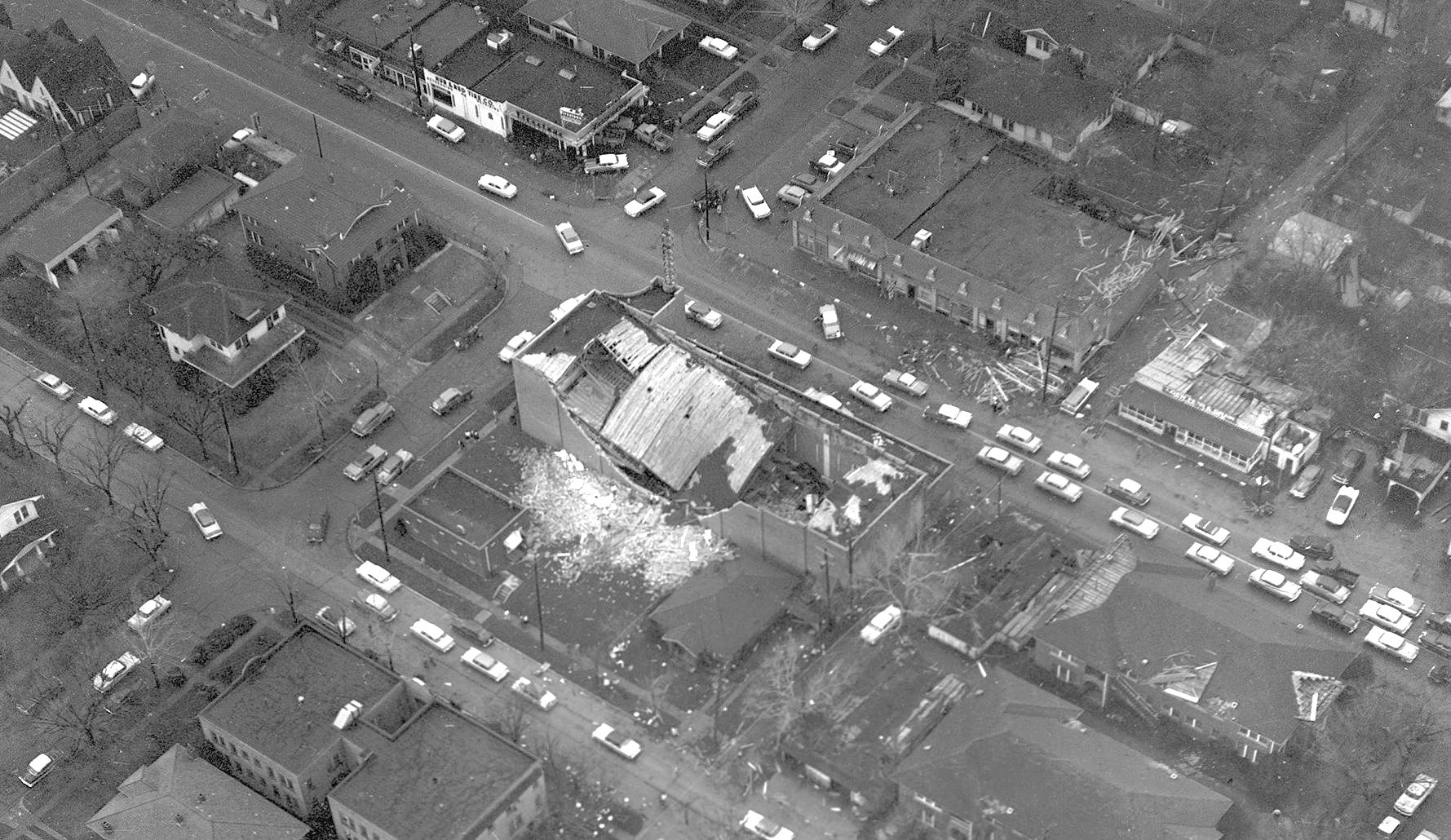
One of the casualties of the famous tornado that hit Dallas and Oak Cliff in 1957 was the Kessler Theater. In 1957, the Kessler — then only 15 years old — had hit hard times and was being used to house an evangelical church. It was rebuilt after the tornado, but soon after it was hit by a three-alarm fire. Conclusion? Do not disturb the entertainment gods — that place was meant to be a theater!

kessler_tornado_sherrod

From the post-tornado reports in The Dallas Morning News:

At the West Davis and Clinton business district, an evangelical church in a converted theater building at the intersection was caved in, leaving little more than two walls standing. The church’s cross from atop its more than 50-foot tower was crumpled in the gutter. (DMN, April 3, 1957)

And in a survey of the clean-up:

At Davis and Clinton, where the old Kessler Theater was being used as a revival center before the tornado, workmen were busy wrecking the building, completing what the tornado had started. […] J. T. Hooten, foreman for Winston A. Caldwell, explained that the damaged sections of the theater which might give way under a slight strain and cause further damage had to be torn out. His crew carefully but hurriedly dismantled the old Davis Street landmark. Hooten said the owner may rebuild the theater as a 1-story office building. (DMN, April 10, 1957)

Here is a detail of an aerial photo by photographer Squire Haskins, showing the damaged Kessler in the center (see the full, very large photo here):

kessler_tornado_squire-haskins_UTA_det

***

Sources & Notes

Top photo from an incredibly detailed website devoted to the 1957 Dallas tornado, the home page of which can be seen here.

Second photo from D. Troy Sherrod’s Historic Dallas Theatres (Charleston: Arcadia Publishing, 2014); photo from the collection of the Dallas Public Library.

Aerial photograph by Squire Haskins from the Squire Haskins Photography, Inc. Collection, UTA Libraries, Special Collections; more information is here (click the thumbnail to see a larger image).

Website of the recently (and beautifully) restored Kessler is here.

*

Copyright © 2014 Paula Bosse. All Rights Reserved.


“Rainy Day” and “Rainy Day” on a Rainy Day

bowling_rainy-day_smu

spruce-everett_rainy-day_1944

by Paula Bosse

Two works by local artists closely connected with (if not actually IN) the influential Dallas Nine group of painters and printmakers. Both works are titled “Rainy Day.”

The top print is a lithograph by Charles T. Bowling (1891-1985) and is undated. (From the Bywaters Special Collections, Hamon Arts Library, Southern Methodist University.)

The second print, also a lithograph, is by Everett F. Spruce (1908-2002), dated 1944. (From the collection of the Dallas Museum of Art, a gift of A. H. Belo Corporation and The Dallas Morning News, via the Central University Libraries of SMU.)

Stay dry!

Click pictures for larger images.

*

Copyright © 2014 Paula Bosse. All Rights Reserved.