Flashback : Dallas

A Miscellany: History, Ads, Pop Culture

Category: Women

Babe Didrikson, Oak Cliff Typist
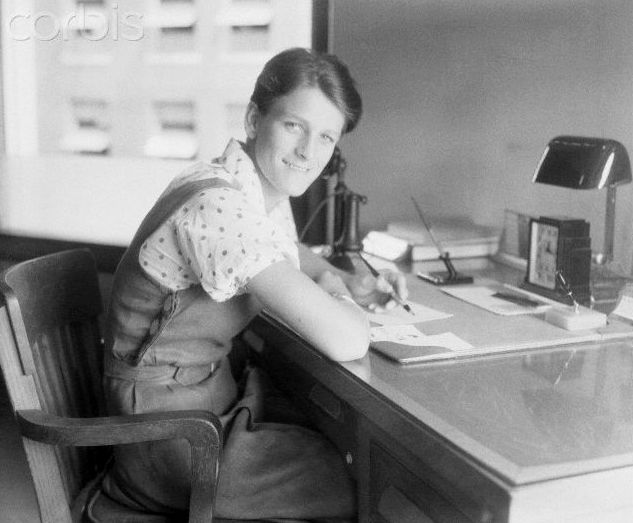
babe-corbis_102132Babe Didrikson at a desk she was probably pretty unfamiliar with, 1932

by Paula Bosse

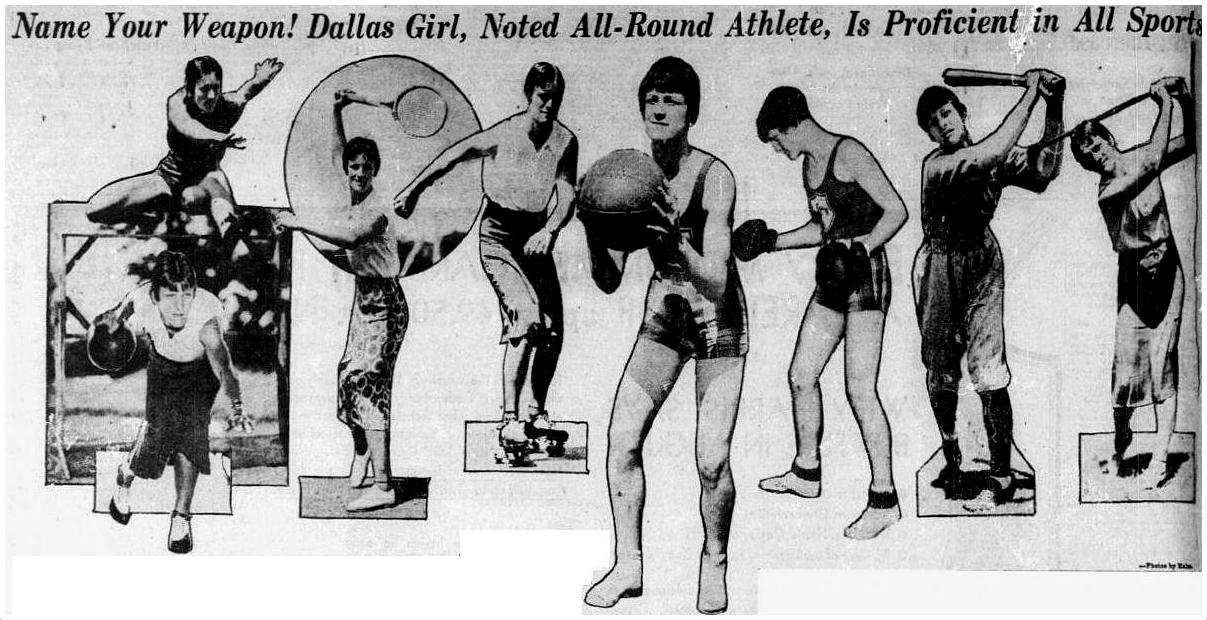
Mildred “Babe” Didrikson has been called the greatest athlete of the 20th century — male or female. She was an All-American basketball player, she set a number of world records in a wide variety of track and field events (she was so good at all of the individual sports that she was entered at least once as an entire TEAM — a team of one!), she won two gold medals and one silver (which should have been three gold medals…) at the 1932 Olympics, and she was, perhaps most famously, a champion golfer who was a founder of the LPGA. She was also highly proficient in softball, bowling, diving, swimming, roller skating, and tennis, and she dabbled in hockey, skeet-shooting, billiards, and even football. There was no sport she didn’t try — and even if she had never tried it before, she was probably pretty good at it. And she spent an important period of her life in Dallas.
babe_dmn_0802311931

Babe Didrikson was born in Port Arthur, Texas in 1911 and grew up in nearby Beaumont. She excelled in sports in school, especially basketball. In the late-’20s, a man named Col. M. J. McCombs, who was the head of the women’s athletic program for an insurance company, saw Babe in action and recruited her to play for his company’s basketball team in Dallas. She was offered a job to do vague secretarial work for the Employers’ Casualty Company (which had offices in the old Interurban Building downtown), with the understanding that she was really being taken on in order to play on the company team. With the blessing of her Norwegian immigrant parents, she interrupted her high school education in Beaumont to accept the $75-a-month job and was moved into a Haines Avenue rooming house in Oak Cliff.

Babe soon became the star of the Golden Cyclones, her company’s championship-winning team which participated in an “industrial” league governed by the national Amateur Athletic Union (the AAU). In the off-season she was introduced to track and field events by McCombs, and she quickly mastered them all.

babe_emp-cas-coFlying the company colors

She soon began breaking world records. Watch her compete at an AAU meet at SMU in July 1930, where one of the records she broke was for the javelin throw, here.

didrikson-babe_070730_track-meet_SMU_javelin_critical-past_screenshot-cropJuly 1930, Dallas

Before she knew it, it was the summer of 1932, and the Olympics were being held in Los Angeles — the 21-year old won three medals, emerged as the star of the games (she was frequently referred to as “the wonder girl from Dallas”) and began her climb up the ladder of celebrity.

After the Olympics, the city of Dallas gave her a victory homecoming, with a parade, a luncheon, and various presentations, all covered widely in the local press. The Dallas Morning News described it as “a demonstration the magnitude of which has never before been accorded a son or daughter of this city” (DMN, Aug. 12, 1932), bigger even, they said, than the reception that had greeted Charles Lindbergh on his Dallas visit.

U625776INPBabe’s post-Olympics parade through downtown Dallas — Aug. 11, 1932

After the celebrations had settled down, Babe Didrikson, sports superstar, was back at “work” — at least long enough to have photographs of her taken at the most uncluttered desk imaginable. (Though to be fair, Babe did claim to have been a typing champion in high school. Even if that were true — and she was known to be something of an exaggerator — it’s still almost impossible to imagine this world champion athlete typing up an afternoon’s dictation on insurance matters.)

babe_insuranceEmployers’ Casualty Co.’s casual employee — Oct. 21, 1932

Babe eventually turned pro, left Dallas, married wrestler George Zaharias, and became an incredibly successful golfer. She died from cancer in 1956 at the early age of 45, but her legacy lives on as one of the greatest and most versatile athletes of all time (…who, for a few short years, also happened to do a bit of light secretarial work for an insurance company in Dallas).

**

Below are a few of my favorite random Babe-related tidbits.

babe_hat_dmn_0712321932

Babe was often ridiculed by male sportswriters for her bearing and physique, which they thought were not feminine enough for their tastes. This criticism — ridiculous though it was — must have stung, because she occasionally made efforts to placate them, some of which seemed very awkward, such as this. The caption of the above photo: “Mildred (Babe) Didrikson (left) and her chaperon, Mrs. Henry Wood, are pictured above as they appeared Monday afternoon just before boarding a train for Chicago, Ill. for the national AAU track and field championships in which Babe […] hopes to carry off high honors and win a berth on the American Olympic team. This is the first picture ever taken of Babe with a hat on. She has never worn one before.”

*
babe_insurance_ad_dmn_081132Aug. 11, 1932

babe_insurance_ad_dmn_081132-detAug. 11, 1932 — ad inset

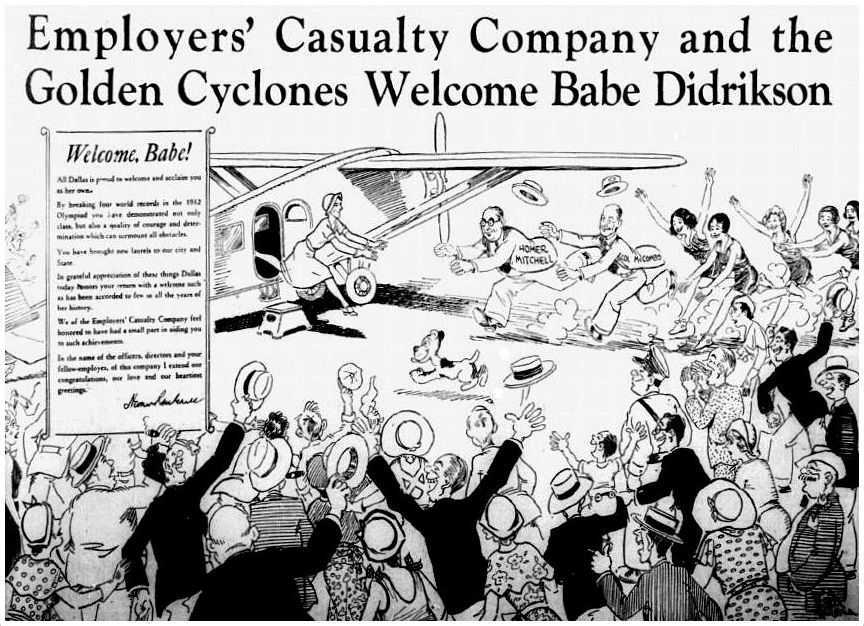
Above, an ad taken out by the Dallas company Babe worked for, welcoming her back home from her Olympic triumph. Drawing by Jack Patton. (Even though Babe had buckled to pressure with the whole hat thing, I can’t quite picture her wearing gloves.)

*

babe-and-babe_081247

Babe and the other Babe, August 12, 1947. I love this photo.

*

babe_vanity-fair_1933

Fantastic photo of Babe in her prime by Lusha Nelson, from the January, 1933 issue of Vanity Fair.

*

babe

***

Sources & Notes

The two photos of Babe Didrikson at her desk, the photo of the parade in Dallas, and the photo with Babe Ruth are from the huge selection of photographs of Babe at CorbisImages. See a lot of photos of her throughout her career, here. The photos of her training and in action are exhilarating, but it’s nice seeing her looking so happy and relaxed in her later golfing days. She definitely smiled a lot more after she started making more than the measly $75 a month she was making in Dallas.

An interesting article from 1975 about Babe in which former co-workers and teammates from Employers Casualty remembered their time with her can be found in the Dallas News archives: “Friends Recall Babe’s Prowess” by Temple Pouncey (DMN, Oct. 26, 1975).

For more on Babe’s time in Dallas and Oak Cliff, she writes about it in her autobiography, This Life I’ve Led (1955), here. (The entire book can be read for free at the link.) Also, check out this article by Gayla Brooks that appeared in the Oak Cliff Advocate.

A really well done, comprehensive overview of Babe Didrikson Zaharias’ career (with lots of great photos), can be found at Pop History Dig, here.

One of my favorite weird Babe things is the record she made with her “golf protege” Betty Dodd. Betty sings (not very well) and is accompanied by Babe on harmonica, an instrument she loved all of her life and which she taught herself to play as a child. The song — and a bit of backstory on Babe and Betty’s relationship — is here (click the arrow at the left of the strip beneath the record label to hear the song “I Felt a Little Teardrop”). Babe’s solo starts at about the 1:06 mark.

And, lastly, newsreel footage of Babe over the years, from the early track meets and the Olympics, to her later career as a golf superstar can be watched here and here.

*

Copyright © 2014 Paula Bosse. All Rights Reserved.
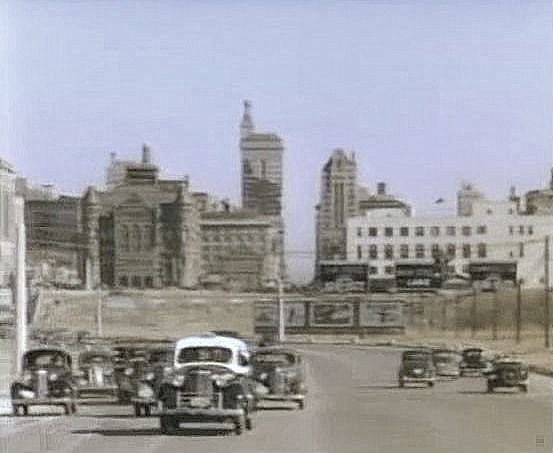
“A Cavalcade of Texas” — Dallas, Filmed in Technicolor, 1938

“A Cavalcade of Texas”

by Paula Bosse

(SCROLL DOWN TO WATCH THE FILM CLIPS.)

Brought to my attention last night in a Dallas history group was the heretofore unknown-to-me full-length, Hollywood-slick travelogue called “A Cavalcade of Texas,” shot around the state in 1938 under the auspices of Karl Hoblitzelle in his capacity as chairman of the Texas World’s Fair Commission. (Hoblitzelle also built the Majestic Theater and founded the Interstate Theatre chain.)

“A Cavalcade of Texas” — a 49-minute full-color travelogue touting the beauty, history, natural resources, and industries of the state — was made to be shown at the New York World’s Fair, but because of a variety of production and logistical problems, the film was, instead released theatrically. John Rosenfield, the legendary “amusements” critic for The Dallas Morning News, was suitably impressed. After an early preview of the film, he wrote:

The picture should be a revelation to the outlanders who still think of Texas as the backwoods with a hillbilly civilization. (DMN, June 27, 1939)

Ha.

The film opened in Dallas in October of 1939 at, unsurprisingly, The Majestic, second on a bill with a Ginger Rogers film (which was fitting, as Ginger had begun her professional career at The Majestic as a teenager). The pertinent paragraph from Rosenfield’s official review is amusingly snippy:

“Cavalcade” shoots the Houston skyline as a bristling metropolitan acreage but hides the Dallas buildings behind the towering Magnolia Building. Maybe we are sensitive about it but we don’t feel that architectural justice has been done. The Fort Worth aspect is glorified more than it deserves. (DMN, Oct. 15, 1939)

(Sorry, Fort Worth!)

The Dallas scenes are only about 4 minutes’ worth of the whole film, but to see Dallas at this time in color — and moving — is kind of thrilling. The entire film is on YouTube, but I’ve bookmarked the two Dallas bits. First, after an interminable sequence on how fantastic things will be when we finally make that darn Trinity navigable, is a Dealey Plaza-less Triple Underpass, shots of Main Street (including the now partially obliterated 1600 block at the 17:52 mark, on the right), Fair Park (including a description of the Hall of State as “the Westminster Abbey of the New World” (!)), and a neon-lit Elm Street at night. (If you let it keep going, you’ll see “the Fort Worth aspect.”)

(I am having problems embedding this clip to begin at the 17:30 mark. If the above does not begin at the Dallas sequence, see it at YouTube, here.)

*

Twenty minutes later, the viewer is, for some reason, shown the Dallas Country Club with what I’m guessing are Neiman-Marcus models pretending to play golf.

(If the above does not begin at the Dallas Country Club sequence at 40:09, see it at YouTube, here.)

*

Those are just the Dallas bits — the whole film is an impressive undertaking, and it’s great to see documentary footage of this period in rich color, presented with incredibly high production values, in full Hollywood style.

cavalcade_101439_ad
Ad, Oct. 14, 1939 (click to see larger image)

***

Sources & Notes

“A Cavalcade of Texas” was directed, edited, and narrated by James A. Fitzpatrick and can be seen in full on YouTube, here.

Background on Karl Hoblitzelle can be read in information provided by the Handbook of Texas, here, and by the Dallas Public Library, here.

The wonderful and vibrant 1939 footage of downtown Dallas that was discovered on eBay a few months ago and “saved” by a group of preservation-minded Dallasites, which included Robert Wilonsky and Mark Doty, is one of my favorite Dallas-history-related stories of 2014. Watch that footage here.

*

Copyright © 2014 Paula Bosse. All Rights Reserved.

Society Ladies and Their Great Big Hats

shakespeare-club_c1895The Dallas Shakespeare Club

by Paula Bosse

Had The Graduate been set near the beginning of the twentieth century rather than the middle of it, that famous scene out by the pool (er…near the horse trough) might have gone something like this:

Mr. McGuire: I just want to say one word to you. Just one word.

Benjamin: Yes, sir?

Mr. McGuire: Are you listening?

Benjamin: Yes, sir, I am.

Mr. McGuire: …”Millinery.”

Benjamin: …Exactly how do you mean?

Mr. McGuire: There’s a great future in millinery. Think about it. Will you think about it?

Benjamin: Yes, I will.

Mr. McGuire: Enough said. That’s a deal.

***

Sources & Notes

Photograph of the Dallas Shakespeare Club is from the Dallas Historical Society; it appears in the book Women and the Creation of Urban Life in Dallas, Texas, 1843-1920 by Elizabeth York Enstam (College Station: Texas A & M University Press, 1998). Enstam’s caption of this photograph identifies two women in the front row, on the right as Sallie Griffis Meyer (1863-1932), future president of the Dallas Art Association, and May Dickson Exall (1859-1936), president of the Dallas Shakespeare Club from 1886 until her death. Ms. Enstam has labeled this photo as “about 1895.” 

*

Dialogue (all but one word) from the film version of The Graduate, screenplay by Buck Henry, based on the novel by Charles Webb. “Millinery adaptation” by Paula Bosse, based on the screenplay by Buck Henry which was based on the novel by Charles Webb.

*

Copyright © 2014 Paula Bosse. All Rights Reserved.

Telephone Operators Sweating at the Switchboard — 1951

summer_telephone-operators_1951Low-tech A/C: ice, buckets, fans

by Paula Bosse

The summer of 1951 in Texas was brutally hot. One heat-related incident that August made national headlines: more than 1,500 Southwestern Bell telephone operators (and supportive coworkers) who were working in unairconditioned conditions (!!) at the Haskell Exchange on Bryan and at the Akard Street headquarters downtown staged what news reports called a “wildcat walkout” and refused to continue working in the sweltering buildings. Management’s attempt to cool things down with electric fans blowing over buckets of ice had not worked. Operators returned the next day, having made their point, hopefully to the imminent installation of air-conditioned switchboard rooms.

The caption for the photo above:

Dallas, Tex. Aug. 10 [1951] — BEATING THE HEAT — Both ice and fans are brought into play by telephone operators at an exchange here today as the city continued to swelter under 100-degree or over temperatures. The thermometer reached a high of 102-degrees to run the consecutive days of 100-degree readings to ten. It is the longest period of such reading since 1925 when a record 11 straight days was set. High mark for the present heat wave was 107 on August 6.

Three days later, the sweat hit the fan, and the women walked out.

operators_heat_st-joseph-MO-news-press_081451
St. Joseph [MO] News Press, Aug. 14, 1951 (click to read)

Let’s hope your work conditions are a bit better this summer!

***

Sources & Notes

Wire service photograph from the Southern Labor Archives of the Georgia State University Library Special Collections.

See ads from 1911 and 1925 encouraging women to become telephone operators in the Flashback Dallas post “Work and Play in Telephone Land,” here.

*

Copyright © 2014 Paula Bosse. All Rights Reserved.

Anyone For Bowling? — 1908

bowling_women_dmn_051008-lg

by Paula Bosse

“WOMEN BOWLERS MAKE GOOD SCORES”
Teams contesting on the alleys of the Dallas Turnverein.

Sports and corsets just don’t seem like a good combo.

Now I know what a turnverein is.

***

Photo by Clogenson, from The Dallas Morning News, May 10, 1908.

Click photo for larger image.

*

Copyright © 2014 Paula Bosse. All Rights Reserved.

Reading, Writing, Beekeeping — 1905

by Paula Bosse

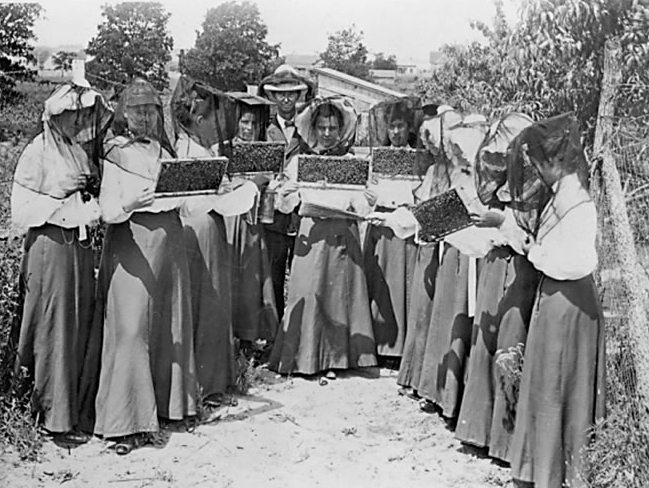
Beekeeping class at the College of Industrial Arts (later Texas Woman’s University) in Denton, around 1905. Pop quiz!

***

Sources & Notes

Photo from The Woman’s Collection of Texas Woman’s University.

Beekeeping was a popular “hobby” for women at the turn of the century, but for a look at larger-scale Texas honey production at this time, check out the article “The Bee Industry of Texas” from the 1904 edition of the Texas Almanac here.

For information on present-day North Texas beekeeping, the website of the Dallas-based Texas Honeybee Guild is here.

*

Copyright © 2014 Paula Bosse. All Rights Reserved.

The Ladies’ Reading Circle: An Influential Women’s Club Organized by Black Teachers in 1892

ladies-reading-circle_negro-leg-brewer_1935The Ladies (click for larger image)

by Paula Bosse

When one thinks of “ladies’ clubs” of the past, one probably tends to think of groups of largely well-to-do women in fashionable dresses, gloves, and smart hats who gathered for quaint meetings in one another’s homes to discuss vaguely literary or cultural topics, sip tea, chit-chat, and gossip. Often they would plan projects and events which would aid pet community or charitable causes. There were clubs of varying degrees of serious-mindedness, but, for the most part, club meetings were mostly an excuse for women to socialize. 100 years ago, these women rarely worked outside the home, and these groups offered an important social and cultural outlet for well-educated women of means. White women. Women of color were not part of that particular club world. They had to create clubs for themselves. And they did.

In 1892, eight African-American teachers in Dallas organized their own club, the Ladies’ Reading Circle, and while it, too, was an important social outlet for the women, the focus of the group tended to be more serious, with reading lists comprised primarily of political, historical, and critical texts.

The members of the Ladies’ Reading Circle (a group that lasted at least until the 1950s) were, for the most part, middle-class black women who set an agenda for the club of education, self-improvement, and social responsibility. Like most women’s clubs of the time, each meeting of the LRC was held in a different member’s home and usually ended with a “dainty” luncheon and light musical fare, courtesy of the Victrola or player piano; but what set the LRC apart from most of the other women’s clubs of the day was the choice of reading material — from books on world history and international politics, to texts on current affairs and social criticism. (Several surprising examples appear below.)

Not only did the women gather weekly to discuss current and cultural affairs, they also worked to improve their community by tackling important social issues and by inspiring and encouraging young women (and men) who looked to them as civic leaders. Noted black historian J. Mason Brewer dedicated his 1935 book Negro Legislators of Texas to the women of the Ladies’ Reading Circle. The photograph above is from Brewer’s book, as is the following dedication:

lrc_negro-leg-brewer_1935-dedication

Included were the names of the members, several of whom had organized the club in 1892:

lrc_members_brewer

One of the LRC’s concerns was establishing a home which, like the white community’s YWCA, offered housing and career training for young women. The charming frame house the club bought for this purpose in 1938 (and which is described in the Jan. 10, 1952 News article “Ladies Reading Circle Seeks $7,500 for Expanding Home”) still stands at 2616 Hibernia in the State-Thomas area

lrc-home_2616-hibernia_google2616 Hibernia (Google Street view, 2014)

But the group was organized primarily as a “reading circle,” and the minutes of three randomly chosen meetings show the sort of topics they were interested in exploring. The following three articles are from the post-WWI-era, and all appeared in The Dallas Express, a newspaper for the city’s black community.

lrc_dallas-express_040320April 3, 1920

lrc_dallas-express_041020April 10, 1920

lrc_dallas-express_102023October 20, 1923

My favorite juxtaposition of content on the pages of The Dallas Express was the article below which reported on a white politician’s promise that he would fight to keep “illiterate Negro women” from voting — just a column or two away was one of those eye-popping summaries of the latest meeting of the Ladies’ Reading Circle. My guess is that the black educators who comprised the Ladies’ Reading Circle were probably far more knowledgeable about world events than he was.

negro-womans-suffrage_dallas-express_052220May 22, 1920

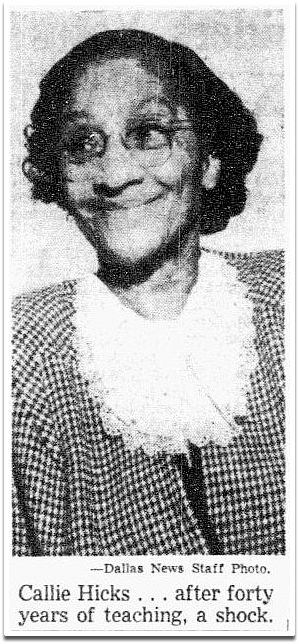
In reading the limited amount of information I could find on the LRC, I repeatedly came across the name of one of the earliest members, Callie Hicks (she is in the 1935 photo at the top, seated, second from the right). She was a dedicated teacher as well as a respected civic leader who worked for several causes and was an executive of the Dallas branch of the NAACP. A Dallas News article about Miss Hicks appeared in Feb., 1950 when she was named “Woman of the Year” by one of the largest African American women’s organizations in Dallas County (“Honor Caps 40 Years of Helpful Teaching,” DMN, Feb. 10, 1950). Miss Hicks died in May, 1965.

callie-hicks_dmn-021950-photo1950

It’s a shame that the Ladies’ Reading Circle is not better known in Dallas today. I have to admit that I had never heard of the group until I stumbled across that 1935 club photo. Their tireless work to improve the intellectual lives of themselves and others no doubt influenced the generations that followed.

***

Sources & Notes

Top photograph, dedication, and member list, from Negro Legislators of Texas and Their Descendants; A History of the Negro in Texas Politics from Reconstruction to Disenfranchisement by J. Mason Brewer (Dallas: Mathis Publishing Co., 1935).

Minutes from the Ladies’ Reading Circle meetings all printed in The Dallas Express.

Relevant material on the LRC and other historic African-American women’s clubs can be read in Women and the Creation of Urban Life, Dallas, Texas, 1843-1920 by Elizabeth York Enstam (College Station: Texas A & M University Press, 1998), here.

The Handbook of Texas entry for one of the founding members of the Ladies’ Reading Circle, Julia Caldwell Frazier, can be found here.

*

Copyright © 2014 Paula Bosse. All Rights Reserved

Neiman-Marcus Celebrates the Texas Centennial with “Cactus Colors” and Cattlebrands Burned Into Rawhide Belts — 1936

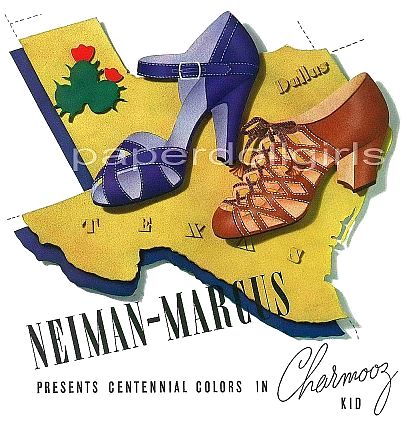
neiman-marcus_shoes_vogue-1936-det

by Paula Bosse

Texans celebrate history with — what else? — fashion! Below, text from a Neiman-Marcus ad which appeared on the eve of the huge Texas Centennial celebrations in 1936.

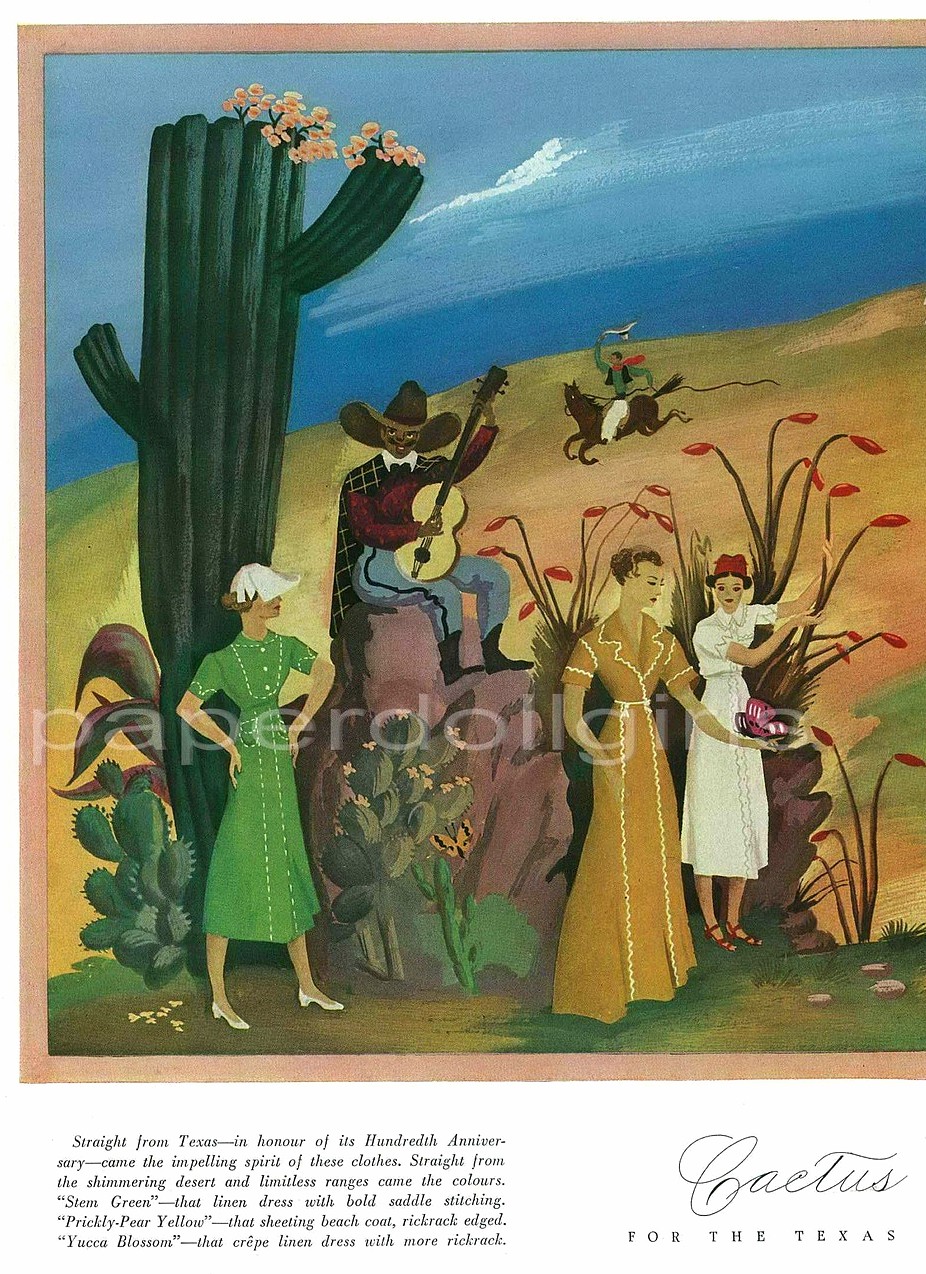
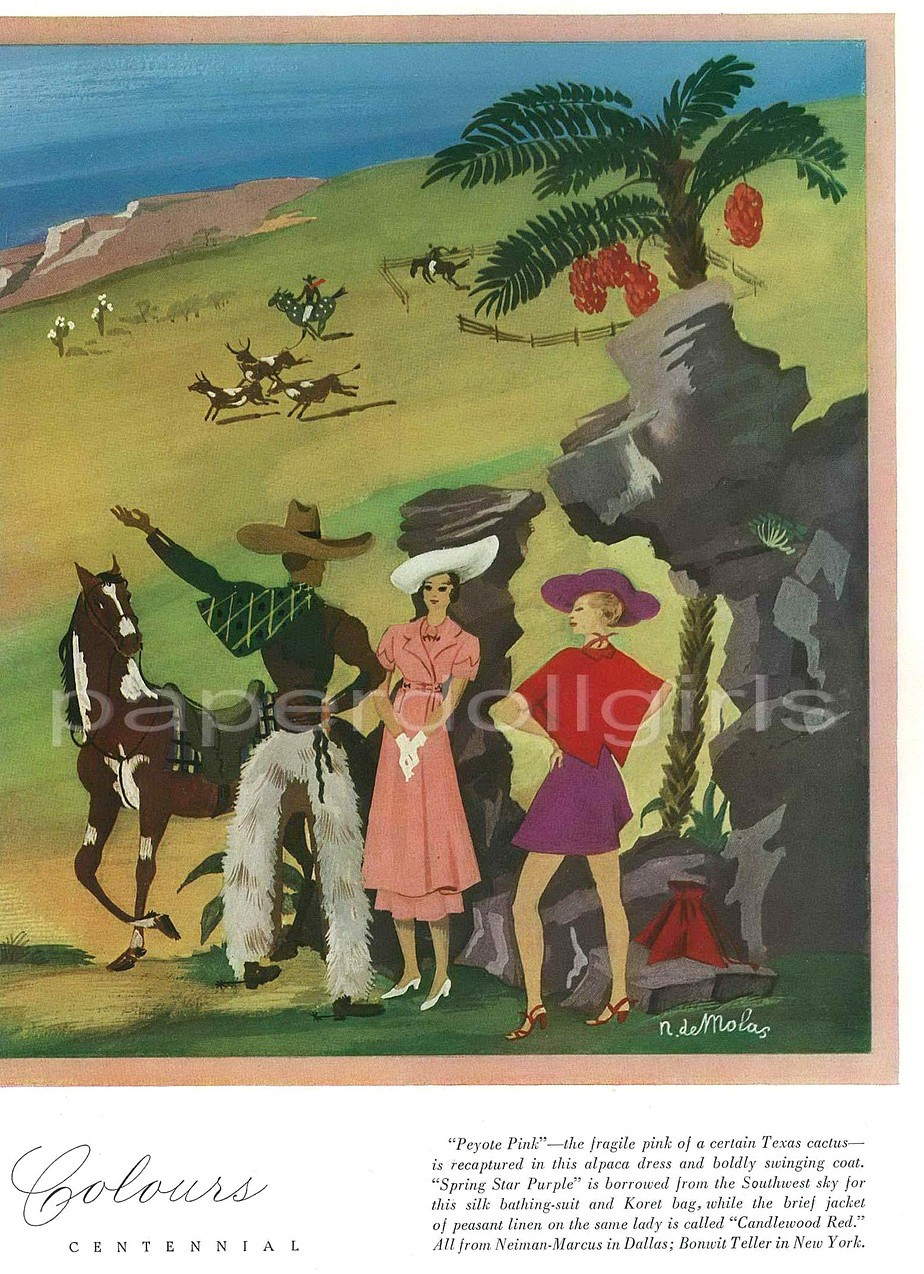
Five days before the Centennial finds Neiman-Marcus keyed for last-minute demands … both in selections and service … Spectator clothes and accessories in cactus colors (see current Vogue), and Artcraft stockings, thin as a web, in Texas range colors … Cool snowy crepe dresses for the afternoon and printed chiffon jacket dresses for Centennial sightseeing … Cottons gifted with importance … Crownless roof hats and trailing garden party dresses … Cattlebrands burned on a rawhide belt that girdles a crisp white watching dress. All in the best of taste and at a happy range of prices.

And then I looked for the Vogue ads mentioned and … wow! I’ve had a vintage advertising blog for several years, and I’ve seen a lot of ads … but these may be my favorites! All as a tie-in to the Texas Centennial, celebrated in Dallas in 1936, spear-headed by Stanley Marcus himself. Thanks, Mr. Stanley!

neiman-marcus_shoes_vogue-1936

neiman-marcus_cactus-colours_vogue-1936a

neiman-marcus_cactus-colours_vogue_1936b

***

Color ads from Vogue, June 1936. I found them on Etsy from this seller (the ads have, apparently, been sold). I would LOVE to see these with the watermarks removed, and I’d also love to know what became of the original artwork and who “N. de Molas” was. I love Texas kitsch and I love fashion illustration from this period, and this is fantastic! Click color pictures for much larger images! And read that copy, man.

If you want to wander around a whole bunch of vintage advertising, my Retro Adverto blog is here, but it has been sadly neglected since my immersion into this blog!

*

Copyright © 2014 Paula Bosse. All Rights Reserved.
 

Swell Hats for Swell People — 1911

sangers-hats_dmn_030711asangers-hats_dmn_030711b

For the ladies: “For every lady desirous of owning a Swell Hat for the Horse Show or any of the other Spring functions…. There are daring creations in the large and small shapes; there are conservative styles for the demure maiden.”

e-m-kahn_hats_dmn_030711

And for the gentlemen, The Ryton:“The most popular style of the season; a wide-brimmed telescope, in all proportions, with the very correct pencil curl edge. Ask for this Hat; you’ll like it.”

(You don’t see a lot of semi-colons in ads anymore, do you?)

***

Sanger Bros. ad and E.M. Kahn ad from The Dallas Morning News, March 7, 1911.

*

Copyright © 2014 Paula Bosse. All Rights Reserved.

Linz Bros. and “The Vogue of Bracelets” — 1923

ad-linz-bros_dmn_031123

by Paula Bosse

What a beautiful art nouveau-inspired ad, echoing Beardsley’s pen and ink drawings and Whistler’s Peacock Room. This is wonderful. And it’s unsigned! Ah, the lot of the commercial artist.

***

Ad from The Dallas Morning News, March 11, 1923.

More on Linz Brothers, premier Dallas jewelers, here.

*

Copyright © 2014 Paula Bosse. All Rights Reserved.