Flashback : Dallas

A Miscellany: History, Ads, Pop Culture

Category: Zooming in on Details

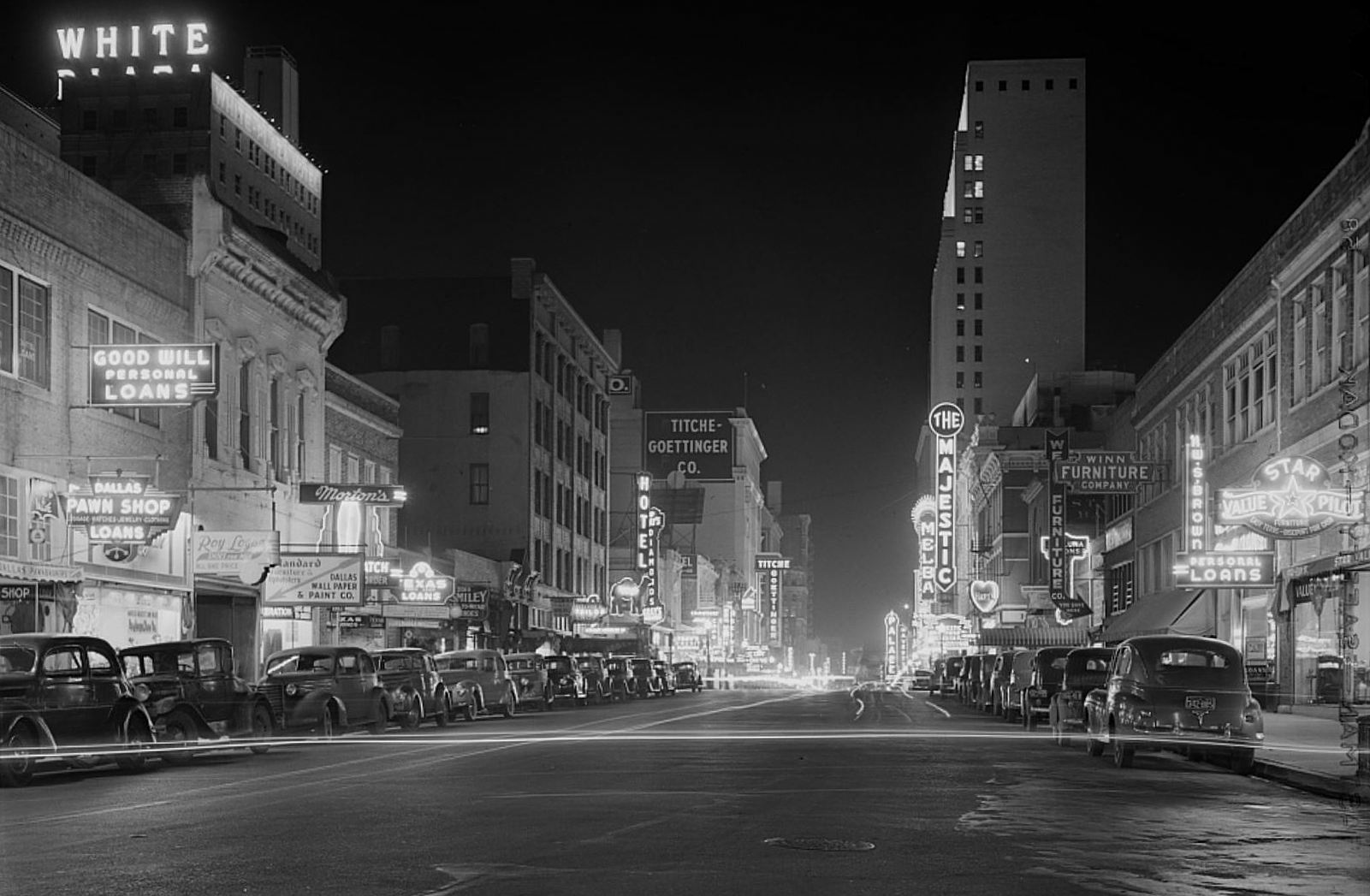
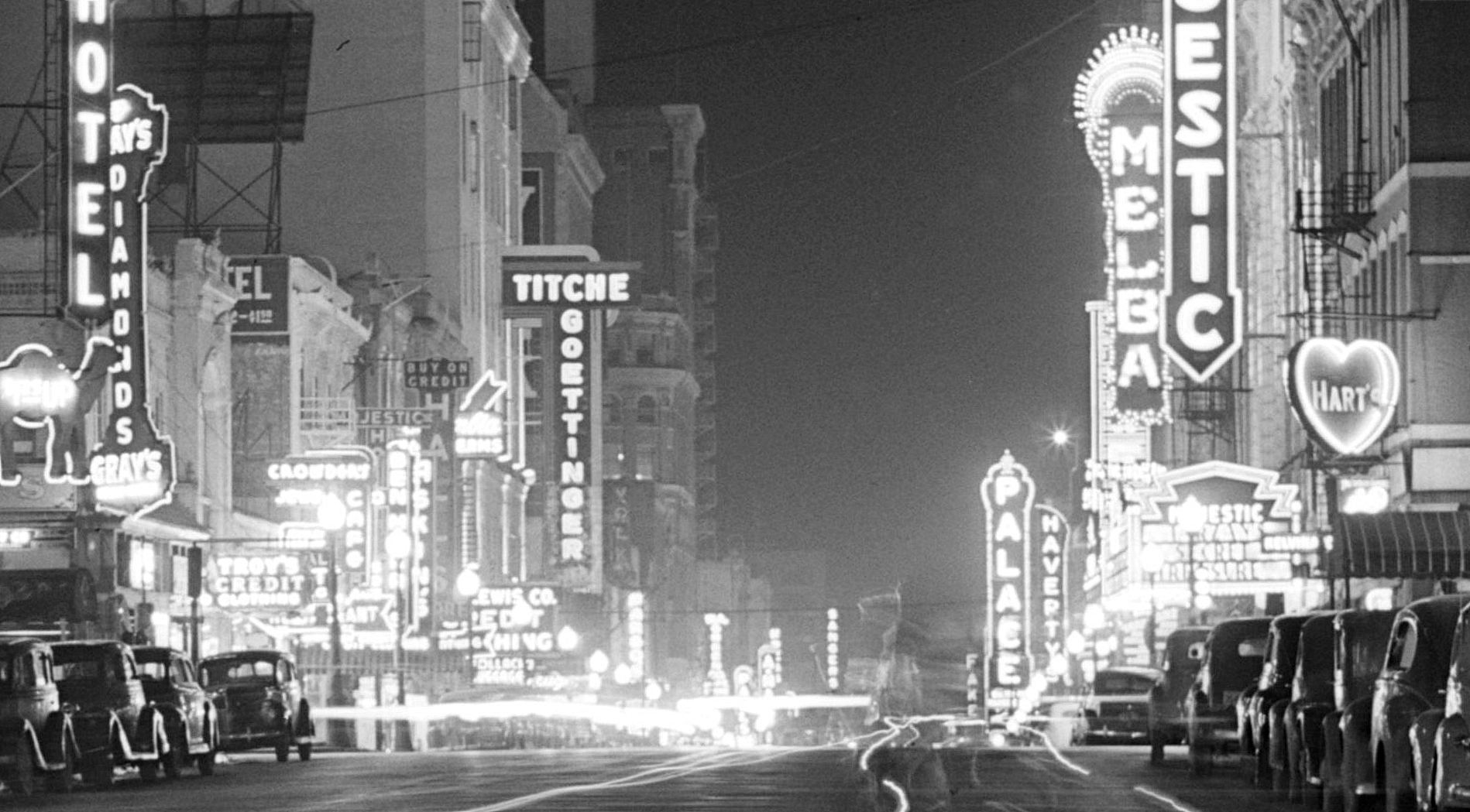
“Night View, Downtown Section” by Arthur Rothstein — 1942

rothstein_elm-street_jan-1942_loc_lg“Linger on the sidewalk where the neon signs are pretty…”

by Paula Bosse

If you’re interested in Dallas history, chances are pretty good that you’ve seen this photograph by Arthur Rothstein, which was taken in 1942 — sometime between January 9th and 16th — taken for the Farm Security Administration (FSA). It shows Elm Street — “Theater Row” — looking west from the block east of Harwood. This photograph is from the Library of Congress (here) a larger image can be explored here.

Below are a few magnified details (click pictures to see much larger images).

*

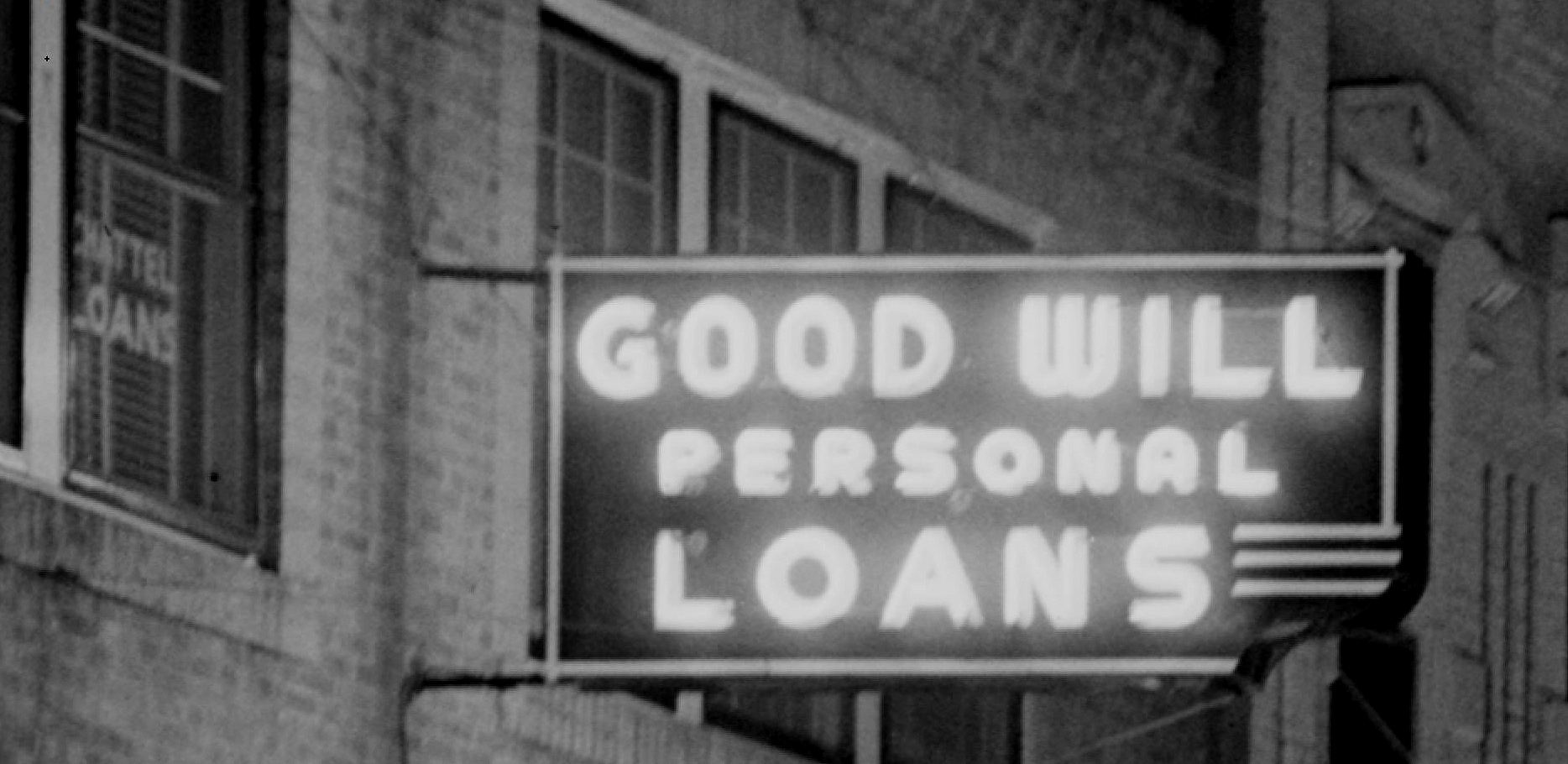
Chattel loans and good will:

rothstein_good-will-loans

*

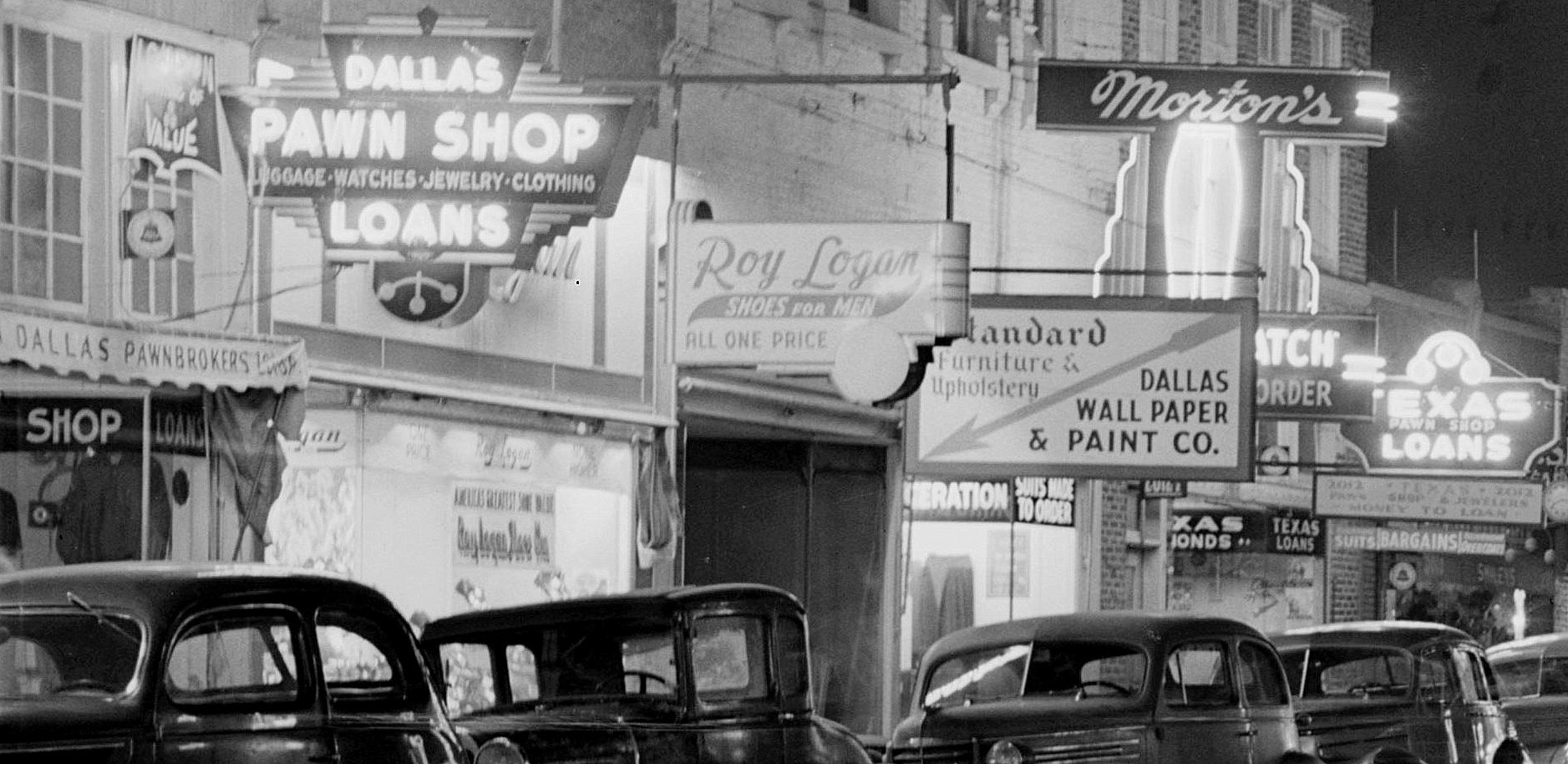
Morton’s Pants Shop (2014 Elm) has a neon sign in the shape of a pair of pants!

rothstein_south-side_a

*

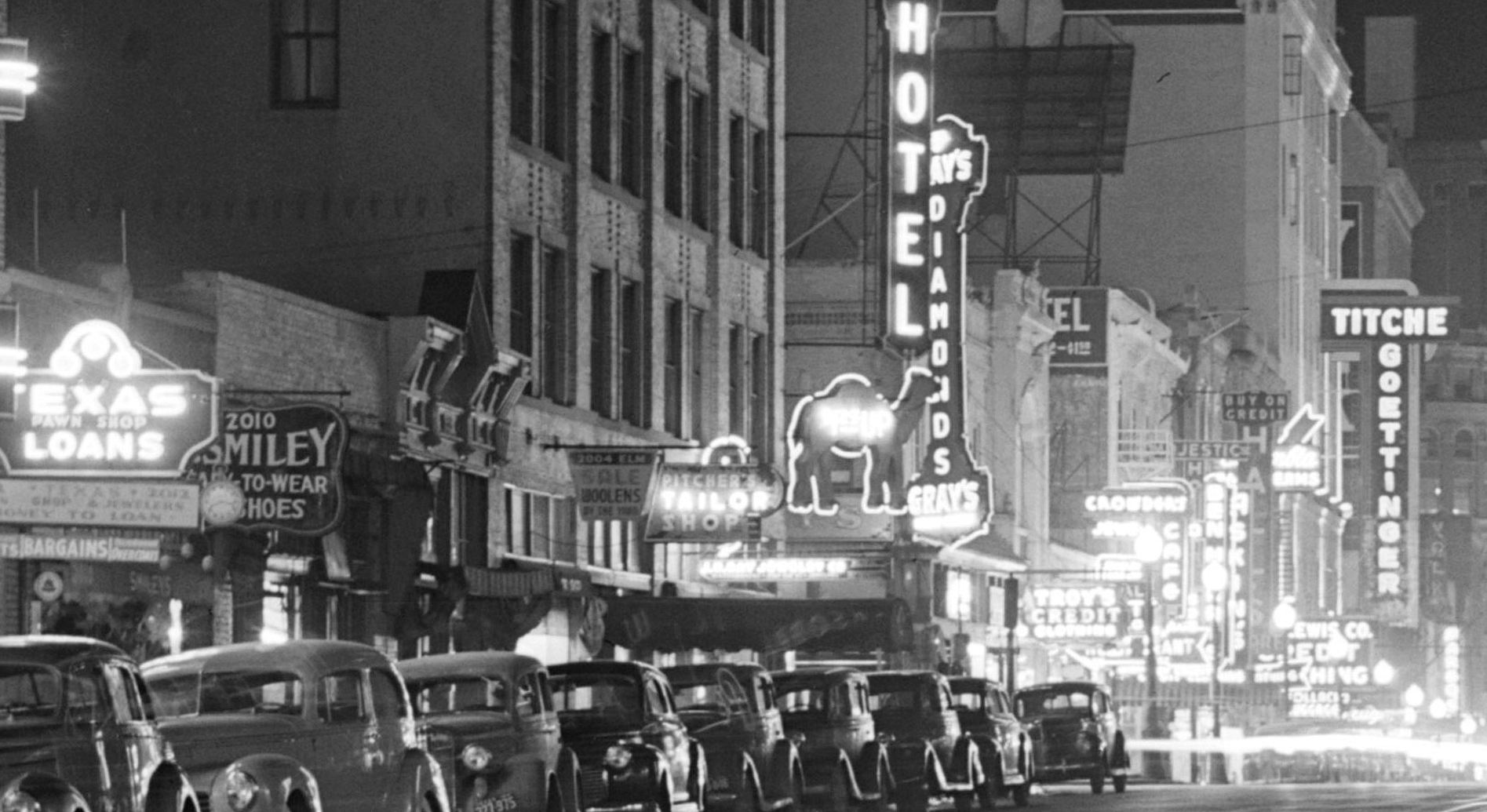
More interesting neon: the Texas Pawn Shop (2012 Elm) has the traditional three balls, and, better, the Campbell Hotel (Elm and Harwood) has a camel!

rothstein_south-side_b

*

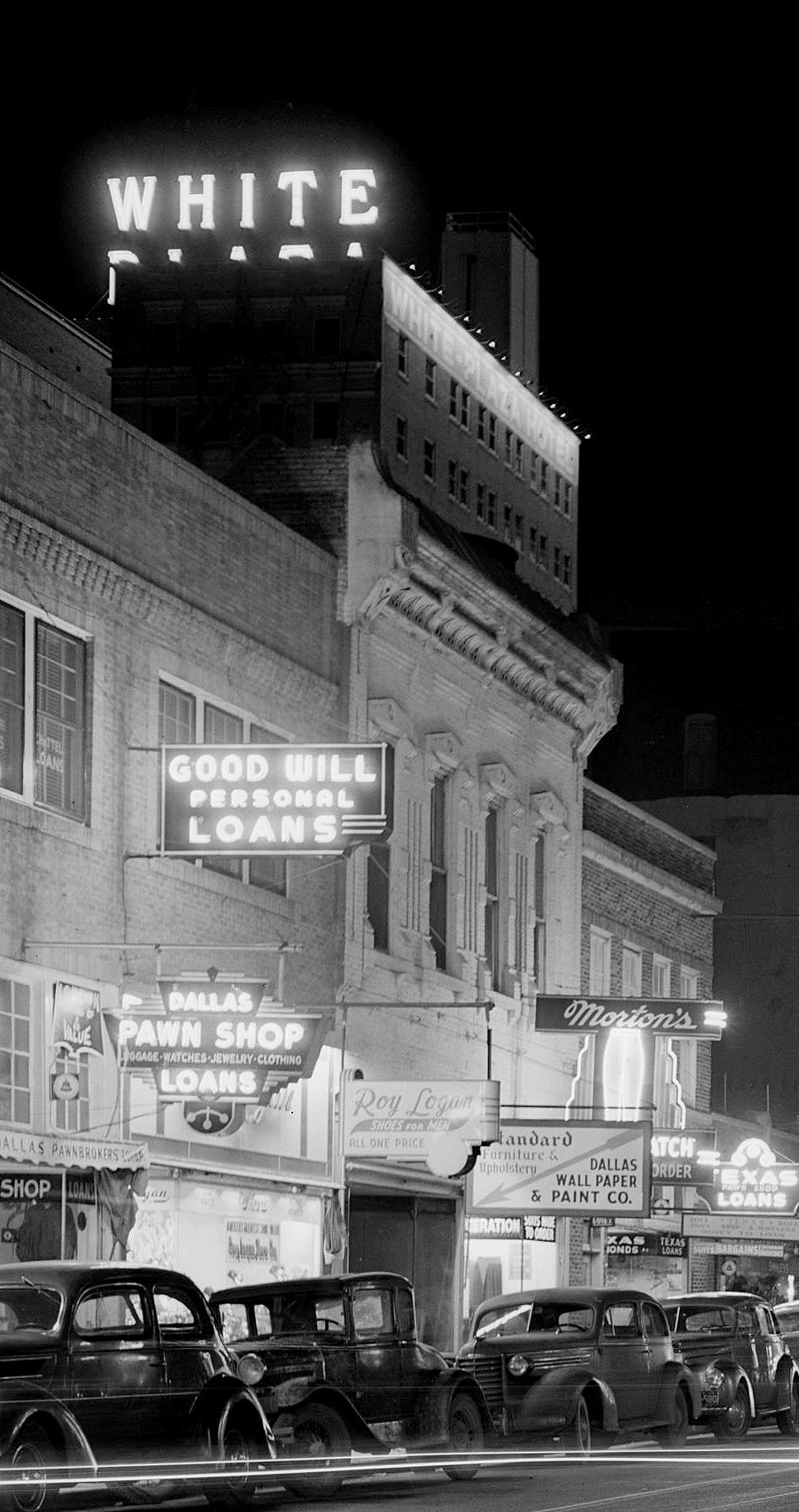
The White Plaza on Main St. (at Harwood) was originally the Hilton Hotel and is now Hotel Indigo. There were some great buildings in this block.

rothstein_south-side_vert

*

That light is blinding.

rothstein_center

*

The towering Tower Petroleum Building (Elm and St. Paul) is pretty cool-looking here.

rothstein_north-side_vert

*

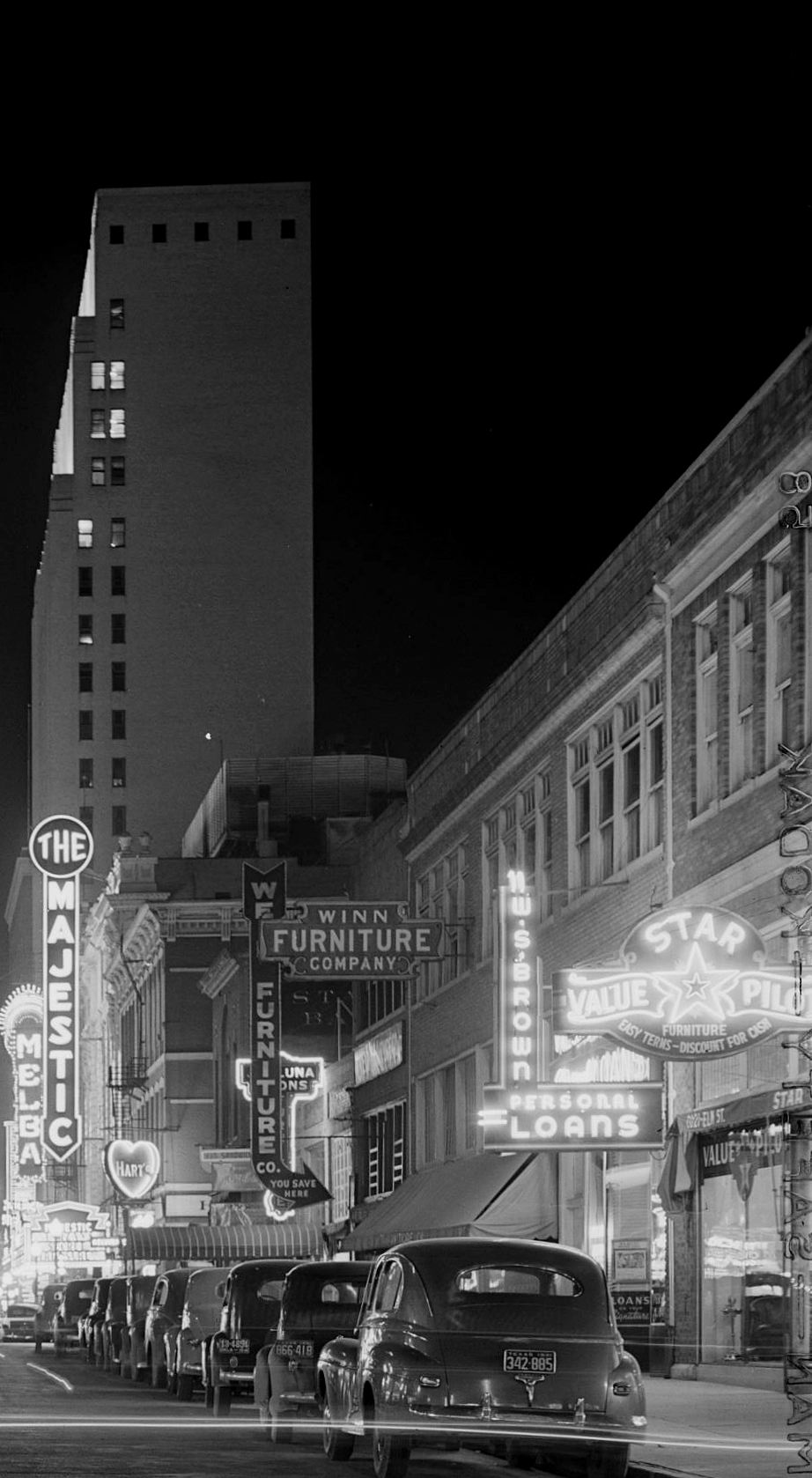
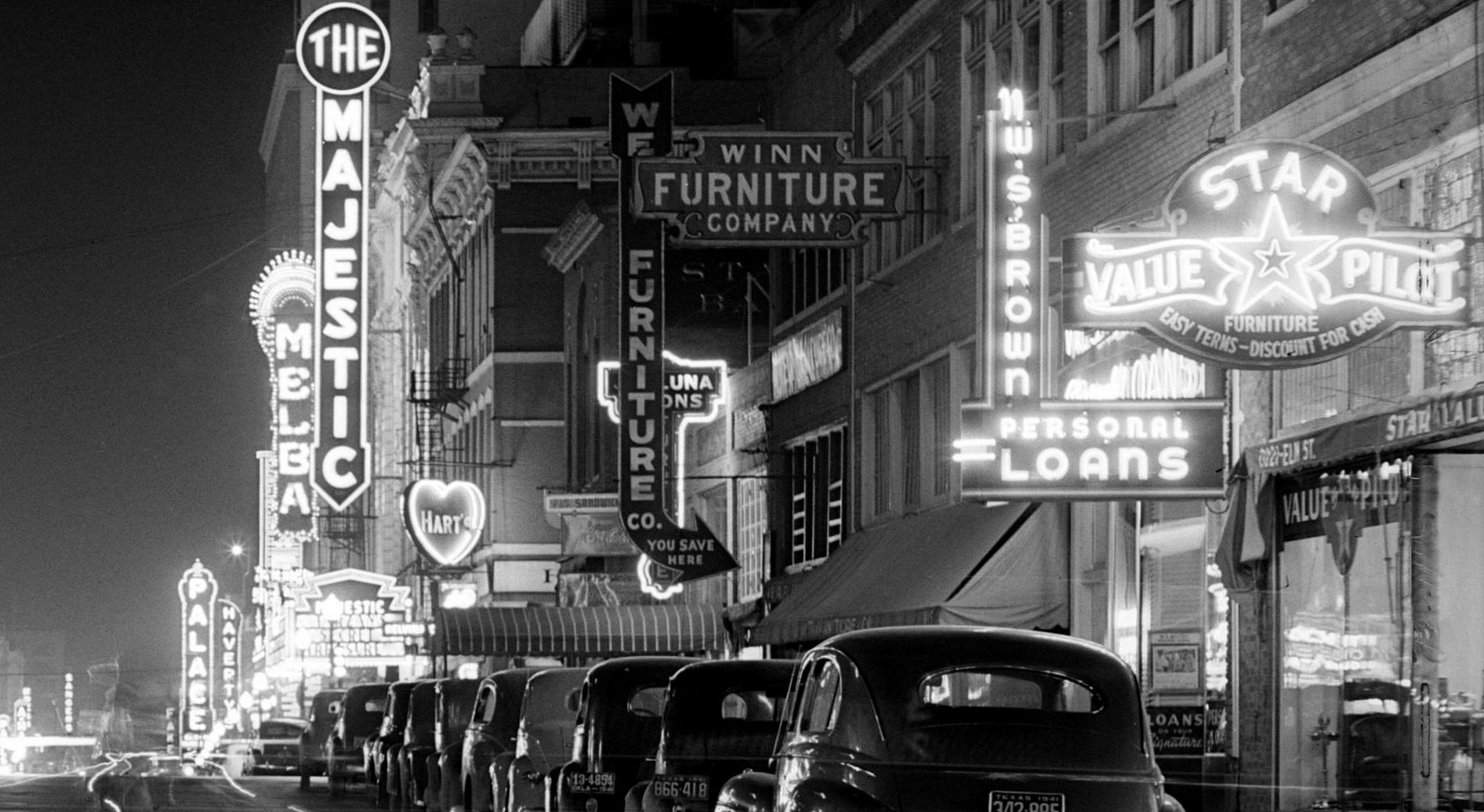
The 2000 block of Elm (seen in the foreground, just east of the Majestic block) was full of furniture stores, pawn shops, and tailors. This is my favorite detail from this photograph. Sadly, the entire block — which was once filled with businesses and activity — was completely demolished; the “camel” side of the street is now occupied by an ugly parking garage, and this side of the street is a wasteland of ugly asphalt parking lots. Yep.

rothstein_north-side

*

1941 plates.

rothstein_texas-1941-plate

*

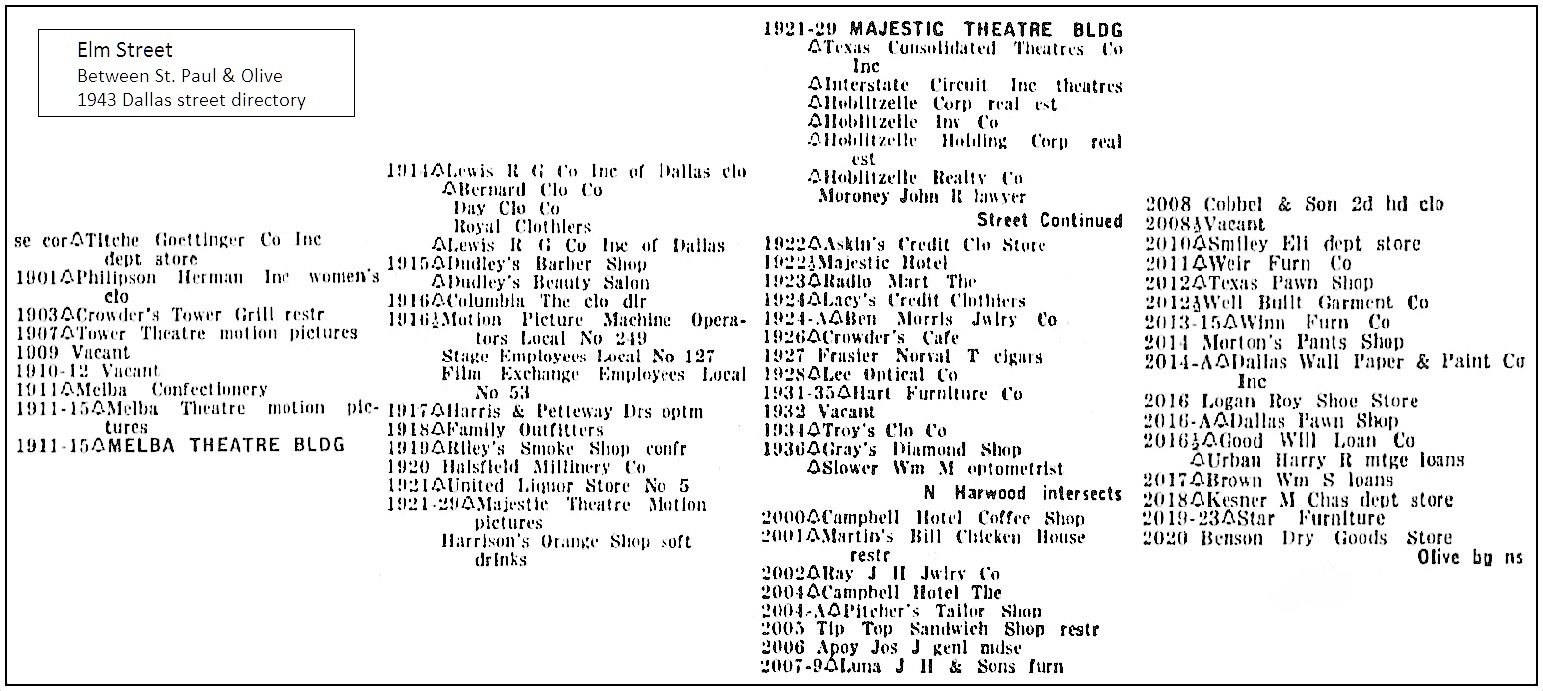
Below, Elm Street businesses from the 1943 city directory, beginning at N. St. Paul and ending at N. Olive. Next stop: Deep Elm.

elm-street_1943-directory

*

The view today? Here. Hope you weren’t too attached. Kiss most of it bye-bye.

***

Sources & Notes

Photo from the Library of Commerce, here. This photo is all over the place, including the great Shorpy website, here (click the “supersize wallpaper” link under the photo to see it BIG). If you want a super-gigantic 26.3 MB file (5978 x 4619) (!), download the TIFF file in the dropdown beneath the photo.

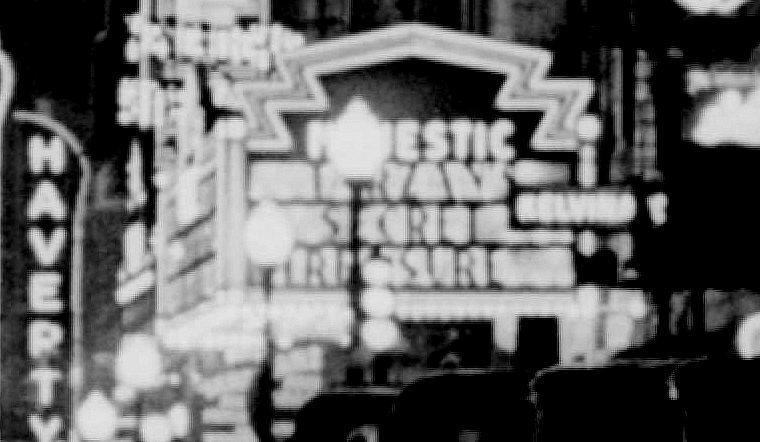
The movie playing at the Majestic Theatre is “Tarzan’s Secret Treasure.” Newspaper ads show that the movie opened on January 9, 1942 and played just one week, closing on January 16.

tarzans-secret-treasure

Thanks, Cody and Chris for asking about this photo!

Everything’s bigger in Texas, and everything’s bigger when it’s clicked.

*

Copyright © 2016 Paula Bosse. All Rights Reserved.
 

Zooming In on the State Fair: The Midway, the Cotton Bowl, and the Octopus — ca. 1950

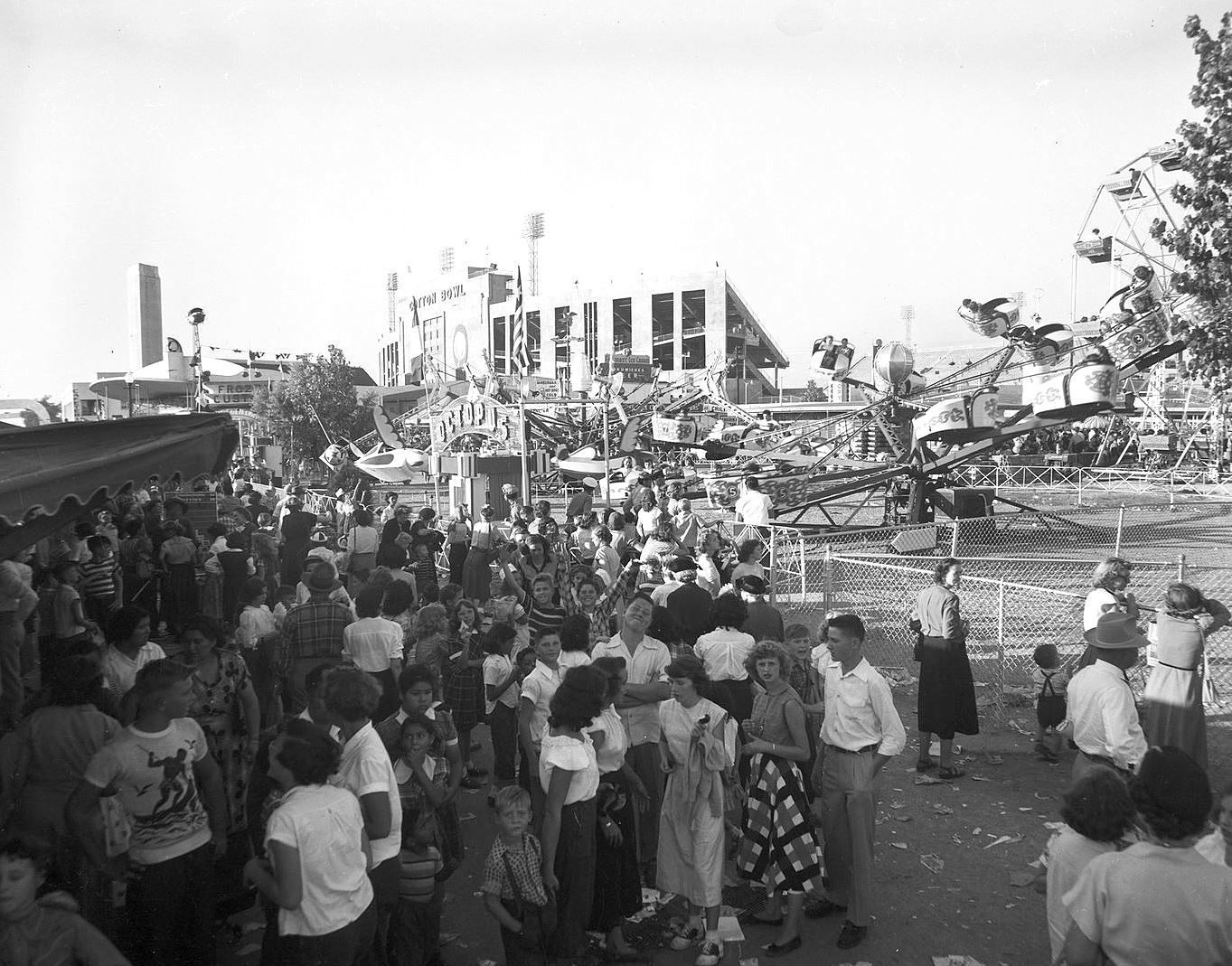
state-fair_midway-cotton-bowl_squire-haskins_ca_1950_utaAnother visit to the fair… (click for larger image)

by Paula Bosse

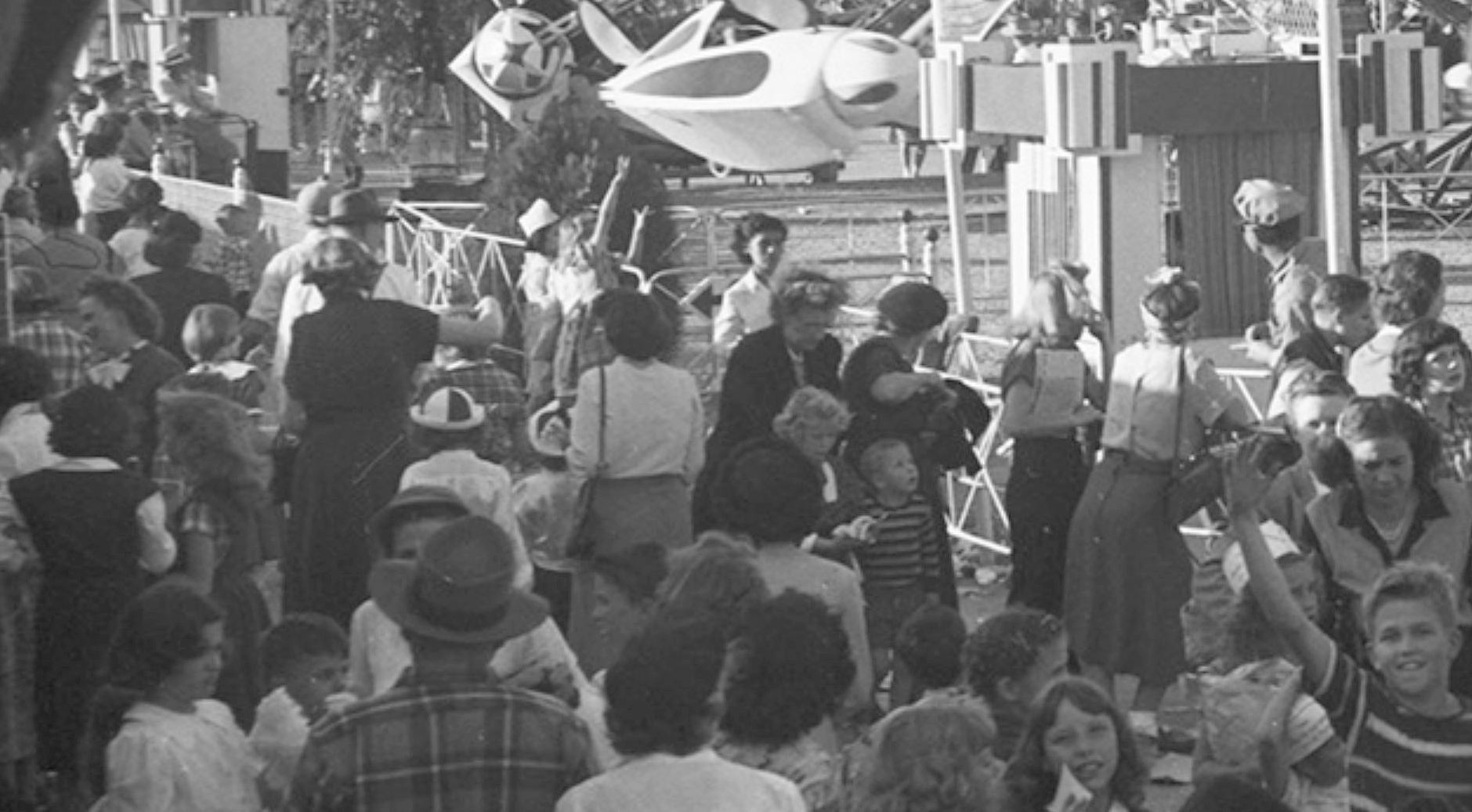
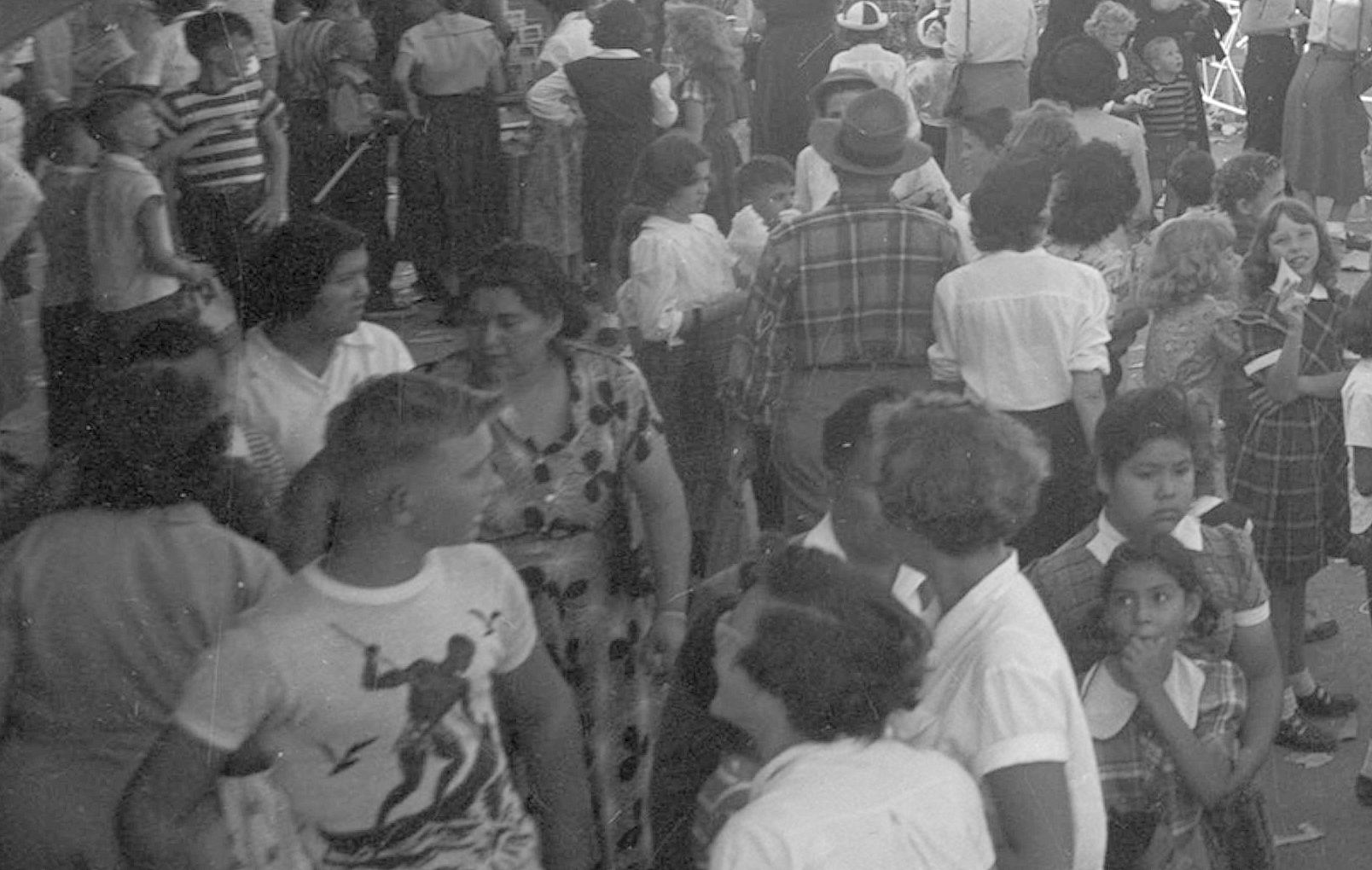
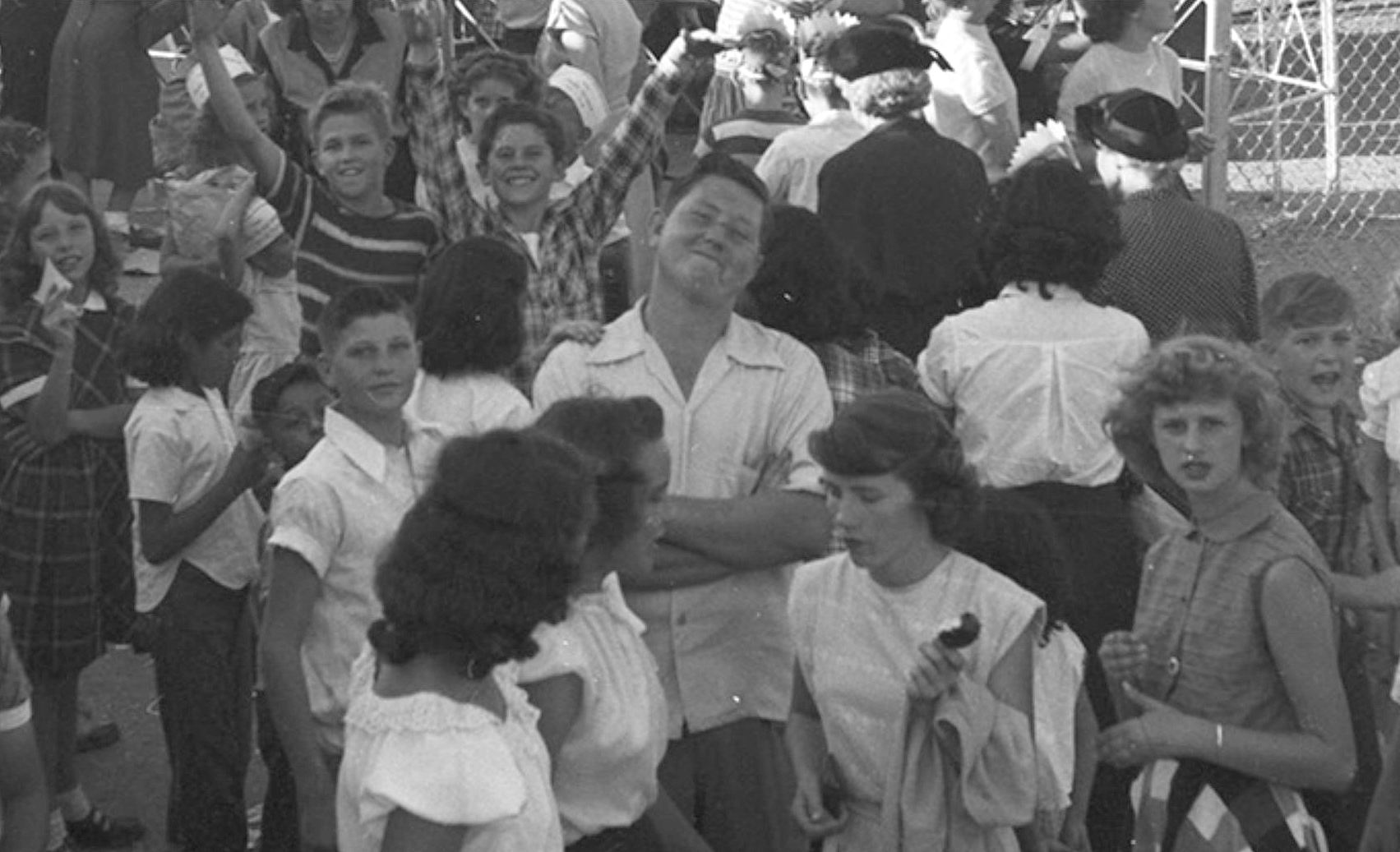
When I see old photos of the State Fair, I always look at the people. Let’s take a closer look at this great photo by Squire Haskins, taken around 1950. (See a BIG scan of this photo at the UTA website, here.)

Here are a few magnified details from Haskins’ photo (all are much larger when clicked):

midway-zoom_1

midway-zoom_2

midway-zoom_3

midway-zoom_5

midway-zoom-4

midway-zoom_6

***

Top photo by Squire Haskins, from the Squire Haskins Photography, Inc. Collection, Special Collections, University of Texas at Arlington Libraries; more information can be accessed here. (Other photos from this collection which were taken around the State Fair Midway at about this time were taken in October, 1950 — this one is not dated, but it seems likely it was taken at the same time.)

See other photos I’ve zoomed in on here.

Click pictures for larger images!

*

Copyright © 2016 Paula Bosse. All Rights Reserved.
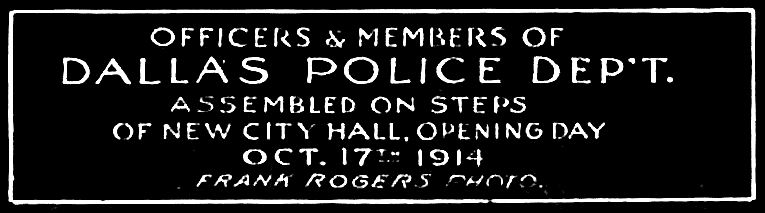
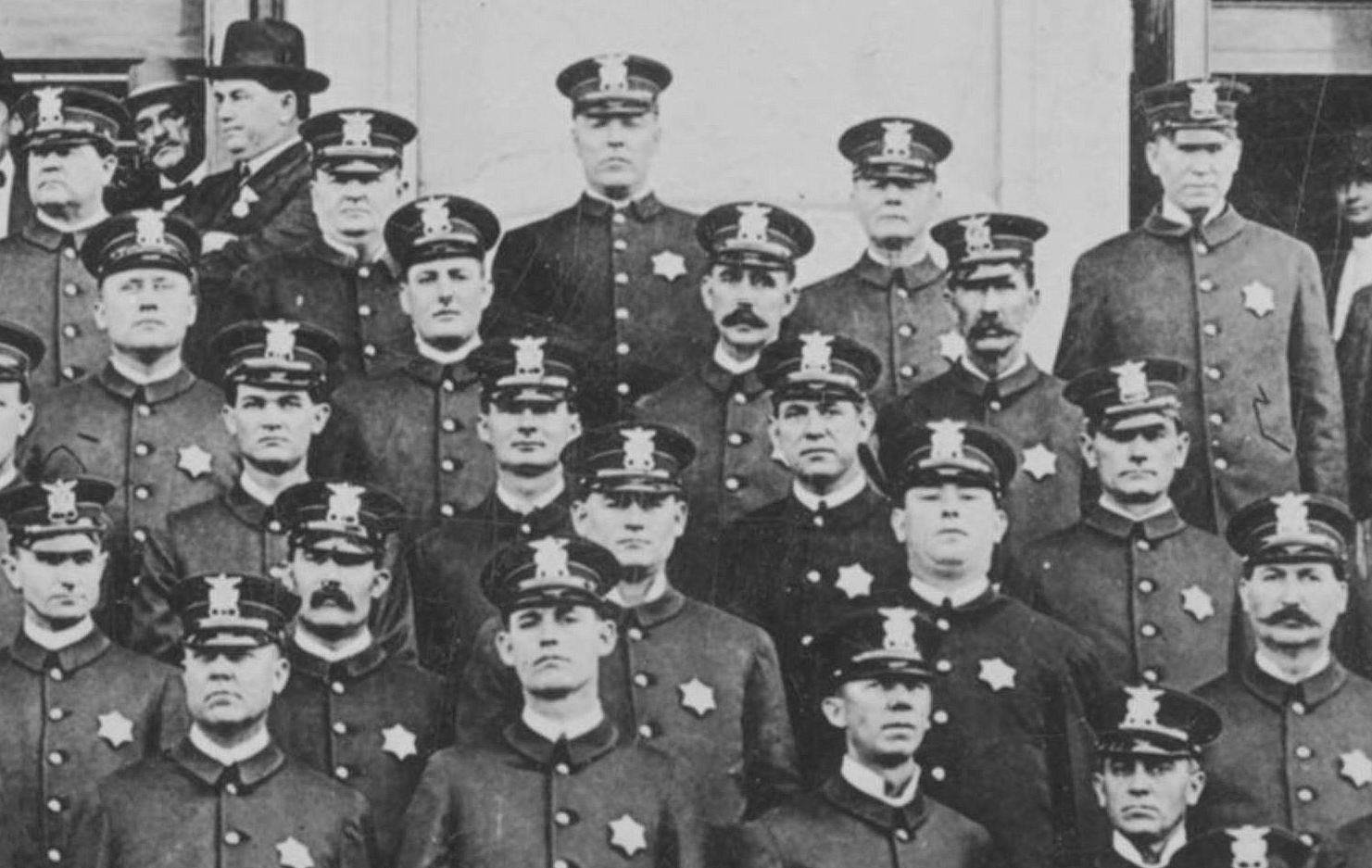
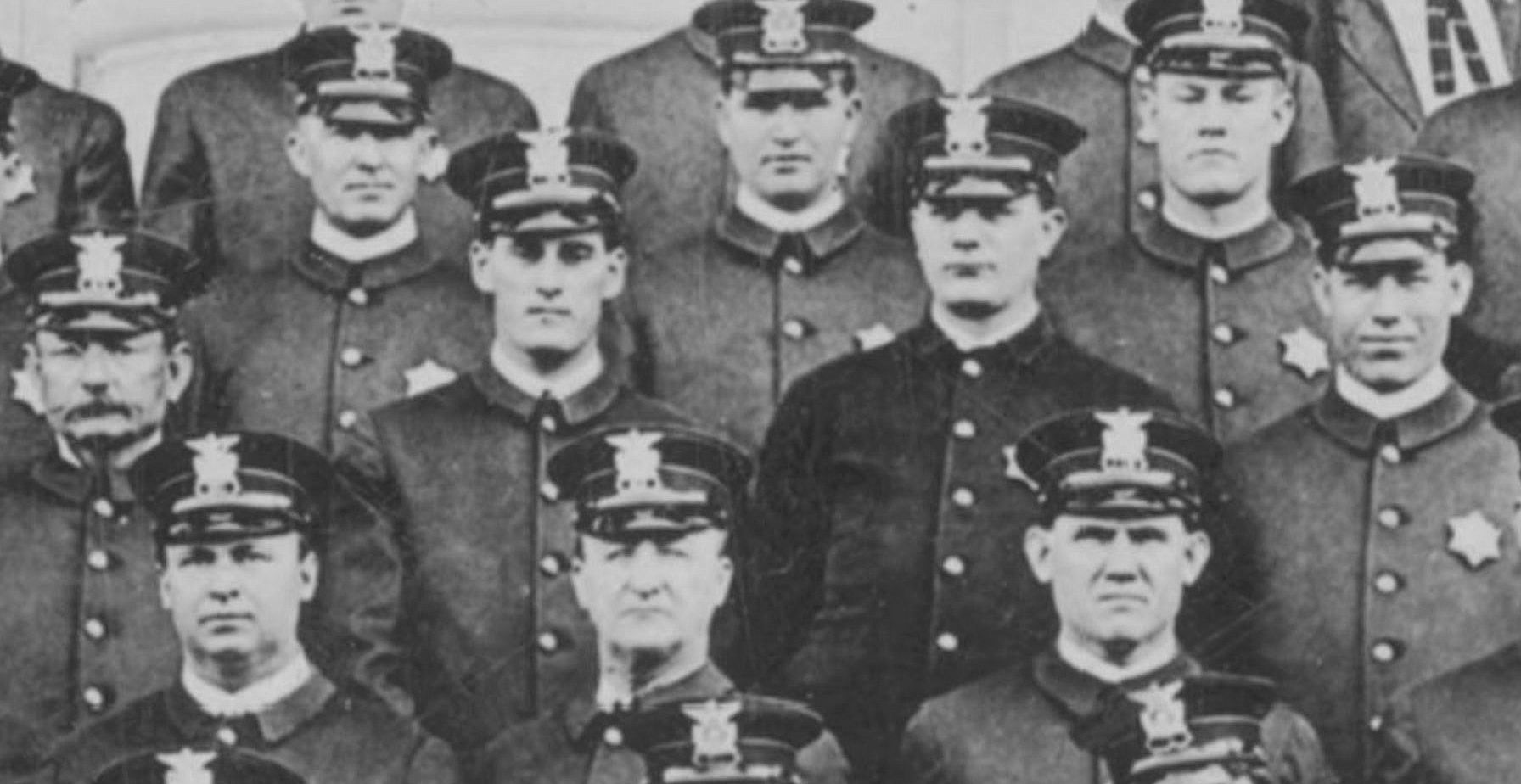
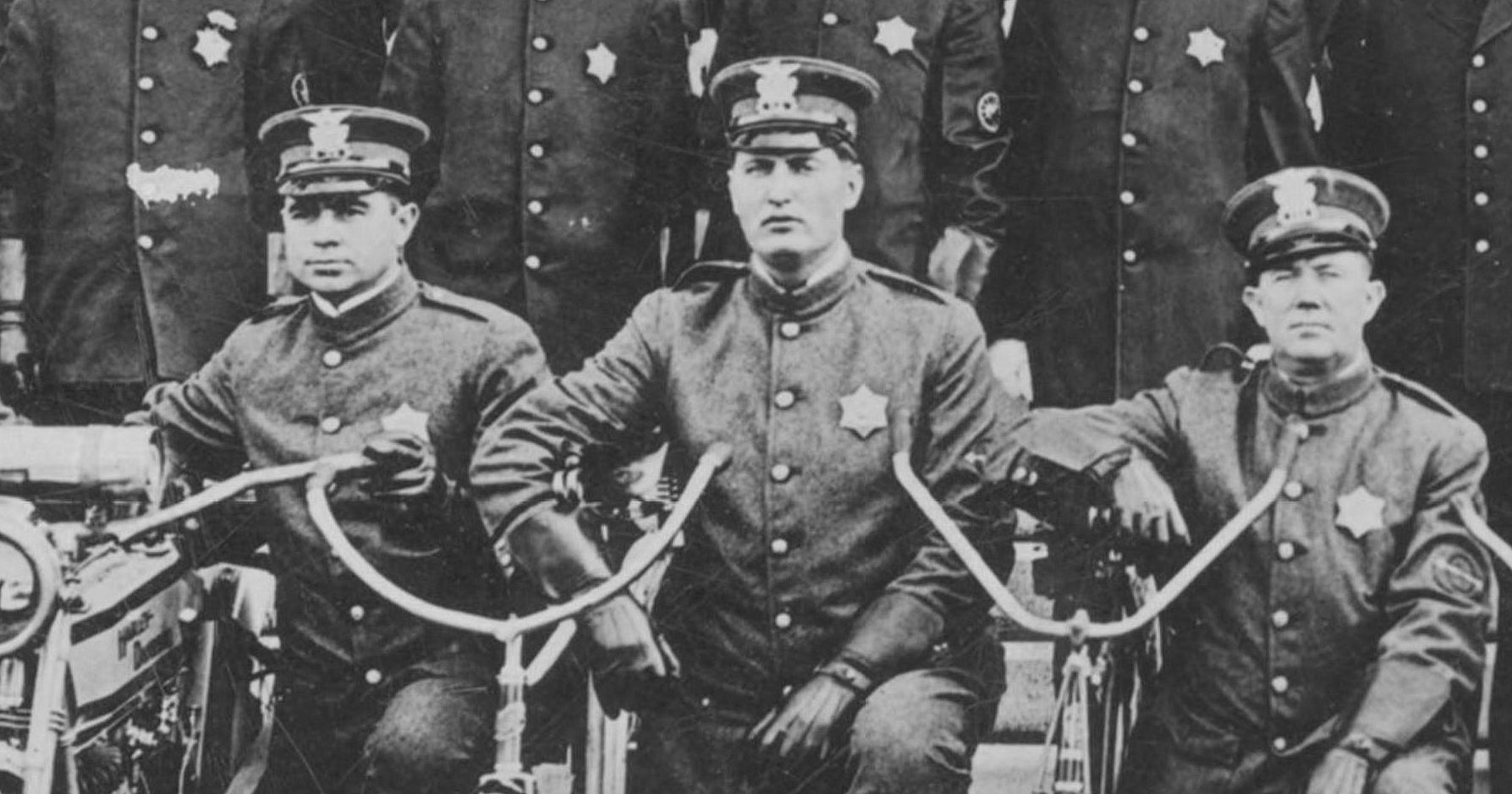
Dallas Police Department — 1914

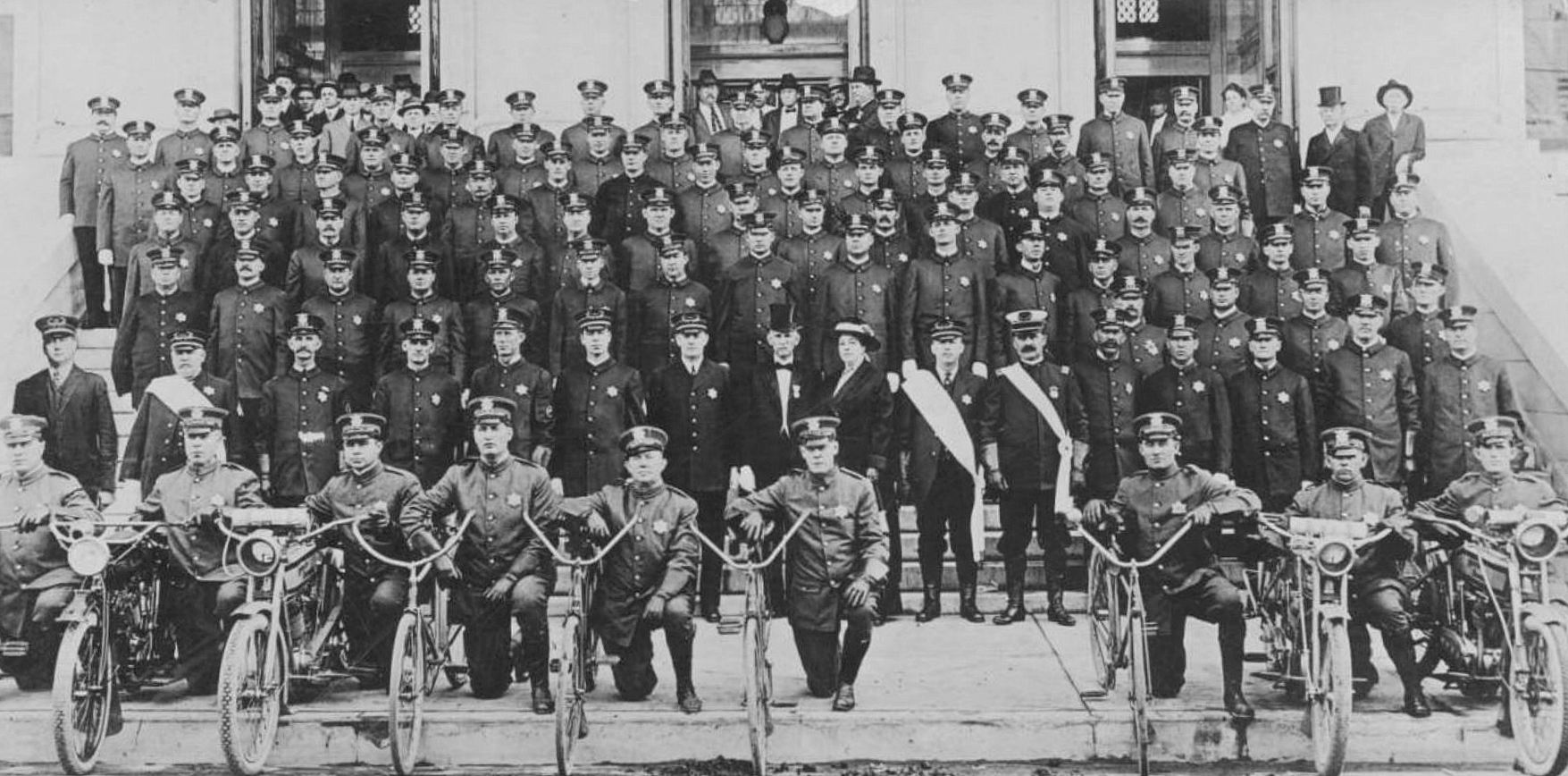
dallas-police-dept_opening-of-city-hall_101714_cook-colln_degolyer_smuOn the steps of the Municipal Building (click for much larger image)

by Paula Bosse

dallas-police-dept_frank-rogers_101714_cook-colln_degolyer_smu

police_1914_det3

police_1914_det4

police_1914_det5

***

“Officers & Members of Dallas Police Dept. Assembled on Steps of New City Hall, Opening Day, Oct. 17th 1914,” photo by Frank Rogers, from the George Cook Collection, DeGolyer Library, Central University Libraries, Southern Methodist University; more information here. I have edited the image.

All images very large when clicked.

*

Copyright © 2016 Paula Bosse. All Rights Reserved.
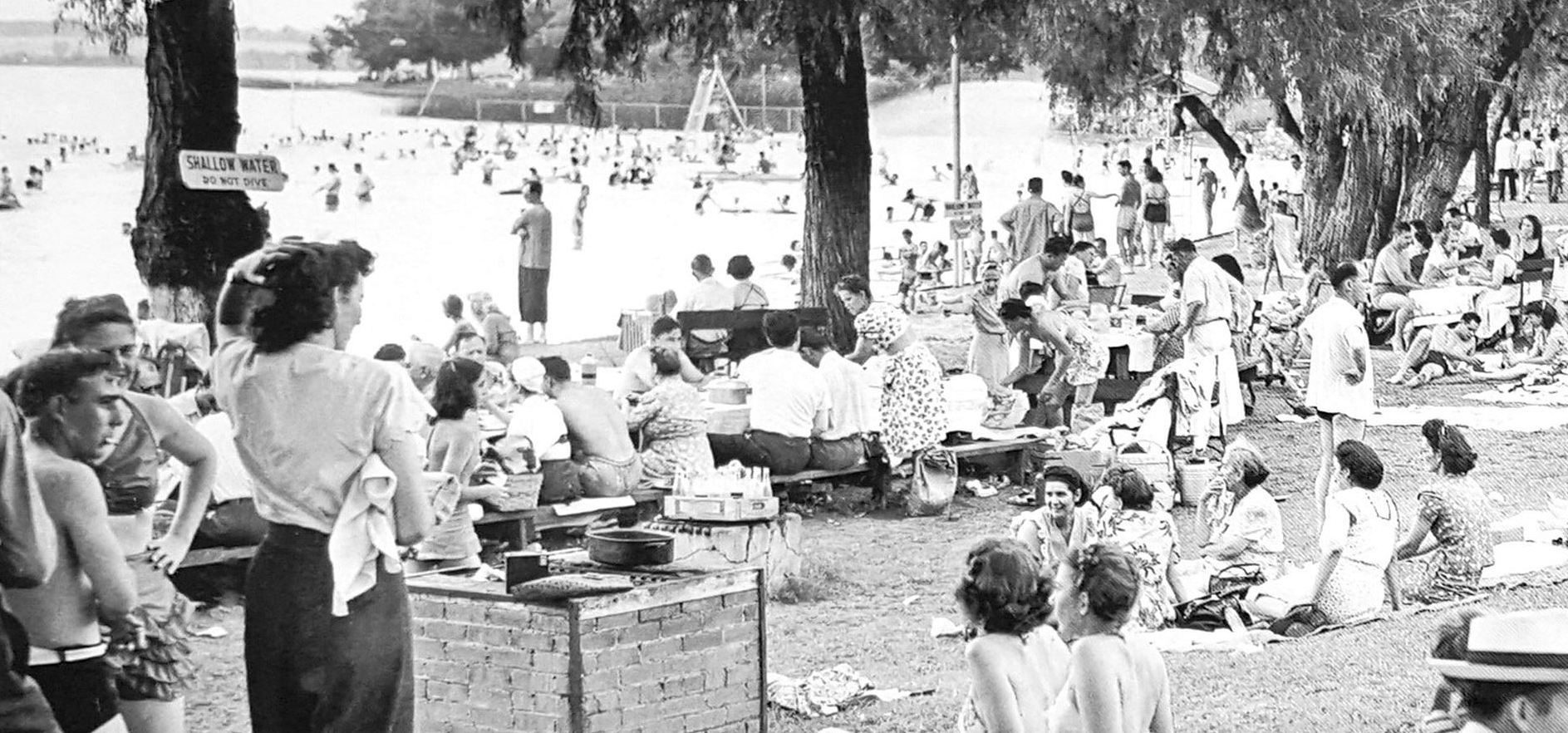
4th of July at White Rock Lake — 1946

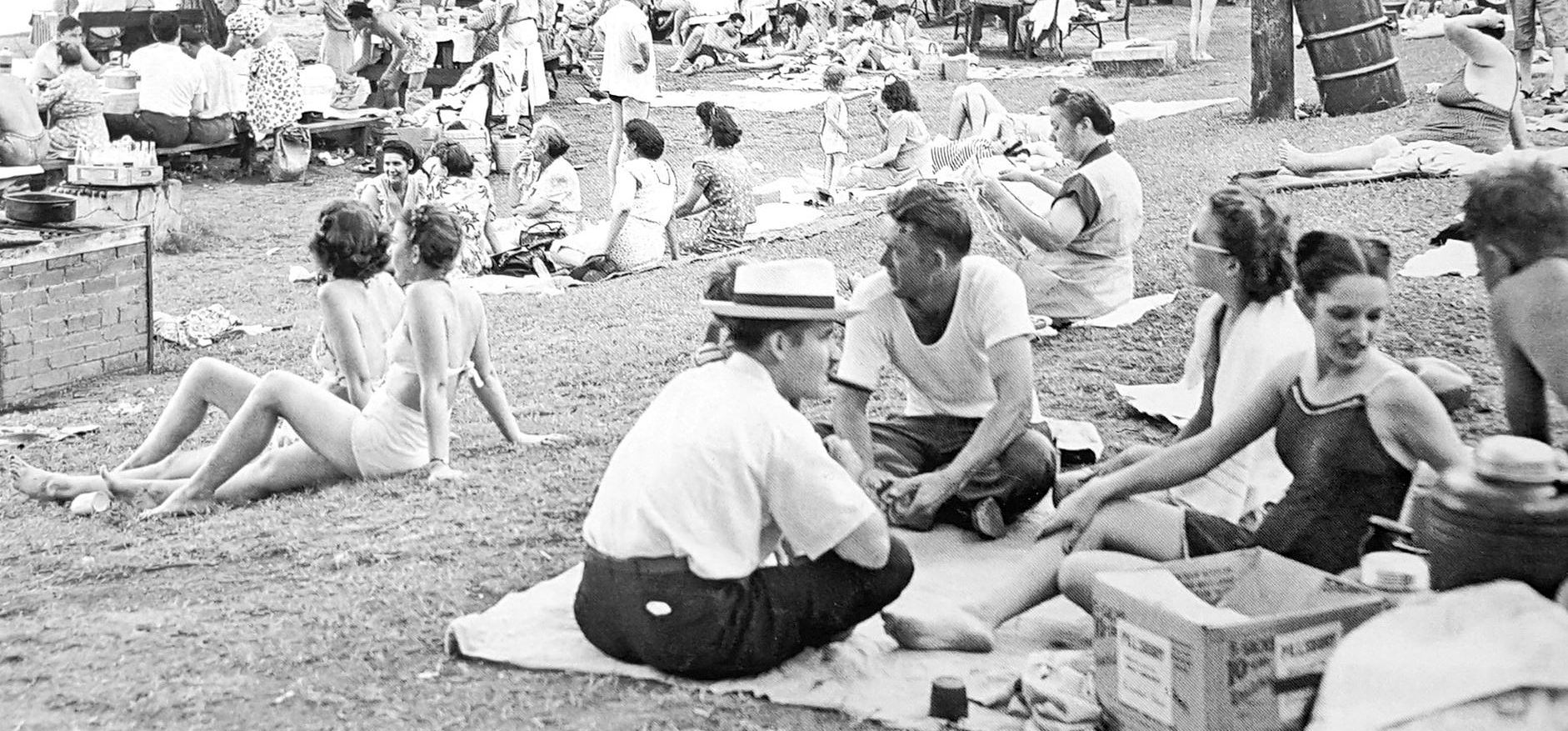
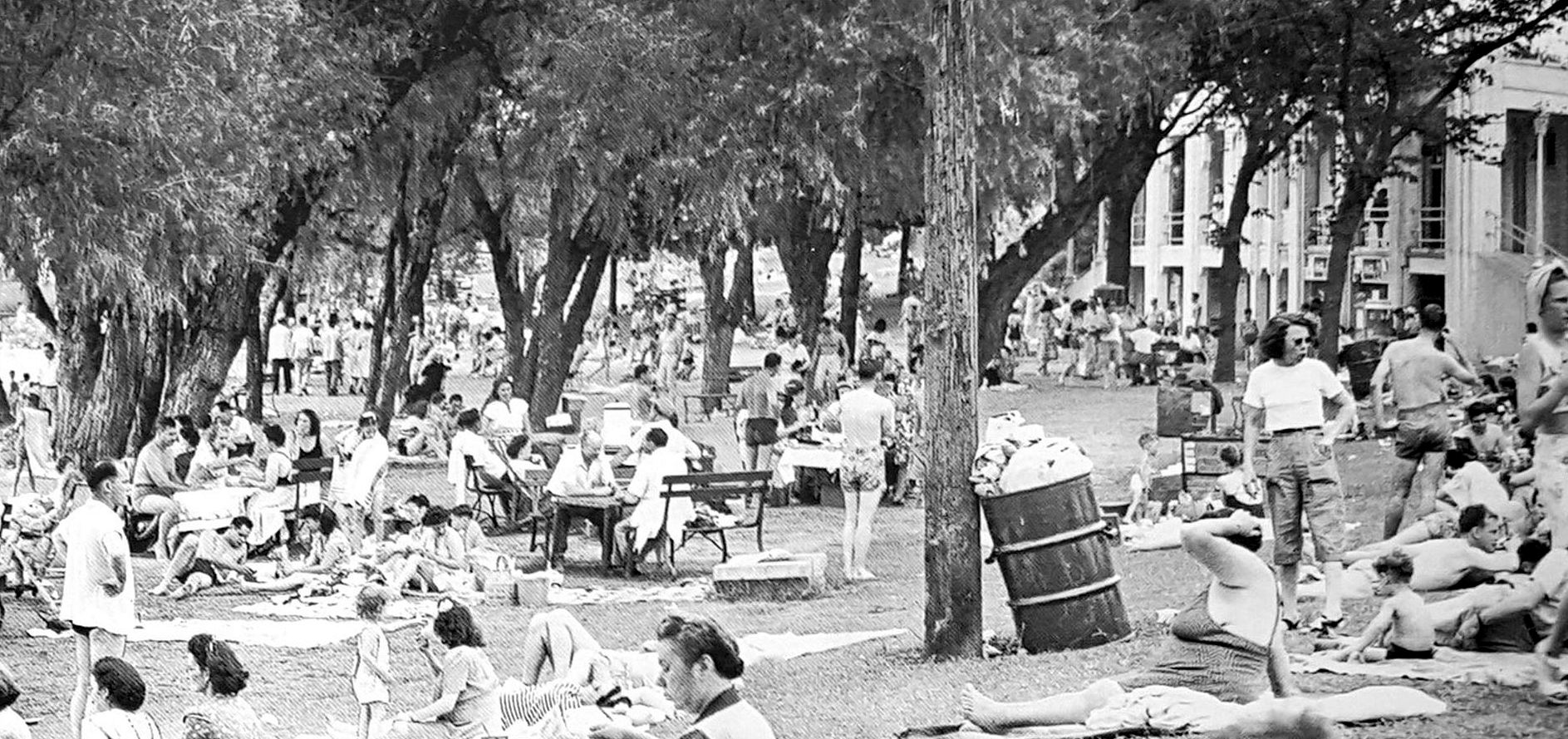
july-4th_1946_white-rock-lakeSo much going on here! (Click for super-gigantic image!)

by Paula Bosse

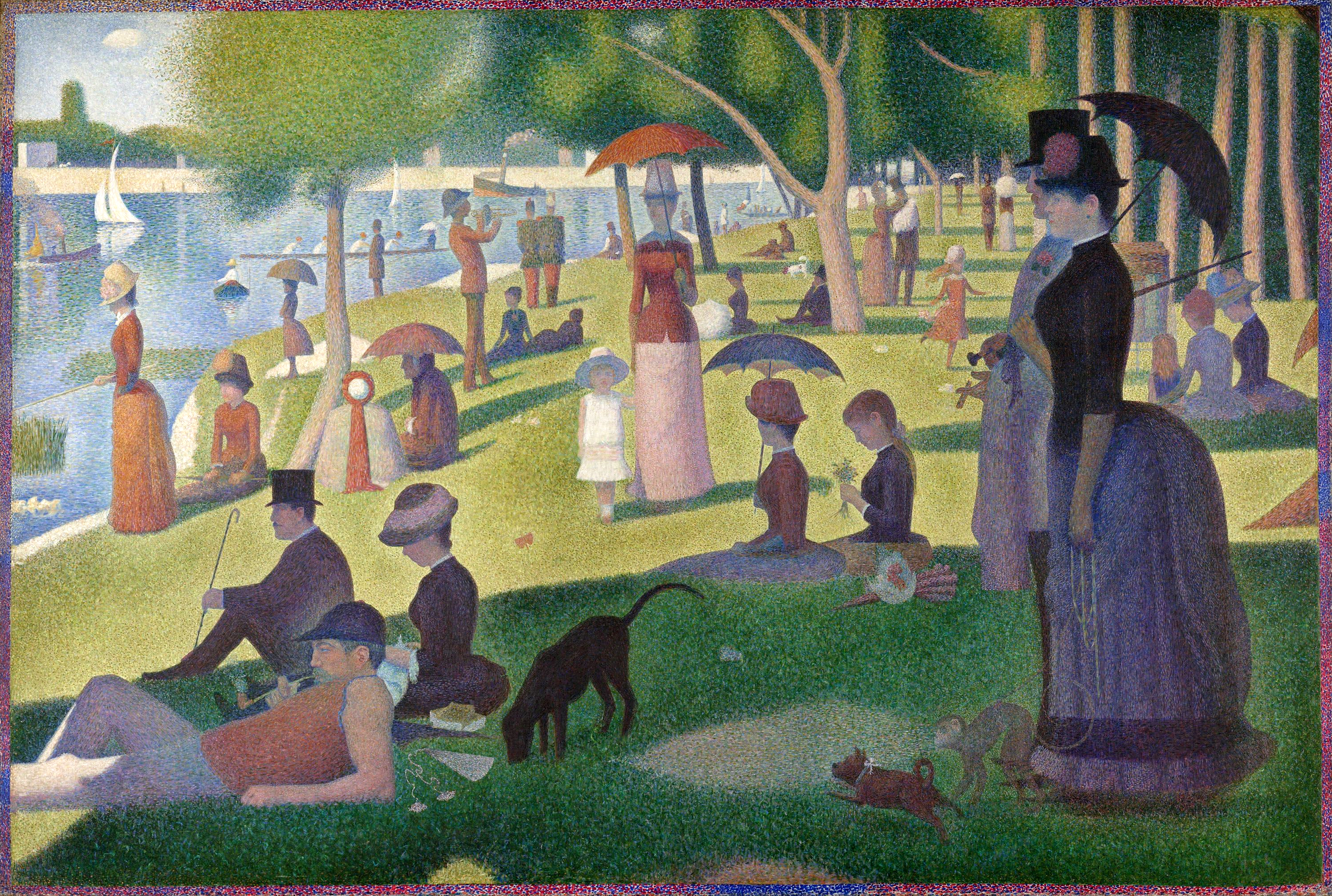
I love absolutely everything about this photo of July 4th celebrants relaxing at White Rock Lake near the Bath House (back when people actually swam in the lake!). All that’s needed is a pet monkey on a leash and a few parasols, and you’d have an updated Tex-ified version of Seurat’s La Grande Jatte painting.

seurat_le-grande-jatte_wiki

This is a photo definitely worth zooming in on. All images here are really big — click ’em! You can practically smell the wienies roasting/croissants baking. Have a happy and safe 4th of July!

4th-july_det1

4th-july_det2

4th-july_det3

*

Copyright © 2016 Paula Bosse. All Rights Reserved.
 

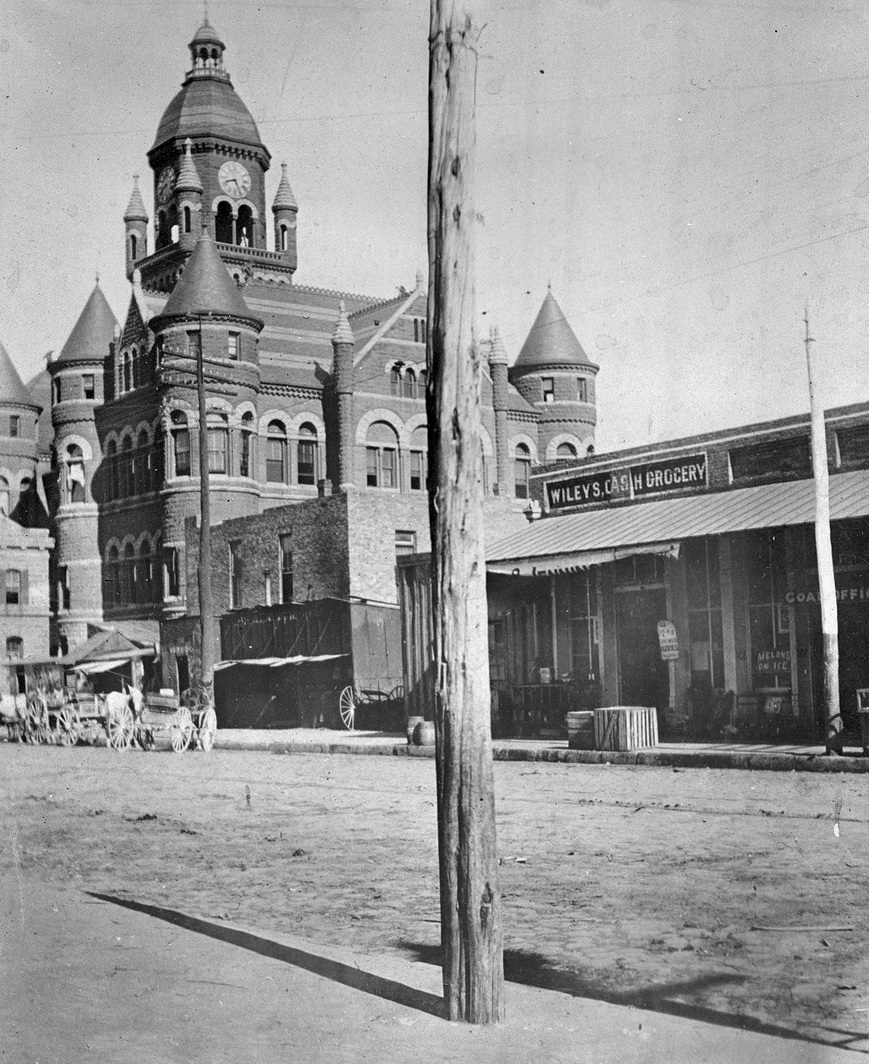
“Melons on Ice” — 1890s

wiley-grocery_1890s_haskins-coll_utaA sleepy little town…

by Paula Bosse

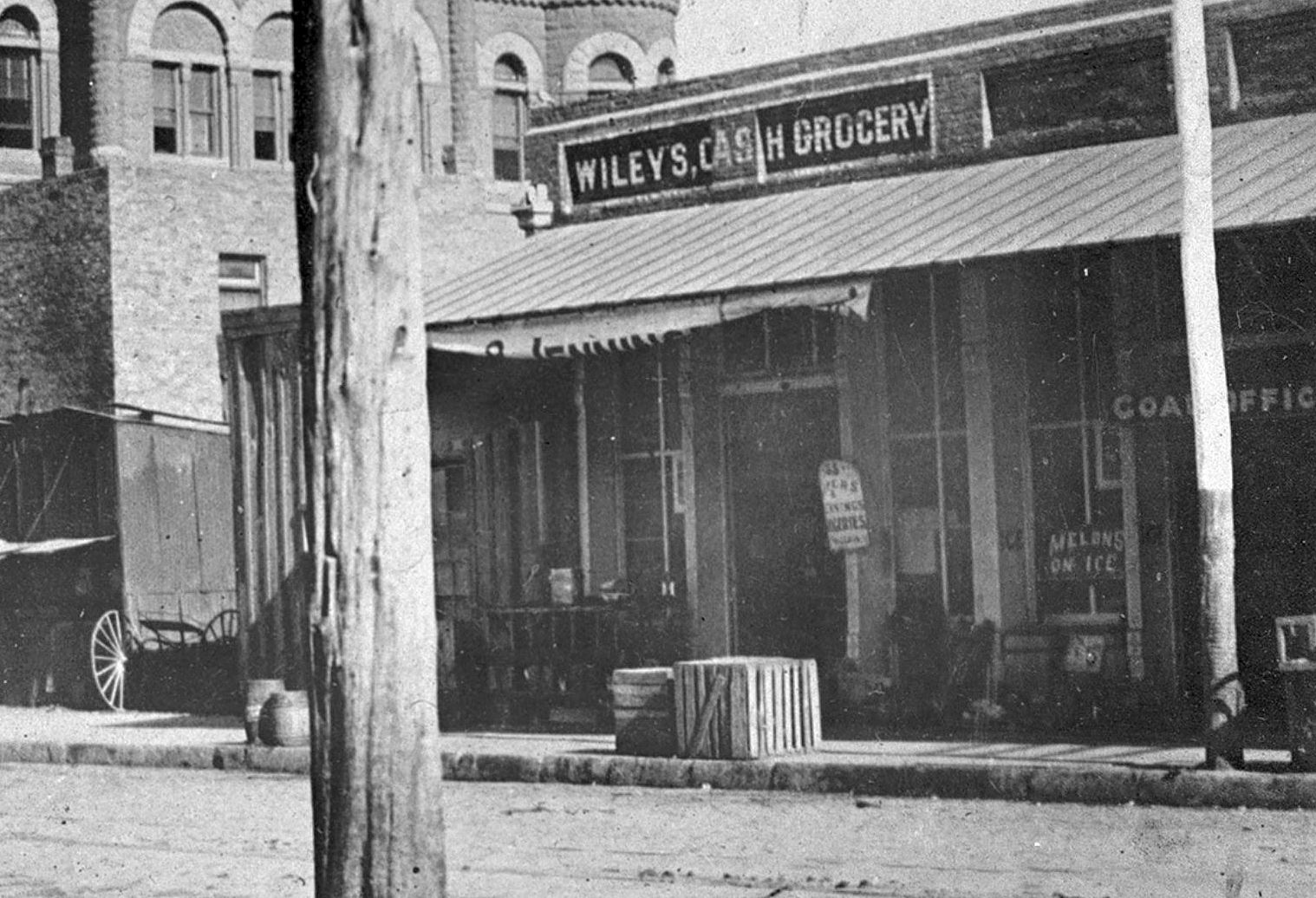
It looks hot in this photo from the 1890s. I bet those “Melons On Ice” in front of Wiley’s grocery store really hit the spot.

wiley-grocery_melons_det-1

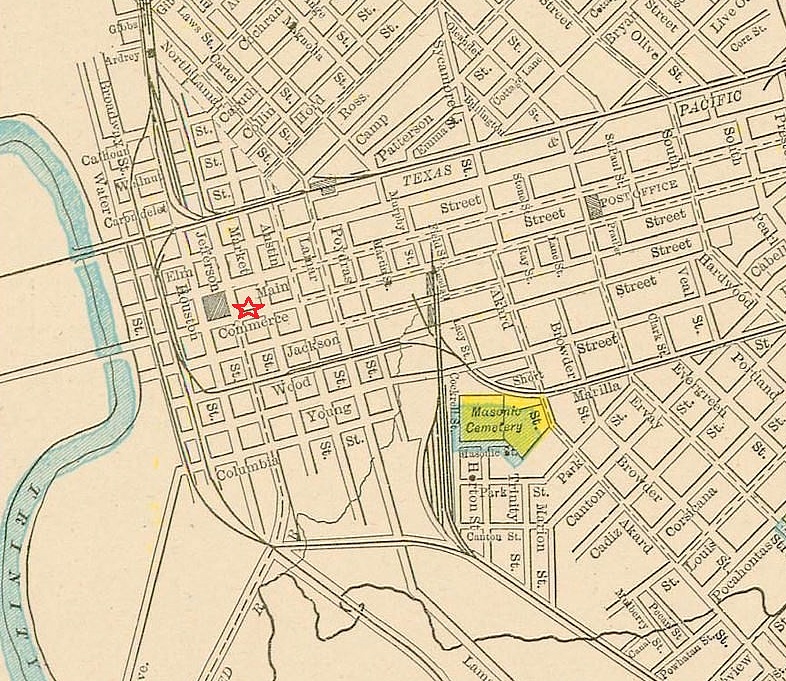
I love this photo. The Wiley Cash Grocery was in business for only a few years — from about 1892 to 1896. It was located at 153 Commerce, one block east of the brand-new county courthouse.

wiley-grocery_1893-directory1893 Dallas directory

wiley-grocery-1893-map
1893 map of Dallas, det.

The business was owned by Anna E. Wiley (~1862-1930) and her husband Jesse P. Wiley (~1863-1942). When they arrived in Dallas around 1887 their address in the city directory was simply “¾ mile w of river.”

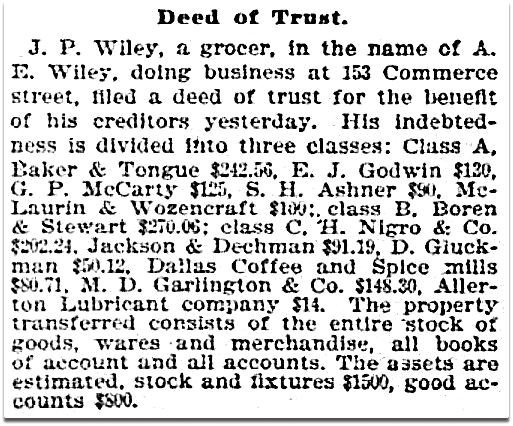
Even though the store seems to have been in Anna’s name, Jesse was forced to file a deed of trust in 1896 when the store was faced with crippling debt. The Wileys owed approximately $1,545 to creditors (about $45,000 in today’s money), but their assets were only about $1,500, plus $800 of “good accounts.” Unsurprisingly, the store was gone by 1897. (Click article below to see a larger image.)

1896-wiley-grocery_dmn_021596
Dallas Morning News, Feb. 15, 1896

This photo captures such an odd view of downtown Dallas — it’s hard to believe that the site once occupied by the Wiley store is now the site of the John F. Kennedy Memorial. A present-day view can be seen here.

***

Sources & Notes

This photo is from the Squire Haskins Photography, Inc. Collection, University of Texas at Arlington Libraries; additional info is here. See this great photo REALLY big here.

The map is a detail from an 1893 map of Dallas from the collection of the Texas State Library and Archives Commission.

*

Copyright © 2016 Paula Bosse. All Rights Reserved.
The Union Depot Hotel Building, Deep Ellum — 1898-1968

union-depot-hotel_1909_uta-detThe old Union Depot Hotel, about 1909 (click for larger image)

by Paula Bosse

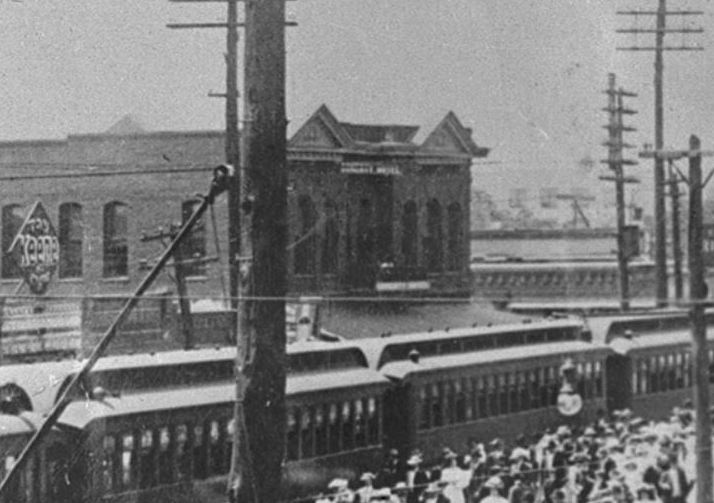
Above, we see the hotel known originally as the Union Depot Hotel, built in 1898 across from the very busy old Union Depot, at the intersection of two major rail lines: the Houston & Texas Central (the H&TC, which ran north-south) and the Texas & Pacific (the T&P, which ran east-west). The tracks crossed at the intersection of Central and Pacific — streets named after the two railroads — in the area east of downtown we now call Deep Ellum. The hotel was on the southwest corner of that intersection.

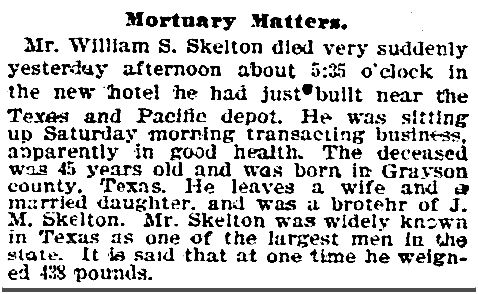
The large, two-story hotel (which also housed a popular cafe and bar) was built by William S. Skelton — more commonly known as Wiley Skelton — to cash in on the large number of travelers coming to Dallas via the bustling passenger depot right across the street. When it opened, it was charging a hefty two bucks a day (the equivalent of about $60.00 in today’s money) — a large-ish sum in 1899, but … location, location, location. This two-dollar-a-day rate to stay at Skelton’s hotel was the same as the base rate of Dallas’ ritziest, priciest hotels, The Windsor and The Oriental. How could Skelton’s “wrong side of the tracks” hotel charge similar rates as the city’s most elegant hotels? Convenience, convenience, convenience. The Union Depot Hotel could not have been more convenient to weary travelers unless it had been located inside the depot.

union-depot-hotel_houston-post_012599Houston Post, Jan. 25, 1899

Skelton was a popular and successful businessman (and noted saloon pugilist) who was known far and wide for his substantial physical bulk. He was a founding member of the city’s “fat men’s club” and was reported to be the heaviest man in the city. When he died suddenly at the age of 45 (probably not a huge surprise, as his obituary mentioned that his weight had, at one time, reached 438 pounds), his new hotel had been open only weeks (perhaps only days).

skelton_dmn_011699Dallas Morning News, Jan. 16, 1899

His unexpected death threw the running of the hotel into confusion. His brother (another famed “fighting fat man”) took over the business side of its operations and occasionally placed ads in the paper seeking a hard-to-find buyer.

union-depot-hotel_1901_portal1901 ad

union-depot-hotel_dmn_111602DMN, Nov. 16, 1902

Eventually the hotel was sold, and it went through several owners and name changes over the years. Then, in 1916, a major catastrophe struck: brand new Union Station, which was waaaay on the other side of town, opened, consolidating passenger rail service to one depot, resulting in the shuttering of most of the city’s smaller depots. Location, location, location wasn’t such a great thing for the old Skelton hotel after this.

The hotel went through many changes over the years, but after the closing (and later razing) of the old Union Depot, it was on a general, inevitable, slide downward. By the time it was demolished in 1968 — when large swaths along Central Avenue were leveled to facilitate highway construction — the building was in disrepair and, apparently, long-vacant. It stood for 70 years.

*

Below is a photo taken from Elm Street in 1908 or 1909, when the hotel (seen at the top left) was owned by Charles S. Conerty and named the Conerty Hotel (you can see the name on two signs, but you have to really zoom in to make them out). Conerty, an Irishman who had previously run bars, owned the hotel very briefly. By May of 1909, plagued with legal troubles stemming from his being charged with selling liquor on a Sunday, Conerty sold the hotel (which he seems to have been running as a boarding house), stating in his classified ad that he was “leaving city.” (He did not leave the city.) In 1910, with a new owner, the hotel was once again known as the Union Depot Hotel.

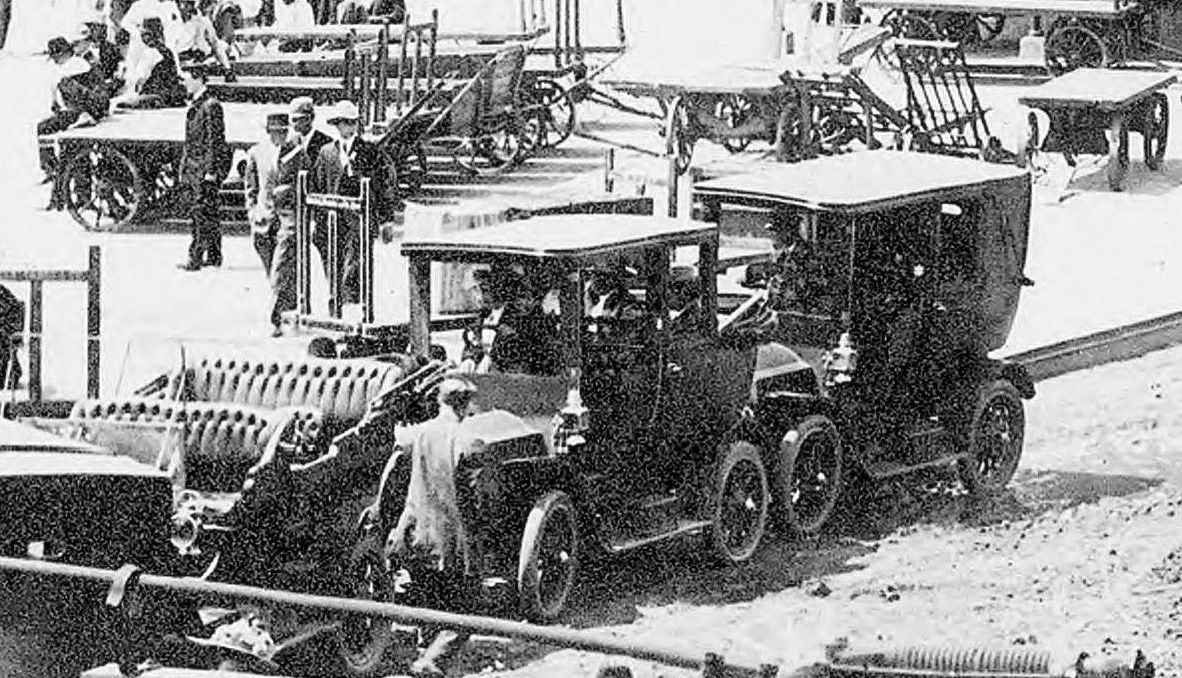
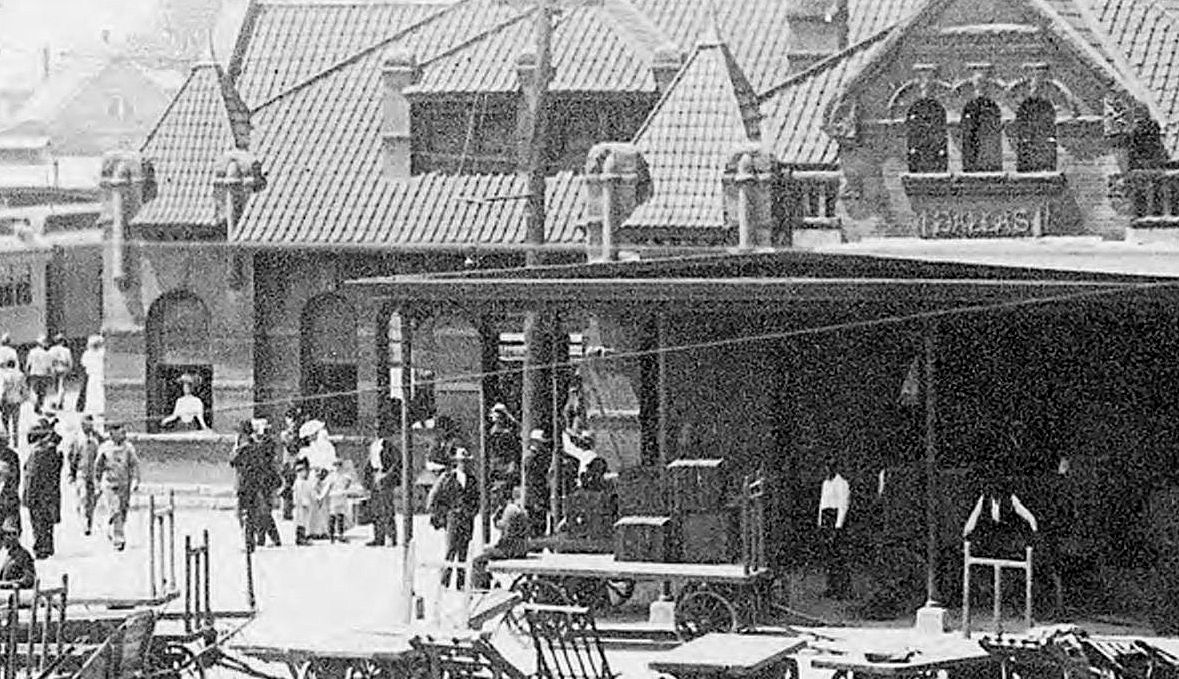
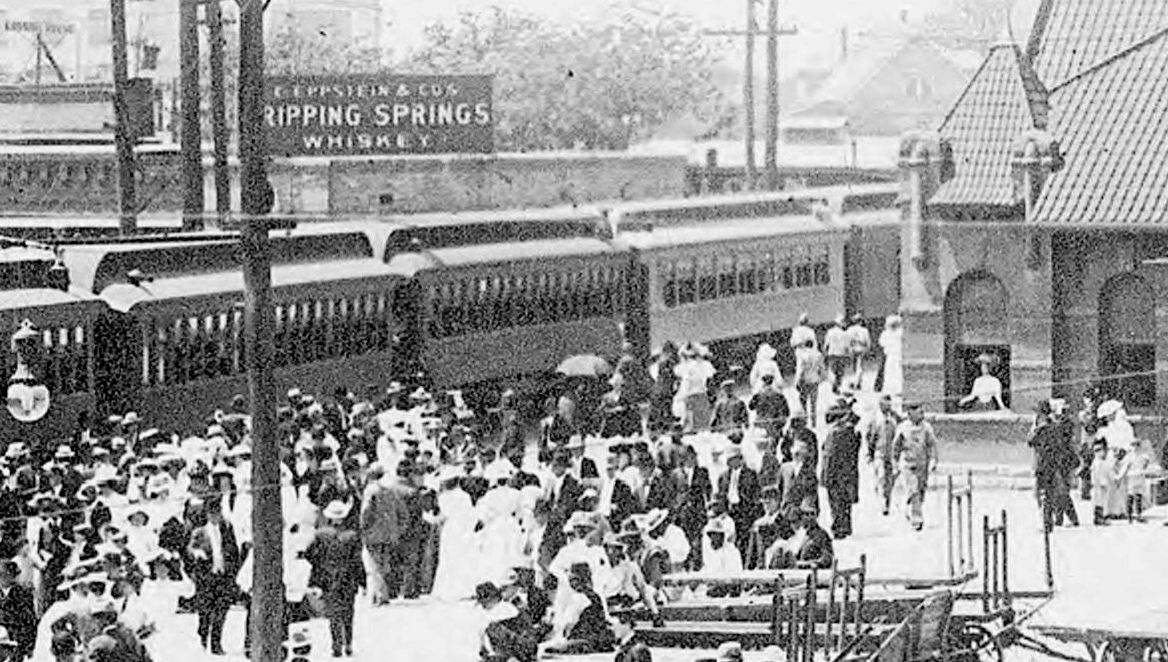
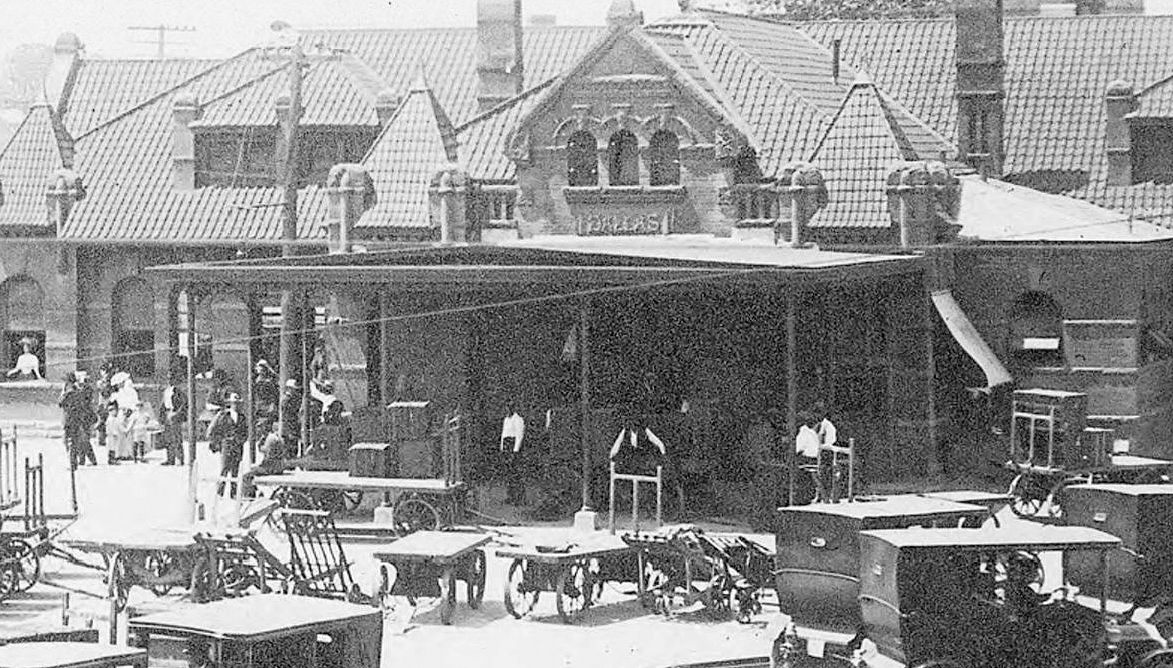
Back to the photo. Across Central Avenue from the hotel is the old Union Depot, where there was always a lot going on. Let’s look at the photo a little more closely. (Click photos to see larger images.)

old-union-depot_degolyer_ca1910

old-union-depot_degolyer_det1

old-union-depot_degolyer_det2

old-union-depot_degolyer-det3

old-union-depot_degolyer_det4

old-union-depot_degolyer_det5

old-union-depot_degolyer_det6

Just seven or eight years after this photo was taken, all that human traffic was gone.

In the fall of 1968, having been vacant for years and counting down its final hours, Dallas Morning News writer Doug Domeier wrote about the old run-down hotel which had long outlived the passenger depot it had been built to serve (see the article “Demolition Leveling Once-Noisy Deep Elm,” DMN, Oct. 19, 1968). Domeier’s entertaining article about those early days includes memories of Lizzie Mae Bass, who once worked in the hotel’s cafe as a waitress and remembers when “horses back[ed] away in fright when a locomotive pulled in at the lively intersection linking the Houston and Texas Central with the Texas & Pacific.”

And today? You’d never EVER suspect that that patch of empty land at the edge of Deep Ellum was ever occupied by one of the city’s busiest train depots.

*

So where was it? Get a good visual idea of how things were laid out in the Sanborn map from 1905, here. Below is a street map that shows where the hotel was (red star) and where the train depot was (blue star). These days? Depressing. See it here (the view is looking north from Elm — the hotel would have been under the overpass, the train station straight ahead).

union-depot-hotel_1952-mapsco1952 Mapsco

It’s interesting to note that during the heyday of the Union Depot, the west side of the block of Central Ave. which ran between Elm and Pacific was the only block in this area not filled with black-owned businesses or residences. When the depot shut down and white-owned businesses moved out, the block began to fill with popular African-American establishments. It’s also interesting (to me, anyway!) to realize that the Gypsy Tea Room of the 1930s was just a few steps to the left of the hotel in the top photo. It took me forever to try to figure out where the Gypsy Tea Room had been — I wrote about it here.

***

Sources & Notes

Top photo is a detail of a larger photo, from the Squire Haskins Photography, Inc. Collection, University of Texas at Arlington Libraries; it is accessible here. The same photograph is shown in full farther down the post — this copy is from the DeGolyer Library, Central University Libraries, Southern Methodist University, and it is accessible here. The quality of both photos makes it difficult to zoom in on them with much clarity, but both sites offer very large images to view.

As mentioned above, an entertaining Dallas Morning News article full of historical info about the area around the depot is highly recommended: “Demolition Leveling Once-Noisy Deep Elm” by Doug Domeier (DMN, Oct. 19, 1968). (I’m not sure why the hotel is referred to as the “Grand Central Station Hotel” throughout — just substitute “Union Depot Hotel” whenever you come across that incorrect name.) The article also has a few paragraphs about the Harlem Theater which was also about to be torn down as part of what Domeier described as the “brutal change” then affecting Deep Ellum.

See a great early-’20s photo of the hotel building (the Tip-Top Tailors moved in around 1922) in the book Deep Ellum: The Other Side of Dallas by Alan Govenar and Jay Brakefield, here (the view is from Pacific to the southwest).

A related Flashback Dallas post — “The Old Union Depot in East Dallas: 1897-1935” — can be read here.

All images larger when clicked.

*

Copyright © 2016 Paula Bosse. All Rights Reserved.
 

The Dallas Chapter of “The Women of the Ku Klux Klan” — 1920s

kkk-women_1920s_cook-degolyer

by Paula Bosse

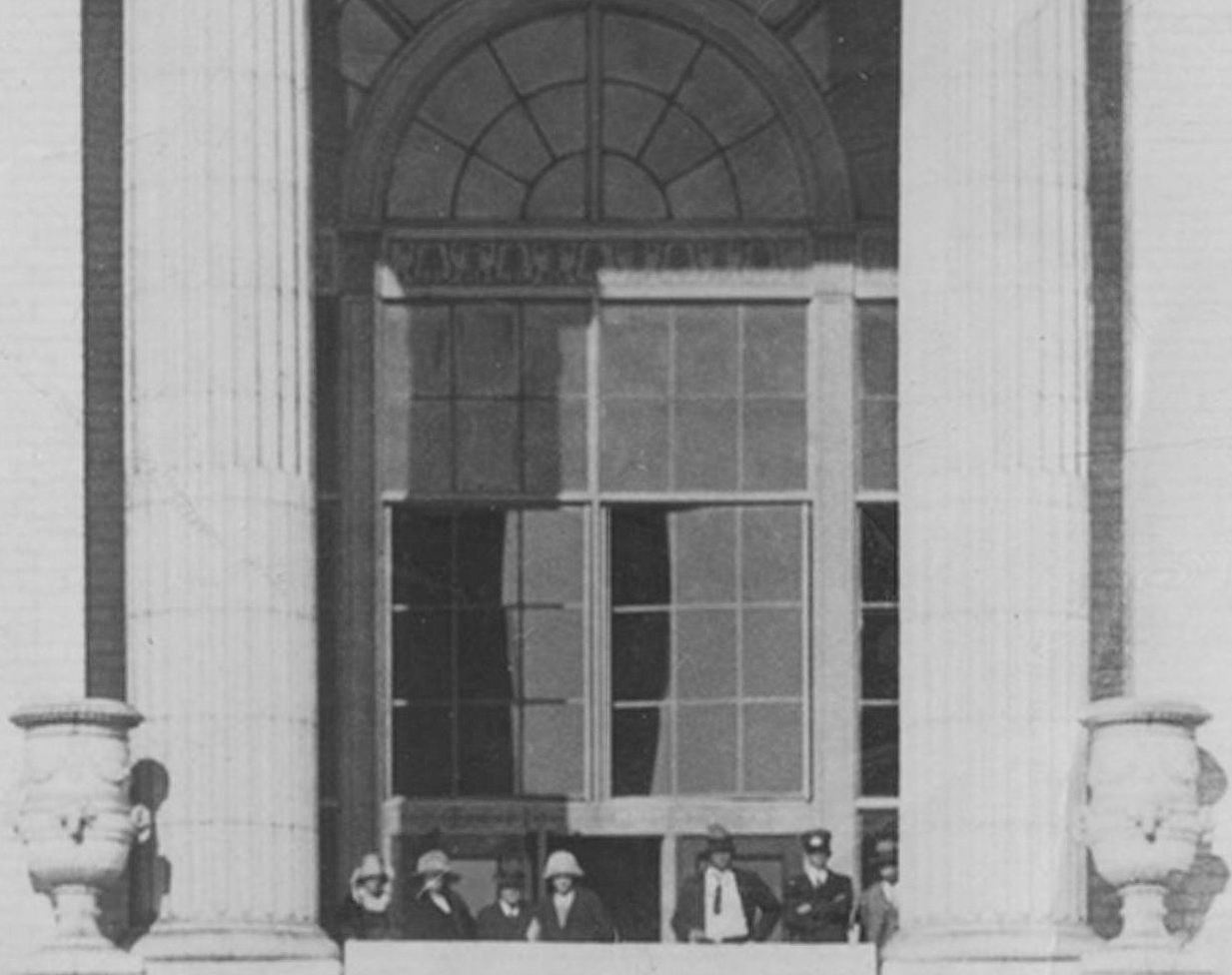
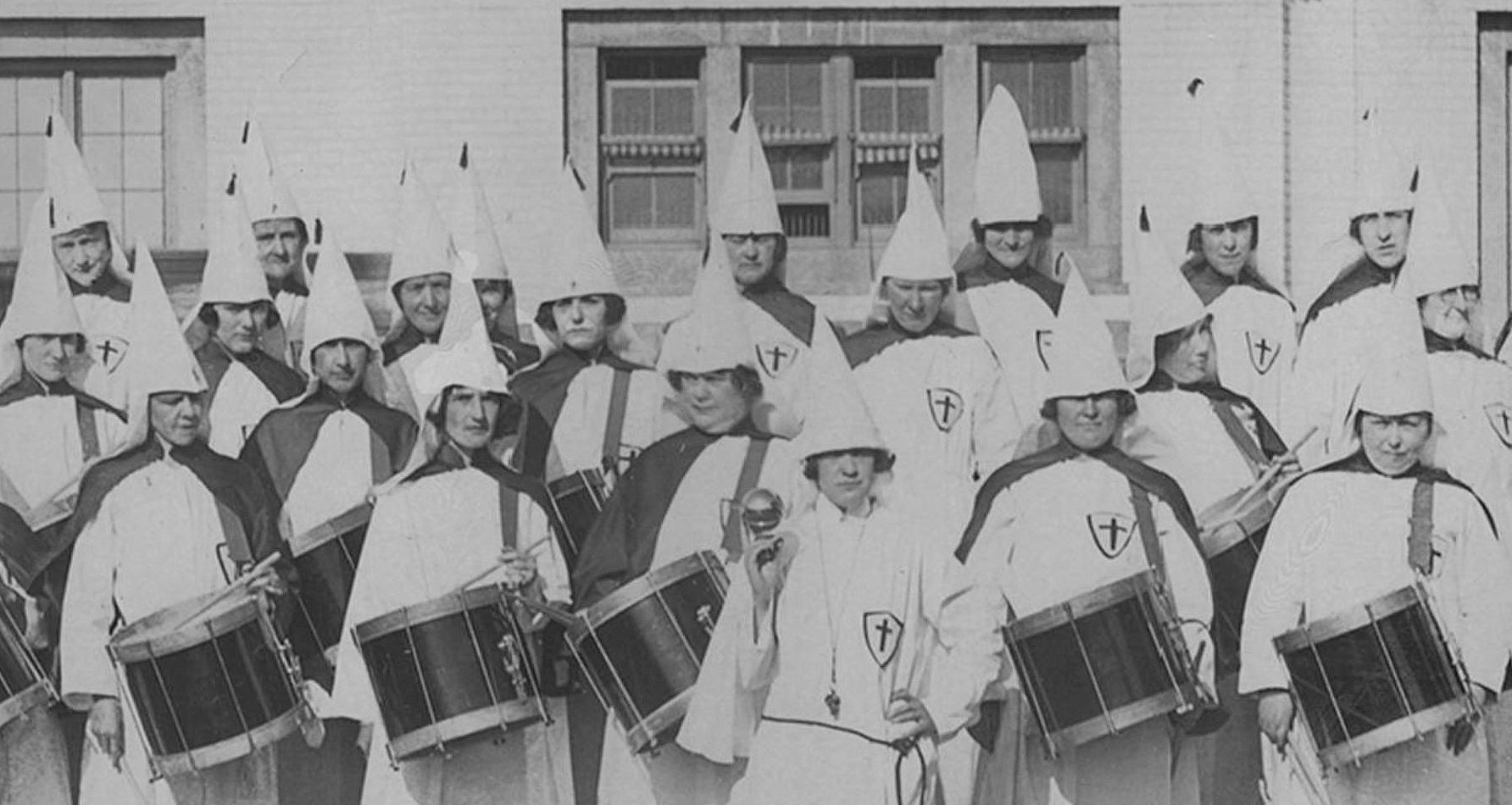
I’ve managed to avoid mention of the Ku Klux Klan since starting this blog a couple of years ago, which is saying something, because the KKK pretty much ruled this city for a good chunk of the 1920s. The Dallas chapter — Klan No. 66 — had more than 13,000 men as members; it was one of the largest chapters in the nation (by some accounts, THE largest chapter). Members included politicians, judges, and law enforcement officials. But what of the Klan-leaning ladies who were not allowed to join? Before I plunge into that, let’s look at what’s going on in this weird, be-robed group shot, a photo taken around 1924 in Ferris Plaza with poor Union Station as a backdrop. (Click these for much larger images.)

wkkk_det1

wkkk_det2

wkkk_det3

wkkk_det4

wkkk_det5

**

In the early 1920s, women — who had led the temperance movement and whom had recently been given the right to vote — began to form groups that tackled social issues. Some of these groups espoused the same general rhetoric as the KKK. One of these groups was formed in Dallas in 1922 — the “American Women” group was the brainchild of three women, including Alma B. Cloud, who appears to have been only 21 years old. One of the other founders was her partner in a short-lived ladies’ clothing boutique. Cloud immediately hit the lecture circuit, giving free lectures on “Americanism” to (white Protestant) women around Texas.

cloud_taylor-tx-daily-press-08222Taylor Daily Press, Aug. 22, 1922

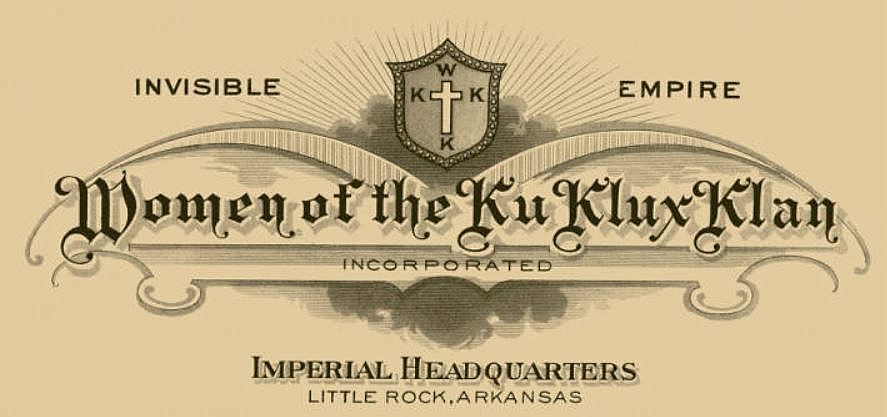
By the following summer, the male leadership of the Klan allowed a “Women of the Ku Klux Klan” to be created; its national headquarters was in Little Rock.

wkkk_letterhead_olemiss

They were not officially part of the KKK but were, in theory, a separate entity. While not, perhaps, as outwardly extreme as their male counterparts, they were certainly as virulently racist and intolerant. They might not have been lynching people and threatening violence, but they were busy pushing their exclusionary, white supremacy agenda. And both the men and the women liked to dress up in white robes and hoods. Here’s what the women looked like when they added masks to the ensemble (not Dallas — location of photo unknown).

wkkk

Several of the independent women’s groups founded previously were happily absorbed by the WKKK — including Miss A. B. Cloud’s group. In fact, Miss Cloud became the leader of the Dallas chapter. The “Klaliff.” The headquarters for this group — which campaigned for “progressive morality”– was in a little space on North Harwood.

WKKK_1924-directory1924 Dallas directory

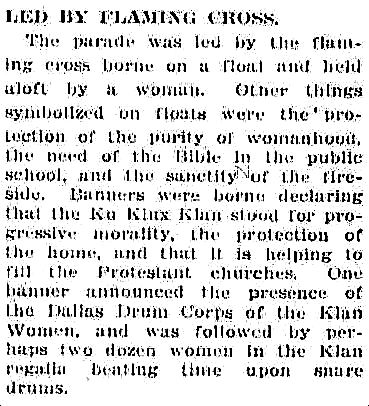
1924 seems to have been the big year for both the KKK and the WKKK. The women found themselves at lots of parades with burning crosses and other … “functions” — so why not form a drum corps? A few clippings. (Click for larger images.)

kkk-women_amarillo-globe-times_031624Amarillo Globe-Times, March 16, 1924

klan-women_dmn_073124Dallas News, July 31, 1924

kkk-women_mckinney-courier-gazette_111224McKinney Courier-Gazette, Nov. 12,1924

By 1926, the KKK was starting to lose its power, and the fear and intimidation they had instilled in much of the public began to wane. The (men’s) KKK had had to downsize and move into the women’s headquarters, and their candidates began losing elections. Even worse, you know things were getting bad if someone was suing the KKK for delinquent robe-payment!

KU KLUX KLAN WOMEN SUED FOR ROBES BILL: Suit for $4,463.80 was filed in the Forty-Fourth District Court on Friday afternoon by John F. Pruitt against the Women of the Ku Klux Klan, Inc. The petition alleges that the plaintiff sold the defendant, a corporation, 6,000 robes at $2.50 each during the two years preceding the filing of the suit, for which the defendant agreed to pay $15,000 to the plaintiff. It is alleged that $4,463.80 remains unpaid. (DMN, Nov. 28, 1925)

The power once exerted by the Ku Klux Klan had diminished greatly by the end of the 1920s, and while the Klan has never disappeared completely, it will never again reach the heights it had attained in the 1920s.

Whatever happened to Miss A. B. Cloud? After having been ousted from her “imperial” position (for reasons I don’t really care enough about to investigate), she had a few sales jobs and eventually began to present motivational sales talks. There was an Alma B. Cloud in California who was mentioned in several news stories from the 1930s — she presented motivational lectures to students on how best to plan their future adult lives. Um, yes. I’m not 100% sure this was the same A. B. Cloud who was the former WKKK gal from Big D, but it seems likely. I wonder what those students would have thought had they known of her pointy-hooded past?

***

Sources & Notes

Links-a-plenty.

Top photo is titled “Ku Klux Klan Women’s Drum Corps Dallas in Front of Union Station,” taken by Frank Rogers; it is from the George W. Cook Dallas/Texas Image Collection, DeGolyer Library, Central University Libraries, Southern Methodist University — it can be accessed here. I have manipulated the color.

Women of the Ku Klux Klan letterhead comes from the Women of the Ku Klux Klan Collection, Archives and Special Collections, University of Mississippi Libraries; the collection can be accessed here.

The photo of the masked WKKK women is all over the internet — I don’t know its original source or any details behind it, but it’s creepy.

“Women of the Ku Klux Klan” on Wikipedia, is here.

“Women of the Klan: Racism and Gender in the 1920s” by Kathleen M. Blee, is here.

“Charity by Day, Punishment by Night: The Ku Klux Klan in Fort Worth” — from the great FW history blog Hometown by Handlebar — is here.

And, probably best of all, the Dallas Morning News article “At Its Peak, Ku Klux Klan Gripped Dallas,” by the wonderful and much-missed Bryan Woolley, can be read here. This article contains facts and figures, describes the sort of “madness of crowds” atmosphere in the city at the time, and details some of the horrible atrocities committed by the KKK in Dallas. Woolley cites historian Darwin Payne’s assertion that if one considered every adult man in Dallas who would have been eligible to have joined the Klan (this excludes, of course, those of African-American, Hispanic, Asian, Catholic, or Jewish descent), one in three of them was a member of the Dallas chapter of the Ku Klux Klan. ONE IN THREE.

A few short mentions of the Dallas WKKK have been compiled here.

UPDATE: For a look at racism in modern Dallas, watch the half-hour film “Hate Mail,” made in 1992 by Mark Birnbaum and Bart Weiss, here. It includes interviews with several prominent Dallasites, as well as interviews with a couple of Klan leaders.

Click pictures and clippings to see larger images.

*

Copyright © 2016 Paula Bosse. All Rights Reserved.
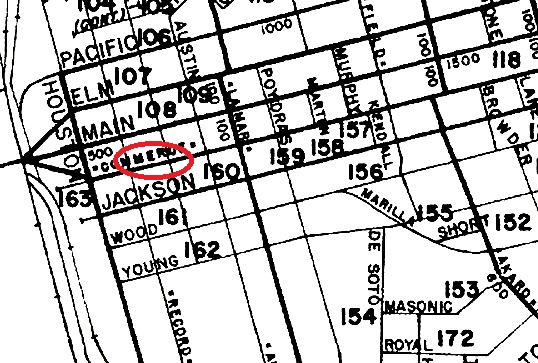
Commerce & Record Streets — 1946

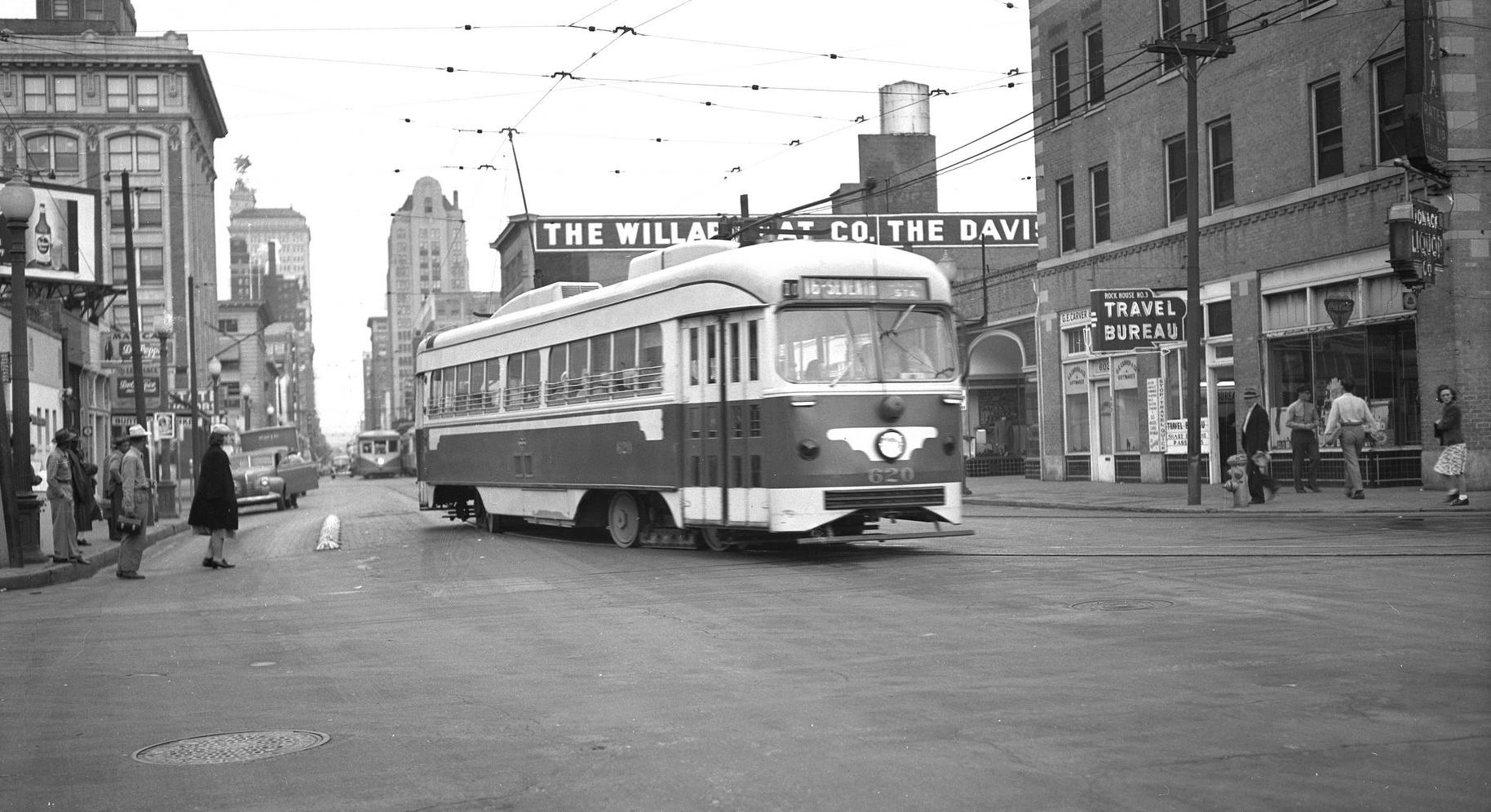
streetcar_commerce-record_051046_ceraCommerce St. looking east from Record (click for huge image)

by Paula Bosse

If it’s a photo of downtown in the ’40s, with people on the streets, retail storefronts, and streetcars, I’m going to love looking at it. Like this one. A lot of people might be hard-pressed to identify the location of this photograph, even if they were standing in the exact spot the photographer stood in. If you look at today’s view from the same vantage point (here), just about everything in the immediate foreground (west of the Pegasus-topped Magnolia Building) is gone — except for, most notably, the beautiful MKT Building at Commerce and Market, one of my favorite downtown buildings.

This is the intersection of Commerce and Record streets, when Record still extended from Elm to Jackson; the Old Red Courthouse was behind the photographer, to the left. Today, the Kennedy Memorial is at the left where the people are waiting for a streetcar; the George Allen Courts Building is across the street — at the right, in the block with the travel bureau; and the block containing the Willard and Davis Hat building — across Commerce from the Katy Building — is now a parking lot.

As with every photograph like this I see, I wish I could step into it and walk around the downtown Dallas of 1946. Maybe pop into Ma’s Cafe for a Dr Pepper before I hop on a streetcar and just ride around on it all day until someone kicks me off.

*

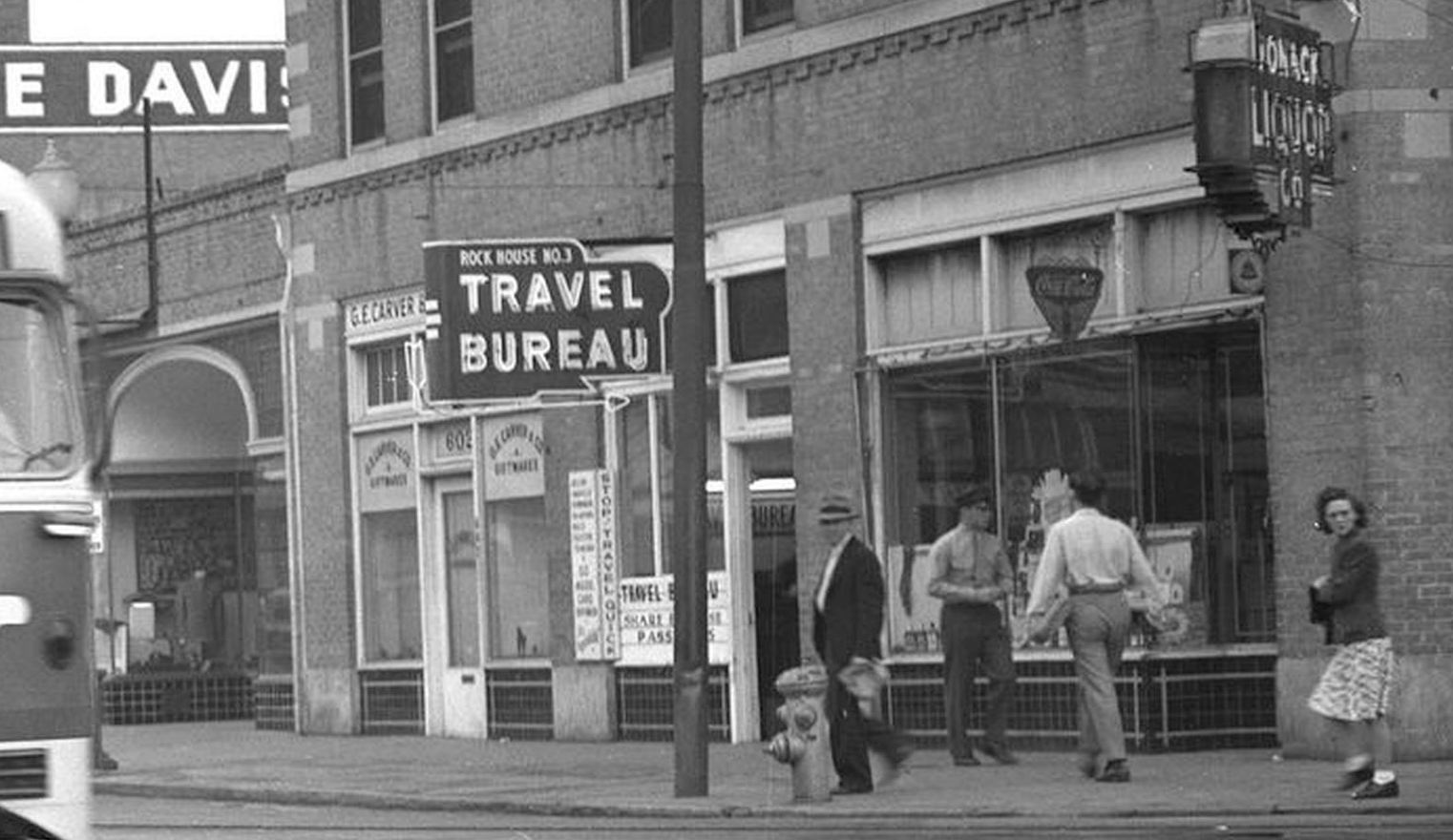
Below are a couple of magnified details (both are much larger when clicked).

streetcar_commerce-record_051046_cera-det1

streetcar_commerce-record_051046_cera-det2

Below is a listing of the businesses in this 600 block of Commerce, between Record Street and the MKT Building.

600-block-commerce_1945-directory1945 Dallas directory

(The tall building on the right with the travel bureau on the ground floor is the Plaza Hotel at 202-204 Record Street. The Yonack Liquor Store on the corner is at 200 Record, with entrances on both Commerce and Record.) 

Here’s a detail of a photo taken about the same time, showing an aerial view of Commerce Street.

aerial_commerce-st_1940s_foscue-lib_smuFoscue Map Library/SMU

***

Top photograph was taken on May 10, 1946 by Richard H. Young; it can be viewed on the CERA (Central Electric Railfans’ Association) website, here. (If you’re interested in Dallas streetcars, this page has some GREAT photographs!)

The caption of the photo from the above website: “May 10, 1946 — New Dallas Railway & Terminal Co. double-end PCC car 620, at speed, southbound, turning into Record St. from Commerce St. (Ervay-7th Line).”

The aerial photo was taken by Lloyd M. Long in the 1940s and is titled “Downtown Dallas looking east (unlabeled); it is from the Edwin J. Foscue Map Library, Central University Libraries, Southern Methodist University. This is only a small portion of the full photograph — the full photo is here.

Since there is an exact date for this photo, here is a large Skillern’s ad from that day’s newspaper. Coincidentally, there was a  Skillern drugstore on the northeast corner of Commerce and Record — it is in this photo, behind the lamppost at the bottom left. Let’s see what was on sale May 10, 1946. (I would kill for a set of those Pyrex bowls!)

skillerns-ad_dmn_051046

And, lastly, who doesn’t love a map?

map_commerce-and-record_1952-mapsco 1952 Mapsco

Everything is bigger when clicked!

*

Copyright © 2016 Paula Bosse. All Rights Reserved.
 

Early Aerial View of the SMU Campus

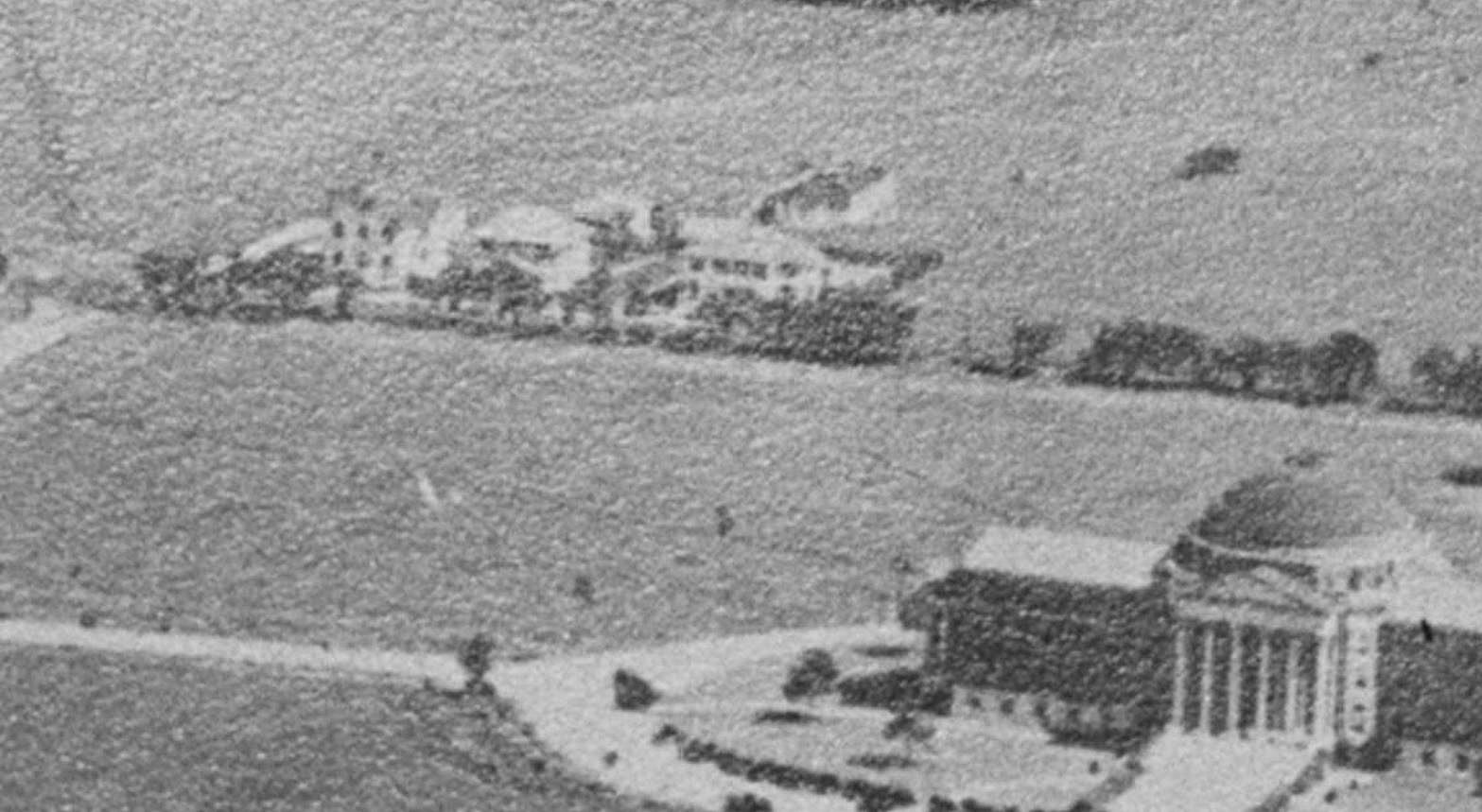
smu_early-aerial_ca1920s_degolyerWide open… (click for much larger view)

by Paula Bosse

Does anyone else fear the SMU campus is getting a little crowded these days? Here’s what it looked like back when there was still plenty of room to stretch out.

This photo is in the SMU archives, accompanied by this description:

Pictured is an aerial view of campus from the southeast. At the bottom is Mockingbird Lane; on the right is Airline Road; at the top is Daniel Avenue; and on the left is Hillcrest Avenue. Situated in the middle of fields is a water tower, Dallas Hall, Atkins Hall, Rankin Hall, North Hall, South Hall, the Women’s Gymnasium, Armstrong Field, and the Morrison-Bell Track.

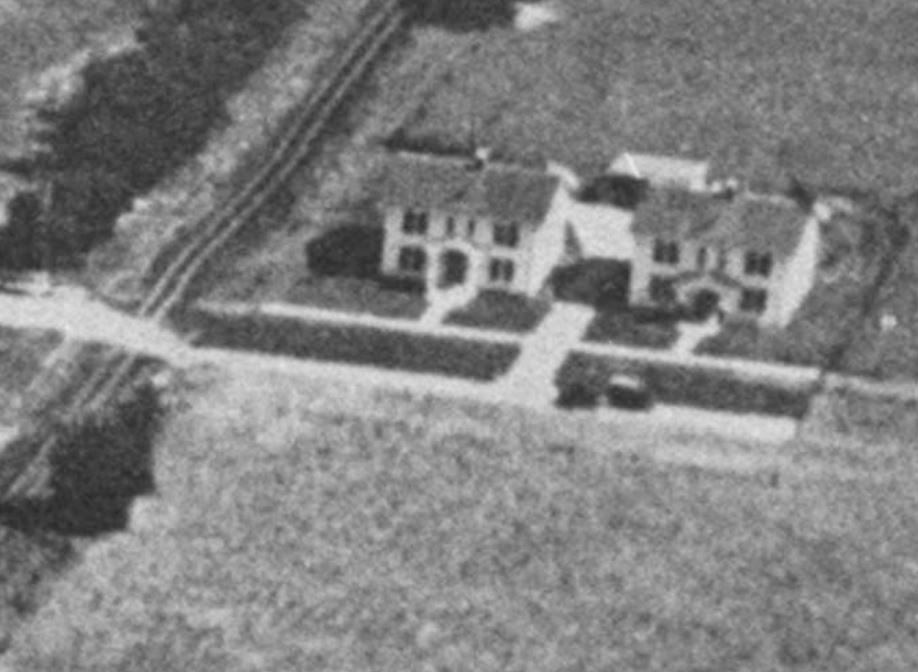
What is the huge hacienda at Hillcrest and Daniel (below)? Is that the Daniel family home?

smu_early-aerial_ca1920s_degolyer_a

And what are the little houses next to the under-construction stadium? Faculty housing? Fraternity houses? Houses not even connected with the university?

smu_early-aerial_ca1920s_degolyer_b

I kinda wish the campus still looked like this.

***

Photo titled “Early aerial view of campus,” ca. 1920s, from the DeGolyer Library, Central University Libraries, Southern Methodist University; it is accessible here.

Zoom in on this photo as much as you can and wander around it — it’s pretty cool. Go here, then slide the magnification bar at the top all the way to the right.

Click pictures for larger images.

*

Copyright © 2016 Paula Bosse. All Rights Reserved.

Selling Kidd Springs Heights, 1909-1910

gaston-bldg_1910_cook-degolyerThe L. A. Wilson Co. is having a sale! (photo: SMU)

by Paula Bosse

The above photo shows a car-and-buggy convoy belonging to the L. A. Wilson Land, Loan & Investment Company, stretched out in front of the Gaston Building at Commerce and S. Lamar. There’s a “Sale To Day” and they’re really pushing property in the Kidd Springs Addition in Oak Cliff. The date “April 20, 1910” is written on the back of the photo, and if that’s true, the big show here might be rooted more in desperation than in enthusiasm. The Wilson company began selling the 30-or-so lots in the new Kidd Springs Heights neighborhood in July of the previous year. An ad that appeared seven months before this photo was taken announced that there were only ten lots left. It looks like this was an impassioned display to make Kidd Springs seem more exciting and move that remaining property. People love parades.

(This is another great photo to zoom in on to see the details. All images are larger when clicked.)

gaston-bldg_1910_cook-degolyer-det1

gaston-bldg_1910_cook-degolyer-det4

gaston-bldg_1910_cook-degolyer-det5

The L. A. Wilson Co. was a fairly large real estate company founded by Missouri-born Lewis A. Wilson (1851-1926); at the time of this photo, the company’s offices were in the Gaston Building at 213 Commerce. (In the photo immediately above, I think the man with the moustache is Mr. Wilson.)

wilson_dmn_070409-detDallas Morning News, July 4, 1909 (ad detail)

The first ad announcing the sale of lots in the Kidd Springs Heights area of Oak Cliff appeared on July 4, 1909. It included the two blocks north of what is now W. Canty, bounded by Turner Ave. on the west and N. Tyler (and Kidd Springs Park) on the east.

ad-wilson_dmn_070409-text

ad-wilson_dmn_070409-photosDMN, July 4, 1909

Four weeks later, a huge half-page ad ran in The Dallas Morning News, full of wonderful reasons why life would be better in Kidd Springs Heights:

The newest theory of scientists is that one should sleep at least eighty or ninety feet above the level of the city – and thus escape the germs which are particularly active during the hours of darkness. Here then is the place for your home. Here then is the place for investment. Kidd Springs Heights is higher than the top of the court house. Up where the cooling breezes are found on the hottest of hot days; where the air is ozone-laden; where the nights are cool and refreshing and where insomnia soon becomes naught but a dim memory.

The effusive sales copy is definitely worth a read (click ad below to read the full sales pitch).

wilson_kidd-springs-heights_dmnn_090109DMN, Aug. 1, 1909

Six weeks later the following self-congratulatory ad appeared. (It’s interesting to note that of the twenty lots sold, two of them had been sold to Mrs. L. A. Wilson, and one each had been sold to the two salesmen. The next year’s telephone directory showed that the Wilsons lived on Live Oak, and the two salesmen lived in boarding houses.)
wilson-kidd-springs_dmn_091209DMN, Sept. 12, 1909

It wasn’t until 1921 that the tiny little Kidd Springs Heights was annexed to the city of Dallas.

annexed_dmn_051421DMN, May 14, 1921

Things may be different today, but in 1909, these were the boundaries of Kidd Springs Heights.

kidd-springs-heights_google_2015

The most interesting odd thing about Kidd Springs Heights? There appear to be two brick archways placed (very awkwardly) across Turner Avenue from one another — each spanning the sidewalk. I can’t find any information about these, but it looks as if they were set right at the northern boundary of the Kidd Springs Heights Addition. Old maps (such as this one from 1919) show no development to the north of this boundary up into at least the ’20s (it doesn’t look as if this addition is even in Oak Cliff proper), so I guess they were there before those sidewalks and served as a welcoming gateway to a new development where germs did not dwell after nightfall.

arch_google
900 block of Turner Avenue (Google Street View)

(Check out both of these markers on Google Street View, here. It’s pretty strange-looking.)

If anyone has information on these markers, please pass it along!

***

Sources & Notes

Top photo is titled “L. A. Wilson Land Loan Investment Company, Gaston Building, Commerce Street” — the photographer’s name and the date are written on the back: W. R. Lindsay, April 20, 1910. It is from the George W. Cook Dallas/Texas Image Collection, DeGolyer Library, Central University Libraries, Southern Methodist University, and it can be viewed here. I have adjusted the color.

Lewis A. Wilson’s biography can be read in A History of Greater Dallas and Vicinity (1909), here. His photo:

wilson_hist-greater-dallas

The Kidd Springs Wikipedia entry is here.

The Sanborn map from 1922 showing this tiny neighborhood at about the middle of the page on the right can be found here. Note how few lots actually have houses built on them. (Taft is now W. Canty; Edwards is now Everts.)

The Murphy & Bolanz map can be seen here. (If the link doesn’t work, you may need to download the plug-in — information on how to do that is here.)

*

Copyright © 2015 Paula Bosse. All Rights Reserved.