Flashback : Dallas

A Miscellany: History, Ads, Pop Culture

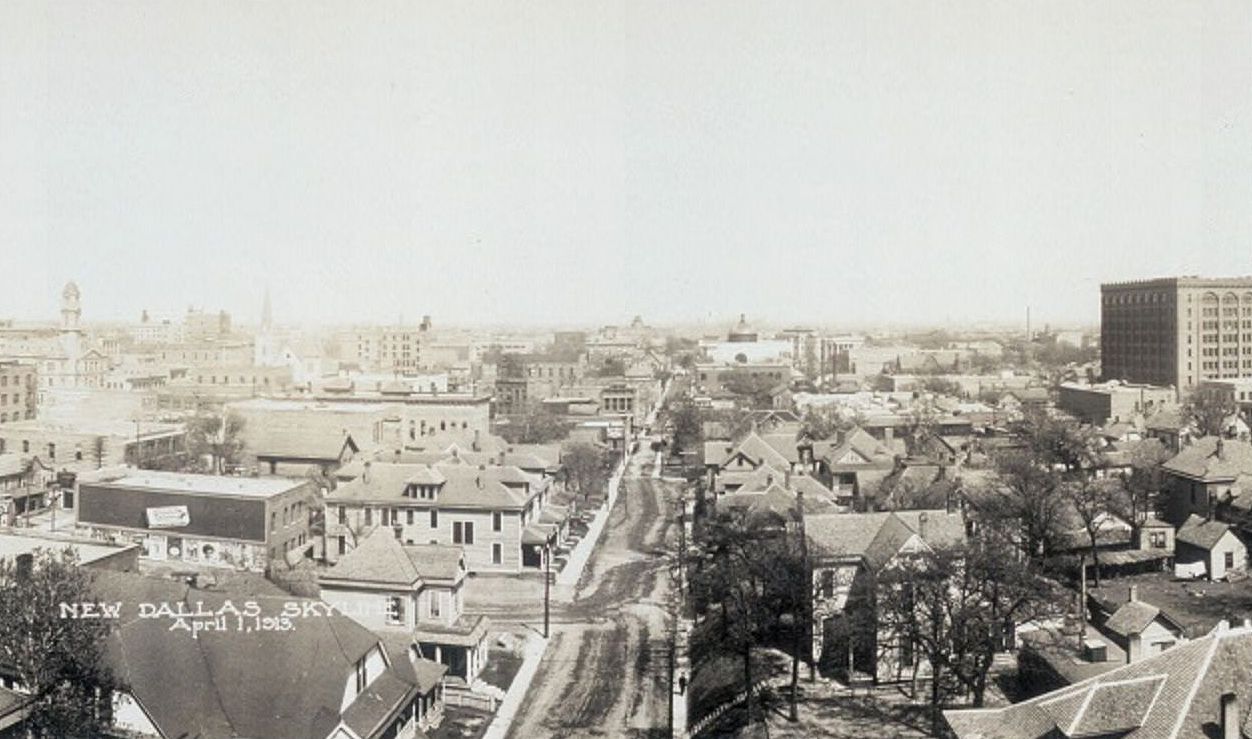
“New Dallas Skyline” — 1913

1913-pano-3Dallas skyline panorama detail, 1913 (click for larger image)

by Paula Bosse

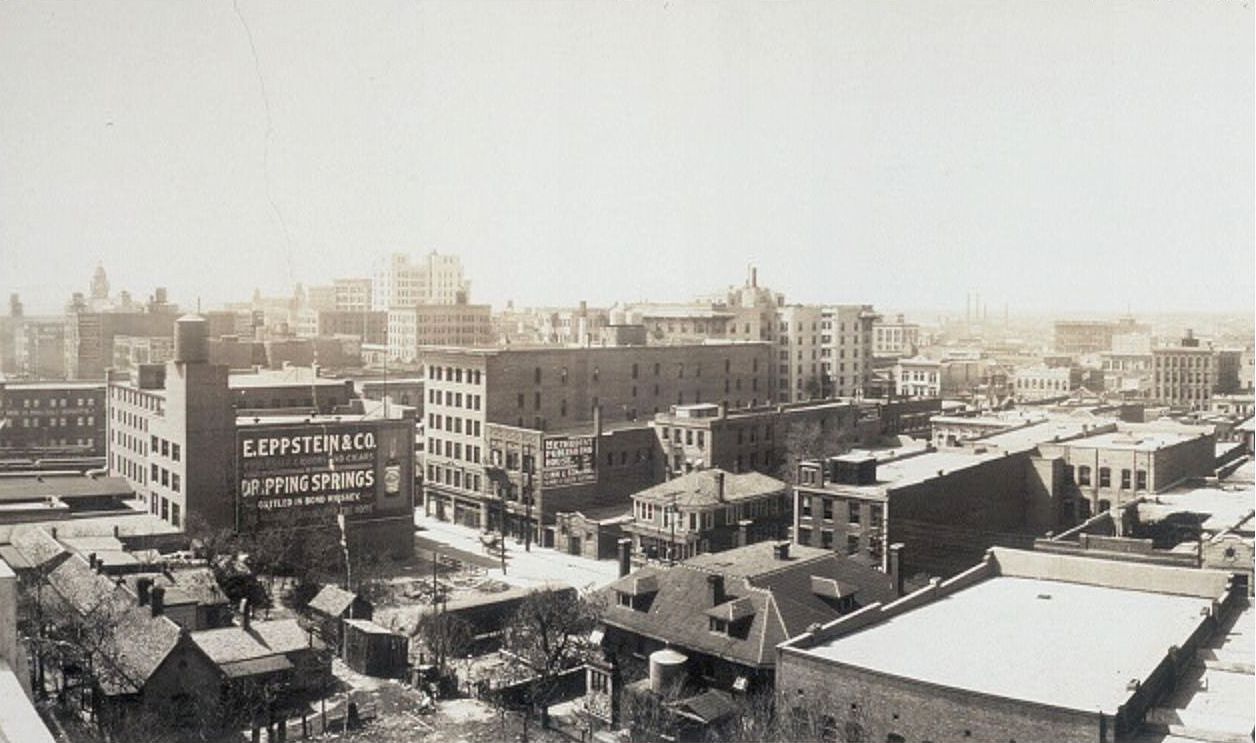
On April 1, 1913, one of Dallas’ most prominent photographers, Jno. J. Johnson, took a wonderful panoramic photo of the Dallas skyline. Dallas was, even then, boasting an impressive skyline. I’ve zoomed in a bit on the photo, breaking it down into four separate images. Johnson’s original photograph, titled “New Dallas Skyline — April 1, 1913,” is below. (Click to enlarge all images.)

dallas-panorama-skyline_april-1913_LOC(Click this photo!)
*

Below, the first portion of the photo.

1913-pano-1E. Eppstein & Co., wholesale distributors of whiskey and cigars, was at 1300-1302 Jackson.

*

1913-pano-2Above, the second portion, showing S. Akard Street, looking north — at the end of the street is the 6-month old Adolphus Hotel (then the tallest building in Dallas), built by beer baron Adolphus Busch, located on Commerce Street, catty-corner from his other hotel, The Oriental (the darker building in the center, with the distinctive top-knot on its northwest corner). The Praetorian Building (on Main) — a previous “tallest building in Dallas” — is the still tall-ish white building, second from the right.

*

The third portion (at the top) shows, I believe, Wood Street, looking east. The Post Office tower on Commerce can be seen at the far left. At the top, to the right of Wood Street (at S. Harwood) is the still-familiar sight of the First Presbyterian Church dome (brand new — the paint inside and out was probably still wet when this photograph was taken); to the right of the dome is the also-still-standing (and beautiful!) Scottish Rite Temple, also brand new.

*

1913-pano-4The final portion shows what I guess would be considered the northern edge of The Cedars? I love old photos that show residences in what we now consider the Central Business District. It’s so weird seeing these houses! The hulking turreted building at the top is Butler Brothers (built in 1910-11) at 500 S. Ervay; it later changed its name to the Merchandise Mart, and it is now undergoing renovation.

***

Panoramic photograph by Jno. J. Johnson, from the Library of Congress, here.

For those who want to play along at home, a 1919 street map of the area can be found at the ever-indispensable Portal to Texas History, here.

Click pictures for much larger images.

*

Copyright © 2015 Paula Bosse. All Rights Reserved.

The Elegant Municipal Building — 1914

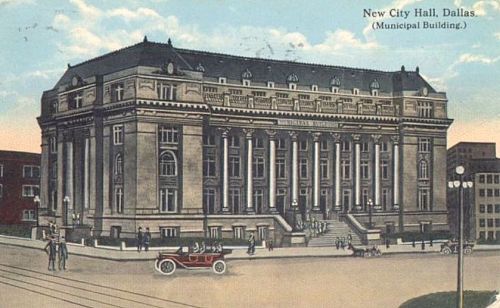
ciA very un-Dallas-looking building … and one of its finest

by Paula Bosse

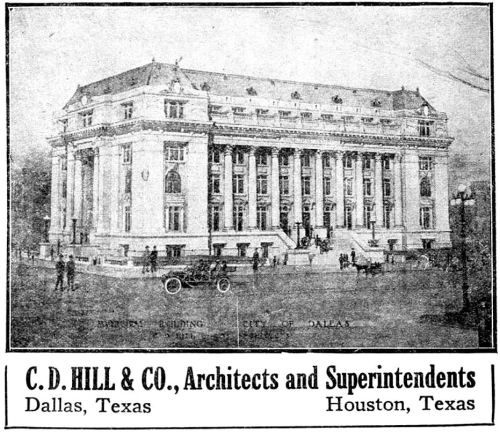
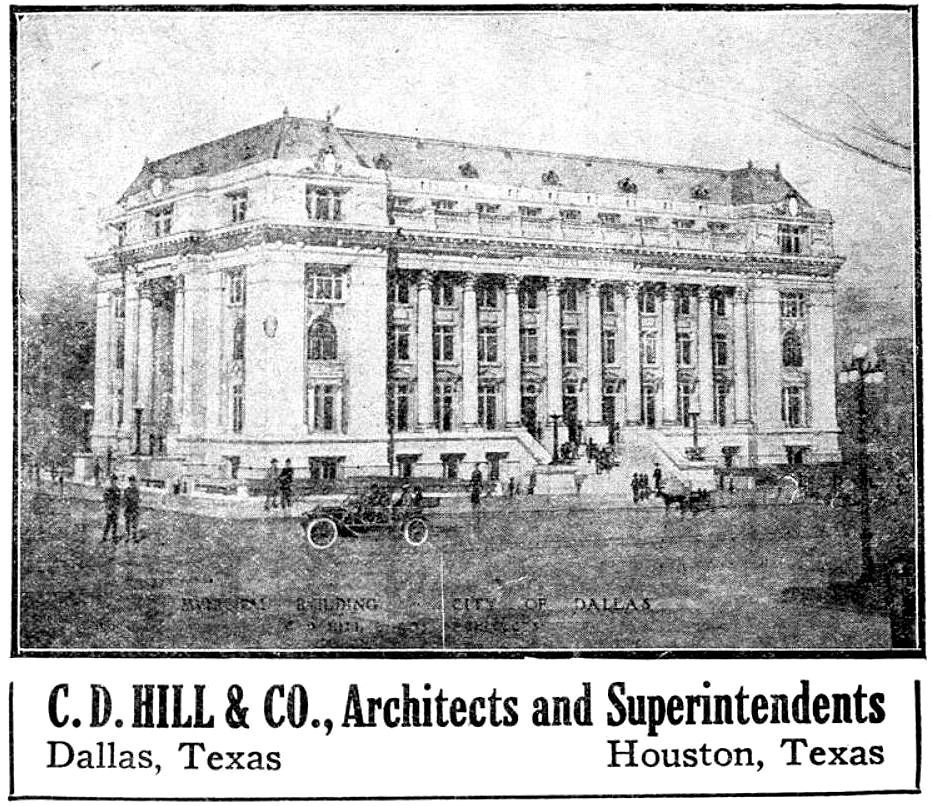
Appearing in the May 7, 1914 issue of Municipal Journal was a short article on Dallas’ then-under-construction Municipal Building and a drawing of what it would look like when completed.
municipal_bldg_watermelon-kid

Dallas Will Have Modern Municipal Building
Dallas, Tex. – The new municipal building of the city of Dallas is nearing completion and will be ready for occupancy in a few months. It will house all of the city departments and in addition will have a modern emergency hospital in the basement and public rest rooms for both men and women. The building is said to be a radical departure in architectural design from the usual type of public buildings in the South; it is constructed along simple but dignified lines. The structure will be of steel construction covered with blue Bedford stone, the five stories, basement and sub-basement will be a home worthy of the city of the hour, as Dallas people like to call their town. Ventilating and heating systems are being installed together with vacuum cleaners. The building, without furnishings, will cost about $550,000. C. D. Hill and Company are the architects. The structure was started by the Fred A. Jones Building Company, which failed just as the steel was up, and it is being finished within the estimates by the city under the supervision of the architects.

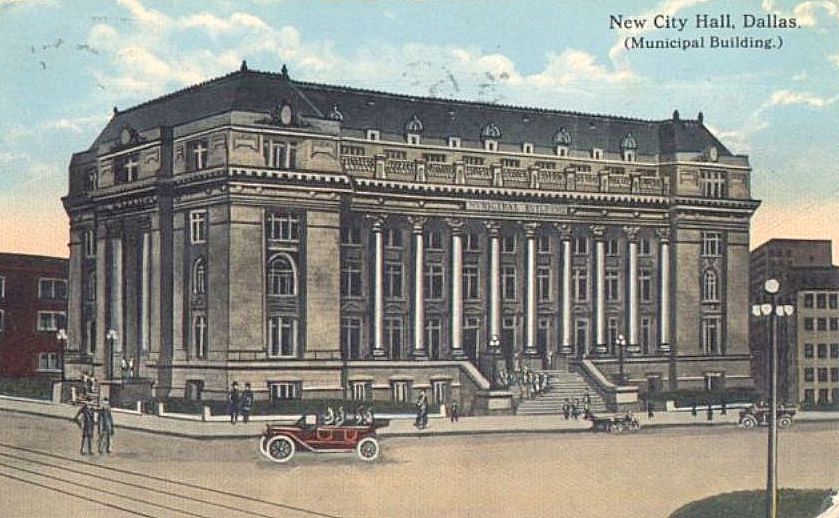
This new City Hall, located at Main, Harwood, and Commerce, was designed by Dallas architect C. D. Hill. Construction began in late 1913 — by January of 1914, its steel frame was in place.
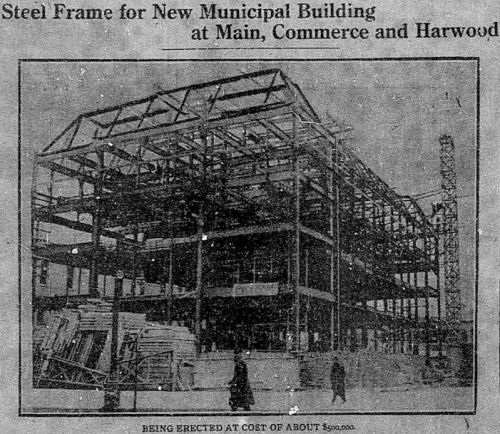
municipal-bldg_dmn_010114Dallas Morning News, Jan. 1, 1914

The cornerstone was laid in a Masonic ceremony on Valentine’s Day, 1914.

municipal- bldg_FWST_021514-cornerstoneFort Worth Star-Telegram, Feb. 15, 1914

As the construction was winding down, workmen complained of an “intolerable” swarm of mosquitoes flying around the site. Apparently an underground spring was flooding the sub-basement and providing palatial digs for endless cycles of constantly-hatching mosquitoes. (I wonder if the basement still floods on occasion?)
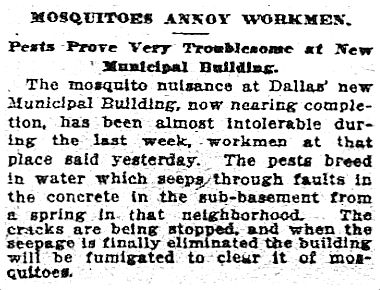
municipal-bldg_dmn_091014-mosquitoesDMN, Sept. 10, 1914

The building was officially opened on October 17, 1914. Here’s a grainy photo that absolutely does not do that beautiful building justice.

municipal-bldg_dmn_101714DMN, Oct. 17, 1914

When the doors were finally opened to the public, it was expected that a few thousand people would show up to tour their new municipal building — in actuality, the much-larger-than-anticipated crowd numbered somewhere between 12,000 and 15,000 curious Dallasites.

municipal-bldg_dmn-101814DMN, Oct. 18, 1914 (click for larger image)

The beautiful exterior was faced with granite and stone, and the interior boasted marble, mosaic tilework, and wood paneling. All of the furniture used in the building was made in Dallas. In addition to the mayor’s office, fire, police, and other municipal departments, the building also housed an emergency hospital, a sub-basement shooting range (!), and, on the 3rd floor, an 1,100-seat auditorium, with a 4th-floor gallery. (The auditorium was designed so that if, in the future, it was determined that it was not needed, it could easily be converted to office space by adding a few columns and beams — a renovation which obviously happened at some point.) Interestingly, the northern half of the top floor was left unfinished as the space was not needed at the time.

ALSO included in the new building’s amenities were much-needed public restrooms (or as they were euphemistically referred to back then, “comfort stations”). A men’s restroom and a women’s restroom (“positively divided with heavy walls”) were located under the Main Street sidewalk, accessible down stairs on either side of the building’s entrance. Up until this point, there was only ONE public “comfort station” in the city (for women and children) — at Fair Park. So for most downtown visitors, this might well have been the most exciting aspect of Dallas’ newest landmark.

The building referred to as both “City Hall” and “the Municipal Building” was considered to be one of the city’s finest and most elegantly imposing. But there are always a few people who just don’t like nice things, and there was a surprising amount of vandalism to the building in its first few weeks.
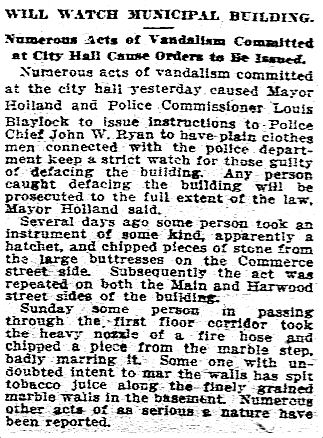
municipal-bldg_dmn_111014-vandalismDMN, Nov. 10, 1914

This is one of the truly great buildings in Dallas, and it just recently celebrated its 100th birthday. It is a Dallas Landmark and a Texas Recorded Historic Landmark. No longer a city property, it is now part of the University of North Texas Dallas College of Law campus (along with the old Titche’s building). UNT is currently working to restore and renovate this beautiful historic building. Thank you, UNT!

*

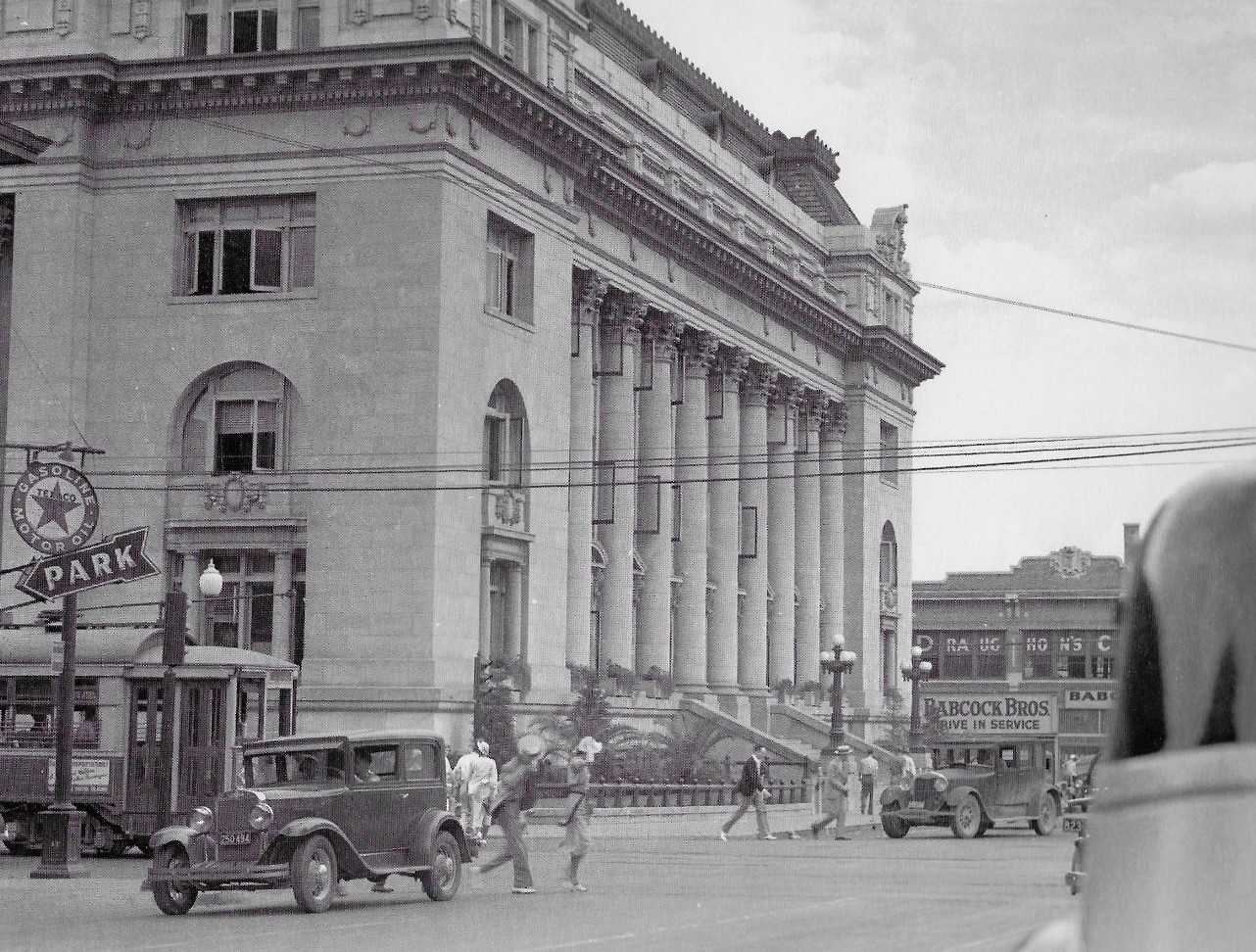
A few images of the building over the years. Here it is in its pristine early days:
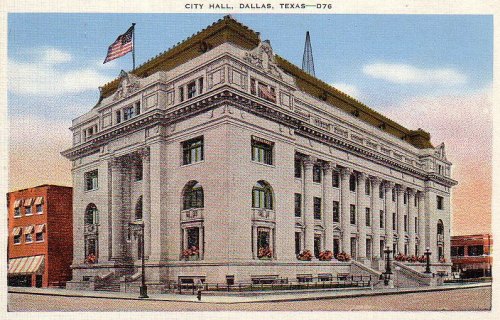
city_hall*

Then there was a weird middle-age-crazy period when someone thought that the addition of awnings would be a good idea (that person was incorrect).

municipal-bldg_color-ebay*

And, today, it’s back to looking distinguished and lovely. Thanks to the wonderful new open park in front of it, it has been given the stately space it deserves — what may be Dallas’ most beautiful building is finally able to be fully admired from a respectful distance.
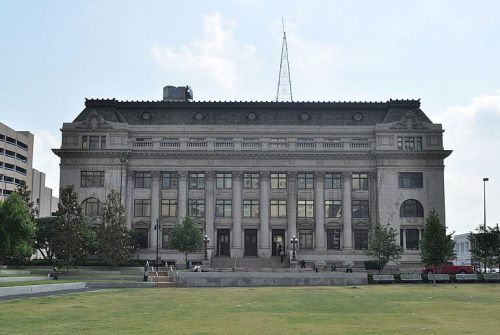
municipal-bldg-today_wikipediaJoe Mabel, Wikipedia

***

Sources & Notes

Top photo from the book Historic Photos of Dallas by Michael V. Hazel (Nashville: Turner Publishing Co., 2006).

Quote from Municipal Journal, Vol. XXXVI, No. 19 — May 7, 1914.

Photo of the old Municipal Building today by Joe Mabel, from Wikipedia. (And, yes, the parking garage of the Dallas Municipal Building is where Ruby shot Oswald.)

Newspaper photos and clippings as noted.

For a detailed description of the architectural details, design elements, and description of office and department locations within the building, see the article “Municipal Building Handsome Structure” (DMN, Oct. 4, 1914), here.

I’d love to know more about the little “aluminum trays, bearing a picture of the building” mentioned as being given away on opening day in an article above. There were FIVE THOUSAND of them given away. Surely there are some still around. Has anyone seen one of the these?
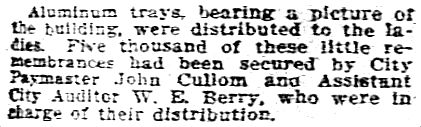
municipal-bldg_dmn_101814_aluminum-traysDMN, Oct. 18, 1914

municipal-bldg_c-d-hill_tx-almanac_19141914 Texas Almanac ad for C. D. Hill & Co.

*

Copyright © 2015 Paula Bosse. All Rights Reserved.

Iola Bridge

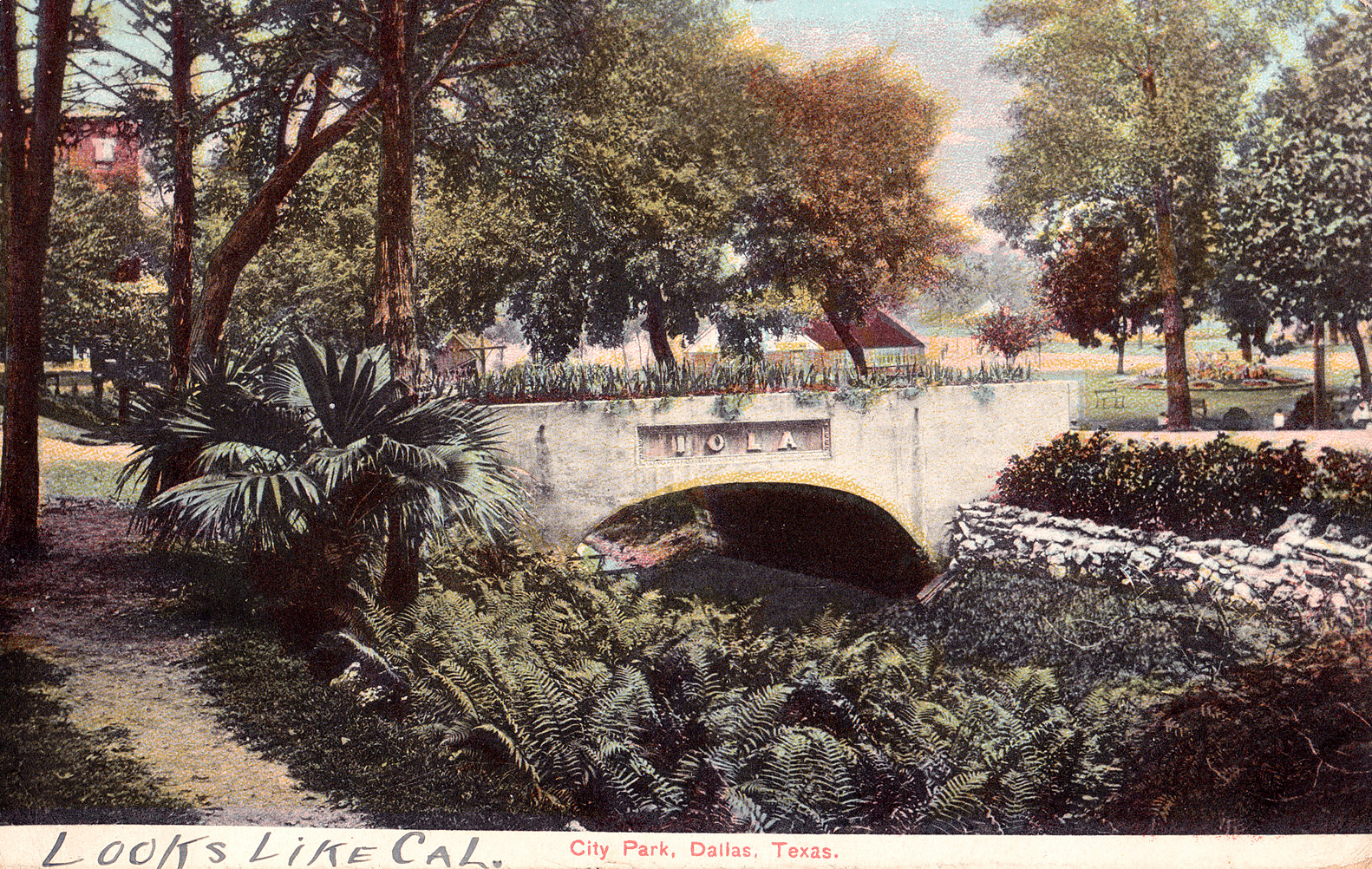
iola-bridge_city-park_ca-1908“Looks like California…” — City Park, ca. 1908

by Paula Bosse

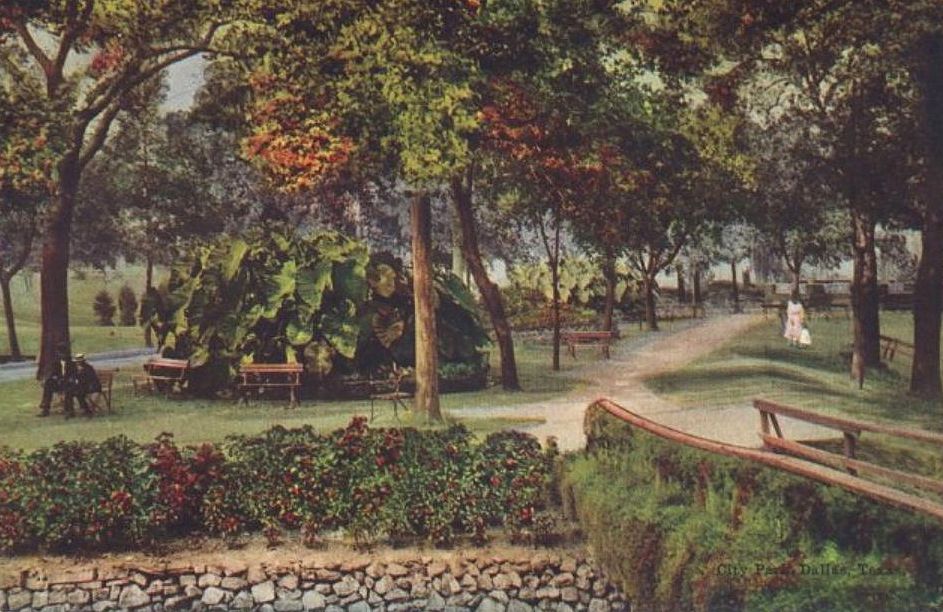
Old postcards of (Old) City Park always seem kind of mysterious to me. I’m fascinated by photos of what was, for many years, Dallas’ only park. It was very big and beautifully landscaped — and it was one of the things about the city that those of earlier generations were most proud of. The postcard views above and below are from the early days of the twentieth century, and, sadly, those views don’t exist anymore — it’s hard to believe they EVER existed here. Even though there’s a hint of what you might see at Reverchon Park, there’s little else about these images that looks like the Dallas of today. What a shame!

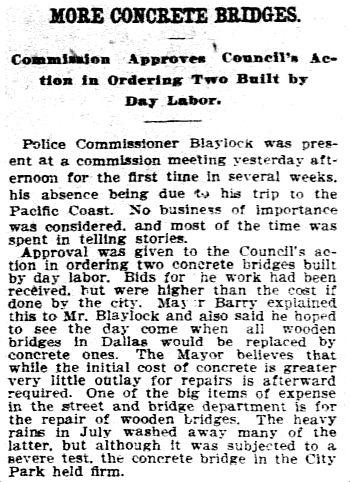
But what’s the story behind the attractive little “Iola” bridge? Built in 1905, it was, apparently, Dallas’ first (or possibly second) concrete bridge. The Iola bridge was far sturdier than the wooden bridges around Dallas, and a concrete bridge also required very little upkeep. In fact, this little bridge “of ornamental design” is actually kind of important — it was often cited by city planners and commissioners when discussing the construction of future bridges around the city.

concrete-bridges_dmn_081005Dallas Morning News, Aug. 10, 1905

It seems wooden bridges were being washed away almost as often as Dallas courthouses were burning down. In a letter that appeared in The News on Feb. 21, 1911, it was noted that, while wooden bridges were “under constant repair,” the concrete Iola bridge “has not required one dollar of outlay […] during its six years of existence.” So … cheaper and sturdier. Bye-bye, wooden bridges!

But “Iola”… where did that name come from? I thought it might have been the name of a wife or mother of a mayor or planner, but I suspect it was merely the name of the company that donated the cement for the bridge’s construction, the Iola Portland Cement Company. The company’s canny “civic donation” ultimately paid off BIG for them in the end. Not only did they supply the cement to build that first very pretty little bridge in a very pretty park, they also, ultimately, got whopping new orders from the city for all those new concrete bridges that began to be built — including, less than ten years later (when the Iola company’s West Dallas plant had been sold to the TEXAS Portland Cement Co.), the Trinity River-spanning Oak Cliff/Houston Street viaduct, which, when it opened in 1912, was the longest concrete bridge in the WORLD! And it all began with that unassuming bridge in scenic City Park, just south of the central business district.

*

iola-bridge_watermelon-kid

iola-bridge_dmn_100921aDMN, 1921

Below, a couple of views showing the charming and rather more rustic wooden bridges in the park.

bridge_city-park_watermelon-kid

wooden-bridges_city-park_watermelon-kid

iola-cement_directory-1905Ad from the 1905 Dallas directory

***

Sources & Notes

Top postcard found somewhere on the internet. All other postcards from The Watermelon Kid — here.

Black and white photo by Victor H. Schoffelmayer appeared in The Dallas Morning News on Oct. 9, 1921; it was one of several photographs of the Iola bridge, taken by members of the Dallas Camera Club.

A Dallas Morning News article from July 14, 1905 detailing the new improvements to City Park (including the concrete bridge) can be read here. (I don’t think the really wonderful-sounding “cascade” was ever built — and that’s a pity, because it sounds like it would have been beautiful!)

*

Copyright © 2015 Paula Bosse. All Rights Reserved.
Nolan Ryan’s Celebratory Pancake Breakfast — 1972

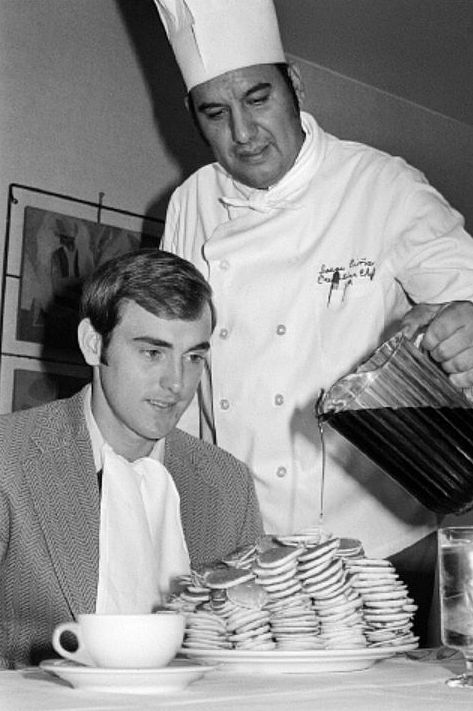
nolan-ryan© Bettmann/CORBIS

by Paula Bosse

In 1972, future baseball hall-of-famer and Texas Rangers legend Nolan Ryan (then a California Angel) was photographed in Dallas as he sat mesmerized by a platter of 302 silver-dollar pancakes and an iced-tea-sized pitcher of syrup. The celebratory breakfast was served to him at the Sheraton Dallas the morning after he became only the sixth pitcher in major league history to strike out more than 300 batters in a season. (His opponents the previous night — September 25, 1972 — had been the Rangers, the team he would one day play for and preside over as president and CEO.)

The UPI Telephoto wire photo ran on Sept. 27, 1972 above the following caption:

302 PANCAKES — Ever wonder what 302 strikeouts in a season will get you? If you’re a batter, you may lose your job, but if you’re a pitcher like Nolan Ryan, left, of the California Angels, [you] will at least get 302 silver dollar pancakes. This was the breakfast that awaited Ryan Tuesday after his 3-hit, 12-strikeout win over the Texas Rangers Monday. The executive chef at the Sheraton Dallas [Isaac Pina] produced the breakfast for the Alvin native, a former New York Met, who is the sixth pitcher in major league history to strike out more than 300 batters in one season.

Twelve strike-outs!

ryan_FWST_092672Fort Worth Star-Telegram, Sept. 26, 1972
Judging by the expression on his face at the next day’s breakfast table, it’s pretty obvious the 25-year old Nolan Ryan enjoyed his triumph.

***

Sources & Notes

Photo ©Bettmann/CORBIS. The photo is also seen on this page, from The Guardian, which shows a collection of really great historic baseball photos — a bit of a surprise, coming from a British newspaper!

The photo was published in newspapers around the country; the quoted wire copy appeared in the Sept. 27, 1972 edition of The Waxahachie Daily Light.

To read a passage from the book Nolan Ryan’s Pitcher’s Bible in which he writes about the importance of his high-carb breakfasts (Day One: Pancakes…), see here.

The Wikipedia entry on Nolan Ryan is here; his stats are here.

*

Copyright © 2015 Paula Bosse. All Rights Reserved.


Easter Egg Hunt at City Park — 1924

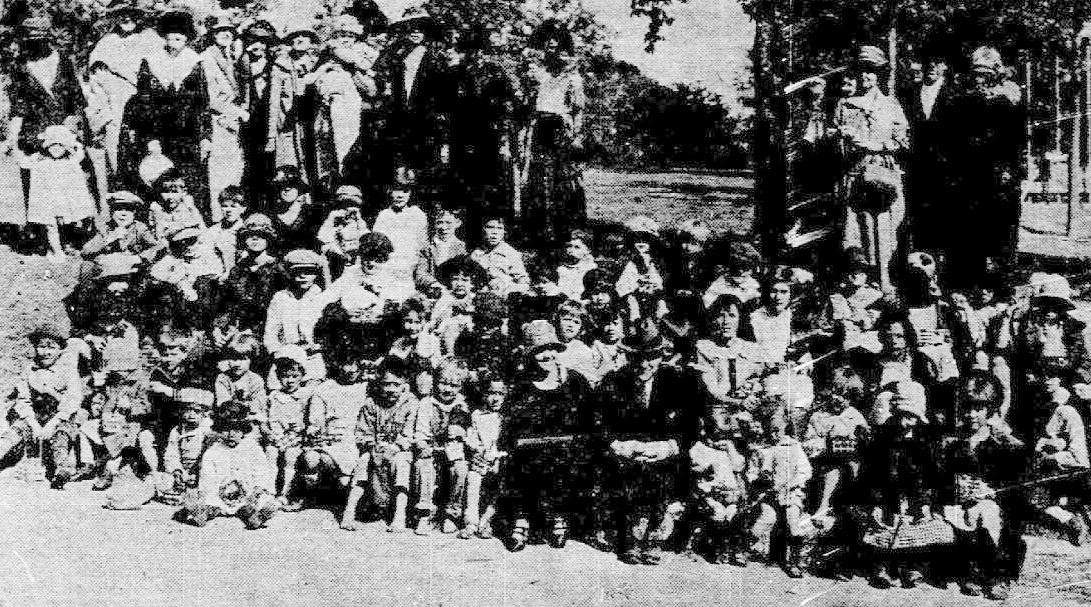
Hunters and their patrons, 1924…

by Paula Bosse

Happy Easter! Here’s what was going on at about this time, 91 years ago.

*

Osteopathic Clinic Fetes Children With Easter Egg Hunt

The church committee of the free osteopathic clinic at the First Unitarian Church, Ervay and St. Louis streets, entertained seventy-five children of the clinic at an Easter egg hunt in City Park Friday afternoon. Real Easter eggs were hidden by the ladies of the committee about the park, and where the close-cropped grass did not provide good hiding places about the tree trunks, nests were made in the sand.

After the youngsters had been released to hunt, they pursued the quest vigorously, to the accompaniment of shrill cries of delight, until all the eggs were found, the members of the committee distributed Easter baskets filled with candy eggs for the children to eat. Later they were taken to the church, where refreshments were served.

***

Sources & Notes

Photo and caption from The Dallas Morning News, April 19, 1924.

*

Copyright © 2015 Paula Bosse. All Rights Reserved.

Dallas’ Kosher Delis — 1921

fram_passover_jewish-monitor_040821

by Paula Bosse

Dallas once had a lot of mom-and-pop Jewish delicatessens and markets. Would that that were true today….

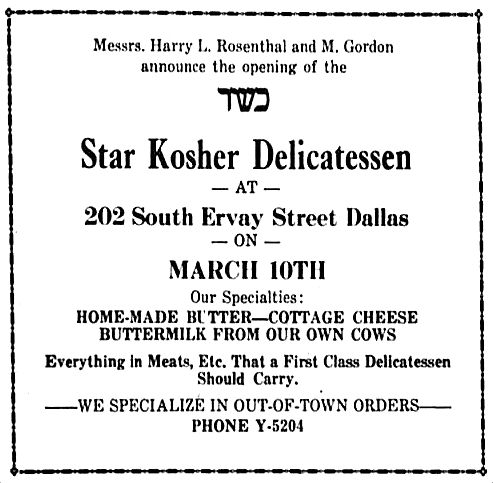
Here are a few ads from the pages of the Fort Worth-based Jewish Monitor (the “Leading Jewish Journal of the Great Southwest”) from April, 1921, published in the lead-up to Passover.

chicago-deli_jewish-monitor_040821

sterns-deli_jewish-monitor_040821

star-deli_jewish-monitor_040121

goldin-meat-mkt_jewish-monitor_040821

***

All ads from The Jewish Monitor, April 8, 1921 (except for the Star Kosher Delicatessen ad, which was from the April 1, 1921 edition). The April 8 edition of the paper can be viewed in its entirety at the Portal to Texas History site, here.

As this is Passover, my previous related post, “The Margules Family’s Passover Seder,” can be read here.

*

Copyright © 2015 Paula Bosse. All Rights Reserved.


Happy 1st Day of April!

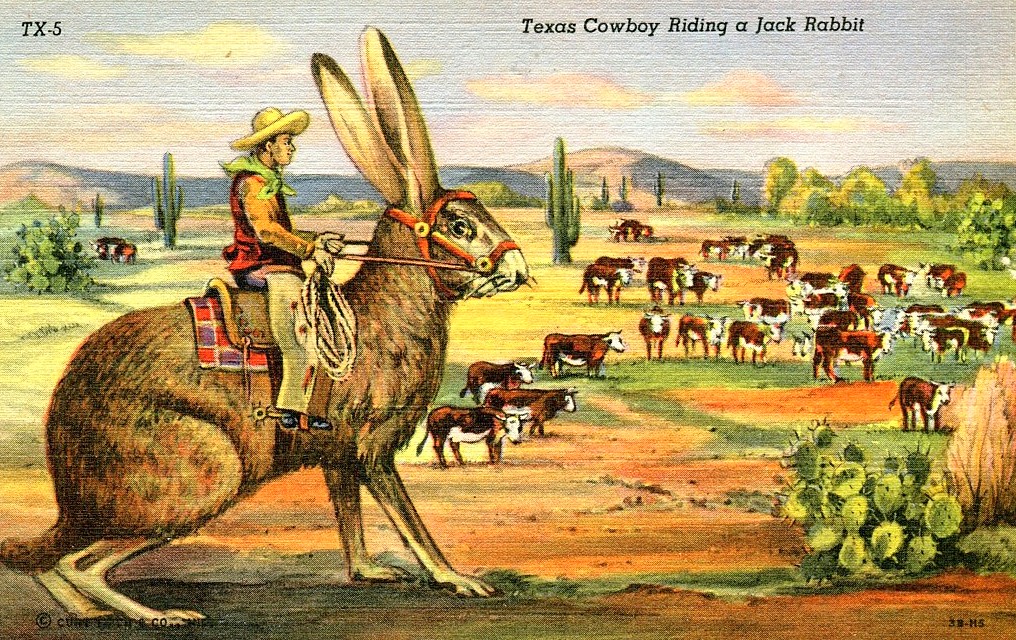
tx-jackrabbitPerspective’s a bit off — those cattle would have been MUCH larger

by Paula Bosse

Everything’s bigger in Texas — including our jackrabbits, which are justifiably legendary. Below, a photo of a (concerned-looking) child posed atop one of the more docile breeds. We’re just not growing them that big anymore. Shame.

jackrabbitApparently somewhere in Dallas…

***

Sources & Notes

Top image found here (where other historical images of cowboys riding giant jackrabbits can be seen).

Bottom photo (possibly a postcard) was on eBay a while back. Location was identified as Dallas.

For a previous Flashback Dallas post celebrating the 1st Day of April, see “U.S. Revenue Cutter ‘Carrie Nation’ Successfully Navigates the Trinity In Valiant Effort to Keep Dallas Dry! — 1931” here.

*

Copyright © 2015 Paula Bosse. All Rights Reserved.

Teenagers, Hot-Rods — 1960s

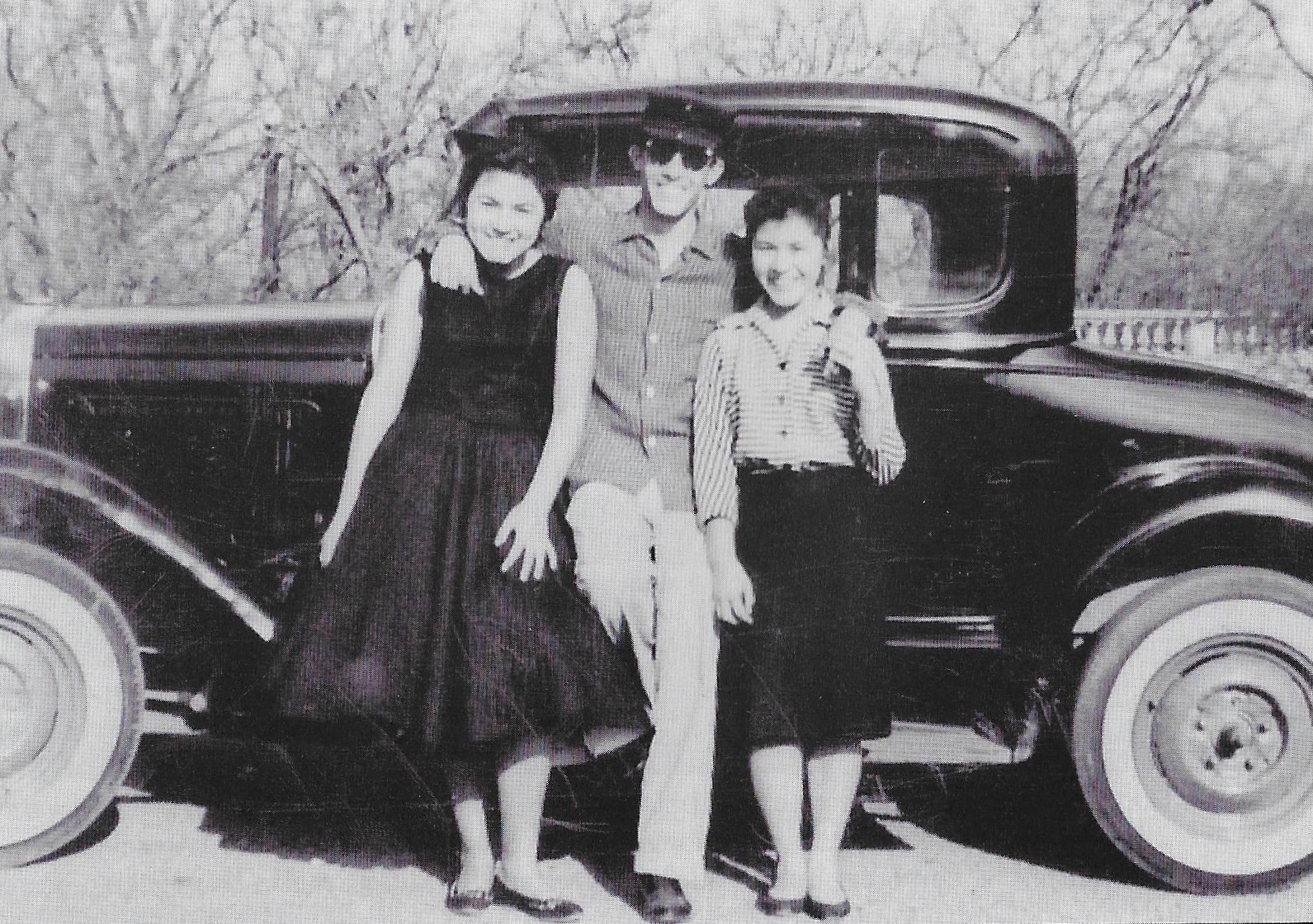
little-mexico_hot-rod_villasana A cool cat and his kittens… (via DMAHL)

by Paula Bosse

Teenagers and hot-rods, man. These kids are cool.

***

Sources & Notes

Photo from the book Dallas’s Little Mexico by Sol Villasana (Charleston, SC: Arcadia Publishing, 2011); photo is credited to Dallas Mexican American Historical League (DMAHL). Caption reads: “These Little Mexico teenagers show off their hot-rod in this 1960s picture. Shown are, from left to right, ? Santos, Rudy Trevino, and Maria Rodriguez.”

*

Copyright © 2015 Paula Bosse. All Rights Reserved.

Highland Park’s Snazzy New Fire Engine — 1914

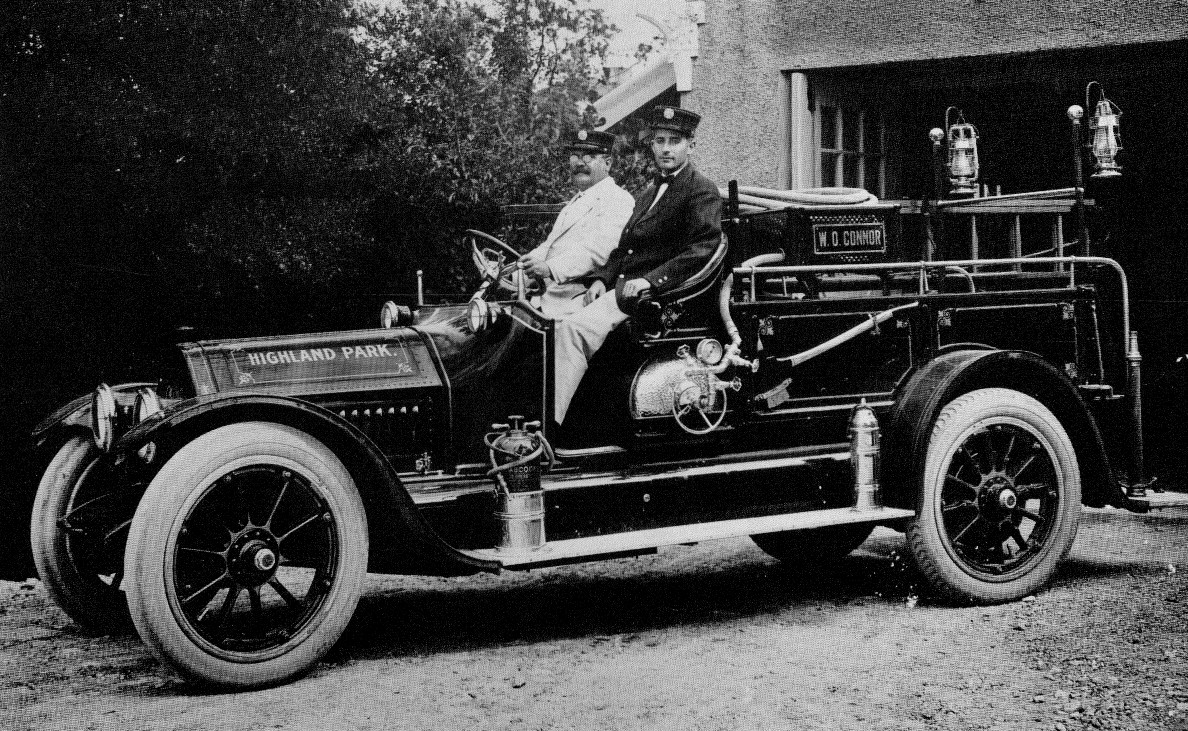
hp_fire-truck_1914Chief McGoldrick behind the wheel of HP’s new fire engine…

by Paula Bosse

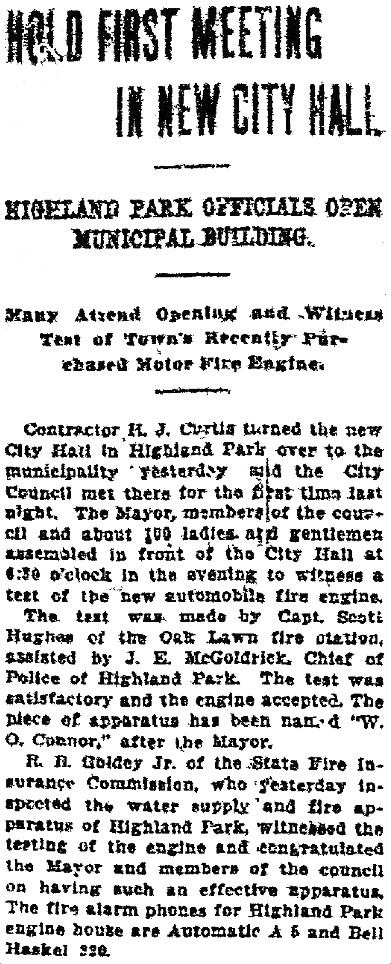
Above, Ed McGoldrick — who was both police chief and fire chief for Highland Park — sits behind the wheel of HP’s new fire engine. It even had a  name — “W. O. O’Connor,” after the mayor. Seated next to Chief McGoldrick is most likely Capt. Scott Hughes of the Oak Lawn fire station. The engine was tested, deemed satisfactory, and accepted into service on June 4, 1914 on the day the new Highland Park City Hall was officially opened. (Click article below to see larger image.)

hp_fire-engine_dmn_060514Dallas Morning News, June 5, 1914

J. E. McGoldrick was apparently something of a peace officer renaissance man. He was an officer on the Dallas Police force from about 1902 to 1912, and then became head police and fire honcho in Highland Park from 1912 to 1917 (where he was also the Street Superintendent). At the same time he was serving as HP Chief Peace Officer, he was also appointed to head the Game Commission of Dallas County. In 1917, he resigned his position in HP to accept a job at SMU where he “would have charge of buildings and grounds” (DMN, June 6, 1917). In 1924, he was appointed Chief Peace Officer of University Park.

That SMU move seems like a bit of a weird detour for a career policeman, but even weirder is the following sentence, which appeared in the blurb about his University Park appointment:

[McGoldrick served as the chief peace officer of Highland Park] until 1917 and then undertook confidential duties for the United States Government. During the past two years he has been connected with Sanger Bros. (DMN, Oct. 5, 1924)

James E. McGoldrick died in October 1927 when he suffered a heart attack while eating his lunch in a drugstore at Main and Lamar. He was 54. His obituary mentioned that he had been “connected with a meat market” in his post-public-service life.

But back to the photo. It’s great. There’s nothing quite like the smell of a new fire engine. And Chief McGoldrick looks very proud.

***

Sources & Notes

Photo from a postcard issued as part of the Park Cities Bank “Heritage Series” in the 1970s; the credit line on the postcard reads “Donated by the Town of Highland Park.” Thanks to the Lone Star Library Annex Facebook group for use of the image.

Newspaper clipping as noted.

*

Copyright © 2015 Paula Bosse. All Rights Reserved.

Dr Pepper Ad: “I’ll Have Another Myself” — 1929

dr-pepper_dmn_052729

by Paula Bosse

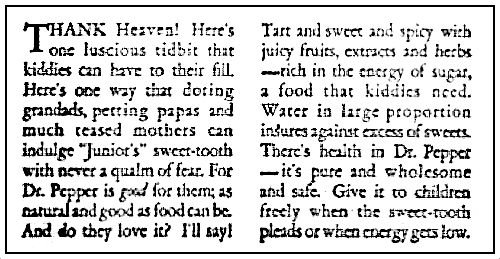
Drink up, kids — Gramps is buying! “It’s pure and wholesome and safe.”

ad-dr-pepper_dmn_052729-text

And the tag line: “It’s A Good Habit To Get — It’s One That Won’t Get You.”

dp-sign

***

Ad from 1929.

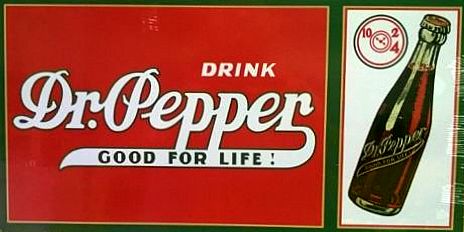
Reproduction of period sign found on eBay.

*

Copyright © 2015 Paula Bosse. All Rights Reserved.