Flashback : Dallas

A Miscellany: History, Ads, Pop Culture

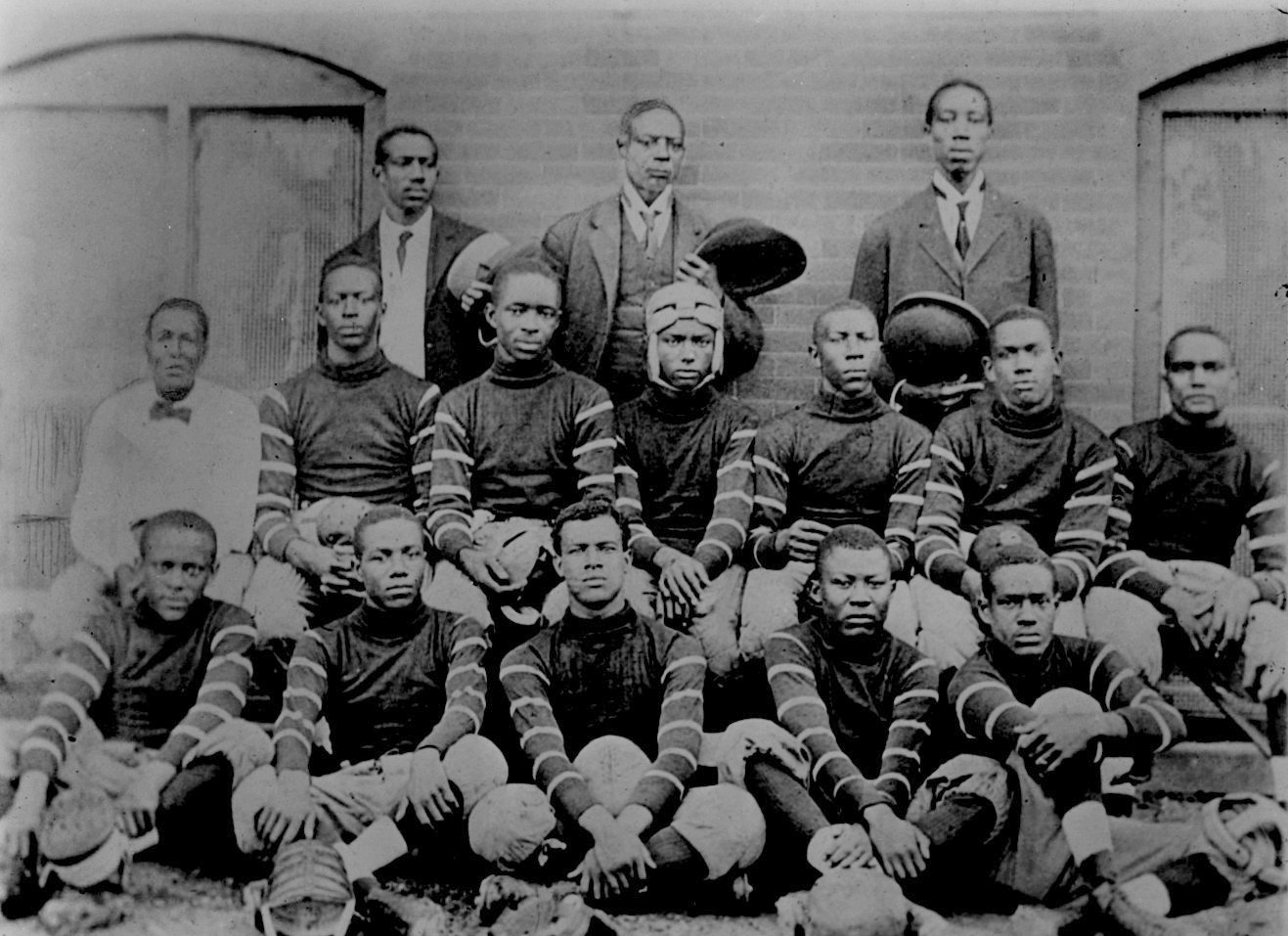
Dallas High School Football, 1909-Style

football-team-1909Game faces ON… (click for larger image)

by Paula Bosse

Great Dallas Historical Society photo described only as “a high school football team,” from 1909. The team most likely represented the “Colored High School” located at Hall and Cochran, the only high school in Dallas at the time for African-American students (it eventually merged with and relocated to the nearby Booker T. Washington High School in the early 1920s where, incredibly, it remained the city’s only high school for black students until Lincoln High School opened in South Dallas in 1939).

As everything was segregated at the time, including schools and sports, the number of black high school football teams they could play was severely limited — in-town opponents were non-existent. In fact, a 1909 blurb in The Dallas Morning News announced that “[t]he football team of the Dallas Colored High School will play the Wylie University team from Marshall at Gaston Park” (DMN, Nov. 12, 1909). They were playing college teams. From 150 miles away. At least they were the home team.

***

Photo from the J. L. Patton Collection, Dallas Historical Society.

Click picture for larger image.

*

Copyright © 2014 Paula Bosse. All Rights Reserved.

McFarlin Auditorium, Following Morning Chapel — 1927

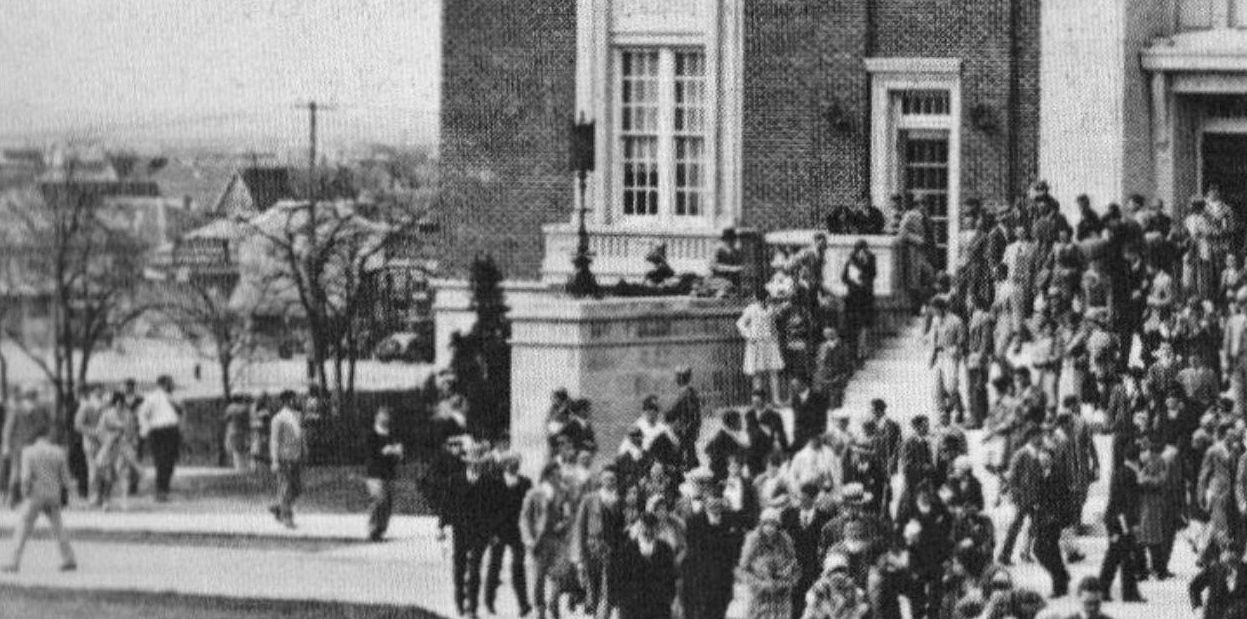
mcfarlin-auditorium_1927McFarlin Auditorium, post-Chapel, 1927 (click for larger image)

by Paula Bosse

Another in the series of wonderful postcards celebrating the history of the Park Cities, this one shows McFarlin Auditorium in 1927, then only two years old. From the back of the card:

This is a 1927 photograph taken following morning Chapel in McFarlin Auditorium. The building is located at McFarlin Blvd. and Hillcrest on the Southern Methodist University campus. At that time, Chapel attendance was mandatory for SMU students. Dr. R. E. Dickenson was Chaplain and conducted the daily chapel services, and Dr. Charles C. Selecman was the President of the University.

Below are a couple of details of the photo which show, in the background, interesting (if fuzzy) views of houses and other structures along (and beyond) Hillcrest.

mcfarlin_det1

mcfarlin_det2

***

Postcard is from the Park Cities Bank “Heritage Series” issued in the 1970s. Photo credit line on the postcard reads “Donated by Stanley Patterson.” Thanks to the Lone Star Library Annex Facebook group for use of the image.

Click pictures for larger images.

*

Copyright © 2014 Paula Bosse. All Rights Reserved.

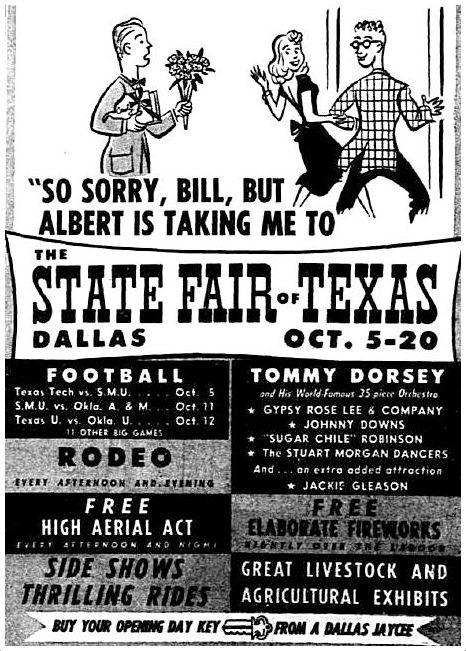
“So Sorry, Bill, But Albert is Taking Me to The State Fair of Texas”

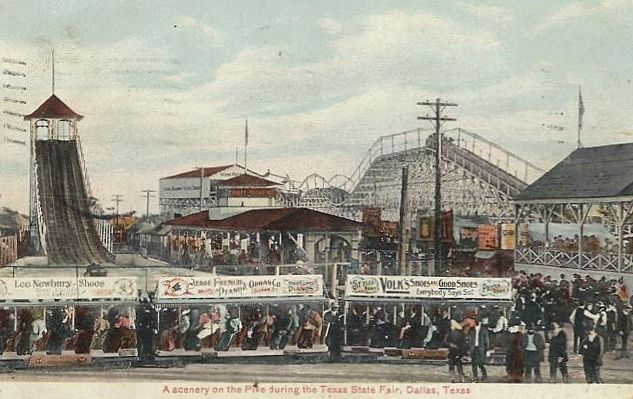
state-fair_1909_flickr“The Pike” — 1909

by Paula Bosse

Hey, y’all — guess what ends this weekend? Hurry!

One doesn’t really need an excuse to post a bunch of photos of the Great State Fair of Texas, but it IS the closing weekend, so why not enjoy a few images from the past few decades.

Above, a view of the Midway in 1909 (then called “The Pike”), with the Log Ride-like “Chute” and its ramp, a roller coaster, and a loaded tram festooned with shoe ads (including one for Volk’s).

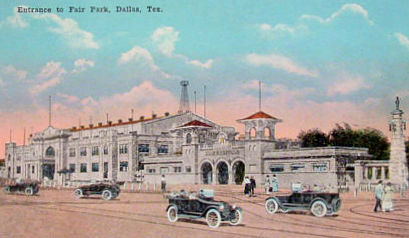
Below, the Fair Park entrance in 1919:

fair-park-entrance_1919

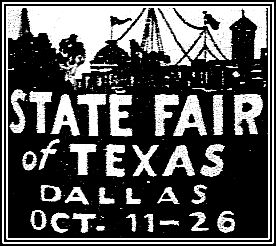
A nice little newspaper ad from 1924:

state-fair_092724

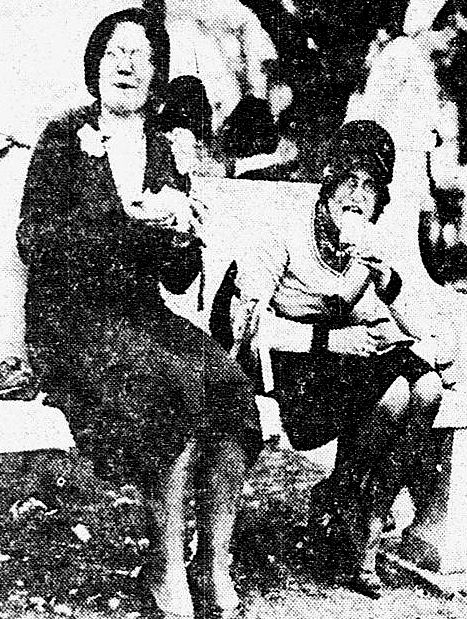
Two women enjoying ice cream in 1930 — State Fair food has always been one of the main joys of visiting the fair.

state-fair_dmn_101530

Ad from 1946: “So sorry, Bill, but Albert is taking me to the State Fair of Texas.” The grown-up entertainment that year was provided by Tommy Dorsey, Gypsy Rose Lee, and Jackie Gleason.

state-fair_dmn_092446

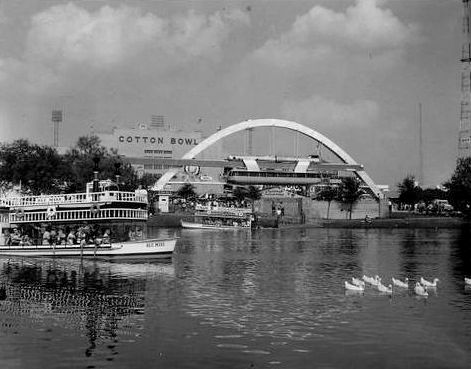
In 1958, Fair Park had a monorail (the only one then operating in the United States) and a paddle-wheeler in the lagoon:

state-fair_lagoon_squire-haskins_dmn-1958

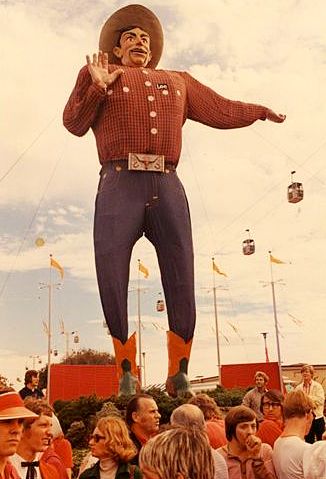
And then there’s this guy, who spans the decades:

big-tex_briscoe-center

***

Sources & Notes

1958 photo featuring the monorail by Squire Haskins, from a Dallas Morning News online article featuring TONS of cool photos of the fair over the years, here.

Big Tex photo (undated) from the Dolph Briscoe Center for American History.

Another post of random images of the SFOT through the decades — “The Fair Is In the Air — Let’s Go!” — is here.

*

Copyright © 2014 Paula Bosse. All Rights Reserved.


The Roller Coaster on the Prairie — 1894

state-fair-grounds_souv-dallas_1894Texas State Fair & Dallas Exposition Fair Grounds, circa 1888

by Paula Bosse

Above, a wonderful view of the “State Fair Grounds and Dallas Exposition” from an 1894 advertisement. The Little Roller Coaster on the Prairie!

If you want to see this very large (and, trust me, you DO), click here (and then click again). It’s like wandering through those old phone book covers, but without the jokes and the dinosaurs.

*

UPDATE: The artwork was used in a previous ad that appeared in The Dallas Morning News in 1888, with the following text:

The coming Fair and Exposition will, beyond a doubt, excel in point of attractiveness, numbers and variety of exhibits any heretofore held.

The County Exhibit Department promises to be the most attractive feature, one never before attempted by any State. Over forty counties up to date have secured space, and more still to enter. The exhibits these counties will present will be something that will astonish visitors.

Every variety of attractions has been provided for, and the musical treat we have in store for visitors will be presided over by the world renowned Cornetist , Prof. A. Liberati.

The purses offered in the Race Department cover $20,000, and will be competed for by the best racers in the land. The management of this department propose to give during the Fair and Exposition the finest races ever given in the South.

We desire to call the attention of counties to the fact that now is the time to get up their exhibits, when grain, fruits, etc. are ripening, and not wait until it is too late.

Space in the County Exhibit Department is free, and no county of our State can afford to be not represented. There will be more people here than ever before, and we want them all to see the varied resources of our great State.

To exhibitors in general we can promise them the finest opportunity ever offered to make displays from which will return good results, and to visitors we can assure them of the grandest entertainment ever given in the Southwest.

dallas-fair_dmn_090588

*

The scene above looks idyllic (to me, anyway), but here is a description of what the land was like before anything was built on it, from a Dallas Morning News history of the SFOT (Oct. 2, 1960):

An 80-acre tract approximately in the center of the present-day State Fair Park was chosen as the site for the Fair. The location was termed by some to be “the worst kind of hog wallow,” and the question most frequently asked was “How are you going to hold a fair in all that mud?”

*

The Dallas State Fair and Exposition (which became the State Fair of Texas) was chartered in 1886, and unless that artist’s rendering is highly romanticized (which it probably is), it looks like the hog wallow was but a faint memory by the time that roller coaster was plopped down on top it.

***

Sources & Notes

Artwork by the Dallas Engraving and Manufacturing Company. Top ad appeared in the Souvenir Guide of Dallas (1894); bottom ad appeared in The Dallas Morning News, Sept. 5, 1888.

*

Copyright © 2014 Paula Bosse. All Rights Reserved.

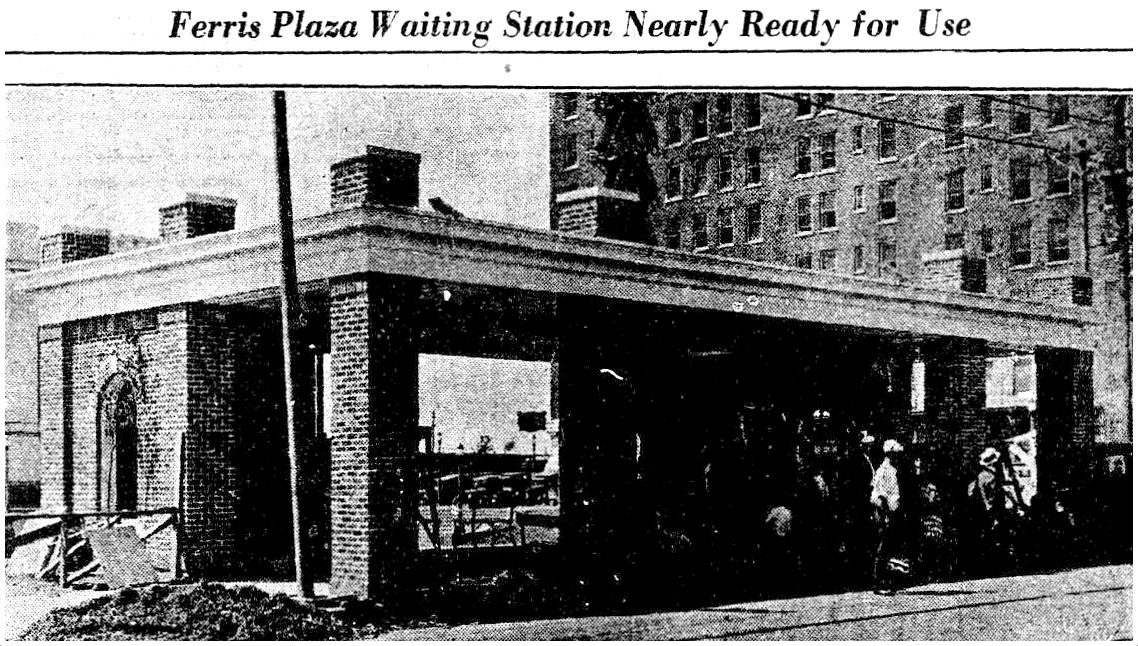
Ferris Plaza Waiting Station — 1925-1950

railway-info-bldg_1926From The Electric Railway Journal, 1926

by Paula Bosse

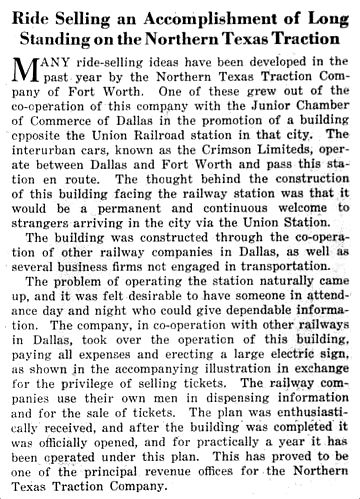
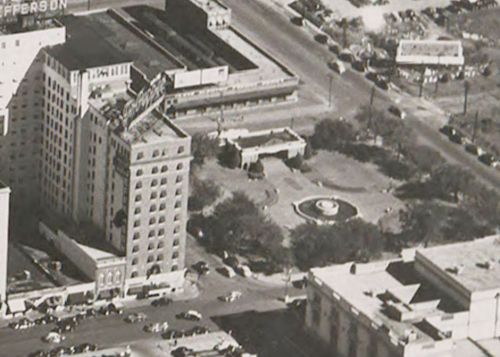
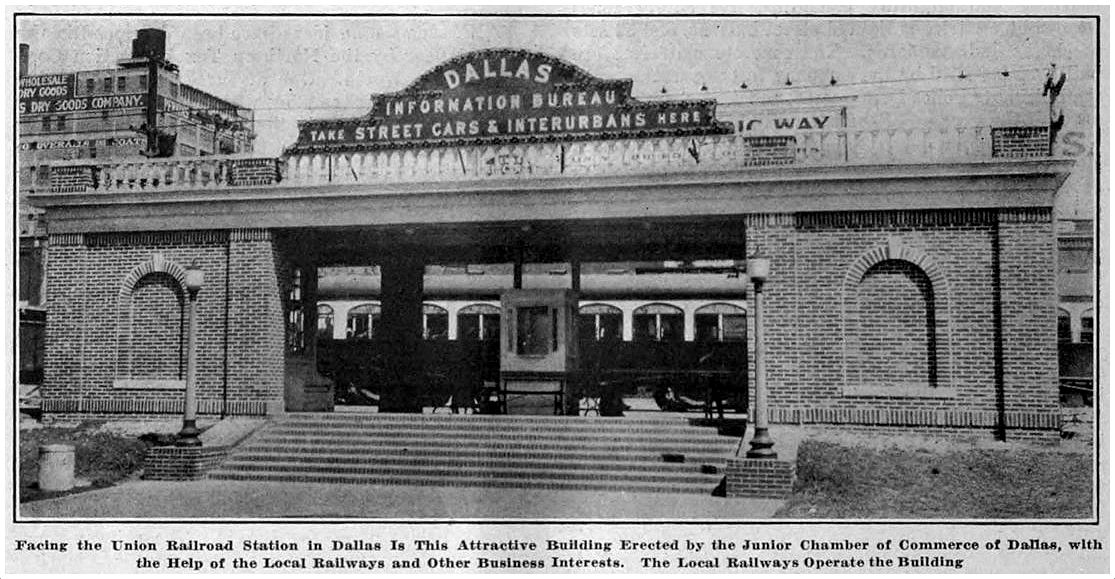
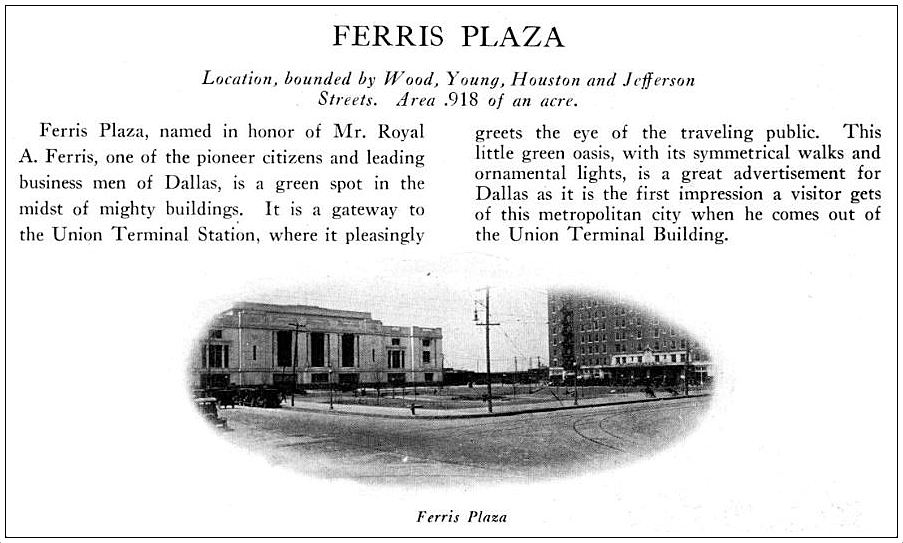
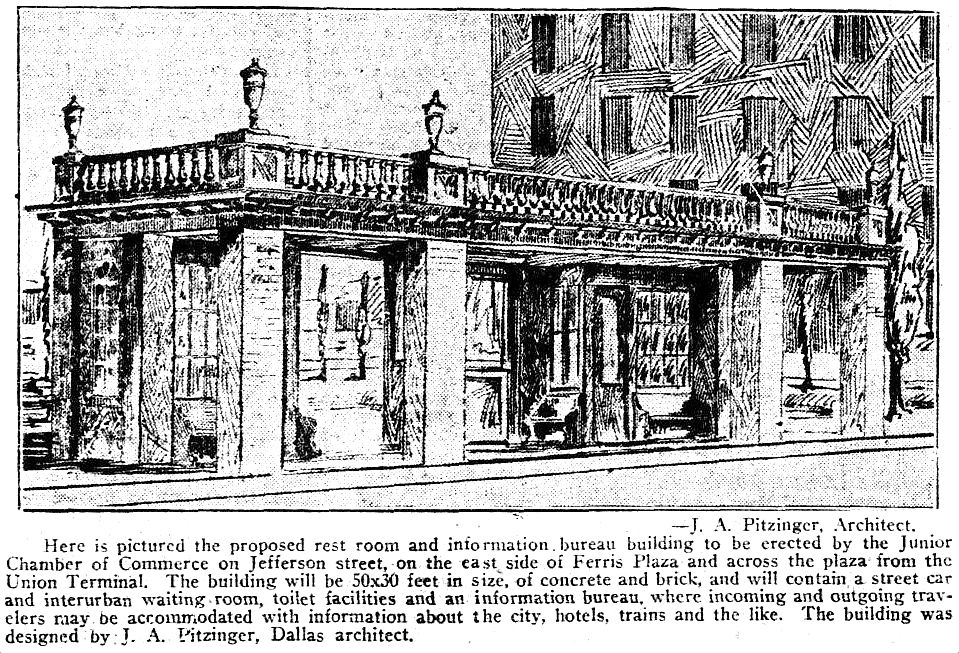
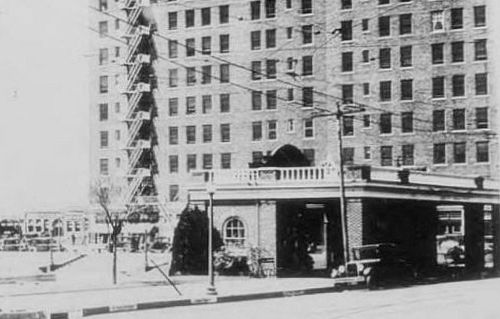
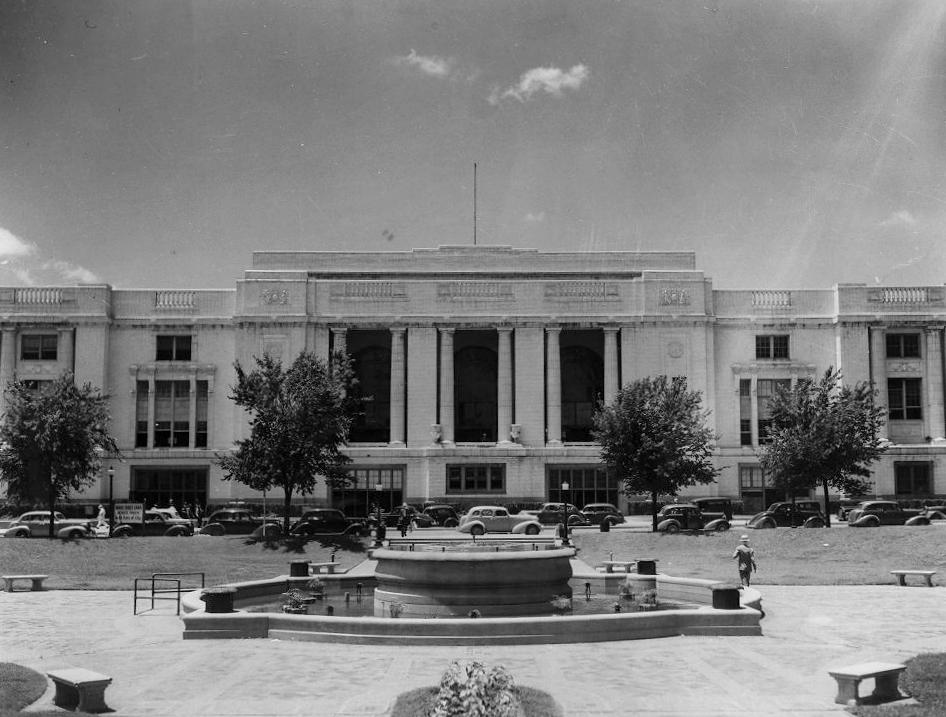
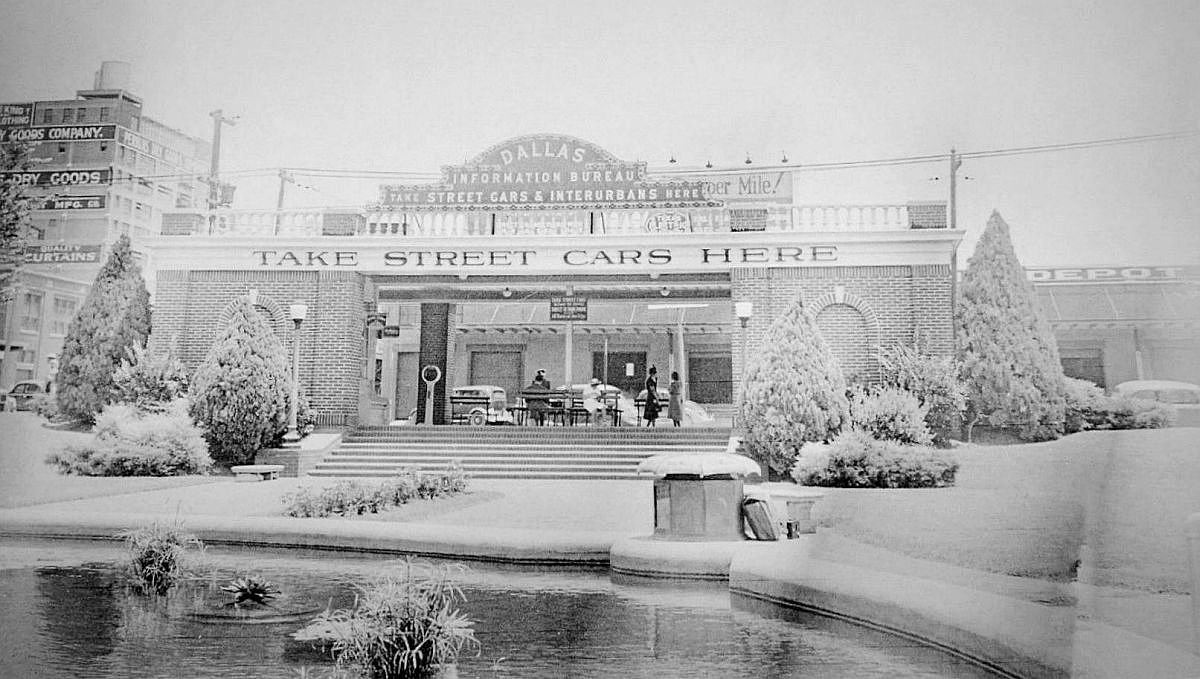
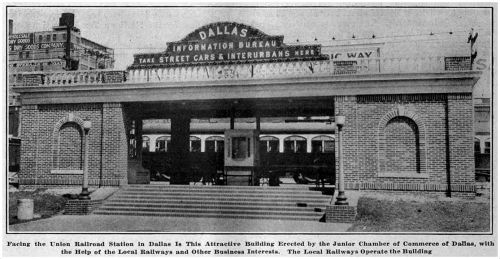
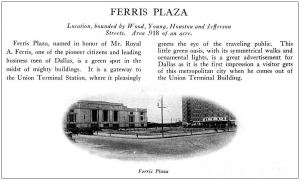
I came across the odd image above whilst digitally thumbing through a 1926 issue of The Electric Railway Journal (as one does…) and wondered what it was. It was definitely something I’d never seen downtown. Turns out it was a combination information bureau, covered stop in which to buy tickets for and await the arrival of interurbans and streetcars, a place to purchase a snack, and a location of public toilets (or, more euphemistically, “comfort stations”). It was located at the eastern edge of Ferris Park along Jefferson Street (which is now Record Street), with the view above facing Union Station. It was intended to be a helpful, welcoming place where visitors who had just arrived by train could obtain information about the city, and it was also a pleasant place to wait for the mass transit cars to spirit them away to points beyond. With the lovely Ferris Plaza (designed by George Dahl in 1925) between it and the front of the Union Terminal, this was considered The Gateway to the City long before Dealey’s Triple Underpass was constructed. (Click photos and articles to see larger images.)
ferris-plaza_park-and-playground-system_pubn_1921-23_portal

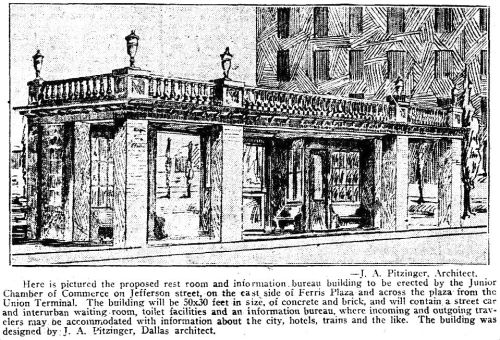
The “waiting station” was the brainchild of the Dallas Junior Chamber of Commerce which proposed the idea to the City of Dallas and, as it was to be built at the edge of a city park, the Park Board. The small (50 x 30) brick building — designed by Dallas architect J. A. Pitzinger — would cost $5,000 and would be paid for by funding from local businesses, including various transportation concerns (namely, the Northern Texas Traction Company). The “traction” companies would staff the information booth and sell tickets. The plans were accepted and permission was granted. Construction began in July, 1925, and the building was opened for waiting by October.

This improvement is the most recent of a number which have made of Ferris Plaza a beauty spot at the gateway of the city. Designed for a sunken garden, fringed with trees, the plaza is now adorned with a great fountain, illuminated with colored lighting at night, the gift of Royal A. Ferris. The new waiting station is in harmony with the general scheme of the plaza development, and combines beauty with utility. (Dallas Morning News, Sept. 20, 1925)

The little waiting station proved to be quite popular, and by the end of its first year the Northern Texas Traction Company (who operated interurban service between Dallas and Fort Worth) was very pleased, as interurban ticket sales at the station had become a solid source of company revenue. The Ferris Plaza station lasted a rather surprising 25 years. It was torn down in 1950, mainly because the interurbans had been taken out of service and there was no longer a need for it. Also, the park department was eager to get their park back and make it more “symmetrical.”

People would just have to wait somewhere else.

*
ferris-plaza-info-bureau_rendering_pitzinger_dmn_031625Architectural rendering by J. A. Pitzinger (DMN, March 16, 1925)
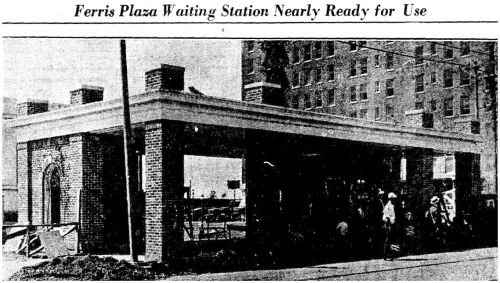
ferris-plaza-waiting-stn_dmn_092025Nearing completion (DMN, Sept. 20, 1925)
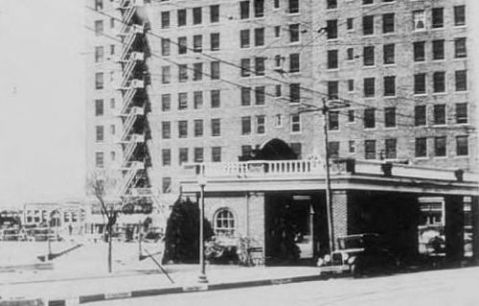
waiting-station_jefferson-hotel_degolyer-lib_SMU_croppedDeGolyer Library, SMU (cropped)

railway-info-bldg_1926_text_smThe Electric Railway Journal (Nov. 6, 1926)
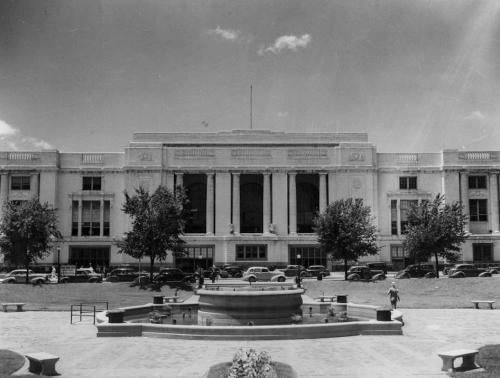
ferris-plaza_union-station_dpl_1936Union Station, 1936 — view from the “waiting station” (Dallas Public Library)
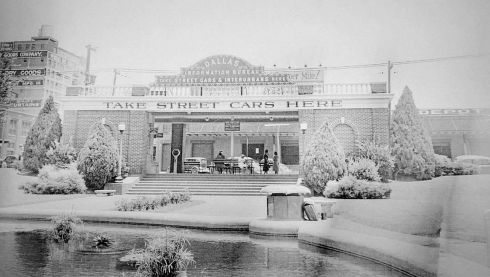
waiting-station_ebay

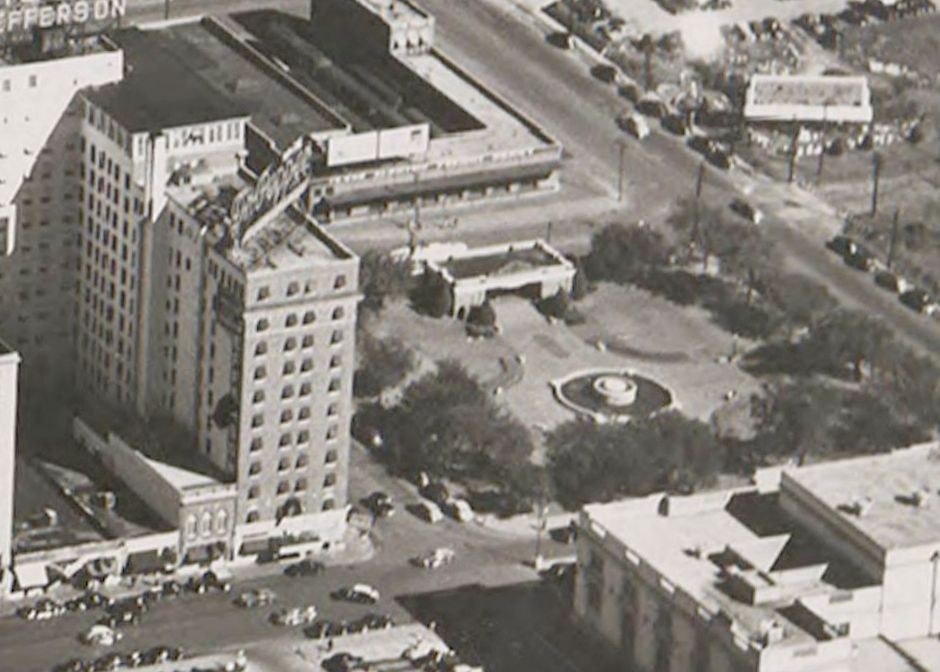
ferris-plaza_aerial_smu_c1949-det1949 aerial view, showing “waiting station” just above plaza’s circular fountain

***

Sources & Notes

Top photo from The Electric Railway Journal, Nov. 6, 1926.

Very early photo and description of Ferris Plaza is from Park and Playground System: Report of the Park Board of the City of Dallas, 1921-1923, via the Portal to Texas History, here.

Cropped image showing the waiting station with the Jefferson Hotel in the background is from the DeGolyer Library, SMU — more info is here.

Photograph of Union Station from the Texas/Dallas History and Archives Division of the Dallas Public Library.

Aerial photo showing Ferris Plaza is from a larger view of downtown by Lloyd M. Long (the original of which is in the Edwin J. Foscue Map Library collection of the Central University Libraries, Southern Methodist University, and which can be viewed here).

To read about the Ferris Park restoration project, see here.

For a few interesting and weird tidbits about the block that eventually became Ferris Plaza (including the fact that it was thought to be haunted and that it was once the site of a brothel), check out this page on Jim Wheat’s fantastic site.

*

Copyright © 2014 Paula Bosse. All Rights Reserved.

Dallas Gets Vertical: 1887-1925

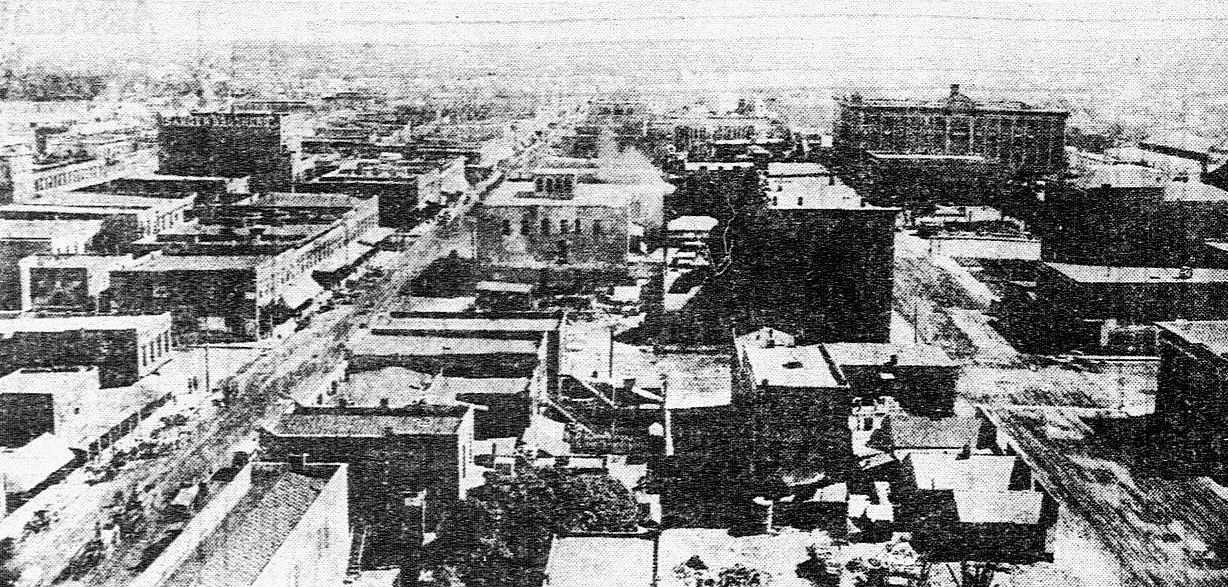
east-from-courthouse_1887Looking east from the courthouse, ca. 1887 (click for larger image)

by Paula Bosse

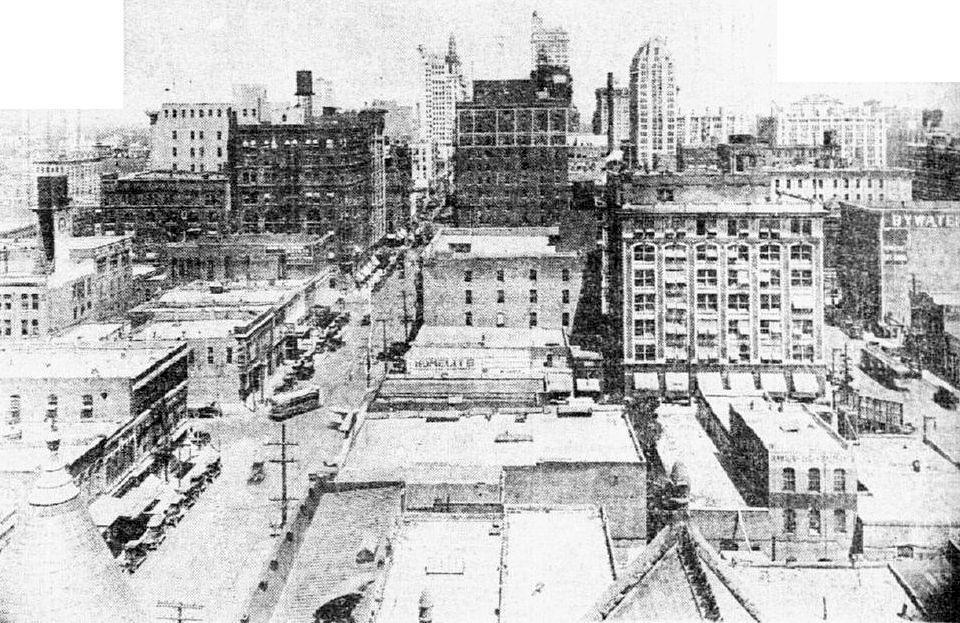
Above and below, the view of downtown Dallas looking east from the courthouse, with Main Street on the left and Commerce on the right. The top photo was taken about 1887 (the Grand Windsor hotel is the mammoth building in the top right corner), and the bottom one was taken about 1925. What a difference 38 years makes — the horizon has disappeared!

east-from-courthouse_1920s

***

Sources & Notes

Both photos appeared in The Dallas Morning News on Oct. 1, 1925. The caption reads: “[First photo]: View of Dallas looking east between Main and Commerce streets from the courthouse. It was taken about 1887. So far as known it is the only picture in existence which shows the Dallas Opera House at the southwest corner of Commerce and Austin streets. It also shows the old Grand Windsor Hotel. Note the vacant lots, and the unpaved condition of the streets and the horsedrawn vehicles on Main. [Second photo] This picture was made by H. B. Hillyer & Son.”

*

Copyright © 2014 Paula Bosse. All Rights Reserved.
Preston Elms: Your Country Estate Awaits — 1935

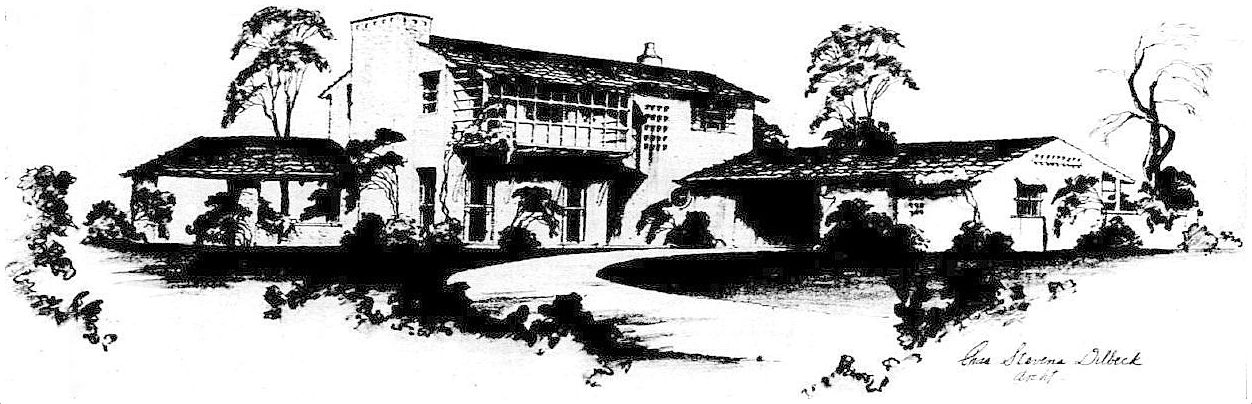
preston-elms_dilbeck_dmn_100135Preston Elms home designed by Charles Dilbeck, 1935

by Paula Bosse

This beautiful home, designed by the wonderful architect Charles Stevens Dilbeck, was featured in an ad touting an exclusive new “country estate” development called Preston Elms, located at Preston Road and Walnut Hill Lane. From the text of the ad:

The home pictured above will be erected immediately in a new tract set aside for a Demonstration Home. It will have three bedrooms, large dining room and living room. Terrace porch on south and east will be 32 feet long and can be reached from dining room, living room or hall. Two baths — most modern type! Extraordinary hardware! …

The backyard will be walled in assuring privacy to servants and parked automobiles. …

All the details of the house and location have been studied and planned for months. …

The Better Homes of America are gradually drifting away from the urban abode of restricted activity to the freedom, comfort, seclusion and the individuality of the COUNTRY ESTATE.

*

A later ad would include this grabber of a line: “In the heart of Preston Road District, All City Conveniences, Minus City Taxes.”

*

Tracts ranging from one-half to two acres would start at $1,700. The house pictured above would cost $12,500. (I would kill for that house, but I fear it has long since been torn down as being too teensy for the neighborhood.)

“Preston Elms” (along with Preston Downs, Preston Hollow, Preston Highlands, Preston Heights, Inwood Road Addition, Sunnybrook, and El Parado) were the subdivisions in the so-called “Preston Road District,” an area of some 1,200 acres north of Northwest Highway. When this area was being developed (by savvy speculator Ira P. DeLoache), it was not within the Dallas city limits. In 1939, after a failed attempt at some sort of merging with University Park, the residents voted to incorporate, and the somewhat sparsely-populated area became the “city” of Preston Hollow. With a mayor and everything.

But back to that house. God, I love that house. As I said, I bet that sucker was elbowed out long ago. If it’s still there, I’d love to know.

A photo of the man responsible for developing most of the Preston Road District, Ira P. DeLoache, namesake of one of the area’s streets.

deloache_legacies_fall-2002

***

Sources & Notes

The Dilbeck drawing at the top is from a half-page real estate ad, here.

Photo of Ira P. DeLoache from the Fall, 2002 issue of Legacies.

Examples of Dilbeck’s beautiful houses (several of which are in Preston Hollow) can be seen here.

Background on Preston Hollow and its road to incorporation can be read about in the Dallas Morning News article “Preston Road Incorporation Plan Climaxes Weeds to Orchids Development,” (DMN, Sept. 24, 1939).

For an aerial view of what would become Preston Hollow, check out a mostly empty 1930 vista (from SMU’s Edwin J. Foscue Library), here. Development, here we come!

*

Copyright © 2014 Paula Bosse. All Rights Reserved.

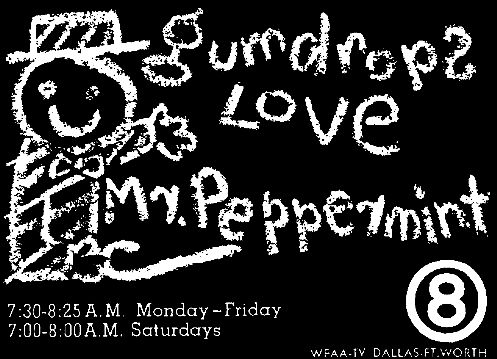
“Gumdrops Love Mr. Peppermint” — 1968

mr-peppermint_1968

by Paula Bosse

When the news is unsettling, remember your “happy place.”

***

1968 TV Guide ad, from eBay.

*

Copyright © 2014 Paula Bosse. All Rights Reserved.


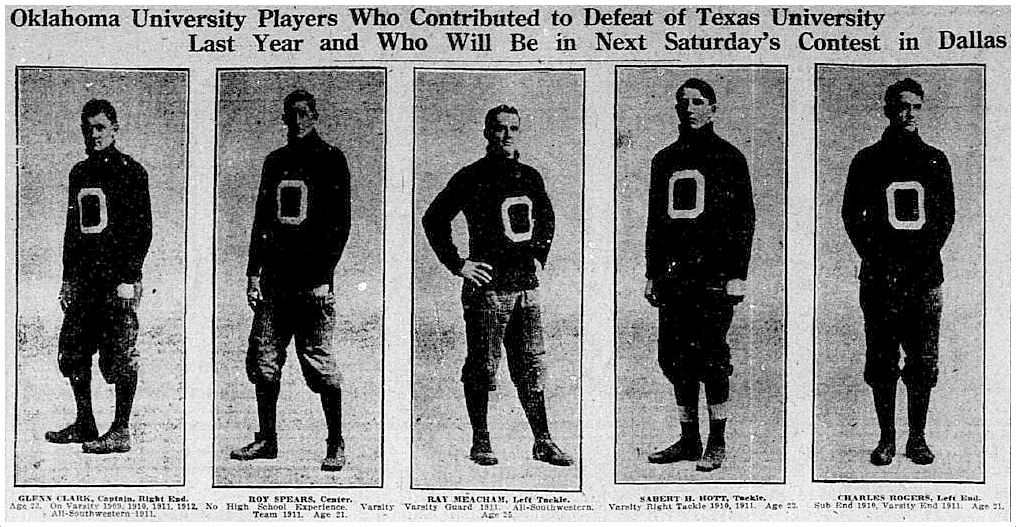
The First Texas-OU Game in Dallas — 1912

tx-players_dmn_101912bWatch out, Oklahoma: giant Texas linemen await…

 by Paula Bosse

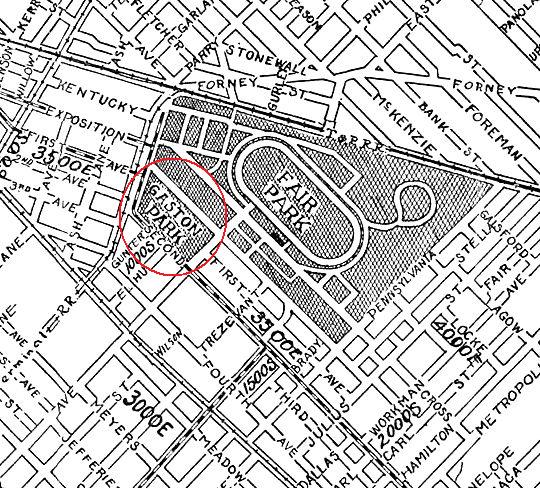
The Texas-OU game is a football tradition, held annually in the Cotton Bowl during the State Fair of Texas. The first game of the so-called “Red River Rivalry/Showdown/Shootout” was held in Dallas (aka “neutral ground”) in 1912. As the Cotton Bowl hadn’t been built yet, the game was held at Gaston Park, a sporting field with a large grandstand where Dallas teams played baseball, football, and, yes, even soccer. It was located at Parry & Exposition, in the spot where the State Fair Auditorium (now known as the Music Hall) was built in the 1920s.

Since my grasp of sports is tentative, I’m not going to go into any particulars of the actual game (which — spoiler! — Oklahoma won, 21-6); instead, I thought I’d mention a few of the incidental things leading up to the game that I found interesting. (For those who are interested in the particulars of the game, fret not — there is a link at the bottom of the post.)

So here are a few of the things that I found amusing or entertaining:

  • The 1912 football season began with new rules: downs were increased from 3 to 4; touchdowns were now 6 points instead of 5; the playing field was reduced from 110 yards to 100; the onside kick was abolished; a touchdown was permitted when caught over the goal line; the ball was kicked off from the 40-yard line instead of midfield; the intermission between quarters was reduced from 2 minutes to 1.
  • Fort Worth felt slighted that they had missed out on hosting the game (“it might just as well have been played in Fort Worth,” the Fort Worth Star-Telegram groused). Local Fort Worth-friendly UT alumni swore to try “strenuously” to get the game for Cowtown the following year, because, damn it, “next year is Fort Worth’s turn” (FWST, Oct. 15, 1912). (Sorry ’bout that, FW….)
  • The Sooners’ coach, 37-year old Bennie Owen (whom I gather is something of an OU legend), had only one arm, the result of a hunting accident. The Dallas Morning News wrote that Owen was “one of the most able [coaches] in the country. He is disabled to some extent by having but one arm, but evidenced by his success during the past season, this does not trouble him to any great extent” (DMN, Oct. 6, 1912).
  • The Longhorns’ coach, Dave Allerdice, was only 25 years old. He had been hired to fill the spot left vacant in the wake of the death of UT’s previous coach who had died rather exotically as the result of “a fall out of the window of his bedroom” (DMN, Oct. 10, 1912).
  • Both Allerdice and Owen had been coached as students by the same man, Coach Yost, at Michigan.
  • The Gaston Park crowd was estimated at over 6,000. The crowds going to the game and to the fair were so great that the streetcars and Interurbans were jam-packed. In fact, both teams had difficulty making it to the game on time because they couldn’t find transportation to get there, and the game had to be started late to allow for the players to arrive and warm up.
  • Oklahoma dominated the game, and the Sooners won, 21-6.

And so began the annual Texas-OU tradition in Dallas.

*

Below, Sooner boys: 0-0-0-0-0.

sooners_1912_dmn_101812DMN, Oct. 18, 1912

*

Grainy, off-kilter image of the crowd-frilled grandstand at Gaston Park.

tx-ou_crowd_dmn_102012DMN, Oct. 20, 1912

*

It’s a bit hard to see anything in these 100-plus-year-old photos, but here are a couple of “action photographs” of the game.

tx-ou_game-photos_dmn-102012DMN, Oct. 20, 1912

*

Gaston Park? Here’s where it was (a lot of street-renaming has gone on since this map was drawn in 1919).

gaston-park_fair-park_ca-1919

***

Sources & Notes

All photos from The Dallas Morning News.

1919 map (detail) from the Portal to Texas History, here.

For slightly better photos of Gaston Park (in 1908), see a previous post, here.

Wikipedia roundup:

  • Gaston Park, here.
  • Bennie Owen, here.
  • Dave Allerdice, here.
  • “Red River Showdown” (which I’ve never actually heard anyone other than TV commentators and promoters say to describe what everyone I know calls the “Texas-OU game”), here.
  • Defenestration, here.

The Dallas Morning News and The Fort Worth Star-Telegram are filled with numerous contemporaneous articles about this game. If you have a handy-dandy Dallas Public Library card (free!), you can pore over these articles to your heart’s content. To read what was printed the day of the game (Oct. 19, 1912), click  here. To read about the results and the game coverage, click here.

Click pictures for larger images. They will still be muddy and grainy, but, by God, they’ll be bigger.

*

Copyright © 2014 Paula Bosse. All Rights Reserved.

Snapshots of the Fair, 1936-1940

tx-centennial_strolling_fwplCentennial Exposition, 1936 — photo by Lewis D. Fox (click for larger image)
by Paula Bosse

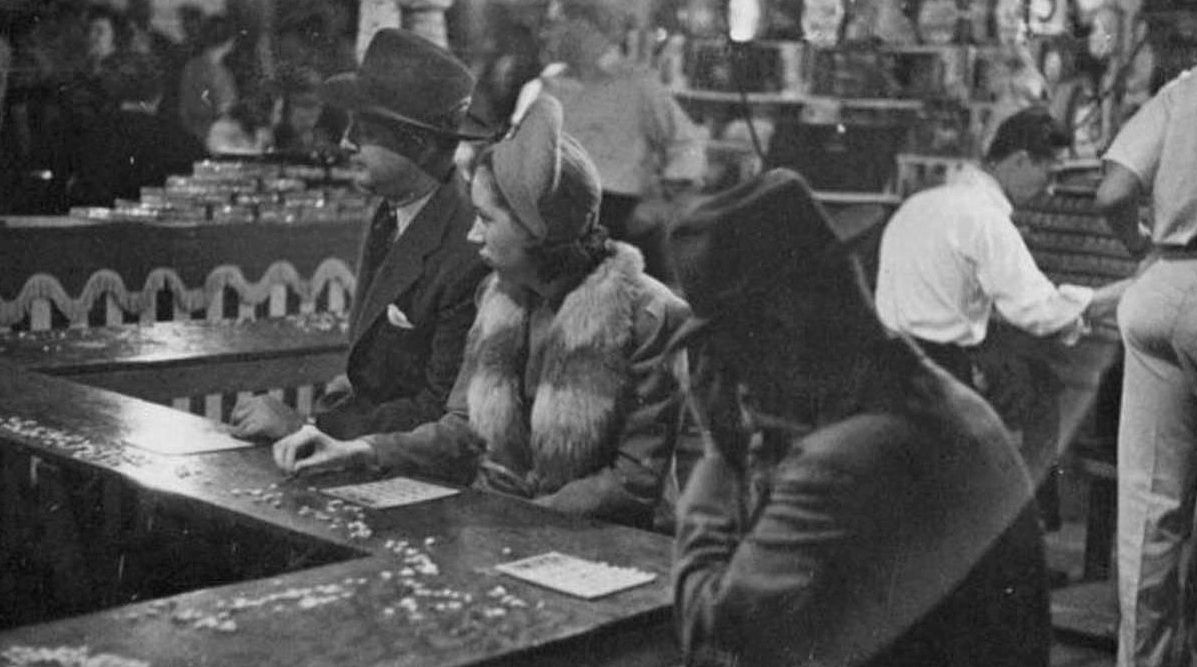
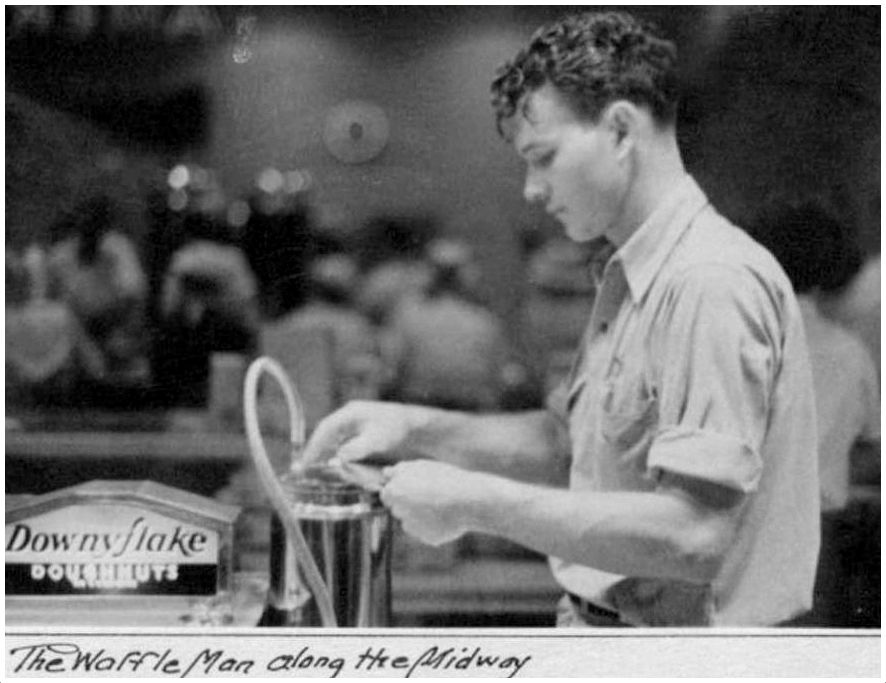
An amateur photographer named Lewis D. Fox took a lot of photos at the State Fair of Texas — from the Texas Centennial in 1936 through 1940. The Centennial photos are particularly interesting, because they show what the “Exposition” was like to the average visitor — there was more going on than just the spectacular extravaganza we usually see — there are also shots of people doing un-spectacular things like just walking around or enjoying a quiet, late-afternoon cup of coffee. There are also photos of the people who do the heavy-lifting at a state fair — the men and women who work the Midway shows and the concession stands (a link to a larger collection of Mr. Fox’s State Fair photos — almost a hundred snapshots — is below).

Enjoy this look at a time when going to the fair meant dressing up and, apparently, often leaving the children at home! (Click photos to see larger images.)

tx-centennial_spirit-of-centennial_fwpl

state-fair_texas-state-bldg_fwpl

state-fair_circus_c1939_fwpl

state-fair_grandstand_fwpl

tx-centennial_swing-revue_fwpl

state-fair_beanery_fwpl

state-fair-midway_fwpl

tx-centennial_cashier_fwpl

tx-centennial_side-view_fwpl

tx-centennial-midway_waffle-man_fwpl

***

Sources & Notes

All photos taken by Lewis D. Fox, from the Fox Photograph Collection in the Fort Worth Public Library Archives, courtesy of the Genealogy, History and Archives Unit, Fort Worth Public Library. Mr. Fox took a lot of snapshots at the fair — see  more here.

On a personal note, I’m mesmerized by “The Waffle Man.” He looks just like a young Lefty Frizzell! Lefty was from nearby Corsicana and he spent a lot of time in Dallas, but he wasn’t born until 1928, so it can’t be him — but check out this photo of Lefty as a teenager and see the remarkable resemblance! Not only did the (no doubt syrup-scented) young man above look like one of my favorite singers, but he also had ready access to waffles. What’s not to love? Oh, Waffle Man….

All images larger when clicked.

*

Copyright © 2014 Paula Bosse. All Rights Reserved.