Flashback : Dallas

A Miscellany: History, Ads, Pop Culture

Telephone Operators Sweating at the Switchboard — 1951

summer_telephone-operators_1951Low-tech A/C: ice, buckets, fans

by Paula Bosse

The summer of 1951 in Texas was brutally hot. One heat-related incident that August made national headlines: more than 1,500 Southwestern Bell telephone operators (and supportive coworkers) who were working in unairconditioned conditions (!!) at the Haskell Exchange on Bryan and at the Akard Street headquarters downtown staged what news reports called a “wildcat walkout” and refused to continue working in the sweltering buildings. Management’s attempt to cool things down with electric fans blowing over buckets of ice had not worked. Operators returned the next day, having made their point, hopefully to the imminent installation of air-conditioned switchboard rooms.

The caption for the photo above:

Dallas, Tex. Aug. 10 [1951] — BEATING THE HEAT — Both ice and fans are brought into play by telephone operators at an exchange here today as the city continued to swelter under 100-degree or over temperatures. The thermometer reached a high of 102-degrees to run the consecutive days of 100-degree readings to ten. It is the longest period of such reading since 1925 when a record 11 straight days was set. High mark for the present heat wave was 107 on August 6.

Three days later, the sweat hit the fan, and the women walked out.

operators_heat_st-joseph-MO-news-press_081451
St. Joseph [MO] News Press, Aug. 14, 1951 (click to read)

Let’s hope your work conditions are a bit better this summer!

***

Sources & Notes

Wire service photograph from the Southern Labor Archives of the Georgia State University Library Special Collections.

See ads from 1911 and 1925 encouraging women to become telephone operators in the Flashback Dallas post “Work and Play in Telephone Land,” here.

*

Copyright © 2014 Paula Bosse. All Rights Reserved.

Giant Zeppelin Balloons, Straight Outta Big D

ryan-rubber-co-zeppelin

by Paula Bosse

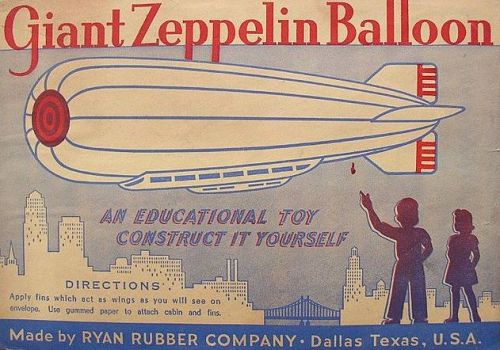
Bet you didn’t know that giant Zeppelin balloons were made in Dallas (or maybe Forney…). They were. The Ryan Rubber Company’s balloon factory opened in Forney in 1946, managed by Lester G. Norris with the help of his wife, Gladys.

***

Sources & Notes

Source of Zeppelin ad unknown.

See a photo of the Norrises at work and read the accompanying article “Picture Blocks and Balloons Big Business for These Men” (Dallas Morning News, Nov. 28, 1949).

*

Copyright © 2014 Paula Bosse. All Rights Reserved.

Metzger’s Milkmen in Bermuda Shorts — 1955


metzgers_bermuda_life_052355-full
Metzger’s milkmen on parade in Life magazine

by Paula Bosse

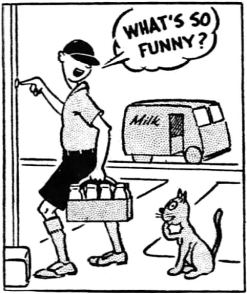
Something BIG happened in Dallas in 1955 — it was such an earth-shattering event that it made headlines around the country: Metzger’s milkmen in Dallas announced that Bermuda shorts would become part of their summer uniform. It must have been a slow news month, because this story was picked up by the wire services and absolutely caught fire, running in newspapers all over the country. It even climbed to the pinnacle of mass media newsworthiness and found itself in the pages of Life magazine where the above photo was accompanied by the following caption:

MILKMEN’S CALVES
Drivers for a Dallas dairy produced a new morning look by setting out in Bermuda shorts. The boss thought they would be cooler in them. The shorts were fine, but one driver was nipped by a dog of long acquaintance who didn’t recognize him. (Life, May 23, 1955)

It was also the subject of newsreel footage. Watch the 1-minute silent clip here. Below, a screenshot:

metzgers_bermuda-shorts-footage_1955_getty

*

In 1955, Bermuda-shorts-fever had somehow gripped the nation. Some sort of marketing sadist was pushing the jacket-and-tie-and-Bermuda-shorts-and-knee-socks combo as appropriate and stylish summertime apparel for men in the boardroom — an unfortunate early version of “business casual.” Mercifully, the fad died fairly quickly.

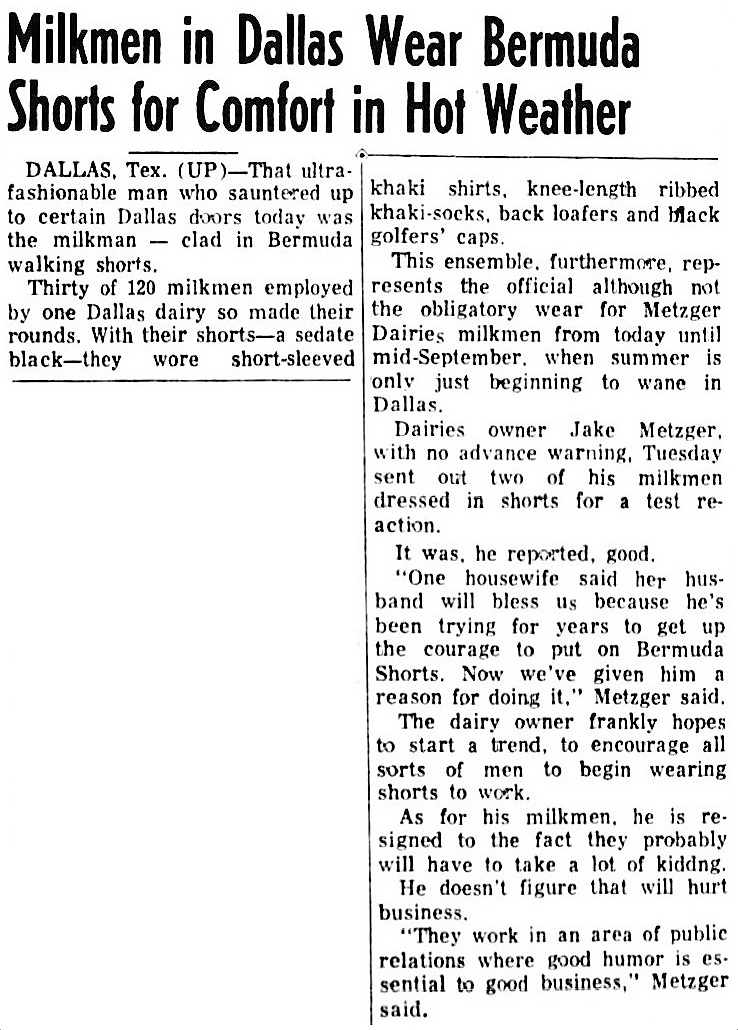
But another more utilitarian idea for the new cool and comfortable shorts emerged here in Dallas. Jake Metzger, owner of the dairy that produced Metzger’s milk, decided to adopt the shorts as part of a new summer uniform for his milk delivery men. The Dallas Morning News suggested that this might be the first such uniform in the United States. Shorts were just not widely seen outside the gym in those days, and certainly not in the workplace. But it gets hot in Texas in the summer. Real hot. REAL hot. Metzger’s idea was a brilliant one, and I’m sure his drivers appreciated it. According to an AP article, the new uniform would consist of the following:

The shorts are the black Bermuda type, often called walking shorts, with an elasticized maroon belt. They’re matched with a short-sleeve khaki shirt, over-the-calf cotton ribbed khaki socks and low black loafers. The outfit is topped with a black cotton golfers’ cap. (AP, May 10, 1955)

If a milkman believed that the new uniform went against his “moral scruples” — or if he just didn’t like the way he looked in it — he could opt out and wear the regular uniform. But a lot of the men jumped at the chance — reports said 30 of 120 milkmen went bare-kneed. And their photos were splashed across newspapers all over the place. A publicity bonanza! Here are just a few of the photos.

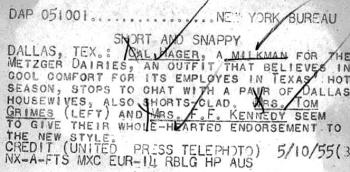
Milkman Cal Hager, ogled by Mrs. Tom Grimes and Mrs. F. F. Kennedy:

metzgers_ebay_front

metzgers_ebay_rearUPI wire photo, May 10, 1955

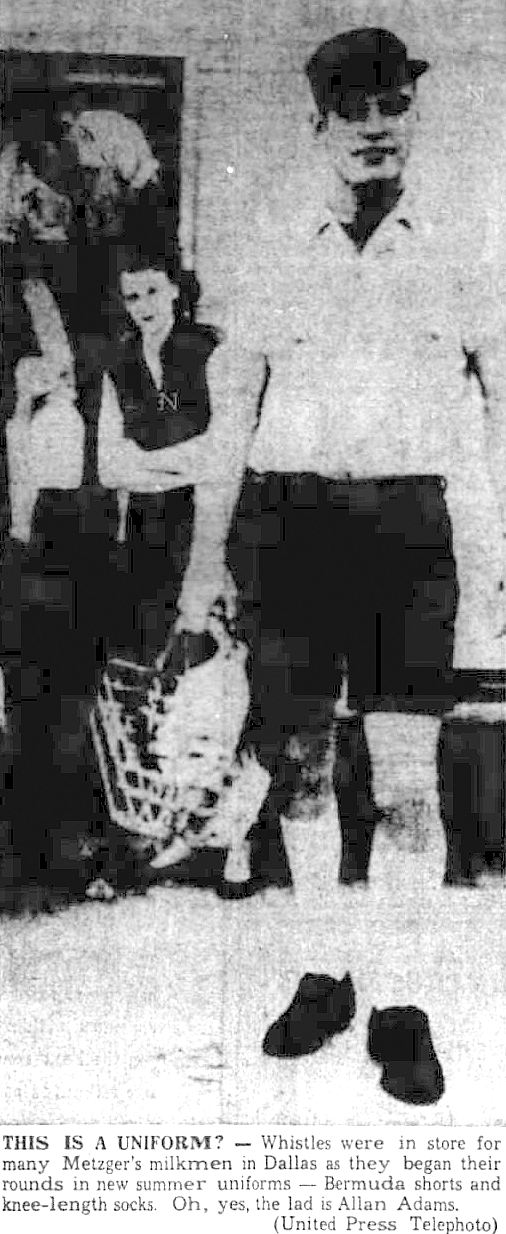
Allan Adams gets the once-over by his customers:

bermuda-shorts_victoria-TX-advocate_051355Victoria (TX) Advocate, May 13, 1955

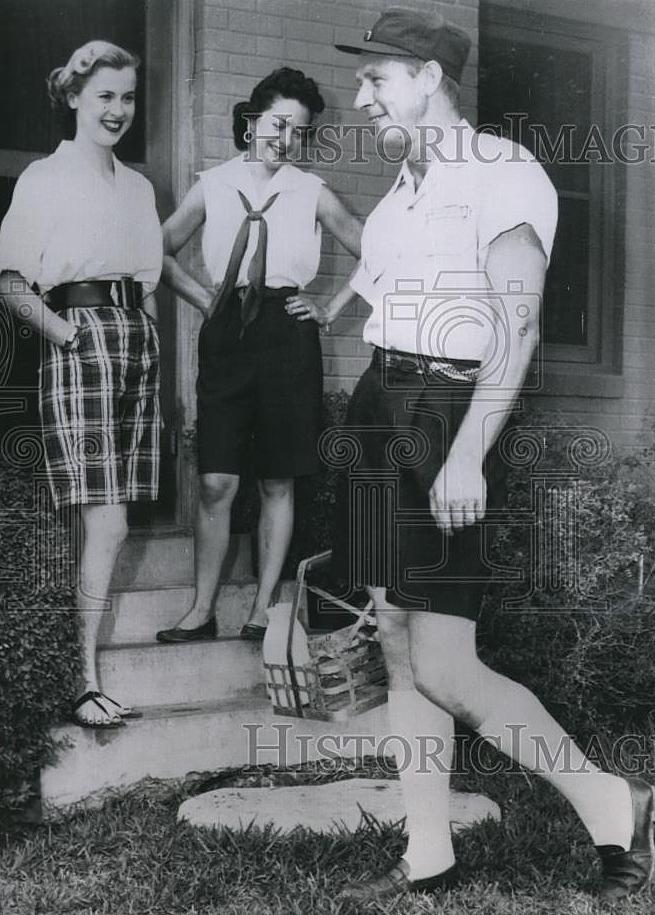
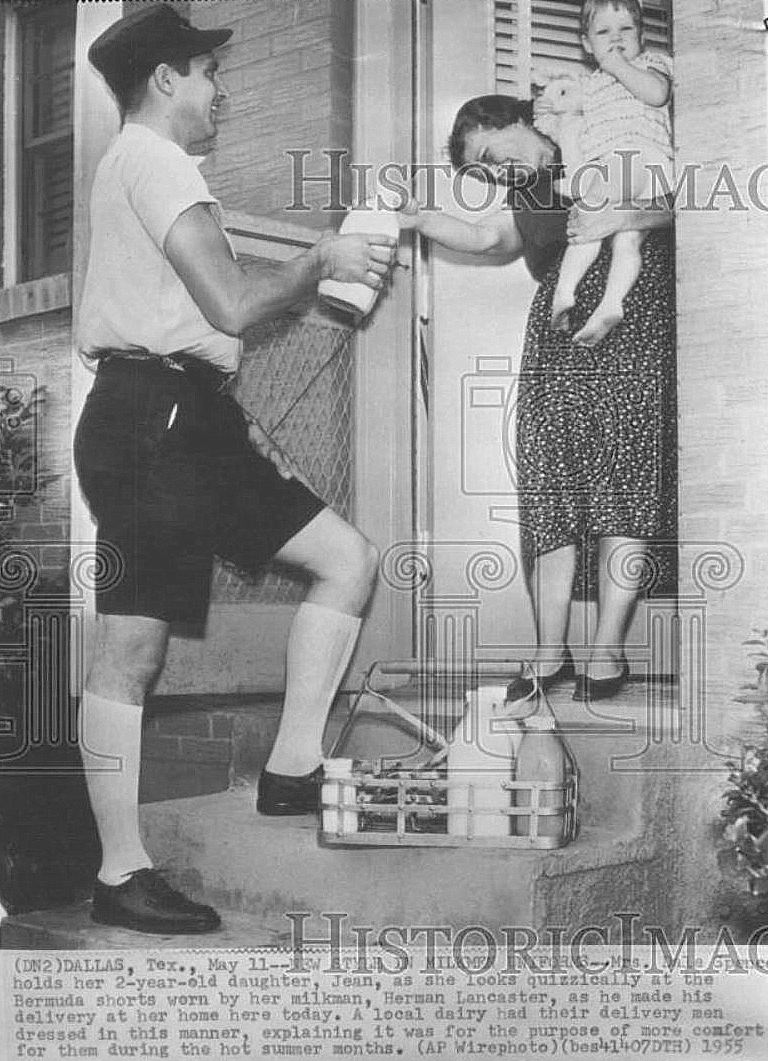
Herman Lancaster and a confused Mrs. Dale Spence (holding daughter Jean):

metzger_bermuda-shorts_historic-imagesAP wire photo, May 11, 1955

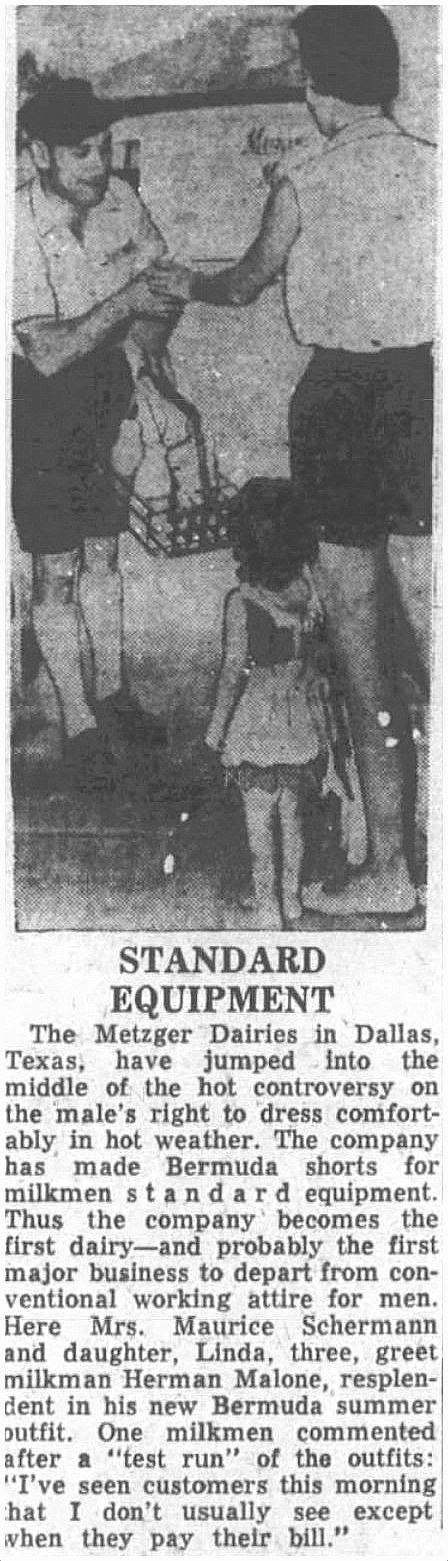
Metzgers’ man Herman Malone proffers a bottle to Mrs. Maurice Schermann and her daughter Linda:

metzger_bermuda-shorts_nanaimo-brit-columbia-daily-news_061055Nanaimo Daily News, British Columbia, Canada, June 10, 1955

metzger_bermuda-shorts_philadelphia-inquirer_051255_cartoonPhiladelphia Inquirer, May 12, 1955

*

The headlines were often better than the photos, in all their reverse sexist glory. Here are a few from every corner of the United States:

  • “DALLAS MILMEN REAL CREAMY IN SHORTS, SOX”
  • “HOUSEWIFE DELIGHTED: MILKMEN MAKE ROUNDS IN BERMUDA WALKING SHORTS”
  • “YOO-HOO, MILKMAN!”
  • “MILMAN COMETH IN SHORTS NOW”
  • “THE MILKMAN COMETH, AND LOOK AT HIS CLOTHES!”
  • “HE’S IN SHORTS: WHISTLES, CATCALLS GREET THE MILKMAN”
  • “DALLAS MILKMEN GO TO WORK DUDED UP”
  • “SPORTY SHORTS FOR MILKMEN”
  • “WHISTLE-BAIT MILKMEN DON BLACK SHORTS”
  • “QUARTS WITH SHORTS — 30 MILKMEN GO NATTY”
  • “DON’T WHISTLE, MOTHERS, IT’S ONLY THE MILKMAN”
  • “CATCALLS, WHISTLES, POETRY GREET SHORTS-CLAD MILKMEN”
  • “ULTRAFASHIONABLE MILKMEN ARE CLAD IN BERMUDA SHORTS”

**

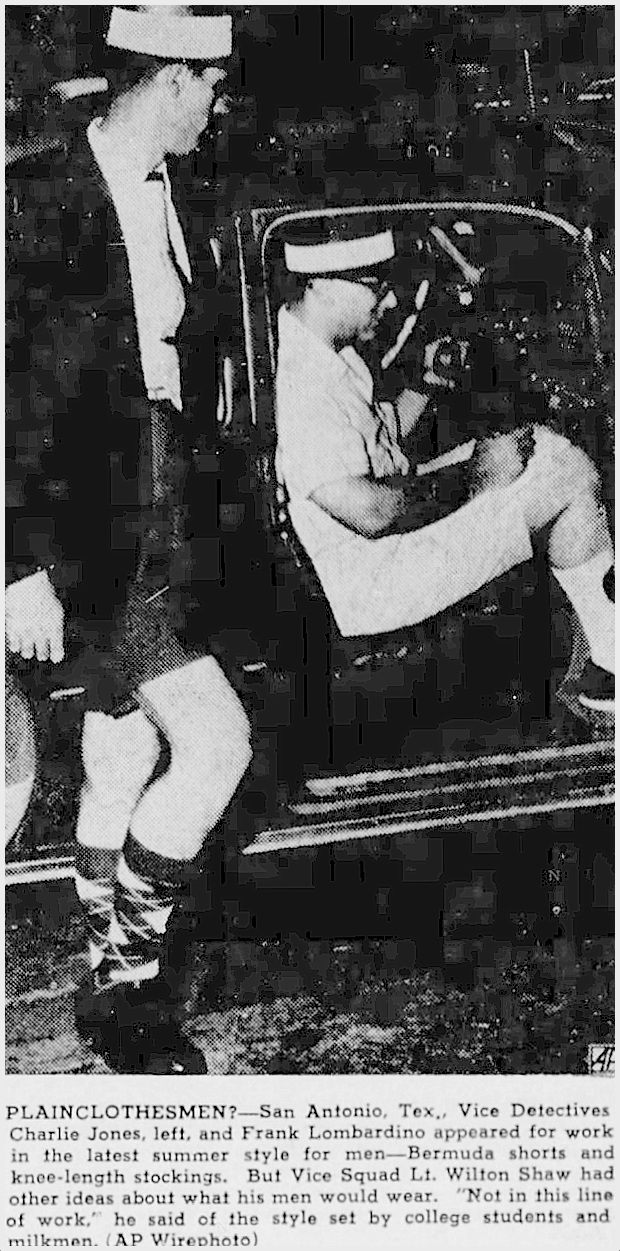
You know a fashion craze has gotten out of hand when you see San Antonio vice squad detectives looking like this:

bermuda-shorts_bryan-TX-eagle_052755_copsBryan (TX) Eagle, May 27, 1955

If Messrs. Jones and Lombardino are still amongst the living, I’m pretty sure they still haven’t lived that photo down. (The partner of Wilton Shaw is misidentified in this photo — he is Chesley Jones.)

**

metzger_bermuda-shorts_coshocton-OH-tribune_051155Coshocton (OH) Tribune, May 11, 1955

*

Copyright © 2014 Paula Bosse. All Rights Reserved.

Expo Park, Circa 1946: Dry Goods, Rooms to Let, Sheet Metal, and Head-In Parking

exposition-827-825_c1946_jim-wheat800 block of Exposition…

by Paula Bosse

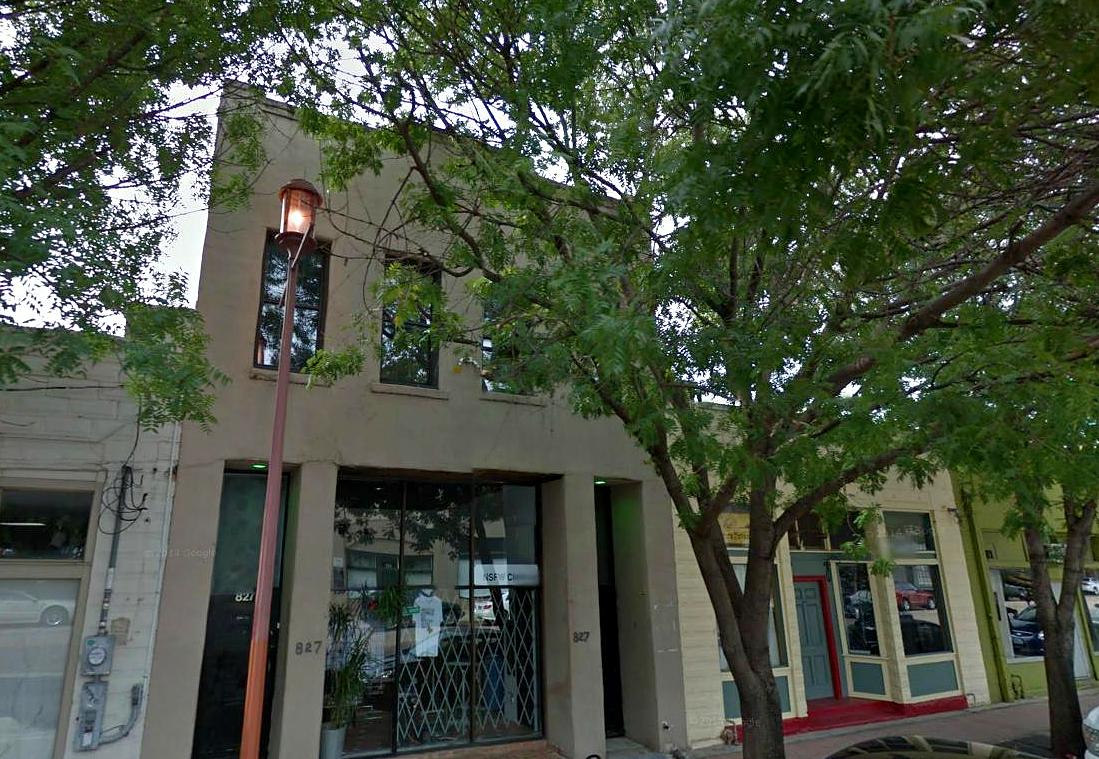
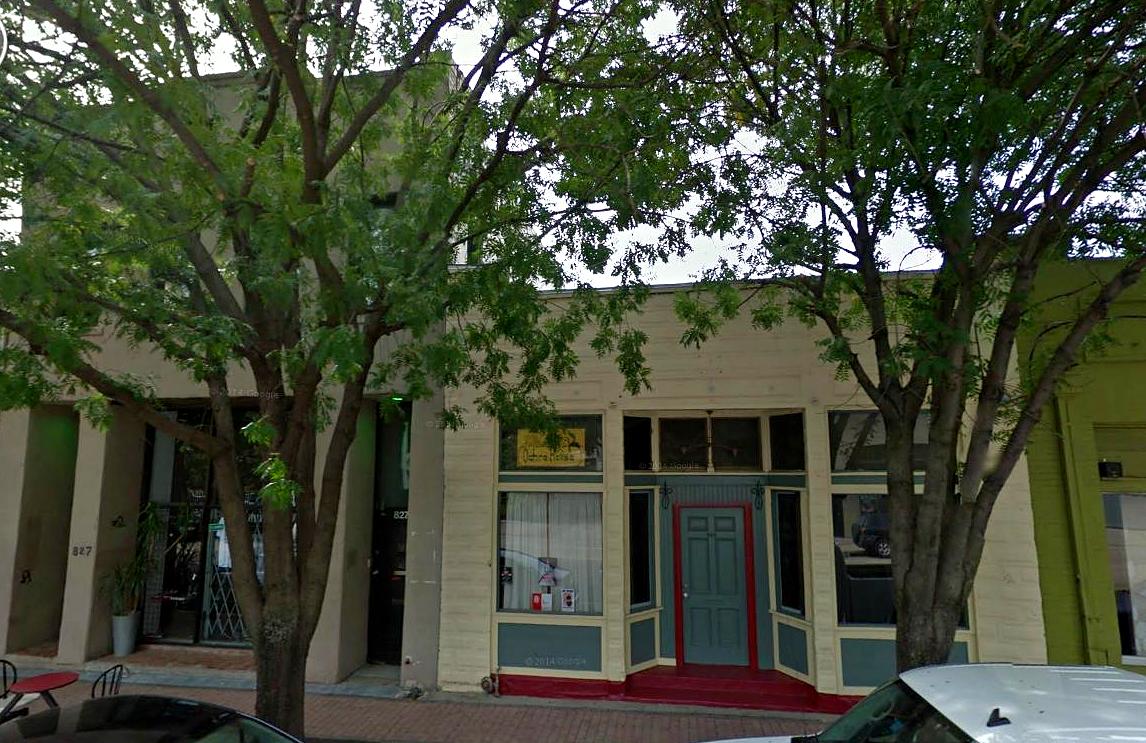
Next time you stop by the Amsterdam Bar at 831 Exposition Avenue, whip out your phone and show this photo to your drinking buddies — this is what the street looked like two doors down, just after World War II. The two-story building at 827 Exposition was home to Lief Dry Goods and the Lief Hotel, and the single-story 825 Exposition was divided into McNeill’s Tin Shop and the Fair Way Cleaners & Laundry (it currently houses the Ochre House theater space). Today the neighborhood has lost much of its grittiness (and head-in parking), but the buildings are still recognizable almost 70 years later. Below, present-day 827 and 825 Exposition Avenue.

exposition_827-google

exposition_825-google

***

Sources & Notes

Top photo from Jim Wheat’s Dallas County Texas Archives.

Bottom two images from Google Street View.

*

Copyright © 2014 Paula Bosse. All Rights Reserved.

I-35E Looking South: A Landscape Blissfully Free of Cars and Strip Malls — 1964

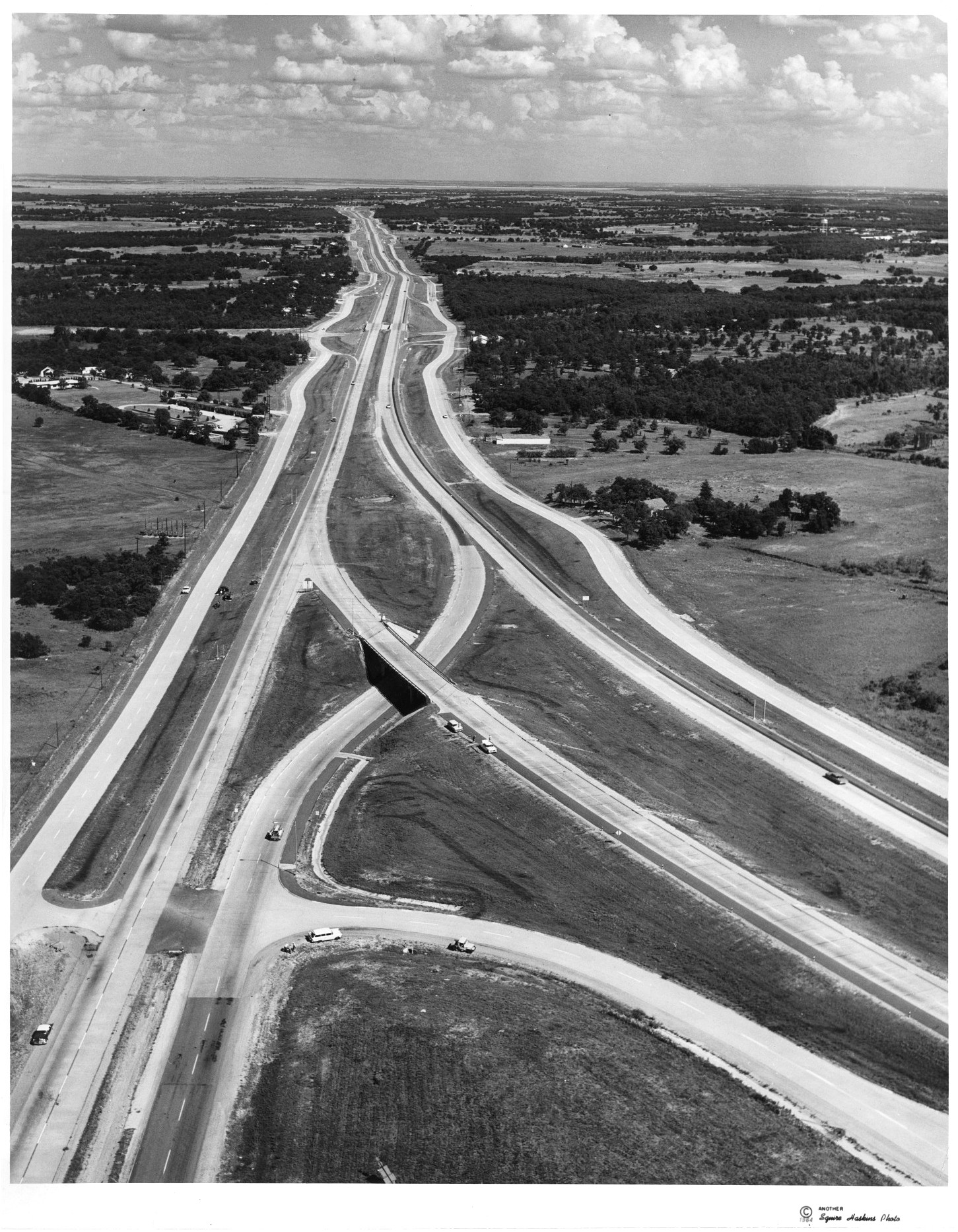
I35E-south-from-denton_haskinsI-35, pre-sprawl — photo by Squire Haskins (GIGANTIC when clicked)

by Paula Bosse

This is I-35. …I-35! I’m not sure what stretch of the interstate this is exactly, but I think we’re looking north toward Denton south from Denton. I might cry. No sprawl!

*

UPDATE: I’ve had several comments about this photo from all over El Internet, and it appears that this is I-35E in Denton, looking south(east) toward Lake Lewisville (then Lake Dallas). More specifically, this shows the I-35 / US-77 (Dallas Dr.) interchange, with part of the old Hwy. 77 visible at the bottom of the photo. It’s been pointed out that the water tower at the top right is at the Denton State School. I hope this is correct! If anyone else has any suggestions, please let me know! (To see a 1965 road map of this area, see here.)

Here’s how it looks these days (thanks, Bill P.).

i35e_google-earth

***

Another amazing aerial photograph by Squire Haskins, from the collection of the Denton Public Library (with an incorrect description!). Accessible on the Portal to Texas History, here.

Click picture for larger image. In fact, it’ll get so big that it might break whatever device you’re viewing this on; proceed with caution.

*

Copyright © 2014 Paula Bosse. All Rights Reserved.

Lucy, Desi, Dallas — 1956

lucy-desi_fw_bellaircraftLucille Ball and Desi Arnaz and their loaner ‘copter from Bell Aircraft

by Paula Bosse

Lucille Ball and Desi Arnaz came to Dallas and Fort Worth in 1956 to promote their new movie, “Forever Darling.” Their arrival times were heavily publicized, and throngs of fans showed up to welcome them — in Dallas at Love Field, and in Fort Worth at the Western Hills Hotel. For those who might have missed their arrivals, they still had a chance to see the couple at one of the personal appearances scheduled at the theaters showing their movie (in Dallas at the Majestic on February 10th, and in Fort Worth at the Hollywood on the 11th). Crowds were large and enthusiastic, and everyone appears to have had a genuinely fun time, possibly even Lucy and Desi, whose relationship in those days was frequently a bit shaky.

Best of all was the tidbit about how the famous couple traveled from Dallas to Fort Worth: by helicopter.

Two television stars will be sailing around above Dallas skyscrapers Saturday. …Lucille Ball and Desi Arnaz will catch a helicopter ride from atop the Statler Hilton for a trip to Fort Worth. City Council officially sanctioned the ride at its Monday meeting. (Dallas Morning News, Feb. 7, 1956)

They left from the helipad atop the Statler Hilton and touched down at the helipad at the Western Hills Hotel in Fort Worth (hotels are nothing without helipads). There was some sort of cordial relationship between the Arnazes and the people at Bell Aircraft, because they availed themselves of this brand new deluxe chopper in New York as well as in DFW. When their promotional duties were finished, Lucy and Desi left Cowtown for California as guests of the president of the Santa Fe Railway — in his private car. Because that’s how you travel if you’re Hollywood royalty.

*

lucy-desi_dmn_020856-detFeb 8, 1956
*

lucy-desi_dmn_021156-photolucy-desi_dmn_021156-captionDMN, Feb. 11, 1956

(Leon Craker, I bet you had a great story about this for years after this momentous meeting.) 

*

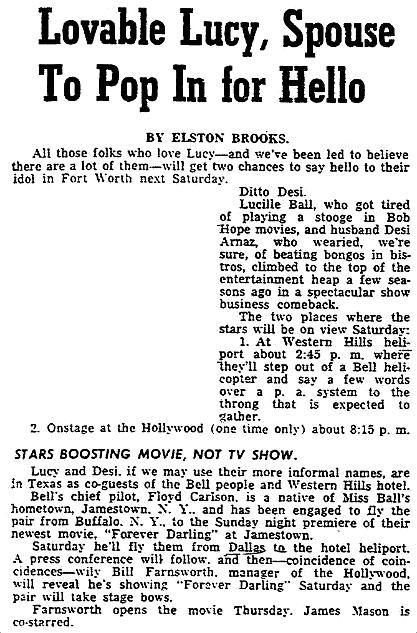
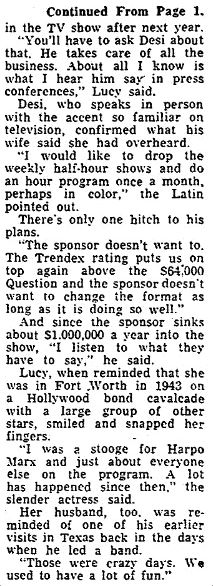
In Fort Worth, Elston Brooks (whose amusing articles I’ve really enjoyed discovering these past few months), seemed underwhelmed and a little annoyed at the prospect of  “lovable Lucy and spouse” invading the city (click articles to see larger images):

lucy-desi_FWST_020556Fort Worth Star-Telegram, Feb. 5, 1956
*

Elson Brooks may not have been very excited, but when Lucy and Desi stepped out of that helicopter, the Fort Worth crowd went wild (click text for larger image):

lucy-desi_FWST_021256-photo

lucy-desi_FWST_021256a

lucy-desi_FWST_021256bFWST, Feb. 12, 1956

*

And here they are back in Los Angeles, with Desi Jr., at the end of a busy promotional tour. Desi is proudly wearing the cowboy hat he’d been given in Fort Worth. And he looks damn good in it.

lucy-desi_dfw

***

Sources & Notes

Top photo of Lucy and Desi standing next to the 1956 Bell 47H-1 (“one of the world’s first executive helicopters”) is from the August 2012 issue of Vintage Aircraft Magazine; photo from Bell Aircraft. The article concerning this helicopter model is contained in a PDF here.

The bottom photo is from a Pinterest page, here.

UPDATE: I had originally identified the photo of Lucy and Desi with the train as having probably been taken in Fort Worth as they were about to depart for Hollywood, mainly because they’re wearing similar clothing from the FW appearance, but a rail historian noted that this photo was actually taken in California at the Los Angeles Union Passenger Terminal — he could tell because he recognized the part of the platform structure over their heads! (“I can name that song in TWO notes!”) The photo he directed me which shows the LAUPT platform (and, in fact, the same engine, two years earlier!), is here. They probably took the final photo for the Santa Fe company as thanks for providing them with transportation back home in the president’s private car. (Thanks, Skip!)

*

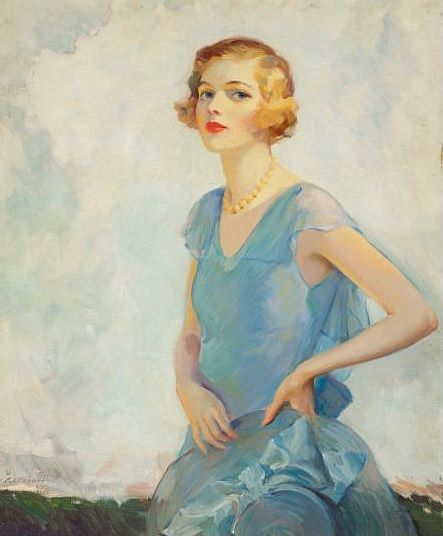
And because today is Lucille Ball’s birthday (which I know only because she shares a birthday with my aunt — happy birthday, Bettye Jo!), it seems like a good time to wheel out this strikingly beautiful portrait of Lucy, along with a wonderful photograph of her from about the same time (probably between 1928 and 1930).

lucilleballportrait

lucilleball-ca1930

*

Copyright © 2014 Paula Bosse. All Rights Reserved.


Thank You, Alan Peppard/Dallas Morning News!

dmn_guide-live_logo

by Paula Bosse

Thanks to Alan Peppard of The Dallas Morning News for picking up the Powell University Training School story (and for saying such nice things about me and the blog)! Thank you, Alan!

Check out Alan’s article “Century-old school still stands in the shadow of SMU and Hotel Lumen” here.

If you missed the original Flashback: Dallas post, see it here.

*

Copyright © 2014 Paula Bosse. All Rights Reserved.

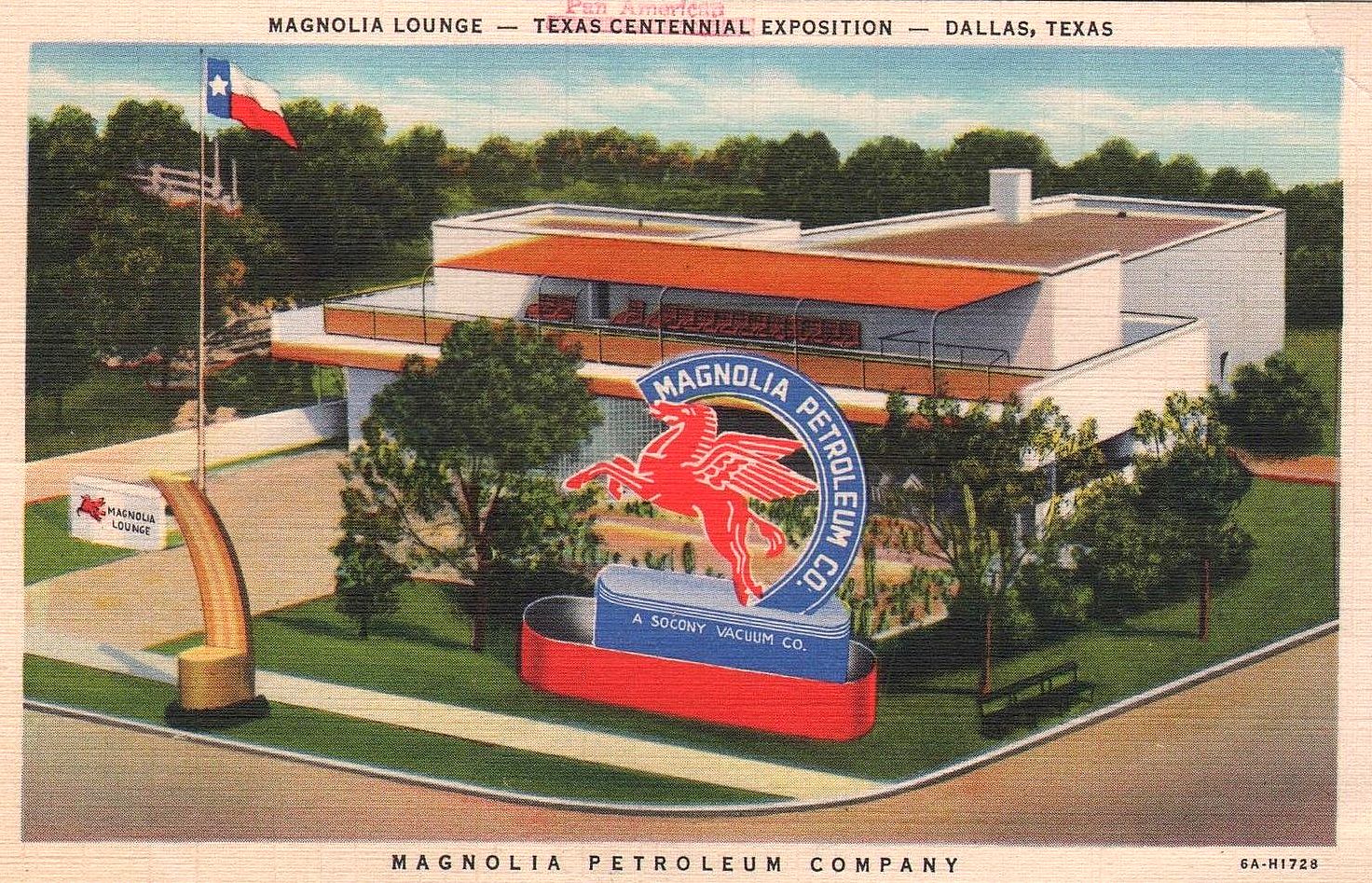
William Lescaze’s Ultramodern Magnolia Lounge — 1936

magnolia-lounge_tx-centennial

by Paula Bosse

The sleekly cool Magnolia Lounge, designed by Swiss-born American architect William Lescaze for the Texas Centennial, is considered the first International-style building built in Texas, and though it feels perfectly at home in Art Deco Fair Park, it looks completely different and much more modern that the buildings around it. It was built by the Magnolia Petroleum Company as a place for visitors to the Centennial Exposition to relax and cool off (it boasted a 20-ton refrigeration plant). The Magnolia Company’s slogan for their building was “Be Our Guest and Rest at the Magnolia Lounge.” In other words, this was the most insistently fabulous rest stop ever built!

How did we GET this cool building? Two words: Stanley Marcus.

“Young retailer Stanley Marcus was dispatched to New York City by Dallas-based Magnolia Petroleum to find the most up-to-date architect of the United States for their Centennial pavilion. Marcus chose William Lescaze, who had just designed the first International-style skyscraper in the United States [the PSFS Building in Philadelphia, which opened in 1932].” (– Virginia Savage McAlester)

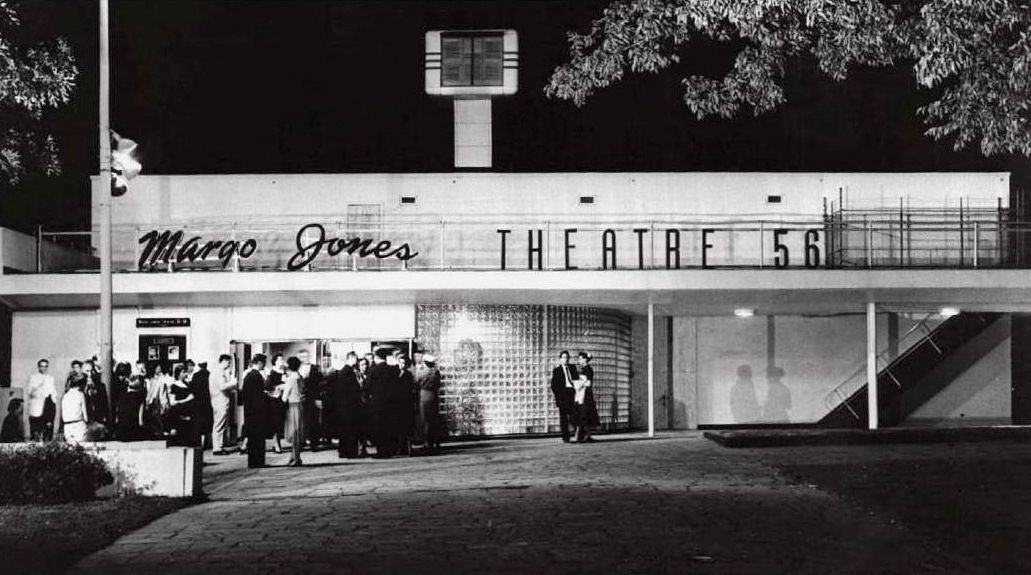
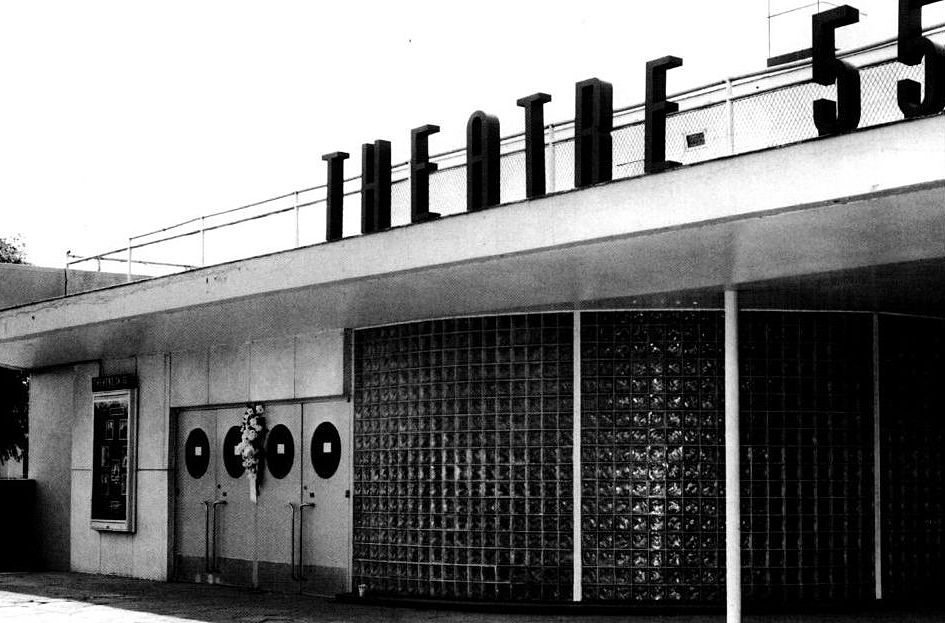
It was a popular oil company-branded “comfort station” for fair visitors until 1942 when the Magnolia Petroleum Co. (who had owned the building), gave title of the Magnolia Lounge to the State Fair, which used it for many years to house its general offices. In 1947, the space became Theatre ’47, Margo Jones’ legendary regional theater where, among other achievements, she produced plays of a young Tennessee Williams and introduced the innovation of theater-in-the-round. After Jones’ death in 1955, the theater carried on for a few years but eventually closed in 1959. After some difficult lean years for the building (during which demolition was considered!), it has been home to organizations such as the Friends of Fair Park, and it is now an active performance space again. And all is well with the world.

margo-jones_theatre-56_dpl

***

Sources & Notes

Postcard of the Magnolia Lounge from the vast wilds of the internet. Click it. It’s huge.

The Virginia McAlester quote is from a Friends of Fair Park advertising section in the Oct. 1989 issue of Texas Monthly.

Photograph of Theatre ’56 from Historic Dallas Theatres by D. Troy Sherrod, from the collection of the Dallas Public Library. (The theater struggled to continue after the sudden death of Margo Jones in 1955, which I wrote about here.)

For more on the history of the Magnolia Lounge, see the official Fair Park home page here; also, check out the the City of Dallas page devoted to this building, here.

And for more on this cool building, particularly in connection with Margo Jones, see the page on the always informative Watermelon Kid site, here.

A lengthy description of the building can be found in the article “Daylight Movies of Texas Scenes To Reward Visitors to Magnolia’s Cool Lounge” (The Dallas Morning News, April 26, 1936).

The Wikipedia page on architect William Lescaze is here.

*

Copyright © 2014 Paula Bosse. All Rights Reserved.


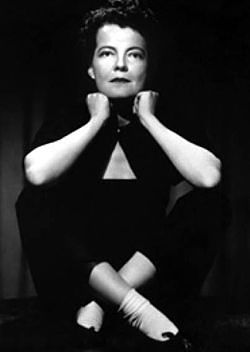
Margo Jones & Jim Beck: Both Legends in Their Fields, Both Victims of Carbon Tetrachloride

margo_tennessee
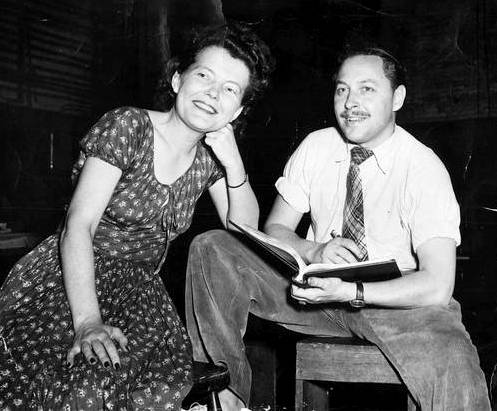
Margo Jones with Tennessee Williams

by Paula Bosse

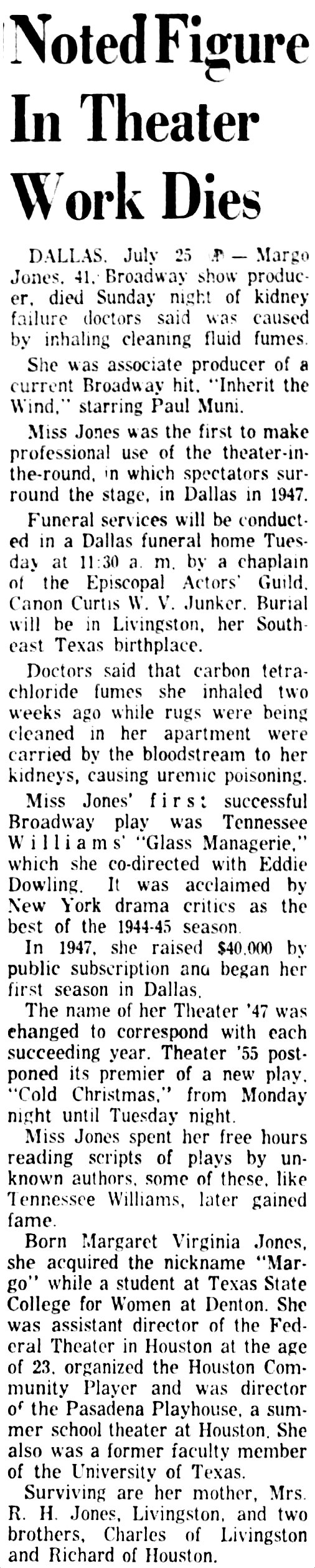
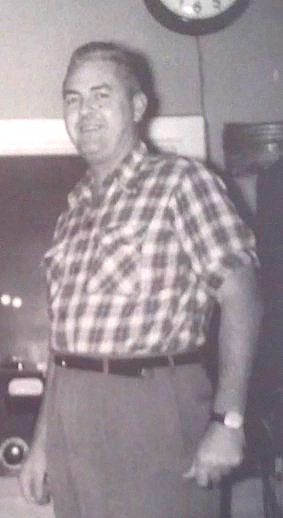
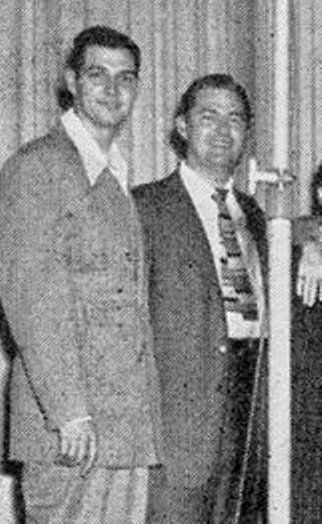
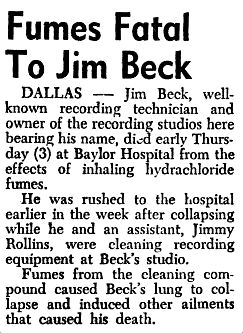
In reading about Dallas theater legend Margo Jones, I saw that she died from inhaling the lingering fumes of a cleaning agent that had been used to clean a rug in her apartment at the Stoneleigh Hotel: carbon tetrachloride. The only thing I knew about carbon tetrachloride was that it had also caused the early death of legendary recording engineer and producer Jim Beck (the man who discovered and produced the first records of Lefty Frizzell, Ray Price, et al.); Beck had been cleaning his recording equipment and had been overcome by the fumes. Both were rushed to the hospital when they were discovered unconscious, and both died about ten days later.

Margo Jones died on July 24, 1955, and Beck died less than a year later, on May 3, 1956. Jones was in her early 40s — Beck was only 39. Margo Jones was a creative powerhouse who was already revolutionizing regional theater, and Jim Beck’s enormous talent was the sole reason that Columbia Records was on the brink of moving their operations from Nashville to Dallas (a move that might very well have set the wheels in motion for Dallas to overtake Nashville as the nation’s recording center for country music). It is such a loss that both died so young,victims of something as mundane as cleaning fluid. With so much remarkable potential ahead of them, it’s sobering to imagine how different Dallas theater and the Dallas recording industry would be today had their careers lasted another two or three or four decades.

margo-jones-photo

margo-jones_austin-american_072655_obitAustin American, July  26, 1955 (click to see larger image)

margo-jones_wreath_legacies_fall-2004Margo Jones’ Theatre ’55 with wreath on door (click for larger image)

jim-beck_detJim Beck in his studio

jim-beck_hank-thompson_liberty-jamboree_c1951-detJim Beck (right) with Hank Thompson

jim-beck_billboard_051256bBillboard, May 12, 1956

jim-beck-studio-logo

***

Sources & Notes

Photo of Theatre ’55 (formerly the Magnolia Lounge in Fair Park) with wreath is from the story “‘I’m Doing It, Darling!’ — Dallas, Margo Jones, and Inherit the Wind” by Kay Cattarulla (Legacies, Fall, 2004 issue), which can be read here.

First photo of Jim Beck (which has been cropped) is from the Bear Family CD box set “Lefty Frizzell: Life’s Like Poetry.”

Photo of Jim Beck and country recording star Hank Thompson is a (cropped) Liberty Jamboree promotional photo, circa 1951.

Jim Beck Studio logo from the Handbook of Texas entry for the recording industry in Texas, here.

Margo Jones is very important. Read why here.

Jim Beck is very important. Read why here.

A bit morbid, perhaps, but Margo Jones’ death certificate can be viewed here; Jim Beck’s death certificate, here.

And, finally … kids, stay away from that carbon tetrachloride. It’s bad stuff.

For my previous post “Lefty Frizzell: It All Began on Ross Avenue,” click here.

*

Copyright © 2014 Paula Bosse. All Rights Reserved.

Send Your Kids to Prep School “Under the Shadow of SMU” — 1915

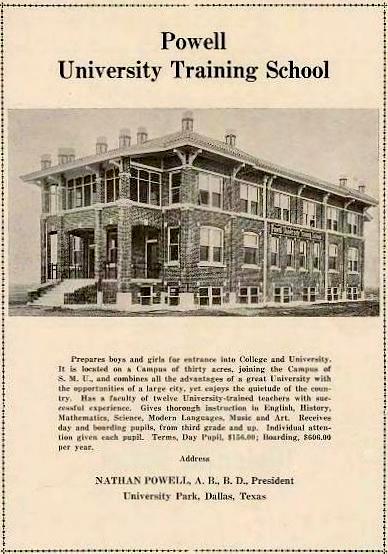
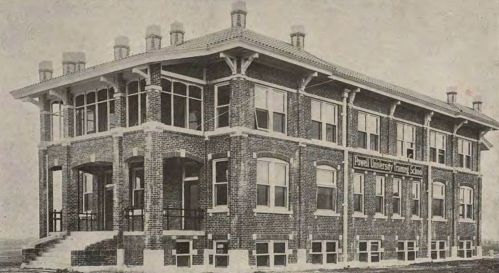
powell-prep_rotunda_1916Powell University Training School, 1915

by Paula Bosse

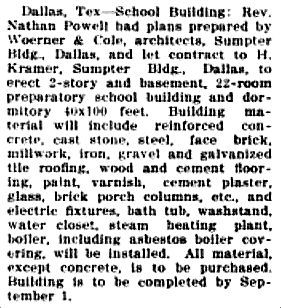
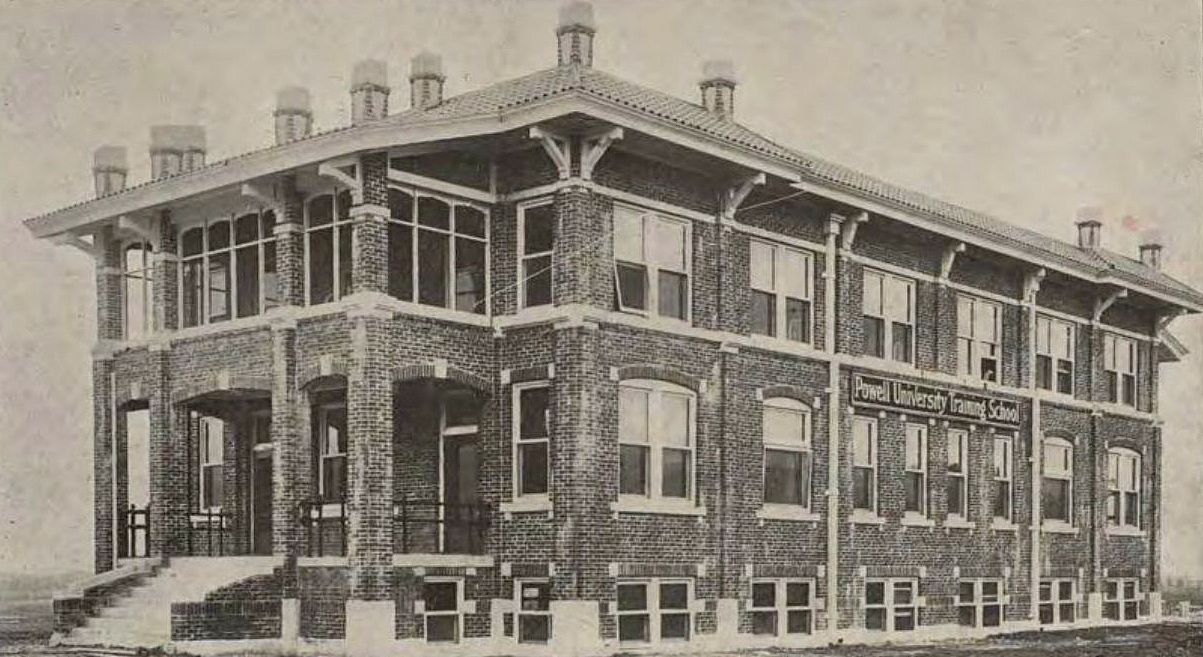
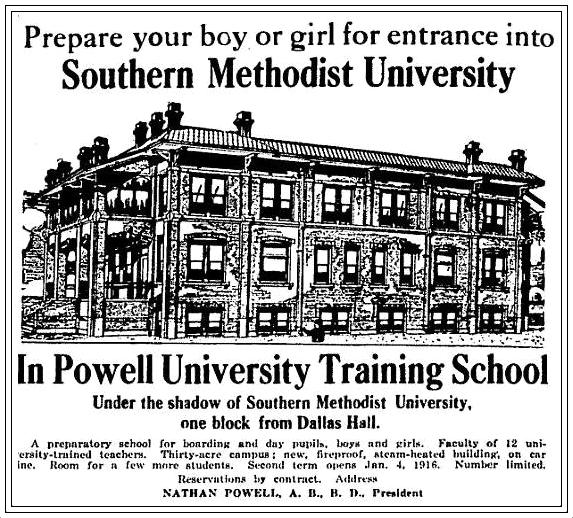
Nathan Powell (1869-1963) was a former Methodist minister who opened his prep school, Powell University Training School, on thirty acres of open land, just across an unpaved road from SMU (which was still in the very early days of its construction). SMU and the Powell school shared more than just adjacent addresses — which they both rather idealistically touted as being “situated on high ground overlooking the university campus and the city” — they also opened on the same day, September 15, 1915.

The location and the opening date were not a coincidence, as Dr. Powell was one of the Methodist movers and shakers who originally promoted the idea of Dallas as the site for a new Methodist university. The following (perhaps exaggerated) sentence can be found in the (perhaps overly laudatory) profile of Powell in one of those ubiquitous late-19th, early-20th century “mug books,” A History of  Texas and Texans (1916):

Beyond his activities as a minister and teacher, the most notable achievement in the life and career of Doctor Powell lies in the fact that he was the sole originator and promoter of the great Southern Methodist University at Dallas, which began its first year September 15, 1915.

Powell University Training School lasted for only about twelve years, until Powell’s rather sudden retirement in 1927 (the good reverend’s “retirement” might have been precipitated by numerous lawsuits and mounting debt). When the school closed, Dr. Powell and his family moved to Harlingen to — as his obituary states — “help organize the grapefruit growers of the Rio Grande Valley.” He operated a citrus nursery himself for a while until it was destroyed by a 1933 hurricane. Nathan Powell died in Harlingen in 1963 at the age of 94.

It’s always exciting to see old buildings still standing in Dallas, and, happily, this one is still around — and it still looks good. Fittingly, it’s currently home to an early-child development center. Next time you’re near the intersection of Binkley and Hillcrest, go take a look.

*
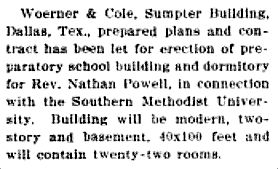
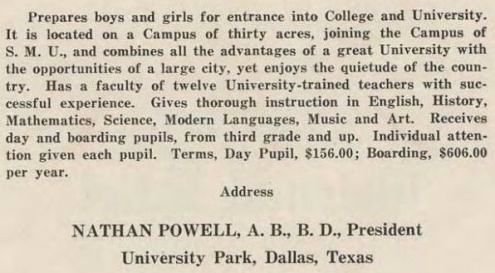
powell_tx-trade-rev-industrial-record_071515a*powell_tx-trade-rev-industrial-record_071515bBoth items from the Texas Trade Review & Industrial Record, July 15, 1915
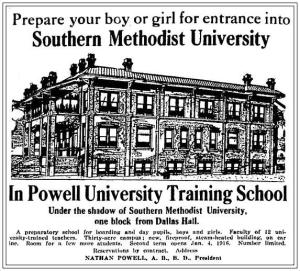
powell_school_ad_smu-times_121815SMU Times, Dec. 18, 1915 (click for larger image)
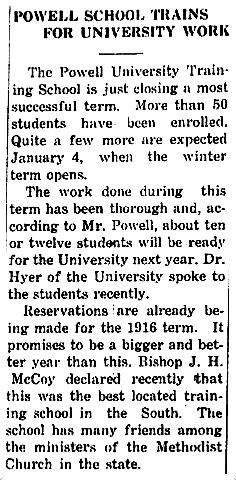
powell_school_smu-times_121815SMU Times, Dec. 18, 1915

ad-powell-prep_smu-rotunda-19161915 (click to read text)

Below, after the school closed. Looking a little shaggy. I would have guessed the photo was from much earlier, but it’s dated 1931. Complete with horse.
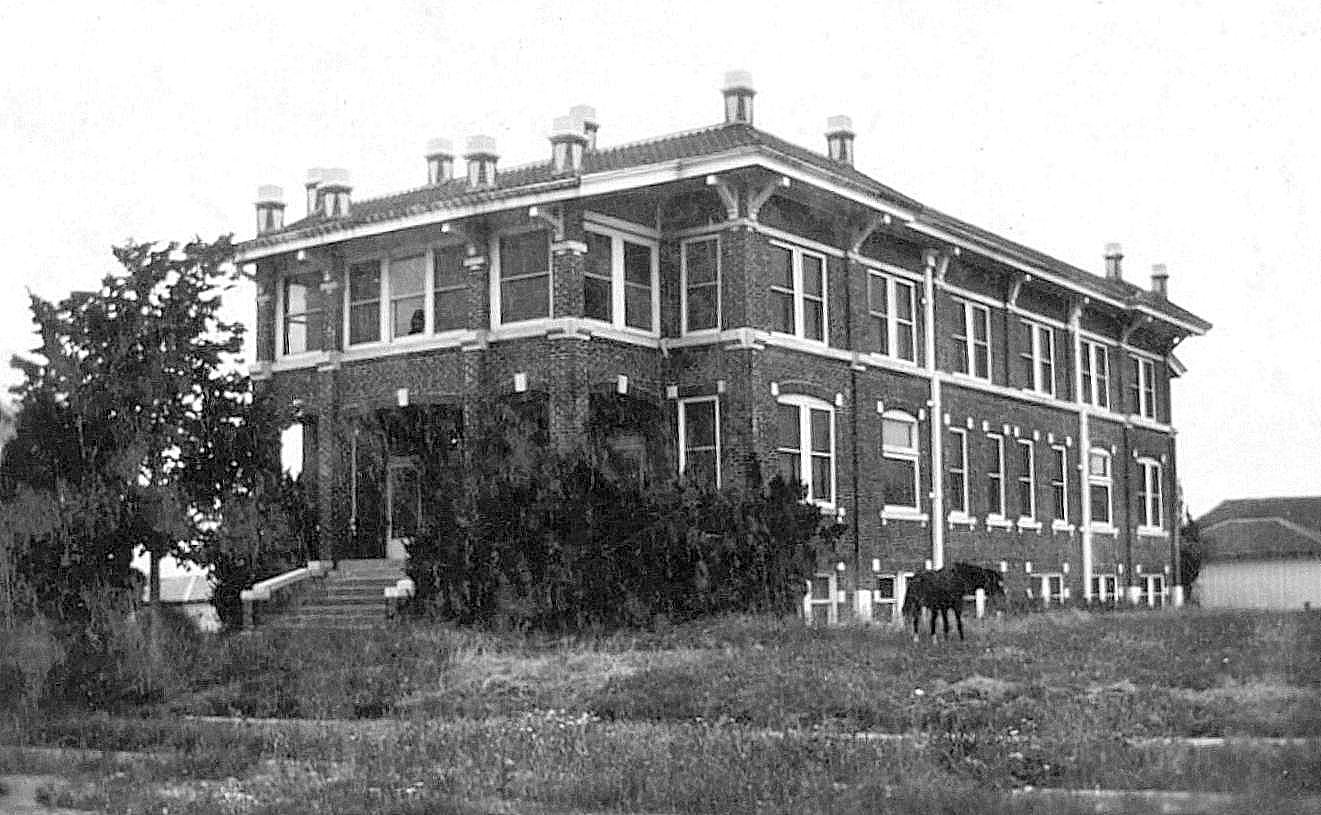
powell-univ-training-school_brown-bk_university-park_19311931, Brown Book, University Park Public Library

***

Sources & Notes

Top image and bottom ad appeared in the very first edition of The Rotunda, SMU’s yearbook for their inaugural year, 1915-16.

More on Rev. Powell’s early life and involvement with the founding of Southern Methodist University can be read in A History of Texas and Texans by Frank W. Johnson (Chicago and New York: American Historical Society, 1916), here.

Information regarding Powell’s retirement in Harlingen is from “The Chronological History of Harlingen” by Norman Rozeff (circa 2009), in a PDF here.

Powell’s obituary can be found in The Dallas Morning News, Nov. 8, 1963: “Dr. Powell Dies; Helped Found SMU.”

Currently occupying 3412 Binkley is The Community School of the Park Cities. According to the history page of their website (here), the building has been operated as a school since at least the 1950s.

I’m not sure what the actual facts are concerning Nathan Powell’s role in the founding of SMU. There are very few results when searching the internet. Most newspaper articles connecting him with the university seem to have been generated by Powell himself. If Powell was as important in the history of SMU as he claimed to be, it’s surprising to see so little information on any connection. Was Powell’s assertion that he was the driving force behind the creation of SMU a blatant lie? Was it merely an exaggeration of the truth? Or was it accurate, but something happened to cause the university to distance itself from him? A collection of papers in the SMU archives (which I have not seen) seems to indicate that there were those in Methodist circles who disputed Powell’s claims, as Elijah L. Shettles took it upon himself to prove that Nathan Powell was the driving force behind the very existence of SMU. An overview of the collection — The Elijah L. Shettles Papers on the Founding of Southern Methodist University — can be found here.

(I’ve found an article from the Fort Worth Star-Telegram in 1910 that had Powell all but saying Fort Worth — not Dallas — would be the best choice for the university’s location. Read that article and see other photos of the school — and also read about the lawsuit against Powell (which had nothing to do with SMU) that took thirteen years to reach trial and ended in quite a hefty judgement, in a PDF here.)

See more of SMU’s first year in previous posts here and here.

*

Copyright © 2014 Paula Bosse. All Rights Reserved.