Flashback : Dallas

A Miscellany: History, Ads, Pop Culture

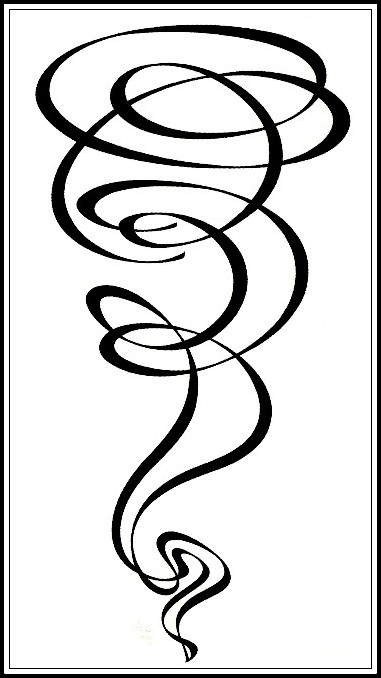
Alexandre Hogue’s “Calligraphic Tornado” — 1970

by Paula Bosse

Since the season is upon is, it seems like a good time to post Alexandre Hogue’s wonderful “Calligraphic Tornado” (1970), quite a departure from his more widely known Depression-era landscape paintings. I love this.

***

Sources & Notes

Image and text from Nature’s Forms/Nature’s Forces: The Art of Alexandre Hogue by Lea Rosson DeLong (Norman: University of Oklahoma Press, 1984), p. 168. (This is a great monograph on the Dallas Nine artist, but it appears to be becoming difficult to find at affordable prices. There are a couple that should be scooped up quickly, here. It was issued only in softcover.)

A previous post from me on Hogue (one of my favorite artists) — with another uncharacteristic example of his work — is here.

*

Copyright © 2014 Paula Bosse. All Rights Reserved.

Tornado as Learning Tool — 1957

by Paula Bosse

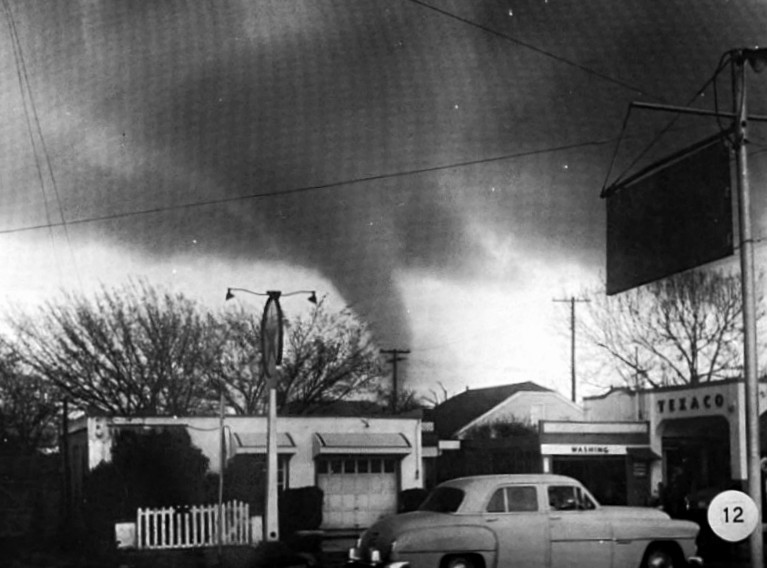
On April 2, 1957, the famous Dallas tornado (tornadoes, actually) ripped across the city. At the time, it was the most photographed tornado in history, and the photographs and film footage taken that day were immensely important in the study of how tornadoes form and behave. The above photo is from a landmark study by the United States Weather Bureau (link to the full report is below).

Above, a photo by Bill Winfrey of the Dallas Morning News, taken from the roof of the News building, looking toward Oak Cliff.

I just stumbled across the odd little film above, produced by the National Assn. of Broadcasters in the late ’50s. If you skip to about the 4:30 mark, you can see a WFAA Channel 8 reporter/cameraman running to his news vehicle, followed by a minute or so of the clearest film footage of the Dallas tornado I can find online.

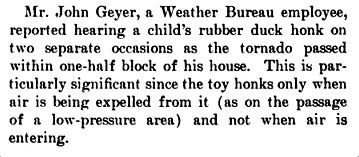
Since the tornado has been written about for years and years and years, there’s nothing I can add, really, except to mark another anniversary. ALTHOUGH, the following paragraph (from the official U.S. Weather Bureau report) has been sorely under-reported: the affect of tornadoes on the behavior of rubber duckies.

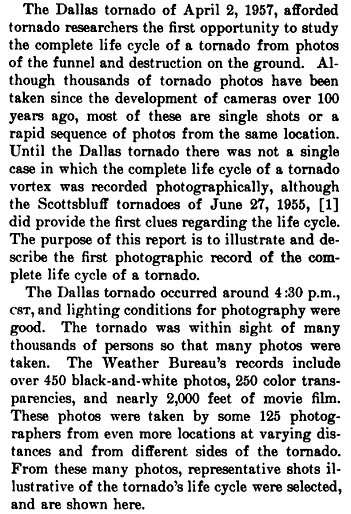
As you can see, that report was thorough! The U.S. Weather Bureau Report that was issued about the Dallas tornado was incredibly important in leading to what we know about tornadoes today. This paragraph introduced their report:

***

Sources & Notes

Top photo and clipped text from “The Tornadoes at Dallas, Tex., April 2, 1957 — Research Paper No. 41” (Washington: U.S. Govt. Printing Office, U.S. Department of Commerce, Weather Bureau, 1960). You can access the entire official report — containing numerous photographs, charts, interviews with Dallasites who witnessed the tornado(es), and results of the Bureau’s research — here. It’s very interesting.

The second photo is from the great Dallas Morning News photo blog, here.

The National Association of Broadcasters’ self-aggrandizing pseudo-PSA film, “A Guest in the House,” can be found here.

And, finally, everything you ever needed to know about the 1957 tornado is here.

*

Copyright © 2014 Paula Bosse. All Rights Reserved.

Do Not Become an April Fool: Tips from E. M. Kahn & Co. — 1898

by Paula Bosse

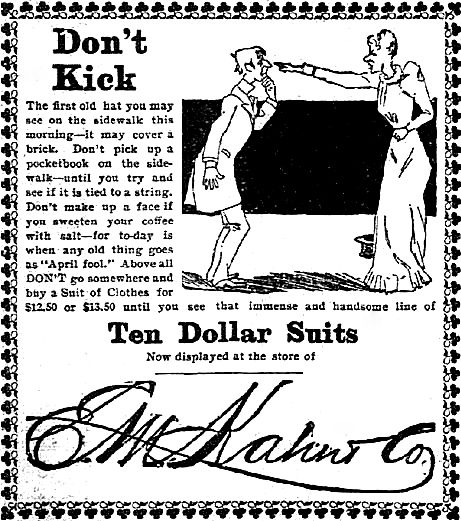
Pranks in 1898 were high-larious.

Do NOT be a fool and pass up that ten-buck suit, man, or you’ll have hell to pay with the missus.

***

Ad appeared in The Dallas Morning News, April 1, 1898.

*

Copyright © 2014 Paula Bosse. All Rights Reserved.

U.S. Revenue Cutter “Carrie Nation” Successfully Navigates the Trinity In Valiant Effort to Keep Dallas Dry! — 1931

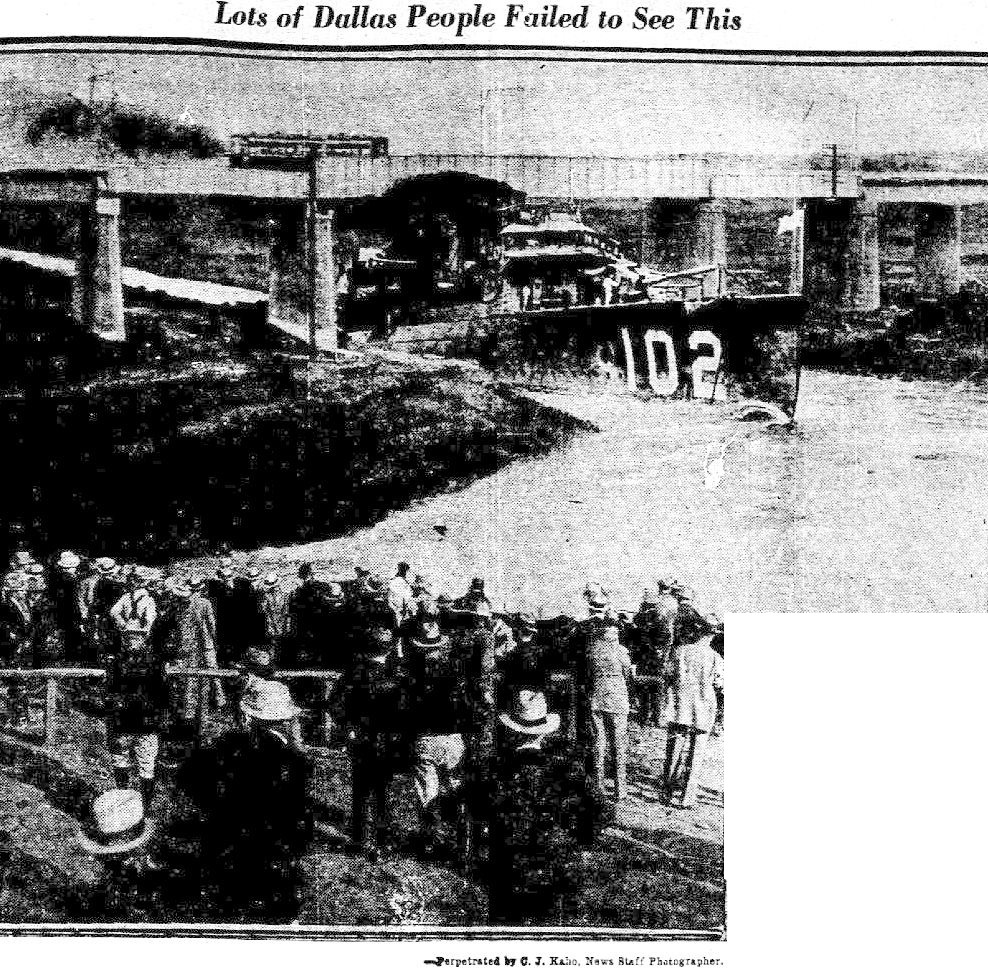
april-fools_dmn_010131_carrie-nation
The ship’s arrival, passing under the streetcar viaduct…

by Paula Bosse

I spent a couple of hours looking through the archives of The Dallas Morning News this morning, hoping to find a nice juicy April Fools’ prank from the past. Everything was fairly run-of-mill. Until I came across this. THIS is great. I don’t know who wrote the story, but there is, at least, acknowledgement for the wonderfully weird photo above — the photo credit reads: “Perpetrated by C. J. Kaho, News Staff Photographer.”

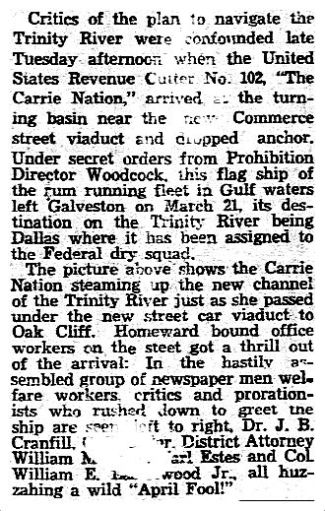
Below is the accompanying story about the United States Revenue Cutter Carrie Nation and the news of its journey up a surprisingly navigable Trinity River in order to anchor itself beneath the Commerce Street viaduct and make sure that the rum-runners in the Gulf don’t gain a foothold in bone-dry Prohibition-era Dallas. The photo and report appeared in the pages of The Dallas Morning News on April 1, 1931, beneath the headline “Lots of Dallas People Failed to See This.”

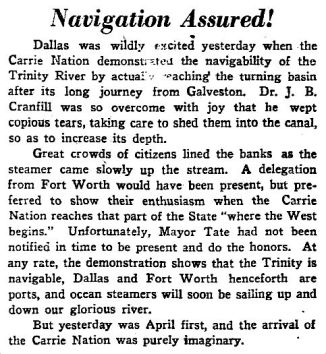
Unwilling to let such an important story fade away — and with a few more good lines left to get into print — this appeared the next day, on April 2, 1931: “Navigation Assured!”

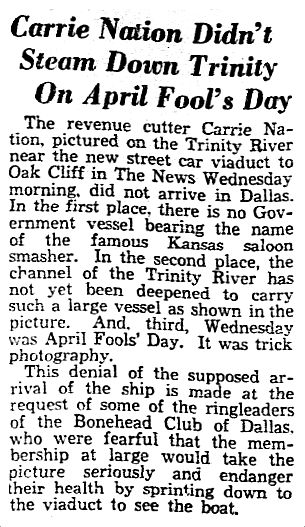
Then some killjoy editor probably insisted on this, which also appeared on April 2, 1931:

**

Rev. J. B. Cranfill was a Baptist leader and a noted Prohibitionist. I love the line “Dr. J. B. Cranfill was so overcome with joy that he wept copious tears, taking care to shed them into the canal, so as to increase its depth.”

And I laughed out loud at the “where the West begins” dig at Fort Worth.

But, seriously, that photo is great. The little streetcar chugging over the viaduct is just the perfect garnish.

Read about the famed, notorious Bonehead Club of Dallas in a 1991 Texas Monthly article by Helen Thompson, here. Thank you, Boneheads!

*

Copyright © 2014 Paula Bosse. All Rights Reserved.

Dallas to Austin by Stagecoach: Only Three Days! (1854)

by Paula Bosse

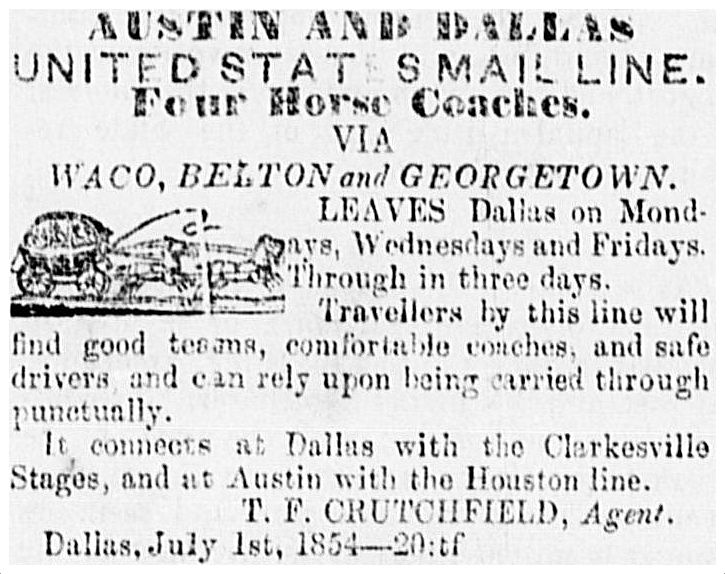
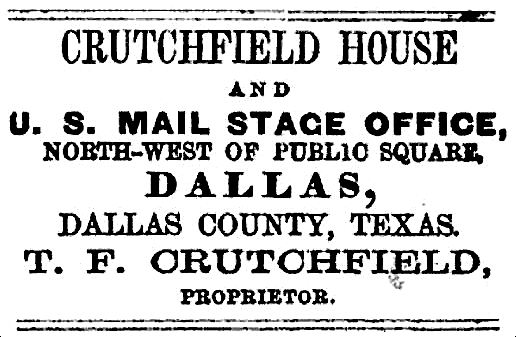
T. F. Crutchfield was a busy man who had his hands in a lot of pies in the very early days of Dallas. I’ll have to get back to him one day. Above, an ad of his, dated 1854, from an 1855 issue of the Dallas Herald. Below, an ad from the 1858 Texas Almanac.

crutchfield_tx-almanac_1858

***

Sources & Notes

An interesting article by Mike Cox on stagecoaching in Texas, from the Texas Almanac, is here.

*

Copyright © 2014 Paula Bosse. All Rights Reserved.

Lincoln High School — 1939

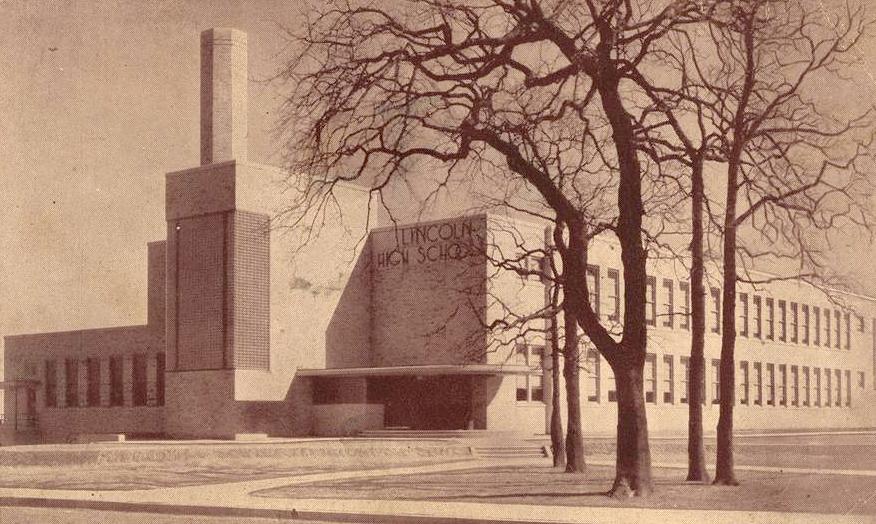
lincoln-high-school_1939The cool deco design of Lincoln High School… (click for larger image)

by Paula Bosse

When it opened on eleven acres in South Dallas in January, 1939, Lincoln High School was one of the largest high schools in Dallas, and one of the largest African-American high schools in the entire South. Shockingly, in 1939 it was one of only TWO (!) high school for black students in Dallas. As one would expect, its opening was greeted with great enthusiasm, and students rushed to enroll, pushing its capacity to a maximum. At its height, it had over 3,000 students. The building was designed by architect Walter C. Sharp, who designed many schools in and around Dallas, and with those clean lines and glass bricks, it’s pretty cool.

***

Photo from the J. L. Patton Collection, Dallas Historical Society.

For more on the background of Lincoln High School, see the info from the “Open Plaques” project here.

Click photo for larger image.

*

Copyright © 2014 Paula Bosse. All Rights Reserved.

Lefty Frizzell: It All Began on Ross Avenue

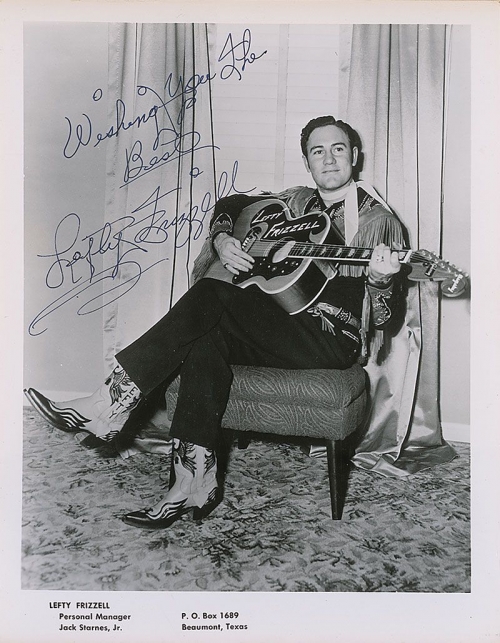
lefty_promoThe Man

by Paula Bosse

Lefty Frizzell was born on this day in 1928 in Coriscana. His Dallas connection? He was “discovered” by Dallas producer Jim Beck and recorded many of his early hits at Beck’s downtown studio. He played a lot of gigs around town, including several appearances over the years on the Big D Jamboree. But even if there weren’t any iron-clad Dallas connections, I’d have to mention him anyway. Not only is he one of country music’s most influential artists (up there in the Holy Trinity with Hank Williams and George Jones), he’s my favorite singer. Of any genre. EVER.

Take a listen to his first single, recorded on July 25, 1950 at the celebrated Jim Beck Studio at 1101 Ross Avenue: “If You’ve Got the Money, I’ve Got the Time” (which the Dallas Morning News — a bit dismissive of the “hillbilly” set — weirdly mangled into “I’ve Got the Money If You Can Spare the Time”). It was an incredible smash hit, and it kicked off a spectacular career, during which he was at almost Beatles-level popularity, with four singles in the top ten at the same time.

*

And another clip, this time a live performance from “The Porter Wagoner Show.”

*

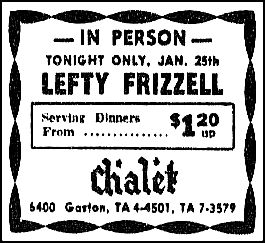
And, lastly, something I just found today, an ad for an appearance by Lefty in January 1963, when his career had dipped a bit (he would have a big come-back hit with “Saginaw, Michigan” at the end of the year). I’ve never heard of The Chalet (a supper club, I think), but its address of 6400 Gaston means that it was in the space where the Dixie House is now, in Lakewood. Maybe it’s only exciting to a superfan such as myself, but knowing that Lefty performed in my neighborhood, in a place in which I’ve actually spent a not insignificant amount of time, well … that’s just damn cool. Happy Birthday, Lefty!

lefty-chalet_dmn_012563January 1963

***

Sources & Notes

To read my post on the untimely death of Jim Beck (and see photos of him, which are few and far between), click here.

*

Copyright © 2014 Paula Bosse. All Rights Reserved.

The Pasadena Perfect Home — 1925

g

by Paula Bosse

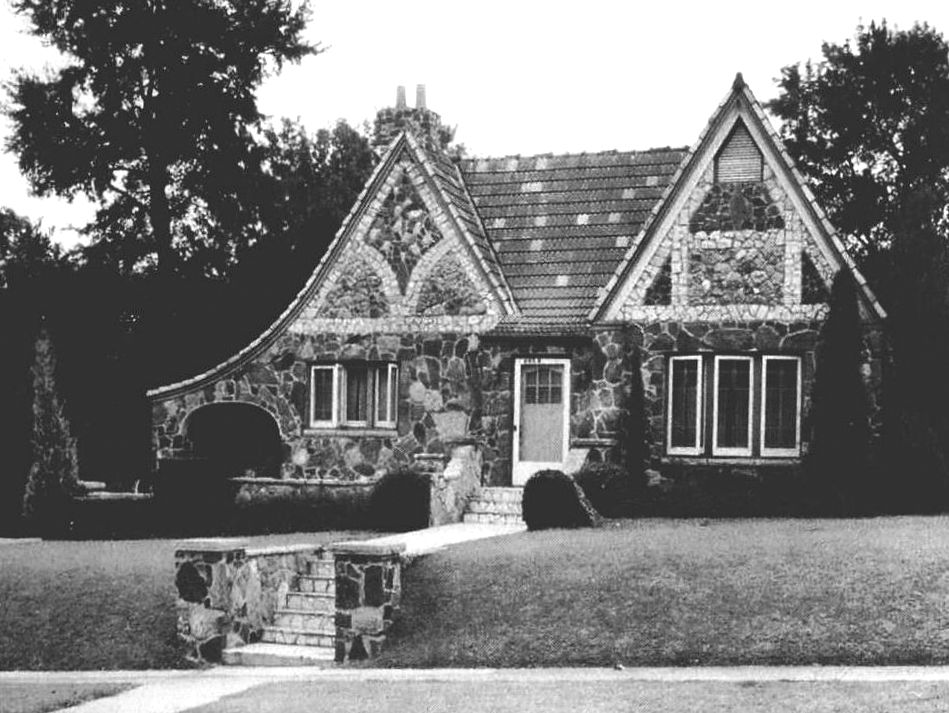
A few weeks ago, I wrote about the “Blandings Dream House” promotion in which the marketing department of the studio behind the Cary Grant movie “Mr. Blandings Builds His Dream House” built several houses around the country. The houses were built and furnished locally, with the contractors sharing in the (massive) advertising blitz. Once the home was completed, people toured the  house, with a small admission going to charity. One of those houses was built in Dallas (in Preston Hollow). That was in 1948. Twenty-three years BEFORE that, the Dallas Times Herald sponsored something called “The Pasadena Perfect Home,” built and marketed in a similar manner.

In the early 1920s, land in the general area we now know as Lakewood was pretty much undeveloped. There was a lot of open space — some farmland, the occasional cotton patch. White Rock Lake was becoming a popular recreational destination, but it was still WAAAAY out beyond the center of Dallas. But by the mid-’20s, developers started developing. A few of the neighborhoods that sprang to life at this time were Lakewood, Hollywood Heights, and Santa Monica. In 1925 — in the part of town then being referred to as “New East Dallas” — a 40-acre parcel of land near the Hollywood/Santa Monica subdivisions began to be planned. The small tract of 130 lots was to be known as Pasadena, located just north of Gaston, comprised of Pasadena, Wildgrove, and Shook avenues, bordered by Auburn Ave. and White Rock Rd.

The developer came up with the brilliant idea of marketing his investment by building two “perfect homes” and, while they were under construction, to promote the bejabbers out of them in the pages of the Dallas Times Herald, the project’s sponsor (and namesake). Just like the Blandings builders did a couple of decades later, local construction crews, plumbers, electricians, stone masons, etc. were contracted to build the “Dallas Times Herald Pasadena Perfect Homes” in exchange for their businesses appearing in a veritable onslaught of advertising-slash-publicity (which soon became publicity-slash-advertising). Each step of progress in the months-long construction of the houses was breathlessly reported in the Times Herald in regular reports, and looky-loos (i.e. potential buyers) were heartily encouraged to drive out to watch the goings-on. Make a day of it! This pleasant hard-sell to “own a bit of paradise in the heart of New East Dallas” was covered more as a community event than as the clever marketing gimmick it was.

When the two homes were completed, there was an official opening on February 21, 1926. This boggles the mind, but apparently 20,000 people (TWENTY-THOUSAND PEOPLE!) showed up for this event. All that promotion worked. Lots in the little neighborhood sold quickly.

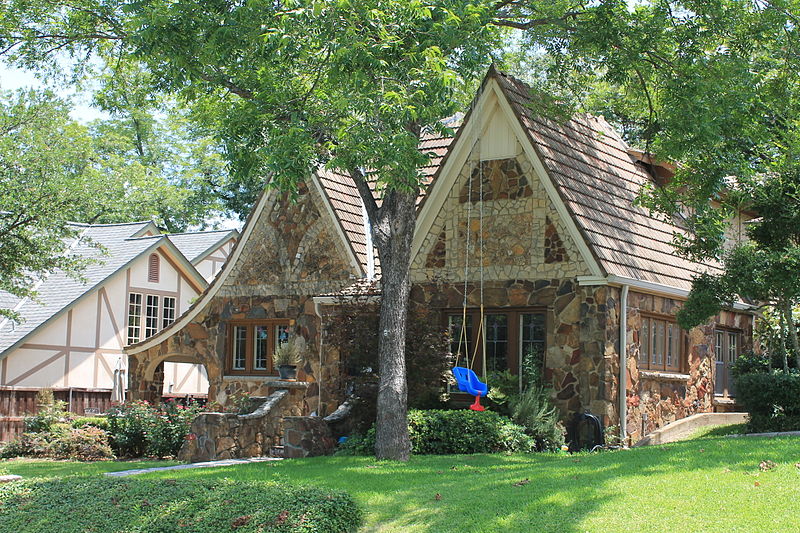
The original “perfect home” pictured above is still there, on Wildgrove. In fact, the house, designed by architect Arthur E. Thomas, was placed on the National Register of Historic Places in 2006 (listed as “The Dallas Times Herald Pasadena Perfect Home”). It’s well worth a nice Sunday drive to check out this home and the other homes in this lovely historic area. The Pasadena neighborhood remains unsullied by the McMansion-ization that has destroyed the charm of much of Dallas’ older neighborhoods, and driving down Pasadena’s tree-lined streets is an absolute joy.
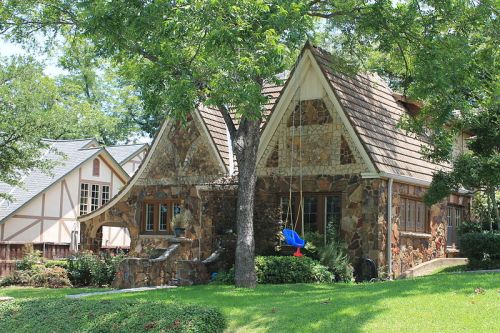
Above, the house from a 2011 Google maps photo.
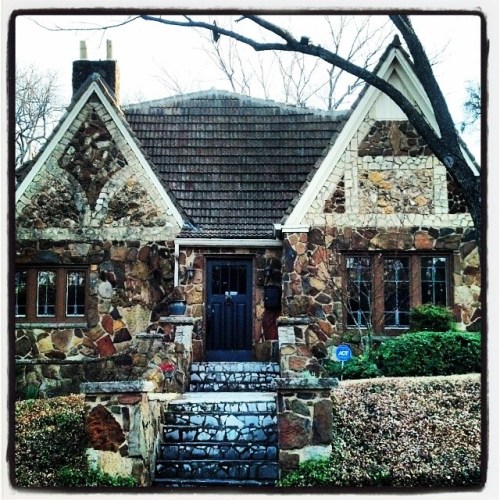
A photo I took at the end of February, 2014, Instagramized.

***

Sources & Notes

For more on the Dallas Times Herald Perfect Home(s) (and a couple of other photos, on pages 2 and 38), see the article by Sam Childers in the Fall, 2002 issue of Legacies, here. There is also some info here.

A little more info on this home (building materials, etc.) is here.

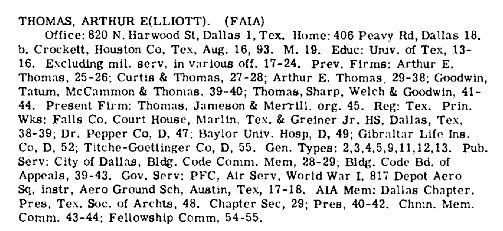
The architect of this house is Arthur E. Thomas, and he designed some pretty impressive buildings in Dallas, such as the Dr Pepper headquarters and Baylor Hospital, and, most impressively, he was one of the Centennial Architects who worked on the Centennial buildings in Fair Park in 1936. But I have found very little about him online. A brief bio is here. The following list of his projects is from a 1956 AIA directory.
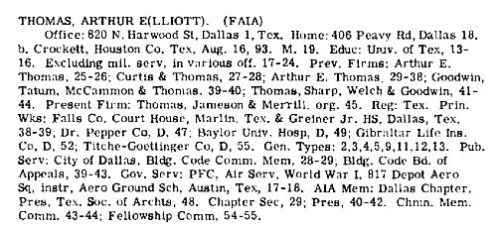
Click pictures for larger images.

*

Copyright © 2014 Paula Bosse. All Rights Reserved.

Phrenology by Mail! — 1894

by Paula Bosse

Distance matters not to this Main Street medium. Prof. A. Henry was, verily, a man of many talents. (In case you do not know what phrenology is, see this. It’s probably not something one can do easily via mail.)

***

Sources & Notes

From A Souvenir Guide of Dallas, 1894.

*

Copyright © 2014 Paula Bosse. All Rights Reserved.
Joe Yee Cafe: The Best Chop Suey in Town

joe-yee-cafe-extChop suey *and* famous chicken house…

by Paula Bosse

I came across the above image and was enthralled. I’ve never heard of the Joe Yee Cafe, but this (granted) idealized picture is wonderful. The postcards above and below were from the early 1950s, and if you are familiar with the generally run-down neighborhood around Columbia and Fitzhugh these days, you may well shed a tear that something this charming and picturesque has been gone for many, many years.

joe-yee-cafe-interior

I love the surprising color scheme of the restaurant’s interior — those fabulous purples and greens! (The colors are a bit unexpected because they so loudly clash with the bold tomato red of the exterior.)

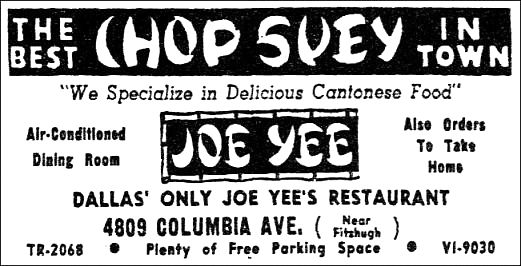
I did a little research to see what I could find out about Joe Yee’s Chinese restaurant. Seems that Mr. Yee’s cafe was in business by the 1930s, downtown, on Main Street near Field. It advertised steadily over the years, and its ads proudly proclaimed that the restaurant served “the best Chinese food you ever tasted” and was “completely air-conditioned.” Several newspaper accounts (particularly the society columns) mentioned it as a popular place for young people to grab a bite before and after dances at nearby downtown hotels. Business must have been pretty good for the place to have lasted so long at such a primo location. The cafe moved to the Columbia Street location in 1950 where it remained in business until at least late 1956 when a major fire struck.

joe-yee-cafe_matchbk

1938-joe-yee_dmn_1125381938

1943-joe-yee_dmn_0812431943

1953-joe-yee_dmn_0830531953

***

Sources & Notes

Top two early-’50s postcards are from the great Boston Public Library Tichnor Brothers Postcard Collection on Flickr, here.

In old photos of downtown Dallas one often sees “Chop Suey” signs along the streets. I’d love to know more about these restaurants in general, and about Chinese and Chinese-Americans in Dallas in the first half of the 20th century, if anyone can point me to a good source.

If background on Chop Suey is needed, might I point you to to the Wikipedia entry here, or the Snopes entry here.

*

Copyright © 2014 Paula Bosse. All Rights Reserved.