Flashback : Dallas

A Miscellany: History, Ads, Pop Culture

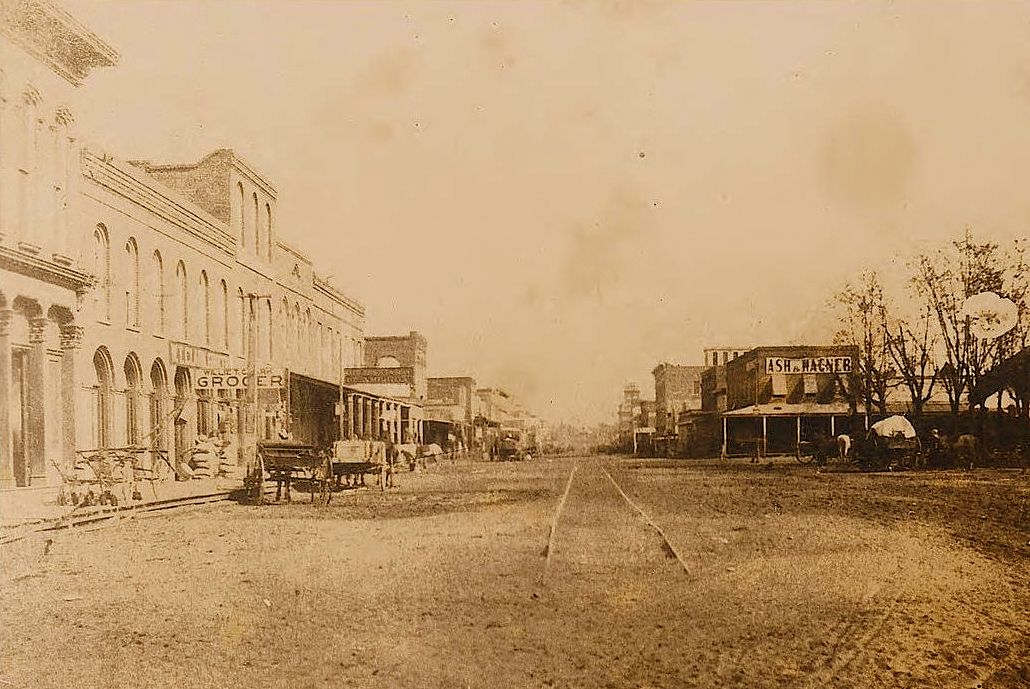
Main Street, 1875 — Very Little Hustle, Very Little Bustle

by Paula Bosse

Main Street, looking east from the old courthouse, at Houston Street. 1875. Wow.

***

Stereograph from the George A. McAfee collection, DeGolyer Library, Central University Libraries, Southern Methodist University; more info on this image can be found here.

Click to see larger image.

*

Copyright © 2014 Paula Bosse. All Rights Reserved.

Southwestern Bell Telephone Goings-On, Circa 1928

by Paula Bosse

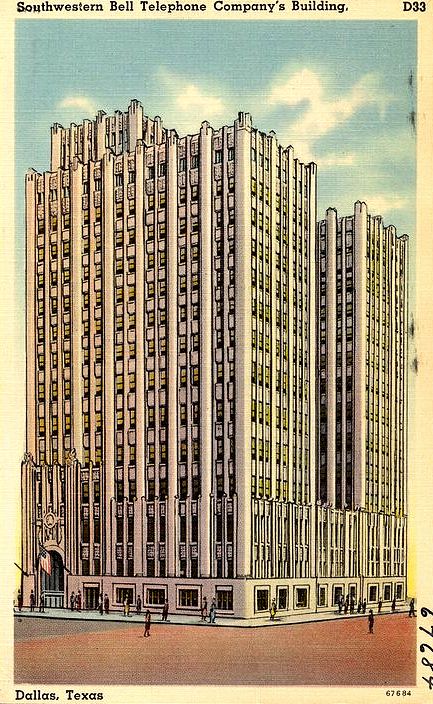
The beautiful Southwestern Bell Telephone Company building, designed by Lang & Witchell in 1929.

From the book Dallas Landmarks:

Dallas’ first telephone exchange opened on June 1, 1881, with 40 subscribers. There were several competing telephone companies before 1925 when Southwestern Bell became the sole provider. The number of telephones in used quickly soared from 30,000 in 1922 to 200,000 in 1949.

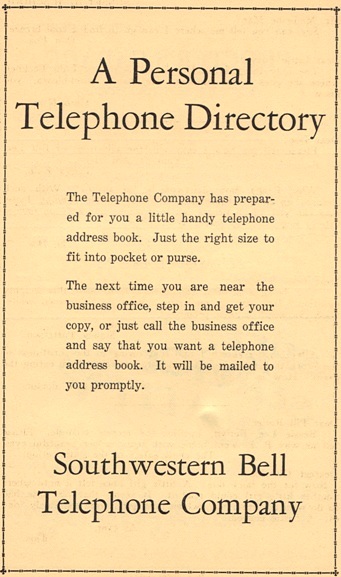
The relatively few telephone subscribers at the time the building was going up might explain this folksy little notice about a “personal telephone directory” that the fine folks at Southwestern Bell have been working on night and day, just for you. Next time you’re in the neighborhood, why don’t you just drop right on in and pick one up? Set a spell. Take your shoes off. Y’hear?

***

Sources & Notes

Postcard from the Boston Public Library Tichnor Brothers Postcard Collection on Flickr, here.

Quote from the book Dallas Landmarks, by Preservation Dallas and Dallas Heritage Village (Charleston: Arcadia Publishing, 2008). p. 31.

Quaint little ol’ phone book ad, from, of all places, the Nov. 1928 issue of “The Stampede,” the school magazine published by and for the students of Sunset High School in Oak Cliff.

*

Copyright © 2014 Paula Bosse. All Rights Reserved.


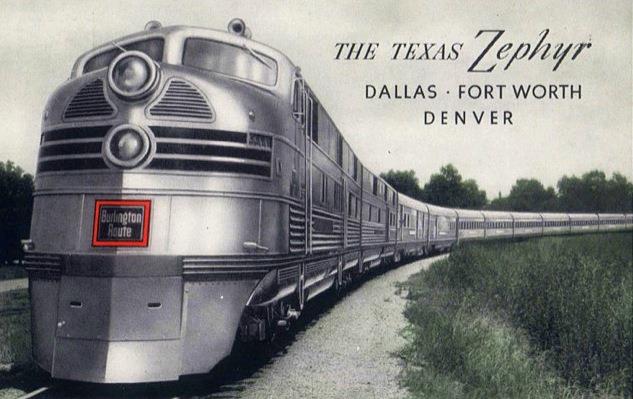
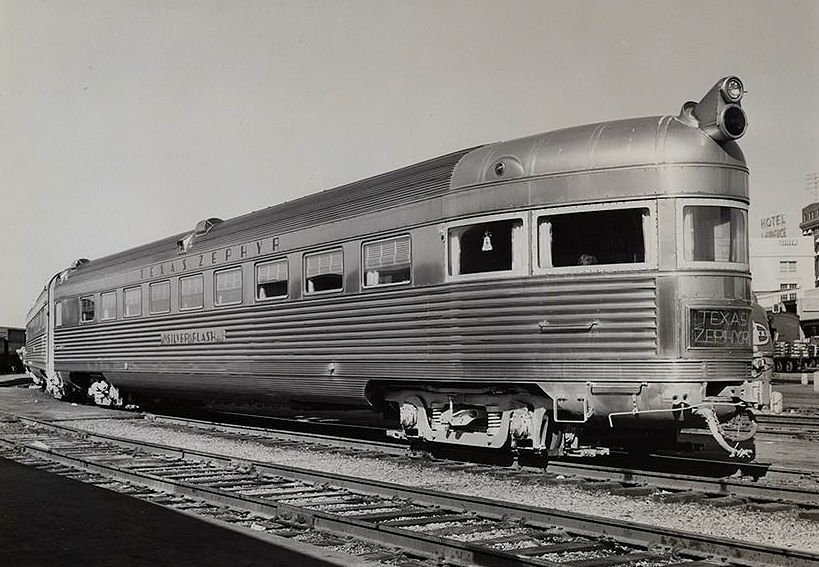
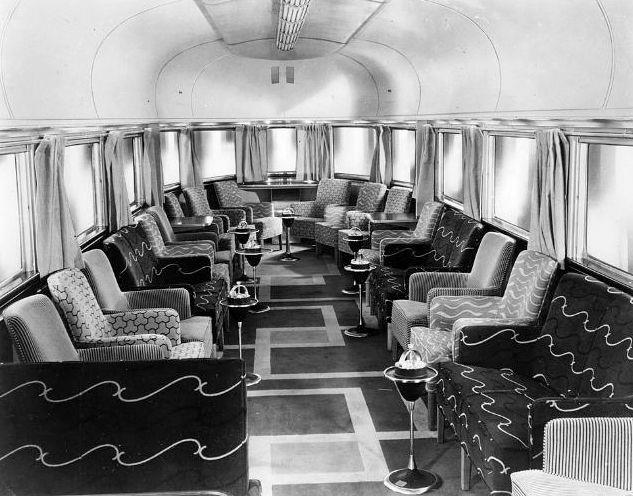
The Texas Zephyr — Streamlined Luxury Train Travel

Dallas — Fort Worth — Denver

by Paula Bosse

From the golden age of train travel. …I was born in the wrong era.

***

Sources & Notes

Second photo showing the exterior of the “Silver Flash” passenger car on the tracks at Union Station in Dallas is from the DeGolyer Library, Central University Libraries, Southern Methodist University; it was taken by Everett L. DeGolyer Jr. in 1960; more information on this photo is here.

Top and bottom images are from the wilds of the internet.

More on the Texas Zephyr here.

*

Copyright © 2014 Paula Bosse. All Rights Reserved.

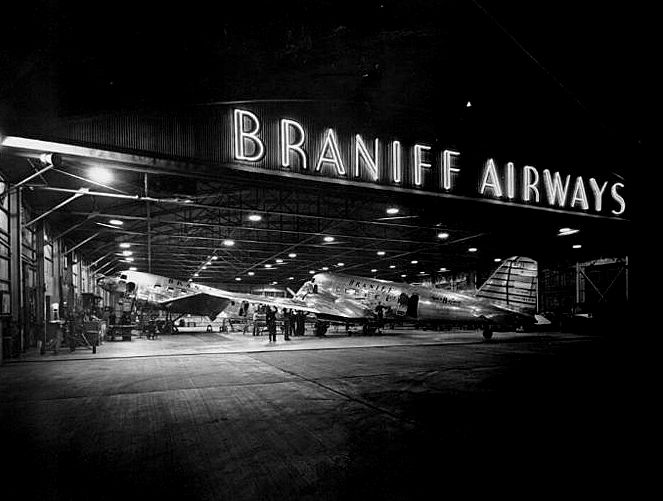
Braniff Hangar, Love Field — 1940s

by Paula Bosse

Overnight maintenance. Beautiful sign.

Photo caption:

Night maintenance at the Braniff hangar, main entrance on Roanoke Drive at Dallas Love Field, early 1940s.

Planes being serviced include a DC-2 and DC-3.

*

Copyright © 2014 Paula Bosse. All Rights Reserved.

Dallas Steam Mills at the Cedar Spring — 1855

by Paula Bosse

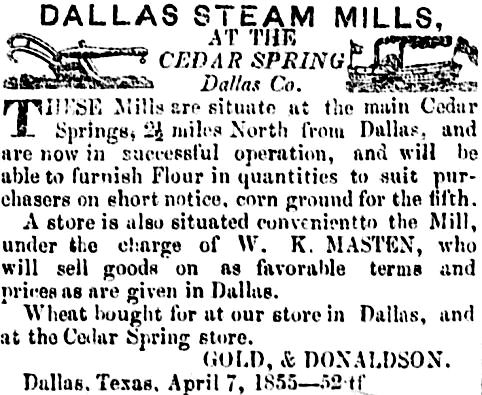
DALLAS STEAM MILLS, at The Cedar Spring, Dallas Co.

These Mills are situate at the main Cedar Springs, 2 1/2 miles North from Dallas, and are now in successful operation, and will be able to furnish Flour in quantities to suit purchasers on short notice, corn ground for the fifth. A store is also situated convenient to the Mill, under the charge of W. K. MASTEN, who will sell goods on as favorable terms prices as are given in Dallas. Wheat bought for our store in Dallas, and at the Cedar Spring store.

–GOLD, & DONALDSON. Dallas, Texas , April 7, 1855

*

In 1843, a trading post was established just outside the city of Dallas at the new settlement of Cedar Springs. There were few settlers at the time, so items traded were pretty much limited to only the essentials (groceries, ammo, buffalo hides). By 1850, though, sexier luxury goods like “hoopskirts, silk stockings, bridal bouquets, Bibles, accordions, Mustang liniment, snake-root and castor oil were listed in the inventory of a deceased merchant. This advance in merchandising may be attributed to the establishment by that time of a gristmill to which farmers from many miles around brought their grain. Naturally they visited the stores to trade” (WPA Dallas Guide and History). The Dallas Steam Mills was one of the first commercial mills in “the Cedar Spring,” and as it was affiliated with successful early Dallas retailers Gold and Donaldson, it must have also been one of the most profitable.

The community grew quickly. Until 1850. That was when Dallas County residents went to the polls and voted on which of the local communities would be the county seat. The choices were: the city of Dallas, Cedar Springs, and the ever-popular Hord’s Ridge. Cedar Springs came in dead last. The agony of defeat must have hit hard — the loss seems to have dampened civic enthusiasm and contributed to stagnant growth. It wasn’t until the turn of the century that the area — by then called Oak Lawn — had rebounded with a boom in population. By the 1940s, though, the area had been officially annexed by the city of Dallas. Oak Lawn (né Cedar Springs) had, at least, managed to hold onto a shred of independence a few decades longer than its former opponent had — Hord’s Ridge had changed its name to Oak Cliff, but it, too, had been swallowed up by the voracious, mammoth city surrounding it. No hard feelings, guys. You can run but you can’t hide. Resistance has always been futile. We’re all just one big happy kudzu-like sprawling sprawl now.

*

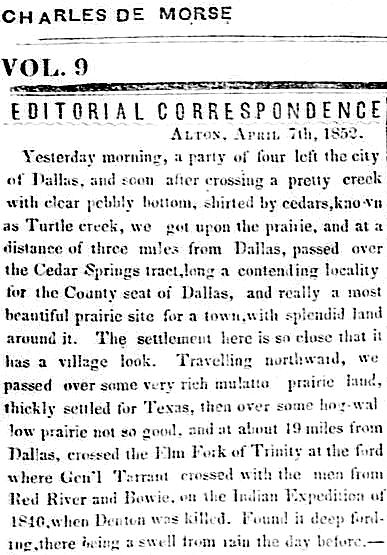
Below is an interesting account of traveling through Cedar Springs in 1852.

***

Dallas Steam Mills ad from the Dallas Herald, 1855.

Quote mentioning accordions and hoopskirts from The WPA Dallas Guide and History (Dallas Public Library Texas Center for the Book, University of North Texas Press, 1992). p.124

The account of passing though Cedar Springs, by Charles DeMorse, is the lead story in the July 17, 1852 issue of Clarksville’s Northern Standard newspaper; it can be found here  on UNT’s invaluable Portal to Texas History site; from the collection of the Dolph Briscoe Center for American History.

A biography of Charles DeMorse, writer and editor of Clarksville’s Northern Standard can be found here.

The Handbook of Texas History entry for Cedar Springs is here.

*

Copyright © 2014 Paula Bosse. All Rights Reserved.

Roger Corman Does Dallas — 1970

by Paula Bosse

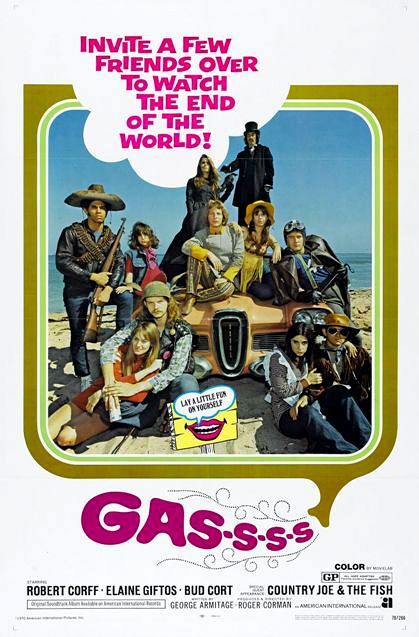
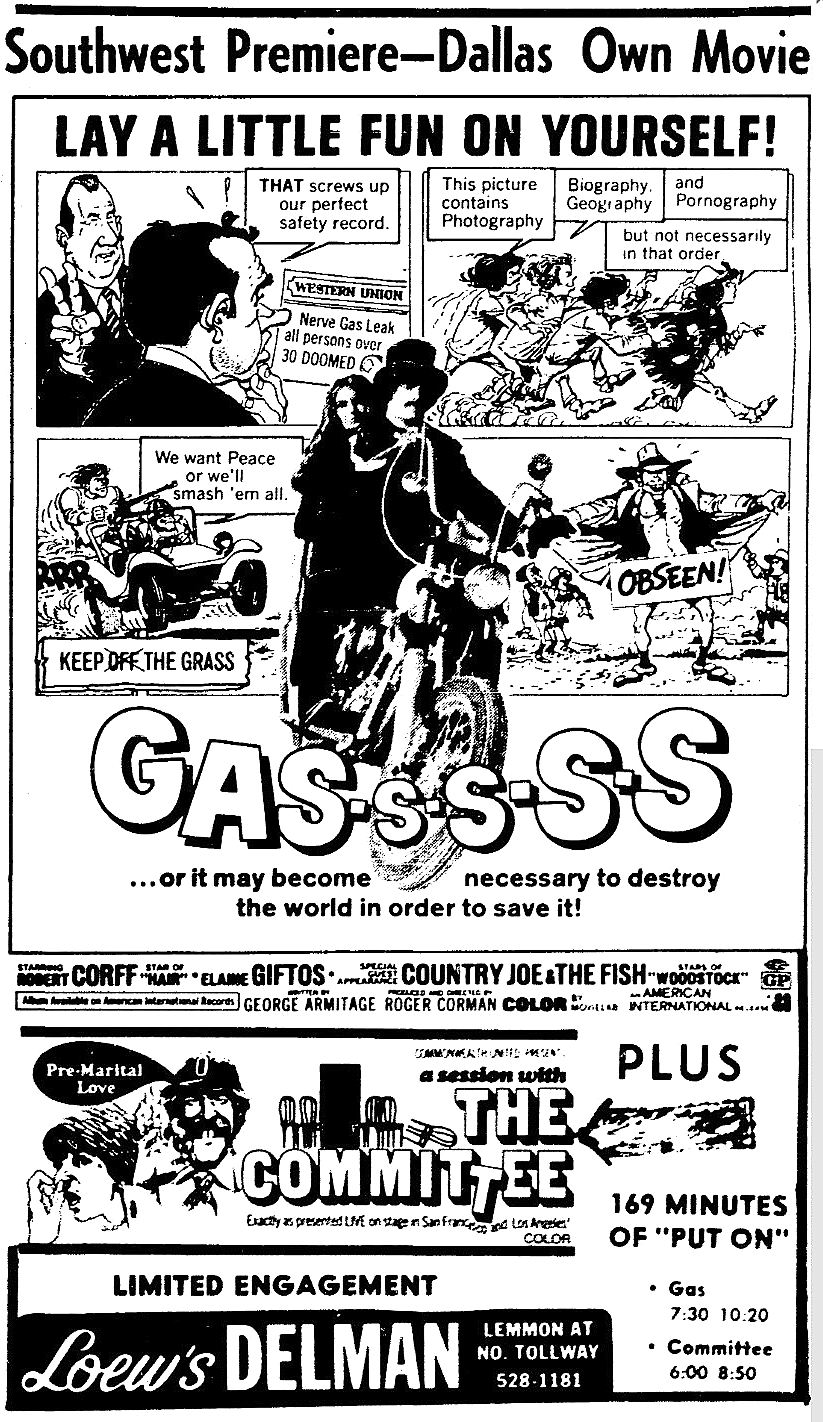
Think you’re up on your “movies-shot-in-Dallas” trivia? I thought I was. Until I happened across a strange little movie in the wee hours of the morning a couple of years ago. The movie is called Gas-s-s-s! Or sometimes Gas–Or–It Became Necessary to Destroy the World In Order to Save It. And it’s directed and produced by the great schlockmeister (and I use that word lovingly), Roger Corman.

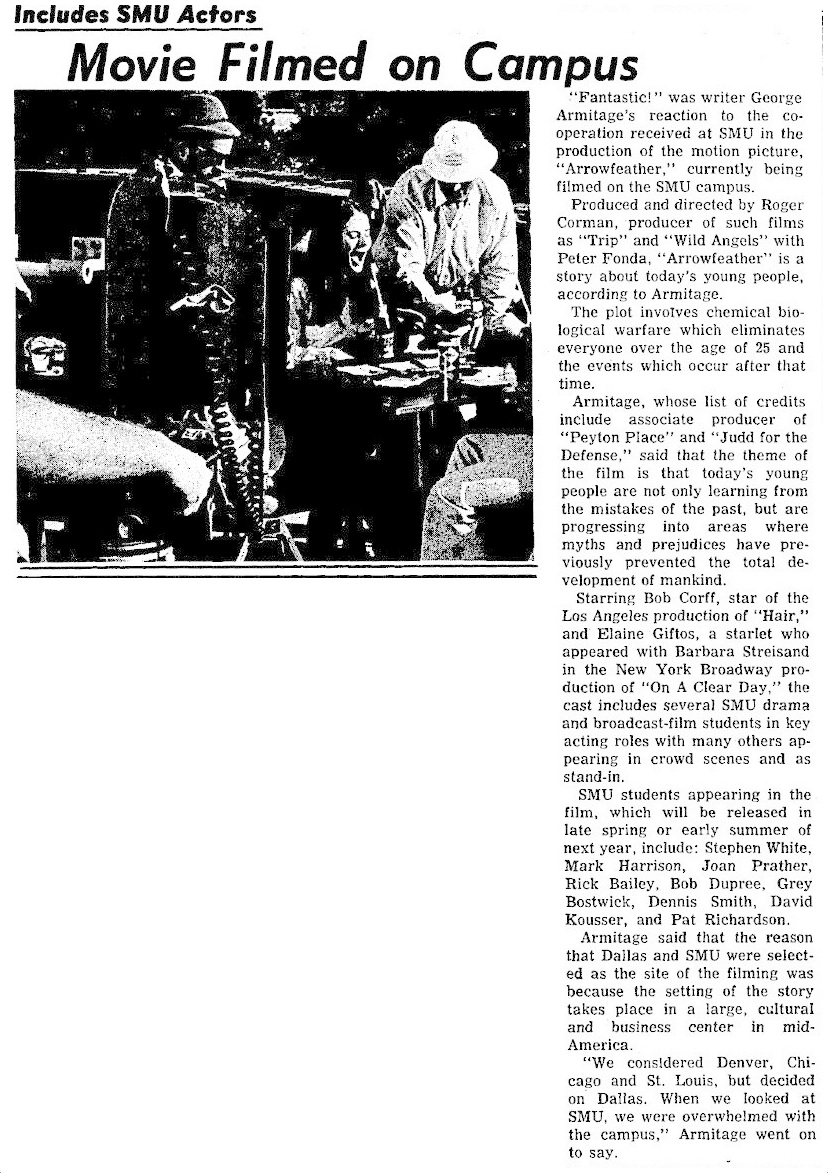
For my purposes here, I’m not going to try to describe the meandering plot of this vaguely post-apocalyptic screwball hippie groove-fest, but other than the fact that it has early appearances on film by Bud Cort, Cindy Williams, Ben Vereen, and Talia Shire (billed here as “Tally Coppola”), the only thing that really matters is that a good ten minutes of this really bad movie take place in Dallas — a good chunk of it shot on the SMU campus (?!). (I wonder if there was some guerrilla film-making going on here because it seems unlikely that the powers-that-be at SMU would have allowed Corman to film one of his typical counter-culture movies in the heart of the Park Cities.) (ETA: Well, I’ve recently come across an article from the SMU Daily Campus, which appeared during filming (read it at the bottom of this post). It mentions previous Corman movies, so I guess the Hilltop decision-maker knew of Corman’s oeuvre and was fine with everything. Either that, or that person was lazy and didn’t bother investigating. The working title, by the way, was “Arrowfeather.”)

The Dallas scenes are conveniently right at the beginning of the movie (following a short animated sequence of plot exposition and titles). Corman’s opening montage of the streets of Dallas is only 30-seconds long, but it’s really great! Not that he meant it to be, but it’s like a little valentine to downtown Dallas as it was embarking on a new decade. Look at all those buildings! Look at all those people! Later on you see an eerie, deserted downtown, Dealey Plaza, SMU fraternity row, and a mod, weird-looking church which I’ve never seen (where is that, anyway?). Here’s the opening couple of minutes of the movie:

*

The entire movie is occasionally on YouTube, but it seems to go up and get pulled off with some frequency. By the time you read this it may no longer be available, but you can watch the trailer here. (If you can find the full movie, the Dallas bits start at about the 3:30 mark and last until about the 13:00 mark.)

I watched the whole thing, and I can’t say I enjoyed it. I DID really like Cindy Williams as an excitable music geek, here in her first movie — three years before American Graffiti and longer still before Laverne & Shirley — but I’m not sure that’s enough of a reason to recommend sitting all the way through it. (And don’t get excited about Bud Cort, because his participation is minimal.)

Watch the whole thing if you must. But, remember: you’ve been warned!

**

gassssss_movie_smu-daily-campus_nov-4-1970SMU Daily Campus, Nov. 4, 1970

This article appeared in the SMU newspaper — The Daily Campus — while the movie was being filmed in Dallas. (Click for larger image.)

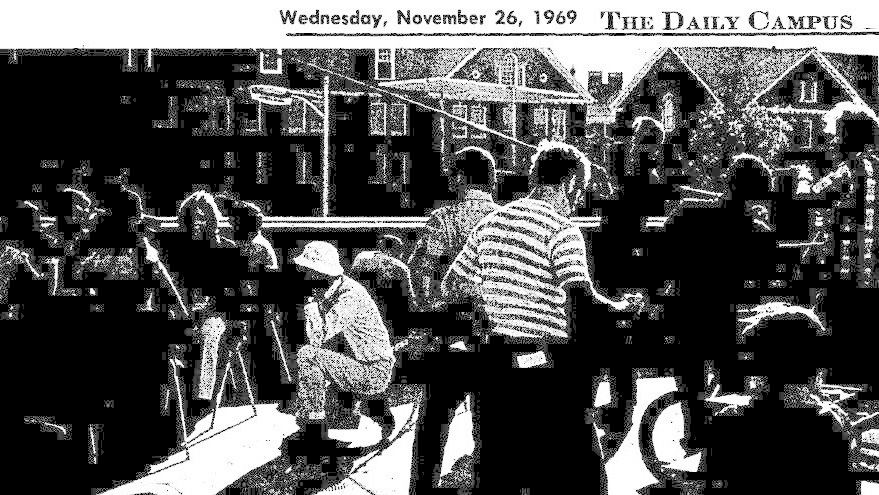
gas_making-of_roger-corman_smu-daily-campus_112669SMU Daily Campus, Nov. 26, 1969

The photos accompanying the article are, sadly, not the greatest resolution, but here’s one:

gas_making-of_roger-corman_smu-daily-campus_112669_photo

***

Sources & Notes

SMU Daily Campus article (Nov. 26, 1969) is from the Southern Methodist University Student Newspapers collection, DeGolyer Library — see the scanned issue here.

The IMDb listing for the movie is here. Who knows? You might know people in it! …Heck, you might be in it.

If you’ve arrived at this post by searching on “schlockmeister,” I invite you to peruse these other Flashback Dallas posts about Dallas’ own Roger Corman, Larry Buchanan:

*

Copyright © 2014 Paula Bosse. All Rights Reserved.

Not Every ‘Good Luck Trailer Park’ Story Has a Happy Ending — 1964

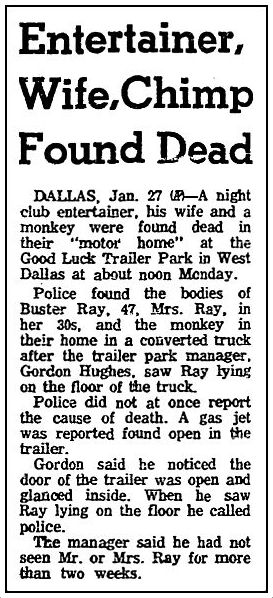
chimp_fwst_012864Fort Worth Star-Telegram, Jan. 28, 1964

by Paula Bosse

“Entertainer, Wife, Chimp Found Dead.” THAT is a headline.

Had I not known that the (ironically named) Good Luck Trailer Park on W. Commerce had been a favorite with visiting circus folk, I might have been a little more surprised by the weird circumstances reported in this article. As it was, I was only mildly surprised.

(I kind of think the chimp did it….)

***

Sources & Notes

Hats off to the Fort Worth Star-Telegram‘s headline writer. The story ran in the Star-Telegram on Jan. 28, 1964.

The victims — Harold Allen Ray and his wife Nadine (and unnamed monkey) — were later determined to have died of accidental carbon monoxide poisoning.

“Buster Raye” (stage name of Harold Ray) had been a comedian and master of ceremonies who seems to have played a lot of burlesque joints/strip clubs as the between-stripper entertainment. He was billed as “The Mighty Mite of Mirth.” In a Feb. 24, 1948 review of his act, The Bryan Eagle wrote:

Buster Raye, diminutive master of ceremonies, stole the show with a clever line of chatter punctuated with juggling, acrobatics, songs, imitations. His jokes were well handled with none of the vulgarity common to many floor shows.

I’m not sure where the monkey fits in.

buster-raye_corpus_042948Corpus Christi Caller-Times, April 29, 1948

*

Copyright © 2014 Paula Bosse. All Rights Reserved.


A Robot Visits the Texas Centennial — 1936

by Paula Bosse

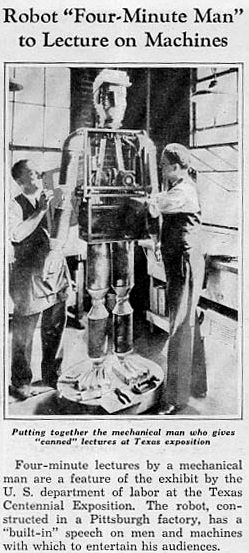
This “mechanical man, built by human hands” was quite the attraction at the 1936 Texas Centennial.

Four-minute lectures by a mechanical man are a feature of the exhibit by the U.S. department of labor at the Texas Centennial Exposition. The robot constructed in a Pittsburgh factory, has a ‘built-in’ speech on men and machines with which to entertain his audiences.

***

Lower image from Popular Mechanics (Sept. 1936).

*

Copyright © 2014 Paula Bosse. All Rights Reserved.

Atkins’ Rattlesnake Oil — Beware of Fraudulent Imitations!

by Paula Bosse

“From the Aboriginal Indians of this country — the early trappers — and pioneers learned that Rattle Snake Oil was the best remedy for rheumatism, pains, sprains, bruises, etc. Every cabin had its bottle hanging ready, from the rafters. The day will come when every house will have it again.”

That little tidbit appeared under the heading “Folk-Lore” in the October 9, 1888 issue of the Dallas-based Southern Mercury newspaper. As there was no company name or product attached, it appeared to be a mere space-filling “factoid” rather than an advertisement. Conveniently, though, it was just a hop, skip, and a jump across three ink-smeared pages from a large ad for Atkins’ Rattlesnake Oil, an ad that warned the reader to “Beware of Fraudulent Imitations!” before it launched into a long list of testimonials from the once-weak and infirm. The ad ended with “Geo. T. Atkins, Dallas, Texas — For Sale by All Druggists.”
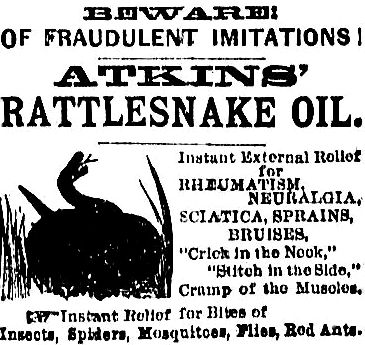
Southern Mercury, Oct. 9, 1888 (detail)

*

George T. Atkins was born in New York in 1837. Educated and having the bearing of a “trained businessman,” he drifted south and for some reason decided to join the Confederate army.

He was described by a fellow brigade member as a dark and handsome “compactly built” snappy dresser who “talked in a louder tone than the others, and [had] a peculiarly non-chalant, devil-may-care manner [that] emphasized his presence.” Atkins became a captain and quartermaster in the Fourth Kentucky Cavalry and though his position did not require participation on the battlefield, he was painted as something of a hot-dogging thrill-seeker: “[T]he gallant captain was frequently found in the ‘thickest of the fray,’ notably in the desperate battle at Saltville, where he recklessly and conspicuously rode up and down the lines, seeming determined to get himself killed.”

After the war, he eventually made his way to Texas with his family, arriving in Dallas in 1876 and settling into a large house at Ross Avenue and Masten Street (now St. Paul). At some point he opened a drugstore on Elm which seems to have been quite a successful enterprise. Perhaps it was his close proximity to drugs and medicinal compounds that prompted Atkins to launch his lengthy (and presumably lucrative) side-business as a snake oil manufacturer and salesman.

As far as I can tell, his “rattle snake oil” ads started around 1888. “Snake oil” has become a synonym for fraudulent wares sold by hucksters who know their products are ineffective but figure they can make a quick buck by grossly exaggerating — if not outright lying about — the magically curative properties of whatever it is they’re selling. As an actual “druggist,” Atkins probably had at least a little credibility compared to the other latter-day medicine-show men flogging their tonics and elixirs out of the back of a wagon before the law ran them out of town.

Southern Mercury, 1890 (det)

In fact, Atkins was, himself, such an expert flogger that his claim in ads that the United States Patent Office had officially ruled that his rattlesnake oil was “The Only True and Genuine Rattlesnake Oil” is automatically suspect, even though the editors of the Dallas Morning News (who, by the way, were no stranger to the popular and socially prominent Atkins, a man with, let’s not forget, a hefty newspaper advertising budget) published in its pages the following blurb (probably supplied by “the plaintiff”):

Dallas Morning News, Dec. 12, 1888

 1888 was a good year, and Atkins was riding a snake-oil wave of good publicity. There were even reports in the local papers that Dallas’ favorite herpetologically-inclined drugstore owner was hustling “live and uninjured rattlesnakes” to interested parties in Paris and London. I don’t know … maybe…. Probably just some more creative publicity.
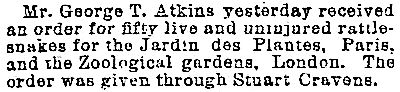
DMN, June 3, 1888

Atkins continued to run his drugstore and sell his snake oil until 1892 when, out-of-the-blue, he was assigned to dig the Texas Trunk Railroad out of receivership. The appointment seemed a little odd, but Atkins was a savvy businessman and a charming and persuasive speaker (he occasionally spoke in front of the Dallas City Council in a manner described as “felicitous and lucid”) — he could easily have back-slapped his way into the job. Despite the fact that he had no background in the railroad business, he seems to have spent several fairly productive years in the position. (His son, by the way, legitimately worked his way up through the ranks of the M-K-T, from lowly freight clerk to powerful executive VP.)

Eventually the railroad job ended and, in the waning years of the nineteenth century, Atkins seemed to be flailing a bit — he set the snake oil aside for a moment and placed an ad in the DMN classifieds soliciting investors to stake a claim in a Klondike gold scheme — at a mere $100 a share!
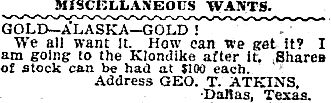
DMN, Aug. 8, 1897

 He continued in the rattlesnake oil biz until at least 1907, but at some point that began to fade away (or his inventory finally ran out), and he and his wife began running a boarding house. By 1918, though, he was tired of being a landlord and, at the age of 80, Atkins was finally ready to retire.

DMN, Oct. 20, 1918

The large 12-room house at Ross and Masten sold after spending a lengthy time on the market, and Atkins and his wife moved to Lemmon Avenue, where, ultimately, he died on August 8, 1920.

DMN, Aug. 9, 1920

 George T. Atkins placed COUNTLESS snake oil ads in newspapers for something like twenty years. Each ad had his name on it. Boldly. Proudly. And there’s nary a mention of the famous Atkins’ Rattle Snake Oil in his obit! That’s a shame, because, to me, that’s the single most interesting thing about the man. He was a career snake oil salesman! He was also one of Dallas’ very first advertising empresarios — an entrepreneur who had a natural flair for the creative hard-sell and knew how to wield it.

“TAKE NO SUBSTITUTE!”

*
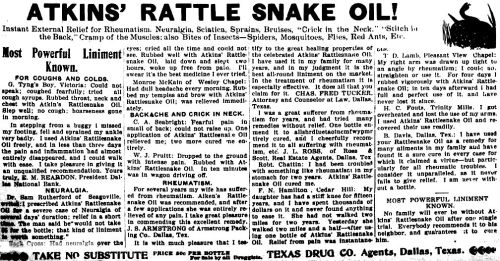
Southern Mercury, Dec. 20, 1900 (click to enlarge)

***

Quotes about Atkins’ time in the Confederate army from Kentucky Cavaliers in Dixie, Reminiscences of a Confederate Cavalryman by George Dallas Mosgrove (Madison: University of Wisconsin Press/Bison Books, 1999 — originally published in 1895); pp. 116-117.

Atkins’ physical examination of his snake oil, published in Chemist and Druggist (1890) can be seen here.

More on the Texas Trunk Railroad here.

*

Copyright © 2014 Paula Bosse. All Rights Reserved.

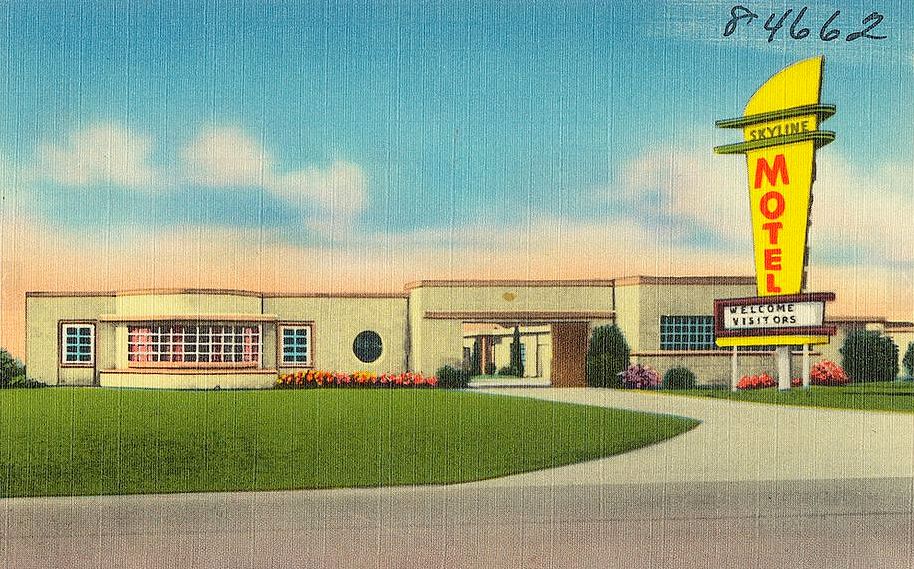
Motel Skyline / Skyline Motel — “The Motel of Distinction” (1947)

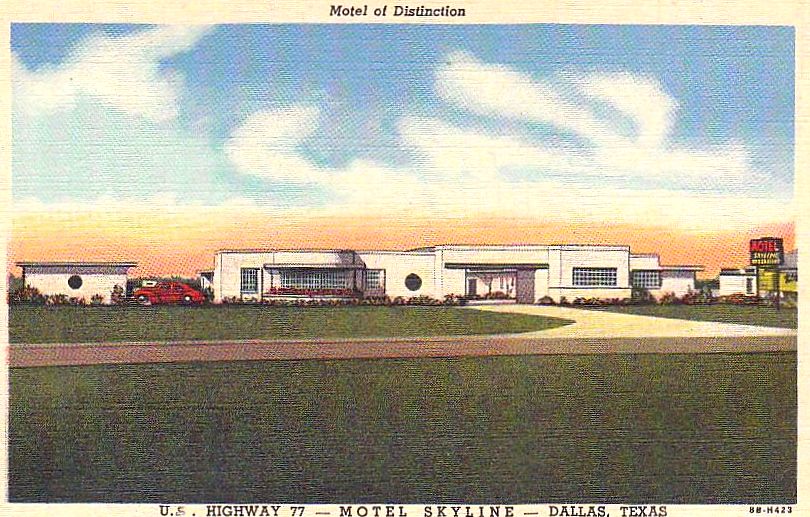
motel-skyline_postcard

by Paula Bosse

THIS is a great, great-looking motel. I only hope it looked half as sleek in real life. It was, rather surprisingly, designed in 1947 by the architect George Marble who was known for his large Tudor-revival homes in the pricier areas of Dallas (particularly Highland Park and Lakewood), so this is a major divergence in style. 1947 seems a little late for something this Deco-looking, but, no matter — this is just a fantastic building.

The “Motel Skyline” (or “Skyline Motel” as it was being referred to in ads not long after it opened in September, 1947) was located at 6833 Harry Hines, near West Mockingbird, just past Love Field. It’s not a great neighborhood these days, but perhaps it was better 60-some-odd years ago, when Harry Hines was the route that the old Hwy. 77 followed. The 30-unit “motor hotel” was built at a cost of $250,000 — it boasted year-round air conditioning and “mattresses of fiberglass.” 

I don’t know how long the place lasted — perhaps until the mid- or late-’60s, when advertising petered out and by which time the probably no-longer-so-sleek motel seems to have started catering to customers paying by the week and by the month. It might not have gotten as seedy as I fear it might have, as I saw only a couple of fairly run-of-the-mill appearances on the police blotter (cash stolen from a sleeping customer and a likely suicide in one of the rooms). Still, I shudder to think of that once-beautiful building ending its days cheek-by-jowl with modern-day Harry Hines.

It’s nice to know Dallas once had this wonderful building, if only for a little while. If anyone has photographs of the actual building, I’d love to see them, even though I know I would probably be disappointed.

*


1962 ad

***

Check out the kind of architectural design that George N. Marble is actually known for (residential, palatial), here.

Second postcard from the absolutely fantastic Boston Public Library Tichnor Brothers Postcard Collection on Flickr, here.

Matchbook from Flicker, here.

Click postcards for larger images. It’s worth it.

*

Copyright © 2014 Paula Bosse. All Rights Reserved.