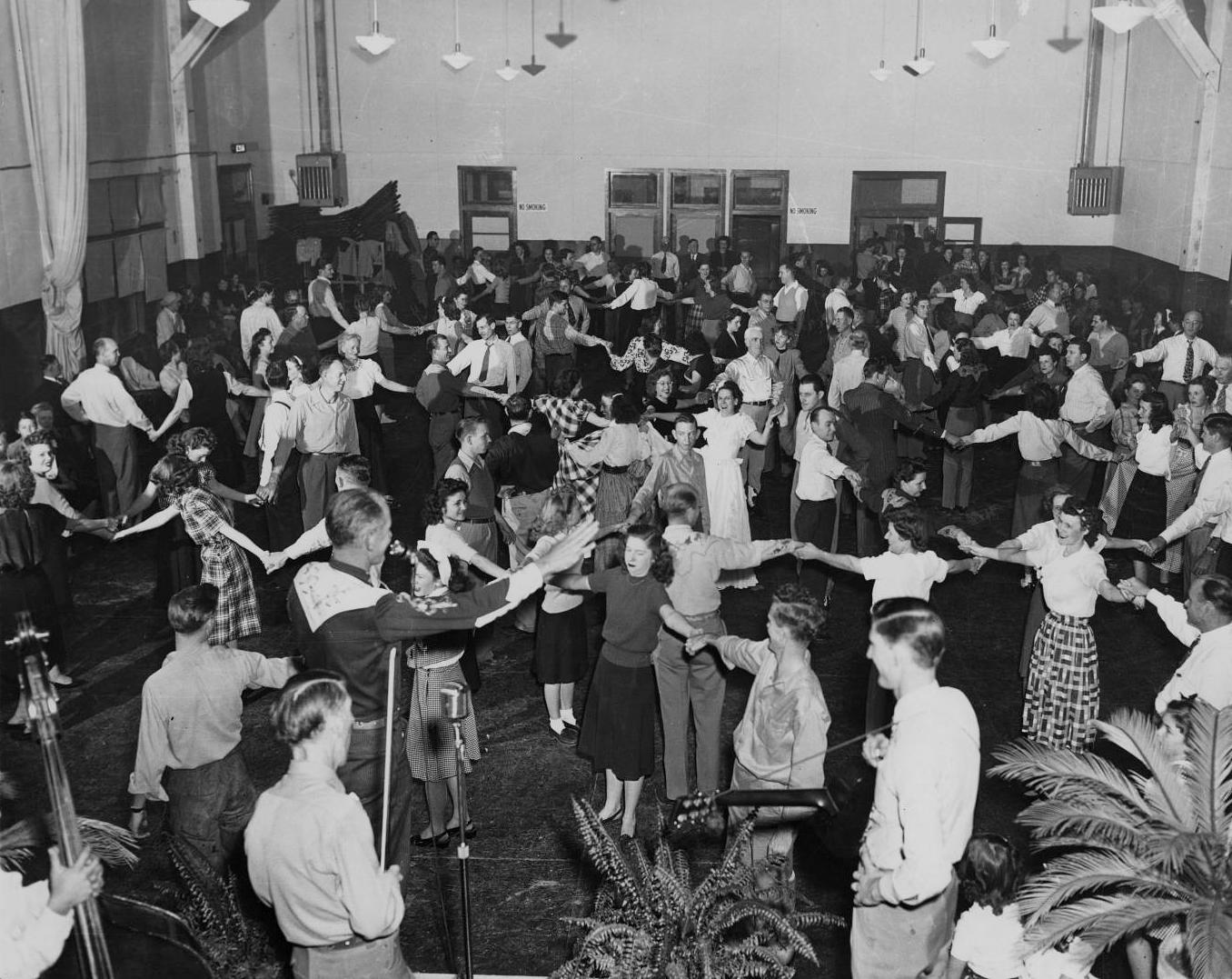
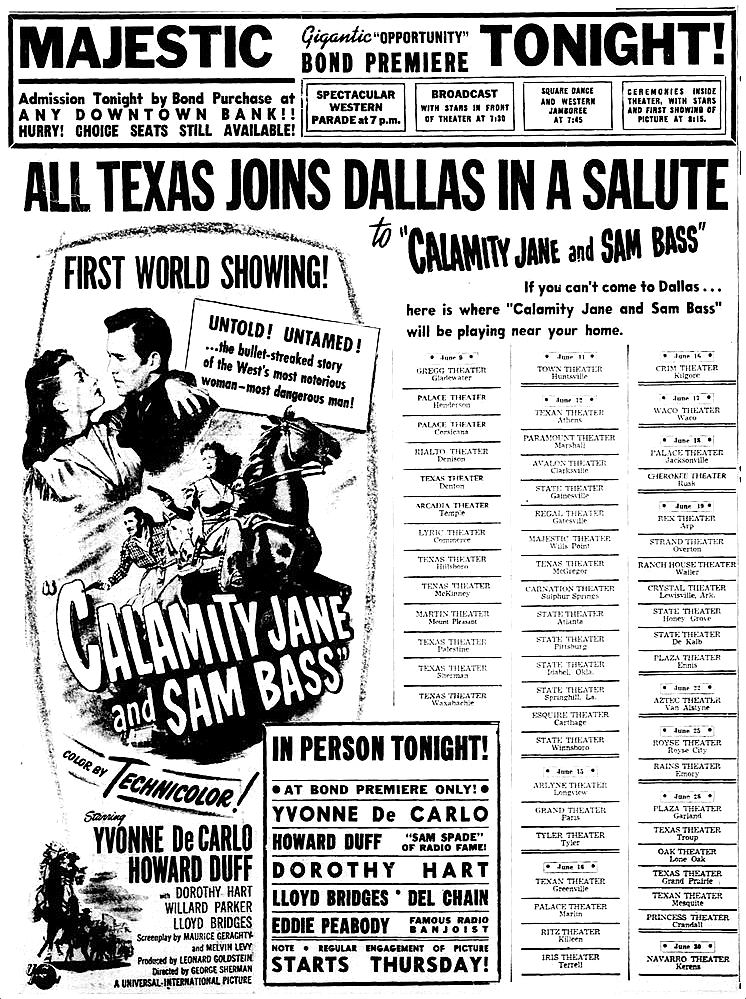
The photo above appeared in a show-biz trade publication showing part of the festivities which swirled around the world premiere of the movie “Calamity Jane and Sam Bass” starring Yvonne DeCarlo and Howard Duff at the Majestic Theatre on June 8, 1949. Several of the film’s stars made personal appearances and were made honorary deputies by Sheriff Bill Decker, sworn in by Judge Lew Sterrett (yes, Lily Munster was an honorary Dallas deputy sheriff!). There was a parade, a live show performed by the actors on the Majestic’s stage before the movie, a block party, and square dancing in Elm Street, with music provided by the Big D Jamboree band.
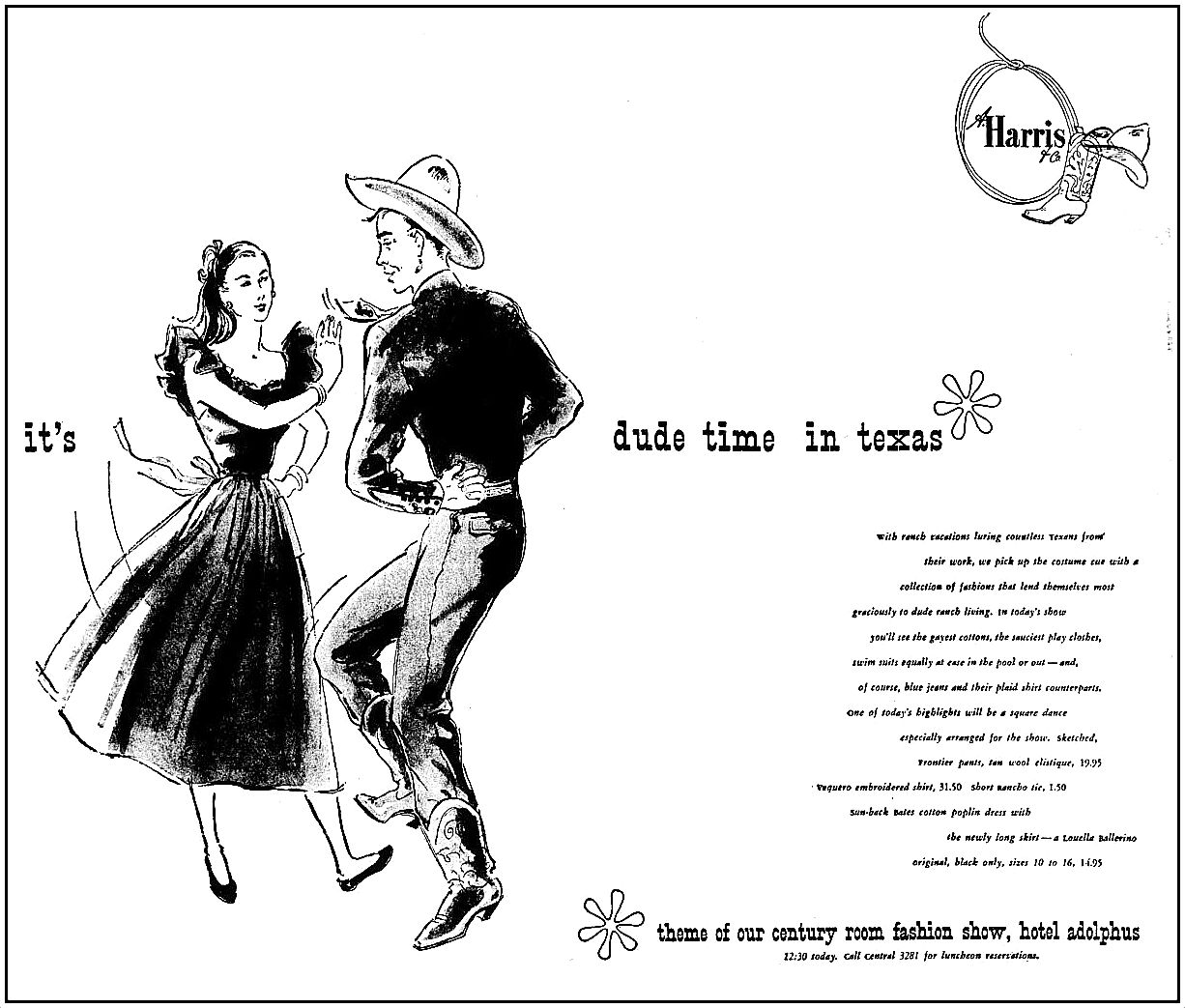
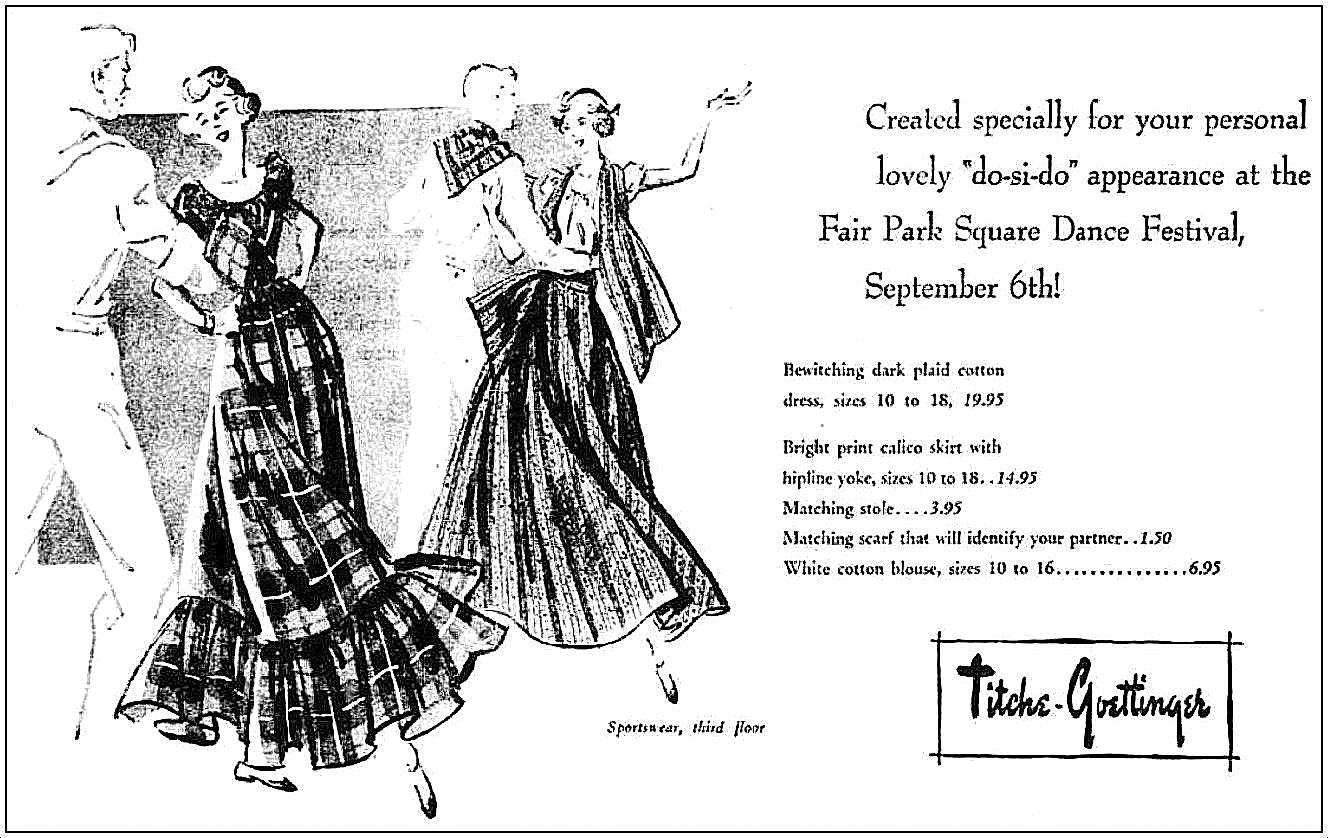
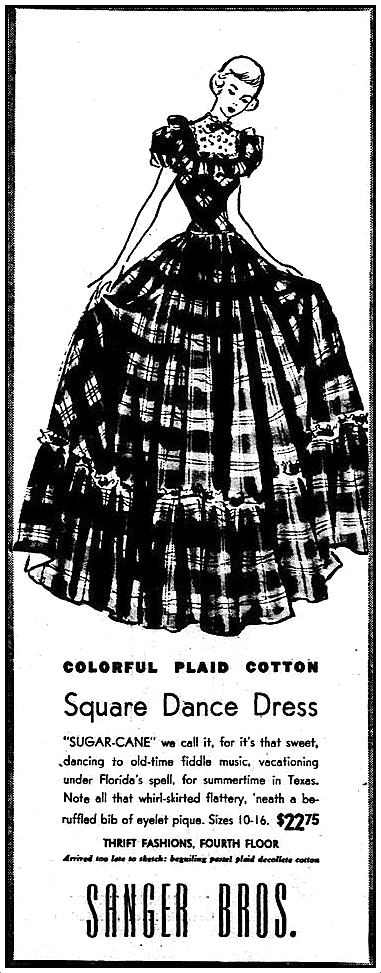
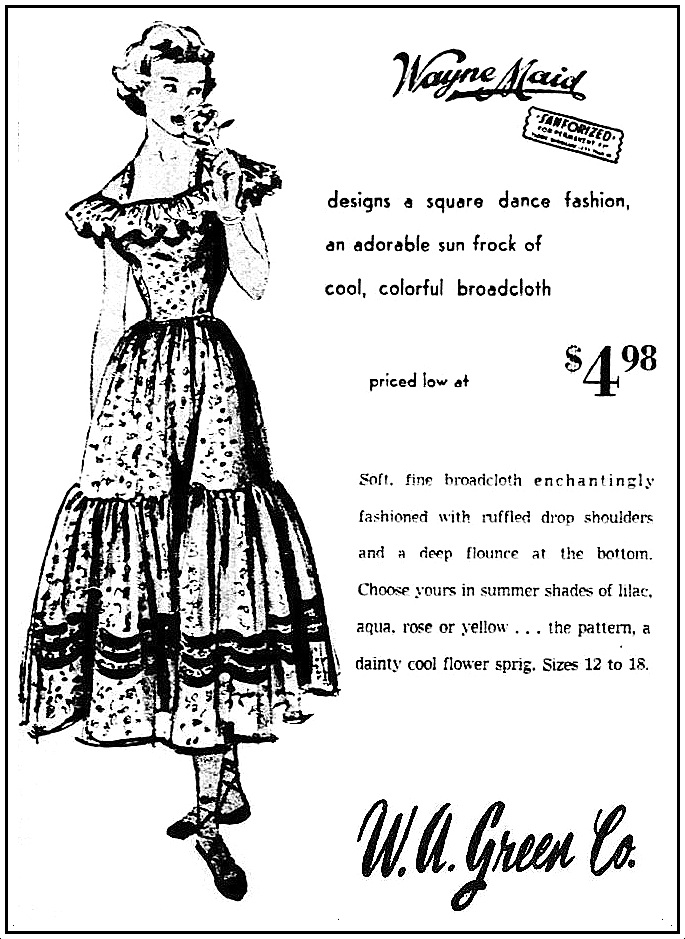
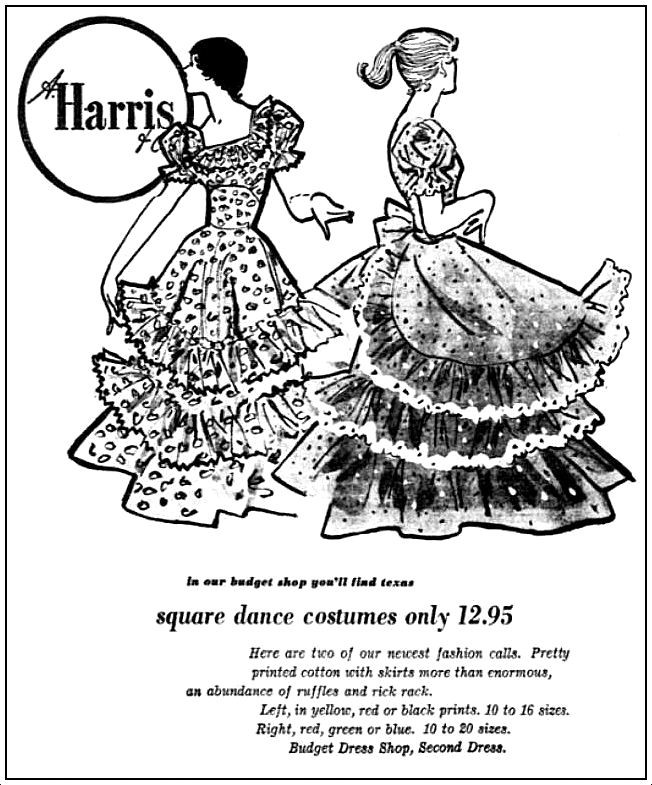
In 1949, as unlikely as it seems, square dancing was a HUGE fad which swept the country (or at least the Southwest). The peak years of the retro craze were probably 1948 to 1950, and its impact was pretty big locally, not only on the dance floor, but also in the fashion pages. When you see every major Dallas department store — even Neiman’s — selling calico and gingham square dance fashions … well, it’s big.
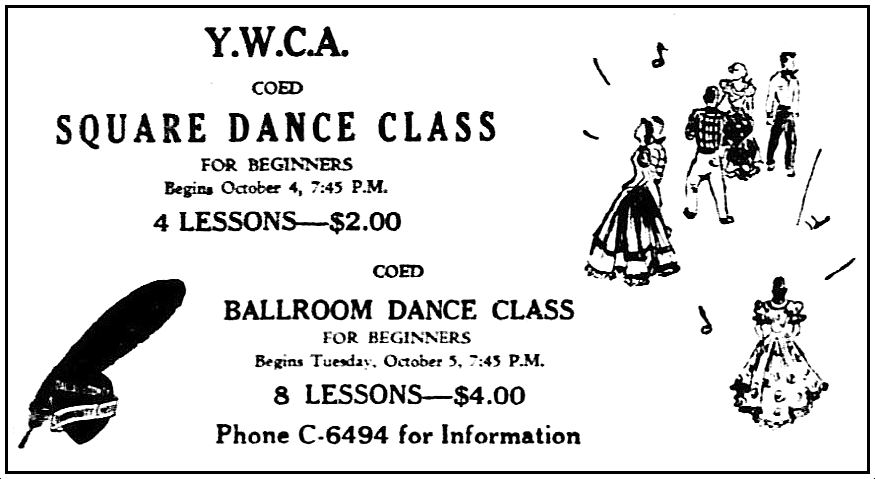
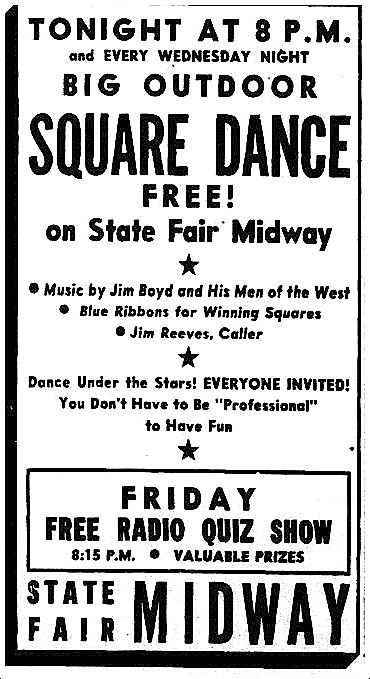
Not only were there lessons available everywhere, but there were clubs and weekly events all over town — every Wednesday in the summer of 1949, there was a big outdoor square dance held at the Fair Park Midway, with music courtesy of local celeb Jim Boyd.
I’m not sure when it stopped (…I’m assuming it has…), but for decades, a lot of us participated in square dancing as part of gym class in elementary school. This interesting throw-back take on physical fitness seems to have begun around 1950 or ’51. Not everyone was thrilled about this odd-but-charming grade-school rite of passage — some ultra-conservative communities complained, but the wholesome and old-timey dancing won out and became a standard part of Texas schools’ physical education curriculum. Forget young people’s cotillions — most Texas children had their first experience dancing with a partner to the strain of a cowboy fiddle and a voice telling us to “allemande left” and “do-si-do.” And I’m sure we’re all better for it.
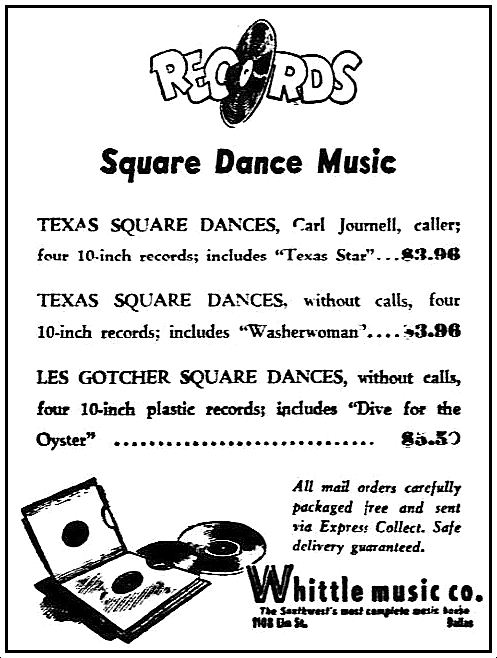
Here are a bunch of ads and things (click pictures to see larger images):
Square dance at La Reunion Place (Dallas Municipal Archives)
1946
1947
1948
1948
1948
1948
1948
1949
1949
1949
1949
1949
1949
1951
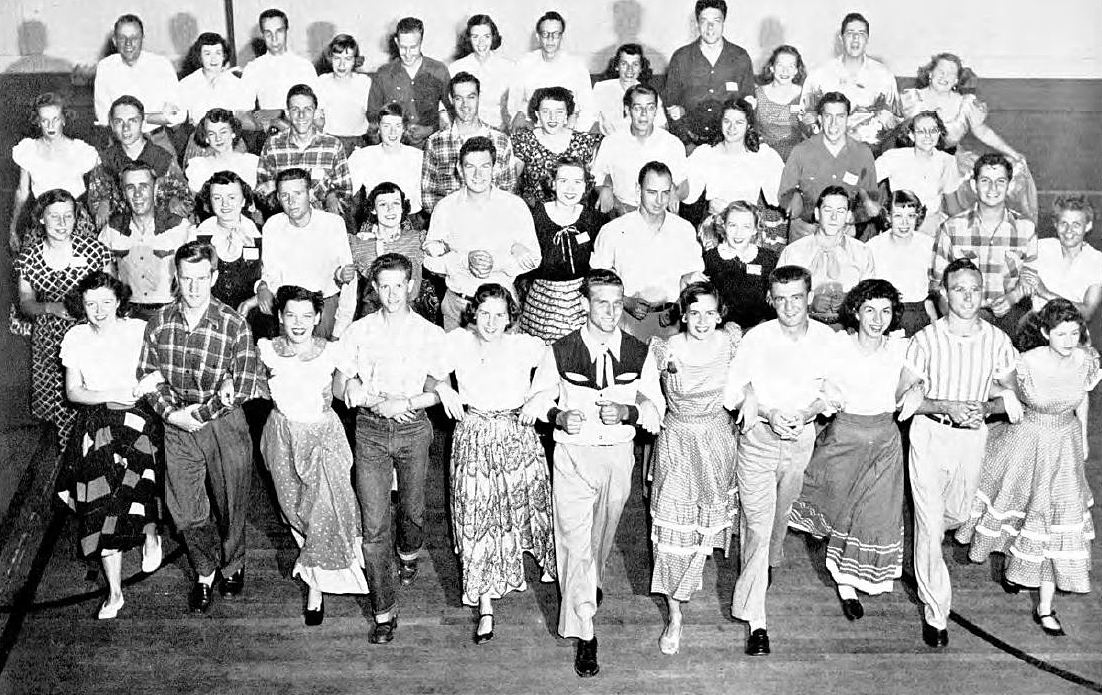
Above, a photo of the Promenaders, a group of SMU students whose purpose is described in the 1951 yearbook as being “to promote the appreciation of square and folk dancing on this campus.” (Think you recognize any of those faces? See who’s in the photo here.)
1956
***
Sources & Notes
Premiere of “Calamity Jane and Sam Bass” was held at the Majestic Theatre on June 8, 1949, and it seems to have been a pretty big deal. There was newsreel footage filmed that night — wonder if it’s floating around anywhere?
Photo of the square dance taken at La Reunion Place is by Squire Haskins and is from the Dallas Municipal Archives; is can be seen on UNT’s Portal to Texas History site, here.
Photo of the SMU Promenaders square- and folk-dancing group is from the 1951 Rotunda, the yearbook of Southern Methodist University.
Jim Boyd was a country-western singer who appeared in a few Hollywood films and was a Dallas disc jockey for many years. He also appeared around town often as a performer and personality. Dallas filmmaker Hugh V. Jamieson, Jr. and director Milton M. Agins made a short film called “Saturday Night Square Dance” (made in either 1949 or 1950); it features Boyd and his Men of the West band, plus square dance groups Silver Spur Square Set and Thompson Square Dance Club. I can find nothing on the two groups, but it seems likely that this film was made in Dallas. The quality of the film uploaded to YouTube is not very good, but, who knows — you might see your parents or grandparents in there if they were big square dancers! You can watch it here.
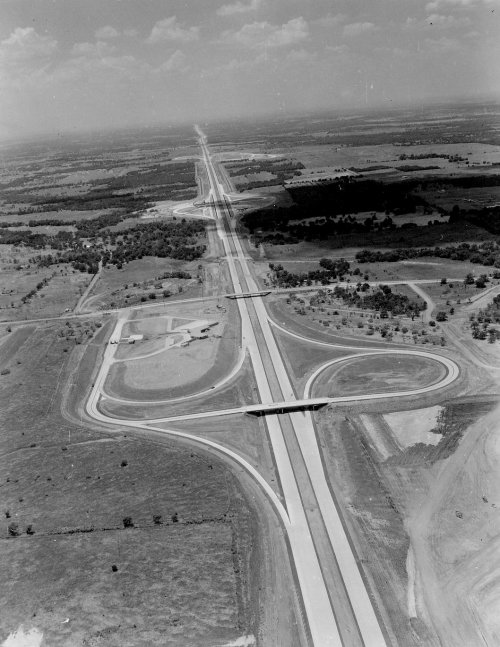
Three years ago I posted this wonderful photo of the blissfully empty, not-yet-opened Dallas-Fort Worth Turnpike — I loved it then, and I love it now. Read the original post — “The DFW Turnpike, Unsullied by Traffic, Billboards, or Urban Sprawl — 1957” — here.
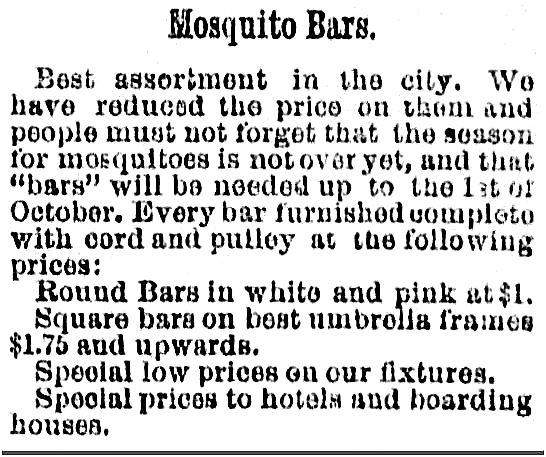
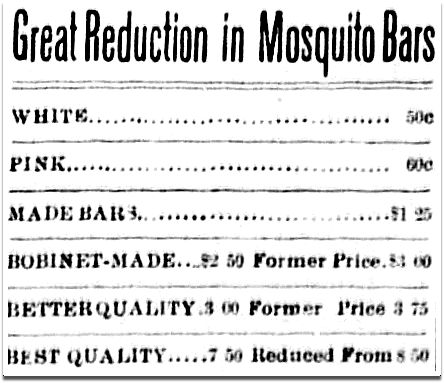
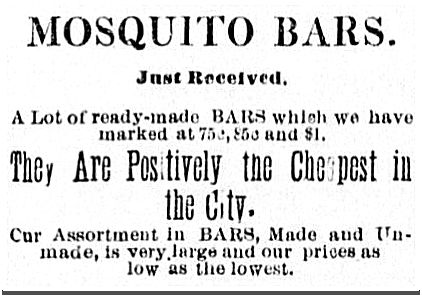
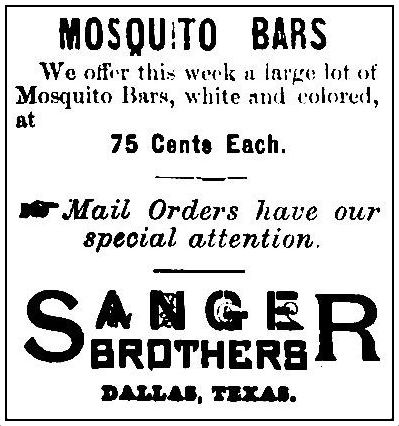
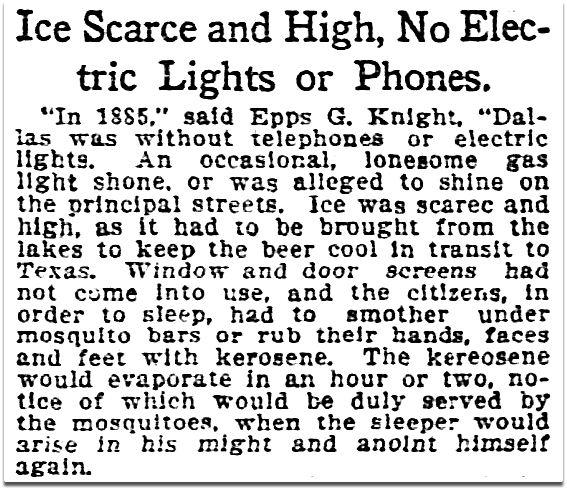
The “mosquito bar” — the human’s defense against blood-thirsty mosquitoes (and other annoying pests) — had its heyday in the US in the second half of the 19th century and the first couple of decades of the 20th century, before screens for windows and doors were commonplace in American homes. They were particularly necessary in the hot and sweaty Southern US states which were routinely plagued with mosquitoes. A typical mosquito bar ad looked like this one from Dallas merchants Sanger Bros. (click ads and clippings to see larger images):
Dallas Herald, Aug. 2, 1885
(According to the Inflation Calculator, $1.00 in 1885 money would be worth about $27.00 in today’s money, adjusted for inflation.)
The first Dallas ad I found for mosquito bars was from 1877 — like the clipping above, it is also from a Sanger Bros. ad (in fact, Sanger’s seemed to be mosquito-bar-central for 19th-century Dallas).
Dallas Herald, July 31, 1877
Dallas Herald, May 14, 1878
Dallas Herald, May 24, 1882
Southern Mercury, July 3, 1890
1894
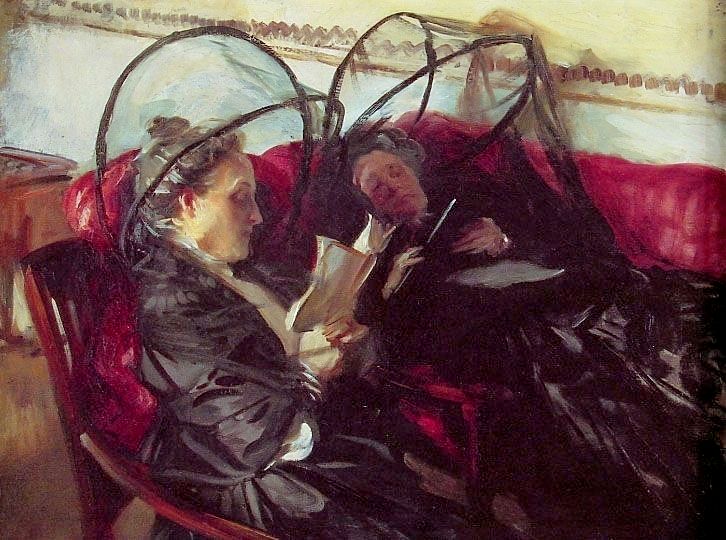
Mosquito bars were usually draped over beds, canopy-style, but the painting above (“Mosquito Nets” by John Singer Sargent, 1908) shows “personal” net-covered armatures, perfect for genteel ladies to relax inside of and read (while trying to keep cool despite being weighed down by what must have been uncomfortably heavy clothing).
The mesh netting or fine muslin used to drape beds (and cover windows and doors) was generally white or pink, sometimes green. Once inside the canopied beds, the netting was tucked under the mattress in order to seal all potential entry points in the mesh-walled fortress and allow the thankful occupants inside to sleep unmolested by mosquitoes (or other biting and stinging insects).
These bars became fairly standard in hotels and in many homes of the time, but if one could not afford the luxury of sleeping inside one of these things, the sleeper would often resort to rubbing him- or herself with kerosene if they wished to avoid being bitten throughout the night.
Dallas Morning News, Oct. 1, 1910
As much of a godsend as the bars were, they had their problems. The fine material was easily torn, and sometimes the mesh was so tightly knit that ventilation (and breathing!) was not optimal. Also, it was not unusual for them to catch fire — there are numerous newspaper reports of the bars being ignited by candles or gas-burning lamps or by careless or sleepy smokers smoking inside the canopy.
Dallas Herald, May 24, 1881
It was apparently a common precaution against midnight thievery for men who stayed in hotels to keep their money in the pockets of their pants and then fold the pants and place them beneath their pillows. The second line of defense was the mosquito netting tucked resolutely under the mattress of their canopied beds. The feeling was that a burglar would have to be pretty stealthy to breech a man’s mosquito bar and steal his pants from under his pillow without waking him. But never underestimate the Big City burglar (click article to see a larger image):
DMN, Sept. 10, 1888
After doors and windows began to be routinely covered with wire screens, the use of mosquito bars in homes and hotels waned, but their use continued in military encampments and hospitals, in recreational camping, and in swampy or tropical areas where the transmission of diseases like malaria and Dengue fever (transmitted by mosquitoes) posed health risks. Wire screens must have been a godsend.
Acme Screen Co., 1924
And if you don’t think that the prospect of a night without a mosquito bar (especially in the bayous of Louisiana…) wouldn’t inflame usually calmer heads, here’s a news story from 1910 about a man who shot a co-worker three times at close range because of a heated argument over which of them owned a mosquito bar. And this was in February! Lordy. Talk about your crime of passion. The moral of this story: do not mess with another man’s mosquito bar.
Town Talk (Alexandria, LA), Feb. 22, 1910
*
DMN, May 28, 1912
***
Sources & Notes
The top painting by John Singer Sargent — titled “Mosquito Nets” (1908) — is from the Detroit Institute of Arts; more on the painting can be found here.
Photo of draped bed is from the “Mosquito Net” Wikipedia page, here.
Other clippings and ads as noted. Dallas Herald and Southern Mercury newspaper scans are part of the huge database of scanned historical Texas newspapers found at the Portal to Texas History (to see newspapers, click this link and filter by “Counties,” “Decades,” “Years,” etc. on the left side of the page, or search by keywords at the top).
This post was adapted from a post I wrote for my other (non-Dallas) blog, High Shrink — that post, “The Mosquito Bar,” can be found here (it includes some great additional photographs and illustrations).
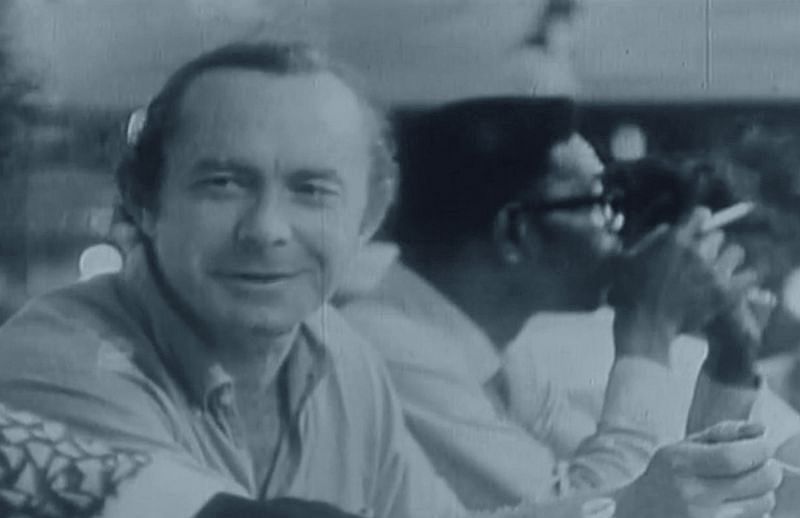
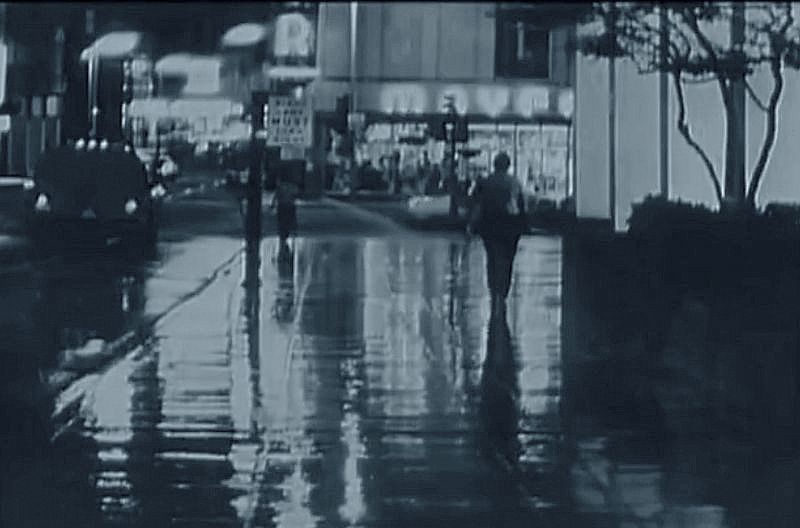
Several years ago, Robert Wilonsky wrote a Dallas Observer article about the short documentary “Sometimes I Run” — I watched it immediately afterward, and it’s stuck with me ever since. The 22-minute film, shot in 1973 by SMU film student Blaine Dunlap (who also made the fun 1970 Sunset High School film I wrote about earlier this year) shows Dallas Public Works Dept. street flusher Stanley Maupin at his job sweeping the downtown sidewalks late at night, accompanied by a soundtrack of jazz music and Maupin’s philosophical musings. It’s cool, gritty, seedy, nostalgic, and somehow life-affirming, all at the same time. Also, Dallas always looks best at night — the wet streets add a definite noir-ness to the overnight municipal goings-on which were happening when most Dallasites were home in bed. (See the bottom of this post for various sites on which you can watch the film in its entirety.)
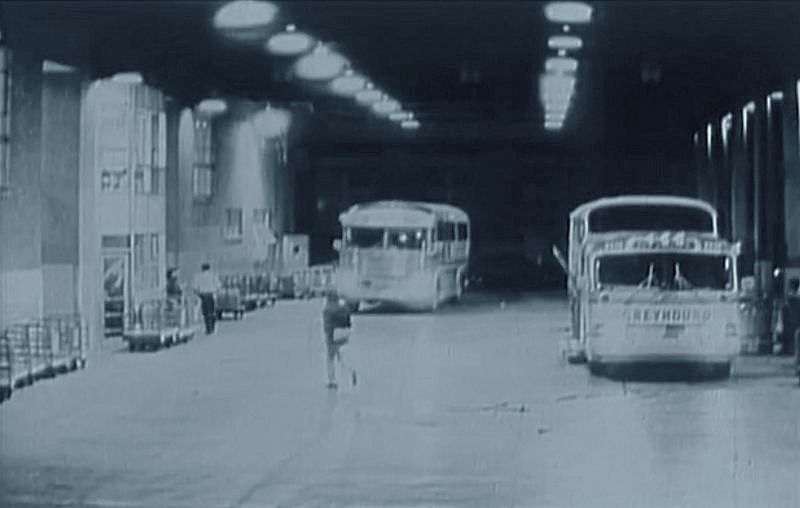
It took the opening moments of this film to remind me that, yes, I DO remember (if vaguely) seeing that revolving beam of light shot from the “rocket” on top of the Republic Bank Building. You can see it at about :35. Also included in the film are Franklin’s, the Greyhound Bus station, the Capri movie theater, a late-night-diner, the Mayfair department store, the Municipal Building, Sanger-Harris, and much more. And while Maupin’s philosophical pronouncements might be a bit heavy-handed at times, I have to admit that I could listen to him talk for hours, if only to hear his accent, a Dallas-area trapping of the past that one doesn’t come across nearly often enough these days.
Here are a few screen captures.
***
Sources & Notes
The 44-year-old award-winning student film, “Sometimes I Run,” directed by Blaine Dunlap, can be seen in its entirety in several places online: on Vimeo (good sound and video), on YouTube (via South Carolina Arts Commission), and at the Texas Archive of the Moving Image (from the collection of the Dallas Municipal Archives). Sound by Ron Judkins, music by Ken Watson.
More on filmmaker Blaine Dunlap can be found in “Spotlight on Dallas Filmmakers: Blaine Dunlap” by Laura Treat, here.
I have tried to find some history on Stanley Maupin, but I didn’t come up with much. He lived in Irving as a boy, but as a teenager, he attended North Dallas High School and, later, McMurry College in Abilene.
North Dallas High School yearbook, 1953
McMurry College yearbook, 1956
Born in 1935, he appears to have died in 1985, perhaps in a shocking way (which I have been unable to verify) — see comments from his grandchildren in the YouTube video here.
Some background on the film can be found in an article by Don Clinchy, here.
Read a 1986 interview with Blaine Dunlap (by Bo Emerson, Atlanta Journal-Constitution, Oct. 24, 1986) here.
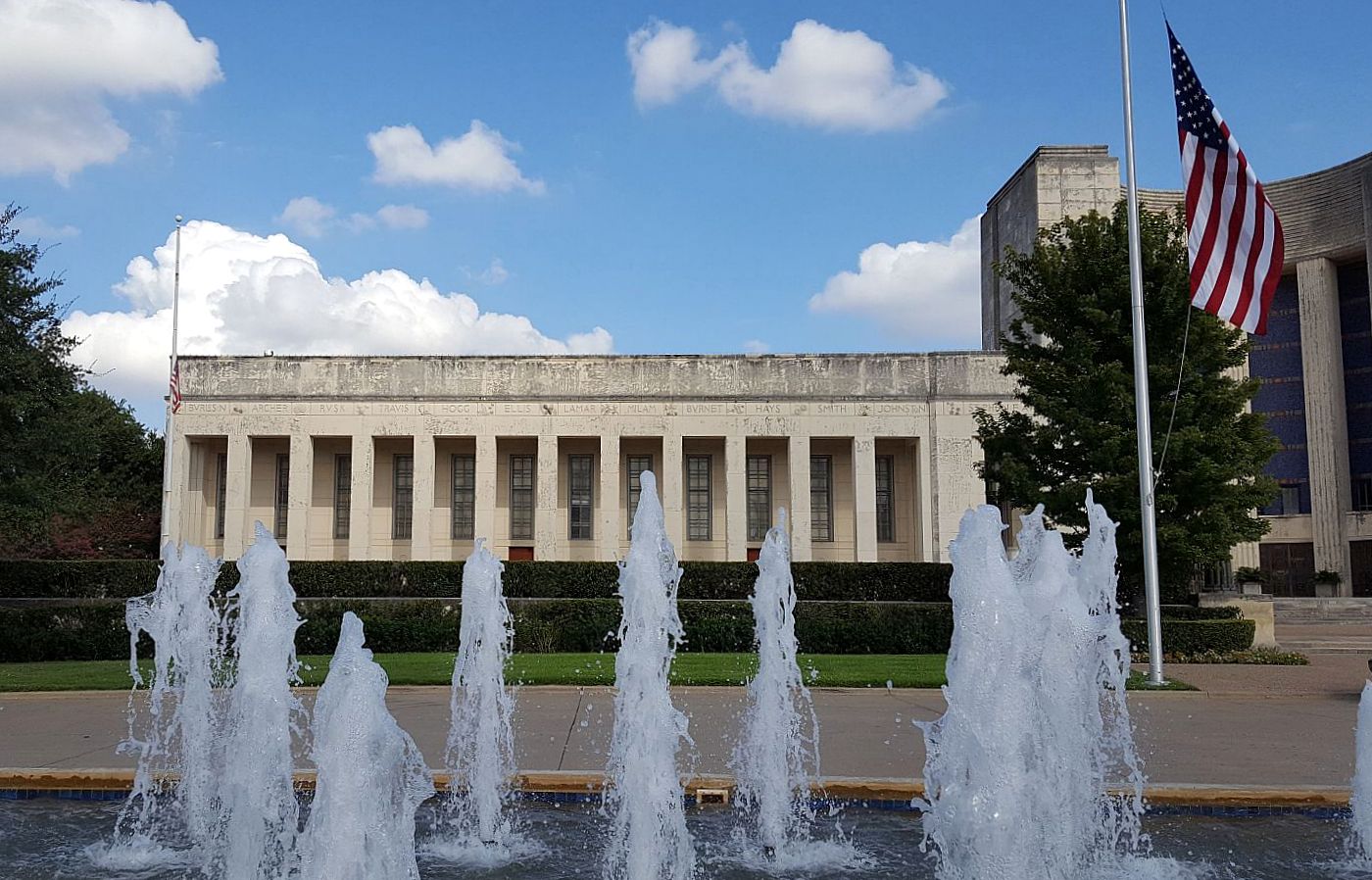
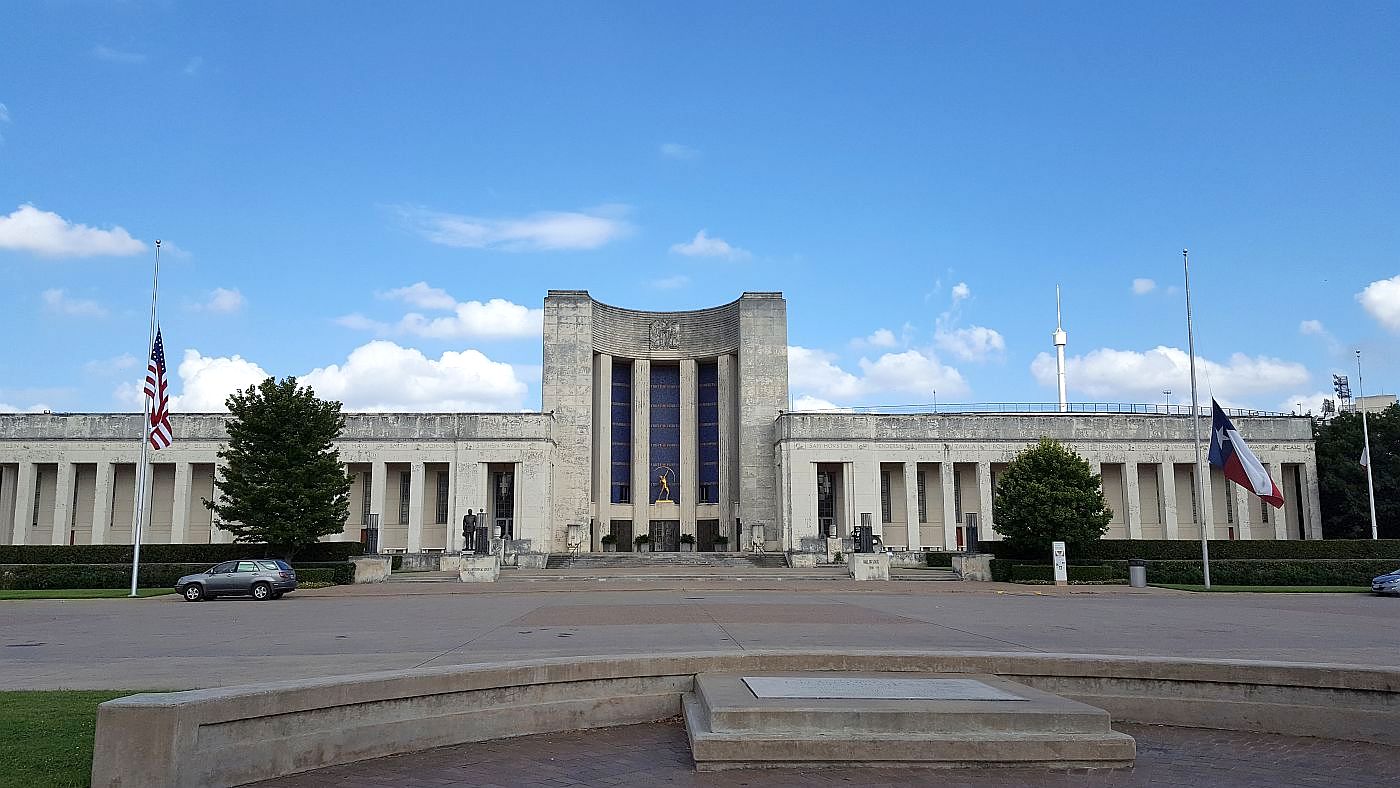
A large number of Texas architects had a hand in designing the Fair Park buildings built expressly for the Texas Centennial in 1936. One such architect was the young (still in his 20s!) Donald Barthelme (1907-1996) of Houston, the principal architect for the Centennial park’s crowning jewel, the Hall of State. Years ago — when the only Donald Barthelme I had ever heard of was the acclaimed writer (who was the son of the architect) — I read an amusing factoid about Barthelme’s amusing “signature” which adorns his beautiful building. It can be seen on the wing to the left of the Hall’s entrance — seen above. (I took the photo this week — the flags are at half-mast in honor of the recent death of former governor Mark White.)
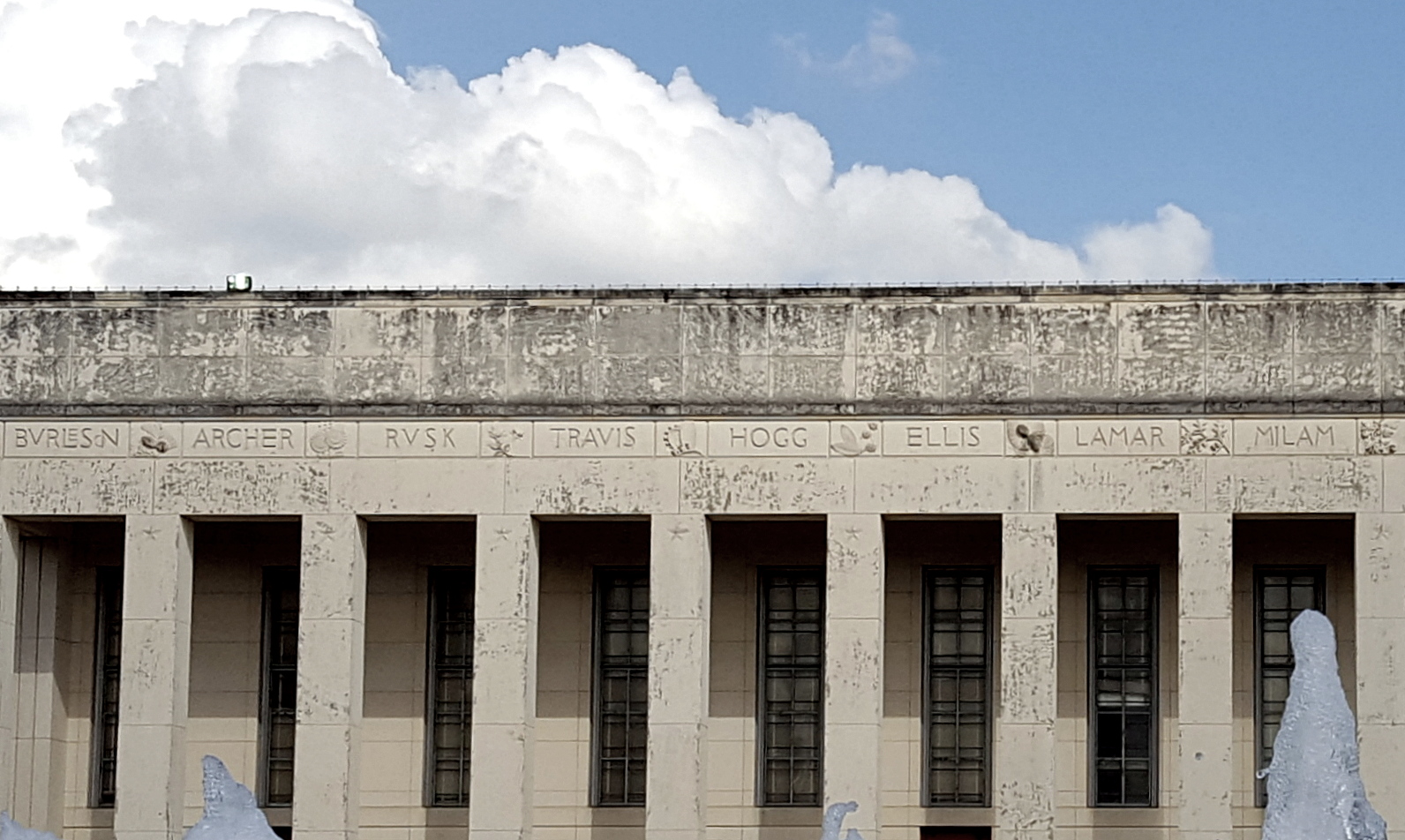
Around the top of the building is a frieze containing names of notable Texans. I’m sure a committee of some sort came up with this list of names which were carved into what was then the most expensive public building in Texas. All I can say is that it’s a shame they couldn’t have come up with just one more name — someone whose last name began with the letter “E,” because Mr. Barthelme arranged the first eight names to spell out his last name (which ended one letter too soon, at “M” — for Milam). I think if I had been in Barthelme’s position I might have just thrown in another name. Maybe “Erath.” …For closure. Click the photo below to see Mr. B’s winking historic signature.
A couple of sentences on the Hall of State by David Dillon, former architecture critic for The Dallas Morning News, written for the paper in November 1989:
Few Texans know who designed the Hall of State — it was Donald Barthelme of Houston, assisted by 10 other architects — yet 53 years after it opened it continues to stir us. It is a building of exceptional individual pieces held together by a powerful central idea — an exemplary period piece that reminds us what public design used to be, and what much contemporary civic architecture is not.
***
Sources & Notes
Photos of the Hall of State taken by me on Aug. 9, 2017.
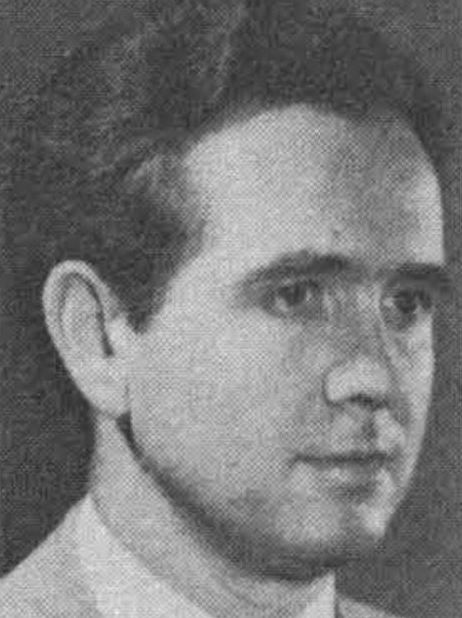
Photos of Donald Barthelme, Sr. taken from the 1949 and 1950 yearbooks of the University of Houston where he was an Architecture professor for many years.
David Dillon quote from his article “An Old Friend Triumphs Anew: The Hall of State Redo Affirms the Power of Great Architecture” (DMN, Nov. 14, 1989), written after an extensive renovation to the building.
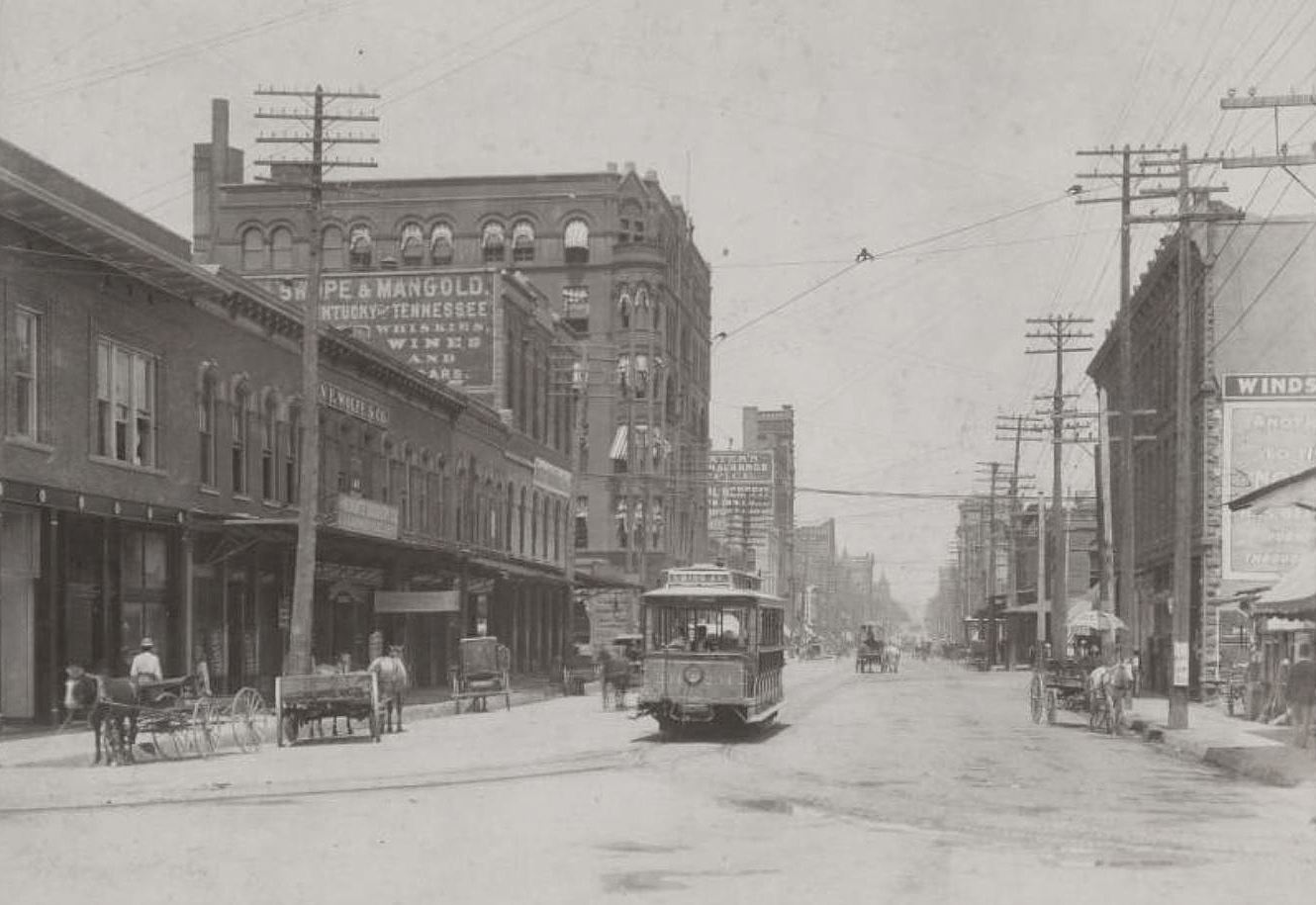
Here’s another great photo from the George W. Cook collection at SMU. This one shows Main Street sometime between 1899 and 1902 (the year asphalt was laid on Main and the year that Sanger Bros. expanded their building from two stories to six); we’re looking east from Market Street. (The aesthetically challenging view as seen today on Google is here.)
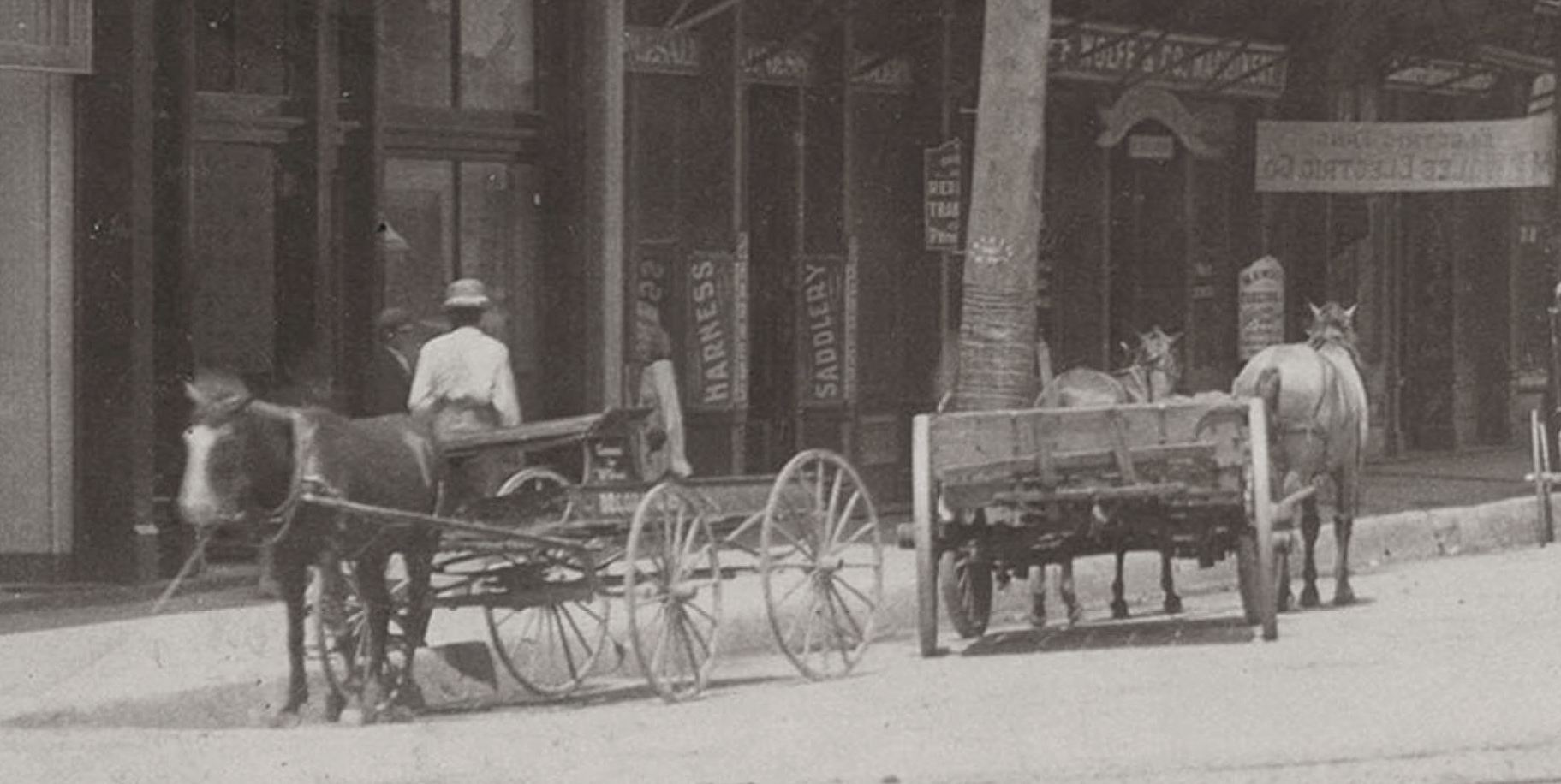
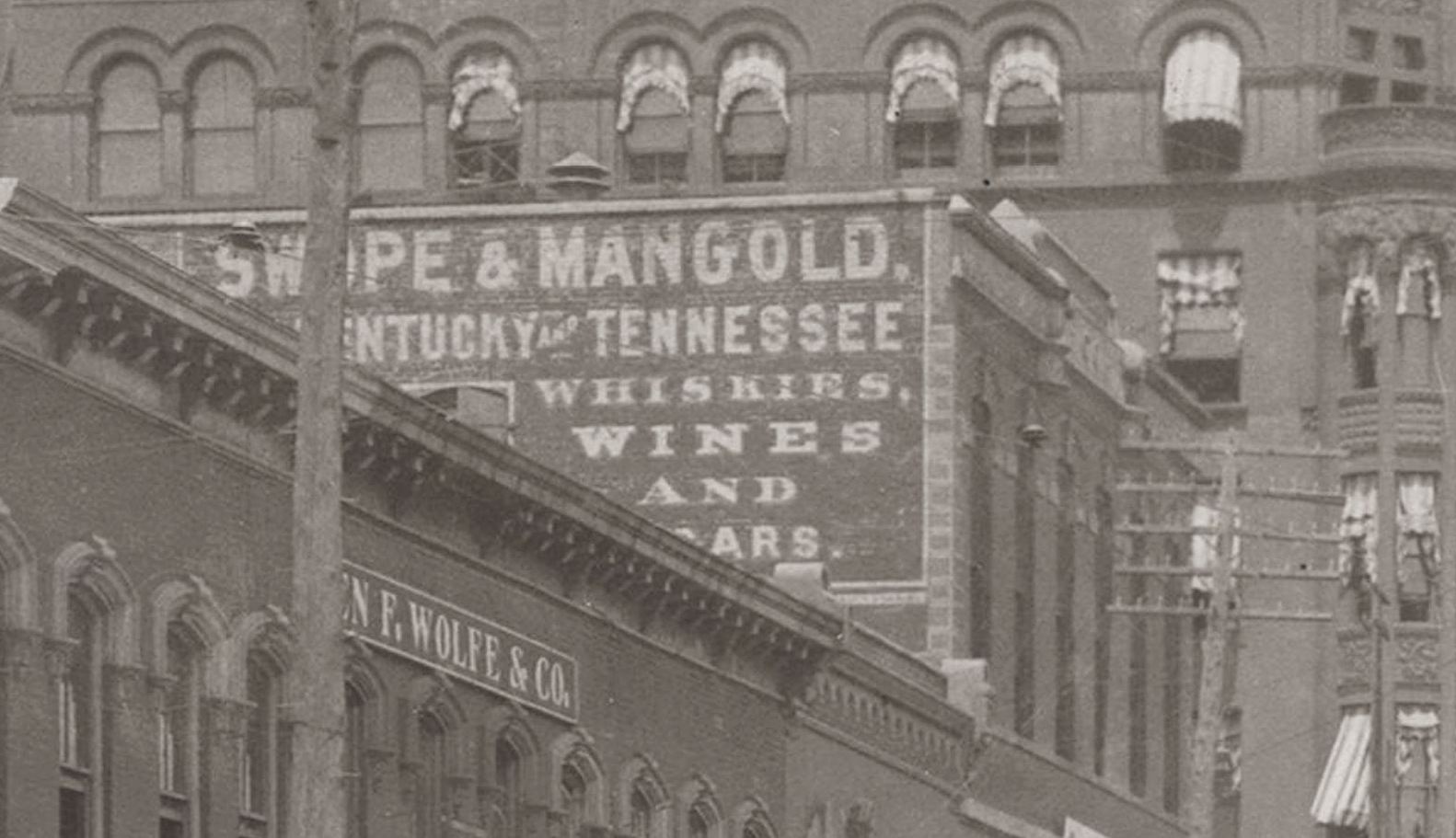
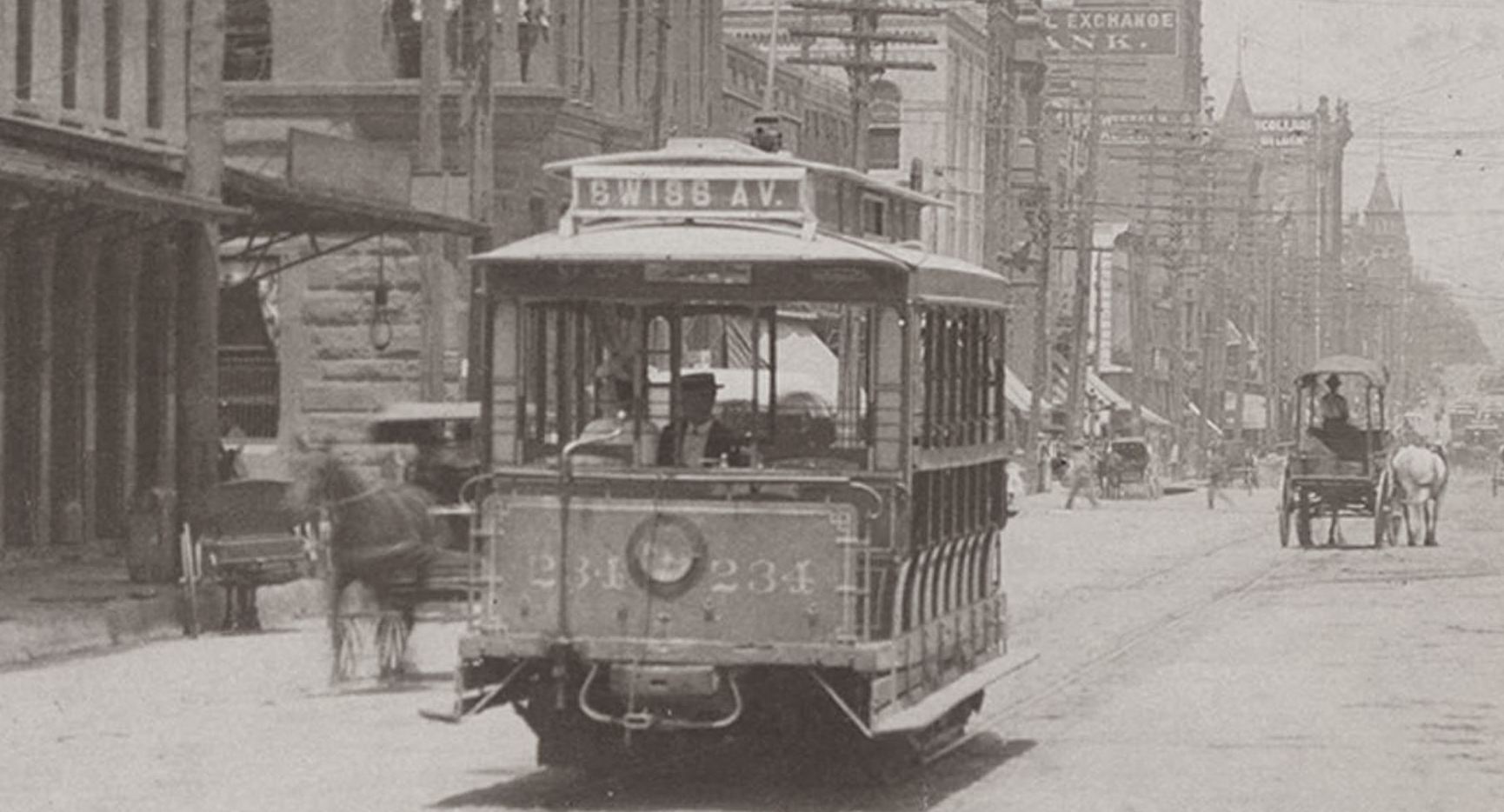
On the north side of Main (at the left), we can see horse-drawn wagons parked in front of a group of businesses including Konantz Saddlery Co., Ben F. Wolfe & Co. (machinery), a banner across the sidewalk for the Southwestern Electrical Engineering & Construction Co., Swope & Mangold wholesale and retail liquor company; then past Austin Street, on the corner, is the Trust Building, with the then-two-story Sanger Bros. building right next door (Sanger’s would build that up to six floors in 1902 and would eventually take over the Trust Building); across Lamar is the North Texas Building, with Charles L. Dexter’s insurance company advertised on the side; and, beyond, the Scollard Building, etc. The Windsor Hotel can be seen on the south side of the street in the foreground. And in the middle, an almost empty little streetcar with “Swiss Av.” on it, moving down Main underneath a canopy of hundreds of ugly electric wires zig-zagging overhead. Let’s zoom in around the photo to see a few closeups (all images are much larger when clicked).
Wagons parked at the curb:
*
Is that someone in the window looking down the street?
*
Swope & Mangold was one of the oldest “liquor concerns” in turn-of-the-century North Texas.
*
The electric streetcar shared the roadway with horses, buggies, and wagons.
*
I can’t quite make out the writing on the umbrella or on the sign posted on the pole. Part of the old Windsor Hotel can be seen at the right. At the bottom corner is a shop that sold “notions” and household goods, and just out of frame were a fish market and a meat market.
*
And the little Swiss Avenue car 234. Lotsa free seats.
*
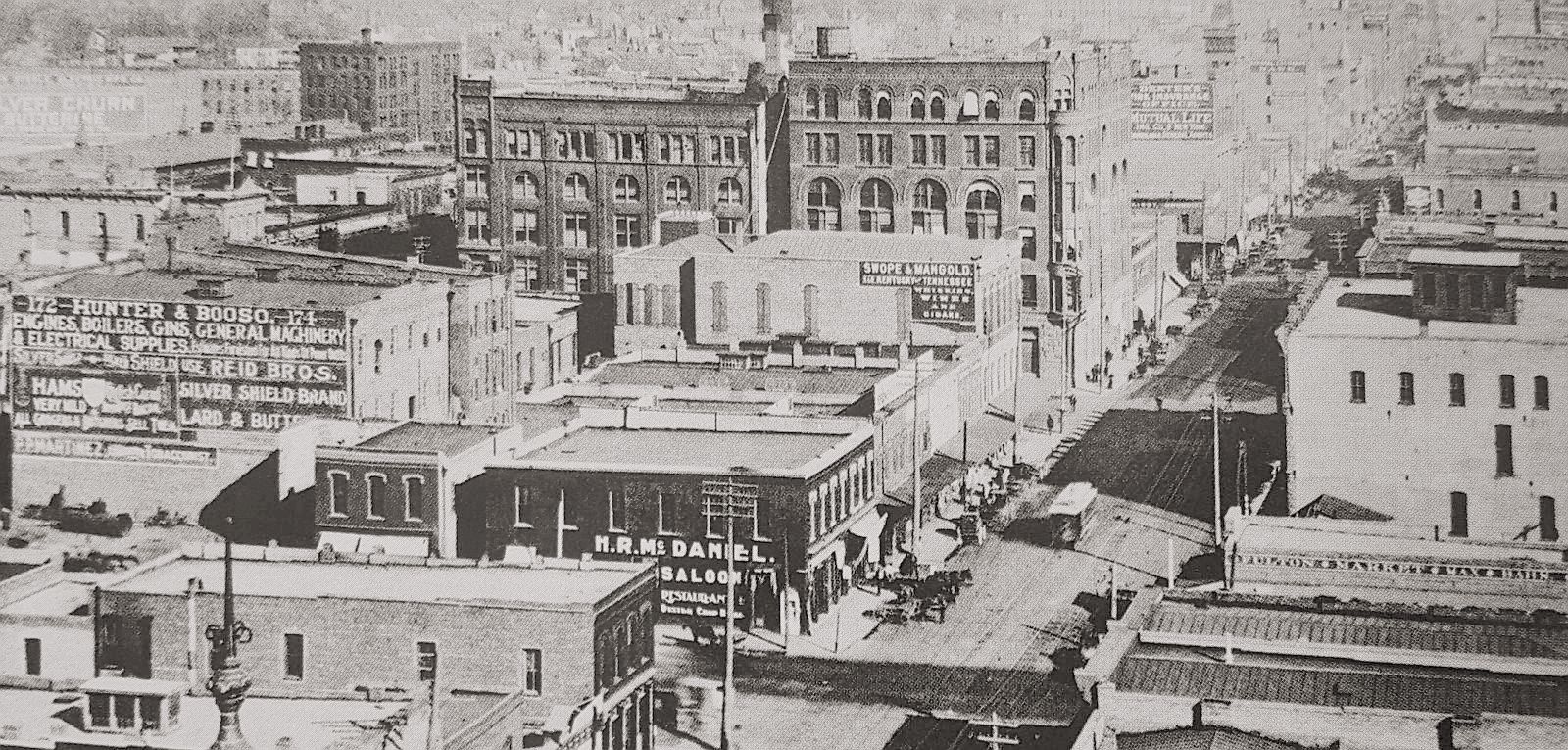
Here’s another view of Main Street looking east, taken around the same time. There’s even a streetcar in about the same spot.
*
See the 1899 Sanborn map for this general area here (note that Record Street was once Jefferson Street).
***
Sources & Notes
Top photo — titled “Main Street between Austin and Market Streets” — is from the George W. Cook Dallas/Texas Image Collection, DeGolyer Library, Central University Libraries, Southern Methodist University; more information on this photo is here.
The circa-1900 bird’s-eye view photo at the bottom is from the collection of the Dallas Historical Society, found in the book Dallas Rediscovered by William L. McDonald (p. 42).
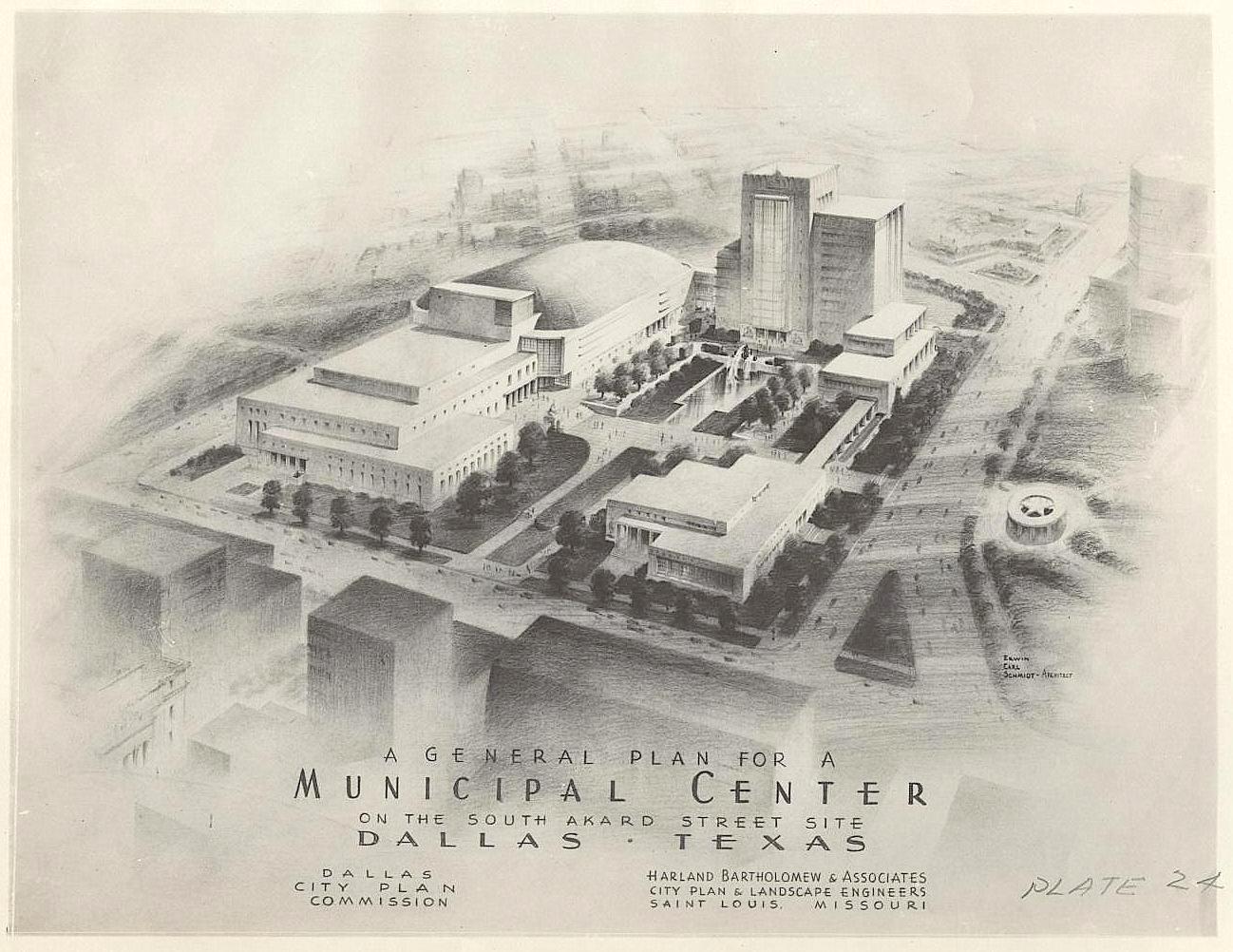
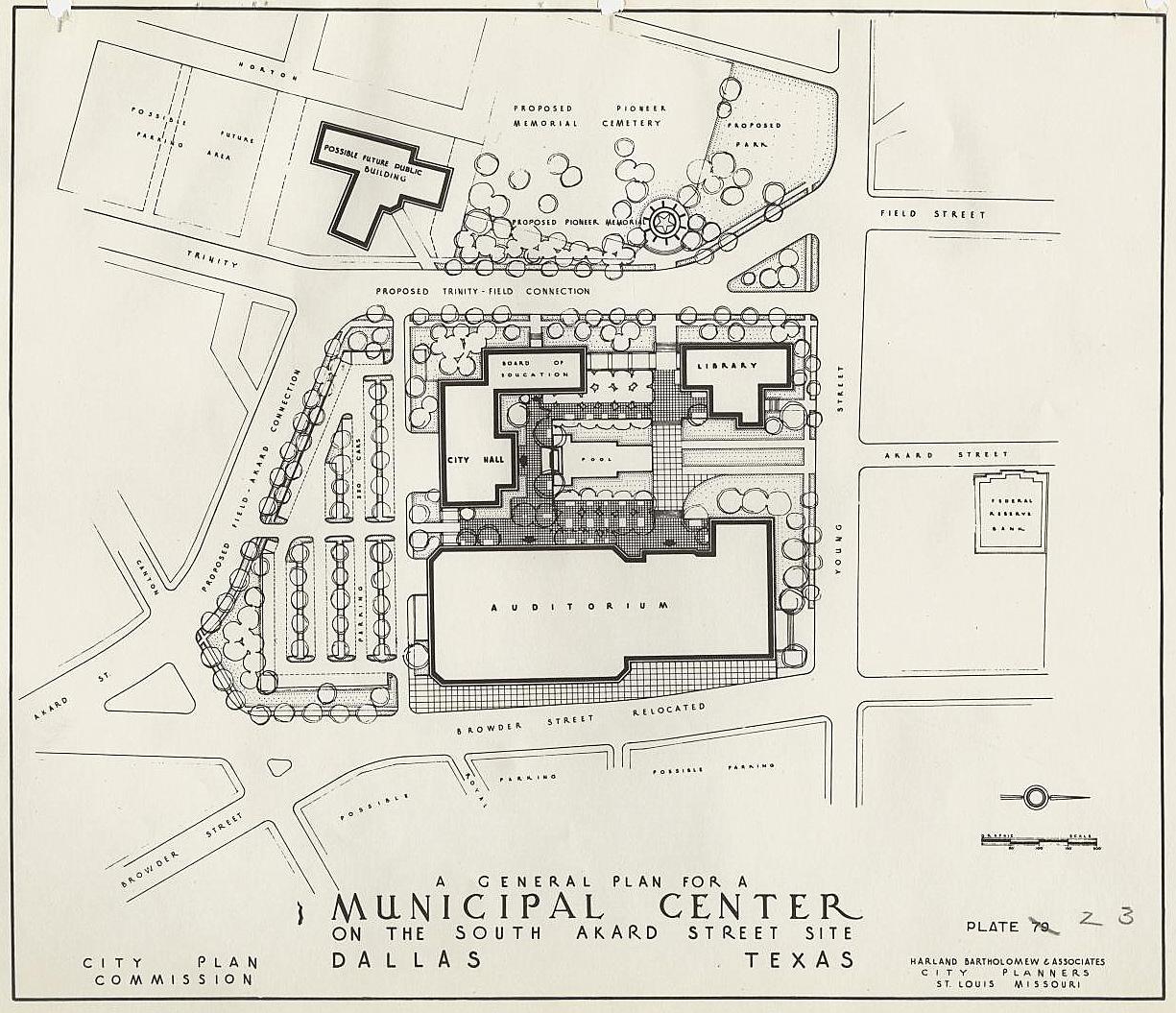
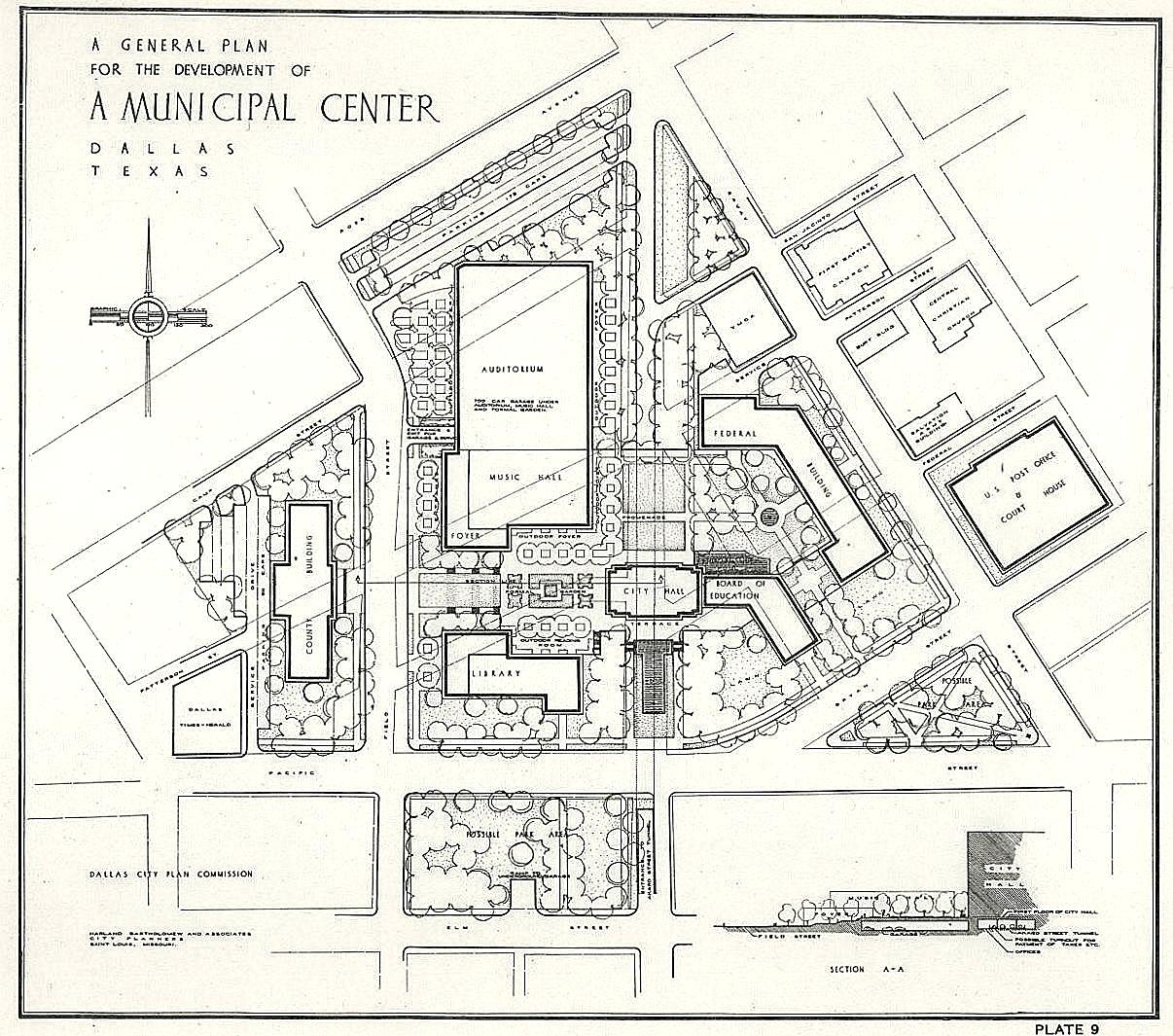
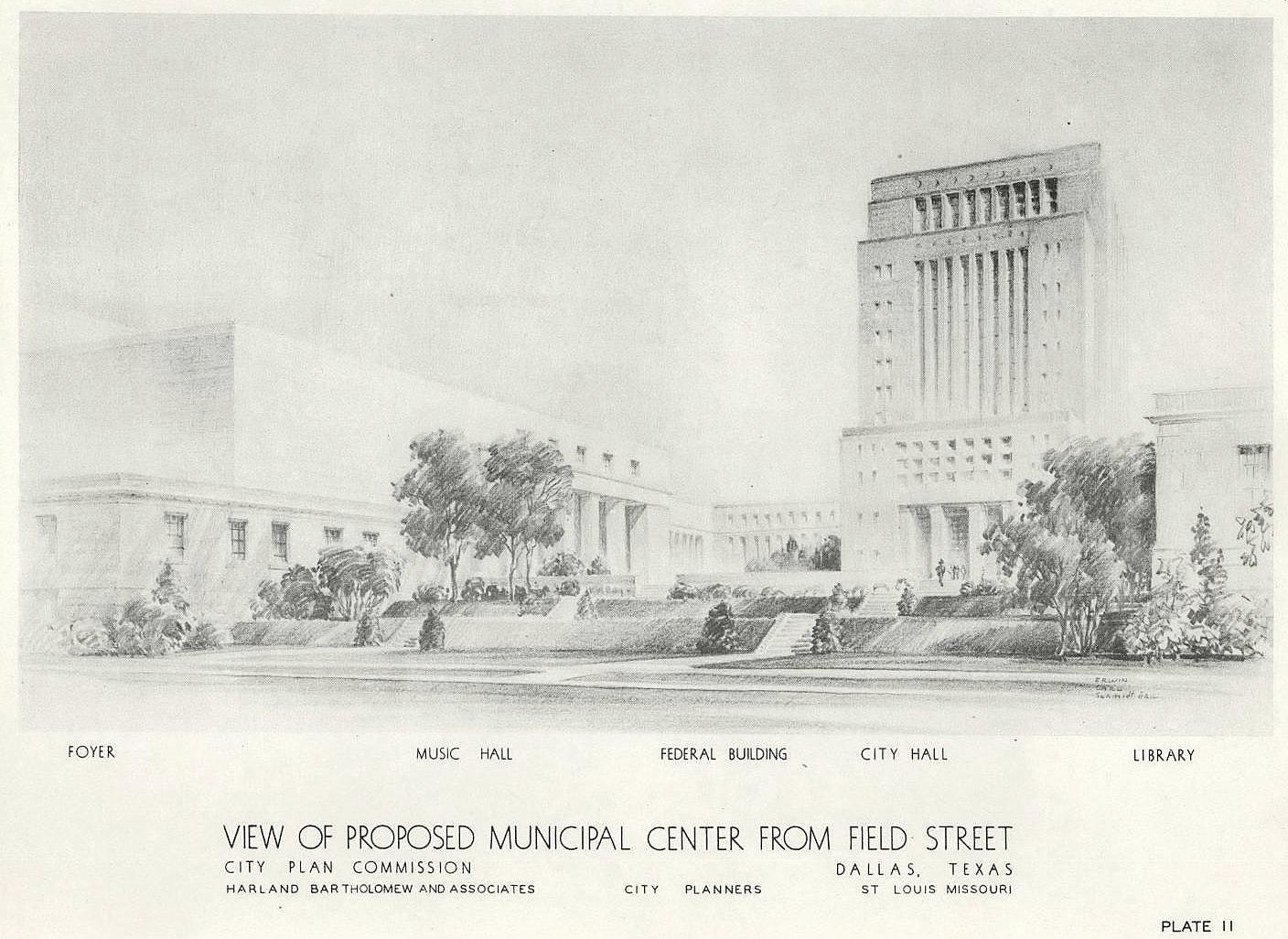
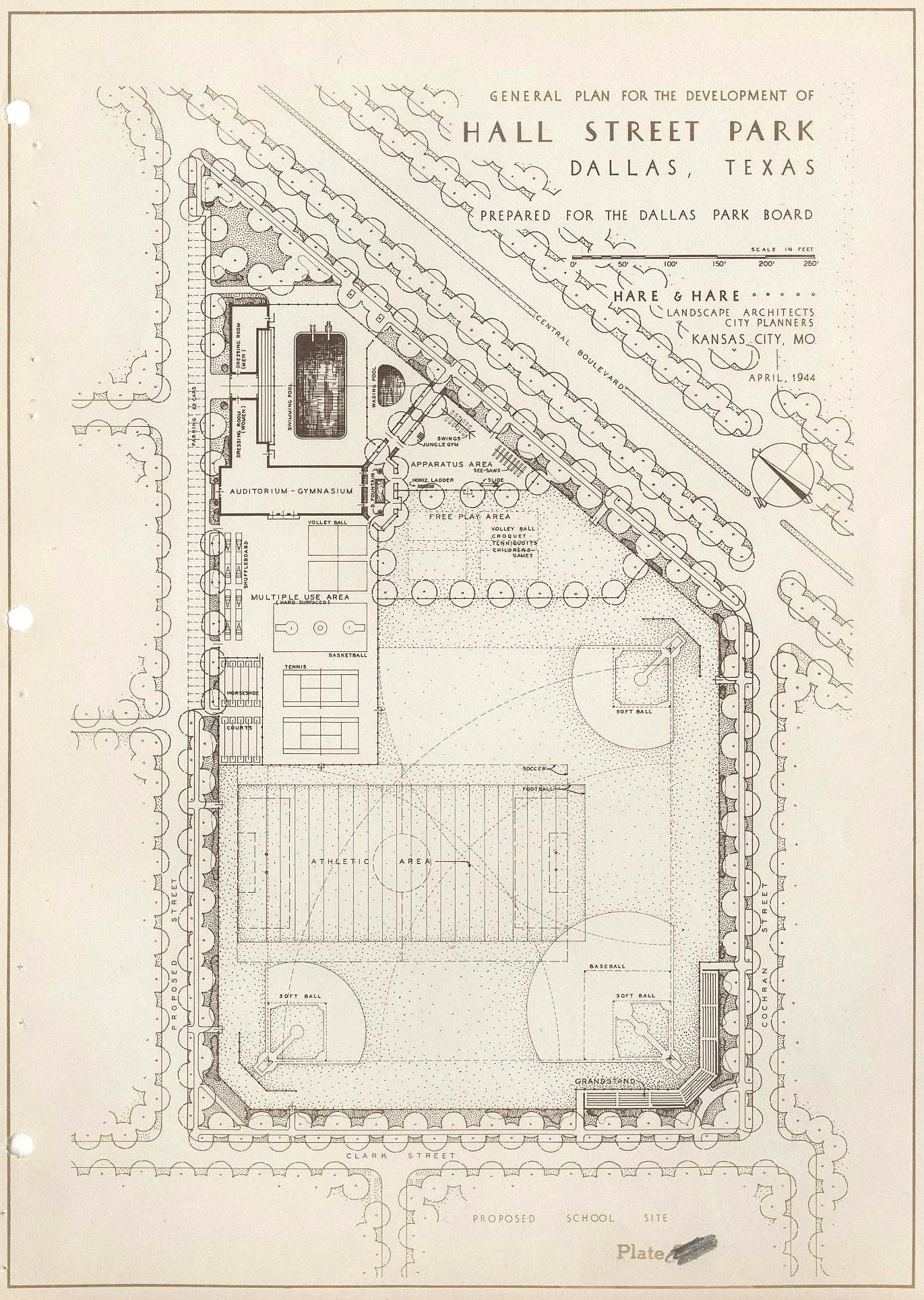
A few proposals from the Dallas master plan for post-war development and planning, commissioned by the city from the St. Louis firm of Harland Bartholomew and Associates (in association with Hare & Hare Landscape Architects). The scanned reports which made up this plan — submitted between 1943 and 1946 — can be found on the Portal to Texas History site, here, courtesy of the Dallas Municipal Archives. If you’re interested in urban planning and maps, these reports are fascinating.
The image above (from 1946, rendered by architect Erwin Earl Schmidt) shows a proposed municipal center on the familiar “South Akard Street Site.” The plan is below. (All images are larger when clicked.)
The previous year, the site for this proposed municipal center was north of Pacific:
And Schmidt’s rendering for that compound is just as interesting:
Also discussed in the plan was what to do with Fair Park. Here’s a 1945 redevelopment proposal:
And here’s the 1946 re-jiggering (the Cotton Bowl’s getting a lot of action):
And, lastly, a 1946 plan for expansion of the “Hall Street Park for Negroes.” I’m not sure that any of this ever happened. The last mention I see of this park was in 1945 (the first mention I found of the park in the Dallas Morning News archives was 1922, and it had clearly been around for a while before that — perhaps it was absorbed into the existing Griggs Park? “Central Boulevard” would soon be built and renamed Central Expressway, the highway that sliced through the thriving black neighborhood centered around Hall Street.
***
Sources & Notes
The 1945 plates can be found in the original publication here; the 1946 plates here.
All illustrations are from the Bartholomew master plan proposal; these reports are from the collection of the Dallas Municipal Archives, accessible on UNT’s Portal to Texas History, here.
Additional images from the plan can be found in the Flashback Dallas post “‘Your Dallas of Tomorrow’ — 1943,'” here.
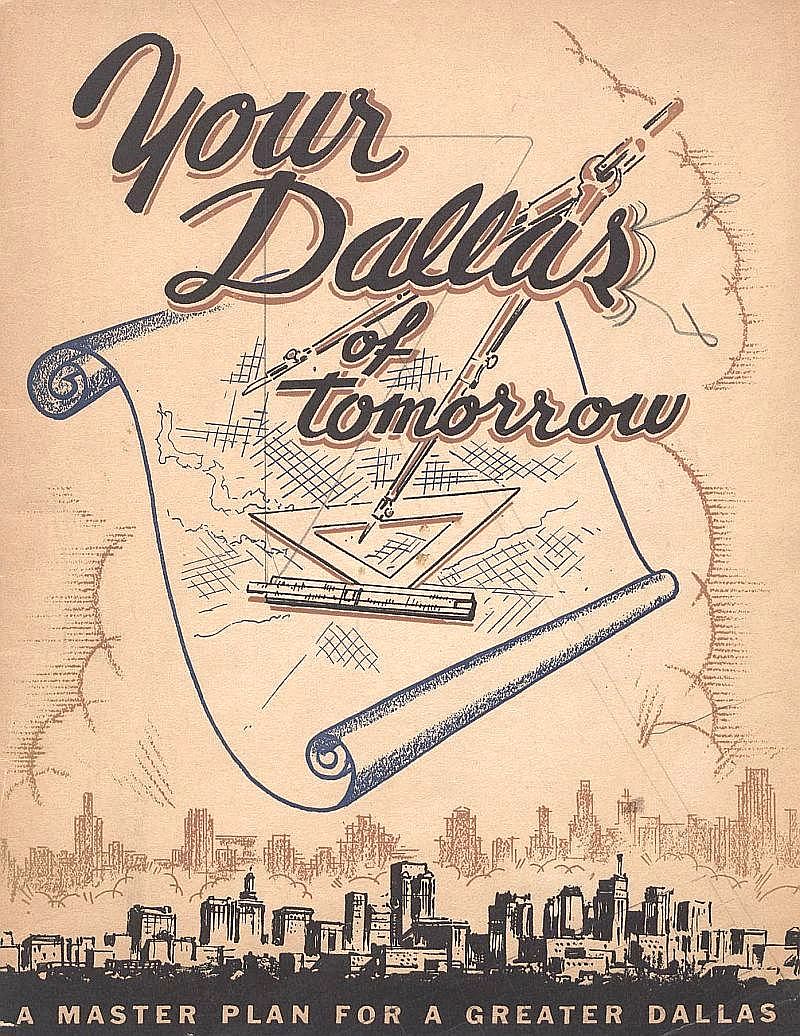
Harland Bartholomew, a St. Louis urban planner and civil engineer, was asked by the City of Dallas in 1943 to prepare a master plan for Dallas which would address the needs of the city’s post-war growth and livability. As then-mayor Woodall Rodgers said, “We need another Kessler Plan and have waited long enough to start. We want to be ready to put Dallas ahead when the war is over and we will have great opportunities to put a master plan in effect” (Dallas Morning News, April 1, 1943).
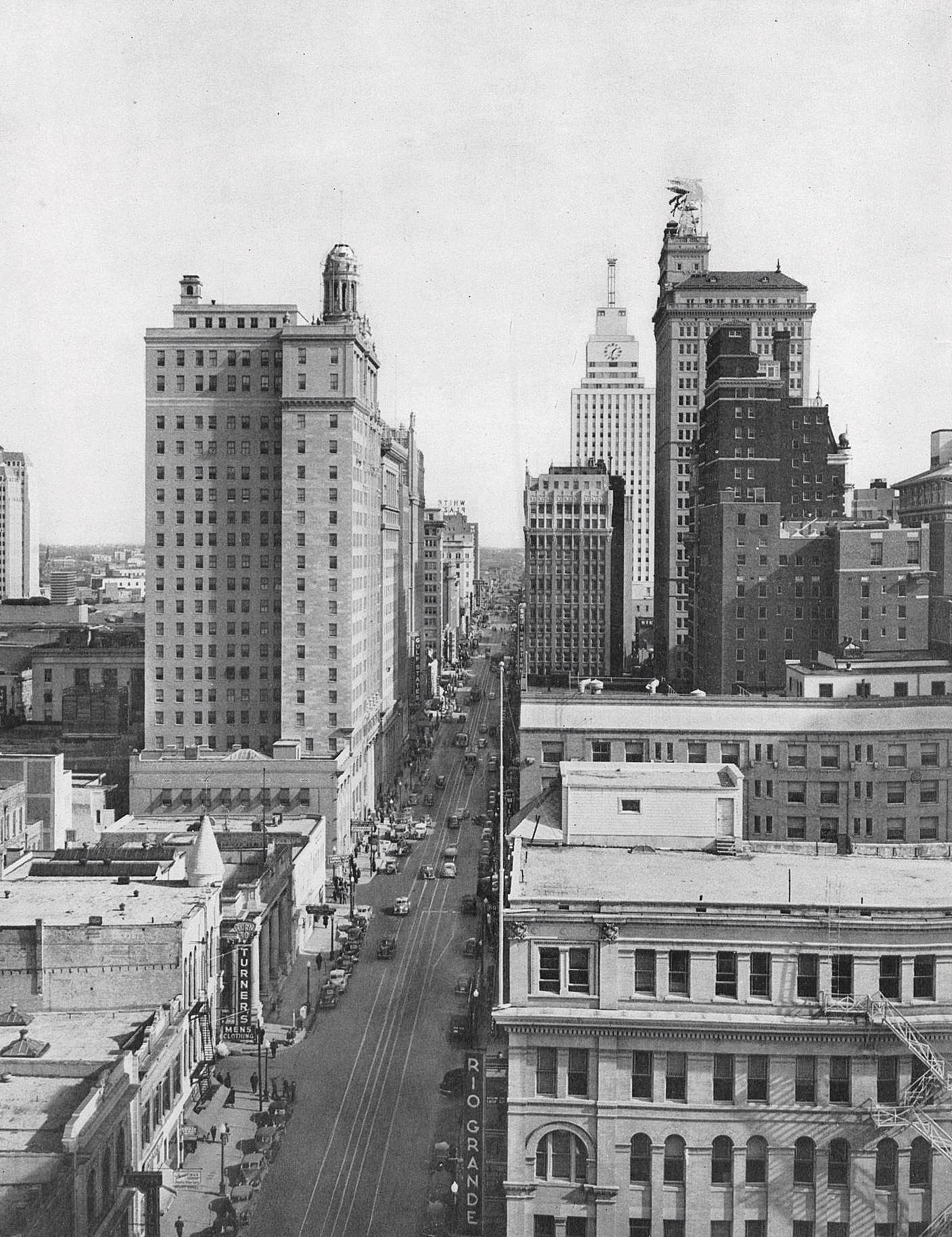
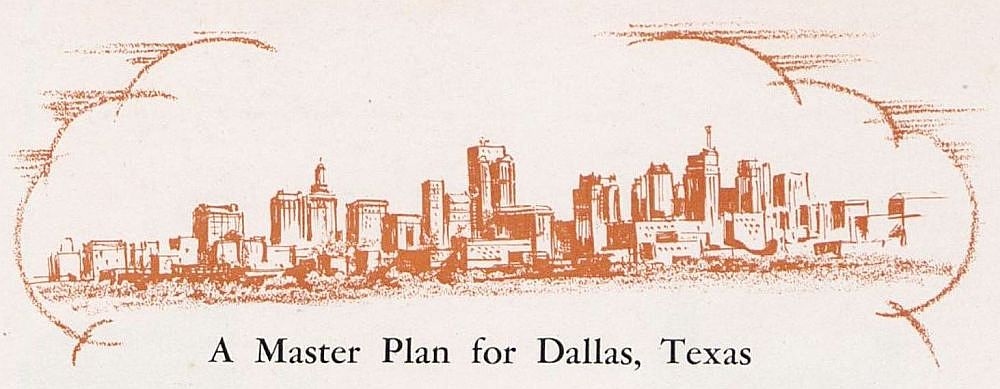
Read Bartholomew’s incredibly thorough 51-page report titled “Your Dallas of Tomorrow” here. It has been scanned in its entirety and is presented (courtesy of the Dallas Municipal Archives) on UNT’s Portal to Texas History site. In addition to the report, there are drawings, graphs, maps, and the wonderful photo seen above showing an already-vibrant metropolis, with its newest addition to the skyline, the Mercantile Bank Building. Below are a few other things from Bartholomew’s master plan I found interesting. (All images are larger when clicked.)
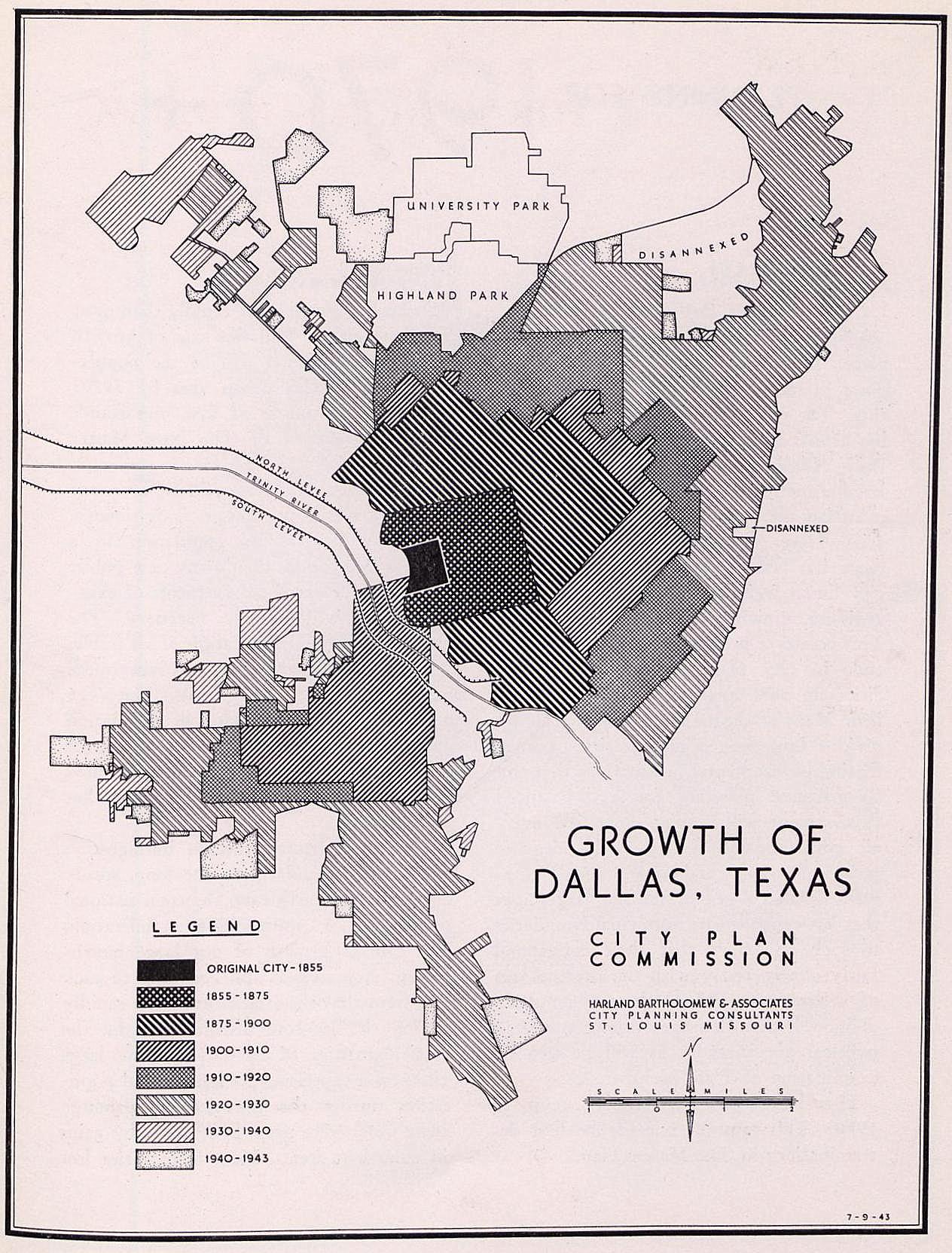
This map showing the growth of the city, from 1855 to 1943, is really interesting. Check out the “disannexed” areas. (I think that area east of the Park Cities was disannexed because landowners — which included W. W. Caruth — argued that it was undeveloped farmland and shouldn’t be subjected to city taxation. …I think.)
A somewhat recognizable skyline.
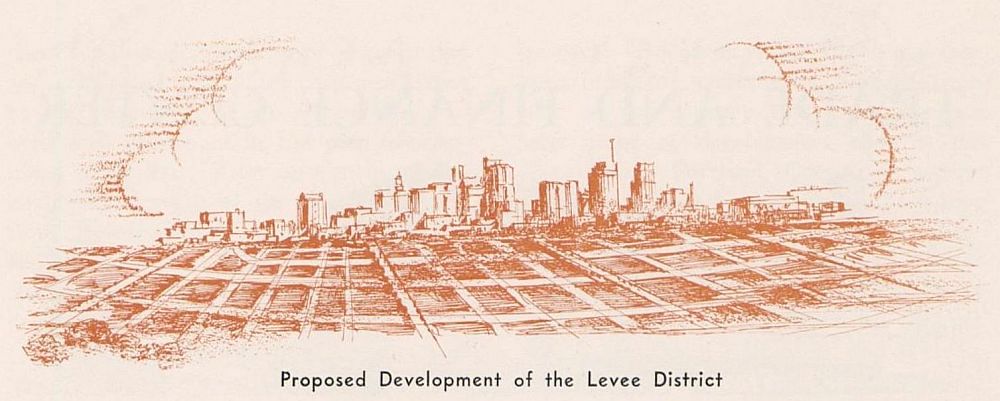
Levee District.
The old Union Depot at the edge of Deep Ellum, demolished in 1935.
There is much more in this interesting report, including quite a bit of good historical information on the development and growth of Dallas.
***
Source & Notes
All images from “Your Dallas of Tomorrow, A Master Plan for Dallas, Texas,” prepared by Harland Bartholomew and Associates of St. Louis, Missouri in September, 1943. Booklet from the Dallas Municipal Archives, accessible on the Portal to Texas History, here.
The report above was the first one issued — and it was the most glitzy. The ones that followed were more down-to-business. Some of the plans were implemented, some were not. See all of the reports of the master plan prepared by Bartholomew and Associates — issued between 1943 and 1946 — here. If you like maps, this link has your name all over it!
One of Dallas’ favorite neon signs… (photo: Paula Bosse)
by Paula Bosse
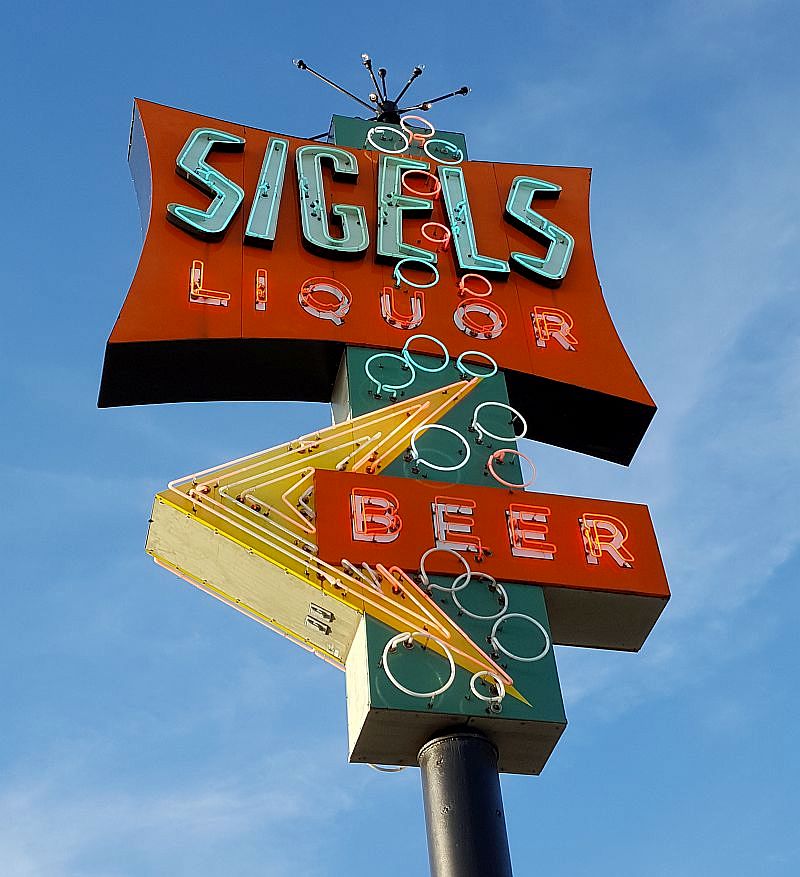
I stopped by Sigel’s liquor store the other day (as one does…) and saw this legendary Sigel’s sign, recently installed in its new home in the parking lot of the Sigel’s store on Greenville Avenue, between Lovers Lane and Southwestern Boulevard, across from the Old Town Shopping Center. I love this neon sign. (See a very large image of it here.)
The sign’s design can be traced back to Dallas artist Marvin M. Sigel (whose great-uncle Harry Sigel founded the business in 1905) — this Fabulous Fifties design was created around 1953 specifically for the then-new store at 5636 Lemmon Avenue (at Inwood). When that store closed in 2009, the sign was refurbished and moved up to the company’s Addison location until that store fell victim to the company’s bankruptcy and was closed. Here’s a video of the fabulous sign when it was in Addison, with close-ups of its flashing neon and dancing bubbles:
*
Marvin Meyer Sigel was born in Poland in 1932 and settled in Dallas in 1937 with his immigrant parents, both of whom had been doctors in Poland (his mother a dentist, his father an M.D.), although only his father continued to practice medicine in the United States. He lived in the vibrant Jewish enclave of South Dallas and went to Forest Avenue High School where he seems to have been a popular kid, interested in art, drumming, and ROTC. Below, a photo from the 1949 yearbook with the caption “Marvin ‘Hot Drums’ Sigel plays with the Swing Band.”
His Forest Avenue High School senior photo, from 1949:
And his 1953 senior photo from the University of Texas:
After studying art at both SMU (under Ed Bearden and DeForrest Judd) and the University of Texas and receiving his B.F.A. from UT in 1953, Sigel served a stint in the Eighth Army in Korea. Back in Dallas, he was remarkably active in the local art community — for decades — as both a fine artist and as an art instructor. He also worked for a while at Peter Wolf Associates, in advertising (on projects for companies like Braniff), and he even did a lot of the tedious paste-up work for Sigel’s ads (back when every picture of a bottle of wine or spirits had to be cut out individually and pasted into one of those huge ads!). But his passion was art, and at the same time he had those regular-paycheck gigs, he also managed to maintain a furious pace of painting new pieces to exhibit at a dizzying number of art shows. Below is an example of one of his watercolors, from 1957 (which was recently offered at auction by David Dike Fine Art). The title? “Cocktail Abstraction” — appropriate subject matter for a member of the Sigel family!
“Cocktail Abstraction” by Marvin Sigel (1957)
When the Sigel’s Liquor store No. 7 opened at Lemmon & Inwood, it was suggested by family members that, hey, we have an artist in the family, let’s get Marvin to design a sign for us. According to Marvin, his cousin Sidney Sigel, who ran the company, probably just wanted a “rectangular sign with block letters,” but other family members wanted something newer and more exciting — something modern that would jump out of a sea of boring rectangular signs with block letters and draw attention. And it certainly did just that. If, as reports have it, that dazzling neon sign was designed in 1953, Marvin Sigel was only 21 years old!
When news broke 56 years later, in 2009, that the Lemmon & Inwood store was closing, there was a concerned uproar from the public about what would happen to the sign. Mr. Sigel was a bit taken aback by how much the people of Dallas had grown to love that sign and considered it a city landmark. Marvin Sigel, then 77 years old, said in a 2009 Dallas Morning News interview, “It was clever, but I figured it would be replaced by something more clever in a half-dozen years.”
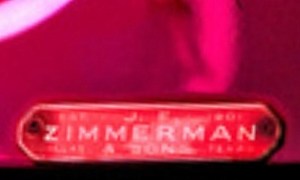
The sign was built by the venerable Dallas firm of J. F. Zimmerman & Sons (est. 1901) who for generations had installed decorative neon elements all around town and had built innumerable lighted signs for companies big and small — their work could be seen on the Mercantile Building’s wonderful tower, on the exterior of the downtown Titche’s store on Main Street, and in the instantly recognizable signs for places as varied as the Cotton Bowl, Big Town, and, presumably, various other Sigel’s stores around the city.
The sign which was moved from Store No. 7 at Lemmon & Inwood to Addison had on its pole a small plaque (seen here) which said:
This Non-Conforming Sign designed by Marvin Sigel was built in the early 1950s. It was moved from Dallas, TX at Lemmon Ave. & Inwood. After being granted a variance it was refurbished to Code and installed here in June of 2009. Sign refurbished and installed by Starlite Sign of Denton, TX.
Interestingly, the plaque on the new location of the sign has a slightly different text:
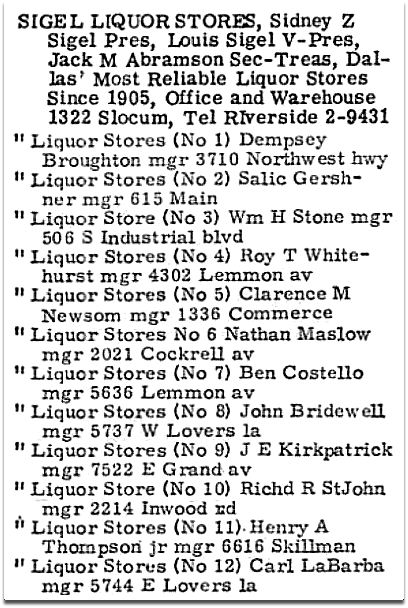
It appears that this is a different Sigel’s sign. In 1965, there were two Sigel’s stores on Lovers Lane: Store No. 8 was along the Miracle Mile on West Lovers Lane, near what is now the Dallas North Tollway, and Store No. 12 was on East Lovers Lane at Greenville (then near Louanns nightclub).
1965 Dallas directory
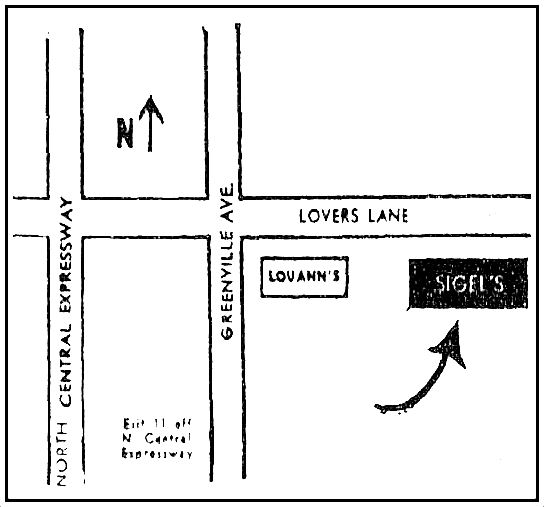
In an April 22, 2009 Dallas Morning News article by Jeffrey Weiss (“The Story Behind That Sigel’s Sign”), is this quote from Mr. Sigel’s son, David S. Z. Sigel, about the original sign at Lemmon & Inwood, with mention of another similar sign: “He created the designs for this sign, as well as a similar but smaller sign which stood outside the Lovers Lane store (where Central Market now stands) for many years.” Here’s a map from a November, 1964 grand opening ad for the new store at 5744 E. Lovers Lane:
Detail from a grand opening ad, Nov. 6, 1964
So is the sign currently standing in the parking lot of the Sigel’s Fine Wines & Great Spirits at 5757 Greenville Avenue the sign which originally stood only a short four-tenths of a mile away? I hope so! And if it is, welcome back to the neighborhood, cool sign!
Whichever sign this is, it is one of the greatest neon designs Dallas has ever had, and I’m so happy it’s survived for over a half-century, through phenomenal city growth, physical displacement, and even company bankruptcy.
Thanks, Marvin, for designing this wonderful sign! And thanks, Starlite Sign of Denton, for the beautiful refurbishing!
***
Sources & Notes *
Top photo and photo of blue plaque taken by me on July 27, 2017 at the Sigel’s store at 5757 Greenville Avenue.
YouTube video by Andrew F. Wood, shot in Addison in 2013.
Sources for other images as noted.
The Zimmerman & Sons nameplate can be seen on the original Lemmon & Inwood sign here (click to enlarge), posted on Flickr by Tim Anderson (a detail of his photo can be seen below) (there is another Zimmerman nameplate posted in the comments on that Flickr page); what appears to be a Zimmerman plate is on the side of the sign at the Greenville Avenue location facing the store’s entrance, not on the side seen in my photo at the top.
Please check out the Dallas Morning News article in theDMN archives titled “Sigel’s Sign Designer Surprised by Its Fame — Project for Family’s Liquor Store Wasn’t a Hit with Boss, He Recalls” by Jeffrey Weiss (April 28, 2009) in which Marvin Sigel discusses his famous sign.
Also, check out these related (online) DMN articles:
“Sigel’s Beverages, A 111-Year-Old Dallas Chain, Filed for Bankruptcy; Wants to Close 5 Stores” by Maria Halkias (Oct. 21, 2016), here
“Sigel’s Iconic Neon Sign Returning to Dallas After Years Wasting Away in Addison” by Robert Wilonsky (March 27, 2017), here
If anyone can verify that this sign is, in fact, the sign from Store No. 12 (Lovers & Greenville), please let me know!
UPDATE: Marvin Sigel died on Feb. 23, 2019 at the age of 87 (his obituary is on the Dallas Morning News website, here). After I wrote this post, Marvin’s son, David, contacted me to let me know his father had seen this and was delighted to know that people still appreciated his work. This was one of the most popular posts of the year. People absolutely still love your sign, Marvin! RIP.
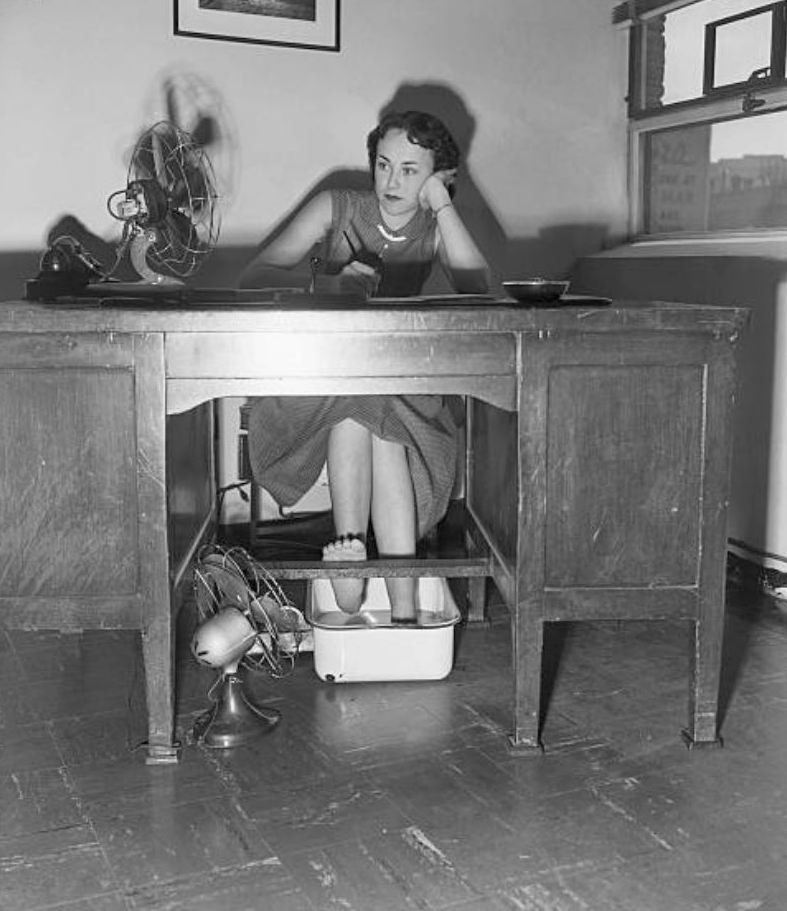
The photo above appeared in newspapers around the country in August 1951 above this caption:
What the well-dressed Texas gal will wear during the current heat wave might be something quite novel. Here, Dallas secretary Mildred Walston starts a new trend in her efforts to keep cool. She uses two fans and a cool pan in which to slosh her feet. Later in the afternoon, Aug. 14, when the temperature hit 103 degrees, Mildred’s boss broke down and sent her off to the nearest swimming pool.
Mildred Walston Fulenwider (1915-1962) worked for many years in the motion picture business in Dallas and was a founding member of WOMPI (Women of the Motion Picture Industry), organized in Dallas in 1952.
I’m going to have to remember that fan-pointed-at-feet-soaking-in-pan-of-cool-water trick.

 Hoedown at the Majestic, 1949…
 Square dance at La Reunion Place (Dallas Municipal Archives)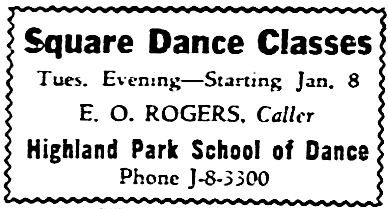
 1948
1948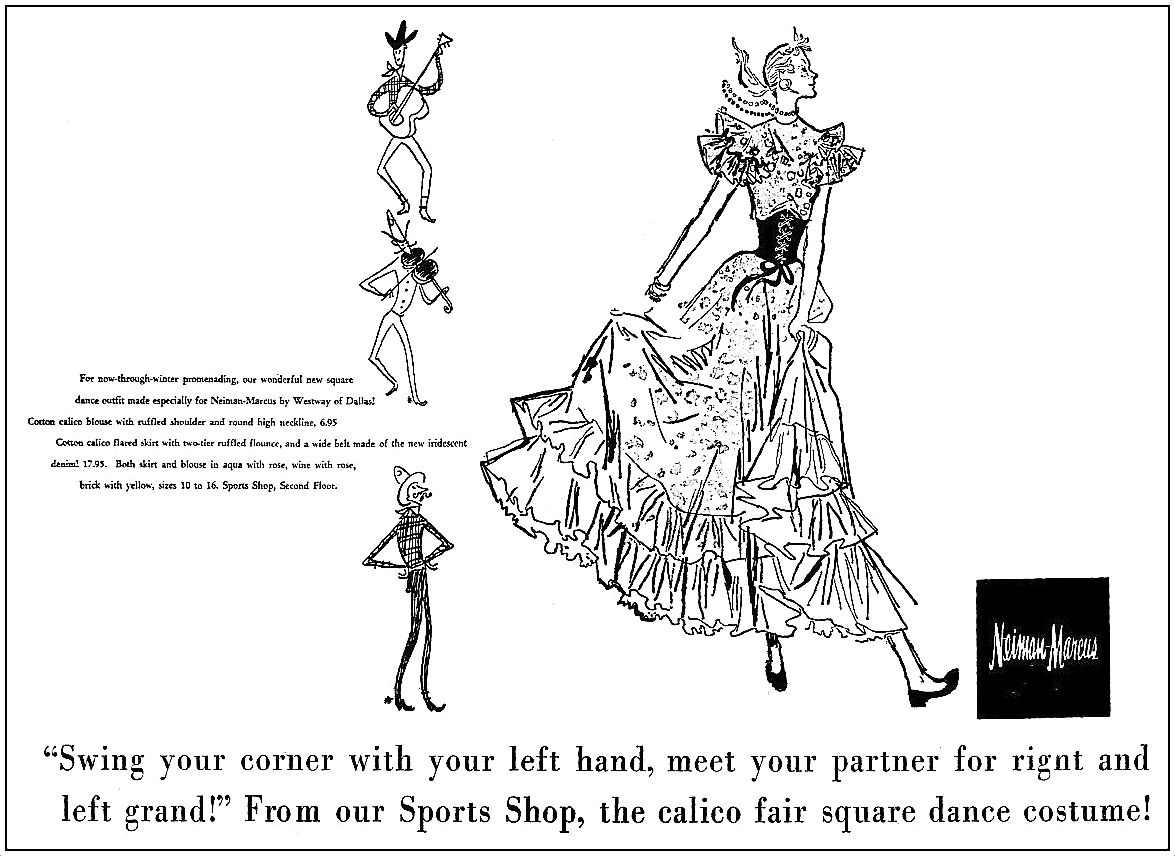



 1951
1951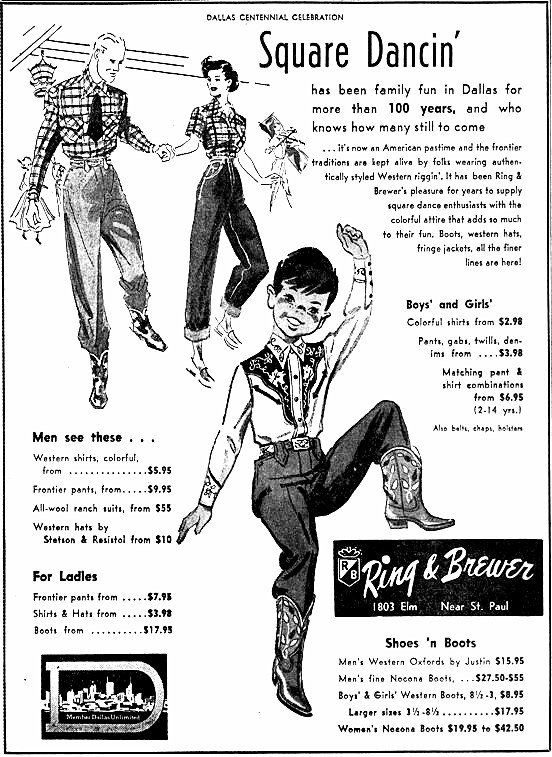

























 Flashback : Dallas