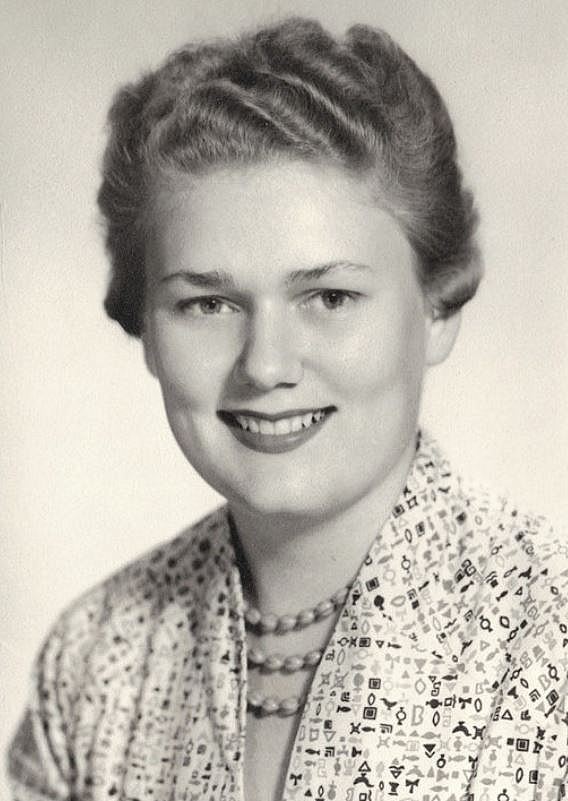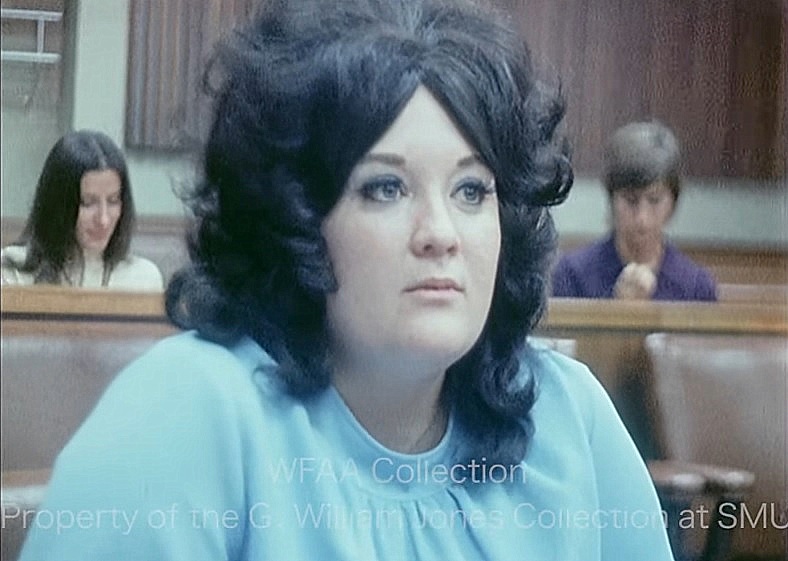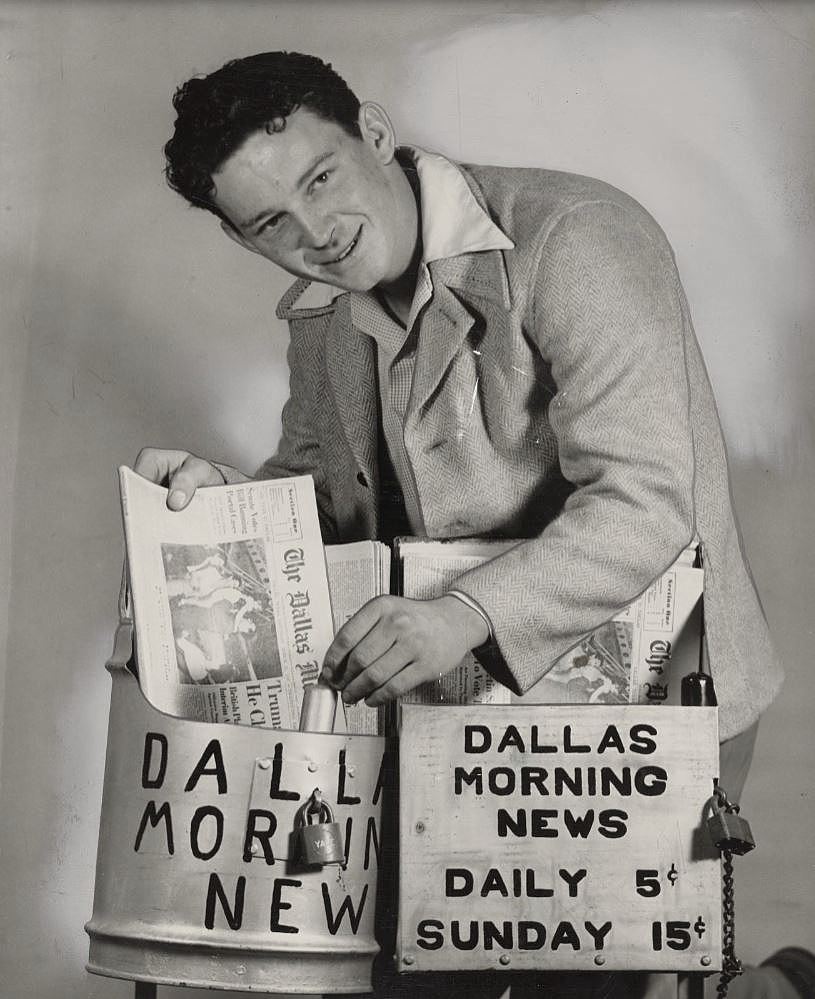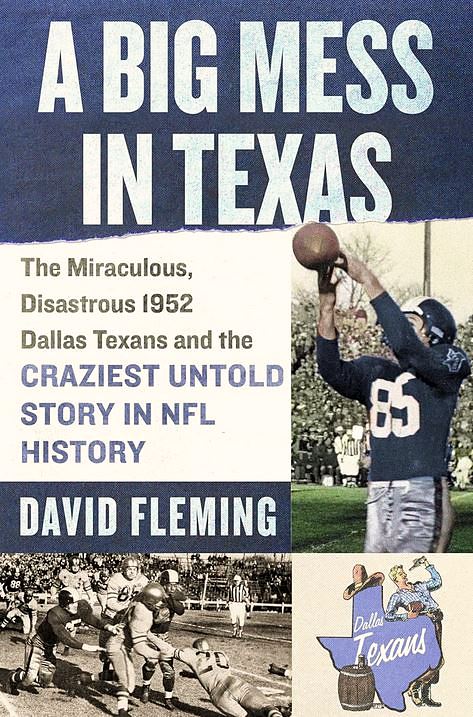
Now that the book is out, Fleming has participated in a Dallas Public Library video interview, conducted by the person who helped him through his pre-publication research process, Caitlyn Jones. I’m not really a sports person, but I have to say, I really enjoyed this interview. It’s always entertaining to listen to someone who is really, really enthusiastic about a topic. Caitlyn did a great job for her first interview, and Fleming tells her how much one particular piece of information — which she stumbled across weeks after their initial email communication — helped shape part of the story he was wanting to tell about what is, quite frankly, a pretty weird story about what must be Dallas’ least successful professional sports team ever (as Wikipedia has it: “…the Texans are officially recognized as the last NFL team to permanently cease operations and not be included in the lineage of any current franchise”).
So as you’re waiting for the turkey to finish or waiting for the Cowboy game to start, check out this 55-minute interview on YouTube. And if you missed my 2016 post on the Texans, mosey on over to “The 1952 Dallas Texans: Definitely NOT America’s Team.”
*
**
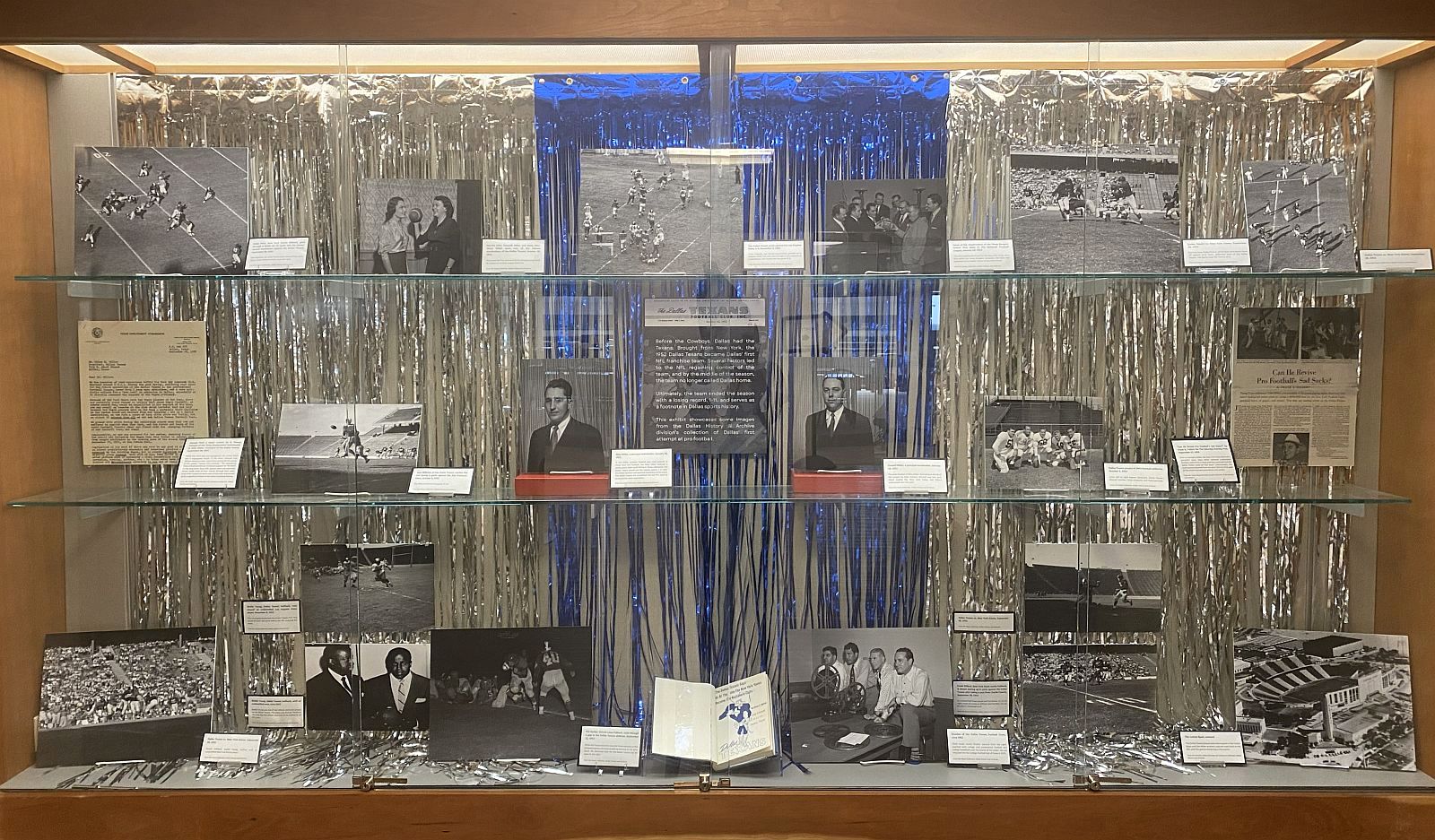
Because of all the research Caitlyn did looking for photos of and information about the Dallas Texans, she became our “staff expert” on the team and even put together this great display, which was exhibited for several weeks on the 7th floor of the downtown Central Library. Thank you, Caitlyn!
*
I’m posting this on Thanksgiving. It turns out the only game the Texans ever won was an upset victory over the Chicago Bears in 1952 on Thanksgiving Day. A miracle! I hope you have as good a Thanksgiving today as the Texans players, coaches, and owners had in 1952!
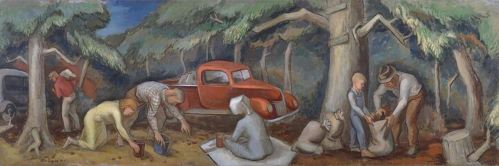
A few days ago, the Dallas Public Library posted a version of the mural below on its social media accounts. The title of the mural is “Gathering Pecans” by Dallas artist Otis Dozier. It was painted in 1941 as a New Deal federally commissioned work to hang in the Arlington Post Office (it now hangs in the Amon Carter Museum in Fort Worth). I love this mural — not only because I’m a fan of Dozier’s work, but also because it captures something that was once a common practice for families: going to a public place like a park (or as seen in the mural, somewhere along the side of the road) and picking up pecans.
Amon Carter Museum of American Art
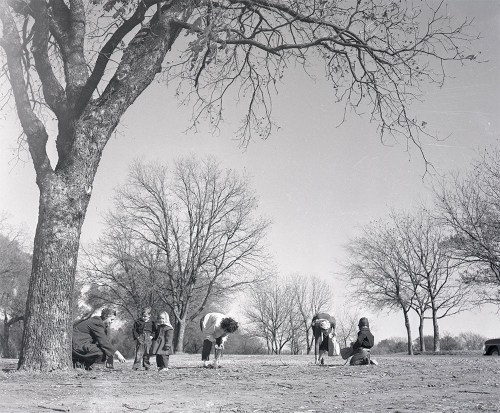
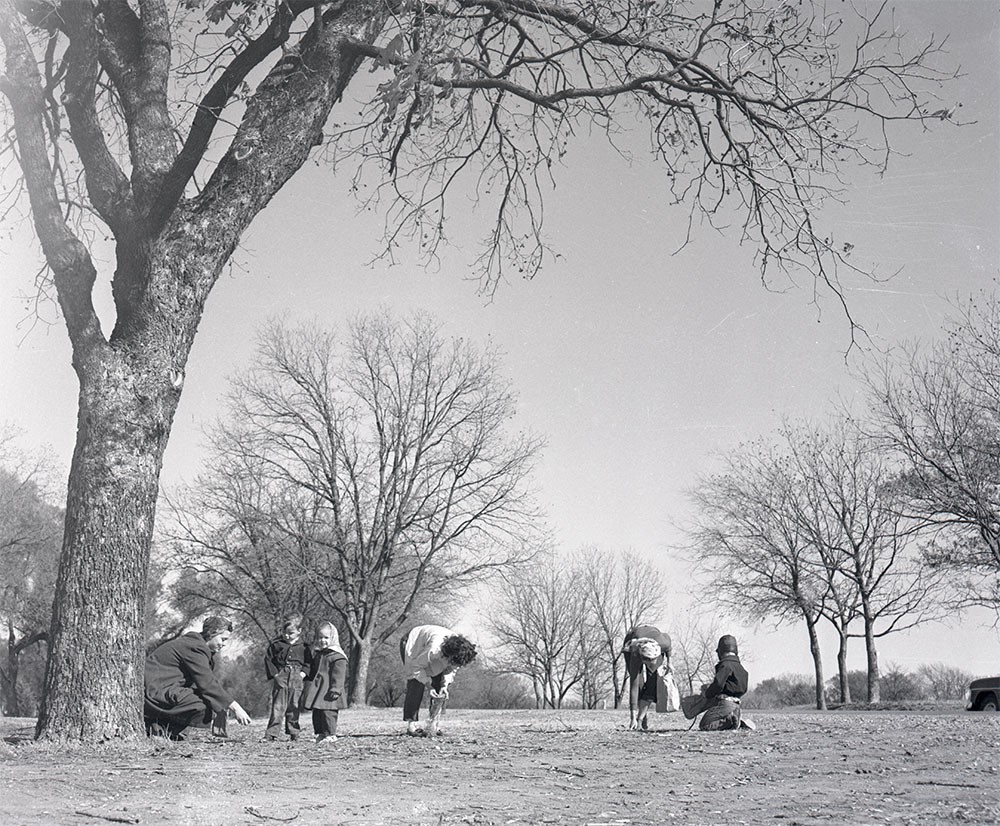
When I was a child, my mother used to take me and my brother to White Rock Lake Park (or occasionally to Reverchon Park) to gather pecans. It was fun. Like a really easy Easter egg hunt with really small eggs. The 1952 photo at the top predates my own time hunting for fallen pecans, but I swear, that could be me, bundled up in a coat and scarf, having fun with my family on a crisp, sunny day.
We’d pick up the nuts (so. many. pecans…) and drop them into a paper sack. Then we’d take them home and lay sheets of newspaper on the dining room table, and the whole family — including my father and aunt — would spend an afternoon cracking pecans and picking out the “meat” with special nutcracking instruments. Next stop: a delicious dessert. I absolutely loved all of this.
I asked my (much younger) co-workers if they ever did this — went to a park to gather pecans. There were a couple of vague “…maybe?…” responses, but most had never heard of such a thing. How sad!
If your family doesn’t do this, consider it. It’s one of my favorite fall memories. And you’ll get an almost-free pecan pie out of it!
Just remember: picking up fallen pecans from the ground in a public park is okay (I think), but shaking branches or disturbing trees to make pecans fall is NOT allowed (and might also lead to a fine). Here are some boys sitting next to a sign that says “Please! Threshing Prohibited.” See those long sticks they’ve got? When that photographer leaves, they’re going to be “threshing.”
Don’t do it! Please! Hunt on the ground.
And don’t wander onto private property unless you have permission. Don’t be like Dinks McClain! He might have been acquitted, but he had to go through a lot of nut-based hassle to be a free man again!
Fort Worth Star-Telegram, Dec. 11, 1907
*
Poaching nuts from private property is not the only thing to beware of. If you browse through the Dallas Morning News and Fort Worth Star-Telegram online archives using the search term “pecan gatherers” or “gathering pecans” or “hunting pecans,” etc., you will see an absolutely eye-popping number of articles about severe injuries and death (!) suffered by people just innocently out looking for some pecans. Lots of people fell out of trees (STAY ON THE GROUND!!), lots of people were shot (in a variety of scenarios), someone drowned, I think (…interesting), and snakes were everywhere. Avoid all these things. And don’t trespass. Don’t be a Dinks McClain. Stay on the ground, stay on public land, and stay away from errant bullets and snakes.
**
Lastly, here’s a 1926 newspaper article (all sub-headlines included!) all about this vanishing tradition:
GYPSY CALL OF THE FALL WOODS HEARD BY DALLAS MOTORISTS
Autumn Leaves and Pecans on Dallas Roads Are Popular
Autumn Tang Brings Forth Many Drivers
Roads Near Dallas Are Crowded on Week-End Afternoons
Seek Fall Leaves
Decorations and Pecans Are Gathered to Take Home
Autumn has failed to chill the ardor of Dallas motorists. On the contrary, they are attracted by the briskness of a fall afternoon drive and by the flaming beauty of autumn leaves or the promise of pecans on and under wayside trees.
Now that the early nights prevent the after-dinner twilight rides of the late summer, Dallasites are saving their drives for week-end and holiday afternoons. On Saturday and especially on Sunday afternoons thousands of local motorists are driving on country roads near Dallas or through the more woodsy of the parks and city addresses to view the beauty of the changing autumn. Others go with the practical motive of finding pecans, and many of these are rewarded.
Roads Are Near
On Saturday afternoon the more popular roads leading from Dallas are crowded with automobiles. No matter in what part of Dallas the motorist lives, he can find a thoroughfare near his home, leading to woods colored by the approach of winter. White Rock Lake, South Beckley avenue, the Holmes street road, Stevens Park, Reverchon Park, Oak Lawn Park, Turtle Creek Boulevard, the Maple avenue road and the Lemmon avenue road are some of the favored drives. On them the motorist will find autumn beauty in profusion.
Many Dallas hostesses are using the gorgeously colored fall leaves as decorations. Even when the motorists are not planning to entertain at home, many take back bunches of the leaves to bring some of the fall color into living and dining-rooms.
Perhaps the most popular fall tree is the sumac, whose scarlet stands out against the darker red and the brown of other leaves. Seen from the roadside, the brilliant leaves have provided an irresistible attraction to stop and gather some to many automobilists. Ash, oak and darker leaves also make their gypsy calls from the woods.
Find Pecans
Pecans as well as decorative leaves are found in many directions from Dallas. Those motorists fortunate enough to have friends with a farm or estate along a water course are making the most of their friendships, while others are forced to rely upon finding trees on unposted land or by the roadside. Most of the pecan hunters are rewarded with enough of the nuts to crack and pick out on the ride back, though fee are able to get a supply sufficient to last through the late fall evenings by the fire.
The brisk coolness of the autumn week-end afternoon, made golden by a pleasant ineffectual sun, not only has not discouraged Dallas automobilists, but the tang of the fall has brought out many who took only short drives during the summer. (Dallas Morning News, Nov. 7, 1926)
***
Sources & Notes
The top photo was taken in November 1952 and is from the Hayes Collection, Dallas History & Archives, Dallas Public Library (PA76-1/11502.2). The description accompanying the photograph: “Hunting pecans at the north end of White Rock Lake are B. B. Rakestraw of Tyler, left, and J. T. White of 7322 Benning. The crisp Fall weather was bringing pecan meat lovers out throughout the city. High winds helped solve the problem of getting nuts.”
The second photograph was taken October 16, 1953 and is also from the Hayes Collection (PA76-1/16051.1). The description of this photo: “Tommy and Danny Wheeler waiting for pecans to fall.”
“Gathering Pecans” is a post-office mural by Otis Dozier (1941); the image reproduced here is from the collection of the Amon Carter Museum of American Art, Fort Worth, Texas — more info is here.
Watch this short film from the Amon Carter Museum on the mural’s relocation and restoration:
*
Pecan tree trivia: in an Oct. 15, 1950 DMN article (“Plenty of Pecans Await Searchers at Dallas Parks”), it is noted that, in 1950, there were approximately 20,000 pecan trees in Dallas parks — half of them were in White Rock Lake Park.
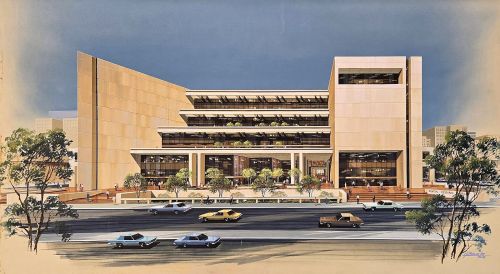
Our city hall has suddenly — and improbably — found itself in the headlines in recent weeks. As of this writing, its immediate fate is unknown. I don’t think I’ve written about this landmark building in the 12 years I’ve been writing about Dallas history. I guess I assumed I’d always have time.
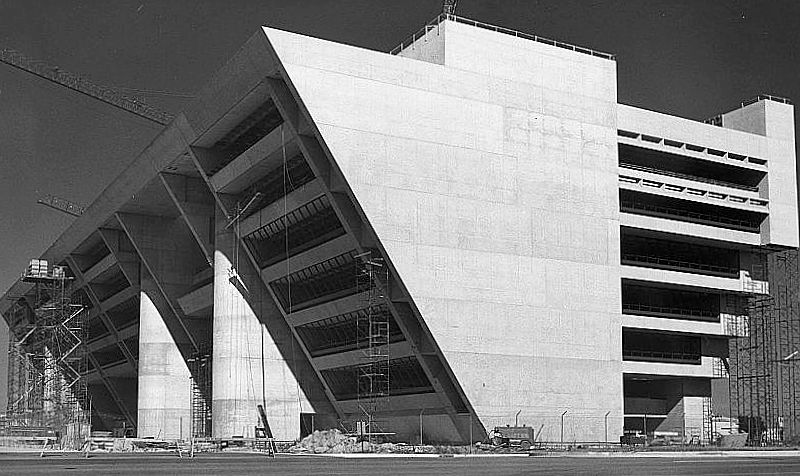
Dallas City Hall is the work of architect I. M. Pei (1917-2019), who, in 1966, was commissioned to design a new city hall by then-mayor J. Erik Jonsson. The very modern design was both acclaimed and derided, and its bumpy road to completion was long and arduous — it was dedicated on March 12, 1978, 12 years after Pei accepted the commission. It is an instantly recognizable building by an internationally respected architect, and it has quietly held the fort on the southern edge of downtown for almost 48 years.
In the project plans presented to the City, I. M. Pei & Partners included these quotes from “Goals for Dallas,” the blueprint that Dallas leaders created for the city’s future:
In an oral history conducted by the Dallas Public Library in 2002, Pei discussed his City Hall project and was asked if he had visited the building in recent years (the link to the oral history and transcript are at the bottom of this post under “Sources & Notes”):
I’ve been back quite a few times. I always went up to the second floor to look at that public space. That public space — some people ask, “Why do you make that space so extravagant? People only come here and pay taxes or pay water bills.” I said, “Precisely. This is a People’s City Hall. You don’t build it for the mayor; you don’t build it for the Council; you build it for the people. They’re the ones who should enjoy it.” I remember that. I always go up to the second floor to look at that space. I think the public that comes to pay taxes should know that this is why. […] That was the original thought, and I still think it’s right — that this City Hall is designed for the people of Dallas. (I. M. Pei oral history, Aug. 1, 2002)
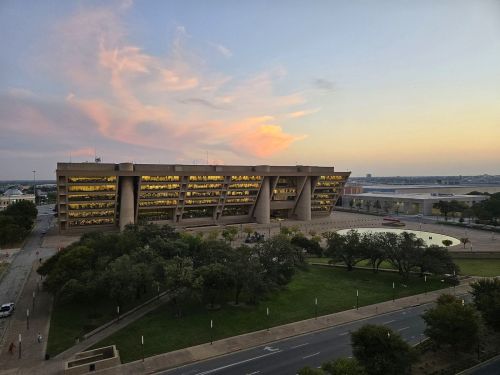
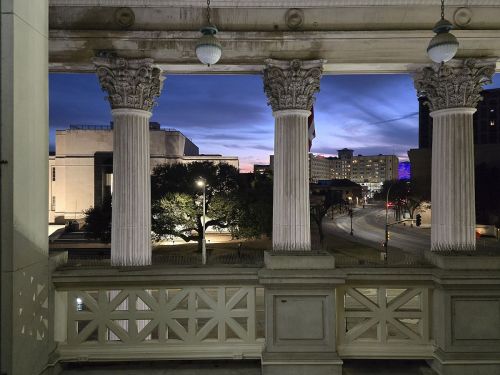
Below are a whole bunch of photos of I. M. Pei in Dallas, aerial views of the city before and during construction of the city hall, and two deceptively calm and quiet photos taken by me from the Central Library across the street only a couple of weeks ago, back when life seemed a little less precarious and before I thought it necessary to look up the dictionary definition of “beleaguered” to make sure I was using it appropriately. I was.
*
The model:
*
Aerial from 1967 (the original name of the project was the Dallas Municipal Center):
*
Aerial from 1976:
*
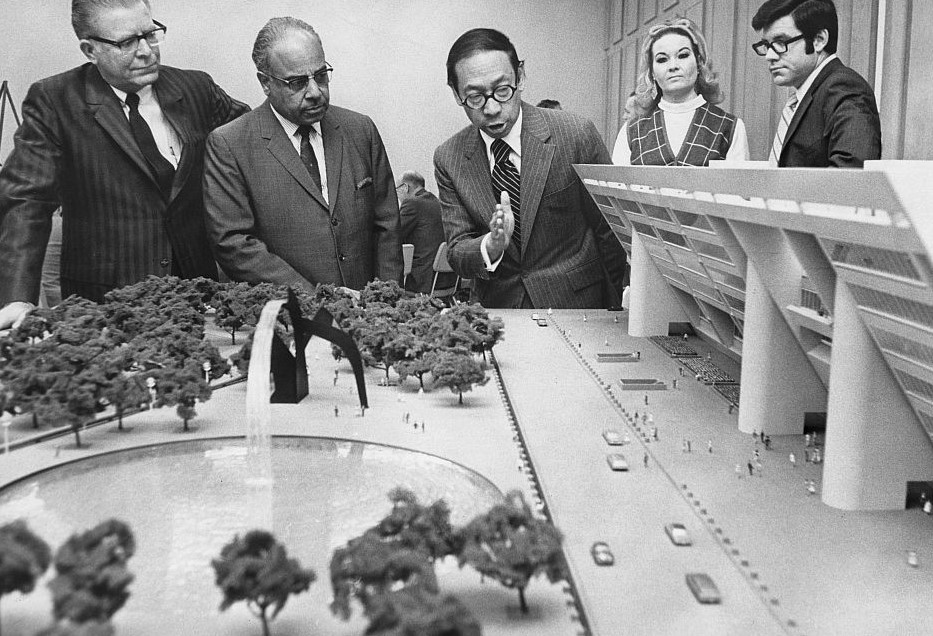
I. M. Pei giving a presentation in Dallas, in which he unveiled his vision for the new city hall (April 28, 1967, Dallas Times Herald photo by Ken Hardin):
*
Showing off the futuristic-looking model to no doubt startled members of the Dallas City Council and city administration workers (October 5, 1970, DTH photo by Joe Gordon).
*
Construction, 1973:
*
Construction, 1974:
*
Construction, 1975:
*
Construction, 1976:
*
Pei shows British sculptor Henry Moore the site where his sculptural work The Dallas Piece will be placed on the City Hall plaza (April 14, 1976, DTH photo by Paul Iverson):
*
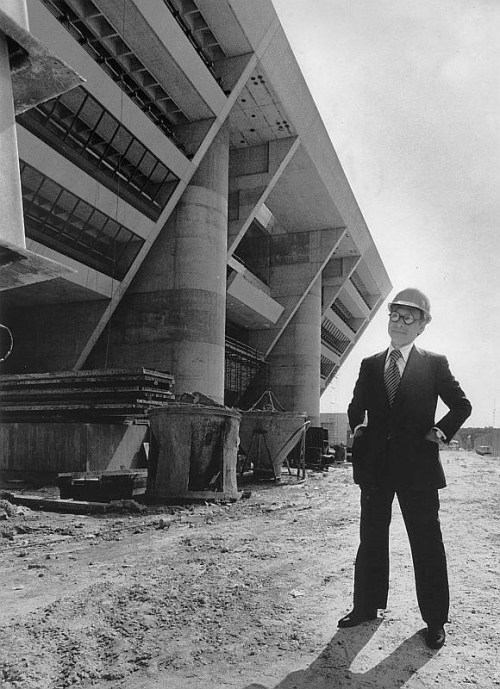
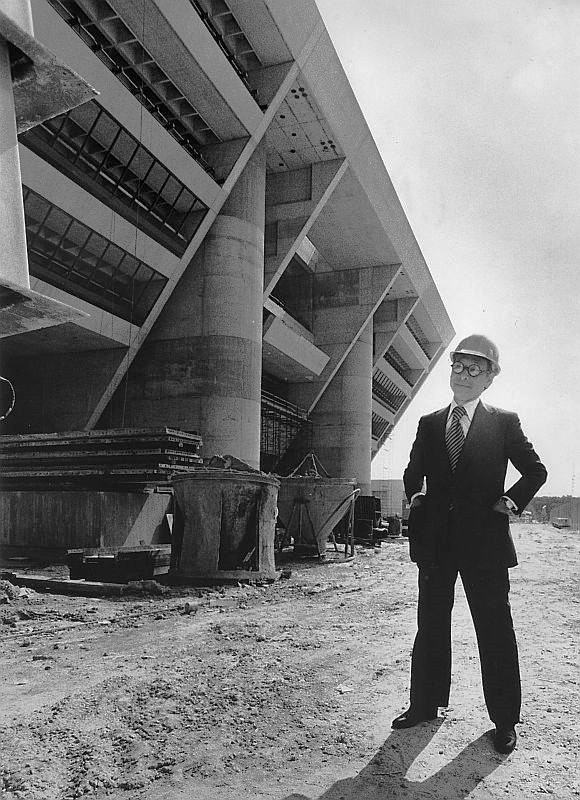
Pei in a hardhat, looking pleased (July 7, 1976, DTH photo by Jay Dickman):
*
Pei with new mayor Robert Folsom, with a killer view of the Dallas skyline behind them (July 7, 1976, DTH photo by Jay Dickman):
*
Side view, from Marilla:
*
Finally, Dedication Day, March 12, 1978 — Pei is seen cutting the ribbon with (left to right) former City Manager Scott McDonald, current City Manager George Schrader, Mayor Robert Folsom, former mayor Wes Wise, and the man who started the whole thing rolling, former mayor J. Erik Jonsson (Pei said that his two greatest allies in the long slog to get the City Hall finished — and to continue with other projects in Dallas — were Schrader and Jonsson, both of whom he was quite fond of and considered friends):
*
A chronology of the long, long trek to completion (at least up to 1976), prepared for the City by I. M. Pei & Partners:
*
I. M. Pei in 1978, happy in Dallas (DTH photo by Phil Huber):
*
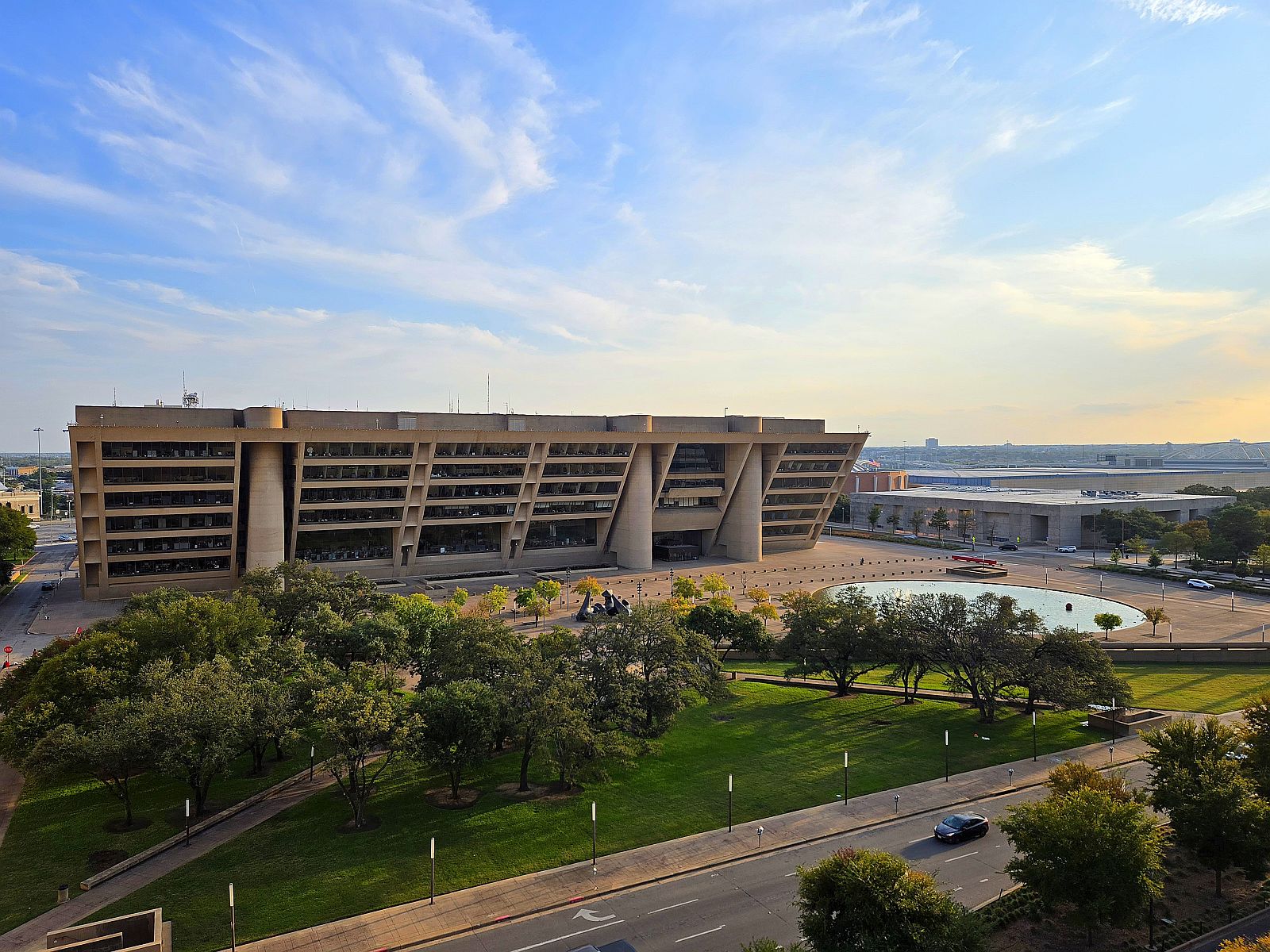
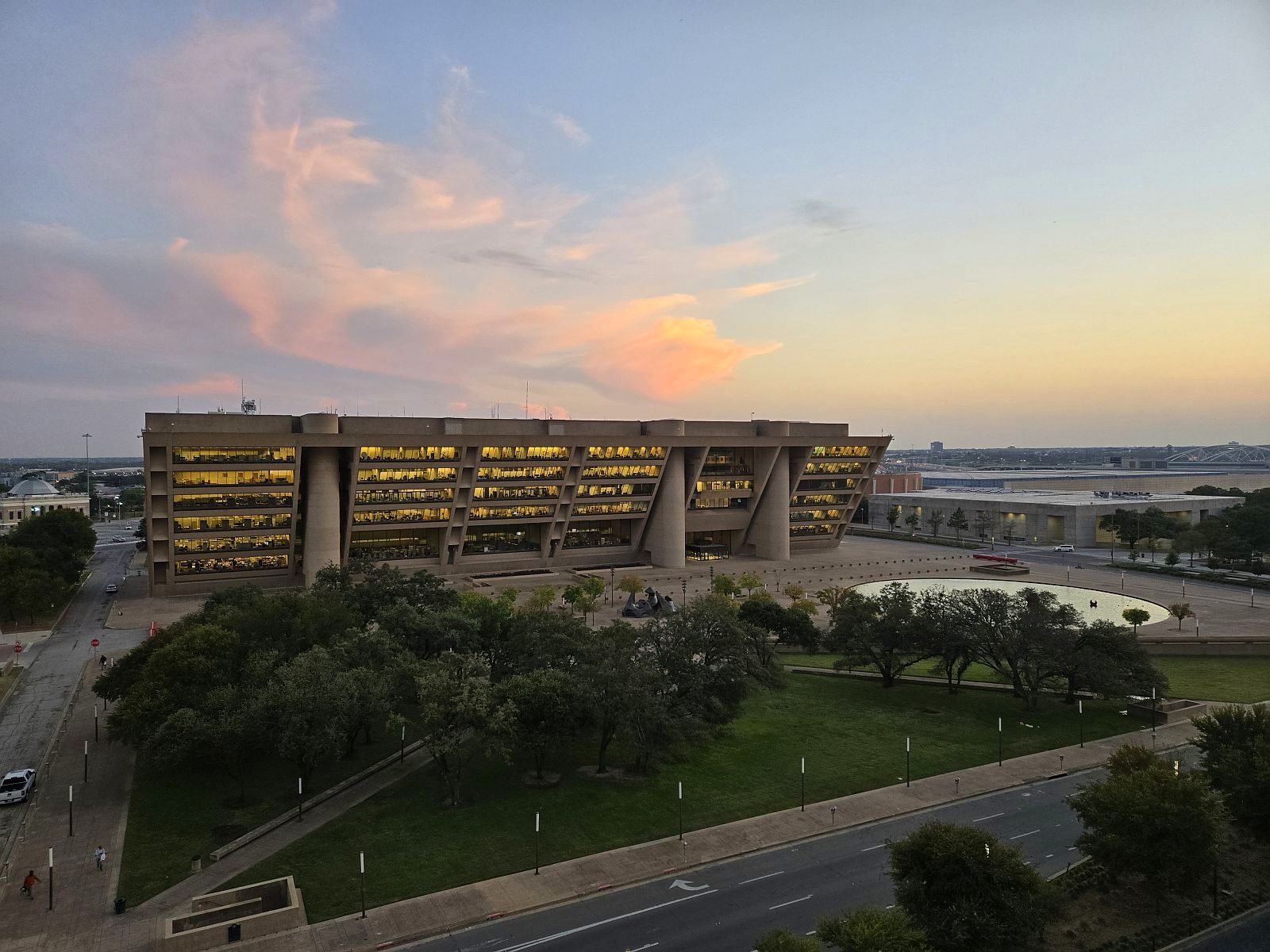
And in October 2025, our solemn City Hall at the end of another day, holding steady as downtown Dallas’ southern anchor.
***
Sources & Notes
Top and bottom color photos of City Hall taken by Paula Bosse on October 23, 2025 from the Central Library.
All other images are from various collections of the Dallas History & Archives division of the Dallas Public Library (including the Dallas Times Herald Collection and the Juanita Craft Collection). All images are used with permission.
Construction photos, “Goals for Dallas” quote, color model photo, and chronology are all from the presentation binder Dallas Municipal Center by associated architects I. M. Pei & Partners and Harper & Kemp (July 5, 1976) (Dallas History & Archives/Dallas Public Library call number R690.513 D145).
The 2002 quote from Pei about City Hall is from I. M. Pei: An Oral History Interview, conducted in New York City on August 1, 2002 by Bonnie A. Lovell for the Dallas Public Library. Ostensibly about Pei’s involvement in commissioning the Henry Moore sculpture, this is an entertaining read/listen, as Pei discusses the larger City Hall project and his affinity and admiration for the city of Dallas and its citizens (audio recording and 48-page transcript with index, Dallas History & Archives/Dallas Public Library call number 730.92 M822YP 2003) — you can listen to the recording and read the transcript on the Dallas Public Library Recollect Digital Collections page here.
It’s been a while since I’ve posted about my sideline gig over on Patreon, so I’m mentioning it again. It has been a year (a year!) since I made an update. It feels like the last year was nothing but nonstop chaos, dealing with not only the return to full-time employment (which I thought would never come), but also finding myself a caregiver to my mother in the difficult final months of her life. It was exhausting.
Both of those things ate up a lot of the time I once used to write and publish frequent posts here. But finances were scary, so I entered the world of Patreon, where people pay a monthly subscription in exchange for regular smatterings of what I hate to call “content,” but that’s what people call it these days. So I sort of shifted what little energy I had at the end of some pretty long days to writing daily mini-Flashback Dallas posts over there. (Daily was a lot. I have since decreased it to about 5 a week.)
I had been posting the topics I’ve covered on Patreon here on this blog in digestible two-month lists. This was to let readers determine if they might like to subscribe (for as little as five dollars a month!), but also so that I can have a more searchable all-in-one Flashback Dallas database (sometimes I forget where I’ve posted something). But that kind of got away from me, and it’s been a year since I’ve posted a list. In February, I’ll be starting my 13th year blogging here. And I’ve been on Patreon about two and a half years. That’s a lot of Dallas history!
Anyway, below is a list of the topics I’ve covered on my Patreon blog over the past year. I’m sorry it’s so long, but… yeah. If you have the stamina, you can also check out the previous lists of topics I’ve covered on Patreon and posted on this blog, here.
As always, I appreciate all of you for reading. I hope the chaos is winding down a bit.
**
OCTOBER 2025
Spooky Halloween Ahead! – 1925
“Stops Indigestion Now!” – 1923 (airplane promotional campaign, Love Field)
Roller Hockey – 1962 (The Dallas Little Texans)
Pike Park, Not Yet Developed – ca. 1912
Bryan Street High School Cheerleader – 1918
Moroney Park – ca. 1917 (baseball park)
Water Delivery During a Time of Drought: 1909-1911
Volk’s Lakewood – ca. 1950
The “Mad Magician” at the Majestic – 1924
“The Pride of East Dallas” – ca. 1886 (Fire equipment)
The Belmont, From Above
Metropolitan Business College – 1911
SFOT Roller Coaster – ca. 1950s (State Fair of Texas, color)
Elvis, In Yer Face – 1971 (Memorial Auditorium)
James Earl Jones and Kevin Conway in Dallas – 1974 (“Of Mice and Men” at SMU)
Beekeeping Supplies – 1908
One of the Modern Homes of Dallas – 1910
Mockingbird and Airline – 1953
Centennial Songs of Texas – 1936 (Stamps-Baxter songbook cover)
Encephalitis Spraying – 1966
Olive and Buddy’s Place on Starlight Road – 1950
Incinerators, Neiman-Marcus, and Illicit Substances
SEPTEMBER 2025
Women and Their Hats, Kidd Springs – 1910
Dallas’ Municipal Flag – 1916
Happy First Day of You-Know-What! (State Fair of Texas)
Back-To-School Time for Little Mr. St. Mark’s – 1955
Serious Girls with Dolls
Cycle Park
American Exchange National Bank Building – 1916 (Lang & Witchell)
Hollywood, East Dallas – 1924 (Hollywood-Santa Monica neighborhood)
Main Street Tear-Downs – 1934 (making way for Dealey Plaza)
***
Sources & Notes
Aerial photo of the Belmont Motor Hotel is from a postcard/booklet found on eBay. This was the description of the Belmont’s amenities (um, “oyster bar”…).
More info on supporting my Flashback Dallas work on Patreon can be found here. All subscriber levels have the same access — $5 a month is a bargain! I try to post at least 5 times a week — posts come directly to your email inbox. You can cancel, restart, or change your subscription amount at any time. Thank you!
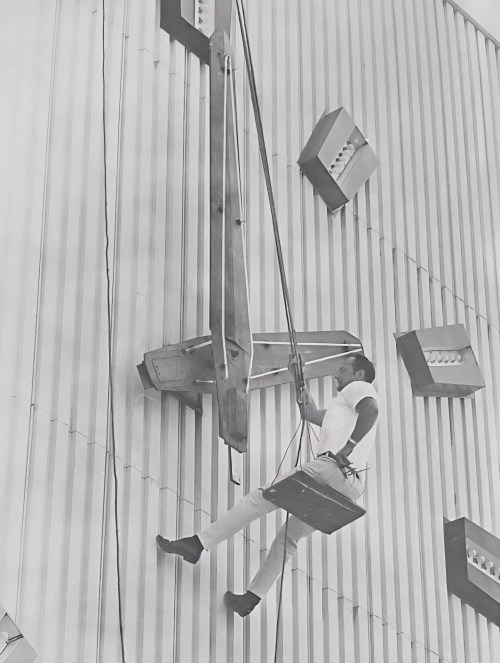
The poor Merc is having a rough time of it at the moment. Here’s a photo from happier days, when it was the Mercantile Bank Building, getting some sort of touch-up to one of its clock faces. Which, by the way, should remind you to turn your clocks back in the wee hours of Nov. 2!
That tower used to do a lot. And all four clock faces had the correct time — all at the same time!
***
Sources & Notes
Photo from the Richards Group Collection, Dallas History & Archives, Dallas Public Library (accession number PA83-3/40).
Mercantile National Bank ad from Dallas magazine, sometime in 1956:
See the Merc in all its early-days glory in these posts:
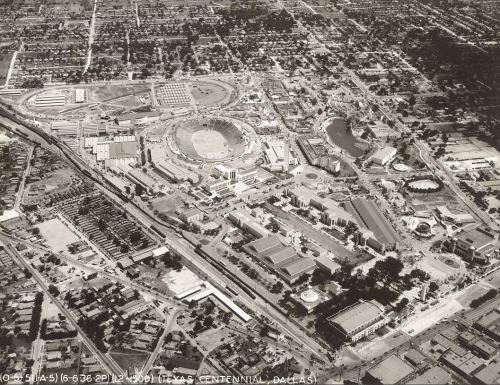
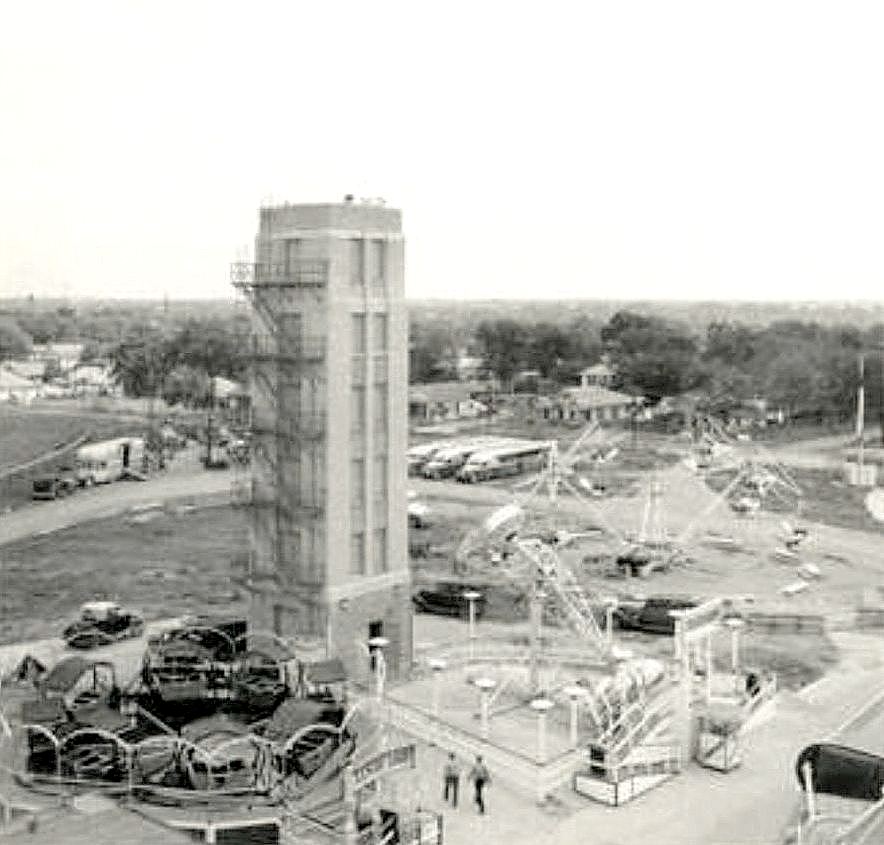
A few months ago, I came across the photos directly above and directly below on the SMU Digital Libraries site. They were both stereographs, and they were both identified as having been taken at Fair Park in 1936 during the Texas Centennial. These two photos didn’t look like Fair Park (except for the long tour buses parked at the upper right of the top photo). If they had not been accompanied by other photos that were unquestionably taken at Fair Park, I might not have been so sure.
Because… what was that odd tower? No sleek, modern art deco architecture there! More like a looming hunk of something ugly and industrial. And it looked like it was relegated to the outer edge of the midway. What was it?
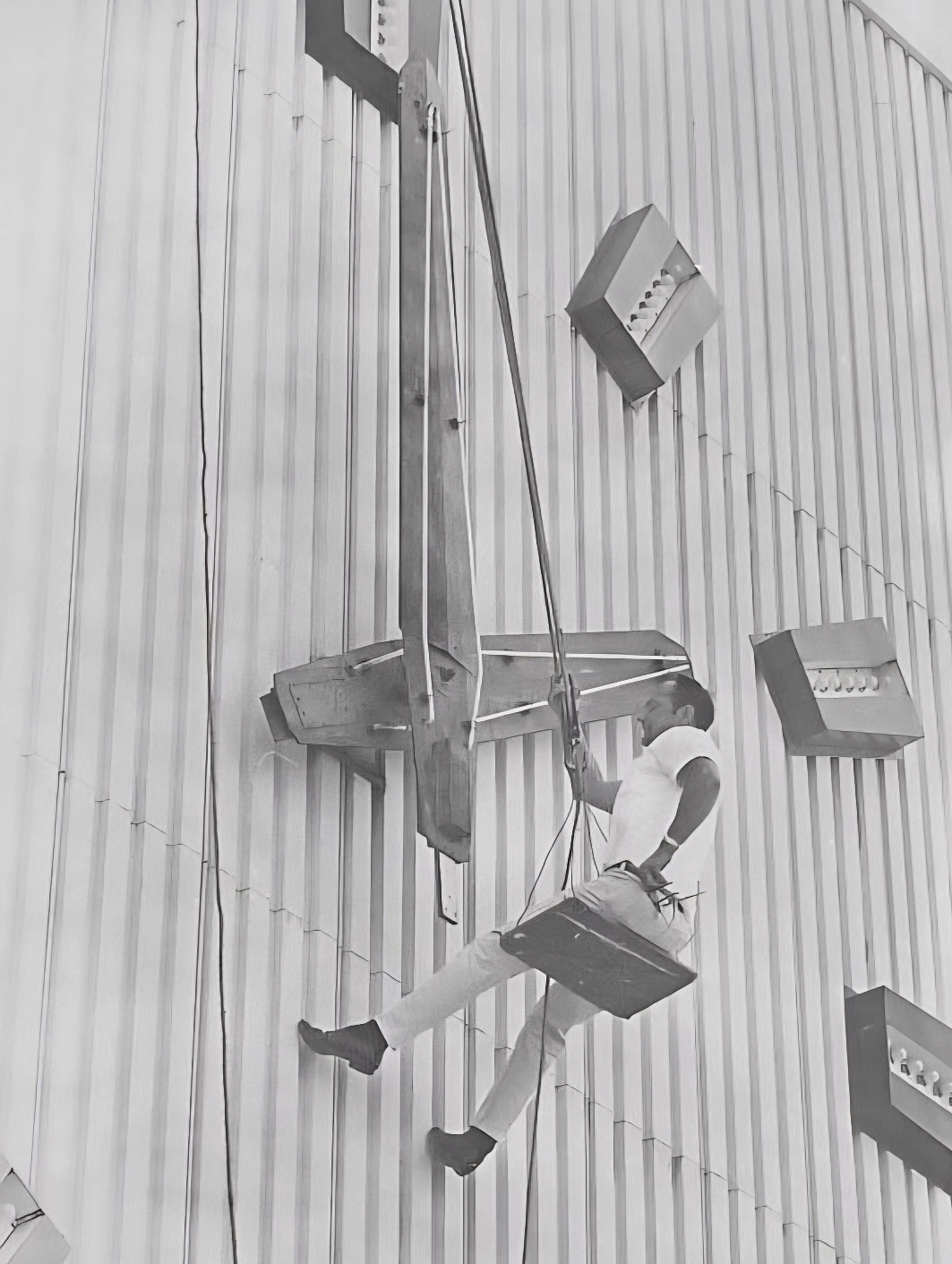
I posted the top photo to the Flashback Dallas Facebook page and asked about this tower thing, and I was informed that it was a drill tower, used by the fire department for training purposes. It was also used to demonstrate rescue practices during the fair. I was directed to this truly spectacular photo, which shows the tower on the far edge of Fair Park (slightly right of center, near the top of the photo — which, by the way, is HUGE). A detail is below.
When — and why — was it built?
In 1930, Dallas was apparently running afoul of the law, because it did not have one of these towers. The State notified that City that that needed to be rectified pronto, or there would be a price to pay:
Unless Dallas provides its fire department with a drill tower, in accordance with the State law, the local key rate of 13 cents will be increased by a 5-cent penalty — the State Fire Insurance commission has served notice. (Dallas Morning News, July 19, 1930)
The city dragged its feet. It was announced almost a year and a half later that things were finally moving toward compliance:
Contract for the new six-story fire drill tower for the Dallas fire department, to be located in Fair Park, has been let to S. J. Buckalew, contractor, by the city department of public works. It will cost $6,328 and will rise 60 feet in height, being built of steel frame with concrete foundation and concrete floors. (DMN, Nov. 18, 1931)
The tower was completed in January 1932 (at a cost closer to $8,000). A few months later, the inaugural exhibition for the public was held at the tower. Firemen demonstrated firefighting techniques and performed drills on how to rescue victims from a tall building. This was the first time that many in the crowd had ever seen such a display. There was, however, a hiccup in one of these performances (or maybe it was planned, as a bit of shocking showmanship):
The demonstration of fire fighting methods included one unexpected thrill when, during the rope-sliding exhibition, a dummy was released from the six-story drill tower, falling to the ground. The crowd, hardly prepared for this feature of the show, was horrified to see what seemed to be a fireman fall out of the tower. Several women were particularly affected, having to be revived by first-aid methods. (DMN, July 1, 1932)
These public demonstrations were very popular and were held for decades. (The tower was, of course, also used regularly by the Dallas Fire Department as its official training tower.) I’m not sure when it was eventually demolished (EDIT: thanks to the comment below, it was demolished on Feb.1, 1947), but the “shows” continued, with towers erected especially for the fair every year, as can be seen in this silent footage from the 1961 State Fair of Texas (the steam pumper “Old Tige” makes an appearance at the 1:13 mark):
***
Sources & Notes
First two stereograph photos were taken in 1936 at the Texas Centennial Exposition and are from the DeGolyer Library, Southern Methodist University: “[Amusement Rides at Fair Park]” is here, and “[View of the Fairgrounds at Fair Park]” is here.
Third photo is a detail from a U.S. National Archives and Records Administration aerial, on Wikipedia.
Video — “Firefighter Demonstration At The State Fair Of Texas – October 1961 (Silent)” — is from the WFAA Collection, G. William Jones Collection, Hamon Arts Library, SMU, on YouTube.
Thanks to the person commenting below, the tower was demolished on Feb. 1, 1947, “to make way for new structures” (DMN, “Landmark Bites Dust,” Feb. 2, 1947).
People may be more familiar with the DFD training tower at Record Crossing — see a photo of that at the Portal to Texas History, here.
Here is a collection of a few random places from Dallas in the 1920s.
*
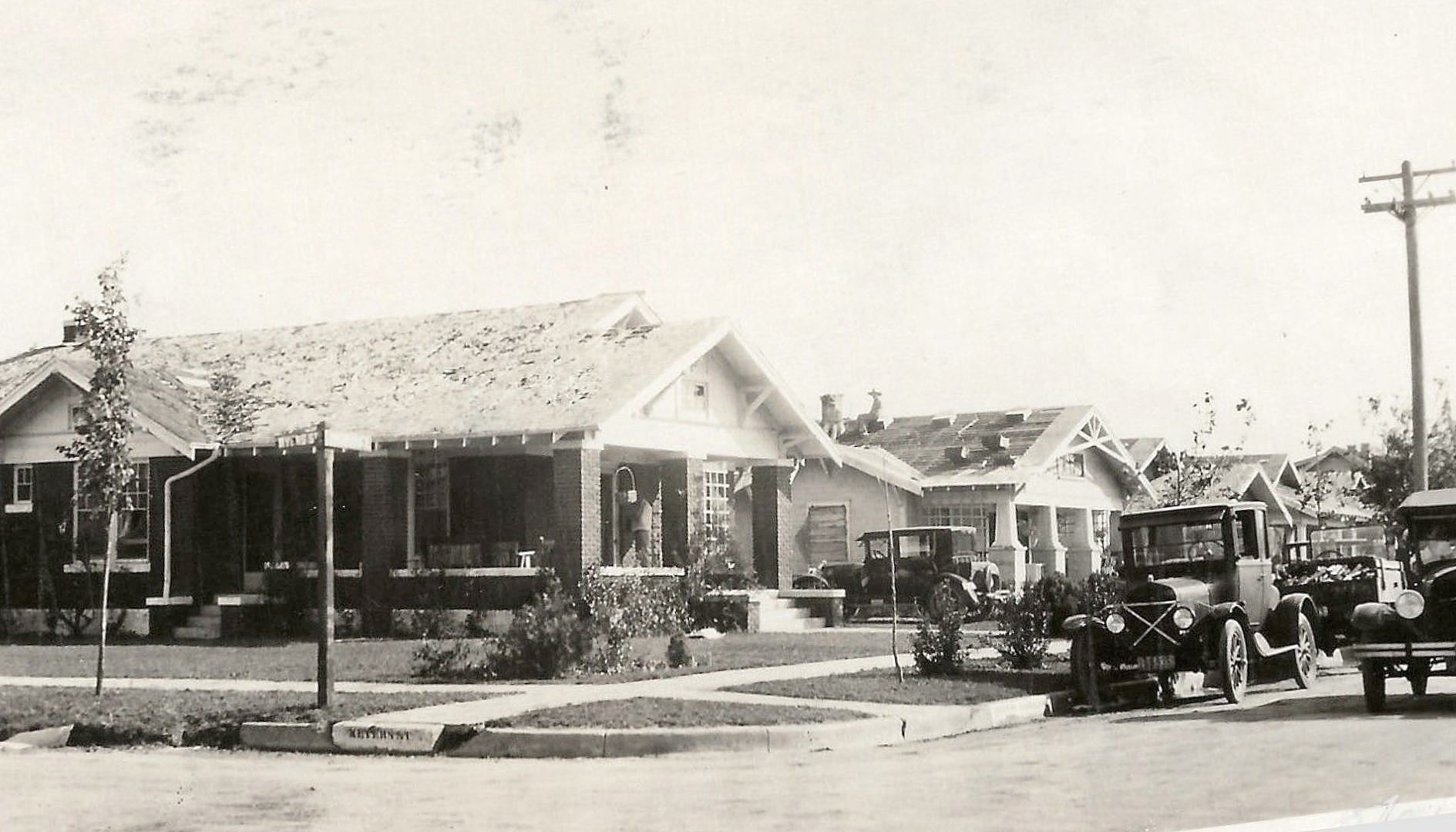
Above, South Dallas, circa 1926. This photo shows the 2900 block of Pennsylvania Avenue at Meyers Street. I love houses of this period, and I love this photo. This may just be poor resolution of the photograph, but it looks like the roof of the house in the foreground is damaged — the roof next door is being repaired.
The house on the corner is no longer there, but the second house — the one with the guys on the roof — is still there, minus some of its aesthetically pleasing design elements. See what this corner looks like in a recent Google Street View, here.
I can’t explain it, but I really love photos of old service stations and garages. The Colonial Motor Co. was in business as early as 1914. Around 1920, it moved to South Dallas, where owner R. F. Mitchell opened a garage at 3219 Holmes Street, just off Pennsylvania in the area known as Colonial Hill. According to the obituary of Mitchell’s son, the business lasted until 1988. That’s quite a run.
An interesting side note about the owner is that he was a motorboat enthusiast and participated in and organized boat races at White Rock Lake. The garage you see above did all the things that service stations do, but it was also the official retailer of Evinrude outboard motors in North Texas.
*
Still in South Dallas, this 1921 photo shows the Forest Avenue High School Drum & Bugle Corps. It’s not that exciting as a photo of a drum and bugle corps, but what is exciting is seeing the view of Forest Avenue behind them. This is now the 3000 block of Martin Luther King Jr. Boulevard, and nothing is this photo still exists. Not the houses, not the streetcar, not the people. It now, rather distressingly, looks like this.
The drum and bugle corps is facing the school, seen here, in a photo from 1924:
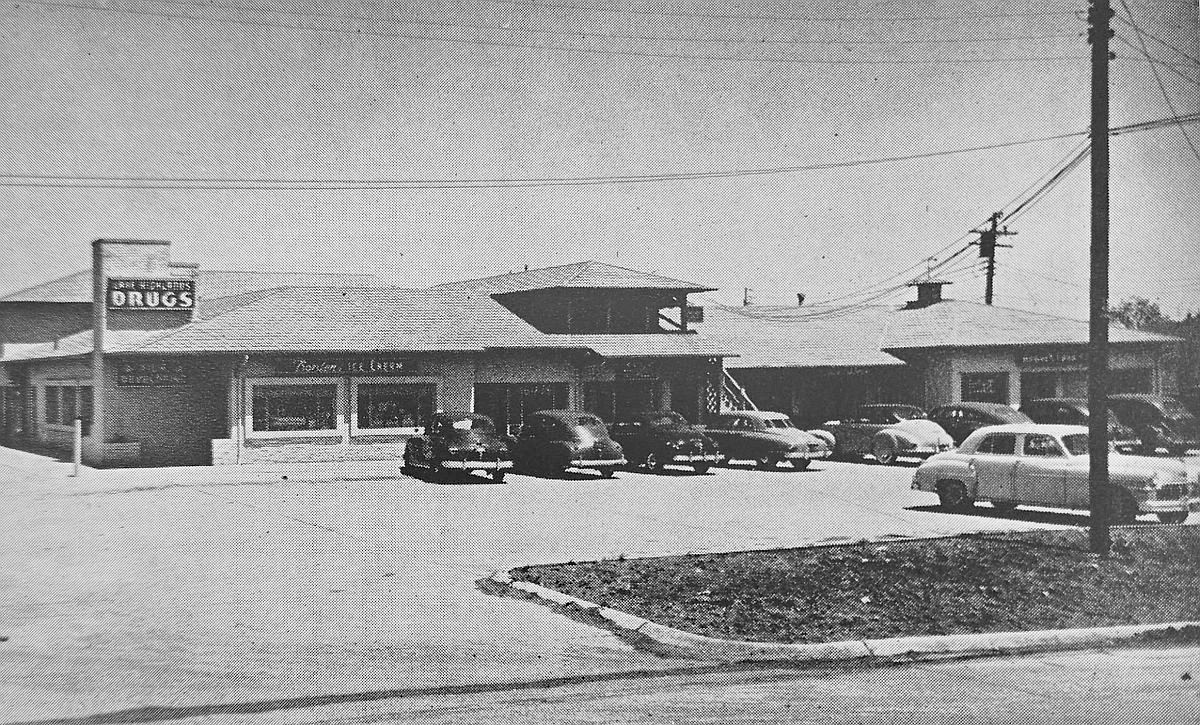
Over to Oak Cliff, to Cannon’s Village, West Davis & Edgefield, an Elizabethan-esque shopping strip built in 1922. Its history is in an Oak Cliff Advocate article here. See what it looks like today, on Google Street View, here. The photo above is from 1925. Another photo is below.
*
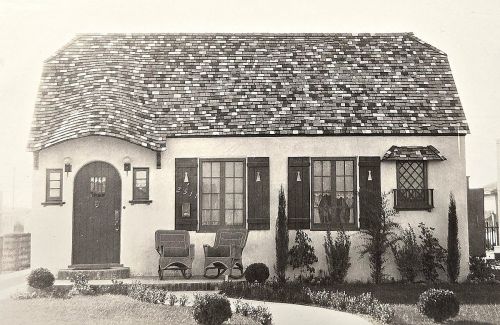
And finally, my dream house!
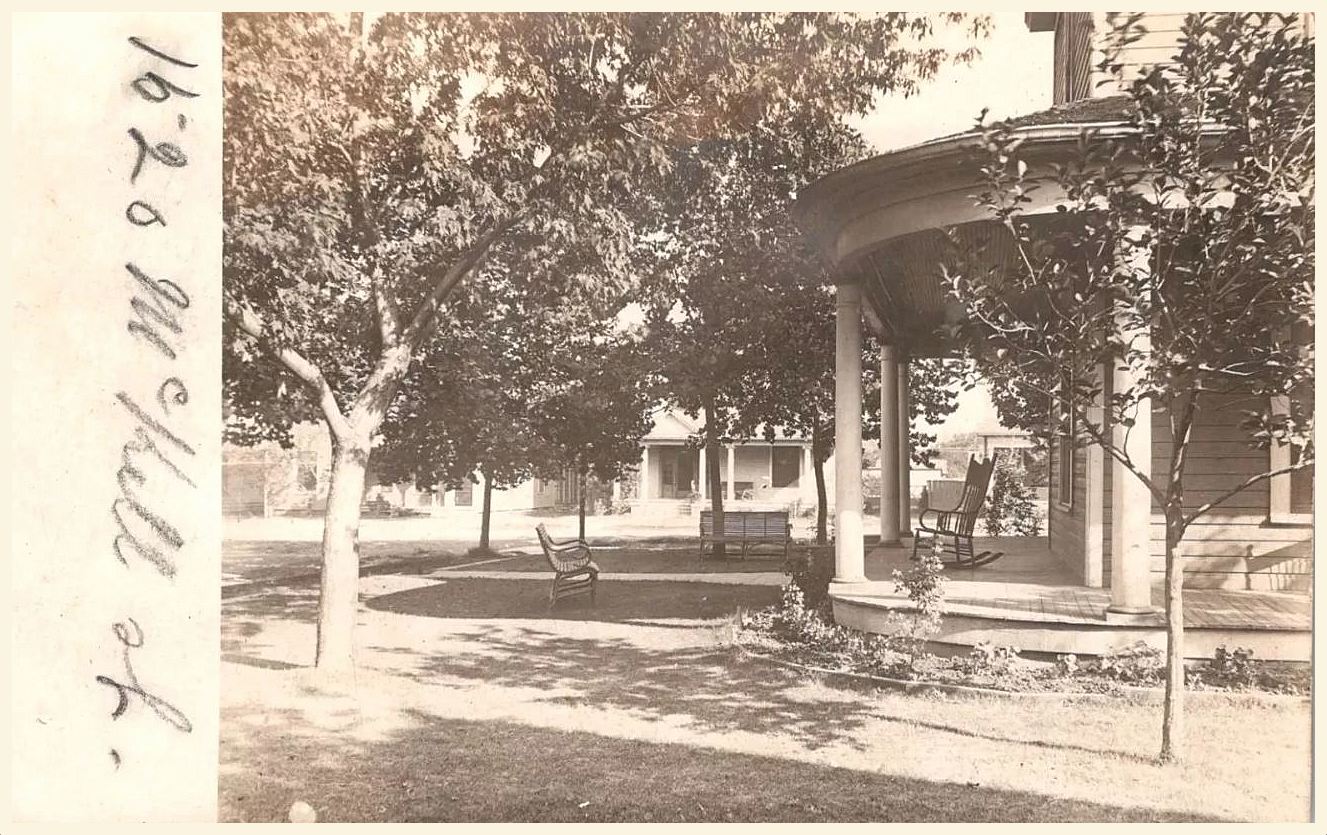
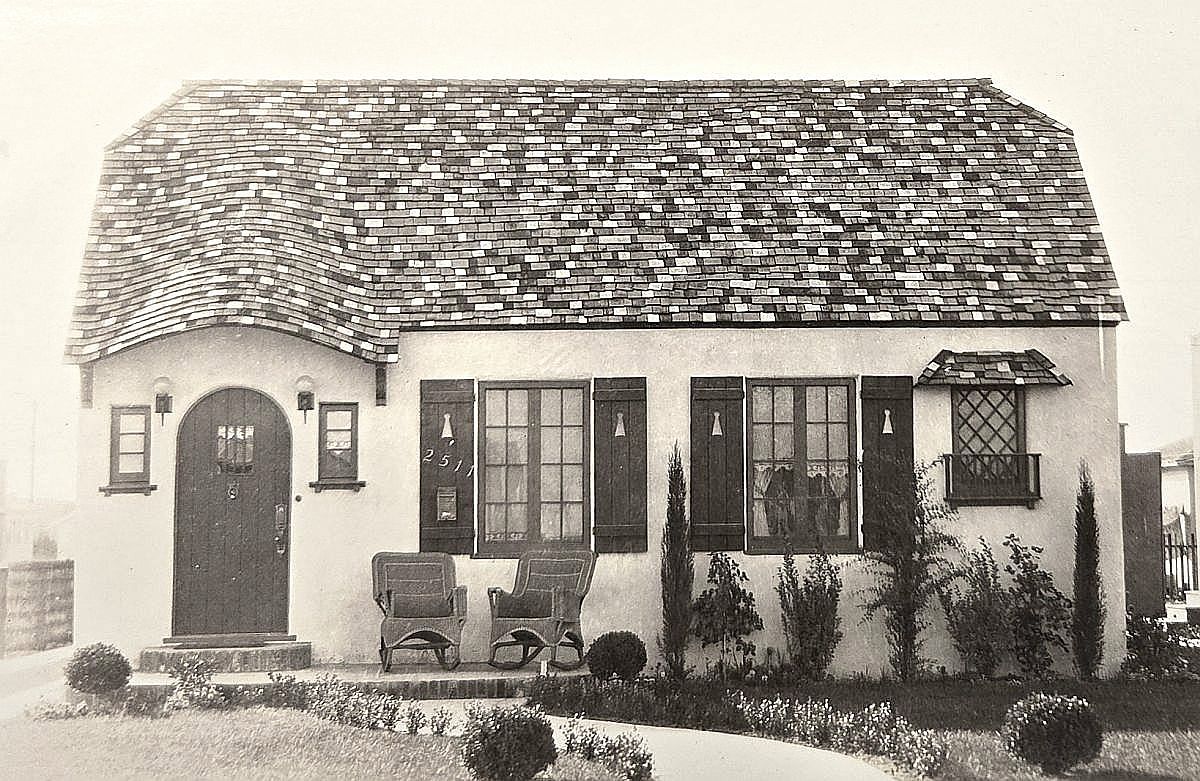
This house may (or may not) have been in Dallas. I choose to believe that it was here somewhere. All that’s known is the address: 2511. It’s almost too cute. Like something out of a fairy tale. That roof is incredible! And the little awning over the little window on the right! The chairs on the little porch. The weird, scrubby landscaping. Just everything! All it needs is some shade trees. I would live there in a heartbeat!
This is one of hundreds of photos of houses from the ‘teens-’30s which were used to sell house plans (and lumber). It is part of the R. M. Williamson Collection in the Dallas History and Archives. The locations of most of the houses are unknown — a lot are (were) probably in Dallas (East Dallas, Vickery Place, Belmont Addition, Oak Cliff, etc.), but a lot just don’t look Dallas-y to me at all (one is fully surrounded by a forest of very, very tall pine trees). But they’re all amazing. If the city of Dallas were filled with all the houses photographed in that collection, it would be a much more aesthetically pleasing city.
Read about this collection here — and read how these photos were used, here.
***
Sources & Notes
Top photo showing Pennsylvania and Meyers is from eBay.
Colonial Motor Co. photo is from the 1924 Forest Avenue High School yearbook; ad ran in newspapers in October 1920.
Drum and bugle corps photo and photo of Forest Avenue High School are from the 1921 and 1924 school yearbooks.
First Cannon Village photo is from a book I can’t remember the title of that I was browsing through in the Dallas History and Archives collection at the Dallas Public Library; second photo is from the Sidewalks of Dallas Instagram account.
Cute house photo is from the R. M. Williamson Collection, Dallas History and Archives, Dallas Public Library.
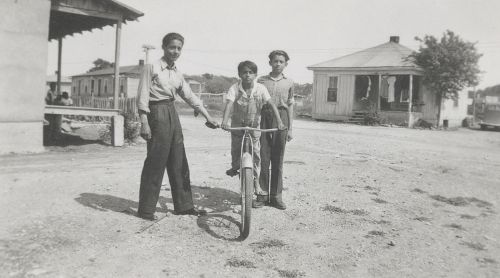
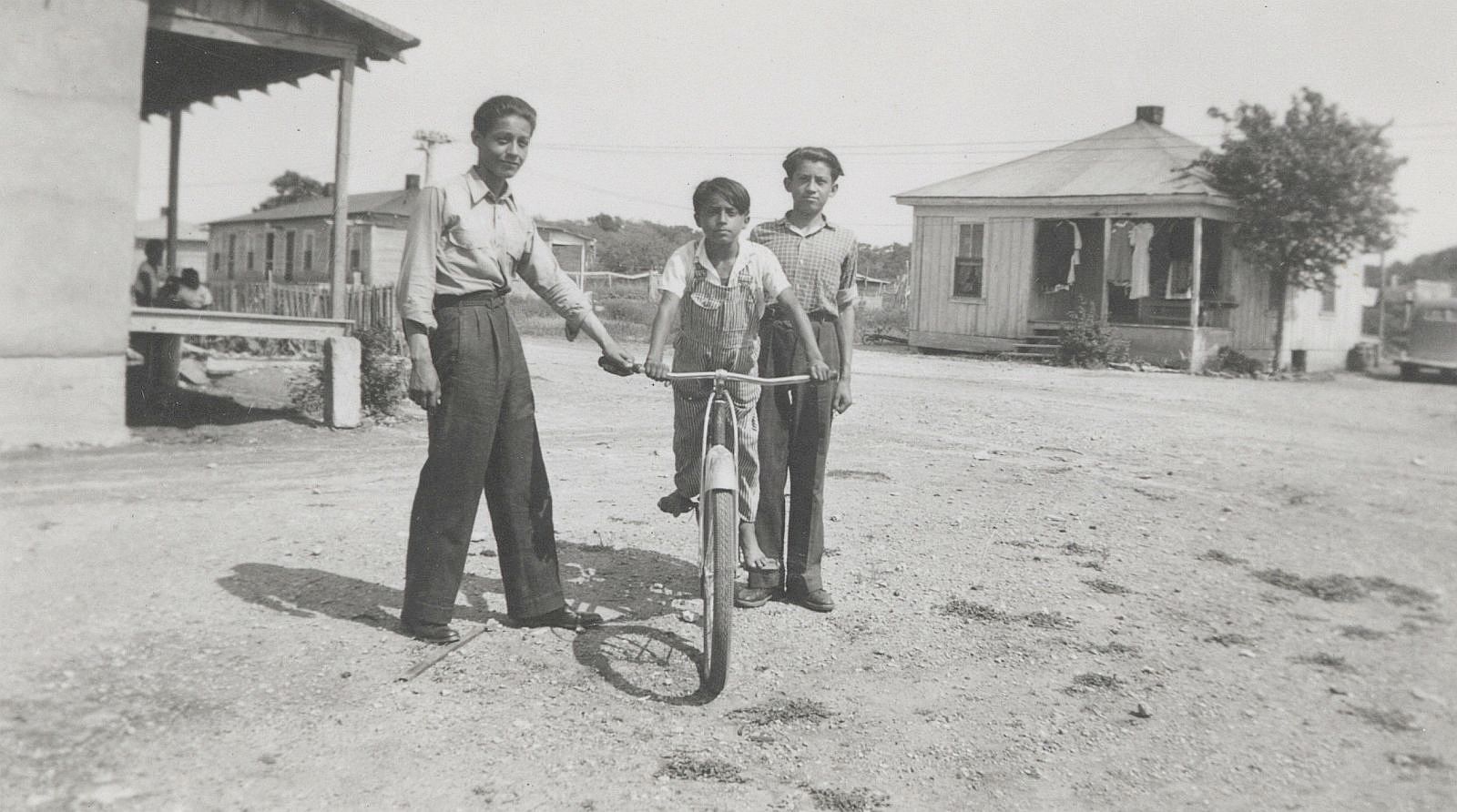
There are pictures I come across sometimes that affect me in a way I can’t really explain. Like this one. This shows three brothers posing for a photo in West Dallas in 1939. The boys are, left to right, Eladio Martinez, Henry Martinez, and Feliberto Martinez. Their father worked for the nearby Trinity Portland Cement Company. During the Depression, the boys helped support the family by cleaning railroad boxcars for a nickel each.
Eladio was killed in action during World War II — the Eladio R. Martinez Learning Center in West Dallas is named after him. His brothers Henry (Enrique) and Feliberto were active in the community and in preserving the history of Ledbetter/Eagle Ford.
Photo — “Eladio Martinez, Henry Martinez on a bicycle, and Feliberto Martinez” — is from the Dallas Neighborhood Stories Grant Collection, Dallas History and Archives, Dallas Public Library; the accession number of this photograph is MA19.4/BDW-Martinez-H.6. More info on this is on the DPL Digital Collections page, here.
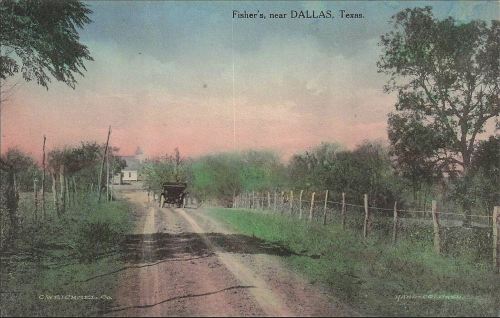
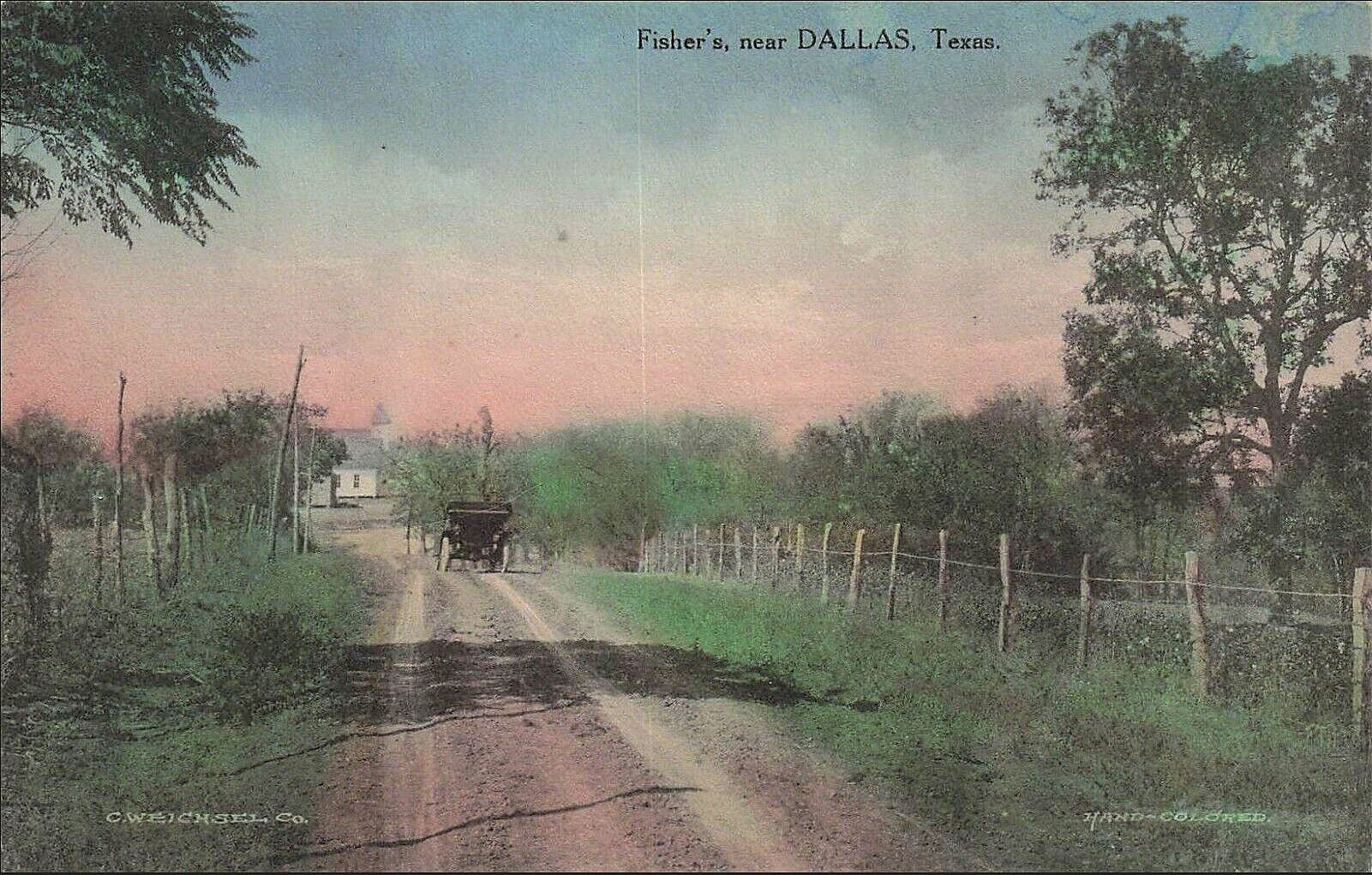
I’ve never seen this postcard before, and I’d never heard of Fisher’s (“near Dallas”).
W. R. Fisher’s Addition was in West Dallas, possibly bordered by what is now N. Edgefield, Fort Worth Avenue, Sylvan, and West Commerce (just below the old T & P railroad tracks). …I think. Lots of real estate transactions were going on in “Fisher’s” in the 1880s and ’90s, when West Dallas was its own community and before the area became part of Dallas.
*
This is a very pretty postcard. I just picked a random intersection on Google to see what the general area looks like now. It’s mostly built-up, of course, but here’s a very attractive view, at Seale and Obenchain here (Jan. 2024).
As far as what looks like a church in the distance — it might be the West Dallas Christian Church (later the Western Heights Church of Christ), which was affiliated with West Dallas Cemetery (later Western Heights Cemetery), where William R. Fisher is buried, along with many members of the family of his first wife, Mary Coombes/Coombs, a familiar name in the settlement of the area.
Dallas Morning News, Oct. 19, 1900
*
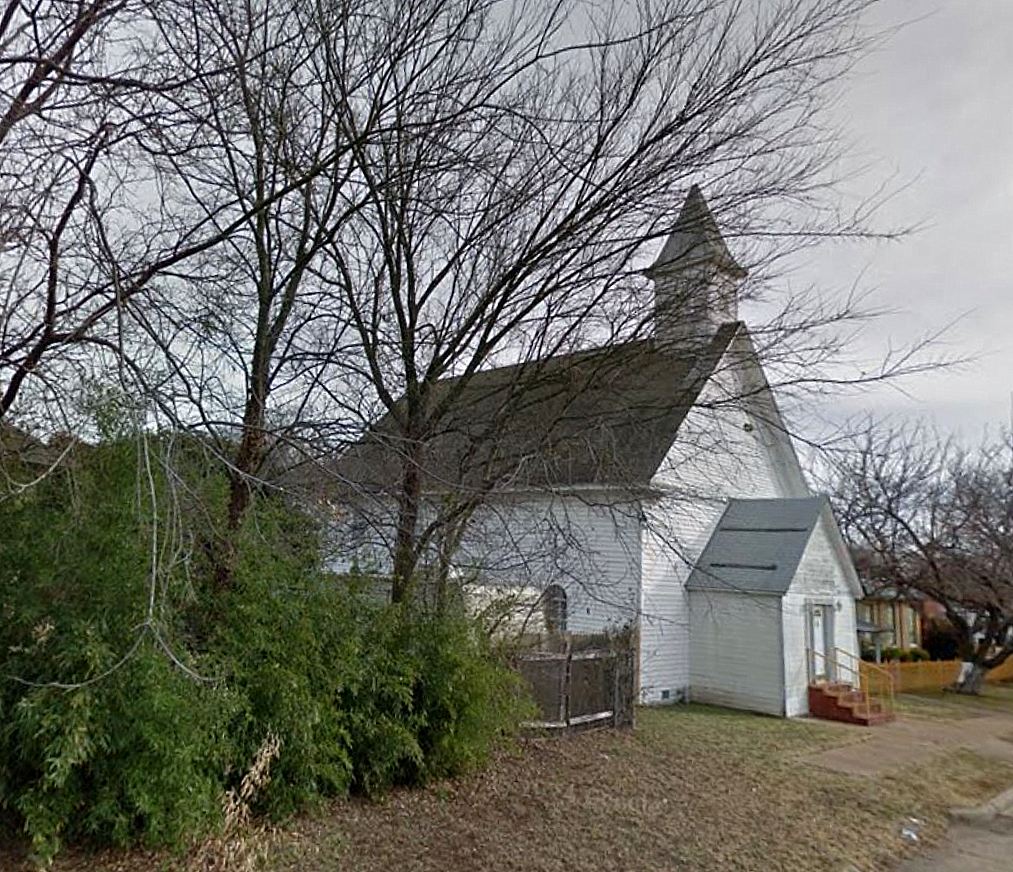
UPDATE: Thanks to reader Linda Donnelly for sending a link that shows this same view these days — with the same church in it! See the Google Street View here. Here’s the church up close (see it on Google Street View here). (1900 block of N. Winnetka, just off Stafford.)
The former West Dallas Christian Church was built around 1890 and has a historical marker, which was placed at the site in 1972, when it was the Western Heights Church of Christ.
***
Sources & Notes
Early-20th-century postcard by Weichsel found on eBay.
Image showing William R. Fisher’s Homestead Subd. (out of the Wm. Coombs’ Survey) is from the Murphy and Bolanz block book scanned by the Dallas Public Library and available online, here.
Read about W. R. Fisher in the History of Dallas County, here.
I saw this photo in a 1955 booklet called Public Transportation in Dallas and loved the neat-as-a-pin Oak Cliff street, its manicured, chilly starkness accentuated by the leafless trees. It’s also a needed reminder — as we’re dragged into August — that someday we’ll (probably) have autumn and winter again.
See what this view looks like today, on Google Street View, here.
***
Sources & Notes
Photo from and cover of the slim booklet Public Transportation in Dallas (1955), Dallas History and Archives, Dallas Public Library.