Flashback : Dallas

A Miscellany: History, Ads, Pop Culture

Tag: Dallas TX

Albert Einstein “Threw the Switch” in New Jersey to Open the Pan-American Exposition in Dallas — 1937
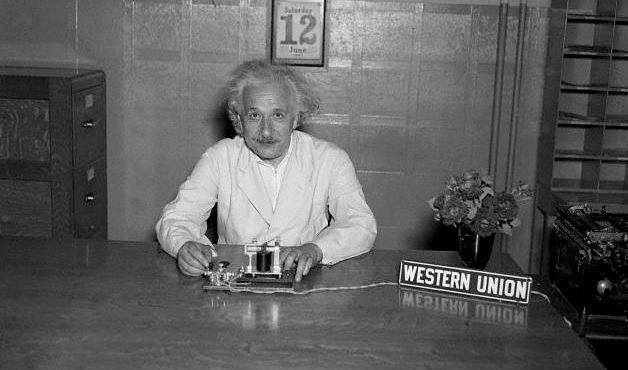
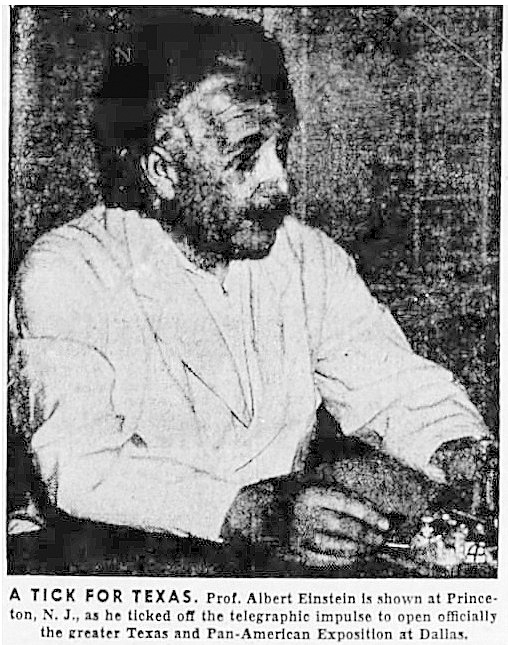
pan-american-expo_einstein_061237Einstein at the switch, June 12, 1937…

by Paula Bosse

Who knew? Albert Einstein, the world’s most famous physicist, helped open the Greater Texas and Pan-American Exposition. The exposition was held at Fair Park for 20 weeks, from June 12, 1937 to October 31, 1937, as a follow-up of sorts to the Texas Centennial (the city had built all those new buildings — might as well get their money’s worth!). I’m not quite sure how Einstein got roped into this, but looking at the photo above, he seemed pretty happy about what was, basically, a long-distance ribbon-cutting. Via telegraph.

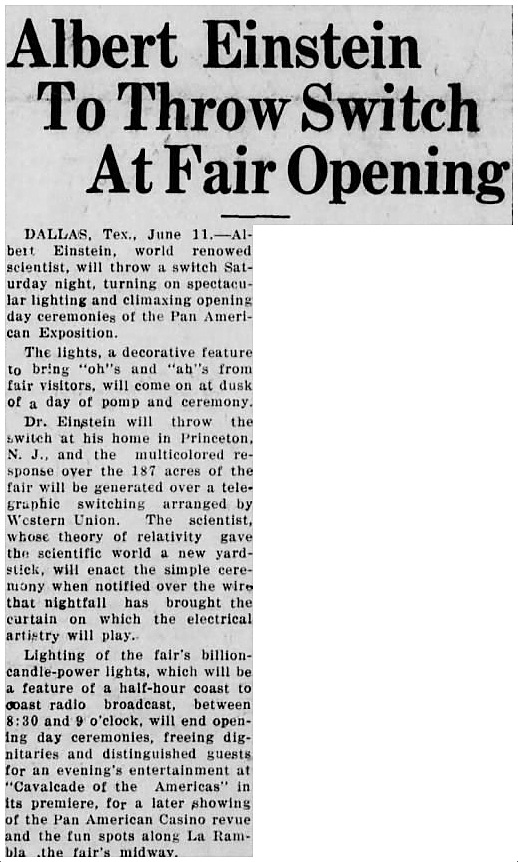
The plan was for Professor Einstein to officially open the Pan-American Exposition by “throwing the switch” which would turn on massive displays of lights around Fair Park. He would do this from Princeton, New Jersey, where he lived, by closing a telegraph circuit which would put the whole thing in motion. Newspaper reports varied on where exactly Herr Einstein was tapping his telegraph key — it was either the study in his home, in his office, in a Princeton University administration building, or in the Princeton offices of Western Union (the latter of which was mentioned in only one report I found, but it seems most likely).

Einstein was a bona fide celebrity, and this was national news — newspapers around the country ran stories about it, and the ceremony was carried live on coast-to-coast radio. Almost every report suggested that Einstein’s pressing of the key in New Jersey would be the trigger that lit up the park in Texas, 1,500 miles away — which was partly correct. According to The Dallas Morning News:

Lights on the grounds will be turned on officially at 8:40 p.m. when Dr. Albert Einstein, exponent of the theory of relativity, presses a key in his Princeton home to fire an army field gun. With the detonation of the shell, switches will be thrown to release the flood of colored lights throughout the grounds. (DMN, June 10, 1937)

So on June 12, 1937 he pressed a telegraph key somewhere in Princeton, NJ, an alert was instantly wired to Dallas, an army field gun (in some reports a “cannon”) was fired, and that blast was the cue for electricians positioned around the park to throw switches to illuminate the spectacular displays of colored lights.

The Western Union tie-in gimmick was a success. Newspaper reports might have been a little purple in their descriptions, but from all accounts, those lights going on all at once was a pretty spectacular sight.

Dr. Albert Einstein, celebrated scientist, threw a switch that flashed a million lights over the 187-acre exposition park. The flash came at 8:40 o’clock and instantly the huge park became a city of a million wonders. Flags from a thousand staffs proclaimed their nationality [and] bands played the national airs of the nations of the Western Hemisphere as lusty cheers roared with thunderous approval. The Greater Texas and Pan-American Exposition was formally opened. It is on its way. (Abilene (TX) Reporter News, June 13, 1937)

The Dallas News describes the crowd as stunned into silence:

The waiting participants in the ceremonies at Dallas heard the results [of Einstein’s telegraph signal] when a cannon boomed. Electricians at switches around the grounds swung the blades into their niches and the flood of light awoke the colors of the rainbow to dance over the 187-acre park. Its breath taken by the spectacle, the crowd stood silent for a moment, and then broke into a cheer. (“Pan-American Fair Gets Off to Gay Start” by Robert Lunsford, DMN, June 13, 1937)

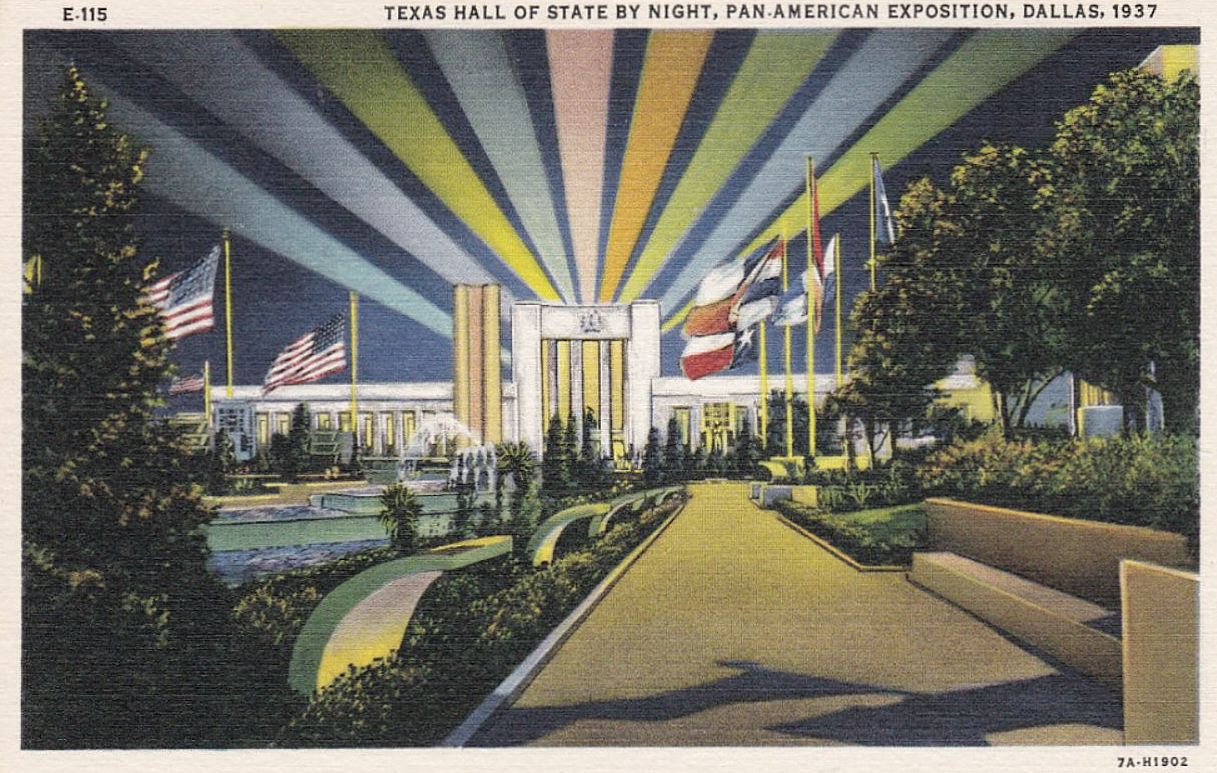
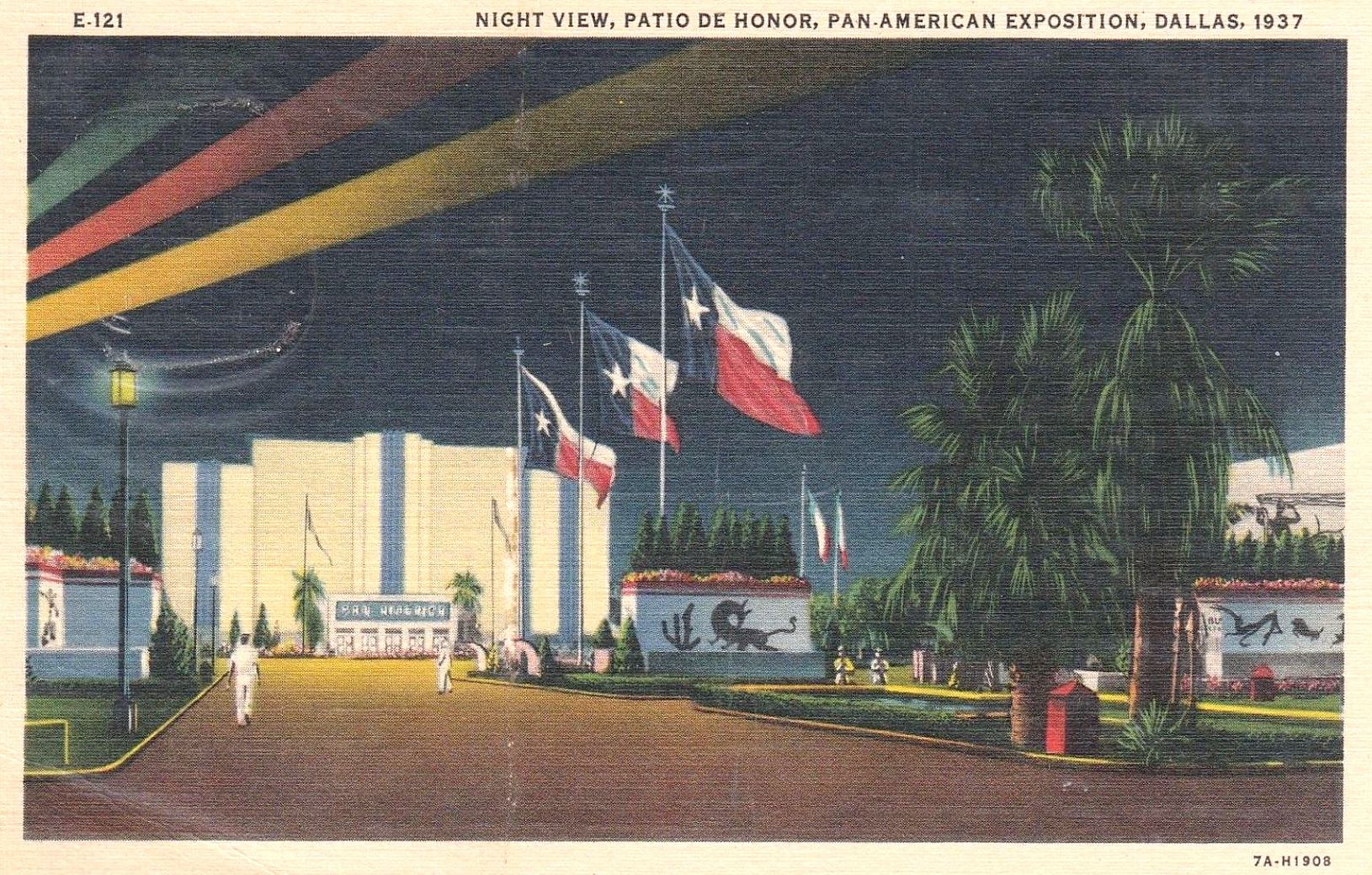
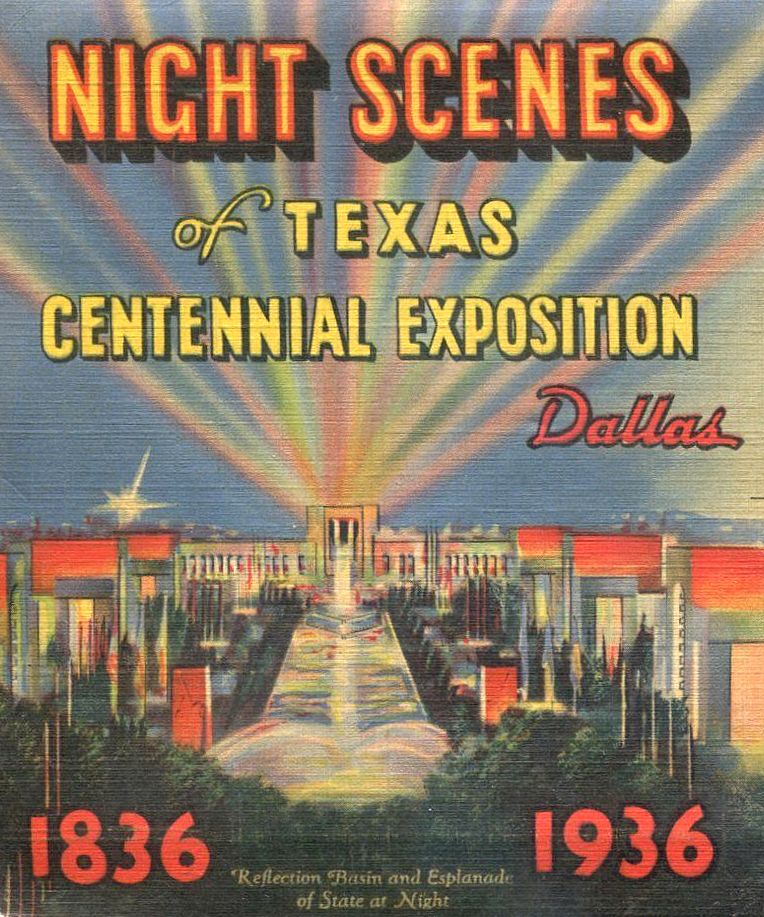
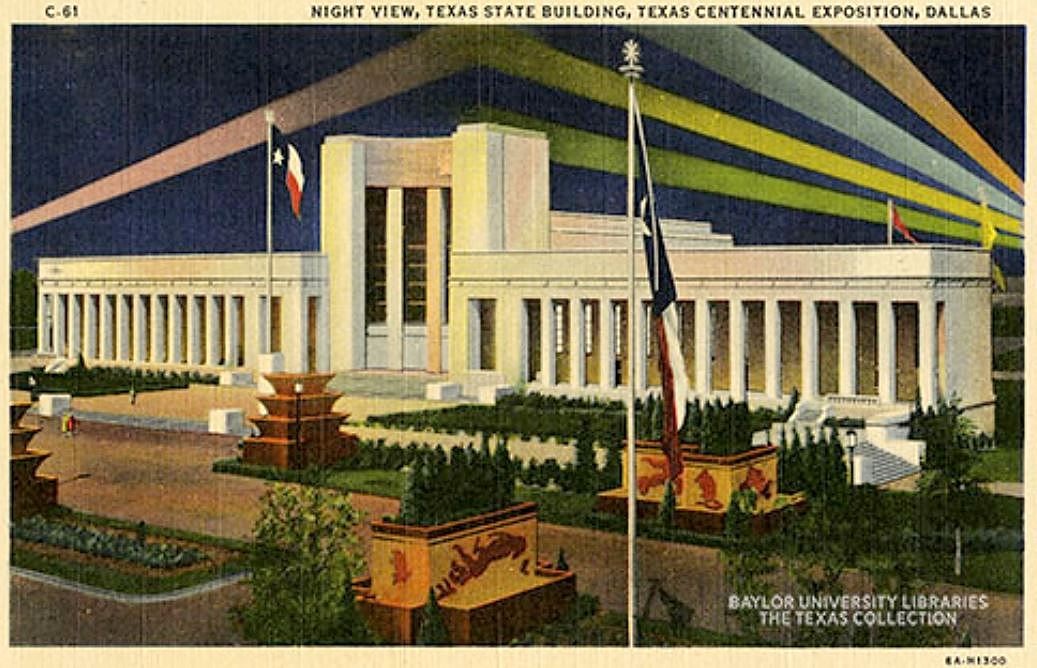
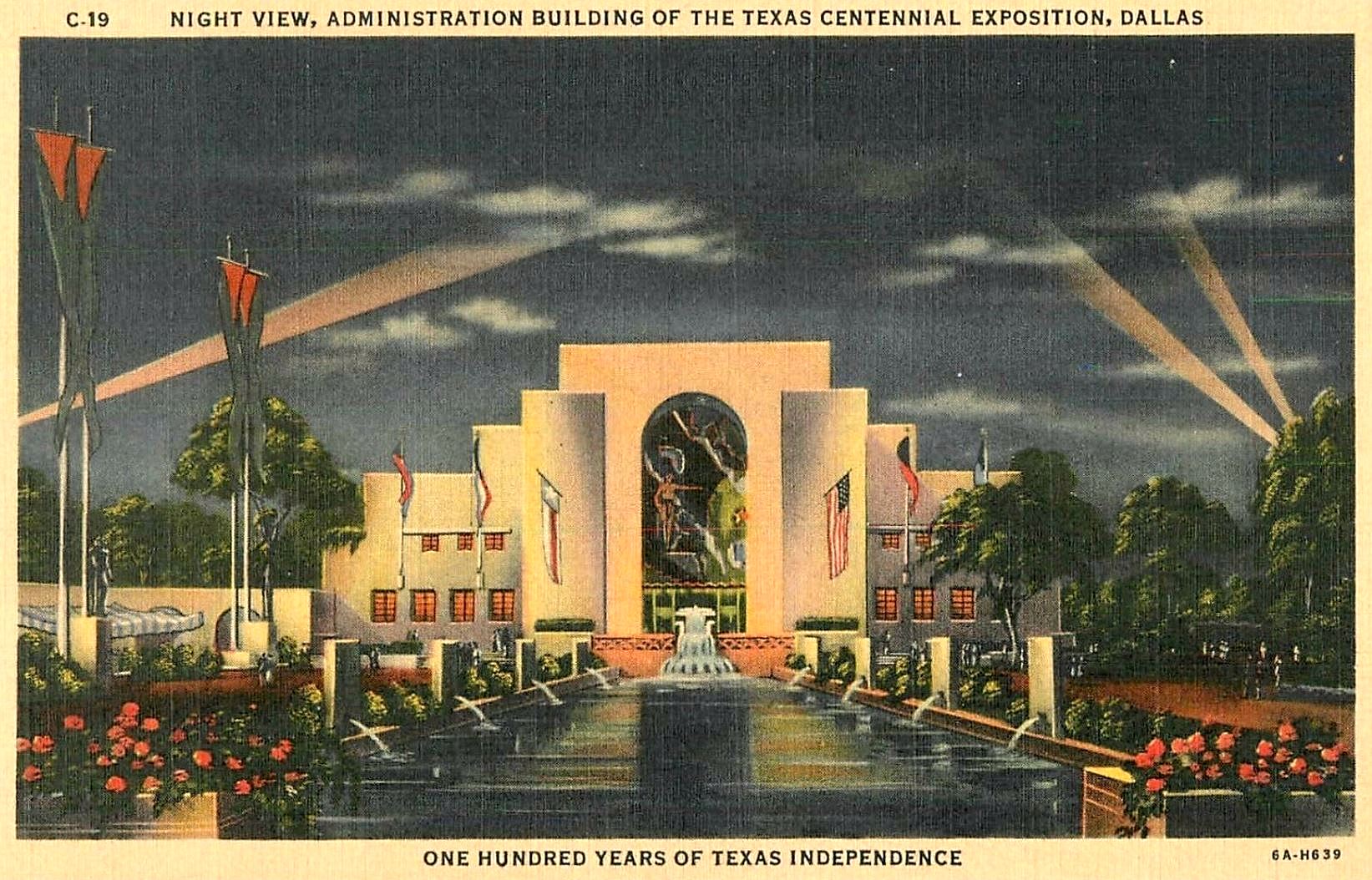
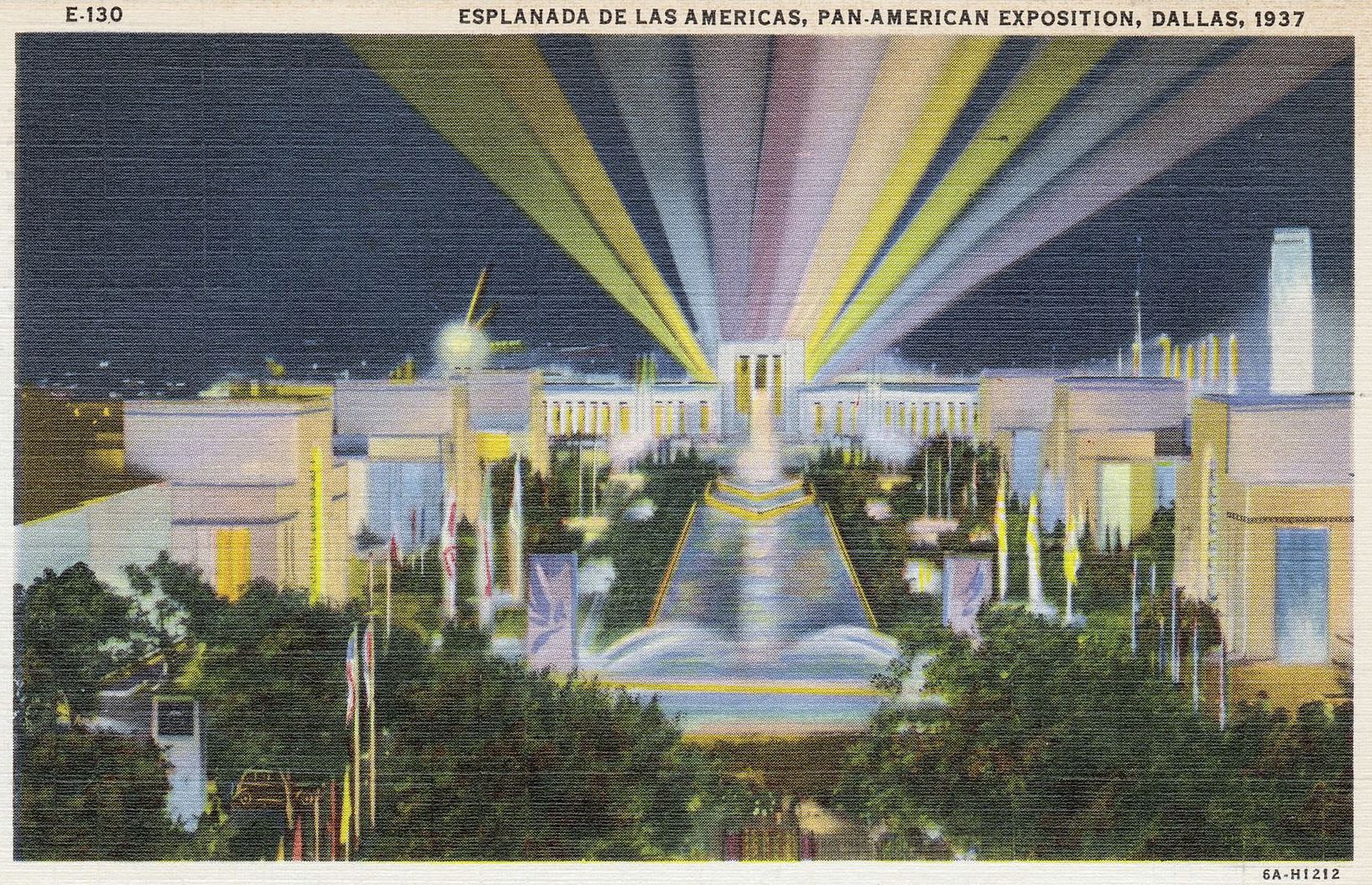
Many of the lighting designs and displays had been used the previous year during the Centennial, but, as with much of the attractions and appointments throughout the park, they were improved and spectacularized for the Pan-American Expo. And people loved what they saw.

Despite the multi-million dollar structures, air conditioning demos, works of art and other newfangled additions to the space, when people left the Centennial Exposition one thing was on everyone’s tongues, according to historical pollsters: the lights.

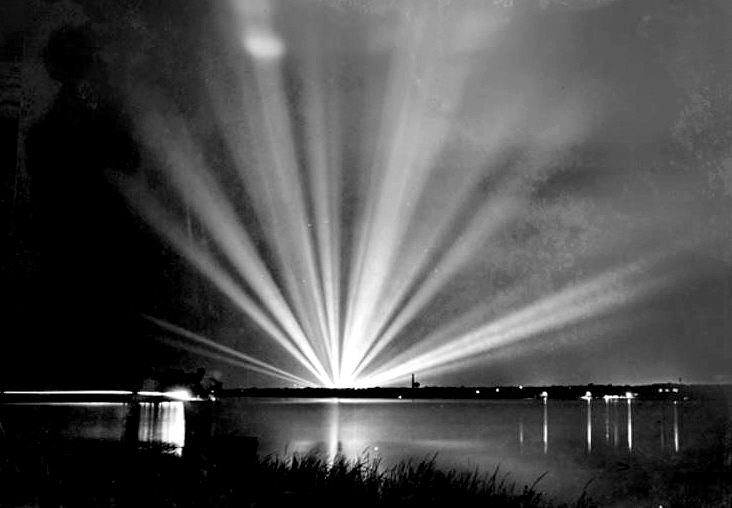
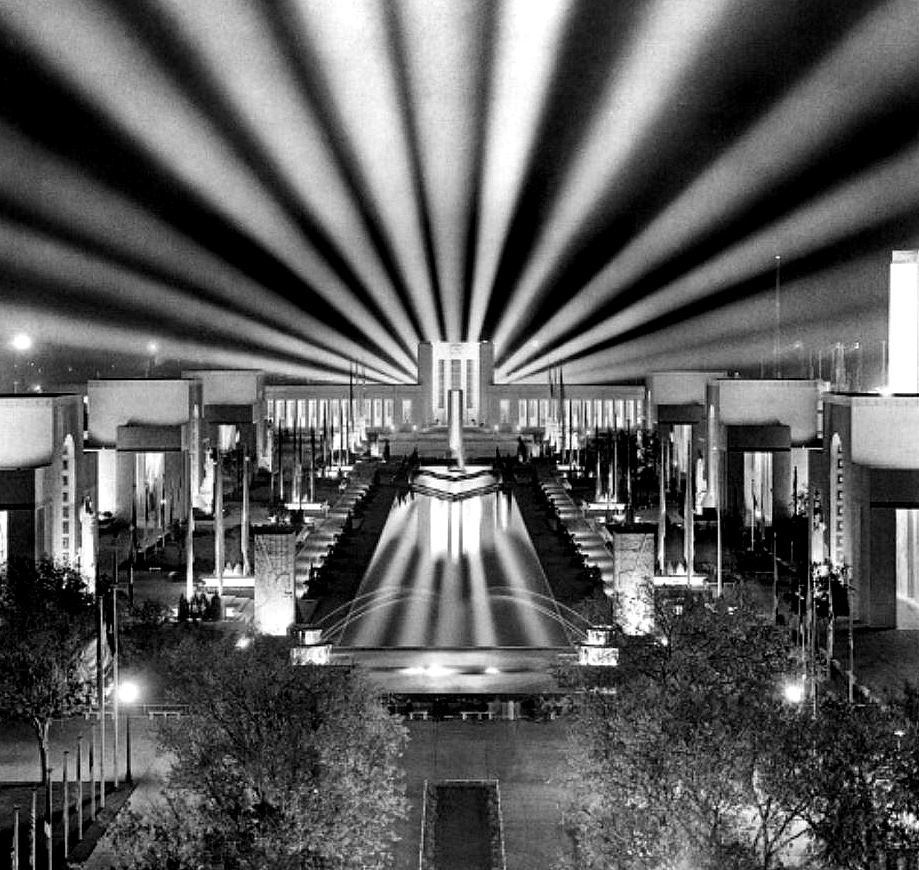
Positioned behind the Hall of State were 24 searchlights scaffolding into a crowned fan shape. “They all moved and were different colors,” says [Jim] Parsons [co-author of the book Fair Park Deco]. “It sounds gaudy, but people loved it.” The lights, he goes on to tell, were visible up to 20 miles away.

Considering most of the people who were visiting the fairgrounds were coming from rural farming communities with no electricity, the inspiring nature of those far-reaching beams makes a lot of sense. (Dallas Observer, Nov. 7, 2012)

Thanks for doing your part for Dallas history, Prof. Einstein!
pan-american-expo_esplanade_postcard

pan-american-expo_hall-of-state_postcard

pan-american-expo_patio-de-honor_ebay

Below, photos from the Texas Centennial, 1936. The multicolored lights could be seen from miles away — here’s what they looked like from downtown and from White Rock Lake.
centennial_pan-american_lights

skyline_downtown-to-fair-park_1936_GE-colln_museum-of-innovation-and-science

fair-park-lights_white-rock-lake

tx-centennial_night-scene_espalanade_hall-of-state_lights_ebay

tx-centennial_night_hall-of-state_lights_flickr_baylorvia Baylor University Flickr stream

tx-centennial_night_administration-bldg_lights_ebay

*

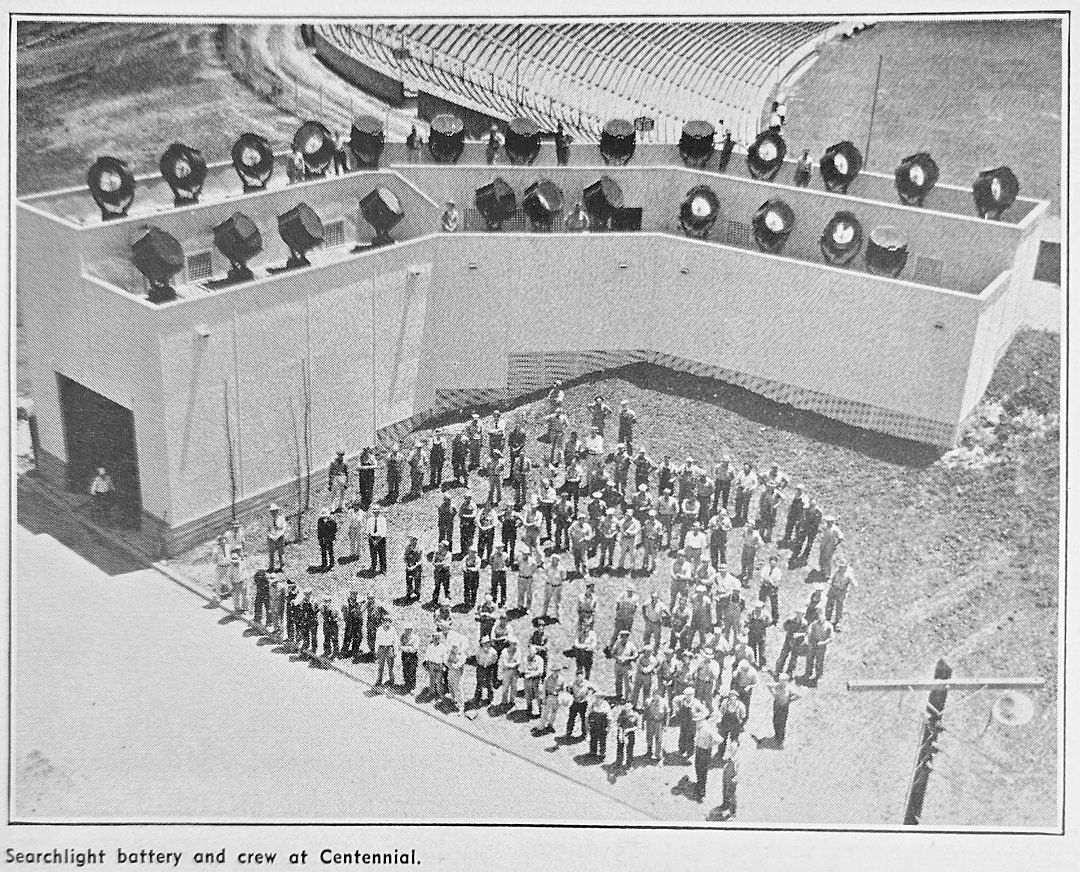
A look behind the scenes: “The general lighting effect is a battery of twenty-four 36-inch searchlights as powerful as the giants that flash from the dreadnoughts of Uncle Sam’s navy. Each searchlight will produce 60 million candlepower. Combined, the battery has a total candlepower of 1.5 billion. A 350,000-watt power generator will produce this colossal quantity of ‘juice.’” And the accompanying photo of the searchlight battery crew manning the candlepower:
tx-centennial_lights_southwest-business-mag_june-1936_photoSouthwest Business, June 1936

**

(All pictures and clippings are larger when clicked.)
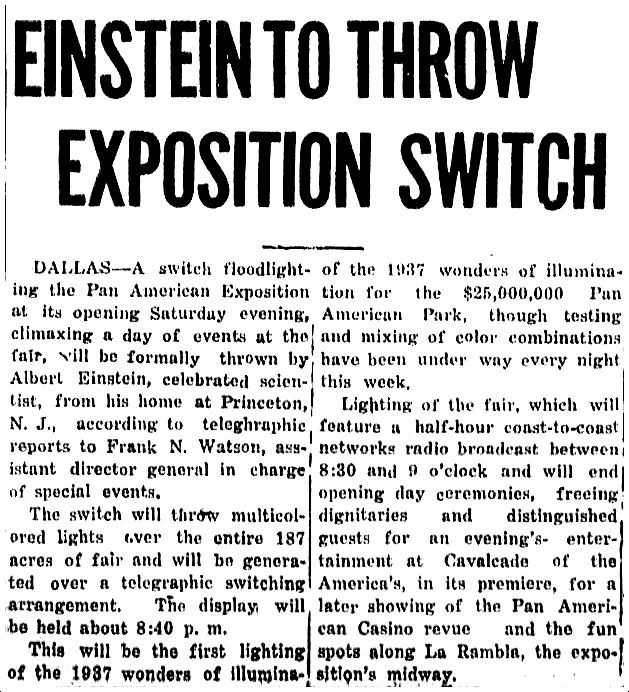
einstein_pan-am-expo_denison-press_060937
Denison Press, June 9, 1937

*

einstein_pan-am-expo_waxahachie-daily-light_061137
Waxahachie Daily Light, June 11, 1937

*
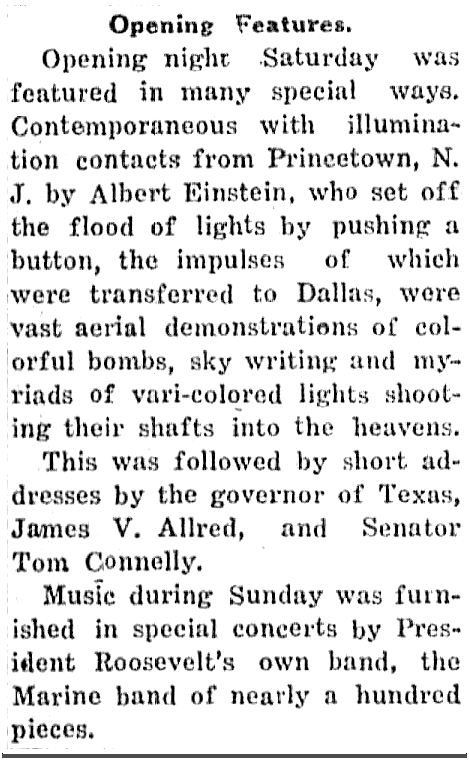
einstein_pan-am-expo_denison-press_061437
Denison Press, June 14, 1937

*

einstein_pan-am-expo_medford-oregon-mail-tribune_062337
Medford (Oregon) Mail Tribune, June 23, 1937

*
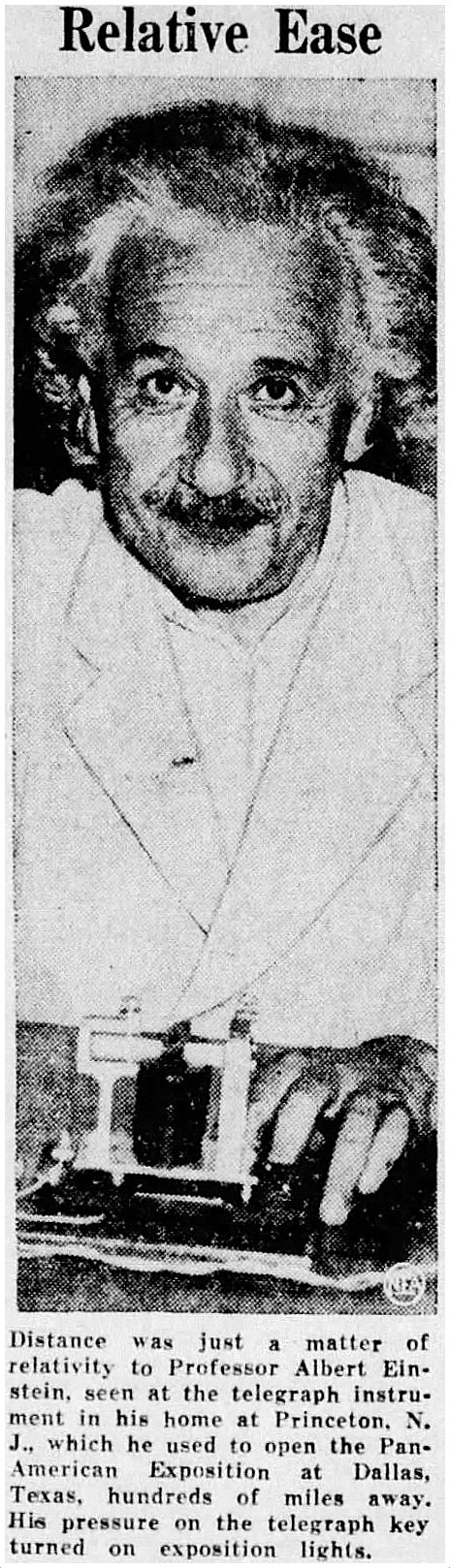
einstein_pan-am-expo_vernon-daily-record_062437
Vernon Daily Record, June 24, 1937

*

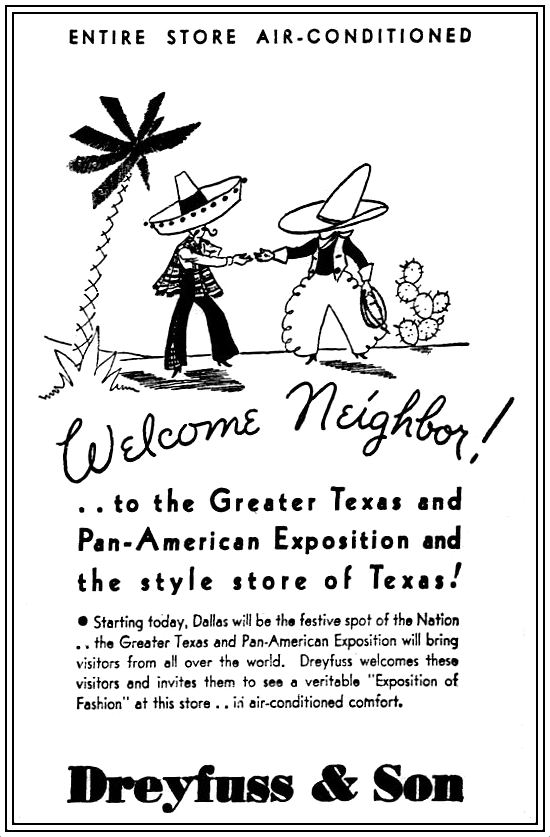
pan-american-expo_drefuss-ad_dmn_061237
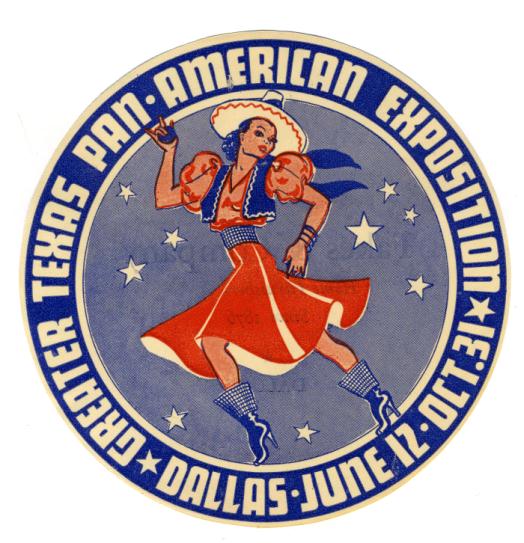
1937

pan-american-expo_sticker_1937_cowgirl

***

Sources & Notes

Top photo from the old Corbis site.

Black-and-white photos from the Centennial seen from Fair Park and White Rock Lake are from the Texas/Dallas History and Archives Division of the Dallas Public Library; the photo of the lights seen from downtown Dallas (titled “New skyline at night from Dallas, Texas”) is from the GE Photo Collection, Museum of Innovation and Science (more info on that photo is here).

Sources of other images and clippings cited, if known.

More on the Pan-American Exposition from Wikipedia, here, and from the fantastic Watermelon Kid site of all-things-Fair-Park, here.

*

Copyright © 2016 Paula Bosse. All Rights Reserved.

Traffic at Ross and Pearl — 1920s

ross-and-pearl_galloway_park-citiesLooking northeasterly on Ross from N. Pearl (click for larger image)

by Paula Bosse

The photo above shows the intersection of Ross and Pearl. The streetcar tracks ran along Pearl. We’re looking northeasterly on Ross. To the left, out of frame, would be the Sacred Heart Cathedral (renamed Cathedral Santuario de Guadalupe in 1977). The photo comes from Diane Galloway’s wonderful book The Park Cities, A Photohistory. Her caption:

Traffic jams such as this one at Ross and Pearl Streets during the twenties encouraged Dallasites to pack up and move to newer developments away from the city.

With the crowd of people at the left, I think the traffic in this photo might have been caused by church-going motorists. The license plates on the cars seem to match those from 1927 and 1928 (links to license-plate-dating sites at bottom of post).

That impressive house at the top left with the pointed turret? At the time of this photograph, it was the George A. Brewer Undertaking Company. Like the two-blocks-away Belo Mansion, which was converted into the Loudermilk-Sparkman funeral home in 1926 (seen here), this spectacular house was once a private residence. It was built by Charles F. Carter (1848-1912), a wealthy cotton merchant, sometime between 1892 and 1895. It took up a huge lot at what is now the northeast corner of Ross and Crockett (see it at the bottom left of the 1921 Sanborn map, here). Here’s what the house looked like, circa 1894. (All pictures are larger when clicked.)

carter-house_church_dallas-through-a-camera_ca-1894_SMU

And, below, you can just see part of the house in a 1910 photo of the new-ish Cathedral at the corner of Ross and Pearl.

 sacred-heart-cathedral_1910_dpl

In 1920 or ’21 the Brewer Undertaking Co. moved into this house at 2303 Ross Avenue and operated as one of the city’s most prominent funeral homes until 1931 when they moved into a new location farther down Ross. When Brewer moved out, the beautiful house was demolished. In its place … a used car lot. Argh. In 1940, Lone Star Olds (later Lone Star Cadillac) moved in, eventually bought up the whole block, and became one of Dallas’ legendary car dealerships. It moved from its Ross Avenue location in 1985.

lone-star-cadillac_ross-ave_squire-haskins_uta

*

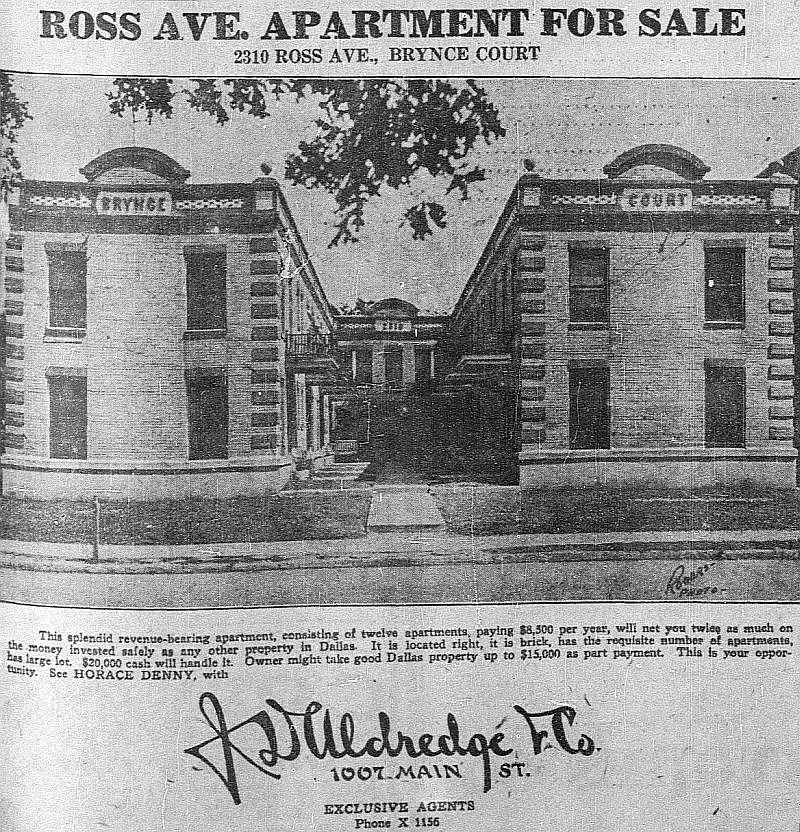
Also, even though it isn’t really visible in the top photo, across the street from the old Carter house — at 2310 Ross — was Brynce Court, a u-shaped apartment building. I haven’t been able to verify this, but The Dallas Morning News had a blurb about the “First Apartments” in the city which read as follows:

Dallas’ first apartment complex was a two-building development at 2310 Ross Ave. Built in 1919 [note: it appears to have been built in 1912], Brynce Court was the first set of apartments housed in more than one building.” (DMN, Jan. 7, 1984)

I mention this because it’s a cool little factoid, but also because I stumbled across a photo of it in an ad while looking for info on Lone Star Olds-Cadillac. So I have to show it. Surprisingly, this apartment block (which probably looked a lot less charming after fifty years) stood at that location until at least 1964.

brynce-court_dmn_051521
Dallas Morning News, May 15, 1921

brynce-court_dmn_042212
DMN, April 22, 1912

*

I always like to look at things in the background of old photos. Here’s an extremely blurry magnified detail from the top photo, showing a two-story building of shops and businesses at Ross and Leonard. Included in these businesses is the Imperial Drug Store — it’s a little hard to make out, but the vertical sign with white letters appears to read “DRUGS” (this building can be seen in the 1921 Sanborn map mentioned above).

ross-pearl_dallas-rediscovered_det

Below, the businesses and residences along Ross Avenue — between  N. Pearl and Leonard — from the 1927 Dallas directory.

ross-avenue_1927-directory

Ross and Pearl these days looks nothing like that top photo. See what the same view looks like today, via Google Street View, here. At least the Cathedral lives on.

***

Sources & Notes

Top photo from Diane Galloway’s book The Park Cities, A Photohistory (Dallas: privately published, 1989); from the collection of John Stull/R. L. Goodson, Jr., Inc., Consulting Engineers.

Photo of the C. F. Carter House is from the book Dallas, Texas Through a Camera, a collection of photos by Clifton Church.

Photo of the Cathedral of the Sacred Heart from the Dallas Public Library, taken in 1910.

(Cropped) photo of Lone Star Cadillac by Squire Haskins from the Squire Haskins Photography, Inc. Collection, University of Texas at Arlington Special Collections; more info is here (click thumbnail on UTA page to see much larger image).

Info on dating Texas license plates can be found here (PDF), here, and here. (If the first link doesn’t open, Google “The History of Texas License Plates.” It’s a report issued by the Texas Department of Transportation. It’s 255 pages long (!) and it’s exhaustive!)

Click pictures to see larger images.

*

Copyright © 2016 Paula Bosse. All Rights Reserved.

The Haskell Exchange — ca. 1910

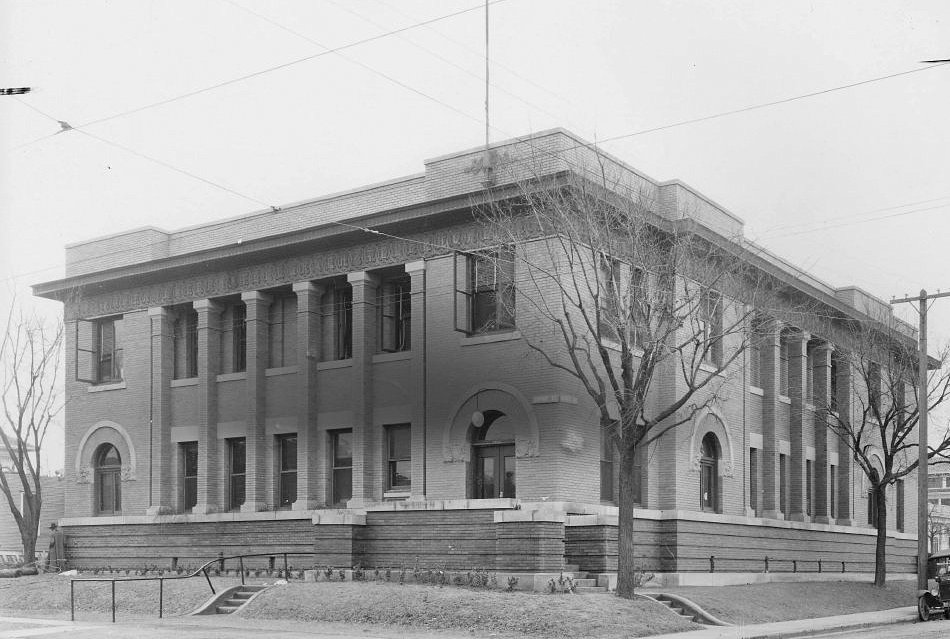
telephone_haskell-exchange_postmarked-1910_ebayThe switchboard hub in Old East Dallas… (click for larger image)

by Paula Bosse

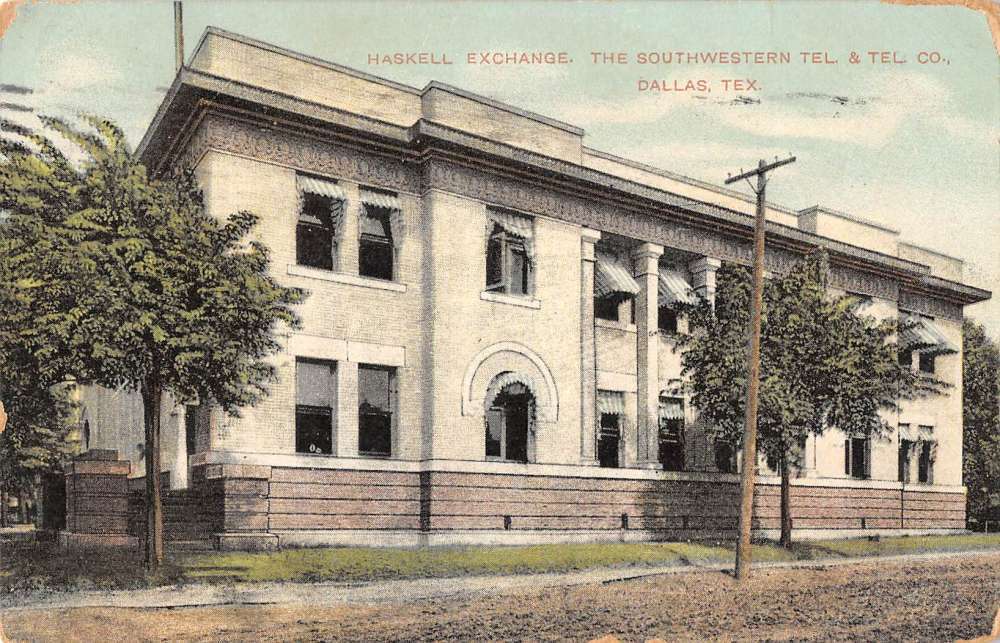
Above, the building that housed the Haskell Exchange of Southwestern Telegraph and Telephone (the company which later became Southwestern Bell Telephone and, eventually, part of AT&T), located at the southeast corner of Bryan and Haskell in Old East Dallas. It was so cute and quaint back in 1910 (the year this postcard was mailed). AT&T still has a building on this very same corner — over a century later. Unfortunately, the building stopped being quaint a long time ago. See the same location today, here. Some awnings might help….

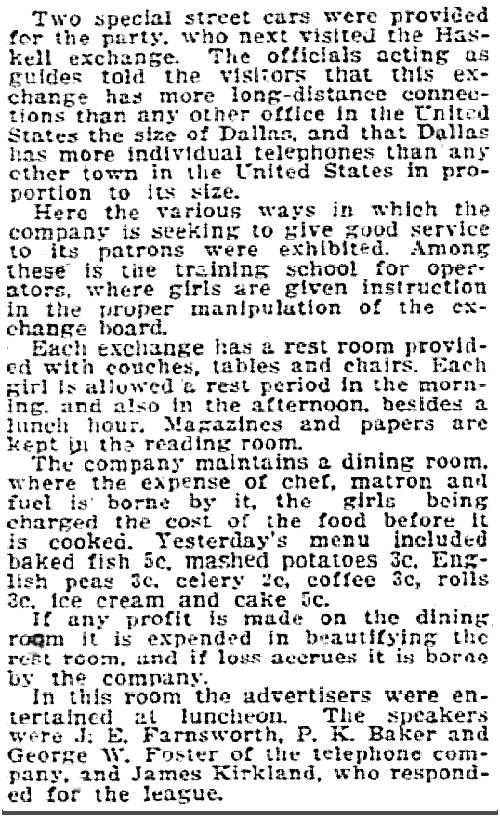
Below is part of an article describing a tour of the Exchange taken by the Dallas Advertising League in 1911 (click for larger image):

haskell-exchange_dmn_021111
Dallas Morning News, Feb. 11, 1911

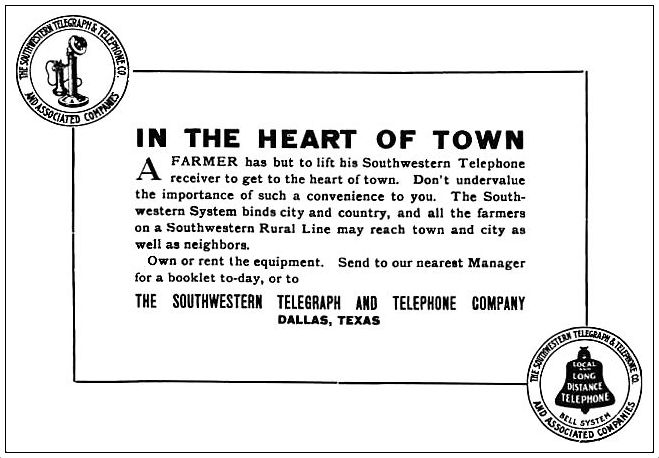
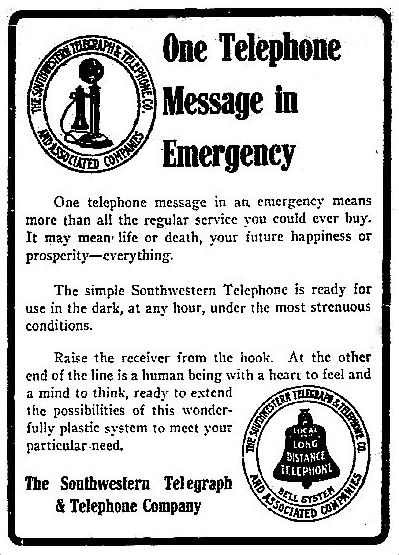
ad-southwestern-telephone-telegraph_1912
Cattle Raisers’ Association of Texas, 1912

ad-southwestern-telephone-telegraph_dmn_050212
DMN, May 2, 1912

haskell-exchange_ca-1915_DHSDallas Historical Society

***

Sources &  Notes

More about the operators of Southwestern Tel. & Tel. (with photos of their “rest room”) can be found in the Flashback Dallas post “Work and Play in Telephone Land,” here.

In this case “exchange” did not mean the same thing as telephone exchanges such as “Taylor,” “Emerson,” “Lakeside,” “Fleetwood,” “Riverside,” etc. Read more at Wikipedia here and here for the distinctions.

*

Copyright © 2016 Paula Bosse. All Rights Reserved.

What’s Playing at the Palace? — 1950s

elm-street_ten-commandments_1957_flickr_coltera.JPGFilm Row: Elm & Ervay, looking west… (click for large image)

by Paula Bosse

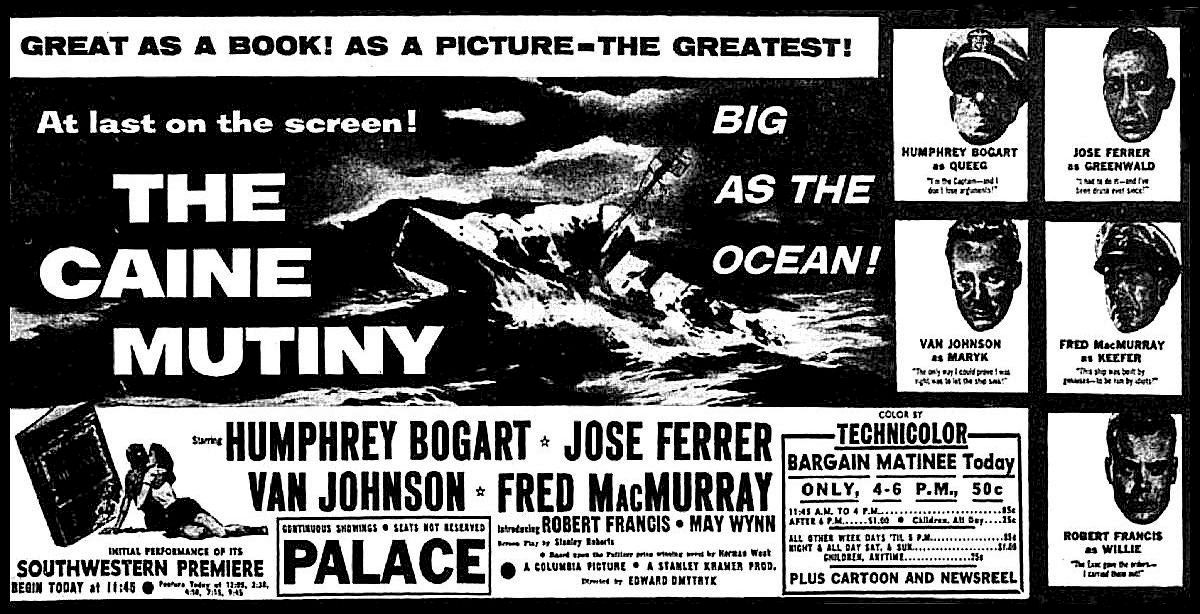
In the 1950s, the two prestige movie theaters in Dallas were the Majestic and the Palace, mainstays of “Theater Row” and just a few blocks apart on Elm Street. The Palace Theater (at Elm and Ervay, across from the Wilson Building) is seen in the two postcards featured here. The one above shows Elm Street looking west. “The Ten Commandments” is playing, placing the date that photo was taken sometime between February and May, 1957. The postcard below shows an eastward-looking view with “The Caine Mutiny” on the marquee, dating that photo to the latter half of July, 1954.

elm-street_looking_east_palace_night_flickr_coltera

“The Ten Commandments” was a huge, huge hit and ran for 11 weeks — no movie had ever run that long in the history of Dallas theaters (it had beat out the then-champ, “Sergeant York,” which had had a seven-week run at the Majestic in 1941).

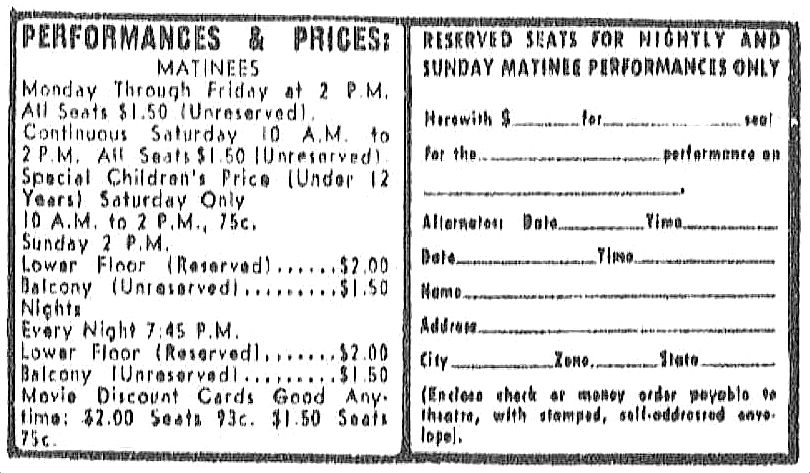
It was also one of the longest movies to ever play in Dallas. We’re talking a running time of almost 4 hours (with an intermission), something which not only tested the endurance of audiences but also severely limited the number of showings per day. It was an “event” picture, and, accordingly, prices were higher and reserved seats were offered.

ten-commandments_palace_dmn_021457_ad_det_reserved-seatsFeb., 1957

The number of people in Dallas who saw that movie at the Palace is staggering: over 100,000! Even after its run at the Palace ended, it continued to draw crowds when it moved down the street to the Tower.

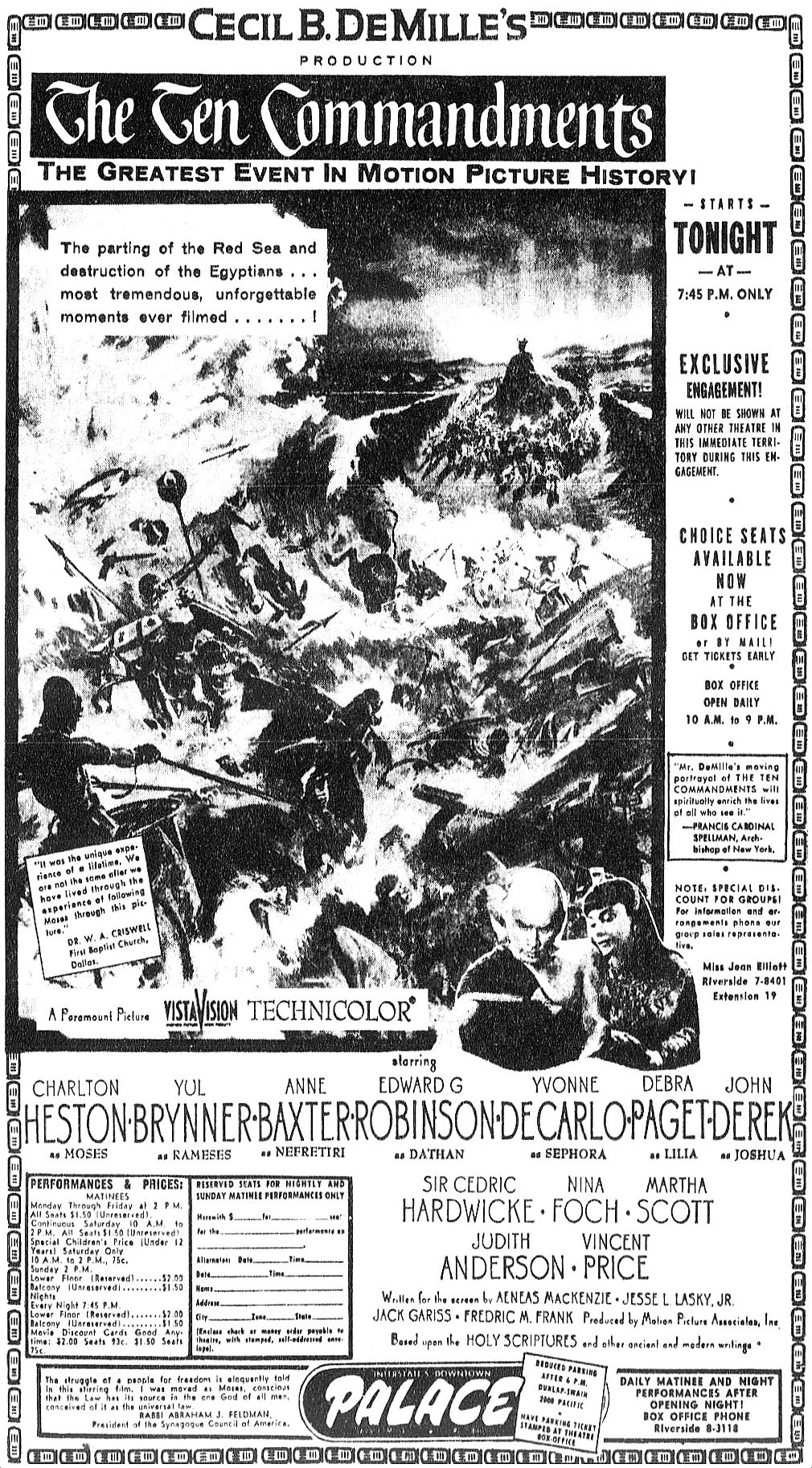
The opening-day ad for the movie:

ten-commandments_palace_dmn_021457_ad
Feb. 14, 1957

There were a couple of things I found interesting about this ad. One was that it had a blurb by First Baptist Church of Dallas’ chief Baptist,  W. A. Criswell.

ten-commandments_palace_dmn_021457_ad_det_criswell

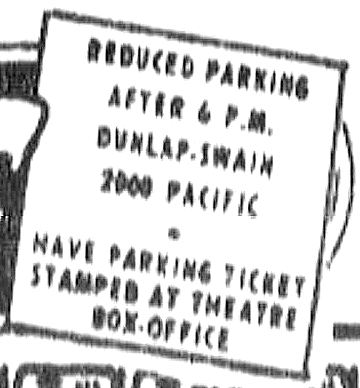
The second was that patrons could park behind the theater — on Pacific — at the Dunlap-Swain station. (Parking downtown for large crowds in those days must have been challenging —  not everyone took streetcars or, later, buses.)

ten-commandments_palace_dmn_021457_ad_det_parking

*

caine-mutiny_palace_dmn_071654_opening-nightJuly, 1954

***

Sources & Notes

Both postcards found on Flickr, posted by the unstoppable Coltera: the top one here, the bottom one here.

“The Ten Commandments” ran at the Palace Theater from Feb. 14, 1957 to May 2, 1957. The film that followed was “Boy On a Dolphin,” which featured the debut of super-sexy Sophia Loren in a U.S. movie. …Which is an interesting counterpoint.

“The Caine Mutiny” ran from July 16, 1954 to July 29, 1954.

A previous post about the Palace — “Next-Door Neighbors: The Palace Theater and Lone Star Seed & Floral — 1926” — can be found here.

Click pictures and clippings to see larger images.

*

Copyright © 2016 Paula Bosse. All Rights Reserved.


A Rainy Day at Main and Akard — 1932

main-akard_frank-rogers_011632_legacies_fall-2013Fedoras, cloches, umbrellas…

by Paula Bosse

A nice photo of a rainy day downtown, almost 85 years ago. The photo — taken on January 16, 1932 by Dallas photographer Frank Rogers — shows the intersection of Main and Akard (the people with umbrellas are crossing Akard Street, heading east). Marvin’s Drug Store (which occupied the ground floor of what was later known as the Gulf States Building) was on the northwest corner, and the A. Harris department store occupied the first five floors of the Kirby Building (originally the Busch Building) on the northeast corner — both buildings are still standing. See the view today, via Bing, here.

***

Sources & Notes

Photo from the Fall, 2013 issue of Legacies, viewable at the Portal to Texas History, here.

*

Copyright © 2016 Paula Bosse. All Rights Reserved.
From the Vault: The Terrill School’s Favorite Ice Cream Peddler — 1916

terrill_ice-cream_yrbk_1916-cacas

by Paula Bosse

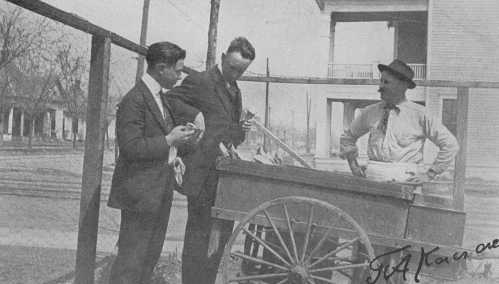
George Cacas was a Greek immigrant who peddled snacks to the prep school boys of The Terrill School in Old East Dallas 100 years ago (ice cream in the summer and popcorn in the winter). Read about him in my post from last year, “George Cacas, The Terrill School’s Greek Ice Cream Man — 1916.”

*

Copyright © 2016 Paula Bosse. All Rights Reserved.

The Sam Houston Zephyr Leaving Union Station, Crossing Over the Triple Underpass — 1950

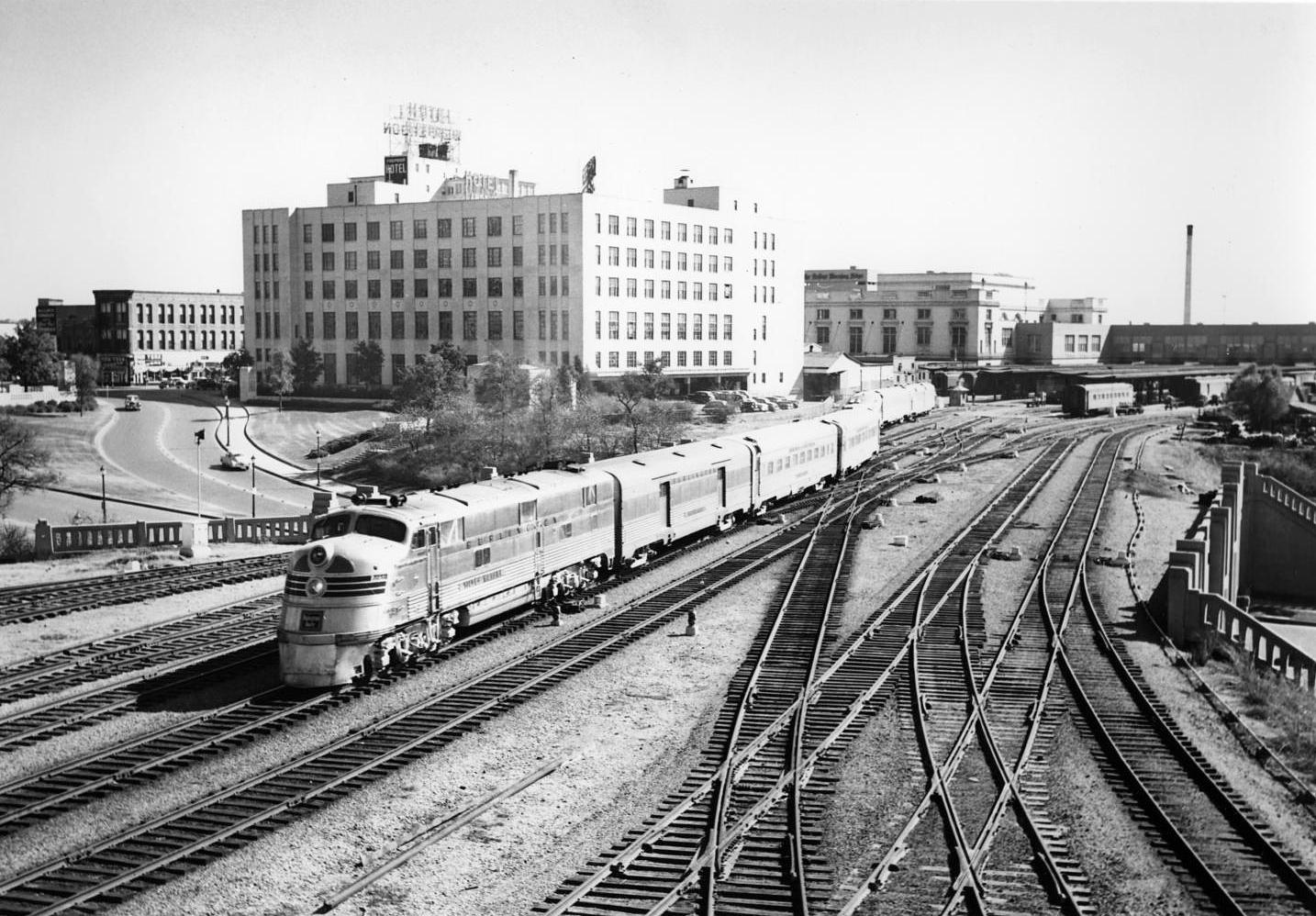
zephyr_triple-underpass_1950_portalThe SHZ heading out of Dallas… (click for larger image)

by Paula Bosse

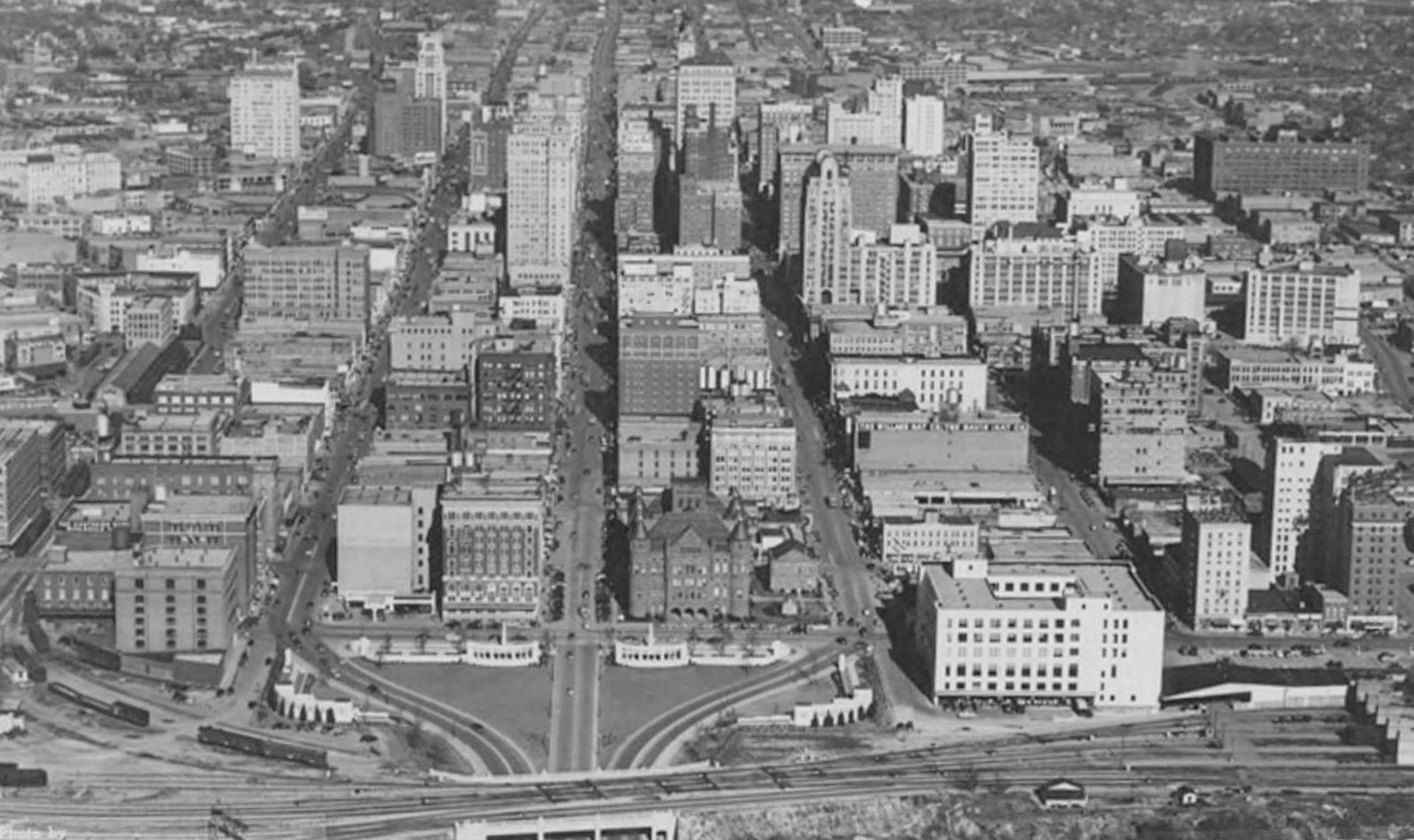
The title pretty much says it all. The Sam Houston Zephyr passenger train is seen crossing over the Triple Underpass, heading out of Dallas. Next stop: Fort Worth. The Post Office Terminal Annex is the tall white building, the Jefferson Hotel is behind it (with the sign on its roof), and Union Station is in the background, just right of center, with the Dallas Morning News building peeking over its roofline. The Old Red Courthouse would be out of frame to the left.

Below, a view of downtown from the west, with the Triple Underpass partially cut off at the very bottom, and Union Station just out of frame at the right.

downtown_aerial-photo-service_postcard_cook-collection_smu_cropped

In asking members of Facebook’s Texas Railroad History group about the top photo, Gerald Preas, one of the members, made this comment, full of interesting little tidbits (slightly edited by me):

The large building in the center is the USPO Terminal Annex. I started working there in August 1963. The buildings between TA and Union Station were part of Railway Express, used for sorting mail to and from RPO cars. That stack in back was the power station for Union Station — it had its own electric and water system, maybe sewage, too. I drank many times that cool sweet well-water. Notice cars around TA loading dock. I supervised that dock 1968/69 — we had to keep the area open. Now look where train is bending, people would park off ballast, but cars turning would swing out further and hit parked cars. That tree on the upper right led down grade to vacant parting lot. I was coming up that path when the President was shot.

***

Sources & Notes

Top photo shows the Fort Worth and Denver’s Sam Houston Zephyr train No. 4, northbound from Houston, leaving the Dallas Union Terminal Station, heading to Fort Worth. The photo was taken by Roger S. Plummer in 1950; photo from the Museum of the American Railroad, via UNT’s Portal to Texas History, here.

(Other photos of the Sam Houston Zephyr taken in Dallas — and one in Fort Worth — by Roger S. Plummer between 1949 and 1955 can be found on the Portal to Texas History site, here.)

Bottom image titled simply “Dallas, Texas” is an Aerial Photo Service postcard, from the George W. Cook Dallas/Texas Image Collection, DeGolyer Library, Central University Libraries, Southern Methodist University. I’ve edited the image a bit — see the original image and description here.

An aerial view of the same area today can be seen here, via Google.

A previous Flashback Dallas post on the stunningly beautiful Texas Zephyr can be found here.

Thanks to the members of the Texas Railroad History group on Facebook for their comments and help.

Both photos are larger when clicked.

*

Copyright © 2016 Paula Bosse. All Rights Reserved.


The 1957 Tornado, Seen From Old East Dallas

tornado_live-oak_040257_rusty-williams_dplThe view from Liberty & Live Oak… (click for larger image)

by Paula Bosse

Great shot of the historic Dallas tornado (which killed 10, injured at least 200, and left about 500 people homeless) as it was plowing through Oak Cliff and West Dallas on April 2, 1957, seen from the 2800 block of Live Oak.

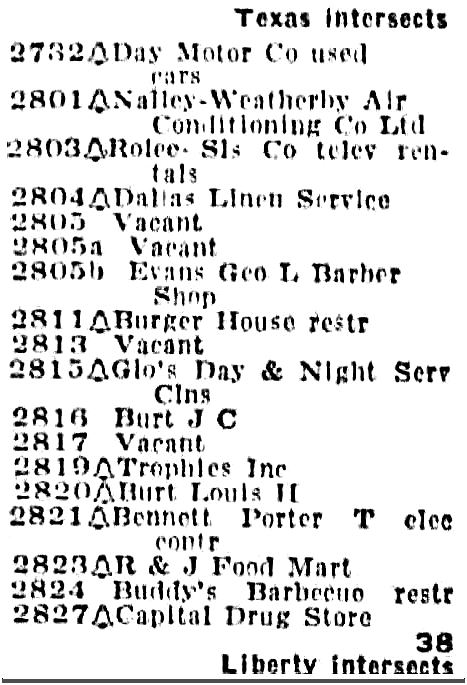
Aside from the tornado, this is an interesting view looking toward downtown, the Medical Arts Building, and the Republic Bank Building (that rocket must have been Dallas’ tallest lightning rod at the time!). The building containing the strip of businesses at the right still stands (I love these buildings — there are a lot of them in the older parts of town) — a present-day view can be seen on Google, here. What stood out to me was a Burger House — I didn’t know of any other than the one on Hillcrest, but this one stood at 2811 Live Oak from 1950 or ’51 until about 1976.

Below, the businesses in the 2800  block of Live Oak — between Texas and Liberty — from the 1956 city directory (click for larger image):

live-oak_1956directory

***

Sources & Notes

Top photo from the book Historic Photos of Dallas in the ’50s, ’60s, and ’70s by Rusty Williams (Nashville: Turner Publishing Company, 2010); from the collection of the Dallas Public Library.

Film footage of the tornado can be found in several videos on YouTube, here.

One of the newspaper reports on the tornado which captures the terror felt by those in the twister’s path and is well worth reading in the Dallas Morning News archives is “‘Roar of Thousand Trains’ Precedes the Killer Funnel” by James Ewell (DMN, April 3, 1957). Of particular interest is the story of T. M. Davisson who hid with a customer in a large empty steel tank on his property.

A previous Flashback Dallas post — “Tornado As Learning Tool — 1957” — is here.

Photo and clippings are larger when clicked.

*

Copyright © 2016 Paula Bosse. All Rights Reserved.


Knox Street Fire — 1961

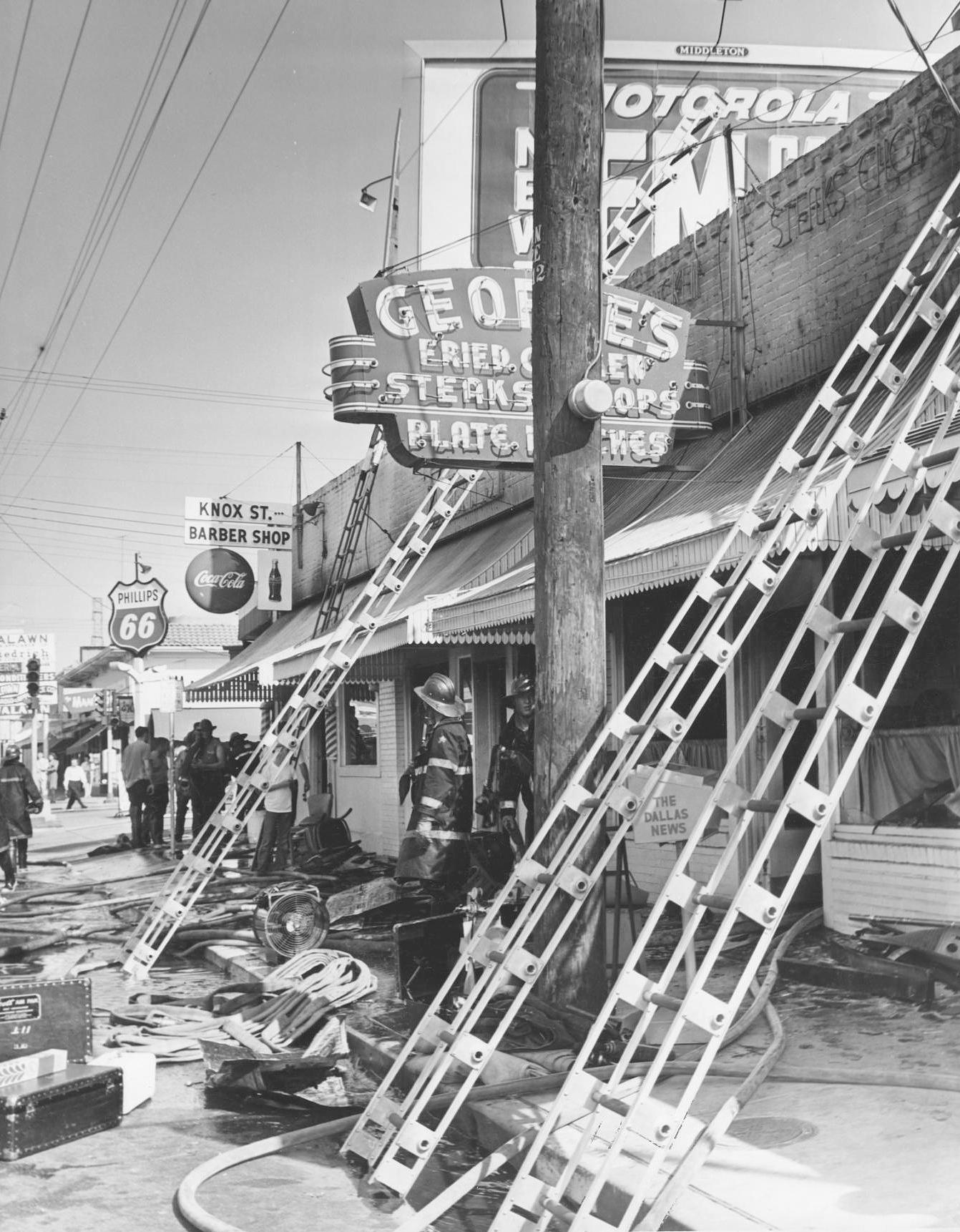
knox-street-fire_3100-block_052161_unt_portal_dallas-firefighters-museum3100 block of Knox, after a 4-alarm fire…

by Paula Bosse

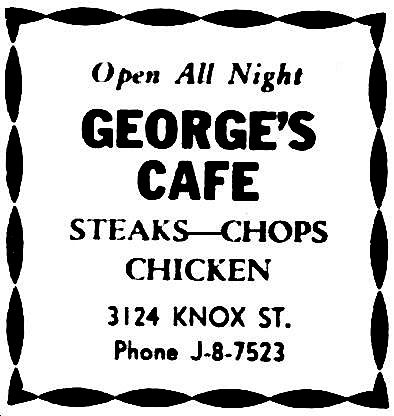
I often run across photos that aren’t particularly historical, but they’re interesting because they show a part of town with which I’m familiar, but which looks very different today. The photo above shows the 3100 block of Knox Street, between McKinney and Cole, looking toward Cole (seen at the stoplight). It shows the aftermath of a 4-alarm fire that broke out on May 21, 1951 and destroyed three businesses: George’s Cafe (at 3124 Knox), the Knox Street Barber Shop (3128 Knox), and Foster’s Food Store (3122 Knox) — the building housing these business survived, but it is long-gone; the land is now occupied by On The Border.

There were no fatalities at the scene, but, sadly, Charles William Layne, a 13-year-old neighborhood boy who suffered from a heart condition, collapsed while running to see what the commotion was and later died.

I looked up one of the businesses affected by the fire: George’s Cafe, owned by George Bartlett, who opened the business at 3124 Knox in 1937. Apparently those early days were difficult, and Bartlett barely kept the business afloat. The only thing that seemed to keep him going was the fear of losing the money his widowed mother had loaned him after she had mortgaged her home. A heartwarming rags-to-riches article about Bartlett appeared in the pages of The Dallas Morning News (“Shot at the Moon” by Kenneth Foree, DMN, Nov. 28, 1946).

Digging a bit, I saw that Bartlett had tried to sell the cafe several times but never seems to have found a buyer. The for-sale ads stopped after 1964. The last appearance of the cafe in the Dallas directory was in 1965. Bartlett died in 1966.

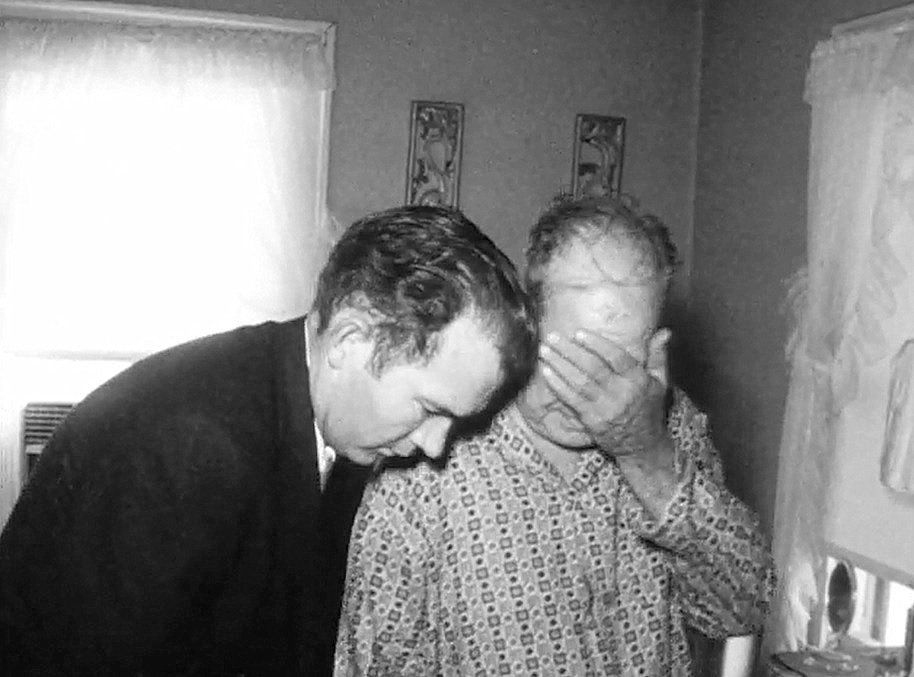
But Bartlett wasn’t kidding when he was interviewed by Kenneth Foree in that Dallas News article: it was very hard making money running the place. So hard, in fact, that in order to keep from going under, he had to take on a side job: he became a bookie, taking bets on basketball games, football games, and horse races. He was arrested twice (in 1959 and 1963) and spent 90 days in jail after being convicted on book-making charges. When arrested in 1963 after having been caught flushing receipts down the toilet as the vice squad broke down his door (a case which was later no-billed), the 57-year-old Bartlett told the arresting officer, “I just can’t make any money in the cafe business” (“Bookmaking Raid Nets Two Arrests” by Hugh Aynsworth, DMN, Nov. 17, 1963). He was shown in a news photo wearing handcuffs and pajamas. Oh, George. What would your mother have said?

UPDATE: I stumbled across news footage from 1963 of poor George on the worst day of his life, described above: in it, he is seen being arrested on camera — in his pajamas — after vice cops raided his East Dallas home. He has a black eye, which he sustained when cops caught him attempting to flush evidence. You can watch the short, silent video here — and you can read the news script which would have been read by the news anchor over the footage, here (it will explain those loaves of bread). Below is a screen shot.

bartlett-george_bookie-raid_nov-1963_WBAP_portalKXAS-NBC 5 News Collection, UNT

**

georges-cafe_dmn_062245
June 22, 1945

Below, the businesses in the 3100 block of Knox Street at the time of the fire. The businesses that burned were located in a building torn down many years ago and replaced by On The Border (the view today is here).

knox-street_3100-block_1962-directory
1962 Dallas directory

***

Sources & Notes

The photo at the top is from the Dallas Firefighters Museum collection, via the Portal to Texas History — more info is here.

Screen shot of George Bartlett is from footage shot on Nov. 16, 1963, from the KXAS-NBC 5 News Collection, UNT Libraries Special Collections, via the Portal to Texas History.

*

Copyright © 2016 Paula Bosse. All Rights Reserved.
Thanksgiving, 1891: The First Turkey-Day Football Game in Dallas

thanksgiving-card_pinterest_sm

by Paula Bosse

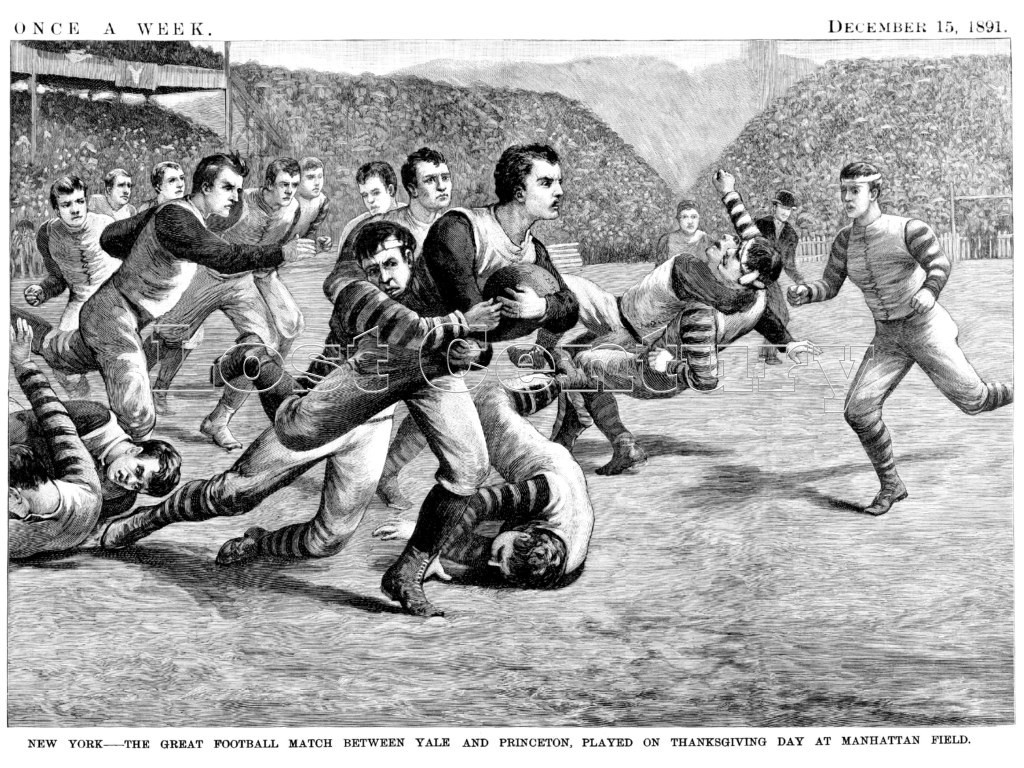
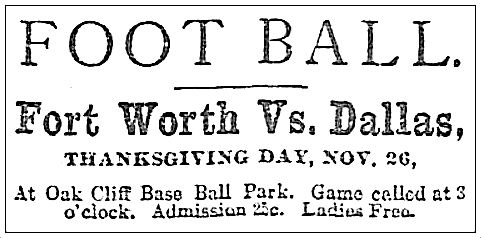
Thanksgiving is a holiday known for eating until you’re full as a tick and football — the highlight for many is the traditional Dallas Cowboys game. But when was the very first Thanksgiving Day football game played in Dallas? 125 years ago — in 1891. It was played on November 26, 1891 in Oak Cliff (…which wasn’t strictly part of Dallas at the time, but… yeah, 1891). The game was between teams from Dallas and Fort Worth, teams which had been organized only a few months previously. The sport of “rugby football” had been gaining popularity around the United States, particularly as a college sport. One of the biggest games of the young sport was the university game played on Thanksgiving Day. In 1891, the Yale-Princeton Thanksgiving game was played in New York before thousands and thousands of spectators. Yale won that year, 19-0 (see the exciting illustration below in which helmets for players are non-existent, but a man who appears to be the referee is wearing a stylish bowler hat). (Click for larger image.)

thanksgiving__football_yale-princeton_1891_lost-century

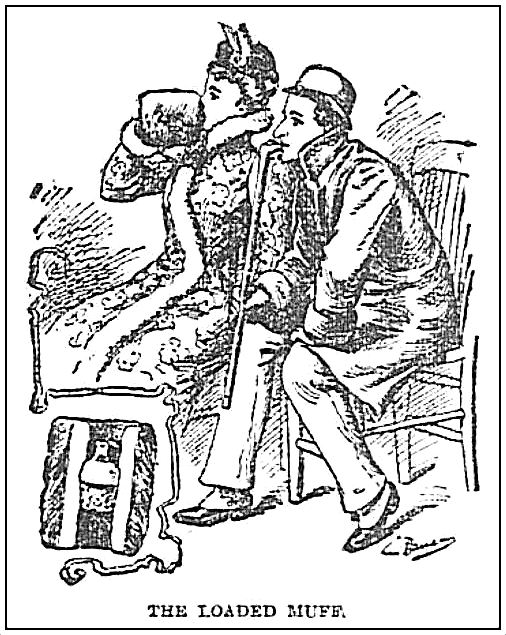
This Ivy League game was almost more of a society event than a sporting event. To get a feel for the atmosphere of these university games, read this really great contemporary article — “The Man of Fashion, We Observe Thanksgiving Day with Great Eclat” by Albert Edward Tyrrell — on the fashions and behavior of these generally well-heeled crowds (it also contains an interesting look at how Thanksgiving was celebrated in 1891, by the swells as well as the non-swells). My favorite piece of minutiae was that young ladies were not above sneaking flasks of liquor into games, hidden in their fashionable hand-warmers. I give you “the loaded muff”:

football_thanksgiving_loaded-muff_dmn112291

But I digress. However much those early Texas football enthusiasts might have hoped for similar large, flask-sipping crowds, the first Thanksgiving football game held in Dallas (and possibly in Texas) attracted a smaller crowd of hundreds rather than thousands (including “about 100 ladies”). Though the crowd was miniscule compared to the one up in New York that day, it did not lack in boisterousness and excited appreciation.

thanksgiving_football_dmn_112591_ad
Dallas Morning News, Nov. 25, 1891

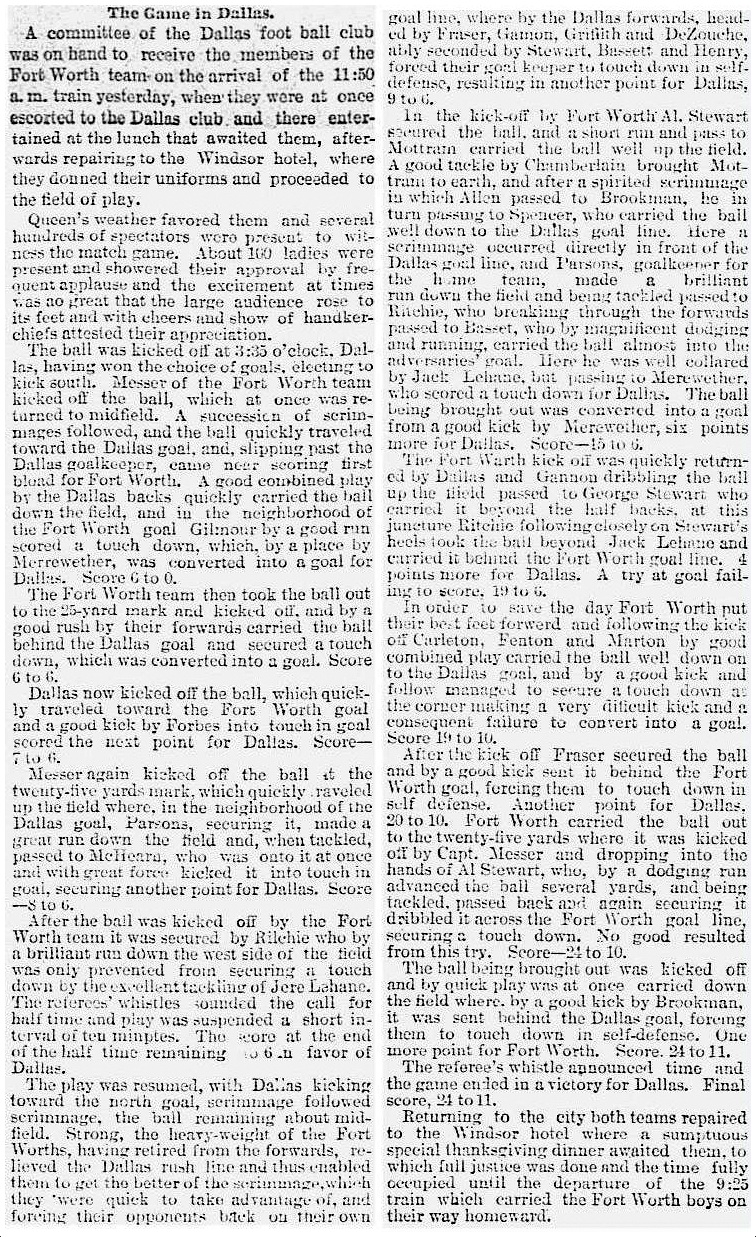
Dallas and Fort Worth had met twice before their matchup in Oak Cliff — both times with Dallas emerging victorious, and … not to be too anti-climactic, but the big inaugural Thanksgiving Day game on November 26, 1891 resulted in another Dallas win (24-11). (This shouldn’t be too surprising, seeing as the overwhelming majority of the players on the Dallas team of 15 grew up playing rugby in rugby-playing countries: 7 were British and 5 were Canadian — only 3 were native-born Americans. Still. Whatever it takes.) (The dullish play-by-play of the game can be read below.)

So what else was going on in Dallas in the Thanksgiving season of 1891? Here are a few morsels.

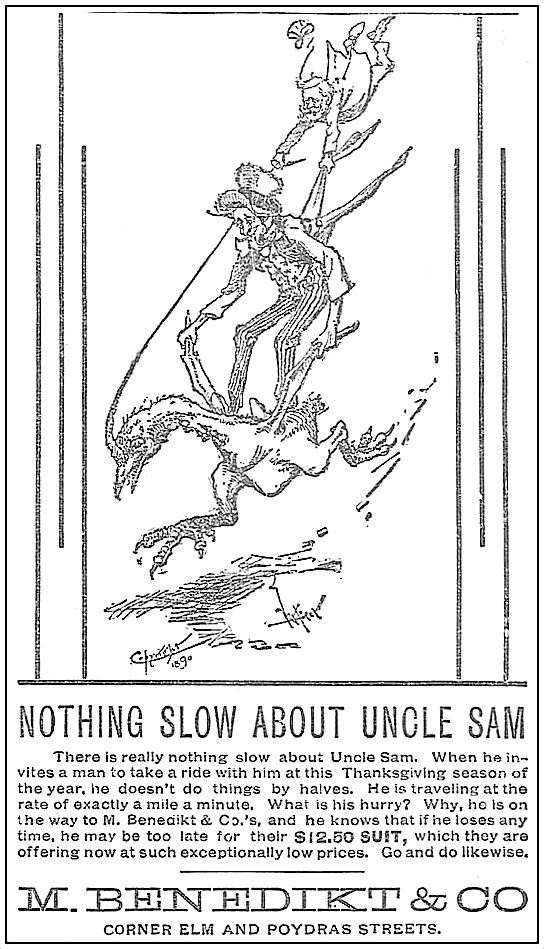
Men might have contemplated getting a new $12.50 suit from M. Benedikt & Co. (a suit which would cost about $335.00 today) — especially after seeing this eye-catching Uncle-Sam-riding-a-(scrawny)-turkey ad. (Click pictures to see larger images.)
ad-thanksgiving_benedikt_dmn_112191
DMN, Nov. 21, 1891
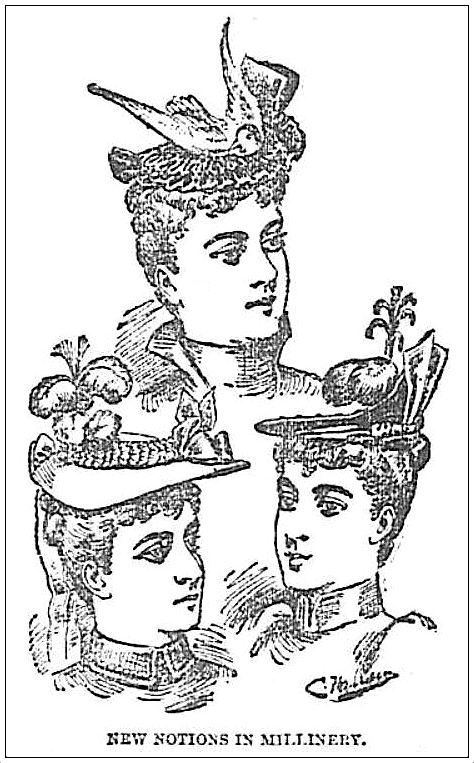
Ladies were kept up to date on the millinery, dress, and hairstyle fashions of the season by reading newspaper articles such as “What Is Really Worn, The Fashions That Find Favor at Thanksgiving” (which can be read here).

thanksgiving_milinery_dmn_112291
DMN, Nov. 22, 1891

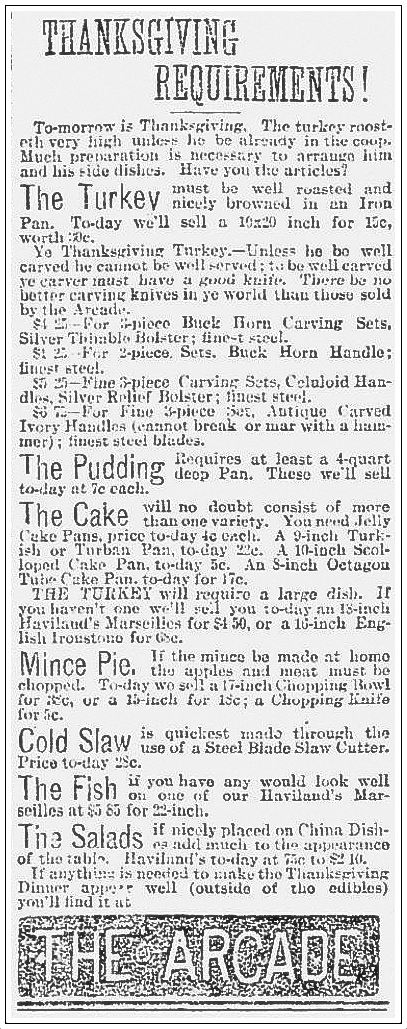
And stores that sold cookware, bakeware, and china took out ads to inform Dallasites that they really needed some new items in order to properly prepare for the big day — one’s guests shouldn’t be forced to be served a feast from tacky serving dishes or eat from chipped plates.

ad-thanksgiving_dmn_112591
DMN, Nov. 25, 1891

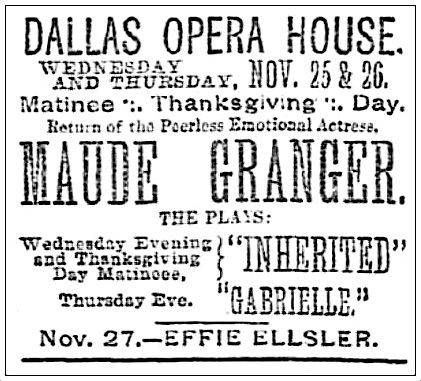
If one wasn’t spending Thanksgiving Day attending one of the city’s many church services, feeding the children at the Buckner Orphans Home, feeding one’s guests and one’s family, visiting friends, or trekking over to Oak Cliff to see that football game, he or she might have considered attending a matinee at the Dallas Opera House — Maude Granger (“The Peerless Emotional Actress”) was back in town and raring to emote.

thanksgiving_theater_dmn_112491
DMN, Nov. 24, 1891

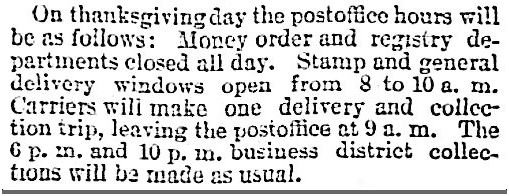
Almost everyone had the day off from work, but, oddly enough, most postal workers had to work at least part of the day. Neither rain nor sleet nor tender turkey breasts and cranberry sauce stayed those couriers from the swift completion of their appointed rounds, I guess.

thanksgiving_post-office_dmn_112591
DMN, Nov. 25, 1891

At least no one was dreading/eagerly anticipating Black Friday back in ’91.

**

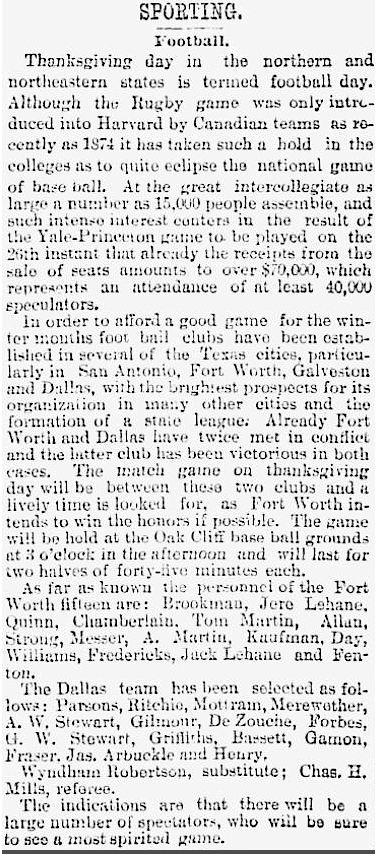
Back to football. First, a friendly D-FW practice run before the Big Game.

thanksgiving_football_dmn_111491
DMN, Nov. 14, 1891

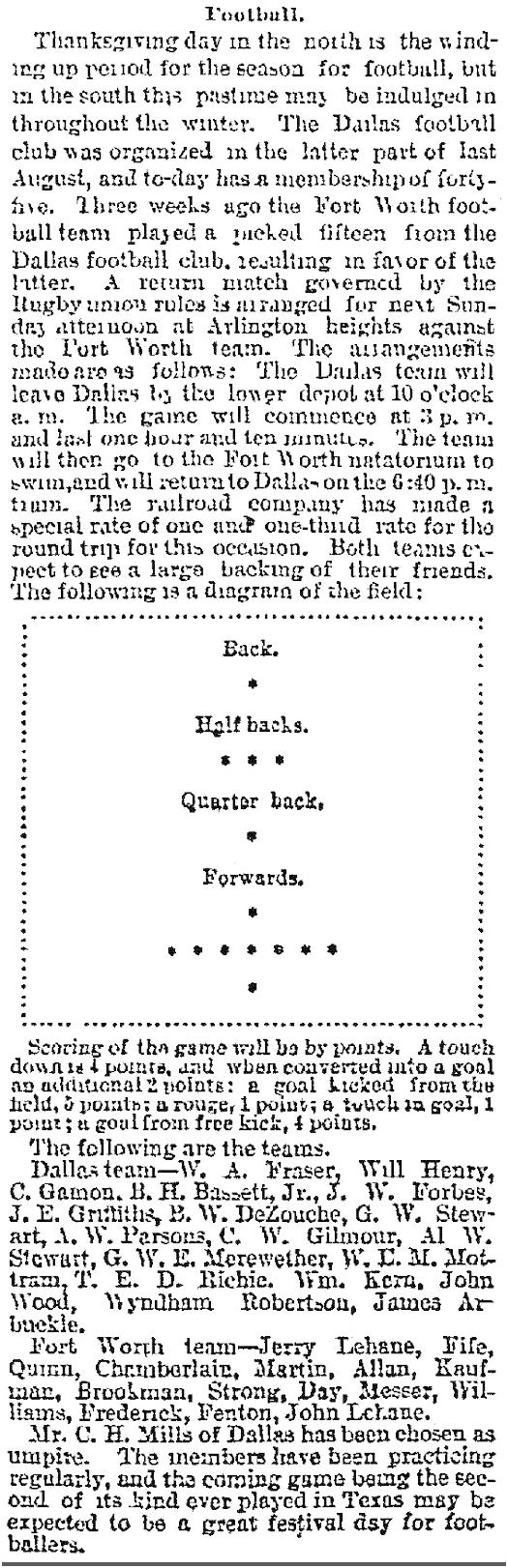
The pre-game article.

thanksgiving_football_dmn_112591
DMN, Nov. 25, 1891

The post-game article.

thanksgiving_football_dallas-fw_dmn_112791_highlights
DMN, Nov. 27, 1891

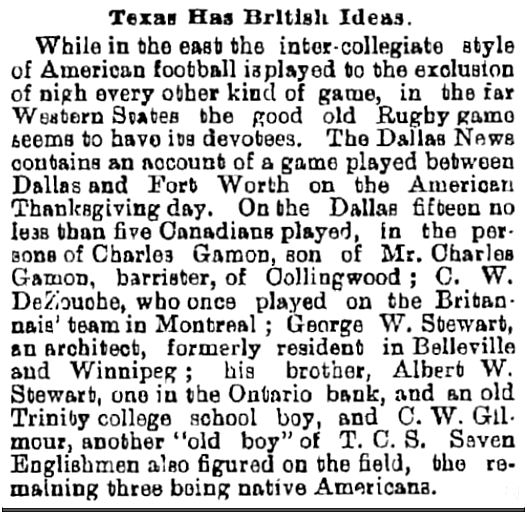
And an article from a proud Canadian newspaper, boasting of the number of Queen Victoria’s faithful subjects playing for the Dallas team.

thanksgiving__football_manitoba-free-press_121191
The Manitoba Free Press, Dec. 11, 1891

***

Sources & Notes

Thanksgiving card found on Pinterest.

Illustration of the 1891 Yale-Princeton game is from the Lost Century of Sports website, here. (I’m not really a sports fan, but if I were, this website of 19th-century sports might be one of my favorites!)

For more on how Thanksgiving finally came to be celebrated in Texas in 1874 (it took a long time for the Southern states to agree to celebrate what many thought was a “Yankee abolitionist holiday”), see my post “Encouraging Dallasites to Observe Thanksgiving — 1874,” here.

Happy Thanksgiving!

*

Copyright © 2016 Paula Bosse. All Rights Reserved.