Flashback : Dallas

A Miscellany: History, Ads, Pop Culture

Tag: Historic Dallas

When Big D Had No Love for Bruce — 1974

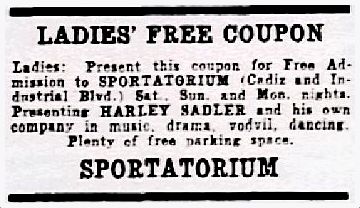
Imagine what coulda been… (click for larger image)

by Paula Bosse

First off, apologies for the image quality of this advertisement. It’s from eBay (“He’s from Barcelona…”).

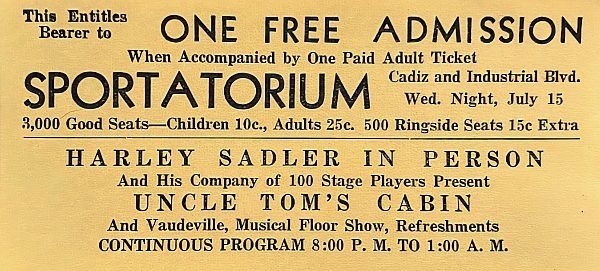
I thought it was an interesting ad, because I never knew that Bruce Springsteen played the Sportatorium, Dallas’ legendary wrestling mecca and off-and-on home to the Big D Jamboree. How had I never heard about this? (This was a show put together by local promoter Gene McCoslin, who had a long history with Willie Nelson.)

1974 was pretty early for Bruce to play in Dallas. He was starting to gain notice nationally, but he wasn’t a star yet. The tickets to the Sportatorium show were $4.50 in advance/$6.00 at the door (roughly $30 and $40 in today’s inflation-adjusted money). As it turns out, the show was canceled, because — hold onto yourselves — only 28 advance tickets had sold. …TWENTY-EIGHT.

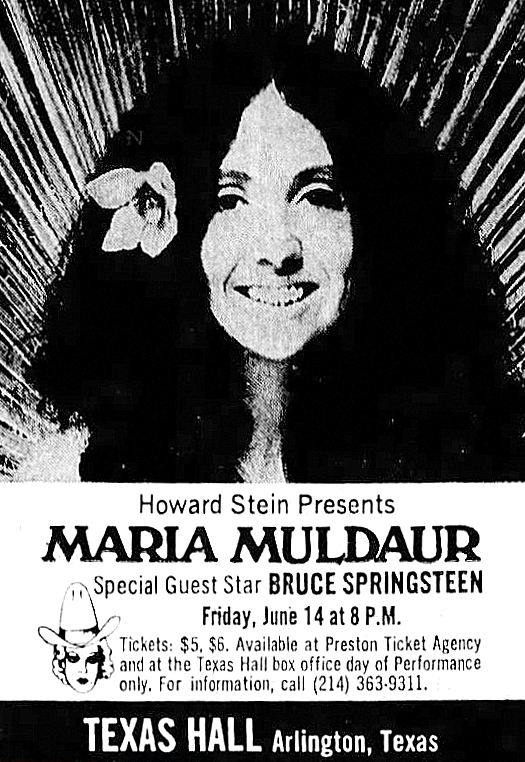
That show was scheduled for November 10, 1974. A few months earlier — in June 1974 — Bruce was, for some inexplicable reason, booked as the opening act for… Maria Muldaur (“Midnight at the Oasis”). That show was scheduled at the UTA campus in Arlington. The Dallas Morning News reported that Bruce was a last-minute no-show, claiming a bout with the flu, but, apparently, he was unhappy with the small turnout and just didn’t go on. (Trouper Maria, having lost her opening act, performed for nearly 2 hours, and got rave reviews.)

Fort Worth Star-Telegram, June 9, 1974

Springsteen’s first actual performance on a Dallas stage appears to have been sometime in the same year as those two ill-fated non-gigs: 1974. Freelance rock critic Kim Martin-Pierce remembered it: “He always had a troubled history here. [He was booked to play at the old Mother Blues nightclub, but] he sold so poorly at Mother Blues that they moved him over to Gertie’s on Lemmon Avenue. He didn’t draw well at all there either, but he gave the greatest performance I’ve ever heard in a small club.” (DMN, “Springsteen Finally Shows Big D Who’s Boss” by John Anders, Nov. 30, 1984, after Bruce’s two sold-out shows at Reunion Arena)

Sorry, Bruce, for the cold shoulder! I think Dallas eventually came around. But you missed out. Playing the Sportatorium would have been really, really cool. And those 28 people would still be talking about the most amazing show they had ever seen.

***

Sources & Notes

Top ad from the Dallas underground newspaper Iconoclast, Nov.8-15, 1974; found on eBay in April 2024.

This post appeared previously in a slightly different form on the Flashback Dallas Patreon page.

*

Copyright © 2025 Paula Bosse. All Rights Reserved.

My Mother, Margaret Werry: 1936-2025

by Paula Bosse

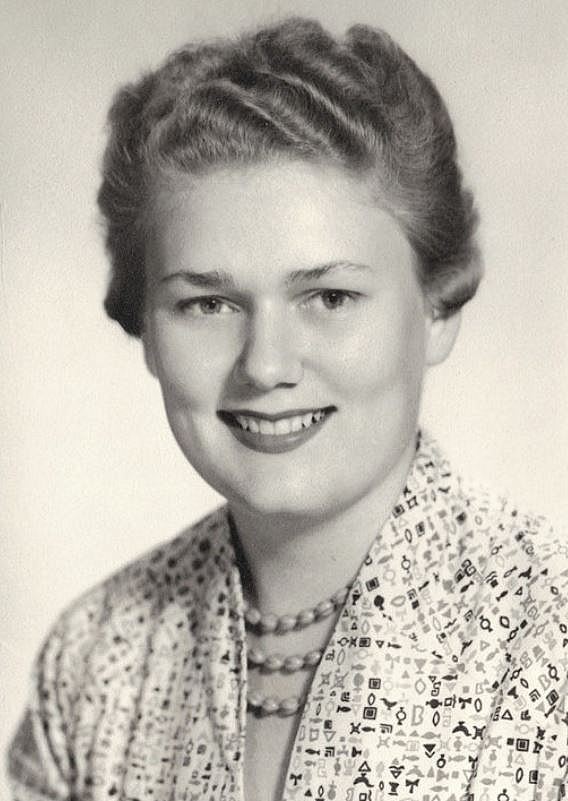
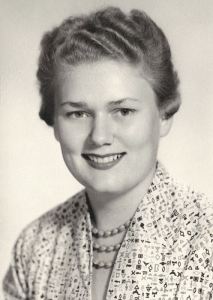
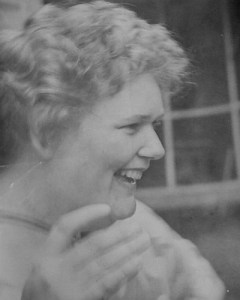
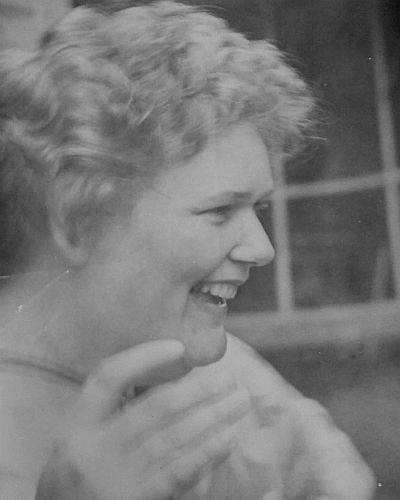
My mother, Margaret Werry (who was known as Margaret Bosse during much of her time as a political activist), died on May 16, 2025, in hospice care at Baylor Hospital in Dallas. She was 89.

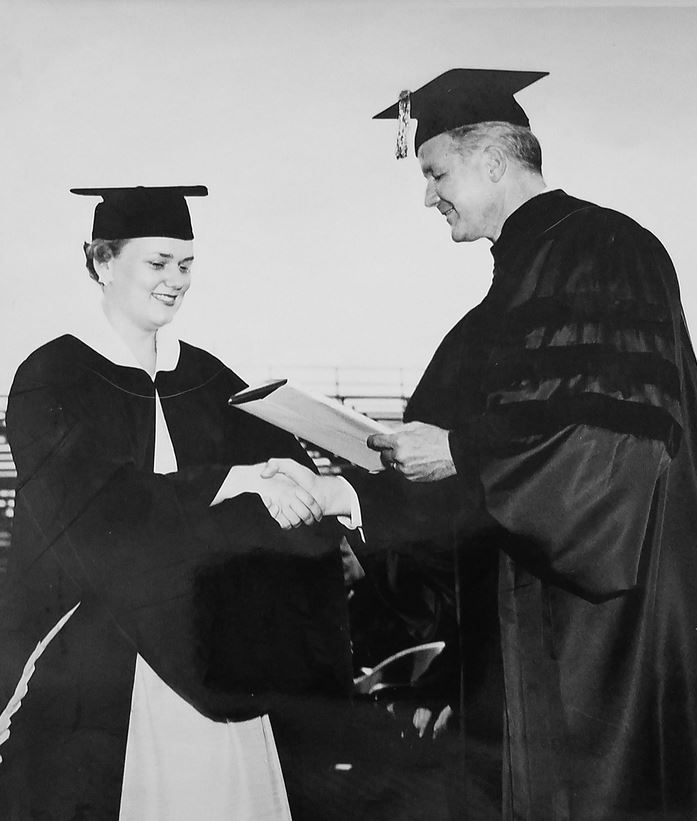
She was born in Dallas, grew up in Oak Lawn on Hartford Street, between Douglas and Wycliff, a couple of blocks from her grade school, Sam Houston Elementary. Instead of attending North Dallas High School, she chose to go to Crozier Tech downtown so she could focus on advanced science courses (she had dreams of going to medical school). She graduated at 16 and attended SMU, majoring in Comparative Literature. (See photos of both of my parents from SMU yearbooks here.)
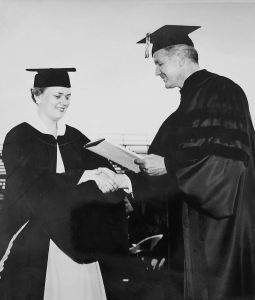
My mother with SMU president, Willis Tate

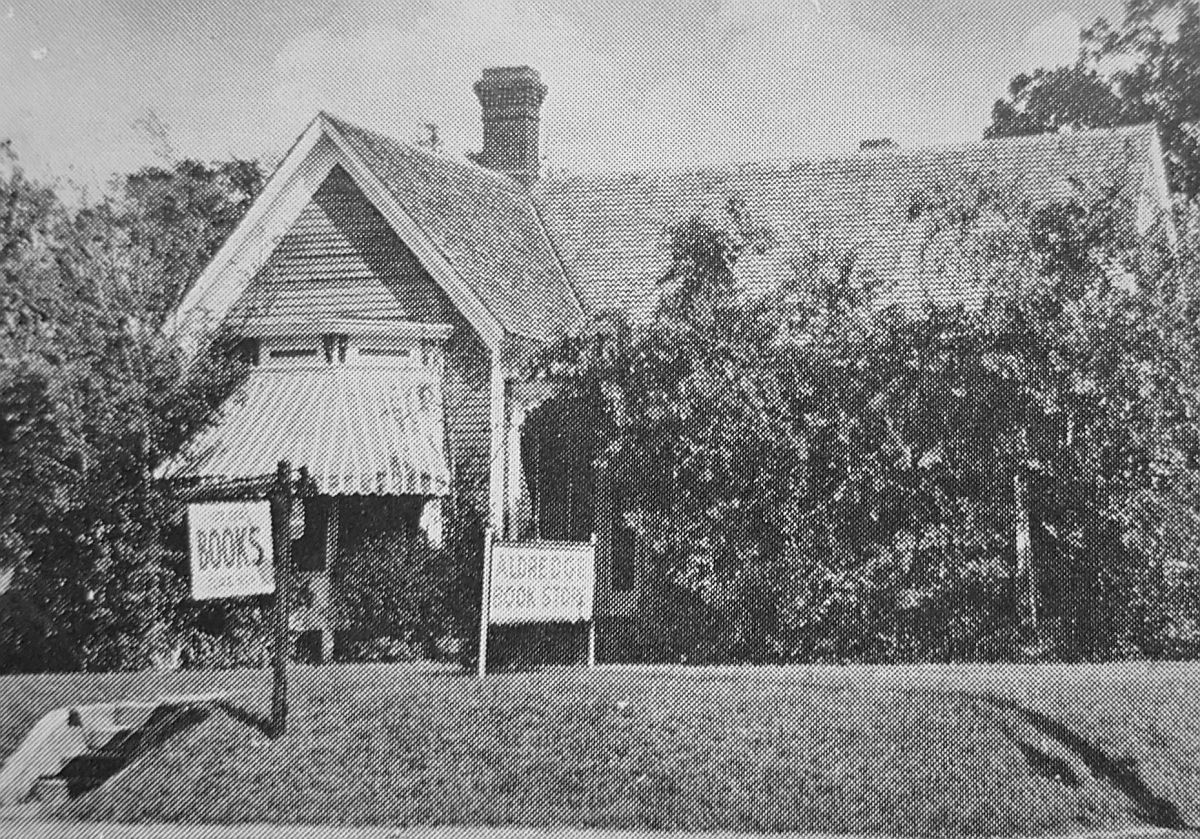
She spent a short time at UT medical school in Galveston, but her mother’s unexpected death brought her back home. She soon began working at an antiquarian bookstore on McKinney Avenue, located in an old Victorian house: The Aldredge Book Store, where she met my father, Dick Bosse, another former Comparative Literature major at SMU. They married a few years later. That bookstore was a home-away-from-home for my parents, for me, and for my brother. Every kid should be lucky enough to grow up in a used bookstore. (My parents divorced amicably in the ’80s and remained friends until his death in 2000. The obituary of my father written by my brother, Erik Bosse, is here.)
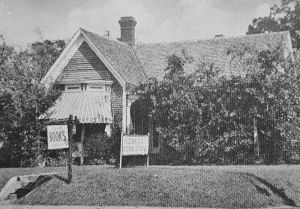
2800 McKinney Avenue, ca. 1960

My mother’s passions in life were working for progressive political causes and for advancing and promoting women’s issues. The 1970s and ’80s were a time of non-stop political activity for her. She was one of the small group of women who were connected in various ways to the First Unitarian Church on Preston Road who helped and supported attorney Linda Coffee in developing the case that became known as Roe v. Wade. She tirelessly worked for women’s rights, even helping to establish the Women’s Southwest Federal Credit Union here in Dallas at a time when mainstream banks and credit unions did not generally grant loans to women without their husband’s consent (!). She always described the ’70s as the most exciting time of her life. A lot was changing then, and she was right in the middle of it.

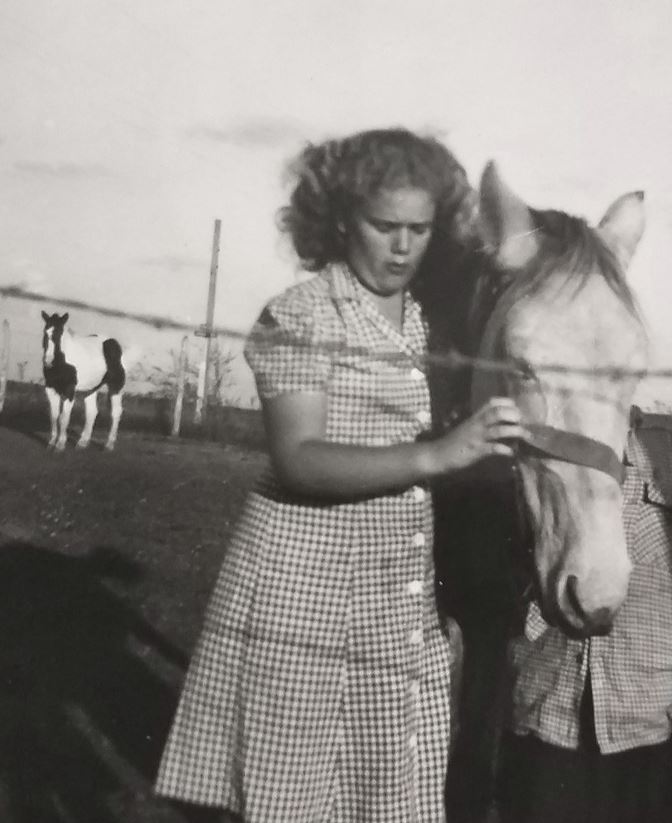
She was also a passionate animal-lover — our house was never without several cats. Some of her fondest childhood memories were her visits to the farm of her aunt and uncle, which she always described with idyllic nostalgia.

She also loved classic movies, Orson Welles, William Faulkner, and bookbinding, to name just four random things.

I remember her reading books to me and my brother. My favorite was The World is Round by Gertrude Stein, which I love to this day, and which I am convinced led to the love of writing and language my brother and I share.

My mother was the kindest person I knew (next to my father). She was smart, funny, and ethical, and, somehow, she never lost her patience when trying to help me with my math homework (sadly, I did not inherit her love of numbers and mathematics). She was a wonderful baker, and I will miss her amazing Christmas cookies and cakes.

And I’ll just miss her. I’ll miss her every day. Her health had been in decline for several years, and the last few months were difficult for her and for my brother and me. I am relieved she is no longer suffering, but it breaks my heart to lose her.

I received a lovely note from Charles Drum, who used to work with my parents at The Aldredge Book Store during those early days. Here is what he wrote:

I read about your mom’s passing. My thoughts are with you. Your mom could always make me laugh. It was a gift. Like your dad, she had a treasury of arcane knowledge to share. I wish I’d been able to talk to her in recent years. We had a lot of memories of ancient times.

Those days at the Aldredge Book Store, working with your dad, Sawnie [Aldredge, the original owner], Mimi [Sawnie’s wife and ABS fixture], and even Thelma [the somewhat irascible maid] were formative years for me and set standards of care, wit, camaraderie, and just plain fun that I was rarely able to match in following years. Your folks’ interests. stories, and above all their humor are a vivid part of me to this day.
 
Happy I sat down to write you.

Thank you, Charlie. (See Charlie in a photo with my father, here.)

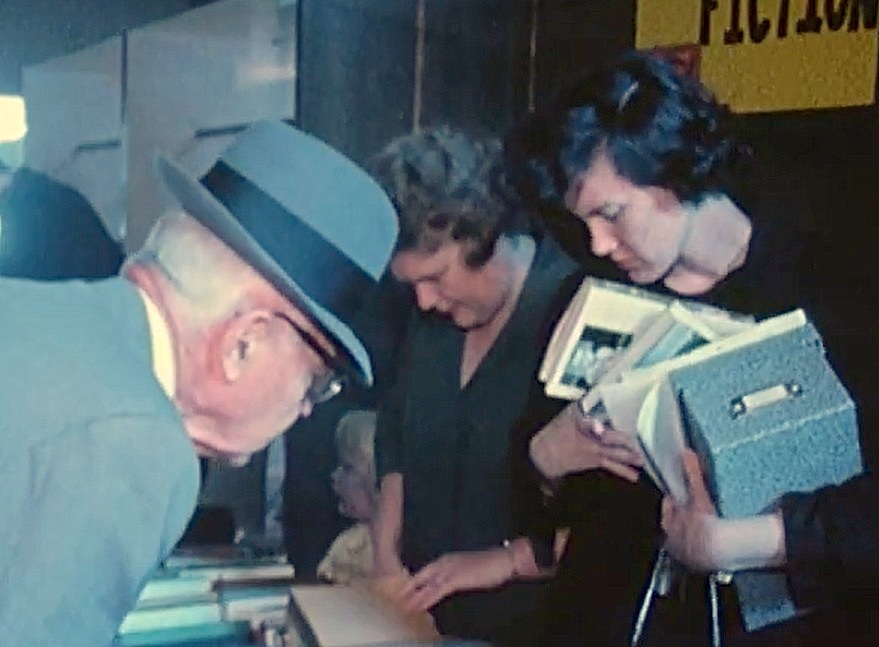
I recently came across this image of my mother and me at one of the hundreds of book sales and book events I found myself at during my childhood. (It’s hard to see me, but I’m in there, next to my mother, dwarfed by people and books and people with books.)
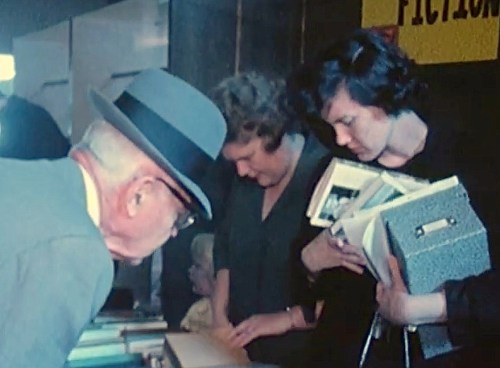
I’ll miss you, Mama. Thank you for all your memories of Dallas.

Thank you for everything.
***

Sources & Notes

Flashback Dallas posts about The Aldredge Book Store are here.

I understand friends of hers may be preparing a get-together to remember my mother. If you were a friend of hers and are interested in attending, please send me an email at the contact info at the top of this page.

*

Copyright © 2025 Paula Bosse. All Rights Reserved.

Whimsy on Main Street — ca. 1906

by Paula Bosse

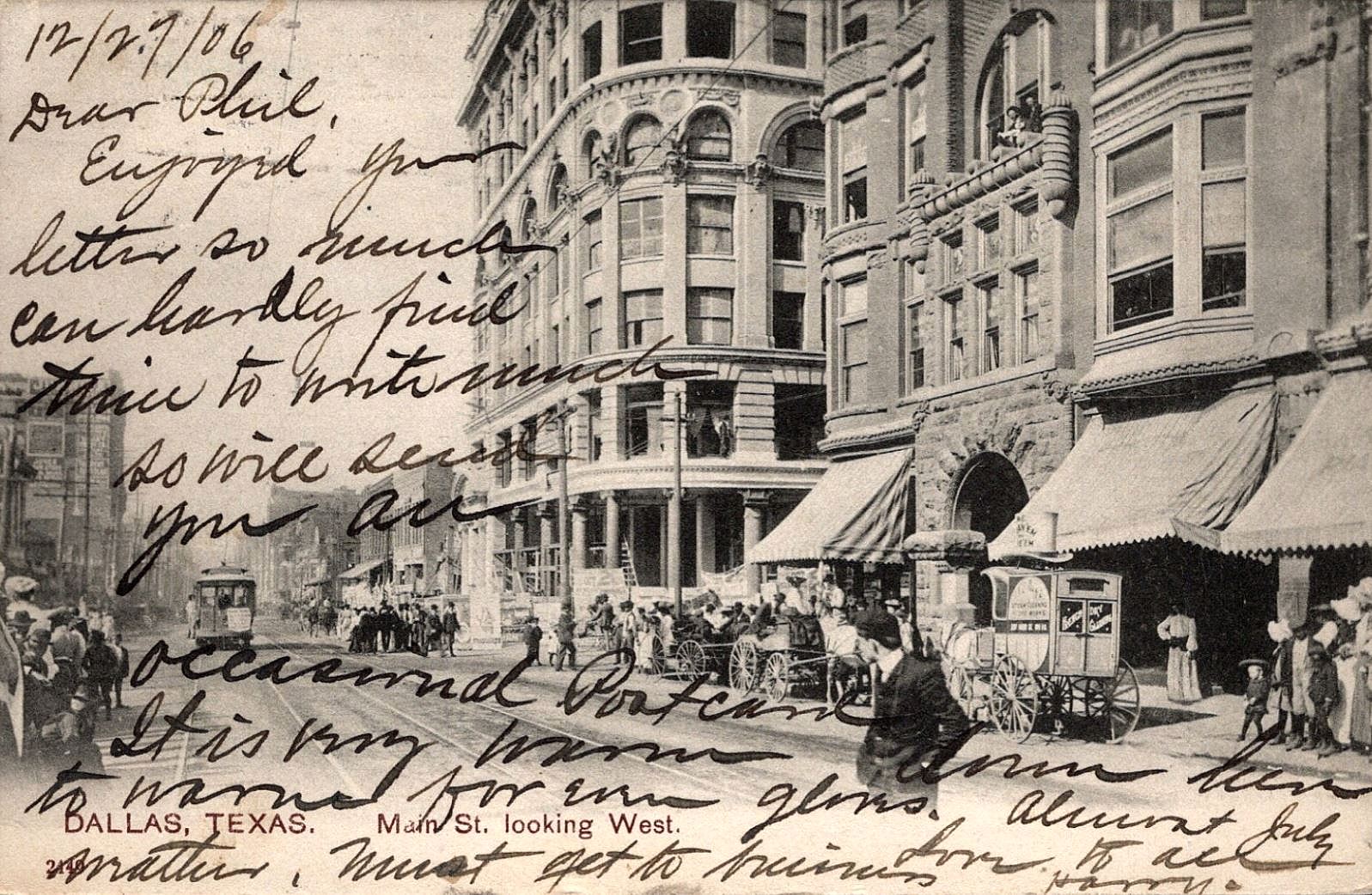
I’ve seen a lot of postcards with views of “Main St. looking West,” usually taken from about Ervay, with the Wilson Building as the architecturally impressive centerpiece. But I don’t think I’ve seen this one. I don’t know when the photo was taken, but it was mailed at the very end of 1906. It looks like the new Wilson Building (which opened in 1904) may still have construction work going on, at least on the ground floor.

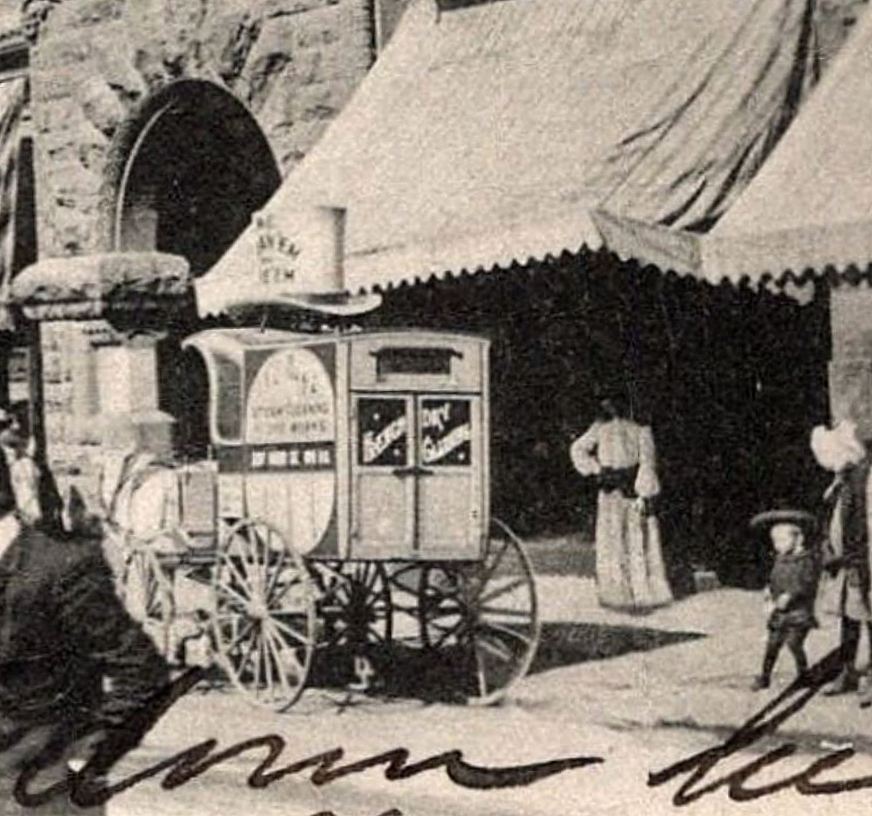
But “whimsical”? Take a look at the horse-drawn dry-cleaning-company delivery wagon on the lower right side of the card. It’s got a GREAT BIG TOP HAT on it! Maybe this sort of thing was popular in the early years of the 20th century, but I’ve never seen anything like this on the streets of Dallas in photographs or postcards of this period. Until now. I love it!

*

The postcard — written and mailed on December 27, 1906 — was addressed to “Master Phillip Wyman” in Yonkers, New York. The sender — identified only as “Harry” — sent this message to Phil, probably a young family member:

Dear Phil, Enjoyed your letter so much. Can hardly find time to write much so will send you an occasional postcard. It is very warm down here, to[o] warm for even gloves. About July weather. Must get to business. Love to all, Harry

Too warm for gloves — in December! Imagine! I bet Master Wyman — who was no doubt shivering up in Yonkers — had his young mind blown. (I wonder if he noticed the big top hat?)

***

Sources & Notes

Postcard from eBay.

*

Copyright © 2025 Paula Bosse. All Rights Reserved.
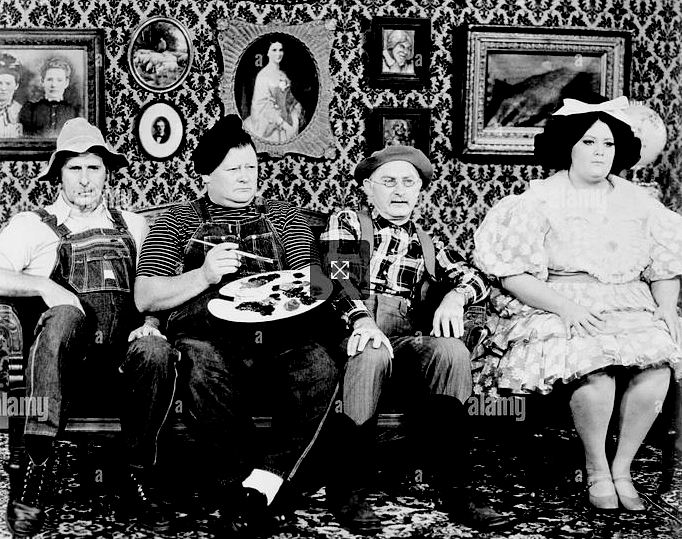
Lulu Roman, 1946-2025

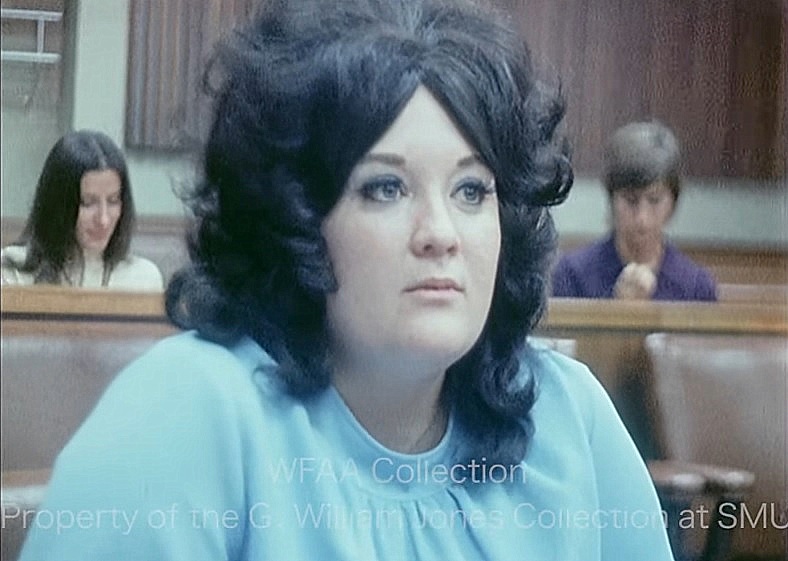
In a Dallas courtroom, 1971

by Paula Bosse

Lulu Roman — known for her appearances on the TV show Hee Haw and her numerous gospel recordings — died last week (on April 23, 2025). She was a Dallas native and a graduate of Samuell High School. A summary of her life and career can be found in the Hollywood Reporter obituary and her Wikipedia entry.

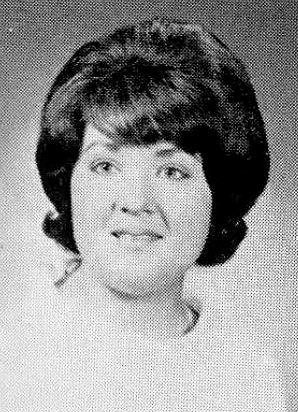
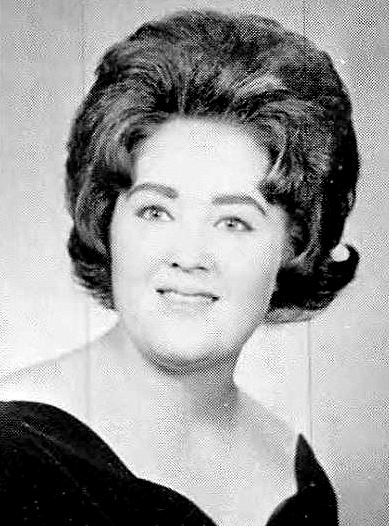
She graduated from W. W. Samuell High School in 1964 (her name back then was Louise Hable), and five years later, she became an original member of the cast of Hee Haw. In 1971, her Oak Lawn apartment (2627 Douglas) was raided by seven narcotics agents, who seized 5.5 pounds of marijuana and small amounts of LSD and hashish. She was booked for drug possession, and this effectively ended her connection with Hee Haw (she later found religion, gave up drugs, and was welcomed back to the show when she was clean — you can see her talk about her new-found “high” to a Channel 8 reporter in 1973 on YouTube here). (The photo at the top is from one of Lulu’s appearances in court in 1971.)

She then went on to a successful career as a gospel singer. RIP, Lulu.

1963 Samuell yearbook, Junior class photo

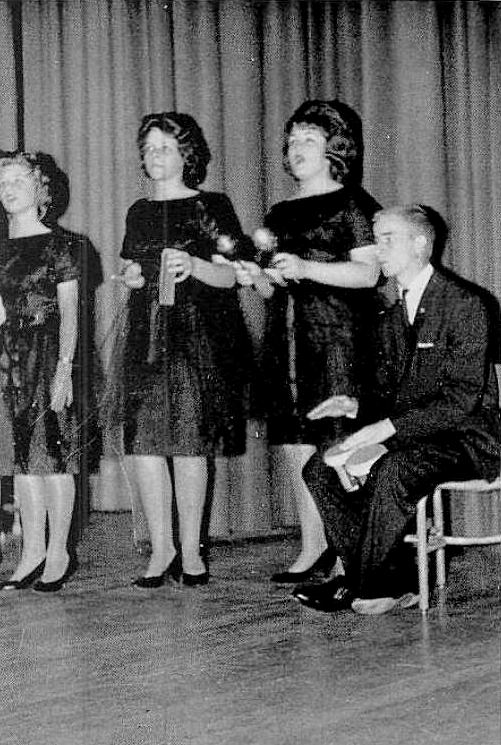
Performing a “Calypso Christmas carol”:

1963 Samuell yearbook

1964 Samuell yearbook, Senior class photo

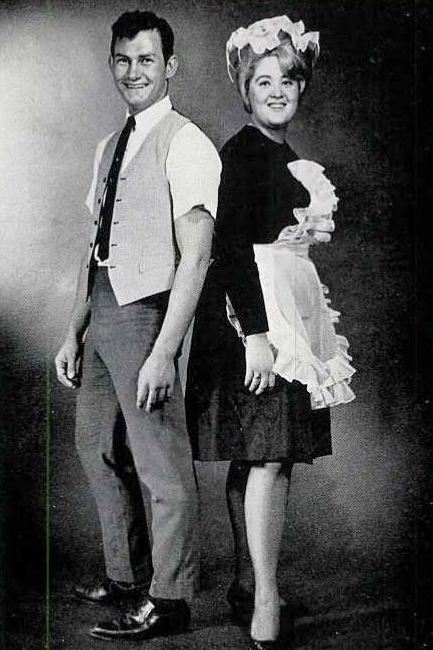
With classmate David Henderson, in costume for a theatrical production.

1964 Samuell yearbook

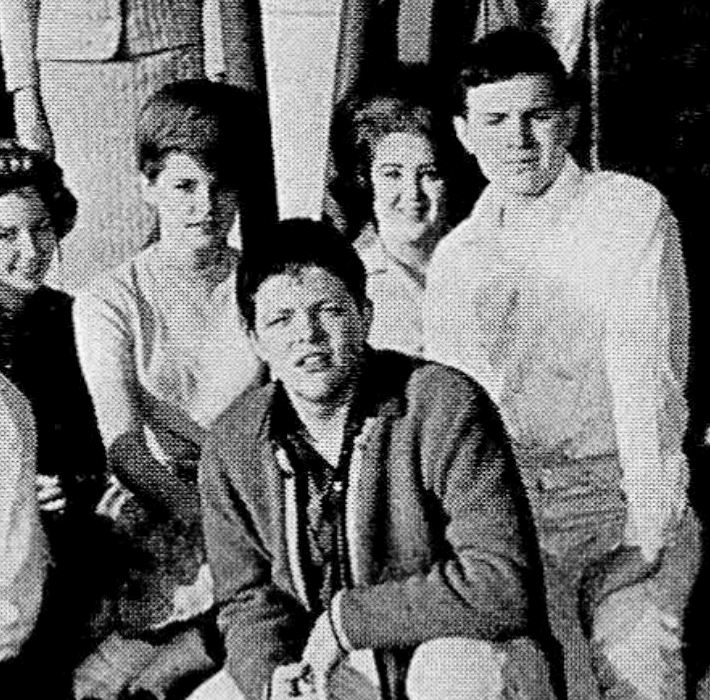
Detail of a photo of members of the Thespians Club:

1964 Samuell yearbook

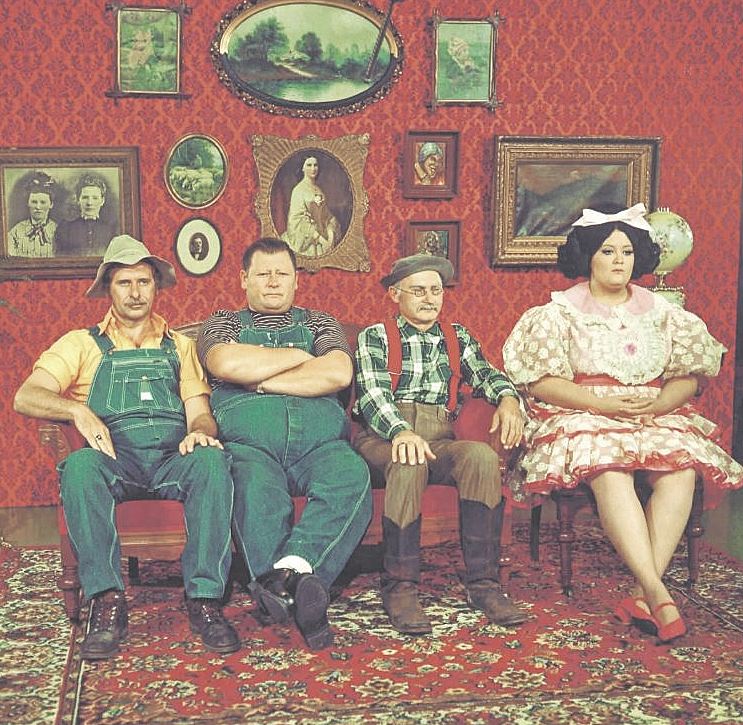
Hitting the big-time, on Hee Haw:

***

Sources & Notes

Top image is a screenshot from Channel 8 news footage of Lulu’s drug possession trial in Dallas on Sept. 3, 1971, from the WFAA Collection, G. William Jones Collection, Hamon Arts Library, Southern Methodist University.

School photos from the 1963 and 1964 Samuell High School yearbooks.

Color photo of some of the Hee Haw cast members (Gordie Tapp, Junior Samples, Grandpa Jones, and Lulu Roman), from The Tennessean; black-and-white photo from Alamy.

*

Copyright © 2025 Paula Bosse. All Rights Reserved.

Commerce & Market, Where the Air Was Made Blue

Kinder, gentler times…

by Paula Bosse

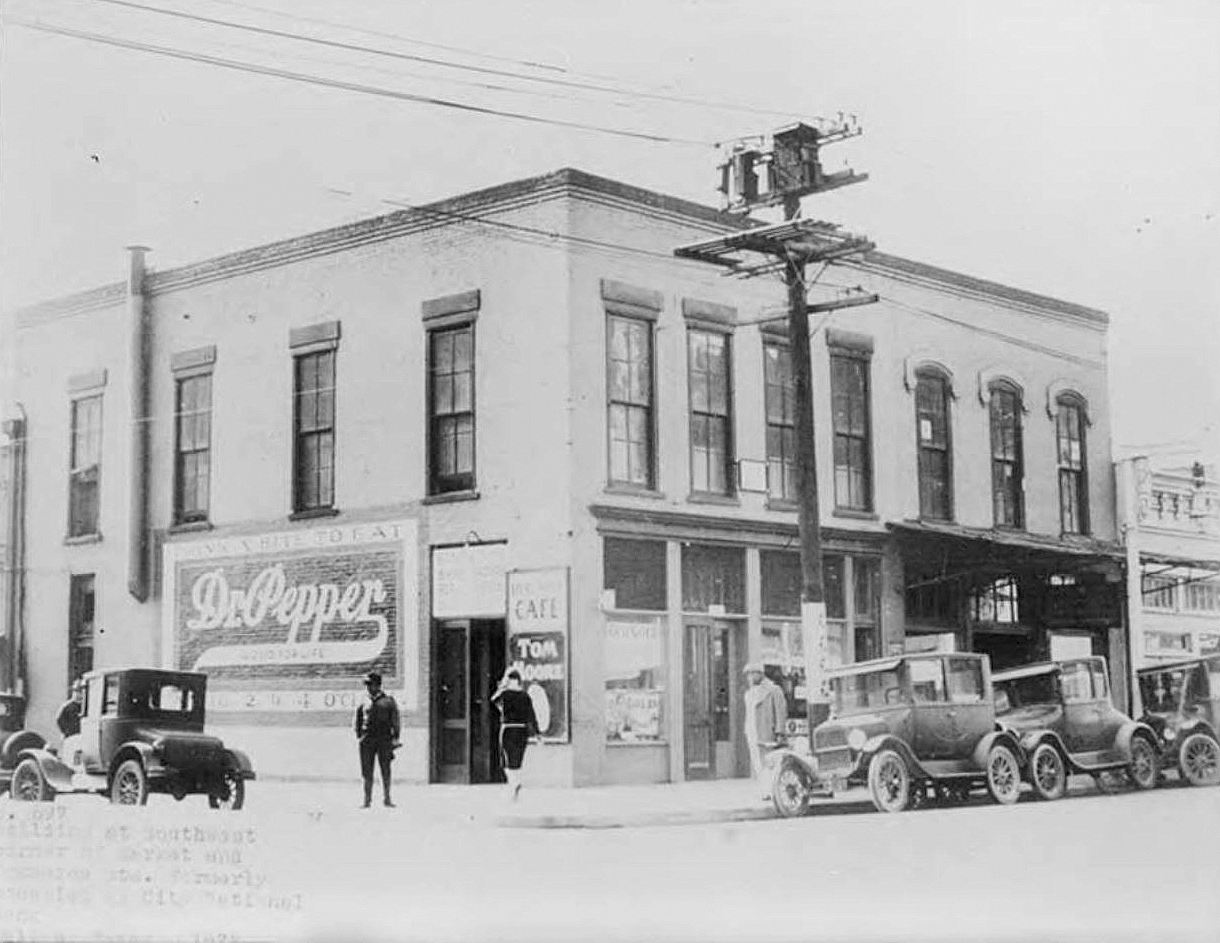
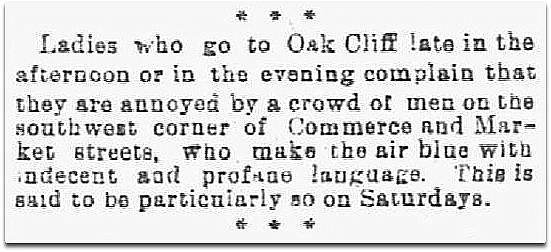
The photo above shows a small, fairly nondescript building at the southwest corner of Market and Commerce, with retail stores and a cafe at street level and, I think, a hotel on the second floor. My car-make-and-model knowledge is bad, but I’ll guess that this photo might be from the early ’20s (a 1921 Sanborn map of the area is here). If you go back even further — like to 1891 — this corner was a hangout for unsavory types, as reported below in The Dallas Morning News in 1891.

Dallas Morning News, Sept. 7, 1891

It’s no surprise there was “indecent and profane language” in the air in 1891 (“particularly on Saturdays”), seeing as that corner was a mere hop, skip, and a jump from Dallas’ premier red-light district.

This corner is currently occupied by the George Allen Courts Building.

***

Sources & Notes

Photo, titled “Building at SW corner of Market and Commerce Streets, formerly occupied by City National Bank Dallas, 1872,” is from the Collection of Dallas Morning News negatives and copy photographs, DeGolyer Library, Southern Methodist University; more information is here.

This post appeared in a slightly different version on the Flashback Dallas Patreon page.

*

Copyright © 2025 Paula Bosse. All Rights Reserved.

Lake Highlands Village — 1951

Buckner and Northcliff, 1951

by Paula Bosse

This is an interesting photo from an ad for J. M. Tuttle Jr. Real Estate/Tuttle Development Company. Jack Tuttle was one of the most prominent developers of Lake Highlands, near White Rock Lake, east of Buckner Blvd. Tuttle began buying land in this far-flung, undeveloped area around 1939 and eventually owned pretty much everything in the area, including Lake Highlands Village, a shopping area a mere stone’s throw from White Rock Lake and not far from Casa Linda. The map below (from another Tuttle ad) shows where much of Tuttle’s property was at the time, including LHV, which was (and still is) at 720 N. Buckner Blvd. It looks a lot different now, but it’s interesting to see how it started out.

Here is the text that accompanied the photo in the ad from 1951:

Lake Highlands Village 

Distinctively individual design plus surrounding natural beauty makes the Lake Highlands Estates an ideal homesite for the discriminating home-owner. And you will like the convenience of your own shopping center in the Lake Highlands Village, just minutes from downtown Dallas and seconds from cool White Rock Lake. 

1952

***

Sources & Notes

Photo and map are from ads that appeared in Dallas magazine in Feb. 1951 and Feb. 1952.

More on Lake Highlands from Flashback Dallas in “Old Lake Highlands.”

This post appeared previously on the Flashback Dallas Patreon page.

*

Copyright © 2025 Paula Bosse. All Rights Reserved.

A Few Photo Additions to Past Posts — #24

Central Dallas Public Library

by Paula Bosse

Time for a few more of these: photos, etc., I’ve come across recently that I am adding to old posts on the topic in order to keep everything together, but I’m also putting them here because they’re still kind of “new.” All of these are things I’ve come across while working at my new job on the Dallas History floor of the downtown library (which, so far, has been great!). I’ve been looking through a lot of old Chamber of Commerce magazines on breaks, and that’s where a lot of these images come from.

But first, above, a really great architect’s drawing of the very library where I work (the architects were Fisher & Spillman). I’ve added it to the post “Flashback Newsflash: Working at the Library.” (Source: Dallas Public Library Archives, Dallas History and Archives, Dallas Public Library) (Images are larger when clicked.)

*

This photo of kids lining up to buy tickets to see The Beatles ran with this caption: “The Preston Ticket Agency, a service of the Preston State Bank of Dallas, recently attracted this crowd when the agency was named to handle the exclusive sale of tickets for a September performance in Dallas of the Beatles quartet. Some youngsters stood in line 24 hours before the ticket office opened for business. The Preston Ticket Agency has been in operation since 1963, and last year served over 40,000 customers with tickets to major Dallas entertainment attractions.” It has been added to 2014 post “The Fab Four in Big D — 1964” (Source: Dallas magazine — a publication of the Dallas Chamber of Commerce — July 1964, Periodicals Collection, Dallas Public Library)

beatles_preston-tickets_dallas-mag_july-1964-DPL

*

The library has a poster collection. It has been dormant for many years, but it would be nice to get some new additions to the collection! If you have Dallas-specific posters, please considering donating them to the library — or, if you produce posters or flyers for events, keep us in mind and send us a copy. This poster from 1973 publicized an East Dallas neighborhood project that, happily, was successful. I’ve added it to 2016’s “The Gateway to Junius Heights” (and, incidentally, the 1917 date on the poster is incorrect, as I found ads from 1909 that had the pillars/columns/gate in them). (Source: Poster Collection, DPL)
*

This 1936 ad for the Outdoor Electric Advertising company features a photo of the exterior of the Main Street side of the Adolphus, with a big neon sign for the Century Club and a smaller sign for the Adolphus Bar. I’ve included this in the 2022 post “1400 Block of Main Street, ca. 1946,” which shows this same view in the daytime. (Source: Southwest Business — published by the Dallas Chamber of Commerce — Sept. 1936 — Periodicals Collection, DPL)

*

I really like this photo of Everette DeGolyer, seen here with Stanley Marcus, so I’ve added it to “Everette Lee DeGolyer, Bibliophile” (2016). (Source: Dallas magazine, Sept. 1951, Periodicals Collection, DPL)

*

This cool art deco building began as an automobile showroom but became a National Defense School during WWII. I’ve added it to “2222 Ross Avenue: From Packard Dealership to ‘War School’ to Landmark Skyscraper” (2015). (Source: 1942 booklet “Young America in Dallas,” DPL)

*

This photo and ad regarding the decor of the Administration Building during the Texas Centennial have been added to the agonizingly titled “State Fair Coliseum/Centennial Administration Building/Women’s Museum/Women’s Building” (2018). (Sources: photo is from Southwest Business, June 1936; ad is from the Oct. 1936 issue of the same magazine, Periodicals Collection, DPL)

*

Still on the Centennial, this is a cool photo showing the large team of lighting people who produced what, by all accounts, was the most spectacular thing about the already overwhelmingly spectacular Texas Centennial (and, also, the following year’s Pan-American Exposition): the lighting displays, which, at the time, cost more than $500,000 (equivalent now to more than $11.5 million). From the article that accompanied this photo: “The general lighting effect is a battery of twenty-four 36-inch searchlights as powerful as the giants that flash from the dreadnoughts of Uncle Sam’s navy. Each searchlight will produce 60 million candlepower. Combined, the battery has a total candlepower of 1.5 billion. A 350,000-watt power generator will produce this colossal quantity of ‘juice.'” You can see those 24 giant searchlights (and the tiny-looking men standing next to them) in this photo, which has been added to 2016’s “Albert Einstein ‘Threw the Switch’ in New Jersey to Open the Pan-American Exposition in Dallas — 1937.” (Source: Southwest Business, June 1936, Periodicals Collection, DPL)

*

This Dallas Power & Light ad has been added to the 2024 post “On the Line at Coca-Cola — 1964.” (Source: Dallas magazine, April 1964, Periodicals Collection, DPL)

*

Here’s the Preston Road Neiman-Marcus under construction. I’ve added it to “Neiman’s First Suburban Store: Preston Road — 1951-1965” (2020), (Source: Dallas magazine, Feb. 1951, Periodicals Collection, DPL)

*

The Highland Park swimming pool looks so quaint. I’ve added it to another quaint photo in 2015’s “A Dip in the HP Pool — 1924.” (Source: Highland Park, an interesting newspaper published by developers Flippen-Prather, June 1927, Periodicals Collection, DPL)

*

And, lastly, I’ve added an article which was, basically, a what-the-heck-is-the-deal-with Zangs vs. Zang’s vs. Zang Boulevard? It adds a little (only a little) insight. The caption for these two photos (very difficult to capture with a phone!): “Harry Gaston, Oak Cliff real estate and insurance man, points out the ZANGS street sign in the north 700 block of the boulevard at Canty Street. A look of bewilderment adorns his face, however, when he discovers the ZANG (no S) sign on the opposite end and other side of the same north 700 block. City records show ZANG as the correct spelling… a reorientation program for the public and some great big headaches for map makers.” The scanned article (not included here), these very wonky photos, and a portrait of Louis C. Zang have been added to 2017’s “Zang and Beckley.” (Source: Oak Cliff magazine — published by the Oak Cliff Chamber of Commerce — Nov. 1967, Periodicals Collection, DPL)

*

Enough for this installment!

*

Copyright © 2024 Paula Bosse. All Rights Reserved.

An Artist’s Conception of a Future Dallas

Vision of a new downtown library…

by Paula Bosse

I came across a collection of drawings recently that I think are just fantastic. They show what Dallas could be if we all just want it enough. The captions are giddy and exuberant, with the exhortation “Let’s build for the future.” It’s the sort of Chamber of Commerce boosterism which is a Dallas mainstay. Dallas dreams big and bold.
It’s not the ideas that I find so intriguing (although, they’re interesting), it’s the artwork. These drawings are great. The monumental, Deco-ish buildings exude a quiet power. Most of them are set against a dark sky, which adds extra awe-inspiring heft. I really, really love these drawings. It’s a shame most of these conceptions remained just that. I would have loved that library (above)! The artist is Ignatz Sahula-Dycke — more about him at the end of this post.

The drawings are not dated, but my guess is late 1930s or very early 1940s. Promotional captions accompany each picture. Click to see full-screen images. Enjoy!

**

A NEW SPORTS STADIUM AT FAIR PARK

100,000 Witness Nation’s Annual Football Classic — “The Cotton Bowl at Dallas, Texas, was the scene of the nation’s most thrilling football classic. The game climaxed a spectacular New Year’s Carnival, including the famous Texas Gold Cup college mile relay, in which twenty of the leading colleges entered picked teams.” … This could well be the lead in all of the nation’s newspapers the day after New Year’s. With the proper promotion and attractions, Dallas can equal and surpass the Rose Bowl and Sugar Bowl. With five million sports-loving people within a radius of 500 miles, Dallas has more to draw on than either of the other two events. This Sahula-Dycke visual gives just an idea of how the new stadium might appear.
*

A CITY AUDITORIUM / CONVENTION CENTER

Attendance 20,000; Patrons Walked From Downton – Your new auditorium may look something like this, according to visualizer Sahula-Dycke. In any event, it’s expected to be beautiful, comfortable, adjustable to meetings, concerts, pageants, theatricals, operas, and conventions, from the smallest and most intimate, to attractions of Madison Square Garden proportions. And it WILL be within easy walking distance from hotels in downtown areas. Millions in trade revenue will come to Dallas… trade revenues which for years have passed Dallas by because of: “no facilities.”
*

AN EXPANDED LOVE FIELD

Love Field Glorified — Vastly expanded in area… capacity increased by multiple, ten-thousand-foot runways capable of serving the great “Constellation” size ships… tremendous improvement in station lobbies, offices, sky-view restaurant, parking and hotel facilities. It will be equipped to qualify as one of the three major airports of America. It can truly be called: “Grand Central Terminal of Southwest air-passenger traffic.”
*

HIGHWAYS

Up and Over In a Breeze — and with perfect safety and satisfaction. Under the Master Plan on many main arteries, cross traffic and stop lights will be eliminated by modern “cloverleaf” highway grade separations. The above is the artist’s “visual” of the proposed Sylvan Street-Fort Worth Avenue overpass. It is representative of many planned trafficways and overpasses or underpasses to speed traffic, reduce hazards, and beautify our city. Central Boulevard from Downtown to North Dallas will be a six-lane dream-come-true for motorists.

*

A NEW UNION STATION (…no steps!!!)

“Yes, We Have No Steps” — Not a reality, not yet a promise, but our conception of what may be, by designer Sahula-Dycke. We may have an entirely new Union Station, built WEST of the present tracks, with entrance from the west side. A wide plaza in front with room for the heaviest traffic loads, worlds of room to park. The great concourse through the center with waiting rooms, restaurants, ticket offices, baggage rooms, etc, arranged for convenience, speed, and volume. Trains on ground level at rear… No steps to climb… no steps… no steps… no steps… no.

*

UNION STATION INTERIOR (…seriously, we mean it: NO STEPS!)

New Station Or Old — No Stairs — Whether or not an entirely new Union Station is built, stairs are out for the future. One proposal is to make over the present station with waiting rooms and public facilities on the ground floor. Access to train levels would be via passageways with easy grades, but no steps to climb. This suggestion is visualized by the above artist’s conception which almost anyone will agree would be a welcome improvement.

*

MEDICAL CENTER

Dallas a Medical Mecca — The Greater Dallas Master Planning Committee is cooperating with Southwest Medical Foundation in many ways such as zoning, land use, routing of streets and trafficways, etc. The Medical Center when built will be one of the greatest and most complete in the world. Plans for the number, size, and arrangement of buildings are still in the formative stage, but the layout will be pretentious, efficient, beautiful and impressive; perhaps something like artist Sahula-Dycke visualizes above, a purely imaginative sketch, which can be a reality.

*

CENTRAL LIBRARY

Dallas Now a City of 14,000 Population — “Why that’s absurd, must be a misprint,” you say. But that really is our present population if our present library is used as a yardstick. The old “Mid-Victorian antique,” built 40 years ago would serve nicely for a town the size of Greenville. For the city of a million people, which Dallas is destined to be within the next quarter century, we’ll need a library something like the above. So far it’s just artist Sahula-Dycke’s dream, but it can come true under the Master Plan. Let’s build for the future.

**

I don’t know the date of these drawings. My guess would be the late ’30s or very early ’40s. (The Union Station drawing shows a building that looks like the Mercantile Bank Building. Plans for the Mercantile were announced to the public in 1940.) In a Dallas Morning News article (“‘Greater Dallas’ Appeals Stir Chamber to Renewed Action,” DMN, Dec. 8, 1937), many of the things covered in the captions above were hot topics at the annual meeting of the Dallas Chamber of Commerce. A “Master Plan” was later developed by Harland Bartholomew in the early ’40s. After a break for the war, the plan was finally put before the voters in April 1945.

The plans changed some between 1937 and 1945, but the visions touted in the drawings above were similar to the plans accepted favorably by Dallas voters. (The one part of this Master Plan that failed — and which is not mentioned in the drawings — is the vote on whether to “unify” the City of Dallas by annexing the Park Cities and Preston Hollow. Everyone was all for it… except for Highland Park and University Park, who chose to remain unannexed.) See an ad that appeared in March 1945, a week before the election, listing all the things Big D was hoping to build and develop here

**

The artist of these conceptions was Ignatz Sahula-Dycke (1900-1982). Ignatz Sahula (known as “Iggie” to his friends) was born in Bohemia (Austria), near Prague, and immigrated with his family to the United States when he was a child. At some point he added his mother’s maiden name “Dycke” to his name — his mother was an artist and a descendant of 17th-century Flemish painter Anthony van Dyck. He studied art in Chicago and, after a stint in the U.S. Navy during World War I, worked for a variety of businesses as a commercial artist. He came to Dallas around 1937 and worked for many years at the Tracy-Locke advertising agency, eventually becoming Creative Art Director of the Dallas office. He actually left Dallas for a while to focus on his art but came back to Dallas a few years later and ended up working for Tracy-Locke for 14 years. His paintings and illustrations center around horses and Southwestern subjects such as desert landscapes and western themes. A good biography and photo of him can be found here, in an article from Western Art & Architecture.

Sahula-Dycke, 1950s

Santa Fe New Mexican, July 28, 1968

Iggie’s favorite subject was horses. Below is a little sketch he did when inscribing Alias Kinson, or The Ghost of Billy the Kid, a 1963 novel he wrote and illustrated, along with his author’s photo. (The back cover is here, complete with what may be a self-penned biography for this self-published book.)

***

Sources & Notes

All Dallas Master Plan images drawn by Ignatz Sahula-Dycke are from the Master Plan Vertical Files of the Dallas History and Archives, Dallas Public Library.

Inscription with watercolor-highlighted sketch and author photo are from an inscribed copy of Sahula-Dycke’s novel, Alias Kinson, currently listed on eBay.

A related Flashback Dallas post regarding Bartholomew’s Master Plan: “‘Your Dallas of Tomorrow’ — 1943.”

*

Copyright © 2025 Paula Bosse. All Rights Reserved.

Snow in Irwindell — 1940

Snow day in Irwindell…

by Paula Bosse

We have snow in Dallas! It’s always exciting for those of us who have grown up here and haven’t really experienced snow that many times in our lives. It’s pretty and magical and, unless you have to drive or walk in it, a welcome treat.

I came across this artwork back in 2018 and have been meaning to post it on a snow day. We’ve had snow since then, but I never got around to it until now. Better late than never.

“My Dallas Home, 1940” (pastel on paper) is by Dallas artist Inez Staub Elder (1894-1991). It shows a snowy scene, with children playing, one of them on a sled. A house is in the background. One would assume from the title that the house was Inez’s house. Her address in 1940 — and for years before and after — was 3339 Gibsondell, in the Irwindell neighborhood of Oak Cliff. Looking at the house on Google Street View, it is apparent that 3339 is not the house seen in the drawing. I figured that if Inez was sketching a winter scene of her neighborhood, she might have done it inside, looking out a window. So I reversed the view from her home, and the house seen in the drawing is one across the street, at 3334 Gibsondell. The brick house has been painted gray, but the image below shows what it looked like when I was originally researching this, back in 2018 — still red brick.

The pictured house is here (Google Street View image from May 2018).

*

Inez Staub Elder, born in Ohio, lived in Dallas for decades. She regularly exhibited and also taught art. Below is an application she filled out for a show at the Dallas Museum of Fine Arts in 1943.

From a 1957 publication:

The geranium in color:

The only image I’ve been able to find of Inez Staub Elder, taken around the time of “My Dallas Home, 1940” is below.

***

Sources & Notes

Top image of painting by Inez Staub Elder titled “My Dallas Home, 1940” (pastel on paper) is from the David Dike Gallery catalog of the October 27, 2018 auction — this was lot 323.

The Dallas Museum of Fine Arts 1943 “Application for One-Man Exhibit” is from the Dallas Museum of Art Exhibition Records, Portal to Texas History, here.

The black-and-white image of the geranium is from the catalog “La Fiesta of Art, 1957,” Bill and Mary Cheek Collection, Portal to Texas History, here.

Color image of the geranium still life is from AskArt.

Read more about Irwindell/The Dells District at the Heritage Oak Cliff website.

*

Copyright © 2025 Paula Bosse. All Rights Reserved.

Year-End List: Most Popular Posts of 2024

The “Reservation”

by Paula Bosse

Another year has passed. I’ve been writing Flashback Dallas for 11 years now, and I surprise even myself when I say that I’m still as excited to learn new things about my hometown as I was when I started this blog in 2014. I am, somehow, approaching 1,500 posts. That’s a lot of murky water under the viaduct.

The high point of 2024 for me was that I finally became a “professional” historian — or at least someone who works full-time (for money!) in the history realm: I became a member of the staff of the Dallas History and Archives at the downtown Dallas Public Library. As you can imagine, this is a job where I am constantly distracted by cool stuff. Working for so long on the blog has prepared me quite a bit in assisting people with their own history research. I’ve met several very nice library customers who read Flashback Dallas, and their kind words have made fitting into a new job a lot easier.

I appreciate all of the support I’ve received over the years, both from longtime loyal readers as well as from casual visitors. Thank you! I hope there will be more to draw you back in 2025.

**

These are the most popular Flashback Dallas posts of 2024, ranked in order by the number of page hits, comments, shares, etc. Read the full post by clicking the link in the title.

*

1.  “SOUTH END ‘RESERVATION’ RED-LIGHT DISTRICT — ca. 1907” (January)

This is the clear winner of 2024. By such a wide margin that the number of views it got is almost the amount that the rest of the top 10 received combined. It’s one of the most popular posts I have ever written. It was only the second post of 2024, but it continued its unbeatable steamrolling throughout the entire year. It is my personal favorite of the year as well. Note to self: more vice history! The photo that started the whole thing is at the top of this page; a map showing the general area is above, with the blue star at the courthouse and the legal brothel “reservation” bounded in red.

*

2.  “THE THREE WITCHES OF STEMMONS TOWER” (January)

This concerns a sort of urban legend/rite of passage for Dallas teens that I had never heard of until a few years ago. I had never seen what these “witches” looked like. But, now have, thanks to a reader who sent me this photo. I knew this one would do well, but maybe not as well as it did do!

*

3.  SALIH’S, PRESTON CENTER: 1953-1977 (February)

Undying nostalgia for Salih’s barbecue drove this post — filled with photos from Dallas high school yearbooks — to #3. It’s another Dallas legend that passed me by entirely. Love for Salih’s has apparently never waned.

*

4.  “THE CLOVERLEAF” (June)

It’s nice to know I’m not the only person who loved this aesthetically-pleasing/fun/scary/thrilling North Dallas highway feature!

*

5.  “COL. McCOY’S RESIDENCE, COMMERCE & LAMAR — 1875” (May)

I was surprised that this post got as much attention as it did. It’s always fascinated me to see old photos of houses in what is now downtown Dallas. Like this photo showing Col. John C. McCoy’s home, which was built in 1852 at what is now Commerce and Lamar. Jump forward almost 175 years, and that pretty little house has been replaced by an asphalt parking lot, and there’s a McDonald’s in the back yard. My favorite thing about this post is finding the house pictured in the fabulous, meticulously drawn Brosius map from 1872,

*

6.  “DR. ROSSER’S GASTON AVENUE RESIDENCE — 1912” (January)

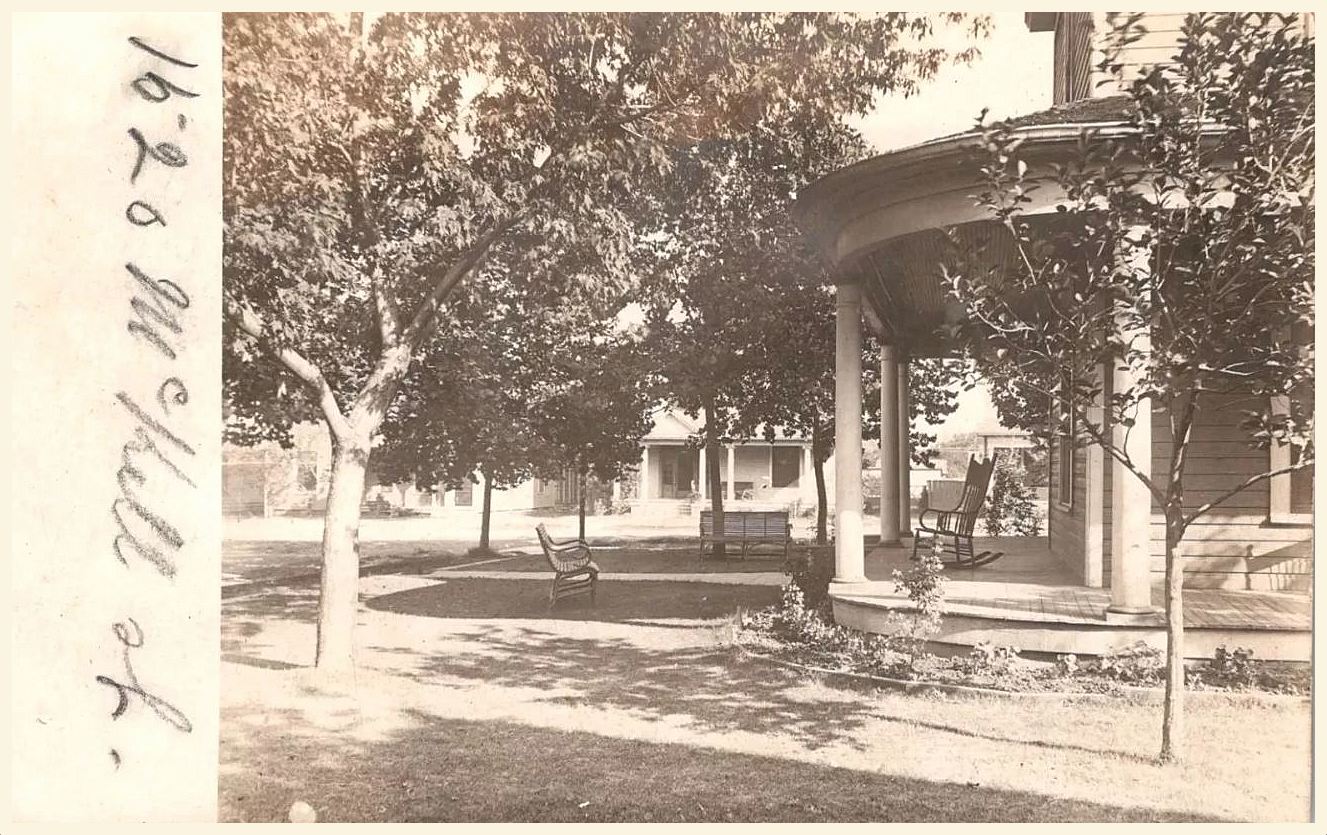
This might be the most surprising post to make this list. Basically, I posted it last New Year’s Day, because the postcard featured in the post was mailed on the day wishing the recipient a happy new year. I actually think of this house almost every day, because I pass this corner (Gaston and Hill) on my drive to work. But the house is not spectacular, and the man who lived there — while important in Dallas’ medical history — is not terribly “sexy.” I’d like to think the post’s popularity might be because of the related story about the person the card is addressed to. We have had ongoing discussions at the library about the importance/necessity of transcribing postcards. I can see both sides of the issue, but, I have to say, I have found more interesting stories and bits of obscure information that I would never have known about had I not read the addresses or messages on the backs of what are seemingly ephemeral bits of mail. Like this one!

*

7.  “THE FOREST THEATER YOU’VE NEVER HEARD OF — ca. 1912-1914” (March)

I felt guilty because it took me 9 years to write this post, having received this really interesting photograph from a reader all the way back in 2015. It took me forever to write down the short history of this little movie theater in South Dallas and make its confusing history readable. I hope I succeeded! It’s gratifying that so many people seemed to like it.

*

8.  “THE HIGGINBOTHAM-PEARLSTONE BUILDING” (February)

This is the post I was researching when I stumbled upon the photo at the top of this page which caused me to detour from my “oh, wow, isn’t this a cool building that’s still standing in the West End — let me tell you about its history” to “OH WOW — THIS IS AMAZING — LET ME TELL YOU ABOUT BROTHELS!” In the end, both posts made the Top Ten!

*

9.  “THE GRADING OF JUNIUS — 1903” (March)

This photo immediately made me wonder where it was taken — and what was that house up on what looks like a hill? That’s in Old East Dallas? Yep. I really enjoyed this one.

*

10.  “OAK LAWN AVE. — KEEP ON TRUCKIN’ (1971) (March)

I didn’t expect this to be so popular, but even hippies deserve their day! I used to never include anything on the blog past 1969, because it just didn’t seem old enough. But this very-’70s artwork is now over 50 years old. I guess it means it is now “historical”!

*

And that wraps up 2024. I look forward to learning new things about the history of Dallas in 2025. I hope you’ll check back in!

As always, thank you for reading, and Happy New Year!

***

Sources & Notes

See all three 2024 Year-End “best of” lists here.

See all Flashback Dallas Year-End lists — past and present — here.

*

Copyright © 2024 Paula Bosse. All Rights Reserved.