Flashback : Dallas

A Miscellany: History, Ads, Pop Culture

Month: October, 2014

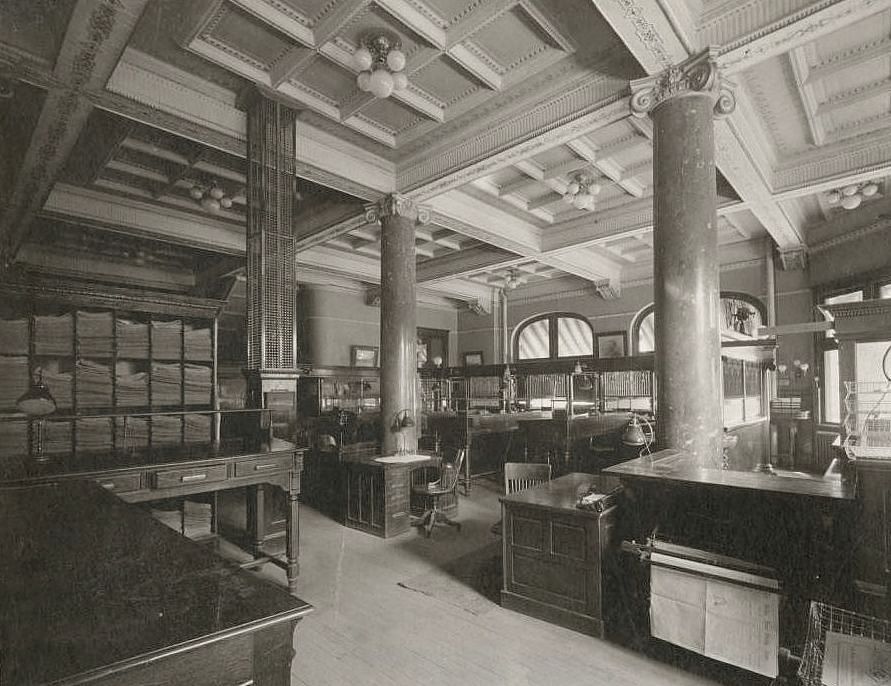
The Dallas Morning News Building, Inside and Out — ca. 1900

dmn_newsroom_c1903_degolyer_smuTurn-of-the-century DMN newsroom (click for larger image)

by Paula Bosse

Above: the empty (and almost sterile) “newsroom” of The Dallas Morning News, around 1903. There’s either a big fire somewhere, or news has taken the day off.

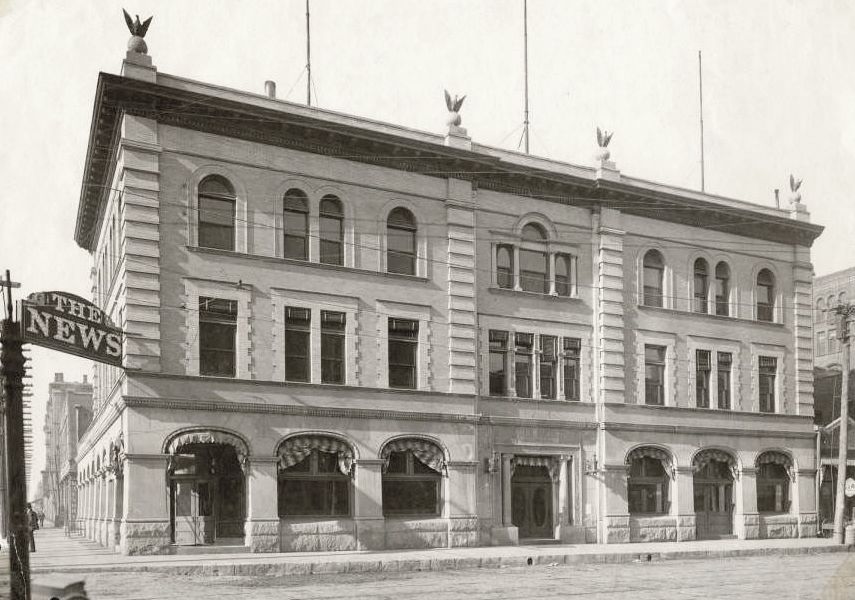
Below: the new Morning News building, about 1900. Located at the northwest corner of Commerce and Lamar, this is the Lamar side.

dmn_lamar-side_c1900_degolyer_smu

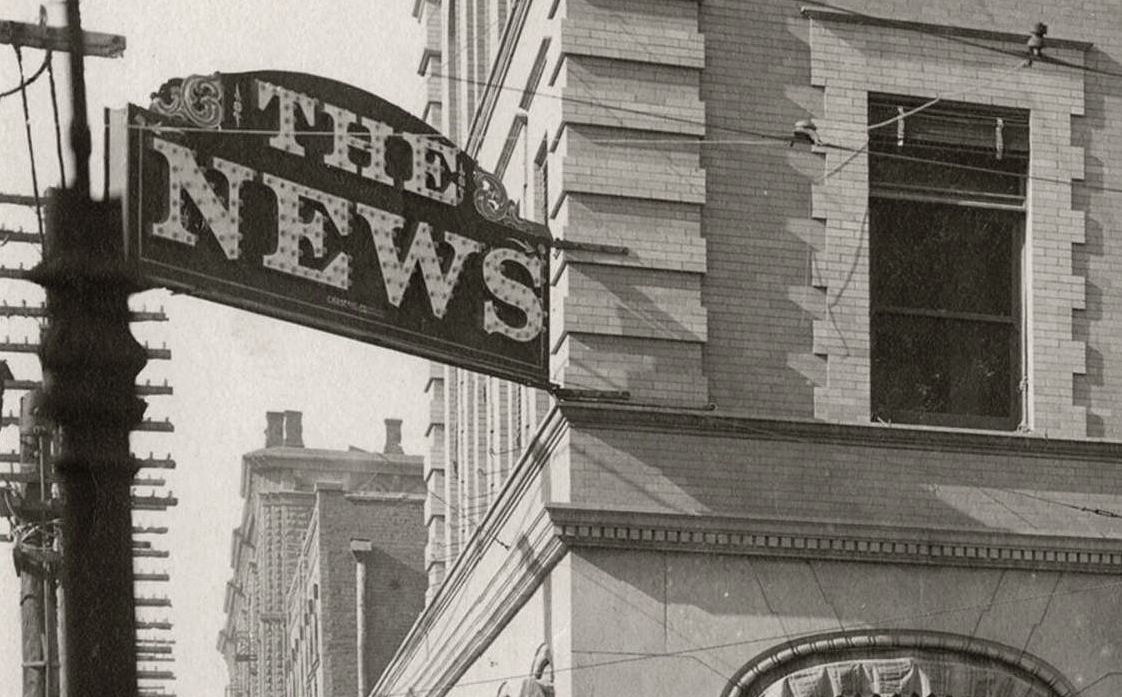
And the somewhat show-bizzy sign, studded with bulbs — one hopes it flashed at night.

dmn_lamar-side_c1900_degolyer-det1

***

Photo of the Dallas Morning News newsroom, circa 1903-1905, from the Belo Records collection, DeGolyer Library, Central University Libraries, Southern Methodist University; more info here.

Photo of the Dallas Morning News building (slightly cropped), circa 1900-1901, from the Belo Records collection, DeGolyer Library, Central University Libraries, Southern Methodist University. Original photo, along with additional information, can be found here.

See the other photos of the building from 1900 in these other posts:

  • “Loitering In Front of the Dallas Morning News Building — ca. 1900,” here
  • “Lively Street Life Outside the Dallas Morning News Building — ca. 1900,” here

All images larger when clicked.

*

Copyright © 2014 Paula Bosse. All Rights Reserved.

Whither Water? — 1956

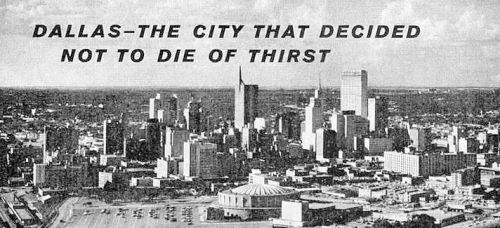
drought_caterpillar-ad_1962_det“Dallas — The City That Decided Not To Die of Thirst”

by Paula Bosse

Between 1950 and 1957, Texas suffered the worst drought on record. By 1957, 244 of Texas’ 254 counties had been declared disaster areas. In 1952, Lubbock recorded not even a trace of rain. Elmer Kelton captured the period perfectly in his classic novel, The Time It Never Rained. It might not have achieved the epic catastrophic proportions of the Dust Bowl days, but that doesn’t mean it wasn’t devastating.

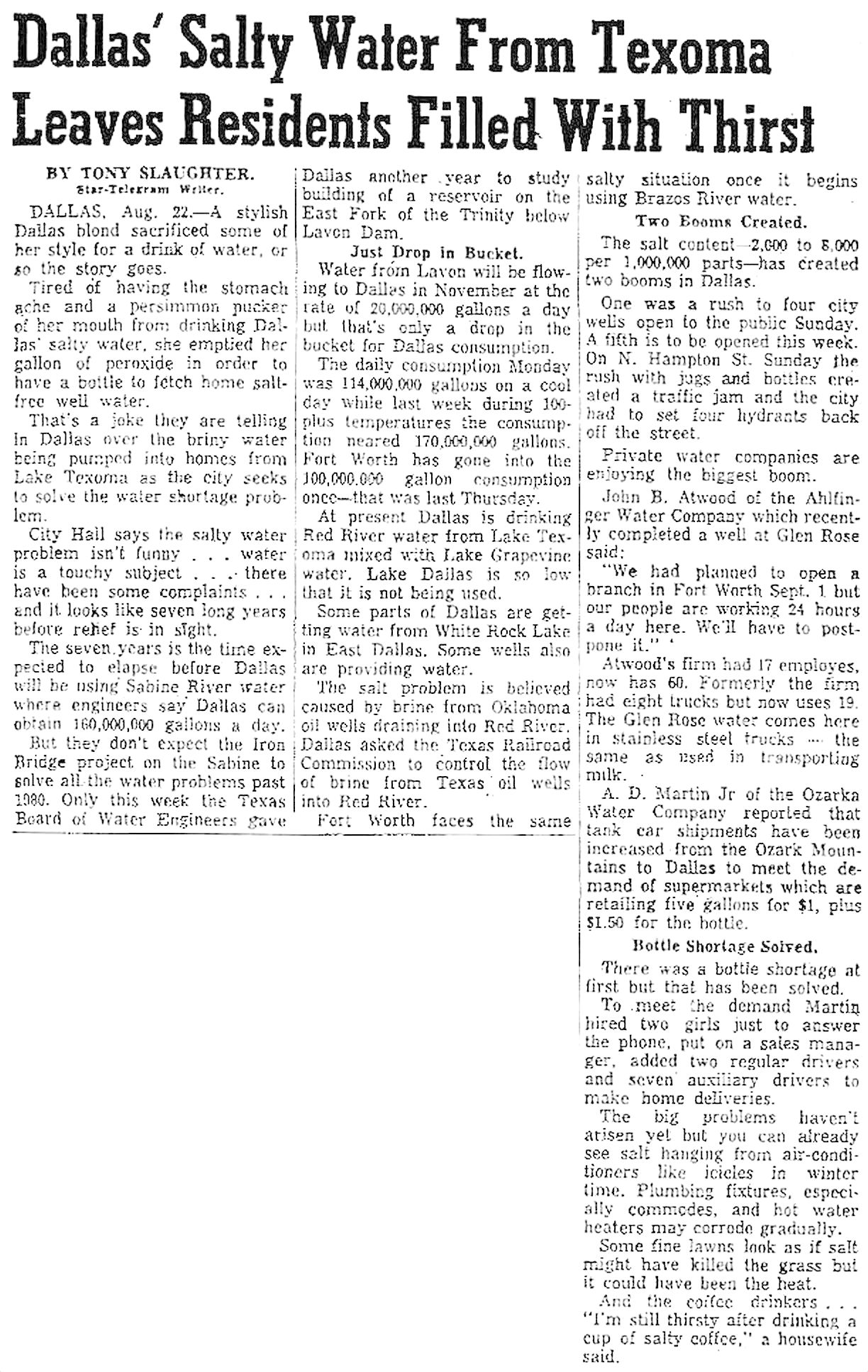
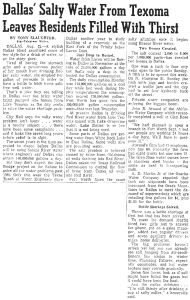
In Dallas, the lakes and reservoirs were hit hard. White Rock Lake dried up — one was able to walk across the parched lake bed without a drop of water in sight. Lake Dallas (now Lake Lewisville) fell to 11% of capacity. Dallas was desperate for water, and in 1956, it began “importing” water from Oklahoma. Red River water was appreciated, but it was considered by many far too salty to drink. In addition to the unpleasant taste, residents were concerned that there would be permanent damage to pipes and plumbing, and, to a lesser extent (since watering restrictions were being strictly enforced) to their lawns.

According to one report, salt content in the water supply had gone from the normal 39 parts per million gallons to over 800 parts (at the height of the problem, some news outlets reported it to be well over 2,000 parts per million). While the water was generally considered perfectly safe for the average person to drink, many looked for cleaner, more palatable drinking water.
drought_FWST_082356Fort Worth Star-Telegram, Aug. 23, 1956 (click for larger image)

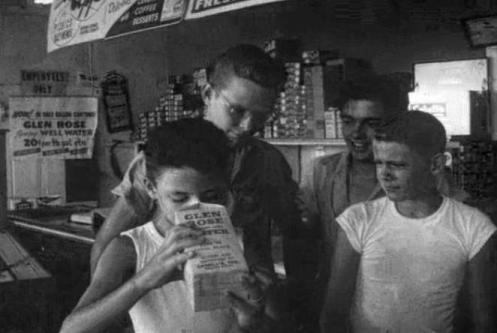
Suddenly bottled water became a boom business. Spring water was being trucked to Dallas from Glen Rose and Arkansas. Water was being sold in bottles and cartons — from 20 cents per half-gallon cartons to $2.50 for five-gallon bottles ($1.50 of which was for a deposit on the glass bottle). WBAP-TV news even sent a cameraman out to a Cabell’s convenience store to capture some boys testing out the Glen Rose water (watch it here, without sound).
water_portal_screencap

The other source of acceptable drinking water that summer was from city wells dotted around Dallas. Long dormant, the city opened the wells and offered free water to residents. From The Dallas Morning News:

If you don’t like that hard, salty water coming from your taps, you can get soft, unsalty water at four city wells beginning Sunday. City manager Elgin E. Crull Saturday said that the city has installed faucets at the four wells where people may take their buckets or bottles and obtain drinking water. No trucks will be permitted to fill up. (DMN, Aug. 19, 1956)

The four wells mentioned above — and two more opened within a few weeks — were located at the following locations:

  • 1325 Holcomb, near Lake June Road
  • Opera and 13th, near the Marsalis Zoo
  • 875 North Hampton, near Lauraette Street
  • 2825 Bethurum, in South Dallas, near the public housing project
  • Northwest Highway and Buckner
  • Matilda and Anita, on the grounds of Stonewall Jackson Elementary School, in East Dallas

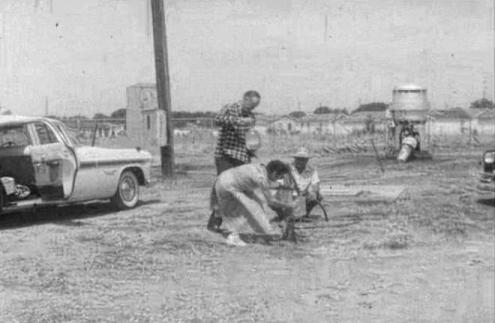
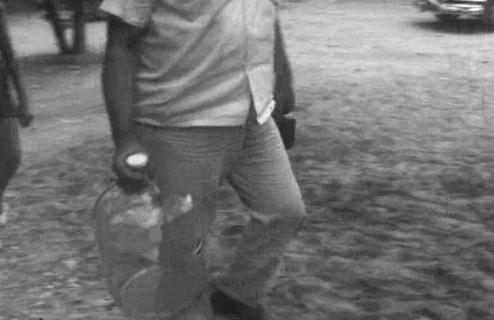
These wells were hugely popular, with thousands of people showing up with jugs, jars, kettles, canteens, and bottles of every conceivable size. (More WBAP news footage of people filling up at these wells can be seen here, without sound; details below).
well-1

well-2

The popularity of the city wells led to private citizens having wells dug on their own property. Not only were bottled water suppliers making a killing during the summer of ’56, so were the owners of drilling businesses. From The Dallas Morning News:

As salty water from city mains reportedly discourages shrubbery and affronts the taste, drillers of shallow residential water wells ride the crest of a boom. […] Luckiest of the water-seekers are residents of the southern section of the city in the Fruitdale, Pleasant Grove and Home Gardens area, and in the neighborhoods that border Loop 12. That is where drillers are finding pay dirt — water-bearing gravel — at shallow depths. (DMN, Oct. 7, 1956)

It wasn’t just professional drillers who were busy — it wasn’t uncommon for the DIY-ers to be out in the backyard on weekends, digging away, hoping for their own personal source of fresh water. And there were probably even some dowsers out and about, water witching their little hearts out.

The drought ended the next year, and personal wells were a thing of the past, but that mania for bottled water really dug its heels in.

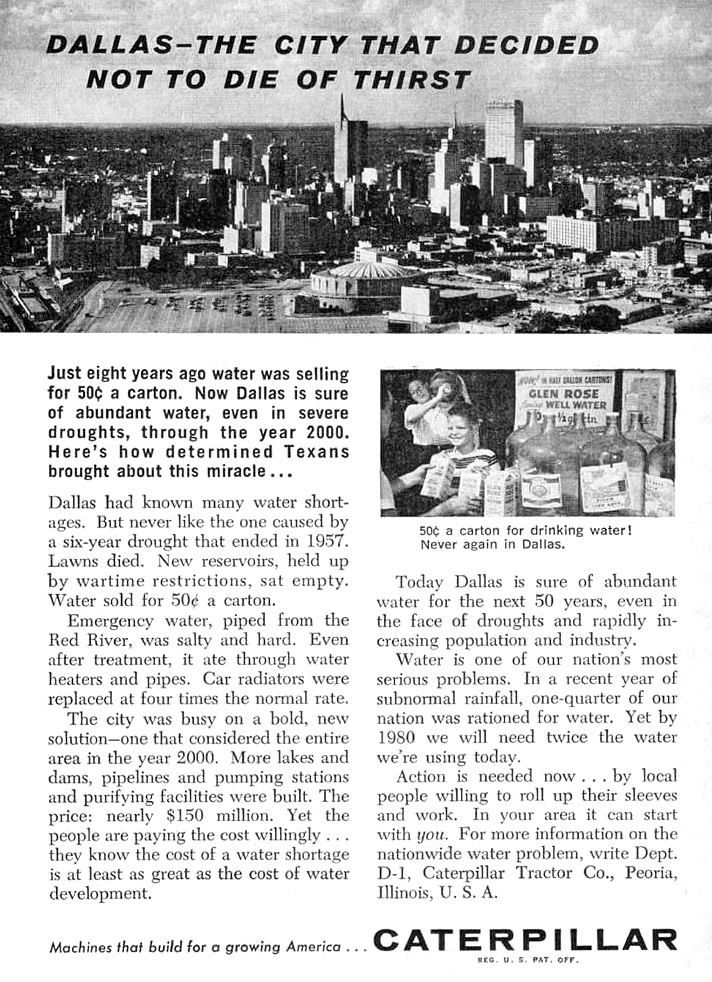
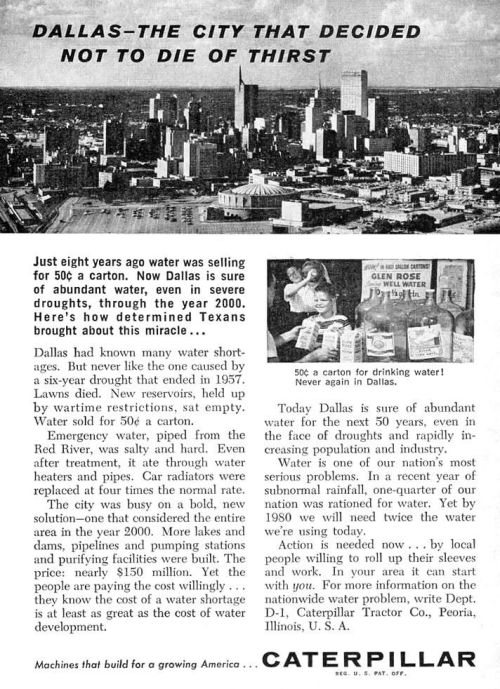
Texas developed the Water Planning Act of 1957, and in 1962, this new mandate and what had happened in Dallas during the drought was used as the basis for a Caterpillar ad which had a bit of a hyperbolic headline, “Dallas — The City That Decided Not To Die Of Thirst”:
drought_caterpillar-ad_19621962 ad (click for larger image)

***

Sources & Notes

Picture of the four boys tasting the Glen Rose water is taken from the WBAP-TV news story that aired on Aug. 12, 1956. The silent, edited footage was shown as the news anchor read the script, seen here. Film footage (linked above) and script from the Portal to Texas History.

The two pictures of people availing themselves of water from the city’s wells are taken from the WBAP-TV news story that aired on  Aug. 19, 1956. The silent footage ran as the anchor read the script seen here and here. Film footage (linked above) and script from the Portal to Texas History.

1962 Caterpillar ad from eBay.

More on affect of the drought on Dallas can be found in these Dallas Morning News articles:

  • “Sparked by Salt: Business Booming For Bottled Water” (DMN, Aug. 5, 1956)
  • “Citizens Stock Up On Saltless Water” by Sue Connally (DMN, Aug. 20, 1956)
  • “Thirsty City Witnesses Revival of Well Drilling” by William K. Stuckey (DMN, Oct. 7, 1956)
  • “Resourceful Citizens Tap City Water Well” (DMN, Oct. 16, 1956)
  • “Continuing Drouth Produces Top Local News Story in ’56” by Patsy Jo Faught (DMN, Dec. 30, 1956)

Read about how the drought affected Texas water management here; read about the Texas Water Rights Commission here.

Read “The City of Dallas Water Utilities Drought Management Update” in a PDF, here.

Finally, I encourage everyone to grab a tall glass of ice water and settle down to read Elmer Kelton’s classic Texas novel, The Time It Never Rained. Or if you’re pressed for time, read Mike Cox’s article about the book in Texas Parks & Wildlife magazine, here.

*

Copyright © 2014 Paula Bosse. All Rights Reserved.


The Dallas Police Department & Their Fleet of Harleys — 1951

ad-harley-davidson_dpd_19511951 ad

by Paula Bosse

Group photo day!

Like so many cities all over the country — whether large or small — the motorcycle division of the Dallas Police Department is equipped with Harley-Davidsons exclusively. Effective traffic regulation is assured through the use of 35 solo Harley-Davidsons and 29 Servi-Cars. Traffic experts recognize that no other method matches motorcycles for efficiently handling so many phases of traffic control work and accident prevention.

***

Sources & Notes

1951 Harley-Davidson ad from… somewhere — probably eBay.

Back in 1910, the DPD was perfectly happy with Indian motorcycles, as can be seen in a previous post, “Dallas Motor Cycle Cops — 1910.”

*

Copyright © 2014 Paula Bosse. All Rights Reserved.
“Life” at the State Fair of Texas — 1951

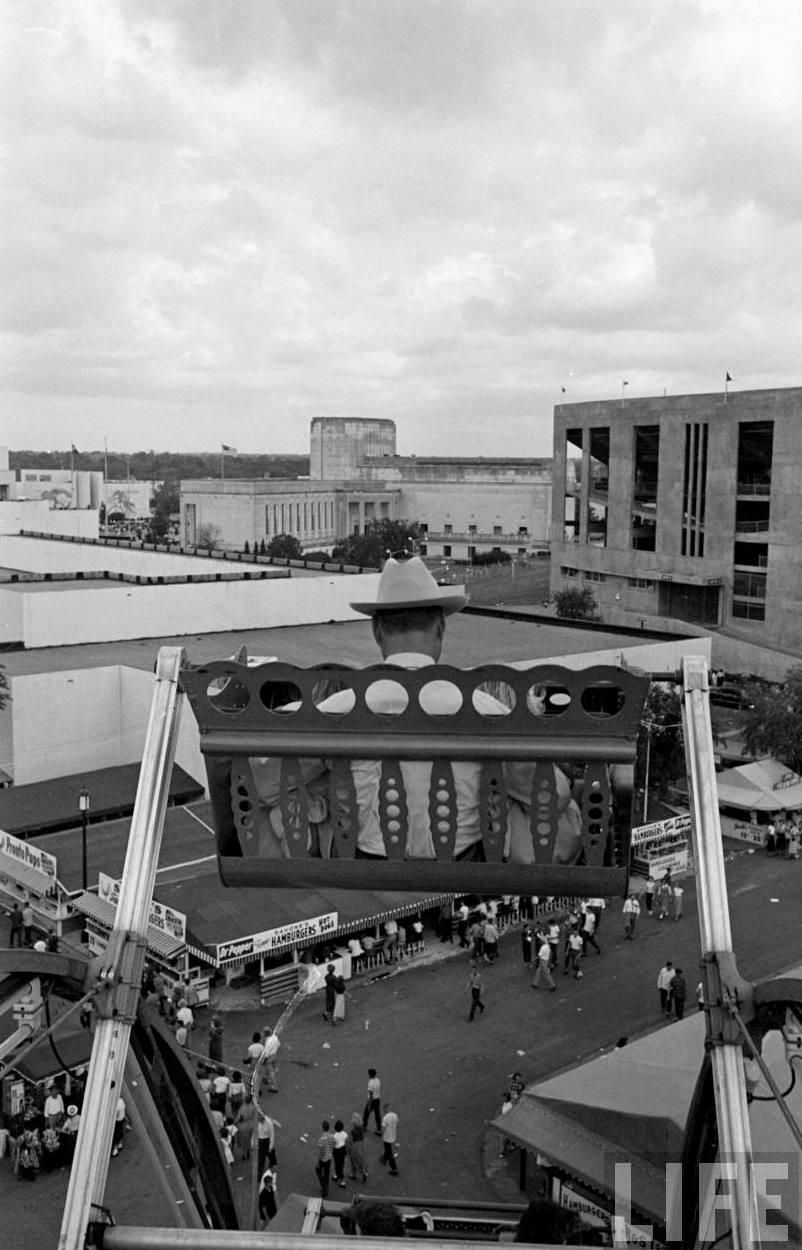
fair-park-midway_life_1951On top of the world, 1951

by Paula Bosse

A Life magazine photographer moseyed down to Dallas in 1951 and captured a couple of cool shots of the State Fair. The photo above (so sweet, and one of my favorite Midway shots ever) was captioned:

In Dallas a rancher takes the kids for a ride in a 92-foot-high double Ferris wheel.

The photo below shows a tractor-pulled tram (fare: 15 cents) as it wheels past the Hall of State, full of well-dressed men and women. (That kid in the boots, cowboy hat, and letterman jacket … had I been around in 1951, I would have had a big ol’ crush on him.)

Click both of these wonderful photos to see larger images. You can practically smell the Brylcreem and cotton candy.

fair-park_tour_life_1951Life magazine, 1951

***

Sources & Notes

Both photos taken at the 1951 State Fair of Texas for Life magazine by an uncredited photographer. The top photo (cropped differently) ran in the Oct. 22, 1951 issue of Life as part of a feature titled “It’s a Bumper Year For Fairs” — it was the only photo that appeared in the magazine shot at the Texas fair. The bottom photo did not run in the magazine.

*

Copyright © 2014 Paula Bosse. All Rights Reserved.

When the Spanish Influenza Hit Dallas — 1918

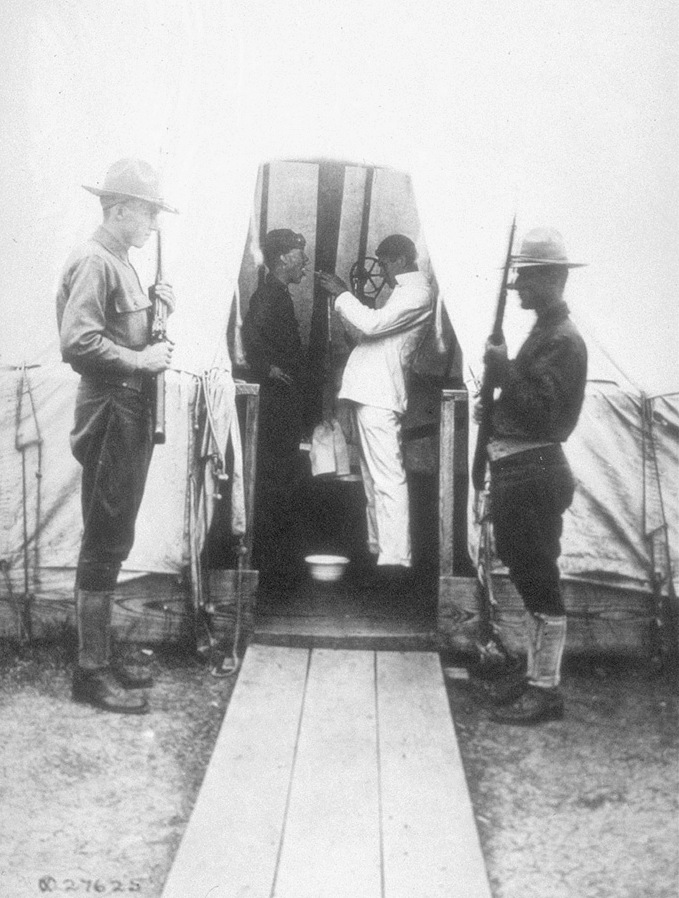
spanish-influenza_love-field_otis-historical-archives_nmhm_110618
American Red Cross at Love Field, spraying soldiers’ throats, Nov. 6, 1918

by Paula Bosse

The Spanish Influenza pandemic of 1918-1919 caused as many as 50 million deaths worldwide — about 600,000 of which were in the United States (11 times greater than the number of American casualties during World War I). Locally, the influenza first hit the soldiers at Camp Bowie in Fort Worth in September, 1918. The flu spread quickly, and on Sept. 27, it was reported that there were 81 cases in the camp. Well aware of the devastation the flu had wrought in other U.S. cities, most notably at military camps, Fort Worth was, understandably, taking the situation seriously. Dallas leaders, on the other hand, were all-but pooh-poohing the need for concern. On Sept. 29, The Dallas Morning News had a report titled “Influenza Scare is Rapidly Subsiding” — the upshot was that, yeah, 44 reported cases of “bad colds” had been reported in the city, but there’s nothing to worry about, people.

In the opinion of the military and civil doctors, the Spanish Influenza scare is unwarranted by local conditions. The few cases of grip, it is claimed, are to be expected as the result of the recent rainy weather.

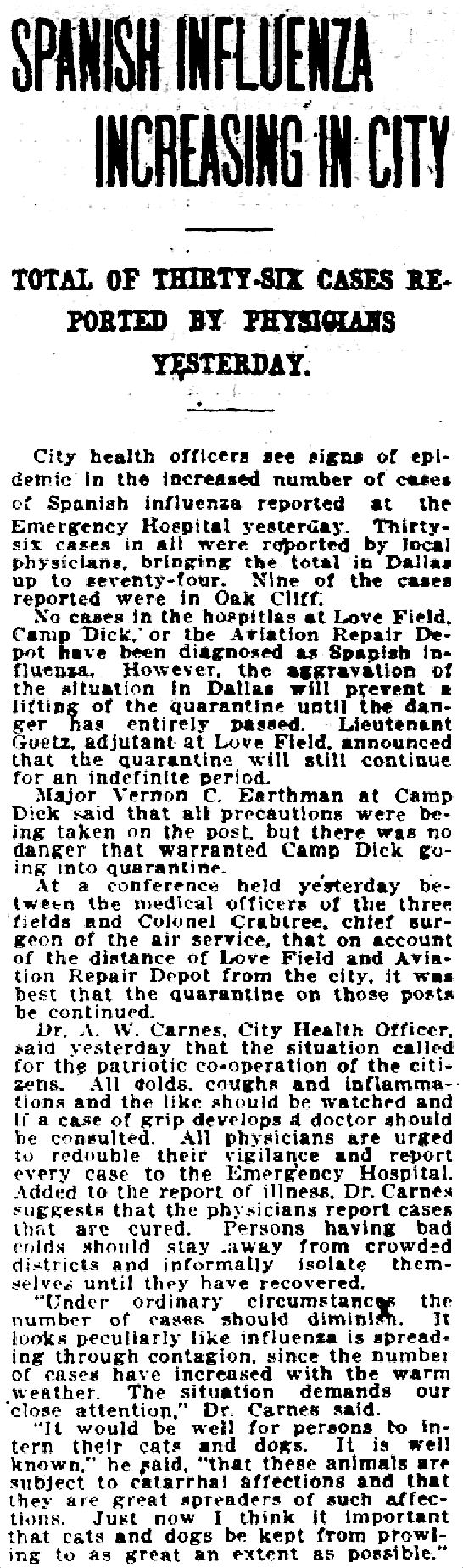
Just two days later, though, officials were jolted out of their complacency when the (reported) cases jumped to 74 (click for larger image):

spanish-influenza-dmn-100218DMN, Oct. 2, 1918 (click for larger image)

The months of October and November were just a blur: the city was plunged into an official epidemic. There was no known cure for the flu, so a somewhat ill-prepared health department preached prevention. People were encouraged to make sure their mouths were covered when they coughed or sneezed, and they were directed to not spit in the street, on streetcars (!), in movie theaters (!!), or, well, anywhere. (Handkerchief sales must have soared and spittoon sales must have plummeted.)

At one point or another, places where people gathered in large numbers — such as schools, churches, and theaters — were closed. Trains and streetcars were required to have a seat for every passenger (no standing, no crowding) (…no spitting). The number of mourners at funerals (of which there were many) was limited. And there was a major push for citizens to clean, clean, clean their surroundings in an attempt to make the city as sanitary as possible. Instructions appeared often in the newspapers.

spanish-influenza_dmn_101218_tipsDMN, Oct. 12, 1918

It was estimated that there were 9,000 cases of Spanish Influenza in Dallas in the first six weeks. By the middle of December, when the worst of the outbreak was over, it was reported that there had been over 400 deaths attributed to the Spanish Influenza and pneumonia in just two and a half months.

spanish-influenza_FWST_121118Fort Worth Star-Telegram, Dec. 11, 1918

As high as these numbers were, Dallas fared much, much better than many other parts of the United States.

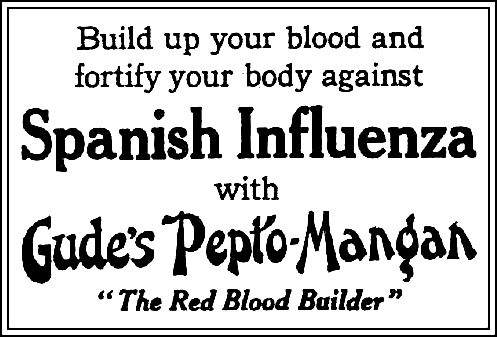
spanish-influenza_ad_dmn_101818_pepto-manganAd, DMN, Oct. 18, 1918

***

Sources & Notes

Photo at top was taken on November 6, 1918 and shows American Red Cross Workers spraying throats of military personnel based at Love Field in hopes of preventing the spread of the influenza. The photo is from the Otis Historical Archives, National Museum of Health and Medicine; I found it on the NMHM site, here. (Click photo for larger image.)

Ad for Pepto-Mangan (“The Red Blood Builder”) was one of a flood of medicines and tonics claiming to be effective in the fight against Spanish Influenza (none were).

For a detailed and remarkably well-researched, comprehensive history of the Spanish Influenza in Dallas, see the article prepared by the University of Michigan Center for the History of Medicine, here. It’s pretty amazing.

To read about the history of pandemics (including several good links regarding the Spanish flu), see the Flu.Gov site, here.

And, NO, Ebola is not transmitted like the flu. But it’s still good practice to cover your mouth when you cough or sneeze,wash your hands frequently, and never EVER spit in the street, because that’s just disgusting. ((This post was originally written in 2014 while Dallas was the center of the Ebola universe.))

More on the Spanish Influenza pandemic can be found in the Flashback Dallas post “Influenza Pandemic Arrives in Dallas — 1918.”

*

Copyright © 2014 Paula Bosse. All Rights Reserved.