Flashback : Dallas

A Miscellany: History, Ads, Pop Culture

Category: 1880s

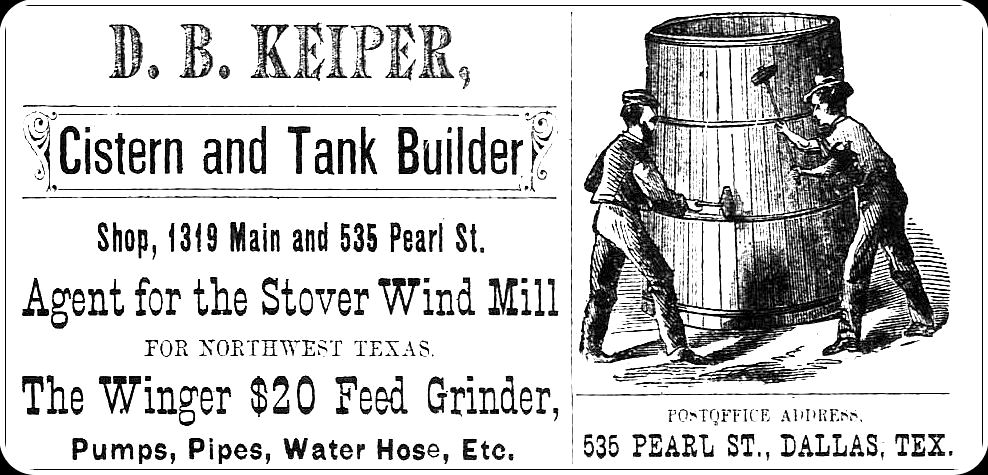
D. B. Keiper, Cistern and Tank Builder

ad-keiper_cisterns_directory_1884Ad from the 1884 Dallas directory

by Paula Bosse

For all your cistern and tank needs, D. B. Keiper’s your man.

keiper_dallas-herald_061881Dallas Herald, June 18, 1881

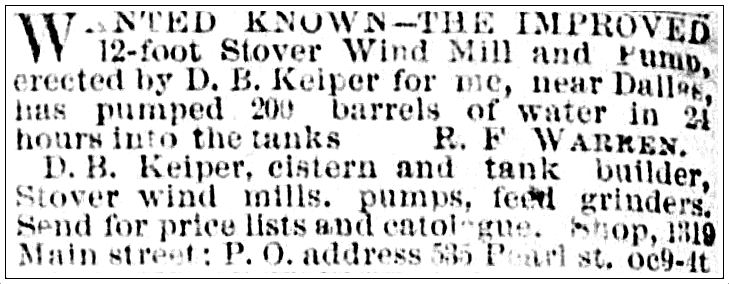
keiper_dallas-herald_101384Dallas Herald, Oct. 13, 1884

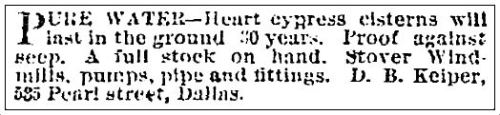
keiper_dallas-herald_120484Dallas Herald, Dec. 4, 1884

keiper_dmn_091586Dallas Morning News, Sept. 15, 1886

keiper_dmn_093088DMN, Sept. 30, 1888

keiper_dmn-121391DMN, Dec. 13, 1891

***

Top ad from the 1884 Dallas directory.

I didn’t find out much about the Pennsylvania-born David Butz Keiper (1827-1895), except that he bought a lot of lumber, sold a lot of cisterns and tanks, and took out a huge number of newspaper ads over the years.

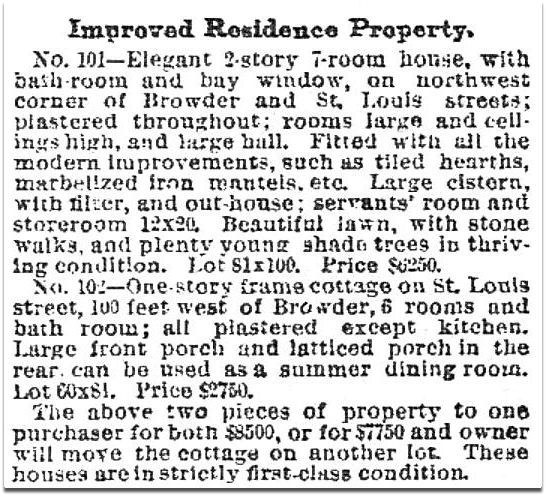
One wonders if he might have built and installed the underground cistern of the Rosenfield house I wrote about in “The Blue House of Browder,” which was built around 1885 — this “for sale” ad appeared in 1887, when Keiper seemed to be Dallas’ king of cisterns:

1887_browder_dmn_050887-FOR-SALEDMN, May 8, 1887

Keiper specialized in underground wooden cisterns (made from cypress lumber) to hold collected rainwater, but there were many different types of cisterns in use around Texas in the nineteenth century. Mark H. Denton wrote an interesting article, “Cisterns in Texas,” for Current Archeology in Texas (April 2011), with illustrations but with little on wooden cisterns; read Denton’s article here (scroll to bottom of p. 4 of the PDF).

Image too small? Click it!

*

Copyright © 2016 Paula Bosse. All Rights Reserved.

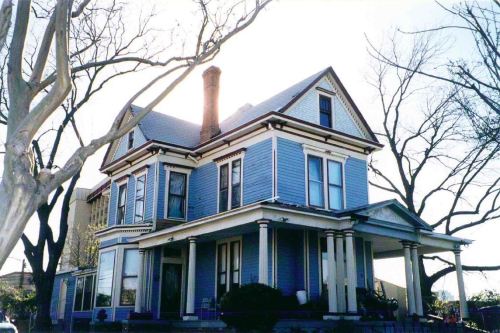
The Blue House on Browder

blue-house_homewardboundinc_2000
The Rosenfield house, in about 2000 (photo courtesy Homeward Bound, Inc.)

by Paula Bosse

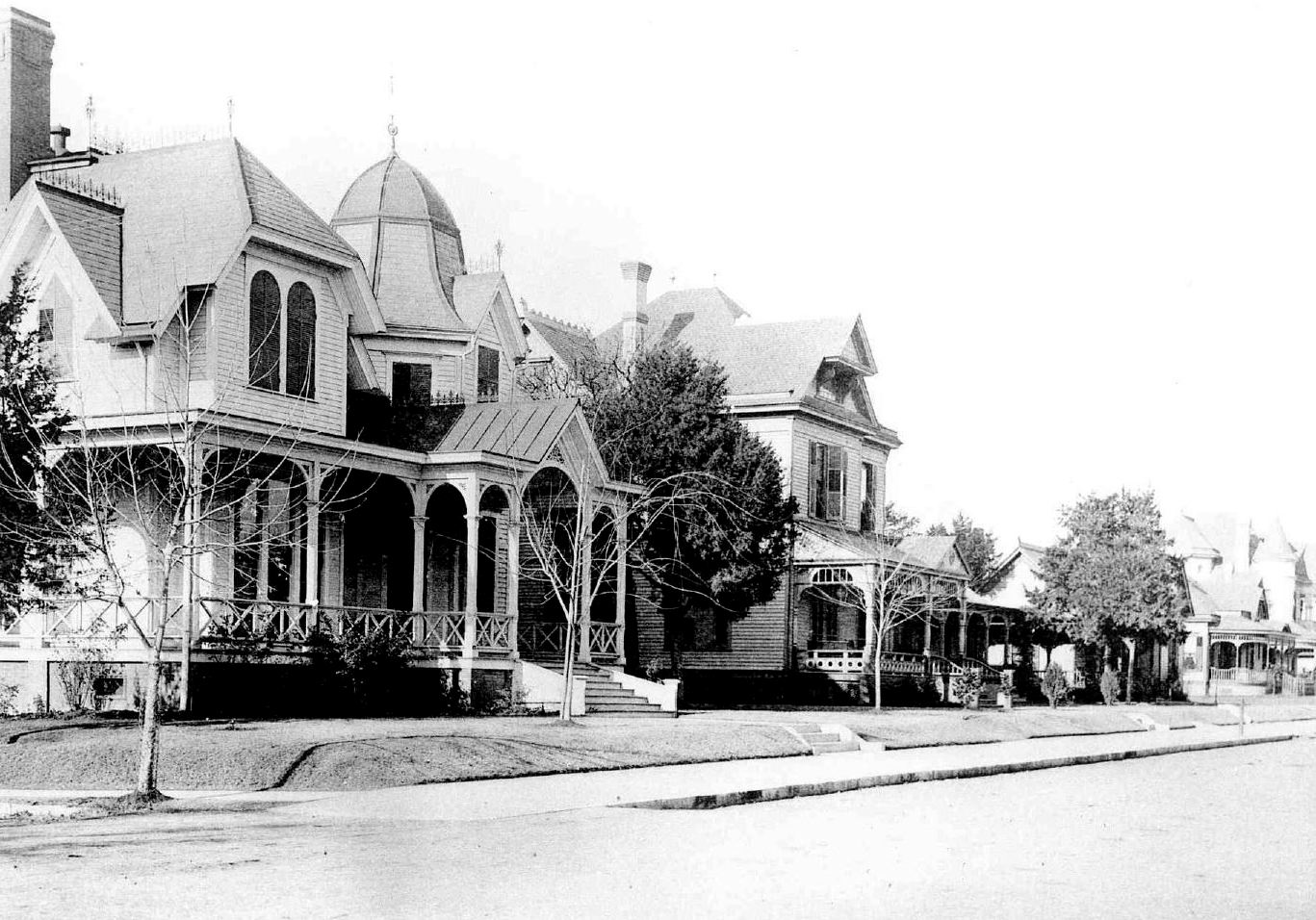
Perhaps you’ve been following the recent brouhaha over the plans to demolish one of the last remaining 19th-century residences in the Cedars area, south of downtown — Robert Wilonsky of The Dallas Morning News has been covering the story here and here and here. The house is in terrible disrepair, but it has the beautiful details of the period, and it’s obvious that it was once a lovely house in a well-to-do neighborhood. Preservation Dallas posted this in-better-days photo on their Facebook page:
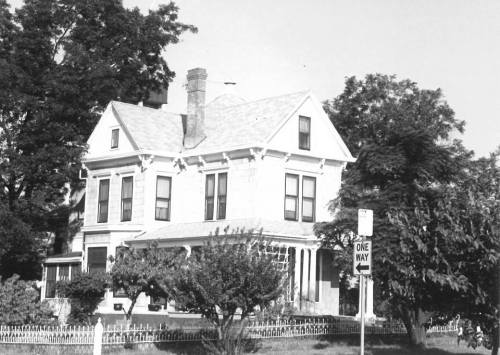
browder-house_preservation-dallas-FB-page

I thought I’d see what I could find about the history of the house — mainly I wanted to see if I could find who built it and when.

The house currently has the address 1423 Griffin, but before highways were built and streets were moved around, its address was 1015 Browder. Dallas changed almost every address in 1911, so I checked Jim Wheat’s very helpful scan of that year’s directory which tells us both the new and the old addresses of houses and businesses and also shows what cross-streets those addresses are between.
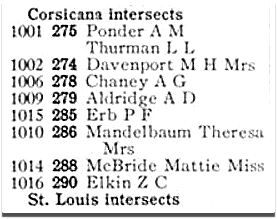
browder-house_1911-directory1911 directory, Browder Street

The original address of the Blue House was 285 Browder Street, between Corsicana and St. Louis. In 1911, P. F. Erb was living there.

Next, I checked the Sanborn maps. The earliest Sanborn map I could find which actually showed this part of Browder was the one from 1892. Here’s a detail showing the two-story frame house on the northwest corer of Browder and St. Louis, with Browder running horizontally along the top. The address is 285 Browder. (The house next to it is 169 St. Louis — more on that house later.)
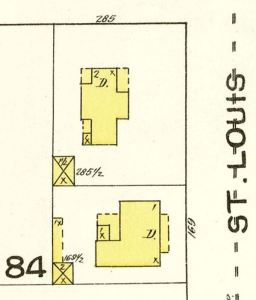
sanborn_1892_285-browder_nw-corner-st-louis_sanborn-1892_sheet-21

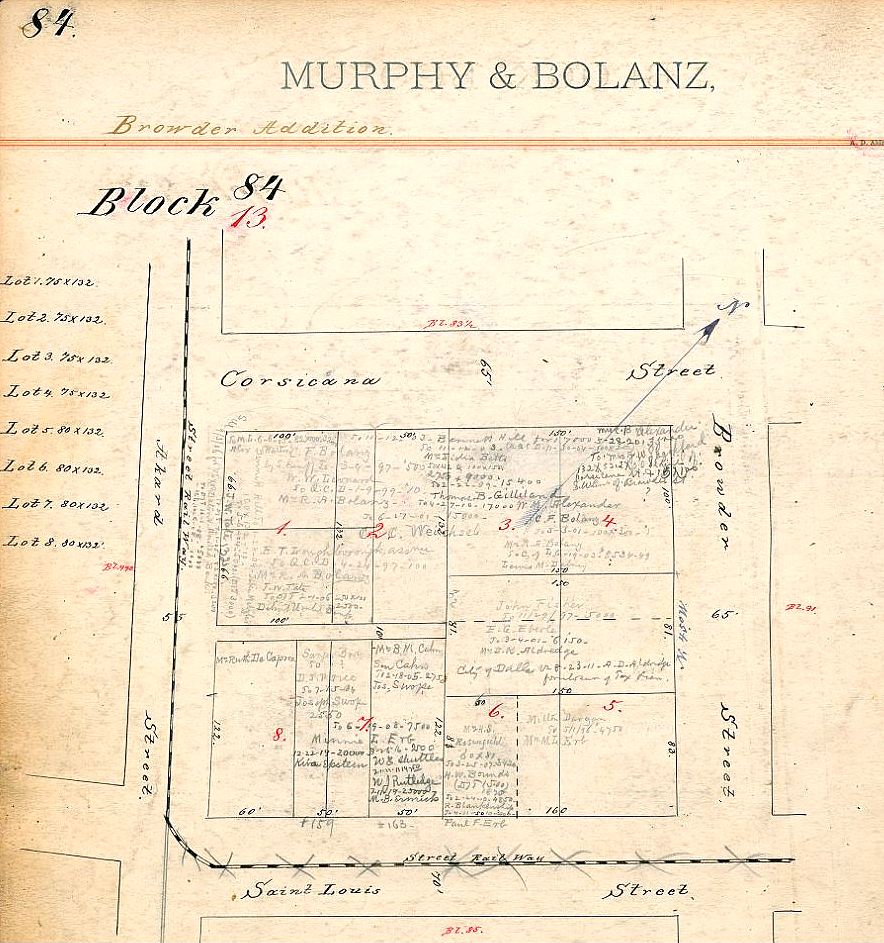
When you look at the full-page map this detail comes from (here), you’ll see larger numbers in the middle of the blocks. The block I’m interested in is block 84. Then I hopped over to the Murphy & Bolanz block book to see what I could find there. (I haven’t actually used this block book much, mostly because my old computer would not work with the plug-in required to view the pages, and it takes a while to figure out what you’re looking at.) When I clicked on “Block 84” in the index, I found this (click for larger image):
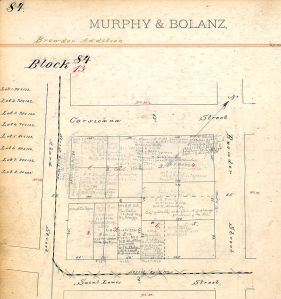
murphy-bolanz_block-13_block-84

Here’s the detail of the pertinent block:
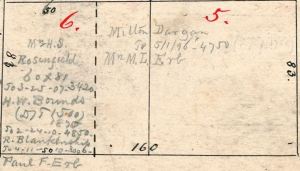
murphy-bolanz_det

The names and other assorted scrawls indicate title change (I think). This page was very helpful, because it told me that this block was originally part of Browder/Browder’s Addition, and it was originally classified as Block 13. The lot in question is Lot 5 (and probably Lot 6, because Erb’s name shows up under both. So now I had terms to search on.

And then it was just a tedious slog through the Dallas Herald archives (not to be confused with the Dallas Times Herald archives), the Dallas Morning News archives, and old city directories. Here’s what I found.

First mention of this particular parcel of land was in The Galveston News on March 24, 1883. P. S. Browder, a Browder family executor, transferred a lot of property — including the two lots I was interested in — to Mr. & Mrs. Nathan Godbold as part of a quitclaim deed (I’m probably not using the correct terminology here…). For one dollar.
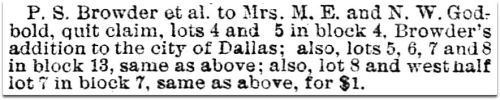
1883-march_browder_galveston-news_032483_QUIT-CLAIMGalveston News, Mar. 24, 1883

A few inches of print over, the record shows that Godbold immediately sold Lots 5 and 6 to Dallas real estate czar Charles Bolanz (misspelled below). For $1,000.

1883-march_browder_galveston-news_032483_to-bolanzGalveston News, Mar. 24, 1883

A few months later, in July, it was reported that Bolanz had sold the adjoining two lots to T. S. Holden, a young man who worked as a salesman for a wholesale grocery firm but seemed to be engaged in land speculation on the side. (It’s a little odd that Bolanz sold it so quickly for a $200 loss, but I’m sure there was probably more to the story.)

1883-july_browder_galveston-news_070283_HOLDENGalveston News, July 2, 1883

At some point, these two lots were sold to Max Rosenfield, another young man who was buying up land in the hopes that its value would increase. From Dallas Rediscovered by William L. McDonald:

“The year 1884 also saw the opening of a new housing subdivision by two Jewish real estate speculators, Gerson Meyer and Max Rosenfield. Their development, bounded by Akard, Corsicana, Browder, and St. Louis streets, was sold primarily to Jewish families who had begun to arrive as early as 1872 as part of the ‘Corsicana crowd’ — the terminal merchants who followed the construction of the H&TC.”

[I couldn’t find anything else about this block being a “sub-division,” but there definitely was a “Rosenfield & Meyer’s Addition” in East Dallas as early as 1886 — see the bottom of this post for more information on Gerson Meyer and the Murphy & Bolanz map of their East Dallas addition.]

In the 1886 city directory, Max Rosenfield is listed as residing at 1118 Browder, which may well have been an address that lasted for a very, very short time — Browder is a very short street, and I wonder if Rosenfield was renumbering addresses in his new development. It does appear to be Lot 5 of the block he and Meyer were developing, though. (Henrietta Rosenfield, widow of Jonas Rosenfield, was Max’s mother, and she lived with or near Max for several years.)

1886_rosenfield_1886-directory_1118-browder1886 Dallas directory

In early 1887, a For Sale ad appeared in the Herald — real estate agents Ducker  & Dudleigh were offering what appears to be Lots 5 and 6. By this time, houses had been built on both lots. (The  numbers 101 and 102 are confusing here, but the property being offered is the lot at the northwest corner of Browder and St. Louis and the lot adjoining it.) The price for the two-story house on Lot 5 was $6,250, which the Inflation Calculator adjusts to being about $166,000 in today’s money, taking into account inflation (but not taking into account Dallas’ outrageous real estate prices!).
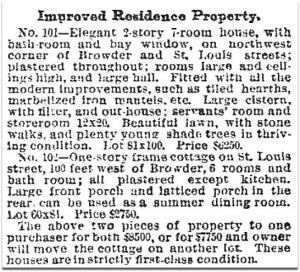
1887_browder_dmn_050887-FOR-SALEDMN, May 8, 1887 (click for larger image)

It doesn’t look like either property sold, because a few months later, the 1888 directory showed Max still living in the Lot 5 house facing Browder and mother Henrietta living in the Lot 6 house at 169 St. Louis.

1888_rosenfield_1888-directory1888 Dallas directory

Rosenfield placed a For Rent ad in the paper in Feb. of 1889, offering his corner house on Browder.
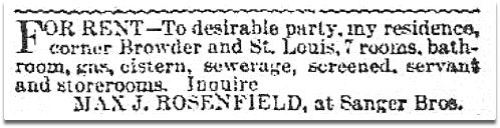
1889_rosenfield_dmn_021389DMN, Feb. 13, 1889

This appears to have been when businessman Milton Dargan moved in. He is listed as moving into the house at about this time in the addenda section of late changes for the 1889 directory (directories were usually compiled in the year before they were actually published).

1889_dargan_1889-addenda-listing1889 Dallas directory

In that same directory, Rosenfield had moved in with his mother in the adjoining property.

1889_rosenfield_1889-directory1889 Dallas directory

At some point Dargan bought the corner house. Henrietta continued to live in the St. Louis-facing house until about 1892, when she moved in with Max at his new home on Akard.

And, finally, the “285” address shows up in a directory, in 1891.

1891_dargan_1891-directory1891 Dallas directory

Paul F. Erb bought the Browder house from Dargan in 1896 (he also bought the adjoining Lot 6 house facing St. Louis in 1910).

1897_erb_1897-directory1897 Dallas directory

And we’re back to Paul Erb, seen in the 1911 directory listing old and new addresses at 1015/285 Browder.

browder-house_1911-directory1911 Dallas directory

Yay!

**

That was a long way to go to establish a chain of ownership. (I’m sure it would have been faster and easier to have consulted city records.)

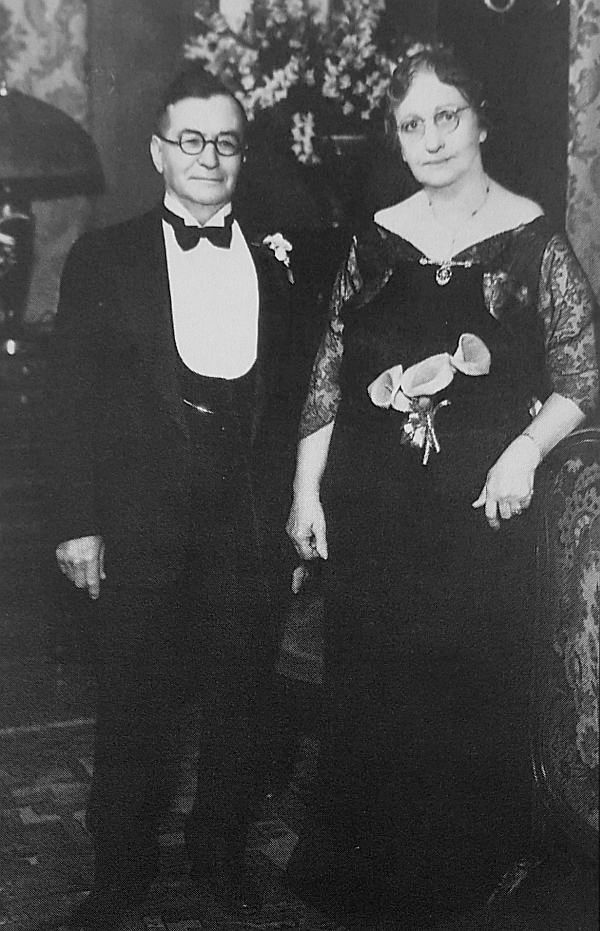
So. Without access to building permits, it looks as if Max Rosenfield (who, by the way, was the father of John Rosenfield — born Max John Rosenfield, Jr. — legendary arts critic for The Dallas Morning News) was the person who built the 130-year-old house now going through the process of probably being torn down soon. It appears to have been built in 1884 or 1885. In a 1935 Dallas Morning News article celebrating the 50th wedding anniversary of Mr. and Mrs. Max Rosenfield, the house is mentioned: “…their first home, a house built by Mr. Rosenfield and still standing on the northwest corner of Browder and St. Louis streets…” (see the article “Mr. and Mrs. M. J. Rosenfield To Observe 50th Anniversary,” DMN, Jan. 6, 1935).

Below is a photo of Max Rosenfield and his new bride, Jenny, probably taken the same year the house was built, 1885-ish, when Max was 26 years old.
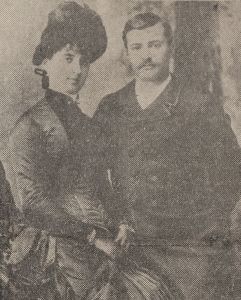
rosenfields_ca-1885_ancestry

Thank you for building such a pretty  house, Mr. Rosenfield. Maybe some magnanimous person with deep pockets can have it moved to a new location and restore it to its former loveliness.
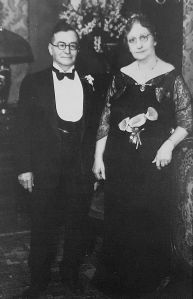
rosenfield-max_1935Mr. and Mrs. M. J. Rosenfield, on their 50th anniversary

**

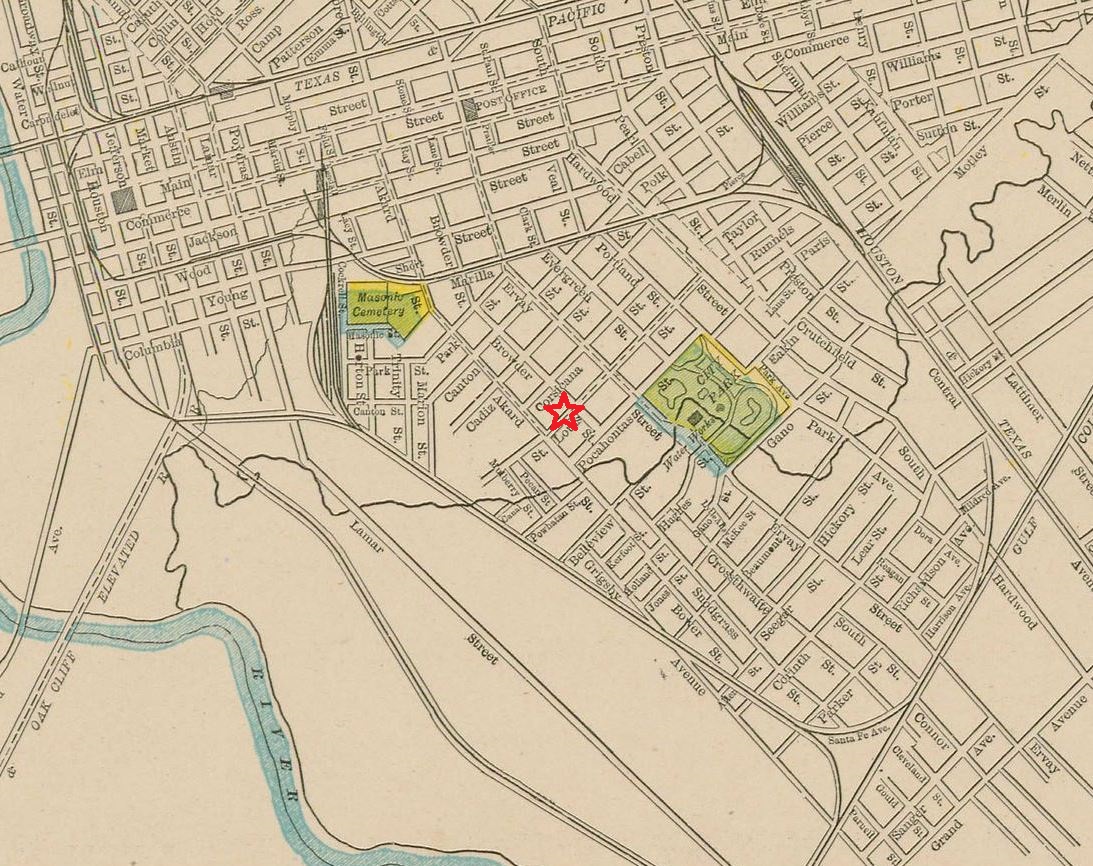
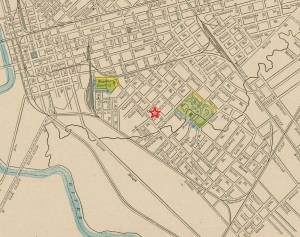
Here’s a detail of an 1893 map of the area, with the house in question marked.
browder-house_1893-map

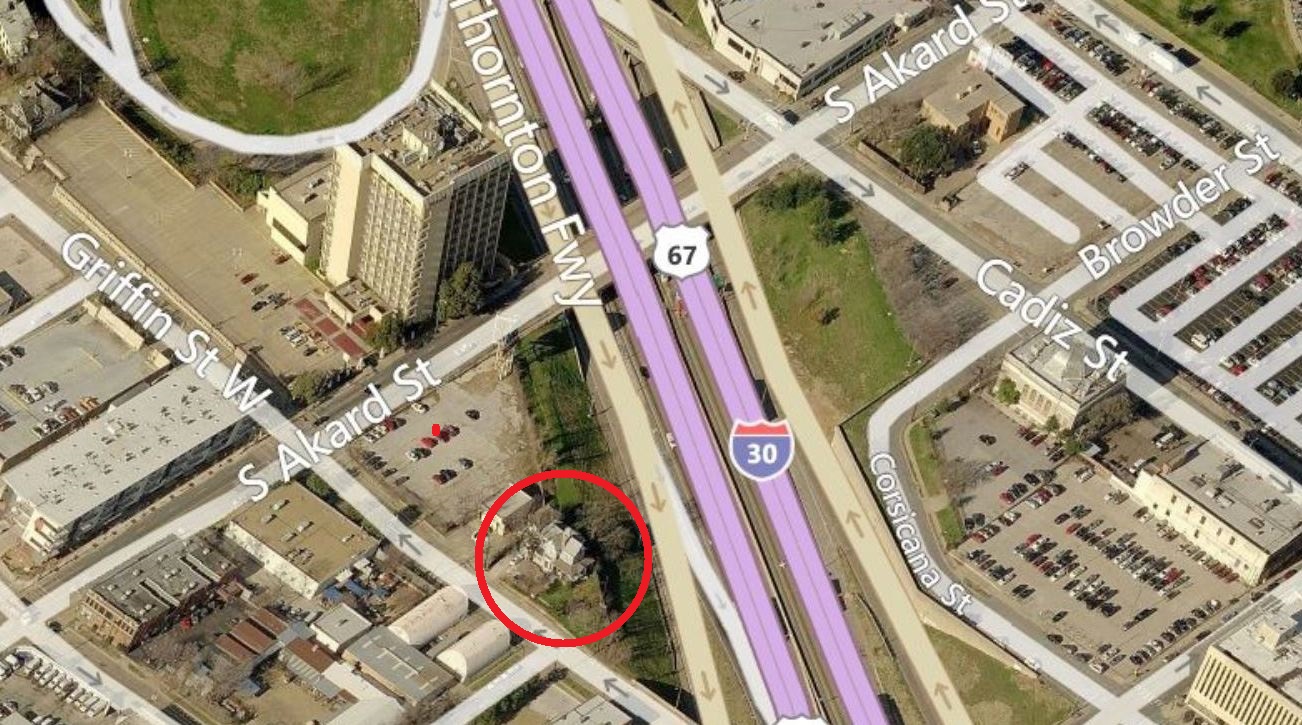
And here’s the lonely little house in its present hemmed-in location.
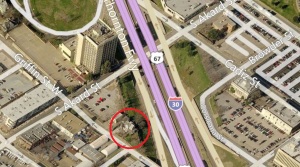
browder-house_bingBing Maps

***

Sources & Notes

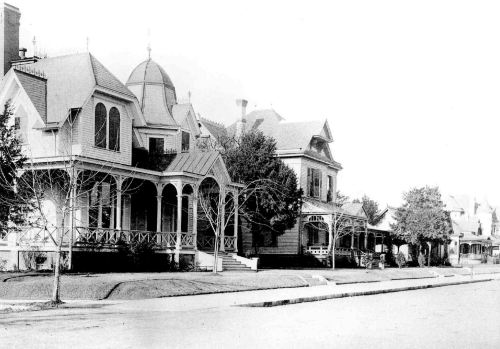
Top photo, taken around 2000, from Homeward Bound, Inc., used with permission. Homeward Bound, Inc. took over the house in 1986 (and owned it until October, 2015) for use as Trinity Recovery Center, a substance abuse treatment center. The organization tried hard to save the house, but, according to Homeward Bound, Inc. Executive Director Douglas Denton, when they approached Dallas’ Landmark Commission in the 1990s, “they were not interested in the building.” Thanks to Mr. Denton for allowing me to use this photo, which shows the beauty of the old house better than any other photo of it that I’ve seen. He points to the photo below as an example of what this Cedars neighborhood once looked like. The caption for the photo in McDonald’s Dallas Rediscovered (p. 125): “Looking north toward downtown along Browder Street near the corner of Cadiz, 1895. These homes, built in the early 1890s, began to be razed in the late 1930s and early 1940s for parking space in the expanding business district.” (Photo: Dallas Public Libary)
browder-near-cadiz_ca1895

This would have been about two blocks from the Rosenfield house. Imagine what that neighborhood once looked like!

Watch a news report on the outcry over the possible demolition of this house on the WFAA website, here.

The Dallas Morning News article on the 50th wedding anniversary of Mr. and Mrs. Max Rosenfield in which it is mentioned that Max built the house (“…their first home, a house built by Mr. Rosenfield and still standing on the northwest corner of Browder and St. Louis streets…”) is “Mr. and Mrs. M. J. Rosenfield To Observe 50th Anniversary” (DMN, Jan. 6, 1935).

Photo of the Rosenfields as a newly married couple found on Ancestry.com.

50th anniversary photo of Mr. and Mrs. Rosenfield is from the book John Rosenfield’s Dallas by Ronald L. Davis (Dallas: Three Forks Press, 2002).

All other sources as cited.

Max J. Rosenfield died in 1935 at the age of 76. His very interesting obituary (probably written by his son, John Rosenfield, amusements editor of The Dallas Morning News), can be found in the Dec. 2, 1935 edition of The News: “M. J. Rosenfield, Business Leader Many Years, Dies.”

It’s worth trying to figure out how to use the Murphy & Bolanz block books, courtesy of the Texas/Dallas History and Archives Division of the Dallas Public Library. Background on these very useful books can be found here.

If I’ve made any mistakes or have drawn any incorrect assumptions, please let me know!
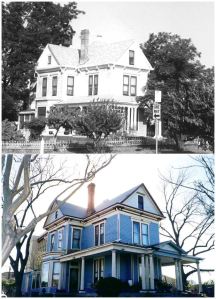
browder-house_then-now

*

UPDATE: Max Rosenfield developed a real estate partnership with Gerson Meyer, both of whom worked for Sanger Bros. department store. They bought and sold real estate (often to fellow Sanger’s employees), apparently as a lucrative side-business (Rosenfield even conducted his real estate transactions from his Sanger Bros. office). They apparently had acquired enough land by 1886 to have their own “addition” — “Rosenfield and Meyer’s Addition” in East Dallas. The earliest mention I found of it was this ad from May, 1886.

rosenfield-and-meyer-addition_dmn_052786DMN, May 27, 1886

Their addition was in East Dallas. Below, the map from the Murphy & Bolanz block book (click for larger image):
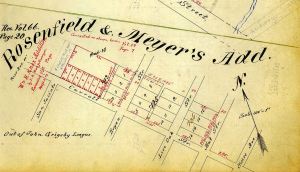
rosenfield-and-meyers-addition_murphy-bolanz

Gerson Meyer (a Jewish German immigrant, just a couple of years older than Rosenfield), moved to St. Paul, Minnesota in 1897 and continued working for several years in men’s clothing.

If something looks too small, click it!

*

Copyright © 2016 Paula Bosse. All Rights Reserved.


The Eisenlohr Family and Dallas’ First Christmas Tree — 1874

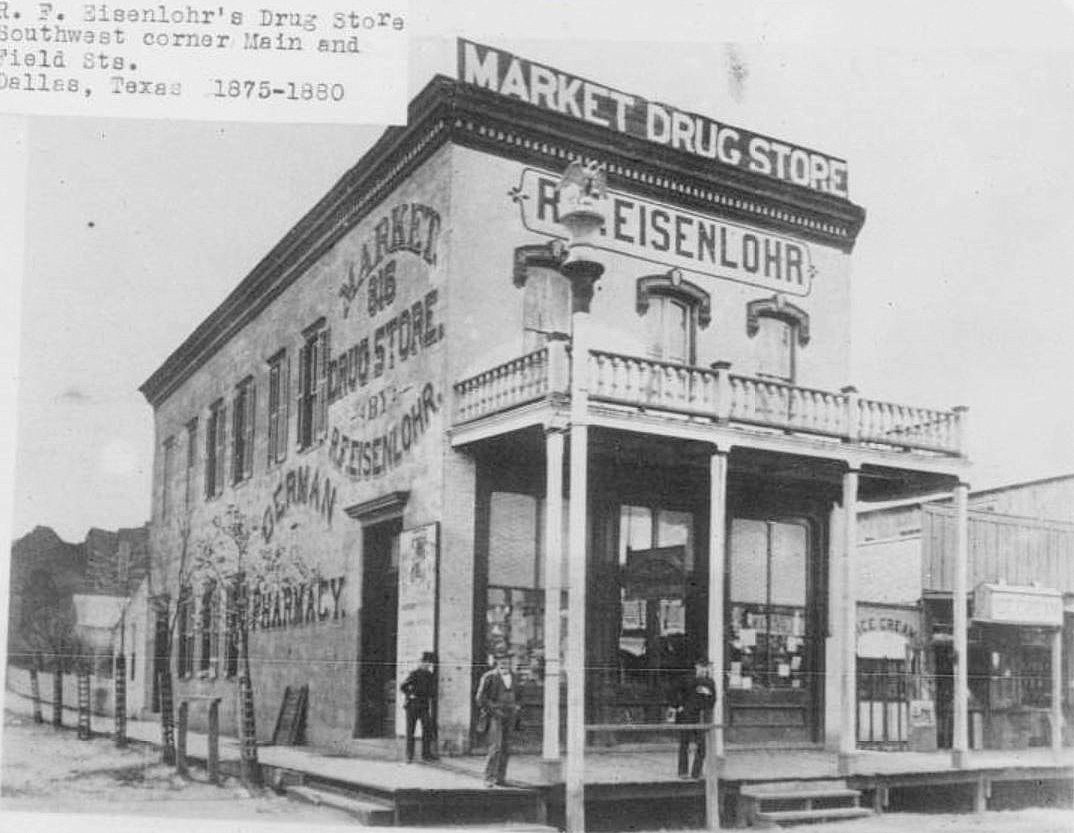
eisenlohr_1885_ebayThe Eisenlohr Market Drug Store, 1885 (click for larger image)

by Paula Bosse

According to the memories of Dallas artist E. G. Eisenlohr (1872-1961), his German-born parents brought the first decorated Christmas tree to Dallas in 1874 (or, according to a version of the story published a few years later, 1876). There had been Christmas trees in Dallas before this, but the Eisenlohrs’ tree may have been the first tree — or one of the first — to be brought inside and decorated with tinsel and ornaments.

According to E. G. Eisenlohr’s Christmas memories which appeared in The Dallas Morning News on Oct. 1, 1935:

The candles, holders and tinsel for that first Christmas tree in the village of Dallas in 1874 was ordered from the East. For days my mother baked cookies in the shapes of stars, ships, [and] boots [using] hand-carved molds, some more than 100 years old, that illustrated folk tales…. For days before Christmas Eve the children had been locked out of the room where Kris Kringle was decorating the tree and permitted to enter only after our parents played their Christmas concert and appeared at the window in answer to the cheers from the crowd in the streets. There may have been other trees in the village before we had ours but I have not heard of any and many persons said ours was the first here. I believe we had the first tinsel and glass decorations, for many persons told me later that their parents had told them of the decorated trees back in their old homes before they came to Texas.

eisenlohr-store_degolyer-lib_SMUThe store, ca. 1875-1880 (via DeGolyer Library, SMU)

But what kind of tree was it? According to Kenneth Foree’s 1946 News article about the Eisenlohr tree, it was “a beautiful cedar tree (cut from an Akard and Young thicket by moonlight when the children were asleep” (DMN, Dec. 24, 1946).

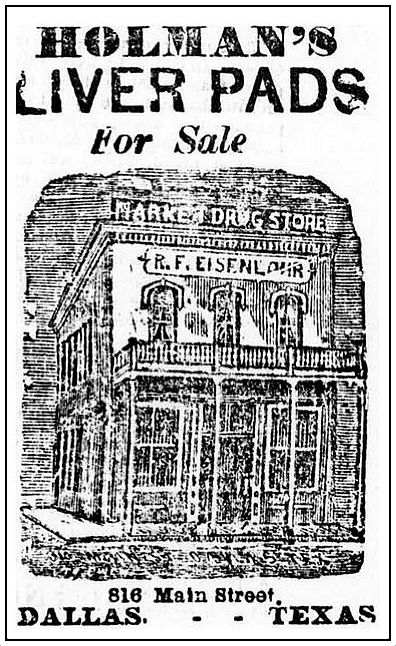
Eisenlohr’s father, Rudolph F. Eisenlohr, owned the Market Drug Store (seen above), which was at the southwest corner of Main and Field (the current view of that corner can be seen here, via Google Street View, and the 1885 Sanborn map of that block can be found here.) The family lived upstairs. Imagine that first decorated tree — actually inside someone’s home! — lit with candles in one of those upper windows, attracting a crowd of people below who had never before seen such a sight in the little village of Dallas.

eisenlohr_photoR. F. Eisenlohr (1846-1933)

eisenlohr_market-drug-store_dallas-herald_021877
The Dallas Herald, Feb. 18, 1877

eisenlohr_dallas-directory_1878
Dallas city directory, 1878

eisenlohr_nortons-union-intelligencer_102383
Norton’s Union Intelligencer, Oct. 23, 1883

***

Sources & Notes

More on this tree can be found in these three Dallas Morning News articles:

  • “Christmas of ’74 Featured by First Yule Tree in City — Intended for Eisenlohr Children, but Served for All of Youngsters ” (DMN, Oct. 1, 1935)
  • “Happy Citizens of the Little Town of Dallas Saw Their First Glass and Tinsel Ornaments in 1876 on a Tree Which Glittered Through the Eisenlohrs’ Window Upstairs Over Their Drug Store” (…that is one crazy-long headline…) by Mattie Lou Frye (DMN, Dec. 18, 1932)
  • “First Tree” (crazy-short headline…) by Kenneth Foree (DMN, Dec. 24, 1946)

Photo of the Eisenlohr store found on eBay.

More on artist E. G. Eisenlohr here and here.

*

Copyright © 2015 Paula Bosse. All Rights Reserved.


The Dallas News Special: Fast Train to Denison — 1887

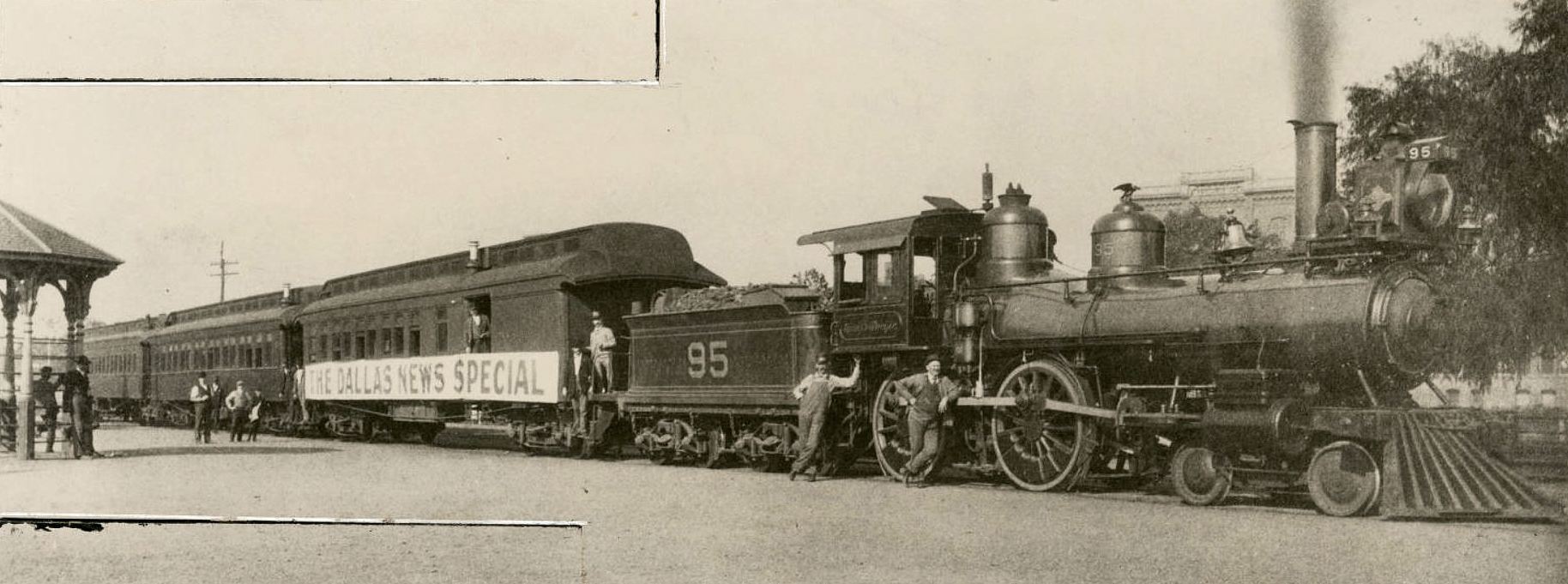
dallas-news-special_belo-collection_smuThe Dallas Morning News, full speed ahead! (Belo Collection, SMU)

by Paula Bosse

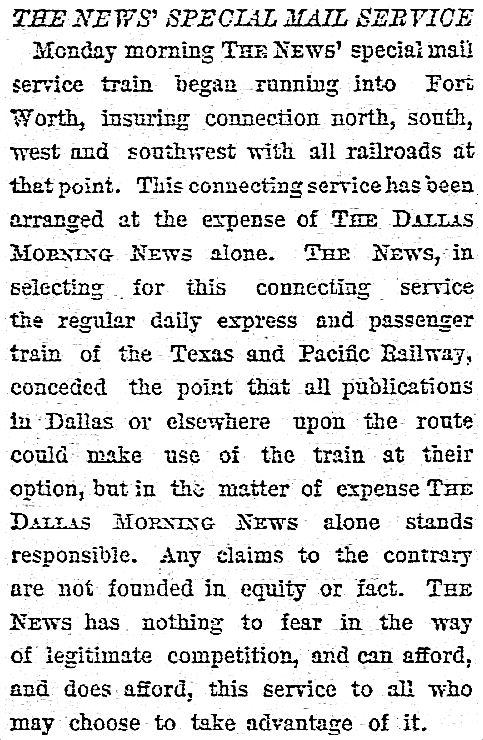
In October 1885, The Galveston News decided to launch a sister publication in Dallas, The Dallas Morning News. They sent 26-year-old George Bannerman Dealey to run it. Before that first month was up, go-getter Dealey had made a special arrangement with the Texas & Pacific railroad — “at considerable expense to The News” — to extend its route and pop into Dallas to pick up papers destined for its subscribers west of the city. (The photo at the top may or may not show that very first “Special Mail train.”)

news-train-fort-worth_dmn_102885DMN, Oct. 27, 1885 (click for larger image)

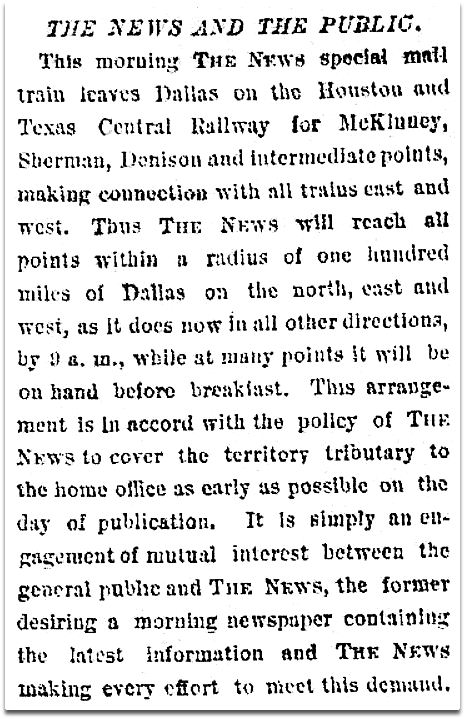
A year and a half later, The News one-upped itself and made the announcement that it would operate a special train to Denison — again, “at a vast expense.” This train would transport editions of the paper in the wee small hours in order to assure that The Dallas Morning News would actually BE a morning newspaper for as many of its subscribers as possible, whether they lived “within a block of the press” or a hundred miles away (DMN, Sept. 30, 1888). News-hungry Denisonians could read their papers over breakfast at the same time their Dallas counterparts did.

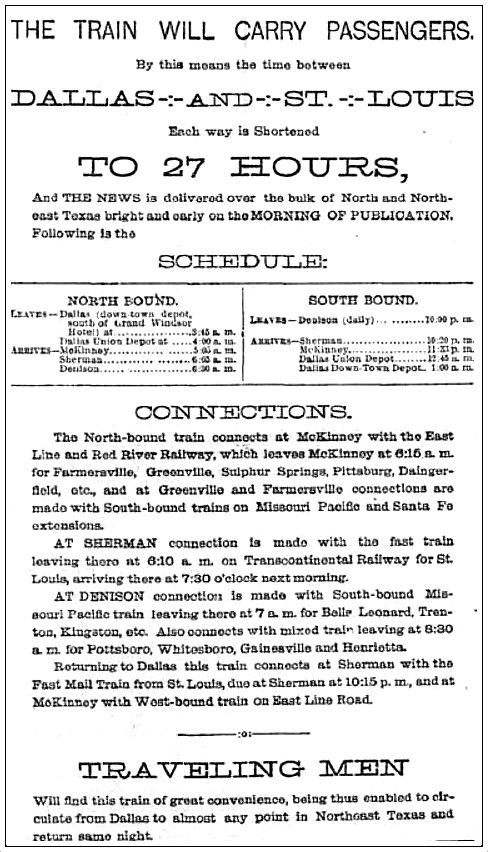
news-train_dmn_052287DMN, May 22, 1887
The train was dubbed by some “The Comet” (not to be confused with the MKT’s later Katy Komet). It was a “fast train” that carried passengers as well as newspapers along the Houston and Texas Central rails.

ad-special-news-train_dmn_052287-det

ad-special-news-train_dmn_052287-det2DMN, May 22, 1887
Not only was this a clever way to extend its reach and expand its circulation, but, as the Handbook of Texas notes, it also “enabled the paper to meet the threat of the St. Louis newspapers, which in 1885 had a larger circulation in North Texas than did any state paper.”

A rousing account of the first Dallas-to-Denison run appeared in the pages of both The Dallas News and The Galveston News (which often shared content). A link to that full story is below, but here are a few passages from an article written the next year, touting the wondrous success of the News Special, written as only a nineteenth-century newspaperman could write it (and the writer might well have been G. B. Dealey himself).

First, one encounters a mention of Plano in a more grandiose combination of words than one might expect, as the writer describes his pleasant pre-dawn train trip along the route.

Plano was reached before the drowsy god of day had wiped his eyes at the first yawn. He rolled over in his couch by the time it reached McKinney, and he was sitting on the side of it when the train was at Melissa. And here the mocking birds, with no ruddier iris upon their breast, but moved with the spirit that makes the burnished dove mourn out his love, made the air resonant with their chatter and their songs. Into Sherman and Denison the train plunged and the trip was done.

Um, yes. Then he breaks it down in a little more specifically. Actually, a LOT more specifically.

It starts. Two minutes are consumed at the Missouri Pacific crossing five miles out, two minutes at Caruth’s, five minutes for water, two minutes at Richardson, two minutes at the Cotton Belt crossing, three minutes at Plano, two minutes at Allen, three minutes at McKinney, two minutes at Melissa, fifteen minutes at Anna for a meeting point, three minutes at Van Alstyne, two minutes at Howe, five minutes at Sherman. Total forty-eight minutes. The distance between Sherman and Dallas is sixty-four miles. The time card calls for two hours and five minutes from Dallas to that point. Forty-eight minutes is consumed in stoppages. Anyone can make the calculations, sixty-four miles in seventy-seven minutes, and see the terrific speed that this train makes, has made for over a year, and made it without a single accident, and it is a good road — an awful good road — to make it over.

And then he congratulates his employer on giving even its most distant readers “an even whack.”

Is there anything like this in the history of newspapers? True, some of them in the north run special trains on special occasions, but THE NEWS stands without a rival in this sustained work of giving its remote patrons an even whack with its people of the city. (–The Dallas Morning News, Sept. 30, 1888)

Below, a train identified as this H&TC News Special to Denison, even though it looks remarkably similar to the T&P train (in the photo above) which may or may not have been that earlier 1885 mail train to Fort Worth. Dealey is identified as the man in the light-colored suit, standing on the steps (he also resembles the man in the top photo, but now with a full beard).

dallas-news-special_train-to-denison_1887_mcafee_degolyer_SMU

The train would slow down as it neared a small-town depot, and, without stopping, a man would toss bundles of papers from the train into the waiting arms of another man on the platform, who would then divide them up and hand them off to men and boys on horseback who would race to deliver them to stores and homes before breakfast.

The Dallas Morning News ran its hot-off-the-presses newspapers up to Denison for several decades on this train until, presumably, cheaper trucks were pulled into action. But did the rather less romantic trucks, rattling up to Grayson County, inspire the mockingbirds to “[make] the air resonant with their chatter and their songs” as had the noble locomotive speeding the news through the night? I think not.

*

dallas-news-train_degolyer-lib_SMU_ca-1885Dallas News offices, via DeGolyer Library, SMU

***

Sources & Notes

Top photo, titled “The Dallas Morning News special train,” is from the Belo Records, DeGolyer Library, Central University Libraries, Southern Methodist University; it can be viewed here. It’s a bit confusing, but this may show the inaugural run of the DMN’s special train to Fort Worth on May 22 ,1885, along the Texas & Pacific Railway. If anyone has suggestions on where this photo may have been taken, please let me know.

I came across a cropped version of the second photo in the March 1976 issue of Texas Historian, with the caption: “The Comet, Dallas News special train operated between Dallas and Denison in 1887. G. B. Dealey, then Dallas News business manager, stands on first car platform.” The version seen above is from the George A. McAfee photographs collection, DeGolyer Library, Southern Methodist University here; it is titled ”The Dallas News Special (H&T.C.).”

If you’re into trains (and even if you’re not), you might enjoy reading the following three stories from The Dallas Morning News:

  • “Special Mail Service, Observations of a Staff Correspondent Along the Route” (DMN, Oct. 27, 1885), describing the new Fort Worth route and how The News convinced (i.e. paid) the Texas & Pacific Railway to include a stop in Dallas to load up on newspapers and haul them westward, can be read here.
  • “The News in North Texas, The Special Mail Train Service” (DMN, May 23, 1887), a rousingly written ride-along narrative, is here. (I would advise more fragile readers to skip to the next paragraph when they come across mention of a cute little calf — nineteenth-century journalism is not for the overly sensitive.)
  • “News Special Train, Between Dallas and Denison Before Day, Remarkable Record, But the Following Cheerful Narrative Tells the Whole Story, Extending Over Sixteen Months, Over Fifty Miles An Hour” (DMN, Sept. 30, 1888), another genuinely exciting and poetic account of the special train and its crew, again, probably written by Dealey, can be read here. The few sentences that are illegible at the bottom of the first column: “He rang it with jerks in town, he rang it clangingly at crossings, but away out in the solitudes of the country, softly and gently he would peal it slowly, as if he had quit; softly as if his head had dropped upon his bosom. Lyerly is promoted now. Lasher is on the regular passenger train, and R. R. Roe has beautifully and [evenly?] taken his place. But Gentry still sits upon his old seat on the right hand side and watches growing into beefhood the….” 

*

Copyright © 2015 Paula Bosse. All Rights Reserved.

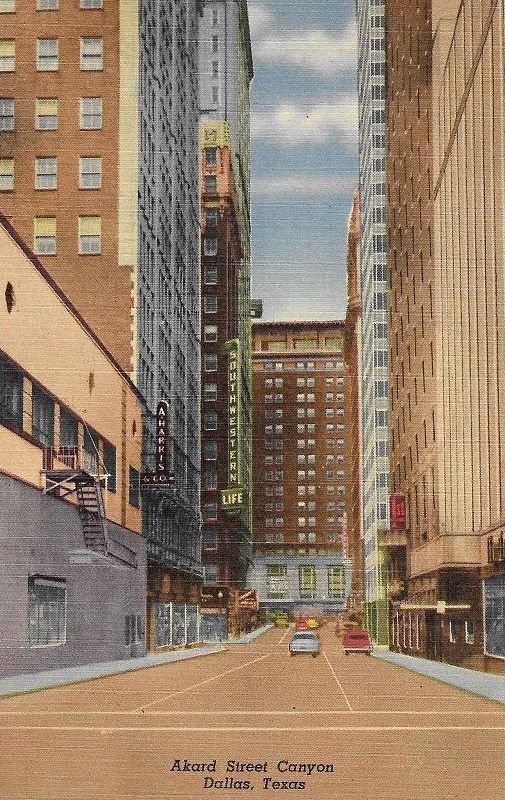
Akard Street Looking South, 1887-2015

akard_from-pacific_cook_degolyer_smu_ca1898-detAkard Street from Pacific, ca. 1898, via Cook Collection, SMU

by Paula Bosse

I realized the other day that I have an inordinate number of photographs and postcards showing Akard Street looking south — usually taken from Pacific or Elm, so I thought I’d collect them all together. Some of these aren’t dated, so they’re not in strict chronological order, but I’ve made a half-hearted attempt to make sure horse-and-buggy photos are before the men-in-straw-hat-boaters, which are before the women-in-Miss-Crabtree-dresses, which are before the cars-with-rounded-bodies. It might be easiest to just assume they are not in chronological order. (All photos are larger when clicked — a couple are really  big.)

*

The oldest is from 1887, when North Akard was still called Sycamore Street, and before the Oriental Hotel was built at Commerce and Akard in 1895.

akard_south-from-elm_1887
*

Next up, an incredible photo, taken around 1898, a detail of which appears at the top of this post. The Oriental Hotel can now be seen at the end of Akard, at Commerce, where Akard used to make a dog-leg turn before continuing south, giving the appearance of a dead-end street.

akard_from-pacific_cook_de-golyer_smu-ca1898via George W. Cook Collection, DeGolyer Library, SMU

*

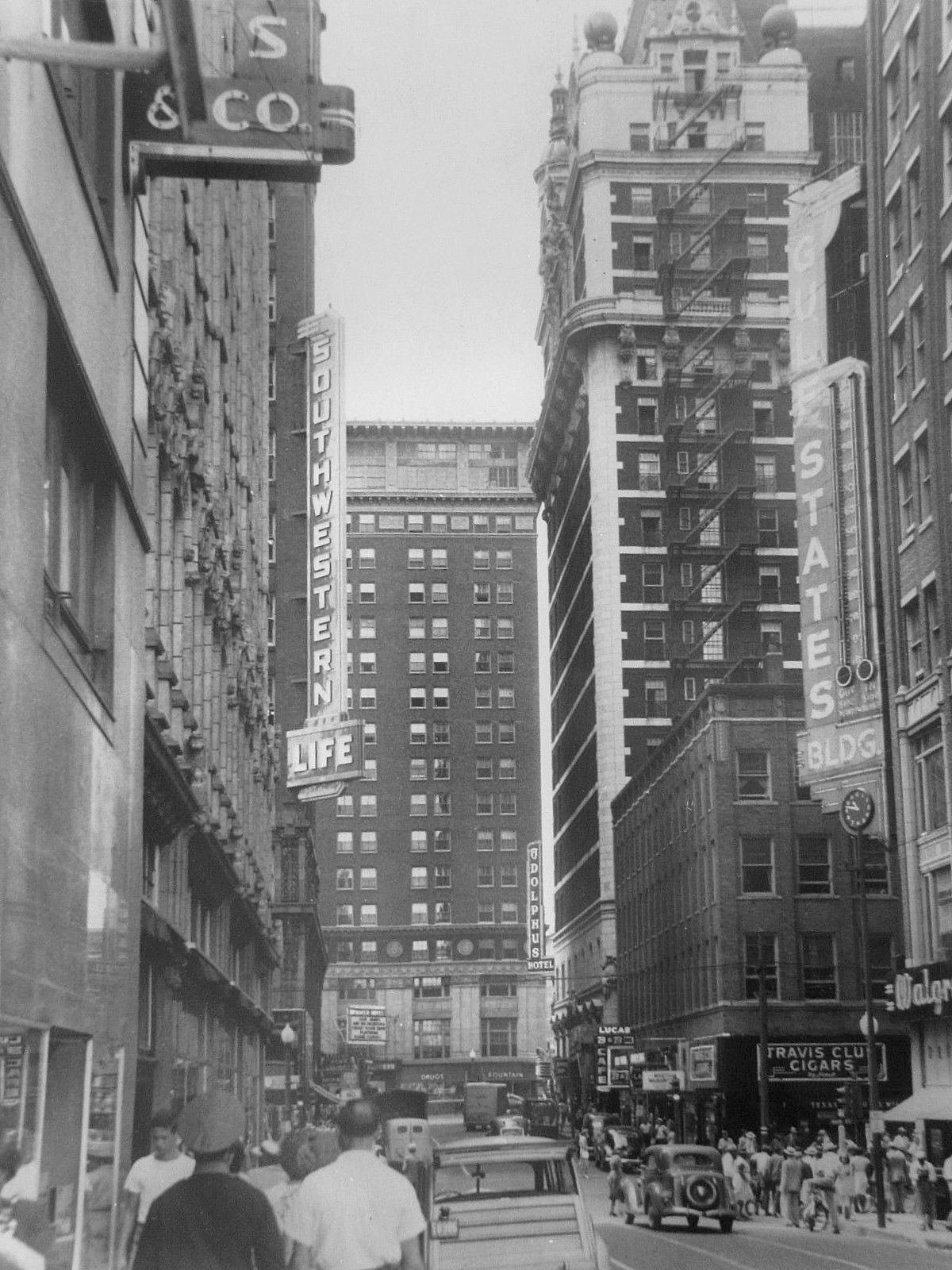
Another, with the Adolphus Hotel (built in 1912) now on the right, across Commerce from the Oriental. The tall building across Akard from the Adolphus is the Southwestern Life Building. The Gentry photography studio was at the southeast corner of Elm and Akard from 1912, which is probably the date of this postcard image. Construction of the Busch Building (now known as the Kirby Building) began in December, 1912.

akard-elm_postcard_ebay_ca-1912via eBay

*

From 1925, with the new Baker Hotel having replaced the Oriental Hotel. This area was now being called “the canyon district” or “the canyon.”

akard_south-from-elm_1925

*

In this great Frank Rogers photo, the canyon walls are getting higher, with the Adolphus Hotel firmly anchoring the Commerce corner across from the Baker.

akard_baker-adolphus_postcard_rogers_ebayvia eBay

*

By the time this photo was taken in about 1936, Pegasus had become a part of the skyline, perched atop the Magnolia Petroleum Building. (Note the Queen Theater at the northeast corner of Elm and Akard.)

akard_pacific_1936_legacies-spring-1989via Legacies History Journal

*

This photo is from the early- or mid-1930s — LOOK AT ALL THOSE PEOPLE.

akard-canyon_municipal-archives_dma-uncratedvia the DMA’s Uncrated blog

*

As opposed to this one, which has NO people in it.

akard-canyon_ebayvia eBay

*

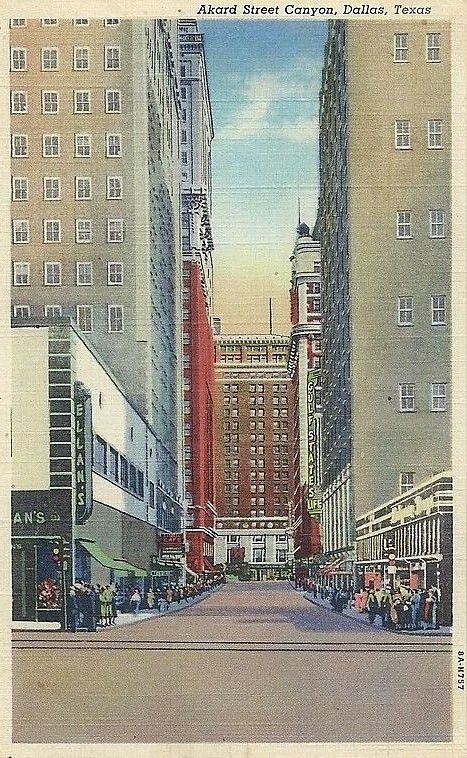
More canyon, this view showing the super-cool art-deco-y building at Elm and Akard with Ellan’s hat shop on the ground floor, late-1930s.

akard-st-canyon_ellans

*

This candid photograph, a little deeper into the canyon, is one of my favorites. (Click to see a gigantic image.)

akard-looking-south_ebayvia eBay

*

From 1951 — a bit grainy, but a slightly closer view of the side of the Queen Theater at the left and the Mayfair department store, built in 1946, at the right:

akard_dpl_1951via Dallas Public Library

*

And, finally, today. Pegasus and the Adolphus are still there, but the Baker Hotel was demolished in 1980, replaced by the One AT&T Plaza/Whitacre Tower.

akard-looking-south_google_2015via Google Street View, 2014

***

Sources & Notes

The photo dated by SMU as “circa 1898” is titled “Akard Street from Akard and Pacific Avenue Intersection”; it is from the George W. Cook Dallas/Texas Image Collection, DeGolyer Library, Central University Libraries, Southern Methodist University, and it can be viewed here.

The circa 1936 photo showing Pegasus is from the Spring, 1989 issue of Legacieshere; it is from the Hayes Collection, Texas/Dallas Archives Division, Dallas Public Library, and is attributed to Denny Hayes.

The photo showing “ALL THOSE PEOPLE” is from the Dallas Museum of Art’s Uncrated blog — here — is from the Dallas Municipal Archives. They have the date as “1940,” but Liggett’s Drug Store was gone from Elm and Akard by 1936.

Other sources as noted.

Click pictures for larger images — sometimes MUCH larger images.

*

Copyright © 2015 Paula Bosse. All Rights Reserved.


Tracking Down a Photo Location & Discovering a City Pioneer: D. M. Clower, The Man Who Brought the Telephone to Dallas

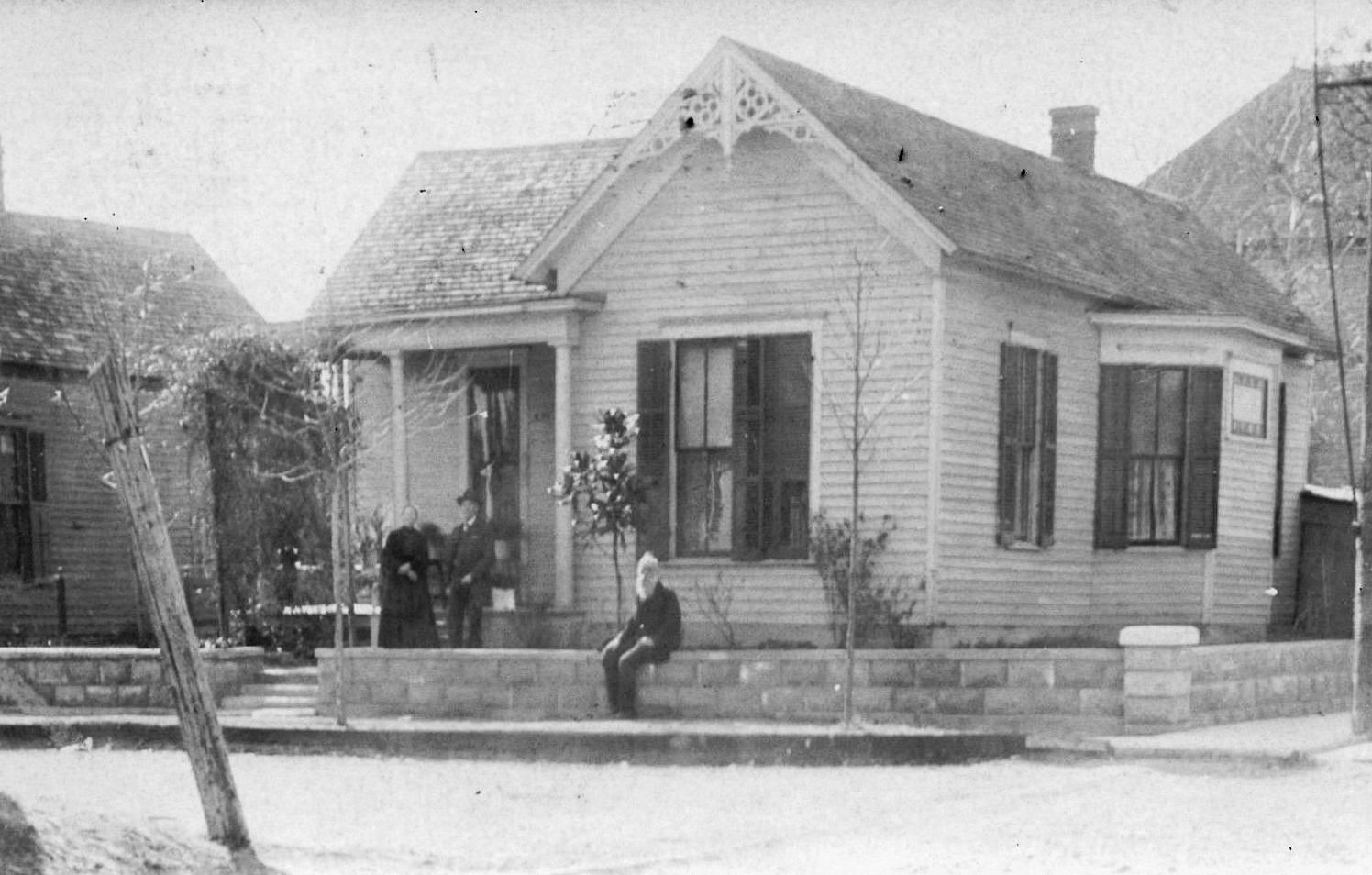
house_RPPC_1909_ebayMystery house, Dallas, ca. 1908 (click for larger image)

by Paula Bosse

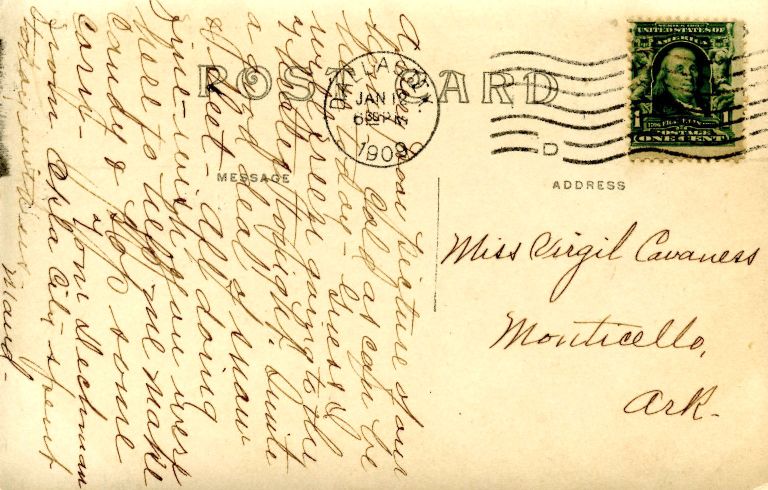
Not too long ago I came across the above photo which had been made into a real photo postcard.” It was postmarked January 12, 1909, and it contained a chatty message.

“A very good picture of our house. Cold as can be here today – guess I will freeze going to the theater tonight. Quite a good deal of snow and sleet. All doing fine – wish you were here to help me make candy & pop some corn. Tom Dechman from Okla. City spent today with us. Maud.”

house_RPPC_1909_ebay_back

Such a nice photo of a modest little house in Dallas, probably taken in 1908. When I saw it, I thought it would be cool if I could figure out where it was. There wasn’t much to go on from the postcard, though. But, as it turns out, there was just enough information to put the pieces together and figure it out. Someone asked me recently how I track down things like this. Basically, I look for a long time in a lot of different places. Here’s how I found out where this mystery house was.

Using Ancestry.com, I found Virginia (“Virgil” — sometimes “Virgie”) Cavaness in Monticello, Arkansas. She was born in 1871 and would have just turned 37 years old when she received this card. The familiar tone of the postcard message indicated to me that Virgil was probably a close friend or family member.

I found Thomas Dechman in Oklahoma City — he would have been 23 when he visited Maud. He probably wasn’t a close friend or immediate family member because she writes his full name out. According to the 1909 Oklahoma City directory (accessible on Ancestry.com), he worked alongside his father, A. F. Dechman, at a wholesale produce company.

Then I checked the Dallas Morning News archives and found this from Dec. 30,1909.

clower_dmn_123009DMN, Dec. 30, 1909

Tom Dechman was Mrs. A. F. Dechman’s son. So I searched on “Maud Clower.” Maud, born in 1877, was also D. M. Clower’s daughter. Mrs. A. F. Dechman was Maud’s sister Annie, and Tom was her nephew.

I continued searching the DMN archives for mentions of the Clower family and found that in 1906 Maud Clower had married Jesse (J. D.) Patterson — and, hey, Virgil had attended the wedding.

virgie_dmn_090206DMN, Sept. 2, 1906

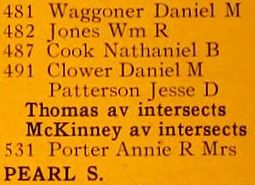
I checked to see where Maud and J. D. Patterson were living in 1908/1909. Most directories are available on Ancestry (a subscription site), but, as it happens, the 1909 directory is one of the few historical Dallas city directories that is available online (for free) — you can access it here (a few other directories are here). I found a Jesse D. Patterson listed as living at 491 N. Pearl, but no spouse’s name was listed, so I cross-referenced the address with the street directory section to determine whether this was the right J. D. Patterson. (Street directories are very helpful — not only do they list the occupants for each address, they also help to pinpoint where specific addresses were as they show which cross-streets those addresses were between; this is extremely helpful when trying to figure out where things were when streets had different names and/or when trying to figure out where things were before all of Dallas’ street numbers were changed in 1911. Another useful resource is a page on Jim Wheat’s site, which has links to every page of the 1911 street directory — click on a street name and find your address: the “new” address is on the left, and the “old” address is next to it, in bold.)

clower-patterson_1909-directory1909 city directory, residents of N. Pearl Street

Even though this didn’t have Maud’s name listed alongside her husband’s, it DID show that her father, D. M. Clower, was living at the same address. Success!

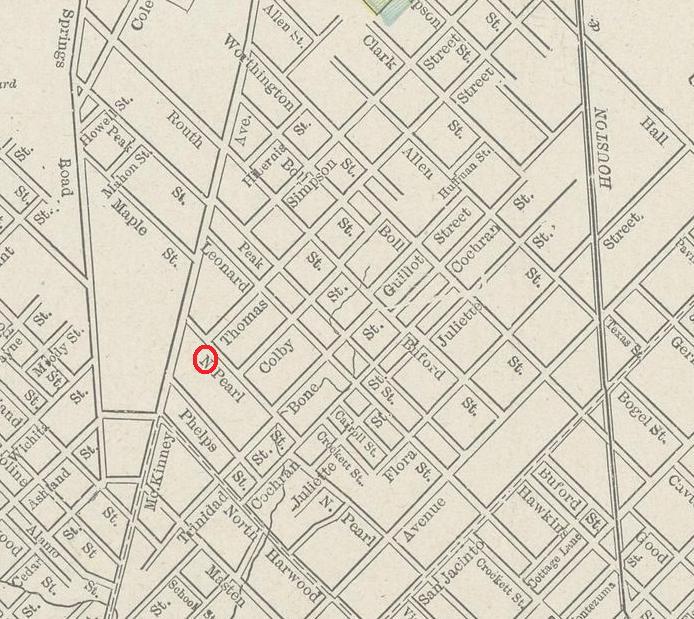
So there it is. When Maud sent that postcard to Virgil, she and her husband were living with her parents at 491 N. Pearl Street. The house in the photo was at the southwest corner of N. Pearl and Thomas. It’s always helpful to check a street map from about the same period for context and to make sure you’re looking at the right location — many street names have changed over the years — if a street named “Forest” is being referenced in the 1940s, for instance, you need to know that the old Forest Avenue and the current Forest Lane are absolutely nowhere near each other. Below is a map drawn about 1900, with the location of the Clower house circled in red (this is one of many maps found on the Portal to Texas History site; the one below is a detail of the map found here).

clower-home_map-ca1898

I also checked out Sanborn maps to see if the house in the photo matched the house that was actually on the lot at N. Pearl and Thomas. It does. To see what the general footprint of the house looked like in 1905 (the Clowers lived at 491 N. Pearl from about 1905 to 1910), see here. In the 1921 map (by which time the address had been changed to 2221 N. Pearl), you can see that additions had been made to the house since 1905 and that it looks more like the house in the photo (a room now juts out at the right and there is an out-building behind the house); see the 1921 Sanborn map here. To see what that Uptown block looks like now, see here (N. Pearl is on the left, looking south). Quite a change! It took me a long time to realize just how essential Sanborn maps can be — they are incredibly useful, and I try to use them whenever I can.

**

I really didn’t expect to track down the actual address of an unidentified house found on a picture postcard, but persistence pays off. A bonus of this persistence was that I ended up learning about the very interesting man who owned the house — a man who played a pivotal role in the development of Dallas: Daniel Morgan (D. M.) Clower. Clower was an electrical engineer who, in 1881, installed the very first telephone in Dallas (for Judge John Bookhout) and ran the city’s first telephone exchange; he also set up phone systems in other cities. In addition to his work for Bell Telephone, he also ran Dallas’ electric company for many years and was responsible for setting up the city’s first electric street lights and helped in developing electrified rail systems in the region.

clower_electrician_1889-directory1889 Dallas directory (click for larger image)

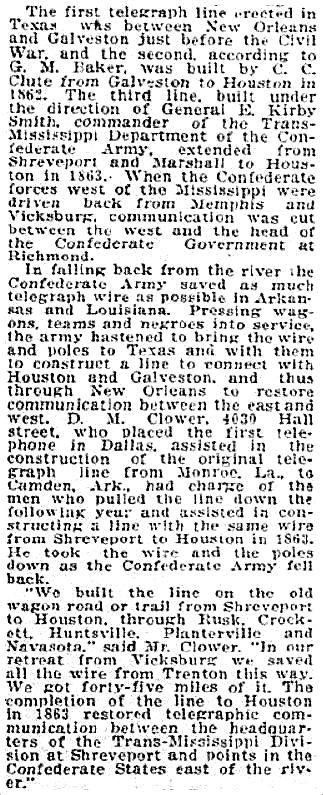
During the Civil War, Clower was a Confederate telegraph operator in the 1st Louisiana Regiment (see Clower’s fascinating obituary below). When the Union army was advancing after the fall of Vicksburg, Clower directed (and helped in) the destruction of the Confederate telegraph system he had helped set up, in order to prevent its being commandeered by Yankee forces — he and his men raced to pull up over 40 miles of wire and equipment, loaded everything on wagons, bugged out, and then used the same wire and poles to string a new Confederate line into and across Texas.

clower-telegrapher_dmn_010822DMN, Jan. 8, 1922

The war ended before Clower had completed his line northward from Houston, but his efforts had helped lay the telegraph infrastructure that the state of Texas relied on for decades afterward.

*

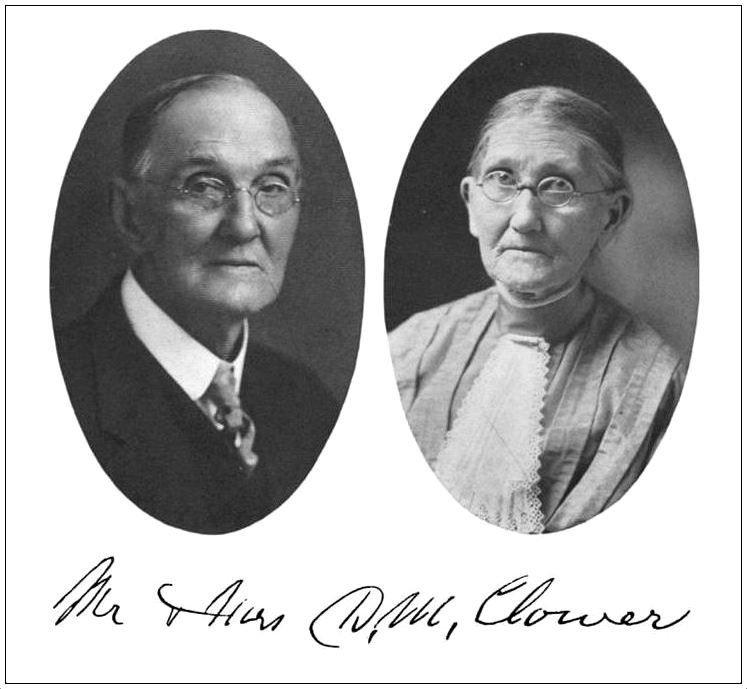
The people in the top photo are not identified. When that photo was taken, D. M. Clower and his wife, Ellender, would have been about 73; their daughter Maud and her husband Jesse would have been in their early 30s. I assume it’s the elder Clowers, with a mystery bearded man in the foreground.

clowers_d-m-and-ellender_hist-of-tx-and-texans_1914_portal
Mr. and Mrs. D. M. Clower, ca. 1914

You never know what you’re going to discover when you read a 106-year-old postcard and wonder where an old house used to be.

***

Sources & Notes

Postcard found on eBay.

Daniel Morgan Clower was born in Alabama in 1835; he arrived in Dallas in 1879, coming from Comanche, where Maud was born in 1877. Clower died in 1927 at the age of 92; Maud died in 1948. His wife, Ellender Paralee Clower, died in 1917 (at which time the couple had been married for more than sixty years).

More on Clower can be found in the pages of The Dallas Morning News:

  • “Telegrapher Tells Civil War Episode” (DMN, Feb. 1, 1924) — a fantastically cinematic account of Clower’s past, in his own words
  • A photo of Clower and Eli Sanger, (DMN, May 1, 1927) — what might well be the last photo of Clower ran in the News just a few months before his death at the age of 92; also in the photo is Eli Sanger, of Sanger Bros. (Clower once had a business in Millican, TX when Sanger’s opened there at the close of the Civil War, and he proudly boasted that he was one of their very first customers)
  • “Daniel Clower Funeral Held” (DMN, Aug. 19, 1927) — Clower’s obituary, with photo

Photo of Mr. Clower with text from a Dallas Times Herald story published on the occasion of his 89th birthday can be found here (scroll down to 1924, about halfway down the page), via Jim Wheat’s site.

The photo of Mr. Clower and his wife Ellender is from the book A History of Texas and Texans, published in 1914; the accompanying entry about Clower’s very interesting life can be found here, via the Portal to Texas History.

*

Copyright © 2015 Paula Bosse. All Rights Reserved.

Police Blotter — 1880s

san-angelo-saloonA saloon in a calm moment

by Paula Bosse

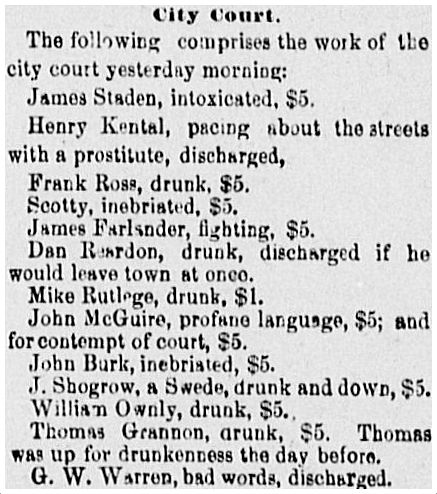
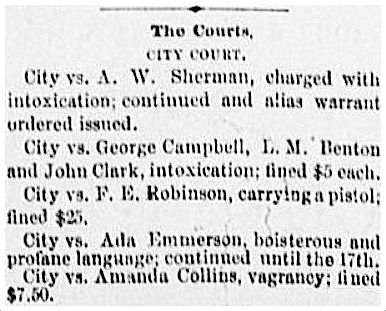
A few snapshots of life among Dallas’ lively and unruly set in the 1880s, as reported in The Dallas Daily Herald:

police-blotter_dal-her_061681(June 16, 1881)

police-blotter_dal-herald_060381(June 3, 1881)

police-blotter_dal-her_102782(Oct. 27, 1882)

police-blotter_dal-her_111782(Nov. 17, 1882)

Looks like Dallas had a steady flow of cash coming into the city coffers. The usual fine seemed to be five dollars, and that was a LOT of money back then. If you plug that into the Inflation Calculator, it shows that five bucks in 1881 would be equivalent to about $118 in today’s money. So, yeah — the city was raking it in. Prosperity! Thank you, drunks and reprobates — you  helped build our city!

***

Top photo shows imbibers inside the Arc Light Saloon in San Angelo, Texas; photo found here. Not Dallas, but I was unable to find a photo of a saloon in Dallas in this period. (I bet there’s a Tumblr on this, though. Or a Pinterest page….)

All newspaper clippings from The Dallas Daily Herald, accessible through the invaluable Portal to Texas History; browse through the collection here.

See more tidbits from the police blotter in the Flashback Dallas post “Police Blotter — Drunks, Vagrants, Adulteres,”  here.

*

Copyright © 2014 Paula Bosse. All Rights Reserved.

Dallas Gets Vertical: 1887-1925

east-from-courthouse_1887Looking east from the courthouse, ca. 1887 (click for larger image)

by Paula Bosse

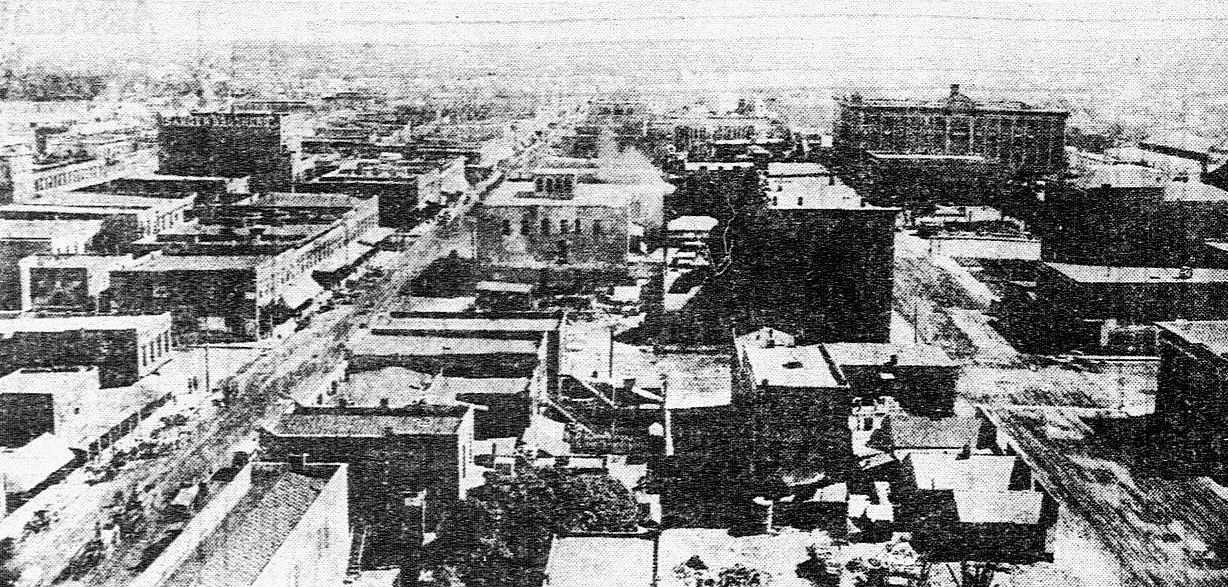
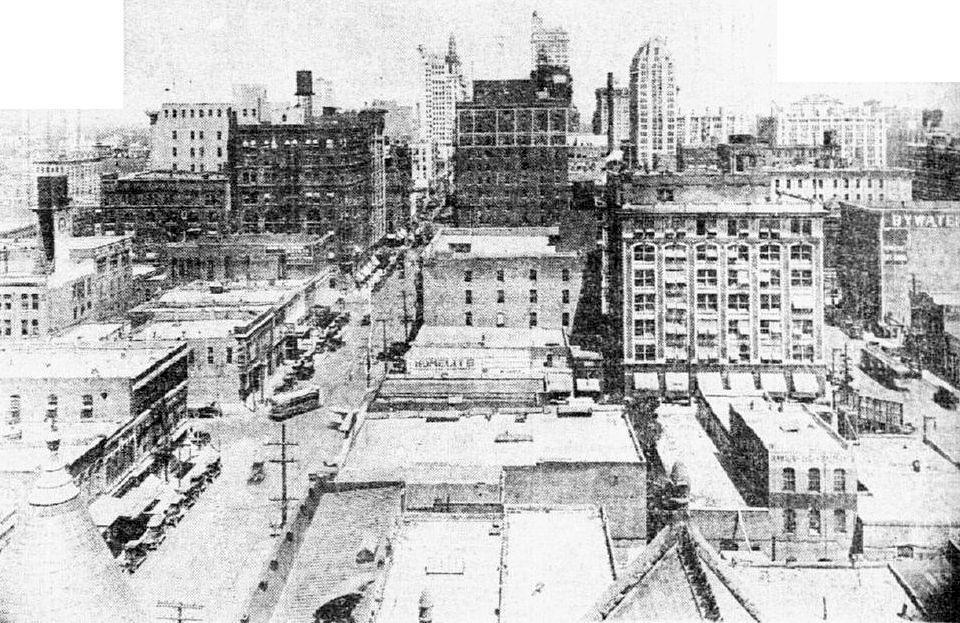
Above and below, the view of downtown Dallas looking east from the courthouse, with Main Street on the left and Commerce on the right. The top photo was taken about 1887 (the Grand Windsor hotel is the mammoth building in the top right corner), and the bottom one was taken about 1925. What a difference 38 years makes — the horizon has disappeared!

east-from-courthouse_1920s

***

Sources & Notes

Both photos appeared in The Dallas Morning News on Oct. 1, 1925. The caption reads: “[First photo]: View of Dallas looking east between Main and Commerce streets from the courthouse. It was taken about 1887. So far as known it is the only picture in existence which shows the Dallas Opera House at the southwest corner of Commerce and Austin streets. It also shows the old Grand Windsor Hotel. Note the vacant lots, and the unpaved condition of the streets and the horsedrawn vehicles on Main. [Second photo] This picture was made by H. B. Hillyer & Son.”

*

Copyright © 2014 Paula Bosse. All Rights Reserved.

W. W. Orr: Buggies, Phaetons, Carriages — “Everything on Wheels!”

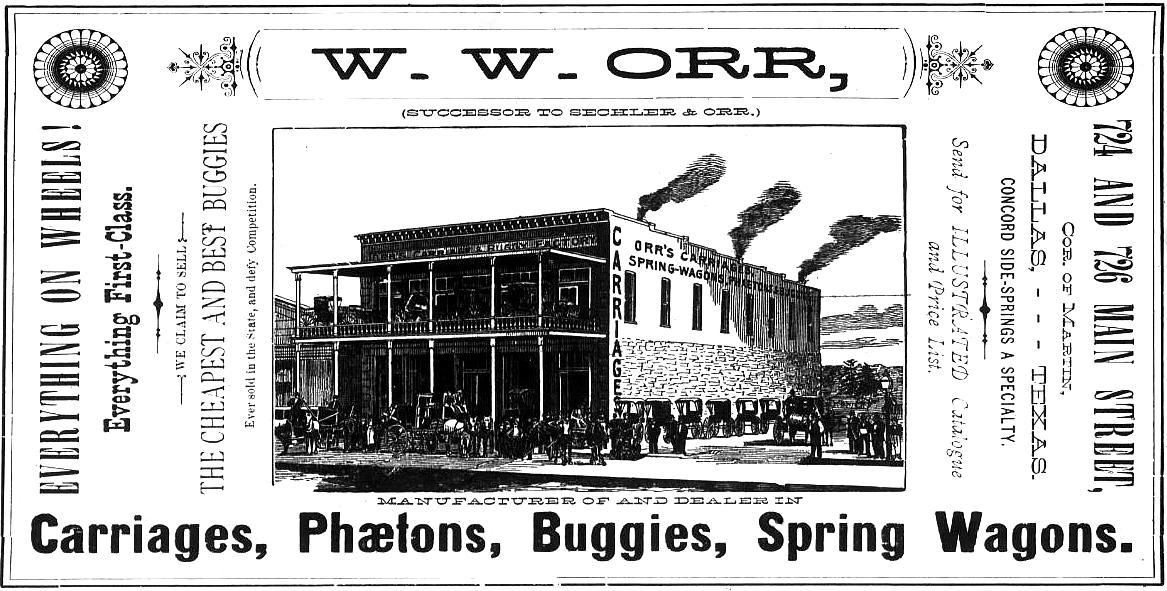
ad-orr-carriages_directory_1878-detW.W. Orr’s carriage business on Main St., 1878 (click for larger image)

by Paula Bosse

I came across the image above in the 1878 Dallas city directory, and my eye was immediately drawn to the novel open-air display of  buggies on the second floor of the building. I’ve never seen this before — the frontier version of the auto showroom!

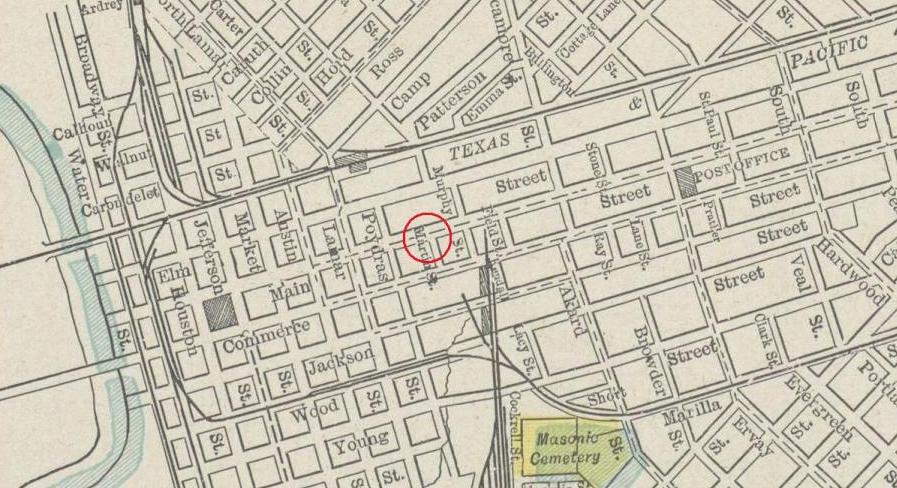
I hope this is a depiction of the actual shop owned by W. W. Orr at 724-726 Main Street (corner of Main and Martin — see map below) and not some sort of early augmented clip art. Orr ran a successful business selling buggies, phætons, and carriages, and he probably did have an imposing shop.

William Wallace Orr was born in Ohio, and after the Civil War he made his way to Texas, where he served for a short time as an East Texas postmaster before coming to Dallas where he and his wife, Amanda, operated a livery stable.

orr_dallas-herald_041973Dallas Herald, April 19, 1873

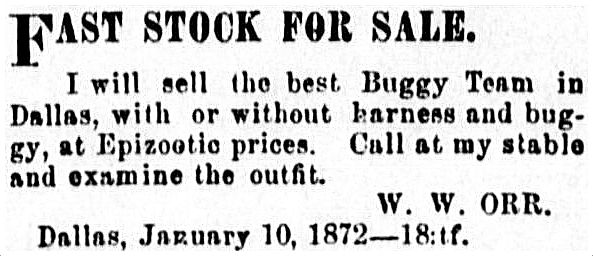
I’m not sure whether “epizootic” is used here as some sort of 19th-century tongue-in-cheek hard-sell advertising term (“His prices are INSANE!“) … or whether it means the horses have some sort of disease. I tend to think it’s the former.

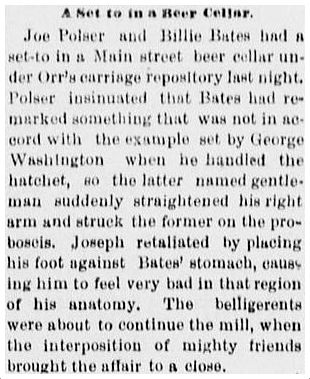
The carriage business, which had started by 1878, is notable (to me, anyway) because it was housed in a building with a basement — I wasn’t aware that basements really existed in Dallas at the time. Orr rented out the basement beneath his “carriage repository” as a beer cellar. If TV westerns are anything to go on, drunken brawls in most drinking establishments of the time were to be expected. What might not be expected is an account of a bar fight to be reported like this:

orr_cellar_dal-her_060278Dallas Herald, June 2, 1878

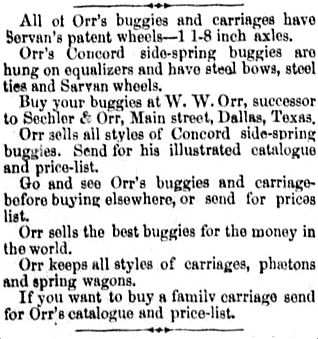
Regardless of what disreputable activities were going on in the cellar, it seems that Orr’s business of manufacturing and selling “everything on wheels” was a booming one.

orr_dal-her_060380Dallas Herald, June 3, 1880

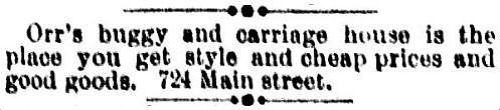
He had stylish conveyances, cheap prices, and good goods:

orr_dal-herald_081283Dallas Herald, Aug. 12, 1883

After the death of his wife in 1886 (she died of consumption at the early age of 42), Orr passed the business to his son. In poor health, he left Dallas for Mississippi, where he met a woman who nursed him back to health and whom he later married. After a few years of an apparently happy second marriage, W. W. Orr died in 1894. Cash savings, investments, and real estate holdings back in Dallas had left him a wealthy man, and, as might be expected, his family in Dallas was dismayed to learn that he had left his estate to his infant daughter in Mississippi. His three grown children from his first marriage were not happy, and they contested the will. (The case is covered exhaustively here. I think the baby daughter emerged victorious, but I’m not absolutely sure.)

It’s interesting that Orr and his first wife are buried side by side in Greenwood Cemetery. Amanda Melvine McQueen Orr has a large, ornate monument and headstone; W. W. has his name — and nothing else — carved into an unadorned marker. It would have been nice to have had a little a buggy in the corner. …Something.

orr-map_c1900

The location of Orr’s buggy and carriage house was at the corner of Main and Martin, shown above in a map from around 1900. (Click for larger image.)

And, below, is the full ad, with that incredible artwork! (Click it!)

ad-orr-carriages_directory_18781878

***

Sources & Notes

Illustrated ad from the 1878 Dallas city directory.

All other ads from The Dallas Herald, as noted.

Map is a detail from a map of Dallas, circa 1900, from the Portal to Texas History, here.

Amanda Orr’s headstone and memorial statuary can be seen in several photos here; W. W.’s sad unadorned slab can be seen here.

Phætons? They sound dangerous!

*

Copyright © 2014 Paula Bosse. All Rights Reserved.


Empire Mills — Grinding Wheat Into Wedding Presents Since the Cleveland Administration

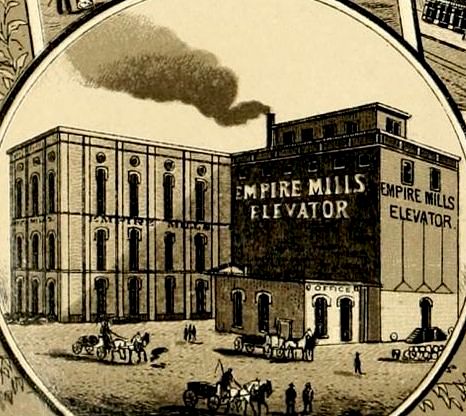
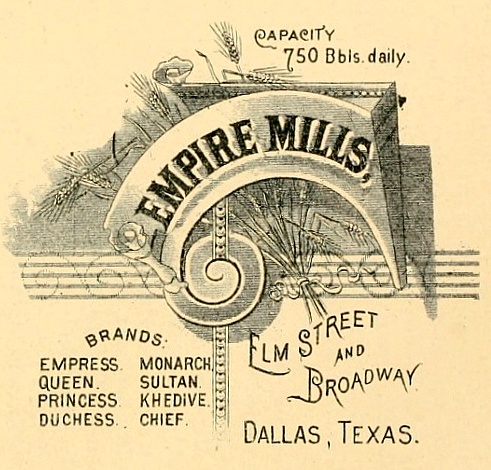
empire-mills_imm-gd_1889aFlour central!

by Paula Bosse

Exciting news hit the pages of The Dallas Herald on March 26, 1885:

A contract was closed last night for the erection of a mammoth 250-barrel, full roller flouring mill with all the latest machinery in this city. The promoters are W.C. Howard, J. Rauch and S.T. Stratton. It will be called the Empire Mills.

The mill opened in September, with the company’s proclamation that their new “roller mills” were “the largest and finest ever erected in the South.” It was located at Elm and Broadway, near the Trinity River. In a newspaper interview, John Neely Bryan’s son described the location of his father’s famous cabin as being “at the top of the hill, about where Empire mills are now located” (Dallas Morning News, Aug. 11, 1889). So, about where Dealey Plaza is today. Wheat was a major crop in North Texas, and the mill was a successful and important addition to the growth of the city.

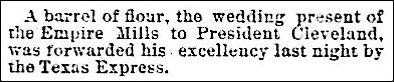
But it wasn’t all crushing and grinding. One must occasionally participate in the world of social niceties. So when the president of the United States is getting married, what better way to commemorate the occasion than by presenting the happy couple with a romantic and self-promoting barrel of flour?

cleveland-flour_dmn_053086DMN, May 30, 1886

cleveland-flour_dmn_070586DMN, July 5, 1886

One wonders what the newlyweds exclaimed as they tore the bow from that barrel? It probably wasn’t, “Oh! Flour! How stupendous!”

empire-mills_clifton-church_1894

empire-mills_souv-gd

empire-mills_imm-gd_1889b

***

Sources & Notes

Top and bottom images from an ad in The Immigrants Guide to Texas (1889).

Photograph by Clifton Church, ca. 1894.

Next to last illustration from Souvenir of Dallas, Texas (c. 1888).

Roller mill? Right this way.

*

Copyright © 2014 Paula Bosse. All Rights Reserved.