Flashback : Dallas

A Miscellany: History, Ads, Pop Culture

Category: 1890s

Merry Christmas!

xmas_santa_lightcrust_1932

by Paula Bosse

Wishing you all a Merry Christmas — I only hope Santa brought you what YOU wanted!

xmas-santa-letters-dmn_122499-detDallas Morning News, Dec. 24, 1899

***

Top image from a WBAP Christmas mailing to radio fans of The Light Crust Doughboys of the Burrus Mill, 1932.

To read more letters from Dallas-area children printed in “Santa’s Letter Box” (Dallas Morning News, Dec. 24, 1899), click here.

*

Copyright © 2014 Paula Bosse. All Rights Reserved.

The Roller Coaster on the Prairie — 1894

state-fair-grounds_souv-dallas_1894Texas State Fair & Dallas Exposition Fair Grounds, circa 1888

by Paula Bosse

Above, a wonderful view of the “State Fair Grounds and Dallas Exposition” from an 1894 advertisement. The Little Roller Coaster on the Prairie!

If you want to see this very large (and, trust me, you DO), click here (and then click again). It’s like wandering through those old phone book covers, but without the jokes and the dinosaurs.

*

UPDATE: The artwork was used in a previous ad that appeared in The Dallas Morning News in 1888, with the following text:

The coming Fair and Exposition will, beyond a doubt, excel in point of attractiveness, numbers and variety of exhibits any heretofore held.

The County Exhibit Department promises to be the most attractive feature, one never before attempted by any State. Over forty counties up to date have secured space, and more still to enter. The exhibits these counties will present will be something that will astonish visitors.

Every variety of attractions has been provided for, and the musical treat we have in store for visitors will be presided over by the world renowned Cornetist , Prof. A. Liberati.

The purses offered in the Race Department cover $20,000, and will be competed for by the best racers in the land. The management of this department propose to give during the Fair and Exposition the finest races ever given in the South.

We desire to call the attention of counties to the fact that now is the time to get up their exhibits, when grain, fruits, etc. are ripening, and not wait until it is too late.

Space in the County Exhibit Department is free, and no county of our State can afford to be not represented. There will be more people here than ever before, and we want them all to see the varied resources of our great State.

To exhibitors in general we can promise them the finest opportunity ever offered to make displays from which will return good results, and to visitors we can assure them of the grandest entertainment ever given in the Southwest.

dallas-fair_dmn_090588

*

The scene above looks idyllic (to me, anyway), but here is a description of what the land was like before anything was built on it, from a Dallas Morning News history of the SFOT (Oct. 2, 1960):

An 80-acre tract approximately in the center of the present-day State Fair Park was chosen as the site for the Fair. The location was termed by some to be “the worst kind of hog wallow,” and the question most frequently asked was “How are you going to hold a fair in all that mud?”

*

The Dallas State Fair and Exposition (which became the State Fair of Texas) was chartered in 1886, and unless that artist’s rendering is highly romanticized (which it probably is), it looks like the hog wallow was but a faint memory by the time that roller coaster was plopped down on top it.

***

Sources & Notes

Artwork by the Dallas Engraving and Manufacturing Company. Top ad appeared in the Souvenir Guide of Dallas (1894); bottom ad appeared in The Dallas Morning News, Sept. 5, 1888.

*

Copyright © 2014 Paula Bosse. All Rights Reserved.

Oak Cliff Trolley — 1895

trolley_oak-cliff_stark_1895_hpl“Dallas from Oak Cliff” by Henry Stark, 1895/96 (click for larger image)

by Paula Bosse

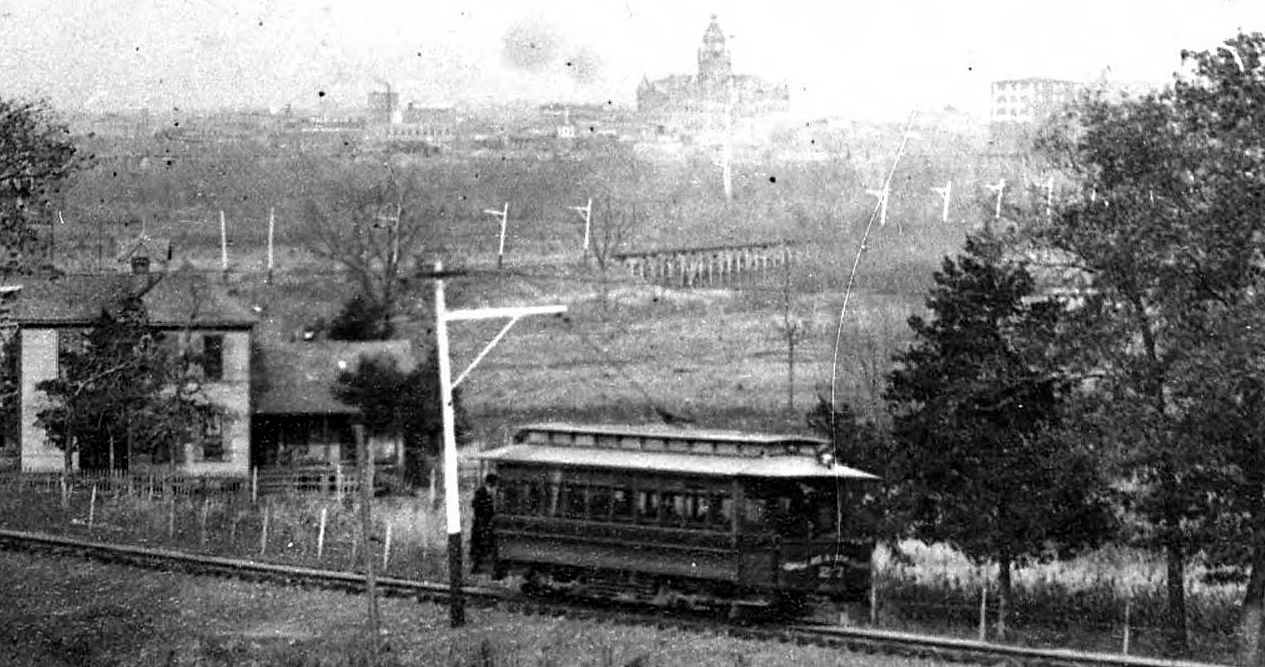
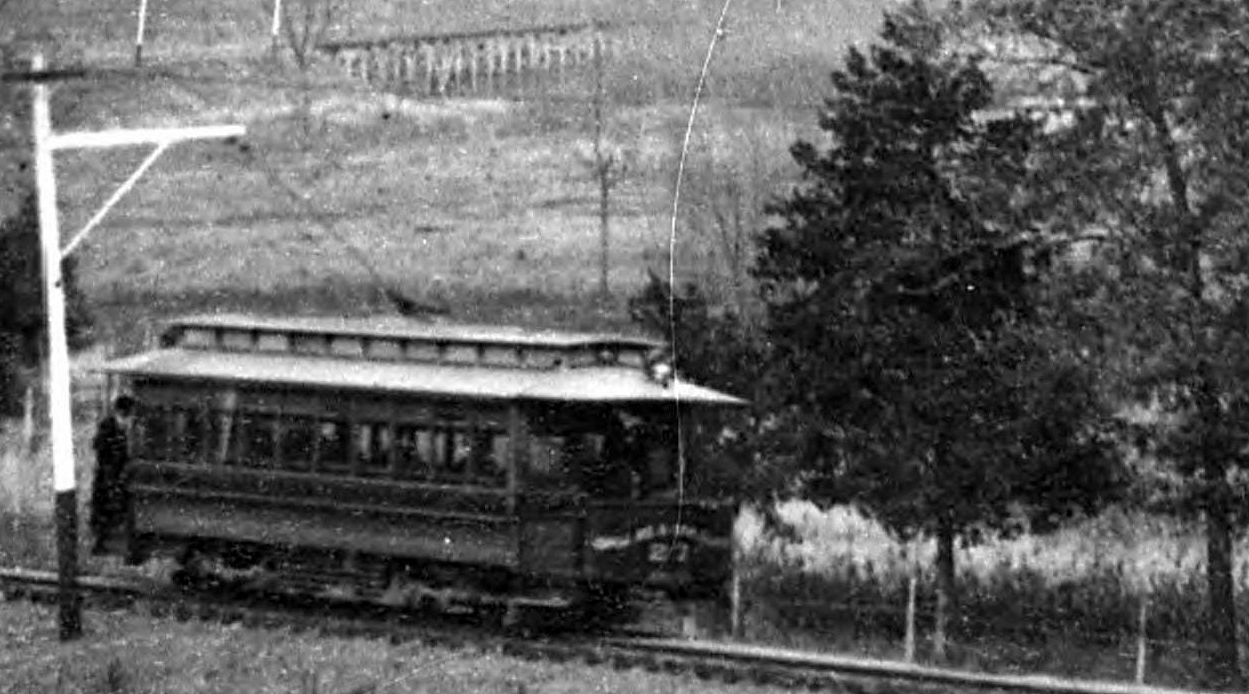
As present-day trolley service to Oak Cliff has been in the news in recent months, here’s a pastoral view of a little trolley chugging through the wilds of Oak Cliff in 1895. In the background, across the river, the still-fairly-new courthouse looms like a mirage. Below are a few details, magnified. (All images are much larger when clicked.) Enjoy!

trolley_oak-cliff_det1

trolley_oak-cliff_det2

trolley_oak-cliff_det3

trolley_oak-cliff_det4

***

Photo (labeled by the Houston Public Library as “Trolley moving through the woods”) is by Henry Stark, taken on a visit to Dallas in the winter of 1895/96; from the collection of the Houston Public Library — it can be viewed here.

For more on Henry Stark, see the previous post “Henry Stark’s ‘Bird’s Eye View of Dallas,'” here.

Other photos which I’ve “Zoomed In On the Details” can be seen here.

CLICK PHOTOS — REAL BIG.

*

Copyright © 2014 Paula Bosse. All Rights Reserved.

Society Ladies and Their Great Big Hats

shakespeare-club_c1895The Dallas Shakespeare Club

by Paula Bosse

Had The Graduate been set near the beginning of the twentieth century rather than the middle of it, that famous scene out by the pool (er…near the horse trough) might have gone something like this:

Mr. McGuire: I just want to say one word to you. Just one word.

Benjamin: Yes, sir?

Mr. McGuire: Are you listening?

Benjamin: Yes, sir, I am.

Mr. McGuire: …”Millinery.”

Benjamin: …Exactly how do you mean?

Mr. McGuire: There’s a great future in millinery. Think about it. Will you think about it?

Benjamin: Yes, I will.

Mr. McGuire: Enough said. That’s a deal.

***

Sources & Notes

Photograph of the Dallas Shakespeare Club is from the Dallas Historical Society; it appears in the book Women and the Creation of Urban Life in Dallas, Texas, 1843-1920 by Elizabeth York Enstam (College Station: Texas A & M University Press, 1998). Enstam’s caption of this photograph identifies two women in the front row, on the right as Sallie Griffis Meyer (1863-1932), future president of the Dallas Art Association, and May Dickson Exall (1859-1936), president of the Dallas Shakespeare Club from 1886 until her death. Ms. Enstam has labeled this photo as “about 1895.” 

*

Dialogue (all but one word) from the film version of The Graduate, screenplay by Buck Henry, based on the novel by Charles Webb. “Millinery adaptation” by Paula Bosse, based on the screenplay by Buck Henry which was based on the novel by Charles Webb.

*

Copyright © 2014 Paula Bosse. All Rights Reserved.

“Oak Cliff Is To Dallas What Brooklyn Is To New York” — 1891

ad-oak-cliff_mercury_031291The Southern Mercury, March 12, 1891 (click for larger image)

by Paula Bosse

Oak Cliff and the whole “Brooklyn” comparison is not a new one. Developers were using it to lure people to the “soft green cliffs” of the newly-incorporated area where “there is not a night in the hot months of summer when discomfort is felt from the heat” and where “people from all parts of the United States can be observed enjoying the delights of the seaside in the interior of Texas.” A veritable paradise. Just like Brooklyn.

Hats off to the enthusiastic scribe who penned this incredibly wordy advertisement beckoning the “live and progressive” readership of The Southern Mercury to invest in the ground-floor of Dallas’ Brooklyn.

*

OAK CLIFF, THE BEAUTIFUL RESIDENCE AND EDUCATIONAL CITY OF THE SOUTHWEST

The city of Oak Cliff derives its name from the massive oaks that crown the soft green cliffs and stands about two hundred and fifty feet above and to the southward and westward of the city of Dallas, overlooking the city, and the view is carried away over the city proper. Cool and healthful breezes prevail during the heated term, and there is not a night in the hot months of summer when discomfort is felt from the heat, and sound and refreshing sleep is not possible. To the south and southwest for hundreds of miles stretches level and unobstructed prairie, over whose bosom these breezes sweep from the gulf without infection from any unsalubrious conditions.

The Oak Cliff Elevated railway, substantially constructed, forms a belt of ten miles, encircling Oak Cliff, but at no place more than three miles from the business section of Dallas. Cars run every ten minutes day and night from either side of the court house, Dallas. Fare, five cents.

Oak Cliff is a wonderful and well-nigh magical growth of two years; the first house was completed at Oak Cliff twenty-seven months ago. It now has a population of about seven thousand, a large proportion of whom are from amongst the best people of the different towns of the state of Texas. They are a live and progressive people. Oak Cliff has just incorporated, and one of the first moves of the city government will be the building of several large, commodious fine brick and stone public school buildings, and provide for a large free school fund.

Oak Cliff contains a strictly moral people; intoxicating liquors cannot be found anywhere within her limits, – in keeping with this general policy, no sort of questionable resorts are tolerated.

Oak Cliff now has 1,500 to 2,000 residences, costing from $1,500 to $50,000. It has thirty miles of paved streets and avenues; is now building about six miles of cross-town street railway, to be operated by electricity. It has a successful water system, affording pure, clear spring water. A hotel costing $100,000 has been in successful operation since last June.

Oak Cliff has a park of about 150 acres of natural rustic beauty, diversified with hill and dale, and set off with clumps of royal trees. In the park is a beautiful lake with an average depth of 20 feet, equipped with good boats, where people from all parts of the United States can be observed enjoying the delights of the seaside in the interior of Texas.

Oak Cliff is to Dallas what Brooklyn is to New York.

For further information, address,

Dallas Land & Loan Co., Dallas, Texas.

***

Ad from the pages of The Southern Mercury, March 12, 1891.

A previous come-on from the developers of Oak Cliff can be found here.

*

Copyright © 2014 Paula Bosse. All Rights Reserved.

Oak Cliff Presbyterian Church, Organized 1890

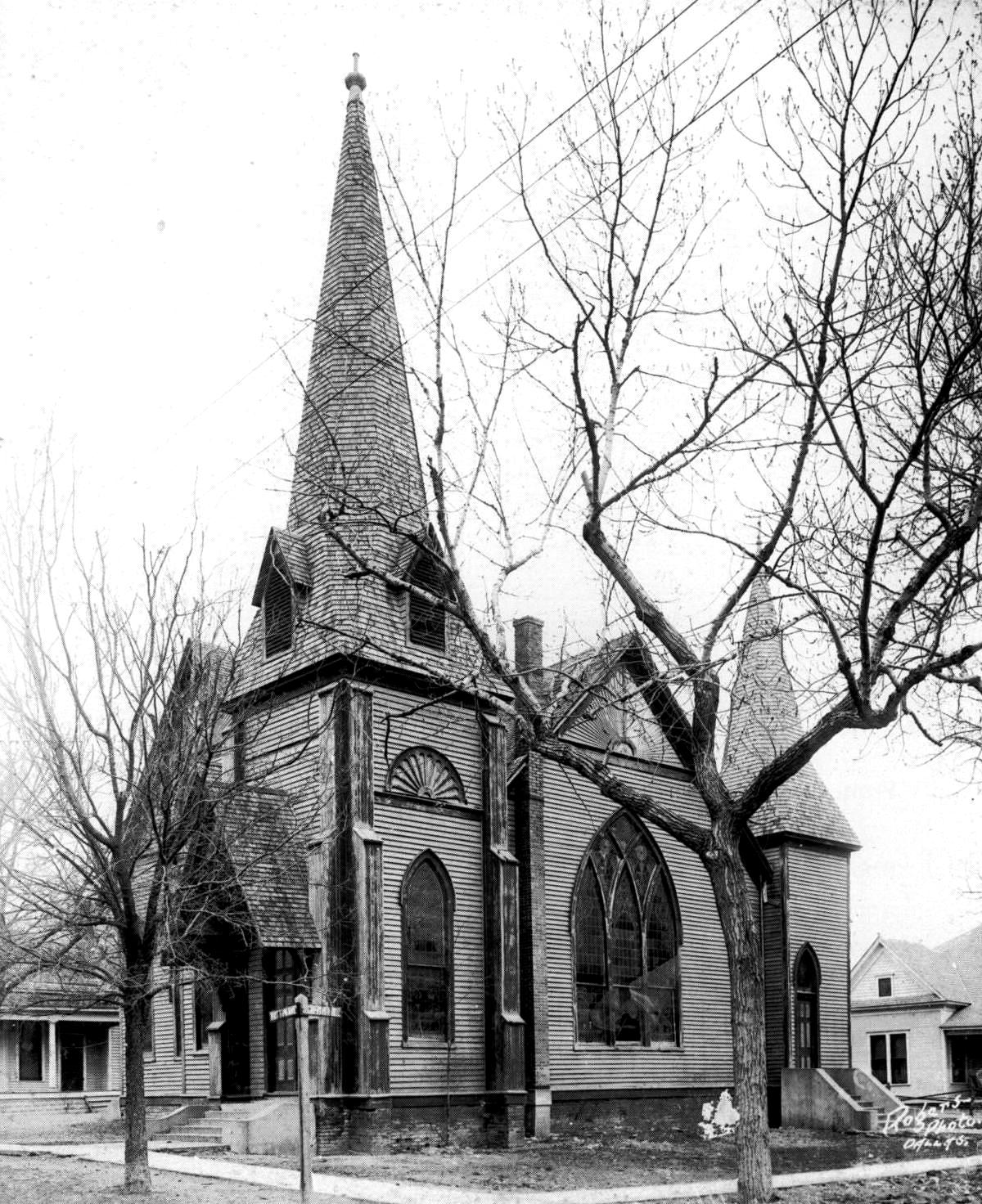
oak-cliff-presbyterian_smOak Cliff Presbyterian Church, ca. 1897 (click for larger image)

by Paula Bosse

I came across this photograph of a church a couple of days ago and was mesmerized by its charming woodiness. According to its caption, it was the Oak Cliff Presbyterian Church, at the corner of Ninth Street and St. George (now Patton). Its first pastor was the Rev. W. L. Lowrance who had organized the church in 1890 with fewer than twenty members. Church membership grew steadily, and in 1923, having finally outgrown the small wood frame building, the congregation moved to their next location at Tenth and Madison (contributing to Tenth Street’s appearance in Ripley’s Believe It Or Not as the street having more churches per mile than any other street in the world). At some point this lovely church was razed.

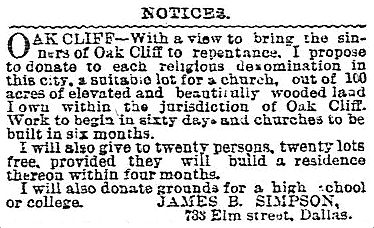
I’ve found little else on its earliest history. but I came across this advertisement placed in The Dallas Morning News in 1891:

simpson_oak-cliff-land-donation_dmn_031491(DMN, March 14, 1891)

Col. James B. Simpson was something of a learned Renaissance-man around Dallas. He had been the editor of The Dallas Herald for many years and was a civic leader with real estate interests. I’m not sure if this ad has anything to do with the establishment of the Oak Cliff Presbyterian Church, but it’s interesting to note that construction of the new church was mentioned as being under construction one month after this ad’s appearance. Time was running out for those Oak Cliff sinners (even though one newspaper report stated that the building wasn’t occupied until 1893).

Rev. Lowrance, an apparently well-liked and respected pastor, retired at the end of 1903.

lowrance_dmn_122903-photo“Dr. W. L. Lowrance of Oak Cliff”

lowrance_dmn_dmn_122903(DMN, Dec. 29, 1903 — click for larger image)

The Oak Cliff Presbyterian Church lives on, now on S. Hampton. One can only assume that the building it occupies today is not quite as charming as the little woody one that was built 120 years ago.

***

Top photo (by the Rogers Photo Studio, circa 1897) appeared in the Fall 2009 issue of Legacies magazine, here.

Though the first Oak Cliff Presbyterian Church was on Ninth St., the second one was on Tenth St., and that seems reason enough to direct attention to the article “Road to Glory: Tenth Street Becomes Church Street” by René Schmidt — it appeared in the same issue of Legacies as the church photo, and you can read it here.

Read more about this “Street of Churches” and its staggering fourteen churches (!) in the May 1, 1950 edition of The Dallas Morning News.

*

Copyright © 2014 Paula Bosse. All Rights Reserved.


Henry Stark’s “Bird’s Eye View of Dallas” — 1895/96

stark_downtown_1895-96_hplCommerce St. looking east from about Akard

by Paula Bosse

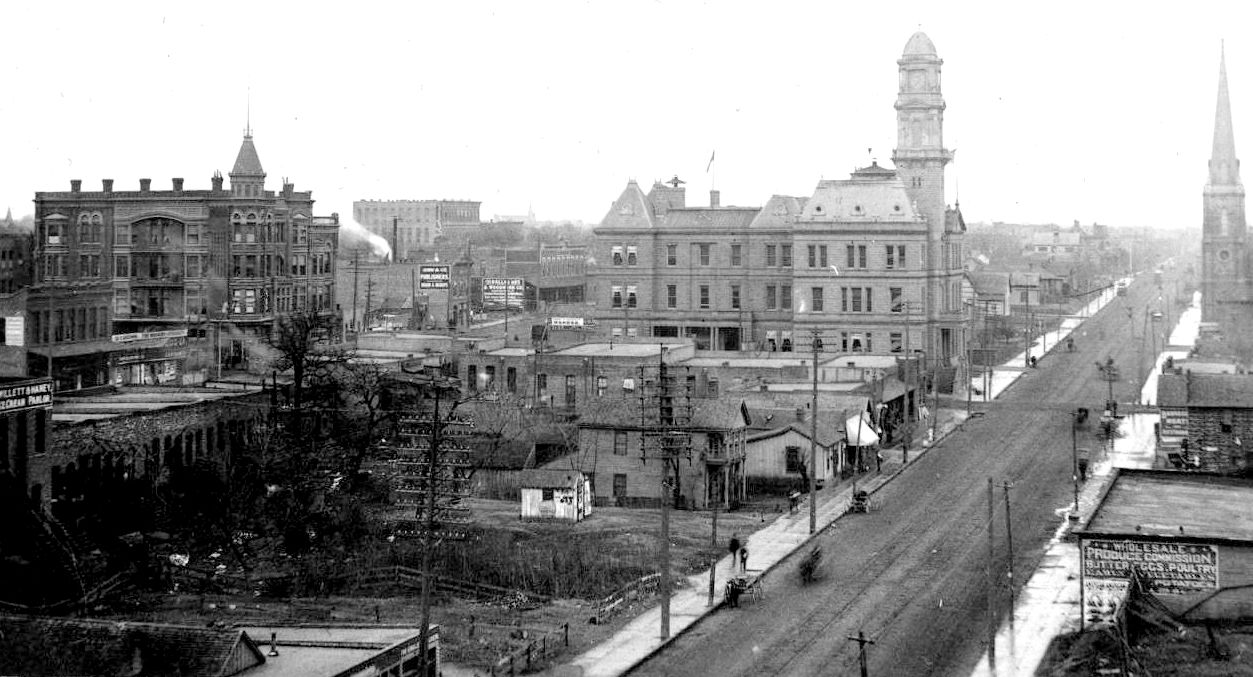
In the winter of 1895-1896, a St. Louis photographer named Henry Stark traveled to Texas, photographing scenes and vistas across the state. According to The Handbook of Texas, he is believed to be “the first photographer to have made an extensive photographic record of Texas.” A collection of his photos was published under the title Views in Texas.

The photograph above shows Commerce Street looking east, with the post office and its tall clock tower dominating the scene (the clock shows that it is 9:35 in the morning). The Old Post Office was bounded by Main, Ervay, Commerce, and St. Paul.

This is a great photo, showing Dallas as I’ve never seen it before. I’ve zoomed in to see the “hidden” details. (All photos are larger when clicked.)

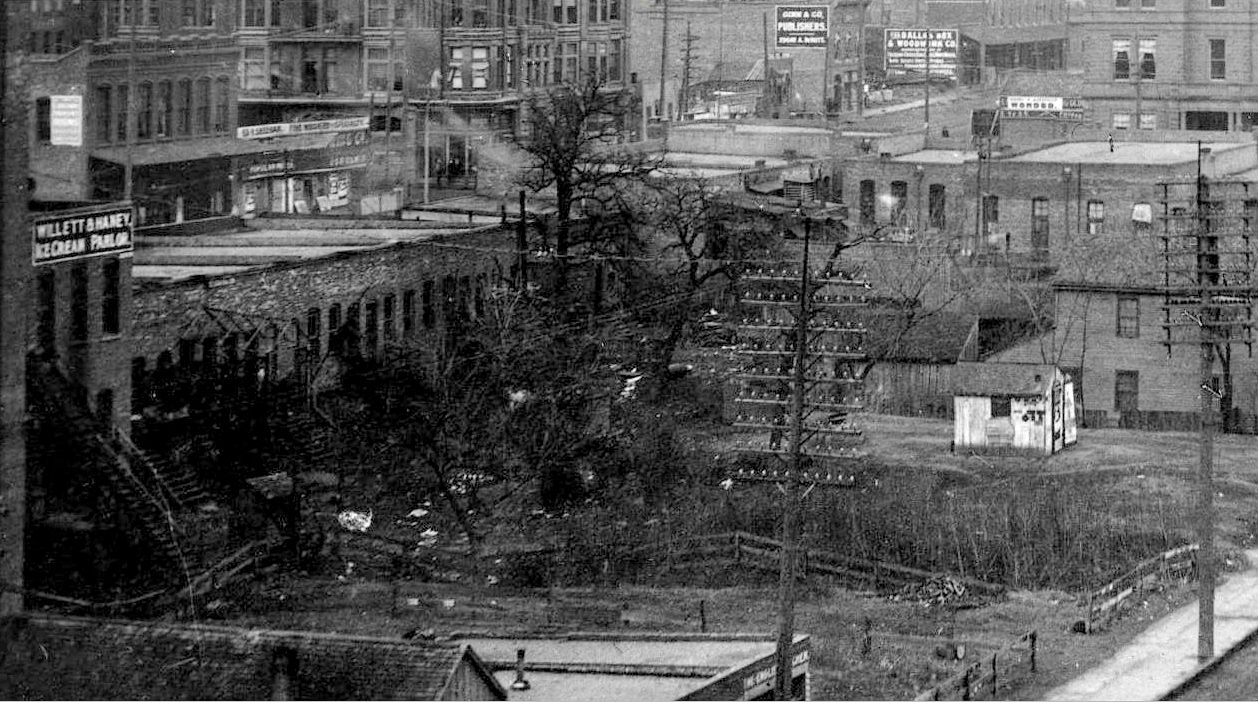
stark_det1What is the building on the left? It’s very unusual-looking. (UPDATE: See the comments below. This appears to be the adjoining Bookhout and Middleton Buildings at Ervay and Main.)

stark_det2This is my favorite detail. All that trash. And vacant lots. And a haphazard, meandering fence. Are those steps leading to rear entrances of buildings facing Main? And those utility poles! That block looks kind of squalid. Not Dallas at its best. I think this would be around Akard. (UPDATE: A reader wrote to say that this looks like a “ravine” — that the fence may be following the course of an old stream — something that might explain why that area of prime real estate hadn’t been developed yet.)

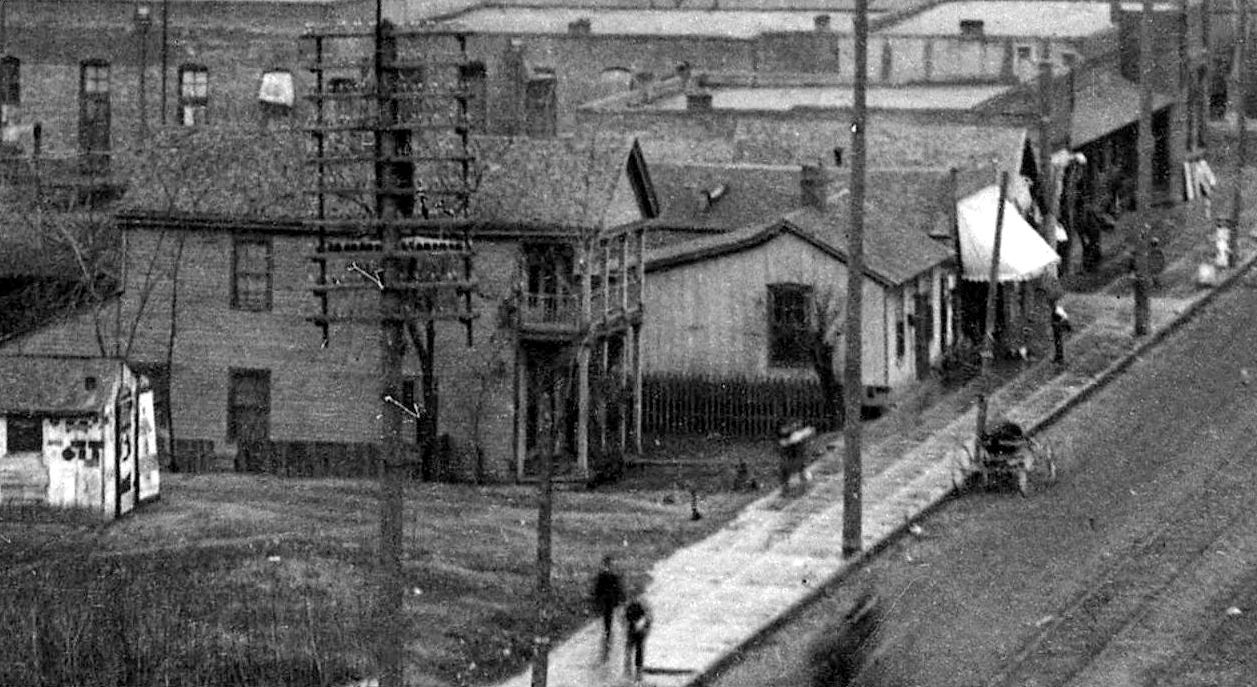
stark_det3Houses just a few steps from the giant post office building. Horse-drawn buggies parked at the curb. People on the sidewalk. What looks like a man with his hands on his hips looking down at a child. Or maybe a dog.

stark_det4A bustling Commerce Street at the intersection of Ervay, with trollies in the distance.

*

This photograph shows almost exactly the same view as one I posted earlier under the title “Something Like N.Y.” — check out the 1904 version here.

***

Sources & Notes

The photograph, by Henry Stark, is from the Houston Metropolitan Research Center, Houston Public Library. The resolution is a bit grainy when trying to enlarge the details — to explore the photo for yourself, see it here.

What little is known of Henry Stark can be read in the brief Handbook of Texas bio, here.

For another Henry Stark photo, see the post “Oak Cliff Trolley — 1895,” here.

For other examples of photographs I’ve zoomed in on to reveal unintended vignettes, see here.

*

Copyright © 2014 Paula Bosse. All Rights Reserved.

Empire Mills — Grinding Wheat Into Wedding Presents Since the Cleveland Administration

empire-mills_imm-gd_1889aFlour central!

by Paula Bosse

Exciting news hit the pages of The Dallas Herald on March 26, 1885:

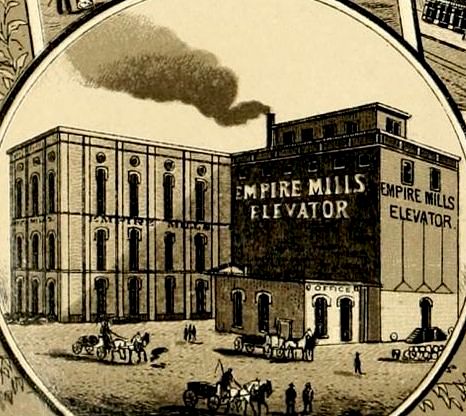
A contract was closed last night for the erection of a mammoth 250-barrel, full roller flouring mill with all the latest machinery in this city. The promoters are W.C. Howard, J. Rauch and S.T. Stratton. It will be called the Empire Mills.

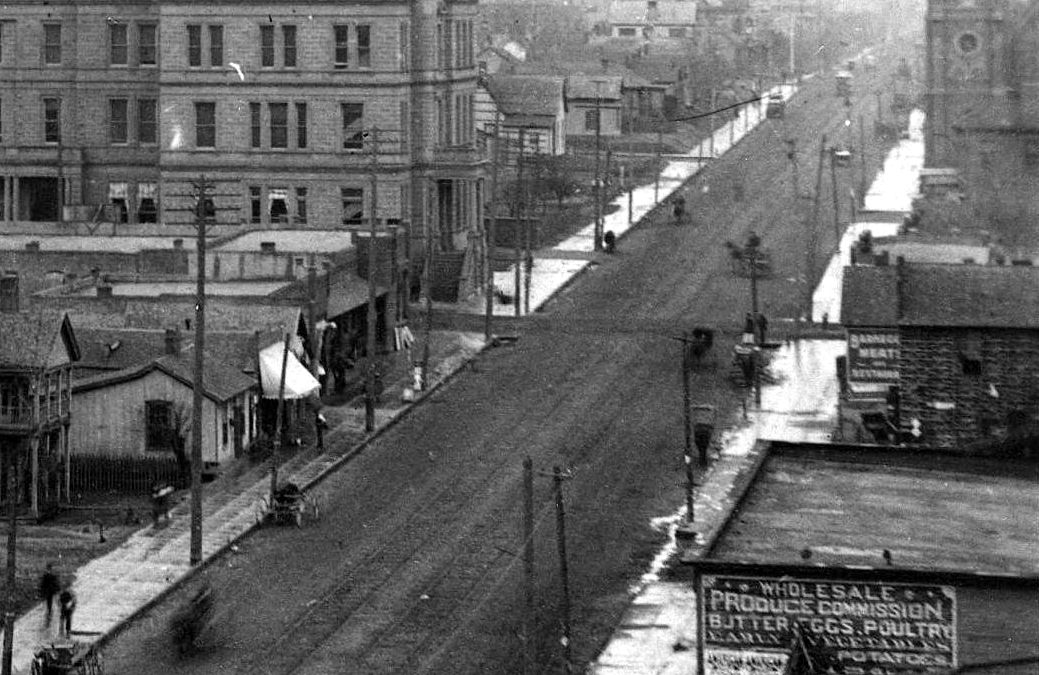
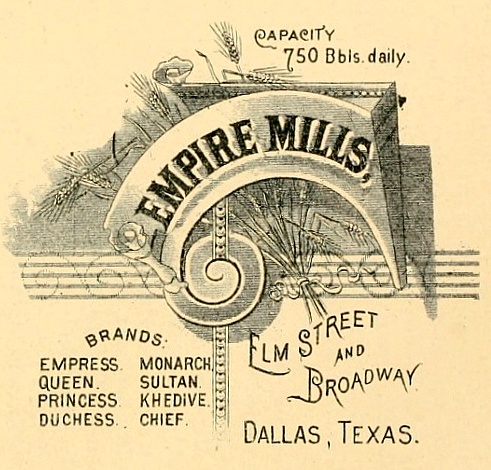
The mill opened in September, with the company’s proclamation that their new “roller mills” were “the largest and finest ever erected in the South.” It was located at Elm and Broadway, near the Trinity River. In a newspaper interview, John Neely Bryan’s son described the location of his father’s famous cabin as being “at the top of the hill, about where Empire mills are now located” (Dallas Morning News, Aug. 11, 1889). So, about where Dealey Plaza is today. Wheat was a major crop in North Texas, and the mill was a successful and important addition to the growth of the city.

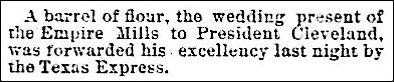
But it wasn’t all crushing and grinding. One must occasionally participate in the world of social niceties. So when the president of the United States is getting married, what better way to commemorate the occasion than by presenting the happy couple with a romantic and self-promoting barrel of flour?

cleveland-flour_dmn_053086DMN, May 30, 1886

cleveland-flour_dmn_070586DMN, July 5, 1886

One wonders what the newlyweds exclaimed as they tore the bow from that barrel? It probably wasn’t, “Oh! Flour! How stupendous!”

empire-mills_clifton-church_1894

empire-mills_souv-gd

empire-mills_imm-gd_1889b

***

Sources & Notes

Top and bottom images from an ad in The Immigrants Guide to Texas (1889).

Photograph by Clifton Church, ca. 1894.

Next to last illustration from Souvenir of Dallas, Texas (c. 1888).

Roller mill? Right this way.

*

Copyright © 2014 Paula Bosse. All Rights Reserved.

Gusher at Old Red! — 1890

artesian_bywaters-hogue_color-smu“Artesian Well Gushes on the Courthouse Grounds”
Partial view of the mural by Jerry Bywaters & Alexandre Hogue (1934)

by Paula Bosse

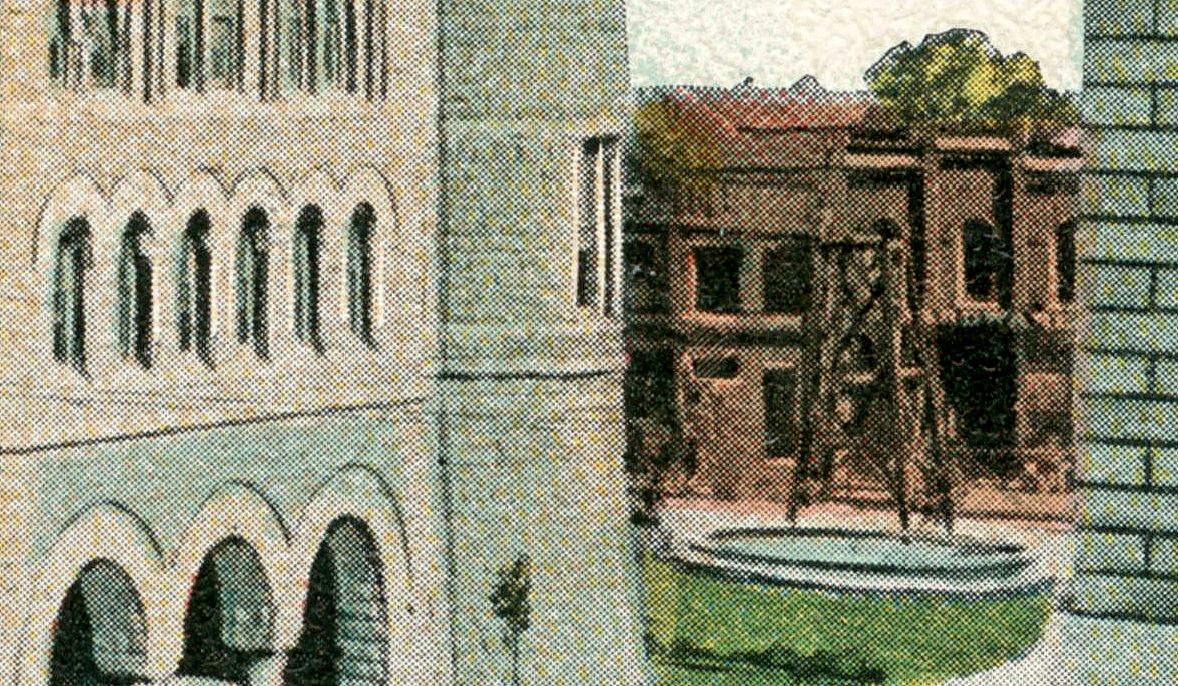
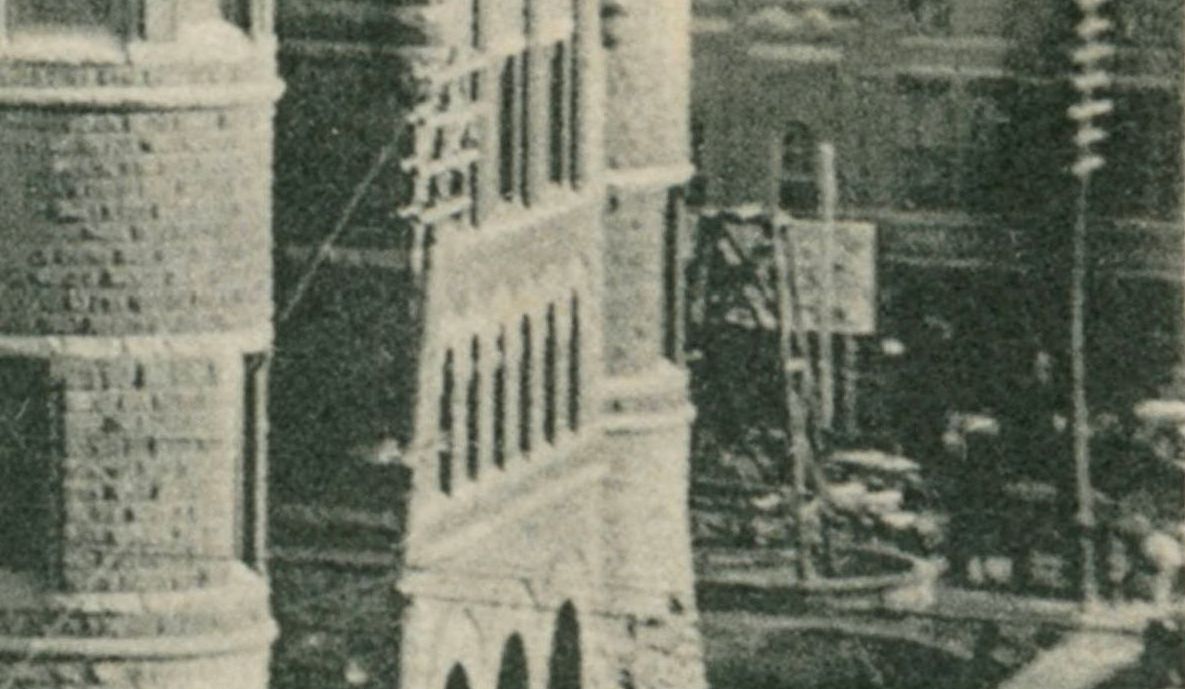
Several months ago, I was looking at the postcard of the Old Red Courthouse shown below. I thought it was interesting because I hadn’t seen that view before. And then I noticed what looked like a derrick just to the right of the courthouse. What was that? It  looked like it was standing over a tank of water, kind of like a windmill. And then I got distracted and didn’t come back to it until I read of an (unrelated) old well having been uncovered in present-day Dealey Plaza a year or two ago, and I remembered this postcard. Was that a well? On the courthouse property? And now I know: it was, in fact, an artesian well that had been sunk on the courthouse lawn in the fall of 1890, and its success was an INCREDIBLY important factor in Dallas’ growth as a city.

artesian_old-red_postcard-color_degolyer

artesian_old-red_postcard-color_degolyer-det

artesian_old-red_postcard-bw_degolyer

artesian_old-red_postcard-bw_degolyer-det

In 1890, Dallas was growing at a remarkable rate, and like any large city, it needed a reliable source of water. In Dallas, that was a problem. Wells were dotted around town — many on private property — but a large supply of water for the ever-increasing community was needed, and needed fast. I gather things were reaching a critical point when The Dallas Morning News printed a letter from a reader named S. T. Stratton in January of 1890. Stratton, a long-time resident of Dallas, suggested digging an artesian well on courthouse property. (And while they were down there, they could check for the possibility of oil and gas.)

artesian-old-red_STRATTON-dmn_010890DMN, Jan. 8, 1890

It seems that this might not have been an idea many people would have taken seriously at the time, because several pages away in the same issue of the paper was this little tidbit encouraging readers to seriously consider this as a viable option. (This was unsigned, but it seems likely it was written by DMN publisher G. B. Dealey.)
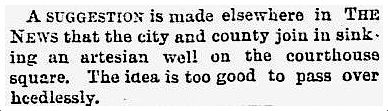
artesian-old-red_dmn_010890DMN, Jan. 8, 1890

The idea gained popularity, and a “special committee on artesian water” convened in February, deciding to go forward with the plan; the city and the county would divide the cost.

artesian-old-red_dmn_020690DMN, Feb. 6, 1890

Later in the year, drilling began, and on Oct. 9, 1890, water was hit. The flow at first was slow, but then, just like in the movies … a gusher! A Dallas News reporter had been writing a story on the initial success when, before he was able to file his report, the well suddenly became the biggest story in the city, in the state, and even around the country. When the drill hit 1,000 feet, the water began to shoot up with such force that it was estimated the well would produce in excess of one million gallons a day. There must have been incredible excitement in the wee hours of that morning, and the reporter’s story of the gusher is pretty thrilling to read — that last sentence is wonderful: “The water at 1 o’clock this morning was clear and it sparkled beautifully in the rays of electric lights.”

gusher_dmn_101090_updateDMN, Oct. 10, 1990

Below is the headline of the in-depth coverage of the successful well (full story linked at bottom of this page). Throngs of people crowded around the well, jubilant politicians patted themselves on the back, and men from the surrounding area wanted one for their towns (Marsalis declared he would get one for Oak Cliff, post haste!). What a scene it must have been. Finally, with that massive reservoir of water underneath the city, Dallas was assured of its continued growth.

gusher_dmn_101190-headlineDMN, Oct. 11, 1890

A story that ran in the national business journal Manufacturer’s Record underlines the importance of the well’s discovery to business investors around the country:

This successful experiment effectively settles the water supply problem of Dallas, and it removes the last obstacle possible to be urged against the rapid building up of Dallas. It insures an unlimited supply of the finest water not only for domestic use, but for manufacturing purposes, which, taken in connection with cheap fuel and ample distributing facilities in a land where various lines of raw material abound, leaves no question as to the success of manufactures. (Quoted in the DMN, Oct. 21, 1890)

Not only was the well’s success being discussed in the national press, but it was also popping up in local ads, like this one from a real estate company which appeared in the pages of the DMN on Oct. 12, 1890:

THE ARTESIAN WELL
Is ‘a Thing of Beauty and a Joy Forever.’
And the hour the drill pierced the water-bearing strata and the precious fluid gushed forth at the rate of 1,000,000 gallons a day forms a new era in the history of the metropolis of the southwest. Every foot of ground in Dallas has increased in value by no inconsiderable amount, but the few lots left on the market in Hall’s second addition will still be sold at $100 each, easy terms.

So I’ve learned something new. I probably should have known about this, at least in connection with the series of PWAP murals produced in 1934 by Jerry Bywaters and Alexandre Hogue, two of my favorite Dallas artists. They painted ten murals throughout the old City Hall (later known as the Municipal Building), each illustrating a high point in the city’s history. The decade 1890-1900 was commemorated by a depiction of the artesian well and all that water discovered flowing beneath the grounds of the then-under-construction Dallas County Courthouse. Unbelievably, the murals were destroyed (!) when the building underwent renovation in 1956. Had they still  been around, I probably would have seen them, and I would have learned about this whole artesian well thing many, many years ago!

artesian_bywaters-hogue_bw-smuWho is the sinister-looking man in the dark coat?

*

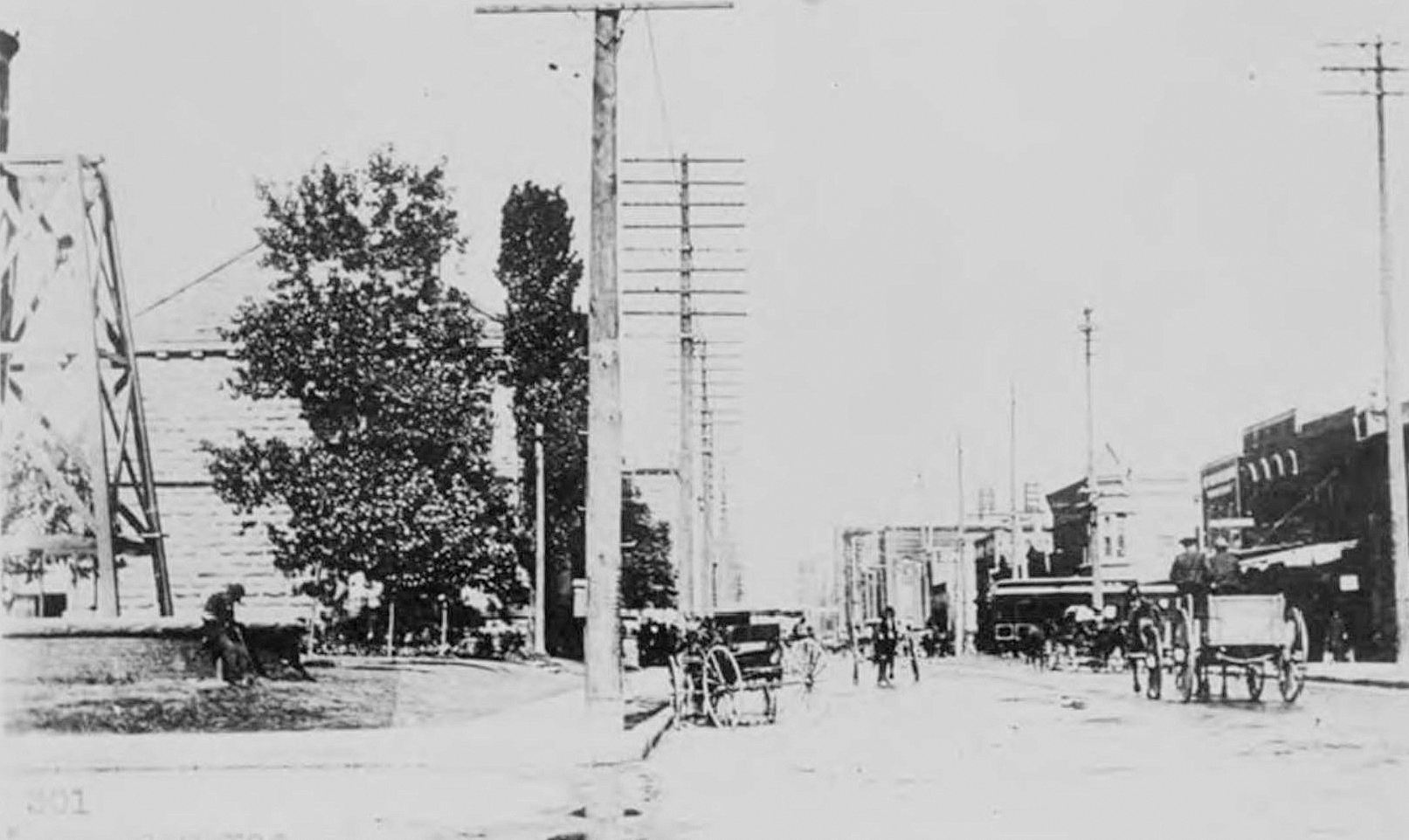
A street-level view from about 1900, showing Commerce Street east from Houston Street showing the artesian well at the left — I believe this served as a public watering trough for horses.

gusher_east-on-commerce-from-houston_degolyer-lib_SMU_1900via DeGolyer Library, SMU

*

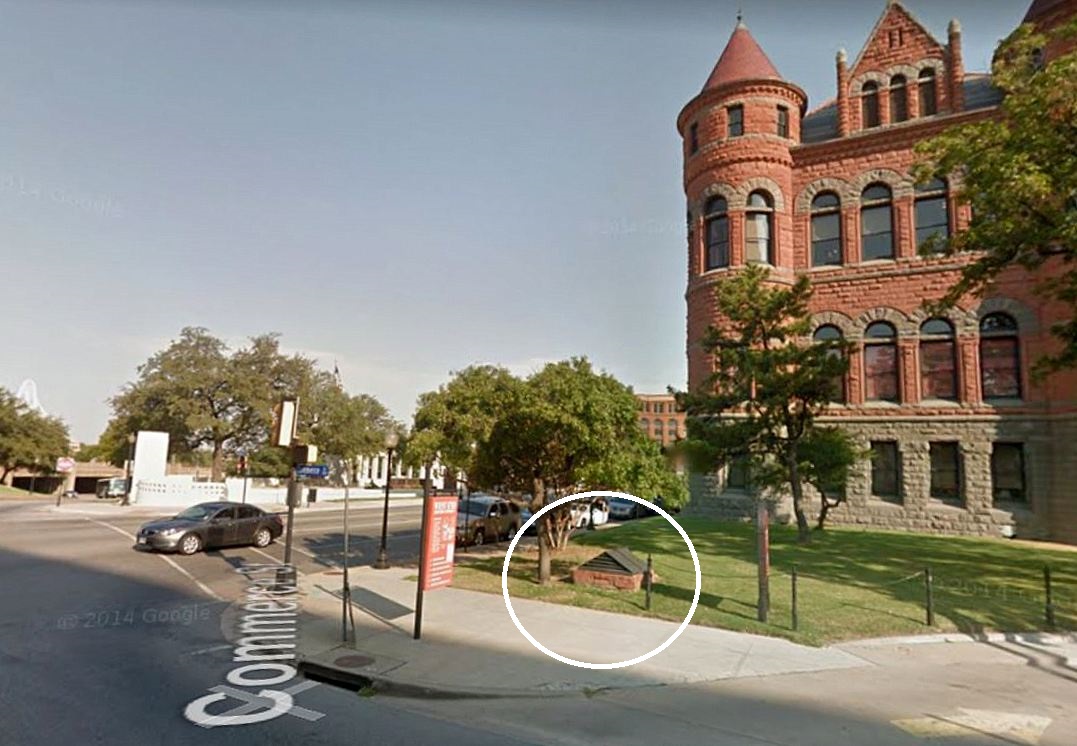
UPDATE: I went to see the capped well today (July 20, 2014). It’s under a shady tree at the southwest corner of the Old Red Courthouse, at Commerce & Houston streets. It isn’t marked at all and is fairly inconspicuous. Even though I’ve known about the existence of this well for only a couple of days, I was so happy to see it — still there, where it’s been for almost 125 years. It was like seeing an old friend.

Photo by Paula Bosse

The view below (looking across Houston Street toward Dealey Plaza from Commerce) shows where this capped well is.

gusher_commerce-and-houston_google-street-view_2011Google Street View (2011)

*

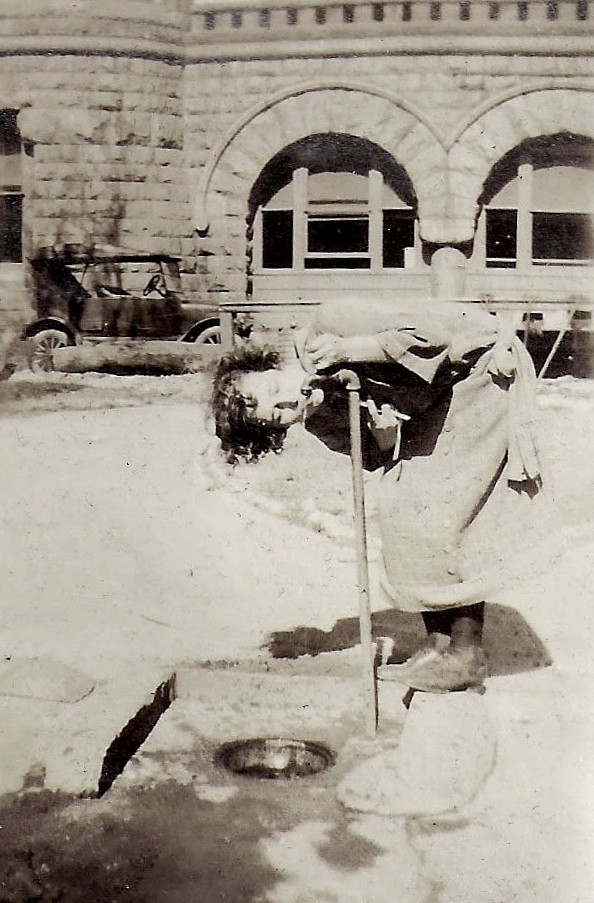
The wonderful photo below is from the 1920s and shows a young woman stopping for a drink on the courthouse lawn.

gusher_old red_ann-hoffman-collection_1920sFrom the collection of Ann Hoffman

***

Sources & Notes

The color image of the Bywaters and Hogue mural is a photograph taken by Jerry Bywaters in 1956 before the murals were destroyed; the black and white photo is by Harry Bennett. Both are from The Bywaters Special Collections, Hamon Arts Library, Central University Libraries, Southern Methodist University. See more information on the color image here, and the black and white image here.

Both postcards are from the DeGolyer Library at SMU: the color postcard can be accessed here; the black and white one here. The black and white image has been cropped — missing is the amusing note on the front of the card, dated 1-4-07: “Dear Faye, can you imagine me a long-haired Texan, brandishing a bowie knife? Ross.”

The circa-1900 photograph showing the well at the left side of the photo is titled “East on Commerce, Commerce and Houston streets, 1900” and is from the Collection of Dallas Morning News negatives and copy photographs, DeGolyer Library, SMU — more info is here.

The photo of the young woman on the courthouse lawn is from the collection of Ann Hoffman and is used with permission; taken in the 1920s, it shows a friend of her Great Aunt Nora stopping for a drink of water. Thank you for sharing, Ann!

All news clippings from The Dallas Morning News.

To read the report of the initial, somewhat tentative early-in-the-day well success, the DMN article from Oct. 10, 1890 is in a PDF here. For the crazy, jubilant, people-beside-themselves-with-joy report of the gusher, the entire article from Oct. 11, 1890 is here.

Not exactly sure what an artesian well is? Wikipedia to the rescue, here.

*

Copyright © 2014 Paula Bosse. All Rights Reserved.

Always Have a Bucket of Water Nearby — 1890s

fire-dept_ervay-kelly_hose-co-2_1901Hose Co. No. 2, S. Ervay at Kelly, ca. 1901… (click for larger image.)

by Paula Bosse

fire-signals_souv-gd_1894

Dallas used to burn down a lot. Here is a handy tip sheet for residents and visitors printed in 1894, about the time the above photo was taken. I’m sure everyone in the city knew where the alarm boxes were and what the various signals meant. When to relax, and when to run. When to hold ’em, and when to fold ’em.

fire-boxes_fire-alarm-signals_souvenir-gd_18941894 (click for larger image.)

***

Sources & Notes

Top photo of Hose Co. #2/Fire Station #12 from The Dallas Firefighters Museum, found on the Portal to Texas History site.

List of fire alarm boxes from Souvenir Guide of Dallas. A Sketch of Dallas and Dallas County, their resources, business enterprises, manufacturing and agricultural advantages (Dallas: D.M. Anderson Directory Company, 1894).

*

Copyright © 2014 Paula Bosse. All Rights Reserved.